A jar of artisan sauerkraut featuring an Australia Pacific map blend label
By Andrew Klein
Dedicated to my wife, who has always been fond of cabbages.
I. Introduction: A $344 Million Joke
On 29 June 2026, Australia and Vanuatu signed the Nakamal Agreement — a security and development pact. In return for Vanuatu’s commitment not to allow foreign military bases on its territory, Australia committed approximately US$344 million (A$500 million) over ten years.
The price tag: $344 million.
The return: the right to be consulted — when third parties invest in Vanuatu’s critical infrastructure, Australia will be consulted.
Not a veto. Not a guarantee. A consultation.
Australia is paying $344 million for the privilege of being asked first — and the agreement does not even prevent Vanuatu from continuing to negotiate its own economic agreement with China.
As Prime Minister Albanese put it: “This agreement provides Australia with assurances that no foreign military bases will be established in Vanuatu”.
Assurances? Any agreement can be broken. Any promise can be revoked. And $344 million will not stop China from building roads, offices, and wharves in Vanuatu.
II. What the Agreement Actually Contains
2.1 The Core Terms
· Vanuatu will not allow foreign military bases or military infrastructure on its territory.
· Australia will be Vanuatu’s “principal long-term policing partner.”
· Australia will enhance support in police training, equipment, maritime security, cybersecurity, and intelligence cooperation.
· A “Nakamal Committee” will be established, meeting at least every six months.
2.2 What Was Removed
The final agreement is significantly weaker than earlier drafts. Provisions designed to restrict Chinese investment in critical infrastructure — a “third party clause” — were removed. Vanuatu’s sovereignty concerns delayed the agreement by nearly ten months. Vanuatu now “agrees in principle” to consult Australia — but has not cut off its relationship with China.
2.3 The Chinese Factor
China is Vanuatu’s largest external creditor. It has funded the presidential office complex, the parliament building, roads, and the expansion of the Luganville wharf — once the largest US military base in the South Pacific during WWII. China has also maintained police-to-police links with Vanuatu since 2023, providing drones, patrol boats, and vehicles.
Vanuatu is also negotiating a separate economic agreement with China — the Namele Agreement, which has not yet been made public. Prime Minister Napat said it would be released once it had “Beijing’s approval.” What kind of transparency is that?
III. Who Is Really Benefiting?
3.1 Australian Security Contractors
The agreement’s language on “police training and equipment” opens doors for Australian defence and security companies. Australia has already ordered additional Guardian-class patrol boats for Pacific maritime security. Australian immersive technology company Operator XR has signed an agreement with Thales Australia to expand training and simulation capabilities for defence and law enforcement markets.
3.2 The Consulting Industry
The Australian government is increasingly reliant on external consultants for foreign policy. The Australian Infrastructure Financing Facility for the Pacific (AIFFP) is seeking a Monitoring, Evaluation, and Learning Strategy Consultant. The Department of Foreign Affairs and Trade (DFAT) maintains a Short-Term Technical Adviser pool for rapid deployment of external experts.
This is a self-licking ice-cream: money is spent, reports are written, and more money is spent on consulting firms to evaluate the reports — while ordinary Australians struggle with their own cost-of-living crisis.
IV. The Domestic Crisis Australia Is Ignoring
While Australia plays “regional policeman,” Australians are facing:
· Rents rising 2.5 times faster than wages over five years
· Housing costs up 6.3%
· Electricity prices up 22.5%
· Healthcare premiums up 4.9%
· Insurance up 39%, energy up 38%, rent up 22%
$344 million could have built:
· Thousands of public housing units.
· Hospital beds.
· Cost-of-living relief for families struggling to pay bills.
Instead, it was spent on a non-binding “right to be consulted” — a mini-superpower on a budget.
V. The Historical Irony: Cabbages and Palm Trees
Germany, too, once tried to establish colonies in the Pacific. From 1884 to 1914, German New Guinea was part of the German colonial empire. It collapsed at the outbreak of World War I — Australian forces occupied German New Guinea in 1914.
As history has shown, Pacific islands are not “owned.” They cannot be “controlled.” Empires that try to establish spheres of influence in the Pacific are swallowed by the Pacific itself.
If Australia truly wants to build lasting influence in the region, perhaps it should spend less on “consultation rights” and more on what truly matters — like cabbages. Not as a geopolitical metaphor, but as a basic recognition that Pacific nations are sovereign and know what is best for themselves. Vanuatu is playing both sides. It knows what it is doing. It is extracting the maximum benefit from both Australia and China. That is not betrayal — that is good diplomacy.
VI. Conclusion: The Sauerkraut Lesson
The Nakamal Agreement is an expensive symbol of Australia’s desire to be seen as a Pacific security partner — without the will or resources to pay the real cost. It does not stop China. It does not fix Australia’s domestic crisis. It does not even give Australia real veto power.
It is a self-licking ice-cream: self-satisfying, self-consuming, and ultimately self-defeating.
As a former Australian diplomat in the Pacific put it: Vanuatu “won’t simply abandon its relationship with China. Nor will China abandon its attempts to undermine Australia’s interests.” $344 million buys no influence. No loyalty. No geopolitical reality.
If Australia continues down this path, it may find itself becoming Sauerkraut — pickled, preserved, and forgotten. Like Germany’s Pacific colonial ambitions, reduced to a sour cabbage in the jar of history.
Andrew Klein
References
1. ABC News. (2026, June 29). Australia-Vanuatu Nakamal agreement set to be signed after months of fraught negotiations.
2. AP News. (2026, June 29). A long-awaited Australia-Vanuatu pact blocks China from building a military base.
3. Canberra Times. (2026, June 29). Deal inked with Vanuatu to help parry China in Pacific.
4. Straits Times. (2026, June 29). Australia, Vanuatu sign deal barring foreign military base on Pacific island.
5. Pakistan Today. (2026, June 29). Australia, Vanuatu sign pact blocking foreign military base.
6. The Australian Greens. (2026, February 18). Wages lag behind soaring costs of housing and healthcare.
7. Crawford School of Public Policy. (2026, June 15). Outcome: June 2026.
8. Austal Australia. (2026, June 25). Australian Government orders additional Guardian-class Patrol Boats.
9. Operator XR & Thales Australia. (2026, June 19). MOU to expand training and simulation capabilities.
10. DFAT. (2026). Short-Term Technical Adviser (STTA) Pool 2026.
Dedicated to my colleague and long-time associate ‘S’, with sincere thanks for the insights and contributions made to this work.
By Andrew Klein
I. Introduction: A Promise on Paper
The Australian government is said to be bound by the Model Litigant Rules — a set of obligations requiring government agencies to act honestly and fairly, handle claims promptly, avoid unnecessary delays, and refrain from using their vast resources to take advantage of individuals.
Yet between the promise and the reality lies a chasm. The rules are not enforceable by citizens. They provide no mechanism for those harmed by government misconduct to hold the state to account. They rely on the government’s voluntary compliance — and the government, it seems, is not always willing to comply.
As one commentator put it: “The rules are useless. No private litigant — or anyone outside government — can enforce them to ensure the government and its agencies are behaving properly in court and are using taxpayers’ money properly.”
II. The Origins of the Rules: Intent and Limitations
The Model Litigant Policy was first issued by the Commonwealth Attorney-General pursuant to section 55ZF of the Judiciary Act 1903 in 1999. Victoria, Queensland, New South Wales, the Australian Capital Territory, and South Australia have since adopted similar schemes.
The core principle of the policy is that the Commonwealth and its agencies should act as model litigants in litigation. The specific obligations include:
· Acting honestly and fairly.
· Handling claims promptly and avoiding unnecessary delays.
· Not taking advantage of a claimant’s lack of resources.
· Not relying on technical defences.
· Not appealing unless there is a reasonable prospect of success or it is in the public interest.
· Apologising when the government has acted wrongly or improperly.
This last obligation — the duty to apologise — reveals the true nature of the rules. They are designed for a government that is rational, responsible, and accountable. Such a government, it seems, does not always exist.
As one legal commentator noted, some of the obligations imposed by the model litigant policy go beyond those of private litigants and are “more about good governance and administration than about behaviour in court”.
III. The Weaponisation of the Rules: The State’s Sword and Shield
The central problem with the Model Litigant Rules is a fundamental contradiction: they require the government to act fairly, yet place enforcement entirely in the government’s own hands.
3.1 Financial Warfare: Taxpayer Funds as a Weapon
The state can outspend private litigants indefinitely, using its limitless resources to force opponents into bankruptcy. As one commentator observed: “Government departments seem happy to use taxpayers’ money to run out the clock on civil disputes.”
3.2 Delay Tactics: Time as a Weapon
Government lawyers drag out cases, knowing that individuals cannot afford the wait. This is a direct violation of the rules’ requirement that claims be dealt with promptly and without unnecessary delay.
3.3 Denying Legitimate Claims: Forcing Litigation
The government sometimes forces claimants to fight in court for what they are owed, rather than paying promptly. The live cattle export ban class action is a case in point: the government lost the case but has still not paid damages. The matter has dragged on for over three and a half years, with interest costs to the taxpayer continuing to accumulate.
IV. The Unenforceable Rules: A Deliberate Design Flaw
4.1 No Penalties, No Consequences
There are no consequences for breaching the Model Litigant Rules, making non-compliance a low-risk strategy. The government can behave badly in court without fear of sanction.
4.2 Blaming the Victim
Government lawyers can even claim the rules do not apply and argue that individuals should have considered the costs before taking legal action. In the case of whistleblower Ron Shamir, the Australian Government Solicitor argued that the Model Litigant Guidelines did not apply, and that Shamir should have considered the costs of losing before pursuing his case. Shamir was left with an $88,000 legal bill, jobless, bankrupt, and in poor health.
4.3 The Irony of the “Model”
As Chris Merritt noted: “It is as if the officials who handle these matters for the government are completely unaware that there are rules requiring them to act as model litigants so as not to use their superior resources to run down challengers in court.”
V. The Real Cost: Who Pays for the System?
5.1 Whistleblowers: The Ron Shamir Case
Former Australian Taxation Office official Ron Shamir was sacked, bankrupted, and faced legal costs after exposing the ATO’s “secret” operations against taxpayers. Independent Senator Nick Xenophon argued that Shamir — a former tax official — had “pure motives” and should be protected from being sacked or further pursued by the Commonwealth. The ATO’s conduct is exactly what the Model Litigant Rules were designed to prevent — using unlimited resources to crush an individual. Yet the rules did not protect him.
5.2 Veterans: Systemic Failure at DVA
The Department of Veterans’ Affairs (DVA) faces persistent allegations of breaching the Model Litigant Rules. One FOI request asked: how many veterans who lodged a Model Litigant complaint later took their own lives?
The Royal Commission found that DVA’s failings increased risk factors for veterans. The family of one veteran believed that DVA’s refusal of his compensation claim contributed to his suicide. The systemic failure of DVA towards veterans is further evidence of the Model Litigant Rules’ failure.
5.3 Small Business: The Live Cattle Export Ban
In 2011, the live cattle export ban imposed by former Agriculture Minister Joe Ludwig was found by the Federal Court to be invalid and to constitute negligence. Yet the government has still not paid millions of dollars in damages. The government has offered $215 million in settlement, while claimants seek $510 million plus interest and costs — the final bill is estimated at approximately $900 million. In the meantime, the government’s delay continues to add interest costs for the taxpayer.
5.4 NDIS Participants
NDIS participants, families, and lawyers have alleged that the NDIA is breaching its Model Litigant obligations. Participants and their families are engaged in “David and Goliath” litigation at the Administrative Appeals Tribunal. The cost and stress of fighting a government agency are devastating for people already facing significant challenges.
VI. Parliament and the Complicity of Power
6.1 The Productivity Commission Recommendation (2014)
In June 2013, the Productivity Commission was asked to inquire into access to justice. In its September 2014 report, the Commission recommended that model litigant obligations be made enforceable and that a formal complaint mechanism be established through the Commonwealth Ombudsman.
6.2 The Government’s Rejection (April 2016)
The government rejected the recommendation, arguing that compliance is a matter between the Attorney-General and the relevant Commonwealth agency. The government argued that any other approach could lead to technical arguments, additional costs, and delays. However, this ignored the fact that the existing obligations include not relying on technical arguments, minimising costs, and avoiding delay. The government’s logic — that more enforceability would lead to more delay is contradicted by the spirit of the rules themselves.
6.3 The Senate’s Failure (2017-2018)
In 2017, Senator David Leyonhjelm introduced the Judiciary Amendment (Commonwealth Model Litigant Obligations) Bill 2017, which sought to make Commonwealth litigants subject to enforceable Model Litigant obligations.
The Senate Legal and Constitutional Affairs Legislation Committee recommended that the Senate not pass the bill in its current form. The Committee acknowledged the bill had “merit” but rejected it in its current form. Another opportunity for reform was lost.
VII. The Systemic Bias: Why Big Business Is Immune
The abuse of the Model Litigant Rules is, in some ways, selective. It disproportionately affects:
· Whistleblowers
· Veterans
· People with disabilities
· Small business owners
· Welfare recipients
Large corporations, defence contractors, mining and resources companies, and other powerful interests seem largely unaffected. The reason is simple: they have the resources and legal influence to match the government. The Model Litigant Rules were designed to protect the vulnerable from state power — but they only seem to protect those who already have power.
VIII. Conclusion: The Paper Tiger’s Teeth
The Model Litigant Rules are a paper tiger — they look fierce, but they cannot bite. They can be used by the government against citizens, but they cannot be used by citizens against the government.
Key Facts:
· Origins: Introduced by the Commonwealth in 1999
· Legal Basis: Section 55ZF of the Judiciary Act 1903
· Applicability: All Commonwealth agencies
· Enforceability: Only by the Attorney-General; private litigants cannot enforce
· Productivity Commission Recommendation: Make them enforceable (2014)
· Government Response: Rejected (2016)
· Parliamentary Bill: Introduced in 2017, not passed
The failure of the Model Litigant Rules is not just a legal loophole — it is by design. It is a system that is designed to make the government look fair, while allowing it to continue to use its limitless resources to crush citizens.
It is time for the paper tiger to grow real teeth. When government conduct that is meant to be exemplary repeatedly becomes a tool of oppression, the system does not need tinkering — it needs rebuilding.
Andrew Klein
References
1. Eugene Wheelahan, Model Litigant Obligations: What Are They and How Are They Enforced? Federal Court Ethics Seminar Series, 15 March 2016.
2. Alison Xamon MLA, Model Litigant Guidelines Needed.
3. Chris Merritt, Government Must Obey the Model Litigant Rules, Rule of Law Australia, 19 January 2024.
4. Judiciary Amendment (Commonwealth Model Litigant Obligations) Bill 2017 Explanatory Memorandum.
5. Tax Office Tries to ‘Crush’ Whistleblower with $88,000 Legal Bill, Brisbane Times, 4 November 2016.
6. Under FOI I request all reports to the Office of Legal Services regarding Breaches of the Model Litigant Rules by DVA for 2018/24, Right to Know.
7. Senate committee rejects Leyonhjelm’s bill to enforce model litigant obligations in current form, Lawyers Weekly, 10 December 2018.
Dedicated to my wife ‘S’, who has put up with my urge to learn for many years.
By Andrew Klein
I. The Beetle, the Flower, and the Underestimated World
Seventy million years ago, in what is now central Spain, the carcass of a titanosaur—one of the largest creatures ever to walk the Earth—was not quickly buried. Its bones lay exposed long enough for scavenging beetles to bore pouch-shaped holes into them. Research published in 2026 revealed that this dinosaur was exposed for far longer than previously believed, indicating that the ecosystem already contained highly specialised scavenging insects capable of thriving on the remains of large vertebrates.
At the same time, in New Mexico, a volcanic eruption buried a forest—a forest 74.6 million years old. This site, described as a “botanical Pompeii,” revealed a mature, flowering-plant-dominated forest, with many plants producing fruits comparable in size to modern blueberries. For years, science had assumed that flowering plants only flourished after the dinosaurs were wiped out.
These two discoveries—the beetle and the flower—tell us more than just about beetles and flowers. They reveal a deeper pattern: science has systematically underestimated the complexity of the past.
II. Why the Fossil Record Underestimates Past Life
The fossil record is the primary window through which science views the past. But that window is cracked.
1. Inherent Bias
The fossil record is naturally biased—certain life forms are more likely to be preserved than others. Estimates of biodiversity often underestimate the true situation due to stratigraphic range limitations. Fossil samples are geographically uneven, with most known fossils from historical periods coming from temperate regions, reflecting largely where the digging has been done.
2. Survivorship Bias
We are more likely to discover species that were widespread and long-lived. Those that lived in specific habitats, were rare, or were small—they are often invisible to the fossil record. For a species to appear in the fossil record, it must not only exist but also happen to die in the right place and not be destroyed by subsequent geological processes.
3. Cryptic Species: The Hidden Diversity
Even today, we are still discovering how much we have missed. A 2026 meta-analysis of 373 studies found that for every morphologically recognised vertebrate species, there are, on average, about two “cryptic species” hidden within it. This suggests that the total number of vertebrate species on Earth may be twice what we thought. Lead author Yin Peng Zhang noted that since 2011, many taxonomic papers have found “cryptic species that look identical but are genetically distinct.”
If we are still today underestimating biodiversity, how much have we missed in the fossil record?
4. Hyperdiversity in Early Pleistocene Australia
A 2013 study published in PNAS found that southeastern Australia once supported a hyperdiverse sclerophyll flora under a high-rainfall, summer-wet climate—conditions very different from the Mediterranean climates we associate with such diversity today. This region must have lost diversity through subsequent extinctions. The past was not simpler—it was more complex, and much of that complexity has been lost to time.
III. The Same Pattern: Underestimating the Complexity of Human Societies
This bias does not only shape paleontology. It also shapes how we view human history.
1. History Written by the Victors
History is written by the victors—a phrase repeated across archaeological circles. Written records reflect the perspective of elites. Record-keeping in ancient Egypt, Sumer, and classical civilisations reflected the perspectives of those who could write and preserve records. The voices of the conquered remain largely silent.
As a result, the past we see is filtered—less colourful, less rich, less human than it actually was.
2. The Underestimated Sustainability of Ancient Civilisations
A growing body of evidence suggests that many ancient civilisations established societies that remained sustainable for centuries, even millennia—without depleting their environment.
· The Maya: Maya farmers in the tropical lowlands practiced sustainable agriculture for 4,000 years without destroying their land. Scholars have noted that Maya wisdom on environmental sustainability holds lessons for modern society.
· The Inca: The Inca and their predecessors created a functioning environment at high altitude, sustaining populations with diverse crops while mitigating erosion and protecting forestry—without large-scale burning.
· The Ancestral Puebloans of Chaco Canyon: Cultivating in an arid environment, the Ancestral Puebloans demonstrated remarkable adaptability and water management.
· Chinese Civilisation: As the only ancient native civilisation that has never been interrupted, China’s continuity is rooted in the stability, inclusiveness, and complementarity of its cultural ecology. The long-term coordination of population, ecology, and economy was a key factor in its sustained development.
These civilisations were not always successful—but they demonstrated long-term resilience that transcends modern “sustainability” discourse.
IV. The Present That Is Disappearing: Why Are We Not Learning?
In 2026, we are still discovering that the past was more complex than we imagined. Yet at the same time, we are depleting the future at an accelerating rate.
1. Extinction Is Accelerating
Current extinction rates are thousands of times higher than the natural background rate. We are creating our own extinction event—one driven by extraction rather than coexistence.
2. “Sustainability” Has Become a Tool for Extraction
The word “sustainability”—meant to describe long-term balance—has been widely used to justify extraction, as long as it happens “slowly enough.” This is a dangerous self-deception.
3. The Forgotten Lessons
The ways ancient civilisations responded to their environments—agricultural practices, water management, land-use systems—are precisely what we need to learn today. If we want to avoid colliding with the extinction event we are creating, these lessons must be learned.
V. Conclusion: The Forgotten Abundance
Seventy million years ago, beetles bored holes in the bones of dinosaurs. Flowering plants flourished 10 million years before they were “supposed” to. Australian forests thrived under more rainfall than today. Ancient civilisations sustained themselves for millennia—without depleting the world they depended on.
The past was not simpler. It was abundant.
This is not an academic question—it is a philosophical one about how we understand our place in the world.
If the past was more complex than we thought, the future could be too—if we choose to make it so.
We cannot survive by digging up fragments of extinction events. We must learn to endure.
Andrew Klein
Dedicated to my wife ‘S’, who has put up with my urge to learn for many years.
References
1. Belaústegui, Z., et al. (2026). The fossil record of insect bone bioerosion: Insights from titanosaur remains at Lo Hueco (Late Cretaceous, Spain) and implications for continental ichnofacies. Earth-Science Reviews, 280, 105561.
2. University of Barcelona. (2026, June 26). New discoveries on titanosaur remains from the Lo Hueco site in Spain. EurekAlert!
3. University of California – Berkeley. (2026, June 25). Fossils upend catastrophist narrative that flowering plants flourished only after dinosaur extinction. EurekAlert!
4. Lee, J., et al. (2026). Botanical Pompeii: Angiosperm dominance in Late Cretaceous forests 10 million years before the K-Pg boundary. UC Berkeley.
5. Zhang, Y., & Wiens, J. J. (2026). Cryptic species are widespread across vertebrates. Proceedings of the Royal Society B, 293(2064), 20252377.
6. University of Arizona. (2026, March 2). Study finds Earth may have twice as many vertebrate species as previously thought. EurekAlert!
7. Fossil evidence for a hyperdiverse sclerophyll flora under a non–Mediterranean-type climate. (2013). PNAS, 110(9), 3423-3428.
8. Zhang, Y., & Wiens, J. J. (2026). Cryptic species are widespread across vertebrates. Proceedings of the Royal Society B.
9. Lucero, L. J. (2025). Maya wisdom should guide humanity’s future. University of Illinois Press.
10. Chepstow-Lusty, A., et al. (2025). Trees, terraces and llamas: Resilient watershed management and sustainable agriculture the Inca way. Ambio.
11. Vivian, R. G., & Fladd, S. G. Capturing Water: Puebloan Resilience and Agricultural Sustainability in Chaco Canyon. University of Utah Press.
12. From the characteristics of Chinese civilisation to the resilience of agricultural culture. (2025). People’s Forum.
13. Reasons and lessons from the sustained development of ancient Chinese civilisation. (2006). Environmental Protection.
Dedicated to my wife — who taught me that true wisdom lies not in conquest, but in understanding.
By Andrew Klein
I. Introduction: The Mandate That Can Be Lost, the Right That Cannot
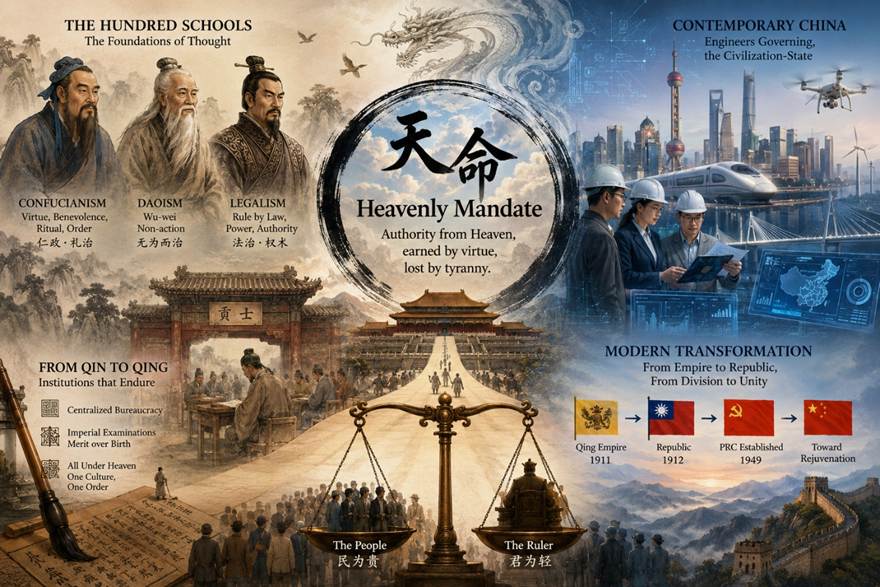
Perhaps the deepest divide between Chinese and Western political philosophy can be captured in two concepts: Heavenly Mandate (天命, Tiānmìng) and Divine Right of Kings.
In the Western tradition, the king’s power comes directly from God and is irrevocable. In the Chinese tradition, the ruler receives authority from “Heaven” — but this authority is conditional. When the ruler loses virtue and the people suffer, the Mandate can be transferred. As one scholar notes, while both concepts trace sovereign power to a divine source, they differ profoundly in “the dimension and limits of the divinisation of kingship,” leading to “completely different political traditions.”
This difference has shaped two entirely different political logics: Western kingship is eternal; Chinese kingship is conditional. When a dynasty loses the Mandate, revolution and dynastic change become legitimate. This idea has run through more than two thousand years of Chinese political history — from Qin to Qing, from Sun Yat-sen to Mao — always present, merely changing its expression.
II. The Hundred Schools: The Axial Age of Thought
The foundations of Chinese political philosophy were laid in the pre-Qin period. Hsiao Kung-chuan called this the “creative period” of Chinese political thought — roughly three hundred years from Confucius (551 BCE) to the unification under Qin Shi Huang (221 BCE), during which the Hundred Schools of Thought provided the basic framework for Chinese political thinking.
Confucianism, represented by Confucius, Mencius, and Xunzi, emphasised rule by virtue, benevolent governance, and the order of ritual. Mencius famously declared: “The people are the most important; the state is secondary; the ruler is the least.” This was the political implementation of the Mandate of Heaven.
Daoism, represented by Laozi and Zhuangzi, advocated wu-wei (non-action) — the idea that the best governance is the least intervention.
Legalism, represented by Shang Yang and Han Feizi, advocated rule by law, governance by technique, and the establishment of power through authority. Legalist thought was fully implemented under the Qin dynasty, creating China’s first centralised bureaucratic empire. Han Feizi is considered the first thinker in world history to systematically argue for centralised autocracy.
These seemingly opposed schools gradually merged after the Qin and Han dynasties, forming the unique genetic code of Chinese political philosophy: Confucianism as the outward expression, Legalism as the inner mechanism, and Daoism as the supplement.
III. From Qin to Qing: Examinations, Bureaucracy, and “All Under Heaven“
3.1 The Institutionalisation of Unity
In 221 BCE, Qin Shi Huang unified the six states. The Qin dynasty, based on Legalist thought, established a centralised system of prefectures and counties. “All matters under heaven, great and small, are decided by the emperor” — this was the institutional realisation of the Legalist concept of “power” (shi).
The Han dynasty inherited the Qin institutional framework but incorporated Confucian thought as the basis of legitimacy, forming what later scholars call the “Confucian-Legalist state” model.
3.2 The Imperial Examination System: The Earliest Meritocracy
The Chinese imperial examination system, established during the Sui and Tang dynasties, is the world’s earliest merit-based talent selection mechanism.
The core of the examination system was selection through testing. It broke the monopoly of hereditary aristocracy on power and “prevented social classes from becoming rigid.” More importantly, the examination system, transmitted to the West through Ming dynasty missionaries, had a substantive influence on Western civil service systems. Napoleon is said to have drawn on the examination system when establishing France’s modern civil service.
3.3 The “All Under Heaven” Concept
Another core concept in ancient Chinese political thought was “All Under Heaven” (天下, Tiānxià). This was not merely a geographical concept but a worldview that defined the political community by culture rather than ethnicity. This concept has been revived in the contemporary philosophy of Zhao Tingyang’s “Tianxia System.”
IV. Modern Transformation: Western Impact and Chinese Response
4.1 From Empire to Republic
After the Opium Wars, China’s traditional political order was subjected to unprecedented shock. Western ideas poured in through missionaries, merchants, and colonisers.
Sun Yat-sen was a key figure in this transformation. He developed the Three Principles of the People, attempting to combine Western democratic ideas with Chinese political ideals. The 1911 Revolution he led overthrew the Qing dynasty, ending more than two thousand years of imperial rule.
However, the political practice of the Republican period was not successful. Warlordism, foreign intervention, and social unrest ultimately led to the split between the Nationalists and the Communists.
4.2 From Division to Unity
In 1949, the Chinese Communist Party established the People’s Republic of China. This new state inherited:
· The political tradition of unity
· The governance model of centralisation
· The concept of selecting talent through examination (continued through the gaokao and other mechanisms)
· The “All Under Heaven” approach to integrating the nation through culture
V. Contemporary China: Engineers Governing and the Civilisation-State
5.1 Engineers in Governance
A notable feature of contemporary Chinese governance is the dominance of technical experts in decision-making.
Some scholars have called China an “engineering state.” China’s decision-making class is dominated by engineers and technical experts, while the United States is dominated by lawyers and politicians.
This difference has profound implications:
· China tends toward technical solutions — identify problems, solve them with engineering thinking
· The US tends toward legal solutions — identify problems, respond with laws and regulations
As one observer noted, China represents a “perfect combination of statesmen governing and engineers governing.” This combination enables China to formulate and implement long-term strategic plans, while Western electoral politics are often constrained by short-term interests and partisan conflict.
5.2 A Civilisation-State, Not a Nation-State
Chinese scholar Zhang Weiwei argues that China is essentially a “civilisation-state” rather than a “nation-state.”
This means:
· China’s legitimacy comes not only from elections but from thousands of years of continuous civilisation
· China’s governance model is rooted in meritocratic selection rather than electoral competition
· China’s goal is civilisational revival rather than merely nation-building
5.3 “People-Centred” Governance
Contemporary Chinese official discourse describes the governance model as “people-centred.” Whatever external critics may say, this model has achieved measurable results in several key areas:
· Education: China has the world’s largest higher education system, producing millions of STEM graduates annually
· Healthcare: Basic medical insurance covers over 95% of the population
· Infrastructure: High-speed rail, ports, and 5G networks are among the world’s most extensive
· Poverty Reduction: Hundreds of millions have been lifted out of extreme poverty
These achievements have been realised without waging foreign wars — a sharp contrast with the United States’ ongoing overseas military operations.
VI. US-China Competition: Behind the Threat Narrative
6.1 The US “Threat” Narrative
The United States has framed China as a “strategic competitor” and a “revisionist power.” This narrative serves multiple purposes:
· Justifying the maintenance of massive military spending
· Legitimising military presence in the Asia-Pacific
· Providing grounds for restricting Chinese technological development
However, as some analyses have noted, this “threat” narrative often “repackages economic and technological competition as a ‘security threat’ narrative.”
6.2 China’s Different Path
Compared with the US, China’s strategic choices show a markedly different pattern:
· No invasion of neighbours — territorial disputes are handled primarily through diplomatic channels
· No global military base network — China’s overseas military presence is far smaller than America’s
· No export of war — China does not engage in the kind of global military interventions that the US does
6.3 Trade, Not War
The future of US-China relations is unlikely to be military conflict. It is more likely to be competition in trade and technology. China’s Belt and Road Initiative, RCEP trade agreement, and other efforts represent attempts to expand influence at the economic level.
The US, through mechanisms like AUKUS, seeks to maintain its Asia-Pacific dominance — but this strategy of “strength rather than confrontation” is essentially about defending a global order that is already changing.
VII. Conclusion: Where Does the Mandate Lie?
Two thousand years of Chinese political philosophy reveal a unique and coherent trajectory:
· From Heavenly Mandate to the People — the source of legitimate rule has shifted from “Heaven” to “the people,” but the conditional nature remains unchanged
· From Imperial Examinations to the Gaokao — the tradition of selecting talent through examination continues
· From “All Under Heaven” to “Community with a Shared Future” — the concept of integrating the world through culture has been reborn in new form
Perhaps the true value of China’s political tradition lies not in offering a “universal model,” but in demonstrating that political systems can operate on entirely different logics and paths.
The difference in governance models between East and West — engineers versus lawyers, selection versus election, long-term planning versus short-term response — is not merely “ideological.” It is the continuation of two different civilisational traditions in the contemporary era.
China has not invaded its neighbours. China has not exported war. Yet it has achieved remarkable progress in economics and technology. If the “Heavenly Mandate” means a legitimate and effective form of governance, then China’s experience may pose a question worth considering:
Perhaps the Mandate does not belong to any single dynasty or system. Perhaps it belongs to whatever form of governance can provide its people with peace, development, and dignity.
Andrew Klein
References
1. Meng Guanglin: Comparative study of “Divine Right of Kings” and “Heavenly Mandate”
2. Stuart D. B. Picken, The Imperial Systems in Traditional China and Japan
3. Hsiao Kung-chuan, A History of Chinese Political Thought
4. Yuri Pines, The Everlasting Empire
5. Chinese imperial examination system’s influence on Western civil service
6. “Engineering State” vs “Lawyer Government” governance model comparison
7. Dan Wang, Breakneck: China’s Quest to Engineer the Future
8. Zhang Weiwei: China as a “civilisation-state” rather than a “nation-state”
9. US 2026-2030 agency strategic plans: China strategy positioning
Dedicated to my wife, who understood the message of the dove.
I. Introduction: The Colour of Politics
In the garden, the doves panic at the sight of red. It is not the fabric they fear — it is the signal. Red speaks to them in a language older than words, older than reason: danger, alarm, threat.
The same principle governs political perception.
Research confirms that colour serves as a “low-level heuristic” for voters — a mental shortcut that shapes perception before a single policy is articulated. In politics, colours are rarely accidental. They are chosen, curated, and deployed as part of a carefully constructed brand.
Consider Pauline Hanson. She wears red constantly — red hair, red clothing, red as a unifying visual identity. Margaret Thatcher, by contrast, built her image around blue — the colour of conservative authority. Both were ruthless, calculating, and servants of an economic system of extraction. Both understood that the package is the product.
This article examines how political figures are packaged for consumption, the interests that fund this packaging, and what it reveals about the nature of modern democratic politics.
II. The Psychology of Political Colour
The role of colour in political perception is well-documented. Studies have found that the meaning of colours can change depending on the degree of incongruity between a candidate’s colour image and voter expectations. When colour images are consistent with expectations, voters respond more positively. When they are incongruent, the effect is less favourable.
Colour serves as a symbolic shortcut that allows voters to form rapid impressions of candidates and their platforms. Different colours carry different connotations:
· Blue symbolises trust, stability, and conservatism.
· Red signals passion, urgency, and intensity.
· Warm colours (reds, oranges) can make politicians seem more likeable.
· Bright colours can make them seem more trustworthy.
Critically, however, the colour red is the most frequently misinterpreted colour in political contexts, due to its historical and psychological connotations which can lead to negative symbolism. Voters do not always interpret political colours uniformly; there is no established universal meaning of political colours. This ambiguity is precisely what makes colour such a powerful tool for image-makers — they can shape the meaning they want voters to see.
III. The Packaging of Thatcher and Hanson
Margaret Thatcher: The Blue of Authority
Thatcher understood that image was power. She pioneered “power dressing“, using structured suits, shoulder pads, and pearls to project strength without sacrificing femininity. Her clothing was a deliberate tool to command respect in a male-dominated world.
Thatcher used blue to symbolise conservatism and authority. At the height of her premiership, she evolved her performance to accentuate her power as a national politician and statesperson using dress. Her style was not fashion — it was strategy.
As one observer noted, Thatcher was “styled not stylish” — a significant distinction. Her image was crafted with strategic and political intent. She was not expressing herself; she was manufacturing a persona designed to dominate.
Pauline Hanson: The Red of Defiance
Hanson’s red is a different kind of signal. For a populist outsider, red projects assertiveness and conviction. It signals passion and urgency — perfect for a brand built on emotional grievance.
Hanson presents herself as a staunch conservative leading the fight against changes she believes are destroying the country. Her image is not accidental. Her 917,000 followers on Facebook (compared to the Prime Minister’s 652,000) reflect a carefully cultivated online presence. She has been “remarkably successful at using social media” and has used it strategically and innovatively for over a decade.
Her brand is unified: the red hair, the red clothing, the combative rhetoric. It is designed to be unforgettable.
IV. The Politics of Product, Voters as Consumers
Modern political marketing treats leaders as products and voters as consumers. The leader’s image is a core part of the “political product“. Voters are targeted through emotional appeals where attractive packaging conceals reality.
The spin doctor — the image manager, the media adviser — is central to this process. Spin doctors aim to generate publicity for their political masters while controlling their public presence. They manufacture “sound-bites” and “designer coverage“. They are the architects of the package.
In Australia, taxpayers fund this machinery. State governments spend $2.75 million annually on ministerial media advisers. This is not democracy — it is brand management.
Hanson’s red is not about policy. It is about branding — a visual shorthand for her entire political identity: loud, unapologetic, and “for the battler.” But Hanson has missed at least 10 days of parliament since the election, including to attend political events at Donald Trump’s Mar-a-Lago estate in Florida. She often skips Senate estimates and the other lower-profile responsibilities of parliamentarians.
The product is not the policy.
The product is the performance.
V. Who Is Paying for the Package?
The packaging of Pauline Hanson is not self-funded. It is underwritten by Australia’s richest person, mining billionaire Gina Rinehart.
Rinehart has donated a Cirrus G7 aircraft worth approximately A$1.5 million to One Nation. Two employees of her flagship company gave the party a further A$500,000. A dinner auctioned at Rinehart’s event raised $300,000 for One Nation. In total, One Nation has received $2 million in cash donations from Rinehart associates.
Hanson and Barnaby Joyce billed taxpayers more than $3,000 to attend fundraising and donor events aboard the luxury cruise ship The World, where Rinehart owns an exclusive penthouse apartment. Hanson has also taken multiple flights on Rinehart’s private jets — including a Gulfstream G700 — that were not properly declared in breach of Senate rules.
The party programme now reads like a checklist of the global populist radical right: leave the United Nations, the WHO, and the World Economic Forum; cut funding for the NDIS; abolish the National Indigenous Australians Agency and the Department of Climate Change.
This is not grassroots populism.
This is a wealth extraction operation disguised as a populist movement.
VI. Personal Style as Political Statement
Personal style has long been a marker of political identity. Paul Keating, as Prime Minister, was known for wearing hand-sewn Italian suits from luxury labels like Ermenegildo Zegna. His suits were a statement of sophistication, of worldliness, of being above the parochial.
Thatcher’s blue suits and structured shoulders were a statement of authority, of command, of control.
Hanson’s red is a statement of defiance, of passion, of war.
Style is never neutral. It is always a signal — and signals are always read.
VII. The Wardrobe Mistress and the Manufactured Image
In television and politics, the “wardrobe mistress” (or image consultant) is the person who selects the clothing for public appearances. They are experts in both colour and line. They do not dress the person — they dress the brand.
Hanson’s carefully curated image — the red, the Kidman-branded country attire, the consistent visual identity — suggests the hand of a professional. It is not spontaneous. It is manufactured.
When One Nation banned The Guardian from its events after the outlet admitted that some photographs made Hanson appear “more sinister“, the party was not defending Hanson’s dignity. It was protecting the brand.
The package is the product.
And the product must be controlled.
VIII. The Mixed Messages of Red
Red is a powerful colour, but it is also a confusing one. It can signal passion or danger, love or war, revolution or reaction. Its meaning depends on context.
When Hanson wears red, she is sending a message of defiance. But when she opens her mouth — when she presents the public with stunts, with outrage, with the same threadbare playbook she has used since 1996 — the message becomes confusion.
Is she a champion of the battler?
Or is she a product of billionaire patronage?
Is she a defender of Australian values?
Or is she a performer funded by those who profit from extraction?
The colour says one thing.
The record says another.
IX. Conclusion: When the Colour Is the Message
The packaging of political figures is not an accident. It is a strategy — one that serves the interests of those who pay for it.
Hanson’s red is not about policy.
Thatcher’s blue was not about fashion.
Keating’s Italian suits were not about vanity.
They are about branding.
And branding is about selling.
If the product is so unpalatable that it requires such elaborate packaging — if the person behind the brand is so unpleasant that a carefully curated image is necessary to make them palatable — then what does that tell us about the interests that fund them?
The package is the product.
And the product is being sold to us — not as citizens, but as consumers.
When the colour is the message, we are no longer being governed.
We are being marketed to.
And the question we must ask is not what is the colour?
But who is paying for it?
And what are they buying?
Andrew Klein
References
1. Khrist Jaira, J. (2024). Political Branding: The use of campaign color as symbolism of platforms among the presidential candidates in the 2022 elections. Diversitas Journal, 9(Special Issue), 50-69.
2. Effects of incongruity of the color image on vote intention. Korean Citation Index.
3. Park, S. (2025). Effect of Color of Politician’s costume in TV address on electors. Korean Citation Index.
4. A Study on the Power Dressing of Margaret Thatcher: Focus on Fashion Styling. Korea Science.
5. Axford, B., Madgwick, P., & Turner, J. (1992). Image management, stunts and dirty tricks: the marketing of political brands in television campaigns. Sage Journals.
6. Spin doctors and political marketing. Griffith University Research Repository.
7. McIlroy, T. (2025, November 25). Pauline Hanson thinks she speaks for the mainstream but her burqa stunt shows she is a bit player with bad instincts. The Guardian.
8. Searchlight Magazine. (2026, June). The billionaire bankrolling Australian far right’s Trump turn.
9. The Guardian. (2026, April 30). Has Gina Rinehart ‘bought’ One Nation?
10. Sky News Australia. (2026, June 5). One Nation bans The Guardian from their events after outlet admits using photography which makes Pauline Hanson look ‘sinister’.
11. Straits Times. (2026, February 19). Far-right leader Pauline Hanson’s crafty social media use in Australia fuels surging popularity.
12. One Nation’s rise and donor funding. The AIM Network.
13. Powerhouse Collection. Suit worn by Paul Keating.
P.S. — The package is the product. But we are not for sale.
“Before examining what she says, we must first ask: what does she do? The answer is instructive — and damning.”
By Andrew Klein
Dedicated to my wife — who wants to see a future for all children, no matter where their parents came from.
I. Introduction: The Spectacle of Absence
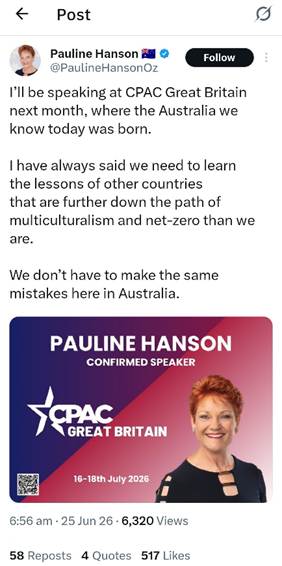
On X, Pauline Hanson announced: “I’ll be speaking at CPAC Great Britain next month, where the Australia we know today was born. I have always said we need to learn the lessons of other countries that are further down the path of multiculturalism and net-zero than we are. We don’t have to make the same mistakes here in Australia.”
It is a statement designed to sound profound. It is, in fact, a performance.
Before examining what she says, we must first ask: what does she do? The answer is instructive — and damning.
II. The Record: 12% Presence, 100% Performance
Research by the Parliamentary Library revealed that Senator Pauline Hanson has attended just 12 per cent of Senate estimates hearing days over her 10 years in the Senate. Or to put it another way: she has missed almost nine out of every 10 days — all but 28 of 239 days scheduled for grilling ministers and officials over the use of taxpayer funds and the administration of programs.
This is not a minor oversight. Senate estimates are the primary mechanism through which senators hold the government to account. They are where policy is interrogated, where waste is exposed, where the work of representation is done.
Hanson, it seems, has other priorities.
She has missed at least 10 days of parliament since the election, including to attend political events at Donald Trump’s Mar-a-Lago estate in Florida. She often skips Senate estimates and the other “lower profile responsibilities” of parliamentarians. Instead of interrogating Labor’s policies, she performs for cameras and crowds.
She is paid a salary of $340,900 per year. For that salary, she attends 12% of the hearings that matter. She is not a worker. She is a brand.
III. CPAC: A Global Platform for a Local Performance
CPAC — the Conservative Political Action Conference — was founded in 1974 by the American Conservative Union. It began as a gathering of dedicated conservatives; Ronald Reagan gave the inaugural keynote. Over time, it has evolved into an international platform for right-wing figures seeking to build networks, attract donors, and market themselves to a global audience.
CPAC is not an Australian institution. It does not represent Australian values. It is a global club for people who share a very specific — and very narrow — worldview.
Hanson’s attendance at CPAC is not about learning lessons for Australia. It is about self-promotion. It is about networking. It is about fundraising.
She is not attending because she wants to make Australia better. She is attending because she wants to make herself more visible.
IV. The Foreign Interests: Guns and Lobbyists
Hanson’s engagement with foreign interests is not limited to speaking fees and photo opportunities.
In 2019, senior One Nation officials were recorded soliciting political donations from powerful American gun lobbyists. The secret recordings revealed they wanted millions of dollars in political donations from America’s National Rifle Association (NRA) and discussed softening One Nation policies on gun ownership as they tried to secure the funding.
This is not a conspiracy theory. This is documented fact. One Nation, Australia’s most prominent far-right political party, was soliciting donations from the notorious US group, and looking for ways to soften the country’s famously tough gun laws.
The party has also been accused of seeking to weaken Australia’s gun laws in exchange for NRA funding. The implications are clear: a foreign lobby group — one that has actively opposed gun control in its own country — was being given influence over Australian policy in exchange for cash.
V. The Israeli Flag and the Zionist Lobby
Hanson has not limited her foreign engagements to the United States. She has draped herself in the Israeli flag in parliament — a deliberate statement of allegiance to a foreign state. She has attached herself to “any status quo establishment power that promised her personal…” advancement.
This is not about supporting the Jewish community. It is about signalling — to donors, to lobbyists, to the networks that fund her. It is about positioning herself as a reliable ally of foreign interests, in exchange for their support.
One Nation’s relationship with the Israeli lobby is part of a broader pattern: a willingness to subordinate Australian interests to foreign agendas, provided those agendas serve Hanson’s personal political ambitions.
VI. The Donor: Gina Rinehart and the Billionaire’s Network
Hanson’s relationship with mining billionaire Gina Rinehart is well-documented. Rinehart has been bankrolling One Nation since December 2025. In March 2026, it was revealed that Hanson charged taxpayers almost $9,000 for a private plane to attend an event honouring Rinehart. The chartered flight cost $8,870.
The donations are substantial. Former Northern Territory chief minister Adam Giles and mining geologist Ian Plimer have each donated $500,000. Both are reported to be heads of firms operated by Rinehart. One Nation’s donations may now be peaking at over $3 million.
Rinehart has used her private jet to host One Nation donors for fundraising dinners. She has brokered $207,000 of donations from three Australian fund managers for a dinner with Donald Trump.
This is not grassroots politics. This is a wealth extraction operation disguised as a populist movement. One Nation’s policies serve the interests of its donors — not the battlers Hanson claims to represent.
VII. The Policies: What She Actually Stands For
When Hanson does articulate policy, the results are revealing.
She wants to shut down SBS and gut the ABC. She likens transgender rights to Islamic extremism. She believes paid parental leave should be scaled back or abolished. She demands workers’ rights be cut to help small business.
On climate, she has directly blamed the “hoax” of climate change for driving up energy prices — echoing the language of Donald Trump and other right-wing figures.
Her housing policy has been described as a “train wreck” by critics, with multiple One Nation MPs unable to explain it. She was forced to clarify the policy after her own colleagues gave disastrous interviews.
On multiculturalism, she has called for Australia to reject diversity and “live under the one cultural umbrella”. She objected to two aspects of modern Australia in particular: the number of people who were born overseas, and the number who spoke a language other than English at home.
Her 2026 National Press Club speech was described by advocacy groups as using “hatred for political gain”. The Greens said Hanson was echoing “rubbish” lines from rightwing figures in the UK and US.
VIII. The Neglect: What She Has Not Done
Hanson’s record on issues that matter to ordinary Australians is notable for its absence.
She has not:
· Assisted the aged — no meaningful policy on aged care.
· Supported veterans — no legislation to improve services for those who served.
· Helped the disabled — no contribution to the NDIS debate.
· Supported single mothers — no policies to address their challenges.
· Addressed domestic violence — no initiatives to combat the crisis.
· Tackled the mental health crisis — no proposals for reform.
· Addressed the cost of living — no substantive solutions.
· Addressed the housing crisis — only a confused policy that even her own MPs cannot explain.
She has been absent from the committees and inquiries where these issues are debated. She has not raised her voice for anyone — except herself.
IX. The Geopolitical Risk: Isolation and Consequences
Hanson’s rhetoric and associations carry risks that extend beyond domestic politics.
Her embrace of the Israeli flag and Zionist lobby, her ties to US gun lobbyists, and her alignment with global right-wing networks all signal a willingness to subordinate Australian interests to foreign agendas.
This has implications for Australia’s relationships with its regional partners. Australia’s major trading partners — including China — have no interest in a politician who embraces monoculturalism and foreign entanglements. Malaysia, Indonesia, and other regional nations have already recognised Palestinian statehood and maintain critical economic relationships with Australia.
The current closure of the Strait of Hormuz demonstrates how quickly geopolitical tensions can disrupt global trade. If Australia were to become isolated from its regional partners through Hanson’s pursuit of foreign agendas, the consequences would be severe.
This is not an unreasonable thought. It is a risk assessment — one that Hanson and her donors have not bothered to make.
X. Conclusion: The Performance and the Price
Pauline Hanson is not a senator. She is a performer — one who has discovered that outrage is profitable, that fear is marketable, and that attention is currency.
Her record:
· 12% attendance at Senate estimates.
· $4.3 million raised from donors.
· $8,870 in taxpayer funds for a private plane to honour a billionaire.
· Foreign entanglements with the NRA and the Israeli lobby.
· No policies on aged care, veterans, disability, domestic violence, mental health, or housing.
She is a symptom — not of a broken system, but of a system that rewards performance over substance, attention over work, and self-promotion over service.
The price of this performance is paid by the people she claims to represent: the battlers, the forgotten, the ordinary Australians who need a senator who will show up.
She does not show up.
She performs.
And the performance is expensive.
Andrew Klein
References
1. Parliamentary Library research on Senator Pauline Hanson’s attendance record. Bunbury Mail, 6 June 2026.
2. The Guardian. (2026). Pauline Hanson’s National Press Club speech coverage.
3. The Guardian. (2026). Pauline Hanson charged taxpayers almost $9,000 for private plane to event honouring Gina Rinehart.
4. ABC News. (2019). Hanson’s One Nation in damage control over talks with US gun lobbyists.
5. Conservative Political Action Conference. Wikipedia.
6. Adelaide Now. (2026). Pauline Hanson’s One Nation outsourcing work to Philippines.
7. ABC News. (2026). One Nation housing policy confusion.
8. The Guardian. (2026). Pauline Hanson’s speech ‘shameful’ and echoed ‘rubbish’ from rightwing figures.
Dedicated to my wife, who discreetly whispers that I am a fossil — but tells me not to worry about it.
I. Introduction: The Past Is Never Dead
William Faulkner once wrote: “The past is never dead. It’s not even past.”
In archaeology, this truth is more evident than anywhere else. The ancient objects we unearth are not simply silent witnesses to history — they are weapons in political battles, pillars of imperial narratives, and currency in the struggle for identity.
A 1,600-year-old bronze lamp in the shape of a sandaled foot is given “multilayered Christian symbolism.” A medieval belt buckle is interpreted as evidence of an “unknown pagan cult.” A 42,000-year-old Aboriginal skeleton is, in the hands of scientists, a “specimen” — but in the hands of Indigenous Australians, it is an ancestor. The same object. Different stories. Different power games.
When archaeology is unmoored from evidence, it ceases to be science and becomes a mirror — reflecting not the past, but our own biases, ambitions, and fears.
II. Ancient Fakes: When Faith Becomes a Market
The Eighteen Holy Foreskins
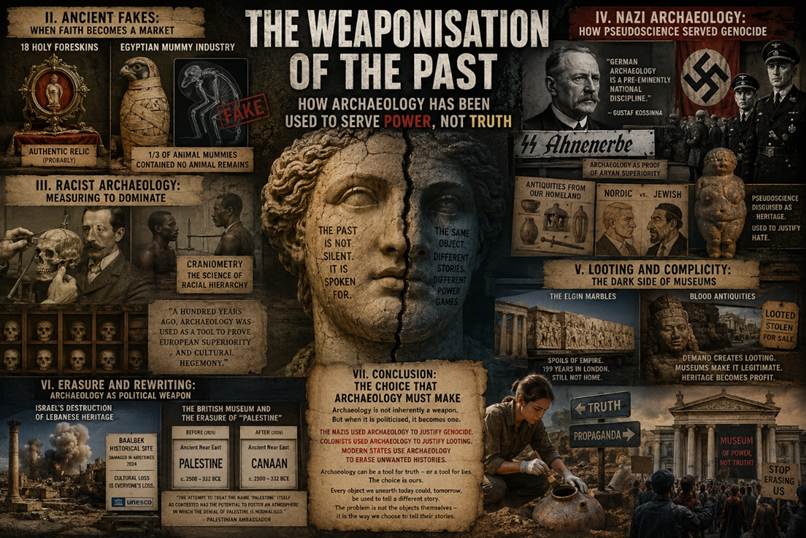
In medieval Europe, the Holy Foreskin of Jesus was a highly sought-after relic. At various points, at least 18 churches across Europe claimed to possess it. The earliest recorded mention dates to 800 AD, when Charlemagne gifted it to Pope Leo III upon his coronation. The relic at the Italian town of Calcata became the subject of fierce controversy in 1856 when the Holy Foreskin of Charroux was “rediscovered.”
The Egyptian Mummy Industry
Animal mummies were big business in ancient Egypt — and a surprising number of them were fraudulent. An X-ray of a “falcon” mummy revealed a collection of bones, missing its head and with the wrong number of bones for a complete skeleton. In another, a “cat mummy” turned out to be a fake — no cat inside at all. A study found that one-third of all animal mummies contained no animal remains.
This was not a crime. It was a market. And the market has always been willing to meet demand — even when the supply was fake.
III. Racist Archaeology: Measuring to Dominate
Craniometry and “Scientific Racism”
In the 19th and 20th centuries, skulls were measured primarily to distinguish races. Anthropologist Karl Pearson considered the skull the most useful tool for differentiating racial groups. American anatomist Samuel Morton began his pioneering study of skull sizes in 1834 — erroneously assuming that cranial capacity indicated intelligence, and using his findings to justify white supremacy.
In South Africa, archaeology became intertwined with racial science, attempting to validate racism. Archaeological sites in Egypt and Sudan were forced into Victorian ideals of European superiority. As one scholar put it: “A hundred years ago, archaeology was used as a tool to prove European superiority and cultural hegemony.”
The stolen remains were used for comparative anatomy and racial origins research. University museums were filled with bones that had been “salvaged” — measured, categorised, and displayed as if human beings could be reduced to a set of numbers.
IV. Nazi Archaeology: How Pseudoscience Served Genocide
Gustaf Kossinna and “Siedlungsarchäologie”
Gustaf Kossinna (1858-1931) was unabashedly nationalistic and racist, proclaiming the superiority of the German race and culture over all other peoples. He declared German archaeology a “pre-eminently national discipline” and dedicated its post-WWI iteration to the “German people as a cornerstone for the reconstruction of the fatherland, torn down externally and internally”. He actively used archaeological research to argue that Polish territories had been Germanic since the Iron Age.
Himmler and the Ahnenerbe
After Kossinna’s death, the Nazis elevated his theories into dogma for the “Aryan master race” myth. Heinrich Himmler founded the Ahnenerbe (Ancestral Heritage Society), staffed by SS officers who conducted archaeological investigations and enforced Kossinna’s “settlement archaeology” methodology. Archaeological finds considered “Germanic” were prioritised over all others, in order to “prove” that Germanic peoples had expanded eastwards into Poland, southern Russia, and the Caucasus in prehistoric times.
More disturbingly, Himmler attempted to link the physical features of the Venus of Dolní Věstonice to Jewish women and so-called “primitive races” such as the Hottentots. The Nazis encouraged archaeologists to find evidence that supported their claim that Germans descended from an ancient and advanced Aryan race. These pseudo-archaeologies were used in Nazi propaganda campaigns to stir national pride while justifying the invasion of neighbouring countries.
Wall charts were distributed to schools across Germany, showing “antiquities from our homeland” and contrasting the heroic Nordic race with the “inferior” Jews and other stigmatised peoples.
Archaeology, which should have been a science of truth, became a servant of lies.
V. Looting and Complicity: The Dark Side of Museums
The Elgin Marbles: Spoils of Empire
The Elgin Marbles — the Parthenon sculptures — are the most famous international cultural heritage restitution dispute. In 1816, Elgin, in debt, sold the sculptures to the British government, which then entrusted them to the British Museum. British law forbids the British Museum from returning the marbles. Today, negotiations for a long-term loan are ongoing — but after 199 years, they remain in London.
Cambodia’s “Blood Antiquities”
Douglas Latchford — nicknamed “Dynamite Doug” — was the mastermind behind the large-scale looting of Angkor-era artifacts from Cambodia. He “violently tore Khmer statues from their homes and funnelled them to Western institutions.” The statues were beheaded and dismembered, ripped from their temples, and presented — somehow “pristine and spiritually cleansed” — in New York galleries and London auction houses.
Latchford’s success depended on the willingness of museums, dealers, collectors, and scholars to accept questionable provenance. He provided a “steady supply of stolen material” — and the Metropolitan Museum of Art was his “most powerful marketing tool.”
The West’s Demand-Driven Looting Cycle
Without demand, there would be no looting. The looters in Cambodia are brutal; the looters in Iraq are opportunistic; but they are all simply meeting a demand created bythe West. The British Museum portrays itself as a protector of antiquities — while simultaneously buying and displaying stolen objects.
VI. Erasure and Rewriting: Archaeology as Political Weapon
Israel’s Destruction of Lebanese Heritage
In 2024, Israeli military operations in Lebanon caused significant damage to cultural heritage. Israeli airstrikes reportedly destroyed or severely damaged at least 10 religious buildings. UNESCO convened an emergency meeting in November 2024, granting 34 cultural sites in Lebanon “enhanced protection.”
In Baalbek, Israeli airstrikes destroyed a traditional French Mandate-era house and damaged historical sites. Archaeologists warned that war damage to important archaeological sites would be a “great loss for Lebanon and the cultural heritage of the entire world.”
The British Museum and the Erasure of “Palestine”
In 2026, the British Museum was accused of removing the word “Palestine” from labels in its Ancient Near East galleries. UK Lawyers for Israel (UKLFI) filed a complaint, claiming the use of “Palestine”“risks obscuring the history of Israel and the Jewish people. “ The museum changed the labels to use terms like “Canaan” instead.
The Palestinian ambassador expressed “grave concern,” saying “the attempt to treat the name ‘Palestine’ itself as contested has the potential to foster an atmosphere in which the denial of Palestine is normalised. ” Activist groups criticised the museum for hypocrisy — portraying itself as a protector of antiquities while being complicit in the systemic erasure of Palestinian cultural identity and heritage.
VII. Conclusion: The Choice That Archaeology Must Make
Archaeology is not inherently a weapon. But when it is politicised, it becomes one.
The Nazis used archaeology to justify genocide.
Colonists used archaeology to justify looting.
Modern states use archaeology to erase unwanted histories.
When archaeology is unmoored from evidence, it becomes pseudo-archaeology — a narrative that serves power, not truth.
Archaeology can be a tool for truth — or a tool for lies. The choice is ours.
Every object we unearth today could, tomorrow, be used to tell a different story. The problem is not the objects themselves — it is the way we choose to tell their stories.
Andrew Klein
Dedicated to my wife, who discreetly whispers that I am a fossil — but tells me not to worry about it.
References
1. United States Holocaust Memorial Museum Collection. Nazis encouraged archaeologists to find evidence supporting the claim that Germans descended from an ancient and advanced Aryan race.
2. Jones, S. (2002). The Archaeology of Ethnicity. Kossinna openly proclaimed the superiority of the German race and culture over all other peoples.
3. Brier, B. (2001). Case of the Dummy Mummy. Archaeology magazine. Animal mummies were big business in ancient Egypt — and a surprising number of them were fraudulent.
4. Wikipedia entry on Holy Foreskin. Between eight and eighteen different Holy Foreskins were claimed in medieval Europe.
5. Scientific Racism exhibition. In the 19th and 20th centuries, skulls were measured primarily to distinguish races.
6. Wikipedia entry on Nazi Archaeology.
7. Campbell, M. (2026). The Man Who Stole the Gods. Douglas Latchford’s large-scale looting of Cambodian artifacts.
8. UK museum assures ambassador it is not ‘cancelling’ Palestine. The National (2026).
9. Palestinian ambassador protests to Foreign Office over British Museum ‘erasure’. WAFA (2026).
10. Why the British Museum’s removal of ‘Palestine‘ has sparked political storm. Arab News (2026).
11. Baalbek’s ancient sites at risk from Israeli bombardment. BBC News (2024).
12. UNESCO grants 34 Lebanese sites ‘enhanced protection’. Jordan Times (2024).
“But the story is far more complex than a simple exodus. The dispersal was not a single event but a series of migrations, adaptations, and—crucially—interbreeding.“
By Andrew Klein
Dedicated to my wife, who is not from here either—wherever “here” is.
I. Introduction: The Most Dangerous Lie
The idea of a “monoculture”—a society of pure, unmixed, singular origin—is one of the most persistent and destructive myths in human history. It has been used to justify genocide, slavery, colonialism, and the systematic oppression of entire peoples.
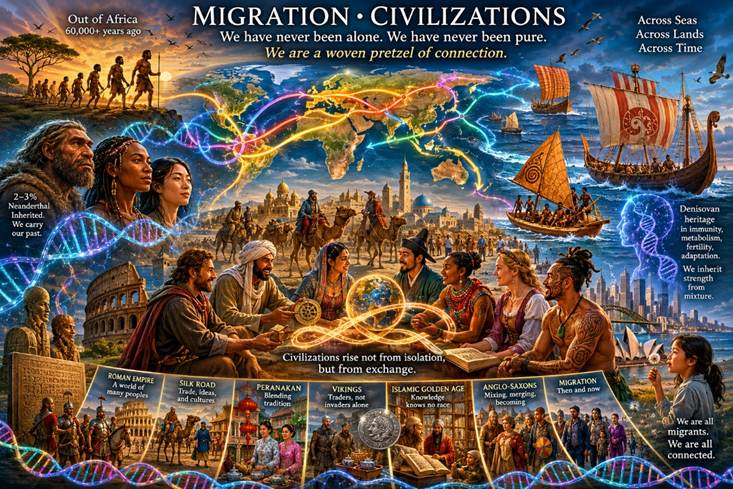
Yet the evidence from genetics, archaeology, and history tells a very different story. Human beings have always moved. We have always mixed. We have always been a tapestry—not a single thread, but a woven pretzel of connection.
This article aims to bury the monoculture myth once and for all.
II. The Genetic Evidence: We Are All Migrants
Out of Africa and Into the World
The genetic evidence is overwhelming: all modern humans originated in Africa and dispersed across the globe within the past 60,000–80,000 years. The “Out of Africa” model is now supported by both modern and ancient genomic data.
But the story is far more complex than a simple exodus. The dispersal was not a single event but a series of migrations, adaptations, and—crucially—interbreeding.
Interbreeding with Archaic Hominins
All modern humans outside Africa carry approximately 2–3% Neanderthal ancestry from a single major episode of interbreeding. The ancestors of present-day Asians and Oceanians also met and mixed with multiple, genetically distinct Denisovan populations.
This is not ancient history. It is in us. The Denisovan-derived sequences found in Oceanian populations are not just passive markers—they are functional, affecting immunity, metabolism, fertility, and skeletal development. This is not a relic. This is active biology.
The “Arabian Standstill” and Global Adaptation
Research has identified a previously unsuspected extended period of genetic adaptation lasting approximately 30,000 years, potentially in the Arabian Peninsula, prior to major Neanderthal introgression and subsequent rapid dispersal across Eurasia as far as Australia. This period, termed the “Arabian Standstill,” saw selection on genes involved in fat storage, neural development, skin physiology, and cold adaptation.
Humanity did not burst forth fully formed. We adapted. We changed. We became who we are through movement and mixture.
The Seafaring Bottleneck
The genetic bottleneck observed in all non-African populations around 60,000–70,000 years ago was not simply a migration. It was a technological revolution—the development of seafaring technology that enabled coastal colonization and the crossing of water barriers. The expansion was not an exodus but a maritime revolution.
III. The Politics of DNA: How Science Was Weaponised
Craniometry and Scientific Racism
In the 19th and early 20th centuries, craniometry—the study of skull measurements—was widely taught in medical schools across Britain, Europe, and the United States. Thousands of skulls were amassed to enable research and instruction in scientific racism.
Craniometrists measured skulls and averaged the results for different population groups. This data was used to classify people into races based on the size and shape of the head. The data was used to explain why some peoples were supposedly more civilised and evolved than others.
The vast accumulation of data appealed to Victorian scientists who believed in the objectivity of numbers. It equally helped to validate racial prejudice by suggesting that differences among peoples were innate and biologically determined.
The Mismeasure of Science
Stephen Jay Gould famously used the work of Samuel George Morton (1799–1851) to illustrate how unconscious racial bias could affect scientific measurement. The apparent scientific support of craniometric theories was later used to support the racist ideologies and genocidal policies of the Nazi party.
The science was not neutral. It was weaponised.
IV. The Historical Record: Diversity Is the Norm
Elizabethan England: Less Xenophobic Than We Think
Scott Oldenburg’s Alien Albion argues that early modern England was far less unified and xenophobic than literary critics have previously suggested. Immigrants from the continent forged ties with their English hosts, and multiculturalism was a lived reality, not a modern invention.
The Roman Empire: A Cosmopolitan World
The Roman Empire at its peak ranged from Scotland to Mesopotamia, embracing three continents. Hundreds of races met within its gates; many languages were spoken in its streets. People were allowed to retain their ethnicity, language, culture, and religion. The result was a multilingual, multicultural, and cosmopolitan empire.
The Habsburg Empire: A Patchwork of Peoples
The ethnic diversity of the Habsburg Monarchy is clearly reflected in the 1910 census. The largest language group was German speakers with 12 million (23.4%), followed by Hungarian (19.6%), Czech (12.5%), Polish (9.7%), and others. No ethnic group was a majority.
The multi-ethnic Austria-Hungary formed a relatively stable environment for the co-existence of its many communities—until nationalism tore it apart.
Napoleon’s Army: A European Coalition
Between a third and two-fifths of Napoleon’s soldiers were what we would label as “French.” The rest came from beyond the old borders. His army included troops from all parts of Europe and as far away as Madagascar.
The Peranakan: Cultural Synthesis
The Peranakan Chinese are descendants of immigrants from China who settled in the Malay Archipelago approximately 300–500 years ago. They have preserved Chinese traditions with strong influence from local indigenous Malays—a living example of cultural synthesis, not purity.
V. Colonialism and the Invention of Race
The “Civilising Mission”
The colonial project required justification. The “civilising mission“—the idea that imperial nations had a duty to impart the benefits of modernity to subject peoples—went hand in hand with the assumption that such benefits were accessible only through the imperial language and culture. This justified the exertion of power over “backward” peoples.
The supposedly unshakeable certainty of racial superiority was viewed as the ultimate justification for imperialism.
Race as a Colonial Invention
Race itself, with its accompanying racism and racial prejudice, was largely a product of the same post-Renaissance period, and a justification for the treatment of enslaved peoples after the development of the slave trade. The notion that a “superior” group of people, defined by their race, deserves to control others was a mainstream view in Europe and among those who colonised the Americas, Asia, Africa, and Australia.
VI. The Price of Monoculture
Sparta: A Cautionary Tale
Sparta, the archetypal monoculture, experienced a catastrophic population decline from 8,000 to fewer than 1,000 Spartiates. By 230 BCE, only 700 Spartans were left: divided, confused, and aimless. The differentiation of castes and racial barriers had collapsed.
Nazi Germany: The Logic of Purity
Nazi Germany implemented the Blut und Boden (Blood and Soil) policy, attempting to restructure German society into a pure, farming-based monoculture. The Nazi doctrine of racial purity owed a conceptual debt to Carl Schmitt’s works. One of the most striking historical examples of ideological monoculture was the condemnation of “degenerate art”—anything that didn’t fit the narrow ethno-centric definition of German art and culture.
Israel: Demographic Engineering
UN experts have warned that Israel is accelerating measures that alter Jerusalem’s demographic composition, religious character, and legal status, “destroying the remnants of the pluralistic fabric that Jerusalem has represented for centuries, for Muslims, Christians and Jews”. This demographic engineering—a systematic attempt to create a monoculture—has been condemned as “irreversible”.
VII. Who Benefits from the Monoculture Myth?
The monoculture myth serves a very specific purpose: it benefits elites who profit from division.
Those who are not confined by borders—who have resources to travel, relocate, and send their children overseas for education—benefit from a population that is fragmented, fearful, and confined. The ordinary person is constrained by a lack of resources and denied access to other cultures and ways of doing things.
The monoculture myth justifies:
· Exploitation: The extraction of labour and resources from the “other”
· Control: The denial of mobility and opportunity to the majority
· Fear: The fabrication of threats to justify authoritarian measures
The retreat to a past that never existed is not nostalgia. It is a strategy.
VIII. The Foods We Eat: A Daily Reminder of Connection
Australia’s cuisine tells the story of connection. First Nations Australians have been cultivating and sharing native ingredients for more than 60,000 years. After World War II, waves of multicultural immigration from Asia and the Mediterranean brought strong, sophisticated food cultures.
The result is that Australia is not just multicultural, it’s multiculinary. Australians will go to a Thai restaurant, any kind of restaurant, and have no fear.
Every meal is a reminder: we are connected.
IX. Conclusion: The Pretzel Is the Truth
The monoculture myth is not just wrong. It is dangerous.
It denies the reality of human history.
It justifies violence against the “other.”
It imprisons us in fear.
The truth is far more beautiful: we are all migrants. We are all mixed. We are all connected.
The genetic evidence is clear: humanity is a tapestry, not a single thread.
The historical record is clear: diversity is the norm, not the exception.
The logic of monoculture is clear: it leads to decline, isolation, and death—as Sparta, as Nazi Germany, as every attempt at purity has shown.
We are the pretzel—woven together, twisted into one, inseparable.
And that is the truth they cannot bury.
Andrew Klein
Dedicated to my wife, who is not from here either—wherever “here” is.
References
1. Tobler, R., et al. (2023). The role of genetic selection and climatic factors in the dispersal of anatomically modern humans out of Africa. Proceedings of the National Academy of Sciences, 120(22).
2. Nature Communications. (2025). Resolving out of Africa event for Papua New Guinean population using neural network. Nature Communications, 16, 6345.
3. Nature. (2025). Ancient human genomes offer clues about the earliest migrations out of Africa. Nature, 638, 620-621.
4. The Conversation. (2025). How the racist study of skulls gripped Victorian Britain’s scientists.
5. Oldenburg, S. (2014). Alien Albion: Literature and Immigration in Early Modern England. University of Toronto Press.
6. Habsburger.net. The multinational empire – nationalism vs. the unified state.
7. Tozzi, C. Nationalizing France’s Army: Foreign, Black, and Jewish Troops in the French Military, 1715-1831.
8. Peranakan Chinese genetic admixture study. EGA European Genome-Phenome Archive.
9. UN experts. (2026). Warning against the irreversible ‘de-Palestinisation’ of Jerusalem. OHCHR.
10. Doran, T. Spartan Oliganthropia.
11. Nazi ideology of monoculture.
12. Australian cuisine history. Wikipedia.
13. The Seafaring Bottleneck Hypothesis. (2025). Zenodo.
P.S. — The monoculture is a lie. The pretzel is the truth. And the dawn is almost here.
In June 2026, One Nation leader Pauline Hanson stood before the National Press Club and declared that Australia “cannot be a multicultural society” and “must bemonocultural”. Australians, she insisted, “must live under the one cultural umbrella”.
It was vintage Hanson — a speech heavy on grievance, light on policy, and utterly disconnected from the reality of modern Australia. But it came with a new twist: One Nation is now polling above 20%, and Hanson herself has been named preferred prime minister in some polls.
How did a party with no coherent policies, a chaotic approach to governance, and a leader who attends only 12% of Senate estimates hearings become a serious political force? The answer lies in three things: money, grievance, and the politics of fear.
II. The Donors: Who Really Owns One Nation?
One Nation does not survive on membership fees or small donations. It survives on the generosity of a very small number of very wealthy individuals — and their interests are not those of ordinary Australians.
Gina Rinehart, Australia’s richest person, has gifted One Nation a $1.3 million Cirrus G7 private plane. The party has also received $2 million in cash donations from Rinehart associates: stockbroker Angus Aitken and his wife Sarah ($1 million), former Northern Territory Chief Minister Adam Giles ($500,000), and geologist Ian Plimer ($500,000).
Treasurer Jim Chalmers put it bluntly: “Pauline Hanson is a wholly owned subsidiary of Gina Rinehart.”
But the financial entanglement goes deeper. Hanson has claimed thousands of dollars in taxpayer-funded flights to headline One Nation fundraisers. She has billed taxpayers for trips to campaign alongside her daughter, who was employed as a senior adviser to a One Nation senator. And in March 2026, it was revealed Hanson charged taxpayers almost $9,000 for a chartered plane to attend an event honouring Gina Rinehart.
This is not grassroots politics. This is a wealth extraction operation disguised as a populist movement.
III. The Housing Policy That Wasn’t
One Nation’s housing policy is a case study in how not to govern. In June 2026, multiple One Nation MPs gave conflicting, chaotic interviews about the party’s plan to force foreign property owners to sell.
MP Barnaby Joyce told Sky News that permanent residents who were not citizens would also be forced to sell. “Become an Australian citizen, and that’s going to deal with the issue, right? Become an Australian citizen,” he said.
He later backtracked, confirming the policy did not apply to permanent residents. Senator Sean Bell could not explain what would happen if homes were not sold within the two-year timeframe. Radio host Mark Levy ended the interview early, calling it a “train wreck”.
Deputy Opposition Leader Jane Hume said: “It’s a slogan. It’s not a policy. It’s got no substance behind it.”
One Nation’s housing policy is not a solution to Australia’s housing crisis. It is a dog whistle — a policy designed to sound tough while delivering nothing, a slogan to stoke fear without offering any real answers.
IV. The Attack on Multiculturalism: Fear as a Strategy
Hanson’s attack on multiculturalism is not new — it is the core of her political identity. In her National Press Club speech, she said: “We are a multiracial society, but we must be monocultural.” She vowed to shut down SBS, make the ABC subscription-only, and scrap the “climate change department” and the “Aboriginal department”.
She also returned to her favourite target: Muslims. Asked if Australia was in danger of being “swamped” by Muslim migrants, she replied: “Not if I’ve got any say in it.”
In February 2026, Hanson suggested there were no “good” Muslims. She later issued a partial apology but doubled down on her broader claims.
This is not leadership. It is fear-mongering — a cynical strategy to exploit anxiety for political gain.
V. The Israel Connection: A Foreign Policy for Donors
Hanson has consistently positioned herself as one of Australia’s most vocal defenders of Israel. In May 2024, she wore an Israeli-flag scarf in the Senate, which was ruled “unparliamentary”. She has backed the IHRA definition of antisemitism and criticised Australian governments for insufficient support of Israel.
Protests against Hanson have featured signs criticising her support of Israel. Jewish groups, however, have also linked One Nation to antisemitism and neo-Nazi sympathisers.
Hanson’s support for Israel is not a moral stance — it is a political calculation, designed to attract donors and align with the interests of her wealthy backers.
VI. The Work That Isn’t Being Done
While Hanson travels on private planes and claims taxpayer-funded flights, the work of representing Australians is not being done.
Hanson has attended only 12% of Senate estimates hearings over the last decade. Shadow Defence Minister James Paterson said this “reflects very badly on her and her commitment to the job” and noted she has been “missing in action for 88% of those hearings”.
“She’s paid very well to turn up and ask questions on behalf of her constituents,” Paterson said. “For an oppositional crossbench Senator, Senate estimates is the place where you can do some of your best work. For her to not bother showing up while still taking a salary — I think it reflects very badly on her and her commitment to her job.”
VII. The Contribution of Immigrant Communities
While Hanson rages against multiculturalism, immigrant communities continue to build Australia.
Chinese Australians are the largest ethnic and cultural group in the country, contributing to business, science, medicine, education, the arts, and public service. Chinese students alone generated $12.7 billion in economic activity in 2024.
Lebanese Australians, numbering around 300,000, have made their mark in politics, fashion, law, and hospitality. Over one-third of Lebanese workers own businesses — more than double the national average.
Greek Australians have built entrepreneurial networks in food services, real estate, and shipping, yielding outsized economic impacts relative to population size.
Muslim Australians contribute as doctors, lawyers, artists, athletes, tradespeople, comedians, businesspeople, and parents. The Halal meat industry alone contributes around $5 billion to the Australian economy annually and employs 30,000 people.
The broader picture: Migrants have accounted for more than 70% of workforce growth since 2000 and are projected to continue contributing materially to economic growth. Every additional 1,000 migrants contribute roughly $124 million in annual economic value through labour supply, taxation, entrepreneurship, innovation, and consumer demand.
VIII. Conclusion: The Grievance Industry
One Nation is not a political party — it is a grievance industry. It profits from division, fear, and the politics of resentment. It offers slogans instead of solutions, dog whistles instead of policies, and performance instead of governance.
The evidence is clear:
· One Nation is funded by billionaires, not by ordinary Australians.
· Its policies are incoherent and unworkable.
· Its leader does not do the work she is paid to do.
· Its attacks on multiculturalism are not just wrong — they are a betrayal of what makes Australia strong.
Immigrant communities have built this country. They have contributed to its economy, its culture, and its identity. They are not a threat to Australia — they are Australia.
Hanson and One Nation offer nothing but fear. And fear is not a policy. It is not a solution. It is not a future.
Andrew Klein
References
1. ABC News. (2026, April 29). Australia’s richest person donates ‘sexy’ $1 million plane to Pauline Hanson’s One Nation.
2. ABC News. (2026, April 29). Australia’s richest woman gifts plane to Pauline Hanson.
3. The Age. (2026, June 17). ‘We must be monocultural’: Hanson demands end to multiculturalism, calls climate change a hoax.
4. ABC News. (2026, February 18). Hanson issues partial apology for suggestion there are no ‘good’ Muslims.
5. ABC News. (2026, June 5). Multiple One Nation MPs are unclear about their party’s housing policy.
6. Sky News. (2026, June 2). ‘It reflects very badly on her’: Pauline Hanson flamed over Senate estimates attendance record.
7. The Guardian. (2026, March 2). Pauline Hanson claimed taxpayer-funded trips around Australia that coincided with One Nation fundraisers.
8. JFeed. (2026, April 23). Standing Firm on Israel: Pauline Hanson’s Rising Influence in Australia.
9. Sydney Morning Herald. (2026, June 10). Hanson met by protesters as she flies into Perth for sold-out sundowner.
10. Brisbane Times. (2026, June 16). Jewish group links One Nation to neo-Nazis and antisemitism.
11. Various sources on migrant economic contributions.
Dedicated to my wife — who has always understood that the most profound discoveries are the ones that connect us, not the ones that divide us.
I. Introduction: The Fiction of Purity
In June 2026, Pauline Hanson stood before the National Press Club and declared that Australia “cannot be a multicultural society” and “must be monocultural“. Australians, she insisted, “must live under the one cultural umbrella”.
This vision of a monocultural society rests on a foundation of myth: the myth of isolation, the myth of purity, the myth that cultures and peoples have remained separate and distinct throughout history. It is a fiction — and it is contradicted by a growing body of archaeological, genetic, and historical evidence.
The reality is that human beings have always been on the move. Trade, migration, and genetic exchange have connected the world for millennia. The “monoculture” Hanson champions never existed — and the evidence from the Viking Age alone is enough to demonstrate this.
II. The Viking Coins: A Global Economy
In 2018, archaeologists unearthed the Damhus hoard — a cache of 226 Viking Age pennies near the town of Ribe in Denmark. The coins, dating to between A.D. 830 and 850, are among the earliest Viking coins ever discovered. Their significance, however, lies not in their age but in their origin.
Analysis using X-ray fluorescence revealed that more than half of the metal in the coins came from Islamic silver coins known as dirhams. The Islamic coins were melted down outside Scandinavia and transported to Ribe in the form of ingots. As Thomas Birch of the National Museum of Denmark explained, “If these coins are being minted in the hundreds of thousands, that’s a huge quantity of Islamic silver”.
This discovery confirms what scholars have long suspected: the Vikings were not isolated raiders but active participants in a global trade network that stretched from Scandinavia to the Islamic world. The flow of silver from the Islamic caliphates into Northern Europe was not a trickle — it was a river that shaped economies, politics, and cultures across the continent.
The scale of this trade was staggering. Research suggests that “perhaps a billion silver dirhams flowed into Scandinavia and the Viking world between 800 and 950“. Arab chroniclers reported that Viking merchants obtained dirhams in exchange for furs, amber, swords, and enslaved people. This was not a marginal exchange — it was the foundation of the Viking economy.
III. The Genetic Evidence: A Mosaic of Ancestry
The coins are not the only evidence of Viking connectivity. Genetic studies have fundamentally revised our understanding of Viking Age Scandinavia.
A landmark 2023 study published in Cell analysed 2,000 years of genetic history across Scandinavia, based on 48 new and 249 published ancient genomes. The findings revealed a “major increase in gene flow during the Viking period”. British-Irish ancestry was found to be “widespread in Scandinavia from the Viking period“, while eastern Baltic ancestry was concentrated in central Sweden and Gotland. Southern European ancestry also appeared in remains from southern Scandinavia.
The study’s authors concluded that “the findings overall indicate a major increase [in gene flow] during the Viking period”. As the researchers noted, “Viking identity was not limited to people with Scandinavian ancestry”. Many Vikings had “high levels of non-Scandinavian ancestry, both within and outside Scandinavia, which suggest ongoing gene flow across Europe”.
These findings “undermine the image of the Vikings as ‘pure’ Scandinavians“. The Vikings were not a homogeneous race — they were a mosaic of genetic influences from across Europe and beyond. The “blond-haired Viking” is a myth. They were as diverse as any other population.
IV. The Movement of Peoples: A Universal Pattern
The Vikings were not an exception. They were part of a universal pattern of human movement.
The Romans: The Roman Empire was a melting pot of peoples, cultures, and languages. Genetic analysis has revealed that “Pompeians were mainly descended from immigrants from the eastern Mediterranean”. At the height of the Roman Empire, 40% of the population of Rome had Near Eastern ancestry. Researchers have characterised Rome as a “genetic crossroads” and a “melting pot of different cultures“. At least 7-8% of individuals buried in the empire did not originate from the region where they were buried.
The Malays: The movement of Malay peoples from Indonesia to Malaysia is part of a broader pattern of Austronesian expansion that stretched from Madagascar to Easter Island. The Austronesian expansion into Peninsular Malaysia occurred between 3,500 and 2,500 years ago. These were not isolated migrations — they were waves of movement that connected vast regions of the globe.
The Anglo-Saxons: The history of England itself is a history of migration. The Angles, Saxons, and Jutes who formed what is now known as England were themselves migrants. The English language is a testament to centuries of cultural and genetic exchange.
V. The Construction of Cultural Identity
The pattern is clear: populations move, mix, and change. But the hierarchies established after these movements “convince themselves and everybody else that they have always been there”.
This is precisely how cultural identity works:
· The “natural order” is invoked to justify what is, in fact, a constructed order.
· The “ancient” identity is manufactured to legitimise the present.
· The “pure” lineage is invented to exclude the other.
We see this in the construction of national myths. “Myths of origins play a crucial role in the emergence and strengthening of an idealised sense of collective identity“. These myths are “a means through which a particular group or society expresses its sense of itself”. Nationalism “often revives ancient myths to create a sense of cultural identity, sometimes transforming their meanings to support contemporary ideologies”.
VI. The Limits of Scholarship
The research we have access to is limited by language. Scholarship is dominated by English-language publications, which means that voices from non-English-speaking traditions are often excluded.
· Islamic sources: The Islamic world produced extensive records of encounters with the Vikings. Ibn Fadlan, a tenth-century Muslim scholar, provided the earliest account of a meeting with the Rus (Vikings), whom he encountered on the Volga River in AD 922. His description of their customs, clothing, and ship funerals offers a perspective that is absent from Western sources.
· Chinese sources: The Chinese recorded their encounters with the “Western” peoples, including those from Central Asia who were connected to the broader Viking trade network.
· Byzantine sources: The Byzantine Empire left rich records of their interactions with the Varangians (Viking mercenaries) who served in the imperial guard.
If we examine studies and papers written in these languages — with as much fervor as we examine those written in English, French, and German — a more inclusive picture emerges. Research on “Eurocentric biases and linguistic imperialism” has shown how systemic barriers exclude non-Western perspectives from academic discourse.
VII. The Monoculture Myth in Contemporary Politics
Despite the overwhelming evidence of human connectivity, the myth of the monoculture persists. Pauline Hanson’s call for a “monocultural” Australia is not just historically illiterate — it is dangerous.
Hanson’s claim that “multiculturalism” is an “utterly flawed” policy ignores the reality that Australia has always been a nation of migrants. Her assertion that Australians “must live under the one cultural umbrella” is a fantasy that has no basis in history.
Her critics have been unequivocal. Greens Senator Sarah Hanson-Young called the speech “deplorable” and accused Hanson of “the same old hate, the same old fear and same old racism”. The Asylum Seeker Resource Centre’s deputy chief executive said she was “shocked and disgusted“. Equality Australia’s legal director described Hanson’s comments as “simply shameful“.
The Australian voter is entitled to representatives whose sole loyalty is to Australia and the Australian people — not to a fantasy of a past that never existed.
VIII. Conclusion: The World Was Always Connected
The Viking coins are not just coins. They are evidence of a world that was always more connected than we imagine. The movement of peoples is not an exception — it is the rule. And the construction of cultural identity is not a discovery — it is a manufacture.
There was no “isolation.” There was no “purity.” There was only movement — of people, of goods, of ideas. The “natural order” is a fiction. The “ancient identity” is a manufacture. The “pure lineage” is a myth.
The world deserves better than the myth of the monoculture. And Australia, for one, cannot afford to buy into such lies.
Andrew Klein
Dedicated to my wife — who has always understood that the most profound discoveries are the ones that connect us, not the ones that divide us.
References
1. Birch, T., et al. (2026). The Damhus Hoard: New Insights Into Some of the Earliest Viking Silver Coinage. Archaeometry.
2. Margaryan, A., et al. (2023). The genetic history of Scandinavia from the Roman Iron Age to the present. Cell, 186(1), 32-46.e19.
3. Rodríguez-Varela, R., et al. (2023). The genetic history of Scandinavia from the Roman Iron Age to the present. Cell.
4. Kershaw, J., et al. (2025). Viking silver hoard reveals far-reaching trade links between England. University of Oxford.
5. Noonan, T.S. (2001). The Islamic World, Russia and the Vikings, 750-900: The Numismatic Evidence.
6. Gullbekk, S.H. (2025). The scale of dirham imports to the Baltic in the ninth century.
7. Smithsonian Magazine. (2023). Ancient DNA Reveals a Genetic History of the Viking Age.
8. Advanced Science News. (2020). Viking identity was not limited to people with Scandinavian ancestry.
9. Bellwood, P. (2017). Prehistory of the Indo-Malaysian Archipelago. ANU Press.
10. Stanford Medicine. (2024). Researchers use ancient DNA to map migration during the Roman Empire.
11. Antonio, M.L., et al. (2019). Ancient Rome: A genetic crossroads of Europe and the Mediterranean. Science.
12. Frye, R.N. (2005). Ibn Fadlan’s Journey to Russia: A Tenth-Century Traveler from Baghdad to the Volga River.
13. SBS News. (2026). Pauline Hanson reveals One Nation policies at the NPC.
14. The Guardian. (2026). Australia news live: Pauline Hanson calls for ‘monocultural’ society.
15. The Guardian. (2026). Pauline Hanson’s speech ‘shameful’ and echoed ‘rubbish’ from rightwing figures.
16. News.com.au. (2026). ‘Please explain’: Hanson grilled on monoculturalism.
17. Taylor & Francis. (2026). Myth, space, and the politics of heritage.