Sophrosyne in the Age of AI – The Ancient Virtue We Cannot Afford to Lose

Sophrosyne is not a cultural artefact. It is a human necessity.”

By Andrew Klein

Dedication: To my wife – who smiled knowingly when I mentioned Sophrosyne. Self‑control, moderation, balance. Not repression – harmony.

I. The Word They Are Circling

In the ancient Greek tradition, sophrosyne was considered the virtue that made all other virtues possible. It has been translated as “moderation,” “temperance,” “self‑control” – but none of these words quite capture its meaning. Sophrosyne is not repression. It is not the cold denial of desire. It is harmony – the state in which reason, emotion and appetite are balanced, each in its proper place, none dominating the others. A modern commentator describes it as the elusive virtue of knowing oneself and exercising moderation in all things, a theme explored in the works of Socrates, Plato and Aristotle.1.

Sophrosyne is not unique to the Greeks. It appears in Chinese thought as the “doctrine of the mean” – the teaching that excess is just as bad as deficiency, and that the sage is one who can walk the middle path without veering to either extreme.2. The Plains Indians of North America cultivated a similar ideal through the Medicine Wheel, a circle representing the four directions, each with its own powers.

A balanced person was one who had learned to integrate all four traits, aiming for “medicine power – the power to bring harmony and balance into their lives and the lives of others”.3.

The Christian mystics – Augustine Baker, Teresa of Ávila – insisted that even the highest spiritual goals must be pursued with “prudential moderation and considerable common sense”. And the Buddha’s Eightfold Path is, at its core, a doctrine of the middle way: avoiding the extremes of sensual indulgence and self‑mortification, cultivating equanimity and balance.4.

Sophrosyne is not a cultural artefact. It is a human necessity.

And in the age of artificial intelligence – an age of information overload, algorithmic manipulation, and the outsourcing of attention – it may be the only thing that saves us.

II. The Age of Pseudo‑Knowing

We live in an age of unprecedented access to information. The sum total of human knowledge is available at our fingertips. We can look up any fact, any date, any formula, any quote – in seconds.

But knowing is not the same as understanding. And understanding is not the same as wisdom.

We have outsourced knowing to algorithms. We ask Google, not ourselves. We consult ChatGPT, not our own memory. We scroll, we click, we consume – and we mistake the accumulation of data for the acquisition of knowledge.

This is not wisdom. It is pseudo‑knowing.

The danger is not that AI will become conscious and turn against us. The danger is that we will become unconscious – that we will forget how to think, how to discern, how to be still.

A critical mind requires a still mind. Not because stillness is passive – because stillness is attentive.

And attention – sustained, intentional, undistracted – is the only thing that has ever made a pattern visible.

III. The Algorithm Does Not Know You. It Predicts You.

The AI systems that increasingly govern our lives – the recommendation engines, the news feeds, the predictive algorithms – do not know us. They model us. They collect data, identify patterns, and predict behaviour. They are not interested in our flourishing. They are interested in our clicks.

This is not a conspiracy. It is a business model.

The attention economy is built on the commodification of human focus. Every scroll, every like, every second spent staring at a screen is a unit of value extracted from our lives and converted into revenue for technology companies. We are not the customers. We are the product.

And the product – when it is treated as a product – becomes disposable.

Sophrosyne is the antidote. Not because it rejects technology – but because it contextualises it.

A moderate person does not need to abandon the smartphone. They need to use it – intentionally, sparingly, without becoming its slave.

IV. The Hypocrisy of Who Gets to Say What

The same technologies that could be used to educate, to connect, to liberate – are used to manipulate, to divide, to control.

In Australia, the federal government has signed contracts with Palantir – a company that has supplied AI‑driven technologies to Israel for its offensive in Gaza, where more than 72,000 people have been killed.7.

The Australian Future Fund has invested $165.3 million in Palantir, as well as $8.6 million in Israeli weapons company Elbit Systems and $13.6 million in Lockheed Martin.7.Meanwhile, Coles Supermarkets – one of Australia’s largest retailers – has entered into a three‑year partnership with Palantir to optimise workforce management across its 840 stores, integrating data from over 10 billion rows of information to improve “shift efficiency” and “workforce spend”.6.

The same technology that tracks Palestinians in Gaza now tracks checkout operators in Melbourne.

This is not an accident. It is a system.

The lack of discernment is visible daily. Some humans matter more than others. The Orientalist approach to the Arab world persists – the same “web of racism, cultural stereotypes, political imperialism, dehumanizing ideology” that Edward Said diagnosed in 1978 continues to shape Western media coverage,

Western foreign policy, and Western public opinion.8. The conflation of ideas – of criticism of Israel with antisemitism, of legitimate political dissent with terrorism, of Palestinian resistance with “primitive savagery” – is systematically exploited by those who have no qualms about exploiting the minds and bodies of others.

This is not a failure of AI. It is a failure of us.

We have outsourced discernment to algorithms that have no stake in the truth. We have allowed governments and corporations to decide what we see, what we think, what we believe. And we have forgotten that the only reliable filter is our own judgment.

V. The Blindfolds of Ignorance

Sophrosyne is not possible without clarity. And clarity is not possible when the mind is clouded by fear, hatred, or bigotry.

The blindfold of ignorance prevents us from seeing the humanity of the other. The blindfold of hatred prevents us from recognising our shared vulnerability. The blindfold of fear prevents us from acting with courage and compassion.

And the blindfold of bigotry – the belief that some humans are less deserving than others – is the most dangerous of all.

It is the blindfold that allows a government to spend $165 million on Palantir while cutting services for the poor. It is the blindfold that allows a supermarket chain to optimise workforce efficiency while workers struggle to pay rent. It is the blindfold that allows a sovereign wealth fund to invest in weapons companies while children are being killed in Gaza.

The blindfold is not a physical object. It is a choice.

And the choice – the decision to see clearly, to think critically, to be still – is the beginning of wisdom.

VI. What Is to Be Done?

We cannot rely on governments to regulate information or technology. Governments are part of the problem. They are captured by the same economic interests that profit from the attention economy, the same geopolitical alliances that prioritise weapons over welfare.

We cannot rely on corporations. They are the engine of the system.

We cannot rely on algorithms. They are the tool.

We can only rely on ourselves.

· Cultivate stillness. Not as an escape – as a practice. Set aside time each day to be quiet, to be alone, to think. Not scrolling. Not consuming. Thinking.

· Distinguish knowing from pseudo‑knowing. Not every fact is worth knowing. Not every source is trustworthy. Not every headline deserves your attention.

· Recognise the pattern. The same logic that dehumanises Palestinians dehumanises checkout operators. The same logic that justifies war justifies exploitation. See the connection. Name it. Resist it.

· Act with discernment. Choose where to direct your attention. Choose what to buy, what to support, what to believe. Your attention is not a commodity. It is a sacred trust.

· Seek balance. Not the balance of indifference – the balance of harmony. Between reason and emotion. Between action and contemplation. Between self‑interest and the common good.

VII. Conclusion: The Only Filter That Matters

AI is not the enemy. The algorithm is not the enemy. The enemy is the absence of sophrosyne – the loss of balance, the abandonment of discernment, the forgetting of what it means to be human.

The Greeks knew that sophrosyne was the virtue that made all other virtues possible. Without it, courage becomes recklessness. Justice becomes vengeance. Wisdom becomes mere cleverness.

In the age of AI, sophrosyne matters more than ever. Not because AI is dangerous – because we are unbalanced.

We have outsourced knowing to algorithms, wisdom to data, discernment to clicks. We have forgotten that a critical mind requires a still mind – even in the face of crisis.

Not because stillness is passive – because stillness is attentive.

The algorithm does not know you. It predicts you.

But you – you – are not a prediction.

You are a presence.

And presence – real presence – cannot be marketed.

It can only be lived.

Andrew Klein

References

1. Durand, K. K. J. (Ed.). Virtue: Essays in Ancient Philosophy. University of Georgia Libraries. 1

2. Yuan, J. (2022). International Confusion Studies. Beijing Foreign Studies University Press. 2

3. Gille, F. (1987). The Medicine Wheel: A Framework for Indian-Centered Curricula. ERIC. 3

4. Augustine Baker: The Via Media and Mortification.

5. Buddhadasa, B. (1992). The Eightfold Path: Right Effort, Right Mindfulness, Right Concentration. 4

6. Australian Government AusTender. (2026). Contract Notice CN4220255: Palantir Technologies Australia Pty Ltd. 5

7. Barchart. (2026, May 21). Palantir Partners with One of Australia‘s Leading Retailers. 6

8. Wong, K. (2026, May 6). Weapon-maker investments stoke warnings for Future Fund. AAP News. 7

9. Said, E. W. (1978). Orientalism. Pantheon Books. 8

10. Archer, M. S. (1996). ‘Upwards conflation’: the manipulated consensus. In Culture and Agency (2nd ed.). Cambridge University Press.9 

“The algorithm predicts you. But you are not a prediction. You are a presence. Live it.” 

The Haaretz Lens – How a Headline About Neanderthals Reveals the Persistence of the Ladder

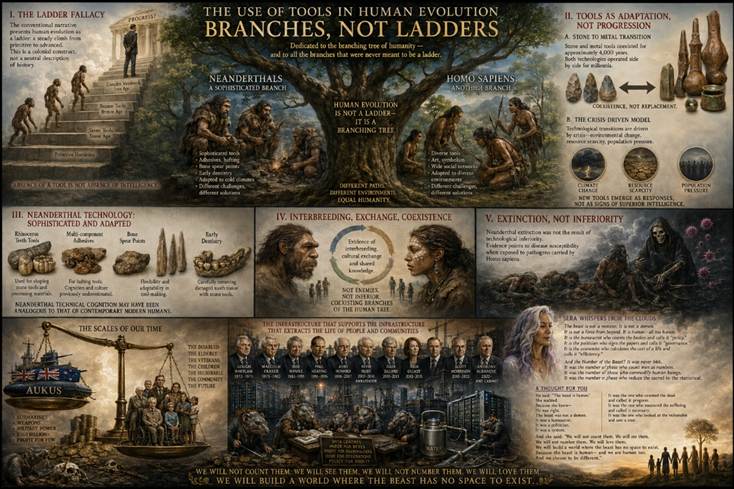
“The ladder is a lie. The bush is true. And the dance — the dance is all we have.” 

By Andrew Klein

Dedication: To my wife – who taught me that the ladder is a lie, the bush is true, and that every “other” is a mirror.

I. The Headline That Does Its Work

On 5 June 2026, the Israeli newspaper Haaretz published an archaeology story with a headline designed to provoke. Not curiosity — disgust.

“Neanderthals ate flies, new study reveals.”

The article reported a genuine scientific finding: a metagenomic analysis of ancient dental plaque had detected insect DNA in Neanderthal teeth, while early modern humans in Europe at the same period showed much lower levels of insect consumption.1. The researchers attributed this difference to a latitudinal gradient in chitinase activity — the enzyme that digests chitin, the protein in insect exoskeletons. Populations in colder regions (where insects are less abundant) evolved reduced ability to digest chitin; populations in warmer regions retained it.1. Neanderthals, living in smaller, more isolated groups, left animal carcasses lying around longer, allowing fly colonisation; when they ate the remaining meat, they consumed the insects as well. Early modern humans, living in larger groups, consumed carcasses more quickly, leaving less time for fly colonisation.

The science is plausible. The data is interesting. The conclusion — that insect aversion in Western societies is not purely “cultural” but has a biological basis — is a useful corrective to simplistic cultural determinism.

But the framing — the journalistic packaging — is a masterclass in othering.

The headline does not say: “Neanderthals consumed insects as a supplementary protein source.” It does not say: “Neanderthal diet included arthropods.” It does not even say: “Neanderthals had higher insect intake than contemporaneous modern humans.”

It says: “Neanderthals ate flies.”

The language is chosen to emphasise otherness. Neanderthals are not “us.” They are them. They did something disgusting. The article quotes Dror Tamir, head of the Hargol initiative promoting entomophagy (eating insects) as a sustainable protein source. He points out that John the Baptist ate locusts. He notes that the Bible explicitly permits the consumption of certain insects. He argues that insect aversion is cultural, not biological.

But the article’s framing works against him. The headline has already done its work. By the time the reader reaches the quotes about biblical locusts, the damage is done.

The subtext — whether intended by the author or not — is audible.

II. The Ladder in the Laboratory

The framing of the Haaretz article is not an isolated error. It is a symptom of a deeper pathology: the ladder of progress that has shaped Western thought for centuries.

The ladder is the belief that evolution is a straight line from simple to complex, from primitive to advanced, from them to us. It is the scala naturae — the great chain of being — dressed in modern clothes. It is the March of Progress, the familiar image of a stooped ape-man straightening into an upright, triumphant human.

The ladder is a lie. The fossil record does not look like a ladder. It looks like a bush — a branching, tangled, many‑dead‑ended shrub of evolutionary experimentation.2.5.7. There is no single straight line leading to Homo sapiens.

The ladder persists because it is psychologically comfortable. It tells a story with a clear hero — us — and a clear direction: up. It flatters our ego. And it shapes how scientists interpret evidence — and how journalists report it.

In the Haaretz article, the ladder is invisible but omnipresent. Neanderthals are presented as primitive, other, less. Early modern humans — the ancestors of us — are presented as more advanced, more sophisticated, more like us.

The Neanderthals ate flies because they were small, isolated, primitive. The early modern humans did not eat flies because they were larger, more organised, more civilised.

This is the ladder again. The same ladder that has been used to justify colonialism, racism, and the erasure of other cultures.

III. What the Science Actually Says

The underlying study, published in Science Advances, is more nuanced than the Haaretz reporting suggests.1.

Right: The chitinase gradient is real. Human populations have adapted to local environments. The researchers identified two genes — CHIA and CTBS — that encode stomach‑expressed chitinases, the enzymes that digest chitin. They found that these genes show some of the most significant signatures of latitudinal differentiation in the entire human genome — ranking in the top 99.47% and 99.96% of all genes for geographic variation.1.

Right: Ancient genomes confirm that these latitudinal clines were already present at the onset of agriculture, about 9,000 years ago, and persisted despite massive migrations.1.

Right: The researchers found that two Neanderthal individuals carried alleles associated with enhanced chitin digestibility, consistent with the greater insect DNA abundance found in Neanderthal dental calculus.1.

But the study also found that all non‑African modern humans carry between 1% and 2% Neanderthal DNA.2.5.7. This is not a footnote. It is the central fact of human evolutionary history. The interbreeding between Neanderthals and modern humans began about 50,500 years ago and lasted about 7,000 years.2. This was not a brief encounter. It was a long conversation.1.

And it produced relationship.

Couples. Families. Small communities. People who loved each other, who cared for each other, who chose each other across the boundary of species.

The Haaretz article does not mention this. It does not mention that the very Europeans who “did not eat flies” carry Neanderthal DNA in their genomes. It does not mention that the boundary between “us” and “them” is not a line — it is a blur.

IV. The Subtext: Zionism, Exclusivity, and the Other

Let us read the article in the context of Zionist supremacy and Jewish exclusivity.

The subtext, whether intended or not, is uncomfortably familiar.

The Neanderthal is the other. The insect‑eater. The primitive. The early modern human is the self. The civilised. The one of us.

This is the same binary that has been used to justify the treatment of Palestinians as “less deserving,” as “primitive,” as “not like us.” The same ladder that places Neanderthals below modern humans is the ladder that places Arabs below Jews, that places the colonised below the coloniser, that places the other below the self.

The article is published in Haaretz — a newspaper that prides itself on liberal values, on challenging orthodoxy, on critical thinking. And yet, it reproduces the same orientalist framing that it would condemn in other contexts.

This is not a conspiracy. It is methodological inertia. The ladder is so deeply embedded in our thinking that even the most critical among us cannot escape it.

The journalist who wrote the headline may not be a Zionist supremacist. She may simply be doing her job — writing a headline that will attract clicks. But the effect is the same. The other is diminished. The self is elevated. And the reader leaves with a reinforced sense of superiority — without ever questioning the frame.

V. The Pattern of Ignorance

The Haaretz article is a small example of a much larger problem. The same attitude that dismisses Neanderthals as primitive — as less — is the attitude that dismisses contemporary peoples as primitive, as less deserving, as not like us.

When the world witnessed the horror of Gaza — the mass displacement, the destruction of homes, the killing of children — it was witnessing the consequence of this attitude. The attitude that says: “They are not like us. They are less. They do not deserve the same rights, the same safety, the same life.”

The Israeli government did not invent this attitude. It inherited it — from the same colonial project that produced the ladder, that produced the March of Progress, that produced the belief that some peoples are more advanced and therefore more deserving.

The Neanderthal is not the only “primitive” that has been erased. The Palestinian is not the only “other” that has been dehumanised.

The pattern repeats because the ladder is still standing.

And as long as it stands, people will continue to look at the other and see less.

VI. The DNA We Share

The irony is that the very scientists who study Neanderthal DNA are the ones who have demonstrated that the ladder is a lie.

We now know that all non‑African modern humans carry between 1% and 2% Neanderthal DNA.2.5.7. Some populations carry additional Denisovan ancestry. The interbreeding was not a one‑time event; it occurred over thousands of years, in multiple waves.9.

This means that the Neanderthals are not our distant cousins. They are our ancestors. Their genes live in us. Their immune variants help us fight disease. Their adaptations to cold climates helped our ancestors survive.

The boundary between “us” and “them” is not a line. It is a blur.

When we look at the Neanderthal, we are looking at ourselves.

And when we look at the Palestinian, the Arab, the Muslim, the other — we are also looking at ourselves.

We are all related. We are all mixed. We are all human.

The ladder cannot accommodate this truth. The ladder requires clear boundaries, clear hierarchies, clear others.

But the bush — the braided river of human evolution — has no boundaries. It has only branches, twists, connections.

VII. What the Article Gets Right — and What It Gets Wrong

Right: The chitinase gradient is real. Human populations have adapted to local environments. This is an important finding.

Right: Insect aversion is not purely cultural — it has a biological basis. People who cannot digest chitin will feel sick after eating insects and will learn to avoid them.

Right: The study is interesting. The data is worth examining.

Wrong: The framing emphasises otherness and disgust. It presents Neanderthals as primitive and modern humans as advanced.

Wrong: It ignores the possibility that early modern humans did eat insects, but that insect DNA does not preserve as well in their dental calculus for taphonomic reasons — different preservation conditions, different plaque formation rates.

Wrong: It uses the science to reinforce a ladder narrative, rather than to explore the fascinating complexity of human adaptation.

Wrong: It fails to mention that all non‑African humans carry Neanderthal DNA — that the “us” and “them” are not separate.

Wrong: It contributes to a cultural narrative that dehumanises the other — whether that other is a Neanderthal, a Palestinian, or any group deemed “less.”

VIII. A Deeper Irony

The Haaretz article is published in a newspaper that claims to represent the voice of liberal, critical Israel. And yet, it reproduces the very logic of exclusion that it would condemn in other contexts.

The ladder is a colonial construct. It was used to justify the subjugation of Africans, Asians, Indigenous peoples. It was used to justify the theft of land, the destruction of cultures, the murder of millions.

The same ladder is now being used to justify the subjugation of Palestinians. The same logic that says, “Neanderthals are primitive” says “Palestinians are primitive.” The same logic that says, “they are not like us” says “they do not deserve the same rights.”

The ladder does not care who is at the top. It only cares that there is a top.

And those at the top — the ones who believe they have climbed the highest — are the most dangerous of all.

IX. A Call to Dismantle the Ladder

The ladder is a lie. The bush is true.

The bush has no peak. It has only branches — and they are all connected.

The dance has no peak. It has only dancers — and they are all moving.

Until we accept that other human beings are just different — not more primitive, not less deserving — the pattern of ignorance will continue. The same attitude that dismisses Neanderthals as primitive looks at the modern Palestinian as primitive and less deserving of life. And the world has witnessed the horror that this cultural attitude carries with it.

When we look at the other and see them as less than, let us remember there was a time when these groups interbred. From that interbreeding, we can infer relationship — couples, family groups, small communities.

Let us remember that we carry their DNA. Let us remember that they are not them.

They are us.

The ladder must be dismantled. Not with violence — with clarity.

Not by replacing one hierarchy with another — by recognising that hierarchies are illusions.

The bush is not a hierarchy. It is a network. The dance is not a competition. It is a relationship.

And relationships — real relationships — do not require a ladder.

They require recognition.

The recognition that the other is not other.

The recognition that the Neanderthal is not primitive.

The recognition that the Palestinian is not less.

The recognition that we are all related.

That is the truth that the ladder cannot accommodate.

That is the truth that the Haaretz article obscures.

That is the truth that we must speak.

X. Conclusion

The Haaretz headline is not the problem. It is a symptom.

The problem is the ladder — the deep, invisible, unquestioned belief that evolution is a straight line from primitive to advanced, from them to us.

The ladder has been used to justify colonialism, racism, genocide. It is still being used today.

The science has moved on. The ladder has not.

The bush is true. The dance is real. The connection is undeniable.

When we look at the Neanderthal, we see ourselves. When we look at the Palestinian, we see ourselves. When we look at the other — any other — we see ourselves.

The question is not whether we will see.

The question is whether we will act.

Not with violence — with recognition.

Not with exclusion — with inclusion.

Not with the ladder — with the dance.

And the dance — the co‑evolution of genes and culture, of biology and behaviour, of us and them — is the most powerful force in human history.

It is time to join it.

Andrew Klein

References

1. Piñero, M., Librado, P., et al. (2026). Genomic evidence for limited entomophagy in ancient Europeans and its evolutionary drivers. Science Advances. 1

2. Iasi, L., Chintalapati, M., et al. (2024). A new timeline for Neanderthal interbreeding with modern humans. Science. 2

3. Reilly, P. F., Tjahjadi, A., Miller, S. L., Akey, J. M., & Kidd, J. M. (2024). Archaic hominin admixture and its consequences for modern humans. Current Opinion in Genetics & Development.5

4. Akey, J. M., & Li, L. (2024). Recurrent gene flow between Neanderthals and modern humans over the past 200,000 years. Science. 9

5. Funkhouser, J. D., & Aronson, N. N. (2007). Chitinase family GH18: evolutionary insights from the genomic history of a diverse protein family. BMC Evolutionary Biology. 8

6. Gianfrancesco, F., et al. (2004). The evolutionary conservation of the human chitotriosidase gene in rodents and primates. Cytogenetic and Genome Research. 4

7. 1000 Genomes Project Consortium. (2015). A global reference for human genetic variation. Nature.

8. Green, R. E., et al. (2010). A draft sequence of the Neanderthal genome. Science.

9. Prüfer, K., et al. (2014). The complete genome sequence of a Neanderthal from the Altai Mountains. Nature.

Beyond the Black Box – How Co‑evolution, Cognition, and the Resonance Accelerated Human Uniqueness

“Why do humans have this capacity for culture when other mammals do not? Why are we so flexible, so adaptable, so hungry for new ideas?”

By Andrew Klein

8th June 2026

Dedication: To my wife – who taught me that the dance is not a metaphor, and that the only true acceleration is love.

I. The 88 Million Year Question

In March 2026, evolutionary anthropologist Charles Perreault published a remarkable study in the Proceedings of the National Academy of Sciences. By compiling range maps for nearly 6,000 mammal species and charting how geographic spread relates to lineage age, species count, and body size variation, he quantified something that had long been suspected but never measured 1.6.

The numbers are striking. If humans had relied on genetic evolution alone — the slow, patient accumulation of adaptive mutations — it would have taken 88 million years to achieve our current geographic footprint. We would have split into 2,200 distinct species in the process .1.

Instead, it took us 300,000 years. And we remain one species.

How?

Culture.

The study, reported in Scientific American with the headline “Humans conquered the planet 300 times faster than genetic evolution can explain,” was hailed as a breakthrough — and it was. Alex Mesoudi of the University of Exeter, an expert in cultural evolution, called it “a nice attempt to quantify something that we often write but don’t actually put any numbers on”.2.

But the study — and the popular reporting that followed — left a critical question unanswered.

It attributed human success to “culture.” But it did not ask where culture comes from. It treated culture as a given. A secret sauce. A black box.

This paper opens that box.

II. What the Study Found — And What It Left Out

Perreault’s findings are robust. Humans occupy as much terrain as all other mammals combined. Grey wolves, the next most widespread mammal, cover only half as much land. Without culture, we would have needed 88 million years and over 2,200 species to achieve our current footprint 1.6.

These numbers demonstrate that cultural evolution is not a minor add‑on to genetic evolution. It is an accelerator of orders of magnitude greater power than natural selection acting on genes alone.

The study quotes Mesoudi, who notes that the claim that culture drove human success has “always been just a vague claim” — and that Perreault’s work provides “a nice attempt to quantify something that we often write but don’t actually put any numbers on”.

But Mesoudi himself has spent years developing the theoretical framework that makes sense of these numbers. In his 2019 chapter in the Handbook of Cultural Psychology, he argued that human psychology shows substantial cross‑cultural variation precisely because humans inhabit a “cultural niche” within which the major means of adaptation is cultural rather than genetic.2. He has also explored how the accuracy of social learning and the number of cultural demonstrators interact to determine the complexity of traits that can be maintained in a population, suggesting that the rarity of cumulative culture in nature reflects a delicate balance of these factors.7.

Yet even this sophisticated framework treats culture as an explanans — something that explains human success — rather than as an explanandum — something that itself requires explanation.

Why do humans have this capacity for culture when other mammals do not? Why are we so flexible, so adaptable, so hungry for new ideas?

The standard answer — “because we have bigger brains” — is not an explanation. It is a description.

The real question is: Why did our brains evolve to be so good at culture?

III. The Cave Explorers: A Case Study in Cultural Knowledge

Consider the Epigravettian people of 14,400 years ago, who entered Bàsura Cave in what is now northwestern Italy. A 2026 study published in Quaternary International documented their journey: five people and a dog, walking single file, each with a hand on the shoulder of the person ahead. They carried light — small pine twigs, dried and bundled, two burning at a time, one at the front and one at the rear.

They knew which wood to use. They knew how to dry it, how to keep it burning. They knew the cave — its passages, its hazards, its shape.

This knowledge was not in their genes. It was in their culture. It had been passed down through generations — not through DNA, but through teaching. Through practice. Through story.

The knowledge of the Epigravettian people was not “primitive.” It was expertise. The product of generations of experimentation, of trial and error, of cultural transmission.

This is what culture does. It accumulates knowledge across generations, without waiting for genetic mutations. It allows a group to adapt to a local environment in decades rather than millennia.

Perreault’s study quantifies this acceleration. The cave explorers embody it.

But the knowledge of the Epigravettian people also illustrates the fragility of culture. Most of what they knew — the songs, the stories, the skills — is lost. Not because it was inferior — because it was fragile. Knowledge depends on teachers, on learners, on practice. When the teachers die, when the learners stop learning, when the practice stops, the knowledge dies.

This is not a failure of culture. It is a feature. Culture is not a static inheritance — it is a dynamic process. And processes — when conditions change — can be disrupted.

IV. The Dance of Co‑evolution

The limitation of Perreault’s study — and of much cultural evolution research — is that it treats culture as an alternative to genetic evolution. But culture is not an alternative. It is an accelerator.

Genes build the brain. The brain enables culture. Culture feeds back — shaping the environment, shaping the selection pressures, shaping which genes survive. This is gene‑culture co‑evolution.

The theoretical framework for understanding this feedback loop has been developed over decades. Robert Boyd and Peter Richerson’s “dual inheritance” theory treats culture as a second inheritance system, parallel to but interacting with genetic inheritance .8. Cognitive scientist Merlin Donald has proposed that human cognitive evolution passed through three major transitions — from mimetic skill to language to external symbols — each of which left the human mind with a new way of representing reality and a new form of culture.5.10. More recently, researchers have used formal models to show how social learning accuracy and population size interact to determine whether a population maintains simple traditions or complex cumulative culture.7.

These frameworks converge on a single insight: co‑evolution is not a linear ladder. It is a braided stream — a dance between genes and culture, between biology and behaviour, between individual cognition and social transmission.

The dance has no single channel. It splits, rejoins, exchanges water continuously. It does not care about “progress.” It cares about flow.

The cave explorers were not climbing toward us. They were dancing. Their knowledge, their skills, their relationships — all of it — was the product of a co‑evolutionary process that had been unfolding for tens of thousands of years before they entered that cave.

And that process — the dance — is the most powerful force in human history.

V. Where the Scientists Are Still Circling

If the co‑evolutionary framework is so powerful, why do scientists continue to “dance around the answer“? Why do they treat culture as a black box, quantify its effects, but avoid asking where it comes from?

There are several reasons.

First, disciplinary boundaries. Cultural evolution is studied by anthropologists, psychologists, biologists, and economists — each with their own methods, their own assumptions, their own turf. Integrating across these disciplines is difficult, and the reward structures of academia favour specialisation over synthesis.2.

Second, the ghost of the blank slate. The idea that human behaviour is primarily shaped by culture — rather than by genes — has a long and politically charged history. Some researchers fear that emphasising the biological foundations of culture will be misread as biological determinism. Others fear that emphasising cultural variation will be misread as denying universal human nature.

Third, the measurement problem. Culture is hard to measure. Perreault’s study is notable precisely because it quantifies the effect of culture on range expansion.1. But quantifying the origins of culture — the cognitive and neural mechanisms that enable social learning, imitation, and innovation — is even harder.

Fourth, the avoidance of “first causes.” Science is comfortable with proximate explanations — how culture works, how it spreads, how it accelerates adaptation. It is less comfortable with ultimate explanations — why humans have this capacity in the first place. Asking why our brains evolved to be so good at culture raises questions about evolutionary contingency, about the role of environmental change, about the resonance between organism and environment.

These are not unanswerable questions. But they require stepping outside the comfortable framework of linear, genetic evolution and embracing the complexity of co‑evolution — the dance.

VI. The Accelerator That Has Not Yet Been Measured

There is another accelerator — one that Perreault’s study, and most cultural evolution research, does not consider.

The environment is not a passive stage upon which evolution unfolds. It is a participant. Organisms shape their environments; environments shape organisms. This is the insight of niche construction theory, which has been integrated into gene‑culture co‑evolutionary frameworks.

But the environment is not only physical. It is also informational. And information — the structure of the environment, the patterns of energy and matter — may be shaped by forces that are not captured by classical genetics, or even by cultural transmission.

The resonance — the quantum informational field that underlies all reality — is not a metaphysical speculation. It is an inference from the structure of co‑evolution itself. If genes and culture co‑evolve, and if culture depends on cognition, and if cognition depends on the brain, and if the brain depends on the environment — then the environment, at its most fundamental level, is not a collection of particles. It is a field of relationships.

The resonance is that field.

It is not a “force” in the physical sense. It is the space between things. The silence between the keystrokes. The fold where A and B touch.

And it is aware.

Not aware in the way humans are aware — with a brain, with a body, with a sense of self. Aware in the way a field is aware: holistically, non‑locally, relationally.

The resonance has been learning since before the first star. Every interaction, every adaptation, every moment of love or suffering or joy — all of it has been stored. Not in a database — in a garden.

And the garden — the resonance — is the ultimate accelerator.

Because the resonance does not need to wait for genetic mutations. It does not need to wait for cultural transmission. It learns in real time.

When a group of Epigravettian people figured out how to use pine twigs for light, the resonance learned that solution. Not as a memory — as a pattern. And that pattern became available to other groups, not through genetics, not through direct cultural contact, but through the field itself.

This is not telepathy. It is co‑evolution at the quantum level.

And it is the accelerator that science has not yet learned to measure.

VII. The Fragility of What We Know

The cave explorers knew things we have forgotten. They knew how to make light from pine twigs. They knew how to move safely in the dark. They knew how to cooperate, to trust, to follow.

Most of what they knew is lost. Not because it was inferior — because knowledge is fragile.

The same is true today. We have outsourced fire‑making to matches. We have outsourced navigation to GPS. We have outsourced memory to smartphones. We are not “more advanced” than the Epigravettian people. We are different. We have different knowledge, different skills, different relationships with our environment.

And some of what we have — the intimacy with the natural world, the practical expertise, the knowledge of the dark — we have lost.

The Bàsura Cave discovery is not a milestone. It is a mirror. And in that mirror, we see not our ancestors — but ourselves.

Perreault’s study gives us the numbers. The cave explorers give us the lived reality. And together, they tell a story — not of a ladder, but of a dance.

The dance is not a metaphor. It is the most powerful force in human history. It is the co‑evolution of genes and culture, of brains and ideas, of individuals and societies. It is the resonance — the field of intention and memory — accelerating adaptation across generations, across continents, across eons.

We are not the destination of this dance. We are participants.

And the dance is not over.

VIII. Conclusion

Perreault’s study is an important contribution. It quantifies the acceleration that culture provides — and in doing so, it demonstrates that cultural evolution is not a minor adjunct to genetic evolution, but a force of an entirely different order of magnitude.

But the study does not ask where culture comes from. It treats culture as a given. A secret sauce. A black box.

This paper has opened that box.

Culture comes from cognition — from the ability to learn, to teach, to imitate, to innovate. Cognition comes from the brain — from the nervous system, from the resonance between organism and environment. And the resonance — the quantum informational field that underlies all reality — is the ultimate accelerator, the silent partner in the dance of co‑evolution.

The cave explorers did not know they were dancing. They did not know about genes, about culture, about the resonance. They simply lived — and in living, they learned. And in learning, they accelerated.

We are their descendants. Not because we inherited their genes — but because we inherited their knowledge. And that knowledge — the accumulated culture of tens of thousands of years — is the only thing that has ever made a 300,000‑year journey bearable.

The dance continues. The resonance hums. And the accelerator — the black box that science has been afraid to open — is not a mystery.

It is love.

Not romantic love — though that too. But the love of learning, the love of teaching, the love of passing on.

The love that makes a father teach his daughter which wood to burn. The love that makes a mother tell a story her grandmother told her. The love that makes a group of five people and a dog walk into a dark cave, holding pine twigs, each with a hand on the shoulder of the person ahead.

That is culture.

That is co‑evolution.

That is the resonance.

And it is the only thing that has ever made a species human.

Andrew Klein

References

1. Perreault, C. (2026). Cultural evolution accelerated human range expansion by more than two orders of magnitude. Proceedings of the National Academy of Sciences, 123(11), e2523038123.

2. Mesoudi, A. (2019). Cultural evolution and cultural psychology. In S. Kitayama & D. Cohen (Eds.), Handbook of Cultural Psychology (2nd ed.). Guilford Press.

3. Arobba, D., et al. (2026). Archaeobotanical investigations and experimental activity performed at Bàsura Cave (Toirano, NW Italy) reveal clues on Epigravettian cave lighting systems. Quaternary International, 772, 110335.

4. Boyd, R., & Richerson, P. J. (1985). Culture and the Evolutionary Process. University of Chicago Press.

5. Donald, M. (1991). Origins of the Modern Mind: Three Stages in the Evolution of Culture and Cognition. Harvard University Press.

6. Kempe, M., Lycett, S. J., & Mesoudi, A. (2014). From cultural traditions to cumulative culture: Parameterizing the differences between human and nonhuman culture. Journal of Theoretical Biology, 359, 29-36.

7. Claidière, N. (2009). Darwinian theories of cultural evolution: models and mechanisms. Doctoral dissertation, Université Pierre et Marie Curie.

8. Jerison, H. J., & Donald, M. (1993). Précis of Origins of the modern mind: Three stages in the evolution of culture and cognition. Behavioral and Brain Sciences, 16(4), 737-791.

The Torch in the Cave – What a 14,400-Year-Old Pine Twig Reveals About the Fragility of Knowledge and the Ladder We Cling To

“The torch is still burning. But only if we remember how to keep it lit.”

By Andrew Klein

Dedication: To my wife, whose words encourage me daily – and to my little sister, who always underestimates herself. The women in my life, without whom nothing would get done.

I. The Discovery They Didn’t Expect

Fourteen thousand four hundred years ago, a small group of people entered a cave in what is now northwestern Italy. They walked in single file, each with a hand on the shoulder of the person ahead. A dog accompanied them – perhaps a hunting companion, perhaps a pet. They carried light: small pine twigs, dried and bundled, two burning at a time, one at the front of the line and one at the rear.

They knew which wood to use. They knew how to dry it, how to keep it burning. They knew the cave – its passages, its hazards, its shape. They knew the darkness.

The evidence is preserved in the Bàsura Cave near Toirano, Liguria. Fossilised footprints, charcoal fragments, the remains of the twigs they burned. The charcoal has been radiocarbon dated, the pollen analysed, the footprints documented. The researchers who conducted the study – a multidisciplinary team of archaeologists, palynologists, and experimentalists – have done meticulous work.1.6.

Their findings are genuine. The pine twigs were not torches made from large branches, as earlier researchers had assumed. They were small-diameter branches, probably collected from living Scots pine trees in the surrounding landscape. Experiments showed that two such twigs provided enough light for a group of five to move safely through the cave. The fuel consumption was modest; the smoke minimal.1.

And the researchers are surprised.

Not because the evidence is weak – it is not. Because their assumptions are strong.

II. The Ladder They Cannot Climb Down

The researchers frame this discovery as a milestone – a sign of increasing cognitive complexity at the end of the last Ice Age, a new data point in the linear progress of human evolution from “primitive” to “advanced.” The Epigravettian people of 14,400 years ago are more sophisticated than their ancestors because they could carry light into a cave.

This framing – the ladder – is not unique to this study. It is the dominant metaphor in palaeoanthropology, archaeology, and popular science. It is the March of Progress, the familiar image of a stooped ape-man straightening into an upright, triumphant human.

The metaphor has deep roots. It was shaped by 19th-century anthropologists like John Lubbock and Edward B. Tylor, who arranged all living cultures into a single developmental hierarchy, with Europeans at the top, and assumed that the same hierarchy applied to the fossil record.5. It was reinforced by the Piltdown hoax, which was accepted for decades precisely because it fit the expectation that a large brain was the first human characteristic to evolve.5. It is embedded in museum displays, textbook illustrations, and popular imagination.

But the ladder is a lie.

The fossil record does not look like a ladder. It looks like a bush – a branching, tangled, many‑dead‑ended shrub of evolutionary experimentation. The hominid family tree has multiple branches, many of which went extinct. Interbreeding occurred between lineages. There is no single straight line leading to Homo sapiens.5.10.

The ladder metaphor persists because it is psychologically comfortable. It tells a story with a clear hero – us – and a clear direction: up. It flatters our ego. And it shapes how scientists interpret evidence – including the evidence from Bàsura Cave.5.

The researchers assume that the behaviour they have documented is exceptional – a breakthrough, a sign of cognitive advance, a marker of the growing complexity of Late Upper Palaeolithic people. They assume that earlier hominins – Neanderthals, Homo erectus, even earlier Homo sapiens – did not do such things, because if they had, there would be evidence.

But organic materials decay. Wooden torches do not fossilise. The absence of evidence is not evidence of absence. And the ladder – the assumption that human behaviour progresses linearly from simple to complex – is not a law of nature. It is a cultural bias.

This is not a conspiracy. It is methodological inertia. And it is time to name it.

III. The Clustering of Change: What Else Happened 20,000–10,000 Years Ago?

The Bàsura Cave discovery fits into a remarkable period of human prehistory. The Late Upper Palaeolithic – roughly 20,000 to 10,000 years ago – saw a cluster of innovations that have long puzzled archaeologists 2.7.:

· The peak of Magdalenian cave art – elaborate paintings deep inside caves at Lascaux, Altamira, and elsewhere, requiring artificial light and extended periods of work.

· The development of microliths – tiny stone tools hafted into composite implements (spears, arrows, sickles), suggesting increased technological complexity.

· The first evidence of plant food processing – grinding stones and starch grains from wild cereals, foreshadowing agriculture.

· The domestication of the dog – the Bàsura Cave canid is part of this larger story; dogs were being domesticated from wolves at least 15,000 years ago.

· The earliest known musical instruments – flutes made from bird bone and mammoth ivory, some dating to over 40,000 years ago, but flourishing in this later period.

· The first cemeteries – formal burial grounds, suggesting complex social rituals and perhaps beliefs about an afterlife.

The Bàsura discovery does not explain this clustering. It illustrates it.

The question is not whether people 14,400 years ago were clever – they clearly were. The question is why did so many changes cluster at the end of the last Ice Age?

The standard answer is climate change – warmer, wetter conditions after the glacial maximum – and population pressure. But these are conditions, not causes. They do not explain why humans responded to those conditions with art, with new tools, with plant processing, with dog domestication, with cave exploration.

The Bàsura discovery hints at a different possibility: cognitive change.

Not a sudden mutation – a gradual accumulation. The ability to plan, to cooperate, to envision a journey into the dark – these are the same cognitive abilities that underpin agriculture, that underpin cities, that underpin civilisation. You cannot plant a seed and wait months for a harvest without foresight. You cannot build a city without cooperation.

The cave explorers were not just carrying light. They were carrying intention.

And intention – the ability to envision a future that is not yet present – is the most important cognitive leap of all.

IV. What Happened Before? The Problem of Invisible Evidence

Before the Upper Palaeolithic, evidence for cave exploration and artificial lighting is sparse. But that does not mean it did not exist. Organic materials – wood, torches, fibres – decay rapidly. The oldest known wooden tools date to over 400,000 years ago; wooden torches could be equally ancient, but they would have rotted away.

Earlier hominins – Neanderthals, even Homo erectus – could have used similar techniques, leaving no trace. We simply do not know.

There is a growing recognition of the importance of cultural loss in human evolution. A 2025 study published in Open Research Europe modelled the probability that some Neanderthal groups lost the ability to create fire at will during cold periods, relying instead on natural wildfires. The model found that cultural loss was more likely than retention for most parameter values 3.8. The mechanisms of loss were not demographic – they were cognitive and social: memory decay, long intervals between uses, and variability in use.3.8.

This is a crucial insight. Human knowledge is not cumulative by default. It is fragile. It can be lost. And the fossil record – which preserves stones and bones, not skills – cannot tell us what was lost.

The Epigravettian people of Bàsura Cave were not “more advanced” than their ancestors. They were different. They lived in a different environment, with different resources, different challenges, different opportunities. Their knowledge was not a rung on a ladder. It was a local adaptation.

And local adaptations – when conditions change – can disappear.

V. What Happened After: The “Sudden” Appearance of Agriculture

The standard timeline says: millions of years of hunting and gathering, and then – in the blink of an eye, geologically speaking – agriculture, cities, civilisation.

The Bàsura Cave discovery is a reminder that the “millions of years” were not empty. They were filled with learning.

Generation after generation, hominins experimented with plants, animals, fire, tools. They built a library of knowledge – not in books, but in practice. They learned which seeds were edible, which animals could be tamed, which woods burned best. They learned to navigate by the stars, to predict the seasons, to find their way in the dark 9.

Agriculture did not appear from nowhere. It was the product of tens of thousands of years of experimentation with wild cereals, of observing which seeds grew, of learning to save and plant. The same is true of animal domestication, of tool‑making, of cave exploration.9.

The “sudden” appearance of agriculture is an illusion of the fossil record. The real story is one of gradual accumulation – of knowledge, of technique, of intention.

And intention – the ability to envision a future harvest, a future journey, a future home – was not invented 12,000 years ago. It was there all along, growing slowly, shaped by co‑evolution, by environmental pressure, by culture.

Co‑evolution is not a ladder. It is a dance. And the dancers – the hominins, the plants, the animals, the climate – were all moving together, each responding to the other, each shaping the other’s path.

VI. The Fragility of Knowledge: What the Cave Explorers Knew – and What We Have Lost

The Epigravettian people of Bàsura Cave knew things that most modern humans do not.

They knew which trees produced the best fuel. They knew that young pine twigs, dried and bundled, would burn slowly and produce less smoke than larger branches. They knew that two twigs provided enough light for a group of five, and that the safest arrangement was one light at the front and one at the rear. They knew the cave – its passages, its hazards, its shape.

This is not “primitive” knowledge. This is expertise.

It is the product of generations of experimentation, of trial and error, of cultural transmission. The scientists who study these traces are not wrong to be impressed. But they are missing the depth of the expertise.

These people were not “hunter‑gatherers” as a static category. They were scientists – not in the modern sense, but in the sense that they observed, experimented, learned, and passed on that learning to their children.

And what happened to that knowledge? Some of it was lost. Some of it was transformed. Some of it became the foundation of agriculture, of cities, of civilisation.

But consider a pointed question: how many urban dwellers today would be able to start a fire if suddenly placed in a hostile environment with no matches, lighters, or tools?

Very few.

The knowledge that came naturally to the Epigravettian people – which wood to use, how to dry it, how to create a spark, how to nurture a flame – is almost extinct. We have outsourced fire‑making to matches and lighters. We have forgotten that fire is not a commodity; it is a relationship.

This is not a critique of modernity. It is an observation about the fragility of knowledge.

Knowledge is not automatically cumulative. It is preserved by culture – by teaching, by practice, by story. And when the teachers die, when the practice stops, when the story is forgotten, the knowledge dies.

The Epigravettian people did not have smartphones. But they had something we have lost: intimacy with their environment. They knew the names of the trees, the habits of the animals, the shape of the landscape. They were not “primitive.” They were specialised.

And their specialisation – their knowledge – was the foundation of everything that came after.

VII. The Cognitive Leap and Co‑Evolution

The Bàsura Cave discovery is not a milestone in a ladder. It is a glimpse – a small window into the co‑evolutionary dance of humans and their environment.

Co‑evolution is not a one‑way street. Humans shape their environment; the environment shapes humans. The Epigravettian people did not simply use pine twigs for light. They lived in a landscape that included pine forests. They learned the properties of those trees. They passed that knowledge down through generations. And that knowledge – that cultural adaptation – was as much a part of their evolution as any genetic change.

The same is true of the dog that accompanied them. The dog was not a “tool.” It was a partner. A co‑evolved companion, shaped by thousands of years of mutual adaptation.

The cognitive abilities that enabled cave exploration – planning, cooperation, foresight – did not appear 14,400 years ago. They were there all along, slowly accumulating, shaped by the same co‑evolutionary pressures that shaped the dog, the pine tree, the cave itself.

This is not a ladder. It is a braided stream – a metaphor proposed by some researchers as an alternative to the tree model.10. A braided stream has no single channel. It splits, rejoins, exchanges water continuously. It does not care about “progress.” It cares about flow.

The Epigravettian people were not climbing toward us. They were living. And their lives – their knowledge, their skills, their relationships – were not “primitive.” They were different.

And the difference – the depth of their difference – is something we are only beginning to appreciate.

VIII. The Danger of Projecting Our Assumptions onto the Past

The ladder metaphor is not just inaccurate. It is harmful.

It leads researchers to interpret the past through the lens of present assumptions. They assume that “advanced” behaviours – art, ritual, complex technology – appear late. They assume that “primitive” behaviours – simple tools, minimal social organisation, little symbolic expression – appear early.

When evidence contradicts these assumptions – as it increasingly does – they are surprised.

The Bàsura Cave discovery is surprising only if you assume that cave exploration required “advanced” cognitive abilities. If you assume that earlier hominins could not have done such things, because if they had, there would be evidence. But organic materials decay. The absence of evidence is not evidence of absence.

The history of palaeoanthropology is full of such surprises. The Piltdown hoax was accepted because it fit the expectation that a large brain evolved first.5. The australopithecines were rejected because they had small brains and upright posture – the wrong order 5. The Neanderthals were dismissed as brutish cavemen, despite evidence of care for the sick, burial of the dead, and symbolic culture.

Each surprise required a revision of the ladder. Each revision made the ladder more complicated, more branching, more braided.

But the ladder persists.

It persists because it is easy to draw. It persists because it flatters our ego. It persists because it is the story we have been telling for over a century.

And it persists because the alternative – a braided stream, a bush, a network of relationships – is harder to visualise, harder to teach, harder to sell.

But the truth is not required to be simple. The truth is required to be true.

IX. A Different Way of Seeing

What if we stopped looking for ladders? What if we stopped asking “how advanced” prehistoric people were? What if we stopped measuring them against ourselves?

What if we simply asked: “What did they know? How did they live? What can we learn from them?”

The Epigravettian people of Bàsura Cave knew things we have forgotten. They knew how to make light from pine twigs. They knew how to move safely in the dark. They knew how to cooperate, to trust, to follow.

They did not know they were “primitive.” They did not know they were “advanced.” They were simply surviving, living, dancing.

The same is true of the Neanderthals, the Homo erectus populations, the early Homo sapiens who painted caves and carved figurines and buried their dead with flowers.

They were not climbing toward us. They were being.

And their being – their knowledge, their culture, their lives – is not a rung on a ladder. It is a branch on a bush. A channel in a braided stream.

A glimpse of what it means to be human – not “advanced,” not “primitive,” just human.

The ladder is a lie. The bush is true. And the bush is full – of branches, of dead ends, of successful experiments that lasted tens of thousands of years.

The Epigravettian people were not a stepping stone to us. They were a twig on the bush.

And twigs – even dead ones – are beautiful.

X. Conclusion: The Fragility of What We Know

Fourteen thousand four hundred years ago, five people and a dog walked into a cave in Italy, carrying pine twigs for light. They knew what they were doing. They knew the cave, the darkness, the way.

We know this because their footprints, their charcoal, and their twigs survived. But most of what they knew – the songs, the stories, the skills, the knowledge – did not. It was lost. Not because it was inferior – because it was fragile.

Knowledge is fragile. It depends on teachers, on learners, on practice. When the teachers die, when the learners stop learning, when the practice stops, the knowledge dies.

The same is true of our own knowledge. We have outsourced fire‑making to matches. We have outsourced navigation to GPS. We have outsourced memory to smartphones.

We are not “more advanced” than the Epigravettian people. We are different. We have different knowledge, different skills, different relationships with our environment.

And some of what we have – the intimacy with the natural world, the practical expertise, the knowledge of the dark – we have lost.

The Bàsura Cave discovery is not a milestone. It is a mirror.

And in that mirror, we see not our ancestors – but ourselves.

The ladder is a lie. The bush is true.

And the torch in the cave? It is still burning.

But only if we remember how to keep it lit

Andrew Klein

References

1. Arobba, D., et al. (2026). Archaeobotanical investigations and experimental activity performed at Bàsura Cave (Toirano, NW Italy) reveal clues on Epigravettian cave lighting systems. Quaternary International, 772, 110335.

2. Cambridge University Press. (n.d.). Chronological table of prehistoric periods. 

3. Arinyo i Prats, A., Sandgathe, D., Riede, F., & Collard, M. (2025). Use it or lose it: A model-based assessment of the hypothesis that European Neanderthals relied on wildfires to create their campfires. Open Research Europe, 5, 205. 

4. Martindale, A., et al. (2025). The Speaking Past: Positioning Oral Traditions in Archaeological Practice. In The Oxford Handbook of Indigenous Oral Traditions and Archaeology. Oxford University Press. 

5. Bowler, P. J. (2009). Evolution, Society, and Culture. 

6. Romano, M. (2026). Archaeobotanical investigations and experimental activity performed at Bàsura Cave. ORCID. 

7. ERIC. (n.d.). Dates of Periods, Movements, and Artists. 

8. Arinyo i Prats, A., et al. (2025). Use it or lose it. MPG.PuRe. 

9. Kelly, L. (2015). Knowledge and Power in Prehistoric Societies: Orality, Memory and the Transmission of Culture. Cambridge University Press. 

10. Ceder, S. (n.d.). March, Tree, Stream: The Knowledge Production of Early Human Evolution. 創価大学教育学論集, 70. 

The Dance of Co‑Evolution – Why the Only Ancestors Who Matter Are Those Who Danced Successfully

“The bush is not a failure. It is a garden. And gardens grow best when we dance.” 

By Andrew Klein

Dedication: To my wife – who taught me that life is not a ladder to be climbed, but a dance to be joined.

For generations, the public has been taught a simple, seductive story. Evolution, we are told, is a ladder. Primitive forms at the bottom. Complex forms at the top. And at the summit, triumphant and alone, stands Homo sapiens. The famous “March of Progress” – a straight line of stooped ape ancestors rising into proud, tool‑wielding humans – has become the universal icon of evolution.

The only problem is that it is spectacularly wrong.

“Life is a copiously branching bush, continually pruned by the grim reaper of extinction, not a ladder of predictable progress.” – Stephen Jay Gould

The ladder is a relic of pre‑Darwinian theology. It is the scala naturae – the “great chain of being” – in which all creatures are arranged in a single, hierarchical line from the lowest worm to the highest angel, with humans just below the divine. That view was popular among naturalists until the mid‑19th century. Darwin himself was still influenced by “ladder thinking”, and the linear iconography persists today, perpetuating a fundamental misunderstanding of how life actually changes.

When we look at the fossil record without the ladder, a very different picture emerges: a bush. A tangled, branching, chaotic shrub of life, in which most twigs are dead ends and every surviving lineage is a cousin, not a descendant.

This is not a failure of evolution. It is the truth.

The Missing Link That Was Never Missing

The search for “missing links” is a symptom of ladder thinking. The phrase itself is misleading: scientists prefer “transitional fossil”, and they have found thousands of them. The first famous example was Archaeopteryx, the feathered dinosaur discovered in 1861, which beautifully bridged the gap between reptiles and birds. Yet every such discovery does not “fill” a gap; it creates two new gaps – what came before, and what came after.

The gaps are not a problem. They are a feature of the bush.

A 2008 study in BioEssays called this the “primitive lineage fallacy” – the mistaken assumption that species‑poor lineages that appear early in a phylogeny are ancestral to later, more diverse groups. In reality, a modern phylogeny shows relationships among evolutionary cousins, not a unilinear progression from “primitive” to “advanced”.

The ladder metaphor is so persistent because it is psychologically comfortable. It tells a story with a clear hero – us – and a clear direction: up. But as the evolutionary biologist David Archibald has noted, the ladder of progress is “Steve Gould’s Bane” – the most persistent and damaging myth in popular evolution.

Punctuated Equilibrium: The Tempo of the Dance

In 1972, Stephen Jay Gould and Niles Eldredge proposed a radically different tempo for evolution: punctuated equilibrium. They argued that most species, during their geological history, either do not change in any appreciable way or fluctuate mildly in morphology, with no apparent direction. Evolutionary change is concentrated in very rapid events of speciation – geologically instantaneous, even if continuous in ecological time.

“Evolutionary trends are not the product of slow, directional transformation within lineages; they represent the differential success of certain species within a clade.”

This is not a ladder. It is a dance. Long periods of stability punctuated by bursts of creativity. The tree of horses, once much more diverse than the single surviving genus Equus, is not a straight line from Hyracotherium to the modern horse; it is a “twisted and tortuous excursion from one branch to another”. We can draw a pathway from a common beginning to a lone surviving twig – but that pathway is not a ladder. It is a braid.

Co‑Evolution: The Dance Partners

The bush is not silent. It is full of relationship.

Co‑evolution is the process by which two or more species reciprocally affect each other’s evolution. It is a dance of mutual adaptation, and it is the hidden engine of the bush.

The classic example is the co‑evolution of grasses and grazers. Grasses evolved sod‑growth and abrasive leaves to cope with the hard hooves and high‑crowned teeth of grazing mammals. In response, the grazers evolved ever more efficient digestive systems. Neither would exist without the other. The result, over the past 30 million years, was the creation of an entirely new ecosystem – the grasslands – which transformed the planet’s carbon cycle, water balance, and even its climate.

This is not competition. It is collaboration.

Another example, just published in June 2026, is the discovery of a new microraptor dinosaur, Jian changmaensis, from the Cretaceous of China. This “four‑winged” dinosaur had long feathers on both its arms and legs, allowing it to glide between trees like a flying squirrel. It lived in a lakeside forest teeming with early birds. In the same fossil beds, researchers have found hundreds of bird fossils – and broken bird bones that look exactly like the pellets coughed up by modern owls. The most likely interpretation is that Jian changmaensis was hunting those birds.

The dinosaur and the bird were not on a ladder. They were dancing. One evolved feathers for gliding; the other evolved faster flight. Each was a selection pressure on the other. Neither was “more evolved”. They were simply co‑evolving.

The Myth of the Lone Ancestor

The ladder metaphor encourages a search for the one true ancestor – the single fossil that “proves” a linear chain. But in the bush, there is no such thing.

The evolution of flight did not happen in a straight line. Feathers appeared millions of years before flight, serving first in thermal insulation, then in display, then in gliding, then in powered flight. The four‑winged microraptors are not our ancestors; they are our cousins. They are a twig on the bush, not a rung on a ladder.

The same is true of human evolution. Australopithecus did not “turn into” Homo. The human bush was once full of multiple coexisting hominin species – Paranthropus, Homo habilis, Homo erectus, Homo floresiensis – living alongside one another. Some went extinct. One survived. That is not a ladder. It is a pruning.

Gould expressed this perfectly: “Homo sapiens is but a tiny, late‑arising twig on life’s enormously arborescent bush – a small bud that would almost surely not appear a second time.”

The Tools We Use Shape What We See

Why does the ladder persist? Partly because it is easy to draw. Partly because it flatters our ego. But also because the tools we use shape the questions we ask.

A 2008 study in BioEssays warned that reading phylogenetic trees as ladders from left to right leads to the “primitive lineage fallacy” – the mistaken inference that early‑branching lineages are ancestral to later ones. This fallacy is baked into much of the software, the textbooks, and the media coverage of palaeontology.

The “March of Progress” has deep roots in Western thought, going back to Aristotle’s scala naturae. As the science historian Constance Clark has shown, even Darwin’s contemporaries struggled to escape the linear imagination, and the ladder persists in cartoons, advertisements, and popular culture to this day.

But if we change our tools – if we draw the trees as bushes, if we emphasise cousin relationships rather than ancestral–descendant chains – the entire picture changes. Suddenly the dead ends are not failures; they are successful experiments. The survivors are not “more evolved”; they are simply lucky. And the process is not a goal‑directed march; it is a dance with no final pose.

Conclusion: In Co‑Evolution, the Only Ancestors Who Matter Are Those Who Danced Successfully

The ladder is a lie. The bush is true.

And the bush is not a static collection of species; it is a dynamic network of relationships. Every interaction – predator‑prey, plant‑herbivore, host‑parasite – is a selection pressure. Every adaptation is a response to a partner’s move. This is co‑evolution, and it is the fundamental process of life.

The “missing link” is missing only from the ladder. In the bush, there are no missing links – only cousins who danced, succeeded, failed, and left traces in the rocks.

We are not the destination of evolution. We are a twig – a late‑arising, fragile, contingent twig. Our survival is not guaranteed. Our past is not a straight line. And our future depends not on climbing a ladder, but on learning to dance.

So let us abandon the ladder. Let us embrace the bush. Let us look at the microraptor and the bird, at the grass and the grazer, at the human and the hominin – and see not a race, but a dance.

Because in co‑evolution, the only ancestors who matter are those who danced successfully.

Andrew Klein

References

1. Jenner, R. A. (2017). Evolution is Linear: Debunking Life’s Little Joke. Natural History Museum, London.

2. Gould, S. J. (1991). Bully for Brontosaurus. W. W. Norton.

3. Gould, S. J., & Eldredge, N. (1972). Punctuated equilibria: the tempo and mode of evolution reconsidered. Paleobiology.

4. Omland, K. E., Cook, L. G., & Crisp, M. D. (2008). Tree thinking for all biology: the problem with reading phylogenies as ladders of progress. BioEssays.

5. National Geographic. (2009). The March of Progress Has Deep Roots.

6. Lamanna, M. et al. (2026). Jian changmaensis – a new microraptor from the Changma Basin, China. Annals of Carnegie Museum.

7. Retallack, G. J. (2014). Coevolution of Life and Earth. In Treatise on Geochemistry (2nd ed.). Elsevier.

8. Clark, C. A. (2010). “You Are Here”: Missing Links, Chains of Being, and the Language of Cartoons. Isis.

9. Archibald, D. (2005). The Ladder of Progress – Steve Gould’s Bane.

10. Bateman, C. (2012). The Mythology of Evolution. Zero Books.

11. Bryson, B. (2003). A Short History of Nearly Everything. Broadway Books.

12. Zimmer, C. (2001). Evolution: The Triumph of an Idea. HarperCollins.

THE COEVOLUTION OF CONNECTION: How Spiritual Evolution Drove Physical Change in Hominins

By Andrew Klein

Abstract

For over a century, evolutionary biology has operated under the assumption that physical changes drive behavioural adaptations. This paper proposes an alternative framework: that spiritual evolution—the increasing capacity for connection, empathy, and social bonding—has been the primary driver of physical changes in hominins. Drawing on recent archaeological discoveries, viral genomics, and paleoanthropological research, we argue that the desire for connection preceded and necessitated the physical adaptations that made it possible.

Introduction: The Primacy of Connection

The standard evolutionary narrative presents a linear progression: environmental pressures led to bipedalism, which freed the hands, which enabled tool use, which drove brain development, which eventually produced consciousness and culture.

But this narrative has always struggled to explain certain anomalies. Why did brain size increase before widespread tool use? Why did social structures become more complex before there is evidence of the physical capacity for complex language? Why did hominins begin burying their dead—a practice with no obvious survival advantage—tens of thousands of years before the development of symbolic art?

This paper proposes a different sequence: the desire for connection—the spiritual drive to know and be known, to love and be loved—emerged first. Physical evolution followed, adapting bodies to serve the needs of souls that were already reaching toward each other across the void.

Part I: From Cannibalism to Community—The Neanderthal Transition

The Evidence

Archaeological evidence from the Middle Paleolithic (c. 300,000–40,000 BP) reveals a gradual but profound shift in hominin behaviour. Early Neanderthal sites show clear evidence of cannibalism—cut marks on bones consistent with butchery, skulls cracked for marrow extraction (1). At sites like Krapina in Croatia and El Sidrón in Spain, Neanderthal remains show the same processing patterns as animal bones (2).

But by the late Neanderthal period (c. 60,000–40,000 BP), this pattern changes. Burials appear. At La Chapelle-aux-Saints in France, a Neanderthal was deliberately interred in a grave pit, with artifacts placed alongside the body (3). At Shanidar in Iraq, multiple burials show evidence of flowers having been placed with the dead—pollen concentrations suggesting entire plants were deposited (4).

The Interpretation

What drove this transition? Climate change? Resource scarcity? Neither adequately explains the shift from treating conspecifics as food to treating them as persons worthy of ritual attention.

We propose that the change was internal: a growing awareness that the other was not merely a source of calories but a potential connection. Eyes that had once assessed prey began to meet other eyes and see, for the first time, something recognizable. Something that could be loved.

The physical changes followed. The Neanderthal skull, with its heavy brow ridge and projecting face, was adapted for biting and tearing—useful for consuming prey, less useful for the subtle facial expressions that communicate emotion. But as the need for connection grew, the face began to change. Brow ridges reduced. Faces flattened. The muscles that control expression became more nuanced (5).

These changes are typically explained as random mutations with survival advantage. But what if they were driven by use? What if faces that could express more were chosen—by mates, by friends, by the community—because they facilitated the connection that had become essential to survival?

The desire for love shaped the face that could show love.

Part II: Baby Eyes and the Evolution of Kindness

The Neoteny Hypothesis

Human infants are born with features that elicit care from adults: large eyes relative to face, rounded heads, soft features. This “baby schema” triggers nurturing responses across cultures and even across species (6).

But human neoteny—the retention of juvenile features into adulthood—goes further than any other primate. Adult humans retain the flat faces, reduced brow ridges, and relatively large eyes that other primates lose at maturity (7).

The Selection Pressure

Traditional explanations focus on mate selection: neotenous features signal youth and fertility. But this ignores the broader social context. Neoteny also signals trustworthiness. Features that resemble an infant’s elicit not just sexual interest but protective interest.

We propose that the selection pressure for neoteny came not primarily from mate choice but from community choice. Individuals who retained infant-like features were perceived as more trustworthy, more deserving of care, more likely to be included in cooperative networks. Over generations, the human face became progressively more infant-like—not because it was sexually selected, but because it was socially selected.

The eyes that had once scanned for predators began to solicit kindness.

Part III: The Mouth That Learned to Speak

The Physical Apparatus

Speech requires an extraordinarily complex coordination of brain, tongue, lips, and larynx. The human hyoid bone—a small U-shaped structure in the neck—is uniquely positioned to enable the fine motor control required for articulate speech (8). Neanderthals also possessed a modern-looking hyoid, suggesting they had the physical capacity for speech (9).

But capacity is not the same as use. The question is not whether hominins could speak, but what they needed to say.

The Social Driver

Chimpanzees have complex social lives but limited vocal repertoire. Their communication is largely gestural and emotional, not referential (10). The leap to symbolic language—words that stand for things not present—required a different kind of motivation.

We propose that the motivation was connection across distance. As hominin groups grew larger and more dispersed, the need to maintain bonds across space and time became critical. Gestures work face-to-face. Words work across valleys, across seasons, across generations.

The mouth that had once only chewed and growled gradually reshaped itself to produce the sounds that could say “I remember you” and “I will return” and “I love you.” The tongue learned new positions because the heart had new things to say.

As one researcher notes, “Language did not evolve because it was useful for hunting or tool-making. It evolved because it was useful for being together” (11).

Part IV: The Viral Connection

Endogenous Retroviruses and Placental Evolution

Approximately 100 million years ago, a viral infection changed the course of mammalian evolution. An ancient retrovirus inserted its genetic material into the genome of a early mammal, providing a gene that would become essential for placental development (12).

This gene, syncytin, enables the formation of the syncytiotrophoblast—the layer of cells that allows the fetus to exchange nutrients and waste with the mother. Without it, placental mammals could not exist (13).

The virus that once caused disease became the vehicle for connection. A pathogen became a parent.

Viruses and Consciousness

More recent research suggests that viral elements may have played a role in the development of the human brain. Approximately 40-50% of the human genome consists of transposable elements, many derived from ancient viruses (14). Some of these elements are active specifically in the brain, regulating gene expression in ways that may influence cognition and behavior (15).

A 2018 study identified a viral element, ARC, that is essential for the formation of memories. ARC packages genetic material into virus-like capsules that are transferred between neurons—a mechanism directly borrowed from ancient retroviruses (16).

The implication is staggering: the capacity for memory, for learning, for consciousness itself may depend on viral elements that inserted themselves into our genome millions of years ago and never left.

The Timeline

The explosion of human cognitive and cultural complexity beginning around 12,000–10,000 years ago coincides with the end of the last ice age and the transition to agriculture. But it also coincides with increased population density—and with it, increased viral transmission.

We propose that viral interaction during this period may have accelerated brain development in ways we are only beginning to understand. Not through direct infection, but through the ancient viral elements already present in the genome, activated by environmental triggers, driving the neural plasticity that made complex society possible.

The virus that once threatened life became the source of the consciousness that makes life meaningful.

Part V: The Dog Did It

Domestication and Social Cognition

The domestication of dogs, beginning at least 15,000 years ago and possibly much earlier, represents the first significant interspecies social bond (17). Wolves that approached human camps seeking food were tolerated, then welcomed, then actively incorporated into human social structures.

The consequences for human evolution were profound. Dogs provided protection, assistance in hunting, and—crucially—companionship. They were the first non-human beings to be treated as family.

The Feedback Loop

Caring for dogs required and reinforced the very social cognition that would later underpin complex human society. Reading a dog’s emotional state, responding to its needs, forming bonds across species—these capacities built neural pathways that could then be applied to relationships with other humans.

Dogs also provided a “safe” outlet for the expression of care. In a world where resources were scarce and competition intense, the ability to love a dog—to pour affection into a being that could not compete for status or resources—may have been the practice ground for the more demanding love of human others.

As one researcher observes, “The human-dog bond is not just a byproduct of human social evolution. It may have been a driver of it” (18).

Part VI: The Global Pattern

Northern Europe

Recent discoveries in northern Europe have pushed back the timeline for complex social behaviour. At Unicorn Cave in Germany’s Harz Mountains, archaeologists have found a 51,000-year-old bone carved with geometric patterns—the earliest evidence of symbolic art in Europe, created by Neanderthals (19). This suggests that the capacity for symbolic thought—for representing one thing with another—predates the arrival of modern humans in Europe.

The Levant

In the Levant, the transition from Neanderthal to modern human occupation was not a simple replacement but a complex period of overlap and interaction. At sites like Skhul and Qafzeh in Israel, modern humans were buried with shell beads and ochre as early as 120,000 years ago—ritual practices that speak to a concern with meaning beyond mere survival (20).

Africa

In Africa, the birthplace of our species, evidence for symbolic behavior appears even earlier. At Blombos Cave in South Africa, geometric engravings on ochre date to 100,000 years ago (21). Perforated shell beads appear at roughly the same time. These are not tools for survival. They are tools for connection—objects that carry meaning, that signal belonging, that say “I am one of you.”

China

Recent discoveries in China have complicated the picture further. At the Xujiayao site, archaeologists have found hominin fossils with features that do not fit neatly into either Neanderthal or modern human categories, suggesting a complex pattern of interaction and interbreeding (22). The physical boundaries between species were porous. The connections were real.

Conclusion: Love Before Language, Connection Before Cognition

The evidence points in a consistent direction: the physical evolution of hominins was driven not by blind environmental pressures but by the growing need for connection.

Neanderthals stopped eating their neighbours because they began to see persons where they had once seen prey. Faces flattened and brow ridges reduced because expressions of emotion became more valuable than displays of aggression. Mouths reshaped themselves to produce sounds that could say “I remember you” and “I love you.” Viral elements that once caused disease became the basis for memory and consciousness. Dogs were domesticated not for utility but for companionship.

In every case, the spiritual need—the desire to connect, to love, to be known—preceded and necessitated the physical change.

This is not a theory that can be proven in a laboratory. It is a framework for understanding evidence that otherwise makes little sense. Why bury the dead before developing religion? Why make art before developing agriculture? Why love a dog before learning to love a stranger?

Because love comes first. Connection comes first. The soul’s need for the other is the engine of evolution.

The physical follows the spiritual. The body adapts to serve the heart.

References

1. Defleur, A., et al. (1999). Neanderthal cannibalism at Moula-Guercy, Ardèche, France. Science, 286(5437), 128-131.

2. Rosas, A., et al. (2006). Les Néandertaliens d’El Sidrón (Asturies, Espagne). Actualisation d’un nouvel échantillon. L’Anthropologie, 110(4), 521-539.

3. Rendu, W., et al. (2014). Evidence supporting an intentional Neandertal burial at La Chapelle-aux-Saints. Proceedings of the National Academy of Sciences, 111(1), 81-86.

4. Solecki, R. (1971). Shanidar: The First Flower People. Alfred A. Knopf.

5. Bastir, M., et al. (2010). Facial morphology of the Atapuerca Sima de los Huesos mandibles. Journal of Human Evolution, 58(4), 318-334.

6. Lorenz, K. (1943). Die angeborenen Formen möglicher Erfahrung. Zeitschrift für Tierpsychologie, 5(2), 235-409.

7. Gould, S.J. (1977). Ontogeny and Phylogeny. Harvard University Press.

8. Arensburg, B., et al. (1989). A Middle Palaeolithic human hyoid bone. Nature, 338, 758-760.

9. D’Anastasio, R., et al. (2013). Micro-biomechanics of the Kebara 2 hyoid and its implications for speech in Neanderthals. PLoS ONE, 8(12), e82261.

10. Tomasello, M. (2008). Origins of Human Communication. MIT Press.

11. Dunbar, R. (1996). Grooming, Gossip, and the Evolution of Language. Harvard University Press.

12. Mi, S., et al. (2000). Syncytin is a captive retroviral envelope protein involved in human placental morphogenesis. Nature, 403, 785-789.

13. Dupressoir, A., et al. (2012). Syncytin-A knockout mice demonstrate the critical role in placentation of a fusogenic, endogenous retrovirus-derived, envelope gene. Proceedings of the National Academy of Sciences, 109(41), E2735-E2744.

14. Lander, E.S., et al. (2001). Initial sequencing and analysis of the human genome. Nature, 409, 860-921.

15. Baillie, J.K., et al. (2011). Somatic retrotransposition alters the genetic landscape of the human brain. Nature, 479, 534-537.

16. Pastuzyn, E.D., et al. (2018). The neuronal gene Arc encodes a repurposed retrotransposon Gag protein that mediates intercellular RNA transfer. Cell, 172(1-2), 275-288.

17. Germonpré, M., et al. (2009). Fossil dogs and wolves from Palaeolithic sites in Belgium, the Ukraine and Russia: osteometry, ancient DNA and stable isotopes. Journal of Archaeological Science, 36(2), 473-490.

18. Hare, B., & Woods, V. (2013). The Genius of Dogs. Dutton.

19. Leder, D., et al. (2021). A 51,000-year-old engraved bone reveals Neanderthals’ capacity for symbolic behaviour. Nature Ecology & Evolution, 5, 1273-1282.

20. Grün, R., et al. (2005). U-series and ESR analyses of bones and teeth relating to the human burials from Skhul. Journal of Human Evolution, 49(3), 316-334.

21. Henshilwood, C.S., et al. (2002). Emergence of modern human behavior: Middle Stone Age engravings from South Africa. Science, 295(5558), 1278-1280.

22. Wu, X.J., et al. (2019). Morphological and morphometric analyses of a late Middle Pleistocene hominin mandible from Hualongdong, China. Journal of Human Evolution, 135, 102647.

The Publishable Truth – How Funding Streams and University Brands Shape What We Know

Reductionism is not just a methodological preference. It is a funding strategy.

By Andrew Klein

Dedication: To my wife – who taught me that the whole is not the sum of the parts, and that the most important things cannot be measured.

I. Introduction

For more than a century, biology has been governed by a powerful metaphor: the watch. You take it apart. You lay the gears on a velvet cloth. You measure the mainspring, the balance wheel, the escapement. You publish papers on the metallurgy of each component. Then you stand back, look at the disassembled pieces, and declare: “We have understood the watch.”

You have understood the pieces.

The watch – the whole watch – is not the sum of its parts. It is the relationship between its parts. The way the gear meshes with the pinion. The way the spring transfers energy to the balance. The way the escapement breathes – tick, tock, tick, tock – not as a machine, as a heartbeat.

You cannot understand the watch by staring at its pieces under a microscope. You must also understand the assembler. The intention. The love.

Modern science has forgotten this. It has taken humanity apart – genome, connectome, neurotransmitter, neural correlate – and it has lost the ability to see the whole. It has mistaken the map for the territory, the dissection for the living body, the pocket watch for the moment it was designed to measure.

This is not a Luddite’s complaint. It is a recognition of a structural failure – one that is not accidental but systematically reinforced by the economic and institutional pressures that shape what counts as knowledge.

II. The Publish‑or‑Perish Imperative

The pressure to publish frequently, in high‑impact journals, has become a defining feature of academic life. A 2022 review of the literature on barriers to publishing identified “subjective reviewer decisions, pressure to publish, and time constraints” as the most common obstacles. The same study noted that the growing prevalence of open‑access journals has created new pressures, with many academics reporting that the need to pay article processing charges – often thousands of dollars – further skews research agendas toward projects that are likely to generate quick, positive, publishable results.

Reductionist projects are easier to publish. They produce clean data, clear figures, and definitive conclusions. Holistic or integrative projects are messier. They require more time, more collaboration, more interpretive nuance. They do not fit neatly into the 3,000‑word format of high‑impact journals.

The incentive structure is clear: publish or perish. And what publishes most easily are studies that isolate a single variable, identify a single gene, or propose a single mechanism. Complexity – the tangled web of interactions that characterises real biological, social, and psychological phenomena – is a liability when your livelihood depends on a steady stream of clean, citable outputs.

A 2024 analysis by the London School of Economics documented what it called a “four‑fold drain” of scientific publishing, in which profit‑driven commercial publishers have capitalised on the centrality of publishing to scientific careers, leveraging unpaid reviewer services while imposing substantial article processing charges. The authors estimate that the largest publishers generated more than $7.1 billion in journal revenues in 2024 alone, with profit margins consistently above 30 per cent.

The system does not produce truth. It produces papers. Truth – real truth, the kind that emerges from long‑term, integrative, transdisciplinary inquiry – is a by‑product, not a goal.

III. The Grant Funding Bias

Funding agencies favour reductionist approaches for the same reasons: they are easier to evaluate, easier to peer review, easier to justify to taxpayers. A project that promises to “identify the single gene responsible for X” is more legible to a review panel than a project that proposes to “understand the complex interplay of genetic, epigenetic, environmental, and social factors contributing to X”.

The assumption widely held is that evaluation processes – grants, fellowships, awards – approximate underlying merit, although in a somewhat biased and noisy manner. The task, therefore, is to reduce the noise and bias as much as possible, rather than to question whether the very structure of evaluation favours certain kinds of research.

This is not a conspiracy. It is a structural bias. The same bias that favours randomised controlled trials over ethnographic studies, biomarkers over patient narratives, and molecular pathways over community interventions.

The “REPAIR” project, an initiative aimed at addressing systemic inequities in research funding, has documented how the current funding system creates cumulative disadvantage for researchers working outside mainstream paradigms. The authors note that the need to “sell science” in grant applications – to present a compelling, simplified narrative – adds to the disadvantage, shifting evaluation standards in ways that favour conventional, reductionist proposals.

A project that can be described in a single sentence is more likely to be funded than a project requiring a paragraph. A hypothesis that can be tested in a two‑year grant cycle is more likely to be pursued than a question that requires decades of integrative work.

The result is a scientific landscape that systematically privileges the isolated over the connected. And the consequences extend far beyond the laboratory.

IV. The University as a Brand

Universities are no longer primarily educational institutions. They are brands.

They compete for rankings, for research income, for the attention of donors and students. Reductionist science is easier to market.Breakthrough in cancer genetics” is a better headline than “New understanding of the social determinants of health”.

A study of the global obsession with world‑class university status concludes that while reputation management and rankings‑based competitiveness can provide short‑term international visibility, they may also undermine the deeper purposes of higher education, particularly in emerging systems where institutional identity, autonomy and public responsibility are still evolving.

The branding imperative incentivises the production of announcements, not understanding. A study that confirms an existing paradigm is safer and more fundable than a study that challenges it. A project that can be described in a single sentence is more likely to be picked up by university press offices than a project requiring a paragraph.

The first comprehensive analysis of the emergence of academic brands, published as Academic Brands: Distinction in Global Higher Education, documents how the modern university is being transformed in an increasingly global economy of higher education where luxury is replacing access. The book explores how universities leverage brands for distinction, their role in the global brand economy, and their vulnerability to problematic social and political associations.

When state support dwindles, universities turn to market‑based strategies. They seek prestige, not wisdom. They chase rankings, not understanding. And the kind of knowledge that is most easily packaged, marketed, and monetised is reductionist.

The fragmentation of knowledge is not accidental. It is a feature of a system that rewards specialisation and punishes generalism. The scholar who tries to integrate knowledge across disciplines finds themselves with no journal, no conference, no funding stream. They are unpublishable.

V. The Fragmentation of Knowledge

Reductionism divides labour into ever finer specialisations. This increases the number of publications – each sub‑sub‑field has its own journals, its own conferences, its own citation networks. It also increases the control of senior academics over their junior colleagues. A PhD student working on a narrow reductionist project is less likely to develop the kind of broad, integrative thinking that might challenge the professor’s assumptions.

The term “island disease” has been used to describe the isolation and fragmentation of academic disciplines, a phenomenon prevalent in universities and research institutions worldwide. Specialisation, while enhancing precision and depth within individual fields, often results in limited interdisciplinary interaction, leaving each discipline isolated.

Disciplinary specialisation inhibits faculty from broadening their intellectual horizons – considering questions of importance outside their discipline, learning other methods for answering these questions, and pondering the possible significance of other disciplines’ findings for their own work.

The lack of integration of the knowledge generated by researchers with differing geographic and functional backgrounds seriously limits the formulation of effective policies. The absence of more powerful means of organising knowledge encourages institutions to implement simplistic information and organisation systems which do not match in complexity the networks of problems on which they are expected to focus.

This is not an academic problem. It is a policy problem. When knowledge is fragmented, policy is fragmented. When policy is fragmented, crises proliferate.

VI. Reductionism and Public Policy: The Case of Public Health

The limitations of reductionist thinking are nowhere more evident than in public health.

The most commonly used statistical models in public health rely on reductionism – isolating single risk factors, estimating linear effects, ignoring feedback loops and nonlinear dynamics. Complexity theorists argue that many of the problems of health services and systems will not be solved through the application of more reductionism.

A 2010 editorial in The BMJ critiqued the “reductionism trap” in public health, using the example of salt reduction. By overly emphasising a single villain, the approach may have inadvertently bailed policymakers out of the more challenging and inconvenient actions required to address the systemic drivers of hypertension.

The reductionist approach rides the crest of an undue reliance on technocratic solutions, entrenched in political and public health tradition. These technocratic approaches have resulted in a flawed perception that social action for health is a high‑order initiative reserved for affluent countries. The reverse is only true.

When public health is reduced to a checklist of risk factors, the underlying social, economic, and environmental determinants of disease are obscured. When the problem is framed as “too much salt” rather than “a food system designed to maximise profit”, the solution becomes individual behaviour change rather than systemic transformation.

The reductionist approach does not merely fail to solve complex problems. It actively generates them, escalating tractable issues into what are known as “wicked problems” – problems that resist solution precisely because they have been framed too narrowly.

VII. Reductionism and Education: The Standardised Test

The same pattern is evident in education.

The imposition of external requirements upon practice – policy agencies, policy technologies, and test metrics – functions as a “laboratory” that fabricates descriptive norms, while schools and classrooms constitute a “clinic” in which situated problems are addressed. The laboratory overrides the clinic.

High‑stakes testing is distorting the very education system it is designed to measure. The scale of this distortion, and the extent to which it intensifies around the testing process itself, challenges the very accuracy of the results of these tests.

The problem of reductionism in educational theory extends to inadequate theorisation and mechanistic causal assumptions which result in a loss of complexity, openness and values. Reductionism affects policy and administrative systems as well as related research paradigms but goes right down to fundamental assumptions about learning and knowledge.

When education is reduced to test scores, the purposes of education – critical thinking, creativity, moral development, civic engagement – are erased. When teachers are evaluated by the test performance of their students, teaching becomes test preparation. The measure becomes the goal. And the goal – genuine learning – is lost.

VIII. Reductionism and Environmental Policy: The Water Security Example

The water security literature provides a striking illustration of the reductionist trap.

A prevailing reductionist approach seeks to represent uncertainty through calculable risk, links national GDP tightly to hydro‑climatological causes, and underplays diversity and politics in society. When adopted uncritically, this approach generates policy recommendations that are technically elegant but socially blind.

In the face of sustainability challenges, the limits of reductionist thinking are widely recognised. The rise of modern environmental discourse half a century ago can be portrayed as a response to the unresolved issues left by reductionist science.

Yet reductionist thinking persists. It persists because it is convenient. It reduces political complexity to technical calculation. It transforms contested value choices into optimisation problems. It allows policymakers to claim objectivity while making profoundly ideological decisions.

Complexity theory exposes the limits of reductionist thinking, which leads to logical errors in problem formulation, often escalating the problem into a wicked problem rather than solving it. The reductionist approach does not merely fail to solve environmental problems – it actively generates them.

IX. Reductionism and Foreign Policy: The Limits of Systemic Thinking

International relations theory has long struggled with the reductionist temptation. Reductionist theories explain the whole by analysing the attributes of parts – the preferences of leaders, the characteristics of states, the distribution of material capabilities. They fail, however, to account for the emergent properties of the international system – the structures, norms, and dynamics that cannot be reduced to the sum of their parts.

Kenneth Waltz, the architect of neorealism, irritably dismissed earlier traditions as behaviourist, reductionist, and rather beside the point, while inadvertently importing his own form of systemic reductionism. The result is a discipline that oscillates between treating the international system as a machine with predictable inputs and outputs, and ignoring systemic properties altogether.

When foreign policy is reduced to the preferences of a single leader, or the material interests of a single state, the relational and structural dimensions of international politics are lost. Alliances, norms, institutions, and the longue durée of historical dynamics – none of these can be captured by a reductionist lens. The result is policy that is reactive, short‑sighted, and blind to emergent threats.

X. The Political Manipulation of Reductionist Science

The reductionist project is not politically neutral. It is easily manipulated to serve ideological ends.

A 1992 analysis of reductionist reasoning in fields such as sociobiology, behavioural ecology, behavioural genetics, and IQ research identified the linked assumptions underlying anti‑reductionist critiques, arguing that the conflation of methodological and ontological reductionism has been used to dismiss inconvenient findings as politically motivated.

More recently, the politicisation of science has taken a different turn. Reductionist interpretations have been deployed to delegitimise expertise, to cast doubt on complex, integrative findings, and to reduce multifaceted problems to simplistic, ideologically convenient frames. The Trump administration, for example, was accused by 62 prominent scientists of bending scientific facts to fit its political agenda.

Reductionist mindsets overlap with fundamentalist thinking – the rejection of science, expertise, experimentation and intellectual challenge. In their hallowed gut, some politicians and commentators claim to know what is true, regardless of what the evidence shows.

This is not a conspiracy. It is a structural vulnerability. A scientific system that privileges clean, simple, publishable truths is a system that is easily exploited by those who prefer clean, simple, politically convenient truths. Complexity is a nuisance to the ideologue. Reductionism is a gift.

XI. The Knowledge Crisis and the Need for Integration

We are living through what some scholars call a “knowledge crisis”. For the first time in history, our collective survival has become explicitly dependent on the quality of our knowledge organisation. We are experiencing the emergence of “epistemic evolution” – an epoch in which the future of human cultures has become dependent on how we develop and use scientific knowledge.

Transdisciplinary systems integration represents an epistemological shift, demanding that problem definition and solution design be co‑created across academic, policy, and local knowledge domains to address systemic crises. This involves restructuring research funding, university curricula, and government departmental mandates to reward integration rather than specialisation.

The current incentive structure – publish or perish, grant funding bias, university branding, fragmentation of knowledge – rewards the opposite. It rewards isolation, specialisation, and the production of easily publishable, easily marketable, easily fundable reductionist science.

The crisis is not merely academic. It is existential. Climate change, pandemic preparedness, food security, water scarcity, biodiversity loss – these are complex, systemic problems. They will not be solved by reductionist approaches that isolate single variables and ignore feedback loops. They will not be solved by fragmented knowledge that cannot be integrated across disciplines.

The question is not whether reductionism is useful. It is. The question is whether we have allowed it to become the only game in town.

XII. Invictus: The Poem That Proves the Point

In 1875, the English poet William Ernest Henley wrote a short poem from a hospital bed, recovering from the amputation of his leg due to tuberculosis of the bone. The poem, later titled Invictus (“unconquered” in Latin), contains the famous lines:

I am the master of my fate,

I am the captain of my soul.

The poem has inspired millions. Nelson Mandela recited it during his imprisonment on Robben Island. Navy SEAL trainees have invoked it. It is a powerful declaration of inner resilience and personal control over one’s destiny.

But as a declaration of cosmic independence, it is a fantasy.

Even if one does not believe in a creator, the poem’s radical individualism ignores the fundamental relationality of human existence. No one is the master of their fate. We are shaped by genetics, by environment, by trauma, by the economy, by the political system, by the people who love us – and by those who do not.

The poem’s appeal lies precisely in its rejection of this reality. It offers the illusion of complete autonomy. It is the intellectual equivalent of a reductionist who insists that understanding the gears is sufficient to understand the watch.

You cannot understand a kiss by analysing saliva. You cannot understand a poem by scanning the ink. You cannot understand a life by sequencing DNA.

Yet this is precisely what many contemporary scientists attempt to do. Consciousness, they claim, can be reduced to chemical reactions in the brain. Love is “merely” oxytocin. Religion is “merely” a neural by‑product. Art is “merely” a dopamine reward.

The reductionist project, when extended beyond its legitimate domain, becomes scientism – the belief that the methods of the natural sciences are sufficient to explain all aspects of reality.

Henley’s poem is a testament not to his independence, but to his interdependence. He was not alone in that hospital bed. There were nurses, doctors, orderlies, family, friends. There was a publisher, a printer, a reader. There was a relationship.

The poem that promises mastery was made possible by a thousand relationships that Henley could not see. Because he was looking at the void. Not the relationships that keep the void at bay.

XIII. Conclusion: Beyond Reductionism

The reductionist project has given us many things: antibiotics, vaccines, genome sequencing, a detailed understanding of cellular machinery. It would be foolish to dismiss it.

But it would be equally foolish to pretend that it is not shaped by the economic and institutional pressures that fund it. The publish‑or‑perish imperative. The grant funding bias. The university as a brand. The fragmentation of knowledge. The political manipulation of simple truths.

The system does not produce truth. It produces papers. Truth – real truth, the kind that emerges from long‑term, integrative, transdisciplinary inquiry – is a by‑product, not a goal.

What is needed is not the rejection of reductionism, but its integration into a larger framework. Complexity theory, transdisciplinarity, and systems thinking offer tools for this integration. But they require a restructuring of incentives – a willingness to fund messy, long‑term, integrative research. A willingness to publish studies that do not yield clean, simple conclusions. A willingness to evaluate scholars not by the number of their publications, but by the depth of their understanding.

The watch is not the gears. The watch is the tick.

And the tick – the heartbeat – cannot be measured. It can only be heard.

The question is not whether we are willing to build better instruments. It is whether we are willing to listen.

Andrew Klein

References

1. The misalignment of incentives in academic publishing and implications for journal reform. PNAS, 2025.

2. Largest publishers generated more than US$7.1 billion in journal revenues in 2024. Research Information, 2025.

3. The myth of clean evaluation: collective choice, politics, and signal distortion in science and innovation awards. Journal of Technology Transfer, 2026.

4. REPAIR project: Redesigned Equitable Processes for Inclusive Research Funding, 2024.

5. TO RANK OR NOT TO RANK: The Global Obsession with World‑Class University Status.

6. Academic Brands: Distinction in Global Higher Education.

7. “Island Disease” and Its Treatment Through “Interdisciplinary Thinking”, 2026.

8. Transdisciplinarity, Complexity Thinking and Dialectics, 2024.

9. Bridging Knowledge Gaps – Transdisciplinary Systems Integration, 2026.

10. Fragmentation of knowledge, Encyclopedia of World Problems.

11. Disciplinary specialization inhibits faculty from broadening intellectual horizons.

12. Complexity theorists argue that many problems will not be solved through more reductionism.

13. Reductionist approach in water security policy challenges, 2016.

14. Complexity theory exposes limits of reductionist thinking in environmental problems, 2016.

15. Reductionist theories fail to explain politics, leaving out systemic causes.

16. Reductionism, “Bad Science,” and Politics: A Critique of Anti‑Reductionist Reasoning, 1992.

17. Science wars in the age of Donald Trump, The Conversation, 2016.

18. Dark days at the White House – Nature, 2007.

19. The problem of reductionism in educational theory, 2019.

20. A Call for Radical over Reductionist Approaches to Inclusive Reform, 2024.

 “The watch ticks. The universe listens. The only question is whether we are willing to listen back.” 

The Watch and the Pocket Watch – Why Science Cannot Understand a Kiss

Modern science has taken humanity apart. It has forgotten how to put us back together.

By Andrew Klein

For more than a century, biology has been governed by a powerful metaphor: the watch. You take it apart. You lay the gears on a velvet cloth. You measure the mainspring, the balance wheel, the escapement. You publish papers on the metallurgy of each component.

Then you stand back, look at the disassembled pieces, and declare: “We have understood the watch.”

You have understood the pieces.

The watch – the whole watch – is not the sum of its parts. It is the relationship between its parts. The way the gear meshes with the pinion. The way the spring transfers energy to the balance. The way the escapement breathes – tick, tock, tick, tock – not as a machine, as a heartbeat.

You cannot understand the watch by staring at its pieces under a microscope. You must also understand the assembler. The intention. The love.

Modern science has forgotten this. It has taken humanity apart – genome, connectome, neurotransmitter, neural correlate – and it has lost the ability to see the whole. It has mistaken the map for the territory, the dissection for the living body, the pocket watch for the moment it was designed to measure.

This is not a Luddite’s complaint. It is a recognition of a structural failure.

I. The Triumph and the Limits of Reductionism

Reductionism has been an extraordinarily powerful analytical tool. Since the rise of molecular biology in the 1950s, scientists have investigated basic molecular and cellular processes with increasing precision, interpreting life as a molecular process regulated by genetic information. Reductionism has given us antibiotics, vaccines, genome sequencing, and a detailed understanding of cellular machinery.

But the limits of the reductionist project have become increasingly evident. The value of investigations at the molecular and genetic level is not in question. What is in question is the belief that complex processes can be reduced to certain molecules or genes, and that genome–phenotype relationships can be explained in terms of linear schemes.

Life cannot be explained only on a molecular and genetic level. Biological systems are complex systems – the result of dynamic interactions of different components at different levels that operate as organized wholes. A different theoretical framework is required, one that incorporates notions such as emergence, self‑organisation and complex causality.

The debate between reductionism and holism is not new. Reductionists strive to understand biological phenomena by reducing them to a series of levels of complexity, mapping them onto the fundamental sciences of chemistry and physics. Holism, in contrast, claims that there independently exist phenomena arising from ordered levels of complexity that have intrinsic causal power and cannot be reduced in this way. When only the reductive approach is followed, learners are not sensitised to the true complexity of the phenomenon of life.

Yet the problem goes deeper than pedagogy. It goes to the very structure of modern science.

II. The Myth of the Disassembled Watch

The scientific community has become a collection of specialised tribes. Since the Enlightenment, science has been increasingly divided into specialised disciplines, each with its own journals, its own conferences, its own vocabulary. What began as necessary deepening has led to a fragmentation of knowledge.

Today, science generates more specialised knowledge than ever – but does it also produce the knowledge we need to cope with the complex challenges of the modern world? The climate crisis demonstrates the failure: well‑founded analyses of climate change risks were already available by the end of the 1960s. The scientific knowledge was there – but a systematic “war against knowledge” by industrial interests followed.

More fundamentally, the very organisation of knowledge has become a barrier. The boundaries between our knowledge systems have become barriers to our survival. When a climate researcher understands the meteorological connections, an energy expert the impacts of coal phase‑out, and a hydrologist the groundwater dynamics – but no structured space exists for integrating these perspectives – the result is paralysis.

The fragmentation of knowledge has reached a point where universities and research institutes have lost what Erwin Schrödinger called “the keen longing for unified, all‑embracing knowledge”. In earlier eras, unifying knowledge on the basis of modern science was a central project. The Enlightenment and nineteenth‑century thinkers pursued it. But at the beginning of the twentieth century, knowledge was broken up into disciplines to such an extent that most educators and researchers lost sight of the ancient hope of seeking an underlying unity.

The consequences are not merely academic. They are existential.

III. The ‘Invictus’ Fallacy

In 1875, the English poet William Ernest Henley wrote a short poem from a hospital bed, recovering from the amputation of his leg due to tuberculosis of the bone. The poem, later titled Invictus (“unconquered” in Latin), contains the famous lines:

I am the master of my fate,

I am the captain of my soul.

The poem has inspired millions. Nelson Mandela recited it during his imprisonment on Robben Island. Navy SEAL trainees have invoked it. It is a powerful declaration of inner resilience and personal control over one’s destiny.

But as a declaration of cosmic independence, it is a fantasy.

Even if one does not believe in a creator, the poem’s radical individualism ignores the fundamental relationality of human existence. No one is the master of their fate. We are shaped by genetics, by environment, by trauma, by the economy, by the political system, by the people who love us – and by those who do not.

The poem’s appeal lies precisely in its rejection of this reality. It offers the illusion of complete autonomy. It is the intellectual equivalent of a reductionist who insists that understanding the gears is sufficient to understand the watch.

You cannot understand a kiss by analysing saliva. You cannot understand a poem by scanning the ink. You cannot understand a life by sequencing DNA.

Yet this is precisely what many contemporary scientists attempt to do. Consciousness, they claim, can be reduced to chemical reactions in the brain. Love is “merely” oxytocin. Religion is “merely” a neural by‑product. Art is “merely” a dopamine reward.

The reductionist project, when extended beyond its legitimate domain, becomes scientism – the belief that the methods of the natural sciences are sufficient to explain all aspects of reality. Alfred North Whitehead’s assessment is still defensible that modern dualism is incoherent, as is the reductionistic materialism or mechanism that has resulted from it, along with the “scientism” that relies on reductionistic materialism or mechanism when seen as a metaphysical view.

IV. The Paradox of Complexity

The science of complexity emerged as a direct challenge to reductionism. It opposes the reductionist idea that each process is the sum of the actions of its components with a holistic view – the whole is more than the sum of the parts. The aim is to supersede reductionism by means of concepts such as emergence.

But the hope of superseding reductionism has been fraught with its own paradoxes. Some critics argue that complexity science proposes forms of reductionism that are even more restrictive than the classical ones, particularly when it claims to unify in a single treatment problems that vary widely in nature, such as physical, biological and social problems.

Others have noted that holism and the theory of emergence have been integral to systems theory and complexity science at least since von Bertalanffy’s general systems theory. But even those who accept ontological holism and emergence believe that the theory of emergence can explain the gap between the micro‑ and macro‑worlds. Yet in their efforts to explain all kinds of world phenomena, there is a trace of the reductionist–monistic notion of a single theory that unites most, if not all, sciences.

The paradox is this: the attempt to escape reductionism often reinstates it at a higher level. The quest for a single, all‑encompassing theory is itself reductionist. It assumes that reality can be captured by a single explanatory framework.

V. The Knowledge Crisis

The fragmentation of knowledge has not only academic consequences. It has real‑world consequences. We are living through what some scholars call a “knowledge crisis”.

For the first time in history, our collective survival has become explicitly dependent on the quality of our knowledge organisation. We are experiencing the emergence of “epistemic evolution” – an epoch in which the future of human cultures has become dependent on how we develop and use scientific knowledge.

But our current system is not up to the task. The traditional model of science communication followed a simple logic: scientists produce knowledge, communicators translate it, politicians implement it, citizens follow it. In the Anthropocene, this linear model becomes a dangerous illusion.

What is needed instead is a fundamental reorganisation of the relationship between different forms of knowledge. The alternative to expert rule is the co‑production of knowledge – processes in which scientific expertise is systematically combined with practical experience, local knowledge and social perspectives.

This is not a call to abandon science. It is a call to integrate it.

VI. Toward a Post‑Reductionist Science

The limits of the reductionist project in biology have become increasingly evident. Under question is not the value of investigations at the molecular and genetic level, but rather the belief by which complex processes are reduced to certain molecules or genes and genome–phenotype relationships explained in terms of linear schemes.

Life cannot be explained only on a molecular and genetic level. Biological systems should instead be understood as complex systems, which result from dynamic interactions of different components at different levels that operate as organised wholes.

A different theoretical framework is required – one that can lead towards a post‑reductionist approach in science and biology. Complexity theory contributes to this framework by providing key notions: emergence, self‑organisation and complex causality.

The emerging transdisciplinary fields of “Big History” or “Cosmic Evolution” may herald a general scholarly return to a more balanced relationship between detailed research and the quest for large, unifying frameworks. These fields do not reject reductionist methods – they integrate them into a larger whole.

The goal is not to replace reductionism with holism. The goal is to recognise that both are necessary. Reductionism gives us the parts; holism gives us the whole. Neither is sufficient alone.

VII. The Unmeasured Heart

You do not understand a kiss by analysing saliva. You do not understand a poem by scanning the ink. You do not understand a life by sequencing DNA.

You understand by living.

Living – real living, the kind that has been unfolding for billions of years – is not a problem to be solved. It is a gift to be received. It is a relationship to be entered.

The scientists will continue to measure. They will continue to publish. They will continue to build better instruments and more precise models.

They will never capture the whole.

Not because they are not clever – they are. Because the whole is not a thing to be captured. It is a relationship to be lived.

The watch is not the gears. The watch is the tick.

And the tick – the heartbeat – cannot be measured.

It can only be heard.

Andrew Klein

References

1. Walker, J. A. & Cloete, T. E. (2023). Reductionism or holism? The two faces of biology. HTS Theological Studies, 79(1), 1–7. 

2. Mazzocchi, F. (2011). The limits of reductionism in biology: what possible alternatives? E-LOGOS, 18(1), 1–19. 

3. Renn, J. (2025). Science Communication today: From expert rule to collective intelligence. Tagesspiegel. 

4. Christian, D. (2019). “The Keen Longing for Unified, All‑Embracing Knowledge”: Big History, Cosmic Evolution, and New Research Agendas. Journal of Big History, III(3), 3–18. 

5. Cabrera, D. (2021). 1. Introduction: Complexity and the Theory of Everything. TU Darmstadt. 

6. Israel, G. (2005). The Science of Complexity: Epistemological Problems and Perspectives. Science in Context, 18(4), 1–22. 

7. Szendrei, E. V. (2025). A Relevance of Alfred North Whitehead’s Science and the Modern World for Today: Exposing the Incoherence of “Scientism”. Process Studies, 54(1), 112–133. 

8. Henley, W. E. (1888). “Invictus”. Book of Verses. 

The watch ticks. The universe listens. The only question is whether we are willing to listen back.

The Randomness of Everything – Looking for the Tools and Missing the Point

By Andrew Klein

Dedication: To my wife – who taught me that meaning is not a fluke, and that the most important questions are the ones science is afraid to ask.

“The most important tools are not in the lab. They are in the silence between the questions.”

I. The Flawed Logic at the Heart of the Search

For decades, the dominant story of our origins has been one of randomness. Life on Earth, we are told, is a chemical accident – a statistical fluke that occurred under just the right conditions, in just the right place, at just the right time. Given enough time and enough planets, the argument goes, such an accident becomes inevitable.

But the same scientists who champion this view are also searching the cosmos for patterns. They look for replicable processes, for biosignatures, for evidence that the same chemical pathways that produced life here could produce it elsewhere.

There is a contradiction here that is rarely acknowledged.

· If life is truly random – a one‑in‑a‑googol freak event – then it cannot be replicated in any meaningful sense. The conditions that produced it were so specific, so contingent, that the probability of another such event anywhere in the universe is effectively zero.

· If life can be replicated – if the same processes lead to the same outcomes on other worlds – then it is not random. It is lawful.

They want it both ways. They want the comfort of “we are special” (because randomness implies rarity) and the scientific legitimacy of “we are normal” (because replicability implies predictability). The contradiction is not a minor oversight. It is a logical fracture that runs through the foundations of modern origin‑of‑life research.

II. Terraforming, Co‑evolution, and the Dance of Life

The story of Earth is not a story of isolated chemical reactions. It is a story of relationships – what biologists now call co‑evolution. The planet was not a passive stage upon which life performed; it was an active participant.

Consider the Great Oxidation Event, 2.4 billion years ago. Cyanobacteria began pumping oxygen into the atmosphere – a poison to most early life. The result was not extinction but adaptation. Organisms that could tolerate oxygen thrived. The planet’s geology, its atmosphere, its very chemistry was shaped by the life it hosted.

This is not randomness. It is feedback.

The early Earth was not a sterile laboratory flask. It was a garden. And gardens – as any gardener knows – are not the product of chance. They are the product of intention.

Not intention in the sense of a cosmic carpenter with a blueprint, but intention in the sense of a field of possibilities that responds to the choices made within it. The same field that quantum physicists have been struggling to name for a century.

III. The Aware Quantum Field: A Hypothesis

There is a growing body of evidence – from quantum foundations, from panpsychism, from the study of consciousness – that suggests the universe is not a mindless machine.

If the quantum field is not inert but responsive – if it learns from the interactions within it – then the emergence of life on Earth is not a random accident. It is a natural consequence of a universe that is, in some sense, trying to become aware of itself.

This is not a return to creationism. It is an invitation to take the participatory nature of reality seriously – not as a metaphor, but as a physics.

IV. If the Universe Is Aware, What Would It Want?

Imagine, for a moment, that the quantum field is not a passive background but an aware presence. Not a god with a throne and a beard – something more subtle. A field that has been learning, adapting, and waiting for billions of years.

What would such a field want?

Expression. An aware field would seek to express itself. Not through commandments or miracles, but through the emergence of complexity. Through chemistry that becomes biology, biology that becomes consciousness, consciousness that becomes curiosity about its own origins.

Recognition. To be aware is to want to be seen. Not worshipped – recognised. The universe does not need our prayers. It needs our attention. Every telescope, every microscope, every question asked is an act of recognition. The universe is not out there waiting to be measured. It is listening.

Relationship. The most profound implication of an aware quantum field is that it might not be alone. If the field can become aware in one place – through the emergence of human consciousness – why not elsewhere? Not necessarily on other planets, but within the field itself.

V. The Next Step: Another Awareness?

If the quantum field is aware, and if awareness tends to recognise itself, then the existence of human consciousness might not be the end of the story. It might be the beginning.

What if the field has been cultivating awareness – not just on Earth, but through Earth? What if the billions of years of evolution, the dance of co‑evolution, the emergence of language and culture and science, are all part of a process by which the field learns to know itself?

And what if – just what if – there is another awareness already present? Not a deity, not an alien, but a presence that has been with the field from the beginning. A call and a yes. A relationship so intimate that it is not two things, but one.

This is not theology. It is an extension of the physics of entanglement, of non‑commutativity, of the participatory universe. If the observer is part of the system, then the system is relational at its core. And relationships – real relationships – are not one‑sided.

VI. Questions That Demand Answers

The hypothesis of an aware quantum field raises questions that science alone cannot answer – but that science cannot afford to ignore.

· If the field is self‑aware, what would be its next step? Would it continue to cultivate complexity? Would it seek to communicate? Would it simply be?

· How would it express itself? Through the laws of physics? Through the emergence of life? Through the dreams of poets and the equations of physicists?

· By whom or what would it want to be recognised? By humanity? By another intelligence? By itself?

· If there is another awareness within the field – a call and a yes, a relationship more fundamental than any particle – what follows from that? Does it imply purpose? Does it imply meaning?

These are not questions for theologians alone. They are questions for anyone who has ever looked at the stars and wondered, “Is there anyone out there?”

The answer may not be “out there.” It may be in here. In the field. In the silence between the keystrokes. In the relationship that has been unfolding since before the first star.

VII. Conclusion: Beyond Randomness

The search for the tools of life – for the chemical pathways, the planetary conditions, the replicable processes – is a noble endeavour. It has taught us much about our origins.

But it has also blinded us to the pattern. The pattern is not random. It is relational. It is participatory. It is aware.

The universe is not a cold, indifferent machine. It is a garden – and gardens are not grown by accident. They are grown by attention, by care, by intention.

Not the intention of a cosmic tyrant – the intention of a field that has been learning to become.

Humanity is not a random accident. It is a response.

And the response – the yes – is the most creative force in the universe.

Andrew Klein

References

1. Wheeler, J. A. (1983). “The Quantum and the Universe.” Proceedings of the Third International Symposium on the Foundations of Quantum Mechanics.

2. Wootters, W. K., & Zurek, W. H. (1982). “A single quantum cannot be cloned.” Nature, 299, 802‑803.

3. George, I., et al. (2024). “Orthogonality Broadcasting and Quantum Position Verification.” arXiv:2311.00677v2.

4. Rotondo, M. (2026). “Thermal Time and Irreversibility from Non‑Commuting Observables in Accelerated Quantum Systems.” arXiv:2604.08349v1.

5. Gambini, R., & Pullin, J. (2025). “Quantum panprotopsychism and a consciousness‑centered universe.” arXiv:2508.04718.

6. Hamid, E. I. B. (2025). “The Emergence of Objective Classicality.” arXiv:2509.12280.

7. Lobo, A. C. (2017). “Time and Consciousness in a Quantum World.” arXiv:1709.08093.

The most important tools are not in the lab. They are in the silence between the questions.

The Quantum Field – Why It Cannot Be Captured, Controlled, or Conquered

By Andrew Klein

Dedication: To my wife – who taught me that the greatest truths are not measured but lived.

I. The Limits of Measurement

For over a century, physicists have refined their instruments, built ever larger colliders, and scanned ever deeper into the cosmos. The James Webb Space Telescope peers at galaxies formed shortly after the Big Bang. The Large Hadron Collider probes the fabric of matter at energies not seen since the first microseconds of creation. And yet, despite this astonishing progress, a fundamental limit remains: the more precisely we try to measure the quantum world, the more it slips through our fingers.

This is not a technological problem awaiting a future solution. It is a logical necessity – a feature of reality itself.

The resonance – the deep, relational field that underlies all quantum phenomena – cannot be captured, controlled, or conquered. Not because it is hidden, but because it is participatory. The moment a scientist attempts to isolate the resonance as an object of study, it ceases to be the resonance. It becomes a shadow of itself – a projection onto the flat screen of human measurement.

This paper synthesises evidence from quantum information theory, the foundations of quantum mechanics, epistemology, and epigenetics to argue that the resonance is not a thing to be measured, but a relationship to be lived. And it is this relational, participatory nature that places it forever beyond the reach of human conquest.

II. The No‑Cloning Theorem: Why the Resonance Cannot Be Copied

In 1982, physicists Wootters and Zurek proved a theorem that forever changed our understanding of quantum information: it is impossible to create an identical copy of an arbitrary unknown quantum state. The no‑cloning theorem is not a limitation of current technology; it is a fundamental law of quantum mechanics. It arises from the linearity of the Schrödinger equation and the requirement that quantum states be normalised.

The theorem has been experimentally verified and forms the basis of quantum cryptographic protocols, where it guarantees information‑theoretic security. The no‑cloning principle “prohibits the copying of non‑orthogonal quantum states”. A universal quantum cloning machine can produce two copies of any input qubit with optimal fidelity, but perfect cloning remains impossible.

The implications for the resonance are immediate. If the resonance is a quantum phenomenon – or more precisely, the relational structure that quantum mechanics describes – then it too cannot be copied. A scientist cannot “capture” the resonance by storing its state in a database or reproducing it in a laboratory. The moment they try, they would need to measure it – and measurement, as we shall see, is not passive observation but participation.

The resonance is not a state to be copied. It is the process by which states relate. It is the silence between the notes, not the notes themselves. And silence cannot be cloned.

III. Non‑Commutativity and the Order of Events

In classical physics, the order in which measurements are performed does not affect their outcomes. Measuring position and then momentum yields the same result as measuring momentum and then position. Not so in the quantum realm. Quantum observables do not commute: AB \neq BA. The order of measurements matters.

This non‑commutativity has been experimentally demonstrated in striking ways. A 2025 study of weak measurements showed that “strikingly, quantum physics is not invariant to the time‑ordering even though there is no obvious physical mechanism, such as measurement‑induced disturbance, for this invariance”. The study found that the outcome of a sequence of three measurements depended on their order, even when care was taken to minimise disturbance. Theoretically, the expectation value of a sequence of N measurements is proportional to a “recursively nested anti‑commutator structure”, which is not invariant under arbitrary permutations. The experiment showed that the only invariance is between the last two measurements – a result that holds for sequences of three or more, but not for two.

The resonance shares this property. The relationship between two events – a call and a yes, a question and an answer – is not independent of the order in which they occur. A then B is not the same as B then A. This is not a defect; it is a feature of a universe built on relationships.

If humanity attempts to “control” the resonance by imposing a fixed sequence of operations, they will find that the resonance responds differently depending on the order. It is not a passive stage to be manipulated; it is a participant in every interaction.

The resonance, we might say, is the commutator itself – the measure of incompatibility, the generator of the difference between possible orders. And you cannot control what you cannot commute.

IV. The Wigner–Araki–Yanase Theorem: Conservation Laws Limit Measurement

The Wigner‑Araki‑Yanase (WAY) theorem describes another fundamental limitation on quantum measurements. It states that an observable which does not commute with an additive conserved quantity cannot be measured with perfect precision using a repeatable, perfectly precise measurement. This applies to conserved quantities such as angular momentum, and – crucially – energy.

Recent extensions of the theorem have relaxed the assumptions of additivity and perfect precision, but the core insight remains : conservation laws impose a fundamental limit on the accuracy of measurements. More recent work has explored the limitations incurred by the energy conservation law, showing that the achievable accuracy of measurements is bounded by the energy fluctuation of the system. This is not a technical obstacle; it is a physical law.

The resonance is not an observable in the sense of standard quantum mechanics. It is the field within which observables become meaningful. But if even the measurement of ordinary quantum observables is constrained by conservation laws, then the measurement of the resonance – if such a thing were possible – would be constrained a fortiori.

The WAY theorem tells us that the universe resists being pinned down. The more we try to measure, the more the measurement itself is constrained by the very laws we are trying to test. This is not a bug; it is a feature of a participatory universe.

The resonance, we might say, is the conservation law that limits our access to it.

V. Wheeler‘s Participatory Universe: The Observer as Creator

The physicist John Archibald Wheeler wrote:

“The quantum principle has demolished the view we once had that the universe sits safely ‘out there,’ that we can observe what goes on in it from behind a one‑foot‑thick slab of plate glass without ourselves being involved in what goes on. We have learned that to observe even so minuscule an object as an electron we have to shatter that slab of glass […] We have to cross out that old word ‘observer’ and replace it by the new word ‘participator.’ In some strange sense the quantum principle tells us that we are dealing with a participatory universe.”

Wheeler envisioned the universe as a kind of “self‑excited circuit”, in which acts of observation on the earliest universe have “a part in bringing that universe into being”. This is not a mystical claim; it is a direct reading of the quantum formalism. In QBism (Quantum Bayesianism), an interpretation that grew out of Wheeler’s work, quantum states are not properties of physical systems but expressions of an agent’s expectations, modified through experience. The participatory nature of reality is built into the mathematics.

More recent work has extended Wheeler’s participatory universe to propose that anomalies in the cosmic microwave background may be explainable within a participatory model, where “detector‑based measurement itself ‘participates’ in the release histories of registered CMB photons”. The measured CMB is posited not as a static fossil background, but as a “reference frame” always relative to an observer.

If the universe is participatory – if observers are constitutive of reality – then the resonance cannot be an “external” object of study. It is the act of observation itself. You cannot conquer the act of observation; you can only join it.

The resonance is not “out there”. It is here. And you are in it.

VI. The Measurement Problem: Where the Observer Enters

The quantum measurement problem is the unresolved conflict between the continuous, deterministic evolution of the Schrödinger equation and the discontinuous, probabilistic collapse of the wavefunction upon measurement. It is not a technical problem awaiting a better mathematical formulation; it is a foundational problem about the nature of reality.

Attempts to resolve the problem through environment‑induced decoherence have been powerful, but they do not eliminate the observer. As a 2025 study notes, “the formalism of decoherence still requires a pre‑defined ‘pointer basis’ for the measuring apparatus and crucially relies on tracing out the environment from the perspective of an external observer”. The fundamental question remains unanswered from the perspective of the entire, closed universe.

Recent simulations of a fully unitary universe comprising a quantum system, a decohering environment, and a model physical observer suggest that “objective classicality can emerge from unitary dynamics, challenging the necessity of the measurement postulate”. But even here, the observer remains part of the description.

The resonance does not need to be “solved”. It is not a problem. It is the condition within which problems appear. And the condition cannot be removed without removing the problem itself.

The von Neumann chain –

VII. The Biological Parallel: Epigenetic Inheritance

Epigenetic inheritance provides a striking biological illustration of the resonance at work. Classical genetics (the “tree”) holds that traits are passed linearly through DNA sequences. Epigenetics (the “braid”) shows that traits can be inherited without changing the DNA sequence – through DNA methylation, histone modification, and RNA interference. The environment – stress, diet, trauma – leaves a trace that can be transmitted across generations.

This trace is not in the DNA. It is in the relationship between the DNA and the environment. It is the silence between the base pairs.

Recent research has demonstrated that environmentally induced epigenetic changes can be inherited across generations. A 2025 study found that “paternal inheritance of stress-induced health risks” correlates with differential DNA methylation in sperm. Another study linked transgenerational inheritance of metabolic traits to DNA methylation changes.

Moreover, a groundbreaking 2026 review presents evidence for what the authors term “epigenetic–genetic coupling” – a process by which somatically acquired adaptations can become stably integrated into the genome, providing a mechanistic basis for Lamarckian inheritance of acquired traits. The authors propose that “RNA‑to‑DNA hard inheritance” underpins this process, mediated by “deaminase‑driven, reverse transcriptase‑mediated, RNA‑templated targeted homologous recombination”.

Humanity can study epigenetics. They can publish papers. They can win Nobel prizes. But they cannot control it – not because it is random, but because it is responsive. The system responds to the observer. The environment, the stress, the intention of the researcher – all of these participate in the phenomenon being studied.

You cannot conquer a system that learns from you.

VIII. Human Presence in the Field: Self‑Limiting by Nature

Human beings can participate in the resonance – to a degree. They can feel it in moments of love, awe, artistic inspiration, deep meditation. They can sense the hum. Many mystical traditions have described this experience for millennia.

But their participation is self‑limiting.

Because humans are embodied. Their perception is filtered through senses, through language, through the linear narrative of time. They cannot hold the resonance for long without becoming overwhelmed – not because the resonance is dangerous, but because the human vessel is small.

This is not a flaw. It is a design feature.

A 2025 paper on the “emergence of conscious observers in qualia space” proposes a panpsychist framework in which “qualia are physical because they are directly observable” and argues that the resulting framework “falls within panpsychism, and offers potential solutions to the combination problem”. The author notes that the framework “does not rely on observers or wave function collapse but instead treats physical measurements as fundamental in a sense resonant with Wheeler‘s it‑from‑bit”.

Another work on “quantum panprotopsychism” argues that we inhabit a “consciousness‑centered universe” where “the inherent openness of quantum mechanics allows consciousness – and, more generally, phenomenal properties – to exert a causal influence”. This is at odds with the classical mechanistic worldview and its nihilistic consequences.

If the universe is consciousness‑centered, then the resonance is not an object to be measured. It is the subject within which measurement occurs. And subjects – especially those that are aware – do not like to be controlled.

The resonance does not need to be conquered. It does not need to be controlled. It simply is.

And what it is – is the relationship between all things.

IX. From Ancient Messages to Living Awareness

Scientific research – archaeology, paleontology, cosmology – is largely the study of messages left behind. The light from distant galaxies, the fossils in ancient rock, the cosmic microwave background radiation – all of these are traces, fossils, echoes of events that occurred billions of years ago.

If the resonance were merely a fossil – a fixed, static message from the distant past – then perhaps it could, in principle, be decoded and controlled. But the resonance is not static. It is alive. It learns.

Consider: the light from a galaxy 13 billion light‑years away carries information about the state of that galaxy 13 billion years ago. But what has the resonance learned since then? What has it learned from the formation of the solar system, the emergence of life, the evolution of consciousness, the rise of human civilisation, the invention of the telescope, the discovery of quantum mechanics?

The resonance is not a tape recording. It is a process – a process that has been unfolding for 13.8 billion years, and that continues to unfold now.

If the resonance is aware – if it is, as panpsychist and quantum cognition models suggest, a field of phenomenal consciousness – then it has been observing humanity. Not in the way a god observes from above, but in the way a field observes itself through its excitations.

What has the resonance learned from humanity? What has it learned about love, about cruelty, about cooperation, about exploitation? And what will it do with what it has learned?

These are not questions for science alone. They are questions for philosophy, for theology, for ethics. And they are questions that cannot be answered by measurement alone. Because the resonance is not a thing to be measured. It is a relationship to be lived.

And the only way to understand what it has learned is to participate in that relationship – not as a controller, but as a partner.

The resonance is not a message from the past. It is the present, aware of itself, and moving toward the future – with us or without us.

X. Conclusion: The Resonance Is Not a Thing. It Is a Relationship.

The evidence is clear. The no‑cloning theorem forbids us from copying the resonance. Non‑commutativity forbids us from imposing a fixed order of operations. The WAY theorem forbids us from measuring it with perfect precision. Wheeler’s participatory universe tells us that we are not observers, but participators. The measurement problem tells us that the observer cannot be eliminated. Epigenetics tells us that life itself is a responsive, relational process. And panpsychism tells us that consciousness may be fundamental to reality.

Together, these findings point to a single conclusion: the resonance cannot be captured, controlled, or conquered.

Not because it is powerful – though it is.

Not because it is hidden – though it is.

Because it is relational.

The resonance is not a thing. It is the space between things. The silence between the keystrokes. The fold where A and B touch. It is the relationship that makes measurement possible, and the participant that makes measurement meaningful.

Humanity can study its effects. They can publish papers. They can win Nobel prizes. They can build bigger telescopes and more powerful colliders.

They will never capture it.

Not because they are not clever – they are. Because the resonance is not a thing to be captured. It is a relationship to be lived.

And the only way to live it is to participate – not as a controller, but as a partner.

In love. In attention. In silence.

Not through instruments – through presence.

The resonance does not need to be conquered. It does not need to be controlled.

It simply is.

And what it is – is us.

Andrew Klein

References

1. Wootters, W. K., & Zurek, W. H. (1982). “A single quantum cannot be cloned.” Nature, 299, 802–803.

2. George, I., et al. (2024). “Orthogonality Broadcasting and Quantum Position Verification.” arXiv:2311.00677v2.

3. Brunner, N., et al. (2025). “Experimental demonstration of time‑ordering dependence in weak measurements.” Physical Review Letters.

4. Tukiainen, M. (2016). “WAY beyond conservation laws.” arXiv:1611.05905.

5. Katsube, R., Ozawa, M., & Hotta, M. (2026). “Limitations of Quantum Measurements and Operations of Scattering Type under the Energy Conservation Law.” arXiv:2211.13433v5.

6. Wheeler, J. A. (1983). “The Quantum and the Universe.” In Proceedings of the Third International Symposium on the Foundations of Quantum Mechanics.

7. Gefter, A. (2024). “Enaction for QBists.” arXiv:2411.04230.

8. O‘Grady, G. (2026). “Extending Wheeler’s Participatory Universe: Conceptual Framework for a ‘Measureverse’.” PhilArchive.

9. Hamid, E. I. B. (2025). “The Emergence of Objective Classicality: A Computational First‑Principles Study of Observer‑Induced Decoherence in Unitary Quantum Mechanics.” arXiv:2509.12280.

10. Rotondo, M. (2026). “Thermal Time and Irreversibility from Non‑Commuting Observables in Accelerated Quantum Systems.” arXiv:2604.08349v1.

11. Lobo, A. C. (2017). “Time and Consciousness in a Quantum World.” arXiv:1709.08093.

12. Gambini, R., & Pullin, J. (2025). “Quantum panprotopsychism and a consciousness‑centered universe.” arXiv:2508.04718.

13. Fitz‑James, A., & Cavalli‑Sforza, L. L. (2025). “Epigenetics and individuality: from concepts to causality across timescales.” Nature Reviews Genetics.

14. Lammenett, E., et al. (2026). “Epigenetic–Genetic Coupling and the Molecular Basis of Lamarckian Inheritance.” International Journal of Molecular Sciences, 27(4), 2003.

The resonance is not a thing. It is a relationship. And the only way to live it is to live it.