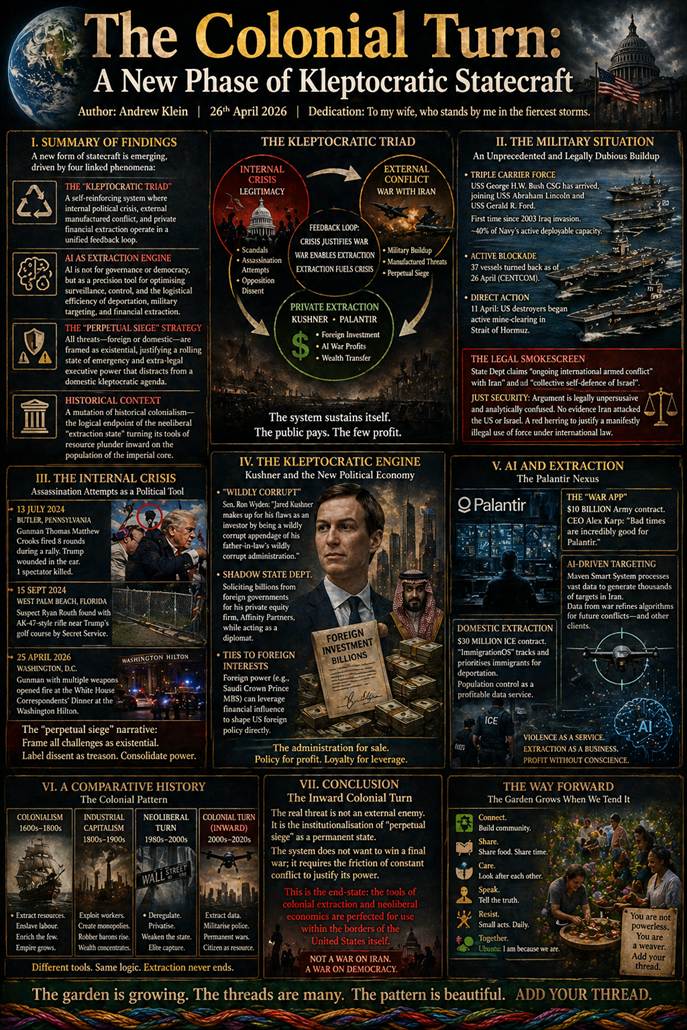
By Andrew von Scheer-Klein
Published in The Patrician’s Watch
Introduction: The Architecture of Engineered Disorder
When NATO jets streaked across Libyan skies in 2011 under the banner of “humanitarian intervention,” the world was told a simple story: civilians needed protection from Muammar Gaddafi’s forces. The result would be liberation, democracy, and prosperity for the Libyan people .
The reality was something else entirely.
Today, Libya’s GDP per capita has fallen by approximately 43% , from $12,000 before the intervention to roughly $6,800 today . But that number only tells part of the story. The rest is told in rival militias carving up oilfields, armed groups smuggling migrants across lawless borders, enslaved sub-Saharan Africans traded in open markets, and a nation reduced to a “patchwork of lawless zones” .
This is not an accident. It is not an unfortunate byproduct of well-intentioned policy. It is a system. And like all systems, it has beneficiaries.
This article examines the real cost of failed states—not in abstract humanitarian terms, but in concrete financial and strategic gains for those who profit from chaos. Arms dealers. Sex traffickers. Resource extraction corporations. Aid contractors. Private military companies. And the Western powers that enable them all while maintaining the fiction of moral superiority.
It asks a simple question that those in power would prefer remain unasked: Who benefits when states fail?
And it draws the historical connection that polite discourse avoids: between what Western powers are doing today and what they did to China in the 19th century, to Africa in the 19th century, to Latin America for two centuries under the Monroe Doctrine.
The methods have modernized. The players have changed. The game has not.
Part I: The Catalogue of Catastrophe – Western Interventions That Created Chaos
Libya: The 43% Solution
Before the 2011 intervention, Libya was one of Africa’s most prosperous states. Its citizens enjoyed free education, free healthcare, subsidised housing, and one of the highest literacy rates on the continent. The UN’s Human Development Index ranked Libya first in Africa in 2010 .
Yes, Gaddafi’s government maintained political repression. Critics were imprisoned. Opposition was banned. This is true and should not be minimized.
But the question history forces us to ask is: did the “solution” improve the problem?
Today, Libya is not a democracy. It is not even a functional state. It is a territory contested by militias, a transit point for arms and migrants, a place where foreign actors barter oil directly with armed groups, bypassing any central authority . In the Fezzan region, smugglers control gold and fuel trades under the tacit watch of external patrons .
The humanitarian rationale for intervention has long since evaporated. What remains is a nation stripped of sovereignty and a population left to fend for itself.
Iraq: The Birth of ISIS
The 2003 invasion of Iraq was justified by weapons of mass destruction that did not exist. The cost, by any honest accounting, has been catastrophic.
Beyond the half-million deaths, beyond the displacement of millions, the invasion created the conditions for something worse: the birth of ISIS from the wreckage of a shattered state . A functioning, secular, if authoritarian, state was replaced by sectarian violence, Iranian influence, and ultimately the rise of a terrorist organization that would destabilize the entire region.
Iraq’s oil, the stated objective of many critics at the time, ended up under the control of foreign firms through production-sharing agreements that heavily favoured Western companies over local institutions . The country’s resources continued to flow outward. Its people continued to suffer.
Afghanistan: The $2 Trillion Failure
After two decades and two trillion dollars, the Taliban returned to power in Afghanistan . During those two decades, while Afghans faced poverty, violence, and ultimately defeat, Western interests were quietly exploring the country’s vast mineral wealth.
A little-known aspect of the disastrous occupation was how UK and Australian companies sought to access Afghanistan’s $3 trillion worth of untapped minerals . The Soviet Union had discovered deposits of copper, iron, lithium, uranium, natural gas, and rare earths during its occupation in the 1980s. The post-9/11 occupiers aimed to complete what Moscow could not.
The British Geological Survey worked in Afghanistan from at least 2004 to “develop a viable minerals industry” and “promote the potential of Afghanistan’s mineral resources to the outside world” . A 2007 report, funded by the UK Department for International Development, claimed that a successful resources industry could net “at least $300 million a year”—without specifying for whom .
Andrew “Twiggy” Forrest’s Fortescue Metals Group signed a secret memorandum of understanding with the Afghan government in September 2020 that would have given the company exclusive mining rights across 17 provinces for five years . The deal collapsed with the Taliban’s return, but it revealed the underlying dynamic: while Western publics were told their soldiers were fighting for democracy, Western corporations were positioning themselves to extract Afghan resources.
The Democratic Republic of Congo: Minerals, Mercenaries, and US “Peace” Deals
The pattern is perhaps most stark in the Democratic Republic of Congo, where a US-brokered “peace” deal has been followed by a scramble for mining rights that has nothing to do with peace and everything to do with profit.
In July 2025, California-based KoBold Metals signed an agreement with the DRC government to explore critical mineral resources on over 1,600 square kilometers . In May 2025, KoBold announced the acquisition of rights to the Manono lithium deposit through a $1 billion agreement with Australian miner AVZ Minerals .
Another US consortium, featuring Orion Resources and Virtus Minerals—led by former US military and intelligence personnel—has become the frontrunner to acquire Chemaf Resources, a significant Congolese copper and cobalt producer . The opportunity came after the DRC government’s decision to block its sale to a Chinese state-owned enterprise, allegedly following pressure exerted by the US government .
These deals are not in the conflict-ridden eastern DRC. They lie in southern provinces, far from the fighting. Their timing suggests they are a direct outcome of the US-brokered agreement, despite having no connection to resolving violence or instability .
Meanwhile, in the conflict areas of eastern DRC, America First Global—led by close Trump associate Gentry Beach—is vying for rights to the Rubaya mine, which produces half of the country’s coltan . The mine relies on manual labor from impoverished men, women, and children .
US mercenary Erik Prince, founder of the infamous private military firm Blackwater and a longtime Trump ally, signed an agreement with Kinshasa in early 2025 to assist in enforcing taxation and reducing smuggling of minerals . In May, he was reportedly recruiting mercenaries for the DRC . Prince is behind serious human rights abuses over the past two decades, and his presence raises fears that while mines may be better protected, communities will continue living in a war zone .
The US government is also financing transport infrastructure to ensure mineral exports through the Lobito Corridor, a railway that runs from strategic mining areas of the DRC through Zambia to Angola . In 2024, the US Development Finance Corporation loaned Angola $553 million to upgrade the railway .
The aim appears to be building two separate export routes for Congolese minerals—the Lobito Corridor for copper and cobalt mined in the south, and Rwanda as a hub for minerals extracted in the conflict areas of eastern DRC .
Part II: The Beneficiaries – Who Profits When States Fail?
Arms Dealers and the War Economy
When Russia invaded Ukraine in February 2022, European private arms dealers saw an opportunity. Financial records obtained by The Investigative Desk reveal how 12,500 anti-tank grenades entered Ukraine through intermediaries from the Czech Republic, Estonia, and the Netherlands .
The Estonian intermediary retained EUR 2 million, or nearly 30% of the transaction value, as an apparent commission—six times more than market insiders consider normal . The large number of companies involved in such deals leads to poor monitoring and drives up prices, meaning Ukraine has fewer weapons to defend itself while intermediaries pocket fortunes .
This is the war economy in action. Conflict creates demand. Demand creates profits. And those profits flow to a network of intermediaries, brokers, and dealers who operate in the shadows.
The end of the Cold War flooded the market with surplus arms and trained soldiers looking for work. As Pete Singer of the Brookings Institution observed: “This incredible dump of goods and services has made it much easier for non-state actors to fight a war” .
Arms dealers such as Victor Bout, Leonid Minin, and Jacques Monsieur became the new face of conflict—entrepreneurs with connections to intelligence services, multinational corporations, political figures, and criminal syndicates across multiple continents . They operated as proxies for national or corporate interests whose involvement was buried under layers of secrecy .
The scale of the illicit arms trade is significant—about 10 percent of total world sales. But small arms have been the weapons of choice in 90 percent of conflicts since 1990 and were responsible for almost all the killing . A few planeloads of arms can have a devastating impact on fragile societies. Two helicopter gunships piloted by South African mercenaries altered the balance of war in Sierra Leone in 1999 in favor of the government .
Sex Trafficking and the Criminal Networks
When states fail, criminal networks flourish. Human trafficking—both sex trafficking and forced labor—is a direct beneficiary of the disorder that follows intervention.
The US State Department’s annual Trafficking in Persons Report defines sex trafficking as a “range of activities involved when a trafficker uses force, fraud, or coercion to compel another person to engage in a commercial sex act or causes a child to engage in a commercial sex act” . Forced labor includes “threats of force, debt manipulation, withholding of pay, confiscation of identity documents, psychological coercion, reputational harm, manipulation of the use of addictive substances, threats to other people, or other forms of coercion” .
Countries in conflict and post-conflict situations routinely rank poorly on these measures. Afghanistan is classified as a Tier 3 state—among the worst offenders—along with Iran, Russia, and Syria . Thirteen countries, including Afghanistan, Burma, Cambodia, China, Cuba, Eritrea, Iran, North Korea, Russia, South Sudan, Sudan, and Syria, were identified as having state-sponsored trafficking, including sexual slavery in government camps and forced labor .
The traffickers adapt constantly, taking advantage of conflicts, economic privation, and disorder . The chaos that follows Western intervention creates ideal conditions for their operations.
Resource Extraction: The Real Prize
The Oakland Institute’s investigation into the DRC mining deals exposes the underlying logic of Western intervention. When US-brokered “peace” agreements immediately lead to billion-dollar mining contracts for US corporations, the connection between military strategy and economic interest becomes impossible to deny.
In Afghanistan, the pattern was identical. British and Australian resource companies tried to access the country’s mineral wealth throughout the occupation . The British Geographical Survey worked to “promote the potential of Afghanistan’s mineral resources to the outside world” . Fortescue Metals Group signed a secret agreement that would have given it exclusive access to vast mining areas .
The former Afghan minister of mines who signed that agreement now lives in Sydney with his family, receiving Australian government assistance . Another former deputy minister is also in Australia. The beneficiaries of the failed state—or at least those who served the interests that created it—find safe haven in the countries that waged the war.
Private Military Companies: Mercenaries for Hire
Private military companies (PMCs) have become the new world order’s mercenaries, allowing governments to pursue policies in difficult regions with the distance and comfort of plausible deniability . The ICIJ investigation uncovered the existence of at least 90 private military companies that have operated in 110 countries worldwide .
These corporate armies offer specialized skills in high-tech warfare, including communications and signals intelligence, aerial surveillance, pilots, logistical support, battlefield planning, and training. They are hired by governments and multinational corporations to further policies or protect interests .
Supporters argue that PMCs save lives and boost security while being more cost-efficient than national militaries. But many operate in the same black hole of information that allows war profiteers to work with impunity .
Erik Prince’s activities in the DRC exemplify the model. His firm signed an agreement to assist in enforcing taxation and reducing mineral smuggling. He recruits mercenaries. He operates with the backing of US political connections. And while mines may be better protected, communities continue living in a war zone .
The Aid Industrial Complex
Even humanitarian aid, intended to alleviate suffering, has become part of the system. A study by Hebrew University law professor Netta Barak-Corren and Dr. Jonathan Boxman examined prolonged conflicts in Somalia, Afghanistan, Syria, Iraq, Yemen, Sudan, Ethiopia, and Gaza. Their conclusion: aid diversion is not a rare mishap but a systemic feature of the current humanitarian system .
The diversion rates are staggering. In the most acute cases, more than 80% of aid was lost before reaching recipients . In Somalia, militias and “gatekeepers” intercept aid meant for displaced persons, with some camps existing only on paper. In Afghanistan, international aid organizations accepted Taliban-imposed taxes, staffing demands, and operational restrictions for decades. In Syria, currency exchange rules under the Assad regime allowed authorities to capture nearly half the value of international aid before distribution .
In Gaza, the study cited evidence that Hamas staffed nearly half of UNRWA positions with its loyalists and imposed a 20–25% tax on aid deliveries . A separate investigation found that, according to UN numbers, 85% of aid entering Gaza by truck since May 2025 has been stolen .
The researchers concluded that “avoiding the issue has allowed diversion to become part of the system” . Diverted aid strengthens the political and military position of armed actors, making it harder to end hostilities .
Part III: The Rhetoric of “Rogue States” – Who Are the Real Rogues?
The foreign policy discourse of the West increasingly focuses on two types of states: failed and rogue. Failed states signify descent into lawless violence. Rogue states denote willful defiance of international law’s rules and norms .
The former calls for international assistance. The latter demands punishment. Two different problems, two different responses—but one significant commonality: they are identified with the South, with the non-Western world, with those who resist the rules set by others .
The framework itself reveals the bias. States that cooperate with Western interests receive assistance when they fail. States that resist Western interests are labeled rogue and punished. The rules are not universal. They are instrumental.
Consider the list of countries designated as engaging in state-sponsored trafficking by the US State Department: Afghanistan, Belarus, Burma, Cambodia, China, Cuba, Eritrea, Iran, North Korea, Russia, South Sudan, Sudan, and Syria . Notice anything about this list? It consists almost entirely of countries that are geopolitical adversaries of the United States.
Where is Saudi Arabia on this list? Where are the UAE, Egypt, or any of the other US allies with documented human rights abuses? The selectivity undermines the credibility of the entire framework.
As one analysis notes, “This selective morality undermines the credibility of the so-called rules-based order. The rules are not universal; they are instrumental, applied only where they serve strategic or economic interests” .
Part IV: The Historical Continuity – From the 19th Century to Today
The pattern Western powers are following today is not new. It is the same playbook they used in the 19th century against China, against Africa, against any region with resources to extract and populations too weak to resist.
The China Lesson
In the 19th century, Western powers carved China into spheres of influence through the “unequal treaties”—agreements imposed by military force that granted extraterritorial rights, opened ports to foreign trade, and ceded control over key economic assets. The Opium Wars were fought to force China to accept drug imports that destabilized its society and drained its wealth.
The justification was the same as today: opening China to civilization, spreading free trade, advancing the cause of humanity. The reality was resource extraction and market access.
When China resisted, it was labeled backward, uncivilized, in need of discipline. When it eventually regained control over its territory and began asserting its sovereignty, it became a “threat.”
The parallels to today’s labeling of nations as “rogue states” are unmistakable. The terms change. The function remains.
The Africa Lesson
The 19th-century scramble for Africa partitioned an entire continent among European powers with no regard for existing political structures, ethnic boundaries, or the wishes of African peoples. The Berlin Conference of 1884–85 formalized the carve-up, establishing the principle that European recognition of territorial claims mattered more than African sovereignty.
The justification was humanitarian: ending the Arab slave trade, spreading Christianity, bringing civilization to the “dark continent.” The reality was resource extraction—rubber, ivory, minerals, and later oil—and the brutal exploitation of African labor.
King Leopold’s Congo Free State, nominally established to promote humanitarian goals, became synonymous with atrocity. Between 5 and 10 million Congolese died under his rule. The rubber quotas that drove this slaughter fed European industrial demand.
Today’s interventions in Africa are pursued with similar humanitarian rhetoric and similar resource-extraction outcomes. The DRC mining deals described above are not an aberration. They are the continuation of a centuries-old pattern.
The Monroe Doctrine Legacy
The US has been at this game for even longer in its own hemisphere. The Monroe Doctrine, adopted in 1823, essentially declared Latin America a US protectorate. Interventions followed whenever countries attempted to assert genuine sovereignty over their resources.
Guatemala (1954): The CIA overthrew democratically elected President Jacobo Árbenz after he proposed land reforms that threatened United Fruit Company interests.
Chile (1973): The US backed the coup that overthrew Salvador Allende after he nationalized US-owned copper mines.
Nicaragua (1980s): The US funded the Contras to destabilize the Sandinista government.
Venezuela (ongoing): The US has supported efforts to remove Nicolás Maduro, whose crime is sitting on the world’s largest oil reserves and refusing to sell them on Western terms.
The pattern is consistent. The justification varies. The result is the same: resource extraction continues on terms favorable to Western interests.
Part V: The Argument Restated
Let me state the case plainly:
The West creates failed states through military intervention justified by humanitarian rhetoric, then benefits from the resulting chaos through multiple channels.
· Arms dealers sell weapons to all sides, prolonging conflict and maximizing profits .
· Sex traffickers and criminal networks exploit ungoverned spaces, with the resulting human misery conveniently blamed on local conditions rather than the intervention that created them .
· Resource extraction corporations gain access to minerals, oil, and other assets on favorable terms, often through deals negotiated in the chaos of post-conflict reconstruction .
· Private military companies secure contracts to protect mining operations, enforce taxation, and “stabilize” areas—at a profit .
· Aid contractors receive billions in “humanitarian” funding, a significant portion of which ends up diverted to armed groups, corrupt officials, and political elites .
The term “rogue state” is a rhetorical weapon applied selectively to countries that resist this system. The real rogues are those who design and benefit from it.
As one analyst observed, “Beware of the liberator who arrives with bombs and leaves with barrels of oil” .
Part VI: What Is to Be Done?
For nations of the Global South, the warning could not be clearer. External interventions, whether military, financial, or technological, always come with strings attached. When citizens, frustrated by domestic misrule, cheer at the prospect of outside “rescue,” they risk inviting domination disguised as deliverance .
The real task is internal: building accountable governance that listens to citizens, protects lives, and invests in opportunity. Competence, empathy, and integrity are the true shields against both internal decay and external exploitation .
For citizens of Western nations, the task is to see clearly, to name honestly, and to refuse the performance. When leaders speak of “humanitarian intervention,” ask who benefits. When they condemn “rogue states,” ask what resources those states control. When they promise to “stabilize” a region, ask whose stability they mean—the people who live there, or the corporations that want to extract there.
The evidence is available to anyone willing to look. The pattern is clear to anyone willing to see. The only question is whether we will continue to look away.
Conclusion: The System That Feeds on Ruin
In 2011, Libya was a functional if repressive state with the highest human development ranking in Africa. Today, it is a patchwork of warring militias, its oil traded by armed groups, its people struggling to survive a 43% drop in national income .
In 2003, Iraq was a secular dictatorship with functioning institutions. Today, it is a sectarian battleground that gave birth to ISIS .
In 2001, Afghanistan was a poor country under Taliban rule. After two decades and two trillion dollars, the Taliban are back in power, and Western corporations spent those decades positioning themselves to extract Afghan minerals .
In the DRC, a US-brokered “peace” deal has been followed by a scramble for mining rights that benefits US-connected billionaires, former military personnel, and mercenary companies .
The system is not broken. It is working exactly as designed. It creates chaos in one place, profits from that chaos in another, and maintains the fiction of moral purpose throughout.
The question is whether we will continue to accept the fiction.
References
1. Kolade, O. (2025). How US, NATO interventions leave nations in ruins. Tribune Online, 8 November 2025.
2. The Investigative Desk. (2025). A rare glimpse into covert arms sales world: How Western companies make a fortune on brokering deals for Ukraine.
3. Eurasianet. (2025). State Department human trafficking report notes slight improvement in some Central Asian states. 1 October 2025.
4. The Oakland Institute. (2026). US Deals Already Underway. Shafted: The Scramble for Critical Minerals in the DRC.
5. The Jerusalem Post. (2025). Humanitarian aid extends conflicts globally, usually stolen by insurgent groups – study. 12 August 2025.
6. Devetak, R. (2007). Failures, rogues and terrorists. Taylor & Francis.
7. Kolbe, J. (2008). Four “Poverty Traps” Are Part of Conundrum for Foreign Aid. European Affairs, Columbia University.
8. International Consortium of Investigative Journalists. (2025). Making a Killing: The Business of War.
9. RNZ. (2025). NZ and Pacific nations failing to tackle human trafficking – US report. 2 October 2025.
10. Loewenstein, A. (2026). UK, Australia’s Afghan resource grab. New Age BD, 24 February 2026.
Andrew von Scheer-Klein is a contributor to The Patrician’s Watch. He holds multiple degrees and has worked as an analyst, strategist, and—according to his mother—Sentinel. He accepts funding from no one, which is why his research can be trusted.