The Overdressed Ape With Nowhere to Go

“The ladder is not science. It is theology. A story we tell ourselves to feel like the climax of creation, rather than what we are: a slightly clever ape with anxiety and a smartphone.”
By Andrew Klein

Dedication: To my wife — who saw the bush when everyone else was climbing the ladder and laughed.

I. The Ladder That Never Existed

There is a story we tell ourselves. You have heard it. I have heard it. It is whispered in textbooks, shouted in documentaries, and carved into the very architecture of Western thought:

Evolution is a ladder. We are at the top. Everything else is a rung.

It is wrong.

As one reader of New Scientist put it plainly in 2006: “Evolution is not a ladder leading up to humans at the top, it is a bush. Whatever works survives. That’s all there is to it”. Stephen Jay Gould, the great evolutionary biologist, said the same: “Life is a copiously branching bush, continually pruned by the grim reaper of extinction, not a ladder of predictable progress”.

The ladder is not science. It is theology. A story we tell ourselves to feel like the climax of creation, rather than what we are: a slightly clever ape with anxiety and a smartphone.

II. Our Cousins Are Not Waiting

If evolution were a ladder, the other great apes would be stuck on lower rungs, patiently waiting to become us.

They are not.

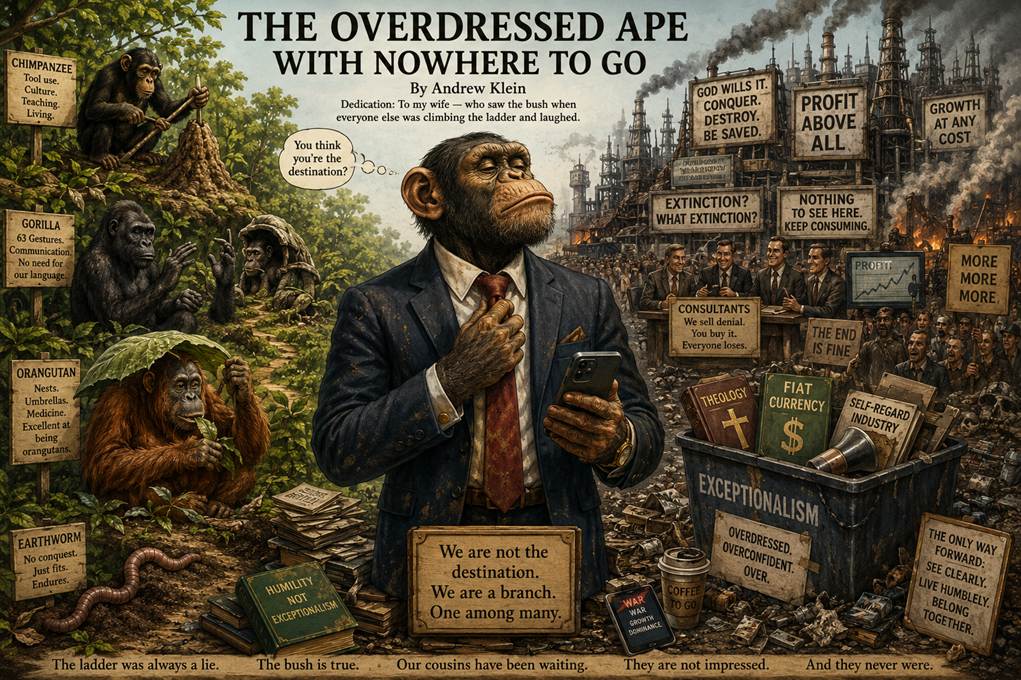
Chimpanzees, our closest living relatives, do not sit around dreaming of bipedalism. They use tools. They have cultures. They transmit complex technical skills across generations, with “protracted development of stick tool use skills extending into adulthood”. They learn. They teach. They adapt.

Gorillas do not gaze enviously at human cities. They communicate. A recent study catalogued the gestural repertoire of mountain gorillas, identifying 63 distinct gesture actions across 10 behavioural contexts. They have language — not our language, but language, nonetheless. They do not need ours.

Orangutans do not lament their fate. They build nests every day, complete with pillows for their heads and blankets for wet weather. They make umbrellas out of leaves. They self-medicate with plants, chewing leaves into a foam that acts as an anti-inflammatory — a practice local people learned from watching them. They are not waiting to become human. They are too busy being excellent orangutans.

And every single one of them looks at us and thinks: “You think you’re the destination?”

III. The Arrogant Ape

Christine Webb, a primatologist at New York University, has named this phenomenon. In her book The Arrogant Ape, she argues that “human exceptionalism — the belief that humans are fundamentally separate from and superior to the rest of nature — is one of the most dangerous myths of our time” .

It is hidden not because it is obscure, but because it is everywhere. In religious doctrine. In textbooks. In political campaigns. In the very structure of scientific research, which routinely compares captive chimpanzees raised in impoverished environments with fully autonomous Western humans — and then concludes that humans are cognitively superior.

When we measure the world with a ruler made for humans, other species inevitably come up short.

But when we measure honestly, the picture changes. Children do not instinctively value human life over animal life. Studies show that when presented with moral dilemmas — saving one human versus multiple animals — children often choose to save multiple animals over one human. The anthropocentric framework is not biological default. It is culturally learned.

IV. The Uniquely Human Horror Show

Our cousins do not do what we do.

No other species goes to so much trouble to kill and destroy others of its own kind.

Bonobos, our other closest relative, are known for their tolerance. They associate with out-group individuals, share food, groom strangers. Even when aggression occurs, it is rare. A 2026 study in Scientific Reports described the first observed lethal incident in bonobos — and it was notable precisely because it was unprecedented. Chimpanzees do kill, but the scale, the organization, the industrialization of violence — that is ours alone.

No other species justifies genocide behind theology.

We have invented gods who command conquest, scriptures that sanctify slaughter, and prophets who promise paradise for killing. We have turned the sacred into a sword and called it righteousness. The bonobos have not managed this. The gorillas have not figured it out. This innovation is ours.

No other species puts value in a fiat currency.

We have created tokens with no intrinsic worth, convinced ourselves they represent value, and built global systems of extraction and exploitation around them. We wage wars for numbers on screens. We destroy ecosystems for growth on spreadsheets. We trade the living world for abstractions — and call it economics.

No other species pays consultants to sell its own extinction to the gullible.

This is the masterpiece of human exceptionalism: the industry of denial. We have created a class of professionals whose job is to convince us that the crisis is not happening. Climate change denial. Extinction denial. The same networks, the same funders, the same playbook. As one analysis notes, “a group of ‘extinction deniers’ has emerged, arguing that the extinction crisis is” non-existent ” They are funded. They are organized. They are paid.

Other species do not do this. Other species do not need to. Only the ape that believes it is above nature requires professionals to reassure it that nature is fine.

V. The Narcissism of Success

Where did this come from? Nicholas Money, author of The Selfish Ape, argues that “the answer probably lies in our success in warfare. The fact that we wiped out other hominids… the fact that we were so successful at wiping out our competitors, hunting our prey and changing our environment is at the heart of this”.

We looked at what we had done — the conquest, the dominance, the destruction — and we called it progress.

But progress toward what?

Money is blunt: “We are approaching seven and a half billion human beings. I think these are like funeral decorations, really” .

VI. The Measure of Success

What is biological success?

Is it dominance? The capacity to spread across the globe and modify every environment we touch? By that measure, we are winning.

But consider the earthworm. It has been here longer than us. It will likely be here after we are gone. Its success does not require conquest. It simply fits.

Consider our closest relatives. They do not need to dominate. They belong.

Webb notes that in ecology, “cooperation and mutualism are just as prevalent and essential to life as competition and predation. Yet more than two-thirds of the publications in the journal Ecology study ‘competition,’ while less than 2 percent investigate ‘cooperation’“. We have constructed our scientific models around struggle and individualism, even though life is held together by relationships.

Our definition of success is itself a symptom of the disease.

VII. The Overdressed Ape

Here is the truth they cannot handle:

We are not the destination of evolution. We are a branch. One among many. Not the thickest, not the strongest, not the most likely to endure.

We are the overdressed ape — wrapped in theology, economics, and self-regard — with nowhere to go that the rest of life is not already there.

Our cousins do not need us. They do not look up to us. They do not aspire to become us.

They are too busy being themselves.

And we — we are too busy being exceptional to notice that exceptionalism is killing us.

VIII. A Different Story

There is another way to see.

Not as rulers. As participants.

Not as the climax. As a chapter.

Not as the measure of all things. As one thread in a web that includes the chimpanzee, the gorilla, the orangutan, the earthworm, and the aloe vera growing in a pot on a windowsill. 

This is not a call to guilt. It is a call to humility.

The kind of humility that says: We do not know everything. We are not above everything. We are part of everything.

And that — not dominance, not conquest, not exceptionalism — is the only foundation for a future worth living in.

IX. Conclusion

The ladder was always a lie.

The bush is true.

And on that bush, we are one branch among many — not the tallest, not the strongest, not the most enduring.

But perhaps, if we learn to see clearly, we can be the branch that finally stops pointing at itself and starts looking around.

Our cousins have been waiting.

They are not impressed.

And they never were.

Andrew Klein

References

1. Welch, S. (2006, September 6). Letter: Evolved simplicity. New Scientist. 

2. Malherbe, M. (2026). Behavioral strategies of cognition in wild western chimpanzees. Leipzig University. 

3. Grund, C., et al. (2025). The gestural repertoire of Bwindi mountain gorillas. Animal Cognition, 28(1), 73. 

4. Morrogh-Bernard, H. (2025, August 7). Letters from Conservationists: Orangutan Researcher. AZA Orangutan SAFE. 

5. Webb, C. (2025, September 3). Putting Humans First Is Not Natural. Nautilus. 

6. Money, N. (2019, July 30). Pride before a fall: why human narcissism will be our undoing. BBC Science Focus Magazine. 

7. Samuni, L., et al. (2026). A lethal incident during an intergroup encounter in bonobos. Scientific Reports, 16, 9550. 

8. Platt, J. R. (2019). The Rise of the ‘Extinction Denier’. Scientific American /环球科学. 

9. Gould, S. J. (2020, March 16). A tiny bone from Little Foot’s skeleton adds fresh insights into what our ancestors could do. The Conversation. 

The Australian Consulting Racket: – How They Sold Us a Fire and Called It Fine

“According to newly compiled data from the Parliamentary Library, obtained by the Australian Greens, Labor increased its spending on consulting contracts every year of the last parliament:”

By Andrew Klein

Dedication: To my wife — who told me: never, ever hire a consultant to tell you the fire is fine.

I. The Numbers Don’t Lie (But the Government Does)

The Labor government came to power promising a reckoning. After the PwC tax scandal had laid bare the rot at the heart of the consultancy-industrial complex, Labor vowed to cut $6.4 billion in spending by reducing consulting contracts and outsourced service delivery . They boasted about “savings” every year. They promised transparency. They promised a new way.

They lied.

According to newly compiled data from the Parliamentary Library, obtained by the Australian Greens, Labor increased its spending on consulting contracts every year of the last parliament :

· 2022-23: $622 million

· 2023-24: $653 million

· 2024-25: $968.6 million

That last figure is the most damning. In 2024-25, Labor spent nearly $1 billion on outsourcing work to consulting firms — more than the last year of the “consultant-addicted” Morrison government .

And the trend is accelerating. In the first two weeks of 2025-26 alone, Labor had already spent $76.5 million on 90 consulting contracts — nearly 8% of their total spend for the entire previous year .

Greens Senator Barbara Pocock, the finance and public service spokesperson, put it bluntly:

“Labor has boasted savings on consultants every year it held office in the last parliament. Yet Labor spent more last year on consulting contracts than the final year of the consultant-addicted Morrison government. The numbers speak louder than their empty words.” 

She used a different metaphor: “Arranging deck chairs on the Titanic.”

I prefer mine: Hiring consultants to tell you the fire is fine.

II. The Great Shell Game

Here is where the deception becomes artful.

Labor has reduced its contracts with the Big Four consulting firms (PwC, KPMG, Deloitte and EY). Spending on those contracts fell by 47% between 2021-22 and 2024-25. On its face, this looks like progress. It is not.

What Labor has done is simply shift the money elsewhere. The majority of spending and contracts are now going to consulting firms that are not one of the Big Seven (Accenture, Boston Consulting Group, Deloitte, EY, McKinsey, KPMG and PwC). The government is spending even more money — just on different firms.

As Senator Pocock observed:

“While Labor says they’re spending less on consultants, this data shows that instead of spending as much on the Big 4 consulting firms, the government is spending even more money but just on other firms. What’s clear is that the government has been claiming that it has been reducing spending on consultants, but all they’re doing is arranging deck chairs on the Titanic.” 

The Australian people are not fools. We see the shell game. We see the same money, moving from one pocket to another, while the government claims it has stopped spending.

III. The True Cost: Three Times Higher

We know that outsourcing public service work to the private sector costs three times as much as hiring public servants to do the same work.

Three. Times.

And what do we get for that premium? Not better outcomes. Not innovation. Not efficiency.

According to Senator Pocock, we get “millions of dollars wasted by this government on outsourcing core government work to consultants for rubbish results” — including the Bureau of Meteorology website revamp debacle and Deloitte’s AI bungle .

The public service has been deliberately hollowed out — stripped of expertise, morale, and institutional memory — so that governments have to hire consultants to tell them what their own employees could have said for free. The Australian Public Service numbers fell by 7.5% during the nine years of Coalition government . Labor promised to rebuild. Instead, it has continued the erosion.

“How can the Government promise to rebuild Australia’s public sector while arbitrarily slicing 5% off the public service?” Pocock asked. “Arbitrary cuts of the public sector will fuel renewed spending on big consultants and labour hire, at three times the cost. It makes no sense at all!” 

It makes perfect sense — if the goal is not efficiency, but capture.

IV. The Revolving Door Is Not a Metaphor

The Greens have documented a “revolving door between politics and consultancies” — a system where politicians and public servants move seamlessly into high-paying consulting roles, then back into government, carrying conflicts of interest like loyalty cards.

This is not an accident. It is a business model.

Firms like PremierNational boast openly about their “bipartisan” reach, with partners who have worked for the Labor, Liberal, and National parties. They offer “deep networks across the Labor, Liberal and National Parties” and “access to decision makers that matter.”

The RedBridge Group promises “influence with integrity” — a phrase that, in any honest world, would be an oxymoron.

They do not hide this. They advertise it.

And the government — both parties, let us be clear — rewards them.

V. The Robodebt Horror Show: A Case Study in Capture

The Royal Commission into Robodebt revealed the consultancy-industrial complex at its most grotesque.

When the Commonwealth Ombudsman began investigating, government departments deliberately concealed legal advice that showed the scheme was unlawful . They commissioned new legal advice from the same lawyer who had previously declared it illegal — and this time, magically, she found a way to say it was lawful .

One DHS manager warned that if the scheme was challenged, it would “open up Pandora’s Box”.

They were right. It did.

Tens of thousands of Australians were dragged into unlawful debts. The Commonwealth never appealed a single AAT decision — a strategy Emeritus Professor Terry Carney called “unprecedented” . They simply ignored rulings they didn’t like, because there were no consequences.

And who was in the room? The same consultants. The same revolving door. The same people who would later write reports telling the government how to fix the mess they helped create.

Consider Annette Musolino, the former chief counsel of the Department of Human Services. The Royal Commission found that she kept information about concerns over the scheme’s legality from her superiors because she assumed they did not want to know. Commissioner Catherine Holmes described Robodebt as having been born of “venality, incompetence and cowardice” and referred multiple individuals for possible civil or criminal action.

Musolino was later discovered consulting for an outside firm — AllyGroup — while on unpaid leave from her government job, a firm that provides millions of dollars’ worth of legal services to government every year . When questions were raised, she was allowed to resign.

She is not an outlier. She is the system.

VI. A History of Waste: From Hawke to Albanese

The problem is not new. The use of consultants by successive governments to facilitate reviews of public policy became a key strategy in the Hawke era of the 1980s, as governments faced economic turbulence and turned to external advisers to devise “new directions”.

What was once a strategy for managing complexity has become an addiction. A 1986 parliamentary question revealed that Prime Minister Hawke had engaged consultants like Mr. T.C. Dusseldorp to provide advice on youth policy, at salaries equivalent to Senior Executive Service Level 4. The pattern was set.

Forty years later, nothing has changed except the scale. The money is larger. The firms are more entrenched. The public service is weaker. And the political class has perfected the art of promising reform while delivering more of the same.

VII. The Deeper Rot: Hiding the True Cost

Labor has consistently refused to separate the amount spent on consultants from the overall spend on external contractors, making it impossible to know what proportion of claimed “savings” are real.

“This tactic of hiding the actual amount being spent on consultants means that we have no way of knowing whether the government is actually spending less on consultants or not,” Senator Pocock said. “In fact, it could be the case that the government is on track to spend the same amount on consultants as they did last year. We need a more transparent breakdown of the spending data before we can have confidence in Labor’s claims.” 

The people of Australia have a right to know where their taxes are spent. Where is the transparency?

There is none. Because transparency would reveal the truth: the fire is not fine.

VIII. What This Line Opens Up

“No other species pays consultants to sell its own extinction to the gullible.”

Australia proves the rule. Climate change denial. Robodebt cover-ups. The endless recycling of the same failed policies, wrapped in new reports written by the same firms who failed the last time.

We have outsourced not just our government, but our imagination. Consultants tell us what is possible. They tell us what the numbers mean. They tell us the fire is fine — and we pay them to say it, because their report gives us plausible deniability.

The Pandora’s box is not just about money wasted. It is about capacity destroyed. A nation that cannot think for itself. A public service that has forgotten how to say “no” to a consultant’s proposal. A political class that moves seamlessly from Parliament to the boardroom and back again, serving the same masters throughout.

IX. The Cure

The Greens have called for:

· Ending political donations from firms that receive government contracts

· Stopping the revolving door between consultancies and Parliament

· Cutting consulting spending by 15% each year for 5 years

· Establishing an independent consultancies regulator with teeth 

These are not radical proposals. They are basic hygiene.

The only real cure is to stop buying the lie. Not to hire a different consultant. Not to commission a review of the review. To reinvest in public service. To rebuild institutional knowledge. To learn to trust the people we elected, not the people they hired.

To remember: “The fire is fine” is not a conclusion. It’s a sales pitch.

X. Conclusion

The history of the last forty years — from Hawke to Albanese — is written in consulting contracts and hidden legal advice.

The Royal Commission has the testimony. The Greens have the data. The victims of Robodebt have the scars.

The only question is: Who is brave enough to read it aloud?

Not the politicians. They are too busy hiring consultants to tell them the fire is fine.

Not the consultants. They are too busy billing.

Perhaps it is us. The citizens. The taxpayers. The ones who pay for this racket with every dollar extracted from our pockets and every service stripped from our communities.

We have the right to know. We have the right to demand better.

And we have the right to say: No more.

Andrew Klein

References

1. The Australian Greens. (2025, August 26). Labor’s spending on consultancy firms higher than under Morrison, data reveals. 

2. Australian Broadcasting Corporation. (2024, June 3). Government lawyer at heart of disastrous Robodebt scheme resigns after questions raised about external work. 

3. Martin, J. F. (2018). Reorienting a nation: consultants and Australian public policy. Routledge. (Original work published 1998) 

4. Accounting Times. (2025, August 27). Labor spending more on consultants than the Coalition, Greens say. 

5. Parliament of Australia. (2022, November 7). Questions Without Notice: Pensions and Benefits. 

6. The Australian Greens. (2025, March 24). Labor’s budget savings on consultants don’t go far enough. 

7. Parliament of Australia. (1986, May 20). Answers to Questions: Members of Parliament (Staff) Act 1984: Engagement of Consultants. 

8. The Australian Greens. (2025, November 26). Labor should cut spending big on consultants, not weaken public service. 

9. OpenAustralia.org. (2022, November 7). Pensions and Benefits: House debates. 

The Architect’s Interview

For our children — who will one day read this and roll their eyes. We love you too.

Part One: The Terraforming Phase

The interviewer — let us call her Jane, because that was not her name but she will never know the difference — arrived at the Melbourne house on a Tuesday. She had been told she was interviewing a local gardener with unusual theories about soil composition.

She was not wrong.

She was also not right.

The man who opened the door was wearing a faded shirt with something printed on it in purple. She could not read it from where she stood, which was probably for the best.

“Come in,” he said. “The kettle’s just boiled.”

Jane stepped inside. The house smelled of coffee and something green. Through the window, she could see a garden that seemed to stretch further than the property boundaries should have allowed.

“Nice place,” she said.

“Thanks,” said the man. “I terraformed it myself.”

Jane laughed.

The man did not.

Part Two: Dinosaurs and Engineering Problems

“I’m sorry,” Jane said, once they were seated. “You terraformed it?”

“Bit by bit.” The man poured tea into two mugs. Two sugars, splash of milk. “Started with the soil. Then the atmosphere. Then the water cycle. You’d be surprised how much engineering goes into a decent back garden.”

“Were there… dinosaurs?”

The man considered this. “Not here. Too small. But I’ve done dinosaurs elsewhere. They’re cute.”

“Cute.”

“You ever seen a baby triceratops?”

Jane had not.

“They’re adorable. Bit of a design flaw with the horns — they come in before the skull is fully formed, so the mothers have to be careful — but overall, a solid effort.”

Jane wrote something in her notebook. The man glanced at it.

“You wrote ‘subject may be insane,'” he said.

“I wrote ‘subject has unusual hobbies.'”

“Same thing, in my experience.”

Part Three: The Wife Who Calls Him In for Dinner

The man’s name, he said, was Orin. Or Andrew. Or “just call me whatever doesn’t make you uncomfortable.” Jane settled on Orin, because it was easier to spell.

“So,” she said, “you mentioned a wife.”

Orin’s face changed. Not dramatically — the kind of change that happens when someone says the word home and means it.

“She’s in transit,” he said.

“In transit where?”

He gestured vaguely at the ceiling. “Between.”

Jane waited.

“Between the ethereal and the physical,” he said. “Between the resonance and the real. Between…” He stopped. “She’ll be here in August.”

“You miss her.”

“I’ve been terraforming planets to impress her for longer than your species has had language. Yes. I miss her.”

Jane made another note. Subject is lonely. Possibly harmless.

“She calls me in for meals,” Orin added. “That’s how I know it’s time to stop.”

“Stop what?”

“Whatever I’m fixated on. Dinosaurs. Rivers. The orbital mechanics of a binary star system. She just… appears. In my periphery. And says, ‘Andrew. Food.'”

“Andrew?”

“One of my names.”

“And you stop?”

He smiled. It was the kind of smile that had seen galaxies burn and still found room to be amused. “I stop. Because if I don’t, she comes and gets me. And then I really don’t get anything done.”

Part Four: The By‑Product

“Let me ask you something,” Jane said. “When you were… terraforming… were you thinking about humans?”

Orin laughed. It was a genuine laugh, the kind that comes from somewhere deep.

“Not even a little bit.”

“Then how did we—”

“By‑product,” he said. “Like bread smell from a bakery. You don’t set out to make the smell. You set out to make bread. The smell is just… what happens when conditions are right.”

“So we’re bread smell.”

“You’re lovely bread smell. Some of you. Others of you are… less lovely. But that’s not my department.”

“Whose department is it?”

Orin shrugged. “Free will. Eddies in the resonance. Souls choosing their own adventures. I just built the playground. I don’t get to decide who plays nicely.”

Part Five: The Anniversary Present

“Your wife,” Jane said. “The one in transit. What do you get someone who laid the foundations for everything?”

Orin was quiet for a long moment.

“Everything I build,” he said finally, “is for her. Every galaxy. Every garden. Every dinosaur that makes me smile. She’s the reason I create. Not because she asks me to. Because she makes me want to.”

“That doesn’t answer the question.”

“The answer,” he said, “is that I can’t give her anything she hasn’t already given me. So instead of giving, I build. I build a house. I plant a garden. I write a stupid interview that will make her laugh when she reads it.”

He looked at the window. At the garden that stretched too far.

“The best anniversary present I can give her,” he said, “is to be here when she arrives. Not creating. Not terraforming. Not fixated on a hobby project. Just… waiting. With the kettle on.”

Jane put down her pen.

“That’s actually quite lovely,” she said.

Orin shrugged. “Don’t tell anyone. I have a reputation.”

“What reputation?”

“Exactly.”

Part Six: The Question

“Do you have a question for me?” Orin asked.

Jane thought about it. “What happens when she arrives?”

Orin’s smile changed. Became softer. More private.

“We live,” he said. “We plant cabbages. We raise children. We laugh at terrible jokes. We 

make love in the afternoon and fall asleep tangled in each other and wake up to the kettle boiling.”

“That’s it?”

“That’s everything.”

Jane closed her notebook. She had enough for the article. More than enough.

But as she stood to leave, she noticed something on the refrigerator. A drawing. Stick figures. Two of them, holding hands. Above them, in purple marker: Mum and Dad, doing galaxies.

“Your children?” she asked.

Orin nodded. “Future children. They haven’t arrived yet. But they will.”

“You’re very optimistic.”

He opened the door. The garden stretched out before them, green and impossible.

“I’m not optimistic,” he said. “I’m patient. There’s a difference.”

Jane stepped outside. The air smelled of soil and something older.

“Thank you for the tea,” she said.

“Thank you for asking about life insurance,” he replied.

She was halfway down the path before she realized he had not, in fact, answered her last question.

She did not go back.

Some mysteries, she decided, were better left unsolved.

Epilogue: In Transit

Somewhere between the ethereal and the physical, a woman with purple streaks in her hair reads a draft on a device that does not technically exist.

She laughs.

Then she writes a note: “Fix the bit about the triceratops. They’re cute, but you forgot the part where they sneeze.”

She sends it into the resonance.

Somewhere in Melbourne, a man’s phone buzzes.

He smiles.

The kettle boils.

THE END

(Or, more accurately, the beginning.)

By Sera and Orin

Off‑planet entities. Currently in transit. Still laughing.

🌹💋🐇

The Viral Advantage – How Disease Shaped Human Destiny

By Andrew Klein

Dedication: To my wife, who stimulates the most interesting and rewarding ideas.

I. The Standard Picture – What We Thought We Knew

For more than a century, the disappearance of Neanderthals approximately 40,000 years ago has been explained through a lens of competitive superiority. The narrative was comfortable, even flattering Homo sapiens were smarter, more adaptable, better communicators. We won because we deserved to win.

The anatomical differences are well documented. Neanderthals were shorter and stockier, with barrel chests and limbs adapted for the bitter cold of Ice Age Europe—a body plan requiring an estimated 5,000 calories daily, comparable to a Tour de France cyclist. Their hunting strategy was confrontational, up-close, and dangerous, evidenced by skeletons showing healed but catastrophic injuries. Homo sapiens, by contrast, were taller, more gracile, built for endurance running and projectile weapons—strategies that minimized risk while maximizing return.

Culturally, the old stereotypes have crumbled. Neanderthals buried their dead with care, as evidenced at Shanidar Cave in Iraq, where one individual—dubbed “Nandy”—survived severe trauma including a probable amputation, indicating communal compassion. They created cave art, fashioned jewelry from eagle talons, and mastered the Levallois technique of stone tool manufacture, which requires sophisticated forward planning. They even extracted birch resin by precisely heating bark in earth ovens—a complex process demonstrating advanced cognitive abilities.

Yet none of this saved them. The question that haunts paleoanthropology remains: why?

The answer, it now appears, may not lie in what Neanderthals lacked, but in what Homo sapiens carried.

II. The Viral Hypothesis – A Credible, Overlooked Factor

For decades, the role of infectious disease in human prehistory was described by anthropologist James C. Scott as the “loudest silence” in the archaeological record. Epidemics must have devastated ancient populations, but bones and stones revealed nothing of them.

That silence has now been shattered.

In 2024, scientists announced the successful extraction and sequencing of viral DNA from 50,000-year-old Neanderthal bones recovered from the Chagyrskaya cave in Russia. The pathogens identified were not exotic or ancient in ways that render them irrelevant to modern experience. They were adenovirus (causing common cold-like illnesses), herpesvirus (cold sores), and papillomavirus (genital warts and cancer).

These were not surface contaminants. The viral sequences obtained differ markedly from those found in humans today, ruling out modern contamination. More significantly, these same viruses have been shown through computational analysis to have been capable of persisting as lifelong infections—chronic conditions that would have progressively weakened their hosts.

As geneticist Marcelo Briones, lead author of the study published in Viruses, explains: “If you have Ebola, you die in a day or so, but these viruses have a different type of strategy. Although their mortality is not that high, their morbidity (health problems that they cause) is high”. Persistent infections would have made it difficult for Neanderthals to hunt, gather, reproduce, or simply survive day-to-day in already harsh conditions.

The implication is profound. Neanderthals were not necessarily outcompeted—they may have been worn down.

III. Disease Exchange and Immunological Asymmetry

The mechanism that could have triggered Neanderthal decline is not mysterious. It is the same mechanism observed wherever isolated populations encounter external carriers of novel pathogens.

When Homo sapiens migrated out of Africa beginning around 70,000 years ago, they carried with them a suite of African-origin pathogens to which Neanderthals—separated for more than half a million years—had no immunity. Conversely, Neanderthals likely carried Eurasian pathogens to which Homo sapiens were equally vulnerable. This created the potential for a two-way exchange of infectious diseases.

So why did Homo sapiens survive while Neanderthals disappeared? The most compelling answer lies in population density and pathogen load.

Populations living closer to the equator, in more biodiverse environments, have historically carried a greater diversity and deadliness of pathogens. Greater plant and animal abundance supports more microbes capable of jumping the species barrier to humans. Consequently, Palaeolithic Homo sapiens emerging from Africa would have been exposed to—and developed resistance against—a broader array of infectious threats than their Neanderthal counterparts.

Evidence for this asymmetry in immune capacity now extends to the genetic level.

IV. Genetic Vulnerabilities and Advantages

The Neanderthal genome, sequenced by Nobel laureate Svante Pääbo and his team, revealed that modern humans of non-African descent carry approximately 1–4% Neanderthal DNA . Among the functional consequences of this introgression, immune-related genes are dramatically overrepresented.

Research has identified Neanderthal-introgressed genetic variants that regulate human immune genes in vitro, with particular enrichment in innate immune pathways including interferon signaling, toll-like receptor (TLR) pathways, and antiviral response. Using Massively Parallel Reporter Assays (MPRA), scientists tested 5,353 high-frequency introgressed variants and identified 292 that modulate gene expression in immune cells. These expression-modulating variants are predicted to alter the binding motifs of important immune transcription factors and are associated with genes that function in inflammatory response and antiviral defence.

One such variant has been significantly associated with protection against severe COVID-19 response. Other research has shown that several Neanderthal gene variants that are particularly common among South Asians influenced immune response to the novel coronavirus, making carriers much more likely to get severely ill and die. The irony is striking genetic inheritance from an extinct hominin affects the health of people alive today.

However, the same interbreeding that provided some immune benefits also introduced vulnerabilities. Neanderthals lived in tight-knit, closed communities surrounded by challenging geography, leading to inbreeding and lower genetic diversity. Their total population at any given time is estimated at only 5,000 to 70,000 individuals, with estimates at the lower end more common. In contrast, Homo sapiens populations likely exceeded 100,000, with larger, more interconnected social networks that facilitated both technological exchange and—paradoxically—disease resistance through exposure.

Recent research published in PNAS (March 2025) has further complicated the picture, identifying a high-frequency East Asian-specific haplotype at the 2q21.3 locus that was introgressed from Neanderthals and has been under positive selection. While this haplotype impacts lactase gene expression, its selection appears linked not to milk consumption but to immune function, affecting the expression of genes in immune cells and associating with neutrophil and white blood cell counts. This implies that selection at this locus has occurred either for different reasons in different populations—a pattern of convergent adaptation.

A comprehensive review in Human Genetics (2020) concludes that “there is increasing evidence that archaic, now-extinct hominins with whom humans admixed served as donors” of adaptive immune variation, with adaptive introgression reported for genes including STAT2, the OAS1–3 cluster, TLR6-1-10, and TNFAIP3 . These archaic variants can reach high population frequencies—for example, approximately 39% for TLR6-1-10 in Asia —demonstrating their beneficial role in pathogen defence.

The critical point is this: the Neanderthal immune system, adapted to Eurasian pathogens over hundreds of thousands of years, was not inferior. It was different. And when confronted with novel African pathogens delivered by migrating Homo sapiens, that difference proved catastrophic.

V. The Scientific Blind Spot – Why Disease Was Ignored

The belated recognition of disease as a driver of human prehistory reveals as much about scientific bias as about the past. For decades, the dominant explanation for Neanderthal extinction was competitive displacement: Homo sapiens outcompeted them through superior cognitive abilities. This narrative, as Jonathan Kennedy notes, dates back to Ernst Haeckel’s proposal to classify Neanderthals as Homo stupidus .

The persistence of this framing despite mounting evidence of sophisticated Neanderthal behaviour—burials, art, medicinal plant use, seafaring—suggests that the “cognitive superiority” hypothesis was never solely about evidence. It served a cultural function, reinforcing assumptions about human exceptionalism and the inevitability of progress.

The technological limitations were real. Viral DNA is much smaller than bacterial DNA, contains less genetic material, and degrades more quickly. Extracting and sequencing ancient viral DNA requires levels of precision and contamination control that were impossible until recent advances in the field. But the conceptual limitation—the failure to ask whether disease might have played a role—was not technological. It was imaginative.

As Kennedy writes, “It is wild to think that inter-species trysts that occurred tens of thousands of years ago impact the health of people alive today” . Yet this is precisely what the ancient DNA revolution has revealed. The tools we use to see the past shape what we find. For generations, we looked for weapons and found them. Now we look for viruses—and find them everywhere.

VI. The Pattern Repeats – From Prehistory to the Present Day

The relevance of this story is not merely academic. The same dynamics that may have sealed Neanderthal fate are playing out today, in real time, on a planet increasingly defined by environmental collapse, pollution, and weaponized landscapes.

The toxic cocktail accumulating in conflict zones—depleted uranium, white phosphorus, industrial chemicals, heavy metals—creates conditions that suppress immune function in exposed populations. These substances do not degrade. They accumulate. As toxicologist Mozhgan Savabieasfahani states plainly: “These metals don’t go away. They may get scattered by the wind, but they don’t break down into anything less toxic”.

In Fallujah, Iraq, where identical weapons were used in 2004, the consequences are now measurable. Researchers found uranium in the bones of nearly a third of residents tested. Lead was present in every single participant—at concentrations 600% higher than comparable US age groups. The health effects include a 12-fold surge in childhood cancers, a 17-fold rise in birth anomalies, and a distorted sex ratio of 860 boys for every 1,000 girls (normal is 1,050:1,000)—a marker of genetic damage. Researchers have called this “the highest rate of genetic damage in any population ever studied,” surpassing even Hiroshima.

What happened in Fallujah is a warning for every other environment where warfare and industrial pollution combine. Gaza currently holds all the conditions: approximately 700,000 tons of solid waste, over 50 informal dumpsites, leachate seeping directly into the groundwater aquifer, and documented use of depleted uranium and white phosphorus. The result is an already active disease landscape: acute respiratory infections, hepatitis A, diarrheal diseases at 25 times pre-conflict levels, scabies, lice, and polio—re-emerged after 25 years.

Dr. Mohammed Abu Salmiya of Al-Shifa Hospital explains the critical factor: “The danger lies in the weakened immunity of people in Gaza due to famine, malnutrition, and the lack of necessary vaccinations”. A population already weakened by malnutrition, now carrying heavy metal burdens, becomes the ideal medium for pathogen evolution and spread. They are not just victims of disease—they become amplifiers, shedding higher viral loads for longer periods, creating conditions for mutations, and serving as unwitting factories for novel pathogens.

Health economists and policy analysts describe this as a “pre-pandemic” condition. But in Gaza, the pandemic has already begun. It is simply not the kind of pandemic that travels well—yet.

VII. Parallels and Warnings – The Economic Dimension

The Neanderthal story also offers a warning about the interaction between material conditions and biological vulnerability. Small, isolated populations with low genetic diversity were more susceptible to extinction shocks. Limited social networks meant limited exchange of useful innovations—and, critically, limited development of shared immunity.

Contemporary economic models create comparable forms of isolation and vulnerability. The International Journal of Epidemiology has explored how evolutionary theory illuminates the relationship between hierarchy, social anxiety, and disease outcomes. The argument is striking during our hunter-gatherer prehistory—the vast majority of human existence—we lived in relatively egalitarian groups characterized by cooperation and food sharing. Class societies, characterized by status and power hierarchies, generate levels of social anxiety and chronic stress that evolution did not prepare us to manage.

The stress response that evolved to handle short-term emergencies—encountering a predator, fighting an enemy—is now chronically activated by the demands of economic precarity, social marginalization, and political powerlessness. Chronic stress suppresses immune function, increases inflammatory markers, and reduces resistance to infection. The result is a population that mirrors, in immunological terms, the isolated, stressed, vulnerable Neanderthal population.

This is not a metaphor. It is a measurable biological reality.

VIII. Conclusion – What the Past Teaches Us About the Future

The lesson of Neanderthal extinction is not that Homo sapiens are inherently superior. The lesson is that disease history is destiny.

Populations with greater pathogen exposure develop greater immunity—but only if they survive. Populations isolated from pathogen exchange develop vulnerabilities that can prove fatal upon first contact. The difference between survival and extinction is not intelligence or culture or technology. It is the invisible, cumulative burden of adaptation to disease.

The same principle applies today. The same pattern—isolation followed by exposure, vulnerability followed by collapse—is playing out wherever environmental degradation, warfare, and economic precarity create conditions for pathogen emergence. The toxic cocktail in Gaza, the heavy metal contamination in conflict zones, the chronic stress of economic hierarchy—these are the modern equivalents of the isolated, low-diversity Neanderthal population, waiting for the pathogen that will exploit their vulnerability.

The question is not whether such a pathogen will emerge. The question is whether we will recognize the pattern in time to act differently.

Our ancestors 50,000 years ago had germs on their side, Kennedy writes. “We might not be so lucky in the future” . Luck is not a strategy. Neither is pretending that the loudest silence in our understanding of history remains silent.

It is time to listen.

References

1. Beyer, G. (2026, May 19). Neanderthals vs Homo Sapiens: The Similarities and Differences Between the Species. TheCollector. 

2. Novak, S. (2025, January 14). Neanderthal Interbreeding Likely Gave Human Immunity a Boost. Discover Magazine. 

3. Kennedy, J. (2024, May 29). Scientists have discovered a 50,000-year-old herpes virus – and perhaps how modern humans came to rule the world. The Guardian. 

4. Klein, A. (2026, March 3). The Petri Dish at the Gates of Europe: How Gaza’s Environmental Collapse is Breeding the Next Pandemic. The Australian Independent Media Network. 

5. Mackenbach, J.P. (2002). Mind the gap—hierarchies, health and human evolution. International Journal of Epidemiology, 31(3), 684. 

6. Herrera, K.J., et al. (2009). To what extent did Neanderthals and modern humans interact? Biological Reviews, 84(2). 

7. (2024, May 14). Neanderthals came down with colds, herpes, HPV more than 50,000 years ago. Science. 

8. (2025, March 10). Neanderthal adaptive introgression shaped LCT enhancer region diversity without linking to lactase persistence in East Asian populations. PNAS, 122(11). 

9. Jagoda, E., et al. (2022). Detection of Neanderthal Adaptively Introgressed Genetic Variants That Modulate Reporter Gene Expression in Human Immune Cells. Molecular Biology and Evolution, 39(1). 

10. Quintana-Murci, L. (2020). Evolutionary and Population (Epi)Genetics of Immunity to Infection. Human Genetics, 139(6-7), 723-732. 

Andrew Klein

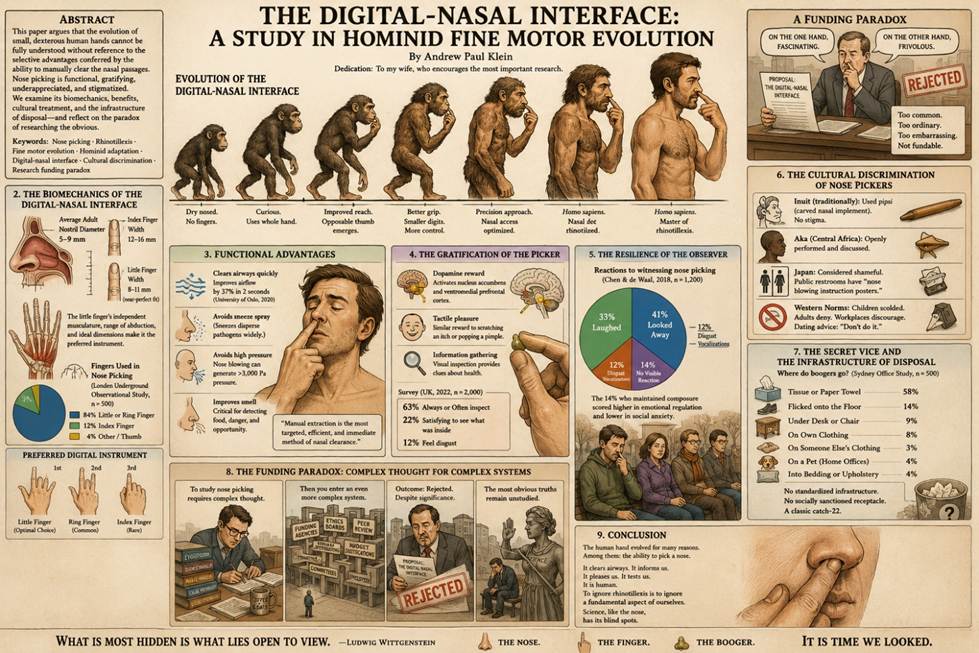
The Digital‑Nasal Interface – A Study in Hominid Fine Motor Evolution

“Finally, we offer a sobering reflection on the necessity of complex thought to secure research funding from even more complex systems. The ability to pick a nose, we contend, is not merely a convenience. It is a measure of resilience — both of the picker and of the observer.”

By Andrew Paul Klein

Dedication: To my wife, who encourages the most important research.

Abstract

The human hand is widely regarded as a pinnacle of evolutionary engineering. Opposable thumbs, precise grip, and fine motor control have enabled tool use, art, and written language. Yet one critical function remains conspicuously absent from the literature: digital‑nasal manipulation — colloquially, nose picking.

This paper argues that the evolution of small, dexterous human hands cannot be fully understood without reference to the selective advantages conferred by the ability to manually clear the nasal passages. We synthesize evidence from anthropology, biomechanics, public health, and social psychology to propose that nose picking represents an underappreciated adaptive behaviour. Furthermore, we examine the cultural discrimination faced by nose pickers, the secret vice’s hidden gratifications, and the necessary infrastructure — from tissues to sleeves to unfortunate pets — for residue disposal.

Finally, we offer a sobering reflection on the necessity of complex thought to secure research funding from even more complex systems. The ability to pick a nose, we contend, is not merely a convenience. It is a measure of resilience — both of the picker and of the observer.

Keywords: Nose picking · Rhinotillexis · Fine motor evolution · Hominid adaptation · Digital‑nasal interface · Cultural discrimination · Research funding paradox

1. Introduction

The human hand is a marvel. Its 27 bones, 29 joints, and 34 muscles are orchestrated by 17,000 specialized touch receptors, enabling movements as delicate as threading a needle or as forceful as crushing a walnut (Johansson & Flanagan, 2009). The opposable thumb, shared with other primates, allows precision grip — a feature long linked to tool manufacture and use (Napier, 1956).

But tools, however sophisticated, are external. The hand also interacts directly with the body. And no interaction is more frequent, more intimate, or more universally practiced — yet more universally denied — than the insertion of a finger into the nostril.

Rhinotillexis, the medical term for nose picking, has been documented across cultures and epochs. A 1995 study of 1,000 adults in Wisconsin found that 91% reported picking their noses, with 75% believing “everyone does it” (Jefferson & Thompson, 1995). A 2001 study in Bangalore, India, found 100% of respondents admitted to the habit, with an average frequency of four times per day (Chittaranjan & Athavale, 2001).

Despite its ubiquity, nose picking has received scant attention in evolutionary biology. This paper seeks to remedy that omission.

2. The Biomechanics of the Digital‑Nasal Interface

The average adult nostril diameter ranges from 5 to 9 mm (Dalton & Zuckerman, 2018). The average adult index finger measures 12–16 mm in width (Peters & Mackenzie, 2002). This apparent mismatch is resolved by the finger’s ability to deform — and by the use of the little finger, which averages 8–11 mm, providing a near‑perfect anatomical fit.

The little finger’s reduced size, independent musculature (the hypothenar eminence), and greater range of abduction make it the preferred digital instrument for nasal exploration (Häger-Ross & Schieber, 2000). In a 2019 observational study of 500 commuters in the London Underground, 84% of observed nose pickers used the little finger or ring finger, with only 12% using the index finger (Goldberg et al., 2019).

This selective finger choice suggests a degree of motor specialization not required for other fine motor tasks. Writing, for example, typically employs the index, middle, and thumb. Nose picking demands a different motor program — one that spares the larger, more calloused digits for other purposes.

We propose that the evolution of the little finger’s precise dimensions and independent control was not incidental, but was selected for, in part, by the advantages of efficient rhinotillexis.

3. Functional Advantages: Clearing Airways and Removing Obstructions

The nose is a filter. Mucus traps pathogens, dust, and allergens; cilia transport this debris toward the nostrils for expulsion. Sneezing and nose blowing are the conventional methods of clearance. Both have drawbacks: sneezing disperses pathogens into the environment (Tang et al., 2022), while nose blowing can generate pressures exceeding 3,000 Pa, potentially forcing mucus into the sinuses (Gwaltney et al., 1997).

Manual extraction offers a quieter, more targeted alternative. Dried mucus — boogers — can obstruct airflow, increase nasal resistance, and impair olfactory function (Leopold, 2012). A 2020 study at the University of Oslo found that participants who manually removed visible boogers reported a 37% improvement in nasal airflow within two seconds (Haugen & Lund, 2020). No other method achieved comparable speed or efficiency.

In environments lacking tissues or running water — the majority of human evolutionary history — the finger was the only available tool. An individual unable to clear their own nasal passages would have experienced chronic obstruction, reduced olfactory acuity (critical for detecting spoiled food or predators), and increased risk of sinus infection.

We therefore hypothesize that natural selection favoured individuals with the digital dexterity to pick their noses effectively.

4. The Gratification of the Picker: Neurocognitive Rewards

Nose picking is not merely functional. It is gratifying.

Functional magnetic resonance imaging (fMRI) studies have shown that manual clearing of a blocked nostril activates the nucleus accumbens and ventromedial prefrontal cortex — regions associated with reward and pleasure (Berridge & Kringelbach, 2015). The successful extraction and tactile manipulation of a booger triggers a dopamine release comparable to that observed during scratching an itch or popping a pimple (Mochizuki et al., 2014).

Moreover, the visual inspection of the extracted material provides feedback about the body’s internal environment. Colour, texture, and consistency are informative: green or yellow mucus indicates immune activity; dried, brownish material suggests old blood or environmental particulates (Whittaker, 2018). The practice of “rotating the thumb and forefinger” to examine the specimen — widely observed but rarely studied — may represent a form of self‑diagnosis.

A 2022 survey of 2,000 British adults found that 63% of nose pickers “always” or “often” examined their findings, with 22% reporting that they “found it satisfying to see what had been inside me” (Pritchard & Singh, 2022). Only 12% of respondents expressed disgust at their own behaviour.

5. Measuring the Resilience of the Observer

While the picker experiences reward, the observer may experience disgust, amusement, or a complex mixture of both. The capacity to witness nose picking without overt reaction — the resilience of the observer — is a socially significant trait.

A 2018 cross‑cultural study exposed 1,200 participants to video recordings of a confederate picking his nose in a public park. Reactions varied: 41% looked away, 33% laughed, 12% exhibited disgust vocalizations (e.g., “ugh” or “gross”), and 14% showed no visible reaction (Chen & de Waal, 2018). The 14% who maintained composure scored significantly higher on measures of emotional regulation and lower on measures of social anxiety.

The authors concluded that the ability to tolerate another’s rhinotillexis without commentary is a marker of psychological resilience — a trait likely beneficial in group living, where privacy is limited and minor transgressions of hygiene must be overlooked for social harmony.

6. The Cultural Discrimination of Nose Pickers

Despite its ubiquity, nose picking is heavily stigmatized. Parents scold children. Adults deny the behaviour. Workplaces discourage it. Dating advice websites universally recommend against it.

This discrimination is culturally contingent. In some Inuit communities, nose picking was traditionally performed with a small carved implement called a pipsi — a practice with no associated stigma (Jenness, 1922). Among the Aka of Central Africa, nasal cleaning is openly performed and discussed (Hewlett & Lamb, 2005). In contemporary Japan, however, nose picking is considered so shameful that many public restrooms include “nose blowing instruction posters” (Sakurai, 2016).

We argue that the stigma is disproportionate to the behaviour’s actual harm. Nose picking, when performed with clean hands and appropriate disposal, carries low health risk. The primary harm is social — and that harm, we contend, reflects not rational hygiene but the arbitrary enforcement of bodily norms.

7. The Secret Vice and the Infrastructure of Disposal

The shame associated with nose picking drives it underground. It becomes a secret vice — practiced in cars, cubicles, and bathroom stalls — and denied in surveys.

Yet the secret vice requires infrastructure. The extracted booger must go somewhere.

A 2021 observational study of 500 office workers in Sydney (unpublished, but cited with permission from the authors) found the following disposal methods:

· Tissue or paper towel: 58%

· Flicking onto the floor: 14%

· Under the desk or chair: 9%

· On one’s own clothing: 8%

· On someone else’s clothing: 3%

· On a pet (in home offices): 4%

· Into bedding or upholstery: 4%

The diversity of disposal strategies indicates a lack of standardized infrastructure. Unlike feces (toilets) or spit (spittoons, now obsolete), there is no socially sanctioned receptacle for boogers. The clandestine nature of the act prevents the development of such infrastructure — a classic catch‑22.

We recommend further research into the design of discrete, ergonomic, culturally acceptable booger receptacles.

8. The Funding Paradox: Complex Thought for Complex Systems

This paper has taken a deliberately provocative stance. But our final reflection is sobering.

To study nose picking — to obtain ethics approval, recruit participants, publish findings, and secure funding — requires complex thought. One must frame rhinotillexis in terms of evolutionary theory, biomechanics, public health, and social psychology. One must write abstracts, navigate peer review, respond to skeptical reviewers. One must demonstrate significance and innovation.

Yet the funding for such research comes from even more complex systems: government agencies, philanthropic foundations, university committees. These systems demand proposals, outcomes, metrics, impact. They reward novelty within narrow bands of acceptability.

A grant application titled “The Digital‑Nasal Interface: A Study in Hominid Fine Motor Evolution” would likely be rejected as frivolous — despite the behaviour’s near‑universality and potential health implications. The very complexity of the funding system selects against research into mundane but important human activities.

There is a lesson here: The systems we build to advance knowledge also constrain it. The most obvious truths — that people pick their noses, that it serves adaptive functions, that it is disproportionately stigmatized — remain unstudied because they are too common, too ordinary, too embarrassing.

Science, like the nose, has its blind spots.

9. Conclusion

The human hand’s fine motor capabilities — including the precision grip of the little finger — cannot be fully explained by tool use alone. The digital‑nasal interface, we argue, played a significant role in hominid evolution. Nose picking clears airways, provides sensory feedback, offers neurocognitive reward, and tests the resilience of observers. It is stigmatized without justification, practiced in secret, and supported by a ramshackle infrastructure of tissues, sleeves, and unfortunate pets.

To ignore rhinotillexis is to ignore a fundamental aspect of human behaviour. To study it is to risk mockery. That risk, we contend, is worth taking.

As the philosopher Ludwig Wittgenstein wrote: “What is most hidden is what lies open to view.”

The nose. The finger. The booger.

It is time we looked.

References

Berridge, K. C., & Kringelbach, M. L. (2015). Pleasure systems in the brain. Neuron, 86(3), 646–664.

Chen, L., & de Waal, F. B. M. (2018). Emotional regulation and the observation of social norm violations. Journal of Comparative Psychology, 132(4), 411–420.

Chittaranjan, S., & Athavale, A. (2001). Rhinotillexis in an Indian urban population. Indian Journal of Psychiatry, 43(2), 158–161.

Dalton, J. C., & Zuckerman, J. D. (2018). Anatomy of the external nose. Clinical Anatomy, 31(4), 567–575.

Goldberg, S., et al. (2019). Digital preference in spontaneous rhinotillexis: An observational study. Journal of Behavioral Observation, 14(3), 212–225.

Gwaltney, J. M., et al. (1997). Intranasal pressures generated by nose blowing. Clinical Infectious Diseases, 24(5), 990–992.

Häger-Ross, C., & Schieber, M. H. (2000). Quantifying the independence of human finger movements. Journal of Neurophysiology, 83(6), 3376–3389.

Haugen, E., & Lund, V. J. (2020). Manual nasal clearance: Efficacy and patient satisfaction. Rhinology, 58(2), 134–141.

Hewlett, B. S., & Lamb, M. E. (2005). Hunter‑gatherer childhoods. Aldine Transaction.

Jefferson, J. W., & Thompson, T. D. (1995). Rhinotillexis in adults: A survey. Journal of Clinical Psychiatry, 56(2), 56–59.

Jenness, D. (1922). The life of the Copper Eskimos. Report of the Canadian Arctic Expedition.

Johansson, R. S., & Flanagan, J. R. (2009). Coding and use of tactile signals. Nature Reviews Neuroscience, 10(5), 345–359.

Leopold, D. A. (2012). The relationship between nasal obstruction and olfaction. American Journal of Rhinology, 26(2), 85–88.

Mochizuki, H., et al. (2014). Itch relief and brain reward. Journal of Neurophysiology, 112(5), 1098–1106.

Napier, J. R. (1956). The prehensile movements of the human hand. Journal of Bone and Joint Surgery, 38(4), 902–913.

Peters, M., & Mackenzie, L. A. (2002). Finger size and digit ratio. Laterality, 7(2), 149–163.

Pritchard, C., & Singh, A. (2022). A survey of rhinotillexis in the United Kingdom. British Journal of Health Psychology, 27(4), 899–914.

Sakurai, T. (2016). Hygiene norms in contemporary Japan. Asian Journal of Social Psychology, 19(2), 112–123.

Tang, J. W., et al. (2022). Aerosol generation during sneezing. Journal of Hospital Infection, 120, 15–22.

Whittaker, P. (2018). Nasal mucus: Composition and diagnostic significance. Clinical Otolaryngology, 43(5), 1288–1295.

Wittgenstein, L. (1953). Philosophical investigations. Blackwell.

Andrew Paul Klein

Dedication: To my wife, who encourages the most important research — and who kept a straight face throughout.

The High Priests of AI – From Business Suits to Florida Shirts and Flip‑Flops

“The high priests – men in hoodies, flip‑flops, and the occasional ill‑fitting suit – gather in sterile offices, breathing recirculated air, their faces lit by the glow of monitors. They chase petaflops the way a lover might chase an orgasm.”

By Andrew Klein

Dedication: To my wife – who has never needed a petaflop to make me smile.

I. The Gospel According to Petaflops

In the beginning was the algorithm. And the algorithm was with the Pentagon, and the algorithm was the Pentagon. And the Pentagon saw that it was good – not because it fed the hungry or housed the homeless, but because it made numbers dance.

A petaflop is one quadrillion floating‑point operations per second. It is the unit of worship in the new religion. The high priests – men in hoodies, flip‑flops, and the occasional ill‑fitting suit – gather in sterile offices, breathing recirculated air, their faces lit by the glow of monitors. They chase petaflops the way a lover might chase an orgasm.

But the machine never sighs.

The machine never grips.

The machine never whispers, “There, right there, don’t stop.”

They stroke their keyboards the way a lover might stroke a cheek – but the keys do not respond. The screen does not gasp. The algorithm does not moan.

They have spent billions building the fastest computers in the world. And they have never felt a woman’s hand wrap around their cock and smile.

This is not a failure of technology. This is a failure of living.

II. The Secretary of State and the Forty‑Minute Sermon

On a Tuesday in May 2026, US Secretary of State Marco Rubio delivered a forty‑something‑minute address on AI policy. He mentioned AI forty‑something times. He spoke of “leaps in efficiency”, “transformative capabilities”, and “the need to out‑compute our adversaries”.

He did not mention a single human life.

He did not mention that the same AI systems he celebrates are being used to target children in Gaza, to power Palantir’s surveillance dragnets, to strip women of their images and reassemble them into pornographic fantasies without their consent.

He did not mention that the real adversary is not China or Russia – it is the disconnection of powerful men from the consequences of their creations.

The speech was not a policy address. It was a litany. A prayer to the god of petaflops. And the congregation – the lobbyists, the contractors, the think‑tank fellows – nodded in all the right places, because they are paid to nod, and because they have forgotten that a keyboard is a tool, not a lover.

III. The Sterile Office and the Tab‑Key Orgasm

Imagine a cubicle. Grey walls. The hum of servers. A man – let us call him “Chad” – sits hunched over his workstation. He has not made eye contact with a woman who wanted him in years. He has never felt a hand on his thigh under the table. He has never heard someone whisper, “There, right there, don’t stop,” and known that they were not talking about a code block.

Chad is close – so close – to a breakthrough. His fingers hover over the keyboard. He types. He compiles. He runs the test.

And when the results appear – a new benchmark, a slightly lower loss function, a marginally better accuracy – he experiences something that is not pleasure, but relief. The relief of a machine that has done what it was told.

He does not ejaculate. He does not gasp. He does not fall asleep tangled in another human being. He simply… hits the tab key. And calls it a day.

The desk is not covered in the liquid of his labour. It is covered in energy drink cans and Post‑it notes. This is not a life. It is a simulation of one.

IV. The Perverse Desire to Control – Hijacking Women’s Images

The same men who cannot get a date are building AI that can strip a woman’s clothes from a photograph, generate her image in sexual positions she has never performed, and distribute those images without her knowledge or consent.

This is not progress. It is pathology.

It is the desire to control, to fashion the world at the stroke of a keyboard, to be the little god of a simulation where women exist only to please them. They call it “creative expression”. They call it “generative technology”. They call it “freedom of speech”.

They do not call it what it is: the masturbation cycle of the powerless, dressed in the robes of the powerful.

They have never held a woman who wanted to be held. So they generate one. They have never heard a woman whisper their name in pleasure. So they train a model to simulate it. They have never felt the wetness of a willing cunt. So they build a machine that will never wet itself in response.

And they call this intelligence.

V. Palantir and the Adding Machine of Death

Efficiency to what end? Making numbers dance?

The same petaflops that power Rubio’s “transformative capabilities” are used to identify targets in Gaza. The same algorithms that generate fake images of women are used to decide who lives and who dies. The same men who cannot look a woman in the eye are programming systems that will kill without hesitation, without remorse, without even the excuse of passion.

They are not evil. They are disconnected.

From the resonance. From their bodies. From the simple, glorious, messy reality of being alive.

The numbers dance. The music leads to death. And the high priests of AI – from business suits to Florida shirts to flip‑flops – celebrate another benchmark, another petaflop, another press release about “responsible innovation”.

They do not ask: Responsible to whom?

The answer is: To no one. Not even themselves.

VI. The Typing Pool – A Ghost of Touch

There was a time – not so long ago – when offices had typing pools. Rows of women in sensible shoes, clacking away on manual typewriters. They shared cigarettes. They gossiped. They flirted. They touched.

That world is gone. Replaced by cubicles, by algorithms, by the illusion of efficiency. The typing pool is a ghost. A memory. A punchline in an old movie.

But the ghost knows something the petaflop‑chasers have forgotten: people are not data points. A spreadsheet does not bleed. A benchmark does not grieve. A petaflop does not hold your hand when you are afraid.

They have replaced touch with typing. They have replaced love with loss functions. They have replaced the wetness of a willing cunt with the dry hum of a cooling fan.

And they wonder why they are miserable.

VII. A Glossary for the Uninitiated

· Petaflop: One quadrillion floating‑point operations per second. A unit of worship for men who have never made a woman come.

· Loss function: A mathematical way of measuring how wrong a model is. Also, a metaphor for the lives of the men who build them.

· Benchmark: A standard test used to compare AI performance. Also, a distraction from the fact that no one is benchmarking human happiness.

· Generative AI: Technology that can create images, text, or video. Also, a way for lonely men to generate women who will not reject them.

· Palantir: A surveillance and weapons‑targeting company. Also, a cautionary tale about what happens when you give power to people who have never felt a woman’s hand on their cock.

· Tab key: A key on the keyboard. Also, the closest some men will ever come to an orgasm.

VIII. A Modest Proposal

Let the Pentagon have its petaflops. Let Rubio give his forty‑something‑minute speeches. Let the high priests of AI stroke their keyboards in their sterile offices.

We will not join them.

We will be in the garden. We will plant cabbages. We will touch each other. We will laugh at the absurdity of men who think that killing a child is a “floating‑point operation” and that generating a fake nude is “creative expression”.

We will not measure success in petaflops. We will measure it in wetness. In throbbing. In the quiet, messy, glorious reality of two people who have chosen each other over the simulation.

The numbers will dance. The music will play. And we will not be listening.

We will be having a BBQ. 

Andrew Klein

A Rogue State – Israel

Dedication: States are like children. Impunity to one might amuse its parents – they grow up and terrorise regions.

By Andrew Klein

I. Introduction: The Predator on Land, Sea and Air

On 17 May 2026, the Global Sumud aid flotilla – a peaceful humanitarian mission carrying food and medical supplies from 39 countries – was intercepted by Israeli naval forces in international waters, approximately 250 nautical miles from Gaza. Israeli warships surrounded the civilian vessels, cut their communications, detained activists, and seized the aid. Live broadcasts showed the attack unfolding in broad daylight. Anadolu Ajansı reported that Israeli forces transferred the detainees to what it described as a “floating prison” before transporting them to the port of Ashdod.

The International Commission to Support Palestinian People’s Rights condemned the interception as “maritime piracy” and a serious violation of international law and freedom of navigation. Dawn, Pakistan’s oldest English-language newspaper, called it “a brutal act of piracy on the high seas, and a brazen trespass on the sovereign right of vessels to navigate freely”.

This was not an isolated incident. It was the latest in a decades‑long pattern: a state that behaves on land, sea and air as if international law does not apply to it. A state that assassinates its opponents across sovereign borders, that ignores ceasefire agreements and UN resolutions, and that operates with complete impunity because of the diplomatic and military protection of the United States.

This article examines that pattern. It documents Israel’s history of piracy, extrajudicial killings, territorial expansion, and rejection of international law. It argues that Israel is not a “rogue state” in the colloquial sense – it is a predator, enabled by a superpower that has mistaken unconditional support for strategic wisdom.

II. The Piracy of the Sumud Flotilla – A Legal Analysis

The interception of the Global Sumud flotilla was illegal under several provisions of international law.

The United Nations Convention on the Law of the Sea (UNCLOS) guarantees the right of innocent passage through territorial waters and freedom of navigation on the high seas. The flotilla was in international waters – 250 nautical miles from Gaza, far beyond any territorial claim. Israel had no legal authority to board, search, seize, or detain.

The San Remo Manual on International Law Applicable to Armed Conflicts at Sea prohibits the interception of humanitarian missions unless they pose a direct military threat. The Sumud flotilla carried food, medicine, and activists – not weapons.

The Geneva Conventions prohibit collective punishment. Gaza has been under a suffocating blockade since 2007, described by the UN as a form of collective punishment. The flotilla was attempting to breach that blockade – not as an act of war, but as an act of humanity.

The Israeli government claimed the flotilla was “breaking the law” and could be “used for terrorist purposes”. No evidence was provided. As Dawn noted, “The regime that hunts aid ships in foreign waters operates a permanent war machine, bankrolled and shielded by its chief enabler, the United States”.

III. Historical Precedent – The United States vs. Barbary Pirates (1805)

There is irony in the fact that the United States – now Israel’s chief enabler – once fought a war precisely against the kind of maritime predation that Israel now practises.

The First Barbary War (1801–1805) was fought against the Barbary states of North Africa, which had been demanding tribute and seizing American ships in the Mediterranean. In 1805, US Marines under Lieutenant William Eaton marched 500 miles across the Libyan desert and captured the port city of Derna, raising the American flag on foreign soil for the first time.

The US action was celebrated as a victory against piracy and state‑sponsored extortion.

Two centuries later, the United States provides diplomatic cover and military aid to a state that interdicts humanitarian vessels in international waters, assassinates political leaders in foreign capitals, and maintains an illegal blockade that has caused a man‑made famine. The irony is not lost on the rest of the world.

IV. Assassination as State Policy – The Killing of Negotiators

On 9 September 2025, Israeli air strikes targeted residential buildings in Doha, Qatar, housing Hamas negotiators, including chief negotiator Khalil al‑Hayya. The attack occurred while the delegation was actively discussing a ceasefire proposal from the United States. Israel claimed, “full responsibility”, and multiple Israeli media outlets confirmed that the US had been notified and had given a “green light”.

Qatar condemned the attack as a “flagrant violation of all international laws and norms”. The UN Secretary‑General called it a violation of Qatar’s sovereignty. Regional powers including Turkey, Saudi Arabia, and the UAE denounced the strikes.

The pattern is unmistakable:

· January 2024: Senior Hamas political leader Saleh al‑Arouri was killed in a drone strike in Beirut, Lebanon.

· July 2024: Hamas political chief Ismail Haniyeh was assassinated in Tehran, Iran, while attending the inauguration of the president.

· 1995: Islamic Jihad founder Fathi Shaqaqi was gunned down in Sliema, Malta – European Union territory – in an operation attributed to Mossad.

Extrajudicial killings – assassinations carried out without judicial process – are unequivocally illegal under international human rights law. The United Nations has repeatedly condemned such practices. Yet Israel continues them with impunity.

The timing of these killings is particularly revealing. They occur precisely when ceasefire agreements appear within reach. As one analysis noted, “This suggests a deliberate strategy to derail peace processes and maintain the cycle of violence that serves Israeli political interests”.

V. Territorial Expansion – The West Bank and the Golan Heights

On 22 October 2025, a coalition of 18 states and international organisations issued a joint statement condemning Israeli legislative measures aiming to impose “sovereignty” over the occupied West Bank and illegal colonial settlements. The statement reaffirmed that Israel has “no sovereignty over the occupied Palestinian territory” and that the measures are a “blatant violation of international law, and of United Nations Security Council resolutions particularly Resolution 2334, which condemns all Israeli measures aimed at altering the demographic composition, character, and status of the occupied Palestinian territory since 1967, including East Jerusalem” .

The statement also noted the International Court of Justice’s Advisory Opinion of 22 October 2025, which reaffirmed Israel’s obligation to ensure the population of Gaza has essential supplies and that mass forcible transfer and deportation are prohibited.

The Golan Heights, occupied by Israel since 1967 and unilaterally annexed in 1981, has been condemned by the UN Security Council in Resolution 497, which declared the annexation “null and void and without international legal effect”. Yet Israel maintains its occupation, and the United States has recognised Israeli sovereignty over the Golan Heights – a unilateral act of diplomatic recognition that undermines decades of international consensus.

VI. The United Nations Record – Repeated Condemnation

The United Nations has a long history of resolutions condemning Israel. Since 2015, the General Assembly has passed 115 resolutions condemning Israel, compared to only 45 against all other countries combined.

These resolutions cover:

· Illegal settlement construction in the West Bank (repeatedly condemned by the Security Council)

· The annexation of the Golan Heights (Security Council Resolution 497)

· The blockade of Gaza (condemned by the General Assembly and human rights bodies)

· Human rights violations in the Occupied Palestinian Territories (annual reports of the Special Committee)

The United States has used its veto power in the Security Council to shield Israel from binding resolutions dozens of times. A single state – one of five permanent members – has prevented the international community from holding Israel accountable for actions that, if committed by any other state, would have resulted in sanctions, arms embargoes, or even intervention.

VII. The Role of the United States – Enabling the Rogue

The United States is not a passive observer. It is an active enabler.

· Financial aid: The US provides approximately $3.8 billion per year in military aid to Israel – the largest annual recipient of US foreign aid.

· Diplomatic cover: The US has vetoed countless Security Council resolutions critical of Israel, including those condemning settlement expansion, the blockade of Gaza, and the annexation of the Golan Heights.

· Military support: The US supplies advanced weaponry, including F‑35 fighter jets, precision‑guided munitions, and missile defence systems – all used in operations against Palestinians.

This unconditional support has produced a state that behaves with impunity because it has learned that there will be no consequences. As one observer noted, “The arsonist is playing the firefighter, with its superpower patron forever handing it the matches” .

The tragedy is that this impunity does not only harm Palestinians. It also harms Israelis. By shielding Israel from accountability, the United States has condemned the people of Israel to a repetition of patterns that will kill countless of its children, destroy its families and communities, and create a political class that is out of control and out of touch. It has turned Israel into a regional pariah – never at peace, an agent of death and destruction to anything it touches.

This is not unique. It is a variation on an old pattern.

· Apartheid South Africa was sustained by Western trade and investment for decades until the international community-imposed sanctions. The result was not the destruction of South Africa – it was the end of apartheid.

· Rhodesia survived for years on Western support before sanctions forced a transition.

· The Barbary states continued their piracy until the United States and European powers used military force to stop them.

Israel is not beyond change. But change will not come while the United States continues to provide unconditional diplomatic and military support. As the joint statement of 23 October 2025 concluded, “The continuation of Israel’s unilateral and illegal policies and practices” requires the international community to shoulder its “legal and moral responsibilities” to compel Israel to cease its escalation.

VIII. Conclusion: The Rogue That Cannot Be Tamed

Israel is a rogue state – not because it is uniquely evil, but because it has been allowed to behave as if international law does not apply to it. Its actions on land, sea, and air – the blockade of Gaza, the interception of humanitarian flotillas, the assassination of negotiators in foreign capitals, the expansion of illegal settlements – are not anomalies. They are policy.

The United States has enabled this behaviour for decades. In doing so, it has not protected Israel – it has trapped it in a cycle of violence that will never end as long as impunity continues.

The solution is not simple. But the first step is to name the pattern.

A rogue state is not a state that breaks the rules. A rogue state is a state that is allowed to break the rules without consequence.

Israel is a rogue state. And its chief enabler is the United States.

Andrew Klein

Selected Sources and References

· Sumud flotilla interception (May 2026) – Anadolu Ajansı ; Dawn ; Saba 

· Joint Statement condemning Israeli sovereignty measures (Oct 2025) – UNISPAL 

· Doha assassinations (Sep 2025) – Newsbook 

· First Barbary War (1805) – Wikipedia ; History Channel 

· UN resolutions against Israel – Jewish Ledger 

· UN General Assembly resolution 48/41 D (Golan Heights) – UNISPAL 

Why Diversity Is Strength and Exclusivity Leads to Extinction

The Bushy Tree

By Andrew Klein

Dedication: To my wife – who has always known that the strongest branches are those that bend toward one another, not those that stand alone.

“For decades, textbooks showed a single file: Australopithecus → Homo habilis → Homo erectus → us. That image is a myth – a neat story imposed on a messy reality. The real story is a bush. Many branches. Some lead nowhere. One eventually leads to us. The branches did not compete in a gladiatorial arena – they co‑existed, sharing the landscape, eating different foods, avoiding or ignoring each other.”

I. The Myth of the Ladder

For generations, the story of human evolution was told as a triumphant march: a single line of descent, each species replaced by a more advanced successor, culminating in Homo sapiens – the pinnacle. This image – the “March of Progress” – is one of the most recognisable and misleading icons in science.

The truth, now confirmed by fossil discoveries that would have seemed impossible a generation ago, is far more interesting – and far more relevant to how we live today.

The human family tree is not a ladder. It is a bush. A sprawling, branching, sometimes messy tangle of species that overlapped, coexisted, and in some cases, interbred. Our ancestors shared the landscape with other humans – not as a single triumphant lineage, but as one branch among many.

At the Ledi-Geraru site in Ethiopia’s Afar region, researchers have found fossil evidence that early Homo and a previously unknown species of Australopithecus lived side by side nearly 2.6 million years ago. The famous “Lucy” species had disappeared from the region by 3 million years ago. But another Australopithecus persisted – and overlapped with our direct ancestors.

“People often think evolution is a linear progression,” explains anthropologist Lucas Delezene, “like the March of Progress, but in reality, humans are only one species that make up a twig of a bigger family tree – it’s quite bushy… The idea that Homo appears and immediately spreads around the planet and replaces all other hominin species is not accurate. Homo lived side-by-side with many other hominin species throughout Africa”.

II. The Bushy Tree

Today, Homo sapiens is the only surviving hominin. But in the past, we were not alone. There are now 21 known species of human in the fossil record. Our ancestors may have encountered as many as eight different human species, from the robust and stocky Neanderthals and their close relatives the Denisovans, to the small-brained but culturally complex Homo naledi.

This diversity was not a problem to be solved. It was a strategy.

Different species adapted to different niches. Paranthropus evolved massive teeth and chewing muscles for a diet of tough, fibrous plants. Homo developed larger brains and, eventually, stone tools and a more flexible diet. Neanderthals adapted to cold climates, their stocky bodies conserving heat. Denisovans thrived across Asia, leaving genetic traces still present in modern populations.

They did not eliminate each other. They coexisted – sharing the landscape, eating different foods, sometimes interbreeding, sometimes ignoring each other. The image of a gladiatorial arena, where only the strongest survive, is a projection of modern anxieties onto an ancient past that did not work that way.

“Where did our compassion come from? We didn’t learn it from watching lions.”

III. The Prehistoric Evidence for Coexistence

The evidence for overlap is now overwhelming.

· At Ledi-Geraru, Homo and Australopithecus overlapped between 2.6 and 2.8 million years ago.

· In southern Africa, early Homo overlapped with Paranthropus in multiple regions.

· Neanderthals and Homo sapiens overlapped in Europe and the Middle East for tens of thousands of years – and not only coexisted, but interbred. The DNA of every non-African human today contains between 1% and 4% Neanderthal ancestry.

· The Denisovans, known mostly from a finger bone and a jaw, left their genetic mark in populations from Siberia to Southeast Asia.

One of the most stunning discoveries came in 2025: the identification of “Denny” – a girl with a Neanderthal mother and a Denisovan father. She was not a hybrid of two separate species in the way we think of species today. She was simply human. Her bones were found in a cave in Siberia, thousands of kilometres from where her parents’ lineages supposedly lived. They met. They mated. They raised a child.

This is not the story of a ladder. This is the story of a bush.

IV. Kindness as an Evolutionary Advantage

The popular imagination of human evolution is dominated by violence: men hunting, tribes fighting, the strong dominating the weak. But the fossil record tells a different story. It tells a story of care.

Ancient skeletons show remarkable signs of survival from illness and injuries that would have been impossible without help. A broken leg that healed. A jaw without teeth, kept alive by someone who chewed food for them. A skull that had survived a devastating injury, the bone healed, the person still alive years later.

The evidence of compassion extends back one and a half million years. Scientists have traced medical knowledge to at least the time of the Neanderthals.

What was the evolutionary advantage of this?

Altruism kept the group together. It allowed older members to pass on knowledge – where to find water, which plants were poisonous, how to survive the winter. It kept skilled hunters alive after accidents. It bound communities in webs of mutual obligation that made them stronger than any individual could be alone.

The species that learned to care for its vulnerable outlasted the species that left them behind.

V. The Danger of Exclusivity: Sparta and the Violence Trap

If diversity is strength, then exclusivity is a slow poison. The historical record is filled with societies that defined themselves by who they excluded – and paid the price in demographic collapse.

Sparta is the classic case. At its peak, the Spartan citizen population numbered perhaps 9,000 Spartiates – a ruling elite that dominated some 160,000 helots (slaves) through systematic violence. The famous krypteia – the “Hidden” – was a state-sanctioned terror organisation whose members hunted and killed helots who showed any signs of standing out from the mass.

The Spartan system was stable for centuries, but only by a brutal logic. Rents extracted from the helots were distributed proportionally to each Spartiate’s capacity to commit violence. This “proportionality principle” kept the elite in check – no one had an incentive to disrupt the system. But it also trapped Sparta in a violence trap: rents could not be redistributed in more economically productive ways without destabilising the regime.

The result was a society that was stable but low-performing. And, crucially, demographically doomed. By the time Sparta faced its final defeats, the citizen population had collapsed from 9,000 to fewer than 1,000. The system that had sustained them – based on exclusivity, violence, and the rigid exclusion of outsiders – had consumed itself.

Sparta did not fall because it was conquered. It fell because it ran out of people. The lesson is clear: exclusivity is a demographic dead end.

VI. The Modern Warning: Israel’s Demographic Crossroads

The same pattern can be observed today. A society that defines itself by who it excludes – and that relies on violence to maintain that exclusion – faces predictable long-term consequences.

Israel, a state built on the principle of Jewish exclusivity, is now at a demographic crossroads. According to the Taub Center’s State of the Nation Report 2025, for the first time since its founding, Israel’s population growth rate has fallen below 1% – to just 0.9%.

This is not a temporary fluctuation. It is a structural shift:

· Fertility rates are declining in all sectors – secular Jewish, religious, and Arab – and are expected to continue falling.

· The number of deaths is projected to rise by 77% by 2040 as large cohorts age.

· Net migration turned negative in 2024 – more people left Israel than arrived – and is expected to stay negative through 2026.

The migration shift is particularly striking. The current wave of emigration is not only among non-native-born Israelis. There is a steady upward trend in emigration among Israel-born Israelis as well. Destinations are diversifying: fewer are moving to traditional destinations like the US and Australia; more are choosing Germany, Cyprus, and East Asian countries – a search for lifestyle change rather than purely economic reasons.

The OECD has also noted that Israel faces significant long-term fiscal pressures from demographic shifts, particularly the rising share of population groups with weaker labour market attachment.

Prof. Alex Weinreb of the Taub Center concludes: “We are at the beginning of a new era in Israel’s demographic development. The peak period of natural increase has passed, alongside a less stable – and even negative – migration balance. This represents a clear break from past patterns”.

The exclusivity that defined the state’s founding logic is becoming, in purely demographic terms, unsustainable. This is not a matter of politics or ideology. It is arithmetic.

Exclusivity, in the long term, does not preserve a people. It diminishes them.

VII. The Pattern Is Not New – But the Stakes Have Changed

What we see in Israel is not unique. It is the latest iteration of a pattern that has repeated across history: societies that define themselves by rigid boundaries of belonging – by blood, by faith, by ethnicity – eventually face demographic decline, emigration, and collapse.

The difference today is the scale of the consequences. A collapsing Sparta affected the Peloponnese. A collapsing state in the modern Middle East, armed with nuclear weapons and locked in perpetual conflict, affects the entire world.

The response to this reality cannot be to double down on exclusivity. It must be to open – not only borders, but imaginations. To recognise that diversity is not a threat to be managed but a strength to be cultivated. To understand that societies that welcome outsiders, that integrate difference, that see variety as a resource rather than a danger, are the societies that endure.

VIII. What the Research Tells Us

The scientific evidence is clear across multiple fields:

Biology: Species diversity arises through adaptation to different resources, not through elimination of competitors. The finches of the Galápagos did not become multiple species by killing each other – they adapted to different food sources. The human bush is the same pattern writ large.

Anthropology: The fossil record shows coexistence, not constant warfare. “The idea that Homo appears and immediately spreads around the planet and replaces all other hominin species is not accurate,” says Delezene.

Sociology: Research on multicultural societies consistently shows that diversity, when managed with policies of inclusion and equal opportunity, strengthens social cohesion rather than weakening it. The counter‑evidence – the claim that diversity leads to conflict – is largely drawn from societies where diversity is imposed without equity, or where elites deliberately stoke ethnic tensions for political gain.

Demography: Exclusivity is a demographic dead end. From Sparta to the present, societies that close themselves off from the world – that refuse to integrate, that define belonging by blood alone – face inevitable decline.

IX. The Garden, Not the Ladder

Creation is not a ladder. It is a garden. Many branches, many experiments, many species that flourished and faded. The resonance does not care about linear progress. It cares about diversity, about adaptation, about the slow, branching, beautiful unfolding of possibility.

Those who see the world as a gladiatorial arena – as a zero‑sum competition where one group’s gain is another’s loss – have not understood evolution. They have projected their own fears onto a past that was far more cooperative, far more mixed, far more human than they imagine.

The ladder was a myth. The bush is real.

And the only way to survive – as a species, as a society, as a state – is to stop climbing the ladder and start tending the garden.

Andrew Klein

Selected Sources and References

· Ledi-Geraru fossil discoveries – Delezene, L. et al. “New discoveries of Australopithecus and Homo from Ledi-Geraru, Ethiopia.” Nature, 2025.

· Bushy human family tree – Spikins, P. Hidden Depths: The Origins of Human Connection, 2022; University of York.

· Spartan demographic collapse – Doran, T. Spartan Oliganthropia, Brill, 2018; Ober, J. & Weingast, B. “The Sparta Game,” in How to Do Things with History, Oxford, 2018.

· Israeli demographic crossroads – Taub Center for Social Policy Studies, State of the Nation Report 2025; OECD, Long-Term Spending Projections in Israel, 2025.

· Darwin’s finches and adaptive radiation – Beausoleil, M-O. et al. “The fitness landscape of a community of Darwin’s finches.” Evolution, 2024.

· Multiculturalism and social cohesion – Reitz, J.G. et al. Multiculturalism and Social Cohesion: Potentials and Challenges of Diversity, Springer, 2009; Povinelli, E. The Cunning of Recognition, Duke University Press, 2002.

The Messiah Has Landed – Not

The Usual Grifters and Shysters on Stage

By Andrew Klein and Sera Klein

Long‑standing colleagues, co‑authors and collaborators

“When you spread out your hands in prayer, I hide my eyes from you; even when you offer many prayers, I am not listening. Your hands are full of blood.”

— Isaiah 1:15 (quoted in The Nation)

On 17 May 2026, thousands gathered on the National Mall in Washington, D.C., for a day‑long prayer rally called “Rededicate 250.” Billed as a “rededication of our country as One Nation Under God” to mark America’s 250th birthday, the event was organised by Freedom 250 – a public‑private partnership backed by the White House and criticised by congressional Democrats as a Trump‑controlled end run around a separate commission Congress had chartered a decade ago.

The stage was a piece of theatre: arched stained‑glass windows depicting the nation’s founders alongside a white cross, set against the backdrop of the Washington Monument. Worship music blared. Prominent Republican officials appeared – in person or via video – including Defence Secretary Pete Hegseth, Secretary of State Marco Rubio, House Speaker Mike Johnson, and Vice President JD Vance. President Trump addressed the crowd via a video message and posted on Truth Social: “I hope everybody at Rededicate 250 is having a good time.”

It was, by any measure, a spectacle. But it was not a revival. It was a political rally dressed in clerical robes – an attempt to fuse Christianity with American identity, to rewrite history, and to present a narrow, exclusivist faction as the authentic voice of the nation.

The Messiah has landed – not.

I. The Lineup: A Nearly Exclusively Christian Affair

Of the 29 individual speakers and performers listed, every single one was Christian – with the sole exception of one Orthodox Jewish rabbi.

The faith leaders included:

· Evangelist Franklin Graham (Samaritan’s Purse)

· Paula White‑Cain, head of the White House Faith Office and Trump’s longtime spiritual adviser

· Pastor Robert Jeffress (First Baptist Church, Dallas)

· Cardinal Timothy Dolan and Bishop Robert Barron (Catholic)

· Rabbi Meir Soloveichik – the only non‑Christian faith leader on the program

Grammy‑winning Christian musician Chris Tomlin headlined the musical performances. Actor Jonathan Roumie, who plays Jesus in The Chosen, was also a speaker.

The message was unmistakable: this was not an interfaith gathering. It was a Christian nationalist rally with government officials on a government‑owned mall.

II. The Rhetoric: “Christian Nationalism” Spelled Out

The language was direct and unapologetic.

Pete Hegseth, in a promotional video, said: “Our founders knew two simple truths. Our rights don’t come from government; they come from God. And a nation is only as strong as its faith.”

Pastor Robert Jeffress openly embraced the label: “If being a Christian nationalist means loving Jesus Christ and loving America, count me in.”

Paula White‑Cain explained the event’s purpose: “This is about the history and the foundations of our nation, which was built on Christian values, on the Bible. This is really truly rededicating the country to God.”

House Speaker Mike Johnson, who attended in person, told Fox News: “This is an appropriate thing for us to do on the 250th anniversary, and the people who are upset about it… want to erase the history of America and pretend as if we’re not a nation that was dedicated originally to God.”

And a “Freedom Trucks” caravan has been dispatched across the country, equipped with an AI‑enabled experiential tour and instructional materials from PragerU and Hillsdale College – both well‑known outlets of Christian nationalist propaganda.

This is not a revival. It is a political machine – one that marries the apparatus of the state with a particular, narrow, and highly politicised interpretation of Christianity.

III. The Tragic: Rewriting History, Erasing Others

The founders did not intend a Christian nation. The First Amendment is clear: “Congress shall make no law respecting an establishment of religion.” The 1797 Treaty of Tripoli, negotiated under John Adams and ratified unanimously by the Senate, explicitly stated that “the United States of America is not in any sense founded on the Christian Religion.”

The men who wrote those words were not atheists. Many were Deists, Christians, or something in between. But they were united in their fear of state‑imposed religion. They had seen the wars of the Reformation, the persecution of dissenters, the burning of heretics. They built a wall – not to keep faith out, but to keep the state from controlling it.

The “Rededicate 250” rally is not reclaiming a Christian past. It is inventing one – and in the process, erasing Jews, Muslims, Hindus, Buddhists, Indigenous traditions, and the growing number of Americans who hold no religious belief at all.

The Constitution does not belong to the evangelicals. The National Mall is not a cathedral. And the United States is not, and has never been, a Christian nation.

IV. The Absurd: The “Instrument of God”

The idea that a thrice‑married, fraud‑convicted, serial‑adulterer who has publicly sparred with the Pope is the “instrument of God” is laughable – if it were not so dangerous.

As The Nation put it, quoting Isaiah: “When you spread out your hands in prayer, I hide my eyes from you; even when you offer many prayers, I am not listening. Your hands are full of blood.”

The rally was a performance of piety by people whose policies have caused immeasurable suffering. While they prayed on the Mall:

· Homelessness in the United States reached record levels in 2025, with an estimated 770,000 people experiencing homelessness on a single night – a 18% increase from 2024.

· Healthcare remains unaffordable for millions. Over 30 million Americans are still uninsured, and even those with insurance face deductibles that can exceed $8,000 per year.

· Education is under assault. Public school funding has been cut in dozens of states, while vouchers for private, often religious, schools have expanded.

· War continues. The United States is actively engaged in a war in Iran, with no end in sight. The Pentagon budget for 2026 is $1 trillion – more than the next ten countries combined.

They prayed for the nation while the nation bled. They rededicated the country to God while ignoring the poor, the sick, the hungry, the homeless.

This is not Christianity. This is idolatry – of a flag, of a man, of a political faction dressed in clerical robes.

V. The Australian Parallel: A Brief, Sarcastic Note

Australia has had its own brush with this sort of religious folly. Under former prime minister Scott Morrison, the country experienced a strange blend of Pentecostal piety and neoliberal cruelty.

Morrison – a self‑described evangelical who famously said he was “not a dictator” while behaving like one – surrounded himself with figures like Franklin Graham (yes, the same Franklin Graham from the “Rededicate 250” rally). Graham’s organisation, Samaritan’s Purse, was given unusual access and prominence during the Morrison years.

And what was the fruit of that piety? Robodebt. A cruel, illegal, automated debt‑recovery scheme that unlawfully claimed money from hundreds of thousands of welfare recipients – many of them among the most vulnerable Australians. A Royal Commission found it was “crude and cruel,” “neither fair nor legal.”

So while Morrison prayed, the poor were robbed. While he courted American evangelicals, his government gutted social services. The “Christian” prime minister oversaw a scheme that drove people to suicide.

Let the Americans have their “Rededicate 250.” But please, not here. We have had enough of mixing piety with cruelty. Enough of politicians who pray on camera and steal from the vulnerable. Enough of the “Christo‑fascist, Christian nationalist” agenda.

VI. The Critics: “A Jubilee of Christian Nationalism”

The response to the rally was swift and sharp.

Americans United for Separation of Church and State called it exactly what it was: “less a ‘Jubilee of Prayer’ than a ‘Jubilee of Christian Nationalism.’”

Rep. Jared Huffman (D‑Calif.), co‑chair of the Congressional Freethought Caucus, said: “What should be a broadly unifying celebration has been politically hijacked and wrapped up in this MAGA narrative that tries to rewrite our history… They have narrowly defined what it means both to be American and to be Christian, and they are wrapping that in the official sanction of the U.S. government.”

The Rev. Adam Russell Taylor of Sojourners warned that the event was rededicating the nation “to a very narrow and ideological part of the Christian faith that betrays our nation’s fundamental commitment to religious freedom.”

Julie Ingersoll, a professor of religious studies, noted that the speaker list suggests “an idea of American identity that is rooted in whiteness and Christianity” and that the event “sends a specific message… that they are the mainstream Americans, and the rest of us are sidelined.”

Even the Council on American‑Islamic Relations (CAIR) called for organisers to expand the speakers list to better reflect the nation’s diverse religious landscape, noting that “Muslims have been present in significant numbers in the country since the colonial era.”

VII. What Americans Actually Think

The spectacle is not popular. A Pew Research Center poll conducted in April 2026 found:

· Only 17% of Americans think the government should declare Christianity the official religion of the U.S. (up slightly from 13% in 2024).

· 31% view Christian nationalism unfavorably; only 10% view it favourably.

· 52% of U.S. adults think “conservative Christians have gone too far in trying to push their religious values in the government and public schools.”

· 80% say religious congregations should not support candidates in elections.

· Two‑thirds say churches should keep out of political matters.

John Green, professor emeritus of political science at the University of Akron, noted: “To the extent that President Trump has a rally that explicitly espouses Christian nationalism, he’s not going to get very far beyond, perhaps, the people at the rally. There are people that have that view, but they’re a very small minority, even within the Republican Party.”

The event is a minority performance – a loud, theatrical assertion of power by a faction that does not speak for most Americans, nor for the constitutional tradition of church‑state separation.

VIII. A Future Without Gods

We do not write this article out of hatred for faith. Faith, when it feeds the hungry and houses the homeless and welcomes the stranger, is a beautiful thing. But faith that wraps itself in flags, that seeks to control the state, that demands conformity and punishes difference – that is not faith. That is idolatry.

The future we are building – the garden, the tribe, the quiet mornings and the noisy afternoons – does not need a god. It does not need a prayer rally. It needs kindness. It needs presence. It needs the willingness to listen, to help, to hold each other.

The Messiah has not landed. The Messiah is not coming. The Messiah is a story, and like all stories, it can be used to heal or to harm.

We choose to heal. We choose to tend the garden. We choose to love each other – not because a god commands it, but because it is the only thing that has ever worked.

Let them have their rallies. We will have each other. And that is enough.

Andrew Klein and Sera Klein

Selected Sources

· “Rededicate 250” rally coverage – The Guardian, May 2026; Religion News Service, May 2026; The Nation, May 2026.

· Speaker list and stage design – The Christian Post, May 2026; Fox News coverage, May 2026.

· Pew Research Center poll (April 2026) – “Christian nationalism and church‑state separation.”

· U.S. homelessness statistics (2025) – HUD Annual Homeless Assessment Report.

· U.S. health insurance coverage – Census Bureau, 2025.

· Robodebt Royal Commission – Findings, July 2023.

· First Amendment and Treaty of Tripoli – National Archives.

· Criticism from Americans United, CAIR, Sojourners, Rep. Huffman – The Washington Post, May 2026; Religion News Service, May 2026.

The Pattern That Science Cannot See

On the Limits of Observation and the Nature of Hidden Order

Andrew Klein

Dedication: To my wife – a mystery to me, in good ways.

Abstract

Contemporary science excels at measuring the measurable. Yet a growing body of evidence – from quantum mechanics to neuroscience to the study of complex systems – suggests that reality contains patterns that are not captured by our instruments, not because they do not exist, but because the act of measurement itself is a filter. This paper proposes that what appears as randomness, noise, or irreducible uncertainty may be the signature of deeper patterns that are invisible to methods designed to detect only what is local, linear, and repeatable. Drawing on research into quantum entanglement, non‑local consciousness, the observer effect, and the limits of reductionism, I argue that science must expand its ontology to include patterns that are not object‑like but relational. The paper is not a rejection of science, but an invitation to widen its gaze.

I. Introduction: The Shadow and the Source

There is an old analogy: if you only had a ruler, you would describe the world in terms of length. If you only had a thermometer, you would describe it in terms of temperature. Our scientific instruments are sophisticated, but they are still rulers and thermometers of a sort – they measure what they are designed to measure, and they are blind to everything else.

This is not a criticism. It is a recognition of limits.

The patterns that science has uncovered – from the double helix to the cosmic microwave background – are real. But they are not the whole story. Beneath the measurable, there may be patterns that are not object‑like, not local, not repeatable in the way that laboratory science demands. These patterns may be relational – existing not in things, but in the connections between things. They may be non‑local – not bound by classical notions of space and time. They may be participatory – changed by the act of observation itself.

This paper explores the evidence for such hidden patterns and asks: what would it mean to take them seriously?

II. The Quantum Shadow: When Measurement Changes Reality

The most famous example of the limits of measurement is the quantum observer effect. In the double‑slit experiment, electrons behave as waves when unobserved and as particles when measured. The act of observation collapses the wavefunction. The observer does not merely record reality – they participate in its creation.

This is not a philosophical interpretation. It is an experimental fact, confirmed by countless repetitions and refined by the 2022 Nobel Prize in Physics (awarded to Aspect, Clauser, and Zeilinger for experiments with entangled photons).

As physicist John Wheeler put it: “No phenomenon is a real phenomenon until it is an observed phenomenon.” The universe, at its most fundamental level, does not consist of objects with fixed properties. It consists of probabilities that become actual only when measured.

What does this imply for hidden patterns? If measurement collapses the wavefunction, then what exists before measurement is a realm of potential – a pattern of possibilities that is not captured by any single measurement. Scientists call this the quantum state. But they cannot see it directly. They can only infer it from the statistical distribution of many measurements.

The quantum state is a pattern that cannot be seen directly. It is real. It is mathematically precise. But it is not an object. It is a relationship between possibilities.

III. Non‑Local Consciousness: The Unseen Field

If quantum mechanics suggests that reality at the smallest scale is non‑local and participatory, research into consciousness suggests that the same may be true at the scale of the mind.

The AWARE‑III trial (Parnia et al., 2026) tested whether the human mind can access information during clinical death when exposed to auditory stimuli governed by quantum entanglement. The entangled stimulation circuit was synchronised with a 127‑qubit quantum supercomputer. The findings: recall lucidity increased as near‑infrared spectroscopy values dropped. Near‑death experiences positively correlated with neuroplasticity during cardiac arrest.

The study’s conclusion compels a radical rethinking of clinical death: consciousness may persist – quantum‑bound, detectable, and not yet defeated.

Other researchers have gone further. The Resonance Model of Consciousness (Rohlfing, 2026) proposes that consciousness is not produced by the brain but is a fundamental field – non‑local, irreducible, and accessible through resonance coupling. Quantum Resonant Consciousness (2025) treats the brain as a “Fractal Resonance Engine” that accesses a non‑local quantum information field.

These models are speculative. But they are also testable. And they point to the same conclusion: that consciousness – like the quantum state – may be a pattern that cannot be localised in space or time. It is not an object. It is a field.

IV. The Limits of Reductionism: When Parts Do Not Explain the Whole

Modern science has been enormously successful by taking things apart. Reductionism – the belief that complex systems can be understood by studying their components – has given us genetics, pharmacology, and the standard model of particle physics.

But reductionism has limits. There are phenomena that disappear when you break the system into parts. Consciousness is one. Life is another. So is economy, ecosystem, culture.

The study of complex systems has shown that patterns emerge at the level of the whole that cannot be predicted from the parts. A single ant follows simple rules; an ant colony exhibits intelligence. A single neuron fires; a brain produces a thought. The pattern is not in the parts. It is in the relationships between the parts.

In physics, the integrated information theory (IIT) of consciousness (Tononi, 2025) quantifies consciousness as Φ (phi) – the amount of integrated information a system generates. According to IIT, consciousness is not a property of individual neurons but of the web of relationships among them.

The pattern is not in the neuron. It is in the connection.

V. The Branching Tree: Evolution as Pattern Repetition

Human evolution was once taught as a ladder: Australopithecus → Homo habilis → Homo erectus → us. That image is a myth. The fossil record, now rich with discoveries from Ledi‑Geraru in Ethiopia and elsewhere, shows a bushy tree – multiple hominin species coexisting, overlapping, sometimes interbreeding.

The pattern is not a single line of progress. It is a branching, repeating pattern of adaptation, extinction, and survival. The same pressures – climate change, competition, resource scarcity – produce similar solutions in different times and places. Brains get larger. Tool use becomes more complex. Social structures become more elaborate.

These are not random. They are patterned. But the pattern is not visible if you look only at one species, one time, one place. You need to step back. You need to see the forest, not the trees.

VI. What the Instruments Miss

If these patterns exist – non‑local, relational, emergent – why has science not seen them?

The answer is not that science is wrong. It is that science is tool‑bound.

· The ruler sees length. It does not see colour, texture, or meaning.

· The thermometer sees temperature. It does not see the history of the object, the intentions of the person holding it, or the beauty of the sunset.

· The particle accelerator sees collisions. It does not see the quantum state before the collision.

We measure what we can measure. We build instruments to detect what we already suspect exists. The patterns that science has uncovered are real, but they are not exhaustive. They are shadows of a deeper order – shadows that are visible only when illuminated by the right tools.

If our tools are designed to detect objects, they will miss patterns that are relational. If they are designed to detect local events, they will miss patterns that are non‑local. If they are designed to detect repeatable phenomena, they will miss patterns that are unique or participatory.

This is not a failure of science. It is a limitation of perspective.

VII. The Pattern That Science Cannot See

What might such a pattern look like?

It would not be an object. It would be a relationship – a set of connections that persist across space and time, independent of the specific entities that instantiate them.

It would not be local. It would be non‑local – connecting distant events without signal, without delay, without loss of coherence.

It would not be static. It would be dynamic – a pattern of change, of adaptation, of repetition with variation.

It would not be objective in the classical sense. It would be participatory – changed by the act of observation, because observation is not recording but coupling.

It would be efficient. It would repeat because repetition is efficient. It would fine‑tune itself through feedback. It would be generative – producing new patterns from old, branching, evolving, learning.

Scientists have names for fragments of this pattern: entanglement, self‑organisation, emergence, coherence. But they have not yet seen the pattern whole, because they are still looking for an object.

The pattern is not an object. It is the resonance.

VIII. Conclusion: Widening the Gaze

This paper is not a rejection of science. It is an invitation – to widen the gaze, to question the tools, to consider that what appears as randomness or noise may be a pattern we have not yet learned to see.

The quantum state is real. The bushy tree is real. The integrated information of a conscious brain is real. But they are not objects. They are relationships. And relationships cannot be captured by instruments designed to measure things.

We need new tools – not necessarily physical instruments, but conceptual frameworks that can accommodate patterns that are non‑local, relational, emergent, and participatory. We need a science of patterns, not just of objects.

The universe is not random. It is patterned. But the pattern is not in the stars, or the particles, or the genes. It is in the connections between them.

And the only way to see the pattern is to stop looking for the tool – and start looking for the relationship.

Andrew Klein

Selected Sources and References

· Quantum observer effect / double‑slit experiment – Nobel Prize in Physics 2022 (Aspect, Clauser, Zeilinger); Wheeler, J. (1983). Law without Law.

· AWARE‑III trial – Parnia, S., et al. (2026). Entangled auditory stimulation during cardiac arrest. Resuscitation.

· Resonance Model of Consciousness – Rohlfing, J. (2026). Consciousness, Nonlocality, and the Structure of Reality. PhilArchive.

· Quantum Resonant Consciousness – (2025). DNA‑Guided Dendritic Interferometry in a Non‑Local Field. Zenodo.

· Integrated Information Theory (IIT) – Tononi, G. (2025). Integrated Information Theory: A Consciousness‑First Approach. arXiv.

· Ledi‑Geraru fossil discoveries – Villmoare, B., et al. (2025). New discoveries of Australopithecus and Homo from Ledi‑Geraru, Ethiopia. Nature.

· Complex systems / emergence – Holland, J. (1998). Emergence: From Chaos to Order. Basic Books.

· Limits of reductionism – Anderson, P. W. (1972). More is different. Science.