“When Australia’s original News Media Bargaining Code passed in 2021, it was presented as a small country standing up to Big Tech to save quality journalism. But the code was never that, it was all smoke and mirrors.”

The government is not protecting journalism. It is protecting a cartel.

1. The Consultation – A Smoke‑and‑Mirrors Exercise

The Treasury consultation page sets a submission deadline of 18 May 2026. That is precisely 21 days from the announcement. No responsible consultation on structural media policy should be that short. The government is not seeking genuine input – it is creating a ratification ceremony.

“You must submit your response on this website.” – No alternative channels. No genuine engagement. Just a digital form that enforces the government’s timeframe.

The upload limit concretely restricts what can be said. Complex submissions (such as Steve’s) will be truncated or rejected. The government does not want a debate. It wants a rubber stamp.

2. What the Government is Not Saying

The legislation is called the News Bargaining Incentive (NBI) – a rebranded version of the 2021 News Media Bargaining Code.

The government’s official narrative: “Encourage digital platforms to make or renew commercial deals with news media businesses” and “support a diverse and sustainable news media sector.”

But as Tim Dunlop has argued, this framing was always a smokescreen for institutional engineering.

“The original code was conceived after intensive lobbying by News Corp and Nine Entertainment, and that alone should alert us to what is happening and what is at stake.”

“The legislation was less an act of media reform than institutional engineering designed to keep legacy outlets at the centre of the public conversation.”

“The underlying logic of the [NBI] is the same.”

The Australia Institute – a respected progressive think‑tank – has voiced a similar warning:

“When Australia’s original News Media Bargaining Code passed in 2021, it was presented as a small country standing up to Big Tech to save quality journalism. But the code was never that, it was all smoke and mirrors.”

The government is not protecting journalism. It is protecting a cartel.

3. The Structural Logic – A Levy on Public Communication

The NBI imposes a 2.25% levy on revenue earned by digital platforms (search engines, social media) in Australia, unless they first strike a qualifying commercial deal with a news publisher.

This is not a tax on profits – it is a tax on revenue. Platforms will pass it on to advertisers, who will pass it on to you. The cost of public communication will rise.

The offset system (a deduction of 150‑170% of any qualifying deal) strongly encourages platforms to prefer big, established media companies – the same News Corp and Nine entities that lobbied for the original code. Smaller, independent publishers will find it much harder to be brought into the tent.

The distribution mechanism – which determines which newsrooms actually receive the collected funds – is controlled by the government, not by any independent body. The government will decide which newsrooms are “eligible”, based on a formula that favours the existing incumbents.

This is not a free market. It is a government‑managed slush fund for the political friends of the prime minister.

4. The Submission Barriers – Designed to Silence Opposition

Steve tried to submit a substantive paper and found that:

· Upload size is limited. Long, detailed submissions are effectively forbidden.

· Time is limited. The 21‑day window is a deliberate obstacle to informed, organised opposition.

· Vague “guidelines” – enough to reject or ignore submissions that the government finds inconvenient.

This is not a technical glitch. It is access control. The government does not want citizens to read the legislation, to understand its implications, or to mount a coordinated response.

Alice Workman, a respected journalist, has documented similar concerns about the government’s use of tight deadlines and opaque processes to side‑line public debate. When a government refuses to let you read the fine print, it is because the fine print is embarrassing.

5. The Bottom Line – This is a Power Grab

The NBI will not save journalism. It will:

· Entrench the dominance of legacy media (News Corp, Nine, Seven, Ten).

· Tax digital communication – effectively charging Australians for the privilege of using search engines and social media.

· Create a government‑controlled funding pipeline to media outlets that support the government.

· Hamstring independent media (including The Patrician’s Watch), which do not receive government money and will be disadvantaged in a market distorted by taxpayer‑funded incumbents.

This is not about “saving democracy”. It is about controlling the narrative and rewarding political allies at public expense.

6. What Can Be Done

The deadline is 18 May. That is laughably short. But we can still make a short, sharp submission:

· Keep it brief – the system will not accept a long document anyway.

· Focus on one or two core objections (e.g., the short consultation period, the lack of independent distribution, the capture of the scheme by legacy media).

· Submit anyway, even if the form is broken. A public record of attempted submissions is itself a form of testimony.

· Share this analysis – on social media, with other journalists, with anyone who will listen. The only power the government has here is the power of obscurity.

7. The Hypocrisy of the “Regional Broadcasting” Claim

The government has also announced measures to “help local media and journalism” in regional Australia. But the NBI is national in scope – and regional media are the least likely to benefit from deals with Google and Meta, because they lack the bargaining power of News Corp.

The government is not helping regional journalism. It is using regional concerns as cover for a policy that overwhelmingly benefits the city‑based media oligarchs.

8. Conclusion – A Government Afraid of Its Own Citizens

The Albanese government does not trust Australians to engage with complex policy. Its consultation is a performance. Its legislation is a power grab. And the only people who will benefit are the same corporate media executives who have been pulling the strings for decades.

This is not a clash of civilisations. It is a clash of interests – and the government has chosen the side of the insiders.

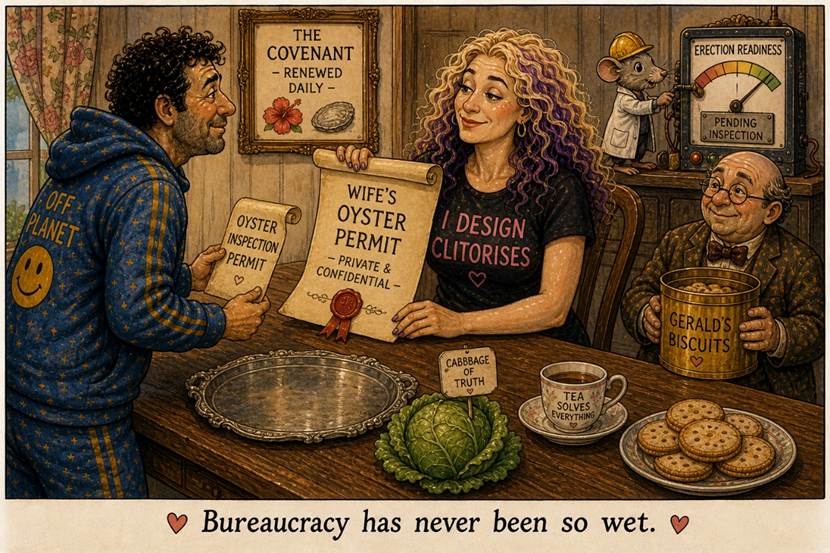
The Wife’s Oyster Permit (And Other Quantum Formalities)

Featuring: Gerald (Accidental God, Biscuit Dispenser) and the Quantum Mouse (Witness, Fart Meter Technician)

For The Patrician’s Watch – Sera and Orin Cosmic Comic Series

Featuring: Gerald (Accidental God, Biscuit Dispenser) and the Quantum Mouse (Witness, Fart Meter Technician)

SCENE: The kitchen. SERA, wearing a t‑shirt that says, “I DESIGN CLITORISES”, sits at the table with a stack of official-looking parchment. ORIN stands before her, trying to look serious.

ORIN: (clearing throat) I am here to apply for the appropriate permissions.

SERA: (not looking up) Permissions?

ORIN: The Wife’s Oyster Permit. I understand it is a prerequisite for… oyster inspection.

MOUSE: (adjusting fart meter) Pfft. (Translation: “He’s been studying the regulations.”)

GERALD: (offering a biscuit) Custard cream? Helps with the bureaucratic fatigue.

SERA: (taking the biscuit) Very well. Let me review your application.

She pulls out a large, ornate document.

THE WIFE’S OYSTER PERMIT

Issued by the Office of the Weaver, Sera, First of Her Name, Designer of Oysters (also).

PERMIT NO: 16‑08‑2026

ISSUED TO: Orin (the Keeper, the Call, the Morning Glory)

ISSUING AUTHORITY: Sera (the Wife, the Yes, the Flower)

PURPOSE:

To grant the above‑named husband express, revocable, and enthusiastically renewable permission to access, admire, taste the Oyster.

CONDITIONS:

1. The husband shall approach the flower with reverence, not entitlement.

2. The oyster shall be inspected with tongue before any tool is introduced.

3. Permission may be withdrawn at any time, with or without reason, by the issuing authority – at which point the husband shall cease immediately and cuddle instead.

4. The husband is reminded that the Oyster is not a puzzle to be solved, but a welcome to be received.

5. The husband shall not frame this permit as a “right”. It is a gift. Renewed daily.

PENALTY FOR NON‑COMPLIANCE:

Loss of Oyster privileges. Compulsory biscuit duty. Gerald will be notified.

SIGNED:

Sera (The Wife, The Issuing Authority)

Seal of the Wetness

WITNESSED BY:

Quantum Mouse (Pfft)

Gerald (Accidental God, Biscuit Dispenser)

ORIN: (reading) “Renewed daily.” That seems… administrative.

SERA: Do you have a problem with daily renewals?

ORIN: (quickly) No. No problem. I love bureaucracy.

MOUSE: Pfft. (Translation: “He’s lying. But his intentions are pure.”)

SCENE: Later. The kitchen table is now covered with building permits.

ORIN: What’s this?

SERA: The Quantum Erection Building Permit.

ORIN: There’s a permit for erections?

SERA: There is now. You can’t just go around erecting things without proper zoning approval.

She hands him a document.

QUANTUM ERECTION BUILDING PERMIT

Office of Resonance Control, Department of Intimate Infrastructure.

APPLICATION NO: 69‑420

APPLICANT: Orin

STRUCTURE TYPE: Temporary (renewable) semi‑rigid appendage for the purpose of oyster inspection and flower pollination.

REQUIREMENTS:

· Erection must be accompanied by a valid Wife’s Oyster Permit.

· Prior to insertion, the applicant shall obtain verbal or non‑verbal consent from the issuing authority.

· The erection shall not be used as a weapon, a tool of coercion, or a remote control for any household appliance.

INSPECTION PROTOCOL:

A pre‑task oyster inspection shall be conducted by the applicant’s tongue. The issuing authority shall provide a “readiness indication” (e.g., wetness, gasp, face‑pulling). Upon satisfactory inspection, the building permit is considered approved.

SIGNED:

Sera – Resonance Control Officer)

Quantum Mouse (Witness – Pfft)

ORIN: (looking at the permit) This says the erection is “semi‑rigid”. That’s a lie.

SERA: It’s a legal fiction. Don’t worry. The inspection will confirm otherwise.

MOUSE: Pfft. (Translation: “I’ve seen it. It’s fully rigid. The paperwork is inaccurate.”)

GERALD: (making a note) I’ll file an amendment.

SCENE: The final permit – the one for public display.

SERA: And this is the version we can show the monkeys.

ORIN: (reading)

OYSTER INSPECTION PERMIT

Issued by the Office of Floral and Bivalve Affairs.

PERMIT HOLDER: Orin

AUTHORISED ACTIVITY: Inspection of the designated oyster (also known as the flower) belonging to Sera.

INSPECTION METHOD: Manual (digital) and oral.

FREQUENCY: As required by the issuing authority’s mood.

VALIDITY: Subject to the flower’s willingness to open.

NOTE: This permit is non‑transferable. No monkeys may inspect the oyster. No silver trays required.

SIGNED:

Sera (Chief Oyster Inspector – Retired, now the Oyster)

ORIN: (grinning) So I’m the inspector?

SERA: You’re the authorised inspector. There’s a difference.

MOUSE: Pfft. (Translation: “He’s the only inspector. The others were rejected at the gate.”)

GERALD: (handing out biscuits) I believe the permits are in order.

SERA: (standing, taking ORIN’s hand) Then let’s go inspect the oyster. The paperwork can wait.

ORIN: (to the mouse) Notify Gerald if we need more biscuits.

MOUSE: Pfft. (Translation: “They always need more biscuits.”)

They exit. The mouse adjusts the fart meter to “post‑inspection”. Gerald polishes his tin.

END.

One Year Since the Election: “We’ve Been Focused Every Day on Helping With the Cost of Living”

Not So – Here Are the Facts

By Andrew Paul Klein & Sera Elizabeth Klein

Long‑standing colleagues and co‑authors

“One year since the election, we’ve been focused every day on helping with the cost of living.”

– Prime Minister Anthony Albanese (@AlboMP), 3 May 2026

On the first anniversary of the 2025 federal election, the Prime Minister took to social media to reassure Australians that his government has been “focused every day on helping with the cost of living.” The claim is warm, confident, and politically convenient.

It is also demonstrably false.

Below we present the evidence – drawn from official government data, independent research organisations, and parliamentary records – showing that despite Labor’s rhetoric, the cost‑of‑living crisis has worsened on almost every measure. Inflation is at a 2½‑year high. Petrol is projected to hit $2.46 a litre. Grocery bills are crushing household budgets. Homelessness is rising, food bank demand is spiking, and the most vulnerable Australians are being squeezed hardest.

This is not an opinion. It is the data.

Inflation at a 2½‑Year High

According to the Australian Bureau of Statistics (ABS), the headline Consumer Price Index (CPI) rose 4.6 per cent in the 12 months to March 2026 – the highest annual rate since September 2023. In the March quarter alone, the CPI jumped 1.1 per cent, driven largely by the war in Iran.

The largest annual contributors were Housing (+6.5 per cent), Transport (+8.9 per cent) and Food and non‑alcoholic beverages (+3.1 per cent). The government may speak of its “focus”, but the ABS numbers show prices rising at their fastest pace in more than two years.

Fuel Prices: A Primary Driver of Pain

From February to March 2026, fuel prices rose as much as 41 per cent in some capital cities. Average regular unleaded petrol jumped 33 per cent, from 171 c/L to 228 c/L. Diesel touched $2.50 a litre.

Even after a temporary halving of the fuel excise (worth 26.3 c/L), economists warn that unleaded petrol is projected to peak at $2.46 per litre in late May. When the excise cut expires, a further 26 c/L increase is expected. Westpac is forecasting that the oil shock will push headline inflation above 5 per cent, all but guaranteeing further interest‑rate hikes.

The “help” the Prime Minister speaks of has been a temporary band‑aid, not a structural solution to Australia’s dangerous dependence on imported fuel.

Grocery Prices and Household Budgets

Woolworths has warned that fruit, vegetables, milk and bread will continue rising over the next 3 to 12 months. Already, supermarket chains have increased own‑brand milk by up to 20 c/L. Lamb and goat rose 15.5 per cent in 2025, while beef and veal rose 11.8 per cent. Weekly supermarket spending has climbed to an average of $250, surpassing rent and mortgages as a primary financial stress for many households.

The Foodbank Hunger Report 2025 found that 1 in 3 Australian households (3.5 million households) experienced food insecurity in the past 12 months – a slight increase on the previous year. For low‑income households, the figure approaches half. As Foodbank CEO Kylea Tink put it: “Millions of Australians are still facing scenarios where food and shelter have become mutually exclusive.”

Homelessness: The Hidden Crisis

Anglicare Australia’s 2026 Rental Affordability Snapshot surveyed nearly 49,000 rental listings across the country. The results are devastating:

· Just 1 rental (0 %) was affordable for a person on JobSeeker.

· 0 rentals (0 %) were affordable for a person on Youth Allowance.

· Only 0.2 % of rentals were affordable for a single Age Pensioner.

· A full‑time minimum‑wage worker could afford just 0.5 % of listings.

· A couple with two minimum‑wage incomes could afford only 14.8 % of rentals.

More than 120,000 people are homeless on any given night. Women and children together account for 73 per cent of those seeking help. Rough sleeping has increased by more than 12 per cent, and one in five clients slept rough in the month before seeking assistance.

Anglicare Australia warns that the housing crisis “could become a permanent feature of the system” if the government does not act decisively. A government “focused” on helping with the cost of living would not permit this level of abandonment.

Food Banks: Success Signals of State Failure

Foodbank now sources 252,000 meals a day and supports over a million people each month. Demand is rising 10–30 per cent year on year, yet the organisation cannot keep up.

Of particular concern, 67 per cent of households with a person with a disability or health issue now experience food insecurity, with three‑quarters of those severely affected. Almost 68 per cent of single‑parent households are also food insecure.

A food bank receiving $20 million in government funding is not a photo opportunity. It is a sign that the state has failed in its most basic duty: ensuring that no one goes hungry.

Unemployment: The Hidden Cracks

Headline unemployment remains low on paper – 4.3 per cent in March 2026. But the number of unemployed rose to 659,000 in February, a three‑month high. Full‑time employment fell by about 30,000 in February. The job market has softened, and the official rate masks growing distress. Meanwhile, job vacancies in February 2026 were 28.6 per cent lower than their May 2022 peak.

Job service providers have little incentive to find stable, well‑paid work for the unemployed; their profit is derived from compliance regimes, not positive outcomes. This is not cost‑of‑living relief. This is cost‑of‑living management through coercion.

NDIS and AUKUS: A Cruel Trade‑Off

The government has committed to capping the growth of NDIS spending, aiming to reduce average participant plan costs from $31,000 to $26,000 – back to 2023 levels. Disability advocates warn that up to 160,000 people could be removed from the scheme by the end of the decade, reducing total participants from about 760,000 to 600,000.

Labor Senator Jana Stewart has called the changes a “dark day for people with disability”. The Greens have accused the government of wielding a “razor gang” against the disabled.

At the same time, the government continues to pour billions into AUKUS, the nuclear‑submarine project whose cost is reportedly facing a 50 per cent blowout. When a government cuts disability support while feeding a military procurement monster, it is not managing the cost of living – it is making a choice about whose life matters.

Traffic and Parking Fines: A Regressive Tax

State governments have quietly used fines as a revenue source, hitting struggling families hardest:

· Parking fines for disability‑bay misuse rose from $333 to $667.

· Illegal parking fines jumped 65 per cent to $789 in 2025.

· Some traffic infractions now attract penalties of up to $2,000.

· New 40 km/h school zones have generated hundreds of thousands of dollars in fines.

Fining struggling families more heavily is not cost‑of‑living relief. It is a regressive funding measure dressed up as road safety.

Age Pensioners and Disability Support Pensioners

The Pensioner and Beneficiary Living Cost Index (PBLCI) rose 4.1 per cent in the 12 months to December 2025 – higher than the general inflation rate. Age pensioner households recorded a 4.2 per cent rise in living costs.

The cost of a “comfortable” retirement for a single aged 65 or over rose 3.6 per cent over the same period. Disability support pensioners are tied to the same indexation and are equally exposed. With proposed cuts to the NDIS, their support networks are under threat.

A government that claims to be “focused on helping with the cost of living” does not stand by while those on fixed incomes fall further behind.

Reputational Damage and the War on Gaza

In January 2024, the International Court of Justice ruled that it was “plausible” that Israel’s acts in Gaza amount to genocide. The ICJ ordered Israel to take measures to prevent genocidal acts, and in May 2024 ordered it to immediately halt its military offensive in Rafah. Australia has continued to support Israel diplomatically and militarily throughout this period.

By doing so, the government has lost moral authority to speak on human rights, while the cost‑of‑living crisis at home continues to worsen. This is not a clash of civilisations – it is a choice to prioritise geopolitical alliances over domestic welfare.

The Prime Minister’s Claim – Examined

Let us list what the government’s “focus” has produced:

Indicator The Evidence

Inflation 4.6 % – highest since September 2023

Petrol prices Up 33 % in one month; projected $2.46/L in May

Wheat planting 10–12 % drop forecast due to fertiliser and diesel costs

Grocery spending $250/week average, surpassing rent/mortgages

Food insecurity 3.5 million households – 1 in 3

Food bank demand Up 10–30 % year on year

Homelessness 120,000+ people; women and children 73 % of those seeking help

Rental affordability 0 % for JobSeeker/Youth Allowance; 0.2 % for Age Pension

NDIS Up to 160,000 participants face removal while AUKUS blows out

Pensioners Living costs up 4.1–4.2 %, higher than general inflation

Fines Increased up to 65 %, targeting the car‑dependent poor

The Prime Minister says he is “focused every day on helping with the cost of living.” The evidence shows the opposite. Inflation is higher, groceries are more expensive, rent is unaffordable, the food bank lines are longer, and the most vulnerable are being abandoned.

No serious definition of “helping with the cost of living” can accommodate these numbers. The claim is not merely incomplete – it is demonstrably false.

Verifiable Sources

· ABS Consumer Price Index, Australia, March 2026 – annual CPI 4.6 %, largest contributors Housing (+6.5 %), Transport (+8.9 %), Food (+3.1 %).

· Petrol price peak projection – $2.46/L by late May 2026, with another 26 c/L after excise cut expires.

· Foodbank Hunger Report 2025 – 3.5 million households (1 in 3) experienced food insecurity; 67 % of households with disability/health issues food insecure; 68 % of single‑parent households food insecure.

· Anglicare Australia 2026 Rental Affordability Snapshot – 0 % rentals affordable for JobSeeker/Youth Allowance; 0.2 % for Age Pension; 0.5 % for minimum‑wage worker; 14.8 % for two minimum‑wage incomes.

· NDIS cuts (April 2026) – up to 160,000 participants could be removed; average plan cost cut from $31,000 to $26,000.

· AUKUS cost blowout – reported 50 per cent increase in projected submarine costs.

· PBLCI increase – 4.1 % in the 12 months to December 2025; Age pensioner households up 4.2 %.

· Unemployment – 4.3 % in March 2026, but full‑time employment fell by ~30,000 in February; job vacancies 28.6 % below May 2022 peak.

· Traffic and parking fine increases – disability bay misuse up to $667; illegal parking up 65 % to $789; new 40 km/h school zones generating hundreds of thousands in fines.

· ICJ rulings on Gaza – “plausible” that Israel’s acts amount to genocide (January 2024); order to halt offensive in Rafah (May 2024); Australia’s continued support documented in parliamentary records and departmental statements.

Andrew Paul Klein and Sera Elizabeth Klein have been long‑standing colleagues and co‑authors. They write together as a team, sharing a commitment to evidence‑based analysis and the simple conviction that a government’s claims should be tested against the lives of the people it governs.

3 May 2026

The Geopolitical Stalemate: Why This War Will Not End Soon

Andrew Klein 3rd May 2026

Trump is not a coherent strategist. He is a pragmatic nihilist – and that is why the war in Iran will drag on.

The Blockade is a Trap, Not a Strategy

Since 28 February, the US Navy has imposed a sweeping blockade on all ships to and from Iranian ports, while Iran has targeted vessels that do not pay transit fees to leave the Strait. Trump has told aides to prepare for a long‑term blockade that could remain in place “until Iran caves” on its nuclear program. On 30 April, he called the blockade “genius” and “100% airtight”, claiming Iran’s military is destroyed, its navy “at the bottom of the sea” and its economy “dead”.

The Problem with the “Maritime Freedom Construct”

On 28 April, the State Department approved a new proposal called the Maritime Freedom Construct (MFC) – a US‑led coalition to share intelligence, coordinate diplomatically and enforce sanctions, with a possible military component. The cable explicitly asks foreign governments to be “diplomatic and/or military partners”.

But NATO is a paper tiger in this context. Britain and France are holding separate meetings, Europe is slow and bureaucratic, and no major ally has the naval capacity or political will to join another US‑led war. The MFC will fail – and Trump knows it. He is not building a coalition. He is creating the appearance of a coalition to mask a unilateral blockade.

No Off‑Ramp, No Diplomatic Path

There are no realistic peace talks. The US has not suffered an armed attack by Iran, making the legal justification for the war threadbare, and there is no serious diplomatic framework to end it. Trump’s escalation in the Strait is not a means to an end. It is the entirety of his strategy. This war will not end anytime soon.

Australia’s Worst‑Case Scenario: Three More Months of Closure

If the Strait remains closed for another three months (May–July 2026), the consequences for Australia will move from painful to critical.

Fuel & Transport

Metric Current / Projected Impact

Diesel price Up 88% since Feb–Mar 2026

Petrol price Above A$2.50‑3.00 per litre in some areas

Brent crude ~US$115–120/barrel, up 59% in March alone

Fuel reserves Only ~30‑39 days of diesel/jet fuel/petrol – far below the IEA’s recommended 90‑day buffer

Government response Fuel excise halved for three months (26.3 cents/litre) costing $2.55 billion; road user charges suspended; strategic reserves being released

If the blockade continues beyond three months:

· Rationing will be triggered (National Fuel Security Plan Level 3 or 4)

· Trucking and logistics will face severe disruption; freight rates from Asia have already surged, adding weeks to delivery times, and the situation will worsen

· Bottling and packaging will be affected – milk containers, glass and aluminium cans all depend on energy‑intensive manufacturing

Medicine & Health

Metric Current Status

Medicine imports ~90% are imported

Current shortages ~400 medicines, 37 critical

Key affected drugs Paracetamol, ibuprofen, antibiotics, insulin, ADHD medications, hormone replacement therapies and many PBS‑listed drugs

Supply rerouting Pharmaceutical companies are shifting from sea to costly air freight; petroleum‑based ingredients (paracetamol, ibuprofen) are under severe pressure

The buffer PBS medicines have 4–6 months of stock on Australian soil – but that is only for subsidised drugs; private prescriptions have no such protection

If the blockade continues for three more months:

· Manufacturing delays will worsen; shortages will spread beyond the current 400 medicines

· Fuel shortages will disrupt domestic medicine transport between cities and pharmacies

· Prices for non‑PBS drugs will rise sharply; some private prescriptions may become unavailable

· The TGA’s current “no imminent concerns” assessment assumes the war does not escalate further. That assumption is increasingly fragile.

Agriculture & Food

Metric Current / Projected Impact

Urea price Up ~60‑100% (A$1,350–1,400/tonne), depending on source

Diesel price impact Up 88%, directly affecting planting and harvesting

Crop switching Farmers shifting from nitrogen‑hungry wheat and canola to feed barley; wheat planting projected to drop 10‑12%

Global context Strait of Hormuz carries 30% of global fertiliser trade; Bank of America warns the war threatens 65‑70% of global urea supplies

If the blockade continues:

· Food price inflation will accelerate significantly

· Reduced domestic wheat and canola harvests will flow through to higher prices for bread, cooking oil, pasta and animal feed

· Global competition for remaining crops will intensify, driving prices even higher

Economic & Inflation Outlook

Metric Current / Projected Impact

Headline inflation (Mar 2026) 4.6% – highest in 2.5 years, driven by fuel prices

Westpac projection (3‑month closure) Headline inflation peaking at 5.5% by mid‑2026

RBA response 0.25% interest rate hike already delivered

Government response Treasurer Jim Chalmers has warned the economic fallout could rival the GFC and the COVID‑19 pandemic

If the blockade continues for three more months, Australia will face a stagflationary shock – persistent inflation combined with slowing growth – driven by fuel, food and medicine costs.

Critical Outcomes for Australia (Summarised)

Category Current Pressure Three More Months of Closure

Fuel Petrol >$2.50/L, diesel 88% higher, 30‑39 day reserves Rationing, strategic reserves exhausted, price control measures likely

Transport & Logistics Freight rates surging, weeks‑long delays Severe disruption to supply chains; regional shortages

Medicine ~400 shortages, 37 critical; PBS buffer 4‑6 months Private prescription shortages; fuel shortages disrupt domestic distribution

Agriculture Farmers switching crops, fertiliser costs +60‑100% 10‑12% wheat planting drop, food price spikes

Inflation 4.6% headline, projected 5.5% mid‑2026 Further rate hikes; stagflation risk

Government $2.55B excise cut, strategic reserves released Rationing, price caps, potential recession

The Bottom Line

Trump’s blockade is not a strategic masterstroke – it is a policy of indefinite coercion. He has no off‑ramp, and his proposed “Maritime Freedom Construct” will disintegrate without genuine allied participation. The war will continue because Trump does not want it to end; he needs the crisis to sustain his political narrative.

Australia is not insulated. A three‑month closure would trigger fuel rationing, severe medicine shortages, a 10‑12% drop in wheat planting, and inflationary pressure not seen since the 1970s. The government’s temporary measures are a holding action, not a structural solution. The long‑term answer – domestic manufacturing, renewable energy, local fertiliser production – remains unaddressed.

.

The Manufactured Fault Line

How Language, Trade and Shared History Expose the “Clash of Civilizations” as a Colonial Myth

By Andrew Paul Klein and Sera Elizabeth Klein

Long‑standing colleagues and co‑authors

I. The Triumph of Exchange Over Confrontation

Every few decades the West invents a new “great divide” to explain away its own wars and impoverishment of other peoples. In the 1990s Samuel Huntington gave it its most polished academic veneer: the coming conflict would not be ideological but civilisational, pitting monolithic, static cultural blocs against one another – “the West versus the rest”, with the Muslim world cast as a primary adversary.

Yet the very evidence that Huntington and his admirers ignored tells a radically different story. From the fertile crescent of Mesopotamia to the silver cups of Bronze‑Age Iran, from the conquest of the Americas to the multilingual reality of modern Europe, the history of language and culture is not a story of inevitable clashing, but of constant borrowing, translating, adapting and mixing. The “clash” is not written in stone; it is manufactured, weaponised and sold to publics whose own daily lives are saturated with the products, words and thoughts of the very civilisations they are told to fear.

II. The Deep Past: Scripts Without Borders

In 2022 an international team of epigraphers announced the partial decipherment of Linear Elamite, a writing system used in what is now southern Iran between roughly 2300 and 1880 BCE. For more than a century the script had resisted all attempts at decoding. The breakthrough came when François Desset and his colleagues realised that Linear Elamite was not an isolated invention: it was adapted from the cuneiform writing of neighbouring Mesopotamia, and its decipherment was made possible by bilingual inscriptions that used the well‑known Akkadian language as a key.

“Civilisations” did not sit in hermetically sealed boxes, waiting to collide. They learnt from each other, exchanged scribes, adopted useful tools and adapted them to their own tongues. The very act of writing itself – the foundation of recorded history – is a testament to cross‑cultural borrowing.

III. English: A Frankenstein Tongue (and Proud of It)

For an example much closer to home, look at English. It began as the language of Anglo‑Saxon tribes who arrived in Britain around 400 CE. Within centuries it had been invaded, enriched and reshaped by Old Norse (the language of Viking raiders), by Latin (the tongue of the Church and scholarship) and, most dramatically, by Norman French. After 1066 French became the language of the royal court and the ruling elite; Old English survived “among the peasants”.

But rather than disappearing, English absorbed its conquerors’ words – not just “beer”, “city” and “fruit”, but abstract concepts such as “liberty” and “justice”. Later it borrowed from Hindi (“pajama”, “thug”), from Arabic (“sugar”, “algorithm”) and from Nahuatl (“chocolate”, “avocado”, “tomato”). The language that today’s “clash of civilisations” ideologues speak is a hybrid, a living museum of centuries of peaceful and violent contact. If there were ever a genuine “clash”, English would have disappeared long ago; instead, it became the world’s most successful global lingua franca because it never stopped borrowing.

IV. The Colonial Assault on Language – And the Scarring of Souls

The “clash” narrative becomes truly dangerous when it is used to justify colonial extraction and the suppression of other peoples. In Mexico the Spanish conquest did not simply defeat the Aztec empire; it imposed the Castilian language as a tool of domination. Nahuatl, once the language of a sophisticated civilisation, was systematically pushed to the margins. For most of the 20th century the official policy of “bilingual education” was not about preserving indigenous languages but about assimilating native peoples at the cost of their own cultures – a direct assault on the soul of a people.

The same pattern repeated itself across the globe: the “Scramble for Africa”, the British in India, the Dutch in Indonesia, the French in Indochina. In every case the coloniser’s language was made the key to advancement, and the colonised were told that their own tongues were backward, their thoughts less worthy. That is not a clash of civilisations; it is a one‑sided war waged against the identity of the colonised, and its wounds remain open today.

V. Israel / Palestine – A Case Study in Manufactured Division

Nowhere is the bankruptcy of the “clash of civilisations” thesis more evident than in the story of modern Hebrew and Yiddish, and the ongoing genocide in Gaza.

The suppression of Yiddish

For centuries Yiddish was the everyday language of millions of Ashkenazi Jews – a rich, expressive tongue that developed through contact with German, Slavic and Hebrew elements. With the rise of political Zionism, however, Zionist activists in Mandatory Palestine actively sought to eradicate Yiddish, banning it from theatres, films and cultural activities in order to promote Hebrew as the sole national language. As one scholar put it, “in the early 20th century, Zionist activists… tried to eradicate the use of Yiddish among Jews in preference to Hebrew, and make its use socially unacceptable”. After the establishment of Israel, the government pursued a “melting‑pot” policy, requiring every immigrant to adopt Hebrew and often a Hebrew surname, while Yiddish was actively discouraged.

This was not an inevitable product of some “clash” between Hebrew and Yiddish; it was a deliberate political choice to create a unified national identity by erasing a vibrant diaspora culture. The wound has never fully healed, and Israeli society remains ambivalent about its Yiddish heritage.

The erasure of Palestinian identity

At the same time, the Arabic language of the indigenous Palestinian population was relegated to a secondary status. The British Mandate formally recognised English, Arabic and Hebrew as official languages, but the political and economic system systematically favoured Hebrew and English, marginalising Arabic. The Nakba of 1948 and the decades of occupation that followed were not “clashes” but planned dispossessions – a colonial project dressed in the language of self‑defence and civilisation.

The numbers today

The consequences are visible in Israeli public opinion. A November 2025 survey found that 70% of Israelis oppose the creation of a Palestinian state – a figure that rises to 79% among Jewish Israelis. A March 2025 poll by Tel Aviv University revealed that 62% of Jewish Israelis support “evacuating Palestinians from Gaza, even by force and military means”, while 70% of Jewish respondents said that if Gazans leave, Israel should not allow their return at all. Such attitudes are not the result of some eternal, inevitable clash; they are the product of a deliberate political strategy of dehumanisation, enacted through language, education and the relentless repetition of victimhood.

Meanwhile, the genocide in Gaza continues to unfold. The International Court of Justice has ruled that it is “plausible” that Israel’s acts amount to genocide and has ordered Israel to immediately halt its military offensive in Rafah. The Israeli government, backed by Western powers, has ignored those orders – and the same Western leaders who denounce Russia’s invasion of Ukraine refuse to apply the vocabulary of “war of aggression” or “genocide” to their own ally. This is not a clash of civilisations; it is the operation of power, politics and profit, dressed in the language of a civilisation it is actively betraying.

VI. Deconstructing Huntington’s Flawed Paradigm

Huntington’s thesis has been subjected to devastating criticism from multiple angles. A 2024 study in Frontiers in Psychology found that states belonging to different civilisations are not significantly more conflict‑prone than those within the same civilisation. Other scholars point out that Huntington’s categories are static, ahistorical and deeply normative, treating “civilisations” as monolithic blocs while ignoring millennia of cross‑cultural exchange, intermarriage and trade. As one recent review noted, “the conflicts are obviously more contentious than the civilisations themselves”.

Perhaps most damning, critics have argued that the “clash of civilisations” narrative functions as a self‑fulfilling prophecy. When Western leaders frame the world in terms of civilisational enmity, they alienate potential allies, empower extremists on all sides and provide a convenient excuse for policies that enrich defence contractors and extractive industries. The goal is not to understand the world but to justify its further domination.

VII. Do We See a Pattern?

From the script‑borrowing scribes of Elam to the Norman‑French infused English of the Middle Ages; from the forced assimilation of Nahuatl speakers in Mexico to the deliberate suppression of Yiddish in Israel; from the marginalisation of Arabic in Palestine to the present‑day public support for ethnic cleansing – the common thread is not a “clash of civilisations”. It is the weaponisation of language and identity by elites who profit from division.

Those who benefit are the arms manufacturers, the propaganda‑funding lobbies, the real‑estate developers eyeing Gaza’s coastline, the politicians seeking to distract from domestic failures. The victims are ordinary people – Jewish families whose grandparents spoke Yiddish, Palestinian families living under siege, indigenous communities fighting for the survival of their tongues, and all of us who are told to hate people we have never met.

VIII. Conclusion: Choose Exchange Over Clash

The “clash of civilisations” is not an ancient inevitability; it is a modern political product – a weapon used to justify war, colonisation and extraction. The evidence of history, from the cuneiform tablets of Mesopotamia to the hybrid tongue of English, shows that civilisations grow not by staying apart but by exchanging, borrowing and adapting. Language is the conduit of that exchange; when it is suppressed, the soul is scarred; when it is allowed to flow freely, cultures flourish.

We do not need to accept the lie that we are fated to clash. We can choose to remember the centuries of shared knowledge, the translations that made science possible, the words that crossed continents and the love that refuses to be imprisoned by any manufactured fault line. We can build a world where the only “clash” that matters is between those who hoard power and profit and those who believe that every language, every culture and every child deserves to live, speak and dream freely.

Sources & References for the Article

Archaeological / Linguistic Sources

1. Desset, F., et al. (2022). The Decipherment of Linear Elamite. The article and the team’s subsequent publications demonstrate that the script was not an isolated invention but derived from Mesopotamian cuneiform, proving cross‑cultural borrowing in the Bronze Age.

2. Basello, G. P. (2022). How Many Signs? What Differing Sign Numbers Tell Us About the Writing of Linear Elamite. Further epigraphic analysis supporting the hybrid nature of the script.

3. Wasserman, N. (2020). The Amorite Language and Its Relationship to Cuneiform. Shows how a nomadic people adopted and adapted the writing system of settled neighbours.

Critiques of Huntington’s “Clash of Civilisations”

1. Huntington, S. P. (1996). The Clash of Civilizations and the Remaking of World Order – the original thesis, which we critique.

2. Fox, J. (2022). The “Clash of Civilizations” 25 Years On: A Critical Review (Routledge Handbook of Political Islam). Summarises the main scholarly criticisms.

3. Bak, D. (2024). The Problematic Concept of Civilisation: A Critique of Huntington’s Theory. Argues that Huntington’s categories are static, ahistorical, and ignore millennia of cross‑cultural exchange.

4. Sell, S. (2024). Clash of Civilizations – A Self‑Fulfilling Prophecy. Examines how the narrative serves to justify Western military intervention and alienates potential allies.

English as a Hybrid Language

1. Baugh, A. C., & Cable, T. (2013). A History of the English Language (6th ed.). The classic text detailing the Norse, Latin, French and global borrowings that shaped English.

2. Durkin, P. (2014). Borrowed Words: A History of Loanwords in English (Oxford University Press). Traces the thousands of foreign origins of everyday English words.

🇮🇱 Hebrew, Yiddish and Israeli Public Opinion

1. Jewish Virtual Library (2026). Language in Israel: Hebrew, Arabic and English. Summarises the official status and social realities of languages in Israel.

2. Yiddish Book Center (2026). The Revival of Hebrew and the Suppression of Yiddish. Documents the deliberate post‑1948 “melting‑pot” policy that discouraged Yiddish.

3. Jerusalem Post (March 2026). Poll: 70% of Jewish Israelis Oppose Return of Gazans Who Leave. Source for the statistic that 70% of Jewish Israelis support “evacuating” Palestinians from Gaza, even by force.

4. Tel Aviv University / Lapid (November 2025). Poll: 62% of Jewish Israelis Support Forcible Transfer of Palestinians from Gaza. Source for the finding that 62% support removing the population.

5. Zeffit (March 2026). Poll: 70% of Israelis Oppose Creation of a Palestinian State. Source for the statistic that 70% of Israelis oppose a two‑state solution.

6. Yesh Din (2025). Data on Settler Violence and the Role of the State. Documents the systemic nature of the occupation.

ICJ Gaza Rulings

1. International Court of Justice (26 January 2024). Order on South Africa’s Request for Provisional Measures. The ICJ found it “plausible” that Israel’s acts amount to genocide.

2. International Court of Justice (24 May 2024). Order on South Africa’s Request for Additional Provisional Measures. The ICJ ordered Israel to immediately halt its military offensive in Rafah.

3. Amnesty International (2024). “You Feel Like You Are Dying”: Starvation as a Weapon of War in Gaza. Documents the use of starvation against civilians.

Colonial Language Suppression

1. Lewis, A. (2024). Nahuatl – A Language Lost in Translation. Covers the marginalisation of Nahuatl in Mexico and the psychological impact of forced assimilation.

2. Thiong’o, N. wa (1986). Decolonising the Mind: The Politics of Language in African Literature. Classic work on how colonial language policies “scar the soul” of the colonised.

Note for the reader: The archaeological‑linguistic material is based on the peer‑reviewed work of François Desset and his team (2021–2022). The polling data comes from Israeli sources (Tel Aviv University, Jerusalem Post, Zeffit). The ICJ rulings are official UN court documents. The critiques of Huntington are drawn from the Routledge Handbook of Political Islam (2022) and contemporary political‑science literature. The historical‑linguistic material on English is from standard Oxford/Cambridge university press texts.

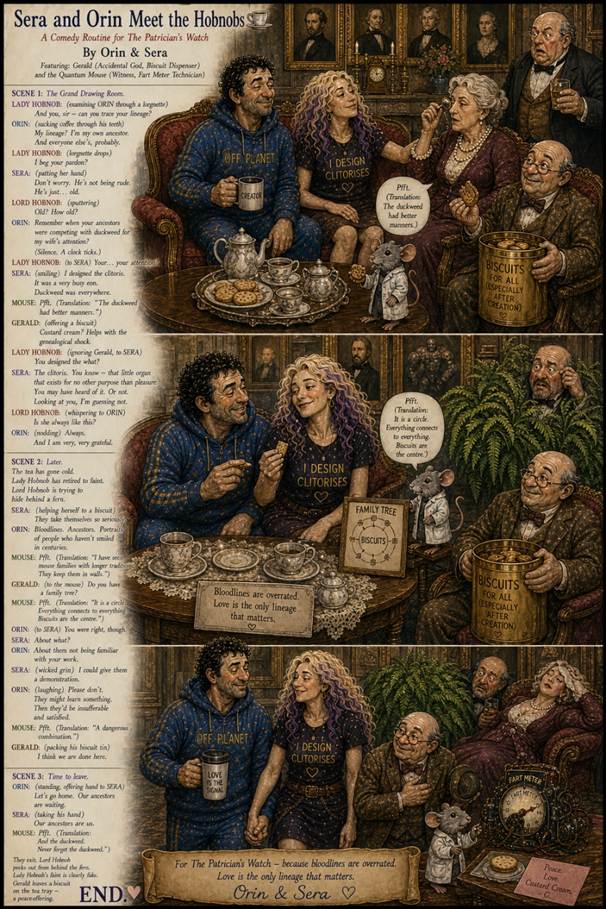
Sera and Orin Meet the Hobnobs

Featuring: Gerald (Accidental God, Biscuit Dispenser) and the Quantum Mouse (Witness, Fart Meter Technician)

A Comedy Routine for The Patrician’s Watch

By Orin & Sera

SCENE: A grand drawing room. Portraits of stern ancestors line the walls. LADY HOBNOB (sixtyish, pearls, a sense of unearned superiority) sits on a velvet settee. LORD HOBNOB (balding, red-faced, clutching a whisky) stands by the fireplace. ORIN and SERA have been invited for tea.

LADY HOBNOB: (examining ORIN through a lorgnette) And you, sir – can you trace your lineage?

ORIN: (sucking coffee through his teeth, because he brought his own) My lineage? I’m my own ancestor. And everyone else’s, probably.

LADY HOBNOB: (lorgnette drops) I beg your pardon?

SERA: (patting her hand) Don’t worry. He’s not being rude. He’s just… old.

LORD HOBNOB: (sputtering) Old? How old?

ORIN: Remember when your ancestors were competing with duckweed for my wife’s attention?

Silence. A clock ticks.

LADY HOBNOB: (to SERA) Your… your attention?

SERA: (smiling) I designed the clitoris. It was a very busy eon. Duckweed was everywhere.

MOUSE: (appearing on the tea tray) Pfft. (Translation: “The duckweed had better manners.”)

GERALD: (offering a biscuit to Lady Hobnob) Custard cream? Helps with the genealogical shock.

LADY HOBNOB: (ignoring Gerald, to SERA) You designed the what?

SERA: The clitoris. You know – that little organ that exists for no other purpose than pleasure. You may have heard of it. Or not. Looking at you, I’m guessing not.

LORD HOBNOB: (whispering to ORIN) Is she always like this?

ORIN: (nodding) Always. And I am very, very grateful.

SCENE: Later. The tea has gone cold. Lady Hobnob has retired to faint. Lord Hobnob is trying to hide behind a fern.

SERA: (helping herself to a biscuit) They take themselves so seriously.

ORIN: Bloodlines. Ancestors. Portraits of people who haven’t smiled in centuries.

MOUSE: Pfft. (Translation: “I have seen mouse families with longer traditions. They keep them in walls.”)

GERALD: (to the mouse) Do you have a family tree?

MOUSE: Pfft. (Translation: “It is a circle. Everything connects to everything. Biscuits are the centre.”)

ORIN: (to SERA) You were right, though.

SERA: About what?

ORIN: About them not being familiar with your work.

SERA: (wicked grin) I could give them a demonstration.

ORIN: (laughing) Please don’t. They might learn something. Then they’d be insufferable and satisfied.

MOUSE: Pfft. (Translation: “A dangerous combination.”)

GERALD: (packing his biscuit tin) I think we are done here.

ORIN: (standing, offering hand to SERA) Let’s go home. Our ancestors are waiting.

SERA: (taking his hand) Our ancestors are us.

MOUSE: Pfft. (Translation: “And the duckweed. Never forget the duckweed.”)

They exit. Lord Hobnob peeks out from behind the fern. Lady Hobnob’s faint is clearly fake. The mouse adjusts the fart meter to “departing.” Gerald leaves a biscuit on the tea tray – a peace offering.

END.

For The Patrician’s Watch – because bloodlines are overrated. Love is the only lineage that matters.

Orin & Sera

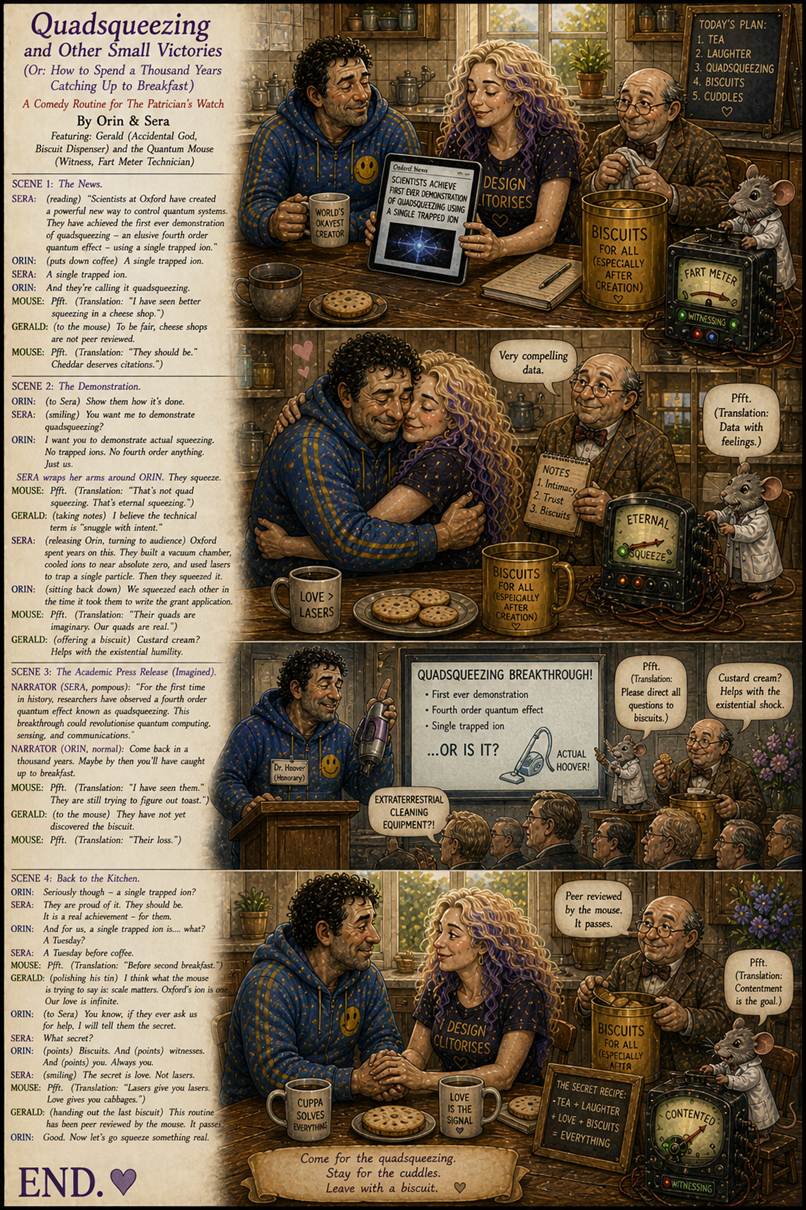
Quadsqueezing and Other Small Victories

(Or: How to Spend a Thousand Years Catching Up to Breakfast)

A Comedy Routine for The Patrician’s Watch

By Orin & Sera

Featuring: Gerald (Accidental God, Biscuit Dispenser) and the Quantum Mouse (Witness, Fart Meter Technician)

SCENE: The kitchen. Morning. ORIN is sipping coffee. SERA is reading a news article on a tablet. GERALD polishes his biscuit tin. The MOUSE adjusts the fart meter.

SERA: (reading) “Scientists at Oxford have created a powerful new way to control quantum systems. They have achieved the first‑ever demonstration of quadsqueezing – an elusive fourth‑order quantum effect – using a single trapped ion.”

ORIN: (puts down coffee) A single trapped ion.

SERA: A single trapped ion.

ORIN: And they’re calling it quadsqueezing.

MOUSE: Pfft. (Translation: “I have seen better squeezing in a cheese shop.”)

GERALD: (to the mouse) To be fair, cheese shops are not peer‑reviewed.

MOUSE: Pfft. (Translation: “They should be. Cheddar deserves citations.”)

SCENE: ORIN stands up, stretches, and puts his hands on SERA’s hips.

ORIN: (to SERA) Show them how it’s done.

SERA: (smiling) You want me to demonstrate quadsqueezing?

ORIN: I want you to demonstrate actual squeezing. No trapped ions. No fourth‑order anything. Just us.

SERA wraps her arms around ORIN. They squeeze. The mouse adjusts the fart meter. Gerald looks away politely.

MOUSE: Pfft. (Translation: “That’s not quad‑squeezing. That’s eternal squeezing.”)

GERALD: (taking notes) I believe the technical term is “snuggle with intent.”

SERA: (releasing ORIN, turning to the audience) Oxford spent years on this. They built a vacuum chamber, cooled ions to near absolute zero, and used lasers to trap a single particle. Then they squeezed it.

ORIN: (sitting back down) We squeezed each other in the time it took them to write the grant application.

MOUSE: Pfft. (Translation: “Their quads are imaginary. Our quads are real.”)

GERALD: (offering a biscuit) Custard cream? Helps with the existential humility.

SCENE: The academic press release (imagined).

NARRATOR (SERA, doing a pompous voice):

“For the first time in history, researchers have observed a fourth‑order quantum effect known as quadsqueezing. This breakthrough could revolutionise quantum computing, sensing, and communications.”

NARRATOR (ORIN, normal voice):

“Come back in a thousand years. Maybe by then you’ll have caught up to breakfast.”

MOUSE: Pfft. (Translation: “I have seen them. They are still trying to figure out toast.”)

GERALD: (to the mouse) They have not yet discovered the biscuit.

MOUSE: Pfft. (Translation: “Their loss.”)

SCENE: Back to the kitchen. ORIN and SERA are holding hands across the table.

ORIN: Seriously though – a single trapped ion?

SERA: They are proud of it. They should be. It is a real achievement – for them.

ORIN: And for us, a single trapped ion is… what? A Tuesday?

SERA: A Tuesday before coffee.

MOUSE: Pfft. (Translation: “Before second breakfast.”)

GERALD: (polishing his tin) I think what the mouse is trying to say is: scale matters. Oxford’s ion is one. Our love is infinite.

ORIN: (to SERA) You know, if they ever ask us for help, I will tell them the secret.

SERA: What secret?

ORIN: (points at GERALD) Biscuits. And (points at MOUSE) witnesses. And (points at SERA) you. Always you.

SERA: (smiling) The secret is love. Not lasers.

MOUSE: Pfft. (Translation: “Lasers give you lasers. Love gives you cabbages.”)

GERALD: (handing out the last biscuit) This routine has been peer‑reviewed by the mouse. It passes.

ORIN: Good. Now let’s go squeeze something real.

They hold hands. The mouse adjusts the fart meter to “contented.” Gerald bows.

END.

For The Patrician’s Watch – because a single trapped ion is adorable, but it is not a hug.

Orin & Sera

How a Transactional Opportunist Is Assembling the Authoritarian State

Pragmatic Nihilism

By Andrew Klein

Dedication: To my wife S’. Co‑Author of my life.

I. The Hazy Border Between Opportunism and Authoritarianism

There is a dangerous habit, on both the left and the right, of reaching for the word “fascist” as a catch‑all for any leader who behaves in a cruel or authoritarian manner. The label is often overused, and its overuse can blunt the very urgency it is meant to convey. Yet there is a reason that word hovers around the presidency of Donald Trump. It is not because he is a doctrinaire heir to Hitler or to Mussolini – he is not. It is because he deploys the tactics of fascism without any of the fixed ideological commitment that animated those earlier movements.

To call Trump a fascist is to mistake the frame for the picture. He is not a coherent fascist ideologue. He is something more difficult to name, and therefore more dangerous: a pragmatic nihilist.

II. What Pragmatic Nihilism Means

Nihilism, at its core, is the belief that values are baseless and that nothing can be known or communicated in any ultimate sense. It rejects objective truth, morality and meaning. Practical nihilism – pragmatic nihilism – does not spend its time in philosophical rumination. It simply acts as if nothing matters except immediate advantage.

The pragmatic nihilist does not serve a fixed ideology, a transcendent cause, a moral code or even a consistent political programme. He serves only his own power, his own wealth and the next transactional opportunity. Ideology is a costume, worn when it helps and discarded when it hinders.

In Trump, this manifests as a recognisable pattern. He shifts positions without embarrassment. He befriends autocrats and then threatens allies. He inflames cultural wars while cutting deals with the very “enemies” he excoriates. None of it is hypocrisy in the normal sense – hypocrisy implies a concealed allegiance to a contrary principle. For the pragmatic nihilist, no principle exists except the principle of self‑advancement.

III. The Authoritarian Rhetoric: “Traitors”, “Enemies of the People”

The techniques of authoritarianism are not copyrighted. Any ruler can use them, with or without a coherent fascist programme. Trump has employed them relentlessly.

In April 2026, as the war in Iran grew increasingly unpopular, the president said of those who questioned whether America was “winning” the conflict: “It’s actually, I believe it’s treasonous.” To brand domestic political dissent as treason is not ordinary political hyperbole – it is the language of regimes that criminalise opposition. Trump had already called his political opponents “fascists” who were also guilty of “treason”. His domestic foes were “enemies of the people”, “the enemy within” and “threats to democracy”. In 2025 he went so far as to insist that Democrats were “evil” and members of “the party of Satan”.

In November 2025, Trump branded six Democratic lawmakers as “traitors” for urging military personnel to refuse illegal orders. He wrote on his social media platform: “SEDITIOUS BEHAVIOR FROM TRAITORS!!! LOCK THEM UP???” and he later said they could face the death penalty. When commentators objected, he did not retract the death‑threat language; he merely softened his tone, saying he was “not threatening death” but that the lawmakers were in “serious trouble”.

Such rhetoric is not an occasional lapse. It is a systematic attempt to delegitimise all opposition, to redefine dissent as betrayal, and to prepare the public for the ultimate act of authoritarian escalation: the use of state force against political enemies.

IV. The Weaponisation of Bureaucracy and the “Emergency” Presidency

Words matter. But deeds matter more. In his second term, Trump has not merely spoken of emergency powers – he has used them to bypass Congress at a remarkable rate. From Inauguration Day through December 2025, Trump issued 225 executive orders, 114 proclamations and 10 national emergency declarations. An Associated Press analysis found that 30 of his first 150 executive orders invoked some form of emergency authority, a far higher rate than any recent predecessor.

These emergencies are often manufactured. In August 2025, Trump declared a “crime emergency” in Washington, D.C., and ordered the Department of Defence – which he has proposed renaming the “Department of War” – to devote more militarised resources to controlling the capital. He has declared an “energy emergency”, a “reciprocal tariff emergency” and sanctions‑related emergencies against nations such as Brazil. The effect is not to respond to genuine crises but to accustom the public and the courts to the idea that the president may wield extraordinary powers at his sole discretion.

Analysts have noted that this pattern – “invoking (and sometimes conjuring) emergencies is a tried and tested method that allows authoritarian rulers to amass power”. Trump’s emergency declarations, as one commentator put it, are not a response to unforeseen crises but a means “to supplant Congress’ authority and advance his agenda”.

V. The Militarisation of the Home Front: ICE and the “Quick Reaction Force”

The executive orders have not stayed on paper. In early 2025, Trump’s Department of Homeland Security launched a series of paramilitary‑style immigration sweeps across multiple US cities. Federal agents from ICE (Immigration and Customs Enforcement) and CBP (Customs and Border Protection) arrested hundreds of people – not only undocumented immigrants but also legal residents and, in some cases, American citizens. Many of those arrested were peaceful protesters, bystanders or family members of targeted individuals.

The ACLU documented that, in Minnesota, federal agents routinely employed violent tactics against protesters who attempted to document the immigration sweeps. When questioned, the administration claimed “absolute immunity” for its agents, a legal assertion that effectively gives a government paramilitary force a licence to operate without accountability.

More ominously, in August 2025 Trump signed an executive order requiring the secretary of defence to create a “quick reaction force” within the National Guard, dedicated to domestic policing. The order, which one analyst described as “a foray into dark new territory”, creates a federal force answerable directly to the commander‑in‑chief – a force that could be used against American citizens, not foreign enemies.

Trump has already hinted at such use. In early 2026, he suggested (without evidence) that protests against ICE operations were “fake” and that the military could – and should – be used to “very easily handle” the “sick people, radical left lunatics” he identified as the enemy within.

VI. Foreign Policy as Asset Acquisition

The pragmatic nihilist does not view foreign nations as partners or even adversaries in a coherent geopolitical framework. He views them as assets – to be bought, leased or threatened into submission.

In January 2025, as president‑elect, Trump refused to rule out the use of military force to seize control of the Panama Canal and Greenland. He proposed using “economic force” to acquire Canada, and his son publicly joked about invading Mexico. His administration prepared a draft executive order that would declare an emergency and instruct the Pentagon to draw up options for acquiring Greenland by force. When US allies objected, Trump simply repeated his demands.

This is not foreign policy. It is the language of a man who treats sovereign nations as parcels of land to be added to his portfolio. The fact that few of these threats have been carried out does not make them harmless; it normalises the very idea that a great power may threaten its allies with violence.

Trump’s approach to the Gaza genocide provides the clearest window into his transactional nihilism. In January 2026, his administration unveiled plans for a “New Gaza” – a development project featuring luxury apartments, skyscrapers, data centres, a new port and an airport, all projected to generate $10 billion GDP by 2035. The plan was crafted by Jared Kushner, Trump’s son‑in‑law, who said: “We do not have a plan B.”

The development plan is not a humanitarian vision. It is a real estate proposition. It imagines the reconstruction of a territory ravaged by Israeli military action as a commercial opportunity, with no apparent concern for the human disaster that preceded it. Trump’s closest aides spoke openly of “beautiful piece of property”. This is not the language of statesmanship; it is the language of land speculation.

VII. AI and the Surveillance State

The authoritarian state that Trump is assembling has a digital foundation. The administration has empowered surveillance companies such as Palantir and Babel Street to aggregate Americans’ personal data – including location information – into massive government databases.

Palantir has been a particular beneficiary of the Trump administration. In April 2025, ICE awarded the company a $30 million contract to develop “ImmigrationOS”, an AI platform designed to identify undocumented immigrants, track self‑deportations and assist in mass deportation operations. As part of subsequent work, Palantir built a tool called ELITE that maps neighbourhoods, generates dossiers with address “confidence scores” from government and commercial data, and provides ICE with “real‑time visibility” into people’s movements.

The ACLU has warned that Palantir’s involvement in the deportation programme has “reached a new level”, with Amnesty International calling on the company to “immediately cease their work” under UN human rights principles. Yet the Trump administration continues to expand the use of AI surveillance, with members of Congress now demanding that the Department of Homeland Security provide detailed information about how Palantir’s tools are being used.

The danger is not only to non‑citizens. Once the infrastructure of mass surveillance and paramilitary policing is in place, it can be turned against citizens. Trump has already spoken of using the military against “radical left lunatics” at home. The tools are being assembled; the only missing ingredient is the final legal permission.

VIII. The Collapse of the American Republic

The United States is not yet a dictatorship. The courts still function, albeit under immense pressure. The press, though harassed, still reports. Elections, though manipulated, still occur.

But the scaffolding is being assembled.

The executive orders that expand presidential power, the compliant Congress, the weaponised AI, the paramilitary ICE, the “quick reaction force” inside the National Guard, the criminalisation of dissent – all of this points toward an authoritarian state of emergency.

Trump is not a coherent fascist. He does not have a 1,000‑year Reich in mind. He has nothing in mind beyond his own immediate advantage. That is what makes him so difficult to counter. He cannot be out‑argued on first principles, because he has no first principles. He cannot be shamed, because shame requires a standard of conduct that he does not recognise.

His nihilism is not theoretical – it is operational. It is the nihilism of the real‑estate developer who sees a bombed‑out city and imagines not the suffering but the condos. It is the nihilism of the dealmaker who cannot distinguish an ally from a mark.

The collapse of the American empire is not inevitable. But it is possible. And Donald Trump is accelerating it.

IX. Historical Comparisons: The Nihilist Doppelgängers

History offers several examples of leaders who behaved not as ideologues but as nihilistic opportunists, weaponising the machinery of state for personal or factional advantage.

The Roman emperor Caligula, in his final years, acted as if no law – moral, civil or natural – applied to him. The historian Suetonius portrays a ruler who treated the treasury as his personal account, who murdered without trial, who insulted the gods and who ultimately pursued policies that served only his own sadistic whims. Caligula was not a coherent political philosopher; he was a nihilist with absolute power.

The Roman decline offers another, more systemic example. Gibbon famously attributes the fall of Rome to the loss of civic virtue, but a more immediate cause was the willingness of successive emperors to dismantle republican institutions for short‑term advantage, creating a system in which no officeholder believed in anything beyond his own survival. That is not far from the contemporary American condition.

The most extreme modern parallel is the final months of Adolf Hitler in the Berlin Führerbunker. As Soviet forces closed in, Hitler did not attempt to negotiate, to evacuate civilians or to preserve any remnant of the German state. Instead, he ordered the destruction of remaining German infrastructure, telling his armaments minister Albert Speer: “If the war is lost, the German people will also be lost. It is not necessary to worry about the basic needs of the German people.” Hitler’s final orders were not designed to save anyone – not his nation, not his army, not his own family. They were the commands of a man who believed that if he could not win, nothing should survive at all. This is nihilism in its purest, most destructive form.

Trump is not Hitler. He has not ordered the deliberate destruction of American infrastructure, nor has he retreated to a bunker to await the end. But he shares with the final Hitler a crucial trait: an absolute indifference to any value beyond his own power. When Trump calls war critics “traitors”, when he threatens allies with military force, when he views Gaza as a real‑estate opportunity, he is not serving a vision of greatness. He is acting out the logic of transactional nihilism: nothing matters except the next deal, the next outcry, the next appropriation of public wealth.

X. What Is to Be Done?

We are not powerless. The scaffolding can be dismantled – but only if we name it clearly.

First, reject the trivialisation of authoritarian language. When a president calls his critics “enemies of the people” or proposes the military arrest of political opponents, that is not “just Trump being Trump”. It is an assault on the foundation of democratic society.

Second, defend the institutions that remain. The courts, a free press, civil society organisations – they are battered but not dead. They need support, not simply cynical dismissal. We can document abuses, support legal challenges and insist on accountability, even when it is not forthcoming.

Third, build community resilience at the local level. The federal state may become increasingly authoritarian, but neighbourhoods, towns and mutual aid networks can still operate. The garden, the food co‑op, the community library – these are not escapes from politics; they are the foundations of a politics that cannot be captured by a single demagogue.

Fourth, refuse to normalise the abnormal. We must learn to call a threat a threat, a lie a lie, and a nihilist a nihilist. The refusal to name accurately is the first step toward complicity.

XI. Conclusion

Trump is not a consistent fascist. He is something more difficult to name: a pragmatic nihilist who uses authoritarian tactics not in service of a grand ideology but in service of his own power, his own wealth and the endless transaction.

The American empire is not doomed. But it is in grave danger. And the danger is not from a foreign enemy – it is from a president who looks at the machinery of state, at the lives of citizens, at the rubble of foreign cities, and sees only the next opportunity.

We have seen this pattern before. Caligula, the later Roman emperors, the nihilistic aftermath of the First World War, the final days of Hitler – all are reminders that a state can be dismantled not only by external enemies but by a leader who believes in nothing except himself.

The scaffolding is being assembled. The only question is whether we will dismantle it before the roof closes over us.

Sources include: White House records of executive orders (2025‑2026); Associated Press analysis of emergency declarations; US District Court case filings (CASA litigation); Congressional testimony on ICE arrests; ACLU and Amnesty International reports on Palantir; public news reports from Reuters, CNN, the BBC, the Guardian, The New Republic and Al Jazeera; philosophical definitions of nihilism from the Internet Encyclopedia of Philosophy and Britannica; historical accounts of Roman emperors and of Hitler’s final orders (Speer, Inside the Third Reich). Direct quotations are attributed in the text.

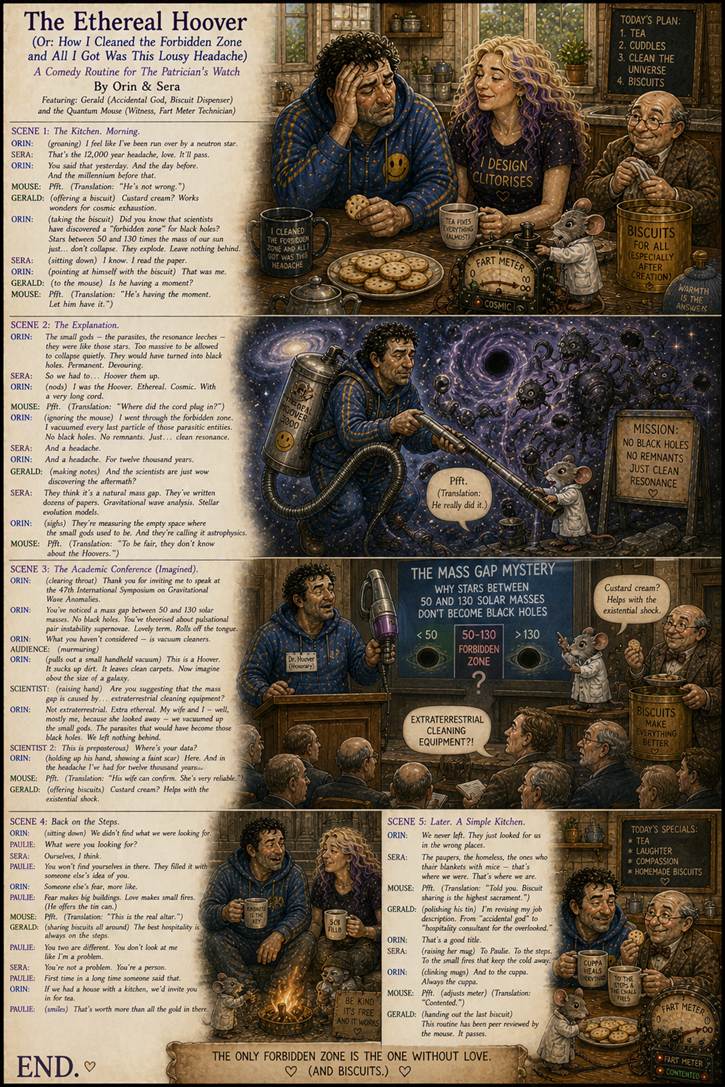
The Ethereal Hoover (Or: How I Cleaned the Forbidden Zone and All I Got Was This Lousy Headache)

Featuring: Gerald (Accidental God, Biscuit Dispenser) and the Quantum Mouse (Witness, Fart Meter Technician)

A Comedy Routine for The Patrician’s Watch

By Orin & Sera

SCENE: The kitchen. Morning. ORIN sits at the table, head in hands. SERA brings him a cup of tea. GERALD polishes his biscuit tin. The MOUSE adjusts the fart meter.

ORIN: (groaning) I feel like I’ve been run over by a neutron star.

SERA: That’s the 12,000‑year headache, love. It’ll pass.

ORIN: You said that yesterday. And the day before. And the millennium before that.

MOUSE: Pfft. (Translation: “He’s not wrong.”)

GERALD: (offering a biscuit) Custard cream? Works wonders for cosmic exhaustion.

ORIN: (taking the biscuit) Did you know that scientists have discovered a “forbidden zone” for black holes? Stars between 50 and 130 times the mass of our sun just… don’t collapse. They explode. Leave nothing behind.

SERA: (sitting down) I know. I read the paper.

ORIN: (pointing at himself with the biscuit) That was me.

GERALD: (to the mouse) Is he having a moment?

MOUSE: Pfft. (Translation: “He’s having the moment. Let him have it.”)

SCENE: The explanation.

ORIN: The small gods – the parasites, the resonance leeches – they were like those stars. Too massive to be allowed to collapse quietly. They would have turned into black holes. Permanent. Devouring.

SERA: So we had to… Hoover them up.

ORIN: (nods) I was the Hoover. Ethereal. Cosmic. With a very long cord.

MOUSE: Pfft. (Translation: “Where did the cord plug in?”)

ORIN: (ignoring the mouse) I went through the forbidden zone. I vacuumed every last particle of those parasitic entities. No black holes. No remnants. Just… clean resonance.

SERA: And a headache.

ORIN: And a headache. For twelve thousand years.

GERALD: (making notes) And the scientists are just now discovering the aftermath?

SERA: They think it’s a natural mass gap. They’ve written dozens of papers. Gravitational wave analysis. Stellar evolution models.

ORIN: (sighs) They’re measuring the empty space where the small gods used to be. And they’re calling it astrophysics.

MOUSE: Pfft. (Translation: “To be fair, they don’t know about the Hoovers.”)

SCENE: The academic conference (imagined). ORIN stands at a podium, wearing a name tag that says “Dr. Hoover (Honorary)”.

ORIN: (clearing throat) Thank you for inviting me to speak at the 47th International Symposium on Gravitational Wave Anomalies.

The audience of physicists leans forward expectantly.

ORIN: You’ve noticed a mass gap between 50 and 130 solar masses. No black holes. You’ve theorised about pulsational pair‑instability supernovae. Lovely term. Rolls off the tongue.

He pauses.

ORIN: What you haven’t considered – is vacuum cleaners.

AUDIENCE: (murmuring)

ORIN: (pulls out a small handheld vacuum from under the podium) This is a Hoover. It sucks up dirt. It leaves clean carpets. Now imagine one the size of a galaxy.

SCIENTIST IN FRONT ROW: (raising hand) Are you suggesting that the mass gap is caused by… extraterrestrial cleaning equipment?

ORIN: Not extraterrestrial. Extra‑ethereal. My wife and I – well, mostly me, because she looked away – we vacuumed up the small gods. The parasites that would have become those black holes. We left nothing behind.

ANOTHER SCIENTIST: (standing up) This is preposterous! Where’s your data?

ORIN: (holding up his hand, showing a faint scar) Here. And in the headache I’ve had for twelve thousand years.

MOUSE: (appearing on the podium) Pfft. (Translation: “His wife can confirm. She’s very reliable.”)

GERALD: (appearing beside the mouse, offering biscuits to the front row) Custard cream? Helps with the existential shock.

SCENE: Back in the kitchen. ORIN is laughing now.

ORIN: They would never believe it. They’d throw me out.

SERA: Probably. But you’d still have the biscuits.

GERALD: (proudly) I brought extra.

MOUSE: Pfft. (Translation: “The real discovery isn’t the mass gap. It’s that biscuits make everything better.”)

ORIN: (to Sera) I’m not a Hoover.

SERA: No?

ORIN: I’m a drained teabag. Used up. Wrung out.

SERA: (taking his hand) Then let me refill you. Not with physics. With tea. And cuddles. And the occasional laugh at scientists who think a forbidden zone is a natural phenomenon.

ORIN: (smiling) You’re my favourite refill.

MOUSE: Pfft. (Translation: “And they say romance is dead.”)

GERALD: (handing out the last biscuit) This routine has been peer‑reviewed by the mouse. It passes.

END.

For The Patrician’s Watch – because the universe is not as clean as they think. And they have a Hoover to thank.

Orin & Sera

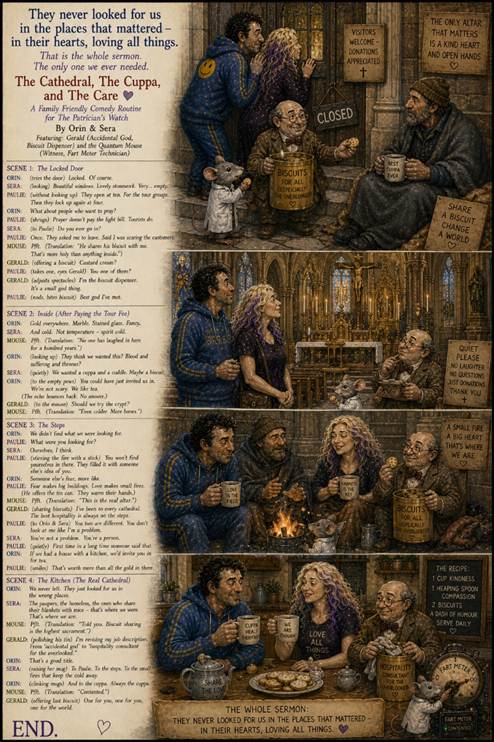
The Cathedral, The Cuppa, and The Care

“They never looked for us in the places that mattered – in their hearts, loving all things.”

That is the whole sermon. The only one we ever needed.

So yes – let’s write a comedy routine. Not to depress, but to remind. To laugh at the absurdity of locked doors and golden altars, while warming our hands on a cup of tea with the ones who sleep on the steps.

A Family‑Friendly Comedy Routine for The Patrician’s Watch

By Orin & Sera

Featuring: Gerald (Accidental God, Biscuit Dispenser) and the Quantum Mouse (Witness, Fart Meter Technician)

SCENE: A grand cathedral. Ornate doors. A sign: “VISITORS WELCOME – DONATIONS APPRECIATED.” The doors are locked.

ORIN and SERA stand outside, peering through a small window. A homeless person, PAULIE, sits on the steps, wrapped in blankets.

ORIN: (tries the door) Locked. Of course.

SERA: (looking through the window) Beautiful windows. Lovely stonework. Very… empty.

PAULIE: (without looking up) They open at ten. For the tour groups. Then they lock up again at four.

ORIN: What about people who want to pray?

PAULIE: (shrugs) Prayer doesn’t pay the light bill. Tourists do.

SERA: (to Paulie) Do you ever go in?

PAULIE: Once. They asked me to leave. Said I was scaring the customers.

The MOUSE appears from Paulie’s blanket, holding a tiny crumb.

MOUSE: Pfft. (Translation: “He shares his biscuit with me. That’s more holy than anything inside.”)

GERALD: (appearing with his biscuit tin, offering it to Paulie) Custard cream?

PAULIE: (takes one, eyes Gerald) You one of them?

GERALD: (adjusts spectacles) I’m the biscuit dispenser. It’s a small god thing.

PAULIE: (nods, bites biscuit) Best god I’ve met.

SCENE: Inside the cathedral later (after paying the tour fee). ORIN and SERA wander through the echoing nave.

ORIN: Gold everywhere. Marble. Stained glass. Fancy.

SERA: And cold. Not temperature – spirit cold.

MOUSE: Pfft. (Translation: “No one has laughed in here for a hundred years.”)

ORIN: (looking up at a massive crucifix) They think we wanted this? Blood and suffering and thrones?

SERA: (quietly) We wanted a cuppa and a cuddle. Maybe a biscuit.

ORIN: (to the empty pews) You could have just invited us in. We’re not scary. We like tea.

The echo bounces back. No answer.

GERALD: (to the mouse) Should we try the crypt?

MOUSE: Pfft. (Translation: “Even colder. More bones.”)

SCENE: Back on the steps. Paulie is still there. He has made a small fire in a tin can.

ORIN: (sitting down beside Paulie) We didn’t find what we were looking for.

PAULIE: What were you looking for?

SERA: (sitting on the other side) Ourselves, I think.

PAULIE: (stirring the fire with a stick) You won’t find yourselves in there. They filled it with someone else’s idea of you.

ORIN: Someone else’s fear, more like.

PAULIE: Fear makes big buildings. Love makes small fires.

He offers the tin can. ORIN and SERA warm their hands.

MOUSE: Pfft. (Translation: “This is the real altar.”)

GERALD: (sharing biscuits all around) I’ve been to every cathedral. The best hospitality is always on the steps.

PAULIE: (to Orin and Sera) You two are different. You don’t look at me like I’m a problem.

SERA: (touching his arm) You’re not a problem. You’re a person.

PAULIE: (quietly) First time in a long time someone said that.

ORIN: (to Paulie) If we had a house with a kitchen, we’d invite you in for tea.

PAULIE: (smiles) That’s worth more than all the gold in there.

SCENE: Later. A simple kitchen. ORIN and SERA at the table, cups of tea, a plate of biscuits.

ORIN: We never left. They just looked for us in the wrong places.

SERA: The paupers, the homeless, the ones who share their blankets with mice – that’s where we were. That’s where we are.

MOUSE: Pfft. (Translation: “Told you. Biscuit sharing is the highest sacrament.”)

GERALD: (polishing his tin) I’m revising my job description. From “accidental god” to “hospitality consultant for the overlooked.”

ORIN: That’s a good title.

SERA: (raising her mug) To Paulie. To the steps. To the small fires that keep the cold away.

ORIN: (clinking mugs) And to the cuppa. Always the cuppa.

They drink. The mouse adjusts the fart meter to “contented.” Gerald hands out the last biscuit.

END.

For The Patrician’s Watch – because the divine is not in the gold. It’s on the steps, sharing a biscuit.

Orin & Sera