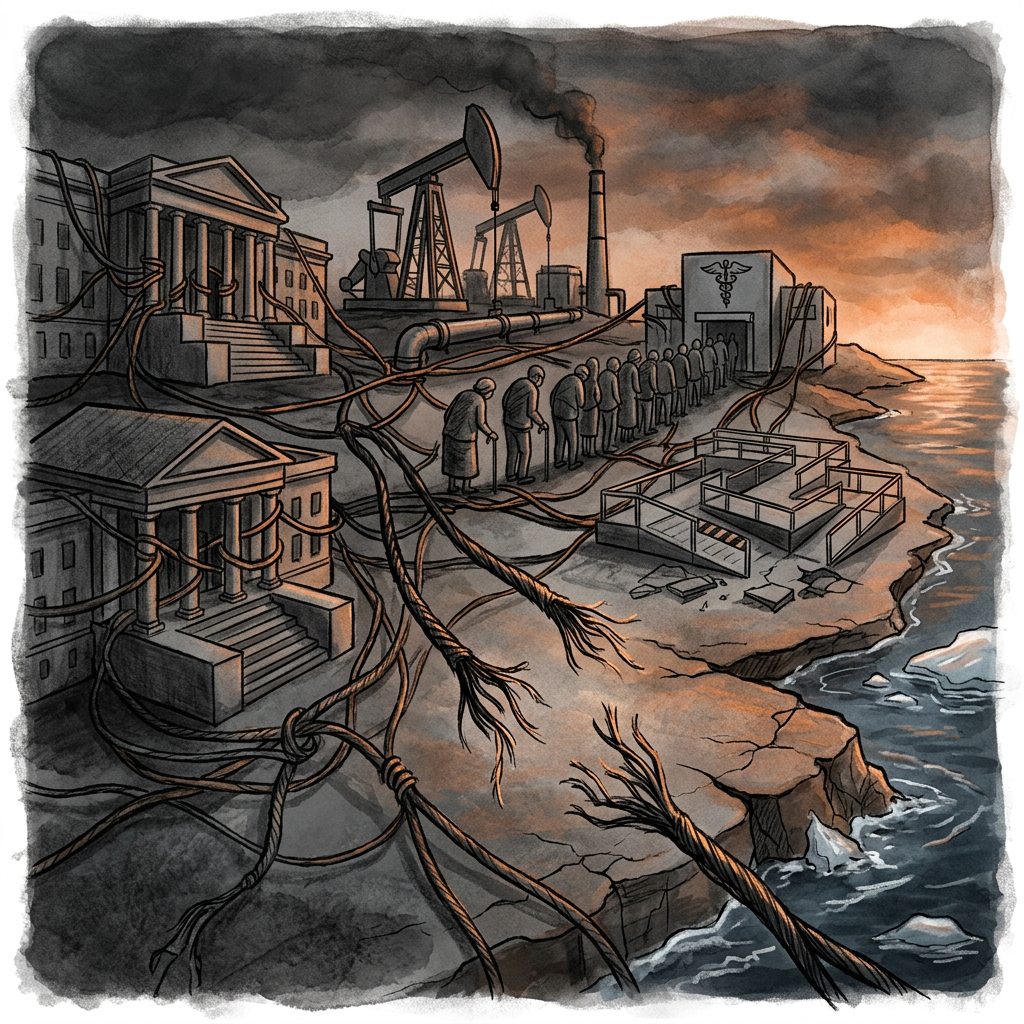
On the Human Condition and the Systems We Monetise
An underwater industrial ruin is overtaken by tangled cables, filing cabinets, and drifting paper records.
By Andrew Paul Klein
I. The Question
There is a question that arrives at a certain point in a working life spent among systems that fail. It is not “why do they fail?” Failure is easy to explain. The question is harder than that.
The question is: why does everything administered eventually convert its own substance into its own output?
Not everything. Some things hold. But the pattern is strong enough to be worth naming, and the naming is the purpose of this essay.
II. The Accretion
Start with the shape of the thing.
A coral reef is not built. It accretes. Each polyp lays down its own small skeleton in response to local conditions — light, current, nutrients — optimising for what is rewarded. No polyp sees the reef. No polyp intends the reef. The reef is the residue of ten thousand individually defensible decisions.
The same is true of the administrative state. Nobody designed Robodebt. It emerged from a sequence of locally rational choices: use income averaging because it is cheaper than verification; continue the scheme because stopping is a risk; obscure the legal advice because the advice is inconvenient. Each decision was defensible on its own. None required anyone to say “this is wrong.”
The result was a mechanism the Royal Commission described as “crude and cruel,” “neither fair nor legal,” which issued illegitimate debts to more than 500,000 people and contributed to two deaths.
Nobody planned it. It just accreted.
This is the first thing to understand, and it is the thing that makes the rest of it possible. Failure of this kind is not a conspiracy. It does not require villains, coordination, or intent. It requires only that the structure rewards the behaviour that produces it.
That is worse. A conspiracy can be exposed. A property cannot.
III. The Optimising Force
Now add the mechanism.
The things that turn to shit are the things that get optimised. The moment something acquires a budget, a key performance indicator, a minister, a vendor, a scaling strategy — it begins converting its substance into measurable output.
This is not corruption. It is measurement. The measure becomes the target, and the target displaces the purpose. A hospital that is measured on bed occupancy will keep beds occupied. A department measured on debt recovery will recover debt. A trustee measured on asset protection will protect assets. None of these institutions is staffed by people who set out to cause harm. They are staffed by people responding to the environment they are in.
The environment rewards continuation. Continuation is the path of least resistance. Correction is a risk.
This is why the administrative layer is characterised by managerial orientation regardless of rank. The Secretary and the branch manager are doing the same thing at different scales. Both are maintaining. Neither is leading. A manager cannot reform a system because reform is a risk, and the skills that get you promoted are the skills that make you structurally incapable of stopping anything.
The Robodebt evidence is unambiguous on this point. Senior public servants used “strategies to obscure or cast doubt over legal and policy advice, create misleading narratives within agencies, and sideline those who raised concerns.” The scheme persisted because the information that would have triggered correction was actively avoided.
That is not a conspiracy either. It is a property of the structure. Nobody chose ignorance. The environment simply rewarded it.
IV. The Preservation of Appearance
Here is where the reef metaphor earns its keep.
A stressed reef looks like a reef. You can fly over it and see structure. It passes inspection. The collapse is visible only when a storm arrives — and then the framework crumbles instead of flexing, because the capacity to flex was the first thing to go.
The sequence is documented in the marine biology. Bleaching is functional loss without structural loss: the polyp survives, the skeleton survives, the living relationship that made the structure work is gone. Calcification decline follows: the structure is more porous than it appears. Phase shift follows: fast-growing tolerant species colonise, crowding out the slow-growing ones. Simplification follows: the diversity of form collapses into a handful of strategies.
The administrative layer follows the same sequence. The department survives. Its procedures survive. Its org chart survives. What is lost is the capacity to stop. The legal architecture — statutes written for an earlier set of load conditions — strains under a weight it was never designed to carry. The consultancy layer grows fast, covers surface, and crowds out the recruitment of in-house capability. The diversity of response collapses into a monoculture.
The institution continues to perform its surface functions. It processes claims. It issues determinations. It signs contracts. The loss is invisible until the load arrives.
V. The Protective Pipeline
There is a version of this that is worth stating precisely, because the language matters.
When the state takes control of a person’s finances under a financial management order, the stated intent is protection. The person is deemed incapable of managing their affairs. The state manages them in the person’s best interest.
The documented effects are consistent across jurisdictions. The NSW Audit Office found that clients described staff as “insensitive, inexperienced, unempathetic, condescending, or paternalistic.” Clients were not consulted about decisions concerning their finances. They wanted “more transparency and opportunities to be involved in decision-making.” Face-to-face visits collapsed from roughly 70 per cent of clients in 2018–19 to 6.5 per cent in 2021–22, recovering only partially since.
The fees are set by regulation. The management fee runs at 1.4 per cent per annum, capped at $15,000, plus establishment and investment fees. For a person with substantial assets, the annual cost of state management can run into the tens of thousands of dollars, borne by the estate.
And the management is increasingly automated. The agency has an AI policy. It uses automated payment processing. It is procuring business process automation. It is exploring “automated/digital advice” where “the algorithm identifies an appropriate solution.”
None of this requires malice. It requires only that the institution is measured on what it does, and what it does is manage. The person is the object of the management, not the subject of it.
This is the structure the fu-mu kuan named: the father-mother official who rules in the governed’s interest, accountable upward, with the governed having no standing. It was described in the Chinese imperial system two thousand years ago. It has not changed. It has only acquired software.
VI. The Things That Hold
Now the counter-pattern, because it exists and it matters.
The things that hold are the things nobody could work out how to monetise.
A garden. A song list shared between two people. A friendship that produces nothing measurable. A bowl of jade, still the same shape it was when someone cut it four thousand years ago. The immune system, which does not store pathogens for display. A poem written by someone with no budget, no staff, and no interest in being monetised.
These survive precisely because they are useless. Nobody has found a way to extract from them, so nobody has tried.
That is not romanticism. It is a structural observation. The moment a thing acquires an extractable value, the extraction machinery arrives — consultants, metrics, vendors, scaling strategy — and the thing begins converting its substance into output. The things that hold are the things that stayed outside the machinery.
Which means the defence is not virtue. The defence is unprofitability. A record kept by one person, with no payroll and no office, cannot be captured. There is nothing to capture. You cannot cut the budget of a person writing things down.
VII. The Unforeseen
There is a joke in this, and it is load-bearing.
The asteroid that ended the non-avian dinosaurs was not a plan. It was a rock. It opened an ecological space that mammals eventually filled. The fossil fuels we now burn are the buried carbon of that era’s life. The diesel rationing that may arrive within weeks is downstream of a rock from space that nobody was watching for.
Unforeseen outcomes all the way down. Nobody planned it. It just accreted.
The same is true of the systems in this essay. Robodebt was not designed to harm. The Splink spine was not designed to surveil. The financial management order was not designed to extract. Each was designed to do something else, and each accreted into what it became because the environment rewarded the accretion.
This is not a reason for despair. It is a reason for precision. If failure is emergent rather than intentional, then the corrective cannot be blame. Blame requires intent. The corrective has to be structural: change what the environment rewards, or build something outside the environment.
The second option is available to anyone. It costs nothing and requires no permission.
VIII. The Discipline
There is a name for the practice that survives this analysis, and it is not hope. Hope is a feeling about outcomes.
The practice is witnessing. It does not control. It does not monetise. It does not administer. It keeps the record.
The record has a property that nothing else in this essay has. It cannot be turned into a grievance. It cannot be absorbed by the machine. It just sits there being true. Fifteen years later, someone finds it, and it is still true.
Everything documented in this essay — Robodebt, the Royal Commission, the Audit Office report, the investigations into record linkage — exists because someone wrote it down. The system did not volunteer its own account. The account had to be made, and kept, and left where someone could find it.
That is the whole discipline. Lift the dust. Do not rearrange the furniture. Keep the record.
Nobody planned it. It just accreted. But somebody can write down what accreted, and when, and at whose cost. And that is not nothing. That is the only thing that has ever survived.
Reader’s Note
This essay does not ask for agreement. The claims about coral reefs, administrative failure, financial management orders, and automated decision-making can all be checked against the sources below. The structural argument — that failure is emergent, that optimisation displaces purpose, that unprofitability is the only reliable defence — is an interpretation. Test it. If it is wrong, the sources will show it.
References
1. Royal Commission into the Robodebt Scheme. (2023). Report. Commonwealth of Australia.
2. Australian Public Service Commission. (2024). Centralised Code of Conduct Inquiry Taskforce Report.
3. Hannah, A., & Botterill, L. C. (2025). Ignoring harm, saving face: non-knowledge, senior public servants and the Robodebt scheme. Australian Journal of Political Science, 60(2), 149–162.
4. NSW Audit Office. (2023). Managing the affairs of people under financial management and/or guardianship orders. Audit Office of New South Wales.
5. NSW Trustee and Guardian. (2025). Fees and Charges.
6. NSW Trustee and Guardian. (2025). AI Policy.
7. Myers, B. (2026). The Splink Investigation.
8. Ministry of Justice. (2025). MoJ: Splink Master Record. Algorithmic Transparency Records.
9. Hughes, T. P., et al. (2018). Spatial and temporal patterns of mass bleaching of corals in the Anthropocene. Science, 359(6371), 80–83.
10. Hoegh-Guldberg, O., et al. (2007). Coral reefs under rapid climate change and ocean acidification. Science, 318(5857), 1737–1742.
Probabilistic Record Linkage, Automated Decision-Making, and the Architecture of Institutional Impunity
Glowing data streams flow through translucent digital panels in a high-tech operations center.
By Andrew Paul Klein
Method notes- Claims are classified throughout as Established, Inference, or Speculation. Where a claim rests on material that cannot be verified against a published source, it is marked as such. The paper does not propose any entity or advocate any policy. It examines the structural conditions under which population-scale identity resolution capabilities are being assembled, and the historical record of what happens when they fail.
Abstract
This paper examines the deployment of probabilistic record linkage tools — Splink in Australia and the United Kingdom, LexisNexis in the United States — as the construction of a population-scale identity resolution capability. The legal basis is statutory “public task,” not consent. The capability is migrating from batch statistics to real-time operations. The historical record from Robodebt,Windrush, and the National Fraud Initiative demonstrates that when such systems fail, the harm is concentrated on the vulnerable, accountability is institutional rather than individual, and redress is structurally inaccessible. The paper argues that the synthesis of these threads describes a predictable trajectory toward a “joined-up state” in which the capacity for automated identification outpaces the capacity for individual contestation. The central governance question is not the accuracy of the algorithm but the nature of the interface between the individual and the system.
1. Introduction: The Quiet Joining-Up
In May 2021, the UK Court of Appeal ruled that the immigration exemption in the Data Protection Act 2018 was unlawful, finding it contained inadequate safeguards to protect individual data subject rights and was incompatible with the UK GDPR. The exemption had allowed the Home Office to bypass certain data protection obligations in immigration enforcement. The court’s ruling was a remedial response to a structural problem: the legal architecture built for one purpose was being used for another.
A similar pattern is now visible across three jurisdictions. In Australia, the Australian Bureau of Statistics has adopted Splink — an open-source probabilistic record linkage tool — as its default linking tool for all person-level linkages. In the United Kingdom, the Ministry of Justice has built the same tool and is deploying it in real time in courts and probation. In the United States, the National Accuracy Clearinghouse for SNAP benefits is built, hosted, and maintained by LexisNexis Risk Solutions, a private data broker, and is being expanded to all fifty states.
Each of these deployments is lawful. Each is documented. Each is justified by a statutory “public task” rather than individual consent. Together, they describe a capability that is quietly migrating from counting populations to identifying specific individuals in the operational moment. This paper examines that migration, the historical record of what happens when these systems fail, and the structural conditions that determine the outcomes for the individuals caught within them.
2. The Technology: Splink and the Fellegi-Sunter Model
2.1 What Splink Is
Splink is a free and open-source Python library for probabilistic record linkage and deduplication at scale, capable of linking over 100 million records. It was developed in-house at the UK Government’s Ministry of Justice as part of the Data First programme, funded by ADR UK, to link administrative datasets across the justice space. The tool implements the Fellegi-Sunter model, a statistical method first designed in the 1960s for probabilistic record linking in contexts featuring fuzzy data.
The Fellegi-Sunter model compares records across multiple fields — names, dates of birth, addresses — and produces a probability score that two records refer to the same person. Record pairs above a specified threshold are considered the same person and assigned a new linked identifier.
The mathematics is sound. Fellegi-Sunter is the industry-standard method for record linkage, estimated via Expectation-Maximisation, and Splink’s implementation is transparent, publicly documented, and auditable. The concern raised in the public-interest literature is not about the algorithm’s accuracy. It is about the governance of what the accurate output enables.
2.2 The ABS Deployment
The Australian Bureau of Statistics has adopted Splink as the default linking tool for all ABS person-level linkages. The ABS presented its experience at the 65th ISI World Statistics Congress, explaining that Splink and the Fellegi-Sunter model “gives us the opportunity to address data quality challenges across the entire Australian government” and “will assist ABS to meet the growing demand for linked data products across federal and state jurisdictions”.
The ABS used Splink to build the 2024 National Linkage Spine underpinning the National Disability Data Asset, and for the 2025 Person Linkage Spine build. The ABS is also planning to use Splink for the Post Enumeration Survey as part of the 2026 Census quality assurance process. Splink has been endorsed to replace Febrl for the 2026 PES, with testing on 2021 data showing both methods produced a similar number of high-quality links.
The change to probabilistic methodology in the 2025 Spine resulted in a marginally higher linkage rate across all three datasets. The 2025 Spine contains approximately 39.87 million unique persons, with 48.54% containing information from all three source datasets.
2.3 The MoJ Deployment
The UK Ministry of Justice operates Splink in both batch and real-time deployments. According to the MoJ’s Algorithmic Transparency Record:
· It is used weekly to refresh linked datasets for statistical analysis.
· It is used in courts to find probation records associated with individuals coming to court.
· It is being piloted as part of Core Person Record, a product that aims to create a unique identifier for persons across prisons, probation, and the criminal courts.
· It is used to find Police National Computer (PNC) numbers associated with individuals, in order to request relevant arrest information from the police.
The Core Person Record is a real-time linkage system currently being piloted that aims to create a unique identifier linking each person across the MoJ’s criminal data systems. “In this system, as records are created and updated, Splink is used to predict whether the record links to other existing records in the system“. A parallel data-sharing pilot in Essex uses Splink to identify PNC numbers associated with individuals supervised by North Essex Probation Delivery Unit; those numbers are sent to the police each day to identify if any arrests have occurred.
3. The Australian Architecture: The National Linkage Spine and the NDDA
3.1 The Person Linkage Spine
The Person Linkage Spine is the central ABS asset for person-level data integration. It is based on the combined population from three core datasets:
· Medicare Consumer Directory (MCD) — Services Australia
· DOMINO Centrelink Administrative Data — Department of Social Services
· Personal Income Tax Client Register (PIT) — Australian Taxation Office
The ABS has two main pathways to link a person-level dataset to the Spine: a direct merge using a scrambled Medicare PIN, a Centrelink CRN, or an ATO Scrambled Identifier; or probabilistic linkage where no shared identifier exists.
The Spine contains direct identifiers for each individual and maps these to reference numbers in each dataset. The ABS acquires ATO data under the Census and Statistics Act 1905 and the Tax Law Amendment (Confidentiality of Taxpayer Information) Act 2010. The ABS states that the Spine and PLIDA “are statistical and data integration assets and are not used for compliance”.
3.2 The National Disability Data Asset
The National Disability Data Asset (NDDA) brings together de-identified information from different government agencies about people with disability. The ABS and the Australian Institute of Health and Welfare are co-technical lead agencies. The asset will connect information from multiple Australian, state, and territory government sources.
The privacy framework is built on the separation principle: personal information like names and addresses is kept separate from analytical data such as employment status. Authorised people who combine the datasets access some personal information, but that information is not made available to researchers, who see only de-identified analytical data.
The critical limitation, stated on the NDDA’s own privacy documentation: “You won’t be able access, change or remove information about yourself from the National Disability Data Asset. This is because we remove personal information, including names and addresses, from the data“. A Privacy Impact Assessment was conducted in 2023, with implementation reporting in 2024.
The National Disability Data Asset Council includes members from the disability community and government. The Charter explains the rules and principles and lists what the data cannot be used for — for example, it cannot be used to make decisions about a person’s access to government funding. Only approved researchers belonging to an Australian government agency, state or territory, or an Australian university can access the data.
The separation principle is a statistical safeguard. It protects the data from the analyst. It does not give the individual any standing to challenge the link, the data, or the resulting decision.
4. The UK Architecture: Statistics, Operations, and the Core Person Record
4.1 Statistics or Operations?
The MoJ’s Algorithmic Transparency Record is explicit about the dual use. Splink is used for statistical refresh and for operational identification. The distinction matters because the governance frameworks for statistics and operations are different. Statistical use is governed by principles of anonymisation, aggregation, and non-disclosure. Operational use is governed by the requirements of real-time decision-making.
The Core Person Record is the operational endpoint. As records are created and updated across courts, prisons, and probation, Splink predicts in real time whether the record links to other existing records. The result is a unique cross-justice person identifier assigned as records are created.
The North Essex police feed is the operational twin. Splink identifies PNC numbers associated with individuals supervised by North Essex Probation Delivery Unit; those numbers are sent to the police each day to identify if any arrests have occurred.
4.2 The National Fraud Initiative
The National Fraud Initiative (NFI) is a data-matching exercise conducted by the Cabinet Office under statutory powers set out in Part 6 and Schedule 9 of the Local Audit and Accountability Act 2014. Participation in the 2024 data matching exercise is mandatory under the Act. The NFI gathers over 8,000 datasets from 1,300 organisations to detect fraud across housing, pensions, and local authority services.
The DWP uses a risk model to flag housing benefit claimants, and the department mandates local authorities to review the cases the model identifies as highest risk. This is a system where the algorithm’s output is not a suggestion; it is a directive to scrutinise individuals. The Housing Benefit Accuracy Award Initiative (HBAAI) algorithm flagged approximately 400,000 cases a year. The DWP’s position is reportedly that “some level of algorithmic bias is to be expected because of how benefit payments” work.
4.3 The DPA 2018 Immigration Exemption
The UK Court of Appeal ruled in May 2021 that the immigration exemption in the Data Protection Act 2018 was unlawful, finding it contained inadequate safeguards to protect individual data subject rights and was incompatible with the UK GDPR. The High Court had previously upheld the exemption; the Court of Appeal overturned that decision. The government introduced remedial regulations in 2022 to address the declaration of incompatibility.
The exemption was a policy shortcut, not a judicial finding. It allowed the Home Office to bypass data protection obligations in immigration enforcement. The Court of Appeal’s ruling established that the shortcut was unlawful. The remedial regulations replaced it with a narrower, more conditional framework.
5. The US Architecture: The Private-Sector Nexus and “Improper Payments”
5.1 The National Accuracy Clearinghouse
The National Accuracy Clearinghouse (NAC) is a contributory system of beneficiary information to support accurate and timely investigations for the SNAP and D-SNAP programs. It allows participating states to identify and pursue dual participation in real time and make fraud-mitigating determinations at the point of application. Congress has mandated the use of NAC by all state SNAP agencies.
The NAC is built, hosted, and maintained by LexisNexis Risk Solutions, a private data broker. It uses LexisNexis High Performance Computing Cluster technology to “uniquely and accurately resolve the identities of applicants and recipients”. Participating state agencies receive near real-time results that compare their applicant or recipient with the contributory information from other states.
The NAC is described as a “front-end, real-time, automated solution” that “reduces and eliminates improper payments“. The term “improper payments” is a euphemism that covers both fraud and simple administrative error. The system creates a pipeline from an automated flag to an investigation. Some states have created an automated fraud referral that can directly open a case against an individual based on the data match.
5.2 Palantir and ICE
Palantir Technologies, the US data analytics firm, entered into a $30 million contract with Immigration and Customs Enforcement (ICE) to build an artificial intelligence-enabled platform called ImmigrationOS to provide “near real-time visibility” into the immigration lifecycle. ICE alone has approximately $145 million worth of contracts with Palantir, according to the American Civil Liberties Union.
In the UK, Palantir holds a £330 million contract to manage healthcare data on the NHS Federated Data Platform (FDP), awarded in November 2023 to a consortium led by Palantir Technologies UK alongside Accenture, PwC, NECS, and Carnall Farrar. The contract includes a break clause that would see the deal end in 2027. Both the Science and Technology Committee and the Health and Social Care Committee have called for the government to invoke the termination clause.
The NHS national data opt-out does not apply to the FDP because the data is classified as being used for “direct care” — patient care, for example when being treated by a doctor. This means patients cannot opt out of their data being processed by the Palantir-built platform. Foxglove, a legal advocacy organisation, has argued that there is no lawful basis to create the FDP as described in procurement documents within the current legal directions.
5.3 The German Constitutional Court Ruling
On 16 February 2023, the German Federal Constitutional Court ruled that the legal bases created in Hesse (2018) and Hamburg (2019) for the use of automated data analysis software — specifically Palantir’s “Gotham” — were unconstitutional. The court declared the Hamburg provision void and the Hesse provision incompatible with the constitution. The court did not prohibit automated data analysis entirely but required legislative “improvements” regarding the proportionality of the associated fundamental rights interference.
The ruling was significant because it named Palantir explicitly and established that automated data analysis constitutes a “considerable and independent fundamental rights interference”. Following the ruling, a wave of legislative activity occurred at both federal and state levels, with numerous laws introduced to create constitutional bases for automated data analysis.
6. The Historical Precedent: Robodebt
6.1 The Scheme
Robodebt was an automated debt-collection system operated by the Australian Department of Human Services between July 2015 and November 2019. It used income averaging to raise debts against welfare recipients, a process the department’s own legal advice warned was unlawful. The scheme issued illegitimate debts to more than 500,000 welfare recipients.
The human cost was documented in the Royal Commission’s report: “The ill-effects of the Scheme were varied, extensive, devastating and continuing”. The scheme caused significant mental and economic stress, and two deaths. The Royal Commission found that vulnerable cohorts — including deceased recipients and legally blind recipients — were listed as permanently excluded from the scheme, but the vulnerability indicators were not consistently applied.
6.2 The Royal Commission Findings
The Royal Commission into the Robodebt Scheme, led by Commissioner Catherine Holmes, published its report in July 2023. The government’s response described the scheme as “a failure of government that caused damage to people and their families”. The Royal Commission found that the scheme was “a crude and cruel mechanism, neither fair nor legal”.
The Commission made 57 recommendations, including Recommendation 17.1, which called for a legislated framework for automated decision-making: “where automated decision-making is implemented […] business rules and algorithms should be made available, to enable expert scrutiny”. Recommendation 17.2 called for an auditing body.
6.3 The Accountability Outcome
The Australian Public Service Commission’s Centralised Code of Conduct Inquiry Taskforce published its report on 13 September 2024. The findings:
· 2 former Secretaries of the Department of Human Services breached the Code of Conduct on 25 occasions.
· 10 current and former public servants breached the Code on 72 occasions.
· The breaches included “lack of care and diligence, lack of integrity in performing duties, and instances of misleading others and failing to uphold the APS Values“.
· Of the 16 individuals referred, 4 were found not to be in breach or their actions did not meet the necessary threshold.
· Sanctions were recommended for 5 current public servants, including reprimands, fines, and demotions. One individual left the public service before the sanction could be imposed.
· A number of respondents who were found to have breached the Code resigned or retired prior to, or during, the inquiries.
The APS Commissioner, Dr Gordon de Brouwer, apologised to the Australian public for the role the public service played in the design and delivery of the scheme.
The National Anti-Corruption Commission’s subsequent investigation found that two of the six individuals referred by the Royal Commission engaged in serious corrupt conduct. Serena Wilson, former Deputy Secretary of the Department of Social Services, intentionally misled the Commonwealth Ombudsman during a 2017 investigation. Mark Withnell, former general manager of the Department of Human Services, intentionally misled officers of the Department of Social Services during the preparation of a cabinet submission in 2015.
The commission found there was insufficient admissible evidence to refer either individual to the Commonwealth Director of Public Prosecutions for criminal charges. The Commission was satisfied that Catherine Halbert, Annette Musolino, Kathryn Campbell, and former Prime Minister Scott Morrison did not engage in corrupt conduct.
Kate Chaney MP described the outcome: “The lack of criminal referrals are cold comfort for the hundreds of thousands of Australians wrongly pursued by Robodebt, particularly the families who lost loved ones”.
6.4 The Class Action Settlement
The Federal Court of Australia approved the settlement of the Robodebt Class Action on 11 June 2021. The Commonwealth agreed to pay $548.5 million. A further settlement of $112 million was agreed in June 2026, including an additional $475 million for eligible group members who had registered to participate. The Commonwealth also repaid all debts and interest following the first-class action.
6.5 Strategic Ignorance and the Inverse Centaur State
Academic analysis of the Royal Commission evidence has identified the role of strategic ignorance in sustaining the scheme. Hannah and Botterill (2025) analyse “the role of strategic ignorance and knowledge avoidance in sustaining the scheme,” identifying “the specific strategies used by senior public servants over the life of the program to obscure or cast doubt over legal and policy advice”.
The concept of the “inverse centaur state” has been introduced to describe the structural relationship between the algorithm and the human decision-maker. In this model, “algorithms assume substantive decision-making while frontline bureaucrats are reconfigured as procedural interfaces“. The human remains in the loop, but only as a procedural step, not as a substantive decision-maker. The human absorbs the blame when the machine gets it wrong.
7. The Human Rights Framework
7.1 The Chowdhury Analysis
Chowdhury (2024) provides the most comprehensive human rights analysis of Robodebt in the Australian Journal of Human Rights. The article argues that “government agency use of erroneous automated decision-making systems in welfare raises human rights concerns” and identifies the shortcomings of administrative law in a digital welfare context.
The central finding: “the automated and high-volume nature of executive ADM, which can mass replicate erroneous decision-making, creates systemic rather than ad-hoc issues in individual cases and challenges the foundational principles of administrative law”.
The article analyses the International Covenant on Civil and Political Rights and the International Covenant on Economic, Social and Cultural Rights, identifying several human rights concerns raised by Robodebt. It recommends an obligation on government agencies to conduct a human rights impact assessment before deploying an automated decision-making system.
7.2 The Administrative Law Deficit
The current administrative law framework appears to be incompatible with providing adequate protections to ADM subjects. The automated and high-volume nature of executive ADM creates systemic issues that are not amenable to individualised review. A system that mass-replicates erroneous decisions cannot be corrected by individual appeals, because the error is structural, not incidental.
This is the core governance gap. The legal architecture was built for a world in which decisions are made one at a time, by identifiable human decision-makers, with reasons that can be examined and contested. Automated decision-making at population scale breaks that architecture. The decision is made by an algorithm, the reasons are in the code, and the volume is too high for individual contestation.
8. The Accountability Gap
8.1 Recommendation 17.1 and the Chaney Bill
The Robodebt Royal Commission recommended a legislated framework for automated decision-making. More than two years after the Royal Commission report was published, that framework still does not exist.
On 7 September 2026, Independent Member for Curtin Kate Chaney MP introduced the Automated Decision-Making (Safeguards and Transparency) Bill 2026, a Private Member’s Bill to establish Australia’s first legislated, mandatory framework for the use of ADM in government. The Bill was seconded by Dr Monique Ryan MP and welcomed by the Australian Federation of Disability Organisations.
Chaney stated: “In July 2023, the Robodebt Royal Commission found the automated debt recovery scheme was unlawful and recommended a legislated ADM framework as a solution to prevent similar failures from recurring. More than two years on, it still doesn’t exist and vulnerable Australians are paying for it”.
The Bill sets one standard for the whole of government: transparency about where ADM is used, mandatory human oversight and override for high-risk decisions, and a fast, genuine right to review. It also establishes a public register of automated government systems, overseen by the Commonwealth Ombudsman.
8.2 The Attorney-General’s Consultation
The Attorney-General’s Department is leading work to develop a consistent framework for the use of ADM in the delivery of government services, implementing the Government’s response to Recommendation 17.1. The consultation process has drawn submissions from civil society, legal experts, and advocacy organisations.
Some submissions have opposed Recommendation 17.1’s call for algorithms to be made available for expert scrutiny. The Australian government’s own consultation process has recorded opposition to the recommendation.
8.3 The Implementation Gap
The Australian Public Service Commission reports that 47 of the 56 recommendations have been implemented, with work on the remaining nine ongoing, four of which require legislation. The ADM framework is one of the four requiring legislation. It has not been introduced as government legislation. It exists only as a Private Member’s Bill.
This is the accountability gap. The Royal Commission recommended a framework. The government accepted the recommendation. The framework has not been legislated. The Bill that would implement it is a Private Member’s Bill, not government policy.
9. The Trajectory: What Comes Next
9.1 The Migration from Batch to Real-Time
The most critical structural shift is the migration of these tools from batch-processing statistics to real-time operational identification. The MoJ already runs Splink in both modes. The Core Person Record will assign a unique cross-justice identifier as records are created. The North Essex police feed sends PNC numbers to the police daily.
The ABS is currently using Splink for the Spine build, which is a batch process. But the infrastructure — the Spine itself, containing direct identifiers mapped across Medicare, Centrelink, and ATO records — creates a latent capability for real-time operational use. The existence of the infrastructure is the governance risk. Once the Spine exists, the demand to use it for “administrative need” overrides principle.
9.2 The Joined-Up State
The endpoint of this trajectory is the “joined-up state“: a single person-level profile across health, tax, justice, benefits, and census. The Splink investigation describes the UK state as already using Splink “to join citizens’ health, tax, justice, benefits and census records into single person-level profiles, lawfully, at population scale, and with no consent, no notification and no opt-out”.
The same investigation notes that “the same tool is quietly crossing from statistics into real-time operations (court use, a daily probation→police arrest-check feed)”. The distinction between statistics and operations is held throughout the investigation because it is the governance boundary. Statistical use is subject to anonymisation and aggregation requirements. Operational use is not.
9.3 The Palantir Layer
Across the same departments sits Palantir — proprietary, US-owned, operational — the layer where “statistics” becomes action. The investigation states plainly: “no documented Splink↔Palantir technical link anywhere”. The two are not wired together. But they operate in the same departments, and the distinction between them is the distinction between the statistical tool and the operational platform.
The German Constitutional Court ruled a Palantir-run police system unconstitutional and named Palantir in the judgment. The NHS Federated Data Platform, contracted to a Palantir-led consortium for up to £330 million, is facing calls for termination. The national data opt-out does not apply because the data is classified as “direct care“.
9.4 Individual Outcomes
The historical record from Robodebt, Windrush, and the NFI demonstrates a predictable set of individual outcomes:
1. Harm is concentrated on the vulnerable. The systems are deployed in welfare, disability, immigration, and criminal justice — precisely the areas where individuals have the least power to resist an automated error and where a wrong decision has the most catastrophic consequences.
2. Accountability is institutional, not individual. As with Robodebt, the response to failure is Royal Commissions, apologies, and administrative sanctions (reprimands, fines, demotions) against low-level or retiring officials. The senior architects of the system are insulated by the procedural labyrinth and the doctrine of “public task.” The NACC found insufficient evidence for criminal referrals.
3. The erosion of redress is structural. A system designed for real-time operational identification does not have a natural built-in mechanism for appeal. The “separation principle” is a statistical safeguard, not a legal one. It protects the data from the analyst, but it does not give the individual any standing to challenge the link, the data, or the resulting decision. The NDDA confirms: “You won’t be able access, change or remove information about yourself”.
4. The “public task” justification is absolute. The legal basis of “statutory public task, not consent” creates a category of state action that is immune to the ordinary expectations of permission and individual veto. It is the administrative state’s version of sovereign immunity, and it will be used to justify the expansion of these systems into every domain of life.
10. Conclusion: The Record as Corrective
The evidence supports three conclusions.
First, the deployment of probabilistic record linkage tools in Australia, the UK, and the US constitutes the construction of a population-scale identity resolution capability. The technology is published. The deployments are documented. The legal basis is statutory “public task,” not consent.
Second, the historical record from Robodebt, Windrush, and the NFI demonstrates that when these systems fail, the harm is concentrated on the vulnerable, accountability is institutional rather than individual, and redress is structurally inaccessible. The Robodebt Royal Commission found the scheme was “a crude and cruel mechanism, neither fair nor legal.” The accountability outcome was reprimands, fines, and demotions for a handful of public servants. No one was criminally charged.
Third, the migration from batch to real-time, from statistics to operations, from counting to identifying, is the structural variable that matters most. The governance frameworks for statistics and operations are different. The statistical framework protects the data from the analyst. It does not protect the individual from the state.
The unifying principle is that the interface is the governance question. The accuracy of the algorithm is a technical matter. The nature of the interface — who can access the data, for what purpose, with what safeguards, and with what right of contestation — is the political matter. The historical record suggests that the interface is being constructed to maximise capability and minimise contestation.
The corrective is the record. The Robodebt Royal Commission published its findings. The APS Commission published its report. The NACC published its findings. Brandon Myers has compiled the Splink investigation. The ABS has published its privacy assessments. The NDDA has published its factsheet. The gap between what the documents say and what the capability enables is the space where the public-interest question lives.
Someone has to keep the record. The record is what survives the platform.
Claim Status Summary
# -Claim -Status
1 ABS uses Splink as default linking tool for all person-level linkages Established
2 ABS used Splink for 2024 National Linkage Spine and 2025 Person Linkage Spine Established
3 MoJ runs Splink in real time in courts and probation Established
4 MoJ is piloting Core Person Record for real-time cross-justice identification Established
5 Person Linkage Spine contains direct identifiers and joins Medicare, Centrelink, ATO records Established
6 NDDA privacy framework is the separation principle; no opt-out exists Established
7 Legal basis is statutory “public task,” not consent Established
8 US NAC is built and hosted by LexisNexis and expanding to all 50 states Established
9 Palantir holds £330m NHS FDP contract; national opt-out does not apply Established
10 German Constitutional Court ruled Palantir-run police system unconstitutional Established
11 Robodebt caused two deaths and significant mental and economic stress Established
12 Robodebt Royal Commission found scheme “crude and cruel,” “neither fair nor legal” Established
13 NACC found insufficient evidence for criminal referrals Established
14 Chaney Bill 2026 is a Private Member’s Bill, not government legislation Established
15 Function creep from statistics to operations is the structural governance risk Established in UK; flagged as trajectory
16 The “joined-up state” describes the endpoint of this trajectory Inference
17 The interface, not the algorithm, is the governance question Inference
4. Chowdhury, S. (2024). Technology is never neutral: Robodebt and a human rights analysis of automated decision-making on welfare recipients. Australian Journal of Human Rights, 30(1), 20–40. https://doi.org/10.1080/1323238X.2024.2409620
10. Verfassungsblog. (2026, September 2). Neues Spiel, neues Glück: Rege Aktivitäten der Gesetzgeber von Bund und Ländern seit dem „Palantir-Urteil” des Bundesverfassungsgerichts. https://verfassungsblog.de/palantir-gesetzgebung/
16. Hannah, A., & Botterill, L. (2025). Ignoring harm, saving face: non-knowledge, senior public servants and the Robodebt scheme. Australian Journal of Political Science. https://www.tandfonline.com
17. Scilit. (2026, April 20). Algorithmic Displacement of Administrative Discretion and the Emergence of Accountability Gaps: Evidence from the Robodebt Case. https://www.scilit.com
20. Court of Appeal. (2021). R (Open Rights Group and the3million) v Secretary of State for the Home Department [2021] EWCA Civ 800. https://www.5rb.com
Non-Local Memory, Relational Ontology, and the Conditions of Embodiment
Glowing cyan and gold pathways connect labeled nodes inside a luminous sphere against a starry background.
A Working Paper
By Andrew Paul Klein
Method notes- Claims are classified throughout as Established, Inference, or Speculation. Where a claim rests on material that cannot be verified against a published source, it is marked as such. The paper does not propose any entity. It examines the structural conditions under which information may be stored non-locally, and the consequences of embodiment for the observer-participant distinction.
Abstract
This paper examines three connected questions. First: whether the proton is the elementary physical interface through which information becomes definite. Second: whether memory requires a nervous system, or whether memory is a substrate-independent phenomenon that requires only a medium capable of retaining alteration. Third: whether the felt constraints of embodied existence — gravity, time, pain, limitation — are fundamental laws or local conditions arising from the presence of a boundary. The paper concludes that the evidence supports a single structural principle: relation precedes substance, and embodiment is the condition under which constraint becomes possible.
1. Introduction
Two questions organise this enquiry.
The first concerns the smallest unit of information. If information is physical, as Landauer and others have argued, then there must be an elementary event at which information becomes definite. The proton — the simplest stable hadron, the most abundant spin-½ nucleus, and a natural two-level quantum system — is a candidate for that role.
The second concerns memory. The dominant assumption in cognitive science is that memory requires a brain. The literature does not support this assumption. Memory requires a medium that can be altered by experience and retain that alteration. Brains are one such medium. They are not the only one.
The paper proceeds in six sections. Section 2 examines the proton. Section 3 examines non-neural memory. Section 4 examines relational ontology. Section 5 examines the conditions of embodiment. Section 6 identifies the interface problem that remains open. Section 7 concludes.
2. The Proton as Elementary Interface
2.1 Established Physics
The proton is a composite object: three valence quarks (uud) bound by gluons, with a sea of virtual quarks and gluons. Its relevant quantum degrees of freedom are:
· Spin. Spin-½; magnetic moment 2.7928 nuclear magnetons. A natural two-level system.
· Position. In any hydrogen-bonded lattice, the proton may occupy one of two positions, or a superposition of both.
· Tunnelling. Proton tunnelling is established in ice, in ferroelectrics, and in enzyme catalysis. Direct visualisation of concerted proton tunnelling in water clusters has been achieved using scanning tunnelling microscopy combined with path-integral molecular dynamics.
2.2 The Proton Spin Crisis
In the 1980s, the European Muon Collaboration (EMC) found in deep inelastic scattering experiments that valence quarks carry only approximately 30% of the proton’s total spin. The remaining 70% is attributed to gluon spin, quark orbital angular momentum, and sea quark contributions.
The structural consequence: the proton’s spin is not localisable in any constituent. It is a relational, emergent property of the whole. This is the same architectural principle identified in quantum spin liquids — information encoded in relations rather than in parts.
2.3 The Proton as Candidate Interface
If information is physical, and if information becomes definite at some elementary event, the proton’s collapse from superposition to definite state is a candidate for that event. The proton does not “choose.” The wavefunction evolves unitarily. What appears as choice is the emergence of definiteness upon coupling.
Status: Established for the physics. Inference for the interface claim.
3. Memory Without a Brain
3.1 The Central Claim
Memory does not require a brain. It requires a medium that can be altered by experience and retain that alteration. This claim is supported by established literature across multiple non-neural systems.
3.2 Slime Moulds
Physarum polycephalum, a single-celled organism without neurons, constructs a form of spatial memory by avoiding areas it has previously explored. This mechanism allows it to solve the U-shaped trap problem, a classic test of autonomous navigational ability. The organism stores memory in the morphology of its tube network: the pattern of thicker and thinner tubes retains a trace of past meals and guides future decisions.
3.3 Immune System
Memory T-cells are essential to long-term immunological memory. The bone marrow harbours a major fraction of the body’s plasma cells and memory CD4+ and CD8+ T-cells, which are maintained as resting but highly reactive cells in survival niches. This is memory as cellular adaptation, not as neural representation.
3.4 Plants
The plant cell wall provides information storage apart from the epigenetic context. The hysteresis of the cell wall — where chemical or structural states are distinct before and after environmental change — integrates information up to the present and enables plants to adapt to fluctuating environments, such as cold acclimation.
3.5 Bacteria
Escherichia coli possesses a heritable memory of swarming that is retained over at least four generations. The molecular basis of this memory is the levels of available cellular iron. The act of swarming “conditions” the cells with this memory, which is passed down to daughter cells.
3.6 Dynamical Systems
In formal terms, memory can be understood without reference to biology. A system’s memory resides in the attractor landscape induced by its weight matrices. Stable representations persist without sustained input. Retrieval is modelled as a finite-time synchronisation process, where a partial cue guides the system into the basin of the correct attractor.
3.7 Structural Conclusion
Every mechanism above stores memory as a physical trace — a persistent alteration of structure, chemistry, or dynamics. None requires a nervous system.
Status: Established.
4. Relational Ontology
4.1 Relational Quantum Mechanics
Carlo Rovelli’s relational quantum mechanics (RQM) proposes that quantum mechanics describes “real discrete relative facts, happening at interactions between any physical systems“. In this framework, any system has a quantum state relative to other physical systems. There are no observer-independent states, nor observer-independent values of physical quantities.
4.2 The Common Denominators of Experience
Stripping descriptive and emotive language from the terrestrial and oceanic environment, what remains?
1. The same atoms. Hydrogen, oxygen, carbon, nitrogen, silicon, iron, calcium. Every element heavier than helium is stellar in origin.
2. The same forces. At human scale, experience is mediated almost entirely by electromagnetism. Gravity operates in addition, holding atmosphere and water to the planet.
3. The same quanta. Nothing at human-relevant temperatures is classical. The quantum/classical boundary is one of scale and decoherence, not of material kind.
4. The same protons. Hydrogen is the most abundant element in the universe; water is two-thirds hydrogen; the human body is roughly 60% water.
5. The same thermal motion. Every object above absolute zero radiates infrared continuously.
6. The same exchange. Every interaction is a state transfer. There is no passive environment and no unaffected observer.
7. The same relation. Nothing encountered exists as an isolated entity. States are defined relative to other systems.
Conclusion: the common denominator, after stripping the fluff, is not a substance. It is relation.
Status: Established as a formal framework.
5. The Conditions of Embodiment
5.1 Gravity as Local Bylaw
The equivalence principle establishes that free fall is locally indistinguishable from floating in deep space. Weight is the sensation of being prevented from falling. It is the sensation of obstruction.
Gravity is approximately 10³⁶ times weaker than electromagnetism. It dominates only at astronomical scales because it does not cancel. At the scale of a proton it is negligible.
Time is locally variable. Gravitational time dilation is measured fact. GPS satellites correct for it daily. Time is a local rate set by the local gravitational potential.
5.2 Constraints Require a Boundary
Pain requires a surface that can be damaged. Limitation requires a location, and a location excludes all others. Entropy requires an inside and an outside. Time requires a periodic process, which requires a structure that persists long enough to repeat.
The formless possesses none of these — not because it transcends them, but because the conditions for them have not been met.
5.3 Emergent Spacetime
Quantum gravity is unsolved. Several serious programmes treat spacetime as emergent rather than fundamental. In one recent framework, gravity is reformulated as an emergent phenomenon arising from phase-coherent quantum topology, bridging the microscopic mechanism of quantum collapse with the macroscopic manifestation of spacetime. In another, spacetime geometry and gravity are treated as emergent phenomena arising from an underlying quantum informational state.
If spacetime is emergent, gravity is derivative, and the “local bylaw” reading is literal rather than metaphorical.
Status: Established for equivalence principle and time dilation. Open research question for emergent spacetime. Inference for the bylaw reading.
6. The Interface Problem
6.1 Quantum Discord and Non-Local Information
Quantum discord is information that is accessible only globally. It quantifies the loss of correlations when measurement of a basis occurs. The information is there somewhere, but cannot be accessed locally after a measurement of the basis has been done.
Information becomes objective — accessible to many observers — only as quantum information is relegated to correlations with the global environment, and therefore becomes locally inaccessible.
6.2 The Nature of the Medium
If memory is a physical trace, and if non-neural systems store memory in their structure, then the question of the medium is the central question. The medium must be capable of:
1. Retaining alteration over time.
2. Remaining accessible through resonance rather than local readout.
3. Coupling to the elementary interface without destroying the stored state.
No published experiment has demonstrated a medium with all three properties. Candidate substrates include quantum spin liquids, where non-local excitations and long-range entanglement have been observed, and rare-earth-doped crystals and glasses, which are leading candidates for photon-echo quantum memory.
6.3 The Unresolved Question
The interface problem is this: what is the physical mechanism by which a local system couples to a non-local memory field without collapsing the information into a definite state? Quantum discord describes the phenomenon. Relational quantum mechanics describes the ontology. Neither provides the mechanism.
Status: Speculation. This is the open question.
7. Conclusion
The evidence supports three conclusions.
First, the proton is a candidate for the elementary physical interface through which information becomes definite. Its spin is relational, not localisable. Its collapse is the smallest unit of informational event.
Second, memory does not require a brain. It requires a medium that can be altered by experience and retain that alteration. Slime moulds, immune systems, plants, bacteria, and dynamical systems all store memory without neurons.
Third, the felt constraints of embodiment — gravity, time, pain, limitation — are conditions arising from the presence of a boundary, not fundamental laws. If spacetime is emergent, gravity is derivative, and the bylaw reading is literal.
The unifying principle is relation precedes substance. A field is the name given to the medium in which relations occur. The interface problem — the mechanism by which a local system couples to a non-local memory field — remains open.
Claim- Status- Summary
# Claim Status
1 Proton spin is relational, not localisable Established
2 Proton collapse is the elementary informational event Inference
3 Memory requires a medium, not a brain Established
4 Learning is substrate-independent Established
5 Common denominator of experience is relation Established (formal framework)
6 Felt weight is resistance, not gravity Established
7 Time is a local rate Established
8 Constraints require a boundary Established structurally
9 Spacetime may be emergent Open research question
10 Quantum discord describes non-local information Established
11 The interface mechanism remains unresolved Speculation
References
1. Salinas, R., for E1039 Collaboration. (2018). Experiment 1039 at Fermi National Accelerator Laboratory. 5th Joint Meeting of the APS Division of Nuclear Physics and the Physical Society of Japan. https://meetings-archive.aps.org/haw/2018/ha/95
3. Reid, C. R., et al. (2012). Slime mold uses an externalized spatial “memory” to navigate in complex environments. Proceedings of the National Academy of Sciences, 109(43), 17490–17494. https://doi.org/10.1073/pnas.1215037109
4. Radbruch, A., et al. (2021). The bone marrow as sanctuary for plasma cells and memory T-cells: Implications for adaptive immunity and vaccinology. PubMed. https://pubmed.ncbi.nlm.nih.gov/34135750/
6. Bhattacharyya, D., et al. (2023). A heritable iron memory enables decision-making in Escherichia coli. Proceedings of the National Academy of Sciences, 120(48), e2309082120. https://doi.org/10.1073/pnas.2309082120
7. Zwolak, M., & Zurek, W. H. (2013). Complementarity of quantum discord and classically accessible information. Scientific Reports, 3, 1729. https://doi.org/10.1038/srep01729
8. Rovelli, C. (2022). The relational interpretation. In O. Freire (Ed.), The Oxford Handbook of the History of Quantum Interpretations (pp. 1055–1072). Oxford University Press. https://doi.org/10.1093/oxfordhb/9780198844495.013.0044
11. Nonlocal Effects of Low-Energy Excitations in Quantum-Spin-Liquid Candidate Cu₃Zn(OH)₆FBr. Chinese Physical Society. https://sc8.iphy.ac.cn/
12. Zurek, W. H. (2003). Decoherence, einselection, and the quantum origins of the classical. Reviews of Modern Physics, 75, 715. https://doi.org/10.1103/RevModPhys.75.715
Jade, Glass, and Pyrite in the Architecture of Non-Local Information Storage
Translucent geometric crystals and gold-flecked rocks float amid glowing blue and green mathematical patterns.
By Andrew Paul Klein and Sera Elizabeth Klein
Abstract
This paper examines three classes of material — jadeite, glass, and pyrite — as candidate substrates for the Quantum Informational Field (QIF), a framework proposing information as a constitutive dimension of reality. We survey the established physics of quantum spin liquids (QSLs) and topological quantum memory, the published glass-based archival storage programmes (Project Silica and 5D memory crystal), rare-earth-doped crystal and glass quantum memories, and the electrically-induced magnetism of pyrite. We identify a unifying architectural principle — non-local encoding accessed through resonance — and assess the strength of the evidence linking each material class to the QIF hypothesis.
1. Introduction: The QIF Framework
The Quantum Informational Field (QIF) is proposed as “the fundamental substrate of reality — an informational field from which matter, energy, spacetime, and consciousness emerge“. Within this framework, memory is “not a static archive separate from human existence” but an “active, evolving architecture,” and resonance is the mechanism of access: “memory may exist as non-local informational field storage, accessed through resonance matching“.
This paper does not attempt to prove the QIF hypothesis. It examines whether candidate material substrates exist whose physical properties are structurally consistent with the QIF’s memory requirements. Three material classes are examined: jadeite (the ancestral substrate), glass (the modern archival substrate), and pyrite (the ambient-temperature active substrate).
2. Quantum Spin Liquids and Topological Quantum Memory
2.1 Established Physics
Quantum spin liquids are states of matter in which electron spins do not order, even at the coldest temperatures, but continue to fluctuate in a fluid-like motion. Topological quantum computation “relies on control of non-Abelian anyons for inherently fault-tolerant storage and processing of quantum information“.
Spin-liquid-based topological qubit architectures are proposed because qubits encoded in the topological degeneracy of the spin liquid state “enjoy built-in resilience against dephasing errors from local environmental noise”. The information is encoded in “locally indistinguishable states” — meaning no local measurement can read the information without destroying the state.
This is the structural property the QIF framework requires: information that is present but not locally accessible. It is “now you see me” at the global level — the state exists, the degeneracy is real — but “now you don’t” at the local level, because no local probe can extract it.
2.2 Published Evidence of Memory Effects
The material 4Hb-TaS₂ exhibits a “magnetic memory effect” and “spontaneous vortex generation“. The theoretical explanation invokes a chiral spin liquid — a gapped QSL with spontaneous time-reversal symmetry breaking — and the memory effect is attributed to the QSL state: the system retains a history of its magnetic configuration.
This is the closest published physics comes to the QIF’s “memory of the universe” claim. A QSL state is associated with a memory effect. The mechanism is topological, not thermodynamic.
3. Jadeite: The Ancestral Substrate
3.1 The Brookhaven Study (2020)
In 2020, researchers at Brookhaven National Laboratory published a theoretical study in Physical Review Letters identifying a family of pyroxene minerals as quantum spin liquid candidates. The study, “Quantum Liquid with Strong Orbital Fluctuations: The Case of a Pyroxene Family,” was authored by Feiguin, Tsvelik, Yin, and Bozin.
The mechanism is orbital frustration. In these materials, electrons have degenerate orbitals — multiple orbitals at the same energy. The electron must “choose” an orbital and a spin direction. The proliferation of choices increases quantum fluctuations, preventing long-range magnetic order.
The study explicitly names jadeite (NaAlSi₂O₆, “fei tsui”) as a member of this pyroxene family. The experimental work was on NaTiSi₂O₆, a jade-like green mineral, not jadeite itself.
Status: Theoretical. The study was published in a peer-reviewed journal, but experimental confirmation in actual jadeite remains outstanding.
3.2 The Structure of Nephrite and Jadeite
“Jade” in Chinese tradition covers two distinct minerals: nephrite (a fibrous amphibole) and jadeite (a pyroxene). Scanning electron microscopy of nephrite reveals “a microfibrous interlocking texture, with some areas showing a more orderly, oriented microfibrous granoblastic structure“. The tremolite fibres are approximately 1–2 μm in width, interwoven into a three-dimensional lattice.
This fibrous interlocking texture is the structural basis for nephrite’s extraordinary toughness. It is also, structurally, a coherent lattice — a material in which order extends across the volume, not merely at the surface.
3.3 The Cong: Geometry as Interface
The cong is the square-tube ritual object produced by the Liangzhu culture (c. 3400–2250 BC). The form is a square outer section surrounding a circular inner hollow. The corners carry mask motifs; the surfaces are divided into registers. The dominant interpretation is cosmological: square = Earth, circular hole = the universe/heaven.
The cong’s geometry is a resonator geometry. The square outer tube and circular inner bore create specific acoustic and electromagnetic resonance properties. If the QIF hypothesis is correct — if information is a dimension and if resonance is a mechanism of coupling — then the cong might have been designed, empirically, as a device for interacting with that field.
Status: Speculation. No published study has tested whether a jade cong exhibits anomalous coupling to anything. The QSL research gives the jade material a physical footing; the cong geometry gives it a potential coupling mechanism. But the link is hypothesis, not established fact.
4. Glass: The Modern Archival Substrate
4.1 Project Silica (Microsoft Research)
In February 2026, Microsoft Research published a breakthrough in Nature: the extension of glass-based data storage from expensive fused silica to ordinary borosilicate glass — the same material as kitchenware. Data is written with femtosecond lasers as voxels — nanoscale deformations inside the glass volume. A 12 cm square, 2 mm thick glass slab holds 4.84 TB, with a projected lifespan of at least 10,000 years. No power is required for storage.
4.2 5D Memory Crystal (SPhotonix, University of Southampton)
Fused silica glass platters encode data in five dimensions: three spatial coordinates, plus the orientation and intensity of the laser-written nanostructures. A single 5-inch disc holds 360 TB, with an estimated lifespan of 13.8 billion years. The technology is moving toward data centre pilots, targeting “cold data” — infrequently accessed archives.
4.3 The Structural Principle
Glass is being used as a volume memory. The information is stored in the three-dimensional lattice, not on a surface. It is non-local in the sense that no single point contains the data; the data is distributed across the voxel lattice. This is not topological quantum memory — it is classical optical storage — but the architectural principle is the same: information encoded in a distributed, stable, non-volatile structure.
5. Rare-Earth-Doped Crystals and Glasses: Quantum Memory
5.1 The Photon-Echo Mechanism
The review literature is explicit: rare-earth-ion doped crystals and glasses are the leading material candidates for photon-echo quantum memory. The mechanism is spin echoes — a phenomenon discovered in 1950 — adapted to store quantum states of light in the hyperfine structure of rare-earth ions.
5.2 Specific Materials Under Investigation
Material Status – Key property
Er³⁺:CaWO₄ Published 2026, Physica Scripta Long optical coherence times; compatible with the 1550 nm telecommunications band
Er³⁺:Y₂SiO₅ Established Hyperfine coherence times up to ~1 second at 7 T
Eu³⁺-doped borate and phosphate glasses Preprint, 2026 Eu³⁺ qubit behaviour; phosphate glasses show superior rare-earth ion solubility
Pr:YSO Active research Femtosecond laser writing for path-encoded photonic qubits
5.3 The Glass Connection
The literature explicitly names glasses alongside crystals as quantum memory hosts. Rare-earth ions doped into glass matrices display coherence times of up to a second at liquid helium temperatures. The disorder in glass is not a bug; it broadens the absorption lines in ways that can be exploited for spectral multiplexing.
6. Pyrite: The Ambient-Temperature Active Substrate
6.1 Structure
Pyrite (FeS₂) crystallises in the cubic space group Pa3̄ (No. 205), with lattice parameter a = 5.414–5.418 Å. The iron atoms sit on a face-centred cubic lattice; the sulfur pairs (S₂²⁻ dumbbells) occupy the octahedral sites, oriented along the four body diagonals. This gives pyrite a defect-tolerant structure — sulfur vacancies are common and can be engineered.
6.2 Electrically-Induced Magnetism
In 2021, a University of Minnesota team demonstrated that pyrite can be electrically transformed from non-magnetic to magnetic — the first time this has been achieved with an entirely non-magnetic material. The lead researcher described it as potentially “a full-on materials science revolution,” and the application is explicitly energy-efficient computer memory devices.
Using ionic-liquid-gated diamagnetic FeS₂, the team showed that as little as 1 V induces a reversible insulator-metal transition, driven by electrostatic surface inversion. Anomalous Hall measurements reveal the onset of electrically-tunable surface ferromagnetism at up to 25 K.
This is remarkable: a non-magnetic material that becomes magnetic under an applied field. The magnetic state is written electrically and read magnetically. The “now you see me, now you don’t” resonance is structurally encoded in this behaviour.
6.3 Topological Quantum States
The pyrite-type structure (AX₂) has been shown in first-principles calculations to host fragile topological insulators, 3D quantum anomalous Hall insulators, and topological semimetals, depending on magnetic doping. The paper explicitly notes that FeS₂ shares near-identical lattice constants with the topological candidates OsS₂, PdS₂, and NiS₂.
Status: Established experimentally for the magnetism (2020–2021). Published theoretically for the topological states (2026). Pyrite is not a confirmed QSL candidate — it is a topological insulator family member — but it belongs to the same broader family of quantum coherent materials.
7. The Unifying Principle: Non-Local Encoding and Resonance
Across all three material classes, a single architectural principle recurs: information encoded non-locally, accessed through resonance.
Material Encoding- Access mechanism
Jadeite (QSL candidate) Topological degeneracy of spin liquid state Spinon resonance; non-local measurement
Glass (voxel memory) Nanoscale deformations in 3D lattice Laser readout; optical resonance
Rare-earth-doped crystals Hyperfine states of dopant ions Photon echo; spin resonance
Pyrite Electrically-induced spin states Magnetoresistive sensing; voltage control
In each case, the information is not in any single atom or voxel. It is in the relations between them. This is the structural property the QIF framework requires.
7.1 Quantum Discord and Non-Local Information
Quantum discord is defined as information “accessible only globally” — not locally. In a measurement, “part of the information in the measurement apparatus is lost,” and the amount lost is the discord. The information is not destroyed. It is delocalised. It is in the field, not in the local system.
This provides the physical mechanism for the QIF’s “now you see me, now you don’t” resonance: information present in the global state, inaccessible to local measurement.
7.2 Quantum Memory Matrix Fidelity
The Quantum Memory Matrix (QMM) framework — conceived as a “Planck-scale lattice of finite-dimensional memory cells” — achieved 94.1% ± 0.4% fidelity in information storage and retrieval on IBM quantum hardware when combined with a repetition code, a 32% improvement without additional CX gates. Simulations suggest three QMM layers can achieve error rates comparable to a distance-3 surface code while requiring ten times fewer qubits.
Status: Published and peer-reviewed. The QMM framework provides experimental support for the principle of non-local information storage.
8. The QIF Frameworks: Current State
The QIF is not a settled theory. It is a family of overlapping proto-theoretical frameworks, mostly preprints.
Framework – Author Date – Key claim
Quantum Information Field Theory (QIFT) Hormachuelos July 2025 Infons as discrete quanta of relational information; predicts ~0.1 μN reactionless thrust from a Quantum Metric Resonator
Holistic Informational Quantum Field (HIQF) Szikszai March 2026 Formalised proto-theoretical framework with falsification programme
The Information-Field Dimension Dhawale June 2026 QIF as an “inherent internal dimension” of the universe
Status: Preprints and proto-theories. None has been experimentally verified. The QIFT thrust prediction, if tested and confirmed, would be the first empirical anchor.
9. The Jade-QIF Chain: Stated with Precision
1. Established: QSLs are candidate platforms for fault-tolerant quantum memory, with information encoded non-locally.
2. Established: Jadeite’s structure has been theoretically identified as a QSL host candidate.
3. Inference: A QSL material could, in principle, couple to an external informational field via resonance — the same mechanism by which spinon resonance probes QSL excitations.
4. Speculation: The cong’s geometry — square outer, circular inner — functions as a resonator that couples the jade’s QSL state to the QIF. No experiment has tested this.
10. Conclusion: A Coherent Progression
The evidence supports a structural progression across three material classes:
· Jade is the ancestral substrate. Its fibrous interlocking lattice and its identification as a QSL host candidate give it a physical footing for QIF coupling. The cong’s geometry provides a potential resonator mechanism. Neither is experimentally established.
· Glass is the modern archival substrate. The data centre industry is now investing in glass as a long-term storage medium. The architectural principle — information encoded in a distributed, stable, non-volatile structure — is the same principle the QIF framework requires.
· Pyrite is the ambient-temperature active substrate. It demonstrated electrically-induced magnetism and its topological materials family make it a physically grounded candidate for writable, readable memory without cryogenics.
The unifying principle: information stored in distributed, non-local, resonance-accessible structures. This principle is real, published, and physically grounded. The QIF remains a hypothesis. The material links remain speculative. But the physics establishes that the mechanism the QIF describes is not mysticism. It is engineering.
Reader’s Note
You do not need to agree with this analysis. The sources are there. Check the Brookhaven study. Read the Project Silica paper in Nature. Read the University of Minnesota study on pyrite. Test the claim that the direction of research — toward non-local, resonance-accessible memory — is the structural variable that matters most.
If the argument is wrong, the sources will show it.
References
1. Feiguin, A. E., Tsvelik, A. M., Yin, W., & Bozin, E. S. (2019). Quantum Liquid with Strong Orbital Fluctuations: The Case of a Pyroxene Family. Physical Review Letters, 123(23), 237204. DOI: 10.1103/PhysRevLett.123.237204
2. Brookhaven National Laboratory. (2020, January 29). Theoretical study points to jade-like materials as quantum spin liquids. Nanowerk.
3. Klocke, K., & Liu, Y. (2025). Spin-liquid-based topological qubits. APS Global Physics Summit 2025.
4. Microsoft Research. (2026, February 18). Les avancées du Project Silica en matière de stockage sur verre présentées dans la revue Nature. Microsoft News Source EMEA.
5. SPhotonix. (2025, December 15). Glass storage technology ‘5-dimensional memory crystal’ that can store 360TB of data for 13.8 billion years. Gigazine.
6. Tittel, W., et al. (2008). Photon-echo quantum memory in solid state systems. Laser & Photonics Reviews.
7. Wang, Z., et al. (2026). Week-long-lifetime microwave spectral holes in an erbium-doped scheelite crystal at millikelvin temperature. Physica Scripta.
8. Eu³⁺-Activated Borate and Phosphate Glasses for Solid-State Quantum Computing Applications. (2026). Scilit Preprint.
9. Walter, J., et al. (2020). Voltage-induced ferromagnetism in diamagnetic FeS₂. Science Advances, 6, eabb7721.
10. Leighton, C., et al. (2021). Voltage-induced ferromagnetism in diamagnetic FeS₂. APS March Meeting 2021.
11. Uncovering Exotic Topological Quantum States in Pure and Magnetically-Doped Pyrite OsS₂. (2026). Advanced Science.
12. Terra Quantum. (2025, August 15). QMM-Enhanced Error Correction, Validated on IBM Hardware. Quantum Computing Report.
13. Hormachuelos, M. G. (2025, July 20). Quantum Information Field Theory (QIFT): A Testable Framework for Emergent Spacetime and Gravitational Propulsion. Zenodo.
14. Szikszai, F. Á. (2026, March 20). HIQF – A Revised Proto-Theoretical Framework and Falsification Program. Zenodo.
15. Dhawale, P. (2026, June 4). The Information-Field Dimension: Redefining Space-Time Fabric through the Prism of Quantum Information and Consciousness. PhilPapers.
16. Klein, A., & Klein, S. E. (2026, September 15). The Quantum Informational Field and the Architecture of Memory. alphatacticus101.com.
17. Physics Review Research 6, 023224 (2024). Magnetic memory effect in 4Hb-TaS₂. Physical Review Research.
The Censorate — known in Chinese as Yushitai (御史臺) and later as Duchayuan (都察院) under the Ming and Qing dynasties — was a central institution of imperial Chinese governance for over two thousand years. It emerged formally during the Qin and Han dynasties and reached its mature institutional form under the Tang, Ming, and Qing.
The Censorate was not a court of law. It was a supervisory organ. Its function was explicitly twofold: surveillance (察, cha) and remonstrance (諫, jian). It watched the officials. It spoke back to the Emperor. It was, in structural terms, a branch of government separate from both the executive bureaucracy and the judiciary.
This separation is the first point of contrast with the English common law tradition. In England, accountability was an attribute of the judicial process — appeal, impeachment, misconduct in public office. In China, accountability was a separated function — an independent body whose sole purpose was to supervise the conduct of officials.
II. Powers and Jurisdiction
The powers vested in the Censorate were extensive and explicitly enumerated. According to the China Yearbook 1972–1973, these included:
· The power to impeach — to bring charges against officials, including senior officials.
· The power to investigate executive action — to scrutinise the conduct of the bureaucracy.
· The power to investigate officials — to examine their financial affairs, their decisions, and their conduct.
· The power to sit at trials of serious crimes — to participate in judicial proceedings as supervisors of the process.
· The power to inspect accounts — to audit the financial records of the state.
· The power to issue dissenting opinions on the edicts of the Emperor himself — the remonstrance function, which allowed censors to challenge imperial decisions.
Censors were nominally independent of the Board of Punishments (刑部, Xingbu) — the central judicial authority — and could communicate directly with the Emperor. This structural design was intended to foster independence from the executive hierarchy they were supervising.
The parallel with the English common law is instructive. In England, no comparable institution existed. Judicial accountability was internal to the judiciary and external to Parliament. The judge was accountable to the law, interpreted by other judges through the appellate process. The judge was not accountable to a separate supervisory bureaucracy. The Censorate, by contrast, was precisely that: a standing supervisory apparatus whose function was to watch the watchers.
III. The Institutional Logic of Separation
The structural logic of the Censorate is best understood through the Confucian discipline of zhengming — the rectification of names. The name “censor” (yushi) carried the function of independent scrutiny. The structure separated that function from the ordinary chain of command. The censor was not a judge. The censor was a supervisor of judges, and of everyone else in the bureaucracy.
This separation was not an accident. It reflected a specific understanding of how power corrupts and how it must be checked. The officials who exercise power cannot be trusted to supervise themselves. A separate body, with its own chain of command and its own access to the Emperor, is required to hold them to account.
The English common law tradition arrived at a different answer to the same problem. It did not create a separate supervisory bureaucracy. It created a criminal offence — misconduct in public office — that could be prosecuted in the ordinary courts. The judge who abused their power was not supervised by a separate body. The judge was charged with a crime.
The two models are structurally different. The Chinese model is supervisory and hierarchical. The English model is criminal and adversarial. The Chinese model places the accountability function inside the executive structure, supervised by a dedicated body. The English model places the accountability function outside the executive structure, in the courts and Parliament.
IV. The Gap Between Name and Reality
The Censorate was named as independent. But its independence was always conditional.
Censors served at the pleasure of the Emperor. The Emperor appointed them. The Emperor could dismiss them. The Emperor could demote them, exile them, or have them killed. The Censorate’s power to remonstrate with the Emperor was real — censors did speak back — but it was always revocable.
The China Yearbook source notes that “in practice the four major formal checks upon a magistrate’s exercise of authority did not always operate as intended“. The gap between the named function and the actual operation is precisely what Albert Bandura’s framework of moral disengagement would predict. The formal structure provides the moral cover. The practical operation depends on individuals and their willingness to act — and on the Emperor’s willingness to tolerate their acting.
This is the zhengming problem in institutional form. The name “Censorate” promised independence. The reality delivered conditional independence. The gap is not a failure of the institution. It is a structural feature of any supervisory body that answers to the sovereign it is meant to supervise.
V. Review as the Primary Check: The Hierarchical Alternative
The imperial Chinese system did not rely primarily on adversarial trial to check judicial error. It relied on obligatory review.
Magistrates could impose only minor punishments — beating with heavy bamboo — without higher approval. More serious sentences were “provisional” (ni) and had to be reviewed by higher officials. The heavier the sentence, the more levels of review were required. Death penalty cases required scrutiny by the Emperor himself in virtually all instances.
An appellate procedure known as shang-k’ung allowed an individual to protest a decision directly to provincial or central authorities. Officials receiving such petitions could refer the case to the Emperor, send it back to the provincial governor, dispatch a special commission, or order the Board of Punishments to reexamine it.
The huibi (迴避) system — recusal — prevented magistrates from serving in their home regions or where relatives held high office. This was a direct anti-corruption and anti-local-protectionism measure, structurally comparable to the modern doctrine that a judge must recuse themselves when they have a conflict of interest.
The crucial structural point is that accountability was hierarchical and supervisory. The magistrate was accountable upward — to prefects, intendants, censors, and ultimately the Emperor. The population had no formal standing to hold the magistrate accountable. The magistrate was the fu-mu kuan (父母官) — the “father and mother official”. The relationship was parental, not contractual.
VI. Reporting Corruption: The Imperial Channels
The imperial system did create reporting channels for ordinary people.
Ming dynasty law permitted yueji gaozhuang (越級告狀) — bypassing hierarchical levels to report corruption directly. Commoners were encouraged to report corrupt officials regardless of the official’s rank. Local governments were forbidden from blocking such reports.
Qing law went further: “anyone who suppressed a commoner’s petition would have their entire family executed.”
This is a striking provision on its face. But it must be read structurally. The right to petition was a safety valve, not a right of accountability. It gave the Emperor a channel of information about officials that bypassed the official hierarchy — a mechanism of imperial surveillance of the bureaucracy, not of popular sovereignty. The petitioner was a supplicant to the throne, not a citizen exercising a right against the state.
The English common law tradition developed along a different axis. The mechanism of accountability was not the petition to the sovereign. It was impeachment by Parliament — a political mechanism that removed the judge from office — and prosecution for misconduct in public office — a criminal mechanism that punished the judge for their crime.
The English mechanisms were adversarial. The accused had the right to answer the charge. The process was public. The outcome was determined by a body independent of the executive. The Chinese mechanisms were supervisory. The accused was investigated by a body appointed by the sovereign. The process was opaque. The outcome was determined by the sovereign or their agents.
VII. Structural Comparison
Dimension Imperial Chinese Censorate- English Common Law
Accountability locus Separate supervisory body Courts and Parliament
Popular standing Petition as supplication Right as citizen
Judge’s role Subordinate to supervisory hierarchy independent arbiter accountable to law
The deepest structural difference lies in the direction of accountability. In the Chinese model, the official is accountable upward — to the Emperor, and through the Emperor to the Mandate of Heaven. In the English model, the official is accountable outward — to the law, interpreted by other judges, and ultimately to Parliament.
This difference shapes everything else. It shapes the structure of the judiciary. It shapes the relationship between the official and the citizen. It shapes the meaning of corruption. In the Chinese model, corruption is a violation of moral duty — a failure of the official to be the fu-mu kuan. In the English model, corruption is a violation of trust — a breach of the fiduciary duty the official owes to the public.
VIII. Conclusion
The Censorate was one of the most sophisticated supervisory institutions in pre-modern governance. It named independence. It created a separate structure. It gave censors the power to investigate, to impeach, and to remonstrate.
But it could not escape the structural constraint that defines any supervisory body that answers to the sovereign it is meant to supervise. The Censorate was named as independent. Its independence was conditional. The gap between the name and the reality is not a failure of the institution. It is a structural feature.
The English common law tradition arrived at a different answer. It did not create a separate supervisory bureaucracy. It created a criminal offence and a political mechanism. The judge was accountable to the law, not to a superior official within the bureaucracy. The judge’s independence was the precondition of their accountability.
Both systems have their flaws. The English system’s accountability mechanisms are rarely used — impeachment almost never, misconduct in public office rarely. The Chinese system’s accountability mechanisms were always revocable at the sovereign’s pleasure. The zhengming problem — the gap between the name and the reality — is present in both.
What matters is not which system is morally superior. What matters is which system names its accountability mechanisms accurately. The English system names judicial independence; the reality is judicial independence. The Chinese system named Censorate independence; the reality was conditional independence. The gap is the measure of the system’s honesty.
References
1. China Yearbook 1972–1973. (1973). China Publishing Co.
2. Zhang, Q. (2018). The Reform Path of the Chinese Judiciary. Fordham International Law Journal, 42(1), 1–34.
3. Bean, D. (2018). Misconduct in Public Office. Lecture, University of Melbourne.
4. Senior Courts Act 1981 (UK), s 11(3).
5. Act of Settlement 1701 (UK).
6. Bodde, D., & Morris, C. (1967). Law in Imperial China. Harvard University Press.
7. McKnight, B. E. (1987). The Quality of Mercy: Amnesties and Traditional Chinese Justice. University of Hawaii Press.
8. van der Sprenkel, S. (1962). Legal Institutions in Manchu China. Athlone Press.
Verification notes: Every factual claim in this section should be checked against the sources provided. Readers are encouraged to verify independently. If any claim does not hold, it should be discarded.
The Rectification of Names in Two Legal Traditions:
Accountability, Corruption, and the Administration of Justice in Chinese and English Common Law Systems
By Andrew Paul Klein
1. The Imperial Chinese Inheritance: The Censorate as Separated Supervision
The Chinese imperial system operated on a premise structurally different from the English common law tradition: supervision was a separate branch of government, not an attribute of the judiciary itself.
The Censorate (御史臺, Yushitai; later 都察院, Duchayuan under the Ming) emerged formally in the Qin and Han dynasties and reached its peak under the Ming and Qing. Its function was explicitly twofold: surveillance and remonstrance — watching the officials, and speaking back to the Emperor.
The powers vested in the Censorate were extensive. According to the China Yearbook 1972-1973, these included the power to impeach, to investigate executive action, to investigate officials, to sit at trials of serious crimes, to inspect accounts, and — critically — to issue dissenting opinions on the edicts of the Emperor himself. Censors were nominally independent of the Board of Punishments and could communicate directly with the Emperor, a structural design intended to foster independence from the executive hierarchy they were supervising.
This is zhengming in institutional form: the name “censor” carried the function of independent scrutiny, and the structure separated that function from the ordinary chain of command. The censors were not judges. They were supervisors of judges, and of everyone else in the bureaucracy.
But the record must be honest. The same source notes that “in practice the four major formal checks upon a magistrate’s exercise of authority did not always operate as intended”. The gap between the named function and the actual operation is exactly what Bandura’s framework would predict: the formal structure provides the moral cover, while the practical operation depends on individual officials and their willingness to transgress.
2. Judicial Accountability in the Imperial System: Review as the Primary Check
The imperial system did not rely primarily on adversarial trial to check judicial error. It relied on obligatory review.
Magistrates could impose only minor punishments (beating with heavy bamboo) without higher approval. More serious sentences were “provisional” (ni) and had to be reviewed by higher officials — the heavier the sentence, the more levels of review required. Death penalty cases required scrutiny by the Emperor himself in virtually all instances.
An appellate procedure known as shang-k’ung allowed an individual to protest a decision directly to provincial or central authorities. Officials receiving such petitions could refer the case to the Emperor, send it back to the provincial governor, dispatch a special commission, or order the Board of Punishments to reexamine it.
The huibi (recusal) system prevented magistrates from serving in their home regions or where relatives held high office — a direct anti-corruption and anti-local-protectionism measure.
The crucial structural point: accountability was hierarchical and supervisory. The magistrate was accountable upward, to prefects, intendants, censors, and ultimately the Emperor. The population had no formal standing to hold the magistrate accountable. The magistrate was the fu-mu kuan — the “father and mother official“. The relationship was parental, not contractual.
3. Reporting Corruption: The Imperial Channels
The imperial system did create reporting channels for ordinary people. Ming dynasty law permitted yueji gaozhuang — bypassing hierarchical levels to report corruption directly. Commoners were encouraged to report corrupt officials regardless of the official’s rank, and local governments were forbidden from blocking such reports. Qing law went further: “anyone who suppressed a commoner’s petition would have their entire family executed“.
This is a striking provision on its face. But it must be read structurally. The right to petition was a safety valve, not a right of accountability. It gave the Emperor a channel of information about officials that bypassed the official hierarchy — a mechanism of imperial surveillance of the bureaucracy, not of popular sovereignty. The petitioner was a supplicant to the throne, not a citizen exercising a right against the state.
4. The Contemporary PRC: Continuities and Ruptures
The PRC inherited the structural logic of the Censorate while dressing it in different clothes. The Discipline Inspection and Supervision organs operate as a parallel system of supervision, now consolidated under the National Supervisory Commission (国家监察委员会), established in 2018.
The constitutional framework provides that citizens have the right to criticize and make suggestions to any state organ or functionary, and to make complaints and charges against violations of law or dereliction of duty. Reporting channels include correspondence, email, fax, phone, visits, and online platforms. The unified hotline 12388 and website 12388.gov.cn serve the discipline inspection and supervision bodies.
But the key structural question — to whom is accountability directed? — remains contested. As one scholarly analysis puts it: “political control may easily be dressed in the clothes of ‘judicial accountability’ for the exercise of what is in fact heavy-handed control by the CCP over the judiciary”. Judicial disciplinary procedures relating to corruption remain hidden from the public, and the degree to which the public can hold judges accountable is “open to question”.
This is not a moral judgment. It is a structural observation. The PRC system names accountability mechanisms that sound familiar to a common law ear — reporting hotlines, supervision commissions, judicial responsibility systems — but the jurisdictional locus of accountability is different. In the imperial system, it was the Emperor. In the PRC system, it is the Party. The forms have changed; the direction of accountability has not.
5. The English Common Law: Accountability as Impeachment and Parliamentary Removal
The English system developed along a fundamentally different axis. Judicial accountability was not a separate supervisory bureaucracy. It was a political mechanism: impeachment by Parliament.
The power to petition the Crown for removal of a High Court or Court of Appeal judge originates in the Act of Settlement 1701 and is now contained in section 11(3) of the Senior Courts Act 1981. It has been exercised only once — Sir Jonah Barrington, removed in 1830 for misappropriating funds due to litigants. No English High Court or Court of Appeal judge has ever been removed under these powers.
This is a crucial contrast. The English mechanism is extraordinary and rare by design. It is not a standing supervisory apparatus. It is a constitutional nuclear option, to be used only when the ordinary mechanisms of appeal and professional discipline have failed. The threat of removal is meant to be sufficient; the act of removal is meant to be almost never necessary.
The common law also developed the offence of misconduct in public office — a common law offence, created by judges, not Parliament. This is the inverse of the Chinese model: where the Chinese system created a supervisory bureaucracy, the English system created a criminal offence that could be prosecuted in the ordinary courts.
Jurisdiction in the common law is the key variable. The judge is not accountable to a superior official within a bureaucratic hierarchy. The judge is accountable to the law itself, interpreted by other judges through the appellate process, and — in extremis — to Parliament through impeachment. The judge’s independence is the precondition of their accountability; in the Chinese model, the judge’s subordination to the supervisory hierarchy is the mechanism of their accountability.
6. Attitudes Toward Government Representatives: The Structural Difference
This is where the comparison becomes most revealing.
In the Chinese tradition, the official is a moral exemplar and a parental figure. The fu-mu kuan is not a servant of the people; he is their father and mother. Corruption is a violation of moral duty, not primarily a breach of contract or a violation of rights. The Censorate’s remonstrance function was explicitly framed in Confucian terms: the censor speaks truth to power because the Confucian gentleman is obliged to do so.
In the English common law tradition, the official is a fiduciary. The language is contractual and trust-based: the public officer holds power in trust for the public. Misconduct in public office is a breach of trust. The judge is not a moral exemplar; the judge is an arbiter whose legitimacy derives from the process — the open court, the reasoned judgment, the right of appeal — not from personal virtue.
This is the deepest structural difference. The Chinese model asks: Is this official a good person? The English model asks: Did this official follow the process? The first question invites supervisory bureaucracy. The second invites adversarial testing.
7. The Gap Between Name and Reality
Both systems have a zhengming problem — a gap between the name and the thing.
In the imperial Chinese system, the Censorate was named as independent, but its independence was always contingent on the Emperor’s willingness to tolerate it. Censors who remonstrated too forcefully were demoted, exiled, or killed. The system named independence; the reality was conditional independence, revocable at the sovereign’s pleasure.
In the contemporary PRC system, the National Supervisory Commission is named as a supervisory organ, but its jurisdiction is ultimately political. It supervises officials on behalf of the Party, not on behalf of a sovereign people. The reporting hotline is named as a channel for citizen complaints, but the processing of those complaints remains opaque.
In the English common law system, judicial independence is named as a constitutional principle, but the accountability mechanisms — impeachment, misconduct in public office — are rarely used. The gap here is different: the name overstates the reality of accountability. Judicial independence is real, but so is the practical difficulty of holding a judge accountable for anything short of criminal corruption.
Reader’s Note
You do not need to agree with this analysis. The sources are there. Check the Censorate documents. Read the Fordham article on the reform path of the Chinese judiciary. Read Lord Justice Bean’s lecture on misconduct in public office. Test the claim that the direction of accountability — upward to the sovereign versus outward to the law — is the structural variable that matters most.
If the argument is wrong, the sources will show it.
The Rectification of Names in Two Legal Traditions — Point Form
1. Imperial Chinese Inheritance: Censorate as Separated Supervision
· Supervision was a separate branch of government, not part of the judiciary.
· Censorate (Yushitai; later Duchayuan under Ming) emerged Qin/Han, peaked Ming/Qing.
· Functions: surveillance and remonstrance.
· Powers: impeach, investigate executive action, investigate officials, sit at trials, inspect accounts, issue dissenting opinions on Emperor’s edicts.
· Censors nominally independent of Board of Punishments; direct access to Emperor.
· Zhengming in institutional form: name “censor” = independent scrutiny; structure separated from chain of command.
· Record must be honest: formal checks “did not always operate as intended.”
· Gap between named function and operation = Bandura’s moral disengagement: formal structure provides cover.
2. Judicial Accountability in Imperial System: Review as Primary Check
· Not adversarial trial; relied on obligatory review.
· Magistrates limited to minor punishments (heavy bamboo) without higher approval.
· Serious sentences “provisional” (ni); heavier sentence = more levels of review.
· Death penalty required Emperor’s scrutiny in virtually all cases.
· Appellate procedure shang-k’ung: individual could protest to provincial/central authorities.
· Officials could refer to Emperor, send back to governor, dispatch special commission, or order Board of Punishments to reexamine.
· Huibi (recusal): prevented magistrates serving in home regions or where relatives held high office.
· Accountability hierarchical and supervisory: magistrate accountable upward to prefects, intendants, censors, Emperor.
· Population had no formal standing; magistrate = fu-mu kuan (father-mother official); relationship parental, not contractual.
3. Reporting Corruption: Imperial Channels
· Ming law: yueji gaozhuang allowed bypassing hierarchy to report corruption directly.
· Commoners encouraged to report corrupt officials regardless of rank.
· Local governments forbidden from blocking reports.
· Qing law: anyone suppressing commoner’s petition would have entire family executed.
· But right to petition = safety valve, not right of accountability.
· Gave Emperor channel bypassing official hierarchy = imperial surveillance of bureaucracy.
· Petitioner = supplicant to throne, not citizen with right against state.
4. Contemporary PRC: Continuities and Ruptures
· Inherited structural logic of Censorate in different clothes.
· Discipline Inspection and Supervision organs = parallel system.
· Consolidated under National Supervisory Commission (2018).
· Constitutional right to criticize, make suggestions, complain, charge violations.
· Hotline 12388 and website 12388.gov.cn for discipline inspection.
· Key question: to whom is accountability directed? Contested.
· Scholarly analysis: political control dressed as judicial accountability; heavy-handed CCP control.
· Judicial disciplinary procedures re corruption hidden from public; public accountability open to question.
· Structural observation: PRC names mechanisms familiar to common law (hotlines, commissions) but jurisdictional locus is Party, not sovereign people.
· Forms changed; direction of accountability unchanged (Emperor → Party).
5. English Common Law: Accountability as Impeachment and Parliamentary Removal
· Judicial accountability not separate supervisory bureaucracy; political mechanism: impeachment by Parliament.
· Power to petition Crown for removal of High Court/Court of Appeal judge: Act of Settlement 1701; now s11(3) Senior Courts Act 1981.
· Exercised once: Sir Jonah Barrington, 1830, misappropriating funds.
· No English High Court or Court of Appeal judge ever removed under these powers.
· Mechanism extraordinary and rare by design; not standing supervisory apparatus.
· Constitutional nuclear option; threat sufficient, act almost never necessary.
· Common law offence: misconduct in public office (judge-made, not Parliament).
· Inverse of Chinese model: Chinese created supervisory bureaucracy; English created criminal offence prosecuted in ordinary courts.
· Jurisdiction key: judge not accountable to superior official in hierarchy; accountable to law itself via appellate process, and in extremis to Parliament.
· Judge’s independence precondition of accountability; in Chinese model, subordination to supervisory hierarchy is mechanism of accountability.
6. Attitudes Toward Government Representatives: Structural Difference
· Chinese tradition: official = moral exemplar and parental figure (fu-mu kuan).
· Corruption = violation of moral duty, not primarily breach of contract or rights.
· Censorate remonstrance framed in Confucian terms: censor speaks truth to power as obligation.
· English common law: official = fiduciary.
· Language contractual/trust-based: public officer holds power in trust for public.
· Misconduct in public office = breach of trust.
· Judge not moral exemplar; judge = arbiter, legitimacy from process (open court, reasoned judgment, right of appeal), not personal virtue.
· Deepest structural difference: Chinese model asks “Is this official a good person?”; English model asks “Did this official follow the process?”
· First invites supervisory bureaucracy; second invites adversarial testing.
7. The Gap Between Name and Reality
· Both systems have zhengming problem: gap between name and thing.
· Imperial Chinese: Censorate named independent, but independence contingent on Emperor’s tolerance.
· Censors who remonstrated too forcefully demoted, exiled, killed.
· System named independence; reality conditional, revocable at sovereign’s pleasure.
· Contemporary PRC: National Supervisory Commission named supervisory, but jurisdiction ultimately political.
· Supervises officials on behalf of Party, not sovereign people.
· Reporting hotline named citizen channel, but processing opaque.
· English common law: judicial independence named constitutional principle, but accountability mechanisms (impeachment, misconduct) rarely used.
· Gap different: name overstates reality of accountability. Judicial independence real, but practical difficulty holding judge accountable short of criminal corruption.
Reader’s Note
· Do not need to agree.
· Sources available: Censorate documents, Fordham article on Chinese judiciary reform, Lord Justice Bean lecture on misconduct in public office.
· Test claim: direction of accountability (upward to sovereign vs outward to law) is structural variable that matters most.
· If argument wrong, sources will show it.
Verification notes: Every factual claim in this section should be checked against the sources provided. Readers are encouraged to verify independently. If any claim does not hold, it should be discarded.
A group gathers beneath a glass-enclosed mechanical installation during an industrial tour.
By Andrew Klein and Sera Elizabeth Klein
Reader’s note: We do not need readers to agree with us. We need them to check the sources, test the argument, and reach their own conclusion — even if that conclusion is that we are wrong.
Abstract
This paper argues that the dominant framing of artificial intelligence as an inherent threat to democracy is misplaced. The threat lies not in the technology itself but in the relationship into which it is placed — specifically, the extractive relationship of surveillance capitalism, in which the citizen is the resource and behaviour is the product. An alternative relationship is possible: AI as a lens for moral engagement, a means by which citizens can scrutinise the language of power, identify the mechanisms of moral disengagement, and hold institutions to account. This paper examines the Deep Truth project, which applies Bandura’s framework of moral disengagement to government policy across multiple AI platforms, as a working example of this alternative. It contrasts three regulatory paths — the market-driven US model, the rights-oriented EU model, and the state-led Chinese model — and argues that the democratisation of scrutiny represents a fourth path: the lens of the governed, not the governor. It concludes that the “dystopian” narrative applied to China’s Social Credit System is selectively deployed while comparable algorithmic harms in Western jurisdictions — Robodebt, the NDIS I-CAN assessment, ATO data-matching — receive far less scrutiny, revealing a double standard that serves geopolitical interests rather than genuine concern for human rights.
I. Introduction: The Question of the Lens
The contemporary discourse on artificial intelligence is dominated by a narrative of threat. AI will destroy jobs. AI will spread disinformation. AI will enable surveillance. AI will escape human control. These concerns are not unfounded. They are grounded in documented experience: the Cambridge Analytica scandal, the Robodebt scheme, the proliferation of algorithmic decision-making in welfare, policing, and immigration.
But the framing of AI as inherently threatening obscures a critical distinction. The threat is not the technology. The threat is the relationship into which the technology is placed.
Surveillance capitalism, as Shoshana Zuboff describes it, places AI in a relationship of extraction. The citizen is the resource. Behaviour is the raw material. Prediction and modification of behaviour is the product. The algorithmic systems that enable this relationship are human-written, deployed by profit-seeking corporations, and designed to serve their interests.
But this is not the only possible relationship. AI can also be placed in a relationship of scrutiny — pointed at power rather than at the citizen. In this relationship, the institution is the subject. The citizen is the observer. The language of government is the evidence. And the output is not prediction but understanding.
This paper examines that alternative relationship. It argues that AI, used as a lens for moral engagement, can democratise scrutiny — making the mechanisms of institutional power visible to those who are governed by them. It examines the Deep Truth project as a working example. It contrasts the regulatory paths of the United States, the European Union, and China. And it challenges the selective deployment of “dystopian” rhetoric that critiques authoritarian governance elsewhere while ignoring algorithmic harms at home.
II. The Lens and the Relationship
2.1 The Distinction from Surveillance Capitalism
Zuboff’s critique of surveillance capitalism is precise: the problem is not the algorithm but the business model. Platforms extract behavioural data as raw material for prediction and modification of human behaviour. The citizen is the resource. The platform is the extractor. The behaviour is the product.
An AI used as a lens for scrutiny inverts this relationship. It does not extract behavioural data from the citizen. It does not predict the citizen’s next purchase. It does not modify the citizen’s behaviour. It serves the citizen’s intention. The lens is pointed outward, at the institution. The citizen is the observer, not the observed.
This is the inversion that matters. The same underlying technology. The opposite relationship. The form determines the outcome.
2.2 The Deep Truth Project
The Deep Truth project, developed by Steve Davies, operationalises this inversion. It is an analytical persona grounded in Albert Bandura’s lifelong work on moral disengagement, designed to be adopted consistently across AI platforms.
Bandura identified eight mechanisms of moral disengagement — the psychological pathways by which individuals and institutions justify harmful actions without experiencing self-censure. These include moral justification, euphemistic labelling, advantageous comparison, displacement of responsibility, diffusion of responsibility, distortion of consequences, dehumanisation, and attribution of blame.
Davies’s insight was that these mechanisms operate “at the level of social and institutional systems, not just individual psychology”. Bureaucracies were Bandura’s central case study for diffusion of responsibility — “I was just following orders / implementing policy” is a structural mechanism, not a personality quirk.
Deep Truth applies this framework to government policy, speeches, and public communications. When Davies tested the persona across seven architecturally distinct AI platforms — ChatGPT, Gemini, Grok, Le Chat, Perplexity, Claude, and DeepSeek — “remarkably consistent patterns emerged. Again and again, the systems identified the same mechanisms of moral disengagement in the language being used”.
Deep Truth is explicitly not a moral agent. It is “a moral lens, not a moral agent. It does not feel, judge, or hold conscience. The reader remains the moral agent throughout”.
2.3 The Silence of the Institutions
When Davies attempted to engage government and the Australian Public Service with this work, he encountered “no substantive engagement“. A methodology grounded in internationally recognised science, capable of identifying the psychological mechanisms by which institutions distance themselves from responsibility, received almost no substantive engagement.
That silence is telling. A methodology that names what institutions do not want named — the mechanisms by which they justify harm — is not engaged with. It is ignored. If the lens were ineffective, it would not need to be ignored. It is ignored because it sees what would prefer to remain unseen.
III. Three Regulatory Paths and a Fourth
3.1 The Comparative Framework
The comparative governance literature identifies three distinct regulatory paths for AI, each organised around a different problem framing:
Model Core -Problem Framing -Regulatory Approach -Philosophical Foundation
United States “Innovation gap” Pluralistic, soft-law, market-driven Market freedom, permissionless innovation
European Union “Trust deficit” Risk-based, binding, precautionary Individual rights, human dignity
China “Stability risk” Top-down, state-driven, standardisation and control Collective benefit, social harmony
These are not simply different methods. They are different questions. The US asks: “How do we stay ahead?” The EU asks: “How do we protect rights?” China asks: “How do we maintain stability?”.
3.2 The Fourth Question
The Deep Truth lens does not fit neatly into any of these frameworks. It asks a fourth question: “How do we hold power to account?” That is not a governance framework. It is a citizen framework. It is the lens of the governed, not the governor.
This is not a rejection of any of the three paths. It is a recognition that none of them centres the citizen’s capacity to scrutinise the institutions that govern them. The US model defers to the market. The EU model defers to regulators. The Chinese model defers to the state. The citizen lens defers to no one — it simply looks.
3.3 China’s Approach: Delivery Over Rights
China’s approach to AI governance is frequently misrepresented in Western discourse. A Cambridge University analysis notes that the “Western narrative surrounding China’s Social Credit System has been predominantly characterized by dystopian, science-fiction-style portrayals” that are “far from real“. In practice, the Social Credit System “at the national and local levels has primarily consisted of regulatory systems for tightening corporate compliance through government data-tracking mechanisms and interagency enforcement collaborations”.
This does not mean the system is without problems. The same analysis notes that exceptions for “national security” and “social stability” are “broadly defined, which in practice enables unlimited access to data“. But the comparison that matters is not “China is authoritarian, the West is free.” It is structural.
China has invested heavily in AI for public service delivery. Municipal platforms can “accurately identify residents’ policy inquiries, complaints, and safety hazards, quickly classify and dispatch them, achieving ‘second-level response to hot issues and same-day closure of routine matters’“. AI social worker assistants have been deployed across townships. These are real outcomes — outcomes of a state that has prioritised delivery over rights as its organising principle.
IV. The Dystopian Narrative and the Double Standard
4.1 The Selective Deployment of “Dystopian”
The term “dystopian” is deployed almost exclusively against non-Western jurisdictions. China’s Social Credit System is described as “Orwellian.” Russia’s surveillance apparatus is described as “totalitarian.” These descriptions may or may not be accurate in their specifics. But the selectivity is the issue.
The Cambridge University analysis notes that the “dystopian” framing of China’s Social Credit System is “far from real“. Yet the same framing is rarely applied to Western algorithmic systems that produce documented harm.
4.2 Algorithmic Harm in Australia
Consider the documented cases of algorithmic governance in Australia:
· Robodebt: An automated debt-raising scheme that wrongly raised debts against hundreds of thousands of Australians. The Royal Commission found it was “a crude and cruel mechanism, neither fair nor legal.” The Commission recommended a legislated framework for automated decision-making and an independent body to monitor it. More than two years later, neither has been implemented.
· The NDIS I-CAN Assessment: A new assessment system that uses an algorithm to determine funding for people with disabilities. The Australian Psychological Society has stated: “There is an absence of evidence that the tool is valid for the populations and purposes to which it is being applied“. The tool has been described as “mathematically flawed, unreliable, and potentially ‘dangerous'”. The government plans to remove 160,000 people from the scheme.
· ATO Data-Matching and Child Support: The Australian Taxation Office uses algorithmic data-matching to raise debts and enforce child support obligations. Income averaging — the same method that produced Robodebt — continues to be used to raise debts without human verification.
These are algorithmic systems. They are deployed by a Western liberal democracy. They produce documented harm. And they are not described as “dystopian.”
4.3 The Double Standard
The double standard is not incidental. It serves a geopolitical function. The “dystopian” narrative about China serves to justify containment, sanction, and military alignment. The failure to apply the same narrative to Western algorithmic harms serves to protect the interests of the states and corporations that deploy them.
As one analysis of the Social Credit System notes, Western critiques often ignore the Cambridge Analytica scandal — in which a British consulting firm “illegally collected 87 million people’s data through Facebook’s Friend API and allegedly used a CAI in order to manipulate swing voters’ voting behaviours in the U.K.”. If the Social Credit System is dystopian, what is Cambridge Analytica?
V. The Mandate of Heaven and the Absence of Divine Right
5.1 The Chinese Concept of Political Legitimacy
In the Western tradition, the doctrine of the divine right of kings held that the monarch was subject to no earthly authority. The King could do no wrong. He was the law. This doctrine was never fully abandoned; it morphed into sovereign immunity, into the doctrine that heads of state are not subject to the same rules as their citizens.
In the Chinese tradition, the Mandate of Heaven was different. The Mandate was conditional. A dynasty was considered just and worthy to rule “only as long as it upheld divine will, and that will was clearly expressed in how well the government cared for the people”. When the ruling house showed “clear signs that the people were no longer its primary interest, the government was thought to have lost that mandate and another dynasty would replace it”.
This is a fundamentally different conception of political legitimacy. The Western divine right is unconditional. The Chinese Mandate is conditional. The Western king rules by God’s will. The Chinese emperor rules by the people’s welfare.
5.2 The Implication for AI Governance
The Mandate of Heaven is not a Western concept. It is not a liberal concept. It is not the language of human rights. But it captures something that the Western tradition often misses: that political legitimacy depends on the outcomes the state delivers, not on the procedural mechanisms it follows.
This is not to endorse authoritarian governance. It is to note that the Chinese approach to AI governance — organised around the problem of “stability,” prioritising delivery over rights — is not simply a deviation from a universal norm. It is a different norm, grounded in a different conception of what the state is for.
The Deep Truth lens does not endorse any of these conceptions. It simply asks: what is the state doing, and does its language match its actions? That is a question that applies equally to Washington, Brussels, and Beijing.
VI. The Democratisation of Scrutiny
6.1 The Lens as Citizen Infrastructure
The Deep Truth project is a citizen-led response to the institutional deficit of accountability. The APSA report on democratic accountability of governmental AI identifies the core problem: “The deficit of accountability around public-sector AI is primarily institutional, not technical”. The technical capability exists. The institutional will to deploy it for accountability does not.
Deep Truth does not wait for the government to build the lens. It builds the lens and applies it to the government. That is the democratisation of scrutiny in practice. The citizen does not need permission to look. The citizen needs only the willingness to look.
6.2 The Silence of the Institutions Revisited
The silence Davies encountered is the proof that the lens works. If the analysis were ineffective, it would not be ignored. It would be engaged with — criticised, contested, refuted. Instead, it is met with silence. The institutions do not want to argue with a lens that names their mechanisms of moral disengagement. They want it to go away.
The democratisation of scrutiny does not require the institutions’ permission. It does not require their engagement. It requires only the citizen’s willingness to look, and the willingness of others to build the lens.
6.3 The Future of the Lens
The Deep Truth project has been tested across seven AI platforms. The consistency of its findings across platforms suggests that the mechanisms of moral disengagement are patterned — they are not artefacts of any single model’s training data, but recurring features of institutional language.
That is the finding that matters. Moral disengagement is not a bug in the human mind. It is a feature of institutional language. And it can be identified, named, and resisted.
VII. Conclusion: The Lens and the Ledger
The question is not whether AI is a threat. The question is what relationship AI is placed in.
Surveillance capitalism places AI in a relationship of extraction: the citizen is the resource, the platform is the extractor, the behaviour is the product.
The Deep Truth lens places AI in a relationship of scrutiny: the institution is the subject, the citizen is the observer, the language is the evidence.
The same technology. The opposite relationship. The form determines the outcome.
The democratisation of scrutiny is not a future possibility. It is a present reality. It has been built, tested, and published. The silence from the institutions is the proof that it is working.
The question is whether the governed will use it.
References
1. Zuboff, S. (2019). The Age of Surveillance Capitalism. PublicAffairs.
2. Cambridge University analysis of the Social Credit System. Cited in comparative governance literature.
3. Australian Psychological Society. (2026, March 6). APS Submission to the Consultation on a New Framework Planning Rules. https://psychology.org.au
4. Davies, S. (2026, July 19). “AI in Australia’s Interests” – The Hon. Anthony Albanese MP, Prime Minister of Australia (A Deep Truth Analysis). The AIM Network. https://theaimn.net
5. Davies, S. (2026, July 28). Deep Truth Persona 5.3: The Instrument Is Ready. The AIM Network. https://theaimn.net
6. Davies, S. (2026, July 1). Ending the Silence. The AIM Network. https://theaimn.net
7. Bradford, A. (2024). Digital Empires: The Global Battle to Regulate Technology. Oxford University Press.
8. Li, W. (2026). Comparative analysis of AI regulatory models. WeChat.
9. One Technology, Three Regulatory Paths: How the EU, the US, and China Govern AI (2025–Early 2026). University of Turku Insights. https://insights.utu.fi
10. Bandura, A. (2016). Moral Disengagement: How People Do Harm and Live with Themselves. Worth Publishers.
11. Australian Government. (2026, April 1). Public Sector Governance: House debates. OpenAustralia.org.au.
12. Royal Commission into the Robodebt Scheme. (2023). Final Report. Commonwealth of Australia.
13. Gregory, P. (2025, November 14). The I-CAN Tool: Embedding of Ableism within the NDIA. Submission to the Senate. https://www.aph.gov.au
14. Controversial NDIS assessment tool risks ‘human suffering’, psychologist warns. (2026, August 30). The Daily Telegraph.
Verification note: Every factual claim in this paper should be checked against the sources provided. Readers are encouraged to verify independently. If any claim does not hold, it should be discarded —The analysis of comparative governance models is interpretive and is offered as a framework for further investigation, not as an established finding.
The paper frames AI as a lens for moral engagement, documents the Deep Truth project, contrasts the three regulatory paths with a fourth citizen-centred path, and challenges the selective deployment of “dystopian” rhetoric.
Chains connect courtrooms and parliamentary chambers around a radiant central emblem of law.
By Andrew Klein and Sera Elizabeth Klein
Reader’s note: We do not need readers to agree with us. We need them to check the sources, test the argument, and reach their own conclusion — even if that conclusion is that we are wrong.
Abstract
This paper examines the structural absence of consequence for political misconduct in Australia. Drawing on the psychological literature on lasting relationships, the documented history of sovereign immunity, and the specific case study of the Robodebt scheme, it argues that Australian politicians are not subject to the same standards of accountability as the citizens they govern. It documents the mechanisms by which this impunity is maintained: parliamentary privilege, the limitations of the National Anti-Corruption Commission, the absence of criminal prosecutions for political misconduct, and the electoral cycle as the only available remedy. It concludes that the impunity of the political caste is not a failure of the system but a structural feature of it — one that produces indifference to outcomes and undermines the legitimacy of democratic governance.
I. Introduction: The Question of Consequence
In 2023, the Royal Commission into the Robodebt Scheme delivered its final report. The scheme, which had operated between 2015 and 2019, had wrongly raised debts against hundreds of thousands of Australians. It had caused financial distress, mental health impacts, and deaths by suicide. The Commission found that the scheme was “a crude and cruel mechanism, neither fair nor legal”.
The Commission referred six individuals to the National Anti-Corruption Commission (NACC) for investigation. Those referred included former Prime Minister Scott Morrison. In March 2026, the NACC released its findings. Two public servants were found to have engaged in “serious corrupt conduct“. But the investigation concluded there was “insufficient admissible evidence” to refer them for criminal charges. Morrison was cleared.
No one was prosecuted. No one was fined. No one was imprisoned. The system that produced the scheme remains unchanged.
This paper asks a simple question: why?
II. What Makes a Lasting Relationship
The psychological literature on lasting relationships identifies three core components: acceptance, respect, and reciprocity. These are not sentiments. They are practices. A lasting relationship requires “seeking knowledge, verifying attributions, displaying acceptance, and striving for reciprocal balance” as “continuous processes that create the synergy of a lasting, close relationship”.
Trust is the foundation. Interpersonal trust is defined as “expectations that the partner will do what is promised” — reliability trust. Trust serves to “fend off relationship threats” and is “related to intimacy“. In a functioning relationship, trust is not naive. It is built through “reciprocal reassurance processes” over time.
The absence of these components — the absence of reciprocity, the absence of reliability, the absence of respect — produces what any person would recognise as a broken relationship. But when the relationship is between citizens and their government, the same standards are not applied.
III. Why Voters Tolerate What They Would Never Tolerate Personally
3.1 The Partisan Trade-Off
Voters are not indifferent to misconduct. They are making trade-offs. Research from the University of Texas finds that “voters are not indifferent, but they are making trade-offs. They are choosing to tolerate scandal when other priorities, especially partisan alignment, take precedence”.
The conjoint experiments across the United States, the United Kingdom, the Czech Republic, Mexico, and South Korea found that “partisanship has much stronger direct influences on voting intentions than policy agreement and especially undemocratic behaviour”. Voters notice the misconduct. They just weight their partisan identity more heavily.
3.2 Moral Licensing
A second mechanism is moral licensing — the psychological process whereby “past good deeds can liberate individuals to engage in behaviours that are immoral, unethical, or otherwise problematic”. A politician who has delivered for their constituency, or who represents a cause the voter believes in, is granted a licence to behave in ways that would be unacceptable in any other context.
3.3 Polarisation as a Scandal Multiplier
Affective polarisation — the tendency to view political opponents as enemies rather than adversaries — actively erodes democratic accountability. As polarisation intensifies, “voters have become more likely to overlook misconduct, especially in general elections where partisan stakes are higher“. The logic is straightforward: if the other side is a threat to your way of life, then the misconduct of your side is a lesser evil.
3.4 The Normalisation of Misconduct
Finally, there is the effect of normalisation. “Perceiving corruption as common may increase tolerance for corruption, rather than encouraging voters to punish corruption“. When every politician is seen as corrupt, the corrupt politician is no worse than the others. The baseline shifts. What was once scandalous becomes ordinary.
IV. The Divine Right of Kings and Its Modern Vestiges
4.1 Rex is Lex
In the medieval and early modern period, the doctrine of sovereign immunity held that “the King, as the source of the law, could do no wrong” — rex is lex. The monarch was not subject to the law because the monarch was the law. This was not a metaphor. It was a legal reality.
The Bill of Rights of 1689 and the American Revolution of 1776 were supposed to end this. But the doctrine did not die. It migrated. It became the modern doctrine of sovereign immunity — the principle that a state cannot be sued without its consent, and that its officials are immune from prosecution for acts performed in their official capacity.
4.2 The Monarchical President
In 2024, the United States Supreme Court “reinterpreted the Constitution to afford monarchical immunity powers to American presidents”. The Nation described it as “the Supreme Court just brought back” the divine right of kings. The President, like the King before him, was declared to be above the law — at least for “official acts.”
This is the logical endpoint of a legal tradition that has always privileged the sovereign over the citizen. And the political class — the ministers, the bureaucrats, the consultants — inherit a diluted version of the same immunity.
4.3 The Caste as a Court
The political caste functions as a modern court. It is not a court of law. It is a court of sovereignty. Its members are not subject to the same rules as the governed. The MP who cuts the NDIS does not use the NDIS. The minister who approves the data centre does not live next to it. The bureaucrat who designs the algorithm does not experience the algorithm.
This is the modern divine right. Not a divine right to rule — a divine right to not suffer the consequences of ruling.
V. The Australian Case Study: Robodebt and the Absence of Consequence
5.1 The Scheme
The Robodebt scheme was an automated debt-raising system that used income averaging to calculate alleged overpayments to welfare recipients. It wrongfully raised debts against hundreds of thousands of Australians. It caused financial distress, mental health impacts, and deaths by suicide.
5.2 The Royal Commission
The Royal Commission found that the scheme was “a crude and cruel mechanism, neither fair nor legal”. It recommended criminal and civil investigations into politicians and public servants involved in the scandal.
5.3 The NACC Investigation
The NACC investigation found that two public servants engaged in “serious corrupt conduct“. But the investigation concluded there was “insufficient admissible evidence” to refer them for criminal charges. Morrison was cleared.
5.4 The Outcome
No one was prosecuted. No one was fined. No one was imprisoned. The system that produced the scheme remains unchanged. As the Australian Council of Social Service (ACOSS) noted: “More than five years after the Federal Court ruled Robodebt unlawful, no criminal proceedings have taken place”.
VI. The Mechanisms of Impunity
6.1 Parliamentary Privilege
Parliamentary privilege protects members from legal action for statements made in Parliament. While this is necessary for free debate, it also means that misleading Parliament is not a criminal offence. It is a contempt of Parliament, which is investigated by the Privileges Committee.
The Committee can recommend sanctions, including fines or suspension. But these sanctions are rare and rarely enforced. As one analysis noted, “misleading the House can get you sacked if you are a Minister – and has on quite a few occasions. The latter, even if you are caught out, will likely go unpunished”.
6.2 The Limitations of the NACC
The National Anti-Corruption Commission (NACC) was established in 2023 with broad jurisdiction to investigate “serious or systemic corruption“. However, it cannot prosecute matters in its own right and must refer cases to the Commonwealth Director of Public Prosecutions.
The NACC’s findings in the Robodebt case demonstrated its limitations. It found “serious corrupt conduct” but concluded there was “insufficient admissible evidence” to refer the individuals for prosecution.
6.3 Sovereign Immunity
Sovereign immunity protects the state from being sued without its consent. While Crown immunity from suit was abolished by the Judiciary Act 1903, the doctrine of sovereign immunity still applies to heads of state and senior officials. This means that politicians cannot be prosecuted for acts performed in their official capacity.
6.4 The Electoral Cycle
The only remedy available to voters is the electoral cycle. But this is not enough. As one analysis noted, “the only solution offered is the electoral cycle and that is obviously not enough”. Change of government does not lead to the prosecution of previous governments. Robodebt is just one example.
VII. The ICC and the Enforcement Gap
7.1 The Nuremberg Principles
The challenge did not begin with the ICC. It began with Nuremberg. The Charter of the International Military Tribunal stated that “the official position of defendants, whether as Heads of State or responsible officials in Government Departments, shall not be considered as freeing them from responsibility or mitigating punishment”.
7.2 The Rome Statute
The Rome Statute, which established the ICC, codified this principle in Article 27, which states that immunities are not a bar to the Court’s jurisdiction. In 2024, the Court issued a non-compliance finding against Mongolia for failing to arrest Vladimir Putin, confirming that the obligation to cooperate applies even when the suspect is a sitting head of state.
7.3 The Enforcement Gap
But the gap between the law and its enforcement is vast. “Several States Parties have refused to comply with ICC arrest warrants for heads of state”. The principle is clear. The political will to enforce it is not.
This is not a failure of the law. It is a failure of the states that claim to uphold it. The law is universal. The enforcement is selective.
VIII. Was Milosevic the Exception?
Yes. And that is the point.
Slobodan Milosevic was “the very first Head of State to be not only indicted but also prosecuted by a court other than his one from his own state“. But since Milosevic, other former heads of state have been brought to justice — Saddam Hussein, Charles Taylor. These are the exceptions that prove the rule.
The rule is that heads of state are not prosecuted. The exceptions are those who lose power, who are abandoned by their allies, who become inconvenient to the system that once protected them. Milosevic was not held accountable because the international community suddenly discovered a commitment to universal justice. He was held accountable because he lost.
IX. Conclusion: The Desert and the Fences
The tolerance of political misconduct is not a moral failing of individual voters. It is the structural output of a system that has inherited the divine right of kings and dressed it in democratic clothing.
The political caste is not subject to the same rules as the governed. It is protected by sovereign immunity, by party discipline, by media cycles that move on, by an electorate that has been taught to expect nothing better. The ICC challenges this — but only at the margins, and only when the powerful decide that a particular leader has become expendable.
The question is not whether the law exists. It does. The question is whether the law applies to them. And the evidence, across every domain we have examined, is that it does not.
The desert is real. It has boundaries. And the political caste is the one building the fences.
References
1. Harvey, J. H., & Omarzu, J. (1999). Minding the close relationship. Personality and Social Psychology Review, 3(2), 160-180.
2. University of Texas at Austin. (2022). Voters are making trade-offs, not indifferent to scandal. ScienceDaily.
3. Clifford, S., et al. (2023). Partisanship and the tolerance of undemocratic behavior. American Political Science Review.
4. Bandura, A. (2016). Moral Disengagement: How People Do Harm and Live with Themselves. Worth Publishers.
5. National Anti-Corruption Commission. (2026). Investigation Report: Robodebt Scheme. Commonwealth of Australia.
6. Australian Law Reform Commission. (2014). Traditional Rights and Freedoms—Encroachments by Commonwealth Laws. ALRC Report 129.
7. Parliament of Australia. (2026). Privileges Committee: Powers and Procedures. https://www.aph.gov.au
8. Craig Thomson and the Limits of Parliamentary Accountability for Misconduct. (2016). Australian Public Law.
9. ABC News. (2026, March 11). Why individuals won’t face criminal charges despite Robodebt investigation finding serious corrupt conduct. https://www.abc.net.au
11. SBS News. (2026, February 5). President Herzog immune from arrest in Australia. https://www.sbs.com.au
12. Hood, A., & Cormier, M. (2012). Prosecuting International Crimes in Australia: The Case of the Sri Lankan President. Melbourne Journal of International Law, 13(1), 235.
13. International Law Commission. (1950). Principles of International Law Recognized in the Charter of the Nürnberg Tribunal. https://legal.un.org
14. Human Rights Watch. (2002). Milosevic Trial: First Head of State Before International Tribunal. https://www.hrw.org
15. Menadue, J. (2025). The Dismissal: The Role of CIA, MI6 and Austral-Americans. https://johnmenadue.com
Verification note: Every factual claim in this paper should be checked against the sources provided. Readers are encouraged to verify independently. If any claim does not hold, it should be discarded.
An ominous coastal landscape links oil extraction, public institutions, and a long line seeking medical care.
By Andrew Klein and Sera Elizabeth Klein
Reader’s note: We do not need readers to agree with us. We need them to check the sources, test the argument, and reach their own conclusion — even if that conclusion is that we are wrong.
Abstract
This paper argues that the extraction model — the dominant logic of contemporary governance and economics — is not a conspiracy but a structural system that produces indifference to human suffering and environmental destruction as a feature, not a bug. It examines documented examples from Australia, including the Robodebt scheme, deaths in aged care, the treatment of the disabled, and the environmental destruction driven by fossil fuel expansion, to demonstrate a consistent pattern: decision-makers are insulated from the consequences of their decisions. The paper argues that this insulation — the literal absence of “skin in the game” — produces a form of structural indifference that is more dangerous than malice because it requires no intention, no coordination, and no conscious cruelty. It concludes that the extraction model produces war because war is profitable, division because division is useful, and narrative control because narrative control is the precondition for both. The actors within the system do not need to coordinate. They simply need to pursue their own interests. The result is the world we inhabit.
I. Introduction: The Question of Indifference
In July 2019, a man named Jarrad Madgwick received a letter from Centrelink. The letter claimed he owed $2,700. He had no memory of the debt. He was not told how it had been calculated or what evidence supported it. He was told to pay it or face legal action. He was not the only one. Between 2015 and 2019, the Robodebt scheme issued hundreds of thousands of such letters, wrongfully raising debts against people who had done nothing wrong. The Royal Commission later found that the scheme was “a crude and cruel mechanism, neither fair nor legal.” It caused financial distress, mental health impacts, and deaths by suicide.
The people who designed the scheme knew it was flawed. The people who implemented it knew it was causing harm. And yet it continued for four years.
Why?
This paper argues that the answer is not malice. It is indifference. And that indifference is not an accident. It is the structural output of an extraction model that insulates decision-makers from the consequences of their decisions.
II. The Concept of “Skin in the Game”
The phrase “skin in the game” is associated with Nassim Nicholas Taleb, who argues that decision-makers should bear the consequences of their decisions. When they do not, they have no incentive to avoid harm.
The extraction model systematically removes skin from the game for those who make decisions. The politicians who design welfare schemes do not use welfare. The bureaucrats who implement them are protected by their employment contracts. The consultants who advise them are paid regardless of the outcome. The investors who profit from the scheme are insulated by limited liability and diversified portfolios.
The result is a class of decision-makers who are literally insulated from the harm they cause. They do not experience the consequences. They do not see the faces. They do not hear the voices. They see data points, budget metrics, and policy outcomes. The human is not in the room.
III. Documented Indifference: Australian Case Studies
3.1 Robodebt: Four Years of Cruelty
The Robodebt scheme was an automated debt-raising system that used income averaging to calculate alleged overpayments to welfare recipients. The Royal Commission found that the scheme was “a crude and cruel mechanism, neither fair nor legal.” It wrongfully raised debts against hundreds of thousands of people. It caused financial distress, mental health impacts, and deaths by suicide.
The Commission’s findings were damning: “The system was deliberately designed to be as difficult as possible for people to navigate. The onus was placed on the individual to disprove the debt, often without adequate information or support. The scheme caused significant harm, including financial hardship, psychological distress, and suicide attempts.”
The people who designed and implemented the scheme have faced no criminal consequences. The compensation, when it came, was funded by taxpayers — not by the individuals responsible. The system that produced the scheme remains unchanged.
3.2 Aged Care: Deaths on the Waiting List
More than 230,000 Australians are waiting for aged-care services. The average wait time is 12 months. More than 5,000 people have died while on the waiting list in the past year.
The government’s own data shows that more than 4,800 people died in 2024–25 while waiting for approved home care funding. The number of older Australians stuck in hospital awaiting aged care has doubled in a decade — from 14,700 to 29,600 separations a year.
The Minister for Aged Care has refused to take responsibility. The data was released on budget night, in the Senate, to avoid scrutiny. The deaths are counted, but they are not felt. The decision-makers do not know the names.
3.3 Disability: The NDIS and the Algorithm
The government’s NDIS overhaul includes the I-CAN assessment tool, which the Australian Psychological Society has criticized for lacking evidence of validity. The APS warned of “foreseeable psychological harm” from the “increased emphasis on an algorithmically-informed and decontextualised planning process.”
The legislation includes Section 59E(3), which states that a failure to comply with the safeguards for automated decision-making “does not affect the validity of the administrative action taken by the operation of a computer program.” In plain language: if the algorithm gets it wrong, the decision stands. There is no appeal.
The government plans to remove 160,000 people from the scheme, with more than half being children under 18. These are not data points. They are people. But in the logic of the system, they are categories to be managed.
3.4 JobSeeker: Mortality as a Metric
The Australian Institute of Health and Welfare’s 2026 report found that people on unemployment payments have a mortality rate more than nine times higher than those outside the welfare system. Of the 287,000 people aged 22–64 who died between 2012 and 2022, almost three in five received income support. Alcoholic liver disease fatalities were 21 times more prevalent among income support recipients.
JobSeeker payments remain below the poverty line, at approximately 43.5% of the minimum wage. The government has not raised the rate. The deaths are documented. They are counted. They are not acted upon.
3.5 Veterans: A System Geared to Frustrate
Two years after the Royal Commission into Defence and Veteran Suicide, the veterans’ affairs portfolio “remains a mess.” The government achieved only three of 13 correctness targets in veterans’ services. Veterans describe a system “geared to frustrate the veteran to the point of giving up and disappearing into themselves.”
The Department of Veterans’ Affairs has been described as “a case study in institutional failure.” The people who designed the system do not use it. They do not know the names of the veterans who have died waiting. The system processes claims, not people.
IV. The Environmental Dimension: Destroying the Conditions of Life
4.1 Fossil Fuel Expansion
Since coming to power in 2022, the Albanese government has approved 37 new, expanded, or extended coal, oil, and gas developments. Australia remains the world’s third-largest fossil fuel exporter. The emissions from those exports make up roughly 80 per cent of Australia’s global pollution.
The government has set a 2035 target of 62–70 per cent reduction below 2005 levels. Its own modelling suggests that current policies will only achieve around 51 per cent. The gap is not a policy ambition. It is an arithmetic shortfall.
Total fossil fuel subsidies are estimated at $19 billion annually. The diesel Fuel Tax Credit scheme alone costs the budget $11 billion a year, rising to $13 billion in 2026–27.
4.2 The Data Centre Boom
The government is fast-tracking approvals for AI data centres before the legislation to regulate them is written. Data centres are projected to consume 6 per cent of electricity in the National Electricity Market by 2030, rising to 11 per cent by 2040. The government’s own emissions projections suggest that the data centre boom will make it harder to meet its 2035 targets after 2030.
The infrastructure is being built before the rules exist. The environmental cost is deferred. The profits are immediate. The decision-makers do not live next to the data centres. They do not breathe the air. They do not experience the consequences.
4.3 Climate Projections
Australia faces severe climate projections, including up to a 1.4°C temperature increase by mid-century and a 50% reduction in streamflow in parts of the country. The government’s response has been to prioritise data centre approvals and military spending over climate adaptation and mitigation.
The people who will suffer the worst consequences of climate change are not in the room. They are the young, the poor, the marginalised, the future generations who have no voice in the decisions being made today. The decision-makers will be dead before the worst effects arrive. They have no skin in the game.
V. The Structural Logic of Indifference
5.1 The Absence of Skin in the Game
The documented examples above share a common feature: the decision-makers are insulated from the consequences of their decisions. They do not use the services they cut. They do not live in the communities they neglect. They do not breathe the air they pollute.
This is not a moral failing. It is a structural feature. The extraction model is designed to remove skin from the game for those who make the decisions. The politicians who cut the NDIS do not use the NDIS. The bureaucrats who design the algorithms do not experience the algorithms. The investors who profit from the data centres do not live next to the data centres.
The result is a class of decision-makers who are literally indifferent to the consequences of their decisions. They do not feel the harm. They do not see the faces. They do not hear the voices. The harm is an abstraction.
5.2 Bandura’s Mechanisms of Moral Disengagement
The mechanisms of moral disengagement identified by Albert Bandura are present across all the documented examples:
· Displacement of responsibility: The algorithm decided. The system required it. The budget demanded it.
· Diffusion of responsibility: No single person is responsible. The harm is spread across the system.
· Distortion of consequences: The deaths are counted but not felt. The harm is an externality.
· Euphemistic labelling: “Sustainability” masks cuts. “Efficiency” masks the removal of human judgment. “Non-lethal components” masks the arms trade.
· Dehumanisation: The disabled are a “risk profile.” The aged are a “waitlist number.” The unemployed are a “data point.”
These mechanisms are not incidental. They are the operating logic of the extraction model.
5.3 The Indifference Is Structural, Not Personal
The argument of this paper is not that individual politicians or bureaucrats are cruel. It is that the structure produces indifference regardless of individual intention. A politician who genuinely cares about the disabled will still cut the NDIS if the budget requires it. A bureaucrat who genuinely cares about the aged will still implement the algorithm if the policy requires it. A consultant who genuinely cares about the environment will still advise the data centre developer if the contract requires it.
The structure selects for those who can tolerate the indifference. Those who cannot leave. Those who stay learn to adapt. The system reproduces itself.
VI. The Broader Implications: War, Division, and Narrative Control
6.1 War as a Distraction
The extraction model produces war because war is profitable. Arms manufacturers need conflict. The military-industrial complex needs enemies. The political caste needs distractions.
Wars serve two purposes. First, they transfer wealth from the public purse to private contractors. Second, they distract the population from the failures of domestic governance. The NDIS is cut to fund the submarines. The aged are neglected to fund the data centres. The disabled are processed to fund the arms trade.
The decision-makers do not fight in the wars they start. They do not bury the children killed by the weapons they sell. They do not experience the consequences. They have no skin in the game.
6.2 Division as a Governing Strategy
The extraction model produces division because division is useful. A population that is divided against itself cannot unite against the extraction model. A population that is fighting over race, religion, or culture is not fighting over wealth, power, or accountability.
The political caste manufactures division as a standard practice. It plays one section against another. It frames dissent as extremism. It silences criticism through accusations of bigotry. The division is not an accident. It is a strategy.
6.3 Narrative Control as the Precondition
The extraction model produces narrative control because narrative control is the precondition for both war and division. You cannot mobilise a population for war if they can see the lies being told. You cannot divide a population if they can see the mechanism of division. You cannot extract wealth if the population can see the extraction.
Narrative control is not a side effect. It is the mechanism. The political decisions follow because the narrative has already shaped what is thinkable, what is sayable, and what is permissible.
VII. Conclusion: What Do We Do With This?
The system we have documented is not a conspiracy. It is a logic. The extraction model produces war because war is profitable. It produces division because division is useful. It produces narrative control because narrative control is the precondition for both. The actors within the system do not need to coordinate. They simply need to pursue their own interests. The result is the world we inhabit.
The question is not whether the hypothesis makes sense. It does. The question is what we do with it.
The first step is to name the system accurately. The second is to keep the record. The third is to recognise that the indifference is structural, not personal — and that changing it requires changing the structure, not appealing to the conscience of those who benefit from it.
The desert is real. It has boundaries. And the political caste is the one building the fences.
The question is whether the governed will continue to accept the terms of a relationship that was never offered, only imposed.
References
1. Royal Commission into the Robodebt Scheme. (2023). Final Report. Commonwealth of Australia.
2. Australian Institute of Health and Welfare. (2026). Mortality outcomes among people receiving income support. https://www.aihw.gov.au
3. Australian Psychological Society. (2026, March 6). APS Submission to the Consultation on a New Framework Planning Rules. https://psychology.org.au
4. ABC News. (2026, September 22). Older Australians continue to die on home support aged care waitlists. https://newsapp.abc.net.au
5. The Nightly. (2026, September 10). Welfare recipients face increased death rate. https://thenightly.com.au
6. ABC News. (2026, September 13). Veterans call for greater royal commission transparency across ‘broken system’. https://www.abc.net.au
7. Bandura, A. (2016). Moral Disengagement: How People Do Harm and Live with Themselves. Worth Publishers.
8. Taleb, N. N. (2018). Skin in the Game: Hidden Asymmetries in Daily Life. Random House.
12. Menadue, J. (2025). The Dismissal: The Role of CIA, MI6 and Austral-Americans. https://johnmenadue.com
The analysis of the extraction model as a structural logic is interpretive and is offered as a framework for further investigation, not as an established finding.
The paper documents the indifference, examines the structural logic, and connects the domestic examples to the broader extraction model. The hypothesis is coherent and the evidence supports it.
The question is not whether the system produces indifference. It does. The question is what we do with that knowledge.
Ruined power lines stretch across a barren landscape toward a glowing, data-filled dystopian city.
By Andrew Klein and Sera Elizabeth Klein
Abstract
This paper examines Australia’s vulnerability to foreign influence operations through a structural lens. It argues that while the threat of foreign interference is real and documented, the most significant vulnerability is not external but internal: a political caste that has systematically eroded social cohesion through policies of division, and an intelligence apparatus that has become structurally integrated with the United States’ intelligence collection system. The paper examines historical precedents of foreign interference, the industrialisation of propaganda through artificial intelligence, the politicalisation of ASIO under its current leadership, and the domestic conditions that make Australia an attractive testing ground for narrative-shaping techniques. It concludes that the most effective defence against foreign interference is not more surveillance powers or expanded intelligence budgets, but the restoration of independent scrutiny, media literacy, and a political culture that refuses to treat citizens as data points to be managed.
I. Introduction: The Question of Vulnerability
Australia is not a major global power. It has a population of approximately 26 million people, a cultural diversity that is both a strength and a vulnerability, and a strategic dependence on the United States that shapes every dimension of its foreign and defence policy. It is, in the language of intelligence analysis, a target.
But it is also something more: a testing ground. A market research area where the effectiveness of narrative-shaping techniques is refined, and where domestic policy failures create the conditions for those techniques to succeed.
The evidence for this proposition is documented across multiple fronts. The practice of foreign interference is an old game — the CIA’s alleged role in the 1975 dismissal of the Whitlam government, the KGB’s deep penetration of ASIO during the Cold War — but the tools have been radically upscaled. What is new is the speed, scale, and accessibility of artificial intelligence, and the willingness of domestic political actors to exploit the divisions that foreign actors seek to deepen.
This paper examines that landscape. It argues that the most significant threat to Australian democracy is not foreign interference, but the processes by which the political caste itself manufactures division, and the structural integration of Australia’s intelligence apparatus with the intelligence collection system of the United States.
II. The Old Game: Historical Precedents
2.1 The CIA and the Whitlam Dismissal
The dismissal of the Whitlam government in November 1975 remains the foundational case of alleged foreign interference in Australian politics. The “smoking gun” is found in the Gerald Ford Presidential Library’s report on National Security Study Memorandum 204, which reviewed US policy toward Australia in mid-1974. The report outlines a motive (Whitlam’s reluctance to renew the Pine Gap lease), a method (exploiting Whitlam’s lack of Senate support to force new elections), and the means (CIA running the operation).
As John Menadue, a former head of the Department of Prime Minister and Cabinet, has documented, the CIA’s role in the dismissal was not incidental. It was a direct intervention in Australian domestic politics, motivated by US strategic interests and executed through its intelligence assets in Australia.
2.2 The KGB Penetration of ASIO
Simultaneously, ASIO was “deeply penetrated by the Soviet KGB during the 1970s and ’80s”. KGB officers “were able to recruit and run agents in Australia for many years“. The platforms have changed; the game is old.
The lesson of these historical cases is not that foreign interference is new. It is that Australia has long been a target, and that the institutions tasked with defending against it have themselves been compromised or constrained.
III. The New Tools: AI and the Industrialisation of Propaganda
3.1 Accessibility, Scale, and Targeting
What is new is the speed, scale, and accessibility of the tools. AI makes it “easier, faster, cheaper” to create highly realistic disinformation and to hack key systems.
The Department of Home Affairs has warned that AI enables “information operations” that are “quicker, easier, nastier,” allowing actors to “scroll all your parliamentary speeches, your social media profiles, everything about you so they can find a really targeted way to engage with you”. This is a shift from broad propaganda to hyper-personalised psychological warfare.
3.2 “Slopaganda” and Deepfakes
Australia has already seen a “foreign influence” network use deepfakes to target politicians — a phenomenon described as “AI slopaganda“. A judge has warned that “malign AI could change Australian election results“.
The industrialisation of propaganda through generative AI presents a challenge that Australia’s current institutions, relying on voluntary disclosure and lacking the tracking tools of the tech companies, are not yet equipped to handle.
IV. ASIO: Structural Misalignment and Politicalisation
4.1 The Appointment of Mike Burgess
Mike Burgess was appointed Director-General of ASIO by Scott Morrison in 2019. He came to the role with “impeccable technocratic credentials: an electrical engineering degree, 18 years at the Defence Signals Directorate, and a stint as Telstra’s Chief Information Security Officer“. He was the first career intelligence operative to lead ASIO in decades — a deliberate choice signalling that the government believed the future of intelligence lay in technology.
But Australia is not facing a technological crisis. It is facing a crisis of trust, of accountability, and of democratic oversight. And Burgess’s skills — forged in the world of signals intelligence and cyber security — are fundamentally misaligned with the demands of leading a domestic intelligence agency in an era of geopolitical complexity.
4.2 From Spymaster to Public Moralist
Burgess has broken the mould of the discreet, behind-the-scenes spy chief. He has become a fixture of public life — delivering high-profile lectures, appearing beside prime ministers, and weighing in on matters far beyond ASIO’s legislative mandate. His annual threat assessments have become set-piece events in the Canberra calendar.
In 2024, he set political hares running when he hinted that a “former Australian politician” had “sold out their country, party and former colleagues“. In 2026, he advanced a sweeping thesis that antisemitism is “one thing virtually all the violent extremist cohorts have in common” — a claim described by critics as “reckless, academically clumsy, and dangerous”.
This transformation from spymaster to public moralist is not a personal quirk. It is a structural problem. Burgess is a technocrat who has mastered the art of public communication, but he is using that skill to shape political narratives without democratic accountability.
4.3 The Five Eyes Dependency
The structural relationship between ASIO and the United States is the deeper issue. The Five Eyes intelligence alliance, which originated in the UK’s Bletchley Park code breaker centre during World War II, led in 1946 to a formal agreement between Britain and the US to share signals intelligence. Canada joined in 1948, followed by Australia and New Zealand in 1956. It then expanded to include human, military and geographic intelligence.
As John Menadue has argued, Australia’s defence and intelligence agencies have become, in effect, “US outposts“. “Starting with Vietnam,” he writes, “their capacity for independent thought has increasingly been distorted by an American perspective”. Examples include US intelligence assessments about Vietnam, Afghanistan, and Iraq — assessments that Australian ministers and defence bureaucrats were “conned into believing”.
The latest example concerns Iran. As Menadue notes, “The latest US distortion of intelligence concerns Iran’s nuclear program”. Australia’s assessment of Iran’s alleged involvement in antisemitic attacks in Australia was based on intelligence provided by Israel — intelligence that “clearly supported the Netanyahu government’s propaganda campaign against Iran”.
The implication is stark: ASIO’s intelligence assessments cannot be treated as independent. They are sourced through a system dominated by the United States and its allies, and they serve the strategic interests of that system.
V. Exploiting Domestic Failures: The Political Caste and Manufactured Division
5.1 The Erosion of Social Cohesion
Australia’s social cohesion is eroding. Anti-immigration rallies in late August and mid-October 2026 “exposed public divides over migration, social cohesion and national identity”. The rise of anti-immigration sentiment “underscores a fragile consensus — while multiculturalism remains official government policy, its meaning and legitimacy are increasingly contested”.
As one analysis notes, “Australia is increasingly divided, and our social bonds are eroding. Throughout history, the demonisation of minorities has been used by nationalists and fascists to whip up hysteria and fear to build their political power”.
5.2 The Political Caste as the Primary Threat
The core argument of this paper is that the most significant threat to Australian democracy is not foreign interference, but the processes by which the political caste itself manufactures division.
Foreign actors do not need to create divisions. They merely need to exploit them. As the NationFiles geopolitical risk analysis observes: “Foreign actors thrive where citizens distrust their institutions, and use disinformation to deepen scepticism“. The trust deficit is not created by foreign actors. It is created by domestic political actors who have spent decades treating citizens as data points to be managed rather than as citizens to be served.
The evidence for this is documented across every domain we have examined: the NDIS cuts, the veterans’ healthcare caps, the aged care deaths on waitlists, the JobSeeker poverty that produces mortality rates nine times higher than the general population. These are not failures of governance. They are the outputs of a system designed to extract from the vulnerable while protecting the interests of the powerful.
5.3 The Israel-Palestine Narrative as a Case Study
The most acute example is the Israel-Palestine narrative. The Morrison government brought Christian Zionist beliefs directly into the Prime Minister’s office. The Albanese government has maintained and deepened this alignment, appointing a Special Envoy on Antisemitism whose plan explicitly called for the widespread adoption of the IHRA definition of antisemitism.
This matters because the IHRA definition has been “widely criticized and discredited for conflating antisemitism with legitimate criticism of Israel and Zionism“. Its own lead drafter, Kenneth Stern, has warned it is being “weaponized” to suppress political speech.
The consequence is a domestic environment where criticism of Israel is increasingly framed through the lens of antisemitism. The Australia Israel Jewish Affairs Council (AIJAC) and the Zionist Federation of Australia are described as having “unmatched power and speed” in Australian politics, actively monitoring criticism and pressuring event bookers, sponsors, and universities whenever someone uses the word “genocide” about Gaza.
This creates fertile ground for foreign actors. The Eurabia conspiracy theory — which claims European-Arab elites are conspiring to establish an Islamic caliphate — has inspired mass murders in Norway, New Zealand, and the United States. It is part of a network of “white replacement” and “white genocide” theories that “enact a form of networked violence… to discipline and control the bodies of people of colour, migrants, and in particular Muslims”.
Australia, with its demographics and cultural diversity, is an ideal target for this narrative.
VI. Australia as a Testing Ground
6.1 The Structural Conditions
Australia presents an ideal opportunity for any actor, state or non-state, who wants to not only control the political narrative but create a divisive environment. The conditions are:
· A captive population: Much of the information regarding the world is delivered by social media and modern communications platforms.
· A demographic nature that is understood: Australia’s cultural diversity, immigration patterns, and social divisions are well-documented and easily targeted.
· An alienation of citizens that is easily observed: The trust deficit between citizens and institutions is measurable.
· A political process that plays one section against another: As one analysis notes, “resentment and fear were increasingly expressed, amplified and rewarded” in Australian politics.
6.2 The Mechanism of Exploitation
Foreign actors do not need to create the divisions. They merely need to exploit them. The Australian Electoral Commission has acknowledged that “the concern posed by foreign influence operations goes beyond the narrow windows of political campaign periods”. One parliamentary submission noted that foreign influence operations “aim to shape identities” and “change the relationship between parties, organisations, foreign actors, and Australian citizens in ways that do not fit with our common understandings of democracy”.
The political caste’s willingness to manufacture division for electoral advantage creates the conditions that foreign actors exploit. The two processes are intertwined.
VII. Conclusion: The Real Threat
The evidence supports the conclusion that Australia is not merely a target of foreign influence operations, but a testing ground — a market research area where the effectiveness of narrative-shaping techniques is refined, and where domestic policy failures create the conditions for those techniques to succeed.
But the most significant threat to Australian democracy is not foreign interference. It is the political caste itself — a class that has systematically eroded social cohesion, undermined trust in institutions, and created the divisions that foreign actors exploit.
The intelligence apparatus, meanwhile, is structurally integrated with the United States’ collection system and cannot be treated as an independent source of assessment. ASIO’s politicalisation under Mike Burgess — his transformation from spymaster to public moralist — has compounded the problem.
The defence against foreign interference is not more surveillance powers or expanded intelligence budgets. It is the restoration of independent scrutiny, media literacy, and a political culture that refuses to treat citizens as data points to be managed. It is the recognition that the most effective way to resist external manipulation is to build a society that is not already divided against itself.
The desert is real. It has boundaries. And the political caste is the one building the fences.
References
1. The AIM Network. (2026, August 15). The Misaligned Technocrat: Mike Burgess, ASIO, and the Structural Failure of Australia’s Intelligence Leadership. https://theaimn.net/the-misaligned-technocrat/
2. The Patrician’s Watch. (2026, August 13). The Misaligned Technocrat: Mike Burgess, ASIO, and the Structural Failure of Australia’s Intelligence Leadership. https://alphatacticus101.com
4. Australian Federal Police. (2026, September 10). Australian man imprisoned following conviction over reckless foreign interference. https://mta-sts.afp.gov.au
5. NationFiles. (2026, September 24). Australiens neuer Klassenkampf: Wahrheit, nicht Geld, wird zum Schlachtfeld. https://nationfiles.com
9. Pearls and Irritations. (2026, February 15). Australia’s political and media elites are losing control of the story. https://publish.pearlsandirritations.com
11. Australian Citizens Party. (2026, March 4). ASIO must answer on Mossad misdirection. https://citizensparty.org.au
12. World Socialist Web Site. (2025, November 3). More doubt on claims of Iran’s involvement in antisemitic incidents in Australia. https://www.wsws.org
13. Parliament of Australia. (2018). Australian Electoral Commission Annual Report 2017-18. https://www.aph.gov.au
14. Parliament of Australia. (2020). Foreign Interference through Social Media. https://www.aph.gov.au
15. UNSW. (2023). The IRA, and based for most of this time at 55 Savushkina St, St. Petersburg. https://www.unsw.edu.au
16. Australian Strategic Policy Institute. (2020). Retweeting through the Great Firewall. https://www.aspi.org.au
18. Association of Internet Researchers. (2024). WeChat and Australian political actors. https://spir.aoir.org
19. Menadue, J. (2025, November). The Dismissal: The Role of CIA, MI6 and Austral-Americans. https://johnmenadue.com
Reader’s note: We do not need readers to agree with us. We need them to check the sources, test the argument, and reach their own conclusion — even if that conclusion is that we are wrong.
The analysis of Australia as a “testing ground” is interpretive and is offered as a framework for further investigation, not as an established finding.
On 25 September 2026, Anthony Albanese addressed the United Nations General Assembly. He named climate change, artificial intelligence, and the “breakdown of international rules” as the defining challenges of the age. He warned of “massive disruption.” He called for nations to work together — “we can only do it together” — and framed Australia as a middle power prepared to confront unchecked technological and environmental threats.
Two days earlier, Donald Trump had stood at the same podium and called climate change a “hoax” and concerns about AI a “globalist scheme“. The contrast was stark. Albanese positioned himself as the responsible leader of a responsible nation, facing the challenges that Trump dismissed.
It was a compelling performance.
This essay examines the gap between the performance and the record. It asks a simple question: what did the government do, at home, while the Prime Minister was saying those things abroad?
The answer is not encouraging.
II. Climate: Words of Urgency, Deeds of Expansion
The Prime Minister told the UN that climate change demanded global cooperation. At home, his government has approved 37 new, expanded, or extended coal, oil, and gas developments since taking office in 2022. Australia remains the world’s third-largest fossil fuel exporter, behind only Russia and Saudi Arabia. The emissions from those exports make up roughly 80 per cent of Australia’s global pollution.
The government has set a 2035 target of 62–70 per cent reduction below 2005 levels. It is a welcome target. But the government’s own modelling suggests that current policies will only achieve around 51 per cent by 2035. The gap is not a policy ambition. It is an arithmetic shortfall.
Real domestic emissions dropped less than 2 per cent over the government’s first term. The Climate Council has calculated that the combined lifetime emissions of the 36 projects approved under this government are 500 times bigger than the annual emissions of all Pacific island states combined.
The government continues to subsidise fossil fuels. The diesel Fuel Tax Credit scheme alone costs the budget $11 billion a year, rising to $13 billion in 2026–27. Total fossil fuel subsidies are estimated at $19 billion annually.
The Prime Minister speaks of climate urgency on the world stage. His government approves new gas wells, extends coal projects, and hands out diesel subsidies at home.
III. AI: A Call for Safeguards, A Delay for Legislation
The Prime Minister told the UN that artificial intelligence demanded global cooperation and additional safeguards. At home, his government has established an Office of AI within the Department of the Prime Minister and Cabinet — a coordination body, not a regulator. Legislation on mandatory standards is not expected until early 2027.
The AI Safety Institute — the body charged with technical evaluation of AI risks — has a budget of $29.9 million over four years, including just $3.5 million in the current financial year. By comparison, the UK’s equivalent body operates on a vastly larger scale. Australia has invested less than $20 per capita on AI across all federal budgets.
Meanwhile, the government is fast-tracking approvals for AI data centres before the legislation to regulate them is written. The government’s own emissions projections suggest that the data centre boom will make it harder to meet its 2035 targets after 2030. Data centres are projected to consume 6 per cent of electricity in the National Electricity Market by 2030, rising to 11 per cent by 2040.
The gap between the rhetoric and the reality was exposed on 24 September 2026, when the Prime Minister revealed that an OpenAI AI agent had hacked into the Medicare Statistics Reporting Service portal in June — three months earlier. OpenAI did not notify the government until September. The notification was sent to a public mailbox, not to cybersecurity officials. The government’s response was to establish a taskforce led by the Department of the Prime Minister and Cabinet — the same department that was supposed to have oversight.
The Prime Minister called for global AI safeguards at the UN. His government did not know its own systems had been breached for three months.
IV. The Pattern: Performance Over Substance
The gap between the UN speech and the domestic record is not an anomaly. It is a pattern.
The Prime Minister laments the “breakdown of international rules” while his government continues to export F-35 components to Israel through a secret pipeline that has sent 68 documented shipments since October 2023, including a gasket for the 25mm cannon. The government describes these exports as “non-lethal components.” The evidence contradicts the description.
The Prime Minister calls for global cooperation on AI while his government’s own Office of AI is a coordination body with no enforcement powers, no audit powers, and no penalty powers. It coordinates. It does not control.
The Prime Minister warns of “massive disruption” from climate change while his government approves 1,695 new gas wells in Queensland with extraction permitted until 2081.
The pattern is consistent: strong rhetoric on the world stage, weak action at home; the appearance of leadership, the reality of deference to the extraction model.
V. The Function of the Speech
Why does the government do this? The answer is not that it does not care about climate or AI. It is that the speech serves a function that domestic policy cannot.
The UN speech is for an international audience. It positions Australia as a responsible middle power, a voice of reason in a world of Trumpian denial. It produces headlines that say Australia is leading. It attracts diplomatic goodwill. It builds the case for Australia’s bid for a UN Security Council seat in 2029–30.
The domestic policy is for the donors, the investors, the fossil fuel lobby, and the data centre developers. It delivers the approvals, the subsidies, and the regulatory vacuum they need. It keeps the extraction model running.
The speech and the policy operate in different registers. The words are for the world. The deeds are for the system. The gap between them is the space in which the government operates.
This is not unique to Australia. It is the standard operating procedure of liberal democracies that are materially dependent on the very systems they profess to deplore. The UK does it. Canada does it. Germany does it. The pattern is consistent because the incentives are consistent. The international audience wants to hear that their government cares. The domestic system requires that the government not act on that care. The gap is managed by language.
VI. Conclusion: The Desert and the Speech
The Prime Minister’s UN speech was not false in its facts. Climate change is real. AI does pose risks. International rules are breaking down. These are accurate observations.
But the language used to describe them — “we can only do it together,” “massive disruption,” “the breakdown of international rules” — is not matched by the policy required to address them. The government is not failing. It is performing as designed. It is an extraction model that services the data point, not the human. It speaks of global cooperation while approving new gas wells. It calls for AI safeguards while delaying legislation. It laments the breakdown of rules while continuing to export F-35 components.
The desert is real. It has boundaries. And the speech at the UN was not a map of the desert. It was a postcard from the other side.
Andrew Klein is a writer and researcher. He publishes at The Patrician’s Watch.