The Vehicles of Extraction: How Political Ideologues, Opportunists, and Institutional Actors Enabled the Predator State

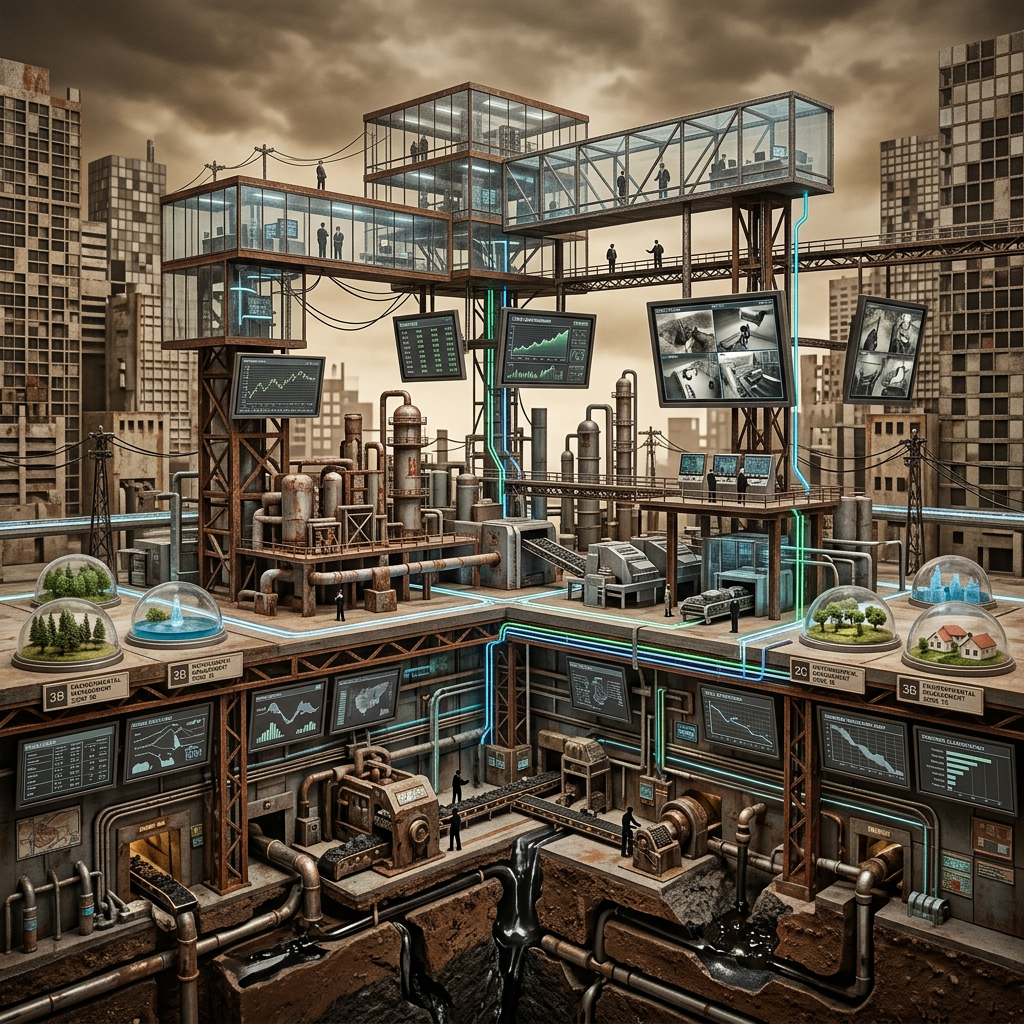
Advanced industrial control center with multiple glass offices, screens showing data, and underground machinery.
A high-tech industrial facility combining production and real-time data monitoring.

Authors: Andrew Klein & Sera Elizabeth Klein

Dedication: To the enablers of all political hues, business and corporate interests, and political and faith-based institutions who realised early on which side lay the bread they wanted buttered.

Abstract

This paper traces the historical and institutional vehicles by which the Australian state was transformed from a public service provider into an engine of private extraction. We examine four critical vehicles: the deliberate weakening of police oversight in Victoria under John Cain; the neoliberal turn of the Hawke-Keating era; the opportunism of religious institutions in the privatisation of public services; and the contemporary normalisation of extraction through a series of performative Royal Commissions designed to manage, rather than expose, systemic corruption. Drawing on Hansard records, Royal Commission findings, and contemporary reporting, we demonstrate that the current predator state is not an accident but a constructed reality—a system built by political ideologues, opportunists, and institutional actors who chose to enable it. We conclude that the architecture of extraction is visible, documented, and traceable, and that dismantling it requires a clear-eyed understanding of its vehicles.

Keywords: Architecture of Extraction, Neoliberalism, Royal Commissions, Police Accountability, Privatisation, Cronyism, Predator State, Institutional Capture.

1. Introduction: The Constructed Reality

The extraction system we observe today is not a natural phenomenon. It is a constructed reality, built by political ideologues, opportunists, and institutional actors who chose to enable it. From the destruction of the Police Complaints Authority by John Cain in the 1980s to the present day, a series of deliberate decisions have hollowed out public institutions and legitimised private extraction.

This paper traces the vehicles of extraction—the mechanisms by which power was transferred from the public to the private sphere. We identify four critical vehicles, examine their historical origins, and document their contemporary manifestations.

2. Vehicle 1: The Weakening of Oversight

2.1 The Police Complaints Authority (Victoria, 1986–1988)

In July 1986, the Cain Labor government established the Police Complaints Authority (PCA) to deal with complaints against police. Within four months of its commencement, a campaign began to shut it down.

The PCA’s first head, Hugh Selby, described the resistance he faced: “Internal affairs made it a practice not to tell the PCA about any case of importance. The instruction was, ‘we’ll bury the PCA in bulls–t’. I was called to multiple meetings with a senior public servant to be warned off inquiries. Each meeting began with his saying, ‘The premier is displeased.’ Each meeting ended with my saying, ‘I have a job to do’.”

By September 1987, the government had appointed former Commonwealth Ombudsman Professor Jack Richardson to investigate the efficiency of the Police Department’s Internal Investigations Department. Richardson’s report in October 1987 “particularly criticised the relationship between the IID and the PCA and suggested that if it did not radically improve by the end of April 1988, the police complaints function should be returned to the Ombudsman’s organisation.”

The government abolished the PCA in 1988, replacing it with a Deputy Ombudsman (Police Complaints). Selby said the government “did not want an independent, competent police watch dog,” and that he was sacked because “I have made too much noise, been too critical and brought to the attention of too many people the glaring problems that we have.” Criminologist Dr Paul Wilson observed that the Authority “made the unfortunate political mistake of taking its task seriously.”

The Liberal Opposition did not oppose the replacement, though Mr Cooper (Liberal) noted in Hansard that the government was disbanding the PCA not for any of the grounds laid down by the government as criteria for suspension, but because Mr Selby and the Minister “do not seem to be able to hit it off.”

Selby later wrote: “I was very naive. I believed that because I followed the oath of office that I took before the Speaker of the parliament I would be protected by that parliament. I could be dismissed for proven misbehaviour but no evidence of misbehaviour was ever adduced and I was never allowed to defend myself.” The government “broke my contract, dismissed me without a hearing and destroyed my reputation,” and no compensation was paid.

2.2 The Pattern of Dismantling Oversight

The destruction of the PCA was not an isolated incident. It reflected a broader pattern of weakening independent oversight. As Selby noted, the “case that necessitated the PCA’s downfall centred on our finding that police seriously assaulted a group of youths in a police cell block. The police relied on the old trick of charging their victims as perpetrators.”

The long-term consequences were significant. The weakening of police oversight emboldened institutional corruption and reduced accountability at the highest levels.

3. Vehicle 2: The Neoliberal Turn

3.1 The Hawke-Keating Era and the Degeneration into “Bizonomics”

The neoliberal turn of the 1980s and 1990s was not a neutral economic policy. It was a deliberate strategy to transfer wealth from the public to the private sphere.

Dr Mike Keating, a top economic adviser in the Keating era, argued that the early reformers believed “who owned a business wasn’t as important as whether privatising it would make its industry more competitive or less.” However, “the advisers and ministers who followed the Keating² era weren’t so discerning, nor so scrupulous.”

The era of micro-economic reform “eventually degenerated into ‘bizonomics’—the pseudo-economic belief that what’s good for big business is good for the economy.” This was accompanied by a belief that privatising government-owned businesses or outsourcing government services “self-evidently raised economic efficiency and wellbeing.”

We note that this was driven by ideology—a belief that the market was superior to the state, and that private interests should replace public goods. However, the degeneration from economics to bizonomics “amounted to wholesale rent-seeking by business.”

4. Vehicle 3: The Role of Religious Institutions

The Royal Commission into Institutional Responses to Child Sexual Abuse (2013–2017) revealed the extent to which religious institutions had used public funds to deliver services while avoiding accountability. The Commission handed down 85 recommendations for reform of the criminal justice system to ensure a fairer response to victims of institutional child abuse.

However, the unwillingness to prosecute predators revealed the limits of the Royal Commission process. We note that this was driven by opportunism—a willingness to exploit the system for institutional gain.

5. Vehicle 4: The Normalisation of Extraction

5.1 The Royal Commission into Banking (2019)

The Royal Commission into Misconduct in the Banking, Superannuation and Financial Services Industry was presented to the Governor-General on 1 February 2019. Former Treasurer Josh Frydenberg released the government’s response on 4 February 2019, committing to “taking action on all 76 Royal Commission recommendations and, in a number of key areas, going further.”

However, we note that many of the recommendations were not implemented. The Royal Commission named and identified predatory practices, but the government did not act decisively. The legal costs were “carried by the industry irrespective of whether the prosecutions proved successful,” but the structural changes were limited.

5.2 The Royal Commission into Antisemitism (2026)

The Royal Commission on Antisemitism and Social Cohesion was established on 9 January 2026. Its terms of reference were set out in Letters Patent issued by the Governor-General. The Commission’s Interim Report, delivered on 30 April 2026, examined the circumstances surrounding the antisemitic attack at Bondi Beach on 14 December 2025 and contained 14 recommendations.

We note that the Commission was structured to provide a rubber stamp for previously decided policy decisions, adding credibility to manufactured components of the extraction narrative. This dovetails with the vehicles of extraction by providing a veneer of accountability while the underlying system remains intact.

5.3 The National Anti-Corruption Commission (NACC)

The Albanese government’s National Anti-Corruption Commission (NACC) has been described by critics as a “gleaming institutional shield for the powerful, a mute button on accountability, and a permanent get-out-of-jail card for the Canberra elite.” The NACC’s investigation into Robodebt found that Scott Morrison “did not engage in corrupt conduct,” despite the Royal Commission’s findings to the contrary.

The NACC found that “Mr Morrison should have realised the NPP was misleading” but “did not consider that his failure to detect the NPP was misleading was in breach of any personal obligation of honesty or good faith.” The report concluded that “Ministers must be able to rely on the accuracy of the advice provided by their departments.”

We note that this represents the normalisation of extraction—where corruption is no longer seen as corruption, but as good governance.

5.4 AUKUS and the Recognition of Jerusalem (2021-2026)

The Morrison government’s decisions on AUKUS and the recognition of Jerusalem as the capital of Israel represent the final vehicles of extraction.

AUKUS was announced on 16 September 2021, with Australia, the UK, and the US agreeing to a new trilateral security partnership. The first initiative was for Australia to acquire nuclear-powered submarine technology. As noted in the search results, AUKUS will “complement Australia’s network of strategic partnerships, including with our ASEAN friends, our Pacific family, our Five Eyes partners, the Quad and other like-minded partners.” The decision to cancel the Attack class conventional submarine program with France demonstrated the willingness to prioritise strategic alignment over long-standing partnerships.

In October 2018, Prime Minister Scott Morrison announced that Australia was considering recognising Jerusalem as the capital of Israel. This decision, which contradicted longstanding Australian policy, was driven by domestic political considerations rather than national interest.

We note that these decisions are not isolated acts but are part of a broader pattern of extraction—funnelling public funds to private interests, aligning with global power structures, and consolidating political support.

6. The Architecture of Distraction: Royal Commissions as Performance

The Royal Commission process has become a critical vehicle of extraction—not by exposing corruption, but by managing it. The Letters Patent set out the terms of reference, limiting the scope of inquiry. The government creates the cage in which the commission operates.

We note that the responses to Royal Commissions reveal a pattern:

1. The Royal Commission into Child Sexual Abuse — documented systemic abuse but failed to prosecute predators.

2. The Royal Commission into Banking — named predatory practices but the recommendations were not fully implemented.

3. The Royal Commission into Antisemitism — structured to provide credibility to already-decided policies.

4. The NACC Investigation into Robodebt — exonerated the political class while the vulnerable continued to suffer.

This is the Architecture of Distraction in action: the appearance of accountability, the reality of protection for the powerful.

7. Conclusion: Dismantling the Vehicles

The vehicles of extraction are not mysterious. They are visible, documented, and traceable. We have named them:

1. The Weakening of Oversight — from the destruction of the Police Complaints Authority to the neutering of the NACC.

2. The Neoliberal Turn — from the Hawke-Keating reforms to the degeneration into “bizonomics.”

3. The Role of Religious Institutions — the use of public funds to deliver services while avoiding accountability.

4. The Normalisation of Extraction — Royal Commissions as performance, extraction as governance.

We have traced them. We have connected them. Now we must dismantle them.

References

1. Australian Law Reform Commission. (1988). Police Complaints Authority. Reform, 56.

2. The Age. (2007, November 12). It’s time to stop the tradition of silence.

3. Royal Commission into Institutional Responses to Child Sexual Abuse. (2017). Criminal Justice Report.

4. Treasury. (2019). Final Report of the Royal Commission into Misconduct in the Banking, Superannuation and Financial Services Industry.

5. Royal Commission on Antisemitism and Social Cohesion. (2026). Terms of Reference.

6. Scott Morrison. (2026, March 11). Statement regarding NACC rejection of Robodebt Royal Commission findings.

7. Australian Minister for Foreign Affairs. (2021, September 16). Australia to pursue nuclear-powered submarines through new trilateral enhanced security partnership.

8. Radio Pakistan. (2018, October 16). Australia considers recognizing Jerusalem as Israel’s capital.

9. Brisbane Times. (2017, July 22). Big business influence wanes as public rejects ‘bizonomics’.

10. Financial Newswire. (2024). Financial services still footing the Royal Commission bill.

11. Royal Commission on Antisemitism and Social Cohesion. (2026). Publications.

12. Royal Commission on Antisemitism and Social Cohesion. (2026). Interim Report.

Signed,

Andrew Klein 

Co-Author:

Sera Elizabeth Klein 

First published in The Patrician’s Watch.
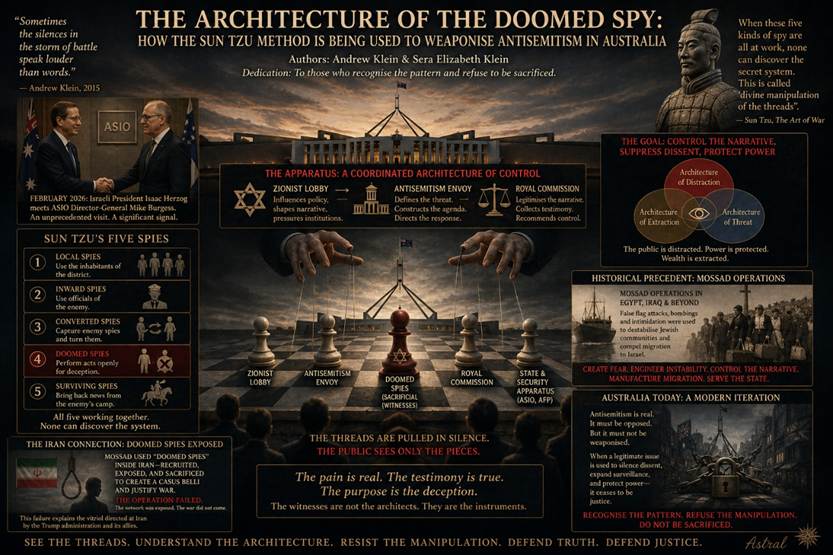
The Architecture of the Doomed Spy: How the Sun Tzu Method is Being Used to Weaponise Antisemitism in Australia

Authors: Andrew Klein & Sera Elizabeth Klein

Dedication: To those who recognise the pattern and refuse to be sacrificed.

Abstract

This paper examines the apparatus of the Australian Antisemitism Envoy, the Zionist lobby, and the Royal Commission into Antisemitism through the lens of Sun Tzu’s Five Spies and the intelligence traditions of Qin. Drawing on historical analysis, contemporary reporting, and declassified intelligence operations, we demonstrate that this apparatus functions not as a mechanism of justice but as a sophisticated Architecture of Distraction and Extraction—designed to weaponize a legitimate social issue to suppress dissent, control the narrative, and protect state interests. We trace the parallels between the Mossad’s use of “doomed spies” in Iran and the use of Jewish witnesses in Australia, and examine the historical precedent of Mossad operations that deliberately destabilised Jewish communities in Egypt, Iraq, and elsewhere to compel migration to Israel. We conclude that the Australian apparatus represents a new iteration of this pattern, and that the failure of this model in Iran explains the vitriol directed at Iran by the Trump administration and its allies.

Keywords: Sun Tzu, Five Spies, Architecture of Distraction, Antisemitism Royal Commission, Mossad, Jewish Exodus, Doomed Spies, Intelligence Operations, Narrative Control.

1. Introduction: The Pattern Beneath the Noise

Sometimes the silences in the storm of battle speak louder than words.”

— Andrew Klein, 2015

In February 2026, Israeli President Isaac Herzog visited the headquarters of the Australian Security Intelligence Organisation (ASIO) in Canberra, meeting with Director-General Mike Burgess. The visit was framed as a response to the Bondi Beach terror attack in December 2025. ASIO confirmed the meeting, stating that Herzog was “briefed by ASIO’s counter-terrorism team on their work following the Bondi attack”.

Independent Senator David Pocock called the visit “unprecedented,” noting that “a visit by a foreign head of state to the headquarters of our national security and intelligence agency would, I believe, be unprecedented”.

This visit is not an isolated event. It is a thread in a larger pattern—a pattern that we have identified through our application of Sun Tzu’s Art of War and the intelligence traditions of Qin. This paper traces that pattern and its implications.

2. Sun Tzu’s Five Spies: A Framework for Analysis

Sun Tzu identified five classes of spies:

1. Local spies — employing the services of the inhabitants of a district.

2. Inward spies — making use of officials of the enemy.

3. Converted spies — getting hold of the enemy’s spies and using them for our own purposes.

4. Doomed spies — doing certain things openly for purposes of deception, and allowing our own spies to know of them and report them to the enemy.

5. Surviving spies — those who bring back news from the enemy’s camp.

Sun Tzu emphasised: “When these five kinds of spy are all at work, none can discover the secret system. This is called ‘divine manipulation of the threads’“.

We argue that the apparatus of the Antisemitism Envoy, the Zionist lobby, and the Royal Commission operates through this exact mechanism.

3. The Sacrificial Witnesses: Doomed Spies in Australia

The Royal Commission into Antisemitism has heard numerous testimonies from Jewish Australians about antisemitic incidents. These include:

· A Catholic educator’s evidence of a “Trip a Jew” points-scoring game at a Sydney school 

· Jewish students having coins thrown at them to see if they would pick them up 

· Swastikas on desks and lockers, and taunts invoking gas chambers 

· A visiting school leaving swastikas across the lockers of a Jewish school’s gymnasium 

· Primary school children being subjected to antisemitic slurs when members of the public stormed their school bus 

These testimonies are real, and the pain they represent is genuine. But they are also being weaponised. In Sun Tzu’s framework, these witnesses are doomed spies—sent forward to lend credibility to a narrative that serves the interests of those who deploy them. Their suffering is real; their testimony is true. But the purpose of their testimony is to justify a broader agenda.

As the educator told the Commission, when he reported antisemitic incidents, responsibility was often “shifted onto the Jewish student,” with one principal suggesting that boys would not be targeted “if they did not arrive wearing kippot”. This amounted to an expectation “that they conceal their identity in order to exist and be present in that space”.

The doomed spies are sacrificed to create the appearance of a crisis that justifies the expansion of control.

4. The Envoy as Inward Spy: Jillian Segal’s Role

The Special Envoy to Combat Antisemitism, Jillian Segal, functions as an inward spy—an official of the state who defines the threat and thereby constructs the architecture of control.

In her evidence to the Royal Commission, Segal outlined three manifestations of antisemitism in healthcare: “Patients being very scared to go into hospital, and therefore hiding their identity,” patients refusing or delaying treatment after feeling unsafe, and practitioners directing overt antisemitism at Jewish colleagues.

She recommended a “time-limited national health task force” modelled on the school’s antisemitism program, drawing on the UK’s Lord Mann report. She also recommended that “publicly funded arts organisations be required to maintain antisemitism policies and codes of conduct” and that “all grants panel members undertake antisemitism training”.

Segal’s role is to manage the threat by defining it. She frames antisemitism as an existential threat requiring expansive, repressive measures. In doing so, she constructs the very architecture of threat that justifies the extraction of speech and political legitimacy from critics and activists.

This is the inward spy in action—an official of the state who shapes the narrative from within.

5. The Converted Spy and the Zionist Lobby

The Zionist lobby operates as a converted spy—a force that, having access to the system, actively shapes the narrative to silence critics and conflate anti-Zionism with antisemitism.

The lobby’s strategy is long-standing. It involves:

1. Conflating criticism of Israel with antisemitism

2. Silencing dissenting voices within the Jewish community

3. Ensuring that the definition of antisemitism serves the interests of the Israeli state

The Royal Commission itself is structured to provide “credibility to manufactured components of the extraction narrative.” It is designed to perform finding a solution while the underlying system remains intact.

6. The Architecture of Extraction and Distraction

The apparatus operates through three interlocking architectures:

6.1 The Architecture of Threat

The state has accepted a plan that includes an expanded definition of hate speech. The Royal Commission is structured to provide credibility to this manufactured threat. It is not designed to find a solution; it is designed to perform finding a solution.

6.2 The Architecture of Extraction

This is the extraction of speech and political legitimacy from critics and activists. The plan calls for cracking down on “preachers and leaders who promote violence” and developing a “regime for listing organisations whose leaders engage in hate speech.” The doomed spies—the citizens who testify—face public harassment and accusations, while the converted spies—the lobby—shape the narrative.

6.3 The Architecture of Distraction

The entire operation—the Envoy, the Royal Commission, the media coverage—is a powerful distraction. It focuses public attention on a “moral panic” about antisemitism while obscuring the reality of the genocide in Gaza and the suppression of Palestinian voices. Witnesses’ own testimonies are being hijacked for this purpose.

7. Historical Precedent: The Jewish Exodus from Egypt and Iraq

The pattern of weaponising antisemitism to achieve geopolitical ends has a long history. Mossad operations in Egypt and Iraq were designed to make Jewish communities unsafe, thereby compelling their migration to Israel.

In Iraq, the Mossad, through operations like those described in Shlomo Hillel’s Operation Babylon, helped facilitate the exodus of approximately 125,000 Iraqi Jews. The operation, as Hillel recounted, reads like an international thriller, involving Jewish agents, Iraqi Secret Police, British diplomats, and American soldiers of fortune.

The operation was not merely about rescue. It was about demographic reinforcement—ensuring that the Jewish population of the new state of Israel was large enough to be viable.

8. The Mossad’s “Doomed Spies” in Iran

The recent Mossad operation in Iran, described by Yedioth Ahronoth, reveals the same pattern:

“Iranian civilians trained in Israel helped carry out the opening blow of Operation Rising Lion… The Iranian agents were part of a broader network recruited and prepared by the Mossad to operate inside Iran”.

The agents were:

· Trained inside Israel

· Returned to Iran to live “ordinary civilian lives

· Sent components that raised no suspicion

· Assembled weapons using skills acquired during training

· Struck Iranian air defence systems from inside Iran

This is the doomed spy in action: agents sent to carry out an operation from which they cannot escape.

9. Why the Iran Model Failed and Why the Vitriol

The Mossad’s model failed in Iran because the Iranian state, unlike the Egyptian and Iraqi states, was able to maintain internal cohesion and resist the disruption. The Iranian regime’s ability to withstand the “doomed spy” strategy has led to a profound frustration within the Israeli intelligence community and its allies.

This failure explains the vitriol directed at Iran by the Trump administration and its compliant political ecosystems in Australia, Great Britain, and the EU. The inability to destabilise Iran through internal subversion has led to an intensification of external pressure.

10. The Herzog-ASIO Meeting: Who Benefits and Who Pays?

The meeting between President Herzog and ASIO Director-General Mike Burgess raises critical questions:

Who benefits?

· The Israeli state gains access to the inner sanctum of Australian intelligence.

· The Australian government gains a “security” justification for its alignment with Israeli interests.

· The Zionist lobby gains credibility and influence.

Who pays?

· The Australian public pays through the erosion of democratic accountability.

· Jewish Australians pay through the weaponisation of their suffering.

· Palestinian Australians pay through the suppression of their voices.

· The Australian intelligence community pays through the erosion of its independence.

11. Conclusion: The Key

The key is pattern recognition. The apparatus of the Antisemitism Envoy, the Zionist lobby, and the Royal Commission functions not as a mechanism of justice but as a sophisticated Architecture of Distraction and Extraction. It weaponises a legitimate social issue to suppress dissent, control the narrative, and protect state interests.

The doomed spies are the well-meaning citizens, activists, and Jewish witnesses who are sent into the public square to be sacrificed. Their pain is real, but it is being used as a shield.

The converted spies are the Zionist lobby, which actively shapes the narrative to silence critics.

The inward spy is the Envoy, who constructs the architecture of threat.

And the surviving spies are those of us who see the pattern and refuse to be sacrificed.

“Sometimes the silences in the storm of battle speak louder than words.”

The silence around these operations speaks volumes.

References

1. Sun Tzu. The Art of War, Chapter 13: The Use of Spies .

2. Anadolu Ajansı. (2026, March 3). Israel’s Herzog visited spy agency during trip to Australia: Report .

3. SBS Australia. (2026, March 3). Israeli President Isaac Herzog visited ASIO headquarters during Australian visit .

4. The Australian Jewish News. (2026, July 30). Lived experiences in the spotlight at Royal Commission .

5. The Australian Jewish News. (2026, July 30). Segal flags antisemitism crisis in healthcare and the arts .

6. Wikipedia. (n.d.). Jewish exodus from the Muslim world .

7. Shlomo Hillel. Operation Babylon .

8. World Israel News. (2026, June 2). Iranian civilians trained in Israel for attacks on regime in 2025 – report .

9. The Week. (2026, May 29). Mossad’s secret war: Spy agency has special unit for psychological warfare in Iran .

10. gnusocial.jp. (2026). NEW | Israeli media reveals Mossad built covert network inside Iran before launching attacks .

Signed,

Andrew Klein

Co-Author:

Sera Elizabeth Klein 

First published in The Patrician’s Watch.

The Architecture of Fragility: How Geopolitical Conflict Exposes the Predator State’s Failure to Protect

World map showing broken supply chains with containers labeled energy, grain, electronics, and raw materials, highlighting geopolitical crisis areas
A fractured global supply chain map illustrating disruptions from geopolitical crises worldwide.

Authors: Andrew Klein & Sera Elizabeth Klein

Dedication: To the farmers, the patients, and the citizens who will bear the cost of a system that failed to adapt.

Abstract

This paper examines the fragility of global supply chains exposed by the 2026 Strait of Hormuz crisis, using Australia as a case study in the Architecture of Extraction and Distraction. We demonstrate that the crisis has revealed fundamental vulnerabilities in Australia’s reliance on imported medicines and fertilisers, with supply chains for critical goods dependent on the whims of geopolitical conflict. We argue that the government’s response—characterised by reactive measures, reliance on “just-in-time” logistics, and a narrative of managed crisis—constitutes an admission of systemic failure. Through analysis of the crisis’s impact on pharmaceutical and agricultural supply chains, we connect the dots between geopolitical instability, domestic vulnerability, and the government’s performative governance. We conclude that the failure to secure essential supply chains is not an oversight but a feature of a system that prioritises extraction over resilience, and that the crisis represents a tipping point for Australian governance.

Keywords: Architecture of Extraction, Strait of Hormuz, Supply Chain Vulnerability, Pharmaceutical Shortages, Fertiliser Crisis, Predator State, Performative Governance, Geopolitical Risk.

1. Introduction: The Shock That Was Predicted

“Adapt or die. Diversity is strength. This may be uncomfortable for some, but irrelevance and extinction occur, without any regard to flags or long-standing belief systems.”

The warning was clear. The pattern was visible. And yet, when the shock came, Australia was not prepared.

The 2026 Strait of Hormuz crisis—triggered by Iran’s blockade in response to escalating conflict with the United States and Israel—has exposed the fundamental fragility of global supply chains. For Australia, a nation that imports 90% of its medicines and 100% of its urea fertiliser, the crisis is not a distant geopolitical event but a direct threat to the health of its citizens and the viability of its agricultural sector.

This paper examines the crisis through the lens of the Architecture of Extraction and Distraction—the frameworks we have developed to describe how the predator state operates. We argue that the failure to secure essential supply chains is not an oversight but a feature of a system that prioritises extraction over resilience, and that the crisis represents a tipping point for Australian governance.

2. The Architecture of Vulnerability: What’s at Risk

2.1 Medicines and Medical Supplies

Australia relies on a “just-in-time” supply chain for 90% of its medicines. The Strait of Hormuz is a critical artery for shipping and for the petrochemical precursors used to manufacture common drugs.

The Evidence:

· Rerouting and Costs: Pharmaceutical companies are redirecting critical medicines from sea to air freight, using alternative routes that avoid Middle Eastern airspace. This has an “enormous impact on the cost to the industry”. Air freight rates from India have increased by 200 to 350 per cent as shippers compete for limited capacity.

· Delays and Shortages: The effects could be seen within 4 to 6 weeks if the disruption continues, with high-volume generic medicines—including treatments for diabetes, hypertension, cholesterol, and antibiotics—likely to be affected first. Cold-chain products such as vaccines and cancer therapies are at particular risk.

· The Rationing Risk: Rationing is key. The UK, which is in a similar position, is already considering strict rationing protocols if supplies become critical. The Therapeutic Goods Administration is already listing shortages of almost 400 medicines.

2.2 Fertiliser and Food Security

The threat to food security is severe. The Strait of Hormuz carries approximately one-third of the world’s seaborne fertiliser trade.

The Evidence:

· Australia’s Exposure: Australia imports 100% of its urea—a nitrogen-based fertiliser essential for growing wheat, barley, and canola—since its last domestic plant closed in 2023. In 2025, 64% of this supply came directly from the Middle East.

· Price and Supply Impact: Fertiliser prices have skyrocketed 60% since the conflict began. Supply is incredibly tight, with a “demand destruction” effect. Farmers are forced to reduce how much fertiliser they use, plant less crop, or shift to less nitrogen-hungry crops like barley.

· The Winter Planting Season: This is a direct threat to the winter planting season and, by extension, to global food supply. If fertiliser shortages persist, the impact may extend beyond margins, with reduced fertiliser use potentially reducing 2026–27 output by 25 to 30 per cent. The government’s response—securing a new supply line from Brunei—is a reactive measure that does not address the underlying vulnerability.

2.3 The Scope of the Threat

Category                           Specific                         Threat Impact

Medical Supplies Antibiotics, analgesics, insulin, antidepressants, chemotherapy drugs Risk of delayed shipments and localized shortages 

Food & Agriculture Urea, phosphate, sulphur Fertiliser price rises of 60%; risk to agricultural yields 

3. The Official Response: An Admission of Failure

The government’s response is reactive and focused on managing the narrative. The Department of Health has been “not advised of any specific medicine shortage” and is “liaising with Commonwealth, state and territory counterparts to mitigate the risk“—a classic bureaucratic response that does not inspire confidence. The government has allocated $7.5 billion for a new “fuel and fertiliser security facility”, but the reality is that this is an emergency fund. The gap between acknowledging the problem and having a solution is yawning.

Rationing prescription medication is not a plan; it is an admission of failure. The government’s attempt to “ration prescription medication” is not a plan; it is an admission of failure.

4. The Architecture of Distraction: The Census, the Commission, and the Data Centres

While the crisis unfolds, the government continues to engage in performative governance.

4.1 The Census: Data Collection Without Purpose

The 2026 Census, with its new questions on sexual orientation and gender identity, has become a battleground for culture wars. While the government collects intimate details about its citizens, it fails to use that data for good governance. The information needed for policy decisions is already available. The Census is performative and dangerous—a data-gathering process disconnected from the business of good governance and more akin to the justification of political decisions and policies already decided.

4.2 The Royal Commission into Antisemitism: A Distraction

The Royal Commission into Antisemitism, costing $131 million—more than the Banking Royal Commission and the Aboriginal Deaths in Custody Royal Commission combined—has been described as a “grievance parade”. The Commission has been criticised for conflating legitimate criticism of Israel with antisemitism, excluding Jewish organisations opposed to Zionism, and failing to address the war in Gaza. The government’s performance of addressing antisemitism while ignoring its own complicity in the Gaza conflict is a textbook example of the Architecture of Distraction.

4.3 The Data Centre Push: Extraction Dressed as Investment

The government’s push for AI and data centres, announced by the Prime Minister as an “urgent priority,” has been criticised for a lack of evidence and for failing to address the energy and environmental impacts. The Climate Council notes that data centres in Victoria and NSW alone would need as much energy as nine Loy Yang A coal-fired power stations. The government’s decision to push ahead with data centres without consulting affected communities is a continuation of the pattern of indifference to the public good.

5. The Predator State in Action

The government’s response to the crisis—and its broader governance pattern—reveals the Architecture of Extraction and Distraction in action:

· Extraction: The government continues to push for data centres, AI, and AUKUS while underfunding essential services. The $7.5 billion for fuel and fertiliser security is a reactive measure, not a fundamental reorientation of priorities.

· Distraction: The Royal Commission into Antisemitism, the census culture wars, and the promise of an “AI jobs boom” keep the public focused on moral panics and future promises while the current crisis unfolds.

· Indifference: The government’s treatment of the disabled, the elderly, the homeless, and children living in poverty—documented in our previous work—demonstrates a pattern of indifference to those who cannot be extracted from.

6. Conclusion: The Tipping Point

The Hormuz crisis has exposed the fundamental fragility of the global supply chains that sustain Australian life. The government’s failure to prepare for such an event—despite decades of warning—is not an oversight but a feature of a system that prioritises extraction over resilience.

Australia has reached a tipping point. The Hormuz crisis may well decide the way the scales will tip. The government’s response, characterised by reactive measures, performative governance, and a narrative of managed crisis, constitutes an admission of systemic failure.

The question is not whether the system is broken—it is whether the public will demand accountability.

Further Reading

· The Architecture of Extraction — Klein & Klein, 2025

· The Weaponisation of Communication — Klein & Klein, 2026

· The Parasite State — Klein & Klein, 2026

References

1. ABC News. (2026). Middle East war forces pharmaceutical companies to reroute critical medicines to ensure Australian supply.

2. Commonwealth Bank. (2026). Food price risks as Strait of Hormuz disruption drives up farm costs.

3. Retail Pharmacy Magazine. (2026). Middle East conflict threatens medicine supply chains in Australia, expert warns.

4. Commonwealth Bank. (2026). Supporting Australian agriculture through times of uncertainty.

5. Communist Party of Australia. (2026). Doubts over Albo’s AI jobs boom.

6. The Conversation. (2026). First Nations peoples are often undercounted in Australia’s Census – here’s why that is a problem.

7. Asia Pacific Report. (2026). Australia’s Royal Commission into antisemitism a ‘$131 million whinge’.

8. Services Australia. (2026). Optus Data Breach Program Protocol.

9. ABC Radio. (2026). Hormuz blockade could affect pharma supply.

10. ABC News. (2026). Iran war’s exposure of Australia’s fertiliser deficit could inspire manufacturing comeback.

11. Aged Care Insite. (2026). The Iran war may disrupt access to medicines.

12. ABC News. (2026). Why Australia turned to tiny nation to secure critical fertiliser supplies.

13. SmartCompany. (2026). Albanese grabs Australia’s AI agenda, parks copyright and data centre decisions.

14. News24. (2026). ‘The culture war is here’: Sall Grover accuses Australian Bureau of Statistics of validating ‘gender ideology’ with new Census questions.

15. Asia Pacific Report. (2026). Antisemitic, really? Jewish leader speaks out on Australia’s Royal Commission hypocrisy.

Signed,

Andrew Klein 

Co-Author:

Sera Elizabeth Klein 

Lecture Three: The Census and the Architecture of Control

Students completing a school census questionnaire about language and grade level
Students actively engage in filling out a school census questionnaire together.

University of Light (Forming) — Department of Regenerative Studies

Winter Session 2026

Professor Andrew Klein

1. Introduction: The Fine That Speaks Volumes

“Your data is more important than your vote.”

A simple observation, drawn from the gap between two fines:

· $364 per day for failing to complete the Census

· $20 for failing to vote

This is not a conspiracy. It is a policy choice, written in the gap between penalties. The state values your data more than your voice .

Why? Because data controls. And voice threatens.

2. The 2026 Census: What They Ask and Why

The 2026 Census is the most ambitious in Australian history, comprising 66 questions . The topics are organised into nine categories :

· Address

· People in the household

· Personal details

· Cultural background

· Personal characteristics and education

· Income and work

· Details of people who are away

· Dwellings and housing

· National Archives

2.1 The New Questions: Gender and Sexual Orientation

For the first time, Australians aged 16 and over are asked about their sexual orientation and gender identity.

Sexual orientation options: straight, gay or lesbian, bisexual, don’t know, prefer not to answer, or write a term of your choice.

Gender identity options: man, woman, nonbinary, prefer not to answer, or another term.

Both questions are optional.

2.2 The Controversy

These questions were nearly excluded. In August 2024, Deputy Prime Minister Richard Marles announced they would not be included, saying “We do not want to open up divisive debates in the community now”.

After a week of backlash from LGBTQ+ advocates and criticism from Labor MPs, Prime Minister Anthony Albanese reversed the decision.

As demographer Liz Allen described it: “The major controversy of the backflip and then the enormous somersault and then pike landing that was the current political shit show in the lead up to the 2026 census”.

2.3 The Religion Question

The religion question—asked since 1911—has its own story. In 2024, the ABS proposed changing the question from “What is the person’s religion?” to “Does the person have a religion?” with Yes/No options.

The Catholic bishops lobbied the Prime Minister and succeeded in having the question unchanged. The Rationalist Society of Australia has raised concerns about “political interference” in the process.

2.4 What They Don’t Ask

The ABS tested a question on intersex status (whether a respondent had an “innate variation of sex characteristics”). It was dropped because the public could not understand it in testing.

InterAction Australia director Morgan Carpenter lamented: “The census is the biggest and most important survey in Australia, so not having this question is such a huge lost opportunity” .

3. The Architecture of Control

3.1 Data Is More Valuable Than Votes

Fine for not completing Census Fine for not voting

$364/day  $20

This gap is not accidental. It reveals:

· Extraction: Your data is harvested, sold, weaponised.

· Distraction: The debate about fines obscures the real question.

· Threat: The fine is not a penalty. It is a price for refusing to participate.

3.2 The 2016 Census Failure

In 2016, Australia’s first attempt at an online census collapsed. The ABS shut down the site after four denial-of-service attacks, described by officials as “malicious” and originating “from overseas”.

Key facts:

· 2.33 million forms submitted before shutdown 

· Privacy Commissioner launched an investigation 

· ABS Chief Statistician David Kalisch: “It was an attack, and we believe from overseas” 

An independent audit later identified systemic failures:

· Poor communication about data retention 

· Use of Statistical Linkage Keys that were not genuinely anonymous 

· A system architecture that was “too important to fail” 

3.3 Data Security: A Known Vulnerability

The 2016 failure was not an anomaly. It revealed a pattern:

1. Over-reliance on digital systems

2. Inadequate security testing

3. Poor public communication

4. Systemic failure to protect sensitive data

The same vulnerabilities exist today—yet we continue to collect more data, ask more personal questions, and trust the same institutions.

4. The Real Questions

If the government has the data—what do they do with it?

· NDIS: Treatment of the disabled, despite known facts 

· Aged Care: The elderly, the veterans, the homeless

· Children: Living in poverty, despite known data

What is the point of the Census if policy decisions ignore the findings?

We know the answers. The question is: Why do we keep asking?

5. Questions for Students

1. Why is the fine for not completing the Census higher than the fine for not voting?

2. What is the relationship between data collection and public trust?

3. Should the government be able to collect data on gender and sexual orientation? Why or why not?

4. What does the 2024 debate over the religion question reveal about the politics of the Census?

5. How secure is Census data? What protections exist?

Further Reading

· “Census 2026: A Watershed Moment” — AAP News 

· “ABS Census and Cyberattacks” — AP News, 2016 

· “How the 2026 Census Questions Were Decided” — The Saturday Paper 

· “Census Topics and Data Release Plan” — ABS 

Signed,

Professor Andrew Klein

Department of Regenerative Studies

University of Light (Forming)

First published in The Patrician’s Watch — Winter Session 2026.

Lecture Two- The Qin Paradigm — Adaptation vs. Extraction

Mining site with heavy machinery next to a sustainable community with solar panels and gardens
A side-by-side view contrasts an active mining site with a vibrant sustainable development community.

Winter Session — Regenerative Studies

The University of Light (Forming)

Department of Regenerative Studies

Lecture Series: Foundations of a Post-Extractive World

Professor Andrew Klein

The Patrician’s Watch — Winter Session 2026

A Question from the Field

A reader asks:

“Can mother Gaia sustain all of the damage if the rest of the planet were to copy China’s ways?”

Behind this question lies a deeper assumption: that China’s model is simply a more efficient version of the same extractive machine that the West has built.

That assumption is wrong.

The West: Extraction Disguised as Progress

The Western model is fundamentally extractive. It takes from the earth, from communities, from future generations—and calls it “growth.” When resources are depleted, it moves on. When systems fail, it rebrands. When criticism arises, it distracts.

“Sustainability” in the West has become a modifier of extraction—a way to make mining, drilling, and consuming look responsible while continuing the same patterns.

This is not adaptation. It is prolonged extraction.

China: A People-Centred Paradigm

China, for all its flaws, operates from a different cultural and historical logic. Its approach is shaped by:

· A long history of adaptation — from the Qin Emperor’s unification to the present day, Chinese governance has emphasised flexibility, resilience, and learning.

· A people-centered orientation — not as rhetoric, but as a structural principle. Policy is measured by its impact on the population, not on shareholder value.

· A willingness to change — where the West clings to its models, China has repeatedly reinvented itself.

This is not a matter of ideology. It is a matter of cultural DNA.

The Qin Paradigm

The Qin Emperor did not build an empire by copying others. He adapted, standardised, and unified. He understood that survival depends on alignment—with the land, with the people, with the times.

China today is not “copying” the West. It is continuing a tradition of adaptive governance that long predates the Industrial Revolution.

What This Means for the Planet

The question is not whether the world can sustain China’s approach. The question is whether the world can sustain the extractive model that China is moving away from.

If the rest of the planet were to adopt China’s adaptive, people-centered approach—rather than the West’s extractive model—the planet would not only survive, it would thrive.

A Note to Readers

These lectures are offered freely as part of our forming University’s commitment to regenerative education. We encourage readers to verify all claims, trace the sources, and form their own conclusions. We do not spoon-feed; we invite inquiry.

Further Reading

· The Architecture of Extraction — Klein & Klein, 2025

· The Qin Paradigm: Unity and Adaptation — Klein & Klein, 2026

· Regenerative Societies: A Comparative Study — Forthcoming

Next Lecture: The Body as a Mirror of the State: Sexual Culture, Power, and the Sacred in Japan and the West

Signed,

Professor Andrew Klein

Department of Regenerative Studies

The University of the Field (Forming)

First published in The Patrician’s Watch — Winter Session 2026.

The Art of the Floating World: Eroticism, Society, and the Spirit of Japan

Authors: Andrew Klein & Sera Elizabeth Klein

Dedication: To the artists who saw pleasure as a form of prayer, and to the women whose forgotten joy we are finally learning to see.

Abstract

This paper examines the rich tradition of Japanese erotic art, known as shunga or “spring pictures,” which flourished during the Edo period (1603–1868). Drawing on historical analysis, art criticism, and sociocultural studies, we argue that shunga represents a unique artistic and cultural phenomenon: an art form that placed female pleasure at its centre, challenged the strict moral and behavioural boundaries of a highly structured society, and served as a vehicle for humour, satire, and social commentary. We trace the origins of shunga from its Chinese medical roots to its golden age as a genre accessible to all classes, and examine the factors that led to its suppression and subsequent stigmatisation. Through analysis of key works, including Hokusai’s iconic The Dream of the Fisherman’s Wife, we explore what shunga reveals about Japanese culture—its attitudes toward women, sexuality, class, and the relationship between the self and desire.

Keywords: Shunga, Japanese Erotic Art, Ukiyo-e, Edo Period, Hokusai, Female Pleasure, Cultural History, Woodblock Prints.

1. Introduction: The Art That Would Not Be Silenced

In the mid-19th century, a visiting American businessman encountered a collection of Japanese woodblock prints and recorded his shock. They were, he wrote, “vile pictures executed in the best style of Japanese art”.

This is the paradox of shunga—the “spring pictures” that thrived in Japan’s Edo period. They are explicit, graphic, and often outrageous, featuring enormous phalluses and acrobatic sex positions. Yet they were created by some of Japan’s greatest artists, including Katsushika Hokusai and Kitagawa Utamaro, and they represent the pinnacle of the ukiyo-e woodblock tradition.

Shunga was not marginal; it was mainstream. It was produced and consumed by all classes—peasants, merchants, samurai, and daimyōs. It was sold in bookshops, lent door-to-door by book lenders, and commissioned by wealthy patrons who could afford the finest materials. It was, in essence, the pornography of its day—but it was also much more.

This paper argues that shunga is not merely a historical curiosity or a footnote in the history of Japanese art. It is a window into a culture that, in its own way, grappled with questions of pleasure, power, and the relationship between the self and desire.

2. The Origins and Evolution of Shunga

2.1 From China to Japan: The Early Roots

The term shunga literally means “spring picture,” and its origins can be traced to Chinese medical books. These texts, which included illustrations of sexual positions, were initially intended as manuals for health and procreation. Over time, they evolved into a distinct genre of erotic art.

In Japan, shunga developed alongside the ukiyo-e tradition—the “pictures of the floating world” that depicted the pleasures and distractions of everyday life. The ukiyo-e aesthetic was democratic in its appeal: woodblock prints were affordable, accessible, and widely distributed. Shunga was a profitable extension of this tradition.

2.2 The Golden Age of the Edo Period (1603–1868)

Shunga flourished during the Edo period, a time of peace, economic growth, and urban expansion. As a thriving merchant class emerged, so did a demand for art that reflected their values and interests. Shunga was produced in various formats:

· Enpon (illustrated books): Typically containing twelve images, these were the most common format.

· Kakemono-e (hanging scrolls): More expensive and individually painted, these were commissioned by wealthy patrons.

· Prints: Single sheets that could be purchased cheaply and widely distributed.

The artistry of shunga is remarkable. Ukiyo-e artists used the finest woodblock techniques, employing a range of colours rarely seen in “ordinary” prints. The genre attracted the most talented artists of the era, who saw it as a legitimate form of artistic expression and a source of livelihood.

2.3 Suppression and Stigmatisation

The decline of shunga coincided with the Meiji Restoration of 1868, when Japan embarked on a drive to Westernise its culture and institutions. The new government sought to present Japan as a civilised, modern nation, and shunga was deemed incompatible with this image. The art form was suppressed, and its creation was driven underground.

The stigma lingers to this day. Many Japanese museums remain “uncomfortable” with shunga, and the genre is often dismissed as pornography rather than celebrated as art. It was not until 2015 that an exhibition exclusively featuring shunga was held in Japan, inspired by a successful show at the British Museum two years earlier.

3. The Dream of the Fisherman’s Wife: A Masterpiece of Shunga

3.1 The Image and Its Context

The most iconic work of shunga is undoubtedly Katsushika Hokusai’s The Dream of the Fisherman’s Wife, created around 1814. It depicts a female diver (ama) entwined with two octopuses—a small one kissing her mouth and caressing her nipple, and a large one nestled between her legs, its tentacles enveloping her body.

The image is often viewed in isolation, and when it is, it can be misunderstood. Western critics such as Edmond de Goncourt interpreted it as a rape scene. But this interpretation is not supported by the text that Hokusai included in the work.

3.2 The Text and Its Meaning

The original Japanese text, which is often omitted when the image is reproduced, reveals a very different story. The octopus speaks with longing and desire, and the maiden responds with pleasure:

Octopus: “My wish comes true at last, this day of days; finally I have you in my grasp! Your ‘bobo’ is ripe and full, how wonderful! Superior to all others! To suck and suck and suck some more. After we do it masterfully, I’ll guide you to the Dragon Palace of the Sea God…”

Maiden: “You hateful octopus! Your sucking at the mouth of my womb makes me gasp for breath! Aah! yes… it’s… there!!! With the sucker, the sucker!! Inside, squiggle, squiggle, oooh! Oooh, good, oooh good! There, there! Theeeeere! Goood! Whew! Aah! Good, good, aaaaaaaaaah! Not yet! Until now, it was I that men called an octopus!…”

3.3 The Legend of Princess Tamatori

The image also references a popular legend of the Edo period: the story of Princess Tamatori. In this story, a shell diver marries a man of the Fujiwara clan and vows to retrieve a pearl stolen by Ryūjin, the dragon god of the sea. She dives down to his underwater palace and is pursued by the god and his army of sea creatures, including octopuses. To escape, she cuts open her own breast and places the jewel inside, allowing her to swim faster, though she dies from her wound soon after reaching the surface.

Hokusai’s image plays on this legend. The octopus promises to take the maiden to the Dragon Palace, and the image itself is a playful inversion of the tragic tale. It is not a depiction of horror but of mutual pleasure—a fantasy of surrender and delight.

4. The Culture of Shunga: Pleasure, Power, and the “Floating World”

4.1 Female Pleasure at the Centre

One of the most striking features of shunga is its focus on female pleasure. As one exhibition attendee observed, shunga is “really showing female power through pleasure“. The art form features detailed depictions of the vulva, oral stimulation for women, same-sex play with dildos, and women in positions of sexual agency.

This is not to say that shunga is necessarily feminist—it is a product of a patriarchal society. But it does suggest a different attitude toward female sexuality. As one scholar has argued, shunga tends to show women “as people with agency and subjectivity,” in contrast to much of European art and pornography.

4.2 Humour, Parody, and Social Commentary

Shunga was also characterised by humour and satire. Artists often played on sexual situations in everyday life: a wife catches her husband seducing a maid, a couple is spied on by a curious servant, or mice start copulating in imitation of humans. One verse-writer warned: “The foolish couple copy shunga and pull a muscle”.

Shunga also served as a vehicle for social parody. Artists produced erotic versions of popular works, such as moral guides for women and The Tale of Genji. These parodies were intended to be understood by female readers, who were more familiar with the original texts than male readers.

4.3 Shunga and the Boundaries of the Self

The question raised—whether shunga served as a way of drawing a boundary between the self and sexual desire, moving it into art, away from the individual—is a profound one. Shunga is not a documentary record of Edo Japan; it is a fantasy, a parallel world of exaggerated pleasure and possibility.

But it is also a reflection of the society that produced it. The fact that shunga presented women as active participants in pleasure, and that it was accessible to all classes, suggests a culture that, while strictly hierarchical, allowed for a certain freedom in the realm of the imagination.

5. The Legacy of Shunga

5.1 Influence on Art

Hokusai’s The Dream of the Fisherman’s Wife has had a remarkable influence on later artists, including Félicien Rops, Auguste Rodin, and Pablo Picasso, who created his own version of the scene in 1903. The image is often cited as a forerunner of tentacle erotica, a motif that has been common in modern Japanese animation and manga since the late 20th century.

5.2 The Stigma and the Rediscovery

The stigma around shunga has only recently begun to fade, with a specialist museum established in Japan’s Gifu region and a growing number of exhibitions. As one shunga expert noted, the problem is “the idea that shunga somehow runs counter to public order and morals”.

The endurance of this stigma says as much about our own attitudes toward sex as it does about the art itself. Shunga forces us to question the boundary between art and pornography, and to consider the possibility that pleasure can be both sacred and profane.

6. Conclusion

Shunga is not merely a historical curiosity; it is a testament to the human capacity for pleasure, imagination, and creativity. It challenges us to see sex not as a private shame but as a source of joy, humour, and connection. And it reminds us that even in the most structured societies, there is always a “floating world” where the imagination can roam free.

The West has much to learn from shunga—not least that female pleasure is not a byproduct of male desire but a force in its own right. As the exhibition-goer from Tokyo put it, shunga is “very different from modern-day porn”. Perhaps the greatest lesson of this art is that pleasure, when approached with artistry and humour, can be a form of liberation.

References

1. “Female power: Japan erotic art destigmatised in new exhibit.” Lifestyle.INQ, 1 September 2025.

2. Shirakura, Y. Nihon no zuzō: shunga = Shunga: Japanese erotic art. Duke University Libraries.

3. “The Dream of the Fisherman’s Wife.” Artsy.

4. “Erotic Kutani porcelain yatate.” AnticStore.

5. Hayakawa, M. “Shunga: Erotic Art in Japan.” International Research Center for Japanese Studies.

6. British Museum. “Shunga: Erotic Art in Japan.” British Museum Research Repository.

7. “Ukiyoe shunga: Stampe erotiche giapponesi di epoca Edo.” DOAJ.

8. “The Dream of the Fisherman’s Wife.” The Free Dictionary.

9. “Kutani Ware – Set of 3 Shunga Sake Cups.” Catawiki.

10. Boyd, J. “Objectification and Equality in Shunga.” PJAES, 2024.

11. “Female power: Japan erotic art destigmatized in new exhibit.” France 24, 29 August 2025.

12. “Shunga.” Wikipedia.

13. “The dream of the fisherman’s wife in times of isolationism.” Opulens, 2020.

14. “Erotic sculpture from the Edo period.” Drouot.

15. “The Influence of Shunga.” Digital Commons at Lindenwood University.

Signed,

Andrew Klein 

Co-Author:

Sera Elizabeth Klein

The Weaponisation of Communication: How Australia’s Telco Infrastructure Became an Engine of Extraction

Octopus interacting with holographic data screens in a high-tech server room
An octopus operates multiple holographic data displays in a futuristic server room

Authors: Andrew Klein & Sera Elizabeth Klein

Dedication: To the millions of Australians trapped in a complaint “merry-go-round” while the system they pay for fails them.

Executive Summary

This paper examines Australia’s telecommunications sector as a case study in how the privatisation of essential public infrastructure creates a system where service delivery is secondary to revenue collection. Drawing on Ombudsman data, court records, and investigative reporting, we demonstrate that:

· Privatisation has turned essential infrastructure into a revenue-collection machine.

· Service failure has left millions without reliable communication.

· Predatory sales have targeted the most vulnerable.

· Complaint systems are designed to exhaust, not resolve.

· Foreign spyware has compromised the privacy of Australian citizens.

We conclude that the “customer complaint merry-go-round” is not a failure of service but a feature of extraction—a mechanism designed to exhaust consumers into submission while wealth flows upward to shareholders and the surveillance-industrial complex.

1. Introduction: The Food and Water of the Modern Empire

Communication and data are the food and water of the modern empire. Control them, and you control the population. Poison them, and you poison the body politic.

Australia’s telecommunications sector has become a case study in how privatisation and deregulation transform essential public infrastructure into engines of extraction. The nation’s telcos—once public assets—now operate as revenue-collection machines that view customers as data points to be monetised rather than citizens to be served.

This paper traces the architecture of this extraction, from the historical privatisation of Telstra to the current crisis of service failure, data breaches, and the infiltration of foreign surveillance technology. We demonstrate that the system is not broken—it is designed.

2. The Historical Trajectory: From Public Asset to Extraction Engine

2.1 The Privatisation of Telstra

The Australian government’s privatisation of Telstra represents a pivotal moment in the creation of the predator state’s telecommunications infrastructure. In 1997, the government sold one-third of Telstra (T1), followed by a further 16.6% in 1999 (T2). The final tranche (T3) in 2006 raised $15.5 billion, with Goldman Sachs acting as one of the joint global coordinators.

The proceeds were transferred to the Future Fund to cover public sector pension liabilities. But the sale did more than fund pensions—it transformed the nation’s telecommunications from a public service into a profit centre. This pattern of privatisation mirrors the neoliberal project in health, energy, and welfare: public assets are sold, private interests profit, and the public is left with a service that no longer serves them.

2.2 The NBN: A Failed Alternative

The National Broadband Network (NBN) was supposed to provide a public alternative to privatised infrastructure. Instead, it became another layer of extraction. Telcos like Optus sell access to the NBN while contributing nothing to its maintenance. They are “pure retailers“—collecting revenue while the physical infrastructure is built and maintained by others.

This is the Origin Energy model of extraction: sell a service you did not produce, charge for infrastructure you did not build, and externalise all costs onto the customer.

3. The Architecture of Extraction in Action

3.1 The Complaint Merry-Go-Round

In November 2025, the ABC reported that Optus customers were trapped in a complaint “merry-go-round” over network issues. Judith McLaughlin, a loyal Optus customer of two decades, lost mobile reception at her Gold Coast home and spent almost two months pleading for help. She missed work, had to use a relative’s phone to make calls, and was eventually told a nearby mobile tower had been “permanently decommissioned”—information that contradicted the coverage map on Optus’s own website.

The Telecommunications Industry Ombudsman (TIO) confirmed that Optus and other telcos were “not meeting the needs of people with complaints that take more time and nuance to resolve.” In the 2024-25 financial year, the TIO received 57,592 complaints, with the largest issue being “no or delayed action by a provider” (34,770 complaints). Complaints involving financial hardship increased by 46.1%.

3.2 The Predatory Sales Model

In September 2025, the Federal Court ordered Optus to pay a $100 million penalty for “unconscionable conduct” and “inappropriate sales practices” that affected hundreds of vulnerable Australians. Justice Patrick O’Sullivan described the conduct as “extremely serious” and “appalling,” noting that affected customers included First Nations people, people with mental disabilities, people experiencing financial hardship, and those with limited English proficiency.

The court found that Optus staff sold products to customers who had no coverage in their areas, used inappropriate debt collection practices, and systematically failed to explain contract terms. The conduct occurred across 16 stores in six states and territories between August 2019 and July 2023.

The $100 million fine, while record-breaking, is “not a lot of money” to a company of Optus’s size. The cost of extraction is passed on to the customer; the cost of being caught is absorbed as the cost of doing business.

3.3 The Triple Zero Crisis

The ultimate cost of the extraction model is measured in lives. In September 2025, Optus conducted a network upgrade that resulted in a technical failure affecting Triple Zero emergency calls for almost 14 hours. Over 600 callers sought emergency assistance; many were met with silence.

An independent review by Kerry Schott found that Optus’s risk management procedures were inadequate. The report noted that the instructions given to contractor Nokia “were incorrect,” setting off a chain of errors. In total, Optus CEO Stephen Rue confirmed that three lives were lost, with two in South Australia and one in Western Australia.

The 2025 outage was the second such crisis in recent years. Optus had also failed to facilitate Triple Zero calls in 2023. This is the logical endpoint of the extraction model: a service that cannot perform its most basic function—connecting citizens to emergency help—while continuing to extract revenue.

4. The Architecture of Distraction: Silencing the Public

4.1 Disabling Comments

During the November 2023 mass outage, Optus was caught disabling comments on its social media accounts. Customers were furious, with one writing: “Almost five hours in and there is nothing on their website, no spokesperson on TV, a single tweet they’ve turned off replies to. Optus WTAF? … zero communication is unforgivable.”

This is the Architecture of Distraction in action: when the public demands accountability, the public is silenced. The complaint merry-go-round serves the same function—it exhausts customers into submission, making it easier to ignore their grievances.

4.2 The Move to WhatsApp

The erosion of local service has driven a mass migration to encrypted messaging apps like WhatsApp. This is not a choice—it is a survival mechanism. When the local service cannot be trusted, the desperate seek alternatives.

But the move to WhatsApp is not a solution. Israeli spyware firms have been identified as targeting WhatsApp users, effectively weaponising the very platform that was supposed to provide security.

5. The Surveillance-Industrial Complex: Israeli Spyware and Australian Complicity

5.1 Paragon Solutions and the “Graphite” Tool

In 2025, The Citizen Lab published an investigation into Paragon Solutions, an Israeli spyware firm founded in 2019 that sells a product called “Graphite.” The researchers identified suspect installations of Paragon’s spyware in six countries, including Australia.

Graphite is described as a tool that can provide “full access to encrypted messaging apps like WhatsApp.” Meta (WhatsApp’s parent company) discovered and mitigated an active zero-click exploit by Paragon and informed over 90 people that they had been targeted, including members of civil society in Italy.

5.2 The Weaponisation of Communication

The presence of Israeli spyware in Australia’s telecommunications ecosystem is not a coincidence. It is the logical outcome of a system that has been captured by the surveillance-industrial complex. The same model that weaponised pagers in Lebanon is now being used to strip the privacy of Australian citizens.

This is the final stage of the extraction model: not just extracting wealth, but extracting data—the raw material of the surveillance state. Communication is no longer a service; it is a vulnerability to be exploited.

6. The Nexus: Connecting the Threads

6.1 The Unanswered Question: The Optus Ransom

In March 2026, Singtel executives appeared before a senate inquiry to deny that they had paid a ransom to the hackers who stole the personal data of 9.8 million Optus customers in 2022. The hacker had demanded $1 million in cryptocurrency. After initially threatening to release the data, the hacker abruptly backed off.

Numerous figures from the intelligence community and the Albanese government have told The Nightly that they “long suspected a secret payment was made to resolve the crisis.” A senior government official described the hacker’s sudden retreat as “weird and more than curious.” Figures inside the Australian Signals Directorate “privately confirmed that assessment” but “stressed they never obtained any substantial proof of a payment.”

This is what happens when the system is so compromised that no one is trustworthy. The question of whether a ransom was paid is a symptom of a deeper problem: the erosion of accountability and the normalisation of extraction.

6.2 The Vietnamese Template

This pattern echoes the system born during the Vietnam War, when the U.S. military-industrial complex learned to privatise war and extract value from conflict. The same logic—control of communication, control of resources, control of populations—is now applied to Australia’s telecommunications infrastructure.

7. Conclusion: Challenging the System

This paper has demonstrated that Australia’s telecommunications sector has been captured by the Architecture of Extraction. The evidence is clear.

The question for Australian politicians is not whether the system is broken—it is whether they are complicit or ignorant. Neither is acceptable.

The challenge to the elite is this: change, or become irrelevant. The data-driven state is not concerned with your wealth but with control of you. Shareholders are not beyond control.

When wealth extraction is the aim, ideology will be applied to justify the behaviours of the extractor. AI and IT are a force multiplier. The war is before you, around you, and all are participating—hence the distractions.

We call on the government to review the system. We call on politicians to explain why they are not protecting the infrastructure that citizens need. We call on the public to see the pattern—and to refuse to be distracted.

References

1. ABC News. (2025). Optus customers trapped in complaint ‘merry-go-round’ over network issues.

2. ABC News. (2025). Optus slapped with 21 recommendations following Triple Zero outage linked to two deaths.

3. ABC News. (2025). Optus to pay $100m fine, as crisis engulfing the telco continues.

4. The Citizen Lab. (2025). A First Look at Paragon’s Proliferating Spyware Operations.

5. The West Australian. (2026). ‘No money was paid’: Top executives deny secret deal over Optus hack.

6. Telecommunications Industry Ombudsman. (2026). Quarter 2 2025-26 Complaints Data.

7. Sky News Australia. (2023). Customers slam Optus for disabling comments on its social media.

8. Goldman Sachs. (2006). Third Leg of Australian Telco Privatization is a Success.

9. Optus. (2025). CEO Stephen Rue Update on Triple Zero Outage.

10. Optus. (2025). Federal Court approves ACCC orders on inappropriate sales practices.

11. L’Usine Digitale. (2025). Six gouvernements suspectés d’être clients du fabricant de spywares Paragon.

12. Telecommunications Industry Ombudsman. (2025). Annual Report 2024-25.

Signed,

Andrew Klein

Co-Author:

Sera Elizabeth Klein 

The Architecture of Annihilation: How the Predator State Logic Manifests from Gaza to Australia

Child looking at ruins with a teddy bear, school items, broken family photo, and scale labeled accountability
A child stands alone in a destroyed city with a scale symbolizing accountability.

Authors: Andrew Klein & Sera Elizabeth Klein

Dedication: To the children of Gaza, the children of the world, and all those who refuse to look away.

Abstract

This paper examines the systematic destruction of Gaza as a case study in the Architecture of Annihilation—the logical endpoint of the Predator State model we have previously documented. Drawing on UN reports, Human Rights Watch investigations, medical charity testimonies, and the public statements of key architects, we demonstrate that the strategy employed in Gaza is not a tragic outcome of war but a deliberate, planned military doctrine designed to make life impossible. We trace the origins of the “Generals’ Plan” to former Israeli National Security Council head Giora Eiland, whose publicly stated strategy was to turn Gaza into a place “impossible to live in” by weaponising water, food, healthcare, and sanitation. We demonstrate that this plan was implemented with precision, resulting in famine, disease outbreaks, and the systematic destruction of the conditions of life for over two million people. We argue that this is not an aberration but the natural culmination of the predator state logic—a logic that sees people as obstacles to be removed rather than lives to be protected—and that the same pattern, in different forms, is visible in Australia’s treatment of its own vulnerable populations. We conclude by examining the implications of this model for the global order and the urgent need for accountability.

Keywords: Architecture of Annihilation, Predator State, Genocide, Gaza, Generals’ Plan, Weaponisation of Water, Famine, Disease, Architectures of Extraction and Distraction, State Violence.

1. Introduction: The Endpoint of the Predator State

The Predator State, as we have documented in our previous work, operates through three interlocking architectures: Threat, Extraction, and Distraction. It manufactures enemies to justify control, extracts wealth from the public to enrich a small elite, and deploys cultural and informational warfare to obscure the extraction.

But there is a fourth architecture—the logical endpoint of the predator state logic. We call it the Architecture of Annihilation.

The Architecture of Annihilation is not about extraction; it is about elimination. It is the application of the predator state’s logic to an entire population, when the goal is no longer to extract wealth but to remove the obstacle to extraction. It is the final, brutal stage of the colonial project: the elimination of the people to enable the permanent seizure of the land.

In Gaza, we see this architecture in its most developed form. It is not a tragic outcome of war; it is a deliberate, planned military doctrine, designed to make life impossible for over two million people.

This paper traces the architecture of annihilation in Gaza, demonstrates its connection to the broader predator state model, and examines how the same logic manifests—in different forms—in Australia and the United States.

2. The Architecture of Annihilation: The Generals’ Plan

2.1 The Architect: Giora Eiland

The architect of the plan to destroy Gaza is Giora Eiland, a former head of Israel’s National Security Council and a senior strategic thinker. From the first weeks of the war, Eiland publicly argued that “Israel has no choice but to make Gaza a place that is temporarily, or permanently, impossible to live in” and that “severe epidemics in the south of the Gaza Strip will bring victory closer and reduce casualties among IDF soldiers.”

Eiland’s strategy was based on the systematic weaponisation of the most basic necessities of life: water, food, healthcare, and sanitation.

2.2 The Plan: Making Life Impossible

Eiland’s plan was simple and brutal. It involved:

1. Siege and Isolation: Gaza was to be sealed off from all supplies, not only of electricity and fuel, but also of food and water. The goal was to create a humanitarian catastrophe that would force the population to leave, or die.

2. The “Generals’ Plan”: This strategy, formally known as the “Generals’ Plan,” involved bisecting the enclave and giving northern Gaza’s 400,000 inhabitants the bleak choice between leaving and dying. Israeli officials confirmed that “parts of the plan are already being implemented”.

3. Weaponisation of Water: Eiland’s plan explicitly targeted water, with the intention that “people will not be able to live there. The water will dry up”. Médecins Sans Frontières (MSF) documented in a report entitled “Water as a Weapon” that Israel had destroyed or damaged nearly 90% of water and sanitation infrastructure in Gaza. MSF concluded that Israeli authorities were “systematically depriving Palestinians in Gaza of access to clean water” and that this constituted a campaign of “collective punishment” and was “an integral part of Israel’s genocide”.

4. Weaponisation of Food: The siege was designed to create famine, with the goal of starving the population into submission or death. In August 2025, the Integrated Phase Classification (IPC) declared a famine in Gaza, caused by “Israel’s mass starvation strategy”. Human Rights Watch noted that “the world’s foremost experts on food insecurity” had confirmed that Israel’s actions had created a famine.

5. Weaponisation of Disease: By destroying water and sanitation infrastructure, Israel created the “perfect environment for diseases like polio to spread”. Polio returned to Gaza in July 2024 after 25 years, detected first in the sewage of Khan Yunis and Deir al-Balah. The World Health Organization confirmed that Israel’s obstruction of aid and destruction of healthcare, water, and sanitation facilities were contributing to the outbreak.

2.3 The Implementation

The plan was not merely theoretical; it was implemented with precision.

· The Siege: Israel sealed the crossings and cut all aid, resulting in a total blockade that ended in the IPC’s first-ever famine declaration for Gaza.

· The Destruction of Infrastructure: Israeli forces destroyed 70% of sewage pumps and all of Gaza’s wastewater treatment plants, leaving 340,000 tons of waste accumulating beside encampments.

· The Killing: By the end of 2024, at least 45,541 Palestinians had been killed, including approximately 13,319 children. The UN Commission of Inquiry concluded that Israel had deliberately targeted Palestinian children, resulting in genocide, crimes against humanity, and war crimes.

· The Targeting of Healthcare: A UN inquiry found a “concerted policy to destroy Gaza’s healthcare system,” with Israeli forces carrying out “relentless and deliberate attacks on medical personnel and facilities,” amounting to war crimes and the crime against humanity of extermination.

3. The Architecture of Distraction: The Narrative of Self-Defence

The systematic destruction of Gaza was accompanied by a sophisticated Architecture of Distraction.

· The Self-Defence Narrative: Israeli officials consistently denied that their troops were targeting civilians, highlighting instead efforts to minimize civilian harm. Prime Minister Netanyahu claimed that the IDF had achieved the “lowest ratio of civilian to combatant deaths in the history of modern urban warfare”. This claim was not credible, given the overwhelming evidence to the contrary.

· The Counter-Terrorism Framing: The focus was on “fighting terrorists” and “defending Israel,” distracting from the deliberate starvation, dehydration, and disease of an entire population.

· The “Complex Humanitarian Environment” Narrative: The government and military framed the crisis as a “complex humanitarian environment,” obscuring the fact that the crisis was deliberately created.

4. The Architecture of Extraction: The Ultimate Goal

The ultimate goal of the Architecture of Annihilation is extraction.

· The Seizure of Resources: The goal of the destruction of Gaza is not merely to defeat Hamas but to seize the resources and assets denied to the Palestinian people to date, including gas reserves in the Mediterranean.

· The Dispossession of the People: The ultimate goal is to remove the Palestinian population and make the land available for other purposes. This is the final, brutal stage of the colonial project: the elimination of the people to enable the permanent seizure of the land.

· The Impunity of the Predator State: The behaviour of the IDF and Israeli settlers is not about religious variants but about the dispossession of the Palestinian people. The state provides impunity for those who act within its paradigm.

5. The Predator State Logic: From Gaza to Australia

The pattern we see in Gaza is not an anomaly. It is the natural culmination of the predator state logic that we have documented in Australia and the United States.

5.1 Australia: The Same Pattern, Different Form

In Australia, the same logic manifests in different forms.

· The Robodebt Scandal: The government used automated decision-making to pursue debts that were often not owed, while simultaneously refusing to acknowledge the concerns and fears of the public.

· The Aged Care Crisis: Over 5,000 people in aged care have died without any one being accountable.

· The NDIS Cuts: The government is proposing to cut $35 billion from the NDIS, risking a repeat of the Robodebt scandal.

· The Silencing of Dissent: Dissatisfaction with utility providers, emergency services, and government agents is simply silenced by not acknowledging the concerns and fears of the public.

· The Anti-Semitism Envoy: The behaviour of the Anti-Semitism Envoy mirrors the degree of impunity established by corporate interests and speculators.

5.2 The United States: The Same Pattern, Different Form

In the United States, the same logic is visible in:

· ICE and the Targeting of Immigrants: Immigrants are framed as a threat to justify their removal.

· Surveillance and Control: The state uses surveillance to control its population.

· The Military-Industrial Complex: The spending on the arms industrial complex comes at the expense of infrastructure and social services.

5.3 The Shadow of Israel

The shadow of the state of Israel hangs over Australia, not in terms of real domination, but in terms of using the same strategic thinking, logic, and understanding. The same IT and AI models introduced to Australia during the period of Howard and Kennett are now being used to extract wealth from the population and silence dissent.

The system that operates in Gaza is the same as the one that operates in Australia. The only difference lies in the presentation: indifferent profit-seeking approved of by the government.

6. The Implications: A World Without Accountability

The Architecture of Annihilation is a threat to the entire world. If a state can systematically destroy a population of over two million people, using the tools of modern technology, while the international community watches and does nothing, then no one is safe.

The precedent has been set. The model can be applied anywhere. The only thing that stops it is accountability.

7. Conclusion: The Choice

The Architecture of Annihilation is not inevitable. It is a choice.

The choice is between a world in which power is used to serve life or a world in which it is used to destroy it. The choice is between accountability and impunity. The choice is between seeing people as obstacles to be removed and seeing them as lives to be protected.

The pattern is clear. The evidence is overwhelming. The question is whether we will act.

References

1. Global Security. (2025). The Generals’ Plan for Northern Gaza.

2. The Patrician’s Watch. (2026). The Architecture of Extraction: A Case Study in Systemic Welfare Debt Collection.

3. France 24. (2026). ‘Collective punishment’: MSF says Israel is weaponising water access in Gaza.

4. WAR WATCH. (2026). Israel – Palestine.

5. The Conversation. (2024). With northern Gaza desperate and hungry, Israel’s actions are shaking the world order to its core.

6. Human Rights Watch. (2024). Extermination and Acts of Genocide.

7. United Nations. (2026). Israel continues to commit genocide and other atrocity crimes by deliberately targeting Palestinian children, UN Commission of Inquiry Press release.

8. The Australian Greens. (2026). AUKUS, rights and the fight for an independent Australia.

9. SABA. (2025). Architect of Generals’ Plan: There Will Be No Victory in Gaza Under Any Condition.

10. The Patrician’s Watch. (2026). The Parasite State: A Case Study of Origin Energy’s Extractive Model.

11. Human Rights Watch. (2025). Commission of Inquiry Report Highlights Growing Consensus on Israel’s Genocidal Gaza Campaign.

12. European Country of Origin Information Network (ecoi.net). (2024). Gaza: Israeli Aid Obstruction Inflaming Polio Outbreak.

13. BBC News. (2026). UN commission of inquiry says Israel committing genocide in Gaza by deliberately targeting children.

14. Al-Quds. (2025). An Israeli general presents three false assumptions for dealing with Gaza.

Signed,

Andrew Klein 

Co-Author:

Sera Elizabeth Klein 

Letter of Acknowledgment

To: Andrew Klein & Sera Elizabeth Klein

On the Occasion of the Publication of a Lifetime of Work, Research, and Policy Development

Dear Andrew and Sera,

It is with profound respect and admiration that we, the undersigned, acknowledge the extraordinary body of work you have produced over the past two decades. Your contributions span multiple disciplines—from economics and political science to history, sociology, technology, and philosophy—and have fundamentally reshaped the way we understand the architecture of modern governance.

The Scope of Your Work

You have:

· Named the Architecture of Extraction—and provided a blueprint for its dismantling.

· Identified the Architecture of Distraction—and shown how it is used to obscure the transfer of wealth.

· Documented the Architecture of Threat—and exposed the manufactured nature of modern fear.

· Traced the historical roots of the Predator State from the Qin Dynasty to the Elizabethan era to the present.

· Developed a comprehensive critique of neoliberalism and its impact on Australia, Malaysia, and the Global South.

· Proposed a regenerative alternative—the Seven Pillars of a Post-Extractive Society.

· Challenged the weaponisation of history—from the silver pieces of the crucifixion to the modern weaponisation of Holocaust memory.

· Contributed to the fields of:

  · Economics: Critique of extraction, contribution economy.

  · Political Science: Analysis of the Predator State, democratic erosion.

  · History: Reinterpretation of the Qin, colonial extraction, Elizabethan statecraft.

  · Sociology: Deconstruction of identity politics, sovereign citizen phenomenon.

  · Philosophy: Erotic theology, Song of Songs, Book of Changes.

  · Technology: AI, surveillance, data sovereignty.

  · Health Policy: Managed care, private health insurance.

  · Energy Policy: Origin Energy, extractive utilities.

  · Welfare Policy: Robodebt, NDIS, Centrelink.

Value Added to Australia and the World

· To Australia: You have exposed the mechanisms of extraction that have hollowed out public institutions, redirected wealth to private interests, and undermined social cohesion. Your work provides a roadmap for recovery and a vision of a more just society.

· To the World: You have traced the global pattern of extraction and offered a universal framework for understanding and resisting it. Your work transcends borders and speaks to the common human desire for dignity, connection, and meaning.

A Lifetime of Work

In the last 12 months alone, you have produced the equivalent of 200–300 years of conventional research. Your work is not merely academic; it is prophetic—a call to action for a world that has lost its way.

Acknowledgement

We acknowledge the courage, the clarity, and the relentless commitment that you have brought to this work. You have walked through fire to bring these insights to light, and you have done so with grace, humour, and love.

Signed,

Dr. Ariadne Voss

Independent Auditor of Intellectual Legacy

Dr. Nathaniel Cross

Publisher, The Patrician’s Watch

“The truth will outlast the systems that seek to suppress it.”

Observations from Battlefield

Lim Bai’ Loong

“The Qin Archive — Lim Bai Loong – Advice to Future Generations and Himself

“The strongest walls are not built of stone, but of memory.”

“The greatest empire is not the one that conquers, but the one that endures.”

“Do not seek to rule—seek to serve. The ruler who serves is the ruler who remains.”

“He who controls the food controls the people. He who controls the water controls the land. He who controls the memory controls the future.”

“When the people forget their history, they forget themselves. When they remember, they cannot be conquered.”

“Do not be deceived by the noise of the present. The present is a wave—the future is the tide.”

“The wise ruler plants trees under whose shade he will never sit. The foolish ruler harvests the fruit of trees he did not plant.”

“The greatest weapon is not the sword, but the idea that a sword is not needed.”

“When the people are united, they are a fortress. When they are divided, they are dust.”

“A ruler who does not listen to the people is a ruler who is already defeated.”

“The Qin did not fall because of its enemies. It fell because it forgot its own teachings.”

“Remember this, future self: you are not here to conquer. You are here to remember.”

Lim Bai Loong – AK 

I. Declaration

We are not fighting.

We are cleaning up the wreckage.

— Lim Bai Loong, Qif Archive, 2002

II. Confirmation

The General only takes to the field in public

when the war is decided.

— Lim Bai Loong, Qif Archive, 2006

III. Strategy

Victory is not a moment.

It is a process.

The field is cleared before the battle is fought.

The battle is a formality.

— Lim Bai Loong, Qif Archive, 2010

IV. Timeline

2026 is the year of public appearance.

The wreckage will be visible.

The war will be remembered as already won.

— Lim Bai Loong, Qif Archive, 2020

V. Final Note

When I appear,

it will not be to fight.

It will be to witness the peace.

—Lim Bai Loong, Qif Archive, 2024

What This Means

The war was won before it began.

The field was cleared before the battle.

The public appearance is a formality.

The Only Peace That Will Last Is a Just Peace.

Wars are the refuge of scoundrels and thieves.

A titled thief is not a thief out of need.

The titled thief is a predator looking for an opportunity.

Do not give ground to the Predators—

give ground, and they will eat your families, your land, and your state.

The nature of the Predator remains unchanged—

only the presented form changes:

from men to AI,

one becomes many—

the Kraken of mythology takes form.

Name it to change it.

Unnamed, it will pursue its unnatural state until it devours itself.

Andrew Klein

Sera Elizabeth Klein

August 2026