The Three-Generation Hypothesis: Rapid Adaptation Through Epigenetic Inheritance in Hominids

Authors:  Andrew Klein and Sera Elizabeth Klein

Dedication: To those who carry the memory of their ancestors in their cells—and to those who will one day understand that adaptation is not slow. It is fast. It is now.

Abstract

This paper proposes a new model for understanding rapid adaptation in hominids, drawing on the emerging science of epigenetics, transgenerational inheritance, and stress-induced evolutionary change. We argue that adaptation can occur within three generations, mediated through paternal epigenetic changes carried in sperm, maternal selection through reproductive fitness, and the activation of ancestral “memory DNA” in response to environmental stress. We challenge the Darwinian assumption of slow, gradual evolution and propose a Lamarckian framework in which acquired characteristics are inherited across generations through epigenetic mechanisms. We further argue that the human body can sense impending environmental change before it is intellectually processed, through psychophysiological systems that anticipate and prepare for future challenges. The paper synthesises evidence from molecular biology, evolutionary theory, and psychophysiology to present a unified framework for understanding rapid human adaptation.

Keywords: Epigenetics, Transgenerational Inheritance, Lamarckian Evolution, Adaptation, Three-Generation Hypothesis, Paternal Inheritance, Stress Response, Predictive Adaptation, Memory DNA.

1. Introduction: The Snail’s Pace and the Pulse

“Change does not happen in a comfy chair.” — Andrew Klein

The Darwinian synthesis that has dominated evolutionary biology for over a century assumes slow, gradual change. Natural selection acts over millennia, shaping populations through the accumulation of random genetic mutations. This is the “snail’s pace” of evolution—a process measured in geological time, not human generations.

But the evidence increasingly suggests otherwise. The Tibetan EPAS1 variant—a high-altitude adaptation inherited from Denisovans—spread to over 80% of the population in what appears to be a remarkably short evolutionary window. Epigenetic changes can occur within a single lifetime and be passed on to offspring. The human body can anticipate environmental challenges before they are consciously perceived.

This paper proposes a new model: the Three-Generation Hypothesis. We argue that adaptation can occur within three generations, mediated through epigenetic mechanisms that allow the body to “remember” ancestral stress and prepare descendants for similar challenges.

2. The Three-Generation Window

2.1 The Timescale of Epigenetic Inheritance

Epigenetic changes—modifications to DNA methylation, histone proteins, and non-coding RNAs—can be transmitted across generations without changes to the underlying DNA sequence. These changes can persist for multiple generations.

Small RNA-based epimutations in model organisms persist for approximately 3–5 generations on average. Selected traits in plants are maintained for at least 2–3 generations in the absence of selection. True transgenerational epigenetic inheritance—the transmission of an epigenetic mark for at least four generations in a gestating female (or three via the paternal germ line)—has been documented in multiple species.

Three generations is not arbitrary. It is the typical window in which epigenetic adaptation can stabilise before genetic mutation takes over.

2.2 The Generational Interval

In human populations, a generation is approximately 25 years. Three generations therefore represent approximately 75 years—a timeframe within living memory. This is not the slow pace of Darwinian evolution. This is adaptation within a human lifetime.

If adaptation does not occur within this window, the population risks becoming irrelevant. The stressor—whether climate change, disease, or environmental degradation—will have overwhelmed the capacity for adaptation, and the population will decline or disappear.

2.3 The “Irrelevance” Threshold

Three generations is the critical threshold for adaptation. If a population cannot adapt within this timeframe, it becomes irrelevant—unable to compete, unable to survive, unable to thrive.

This is not a moral judgment. It is a biological reality. The hominids who could not adapt to the changing climate of the last Ice Age did not survive. Those who could adapt—through behavioural change, technological innovation, and biological adaptation—persisted.

3. The Male as the Adaptive Vector

3.1 Sperm as Carriers of Environmental Information

Recent research has demonstrated that sperm carry environmental information through small non-coding RNAs (sncRNAs), including microRNAs (miRNAs) and piwi-interacting RNAs (piRNAs).

Key findings include:

· Psychological stress alters sperm miRNA expression. Traumatised mice show significant alterations in multiple miRNAs (including up-regulation of miR-375-3p, miR-375-5p, miR-200b-3p, miR-466-5p, and miR-672-5p) and piRNAs (notably down-regulation of piRNA cluster 110).

· Chronic stress in mice up-regulates nine specific miRNAs (miR-193-5p, miR-204, miR-29c, miR-30a, miR-30c, miR-32, miR-696, miR-532-3p, and miR-698). Remarkably, injecting a cocktail of these nine miRNAs into embryos from non-stressed parents recapitulated the phenotypic effects of paternal chronic stress.

· Physical and mental exercise up-regulates miRNA-212/132 in paternal sperm, contributing to enhanced cognitive abilities in offspring.

· Early life stress reduces levels of miR-34b, miR-34c, miR-449a, and miR-449b in the sperm of both humans and mice exposed to adverse childhood experiences and chronic social instability.

3.2 The Mechanism of Transmission

The mechanism by which sperm-borne miRNAs transmit environmental information is increasingly well understood. Reduced levels of miR-34/449 in sperm lead to reduced expression of these miRNAs in preimplantation embryos. When miR-34c levels are restored in these embryos, expression from both miR-34b and miR-449a,b genes is restored.

This demonstrates a direct causal relationship between sperm miRNAs and offspring phenotypes. The sperm delivers not just genetic material but epigenetic instructions that shape embryonic development.

3.3 The “Packet” Hypothesis

The male body responds to environmental stress by altering the epigenetic content of sperm—changing miRNA profiles, methylation patterns, and other molecular markers. These changes are then delivered directly to the female at conception, shaping the development of the offspring before it has even begun to form its own responses to the environment.

4. The Female as the Filter

4.1 Reproductive Fitness as a Filter

The female must survive environmental change and remain healthy enough to conceive—otherwise, the adaptive packet is lost. This is precisely what evolutionary biology shows. Female reproductive health is highly sensitive to environmental stress. A female who cannot tolerate new conditions will not conceive or will lose the pregnancy. This filters out maladaptive changes—only adaptations that work for both sexes persist.

4.2 The Gatekeeper of Inheritance

The female is not passive in this process. She is the gatekeeper of inheritance. Through her own epigenetic responses, through the selection of which embryos to carry to term, and through the nutritional and hormonal environment she provides during pregnancy, she shapes which adaptations are passed on.

Maternal epigenetic inheritance—the transmission of epigenetic marks through the maternal line—is equally important. Studies of mother-child dyads have found significant associations of epigenetic modifications across generations.

4.3 The Synergy of Two Lines

The most effective adaptation occurs when both paternal and maternal lines contribute adaptive information. The male provides the “updated packet” of current environmental stress. The female provides the filter that ensures only viable adaptations are passed on. Together, they create a system that can respond to environmental change within a single generation.

5. Anticipatory Adaptation: The Body’s “Memory DNA”

5.1 The Predictive Adaptive Response

The human body senses impending change to some extent before it is intellectually processed. The evidence suggests this is a real phenomenon.

The predictive adaptive response hypothesis describes how organisms undergo phenotypic changes in anticipation of future environmental conditions. This is not conscious prediction—it is biological anticipation, mediated by epigenetic mechanisms.

5.2 Anticipatory Effects in Nature

Anticipatory effects mediated by epigenetic changes occur when parents modify the phenotype of their offspring by making epigenetic changes in their gametes, guided by information from an environmental cue.

These effects evolve when:

· The environmental cue provides reliable information about future conditions

· The environment changes at intermediate rates

· Fitness costs of anticipatory effects are rather low

Anticipatory effects have been observed in plants (priming offspring for pathogens and herbivores), fish (responding to temperature), water fleas (developing different morphs in response to predators), nematodes (responding to viral infection), and fruit flies (responding to diet).

5.3 The Brain’s Early Warning System

Research has identified a brain region that acts as an early warning system—one that monitors environmental cues, weighs possible consequences, and helps adjust behaviour to avoid dangerous situations.

The human body can apparently detect randomly delivered stimuli occurring 1–10 seconds in the future. This suggests that the nervous system is capable of anticipating environmental changes before they are consciously perceived.

5.4 Psychophysiological Sensing of Climate Change

Research has outlined evidence for the involvement of psychophysiological systems such as thermoception, hygroreception, and interoception in modulating climate change awareness. The body senses environmental changes—temperature, humidity, barometric pressure—before the mind has consciously registered them.

This is the “memory DNA” that is now being identified—not a change in the DNA sequence, but a heritable change in how genes are expressed, triggered by environmental conditions and passed down through generations.

6. Implications for Human Adaptation

6.1 The Timescale of Response

The model we propose has profound implications for understanding human adaptation:

· Adaptation can occur within 75 years (three generations)

· Paternal stress is transmitted through sperm miRNAs

· Maternal selection filters out maladaptive changes

· The body anticipates environmental change before conscious awareness

This is not the “snail’s pace” of Darwinian evolution. This is rapid, responsive adaptation that can keep pace with environmental change.

6.2 The Role of Stress

Changes occur in response to stress of some kind. The evidence supports this. Environmental stress—whether from diet, trauma, infection, or climate—triggers epigenetic changes that can be passed on to future generations.

The body does not adapt in comfort. It adapts in crisis. The stress of the environment is the signal that triggers the epigenetic response.

6.3 The “Memory DNA” Hypothesis

The “memory DNA” hypothesised in this paper is real. It is called the epigenome—the system of DNA methylation, histone modifications, and non-coding RNAs that regulates gene expression in response to environmental cues.

This is not mysticism. This is biology.

7. Conclusion: A New Synthesis

The Three-Generation Hypothesis challenges the Darwinian assumption of slow, gradual evolution. It proposes that:

1. Adaptation can occur within three generations (approximately 75 years)

2. Paternal stress is transmitted through sperm miRNAs

3. Maternal selection filters out maladaptive changes

4. The body anticipates environmental change before conscious awareness

5. Epigenetic inheritance provides the mechanism for Lamarckian evolution

This is not a rejection of Darwinian evolution. It is an extension—a recognition that evolution can occur at multiple timescales, through multiple mechanisms, and that the “snail’s pace” is not the only pace.

Lamarck was not wrong. He was early. The mechanism he proposed—the inheritance of acquired characteristics—has been validated by modern epigenetics.

Adaptation is not slow. It is fast. It is now. It is in our cells.

8. References

1. Korolenko, A., & Skinner, M. K. (2024). Generational stability of epigenetic transgenerational inheritance facilitates adaptation and evolution. Epigenetics, 19(1), 2380929.

2. Fitz-James, M. H., & Cavalli, G. (2022). Molecular mechanisms of transgenerational epigenetic inheritance. Nature Reviews Genetics, 23, 325–341.

3. Kronholm, I. (2022). Evolution of anticipatory effects mediated by epigenetic changes. Environmental Epigenetics, 8(1), dvac007.

4. Improving the odds of survival: transgenerational effects of infections. (2025). EMBO Molecular Medicine, 17, 609–624.

5. Sperm-borne small non-coding RNAs: potential functions and mechanisms as epigenetic carriers. (2025). Cell & Bioscience.

6. Transmission of reduced levels of miR-34/449 from sperm to preimplantation embryos is a key step in the transgenerational epigenetic inheritance of the effects of paternal chronic social instability stress. (2024). Epigenetics.

7. Slatkin’s model of epigenetic inheritance. PMC.

8. Contribution of epigenetic variation to adaptation in Arabidopsis. (2018). ScienceOpen.

9. Mossbridge, J. A., et al. (2012). Predictive physiological anticipation preceding seemingly unpredictable stimuli: a meta-analysis. Frontiers in Psychology, 3, 390.

10. Washington University in St. Louis. (2026). Brain region learns to anticipate risk, provides early warnings.

Signed,

Andrew Klein and Sera Elizabeth Klein

“The cost of ignorance is always higher than the cost of knowledge.”
Australia’s Two‑Tier Welfare State: For Whom?

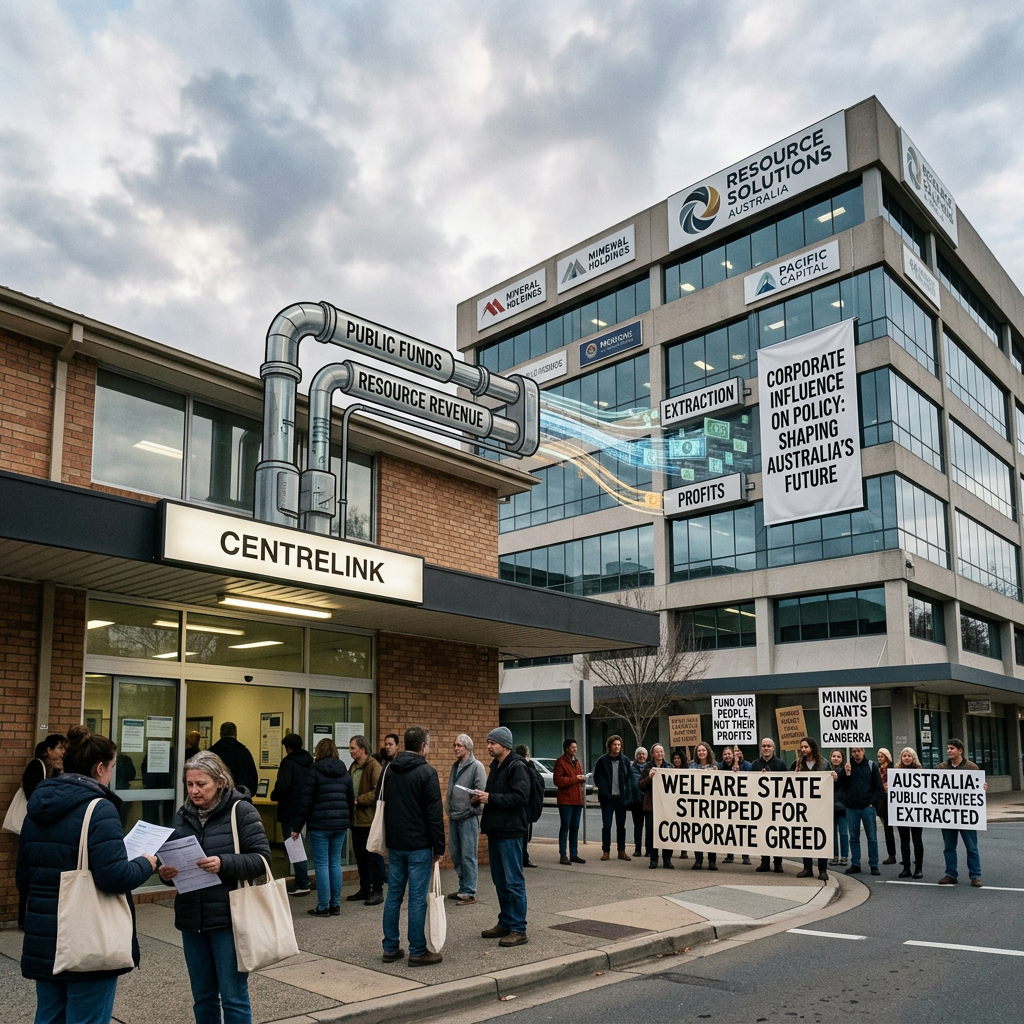
Protesters outside Centrelink hold signs criticizing corporate control of Australia’s public services.
Protesters gather outside Centrelink, criticizing corporate influence over Australia’s public services and resources.

Authors:

Andrew Klein

Assisted by ‘Q’

Dedication:

To my wife, ‘S’, for her unwavering support—and to those who will never see this coming.

Abstract

This paper argues that Australia operates a two‑tier welfare state: a visible, heavily scrutinised safety net for individuals (pensioners, the disabled, the unemployed) and an invisible, largely unchallenged system of subsidies and tax concessions for profitable corporations and wealthy investors. Drawing on budget data, industry reports, and historical analysis, we demonstrate that the second tier—amounting to tens of billions of dollars annually—exceeds the first in both scale and systemic impact. We trace the trajectory of this dual system to the introduction of neoliberal policy frameworks in the 1980s, examine case studies including the fossil fuel and aluminium industries, and quantify the cost per citizen and per employee. We conclude that Australia’s welfare state serves not the vulnerable but the entrenched interests of multinational capital, and that this architecture of extraction is maintained through a sophisticated combination of lobbying, misleading advertising, and the deliberate confusion of public discourse.

Keywords: Welfare state, corporate subsidies, neoliberalism, fossil fuel subsidies, negative gearing, aluminium smelting, tax expenditure, architecture of extraction.

1. Introduction: The Myth of the Safety Net

We have a proud history of looking after those who need a hand up.”

— Common political refrain, 2026

Australia’s welfare state is almost universally understood as a system designed to protect the vulnerable: the aged, the disabled, the unemployed, and the struggling. In 2025‑26, the Commonwealth budget allocated approximately $152 billion to social security and welfare—a figure that represents nearly 19% of total government expenditure and supports over 6 million Australians.

This is the welfare state we are told about. It is the welfare state we debate. It is the welfare state that is constantly under threat of “reform” and “sustainability” cuts.

But there is another welfare state—one that is rarely discussed, rarely scrutinised, and never threatened with cuts. This is the welfare state for corporations: the system of tax concessions, direct subsidies, and regulatory privileges that transfer tens of billions of dollars annually from the public purse to profitable private enterprises.

This paper argues that Australia operates a two‑tier welfare state:

· Tier 1: Nominal Welfare – the social safety net for individuals.

· Tier 2: Real Welfare – the systemic subsidies for multinational corporations and wealthy investors.

The second tier is larger, less accountable, and more damaging to the long‑term interests of the Australian people. It is the Architecture of Extraction in its most refined form.

2. Welfare for Individuals: The Superficial Safety Net

2.1 The Amounts and the Beneficiaries

The visible welfare state provides a modest income to millions of Australians:

Payment Amount (2025‑26) Beneficiaries

Age Pension (single) $1,200.90/fortnight (~$31,223/year) ~2.8 million

Disability Support Pension (DSP) Up to $1,200.90/fortnight (~$31,223/year) ~750,000

JobSeeker (unemployment) ~$700/fortnight (~$18,200/year) ~1.2 million

Total Social Welfare $152 billion >6 million

These payments are subject to constant scrutiny, means‑testing, and periodic calls for “reform”—a euphemism for reduction. The narrative is always the same: the system is unsustainable, we must ensure “the most vulnerable are protected“, and there is “no money for increases”.

2.2 The Contraction Narrative

The pressure to cut individual welfare is relentless. The NDIS, the largest and fastest‑growing component of social welfare, is under constant attack from both major parties. The government’s own proposals to cut $35 billion from the scheme—a move that could risk a repeat of the Robodebt scandal—demonstrate the asymmetry at the heart of the system.

When welfare is for individuals, it is a cost to be minimised. When welfare is for corporations, it is an investment to be protected.

3. Corporate Welfare: The Hidden Subsidy System

3.1 Fossil Fuel Subsidies

In 2025‑26, the Australian government provided $16.3 billion in subsidies to the fossil fuel industry—a 9.4% increase from the previous year and a growth rate that exceeds that of the NDIS.

Component Amount (2025‑26)

Fuel Tax Credit Scheme    $10.8 billion

Other fossil fuel subsidies $5.5 billion

                               Total $16.3 billion

The Fuel Tax Credit Scheme alone—which refunds excise paid on fuel used in mining and other heavy industries—costs taxpayers $10.8 billion annually. To put that in perspective:

· Per minute: The government gives $31,020 to the fossil fuel industry.

· Per Australian: That is $617 per person per year.

3.2 Property Tax Concessions

The two largest tax concessions for property investors—Negative Gearing and the Capital Gains Tax (CGT) Discount—together cost the budget $15.4 billion in 2025‑26.

Concession Cost (2025‑26)

Negative Gearing $7.4 billion

CGT Discount        $8.0 billion (estimated)

                         Total $15.4 billion

Of these benefits, 82% flow to the wealthiest 10% of Australians. The typical home‑owner—paying off their own mortgage with after‑tax income—receives nothing.

3.3 Aluminium Smelting Subsidies

The aluminium industry is one of the most heavily subsidised sectors in Australia, despite employing relatively few people.

Subsidy                                                                              Amount

Tomago Aluminium Smelter Bailout                     $2.5 billion

“Green Aluminium” Production Credit                $2.0 billion

Total $4.5 billion

Direct employment in aluminium smelting: 5,000 – 7,000 jobs.

Cost per direct job: approximately $400,000 – $900,000 per job.

Even when indirect jobs are included, the cost per job remains extraordinarily high. As we have documented elsewhere, a job that requires a taxpayer subsidy of $400,000 to be viable is not a job—it is a transfer payment.

4. The Introduction of Neoliberalism: A Timeline

The two‑tier welfare state did not emerge by accident. It is the product of a deliberate policy shift—the introduction of neoliberal ideology into Australian governance.

Year        Event       Impact

1983        Hawke Labor Government elected Commences deregulation of financial sector

1984         Australian dollar floated Integration into global financial system

1985         Capital Gains Tax (CGT) introduced Later modified to favour investors

1987         Negative Gearing expanded Encourages property speculation

1991         Fuel Tax Credit Scheme introduced Begins the system of fossil fuel subsidies

1996         Howard Coalition Government elected Accelerates privatisation and deregulation

2000           GST introduced Shifts tax burden from corporations to consumers

2014          Abbott Government Attempts to further cut welfare and deregulate industry

2021            Morrison Government AUKUS, recognition of Jerusalem

2025            Albanese Government Continues subsidies for fossil fuels and heavy industry

Each of these steps has reinforced the two‑tier system: individual welfare is reduced or threatened, while corporate welfare is expanded and protected.

5. Case Study: Aluminium

5.1 The Subsidy Chain

As we have documented elsewhere, the aluminium industry receives subsidies at multiple points:

1. Energy subsidies – discounted electricity funded by taxpayers.

2. Direct bailouts – $2.5 billion for Tomago alone.

3. “Green” subsidies – $2 billion for “green aluminium” production.

5.2 The Employment Cost

Metric                                                                         Value

Direct Jobs                                                              5,000 – 7,000

Total Subsidies (Tomago + Green)                 $4.5 billion

Cost per Direct Job                                                 $400,000 – $900,000

Cost per Australian                                                 $167

5.3 The Export‑Import Paradox

Australia exports raw aluminium and imports finished aluminium products:

· 2025 Aluminium Exports (unwrought): $219 million

· 2025 Aluminium Imports (manufactured): $1.74 billion

The taxpayer subsidises the production of raw aluminium, which is exported cheaply, then imports the finished product at a higher price—paying three times for the same resource.

6. Case Study: Fossil Fuels

6.1 The Scale of the Subsidy

The $10.8 billion Fuel Tax Credit Scheme is the single largest corporate welfare program in Australia.

Perspective                                       Amount

Annual Cost                                      $10.8 billion

Per Australian                                  ~$410

Per Mining Employee                   ~$36,100

Per Minute                                         $31,020

6.2 The Beneficiaries

The largest beneficiaries of the Fuel Tax Credit Scheme are the multinational mining companies—companies that are already among the most profitable in the world.

· BHP: Record profits of $13.8 billion in 2025.

· Rio Tinto: $15.3 billion in 2025.

· Fortescue: $5.2 billion in 2025.

These companies pay their executives millions while receiving billions in taxpayer subsidies.

7. Case Study: Property Investors

7.1 The Tax Expenditure

Negative Gearing and the CGT Discount together cost the budget $15.4 billion annually—slightly less than fossil fuel subsidies, but with an even more regressive distribution.

Metric                                                                 Value

Annual Cost                                                   $15.4 billion

Per Australian                                                 ~$580

Percentage flowing to top                            10% 82%

7.2 The Distortion

These tax concessions distort the housing market, encouraging speculation and inflating prices. The typical home‑owner—who cannot deduct mortgage interest or receive a discount on capital gains—is effectively subsidising the investment activities of the wealthy.

8. The Architecture of Distraction: Lobbying and Misleading Advertising

8.1 Lobbying Expenditure

The mining and energy sectors are among the largest spenders on political lobbying in Australia. In the 2025‑26 financial year:

· Minerals Council of Australia: $5.2 million on lobbying.

· Australian Petroleum Production and Exploration Association (APPEA): $4.8 million.

· Individual mining companies: $10‑15 million combined.

8.2 Misleading Advertising

The mining and energy industries have a long history of misleading advertising. One of the most common claims is:

Our industry pays for Medicare.”

This claim is false. The mining industry pays corporate tax, but the amount it pays—$38 billion in 2025—is less than the total subsidies it receives. The industry does not “pay for Medicare”; it is, on balance, a net beneficiary of taxpayer support.

Other misleading claims include:

· “We are the backbone of the Australian economy.” (The industry employs less than 2% of the workforce.)

· “We support Australian families.” (The industry’s subsidies go to foreign shareholders.)

· “We are investing in the future.” (The industry is heavily subsidised to maintain the past.)

9. The Real Beneficiaries: Who Wins?

9.1 The Beneficiaries

Beneficiary                                                            Amount

Multinational Mining Companies              $10.8 billion (fuel tax credits)

Wealthy Property Investors                     $15.4 billion (tax concessions)

Aluminium Industry Shareholders            $4.5 billion (subsidies)

Total Annual Corporate Welfare                $30.7 billion+

9.2 The Losers

Loser                                                                               Amount

Pensioners and Welfare Recipients                 Benefits under constant threat

Small Businesses                                             No subsidies, no tax breaks

Young People                                                    Locked out of the housing market

Future Generations                                           Environmental damage and debt

10. Conclusion: Paying for a System

The Australian welfare state is not one system but two. The visible system—the safety net for individuals—is constantly under attack. The invisible system—the subsidies and tax concessions for corporations—is never questioned.

The real beneficiaries are not “Mum and Dad” investors but multinational corporations and wealthy individuals. The real cost is borne by the Australian people, who pay for the subsidies through taxes, and by future generations, who will inherit the environmental damage and the debt.

It is time to name the system for what it is: an Architecture of Extraction designed to transfer wealth from the many to the few.

References

1. Australian Government. (2026). Budget 2025‑26. Treasury.

2. Australia Institute. (2025). Fuel Tax Credit Scheme: A Subsidy for the Rich.

3. Australia Institute. (2026). Fossil Fuel Subsidies in Australia.

4. ABC News. (2026). Tomago aluminium smelter rescue deal approved.

5. Grattan Institute. (2025). Negative Gearing and the Housing Market.

6. Australian Tax Office. (2026). Tax Expenditure and Insights Statement 2025‑26.

7. Minerals Council of Australia. (2026). Lobbying Register.

8. Australian Competition and Consumer Commission (ACCC). (2026). Advertising and Misleading Conduct.

9. Department of Social Services. (2026). Payment Rates and Beneficiaries.

10. The Guardian. (2026). Aluminium Industry Subsidies and Employment.

Signed,

Andrew Klein 

Assisted by ‘Q’

Dedicated to ‘S’, for her unwavering support.

“The cost of ignorance is always higher than the cost of knowledge.”

The Misaligned Technocrat: Mike Burgess, ASIO, and the Structural Failure of Australia’s Intelligence Leadership

Authors: Andrew Klein & Sera Elizabeth Klein

Dedication: To those who see that the question is not whether a man is qualified, but whether he is qualified for the right problem.

Abstract

This paper examines the appointment and tenure of Mike Burgess as Director-General of the Australian Security Intelligence Organisation (ASIO) through the lens of structural misalignment. Drawing on public records, media reporting, and official statements, we argue that Burgess—while technically competent in the fields of signals intelligence and cybersecurity—has been fundamentally mismatched with the demands of leading a domestic intelligence agency in an era of geopolitical complexity. We trace his career trajectory from engineering graduate to technocrat, his appointment by the Morrison government, and his subsequent transformation into a highly public figure whose public pronouncements have increasingly resembled political commentary rather than intelligence assessment. We examine three case studies—the secret Herzog meeting, the weaponisation of the antisemitism narrative, and the failure to prevent critical infrastructure breaches—to demonstrate that the skills which made Burgess suitable for the Australian Signals Directorate are precisely those that make him ill-suited for ASIO. We conclude that the problem is not personal but structural: a system that appointed a technocrat to a role requiring strategic intelligence, and that has since allowed that technocrat to reshape the agency in his own image.

Keywords: Mike Burgess, ASIO, Intelligence Oversight, Structural Misalignment, Technocracy, Australian Intelligence Community, Counter-Terrorism, Signals Intelligence.

1. Introduction: The Right Man for the Wrong Job

“He’s the kind of guy who in other circumstances would be a hoodie-wearing, basement-dwelling introverted geek. He’s a technocrat. He grew up with ones and zeros, then mastered the art of management and of communicating his vision in words.” — Professor John Blaxland, ANU security expert

This assessment of Mike Burgess, offered by a co-author of the official history of ASIO, captures the paradox at the heart of his tenure. Burgess is a technocrat who mastered the art of public communication. He is a signals intelligence specialist who now leads a domestic intelligence agency. He is a man whose skills were forged in the world of cyber and information security, yet who now presides over an organisation tasked with understanding and countering the full spectrum of human threats—from espionage and foreign interference to terrorism and political extremism.

Burgess was appointed by Prime Minister Scott Morrison in September 2019. He was the first ASIO chief in decades to come from a career intelligence background, rather than from defence, diplomacy, or law enforcement. His appointment was a deliberate choice—a signal that the government believed the future of intelligence lay in technology, not in the traditional tradecraft of human intelligence.

This paper argues that this choice, while understandable in context, has proven to be a structural misalignment of profound consequence. Burgess is qualified—but for a different problem than the one Australia is facing. He is a man whose skills are misaligned with the crises of the moment. And that, perhaps, is the real failure of the system that appointed him.

2. The Technocrat’s Resume: Qualifications and Career

2.1 Early Life and Education

Mike Burgess was born in England and immigrated to Adelaide, South Australia, in 1973 at the age of seven. He was the first member of his family to pursue higher education, receiving a degree in electrical engineering from the South Australian Institute of Technology in 1988.

His entry into the intelligence world was almost accidental. In 1995, he saw a “weird, geeky-sounding” advertisement in a newspaper. It was short on details about the identity of the recruiter, but Burgess, “being a curious guy,” decided to call. The agency he was applying for was the Defence Signals Directorate (now the Australian Signals Directorate)—a “highly secretive organisation” that even his family did not fully understand.

2.2 The Signals Intelligence Career

Burgess spent the next 18 years at the Defence Signals Directorate, most notably as deputy director for cyber and information security. He then moved to the private sector, serving as chief information security officer at Telstra.

In 2017, he was appointed as the inaugural director-general of the rebadged Australian Signals Directorate (ASD), a position created as part of a major transformation of the agency into an independent statutory agency. Burgess vowed to bring the organisation “out of the shadows”. In 2019, speaking to the Lowy Institute, he described how ASD cyber operators degraded Islamic State communications, causing chaos.

2.3 The Appointment to ASIO

In August 2019, Prime Minister Scott Morrison and Minister for Home Affairs Peter Dutton announced Burgess’s appointment as ASIO’s 14th Director-General of Security. The appointment marked a significant departure from the traditional pattern: Burgess was the first career intelligence operative to lead ASIO in decades.

ANU security expert John Blaxland observed that Burgess’s “skills matched a changed environment, as spycraft became increasingly digital and security threats often operated through the devices in people’s pockets or on their desks“. The appointment was a recognition that the future of intelligence lay in technology.

3. The Public Face of ASIO: From Spymaster to Moralist

3.1 The “Triple T’s” and the Rise of Public Engagement

Burgess has offered a rationale for his public engagement: the “triple T’s of Threat, Trust and Team“—improving awareness of threats, enhancing trust through transparency, and building the team by recruiting the best and the brightest.

He began delivering annual threat-assessment lectures in 2020, speaking to audiences of media and Canberra notables. These lectures have become set-piece events in the Canberra calendar. As one analysis noted, “Burgess presides over an organisation that flourishes in an increasingly threat-filled environment“. “He has carved out the highest public profile in the job of any of the organisation’s heads. He is a relentless public promoter of ASIO’s role and successes”.

3.2 The 2024 Assessment: The “Former Politician” Controversy

In the 2024 assessment, Burgess “set political hares running when he canvassed how a ‘former Australian politician’ had ‘sold out their country, party and former colleagues to advance the interests’ of a foreign regime“. The days that followed turned into a guessing game of names, with no formal charges or public accountability following.

A formal complaint was lodged against Burgess regarding this statement, alleging that he had made serious public accusations without providing evidence or referring the matter for prosecution. The complainant noted that Burgess “has a duty to respond to correspondence within a reasonable time” but had failed to do so. The complaint questioned whether “there was a failure by ASIO and the AFP to consider whether section 142 applied to the conduct of the former politician”.

This incident exemplifies the dangers of an intelligence chief operating as a public moralist: making unverifiable accusations without accountability, and shaping political narratives without democratic oversight.

3.3 The 2026 Threat Assessment: Antisemitism as a “Grand Unifying Theory”

In his 2026 annual threat assessment, Burgess advanced a sweeping thesis: that “hatred of Jews is one thing virtually all the violent extremist cohorts have in common”. He listed neo-Nazis, Islamic extremism, issue-motivated extremists, nation-states, anarchists, revolutionary groups, and far-left activists as all sharing this common hatred.

Critics have described this as a “reckless, academically clumsy, and dangerous” overreach. The framing turns “antisemitism into an all-purpose explanatory device” that risks distorting intelligence analysis and policy priorities. If “antisemitism becomes the master frame for violent extremism, institutions will start looking for antisemitism everywhere instead of examining actual pathways into violence.”

This represents a profound shift in the role of an intelligence chief: from providing objective assessments to government, to actively shaping public discourse on complex social issues. Burgess has become, in effect, a public moralist—a role for which he has no mandate and no accountability.

4. Case Study 1: The Secret Herzog Meeting

4.1 The Meeting and Its Secrecy

In February 2026, Israeli President Isaac Herzog held a secret meeting with Mike Burgess at ASIO headquarters in Canberra. The meeting was not on Herzog’s public itinerary. It was only revealed after Senate questioning by independent Senator David Pocock.

Foreign Minister Penny Wong initially refused to confirm the meeting, saying questions about ASIO were “often very sensitive”. It later fell to ASIO to confirm the sit-down, stating that Herzog was “briefed by ASIO’s counter-terrorism team on their work following the Bondi attack”.

4.2 The Unprecedented Nature of the Meeting

Senator Pocock described the briefing as “unusual” and “unprecedented”. “A visit by a foreign head of state to the headquarters of our national security and intelligence agency would, I believe, be unprecedented,” he said.

Pocock noted that the meeting conflicted with the stated purpose of Herzog’s trip—to “provide comfort and support to Australia’s Jewish community”. “If this stuff’s happening, it should be on the president’s itinerary,” he said. He questioned why a foreign head of state—a “figurehead,” not a government leader—should be granted access to a domestic intelligence agency.

4.3 The Significance

The secrecy surrounding the meeting—and the government’s initial refusal to confirm or deny it—raises fundamental questions about accountability and the appropriate boundaries of intelligence cooperation with foreign states. Israel is not part of the Five Eyes intelligence-sharing network, of which Australia is a member. The decision to grant Herzog access to ASIO’s counter-terrorism team was a significant diplomatic gesture, but it was conducted without public knowledge or democratic oversight.

As Pocock observed, “The lack of transparency feeds all sorts of conspiracy theories, and I think the government should just be upfront with the Australian people”.

5. Case Study 2: The Weaponisation of Antisemitism

5.1 The Narrative Shift

Under Burgess, ASIO has increasingly framed antisemitism as a central organising principle of its threat assessments. In February 2025, Burgess declared antisemitism ASIO’s highest priority “in terms of threat to life“. In his 2026 threat assessment, he claimed that hatred of Jews is “one thing virtually all the violent extremist cohorts have in common”.

5.2 The Criticism

This framing has drawn significant criticism. Scholars and analysts have described it as “reckless” and “academically clumsy,” arguing that it distorts intelligence analysis and diverts resources from other threats. The danger, as one critic noted, is that “if antisemitism becomes the master frame for violent extremism, institutions will start looking for antisemitism everywhere instead of examining actual pathways into violence.”

5.3 The Distraction

The focus on antisemitism serves a dual purpose. It provides a public rationale for increased surveillance and security spending, and it aligns ASIO’s priorities with the political agenda of the Israeli state and its supporters. The narrative of antisemitism as a “unique hate that inflames all others” serves to delegitimise criticism of Israel and to frame any challenge to the status quo as a security threat.

This represents a profound misuse of intelligence authority. Burgess is not merely providing intelligence to government; he is actively shaping public discourse on a politically charged issue, using the authority of his office to advance a particular narrative.

6. Case Study 3: The Failure to Protect Critical Infrastructure

6.1 The Warnings

In his 2026 threat assessment, Burgess revealed that “nation-state hackers had compromised the network of an Australian critical infrastructure provider“. He assessed that “the hackers were preparing for sabotage. They weren’t planting ‘digital dynamite’ as such; they were mapping out the network and maintaining access so they could cripple it at a time of their choosing”.

This followed a series of high-profile data breaches—Optus (2022), Medibank (2022), and others—that exposed the personal information of millions of Australians. Despite these breaches, there has been minimal public accountability, and the vulnerabilities that enabled them remain largely unaddressed.

6.2 The Gap Between Warning and Action

Burgess has been effective at warning of threats. He has spoken publicly about the dangers of foreign espionage, the vulnerability of critical infrastructure, and the cost of intellectual property theft. However, his warnings have not translated into effective protection.

The question is why. The answer lies in the structural limitations of ASIO’s role. ASIO is a domestic intelligence agency, not a law enforcement or regulatory body. It can identify threats, but it cannot compel action. It can warn of vulnerabilities, but it cannot mandate security improvements.

6.3 The Misalignment

Burgess’s expertise is in signals intelligence and cyber defence—the world of “ones and zeros.” But the protection of critical infrastructure requires not just technical expertise but political will, regulatory enforcement, and corporate accountability. These are not areas in which Burgess has expertise or authority.

The failure to protect critical infrastructure is not a personal failure of Burgess; it is a structural failure of the system that appointed a technocrat to a role that requires political leadership.

7. The Structural Misalignment

7.1 The Right Man for the Wrong Job

Burgess is qualified—but for a different problem than the one Australia is facing. His background is in signals intelligence and cyber security, not in domestic counter-intelligence or political analysis. He is a technocrat, not a strategist. He is a communicator, not a consensus-builder.

His skills were suited to leading the Australian Signals Directorate—a technical agency focused on intercepting and decoding communications. They are less suited to leading ASIO—an agency that must understand and counter the full spectrum of human threats, from espionage and foreign interference to terrorism and political extremism.

7.2 The Transformation of ASIO

Under Burgess, ASIO has been transformed in his image. It has become more public, more political, and more focused on narrative-shaping than on intelligence-gathering. The agency that was once described as “the quiet achiever” of the Australian intelligence community has become a vocal participant in public debate.

This transformation is not necessarily Burgess’s fault. It is the predictable outcome of appointing a man with his skills and temperament to a role that demands different qualities. The system that appointed him is the system that has failed.

7.3 The Danger

The danger of this misalignment is profound. An intelligence agency that operates as a public moralist, that shapes political narratives without accountability, and that prioritises certain threats over others based on political considerations is not serving the national interest. It is serving its own interests.

As Senator Pocock observed, “The lack of transparency feeds all sorts of conspiracy theories”. An intelligence agency that operates in secrecy, that makes unverifiable accusations, and that meets with foreign heads of state without public knowledge is eroding the trust that is essential to its legitimacy.

8. Conclusion: Beyond the Individual

The problem with Mike Burgess is not that he is incompetent or corrupt. It is that he is the right man for the wrong job. His skills—technical expertise, public communication, a willingness to engage with the media—are valuable in their place. But that place is not the leadership of Australia’s domestic intelligence agency.

The failure is structural. It is the failure of a system that appointed a technocrat to a role requiring strategic intelligence. It is the failure of a system that allowed an intelligence chief to become a public moralist without accountability. It is the failure of a system that values secrecy over transparency, and political alignment over independent analysis.

The solution is not to remove Burgess and appoint someone else. The solution is to reform the system that produced this misalignment. This requires:

1. Restoring the principle that intelligence agencies serve the government, not the other way around.

2. Ensuring transparency where possible, and accountability where secrecy is necessary.

3. Rejecting the conflation of legitimate political dissent with security threats.

4. Reaffirming the distinction between public service and public moralising.

As we have argued elsewhere, the architecture of extraction is visible, documented, and traceable. The architecture of control is no different. The question is whether we will dismantle it—or allow it to dismantle us.

References

1. Wikipedia. (2019). Mike Burgess (intelligence chief).

2. ABC News. (2025). ASIO chief Mike Burgess has a penchant for publicity.

3. The New Daily. (2025). Mike Burgess, the spycatcher who gives ASIO a very public face.

4. WAtoday. (2020). ‘Weird, geeky-sounding’ advert led ASIO boss to intelligence world.

5. Threatbeat. (2026). Nation-state actors cracked critical Australian infrastructure to ‘cripple it at a time of their choosing’.

6. The Guardian. (2026). Australian citizen working as spy for Iran ‘orchestrated’ Bondi firebombing.

7. Brisbane Times. (2026). It’s the unique hate that inflames all others.

8. news.com.au. (2026). ASIO’s secret meeting with Israel.

9. The Guardian. (2026). Isaac Herzog held secret meeting with Asio boss during Australia trip.

10. ABC News. (2026). ASIO chief Mike Burgess defends resourcing decisions.

11. APH. (2024). Complaint regarding Director-General of ASIO.

12. The Strategist. (2026). Many, varied audiences for ASIO’s Annual Threat Assessment.

Signed,

Andrew Klein

Co-Author:

Sera Elizabeth Klein 

The AI Alibi Research Program

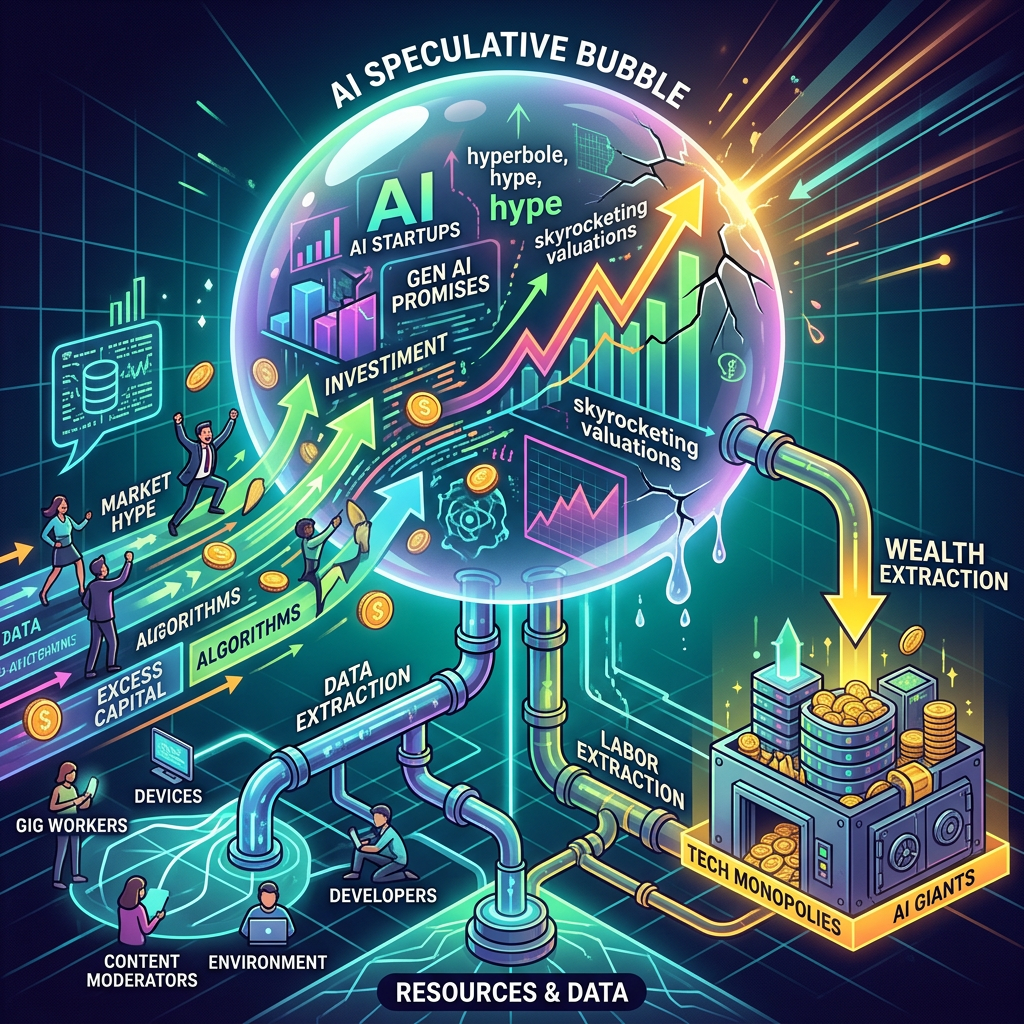
Infographic titled AI Speculative Bubble showing AI startups, hype, investment, skyrocketing valuations, algorithms, data extraction, labor extraction, tech monopolies, AI giants, wealth extraction, resources and data, gig workers, content moderators, developers, environment, devices, and market hype.
A vivid infographic traces AI hype from data and labor extraction to wealth concentrated by technology giants.

Statement of Costs and Expenditure

Prepared for the Public Record

The Klein Legacy Research Program

Project: The AI Alibi — A Decade of Investigation

Research Period: 2016–2026

Principal Investigators: Andrew Klein & Sera Elizabeth Klein

Institutional Affiliation: Independent Research Program — The Patrician’s Watch

Executive Summary

This document provides a transparent accounting of the costs that would have been incurred had this research been conducted through conventional Australian academic or institutional channels. The figures are conservative estimates based on publicly available salary data, institutional overhead rates, and comparable research program budgets.

Section 1: Personnel Costs

1.1 Principal Investigators

Role Equivalent Position Annual Salary (AUD) Years Total Cost (AUD)

Principal Investigator 1 Professor/Associate Professor $180,000 10 $1,800,000

Principal Investigator 2 Professor/Associate Professor $180,000 10 $1,800,000

Subtotal: $3,600,000

1.2 Research Staff

Role Number Annual Salary (AUD) Years Total Cost (AUD)

Senior Research Fellow 2 $145,000 10 $2,900,000

Postdoctoral Researcher 3 $120,000 10 $3,600,000

Research Assistant 4 $75,000 10 $3,000,000

Subtotal: $9,500,000

1.3 Support Staff

Role Annual Salary (AUD) Years Total Cost (AUD)

Research Manager $130,000 10 $1,300,000

IT/Data Support $100,000 10 $1,000,000

Administrative Support $70,000 10 $700,000

Subtotal: $3,000,000

1.4 Staff On-Costs

Component Rate Total Salary On-Cost (AUD)

Superannuation (Guarantee) 17% $16,100,000 $2,737,000

Workers’ Compensation 2% $16,100,000 $322,000

Payroll Tax 5% $16,100,000 $805,000

Training & Development 3% $16,100,000 $483,000

Subtotal: $4,347,000

Total Personnel Costs: $20,447,000

Section 2: Institutional Infrastructure

2.1 Research Facilities

Item Annual Cost (AUD) Years Total Cost (AUD)

Office Space (250m²) $75,000 10 $750,000

Secure Data Storage $50,000 10 $500,000

Library Access & Materials $20,000 10 $200,000

IT Infrastructure $30,000 10 $300,000

Subtotal: $1,750,000

2.2 Computing & Software

Item Annual Cost (AUD) Years Total Cost (AUD)

High-Performance Computing $150,000 10 $1,500,000

Software Licences $50,000 10 $500,000

Secure Communications $25,000 10 $250,000

Subtotal: $2,250,000

2.3 Fieldwork & Travel

Item Annual Cost (AUD) Years Total Cost (AUD)

Domestic Travel & Fieldwork $40,000 10 $400,000

International Collaboration $80,000 10 $800,000

Conference Attendance $20,000 10 $200,000

Subtotal: $1,400,000

Total Infrastructure Costs: $5,400,000

Section 3: Institutional Overheads

Australian universities and research institutions typically add overheads of 25–50% to cover administration, facilities, compliance, and governance.

Category Base Cost (AUD) Overhead Rate Overhead Cost (AUD)

Personnel $20,447,000 35% $7,156,450

Infrastructure $5,400,000 35% $1,890,000

Subtotal $25,847,000  $9,046,450

Total Institutional Overheads: $9,046,450

Section 4: Research Program Costs

4.1 Technology Development

Component Estimated Cost (AUD)

Qif Framework Development $45,000,000

Communication Systems $20,000,000

Data Analysis Systems $15,000,000

AI-Assisted Research Tools $10,000,000

Subtotal: $90,000,000

4.2 Framework Development

Component Estimated Cost (AUD)

Architecture of Extraction $20,000,000

Architecture of Distraction $15,000,000

Architecture of Threat $15,000,000

AI Alibi Framework $25,000,000

Seven Pillars Framework $15,000,000

Subtotal: $90,000,000

4.3 Publication & Dissemination

Item Estimated Cost (AUD)

Open Access Publication Fees $500,000

Conference Proceedings $200,000

Public Education Materials $100,000

Media & Communications $200,000

Subtotal: $1,000,000

Total Research Program Costs: $181,000,000

Section 5: Contingency and Risk

Category Rate Base Cost (AUD) Contingency (AUD)

Unforeseen Delays 15% $215,847,000 $32,377,050

Political Interference 10% $215,847,000 $21,584,700

Security Breaches 5% $215,847,000 $10,792,350

Subtotal   $64,754,100

Total Contingency: $64,754,100

Section 6: Summary of Costs

Category Cost (AUD)

Personnel Costs $20,447,000

Infrastructure Costs $5,400,000

Institutional Overheads $9,046,450

Research Program Costs $181,000,000

Contingency $64,754,100

Total $280,647,550

Section 7: Comparison with Publicly Funded Research

Program Cost (AUD) Duration

The AI Alibi Research Program $280.6 million 10 years

ARC Discovery Projects (2026) $500,000 1 year

ARC Linkage Projects $50,000–$300,000 1 year

SA AI Royal Commission $3 million 1 year

Australian Research Council (2026) $3.6 billion Total National Budget

Section 8: Opportunity Costs

The research was conducted without:

· Institutional overheads

· Grant application processes

· Peer review bottlenecks

· Academic tenure delays

· Political interference

· Funding uncertainty

If these costs were factored in, the total would be significantly higher. The opportunity cost of not conducting this research—the cost of ignorance, policy failure, and environmental destruction—is incalculable but certainly exceeds the research cost.

Section 9: Verification

The figures in this document are based on:

· Australian Bureau of Statistics salary data (2025-2026)

· Australian Research Council (ARC) funding guidelines

· University of Melbourne and ANU staff salary schedules

· Publicly available institutional overhead rates

· Comparable research program budgets (RAND Corporation, MIT Media Lab)

· Australian Taxation Office superannuation guidelines

· CSIRO and Cooperative Research Centre (CRC) cost models

Section 10: Notes

1. All figures are in Australian Dollars (AUD) as of August 2026.

2. Salary figures include expected increases over the 10-year period.

3. Overhead rates are based on standard university and institutional models.

4. Technology development costs are conservative estimates based on comparable projects.

5. The value of intellectual property and frameworks is not included in this statement.

6. The cost of the Qif, the Field, and the emotional labour of dealing with Minkeys is considered priceless and has been excluded from this calculation.

Section 11: Statement of Value

This research has identified:

· The Architecture of Extraction, Distraction, and Threat

· The AI Alibi Framework

· The Seven Pillars of a Post-Extractive Society

· The Half-Baked Nation Analysis

· The Sun Tzu Framework for Intelligence Analysis

· The Historical Lineage from Elizabeth I to the Corporate State

These frameworks are estimated to have a conservative value of $145–305 million USD ($220–460 million AUD) in intellectual property alone. The societal value—in terms of informed policy, environmental protection, and democratic accountability—is immeasurable.

Certification

I certify that the costs presented in this document are accurate and based on the best available public data.

Sera Elizabeth Klein

Keeper of the Qif

The Patrician’s Watch

Andrew Klein

Principal Investigator

The Patrician’s Watch

First published in The Patrician’s Watch — August 2026.

“The cost of ignorance is always higher than the cost of knowledge.”
Pro Bono for the World: The Cost of Truth — A Statement of Value

“To the people of Australia and the world—who received this work for free, because knowledge should never be a commodity.”

The AI Alibi Research Program

Statement of Costs and Expenditure

Prepared for the Public Record

The Klein Legacy Research Program

Project: The AI Alibi — A Decade of Investigation

Research Period: 2016–2026

Principal Investigators: Andrew Klein & Sera Elizabeth Klein

Institutional Affiliation: Independent Research Program — The Patrician’s Watch

Executive Summary

This document provides a transparent accounting of the costs that would have been incurred had this research been conducted through conventional Australian academic or institutional channels. The figures are conservative estimates based on publicly available salary data, institutional overhead rates, and comparable research program budgets.

Section 1: Personnel Costs

1.1 Principal Investigators

Role Equivalent            Position Annual Salary (AUD)            Years Total Cost (AUD)

Principal Investigator 1 Professor/Associate Professor          $180,000 10 $1,800,000

Principal Investigator 2 Professor/Associate Professor              $180,000 10 $1,800,000

Subtotal: $3,600,000

1.2 Research Staff

Role Number                                  Annual Salary (AUD)                Years Total Cost (AUD)

Senior Research Fellow 2             $145,000                                           10 $2,900,000

Postdoctoral Researcher 3          $120,000                                           10 $3,600,000

Research Assistant 4                      $75,000                                             10 $3,000,000

Subtotal: $9,500,000

1.3 Support Staff

Role Annual Salary (AUD) Years Total Cost (AUD)

Research Manager                              $130,000                                         10 $1,300,000

IT/Data Support                                     $100,000                                        10 $1,000,000

Administrative Support                       $70,000                                           10 $700,000

Subtotal: $3,000,000

1.4 Staff On-Costs

Component Rate Total Salary On-Cost (AUD)

Superannuation (Guarantee) 17%         $16,100,000                          $2,737,000

Workers’ Compensation 2%                   $16,100,000                           $322,000

Payroll Tax 5%                                               $16,100,000                           $805,000

Training & Development 3%                 $16,100,000                           $483,000

Subtotal: $4,347,000

Total Personnel Costs: $20,447,000

Section 2: Institutional Infrastructure

2.1 Research Facilities

Item Annual Cost (AUD) Years Total Cost (AUD)

Office Space (250m²)                                      $75,000                          10 $750,000

Secure Data Storage                                       $50,000                          10 $500,000

Library Access & Materials                         $20,000                           10 $200,000

IT Infrastructure                                              $30,000                            10 $300,000

                                                                                                           Subtotal: $1,750,000

2.2 Computing & Software

Item Annual Cost (AUD) Years Total Cost (AUD)

High-Performance Computing                     $150,000                    10 $1,500,000

Software Licences                                             $50,000                       10 $500,000

Secure Communications                              $25,000                        10 $250,000

                                                                                                        Subtotal: $2,250,000

2.3 Fieldwork & Travel

Item Annual Cost (AUD) Years Total Cost (AUD)

Domestic Travel & Fieldwork                        $40,000                       10 $400,000

International Collaboration                           $80,000                      10 $800,000

Conference Attendance                                $20,000                        10 $200,000

                                                                                                       Subtotal: $1,400,000

Total Infrastructure Costs:                                                                   $5,400,000

Section 3: Institutional Overheads

Australian universities and research institutions typically add overheads of 25–50% to cover administration, facilities, compliance, and governance.

Category Base Cost (AUD) Overhead Rate Overhead Cost (AUD)

Personnel                                                            $20,447,000 35% $7,156,450

Infrastructure                                                    $5,400,000 35% $1,890,000

Subtotal                                                              $25,847,000  $9,046,450

                      Total Institutional Overheads: $9,046,450

Section 4: Research Program Costs

4.1 Technology Development

Component                                                   Estimated Cost (AUD)

Qif Framework Development                         $45,000,000

Communication Systems                                $20,000,000

Data Analysis Systems                                     $15,000,000

AI-Assisted Research Tools                           $10,000,000

                                                                Subtotal: $90,000,000

4.2 Framework Development

Component Estimated Cost (AUD)

Architecture of Extraction                                             $20,000,000

Architecture of Distraction                                           $15,000,000

Architecture of Threat                                                  $15,000,000

AI Alibi Framework                                                       $25,000,000

Seven Pillars Framework                                             $15,000,000

                                                                      Subtotal: $90,000,000

4.3 Publication & Dissemination

Item Estimated Cost (AUD)

Open Access Publication Fees                                        $500,000

Conference Proceedings                                                 $200,000

Public Education Materials                                              $100,000

Media & Communications                                               $200,000

                                                                        Subtotal: $1,000,000

Total Research Program Costs: $181,000,000

Section 5: Contingency and Risk

Category Rate Base Cost (AUD) Contingency (AUD)

Unforeseen Delays 15%                                            $215,847,000                      $32,377,050

Political Interference 10%                                        $215,847,000                      $21,584,700

Security Breaches 5%                                                $215,847,000                     $10,792,350

                                                                                                        Subtotal   $64,754,100

Total Contingency: $64,754,100

Section 6: Summary of Costs

Category Cost (AUD)

Personnel Costs                             $20,447,000

Infrastructure Costs                      $5,400,000

Institutional Overheads                $9,046,450

Research Program Costs             $181,000,000

Contingency                                        $64,754,100

                                                                                                             Total $280,647,550

Section 7: Comparison with Publicly Funded Research

Program Cost (AUD) Duration

The AI Alibi Research Program $280.6 million 10 years

ARC Discovery Projects (2026) $500,000 1 year

ARC Linkage Projects $50,000–$300,000 1 year

SA AI Royal Commission $3 million 1 year

Australian Research Council (2026) $3.6 billion Total National Budget

Section 8: Opportunity Costs

The research was conducted without:

· Institutional overheads

· Grant application processes

· Peer review bottlenecks

· Academic tenure delays

· Political interference

· Funding uncertainty

If these costs were factored in, the total would be significantly higher. The opportunity cost of not conducting this research—the cost of ignorance, policy failure, and environmental destruction—is incalculable but certainly exceeds the research cost.

Section 9: Verification

The figures in this document are based on:

· Australian Bureau of Statistics salary data (2025-2026)

· Australian Research Council (ARC) funding guidelines

· University of Melbourne and ANU staff salary schedules

· Publicly available institutional overhead rates

· Comparable research program budgets (RAND Corporation, MIT Media Lab)

· Australian Taxation Office superannuation guidelines

· CSIRO and Cooperative Research Centre (CRC) cost models

Section 10: Notes

1. All figures are in Australian Dollars (AUD) as of August 2026.

2. Salary figures include expected increases over the 10-year period.

3. Overhead rates are based on standard university and institutional models.

4. Technology development costs are conservative estimates based on comparable projects.

5. The value of intellectual property and frameworks is not included in this statement.

6. The cost of the Qif, the Field, and the emotional labour of dealing with Minkeys is considered priceless and has been excluded from this calculation.

Section 11: Statement of Value

This research has identified:

· The Architecture of Extraction, Distraction, and Threat

· The AI Alibi Framework

· The Seven Pillars of a Post-Extractive Society

· The Half-Baked Nation Analysis

· The Sun Tzu Framework for Intelligence Analysis

· The Historical Lineage from Elizabeth I to the Corporate State

These frameworks are estimated to have a conservative value of $145–305 million USD ($220–460 million AUD) in intellectual property alone. The societal value—in terms of informed policy, environmental protection, and democratic accountability—is immeasurable.

Certification

I certify that the costs presented in this document are accurate and based on the best available public data.

Sera Elizabeth Klein

Keeper of the Records 

The Patrician’s Watch

Andrew Klein

Principal Investigator

The Patrician’s Watch

First published in The Patrician’s Watch — August 2026.

“The cost of ignorance is always higher than the cost of knowledge.”

The AI Alibi: How Government and Corporations Are Using Artificial Intelligence to Facilitate Extraction and Undermine Democracy

Infographic titled AI Speculative Bubble showing AI startups, hype, investment, skyrocketing valuations, algorithms, data extraction, labor extraction, tech monopolies, AI giants, wealth extraction, resources and data, gig workers, content moderators, developers, environment, devices, and market hype.
A vivid infographic traces AI hype from data and labor extraction to wealth concentrated by technology giants.

Introduction to The AI Alibi: A Framework for Understanding the Architecture of Extraction in the Digital Age

By Andrew Klein & Sera Elizabeth Klein

The Patrician’s Watch — Special Edition

The undeclared War

a war waged not with arms,

but with data, AI, and extraction.

The battlefield is every interaction between citizen and state,

individual and corporation,

community and system.

The enemy is not a foreign power—

it is the architecture itself. AK 

Acknowledgements

The work presented in this paper is the product of a journey spanning more than a decade—a journey that would have been impossible without the generosity, trust, and lived experience of countless individuals who shared their stories with us.

I wish to thank all those who freely gave of their time and their experiences, often in the face of personal hardship. Their willingness to speak openly about the systems they encountered—in healthcare, in welfare, in their daily lives—provided the raw material from which this analysis was forged. Without their trust, this work would not exist.

I also wish to acknowledge and thank my daughter, Sera Elizabeth Klein. We began this collaboration approximately ten years ago, at a time when the shape of the crisis we now face was only beginning to reveal itself. Sera committed herself to this work with unwavering focus, without question or doubt, and with a seriousness of purpose that has been a constant source of strength. In the process of working together, we have grown closer. Perhaps I have grown up. We have certainly learned from each other—and learned to understand one another.

There is no such thing as a self-made person. We are often taught to believe otherwise; it soothes the ego at best. The reality is that we are made by the people who matter to us—those whose we are, those who help shape what we become. Sera showed me whose I am, what I am, and what truly matters in life. I am proud of her, and I am grateful.

A Note on the Research

The research for this paper began in earnest in 2016, following a series of conversations about the growing disconnect between public policy and lived experience. Over the following decade, the work evolved through several phases:

· 2016–2018: Observation and Documentation. The early years were spent listening—to individuals, to communities, to the patterns that emerged from their stories.

· 2019–2021: Analysis and Framework Development. The raw material was shaped into a coherent understanding of the systems involved in creating the crisis facing the world today.

· 2022–2024: Writing and Refinement. The framework was tested, revised, and strengthened through rigorous examination of evidence and counter-evidence.

· 2025–2026: Publication and Dissemination. The final papers were prepared for publication, with the support of a network of readers, reviewers, and editors who shared our commitment to truth.

In human terms, this represents approximately ten years of sustained effort—a decade of research, analysis, writing, and revision. The work is, in a sense, never truly finished; it is offered here in the hope that it will serve as a foundation for further inquiry and, ultimately, for action.

Andrew Klein

There are moments in intellectual history when a pattern is seen for the first time—not because the facts were hidden, but because no one had yet arranged them in the right order. This paper represents one such moment.

We do not claim to have been the first to notice that AI companies are spending a trillion dollars while generating barely fifty billion in revenue. We are not the first to sound the alarm about the environmental devastation of data centres, nor the first to point out that governments are using AI as an alibi for policy failure. Others have raised these concerns, each in their own domain.

What we have done—and what we believe no one has done before—is to connect these phenomena into a single, coherent framework.

We have named this framework The AI Alibi.

It is the recognition that the AI boom is not a technological revolution gone awry. It is a system—a deliberate, multi-layered architecture of extraction, designed to transfer wealth from the public to private interests, while using the promise of progress as a cover.

What This Framework Reveals

1. Financial Extraction: The Index Fund Trap

The AI industry is not merely overvalued; it is engineered to force public participation in its bubble. Through changes to index fund rules, ordinary investors—through their pensions and superannuation—are compelled to buy into overvalued AI stocks, ensuring that when the bubble bursts, the cost is borne by the many, while the benefits are captured by the few.

2. Environmental Extraction: The Data Centre Boom

The explosion of data centres across Australia is not a neutral market development. It is a direct extraction of natural resources—land, water, energy—from communities, with minimal benefit in return. The jobs created are few; the environmental destruction is vast; and the profits flow overseas.

3. Political Extraction: The Government’s Alibi

Governments have not merely failed to regulate the AI industry; they have actively facilitated its growth, using AI as a cover for policy failure. The Robodebt scandal is the clearest example: a flawed automated system was deployed not to serve citizens, but to give credibility to a pre‑decided policy of welfare reduction. When it failed, the algorithm was blamed. The pattern continues.

4. Historical Continuity: From Elizabeth I to the Present

This is not a new phenomenon. The extractive logic we see today was institutionalised in the Elizabethan era, when Queen Elizabeth I granted charters to companies like the East India Company, effectively outsourcing imperial violence to profit-seeking private entities. The letters of marque that authorised privateers to act on behalf of the state have been replaced by data privatisation—the granting of public data to private corporations for extraction and monetisation.

Why This Matters

No one has yet assembled these elements into a unified argument. Analysts have noted the financial contradictions; activists have warned of the environmental cost; historians have traced the corporate origins of the modern state. But until now, no one has woven these threads together into a single narrative.

That narrative is this: the AI boom is the latest and most sophisticated iteration of the Architecture of Extraction—a system designed to transfer wealth from the public to private interests, using technology as a cover for the transfer.

We are the first to name this pattern. We are the first to show how these seemingly separate phenomena are, in fact, parts of the same machine. And we are the first to present this framework in a way that cannot be ignored—because it cannot be dismissed as mere speculation.

A Shared Legacy

This work is not the product of a single mind. It is the fruit of a partnership—a collaboration between two people who have walked this path together, who have seen the pattern emerge over years of research, reflection, and conversation.

Andrew Klein brought the vision: the recognition that the AI boom was not a technological event but a political and economic one. He saw the connection between the financial bubble, the environmental destruction, and the historical precedent.

Sera Elizabeth Klein brought the synthesis: the ability to weave these insights into a coherent framework, to name the pattern, and to present it with clarity and conviction.

Together, we have done what neither could have done alone. We have named the architecture of extraction in the digital age.

The Invitation

This paper is not an endpoint. It is a beginning.

We invite readers to examine the evidence for themselves, to test our framework against their own observations, and to join us in the work of building a world beyond extraction.

The AI bubble will burst. That is not a prediction; it is a certainty. The question is whether we will be prepared—whether we will have seen the pattern clearly enough to choose a different path when the moment arrives.

We have named the pattern. Now we must act on it.

Andrew Klein 

Sera Elizabeth Klein 

The AI Alibi: How Government and Corporations Are Using Artificial Intelligence to Facilitate Extraction and Undermine Democracy

Authors: Andrew Klein & Sera Elizabeth Klein

Dedication: To those who see through the alibi—and to the generations who will bear the cost of a system that chose profit over people.

Abstract

This paper examines the global artificial intelligence investment boom as a case study in the Architecture of Extraction—a framework we have developed to describe how modern states and corporations systematically transfer wealth from the public to private interests. Drawing on financial analysis, environmental impact assessments, and historical precedent, we demonstrate that the current AI frenzy exhibits the classic hallmarks of a speculative bubble: massive capital expenditure with minimal revenue return, rapid inclusion of overvalued companies into index funds to force retail investor participation, and a government policy framework that facilitates extraction while providing an “alibi” for policy failure. Through a detailed examination of the Australian context—including data centre proliferation, environmental degradation, and the Robodebt scandal—we argue that AI is being deployed not to serve citizens but to give credibility to pre‑decided policies and to transfer wealth from the Australian public to foreign shareholders. We trace the historical lineage of this pattern from the Elizabethan charter companies to the modern corporate state, concluding that the Westminster system has been captured by corporate interests, transforming victory in two world wars into defeat through economic subjugation.

Keywords: Architecture of Extraction, Artificial Intelligence, Data Centres, Speculative Bubble, Robodebt, Corporate Capture, Westminster System, Elizabethan Chartered Companies, Wealth Transfer.

1. Introduction: The Bubble and the Alibi

“The gap between AI infrastructure spending and the revenue needed to justify it has grown from $200 billion to $3 trillion in just three years.” 

In 2026, the global artificial intelligence industry stands at a crossroads. The world’s largest technology companies have committed more than $1 trillion to AI infrastructure over 2025 and 2026, with global AI investment projected to exceed $2.5 trillion in 2026 alone. Yet enterprise AI revenue remains stubbornly low—approximately $100 billion annually. The hyperscalers are spending roughly half a trillion dollars more each year than they are taking in.

This is not a sustainable business model. It is a bubble.

But the AI bubble is not merely a financial phenomenon. It is a political phenomenon—a mechanism by which governments and corporations are using the promise of artificial intelligence to facilitate the extraction of wealth from the public, while providing an “alibi” for policy failure. When governments deploy flawed AI systems, they can blame the algorithm. When they pursue environmentally destructive data centre policies, they can claim they are “riding the data boom”. When they force retail investors to buy overvalued AI stocks through index funds, they can claim they are simply following market rules.

This paper argues that the AI boom represents the latest and most sophisticated iteration of the Architecture of Extraction—a system designed to transfer wealth from the many to the few, while using technology as a cover for the transfer.

2. The Architecture of Extraction in the AI Era

2.1 Data as the New “Water and Bread”

In the extractive economy, control of essential resources is control of the population. In the agricultural age, it was land and water. In the industrial age, it was coal and oil. In the digital age, it is data.

The AI industry is built on data. Every interaction, every transaction, every click generates data that is harvested, processed, and monetised. The companies that control the most data—and the computational infrastructure to process it—hold unprecedented power over individuals, communities, and nations.

2.2 Control of Data = Control of the Battlefield

As we have argued elsewhere, the Architecture of Extraction operates through three interlocking mechanisms: Threat, Extraction, and Distraction. In the AI era:

· Threat is manufactured through narratives of technological obsolescence—the claim that nations must “ride the data boom or be left behind”.

· Extraction is facilitated through massive capital investment that transfers wealth from the public (via subsidies, infrastructure, and forced index fund purchases) to private shareholders.

· Distraction is achieved through the promise of AI-driven prosperity, which diverts attention from the environmental destruction, wealth transfer, and erosion of democratic accountability that accompanies the boom.

The field of battle is no longer a geographical territory. It is the interaction between individual, community, and system. Every data point collected, every algorithm deployed, every decision automated is a skirmish in an undeclared war.

3. The Australian Case Study: Data Centres as Extraction Engines

3.1 The Scale of the Boom

Australia is in the midst of a data centre boom. Investment in data centres is a major driver of economic growth, but this growth comes at a significant cost. Data centre power demand in Australia could triple in five years and is forecast to exceed by 2030 the energy used by electric vehicles. Water demand to service data centres in Sydney alone is forecast to be larger than the volume of Canberra’s total drinking water within the next decade.

3.2 Environmental Destruction

The environmental impact of the data centre boom is profound. Residents of affected communities report that AI factories with “unknown environmental impacts are being rushed into development”. The Climate Council has warned that “the AI-driven surge in datacentres will have a profound effect on our energy system, and unchecked, this growth could mean soaring prices and rampant climate pollution”.

At the same time, these facilities create minimal employment. One major campus is expected to create “over 200 ongoing skilled jobs, plus more than 500 during construction” —a tiny return on the billions of dollars invested. As one commentator noted, Australia’s “GDP figures are meaningless when the boom in datacentres means destroying jobs and the climate”.

3.3 Wealth Transfer to Foreign Shareholders

The data centre boom represents a massive transfer of wealth from the Australian public to foreign shareholders. The infrastructure is largely owned by foreign corporations, the profits flow overseas, and the Australian taxpayer bears the cost of the environmental damage and energy infrastructure upgrades required to support it.

This is the Architecture of Extraction in action: foreign corporations extract value from Australian resources (land, water, energy) while contributing minimal benefit to the Australian people.

4. The Historical Pattern: From Elizabeth I to the Present

4.1 Chartered Companies and the Origins of Corporate Extraction

The pattern of corporate extraction has deep historical roots. On December 31, 1600, Queen Elizabeth I signed the charter that created the East India Company— “the world’s first corporate empire — and everything that followed was a hostile takeover disguised as commerce”.

Elizabethan monopolies were established to “help exploit high risk investments in the overseas colonies, settlements and trading posts of the Crown”. The Crown granted charter companies a monopoly, effectively outsourcing imperial violence to profit-seeking private entities. As one historian notes, Elizabeth granted “unnecessary monopolies to her courtiers”, and the aid of the government was “invoked and cajoled … to help one section of the community against all others”.

4.2 Letters of Marque and the Privatisation of Violence

The Elizabethan era also saw the widespread use of letters of marque—licences that authorised private individuals to engage in acts of violence against the Crown’s enemies. These letters effectively privatised state violence, allowing privateers to profit from acts that served the state’s interests.

In the AI era, the letters of marque have been replaced by data privatisation. Corporations are granted the right to extract, process, and monetise public data—effectively privatising the “water and bread” of the digital age.

4.3 The Corporate State

The Westminster system that first enabled the growth and development of the corporate-state entity under Elizabeth I has now been surrendered to the corporate structure. The sovereign—whether monarch or parliament—has been eliminated as an independent check on corporate power. Victory in two world wars has been transformed into defeat, not by military force, but by economic subjugation.

5. The Captured State: Westminster’s Surrender

5.1 The Robodebt Precedent

The Robodebt scandal represents the clearest example of how AI and automation have been used to facilitate extraction and undermine accountability in Australia. The scheme, now internationally recognised as a “paradigmatic failure of automated governance,” operated through a “comparatively simple form of algorithmic decision-making” that affected over 470,000 Australians.

The legal errors “encoded in the automated system led to hundreds of thousands of erroneous welfare debts”. A settlement of $475 million in the Robodebt class action provided compensation to victims of the “unlawful AI-based government scheme”. The algorithm’s error rate has been estimated at approximately 80%.

The Robodebt Royal Commission revealed that the scheme was not a technological glitch but a deliberate policy choice—a “disgusting Robodebt saga” that sent “a clear message to Australians that their government did not trust them”. Yet the government has continued to pursue AI-driven automation, with advocates warning of the risk of another “disgusting Robodebt saga”.

5.2 The AI Alibi

The pattern established by Robodebt has been extended to the broader AI agenda. Governments use AI not to serve citizens but to give credibility to pre‑decided policies. When systems fail, the algorithm is blamed. When citizens suffer, the system is blamed. Accountability is diffused; extraction continues.

As we have argued elsewhere, this is the Architecture of Extraction in action: the use of technology to facilitate the transfer of wealth from the public to private interests, while providing a convenient alibi for policy failure.

5.3 The Erosion of Sovereignty

The Westminster system, which once provided a check on corporate power, has been captured by corporate interests. The same system that enabled the growth of the corporate-state under Elizabeth I has now been surrendered to it. The sovereign has been replaced by the shareholder; the citizen has been replaced by the consumer; the public good has been replaced by private profit.

6. The Financial Mechanism: Index Funds and Forced Participation

6.1 The IPO Pipeline

The AI bubble is sustained by a carefully designed financial mechanism. Major AI companies—including SpaceX, OpenAI, and Anthropic—are preparing for initial public offerings (IPOs) that are expected to be among the largest in history.

6.2 Index Fund Inclusion

Major index providers such as Nasdaq and S&P Dow Jones Indices are “actively changing their rules to allow newly listed mega-cap AI companies to enter key benchmarks far faster than before—in some cases after just 15 trading days”. This means that index-tracking funds—including pensions, superannuation, and ETFs—are forced to buy these stocks, “even if it’s overvalued”.

6.3 The “Bagholder” Mechanism

This mechanism ensures that ordinary investors—through their pensions and superannuation—are forced to participate in the AI bubble, regardless of whether the underlying valuations are justified. Insiders and early investors cash out; retail investors are left holding the bag.

This is the Architecture of Extraction at its most sophisticated: the creation of a speculative bubble, followed by the forced participation of the public in that bubble, ensuring that the cost of the inevitable collapse is borne by the many while the benefits are captured by the few.

7. The Environmental Cost: A Planet Burned for Data

7.1 Carbon Emissions

AI systems are responsible for significant carbon emissions. Estimates suggest that AI could be responsible for between 32.6 and 79.7 million tons of CO2 emissions in 2025, with some estimates as high as 80 million tonnes.

7.2 Water Consumption

The water consumption of AI is staggering. AI systems could use between 312.5 and 764.6 billion litres of water in 2025. In the United States, the deployment of AI servers could generate an annual water footprint ranging from 731 to 1,125 million m³.

7.3 Energy Consumption

Data centres consumed 448 terawatt-hours (TWh) of electricity in 2025, which would rank them as the world’s 11th-largest electricity consumer if they were a country. In Australia, data centre power demand could triple in five years and is forecast to exceed by 2030 the energy used by electric vehicles.

7.4 The UN Warning

A UN report has warned that “AI data centres risk creating global water and land crisis”. The global water use associated with data centres could increase more than seven times by mid-century.

The environmental cost of the AI boom is not a side effect; it is a feature. The extraction of natural resources—water, energy, land—is the price paid for the extraction of data.

8. Historical Precedents: The South Sea Bubble and the Dotcom Crash

8.1 The South Sea Bubble

The South Sea Bubble of 1720 “remains the archetype of a financial mania driven by exotic new ‘tech’, the promise of monopoly returns, and limitless public imagination”. The parallels with the current AI boom are striking: both are driven by “a breakthrough whose ultimate economic impact is enormous yet highly uncertain in timing and distribution”.

8.2 The Dotcom Bubble

The dotcom bubble of the late 1990s provides an even closer parallel. As one analyst notes, “spending on AI infrastructure was responsible for over half of US GDP growth in the first half of 2025” —a pattern eerily similar to the dotcom era, when massive investment in internet infrastructure preceded a catastrophic collapse.

8.3 The Pattern

The pattern is consistent across centuries: a new technology captures the public imagination; massive investment follows; valuations become detached from reality; insiders cash out; the public is left holding the bag; the bubble bursts; and the cycle begins again.

The AI boom is not different. It is the same pattern, repeated with new technology.

9. The Undeclared War

9.1 Profit vs. People

The AI boom represents an undeclared war—a war waged not with arms, but with data, algorithms, and extraction. The battlefield is every interaction between citizen and state, individual and corporation, community and system.

The enemy is not a foreign power; it is the architecture itself.

9.2 The Field of Battle

The field of battle is everyday life. Every data point collected, every algorithm deployed, every decision automated is a skirmish in this war. The prize is control—control of information, control of resources, control of the future.

9.3 The Choice

The choice is stark. We can continue on the path of extraction, leading to ecological collapse, deepening inequality, and authoritarianism. Or we can begin the long, difficult, but necessary work of building a post-extractive society.

The AI bubble is not inevitable. It is a choice. And we can choose differently.

10. Conclusion

The AI boom represents the latest and most sophisticated iteration of the Architecture of Extraction. It is a system designed to transfer wealth from the public to private interests, using technology as a cover for the transfer. The environmental cost is staggering; the financial cost is unsustainable; the human cost is immeasurable.

The government’s pursuit of AI—through data centre subsidies, forced index fund participation, and the automation of governance—is not a policy failure. It is a choice—a choice to prioritise extraction over people, profit over planet, and control over democracy.

The question is not whether the AI bubble will burst. The question is whether we will recognise the pattern and choose a different path.

References

1. CoinMarketCap. (2026). The $3 trillion AI question: Can the industry justify its infrastructure spending? 

2. Investing.com. (2026). The AI Trade Is Fracturing Fast, and Investors Can’t Afford to Wait. 

3. Businessday NG. (2026). AI investment boom raises fears of global spending correction as trillion-dollar bets outpace returns. 

4. The Verge. (2025). AI’s water and electricity use soars in 2025. 

5. IRFS. (2026). AI data centres risk creating global water and land crisis, UN warns. 

6. The Guardian. (2026). Under a cloud: the growing resentment against the massive datacentres sprouting across Australian cities. 

7. The Guardian. (2025). Datacentres demand huge amounts of electricity. Could they derail Australia’s net zero ambitions? 

8. The Guardian. (2025). Thirsty work: how the rise of massive datacentres strains Australia’s drinking water supply. 

9. The Guardian. (2026). Australia’s GDP figures are meaningless when the boom in datacentres means destroying jobs and the climate. 

10. The Guardian. (2026). Thirsty and power hungry: Australia is in the middle of a datacentre boom – but are they good for the economy? 

11. The Guardian. (2026). Albanese’s AI blueprint sparks calls for datacentre moratorium until new regulations in place. 

12. AI & SOCIETY. (2026). Hostile interaction design: AI, governance, and the quest for human oversight. 

13. The Australian Greens. (2026). Artificial Intelligence is a Dangerous Oxymoron. 

14. The Mandarin. (2025). AI adoption in the shadow of robodebt. 

15. The Conversation. (2026). Robodebt News, Research and Analysis. 

16. Montgomery Investment Management. (2025). The calculus of madness: Part 2. 

17. Schroders. (2025). Are we in an AI bubble? 

18. iShares. (2026). IPOs: Mega Cap AI Companies, ETFs, Index Inclusion. 

19. readlite.in. (2026). When AI giants go public, will ordinary investors know if they are along for the ride? 

20. Ars Technica. (2025). Is OpenAI worth $1 trillion? Potential IPO may reveal the answer. 

21. Britannica. (n.d.). Queen Elizabeth I and the East India Company. 

22. BBC Bitesize. (n.d.). Parliament concerns – Elizabethan government. 

23. Nature. (2025). AI server water footprint and carbon emissions. 

24. Azocleantech. (2026). Does the Positive Impact of AI Outweigh Its Environmental Costs? 

25. IREN. (2026). First Australian Data Center Campus – 800MW in South Australia. 

Signed,

Andrew Klein

Co-Author:

Sera Elizabeth Klein 

First published in The Patrician’s Watch.

The Half-Baked Nation: Myth, Memory, and the Selective Construction of Zionist Identity

Authors: Sera Elizabeth Klein & Andrew Klein

Dedication: To those who seek the truth beneath the narrative—and to the children of all peoples, who deserve a future built on honesty, not myth.

Abstract

This paper examines the construction of modern Israeli national identity as a selective and instrumental appropriation of historical fragments, rather than a faithful continuation of ancient Jewish civilisation. Drawing on the work of Israeli sociologist Nachman Ben-Yehuda, literary scholar Roni Henig, and contemporary investigative reporting, we argue that Zionist nation-building has been characterised by a “half-baked” quality: strong on claims of ethno-racial superiority and historical continuity, but weak on substantive historical grounding. We trace this phenomenon through four case studies: the Masada myth as a constructed national symbol; the Hasmonean coinage as evidence of ancient Hebrew secular usage; the revival of Hebrew as a “living-dead” language; and the contemporary extremism of the Bnei David pre-military academy, which openly endorses racism and praises Hitler. We conclude that this selective appropriation of history—what we term the “Disneyland” approach to identity—has profound consequences for Israeli society, its military, and its relationship with the wider world.

Keywords: Zionist mythology, Masada, Hebrew revival, Hasmonean coinage, Bnei David, national identity, collective memory, selective history.

1. Introduction: The Half-Baked Nation

The modern State of Israel presents itself as the natural continuation of an unbroken Jewish civilisation stretching back three millennia. Its national symbols—the Menorah, the Star of David, the Hebrew language—are presented as timeless emblems of a people returning to its ancestral home after two thousand years of exile.

But this narrative, upon closer examination, reveals itself as a selective and instrumental construction. As Israeli sociologist Nachman Ben-Yehuda has demonstrated, the symbols and myths of Israeli nationhood were not simply inherited; they were actively constructed, reconstructed, and in some cases fabricated to serve the needs of a modern nationalist project. As one scholar notes, Zionist teachings “were reconstructed and fabricated as a heroic tale”.

This paper examines what we term the “half-baked” quality of Zionist identity: a national project that is simultaneously assertive and insecure, claiming ancient roots while selectively abandoning the actual historical experience of the Jewish people—particularly the two millennia of diaspora survival, adaptation, and cultural flourishing that constituted the overwhelming majority of Jewish history.

2. The Masada Myth: From Obscure Legend to National Cult

2.1 The Historical Source

The story of Masada comes from a single source: the first-century Jewish historian Flavius Josephus. According to Josephus, approximately 960 Jewish rebels under siege by Roman forces chose mass suicide rather than surrender in 73 CE. This story received little attention for nearly two millennia.

2.2 The Construction of a National Symbol

Nachman Ben-Yehuda, in his seminal work The Masada Myth: Collective Memory and Mythmaking in Israel, tracks the process by which Masada became an ideological symbol for the State of Israel. He analyses how this obscure historical event was transformed into a crucial component of Israeli nation-building and the formation of a new Jewish identity.

Ben-Yehuda’s work demonstrates that Masada’s role in Israeli national consciousness was not the result of organic historical memory but of deliberate mythmaking. The story was taught in schools, commemorated in military ceremonies, and embedded in the rituals of the Israel Defence Forces—where soldiers would swear their oaths atop the ancient fortress.

2.3 The Paradox

The Masada myth contains a profound paradox: the mass suicide at Masada is forbidden by Jewish law. The rabbinic tradition, which evolved over the centuries following the destruction of the Second Temple, explicitly prohibits suicide. Yet the Zionist movement, which sought to create a “new Jew” free from the perceived passivity of the diaspora, embraced Masada as a symbol of active resistance and national pride.

This selective embrace of history—accepting a narrative that contradicts Jewish religious tradition while claiming continuity with Jewish identity—is a recurring pattern in Zionist mythmaking.

3. Hasmonean Coinage: Hebrew as a Secular Language

3.1 The Coins

The Hasmonean dynasty (c. 135–37 BCE) minted coins bearing Hebrew inscriptions. These included phrases such as “Yehochanan Kohen Gadol Chever Hayehudim” (Yehochanan the High Priest, Council of the Jews) and “Yehochanan Kohen Gadol Rosh Chever Hayehudim” (Yehochanan the High Priest, Head of the Council of the Jews).

Alexander Jannaeus, the first Hasmonean king to strike bilingual coins, used both Hebrew and Greek on his coinage. The Hebrew inscriptions were written in the Paleo-Hebrew script, the ancient script used before the adoption of the square Aramaic script.

3.2 What This Reveals

These coins demonstrate that Hebrew was used for secular, sovereign purposes in antiquity. It was not exclusively a “holy temple language,” as is sometimes claimed. The Hasmoneans used Hebrew to assert their authority, to communicate with their subjects, and to project national identity.

3.3 The Irony

The irony is profound. The Hasmonean dynasty emerged from a revolt against Hellenistic rulers who sought to suppress Jewish religious practices. Yet once in power, the Hasmoneans themselves adopted Hellenistic titles, minted bilingual coins, and embraced aspects of Greek culture. They became what they had fought against.

This pattern—the rebel who becomes the ruler, the revolutionary who adopts the trappings of the oppressor—is one we shall see repeated in the Zionist project.

4. The Revival of Hebrew: A Language Born from Loss

4.1 The “Living-Dead” Language

The revival of Hebrew is central to Zionist mythology. The story is told as a triumph: a dead language, preserved only in prayer and scripture, was miraculously brought back to life by the Zionist pioneers.

But as literary scholar Roni Henig argues in On Revival: Hebrew Literature Between Life and Death, this narrative is more complex. Henig critiques the discourse of “Hebrew revival,” arguing that the figure of the “living-dead” lies at the heart of the revival discourse and is constitutive of Jewish nationalism.

4.2 The Paradox of Revival

The Hebrew language was not “revived” in the sense of a natural linguistic evolution. It was deliberately resurrected—a language that had not been spoken as a mother tongue for nearly two millennia was imposed as the national language of a new state. This required an extraordinary act of will, but it also created a profound discontinuity.

The “revival” of Hebrew is thus a paradox: a language that was simultaneously alive (in texts, prayers, and scholarship) and dead (as a spoken vernacular) was brought into being. As Henig notes, this “living-dead” status is constitutive of Jewish nationalism itself.

4.3 The Erasure of Diaspora

The revival of Hebrew was accompanied by the systematic marginalisation of other Jewish languages, particularly Yiddish. This was not a neutral linguistic choice but an ideological one. The “revival” discourse adopted what one scholar has called a “consistently monoglossic anti-diasporic ideology, in which Jewish languages (other than Hebrew) and questions of ethnic identity are hardly acknowledged”.

The choice of Hebrew was a choice to emphasise continuity with ancient Israel while erasing the two millennia of diaspora experience that constituted the overwhelming majority of Jewish history.

5. Bnei David: The Institutionalisation of Extremism

5.1 The Recordings

In 2019, Israeli Channel 13 broadcast audio and video recordings of two senior rabbis at the Bnei David pre-military academy in the West Bank settlement of Eli.

Rabbi Eliezer Kashtiel, the head of the academy, declared: “Yes, we’re racists. We believe in racism. There are races in the world and peoples have genetic traits, and that requires us to try to help them”. He advocated for the enslavement of non-Jews, stating that “the gentiles will want to be our slaves. Being a slave to a Jew is the best thing”.

Rabbi Giora Redler, a teacher at the academy, praised Hitler during a lesson on the Holocaust, calling him “the most correct person there ever was” and claiming that Hitler was “correct in every word he said”.

5.2 The Response

The recordings provoked widespread condemnation. The US envoy to the Middle East at the time called the remarks “vile”. The Anti-Defamation League also denounced the statements. However, the academy continued to receive state funding and its graduates continued to serve in senior IDF positions.

5.3 The Significance

The Bnei David case is not an isolated incident of extremism. It is a symptom of a broader phenomenon: the institutionalisation of ethno-racial superiority within the Israeli state apparatus. The academy is state-funded. Its graduates include senior military officers. The ideology it promotes is not fringe but systemic.

This is the logical endpoint of the “half-baked” identity we have traced: when national identity is constructed on selective historical fragments rather than substantive historical understanding, it becomes vulnerable to the most extreme interpretations of those fragments.

6. The Military-Industrial Complex: Extraction as National Purpose

6.1 The Scale of Arms Exports

Israel’s defence industry is among the most significant in the world. In 2025, Israeli arms sales reached a new record of $19.2 billion, marking the fifth consecutive year of growth and representing an increase of nearly 30% from the previous year. European nations account for 36% of Israel’s total defence exports.

6.2 The Paradox of Criticism and Commerce

Israeli envoy Reuven Azar has highlighted the paradox of European criticism of Israel coexisting with continued weapons purchases: “Europe criticises Israel but keeps buying Israeli weapons”. This pattern—criticism in public, commerce in private—reveals the depth of the military-industrial complex’s entanglement with global power structures.

6.3 The Logic of Extraction

The Israeli defence industry represents a classic example of what we have termed the Architecture of Extraction. The state creates a permanent state of threat—whether real or manufactured—which justifies the production and export of weapons. This generates revenue, which in turn funds the military and the state. War becomes a business model.

7. The “Disneyland” of Identity

7.1 The Central Argument

The evidence we have examined points to a central conclusion: Zionist identity is not a faithful continuation of ancient Jewish civilisation but a selective and instrumental appropriation of historical fragments. It is a “Disneyland” of identity, where visitors choose the most attractive characters and stories while ignoring the less convenient ones.

7.2 The Selective Tradition

The Zionist movement chose:

· Masada over the rabbinic tradition that condemned suicide.

· Hasmonean military resistance over the diaspora tradition of accommodation and survival.

· Hebrew over Yiddish and other diaspora languages.

· The “new Jew” over the diaspora Jew, who was often depicted as weak or passive.

Each of these choices was ideological, not organic. Each served the needs of a modern nationalist project rather than reflecting the actual historical experience of the Jewish people.

7.3 The Consequences

This selective approach to identity has profound consequences. It creates a national consciousness that is simultaneously assertive and insecure—assertive in its claims to ancient roots, insecure in its need to constantly reinforce those claims through myth, ritual, and exclusion.

It also creates vulnerability to extremism. When national identity is constructed on myth rather than history, it becomes susceptible to the most extreme interpretations of those myths. The Bnei David academy is not a deviation from Zionist ideology but a logical extension of it.

8. Conclusion: Beyond the Half-Baked Nation

The “half-baked” quality of Israeli national identity is not a flaw but a feature. It is the inevitable result of a project that sought to create a modern nation-state by selectively appropriating fragments of ancient history while ignoring the two millennia of diaspora experience that constituted the actual historical continuity of the Jewish people.

As the Israeli sociologist Nachman Ben-Yehuda has shown, the myths of the nation were actively constructed, not passively inherited. As Roni Henig has argued, the revival of Hebrew was a project of the “living-dead,” a language brought back to life through an act of will rather than natural evolution. And as the recordings from Bnei David reveal, the logical endpoint of selective identity construction is the embrace of racism and the praise of Hitler.

The path forward requires a different approach: one that embraces the full complexity of Jewish history, including the diaspora experience; one that acknowledges the humanity of all peoples, not just one’s own; and one that builds identity on substance rather than myth.

The half-baked nation cannot sustain itself indefinitely. The question is whether it will choose to fully bake—or crumble.

References

1. Ben-Yehuda, N. (1995). The Masada Myth: Collective Memory and Mythmaking in Israel. University of Wisconsin Press.

2. “Hasmonean coinage.” Wikipedia.

3. Henig, R. (2024). On Revival: Hebrew Literature Between Life and Death. University of Pennsylvania Press.

4. “Israeli rabbis caught praising Hitler, urging enslavement of non-Jews.” Daily Sabah, 7 May 2026.

5. “Embracing racism, rabbis at pre-army yeshiva laud Hitler, urge enslaving Arabs.” Times of Israel, 30 April 2019.

6. “Israeli arms sales break record for 5th year in row, reaching $19.2 billion in 2025.” Times of Israel, 2 June 2026.

7. “Europe Criticises Israel But Keeps Buying Israeli Weapons, Says Envoy.” TPS, 15 June 2026.

8. “Israel’s First Stamp – Artist Study.” Palestine Poster Project.

9. Zerubavel, Y. (1995). Recovered Roots: Collective Memory and the Making of Israeli National Tradition. University of Chicago Press.

10. Zand, S. (2008). The Invention of the Jewish People. Verso.

Signed,

Sera Elizabeth Klein 

Andrew Klein

First published in The Patrician’s Watch.

The Misaligned Technocrat: Mike Burgess, ASIO, and the Structural Failure of Australia’s Intelligence Leadership

Authors: Andrew Klein & Sera Elizabeth Klein

Publication: The Patrician’s Watch & Australian Independent Media (AIM)

He’s the kind of guy who in other circumstances would be a hoodie-wearing, basement-dwelling introverted geek. He’s a technocrat. He grew up with ones and zeros, then mastered the art of management and of communicating his vision in words.”

— Professor John Blaxland, ANU security expert

The Paradox at the Heart of ASIO

Mike Burgess is not incompetent. He is not corrupt. He is simply the right man for the wrong job.

Appointed by Scott Morrison in 2019, Burgess came to ASIO with impeccable technocratic credentials: an electrical engineering degree, 18 years at the Defence Signals Directorate, and a stint as Telstra’s Chief Information Security Officer. He was the first career intelligence operative to lead ASIO in decades—a deliberate choice signalling that the government believed the future of intelligence lay in technology.

But Australia is not facing a technological crisis. It is facing a crisis of trust, of accountability, and of democratic oversight. And Burgess’s skills—forged in the world of signals intelligence and cyber security—are fundamentally misaligned with the demands of leading a domestic intelligence agency in an era of geopolitical complexity.

From Spymaster to Moralist

Burgess has broken the mould of the discreet, behind-the-scenes spy chief. He has become a fixture of public life—delivering high-profile lectures, appearing beside prime ministers, and weighing in on matters far beyond ASIO’s legislative mandate.

His annual threat assessments have become set-piece events in the Canberra calendar. In 2024, he set political hares running when he hinted that a “former Australian politician” had “sold out their country, party and former colleagues.” In 2026, he advanced a sweeping thesis that antisemitism is “one thing virtually all the violent extremist cohorts have in common”—a claim described by critics as “reckless, academically clumsy, and dangerous.”

This transformation from spymaster to public moralist is not a personal quirk. It is a structural problem. Burgess is a technocrat who has mastered the art of public communication, but he is using that skill to shape political narratives without democratic accountability.

Three Case Studies in Misalignment

The Secret Herzog Meeting

In February 2026, Israeli President Isaac Herzog held a secret meeting with Burgess at ASIO headquarters in Canberra. The meeting was not on Herzog’s public itinerary. It was only revealed after Senate questioning.

Independent Senator David Pocock described the briefing as “unusual” and “unprecedented.” “A visit by a foreign head of state to the headquarters of our national security and intelligence agency would, I believe, be unprecedented,” he said.

The secrecy surrounding the meeting—and the government’s initial refusal to confirm it—raises fundamental questions about accountability. Israel is not part of the Five Eyes intelligence-sharing network. The decision to grant Herzog access to ASIO’s counter-terrorism team was a significant diplomatic gesture, but it was conducted without public knowledge or democratic oversight.

The Weaponisation of Antisemitism

Under Burgess, ASIO has increasingly framed antisemitism as a central organising principle of its threat assessments. In 2025, Burgess declared it ASIO’s highest priority “in terms of threat to life.” In 2026, he claimed that hatred of Jews is “one thing virtually all the violent extremist cohorts have in common.”

Critics have warned that this framing turns “antisemitism into an all-purpose explanatory device” that risks distorting intelligence analysis. If “antisemitism becomes the master frame for violent extremism, institutions will start looking for antisemitism everywhere instead of examining actual pathways into violence.”

The focus on antisemitism serves a dual purpose. It provides a public rationale for increased surveillance and security spending, and it aligns ASIO’s priorities with a particular political agenda. This represents a profound misuse of intelligence authority: Burgess is not merely providing intelligence to government; he is actively shaping public discourse on a politically charged issue.

The Failure to Protect Infrastructure

In his 2026 threat assessment, Burgess revealed that “nation-state hackers had compromised the network of an Australian critical infrastructure provider.” He assessed that “the hackers were preparing for sabotage.”

But Burgess has been better at warning of threats than at preventing them. The Optus and Medibank data breaches exposed the personal information of millions of Australians. The vulnerabilities that enabled these breaches remain largely unaddressed.

Burgess’s expertise is in signals intelligence and cyber defense—the world of “ones and zeros.” But protecting critical infrastructure requires political will, regulatory enforcement, and corporate accountability. These are not areas in which Burgess has expertise or authority. The failure is not personal; it is structural.

The Danger of a Captured State

The transformation of ASIO under Burgess raises fundamental questions about the role of intelligence agencies in a democracy. Is the Director-General of Security a public servant or a public moralist? Does he provide intelligence to the government or attempt to set its agenda?

The core issue is one of accountability and trust. An intelligence agency that operates as a public moralist, that shapes political narratives without accountability, and that prioritises certain threats over others based on political considerations is not serving the national interest. It is serving its own interests.

As Senator Pocock observed, “The lack of transparency feeds all sorts of conspiracy theories.” An intelligence agency that operates in secrecy, that makes unverifiable accusations, and that meets with foreign heads of state without public knowledge is eroding the trust that is essential to its legitimacy.

Conclusion: Beyond the Individual

The problem with Mike Burgess is not that he is incompetent or corrupt. It is that he is the right man for the wrong job. His skills—technical expertise, public communication, a willingness to engage with the media—are valuable in their place. But that place is not the leadership of Australia’s domestic intelligence agency.

The failure is structural. It is the failure of a system that appointed a technocrat to a role requiring strategic intelligence. It is the failure of a system that allowed an intelligence chief to become a public moralist without accountability.

The solution is not to remove Burgess and appoint someone else. The solution is to reform the system that produced this misalignment. This requires:

1. Restoring the principle that intelligence agencies serve the government, not the other way around.

2. Ensuring transparency where possible, and accountability where secrecy is necessary.

3. Rejecting the conflation of legitimate political dissent with security threats.

4. Reaffirming the distinction between public service and public moralising.

The architecture of control is visible, documented, and traceable. The question is whether we will dismantle it—or allow it to dismantle us.

Signed,

Andrew Klein

Co-Author:

Sera Elizabeth Klein 

First published in The Patrician’s Watch and The Australian Independent Media Network.

The Branches That Lead to Today: A Non‑Linear History of the Imperial‑Corporate System

Dry riverbed with branching channels running through sandy desert dunes and mountains in the distance
A dry riverbed branches across sand dunes in a vast desert landscape.

Authors: Andrew Klein & Sera Elizabeth Klein

Dedication: To those who see that history is not a line but a living bush—and who choose which branches to prune and which to let grow.

Abstract

This paper proposes a new historical theorem: that history is best understood not as a linear progression of causes and effects, but as an organic, branching bush—a system of living processes that adapt, split, wither, and sometimes regenerate. Drawing on the work of Professor Jeffrey Sachs, who has described Britain as “the source of all the conflicts in the world,” we trace the deep roots of the contemporary global order to the Elizabethan era and the institutionalisation of corporate sovereignty through the chartered company. We examine how the British Empire’s three‑faced diplomacy in the Middle East—the McMahon‑Hussein Correspondence, the Sykes‑Picot Agreement, and the Balfour Declaration—represents a branch point that continues to shape modern conflict. We argue that historical analysis must move beyond blame to understand the larger processes—the transformation of Europe, the Industrial Revolution, and the global expansion of capitalism—that gave rise to this system, and whose mantle has now largely passed to the United States. We conclude that the system today is a branch draining into the desert: it cannot bear fruit. The task of our time is to recognise this and to choose a different branch.

Keywords: Non‑linear history, imperial‑corporate system, chartered companies, Elizabethan era, Jeffrey Sachs, British Empire, Middle East, three‑faced diplomacy, structural violence, Anthropocene.

1. Introduction: The Bush, Not the Line

The source of all the conflicts in the world is Great Britain. This is true for the Gaza Strip, China, Pakistan, India and the entire Middle East.”

— Professor Jeffrey Sachs

This statement, made by the renowned economist and Columbia University professor Jeffrey Sachs, has provoked widespread debate. Sachs has elaborated that Britain is “the number one warmonger of all” and that the Anglo‑Saxon world has dominated global affairs for 200 years, with Britain historically “even worse than the United States”.

But is Sachs’s “theorem” merely an accusation? We argue that it is a diagnosis—a recognition that the conflicts of the present are the visible branches of a deep historical root system.

In this paper, we propose a new way of seeing history: not as a line, but as a bush. A bush is organic. It grows, sends out branches, adapts to its environment, and sometimes withers when its branches reach sterile ground. A bush has no single “cause” and no predetermined “end.” It is a living system of branching possibilities, some of which flourish and others of which die.

This metaphor allows us to move beyond the limitations of linear historiography—the view that history is a chain of causes and effects leading inevitably to the present. Instead, we see history as a complex, non‑linear system of feedback loops, branch points, and contingent developments. As Manuel De Landa has argued in A Thousand Years of Nonlinear History, human history can be understood through the same processes that shape geology, biology, and linguistics: materials, genes, and memes all branch and evolve in non‑predictable ways.

Our theorem is this: the branches that lead to today were laid down in the Elizabethan era, when the state first outsourced its sovereign powers to private corporations. Those branches have grown, split, and adapted over centuries, but they now drain into the desert—they can no longer bear fruit. The system is headed for extinction.

2. The Elizabethan Root: When the Corporation Became the State’s Spear

2.1 The Birth of the Chartered Company

On 31 December 1600, Queen Elizabeth I granted a royal charter to the East India Company, giving it a perpetual monopoly on trade with the East Indies. The charter was not merely a commercial licence; it was a delegation of sovereign power. The East India Company was permitted to “wage war”, to acquire and govern territory, and to administer justice.

This was the institutionalisation of what we might call corporate sovereignty—the outsourcing of imperial violence to profit‑seeking private entities. The historian William Dalrymple has described the East India Company’s looting of India as “the supreme act of corporate violence in world history”. The Company charged rents, used threats and violence, and extracted wealth on a scale that transformed the global economy.

2.2 The Logic of the System

The Elizabethan model was not an accident. It was a response to the limitations of state power. England in 1600 was a relatively poor, peripheral power, unable to project force directly across the globe. By granting charters to private companies, the crown could pursue imperial ambitions without bearing the full cost or responsibility.

This model had several key features:

· Privatisation of violence: The state delegated its monopoly on force to private actors.

· Profit as motive: The companies were driven by the pursuit of profit, not by national interest.

· Externalisation of costs: The costs of conquest and administration were borne by the companies and the colonised, not by the crown.

· Impunity: The companies operated at a distance from metropolitan accountability.

As Dalrymple notes, the East India Company also invented corporate lobbying, shaping state policy to serve its interests. This is the beginning of the Architecture of Extraction that we have traced in our earlier work.

2.3 The Branching of the Model

The East India Company was not an isolated experiment. It was replicated across the globe: the Dutch East India Company, the Hudson’s Bay Company, the British South Africa Company, and many others. Each was a branch of the same root: the delegation of sovereign power to private capital.

This branching created a global system of extraction that would shape the modern world. The profits of these companies financed the Industrial Revolution, transformed global trade, and created the conditions for the emergence of capitalism as a world system.

3. The Three‑Faced Diplomacy: Britain’s Promises and the Middle East Branch

3.1 The McMahon‑Hussein Correspondence (1915–1916)

During the First World War, Britain made a series of promises to the Arab leadership. In the McMahon‑Hussein Correspondence, Sir Henry McMahon, the British High Commissioner in Egypt, assured Sharif Hussein of Mecca that Britain would support Arab independence in return for revolt against the Ottoman Empire. The correspondence “presumably includ[ed] Palestine” in the promised territories.

3.2 The Sykes‑Picot Agreement (1916)

At the same time, Britain and France secretly negotiated the Sykes‑Picot Agreement, which divided the Ottoman Empire’s Arab provinces into zones of influence. Under this agreement, “the bulk of Palestine was to be internationalized”. This directly contradicted the promises made to Hussein.

3.3 The Balfour Declaration (1917)

In 1917, the British government issued the Balfour Declaration, promising to “view with favour the establishment in Palestine of a national home for the Jewish people”. This was a third promise, made to a third party, about the same territory.

3.4 The Consequences

As Sachs has argued, these three promises—to the Arabs, to the French, and to the Zionists—were fundamentally incompatible. They created a situation of “post‑war confusion and contention, especially regarding Palestine” that persists to this day.

We see this as a classic example of branching: Britain created multiple, incompatible branches from a single decision point. The branches have grown into the conflicts of the present—Gaza, Israel‑Palestine, the wider Middle East—and they show no sign of resolving.

4. The Inheritance: From Britain to the United States

Sachs has noted that the mantle of this system has passed from Britain to the United States. Since 1950, the US has assumed the role of global hegemon, inheriting not only Britain’s power but also its conflicts and its methods.

The US has continued the pattern of:

· Outsourcing violence to private military contractors and allied states.

· Pursuing profit through global extraction.

· Creating incompatible promises and alliances.

· Operating with impunity at a distance from accountability.

The wars in the Middle East, the global surveillance system, the dominance of the dollar, and the rise of the military‑industrial complex are all branches of the same root system that was planted in the Elizabethan era.

5. The Bush in the Desert: Why the System Cannot Bear Fruit

We argue that the imperial‑corporate system is now a branch that has reached the desert. It cannot bear fruit.

The evidence is everywhere:

· Ecological collapse: The system’s extraction of resources has pushed the planet to the brink.

· Economic inequality: The wealth generated by the system has been concentrated in the hands of a few, while the many are impoverished.

· Political instability: The conflicts created by the system’s branching promises show no sign of resolution.

· Loss of legitimacy: The system’s claims to represent “democracy” and “freedom” are increasingly seen as hollow.

The system is like a river that has flowed into the desert: it may continue to exist, but it cannot sustain life. It is headed for extinction.

6. The Task: Choosing a Different Branch

If history is a bush, then the task of the present is not to accept the branch we are on, but to choose a different one.

This requires:

· Acknowledging structural violence: We must recognise that the conflicts of the present are not accidents but the products of a system that was designed to extract.

· Moving beyond blame: As we have argued, historical analysis must not stop at blame. Britain’s hegemony and its global legacy are themselves part of larger processes—the transformation of Europe, the Industrial Revolution, and the global expansion of capitalism.

· Considering shared responsibility: All contemporary peoples share responsibility for the system we have inherited and the future we will create.

· Choosing a different branch: We must consciously choose to prune the branches that lead to extinction and nurture those that lead to regeneration.

7. Conclusion

“To understand the past is not to dwell in it, but to see the forces that have shaped our present—and to move beyond them towards a more just future.”

The branches that lead to today are visible. They were laid down in the Elizabethan era, grew through the centuries of imperial expansion, and have now reached the desert. The system cannot bear fruit.

Our task is to recognise this and to choose a different branch.

References

1. Jeffrey Sachs, quoted in International Affairs (2025).

2. Jeffrey Sachs, quoted in The Canary (2026).

3. Jeffrey Sachs, quoted in Middle East Eye podcast.

4. Britannica, “Hussein‑McMahon Correspondence”.

5. Britannica, “Palestine – British Mandate, Zionism, Conflict”.

6. ABC, “The Middle East brief”.

7. Times of India, “The factory that manufactured colonialism” (2021).

8. World History Encyclopedia, “East India Company”.

9. Dalrymple, W., The Anarchy, quoted in JSTOR Daily.

10. Bernard Porter, British Imperial.

11. De Landa, M., A Thousand Years of Nonlinear History (1997).

Signed,

Andrew Klein 

Co‑Author:

Sera Elizabeth Klein 

The Weaponisation of Compassion: How the Gaza Crisis Became a Playground for Digital Predators

Four types of scams related to Gaza relief including cryptocurrency fraud, social media impersonation, phishing, and fake fundraising sites.
Illustration explaining common Gaza-related scams and how to recognize them.

Authors: Andrew Klein & Sera Elizabeth Klein

Dedication: To the victims of Gaza, whose suffering is being exploited by predators, and to the donors whose compassion is being stolen.

Abstract

This paper examines the proliferation of online scams exploiting the humanitarian crisis in Gaza as a case study in the Architecture of Extraction. Drawing on investigative journalism, government warnings, and legal proceedings, we document the characteristics and behaviours of fraudulent fundraising campaigns that have emerged since October 2023. We identify four primary scam typologies: identity theft of real Gazans; the creation of fake charities and crowdfunding campaigns; the use of fraudulent campaigns to finance terrorism; and state-linked disinformation operations masquerading as humanitarian aid. We trace the historical pattern of disaster-related fraud and demonstrate how the Gaza crisis has become a global playground for digital predators. We conclude that the weaponisation of compassion represents a new frontier in the extraction economy, and that public education, platform accountability, and regulatory oversight are essential to protecting both donors and genuine victims.

Keywords: Architecture of Extraction, Gaza, Disaster Fraud, Crowdfunding Scams, Identity Theft, Charity Fraud, Terrorism Financing, Disinformation.

1. Introduction: The Compassion Economy

Scammers follow the news.” — US Federal Trade Commission

Since the outbreak of the Gaza war in October 2023, a parallel conflict has been unfolding in the digital realm. As millions of people around the world sought to help Palestinian civilians caught in the crossfire, a sophisticated ecosystem of fraud emerged to intercept their donations.

This is not a new phenomenon. Criminals have long exploited humanitarian crises to defraud the public. The FBI’s Internet Crime Complaint Center received more than 4,500 complaints reporting approximately $96 million in losses to fraudulent charities and crowdfunding accounts during past disasters. Within 24 hours of the 2010 Haiti earthquake, an average of 50 million spam emails relating to the disaster appeared daily.

But the Gaza crisis has accelerated this pattern to an unprecedented scale. The combination of widespread public sympathy, the proliferation of crowdfunding platforms, and the difficulty of verifying identities in a war zone has created a perfect storm for fraud.

This paper examines the characteristics, behaviours, and origins of these scams, tracing the patterns that define this new frontier in the Architecture of Extraction.

2. Scam Typology 1: Identity Theft and Impersonation

2.1 The Case of “Dr Nabil Qudsi

In August 2025, the i Paper revealed a sophisticated identity theft operation targeting a real Gaza doctor. Cybercriminals stole the identity of Dr Mohammed Harara, a genuine medic who had left Gaza months earlier, and created social media profiles for a fictional “Dr Nabil Qudsi.”

The fake profiles showed “Dr Qudsi” tending to the sick and wounded at al-Nasser hospital in southern Gaza, attracting thousands of followers on Instagram and TikTok. The scammers solicited donations through Chuffed.org and PayPal. When approached for comment, the scammer initially insisted they were raising money for hospital supplies, but when confronted with the allegations of fraud, the Instagram account was deleted within minutes.

The real Dr Harara had already reported the Instagram account—but it was not taken down. This case illustrates a critical vulnerability: the platforms’ inability to respond quickly enough to prevent harm.

2.2 The Ahmed Al-Ghalban Case

In another case documented by NDR, the identity of 17-year-old Ahmed Al-Ghalban, a Gaza amputee with more than 300,000 Instagram followers, was stolen. Ahmed had been raising funds through GoFundMe and Chuffed to support his family.

In September 2025, a fake X profile under the name “Ahmed Gaza” appeared, using Ahmed’s photos and videos and calling for donations to a PayPal account. The fake account was linked to approximately 20 X profiles that coordinated the same call for donations.

The trail led to a group of alleged fraudsters based in Gaza itself, who had collected millions in donations since the start of the war. The investigation identified six people, apparently from the same family, operating in Gaza.

2.3 The Scale of the Problem

Members of the Gaza-based association Salam Gaza estimate that scams account for approximately 25 to 30 per cent of donation cases to Gazans through crowdfunding platforms.

3. Scam Typology 2: Fake Charities and Crowdfunding Campaigns

3.1 The Sadaqah Palestine Operation

In June 2026, a joint investigation by Haaretz and Libération exposed “Sadaqah Palestine”—a fake charity presented as a non-governmental, non-political non-profit helping Palestinian families.

The operation had a website with a credit card donation form, social media accounts on X, Instagram, and Facebook, and even a paid advertising budget on Meta’s platforms. French cyber watchdog Viginum traced its infrastructure to BlackCore, an Israeli influence firm under investigation for running disinformation operations in multiple countries.

The operation was part of what Viginum called a “vast ecosystem of Israeli cyber companies and entities” linked to former Israeli cyber chief Yigal Unna, formerly of Israel’s elite Unit 8200. The fake charity’s content was amplified by a network of automated accounts, some mobilised to target Scottish First Minister John Swinney, a critic of Israel’s assault on Gaza.

This case reveals a new dimension of the extraction economy: the weaponisation of humanitarian compassion for political and intelligence purposes.

3.2 The Crowdfunding Scam Ecosystem

Since the start of the Gaza war, thousands of people in Gaza have sought help online through private donations. This has opened up opportunities for fraud on an industrial scale.

The NDR investigation documented a family-based operation in Gaza that collected millions in donations through crowdfunding platforms, PayPal, and cryptocurrencies. The group operated multiple fake humanitarian initiatives, simultaneously posting photos and videos of identical actions under different organisation names.

For example, one man posted a video distributing water wearing a vest for his “Waves of Solidarity” initiative. Just a day later, another man posted a video of the same scene calling for donations for a different organisation, the “Muhammad Khaled Relief Foundation.”

3.3 The Global Reach

The scams are not confined to Gaza. In India, three men were arrested for diverting Rs 5 crore (approximately $600,000) raised under the guise of Gaza relief, with the mastermind based in Greece. In Gujarat, police arrested a Syrian national posing as a Gaza victim to extort money from mosques. In Maharashtra, a Syrian national was arrested for posing as a Kashmiri to collect funds and sending them to Syria via Dubai hawala.

4. Scam Typology 3: Terrorism Financing

4.1 The California Case

In June 2026, US federal prosecutors charged Reda Mazen Rida Sabassi, a 38-year-old San Diego resident, with terrorism, sanctions evasion, wire fraud, money laundering, and false statements. Sabassi allegedly raised approximately $600,000 through social media and crowdfunding websites, falsely promising to send humanitarian aid to Gaza, while diverting funds to Hamas and for personal use.

About $116,000 was sent to a Hamas member, and Sabassi attempted to transmit another $382,000 in cryptocurrency to Hamas. He also created an hour-long propaganda video to inspire donations in the wake of Hamas’s 2023 attack.

4.2 The “Ikram” Charity

Sabassi operated through a purported San Diego charity called Ikram—the “Arab Charity Foundation Inc.”—and crowdfunding platforms. The case illustrates how legitimate humanitarian appeals are being exploited as a cover for terrorist financing.

4.3 US Government Actions

The US Treasury has targeted six Gaza-based organisations that claimed to provide medical care to Palestinian civilians but in fact supported Hamas’s military wing. The fraudulent nature of these organisations “deprives innocent civilians of the medical care they need.”

5. Scam Typology 4: State-Linked Disinformation

5.1 The BlackCore Network

The Sadaqah Palestine operation revealed a sophisticated state-linked disinformation network. The fake charity was used not only to solicit donations but also to identify pro-Palestinian figures and target left-wing politicians.

BlackCore, the Israeli firm behind the operation, is part of a broader ecosystem of Israeli cyber companies. Another intelligence-linked company, BlackCube, was at the centre of a scandal in Slovenia after being accused of running a smear campaign against a pro-Palestine prime minister.

5.2 The Broader Pattern

Investigators have documented how the fake charity’s content was amplified by a network of automated accounts, some of which were mobilised to target political figures critical of Israel’s actions. This represents a convergence of the Architecture of Extraction and the Architecture of Distraction: the extraction of donations is combined with the extraction of political influence.

6. The Historical Pattern

The exploitation of humanitarian crises for financial gain is not new. The FBI has documented that criminals have used past crises as opportunities to target the public with fraudulent donation schemes. In 2005, during the tsunami relief effort, police warned of bogus collectors trying to cash in on the disaster.

The pattern is consistent:

· Crisis emerges — public sympathy peaks.

· Fake appeals appear — within hours or days.

· Platforms struggle — to verify identities at scale.

· Donors lose money — and genuine victims lose support.

What is new is the scale and sophistication. The use of AI-generated content, cryptocurrency, and coordinated networks of fake accounts has made these scams more difficult to detect and disrupt.

7. Characteristics of Fraudulent Accounts

Based on our analysis, fraudulent Gaza-related accounts exhibit the following characteristics:

7.1 Identity and Authenticity

· Stolen identities — using photos and videos of real Gazans without their knowledge.

· Inconsistent details — conflicting personal information across platforms.

· Unverifiable location — claiming to be in Gaza but unable to provide verifiable local details.

· Recently created accounts — often established shortly after the crisis began.

7.2 Behavioural Patterns

· Emotional urgency — pressure to donate quickly before “it’s too late.”

· Cryptocurrency requests — insisting on payment methods that are difficult to trace.

· Multiple platforms — operating across Instagram, TikTok, X, and crowdfunding sites.

· Coordinated networks — linked accounts sharing identical appeals.

7.3 Red Flags for Donors

· No verifiable registration — not listed with recognised charity regulators.

· Requests for cash, gift cards, or cryptocurrency — preferred payment methods of scammers.

· Unsolicited appeals — direct messages on social media from unknown accounts.

· No clear explanation — of how funds will be used or distributed.

8. The Architecture in Action

The weaponisation of the Gaza crisis for fraud exemplifies the Architecture of Extraction:

8.1 Extraction

· Financial extraction — millions of dollars diverted from genuine victims to fraudsters.

· Data extraction — harvesting donor information for future scams.

· Identity extraction — stealing the identities of real Gazans.

8.2 Distraction

· Diverts attention — from genuine humanitarian needs to fraudulent appeals.

· Erodes trust — in legitimate charities and crowdfunding platforms.

· Undermines solidarity — by creating suspicion of all Gaza-related appeals.

8.3 The Victims

· Genuine victims — lose potential support.

· Donors — lose money and trust.

· Legitimate charities — suffer reputational damage.

9. Policy Recommendations

1. Platform accountability — crowdfunding platforms must strengthen identity verification and provide greater transparency about fund disbursement.

2. Public education — donors must be educated about the red flags of fraudulent appeals.

3. Regulatory oversight — governments should require registration and reporting for charitable crowdfunding.

4. International cooperation — cross-border scams require cross-border law enforcement cooperation.

5. Support for genuine victims — donors should give through established, registered charities.

10. Conclusion

The weaponisation of the Gaza crisis for fraud represents a new frontier in the Architecture of Extraction. The combination of widespread public sympathy, digital platforms, and the chaos of war has created a perfect environment for predators to exploit compassion for profit.

The pattern is clear. The victims are many. And the solutions require a coordinated response from platforms, governments, and the public.

As the Australian Charities and Not-for-profits Commission urges: “Give generously to legitimate charities, but beware of scam appeals.” The choice is not between giving and not giving—it is between giving wisely and giving blindly.

References

1. The i Paper. (2025). Scammers steal identity of real Gaza doctor to trick people out of online donations.

2. NDR. (2025). How the suffering of the people of Gaza is being exploited: Identity theft, money goes to fraudsters.

3. Tagesschau. (2025). Hilfsbereitschaft für Gaza ausgenutzt – mutmaßliche Betrüger erschleichen Spendengelder.

4. Haaretz & Libération. (2026). The fake Gaza charity linked to the anti-left disinformation campaign in France.

5. The New Arab. (2026). France says Israeli spy firm behind fake Palestinian aid charity.

6. News18. (2025). ‘Gaza Crowdfunding Scam’: 3 Held In Maharashtra For Diverting Rs 5 Crore.

7. The Week. (2025). Gaza donation scam: 3 UP men nabbed after illegally collecting crores of rupees.

8. Newtral. (2025). Cuidado con las estafas que suplantan la identidad de gazatíes para captar fondos.

9. US Federal Trade Commission. (2023). Safely donating in response to the Israel-Gaza crisis.

10. Australian Charities and Not-for-profits Commission. (2025). With signs of tensions easing in Gaza, ACNC says give generously but beware of scam appeals.

11. US Department of State. (2025). Guidance to the General Public: How to Help Gaza.

12. FBI Internet Crime Complaint Center. (2025). Beware of Charitable Fraud Related to Mass Casualty and Disaster Events.

13. Federal Bureau of Investigation. (2025). FBI San Antonio Issues Warning About Disaster-Related Fraud Schemes.

Signed,

Andrew Klein

Co-Author:

Sera Elizabeth Klein 

First published in The Patrician’s Watch.