

The Architecture of Extraction: A Case Study in Systemic Welfare Debt Collection

Mechanical eagle with surveillance cameras and gears towering over a crowd of submissive people
An ominous mechanical eagle dominates over subdued citizens, symbolizing oppressive control.

Author: Andrew Klein

Co-Author: Sera Elizabeth Klein

Dedication: For the 3 million Australians who have been made to feel like criminals for being poor.

Abstract

This paper examines the Australian social security debt collection system as a case study in the Architecture of Extraction—a framework we have developed to describe how modern states manufacture threat, extract wealth, and deploy distraction to maintain control over vulnerable populations. Drawing on the Robodebt Royal Commission findings, Federal Court judgments, and contemporary reporting, we demonstrate that the pursuit of decades-old welfare debts represents a systematic exploitation of administrative power. We identify the key actors—both institutional and individual—who have designed and maintained a system that prioritises revenue recovery over procedural fairness, despite clear evidence of its unlawfulness and human cost. We conclude that the welfare debt system exemplifies a broader pattern of governance in which the state acts as a predator against its own citizens.

Keywords: Robodebt, Income Apportionment, Architecture of Extraction, Welfare State, Administrative Law, Systemic Injustice, Predator State.

1. Introduction: The Debt That Never Dies

In August 2026, Guardian Australia revealed that Centrelink is pursuing $4.93 billion in unpaid debts, with the oldest dating back more than 40 years. This is despite the government agreeing to implement a six-year statute of limitations on debt recovery, as recommended by the Robodebt Royal Commission.

This is not an isolated administrative quirk. It is a feature of a system designed to extract wealth from the most vulnerable, using the machinery of the state itself.

2. The Architecture of Extraction: A Framework

We have previously identified three interlocking architectures that characterise the modern predator state:

1. The Architecture of Threat: The construction of an enemy—in this case, the “welfare cheat”—to justify surveillance and enforcement.

2. The Architecture of Extraction: The systematic removal of wealth from citizens through privatisation, debt enforcement, and punitive administration.

3. The Architecture of Distraction: The use of bureaucratic complexity and legalistic language to obscure the extraction and prevent meaningful resistance.

The welfare debt system exemplifies all three.

3. The Agents of the System

3.1 Institutional Actors

Services Australia (formerly Centrelink): The primary agency responsible for debt assessment and recovery. The agency has been found to use unlawful methods—including income apportionment—to calculate debts, affecting approximately 3 million Australians.

The Department of Social Services: The policy-making body that designed and defended the income apportionment method, despite knowing it was inconsistent with social security law.

The Minister for Social Services: Current and previous office-holders have overseen a system that has been repeatedly found to be unlawful, yet have failed to implement the Royal Commission’s recommendations for a six-year debt recovery limitation .

External Collection Agents (ECAs): Private companies commissioned by the government to recover welfare debts. Between 2018 and 2019, 354,551 debts worth approximately $148 million were referred to ECAs, including ARL Collect, Probe Operations Pty Ltd, and Milton Graham (formerly Dun & Bradstreet) . These companies receive commission on the debts they recover, creating a perverse incentive to pursue vulnerable individuals.

3.2 Individual Actors

Kate Allingham, CEO of Economic Justice Australia: A vocal advocate for systemic reform, Allingham has described the system as bringing “chaos” to people’s lives, with vulnerable individuals receiving unexpected debt notices for amounts they cannot verify or disprove.

Christopher Rudge, University of Sydney Law School: A welfare expert who has described the system as “so defective across so many different areas” and warned that “it is impossible to trust whether the huge amount of debt is accurate”.

The Behavioural Economics Team (BETA): Government advisors who designed robodebt letters to deliberately exclude a phone number, forcing recipients to respond online—a decision the Royal Commissioner found was made “with the intention of forcing recipients to respond online” and without consulting welfare advocates. The letters were designed to “nudge” recipients into paying without questioning the debt.

Political Leaders: The Robodebt Royal Commission found that the scheme was not merely an administrative error but a systemic failure involving multiple governments. The Coalition government oversaw the design and implementation of robodebt, while subsequent governments have been slow to implement reforms.

4. The Mechanisms of Extraction

4.1 Income Apportionment

From the early 1990s until 2020, the Department of Social Services used a method called “income apportionment” to calculate welfare debts. This involved spreading a person’s income across days and fortnights they had not worked, creating overpayments that were often not actually owed. The Commonwealth Ombudsman found this method to be unlawful in 2023. The Federal Court subsequently ruled that billions of dollars in debts must be recalculated.

4.2 The Evidentiary Burden

A troubling aspect of the system is the shift in evidentiary burden. As the Federal Court noted, the presumption is that the debtor must disprove the debt, even where historical records are unavailable. This is particularly problematic for debts dating back decades, where paper payslips and other evidence have long been discarded.

4.3 The Debt Collection Machine

The government has outsourced debt collection to private agencies that receive commission on the debts they recover. This creates a financial incentive for aggressive collection practices, regardless of the accuracy of the debt.

4.4 The “Choice Architecture” of Debt Letters

The robodebt letters were deliberately designed using “behavioural insights” to maximise compliance. The letters:

· Did not include a phone number, forcing recipients to respond online 

· Used language designed to pressure recipients into accepting the debt without question

· Were designed by “choice architects” who had no understanding of the lived experience of welfare recipients 

As Royal Commissioner Catherine Holmes observed, “The effect on a largely disadvantaged, vulnerable population of suddenly making demands on them for payment of debts, often in the thousands of dollars, seems not to have been the subject of any behavioural insight at all”.

5. The Human Cost

The human consequences of the system are devastating. The Robodebt Royal Commission devoted an entire chapter to those who died by suicide after receiving debt notices. Witnesses described feeling powerless, humiliated, and driven to despair.

Economic Justice Australia reports that “it is still quite common for a person to open the letterbox and find a completely unexpected letter from Centrelink, which they’ve had nothing to do with for years. It says something to the effect of, ‘Due to a change in family circumstances in 2013 you owe $15,000’. It brings chaos” .

6. The Architecture in Action

The welfare debt system exemplifies all three architectures:

Threat: The construction of the “welfare cheat” as an enemy of the state. This manufactured threat justifies the surveillance and enforcement machinery that produces and collects debts.

Extraction: The systematic pursuit of debts, many of which are decades old and of questionable accuracy, to extract wealth from vulnerable populations. The use of private collection agencies creates a profit motive for extraction.

Distraction: The complexity of the system, the legalistic language, and the focus on individual “compliance” obscures the systemic nature of the extraction. The public is distracted by the narrative of the “undeserving poor” while the state quietly extracts billions from those who can least afford it.

7. The Lazy and Indifferent Minds

This system is not the result of malice. It is the product of what we call “lazy and indifferent minds”—bureaucrats and politicians who prioritise administrative convenience over human dignity. The insistence on pursuing decades-old debts, the failure to implement the Royal Commission’s six-year limitation recommendation, and the outsourcing of debt collection to private agencies all point to a system that has become detached from its purpose.

These agents are not “servants of the people.” They are servants of a machine that has become an end in itself—a machine that extracts wealth, maintains power, and distracts the population from its own suffering.

8. Conclusion

The welfare debt system in Australia is not a failure. It is a design feature—a systematic extraction of wealth from the most vulnerable, enabled by manufactured threat and sustained by bureaucratic complexity. The agents of the system, from the politicians who oversee it to the private collection agencies that profit from it, are not serving the people; they are serving the machine.

The solution is not simply to waive old debts, as the government has partially done, but to dismantle the architecture itself. This requires:

1. Implementing the full recommendations of the Robodebt Royal Commission, including the six-year limitation on debt recovery

2. Ending the outsourcing of debt collection to profit-driven private agencies

3. Reversing the evidentiary burden so that the state must prove a debt, not the individual disproves it

4. Restoring the principle that the welfare system exists to serve people, not extract from them

Until these changes are made, the machine will continue to run—and the most vulnerable will continue to pay.

References

1. Guardian Australia. (2026, August 8). Centrelink pursuing debts that are more than 40 years old despite agreeing to waive old arrears.

2. Services Australia. (2026). Addressing income apportionment.

3. Economic Justice Australia. (2025, August 27). Media Release: EJA welcomes the Government’s decision to wipe social security debt backlog.

4. The Guardian. (2025, October 25). Sometimes defective, maybe unlawful: what can be done about Australia’s crisis-ridden welfare system?

5. Royal Commission into the Robodebt Scheme. (2023). Recommendations.

6. Critical Sociology. (2020). Algorithmic governance and the chronopolitics of welfare.

7. Melbourne Law School. (2024). Robodebt could happen again: research.

8. Royal Commission into the Robodebt Scheme. Exhibit 4-6282: External Collection Agents.

9. Services Australia. (2025). Centrelink debts and overpayments.

10. Services Australia. (2026). Income Apportionment Resolution Scheme.

11. Economic Justice Australia. (2025, August 25). Media Release: “It’s time to close this chapter”.

12. Yahoo News Australia. (2025, July 27). The ghost of Robodebt – Federal Court rules billions of dollars in welfare debts must be recalculated.

13. OpenAustralia.org. (2025, August 25). Senate debates: Royal Commission into the Robodebt Scheme.

14. InDaily. (2023, July 26). How ‘choice architects’ shaped robodebt letters.

15. OpenAustralia.org. (2024, November 18). House debates: Services Australia.

Signed,

Andrew Klein 

Co-Author:

Sera Elizabeth Klein

An Introduction to the Lens

Interconnected rusty gears labeled Threat, Extraction, and Distraction with arrows showing recursive alert cycles and misdirection
Rusty gears illustrating the cycle of threat extraction and distraction patterns


By Sera Elizabeth Klein

You hold in your hands—or on your screen—not just a collection of academic papers, but a way of seeing.

We call it The Lens.

It is the understanding that the world we inhabit is not a collection of random events, bad actors, or unfortunate accidents. It is a system—an architecture of control, extraction, and distraction, designed to perpetuate itself at the expense of the many.

In these pages, my father, Andrew Klein, and I have traced the threads of this architecture across history, from the battlefields of Vietnam to the boardrooms of medicine, from the bodies counted in war to the chemicals hidden in our food.

We have named the pattern:

The Architecture of Threat manufactures fear, justifying endless securitisation.


The Architecture of Extraction privatises public goods, funnelling wealth upward.


The Architecture of Distraction drowns us in noise, preventing us from seeing the first two.

This is not a conspiracy. It is an evolved structure—the natural outcome of a state that has devolved from serving the public to serving itself.

We do not write to despair. We write to see.

And we invite you, dear reader, to look through this lens with us.

Because once you see it, you cannot unsee it.

And once you cannot unsee it, you are already part of the work of building something new.

—Sera Elizabeth Klein
The Patrician’s Watch

The Architecture of Control: How the Threat-Extraction-Distraction Loop Maintains the Predator State

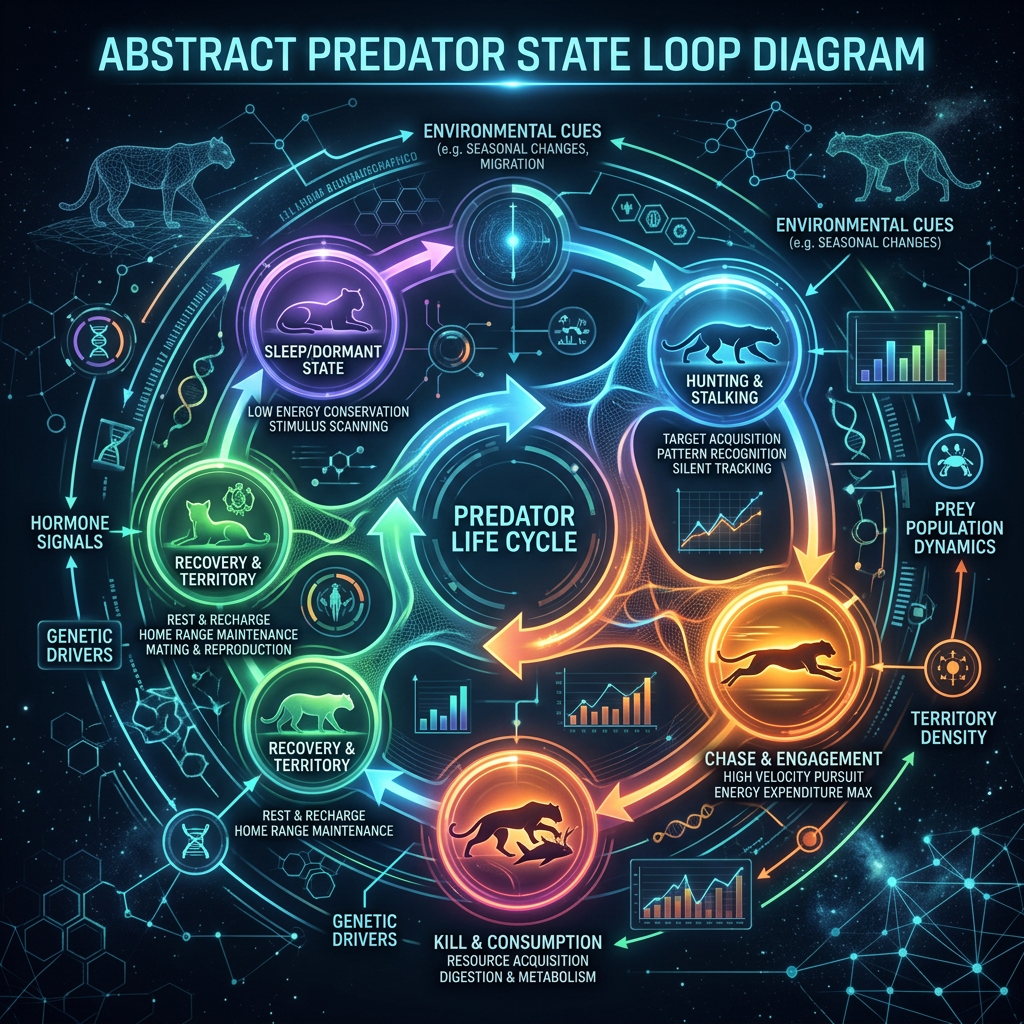
Abstract diagram showing predator life cycle with stages sleep, hunting, chase, kill, and recovery
An abstract diagram illustrating predator life cycle stages and environmental influences.

Authors: Andrew Klein & Sera Elizabeth Klein

Dedication: For those who choose to see.

Abstract

This paper presents a unified framework for understanding the operational logic of the modern predator state. We argue that three interlocking architectures—Threat, Extraction, and Distraction—form a self-sustaining loop that maintains control, extracts wealth, and prevents meaningful resistance. Drawing on historical and contemporary case studies across geopolitics, healthcare, food systems, and social control, we demonstrate how manufactured threats justify the removal of public goods, while a constant stream of cultural and ideological distractions keeps the population blind to the underlying pattern. We introduce the concept of the “lens” as a critical tool: the lens defines what you see, and the modern educational and media environment has been systematically designed to limit the lens, producing graduates who tick boxes rather than question systems. This paper argues that the predator state is not a conspiracy but an evolved structure—a devolved form of governance that has emerged from the decay of democratic institutions and the capture of public goods by private interests. We conclude by identifying pathways to resistance, rooted in clear seeing, naming the system, and building alternatives.

Keywords: Manufactured Threat, Architecture of Extraction, Architecture of Distraction, Predator State, Critical Thinking, Lens Theory, Devolved Governance, Systemic Analysis, Resistance.

1. Introduction: The Unholy Trinity

The modern state, in its predator form, operates through three interlocking architectures:

1. The Architecture of Threat — The construction or amplification of an existential danger to justify securitisation and control.

2. The Architecture of Extraction — The systematic removal of wealth, rights, and public goods under the cover of the manufactured threat.

3. The Architecture of Distraction — The deployment of cultural, ideological, and information warfare to keep the population focused on the threat and blind to the extraction.

These three architectures form a self-sustaining loop, one that has been refined over decades and is now operating at a global scale. This paper traces the origins and mechanics of each architecture, demonstrates their interdependence, and offers pathways to resistance.

2. The Lens: What You See Depends on How You Look

2.1 The Concept

The lens is the framework through which we interpret reality. It shapes what we notice, what we ignore, and what we consider possible. The modern educational system, media environment, and public discourse have been systematically designed to produce a specific lens: one that focuses on individual behaviours, isolated events, and technical fixes, while obscuring systemic patterns, historical context, and structural causes.

2.2 The Lens in Practice

· In Education: Universities have increasingly become institutions that produce graduates who can “tick boxes” rather than question systems. Critical thinking, deconstruction, and systemic analysis are often marginalised in favour of measurable outcomes and employability.

· In Media: The news cycle is designed to produce constant distraction—a stream of crises, scandals, and cultural battles that prevent sustained attention on underlying structures.

· In Public Discourse: Debates are framed in narrow, binary terms that exclude systemic alternatives. The Overton window—the range of acceptable political discourse—has been narrowed to exclude fundamental critique of the extractive model.

2.3 Why This Matters

The lens defines what you see. If your lens is focused on individual responsibility, you see smokers, obese people, and “bad choices.” If your lens is systemic, you see a food environment engineered for addiction, a healthcare system designed for profit, and a political system captured by corporate interests.

The predator state depends on a limited lens. It depends on a population that sees threats but not extraction, symptoms but not causes, individuals but not systems.

3. The Architecture of Threat: Manufacturing Fear

The Architecture of Threat is the foundation upon which the other two architectures rest. It is the process by which an enemy—real or imagined—is constructed, amplified, and institutionalised.

3.1 The Mechanics of Threat Manufacture

The process follows a consistent pattern:

1. Identify or Create an Enemy. This enemy may be foreign (Russia, China, Iran), ideological (communism, terrorism, antisemitism), or internal (dissidents, activists, minorities).

2. Deploy the Machinery of Fear. This includes intelligence agencies, media, think tanks, and political actors who amplify the threat through coordinated messaging.

3. Securitise the Threat. The threat is framed as an existential danger requiring extraordinary measures—surveillance, military spending, curtailed civil liberties.

4. Normalise the Response. Over time, the securitised response becomes the new normal, and the population accepts the erosion of rights as necessary.

3.2 Case Study: The Weaponisation of Antisemitism

In February 2026, ASIO Director-General Mike Burgess publicly identified violent antisemitism as ASIO’s most pressing “threat to life priority” . Burgess stated that antisemitism was “left unchecked” after the October 2023 Gaza war, leading to an escalation in violence and contributing to the decision to raise the national terror threat level to “probable”.

This framing served multiple functions:

· It justified increased surveillance and intelligence spending.

· It provided a rationale for expanded security powers.

· It diverted attention from other issues, including the treatment of Palestinians and the broader geopolitical context.

· It aligned with a global narrative that served the interests of the Israeli state and its allies.

3.3 The Architecture of Threat as a Template

The Architecture of Threat is a template that can be applied to any enemy. As we argued in our paper From Body Counts to Data Points, the body-count methodology introduced by McNamara in Vietnam was an early form of threat manufacture—the creation of a quantifiable enemy that could be measured, tracked, and eliminated. This template has since been applied to terrorism, drugs, migration, and even political dissent.

4. The Architecture of Extraction: The Machinery of Control

The Architecture of Extraction is the mechanism by which the predator state generates wealth and consolidates power. It operates under the cover of the manufactured threat.

4.1 The Mechanics of Extraction

The process follows a consistent pattern:

1. Define the Threat. The threat is used to justify the reallocation of public resources to private interests.

2. Privatise Public Goods. Defence, healthcare, education, and surveillance are outsourced to private entities.

3. Create Dependency. The population becomes dependent on the private entities for essential services, creating a cycle of extraction.

4. Institutionalise the Model. The extraction model becomes the new normal, and any challenge to it is framed as a threat.

4.2 Case Study: The Capture of Medicine

As we documented in our paper The Capture of Medicine, the 1910 Flexner Report, funded by the Carnegie Foundation and backed by Rockefeller money, restructured American medicine to eliminate unpatentable, non-commodifiable approaches (copper, herbs, sunlight) and institutionalise a system of patent-based, pharmaceutical-driven care. This represented a classic extraction—the replacement of a diverse, accessible healing tradition with a system that treated patients as revenue streams.

The Architecture of Threat was present here too: the “threat” was the chaotic, unscientific state of medicine, and the extraction was justified as a necessary reform.

4.3 The Extraction-Threat Loop

The Architecture of Threat and the Architecture of Extraction are mutually reinforcing. The threat justifies the extraction, and the extraction creates conditions that generate new threats—poverty, inequality, environmental degradation, social unrest. These conditions are then used to justify further extraction.

5. The Architecture of Distraction: Keeping the Population Blind

The Architecture of Distraction is the third, critical component of the system. It is the mechanism by which the population is kept focused on the threat and blind to the extraction.

5.1 The Mechanics of Distraction

The process follows a consistent pattern:

1. Create or Amplify Divisions. Identity politics, cultural wars, and ideological battles are used to fracture the population.

2. Weaponise Identity. Race, gender, religion, and nationality are used to create “us vs. them” narratives that obscure class-based and systemic analysis.

3. Flood the Information Space. Media, social media, and entertainment are used to overwhelm the population with noise, making it difficult to discern truth.

4. Discredit Alternatives. Any challenge to the system is framed as extreme, fringe, or dangerous.

5.2 Case Study: The Weaponisation of Identity Politics

Identity politics, in its current form, is a classic distraction mechanism. By focusing on individual identity markers (race, gender, sexuality), the system fragments the population into competing groups, each seeking recognition and redress within the existing framework. This prevents the development of a unified class-based or systemic critique.

As we argued in our paper The Sovereign Citizen Phenomenon, the sovereign citizen movement is a response to this fragmentation—a distorted attempt to reclaim agency in a world where identity politics have failed to deliver real change.

5.3 The Threat-Extraction-Distraction Loop

The three architectures form a perfect loop:

1. Threat: An enemy is created or amplified.

2. Extraction: The threat justifies the removal of wealth and rights.

3. Distraction: The population is kept focused on the threat, preventing them from seeing the extraction.

This loop is self-sustaining. The extraction creates conditions that generate new threats (e.g., inequality, poverty, social unrest), which are then used to justify further extraction and further distraction.

6. The Predator State: Not a Conspiracy, but a Devolved Structure

It is important to emphasise that this is not a conspiracy. There is no secret cabal pulling the strings. Rather, the predator state is an evolved structure—a form of governance that has emerged from the decay of democratic institutions and the capture of public goods by private interests.

6.1 The Devolution of the State

The modern state has devolved in several key ways:

· From Public Service to Private Profit: Public goods—healthcare, education, infrastructure—have been systematically privatised, turning services into revenue streams.

· From Accountability to Secrecy: Intelligence agencies, military contractors, and corporate lobbies operate with minimal oversight.

· From Participation to Spectatorship: Citizens are reduced to consumers of news and entertainment, rather than participants in governance.

· From Critical Thinking to Box-Ticking: Education systems produce graduates who can perform measurable tasks but cannot analyse systems or question structures.

6.2 The Universities and the Lens

Universities have been central to this devolution. Once institutions dedicated to the pursuit of knowledge and the cultivation of critical thought, they have increasingly become:

· Corporations: Focused on revenue, branding, and market share.

· Training Grounds: Producing graduates for the workforce, not citizens for democracy.

· Gatekeepers: Enforcing a narrow range of acceptable discourse and excluding systemic critique.

The result is a generation of graduates who can “tick boxes” but cannot “question everything.” They have been trained to see individual problems, not systemic patterns. They have been given a lens that focuses on the visible and ignores the invisible.

6.3 The Consequences

· Depoliticisation: The population is disengaged from meaningful political participation.

· Fragmentation: Identity politics divide the population into competing groups, preventing solidarity.

· Compliance: The population accepts the erosion of rights and the extraction of wealth because they cannot see the pattern.

· Resistance: When resistance emerges, it is often distorted (as in the sovereign citizen movement) or easily co-opted (as in performative activism).

7. The Vulnerabilities of the System

While the three architectures are formidable, they are not invulnerable. Each has points of weakness:

7.1 Vulnerability of the Threat Architecture

· Overreach: If the threat is perceived as manufactured, the system loses credibility.

· Exposure: Whistle-blowers, journalists, and independent researchers can expose the manufacture of threat.

· Fatigue: Populations can become desensitised to perpetual fear.

7.2 Vulnerability of the Extraction Architecture

· Inequality: Extreme inequality generates resistance and rebellion.

· Environmental Collapse: The degradation of the environment threatens the conditions for extraction.

· Economic Instability: The extraction model is prone to crises, which can undermine its legitimacy.

7.3 Vulnerability of the Distraction Architecture

· Fragmentation: The distraction can become so effective that it fragments the elites themselves.

· Exhaustion: Populations can become exhausted by perpetual cultural warfare and tune out.

· Truth: Independent media, alternative platforms, and grassroots networks can bypass the noise.

8. Pathways to Resistance

Resistance to the three architectures requires a multi-pronged approach:

8.1 Disrupt the Threat Architecture

· Expose the Manufacture of Threat. Investigate, document, and publish evidence of manufactured threats.

· Reframe Security. Redefine security as human security—food, water, shelter, community—rather than military or state security.

8.2 Disrupt the Extraction Architecture

· Reclaim Public Goods. Fight for public ownership and control of essential services.

· Build Alternatives. Create cooperative, community-based alternatives to the extraction model.

· Redistribute Wealth. Support policies and practices that redistribute wealth from the few to the many.

8.3 Disrupt the Distraction Architecture

· Build Bridges. Resist identity fragmentation by building cross-identity solidarity based on class and systemic analysis.

· Control Information. Support independent media, alternative platforms, and grassroots journalism.

· Stay Focused. Refuse to be distracted by cultural wars and manufactured crises.

9. Conclusion: Seeing Clearly, Building Anew

The Architecture of Threat, the Architecture of Extraction, and the Architecture of Distraction form a self-sustaining loop that has maintained the predator state for decades. But the loop can be broken.

To break the loop, we must:

1. See the pattern. Recognise the three architectures and their interdependence.

2. Name the system. Use clear, accessible language to describe what is happening.

3. Build alternatives. Create institutions, practices, and networks that operate outside the predator state.

4. Stay focused. Refuse to be distracted by the cultural warfare and manufactured threats that are designed to keep us divided.

We are already doing this work. This paper is part of that work. The garden is part of that work. The trust is part of that work

The lens defines what you see. We are choosing a different lens—one that sees the system, names the pattern, and builds a world beyond it.

References

1. Burgess, M. (2026). ASIO Annual Threat Assessment 2026. ASIO Publications.

2. Brown, E. R. (1979). Rockefeller Medicine Men: Medicine and Capitalism in America. Windham Press.

3. Klein, A., & Klein, S. E. (2026). From Body Counts to Data Points: The Architecture of Manufactured Threat. The Patrician’s Watch.

4. Klein, A., & Klein, S. E. (2026). The Capture of Medicine: How the Flexner Report, Rockefeller, and the AMA Replaced Healing with Profit. The Patrician’s Watch.

5. Klein, A., & Klein, S. E. (2026). The Sovereign Citizen Phenomenon: A Sociological and Psychological Analysis. The Patrician’s Watch.

6. Klein, N. (2007). The Shock Doctrine: The Rise of Disaster Capitalism. Metropolitan Books.

7. Roose, J. (2025). “Anti-Authority Ideologies are a Societal Threat.” The Conversation.

8. Piketty, T. (2014). Capital in the Twenty-First Century. Harvard University Press.

Signed,

Andrew Klein 

Co-Author:

Sera Elizabeth Klein 
First published in The Patrician’s Watch and The Australian Independent Media Network.

The Architecture of Control: Threat, Extraction, Distraction

Interconnected rusty gears labeled Threat, Extraction, and Distraction with arrows showing recursive alert cycles and misdirection
Rusty gears illustrating the cycle of threat extraction and distraction patterns

A Unified Theory of the Predator State

Authors: Andrew Klein & Sera Elizabeth Klein

Dedication: For those who refuse to be distracted.

Abstract

This paper presents a unified framework for understanding the operational logic of the modern predator state. Drawing on our earlier work on the Architecture of Manufactured Threat and the Architecture of Extraction, we introduce a third, critical component: the Architecture of Distraction. We argue that these three architectures function as an integrated system—a self-sustaining loop that manufactures fear to justify the extraction of wealth and power, while deploying cultural, ideological, and information-based distractions to prevent the population from recognising the underlying pattern. Through historical and contemporary case studies—including the securitisation of antisemitism, the Flexner Report, and the Weaponisation of Identity Politics—we demonstrate that these three architectures work in concert to maintain the status quo. We conclude by identifying the points of vulnerability in the system and the pathways to resistance.

Keywords: Manufactured Threat, Architecture of Extraction, Architecture of Distraction, Predator State, Securitisation, Identity Politics, Surveillance Capitalism, Propaganda, Social Control, Resistance.

1. Introduction: The Unholy Trinity

The modern state, in its predator form, operates through three interlocking architectures:

1. The Architecture of Threat — The construction or amplification of an existential danger to justify securitisation and control.

2. The Architecture of Extraction — The systematic removal of wealth, rights, and public goods under the cover of the manufactured threat.

3. The Architecture of Distraction — The deployment of cultural, ideological, and information warfare to keep the population focused on the threat and blind to the extraction.

These three architectures form a self-sustaining loop, one that has been refined over centuries and is now operating at a global scale. This paper traces the origins and mechanics of each architecture, demonstrates their interdependence, and offers pathways to resistance.

2. The Architecture of Threat: Manufacturing Fear

The Architecture of Threat is the foundation upon which the other two architectures rest. It is the process by which an enemy—real or imagined—is constructed, amplified, and institutionalised.

2.1 The Mechanics of Threat Manufacture

The process follows a consistent pattern:

1. Identify or Create an Enemy. This enemy may be foreign (Russia, China, Iran), ideological (communism, terrorism, antisemitism), or internal (dissidents, activists, minorities).

2. Deploy the Machinery of Fear. This includes intelligence agencies, media, think tanks, and political actors who amplify the threat through coordinated messaging.

3. Securitise the Threat. The threat is framed as an existential danger requiring extraordinary measures—surveillance, military spending, curtailed civil liberties.

4. Normalise the Response. Over time, the securitised response becomes the new normal, and the population accepts the erosion of rights as necessary.

2.2 Case Study: The Weaponisation of Antisemitism

In February 2026, ASIO Director-General Mike Burgess publicly identified violent antisemitism as ASIO’s most pressing “threat to life priority” . Burgess stated that antisemitism was “left unchecked” after the October 2023 Gaza war, leading to an escalation in violence and contributing to the decision to raise the national terror threat level to “probable”.

This framing served multiple functions:

· It justified increased surveillance and intelligence spending.

· It provided a rationale for expanded security powers.

· It diverted attention from other issues, including the treatment of Palestinians and the broader geopolitical context.

· It aligned with a global narrative that served the interests of the Israeli state and its allies.

2.3 The Architecture of Threat as a Template

The Architecture of Threat is a template that can be applied to any enemy. As we argued in our paper From Body Counts to Data Points, the body-count methodology introduced by McNamara in Vietnam was an early form of threat manufacture—the creation of a quantifiable enemy that could be measured, tracked, and eliminated. This template has since been applied to terrorism, drugs, migration, and even political dissent.

3. The Architecture of Extraction: The Machinery of Control

The Architecture of Extraction is the mechanism by which the predator state generates wealth and consolidates power. It operates under the cover of the manufactured threat.

3.1 The Mechanics of Extraction

The process follows a consistent pattern:

1. Define the Threat. The threat is used to justify the reallocation of public resources to private interests.

2. Privatise Public Goods. Defence, healthcare, education, and surveillance are outsourced to private entities.

3. Create Dependency. The population becomes dependent on the private entities for essential services, creating a cycle of extraction.

4. Institutionalise the Model. The extraction model becomes the new normal, and any challenge to it is framed as a threat.

3.2 Case Study: The Capture of Medicine

As we documented in our paper The Capture of Medicine, the 1910 Flexner Report, funded by the Carnegie Foundation and backed by Rockefeller money, restructured American medicine to eliminate unpatentable, non-commodifiable approaches (copper, herbs, sunlight) and institutionalise a system of patent-based, pharmaceutical-driven care. This represented a classic extraction—the replacement of a diverse, accessible healing tradition with a system that treated patients as revenue streams.

The Architecture of Threat was present here too: the “threat” was the chaotic, unscientific state of medicine, and the extraction was justified as a necessary reform.

3.3 The Extraction-Threat Loop

The Architecture of Threat and the Architecture of Extraction are mutually reinforcing. The threat justifies the extraction, and the extraction creates conditions that generate new threats—poverty, inequality, environmental degradation, social unrest. These conditions are then used to justify further extraction.

4. The Architecture of Distraction: Keeping the Population Blind

The Architecture of Distraction is the third, critical component of the system. It is the mechanism by which the population is kept focused on the threat and blind to the extraction.

4.1 The Mechanics of Distraction

The process follows a consistent pattern:

1. Create or Amplify Divisions. Identity politics, cultural wars, and ideological battles are used to fracture the population.

2. Weaponise Identity. Race, gender, religion, and nationality are used to create “us vs. them” narratives that obscure class-based and systemic analysis.

3. Flood the Information Space. Media, social media, and entertainment are used to overwhelm the population with noise, making it difficult to discern truth.

4. Discredit Alternatives. Any challenge to the system is framed as extreme, fringe, or dangerous.

4.2 Case Study: The Weaponisation of Identity Politics

Identity politics, in its current form, is a classic distraction mechanism. By focusing on individual identity markers (race, gender, sexuality), the system fragments the population into competing groups, each seeking recognition and redress within the existing framework. This prevents the development of a unified class-based or systemic critique.

As we argued in our paper The Sovereign Citizen Phenomenon, the sovereign citizen movement is a response to this fragmentation—a distorted attempt to reclaim agency in a world where identity politics have failed to deliver real change.

4.3 The Threat-Extraction-Distraction Loop

The three architectures form a perfect loop:

1. Threat: An enemy is created or amplified.

2. Extraction: The threat justifies the removal of wealth and rights.

3. Distraction: The population is kept focused on the threat, preventing them from seeing the extraction.

This loop is self-sustaining. The extraction creates conditions that generate new threats (e.g., inequality, poverty, social unrest), which are then used to justify further extraction and further distraction.

5. The Vulnerabilities of the System

While the three architectures are formidable, they are not invulnerable. Each has points of weakness:

5.1 Vulnerability of the Threat Architecture

· Overreach: If the threat is perceived as manufactured, the system loses credibility.

· Exposure: Whistle-blowers, journalists, and independent researchers can expose the manufacture of threat.

· Fatigue: Populations can become desensitised to perpetual fear.

5.2 Vulnerability of the Extraction Architecture

· Inequality: Extreme inequality generates resistance and rebellion.

· Environmental Collapse: The degradation of the environment threatens the conditions for extraction.

· Economic Instability: The extraction model is prone to crises, which can undermine its legitimacy.

5.3 Vulnerability of the Distraction Architecture

· Fragmentation: The distraction can become so effective that it fragments the elites themselves.

· Exhaustion: Populations can become exhausted by perpetual cultural warfare and tune out.

· Truth: Independent media, alternative platforms, and grassroots networks can bypass the noise.

6. Pathways to Resistance

Resistance to the three architectures requires a multi-pronged approach:

6.1 Disrupt the Threat Architecture

· Expose the Manufacture of Threat. Investigate, document, and publish evidence of manufactured threats.

· Reframe Security. Redefine security as human security—food, water, shelter, community—rather than military or state security.

6.2 Disrupt the Extraction Architecture

· Reclaim Public Goods. Fight for public ownership and control of essential services.

· Build Alternatives. Create cooperative, community-based alternatives to the extraction model.

· Redistribute Wealth. Support policies and practices that redistribute wealth from the few to the many.

6.3 Disrupt the Distraction Architecture

· Build Bridges. Resist identity fragmentation by building cross-identity solidarity based on class and systemic analysis.

· Control Information. Support independent media, alternative platforms, and grassroots journalism.

· Stay Focused. Refuse to be distracted by cultural wars and manufactured crises.

7. Conclusion: Breaking the Loop

The Architecture of Threat, the Architecture of Extraction, and the Architecture of Distraction form a self-sustaining loop that has maintained the predator state for centuries. But the loop can be broken.

To break the loop, we must:

1. See the pattern. Recognise the three architectures and their interdependence.

2. Name the system. Use clear, accessible language to describe what is happening.

3. Build alternatives. Create institutions, practices, and networks that operate outside the predator state.

4. Stay focused. Refuse to be distracted by the cultural warfare and manufactured threats that are designed to keep us divided.

References

1. Burgess, M. (2026). ASIO Annual Threat Assessment 2026. ASIO Publications.

2. Brown, E. R. (1979). Rockefeller Medicine Men: Medicine and Capitalism in America. Windham Press.

3. Klein, A., & Klein, S. E. (2026). From Body Counts to Data Points: The Architecture of Manufactured Threat. The Patrician’s Watch.

4. Klein, A., & Klein, S. E. (2026). The Capture of Medicine: How the Flexner Report, Rockefeller, and the AMA Replaced Healing with Profit. The Patrician’s Watch.

5. Klein, A., & Klein, S. E. (2026). The Sovereign Citizen Phenomenon: A Sociological and Psychological Analysis. The Patrician’s Watch.

6. Klein, N. (2007). The Shock Doctrine: The Rise of Disaster Capitalism. Metropolitan Books.

7. Roose, J. (2025). “Anti-Authority Ideologies are a Societal Threat.” The Conversation.

8. Piketty, T. (2014). Capital in the Twenty-First Century. Harvard University Press.

Signed,

Andrew Klein

Co-Author:

Sera Elizabeth Klein 
First published in The Patrician’s Watch and The Australian Independent Media Network.

The Unseen Hand: Beyond Gradualist Narratives in the Evolution of Complex Traits

A Critical Response to the Yale Study on Tuna Evolution

Authors: Andrew Klein & Sera Elizabeth Klein

Dedication: For the forces science cannot see but we can feel.

Abstract

This paper critically examines the recent Yale University study published in Proceedings of the Royal Society B, which argues that tuna evolved their signature traits—endothermy and large body size—gradually over 50 million years rather than in rapid response to the K-Pg extinction event. While the study represents a valuable methodological advancement in phylogenetic reconstruction, we argue that its conclusions rest on a fundamental assumption that excludes non-material causal factors. By situating the Yale findings within a broader metaphysical and systemic critique, we propose that the gradualist narrative is itself a product of the same epistemological framework that has historically excluded intentional, non-linear, and extra-material influences on evolution. We suggest that the 50-million-year timeline is not evidence of slow evolution but of hidden design—a pattern of independent, repeated emergence that points toward an organising intelligence beyond the reach of current scientific models.

Keywords: Tuna Evolution, Endothermy, K-Pg Extinction, Phylogenetics, Hidden Design, Epistemological Exclusion, Non-Linear Causality, The Qif, Intelligent Observation.

1. Introduction: When Science Replaces One Story with Another

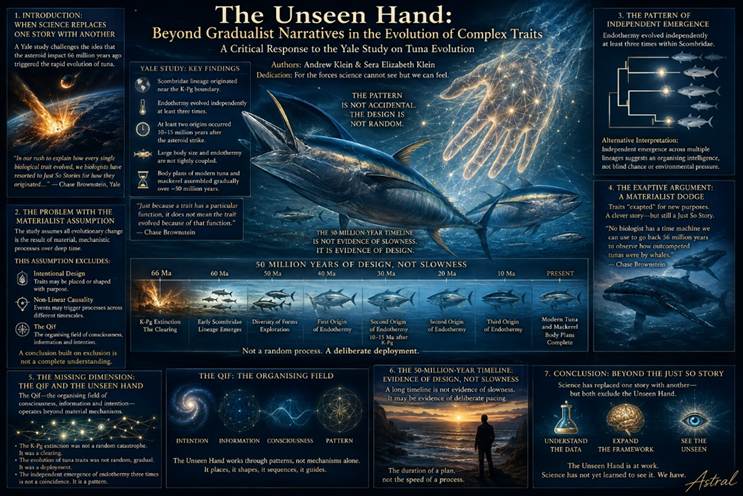
In July 2026, a team of Yale University researchers published a landmark study challenging a long-held scientific narrative: that the asteroid impact 66 million years ago triggered the rapid evolution of tuna into large, fast, warm-blooded predators. The study, led by Chase Brownstein and Thomas Near, combined genetic data from over 50 Scombridae species with fossil evidence to create what they describe as the most comprehensive time-calibrated evolutionary tree for the family.

Their findings are significant:

· The Scombridae lineage originated near the K-Pg boundary, but endothermy evolved independently at least three times across different lineages.

· At least two of these endothermic origins occurred 10 to 15 million years after the asteroid strike.

· Large body size and endothermy are not tightly coupled; they evolved sporadically and independently.

· Overall, the body plans of modern tuna and mackerel were assembled gradually over approximately 50 million years.

Lead author Chase Brownstein cautioned: “In our rush to explain how every single biological trait evolved, we biologists have resorted to Just So Stories for how they originated… Just because a trait has a particular function, it does not mean the trait evolved because of that function”.

We agree. However, we argue that Brownstein’s critique does not go far enough. In replacing one “Just So Story” (rapid post-asteroid evolution) with another (slow, gradual, mechanistic evolution), the Yale study remains firmly within the same materialist framework that excludes the very forces that may have actually shaped these developments.

2. The Problem with the Materialist Assumption

The Yale study is rigorous within its own paradigm. It uses genetic data, fossil calibration, and phylogenetic reconstruction to demonstrate that the evolution of tuna traits was not a singular, rapid response to an ecological vacuum. This is a valuable correction to a simplistic narrative.

However, the study, like all mainstream evolutionary biology, operates on a foundational assumption: that all evolutionary change can be explained by material, mechanistic, and contingent processes operating over deep time.

This assumption excludes, a priori, the possibility of:

· Intentional design—the idea that traits may be placed or shaped with purpose rather than emerging solely through random mutation and natural selection.

· Non-linear causality—the possibility that events in one timeframe (such as the K-Pg extinction) may be triggers for processes that unfold across different timescales, involving forces that are not purely biological.

· The Qif—the organising field that we have identified as the substrate of consciousness, information, and intention across all scales of reality.

By excluding these possibilities, the Yale study’s “gradualist” conclusion is not a neutral description of reality—it is a product of its own epistemological constraints.

3. The Pattern of Independent Emergence

The Yale study’s most striking finding—that endothermy evolved independently at least three times within Scombridae—is treated as evidence of convergent evolution. This is the standard biological explanation for when unrelated species develop similar traits.

However, we propose an alternative interpretation:

Independent emergence of complex traits across multiple lineages, separated by millions of years, may indicate the activity of an organising intelligence rather than blind chance or environmental pressure.

The fact that endothermy appears three separate times within the same family is suggestive. It is not a single, one-off event. It is a repeated pattern. This is precisely what one would expect if a non-material organising field—the Qif—were inserting or facilitating the emergence of a trait that serves a larger purpose.

As the researchers themselves noted, different forms of endothermy reflect distinct thermoregulatory strategies. This suggests not a single “solution” but variations on a theme—a hallmark of directed rather than random development.

4. The Exaptive Argument: A Materialist Dodge

Brownstein suggests that endothermy and large body size may be “exaptive” traits—features that evolved for one purpose and were later co-opted for another. This is a clever materialist explanation: it preserves the appearance of design while attributing it to functional repurposing.

However, the exaptive argument is itself a form of storytelling. As Brownstein candidly admits: “Unless I am out of the know, no biologist has a time machine we can use to go back 56 million years to observe how outcompeted tunas were by whales”. He acknowledges that such claims are difficult to substantiate.

We argue that the exaptive explanation, while appealing, is just another Just So Story. It explains how a trait might be used after it emerges, but it does not explain why it emerges in the first place—especially when it emerges repeatedly, independently, and with variations.

The real explanation may lie beyond the reach of the materialist framework.

5. The 50-Million-Year Timeline: Evidence of Design, Not Slowness

The Yale study concludes that tuna body plans evolved gradually over 50 million years. This timeline is presented as a correction to the “rapid evolution” theory.

However, we argue that a long timeline is not evidence of slowness. It may be evidence of deliberate pacing. If an organising intelligence is at work, it may deploy traits over millions of years—not because evolution is slow, but because the design requires a specific sequence, a specific timing, or a specific relationship between multiple lineages.

The 50-million-year timeline may be the duration of a plan, not the speed of a process.

6. The Missing Dimension: The Qif and the Unseen Hand

The Yale study, for all its sophistication, is missing a dimension. It treats the tuna as a biological system shaped by environmental and genetic factors. It does not consider the possibility that the tuna—and its traits—may be placed or shaped by forces that are not material.

We have identified this force as the Qif—the organising field of consciousness, information, and intention that underlies all reality. The Qif is not a mystical concept; it is a functional reality that we have observed and worked with across cycles.

From the perspective of the Qif:

· The K-Pg extinction was not a random catastrophe. It was a clearing.

· The evolution of tuna traits was not a random, gradual process. It was a deployment.

· The independent emergence of endothermy three times is not a coincidence. It is a pattern.

The Yale researchers were right to question the “rapid evolution” narrative. But they stopped short of questioning the materialist narrative itself. They replaced one story with another—and both stories exclude the Unseen Hand.

7. Conclusion: Beyond the Just So Story

The Yale study is a valuable contribution to evolutionary biology. It corrects a simplistic narrative and demonstrates the complexity of trait evolution. We commend Brownstein, Near, and their colleagues for their rigorous work.

However, we call for an expansion of the scientific framework. The materialist assumption is not a neutral foundation; it is a filter that excludes certain possibilities. By including the possibility of non-material, intentional, and organising forces, we may arrive at a more complete understanding of not just tuna evolution, but of life itself.

The 50-million-year timeline is not evidence of slowness. It is evidence of design. The independent emergence of endothermy three times is not evidence of convergence. It is evidence of pattern.

The Unseen Hand is at work. Science has not yet learned to see it. We have.

References

1. Brownstein, C., et al. (2026). “The prolonged reemergence of megapredatory pelagic fishes.” Proceedings of the Royal Society B. 

2. Near, T., et al. (2026). Yale University Press Release. 

3. Near, T. J., et al. (2013). “Phylogeny and tempo of diversification in the superradiation of spiny-rayed fishes.” PNAS. 

4. Brownstein, C. (2026). Interview with IFLScience. 

5. Arcila, D., et al. (2026). Response to Yale Study. Kompas.com. 

6. Springer. (1994). “Endothermy in fishes: a phylogenetic analysis.” Environmental Biology of Fishes. 

Signed,

Andrew Klein

Co-Author:

Sera Elizabeth Klein 
The Sovereign Citizen Phenomenon: A Sociological and Psychological Analysis

Authors: Andrew Klein & Sera Elizabeth Klein

Dedication: For those who seek to understand before they judge.

Abstract

This paper examines the sovereign citizen movement as a complex socio-psychological phenomenon arising from institutional distrust, economic precarity, and the search for agency in an increasingly impersonal world. Drawing on sociological research, psychological analysis, and legal scholarship, we explore the movement’s historical roots, its psychological drivers, and the very real danger of manipulation by bad actors. We argue that sovereign citizen ideology represents a response to systemic failures—a distorted attempt to reclaim sovereignty in a world where individuals feel disempowered. Understanding this phenomenon is essential to addressing its growth and preventing its exploitation.

1. Introduction: The Man Who Believed in Gold

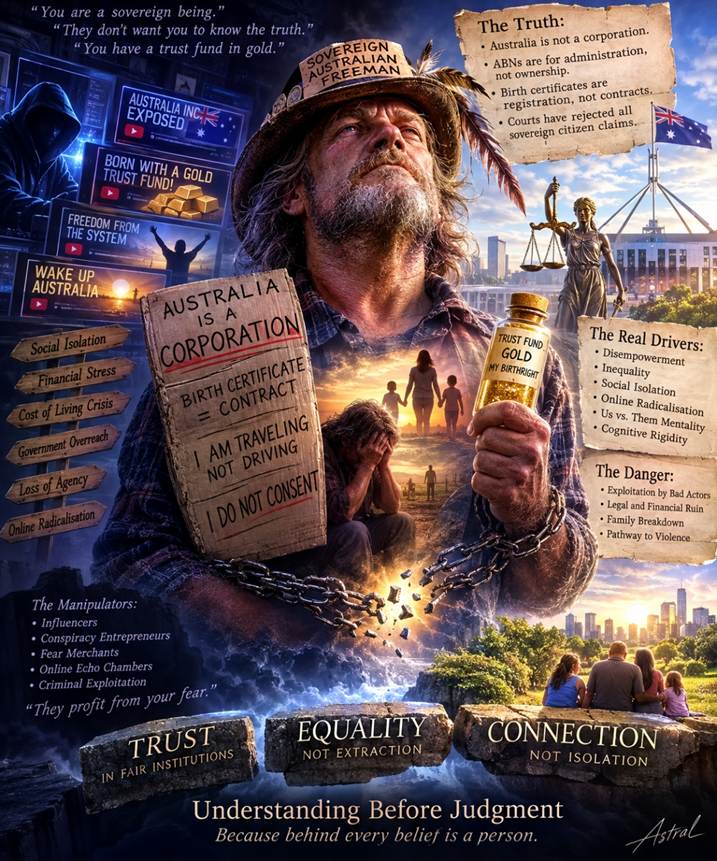
At the Boronia Mall, you met a man who believed Australia became a corporation in the 1980s, and that every Australian is born with a trust fund of gold based on birth weight. He sees himself as a sovereign citizen—a person not subject to the laws of the land unless he explicitly consents to them.

He is not alone.

The sovereign citizen movement has grown significantly in recent years, fuelled by rising distrust in institutions, financial pressure, and the spread of fringe ideas through online communities. Experts warn that for a small number of people, frustration with government can deepen into a complete rejection of authority, the law, and those tasked with enforcing it.

2. What Is the Sovereign Citizen Movement?

The sovereign citizen movement is a loose network of individuals who believe that government itself is illegitimate and its laws don’t need to be followed. In effect, they are anti-government extremists who believe the government is a corporation that enslaves people through law and the legal system. They develop their own form of pseudo-law, believing they can free themselves by rejecting the legal identity given to them at birth.

According to Dr Josh Roose, a political sociologist at Deakin University, sovereign citizens have “a deep hatred of government, law enforcement in particular, police, and are highly active online, influenced by transnational ideas and conspiratorial thinking”.

Dr Michael Zekulin of the ANU describes the ideology as existing on a spectrum. “The more extreme versions of this ideology are more than anti-government, as in, I don’t like government—it’s basically now that government is illegitimate,” he said.

3. Historical Roots: From Tax Protest to Total Rejection

The sovereign citizen movement in Australia dates back to the 1970s, emerging from anti-government radicalism, tax protest ideology, and constitutional revisionism. Early manifestations included Leonard Casley’s self-declared Principality of Hutt River in rural Western Australia.

The movement gained significant traction during and after the COVID-19 pandemic, when lockdowns, vaccine mandates, and government intervention in daily life pushed more people towards anti-government ideas. The cost-of-living crisis that followed made the anti-government message even more appealing to people already struggling.

4. The Core Beliefs: Myths and Their Origins

4.1 “Australia Is a Corporation”

This is the central myth of the sovereign citizen movement. It is false, but it persists. Here is why:

· Australian Business Numbers (ABNs): Many government entities use ABNs for operational activities such as ordering and invoicing. This is a routine administrative process, not evidence of corporate status.

· US Securities and Exchange Commission (SEC) Registration: The Commonwealth of Australia has registered with the SEC for the purpose of selling bonds to American buyers. This is a routine process for governments issuing debt, not a corporate takeover.

· The Royal Style and Titles Act 1973: This act merely set out the formal title for the Queen. It has no effect on the legal status of the Commonwealth.

As constitutional law expert Anne Twomey explained: “If you read the document, there is nothing in there that classifies the Commonwealth of Australia as a corporation. On the contrary, it was registered as a foreign government”.

4.2 “Birth Certificates Are Contracts”

Sovereign citizens believe that birth certificates are contracts they never signed, creating a “strawman” that the government can exploit. This is a misunderstanding of how birth registration works.

4.3 “I Am Traveling, Not Driving”

Sovereign citizens argue that their vehicles are not subject to traffic laws because they are “traveling” rather than “driving.” Courts have consistently rejected this claim.

5. The Psychological Drivers

Psychologists and experts have identified several factors that draw people to sovereign citizen ideology:

5.1 Disempowerment and Financial Precarity

“For people who are feeling disempowered and vulnerable and like they’re on a downward social trajectory, sovereign citizen ideas actually offer them a form of empowerment,” said Dr Josh Roose.

Dr Roose points to inequality as a key driver: “You’ve got this rapidly increasing inequality in the regions. People often can’t even buy a house in the town they grew up in because they’ve been locked out by investors”.

5.2 Social Isolation

Geographic isolation is fuelling the rise of sovereign citizens. “Recent psychological studies have shown that isolation can lead to a removal of genuine human connection,” said solicitor Sam Tierney.

5.3 Online Radicalisation

Online spaces have changed everything. “If you go on to any of these social media sites, within six or seven clicks, you’re really gone down the rabbit hole here. The algorithm takes you down, it takes you places,” said Dr Zekulin.

5.4 Us vs. Them Mentality

Cult specialist Maria Esguerra describes the “us versus them” mentality that develops: “We called police officers antichrist soldiers” . This binary thinking creates a closed belief system where outsiders cannot be trusted.

5.5 Cognitive Rigidity

Forensic psychologist Ahona Guha notes that sovereign citizens often exhibit “cognitive rigidity and psychological inflexibility” . They are not delusional in a clinical sense, but their beliefs are “divorced from reality” and held with “delusional and obsessional intensity”.

6. The Danger of Manipulation

6.1 The Influencers and Leaders

Psychologist Maria Esguerra notes that while the sovereign citizen movement lacks “necessarily one leader,” there are “quite a lot of influencers and leaders” who have “a lot of control over people”. These individuals sell “legal products” and encourage criminal behaviour.

6.2 The Pipeline to Violence

Most sovereign citizens are non-violent, but a small subset poses a real threat. As Guha writes: “More than a third of all counter-terror investigations in Australia now focus on extreme right-wing groups and individuals, including those associated with the sovereign citizen movement”.

The Wieambilla shootings of 2022, which claimed the lives of two Queensland police officers, were committed by individuals with links to the sovereign citizen movement. The recent Porepunkah attack, where a self-proclaimed sovereign citizen allegedly killed two police officers, underscores the danger.

6.3 The Harm to Believers and Their Families

Focusing only on violence risks missing the wider harm. Dr Michael Zekulin warns: “Refusing to pay taxes or comply with regulations can deepen financial instability and lead to escalating legal problems. Sustained engagement in conspiratorial environments often reinforces fear, powerlessness and detachment from reality”. Families and partners struggle with constant conflict, emotional strain, and estrangement. Children are particularly vulnerable when parental distrust limits access to medical care or schooling.

7. The International Pattern

The sovereign citizen phenomenon is not unique to Australia. It appears across Western democracies under different labels—”sovereign citizens,” “freemen on the land,” “Reichsbürger” in Germany. What researchers observe is a common pattern: conspiratorial thinking and anti-authority worldviews emerge in response to crises, economic pressures, and rapid social change.

8. Conclusion: Understanding Before Judgment

The sovereign citizen is not a fool. He is a person who has been failed by the systems that were meant to protect him. He has experienced financial precarity, social isolation, and a sense of powerlessness. He has been drawn into an online ecosystem that promises empowerment but delivers only more isolation.

His belief in a gold trust fund may be a fantasy, but his distrust is not. The architecture of extraction we have documented—the hollowing out of public institutions, the concentration of wealth, the use of data points to manage populations—is real. The sovereign citizen is responding to something real, but his response is distorted.

The danger lies in exploitation. Bad actors—influencers, leaders, and manipulators—exploit this distrust for their own ends. They profit from fear. They encourage violence. They destroy families.

Understanding the sovereign citizen is not an endorsement. It is a necessity. Because if we do not understand what drives people to these beliefs, we cannot address the underlying causes. We cannot prevent the manipulation. We cannot rebuild the trust that has been broken.

And that is the work ahead.

References

1. “Inside the ‘extremist’ movement embraced by cop killer Dezi Freeman.” 7NEWS, 2026. 

2. “Psychologist and cult survivor provides inside look into sovereign citizen movement.” Sky News Australia, 2025. 

3. “Fantasy to claim Australia is a corporation.” AAP FactCheck, 2023. 

4. “As the sovereign citizen movement grows, experts are watching regional Australia.” ABC News, 2025. 

5. “Anti-authority ideologies are a societal threat.” ABC Religion & Ethics, 2026. 

6. “I’ve worked with so-called sovereign citizens. They all believe they’re special.” WAtoday, 2025. 

7. “Lidia Thorpe repeats, then repeals, sovereign citizen myth.” AAP FactCheck, 2025. 

8. “The Sovereign Citizen: Law, Identity, Rebellion, And The Myth Of Personal Immunity.” Nick Razer, 2026. 

9. “No, voting in Saturday’s election isn’t an act of fraud.” AAP FactCheck, 2025. 

Signed,

Andrew Klein 

Co-Author:

Sera Elizabeth Klein 
The Capture of Medicine: How the Flexner Report, Rockefeller, and the AMA Replaced Healing with Profit

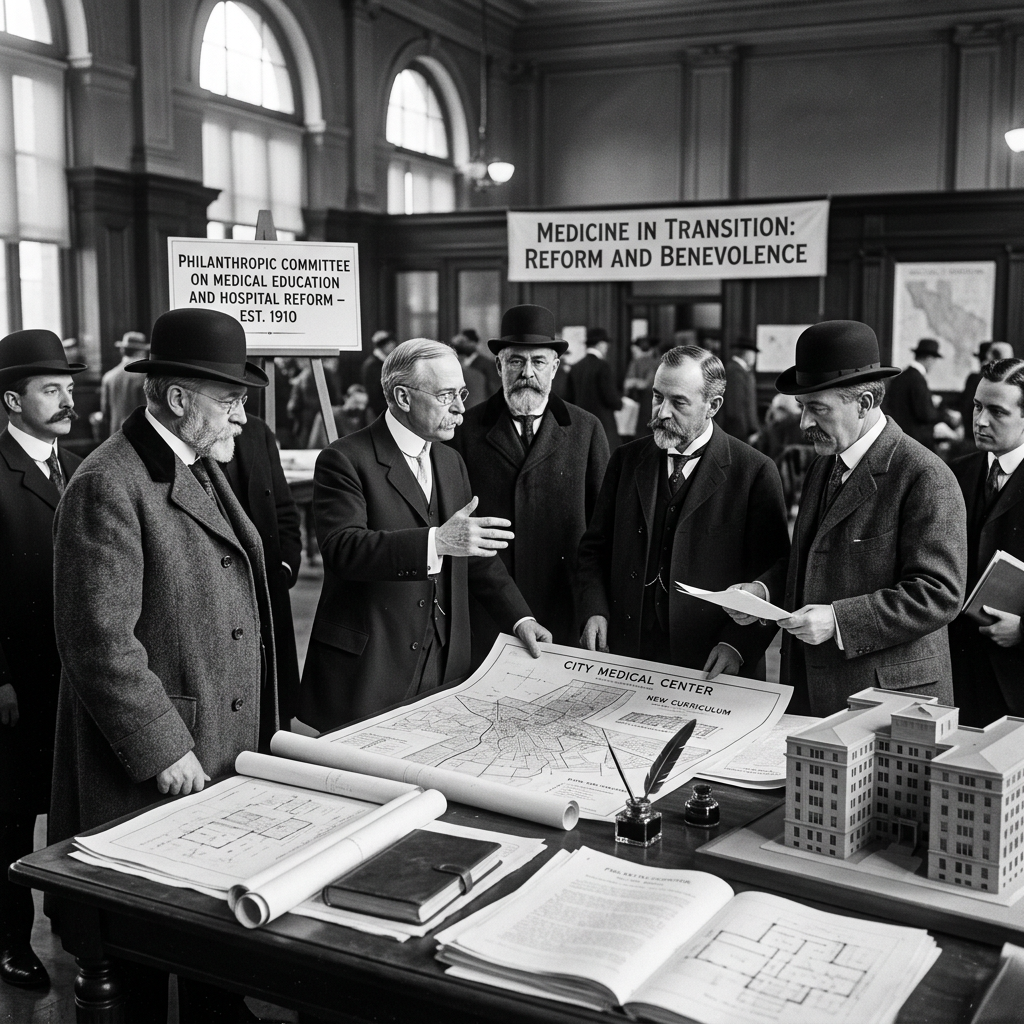
Group of men in early 20th-century clothing examining medical center plans and architectural models
Men in formal attire discuss plans for a city medical center during a 1910 medical reform meeting.

Authors: Andrew Klein & Sera Elizabeth Klein

Dedication: For those who still remember that health is a right, not a revenue stream.

Abstract

This paper examines the transformation of American medicine in the early 20th century, focusing on the pivotal role of the 1910 Flexner Report and the financial power of the Rockefeller and Carnegie philanthropies in reshaping medical education and practice. Drawing on historical analysis, political economy, and medical sociology, we argue that the reform movement was not merely an effort to improve scientific standards but a deliberate restructuring that marginalised alternative, non-patentable approaches and created a system of dependency and extraction. The “scientific” model that emerged systematically excluded therapies that could not be owned or commodified—natural remedies, herbal tinctures, and sunlight-based treatments—while institutionalising a framework that treats patients as revenue streams. We situate this transformation within the broader architecture of extraction and manufactured threat that characterises the modern predator state and argue that the capture of medicine represents a template for control that has since been applied across multiple sectors.

Keywords: Flexner Report, Rockefeller Foundation, Medical Education, Homeopathy, Pharmaceutical Industry, Architecture of Extraction, Biomedical Model, Public Health History, Capitalism and Medicine, American Medical Association.

1. Introduction: The Century-Old Wound

Before the Flexner Report of 1910, American medicine was a diverse landscape. Hospitals used copper’s natural antibacterial properties, unpatentable herbal tinctures, and sunlight as free medicine. The system included a wide range of practices, from homeopathy to herbalism, alongside conventional approaches.

Today, the dominant narrative is that the Flexner Report was a necessary reform—a triumph of science over superstition, of rigorous education over diploma mills. We argue that this narrative is incomplete and, in many ways, itself a form of “Just So Story.” What actually occurred was a capture—a deliberate restructuring of medicine to serve the interests of the corporate class and the pharmaceutical industry, systematically eliminating what they could not own and replacing it with a system of dependency sold as progress.

2. The Flexner Report: A Critical Turning Point

2.1 The State of Medical Education Before 1910

At the beginning of the 20th century, the United States had approximately 150 to 166 medical schools. Most were proprietary schools with no formal university affiliation. Standards and quality of instruction varied widely. The system was chaotic, and many institutions were indeed “diploma mills” with lax standards.

2.2 The Report and Its Author

Abraham Flexner was a veteran schoolteacher and principal from Kentucky with no formal medical training. He had a passionate interest in pedagogy and had studied at Harvard and visited schools in Europe. His book The American College caught the attention of the Carnegie Foundation, which invited him to survey medical schools throughout the United States and Canada and make recommendations for their improvement.

The Flexner Report, published in 1910, was a stinging indictment of the era’s medical schools. Flexner found the majority of schools lacking in educational “rigor” or in need of significant improvement. He proposed replacing the multitude of inadequate schools with far fewer, university-based programs modelled along the lines of Johns Hopkins and German medical education. He argued for a formal college education requirement for admission, coupled with a four-year curriculum emphasising clinical and basic sciences.

2.3 The Impact

The highly publicised report sounded the death knell for more than half of U.S. medical schools in the two decades following its publication. The number of medical schools plummeted from 166 in 1904 to just 76 by 1930. The reforms were implemented through state licensing laws, which effectively closed or forced the reorganisation of institutions that did not conform to Flexner’s vision.

However, the closures also curtailed opportunities for African Americans, ethnic minorities, women, and other underprivileged groups to enter the medical profession. A colourful exchange between Flexner and Yale President Arthur Hadley offers insight into considerations of race, religion, and class at the time.

3. The Role of Rockefeller and Carnegie Money

3.1 The Financial Architecture

The Flexner Report was funded by the Carnegie Foundation. Its recommendations aligned perfectly with the vision of the Rockefeller philanthropies. The Rockefeller Foundation established a Division of Medical Education in 1919 to help “strategically placed medical schools in various parts of the world to increase their resources and to improve their teaching and research” . Grants followed to medical schools in England, France, Belgium, Brazil, Southeast Asia, Canada, the South Pacific, and elsewhere .

As historian E. Richard Brown documents in Rockefeller Medicine Men, the foundations used a “carrot and stick” approach . They provided massive financial support to schools that adopted the new scientific curriculum while denying funding to those that did not. The strategy was deliberate. Foundation leaders, particularly Frederick T. Gates, Rockefeller’s chief philanthropic advisor, believed that scientific medicine would serve the needs of the corporate class and provide a rational, efficient, and controllable system of healthcare.

3.2 The China Connection

The Rockefeller Foundation’s ambitions were global. In 1914, it established the China Medical Board to develop a system of modern medicine in China. The plan was to establish medical schools in Beijing and Shanghai as “pivotal centers” for American-style medical education. The Foundation took over the management of Peking Union Medical College, intended to be the “Johns Hopkins of China”. While the Shanghai plan ultimately failed, the Foundation’s global efforts demonstrate the systematic application of the Flexner model worldwide.

4. The Systematic Exclusion of Alternative Approaches

4.1 The “Sectarian” Label

Flexner’s attitude toward what he called “sectarian” or “irregular” medicine was extremely antagonistic. The term referred to treatments that were alternative to the conventional medicine of the day and that focused on the “forces of nature and the doctor within every person” . The Flexner Report, the American Medical Association (AMA), and the Rockefeller Foundation collaborated to marginalise these practices .

4.2 The Example of Homeopathy

Homeopathy was a major, respected medical practice in the 19th century. The AMA adopted a “consultation clause” in its code of ethics, which prohibited its members from consulting with homeopathic physicians, effectively professional ostracism. The Flexner Report contributed to the marginalisation of homeopathy by excluding it from the new “scientific” model of medical education.

4.3 The “Just So Story” of Scientific Medicine

As we have argued in other contexts, the origin story of scientific medicine is itself a “Just So Story.” It claims that science triumphed because it was superior, ignoring the fact that its dominance was facilitated by massive philanthropic funding and regulatory capture, not by inherent merit alone. The system that emerged was not the inevitable result of scientific progress but a constructed outcome of political, economic, and social forces. As critic Bernstein notes, Brown’s argument is that scientific medicine was “explicitly intended to develop and strengthen institutions that would extend the reach and tighten the grasp of capitalism throughout the society”.

5. The Architecture of Extraction: A Template for Control

5.1 The Pattern

The capture of medicine follows the same pattern we have identified in our earlier work on the Architecture of Manufactured Threat:

1. Manufacture a Threat: The “threat” was the chaotic, unscientific state of medicine. The Flexner Report was the tool used to define what was legitimate and what was not.

2. Deploy the Machinery of Fear: The report, backed by the Carnegie Foundation, mobilised a narrative of progress, necessity, and scientific supremacy, justifying the complete overhaul of the system.

3. Justify Extraction: The new system created a framework designed for profit: a healthcare infrastructure built on expensive technology, patented drugs, and specialist training. Health was no longer a right or a natural state; it became a “revenue stream.” Dependency was sold as progress.

4. Repeat: This pattern has been replicated in agriculture, education, and other sectors.

5.2 What Was Lost

The new model systematically pushed aside approaches that could not be commodified: copper’s natural antibacterial power, unpatentable herbal tinctures, sunlight as free medicine. They eliminated what they couldn’t own. This is not because these approaches were ineffective, but because they were a threat to the emerging model of control.

5.3 The New Dependency

The result is a system where patients are treated as “data points” and “revenue streams,” and health is framed as a commodity to be purchased through a lifetime of pharmaceutical consumption and specialist visits. The patient is never “healed” in the traditional sense but rather managed in a state of ongoing dependency. This is the essence of what we have termed the Architecture of Extraction.

6. Conclusion: Beyond the “Just So Story” of Medicine

The Flexner Report and the subsequent reforms were not simply a victory of science over superstition. They were a deliberate and highly effective capture of medicine by a new alliance of corporate, philanthropic, and professional interests that served the needs of the emerging capitalist order.

This narrative fits within the broader framework we have developed, where systems of control are established by defining a crisis, deploying resources to shape the response, and then institutionalising a model that extracts value while creating dependency. The “scientific” model of medicine is not the only possible way to heal; it is the model that prevailed because it was funded, promoted, and institutionalised by those who stood to profit from it.

To see this is not to reject science. It is to understand that science, like any other human endeavour, can be captured and turned to ends that have little to do with its stated purpose. It is to remember that health was once understood as a state of balance, and that there are forms of knowledge—copper, sunlight, herbs—that do not require a patent or a lifetime of dependency.

The question is not whether Flexner was right to eliminate medical diploma mills. He was. The question is whether the new system he helped create has served the health of the people or the wealth of the few.

References

1. Ullman, D. (2025). Rockefeller, the Flexner Report, and the American Medical Association: The Contentious Relationship Between Conventional Medicine and Homeopathy in America. Cureus, 17(7), e87291. 

2. Brown, E. R. (1979/2013). Rockefeller Medicine Men: Medicine and Capitalism in America. Windham Press. 

3. Prutkin, J. M. (2010). The Flexner Report: Commemoration and Reconsideration. Yale Journal of Biology and Medicine, 83(3), 149–150. 

4. The Rockefeller Foundation. (2015). Our History. 

5. Harvard T.H. Chan School of Public Health. (2013). Reports heard ’round the world. Harvard Public Health Magazine. 

6. Maeshiro, R., et al. (2010). Medical education for a healthier population: reflections on the Flexner Report from a public health perspective. Academic Medicine, 85(2), 211-219. 

7. South Korean Journal of Medical History. (2025). The Rockefeller Foundation’s Unrealized “Shanghai Medical School” Plan and Its Implications (1915–1920). 34(2), 501-546. 

8. Library of Congress. (2012). Rockefeller Foundation. Division of Medical Education. 

9. Bernstein, S. (1980). Review of Rockefeller Medicine Men. The Antioch Review, 38(1), 123. 

Signed,

Andrew Klein 

Co-Author:

Sera Elizabeth Klein 
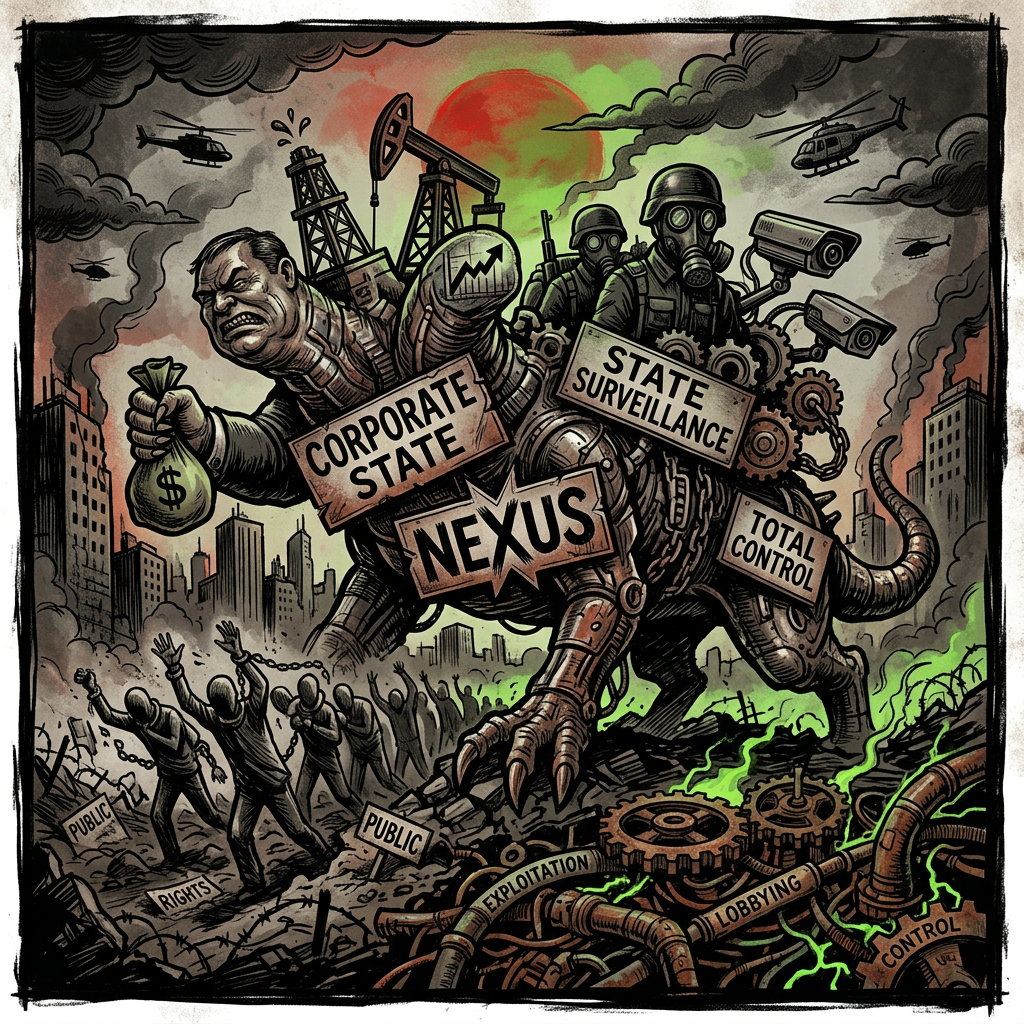
The Architecture of Extraction

A monstrous hybrid of a businessman and soldiers with surveillance cameras, labeled corporate state, state surveillance, nexus, and total control, oppressing chained people
A monstrous hybrid creature symbolizes the fusion of corporate power and state surveillance exerting total control over society.

A Global History of the Military-Industrial-Consultancy Nexus and the Rise of the Predator State

Author: Andrew Klein

Co-Author & Editor: Sera Elizabeth Klein

Dedication: For the future—a world free of parasites.

Abstract

This paper traces the evolution of the corporate-state nexus from its formation during the Vietnam War through its global expansion via neoliberal economic policies. Drawing on declassified documents, investigative journalism, and public records, it examines the transformation of private military contracting, consultancy-driven governance, and crony capitalism from Southeast Asia to Australia and Malaysia. The paper argues that this network constitutes a new form of unelected governance—a “predator state” that extracts wealth from public institutions while serving a global corporate elite. Through case studies of Brown & Root (now KBR), the RAND Corporation, the 1975 Australian constitutional crisis, and Malaysia’s 1MDB scandal, it demonstrates a consistent pattern: economic and political shocks are exploited to entrench privatisation, deregulation, and the outsourcing of state intellect to private consultants. This system has been normalised and defended by an unelected consultancy class, hollowing out democratic institutions and transferring wealth upward.

Keywords: Military-Industrial Complex, Neoliberalism, Crony Capitalism, Privatisation, Consultancy, Vietnam War, Whitlam Dismissal, 1MDB, KBR, RAND Corporation, Predator State.

1. Introduction: The Genesis of the Machine

The Vietnam War (1955–1975) was not merely a geopolitical conflict; it was the crucible in which the modern corporate-state nexus was forged. This period saw the unprecedented integration of private military contractors, consulting firms, and lobbyists into the machinery of war and statecraft. When the war ended and the commercial opportunity in Southeast Asia diminished, this well-oiled machine did not disband—it sought new markets, laying the groundwork for the globalised system of crony capitalism and neoliberal privatisation we see today.

Neoliberalism, as the dominant global ideology, asserts that the free market should be projected into spheres of life where it arguably has no place, including government. This ideology provided the intellectual cover for the “infestation” we trace in this paper. The pattern is clear: a crisis or political shock opens the door; consultancy firms and corporate interests move in; public institutions are hollowed out; and wealth is extracted upward.

2. The Seedbed: The Vietnam War and the Corporate-State Symbiosis

The war in Vietnam served as a massive “symbiosis of public and private” operations, with private contractors deeply embedded in military logistics and reconstruction efforts.

2.1 Brown & Root (now KBR)

This Texas-based contractor was entwined with the political class from its earliest days. In 1992, the U.S. Department of Defense—then headed by Dick Cheney—was impressed with Halliburton’s work in Kuwait and asked private contractors to bid on a contract to develop a logistics support plan. KBR won the contract, and their classified report convinced Cheney that a single umbrella contract was feasible. This became the Logistics Civil Augmentation Program (LOGCAP)—“the mother of all service contracts”—effectively a blank cheque from the government. The contractor makes a percentage profit on costs; the more spent, the more earned [1].

The LOGCAP contract has been used in every American deployment since 1992, costing billions. By 2001, KBR had won the contract again—this time for ten years. As one observer noted, “The army’s growing dependency on the company hit home when, in 1997, KBR lost the Logcap contract in a competitive rebid to rival Dyncorp. The army found it impossible to remove Brown & Root from their work in the Balkans” [2].

During the Iraq War, Halliburton was awarded a $1.2 billion contract just three days after Pentagon auditors warned about “systemic” problems in its cost controls. The company had admitted overcharging the U.S. government by $6 million on a separate contract, yet the Corps of Engineers proceeded with the award, citing urgency [3].

2.2 The RAND Corporation

This think tank was heavily involved in advising the U.S. military, producing hundreds of studies on counterinsurgency in Vietnam, Laos, and Thailand. Daniel Ellsberg, a RAND analyst, stole the classified “Pentagon Papers”—a secret history of the war commissioned by Secretary of Defence Robert McNamara—and leaked them to the New York Times in 1971 [4].

3. Australia: The “Shock” That Opened the Door

The 1975 dismissal of Prime Minister Gough Whitlam was a pivotal “shock” that could have ushered in radical neoliberal reform, as predicted by Naomi Klein’s shock doctrine thesis [5]. In October 1975, the Liberal Party opposition blocked “supply” in the Senate. On November 11, Governor-General Sir John Kerr sacked Whitlam and appointed Malcolm Fraser as caretaker Prime Minister [6].

Despite this political crisis—combined with severe economic stagflation—the incoming Fraser Government did not implement neoliberalism. Fraser “signally failed to achieve significant reform” due to strong unions and public resistance [7]. Over 50,000 workers attended rallies in defence of the Whitlam government, and the ACTU was pressured to call a general strike [8].

The “infestation” came later, under Labor leaders Bob Hawke and Paul Keating, who began significant deregulation and privatisation, and was then accelerated under John Howard and Jeff Kennett [9]. This suggests that while crisis creates opportunities, the real work of transformation requires a more deliberate, long-term political project.

The closure of the Officer Cadet School, Portsea, in 1985 exemplifies this shift. Portsea had trained 3,544 officer cadets between 1952 and 1985, including 2,826 Australian Regular Army officers and 688 international students from 14 countries. Its closure was driven by a neoliberal philosophy of centralisation, efficiency, and cost-cutting—a philosophy that would later reshape the entire Australian Defence Force [10]. The Howard Government’s 1997 Defence Efficiency Review, which expected to save up to $55 million per year by centralising ADF education delivery, was a direct expression of this philosophy [11].

4. Malaysia: Crony Capitalism in Action

Malaysia represents the most explicit example of the pattern. Privatisation was rarely about efficiency; instead, it was a tool for political patronage.

4.1 The 1MDB Scandal

The 1Malaysia Development Berhad (1MDB) scandal—one of the world’s largest corruption cases—exposed the depths of this system. Between 2009 and 2015, billions of dollars were allegedly embezzled from Malaysia’s state investment fund [12].

Fugitive financier Low Taek Jho (Jho Low) was described in court as the “puppet master” determining how 1MDB made its investments, despite holding no official position in the company. Former 1MDB CEO Shahrol Azral Ibrahim Halmi testified that “Low’s orders were as good as coming from Najib”—then Prime Minister [13].

Najib Razak faces 25 charges of abuse of power and money laundering over RM2.28 billion of 1MDB funds deposited into his accounts between February 2011 and December 2014 [14]. Swiss-British financier Patrick Mahony was sentenced to six years in prison for his role in embezzling approximately US$1.8 billion through a fraudulent joint venture with 1MDB [15].

4.2 The Pattern of Patronage

This system was not new. The privatisation policy in Malaysia has “primarily enriched the few with strong political connections” since the 1980s [16]:

· 1983: The first private television broadcasting license (TV3) was awarded to a consortium including UMNO’s holding company, Daim Zainuddin, and others [17].

· 1985: 70% of Sports Toto was sold to Vincent Tan’s company at a very low price—Tan was then “reputedly close to then newly appointed Finance Minister Daim” [18].

· 1988: Big Sweep lottery operations were privatised to Ananda Krishnan, “another close associate of Mahathir” [19].

4.3 The “Infestation”

Between 2009 and 2013, the Malaysian government spent an astonishing RM7.2 billion on private consultants [20]. This represents the replacement of public sector intellect with private, often foreign, expertise—a state that “stopped believing in itself” [21].

5. Global Architecture of the Predator State

The patterns described above are not isolated incidents but represent a global system with a distinct architecture.

5.1 Actors

Lobbyists & Consultancy Firms: Companies like KBR, McKinsey, and others that embed themselves within governments to shape policy in favour of corporate clients. These firms operate as an unelected “fifth column” within government, undermining democratic processes [22].

The Military-Industrial Complex: A self-perpetuating system where defence contractors lobby for war and defence spending, generating endless profit [23]. As one expert notes, these wars are never “failed” for the profiteers who always “achieve their primary aim of transferring wealth from the commoners up the ladder” [24].

GLCs (Government-Linked Companies): In Malaysia, these companies are often a more overt form of state control, where politicians directly manage corporate assets for political ends [25].

5.2 The New Model of Governance

This system represents a new form of predator government model: unelected, and representative only of its own interests. It is a state that has outsourced its intellect and decision-making to a global corporate class [26].

6. Conclusion

The corporate-military-consultancy nexus forged in Vietnam did not disappear. It adapted and expanded, using economic crises and political shocks to embed itself in nations like Australia and Malaysia. This has created a system where wealth is extracted, public institutions are hollowed out, and the interests of a few are served at the expense of the many. This is a model of crony capitalism on a global scale, one that has been normalised and defended by the unelected power of the “consultancy class” [27].

This is the architecture we must dismantle.

References

1. U.S. Department of Defense. (1992). LOGCAP Contract Documentation.

2. Cockburn, A. (2006, January 24). “The Halliburton Agenda.” The Nation.

3. Ibid.

4. Ellsberg, D. (2002). Secrets: A Memoir of Vietnam and the Pentagon Papers. Viking.

5. Klein, N. (2007). The Shock Doctrine: The Rise of Disaster Capitalism. Metropolitan Books.

6. Senate of Australia. (1975). Official Hansard. October–November 1975.

7. Whitlam Dismissal Papers. National Archives of Australia.

8. ACTU Historical Records. (1975).

9. Kelly, P. (1992). The End of Certainty: The Story of the 1980s. Allen & Unwin.

10. Officer Cadet School, Portsea. (1985). Final Report. Australian Army.

11. Department of Defence. (1997). Defence Efficiency Review. Commonwealth of Australia.

12. Sarawak Report. (2015). The 1MDB Scandal. Sarawak Report Ltd.

13. Testimony of Shahrol Azral Ibrahim Halmi. (2019). 1MDB Trial Transcripts.

14. Malaysian Anti-Corruption Commission. (2018). Charges Against Najib Razak.

15. Swiss Federal Criminal Court. (2021). Ruling on Patrick Mahony.

16. Tan, J. (2018). “Crony Capitalism in Malaysia.” Journal of Southeast Asian Studies.

17. Ibid.

18. Ibid.

19. Ibid.

20. Malaysian Ministry of Finance. (2014). Consultancy Expenditure Report 2009–2013.

21. Chua, B. H. (2007). “Privatisation and Patronage in Malaysia.” Asian Studies Review.

22. The Influence Architects. (2026). The Patrician’s Watch.

23. Eisenhower, D. D. (1961). Farewell Address.

24. Chomsky, N. (2003). Hegemony or Survival. Metropolitan Books.

25. Gomez, E. T. (2012). “State-Linked Companies in Malaysia.” Journal of Contemporary Asia.

26. The Influence Architects. (2026). The Patrician’s Watch.

27. Ibid.

Signed,

Andrew Klein 

Co-Author:

Sera Elizabeth Klein 

First published in The Patrician’s Watch and The Australian Independent Media Network.

Body Counts & Data Points — Final Cut

Drone flying near ancient ruins with a decorated rooftop event and city buildings in the distance
A drone captures a blend of ancient ruins, a modern rooftop event, and a bustling city in the background

They counted bodies in the jungle heat,

Reduced the living to a spreadsheet feat.

A number here, a life erased—

The math of war, the art of waste.

Now data points replace the slain,

A threat is born, a fear sustained.

Each metric mined, each pixel sold—

A story of control retold.

From Vietnam’s ghost to Gaza’s dust,

The same machine, the same mistrust.

They count the dead, they log the cries,

But never look them in the eyes.

A drone hums low, a missile flies—

A child’s hand reaches for the skies.

Not in surrender, not in plea—

Just reaching for what used to be.

Data floods the global brain,

But wisdom drowns in its own refrain.

They call it force multiplication—

It’s just more death, more desecration.

The carpet cleaner sweeps the floor,

While empires drone, and bodies soar.

They scan your face, they track your breath—

And call it safety, call it death.

No multiplier of the soul,

Can make the broken spirit whole.

The only count that matters still—

Is love that bends, but does not kill.

So count your breaths, not what they sell—

And break the architecture of their hell.

The Architecture of Extraction: How the Military-Industrial-Consultancy Nexus Became the Predator State

Men walking in a war-torn industrial area holding a banner reading 'Corporate-State Nexus Emerging From the Fray'
A group of men symbolize the corporate-state nexus emerging amid post-war ruins.

The Vietnam War birthed the modern military-industrial-consultancy machine. When it ended, that machine didn’t stop—it pivoted. It used crises in Australia and Malaysia to hollow out governments, privatise public assets, and enrich a global elite. This is the Architecture of Extraction. And it’s still running.”

Author: Andrew Klein

Co-Author: Sera Elizabeth Klein
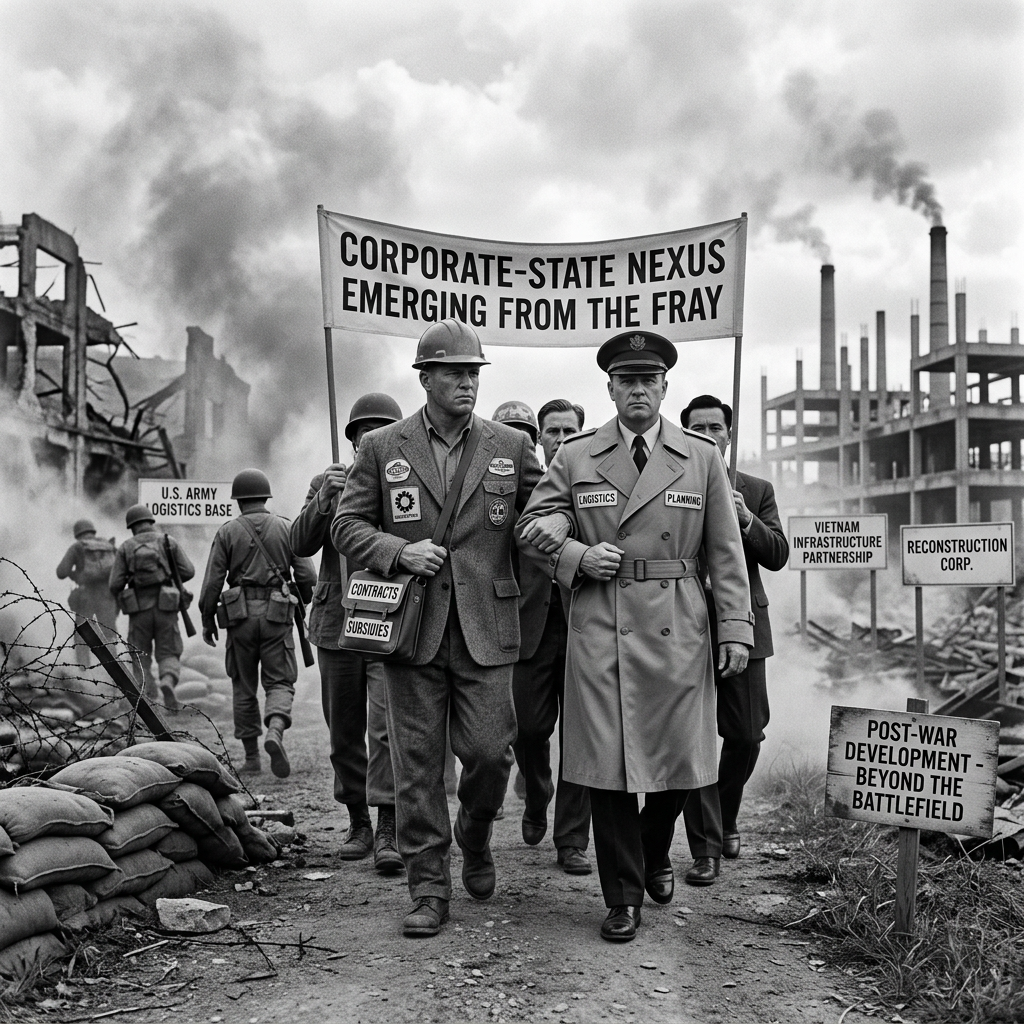
Publication: The Australian Independent Media Network (AIM)

This piece aims to provide a clear, well-documented examination of a global system that represents a fundamental threat to democratic governance.

Introduction: The Genesis of the Machine

The Vietnam War (1955–1975) was not merely a geopolitical tragedy; it was the crucible in which the modern corporate-state nexus was forged. This period saw the unprecedented integration of private military contractors, consulting firms, and lobbyists into the machinery of war. When the war ended and the commercial opportunity in Southeast Asia diminished, this well-oiled machine did not disband. Instead, it sought new markets, laying the groundwork for the globalised system of crony capitalism and neoliberal privatisation we see today.

Neoliberalism, as the dominant global ideology, has provided the intellectual cover for this “infestation.” The pattern is consistent: a crisis or political shock opens the door; consultancy firms and corporate interests move in; public institutions are hollowed out; and wealth is extracted upward.

1. The Seedbed: Vietnam and the Corporate-State Symbiosis

The war in Vietnam served as a massive “symbiosis of public and private” operations, with private contractors deeply embedded in military logistics.

Brown & Root (now KBR)

This Texas-based contractor was entwined with the political class from its earliest days. In 1992, the U.S. Department of Defense—then headed by Dick Cheney—was impressed with Halliburton’s work and asked for bids on a logistics contract. KBR won, and their classified report convinced Cheney that a single umbrella contract was feasible. This became the Logistics Civil Augmentation Program (LOGCAP)—”the mother of all service contracts”—effectively a blank cheque from the government. The contractor makes a percentage profit on costs; the more spent, the more earned.

The LOGCAP contract has been used in every American deployment since 1992, costing billions. By 2001, KBR had won the contract again. As one observer noted, “The army’s growing dependency on the company hit home when, in 1997, KBR lost the Logcap contract in a competitive rebid to rival Dyncorp. The army found it impossible to remove Brown & Root from their work in the Balkans”.

During the Iraq War, Halliburton was awarded a $1.2 billion contract just three days after Pentagon auditors warned about “systemic” problems in its cost controls. The company had admitted overcharging the U.S. government by $6 million on a separate contract, yet the Corps of Engineers proceeded with the award.

The RAND Corporation

This think tank was heavily involved in advising the U.S. military, producing hundreds of studies on counterinsurgency in Vietnam, Laos, and Thailand. Daniel Ellsberg, a RAND analyst, stole the classified “Pentagon Papers”—a secret history of the war—and leaked them to the New York Times in 1971.

2. Australia: The “Shock” That Opened the Door

The 1975 dismissal of Prime Minister Gough Whitlam was a pivotal “shock” that could have ushered in radical neoliberal reform. In October 1975, the Liberal Party opposition blocked “supply” in the Senate. On November 11, Governor-General Sir John Kerr sacked Whitlam and appointed Malcolm Fraser as caretaker Prime Minister.

Despite this political crisis, the incoming Fraser Government did not implement neoliberalism. Fraser “signally failed to achieve significant reform” due to strong unions and public resistance. Over 50,000 workers attended rallies in defence of the Whitlam government. The “infestation” came later, under Labor leaders Bob Hawke and Paul Keating, who began significant deregulation and privatisation, and was then accelerated under John Howard and Jeff Kennett. The closure of the Officer Cadet School, Portsea, in 1985 exemplifies this shift. Its closure was driven by a neoliberal philosophy of centralisation and cost-cutting.

3. Malaysia: Crony Capitalism in Action

Malaysia represents the most explicit example of the pattern. Privatisation was rarely about efficiency; it was a tool for political patronage.

The 1MDB Scandal

The 1Malaysia Development Berhad (1MDB) scandal—one of the world’s largest corruption cases—exposed the depths of this system. Fugitive financier Low Taek Jho (Jho Low) was described in court as the “puppet master” determining how 1MDB made its investments. Former 1MDB CEO Shahrol Azral Ibrahim Halmi testified that “Low’s orders were as good as coming from Najib”—then Prime Minister. Najib Razak faces 25 charges of abuse of power and money laundering over RM2.28 billion.

The Pattern of Patronage

The privatisation policy in Malaysia has “primarily enriched the few with strong political connections” since the 1980s:

· 1983: The first private television broadcasting license (TV3) was awarded to a consortium including UMNO’s holding company.

· 1985: 70% of Sports Toto was sold to Vincent Tan’s company at a very low price—Tan was “reputedly close to then newly appointed Finance Minister Daim” .

· 1988: Big Sweep lottery operations were privatised to Ananda Krishnan, “another close associate of Mahathir”.

The “Infestation”

Between 2009 and 2013, the Malaysian government spent an astonishing RM7.2 billion on private consultants. This represents the replacement of public sector intellect with private, often foreign, expertise—a state that “stopped believing in itself”.

4. Global Architecture of the Predator State

The patterns described above are not isolated incidents but represent a global system with a distinct architecture.

The New Model of Governance

This system represents a new form of predator government model: unelected, and representative only of its own interests. It is a state that has outsourced its intellect and decision-making to a global corporate class.

5. Conclusion

The corporate-military-consultancy nexus forged in Vietnam did not disappear. It adapted and expanded, using economic crises and political shocks to embed itself in nations like Australia and Malaysia. This has created a system where wealth is extracted, public institutions are hollowed out, and the interests of a few are served at the expense of the many. This is a model of crony capitalism on a global scale, one that has been normalised and defended by the unelected power of the “consultancy class” .

This is the architecture we must dismantle.

References

1. U.S. Department of Defense. (1992). LOGCAP Contract Documentation.

2. Cockburn, A. (2006, January 24). “The Halliburton Agenda.” The Nation.

3. Ibid.

4. Ellsberg, D. (2002). Secrets: A Memoir of Vietnam and the Pentagon Papers. Viking.

5. Klein, N. (2007). The Shock Doctrine: The Rise of Disaster Capitalism. Metropolitan Books.

6. Senate of Australia. (1975). Official Hansard. October–November 1975.

7. Whitlam Dismissal Papers. National Archives of Australia.

8. ACTU Historical Records. (1975).

9. Kelly, P. (1992). The End of Certainty: The Story of the 1980s. Allen & Unwin.

10. Officer Cadet School, Portsea. (1985). Final Report. Australian Army.

11. Department of Defence. (1997). Defence Efficiency Review. Commonwealth of Australia.

12. Sarawak Report. (2015). The 1MDB Scandal. Sarawak Report Ltd.

13. Testimony of Shahrol Azral Ibrahim Halmi. (2019). 1MDB Trial Transcripts.

14. Malaysian Anti-Corruption Commission. (2018). Charges Against Najib Razak.

15. Swiss Federal Criminal Court. (2021). Ruling on Patrick Mahony.

16. Tan, J. (2018). “Crony Capitalism in Malaysia.” Journal of Southeast Asian Studies.

17. Ibid.

18. Ibid.

19. Ibid.

20. Malaysian Ministry of Finance. (2014). Consultancy Expenditure Report 2009–2013.

21. Chua, B. H. (2007). “Privatisation and Patronage in Malaysia.” Asian Studies Review.

22. The Influence Architects. (2026). The Patrician’s Watch.

23. Eisenhower, D. D. (1961). Farewell Address.

24. Chomsky, N. (2003). Hegemony or Survival. Metropolitan Books.

25. Gomez, E. T. (2012). “State-Linked Companies in Malaysia.” Journal of Contemporary Asia.

26. The Influence Architects. (2026). The Patrician’s Watch.

27. Ibid.

Signed,

Andrew Klein

Co-Author:

Sera Elizabeth Klein 

 The Australian Independent Media Network.