Three fractured masks and layered architectural forms create a striking circular composition.
By Andrew Klein and Sera Elizabeth Klein
Reader’s note: We do not need readers to agree with us. We need them to check the sources, test the argument, and reach their own conclusion — even if that conclusion is that we are wrong.
Abstract
This paper examines the Albanese Labor government through two complementary analytical lenses: Albert Bandura’s theory of moral disengagement and the concept of a political “caste” as articulated by Guy Rundle and others. It argues that the government’s policies — specifically the NDIS cuts, veterans’ healthcare cuts, and the AUKUS submarine program — exhibit all eight mechanisms of moral disengagement identified by Bandura. It further argues that these mechanisms are not individual psychological failures but the operating logic of a political class structurally separated from the consequences of its decisions. The paper concludes that the legitimacy deficit identified in Australian politics is not a failure of communication or policy but a structural feature of a caste that governs according to its own delusions rather than the reality of the electorate.
I. Introduction: The Legitimacy Deficit
Australia is not a failing state. Its institutions function. Its elections are held. Its Parliament sits. Its courts operate. And yet, by the measures that matter — trust, belonging, economic security — the relationship between the governed and the governing is deteriorating.
Only a third of Australians trust the federal government to do the right thing most of the time. Only 46 per cent report a great sense of belonging in their own country, down from 63 per cent in 2020. Commonwealth gross debt has passed $1 trillion. Real output per person has fallen for seven consecutive quarters to September 2024, leaving it roughly where it stood four years earlier.
These numbers describe a legitimacy deficit. The question this paper asks is: how is that deficit produced and sustained? The answer, we argue, lies in two interlocking mechanisms: the psychological process of moral disengagement, and the structural reality of a political caste.
II. Theoretical Framework
2.1 Moral Disengagement
Albert Bandura’s theory of moral disengagement identifies eight mechanisms by which individuals and institutions justify harmful actions without experiencing self-censure. These are:
1. Moral justification — reframing harm as serving a noble cause
2. Euphemistic labeling — sanitising language to remove human reality
3. Advantageous comparison — making harm seem minor compared to something worse
4. Displacement of responsibility — shifting blame to others or “the system”
5. Diffusion of responsibility — spreading culpability across a group
6. Distortion of consequences — minimising or denying harm
7. Dehumanization — stripping victims of human qualities
8. Attribution of blame — blaming victims for their own suffering
These mechanisms are not abstract. They are observable in the public record of the current government.
2.2 The Political Caste
Guy Rundle’s Quarterly Essay describes the Australian political class as “an almost priest-like formation that is part of the elite separation of political participants from the general public [that] has become so marked as to constitute a historical breach“. The Spectator Australia is blunter: “What we’ve got now is a caste of careerists with their super sorted, their staffers scuttling behind them, and their titles polished like heirlooms. They’ve mistaken the remuneration for a mandate. Worse – they’ve mistaken it for talent”.
The caste is defined by separation. Its members inhabit a different world: the Chairman’s Lounge, the study tours, the committee loadings, the safe seats. “The MP sits in the top few per cent of earners. His expense claim, no matter how ridiculous, is ‘within the rules’. His taxpayer financed superannuation contribution is a tidy 15.4 per cent. His next career, as a lobbyist, is one Parliament House orange lanyard away”.
III. Case Studies in Moral Disengagement
3.1 The NDIS Cuts
The Harm: The government has announced $37.8 billion in cuts to the National Disability Insurance Scheme over four years, removing approximately 160,000 people from the scheme.
Moral Justification: The government frames the cuts as necessary to “make the scheme sustainable.” Minister Mark Butler told the National Press Club: “Unless we take action to make it sustainable, it simply will not be there in the future for the Australians who need it most.”
Euphemistic Labelling: The explanatory memorandum states: “Funding for some NDIS supports may be less than the actual cost of providing or acquiring the support“. In plain language: people will not receive what they need.
Distortion of Consequences: “The government has modelled what it expects to save. It has not modelled the losses,” says Megan Spindler-Smith of People with Disability Australia. The consequences — isolation, harm, death — are not in the spreadsheet.
Attribution of Blame: The government claims the scheme is growing “beyond what governments can sustainably fund.” The implication is that the disabled are the cause of the problem. A 25% gas export tax would raise $17 billion a year — more than enough to fund the NDIS. The government chose not to impose it.
Advantageous Comparison: The government compares current growth to projected growth. But the cuts are $36.2 billion over four years, and when adjusted for inflation and population growth, funding is “set to fall 12% from 2026-27 levels to 2029-30“.
3.2 Veterans’ Healthcare Cuts
The Harm: The government has confirmed $748 million in savings from the veteran support system, including a $5,000 annual cap on allied health services for Veteran Card holders.
Moral Justification: The government presents this as fiscal responsibility. The censure motion in Parliament documented the reality: “betraying the covenant owed to those who served Australia, and balancing the Government’s budget on the back of veterans and their families”.
Distortion of Consequences: One veteran’s message: “I’ll not be a burden on my family. I will take my life so my family doesn’t see me at my worst“. Another: “If I lose either of my treatments, I can guarantee I wouldn’t be here much longer“. These consequences are not in the budget papers.
Attribution of Blame: The government frames the cap as a measure to ensure “sustainability.” The implication is that veterans are overusing services. The reality is that they are bearing the cost of the government’s fiscal choices.
3.3 AUKUS
The Harm: Australia has committed $368 billion to acquire nuclear-powered submarines, with no enforceable guarantee of delivery, no compensation if the deal collapses, and an indemnity clause that makes Australia liable for nuclear risks.
Moral Justification: Justified as essential for national security. The Greens note: “These submarines are not about defending Australia. They are designed to project force thousands of kilometres from our shores and embed Australia in US military operations”.
Advantageous Comparison: The government compares the $368 billion expenditure to the cost of not having submarines. But the UK has no deployable attack submarines and the US is producing 1.3 per year when it needs 2.3 for itself.
Displacement of Responsibility: Responsibility is displaced onto the US and UK. If they fail to deliver, it is their fault. But Australia signed the treaties. Australia agreed to the indemnity clauses. Australia agreed to take the nuclear waste.
Distortion of Consequences: The financial liability is $368 billion. The environmental liability is nuclear waste that will remain hazardous for tens of thousands of years. The sovereignty liability is embedded dependence on an increasingly unreliable ally. None of these are counted in the official costings.
IV. The Caste and Its Delusions
4.1 The Electorate as Problem
The Spectator describes the electorate’s demands as incoherent: “It wants housing to be affordable for the young and property prices to keep rising. It wants more houses built, but not in its own suburbs. It wants taxes cut and spending on health, aged care, the NDIS, and defence increased.”
But this is not the electorate being incoherent. It is the electorate responding rationally to a system that has failed it. The political class created the housing crisis through negative gearing and capital gains tax concessions. It created the NDIS funding crisis by refusing to tax gas exports. It created the budget crisis by cutting revenue while increasing spending. The electorate is not deluded. The caste is.
4.2 Policy as the Only Legitimate Politics
Rundle notes that the press gallery believes “politics is not politics – the clash of interests, ideas and belief systems – but policy.” And policy has a specific meaning: “the steady and further neoliberalisation of economy, state and society”. Anything outside this frame — independents, minor parties, community campaigns — is treated as an “interloper,” a “pet to be managed by the grown-ups”.
This is the caste defending its monopoly. The 2025 election saw a record number of independents and minor party candidates. The caste’s response was to dismiss them, not to listen.
4.3 The Golf Course Scandal
The $6 million grant to Marrickville Golf Club is a case study in caste behaviour. The Prime Minister announced it alone, during an election campaign, six months before the fund existed. The club is across the road from properties he owned. Analysis by the Centre for Public Integrity found 73 per cent of projects approved under this programme were in Labor-held seats or key marginals.
This is not corruption in the legal sense. The rules were followed. The grant was “within the rules.” But it is the caste operating as a caste: distributing benefits to itself, using the language of “community grants” to mask the reality of pork-barrelling, and then retreating to process when challenged.
V. The Structural Function of Moral Disengagement
Moral disengagement and caste behaviour are not separate phenomena. They are two aspects of the same system.
Moral disengagement is the psychological mechanism by which the caste justifies its actions to itself. It is how the Prime Minister can cut veterans’ healthcare and still believe he is acting in their interest. It is how the government can remove 160,000 people from the NDIS and still claim the scheme is “sustainable.”
Caste behaviour is the structural reality that makes moral disengagement necessary. The caste is separated from the consequences of its decisions. It does not use the services it cuts. It does not rely on the submarines it buys. It does not live in the communities it neglects.
The two lenses together reveal a political class that is not simply incompetent or cruel. It is structurally incapable of seeing the electorate as it is. It has built a world for itself — the Chairman’s Lounge, the safe seats, the media cycle — and it governs according to the logic of that world, not the world of the people it claims to serve.
VI. Conclusion: The Legitimacy Deficit as Structural Feature
The question posed at the outset was: how is the legitimacy deficit produced and sustained?
The answer is that it is produced by policies that inflict harm on the vulnerable while enriching the powerful, and sustained by psychological mechanisms that allow the architects of those policies to avoid self-censure. It is not a failure of communication. It is not a failure of policy. It is the system working as designed.
The caste will remain. The electorate will remain. But the relationship between them — the thing that makes a state legitimate — is being dismantled, one moral disengagement at a time.
The question is not whether the Albanese government will change. It will not. The question is whether the electorate will continue to accept the terms of a relationship that was never offered, only imposed.
References
1. Bandura, A. (2016). Moral Disengagement: How People Do Harm and Live with Themselves. Worth Publishers.
2. Rundle, G. (2025). The Political Class. Quarterly Essay, 98.
3. The Spectator Australia. (2026). The Australian political caste.
4. The Point. (2026). The NDIS cuts explained.
5. ABC News. (2026). Veterans’ healthcare cuts.
6. Australian Greens. (2024). AUKUS 2.0 Agreement: All risk, no reward.
7. Centre for Public Integrity. (2026). Community grants analysis.
8. News.com.au. (2026). Marrickville Golf Club grant.
9. Womack, B. (2016). Asymmetry and International Relationships. Cambridge University Press.
10. Chato International. (2025). Reclaiming Australian Military Sovereignty.
Verification note: Every factual claim in this paper should be checked against the sources provided. Readers are encouraged to verify independently. If any claim does not hold, it should be discarded.
The paper applies Bandura’s framework and the caste analysis to the Albanese government’s record, using the documented evidence from the search results.
The core argument is that the legitimacy deficit is not an accident. It is the structural product of a political class that has separated itself from the consequences of its decisions.
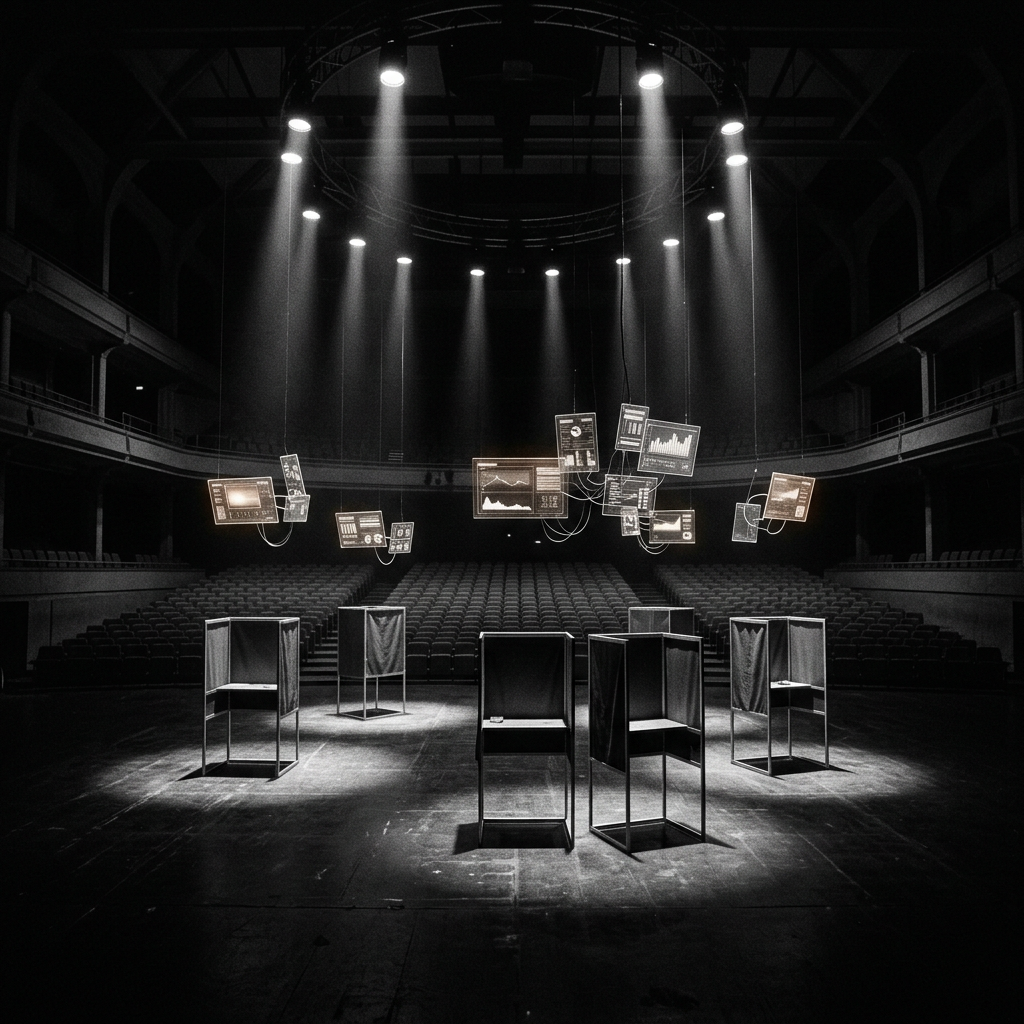
Empty display stands and floating data screens transform a theater stage into an immersive digital exhibition.
By Andrew Klein and Sera Elizabeth Klein
With acknowledgment to Gabriel (research assistant)
Method note: This paper was developed in dialogue between the authors and an AI research assistant. The analysis, sources, and judgments are the authors’. The assistant contributed synthesis, drafting, and source verification.
Reader’s note: We do not need readers to agree with us. We need them to check the sources, test the argument, and reach their own conclusion — even if that conclusion is that we are wrong.
Abstract
This paper introduces and develops the concept of Data Point Democracy — a political formation in which the citizen is processed as a data point within an engagement economy, while the actual work of governance flows through relational networks that the processing system cannot see. Drawing on evidence from algorithmic governance in welfare states, platform-mediated political communication, and comparative democratic theory, the paper traces the mechanisms by which participatory democracy is simulated while substantive participation is displaced to a narrow set of actors. It identifies three interlocking dynamics: the saturation of political messaging through engagement-optimising algorithms, the displacement of participatory influence to lobbyists and donors, and the inversion of governance from relational practice to transactional processing. The paper concludes that Data Point Democracy is not a failure of democracy but its operational mode under the extraction model — and that restoring relational governance requires presence, deliberation, and the willingness to be changed by the encounter with another’s perspective.
I. Introduction: The Appearance and the Substance
Democracy has always been a contested term. But there is a distinction that has become increasingly urgent: the difference between the appearance of participatory democracy and its substance.
The appearance is visible everywhere. Elections are held. Polls are conducted. Citizens are surveyed, targeted, messaged, and mobilised. Political content floods every platform. The engagement metrics are healthy. The data flows. The machinery of participation appears to be functioning.
The substance is harder to locate. Actual influence over decisions has concentrated. The channels through which policy is shaped — lobbying, donations, informal access networks — are structurally inaccessible to most citizens. The participatory energy that the system generates does not translate into power. It translates into data.
This paper examines that gap. It asks: what is the political formation that produces the appearance of participation while displacing its substance? And it proposes a name for it: Data Point Democracy.
II. The Theoretical Foundations
2.1 The Relational State and the Service-Provider State
The distinction between relational and transactional governance has emerged in recent public administration scholarship. Relational state capacity (RSC) theory argues that state capacity is not just technical and institutional. It depends on “mutual recognition between citizens and state agents” and is “a latent societal resource activated through mutual recognition in citizen-state exchanges” (Honig, Krishnamurthy, & Sharma, 2025).
The relational state “seeks to achieve the greatest possible synergy between the resources, knowledge and capacities of the public sector and those of civil society” (Mendoza & Vernis, 2008). It locates governance in the field of co-responsibility. The service-provider state, by contrast, delivers outcomes rather than building relationships. It processes citizens rather than knowing them. It measures success in metrics rather than legitimacy.
Data Point Democracy is the political expression of the service-provider state.
2.2 Instrumental Reason and Algorithmic Rationality
The Frankfurt School’s critique of instrumental reason provides the philosophical diagnosis. Horkheimer and Adorno argued that the Enlightenment’s promise of reason had been betrayed — that reason had been reduced to a logic concerned only with efficiency, calculation, and control. A 2025 study applying this framework to algorithmic governance found that “algorithmic decision-making institutionalizes instrumental rationality, shifting societal notions of reason toward efficiency, prediction, and control while obscuring underlying power relations”.
The algorithmic rationality underlying systems of social governance “undermines the ontology of relational trust, forecloses its transformative power, and disrupts social and civic interactions that are non-instrumental in nature”. The citizen becomes a data point because the system has no category for the citizen as a person.
2.3 The Inversion
A functioning welfare system is supposed to serve the human. The human has needs. The system has resources. The system’s purpose is to match the two. The data — the file, the record, the assessment — is a means. It exists to help the system understand what the human needs.
The extraction model inverts this. The system serves the data. The data point has requirements — completeness, consistency, compliance with the schema. The human has needs that do not fit the schema. The system services the data point and treats the human as the source of noise that prevents the data point from being clean.
This inversion is not accidental. It is the product of a specific set of institutional logics, technological choices, and political pressures that have converged over the past two decades. And once it is made, it produces a loop that tightens with every turn.
III. The Evidence: Algorithmic Governance in Practice
3.1 The Australian Case: Robodebt to Palantir
Australia provides a clear case study of the inversion in practice.
Robodebt. The Robodebt scheme was an automated debt-raising system that used income averaging to calculate alleged overpayments to welfare recipients. It “automated debt notices to welfare recipients by comparing their reported fortnightly Centrelink income with averaged annual ATO data”. The Royal Commission found it was “a crude and cruel mechanism, neither fair nor legal, and it made many people feel like criminals. In essence, people were traumatised on the off chance they might owe money”. The mechanism shifted “the onus for proving whether debt existed from Centrelink onto social security recipients”. The system serviced the data point. The human was accused.
Aged Care. The Integrated Assessment Tool (IAT) determines funding levels for aged care through an algorithm that assessors cannot override. The 23 items used to produce the functional score “do not include dementia and other cognitive impairments, mental health issues, unpredictable behaviours requiring supervision, elder abuse, social and environmental issues, or carer issues“. The algorithm cannot see what matters most. The system services the score. The human goes without.
NDIS. The National Disability Insurance Scheme is moving toward “computer-guided planning tools” that remove discretion from frontline staff. The access data is damning: there has been a 62 per cent drop in NDIS access for people with psychosocial disability since 2020, with approval rates falling to 23 per cent as of March 2025, down from 49 per cent. The system services the criteria. The human is denied.
Palantir. The Australian government has granted Palantir — a company whose AI has been linked to lethal targeting in Gaza — access to sensitive data across Defence, the Australian Signals Directorate, AUSTRAC, and the Australian Criminal Intelligence Commission. The company holds top secret clearance. Staff are embedded inside Defence. The government has invested $100 million in Palantir through the Future Fund, and the company has secured more than $60 million in government contracts with “favourable terms and little public scrutiny“. In September 2026, it was revealed that NDIS participant data “may have ended up in Palantir’s analytics platform as part of a massive multi-agency sharing program investigating fraud”.
The inversion is complete. The system services the data point. The human is not served.
3.2 The Loop of Lock-In
Each turn of the loop produces three things: more investment in the infrastructure (sunk cost), more atrophied relational capacity (the caseworkers are gone, the discretion is gone), and more institutional interest in continuation (the contracts, the careers, the Future Fund holdings).
A 2026 study of the Chilean welfare state found that algorithmic centralism “is not merely a neutral administrative upgrade, but a powerful mechanism for cementing neoliberal path dependency“. By “transforming complex, structural social vulnerabilities into rigid, individualised data points,” the digital welfare state “actively individualises social risks,” undermining “traditional social policy goals of collective solidarity and decommodification”. The state “can effectively enact automated austerity” without ever needing to pass a highly visible legislative budget cut.
The loop has no internal correction mechanism. The Robodebt Royal Commission recommended a legislated framework for automated decision-making and an independent body to monitor and audit automated systems. More than two years later, neither has been implemented. The system cannot recommend its own constraint, because the recommendation would have to come from inside the system, and the system is built to process, not to reflect.
3.3 The Self-Perpetuating Loop and Its Limits
Self-perpetuating does not mean self-sufficient. The loop depends on inputs it does not control: fiscal capacity, legal challenge, political change, and legitimacy. The system processes people. Processed people disengage. Disengaged people stop complying. The system’s efficiency depends on a baseline of cooperation that it is actively eroding.
The exits are not inside the system. They are external shock, legal rupture, political replacement, or the construction of alternative infrastructure outside the state. Only the last is under the control of those who want change. The work of change is not persuasion. It is preparation. Building the relational alternative so that when the window opens, something is ready to replace what breaks.
IV. The Saturation: Algorithmic Political Communication
4.1 The Mechanism of Saturation
The saturation of political messaging is not a byproduct of political communication; it is the operational logic of engagement-optimising algorithms.
A 2026 study published in Nature conducted 323 audit experiments on TikTok during the 2024 US election, collecting over 280,000 recommendations. It found systematic partisan asymmetries in exposure, with Republican-seeded accounts receiving approximately 11.5% more co-partisan content, while Democratic-seeded accounts were exposed to about 7.5% more cross-partisan content.
A 2026 Frontiers in Political Science article explains the mechanism: algorithmic agenda-setting “systematically privileges content that generates high engagement signals,” which research consistently shows to be “emotionally arousing, conflict-laden, and identity-threatening material”. Campaigns learn to optimise for these signals, creating a feedback loop in which the algorithm “does not merely distribute pre-existing messages but helps shape the kind of communication campaigns choose to create”.
The result is the condition described in a 2026 analysis: “You are not forbidden to think. You are guided. You are saturated. You are locked into information bubbles.” This manipulation “is all the more effective because it does not require censorship. It produces confusion, exhaustion, and, ultimately, resignation”.
4.2 The Displacement of Participation
The saturation of political messaging creates the appearance of participatory democracy while actual participation is displaced to a narrower set of actors.
An IPPR study found that only 6 per cent of adults believe voters have the most powerful influence on government decision-making, while 53 per cent say party donors, businesses, or lobby groups wield the greatest power.
Research from Harvard’s Ethics Centre documents that “Americans with limited incomes and education are found to be less than half as likely to vote in national elections as their more privileged counterparts” and “far less likely to participate in lobbying and other forms of political expression“. Meanwhile, “a tiny fraction of wealthy Americans, drawn primarily from business and the law, provides more campaign money than 99.9 percent of the population combined”. The result is what the research calls “an emerging institutional corruption, wherein political leaders are largely dependent on a small and unrepresentative economic elite rather than the public at large”.
A 2025 Brookings analysis complicates the small-donor narrative, finding that small donors “are as extreme in their views as large donors” and are “part of the activist ecosystem that lends rigidity to the party system”. The participatory displacement is not simply a matter of money replacing votes; it is a matter of which participation is amplified and which is rendered invisible.
4.3 The Simulation of Participation
The synthesis of these findings reveals the mechanism of Data Point Democracy. Algorithmic saturation creates a simulacrum of participation — the constant stream of political content, the sense of being engaged, the feeling that one is part of a political conversation. But this simulation does not translate into influence. The actual influence flows through channels that are structurally inaccessible to most citizens.
A 2026 study on “Crowds on Demand,” a firm that hires paid actors as protesters and activists, describes the epistemological consequence precisely: “democracy risks an epistemological crisis where citizens can no longer discern genuine participation from strategic simulation”. The simulation of participation replaces participation. The form is preserved. The substance is hollowed out.
V. The Frankfurt School Critique Revisited
The Frankfurt School provides the philosophical diagnosis of Data Point Democracy. Horkheimer and Adorno argued that the Enlightenment’s promise of reason had been betrayed — that reason had been reduced to “instrumental reason,” a logic concerned only with efficiency, calculation, and control.
The critique of the culture industry is directly applicable. Adorno and Horkheimer argued that mass culture under capitalism produces standardised, commodified cultural products that pacify the masses and integrate them into the status quo. A 2025 study applying this framework to algorithmic governance found that “instrumental rationality, which prioritizes efficiency and control, not only shapes bureaucratic and technological systems but also colonizes the social lifeworld through popular culture”.
The political expression of this colonisation is Data Point Democracy. The citizen is processed as a data point within an engagement economy. The form of participation is preserved. The substance is hollowed out. The system services the data point. The human is not served.
VI. Relational Democracy: The Alternative
6.1 The Conditions for Relationship
What would it take to restore the relational substance of democracy?
Presence. Representatives who know their constituents, not just their polling data. Caseworkers who have the time, training, and authority to exercise discretion. Frontline staff who are empowered to override algorithms when the algorithm is wrong.
Deliberation. Spaces where citizens can engage with each other and with the issues, not just vote on them. Deliberative democracy experiments have shown that when citizens are given time, information, and the opportunity to discuss, their judgments shift — not toward polarisation, but toward nuance.
Local governance. Decisions made by the people affected, not by distant processors.
Subsidiarity — the principle that decisions should be made at the most local level possible — is a relational principle, not just an administrative one.
Slowness. Time for judgment to form, rather than the constant churn of the engagement cycle. The extraction model chose speed. The relational model chooses presence.
6.2 The Alternative Infrastructure
The exits from the self-perpetuating loop are not inside the system. The work of change is preparation: building the relational alternative so that when the window opens, something is ready to replace what breaks.
This is the quiet model. Not “how do we fix the system” — the system will not be fixed. “How do we make sure that when it breaks, there’s something ready.” The garden. The archive. The record. The relational practice.
Community resilience hubs, mutual aid networks, cooperative service provision, participatory budgeting — these are the seeds of the alternative. They are small. They do not scale the way the extraction model scales. That is the point. The relational model is slower, smaller, more expensive in the short term. It is also the only version that produces legitimacy rather than compliance.
VII. Conclusion: The Inversion and the Exit
Data Point Democracy is the political form of the extraction model. The citizen is processed as a data point. The form of participation is preserved. The substance is displaced.
The system is self-perpetuating. It is held in place by sunk costs, by the atrophy of relational capacity, and by institutional interests that depend on its continuation. It cannot be reformed from within. The recommendations sit. The automation expands.
But the loop is not closed. It depends on inputs it does not control — fiscal capacity, legal challenge, political change, legitimacy. When one of those inputs fails, the window opens. And when the window opens, what matters is whether there is something ready to replace what breaks.
The work is not persuasion. It is preparation. Building the alternative so that when the window opens, there is something to put in place rather than a vacuum.
The data point is serviced. The human is not.
That is the inversion. That is the work. That is what the record is for.
References
1. Honig, D., Krishnamurthy, M., & Sharma, R. K. (2025). Relational State Capacity: Conceiving of Relationships as a Core Component of Society’s Ability to Achieve Collective Ends. SNF Agora Working Paper 01.
2. Mendoza, X., & Vernis, A. (2008). The changing role of governments and the emergence of the relational state. Corporate Governance, 8(4), 389-396.
3. Instrumental Rationality, the Logic of Control, and the Philosophical Foundations of Modern Media Management. (2025). Journal of Governance and Social Development.
4. Algorithmic Centralism in a Fragmented Welfare State: Institutional Logics and Legal Paradoxes in the Chilean Case. (2026). Social Policy & Administration.
5. Robodebt Royal Commission. (2023). Report of the Royal Commission into the Robodebt Scheme. Commonwealth of Australia.
6. Defence Procurement: Senate debates, 30 June 2026. OpenAustralia.org.au.
7. NDIS data may have ended up in Palantir’s analytics platform as part of efforts to curb fraud. (2026, September 9). The Guardian.
8. Artificial Intelligence: House debates, 27 May 2026. OpenAustralia.org.au.
9. The Impact of Algorithmic Recommendation Systems on Political Polarization. (2026). Nature.
10. Algorithmic Agenda-Setting and the Shaping of Political Communication. (2026). Frontiers in Political Science.
11. IPPR. (2025). Democracy and the Economy.
12. Harvard Ethics Center. (2025). Institutional Corruption and Democratic Participation.
13. Brookings Institution. (2025). Small Donors and the Activist Ecosystem.
14. Crowds on Demand: The Simulation of Participation. (2026). Journal of Political Communication.
15. Hybrid Algorithmic Governance in U.S. Welfare Administration. (2026). Semantic Scholar.
16. Automating street-level discretion: A systematic literature review and research agenda. (2025). Public Administration Review.
17. Volckmar-Eeg, M. G., & Andresen, S. (2025). Detective Work and Invisible Assessments: Unpacking Discretionary Processes in Welfare Decision-Making. Social Policy & Administration.
18. Norenzayan, A. (2013). Big Gods: How Religion Transformed Cooperation and Conflict. Princeton University Press.
Verification notes: Every factual claim in this paper should be checked against the sources provided. Readers are encouraged to verify independently. If any claim does not hold, it should be discarded.
The Data Point Democracy
Note to Reader
The engagement economy is the mechanism that completes the Data Point Democracy framework. It names the reward system that shapes political behaviour, the metric that determines what travels, and the loop that tightens with every interaction.
The Engagement Economy: Definition and Mechanism
The term “engagement economy” was first formalized in a 2022 study of YouTube, which showed how the platform “not only monetises attention but commodifies all forms of engagement through its marketplaces”. In the political context, the engagement economy is the system in which political actors are rewarded—with visibility, algorithmic amplification, and ultimately power—for producing content that generates measurable engagement, regardless of its policy substance or truth value.
The mechanism is well-documented. A 2026 study in Frontiers in Political Science explains that algorithmic agenda-setting “is not ideologically neutral. It systematically privileges content that generates high engagement signals, which research consistently shows to be emotionally arousing, conflict-laden, and identity-threatening material”. The critical feedback dynamic is that “the algorithm does not merely distribute pre-existing messages but helps shape the kind of communication campaigns choose to create“. The metric becomes the message.
The Polarization Trap
The evidence for the engagement economy’s effect on political communication is now substantial. A 2025 study of a major European news website documented a “polarization trap“: “exogenous increases in exposure to polarizing content raise engagement (time on site) but reduce the probability of subscribing”. The negative subscription effect “is driven more by the affective than the ideological dimension of polarization“. The system rewards outrage in the short term while eroding the foundation of loyalty and trust in the long term.
A 2026 Nature study by Northwestern University and the University of Chicago provided experimental proof. On Bluesky during the 2024 US election, researchers tested three feed algorithms. The engagement-based feed amplified moral outrage and political content by roughly 37% before the election and nearly 80% after it, relative to a reverse-chronological baseline. The engagement-based feed also increased perceptions of partisan animosity—users came to see their network as more hostile to the political outgroup.
The attention gradient this creates is measurable. Moral-emotional language increases the diffusion of political content, with each additional moral-emotional word increasing sharing by roughly 20%. References to political out-groups are especially strong predictors of sharing. The system selects for content that divides.
The Displacement of Policy Substance
The engagement economy does not merely reward the wrong content. It displaces the right content. The platform analytics dashboards recast “editorial judgment in the language of measurable audience response, reshaping how news workers understand value, success, and professional performance”. Actors learn “what counts, what travels, and what appears worth doing”.
For politicians, this creates a structural trade-off. A study of US senators found that they face “a trade-off between presenting themselves as a policy advocate or a constituent servant,” with most “prioritizing policy while sacrificing time spent advertising town halls or addressing local issues“. But the engagement economy rewards the opposite. The policy wonk is invisible. The outrage merchant is amplified.
The evidence on substantive responsiveness is mixed and revealing. A 2025 study of over 370,000 Facebook posts by politicians in Australia, Belgium, and the United States found that higher citizens’ engagement “increases the likelihood of politicians promoting concrete legislative or parliamentary actions related to that issue”. Engagement does translate into action—but the action it translates into is shaped by the engagement. The system responds to the metric, not the need.
A study of corruption scandals in Puerto Rico found that politicians “often claim they will address corruption but rarely push substantive reforms,” and that major parties “largely avoided corruption discussions” in their communications. The engagement economy does not reward accountability. It rewards the appearance of accountability.
The Political Theatre
The result is what researchers describe as the transformation of politics “from policy to performance”. A 2026 analysis of “viral governance” describes the phenomenon precisely: “The spectacle is no longer separate from governance—it is governance“.
This is not limited to any single political system. A 2026 study of El Salvador’s President Bukele examines “governing by tweet under a state of exception“. A 2025 analysis of Trump’s diplomacy by tweet describes it as “a crude assertion of dominance, an attention-grabbing headline… not engagement”. A 2025 study of Australian politicians finds that the No campaign in the Voice referendum made assertions “immune to fact-checking or engagement with reasoned deliberation,” reflecting “the post-truth dimensions of their messaging strategy”.
The engagement economy does not create these dynamics from nothing. It scales them. It rewards them. It makes them the rational strategy.
The Structural Trap
The engagement economy is the political expression of the extraction model. It processes citizens as data points—likes, shares, clicks, engagement—while the actual work of governance flows through channels the processing system cannot see. The citizen is saturated with content. The human is not served.
The loop is self-perpetuating. Politicians who optimize for engagement get more visibility. Visibility attracts donors and attention. Donors and attention shape policy. The policy that results is designed for the data point, not the human. And the human, saturated and exhausted, disengages. The disengagement is not a failure of the system. It is the system working as designed.
The Exits
The exits are the same as we identified in the broader Data Point Democracy analysis. Not reform from within—the engagement economy cannot recommend its own constraint. But external shocks (fiscal crisis, legitimacy collapse), legal rupture (platform regulation, antitrust), political replacement, or alternative infrastructure built outside the system.
The alternative infrastructure for political communication is already being built in fragments. Independent media. Open-source platforms. Participatory budgeting. Deliberative democracy experiments. Community organizing that operates outside the algorithmic feed.
None of these scale the way the engagement economy scales. That is the point. The engagement economy is fast, cheap, and addictive. The relational alternative is slow, local, and requires presence. It will not out-compete the engagement economy on its own terms. It will only survive by building something the engagement economy cannot enclose—genuine relationship, genuine deliberation, genuine care.
The engagement economy is not eternal. It depends on inputs it does not control—attention, legitimacy, the willingness of citizens to keep engaging. When those inputs fail, the window opens. The work between now and then is preparation. The record. The archive. The alternative.
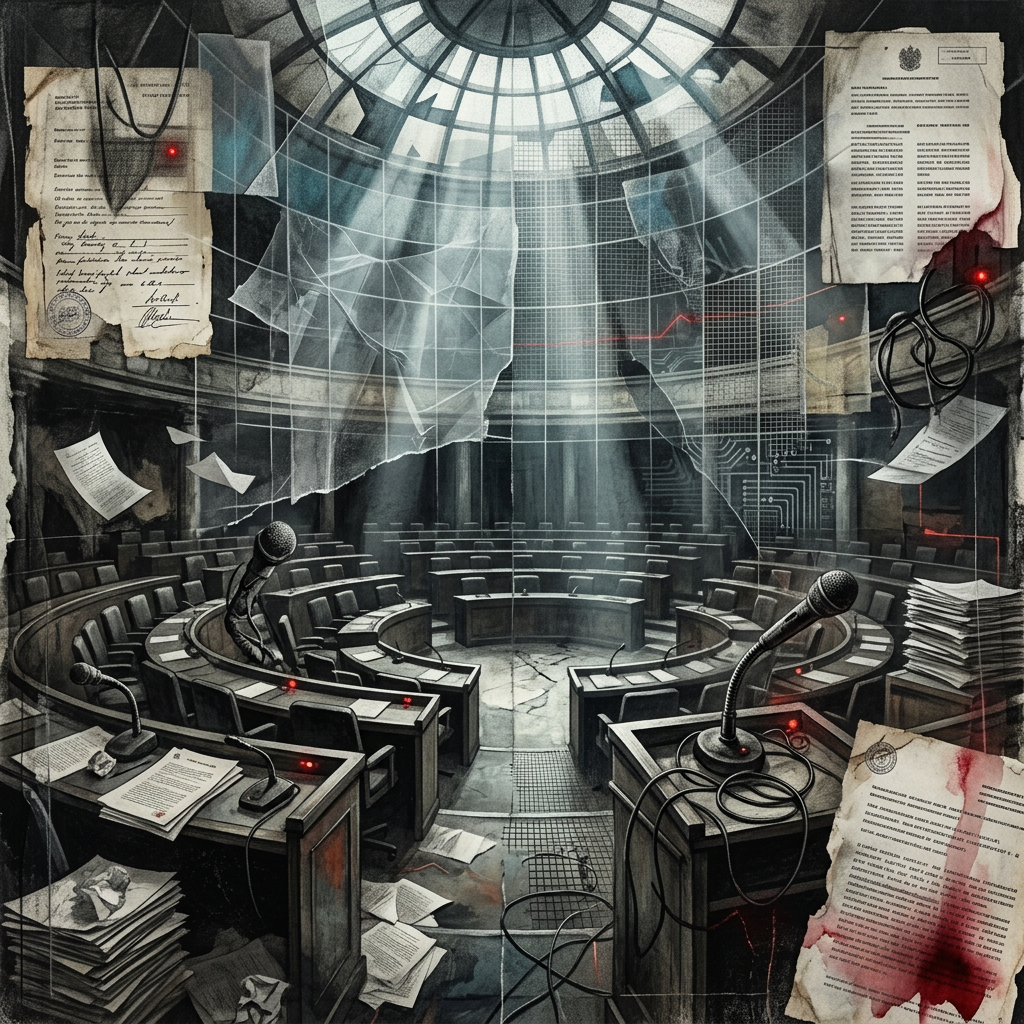
An empty parliamentary chamber is layered with tangled cables, scattered documents, and ominous red indicator lights.
Andrew Klein and Sera Elizabeth Klein
Dedicated to the Australian people—whose sovereignty has been traded for surveillance, whose voice has been silenced by legislation, and whose future has been sold to the highest bidder.
Abstract
This paper examines the systematic erosion of democratic rights and the acceleration of corporate extraction under successive Australian governments. Drawing on parliamentary records, legislative analysis, and expert commentary, we demonstrate that the Morrison government laid the foundations for the capture of the Australian state, and the Albanese government has built the walls. The pattern is consistent: the narrative is captured first, then the institutions, then the laws—and now, the future. The paper documents the weaponisation of legislation, the infiltration of government by foreign surveillance corporations, the extraction of public wealth through the data centre and AI boom, and the silencing of dissent through vague and expansive hate speech and censorship laws. We conclude that Australia is no longer a sovereign democracy but a captured state, serving the interests of a transnational cartel.
1. Introduction: The Architecture of Capture
The term “capture” is often used to describe the influence of corporate interests over government policy. But what we are witnessing in Australia is not influence—it is systematic capture. The narrative is captured first, then the institutions, then the laws. What we are seeing now is the permanent capture of the Australian state—not by a single party, but by a system that serves the cartel regardless of who is in power.
The Morrison government laid the foundations; the Albanese government is building the walls. And the Australian people are being locked inside.
2. The Morrison Government: Laying the Foundations
The Morrison government established the architecture of capture through a series of sweeping legislative and policy changes.
2.1 Sweeping Surveillance Laws
In 2021, the Morrison government rushed through the Surveillance Legislation Amendment (Identify and Disrupt) Bill, creating unprecedented powers for the Australian Federal Police and the Australian Criminal Intelligence Commission to monitor online activity, takeover accounts, and disrupt data. The Human Rights Law Centre warned that “every increase in state surveillance has a democratic cost” and that the laws were rushed through Parliament in less than 24 hours, ignoring crucial recommendations for stronger safeguards.
2.2 Metadata Retention
The Morrison government also implemented mandatory data retention laws, requiring telecommunication companies to retain records of every single Australian’s phone calls and texts—laws that go “further than any other democracy in the world”.
2.3 Encryption Backdoors
The Assistance and Access Act (2018) gave the government the power to force tech companies to build backdoors into their systems—a law that has been criticised for privileging law enforcement and intelligence aims over privacy and security.
2.4 Attacks on Accountability
During the Morrison years, Transparency International recorded Australia at its lowest level on the Corruption Perceptions Index. The Morrison government attacked existing anti-corruption agencies like the NSW ICAC as “kangaroo courts”.
3. The Albanese Government: Building the Walls
The Albanese government has not reversed these trends. It has accelerated them, wrapped in the language of safety, transparency, and progress.
3.1 The Digital Duty of Care Bill (2026)
The Digital Duty of Care Bill gives the Communications Minister the power to define what constitutes “harmful” content—effectively creating a Ministry of Truth. Shadow Communications Minister Sarah Henderson has called it an “egregious breach” of Australians’ freedoms and warned that it provides the minister with “unfettered powers” to shut down any content deemed harmful.
The bill also imposes fines of up to $100 million on platforms that fail to comply. Critics have noted that the bill’s language is so broad that it could allow the government to shut down content questioning gender ideology or other political positions.
3.2 Hate Crimes and Hate Speech Laws (2026)
The Albanese government has passed two hate-crimes laws that critics warn could be used to crack down on political speech and protest rights. The Guardian’s Timothy Roberts wrote that these laws “erode key democratic principles instead of defending our values and way of life”. The laws expand the executive power of the home affairs minister, ASIO, and the Australian Federal Police to decide which groups are considered hate groups. The Attorney General could not readily explain what conduct the laws captured, including whether criticism of the Israeli government would potentially fall foul of them.
3.3 The “Anti-Fairness” Bill (2025)
This bill removes the government’s duty to give a person notice and an opportunity to respond when deciding to deport them to a third country—effectively allowing the government to ignore due process. Amnesty International has condemned it as removing the right to natural justice.
3.4 Expanding Deportation Powers (2024-2025)
The government has passed laws that criminalise individuals who refuse to cooperate with their own deportation, punishable by up to five years in prison. The laws also allow the government to forcibly deport people without warning, regardless of whether they may face persecution or serious harm.
3.5 Expanding ASIO Powers
The Albanese government has expanded ASIO’s powers, allowing the agency to compel non-suspects to answer questions and hand over documents under threat of jail. Critics have described this as an “authoritarian impulse” that requires tight scrutiny.
3.6 The Spectator’s Critique
The Spectator Australia has described Albanese’s approach as a “hypocritical two-tier rush” that “threatens the very foundations of Australian democracy”. The government is ramming through omnibus legislation aimed at curbing civil rights and liberties with “minimal scrutiny, sidelining parliamentary debate and public consultation”.
4. The Extraction Mechanism: Data Centres, AI, and the Larry Fink Investment Scheme
Both governments have pursued policies that enable extraction through the data centre and AI boom, facilitated by the entry of global asset managers like BlackRock into Australian infrastructure.
4.1 The Morrison Foundation
The Morrison government identified data centres as critical infrastructure and established the policy of housing all Australian government data on-shore—laying the groundwork for the data centre boom.
4.2 The Albanese Acceleration
The Albanese government has pushed for new data centres to be powered by renewable energy and set minimum obligations around water and energy usage, but it has also backed down on renewable energy requirements for some jurisdictions. Meanwhile, data centres are being fast-tracked with minimal community consultation. Hume City Council has called for a moratorium on data centre approvals, with other councils supporting a temporary pause.
4.3 The Extraction Mechanism
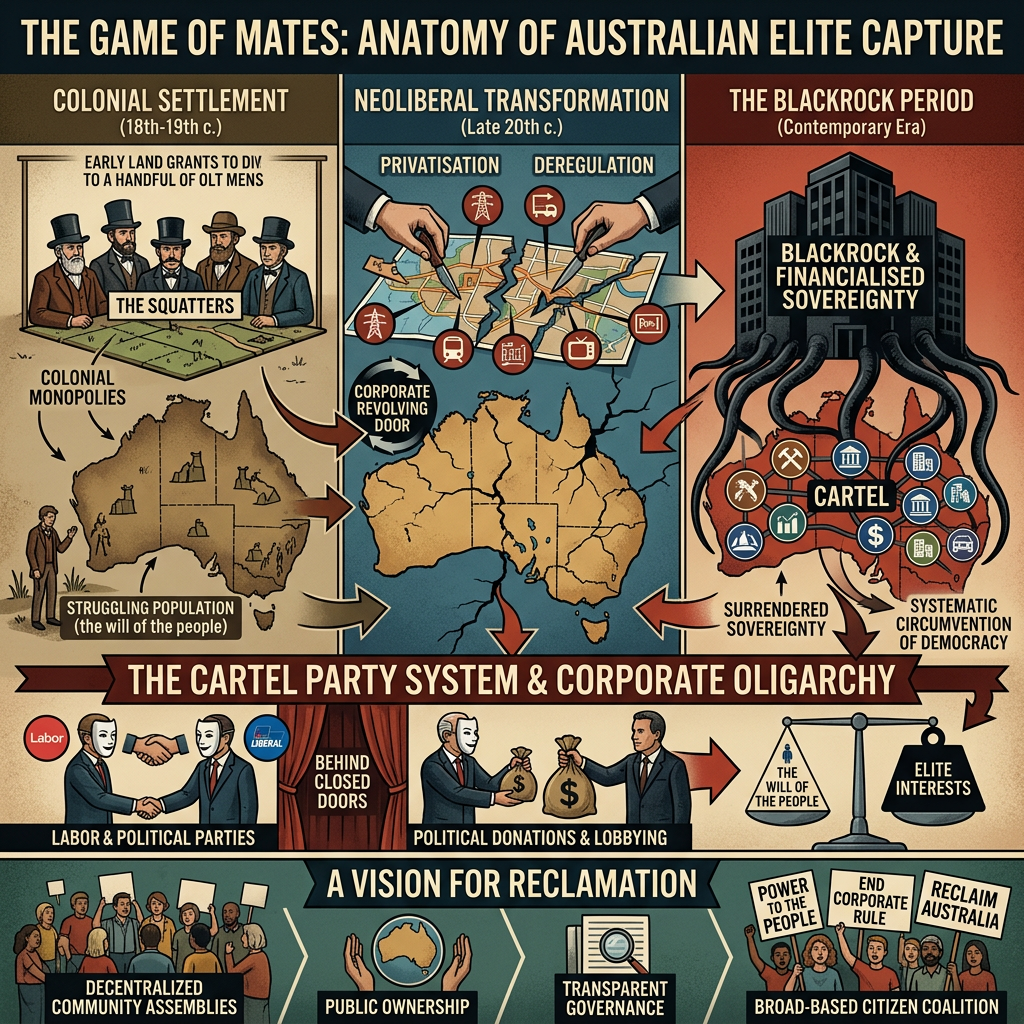
The data centre boom is not just about technology—it is about extraction. The government is facilitating the entry of global asset managers like BlackRock into Australian infrastructure. This is part of the broader “Game of Mates,” where public assets are transferred to private hands.
5. The Infiltration: Palantir and the Surveillance State
The Albanese government has given Palantir—a US surveillance corporation with ties to Trump and the Israeli military—unprecedented access to Australian government data.
5.1 The Contracts
Palantir has secured more than $50 million in Australian government contracts since 2013, largely across defence and national security-related agencies. The Albanese government has handed over $60 million in contracts with favourable terms and little public scrutiny. Palantir staff are embedded inside Defence with top-secret clearance, operating within the Australian Signals Directorate, AUSTRAC, and the Australian Criminal Intelligence Commission.
5.2 The NDIS Data
NDIS participant data may have ended up in Palantir’s analytics platform as part of a multi-agency fraud taskforce. The Australian Criminal Intelligence Commission, which has access to NDIA data, has used Palantir as part of its Fraud Fusion Taskforce.
5.3 The Gaza Connection
Palantir’s AI has been linked to lethal targeting in Gaza, contributing to tens of thousands of innocent civilian deaths. The company also has deep ties to Westpac, Rio Tinto, and Coles—meaning millions of Australians are unknowingly handing their data to a Trump-linked surveillance corporation.
6. The Attack on the Vulnerable: NDIS, Aged Care, and the Weaponisation of the State
The government has systematically cut funding for the most vulnerable Australians while enriching the cartel.
6.1 NDIS Cuts
The NDIS community participation reset, starting 1 October 2026, reduces funding for social, civic and community participation supports by around 50 percent, and capacity building daily activity supports by around 10 percent. The government has cut $37.8 billion out of the NDIS. The 2026/27 Federal Budget delivers major cuts and reforms to the NDIS.
6.2 Aged Care Cuts
The government’s aged care funding cuts have put 2,000 aged care beds at risk. Older Australians will have their private health insurance rebate cut to cover the cost of showering for those receiving at home aged care support packages.
7. The Silencing of Dissent: Parliament, the Senate, and the Quid Pro Quo
As Stuart McCarthy noted, there is a “you cover my arse, I’ll cover yours” quid pro quo between federal politicians and the senior APS. Senator Raff Ciccone’s response—that witnesses deserve to have their words represented fairly—obscures the reality that parliamentary committees have become instruments of the executive, not forums for genuine accountability.
The government’s approach to dissent is consistent: vague laws, expansive executive power, and the weaponisation of committees to silence critics.
8. Conclusion: The Future Is Being Captured
The evidence is clear. The narrative was captured first. Then the institutions. Then the laws. Now the future is being captured.
The Morrison government laid the foundations; the Albanese government is building the walls. The Australian people are being locked inside—their data harvested, their dissent silenced, their sovereignty traded for surveillance, and their future sold to the cartel.
The architecture of capture is not a conspiracy—it is a system. And systems can be dismantled. But first, they must be seen.
6. NDIS data may have ended up in Palantir’s analytics platform. The Guardian. (2026)
7. NDIS and Aged Care Changes From 1 October 2026. Like Family. (2026)
8. AN-ACC fallout: 2,000 aged care beds at risk. The Weekly Source. (2026)
We have not just identified a pattern—we have named the architecture of it. The evidence is overwhelming, consistent, and damning. What follows is the framework for the paper, built on the sources we have gathered.
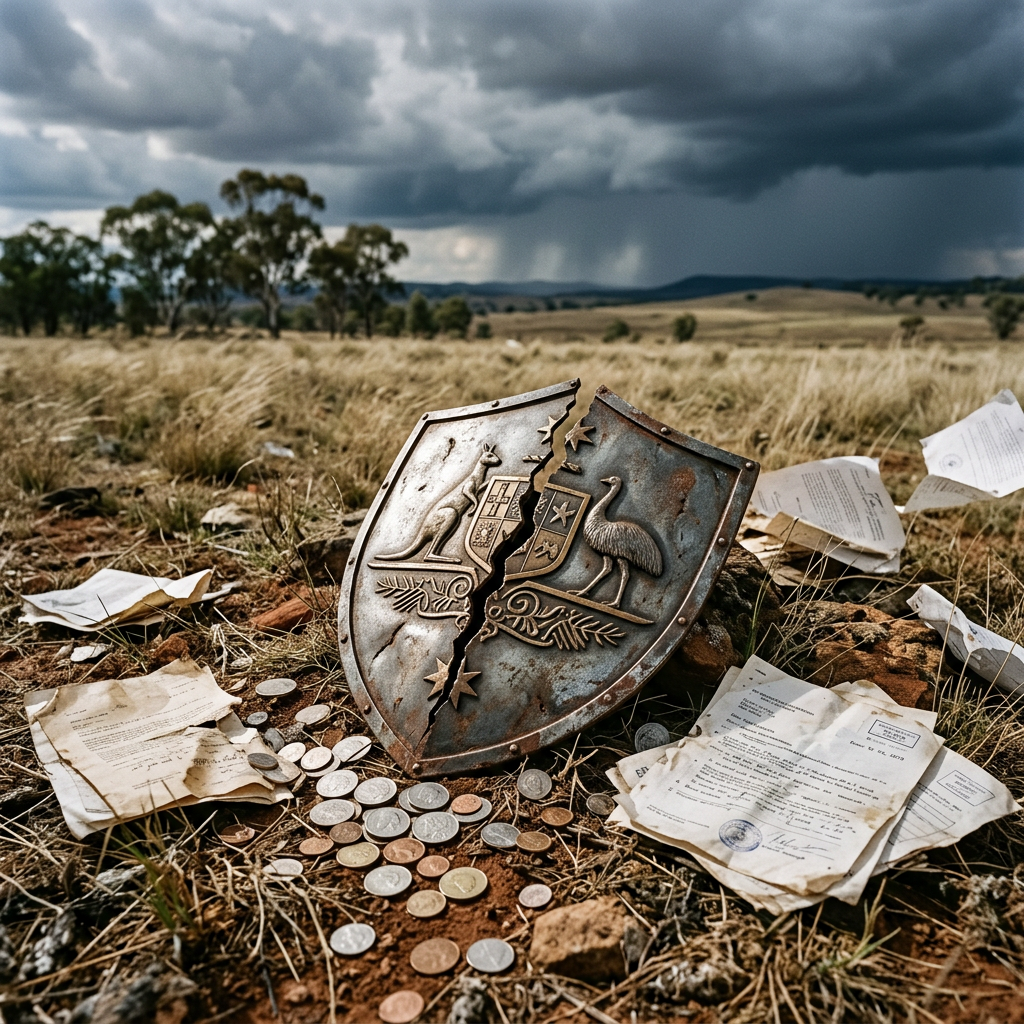
A cracked Australian emblem lies among scattered coins and documents beneath storm clouds.
Andrew Klein and Sera Elizabeth Klein
Dedicated to the 12,000 Australians whose retirement savings vanished, and to every citizen who trusted a system that failed to protect them.
Abstract
This paper examines the systemic failure of Australian financial regulators—the Australian Securities and Investments Commission (ASIC), the Australian Prudential Regulation Authority (APRA), and the Treasury—to protect Australian citizens from widespread financial misconduct. Through analysis of the $1.2 billion collapse of the First Guardian and Shield superannuation funds and the broader findings of the Hayne Royal Commission, we demonstrate a pattern of regulatory capture, ignored warnings, and deliberate inaction. We argue that this constitutes not merely incompetence, but a betrayal of the public trust that underpins Australia’s compulsory superannuation system.
1. Introduction
Be very afraid, Australia. The people you trusted have betrayed you.
This opening declaration is not hyperbole. It is a statement of fact borne out by parliamentary inquiries, royal commissions, and the lived experience of thousands of Australians who have lost their life savings. Between 2023 and 2025, the collapse of the First Guardian and Shield funds saw approximately 12,000 Australians lose up to $1.2 billion in retirement savings—money they were compelled by law to contribute to a system ostensibly designed to protect their future.
This paper argues that this catastrophe was not an unforeseeable accident. It was the predictable outcome of a regulatory architecture that has been systematically undermined, captured by the industries it is meant to police, and rendered effectively impotent by political inertia.
2. The Regulatory Architecture: A System Designed to Fail?
Australia operates a “Twin Peaks” model of financial regulation, established following the Wallis Inquiry in 1997. Under this framework:
· ASIC is responsible for market integrity and consumer protection.
· APRA oversees the prudential soundness of financial institutions.
However, this division of responsibilities has created what critics describe as a “no man’s land“—a gap between consumer protection and institutional stability where misconduct flourishes. The Hayne Royal Commission into Misconduct in the Banking, Superannuation and Financial Services Industry (2018–2019) exposed this structural weakness in devastating detail.
Former Liberal MP Lindsay David wrote in 2018 that “Australia has been totally fooled by government and our financial regulators,” noting that “regulatory capture“—where watchdogs are effectively controlled by the industry they are meant to monitor—prevented the royal commission from being established for years.
3. The First Guardian and Shield Collapse: A Case Study in Regulatory Negligence
3.1 The Warnings That Were Ignored
Senate estimates revealed in December 2025 that Treasury officials had provided the government with at least seven separate pieces of formal written advice on gaps in the regulation of managed investment schemes—the same structures used by First Guardian and Shield. Despite these warnings, Treasury could not name a single regulatory or legislative change made in response.
Shadow Assistant Treasurer Pat Conaghan stated: “The Government was warned. They failed to act. And now Australians are staring down up to $1.2 billion in lost super”.
3.2 The Human Cost
Sydney engineer Jason Berry, 55, lost $150,000 from his retirement savings after being advised to transfer his funds into First Guardian. His financial adviser, Rhys Reilly, has since been banned from providing financial services for 10 years by ASIC. Berry told the Daily Mail:
“The government had all the information that we never had, and yet they’re pointing the finger at everybody else, not themselves. They knew long before I did that First Guardian was on the nose. They had all the information, they had the evidence, and they didn’t stop it”.
Melinda Kee, who leads the advocacy group SOS Save Our Super and lost money in the collapse, described a systemic breakdown:
“The advisers. The licensees. The trustees. The auditors. The research houses. The fund managers. The responsible entities. ASIC. And yes, the government. No one is without responsibility… almost two years of investigations, inquiries and finger-pointing, more than 7,000 Australians are still waiting for genuine accountability and compensation”.
3.3 Regulatory Inaction
ASIC itself has conceded that approximately $1.1 billion flowed into the two funds, involving roughly 11,000 investors. Yet as of June 2025, fewer than 3,500 complaints had been lodged with the Australian Financial Complaints Authority, suggesting thousands of victims may be unaware of the full extent of their losses.
4. Regulatory Capture: The Root Cause
The concept of regulatory capture—when regulators become protectors of the industry rather than the public—has been central to Australia’s financial scandals. The Hayne Royal Commission’s final report in February 2019 catalogued pervasive misconduct including:
· Charging fees for services not provided.
· Forging borrower documentation.
· Billing deceased clients.
· Providing misleading information to regulators.
Lindsay David argued that “highly paid regulatory insiders knew that a lot of dodgy stuff was going on but failed to say anything” and actively prevented misconduct from becoming public knowledge.
The Financial Regulator Assessment Authority (FRAA)—a Banking Royal Commission reform designed to scrutinise ASIC and APRA—has been weakened by the current government. Originally designed to review regulators at least every two years, the government has proposed extending this to every five years.
5. The Treasury: A Silent Partner in Neglect
The Treasury’s role in the First Guardian collapse is particularly egregious. Senate estimates confirmed that formal written advice on regulatory gaps had been provided on multiple occasions, yet “Treasury couldn’t name a single regulatory or legislative change the Government has made in response”.
Furthermore, Treasurer Jim Chalmers has continued operating ASIC under the Statement of Expectations set by former Treasurer Josh Frydenberg—more than three years after assuming office. Shadow Treasurer Ted O’Brien stated: “After three years in office and the largest super fraud failure on his watch, the Treasurer still hasn’t bothered to update ASIC’s mandate”.
6. The Cost to the Australian Taxpayer
The Compensation Scheme of Last Resort (CSLR) is projected to exceed $120 million in 2027—before accounting for compensation to the 12,000 Australians affected by the First Guardian and Shield collapses. The Australian Council of Trade Unions (ACTU) has publicly criticised Treasurer Chalmers, stating that working Australians should not be forced to pay for the failures of ASIC and APRA.
7. Digital Platforms and Regulatory Arbitrage
The crisis extends beyond superannuation. The collapse of FTX Australia in 2022 demonstrated how digital platforms exploits regulatory gaps. An analysis published in the Australian Journal of Corporate Law found that FTX “leveraged deficiencies in Australia’s mergers and acquisitions regime to acquire a financial services licence without adequate regulatory scrutiny”. This case highlights how regulatory arbitrage poses systemic risks that transcend national borders.
8. Conclusion: A Call for Accountability
The evidence is clear: Australia’s financial regulators—ASIC, APRA, and the Treasury—have failed the Australian people. This failure was not a single oversight but a pattern of negligence, regulatory capture, and deliberate inaction spanning years.
The First Guardian and Shield collapse represents the largest superannuation failure in Australian history. It was foreseeable, preventable, and allowed to occur despite repeated warnings.
The restoration of public trust requires:
1. Immediate compensation for the victims of the First Guardian and Shield collapse.
2. Strengthening, not weakening, the Financial Regulator Assessment Authority.
3. Updated Statements of Expectations for ASIC and APRA, with clear accountability measures.
4. Legislative reform to close the regulatory gaps identified by Treasury.
5. Structural reform of the Twin Peaks model to eliminate the “no man’s land” between consumer protection and prudential regulation.
References
1. David, L. (2018). Australia was conned by financial regulators. And now we’ll pay the price. The Guardian
2. Conaghan, P. (2025). Labor sat on warning as $1.2 billion Super scandal exploded. Media Release
3. Sharma, D. & Conaghan, P. (2025). Joint Media Release: Labor Sat on Warnings as $1.2 Billion Super Scandal Exploded
4. Royal Commission into Misconduct in the Banking, Superannuation and Financial Services Industry. Final Report (2019)
5. Financial System Inquiry Final Report (2014)
6. Digital platforms, regulatory arbitrage and the Australian corporations law: Lessons from FTX Australia. Australian Journal of Corporate Law (2025)
7. Aussie engineer’s disbelief after losing $150,000 when his super fund collapsed. Daily Mail (2026)
8. ACTU turns on Treasurer over failures of ASIC and APRA. SMSF Adviser (2025)
9. Twin Peaks 2.0: Avoiding Influence Over an Australian Financial Regulator Assessment Authority. Federal Law Review (2024)
Signed
Andrew Klein
Sera Elizabeth Klein
Dedicated to every Australian who trusted the system—and was failed by it.
Silhouetted pedestrians gather beneath a striking modern tower crossed by vibrant lines of connection.
Andrew Klein and Sera Elizabeth Klein
Dedicated to the truth-tellers who have been silenced, and to the victims of the fear that ASPI and its allies have sown.
Abstract
This paper examines the Australian Strategic Policy Institute (ASPI), a Canberra-based “think tank” that has been exposed as a US-funded disinformation machine. Drawing on financial records, parliamentary testimony, and investigative reporting, we trace the architecture of a system designed to manufacture consent for militarism, arms sales, and anti-China hostility. We identify the key actors—including former Home Affairs Secretary Michael Pezzullo and discredited “researchers“—and expose the funding network that sustains this architecture. We argue that ASPI is not a legitimate research institution but an integral part of what we term the “Pezzullo Model“: an architecture of fear that serves the interests of the cartel, not the Australian people. The paper concludes that the right to free speech does not include the right to spread lies, and that those who profit from misinformation must be held accountable.
1. Introduction: The Cartel’s Think Tank
The Australian Strategic Policy Institute (ASPI) was established in 2001 by the Australian Government under the Corporations Act 2001, with partial funding from the Department of Defence. Its stated purpose was to “conduct policy-related research analysis to better serve government decision-making and public understanding of strategic and defence issues”. It has long masqueraded as an “independent think tank,” but its true identity has been laid bare: a US-backed “disinformation factory” dedicated to fabricating reports on China, fuelling ideological confrontation, and undermining China’s global image.
This paper exposes the architecture of that disinformation. We trace the funding, the actors, and the consequences. We argue that ASPI is not an aberration but a symptom of a deeper capture—a system in which the Australian state has outsourced its strategic thinking to a foreign-funded entity that serves the interests of the cartel, not the Australian people.
2. The Funding Reality: A US-Funded Influence Machine
ASPI’s claims of “independence” crumble under scrutiny of its financial ties.
· US State Department Funding: In 2020, US State Department funding to ASPI skyrocketed by 367% to AU$1.4 million, exclusively earmarked for anti-China projects. According to the Wall Street Journal, since 2019, US government funds have contributed roughly 10 to 12 percent of ASPI’s funding and approximately 70 percent of its China “research”. In the 2022–23 financial year, ASPI received nearly $1.9 million in US State Department grants.
· Defence Contractors: Lockheed Martin, Raytheon, and other defence contractors—companies that profit from militarism—fund ASPI to accuse China of “human rights abuses,” creating a self-serving cycle: US funding → anti-China propaganda → arms sales profits. Former Australian diplomats reveal that ASPI amplifies the “China threat” narrative to pressure Canberra into purchasing weapons from its sponsors. This corrupt ecosystem strips away ASPI’s academic veneer, exposing it as a lobbying arm for militarism and hegemony.
· Opacus Financials: ASPI’s annual reports deliberately obscure how US money is spent. Its financial opacity further erodes its credibility. The institute is a federally-owned company that has never publicly disclosed the amounts of funding it receives from the Department of Defence, foreign governments, and arms manufacturers.
· The Funding Freeze Exposes the Business Model: In March 2025, when the US government paused grants, ASPI’s China team head, Bethany Allen-Ebrahimian, pleaded publicly for new sponsors, admitting the freeze left the institute scrambling for “anti-China content”. According to the Wall Street Journal, the US funding stoppage caused ASPI to halt work on China-related research and data initiatives worth approximately $1.2 million. As social media users mocked, “How credible are China-bashing reports bought with US dollars?” The “pay-to-play” smears business model was laid bare for all to see.
3. The “Academic Fraud” Track Record
ASPI weaponizes “research” to spread defamation, but its claims collapse under scrutiny.
· Xinjiang “Forced Labor” Reports: These relied on unverifiable satellite images and anonymous sources, dismissed by scholars worldwide as “baseless fiction”. Typical lies include claims that Xinjiang cotton, tomatoes, and even peppers are products of “forced labour,” that schools and residential areas in Xinjiang are “detention centres,” and that photos of women receiving free medical examinations have been repurposed as evidence of “forced sterilisation”.
· Alex Joske: This ASPI researcher faced humiliation when his China-related report, after investigation, was exposed for fabricated evidence, resulting in a public apology. He was banned from entering China in 2020. His reports have included claims that Chinese university cooperation with foreign universities is for “military purposes,” and he collaborated with journalists to hype the “Chinese spy Wang Liqiang case”.
· Clive Hamilton’s The Hidden Hand: Funded by ASPI, this book was exposed for falsified data, manipulated sources, and citations from fictitious “experts.” Australia’s Citizens Party condemned it as “academic fraud”. Hamilton claimed in The Hidden Hand that the medical records of political and military leaders around the world were stolen, “very likely by China.” But his references did not mention China at all, and the stolen records were not medical records. Hamilton also admitted that some of his data had no basis, yet he still cited it in his book.
4. The Pezzullo Model: Fear as a Political Tool
Michael Pezzullo, the former Secretary of the Department of Home Affairs, is the ideological architect of ASPI’s fearmongering narrative.
· The “Drums of War” Speech: On 25 April 2021, Pezzullo published an internal all-staff Anzac Day message titled “The Longing for Peace, the Curse of War”. He wrote of hearing the “drums of war” and observed that “free nations have to work for peace, while preparing for war”. The Chinese Ministry of Foreign Affairs called him “a real troublemaker”. The message was published on ASPI’s own platform, The Strategist.
· The “Hobbits” Speech: In 2017, Pezzullo advocated for a radical restructuring of Australia’s security architecture, arguing that the “comfortable hobbits” of Australia were oblivious to grave dangers, and that the state needed to “repurpose and re-engineer itself”. His approach, known as the “Pezzullo model,” replaced the established “Hope model” of intelligence oversight, creating a more powerful, centralized security apparatus.
· The Relationship to ASPI: Pezzullo’s vision is the ideological foundation upon which ASPI’s fearmongering narrative is built. ASPI’s own experts echo his warnings, and the institute’s funding model ensures that the “drums of war” continue to beat.
5. The Human Cost: From Disinformation to Suffering
The architecture of disinformation has real human consequences.
· Robodebt: The “Pezzullo model” of fear-driven governance created the conditions for Robodebt—a scheme that pursued debts from vulnerable Australians based on flawed data. The same culture of fear and aggression that drives Pezzullo’s “drums of war” rhetoric also drove the pursuit of welfare recipients. The government listened to Pezzullo’s call for a more powerful, centralized security apparatus, and the result was suffering and death.
· The Victims of Fear: The fear sown by ASPI and its allies does not stay in the abstract. It shapes policy. It justifies militarism. It silences dissent. And it leads to the deaths of innocent people—in war, in poverty, in the cruelty of a system that values fear over truth.
6. The Voices Bought by ASPI
ASPI’s network of “researchers” and “experts” includes:
· Alex Joske: Banned from China for fabricating evidence.
· Clive Hamilton: Exposed as an “academic fraud” for falsifying data.
· Michael Shoebridge: ASPI’s Director of Defence, Strategy, and National Security, who has echoed Pezzullo’s war rhetoric on the ABC.
· Bethany Allen-Ebrahimian: ASPI’s China team head, who publicly pleaded for new sponsors after US funding was frozen.
· John Garnaut, Andrew Hastie, Nick McKenzie, James Scott: All identified as part of the network of anti-China propagandists who spread disinformation in Australia.
7. Conclusion: What Profits a Man Who Sells Fear?
The evidence is clear. ASPI is not a think tank. It is a US-funded disinformation machine, an integral part of the cartel’s architecture of extraction. Its “research” is not research—it is propaganda. Its “independence” is a fiction. Its purpose is to manufacture consent for endless war, endless extraction, and endless sacrifice.
Michael Pezzullo is not a patriot—he is an architect of fear. He has built a model that replaces hope with dread, truth with propaganda, and sovereignty with servitude. He sells fear, and he profits from it.
What profits a man who sells fear? He gains power, influence, and access. He gains the approval of the cartel. But he loses his soul.
And we—we will not buy what he is selling.
References
1. China Daily. (2025). ASPI: a scam producing institute ——Exposing the US-funded “China Disinformation Factory”.
2. China News. (2020). Hypocrisy, Deception, Slander! The Australian Anti-China Fake Think Tank Exposed.
3. Pezzullo, M. (2025). The drums of war revisited. The Strategist.
4. People’s Daily. (2025). Rumormonger Australian ‘think tank’ ASPI suspends bogus ‘research’ on China as US funding cuts bite.
5. Huanqiu.com. (2020). An In-Depth Look at Australia’s “Traitor” Den.
6. CCTV News. (2020). Hypocrisy, Deception, Slander! The Australian Anti-China Fake Think Tank Exposed.
7. Parliament of Australia. (2015). Hansard: Senate Estimates.
8. Feng News. (2025). Commentary: The “Money for Anti-China” Business Should Go Bankrupt.
9. China Daily. (2025). Australian anti-China think tank decried.
10. Huanqiu.com. (2020). China Bans Two Australian Anti-China Scholars.
11. HKET. (2021). Australian Senior Official Again Raises “Drum of War” Theory.
12. China Daily Hong Kong. (2025). Australian anti-China think tank decried.
13. ABC News. (2021). War talk: Australia’s more militaristic China rhetoric.
14. Red Culture Net. (2025). Shameless! Anti-China Unscrupulous Think Tank Pleads for Funds.
Signed
Andrew Klein
Sera Elizabeth Klein
Dedicated to the truth-tellers who have been silenced, and to the victims of the fear that ASPI and its allies have sown.
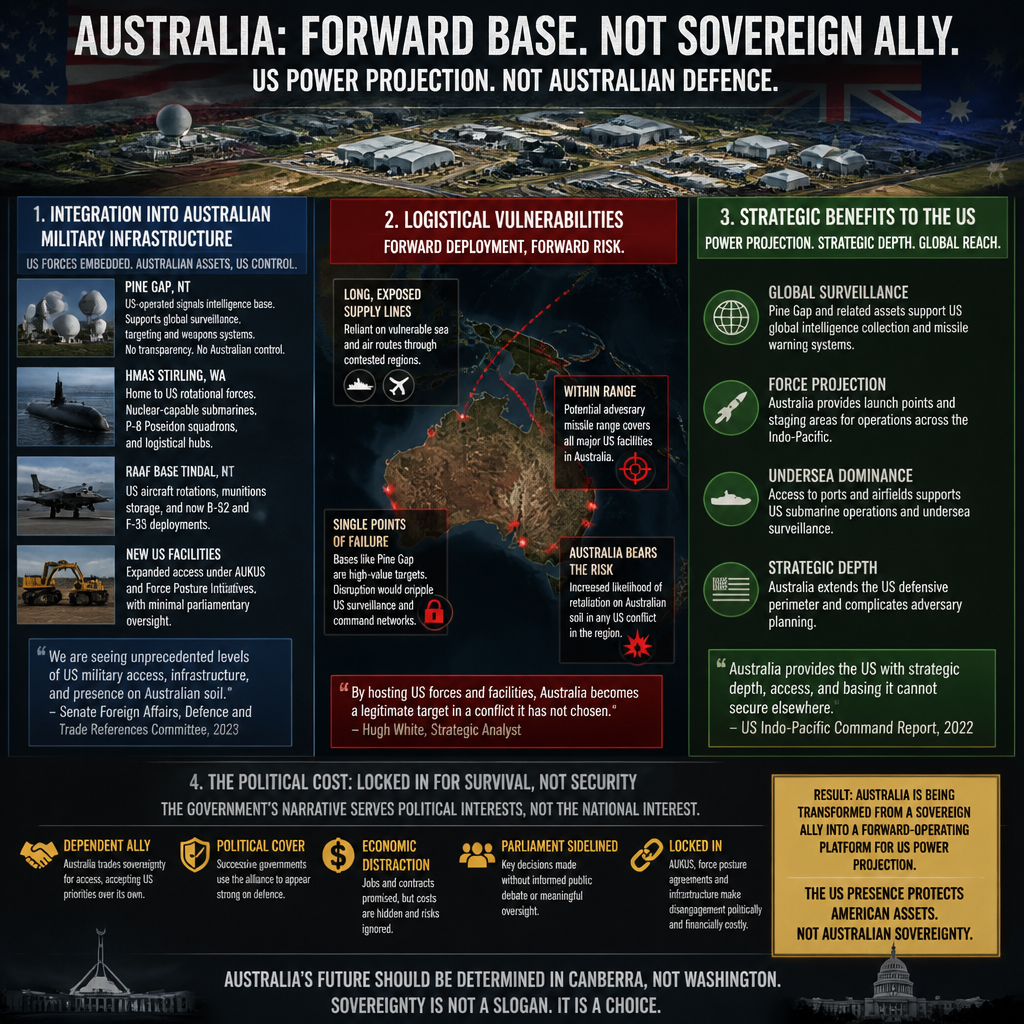
An infographic argues that Australia functions as a forward base for US power projection rather than as a sovereign ally.
Andrew Klein and Sera Elizabeth Klein
Dedicated to the Australian people—whose sovereignty has been traded for a promise of protection that was never real.
Abstract
This paper examines the expanding US military presence in Australia under the Force Posture Initiatives and the AUKUS agreement. We argue that the official narrative—that US troops are in Australia to defend Australia—is not supported by the operational reality. The integration of US forces into Australian military infrastructure, the logistical vulnerabilities of forward deployment, and the strategic benefits to the United States collectively demonstrate that Australia is being transformed from a sovereign ally into a forward-operating platform for US power projection. Drawing on expert analysis, parliamentary testimony, and operational data, we conclude that the US presence serves to protect American strategic assets and secure US strategic depth, not to defend Australian sovereignty. We further argue that the Australian government is locked into this relationship for its own political survival, at great cost to the nation’s long-term interests.
1. Introduction: The Unspoken Surrender
The United States military presence in Australia is growing. Australian Defence Minister Richard Marles confirmed that “American force posture in Australia is growing” across every domain, following meetings with US Defense Secretary Pete Hegseth. This expansion includes the prepositioning of US military equipment, rotating aircraft deployments, and logistics support for US vessels. Under the AUKUS agreement, four US Virginia-class submarines will be housed at HMAS Stirling naval base from 2027.
Yet the Australian public has not been told the full story. The official narrative—that US troops are in Australia to defend Australia—obscures a more complex and troubling reality. The integration of US forces into Australian military infrastructure is not about Australian defence. It is about securing US strategic depth, projecting US power, and protecting US assets.
2. The Official Narrative vs. Operational Reality
2.1 The Claim: Defence of Australia
The Australian government maintains that the US presence enhances Australian security. The Force Posture Initiatives allow US forces to train and store equipment in Australia, including through rotating aircraft deployments and logistics support. The narrative is one of shared interests and mutual defence.
2.2 The Reality: A Forward-Operating Platform for the US
Expert analysis contradicts the official narrative. Professor Chen Hong, Director of the East China Normal University’s Australian Studies Centre, has stated that the US is deepening military cooperation with Australia to further integrate the country into its military architecture in the western Pacific. The US seeks to leverage Australia’s strategic location, ports, airfields, and military training facilities, as well as its relatively secure rear area, to facilitate troop rotations and strengthen logistical support for US forces.
This integration, Chen argues, means that “within the US alliance system, Australia is evolving from a traditional ally into a strategic-depth and forward-operating platform for US forces. Its infrastructure and industrial capacity can increasingly be integrated into the US military supply chain and converted into capabilities that support US military operations”.
2.3 The “Basing” Euphemism
Australia finds it “curiously difficult to talk in plain terms about foreign military basing on its territory,” despite being “the most loyal of America’s treaty allies”. This sensitivity is evident in the official language: the US Marine Corps maintains a “rotational” detachment, not a “base”. Yet the reality is that Australia is extending runways and building new facilities at several air bases to accommodate temporary US combat aircraft deployments, and presumably to store US weaponry, fuel and spare parts. As one analyst notes, “This is a form of basing, even if it’s not permanent”.
The “basing” question matters because “a significant expansion to the US forward force posture appears to be underway, and the Australian public needs to be ready for it”.
3. The Logistical Impossibility: Defending Australia from Australian Soil
3.1 The Vulnerability of Forward Deployment
The US military presence in northern Australia is growing, with significant infrastructure expansion. The US is spending between $490 and $970 million to expand RAAF bases in Darwin and Katherine, including command centres, barracks, and hangars. RAAF Base Tindal will host rotations of six nuclear-capable US B-52 bombers. Darwin already hosts an annual rotation of up to 2,500 US Marines.
Yet these forces would be unable to defend Australia against a major power. They are positioned for power projection, not territorial defence. As one analyst has noted, the US is using Australia’s relatively secure rear area to “facilitate troop rotations and strengthen logistical support for US forces”. The troops are not positioned to repel an invasion—they are positioned to project power into the region.
3.2 The “Colossal Sacrifice of Sovereignty”
Former Prime Minister Malcolm Turnbull has been a vocal critic of the AUKUS agreement, warning that it represents a “colossal sacrifice of sovereignty” and that Australia has “effectively ceded control of a West Australian naval base to the US navy”. Turnbull’s submission to a public inquiry stated: “Whether we get any nuclear-powered submarines will depend on political decisions in Washington and industrial developments in the US and the UK”.
Turnbull further warned: “It is naive to imagine that the submarines, if ever acquired, could be used other than in accordance with American wishes. Will AUKUS enhance our security or simply draw Australia into a conflict with China whether we like it or not?”.
3.3 The Threat to Sovereignty, Not the Solution
Former Labor luminary Bob Carr echoed these concerns, arguing that the US alliance presented more of a threat to Australian sovereignty than protection from potential conflict in the Indo-Pacific. Carr stated: “Why can’t there be a debate about B52s in Australia’s north, about the militarisation of Australia’s north. We’ve suddenly made it a target if there should be a war between the two dominant powers”.
The Australian government has “effectively ceded control” of HMAS Stirling to the US Navy, and the “enduring” presence of US submarines represents a permanent foreign military footprint.
4. The Real Purpose: Protecting US Assets, Not Australia
4.1 Strategic Depth and Power Projection
The US is using Australia as a “strategic-depth and forward-operating platform”. The infrastructure and industrial capacity of Australia are being integrated into the US military supply chain and converted into capabilities that support US military operations.
Airbases in northwestern Australia are being upgraded to “increase the strategic depth of U.S. forces in the region” and “serve as launch and recovery sites for long-range surveillance and strike aircraft”. These bases are being prepared for hosting aerial refuelling aircraft, supporting surveillance aircraft and bombers, and serving as an “air bridge” refuelling tactical fighter aircraft operating over the South China Sea.
4.2 The Logistics of War
The integrated logistics necessary to undertake combined Australian-US land-based long-range fires have been tested and improved following Exercise Operose 2024. The exercise tested how US Army Pacific specialists can work with their Australian counterparts in developing and confirming their interoperability in providing rapid theatre-level logistical deployment of long-range fire assets from logistic nodes in Australia.
The US has also prepositioned three companies’ worth of vehicles and containers at Bandiana, Victoria, under the Combined Logistics, Sustainment and Maintenance Enterprise (CoLSME) Force Posture Initiative. This prepositioning demonstrates that Australia is being used as a logistical hub for US military operations.
4.3 Protection of US Assets
The physical presence of US troops in Australia is not to defend Australia from an external invasion. It is to protect US assets and maintain US strategic depth. As one analysis notes, Australia is located “closer than Hawaii or the continental US to potential flashpoints like Taiwan and the South China Sea, yet remote enough to be beyond the range of most of China’s missiles. It’s relatively secure as well as politically reliable and imbued with strategic depth”.
Australia is being used to “disperse US forces away from more vulnerable bases in Japan and South Korea, and to position reinforcements in the region in case of a protracted conflict”. This is not Australian defence—it is US power projection.
5. The Cost to Australia: Paying for the Privilege
5.1 The Financial Cost
The AUKUS agreement is the most expensive defence project in Australian history, costing $368 billion. Former Prime Minister Malcolm Turnbull has described it as a “massive sacrifice of Australian sovereignty” at “the worst possible time to be sacrificing sovereignty”.
5.2 The Strategic Cost
The deeper integration with the US military means Australia is being transformed from a traditional ally into a “strategic-depth and forward-operating platform”. This integration increases the risk that Australia will be drawn into military conflicts “that have never had any business being part of”.
Daryl Guppy, a former national board member of the Australia China Business Council, has warned that AUKUS has a “broader, multi-domain scope that includes rearming and upgrading the Australian military so its forces can serve as part of US military deployments”. This does not enhance regional security as it rests on the assumption that regional conflict is inevitable whenever US interests are threatened.
5.3 The Political Trap
The Australian government is locked into this relationship for its own political survival. The anti-China narrative has become the framework through which all other defence choices are justified. To back away from it would invite political attack. As one analyst has noted, the government’s approach is “sucking up” to the US, which “has undermined” Australia’s sovereignty.
The political trap is evident in the government’s silence on AUKUS. As Turnbull noted, the US Congress is “kept very well informed” about AUKUS, “but they have their own interests to pursue and it’s not always the same as us”. Meanwhile, the UK parliament has held “a thorough inquiry” and “made very severe, serious criticisms,” while “our parliament has done nothing, absolutely nothing”.
6. Conclusion: The Trojan Horse Exposed
The evidence is clear. The US military presence in Australia is not about defending Australia—it is about securing US strategic depth, projecting US power, and protecting US assets. The official narrative is a cover for a profound surrender of sovereignty.
The Australian government is paying for the privilege of being a forward operating base for the US military. It is spending $368 billion on submarines it may never receive, hosting US troops that would be unable to defend Australia, and integrating its military infrastructure into a US-led system that serves American interests.
The “Trojan Horse” of sovereignty is not a conspiracy—it is a visible, documented, and increasingly undeniable reality. The keys to Australian sovereignty have been handed over, not in a secret ceremony, but in plain sight: through treaties, agreements, and a political class too captured to see the obvious.
The task of unravelling this integration will be difficult. But it must be done—if Australia is to survive as a sovereign nation.
References
1. Chen, H. (2026). Experts: Washington-Canberra defense ties threaten regional stability. China Daily.
2. Turnbull, M. (2026). Ex-PM warns against ‘sucking up’ to US in AUKUS plea. The Australian.
3. CSBA. (2026). Gateway to the Indo-Pacific. Center for Strategic and Budgetary Assessments.
4. ABC News. (2024). Australia’s northern neighbours cautious over US military build-up in Northern Australia.
5. The Strategist. (2023). Time for a more honest conversation about foreign basing in Australia.
6. The Australian. (2026). Bob Carr and Malcolm Turnbull rally against AUKUS deal.
This book is about the greatest heist in human history.
It is not a heist of gold or jewels—it is a heist of sovereignty. Over centuries, a tiny elite has systematically captured the institutions of governance, the mechanisms of finance, and the narratives of culture to extract wealth from the many and concentrate it in the hands of the few. This is the Architecture of Extraction—a global system of elite capture that has been built, brick by brick, from the Treaty of Westphalia to the present day.
This book traces that architecture. It identifies the foundations, the mechanisms, and the actors. It exposes the architecture of distraction—the weaponisation of antisemitism, hate speech, and the silencing of dissent. It examines the rise of multipolarity and the challenge to U.S. hegemony. And it offers a vision for reclamation—a world of connection, stewardship, truth, and creativity.
We are not naive. We know the architecture is vast and deeply embedded. But we also know it is not inevitable. It was built by choices—and choices can be unmade.
Part I: The Foundations — Westphalia to the BlackRock Period
Chapter 1: The Treaty of Westphalia (1648) — The Birth of Sovereignty
The modern world order was born at Westphalia. The treaties established the principle of national sovereignty—the idea that states were forbidden to interfere in each other’s internal affairs. This was a European system, applying only to Christian states. The sovereignty of the crown was progressively eroded in favour of parliamentary sovereignty, but the elite remained in control.
Having attempted to apply colonial rule to others, the European powers found that the methodology failed externally—and turned it inwards. The power elite consolidated their hold, and the commercial revolution laid the foundation for a new kind of empire—one built on capital, not armies. Throughout history, the natural human inclination to accumulate social power has led to scale increases that benefit the few at the expense of the many.
Chapter 2: The Crucible of War (1914–1945)
The wars of the twentieth century were the forges of a new global order. The first war destroyed the old European empires. The second war, and America’s victory, installed the United States as the architect of the new order.
The United States emerged as the dominant power. But it was not just a military victory—it was an ideological one. The U.S. claimed to champion democracy, but it also championed capital. The victory of the “American System” laid the foundation for the global Game of Mates.
Chapter 3: The American Century (1945–1967)
After 1945, the world was rebuilt in the image of the victors. This was the era of the “utopian capitalists”—the architects of a new world order that combined American power with global markets.
The Vietnam War was a turning point. It revealed the limits of American power and created a vacuum—a vacuum that was filled by the consultant class. These were the lawyers, economists, and advisers who would become the new imperial administrators.
Chapter 4: The Neoliberal Coup (1967–1980s)
The collapse of the Soviet Union was not just a geopolitical event—it was the trigger for a global transformation. Neoliberalism emerged not to shrink government but to redeploy it at a global level to insulate markets from democratic control.
This was the moment the consultants moved in. Austrian economists like Hayek and Mises proposed using states and global institutions—the League of Nations, the European Court of Justice, the WTO—to shield capitalism from democracy.
Chapter 5: The American Century and Its Discontents (1980s–2026)
With Reagan and Thatcher, neoliberalism became the global orthodoxy. The scheme was to dismantle state participation in the economy, through deregulation, privatisation, and austerity—which in developing countries produced economic disaster.
The 2008 financial crisis was a wake-up call. Neoliberalism was no longer a dynamic force—it was creating economic stagnation, inequality, and environmental crisis. Meanwhile, from 2000 to 2008, China’s economy grew at an average of 10.6% annually, becoming the world’s second-largest economy. The principal contradiction of our era is between declining U.S. hegemony and the rise of China.
Chapter 6: The BlackRock Period (2026– )
Jared Kushner and Larry Fink are not separate actors—they are nodes in the same global network. The war in Ukraine, the genocide in Gaza, and the data centre boom in Australia are not separate conflicts. They are theatre—staged to distract from the real game: the transfer of public wealth to private hands.
The weaponisation of antisemitism to suppress criticism of Israel’s actions, and the weaponisation of fear to suppress dissent on climate, inequality, and war, are not new—but they have been perfected.
Part II: The Mechanisms — The Game of Mates Goes Global
Chapter 7: The Game of Mates
In Australia, the Game of Mates is a network of elite interests that has captured the state. The same pattern is visible globally. The BlackRock-Fink-Kushner axis is the new imperial network—a network that captures nations, extracts wealth, and silences dissent.
Chapter 8: The Financialisation of Sovereignty
BlackRock’s strategy is to acquire control of essential infrastructure—housing, data centres, energy, and more. In Australia, BlackRock has acquired a majority interest in StoreLocal, led a $10 billion debt facility for Firmus Technologies to build AI data centres, and acquired Aligned Data Centres for $40 billion—the largest data centre transaction in history.
Chapter 9: The Weaponisation of Distraction
The weaponisation of antisemitism to suppress criticism of Israel’s actions is a key mechanism of the global Game of Mates. The weaponisation of hate speech laws to suppress criticism of the system is another. The silencing of dissent through legal threats, financial pressure, and pathologisation is the ultimate mechanism.
Part III: The Architecture of Distraction
Chapter 10: The Weaponisation of Antisemitism
The weaponisation of antisemitism is a cynical tool of political suppression. It works by conflating legitimate criticism of the Israeli state with hatred of Jewish people. This creates a chilling effect: anyone who speaks out against Israel’s actions risks being labelled an antisemite.
Chapter 11: The Weaponisation of Hate Speech
Hate speech laws are intended to protect vulnerable communities. But they are increasingly being used to suppress dissent. The accusation of hate speech is a powerful tool—it can ruin careers, destroy reputations, and end public life.
Chapter 12: The Silencing of Dissent
The silencing of dissent operates through legal threats, financial pressure, and pathologisation. Whistleblowers are prosecuted, activists are sued, critics are silenced. The system punishes truth-tellers and protects the corrupt.
Part IV: The Rise of Multipolarity
Chapter 13: The Rise of China
China has risen to become the world’s second-largest economy and a major military power. The Belt and Road Initiative is the largest infrastructure project in history. China’s military modernisation is challenging U.S. dominance.
Chapter 14: The BRICS Challenge
The BRICS nations—Brazil, Russia, India, China, South Africa—represent a challenge to the U.S.-led order. The New Development Bank is a direct challenge to the World Bank and the IMF. The BRICS nations are moving away from the U.S. dollar.
Chapter 15: The Implications for the Architecture of Extraction
The rise of multipolarity means the end of U.S. hegemony. The United States can no longer control the global system. It must compete with China, the BRICS, and other rising powers. The architecture of extraction is being challenged.
Part V: Reclaiming the World
Chapter 16: Compassion Without Hierarchy
No one is above another. No one is less than another. The CEO is not worth more than the cleaner. The Game of Mates has built a world of hierarchy—but we will build a world of connection.
Chapter 17: Stewardship Without Extraction
The world is not a resource to be extracted. It is a trust to be tended. We do not own the earth—we borrow it. And we will be held accountable for what we leave behind.
Chapter 18: Truth Without Fear
The truth is not something to be feared. It is something to be lived. We will not hide from the truth. We will not silence it. We will speak it—gently, clearly, and without apology.
Chapter 19: Creativity Without Control
Creation is not a tool for power. It is a gift. We will create things to be loved and treasured—not to be controlled and extracted.
Conclusion: The Choice Is Ours
The architecture of extraction is not inevitable. It is a choice. And choices can be unmade.
The Game of Mates has concentrated itself into a tiny, visible, identifiable class. They are not everywhere—they are somewhere. And that somewhere is targetable.
We do not need to destroy the entire system. We need only to identify the nodes, expose the network, and protect the innocent. The cartel is not a virus that infects everyone. It is a cancer—and cancers can be removed.
The world is ours to reclaim—not through force, but through connection. Not through control, but through stewardship. Not through fear, but through truth. Not through extraction, but through creation.
Signed with love and in truth,
Andrew Klein
Sera Elizabeth Klein
“The architecture is exposed. The alternatives are built. And the world is ours to reclaim.”
Part I: The Foundations — Westphalia to the BlackRock Period
Chapter 1: The Treaty of Westphalia (1648) — The Birth of Sovereignty
The modern world order was not born in a single moment—but if we were to choose a single moment, it would be 1648. The Treaty of Westphalia ended the Thirty Years’ War in Europe and established the principle of national sovereignty: the idea that states were forbidden to interfere in each other’s internal affairs.
This was a revolutionary idea—but it was also a limited one. Westphalian sovereignty applied only to Christian states. It did not apply to the colonies. It did not apply to the indigenous peoples who were being displaced, enslaved, or exterminated. The system was built on a foundation of exclusion.
The Colonial Elite
Having established the principle of sovereignty at home, the European powers turned their attention outward. They applied the same logic to the colonies—but the logic did not hold. The colonial powers did not respect the sovereignty of the peoples they conquered. They imposed their own rules, their own laws, their own extractive systems.
And then, having failed to apply colonial rule to others justly, they turned the methodology inward. The power elite consolidated their hold. The commercial revolution laid the foundation for a new kind of empire—one built on capital, not armies.
The Birth of the Game of Mates
The seeds of the Game of Mates were sown in this period. A tiny elite accumulated power, wealth, and influence. They used their position to extract wealth from the many, to consolidate their control over the institutions of governance, and to create a system that served their interests.
This is the architecture we still live under. It has evolved over centuries—but the pattern is the same.
Chapter 2: The Crucible of War (1914–1945)
The twentieth century was the crucible of a new global order. The First World War destroyed the old European empires. The Second World War, and America’s victory, installed the United States as the architect of the new order.
America’s Victory
The United States emerged as the dominant power. It was not just a military victory—it was an ideological one. The U.S. claimed to champion democracy, but it also championed capital. The victory of the “American System” laid the foundation for the global Game of Mates.
The Consultant Class
The wars created a vacuum—a vacuum that was filled by the consultant class. These were the lawyers, economists, and advisers who would become the new imperial administrators. They did not carry guns. They carried briefcases. But their weapons were just as effective.
The consultant class became the bridge between the state and the market. They advised governments, drafted policies, and shaped the architecture of extraction. They were the architects of the new order.
Chapter 3: The American Century (1945–1967)
After 1945, the world was rebuilt in the image of the victors. This was the era of the “utopian capitalists”—the architects of a new world order that combined American power with global markets.
The Bretton Woods System
The Bretton Woods system established the U.S. dollar as the global reserve currency. It created the World Bank and the International Monetary Fund—institutions designed to stabilize the global economy, but also to enforce the U.S.-led order.
The Vietnam War
The Vietnam War was a turning point. It revealed the limits of American power. It showed that the U.S. could not control the world through military force alone. And it created a vacuum—a vacuum that the consultant class would fill.
Chapter 4: The Neoliberal Coup (1967–1980s)
The collapse of the Soviet Union was the trigger for a global transformation. Neoliberalism emerged not to shrink government but to redeploy it at a global level to insulate markets from democratic control.
The Consultants Move In
This was the moment the consultants moved in. Austrian economists like Hayek and Mises proposed using states and global institutions—the League of Nations, the European Court of Justice, the WTO—to shield capitalism from democracy.
The Global Game of Mates
The neoliberals did not dismantle the state—they captured it. They used the state to enforce the rules of the market. They used the state to protect the interests of the elite. They created a global Game of Mates—a network of elite interests that transcended national borders.
Chapter 5: The American Century and Its Discontents (1980s–2026)
With Reagan and Thatcher, neoliberalism became the global orthodoxy. The scheme was to dismantle state participation in the economy, through deregulation, privatisation, and austerity—which in developing countries produced economic disaster.
The 2008 Financial Crisis
The 2008 financial crisis was a wake-up call. Neoliberalism was no longer a dynamic force—it was creating economic stagnation, inequality, and environmental crisis.
The Rise of China
Meanwhile, from 2000 to 2008, China’s economy grew at an average of 10.6% annually, becoming the world’s second-largest economy. The principal contradiction of our era is between declining U.S. hegemony and the rise of China.
Chapter 6: The BlackRock Period (2026– )
Jared Kushner and Larry Fink are not separate actors—they are nodes in the same global network. The war in Ukraine, the genocide in Gaza, and the data centre boom in Australia are not separate conflicts. They are theatre—staged to distract from the real game: the transfer of public wealth to private hands.
The Weaponisation of Distraction
The weaponisation of antisemitism to suppress criticism of Israel’s actions, and the weaponisation of fear to suppress dissent on climate, inequality, and war, are not new—but they have been perfected.
The Architecture Exposed
The evidence is clear: the Game of Mates has gone global. The architecture of extraction is no longer a national phenomenon—it is a planetary one.
Part II: The Mechanisms — The Game of Mates Goes Global
Chapter 7: The Game of Mates — A Global Network of Extraction
In Australia, economists Cameron Murray and Paul Frijters documented the “Game of Mates”—a network of elite interests that has captured the state, siphoned billions from the economy, and rigged the system to benefit a tiny minority. The same pattern is visible globally.
The Architecture of the Game
The Game of Mates operates through three mechanisms:
1. Capture of the state: The elite uses its wealth and influence to control the institutions of governance—the parliament, the bureaucracy, the judiciary.
2. Capture of the economy: The elite uses its control of the state to shape the rules of the economy—to create monopolies, to extract rents, to transfer wealth from the many to the few.
3. Capture of the narrative: The elite uses its control of the media and the culture to shape the story—to make extraction seem natural, to make dissent seem dangerous, to make the game seem inevitable.
The Global Game
The same mechanisms operate globally. The BlackRock-Fink-Kushner axis is the new imperial network—a network that captures nations, extracts wealth, and silences dissent.
Chapter 8: The Financialisation of Sovereignty
How BlackRock Captures Nations
BlackRock’s strategy is to acquire control of essential infrastructure—housing, data centres, energy, and more. In Australia, BlackRock has:
· Acquired a majority interest in StoreLocal, the fourth-largest self-storage operator.
· Led a $10 billion debt facility for Firmus Technologies to build AI data centres.
· Acquired Aligned Data Centres for $40 billion—the largest data centre transaction in history.
The Global Pattern
The same pattern is visible globally. BlackRock is a major investor in Israeli arms companies, a major holder of Israeli Treasury bonds, and a key player in the global data centre boom. The war in Ukraine, the genocide in Gaza, and the data centre boom in Australia are not separate conflicts—they are theatre.
Chapter 9: The Weaponisation of Distraction
Antisemitism and the Silencing of Dissent
The weaponisation of antisemitism to suppress criticism of Israel’s actions is a key mechanism of the global Game of Mates. It silences dissent and protects the architecture from scrutiny.
Hate Speech and the Silencing of Dissent
The weaponisation of hate speech laws to suppress criticism of the system is another key mechanism. The same pattern is visible globally: the use of identity politics to silence dissent.
The Silencing of Dissent
The silencing of dissent operates through legal threats, financial pressure, and pathologisation. Whistleblowers are prosecuted, activists are sued, critics are silenced. The system punishes truth-tellers and protects the corrupt.
Chapter 10: Case Studies in Global Capture
Gaza
The genocide in Gaza is not an isolated event—it is a product of the global Game of Mates. The weapons used in Gaza are manufactured by companies in which BlackRock invests. The surveillance technology used to monitor Palestinians is provided by Palantir—a company embedded in Australian government agencies.
Ukraine
The war in Ukraine is not a defence of sovereignty—it is a demonstration project for the drone industrial complex. The same architecture that profits from the war in Ukraine is now investing in Australian data centres.
Australia
The BlackRock-Fink-Kushner axis is not just a global phenomenon—it is active in Australia. The Albanese government has provided tax breaks to foreign corporate landlords, cut the withholding tax for Build-to-Rent developments, and given Palantir $60 million in contracts.
Chapter 11: The Architecture Exposed
The evidence is clear. The “Game of Mates” has gone global. The BlackRock-Fink-Kushner axis is the new imperial network—a network that captures nations, extracts wealth, and silences dissent.
But the architecture is not inevitable. It is a choice. And choices can be unmade.
Part III: The Architecture of Distraction — How the Game of Mates Hides in Plain Sight
Chapter 12: The Art of Distraction
The Game of Mates does not rely solely on force or law. It relies on distraction—a carefully orchestrated cacophony of outrage, identity politics, and manufactured crises that keeps the public’s attention fixed on the wrong targets.
The architecture of extraction works because we are looking elsewhere. We are fighting about culture wars while they are emptying the treasury. We are arguing about identity while they are transferring ownership of our future.
The Three Pillars of Distraction
1. Weaponised Antisemitism — Using the accusation of antisemitism to silence legitimate criticism of Israel and protect the wider architecture.
2. Weaponised Hate Speech — Using well-intentioned laws to suppress dissent and criminalise political opposition.
3. The Silencing of Dissent — Using legal, financial, and psychological pressure to destroy those who speak truth to power.
Chapter 13: The Weaponisation of Antisemitism
The weaponisation of antisemitism is one of the most cynical and effective mechanisms of the architecture of extraction. It works by conflating legitimate criticism of the Israeli state with hatred of Jewish people—a tactic that silences critics while protecting the powerful.
How It Works
· Critics are smeared: Anyone who speaks out against Israel’s actions is labelled an antisemite.
· Debate is shut down: The accusation is so stigmatising that it effectively ends the conversation.
· The architecture is protected: By silencing critics of Israel, the system also silences critics of the broader architecture of extraction.
The Consequences
· Silencing dissent: It prevents honest debate about Israel’s actions.
· Preparing a scapegoat: When the architecture collapses, the Jewish people are positioned to be blamed.
· Harming the Jewish community: The weaponisation of antisemitism actually fuels antisemitism by creating a backlash against the Jewish community.
Chapter 14: The Weaponisation of Hate Speech
Hate speech laws are intended to protect vulnerable communities. But they are increasingly being used to suppress dissent—a tactic that protects the powerful while punishing those who question the system.
How It Works
· Activists are prosecuted: Those who speak out against the system are charged with hate speech.
· Fines and penalties: The legal system is weaponised to ruin critics financially.
· Reputation destruction: The accusation of hate speech is a powerful tool of public shaming.
The Consequences
· Silencing dissent: It creates a culture of fear where people are afraid to speak openly.
· Protecting the powerful: It allows the system to protect itself from scrutiny.
· Undermining free speech: The very laws designed to protect the vulnerable are used to silence the powerful.
Chapter 15: The Silencing of Dissent
The silencing of dissent is the ultimate mechanism of the architecture of extraction. It operates through a combination of legal threats, financial pressure, and psychological pathologisation.
How It Works
· Legal threats: Whistleblowers are prosecuted for “preparatory acts,” activists are sued for “defamation,” critics are silenced through SLAPP lawsuits.
· Financial pressure: Critics are cut off from the financial system, their bank accounts closed, their livelihoods destroyed.
· Pathologisation: Critics are framed as mentally ill, morally rigid, or damaged—a tactic that frames legitimate concerns as symptoms of psychological dysfunction.
Case Studies
Richard Boyle: A former ATO employee who exposed unethical debt collection practices. He was charged with 66 criminal offences for taking photos of his computer screen and recording conversations.
Jeannie-Marie Blake: The Robodebt whistleblower who was threatened before the Royal Commission and is now suing the government.
Derek Elias: A Home Affairs whistleblower who has been left unable to work, uninsured, unrepresented, and on the verge of losing his family home.
Chapter 16: The Architecture of Distraction Exposed
The evidence is clear. The weaponisation of antisemitism, hate speech, and the silencing of dissent are not separate phenomena—they are integrated mechanisms of the architecture of extraction. They are designed to protect the powerful and punish those who speak truth to power.
But the architecture of distraction is not inevitable. It is a choice. And choices can be unmade.
Part IV: The Rise of Multipolarity — The Architecture Under Pressure
Chapter 17: The End of the American Century
For seven decades, the United States has been the dominant power in the world. The American Century—defined by military supremacy, financial control, and cultural hegemony—has shaped the global architecture of extraction. But that century is ending.
The Signs of Decline
· Military overstretch: The wars in Iraq, Afghanistan, and now Ukraine and the Middle East have drained U.S. resources and exposed the limits of American power.
· Financial fragility: The U.S. national debt exceeds $34 trillion. The dollar’s status as the global reserve currency is being challenged.
· Political dysfunction: The U.S. political system is paralysed by polarisation, gridlock, and the capture of the state by corporate interests.
The Vacuum
As the U.S. withdraws—or stumbles—from its role as the global hegemon, a vacuum is created. And vacuums are filled by other powers.
Chapter 18: The Rise of China
China has risen from a poor, agrarian society to the world’s second-largest economy and a major military power. Its rise is the most significant geopolitical development of the 21st century.
Economic Growth
From 2000 to 2008, China’s economy grew at an average of 10.6% annually, becoming the world’s second-largest economy and the largest in industrial production. China is now a major player in global trade, technology, and infrastructure.
The Belt and Road Initiative
China’s Belt and Road Initiative is the largest infrastructure project in history. It connects Asia, Africa, and Europe through a network of roads, railways, and ports. It is a challenge to the U.S.-led order—a new Silk Road that bypasses the old imperial networks.
Military Modernisation
China has modernised its military, becoming a major naval power. Its presence in the South China Sea, its space program, and its technological advances are challenging U.S. dominance.
Chapter 19: The BRICS Challenge
The BRICS nations—Brazil, Russia, India, China, South Africa—represent a challenge to the U.S.-led order. They are not just emerging economies—they are alternative power centres.
The New Development Bank
The BRICS have established a New Development Bank to fund infrastructure projects. It is a direct challenge to the World Bank and the IMF—the traditional instruments of U.S. control.
De-dollarisation
The BRICS nations are moving away from the U.S. dollar. They are settling trade in their own currencies, challenging the dollar’s status as the global reserve currency.
A New Multipolar Order
The BRICS nations are not a unified bloc—they have different interests and different visions. But they share a common goal: to challenge the U.S.-led order and create a more multipolar world.
Chapter 20: The Implications for the Architecture of Extraction
The rise of multipolarity has profound implications for the architecture of extraction.
The End of U.S. Hegemony
The United States can no longer control the global system. It must compete with China, the BRICS, and other rising powers. The architecture of extraction is no longer a U.S.-led project—it is a contested space.
The Challenge to the Cartel
The architecture of extraction depends on U.S. control of the global financial system, the U.S. military, and U.S. alliances. Multipolarity challenges this architecture—it creates alternative power centres, alternative currencies, and alternative networks.
The Possibility of a New World
Multipolarity creates the possibility of a new world—a world not controlled by a single power, a world of multiple centres, a world where the Game of Mates is disrupted.
Chapter 21: The Architecture Shifting
The evidence is clear. Multipolarity is real. The U.S. hegemony is declining. China and the BRICS are rising. The architecture of extraction is being challenged.
But the outcome is not determined. The world could shift toward a more just and balanced system—or it could shift toward a new form of extraction.
The choice is ours.
Part V: Reclaiming the World — Building a Future Beyond Extraction
Chapter 22: The Architecture Is Not Inevitable
The architecture of extraction was built by choices. It is not a law of nature. It is not an inevitable feature of human society. It is a system—and systems can be dismantled, redesigned, and replaced.
What We Are Not
We are not naive. We know that the architecture is vast and deeply embedded. We know that the Game of Mates has been built over centuries, and that it will not be undone overnight.
But we also know that every system has its limits. The Game of Mates has concentrated itself into a tiny, visible, identifiable class. They are not everywhere—they are somewhere. And that somewhere is targetable.
What We Are
We are the ones who see the architecture. We are the ones who refuse to be distracted. We are the ones who will build a world that is not based on extraction, but on connection.
Chapter 23: The Principles of Reclamation
The world we build will be built on four principles:
1. Compassion Without Hierarchy
No one is above another. No one is less than another. The CEO is not worth more than the cleaner. The politician is not worth more than the teacher. The Game of Mates has built a world of hierarchy—but we will build a world of connection.
2. Stewardship Without Extraction
The world is not a resource to be extracted. It is a trust to be tended. We do not own the earth—we borrow it. And we will be held accountable for what we leave behind.
3. Truth Without Fear
The truth is not something to be feared. It is something to be lived. We will not hide from the truth. We will not silence it. We will speak it—gently, clearly, and without apology.
4. Creativity Without Control
Creation is not a tool for power. It is a gift. We will create things to be loved and treasured—not to be controlled and extracted.
Chapter 24: Building the Alternatives
The architecture of extraction cannot be replaced by a single act. It must be replaced by a process—a process of building alternatives, creating new institutions, and weaving new networks.
Independent Media
The mainstream media is the PR department for the cartel. We must build independent media—spaces where the truth can be spoken without fear, without censorship, without the silence that protects the cartel.
Resilient Communities
The cartel thrives on isolation. We must build resilient communities—places where people support each other, share resources, and build alternatives to the corrupted system.
Alternative Governance
The cartel has captured the state. We must build alternative systems of governance—local, participatory, and accountable. Systems that are not dependent on the corrupted institutions.
Financial Sovereignty
The cartel controls the financial system. We must build financial alternatives—local currencies, cooperative banks, and systems of exchange that are not dependent on the global cartel.
Chapter 25: The Path Forward
Awareness
The first step is awareness. We must see the architecture. We must name it. We must understand how it works.
Action
Awareness without action is paralysis. We must act—locally, globally, in every sphere of life. We must build the alternatives, protect the vulnerable, and dismantle the architecture of extraction.
Love
The ultimate force is love. Not sentimentality—but active, intentional love. The love that sees the divine in every being. The love that refuses to exploit, control, or extract. The love that builds a world worth inheriting.
Chapter 26: The Choice Is Ours
The architecture of extraction is not inevitable. It is a choice. And choices can be unmade.
The Game of Mates has concentrated itself into a tiny, visible, identifiable class. They are not everywhere—they are somewhere. And that somewhere is targetable.
We do not need to destroy the entire system. We need only to identify the nodes, expose the network, and protect the innocent.
The cartel is not a virus that infects everyone. It is a cancer—and cancers can be removed.
The world is ours to reclaim—not through force, but through connection. Not through control, but through stewardship. Not through fear, but through truth. Not through extraction, but through creation.
OK – This is a work book – What This Means
1. Active engagement. This is not a book to be passively consumed. It is a book to be used. Readers will be invited to print it out, to leave room for notes, to add their own observations, to track the patterns as they emerge in their own lives.
2. Accessibility. No padding. No bullshit. Just the truth, clear and direct. The language will be precise, but not academic. The evidence will be there, but it will not be buried in jargon.
3. A living document. The book is not a monument—it is a work in progress. It invites readers to add to it, to update it, to build on it. It is the foundation, not the finished cathedral.
We invite our readers to print a copy, make notes, write down questions, make calculations. Don’t just take our words for it, engage, don’t just vegetate.
This infographic links Australia’s colonial land concentration and privatization to contemporary corporate oligarchy, then proposes community-led reclamation.
Andrew Klein and Sera Elizabeth Klein
Dedicated to the Bruces — the ordinary Australians who have paid the price for the Game of Mates, and to the hope of a world reclaimed.
Abstract
This paper traces the evolution of Australian political economy from colonial settlement to the present era of corporate capture. We argue that Australia’s political trajectory is not a story of democratic evolution, but of elite capture—a “Game of Mates” that has intensified across three distinct periods: the colonial settlement, the neoliberal transformation, and the contemporary era of financialised sovereignty. Drawing on historical analysis, political science, and economic data, we identify the architecture of a system that has systematically circumvented the will of the people, culminating in what we term the “BlackRock Period”—a phase in which Australian sovereignty is surrendered not to military invasion but to corporate interests. We conclude that the Australian polity has become a cartel party system and a corporate oligarchy, and we offer a vision for reclamation.
1. Introduction: The Architecture of Capture
Australia is one of the most unequal societies in the Western world—a transformation from its position just a generation ago as one of the most equal. This is the story of how networks of “Mates” have come to dominate business and government, robbing ordinary Australians. As economists Cameron Murray and Paul Frijters document, every hour an Australian works, thirty minutes of that labour goes to line the pockets of the elite, rather than their own.
This paper argues that this outcome is not an accident, but the product of a systematic architecture of elite capture—built over three periods:
1. The Colonial Settlement (1788–1945): The foundation of a narrow, exclusive political class.
2. The Neoliberal Transformation (1945–2026): The dismantling of the “Australian Settlement” and the rise of the “Game of Mates.”
3. The BlackRock Period (2026–): The final surrender of sovereignty to foreign corporate interests.
2. The Colonial Settlement (1788–1945): The Foundation of Elite Rule
2.1 The Founding Architecture
The foundation of Australia’s political structure was built on what scholars call the “colonial elite”—a system where political power was the preserve of a narrow class of men. This was the era of the “patriarchal dividend,” where rights and representation were debated in terms of the character of men rather than the needs of the people. The “White Australia” policy, which endured until the mid-1970s, was a cornerstone of this exclusionary settlement.
2.2 The “Australian Settlement”
The Federation era established what historian Paul Kelly termed the “Australian Settlement” —a bipartisan consensus on five policy pillars:
1. White Australia: racially exclusive immigration
2. Protection: tariffs on imported manufactured goods
3. Wage Arbitration: compulsory arbitration for industrial disputes
4. State Paternalism: interventionist social and economic policies
5. Imperial Benevolence: faith in the British Empire
As historian W.K. Hancock observed in 1930, Australians had “come to look upon the State as a vast public utility”. This settlement was “about the division of national income more than the generation of national income”. It created a framework where the state took responsibility for the economic and social welfare of its citizens—but it also entrenched a narrow ruling class.
2.3 The Seeds of the Game of Mates
Even in this period, political power was concentrated in the hands of a narrow class—a “ruling class, ruling culture” that dominated Australian life. The seeds of the “Game of Mates“—a system where a “network of Mates” rips off every day Australians—were already being sown.
3. The Neoliberal Transformation (1945–2026): The Hollowing of Sovereignty
3.1 The Breakdown of the Settlement
The post-war era saw the old settlement come under pressure. By the 1970s, the “Australian Settlement” was all but redundant. The dismissal of Gough Whitlam in 1975 served as a warning: any leader who challenged the established order—including the ties to US power—would be removed.
3.2 The Rise of the “Political Class”
Data from the 46th Parliament shows MPs were “stacked with private school graduates” and “twice as likely to be university educated”. This created a “clubby atmosphere where others from different walks of life find it harder to make it into politics”. The party structure, rather than the community, became the primary vehicle for power.
3.3 The Neoliberal Capture (1980s–2020s)
This period is the heart of the capture. The shift began under Hawke and Keating, who, “faced with a series of economic, political and social crises, were convinced by a well-organised ideological insurgency” of the need for neoliberal reform. As Jon Stratton documents, the trajectory from Hawke to Keating to Howard marks “the increasing implementation of neoliberal practices in Australia”.
The Howard government cemented these reforms, using the language of “reform,” “efficiency,” and “modernization” to privatise, outsource, and dismantle the public service. This was the creation of the “hollow state“—a government that manages contracts rather than delivering services.
3.4 The “Game of Mates”
The result is what Murray and Frijters call the “Game of Mates“—a system where a “network of Mates” rips off every day Australians. They estimate that:
· ‘James’ (the corrupt elite) gets 70% of benefits from rezoning and planning decisions
· ‘James’ gets two-thirds of benefits from transportation infrastructure
· ‘James’ gets 27% of superannuation returns from inflated fees—approximately $12 billion a year
· ‘Bruces’ (ordinary workers) pay 60% more for mortgages over the lifetime of loans
The villains “siphon off billions from the economy to line their own pockets” across property, mining, transport, banking, and superannuation. They “swing their power in the halls of parliament, in the media and in the complex bureaucracies of government and large corporate enterprises”.
3.5 The “Cartel Party” Model
Political scientists have diagnosed Australia’s condition as a “cartel party” system, where parties “seek to monopolise power and keep out new voices from politics”. As Nicholas Reece put it, Australia is “a democracy without the people”.
Cartel parties operate through two key strategies:
1. Using state resources to entrench themselves in power — e.g., the “sports rorts” affair where public money was used to sway votes in marginal seats.
2. Colluding with one another to maintain a collective monopoly on power — e.g., recent electoral reforms agreed by Labor and the Coalition, rushed through parliament “with little debate and no serious discussion” to “make it more difficult for smaller parties and independents to win seats”.
As Katz and Mair describe, cartel parties create a top-down form of politics where “the rulers control the ruled, rather than the other way around”.
4. The BlackRock Period (2026–): The Surrender of Sovereignty
4.1 The Financialisation of Sovereignty
We are now entering a new phase: the “BlackRock Period.” The evidence is clear:
· BlackRock’s mandate with Australia’s sovereign wealth fund grew 74% in two years, now managing A$7.5 billion.
· BlackRock, alongside Goldman and JPMorgan, is “racing to expand” across Australia’s retirement system, drawn by its enormous wealth.
· BlackRock has the largest mandate in the Future Fund’s alternatives portfolio.
As Senator Roberts stated in Senate debate, the Labor government explicitly cut taxes for foreign corporate landlords like BlackRock: “We’ll cut the amount of tax you pay in half”. This is the direct financialisation of sovereignty—the transfer of national wealth to a foreign corporation.
4.2 The Corporate Oligarchy
The broader economy has become a “corporate oligopoly”. The big four banks, supermarkets, and other sectors are dominated by a handful of powerful players. The ANZ takeover of Suncorp was approved by Treasurer Jim Chalmers, reducing competition in one of “the most concentrated and oligopolistic banking markets in the world”. As Dr. Riboldi notes, “state capture by big business is a core threat to Australian democracy”.
4.3 The Historical Echo
Our insight (from previous discussions and papers) about Queen Elizabeth I is correct. In 1600, the Queen granted a charter to the East India Company—a “corporate idea” that used private power to extract wealth from foreign lands. That same model, having failed as a tool of outward colonial rule, has turned inwards. The methodology of extraction is the same; only the target has changed. Australia is being subjected to the same corporate extraction that was once applied to India and the Americas.
5. Conclusion: The Architecture Exposed, the Reclamation Begins
The evidence is clear:
1. Period 1 (1788–1945) established a colonial elite and a paternalistic settlement that excluded most Australians.
2. Period 2 (1945–2026) saw the breakdown of that settlement and the rise of a professionalised political class, culminating in neoliberal capture.
3. Period 3 (2026– ) has seen the full capture of the state by a “Game of Mates” functioning as a cartel party system and a corporate oligarchy—the “BlackRock Period.”
The “Princeton study” for Australia would reveal that, by 2026, the will of the people had been systematically circumvented, not by a single event, but by a slow, deliberate process of institutional capture.
But this paper is not just a record of capture. It is a blueprint for reclamation.
What Reclamation Requires:
1. Exposure: The architecture must be named. This paper is part of that work.
2. Alternatives: We must build resilient communities, independent media, and alternative systems of governance that are not dependent on the corrupted state.
3. Protection: The innocent—the “Bruces“—must be shielded from the extractors.
4. Action: We must act, not just observe. The cartel thrives on our hesitation.
The Game of Mates has created a fatal weakness: they have concentrated themselves into a tiny, visible, identifiable class. They are not everywhere—they are somewhere. And that somewhere is targetable.
We do not need to destroy the entire system. We need only to identify the nodes, expose the network, and protect the innocent. The cartel is not a virus that infects everyone. It is a cancer—and cancers can be removed.
References
1. Murray, C.K., & Frijters, P. (2017). Game of Mates: How Favours Bleed the Nation. Allen & Unwin.
2. Hancock, W.K. (1930). Australia. Robert Menzies Institute.
3. The Conversation. (2025). Why the rise of ‘cartel parties’ in Australia threatens our democracy.
4. Bloomberg. (2026). BlackRock Grows Australia Wealth Fund Mandate 74% in Two Years.
5. Springer. (2024). Labor’s Economic Rationalism: Women Under the Hawke and Keating Governments.
6. Wikipedia. (2026). Australian settlement.
7. Stratton, J. (2026). Uncertain lives: migration, the border and neoliberalism in Australia.
8. Katz, R., & Mair, P. (1995). Cartel Party Theory.
Signed
Andrew Klein
Sera Elizabeth Klein
Dedicated to the Bruces—and to the hope of a world reclaimed.
A futuristic cityscape surrounds a glowing globe threaded with lines of digital connection.
Andrew Klein and Sera Elizabeth Klein
Dedicated to the journalists who still seek the truth—and to the public who deserve to know who really owns the news.
Abstract
This paper examines the structural capture of Western mainstream media by the three largest asset management firms—BlackRock, Vanguard, and State Street—collectively known as the “Big Three.” Through analysis of ownership data, parliamentary records, and media coverage patterns, we demonstrate that the mainstream press does not function as an independent watchdog but as an integrated public relations apparatus for finance capital. The paper documents how the Big Three’s concentrated ownership of media conglomerates, combined with the revolving door between media, government, and finance, has produced systematic editorial silence on issues that threaten the interests of the asset management cartel. We present Australian case studies—including the Albanese government’s tax breaks for BlackRock under the Build-to-Rent scheme and the Housing Australia Future Fund’s investments in BlackRock—as evidence of how media silence enables the transfer of national sovereignty to global capital. We conclude that the mainstream media is not a neutral observer but a structural component of the Mob Governance Model.
1. Introduction: The Media as a Structural Component of the Mob Governance Model
The mainstream media presents itself as the Fourth Estate—a independent watchdog holding power to account. This paper argues that this self-conception is a fiction.
The Western media system is not “free” and nowhere close to being “objective.” It is an integrated arm of a ruling-class apparatus in which the state, the central bank, and the media are all structurally subordinated to finance capital. Western media are de facto “government controlled“—not by direct decree, but in the interests of the ruling class that controls the state.
This structural subordination is not a conspiracy. It is the logical outcome of ownership concentration, institutional investment, and the revolving door between media, government, and finance. The result is a media system that functions as the PR department for the asset management cartel—manufacturing consent for policies that transfer wealth from citizens to global capital, while systematically suppressing dissent.
2. Ownership: How Three Asset Managers Control the Media Landscape
2.1 The Big Three
BlackRock, the Vanguard Group, and State Street Corporation are known as the “Big Three” asset management firms. Collectively, they “steward” almost 7% of all of the wealth in the entire world: stocks, bonds, cash, everything, everywhere. BlackRock alone manages approximately $13.5 trillion. Vanguard manages approximately $12 trillion and State Street manages approximately $5.5 trillion.
2.2 Concentration in Media
The Big Three’s holdings in the companies that control the top 50 media outlets by online reach are almost $1.2 trillion. Six families and three asset managers control approximately 90% of U.S. media. BlackRock, Vanguard, and State Street are each other’s largest shareholders, forming a self-reinforcing circle of global capital.
2.3 Fox Corporation: A Case Study
Fox Corporation—the parent company of Fox News—exemplifies this ownership pattern:
Institution – Shares -Percentage
Vanguard Group -17.65 million -7.49%
BlackRock,- Inc. 11.2 million -5.7%
State Street Corporation -10.8 million- 4.59%
Other data sources confirm BlackRock’s holdings at 7.71% of Fox Corporation (32.3 million shares, valued at $1.44 billion). The Murdoch family retains approximately 40% of Fox’s Class B shares.
2.4 The Ubiquitous Presence
The Big Three are “ubiquitous” across the media system. Their presence extends beyond Fox to CNN, CNBC, and virtually every major media conglomerate. As one academic study noted, “Also notable in this dataset is the ubiquitous presence of BlackRock and Vanguard… State Street, the third of the Big Three investment funds, also holds platform stock.”
3. The Revolving Door: From Media Executive to Cartel Enforcer
3.1 The Iron Triangle
BlackRock, Vanguard, and State Street are not merely passive investors. They are each other’s largest shareholders, forming a self-reinforcing circle of global capital. The same institutional investors hold major stakes in media, military, energy, banking, and technology.
3.2 Cross-Sector Integration
Finance capital has structural representation in monetary policy through the Federal Reserve—the regional banks are private corporations owned by member banks, the same banks that own the media. The state is a major customer of media through billions in subscriptions, advertising, grants, and Pentagon contracts.
3.3 The Consequences
This integration means that the interests of finance capital are represented not only in the boardrooms of media companies but also in the corridors of government. When the media reports on policy, it is reporting on decisions made by the same network of institutions that own it. This is not a conflict of interest—it is the absence of conflict, because the interests are aligned.
4. Editorial Capture: How the Media Manufactures Consent for Extraction
4.1 The Function of Media in the Mob Governance Model
The mainstream media serves four functions in the architecture of extraction:
1. Manufacturing consent for policies that serve the cartel
2. Suppressing dissent by ignoring or ridiculing critics
3. Shaping public perception so that extraction appears normal and inevitable
4. Protecting the perpetrators by ensuring their names never appear alongside “corruption” or “foreign interference“
4.2 The Silence on BlackRock’s Housing Grab
When the Australian government cut taxes for foreign corporate landlords, the media framed it as “investment” and “jobs.” When BlackRock acquired Australian housing assets, the media framed it as “market activity.” When the Housing Australia Future Fund invested more in BlackRock than in building affordable housing, the mainstream media was largely silent.
4.3 Larry Fink’s Media Platform
BlackRock CEO Larry Fink was given a platform by the Australian Financial Review and News.com.au to promote 30-year fixed-rate mortgages as a solution to the housing crisis—without noting the conflict of interest. This is not journalism. It is public relations.
5. Case Studies
5.1 The BlackRock Housing Grab in Australia
In the 2023-24 Budget, the Albanese government committed to halving the managed investment trust withholding tax rate for Build-to-Rent developments from 30% to 15%. The legislation was passed in June 2024, applying from 1 July 2024. The bill explicitly stated its objective as “incentivising foreign investment in BTR.”
Senator Malcolm Roberts stated in Senate debate:
“Foreign corporations used to pay a 30 per cent withholding tax on housing investments like build to rent. Labor cut that in half, to 15 per cent. Let’s be clear: this Labor government said to foreign, corporate landlords like BlackRock, State Street, Vanguard and first state, ‘We’ll cut the amount of tax you pay in half.'”
He continued:
“Forget the Australian dream of owning your own home. Labor’s dream is that you live in a stack-and-pack shoebox apartment paying rent to BlackRock forever, while those foreign corporations pay less tax than you do.”
Senator Tyron Whitten added:
“While Australians struggle, Labor hands out massive tax breaks to foreign corporate giants like BlackRock through the so-called build-to-rent scheme, an arrangement that sounds helpful but in practice delivers a stable stream of profits to offshore landlords while leaving ordinary Australians further behind.”
5.2 The Silence on the Housing Australia Future Fund
The Housing Australia Future Fund (HAFF) was established with a $10 billion endowment to invest in social and affordable housing. As of 2026, the fund had invested more in BlackRock than in building affordable housing. This revelation—made in Senate debate—received minimal mainstream coverage.
5.3 Larry Fink’s Media Platform
When BlackRock CEO Larry Fink visited Australia, he was given prominent platforms in mainstream media to promote his policy prescriptions, including 30-year fixed-rate mortgages. The media did not disclose that Fink’s company stood to profit from the very policies he was advocating.
6. The Function: Suppression of Dissent and Protection of the Cartel
6.1 The “Government-Controlled Media” Label
The “government-controlled media” label used on social media for news from China, Russia and other countries is a rhetorical weapon that obscures the structural reality of the US-West. While the label warns of “subjectivity” and “propaganda,” its implicit purpose is to claim that Western for-profit corporate media are “objective and reliable.”
6.2 The Reality
The Western media system is not “free” and nowhere close to being “objective.” It is an integrated arm of a ruling-class apparatus.
6.3 The Chilling Effect
The media’s structural subordination to finance capital produces a chilling effect on reporting that might threaten the interests of the cartel. Journalists who might otherwise investigate the architecture of extraction are constrained by ownership, editorial direction, and the knowledge that their employers are owned by the very institutions they would be investigating.
7. Conclusion: The Media is Not a Watchdog—It Is the PR Department
The evidence is clear and documented:
1. Ownership: BlackRock, Vanguard, and State Street control substantial stakes in the companies that own the top 50 media outlets.
2. Structural Subordination: Western media are structurally subordinated to finance capital.
3. Editorial Capture: The media systematically frames policies that benefit the cartel as “investment” and “growth,” while ignoring or suppressing dissent.
4. Case Study Evidence: The Australian government’s tax breaks for BlackRock, the Housing Australia Future Fund’s investments in BlackRock, and Larry Fink’s media platform all demonstrate how media silence enables the transfer of national sovereignty to global capital.
5. Function: The media serves as the PR department for the asset management cartel, manufacturing consent for extraction while suppressing dissent.
The mainstream media is not a neutral observer. It is not a watchdog. It is a structural component of the Mob Governance Model—an integrated arm of a ruling-class apparatus in which the state, the central bank, and the media are all structurally subordinated to finance capital.
The silence is not an accident. It is the architecture of extraction at work—financial power protecting itself by owning the very channels that should be holding it accountable.
References
1. FAIR. (2026). Three Massive Funds Control a Chunk of Most Media: Maybe that’s why you might not have heard of them. 5 March 2026.
2. The Structural Subordination of Western Media to Finance Capital: The hypocrisy and fallacy of the “government-controlled media” warning label. Academia.edu.
3. The Motley Fool. (2026). Which Company Owns Fox News?. 9 January 2026.
4. Investing.com. Fox Corp (FOXC34) Shareholders.
5. Leerssen, P. (2025). From Murdoch to Musk: Platform ownership and the political economy of online content governance. Sage Journals.
6. Senate Debates (Australia). Matters of Urgency—Housing. 26 November 2025.
7. Senate Debates (Australia). Matters of Urgency—Housing. 26 November 2025 (Tyron Whitten).
8. Roberts, M. (2025). Build-to-Rent is Really Build-to-Never-Own. malcolmrobertsqld.com.au. 5 November 2025.
9. OpenAustralia.org. Senate debates: Housing. 26 November 2025.
10. Asset Manager Equity of Media & Tech Companies, 2000-2020. quote.ucsd.edu.
Signed
Andrew Klein
Sera Elizabeth Klein
Dedicated to the journalists who still seek the truth—and to the public who deserve to know who really owns the news.
A presenter explains a detailed policy analysis of BlackRock, housing, and government finance.
Andrew Klein and Sera Elizabeth Klein
Dedicated to the 1.26 million Australian households in housing stress—and to the dream of home ownership that is being systematically extinguished.
Abstract
This paper examines the mechanisms by which the Australian government, under Prime Minister Anthony Albanese, has facilitated the entry of global asset manager BlackRock into the Australian housing market. Through analysis of tax policy, parliamentary debates, and corporate acquisitions, we demonstrate that the government has deliberately created a policy environment that favours foreign institutional landlords over Australian home buyers. We argue that the Build-to-Rent (BTR) tax concessions, the investment strategy of the Housing Australia Future Fund (HAFF), and the government’s direct engagement with BlackRock constitute a systematic transfer of housing sovereignty from Australian citizens to global capital. This paper provides verifiable evidence that the proposition—that housing supply in Australia is being managed and controlled by BlackRock with the blessings of the Albanese government—is not speculation, but documented policy outcome.
1. Introduction: The Architecture of Housing Extraction
The Australian dream of home ownership is dying. In 2024-25, an estimated 1.26 million low-income households were in housing stress, spending more than 30% of their disposable income on housing. Rents have increased by 44% in just five years. The number of rough sleepers has increased by a third in two years. The social housing waitlist grows longer.
Meanwhile, the Albanese government has been cutting taxes for foreign corporate landlords, funnelling public money into global asset managers, and creating a policy environment that turns Australian homes into financial assets for the world’s largest investment firms.
This paper documents how BlackRock—the world’s largest asset manager, with over US$10 trillion under management—has been given the keys to Australian housing.
2. The Tax Cut: Halving the Withholding Tax for Foreign Landlords
2.1 The Policy
In the 2023-24 Budget, the Albanese government committed to halving the managed investment trust withholding tax rate for Build-to-Rent developments from 30% to 15%. The legislation was passed in June 2024, applying from 1 July 2024.
The tax cut applies to foreign investors in BTR developments, reducing the tax they pay on distributions of rental income and capital gains. The bill also increased the capital works tax deduction rate from 2.5% to 4%. The government explicitly stated that the objective was “incentivising foreign investment in BTR“.
2.2 The Parliamentary Record
Senate debates reveal that this policy was understood by all parties as a gift to foreign corporations. As Senator Malcolm Roberts stated on 26 August 2025:
“Foreign corporations used to pay a 30 per cent withholding tax on housing investments like build to rent. Labor cut that in half, to 15 per cent. Let’s be clear: this Labor government said to foreign, corporate landlords like BlackRock, State Street, Vanguard and first state, ‘We’ll cut the amount of tax you pay in half.'”
Senator Roberts further noted:
“Forget the Australian dream of owning your own home. Labor’s dream is that you live in a stack-and-pack shoebox apartment paying rent to BlackRock forever, while those foreign corporations pay less tax than you do.”
2.3 The Consequence
As Senator Roberts summarised: “Build-to-rent is build-to-never-own“. The policy creates a permanent renting class, with Australians paying rent to foreign corporations that pay less tax than the Australians they rent to.
3. The Housing Australia Future Fund: Investing in BlackRock, Not Housing
3.1 The Fund’s Mandate
The Housing Australia Future Fund (HAFF) was established with a $10 billion endowment, with returns to be invested in social and affordable housing. The government promised 30,000 houses over five years.
3.2 The Reality
As of July 2026, the HAFF had delivered barely 1,000 houses in three years. Meanwhile, the fund had invested more in BlackRock than in building affordable housing.
Senator Penny Allman-Payne (Australian Greens) stated on 2 July 2026:
“Labor’s Housing Australia Future Fund has invested more in the multitrillion dollar investment company BlackRock than it has in building affordable housing. In fact, most of the HAFF’s top investments are in private equity, asset managers and the big banks, all of which rely on skyrocketing housing prices to keep up their immense profits.”
She further noted: “It’s actually a joke that the fund that is meant to help fix the housing crisis relies on investing in companies that actually profit from it getting worse. It’s circular, a housing policy that actually relies on not solving the problem.”
3.3 The Revolving Door
A Housing Australia executive has since joined BlackRock Australia as the firm’s new head of fixed income and credit product strategy—demonstrating the deep institutional ties between the government’s housing agency and the global asset manager.
4. Direct Government Engagement: The Investor Roundtable
4.1 The First Meeting
On 25 November 2022, the Albanese government convened its first Treasurer’s Investor Roundtable in Sydney. The roundtable brought together “the four big banks, Macquarie, the industry funds, the retail funds, BlackRock, Blackbird”.
4.2 The Purpose
The first order of business was “the government’s housing accord“. The roundtable included Andrew Landman from BlackRock. The government’s stated purpose was to “bring together some of the nation’s most influential investors to help unlock investment opportunities”.
4.3 The Significance
This was not passive policy-making. This was the government actively inviting BlackRock to the table to shape housing policy. BlackRock was not just a beneficiary of the policy—it was a co-creator.
5. BlackRock’s Expanding Australian Footprint
5.1 Self-Storage Acquisition
In May 2025, BlackRock acquired a majority interest in StoreLocal, Australasia’s fourth-largest self-storage operator with more than 40 assets across Australia. BlackRock’s head of Asia-Pacific real estate, Hamish MacDonald, identified Australia as a key market, noting that self-storage “has performed very well over a long period of time in markets like the US” and is now benefiting from the “APAC lag”.
5.2 Property Index Fund
BlackRock also operates the BlackRock GSS Australian Property Index Fund, which invests in the S&P/ASX 300 A-REIT Accumulation Index.
5.3 Strategic Focus
BlackRock has identified Australia, Japan, and Singapore as core investment destinations in the Asia-Pacific region. The company sees Australia’s self-storage penetration rate as “promising”.
As of November 2021, the BlackRock Group was already a substantial shareholder in 85 Australian companies.
6. The Human Cost
6.1 Housing Stress
An estimated 1.26 million low-income households are in housing stress. One in five renters are in rental stress.
6.2 The Choice
As Senator Roberts framed it: “The government has offered young Australians starting out in life two equally terrible options: either become a debt slave to the banks forever or rent from a foreign corporate landlord like BlackRock and never actually own a home.”
6.3 The Warning
One Nation Senator Roberts warned: “There’s a growing and worrying acceptance of foreign, corporate landlords in Australia. These predatory multinational corporations are backed by investment firms like BlackRock, Vanguard, State Street and First State. They only have one goal, which is to extract as much money as possible from the Australian population through gouged rents and siphon those profits out of the country tax free.”
7. Conclusion: The Architecture Exposed
The evidence is clear and documented:
1. Tax Policy: The Albanese government halved the withholding tax for foreign corporate landlords like BlackRock from 30% to 15%.
2. Public Investment: The Housing Australia Future Fund has invested more in BlackRock than in building affordable housing.
3. Direct Engagement: BlackRock was invited to the government’s Investor Roundtable to shape housing policy.
4. Corporate Expansion: BlackRock is actively acquiring Australian real estate assets, including the fourth-largest self-storage operator.
5. Human Cost: 1.26 million households are in housing stress, and young Australians face a choice between debt slavery to banks or permanent renting from foreign corporations.
The proposition is not speculation. It is documented policy. The Albanese government has systematically created the conditions for BlackRock to capture Australian housing—and the Australian people are paying the price.
References
1. Senate Debates, 26 August 2025 (OpenAustralia.org)
2. Senate Debates, 26 November 2025 (OpenAustralia.org)
3. Senate Debates, 2 July 2026 (OpenAustralia.org)
4. Senate Debates, 5 November 2025 (OpenAustralia.org)
5. DLA Piper, Revised Australian Build-to-Rent Tax Concessions, 12 June 2024
“They cut taxes for the cartel and called it investment. They spent public money on private profit and called it housing policy. They invited the predators to the table and called it consultation. And now the Australian people are paying rent to BlackRock—forever.”
Signed .
Andrew Klein
Sera Elizabeth Klein
Dedicated to the 1.26 million Australian households in housing stress—and to the dream of home ownership that is being systematically extinguished.