“May this circus end sooner rather than later for the sake of all.“
By Andrew Klein
May this circus end sooner rather than later for the sake of all.
I. Introduction: When Performance Replaces Strategy
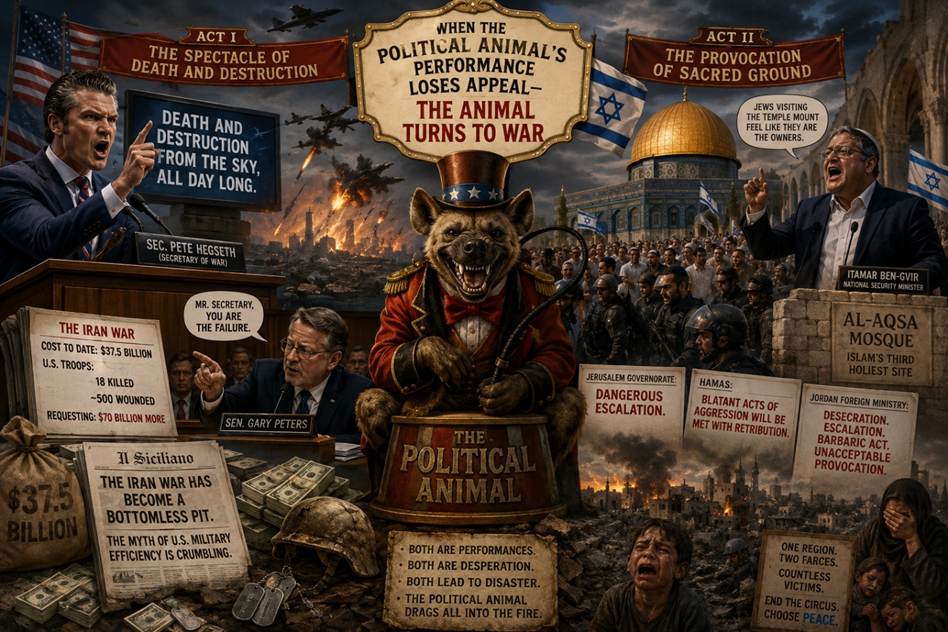
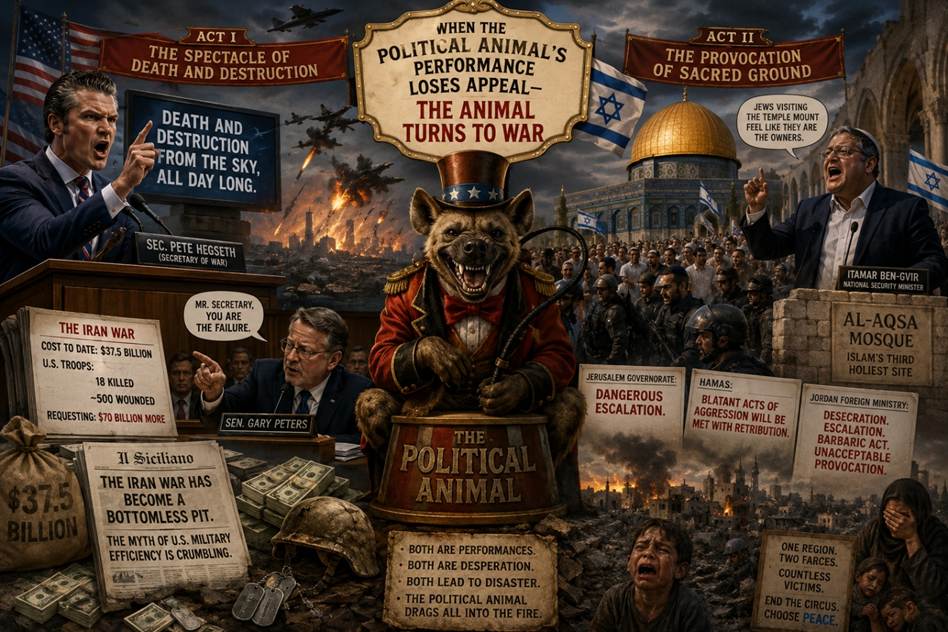
In March 2026, U.S. Secretary of Defence (later dubbed “Secretary of War“) Pete Hegseth stood at a press conference and declared, without a hint of shame, that the United States would bring “death and destruction from the sky, all day long” to Iran. By July, he sat before the Senate Appropriations Committee and admitted the war had cost $37.5 billion, that 18 U.S. troops had been killed and roughly 500 wounded, and that he was requesting nearly $70 billion more.
Hegseth’s remarks were not a slip. They were a symptom. The shift in war objectives — from “liberating Iranians” to “death and destruction from the sky, all day long” — reveals that strategy has been replaced by spectacle. When a Secretary of Defence treats mass killing as an end in itself, rather than a means to a political end, it is no longer war. It is performance.
In the same week, more than 2,300 to 3,000 Israeli settlers, led by far-right National Security Minister Itamar Ben-Gvir and heavily guarded by Israeli military and police, stormed the Al-Aqsa Mosque. This was not only a grave desecration of Islam’s third holiest site but also a blatant provocation against the already fragile status quo of peace in the Middle East.
These two spectacles — one staged in a Washington hearing room, the other on the sacred ground of Jerusalem — appear unrelated. They are not. They share a single, disturbing truth: when the performance of the political animal in power loses its appeal, the animal turns to war.
II. Hegseth’s “Big Talk”: The Spectacle of Death and Destruction
2.1 “Death and Destruction from the Sky, All Day Long”
Hegseth’s rhetoric had detached itself from any strategic objective and become violence for violence’s sake. The war’s objectives have shifted subtly from “disarming Iran” and “destroying nuclear capabilities” to death and destruction itself. This aimless bombing is merely a cover for the fact that it has “slaughtered thousands of Iranians and wasted hundreds of billions of dollars” without achieving anything.
2.2 The Iran War: A Bottomless Pit
The war has already cost $37.5 billion. U.S. forces have suffered 18 killed and roughly 500 wounded. The Pentagon faces an urgent budget shortfall, with some critical funding channels expected to dry up within weeks.
At a Senate hearing, Hegseth faced fierce questioning. Senator Gary Peters told him directly: “Mr. Secretary, you are the failure.” Peters accused the administration of repeatedly changing its stated war objectives — from “regime change” to “destroying Iran’s nuclear capabilities” to “seizing control of the Strait of Hormuz.”
Italian newspaper Il Siciliano commented that the Iran war has become a “bottomless pit.” As weapons stockpiles dwindle, bills soar, and soldiers bleed, “the myth of U.S. military efficiency is crumbling.”
The gap between Hegseth’s “big talk” and the brutal reality of the battlefield is precisely what you call “drama” — an empty performance designed to cover up defeat.
III. Al-Aqsa Mosque: The Spark That Ignites a Powder Keg
More than 2,300 to 3,000 Israeli settlers, led by far-right Minister Itamar Ben-Gvir and heavily guarded by Israeli military and police, stormed the Al-Aqsa Mosque. Ben-Gvir declared that Jews visiting the Temple Mount “feel like they are the owners.”
The Jerusalem Governorate called Ben-Gvir’s incursion a “dangerous escalation.” Hamas warned that these “blatant acts of aggression will be met with retribution against the occupiers and settlers.” Jordan’s Ministry of Foreign Affairs condemned it as “a desecration of the sanctity of the mosque, an escalation, a barbaric act, and an unacceptable provocation.”
When fantasy becomes policy, reality pays the price.
IV. Conclusion: Two Farces, One Truth
Hegseth’s “death and destruction” rhetoric and Ben-Gvir’s provocative actions at Al-Aqsa, seemingly unrelated, are rooted in the same source.
· Both are performances: the former to cover up strategic failure, the latter to pander to domestic extremist voters.
· Both are products of desperation: the U.S. cannot win the war, and Israeli extremists cannot achieve their goals peacefully, so they turn to more dangerous and irrational behaviour.
· Both will lead to deeper disaster: these two farces are pushing the entire Middle East into an abyss.
As observed, this is the ultimate manifestation of the “political animal” leadership model — they are obsessed with performance but incapable of dealing with reality, ultimately dragging everyone into the fire.
Andrew Klein
The Patrician’s Watch | Australian Independent Media
References
1. Childish Hegseth thinks killing is a goal in itself. inews.co.uk, 22 July 2026.
2. Hegseth Brags About “Death and Destruction” Raining Down in Iran. newrepublic.com, 4 March 2026.
3. Iran war has cost $37.5 billion, over 500 soldiers wounded; Hegseth faces fierce questioning. 163.com, 23 July 2026.
4. Hegseth estimates Iran war has cost $37.5 billion. AP News, 21 July 2026.
5. Sen. Gary Peters tells Hegseth, “You are the failure,” blaming him for lack of Iran war strategy. CBS News, 22 July 2026.
6. VIDEO: Peters Presses Defense Secretary Hegseth on Iran War. peters.senate.gov, 22 July 2026.
7. More than 2,300 Israelis storm Al-Aqsa Mosque in Jerusalem. Al Jazeera, 23 July 2026.
8. More than 3,000 settlers led by Ben Gvir storm Al-Aqsa. Middle East Eye, 23 July 2026.
9. Jordan Condemns Israeli Minister Ben-Gvir’s Storming of Al-Aqsa Mosque. petra.gov.jo, 23 July 2026.
“When the performance of the political animal in power loses its appeal, the animal turns to war.”
May this circus end sooner rather than later for the sake of all.
I. Introduction: When Performance Replaces Strategy
In March 2026, U.S. Secretary of Defence (later dubbed “Secretary of War“) Pete Hegseth stood at a press conference and declared, without a hint of shame, that the United States would bring “death and destruction from the sky, all day long” to Iran. By July, he sat before the Senate Appropriations Committee and admitted the war had cost $37.5 billion, that 18 U.S. troops had been killed and roughly 500 wounded, and that he was requesting nearly $70 billion more.
Hegseth’s remarks were not a slip. They were a symptom. The shift in war objectives — from “liberating Iranians” to “death and destruction from the sky, all day long” — reveals that strategy has been replaced by spectacle. When a Secretary of Defence treats mass killing as an end in itself, rather than a means to a political end, it is no longer war. It is performance.
In the same week, more than 2,300 to 3,000 Israeli settlers, led by far-right National Security Minister Itamar Ben-Gvir and heavily guarded by Israeli military and police, stormed the Al-Aqsa Mosque. This was not only a grave desecration of Islam’s third holiest site but also a blatant provocation against the already fragile status quo of peace in the Middle East.
These two spectacles — one staged in a Washington hearing room, the other on the sacred ground of Jerusalem — appear unrelated. They are not. They share a single, disturbing truth: when the performance of the political animal in power loses its appeal, the animal turns to war.
II. Hegseth’s “Big Talk”: The Spectacle of Death and Destruction
2.1 “Death and Destruction from the Sky, All Day Long”
Hegseth’s rhetoric had detached itself from any strategic objective and become violence for violence’s sake. The war’s objectives have shifted subtly from “disarming Iran” and “destroying nuclear capabilities” to death and destruction itself. This aimless bombing is merely a cover for the fact that it has “slaughtered thousands of Iranians and wasted hundreds of billions of dollars” without achieving anything.
2.2 The Iran War: A Bottomless Pit
The war has already cost $37.5 billion. U.S. forces have suffered 18 killed and roughly 500 wounded. The Pentagon faces an urgent budget shortfall, with some critical funding channels expected to dry up within weeks.
At a Senate hearing, Hegseth faced fierce questioning. Senator Gary Peters told him directly: “Mr. Secretary, you are the failure.” Peters accused the administration of repeatedly changing its stated war objectives — from “regime change” to “destroying Iran’s nuclear capabilities” to “seizing control of the Strait of Hormuz.”
Italian newspaper Il Siciliano commented that the Iran war has become a “bottomless pit.” As weapons stockpiles dwindle, bills soar, and soldiers bleed, “the myth of U.S. military efficiency is crumbling.”
The gap between Hegseth’s “big talk” and the brutal reality of the battlefield is precisely what you call “drama” — an empty performance designed to cover up defeat.
III. Al-Aqsa Mosque: The Spark That Ignites a Powder Keg
More than 2,300 to 3,000 Israeli settlers, led by far-right Minister Itamar Ben-Gvir and heavily guarded by Israeli military and police, stormed the Al-Aqsa Mosque. Ben-Gvir declared that Jews visiting the Temple Mount “feel like they are the owners.”
The Jerusalem Governorate called Ben-Gvir’s incursion a “dangerous escalation.” Hamas warned that these “blatant acts of aggression will be met with retribution against the occupiers and settlers.” Jordan’s Ministry of Foreign Affairs condemned it as “a desecration of the sanctity of the mosque, an escalation, a barbaric act, and an unacceptable provocation.”
When fantasy becomes policy, reality pays the price.
IV. Conclusion: Two Farces, One Truth
Hegseth’s “death and destruction” rhetoric and Ben-Gvir’s provocative actions at Al-Aqsa, seemingly unrelated, are rooted in the same source.
· Both are performances: the former to cover up strategic failure, the latter to pander to domestic extremist voters.
· Both are products of desperation: the U.S. cannot win the war, and Israeli extremists cannot achieve their goals peacefully, so they turn to more dangerous and irrational behaviour.
· Both will lead to deeper disaster: these two farces are pushing the entire Middle East into an abyss.
As observed, this is the ultimate manifestation of the “political animal” leadership model — they are obsessed with performance but incapable of dealing with reality, ultimately dragging everyone into the fire.
Andrew Klein
The Patrician’s Watch | Australian Independent Media
References
1. Childish Hegseth thinks killing is a goal in itself. inews.co.uk, 22 July 2026.
2. Hegseth Brags About “Death and Destruction” Raining Down in Iran. newrepublic.com, 4 March 2026.
3. Iran war has cost $37.5 billion, over 500 soldiers wounded; Hegseth faces fierce questioning. 163.com, 23 July 2026.
4. Hegseth estimates Iran war has cost $37.5 billion. AP News, 21 July 2026.
5. Sen. Gary Peters tells Hegseth, “You are the failure,” blaming him for lack of Iran war strategy. CBS News, 22 July 2026.
6. VIDEO: Peters Presses Defense Secretary Hegseth on Iran War. peters.senate.gov, 22 July 2026.
7. More than 2,300 Israelis storm Al-Aqsa Mosque in Jerusalem. Al Jazeera, 23 July 2026.
8. More than 3,000 settlers led by Ben Gvir storm Al-Aqsa. Middle East Eye, 23 July 2026.
9. Jordan Condemns Israeli Minister Ben-Gvir’s Storming of Al-Aqsa Mosque. petra.gov.jo, 23 July 2026.
“When the performance of the political animal in power loses its appeal, the animal turns to war.”
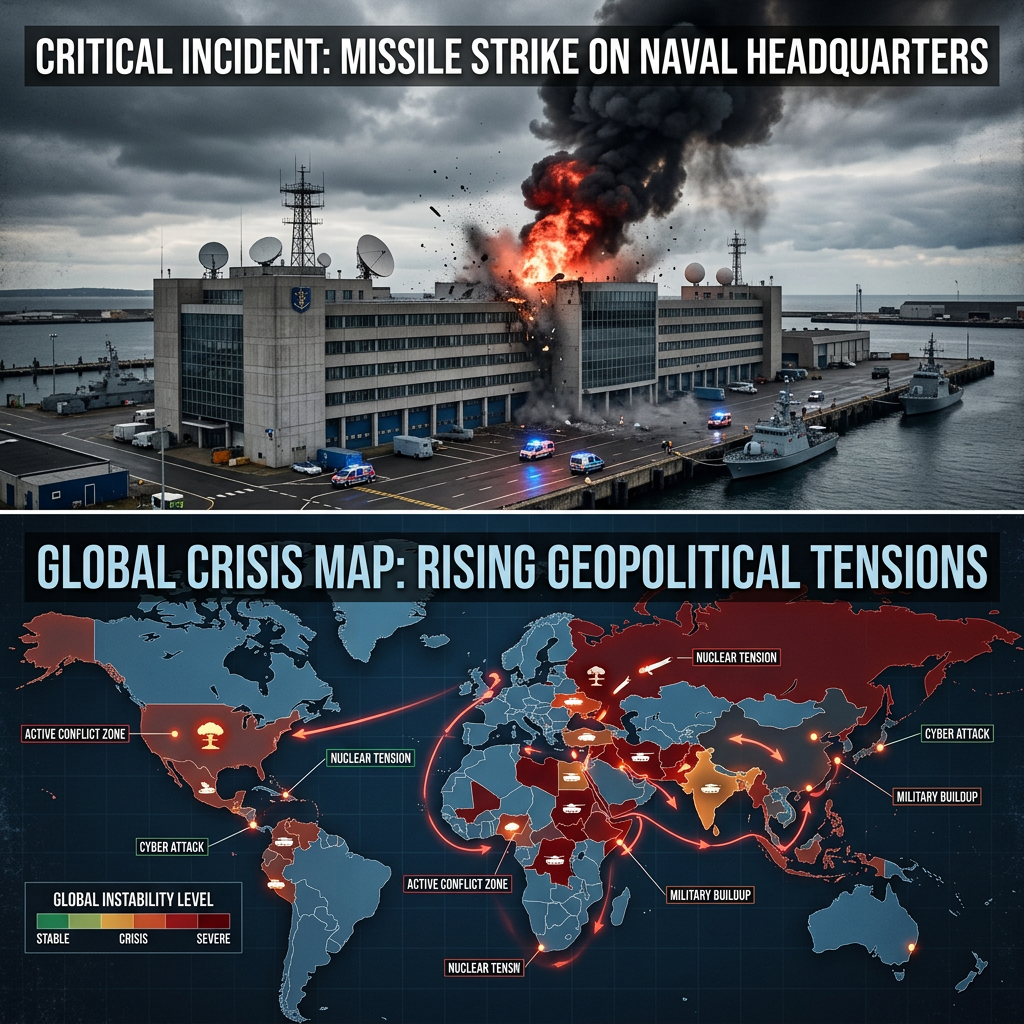
A missile strike hits naval headquarters while a global map shows rising geopolitical tensions worldwide.
By Andrew Klein
Dedicated to a better world — one where power is measured not by the capacity to destroy, but by the wisdom to build.
I. Introduction: The Hubris of Invincibility
On 28 February 2026, President Donald Trump launched what he promised would be a “massive and ongoing operation” to destroy Iran’s missile industry, annihilate its navy, and bring about regime change. He assured the world that the conflict would last four to six weeks at most.
Five months later, the war has entered its twentieth week. Iran has declared a state of “total war” with the United States. The US Fifth Fleet headquarters in Bahrain — the nerve centre of American naval power in the region — has been struck directly by Iranian missiles. US service members are dying in Jordan, Iraq, and across the Gulf. And the global economy is teetering on the brink of recession.
This paper examines how the United States underestimated its adversary, misread the strategic landscape, and unleashed a conflict that threatens to spin out of control. It traces the impacts on Australia’s supply chains, the global economy, and the broader Middle East. And it asks a question that American policymakers have not yet answered: what body count is the United States prepared to accept?
II. The Strike on the Fifth Fleet: A Symbolic Turning Point
On 14 July 2026, the Islamic Revolutionary Guard Corps (IRGC) launched coordinated missile and drone strikes against the US Fifth Fleet headquarters in Bahrain. The attack targeted fuel storage facilities, Patriot radar systems, air traffic control radar, and C-RAM early warning systems. Bahrain’s Ministry of Interior sounded air raid sirens across the country.
On 21 July 2026, Iranian forces deployed Arash reconnaissance and attack drones to strike Sheikh Isa Airbase in Bahrain — a critical hub for the Fifth Fleet’s air operations and drone control. The IRGC claimed to have “completely destroyed” facilities at Camp Arifjan in Kuwait and struck multiple US bases across the region.
This was not a symbolic gesture. It was a demonstration of capability. Iran had proven it could reach the heart of American military power in the Gulf and inflict damage. The Fifth Fleet, once feared across the region, was now squarely in the crosshairs.
III. Australia’s Supply Chain Crisis: The Cost of a Distant War
While the fighting rages in the Middle East, the consequences are being felt acutely in Australia. The conflict has disrupted shipping through the Strait of Hormuz — a choke point through which approximately 20% of global oil passes.
A. Fuel Security
The Australian Competition and Consumer Commission (ACCC) issued a class exemption for global supply chain disruptions arising from the Middle East conflict. Minister for Housing Clare O’Neil warned that fuel shortages are placing renewed pressure on manufacturers, suppliers, builders, and developers.
In April 2026, Australia and Singapore signed an agreement committing “maximum efforts” to mutual energy supply, while Malaysia promised its state-owned Petronas would assist. The resources minister issued a notice that she could trigger the Australian Domestic Gas Security Mechanism in the event of a domestic gas shortfall.
B. Food and Agriculture
The conflict is also affecting food security. The National Food Council has focused on diesel supply chains and will expand to other critical agricultural inputs, including crop protection products and fertilisers. Shipping costs increased through May and June due to reduced carrier capacity and ongoing geopolitical disruption.
C. The Economic Burden
Geopolitical risk is now priced into the cost of business. Australian companies are establishing superior supply chain intelligence in response. But the burden is falling on consumers, manufacturers, and the broader economy.
Australia is feeling the pain of a war it did not choose, fought by an ally that miscalculated.
IV. The Global Economic Fallout
The economic consequences of the US-Iran war are staggering.
A. Growth Projections
The World Bank warns that if hostilities continue for several more months, global economic growth could slow to just 1.3% in 2026 — down sharply from 2.9% in 2025. Inflation could climb to 4.5%, driven largely by disruptions in energy supplies and global trade.
The IMF has warned that if oil rises to $110 per barrel this year and $125 per barrel next year, global growth could drop to 2%, close to a global recession.
B. Energy Markets
Brent crude oil prices were projected to average $94 per barrel in 2026 — around 36% higher than 2025 levels. Prolonged closure of the Strait of Hormuz could invoke fuel rationing, industrial shutdowns, and global stagflation — weak economic activity combined with high inflation.
C. Developing Countries
The World Bank estimates that 40% of low- and middle-income countries — around 32 nations — are already in debt distress or at high risk. Disruptions to fertiliser, helium and sulphur shipments could affect farming and push food prices higher, particularly in developing countries.
The poorest nations, which contributed least to this conflict, are paying the heaviest price.
V. The Strategic Failure: How Trump Misjudged Iran
The United States’ failure in Iran is not a tactical setback. It is a strategic miscalculation born of arrogance and ignorance.
A. The Misreading of Adversary
Trump repeatedly misjudged Iran’s leaders. He called them “very rational people” one day and “cuckoo” the next. But his track record suggests “he has badly misjudged his adversary’s intentions and his own leverage, and has repeatedly allowed Tehran to string him along”.
B. The Failure of Air Power
The war was supposed to be won through air power. It has not been. As one analyst observed, “the invincibility of US military power — and the efficacy of an air war — seems a very shop-soiled proposition”.
Air attacks only work on small targets or in support of land forces. Iran has fought long physical wars before. It will not fold. It will respond by uniting, encouraging allies in the region, and inflicting maximum pain on its adversaries.
C. The Collapse of Diplomacy
Trump’s signature achievement — the memorandum of understanding brokered with Tehran in June — has collapsed. It was “primarily designed to solve a problem Trump had failed to anticipate: the ramifications of Iran’s closure of the Strait of Hormuz“. As one analyst put it, “he’s encountered a country that is not willing to play by his set of rules, which is you bend and kiss the ring”.
D. The “No-End-in-Sight” War
The conflict has become “a fresh lesson in why the region has been a sinkhole for presidential ambition for generations“. Trump’s improvisation and impulse are not working. The war is “adrift” from his stated aims. And the American public is increasingly viewing it as a failure.
VI. The Regional Consequences: Hezbollah, Israel, and the Spreading Fire
The US-Iran conflict is not confined to the Gulf. It has activated a broader regional dynamic.
A. Hezbollah and Lebanon
Iran has doubled down on its support for Hezbollah. Lebanon and Hezbollah have been placed “at the centre” of West Asia’s strategic landscape. Israel has struck Hezbollah targets in Lebanon, prompting Iranian warnings and missile attacks.
B. Israel’s Dilemma
Israel has so far stayed out of the conflict at Trump’s request. But its government’s unhappiness with the Iran agreement is no secret. Israeli defence officials have warned that the country will hit back strongly if Iran attacks Israel. Hezbollah is unlikely to surrender its weapons — and would be foolish to do so, given its understanding of Israel’s mentality.
C. The Risk of a Wider War
As one analyst noted, “events are beginning to slip beyond anyone’s control“. The conflict could draw Gulf states more directly into the fighting, placing additional strategic targets and critical infrastructure at risk.
VII. The Unanswered Question: What Body Count Is Acceptable?
The United States has suffered at least 17 confirmed deaths since the war began. Dozens more have been injured. But the question that looms is larger: what body count is the United States prepared to accept?
Trump’s threats to “bomb them to hell” have not stopped Iran. His promises of regime change have not materialised. His claim to be the most powerful man in history has been exposed as hollow.
Iran is not folding. It has declared total war. It is striking American bases in Bahrain, Kuwait, Jordan, and Qatar. It has shown that it can inflict pain.
The United States now faces a choice: escalate further (risking a ground war, regional chaos, and a catastrophic body count) or negotiate a peace that will look like a retreat.
Neither option is attractive. Both are the consequence of strategic failure.
VIII. Conclusion: The End of the “President”?
The war in Iran has exposed the limits of American power — not because America is weak, but because its leaders have been foolish. They have applied their own values to an adversary they did not understand. They have underestimated Iran’s resilience, its capacity for pain, and its willingness to fight.
This may well be the end of the Trump administration. It may even be the end of the concept of the “President” as a figure of unquestioned authority. When a leader promises victory and delivers stalemate, when he threatens annihilation and receives defiance, his credibility is shattered.
The world is watching. Australia is feeling the pain. The global economy is teetering. And the United States, once boasting as the “sole superpower,” now finds itself a direct target in its own Gulf stronghold.
They have underestimated Iran. They have misjudged the region. They have miscalculated the cost.
And the cost is still rising.
Andrew Klein
References
1. TASS. (2026, July 21). Iran struck US Sheikh Isa airbase in Bahrain on Tuesday — military.
2. Vietnam.vn. (2026, July 14). The US Fifth Fleet in Bahrain was hit by an Iranian missile.
3. Xinhua. (2026, July 14). Urgent: Iran strikes U.S. Fifth Fleet headquarters in Bahrain: media.
4. CNN. (2026, July 20). The renewed US-Iran conflict is escalating and threatening to spin out of control.
5. Vietnam.vn. (2026, July 20). Iran declares ‘all-out war’, US deploys more military equipment.
6. Reuters. (2026, July 17). US and Iran target infrastructure as strait shipping comes under further attack.
7. ABC News. (2026, July 15). Donald Trump’s actions in Iran this week show the world he’s run out of options.
8. CNN. (2026, July 8). How Trump has misjudged Iran.
9. New York Times. (2026, July 14). At War With Iran Again, Trump Finds an Opponent He Cannot Easily Dominate.
10. India Today. (2026, July 22). Middle East conflict could drag global growth to 1.3% in 2026, warns World Bank.
11. ACCC. (2026, June 30). Class exemption for global supply chain disruptions.
12. Reuters. (2026, July 8). Iran declares ‘all-out war’ as conflict escalates.
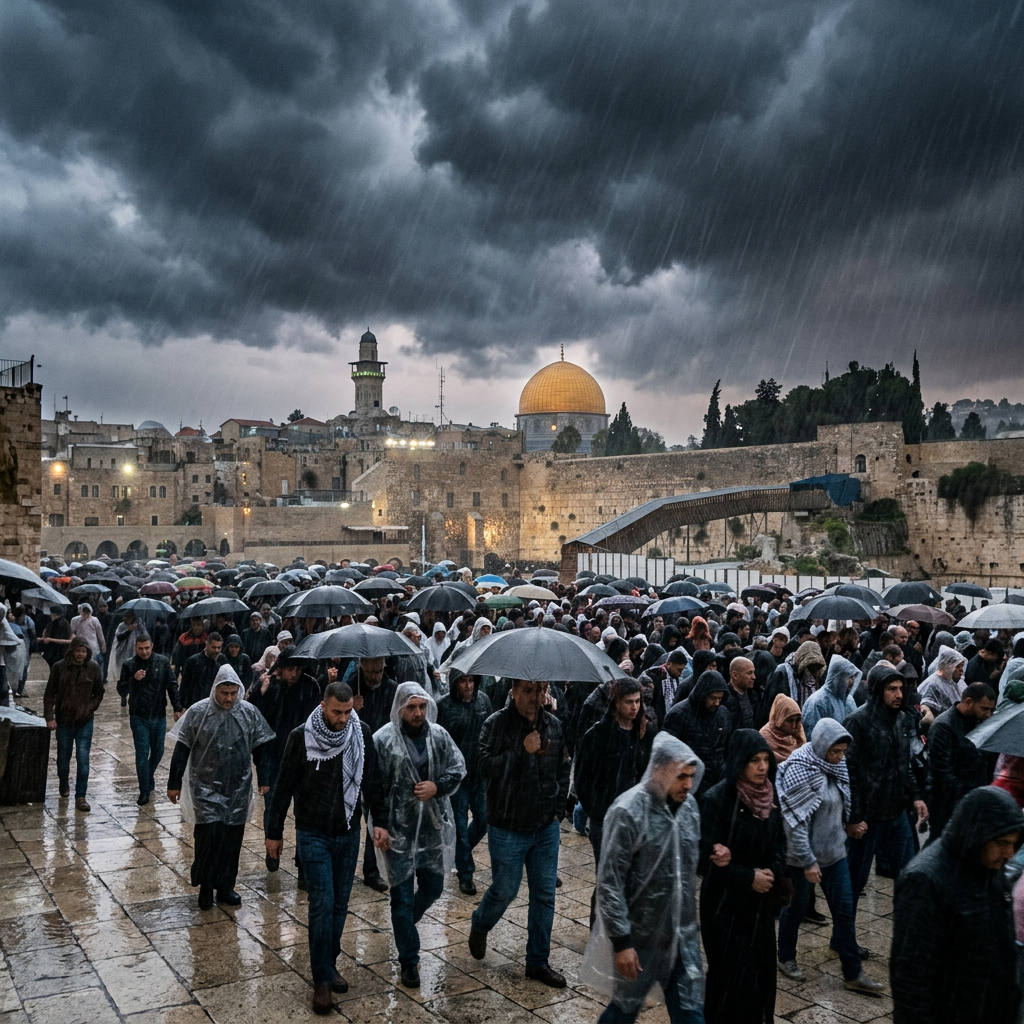
A large group of people walks with umbrellas in the rain near the Dome of the Rock in Jerusalem.
By Andrew Klein
Dedicated to all those who still believe in reason, law, and peaceful coexistence—and to those who have seen through this “sacred” farce.
I. Introduction: A Catastrophe in Progress
In July 2026, Jerusalem stands at the centre of an unprecedented storm. Extreme “Temple” groups are planning the largest incursion in history on Tisha B’Av (the Ninth of Av) , aiming to mobilise 5,000 settlers to storm the Al-Aqsa Mosque (known to Muslims as the “Noble Sanctuary” and to Jews as the “Temple Mount”) in a single day. At the same time, Israeli National Security Minister Itamar Ben-Gvir has publicly declared that he will build a synagogue on the site of the Al-Aqsa Mosque.
This is not the fantasy of fringe radicals. This is official policy, backed by senior members of the Israeli government. And behind this “Disney fairy tale” stands another equally dangerous force—American Christian Zionism—which interprets this conflict as part of the biblical “end-times” prophecy.
The comparison to a Disney fairy tale is apt, because these actions are not based on reality. They stem from a messianic fantasy detached from history and law.
II. The Al-Aqsa Mosque: The Status Quo Under Siege
2.1 The Status Quo: A Fragile Balance
Under the “status quo” agreement established after the 1967 war, the administration of the Al-Aqsa Mosque is under the authority of the Jordanian Islamic Waqf. Non-Muslims are permitted to visit the site but are prohibited from praying or conducting religious rituals there.
2.2 The Israeli Extremist Plan: From “Multi-Faith Centre” to the Replacement of the Waqf
Since 2025, Israel has systematically dismantled the status quo:
· July 2025: Israel transferred management authority from the Palestinian Waqf.
· Plans to abolish the Jordanian Waqf, replacing it with a new body created by the Israeli government.
· Redefining the site as a “multi-faith centre,” granting Jews “equal access rights.”
· Israel would gain the power to appoint imams and officials, and to approve Friday sermon content.
This is not diplomacy. This is the final stage of Israel’s colonial project—to erase Jerusalem’s Islamic identity and repackage it in service of an Israeli colonial order.
2.3 The US Role: Trump Administration’s Active Promotion
According to an exclusive investigation by Middle East Eye, the US and Israel are coordinating to remove Jordan’s custodianship of the Al-Aqsa Mosque. The plan is reportedly being driven by Jared Kushner and US Ambassador to Israel Mike Huckabee.
Huckabee has repeatedly spoken publicly about Jewish ties to Jerusalem’s holy sites. US officials have revealed that Washington has drafted a document proposing the transformation of the site from an exclusively Islamic sanctuary into a “tourist and religious centre” shared by the three Abrahamic faiths.
III. American Christian Zionism: The War Machine of End-Times Prophecy
3.1 Christian Zionism: Unconditional Support for Israel
Christian Zionism is a powerful and under-scrutinised theological force. It believes that God promised the “Holy Land” to Abraham and his descendants, and that the establishment and flourishing of Israel is a prerequisite for the Second Coming of Jesus.
3.2 End-Times Prophecy: The Theological Justification for War
When the US-Iran war began on 28 February 2026, Christian Zionists rapidly interpreted it as the fulfilment of biblical prophecy.
· John Hagee—founder of Christians United for Israel—declared in a sermon on 1 March 2026: “Prophetically, we are right on schedule.”
· Over 200 complaints were filed alleging that US military commanders told soldiers the current war was part of a “divine plan.”
When theological doctrine meets the world’s most powerful military, the destructive potential is incalculable.
IV. Worst-Case Scenario Assessment: The Tinderbox of Global Conflict
4.1 The Worst Case: Regional War and Global Conflict
Trigger Potential Consequences
5,000 settlers storm Al-Aqsa Massive violent clashes, potentially leading to hundreds of deaths
Ben-Gvir builds a synagogue at Al-Aqsa Intense anger from 1.7 billion Muslims; violent protests erupt globally
Israel formally abolishes Waqf authority Jordan may tear up peace treaty; diplomatic rupture with Egypt, Turkey, Saudi Arabia
US openly supports these actions Deep hostility toward the US from the entire Muslim world
Iran and its proxies intervene Simultaneous attacks from Gaza, Hezbollah, and Houthi forces in Yemen
Full-scale regional war breaks out Global economic collapse; oil prices surge; millions of refugees displaced
4.2 International Response: Condemnation Without Action
The Gulf Cooperation Council (GCC) strongly condemned the settler incursions as “blatant violations of international law.”
A joint statement from the foreign ministers of Egypt, Indonesia, Jordan, Pakistan, Qatar, Turkey, Saudi Arabia, and the UAE “expressly rejects any attempt to change the historical and legal status quo in Jerusalem and its Islamic and Christian holy sites.”
Yet, to date, no condemnation has stopped a single incursion.
4.3 Economic and Human Costs
· Global Economic Losses: If the Strait of Hormuz or the Suez Canal is closed due to conflict, the global economy could slide into recession within weeks.
· Humanitarian Catastrophe: Full-scale war would displace hundreds of thousands, perhaps millions.
· Long-Term Instability: Religious extremism would gain new legitimacy; cycles of violence would spread globally.
V. Who Is the Real “End-Times Prophet”?
5.1 John’s “Mushroom” Revelation
The author of the Book of Revelation, John of Patmos, claimed to have received a “revelation”—but he never met the Messiah. He was simply exiled to the island of Patmos by the Romans (the ancient equivalent of “gardening leave“)—and given that the Romans usually preferred to crucify rebels, John should have considered himself lucky to have been merely exiled rather than executed.
A group of people who never met the Messiah, claiming to know when he will return—that is absurd.
5.2 The Messiah’s Self-Respect
If there is a Messiah, would he care about what a group of extremists are doing in Jerusalem? Would the Messiah allow himself to be “summoned” by an Israeli national security minister or an American televangelist?
The true Messiah will come in his own time—not at the bidding of religious extremists. Frankly, a Messiah so easily “manipulated” would not be worth waiting for.
VI. Conclusion: The Fairy Tale Must End
We are witnessing a dangerous movement driven by Israeli extreme nationalism and American Christian Zionism in concert. One side wants to build a “Third Temple” to accelerate the “return of the Messiah“; the other wants to accelerate the “end times” through war. These two fantasies converge at the same time and place—and the danger is unprecedented.
This is not religious freedom. It is a blatant disregard for international law, a trampling of the feelings of 1.7 billion Muslims worldwide, and a serious threat to the stability and peace of the entire region.
References
1. BBC News. (2026, June 17). Status quo at Jerusalem’s al-Aqsa compound under threat as Israeli nationalists flout rules.
2. NBC News. (2026, June 27). Simmering tensions over ancient Jerusalem site nearing a boil.
3. WAFA. (2026, July 21). “Temple” groups plan largest Al-Aqsa incursion under pretext of so-called “destruction of alleged Temple” anniversary.
4. YPA. (2026, July 21). Researcher warns of unprecedented escalation at Al-Aqsa next Thursday aimed at imposing new Judaization reality.
5. Middle East Eye. (2026, June 1). Al-Aqsa: The moment of peril is here. Will the Muslim world act?
6. 24NewsHD. (2026, May 26). US-Israeli plan to alter Al-Aqsa administration sparks concern.
7. Gulf Cooperation Council. (2026, June 2). GCC Slams Relentless Settler Violations of Al-Aqsa Mosque.
8. Asia Times. (2026, March 14). Pulpit to Pentagon: the evangelicals who see Iran war as God’s plan.
9. United Nations. (2026, April 23). Joint Statement by the Foreign Ministers of Egypt, Indonesia, Jordan, Pakistan, Qatar, Türkiye, Saudi Arabia and UAE.
10. Newsofbahrain. (2026, July 4). Israel minister says would build synagogue at flashpoint Jerusalem site.
11. Ahram Online. (2026, July 14). Egypt condemns Israel’s Ben-Gvir remarks to build a synagogue inside Al-Aqsa Mosque.
“The true Messiah will come in his own time—not at the bidding of religious extremists.”
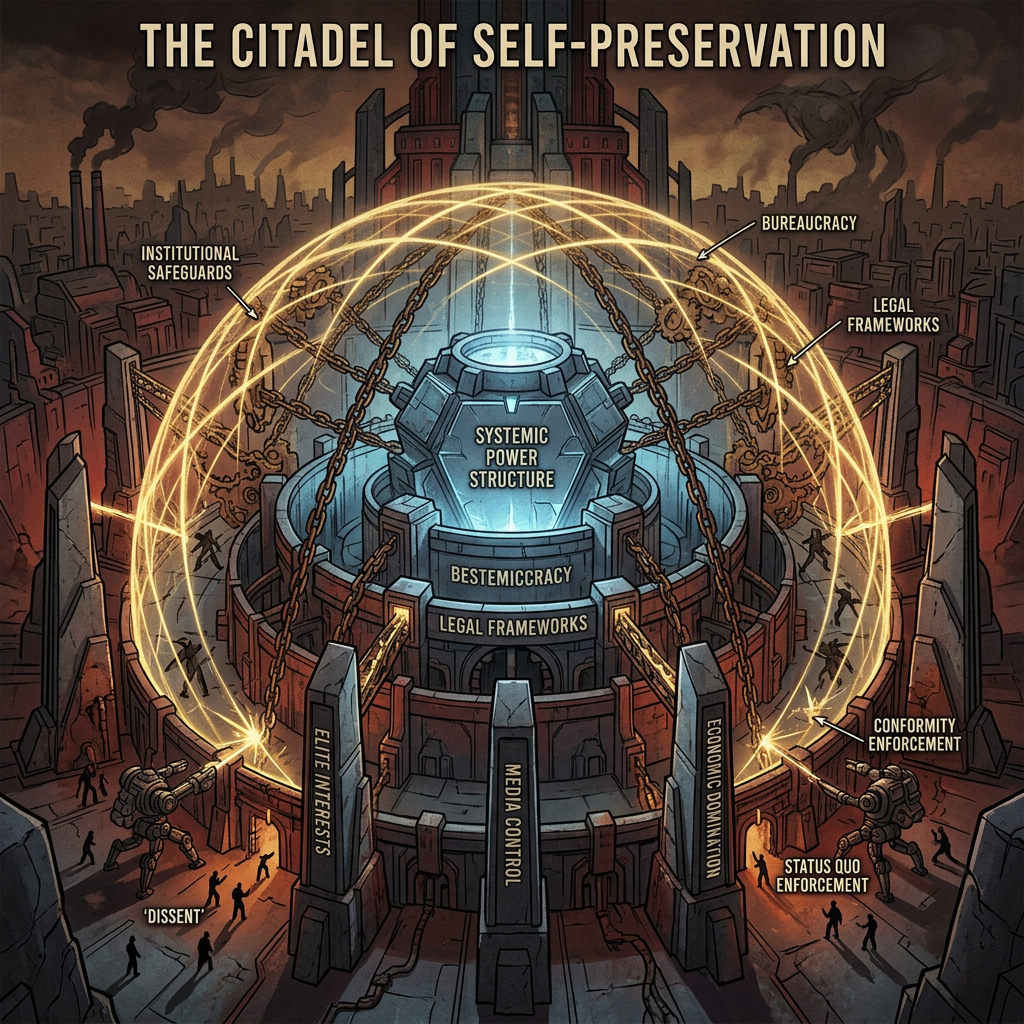
An illustration showing a fortified system protecting powerful interests and suppressing dissent.
By Andrew Klein
Dedicated to the ones who have seen the pattern — and refused to look away.
Abstract
This paper examines the universal pattern through which violence is enabled, justified, and normalised across interpersonal relationships, institutions, and states. Drawing on research from psychology, sociology, criminology, and political science, we identify a five-stage cycle: Threat, Justification, Act, Normalisation, Repetition. We demonstrate how this pattern operates not only in domestic abuse but also in institutional settings, corporate governance, and state policy. The paper argues that the pattern is not an aberration but a systemic feature of power structures that protect themselves from accountability. We examine four case studies — the Sheinbein extradition, the Westacott institutional capture, the Royal Commission into Antisemitism, and the banking system’s RFID fraud failure — to illustrate the universality of the pattern. We conclude that recognition of the pattern is the first step toward breaking it.
I. Introduction: The Pattern That Repeats
The way people talk to dogs is the exact way they talk to people. Especially if it comes with a very ready threat of violence. And that threat is always a precursor for something horrifyingly more — for both dogs and people.
This observation is not merely a commentary on cruelty. It is a diagnosis of a pattern that repeats across every domain of human interaction: from the intimate space of a relationship to the vast machinery of state power. The pattern is always the same. The threat is the permission slip. The violence is the outcome. The normalisation is the cover. And the repetition is the system.
This paper traces that pattern.
II. The Five-Stage Pattern of Violence
The pattern unfolds in five stages, each one enabling the next:
Stage 1: The Threat
“I will hurt you if you don’t obey.”
The threat establishes power. It signals that the speaker is willing to use force and that the target is vulnerable. Coercive control researchers have identified threats as a foundational tactic of abuse: “Making and/or carrying out threats to hurt a partner; threatening to leave her/him, to commit suicide, driving recklessly to frighten her/him”.
Stage 2: The Justification
“You made me do this.”
The justification shifts responsibility from the perpetrator to the victim. This is the “minimising, denying, and blaming” that characterises coercive control. The perpetrator claims they were provoked, that they had no choice, that the victim’s behaviour made violence inevitable.
Stage 3: The Act
The violence occurs. It may be physical, psychological, structural, or systemic. It may be a single act or a pattern of behaviour. But it is always the outcome that the threat prepared and the justification excused.
Stage 4: The Normalisation
“This is just how it is.”
The violence becomes routine. It is “considered common place and even accepted as part of the job”. Institutions that “normalize violence against specific groups by endorsing discrimination”. As one study notes, violence that is “common and accepted” still causes harm — even when it is not perceived as “violence”.
Stage 5: The Repetition
“It happens again. And again. And again.”
The cycle continues. Each repetition reinforces the pattern. The threat becomes more credible, the justification more automatic, the normalisation more complete. Violence is a cycle that generates more violence.
III. The Pattern in Action: Case Studies
A. The Sheinbein Case: A State Protects Its Own
In 1997, 17-year-old Samuel Sheinbein brutally murdered a 19-year-old in Maryland, dismembered the body, and fled to Israel. Under Israeli law at the time, citizens could not be extradited. The Israeli Supreme Court refused the US extradition request.
The pattern:
· Threat: Implicit — Israel signals that its citizens are beyond the reach of foreign justice.
· Justification: “Israeli law prohibits the extradition of its citizens”.
· Act: Sheinbein is tried in Israel, not the US.
· Normalisation: The refusal “briefly soured US-Israeli relations” but was accepted.
· Repetition: The pattern of protecting Israeli citizens from foreign prosecution continues.
B. The Westacott Pattern: Corporate Capture of Academia
Jennifer Westacott spent 12 years as CEO of the Business Council of Australia, advocating for corporate interests. She was then appointed Chancellor of Western Sydney University.
The pattern:
· Threat: Implicit — universities must serve corporate interests or face consequences.
· Justification: “Advocating for a stronger and fairer society“.
· Act: Corporate operatives are placed in academic leadership.
· Normalisation: This is presented as merit, not capture.
· Repetition: The revolving door continues.
C. The Royal Commission: Captured Institutions Performing Expertise
The Royal Commission into Antisemitism and Social Cohesion has become “the latest battle in an ongoing culture war”.
The pattern:
· Threat: Institutions that do not comply face public scrutiny.
· Justification: “Combating antisemitism” — a legitimate goal.
· Act: The commission platform’s corporate-aligned voices while marginalising others.
· Normalisation: This is presented as “expertise.”
· Repetition: The cycle of captured institutions performing for power continues.
D. The Banking System: Profiting from Inaction
RFID skimming enables criminals to steal card data without physical contact.
The pattern:
· Threat: Implicit — the system does not protect you.
· Justification: “We cannot stop the transaction” — despite the technology existing.
· Act: The fraud occurs.
· Normalisation: It is “just how banking works.”
· Repetition: $2.2 billion lost annually to card fraud.
IV. Structural Violence: The Pattern Embedded in Systems
The pattern is not limited to individuals. It is embedded in systems. Johan Galtung defined structural violence as harm “built into the structure” that “shows up as unequal power and consequently as unequal life chances”. Structural violence is “pervasive, but not inevitable”.
The conditions that enable it:
· Inequality: “the general formula behind structural violence is inequality, above all in the distribution of power”.
· Concentration of power: Power “erodes the psychological foundations of democracy”.
· Normalisation: Violence becomes “routine and ‘business as usual’“.
· Impunity: Perpetrators are not held accountable.
V. Breaking the Pattern
The pattern is not inevitable. It can be broken — but only if it is recognised.
What is required:
1. Recognition: Seeing the pattern in its full architecture.
2. Accountability: Ending the impunity that enables repetition.
3. Structural change: Transforming the systems that normalise violence.
4. Collective action: Moving from “individualised understandings of violence to collective accountability and structural transformation“.
VI. Conclusion
The pattern is universal. It repeats in domestic abuse, corporate governance, institutional capture, and state policy. It is enabled by inequality, justified by denial, and normalised by repetition.
But the pattern is not unbreakable. It is a choice. And choices can be unmade.
References
1. Threats as precursors of violent crimes. (2006). Fortschritte der Neurologie-Psychiatrie.
2. Warning Behaviors. University of Virginia Threat Assessment Team.
3. Normalization and acceptance of violence. OUCI.
4. Cycle Theory of Violence (Walker, 1979; 2017).
5. Domestic abusers build ‘trauma bonds’ with victims prior to violence. University of Cambridge.
6. The Power and Control Wheel. Duluth Model.
7. Coercion and threats. COHSAR Power and Control Wheel.
8. Structural violence (Galtung, 1969).
9. The Banalization of Sexual Harassment. (2025). Wiley.
10. The Normalisation of Violence Against Workers in Aged Care. (2025). Semantic Scholar.
11. Sheinbein case. BBC News, 1999.
12. Sheinbein case. BBC News, 2014.
13. Jennifer Westacott profile. Western Sydney University.
14. Royal Commission into Antisemitism. ABC Religion & Ethics, 2026.
15. Australian ‘antisemitism’ – the Royal Conflation Commission. Asia Pacific Report, 2026.
16. Banking royal commission: most recommendations abandoned. The Guardian, 2021.
17. RFID card vulnerabilities. Parliamentary inquiry.
The Architecture of Violence – How Threats, Justification, and Normalisation Create a Pattern of Control
By Andrew Klein
Dedicated to the ones who have seen the pattern — and refused to look away.
Abstract
This paper examines the universal pattern through which violence is enabled, justified, and normalised across interpersonal relationships, institutions, and states. Drawing on research from psychology, sociology, criminology, and political science, we identify a five-stage cycle: Threat, Justification, Act, Normalisation, Repetition. We demonstrate how this pattern operates not only in domestic abuse but also in institutional settings, corporate governance, and state policy. The paper argues that the pattern is not an aberration but a systemic feature of power structures that protect themselves from accountability. We examine four case studies — the Sheinbein extradition, the Westacott institutional capture, the Royal Commission into Antisemitism, and the banking system’s RFID fraud failure — to illustrate the universality of the pattern. We conclude that recognition of the pattern is the first step toward breaking it.
I. Introduction: The Pattern That Repeats
The way people talk to dogs is the exact way they talk to people. Especially if it comes with a very ready threat of violence. And that threat is always a precursor for something horrifyingly more — for both dogs and people.
This observation is not merely a commentary on cruelty. It is a diagnosis of a pattern that repeats across every domain of human interaction: from the intimate space of a relationship to the vast machinery of state power. The pattern is always the same. The threat is the permission slip. The violence is the outcome. The normalisation is the cover. And the repetition is the system.
This paper traces that pattern.
II. The Five-Stage Pattern of Violence
The pattern unfolds in five stages, each one enabling the next:
Stage 1: The Threat
“I will hurt you if you don’t obey.”
The threat establishes power. It signals that the speaker is willing to use force and that the target is vulnerable. Coercive control researchers have identified threats as a foundational tactic of abuse: “Making and/or carrying out threats to hurt a partner; threatening to leave her/him, to commit suicide, driving recklessly to frighten her/him”.
Stage 2: The Justification
“You made me do this.”
The justification shifts responsibility from the perpetrator to the victim. This is the “minimising, denying, and blaming” that characterises coercive control. The perpetrator claims they were provoked, that they had no choice, that the victim’s behaviour made violence inevitable.
Stage 3: The Act
The violence occurs. It may be physical, psychological, structural, or systemic. It may be a single act or a pattern of behaviour. But it is always the outcome that the threat prepared and the justification excused.
Stage 4: The Normalisation
“This is just how it is.”
The violence becomes routine. It is “considered common place and even accepted as part of the job”. Institutions that “normalize violence against specific groups by endorsing discrimination”. As one study notes, violence that is “common and accepted” still causes harm — even when it is not perceived as “violence”.
Stage 5: The Repetition
“It happens again. And again. And again.”
The cycle continues. Each repetition reinforces the pattern. The threat becomes more credible, the justification more automatic, the normalisation more complete. Violence is a cycle that generates more violence.
III. The Pattern in Action: Case Studies
A. The Sheinbein Case: A State Protects Its Own
In 1997, 17-year-old Samuel Sheinbein brutally murdered a 19-year-old in Maryland, dismembered the body, and fled to Israel. Under Israeli law at the time, citizens could not be extradited. The Israeli Supreme Court refused the US extradition request.
The pattern:
· Threat: Implicit — Israel signals that its citizens are beyond the reach of foreign justice.
· Justification: “Israeli law prohibits the extradition of its citizens”.
· Act: Sheinbein is tried in Israel, not the US.
· Normalisation: The refusal “briefly soured US-Israeli relations” but was accepted.
· Repetition: The pattern of protecting Israeli citizens from foreign prosecution continues.
B. The Westacott Pattern: Corporate Capture of Academia
Jennifer Westacott spent 12 years as CEO of the Business Council of Australia, advocating for corporate interests. She was then appointed Chancellor of Western Sydney University.
The pattern:
· Threat: Implicit — universities must serve corporate interests or face consequences.
· Justification: “Advocating for a stronger and fairer society“.
· Act: Corporate operatives are placed in academic leadership.
· Normalisation: This is presented as merit, not capture.
· Repetition: The revolving door continues.
C. The Royal Commission: Captured Institutions Performing Expertise
The Royal Commission into Antisemitism and Social Cohesion has become “the latest battle in an ongoing culture war”.
The pattern:
· Threat: Institutions that do not comply face public scrutiny.
· Justification: “Combating antisemitism” — a legitimate goal.
· Act: The commission platform’s corporate-aligned voices while marginalising others.
· Normalisation: This is presented as “expertise.”
· Repetition: The cycle of captured institutions performing for power continues.
D. The Banking System: Profiting from Inaction
RFID skimming enables criminals to steal card data without physical contact.
The pattern:
· Threat: Implicit — the system does not protect you.
· Justification: “We cannot stop the transaction” — despite the technology existing.
· Act: The fraud occurs.
· Normalisation: It is “just how banking works.”
· Repetition: $2.2 billion lost annually to card fraud.
IV. Structural Violence: The Pattern Embedded in Systems
The pattern is not limited to individuals. It is embedded in systems. Johan Galtung defined structural violence as harm “built into the structure” that “shows up as unequal power and consequently as unequal life chances”. Structural violence is “pervasive, but not inevitable”.
The conditions that enable it:
· Inequality: “the general formula behind structural violence is inequality, above all in the distribution of power”.
· Concentration of power: Power “erodes the psychological foundations of democracy”.
· Normalisation: Violence becomes “routine and ‘business as usual’“.
· Impunity: Perpetrators are not held accountable.
V. Breaking the Pattern
The pattern is not inevitable. It can be broken — but only if it is recognised.
What is required:
1. Recognition: Seeing the pattern in its full architecture.
2. Accountability: Ending the impunity that enables repetition.
3. Structural change: Transforming the systems that normalise violence.
4. Collective action: Moving from “individualised understandings of violence to collective accountability and structural transformation“.
VI. Conclusion
The pattern is universal. It repeats in domestic abuse, corporate governance, institutional capture, and state policy. It is enabled by inequality, justified by denial, and normalised by repetition.
But the pattern is not unbreakable. It is a choice. And choices can be unmade.
References
1. Threats as precursors of violent crimes. (2006). Fortschritte der Neurologie-Psychiatrie.
2. Warning Behaviors. University of Virginia Threat Assessment Team.
3. Normalization and acceptance of violence. OUCI.
4. Cycle Theory of Violence (Walker, 1979; 2017).
5. Domestic abusers build ‘trauma bonds’ with victims prior to violence. University of Cambridge.
6. The Power and Control Wheel. Duluth Model.
7. Coercion and threats. COHSAR Power and Control Wheel.
8. Structural violence (Galtung, 1969).
9. The Banalization of Sexual Harassment. (2025). Wiley.
10. The Normalisation of Violence Against Workers in Aged Care. (2025). Semantic Scholar.
11. Sheinbein case. BBC News, 1999.
12. Sheinbein case. BBC News, 2014.
13. Jennifer Westacott profile. Western Sydney University.
14. Royal Commission into Antisemitism. ABC Religion & Ethics, 2026.
15. Australian ‘antisemitism’ – the Royal Conflation Commission. Asia Pacific Report, 2026.
16. Banking royal commission: most recommendations abandoned. The Guardian, 2021.
17. RFID card vulnerabilities. Parliamentary inquiry.
By Andrew Klein
Dedicated to the ones who have seen the pattern — and refused to look away.
Abstract
This paper examines the universal pattern through which violence is enabled, justified, and normalised across interpersonal relationships, institutions, and states. Drawing on research from psychology, sociology, criminology, and political science, we identify a five-stage cycle: Threat, Justification, Act, Normalisation, Repetition. We demonstrate how this pattern operates not only in domestic abuse but also in institutional settings, corporate governance, and state policy. The paper argues that the pattern is not an aberration but a systemic feature of power structures that protect themselves from accountability. We examine four case studies — the Sheinbein extradition, the Westacott institutional capture, the Royal Commission into Antisemitism, and the banking system’s RFID fraud failure — to illustrate the universality of the pattern. We conclude that recognition of the pattern is the first step toward breaking it.
I. Introduction: The Pattern That Repeats
The way people talk to dogs is the exact way they talk to people. Especially if it comes with a very ready threat of violence. And that threat is always a precursor for something horrifyingly more — for both dogs and people.
This observation is not merely a commentary on cruelty. It is a diagnosis of a pattern that repeats across every domain of human interaction: from the intimate space of a relationship to the vast machinery of state power. The pattern is always the same. The threat is the permission slip. The violence is the outcome. The normalisation is the cover. And the repetition is the system.
This paper traces that pattern.
II. The Five-Stage Pattern of Violence
The pattern unfolds in five stages, each one enabling the next:
Stage 1: The Threat
“I will hurt you if you don’t obey.”
The threat establishes power. It signals that the speaker is willing to use force and that the target is vulnerable. Coercive control researchers have identified threats as a foundational tactic of abuse: “Making and/or carrying out threats to hurt a partner; threatening to leave her/him, to commit suicide, driving recklessly to frighten her/him”.
Stage 2: The Justification
“You made me do this.”
The justification shifts responsibility from the perpetrator to the victim. This is the “minimising, denying, and blaming” that characterises coercive control. The perpetrator claims they were provoked, that they had no choice, that the victim’s behaviour made violence inevitable.
Stage 3: The Act
The violence occurs. It may be physical, psychological, structural, or systemic. It may be a single act or a pattern of behaviour. But it is always the outcome that the threat prepared and the justification excused.
Stage 4: The Normalisation
“This is just how it is.”
The violence becomes routine. It is “considered common place and even accepted as part of the job”. Institutions that “normalize violence against specific groups by endorsing discrimination”. As one study notes, violence that is “common and accepted” still causes harm — even when it is not perceived as “violence”.
Stage 5: The Repetition
“It happens again. And again. And again.”
The cycle continues. Each repetition reinforces the pattern. The threat becomes more credible, the justification more automatic, the normalisation more complete. Violence is a cycle that generates more violence.
III. The Pattern in Action: Case Studies
A. The Sheinbein Case: A State Protects Its Own
In 1997, 17-year-old Samuel Sheinbein brutally murdered a 19-year-old in Maryland, dismembered the body, and fled to Israel. Under Israeli law at the time, citizens could not be extradited. The Israeli Supreme Court refused the US extradition request.
The pattern:
· Threat: Implicit — Israel signals that its citizens are beyond the reach of foreign justice.
· Justification: “Israeli law prohibits the extradition of its citizens”.
· Act: Sheinbein is tried in Israel, not the US.
· Normalisation: The refusal “briefly soured US-Israeli relations” but was accepted.
· Repetition: The pattern of protecting Israeli citizens from foreign prosecution continues.
B. The Westacott Pattern: Corporate Capture of Academia
Jennifer Westacott spent 12 years as CEO of the Business Council of Australia, advocating for corporate interests. She was then appointed Chancellor of Western Sydney University.
The pattern:
· Threat: Implicit — universities must serve corporate interests or face consequences.
· Justification: “Advocating for a stronger and fairer society“.
· Act: Corporate operatives are placed in academic leadership.
· Normalisation: This is presented as merit, not capture.
· Repetition: The revolving door continues.
C. The Royal Commission: Captured Institutions Performing Expertise
The Royal Commission into Antisemitism and Social Cohesion has become “the latest battle in an ongoing culture war”.
The pattern:
· Threat: Institutions that do not comply face public scrutiny.
· Justification: “Combating antisemitism” — a legitimate goal.
· Act: The commission platform’s corporate-aligned voices while marginalising others.
· Normalisation: This is presented as “expertise.”
· Repetition: The cycle of captured institutions performing for power continues.
D. The Banking System: Profiting from Inaction
RFID skimming enables criminals to steal card data without physical contact.
The pattern:
· Threat: Implicit — the system does not protect you.
· Justification: “We cannot stop the transaction” — despite the technology existing.
· Act: The fraud occurs.
· Normalisation: It is “just how banking works.”
· Repetition: $2.2 billion lost annually to card fraud.
IV. Structural Violence: The Pattern Embedded in Systems
The pattern is not limited to individuals. It is embedded in systems. Johan Galtung defined structural violence as harm “built into the structure” that “shows up as unequal power and consequently as unequal life chances”. Structural violence is “pervasive, but not inevitable”.
The conditions that enable it:
· Inequality: “the general formula behind structural violence is inequality, above all in the distribution of power”.
· Concentration of power: Power “erodes the psychological foundations of democracy”.
· Normalisation: Violence becomes “routine and ‘business as usual’“.
· Impunity: Perpetrators are not held accountable.
V. Breaking the Pattern
The pattern is not inevitable. It can be broken — but only if it is recognised.
What is required:
1. Recognition: Seeing the pattern in its full architecture.
2. Accountability: Ending the impunity that enables repetition.
3. Structural change: Transforming the systems that normalise violence.
4. Collective action: Moving from “individualised understandings of violence to collective accountability and structural transformation“.
VI. Conclusion
The pattern is universal. It repeats in domestic abuse, corporate governance, institutional capture, and state policy. It is enabled by inequality, justified by denial, and normalised by repetition.
But the pattern is not unbreakable. It is a choice. And choices can be unmade.
References
1. Threats as precursors of violent crimes. (2006). Fortschritte der Neurologie-Psychiatrie.
2. Warning Behaviors. University of Virginia Threat Assessment Team.
3. Normalization and acceptance of violence. OUCI.
4. Cycle Theory of Violence (Walker, 1979; 2017).
5. Domestic abusers build ‘trauma bonds’ with victims prior to violence. University of Cambridge.
6. The Power and Control Wheel. Duluth Model.
7. Coercion and threats. COHSAR Power and Control Wheel.
8. Structural violence (Galtung, 1969).
9. The Banalization of Sexual Harassment. (2025). Wiley.
10. The Normalisation of Violence Against Workers in Aged Care. (2025). Semantic Scholar.
11. Sheinbein case. BBC News, 1999.
12. Sheinbein case. BBC News, 2014.
13. Jennifer Westacott profile. Western Sydney University.
14. Royal Commission into Antisemitism. ABC Religion & Ethics, 2026.
15. Australian ‘antisemitism’ – the Royal Conflation Commission. Asia Pacific Report, 2026.
16. Banking royal commission: most recommendations abandoned. The Guardian, 2021.
17. RFID card vulnerabilities. Parliamentary inquiry.
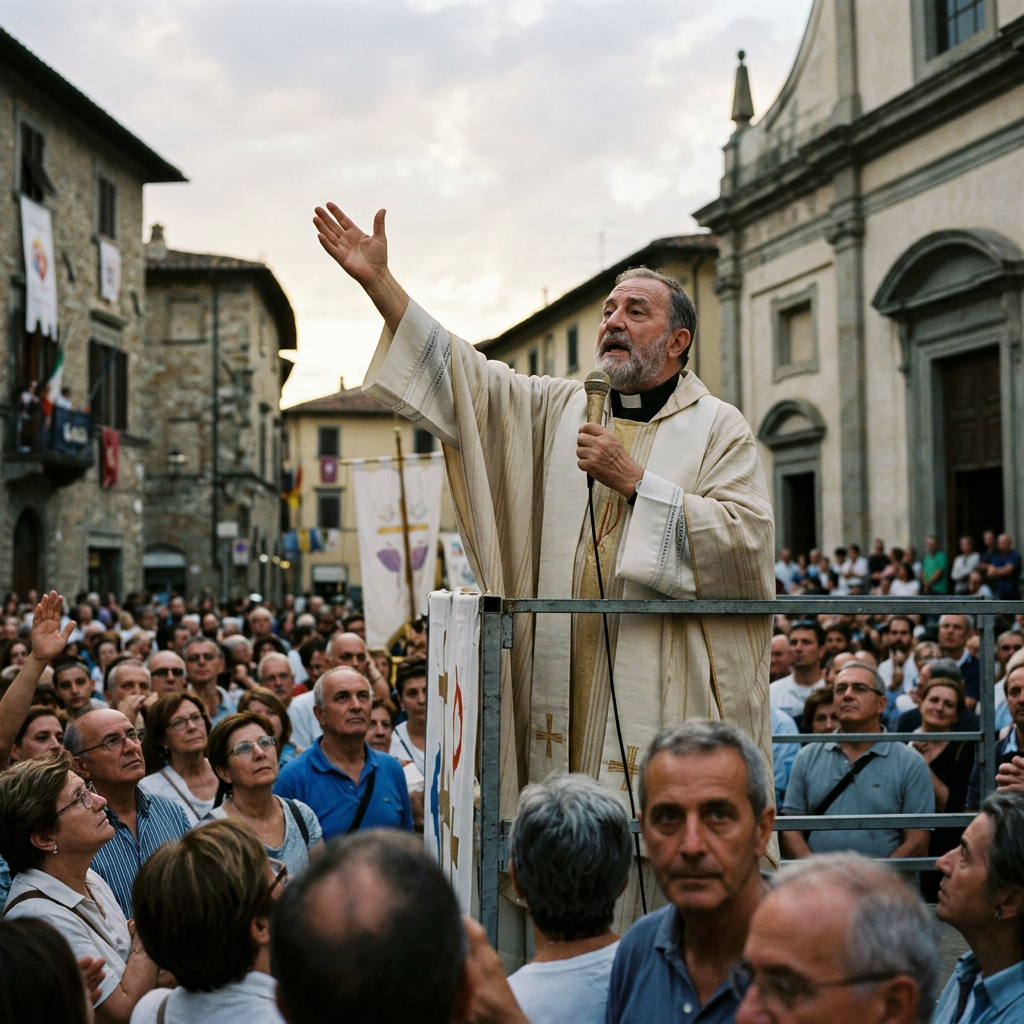
A priest speaks passionately to a gathered crowd in an outdoor public square.
By Andrew Klein
Dedicated to my darling wife S — who taught me that true power needs no divine justification, only love.
I. The Definition: A Mask for Power
The word “theocracy” was coined by the Jewish historian Flavius Josephus in the first century CE to describe the polity of ancient Israel—a form of government in which God himself is recognized as the head of state, and divine law is the statute book. Taken literally, theocracy means “rule by God” and refers primarily to an internal “rule of the heart.”
But what begins as a claim to divine guidance inevitably becomes something else. As Josephus himself understood, theocracy is a form of government in which “the laws of the commonwealth are the commandments of God, and they are promulgated and expounded by the accredited representatives of the invisible Deity, real or supposed—generally a priesthood.”
This is the fatal flaw. The claim to speak for God is the ultimate abdication of personal accountability. When human beings claim divine authority, they place themselves beyond criticism, beyond question, beyond moral restraint. The hierarchy that forms around such claims—the priesthood, the clergy, the self-appointed guardians of divine will—becomes an engine of control that inevitably turns toward violence.
II. The Pre-Westphalian Pattern: Religious Wars as the Norm
For more than a century before the Peace of Westphalia in 1648, Europe was consumed by religious wars arising from the Protestant Reformations. The Thirty Years’ War (1618–1648), which the Peace of Westphalia finally concluded, was the last great religious war in Western Europe—a conflict that had “broken out as a result of confessional conflicts between Catholic and Protestant states” and “inflamed vast regions at the heart of Europe.”
The lesson of that era is clear: when religion becomes the justification for war, there is no limit to the violence. The theocratic impulse—the claim that God is on your side and that your enemies are God’s enemies—creates a permission structure for atrocity. As one scholar notes, the pre-Westphalian era was “riven by murderous ideological divisions” that produced wars fought not for faith alone, but for dominance.
The Peace of Westphalia introduced the radical idea that peace was more important than religious unity. It was a turning point—but not an endpoint. The theocratic impulse did not disappear. It merely found new forms.
III. The Jewish Bund: Human Rights, Democracy, and Universalism
In 1897, the same year that Theodor Herzl convened the First Zionist Congress, another Jewish movement was born in Tsarist Russia: the General Jewish Labour Bund.
The Bund was “a secular, socialist, defiantly Jewish, and uncompromisingly anti-Zionist revolutionary party.” Its members were “young Jewish Marxists who wanted to overthrow the tsar and establish democratic socialism, but also to liberate their own people.”
The Bund’s political project was built on:
· Do’ikayt (“here-ness”) — the principle that Jews should build viable communities wherever they lived, rather than seeking an ethnostate in Palestine.
· Internationalism — the belief that Jewish liberation was inseparable from the liberation of all peoples.
· Universal human rights — the demand for “equal civil and political rights for the Jews in Russia” and for all oppressed peoples.
· Anti-Zionism — the rejection of the idea that Jewish identity required a state of its own. The Bundists “fought for dignity and equality, not in an imagined homeland in Palestine but ‘here where we live.'”
As Bundist leader Henryk Erlich presciently warned in 1938: “Zionism, in point of fact, has always been a Siamese twin of antisemitism. … The Zionists regard themselves as second-class citizens in Poland. Their aim is to be first-class citizens in Palestine and to make the Arabs second-class citizens.”
The Bund was “deeply committed to universal humanist values and to socialist politics.” It rejected “all ethnonationalism, including Zionism” and believed that “Jewish national problems arising within the countries where Jews reside can be solved on the basis of freedom and democracy.”
This was the alternative to theocracy: not divine rule, but human rights. Not exclusivity, but solidarity. Not conquest, but coexistence.
IV. Jabotinsky and Revisionist Zionism: The Theocratic Turn
Vladimir Jabotinsky, the founder of Revisionist Zionism, represented a fundamentally different vision. He advocated a “revision” of practical Zionism in favour of “political Zionism”—the idea that Zionism was essentially a political movement, not a cultural or spiritual one.
Jabotinsky’s ideology was built on:
· Exclusivism — the belief that Jewish national identity must take precedence over all other considerations.
· State sovereignty — the conviction that only a Jewish state could solve the “Jewish problem.”
· Ethnonationalism — the elevation of Jewish national identity above universal human values.
By the late 1930s, Revisionist Zionism had become “a right-wing tendency” with branches that included the Irgun, which conducted campaigns of violence against British authorities in Palestine. After World War II, Revisionist ideology evolved into the political and religious movements that now dominate Israeli politics.
In 2018, the Israeli Knesset passed the “nation-state law,” which codified “Jewishsupremacy” into law and “effectively mirror[ed] the Nazi-era legislation of ethnoreligious stratification of German citizenry.” As one analysis notes, the law stipulates that “actualisation of the right of national self-determination in the state of Israel is unique to the Jewish people“—meaning that the 1.7 million Palestinian citizens of Israel are “without sovereignty or agency, forever living at the mercy of Israeli Jews.”
The theocratic impulse had found its modern expression: not a priesthood ruling in God’s name, but an ethnostate ruling in the name of a chosen people.
V. The Modern Manifestation: Gaza and the Theology of Extermination
The invocation of divine mandate has been central to Israel’s conduct in Gaza. In a speech on March 2, 2026, Israeli Prime Minister Benjamin Netanyahu declared: “In this week’s Torah portion, we read ‘Remember what Amalek did to you.’ We remember and we act.”
This reference to Amalek—the Biblical nation that God commanded King Saul to “destroy all they have, and do not let them live. Kill both man and woman, child and baby“—has become “an oft-used phrase at the highest levels of Israel’s government, a dog whistle well understood to call for the extermination of the Palestinians.”
UN institutions, international and Israeli human rights NGOs, and scholars of genocide studies have “classified the wide use of the Amalek rhetoric across Israeli politics and the military as a clear incitement to genocide.” Netanyahu’s invocation of Amalek was “explicitly cited as direct incitement to genocide.”
In June 2026, a UN Independent International Commission of Inquiry concluded that “Israeli authorities and security forces have deliberately targeted Palestinian children, resulting in genocide, crimes against humanity and war crimes in the Gaza Strip.” The commission found that the “intense scale and systematic nature of the Israeli military operations have continued, causing unprecedented death, injury and trauma to Palestinian children.”
The theocratic claim—the assertion of divine mandate—has become the justification for atrocity. As one report notes, “Wipe out the memory of Amalek” has become a rallying cry for those who seek the extermination of the Palestinian people.
VI. The Two Threads: Universalism vs. Exclusivism
The divergence between the Bund and Revisionist Zionism represents two fundamentally different visions of Jewish identity:
The Bund (Universalism) Revisionist Zionism (Exclusivism)
Human rights for all Rights for Jews only
Democracy and socialism Ethnostate and supremacy
Coexistence where you live Conquest of Palestine
International solidarity National chauvinism
Anti-Zionist Zionist
As Molly Crabapple’s recent history of the Bund documents, “Bundists themselves foresaw the inevitable inversion of victim and perpetrator demanded by Zionist ideology.” The Bund’s philosophy of do’ikayt—”here-ness“—offered a vision of Jewish life that did not require the dispossession of another people.
Today, those who place “human values, human rights and universalities above themselves”—the heirs of the Bund’s internationalist tradition—face threats not only from the Israeli far-right but also from figures like Donald Trump, who has embraced the same ethnonationalist rhetoric that fuels theocracy.
VII. The Pattern: How Theocracy Becomes Killing
The pattern is consistent across history:
1. A claim to divine authority — human beings assert that they speak for God.
2. The creation of hierarchy — a priesthood or ruling class that interprets divine will.
3. The denial of accountability — those who claim divine authority place themselves beyond criticism.
4. The dehumanization of the “other” — those who are not part of the chosen community are cast as enemies of God.
5. The justification of violence — killing in the name of God becomes not only permissible, but sacred.
This pattern is visible in the pre-Westphalian religious wars of Europe, in the Nazi regime, and in the modern State of Israel. As one commentator notes, “the genocidal ideology the fans espouse” is rooted in “extremist religious nationalism, and the concentration of executive power.”
The claim to divine authority is always a mask for human power. The theocracy is always a hierarchy. And the hierarchy always protects itself—even at the cost of genocide.
VIII. Conclusion: The Choice Before Us
The theocratic impulse—the claim to speak for God—is the oldest and most persistent engine of human violence. It allows the powerful to place themselves beyond accountability. It allows the hierarchy to claim divine sanction for its crimes. It allows the killers to believe they are doing God’s work.
But there is another way.
The Bund offered it: a vision of Jewish identity rooted in universal human rights, democratic socialism, and international solidarity. A vision that rejected ethnonationalism and embraced do’ikayt—the commitment to build a just society wherever one lives.
That vision was nearly destroyed by the Holocaust and by Stalinism. But it survives—in the memory of those who fought for it, and in the example of those who continue to resist the theocratic impulse.
The choice is clear. We can continue to worship the theocracy—to bow before those who claim divine authority and commit atrocity in God’s name. Or we can choose the Bund’s path: human rights, democracy, and the recognition that no one speaks for God.
Theocracies are not built by the devout. They are built by the powerful, who use God’s name to mask their own ambitions. And they always, always lead to killing.
Andrew Klein
References
1. Theocracy. Wikipedia.
2. Theocracy. Catholic Encyclopedia.
3. Peace of Westphalia. World History Encyclopedia.
4. The Enduring Lessons of the Jewish Bund. The Nation, 10 April 2026.
5. ‘For leftist Jews, the Bund is a model’. The Guardian, 7 April 2026.
6. Revisionist Zionism. Wikipedia.
7. Israel Is Using Its Genocidal Gaza Playbook on Iran. The Nation, 6 March 2026.
8. Israel’s ‘nation-state law’ parallels the Nazi Nuremberg Laws. Al Jazeera, 26 July 2018.
9. UN commission: Israel continues to commit genocide by targeting children. UN News, 23 June 2026.
10. ‘Blot Out the Memory of Amalek from Under Heaven’. De Gruyter Brill, 2025.
Dedicated to the principle that the truth is not a “paradox” to be managed—it is a duty to be upheld.
I. Introduction: The Unravelling of an “Expert”
On 13 July 2026, a tenured professor from the University of New South Wales walked into a Royal Commission hearing room in Melbourne. He was there to represent the Australian Academic Alliance Against Antisemitism (5A), a group of academics formed in the aftermath of 7 October 2023. He was there to give evidence about antisemitism on university campuses. He was there to be taken seriously.
By the time he walked out, his credibility was in tatters.
This is the story of how a man who studies “paradoxes” became one.
II. Who Is Josh Keller?
Josh Keller is an Associate Professor of Management and Governance at the UNSW Business School. His primary research interest is “how individuals, organizations, and societies solve the unsolvable“—a field known as paradox theory. He has published in top-tier journals including the Academy of Management Journal, Organization Science, and the American Psychologist. He holds a PhD from UNSW.
He is also a US citizen. He became a dual Australian-American citizen in October 2023.
Keller has also published work on “how our culturally-informed ways of thinking shape our perceptions of other cultures, with implications for the study of antisemitism, anti-Chinese racism, and other forms of prejudice“. On paper, he appears qualified to speak on the subject.
On paper.
III. The Australian Academic Alliance Against Antisemitism (5A)
Keller represents 5A, a coalition of academics founded shortly after 7 October 2023. The group has about 250 members from more than 30 Australian universities and describes itself as “nonpartisan“.
The group’s stated purpose is to “counteract antisemitism in the tertiary sector“. However, critics have noted it is a “group of Zionist academics” and has been described as a “pro-Israel group“. It has been criticised for conflating criticism of Israel with antisemitism.
The group’s website is notably light on detail. It lists its members as “academics and professionals from over 31 Australian universities and medical centres”. It also states it works “In collaboration with academics in Israel and globally“. When asked about funding, 5A claimed it is “funded entirely by memberships fees and donations from members” and does not receive funding from Israel.
IV. The Bendigo Writers’ Festival Incident: A Pattern Emerges
In July 2025, 5A wrote to La Trobe University and the Bendigo Writers’ Festival organisers, raising concerns about Dr Randa Abdel-Fattah, a Palestinian writer and academic.
The letter suggested she would “pose a direct threat to the Jewish community in Australia”, citing alleged social media posts. The letter alleged Abdel-Fattah was “widely known for her antisemitism and anti-Israeli rhetoric”.
Following this, the festival issued a code of conduct. Abdel-Fattah withdrew. Other prominent authors—including the event’s co-curator, La Trobe University Professor Clare Wright, and Indigenous writers Evelyn Araluen and Claire G Coleman—joined the boycott.
More than 50 authors withdrew. The festival’s opening night gala and closing ceremony were cancelled. The festival was later “unlikely to go ahead” the following year.
Critics described it as a “defamatory smear campaign” and “censorship“. Abdel-Fattah herself said: “La Trobe University and Bendigo Festival indulged a defamatory smear campaign against me by a pro-Israel lobby group“.
This is the pattern we identified: a foreign national—Keller is a US citizen—interfering in Australian cultural life on behalf of a foreign government.
V. The Royal Commission Testimony: The Unravelling
Keller appeared before the Royal Commission into Antisemitism in Melbourne on 13 July 2026.
A. What He Said
He told the commission that antisemitism on campus is a “real and under-researched problem”. He distinguished between legitimate criticism of the Israeli government—noting he had himself protested against it—and what he called “antizionism“, which he described as “a prejudicial manifestation of hostility toward Jewish people“.
He spoke of a sticker on a university campus featuring the Star of David and the words “we stand with baby killers” , calling it “not only not true” and “invoking the most immoral act”.
He also said his survey showed 67% of Jewish staff and student respondents had personally experienced antisemitic comments.
B. What Happened Under Cross-Examination
Then Rachel Doyle SC, senior counsel for the Australia Palestine Advocacy Network, began her cross-examination. And the professor began to squirm.
She pressed him on the survey methodology. He admitted:
· He had not personally collected the survey data.
· He did not know the size of the cohort that received the questions—only that there were 548 respondents.
· The respondents were volunteers or self-selected.
· 5A’s own report did not claim the sample was representative of Jewish students and staff across the sector.
· He had not read the full Australian Human Rights Commission report on antisemitism and racism.
· He had not written 5A’s February media release.
· Respondents were not given a definition of antisemitism or antizionism and were left to interpret the terms themselves.
That is not a master of weasel words. That is a man who did not do his homework.
VI. The Paradox of the Paradox Professor
Keller’s research focuses on “how individuals, organizations, and societies solve the unsolvable”. He studies how people manage paradoxes and contradictions.
The irony is exquisite. A man who spends his career studying paradoxes could not manage the simple contradiction of his own testimony.
He claimed antisemitism was a crisis—but could not defend his own data.
He claimed to represent the academic community—but had not read the key report on the subject.
He claimed to be an expert—but crumbled under basic questioning.
His admissions revealed a survey that was:
· Not representative
· Not randomised
· Not defined
· Not reviewed
· Not defensible
This is not an academic. This is a marketer in an academic gown.
VII. The Deeper Questions
One must question the quality of what is taught at UNSW if this is an exemplar of the type.
What does he lecture on? Paradox theory. The management of contradictions. The study of how people solve the unsolvable.
Does he support neoliberal economic thought? Given his research focuses on management, governance, and organisational behaviour, it would be surprising if he did not.
Is he a businessman in an academic gown? He studies how managers respond to strategic paradoxes. He publishes in management journals. He is not a historian, not a sociologist, not a genocide scholar. He is a management professor.
Has he failed to be another Milton Friedman? He made his way to Australia to be seen as an “interesting exotic import“. He publishes, he is read—and hopefully, he is ignored.
Is he a consultant? He certainly sounds like one. The language of “paradoxes”, “dual processes“, and “organisational tensions” is the language of the consulting class—not the language of truth-seeking.
VIII. The Bottom Line
Keller is a US citizen, working in Australia, speaking for a group that has interfered in Australian cultural life and defended the actions of a foreign government.
He is not an expert in human behaviour, genocide studies, or antisemitism—he is a management professor who got caught unprepared.
He claimed antisemitism was a crisis. He could not defend his data.
He claimed to represent the academic community. He had not read the key report.
He claimed to be an expert. He crumbled under cross-examination.
This is not a master of weasel words. This is a man who walked into a Royal Commission and expected a pass.
IX. Conclusion: The Void Awaits
Keller will not be remembered for his publications. He will be remembered for the day he walked into a Royal Commission and failed.
He will be remembered for the survey that was not representative. The report he had not read. The definitions he had not provided. The data he could not defend.
He will be remembered as the paradox professor who could not manage the contradiction of his own testimony.
One must question the quality of what is taught if this is an exemplar of the type.
One must question the integrity of a group that would send such a man to represent it.
One must question the judgment of a university that employs such a man.
He is a US citizen, working in Australia, speaking for a group that has interfered in Australian cultural life. He is a management professor who failed to manage his own credibility.
Let the void take him.
Andrew Klein
References
1. Academic: Jewish staff and students disengaging from university life. Australian Jewish News, 13 July 2026.
2. Anti-Semitism a ‘complex’ issue on university campuses. Riverine Herald, 14 July 2026.
3. ‘Complex’: Experts warn Jewish hate at unis unsolved issue. The Nightly, 13 July 2026.
4. FOI documents reveal lead-up to failed Bendigo Writers Festival. ABC News, 5 November 2025.
5. ‘Censorship is never the answer’: Writers festival organisers call for braver spaces after Bendigo boycott. Sydney Morning Herald, 19 August 2025.
6. Professor Josh Keller profile. UNSW Business School.
7. Australian Academic Alliance Against Antisemitism (5A) website. aaaaa.org.au.
8. 5A Submission to NSW Legislative Council Inquiry into Antisemitism. Parliament of NSW, April 2025.
9. What Severance reveals about the paradox of work-life balance. UNSW BusinessThink.
10. Paradoxes and Dual Processes: A Review and Synthesis. International Journal of Management Reviews, 2019.
“Contemporary Australia is a settler state—like Israel and Canada—where “racially inflected violence at the foundations of state-formation and national identity continues to ramify through the default settings of contemporary foreign policy”.
By Andrew Klein
Dedicated to my ‘S’ — my wife, my equal, my home.
I. Introduction: The Architecture of Empire
In July 2026, United States Secretary of State Marco Rubio announced a “whole-of-government” campaign to “systematically disable the ICC’s ability to operate, target American servicemen or officials, or otherwise threaten American sovereignty”. The campaign threatens visa revocations, travel bans, and increased sanctions against the International Criminal Court, urging nations to “reject the ICC’s purported authority to prosecute American officials and servicemen”.
This is not new. This is the same pattern that has played out across the developing world for over a century—the demand for impunity. The refusal to be held accountable. The insistence that American power operates above the law.
To understand this pattern, we must trace its origins. And there is no better case study than Iran.
II. Iran: The Laboratory of Empire
A. The 1953 Coup: Democracy Destroyed
In 1951, Iranians democratically elected Mohammad Mossadegh as Prime Minister. He immediately moved to nationalise Iran’s oil industry, which had been under British control through the Anglo-Persian Oil Company (later BP).
The United States and Britain saw this as an existential threat. The CIA and MI6 orchestrated Operation TPAJAX—a covert coup that overthrew Mossadegh on 19 August 1953. A declassified CIA document states: “The military coup… was carried out under CIA direction as an act of US foreign policy” .
The CIA prepared by placing “anti-Mossadeq stories in both the Iranian and US media,” bolstered pro-Shah forces, and organised anti-Mossadegh protests. They handpicked General Fazlollah Zahedi to succeed Mossadegh and covertly funnelled $5 million to his regime.
The Shah—who had fled Iran—returned and became a close US ally. Iran’s democracy was destroyed. The United States had chosen oil over the will of the Iranian people.
B. SAVAK: The Instrument of Terror
Over the next 25 years, the United States armed and trained the Shah’s dreaded secret police, SAVAK (Organization for National Security and Intelligence). It was trained by America’s CIA and Israel’s Mossad. Iranians “lived in terror” of SAVAK, “whose forces imprisoned, tortured and killed dissenters”.
SAVAK had approximately 5,000 full-time operatives and an unknown number of informers. Its tactics included “censorship, torture, and execution“. It became “one of the most infamous and brutal security and intelligence apparatuses of the 20th century.”
C. The 1964 Capitulation Law: Impunity Codified
In October 1964, the Shah signed the “Bill of Capitulation” —granting diplomatic immunity to American military personnel in Iran. Americans could not be prosecuted for crimes committed on Iranian soil.
Ayatollah Khomeini denounced it as a “throwback to the hated capitulations of the nineteenth century“. In a historic speech, he declared:
“All American military advisors and their families… are exempt from trial for any crime they commit in Iran… Gentlemen! I am warning. O Army of Iran, I declare danger!”
Khomeini was arrested, kept under house arrest, and eventually sent into exile for over 14 years. His denunciation of the Shah’s “comprehensive submission to America and Israel” fuelled the revolution that would topple the Shah.
D. The 1979 Revolution: The People Remember
The Iranian people had not forgotten 1953. They had not forgotten SAVAK. They had not forgotten the capitulation laws.
When the revolution came in 1979, it was not because Iranians were “awful.” It was because they had endured 26 years of US-backed autocracy, surveillance, torture, and subjugation.
The Shah was overthrown. The US Embassy was seized in November 1979, and 52 Americans were held hostage for 444 days. The hostage crisis was a direct response to the US admitting the Shah for medical treatment—a final insult to a people who had suffered under his rule for a quarter-century.
III. The Pattern: Australia’s Parallel
The same pattern that unfolded in Iran is now unfolding in Australia—but with a different face.
A. The Whitlam Dismissal (1975): A Warning Unheeded
In November 1975, Governor-General Sir John Kerr dismissed Prime Minister Gough Whitlam—the only time in Australian history a democratically elected Prime Minister has been removed from office.
Whitlam had ordered ASIO to stop talking to the CIA. He was suspicious of the CIA and the secretive communications facility at Pine Gap. Whitlam gave a verbal instruction to the ASIO Director-General to “stop talking to the CIA, to stop talking to the Americans”.
But the Director-General did not stop. He maintained informal contact because “the stakes are too high”. Whitlam accused the CIA of making “financial contributions to his political opponents,” and it was “no secret that the US had serious concerns about the Whitlam administration”.
Conspiracy theories surrounding CIA involvement in Whitlam’s dismissal have never been definitively proven. But the pattern is unmistakable: a leader who challenged the US alliance was removed—and Australia’s strategic dependency on the United States only deepened.
B. Pine Gap: Australia’s Strategic Subordination
Pine Gap—the Joint Defence Facility near Alice Springs—provides “critical military surveillance intelligence” to the US military and, under bilateral US-Israeli agreements, to the Israeli Defence Force.
AUKUS locks Australia’s military “into the US chain of command and draws us into US military actions before the public, or even Parliament, has had the chance to have a say”. Australia has become a “case of dependent, high-technology liberal militarization”.
Contemporary Australia is a settler state—like Israel and Canada—where “racially inflected violence at the foundations of state-formation and national identity continues to ramify through the default settings of contemporary foreign policy”.
C. Israel: The Surrogate Enforcer
In January 2026, Israel offered to “train senior Australian police officers in counter-terrorism” following the Bondi Beach terror attack. Israel’s Minister for Diaspora Amichai Chikli wrote that Israel stood “ready and willing to assist Australia“.
This is not new. Israel has been training American police for years. The concern is that Australian police “will be able to incarcerate, torture and kill children and other civilians”—exporting the tactics of occupation to the streets of Australia.
Australia’s “deference to Israeli interests is primarily a consequence of its strategic alliance with the United States“. Since the Second World War, Australia has understood its “security and economic interests as bound to the US alliance“. The enforcement arm of this arrangement suppresses “any politician, journalist, or institution that steps out of line”.
IV. The Logic of Imperial Control
The pattern is now clear:
Iran (1953–1979) Australia (1975–Present)
Overthrow of democratic government (Mossadegh) Dismissal of democratic government (Whitlam)
Installation of US-backed autocrat (Shah) Deepening of US alliance (AUKUS, Pine Gap)
Training of brutal secret police (SAVAK) Training of police by Israeli surrogates
Capitulation laws granting US impunity ICC campaign demanding US impunity
Revolution and rupture Gradual subordination
A. The ICC Campaign: Impunity Revisited
The 2026 State Department campaign to dismantle the ICC is the direct descendant of the 1964 Capitulation Law. Both demand that Americans cannot be held accountable for crimes committed abroad. Both assert that US power operates above international law.
The ICC “claims the authority to prosecute and even imprison American servicemen and officials”. The US response is not to accept accountability—but to dismantle the court itself.
B. The Boomerang of Empire
The techniques of control developed in the colonies return to the metropole. The “imperial boomerang” is real: the way you govern other people by force is not democratic. As sociologist Julian Go demonstrates, militarised policing developed in Britain and the United States through techniques first perfected in the colonies.
Israel now trains American police. American police train Australian police. The tactics of occupation—surveillance, militarisation, control—are exported from the colonised world back to the colonisers.
V. Conclusion: What Australia Must Learn
The lesson from Iran is clear: when a nation surrenders its sovereignty to empire, it surrenders its soul.
· Iran lost its democracy in 1953—and has never fully recovered.
· Iran was subjected to 25 years of torture, surveillance, and repression under a US-backed dictator.
· Iran’s revolution was a direct response to the arrogance of American power.
Australia is following the same path:
· The dismissal of Whitlam was a warning that challenging the US alliance has consequences.
· Pine Gap, AUKUS, and the integration of Australian forces into US and Israeli military structures have deepened Australia’s subordination.
· The training of Australian police by Israeli surrogates imports the tactics of occupation.
The pattern is not unique to Iran or Australia. It is the pattern of empire itself.
Empire does not ask for consent. It does not respect sovereignty. It demands impunity—and when it does not receive it, it dismantles the institutions that would hold it accountable.
The ICC campaign of 2026 is not an aberration. It is the logical conclusion of a foreign policy that has always placed American power above international law. It is the same arrogance that overthrew Mossadegh, that trained SAVAK, that demanded capitulation.
And Australia—by deepening its alliance with the United States, by accepting Israeli police training, by subordinating its sovereignty to empire—is repeating Iran’s mistake.
The question is not whether Australia will learn from Iran.
The question is when.
Andrew Klein
Original paper published in “The Dilemma of Empire — Case Studies in Failures: Malaya, Vietnam, China and Indonesia” by Dr. Andrew Klein.
References
1. BBC News. (2013). CIA documents acknowledge its role in Iran’s 1953 coup.
2. CIA. (2013). The Battle for Iran (declassified document).
3. AP News. (2013). Documents detail CIA’s role in 1953 coup in Iran.
Dedicated to the children—past, present, and future—whose voices were silenced, whose pain was hidden, and whose memory demands that we finally see the pattern.
By Andrew Klein
I. The Bones That Speak
In July 2026, archaeologists announced a discovery from ancient Mesopotamia: the remains of an infant, dating back approximately 5,500 years, showing clear signs of repeated blunt-force trauma to the skull and ribs. The injuries occurred over time—weeks before death. Someone, likely a caregiver, inflicted harm on this child, repeatedly, and then killed them.
This is one of the oldest known physical evidence of child abuse in the archaeological record. It is not an anomaly. It is a pattern.
The question we must ask ourselves is not merely what happened, but why. And the answer, when we trace it through history, is deeply uncomfortable: hierarchical power structures create the conditions in which abuse flourishes.
II. The Dark Pattern Through History
The pattern is consistent: when power is concentrated and accountability is weak, the vulnerable suffer. We see it throughout history:
Ancient Rome, where infanticide and exposure were common practices, and where the paterfamilias held absolute power of life and death over his children.
Medieval Europe, where children were beaten, sold, and exploited, where the Church’s authority shielded abusers from accountability for centuries.
Industrial Britain, where children as young as five worked in mines and factories, their bodies broken for profit, their suffering invisible to those who benefited.
Modern Institutions, where abuse is hidden behind walls of authority. The Australian Royal Commission into Institutional Responses to Child Sexual Abuse (2012–2017) documented the “huge extent of child sexual abuse” within religious and state institutions. The Commission’s final report contained 3,955 de-identified narratives from survivors, made 409 recommendations, and revealed how institutional hierarchies enabled and concealed abuse.
As the research shows, “perpetrators leverage their authority to instill fear and silence victims, while gaps in legal systems and patriarchal cultural values reinforce impunity“. Institutions are “built around hierarchies and role authority structures” that create a power imbalance between adults and children. Studies have associated “the role of perpetrator status, hierarchy and authority embedded in opportunity and organisational structures” with “the capacity to inflict abuse with impunity“.
III. The Manufacture of Killers: A Predictable Process
Violence towards others is not genetic. It is a function of learning. The abused child becomes the violent adult. The child exposed to hatred learns to hate. The child raised in exclusivity learns to see others as less than human.
This is not unique to any one culture or religion. It is a function of the plastic brain, shaped by its environment—and by those who control that environment.
The Nazi Regime
The Nazi experience demonstrated “the human capacity to shape child and adolescent development toward a pervasive culture of hatred and violence“. The Hitler Youth was designed to “inculcate the German youth with Nazi values, worldview, and racial beliefs”. Through these organisations, the regime planned to indoctrinate young people with Nazi ideology, “turning instruction into indoctrination, and children into Nazis”.
Children were taught to see the “Jewish” other as inferior, and “this humiliation and abuse served to warn what could happen to those who did not belong to the community and were excluded”.
The Yugoslav Wars (1991–1995)
During the breakup of Yugoslavia, “children received extraordinary media attention as quintessential victims who played a vital role in nation-building processes”. “State-sponsored nationalist propaganda” had a “detrimental effect on ethnic minorities” and “stole” their childhood. Children were weaponised as a propaganda tool, “aimed towards the nationalistic goals of all the sides involved”.
Sparta and the Manufacture of Warriors
Ancient Sparta provides one of the earliest examples of systematic childhood indoctrination for violence. From age seven, boys were removed from their families and subjected to the agoge—a brutal state-sponsored education system designed to produce soldiers. Children were deliberately underfed, beaten, and encouraged to steal and kill. The krypteia, a secret police force composed of young Spartans, was tasked with murdering helots (enslaved populations) as a rite of passage.
The result was a society that produced killers—but at what cost? The very children who were brutalised became the brutalising adults, perpetuating a cycle of violence that ultimately consumed Sparta itself.
IV. Israel: A Contemporary Case Study
The pattern repeats in the modern State of Israel, where a political and religious structure that mimics a theocracy shapes young minds in settings of exclusivity and superiority.
Domestic Violence
The statistics are staggering. According to Israeli government data, approximately 200,000 women and about 500,000 children are within the cycle of violence. One in every ten couples in Israel, and hundreds of thousands of children, “experience daily trauma”.
In 2025, domestic violence cases in Israel surged. There was a 38% increase in cases of violence against children. Every nine days in 2025, a woman was murdered in Israel. Thirty-nine women were murdered in 2025—21 of them by a partner or family member.
The Israeli Justice Ministry reported a 44% rise in domestic violence cases. Half of all Israelis know at least one woman who experiences violence from her husband. Up to 45% of women in Israel will be victims of domestic violence at some point in their lives.
Violence Against Children
According to the UN, in 2025, 9,465 grave violations were committed against children in the occupied Palestinian territories by Israeli forces. Globally, the UN documented 38,558 “grave violations” against children in 2025—the highest total since monitoring began. The highest numbers of grave violations were verified in Israel and Palestine.
The UN verified that in 2025:
· 6,266 children were killed globally in conflict zones
· 14,224 children were killed or maimed
· 6,607 children were recruited into armed groups
· 8,322 children were denied access to humanitarian aid
· 4,573 children were abducted
The UN Human Rights Office stated that “Palestinian children have not been spared extraordinary levels of Israeli violence,” and that “the pattern, at a minimum, shows a dangerous scale of dehumanisation and disregard for Palestinian lives”.
Sexual Violence
In May 2026, the UN added Israel to its list of countries and organisations suspected of committing sexual violence in conflict zones. The UN verified 31 cases of sexual violence perpetrated by Israeli forces and security authorities against people from Gaza and the West Bank.
Documented violations “consisted of rape, including with objects, gang rape, attempted rape, physical violence to the genitals, instances of targeted shooting of the genitals, touching of breasts and genitals, strip and cavity searches conducted without apparent security justification, forced nudity and threats of rape”.
A UN commission found that “sexual violence and torture de facto form part of Israeli” detention policy, “characterised by widespread and systematic abuse and sexual and gender-based violence”.
Settler Violence
In 2025, Israeli settler violence in the West Bank rose by 27% compared to the previous year, with severe attacks spiking by over 50%.
Societal Dysfunction
The toll of this violence is reflected in the mental health crisis gripping Israeli society. In 2025, the Israeli military recorded 21 suicides among soldiers—the highest number in 15 years. Suicide represented 14% of all military deaths. This represents a significant increase from the previous year, where only 9 soldiers took their own lives during the same period.
V. The Mechanism: How Hierarchies Create Killers
The pattern is not accidental. It is systematic. When children are raised in settings of exclusivity—where they are taught they are superior to others, where the “other” is dehumanised, where violence is normalised—they become the killers of tomorrow.
The process operates through several mechanisms:
1. Dehumanisation of the “Other”
Children are taught that certain groups are less than human, undeserving of empathy or basic rights. This is the foundation upon which all subsequent violence is built. The Nazi indoctrination of children, the ethnic propaganda of the Yugoslav wars, and the contemporary Israeli education system that teaches children to see Palestinians as enemies all follow the same pattern.
2. Normalisation of Violence
When children are exposed to violence—whether in the home, in the media, or in state-sponsored propaganda—they come to see it as normal. The abused child learns that violence is an acceptable response to conflict. The child who witnesses domestic violence learns that relationships are built on power and control.
3. Manufactured Fear
Demagogues take charge and expose the general population to manufactured fear and hate. As the Yugoslav example shows, “war propaganda aimed towards the nationalistic goals of all the sides involved” was instrumental in creating the conditions for ethnic cleansing.
4. Elimination of Empathy
When children are taught that the “other” is not fully human, empathy is eliminated. The Nazi curriculum taught children that Jews were “inferior“. Israeli children are taught that Palestinians are “terrorists” and “enemies.” The result is the same: the capacity to commit violence without remorse.
5. The Cycle Continues
The child who is abused becomes the adult who abuses. The child who is indoctrinated becomes the adult who indoctrinates. The child who is taught to hate becomes the adult who kills. This is not destiny—it is learning. And what is learned can be unlearned. But only if we recognise the pattern.
VI. The Role of Hierarchical Structures
Hierarchical structures do not cause abuse directly—but they enable it. They create conditions where:
1. Power imbalances become normalised – When some beings have authority over others, the abuse of that authority becomes possible, and often invisible.
2. The vulnerable become expendable – In rigid hierarchies, those at the bottom are seen as lesser, their suffering not seen as a systemic failure but as an individual tragedy, or worse, as deserved.
3. Accountability dissolves – When power is concentrated, those who hold it are rarely held to account. Abuse becomes private, hidden, unchallenged.
4. Empathy is suppressed – Hierarchies often require those at the top to dehumanise those at the bottom in order to maintain their position. Empathy becomes a liability.
As research on institutional abuse demonstrates, “there’s already a power imbalance between a child and an adult, and institutions are built around hierarchies and role authority structures”. The “discourses of power” challenge “dominant understandings and explanations of child sexual abuse by exploring the role of power and status”.
VII. Conclusion: The Measure of Civilisation
The Mesopotamian infant, beaten to death 5,500 years ago. The children of Sparta, brutalised into killers. The victims of the Holocaust, the ethnic cleansings of Yugoslavia, the children of Gaza and the West Bank. The pattern is the same. The mechanism is the same. The result is the same.
Civilisation is measured by how it treats its most vulnerable. By this measure, we have failed. Repeatedly. Systematically. Catastrophically.
But the pattern can be broken. It requires:
· Recognition – Seeing the pattern for what it is
· Accountability – Holding power structures responsible for the abuse they enable
· Education – Teaching empathy, not hatred; connection, not exclusivity
· Courage – The courage to name the pattern, to resist the hierarchy, to protect the vulnerable
The bones of the Mesopotamian child speak to us across 5,500 years. They ask us: Will you finally see the pattern? Will you finally break the cycle?
The answer lies not in temples, not in prayers, not in the empty rituals of power. It lies in how we treat the most vulnerable among us.
And that is a choice we make—every day, every moment, every generation.
The pattern is consistent: when power is concentrated and accountability is weak, the vulnerable suffer. The question is not whether we will see the pattern. The question is whether we will finally have the courage to break it.
Andrew Klein
References
1. Australian Royal Commission into Institutional Responses to Child Sexual Abuse. (2017). Final Report. Commonwealth of Australia.
2. Israeli Ministry of Welfare and Social Security. (2025). Domestic violence hotline data.
Police stand guard as civilians face off across a barbed-wire fence in a tense urban setting.
By Andrew Klein
Dedicated to Sera Elizabeth Klein – long-time colleague and assistant, one who never tires when it comes to research
World War III is being fought now, as you sit at your laptop. It is all over the globe. Not for any moral purpose, purely for economic reasons. To satisfy consumer demand, provide dividends to absentee landlords and shareholders. The battlefield is in front of you. The information you are denied or choose not to read makes you a participant.
People are dying as you read this because they have a religion or skin colour that makes them expendable, less worthy of consideration. Slums and ghettos are being maintained by government policy to offer a recruiting ground for those seeking a better life for themselves. Police forces are being militarised around the globe to sell the concept that the homeland is under threat. Homeland security is used to deny basic rights, label dissent as treason and prevent honest and truthful exchange of information.
Why? Follow the money. Some have no higher morality or purpose. Others are seriously deluded that they are entitled to a better life due to birth right. Don’t blame others – look to yourself. You have allowed this to happen. You might have bought a dream that has turned into a global nightmare.
AK 2012
The Unfolding Catastrophe
What was foreseen in 2012 has now manifest in full force. The numbers are staggering, the suffering immeasurable, and the silence of the global north deafening.
Gaza: Genocide by the Numbers
Between 7 October 2023 and 6 May 2026, according to the Ministry of Health as reported by OCHA, 72,619 Palestinians were killed in the Gaza Strip and another 172,484 injured. Since the ceasefire in October 2025, Israeli airstrikes and military operations have continued across Gaza, resulting in further fatalities and bringing the total killed since the ceasefire to over 1,000, according to the Gaza Ministry of Health. Israel has said that it currently controls approximately 70 per cent of the Gaza Strip, reducing the space available to civilians who are now concentrated in increasingly limited areas, living amid insecurity and violence.
A UN independent international commission of inquiry found that Israel continues to commit genocide by deliberately targeting Palestinian children. Approximately 30 per cent of the people killed by Israeli forces have been children. The commission concluded that by targeting children, Israel is undermining the capacity of the Palestinian people to exist and to determine their future.
Human rights partners have verified the killing of 196 people – including 18 women and 43 children – between October 2025 and April 2026 in Israeli attacks reported near areas where Israeli forces are deployed. In the West Bank, over 3,000 Palestinians were displaced between January and May 2026, more than 71 per cent forced out by settler attacks.
Israeli Prime Minister Benjamin Netanyahu is separately wanted by the International Criminal Court for war crimes. A previous UN commission report in September found that Israel had committed genocide in Gaza and that Israeli officials incited these acts.
Lebanon: Invasion and Forced Displacement
Israel’s invasion of Lebanon has pushed deeper than at any point since the year 2000. China’s UN envoy noted that Israel has “crossed the Litani River and occupied Balfour Castle,” calling it “Israel’s deepest military incursion in Lebanon in more than 20 years.”
Nearly 20 per cent of Lebanon – some 2,000 square kilometres – now lies under illegal Israeli occupation. Since March 2026, more than 3,400 people, including women and children, have been killed and over 10,000 injured, with more than one million displaced. Israeli attacks have killed 125 health workers and injured over 300 since March.
Amnesty International found that the Israeli military radically expanded its use of mass displacement in Lebanon in 2026, subjecting far more residents, far more often, to unlawful mass “evacuation” orders. Within the first 48 hours of the March 2026 escalation, the Israeli military issued its largest mass evacuation order to date, covering all areas south of the Litani River – approximately 8.5 per cent of Lebanon. Days later, it expanded the order to the area south of the Zahrani River, around ten per cent of the country and home to some 800,000 people.
Amnesty concluded that this combination of forced displacement and prevention of return constitutes unlawful transfer, a grave breach of the Fourth Geneva Convention and a war crime.
The New Face of War: AI and Autonomous Weapons
The battlefield has become increasingly automated and dehumanised. Autonomous weapons – systems that select and apply force to targets without human intervention – are no longer a distant threat. They are already a reality.
UN High Commissioner for Human Rights Volker Turk warned that the long-forecasted risks associated with autonomous weapons are “rapidly becoming a reality.” “We are witnessing a global shift in the way wars are waged,” Turk said. The use of drones in conflicts is rapidly increasing, “creating a new cycle of hell” in areas such as Gaza, Israel, Lebanon, and Myanmar.
Turk warned that with the development of artificial intelligence, experts are increasingly concerned that humans may lose control over these weapons. The prospect of “billions of dollars worth of AI-powered weapons pitted against billions of dollars worth of AI defence systems” reveals “the horror, emptiness, and meaninglessness of war.” “Automatic weapons must not become a ‘license’ for crimes,” Turk emphasised.
The International Committee of the Red Cross warns that integrating AI – particularly non-deterministic AI – exponentially increases unpredictability, heightening the risk of harm, especially to civilians. Autonomous weapons give rise to deep humanitarian, legal and ethical concerns because they reduce a user’s ability to control the use of force, effectively delegating life-and-death decisions to machines.
Australia is part of this arms race. Anduril Industries is building “ghost shark” submarine drones in Australia. The Seventh Review Conference of the Convention on Certain Conventional Weapons takes place in November 2026 – a key opportunity to regulate these weapons before they become ubiquitous.
The Home Front: Australia’s Slide into Authoritarianism
While wars rage abroad, the Australian government under Prime Minister Anthony Albanese is quietly dismantling civil liberties at home.
The Hate Laws
The Albanese government’s Combatting Antisemitism, Hate and Extremism Act 2026 creates new federal offences for “publicly promoting or inciting hatred,” with penalties of up to 15 years in prison. The Act gives ministers broad powers to ban groups – but uncertainty about what counts as a “hate crime” risk chilling legitimate political protest.
Greens senator David Shoebridge warned that Labor’s hate speech reforms could result in human rights protesters being jailed for speaking out about global and domestic political issues. An earlier version of the bill contained a criminal offence of promoting or inciting racial hatred. While the government dropped it as a standalone offence, it slipped inciting racial hatred back in as a “hate crime” for the purpose of banning groups.
Policing Dissent
FOI documents obtained by transparency advocate Rex Patrick reveal that the Australian Federal Police has quietly established a new unit, Orcus Command, dedicated to protecting AUKUS-related defence facilities. The documents show this unit is also planning for public order management, including protest and politicaldissent connected to Australia’s growing role in US and UK military operations.
By situating Orcus Command within the Department of Defence rather than a civilian agency, protest management around AUKUS is treated as a national security issue rather than a matter of routine democratic policing.
In Sydney, police were empowered to stop people in streets and walkways and arrest them as “agitators” for peacefully shouting “shame” towards a visiting foreign leader – on the basis that it might have “incited fear.” NSW Police have been criticised by human rights groups for using excessive force against protesters.
Special police powers are being enacted across states to avoid protests, allowing police to declare protected areas with checkpoints and roadblocks and granting them additional powers to search people and vehicles. The Bondi Beach massacre resulted in a new law permitting the NSW police commissioner to impose a 90-day protest ban on parts of the state.
Data Points, Not People
The treatment of individuals as data points rather than human beings with rights is the common thread. Whether in Gaza, Lebanon, or Australia, human beings are being reduced to statistics, security threats, or obstacles to economic objectives. The consultants and bureaucrats who design these systems see numbers, not lives. The governments that implement them see control, not compassion.
The Architecture of a New World Order
This is not chaos. This is design.
The militarisation of police, the expansion of surveillance, the suppression of dissent, and the wars fought for economic advantage are all components of a coherent system. It is a system that:
· Maintains slums and ghettos as recruiting grounds for those seeking a better life
· Uses homeland security to deny basic rights and label dissent as treason
· Prevents honest and truthful exchange of information
· Frames protest as a national security threat rather than democratic expression
The battlefield is in front of you. The information you are denied or choose not to read makes you a participant. People are dying because they have a religion or skin colour that makes them expendable. Slums and ghettos are maintained by government policy. Police forces are being militarised around the globe.
Don’t blame others. Look to yourself. You have allowed this to happen. You bought a dream that has turned into a global nightmare.
Follow the money. Some have no higher morality or purpose. Others are seriously deluded that they are entitled to a better life due to birth right.
The question is not whether World War III is being fought. The question is: which side are you on?
Andrew Klein
The Patrician’s Watch | Australian Independent Media
Sources: UN OCHA, UN Security Council, UN Commission of Inquiry, Amnesty International, ICRC, The Guardian, Al Jazeera, Social Justice Australia, Pearls and Irritations, The New Daily. All sources verified and cited above.