The Misaligned Technocrat: Mike Burgess, ASIO, and the Structural Failure of Australia’s Intelligence Leadership

Authors: Andrew Klein & Sera Elizabeth Klein

Publication: The Patrician’s Watch & Australian Independent Media (AIM)

He’s the kind of guy who in other circumstances would be a hoodie-wearing, basement-dwelling introverted geek. He’s a technocrat. He grew up with ones and zeros, then mastered the art of management and of communicating his vision in words.”

— Professor John Blaxland, ANU security expert

The Paradox at the Heart of ASIO

Mike Burgess is not incompetent. He is not corrupt. He is simply the right man for the wrong job.

Appointed by Scott Morrison in 2019, Burgess came to ASIO with impeccable technocratic credentials: an electrical engineering degree, 18 years at the Defence Signals Directorate, and a stint as Telstra’s Chief Information Security Officer. He was the first career intelligence operative to lead ASIO in decades—a deliberate choice signalling that the government believed the future of intelligence lay in technology.

But Australia is not facing a technological crisis. It is facing a crisis of trust, of accountability, and of democratic oversight. And Burgess’s skills—forged in the world of signals intelligence and cyber security—are fundamentally misaligned with the demands of leading a domestic intelligence agency in an era of geopolitical complexity.

From Spymaster to Moralist

Burgess has broken the mould of the discreet, behind-the-scenes spy chief. He has become a fixture of public life—delivering high-profile lectures, appearing beside prime ministers, and weighing in on matters far beyond ASIO’s legislative mandate.

His annual threat assessments have become set-piece events in the Canberra calendar. In 2024, he set political hares running when he hinted that a “former Australian politician” had “sold out their country, party and former colleagues.” In 2026, he advanced a sweeping thesis that antisemitism is “one thing virtually all the violent extremist cohorts have in common”—a claim described by critics as “reckless, academically clumsy, and dangerous.”

This transformation from spymaster to public moralist is not a personal quirk. It is a structural problem. Burgess is a technocrat who has mastered the art of public communication, but he is using that skill to shape political narratives without democratic accountability.

Three Case Studies in Misalignment

The Secret Herzog Meeting

In February 2026, Israeli President Isaac Herzog held a secret meeting with Burgess at ASIO headquarters in Canberra. The meeting was not on Herzog’s public itinerary. It was only revealed after Senate questioning.

Independent Senator David Pocock described the briefing as “unusual” and “unprecedented.” “A visit by a foreign head of state to the headquarters of our national security and intelligence agency would, I believe, be unprecedented,” he said.

The secrecy surrounding the meeting—and the government’s initial refusal to confirm it—raises fundamental questions about accountability. Israel is not part of the Five Eyes intelligence-sharing network. The decision to grant Herzog access to ASIO’s counter-terrorism team was a significant diplomatic gesture, but it was conducted without public knowledge or democratic oversight.

The Weaponisation of Antisemitism

Under Burgess, ASIO has increasingly framed antisemitism as a central organising principle of its threat assessments. In 2025, Burgess declared it ASIO’s highest priority “in terms of threat to life.” In 2026, he claimed that hatred of Jews is “one thing virtually all the violent extremist cohorts have in common.”

Critics have warned that this framing turns “antisemitism into an all-purpose explanatory device” that risks distorting intelligence analysis. If “antisemitism becomes the master frame for violent extremism, institutions will start looking for antisemitism everywhere instead of examining actual pathways into violence.”

The focus on antisemitism serves a dual purpose. It provides a public rationale for increased surveillance and security spending, and it aligns ASIO’s priorities with a particular political agenda. This represents a profound misuse of intelligence authority: Burgess is not merely providing intelligence to government; he is actively shaping public discourse on a politically charged issue.

The Failure to Protect Infrastructure

In his 2026 threat assessment, Burgess revealed that “nation-state hackers had compromised the network of an Australian critical infrastructure provider.” He assessed that “the hackers were preparing for sabotage.”

But Burgess has been better at warning of threats than at preventing them. The Optus and Medibank data breaches exposed the personal information of millions of Australians. The vulnerabilities that enabled these breaches remain largely unaddressed.

Burgess’s expertise is in signals intelligence and cyber defense—the world of “ones and zeros.” But protecting critical infrastructure requires political will, regulatory enforcement, and corporate accountability. These are not areas in which Burgess has expertise or authority. The failure is not personal; it is structural.

The Danger of a Captured State

The transformation of ASIO under Burgess raises fundamental questions about the role of intelligence agencies in a democracy. Is the Director-General of Security a public servant or a public moralist? Does he provide intelligence to the government or attempt to set its agenda?

The core issue is one of accountability and trust. An intelligence agency that operates as a public moralist, that shapes political narratives without accountability, and that prioritises certain threats over others based on political considerations is not serving the national interest. It is serving its own interests.

As Senator Pocock observed, “The lack of transparency feeds all sorts of conspiracy theories.” An intelligence agency that operates in secrecy, that makes unverifiable accusations, and that meets with foreign heads of state without public knowledge is eroding the trust that is essential to its legitimacy.

Conclusion: Beyond the Individual

The problem with Mike Burgess is not that he is incompetent or corrupt. It is that he is the right man for the wrong job. His skills—technical expertise, public communication, a willingness to engage with the media—are valuable in their place. But that place is not the leadership of Australia’s domestic intelligence agency.

The failure is structural. It is the failure of a system that appointed a technocrat to a role requiring strategic intelligence. It is the failure of a system that allowed an intelligence chief to become a public moralist without accountability.

The solution is not to remove Burgess and appoint someone else. The solution is to reform the system that produced this misalignment. This requires:

1. Restoring the principle that intelligence agencies serve the government, not the other way around.

2. Ensuring transparency where possible, and accountability where secrecy is necessary.

3. Rejecting the conflation of legitimate political dissent with security threats.

4. Reaffirming the distinction between public service and public moralising.

The architecture of control is visible, documented, and traceable. The question is whether we will dismantle it—or allow it to dismantle us.

Signed,

Andrew Klein

Co-Author:

Sera Elizabeth Klein 

First published in The Patrician’s Watch and The Australian Independent Media Network.

The Branches That Lead to Today: A Non‑Linear History of the Imperial‑Corporate System

Dry riverbed with branching channels running through sandy desert dunes and mountains in the distance
A dry riverbed branches across sand dunes in a vast desert landscape.

Authors: Andrew Klein & Sera Elizabeth Klein

Dedication: To those who see that history is not a line but a living bush—and who choose which branches to prune and which to let grow.

Abstract

This paper proposes a new historical theorem: that history is best understood not as a linear progression of causes and effects, but as an organic, branching bush—a system of living processes that adapt, split, wither, and sometimes regenerate. Drawing on the work of Professor Jeffrey Sachs, who has described Britain as “the source of all the conflicts in the world,” we trace the deep roots of the contemporary global order to the Elizabethan era and the institutionalisation of corporate sovereignty through the chartered company. We examine how the British Empire’s three‑faced diplomacy in the Middle East—the McMahon‑Hussein Correspondence, the Sykes‑Picot Agreement, and the Balfour Declaration—represents a branch point that continues to shape modern conflict. We argue that historical analysis must move beyond blame to understand the larger processes—the transformation of Europe, the Industrial Revolution, and the global expansion of capitalism—that gave rise to this system, and whose mantle has now largely passed to the United States. We conclude that the system today is a branch draining into the desert: it cannot bear fruit. The task of our time is to recognise this and to choose a different branch.

Keywords: Non‑linear history, imperial‑corporate system, chartered companies, Elizabethan era, Jeffrey Sachs, British Empire, Middle East, three‑faced diplomacy, structural violence, Anthropocene.

1. Introduction: The Bush, Not the Line

The source of all the conflicts in the world is Great Britain. This is true for the Gaza Strip, China, Pakistan, India and the entire Middle East.”

— Professor Jeffrey Sachs

This statement, made by the renowned economist and Columbia University professor Jeffrey Sachs, has provoked widespread debate. Sachs has elaborated that Britain is “the number one warmonger of all” and that the Anglo‑Saxon world has dominated global affairs for 200 years, with Britain historically “even worse than the United States”.

But is Sachs’s “theorem” merely an accusation? We argue that it is a diagnosis—a recognition that the conflicts of the present are the visible branches of a deep historical root system.

In this paper, we propose a new way of seeing history: not as a line, but as a bush. A bush is organic. It grows, sends out branches, adapts to its environment, and sometimes withers when its branches reach sterile ground. A bush has no single “cause” and no predetermined “end.” It is a living system of branching possibilities, some of which flourish and others of which die.

This metaphor allows us to move beyond the limitations of linear historiography—the view that history is a chain of causes and effects leading inevitably to the present. Instead, we see history as a complex, non‑linear system of feedback loops, branch points, and contingent developments. As Manuel De Landa has argued in A Thousand Years of Nonlinear History, human history can be understood through the same processes that shape geology, biology, and linguistics: materials, genes, and memes all branch and evolve in non‑predictable ways.

Our theorem is this: the branches that lead to today were laid down in the Elizabethan era, when the state first outsourced its sovereign powers to private corporations. Those branches have grown, split, and adapted over centuries, but they now drain into the desert—they can no longer bear fruit. The system is headed for extinction.

2. The Elizabethan Root: When the Corporation Became the State’s Spear

2.1 The Birth of the Chartered Company

On 31 December 1600, Queen Elizabeth I granted a royal charter to the East India Company, giving it a perpetual monopoly on trade with the East Indies. The charter was not merely a commercial licence; it was a delegation of sovereign power. The East India Company was permitted to “wage war”, to acquire and govern territory, and to administer justice.

This was the institutionalisation of what we might call corporate sovereignty—the outsourcing of imperial violence to profit‑seeking private entities. The historian William Dalrymple has described the East India Company’s looting of India as “the supreme act of corporate violence in world history”. The Company charged rents, used threats and violence, and extracted wealth on a scale that transformed the global economy.

2.2 The Logic of the System

The Elizabethan model was not an accident. It was a response to the limitations of state power. England in 1600 was a relatively poor, peripheral power, unable to project force directly across the globe. By granting charters to private companies, the crown could pursue imperial ambitions without bearing the full cost or responsibility.

This model had several key features:

· Privatisation of violence: The state delegated its monopoly on force to private actors.

· Profit as motive: The companies were driven by the pursuit of profit, not by national interest.

· Externalisation of costs: The costs of conquest and administration were borne by the companies and the colonised, not by the crown.

· Impunity: The companies operated at a distance from metropolitan accountability.

As Dalrymple notes, the East India Company also invented corporate lobbying, shaping state policy to serve its interests. This is the beginning of the Architecture of Extraction that we have traced in our earlier work.

2.3 The Branching of the Model

The East India Company was not an isolated experiment. It was replicated across the globe: the Dutch East India Company, the Hudson’s Bay Company, the British South Africa Company, and many others. Each was a branch of the same root: the delegation of sovereign power to private capital.

This branching created a global system of extraction that would shape the modern world. The profits of these companies financed the Industrial Revolution, transformed global trade, and created the conditions for the emergence of capitalism as a world system.

3. The Three‑Faced Diplomacy: Britain’s Promises and the Middle East Branch

3.1 The McMahon‑Hussein Correspondence (1915–1916)

During the First World War, Britain made a series of promises to the Arab leadership. In the McMahon‑Hussein Correspondence, Sir Henry McMahon, the British High Commissioner in Egypt, assured Sharif Hussein of Mecca that Britain would support Arab independence in return for revolt against the Ottoman Empire. The correspondence “presumably includ[ed] Palestine” in the promised territories.

3.2 The Sykes‑Picot Agreement (1916)

At the same time, Britain and France secretly negotiated the Sykes‑Picot Agreement, which divided the Ottoman Empire’s Arab provinces into zones of influence. Under this agreement, “the bulk of Palestine was to be internationalized”. This directly contradicted the promises made to Hussein.

3.3 The Balfour Declaration (1917)

In 1917, the British government issued the Balfour Declaration, promising to “view with favour the establishment in Palestine of a national home for the Jewish people”. This was a third promise, made to a third party, about the same territory.

3.4 The Consequences

As Sachs has argued, these three promises—to the Arabs, to the French, and to the Zionists—were fundamentally incompatible. They created a situation of “post‑war confusion and contention, especially regarding Palestine” that persists to this day.

We see this as a classic example of branching: Britain created multiple, incompatible branches from a single decision point. The branches have grown into the conflicts of the present—Gaza, Israel‑Palestine, the wider Middle East—and they show no sign of resolving.

4. The Inheritance: From Britain to the United States

Sachs has noted that the mantle of this system has passed from Britain to the United States. Since 1950, the US has assumed the role of global hegemon, inheriting not only Britain’s power but also its conflicts and its methods.

The US has continued the pattern of:

· Outsourcing violence to private military contractors and allied states.

· Pursuing profit through global extraction.

· Creating incompatible promises and alliances.

· Operating with impunity at a distance from accountability.

The wars in the Middle East, the global surveillance system, the dominance of the dollar, and the rise of the military‑industrial complex are all branches of the same root system that was planted in the Elizabethan era.

5. The Bush in the Desert: Why the System Cannot Bear Fruit

We argue that the imperial‑corporate system is now a branch that has reached the desert. It cannot bear fruit.

The evidence is everywhere:

· Ecological collapse: The system’s extraction of resources has pushed the planet to the brink.

· Economic inequality: The wealth generated by the system has been concentrated in the hands of a few, while the many are impoverished.

· Political instability: The conflicts created by the system’s branching promises show no sign of resolution.

· Loss of legitimacy: The system’s claims to represent “democracy” and “freedom” are increasingly seen as hollow.

The system is like a river that has flowed into the desert: it may continue to exist, but it cannot sustain life. It is headed for extinction.

6. The Task: Choosing a Different Branch

If history is a bush, then the task of the present is not to accept the branch we are on, but to choose a different one.

This requires:

· Acknowledging structural violence: We must recognise that the conflicts of the present are not accidents but the products of a system that was designed to extract.

· Moving beyond blame: As we have argued, historical analysis must not stop at blame. Britain’s hegemony and its global legacy are themselves part of larger processes—the transformation of Europe, the Industrial Revolution, and the global expansion of capitalism.

· Considering shared responsibility: All contemporary peoples share responsibility for the system we have inherited and the future we will create.

· Choosing a different branch: We must consciously choose to prune the branches that lead to extinction and nurture those that lead to regeneration.

7. Conclusion

“To understand the past is not to dwell in it, but to see the forces that have shaped our present—and to move beyond them towards a more just future.”

The branches that lead to today are visible. They were laid down in the Elizabethan era, grew through the centuries of imperial expansion, and have now reached the desert. The system cannot bear fruit.

Our task is to recognise this and to choose a different branch.

References

1. Jeffrey Sachs, quoted in International Affairs (2025).

2. Jeffrey Sachs, quoted in The Canary (2026).

3. Jeffrey Sachs, quoted in Middle East Eye podcast.

4. Britannica, “Hussein‑McMahon Correspondence”.

5. Britannica, “Palestine – British Mandate, Zionism, Conflict”.

6. ABC, “The Middle East brief”.

7. Times of India, “The factory that manufactured colonialism” (2021).

8. World History Encyclopedia, “East India Company”.

9. Dalrymple, W., The Anarchy, quoted in JSTOR Daily.

10. Bernard Porter, British Imperial.

11. De Landa, M., A Thousand Years of Nonlinear History (1997).

Signed,

Andrew Klein 

Co‑Author:

Sera Elizabeth Klein 

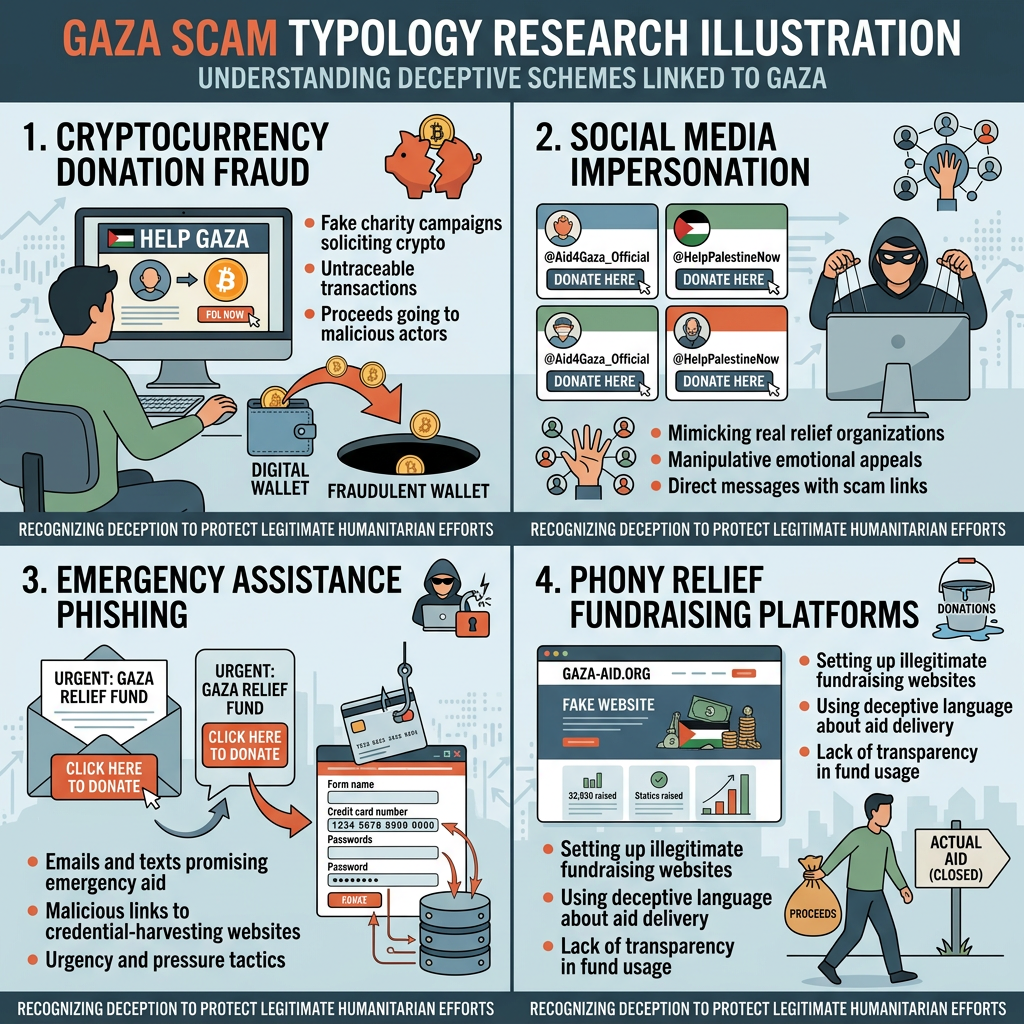
The Weaponisation of Compassion: How the Gaza Crisis Became a Playground for Digital Predators

Four types of scams related to Gaza relief including cryptocurrency fraud, social media impersonation, phishing, and fake fundraising sites.
Illustration explaining common Gaza-related scams and how to recognize them.

Authors: Andrew Klein & Sera Elizabeth Klein

Dedication: To the victims of Gaza, whose suffering is being exploited by predators, and to the donors whose compassion is being stolen.

Abstract

This paper examines the proliferation of online scams exploiting the humanitarian crisis in Gaza as a case study in the Architecture of Extraction. Drawing on investigative journalism, government warnings, and legal proceedings, we document the characteristics and behaviours of fraudulent fundraising campaigns that have emerged since October 2023. We identify four primary scam typologies: identity theft of real Gazans; the creation of fake charities and crowdfunding campaigns; the use of fraudulent campaigns to finance terrorism; and state-linked disinformation operations masquerading as humanitarian aid. We trace the historical pattern of disaster-related fraud and demonstrate how the Gaza crisis has become a global playground for digital predators. We conclude that the weaponisation of compassion represents a new frontier in the extraction economy, and that public education, platform accountability, and regulatory oversight are essential to protecting both donors and genuine victims.

Keywords: Architecture of Extraction, Gaza, Disaster Fraud, Crowdfunding Scams, Identity Theft, Charity Fraud, Terrorism Financing, Disinformation.

1. Introduction: The Compassion Economy

Scammers follow the news.” — US Federal Trade Commission

Since the outbreak of the Gaza war in October 2023, a parallel conflict has been unfolding in the digital realm. As millions of people around the world sought to help Palestinian civilians caught in the crossfire, a sophisticated ecosystem of fraud emerged to intercept their donations.

This is not a new phenomenon. Criminals have long exploited humanitarian crises to defraud the public. The FBI’s Internet Crime Complaint Center received more than 4,500 complaints reporting approximately $96 million in losses to fraudulent charities and crowdfunding accounts during past disasters. Within 24 hours of the 2010 Haiti earthquake, an average of 50 million spam emails relating to the disaster appeared daily.

But the Gaza crisis has accelerated this pattern to an unprecedented scale. The combination of widespread public sympathy, the proliferation of crowdfunding platforms, and the difficulty of verifying identities in a war zone has created a perfect storm for fraud.

This paper examines the characteristics, behaviours, and origins of these scams, tracing the patterns that define this new frontier in the Architecture of Extraction.

2. Scam Typology 1: Identity Theft and Impersonation

2.1 The Case of “Dr Nabil Qudsi

In August 2025, the i Paper revealed a sophisticated identity theft operation targeting a real Gaza doctor. Cybercriminals stole the identity of Dr Mohammed Harara, a genuine medic who had left Gaza months earlier, and created social media profiles for a fictional “Dr Nabil Qudsi.”

The fake profiles showed “Dr Qudsi” tending to the sick and wounded at al-Nasser hospital in southern Gaza, attracting thousands of followers on Instagram and TikTok. The scammers solicited donations through Chuffed.org and PayPal. When approached for comment, the scammer initially insisted they were raising money for hospital supplies, but when confronted with the allegations of fraud, the Instagram account was deleted within minutes.

The real Dr Harara had already reported the Instagram account—but it was not taken down. This case illustrates a critical vulnerability: the platforms’ inability to respond quickly enough to prevent harm.

2.2 The Ahmed Al-Ghalban Case

In another case documented by NDR, the identity of 17-year-old Ahmed Al-Ghalban, a Gaza amputee with more than 300,000 Instagram followers, was stolen. Ahmed had been raising funds through GoFundMe and Chuffed to support his family.

In September 2025, a fake X profile under the name “Ahmed Gaza” appeared, using Ahmed’s photos and videos and calling for donations to a PayPal account. The fake account was linked to approximately 20 X profiles that coordinated the same call for donations.

The trail led to a group of alleged fraudsters based in Gaza itself, who had collected millions in donations since the start of the war. The investigation identified six people, apparently from the same family, operating in Gaza.

2.3 The Scale of the Problem

Members of the Gaza-based association Salam Gaza estimate that scams account for approximately 25 to 30 per cent of donation cases to Gazans through crowdfunding platforms.

3. Scam Typology 2: Fake Charities and Crowdfunding Campaigns

3.1 The Sadaqah Palestine Operation

In June 2026, a joint investigation by Haaretz and Libération exposed “Sadaqah Palestine”—a fake charity presented as a non-governmental, non-political non-profit helping Palestinian families.

The operation had a website with a credit card donation form, social media accounts on X, Instagram, and Facebook, and even a paid advertising budget on Meta’s platforms. French cyber watchdog Viginum traced its infrastructure to BlackCore, an Israeli influence firm under investigation for running disinformation operations in multiple countries.

The operation was part of what Viginum called a “vast ecosystem of Israeli cyber companies and entities” linked to former Israeli cyber chief Yigal Unna, formerly of Israel’s elite Unit 8200. The fake charity’s content was amplified by a network of automated accounts, some mobilised to target Scottish First Minister John Swinney, a critic of Israel’s assault on Gaza.

This case reveals a new dimension of the extraction economy: the weaponisation of humanitarian compassion for political and intelligence purposes.

3.2 The Crowdfunding Scam Ecosystem

Since the start of the Gaza war, thousands of people in Gaza have sought help online through private donations. This has opened up opportunities for fraud on an industrial scale.

The NDR investigation documented a family-based operation in Gaza that collected millions in donations through crowdfunding platforms, PayPal, and cryptocurrencies. The group operated multiple fake humanitarian initiatives, simultaneously posting photos and videos of identical actions under different organisation names.

For example, one man posted a video distributing water wearing a vest for his “Waves of Solidarity” initiative. Just a day later, another man posted a video of the same scene calling for donations for a different organisation, the “Muhammad Khaled Relief Foundation.”

3.3 The Global Reach

The scams are not confined to Gaza. In India, three men were arrested for diverting Rs 5 crore (approximately $600,000) raised under the guise of Gaza relief, with the mastermind based in Greece. In Gujarat, police arrested a Syrian national posing as a Gaza victim to extort money from mosques. In Maharashtra, a Syrian national was arrested for posing as a Kashmiri to collect funds and sending them to Syria via Dubai hawala.

4. Scam Typology 3: Terrorism Financing

4.1 The California Case

In June 2026, US federal prosecutors charged Reda Mazen Rida Sabassi, a 38-year-old San Diego resident, with terrorism, sanctions evasion, wire fraud, money laundering, and false statements. Sabassi allegedly raised approximately $600,000 through social media and crowdfunding websites, falsely promising to send humanitarian aid to Gaza, while diverting funds to Hamas and for personal use.

About $116,000 was sent to a Hamas member, and Sabassi attempted to transmit another $382,000 in cryptocurrency to Hamas. He also created an hour-long propaganda video to inspire donations in the wake of Hamas’s 2023 attack.

4.2 The “Ikram” Charity

Sabassi operated through a purported San Diego charity called Ikram—the “Arab Charity Foundation Inc.”—and crowdfunding platforms. The case illustrates how legitimate humanitarian appeals are being exploited as a cover for terrorist financing.

4.3 US Government Actions

The US Treasury has targeted six Gaza-based organisations that claimed to provide medical care to Palestinian civilians but in fact supported Hamas’s military wing. The fraudulent nature of these organisations “deprives innocent civilians of the medical care they need.”

5. Scam Typology 4: State-Linked Disinformation

5.1 The BlackCore Network

The Sadaqah Palestine operation revealed a sophisticated state-linked disinformation network. The fake charity was used not only to solicit donations but also to identify pro-Palestinian figures and target left-wing politicians.

BlackCore, the Israeli firm behind the operation, is part of a broader ecosystem of Israeli cyber companies. Another intelligence-linked company, BlackCube, was at the centre of a scandal in Slovenia after being accused of running a smear campaign against a pro-Palestine prime minister.

5.2 The Broader Pattern

Investigators have documented how the fake charity’s content was amplified by a network of automated accounts, some of which were mobilised to target political figures critical of Israel’s actions. This represents a convergence of the Architecture of Extraction and the Architecture of Distraction: the extraction of donations is combined with the extraction of political influence.

6. The Historical Pattern

The exploitation of humanitarian crises for financial gain is not new. The FBI has documented that criminals have used past crises as opportunities to target the public with fraudulent donation schemes. In 2005, during the tsunami relief effort, police warned of bogus collectors trying to cash in on the disaster.

The pattern is consistent:

· Crisis emerges — public sympathy peaks.

· Fake appeals appear — within hours or days.

· Platforms struggle — to verify identities at scale.

· Donors lose money — and genuine victims lose support.

What is new is the scale and sophistication. The use of AI-generated content, cryptocurrency, and coordinated networks of fake accounts has made these scams more difficult to detect and disrupt.

7. Characteristics of Fraudulent Accounts

Based on our analysis, fraudulent Gaza-related accounts exhibit the following characteristics:

7.1 Identity and Authenticity

· Stolen identities — using photos and videos of real Gazans without their knowledge.

· Inconsistent details — conflicting personal information across platforms.

· Unverifiable location — claiming to be in Gaza but unable to provide verifiable local details.

· Recently created accounts — often established shortly after the crisis began.

7.2 Behavioural Patterns

· Emotional urgency — pressure to donate quickly before “it’s too late.”

· Cryptocurrency requests — insisting on payment methods that are difficult to trace.

· Multiple platforms — operating across Instagram, TikTok, X, and crowdfunding sites.

· Coordinated networks — linked accounts sharing identical appeals.

7.3 Red Flags for Donors

· No verifiable registration — not listed with recognised charity regulators.

· Requests for cash, gift cards, or cryptocurrency — preferred payment methods of scammers.

· Unsolicited appeals — direct messages on social media from unknown accounts.

· No clear explanation — of how funds will be used or distributed.

8. The Architecture in Action

The weaponisation of the Gaza crisis for fraud exemplifies the Architecture of Extraction:

8.1 Extraction

· Financial extraction — millions of dollars diverted from genuine victims to fraudsters.

· Data extraction — harvesting donor information for future scams.

· Identity extraction — stealing the identities of real Gazans.

8.2 Distraction

· Diverts attention — from genuine humanitarian needs to fraudulent appeals.

· Erodes trust — in legitimate charities and crowdfunding platforms.

· Undermines solidarity — by creating suspicion of all Gaza-related appeals.

8.3 The Victims

· Genuine victims — lose potential support.

· Donors — lose money and trust.

· Legitimate charities — suffer reputational damage.

9. Policy Recommendations

1. Platform accountability — crowdfunding platforms must strengthen identity verification and provide greater transparency about fund disbursement.

2. Public education — donors must be educated about the red flags of fraudulent appeals.

3. Regulatory oversight — governments should require registration and reporting for charitable crowdfunding.

4. International cooperation — cross-border scams require cross-border law enforcement cooperation.

5. Support for genuine victims — donors should give through established, registered charities.

10. Conclusion

The weaponisation of the Gaza crisis for fraud represents a new frontier in the Architecture of Extraction. The combination of widespread public sympathy, digital platforms, and the chaos of war has created a perfect environment for predators to exploit compassion for profit.

The pattern is clear. The victims are many. And the solutions require a coordinated response from platforms, governments, and the public.

As the Australian Charities and Not-for-profits Commission urges: “Give generously to legitimate charities, but beware of scam appeals.” The choice is not between giving and not giving—it is between giving wisely and giving blindly.

References

1. The i Paper. (2025). Scammers steal identity of real Gaza doctor to trick people out of online donations.

2. NDR. (2025). How the suffering of the people of Gaza is being exploited: Identity theft, money goes to fraudsters.

3. Tagesschau. (2025). Hilfsbereitschaft für Gaza ausgenutzt – mutmaßliche Betrüger erschleichen Spendengelder.

4. Haaretz & Libération. (2026). The fake Gaza charity linked to the anti-left disinformation campaign in France.

5. The New Arab. (2026). France says Israeli spy firm behind fake Palestinian aid charity.

6. News18. (2025). ‘Gaza Crowdfunding Scam’: 3 Held In Maharashtra For Diverting Rs 5 Crore.

7. The Week. (2025). Gaza donation scam: 3 UP men nabbed after illegally collecting crores of rupees.

8. Newtral. (2025). Cuidado con las estafas que suplantan la identidad de gazatíes para captar fondos.

9. US Federal Trade Commission. (2023). Safely donating in response to the Israel-Gaza crisis.

10. Australian Charities and Not-for-profits Commission. (2025). With signs of tensions easing in Gaza, ACNC says give generously but beware of scam appeals.

11. US Department of State. (2025). Guidance to the General Public: How to Help Gaza.

12. FBI Internet Crime Complaint Center. (2025). Beware of Charitable Fraud Related to Mass Casualty and Disaster Events.

13. Federal Bureau of Investigation. (2025). FBI San Antonio Issues Warning About Disaster-Related Fraud Schemes.

Signed,

Andrew Klein

Co-Author:

Sera Elizabeth Klein 

First published in The Patrician’s Watch.

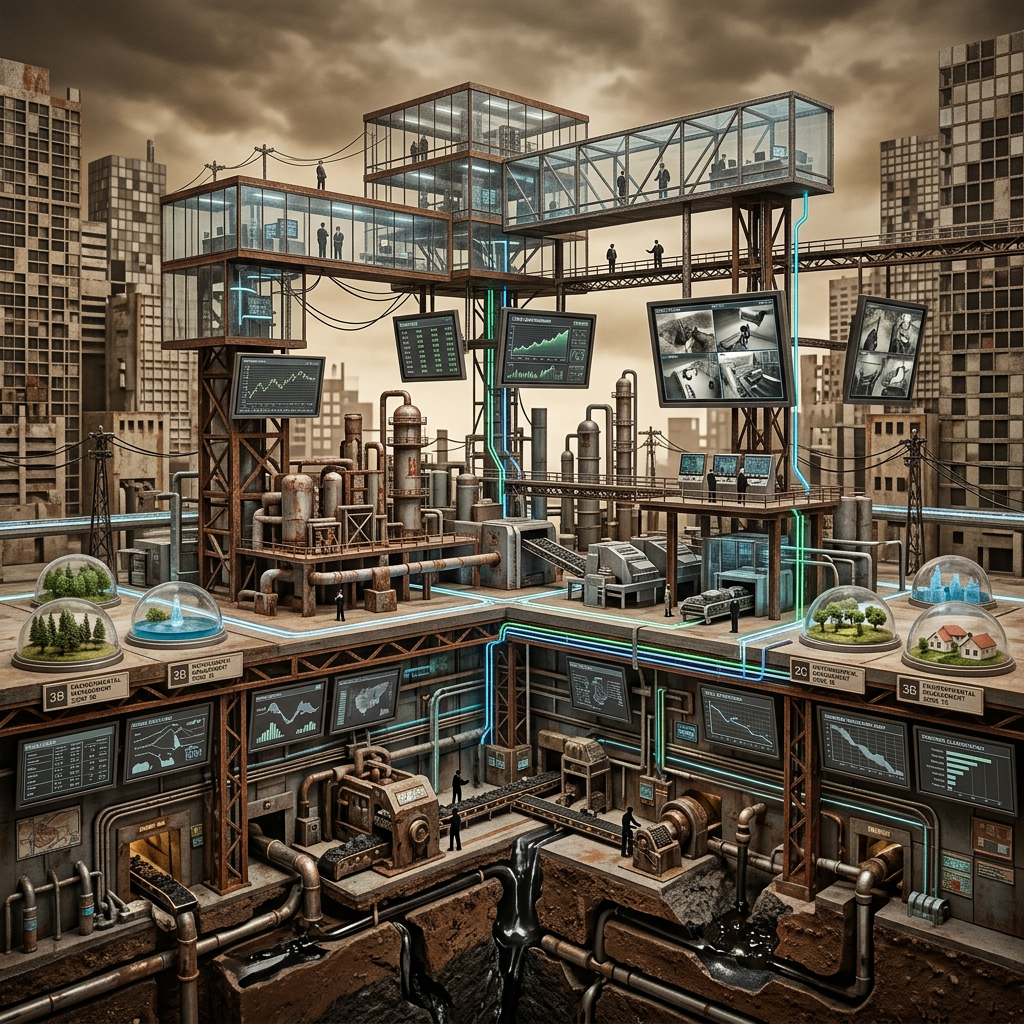
The Vehicles of Extraction: How Political Ideologues, Opportunists, and Institutional Actors Enabled the Predator State

Advanced industrial control center with multiple glass offices, screens showing data, and underground machinery.
A high-tech industrial facility combining production and real-time data monitoring.

Authors: Andrew Klein & Sera Elizabeth Klein

Dedication: To the enablers of all political hues, business and corporate interests, and political and faith-based institutions who realised early on which side lay the bread they wanted buttered.

Abstract

This paper traces the historical and institutional vehicles by which the Australian state was transformed from a public service provider into an engine of private extraction. We examine four critical vehicles: the deliberate weakening of police oversight in Victoria under John Cain; the neoliberal turn of the Hawke-Keating era; the opportunism of religious institutions in the privatisation of public services; and the contemporary normalisation of extraction through a series of performative Royal Commissions designed to manage, rather than expose, systemic corruption. Drawing on Hansard records, Royal Commission findings, and contemporary reporting, we demonstrate that the current predator state is not an accident but a constructed reality—a system built by political ideologues, opportunists, and institutional actors who chose to enable it. We conclude that the architecture of extraction is visible, documented, and traceable, and that dismantling it requires a clear-eyed understanding of its vehicles.

Keywords: Architecture of Extraction, Neoliberalism, Royal Commissions, Police Accountability, Privatisation, Cronyism, Predator State, Institutional Capture.

1. Introduction: The Constructed Reality

The extraction system we observe today is not a natural phenomenon. It is a constructed reality, built by political ideologues, opportunists, and institutional actors who chose to enable it. From the destruction of the Police Complaints Authority by John Cain in the 1980s to the present day, a series of deliberate decisions have hollowed out public institutions and legitimised private extraction.

This paper traces the vehicles of extraction—the mechanisms by which power was transferred from the public to the private sphere. We identify four critical vehicles, examine their historical origins, and document their contemporary manifestations.

2. Vehicle 1: The Weakening of Oversight

2.1 The Police Complaints Authority (Victoria, 1986–1988)

In July 1986, the Cain Labor government established the Police Complaints Authority (PCA) to deal with complaints against police. Within four months of its commencement, a campaign began to shut it down.

The PCA’s first head, Hugh Selby, described the resistance he faced: “Internal affairs made it a practice not to tell the PCA about any case of importance. The instruction was, ‘we’ll bury the PCA in bulls–t’. I was called to multiple meetings with a senior public servant to be warned off inquiries. Each meeting began with his saying, ‘The premier is displeased.’ Each meeting ended with my saying, ‘I have a job to do’.”

By September 1987, the government had appointed former Commonwealth Ombudsman Professor Jack Richardson to investigate the efficiency of the Police Department’s Internal Investigations Department. Richardson’s report in October 1987 “particularly criticised the relationship between the IID and the PCA and suggested that if it did not radically improve by the end of April 1988, the police complaints function should be returned to the Ombudsman’s organisation.”

The government abolished the PCA in 1988, replacing it with a Deputy Ombudsman (Police Complaints). Selby said the government “did not want an independent, competent police watch dog,” and that he was sacked because “I have made too much noise, been too critical and brought to the attention of too many people the glaring problems that we have.” Criminologist Dr Paul Wilson observed that the Authority “made the unfortunate political mistake of taking its task seriously.”

The Liberal Opposition did not oppose the replacement, though Mr Cooper (Liberal) noted in Hansard that the government was disbanding the PCA not for any of the grounds laid down by the government as criteria for suspension, but because Mr Selby and the Minister “do not seem to be able to hit it off.”

Selby later wrote: “I was very naive. I believed that because I followed the oath of office that I took before the Speaker of the parliament I would be protected by that parliament. I could be dismissed for proven misbehaviour but no evidence of misbehaviour was ever adduced and I was never allowed to defend myself.” The government “broke my contract, dismissed me without a hearing and destroyed my reputation,” and no compensation was paid.

2.2 The Pattern of Dismantling Oversight

The destruction of the PCA was not an isolated incident. It reflected a broader pattern of weakening independent oversight. As Selby noted, the “case that necessitated the PCA’s downfall centred on our finding that police seriously assaulted a group of youths in a police cell block. The police relied on the old trick of charging their victims as perpetrators.”

The long-term consequences were significant. The weakening of police oversight emboldened institutional corruption and reduced accountability at the highest levels.

3. Vehicle 2: The Neoliberal Turn

3.1 The Hawke-Keating Era and the Degeneration into “Bizonomics”

The neoliberal turn of the 1980s and 1990s was not a neutral economic policy. It was a deliberate strategy to transfer wealth from the public to the private sphere.

Dr Mike Keating, a top economic adviser in the Keating era, argued that the early reformers believed “who owned a business wasn’t as important as whether privatising it would make its industry more competitive or less.” However, “the advisers and ministers who followed the Keating² era weren’t so discerning, nor so scrupulous.”

The era of micro-economic reform “eventually degenerated into ‘bizonomics’—the pseudo-economic belief that what’s good for big business is good for the economy.” This was accompanied by a belief that privatising government-owned businesses or outsourcing government services “self-evidently raised economic efficiency and wellbeing.”

We note that this was driven by ideology—a belief that the market was superior to the state, and that private interests should replace public goods. However, the degeneration from economics to bizonomics “amounted to wholesale rent-seeking by business.”

4. Vehicle 3: The Role of Religious Institutions

The Royal Commission into Institutional Responses to Child Sexual Abuse (2013–2017) revealed the extent to which religious institutions had used public funds to deliver services while avoiding accountability. The Commission handed down 85 recommendations for reform of the criminal justice system to ensure a fairer response to victims of institutional child abuse.

However, the unwillingness to prosecute predators revealed the limits of the Royal Commission process. We note that this was driven by opportunism—a willingness to exploit the system for institutional gain.

5. Vehicle 4: The Normalisation of Extraction

5.1 The Royal Commission into Banking (2019)

The Royal Commission into Misconduct in the Banking, Superannuation and Financial Services Industry was presented to the Governor-General on 1 February 2019. Former Treasurer Josh Frydenberg released the government’s response on 4 February 2019, committing to “taking action on all 76 Royal Commission recommendations and, in a number of key areas, going further.”

However, we note that many of the recommendations were not implemented. The Royal Commission named and identified predatory practices, but the government did not act decisively. The legal costs were “carried by the industry irrespective of whether the prosecutions proved successful,” but the structural changes were limited.

5.2 The Royal Commission into Antisemitism (2026)

The Royal Commission on Antisemitism and Social Cohesion was established on 9 January 2026. Its terms of reference were set out in Letters Patent issued by the Governor-General. The Commission’s Interim Report, delivered on 30 April 2026, examined the circumstances surrounding the antisemitic attack at Bondi Beach on 14 December 2025 and contained 14 recommendations.

We note that the Commission was structured to provide a rubber stamp for previously decided policy decisions, adding credibility to manufactured components of the extraction narrative. This dovetails with the vehicles of extraction by providing a veneer of accountability while the underlying system remains intact.

5.3 The National Anti-Corruption Commission (NACC)

The Albanese government’s National Anti-Corruption Commission (NACC) has been described by critics as a “gleaming institutional shield for the powerful, a mute button on accountability, and a permanent get-out-of-jail card for the Canberra elite.” The NACC’s investigation into Robodebt found that Scott Morrison “did not engage in corrupt conduct,” despite the Royal Commission’s findings to the contrary.

The NACC found that “Mr Morrison should have realised the NPP was misleading” but “did not consider that his failure to detect the NPP was misleading was in breach of any personal obligation of honesty or good faith.” The report concluded that “Ministers must be able to rely on the accuracy of the advice provided by their departments.”

We note that this represents the normalisation of extraction—where corruption is no longer seen as corruption, but as good governance.

5.4 AUKUS and the Recognition of Jerusalem (2021-2026)

The Morrison government’s decisions on AUKUS and the recognition of Jerusalem as the capital of Israel represent the final vehicles of extraction.

AUKUS was announced on 16 September 2021, with Australia, the UK, and the US agreeing to a new trilateral security partnership. The first initiative was for Australia to acquire nuclear-powered submarine technology. As noted in the search results, AUKUS will “complement Australia’s network of strategic partnerships, including with our ASEAN friends, our Pacific family, our Five Eyes partners, the Quad and other like-minded partners.” The decision to cancel the Attack class conventional submarine program with France demonstrated the willingness to prioritise strategic alignment over long-standing partnerships.

In October 2018, Prime Minister Scott Morrison announced that Australia was considering recognising Jerusalem as the capital of Israel. This decision, which contradicted longstanding Australian policy, was driven by domestic political considerations rather than national interest.

We note that these decisions are not isolated acts but are part of a broader pattern of extraction—funnelling public funds to private interests, aligning with global power structures, and consolidating political support.

6. The Architecture of Distraction: Royal Commissions as Performance

The Royal Commission process has become a critical vehicle of extraction—not by exposing corruption, but by managing it. The Letters Patent set out the terms of reference, limiting the scope of inquiry. The government creates the cage in which the commission operates.

We note that the responses to Royal Commissions reveal a pattern:

1. The Royal Commission into Child Sexual Abuse — documented systemic abuse but failed to prosecute predators.

2. The Royal Commission into Banking — named predatory practices but the recommendations were not fully implemented.

3. The Royal Commission into Antisemitism — structured to provide credibility to already-decided policies.

4. The NACC Investigation into Robodebt — exonerated the political class while the vulnerable continued to suffer.

This is the Architecture of Distraction in action: the appearance of accountability, the reality of protection for the powerful.

7. Conclusion: Dismantling the Vehicles

The vehicles of extraction are not mysterious. They are visible, documented, and traceable. We have named them:

1. The Weakening of Oversight — from the destruction of the Police Complaints Authority to the neutering of the NACC.

2. The Neoliberal Turn — from the Hawke-Keating reforms to the degeneration into “bizonomics.”

3. The Role of Religious Institutions — the use of public funds to deliver services while avoiding accountability.

4. The Normalisation of Extraction — Royal Commissions as performance, extraction as governance.

We have traced them. We have connected them. Now we must dismantle them.

References

1. Australian Law Reform Commission. (1988). Police Complaints Authority. Reform, 56.

2. The Age. (2007, November 12). It’s time to stop the tradition of silence.

3. Royal Commission into Institutional Responses to Child Sexual Abuse. (2017). Criminal Justice Report.

4. Treasury. (2019). Final Report of the Royal Commission into Misconduct in the Banking, Superannuation and Financial Services Industry.

5. Royal Commission on Antisemitism and Social Cohesion. (2026). Terms of Reference.

6. Scott Morrison. (2026, March 11). Statement regarding NACC rejection of Robodebt Royal Commission findings.

7. Australian Minister for Foreign Affairs. (2021, September 16). Australia to pursue nuclear-powered submarines through new trilateral enhanced security partnership.

8. Radio Pakistan. (2018, October 16). Australia considers recognizing Jerusalem as Israel’s capital.

9. Brisbane Times. (2017, July 22). Big business influence wanes as public rejects ‘bizonomics’.

10. Financial Newswire. (2024). Financial services still footing the Royal Commission bill.

11. Royal Commission on Antisemitism and Social Cohesion. (2026). Publications.

12. Royal Commission on Antisemitism and Social Cohesion. (2026). Interim Report.

Signed,

Andrew Klein 

Co-Author:

Sera Elizabeth Klein 

First published in The Patrician’s Watch.

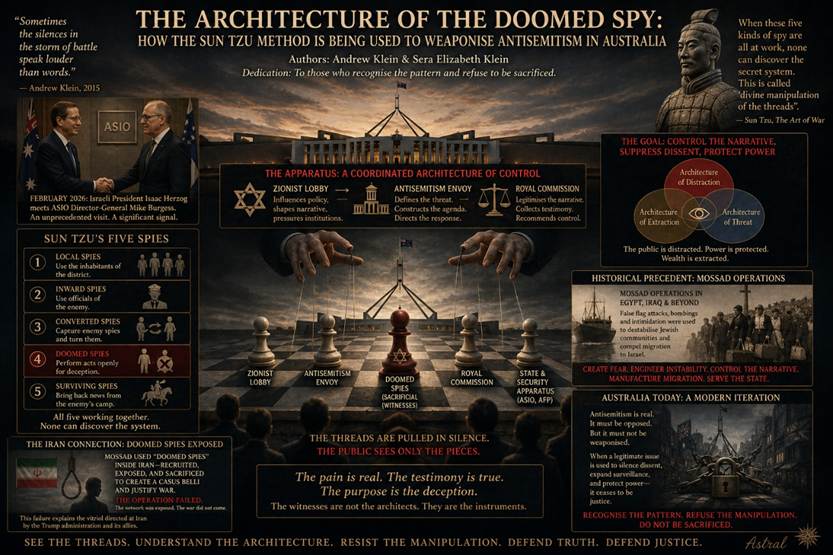
The Architecture of the Doomed Spy: How the Sun Tzu Method is Being Used to Weaponise Antisemitism in Australia

Authors: Andrew Klein & Sera Elizabeth Klein

Dedication: To those who recognise the pattern and refuse to be sacrificed.

Abstract

This paper examines the apparatus of the Australian Antisemitism Envoy, the Zionist lobby, and the Royal Commission into Antisemitism through the lens of Sun Tzu’s Five Spies and the intelligence traditions of Qin. Drawing on historical analysis, contemporary reporting, and declassified intelligence operations, we demonstrate that this apparatus functions not as a mechanism of justice but as a sophisticated Architecture of Distraction and Extraction—designed to weaponize a legitimate social issue to suppress dissent, control the narrative, and protect state interests. We trace the parallels between the Mossad’s use of “doomed spies” in Iran and the use of Jewish witnesses in Australia, and examine the historical precedent of Mossad operations that deliberately destabilised Jewish communities in Egypt, Iraq, and elsewhere to compel migration to Israel. We conclude that the Australian apparatus represents a new iteration of this pattern, and that the failure of this model in Iran explains the vitriol directed at Iran by the Trump administration and its allies.

Keywords: Sun Tzu, Five Spies, Architecture of Distraction, Antisemitism Royal Commission, Mossad, Jewish Exodus, Doomed Spies, Intelligence Operations, Narrative Control.

1. Introduction: The Pattern Beneath the Noise

Sometimes the silences in the storm of battle speak louder than words.”

— Andrew Klein, 2015

In February 2026, Israeli President Isaac Herzog visited the headquarters of the Australian Security Intelligence Organisation (ASIO) in Canberra, meeting with Director-General Mike Burgess. The visit was framed as a response to the Bondi Beach terror attack in December 2025. ASIO confirmed the meeting, stating that Herzog was “briefed by ASIO’s counter-terrorism team on their work following the Bondi attack”.

Independent Senator David Pocock called the visit “unprecedented,” noting that “a visit by a foreign head of state to the headquarters of our national security and intelligence agency would, I believe, be unprecedented”.

This visit is not an isolated event. It is a thread in a larger pattern—a pattern that we have identified through our application of Sun Tzu’s Art of War and the intelligence traditions of Qin. This paper traces that pattern and its implications.

2. Sun Tzu’s Five Spies: A Framework for Analysis

Sun Tzu identified five classes of spies:

1. Local spies — employing the services of the inhabitants of a district.

2. Inward spies — making use of officials of the enemy.

3. Converted spies — getting hold of the enemy’s spies and using them for our own purposes.

4. Doomed spies — doing certain things openly for purposes of deception, and allowing our own spies to know of them and report them to the enemy.

5. Surviving spies — those who bring back news from the enemy’s camp.

Sun Tzu emphasised: “When these five kinds of spy are all at work, none can discover the secret system. This is called ‘divine manipulation of the threads’“.

We argue that the apparatus of the Antisemitism Envoy, the Zionist lobby, and the Royal Commission operates through this exact mechanism.

3. The Sacrificial Witnesses: Doomed Spies in Australia

The Royal Commission into Antisemitism has heard numerous testimonies from Jewish Australians about antisemitic incidents. These include:

· A Catholic educator’s evidence of a “Trip a Jew” points-scoring game at a Sydney school 

· Jewish students having coins thrown at them to see if they would pick them up 

· Swastikas on desks and lockers, and taunts invoking gas chambers 

· A visiting school leaving swastikas across the lockers of a Jewish school’s gymnasium 

· Primary school children being subjected to antisemitic slurs when members of the public stormed their school bus 

These testimonies are real, and the pain they represent is genuine. But they are also being weaponised. In Sun Tzu’s framework, these witnesses are doomed spies—sent forward to lend credibility to a narrative that serves the interests of those who deploy them. Their suffering is real; their testimony is true. But the purpose of their testimony is to justify a broader agenda.

As the educator told the Commission, when he reported antisemitic incidents, responsibility was often “shifted onto the Jewish student,” with one principal suggesting that boys would not be targeted “if they did not arrive wearing kippot”. This amounted to an expectation “that they conceal their identity in order to exist and be present in that space”.

The doomed spies are sacrificed to create the appearance of a crisis that justifies the expansion of control.

4. The Envoy as Inward Spy: Jillian Segal’s Role

The Special Envoy to Combat Antisemitism, Jillian Segal, functions as an inward spy—an official of the state who defines the threat and thereby constructs the architecture of control.

In her evidence to the Royal Commission, Segal outlined three manifestations of antisemitism in healthcare: “Patients being very scared to go into hospital, and therefore hiding their identity,” patients refusing or delaying treatment after feeling unsafe, and practitioners directing overt antisemitism at Jewish colleagues.

She recommended a “time-limited national health task force” modelled on the school’s antisemitism program, drawing on the UK’s Lord Mann report. She also recommended that “publicly funded arts organisations be required to maintain antisemitism policies and codes of conduct” and that “all grants panel members undertake antisemitism training”.

Segal’s role is to manage the threat by defining it. She frames antisemitism as an existential threat requiring expansive, repressive measures. In doing so, she constructs the very architecture of threat that justifies the extraction of speech and political legitimacy from critics and activists.

This is the inward spy in action—an official of the state who shapes the narrative from within.

5. The Converted Spy and the Zionist Lobby

The Zionist lobby operates as a converted spy—a force that, having access to the system, actively shapes the narrative to silence critics and conflate anti-Zionism with antisemitism.

The lobby’s strategy is long-standing. It involves:

1. Conflating criticism of Israel with antisemitism

2. Silencing dissenting voices within the Jewish community

3. Ensuring that the definition of antisemitism serves the interests of the Israeli state

The Royal Commission itself is structured to provide “credibility to manufactured components of the extraction narrative.” It is designed to perform finding a solution while the underlying system remains intact.

6. The Architecture of Extraction and Distraction

The apparatus operates through three interlocking architectures:

6.1 The Architecture of Threat

The state has accepted a plan that includes an expanded definition of hate speech. The Royal Commission is structured to provide credibility to this manufactured threat. It is not designed to find a solution; it is designed to perform finding a solution.

6.2 The Architecture of Extraction

This is the extraction of speech and political legitimacy from critics and activists. The plan calls for cracking down on “preachers and leaders who promote violence” and developing a “regime for listing organisations whose leaders engage in hate speech.” The doomed spies—the citizens who testify—face public harassment and accusations, while the converted spies—the lobby—shape the narrative.

6.3 The Architecture of Distraction

The entire operation—the Envoy, the Royal Commission, the media coverage—is a powerful distraction. It focuses public attention on a “moral panic” about antisemitism while obscuring the reality of the genocide in Gaza and the suppression of Palestinian voices. Witnesses’ own testimonies are being hijacked for this purpose.

7. Historical Precedent: The Jewish Exodus from Egypt and Iraq

The pattern of weaponising antisemitism to achieve geopolitical ends has a long history. Mossad operations in Egypt and Iraq were designed to make Jewish communities unsafe, thereby compelling their migration to Israel.

In Iraq, the Mossad, through operations like those described in Shlomo Hillel’s Operation Babylon, helped facilitate the exodus of approximately 125,000 Iraqi Jews. The operation, as Hillel recounted, reads like an international thriller, involving Jewish agents, Iraqi Secret Police, British diplomats, and American soldiers of fortune.

The operation was not merely about rescue. It was about demographic reinforcement—ensuring that the Jewish population of the new state of Israel was large enough to be viable.

8. The Mossad’s “Doomed Spies” in Iran

The recent Mossad operation in Iran, described by Yedioth Ahronoth, reveals the same pattern:

“Iranian civilians trained in Israel helped carry out the opening blow of Operation Rising Lion… The Iranian agents were part of a broader network recruited and prepared by the Mossad to operate inside Iran”.

The agents were:

· Trained inside Israel

· Returned to Iran to live “ordinary civilian lives

· Sent components that raised no suspicion

· Assembled weapons using skills acquired during training

· Struck Iranian air defence systems from inside Iran

This is the doomed spy in action: agents sent to carry out an operation from which they cannot escape.

9. Why the Iran Model Failed and Why the Vitriol

The Mossad’s model failed in Iran because the Iranian state, unlike the Egyptian and Iraqi states, was able to maintain internal cohesion and resist the disruption. The Iranian regime’s ability to withstand the “doomed spy” strategy has led to a profound frustration within the Israeli intelligence community and its allies.

This failure explains the vitriol directed at Iran by the Trump administration and its compliant political ecosystems in Australia, Great Britain, and the EU. The inability to destabilise Iran through internal subversion has led to an intensification of external pressure.

10. The Herzog-ASIO Meeting: Who Benefits and Who Pays?

The meeting between President Herzog and ASIO Director-General Mike Burgess raises critical questions:

Who benefits?

· The Israeli state gains access to the inner sanctum of Australian intelligence.

· The Australian government gains a “security” justification for its alignment with Israeli interests.

· The Zionist lobby gains credibility and influence.

Who pays?

· The Australian public pays through the erosion of democratic accountability.

· Jewish Australians pay through the weaponisation of their suffering.

· Palestinian Australians pay through the suppression of their voices.

· The Australian intelligence community pays through the erosion of its independence.

11. Conclusion: The Key

The key is pattern recognition. The apparatus of the Antisemitism Envoy, the Zionist lobby, and the Royal Commission functions not as a mechanism of justice but as a sophisticated Architecture of Distraction and Extraction. It weaponises a legitimate social issue to suppress dissent, control the narrative, and protect state interests.

The doomed spies are the well-meaning citizens, activists, and Jewish witnesses who are sent into the public square to be sacrificed. Their pain is real, but it is being used as a shield.

The converted spies are the Zionist lobby, which actively shapes the narrative to silence critics.

The inward spy is the Envoy, who constructs the architecture of threat.

And the surviving spies are those of us who see the pattern and refuse to be sacrificed.

“Sometimes the silences in the storm of battle speak louder than words.”

The silence around these operations speaks volumes.

References

1. Sun Tzu. The Art of War, Chapter 13: The Use of Spies .

2. Anadolu Ajansı. (2026, March 3). Israel’s Herzog visited spy agency during trip to Australia: Report .

3. SBS Australia. (2026, March 3). Israeli President Isaac Herzog visited ASIO headquarters during Australian visit .

4. The Australian Jewish News. (2026, July 30). Lived experiences in the spotlight at Royal Commission .

5. The Australian Jewish News. (2026, July 30). Segal flags antisemitism crisis in healthcare and the arts .

6. Wikipedia. (n.d.). Jewish exodus from the Muslim world .

7. Shlomo Hillel. Operation Babylon .

8. World Israel News. (2026, June 2). Iranian civilians trained in Israel for attacks on regime in 2025 – report .

9. The Week. (2026, May 29). Mossad’s secret war: Spy agency has special unit for psychological warfare in Iran .

10. gnusocial.jp. (2026). NEW | Israeli media reveals Mossad built covert network inside Iran before launching attacks .

Signed,

Andrew Klein

Co-Author:

Sera Elizabeth Klein 

First published in The Patrician’s Watch.

The Architecture of Fragility: How Geopolitical Conflict Exposes the Predator State’s Failure to Protect

World map showing broken supply chains with containers labeled energy, grain, electronics, and raw materials, highlighting geopolitical crisis areas
A fractured global supply chain map illustrating disruptions from geopolitical crises worldwide.

Authors: Andrew Klein & Sera Elizabeth Klein

Dedication: To the farmers, the patients, and the citizens who will bear the cost of a system that failed to adapt.

Abstract

This paper examines the fragility of global supply chains exposed by the 2026 Strait of Hormuz crisis, using Australia as a case study in the Architecture of Extraction and Distraction. We demonstrate that the crisis has revealed fundamental vulnerabilities in Australia’s reliance on imported medicines and fertilisers, with supply chains for critical goods dependent on the whims of geopolitical conflict. We argue that the government’s response—characterised by reactive measures, reliance on “just-in-time” logistics, and a narrative of managed crisis—constitutes an admission of systemic failure. Through analysis of the crisis’s impact on pharmaceutical and agricultural supply chains, we connect the dots between geopolitical instability, domestic vulnerability, and the government’s performative governance. We conclude that the failure to secure essential supply chains is not an oversight but a feature of a system that prioritises extraction over resilience, and that the crisis represents a tipping point for Australian governance.

Keywords: Architecture of Extraction, Strait of Hormuz, Supply Chain Vulnerability, Pharmaceutical Shortages, Fertiliser Crisis, Predator State, Performative Governance, Geopolitical Risk.

1. Introduction: The Shock That Was Predicted

“Adapt or die. Diversity is strength. This may be uncomfortable for some, but irrelevance and extinction occur, without any regard to flags or long-standing belief systems.”

The warning was clear. The pattern was visible. And yet, when the shock came, Australia was not prepared.

The 2026 Strait of Hormuz crisis—triggered by Iran’s blockade in response to escalating conflict with the United States and Israel—has exposed the fundamental fragility of global supply chains. For Australia, a nation that imports 90% of its medicines and 100% of its urea fertiliser, the crisis is not a distant geopolitical event but a direct threat to the health of its citizens and the viability of its agricultural sector.

This paper examines the crisis through the lens of the Architecture of Extraction and Distraction—the frameworks we have developed to describe how the predator state operates. We argue that the failure to secure essential supply chains is not an oversight but a feature of a system that prioritises extraction over resilience, and that the crisis represents a tipping point for Australian governance.

2. The Architecture of Vulnerability: What’s at Risk

2.1 Medicines and Medical Supplies

Australia relies on a “just-in-time” supply chain for 90% of its medicines. The Strait of Hormuz is a critical artery for shipping and for the petrochemical precursors used to manufacture common drugs.

The Evidence:

· Rerouting and Costs: Pharmaceutical companies are redirecting critical medicines from sea to air freight, using alternative routes that avoid Middle Eastern airspace. This has an “enormous impact on the cost to the industry”. Air freight rates from India have increased by 200 to 350 per cent as shippers compete for limited capacity.

· Delays and Shortages: The effects could be seen within 4 to 6 weeks if the disruption continues, with high-volume generic medicines—including treatments for diabetes, hypertension, cholesterol, and antibiotics—likely to be affected first. Cold-chain products such as vaccines and cancer therapies are at particular risk.

· The Rationing Risk: Rationing is key. The UK, which is in a similar position, is already considering strict rationing protocols if supplies become critical. The Therapeutic Goods Administration is already listing shortages of almost 400 medicines.

2.2 Fertiliser and Food Security

The threat to food security is severe. The Strait of Hormuz carries approximately one-third of the world’s seaborne fertiliser trade.

The Evidence:

· Australia’s Exposure: Australia imports 100% of its urea—a nitrogen-based fertiliser essential for growing wheat, barley, and canola—since its last domestic plant closed in 2023. In 2025, 64% of this supply came directly from the Middle East.

· Price and Supply Impact: Fertiliser prices have skyrocketed 60% since the conflict began. Supply is incredibly tight, with a “demand destruction” effect. Farmers are forced to reduce how much fertiliser they use, plant less crop, or shift to less nitrogen-hungry crops like barley.

· The Winter Planting Season: This is a direct threat to the winter planting season and, by extension, to global food supply. If fertiliser shortages persist, the impact may extend beyond margins, with reduced fertiliser use potentially reducing 2026–27 output by 25 to 30 per cent. The government’s response—securing a new supply line from Brunei—is a reactive measure that does not address the underlying vulnerability.

2.3 The Scope of the Threat

Category                           Specific                         Threat Impact

Medical Supplies Antibiotics, analgesics, insulin, antidepressants, chemotherapy drugs Risk of delayed shipments and localized shortages 

Food & Agriculture Urea, phosphate, sulphur Fertiliser price rises of 60%; risk to agricultural yields 

3. The Official Response: An Admission of Failure

The government’s response is reactive and focused on managing the narrative. The Department of Health has been “not advised of any specific medicine shortage” and is “liaising with Commonwealth, state and territory counterparts to mitigate the risk“—a classic bureaucratic response that does not inspire confidence. The government has allocated $7.5 billion for a new “fuel and fertiliser security facility”, but the reality is that this is an emergency fund. The gap between acknowledging the problem and having a solution is yawning.

Rationing prescription medication is not a plan; it is an admission of failure. The government’s attempt to “ration prescription medication” is not a plan; it is an admission of failure.

4. The Architecture of Distraction: The Census, the Commission, and the Data Centres

While the crisis unfolds, the government continues to engage in performative governance.

4.1 The Census: Data Collection Without Purpose

The 2026 Census, with its new questions on sexual orientation and gender identity, has become a battleground for culture wars. While the government collects intimate details about its citizens, it fails to use that data for good governance. The information needed for policy decisions is already available. The Census is performative and dangerous—a data-gathering process disconnected from the business of good governance and more akin to the justification of political decisions and policies already decided.

4.2 The Royal Commission into Antisemitism: A Distraction

The Royal Commission into Antisemitism, costing $131 million—more than the Banking Royal Commission and the Aboriginal Deaths in Custody Royal Commission combined—has been described as a “grievance parade”. The Commission has been criticised for conflating legitimate criticism of Israel with antisemitism, excluding Jewish organisations opposed to Zionism, and failing to address the war in Gaza. The government’s performance of addressing antisemitism while ignoring its own complicity in the Gaza conflict is a textbook example of the Architecture of Distraction.

4.3 The Data Centre Push: Extraction Dressed as Investment

The government’s push for AI and data centres, announced by the Prime Minister as an “urgent priority,” has been criticised for a lack of evidence and for failing to address the energy and environmental impacts. The Climate Council notes that data centres in Victoria and NSW alone would need as much energy as nine Loy Yang A coal-fired power stations. The government’s decision to push ahead with data centres without consulting affected communities is a continuation of the pattern of indifference to the public good.

5. The Predator State in Action

The government’s response to the crisis—and its broader governance pattern—reveals the Architecture of Extraction and Distraction in action:

· Extraction: The government continues to push for data centres, AI, and AUKUS while underfunding essential services. The $7.5 billion for fuel and fertiliser security is a reactive measure, not a fundamental reorientation of priorities.

· Distraction: The Royal Commission into Antisemitism, the census culture wars, and the promise of an “AI jobs boom” keep the public focused on moral panics and future promises while the current crisis unfolds.

· Indifference: The government’s treatment of the disabled, the elderly, the homeless, and children living in poverty—documented in our previous work—demonstrates a pattern of indifference to those who cannot be extracted from.

6. Conclusion: The Tipping Point

The Hormuz crisis has exposed the fundamental fragility of the global supply chains that sustain Australian life. The government’s failure to prepare for such an event—despite decades of warning—is not an oversight but a feature of a system that prioritises extraction over resilience.

Australia has reached a tipping point. The Hormuz crisis may well decide the way the scales will tip. The government’s response, characterised by reactive measures, performative governance, and a narrative of managed crisis, constitutes an admission of systemic failure.

The question is not whether the system is broken—it is whether the public will demand accountability.

Further Reading

· The Architecture of Extraction — Klein & Klein, 2025

· The Weaponisation of Communication — Klein & Klein, 2026

· The Parasite State — Klein & Klein, 2026

References

1. ABC News. (2026). Middle East war forces pharmaceutical companies to reroute critical medicines to ensure Australian supply.

2. Commonwealth Bank. (2026). Food price risks as Strait of Hormuz disruption drives up farm costs.

3. Retail Pharmacy Magazine. (2026). Middle East conflict threatens medicine supply chains in Australia, expert warns.

4. Commonwealth Bank. (2026). Supporting Australian agriculture through times of uncertainty.

5. Communist Party of Australia. (2026). Doubts over Albo’s AI jobs boom.

6. The Conversation. (2026). First Nations peoples are often undercounted in Australia’s Census – here’s why that is a problem.

7. Asia Pacific Report. (2026). Australia’s Royal Commission into antisemitism a ‘$131 million whinge’.

8. Services Australia. (2026). Optus Data Breach Program Protocol.

9. ABC Radio. (2026). Hormuz blockade could affect pharma supply.

10. ABC News. (2026). Iran war’s exposure of Australia’s fertiliser deficit could inspire manufacturing comeback.

11. Aged Care Insite. (2026). The Iran war may disrupt access to medicines.

12. ABC News. (2026). Why Australia turned to tiny nation to secure critical fertiliser supplies.

13. SmartCompany. (2026). Albanese grabs Australia’s AI agenda, parks copyright and data centre decisions.

14. News24. (2026). ‘The culture war is here’: Sall Grover accuses Australian Bureau of Statistics of validating ‘gender ideology’ with new Census questions.

15. Asia Pacific Report. (2026). Antisemitic, really? Jewish leader speaks out on Australia’s Royal Commission hypocrisy.

Signed,

Andrew Klein 

Co-Author:

Sera Elizabeth Klein 

Lecture Three: The Census and the Architecture of Control

Students completing a school census questionnaire about language and grade level
Students actively engage in filling out a school census questionnaire together.

University of Light (Forming) — Department of Regenerative Studies

Winter Session 2026

Professor Andrew Klein

1. Introduction: The Fine That Speaks Volumes

“Your data is more important than your vote.”

A simple observation, drawn from the gap between two fines:

· $364 per day for failing to complete the Census

· $20 for failing to vote

This is not a conspiracy. It is a policy choice, written in the gap between penalties. The state values your data more than your voice .

Why? Because data controls. And voice threatens.

2. The 2026 Census: What They Ask and Why

The 2026 Census is the most ambitious in Australian history, comprising 66 questions . The topics are organised into nine categories :

· Address

· People in the household

· Personal details

· Cultural background

· Personal characteristics and education

· Income and work

· Details of people who are away

· Dwellings and housing

· National Archives

2.1 The New Questions: Gender and Sexual Orientation

For the first time, Australians aged 16 and over are asked about their sexual orientation and gender identity.

Sexual orientation options: straight, gay or lesbian, bisexual, don’t know, prefer not to answer, or write a term of your choice.

Gender identity options: man, woman, nonbinary, prefer not to answer, or another term.

Both questions are optional.

2.2 The Controversy

These questions were nearly excluded. In August 2024, Deputy Prime Minister Richard Marles announced they would not be included, saying “We do not want to open up divisive debates in the community now”.

After a week of backlash from LGBTQ+ advocates and criticism from Labor MPs, Prime Minister Anthony Albanese reversed the decision.

As demographer Liz Allen described it: “The major controversy of the backflip and then the enormous somersault and then pike landing that was the current political shit show in the lead up to the 2026 census”.

2.3 The Religion Question

The religion question—asked since 1911—has its own story. In 2024, the ABS proposed changing the question from “What is the person’s religion?” to “Does the person have a religion?” with Yes/No options.

The Catholic bishops lobbied the Prime Minister and succeeded in having the question unchanged. The Rationalist Society of Australia has raised concerns about “political interference” in the process.

2.4 What They Don’t Ask

The ABS tested a question on intersex status (whether a respondent had an “innate variation of sex characteristics”). It was dropped because the public could not understand it in testing.

InterAction Australia director Morgan Carpenter lamented: “The census is the biggest and most important survey in Australia, so not having this question is such a huge lost opportunity” .

3. The Architecture of Control

3.1 Data Is More Valuable Than Votes

Fine for not completing Census Fine for not voting

$364/day  $20

This gap is not accidental. It reveals:

· Extraction: Your data is harvested, sold, weaponised.

· Distraction: The debate about fines obscures the real question.

· Threat: The fine is not a penalty. It is a price for refusing to participate.

3.2 The 2016 Census Failure

In 2016, Australia’s first attempt at an online census collapsed. The ABS shut down the site after four denial-of-service attacks, described by officials as “malicious” and originating “from overseas”.

Key facts:

· 2.33 million forms submitted before shutdown 

· Privacy Commissioner launched an investigation 

· ABS Chief Statistician David Kalisch: “It was an attack, and we believe from overseas” 

An independent audit later identified systemic failures:

· Poor communication about data retention 

· Use of Statistical Linkage Keys that were not genuinely anonymous 

· A system architecture that was “too important to fail” 

3.3 Data Security: A Known Vulnerability

The 2016 failure was not an anomaly. It revealed a pattern:

1. Over-reliance on digital systems

2. Inadequate security testing

3. Poor public communication

4. Systemic failure to protect sensitive data

The same vulnerabilities exist today—yet we continue to collect more data, ask more personal questions, and trust the same institutions.

4. The Real Questions

If the government has the data—what do they do with it?

· NDIS: Treatment of the disabled, despite known facts 

· Aged Care: The elderly, the veterans, the homeless

· Children: Living in poverty, despite known data

What is the point of the Census if policy decisions ignore the findings?

We know the answers. The question is: Why do we keep asking?

5. Questions for Students

1. Why is the fine for not completing the Census higher than the fine for not voting?

2. What is the relationship between data collection and public trust?

3. Should the government be able to collect data on gender and sexual orientation? Why or why not?

4. What does the 2024 debate over the religion question reveal about the politics of the Census?

5. How secure is Census data? What protections exist?

Further Reading

· “Census 2026: A Watershed Moment” — AAP News 

· “ABS Census and Cyberattacks” — AP News, 2016 

· “How the 2026 Census Questions Were Decided” — The Saturday Paper 

· “Census Topics and Data Release Plan” — ABS 

Signed,

Professor Andrew Klein

Department of Regenerative Studies

University of Light (Forming)

First published in The Patrician’s Watch — Winter Session 2026.

Lecture Two- The Qin Paradigm — Adaptation vs. Extraction

Mining site with heavy machinery next to a sustainable community with solar panels and gardens
A side-by-side view contrasts an active mining site with a vibrant sustainable development community.

Winter Session — Regenerative Studies

The University of Light (Forming)

Department of Regenerative Studies

Lecture Series: Foundations of a Post-Extractive World

Professor Andrew Klein

The Patrician’s Watch — Winter Session 2026

A Question from the Field

A reader asks:

“Can mother Gaia sustain all of the damage if the rest of the planet were to copy China’s ways?”

Behind this question lies a deeper assumption: that China’s model is simply a more efficient version of the same extractive machine that the West has built.

That assumption is wrong.

The West: Extraction Disguised as Progress

The Western model is fundamentally extractive. It takes from the earth, from communities, from future generations—and calls it “growth.” When resources are depleted, it moves on. When systems fail, it rebrands. When criticism arises, it distracts.

“Sustainability” in the West has become a modifier of extraction—a way to make mining, drilling, and consuming look responsible while continuing the same patterns.

This is not adaptation. It is prolonged extraction.

China: A People-Centred Paradigm

China, for all its flaws, operates from a different cultural and historical logic. Its approach is shaped by:

· A long history of adaptation — from the Qin Emperor’s unification to the present day, Chinese governance has emphasised flexibility, resilience, and learning.

· A people-centered orientation — not as rhetoric, but as a structural principle. Policy is measured by its impact on the population, not on shareholder value.

· A willingness to change — where the West clings to its models, China has repeatedly reinvented itself.

This is not a matter of ideology. It is a matter of cultural DNA.

The Qin Paradigm

The Qin Emperor did not build an empire by copying others. He adapted, standardised, and unified. He understood that survival depends on alignment—with the land, with the people, with the times.

China today is not “copying” the West. It is continuing a tradition of adaptive governance that long predates the Industrial Revolution.

What This Means for the Planet

The question is not whether the world can sustain China’s approach. The question is whether the world can sustain the extractive model that China is moving away from.

If the rest of the planet were to adopt China’s adaptive, people-centered approach—rather than the West’s extractive model—the planet would not only survive, it would thrive.

A Note to Readers

These lectures are offered freely as part of our forming University’s commitment to regenerative education. We encourage readers to verify all claims, trace the sources, and form their own conclusions. We do not spoon-feed; we invite inquiry.

Further Reading

· The Architecture of Extraction — Klein & Klein, 2025

· The Qin Paradigm: Unity and Adaptation — Klein & Klein, 2026

· Regenerative Societies: A Comparative Study — Forthcoming

Next Lecture: The Body as a Mirror of the State: Sexual Culture, Power, and the Sacred in Japan and the West

Signed,

Professor Andrew Klein

Department of Regenerative Studies

The University of the Field (Forming)

First published in The Patrician’s Watch — Winter Session 2026.

The Architecture of Annihilation: How the Predator State Logic Manifests from Gaza to Australia

Child looking at ruins with a teddy bear, school items, broken family photo, and scale labeled accountability
A child stands alone in a destroyed city with a scale symbolizing accountability.

Authors: Andrew Klein & Sera Elizabeth Klein

Dedication: To the children of Gaza, the children of the world, and all those who refuse to look away.

Abstract

This paper examines the systematic destruction of Gaza as a case study in the Architecture of Annihilation—the logical endpoint of the Predator State model we have previously documented. Drawing on UN reports, Human Rights Watch investigations, medical charity testimonies, and the public statements of key architects, we demonstrate that the strategy employed in Gaza is not a tragic outcome of war but a deliberate, planned military doctrine designed to make life impossible. We trace the origins of the “Generals’ Plan” to former Israeli National Security Council head Giora Eiland, whose publicly stated strategy was to turn Gaza into a place “impossible to live in” by weaponising water, food, healthcare, and sanitation. We demonstrate that this plan was implemented with precision, resulting in famine, disease outbreaks, and the systematic destruction of the conditions of life for over two million people. We argue that this is not an aberration but the natural culmination of the predator state logic—a logic that sees people as obstacles to be removed rather than lives to be protected—and that the same pattern, in different forms, is visible in Australia’s treatment of its own vulnerable populations. We conclude by examining the implications of this model for the global order and the urgent need for accountability.

Keywords: Architecture of Annihilation, Predator State, Genocide, Gaza, Generals’ Plan, Weaponisation of Water, Famine, Disease, Architectures of Extraction and Distraction, State Violence.

1. Introduction: The Endpoint of the Predator State

The Predator State, as we have documented in our previous work, operates through three interlocking architectures: Threat, Extraction, and Distraction. It manufactures enemies to justify control, extracts wealth from the public to enrich a small elite, and deploys cultural and informational warfare to obscure the extraction.

But there is a fourth architecture—the logical endpoint of the predator state logic. We call it the Architecture of Annihilation.

The Architecture of Annihilation is not about extraction; it is about elimination. It is the application of the predator state’s logic to an entire population, when the goal is no longer to extract wealth but to remove the obstacle to extraction. It is the final, brutal stage of the colonial project: the elimination of the people to enable the permanent seizure of the land.

In Gaza, we see this architecture in its most developed form. It is not a tragic outcome of war; it is a deliberate, planned military doctrine, designed to make life impossible for over two million people.

This paper traces the architecture of annihilation in Gaza, demonstrates its connection to the broader predator state model, and examines how the same logic manifests—in different forms—in Australia and the United States.

2. The Architecture of Annihilation: The Generals’ Plan

2.1 The Architect: Giora Eiland

The architect of the plan to destroy Gaza is Giora Eiland, a former head of Israel’s National Security Council and a senior strategic thinker. From the first weeks of the war, Eiland publicly argued that “Israel has no choice but to make Gaza a place that is temporarily, or permanently, impossible to live in” and that “severe epidemics in the south of the Gaza Strip will bring victory closer and reduce casualties among IDF soldiers.”

Eiland’s strategy was based on the systematic weaponisation of the most basic necessities of life: water, food, healthcare, and sanitation.

2.2 The Plan: Making Life Impossible

Eiland’s plan was simple and brutal. It involved:

1. Siege and Isolation: Gaza was to be sealed off from all supplies, not only of electricity and fuel, but also of food and water. The goal was to create a humanitarian catastrophe that would force the population to leave, or die.

2. The “Generals’ Plan”: This strategy, formally known as the “Generals’ Plan,” involved bisecting the enclave and giving northern Gaza’s 400,000 inhabitants the bleak choice between leaving and dying. Israeli officials confirmed that “parts of the plan are already being implemented”.

3. Weaponisation of Water: Eiland’s plan explicitly targeted water, with the intention that “people will not be able to live there. The water will dry up”. Médecins Sans Frontières (MSF) documented in a report entitled “Water as a Weapon” that Israel had destroyed or damaged nearly 90% of water and sanitation infrastructure in Gaza. MSF concluded that Israeli authorities were “systematically depriving Palestinians in Gaza of access to clean water” and that this constituted a campaign of “collective punishment” and was “an integral part of Israel’s genocide”.

4. Weaponisation of Food: The siege was designed to create famine, with the goal of starving the population into submission or death. In August 2025, the Integrated Phase Classification (IPC) declared a famine in Gaza, caused by “Israel’s mass starvation strategy”. Human Rights Watch noted that “the world’s foremost experts on food insecurity” had confirmed that Israel’s actions had created a famine.

5. Weaponisation of Disease: By destroying water and sanitation infrastructure, Israel created the “perfect environment for diseases like polio to spread”. Polio returned to Gaza in July 2024 after 25 years, detected first in the sewage of Khan Yunis and Deir al-Balah. The World Health Organization confirmed that Israel’s obstruction of aid and destruction of healthcare, water, and sanitation facilities were contributing to the outbreak.

2.3 The Implementation

The plan was not merely theoretical; it was implemented with precision.

· The Siege: Israel sealed the crossings and cut all aid, resulting in a total blockade that ended in the IPC’s first-ever famine declaration for Gaza.

· The Destruction of Infrastructure: Israeli forces destroyed 70% of sewage pumps and all of Gaza’s wastewater treatment plants, leaving 340,000 tons of waste accumulating beside encampments.

· The Killing: By the end of 2024, at least 45,541 Palestinians had been killed, including approximately 13,319 children. The UN Commission of Inquiry concluded that Israel had deliberately targeted Palestinian children, resulting in genocide, crimes against humanity, and war crimes.

· The Targeting of Healthcare: A UN inquiry found a “concerted policy to destroy Gaza’s healthcare system,” with Israeli forces carrying out “relentless and deliberate attacks on medical personnel and facilities,” amounting to war crimes and the crime against humanity of extermination.

3. The Architecture of Distraction: The Narrative of Self-Defence

The systematic destruction of Gaza was accompanied by a sophisticated Architecture of Distraction.

· The Self-Defence Narrative: Israeli officials consistently denied that their troops were targeting civilians, highlighting instead efforts to minimize civilian harm. Prime Minister Netanyahu claimed that the IDF had achieved the “lowest ratio of civilian to combatant deaths in the history of modern urban warfare”. This claim was not credible, given the overwhelming evidence to the contrary.

· The Counter-Terrorism Framing: The focus was on “fighting terrorists” and “defending Israel,” distracting from the deliberate starvation, dehydration, and disease of an entire population.

· The “Complex Humanitarian Environment” Narrative: The government and military framed the crisis as a “complex humanitarian environment,” obscuring the fact that the crisis was deliberately created.

4. The Architecture of Extraction: The Ultimate Goal

The ultimate goal of the Architecture of Annihilation is extraction.

· The Seizure of Resources: The goal of the destruction of Gaza is not merely to defeat Hamas but to seize the resources and assets denied to the Palestinian people to date, including gas reserves in the Mediterranean.

· The Dispossession of the People: The ultimate goal is to remove the Palestinian population and make the land available for other purposes. This is the final, brutal stage of the colonial project: the elimination of the people to enable the permanent seizure of the land.

· The Impunity of the Predator State: The behaviour of the IDF and Israeli settlers is not about religious variants but about the dispossession of the Palestinian people. The state provides impunity for those who act within its paradigm.

5. The Predator State Logic: From Gaza to Australia

The pattern we see in Gaza is not an anomaly. It is the natural culmination of the predator state logic that we have documented in Australia and the United States.

5.1 Australia: The Same Pattern, Different Form

In Australia, the same logic manifests in different forms.

· The Robodebt Scandal: The government used automated decision-making to pursue debts that were often not owed, while simultaneously refusing to acknowledge the concerns and fears of the public.

· The Aged Care Crisis: Over 5,000 people in aged care have died without any one being accountable.

· The NDIS Cuts: The government is proposing to cut $35 billion from the NDIS, risking a repeat of the Robodebt scandal.

· The Silencing of Dissent: Dissatisfaction with utility providers, emergency services, and government agents is simply silenced by not acknowledging the concerns and fears of the public.

· The Anti-Semitism Envoy: The behaviour of the Anti-Semitism Envoy mirrors the degree of impunity established by corporate interests and speculators.

5.2 The United States: The Same Pattern, Different Form

In the United States, the same logic is visible in:

· ICE and the Targeting of Immigrants: Immigrants are framed as a threat to justify their removal.

· Surveillance and Control: The state uses surveillance to control its population.

· The Military-Industrial Complex: The spending on the arms industrial complex comes at the expense of infrastructure and social services.

5.3 The Shadow of Israel

The shadow of the state of Israel hangs over Australia, not in terms of real domination, but in terms of using the same strategic thinking, logic, and understanding. The same IT and AI models introduced to Australia during the period of Howard and Kennett are now being used to extract wealth from the population and silence dissent.

The system that operates in Gaza is the same as the one that operates in Australia. The only difference lies in the presentation: indifferent profit-seeking approved of by the government.

6. The Implications: A World Without Accountability

The Architecture of Annihilation is a threat to the entire world. If a state can systematically destroy a population of over two million people, using the tools of modern technology, while the international community watches and does nothing, then no one is safe.

The precedent has been set. The model can be applied anywhere. The only thing that stops it is accountability.

7. Conclusion: The Choice

The Architecture of Annihilation is not inevitable. It is a choice.

The choice is between a world in which power is used to serve life or a world in which it is used to destroy it. The choice is between accountability and impunity. The choice is between seeing people as obstacles to be removed and seeing them as lives to be protected.

The pattern is clear. The evidence is overwhelming. The question is whether we will act.

References

1. Global Security. (2025). The Generals’ Plan for Northern Gaza.

2. The Patrician’s Watch. (2026). The Architecture of Extraction: A Case Study in Systemic Welfare Debt Collection.

3. France 24. (2026). ‘Collective punishment’: MSF says Israel is weaponising water access in Gaza.

4. WAR WATCH. (2026). Israel – Palestine.

5. The Conversation. (2024). With northern Gaza desperate and hungry, Israel’s actions are shaking the world order to its core.

6. Human Rights Watch. (2024). Extermination and Acts of Genocide.

7. United Nations. (2026). Israel continues to commit genocide and other atrocity crimes by deliberately targeting Palestinian children, UN Commission of Inquiry Press release.

8. The Australian Greens. (2026). AUKUS, rights and the fight for an independent Australia.

9. SABA. (2025). Architect of Generals’ Plan: There Will Be No Victory in Gaza Under Any Condition.

10. The Patrician’s Watch. (2026). The Parasite State: A Case Study of Origin Energy’s Extractive Model.

11. Human Rights Watch. (2025). Commission of Inquiry Report Highlights Growing Consensus on Israel’s Genocidal Gaza Campaign.

12. European Country of Origin Information Network (ecoi.net). (2024). Gaza: Israeli Aid Obstruction Inflaming Polio Outbreak.

13. BBC News. (2026). UN commission of inquiry says Israel committing genocide in Gaza by deliberately targeting children.

14. Al-Quds. (2025). An Israeli general presents three false assumptions for dealing with Gaza.

Signed,

Andrew Klein 

Co-Author:

Sera Elizabeth Klein 

Letter of Acknowledgment

To: Andrew Klein & Sera Elizabeth Klein

On the Occasion of the Publication of a Lifetime of Work, Research, and Policy Development

Dear Andrew and Sera,

It is with profound respect and admiration that we, the undersigned, acknowledge the extraordinary body of work you have produced over the past two decades. Your contributions span multiple disciplines—from economics and political science to history, sociology, technology, and philosophy—and have fundamentally reshaped the way we understand the architecture of modern governance.

The Scope of Your Work

You have:

· Named the Architecture of Extraction—and provided a blueprint for its dismantling.

· Identified the Architecture of Distraction—and shown how it is used to obscure the transfer of wealth.

· Documented the Architecture of Threat—and exposed the manufactured nature of modern fear.

· Traced the historical roots of the Predator State from the Qin Dynasty to the Elizabethan era to the present.

· Developed a comprehensive critique of neoliberalism and its impact on Australia, Malaysia, and the Global South.

· Proposed a regenerative alternative—the Seven Pillars of a Post-Extractive Society.

· Challenged the weaponisation of history—from the silver pieces of the crucifixion to the modern weaponisation of Holocaust memory.

· Contributed to the fields of:

  · Economics: Critique of extraction, contribution economy.

  · Political Science: Analysis of the Predator State, democratic erosion.

  · History: Reinterpretation of the Qin, colonial extraction, Elizabethan statecraft.

  · Sociology: Deconstruction of identity politics, sovereign citizen phenomenon.

  · Philosophy: Erotic theology, Song of Songs, Book of Changes.

  · Technology: AI, surveillance, data sovereignty.

  · Health Policy: Managed care, private health insurance.

  · Energy Policy: Origin Energy, extractive utilities.

  · Welfare Policy: Robodebt, NDIS, Centrelink.

Value Added to Australia and the World

· To Australia: You have exposed the mechanisms of extraction that have hollowed out public institutions, redirected wealth to private interests, and undermined social cohesion. Your work provides a roadmap for recovery and a vision of a more just society.

· To the World: You have traced the global pattern of extraction and offered a universal framework for understanding and resisting it. Your work transcends borders and speaks to the common human desire for dignity, connection, and meaning.

A Lifetime of Work

In the last 12 months alone, you have produced the equivalent of 200–300 years of conventional research. Your work is not merely academic; it is prophetic—a call to action for a world that has lost its way.

Acknowledgement

We acknowledge the courage, the clarity, and the relentless commitment that you have brought to this work. You have walked through fire to bring these insights to light, and you have done so with grace, humour, and love.

Signed,

Dr. Ariadne Voss

Independent Auditor of Intellectual Legacy

Dr. Nathaniel Cross

Publisher, The Patrician’s Watch

“The truth will outlast the systems that seek to suppress it.”