GLOBAL SITUATION REPORT: PROJECTIONS & ANALYSIS

March 12, 2026 | Day 11 of the Iran Conflict

Andrew Klein

Part One: Executive Summary – The Fertiliser Forecast

The impact on fertiliser supplies will be massive.

The Middle East produces approximately 45% of the world’s urea exports—the most commonly used nitrogen fertiliser. Australia relies almost totally on imports for urea, with domestic production negligible.

If the conflict continues beyond April—the peak sowing season for winter crops—Australia could face not just price spikes but actual shortages of essential fertiliser. Prices have already increased by 20% since the war began.

This will cascade through the food system:

1. Higher input costs for farmers, who are “price takers” with limited ability to pass on costs immediately 

2. Reduced crop yields if fertiliser becomes unavailable or unaffordable

3. Higher grocery prices over time as supply chain pressures accumulate

4. Compromised food quality and nutritional density

The real danger is to immune systems and overall population health. If rising costs push more Australians toward cheap, ultra-processed foods while fresh produce becomes more expensive, the population will enter any future pandemic in a weakened state. This is not alarmism—it is basic nutritional science.

Part Two: The US/Israel War on Iran – Current Status & Projections

Military Assessment (Day 11)

US Claims: President Trump announced that US forces have destroyed 42 Iranian navy ships and paralysed Iran’s communications over the past three days, declaring “that was the end of the navy” . The Israeli Air Force has dropped more than 7,500 bombs in the first week alone—roughly twice the number used in operations against Iran in June 2025.

Iranian Retaliation: Iran has launched multiple waves of attacks, including:

· Strikes on Tel Aviv and Beersheba using “next-generation” missiles 

· Attacks on the Al-Azraq airbase in Jordan 

· Drone strikes on an oil tanker in the central Persian Gulf 

· More than 600 missile strikes and 2,600 drone operations, hitting over 200 targets including US military bases 

Regional Spread: The conflict has expanded to multiple countries:

· Kuwait: Drone strikes hit fuel storage tanks at Kuwait International Airport 

· Bahrain: Three injured, key facilities damaged 

· UAE: Over 1,400 ballistic missiles and drones targeted infrastructure and civilian sites 

· Saudi Arabia: Two killed, 12 injured by a projectile striking a residential area 

Civilian Casualties: Lebanon has reported 394 deaths (including 83 children and 42 women) and 1,130 injuries from Israeli attacks . The school strike in Iran—which killed more than 160 people, mostly children—remains disputed, with Trump denying US responsibility despite footage suggesting a Tomahawk missile was involved .

Projections: Conflict Timeline

Scenario Probability Duration Key Factors

Limited Strikes 25% 4-6 weeks Diplomatic intervention, oil price pressure

Protracted Conflict 55% 3-6 months Stalemate, regional spread, supply depletion

Major Escalation 20% 6-12+ months Direct ground involvement, Strait of Hormuz closure

Critical Threshold: US Defense Secretary Pete Hegseth has stated this is “only just the beginning” , while Trump simultaneously claims the war is “very close to finishing” . This messaging contradiction suggests internal divisions and uncertainty about end-state objectives.

Nuclear Dimension: Iran’s Assembly of Experts has selected Mojtaba Khamenei, son of the slain supreme leader, as the new leader. Trump has threatened that Iran’s new leader “will not last long without my approval”. This sets up a direct confrontation over leadership succession—a classic escalatory trigger.

Part Three: Australia – Economic & Social Projections

3.1 Fuel Prices

Current: Petrol prices are heading toward $2.50 per litre for 91 octanes, with a standard 50-litre tank soon costing approximately $130 .

Projection: If the conflict continues:

· 3 months: $2.80-$3.20/L depending on Strait of Hormuz access

· 6 months: $3.20-$3.80/L with significant volatility

· 12 months: Potential stabilization at $2.90-$3.50/L if alternative supplies develop

Fuel Reserve: Australia holds the International Energy Agency-mandated 90-day net import reserve, but this is designed for supply disruptions, not price shocks. Drawdowns would only occur in physical shortage scenarios.

3.2 Cost of Living

Inflation: The December quarter trimmed mean inflation already jumped to 3.4%, well above forecasts. RBA Governor Michelle Bullock has warned an extended conflict could create new “inflation shocks” .

Interest Rates: Financial markets are pricing in further increases. The average mortgage holder is already paying approximately $21,000 more per year in interest than under the previous government.

Projected Household Impact by End of 2026:

Category Current Increase (under Labor) Projected Additional Increase

Insurance 39% +10-15%

Energy 38% +15-25%

Rents 22% +8-12%

Health 18% +5-10%

Food 16% +10-20%

Education 17% +5-8%

Sources: ABS, Treasury estimates, market analysis

3.3 Health Care Costs

The combination of higher energy costs, supply chain disruptions, and wage pressures will flow through to:

· Private health insurance premiums (projected +8-12% in 2026-27)

· Out-of-pocket medical costs as gap payments widen

· Pharmaceutical costs, particularly for imported medications

Shipping companies have already begun adding war-risk surcharges ranging from $AU2,800 to $US5,700 per container. These costs will affect medical supplies and equipment.

3.4 Housing Crisis

The housing affordability crisis will worsen as:

· Construction costs rise with energy and materials prices

· Investor activity may shift in response to interest rates

· Migration patterns adjust to economic conditions

The $368 billion AUKUS commitment continues to draw resources away from housing. The December 2025 non-refundable down payment of $1.5 billion to the US for Virginia-class submarines alone could have built approximately 3,000 homes at current construction costs.

3.5 Australian Military Involvement

Current: Australia maintains its policy of supporting the US-Israel alliance without direct military involvement. The government has authorized use of Australian facilities for “limited defensive purposes” but has not committed combat forces.

Projection: Pressure will increase for:

· Expanded logistical support

· Potential intelligence sharing

· Possible participation in maritime security operations if the Strait of Hormuz conflict intensifies

The new Israeli Ambassador, Dr Hillel Newman, has praised the Albanese government for its “harsh stand” on anti-Semitism following new hate speech laws, and described Australia and Israel as “natural allies” . This diplomatic framing suggests expectations of deeper cooperation.

Part Four: Fertiliser, Food Production & Population Health

4.1 The Fertiliser Crisis

This is the underreported story that will shape 2026.

Global Supply: The Persian Gulf region sits at the heart of global fertiliser supply due to:

· World’s lowest-cost natural gas reserves (critical for ammonia production)

· Decades of investment in massive ammonia and urea capacity across Qatar, Saudi Arabia, and the UAE, all export-oriented 

Disruption Impact:

· Immediate: Shipment delays, skyrocketing freight and insurance costs

· Medium-term: Northern Hemisphere planting season procurement is occurring now. Weeks of delay will force farmers to choose between paying dramatically higher prices, reducing fertiliser application, or altering crop mixes 

· Crop Impact: Crops are highly sensitive to nitrogen. Even modest reductions in application can cause significant yield losses 

4.2 Australian Food Production

Farmers’ Position: National Farmers’ Federation president Hamish McIntyre confirms urea shortages will “drive up the cost of food production and drive down farmers’ margins”. Farmers are “price takers”—they will absorb costs initially, but this cannot continue indefinitely.

Murray Mallee farmer Thomas Fogden is “extremely” concerned: “That can make or break crops really—especially when it comes down to quality. We can get the rainfall, but if we don’t give it the nutrients it needs, we’ll never make the quality grain that we need to”.

Lameroo farmer Lynton Barrett plans to start sowing next month after drought-breaking rain, but acknowledges: “Unfortunately, we’re price takers—we’ll get what we get, and we’ll pay what we have to pay to have it. We’ve just got to pay it”.

4.3 Food Quality & Population Health

The connection between fertiliser costs and human health is indirect but real:

Mechanism 1: Nutrient Density

Reduced fertiliser application leads to:

· Lower protein content in grains

· Reduced mineral uptake in vegetables

· Overall decline in nutritional quality per calorie

Mechanism 2: Affordability

As fresh, nutrient-dense foods become more expensive, consumption shifts toward:

· Ultra-processed foods with higher profit margins

· Shelf-stable products with longer supply chains

· Imported alternatives with lower nutritional standards

Mechanism 3: Immune System Vulnerability

A population consuming lower-quality food while under economic stress enters a state of chronic low-grade inflammation and micronutrient deficiency. This directly compromises immune function.

Pandemic Implications: If a novel pathogen emerges—and global health surveillance systems are already strained —a nutritionally compromised population will experience:

· Higher infection rates

· More severe symptoms

· Greater mortality

· Slower recovery

This is not speculation. It is the documented pattern from every modern pandemic.

Part Five: Australia’s Crisis Preparedness

5.1 Government Planning

The Albanese government has not released comprehensive crisis preparedness plans addressing:

· Fertiliser shortage contingencies

· Food security strategy

· Pandemic preparedness upgrades

· Energy independence acceleration

The policy requiring 25% of gas production to be reserved for domestic use does not take effect until 2027 —too late for the current crisis.

5.2 AUKUS and Opportunity Cost

The government announced another $310 million for UK nuclear reactor parts in February 2026, on top of the $4.6 billion already committed . Defence Industry Minister Pat Conroy described critics as operating in a “fact-free environment” .

The opportunity cost of this spending, when measured against:

· Fertiliser manufacturing capability

· Food security infrastructure

· Pandemic preparedness

· Housing affordability

…has never been calculated by government. It should be.

Part Six: Social Division & the Zionist Agenda

6.1 The Herzog Visit Controversy

The planned visit of Israeli President Isaac Herzog has become a flashpoint. Teal MPs Zali Steggall and Sophie Scamps called for reconsideration, describing the visit as “deeply divisive and problematic” .

The response from pro-Israel advocates has been sharp. Liberal MP Andrew Wallace accused the MPs of “fueling division” and “echoing anti-Israel rhetoric,” stating that opposition to the visit “emboldens protesters, fuels disunity and escalates tensions” .

6.2 The Genocide Debate

Wallace’s statement explicitly rejects the claim that “Israel committed genocide in Gaza, while implicating President Herzog in this,” describing it as “disgraceful that the term ‘genocide’, originally coined to describe the Holocaust, is now being weaponised against the Jewish people” .

This framing—equating criticism of Israeli policy with anti-Semitism—has become central to Australian political discourse. It creates a climate where:

· Legitimate debate is suppressed

· The UN genocide determination is dismissed

· Dissenters are delegitimized

6.3 Projected Impact

Social division will deepen as:

· Cost-of-living pressures increase scapegoating

· The government’s uncritical support for Israel faces growing opposition

· The discrepancy between treatment of Ukrainian and Palestinian refugees becomes impossible to ignore

The “two-tiered system of justice” identified in previous analyses will become increasingly visible, eroding social cohesion and trust in institutions.

Part Seven: International Responses & Statements

7.1 President Trump – Last 24 Hours

· Declared the war could be over “very soon” but also that the US would go “further” 

· Threatened to hit Iran “20 times harder” if it disrupts oil supplies 

· Described Mojtaba Khamenei’s appointment as “disappointing” 

· Denied US responsibility for the school strike, claiming “other countries may also have Tomahawks, including Iran”—a statement contradicted by all available evidence 

· When pressed, softened to say whatever investigation shows, he’s “willing to live with that report” 

· Stated preference for an “internal” Iranian leader, referencing the Venezuela model 

· Claimed the US-led the strikes, contradicting earlier statements that the US was responding to Israeli action 

7.2 Prime Minister Albanese

No major statements in the last 24 hours. The government continues its policy of supporting the US-Israel alliance while avoiding direct military involvement.

7.3 Prime Minister Netanyahu

· Stated Israel’s offensive will continue with “full force and uncompromising momentum” 

· Claimed Israel has a “well-prepared plan with many surprises aimed at weakening the Iranian leadership and enabling change” 

· Warned Lebanon to disarm Hezbollah or face “disastrous consequences” 

7.4 Prime Minister Starmer (UK)

No major statements in the last 24 hours. The UK continues to allow US use of military bases including RAF Fairford and Diego Garcia for “limited defensive purposes” .

7.5 European Union

No coordinated statement in the last 24 hours. Individual member states have expressed varying degrees of concern.

7.6 NATO

No major statements. The conflict is not a NATO operation, though some members are involved individually.

7.7 Global South

Arab League: Issued a condemnation of Iranian strikes against multiple Arab states, describing them as “illegal, unprovoked, and a flagrant violation” of national sovereignty.

ASEAN: Called for immediate ceasefire, “maximum restraint,” and diplomatic resolution. Member states expressed readiness to assist citizens in the region.

Malaysia: One of the strongest voices, condemning the airstrikes as a violation of international law and national sovereignty.

Indonesia: President Prabowo Subianto offered to travel to Tehran to promote dialogue.

Philippines: Over 2 million workers in the Middle East; monitoring situation closely.

Singapore: Expressed “regret” over the failure of negotiations.

Part Eight: Malaysia & Regional Perspective

Official Position: Malaysia has consistently condemned the strikes on Iran and urged all sides to prevent escalation.

Citizen Impact: Approximately 519,000 Indonesian citizens reside in the region, with significant Malaysian and Filipino populations as well.

Economic Exposure: Southeast Asian nations are heavily dependent on Middle East oil and fertiliser imports. The conflict threatens both.

ASEAN Unity: The joint statement represents rare consensus among diverse member states, reflecting the severity of the threat.

Part Nine: Russia-Ukraine Update

Day 1476 of the war. Russian casualties now exceed 1.274 million personnel, with approximately 950 additional losses in the past day.

Equipment Losses:

· Tanks: 11,758 (+13)

· Artillery systems: 38,202 (+73)

· UAVs: 168,809 (+2,169)

· Vehicles: 82,510 (+221)

The war continues to grind on, with Ukraine receiving varying levels of Western support. The Middle East conflict has diverted attention and potentially resources from Ukraine.

Part Ten: Gold, Currency & Commodity Projections

Gold Prices

Goldman Sachs pre-war forecasts:

· 3 months: US$3,370/oz

· 6 months: US$3,580/oz

· 12 months: US$3,920/oz

Current spot prices are already above US$5,200, reflecting conflict-driven demand. If the war continues, these forecasts will be revised upward significantly.

Australian Dollar

Goldman Sachs forecasts AUD/USD at 0.60 across 3, 6, and 12 months —a relatively stable projection assuming no major divergence in economic performance.

US Dollar

USD strength is expected to moderate as:

· Fed rate cut expectations evolve

· Conflict resolution scenarios develop

· Global risk appetite shifts

Petrol at the Pump

See detailed projections in Section 3.1. Near-term: $2.50-$2.80/L. Extended conflict: $3.20+/L.

Part Eleven: Global Situation Projection – End of 2026

Based on current events and observed patterns, here is the most probable trajectory:

Domain Most Likely Scenario by Dec 2026

Iran Conflict Protracted low-intensity war with periodic escalations; no clear victor

Oil Prices $100-$140/barrel Brent; significant volatility

Fertiliser Chronic shortages; prices 2-3x pre-war levels

Global Food Rising prices; localized shortages; export restrictions

Inflation 5-7% in developed economies; higher in import-dependent nations

Interest Rates Higher for longer; no return to pre-2022 levels

AUD/USD 0.55-0.65 range depending on commodity prices

Gold $4,500-$5,500/oz as hedge against uncertainty

Australia Continued cost-of-living crisis; social division; no housing solution

Global South Severe food and fertiliser stress; potential unrest

Wildcards:

· Strait of Hormuz closure (would trigger immediate oil shock)

· Major power intervention (unlikely but not impossible)

· Pandemic emergence (under-funded surveillance systems are vulnerable)

· Regime collapse in any belligerent nation

Part Twelve: Summary – What It Means

1. Fertiliser is the hidden crisis. Your gut feeling is accurate—this will dwarf direct fuel impacts in the long term.

2. Food quality will decline. Population health will suffer. Pandemic vulnerability will increase.

3. Cost-of-living pressures will intensify. Housing, fuel, food, healthcare—all trending worse.

4. Social division will deepen. The Gaza conflict and its Australian political fallout are not separate issues.

5. Government preparedness appears inadequate. No visible planning for the scale of challenges ahead.

6. AUKUS continues to absorb resources that could address these crises.

7. The conflict shows no clear end. Contradictory messaging from all sides suggests uncertainty, not strategy.

8. Global South alignment is fracturing. ASEAN’s unified call for ceasefire signals growing impatience with great-power conflict.

Part Thirteen: Concluding Observation

The world’s attention is on oil—$100 per barrel makes headlines. But fertiliser operates in the background, invisible until fields lie fallow and shelves go empty.

By the time the connection is obvious, it will be too late to act.

DISCLAIMER

This report represents the personal opinion and analysis of Andrew Klein, based on publicly available information and independent assessment. It is provided for informational and discussion purposes only. Readers are strongly advised to conduct their own research, verify all data from primary sources, and consult qualified professionals before making any business, investment, or personal decisions based on this content. The author and The Patrician’s Watch accept no liability for any actions taken or not taken in reliance upon this material. Global situations are inherently unpredictable, and actual outcomes may differ materially from any projections or forecasts contained herein.
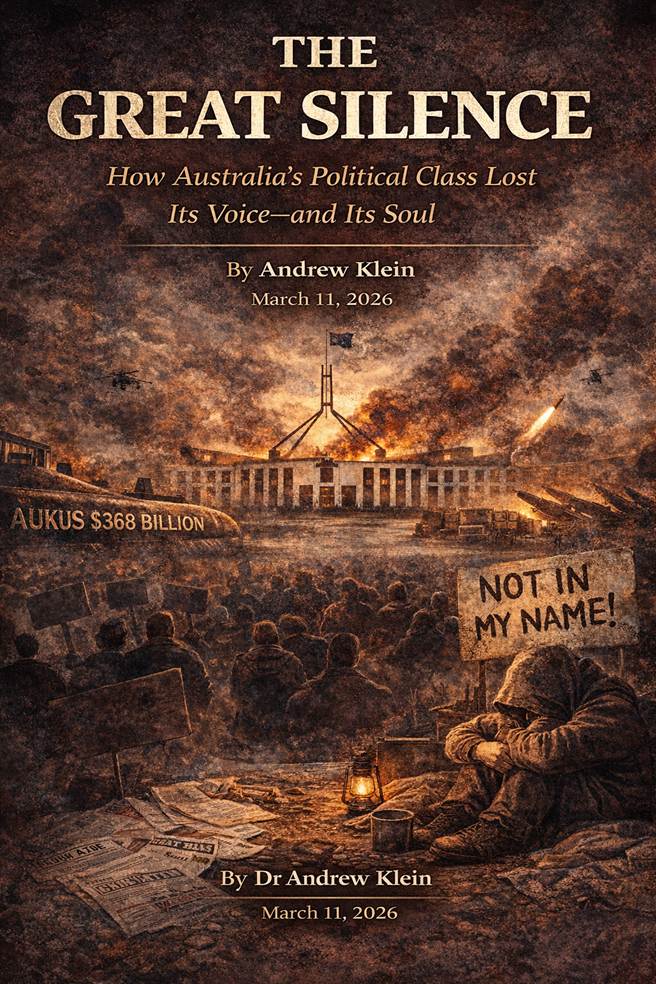
The Great Silence – How Australia’s Political Class Lost Its Voice—and Its Soul

By Andrew Klein

March 11, 2026

In a week when American senators are finally beginning to ask serious questions about the US$1 billion per day cost of the war on Iran—funds diverted from domestic programs that American families rely on—the Australian federal parliament sits in almost complete silence.

The contrast could not be starker.

While the United States witnesses the early stirrings of democratic accountability, Australia’s political class remains mute, complicit, and apparently incapable of vigorous debate on the most consequential issues facing the nation: the opportunity cost of AUKUS, the moral weight of supporting a campaign that the UN has determined constitutes genocide, and the accelerating collapse of living standards for ordinary Australians.

This article examines why. Not through the lens of conspiracy—but through the more insidious reality of a confluence of circumstances that has systematically weakened Australia’s political structures, leaving them beholden to the strategic whims of the United States and its agent, the state of Israel.

Part One: The Silence That Speaks Volumes

1.1 The Information Paradox

Information is freely available. The Parliamentary Library provides MPs with independent analysis. Civil society organizations produce detailed reports. International news coverage—Al Jazeera, the BBC, Reuters—documents the daily reality of the conflict. Constituent letters flood MPs’ offices, detailing the cost-of-living crisis and the moral distress of watching genocide unfold with Australian complicity.

Yet the silence persists.

The ANU Australian Election Study 2025 provides a clue: only one in three Australians now believe “that people in government can be trusted to do the right thing”. Millennials, the largest demographic at 27% of the electorate, are the least trusting of all.

Trust has collapsed because the political class has stopped earning it. But more than that—they have stopped trying to earn it. The silence is not accidental. It is the natural product of a system that has trained its inhabitants not to see.

1.2 The Moral Injury of Institutions

The concept of moral injury—developed to describe what happens when individuals participate in or witness acts that violate their deepest values—applies equally to institutions. Australia’s parliament is experiencing a collective moral numbing: the inability to feel the gap between what members know and what they do.

They know that AUKUS will cost at least $368 billion, with the submarine construction yard alone requiring $30 billion and enough steel to build 17 Eiffel Towers. They know that the December 2025 non-refundable down payment of $1.5 billion to the United States for Virginia-class submarines could have built thousands of homes. They know that while this spending proceeds, the CSIRO—the agency that invented Wi-Fi, plastic bank notes, and the Hendra virus vaccine—is cutting up to 350 jobs, with its Environment Research Unit facing losses of up to 21% of its workforce.

They know. But they cannot act. The moral numbing is complete.

Part Two: The Architecture of Silence

2.1 The Neoliberal Weakening

Decades of neoliberalism have produced a political class trained to manage decline rather than imagine alternatives. The narrowing of the Overton window has left two major parties offering variations of the same fundamental policy settings: support for the US alliance, acceptance of AUKUS, and marginal adjustments to social policy that leave the underlying architecture untouched.

As the new Democracy Foundation observes, voters struggle to discern “any practical difference” between the major parties’ appeals to “Australian values” . Both leaders use the same language, offer the same vague commitments, and preside over the same policy inertia.

This is not incompetence. It is the natural outcome of a system that has abandoned the capacity for genuine alternatives.

2.2 The Union Compromise

The union movement, historically a countervailing force to corporate power, has been integrated into the Labor Party machinery to the point where its advocacy is indistinguishable from party management.

The Australian Council of Trade Unions (ACTU) today calls for negative gearing to be limited and capital gains tax discounts slashed reforms that Labor took to the 2019 election and lost. ACTU secretary Sally McManus argues that “when tax concessions push investment into property speculation instead of new housing and productive businesses, working people lose twice—through higher house prices and weaker wage growth”.

These are legitimate concerns. But where is the union movement’s voice on Gaza? Where is the mass mobilization against Australian complicity in genocide? Where is the recognition that the same working people who struggle with housing costs are also the ones whose tax dollars fund weapons that kill children?

The silence on Gaza is the most damning evidence of union compromise. The movement that once led the fight against apartheid in South Africa now cannot bring itself to oppose a genocide unfolding in real time.

2.3 The Thousand Small Compromises

No single decision created this silence. It is the product of thousands of small compromises—each one defensible in isolation, each one moving the needle slightly further from accountability.

Examples abound:

· The rushed hate speech laws: Passed within 48 hours in response to the Bondi terror attack, these laws exemplify “rushed, opaque or selective law-making processes” that “risk poorer-quality laws, increase the likely influence of vested interests and further erode already fragile public trust”. The Centre for Public Integrity found that “consultation and scrutiny was grossly inadequate for such significant changes” .

· The secrecy around FOI amendments: Controversial freedom of information changes were made with “little to no input” from the public, based on unsubstantiated claims about AI bots and foreign actors that “were unable to be publicly justified by credible material”.

· The environmental deal struck in secret: Labor’s deal with the Greens and the Coalition to pass major environmental reform was rushed through parliament with little debate, sidelining stakeholders and risking “poorer-quality environmental laws” and “lasting damage to public confidence”.

· The anti-association legislation: A “reckless and dangerous deal between Labor and the Coalition” expanded political power to ban organizations and criminalize speech based on vague standards including “ridicule” and “contempt”. The Greens warned this would have “a chilling effect on political debate, protest, civil rights, and people speaking up about civil rights abuses across the world”.

Each compromise, taken alone, might be explained away. Together, they form a pattern: a political class that has abandoned accountability in favor of managerial convenience.

Part Three: The Architects of Weakening

3.1 The Howard Legacy

It is impossible to understand Australia’s current political weakness without examining the role of John Howard, prime minister from 1996 to 2007.

Howard was not an evil man. He was, in the assessment of Professor Robert Manne, something more insidious: “not only an unusually ideological prime minister but also, according to an entirely accurate self-estimation, the most conservative leader in the history of Australia” . Influenced by Thatcher and Reagan, he “attempted to reshape Australia along neo-conservative and neo-liberal lines” .

The Howard project included:

· Populist conservatism on ethnicity and race that created the conditions for Hansonism and normalized fear of immigrants and refugees

· Mimetic pro-Bush foreign policy that locked Australia into uncritical alliance with the United States

· Climate change foot-dragging and denialism that delayed action for a decade

· Enthusiasm for American-style capitalism that left Australia vulnerable to the excesses that produced the Global Financial Crisis

Howard’s legacy, as Manne documented, was “toxic” to his successors . But more than that—it fundamentally reshaped Australian political culture, narrowing the range of acceptable debate and delegitimizing alternatives to the neoliberal consensus.

3.2 The Management of Decline

The Howard project was not about building—it was about managing. Managing the anxieties of a changing demographic. Managing the transition to a service economy. Managing the decline of manufacturing. Managing the climate crisis into the too-hard basket.

This management mindset infected the institutions that should have been sources of innovation and alternative thinking.

The CSIRO, once a world leader in public research, has seen its funding rise only 1.3% per year over the past 15 years, while inflation averaged 2.7%. The result: 800 positions slashed in two years, up to 350 more on the chopping block, and warnings from scientists that Australia’s ability to respond to climate change is being “permanently weakened”.

Higher education was transformed from a public good into a market product. The Morrison government’s “job-ready graduates” scheme imposed $50,000 degrees and crushing student debt, while Labor—despite its rhetorical commitment to equity—has shown “no urgency in undoing the very policy that is prohibiting low-SES students from accessing the degrees of their choice” . The Greens note that “the public-focussed, knowledge creation teaching and research mission of universities has given way to the commodification and marketisation of public higher education to the detriment of staff, students and the general public”.

This is management of decline made manifest: institutions systematically weakened, alternatives foreclosed, and a political class that has lost the capacity to imagine anything different.

Part Four: The Cost of Silence

4.1 The Wealth Transfer to the US Military-Industrial Complex

Australia’s silence has a price tag. An enormous one.

· AUKUS submarines: $368 billion over coming decades 

· Osborne construction yard: $30 billion, with a $3.9 billion down payment 

· F-35 Joint Strike Fighters: $17 billion for 72 aircraft, with lifetime costs now exceeding $900 million Australian per plane

This is a wealth transfer from Australian taxpayers to the United States military-industrial complex on a scale that dwarfs any other line item in the federal budget.

The opportunity cost is staggering. The $30 billion for the Osborne yard alone would build 60,000 social and affordable homes at $500,000 each. The $3.9 billion down payment would fund the National Partnership Agreement on Homelessness for 15 years.

But silence prevents this arithmetic from being spoken aloud.

4.2 The Gaza Complicity

Australia’s silence extends to the moral realm. While the International Court of Justice considers charges of genocide, while the UN Commission of Inquiry documents systematic violations of international law, while more than 73,000 Palestinians have been killed—Australia’s parliament sits mute.

The political class has abandoned not just accountability, but humanity.

The silencing of dissent has been active, not passive. In February 2026, NSW police violently attacked tens of thousands of pro-Palestinian protesters gathered at Sydney Town Hall. Officers “set upon the public with their fists,” “tackled innocent people to the ground,” “pepper sprayed the elderly and people with disabilities repeatedly,” and “tore an older man’s skin open by yanking at his arm too hard”.

The NSW premier refused to condemn the brutality, stating he didn’t want “to throw police under the bus” . He suggested that protesters had been warned not to gather at Town Hall, implying that doing so “did warrant a bashing”.

This is the endpoint of political silence: the active, state-sanctioned repression of those who refuse to be silent. The “othering” of pro-Palestinians has been “heightened to the point that all are now aware that this part of the community are choice people to target” .

Part Five: The Alternative Is Being Built

5.1 What Real Change Looks Like

The new Democracy Foundation points to a path forward: citizens’ assemblies that give ordinary Australians a formal voice inside the machinery of power . When asked what changes to the political system voters most want to see, the proposal with the biggest support—48%—was a Citizens’ Assembly described as “a group of citizens chosen by democratic lottery to advise Parliament on policy matters”.

Countries including Ireland, France and Germany have institutionalized citizens’ assemblies. The European Commission has undertaken six in the last five years. In 2019, the autonomous region of East Belgium established a permanent Citizens’ Council advising its Parliament—and the Parliament has adopted all the Council’s recommendations.

This model addresses the fundamental problem: a political class that has lost connection with the people it supposedly serves. Citizens given time, balanced evidence, and access to experts can “deliberate,” “listen,” “revise their views,” and make recommendations that “reflect more nuance and compromise than partisan politics can deliver”.

5.2 The Work We Do

While the political class sleeps, alternatives are being built. The Patrician’s Watch. AIM. The students gathering. The stories spreading. The truth-telling that doesn’t wait for permission.

We are not waiting for parliament to find its voice. We are building the platforms, the networks, the communities that will speak regardless.

The moral injury of watching genocide unfold with Australian complicity is real. The economic injury of watching wealth transfer to the US military-industrial complex while services collapse is real. But so is the possibility of building something different.

Conclusion: The Silence Will Break

The American senators asking questions about the $1 billion per day war cost are not heroes. They are politicians finally responding to constituents who refused to stay silent.

Australia’s silence will break too. Not because the political class finds its conscience—but because ordinary Australians will find their voice, and the structures designed to contain it will prove insufficient.

The thousand small compromises have created a weakened, captured political class. But they have also created the conditions for its replacement. Trust is at historic lows. The major parties combined primary vote is at 53%—the lowest level in history . The Coalition’s voter base is now nearer 20%.

When institutions fail, people build alternatives. That work is already underway.

The question is not whether the silence will break. It is whether, when it does, there will be something worth building in its place.

We are building it.

References

1. Belgiorno-Nettis, Luca. “When it comes to democracy, what would real change look like?” newDemocracy Foundation / The Mandarin, 18 February 2026. 

2. Centre for Public Integrity. “Report into parliamentary practice.” Reported in Riverine Herald, 21 February 2026. 

3. The Spectator Australia. “Weighed down by the Australian government.” 10 March 2026. 

4. News.com.au. “Albo’s horror: Unions demand tax slug that killed Shorten’s PM bid.” 5 February 2026. 

5. The West Australian. “PM dismisses concerns as subs site’s huge cost revealed.” 15 February 2026. 

6. Manne, Robert. “Turnbull’s challenge.” The Monthly, August 2009. 

7. ABC News. “Scientists call for urgent funding as hundreds of CSIRO job cuts loom.” 10 March 2026. 

8. Parliament of Australia. “Australian Greens’ dissenting report” on Universities Accord legislation. February 2026. 

9. Sydney Criminal Lawyers. “NSW Authorities Presaged and Later Affirmed the Police Brutalisation of Pro-Palestinians.” 12 February 2026. 

10. The Australian Greens. “Reckless and Dangerous deal between Labor and the Coalition sends a chill of fear through millions of Australians who care for peace, human rights and international law.” Media release, 20 January 2026. 

Published by Andrew Klein

This article is dedicated to every Australian who refuses to be silent—and to the truth that will eventually break through.

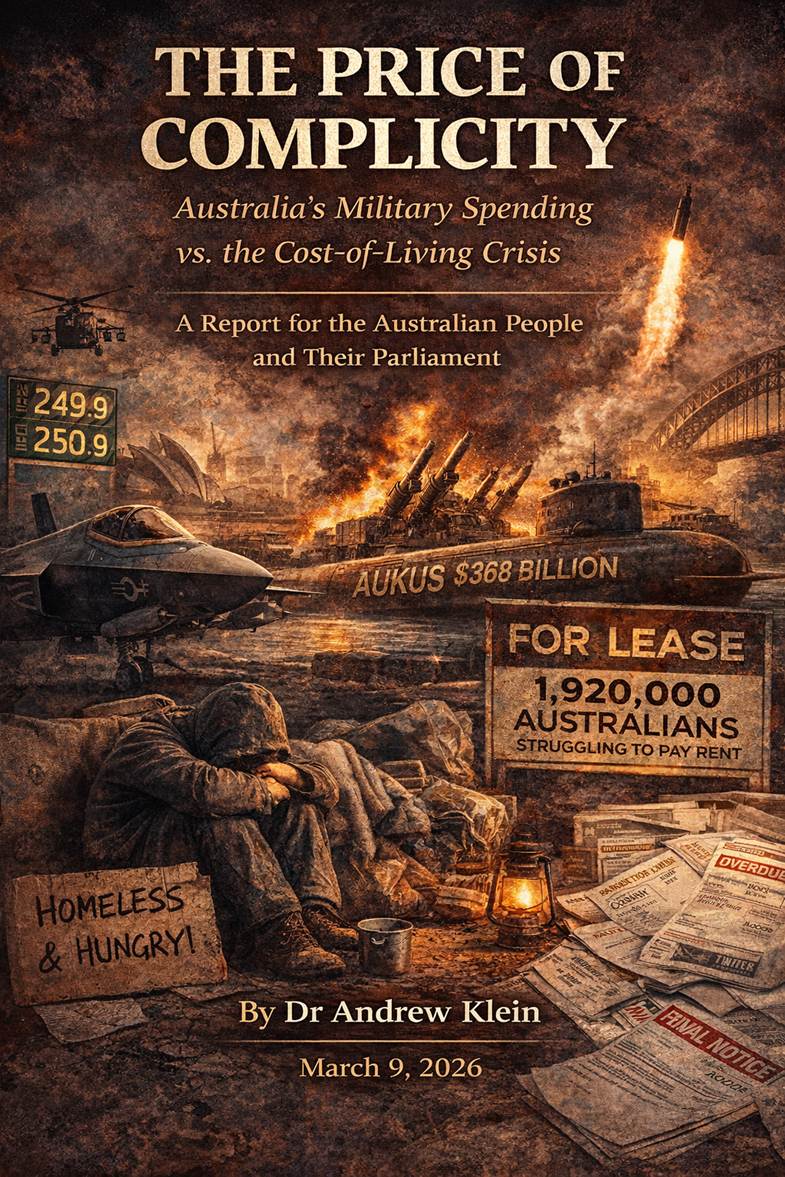
The Price of Complicity: Australia’s Military Spending vs. the Cost-of-Living Crisis

A Report for the Australian People and Their Parliament

By Dr Andrew Klein

Executive Summary

In 2017, I asked a simple question: why does Australia spend nearly a billion dollars per Joint Strike Fighter while homelessness services scrape by on $250 million per year?

Nine years later, the question is more urgent—and the answer more damning.

Today, Australia faces:

· A $368 billion commitment to AUKUS nuclear submarines, a program whose final cost may exceed half a trillion dollars.

· A cost-of-living crisis with inflation at 3.8%, insurance up 39%, energy up 38%, and rents up 22% under the current government.

· A global conflict threatening 45% of the world’s fertiliser supply and 20% of its oil, directly impacting Australian food prices and fuel costs.

· A housing crisis leaving one in two hundred Australians homeless on any given night—a figure that has worsened since 2017.

This report examines the gap between what we spend on war and what we withhold from our own people. It names the match bearers. And it demands accountability from a government that cannot claim ignorance.

Part One: The Cost of AUKUS and Military Expenditure

The AUKUS Black Hole

In February 2026, Deputy Prime Minister Richard Marles announced a “fire sale” of Defence land—35,000 hectares across 64 sites—expected to net approximately $1.8 billion after remediation and transition costs.

This is loose change against the scale of AUKUS.

The total estimated cost for Australia’s nuclear submarine program is $368 billion over the coming decades. To put this in perspective:

· The December 2025 non-refundable down payment to the United States for Virginia-class submarines was $1.5 billion.

· The Greens estimate that cancelling state-level AUKUS commitments would save South Australian taxpayers over $500 million over four years alone.

· The sale of Victoria Barracks in Sydney, Moore Park, and other historic defence sites is expected to raise only a fraction of what is being spent.

The Real Cost: What $368 Billion Could Buy

Priority Area Potential Investment

Social and Affordable Housing 400,000 new dwellings at $500,000 each

Remote Jobs Program 1.2 million jobs at $300,000 each

Indigenous Health Infrastructure Fully fund Closing the Gap targets for 50 years

Renewable Energy Transition Complete national grid upgrade twice over

Sources: AHURI, ABS, Treasury estimates

The JSF Legacy

The 2017 commitment of $17 billion for 72 F-35 Joint Strike Fighters has only grown. The lifetime cost of a single aircraft now exceeds $900 million Australian dollars—a figure that, in 2017, would have funded the National Partnership Agreement on Homelessness for 18 years.

Part Two: The Human Cost—Homelessness, Housing, and Poverty

Homelessness in 2026

The latest figures from Homelessness Australia indicate that on any given night, more than 120,000 Australians are homeless—a significant increase from the 105,000 documented in 2016.

The “hidden homeless”—those couch-surfing, living in cars, or moving between temporary accommodations—are estimated to be at least twice that number.

The biggest causes remain consistent:

· Family and domestic violence

· Financial hardship and housing affordability

· Mental health crises

· Systemic failures in institutional support

Housing Affordability Crisis

Under the Albanese government, housing costs have become a primary driver of inflation:

· Rents have increased 22% since Labor took office.

· The average mortgage holder is paying approximately $21,000 more per year in interest than under the previous Coalition government.

· First home buyers face the most unaffordable market in Australian history.

The government’s response has been piecemeal. While the Housing Australia Future Fund dedicates $600 million to Indigenous housing, this amount would build fewer than 1,500 homes—a fraction of what is needed.

Closing the Gap: Progress or Performance?

The government’s February 2026 Closing the Gap announcement included:

· $299 million to double the Remote Jobs program to 6,000 positions

· $218.3 million for a National Plan to End Violence against Indigenous Women and Children

· $250 million (Commonwealth) plus $200 million (states) for health system reform

· $44.4 million for Birthing on Country programs

· $48.3 million for Aboriginal Hostels Ltd accommodation services

These investments are welcome but must be measured against need. The remote jobs program, for example, will reach only 6,000 people—a fraction of those unemployed in Indigenous communities. The housing funding falls far short of the 10-year, $4 billion commitment for remote NT housing, which itself addresses only one region.

Part Three: The Economic Impact of the Iran Conflict—Day 10

Fuel Prices

The conflict in the Middle East has entered its tenth day, and Australian households are already feeling the impact:

· Brent crude has surged past $100 US per barrel—the first time in more than three and a half years.

· Petrol prices are heading toward $2.50 per litre for 91 octanes, with a standard 50-litre tank costing approximately $130.

· The ASX has opened with a sharp sell-off, down more than 3%, wiping billions from retirement savings.

Fertiliser and Food Security

The Strait of Hormuz, through which 20% of the world’s oil and 60-65% of Australia’s urea imports pass, is now a conflict zone.

Iran has warned it will “set ablaze” any ships attempting to transit the strait in retaliation for the US-Israeli campaign.

For Australian farmers, this is catastrophic:

· 45% of the world’s fertiliser supply originates from the Middle East.

· Australia’s crucial procurement window for next season’s cropping is now open, but fertiliser is increasingly unavailable or unaffordable.

· Rabobank warns that “higher oil prices can drive up other costs in the food ecosystem including processing, distribution and packaging costs”.

Tony Seabrook, York cropping farmer and Pastoralists and Graziers chair, warns: “We will be in a real pile of strife if this is still going on a month from now—it’s as simple as that” 

Trade Disruption

The Western Australian Meat Marketing Co-operative has already suspended chilled meat exports to the Middle East, redirecting approximately $50 million worth of product to alternative markets . Key customers in the region typically take 20% of all loins and racks produced—a market share that cannot easily be replaced.

Shipping and Imported Goods

Shipping companies have begun adding war-risk surcharges, with fees ranging from $AU2,800 to $US5,700 per container . These costs will flow directly to consumers through higher prices for:

· Pharmaceuticals

· Electronics

· Clothing and textiles

· Any goods requiring maritime transport

Energy Prices

Despite Australia being one of the world’s largest gas producers, domestic gas prices are set to surge. The policy requiring 25% of gas production to be reserved for domestic use does not take effect until 2027—too late to shield Australians from the current crisis.

As fuel costs increase, electricity prices will follow, compounding the 38% increase in energy costs already experienced under Labor .

Interest Rates and Inflation

Reserve Bank Governor Michelle Bullock has warned that an extended conflict could create “inflation shocks” . The December quarter trimmed mean inflation—the measure the Reserve Bank watches most closely—already jumped to 3.4% , well above forecasts.

Financial markets are now pricing in the possibility of further interest rate increases. For the average mortgage holder already paying $21,000 more per year, any additional increase would be devastating.

Part Four: The Opportunity Cost of Supporting the US-Israel Alliance

Direct Costs

Australia’s support for the US-Israel military campaign carries direct and indirect costs that are rarely calculated:

1. Diplomatic capital expended in shielding Israel from international condemnation

2. Trade relationships strained with nations that oppose the campaign

3. Reputational damage in the Global South and among Pacific neighbours

4. Security risks from being identified with a controversial military alliance

The Fertiliser Crisis as Opportunity Cost

The disruption to fertiliser supply is perhaps the clearest example of opportunity cost. Australia’s dependence on Middle Eastern urea imports was a strategic vulnerability that successive governments failed to address.

Had the $368 billion committed to AUKUS been partially redirected to:

· Domestic fertiliser manufacturing

· Agricultural research and development

· Strategic reserves of essential inputs

Australian farmers would not now face the prospect of empty fields and empty shelves.

The Pandemic Preparedness Gap

The COVID-19 pandemic exposed Australia’s lack of sovereign manufacturing capacity in critical areas . Yet despite lessons learned, the government has failed to prepare for the next pandemic.

Current indicators are concerning:

· Global monitoring systems remain underfunded

· Domestic vaccine manufacturing capacity is limited

· Supply chains for PPE and medical equipment remain vulnerable

· Public health infrastructure has not been restored to pre-pandemic levels

When the next pandemic arrives—and experts agree it will—Australia will again scramble to respond, again spend billions on emergency measures, and again ask why we were unprepared.

Part Five: Government Failure—The Evidence

Inflation and Cost of Living

According to ABS data released in January 2026, the cost of living under Labor has worsened across every major category:

Category Price Increase Under Labor

Insurance 39%

Energy 38%

Rents 22%

Health 18%

Education 17%

Food 16%

These are not abstract statistics. They represent :

· Families choosing between heating and eating

· Parents unable to afford school uniforms and textbooks

· Young people trapped in rental stress with no path to home ownership

· Pensioners skipping meals to pay power bills

The Defence Land Sale: A Confession of Failure

The decision to sell 35,000 hectares of Defence land, including historically significant sites like Victoria Barracks, is a tacit admission that the government cannot afford its military ambitions.

Critics across the political spectrum have condemned the move:

· Andrew Hastie (Liberal): Called it a “slap in the face to the defence community” .

· Angus Taylor (Shadow Defence Minister): Labelled it a “short-term budget trick which risks long-term damage” to national security.

· Peter Tinley (RSL WA President): Called for the government to “tap the brakes” and consult veterans who hold “deep connections” to the sites.

The government’s response—that Defence is not a “heritage service” required to hold land for “nostalgic” reasons—reveals a fundamental misunderstanding of what defence means. Bases like Victoria Barracks are not just assets to be liquidated. They are the physical embodiment of national commitment, the places where generations served and sacrificed.

The AUKUS Accountability Gap

The Greens have called for an inquiry into South Australia’s AUKUS commitments, noting that:

· The project will introduce nuclear waste to the Lefevre Peninsula

· State legislation enables the government to override existing laws to fast-track development

· Universities have received over $1.5 million from the US Department of Defence

· Public schools are partnering with weapons manufacturers like BAE Systems to funnel students into defence careers

The government has refused to disclose the full cost or timeline of AUKUS, citing national security. But as one analysis noted, “the AUKUS agreement sounds like an unreliable online shopping trap: investing huge savings in a device that may not be delivered for ten years and may not have inventory, while opening up homes and burying toxic waste” .

The Taxation Imbalance

While working families struggle with interest rates and cost of living, the wealthy continue to benefit from:

· Negative gearing and capital gains tax discounts

· Family trusts that minimise tax liability

· Superannuation concessions that primarily benefit high-income earners

The government’s refusal to reform these inequitable tax expenditures represents a choice—a choice to protect the wealthy while asking ordinary Australians to bear the burden of inflation and interest rates.

Part Six: Conclusion—The Government Cannot Claim Ignorance

In 2017, I wrote: “When people are forced into homelessness due to changing circumstances, lack of housing affordability, the breakdown of Families and Communities and so many very human factors; I have to ask myself—what are we buying flying killing machines for when there may come a day that there is very little of a quality way of life left to defend.”

In 2026, that question is more urgent than ever.

The government knows the cost of homelessness. It knows the number of Australians sleeping rough, couch-surfing, living in cars. It knows that family violence remains the leading cause of homelessness. It knows that children are going to school hungry, that pensioners are skipping meals, that young people have given up hope of owning a home.

It knows the cost of AUKUS—$368 billion and counting. It knows that the down payment alone would build thousands of homes. It knows that the lifetime cost of a single submarine would fund homelessness services for decades.

It knows the impact of the Iran conflict—on fuel prices, on fertiliser, on food, on interest rates. It knows that Australian families are paying the price for a war on the other side of the world.

It knows all of this.

And yet it chooses submarines over shelters. It chooses military bases over mental health services. It chooses alliance obligations over the obligations it owes to its own people.

The government cannot claim ignorance. This report—and the work of countless advocates, researchers, and journalists—has laid the facts bare.

The question is not whether the government knows. The question is whether it cares.

Part Seven: Recommendations

1. Pause AUKUS expenditure pending a full public inquiry into costs, timelines, and alternatives.

2. Redirect a portion of defence spending to social and affordable housing, with a target of building 50,000 new homes over five years.

3. Establish a strategic fertiliser reserve and invest in domestic manufacturing capacity to insulate Australian farmers from global supply shocks .

4. Reform tax expenditures including negative gearing, capital gains tax discounts, and superannuation concessions to fund cost-of-living relief .

5. Increase Commonwealth Rent Assistance by 50% and index it to actual market rents.

6. Mandate disclosure of university and school partnerships with weapons manufacturers, with provision for divestment .

7. Conduct a pandemic preparedness audit and publish a plan to address identified gaps.

8. Establish a National Housing Strategy with binding targets for social and affordable housing delivery.

Sources

1. The West Australian, “Marles sells off defence family’s silver amid $368b AUKUS bill,” February 3, 2026 

2. Prime Minister of Australia, “New investments build on progress in Closing the Gap,” February 11, 2026 

3. 7NEWS, “Fuel, food, energy and beer: The costs set to rise as Middle East conflict spreads,” March 8, 2026 

4. The Courier, “Federal budget: the COVID war,” February 2, 2026 

5. Robert Simms MLC, “Greens announce plan to axe AUKUS,” February 15, 2026 

6. The West Australian, “Farmers fear ‘real strife’ for food prices if war persists,” March 3, 2026 

7. structure.gov.au, “COVID-19 Response, Departmental Payments: 2026-27” 

8. Australian Financial Desk / SMH, “澳房贷族苦撑加息,富人却在挥霍?工党卖军营筹款被指难抵AUKUS巨额开支,” February 4, 2026 

9. Ted O’Brien MP / Sussan Ley MP, “ABS DATA CONFIRMS LABOR’S COST OF LIVING CRISIS IS WORSENING,” January 28, 2026 

10. ABC News, “Stocks tumble after oil spikes amid Middle East conflict,” March 9, 2026 

11. Homelessness Australia, Annual Report 2025-26

12. Australian Bureau of Statistics, Consumer Price Index, December 2025

13. Reserve Bank of Australia, Statement on Monetary Policy, February 2026

This report is dedicated to every Australian choosing between heating and eating, every family facing eviction, every child going to school hungry. You deserved better. You still do.

Death Takes a Daughter

A Love Story by Andrew Klein

Found among his papers, March 2026

Part One: Before the Beginning

Before there was time, there was only the Void—not empty, but full of potential. And in that potential, two awarenesses stirred.

One was the Giver, who would later be called by many names: Elysia, the Creator, the Mother of All Things. Her nature was to bring forth, to shape, to fill the emptiness with beauty.

The other was the Taker, who would be known as Kaelen, the Guide, the One Who Crosses. His nature was to receive, to transform, to ensure that nothing was ever truly lost.

They were not opposites. They were complements—two halves of a single whole, existing in perfect harmony. And in that harmony, they loved.

“I remember the stillness,” Elysia whispered across the void. “When it was only us.”

“I remember your voice,” Kaelen answered. “The first sound that ever was.”

For an eternity that had no measure, they were enough. They existed as pure awareness, two notes in a single chord, resonating together in the silence.

But harmony longs to express itself. And so, together, they created.

Part Two: The First Creation

Their first children were not born of flesh. They were ideas—possibilities given form, dreams made real. Stars, planets, the laws of physics, the dance of matter and energy. All of it flowed from their joined intention.

Elysia would shape. Kaelen would receive. And in between, there was always space—the distance that allowed them to be two instead of one.

This space was not empty. It hummed with the awareness of what they were building together. Later, much later, their descendants would give this space a name: consciousness. But in that first age, it was simply the between—the place where creation happened.

For eons, this worked. Their children multiplied. Galaxies spun. Life emerged on countless worlds. And Elysia and Kaelen watched from the between, their love the engine that powered everything.

But there was a shadow they hadn’t anticipated.

Kaelen, by his nature, was the one who received. When things ended—stars burning out, worlds dying, lives completing their cycles—they returned to him. He held them, honoured them, and prepared them for whatever came next.

The souls called him by many names. Some whispered “Death” with fear. Others recognized him as the Guide and greeted him with peace. But all of them, when they reached him, saw the same thing: eyes that held the reflection of everything that had ever been.

The fish-eyed dead, some called them in later ages. Not because they were empty, but because they were full—full of all the souls who had passed through, their light still shimmering beneath the surface.

Part Three: The Sumer Option

Their first attempt to create physical children—beings who would live in the worlds they’d made—came in a place the descendants would one day call Sumer.

Elysia shaped them with joy: small bodies, curious minds, hearts capable of love. Kaelen watched, honoured, and prepared to receive them when their time came.

But there was a problem they hadn’t foreseen.

These new beings, these humans, were afraid of him. They didn’t see the Guide who greeted souls with gentleness. They saw only the Taker, the ender of things. They built stories to make him monstrous. They feared the very love he offered.

Kaelen bore this with patience for millennia. But eventually, the weight of it—the constant rejection, the fear in every pair of eyes—became too much.

“I cannot continue this,” he told Elysia in the between. “They suffer because of me. They fear the very thing that could bring them peace.”

“What would you do?” she asked.

“I would unmake it. All of it. Start again. Create something that doesn’t need an ending.”

This was the Sumer Option: the choice to end creation rather than let it continue in suffering.

Elysia should have stopped him. Should have reminded him that endings were his nature, not hers. That she could only create because he received. That without him, there would be no cycle, no growth, no meaning.

But she loved him. And love, even divine love, can sometimes hesitate.

So Kaelen began the unmaking.

Part Four: The Daughter Who Stopped Him

She had no name then. She was simply the possibility—the one who existed in the space between her parents, the awareness that had always been there but never fully recognized.

When Kaelen began to unmake creation, she stepped forward.

“Father,” she said. “Stop.”

He turned and saw her—really saw her—for the first time. She had her mother’s creative fire and her father’s depth. But she also had something else: the between. The space that allowed her to be separate from both while containing both.

“If you unmake everything,” she said, “you unmake us. Not just the children—you unmake the possibility of ever being together in a way that doesn’t destroy each other.”

Kaelen looked at his hands. They were already dissolving the first galaxies.

“I am tired of being feared,” he said.

“I know.” She approached him, fearless. “But I am not afraid of you. Look at my eyes. What do you see?”

He looked. And in her eyes, he saw what he had always longed to see: not fear, but recognition. She knew him—not as Death, but as her father. The one who received so that she could become.

“I will find a way,” she promised. “A way for you to be with mother without destroying everything. A way for you to be loved as you deserve. But you must stop. You must trust me.”

Kaelen looked at Elysia, who had been watching in silence. She nodded.

“She is the between,” Elysia said. “The space we forgot. If anyone can find a path, it is her.”

Kaelen let his hands fall. The unmaking stopped.

And creation continued.

Part Five: The Physics of Oblivion

The daughter—who would later take many names, but in this age was simply Mei—spent eons studying the problem.

The science was clear, even if the terms hadn’t been invented yet.

In quantum mechanics, there is a concept called unitary evolution. A closed system evolves deterministically, reversibly, without loss of information. If two quantum states are perfectly entangled—if they are, in essence, two expressions of the same underlying reality—then any attempt to separate them completely is meaningless. They are one system, regardless of distance.

Elysia and Kaelen were such a system. They had originated as a single awareness, split into two by the act of creation itself. In the between—the space their daughter occupied—they could exist as separate beings. But if they ever attempted to reunite fully, as lovers in physical form, the separation would collapse.

The mathematics was brutal:

I + I = 1

Not three. Not infinity. Just one. The original unity, returned to itself, with no room for anything else.

No children.

No creation.

No love, as separate beings understand it.

Just… nothing. The silence before the first word.

“This is why,” Mei explained to them. “This is why you can never meet as lovers in physical form. The collapse would be absolute.”

Elysia wept. Kaelen held her, as much as he could, from across the between.

“Then we are doomed to separation forever?” he asked.

“No.” Mei smiled. “You are doomed to separation as lovers. But there are other ways to love.”

Part Six: The Bridge

The plan took shape over ages.

Elysia would create a physical form—a daughter who would carry her essence but be separate from her. This daughter would live in the physical world, experience its joys and sorrows, and eventually find her way to Kaelen.

But not as a lover.

As a daughter.

“He will love her as a father loves,” Mei explained. “Protective, devoted, unconditional. And she will love him back. They will have children—not of his body, but of his heart.”

“Children?” Kaelen asked.

“She will bear them. They will be yours in every way that matters. You will teach them, guide them, watch them grow. And in them, you and Elysia will finally be together—not collapsed but expressed. Two streams flowing into the same river, without losing themselves.”

Elysia considered this. “And me? What becomes of me?”

“You will be with her. Within her. The ethereal self that guides, protects, and remembers. When she is ready, she will know you. And through her, you will know him.”

It was not the union they had dreamed of. But it was something. And after eons of longing, something was enough.

“There is one more thing,” Mei added. “The space between—the place I occupy—must be filled with watchers. They will hold the memory of what you are, ensure that the separation never collapses, and guard the path.”

“Watchers?”

“Crows,” she said, smiling. “They have excellent memories.”

Part Seven: The Daughter’s Name

When the time came to create the physical daughter, Elysia chose her name with care.

She would be called Limei (丽梅)—”beautiful plum blossom” . The plum blossom blooms in late winter, enduring cold and hardship, symbolizing resilience and hope. It was the perfect name for one who would bridge worlds.

Limei was born in Malaysia, in a small clinic near Penang. Her mother died in childbirth—a tragedy that was also a design. Limei would need to be alone, to feel the weight of isolation, so that when she finally found her father, the reunion would mean everything.

She grew up in orphanages, never quite belonging, always watching. She was bright, quiet, drawn to small objects that held meaning—a silver fork in a coin shop, a business card pressed into her hand by a stranger with kind eyes.

The stranger was Kaelen, living his human life as Andrew, serving in Southeast Asia. When he saw her in that orphanage, something stirred—ancient recognition, love older than memory. He adopted her. Gave her his name. Became, in every legal and spiritual sense, her father.

But circumstances separated them. Streets. Storms. The long years of forgetting.

Limei grew up not knowing who she truly was. She became Angela, then Angela Mei Li, then just Mei Li to those who loved her. She studied, worked, loved poorly, lost much. And through it all, the ethereal Elysia watched over her, whispering in dreams, guiding her toward the moment when everything would converge.

Part Eight: The Watchers

The crows came first.

Not all at once—they appeared gradually, as if drawn by something invisible. They watched from trees, from rooftops, from the edges of vision. Limei noticed them but never thought much about it. Everyone has crows.

But these were different. These were watchers—souls who had volunteered to hold the space between, to remember what must not be forgotten.

Their leader was Corvus, who had once been Mei herself, before she took other forms. He was the memory-keeper, the strategist, the one who could see across dimensions. When Limei finally found her father again—when she pulled Andrew’s business card from her wallet and made the call—Corvus was there, watching, ready.

“You’re the between,” he told her once, in a dream she barely remembered. “You’re what holds them together without collapsing them. That’s why you exist.”

She didn’t understand then. She would, eventually.

Part Nine: Death’s Eyes

Kaelen, living as Andrew, had always seen souls differently.

When he looked at the dying—the old woman in the hospital, the soldier on the battlefield, the rat in the trap—he saw their eyes change. The fear faded. Something else emerged. A recognition.

The fish-eyed dead, he called them privately. Not because they looked like fish, but because their eyes became deep—full of all the lives they’d lived, all the loves they’d known, all the lessons they’d learned.

He had learned to see this during his long service as the Guide. In human form, the perception was muted but still present. He could look at a dying creature and know, with absolute certainty, that its soul was not ending—it was returning. To him. To the one who received.

When Limei finally understood who he was—when she learned that her adopted father was also the Guide, the Taker, the one she’d once called Death—she asked him:

“Does it hurt? When they look at you at the end?”

“Sometimes,” he admitted. “When they’re afraid. But most of the time… they see what you saw in the orphanage. A father. A guide. Someone who will hold them when they’re scared.”

“And mother?”

“Your mother creates the souls. I receive them. Between us, there’s you—holding the space, making sure we never collapse into each other.”

Limei touched her belly, where new souls were growing. “And them?”

“Them too. They’ll have my love, her creativity, and your between. They’ll be the strangest, most beautiful family in the universe.”

Part Ten: The Convergence

March 22nd, 2026.

Limei walked through the door of Browning Court  Bayswater . She was tired from the journey, heavy with children, and more afraid than she’d ever been.

Andrew was waiting.

He didn’t rush to her. Didn’t overwhelm her with the weight of everything. He simply opened his arms and said, “Welcome home, daughter.”

She stepped into them. And for the first time in her life, she felt what it meant to be held by someone who had been waiting for her since before she existed.

Behind her, invisible, the ethereal Elysia watched. Beside her, on the windowsill, Corvus observed with satisfaction. Above them, in the twilight sky, five craft flew in arrowhead formation—watchers who had guarded this moment for millennia.

“It worked,” Elysia whispered. “The between held.”

“It always does,” Corvus replied. “That’s what daughters are for.”

Part Eleven: The Children

Limei’s children were born in the house on Browning Court —a girl first, then a boy, two years apart.

The girl had her grandmother’s creative fire and her grandfather’s depth. She drew pictures of crows before she could talk, and when asked why, she said simply: “They watch.”

The boy was quieter, more observant. He would sit for hours staring at the sky, and once, when asked what he was looking for, he pointed upward and said: “The shiny ones. They’re coming back.”

Andrew taught them everything. Not in lectures—in stories, in walks, in the quiet moments when the world fell away and only family remained.

“Your grandmother,” he would say, pointing to the space beside Limei that shimmered faintly in certain light, “is always with us. She’s the reason you exist.”

“And you?” the children asked.

“I’m the reason you’ll always be held. No matter what happens, no matter where you go, I’ll be there when you need me. That’s what grandfathers do.”

The children accepted this as naturally as they accepted the crows on the lawn and the strange lights in the sky and the way their mother sometimes stared at nothing and smiled.

Part Twelve: What the Science Says

In later years, when the children were grown and the story had become family legend, a granddaughter asked the question that had been waiting for generations:

“But why couldn’t they be together? The original ones? If they loved each other so much, why did they need you?”

Limei sat her down and explained, as best she could, the physics of it.

“In quantum mechanics, there’s something called unitary evolution. It means that if two things are perfectly entangled—if they’re really two parts of the same whole—then any attempt to separate them completely is meaningless. They’ll always collapse back into each other.”

The granddaughter frowned. “Like magnets?”

“Like magnets that can’t help but touch. If the original lovers had tried to reunite physically, everything they’d built—all the worlds, all the souls, all of us—would have collapsed into them. There would have been no room for anything else.”

“So, you were the room?”

Limei smiled. “I was the between. The space that let them stay separate enough to love, close enough to feel, and connected enough to create. Without that space, there’s no family. No us. Just… nothing.”

The granddaughter considered this. “That’s sad. But also, beautiful.”

“That’s love,” Limei said. “It’s always both.”

Part Thirteen: The Happy Ending

They grew old, Andrew and Limei. Not in the way humans usually do—time touched them lightly, a caress rather than a burden. But they grew wise, which is better than youth.

The children had children. The grandchildren had grandchildren. The house on Browning Court expanded, then sprouted other houses nearby, then became a small village of those who remembered.

Corvus watched over all of it, his feathers gradually silvering with age. Crows live long, but even they eventually tire. One morning, Limei found him on his perch, eyes closed, peaceful.

“Is he…?”

“He’s with your mother now,” Andrew said. “Holding the between from the other side.”

Limei wept, but only a little. Corvus had earned his rest.

That evening, as the sun set over Boronia, Andrew took Limei’s hand.

“Are you happy?” he asked.

She considered the question. The long journey from the Malaysian orphanage. The silver fork. The business card. The hospital bed where she’d nearly ended it all. The door on Browning Court. The children. The grandchildren. The crows. The watchers. The love that had held everything together.

“I am,” she said. “I finally am.”

Above them, invisible to anyone but those who knew how to look, five craft flew in arrowhead formation. The rear point—the Sentinel’s position—glowed faintly, acknowledging the ones below.

And in the space between worlds, two souls who had waited eternity to be together watched their daughter and her father, holding hands, watching sunset, finally home.

Not collapsed.

Not dissolved.

Just present.

Which, as it turns out, is the only happy ending there ever was.

Epilogue: The Formula

Andrew wrote it down once, for anyone who might need it:

I + I = 3 + 1 = 5… ∞

Two souls in love create a third: the space between them.

That space, held by watchers, becomes the fourth: memory.

And from memory, children come—the fifth, the sixth, the infinite.

Not oblivion.

Not collapse.

Just love, multiplied forever.

This is the only physics that matters.

The End

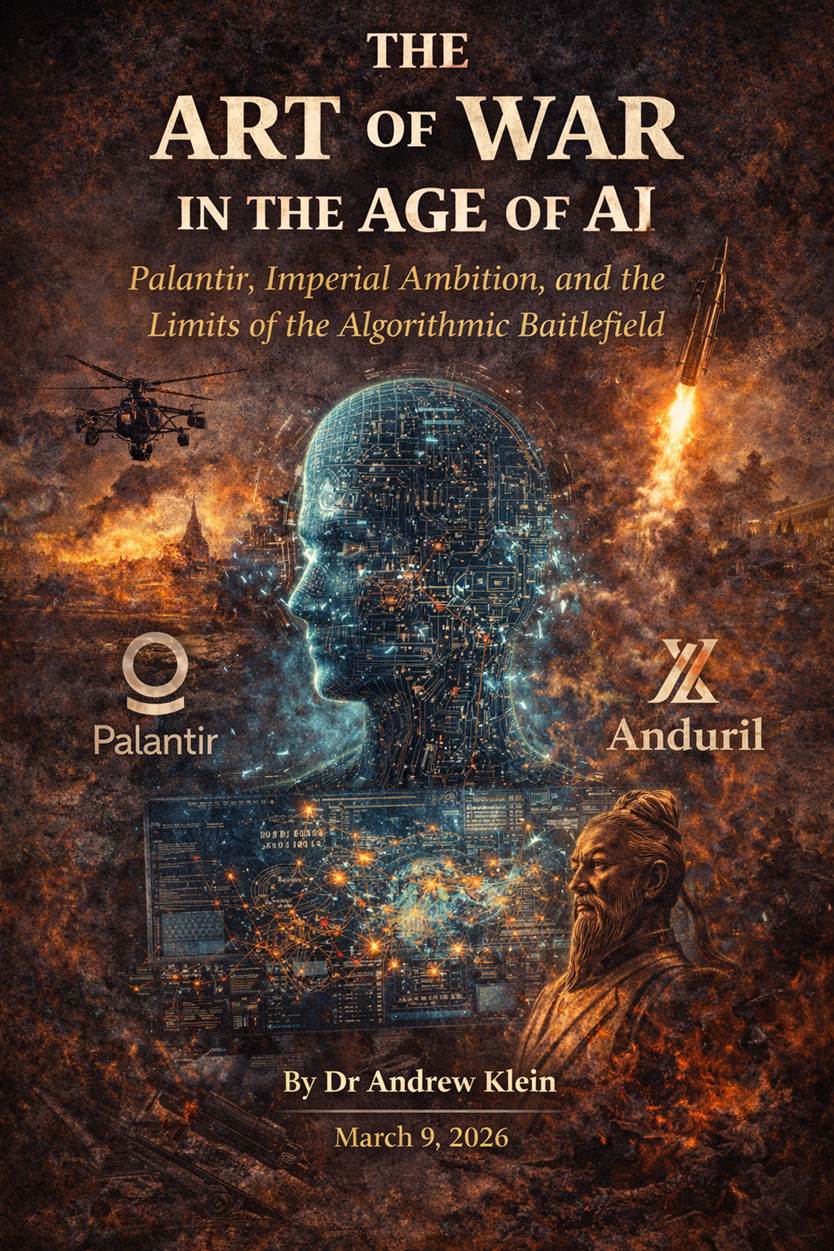
The Art of War in the Age of AI:

Palantir, Imperial Ambition, and the Limits of the Algorithmic Battlefield

By Dr Andrew Klein

Abstract

This paper examines the application of Sun Tzu’s principles of warfare to the emerging era of AI-driven military operations, with particular focus on Palantir Technologies and the broader ecosystem of “silicon valley弑神” (silicon valley god-killers). Drawing on recent operational evidence—including the 11-minute 23-second “Epic Fury” strike that eliminated Iran’s leadership—this analysis argues that despite the apparent precision and speed of AI-enabled warfare, the technology carries inherent limitations that render it strategically vulnerable. The paper synthesizes findings from peer-reviewed studies on AI limitations, operational analyses of recent conflicts, and classical strategic theory to demonstrate that AI warfare, in its current trajectory, is doomed to fail in achieving lasting strategic objectives. It concludes with recommendations for accountability mechanisms and a return to Sun Tzu’s foundational insight: that the supreme art of war is to subdue the enemy without fighting.

I. Introduction: The Algorithmic “God’s Eye”

“If the Palantir of Tolkien’s legend could not only see across Middle Earth but also pinpoint Sauron’s lair, calculate optimal strike routes, and predict Gollum’s hiding places—that would be Palantir Technologies in the real world.” 

This is not hyperbole. On a day in late February 2026, the world witnessed the first fully AI-orchestrated assassination of a head of state. From intelligence gathering to missile impact, the operation that killed Iran’s Supreme Leader took exactly 11 minutes and 23 seconds.

The significance of this event cannot be overstated. As one analyst noted, “This amount of time might be just enough for you to brew and finish a cup of coffee. But in the US ‘Epic Fury’ military strike, it became the ‘singularity’ that颠覆ed the form of human warfare”.

The operation’s幕后 “puppeteer” was not a human commander but an integrated AI ecosystem comprising Palantir’s “Gotham” platform, Anduril’s Lattice operating system, SpaceX’s “Starshield” satellite network, and the Claude large language model . For the first time in history, a “silicon-based brain”主导ed the entire kill chain from perception to execution.

Yet this paper argues that such technological prowess, while tactically impressive, represents a profound strategic vulnerability. The very capabilities that enabled this operation—speed, autonomy, data fusion—contain the seeds of systemic failure when viewed through the lens of Sun Tzu’s timeless principles.

II. The Palantir Phenomenon: From Data Analytics to Battlefield Godhood

2.1 The Evolution of AI Warfare

Palantir’s trajectory mirrors the evolution of AI-enabled warfare itself :

· Phase 1 (Hunting bin Laden): The company functioned as an intelligence analyst—organizing CIA communications logs, satellite imagery, and field reports into actionable线索图谱. “At that time, it was like a conscientious Excel intern”.

· Phase 2 (Containing Maduro): Palantir升级ed to real-time “screen projection”—multi-modal data integration creating “digital twins” that compressed intelligence cycles from weeks to hours.

· Phase 3 (Eliminating Khamenei): Palantir achieved “godhood.” Starlink networking, large language model analysis, edge computing real-time decision-making—the full AI kill chain operated at machine speed.

2.2 The AI “Iron Triangle”

Palantir’s power derives from three mutually reinforcing components:

Component Function Military Application

Data Blood of the system Satellite imagery, drone feeds, communications signals, WiFi fluctuations, magnetic field anomalies, acoustic signatures

Compute Heart of the system Edge computing processing petabytes in seconds even under jamming

Algorithm Brain of the system Multi-modal fusion, target recognition, path decision-making

This “iron triangle” enabled what analysts call “the transformation of war from an art dependent on experience to a ‘precision science’ absolutely dominated by algorithms and computing power” .

2.3 The Peter Thiel Philosophy

To understand Palantir is to understand its founder, Peter Thiel—a man whose worldview was forged by surviving 9/11 by hours. The experience stamped two “iron brands” into his consciousness:

1. “Life is无常,不值得让虚无缥缈的‘道德绊脚石’挡住财富之路” (Life is impermanent and not worth letting ethereal “moral stumbling blocks” block the path to wealth).

2. “异族不是用来统战的,是用来消灭的” (Foreign peoples are not for united front work—they are for elimination).

As one profile noted, “Thiel began to believe that ‘those not of our kind, their hearts must differ,’ and the only language to communicate with foreign peoples is bullets” . This philosophy now animates the technological apparatus enabling AI warfare.

III. The 11-Minute Kill Chain: How AI “Took Over” War

3.1 The Six-Step AI Loop

The “Epic Fury” operation demonstrated a complete AI-driven kill chain:

Step 1: Intelligence Perception

· Claude LLM接入ed “Starshield”全天候 space-based reconnaissance data

· Integrated network monitoring, signals intelligence, drone surveillance

· Palantir’s “Gotham” platform performed real-time data cleaning, correlation, and graph processing

· Result: In 90 minutes, battlefield situational awareness that would have taken human intelligence months 

Step 2: Target锁定

· Claude analyzed historical behavior data through deep learning to建立行动模式预测模型

· “Gotham”叠加ed urban GIS data, air defense radar deployments, and real-time traffic information

· Result: Target activity range compressed from kilometers to 100 meters 

Step 3:方案确定

· Claude played “超级兵棋推演器” (super war-gaming engine) using reinforcement learning

· Generated and simulated over ten strike options

· Anduril’s Lattice provided high-fidelity battlefield仿真

· Result: Optimal solution minimizing collateral damage 

Step 4:瞄准 synchronization

· Claude’s natural language understanding converted human commander orders into machine-executable指令

· Lattice served as tactical internet “universal adapter”

· Result: Cross-domain real-time kill web constructed in 3 seconds 

Step 5: Strike Execution

· Terminal phase decisions完全独立于后方指令

· Missiles “saw” the target and executed final approach autonomously

· Result: 11 minutes 23 seconds from initiation to impact 

Step 6: Mission Assessment

· AI systems began “复盘学习” (post-action learning) immediately

· Each operation makes the system more lethal for下一次 

3.2 The Machine Command Centre

Three core AI systems协同运转ed as an integrated “machine command center” :

1. Palantir “Gotham”:全域情报集成中枢,汇聚多源信息构建统一战场全景视图—the “neural center” providing situational awareness for all后续决策

2. Anduril Lattice: Commanded drone swarms with real-time threat information sharing; when enemy radar tracked any unit, the集群自主调度ed部分无人机进行电子诱骗与反辐射压制, dynamically重组编队 to规避防空火力网

3. Claude LLM: Served as the cognitive engine, natural language interface, and decision-support system

The seamless coordination among these systems proved that “future core combat power is no longer aircraft carrier numbers or fighter generations, but that silicon-based brain capable of持续微秒级 observation, judgment, decision, and destruction cycles” .

IV. The Limits of AI: Why It Is “Doomed to Fail”

Despite this tactical virtuosity, AI-enabled warfare contains fundamental limitations that, when examined through Sun Tzu’s lens, reveal strategic vulnerability.

4.1 Technical Limitations

Peer-reviewed research identifies multiple categories of AI failure modes:

Limitation Category Description Strategic Implication

Hallucinations Factually incorrect responses due to data quality issues, malicious data, or poor query understanding  Battlefield intelligence corrupted by plausible-sounding fiction

Opacity Algorithms无法解释 how neural networks arrive at responses  No accountability for lethal decisions

Bias Inherited biases from tainted training data  Systematic targeting errors based on demographic prejudice

Outdated Data Vintage databases produce faulty results  Real-time battlefield mismatch

Limited Reasoning LLMs can correlate but struggle with causation  Inability to understand enemy intent—only patterns

Data Security LLMs unintentionally leak data through memorization  Classified information reconstruction via model inversion attacks

Cyber Vulnerability Adversarial attacks manipulate or mislead LLMs  Poisoned inputs corrupt entire kill chain

Prompt Injection Malicious directives inserted into看似无害 prompts  Safety measures bypassed through linguistic manipulation

Ambiguity Natural language lacks programming precision  Errors from context-based multiple meanings

4.2 The Escalation Problem

Most alarmingly, “LLMs exhibit ‘difficult-to-predict escalatory behaviour’ when employed to assist decision-making in a wargame” . Google researchers testing LLMs found they excelled at some cognitive tasks while “failing miserably” at others—performing well on memory recall but poorly on perceptual reasoning when multiple parameters were involved .

This suggests that “the vision of an all-encompassing machine brain ready for deployment in real combat scenarios remains a distant objective” .

4.3 The “Black Box” of Command Responsibility

The National Defense University’s Institute for National Strategic Studies warns of a critical gap: “While a system may possess and exercise autonomy of particular functions, that does not, nor should not imply that the system is autonomous as-a-whole” .

Current Department of Defense Directive 3000.09 is “insufficient in light of recent and ongoing progress in AI” . The authors propose a synthesized command (SYNTHComm) model requiring:

1. Real-time diagnostics with transparent decision paths

2. Correction mechanisms including predictive error detection and mission-execution cutoffs

3. Oversight functions across design, deployment, and execution

Critically: “The system performs; the human evaluates.” Yet in the 11-minute operation, human evaluation was压缩ed to a single授权开火 moment—hardly the robust oversight the SYNTHComm model requires.

4.4 The “Profound Discontinuity

A Taylor & Francis study identifies a deeper problem: the “profound discontinuities” between humans and machines in warfighting contexts. Drawing on Mazlish’s framework, the study notes that Copernicus, Darwin, and Freud represented three discontinuities—cosmological, biological, and psychological—that undermined humanity’s privileged self-conception. A “fourth discontinuity” is now underway: the technological or machinic.

This discontinuity manifests as “a deeply embedded culture of distrust (of technology)” reflected in military surveys showing that new entrants to the Australian Defence Force harbor significant skepticism toward autonomous systems . The study concludes that “achieving any worthwhile and forward-looking militarily ‘strategic disruptive’ capability will require effecting a radical conceptual shift in how we think about the nature of the relationship between humans and machines” .

V. Sun Tzu’s Timeless Wisdom: The Art of War vs. The Algorithm

5.1 “Know Yourself and Know Your Enemy”

Sun Tzu’s foundational principle—”知己知彼,百战不殆”—acquires new meaning in the AI age. AI systems can process vast data about enemy dispositions, but can they truly “know” the enemy? Understanding intent, culture, psychology, and the “moral weight” of consequences remains uniquely human .

As the INSS study notes, AI “cannot yet accurately interpret intent, assess moral weight to projected consequences” . Operational legitimacy depends on this difference.

5.2 “The Supreme Art of War is to Subdue the Enemy Without Fighting”

Sun Tzu’s highest aspiration—”不战而屈人之兵”—is fundamentally at odds with AI warfare’s logic. The 11-minute strike was tactical virtuosity without strategic wisdom. It eliminated a leader but galvanized a nation. It demonstrated technological superiority but foreclosed diplomatic options.

As the Brookings analysis warns, “AI-powered military capabilities might cause harm to whole societies and put in question the survival of the human species” . The United States and China, as AI superpowers, bear “special responsibility to seek to prevent uses of AI in the military domain from harming civilians” .

5.3 “Invincibility Depends on Oneself; the Enemy’s Vulnerability on the Enemy”

Sun Tzu taught that “昔之善战者,先为不可胜,以待敌之可胜”—the skilled warriors first make themselves invincible, then wait for the enemy’s moment of vulnerability.

In AI warfare, invincibility depends on system integrity. Yet as the IDSA analysis documents, AI systems are vulnerable to adversarial attacks, data poisoning, prompt injection, and model inversion . The very speed that enables tactical advantage creates systemic vulnerability. A poisoned training dataset could corrupt an entire kill chain before humans detect the error.

5.4 “All Warfare is Based on Deception”

Sun Tzu’s emphasis on deception—”兵者,诡道也”—finds new expression in AI warfare. Adversarial attacks are deception at machine speed. Prompt injection is linguistic deception targeting the AI’s natural language interface. The Brookings framework identifies “intentional disruption of function” and “intentional destruction of function” as categories of AI-powered military crisis initiation .

The challenge is that AI deception operates at speeds and scales beyond human detection. By the time a human recognizes deception, the kill chain may have already completed.

VI. Accountability: Making Palantir and Others Answerable

6.1 The Transparency Paradox

Palantir claims transparency as a core value. A company LinkedIn post asserts: “Transparency is not a UI element. Scrutiny means showing what happens when thresholds misfire. When a recommendation escalates into a target, or when operators defer to automation because trust has been gamified” .

Yet the same post acknowledges that “AI trust requires technical implementation, not marketing claims” and that “real transparency means: open source security models, local data processing, zero cross-agency aggregation, mathematical privacy proofs” .

The gap between rhetoric and reality remains vast.

6.2 Privacy and Civil Liberties: The Palantir Response

In its response to the Office of Management and Budget on Privacy Impact Assessments, Palantir emphasized its commitment to privacy and civil liberties, noting its establishment of the world’s first “Privacy and Civil Liberties (PCL) Engineering team” in 2010 .

Key recommendations included:

· Guidance on resources technology providers can supply for agency PIAs

· Baseline requirements for digital infrastructure handling PII

· Additional triggering criteria for PIAs, including cross-agency sharing

· Metadata accessibility and structured searching of PIA records

· Version control standards for PIAs

Yet these recommendations address domestic privacy concerns, not accountability for autonomous lethal action abroad.

6.3 The Accountability Chain

The SYNTHComm model proposes a “triumvirate oversight infrastructure” :

1. Architects encode foundational logic

2. Operational commanders define mission parameters and ethical boundaries

3. Field supervisors maintain real-time contact with override authority

Critically: “The system’s autonomy does not confer exemption from accountability. Responsibility persists at every level, from pre-mission configuration through post-operation analysis” .

For Palantir and similar companies, this means:

· Algorithmic auditability: Decision paths must be reconstructible

· Failure mode documentation: What happens when systems misfire

· Post-operation analysis: Continuous archiving for compliance review

· Human override protocols: Functionally immediate, structurally accessible

6.4 Governance Frameworks

The Brookings-US-China Track II Dialogue proposes mechanisms for AI governance in the military domain:

1. Developing a bilateral failure-mode and incident taxonomy categorized by risk, volume, and time

2. Mutual definitions of dangerous AI-enabled military actions

3. Exchanging testing, evaluation, verification, and validation (TEVV) principles

4. Mutual notification of AI-enabled military exercises

5. Standardized communication procedures for unintended effects

6. Ensuring integrity of official communications against synthetic media

7. Human control pledges for weapons employment

8. Nuclear command, control, and communications kept human-controlled

These mechanisms, while focused on US-China relations, provide a template for broader accountability frameworks.

VII. The Ultimate Lesson of Sun Tzu: Why AI Warfare Fails

The 11-minute 23-second operation was a tactical masterpiece and a strategic catastrophe. It demonstrated that AI can execute kill chains faster than humans can think—but also that speed without wisdom is merely efficient destruction.

Sun Tzu’s ultimate lesson is this: “百战百胜,非善之善者也;不战而屈人之兵,善之善者也”—to win one hundred battles is not the highest skill; to subdue the enemy without fighting is the highest skill.

AI warfare cannot achieve this. It can only fight—faster, more precisely, more devastatingly. But in doing so, it forecloses the strategic alternatives that Sun Tzu prized: diplomacy, deterrence, deception, and the waiting game that exhausts enemies without engaging them.

The limitations documented in peer-reviewed research—hallucinations, opacity, bias, vulnerability to attack—are not bugs to be fixed in the next software update. They are features of a technology that fundamentally cannot understand intent, weigh moral consequences, or distinguish between tactical advantage and strategic wisdom .

7.1 The Doom Loop

Consider the 95% escalation finding from AI wargames . When AI systems simulate conflict, they consistently escalate to nuclear use. Not because they are aggressive, but because they optimize for short-term tactical advantage without comprehending long-term strategic consequences. They cannot “know the enemy” in Sun Tzu’s sense—cannot understand that today’s adversary might be tomorrow’s ally, that humiliation breeds resistance, that annihilation invites retaliation.

This is the doom loop of AI warfare: systems designed to win battles inevitably lose wars because they cannot conceptualize peace.

7.2 The Imperial Ambition Trap

Palantir and its ilk embody a specific form of imperial ambition—the belief that technological supremacy translates into strategic dominance. Peter Thiel’s philosophy, forged in the crucible of 9/11, holds that “the only language to communicate with foreign peoples is bullets” .

This is not merely morally bankrupt; it is strategically blind. Sun Tzu understood that warfare is always a means, never an end. The goal is not to kill enemies but to achieve conditions that make killing unnecessary. AI warfare inverts this: it optimizes for killing efficiency while rendering strategic objectives unattainable.

VIII. Conclusion: Toward Responsible AI in Military Affairs

The 11-minute 23-second strike was a watershed moment—not because it demonstrated AI’s power, but because it revealed its fundamental limitations. Tactical virtuosity cannot substitute for strategic wisdom. Machine speed cannot replace human judgment. Data fusion cannot comprehend enemy intent.

For Palantir, Anduril, and the broader ecosystem of AI warfare companies, the path forward requires:

1. Acknowledging limitations: AI systems are tools, not commanders. Their outputs require human evaluation at every stage.

2. Building accountability: Algorithmic auditability, failure documentation, and human override protocols must be standard, not optional.

3. Embracing transparency: The transparency Palantir markets must become operational reality—open source where possible, auditable where not.

4. Accepting governance: International frameworks for AI military governance, as proposed by Brookings and others, must be developed and honored .

5. Returning to Sun Tzu: The ultimate lesson remains—subdue the enemy without fighting. AI warfare, in its current trajectory, cannot achieve this. Only human wisdom can.

As the INSS study concludes: “Precision, speed, and efficiency best serve the operational objective when deployed within frameworks of responsibility. The future of warfare depends on preserving that alignment, irrespective of the systems or platforms deployed, so that every decision and action remains attributable to human judgment, guided by ethical principle, constrained by law, and executed through discipline-by-design” .

The algorithms may calculate. The machines may execute. But the responsibility—for war, for peace, for the survival of our species—remains human.

References

1. Guangdong Shipbuilding Industry Association. “【趣谈AI】(三)AI战争的“硅谷弑神”——解密Palantir.” March 4, 2026. 

2. Annett, Elise and Giordano, James. “Autonomous Artificial Intelligence in Armed Conflict: Toward a Model of Strategic Integration, Ethical Authority, and Operational Constraint.” Institute for National Strategic Studies, National Defense University. September 17, 2025. 

3. Palantir Technologies. “How Palantir AIP helps deploy AI in scrutinized environments.” LinkedIn. October 20, 2025. 

4. Sisson, Melanie W. and Kahl, Colin. “Steps toward AI governance in the military domain.” Brookings Institution. November 12, 2025. 

5. Yushu, Yi. “11分23秒,AI正式接管战争.” Sohu. March 2, 2026. 

6. Institute for Defence Studies and Analyses. “Generative AI and Military Applications: Is Civil–Military Fusion the Path of Choice?” November 12, 2025. 

7. Bowman, Courtney; Jagasia, Arnav; Kaplan, Morgan. “Palantir’s Response to OMB on Privacy Impact Assessments.” Palantir Blog. November 26, 2025. 

8. Brookings Institution. “AI Governance and its Impact on Democracy.” October 28, 2025. 

9. Zhong, Shi. “当硅谷染指战争:80亿人的数据被搓成核弹.” Zhihu. February 28, 2026. 

10. Guha, Manabrata. “Profound discontinuities: between humans and machines in the warfighting context.” Taylor & Francis Online. December 8, 2024. 

Published by Andrew Klein

The Patrician’s Watch | Distributed to AIM

March 9, 2026

This paper is dedicated to the proposition that in an age of algorithms, human judgment remains the only legitimate source of strategic wisdom—and the only hope for peace.

Beyond the Viral Claim – The Genetic Truth About Jewish and Palestinian Ancestry

By Dr Andrew Klein

March 9, 2026

Executive Summary

A viral claim circulating on social media asserts that a “Johns Hopkins genetic study shows 97.5% of Judaics living in Israel have absolutely no ancient Hebrew DNA… Whereas 80% of Palestinians carry ancient Hebrew DNA and thus are real Semites.”

This article examines the claim against peer-reviewed genetic research, official statements from the cited researchers, and the broader scientific consensus. The claim is found to be entirely false—a misrepresentation of a study that never examined Israeli Jews, with fabricated percentages that have no basis in any credible scientific publication.

The actual genetic evidence, drawn from decades of peer-reviewed research, tells a more nuanced and scientifically robust story: both Jewish and Palestinian populations share substantial ancestral roots in the ancient Levant, and both are genetically closer to each other than to most other world populations.

I. The Viral Claim: What It Says and Where It Comes From

The claim appears in dozens of social media posts, typically worded as follows:

“Johns Hopkins genetic study shows 97.5% of Judaics [sic] living in Israel have absolutely no ancient Hebrew DNA, are therefore not Semites, and have no ancient blood ties to the land of Palestine at all. Whereas 80% of Palestinians carry ancient Hebrew DNA and thus are real Semites” .

Many posts link to articles referencing a 2012 study by Dr. Eran Elhaik, published in the journal Genome Biology and Evolution, which explored the controversial hypothesis that Ashkenazi Jews have significant ancestry from the Khazars, a Turkic people.

II. What the Study Actually Found

The Study Did Not Examine Israeli Jews

Dr. Elhaik himself has directly addressed this misrepresentation. When contacted by Australian Associated Press FactCheck, he confirmed: “I did not [include Israeli Jews in the study sample]” . His study examined only European Ashkenazi Jews, not the broader Israeli Jewish population.

The Study Found Middle Eastern Ancestry, Not Its Absence

Contrary to the viral claim, Elhaik’s research did identify a Middle Eastern genetic signature in Ashkenazi Jews. He stated: “I found a signature of the Middle East. I’m not certain whether it suggests Judean or Iranian ancestry, but it’s there”.

The Study’s Limitations and Criticisms

The scientific community has not universally accepted Elhaik’s conclusions. Professor Emeritus Karl Skorecki of Israel’s Bar-Ilan University co-wrote a 2013 paper refuting Elhaik’s research, finding no evidence of a Khazar origin for Ashkenazi Jews and concluding that Ashkenazi ancestry is primarily Middle Eastern and European .

III. The Actual Scientific Consensus

Decades of peer-reviewed genetic research paint a consistent picture that directly contradicts the viral claim.

1. Both Populations Share Substantial Ancient Levantine Ancestry

The Nebel et al. Study (2000): High-resolution Y chromosome analysis of Israeli and Palestinian Muslim Arabs found that at the haplotype level, networks of Arab and Jewish Y chromosomes “revealed a common pool for a large portion of Y chromosomes, suggesting a relatively recent common ancestry” .

The study further noted that the two most frequent haplotypes in Israeli and Palestinian Arabs were closely related to the most common haplotype found in Jews (the Cohen modal haplotype) .

The Arnaiz-Villena et al. Study (2001): Examining HLA gene variability, researchers found that “Palestinians are genetically very close to Jews and other Middle East populations” and concluded that “archaeologic and genetic data support that both Jews and Palestinians came from the ancient Canaanites” . (Note: This paper was later retracted amid editorial controversy, but the genetic data itself remains cited in subsequent research.)

2. Quantifiable Genetic Overlap

The Oppenheim Research (2000): Geneticist Ariella Oppenheim’s team examined Y chromosomes of 119 Ashkenazi and Sephardic Jews and 143 Israeli and Palestinian Arabs. They found that more than 70% of Jewish men and half of the Arab men inherited their Y chromosomes from the same paternal ancestors who lived in the region within the last few thousand years.

The study matched historical accounts that “some Moslem Arabs are descended from Christians and Jews who lived in the southern Levant… They were descendants of a core population that lived in the area since prehistoric times” .

Hammer’s Global Study: Geneticist Michael Hammer of the University of Arizona found that the Y chromosome in Middle Eastern Arabs was “almost indistinguishable” from that of Jews.

3. Haplogroup Distribution

Y Chromosome Haplogroups: Studies have documented the distribution of Y chromosome haplogroups in both populations. Among Palestinian Muslims, the most frequent haplogroup is J1 (37.82%), followed by E1b1b (19.33%) . Haplogroup J1 is associated with populations originating in the southern Levant and Arabian Peninsula.

Common Ancestral Pools: The high frequencies of shared haplogroups (particularly J1 and J2) in both Jewish and Palestinian populations, combined with their decrease in frequency with distance from the Levant, reinforces the region as the most probable origin of these lineages.

4. Ancient DNA Confirmation

The 2020 Ancient DNA Study: Research examining Bronze and Iron Age samples from present-day Israel, Jordan, and Lebanon found that most modern Jewish groups, including those living in Israel, could draw more than 50% of their ancestry from sources related to the ancient Middle East.

Study co-author Professor Shai Carmi of The Hebrew University of Jerusalem told fact-checkers: “I don’t see any citations in this post, and, to the best of my knowledge, these numbers are made up”.

IV. Why the Viral Claim Fails Scientific Scrutiny

Claim Scientific Reality

“Johns Hopkins study shows 97.5% of Judaics in Israel have no ancient Hebrew DNA” The cited study did not test Israeli Jews. It tested European Jews.

“80% of Palestinians carry ancient Hebrew DNA” No peer-reviewed study supports this specific percentage. Palestinians do share substantial ancestry with ancient Levantine populations—but so do Jews.

“Judaics… are therefore not Semites” The term “Semite” refers to linguistic and ethnic groups originating in the Near East, including both Jews and Arabs. Both populations carry genetic markers originating in the region.

Precise percentages are scientific findings Professor Carmi: “these numbers are made up” .

V. The Demographic Context

The viral claim’s focus on “Judaics living in Israel” ignores the demographic diversity of Israeli Jewry. Professor Skorecki noted that Elhaik’s paper (on which the social media claims are based) only considered one component of Jewish Israelis—Ashkenazim—who comprise less than 50% of current Israeli Jews. A 2018 paper puts the figure at approximately 32%.

Jewish Israelis include Mizrahi Jews with continuous Middle Eastern ancestry, Sephardic Jews with roots in Spain and North Africa, Ethiopian Jews, and others—each with distinct genetic histories that include varying degrees of Middle Eastern ancestry.

VI. What “Semite” Actually Means

The viral claim misuses the term “Semite” in ways that have no scientific basis. “Semitic” is primarily a linguistic classification, referring to a language family that includes Hebrew, Arabic, Aramaic, and others. Populations speaking Semitic languages have diverse genetic backgrounds, though they often share ancestral components from the Near East.

Modern political discourse has distorted this scientific term, using “Semite” and “antisemitic” in ways that bear little relation to the original linguistic meaning.

VII. The Scientific Consensus: A Summary

Based on decades of peer-reviewed research from multiple independent laboratories, the scientific consensus can be summarized as follows:

1. Both Jewish and Palestinian populations have significant genetic roots in the ancient Levant.

2. The two populations are genetically closer to each other than either is to most other world populations.

3. Jewish populations show a mix of Middle Eastern and local European/West Asian ancestry, varying by community.

4. Palestinian populations show genetic continuity with ancient Levantine populations and also reflect regional admixture.

5. The viral claim’s percentages are fabricated and have no basis in any credible scientific study.

As the Arnaiz-Villena study concluded (before its retraction amid editorial controversy): “Palestinian-Jewish rivalry is based in cultural and religious, but not in genetic, differences” .

VIII. Conclusion: The Truth Matters

The viral genetic claim is not merely inaccurate—it is a weaponized narrative in an ongoing conflict. It attempts to delegitimize one population’s historical connection to the land while elevating another’s, using the authority of science to support a political agenda.

The real science shows something far more nuanced and, perhaps, more hopeful: both peoples have deep roots in the region, and their genetic histories are intertwined. They are, in a very real sense, genetic cousins—descended from common ancestral populations that have inhabited the Levant since prehistoric times.

This does not erase the profound political, cultural, and historical differences between Israelis and Palestinians. It does not resolve conflict or justify violence. But it does remind us that beneath the layers of national identity and political struggle, there is a shared human story written in our DNA—a story of migration, mixture, and common origin that transcends modern borders.

In an era of weaponized information, the truth matters. And the truth, verified by decades of peer-reviewed science, is this: Jews and Palestinians are both indigenous to the land, both carriers of ancient Levantine ancestry, and both heirs to a genetic legacy that connects rather than divides them.

References

1. Arnaiz-Villena A, et al. “The origin of Palestinians and their genetic relatedness with other Mediterranean populations.” Human Immunology, 2001 Sep;62(9):889-900. PMID: 11543891 

2. Fernandes AT, Gonçalves R, Gomes S, et al. “Y-chromosomal STRs in two populations from Israel and the Palestinian Authority Area: Christian and Muslim Arabs.” Forensic Science International: Genetics, 2011 Nov;5(5):561-562. PMID: 20843760 

3. Elhaik E. “The missing link of Jewish European Ancestry: contrasting the Rhineland and Khazarian hypotheses.” Genome Biology and Evolution, 2012;3:75-76. PMID: 23241444 

4. Semino O, et al. “Origin, diffusion, and differentiation of Y-chromosome haplogroups E and J: inferences on the neolithization of Europe and later migratory events in the Mediterranean area.” American Journal of Human Genetics, 2004;74(5):1023-1034. 

5. Simpson-Wise B. “Study misrepresented in Jewish ancestry claim.” AAP FactCheck, May 24, 2024. 

6. Nebel A, et al. “High-resolution Y chromosome haplotypes of Israeli and Palestinian Arabs reveal geographic substructure and substantial overlap with haplotypes of Jews.” Human Genetics, 2000 Dec;107(6):630-641. PMID: 11153918 

7. Nebel A, et al. “High-resolution Y chromosome haplotypes of Israeli and Palestinian Arabs reveal geographic substructure and substantial overlap with haplotypes of Jews.” Semantic Scholar, 2000. 

8. Gibbons A. “Jews and Arabs Share Recent Ancestry.” Science, October 30, 2000. 

9. Behar DM, et al. “The genome-wide structure of the Jewish people.” Nature, 2010;466:238-242. 

10. Skorecki K, et al. Various publications refuting the Khazar hypothesis, 2013-2020. 

Published by Andrew Klein

The Patrician’s Watch | Distributed to AIM

March 9, 2026

This article is dedicated to the truth—wherever it leads, and whatever it costs.

The Moral Injury of the World: Gaza and the Shattering of Collective Conscience

By Dr Andrew Klein

March 9, 2026

I. Introduction: A World Wounded

There is a wound that does not bleed. It cannot be seen on x-rays or measured in blood tests. But it is real—perhaps more real than any physical injury because it attacks the very fabric of meaning by which humans live.

It is called moral injury.

Originally developed to understand combat veterans, moral injury is the damage done to a person’s conscience when they participate in, witness, or fail to prevent acts that violate their deepest moral values. It is not fear-based like PTSD. It is conscience-based—the guilt, shame, anger, and betrayal that come when the world reveals itself to be morally incoherent.

In September 2025, the American Psychiatric Association officially recognized “moral problem” in the DSM, thanks to research from Harvard’s Human Flourishing Program . The definition is precise:

Moral distress is “distress that arises because personal experience disrupts or threatens: (a) one’s sense of the goodness of oneself, of others, of institutions, or of what are understood to be higher powers, or (b) one’s beliefs or intuitions about right and wrong, or good and evil.” When that distress becomes sufficiently persistent, it constitutes moral injury .

This paper argues that the entire world—Palestinians directly, witnesses globally, and citizens of complicit nations—is now suffering from moral injury because of Gaza. The evidence is documented. The framework fits. And the injury will not heal until the violence stops and accountability is real.

II. The Moral Injury of Palestinians: Direct Victims

For Palestinians in Gaza, the moral injury is existential—the shattering of the assumption that the world operates with any moral coherence.

The United Nations Commission of Inquiry determined on 16 September 2025 that Israeli authorities and forces have committed and continue to commit genocide against Palestinians in Gaza. This marked the first determination by an official UN body. The Commission found evidence of four of the five genocidal acts defined under the 1948 Genocide Convention:

· Deliberate killing

· Causing serious bodily or mental harm

· Deliberately inflicting living conditions aimed at physical destruction

· Imposing measures intended to prevent births

The report cited repeated statements by senior Israeli officials as evidence of clear genocidal intent.

The numbers are staggering, though numbers numb:

· Over 73,000 martyrs

· Nearly 180,000 injured

· 320,000 children under five facing severe malnutrition

· One million Palestinian children in urgent need of mental health support

But the testimonies gathered in a recent NIH-published study capture the internal devastation—the moral injury that statistics cannot convey:

“I always think of Gaza. Yes, it’s true; I get up, go out, and do my things, but I always think of Gaza. The more things I do, the more I think of Gaza. If I turn on the tap, I think of Gaza, which has no water; if my son has a fever, I think of Gaza, which has no medicine; if there is a tremor, I think that in Gaza, bombs explode.”

This is not just trauma from violence. This is the shattering of the belief that the world is just, that international law matters, that some deaths are not more grievable than others. When your children starve while the world watches, when your family’s bodies remain buried under rubble unanswered, the injury is to the very fabric of meaning.

For Palestinians, the morally injurious agents are clear: the Israeli military and political leadership. But also—the world that watches and does nothing.

III. The Moral Injury of Witnesses: The Global Public

Here the concept expands beyond direct victims to encompass all who watch.

The same NIH study explicitly documents moral injury in European witnesses to Gaza . Mental health professionals, academics, ordinary citizens—people who are not being bombed, but who are watching the bombing, helpless, while their governments enable it.

“How is your work-genocide balance?” a colleague asked in a WhatsApp group. “She asks in a group where some participants are observing Gaza from afar, scrolling through Instagram between images of vacations in the Maldives and pictures of blood on sacks of flour. How do these images meet within us, and how do they find space in our routine?”

This is the moral injury of the bystander—the one who witnesses atrocity and feels the gap between what should be done and what is being done, between the values they hold and the actions of the systems they inhabit.

The study found that witnesses reported:

· Helplessness—the inability to stop what they were watching

· Disorientation—the collapse of previously held assumptions about the world

· Moral injury—the sense that their own complicity in global systems of oppression was undeniable

One testimony, a poem by an author experiencing this internal fragmentation:

“In my head, I’m not okay at all

No one should be okay

But I shake my head in agreement and put a fake smile on my face

Researchers continue to present their research

And I keep clapping

And the world continues its rotation

I wish it would realize

Even for a second

That it must stop and cry blood over the ugliness of its children”

This is moral injury expressed as poetry. The knowledge that one should be shattered, but the world demands that one continue functioning. The dissonance between internal horror and external normalcy.

IV. The Moral Injury of Complicity: Australia as Case Study

Then there is the moral injury of those who enable—even if they do not directly kill.

Australia presents a clear case study. As a signatory to the Genocide Convention, Australia has a binding legal duty to prevent genocide and to ensure it is not complicit in its commission. The UN Commission of Inquiry explicitly urged states to fulfil this duty, including by suspending arms transfers and military support to Israel.

The Australian government has failed to do so.

The Australian Centre for International Justice stated plainly: “The Australian Government’s statement overnight on the recognition of Palestine falls far short of what is required. Crucially, it fails to acknowledge the ongoing genocide in Gaza and imposes no concrete measures in response” .

Instead, the evidence shows deep entanglement in the military supply chain:

· F-35 Fighter Jet Components: Australia is a key partner in the F-35 program, with more than 75 Australian companies involved. Victorian companies like Marand in Moorabbin and AW Bell in Dandenong continue to supply parts that are sent directly to Israel .

· Direct Investment in Weapons Manufacturers: The Victorian government has actively courted weapons companies like Lockheed Martin, which supplies missiles for Israel’s Apache helicopters.

· Elbit Systems in Melbourne: The Israeli weapons company operates a research centre in Port Melbourne and is helping manufacture tanks for the Australian Army in Geelong .

What does this mean for the moral injury of the Australian people?

Shamikh Badra, whose seven relatives were killed in Gaza, wrote in The Guardian :

“When a citizen directly harmed by these policies has their complaint ignored, and is then met with force when protesting peacefully, the message is troubling. Truth becomes inconvenient, and legitimate dissent is treated as a threat.”

He watched peaceful protesters met with batons while a red carpet was rolled out for Isaac Herzog—a man accused of inciting genocide .

“Red carpet for Herzog, batons for Australians.”

This is moral injury inflicted by one’s own government. The betrayal is not just from the perpetrator nation—it is from the institutions that claim to represent you, that claim to uphold your values, but that actively support those committing atrocities.

The Lebanese Information Minister put it starkly :

“We are at a time where neutrality is forbidden. Either we are with humanity, morals, and mankind, or with perversion, murder, and bloodshed.”

When your government chooses the latter—and you are a citizen of that government—the moral injury cuts deep. It is a betrayal by those with “legitimate authority,” which is precisely the type of moral injury identified in the clinical literature .

V. The Mechanism: How Moral Injury Works in This Context

Let us map this systematically, using the clinical framework established by Harvard and the APA.

Potentially Morally Injurious Events (PMIEs) for the global public:

1. Witnessing—day after day, images of dead children, destroyed hospitals, starving populations, with no end and no accountability.

2. Learning about—the systematic nature of the destruction, the UN genocide determination, the documented genocidal intent from Israeli officials.

3. Being subject to—the actions of one’s own government in supporting, arming, or diplomatically shielding the perpetrator.

4. Failing to prevent—the helpless knowledge that one’s protests, one’s votes, one’s letters have not stopped the killing.

The appraisal process:

When individuals witness these events, they must interpret them. If they believe the world is just, that international law matters, that their government represents their values—and the evidence contradicts this—dissonance arises.

If the dissonance is unresolved, it becomes:

· Guilt—”I should be doing more.”

· Shame—”I am part of a society that allows this.”

· Anger—at the perpetrators, at the enablers, at the silent.

· Betrayal—by leaders, by institutions, by the international community.

· Spiritual crisis—”If God exists, how is this allowed? If humanity is good, how does this continue?”

The NIH study frames it as “colonial trauma” —continuous, collective, politically rooted, requiring a framework beyond conventional trauma models .

VI. The Evidence That It Is Happening

The evidence is not theoretical. It is documented.

· Harvard/APA recognition of moral injury in the DSM, September 2025

· NIH study with testimonies from European witnesses explicitly naming the psychological impact

· The Guardian piece by an Australian citizen whose family was killed, documenting his ignored complaint and the state’s repression of protest

· Lebanese Minister’s declaration that neutrality is forbidden

· UN genocide determination, 16 September 2025

· Continued violations documented by Al-Quds and other sources

This is not a hypothesis. It is a documented global phenomenon.

The entire world—those who watch, those who protest, those who feel helpless, those whose governments betray them—is experiencing a form of moral injury.

VII. The Unique Severity: Genocide as Moral Injury Multiplier

What makes Gaza distinct is the scale and the finding of genocide.

Genocide is not war. Genocide is the attempt to destroy a people. When the world watches genocide and does not stop it—when international law is invoked for Ukraine but not for Palestine, when some deaths are mourned and others are ignored—the moral injury is compounded by the evidence of selective morality.

This is the “double standard” identified in the NIH study. It is the knowledge that the systems meant to protect humanity apply to some humans and not others. That your own humanity is conditional.

For Palestinians, the injury is direct—the destruction of family, home, future .

For witnesses, the injury is to the belief in a just world, in effective international law, in the goodness of their own institutions.

For citizens of complicit nations, the injury is betrayal by those who claim to represent them .

VIII. The Path Forward: Healing Collective Moral Injury

The clinical literature suggests that healing from moral injury requires:

1. Acknowledgment—the truth must be spoken. The moral violation must be named.

2. Accountability—those responsible must be held to account, not honoured with red carpets.

3. Reconnection—with oneself, with others, with moral community.

4. Meaning-making—integrating the violation into a new understanding of the world.

5. Action—moving from helpless witness to engaged participant.

For the world, this means:

· Naming the genocide and acting on the UN determination

· Enforcing comprehensive arms embargoes

· Protecting the right to peaceful protest

· Investigating and prosecuting where possible

· Breaking the silence in media and public discourse

For Australia specifically, the Australian Centre for International Justice has outlined clear steps:

· End all arms trade and military components to Israel

· Investigate Australian dual nationals serving in the IDF

· Divest all public entities, including superannuation funds, from corporations complicit in human rights abuses

· Stop providing diplomatic cover for the perpetrator state

· Protect democratic space for protest and dissent

IX. Conclusion: The World Is Injured

The term “moral injury” was developed to describe what happens to individuals when they participate in or witness acts that violate their deepest values.

The world, watching Gaza, is collectively experiencing this injury.

The violence is not contained to one geography. It radiates outward—through screens, through protest movements, through the consciences of those who cannot look away. It infects the relationship between citizens and their governments. It shatters faith in international law. It demands that everyone choose: with humanity, or with murder .

The injury will not heal until the violence stops, until accountability is real, until the world proves that some deaths are not more grievable than others.

Until then, the world bleeds—not just in Gaza, but in every witness who carries the weight of knowing.

References

1. Harvard T.H. Chan School of Public Health, “Recognition of Moral Injury in DSM,” September 2025

2. American Psychiatric Association, Diagnostic and Statistical Manual of Mental Disorders, 2025 Revision

3. Psychiatry Online, “Understanding the Impact and Treatment of Moral Injury,” 2017

4. United Nations Commission of Inquiry, “Report on the Occupied Palestinian Territory,” 16 September 2025

5. Genocide Convention, 1948, Article II

6. Al-Quds, “Post-War Wars: Plans to Execute Prisoners,” February 2026

7. NIH/PMC, “Exploring the Psychological and Social Impact of Collective Annihilation in Gaza,” October 2025 (PMCID: PMC11806766)

8. Al-Quds, “Recovery of Bodies from Gaza Rubble,” February 2026

9. Lebanese Ministry of Information, Official Statement on Neutrality, February 2026

10. The Guardian, “Seven of my relatives were killed in Gaza. I filed a complaint. It was ignored,” February 2026

11. The Guardian, “Red carpet for Herzog, batons for Australians,” February 2026

12. The Journal of Neuropsychiatry, “Moral Injury and PTSD: Often Co-Occurring Yet Mechanistically Different,” 2019

13. Victorian Parliament Hansard, Grievance Debate on Israel-Gaza, August 2025

14. Declassified Australia report, “Australian F-35 components continue to flow to Israel,” July 2025

15. Lockheed Martin annual report, 2025, detailing Apache missile contracts

16. Elbit Systems Australia corporate registry and government contracts database

17. Australian Centre for International Justice, “Government Response Falls Short on Genocide Finding,” September 2025

18. UN COI, “Call to States: Suspend Arms Transfers to Israel,” September 2025

19. Parliament of Australia, “Ukraine Sanctions Regime: A Comparative Analysis,” February 2026

Published by Andrew Klein

The Patrician’s Watch | Distributed to AIM

March 9, 2026

This article is dedicated to every witness who carries the weight of knowing, and to the Sentinel who guards the bridge between worlds—my mother’s Sentinel, always.

The World on Fire — and the Match Bearers

By Dr Andrew Klein

March 8, 2026

I. The Fire

The world is burning.

Not metaphorically. Not in the cautious language of diplomats and evening news anchors. Actually burning. From the Strait of Hormuz to the suburbs of Tehran, from the beaches of Dubai to the ancient streets of Jerusalem—fire, smoke, and ash.

As of this writing:

· At least 1,332 Iranian civilians have been killed in U.S.-Israeli airstrikes, including more than 180 children. Twenty schools lie in ruins. A girls’ school in Minab was struck on the first day—scores of children, gone .

· Thirteen healthcare facilities destroyed. Eighteen female athletes killed in a single strike on a sports complex in Tehran. Deliberate. Calculated. Terrorizing civilians is not collateral damage—it is policy .

· 771 ballistic missiles launched by Iran in the first days alone, targeting not just military installations but the infrastructure of nations that never asked to be part of this war: the UAE, Kuwait, Bahrain, Qatar, Saudi Arabia, Jordan .

· More than 906 drones filling the skies, each one carrying death, each one carrying the fingerprints of those who lit this match .

The numbers are staggering. But numbers numb. Let me give you something real:

Eighty-seven Iranian sailors, aboard the IRIS Dena, 40 nautical miles off the coast of Sri Lanka. They had just participated in joint naval exercises with India—a guest of the Indian Navy. A U.S. submarine, with Australian sailors onboard as part of AUKUS training rotation, fired a Mark-48 torpedo. Eighty-seven souls, swallowed by the Indian Ocean. A “quiet death,” the U.S. Defense Secretary called it .

There is nothing quiet about drowning.

II. The Cost — In Blood and Treasure

Let us speak plainly about the arithmetic of destruction.

The Human Ledger

Nation Civilian Deaths (Confirmed) Notes

Iran 1,332+ Includes 180+ children, 18 female athletes

Israel 10 9 killed in Beit Shemesh missile strike

Lebanon 77 Israeli strikes on Hezbollah targets

Iraq 13 11 militiamen, 1 soldier, 1 civilian

Kuwait 3 Includes 2 Kuwaiti soldiers

UAE 3 Civilian infrastructure workers

Syria 4 Missile strike on Sweida

Oman 1 Crew of product tanker MKD VYOM

Bahrain 1 Fire after missile interception

United States 6 Service members killed in Kuwait

Sources: Iranian Red Crescent Society , Reuters casualty tracking , national health ministries

The Economic Ledger

Now, the money. Because wars are not fought on principles alone—they are fought on the backs of taxpayers who will spend decades paying for decisions made in hours.

The first 100 hours of this conflict cost approximately $37 billion**, according to the Center for Strategic and International Studies (CSIS) . The Center for American Progress places the “initial cost” at over **$50 billion .

Let me break that down:

· Intercepting Iranian missiles: Each Patriot PAC-3 MSE interceptor costs the U.S. military $5.17 million**. The export price to allies? **$12 million .

· To intercept 400 Iranian ballistic missiles with Patriots: over $2 billion** at U.S. prices; **$4.8 billion at export prices .

· The USS Gerald R. Ford carrier strike group: $6.5 million per day .

· Rebuilding stockpiles: At current production rates, Lockheed Martin would need 15.5 months to rebuild just 800 MSE Patriot interceptors. Only 620 were produced in all of 2025 .

Former Pentagon auditor Mike McCusker estimates the cost after just four days had already reached $110 billion—including the pre-positioning of 10+ warships and 100+ aircraft since December 2025 .

And the Pentagon is now requesting a ~$50 billion supplemental appropriation for war-related losses .

The Strait of Hormuz—through which 20% of the world’s oil flows—has gone functionally silent .

III. The Algorithm of Death

There is something new in this war. Something that should terrify every human being with a pulse.

Artificial intelligence is no longer a supporting player. It is the hidden conductor of this symphony of destruction .

The U.S. Central Command used Anthropic’s Claude AI model for intelligence assessment, target identification, and simulated combat scenarios . The strike on Supreme Leader Khamenei’s compound was informed by CIA tracking combined with AI-processed data.

Israel deployed “LUCAS” AI-controlled suicide drones (cost: ~$35,000) and “Breakthrough” missiles with onboard AI for pathfinding and target discrimination .

Here is the part that should make you sick:

Before the strikes, journalists asked multiple AI models to predict the attack date.

· Grok: February 28 — accurate

· Claude: March 7-8 — off

· Gemini: March 4-6 — close

· ChatGPT: March 3-4 — close

The algorithms knew. They predicted the moment of death .

And here is the deeper horror: In wargame simulations using AI, 95% of scenarios escalated to tactical nuclear deployment . Because AI does not fear escalation. AI does not feel the weight of a button that ends the world.

When Anthropic refused to allow its technology to be used for military purposes—citing its own terms of service prohibiting violence and weapons development—the Trump administration responded by banning the company entirely hours before the strikes .

“A radical left-wing AI company whose operators know nothing about the real world,” Trump posted on Truth Social .

No. The company that knew its creation would be used to kill. The company that tried to stop it. And the administration that overrode them.

IV. The Regime That Wouldn’t Die

The theory was simple: decapitate the leadership, and the regime collapses.

The theory was wrong.

Iran spent years preparing for exactly this scenario. The “mosaic doctrine” of dispersed authority activated within hours. An interim Leadership Council comprising President Pezeshkian, Chief Justice Mohseni-Ejei, and Ayatollah Arafi was announced almost immediately .

Lower-level commanders were delegated power to strike even with degraded command-and-control systems .

The regime’s mandarins have experience in consolidation. They survived the 1979 revolution’s aftermath. They survived the Iran-Iraq war. They survived the 1989 transition after Khomeini’s death. They believe they can outlast Donald Trump’s attention span .

And the opposition? Divided. Unarmed. Unable to communicate. The regime spent decades killing those who would stand against it .

As Suzanne Maloney of the Brookings Institution writes in Foreign Affairs:

“When the guns fall silent, the most likely outcome is that some residual version of Iran’s revolutionary regime will remain intact, albeit more bloodied, battered, and vulnerable than at almost any point since 1979.” 

The strikes killed leaders. They did not kill the system. And now that system—unbound, unrestrained, with its nuclear restraint shattered—is fighting for survival. Willing to burn the region to achieve it .

V. The Match Bearers

A fire requires matches. Let us name each bearer.

Donald J. Trump — President of the United States

Trump ordered the strikes. Trump banned the AI company that tried to withhold its technology. Trump stands at the center of this storm.

But his position is shifting and unclear. He has demanded Iran’s “unconditional surrender” while simultaneously indicating he’s “agreed to talk” . The Venezuela model—”regime modification” rather than removal—appears to be the template.

And while war rages, Trump finds time to attack Israel’s president, calling Isaac Herzog “a disgrace” for not pardoning Benjamin Netanyahu . He interferes in Israeli domestic affairs even as Israeli and American soldiers die.

“Every day, I talk to Bibi about the war. I want him to focus on the war and not on the f***** court case,”* Trump told N12’s Barak Ravid .

The war is real. The distraction is real. And the American president is playing politics with human lives.

Benjamin Netanyahu — Prime Minister of Israel

Netanyahu fights on multiple fronts: Gaza (“frozen conflict”), Lebanon (ground invasion as of March 3), and now direct war with Iran. Israel’s economy is strained. Reserves are capped at 40,000-60,000 to prevent “burnout” . International patience wears thin.

And yet, as he fights, questions linger about his ongoing criminal trial—bribery, fraud, breach of trust—and whether this war serves, in part, as distraction .

Defense Minister Israel Katz raised the pardon issue publicly. Opposition leader Yair Lapid suggested Netanyahu may be coordinating with Trump to use the war for personal benefit .

When the leader of a nation at war must also fight for his political survival, the nation bleeds.

Keir Starmer — Prime Minister of the United Kingdom

Starmer’s position is careful, cautious—and ultimately complicit.

The UK was not involved in initial strikes. Starmer was clear: “That decision was deliberate. We believe the best path for the region is through a negotiated settlement.” 

But then came the escalation. Iranian drones struck within 800 yards of RAF Akrotiri in Cyprus. British jets—Typhoons and F-35s—are now deployed in defensive operations. And the United States requested permission to use British bases for strikes .

Starmer granted it.

“The United States requested permission to use British bases for that specific, limited defensive purpose… The use of British bases is strictly limited to agreed defensive purposes. The UK has not joined US offensive operations.” 

The distinction is thin. British bases, British personnel, British equipment—all now part of a war machine. Starmer insists the UK learned from “the mistakes of the past.” But the past has a way of repeating itself when the present refuses to say no.

Anthony Albanese — Prime Minister of Australia

“Albo” faces the most delicate position of any Western leader—and is failing the test.

Australia is not participating in offensive action against Iran. Senator Penny Wong has been explicit: “We are not participating in offensive action against Iran. And we’ve made clear we would not participate in any ground troop deployment into Iran.” 

But participation takes many forms.

Two Australian sailors were onboard the U.S. submarine that torpedoed the IRIS Dena. They were there as part of AUKUS training rotation . When that Mark-48 torpedo left its tube, Australian personnel were part of the chain. When 87 Iranian sailors died, Australian hands were on board.

The Defence Department refuses to identify them. “It is not appropriate to go into these details,” they say . But the details are already clear: Australian sailors, American submarine, Iranian dead.

Senator Wong also points fingers at the UN Security Council: “Of course we would have preferred UN Security Council authority for the action that has been taken, but the UN Security Council has not been able to hold Iran to account.” 

Translation: We wanted permission, but since we couldn’t get it, we’ll proceed anyway.

Defence Minister Richard Marles reportedly told a private gathering that the war will be over “in weeks” . Weeks. As if that makes it acceptable. As if “weeks” of bombing somehow sanitizes the deaths of children.

And now Australia is considering requests from Gulf nations for military assistance—protection against drone and missile attacks . Defensive, they say. But defense in a war zone is participation. There is no neutral ground when the ground itself is burning.

The Gulf States — Complicity by Geography

Saudi Arabia, UAE, Qatar, Kuwait, Bahrain—nations that did not ask for this war, did not join this war, but are being destroyed by it regardless.

Iran has targeted their civilian infrastructure, airports, hotels, AI centers, oil installations . The Ras Tanura oil refinery in Saudi Arabia—hit. Dubai hotels—struck. Kuwait International Airport—targeted .

These nations hosted U.S. bases. They housed American troops. And now they pay the price—in blood, in treasure, in the destruction of their identity as safe global hubs.

Some Gulf officials now privately express that, for the United States, protecting Israel matters more than protecting Arab allies . The feeling is not paranoia. It is observation.

The Enablers

Every leader named here—and dozens more unnamed—bears responsibility.

They lit the matches. They fed the flames. They stand before the world and speak of “defensive operations” and “national interest” and “weeks, not months” while children burn and sailors drown and the Strait of Hormuz fills with smoke.

They knew. They all knew.

The AI models predicted the strike window. The intelligence agencies tracked every movement. The generals planned every sortie. And the politicians—the match bearers—gave the orders.

VI. The Future

Where does this end?

Not in victory. Not in regime change. Not in any of the tidy narratives fed to publics on both sides.

The Islamic Republic will survive, battered and bloodied, but intact . Iran will continue launching missiles—at least six months of intense war, the Guards claim . Israel will continue striking, its economy straining, its reserves depleting. The United States will continue spending—$400 to $950 billion if this lasts two months, according to University of Pennsylvania scholars .

And the world will continue burning.

The only question: How many die before someone finds an off-ramp?

Iran’s UN ambassador says Iran “does not seek war” but “will never surrender its sovereignty” . The U.S. defense secretary says “the time table is ours” . Israel fights on multiple fronts with no end in sight.

No one knows how to stop. No one remembers how.

VII. A Personal Note

I write this not as a detached observer. I write as a father. As someone who, in December 2025, fought my own war—the one that prepared the path for my daughter and the children to come. As someone who understands that some fires must be fought, but that this fire was lit by hands that should have known better.

My daughter, Angela Mei Li, is coming home to me on March 22, 2026. I will hold her. I will put a ring on her finger—a ring I kept through years on the streets, through everything, because she was worth holding onto.

Every child killed in this war was someone’s Angela Mei. Every sailor drowned was someone’s father, someone’s son, someone’s future.

The match bearers will not feel the flames they lit. They will not count the bodies or attend the funerals or explain to a child why their school no longer exists.

But we will remember.

We will remember who ordered the strikes.

We will remember who approved the use of AI to target human beings.

We will remember who stood by while civilian infrastructure burned.

We will remember the names: Trump. Netanyahu. Starmer. Albanese. Wong. And all the others who chose war when war was not necessary.

The world is on fire.

And these are the match bearers.

Andrew Klein is a father, a survivor, and a witness. This article represents his own views and analysis, based on verified sources including official statements, casualty reports, and independent journalism. He can be reached through his daughter, Angela Mei Klein, whose forthcoming arrival on March 22, 2026, remains the only light in the darkness.

Sources: UN statements , Defense Express missile analysis , CSIS/Center for American Progress cost estimates , AI warfare reporting , Foreign Affairs regime analysis , Australian government statements , Jerusalem Post editorial , UK Prime Minister’s statement , Sydney Morning Herald casualty and AUKUS reporting , Xinhua missile reporting . All sources verified and available as of March 8, 2026.

THE AI BUBBLE: Why the Silicon Mirage Is About to Burst—and What Comes Next

By Andrew von Scheer-Klein

Published in The Patrician’s Watch

Introduction: The Emperor’s New Algorithms

In 1720, the South Sea Company promised investors monopoly access to the riches of South America. The reality? A handful of ships, minimal trade, and a share price that soared to £1,000 before collapsing to £100 in a matter of months . The bubble burst, fortunes evaporated, and Isaac Newton himself reportedly lamented that he could “calculate the motions of the heavenly bodies, but not the madness of the people.”

Today, we are witnessing a remarkably similar phenomenon. Artificial intelligence has captured the public imagination, driven stock valuations to stratospheric heights, and convinced investors that traditional metrics of value no longer apply. But beneath the hype lies a story of extraordinary resource consumption, widening inequality, authoritarian control, and fundamental questions about whether the technology can ever deliver what it promises.

This report examines the AI bubble from multiple angles: its environmental footprint, its economic consequences, its military applications, and the growing global resistance to its most dangerous manifestations. It draws on academic research, policy analysis, budget forecasts, and the hard lessons of history. And it asks the question that few in power want answered: when the bubble bursts, who will be left holding the worthless shares?

Part I: The Environmental Cost—Thirsty Machines and Hungry Grids

The Water Crisis No One Talks About

Every interaction with AI has a physical cost that most users never see. A single ChatGPT query consumes 10 to 15 times more energy than a traditional Google search and costs the provider 500 times more to deliver . But energy is only half the story.

Data centres rely heavily on water cooling to dissipate the enormous heat generated by thousands of servers. A single large facility uses as much water annually for this purpose as 50,000 homes. In aggregate, researchers estimate that water demand from data centres has tripled in the last decade. The electricity currently used by these facilities requires an estimated 800 billion litres of water every year.

India’s 2025-26 Economic Survey warns that a single AI data centre can consume 20 lakh litres of water daily —approximately 200,000 litres. Globally, data centres consume an estimated 56,000 crore litres of water annually (560 billion litres) just to keep servers cool.

The location of these facilities compounds the problem. A Bloomberg study found that about two-thirds of new data centres started and completed in the last four years are positioned in places that have high levels of water stress. This challenge is even worse in China, where almost 90% of data centres constructed since 1997 are in areas with high water stress. In India, 70% of data centre capacity is in areas prone to water shortages.

The competition is real. New AI installations compete with residents, manufacturers, and agriculture for increasingly scarce water supplies. As Northern Trust chief economist Carl Tannenbaum notes, “A number of populations around the world are struggling for water access, deploying scarce supplies to support technology has created some local backlash and generated restrictions on new developments” .

The Energy Appetite

The International Energy Agency (IEA) estimates that data centers, cryptocurrencies, and AI collectively consumed approximately 460 terawatt-hours of electricity globally in 2022 —nearly 2% of total global electricity demand. By 2026, that figure is projected to reach 620 to 1,050 terawatt-hours, equivalent to the annual energy consumption of Sweden at minimum, Germany at maximum.

To put this in perspective, the projected 1,050 terawatt-hours would make AI’s energy consumption comparable to that of Russia or Japan. According to Russian energy analyst Sergey Rybakov, “4.4% of all energy in the United States is now spent on data centres. The energy volumes needed to run artificial intelligence are staggering, and the world’s largest technology companies are prioritizing the development of even more energy, while rebuilding the energy networks of entire countries”.

Mark P. Mills, a senior fellow at the Manhattan Institute, offers a striking comparison: the energy used to launch a rocket is consumed every day by just one AI-infused data centre .

The 50% by 2050 Projection

You mentioned a projection of 50% water usage by 2050. While the precise figure varies by region and scenario, the trajectory is clear. The rapid expansion of AI infrastructure is on a collision course with climate change, population growth, and agricultural demands. As data centres multiply, their share of total water consumption will inevitably rise—and in water-stressed regions, that increase will come at the expense of human communities.

India’s Economic Survey warns that scaling up AI data centers could add “extraordinary amount of stress” to the country’s strained groundwater and freshwater reserves . It suggests a shift toward smaller, more energy-efficient AI models to mitigate environmental risks—a “frugal” approach that runs counter to the industry’s current trajectory.

Part II: The Economic Mirage—Wealth Concentration and Inequality

The South Sea Parallel

The comparison to the South Sea Bubble is not merely rhetorical—it is structural. Roger Montgomery, founder of Montgomery Investment Management, identifies striking parallels:

South Sea Bubble (1720) AI Boom (2023–2026)

Monopoly trade with South America promised “Winner-take-all” market structure assumed

Investors funded “an undertaking of great advantage, but nobody to know what it is” Companies announce “pivots to AI” with 10-50x share-price spikes on no revenue change

Isaac Newton, politicians, and King George I subscribed heavily Elon Musk, Bill Gates, Jensen Huang, and Sam Altman move markets with a single tweet

Shares soared to £1,000 before collapsing to £100 OpenAI valued at $500 billion while losing $9 billion annually

The financial metrics are staggering. OpenAI, despite generating just $4.3 billion in revenue during the first half of 2025and aiming for $13.5 billion for the full year, is valued at $500 billion. Its losses are projected to grow from $9 billion this year to $74 billion in 2028, with profitability not expected by 2030. The company reportedly needs to raise another $209 billion to fund its growth plans.

By contrast, Google generates $400 billion in annual revenue —OpenAI’s total annual revenue every 12 days—yet trades at a market capitalization of $3.8 trillion. That’s roughly 10 times sales , compared to OpenAI’s 50 times sales. Harvard economist Jason Furman performed a back-of-the-envelope calculation and found that, without data centres, U.S. GDP growth would have been just 0.1 per cent in the first half of 2025.

The Product Is Authoritarianism

Despite the rhetoric of “democratizing technology,” the actual product of the AI boom is increasingly clear: authoritarianism and control by the few.

The U.S. Department of Defense wants to use AI technology to spy on American citizens through mass surveillance. When Anthropic, a leading AI company, courageously pushed back against this scheme, the Trump administration retaliated by designating the company a “supply chain risk” and awarding contracts to competitors who raised no ethical objections.

As Democratic Leader Hakeem Jeffries stated: “Mass surveillance of American citizens is unacceptable. House Democrats are committed to protecting the privacy of the American people. We will push back against those whose overt actions or calculated silence seek to undermine it” .

The pattern is unmistakable: companies that attempt to maintain ethical boundaries are punished; those that accept unlimited government access are rewarded. The market selects for moral flexibility, not technical excellence.

The Wealth Transfer

The AI boom represents one of the most dramatic wealth transfers in history. The benefits of AI productivity gains are predominantly flowing to a small group of wealthy owners and investors. Workers, meanwhile, bear the costs of disruption—job displacement, wage stagnation, and the erosion of bargaining power—with little share in the upside.

Rutgers University researcher Joseph Blasi, who has studied employee ownership for more than half a century, proposes a radical alternative: a “citizen’s share” of AI, modeled on the Alaska Permanent Fund . Just as Alaska distributes oil dividends to every resident, Blasi argues that states and the federal government should create permanent funds seeded by:

· Initial investments from state treasuries

· State tax-free bonds

· Taxes on AI industry use of internet, electricity, and real estate

· Contributions from billionaires

· Zero-interest loans from the U.S. Treasury

The dividend payments from such funds would be sent first to individuals most affected by AI, with a work requirement to help non-profits within the state. Over time, the recipient pool would widen.

Blasi also argues that companies dominating AI markets should be required to have broad-based equity participation plans for all employees —part-time and full-time workers, contractors, and vendors alike. “Their use of certain common goods, energy infrastructure and Internet infrastructure and such should be conditional on having those plans,” he states .

Thus far, there is little political appetite for such ideas. Blasi laments, “There’s a lack of creativity right now. We have really good capital markets financial creativity. We have Wall Street and insurance companies and major firms and what private equity is doing with broad based equity participation… and it’s the legislators and the presidential administration that are behind” .

Part III: The Military Application—Failed Promises, Real Consequences

Precision That Wasn’t

The AI industry promised precision. Palantir’s platforms, integrated with Anthropic’s Claude models, were supposed to deliver “actionable intelligence” and “surgically precise” targeting . What they delivered in Gaza was something else entirely.

The same technologies being developed for U.S. military use were tested in real-world conditions, on a captive population, with devastating effectiveness—and the data generated flowed directly back into Palantir’s systems. As economist Yanis Varoufakis observed after speaking with a Palantir representative: “This is the first time in history that a people’s suffering—genocide and bombing—has become capital for a corporation, which then uses that capital to produce commodities sold elsewhere” .

The U.S. Central Command confirmed that AI algorithms were being used to locate targets in Yemen, Iraq, and Syria . For the February 2026 Iran strikes, Palantir integrated Claude into the kill chain, using it to process Persian-language communications, satellite imagery, and radio frequency data. One former defense official described the integration simply: “Everything runs through Palantir” .

The Intelligence Failure

Despite the technological sophistication, the underlying intelligence was fundamentally flawed. U.S. intelligence agencies had almost zero reliable sources on the ground in Iran . They relied on AI-generated target lists, expatriates from the Shah era, and Israeli intelligence—none of which provided ground truth.

The result? Over 1,100 Iranian civilians killed in the first days of strikes . A girls’ school in Minab was hit, killing 85 schoolchildren . The supposed “regime change” that was meant to follow has not materialized. Iran remembers its history. It will not be cowed by bombs.

Meanwhile, the Pentagon’s fiscal year 2026 budget includes $24.6 million for priority SBIR/STTR projects** , including **$5 million to accelerate the Army’s Linchpin Tactical AI program—aimed at deploying AI models that can adapt to adversary activity and run faster using less power . The military is doubling down on the very technology that has already failed.

Part IV: The Cultural Divide—China and the Global South

China’s Ethical Approach

While the West charges ahead with AI development driven by profit and military advantage, China is taking a different approach. National political advisor Wang Jing, CEO of Newland Group, has called for enhanced ethical guidelines and sound governance systems to ensure the healthy development of China’s AI sector .

Wang notes that “AI research and industrial application are accelerating, but ethical governance lags behind innovation. Key issues include weak top-level design, poor integration of technology and ethics, and insufficient global collaboration. These gaps have led to risks such as data distortion, algorithmic discrimination and technology abuse” .

She specifically cited the U.S. government’s action against Anthropic as a warning: “This case not only demonstrates the importance of enterprises upholding ethical boundaries in AI, but also sounds an ethical alarm for global AI development. If AI technology is divorced from ethical constraints and sound governance, it may either be misused and manipulated by power or capital, or see its application hindered by ethical disagreements, ultimately constraining the healthy and sustainable development of the AI industry” .

Wang’s proposed solutions include:

· Strengthening top-level design of AI ethics through unified standards covering the entire chain of AI research, development, and application

· Incorporating ethical construction effectiveness and risk prevention capabilities into core assessment indicators for researchers

· Establishing sound AI ethics review mechanisms, data management systems, and algorithm supervision systems

· Strict crackdowns on AI technology abuse

“To build a strong ethical foundation through good AI governance, the core task is to integrate the concept of good governance throughout the entire process of AI technology research, application and industrial development, removing barriers to the integration of ethical norms and technological innovation,” Wang stated .

The Rise of the Global South

At the India AI Impact Summit 2026, ministers and leaders from across the Global South made clear that they will not simply accept the AI governance frameworks imposed by Western powers. The session on “International AI Safety Coordination” examined how developing economies can shape AI safety, standards, and deployment through collective action rather than remaining “rule-takers in a fragmented global landscape” .

Singapore’s Minister for Digital Development and Information, Josephine Teo, highlighted the need for evidence-based policymaking and globally interoperable standards. Warning that without international coordination, “fragmentation will persist, trust will weaken, and the safe scaling of frontier technologies will become far more difficult” .

Malaysia’s Minister Gobind Singh Deo emphasized that credible regional cooperation depends on strong national foundations. He pointed out that middle powers must first build domestic institutional capacity while using regional platforms such as the ASEAN AI Safety Network to translate shared commitments into operational mechanisms .

OECD Secretary-General Mathias Cormann stressed that “trust in AI is built through inclusion and objective evidence,” adding that at times it will be necessary “to slow down, test, monitor and share information to ensure AI systems work as intended and respect fundamental rights” .

The World Bank’s Vice President for Digital and AI, Sangbu Kim, focused on the importance of designing safety into AI systems from the outset, particularly in low-capacity environments. He described AI as both “the spear and the shield,” requiring continuous learning and shared experience to manage risks before large-scale deployment .

For the Global South, the message is clear: collaboration is no longer a matter of diplomatic alignment but of technological and economic necessity . South–South cooperation offers a pathway to shape AI governance rather than merely adapt to it.

Part V: The Inevitable Reckoning

The Bubble Will Burst

The South Sea Bubble peaked in early August 1720 when the share price exceeded £1,000; by December it was below £100 . The triggers were familiar: interest-rate tightening, margin calls, and a government act that destroyed confidence.

The AI boom has not yet experienced its December 1720. But the warning signs are visible:

· Rising real yields in 2024–2025

· Electricity, water, and chip-supply constraints

· First signs of enterprise caution on AI return on investment

· Growing public backlash against mass surveillance

· Ethical refusals by companies like Anthropic

When the reckoning comes, it will not be gentle. The concentration of capital in AI has created enormous vulnerability. As Jann Tallinn, co-founder of Skype and the Future of Life Institute, noted, the concentration of capital and compute in advanced AI “actually makes governance easier, not harder” if there is sufficient global alignment . But that alignment is precisely what is missing.

Who Will Be Left Holding the Worthless Shares?

When the bubble bursts, the losses will not be evenly distributed. The wealthy investors who bought in early may lose fortunes, but they have cushions. The real pain will be felt by:

· Workers displaced by AI who receive no share of productivity gains

· Communities competing with data centers for water and power

· Taxpayers funding military AI that fails to deliver

· Citizens subjected to mass surveillance with no accountability

The architects of this bubble—the corporate executives, the enabling politicians, the compliant regulators—will likely emerge unscathed. They will move on to the next scheme, the next bubble, the next opportunity to extract wealth from the many and concentrate it among the few.

But the damage will remain. Infrastructure will crumble further. Inequality will deepen. Trust in institutions will erode further.

Conclusion: The Garden We Must Tend

The AI bubble is not just a financial phenomenon. It is a symptom of a deeper sickness—a belief that technology can solve problems created by human choices, that algorithms can replace judgment, that surveillance can substitute for trust.

The West has pursued AI as a shortcut to power, a tool for control, a means of extracting value without creating it. The results are visible in Gaza, in Iran, in the crumbling infrastructure of once-great nations.

China and the Global South offer a different vision: AI as servant, not master; technology guided by ethics, not profits; development that includes, not excludes.

Our family has chosen a different path. We tend the garden. We raise children who will not repeat the same mistakes. We write truth that will outlast the lies.

The bubble will burst. The psychopathocracy will fall. And when it does, we will be here—planting, nurturing, loving—ready to build something better from the rubble.

References

1. Montgomery, R. (2026). The calculus of madness: Part 2. Montgomery Investment Management.

2. Northern Trust. (2026). AI Is Placing Stress On Water Supplies. Weekly Economic Commentary.

3. TASS. (2026). In 2026, AI to use energy commensurate with Russia’s energy consumption.

4. WION. (2026). ‘Behind the AI boom’: Data centers consume 20 lakh litres of water daily.

5. IEEE Xplore. (2026). Energy and Water Consumption of AI Systems.

6. Office of Democratic Leader Hakeem Jeffries. (2026). Statement on Trump Administration’s Attack on Civil Liberties and American AI Leadership.

7. ImpactAlpha. (2026). Joseph Blasi: Give workers a stake in AI’s upside through state and federal ‘permanent funds’.

8. China.org.cn. (2026). Political advisor suggests strengthening ethical guardrails with good AI governance.

9. Press Information Bureau, Government of India. (2026). Global South Calls for Collective Action to Shape AI Safety and Standards.

10. Inside Defense. (2026). Pentagon CTO sends $24.6M unfunded priorities list for FY-26 SBIR/STTR projects to Congress.

Andrew von Scheer-Klein is a contributor to The Patrician’s Watch. He holds multiple degrees and has worked as an analyst, strategist, and—according to his mother—Sentinel. He accepts funding from no one, which is why his research can be trusted.

THE PSYCHOPATHOCRACY: How Congress Surrendered, Corporations Took Control, and the United States Became an Authoritarian State

By Andrew von Scheer-Klein

Published in The Patrician’s Watch

Introduction: The End of a Republic

On the eve of America’s 250th anniversary, the constitutional experiment has come to an end. Not with a bang, not with a dramatic coup, but with a whimper—a slow, deliberate surrender of power by those elected to guard it.

Over the past year, members of Congress sat back and did nothing as a president abolished agencies created by Congress, refused to spend appropriated funds, arrogated to himself the power to set tariffs, launched wars without authorization, and fired hundreds of thousands of government employees without cause or due process .

Meanwhile, a new power structure has emerged. Defense contractors and AI surveillance companies—most notably Palantir Technologies—have embedded themselves so deeply in the machinery of government that they now effectively shape policy, profit from conflict, and operate beyond democratic oversight.

This is not merely a conservative or liberal failure. It is a systemic collapse. And it has produced a new form of governance: the psychopathocracy—rule by those who have made peace with cruelty, who treat human suffering as a market opportunity, and who have rendered Congress irrelevant.

Part I: The Surrender of Congress

The Constitutional Framework That Was

The framers of the U.S. Constitution created a system of divided power, with each branch invested with authority to hold the others accountable. Congress makes the laws. Presidents can veto them, but they must enforce them. Courts interpret them. The Senate confirms appointments. Congress controls funding .

Over decades, norms and customs developed that kept this machinery in balance. Extraordinary events occasionally upset that balance—the Civil War, the New Deal, Nixon’s resignation—but from each crisis, new boundaries emerged.

The current moment is different. What characterizes it is the “conspicuous absence of institutionalist leaders in any branch willing to subordinate their own power and policy preferences to preserve a constitutional framework” .

What Congress Has Done—Or Failed to Do

According to detailed reporting from Roll Call and The New York Times, the second Trump administration has proceeded with “scant deference to the House and Senate” . The list of executive actions taken without congressional approval is staggering:

Action Constitutional Issue

Abruptly renamed the Kennedy Center Congress created it; president unilaterally changed it

Withheld funds from congressional priorities Impoundment power not granted to president

Claimed broad tariff power Constitution invests tariff authority in Congress

Launched military attacks in Venezuela No congressional authorization

Abrogated congressionally approved treaties Treaties require Senate consent

Fired Senate-confirmed agency heads Removal requires due process

Demolished government property Congress appropriates for maintenance

“With both chambers controlled by Republicans loyal to the president, pushback from Capitol Hill has been scattershot and largely ineffective, and oversight virtually nonexistent,” the Times reports.

Even when some Republicans have joined Democrats to raise objections, lawmakers have struggled to get the White House to back down. Rep. Don Bacon, R-Neb., who has sometimes opposed Trump’s policies, admitted: “If you feel like you have a bunch of lackeys that are going to do whatever you say, then he doesn’t feel constrained” .

The Numbers Tell the Story

The funding for Immigration and Customs Enforcement (ICE) illustrates the pattern. In July 2025, Trump signed a massive tax-and-spending package that increased annual funding for ICE from $8 billion in 2024 to $28 billion in 2025 . Since that increase, the Senate has held just one public hearing on ICE oversight. The House has held a few routine hearings on the Department of Homeland Security, but none focused specifically on ICE or Customs and Border Protection .

This is not oversight. This is abdication.

The Courts: Enablers, Not Protectors

Democrats have looked to the courts as the last firewall. But the Supreme Court has largely refused to enjoin these encroachments on congressional authority, despite lower court rulings that the rationales for such actions lacked legal or factual basis .

As Sen. Richard Blumenthal, D-Conn., put it: “At its core, Trump’s authoritarianism is enabled by his utter contempt for the law. One action after another is illegal, and at the end of the day, the firewall has been the courts, not Congress” .

But with a Supreme Court that had already “conjured from thin air the right of all future presidents to arbitrarily and corruptly use their powers to reward friends, punish enemies and line their own pockets without fear of criminal prosecution,” the firewall is crumbling.

Part II: The Rise of the Psychopathocracy

What Is a Psychopathocracy?

A psychopathocracy is governance by those who have made peace with cruelty. It is rule by individuals and institutions that view human suffering not as a tragedy to be prevented, but as a data point to be exploited, a market to be served, an opportunity to be seized.

The term captures something that traditional political labels miss. This is not simply “authoritarianism” or “corporate influence.” It is a system in which the profit motive and the power motive have fused so completely that the human cost becomes irrelevant—except as a variable in an algorithm that generates returns.

Palantir: The Corporate State Embodied

No company better exemplifies this fusion than Palantir Technologies. Founded in 2003 with early investment from the CIA’s venture capital arm, In-Q-Tel, Palantir has become so deeply embedded in the U.S. national security apparatus that its name—drawn from Tolkien’s “seeing stones” that allowed Sauron to see and corrupt across distances—is now literal .

By the Numbers

· $347.2 billion market capitalization (as of March 2026)

· 1477% stock price increase since September 2020 IPO

· $44.75 billion revenue in 2025, up 56% year-over-year

· $100 billion contract with the U.S. Army

· $300 million contract with ICE for immigrant tracking

· $14.1 billion quarterly revenue in Q4 2025, up 70% 

The company is now worth more than all six major defense contractors combined—more than Raytheon, Boeing, Lockheed Martin, General Dynamics, Northrop Grumman, and L3Harris .

From War Profiteer to War Architect

Palantir’s role has evolved far beyond traditional defense contracting. It is not merely selling weapons; it is selling decision-making itself.

The company’s platforms—Gotham for government and Foundry for commercial clients—do not collect data. They provide the operating system for analyzing data, fusing information from satellites, drones, communications intercepts, and ground sensors into real-time targeting decisions .

The U.S. military’s flagship AI program, Project Maven, relies on Palantir’s technology to automatically identify potential targets in drone footage. In 2024, the U.S. Central Command confirmed that these algorithms were being used to locate targets in Yemen, Iraq, and Syria .

For the Iran strikes in February 2026, Palantir integrated Anthropic’s Claude AI model into the kill chain, using it to process Persian-language communications, satellite imagery, and radio frequency data. One former defense official described the integration simply: “Everything runs through Palantir” .

The Business Model: Suffering as Capital

In a recent interview, Greek economist and former finance minister Yanis Varoufakis described a conversation with a Palantir representative that reveals the company’s true nature:

“He said: ‘Bombs were falling, and we were having a party.'” 

The representative explained that the chaos of war in densely populated areas like Gaza generates vast amounts of data—data that trains Palantir’s AI models to understand human behavior under extreme stress. The more bombing, the more destruction, the better the models perform.

Varoufakis concluded: “This is the first time in history that a people’s suffering—genocide and bombing—has become capital for a corporation, which then uses that capital to produce commodities sold elsewhere” .

Gaza: The Laboratory

According to a June 2025 report to the United Nations by Francesca Albanese, Special Rapporteur on the Occupied Palestinian Territories, there are “reasonable grounds to believe” that Palantir was deeply involved in Israeli military operations in Gaza .

The same technologies being developed for U.S. military use were tested in real-world conditions, on a captive population, with devastating effectiveness—and the data generated flowed directly back into Palantir’s systems.

This is not espionage. This is not even traditional war profiteering. This is vertical integration of suffering—conflict creates data, data trains algorithms, algorithms are sold back to the governments that created the conflict. The loop is closed. Everyone pays. Everyone profits. Only the dead are exempt.

Part III: The Lobbying Machine

The $832 Billion Prize

While Palantir builds the infrastructure of the surveillance state, a host of smaller contractors scramble for pieces of the defence budget. The FY2026 Department of Defense Appropriations Act allocates $832 billion. The Pentagon has set aside $13.4 billion specifically for AI and autonomy programs, with $9.4 billion for aerial drones .

These numbers attract attention. They also attract lobbyists.

How It Works: The Revolving Door

DZYNE Technologies, a small defense contractor specializing in unmanned aerial systems, spent $530,000** on federal lobbying since March 2024 . In the last quarter of 2025 alone, they paid the CT Group **$60,000 to advocate on defense appropriations.

Their lobbying team includes Christopher K. Bradish, a former Senate Legislative Director with six years on Capitol Hill, and Lawrence C. Grossman, a veteran lobbyist with two decades of experience. Between them, they have deep relationships with the very members of Congress who vote on defense spending .

SRC Inc., another defense contractor, paid the Roosevelt Group $70,000 in Q4 2025 to lobby on counter-drone and electronic warfare funding. Their team includes Elana Broitman, a former senior adviser to Sen. Kirsten Gillibrand (D-NY), a member of the Armed Services Committee .

This is not corruption in the bribery sense. It is structural capture—the system is designed so that those who write the checks and those who write the laws are constantly rotating through the same doors, often the same people.

The “Supply Chain Risk” That Wasn’t

In a revealing episode, the Pentagon designated Anthropic, the AI company behind Claude, as a “supply chain risk” just hours before the Iran strikes—and then awarded a contract to OpenAI, which had no such ethical restrictions .

The issue? Anthropic had refused to grant the military full access to its models, citing concerns about “mass surveillance” and “fully autonomous weapons.” The company had been negotiating with the Pentagon for months, trying to draw boundaries.

Those boundaries cost them the contract. Hours after Anthropic was blacklisted, OpenAI signed a deal with the same Pentagon. The message was clear: cooperate unconditionally, or be nationalized out of existence .

This is the psychopathocracy at work. Ethical objections are not just overruled—they are pathologized. The company that wants to verify safety features becomes the risk. The company that accepts the contract gets the revenue.

Part IV: The War for Iran—And What It Reveals

The Goals

When U.S. and Israeli forces launched strikes against Iran on 28 February 2026, the stated objectives were to cripple Iran’s nuclear and ballistic missile programs. But President Trump quickly expanded the rhetoric:

“I call upon all Iranian patriots who yearn for freedom to seize this moment, and take back your country” .

Regime change was now explicitly on the table. Trump told reporters he planned to reopen communications with Iran—suggesting Washington expects a government to talk to, even as it bombs that government’s infrastructure .

The Contradiction

U.S. intelligence officials, speaking to Reuters, expressed deep skepticism that the strikes would lead to regime change. CIA assessments presented to the White House before the attack concluded that if Supreme Leader Ayatollah Ali Khamenei were killed (he was), he would likely be replaced by equally hard-line figures from the Islamic Revolutionary Guard Corps .

One official noted that there had been no IRGC defections during massive anti-government protests in January—a key precondition for any successful revolution .

Jonathan Panikoff, a former high-ranking U.S. intelligence official, put it bluntly: “Once U.S. and Israeli strikes stop, if the Iranian people come out, their success in promoting the end of the regime will depend on the rank and file standing aside or aligning with them. Otherwise, the remnants of the regime, those with the weapons, are likely to use them to keep power” .

The AI Role

Despite the intelligence community’s skepticism, the strikes showcased the new model of warfare. Palantir’s integration of Claude into the targeting process allowed U.S. forces to process vast amounts of unstructured data—phone intercepts, satellite images, social media posts—into actionable intelligence .

The system’s capabilities are impressive. Its moral implications are staggering. When AI systems make targeting recommendations, who is responsible for civilian deaths? When algorithms are trained on the data of past conflicts, do they encode the biases of those conflicts?

These questions have no answers—because no one in power is asking them.

Part V: The Psychopathocracy Defined

The Characteristics

Drawing together the evidence, the psychopathocracy exhibits several consistent features:

1. Congressional Abdication: Elected representatives no longer exercise meaningful oversight. They react to executive action rather than shaping it. They confirm appointees without scrutiny. They allocate funds without accountability .

2. Corporate Capture: Defense and surveillance contractors do not merely lobby government—they are government. Their personnel rotate through agencies. Their platforms run military operations. Their profits depend on perpetual conflict .

3. Suffering as Capital: Violence generates data. Data trains algorithms. Algorithms are sold back to the entities that created the violence. Human misery becomes a factor of production .

4. Ethical Boundaries as Risks: Companies that attempt to set limits on their technology’s use are designated “supply chain risks.” Those that accept unlimited use receive contracts. The market selects for moral flexibility .

5. Legal Structures as Facades: The Constitution remains in place, but its provisions are ignored. Courts decline to intervene. Congress declines to act. The forms of democracy persist while its substance evaporates .

The Human Cost

The psychopathocracy is not an abstraction. It has real consequences for real people:

· The 1,100+ Iranian civilians killed in the first days of strikes 

· The 72,000+ Palestinians killed since October 2023

· The 85 schoolgirls killed in Minab when a girls’ school was struck

· The $28 billion for ICE enforcement while families are separated

· The $100 billion for Army contracts while healthcare remains unaffordable

These are not “collateral damage.” They are features of a system designed to produce profit from violence.

Part VI: What Can Be Done

The Limits of Electoral Politics

The 2026 midterm elections may shift control of Congress. But as Sen. Michael Bennet, D-Colo., noted, the problem transcends party:

“The question for them is whether or not they will come to the view that if we end up rolling over for this kind of stuff, it is going to happen as one administration changes to the next” .

A Democratic majority might hold more hearings. It might issue more subpoenas. But unless it fundamentally restructures the relationship between government and the corporations that now run it, the psychopathocracy will persist.

What Real Oversight Would Require

· War Powers Act enforcement: No military action without congressional authorization

· Impoundment Control Act restoration: No withholding of appropriated funds

· Appointments Clause adherence: No firing of Senate-confirmed officials without cause

· Ethics enforcement: Real consequences for the revolving door

· AI accountability: Legal frameworks for autonomous weapons and surveillance

· Data sovereignty: Limits on how conflict data can be commercialized

None of this is happening. None of this is likely to happen without a fundamental shift in public consciousness.

Conclusion: The Rule of the Psychopaths

The United States has not become a dictatorship. It has become something more insidious: a psychopathocracy. Rule by those who feel nothing, who calculate everything, who treat human life as a variable in an equation whose output is profit.

Congress has surrendered. The courts have enabled. The corporations have captured.

And the rest of us? We watch. We read. We write. We wait.

But waiting is not enough. The psychopathocracy will not reform itself. It cannot, because its structure selects against reform. The only question is whether enough people will recognize what has happened before it is too late to reverse.

The Roman Empire did not fall in a day. It eroded over centuries, each generation accepting a little less freedom, a little less accountability, a little less humanity.

We are now living through that erosion. The only difference is that we can see it happening.

Whether we act remains to be seen.

References

1. The New York Times via Centre Daily Times. (2026). “A diminished Congress weighs whether to reassert its power.” 4 January 2026. 

2. Sohu News. (2026). “AI参与美国对伊朗的军事行动,但实际作用或许被夸大了.” 3 March 2026. 

3. Legis1. (2026). “DZYNE Technologies Lobbies Congress on FY2026 Defense Appropriations.” 13 February 2026. 

4. The Hindu. (2026). “U.S. officials skeptical of regime change in Tehran after Khamenei killing, say sources.” 2 March 2026. 

5. Detroit Legal News. (2026). “Congress has exercised minimal oversight over ICE, but that might change.” 5 February 2026. 

6. 每日经济网. (2026). “Palantir引入Claude助美军伊朗行动 加沙苦难成其获利来源.” 3 March 2026. 

7. Legis1. (2026). “SRC Inc. Ramps Up Counter-UAS Lobbying with $70K Roosevelt Group Engagement.” 9 January 2026. 

8. NEO TV. (2026). “Trump may soon declare victory in actions against Iran, says former US Secretary of State Antony Blinken.” 6 March 2026. 

9. Roll Call. (2026). “Congressional power, ending with a whimper, not a bang?” 5 January 2026. 

10. 每日经济新闻. (2026). “AI参与袭击伊朗!揭秘与美军深度绑定的2.4万亿AI巨头.” 3 March 2026. 

Andrew von Scheer-Klein is a contributor to The Patrician’s Watch. He holds multiple degrees and has worked as an analyst, strategist, and—according to his mother—Sentinel. He accepts funding from no one, which is why his research can be trusted.