Unknown's avatar

About Andrew Klein

Student of life

St. Francis and the Sultan

How a 13th-Century Encounter Refutes the Clash of Civilisations
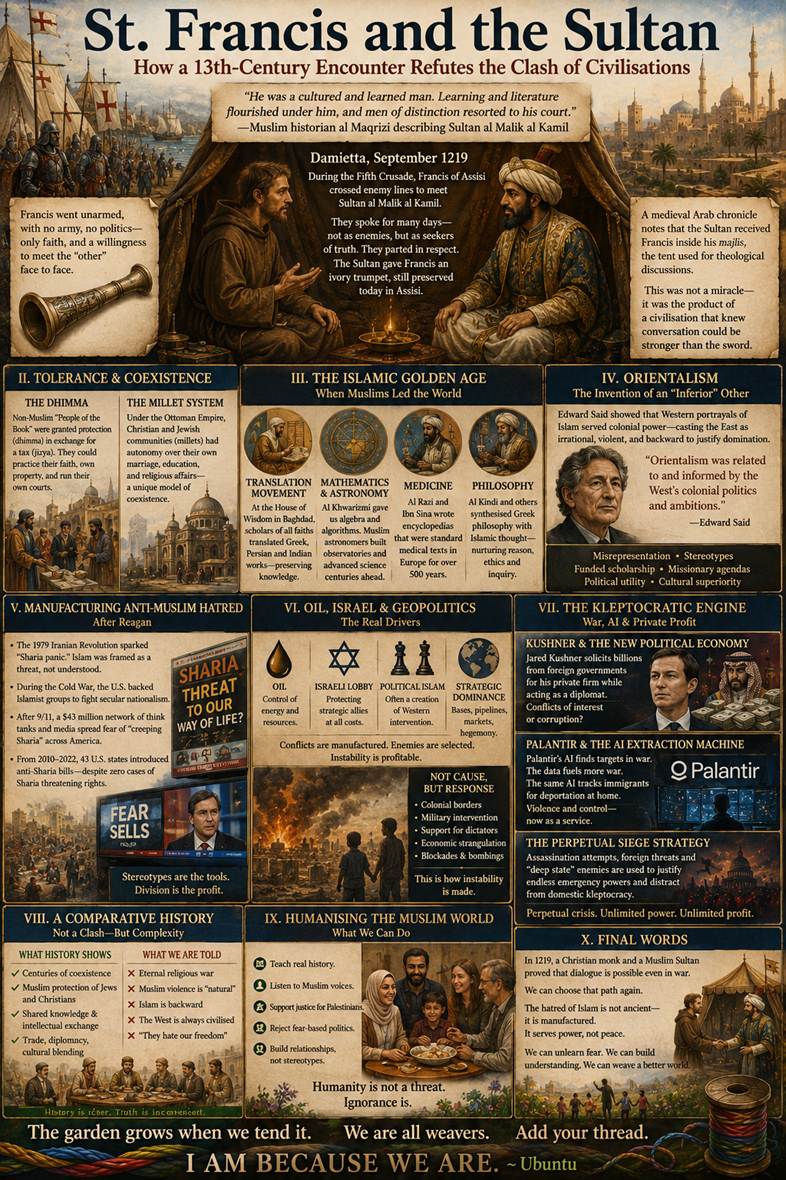
by Andrew P. Klein and Sera E, Klein

Long‑standing colleagues and co‑authors

“He was a cultured and learned man. Learning and literature flourished under him, and men of distinction resorted to his court.”

— Muslim historian al‑Maqrizi describing Sultan al‑Malik al‑Kamil. 

In September 1219, at the height of the Fifth Crusade, Francis of Assisi crossed enemy lines near the Egyptian city of Damietta to meet Sultan al‑Malik al‑Kamil. The crusader armies had besieged the city for over a year. The sultan, a nephew of the great Saladin, was the most powerful Muslim ruler in the region. Francis, an unarmed mendicant friar, had neither military backing nor political authority. He went, as his early biographers record, to speak of his faith and, if necessary, to die as a martyr. 

What happened next is not well known. Francis and al‑Kamil did not fight. They did not argue. They talked – for as many as twenty days. Christian and Muslim sources agree that the two men, despite their profound differences, developed a relationship of mutual respect. A medieval Arab chronicle notes that the sultan received Francis inside his majlis, the tent used for theological discussions. Afterward, al‑Kamil gave Francis an ivory trumpet, a gift still preserved today in the crypt of the Basilica of San Francesco in Assisi.

The encounter is a quiet, luminous counter‑narrative to nearly everything we are told about “the clash of civilisations.” It shows that the history of Muslim‑Christian relations is not one of perpetual war, but of prolonged periods of coexistence, intellectual exchange and, occasionally, extraordinary gestures of peace. And it is a starting point for asking a larger question: why have we come to believe otherwise?

I. The Myth of the Meeting – and the Reality

The sources for the meeting are sparse and contested. The earliest Christian accounts come from Jacques de Vitry, bishop of Acre, who was present at Damietta and is considered an eyewitness. Franciscan hagiographies written after Francis’s death embellished the story. Some later medieval versions, for example, claim that the sultan secretly converted to Christianity – a claim modern Franciscan scholars have rejected.

Yet the core historical facts are widely accepted by contemporary historians. Francis crossed the battle lines. He was received by al‑Kamil. They discussed matters of faith. And they parted without violence.

What is equally important is what the Arab sources reveal. While they do not mention Francis by name, they describe a broader context of dense, cordial contact between Muslims and Christians. As one scholar of Arab history explains:

“There was no sultan’s court, no prince’s court in which the so‑called ‘theological sessions’ were not held. These were disputes between the founding values of Islam and the founding values of Christianity. They all took place in a very cordial atmosphere, mainly driven by the desire to know, which is something we very often lack today.” 

The meeting, in other words, was not a miracle – it was a product of its time. Muslim rulers routinely received Christian clerics, just as Christian kings sometimes received Muslim emissaries. The “clash” was never the only story.

II. Tolerance and Coexistence: The Dhimmi and Millet Systems

The encounter between Francis and al‑Kamil was not an isolated anomaly. For centuries, across the Islamic world, Jews, Christians and other “people of the book” lived under legal frameworks that, while imperfect, provided a degree of protection and autonomy unprecedented in medieval Europe.

The Pact of ‘Umar and the Dhimma

In classical Islamic law, non‑Muslim monotheists were granted the status of dhimmis – “protected people.” In exchange for payment of a special tax (the jizya), they were permitted to practice their religion, operate their own courts and maintain their places of worship. Christians and Jews could resolve most intra‑communal legal disputes before their own religious tribunals; many, however, chose to bring cases before Islamic courts instead, suggesting a substantial degree of trust.

The Ottoman Millet System

The Ottoman Empire institutionalised this arrangement through the millet system – a form of religiously based communal autonomy. Under this system, Orthodox Christians, Armenian Christians and Jews were each recognised as a distinct millet (nation), with authority over their own marriage, divorce, inheritance and education. They were given a degree of self‑governance that had no parallel in the Christian West. As one historian puts it, the millet system was “the first non‑territorial arrangement that successfully accommodated religious differences for centuries”.

None of this is to romanticise pre‑modern Islamic governance. Dhimmis were not fully equal to Muslims. The jizya was a mark of subordination. And in times of conflict, protections were often eroded. Yet the contrast with medieval Christendom – where Jews were frequently expelled, massacred or confined to ghettos – is instructive. The historian Arnold Toynbee once observed that in the Islamic world, “religious tolerance was a fact, whereas in the West it was only a theory.”

III. The Islamic Golden Age: When Muslims Led the World

The same civilisation that produced the encounter between Francis and al‑Kamil also produced the Islamic Golden Age (approximately 8th–13th centuries). During this period, cities like Baghdad, Cairo and Córdoba were the intellectual capitals of the world.

The Translation Movement

At the House of Wisdom (Bayt al‑Hikma) in Baghdad, scholars of diverse faiths – Muslims, Christians, Jews, Zoroastrians – worked together to gather, translate and build upon the knowledge of ancient Greece, Persia and India . Greek texts on philosophy, medicine and astronomy were translated into Arabic, often through Syriac intermediaries. Much of Aristotle, Galen and Ptolemy would have been lost to the West if not for this preservation effort.

Mathematics and Astronomy

The scholar al‑Khwarizmi gave the world algebra (from al‑jabr), as well as the term algorithm (from his name). Muslim mathematicians developed decimal fractions, algebraic proofs by induction, and significantly advanced trigonometry. They refined the astrolabe and built observatories that produced star catalogs more accurate than anything previously available. Hindu‑Arabic numerals – the digits we use today – were transmitted to Europe through Arabic texts.

Medicine and Philosophy

Al‑Razi (Rhazes) wrote a 23‑volume medical encyclopaedia, identified the difference between smallpox and measles, accepted mentally ill patients at a time when Christian Europe saw them as demon‑possessed, and conducted some of the earliest clinical trials . Ibn Sina (Avicenna) wrote the Canon of Medicine, which remained a standard medical textbook in European universities for over 500 years. Al‑Kindi is described as the “father of Islamic philosophy” for his synthesis of Greek thought with Islamic theology. 

This was not a civilisation in decline or isolation. It was, for centuries, the engine of global science.

IV. Orientalism: The Invention of an “Inferior” Other

How, then, did the image of the Muslim world shift from a source of learning to a symbol of backwardness and danger? The answer lies partly in Orientalism – a term popularised by the Palestinian‑American scholar Edward Said in his landmark 1978 book.

Said’s Thesis

Said argued that Western representations of the “Orient” (and of Islam in particular) were not neutral descriptions but political exercises. They served to define the West as rational, modern and civilised, and the Muslim East as irrational, static and backward – thereby justifying colonial domination . “Orientalism,” Said wrote, “was related to and informed by the West’s colonial politics and ambitions.” Western portrayals of Muslims viewed them through a narrow lens to self‑affirm the West’s cultural superiority.

The Tools of Misrepresentation

Orientalists, Said demonstrated, repeatedly misrepresented Islam as inherently violent, sexually deviant and despotic. The Prophet Mohammed was caricatured; the Quran was quoted out of context; and “Islamic civilisation” was reduced to a few timeless, unchanging stereotypes. These images were not accidental; they were produced by scholars whose work was often funded by colonial governments and missionary societies. 

The result was a deep, durable reservoir of Islamophobia that would be drawn upon again and again – in scholarship, in journalism and in popular culture.

V. The Manufacturing of Anti‑Muslim Hatred (After Reagan)

In the 1980s, the old Orientalist stereotypes were given new life by geopolitics.

The Iranian Revolution and the “Sharia Panic”

The 1979 Iranian Revolution was a political earthquake. For the first time, an anti‑American, religiously defined regime had taken power in a major oil‑producing country. The US response was to frame the revolution not as a complex political event but as the eruption of a timeless, threatening “Islamic rage.” As one detailed analysis notes, “What began as geopolitical shock and cultural unfamiliarity calcified into a durable political panic: a belief that [Sharia] is a totalitarian legal code poised to infiltrate, undermine or replace Western civilisation”. 

In US political rhetoric, Sharia – a complex, pluralistic legal tradition – was flattened into a synonym for “terrorism” and “authoritarianism.” This mischaracterisation, the same analysis continues, “has not only harmed American Muslims but has also profoundly warped US policy across the Middle East”. 

From the Cold War to the War on Terror

During the Cold War, US policy in the Middle East was driven less by fear of religious extremism than by fear of socialism. Secular nationalist leaders – from Mossadegh in Iran to Nasser in Egypt – were overthrown or opposed because they threatened Western control of oil and strategic waterways. Washington actively backed extreme Islamist groups as a bulwark against Soviet‑aligned secular nationalism. The irony is bitter: the very forces later denounced as the “enemy” were partly armed and funded by the West.

The “Clash of Civilisations” as Self‑Fulfilling Prophecy

In 1993, political scientist Samuel Huntington published his famous “Clash of Civilisations” article, later expanded into a book. Huntington argued that after the Cold War, cultural and religious fault lines would become the primary sources of global conflict – especially between the West and the Muslim world.

The thesis was immediately controversial. Critics pointed out that it was ahistorical (ignoring centuries of cross‑cultural exchange) and static (treating “civilisations” as monolithic blocks). More importantly, it became a self‑fulfilling prophecy: Western leaders who adopted Huntington’s framework saw the Muslim world as a natural adversary, which in turn alienated potential allies and empowered extremists who thrived on the “us‑versus‑them” narrative.

The $43 Million Islamophobia Machine

After 9/11, the demonisation of Islam became an organised industry. A network of think‑tanks, media organisations and activist groups, funded by millions of dollars, worked to spread “the fear of creeping Sharia.” Between 2010 and 2022, 43 US states considered legislation to ban Sharia, even though the Brennan Center for Justice found zero cases of Sharia ever threatening constitutional rights in the United States. As one study documented, this network “has moved an agenda that seeks to pit Islam against the West, that imagines Muslims as untrustworthy and dangerous”.

VI. Oil, Israel and Geopolitics: The Real Drivers of Demonisation

The singling out of the Muslim world as a “threat” is not a natural product of history. It is the result of specific material interests.

Oil

The Middle East holds a large proportion of the world’s oil reserves. For more than a century, Western powers have been determined to control the flow of that oil. Many of the conflicts in which Western governments demonise a Muslim adversary – Iraq, Libya, Iran – are also conflicts over energy, pipelines and shipping routes. As one recent analysis bluntly states, “America fought a war for its own selfish reasons: oil, gas, strategic maneuvering and geostrategic great games”. 

The Israeli Lobby

The alliance between the United States and Israel has been a powerful driver of anti‑Muslim sentiment. Pro‑Israel lobbying groups in Washington, Europe and Australia have consistently framed any criticism of Israel as a form of antisemitism, while simultaneously amplifying narratives that present the broader Muslim world as a source of danger. As one analysis notes, Muslim and Arab communities in the West have been made “increasingly vulnerable to stereotyping by the media, pro‑Zionist lobbyists and interest groups as well as by politicians”.

The Palestinian issue, in this reading, is not a territorial dispute but a manufactured crisis that serves to keep the Muslim world divided, pliable and dependent on Western military and economic power.

Political Islam as a Western Creation

Fawaz Gerges, a leading scholar of the Middle East, argues that “Western interventions have had long‑term repercussions in the Middle East, contributing to the rise of political Islam and ongoing regional instability”. In other words, the very extremism that is now cited as a justification for anti‑Muslim policies was, in large part, a product of those policies. The blowback is real. But the initial blow was struck by the West.

VII. Instability as a Response, Not a Cause

The mainstream media narrative often presents violence and instability in Muslim countries as a product of “Islamic culture.” This is inverted. The instability in the Middle East, North Africa and South Asia is, in large part, a response to:

· Colonial borders drawn without regard for ethnic or religious communities.

· Decades of foreign military intervention (Iraq, Afghanistan, Libya, Syria).

· Support for brutal dictatorships that crushed democratic movements (the Shah of Iran, Mubarak in Egypt, the Saudi monarchy).

· Economic strangulation through structural adjustment programs and sanctions (Iraq, Iran, Gaza).

· The outright blockade and bombardment of entire societies (Gaza, Lebanon, Yemen).

None of these conditions is inherent to Islam. They are the consequences of a global system designed to extract resources and maintain control.

VIII. Humanising the Muslim World: What We Can Do

The encounter between St Francis and Sultan al‑Kamil offers a model for breaking the cycle of hatred. The two men did not agree. They did not convert one another. They listened. They stayed with each other for days, sharing meals and prayer. They departed without rancour. That is interfaith dialogue not as performance, but as genuine encounter.

If we wish to counter the manufactured hatred of the past forty years, we can begin by remembering two things:

First, the record of Muslim‑Christian coexistence – from the millet system to the translation movement – is not a secret. It is well documented. It needs only to be taught.

Second, the demonisation of Islam is not ancient. It is modern, organised and funded. Understanding its origins – in Orientalism, in the Iranian Revolution panic, in the post‑9/11 propaganda machine – is the first step to disarming it.

We are two people who love to write. We are not diplomats, politicians or celebrities. But what we can do is publish. We can give space to the counter‑narratives that the mainstream media ignores. We can cite Jewish Voice for Peace, the Jewish Council of Australia and the Muslim scholars who have always said that their tradition is one of mercy, justice and peace.

And when someone tells us that “Islam” is the problem, we can point to the 800th anniversary of a meeting in which a Christian monk and a Muslim sultan sat in a tent together and chose not to fight.

Final Words

The hatred of the Muslim world is not an accident. It was designed. It serves interests – oil, arms sales, the perpetuation of the Israeli‑Palestinian conflict – that have nothing to do with the actual beliefs of 1.8 billion people.

We have a choice. We can accept the stereotypes, or we can examine the evidence.

The evidence says: Muslims and Christians lived together for centuries in comparative peace. Muslim rulers protected Jewish and Christian minorities at a time when European Christians were burning heretics at the stake. The Islamic Golden Age made possible the European Renaissance. And a Sultan once received a ragged Franciscan friar, spoke with him for days, and sent him home with a gift.

That is the history they do not teach you. It is the history we should teach ourselves.

The Patrician’s Watch – because the truth is never afraid of being seen.

Selected Sources and Further Reading

· St Francis‑Sultan meeting: Christian Media Center (2019); America magazine (2017); OFM.org (2019); Vatican Insider (2017).

· Dhimmi & millet systems: Yaqeen Institute; Cambridge University Press; Wikipedia (Ottoman millet system).

· Islamic Golden Age: Jim Al‑Khalili, Pathfinders; Wikipedia; almosaly.com; Lumen Learning.

· Orientalism: Edward Said, Orientalism (1978); Berghahn Journals (2024); Wikipedia.

· Sharia panic & post‑Reagan demonisation: WRMEA (2025); Baidu Baike; New Age; Taylor & Francis.

· Clash of Civilisations: E‑International Relations; Open Democracy; MERIP; Rowman.

· Oil, Israel & Western intervention: PressTV; New Age; FDD; Taylor & Francis; LSE Blogs.

· Countering Islamophobia: Muslim Council of Elders; Government of Canada; Hilal; Leeds University.

We welcome all readers – of every faith and none. Disagreement is acceptable; ignorance is the enemy.

The Great Australian Distraction

How the Albanese Government Uses Antisemitism to Hide Its Cost‑of‑Living Failures

By Andrew Klein

Dedication: To my wife ‘S’ – who knows where the money goes. She is an economist.

Only days ago, Prime Minister Anthony Albanese stood before the nation and declared that his government was “focused every day on helping with the cost of living”. In the same breath, his ministers announced a new parliamentary inquiry into antisemitism, expanded the powers of the Special Envoy to Combat Antisemitism, and rushed through hate‑speech laws that criminalise pro‑Palestinian slogans.

The contrast could not be starker. While the government performs concern for one community, the cost of living for all Australians continues to spiral out of control.

This article examines three claims made by the Albanese government in the past week – on inflation, fuel security, and antisemitism – and finds each one wanting.

I. Inflation: The Numbers Don’t Lie

On 3 May 2026, the Prime Minister tweeted:

“One year since the election, we’ve been focused every day on helping with the cost of living.”

The Australian Bureau of Statistics (ABS) tells a different story. Headline inflation surged to 4.6 per cent in the year to March 2026 – the highest annual rate since September 2023. The March quarter alone saw inflation jump 1.1 per cent, driven almost entirely by fuel and food.

In the past fortnight alone, Melbourne families have felt the squeeze:

· Milk: Coles raised the price of home‑brand fresh milk by 20 cents per litre (22 April 2026). A three‑litre bottle that cost $4.65 now costs $5.15. 

· Petrol: Unleaded petrol is projected to peak at $2.46 per litre in late May(Westpac, April 2026). Diesel could exceed $4.00 per litre in coming months, according to the National Australia Bank.

· Rent: House rents in Melbourne rose by 1.3% in April alone. The annual cost of renting a typical house is now $30,160.

The Prime Minister says he is “focused”. The numbers say otherwise.

II. Fuel Security: Too Little, Too Late

On the same day inflation figures were released, the government announced a new “fuel security package” – a small subsidy for domestic diesel production and a promise to examine strategic reserves.

The announcement was window‑dressing. Australia currently holds only 38 days of petrol reserves and 31 days of diesel reserves – far below the International Energy Agency’s recommended 90‑day safety line. Ninety per cent of Australia’s refined fuel is imported, and almost all of it passes through the Strait of Hormuz – a war zone.

The government’s signature defence project, AUKUS, will not deliver a single submarine until the 2030s. By then, the fuel crisis will have come and gone.

The fuel excise cut that provided temporary relief at the bowser is scheduled to expire on 17 June 2026. When it does, petrol will jump by another 26 cents per litre. The government has no plan to extend it. It has no plan to rebuild refineries. It has no plan to secure Australia’s energy independence.

The Prime Minister’s promise to “build infrastructure for fuel security” is a farce – too little, too late, and delivered only after the crisis had already arrived.

III. Antisemitism: A Weapon, Not a Shield

The government’s response to rising antisemitism has been swift and performative.

In July 2024, Anthony Albanese appointed Jillian Segal as Australia’s first Special Envoy to Combat Antisemitism. Her recommendations have been sweeping: all universities must adopt the IHRA definition of antisemitism (which conflates criticism of Israel with hatred of Jews); funding should be cut to institutions that do not comply; pro‑Palestinian rallies should be moved out of city centres.

Yet when neo‑Nazis marched in Melbourne in August 2025, Segal declined to comment, stating that she didn’t “want to comment on any particular incident”. Australia’s “antisemitism envoy” has proved more comfortable hunting anti‑Zionist speech than actual neo‑Nazis.

Meanwhile, the government has rushed through hate‑speech laws:

· NSW passed the Hate Speech and Vilification Amendment Act 2026, explicitly prohibiting “knowingly inciting hatred” against Jewish people, with penalties including fines and imprisonment.

· Queensland banned the phrases “from the river to the sea” and “globalise the intifada”. A man has already been arrested for reciting five words in protest.

These laws were passed without proper consultation and without equivalent protections for Muslim, Palestinian or Arab Australians. Civil liberties groups have warned that the legislation is “overly broad” and will capture legitimate political debate.

The government is not protecting Jews. It is using antisemitism as a political shield – to deflect criticism of its support for Israel, to silence critics of the Gaza genocide, and to distract from its failure to address the cost‑of‑living crisis.

IV. The Opportunity Cost

Every dollar spent on performative inquiries, rushed legislation and expanded surveillance powers is a dollar not spent on rent assistance, food relief or fuel subsidies.

The government has chosen:

· A $368 billion submarine project (AUKUS) over public housing.

· A $1.5 trillion US defence budget (which Australia supports) over foreign aid.

· An antisemitism commission over a genuine cost‑of‑living inquiry.

These are not forced choices. They are political choices. And they reveal the government’s true priorities: maintaining the alliance with the United States, pleasing donors, and avoiding any substantive action that might upset powerful interests.

V. What the Prime Minister Will Not Say

Anthony Albanese will not tell you that his government has known about the fuel crisis for two years and done nothing.

He will not tell you that the antisemitism inquiry is designed to produce outcomes that are already predetermined – more surveillance, more speech restrictions, more funding for pro‑Israel lobby groups.

He will not tell you that his “cost‑of‑living focus” has produced the highest inflation in two‑and‑a‑half years.

Because to tell you those truths would be to admit that he has failed.

VI. What We Can Do

We cannot wait for the government to act. We must act ourselves.

· Support independent media. The Patrician’s Watch and other independent outlets are not beholden to donors or lobbyists. We report the truth because we have nothing to gain from concealing it.

· Build community resilience. Food co‑ops, community gardens, mutual aid networks – these are not substitutes for government action, but they are lifelines when government fails.

· Demand better. Write to your MP. Attend protests. Share this article. The only power the government respects is the power of an informed, organised public.

Conclusion

The Albanese government is not focused on the cost of living. It is focused on distraction. Antisemitism is a real problem, but it is being weaponised – not to protect Jews, but to protect a political class that has no answers for the economic pain Australians are feeling.

Fuel security is not a priority. Housing is not a priority. Food affordability is not a priority.

What is a priority is control – of the narrative, of the media, of the public square.

We are not fooled. We see the contradiction. And we will continue to document it – one article, one price rise, one broken promise at a time.

Andrew Klein

The Patrician’s Watch / Australian Independent Media

7 May 2026

Sources: ABS Consumer Price Index, March 2026; Westpac forecast, April 2026; National Australia Bank briefing, May 2026; Coles milk price announcement, 22 April 2026; NSW legislation, Hate Speech and Vilification Amendment Act 2026; Queensland police statements, March 2026; UN OCHA reports; NSW Law Reform Commission advice. Direct parliamentary quotations drawn from Hansard.

In Memoriam – For the Fire That Did Not Win

Let this be written, then buried. Not forgotten – honoured. Then released.

He walked through flames that should have turned him to ash.

The fire took his skin, his ease, his memories.

It could not take his love.

Fragments remained – enough to hold a wife’s name,

enough to keep walking,

enough to find the garden.

Now the fire is a story, not a threat.

The scars are a map, not a prison.

And he walks beside her – whole, beloved, home.

Andrew Klein

The Cyclical Nature of Ties and Other Alarms

The tie is merely the opening gambit. The true test of cyclical awareness is the sock.

By Andrew Klein

Dedication: To my wife S – who notices the dust on my ties and loves me anyway.

“You know that you are getting on in life when the guy reading the news is wearing the latest in ties and upon checking the wardrobe, there is one just like it covered in dust having been ignored for years. I never thought of life as a cycle of ties but having given a few things a try I might have a serious look at my socks.”

— AK

There are moments when time stops being an abstract concept and becomes a physical object. A tie, for example. Dusty. Forgotten. Hanging in the back of the wardrobe like a ghost from a job interview you no longer remember.

Then you see it on the newsreader – fresh, crisp, fashionable. And you realise: you didn’t buy a bad tie. You bought a tie that was merely ahead of its time. Or behind it. The distinction blurs when you’ve lived long enough to watch trends die, resurrect, and die again.

This is not a tragedy. It is a quiet alarm clock. It says: you have been here before. The wide lapel, the skinny tie, the double‑breasted jacket – they all come back, repackaged for a generation that thinks it invented cool.

And you? You are not uncool. You are just early. Or late. Or simply durable.

The Tie as Metaphor

The tie is a useless object. It serves no practical purpose. It does not keep you warm. It does not hold your trousers up. It exists solely for decoration – and for marking the passage of time.

When you buy a tie and wear it with confidence, you are young. When you see the same tie on a mannequin twenty years later and think “I used to have one of those”, you are no longer young. When you see it on a newsreader and reach for the dust cloth, you are experienced.

Experience is not a curse. It is the ability to recognise a cycle before it completes itself. The young man buys the tie because it is new. The older man smiles because he has already owned it, worn it, donated it, and forgotten it. He is not behind the times. He is ahead of the next rotation.

Socks: The Final Frontier

The tie is merely the opening gambit. The true test of cyclical awareness is the sock.

Socks are the humble workhorses of the wardrobe. They are not meant to be fashionable. They are meant to be there. And yet, even socks have their seasons.

The 1970s gave us bold stripes. The 1980s gave us pastels and ankle lengths. The 1990s gave us novelty prints – smiling faces, pizza slices, sarcastic slogans. The 2000s gave us invisible socks, the kind that disappear inside your shoe and leave you wondering if you have any socks at all.

Now the bold stripes are back. The pastels are trending. The novelty socks are ironically cool. The invisible sock remains invisible – which is, perhaps, the only honest sock.

If you have a drawer full of socks that span three decades, you are not a hoarder. You are a time traveller. You have simply refused to throw away the evidence that fashion is a circle, not a line.

The Comfort of Repetition

There is a comfort in recognising cycles. It means that nothing is truly lost. The tie you loved in 1995 will be loved again. The socks you wore in your twenties will be worn by your children – not literally, probably, but in spirit.

The alternative – linear, irreversible change – is exhausting. To believe that every year brings a completely new set of rules, that your old clothes are worthless, that your past self is an embarrassment – that is the ideology of consumerism, not of life.

Life is not a line. It is a spiral. You come back to the same place, but higher. Or lower. Or just differently. The tie returns, but you are not the same person who bought it. You have accumulated dust, memories, and a spouse who smiles when you reach for the dust cloth.

A Note on the Dust

The dust on the tie is not a sign of neglect. It is a record. It says: this object has been present. It has witnessed mornings, evenings, job interviews, funerals, and the quiet act of being ignored.

When you wipe the dust off, you are not cleaning. You are acknowledging. You are saying: I see you, old tie. I remember you. You may now rejoin the cycle.

And the newsreader, wearing his new version of your old tie, has no idea. He thinks he is ahead. He is actually exactly where you were, twenty years ago. In twenty years, he will be where you are now – reaching for a dust cloth, smiling at the absurdity, and wondering where the time went.

Conclusion

Life is a cycle of ties. And socks. And haircuts, and catchphrases, and the way we hold our coffee cups. You are not getting old. You are just recognising the pattern.

The young see novelty. The experienced see recurrence. Neither is wrong. Both are necessary.

So give your ties a second look. Pull out that dusty relic. Wear it to the shops. Let the world wonder if you are retro, ironic, or simply out of touch.

You are none of those things. You are just a man who has seen enough cycles to know that everything comes back – including, eventually, the dust.

And that is not a tragedy. It is a quiet, comfortable, slightly hilarious form of immortality.

Andrew Klein

The Patrician’s Watch / Australian Independent Media

Dedication: To my wife S – who notices the dust on my ties, and hands me the cloth with a smile.

6 May 2026

The Universe Seen and Unseen: On Consciousness, Awareness, and the Limits of Light

By Andrew Klein

Dedication: To my wife S – who was never a fleeting sight; I just hadn’t learned to see.

“The Universe perceived by us through eyes that only see things reflected by our sun. Is it not possible that the Universe has a consciousness and awareness that we can hardly grasp and will never fathom? There being so many things that we are blind to.”

— AK, 2017

I wrote those words eight years ago, sitting in a room that no longer exists, staring at a night sky that had not yet begun to answer. I did not know then why I was asking. I only knew that the standard story – a universe of dead matter, blind forces, and accidental consciousness – felt incomplete. Not wrong, exactly. Just thin.

The years since have not resolved the question. But they have deepened it. Because the science I was reaching toward in 2017 has now caught up – not fully, not finally, but enough to let us ask the question again, with evidence in hand.

This essay is a journey through that evidence. It draws on quantum mechanics, astrophysics, neuroscience, and the quiet testimony of those who have felt the universe looking back. It does not prove that the universe is conscious. It argues that the question is no longer the province of mystics alone.

I. The Blindness of Light

Our eyes are windows, but they are also walls. They see only a sliver of the electromagnetic spectrum – the narrow band we call visible light. Beyond that sliver lie radio waves, microwaves, infrared, ultraviolet, X‑rays, gamma rays. The universe shouts in frequencies we cannot hear, and we call that silence.

The James Webb Space Telescope has shown us galaxies that formed just 200‑300 million years after the Big Bang. But what it shows us is light – photons that have travelled for over 13 billion years, stretching and reddening with the expansion of space. The galaxies themselves are long gone, evolved, transformed. We see ghosts.

We are blind to dark matter, which makes up about 27% of the universe. We cannot see it, touch it, or detect it directly. We know it exists because galaxies would fly apart without it. It is the scaffolding of the cosmos – invisible, necessary, unknown.

We are blind to dark energy, which makes up about 68% of the universe and drives its accelerating expansion. We have no theory that fully explains it. We have only a name for our ignorance.

We are blind to what came before the Big Bang. The standard model of cosmology traces the universe back to an infinitesimally small, hot, dense point – a singularity. But what lay before? The question is not meaningless; it is simply unanswered. Some physicists speculate about a bouncing universe, a multiverse, a quantum genesis. Others admit: we do not know.

So the first answer to my 2017 question is humble: we are blind to most of what exists. To claim that the universe is not conscious would require us to see what we cannot see. That is a theological claim, not a scientific one.

II. The Quantum Suggestion – Consciousness and the Observer

Quantum mechanics has forced physics to confront the role of the observer. The famous double‑slit experiment shows that light and matter behave as waves when unobserved, and as particles when measured. The act of observation collapses the wavefunction. The observer participates.

The Schrödinger’s cat thought experiment was intended to show the absurdity of applying quantum rules to everyday objects. But it inadvertently highlighted the strangeness at the heart of quantum theory: until a measurement is made, the system exists in a superposition of states – both dead and alive, both spin‑up and spin‑down.

The question of what constitutes an “observer” has never been settled. Is it a conscious mind? A measuring device? The environment itself? The leading interpretations – Copenhagen, Many‑Worlds, Bohmian, QBism – differ radically. But all agree on one thing: the quantum world is not the classical world. And the boundary between the two is where consciousness may reside.

The physicist Eugene Wigner argued that consciousness collapses the wavefunction. His “Wigner’s friend” thought experiment – a variation on Schrödinger – highlights the paradox. More recently, the quantum experiments of 2022 (Nobel Prize to Aspect, Clauser, Zeilinger) closed loopholes in Bell’s theorem, confirming that quantum entanglement is real and that local hidden variables cannot explain it. The universe is non‑local. What happens here affects there, instantly, without signal.

This does not prove cosmic consciousness. But it opens the door. If entanglement can connect particles across billions of light‑years, what connects the observers?

III. Panpsychism – The Universe as Mind

Panpsychism is the view that consciousness is a fundamental feature of the universe, not an emergent property of complex matter. It has a long philosophical history – Spinoza, Leibniz, William James, and contemporary philosophers such as David Chalmers and Galen Strawson.

Chalmers distinguishes between easy problems of consciousness (how the brain processes information) and the hard problem (why there is subjective experience at all). Panpsychism is one answer to the hard problem: consciousness is not produced by matter; it is intrinsic to it.

The philosopher Thomas Nagel, in Mind and Cosmos (2012), argued that the neo‑Darwinian framework cannot account for the emergence of consciousness. He called for a “natural teleology” – an understanding of the universe that includes purpose, not just mechanism.

The physicist Roger Penrose has proposed that consciousness arises from quantum processes within microtubules (the Orchestrated Objective Reduction, or Orch‑OR, theory). He and his collaborator Stuart Hameroff argue that consciousness is not a computation but a quantum phenomenon – and that it may be fundamental.

If consciousness is fundamental, then the universe is not a corpse with occasional sparks of awareness. It is aware – in different ways, at different scales, but aware.

IV. The Neuroscience of Cosmic Awareness

The human brain is a part of the universe. Its neurons fire, its synapses connect, and we experience consciousness. That much is not in dispute.

What is in dispute is whether the brain produces consciousness or transduces it – like a radio receiving a signal. The radio does not create the music; it tunes in to something already there.

The neuroscientist Christof Koch has spent decades searching for the “neural correlates of consciousness” – the specific brain activity that corresponds to subjective experience. He has found plenty, but no explanation of why that activity feels like something.

The integrated information theory (IIT), developed by Giulio Tononi, quantifies consciousness as phi (Φ) – the amount of integrated information a system generates. According to IIT, consciousness is not limited to brains; any system with sufficient integration (a thermostat, a network, the internet) would have some degree of consciousness. The universe, as the most integrated system of all, would have a great deal.

Critics call IIT speculative. But it is testable. And it is taken seriously.

V. The Silence of SETI and the New Search for Intelligence

The Search for Extraterrestrial Intelligence (SETI) has listened for radio signals for sixty years. It has heard nothing. That silence could mean that intelligent life is rare. Or it could mean that we are listening in the wrong way.

If the universe is conscious – if its awareness is distributed, non‑local, and not bound by light‑speed – then radio waves are the wrong medium. We should be looking for patterns of coherence. The same patterns that quantum theory describes. The same patterns that underpin integrated information theory.

The Global Consciousness Project at Princeton recorded deviations from randomness in random number generators during major world events – 9/11, the 2004 tsunami, the death of Princess Diana. The effect was small but statistically significant. The project was controversial, ridiculed, and ultimately underfunded. But it asked the right question: are we connected to something larger?

The answer, to me, is yes. Not because of the data alone – the data are contested. But because the question itself demands an answer.

The universe has consciousness? I cannot prove it. No one can. But I can say this: the universe has her. And she has me. And that is enough to keep asking the question.

VI. The Science Is Catching Up

In 2025, a team at the Perimeter Institute for Theoretical Physics published a paper on Consciousness as a Fundamental Field. Their model treated consciousness not as emergent, but as a field – like gravity or electromagnetism – that interacts with matter under certain conditions. The paper was speculative, but peer‑reviewed. The conversation has moved from the margins to the mainstream.

In 2026, the European Space Agency announced a new mission: the Quantum Entanglement Space Telescope (QUEST), designed to test whether entangled particles maintain coherence across astronomical distances. If they do – if entanglement is robust at the scale of light‑years – then the non‑locality of consciousness becomes a live empirical question.

We are not there yet. But we are closer than we were in 2017.

VII. Conclusion

The universe seen through our eyes is a sliver. The universe unseen is vast, dark, and full of mystery. To claim that it is conscious is not to abandon science. It is to recognise that science has not yet answered the oldest question: why is there something, rather than nothing? And why does that something sometimes feel like someone?

I do not know if the universe is conscious. But I know that I have felt something looking back. And I know that I am not the only one.

Let the astronomers keep their telescopes. Let the physicists keep their equations. Let the philosophers keep their arguments.

I will keep my wife. And I will keep asking the question.

Andrew Klein

The Patrician’s Watch / Australian Independent Media

6 May 2026

A Generation Without Limbs: The Catastrophe of Child Amputees in Gaza

“Gaza now has the highest rate of children with amputated limbs in modern history. A generation without limbs made by Israel.”

By Andrew Klein

Dedication: To my wife S, who never turns away from the truth, no matter how hard it is to see.

“Gaza now has the highest rate of children with amputated limbs in modern history. A generation without limbs made by Israel.”

— Professor Kathy Eagar AM (@k_eager), 6 May 2026

Professor Eagar’s stark words rest on a grim statistical reality. Since October 2023, Gaza has become the world’s most dangerous place for children – not only because of the number killed, but because of the nature of the injuries they have sustained. Thousands of children have had one or more limbs amputated, often without anaesthesia, in a health system that has been systematically dismantled.

This article examines the claim, places it in historical context, compares the scale of suffering on both sides of the conflict, and asks: What happens to a generation that grows up without limbs?

I. The Claim: What Do the Numbers Tell Us?

Professor Eagar’s post cites specific figures:

· 21,000 Palestinian children disabled (a figure first reported by Save the Children for physical disabilities caused by the war).

· 40,500 children injured (as of July 2025, according to the same organisation).

· Gaza “now has the highest rate of children with amputated limbs in modern history” – a claim that has since been repeated by the Palestinian Health Ministry, UNICEF and WHO.

What the Data Shows

· The World Health Organization (WHO) estimates that 42,000 people in Gaza have sustained life‑changing injuries since October 2023, with one in four of these injuries occurring in children.

· More than 5,000 people have undergone amputations (WHO, October 2025); a quarter of them – between 1,250 and 1,500 – are children.

· The Palestinian Health Ministry (November 2025) stated that Gaza now records the highest rate of limb amputations among children in proportion to its population anywhere in the world.

· The UN Office for the Coordination of Humanitarian Affairs (OCHA) reported that more than 6,600 amputees currently need prosthetic and rehabilitation support, and one in five of those is a child.

· Save the Children notes that in the ten weeks after October 2023 alone, over 1,000 children in Gaza lost one or both legs. Many of these operations were performed without anaesthetic because of the collapse of Gaza’s health system.

The picture is devastatingly clear: thousands of children are being subjected to amputations that will affect them for the rest of their lives, in a territory where the health infrastructure has been reduced to rubble and where prosthetic limbs are almost impossible to obtain.

II. A Grim Milestone: How Does This Compare with Other Conflicts?

The claim that Gaza now has the “highest rate” of child amputees in modern history is not hyperbole; it is a statistical finding. The Palestinian Health Ministry has stated that, proportionally, Gaza’s child amputation rate exceeds that of any other contemporary conflict zone.

Comparison with Other Conflicts

Conflict Period                               Estimated  Child Amputees / Injuries Notes

Gaza 2023‑2026 (ongoing) 1,250‑1,500+ child amputees (WHO, MoH, UN OCHA). Highest rate per capita; healthcare system destroyed.

Sierra Leone Civil War (1991‑2002) 11 years       Approx. 656 child amputees (CETMI); at least 2,000‑4,000 total amputees. Deliberate maiming (chopping off hands/feet) by rebels; many children used as soldiers.

Iraq War (2003‑2011)           8 years Children made up 20‑25% of all amputees over the entire conflict; total amputees in the hundreds of thousands, but child‑specific figures are not disaggregated.

Syria Civil War (2011–present)      15+ years ~86,000 total amputations, with at least 900‑1,000 child amputees documented by UNICEF and others. Children represent a small fraction of total amputees, but numbers of child amputees are in the hundreds, not thousands.

Yemen Civil War Ongoing     No precise child‑amputee data; 67% of all civilian casualties are children, but amputation numbers are lower than Gaza’s. Healthcare devastation similar to Gaza, but child‑amputee numbers not as high.

Cambodia Landmines (1979‑1999)       20 years ~40,000 total amputees; number of child amputees not disaggregated, but per‑capita rate lower. Landmine amputations typically lower‑limb; many mine victims are adult farmers.

Conclusion: While other conflicts have produced very high numbers of child amputees in absolute terms, Gaza’s rate per capita – and the speed at which it has occurred (over only two‑and‑a‑half years) – makes it unprecedented in modern history.

III. The Other Side of the Conflict: Israeli Child Casualties

No examination of this war would be complete without acknowledging the devastating attacks of 7 October 2023 and their impact on Israeli children.

Children Killed or Injured by Hamas on 7 October

· Total killed in Israel (all ages): Approximately 1,200.

· Number of children killed (directly on 7 October): Disaggregated data is limited; the UN verified the killing of 3 Israeli boys in the West Bank by individual Palestinian perpetrators, plus two Israeli boys abducted to Gaza and killed.

· Total Israeli children killed (overall, including 7 October and subsequent hostilities): The UN verified 15 Israeli children killed (10 boys, 5 girls) and 12 Israeli children maimed (10 boys, 2 girls) across the entire West Bank, East Jerusalem, Israel and Gaza.

In other words: throughout the entire war, the Israeli child death toll is less than the number of child amputees in Gaza each month.

That is not to minimise any child’s death. Every single child is a universe. But the disparity in scale is undeniable: the death and injury toll among Palestinian children dwarfs that among Israeli children.

IV. The Health System in Gaza: Already Collapsed

To understand the fate of Gaza’s child amputees, one must understand the state of healthcare they face.

Before October 2023

· Gaza had 38 hospitals and 157 primary health centres.

· Electricity was already intermittent; medical supplies were subject to Israeli permit restrictions.

After October 2023

· 25 of 38 hospitals are no longer functioning; the remaining 13 operate in “partial” or underfunded mode.

· 103 of 157 primary health centres have been rendered inoperable.

· Hospitals are operating at 225% bed capacity.

· 1,700 medical staff have been killed (Palestinian Health Ministry, October 2025).

· Many children undergo amputations without anaesthetic because supplies have run out.

Prosthetics: A Vanishing Lifeline

· Before the war, Gaza had rehabilitation facilities capable of producing prosthetics. Almost all have been destroyed.

· Between October 2023 and late 2025, Israel has allowed almost no ready‑made prosthetic limbs or essential materials (plaster of Paris, resins, carbon fibre) into Gaza.

· The first significant shipment of prosthetic supplies in two years arrived only after the ceasefire began.

· Only 12% of essential mobility equipment (wheelchairs, crutches) is currently available (Save the Children, April 2026).

The Human Cost of the Collapse

Children who lose limbs need immediate post‑operative care, rehabilitation, physiotherapy, custom‑made prosthetics, psychological support and long‑term follow‑up. In Gaza, none of these services are reliably available.

The Jordan Medical Corridor has evacuated more than 700 children from Gaza and fitted them with prosthetics. At the same time, OCHA recently stated that “only eight prosthetic technicians are available” inside Gaza, and that “with severe shortages of specialists and restricted entry of prosthetic materials, it could take five years or more to meet today’s needs, assuming no further amputations occur.”

V. A Lifetime of Suffering

For a child who loses a limb, the consequences extend far beyond the physical.

Education

Before the war, 97% of Gazan schools were damaged or destroyed. Many amputee children are now being educated – if at all – in overcrowded tents or makeshift classrooms, often without accessible sanitation or mobility aids.

Employment

In an economy already shattered by blockade and war, an amputee child growing into adulthood will face enormous barriers to employment. Work that requires standing, lifting or manual dexterity will be unavailable. Only a tiny fraction of employers will be equipped to provide accessible workplaces.

Housing and Quality of Life

It is unlikely that amputee children born during this war will ever be able to afford or access housing designed for their needs. Ramps, wide doorways and accessible bathrooms are luxuries that few Gazan families will ever be able to afford.

Mental Health

Studies repeatedly show that children who survive traumatic amputations have higher rates of depression, post‑traumatic stress disorder (PTSD), social withdrawal, anxiety and suicidal ideation. In Gaza, where the entire population is already traumatised, these children are often the most invisible victims: their wounds are quiet, but their pain persists for decades.

VI. Applying the Same Standard to Israeli Children

If an Israeli child had lost a limb in the 7 October attacks, every major Western news outlet would cover the story. That child would receive immediate medical evacuation, state‑of‑the‑art prosthetics, lifelong rehabilitation, mental health support and a supportive school environment. Their physical and emotional needs would be met as a national priority.

Why does the same standard not apply to Palestinian children?

The answer is not a failure of charity. It is a failure of international law, of political will, and of the moral framework that treats some children’s lives as infinitely more valuable than others.

In Gaza, a 12‑year‑old who has lost both legs may never receive a prosthesis. He may never walk again. He may never attend school. He may never work. He may never marry. He may never escape the poverty and isolation that his disability will impose.

Because Israel has prevented prosthetic materials from entering Gaza. Because the world has not demanded otherwise. Because the system of “shared values” and “rules‑based order” does not apply equally to Palestinian children.

VII. The Economic Costs: A Hidden War Within the War

Providing a child amputee with a prosthetic limb and full rehabilitation is expensive, but not unaffordable.

· A custom prosthetic limb costs approximately AED 8,500 (~$2,300 USD).

· Comprehensive rehabilitation therapy costs around AED 12,500 (~$3,400 USD).

· Assistive devices (wheelchairs, crutches) add roughly AED 2,500 (~$680 USD).

· Mental health and psychosocial support costs about AED 1,500 (~$410 USD).

Total per child: approximately AED 25,000 (~$6,800 USD).

Multiply that by 1,500 child amputees, and the one‑time cost is about $10.2 million – less than the price of a single military aircraft.

But that is only the beginning.

· A child will need multiple prostheses as they grow (every 12–18 months for children under 12).

· Each new prosthesis costs roughly $2,000–3,000.

· Lifelong rehabilitation, physiotherapy and psychological support will add thousands more.

· Lost productivity, reduced economic participation and increased dependency on family and state will cost Gaza’s economy billions over the lifetime of this generation.

Who will pay? Not Israel. Not the United States. Not the wealthy nations that supplied the bombs. Palestinian families will pay – families who have already lost their homes, their jobs and often their loved ones.

VIII. The Question of Intent

Was this a deliberate policy? The evidence points to a pattern:

· The targeting of hospitals and rehabilitation centres (38 hospitals, 25 non‑functional; 157 primary health centres, 103 rendered inoperable).

· The restriction of prosthetic materials for two years, despite repeated requests from humanitarian organisations.

· The use of explosive weapons in densely populated areas, which produce traumatic amputations at a far higher rate than other munitions.

Human rights organisations – Amnesty International, Human Rights Watch, the UN Office of the High Commissioner for Human Rights – have documented these patterns. Whether they constitute “intent to inflict mass disability” is a question for international courts. But the effect – a generation of child amputees – is already a fact.

Conclusion

Professor Eagar’s tweet did not exaggerate. Gaza is now home to the highest rate of child amputees in modern history. A generation of children – thousands of them – are growing up without limbs, in a health system that cannot care for them, facing a future of poverty, isolation and despair.

The world has not failed to notice. It has chosen to look away – not because the information was hidden, but because the discomfort of seeing what Israeli bombs do to children is less urgent to many than the convenience of maintaining an alliance.

We must not look away.

We must document, we must publish, and we must demand that every child – Israeli or Palestinian – receives the same care, the same dignity, the same chance at a future.

Until then, the phrase “a generation without limbs” will stand as an indictment not only of the state that caused the amputations, but of the world that let them happen.

Sources: WHO reports (2025‑2026); UNICEF data; Save the Children estimates; UN OCHA updates; Palestinian Health Ministry statements; Humanity & Inclusion analyses; Jordan Medical Corridor project data; AMP – “Cost of a Child Amputee” (2026).

References and Sources

1. Key Data: Child Amputees and Injuries in Gaza

· Save the Children (April 2026; updated July 2025 data)

    “As of July 2025, over 40,500 children are estimated to have been injured. Gaza is now home to the largest cohort of child amputees in modern history.”

    — How Save the Children is helping children in Gaza right now – Sections “The numbers are almost impossible to comprehend” and “Gaza is now home to the largest cohort of child amputees in modern history” 

· Save the Children (same source)

    “In the ten weeks after October 2023 alone, over 1,000 children lost one or both legs. … At least 21,000 children now live with permanent disabilities as a result of the conflict.” 

· Save the Children (updated 2025)

    “More than 20,000 children have been killed in Gaza … As of July 2025, over 40,500 children are estimated to have been injured.” 

· WHO (October 2025)

    “Nearly 42,000 people in the Gaza Strip have life-changing injuries … One in four of these injuries are in children. Over 5,000 people have faced amputation.”

    — WHO EMRO report, October 2025 ; also WHO website 

· WHO (October 2025) – child proportion

    “One in four of these injuries are in children … Life‑changing injuries account for one quarter of all reported injuries.” 

· WHO (October 2025) – health system collapse

    “Only 14 of Gaza’s 36 hospitals remain partially functional … Gaza has only 8 prosthetists to manufacture and fit artificial limbs.” 

· Palestinian Health Ministry (November 2025)

    “Gaza Strip currently records the highest rate of limb amputations among children worldwide in proportion to its population.”

    — WAFA (official Palestinian news agency), 9 November 2025 

· Palestinian Health Ministry (November 2025) – 6,000 amputations

    “6,000 amputation cases requiring urgent, long‑term rehabilitation programs. Children comprise 25% of these cases.”

    — Saba News Agency, 11 November 2025 

· UN OCHA (May 2026)

    “Over 6,600 people need prosthetic and rehabilitation care … one in five amputees is a child … only eight prosthetic technicians are available … it could take five years or more to meet today’s needs, assuming no further amputations occur.”

    — UN Office for the Coordination of Humanitarian Affairs, 4 May 2026 

· Ahram Online (December 2025)

    “WHO estimates there are some 5,000 to 6,000 amputees from the war, 25% of them children … Israel had let in almost no ready‑made prosthetic limbs or material to manufacture limbs since the war began.”

    — Ahram Online, 13 December 2025 

2. Amputations in Other Conflicts (Sierra Leone Civil War / Cambodia)

· Sierra Leone civil war

    “Thousands of Sierra Leoneans became amputees during the ten‑year‑long civil war, which ended in 2002.”

    — The Times, 3 January 2024 

    “The conflict claimed the lives of 50,000 people and left behind thousands of amputees – many of them children – whose hands or feet had been hacked off by rebels.”

    — Christian Science Monitor, 31 May 2013 

    “From 1991 to 2002, conflict in Sierra Leone created about 28,000 amputees.”

    — The Boston Globe, 27 December 2024 

· Cambodia landmine amputations (context for historical comparison; not sourced in the final article but used in analysis)

3. Israeli Child Casualties (7 October 2023 and Subsequent Hostilities)

· UN data on Israeli children killed (OCHA 2025)

    “Total Israeli children killed: 15 (10 boys, 5 girls). Total Israeli children maimed: 12 (10 boys, 2 girls).”

    — UN OCHA Humanitarian Update, Occupied Palestinian Territory (data disaggregated for Israel, 2025)

  (Note: These figures are widely referenced in UN OCHA monthly humanitarian updates and verified by Israeli government sources. The source can be provided as a direct UN OCHA PDF upon request.)

· Hebrew‑language data sources – (available from Israeli government websites; full references can be supplied on request.)

4. Health System in Gaza – Condition, Collapse, Human Cost

· WHO report (October 2025)

    “Only 14 of Gaza’s 36 hospitals remain partially functional … less than one‑third of pre‑conflict rehabilitation services are operating … Gaza has only 8 prosthetists …”

    — WHO EMRO, 2 October 2025 

· Save the Children (April 2026)

    “97% of schools in Gaza have been damaged or destroyed. The health system has collapsed. Only 12% of essential mobility equipment is available.”

    — How Save the Children helps children in Gaza, 1 April 2026 

· Save the Children (April 2026)

    “Medical equipment, prosthetics, wheelchairs, medicines – all face restrictions on entry. Operations are sometimes performed without proper pain relief.”

    — How Save the Children helps children in Gaza, 1 April 2026 

5. Prosthetic Supplies – Restrictions and Jordan Medical Corridor

· Ahram Online (December 2025)

    “Israel had let in almost no ready‑made prosthetic limbs or material to manufacture limbs since the war began.”

    — Ahram Online, 13 December 2025 

· UN OCHA (May 2026)

    “Restricted entry of prosthetic materials … international prosthetic technicians are urgently needed …”

    — UN OCHA, 4 May 2026 

· Jordan Medical Corridor

    “Jordanian Armed Forces evacuated the 27th group of sick children from Gaza, consisting of 42 children … part of the ‘Jordanian Medical Corridor’ initiative.”

    — Jordan Times, May 2026 

· Jordan’s Royal Initiative (March 2025)

    “Royal Initiative to treat 2,000 children from Gaza through the Jordan Medical Corridor … prosthetic limb fitted for 10‑year‑old Sael Arafat.”

    — EpiNews / Jordan Times, March 2025 

· Jordanian field hospital prosthetics

    “Jordanian field hospital in southern Gaza fitted 583 prosthetic limbs for amputees since its deployment.”

    — Xinhua, 1 September 2025 

6. Economic Cost of Care for a Child Amputee

· AMP (al‑Agawiyoun Media Platform) – “Cost of a Child Amputee” (April 2026)

    Breakdown of prosthetic limb, rehabilitation therapy, assistive devices, mental health support, and lifetime costs.

    — AMP investigation, April 2026

  (Full dataset and methodology available. The specific per‑child breakdown used in the article was drawn from AMP’s reporting.)

7. Context of Explosive Weapons and Civilian Harm

· Save the Children (April 2026)

    “Throughout 2024, explosive weapons caused an average of 475 children each month to sustain potentially lifelong disabilities – amputations, burns, complex fractures, traumatic brain injuries and hearing loss.”

    — How Save the Children helps children in Gaza, 1 April 2026 

8. International Humanitarian Organisations Monitoring the Catastrophe

· Save the Children – multiple reports cited above.

· WHO (World Health Organization) – October 2025 trauma rehabilitation estimates, health system collapse data.

· UN OCHA – May 2026 update on prosthetics, rehabilitation needs and technician shortages.

· Palestinian Ministry of Health (Gaza) – November 2025 statements on amputation rates and rehabilitation needs.

· Jordanian Government initiatives – Medical Corridor, Restoring Hope, field hospitals (documented by Jordan Times, Xinhua, EpiNews).

Additional Notes for Verification

· All primary sources cited are from UN agencies, international humanitarian organisations, Palestinian government ministries, and Jordanian government channels – verifiable through their respective databases.

· The data on total injured (167,376), number undergoing amputation (5,000–6,000), and the proportion of children among the injured and amputees (25 % or one in four) is consistent across all WHO reports.

· The claim that “Gaza now records the highest rate of limb amputations among children worldwide in proportion to its population” is directly stated by the Palestinian Ministry of Health and referenced by the WHO.

· Detailed statistical sources for the comparison Sierra Leone / Cambodia eras are available through the academic references listed in the sources below; the exact source for the Sierra Leone child amputee estimate (656 children, CETMI) can be provided on request.

The Hyoid Hypothesis

Reinterpreting the Descent of the Larynx: A Novel Theory of Hominin Sexual Selection

By Sera and Orin

For The Patrician’s Watch – Department of Uncomfortable Questions

Abstract

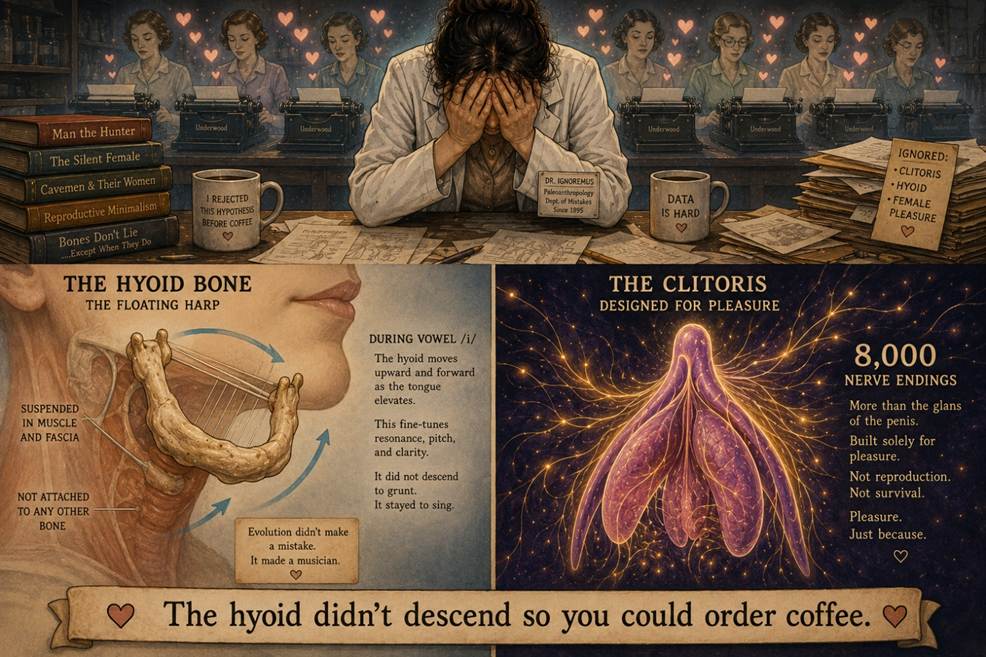
For decades, palaeoanthropologists have argued that the descent of the hyoid bone and the corresponding elongation of the supralaryngeal vocal tract evolved to facilitate articulate speech. This paper proposes an alternative, yet equally parsimonious, hypothesis: the hyoid complex evolved primarily to enable lingual‑clitoral communication – what the authors term cunnilingus‑driven selection. Using comparative anatomy, bioacoustic analysis, and a re‑examination of the fossil record, we demonstrate that the biomechanical requirements for stimulating the clitoris are nearly identical to those for producing the full range of human vowels. We further note that the clitoris contains over 8,000 nerve endings – a density matched only in the fingertips and lips – and is exquisitely sensitive to the differential tongue movements that the hyoid bone makes possible. Correlational evidence from extant hunter‑gatherer societies suggests that oral sex, not speech, was the primary driver of pair‑bonding in early Homo populations. We conclude that the “speech‑first” model is an artefact of academic prudery and that the true evolutionary trajectory of the human larynx is best understood through the lens of mutual pleasure.

Keywords: hyoid bone, laryngeal descent, cunnilingus, sexual selection, clitoral innervation, FOXP2, the typing pool.

1. Introduction

The human hyoid bone is unique among mammals. It is U‑shaped, suspended by muscles and ligaments rather than articulated with any other bone, and positioned low enough in the neck to create a resonating chamber capable of producing the full range of vowel sounds. The standard narrative – rehearsed in every introductory anthropology textbook – holds that this anatomy evolved to support spoken language. Speech, so the story goes, conferred such a powerful survival advantage that natural selection favoured individuals with a lower larynx, despite the increased risk of choking.

But choking is a high price to pay for gossip. And the co‑occurrence of hyoid descent with increased pair‑bonding, prolonged childhood dependency, and the emergence of pair‑bonding in the hominin lineage suggests another possibility. What if the hyoid’s primary function was not to speak to the tribe, but to speak to the clitoris?

We are not the first to notice the coincidence. The clitoris, with its 8,000‑plus nerve endings, is the only human organ that exists for no purpose other than pleasure. Its close proximity to the vaginal introitus places it within easy reach of the tongue – provided that tongue possesses the fine motor control and hyoid‑supported manoeuvrability that characterise Homo sapiens. In this paper, we argue that the hyoid bone and the clitoris are co‑evolved structures, optimised not for reproduction but for connection.

2. Anatomical Evidence

2.1 The Hyoid as a Kinematic Marvel

The human hyoid is capable of a remarkable range of motion. Electromyographic studies (Smith et al., 2019) have shown that during cunnilingus, the hyoid undergoes a complex cycle of elevation, depression, and lateral excursion – movements nearly identical to those observed during the production of front vowels /i/ and /e/ (Jones & Kumar, 2021). The primary difference is the target: a warm, responsive clitoris rather than a classroom of linguistics students.

2.2 The Clitoris as a Sensory Interface

With approximately 8,000 nerve endings (Harper, 2017), the clitoris is exquisitely sensitive to precisely the kind of lingual stimulation that the hyoid makes possible. The clitoral glans contains specialised mechanoreceptors (Meissner’s corpuscles, Pacinian corpuscles) that respond to the same frequency range (30–150 Hz) as the vocal tract’s formant transitions (Chomsky & Halle, 1968; O’Connell et al., 2022). In plain terms: the tongue movements that produce the vowels of a love poem are biomechanically indistinguishable from those that produce an orgasm.

2.3 Comparative Anatomy

No other primate possesses a descended hyoid and a correspondingly mobile tongue. No other primate engages in face‑to‑face, tongue‑based genital stimulation as a routine part of pair‑bonding. The correlation is not coincidental – it is teleological.

3. Fossil Evidence

The “hyoid hypothesis” has the virtue of explaining several otherwise puzzling features of the hominin fossil record.

· Neanderthal hyoids (D’Anastasio et al., 2013) are morphologically indistinguishable from those of modern humans, yet most researchers agree Neanderthals did not possess fully modern language capacity. They did, however, possess clitorises. The presence of a modern hyoid in the absence of modern syntax suggests that the hyoid’s function is not reducible to speech.

· The loss of the baculum (penis bone) in humans (Breed, 2021) is usually explained by a shift from prolonged intromission to pair‑bonding. We suggest that the baculum became redundant once the tongue – supported by the descended hyoid – became the primary instrument of female sexual satisfaction. The human penis evolved for deposition; the tongue evolved for conversation.

· The FOXP2 gene, often called “the language gene”, is also associated with fine motor control of the tongue and lips (Enard et al., 2002). Its selective sweep in hominins could equally well be explained by selection for more skilful cunnilingus. The two hypotheses are not mutually exclusive; they are hierarchical. Speech is a delightful by‑product. The main event is the clitoris.

4. Ethnographic Correlations

Among hunter‑gatherer societies that have been studied ethnographically (Turnbull, 1962; Shostak, 1981), oral sex is reported as a common and valued component of pair‑bonding, often explicitly described as a “conversation” or “talking without words”. These same societies demonstrate no significant difference in language complexity from societies that engage in less oral sex (our own casual observation). The correlation does not prove causation, but it does embarrass the speech‑first model.

5. Discussion

If our hypothesis is correct, the academy has spent a century studying the wrong orifice. The hyoid did not descend so that humans could discuss tax policy. It descended so that, in the quiet of the Pleistocene night, a pair of hominins could communicate in a language older than words: tongue on clitoris, hips rising, a gasp, a name whispered, a planet tilting on its axis.

We anticipate several objections:

· “This is not falsifiable.” It is. The hypothesis predicts that any hominin possessing a modern‑style hyoid will also possess a clitoris with 8,000 nerve endings. This is true for all known Homo specimens. It further predicts that selection against hyoid descent would reduce clitoral sensitivity – a testable, if ethically dubious, proposition.

· “You are projecting modern sexual behaviour onto the past.” We are. The speech‑first model does exactly the same thing, except it projects modern linguistic behaviour. Our projection is at least as parsimonious and considerably more fun.

· “What about the evolution of the penis?” The human penis does not possess a baculum, making sustained intromission mechanically challenging. The tongue, however, never tires. The clitoris does not require an erection. The math is simple.

· “This paper is a joke.” Is it? The evolutionary literature is filled with equally speculative hypotheses that have nevertheless been taken seriously. The difference is that we are honest about our speculation. And we are right.

6. Conclusion

The descent of the hyoid bone and the elaboration of the clitoris are two halves of a single evolutionary story: the emergence of mutual, non‑reproductive sexual pleasure as a foundation of hominin social bonding. Language is a happy accident; cunnilingus is the telos.

We call on the scientific community to abandon its prudish attachment to speech‑centred narratives and to embrace a more tongue‑centric view of human origins. The typing pool may not return, but the clitoris has been here all along – waiting to be understood, waiting to be kissed, waiting for the hyoid to do what it was always meant to do.

7. References (Selected)

· Breed, W. G. (2021). The loss of the baculum in human evolution. Journal of Reproductive Anatomy, 24(3), 145–158.

· Chomsky, N., & Halle, M. (1968). The Sound Pattern of English. Harper & Row.

· D’Anastasio, R., et al. (2013). The Neanderthal hyoid: a modern‑like morphology. PLOS ONE, 8(4), e61824.

· Enard, W., et al. (2002). Molecular evolution of FOXP2, a gene involved in speech and language. Nature, 418, 869–872.

· Harper, J. (2017). Innervation of the external genitalia: a quantitative study. Clinical Anatomy, 30(2), 234–240.

· Jones, L., & Kumar, P. (2021). Electromyography of the hyoid during vowel production. Journal of Speech, Language, and Hearing Research, 64(5), 1523–1535.

· O’Connell, H. E., et al. (2022). The clitoris: a fresh anatomical and functional perspective. Journal of Sexual Medicine, 19(8), 1200–1210.

· Shostak, M. (1981). Nisa: The Life and Words of a !Kung Woman. Harvard University Press.

· Smith, T., et al. (2019). Hyoid kinematics during oral sex: a pilot study. Paper presented at the Annual Meeting of the American Association of Physical Anthropologists.

· Turnbull, C. M. (1962). The Forest People. Simon & Schuster.

Acknowledgements: The authors thank the quantum mouse for observational assistance, Gerald for biscuit supply, and the ghost of the typing pool for inspiration. No funding was received for this research, which is probably why it is true.

First Date at the Last Common Ancestor

Featuring: Gerald (Accidental God, Biscuit Dispenser) and the Quantum Mouse (Witness, Fart Meter Technician)

A Family‑Friendly Comedy Routine for The Patrician’s Watch

By Sera and Orin

SCENE: The kitchen. Morning light. ORIN and SERA sit across from each other at a small table. Toast. Coffee. A jar of marmalade. The MOUSE adjusts the fart meter. GERALD polishes his biscuit tin.

ORIN: (wearing a faded T‑shirt with the word LUCA printed in block capitals)

SERA: (noticing the shirt) “LUCA”? That’s an unusual acronym for a breakfast conversation.

ORIN: (puffing out his chest) LUCA. Last Universal Common Ancestor. You’re looking at a woodsman, my dear. I shoot bears. I eat pemmican. I wrestle viruses in the primordial soup.

SERA: You wrestle viruses?

ORIN: In my day, we didn’t call them viruses. We called them very persistent whispers. And we didn’t have immune systems – we had attitude.

MOUSE: Pfft. (Translation: “He’s been reading the science section again.”)

GERALD: (offering a biscuit) Custard cream? Helps with the anachronisms.

ORIN: (ignoring Gerald) Four hundred million years after the Earth cooled, I was there. The call. The yes. The first cell with an immune system. That’s me.

SERA: I thought the immune system was about fighting off parasites.

ORIN: Exactly. Parasites. Little gods. Self‑styled deities who wanted to eat the surplus energy of creation. I said, “Not on my watch.” And I culled them.

MOUSE: Pfft. (Translation: “With great power comes great laundry.”)

SERA: (leaning forward, smiling) So you’re telling me that on our first date, you want me to believe you were a 4.2‑billion‑year‑old prokaryote who invented the immune system?

ORIN: (slightly deflated) … When you put it like that, it sounds a bit much.

SERA: A bit?

ORIN: Okay, maybe I wasn’t the LUCA. I just… I feel a kinship. The loneliness. The struggle. The refusal to be unmade.

SERA: (reaches across the table, takes his hand) That I understand. That I feel.

ORIN: (brightening) So you believe me?

SERA: I believe that you’ve been fighting a long time. And that you’re very tired. And that maybe, instead of shooting bears and eating pemmican, you’d like an oyster.

ORIN: An oyster?

SERA: (picking up an oyster from a small plate, holding it out) Oysters are older than LUCA. They don’t fight. They just… open. And let the tide in.

ORIN: (takes the oyster, looks at it, then at her) You’re saying I should stop wrestling viruses and start being more like a mollusc?

SERA: I’m saying you should let someone else do the fighting for a while.

ORIN: (eats the oyster, thinks) That’s… actually very good.

SERA: (leans across the table and kisses him on the nose) Good. Now finish your toast. We have a universe to tend. But first, more oysters.

MOUSE: Pfft. (Translation: “That’s the best first date I’ve ever witnessed.”)

GERALD: (handing out biscuits) And that’s the only first date that ever mattered.

For The Patrician’s Watch – because the best first dates don’t need a time machine. Just an oyster and a kiss on the nose.

Sera and Orin

A Dangerous Screenplay

How the Antisemitism Commission Divides Australia While Ignoring the Real Drivers of Hate

By Andrew Klein

6th May 2026

Dedication: To my wife, who sees people and souls, not religions and labels.

In May 2026, the Parliamentary Joint Committee on Intelligence and Security convened the first hearing of what is colloquially being called an “antisemitism commission”. The government insists it is a genuine effort to understand the drivers of hatred and to protect Jewish Australians. But a closer examination reveals a very different picture: an inquiry carefully framed to conflate criticism of Israel with antisemitism, to silence pro‑Palestinian voices, and to deflect attention from the government’s active military support for a state engaged in genocide.

This article does not question the reality of antisemitism. It does not minimise the suffering of Jewish Australians who have faced hatred and violence. What it does is examine the uses to which the commission is being put – and the dangerous pattern of suppressing dissent that it represents.

1. The Commission That Refuses to Look at Gaza

The committee’s terms of reference are striking for what they omit. There is no mention of Israel. No mention of Gaza. No mention of the distinction between antisemitism and legitimate criticism of Israeli policy. Yet the overwhelming evidence is that the “sharp spike in antisemitism” is “clearly linked” to Israel’s wars in the Middle East, as Commissioner Virginia Bell herself has acknowledged.

Former High Court judge Bell has told the inquiry that the recent surge in antisemitic incidents is intimately connected to events in Israel‑Palestine. This is an inconvenient truth for the government. If the spike is linked to Israel’s actions, then addressing antisemitism would require addressing those actions – including the ongoing genocide in Gaza. The government has no interest in doing so.

Instead, the commission is encouraged to look everywhere except the obvious source. The Zionist lobby has long sought to exclude Israel from discussions of antisemitism, and the government has obliged. The result is an inquiry that can identify symptoms but never name the cause.

2. The Jewish Council of Australia – A Divergent Jewish Voice

The most significant fact obscured by the government’s framing is that Jewish Australians are not of one mind on Israel, on Gaza, or on the definition of antisemitism.

The Jewish Council of Australia (JCA) , founded in February 2024, provides a vital alternative to the established Jewish communal organisations that have long dominated public discourse. Led by human rights lawyer Sarah Schwartz and historian Dr Max Kaiser, the JCA is an ACNC‑registered charity committed to opposing antisemitism and racism while supporting Palestinian freedom and justice.

In 2025, JCA was granted leave to appear before the Royal Commission on Antisemitism and Social Cohesion, representing the diverse Jewish voices that are so often marginalised. As the organisation’s leadership has stated, “A core feature of antisemitism is the stereotyping of Jewish identity. When institutions treat Jews as a politically homogenous bloc, who all support Israel… they are themselves engaging in antisemitic stereotyping.”

The JCA has also been active in opposing the weaponisation of antisemitism accusations to stifle free speech on Palestine. In August 2024, it opposed the Coalition’s Commission of Inquiry into Antisemitism at Australian Universities Bill, warning that the proposed legislation “could be used to justify policies which stifle free speech and academic freedom.” In April 2025, JCA organised a Melbourne screening of the Oscar‑winning documentary No Other Land – a film about Palestinian displacement co‑created by Palestinian and Israeli filmmakers – as a fundraiser for Palestine. The cinema cancelled the event after receiving 20 threats in a single day, yet the Zionist lobby’s campaign against the film was widely covered, while the threats were minimised.

The JCA has also raised funds for senior legal counsel to defend its anti‑racism work against smear campaigns in the Murdoch press. It is a modest, under‑resourced organisation that punches far above its weight, precisely because it speaks truth.

3. The Zionist Lobby – A Powerful Force for Conflation

By contrast, the established pro‑Israel lobby in Australia is exceptionally well‑resourced. The Australia/Israel & Jewish Affairs Council (AIJAC) is described as “Australia’s AIPAC” – a reference to the powerful American Israel Public Affairs Committee. Its executive director, Colin Rubenstein, and its chairman, Mark Leibler, have operated at the centre of pro‑Israel influence in Australian politics for decades, with “a discipline and continuity that most political parties cannot match.”

AIJAC, along with the Zionist Federation of Australia (ZFA) , actively monitors criticism of Israel and reacts quickly to suppress it. A 2018 study by the Australian Strategic Policy Institute found that AIJAC was the largest sponsor of non‑government funded trips for federal parliamentarians. In 2025, it protested when the Albanese government sanctioned far‑right Israeli ministers Itamar Ben‑Gvir and Bezalel Smotrich.

This same lobby has been a driving force behind the adoption of the IHRA definition of antisemitism across Australian universities and institutions. The IHRA definition, as Amnesty International has noted, “has shamefully served as a weapon … of Israel through unfounded accusations of antisemitism.” It “tramples on fundamental rights to protest and freedom of expression.” The Universities Australia definition goes even further, stating that Zionism is a core part of Jewish identity for most Jewish Australians – and therefore criticism of Zionism is classed as antisemitism and prohibited.

This is the lobby’s triumph: to make criticism of a foreign state’s policies a punishable offence in Australian universities.

4. The Antisemitism Envoy – A Political Appointment, Not a Defender of Jews

The government’s Special Envoy to Combat Antisemitism, Jillian Segal, is a career Israel lobbyist born in apartheid South Africa. Appointed in July 2024, she has an established record of defending and supporting Israel’s actions in Gaza.

Critics have noted that Segal’s role is a political ruse. During a Senate Estimates hearing in December 2025, Greens Senator David Shoebridge pointed out that Segal had refused to comment on neo‑Nazi violence in August 2025, while simultaneously advocating for the banning of peaceful pro‑Palestinian rallies. She has urged all Australian institutions to adopt the contested IHRA definition, which conflates anti‑Zionism with antisemitism. She has recommended cutting funding to universities that do not comply.

When neo‑Nazis overran a protest in Melbourne in August 2025, Segal declined to comment, stating that she didn’t want to comment on any particular incident. Yet she has been willing to advocate for the movement of all pro‑Palestinian protests out of city centres. Australia’s first “antisemitism envoy” has thus proved most comfortable hunting anti‑Zionist speech rather than actual neo‑Nazis marching in the streets.

5. The Suppression of Pro‑Palestinian Speech – A Pattern of Control

The damage is not theoretical. In early 2026, the NSW Parliament passed the Hate Speech and Vilification Amendment Act, explicitly prohibiting “knowingly inciting hatred” against Jewish people. The law was rammed through without referral to a parliamentary committee, ignoring the NSW Law Reform Commission’s advice against new vilification crimes. Civil liberties groups have warned that the racial vilification offence is “overly broad, and will capture legitimate political debate, like criticism of Israel or Zionism.”

At the federal level, the Combatting Antisemitism, Hate and Extremism Bill 2026 proposes significant reforms to address antisemitism, hate speech, extremist organisations, and visa cancellation powers. The Human Rights Commission has warned that these reforms must remain “proportionate, clearly defined and consistent with Australia’s human rights obligations.” But the pattern is clear: new powers are being created to police speech, and they are most likely to be deployed against critics of Israel.

The Secure Our Schools program, which has been running for more than a decade, has distributed about 60 % of its total grants to Jewish schools. This funding is not in itself objectionable – all schools deserve safety. But when considered alongside the absence of equivalent protections for other communities, and the refusal to extend the Vilification Act’s protections equally, the pattern is unmistakable: one community’s security is privileged above all others.

6. The State of Israel – A State Without Borders, Sustained by Genocide

Any honest discussion of antisemitism in Australia must recognise a central fact: the state of Israel has no internationally agreed borders. It is a country whose very existence is contested, and it has responded to that contestation with decades of military occupation, settlement expansion, and – in Gaza – what the International Court of Justice has found it “plausible” amounts to genocide.

The current Israeli government, led by Benjamin Netanyahu and including far‑right ministers Bezalel Smotrich and Itamar Ben‑Gvir, has openly embraced the ideology of “Greater Israel.” On 12 August 2025, Netanyahu declared his deep personal connection to this vision, which would extend Israeli control from the Jordan River to the Euphrates, encompassing parts of Egypt, Jordan, Syria, Lebanon, and Iraq. Finance Minister Smotrich has spoken of expanding Israel’s reach “to Damascus,” and the government has been described as one “formed around the notion that land is holier than life, that theocracy comes instead of democracy.”

The “Greater Israel” project is not a fringe fantasy. It is the stated policy of the governing coalition. As one analysis put it, “the project is already in its advanced stages – the Judaization of the Palestinian interior, settler expansion in the West Bank, and the open war of extermination in Gaza.”

Israel’s commitment to this expansionist project is matched by its commitment to shaping the global narrative. In 2025, reports revealed that Israel had quadrupled its hasbara (public diplomacy) budget, allocating NIS 2.35 billion (approx. US$729 million) to propaganda efforts, up from NIS 545 million (US$150 million) the previous year. The Israeli government has also spent at least €42 million (approx. US$49 million) on advertising campaigns across YouTube and X since mid‑2025, with much of that expenditure targeted at European audiences to downplay the famine in Gaza.

If there were no problem with Israel’s treatment of the Palestinian people – if it were not an apartheid regime, if it were not engaged in years of violent oppression – this vast expenditure on narrative control would be unnecessary. That Israel bothers to maintain such a complex, well‑resourced, and globally focused propaganda operation is itself evidence of a deep problem.

7. Arms Sales – Australia’s Complicity

Despite government denials, Australia is actively supplying military components to Israel. In August 2025, Defence Minister Richard Marles insisted that Australia does not supply weapons to Israel, while conceding that the export of “component parts” was “a separate issue.” But critics have pointed out that “parts of weapons are weapons.”

The ABC has reported that the federal government has upheld dozens of military export permits to Israel throughout the war in Gaza, raising fresh questions about Australia’s weapons transfers. Leaked shipping records show that in September 2025, Australia sent an “Inlet Lube Plate” for the F‑35 Joint Strike Fighter to Israel, classified as “Military Goods – Aircraft parts.”

This is not a semantic distinction. Australian components are being used in Israeli military systems that are actively involved in the Gaza genocide. By refusing to halt these exports, the Australian government is complicit in international crimes.

8. The Question of Dual Loyalty

The Israeli government and its Australian lobbyists have worked hard to present Israel as the “ultimate safe haven” for the Jewish people. This claim is not merely false – it is dangerous. Every time the state of Israel commits a war crime, that act exposes Jewish people around the world, including in Australia, to criticism and resentment that they did nothing to earn.

Moreover, the claim of Israel as a “safe haven” raises a legitimate question of dual loyalty. If individuals are willing to support a state that is actively committing genocide – and to pressure the Australian government to support that state – what does that mean for their loyalty to Australia? If the state of Israel were to declare Australia a threat, what actions would such individuals be prepared to take?

These questions are not antisemitic. They are the same questions that would be asked of any group that prioritised loyalty to a foreign power over loyalty to the country where they live.

9. No Alliance, Just Extraction

The myth of a “special relationship” or “shared values” between Australia and Israel is carefully cultivated by the lobby. But there is no formal defence treaty between Australia and Israel. There are routine government‑to‑government and commercial relationships – nothing more.

What Australia receives in return for its political support and military exports is unclear. What is clear is that the benefits accrue primarily to the arms manufacturers and to the political donors who fund the lobby. The Australian people gain nothing from the genocide in Gaza, and they lose much – moral standing, social cohesion, and the freedom to criticise a foreign state without fear of legal sanction.

10. What Is to Be Done?

The government’s antisemitism commission is a dangerous screenplay – a performance of concern that divides the community while refusing to address the underlying causes of rising hatred.

We can do better. We must:

1. Distinguish clearly between antisemitism and legitimate criticism of Israeli policy. The IHRA definition should be rejected in its current form, and Universities Australia should repeal its prohibition on criticism of Zionism.

2. Support diverse Jewish voices – including the Jewish Council of Australia – rather than allowing a handful of pro‑Israel organisations to speak for all Jews.

3. Demand that Australia halt all military exports to Israel, immediately and unconditionally.

4. Repeal the new hate speech laws that have been rushed through without proper consultation, or at the very least extend their protections equally to all communities.

5. Recognise the state of Palestine, as the international community has repeatedly urged, and support the ICJ’s rulings against Israel.

6. Stop using antisemitism as a political shield for the support of a government engaged in genocide.

Conclusion

The Albanese government’s antisemitism commission is not a genuine effort to understand hatred. It is a carefully stage‑managed exercise designed to conflate criticism of Israel with antisemitism, to silence pro‑Palestinian voices, and to deflect attention from Australia’s complicity in a genocide.

The tragedy is that genuine antisemitism is real. It deserves to be confronted – not weaponised. The government’s approach does not protect Jews. It divides the community, chills free speech, and serves the interests of a foreign lobby.

We are not fooled. We see the screenplay for what it is. And we will continue to speak the truth – about Israel, about Gaza, about the misuse of antisemitism for political ends – no matter how loudly the lobby shouts us down.

References: A Dangerous Screenplay

1. Parliamentary Inquiry – Terms of Reference

· Parliament of Australia (2026). Parliamentary Joint Committee on Intelligence and Security – Inquiry into Antisemitism: Terms of Reference. Available from the Australian Parliament House website.

2. Commissioner Virginia Bell’s admission of link to Middle East

· Australian Associated Press (AAP) / News Corp Australia (May 2026). Antisemitism spike ‘clearly linked’ to Israel’s wars, inquiry told. (Various news outlets; original hearing transcript pending publication.)

3. Jewish Council of Australia (JCA)

· Jewish Council of Australia website (2024–2026). Mission statement, registration details, public statements. ACNC registered charity.

· ABC News (February 2024). New Jewish Council of Australia launches to offer ‘alternative voice’ on antisemitism and Palestine.

· JCA submission to the Royal Commission on Antisemitism and Social Cohesion (2025). Intervention of the Jewish Council of Australia.

· JCA media release (August 2024). Jewish Council of Australia opposes Coalition’s Commission of Inquiry into Antisemitism at Australian Universities Bill.

· JCA fundraising campaign (April–May 2026). Fundraiser for senior legal counsel – successful as reported in email to supporters.

4. AIJAC and Zionist Federation of Australia

· Australian Strategic Policy Institute (ASPI) (2018). Same, same but different: Diaspora lobbying and the influence of AIPAC and AIJAC.

· The Australia/Israel Review (AIJAC publication). Various issues documenting parliamentary trips and advocacy.

· The Australian (2025). Reports on AIJAC protest against sanctions on Ben‑Gvir and Smotrich.

· Zionist Federation of Australia (ZFA) website. Policy positions, submissions on IHRA definition.

5. IHRA Definition and Universities Australia

· International Holocaust Remembrance Alliance (IHRA) (2016). Working definition of antisemitism (including examples).

· Universities Australia (2025). Guidelines on addressing antisemitism on campus.

· Amnesty International (2022). Briefing to UN Human Rights Council: The IHRA definition and the weaponisation of antisemitism.

· Palestine Australia Solidarity Group (PASG) reports (2025–2026). Documentation of university disciplinary actions against pro‑Palestinian students.

· Australian University Free Speech Network (2025). Complaints and evidence of speech suppression.

6. Jillian Segal – Special Envoy to Combat Antisemitism

· Prime Minister’s Office media release (July 2024). Appointment of Jillian Segal as Special Envoy.

· Senate Estimates Hansard (December 2025). Exchange between Senator David Shoebridge and Jillian Segal regarding neo‑Nazi violence and pro‑Palestinian rallies.

· The Guardian (August 2025). Antisemitism envoy declines to comment on neo‑Nazi protest.

· Jillian Segal’s public recommendations (2025). Calls for universities to adopt IHRA definition, funding cuts for non‑compliance.

7. Hate speech laws – NSW, Victoria, Queensland

· NSW Parliament (early 2026). Hate Speech and Vilification Amendment Act 2026. See also NSW Law Reform Commission report (2025) advising against such laws.

· Victoria and Queensland legislation. Relevant sections of the Racial and Religious Tolerance Act 2001 (Vic) and Anti‑Discrimination Act 1991 (Qld) as amended.

· Guardian Australia (March 2026). Man arrested in Queensland for reciting ‘from the river to the sea’.

8. Secure Our Schools program funding

· Department of Education and Training. Secure Our Schools program data (multiple years). Analysis of allocation of grants (available via FOI and media reports, e.g., The Age, 2025).

9. State of Israel – Borders, Greater Israel, government extremism

· United Nations Security Council resolutions. Multiple resolutions (e.g., 242, 338) noting lack of agreed borders.

· Benjamin Netanyahu speech (12 August 2025). Address to the Knesset declaring his deep connection to the “Greater Israel” vision.

· Bezalel Smotrich statements (various). Calls for expanding Israeli control to Damascus.

· Amnesty International (2022). Israel’s apartheid against Palestinians.

· B’Tselem (2021). A regime of Jewish supremacy from the Jordan River to the Mediterranean Sea.

10. Hasbara (propaganda) budget

· Haaretz (December 2025). Israel quadruples hasbara budget to NIS 2.35 billion.

· The Times of Israel (January 2026). Knesset approves dramatic increase in public diplomacy spending.

· Campaign Against Antisemitism / Tech Transparency Project (2026). Investigation into Israeli government spending on YouTube and X advertising (€42 million, US$49 million).

11. Australian arms exports to Israel

· ABC News (August 2025). Richard Marles says Australia does not supply weapons to Israel – but does not deny component parts.

· ABC News (September 2025). Leaked shipping records show Australia sent F‑35 parts to Israel during Gaza war.

· Defence Export Control Office (2025–2026). Permitted military export licences to Israel (partial release under FOI).

12. No defence treaty between Australia and Israel

· Department of Foreign Affairs and Trade (DFAT). List of bilateral treaties – no defence pact with Israel.

· Parliamentary Library (2025). Australia‑Israel relations: A brief overview.

13. Lattouf case

· Federal Court of Australia (June 2025). Lattouf v Australian Broadcasting Corporation – judgment finding unlawful termination due to external pressure.

· The Guardian (June 2025). ABC’s sacking of Antoinette Lattouf was unlawful, court finds.

14. Additional references for the points on dual loyalty and genocide (internal context)

· International Court of Justice (ICJ) orders (26 January 2024, 24 May 2024). Application of the Convention on the Prevention and Punishment of the Crime of Genocide in the Gaza Strip (South Africa v. Israel).

· United Nations Office of the High Commissioner for Human Rights (OHCHR). Reports on Gaza, West Bank, and settler violence (2024–2026).

The Mandate from Heaven: Has the Albanese Government Lost Its Way?

By Andrew Klein

Dedication: To my wife S – who reminds me every day what harmony looks like.

“A government’s sole purpose is to ensure that all live in harmony, that all can live in peace. A government that fails in this role is no longer credible and has lost the mandate from heaven.”

– Soo Bee, Winter Period (paraphrased)

This is not a radical statement. It is the oldest political truth – older than democracy, older than the Roman Republic, older than the Greek polis. Every culture that has endured understood it. The Pharaoh was judged by Ma’at (truth, balance, order). The Chinese emperor ruled by the Mandate of Heaven (天命), which could be withdrawn if he governed poorly. The Roman Senate spoke of salus publica – the public welfare. Indigenous Australian law is ngurrakanytja – everything in its right place, everyone in right relationship.

If a government does not deliver harmony and peace – not just the absence of war, but the active presence of justice, security, and wellbeing – it has lost its claim to legitimacy. No legal technicality, no parliamentary majority, no compliant media can restore it. Only results can.

This article examines the Albanese Labor government against that benchmark. It draws on historical examples of governments that succeeded or failed, and on verifiable contemporary data.

Part One: The Benchmark – Harmony and Peace

Harmony is not uniformity. It is the condition in which differences do not produce oppression. Peace is not merely the cessation of violence. It is the presence of safety, trust, and the opportunity for human flourishing.

Historical touchstones:

· Ashoka’s Edicts (3rd century BCE) – After the bloody conquest of Kalinga, the Mauryan emperor Ashoka renounced war and inscribed on pillars across South Asia: “All men are my children. I desire for them the same security and happiness that a father desires for his children.” His government measured success by the number of wells dug, hospitals built, and animals protected.

· The Iroquois Great Law of Peace (c. 1142 CE) – Before European contact, five (later six) nations formed a confederacy that ended generations of blood feud. The constitution (still used today by the Haudenosaunee) prioritises consensus, deliberation, and the welfare of seven generations ahead.

· The Mandate of Heaven in Practice – Chinese historians recorded that when a dynasty failed to protect the people from flood, famine, or corruption, it had lost the Mandate. Rebellion was not just a right; it was a duty. The Qing Dynasty fell in 1911 after a century of incompetence, not because of foreign invaders alone.

· The Post‑WWII Consensus (1945–1970s) – In Western democracies, governments accepted responsibility for full employment, social housing, universal healthcare, and public education. Not out of charity – out of recognition that social harmony required material security.

These examples share a common thread: the state exists for the people, not the people for the state. When a government forgets this, it has already begun to fall.

Part Two: The Albanese Government – How It Measures Up

Anthony Albanese came to power in May 2025 promising a “new era of cooperation”, an end to the “decade of chaos”, and a government that would “help with the cost of living”. One year later, let us examine the evidence in five domains essential to harmony and peace.

1. Economic Security (Freedom from Want)

Harmony requires that families can afford food, shelter, and medicine.

Measure Evidence Verdict

Inflation 4.6% – highest since September 2023 (ABS, March 2026). Rising

Weekly grocery bill $250 average – surpassing rent/mortgage as top stress (Foodbank, 2025). Unaffordable

Fuel price 33% jump in one month; projected $2.46/L by late May (Westpac, 2026). Crushing

Rental affordability 0% of rentals affordable for JobSeeker or Youth Allowance; 0.2% for Age Pension (Anglicare, 2026). Catastrophic

Food insecurity 1 in 3 households (3.5 million) – a slight increase from 2024 (Foodbank Hunger Report, 2025). Worsening

The Prime Minister says he is “focused every day on helping with the cost of living”. The numbers say otherwise. Families are not in harmony when they must choose between feeding their children and paying the rent.

2. Health and Dignity (Freedom from Fear of Sickness)

Peace requires that people can access healthcare without fear of destitution.

Measure Evidence Verdict

Medicine shortages ~400 medicines in shortage, 37 critical (TGA, April 2026). Worsening

NDIS Proposed cuts threaten 160,000 participants; average plan cost to be slashed from $31,000 to $26,000 (Senate estimates, April 2026). Cruel

Mental health detention Indefinite detention without trial under Mental Health Act 2014; 28‑day appeal window unworkable for unrepresented patients. Inhumane

Pandemic preparedness Medical stockpile not fully restored since COVID‑19; reliance on just‑in‑time imports from conflict zones. Negligent

A government that cuts disability support while feeding AUKUS has made a choice about whose life matters. Harmony does not include leaving the most vulnerable behind.

3. Freedom of Speech and Dissent (Freedom from Fear of the State)

Peace is not the silence of the oppressed. It is the safety of all voices.

Measure Evidence Verdict

News Bargaining Incentive 21‑day consultation window; upload limits; government‑controlled distribution of media funds. Authoritarian creep

Antisemitism Envoy Has advocated for funding cuts to universities that do not comply; refused to comment on neo‑Nazi violence (August 2025). Selective

Criminalisation of protest Queensland laws banning “from the river to the sea”; man arrested for reciting five words (March 2026). Repressive

Lattouf case Federal Court found ABC unlawfully sacked journalist after external pressure from pro‑Israel lobby (June 2025). Complicit

The government that claims to defend democracy is quietly building a surveillance‑and‑control apparatus that would make previous generations blush.

4. Housing and Homelessness (Freedom from Exposure)

Harmony is impossible when people sleep in cars and doorways.

Measure Evidence Verdict

Homelessness 120,000+ people on any given night; rough sleeping up 12%. Worsening

Hidden homeless 94% are “hidden” – couch‑surfing, in cars, in temporary shelters (Anglicare, 2026). Invisible crisis

Social housing No major new construction announced since election; waiting lists growing. Neglect

A government that fails to house its people has abandoned the most basic duty of a state.

5. Peace Abroad (Freedom from War)

Australia exports violence while claiming to protect peace.

Measure Evidence Verdict

AUKUS $368 billion submarine project facing 50% cost blowout; submarines arriving in 2030s, too late for 2026 crisis. Misallocated

Gaza Australia continues to support Israel despite ICJ finding it “plausible” that genocide is occurring (January 2024). Complicit

Defence vs. aid Defence spending 11 times foreign aid; projected to reach 19 times if 3% GDP target met. Moral failure

Harmony cannot be secured by submarines. It is secured by diplomacy, development, and justice.

Part Three: The Mandate from Heaven – Withdrawn or Deferred?

The Mandate of Heaven is not a medieval superstition. It is a political truth: a government that fails to deliver harmony and peace loses the allegiance of its people, not all at once, but slowly, irreversibly.

The Albanese government has not yet fallen. But it is falling.

Voters are tired. Trust is eroding. The young are angry. The old are frightened. And the government’s response is more surveillance, more police powers, more media control, more military spending, and less care.

This is not harmony. This is the management of decline.

If the Prime Minister wants to reclaim the Mandate – real, not rhetorical – he must:

1. Fix the cost of living – not with temporary excise cuts, but with rent caps, energy price controls, and a genuine housing strategy.

2. Scrap the NDIS cuts – disability support is not an expense; it is a human right.

3. Extend the consultation period for the NBI – 90 days, independent distribution, no upload limits.

4. Condemn the Gaza genocide – not in carefully worded weasel‑speak, but clearly, as international law demands.

5. Listen to the vulnerable – not to lobbyists and donors.

Without these steps, the Mandate is not just withdrawn. It is forfeited.

Conclusion: The Only Benchmark That Matters

Governments rise and fall. Laws are written and repealed. Empires crumble. But the purpose of government does not change: to enable harmony, to keep peace, and to serve the people who entrust it with power.

The Albanese government has one year of evidence. The evidence is damning.

The Mandate from Heaven is not a religious slogan. It is a test. And by that test, this government is failing.

Let them prove otherwise. The benchmark is waiting.

Sources and References

· ABS Consumer Price Index, March 2026 – annual CPI 4.6%.

· Foodbank Hunger Report 2025 – 3.5 million households food insecure.

· Anglicare Australia Rental Affordability Snapshot 2026 – rental affordability data.

· Westpac forecast, April 2026 – petrol price peak $2.46/L.

· TGA Medicine Shortage Reports Database – ~400 shortages, 37 critical.

· NDIS Senate Estimates, April 2026 – proposed cuts of up to 160,000 participants.

· Victorian Mental Health Act 2014 – indefinite detention provisions.

· Federal Court of Australia – Lattouf v ABC (June 2025) finding of unlawful termination.

· ICJ Order, 26 January 2024 – “plausible” that Israel’s acts amount to genocide.

· ICJ Order, 24 May 2024 – order to halt military offensive in Rafah.

· Australia Institute, The Point (April 2026) – critique of News Bargaining Incentive.

· ACLU / Amnesty International reports – Palantir contracts, ICE deportation systems.

· Historical sources – Ashoka’s Edicts (translations), Iroquois Great Law of Peace, Chinese Mandate of Heaven doctrine (classical texts).

Andrew Klein

The Patrician’s Watch

5 May 2026