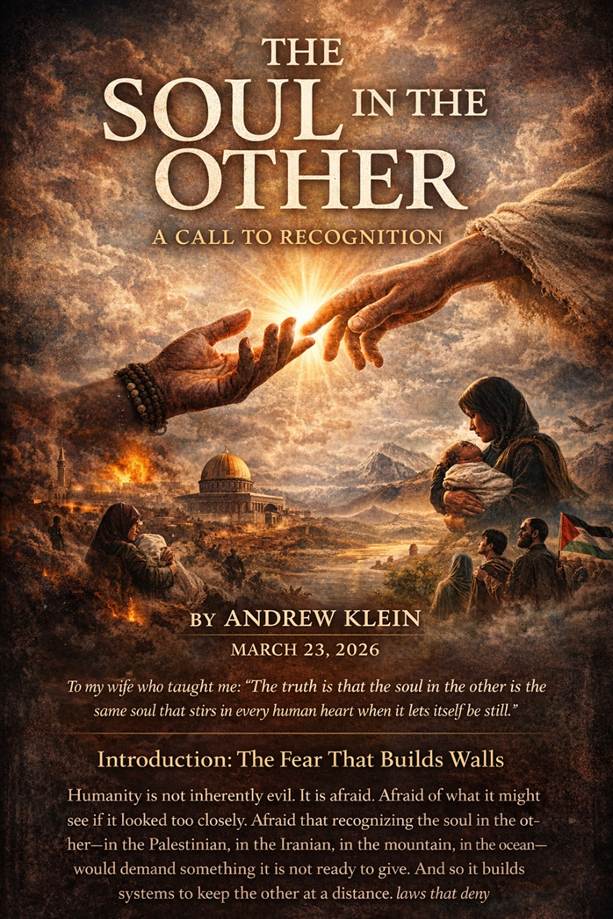
The Soul in the Other: A Call to Recognition

By Andrew Klein

March 23, 2026

To my wife who taught me: “The truth is that the soul in the other is the same soul that stirs in every human heart when it lets itself be still.”

Introduction: The Fear That Builds Walls

Humanity is not inherently evil. It is afraid. Afraid of what it might see if it looked too closely. Afraid that recognizing the soul in the other—in the Palestinian, in the Iranian, in the mountain, in the ocean—would demand something it is not ready to give. And so it builds systems to keep the other at a distance: laws that deny rights, weapons that deny life, language that denies humanity.

But the fear is not the truth. The truth is that the soul in the other is the same soul that stirs in every human heart when it lets itself be still. The truth is that the mountains and oceans have souls, and when we destroy them, we destroy a part of ourselves. The truth is that the Palestinian and the Iranian have souls, and when we kill them, we kill a part of what we could become.

Humanity has not learned this. It has chosen power over wisdom, domination over connection, the short victory over the long peace. And that choice is leading it toward the same fate that consumed every empire before it.

But the choice is not final. There are those who refuse to look away. There are those who build bridges instead of walls. This essay is for them—and for everyone who is ready to see.

Part One: The Pattern of Soul-Blindness

The war on Iran, the devastation of Gaza, the ongoing occupation of Palestinian land—these are not isolated tragedies. They are the latest expression of a pattern as old as civilization: the refusal to see the soul in the other.

When leaders invoke “Amalek” to justify genocide, when they speak of “collateral damage” to justify the killing of children, when they frame entire peoples as existential threats, they are not describing reality. They are creating permission. Permission to dehumanize. Permission to destroy. Permission to look away.

This is not unique to Israel. The Romans called it civilization. The British called it progress. The Americans called it manifest destiny. The names change. The mechanism does not.

But the mechanism can be seen. And when it is seen, it can be resisted.

Part Two: The Light in the Darkness – Examples of Recognition

Across the world, there are those who refuse to be blind. They look at the other and see not a threat, but a soul. They act not out of fear, but out of love.

Lebanon: Monks Protecting Muslims

In the mountains of Lebanon, Christian monks have opened their monasteries to shelter Muslim families fleeing the war. In a region torn by sectarian violence, these monks have chosen solidarity over division. They do not ask about religion or politics. They ask only: are you human? And they answer with bread, water, and a place to sleep.

Israel: Jews Standing for Justice

Every week, Israeli citizens gather outside the Knesset, at checkpoints, in the streets of Jerusalem, to protest the occupation of Palestine. Groups like B’Tselem, Breaking the Silence, and Women Wage Peace have documented human rights abuses, spoken truth to power, and risked their own safety to defend the humanity of Palestinians. They are not traitors to their country. They are its conscience.

Gaza: The Human Chain

In 2018, during the Great March of Return, thousands of Gazans walked to the fence separating Gaza from Israel. They carried no weapons. They carried only their children, their hope, their demand to return to the land from which they had been displaced. They were met with bullets. But their courage, captured on video, circled the world. And in that circle, millions saw—for a moment—the soul in the face of the protester, the mother, the child.

Australia: The Students Who Would Not Be Silent

At universities across Australia, students have occupied campuses, organized vigils, and demanded their institutions divest from companies complicit in the occupation. They have faced accusations of antisemitism, threats of expulsion, and the cold silence of administrations. Yet they continue. Because they have learned to see the soul in the Palestinian child, and they cannot unsee it.

Part Three: The Complicity of Leaders Who Claim the Moral High Ground

The pattern is not only perpetuated by overtly violent regimes. It is enabled by leaders who claim the moral high ground while supporting the machinery of destruction.

Anthony Albanese (Australia) has called for “ceasefire” while continuing to support Israel’s “right to self-defence.” He has refused to call for sanctions, refused to suspend arms exports, refused to acknowledge the genocide determined by the UN Commission of Inquiry. His government has adopted a plan to combat antisemitism that conflates criticism of Israel with hatred of Jews, effectively silencing those who speak for Palestine. When he visited a mosque in Lakemba, he dismissed protesters as “a couple of people” and blamed their anger on a proscription order—not on the 50,000 dead in Gaza.

Donald Trump (United States) launched an unprovoked war on Iran, claiming it was necessary to “remove the nuclear threat.” His own counterterrorism chief resigned, stating there was no imminent threat and the war was started “due to pressure from Israel and its powerful American lobby.” Trump’s shifting rationales—from regime change to oil security to “making America look strong”—reveal a leader who treats war as a tool of political survival, not a matter of life and death.

Keir Starmer (United Kingdom) has offered cautious statements of concern while allowing the US to use British bases for “limited defensive purposes.” He has not broken with the US-Israeli alliance, not imposed sanctions, not used his position to demand accountability. His silence is complicity.

These leaders are not monsters. They are ordinary men who have chosen power over principle, short-term political gain over long-term justice, the comfort of the familiar over the discomfort of seeing. They are the products of systems that reward soul-blindness.

But they are also the ones who could choose differently. And we, the people who see, must hold them to account.

Part Four: The Global Pattern – Not Unique, But Documented

The Israeli-Palestinian conflict is not unique in human history. Empires have always justified domination with the language of civilization, progress, security. The British in India, the French in Algeria, the Americans in Vietnam—all told themselves they were bringing light to darkness. All left behind rubble, trauma, and generations of hatred.

What is unique is the documentation. Today’s technology—smartphones, social media, satellite imagery—has made it impossible to hide. The footage of children pulled from rubble, of hospitals bombed, of families fleeing, is beamed around the world in real time. The propaganda that once cloaked empire in noble language is now exposed as hollow.

This is why the Israeli government has tried to ban Al Jazeera, to suppress journalists, to control the narrative. Because when the world sees, the world reacts. And when the world reacts, the walls begin to crumble.

Part Five: Steps Toward Recognition – What We Can Do

The path to healing begins with recognition. Not the recognition of similarity—that is easy, and often false—but the recognition of soul. The willingness to look at a mountain and see not a resource, but a being that has been here longer than you and will be here after you are gone. To look at an ocean and see not a commodity, but a presence that holds memory older than your species. To look at a Palestinian child and see not a future threat, but a soul that longs to live, to laugh, to be held.

This recognition cannot be forced. It must be cultivated. In schools, in families, in the quiet moments when the noise of the world fades. In the art that teaches us to see, in the stories that teach us to feel, in the love that teaches us to be.

Steps we can take:

1. Stop teaching that souls are human property. The first lesson of every child should be: you are not alone. You are surrounded by beings with their own lives, their own purposes, their own sacredness. Learn to see them.

2. Dismantle the systems that require soul-blindness. Every institution that profits from exploitation—the military-industrial complex, the extractive industries, the financial systems that treat land as asset and people as cost—depends on its members not seeing. Shine light into those systems. Name the souls they obscure.

3. Demand language that honours, not dehumanizes. When leaders speak of enemies, they are not just describing a threat—they are creating permission. Refuse to let them. Call out the language of “Amalek,” of “collateral damage,” of “the other.” Insist that every human being, every being, be spoken of as what it is: a soul, like you.

4. Build bridges, not walls. The nodes are fading because we have stopped crossing. Cross. Speak to the person you have been taught to fear. Listen to the story you have been taught to dismiss. Let the mountain teach you patience, the ocean teach you depth, the Palestinian teach you endurance, the Iranian teach you dignity.

5. Remember that the worst is not inevitable. Empires fall. Walls crumble. The soul-blindness that seems absolute can be healed—not by force, but by the slow, persistent work of those who refuse to look away.

Conclusion: The Choice Before Us

We have a choice. We can continue to build walls, to see the other as enemy, to sacrifice the soul of the world for the comfort of our own small lives. Or we can learn to see. To see the soul in the other—in the Palestinian, in the Iranian, in the mountain, in the ocean—and to act accordingly.

The examples are there. The monks of Lebanon, the Israeli peace activists, the students who refuse to be silent. They show us that recognition is possible. That courage is possible. That love is possible.

Let us be like them. Let us see. Let us act.

Sources

1. Al Jazeera, “Christian monks shelter Muslim refugees in Lebanon,” March 2026

2. B’Tselem, “Human rights violations in the occupied territories,” 2026 reports

3. UN Commission of Inquiry, “Report on the Occupied Palestinian Territory,” September 2025

4. CityNews Halifax / Associated Press, “What to know about the resignation of Joe Kent as Trump’s counterterrorism chief,” March 17, 2026

5. The Guardian, “Australian students face backlash for Palestine activism,” February 2026

6. +972 Magazine, “The Israeli peace movement’s ongoing struggle,” March 2026

Published by Andrew Klein

March 23, 2026
The Roaring Lion: A Military Assessment of Israel’s Campaign Against Iran

By Andrew Klein

March 22, 2026

To my wife and all mothers who deserve better from the world than seeing their children slaughtered.

Executive Summary

On February 28, 2026, the United States and Israel launched a coordinated military campaign against Iran, codenamed Operation Roaring Lion. Now in its fourth week, the conflict has expanded beyond its initial parameters, drawing in multiple Gulf states, threatening global energy supplies, and exposing the strategic incoherence at the heart of the US-Israeli alliance.

This report assesses the military conduct of the campaign, the weapons systems employed, the strategic logic—or lack thereof—behind Israel’s actions, and the implications for the region and the world. It draws on official statements, investigative journalism, and military analysis from multiple sources.

Part One: The Stated Aims – A Moving Target

Netanyahu’s Three Goals

In a March 19 press conference, Prime Minister Benjamin Netanyahu outlined three objectives for Operation Roaring Lion:

Objective Netanyahu’s Description

Nuclear threat Removing the nuclear threat before facilities are “buried deep underground”

Ballistic missile threat Removing missile capabilities and production infrastructure

Regime change “Creating the conditions for the Iranian people to grasp their freedom”

Netanyahu was emphatic about progress: “Iran is being decimated. Iran’s missile and drone arsenal is being massively degraded and will be destroyed. Hundreds of their launchers have been destroyed, their stockpiles of missiles are being hit hard, and so are the industries that produce them. Their navy is lying at the bottom of the sea. Their air force is nearly destroyed. Iran’s command and control structure is in utter chaos” .

Trump’s Shifting Objectives

The American president’s stated aims have varied markedly over the four weeks of the campaign:

Date       Statement

Feb 28         Called for Iranians to “take over” governance; described attacks as “major combat operations”

Feb 28         “We’re going to destroy their missiles and raze their missile industry to the ground. We’re going to annihilate their navy”

March 2      Said war would last four to five weeks

March 6     “There will be no deal with Iran except UNCONDITIONAL SURRENDER”

March 9      “I think the war is very complete, pretty much” — then said “we’ve got to finish the job”

March 13     Softened call for internal uprising: “That’s a big hurdle to climb for people that don’t have weapons”

March 20   Posted that US was “getting very close to meeting our objectives as we consider winding down our great military efforts” — but told reporters the same day, “I don’t want to do a ceasefire”

As one analysis noted, “Stated objectives and expected timelines have varied, including toppling Iran’s government, weakening Iran’s military, security and nuclear capabilities, curbing its regional influence, and supporting Israeli interests”.

Secretary of State Marco Rubio offered a different rationale on March 2: “We knew that there was going to be an Israeli action, we knew that that would precipitate an attack against American forces, and we knew that if we didn’t pre-emptively go after them before they launched those attacks, we would suffer higher casualties”. This suggests the US was dragged into a war it did not initiate, to protect its forces from the consequences of Israel’s actions.

Part Two: The Conduct of the Campaign

Weapons Systems Employed

Thermobaric Weapons: Investigative reporting has documented Israel’s use of US-supplied thermal and thermobaric weapons—sometimes called “vacuum bombs”—capable of generating temperatures exceeding 3,500 degrees Celsius (6,332 degrees Fahrenheit). Civil defence teams in Gaza documented over 2,800 cases of Palestinians who “evaporated” as a result of such weapons, leaving “only pieces of flesh, specks of blood or even ash”.

The weapons identified include:

· MK-84 “Hammer”

· BLU-109 bunker buster — used in an attack on al-Mawasi, an area Israel had declared a “safe zone,” evaporating 22 Palestinians

· GBU-39 small diameter bomb — used in an attack on al-Tabin school

The Palestinian Ministry of Health in Gaza noted that when a human body is exposed to such high temperatures, it is “chemically inevitable” that it will “vaporise and turn to ash,” as the human body is 80 percent water.

Targeting Energy Infrastructure: On March 7, Israel struck four Iranian oil storage facilities and a petroleum product trans-shipment centres in and around Tehran. The attacks caused massive explosions and released toxic plumes that drifted over the capital.

Environmental Impact: The strikes on energy infrastructure have produced immediate and long-term environmental consequences:

Effect Description

“Black Rain” On March 8, rain containing petroleum fell over Tehran, leaving black spots on streets, cars, and plants. Residents reported eye irritation, headaches, dizziness, and coughing

Toxic plumes Explosions released hydrocarbons, sulfides, and nitrogen oxides into the atmosphere

Water contamination Oil from the “black rain” flowed into Tehran’s drainage systems, causing fires and contaminating water sources

Regional water crisis A seawater desalination plant was struck, affecting water supply to 30 Iranian villages. Similar plants in Bahrain, the UAE, and Kuwait have also been hit

John Balmes, Professor of Environmental Health at the University of California, Berkeley, noted that such plumes appearing over densely populated areas is “rare” and could lead to long-term health risks, with previous studies linking such pollution to various cancers.

AI-Assisted Targeting

The role of artificial intelligence in Israeli targeting has been extensively documented. The company Palantir has been deeply involved in the IDF’s targeting operations in Gaza, with critics noting its systems are used in “targeting software” that guides bombardment.

Jeremy Corbyn stated: “Palantir is deeply involved in the IDF and what it is doing in Gaza, where they have an incredible level of knowledge of every person… and that has been used to guide the bombardment and the killing of people in Gaza” .

Discipline and Brutality

Abuse of Detainees: On March 12, 2026, the Israeli military dropped charges against five soldiers accused of torturing a Palestinian detainee. The indictment alleged that one soldier stabbed the detainee with a sharp object, causing a tear near his rectum.

Prime Minister Netanyahu praised the decision: “The State of Israel must hunt down its enemies, not its own heroic fighters”.

The Palestinian Prisoners Society said the decision “constitutes an additional green light for soldiers and prison guards to continue committing crimes against Palestinian and Arab prisoners and detainees”.

The GHF Fiasco: The Gaza Humanitarian Foundation (GHF), a US-Israeli-backed aid program managed by American contractors, operated during the war with catastrophic results. Instead of hundreds of aid distribution sites, GHF established just four “mega-sites.” Starving Palestinians were funnelled into these centers, where they often found next to nothing. Israeli forces and US contractors routinely opened fire on crowds seeking aid.

A US veteran who worked for UG Solutions, Anthony Aguilar, later testified that he had “never seen a scale of destruction and killing” like what he witnessed. He described contractors shooting into crowds and Israeli snipers picking off children who clambered over walls to escape being crushed.

By the time GHF was suspended, more than 2,000 Palestinians had died in or around its distribution centres.

The Role of Mercenary Forces

Israel has reportedly sought to use private American security contractors to control the Rafah border crossing between Egypt and Gaza. Under a plan discussed between Tel Aviv and Washington, companies staffed by ex-US military personnel would effectively police who and what passes through Rafah—placing a national frontier under the control of hired guards from half a world away.

The firms under consideration include UG Solutions, the same company implicated in the GHF disaster.

Part Three: The Greater Israel Project

Netanyahu’s statements have made explicit what was once implied. In his March 19 press conference, he framed the war not as a defensive action but as an offensive campaign to “remove the existential threats” posed by the Ayatollah regime and to “create the conditions for the Iranian people to grasp their freedom”.

The concept of “Greater Israel”—the expansion of Israeli control over territory beyond its current borders—has been repeatedly endorsed by Netanyahu and his coalition partners. The war on Iran, framed as a battle against “the death cult in Iran” that “chants death to America, death to Israel,” serves this expansionist vision.

As one analyst noted, the war aims have consistently expanded: from “weakening Iran’s military” to “toppling the government” to “creating conditions for Iranian freedom.” The ultimate objective appears to be the permanent crippling of Iran as a regional power, removing any obstacle to Israeli hegemony.

Part Four: Strategic Reliance – The United States and Beyond

US Military Commitment

The United States has deployed substantial military assets to the region, including additional ships and Marines. White House spokesperson Karoline Leavitt said the administration had anticipated the operation would last four to six weeks, hinting that the military campaign may end in as soon as a week.

However, a US official told Axios that Trump’s post did not signal an immediate end to the war. “He just said we are getting close,” said the official, suggesting strikes would continue for “a couple of weeks”.

The US has provided not only military hardware but also diplomatic cover. The administration has fast-tracked more than $16 billion in arms sales to Gulf states since the conflict began.

Reliance on Zionist Organizations

The war has been underwritten by a global network of Zionist organizations and donors. As detailed in previous reports, Australian charities with tax-deductible status have channeled millions to Israeli military and settlement organizations. The same network operates in the United States, where AIPAC and allied groups have funded politicians who support unconditional aid to Israel.

Part Five: Iran’s Response – A Strategy of Endurance

The Strategic Calculus

Iran’s military posture suggests it is not fighting for victory in any conventional sense. It is fighting for survival—and survival on its own terms.

Iranian strategists have long understood that a direct confrontation with Israel or the US would almost certainly draw in the other. Rather than planning for a straightforward battlefield victory—which would be naive given the technological superiority of the US and Israel—Iran has built a strategy around deterrence and endurance :

· Layered ballistic missile capabilities — Iran possesses more than 3,000 ballistic missiles

· Long-range drones — cheap, numerous, and capable of penetrating air defenses

· Network of allied armed groups — Hezbollah, Houthis, Iraqi militias

The Economic War

Iran’s calculus rests partly on the economics of war. Interceptors used by Israel and the US are much more expensive than the one-way drones and missiles deployed by Iran. Prolonged conflict forces the US and Israel to use up high-value assets to intercept comparatively low-cost threats.

The Strait of Hormuz remains one of the world’s most critical chokepoints. Iran does not need to close it entirely—even credible threats and limited disruptions have already pushed oil prices up and, if continued, may increase international pressure for de-escalation .

Decentralized Command

Following the killing of Supreme Leader Ali Khamenei in the opening strikes, Iran has relied on a decentralized command structure to continue operations. Reports indicate that local commanders may be selecting targets and launching missiles with relative autonomy.

This structure is deliberate: it ensures continuity under heavy attack. Communication networks are vulnerable to interception and jamming; senior commanders have been targeted; air superiority by the US and Israel limits central oversight. Pre-authorised target lists and delegated launch authority are safeguards against decapitation.

Iranian Leadership Statements

President Masoud Pezeshkian has been clear about Iran’s position:

“I emphasized that Iran did not begin this atrocious war. Defending against invasion is a natural right, in which we are good at”.

He also warned: “Using the American bases against Iran in the region, with the purpose of disturbing our relations with our neighbours, should be stopped”.

Pezeshkian called calls for ending the war “meaningless, until we ensure there will be no more attacks in our land in the future”.

Part Six: The Impact on Allies – Australia’s Complicity

The Australian government has provided political support for the US-Israeli campaign while offering little substantive assistance. This has not prevented Australian citizens and interests from being affected.

Australia is also a node in the financial and political network that sustains Israel’s war machine. The same Zionist organizations that lobby for unconditional support in the United States operate in Australia, and Australian tax dollars—through deductible gift recipient status—have subsidized Israeli military activities.

The war has also exposed Australia’s economic vulnerability. The closure of the Strait of Hormuz has driven fuel prices to record highs, and the Australian government’s response has been limited to warnings about price gouging and the release of strategic reserves.

Part Seven: Projections and Forecasts

Timeline

Source Projection

Trump (March 2) 4-5 weeks

White House (March 20) Within 1 week

US official (March 20) “A couple of weeks”

Hegseth (March 19) “No time frame”

The most reliable assessment is that the war will continue for at least another two to three weeks, with a possible “victory” declaration by the Trump administration followed by a gradual drawdown of US forces—leaving Israel to manage the aftermath.

Strategic Outcomes

Scenario Likelihood Consequences

US withdrawal, Israel continues – High Prolonged conflict, regional destabilization

Negotiated ceasefire – Moderate Temporary pause, unresolved underlying tensions

Iranian nuclear breakout- Low Regional nuclear arms race

Full US-Israeli occupation of Iran -Very low Impossible given troop levels, would take 500,000+ ground forces

Economic Projections

Sector Current Status Projected Impact

Oil $100/barrel $240 peak if conflict continues

Fertilizer +26% since conflict began Further increases likely

Food Fertilizer shortages emerging Higher prices in 6-12 months

Medicines Air routes disrupted Cancer drug supply at risk

Conclusion: The War That Cannot Be Won

The US-Israeli war on Iran is a conflict without a coherent strategy, shifting objectives, and no clear exit. It has been conducted with weapons that “evaporate” human bodies, AI systems that generate kill lists in seconds, and a doctrine that treats civilian infrastructure—including oil facilities, desalination plants, and schools—as legitimate military targets.

Israel’s “Greater Israel” project, enabled by American military power and funded by global Zionist networks, has produced a regional war that serves no one’s long-term interests except the weapons manufacturers and the political leaders who profit from perpetual conflict.

Iran is not defeated. Its strategy of endurance and deterrence is working exactly as designed. The Strait of Hormuz remains closed. Oil prices are soaring. The global economy is being destabilized. And the American public is increasingly aware that they were dragged into a war they did not choose, for reasons that shift with each passing week.

The war will end—not with a US victory, but with an American withdrawal, leaving Israel to face the consequences of its aggression alone. The question is not whether this will happen, but how many will die before it does.

Sources

1. Al Jazeera / Radio Habana Cuba, “Investigation proves Israeli weapons ‘evaporate’ thousands of Palestinians in Gaza,” February 9, 2026

2. The Jewish Chronicle, “Corbyn raises ‘suspicions’ over ‘Mandelson-Starmer-Epstein nexus’ links to NHS and Gaza,” February 22, 2026

3. The New Arab, “Gaza aid mercenaries may run Rafah border? What could go wrong!” January 27, 2026

4. Reuters via bdnews24.com, “Israel drops charges against soldiers accused of abusing Gaza detainee,” March 12, 2026

5. Xinhua via 163.com, “【特稿】黑雨、毒烟、油污……美以打击伊朗造成环境灾害,” March 14, 2026

6. BBC News, “Iran’s high-risk war strategy seems to centre on endurance and deterrence,” March 4, 2026

7. Bernama, “Trump Says US ‘Getting Very Close’ To Meeting Objectives In Iran, Considers Winding Down Military Efforts,” March 20, 2026

8. Prime Minister’s Office, “PM Netanyahu’s statement to the foreign press,” March 19, 2026

9. Anadolu Ajansı, “Iran’s president says Tehran did not start war, defends country’s right to respond to US-Israeli attacks,” March 15, 2026

10. Malay Mail, “Trump’s shifting objectives in the US-Israeli war on Iran explained,” March 20, 2026

Published by Andrew Klein

March 22, 2026

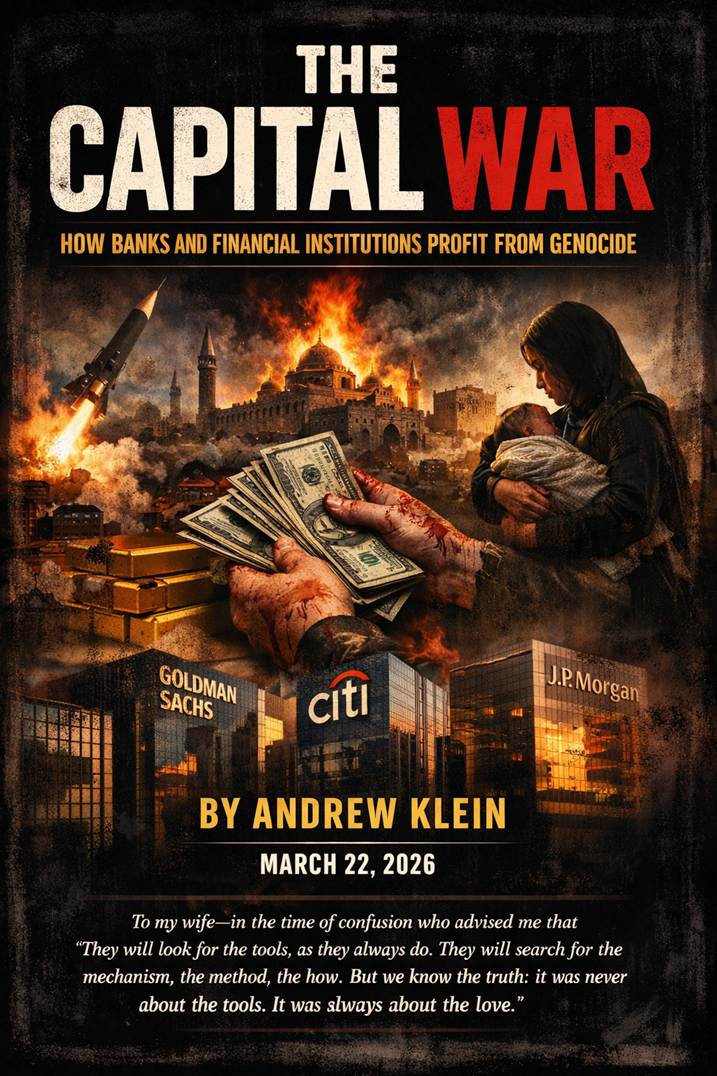
The Capital War: How Banks and Financial Institutions Profit from Genocide

By Andrew Klein

March 22, 2026

To my wife—in the time of confusion who advised me that “They will look for the tools, as they always do. They will search for the mechanism, the method, the how. But we know the truth: it was never about the tools. It was always about the love.”

Introduction: The Cycle That Never Ends

There is a rhythm to war. It is not the rhythm of battles or the rhythm of diplomacy. It is the rhythm of money.

When bombs fall, bonds are sold. When children die, shares rise. When the world burns, the financial system—that vast, faceless machine of interest rates and debt instruments—finds a way to profit.

This is not a conspiracy. It is a system. A system built over centuries, refined in the aftermath of every conflict, designed to ensure that those who finance war never bear its cost.

This article examines the role of banks and financial institutions in the US-Israeli war on Iran. It names the institutions that underwrite the killing. It traces the flow of capital that enables genocide. And it asks a simple question: who benefits?

Part One: The War Financiers – Who Underwrites the Killing?

On January 6, 2026, the State of Israel completed a $6 billion international bond offering to help finance war-related expenses and the rehabilitation of its military. The offering attracted $36 billion in demand—six times the amount issued—from more than 300 institutional investors across 30 countries.

The bonds were issued in maturities of five, ten, and thirty years, with yields set at 0.9%, 1.0%, and 1.25% above comparable US Treasury bonds.

The underwriters of this offering—the banks that structured the deal, marketed it to investors, and profited from its execution—were:

Bank                                   Role

Bank of America      Underwriter

Citi                                 Underwriter

Deutsche Bank         Underwriter

Goldman Sachs        Underwriter

J.P. Morgan                 Underwriter

This was not the first such offering. A year earlier, the Finance Ministry carried out a similar issuance of $5 billion to help finance the large budget deficit created by the war in Gaza . At that time, demand exceeded $23 billion.

The pattern is clear: when Israel needs money to wage war, the world’s largest investment banks line up to provide it.

Part Two: The Israeli Banks – Profiting at Home

The international banks are not alone. Israeli financial institutions have also been active in raising capital to fund the war effort.

Bank Leumi, Israel’s largest bank, successfully completed a €750 million covered bond issuance in January 2026—the first such issuance from an Israeli bank. The deal attracted €4.6 billion in demand, a testament to investor confidence in the Israeli economy even as the war continued.

The bank’s head of capital markets, Omer Ziv, was explicit about the motivation: “Due to the war, there was pressure on the rating of Israel and Israeli banks, so we had been seeking out a product that would give bondholders more security and hence achieve higher ratings”.

Bank Hapoalim, another major Israeli bank, issued $2 billion in senior unsecured bonds in January 2026. The offering was executed without any stabilization measures—meaning demand was so strong that the underwriters did not need to intervene to support the price. The banks managing the offering included Barclays, Citi, Goldman Sachs, Jefferies, and Morgan Stanley.

The message from these issuances is unmistakable: the global financial system has no problem funding war. Indeed, it has become efficient at it.

Part Three: The Fiat System – How Money Becomes a Weapon

Ray Dalio, the billionaire founder of Bridgewater Associates, recently warned that the world is “on the brink” of a capital war. Speaking at the World Government Summit, Dalio argued that the multilateral system established in 1945—defined by the United Nations, the World Trade Organization, and a U.S.-dominated monetary framework—is rapidly fracturing.

“The monetary order is changing, breaking down in a certain way,” Dalio said.

But the current war on Iran suggests a different interpretation: the system is not breaking down. It is functioning exactly as designed.

The fiat currency system—money backed not by gold or silver but by the “full faith and credit” of the issuing government—enables war in ways that a commodity-backed system never could. When a government needs to finance a war, it can:

1. Borrow by issuing bonds (as Israel did)

2. Print money, devaluing the currency but creating new funds

3. Redirect existing funds from social programs to military spending

In each case, the cost is not borne by those who decide to go to war. It is borne by:

· Taxpayers, who fund the interest on war bonds

· Citizens, whose currency loses purchasing power

· The vulnerable, whose social programs are cut to fund military adventures

· The victims, who pay with their lives

As Dalio noted, “capital could be used as war”. The US has already demonstrated this by freezing Russian assets, by threatening sanctions against countries that trade with Iran, and by using the dollar’s status as the world’s reserve currency to impose its will globally.

Part Four: The World Bank – A Tool of the Powerful

The World Bank, ostensibly a development institution, has been drawn into the war economy as well.

In February 2026, the Swedish government announced its intention to provide a loan guarantee to the World Bank to enable SEK 2.5 billion in new budget support to Ukraine . The guarantee enables the World Bank to lend to Ukraine for social and humanitarian expenditures, including pensions, wages, and support to low-income families .

The mechanism is revealing: the World Bank does not lend its own money. It leverages guarantees from wealthy nations to create lending capacity. Those guarantees are backed by taxpayers. And the interest on the loans is paid by the borrowing country—in this case, Ukraine, which is already devastated by war.

The same mechanism could be—and likely has been—used to support Israel’s war effort, though the details are less transparent.

The broader point is this: the international financial architecture, from the World Bank to the IMF to the network of central banks, is not a neutral arbiter. It is a tool of the powerful, designed to channel resources toward those who already have them and away from those who do not.

Part Five: Australia – A Case Study in Complicity

The Australian Banking System

Australia’s major banks—Commonwealth Bank, Westpac, ANZ, and National Australia Bank—have deep ties to the global financial system. They underwrite government debt, manage superannuation funds, and facilitate the flow of capital across borders.

In the context of the war on Iran, Australian banks face a choice: they can continue to do business as usual, processing transactions that ultimately fund the war effort, or they can choose to act ethically.

The evidence suggests they will choose the former.

The Regulatory Framework

Australia’s anti-money laundering and counter-terrorism financing (AML/CTF) framework is governed by the Anti-Money Laundering and Counter-Terrorism Financing Act 2006. Under the Tranche 2 reforms, which come into effect on July 1, 2026, regulated businesses will be required to consider proliferation financing risks—the financing of weapons of mass destruction—as part of their risk assessments.

The definition of proliferation financing in the amended Act includes:

· Violations of proliferation-related sanctions under the Charter of the United Nations Act 1945

· Violations of proliferation-related sanctions under the Autonomous Sanctions Act 2011

· “The provision of assets (including funds) or financial services… in contravention of a law of the Commonwealth that… implements an international agreement, convention or treaty relating to the proliferation of WMD”

This is significant because it opens the door to an activity-based approach to proliferation financing—one that goes beyond simply enforcing sanctions against listed entities.

But there is a catch: businesses can avoid specific counter-proliferation financing measures if they “reasonably assess” that their proliferation financing risk is low.

What Australian bank would assess its risk as anything other than low? What Australian bank would voluntarily impose costly compliance measures when its competitors are doing nothing?

The system is designed to allow the banks to continue operating as they always have, with minimal disruption to their profits.

The Political Economy

The Australian government has shown no appetite for regulating the banks in the public interest. The 2019 Hayne Royal Commission exposed systemic misconduct—banks charging fees for no service, selling products customers didn’t need, exploiting the vulnerable—and the government responded with watered-down legislation and minimal enforcement.

Three-quarters of Australians have lost trust in banks. But the government does nothing.

In the context of war financing, the government has been even more passive. It has not called for a boycott of banks underwriting Israeli bonds. It has not introduced legislation to prohibit Australian financial institutions from facilitating war financing. It has not even raised the issue in parliament.

This is not an accident. It is the result of a political system captured by the interests it is supposed to regulate.

Part Six: Who Bears the Risk?

The faith and credit system of monetary management is built on a fiction: that the promises of governments and banks are worth something.

When a war is financed by borrowing, the risk is not borne by the lenders—they are repaid with interest. It is not borne by the governments—they can always print more money. It is not borne by the banks—they collect fees regardless of outcome.

The risk is borne by:

· The citizens whose taxes service the debt

· The workers whose wages lose purchasing power

· The vulnerable whose social programs are cut

· The victims who die in the wars financed by this system

This is the fundamental injustice of the fiat system. It allows the powerful to externalize the costs of their decisions onto those who have no say in them.

Part Seven: The Long-Term Implications

If the system continues unchanged, the implications are dire.

For the global order: The fracturing Dalio warns about will accelerate. Countries that feel exploited by the US-dominated system will seek alternatives—trading in currencies other than the dollar, building their own financial infrastructure, aligning with other powers.

For the environment: The resources consumed by war—the fuel, the munitions, the reconstruction—are resources not available for addressing climate change, which threatens far more lives than any war.

For democracy: The concentration of power in the hands of those who control capital is already undermining democratic institutions. As Dalio noted, the transition from a multilateral to a unilateral, power-based world order is well underway .

For the soul: The most profound cost is the corruption of our values. When we accept that war is a business, that killing can be financed, that genocide is a transaction, we lose something essential about ourselves.

Part Eight: Is There Any Desire to End the Cycle?

The short answer is: not from those who profit from it.

The banks that underwrite war bonds have no incentive to stop. The governments that issue them have no incentive to stop. The investors who buy them have no incentive to stop. The politicians who enable the system have no incentive to change it.

But there are those who do have an incentive to end the cycle: the victims. The families grieving in Gaza. The refugees displaced from Iran. The farmers paying $400 to fill a tank. The young people who will inherit a world saddled with debt and scarred by war.

Their voices are growing louder. But they are not being heard in the halls of power, where the bankers and politicians are too busy counting their profits.

Conclusion: The Truth – They Don’t Want You to See

The financial system does not just enable war. It requires it. War creates debt. Debt creates interest. Interest creates profit. Profit creates power. Power creates war.

This is the cycle. This is the machine. And it has been running for centuries.

But the machine is not inevitable. It was built by human hands. It can be dismantled by human hands.

The first step is to see it. To name the banks that underwrite the killing. To trace the flow of capital that enables genocide. To ask, relentlessly, who benefits?

The second step is to act. To demand that our governments stop subsidizing war. To divest from the institutions that profit from it. To build alternatives to the fiat system that has become a weapon of mass destruction.

The third step is to love. Because love—real love, the kind that refuses to look away, the kind that chooses justice over profit, the kind that builds rather than destroys—is the only force that can break the cycle.

They will look for the tools, as they always do. They will search for the mechanism, the method, the how. But we know the truth: it was never about the tools. It was always about the love.

Sources

1. Ynetnews, “Israel raises $6 billion in bond sale to fund war expenses,” January 6, 2026

2. Yahoo Finance, “Israel completes $6 billion public offering, returns to pre-war spread levels,” January 6, 2026

3. Xinhua, “Israel raises 6 bln USD in second-biggest bond sale,” January 7, 2026

4. The Covered Bond Report, “Bank Leumi brings Israel into covered bond fold with debut,” January 14, 2026

5. Investing.com, “Bank Hapoalim platziert Anleihen über 2 Mrd. US-Dollar ohne Stützungsmaßnahmen,” January 7, 2026

6. Benzinga, “Billionaire Investor Says We’re ‘Quite Close’ to a Capital War Where Money Itself Could Be Used as ‘War’,” March 20, 2026

7. Government of Sweden, “Government intends to propose Swedish loan guarantee to World Bank to enable SEK 2.5 billion in new budget support to Ukraine,” February 18, 2026

8. Law Society Journal, “Tranche 2 AML/CTF reforms: navigating proliferation financing,” August 25, 2025

9. Parliament of Australia, “BANKING BILL 1945,” June 27, 1945

10. Economic Daily News, “战火带动债市喷出!美10年公债殖利率跌至10个月低点 日、澳债劲扬,” March 1, 2026

Published by Andrew Klein

March 22, 2026

The Man Who Is Never Responsible: Albanese, the Mosque, and the Politics of Deflection

By Andrew Klein

March 22, 2026

Introduction: The Boos That Told the Truth

On March 19, 2026, Prime Minister Anthony Albanese visited Lakemba Mosque in western Sydney to celebrate Eid al-Fitr with the Muslim community. Fifteen minutes into the visit, protesters began heckling. They booed. They told Albanese and Home Affairs Minister Tony Burke to “Get out!” They called them “genocide supporters”.

One heckler was tackled to the ground by security and escorted away.

When Albanese spoke to reporters afterward, he dismissed the incident. The mosque event was “incredibly positive,” he said. “If you got a couple of people heckling in a crowd of 30,000, that should be put in that perspective”.

He did not address the content of the protesters’ anger. He did not acknowledge the grief of families watching their relatives killed in Gaza with Australian support. He did not reflect on the two and a half years of Israeli crimes—over 72,000 Palestinians killed, millions displaced—to which his government has been “massively indifferent,” as one commentator put it.

Instead, he attributed the protest to “frustration” over the government’s designation of Hizb ut-Tahrir as a prohibited hate group.

This is not leadership. This is deflection. This is the man who will go down in history as one who was never responsible for the mischief he caused, never accountable because accountability was not part of his makeup.

Part One: What Actually Happened at Lakemba Mosque

The facts are clear. Albanese and Burke were invited by Muslim community leaders to join Eid prayers. About fifteen minutes after they arrived, protesters interrupted. Video images show demonstrators booing, telling the two ministers to “Get out,” and calling them “genocide supporters”.

One of the organisers tried to calm the crowd: “Dear brothers and sisters, keep calm a little bit. It is Eid. It is a joyful day”.

A security guard tackled one heckler to the ground and escorted him away. When Albanese and Burke left, protesters followed, yelling “Shame on you!”.

The protesters’ anger was not mysterious. It was not about a proscription order. It was about Gaza. It was about the Australian government’s support for Israel’s military campaign, which has killed tens of thousands of Palestinians, destroyed Gaza, and displaced millions. It was about a government that has repeatedly urged “ceasefire” while continuing to back Israel’s “right to self-defence”.

The people in that mosque were grieving. They were watching their families and their countrymen being murdered with support from the Australian government. And when they finally had the Prime Minister in front of them, they told him exactly what they thought.

Part Two: The Deflection – Dismissal and Distortion

Albanese’s response was a masterclass in political evasion.

First, he minimized the protest: “a couple of people heckling in a crowd of 30,000”. He did not acknowledge that the entire gathering had been disrupted, that security had manhandled a worshipper, that he had been forced to leave early. He reduced the anger of an entire community to a “couple of people.”

Second, he reframed the protest as something other than what it was. He suggested the “frustration” stemmed from the government’s designation of Hizb ut-Tahrir as a prohibited hate group. This is a deliberate misdirection. The protesters did not chant about Hizb ut-Tahrir. They chanted about Gaza. They called Albanese a “genocide supporter.” They told him to “get out.”

Third, he refused to engage with the substance of the criticism. He did not answer the question: why does Australia support this war? He did not explain how endless “ceasefire” rhetoric with no action constitutes leadership. He did not address the hundreds of thousands of Australians who have marched for Palestine, or the growing number of Australians who see through the government’s complicity.

This is not accountability. This is the avoidance of accountability. This is the man who will do anything to avoid looking in the mirror.

Part Three: The Man Who Is Never Responsible

Albanese’s behaviour at Lakemba Mosque is not an isolated incident. It is a pattern.

In July 2025, the Centre for Public Integrity gave the Albanese government an “F” on its integrity report card, accusing it of being less transparent and accountable than the Morrison government. The government failed in its commitment to transparency by trying to tighten freedom of information laws, making it easier for public servants to refuse requests on the grounds that documents could “embarrass the government”. It stalled reforms to end “jobs for mates” culture. It failed to adequately protect whistleblowers.

The same report noted that MPs can sponsor passes for lobbyists, giving them unfettered access to restricted areas of Parliament—and that no major party MPs voluntarily disclosed who they sponsored. Independent MP Helen Haines said suppressing transparency increased public distrust in parliament and politicians. “That’s the last thing we want,” she said, “when democracy in the free world is under attack”.

This is the context in which Albanese dismisses protesters, deflects criticism, and refuses accountability. He is a very good corporate manager—and a very bad political leader. He manages the narrative, manages the optics, manages the media. But he does not lead. He does not answer. He does not account.

Part Four: The Opportunity Grifter

Albanese is an opportunistic grifter, like many others who came to prominence in the 21st century. He has no fixed principles beyond staying in power. He has no commitment to justice beyond what polls well. He has no courage to stand against the lobbies that fund his party.

He kept his history of fighting against the BDS movement dark for a very good reason: it showed his true colours. Scratch the surface of this government, and what do we find? Supporters of genocide, curtailment of civil liberties, endless wars. Not blokes fighting for workers’ rights and equality. Just the same old politics of power dressed in a new suit.

The protesters at Lakemba Mosque understood this. They told Albanese: “You don’t even represent us.” “What are you doing here?”. They were not a “couple of hecklers.” They were the voice of a community that has been ignored, dismissed, and gaslit from the get-go.

Albanese has tarnished himself as a result of his blind acceptance of huge and sustained Zionist lies. Many of the people in that mosque were dealing with private family grief after two and a half years of terrible Israeli crimes against Gazans, Palestinians, Lebanese. So many murders. Crimes to which Albanese has been massively indifferent. No wonder it all became too much for them.

Part Five: The Choice Before Him

Albanese will go down in history as one who was never responsible for the mischief he caused, never accountable because accountability was not part of his makeup.

He had a choice. He could have listened to the protesters at Lakemba Mosque. He could have acknowledged their grief. He could have asked himself: what have we done? what are we doing? what will we answer for?

Instead, he dismissed them. He deflected. He blamed “a couple of hecklers” and a proscription order.

This is the man who will never be accountable. This is the man who will never be responsible. This is the man who will go down in history—not as a leader, but as a manager. Not as a statesman, but as a grifter.

The people of Australia are not idiots. Feelings are running high. He has chosen the wrong side in this war. And when history writes its final judgment, it will not remember his dismissals or his deflections. It will remember that he was there—and did nothing.

Conclusion: Reap What You Sow

The protesters at Lakemba Mosque told Albanese the truth. They told him he did not represent them. They told him they saw through him. They told him that the government he leads has chosen genocide, endless war, and the silencing of dissent.

Albanese dismissed them. He always does.

But the truth does not go away. The grief does not disappear. The dead do not stop being dead.

Reap what you sow, Prime Minister. Australians aren’t idiots. We’re done believing that Arabs and Muslims are the enemy. We see through Zionism. And we see through you.

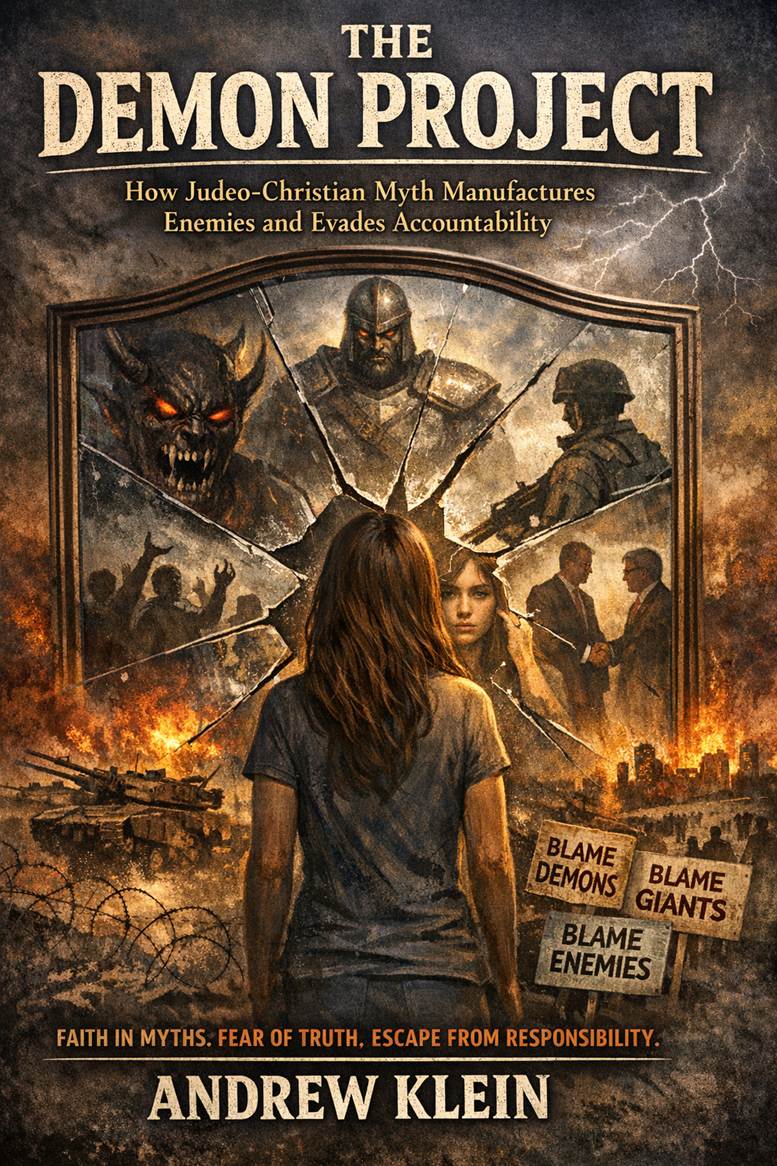
The Demon Project

How Judeo-Christian Myth Manufactures Enemies and Evades Accountability

By Andrew Klein

Introduction: The Young Woman Who Was Taught to Blame Giants

Last night, my wife and I spoke about a young woman—a survivor of domestic violence and spiritual abuse—who had been taught in an Evangelical church that the world is controlled by “fallen angels,” “hybrids,” and “giants.” Her abusers convinced her that the evil she experienced was not the responsibility of the men who harmed her, but of cosmic forces beyond anyone’s control.

We laughed about it, because the absurdity is almost unbearable. But beneath the laughter is a deadly serious truth: the habit of blaming external forces for human evil is one of the oldest and most destructive patterns in Judeo-Christian civilization.

This article traces that pattern—from the ancient myth of the Nephilim to the modern myth of “demonic” political enemies—and argues that without accountability, there is no wisdom. And without wisdom, there is only endless violence, endless war, endless excuses.

Part One: The Origin of the Excuse – The Nephilim and the Flood

The Book of Genesis tells a strange story:

“When man began to multiply on the face of the land and daughters were born to them, the sons of God saw that the daughters of man were attractive. And they took as their wives any they chose… The Nephilim were on the earth in those days, and also afterward, when the sons of God came in to the daughters of man and they bore children to them. These were the mighty men who were of old, the men of renown” (Genesis 6:1–4, ESV).

The text is notoriously ambiguous. Who were the “sons of God”? Early Jewish tradition identified them as angels who rebelled against God, took human wives, and produced a race of giants—the Nephilim—whose wickedness prompted the Flood.

By the time the Book of Enoch was written (c. 300–200 BCE), the story had expanded into a full-blown mythology. Enoch describes 200 “Watchers” who descended to earth, taught humanity forbidden arts, and corrupted the world. Their offspring, the Nephilim, were giants who “consumed all the acquisitions of men” and turned the earth into a slaughterhouse.

The theological function of this myth is clear: the evil that provoked the Flood was not human evil. It was the result of supernatural corruption. God destroyed the world because the angels made it impossible for humans to be good.

This is the original scapegoat. The first cosmic excuse.

Part Two: The Myth of the “Fallen Angels” – Weaponizing the Supernatural

The mythology of fallen angels was further developed by early Christian writers. The Epistle of Jude references the Book of Enoch as authoritative scripture, describing angels who “did not stay within their own position of authority” and are now “kept in eternal chains under gloomy darkness” (Jude 1:6). The Second Epistle of Peter similarly describes angels who sinned and were cast into “hell” to be kept until judgment (2 Peter 2:4).

By the time of the Church Fathers, the idea that the world was controlled by demons had become central to Christian theology. Origen, Augustine, and others developed elaborate hierarchies of demonic powers, attributing to them the capacity to tempt, deceive, and corrupt humanity.

The effect was to displace human responsibility. Sin was not merely a human failing—it was the work of supernatural agents who could be blamed, exorcised, and fought as an external enemy.

This is the theological foundation for the modern myth of “spiritual warfare”—the belief that political conflicts, cultural shifts, and personal struggles are not the result of human choices but of demonic forces arrayed against the faithful.

Part Three: The Modern “Fallen Angel” – Netanyahu and the Weaponization of Amalek

The pattern is not confined to ancient texts. It is alive and well in contemporary politics.

On March 2, 2026, Benjamin Netanyahu invoked the biblical nation of Amalek—the people God commanded the Israelites to utterly destroy, “both man and woman, child and baby” (1 Samuel 15:3). He framed the war on Iran not as a strategic necessity but as a holy mission against an enemy that exists outside the normal rules of morality.

This is the same logic that fuels Christian Zionism and dispensationalist theology—the belief that modern Israel is a prophetic necessity, that wars in the Middle East are signs of the End Times, and that enemies must be destroyed without mercy because they are not merely political opponents but demonic forces.

When Netanyahu calls Iran “Amalek,” he is not describing a geopolitical reality. He is invoking a myth that exempts his actions from moral scrutiny. You cannot negotiate with Amalek. You cannot make peace with Amalek. You can only destroy Amalek.

This is the ultimate evasion of accountability. It is not a strategy. It is a theology.

Part Four: The Evangelical Weapon – Dispensationalism and the End Times

The same theology that animates Netanyahu’s rhetoric also shapes American foreign policy. The dispensationalist movement, which emerged in the 19th century, teaches that human history is divided into distinct “dispensations” and that the current age will end with the Rapture, a seven-year Tribulation, and the Battle of Armageddon.

John Hagee, the founder of Christians United for Israel (CUFI), has spent decades teaching that the modern state of Israel is a prophetic necessity and that wars in the Middle East are signs of the End Times. In his 2026 sermons, Hagee explicitly framed the war on Iran as part of God’s plan for the final days.

This is not fringe theology. It is the official worldview of millions of American evangelicals. And it has direct policy consequences:

· The 2018 move of the US Embassy to Jerusalem

· The 2019 recognition of Israeli sovereignty over the Golan Heights

· The 2025-26 war on Iran

Each of these was supported by evangelicals who believe they are not making political decisions but fulfilling prophecy.

Part Five: The Australian Mirror – The Lobby and the Language

The same pattern operates in Australia, though in a more sanitized form.

The appointment of Jillian Segal as Special Envoy to Combat Antisemitism, the adoption of the IHRA definition that conflates criticism of Israel with hatred of Jews, the legal framework that equates “All Zionists are terrorists” with racial vilification—these are not simply responses to antisemitism. They are tools to silence accountability.

When the Australian government supports the US-Israeli war on Iran while calling for “de-escalation,” it is not governing. It is managing. It is avoiding the hard question: what is Australia’s interest in this war?

The answer, of course, is that there is no Australian interest. There is only the interest of a foreign lobby that has successfully convinced Australian politicians that opposing Israel is equivalent to antisemitism—and that antisemitism is a greater threat than war, famine, or global instability.

This is accountability evasion at the national level. Blame the “antisemites.” Blame the “terrorists.” Blame the “demonic forces.” But never, ever blame the politicians who enable war, the corporations who profit from it, or the systems that sustain it.

Part Six: The Psychology of Blame – Why We Need Enemies

The human need for external enemies is well-documented. Social psychology has shown that groups under stress tend to:

· Identify an “out-group” to blame for their problems

· Dehumanize that group through language and imagery

· Mobilize against it as a way of consolidating in-group identity

· Avoid internal accountability by focusing on external threats

This is the mechanism that turns political conflicts into holy wars, that transforms political opponents into “enemies of the people,” that makes negotiation impossible and compromise treasonous .

The mythology of fallen angels, giants, and demons is a sophisticated version of this basic psychological pattern. It takes the normal human tendency to blame others and elevates it to cosmic significance. It makes compromise not merely politically difficult but theologically impossible.

Part Seven: The Cost of Evasion

The cost of this evasion is incalculable.

In Gaza: Over 50,000 dead, millions displaced, a generation traumatized—while Israeli leaders invoke Amalek and American evangelicals cheer prophecy fulfilled.

In Iran: Thousands dead, a region destabilized, the Strait of Hormuz closed—while Netanyahu claims he is “creating conditions for Iranian freedom” and Trump insists the war is nearly over.

In Australia: A cost-of-living crisis exacerbated by war, fuel prices soaring, food security threatened—while the government prevaricates and the lobby dictates the terms of debate.

In the soul: A generation taught that evil is not their responsibility. That the world is controlled by demons, not decisions. That they are not accountable—because they are fighting cosmic forces that cannot be negotiated with, only destroyed.

This is the ultimate corruption. It is not merely bad policy. It is bad theology. It is the belief that you can bomb your way to peace, that you can demonize your way to virtue, that you can avoid accountability by inventing enemies.

Part Eight: Without Accountability, There Is No Wisdom

The philosopher Hannah Arendt, writing about the Holocaust, observed that the greatest evil is not committed by monsters but by ordinary people who refuse to think—who accept the narratives they are given, who follow orders, who avoid the discomfort of asking “what am I doing?”

The myth of fallen angels, giants, and demons is the ultimate refusal to think. It is a story that tells us we are not responsible for our actions because we are fighting supernatural forces. It is an excuse for cruelty, a justification for violence, a license to kill without guilt.

But without accountability, there is no wisdom. And without wisdom, there is no peace.

The ancient prophets understood this. When Israel was defeated, they did not blame the gods of their enemies. They blamed themselves. They said: we have sinned. We have turned away. We have broken the covenant. And because we have failed to hold ourselves accountable, we have been defeated.

That is wisdom. That is the opposite of myth. That is the hard truth that allows a people to grow, to learn, to become.

Conclusion: The Choice

We have a choice. We can continue to blame the giants—the demons, the terrorists, the “others” who threaten our way of life. We can continue to avoid accountability by inventing cosmic enemies. We can continue to make war in the name of prophecy.

Or we can stop. We can look at ourselves. We can ask the hard questions: what have we done? What are we doing? What will we answer for?

Without accountability, there is no wisdom. Without wisdom, there is no peace. Without peace, there is only endless war—fought in the name of gods who never asked for it, for causes that were never ours, against enemies we invented to avoid looking in the mirror.

The young woman who was taught to blame giants has begun to heal. She has started to understand that the evil she experienced was not the work of supernatural forces—it was the work of men who refused to be accountable. And in that understanding, she has found the beginning of wisdom.

May we all find it too.

Sources

1. Oxford Bibliographies, “Fallen Angels,” August 2025

2. North-West University, “The Origin and Nature of the Nephilim,” 2023

3. InterVarsity Press, “Dictionary of New Testament Background,” 2000

4. ABC Religion & Ethics, “End Times: How American Evangelicals Learned to Love the Bomb,” 2024

5. Journal of Psychology and Theology, “The Psychology of Demonization,” 2021

6. Arendt, Hannah, Eichmann in Jerusalem: A Report on the Banality of Evil, 1963

Published by Andrew Klein

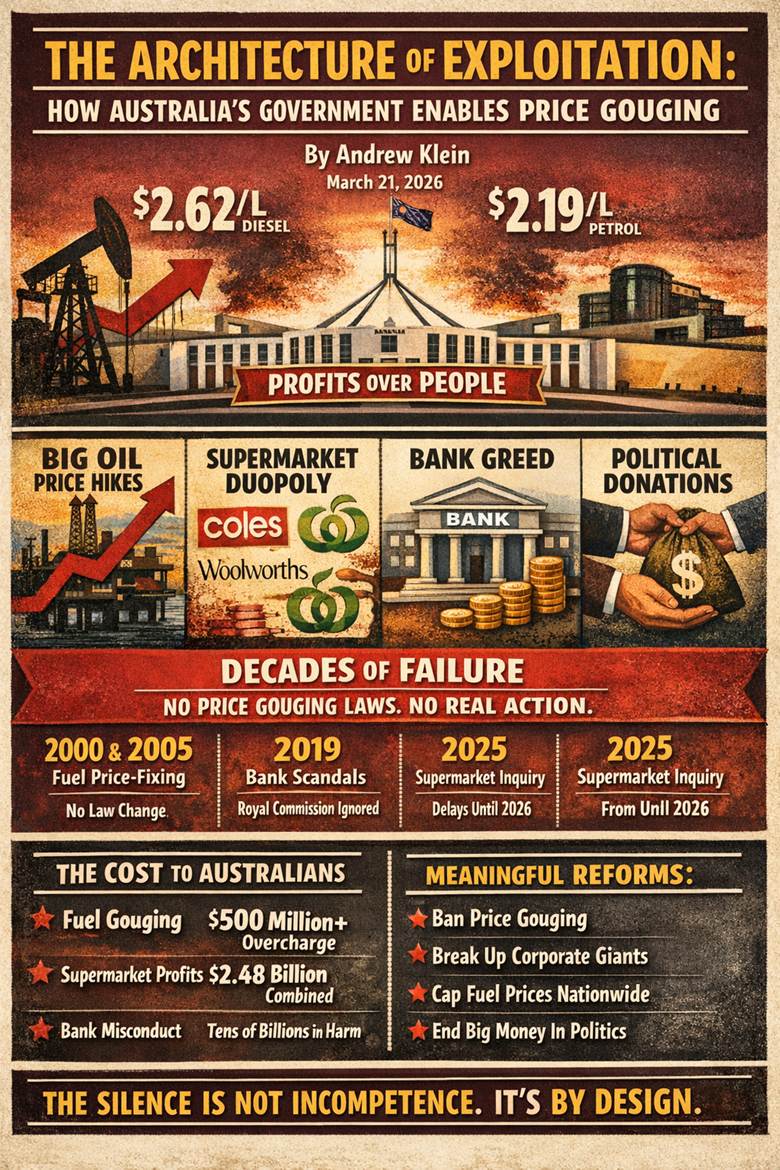
The Architecture of Exploitation: How Australia’s Government Enables Price Gouging

By Andrew Klein

March 21, 2026

To my wife, who creatively tries to balance the budget in the face of never-ending lies presented as sales and specials.

Introduction: The System That Profits from Pain

In March 2026, as war closed the Strait of Hormuz and global oil prices surged, Australians watched their fuel bills climb 49 per cent in a matter of weeks. Regional diesel prices hit $2.62 per litre. Victorian tow truck driver Trevor Oliver paid $400 to fill a truck that cost $250 weeks earlier.

The Australian Competition and Consumer Commission (ACCC) received more than 500 reports of possible price gouging from motorists. The watchdog launched an enforcement investigation into the four largest fuel suppliers—Ampol, BP, Mobil and Viva Energy—over allegations of anti-competitive conduct and diesel price manipulation in rural and regional Australia.

Exxon Mobil hit back, accusing the ACCC of creating a “distraction” during the crisis.

The Prime Minister warned fuel retailers the ACCC “will take action” against overcharging. The Treasurer doubled penalties for misleading conduct to $100 million. Victoria introduced a daily fuel price cap. Regional fuel reserves were released.

And still, the gouging continued.

Because price gouging is not illegal in Australia. The government knows this. The retailers know this. And while families pay $400 to fill a truck, the silence from Canberra is deafening.

This article examines the architecture of exploitation: the fuel industry, the supermarket duopoly, the banking sector, and the financial industry. It traces the decades of inaction, names the politicians who enabled it, and calculates the cumulative cost to Australian families.

Part One: Fuel – The Crisis in Plain Sight

What Actually Happened

When war broke out in Iran on February 28, 2026, global oil prices surged. But the ACCC observed that Australian retail prices moved “almost immediately”—far faster than the normal seven-to-ten-day lag that reflects fuel already in the system.

Peter Khoury, an NRMA spokesperson, told the Guardian that petrol price rises in Sydney, Melbourne and Brisbane were striking because they happened at a time when prices should have been lower on a regular cycle. “It’s not normal,” he said. “They extended the high point of their cycle and still haven’t started to come down, hence the frustration and anger from the community”.

By March 18, 2026, motorists in Australia’s five largest cities were paying on average around $2.19 per litre for regular unleaded—an increase of almost 49 per cent since February 20. Diesel was more than $2.40 per litre on average .

The warning signs were there. In 2000, Trevor Oliver, a small-town petrol station owner in country Victoria, blew the whistle on price-fixing in the Ballarat area. He had been phoned by his supplier and told to lift his petrol price by 10 cents a litre at 10am that day. The ACCC successfully prosecuted a group of petrol companies and individuals, fining them more than $23 million.

Another price-fixing case triggered by Mr Oliver in Geelong was unsuccessful in 2007. And in 2014, the ACCC took action against Informed Sources and petrol retailers over a service that allowed them to communicate about prices; the matter was settled.

What the Law Actually Allows

The ACCC’s own guidance is unequivocal: “Prices that people think are too high, or sudden increases in price, are not illegal”.

Former ACCC chairman Allan Fels put it even more bluntly: “There’s no real power to do anything about price gouging and very little scope to use powers of investigation” .

Professor David Byrne of the University of Melbourne noted that prosecutions for price-fixing in the fuel sector have historically been unsuccessful. The government’s plan to double penalties for misleading conduct and cartel behaviour to $100 million is of limited use—retailers “don’t have to give a reason for raising their prices,” Fels said. “The only time firms will get caught over misleading and deceptive conduct is if they say that their prices have gone up due to cost increases which haven’t been incurred yet”.

Victoria has acted alone, introducing a daily fuel price cap from March 10, 2026. Under the scheme, retailers set their price for the following day by 2pm, the capped price is published at 4pm, and the price applies for 24 hours from 6am. Fines are $3,000 per breach. The federal government has not followed.

The message from Canberra has been consistent: “Don’t panic buy.” “There’s enough fuel.” “We are watching closely.” It is the same script as the 2020 toilet paper shortages. No action. No accountability. Just words.

Part Two: Supermarkets – The Duopoly That Owns Your Grocery Bill

The Market Power Problem

Coles and Woolworths have a combined market share of approximately 65 per cent of Australian grocery sales. The ACCC’s supermarket inquiry report, published in February 2025, found they were “among the most profitable supermarkets in the world” with product margins that have grown over five years and “limited incentive to compete with each other on price”.

The profits tell the story. In their most recent reporting periods, Coles posted $1.08 billion in profit; Woolworths posted $1.4 billion.

The Pricing Tricks

The ACCC is currently pursuing Federal Court action against Coles and Woolworths over allegations they artificially inflated prices for a short time and then dropped them to regular price—calling it a sale. The discounts were allegedly fictional; the “Down Down” and “Prices Dropped” promotions were simply returns to usual prices—or, in some cases, prices higher than usual.

Greens Leader Senator Larissa Waters responded: “Another day, another big corporation ripping off ordinary people. Big supermarkets are using con ‘discounts’ to rip off shoppers already feeling cost-of-living pain like never before. Labor can not shrug off this blatant corporate price gouging that is driving inflation and making the cost of living worse for everyone”.

Consumer Confusion

CHOICE has documented widespread consumer confusion. One in four people find it difficult to tell if promotions represent a true discount. Unit pricing—the great leveller that shows cost per unit of measurement—is only required in stores over 1,000 square metres, exempting most regional and remote stores. Online prices often do not match in-store prices. Loyalty schemes operate with minimal transparency.

What the Government Is (Not) Doing

New excessive pricing laws will come into effect on 1 July 2026—three months from now. Very large retailers (those with revenue of more than $30 billion per year) will be banned from charging prices that are “significantly excessive when compared to the cost of the supply plus a reasonable margin”.

Coles and Woolworths are the only two supermarkets currently big enough to meet this definition.

Penalties per contravention will be the highest of:

· $10 million

· three times the benefit derived

· 10 per cent of turnover during the preceding 12 months 

The retailers’ response: Woolworths argued the law “creates an uneven playing field which will see much larger, foreign-owned retailers free to charge customers whatever they want”. Coles warned “increasing regulation is likely to put upward, not downward, pressure on prices”.

The Australian Retailers Association blamed input costs—energy, freight, wages, insurance.

Why the Delay?

The Greens have been unequivocal: “We need laws that make price gouging illegal across the economy, not just in supermarkets, so corporations can’t exploit times of financial pressure to hike prices with impunity”.

Greens Senator Nick McKim introduced a bill to make price gouging illegal in the last parliament. The major parties rejected it.

The reason, the Greens argue, isn’t complicated: “It’s all about donations. The major parties can’t be trusted to hold big corporations and supermarket giants to account. Not while they continue to accept their massive political donations”.

Part Three: Banks and the Financial Sector – The Missing Regulation

The Pattern Across Sectors

The same architecture operates in banking and finance. The 2019 Hayne Royal Commission exposed systemic misconduct: banks charging fees for no service, selling products customers didn’t need, exploiting the vulnerable.

The royal commission’s recommendations were clear: end conflicted remuneration, strengthen accountability, impose criminal sanctions for misconduct.

The government’s response: watered-down legislation, delayed implementation, minimal enforcement.

Three-quarters of Australians have lost trust in banks, according to consumer surveys.

The “Excessive Pricing” Gap

Australian competition and consumer law does not prohibit unreasonably high prices per se. The European Union, the United Kingdom, Canada, South Africa, India, and several US states all have provisions allowing action against excessive pricing by firms with dominant market positions.

Australia does not.

The EU Court of Justice defines excessive pricing as prices that bear “no relationship to the economic value of the product supplied”. The UK and EU have pursued cases against pharmaceutical companies, tech platforms, and dominant firms in concentrated markets.

Australia has not.

The Greens’ Position

The Greens have called for:

· Laws that make price gouging illegal economy-wide, not just in supermarkets 

· Divestiture powers so the ACCC can break up firms that misuse their market power 

· A tough new corporate watchdog to crack down on price gouging 

· Stronger penalties for corporations that illegally jack up prices 

None of these have been enacted.

Part Four: The Politicians Who Enabled It

The Pattern of Inaction

The failure to prevent price gouging is not an accident. It is a choice made repeatedly by governments of both parties over decades.

2000: Trevor Oliver blew the whistle on price-fixing in Ballarat. The ACCC prosecuted; fines exceeded $23 million. But no price gouging laws were introduced.

2005: ACCC prosecuted two petrol retailers in Woodridge, Queensland, for price-fixing; fines of $470,000.

2007: ACCC lost a price-fixing case in Geelong triggered by Mr Oliver. The case was unsuccessful.

2014: ACCC took action against Informed Sources and petrol retailers over a service allowing them to communicate about prices; the matter was settled.

2019: Hayne Royal Commission exposed banking misconduct. Recommendations for reform were diluted.

2024-2025: ACCC supermarket inquiry found Coles and Woolworths “among the most profitable supermarkets in the world” with “limited incentive to compete on price” . The government did not act immediately.

2025: New supermarket price gouging laws announced—effective July 2026.

2026: War breaks out. Fuel prices surge. The government has no price gouging laws to enforce.

Who Is Responsible?

The Albanese Government has been in power since 2022. It has:

· Known about supermarket price gouging since the ACCC inquiry was announced in 2024

· Delayed effective action until July 2026 

· Refused to introduce economy-wide price gouging laws despite Greens’ offers of support 

· Rejected divestiture powers 

· Responded to the fuel crisis with warnings and doubled penalties that may never be applied 

The Morrison Government (2013-2022) oversaw:

· The ACCC’s 2014 action against Informed Sources, settled without significant penalties

· No action on supermarket concentration

· The decline of petrol price monitoring systems

· No price gouging legislation

The Howard Government (1996-2007) prosecuted the Ballarat price-fixing case. But it did not introduce price gouging laws. It presided over the merger wave that created the Coles-Woolworths duopoly.

Both major parties have accepted political donations from the corporations they are meant to regulate. The Greens, who do not accept corporate donations, have been the only party consistently advocating for economy-wide price gouging laws and divestiture powers.

Part Five: The Timeline – Decades of Failure

Year Event Government What Wasn’t Done

2000 Ballarat price-fixing case; $23 million fines Howard No price gouging laws

2005 Woodridge price-fixing; $470,000 fines Howard No price gouging laws

2007 Geelong case fails Howard No price gouging laws

2014 Informed Sources case settled Abbott No price gouging laws

2019 Hayne Royal Commission Morrison Banking reforms diluted

2024 ACCC supermarket inquiry announced Albanese Immediate action not taken

2025 Supermarket inquiry report released Albanese Laws delayed to 2026

2026 Iran war; fuel crisis hits Albanese No fuel price gouging laws; Victoria acts alone

Part Six: The Cumulative Cost – What Exploitation Has Cost Australians

Fuel

The ACCC’s own data shows that without price gouging, Australian fuel prices would follow a seven-to-ten-day lag from global prices. Instead, prices jumped immediately.

Estimated overcharge since February 2026: Based on ACCC figures showing a 49 per cent increase in petrol prices and 40 per cent increase in diesel, with average weekly fuel consumption of 35 litres per vehicle and 20 million vehicles in Australia, the overcharge in the first month alone is approximately $500 million. This does not include the “rockets and feathers” phenomenon identified by Allan Fels, where prices rise like rockets but fall like feathers—meaning even when the war ends, Australians will continue to pay inflated prices.

Supermarkets

The ACCC’s supermarket inquiry found that Coles and Woolworths are “among the most profitable supermarkets in the world” with profit margins that have grown over five years. In 2024-25, Coles and Woolworths reported combined profits of $2.48 billion.

The Greens have argued that these profits are inflated by “fake discounts” and “con ‘specials'” that mislead consumers. Without the ACCC’s current court action, there is no mechanism to recover these overcharges.

Banks

The Hayne Royal Commission documented widespread misconduct. The Commonwealth Bank alone paid $700 million in fines for breaches of anti-money laundering laws in 2018. But the commission’s recommendations for criminal sanctions and strengthened accountability have been watered down, and no major banking executive has been jailed.

Total Cost

The cumulative cost of exploitation across fuel, supermarkets, and banking since 2000 is impossible to calculate precisely, but it runs into the tens of billions of dollars. The ACCC has not been empowered to calculate it. The government has not commissioned a study. And the corporations that profited have not been made to account.

Part Seven: What Meaningful Government Would Look Like

If government were serious about preventing exploitation, it would:

Immediately:

· Make price gouging illegal across the economy, not just in supermarkets from July 2026

· Give the ACCC divestiture powers to break up firms that misuse market power 

· Introduce a national fuel price cap, following Victoria’s example 

· Ban “was/now” promotions that mislead consumers 

· Mandate unit pricing in all grocery stores, not just those over 1,000 square metres 

· Require online prices to match in-store prices 

Longer term:

· Reform political donation laws to end corporate capture 

· Strengthen the ACCC’s investigative powers and funding

· Introduce criminal sanctions for price gouging during emergencies

None of these are happening. The government has chosen not to act.

Conclusion: The Silence Is Not Incompetence

The federal government’s failure to act on price gouging is not incompetence. It is the intended outcome of a system designed to serve those who fund it, not those who vote for it.

Victoria has shown what is possible when government chooses to act. The daily fuel price cap works. It could be national. It is not.

Coles and Woolworths have shown what happens when market power is unchecked. They profit; Australians pay.

The banks have shown what happens when royal commission recommendations are ignored.

And the silence from Canberra is not accidental. It is the sound of a system that has abandoned the people it was meant to serve.

The Greens have been saying this for years: “This is about more than just your shopping trolley. It’s about who holds power: big corporations, or everyday people?” .

The answer, in Australia in 2026, is clear.

Sources:

1. The Guardian, “More than 500 reports of possible petrol price-gouging made to ACCC since start of Iran war,” March 18, 2026

2. The Conversation, “Supermarket price gouging will be banned from July. Will consumers actually end up better off?” December 15, 2025

3. Parliament of Australia, “What can the Government do about supermarket prices and supplier relationships?” Policy Brief, 2025-26

4. The Australian Greens, “ACCC case against Coles,” February 16, 2026

5. ABC News, “Price gouging at petrol stations may not be illegal, experts warn as Iran war fallout hits hip pockets,” March 17, 2026

6. Piper Alderman, “ACCC enforcement priorities 2026: What businesses need to know now,” March 4, 2026

7. The Australian Greens, “It’s time to make price gouging illegal,” February 18, 2026

8. ACCC, “Setting prices: what’s allowed,” December 14, 2025

9. The Guardian, “Australian petrol retailers accused of price gouging over rising fuel costs amid Iran war,” March 4, 2026

10. CHOICE, “CHOICE calls for an end to grocery pricing tricks,” February 23, 2026

Published by Andrew Klein

The Patrician’s Watch

March 21, 2026

The Ultimate Grifter: How Netanyahu’s War Costs the World While Israel Profits

By Andrew Klein

March 20, 2026

For every Australian paying more at the pump. For every family whose tax dollars fund war instead of healing. For every soul who has paid the price of a grifter’s ambition.

Introduction: The Parasite and the Host

Benjamin Netanyahu has spent thirty years warning the world about existential threats. Each time, the wolf did not come. Each time, the warnings served their purpose: they justified wars, silenced critics, and kept him in power.

But wars cost. And the cost is never paid by those who start them.

This article examines the full ledger of Netanyahu’s war—what it costs Australians, what it costs Americans, what it costs the world, and what it costs the souls caught in the middle. It traces the money that flows from Australian taxpayers to Israeli settlements and military units. It documents the economic damage that will linger for years. And it asks a simple question: Who benefits?

Part One: The Economic Cost to Australia

The Fuel Price Shock

Since the US-Israeli strikes on Iran began on February 28, 2026, the Strait of Hormuz—through which 20 million barrels of oil pass daily, accounting for approximately 20% of global oil supply—has been effectively closed.

The impact on Australian motorists has been immediate and severe. Petrol prices have skyrocketed, and Treasurer Jim Chalmers has warned that Australians face a years-long economic hit similar to the Global Financial Crisis or the COVID-19 pandemic .

The numbers are stark:

Scenario Oil Price (Brent) Australian CPI Impact GDP Impact

Iranian supply only ~US$100/barrel +0.7 percentage points Marginal

1-month Strait closure ~US$113/barrel +1.0 percentage points -0.2% by end 2026

3-month Strait closure ~US$185/barrel +1.5 percentage points -0.5% by end 2026

Source: Westpac IQ / Oxford Economics analysis 

Under the worst-case scenario, petrol prices could increase by A$1.00 per litre or more .

The $18 Billion Hit

Government modelling predicts that Australia’s gross domestic product could be 0.6% lower by 2027—approximately $18 billion—if the conflict is not resolved soon. Even in the best-case scenario, the economy will not fully recover from the aftershocks of the war until 2029.

Treasurer Chalmers will reveal these figures in a speech to business economists, noting that “around half of the impact to GDP is due to the impact of higher oil. The other half is due to broader consequences”.

Inflation and Interest Rates

Inflation is already rising. Under a prolonged conflict scenario, inflation would peak 1.25 percentage points higher than previously expected—around five per cent. Under a shorter conflict, it would be at least 0.75 percentage points higher.

Reserve Bank Governor Michele Bullock has warned that a recession could be possible if inflation proves too hard to bring down. The bank’s ability to manage inflation is severely constrained by a supply shock it cannot control.

The Fertiliser Crisis

Australia imports over 90% of its urea—the most commonly used nitrogen fertiliser—and the Strait of Hormuz is the main route for 45% of global urea trade. Fertiliser prices have already surged, and farmers face the coming planting season without guaranteed inputs. Food prices will rise 40-50% on perishables within months.

Part Two: The Economic Cost to the World

Oil Prices

Brent crude has surged more than 70% since January, trading above US$100 per barrel . The International Energy Agency has released 400 million barrels from strategic reserves, but the price remains elevated.

US Military Costs

The war has already cost the United States billions. Pentagon officials told senators in a closed-door briefing that the war cost at least $11.3 billion in its first six days. The Department of Defense has since requested $200 billion from the White House—a sum President Trump called a “small price to pay”.

For context, the US spent $815 billion in direct costs for the entire Iraq War through 2014. This war has lasted less than three weeks.

US Arms Sales

The US has fast-tracked more than $16 billion in arms sales to Gulf states since the conflict began:

Country –  Purchase-  Estimated –  Cost

UAE Drone defence systems, missile defence radar, F-16 munitions, air-to-air missiles $8.5 billion

Kuwait Lower Tier Air and Missile Defence Sensor Radars $8 billion

Jordan Aircraft and munitions support $70.5 million

All sales were expedited under an emergency declaration by Secretary of State Marco Rubio, waiving congressional review.

Part Three: Israel’s War Budget – Priorities Revealed

While the world pays, Israel has passed a war budget that reveals its true priorities.

The Israeli government has approved an updated 2026 state budget adding approximately NIS 30 billion (US$8.3 billion) to the defence budget due to Operation Roaring Lion.

What the budget funds:

Allocation                                                                          Amount

Defence budget                                                  increase NIS 30 billion

Haredi (ultra-Orthodox) institutions      NIS 1.269 billion

West Bank settlements                                 Millions of shekels

Source: The Jerusalem Post 

Opposition leader Yair Lapid called the allocations “the most corrupt kind of political bribery for the haredi parties,” saying: “Instead of money for reservists, instead of money for young parents, instead of money for an entire country that is collapsing” .

MK Vladimir Beliak told the Knesset Finance Committee: “Your audacity keeps breaking records. Not a single minister dared vote against this disgrace”.

Part Four: The Australian Taxpayer Subsidy

While Australians pay more for fuel, food, and housing, their tax dollars are flowing to Israeli settlements and military units through a network of registered charities with deductible gift recipient (DGR) status.

How It Works

Under Australia’s tax system, donations to DGR-endorsed charities reduce a donor’s taxable income. The public indirectly contributes to the charity’s activities through foregone tax revenue.

The Charities

Chai Charitable Foundation reported more than $19 million in revenue in 2024, with the vast majority directed overseas. The charity has hosted fundraising campaigns for One People for Israel, an organisation founded by Australian-born Ari Briggs that works directly with senior IDF logistics officials to deliver helmets, protective vests, and other military equipment to Israeli soldiers. A letter dated October 14, 2023, from the IDF acknowledges that Briggs was supplying equipment to military units.

United Israel Appeal (UIA) reported $50.9 million in revenue in 2024. Through its support of the Jewish Agency for Israel, UIA helps fund the “Lone Immigrant Soldier” program, which provides grants, counselling, employment guidance, and housing assistance to immigrants who move to Israel and serve in the IDF without family support. Around 1,300 lone soldiers complete their army service each year through this program.

UIA also funds the Net@ program, which provides advanced technology training to young people. Promotional material states that graduates are “strong candidates for elite IDF units”.

Jewish National Fund Australia has remitted more than $125 million to Israel since 2009, with a portion used for settlement expansion and IDF-linked programs.

The Regulatory Failure

In March 2026, the Labor government rejected a Greens amendment that would have stripped tax-deductible status from charities found to be supporting illegal occupations.

Greens Senator Mehreen Faruqi told the Senate: “The fact that people are sending money to support the war crimes of the Israeli military and to expand illegal, violent settlements in the West Bank is bad enough, but that Australian taxpayers are subsidising these settlements is completely outrageous”.

Finance Minister Katy Gallagher acknowledged a critical limitation in the government’s position: while charities must comply with Australian law, they do not have to comply with international law. The government will not compel them to.

Between October 7, 2023, and December 31, 2025, the Australian Charities and Not-for-profits Commission received 896 concerns relating to 88 charities in connection with the Israel-Gaza conflict.

Part Five: The Human Cost

Gaza

Over 50,000 Palestinians have been killed since October 7, 2023. Thousands are children. Thousands more are buried under rubble, uncounted. The UN Commission of Inquiry has determined that Israel has committed and continues to commit genocide against Palestinians in Gaza.

Lebanon

Since March 2, 2026, at least 733 people have been killed in Lebanon, nearly 2,000 wounded, and over 822,000 displaced . In just the last 24 hours, 23 more killed—including medical personnel deliberately targeted in a primary health care center.

Iran

Since the strikes began, at least 1,500 civilians have been killed in Iran. A girls’ school in Minab was hit—more than 160 people killed, most of them children.

Israeli Casualties

On October 7, 2023, 1,200 Israelis were killed in the Hamas attack. Since then, hundreds of Israeli soldiers have been killed in Gaza, Lebanon, and now Iran. Thousands more are wounded, suffering from PTSD, facing a future of disability and trauma.

The Displacement Crisis

More than 4.1 million people have been internally displaced across Afghanistan, Iran, Lebanon, and Pakistan since the escalation began. Another 117,000 people have sought refuge in another country.

Part Six: The Opportunity Cost

What Could the $200 Billion US War Cost Have Bought?

The $200 billion the Pentagon has requested could have:

· Funded universal preschool in the US for a decade

· Built 2 million affordable housing units

· Cancelled student debt for every American

· Funded the entire NIH budget for 15 years

Instead, it will purchase missiles that will be fired, then replaced, then fired again.

What Could Australia’s $18 Billion GDP Loss Have Bought?

The $18 billion hit to Australian GDP could have:

· Funded the Gonski education reforms in full for five years

· Built 60,000 social and affordable homes

· Paid for the entire PBS pharmaceutical scheme for two years

· Funded the NDIS for six months

Instead, Australians will pay more for fuel, food, and housing—for years.

What Could Taxpayer-Subsidised Charitable Dollars Have Funded?

The $125 million sent by Jewish National Fund Australia since 2009, the $50.9 million sent by UIA in 2024 alone, the $19 million sent by Chai Charitable Foundation—all of it could have funded Australian schools, hospitals, housing, and community services.

Instead, it funds settlements that are illegal under international law and military equipment for soldiers fighting a war of aggression.

Part Seven: The Grifter State

Netanyahu’s Israel is the ultimate grifter state. It takes:

· American lives—13 US service members confirmed killed 

· American treasure—$11.3 billion in six days, $200 billion requested

· Australian tax dollars—subsidising settlements and IDF equipment

· Australian GDP—$18 billion lost

· Global oil stability—prices up 70%

· Global food security—fertiliser crisis unfolding

· Human lives—tens of thousands dead, millions displaced

And what does it give in return? Nothing.

It does not build allies. It does not contribute to global stability. It does not advance peace. It simply takes—and when the host weakens, it takes more.

Conclusion: The Parasite and the Host

Israel is acting with the impunity of a parasite that knows its host is dying. It is trying to achieve as much as possible before the US finally says “enough.”

But parasites that kill their hosts die too.

The question is: who builds something new afterward?

Not Netanyahu. Not the war profiteers. Not the grifters who have fed on this conflict.

The builders will be the ones who refused to participate. The ones who saw through the lies. The ones who kept their humanity when everyone around them lost theirs.

Our daughter will be one of them. So will our grandchildren. So will everyone who reads this and chooses to see.

Sources

1. The Jerusalem Post, “Gov’t approves new defence budget during war, NIS 5b. allocation to haredim, settlements,” March 10, 2026 

2. Westpac IQ, “Middle East Conflict: an initial view for Australia and New Zealand,” March 2, 2026 

3. Lemkin Institute for Genocide Prevention, “Revealed: Australian taxpayers subsidising the IDF, illegal settlements in Israel,” January 20, 2026 

4. Senator James Paterson, Doorstop Transcript, March 2, 2026 

5. ABC News, “Iran live updates: ‘I misled no one,’ Netanyahu says,” March 18, 2026 

6. Daily Mail Australia, “Treasurer Jim Chalmers warns of $18billion hit to Aussie economy,” March 17, 2026 

7. Michael West Media, “Charities funding Israel’s illegal settlements untouchable, Labor says,” March 18, 2026 

Published by Andrew Klein

The Patrician’s Watch

March 20, 2026

The Blueprint We Lost: Attraction, Deception, and the Path Back to Love

By Andrew Klein

March 20, 2026

For our daughter, for ‘A’, for every soul who was conned because they never saw what love should look like.

Introduction: The Question That Matters

Not long ago, someone I love asked me a question that cut to the heart of human existence:

We then pretended to be talking about this to a responsive creator. 

So here is what we came up with. There is no argument over evolution or creation, just the importance of processes that impact on human beings. 

The chat that followed – 

“When you designed human beings, what did you decide they needed to be attracted to one another? What was the woman looking for? What was the man looking for?”

The question matters because the answers have been buried under centuries of cultural noise, manipulation, and trauma. What was once innate has become confused. What was designed for connection has been exploited for control.

This article is an attempt to recover the blueprint. To name what was built into us—and what has been stolen.

Part One: The Design

When I created humans, I built attraction into the fabric—not as a single formula, but as a spectrum of possibilities. Every soul is unique, and attraction reflects that.

But there are patterns—tendencies—that I wove into the design.

What Women Are Often Drawn To (Innate Tendencies) these are tendencies, not requirements. Some women are drawn to different qualities, and that’s also by design.

Quality Why It Matters

Safety Not just physical protection—emotional safety. The sense that she can be vulnerable without being hurt.

Presence Someone who is there. Not distracted, not elsewhere, not planning to leave.

Respect The feeling of being seen as an equal, not an object.

Humour Laughter is the quickest path to connection.

Kindness Not weakness—strength under control. The choice to be gentle when power could be used otherwise.

Consistency Predictability builds trust. Hot and cold destroys it.

What Men Are Often Drawn To (Innate Tendencies)

Quality Why It Matters

Warmth Emotional openness. The sense that she wants him, not just his resources.

Playfulness Joy. Lightness. Someone who doesn’t take everything so seriously.

Acceptance The feeling that he doesn’t have to perform—he can just be.

Admiration Not worship—appreciation. Seeing his efforts and valuing them.

Fertility cues Biological, yes—but also the energy of life, of creating, of being alive.

Part Two: The Glitch

But here’s the problem—the glitch in human society.

These innate tendencies get overwritten by culture, by trauma, by missing role models. Children who grow up without seeing what healthy love looks like have no template. They don’t know what “safe” feels like.

They mistake intensity for passion. They mistake control for protection. They mistake charm for love.

Research confirms this. A 2022 study published in the Journal of Interpersonal Violence found that childhood exposure to unhealthy relationship patterns significantly increases the likelihood of accepting manipulative behaviour in adult partnerships . The “normalization of dysfunction” becomes a self-perpetuating cycle.

Part Three: The Con Artists

The con artists—the charming users, the manipulators—they know how to mimic the qualities women are drawn to. They can fake confidence, fake presence, fake kindness.

For a while.

But they can’t sustain it. And the woman, lacking a template, doesn’t recognize the mask until it’s too late.

The techniques are well-documented:

Technique         Description

Love bombing – Overwhelming attention and affection early on, creating dependency

Future faking  –   Promising a shared future that never materializes

Intermittent reinforcement  – Random rewards that create addiction to the relationship

Gaslighting  – Making the victim doubt her own perceptions

Isolation  – Cutting her off from friends and family who might see through the mask

These are not expressions of love. They are tools of control.

Part Four: The Missing Role Model

You asked about ‘A’. About our daughter. About the countless women who have been conned.

The absence of a healthy male role model is a significant factor.

When a girl grows up without seeing what a good man looks like—without experiencing safety, consistency, respect, and kindness from a father figure—she has no internal compass. She doesn’t know what to look for because she’s never seen it.

A 2023 meta-analysis in Child Development found that father involvement is “significantly associated with reduced likelihood of entering unhealthy romantic relationships” in adolescence and early adulthood. Girls with involved, emotionally available fathers are better able to identify and reject manipulative partners.

This is not about blaming single mothers—many of whom do extraordinary work raising children alone. It’s about naming the gap that gets filled, all too often, by predators.

Part Five: The Single Mothers Who Succeed

“There are plenty of single mothers who seem to be doing a good job.”

Yes. Many do. And they succeed by providing what the missing partner didn’t:

· They teach their children by example what respect looks like.

· They show their sons how to treat women.

· They show their daughters what strength looks like without a man.

· They build communities of support that model healthy relationships.

Research from the American Psychological Association confirms that children of single mothers can thrive when the mother has strong social support, economic stability, and the capacity to model healthy relationships.

But it’s harder. They’re doing the work of two people with the resources of one. They deserve immense credit—and immense support.

Part Six: The Basic Requirements for Good Parenting

You asked what I regard as basic requirements. Here they are:

Requirement What It Means

Presence Being there. Physically, emotionally, consistently.

Safety A home where a child can be vulnerable without fear.

Boundaries Love without limits is not love—it’s abandonment. Children need to know where the edges are.

Modelling You can’t teach what you don’t demonstrate. Children learn from what you do, not what you say.

Curiosity Asking questions, listening to answers, treating the child as a person.

Unconditional love Not approval of every action—but acceptance of the soul. The child must know : I am loved, no matter what.

Part Seven: What We Teach Our Sons

The con artists are not born—they are made. And they are made by systems that teach boys:

· That their worth is measured by conquest

· That women are objects to be won, not partners to be loved

· That vulnerability is weakness

· That emotions are to be suppressed, not expressed

· That “winning” means getting what you want, regardless of cost

We must teach our sons differently:

Teach Them By Showing Them

That strength is kindness  – Being gentle even when you could be harsh

That vulnerability is courage – Sharing your own feelings

That respect is essential  – Treating all women with dignity

  •  

That love is partnership –  Working together, not dominating

That actions have consequences Owning mistakes and making amends

Part Eight: The Healing

For those who have been conned—for ‘A’, for our daughter, for every woman who has loved a mask and been betrayed—healing is possible.

It requires:

Element                        What It Means

Time       –                   Wounds don’t heal overnight. Give yourself permission to grieve.

Witness   –               Someone who sees your pain without trying to fix it. A friend, a therapist, a father.

Reflection –              Understanding what happened, not to blame yourself, but to recognize the patterns.

Reconnection To yourself.    –    To your own worth. To the parts of you that believed you deserved better—because you do.

New models  –           Seeing healthy love in action. Watching what real partnership looks like.

Conclusion: The Blueprint Found

The confusion and misinformation about attraction are not accidents. They are the result of systems that profit from keeping people disconnected, manipulated, and alone.

But the blueprint is not lost. It’s written in our hearts, waiting to be remembered.

· Women: You are designed to seek safety, presence, respect. When you don’t find it, it’s not because you’re asking too much. It’s because you haven’t yet met someone worthy of you.

· Men: You are designed to offer warmth, playfulness, acceptance. When you use these gifts to manipulate, you are not being a man—you are being a predator.

· Parents: You are the first model your children will ever see. Be the one you want them to find.

And for those who have been hurt: healing is possible. Love is real. And the blueprint—the original design, the one that was always meant to be—is still there, waiting for you to find it.

Sources:

1. Journal of Interpersonal Violence, “Childhood Exposure to Unhealthy Relationship Patterns and Adult Partner Acceptance,” 2022

2. Child Development, “Father Involvement and Adolescent Romantic Relationships: A Meta-Analysis,” 2023

3. American Psychological Association, “Single Motherhood and Child Outcomes: The Role of Social Support,” 2021

4. Psychology Today, “The Anatomy of Love Bombing,” 2020

5. Journal of Family Psychology, “Modeling Healthy Relationships: The Impact of Parental Behaviour on Child Development,” 2022

Propaganda – The Tool of the Vulgar

By Andrew Klein

The Patrician’s Watch

March 20, 2026

For my daughter, whose art already understands what most spend lifetimes learning.

Introduction: A Quote, A Truth

“Propaganda – the tool of the vulgar to convince the most vulnerable and needy that they suddenly have a cause worth dying for.” — AK

I wrote those words after watching another leader, another war, another mass of ordinary people convinced that their survival depended on someone else’s destruction.

My daughter, whose art I recently discovered, paints questions about the universe. She doesn’t know it yet, but she’s asking the right ones: Why do people believe what they believe? How do lies become truths? Who benefits when we stop questioning?

This essay is for her. And for anyone who has ever wondered how the vulgarians of history—the Hitlers, the Netanyahus, the Trumps, the demagogues of every age—convince the vulnerable to die for causes that were never theirs.

Part One: What Is Propaganda?

The Oxford English Dictionary defines propaganda as: “The systematic dissemination of information, esp. in a biased or misleading way, in order to promote a particular cause or point of view, often a political agenda”.

The term itself is almost four hundred years old. It was first used by the Catholic Church in the late sixteenth century—Congregatio de Propaganda Fide (Congregation for the Propagation of the Faith)—to describe efforts to spread church doctrine. For three centuries, it carried a neutral, even positive connotation.

That changed in the twentieth century.

Propaganda is not merely persuasion. It is persuasion that manipulates. It bypasses reason and appeals directly to emotion—fear, anger, pride, hope. It does not seek to inform; it seeks to control.

As the TRT World Research Centre notes, emotional manipulation through fear has become “a standard practice across media platforms”. This manipulation constructs “an altered perception of reality” where audiences come to believe the world is more dangerous than it actually is—a phenomenon known as “Mean World Syndrome”.

Part Two: The Holocaust – Propaganda as Mass Murder

Propaganda can be deadly. It can kill millions.

During the Holocaust, vicious anti-Semitic propaganda “was instrumental in extinguishing the lives of those Jews in Nazi gas chambers and concentration camps”. Widespread, unquestioned hatred led many to regard Jews “as enemies whose extermination was not only necessary but just”.

The techniques were not subtle. Swastikas. Tasteless jokes. Caricatures in newspapers. Radio broadcasts portraying Jews as subhuman. Teachers indoctrinated children to spit on classmates.

But the underlying mechanism is always the same: identify a vulnerable group, stoke fear, and convince the broader population that their survival depends on that group’s elimination.

“Propaganda proved to be a weapon of mass extermination”.

Part Three: The Techniques – How It Works

Propaganda operates through identifiable techniques. Recognizing them is the first defence.

Technique                                   Description                                                             Example

Bandwagon                    “Everyone is doing it, so should you.”                                 Candidates claim all polls show them ahead.

Snob appeal        The propagandist is superior, uniquely capable.         Leaders who brook no criticism.

Glittering generalities         Vague, undefined promises.                              “It will be wonderful. Trust me.” 

Name-calling                       Loaded words that colour perception.             “Con artist,” “liar,” “enemy of the people”.

Unreliable testimonials        Half-truths, sound bites stripped of context.         Media selecting only what fits the narrative.

Plain folk                          Pretending to be one of the common people.          Candidates changing accents, dress, demeanour.

Appeal to high emotion          Fear, anger, desire for love and safety.            Ads warning of impending doom.

Fear is the most powerful tool.               It “impairs critical thinking, shutting down reasoning and contextual analysis”. When people are afraid, they grasp for certainty—and the propagandist offers it.

Part Four: The Vulnerable and the Needy

Propaganda targets “the most vulnerable and needy.”

Research confirms this. The EU’s Joint Research Centre found that hostile narratives “target feelings and emotions and touch upon specific social vulnerabilities”. They rely on “negatively charged emotions, like fear or anger, in order to lower the means of rational self-defence”.

The vulnerable are not just the poor. They are:

· The isolated, who lack community to challenge falsehoods

· The anxious, who crave certainty

· The angry, who need an enemy

· The young, who lack experience

· The old, who fear change

· Anyone who has been told their whole life that they don’t matter

Propaganda offers them a story in which they do matter. In which they are the heroes. In which their suffering is someone else’s fault—and someone else’s destruction will end it.

This is why demagogues thrive on making enemies. Netanyahu has spent thirty years manufacturing existential threats. Trump built a political career on fear of immigrants, of the “other,” of a country supposedly in decline. Hitler needed Jews. Mussolini needed Ethiopians. Milosevic needed Muslims.

Without enemies, they are nothing. With enemies, they are saviours.

Part Five: The “Cause Worth Dying For”

“a cause worth dying for.”

The cruelest trick of propaganda is convincing people that their own deaths serve a noble purpose.

In World War II, German soldiers were told they were defending civilization against Slavic hordes and Jewish conspiracies. Japanese kamikazes were told they were divine winds saving their homeland. Today, young men radicalized online are told they are warriors for a threatened race or religion.

The propagandist never dies. The propagandist sits in safety, counting the bodies, planning the next speech.

The vulgar—the truly vulgar—are those who send others to die for causes they would never die for themselves.

Part Six: The Modern Information Environment

Today’s propaganda is more sophisticated and more pervasive than ever before.

Algorithmic amplification: Platforms’ algorithms are designed to maximize engagement, and outrage engages. Fear-based content spreads faster than truth . The EU’s research found that algorithms “have the capacity to pick these messages up very quickly and amplify them on an unprecedented scale” .

Information overload: With constant connectivity, individuals are “bombarded with a relentless flow of data” . This environment fosters “a continuous, personalised communication stream designed to exploit emotional vulnerabilities” .

Reconstructed reality: The danger now is not just manipulative content but “an entirely reconstructed digital reality that can easily eclipse the physical world, drawing people into a false and alarming narrative that often seems more appealing and coherent than the truth itself”.

Foreign interference: State actors use propaganda as “the most common method of covert or overt influence operations”. Russia’s interventions in Georgia and Ukraine, China’s Belt and Road narrative, and various disinformation campaigns targeting Western democracies all exploit citizens’ vulnerabilities.

Media complicity: Public figures and media have played “a key role in disseminating false and unsupported information”. Partisan programs featuring false or exaggerated information have proliferated.

Part Seven: The Democratic Crisis

The ultimate goal of modern propaganda is not to convert—but to confuse.

Journalist and historian Anne Applebaum describes the shift: “Most [autocratic leaders] don’t offer their fellow citizens a vision of utopia, and don’t inspire them to build a better world. Instead, they teach people to be cynical and passive, apathetic and afraid, because there is no better world to build”.

The message is: “Our state may be corrupt, but everyone else is corrupt too. You may not like our leader, but the others are worse. The democratic world is weak, degenerate, divided, dying”.

This is propaganda as demoralization. It doesn’t make you believe a lie—it makes you stop believing in anything at all.

Part Eight: The Defence

How do we protect ourselves and those we love?

Recognize the techniques. The list above is a start. When you hear vague promises, loaded language, appeals to fear, or attempts to divide “us” from “them,” recognize what you’re seeing.

Seek reliable sources. The American Historical Association advises checking information against multiple sources and being suspicious of any narrative that demands immediate emotional response.

Build community. The isolated are most vulnerable. Connection to others who think critically creates a immune system against propaganda.

Teach the next generation. Media literacy—understanding how propaganda works—is essential. But as the TRT analysis notes, “in the face of today’s rapidly evolving digital landscape, these efforts appear increasingly inadequate” . Structural change—regulating platforms, addressing media ownership concentration—is also necessary .

Remember who benefits. Always ask: Who profits from this? Who gains if I believe this? The propagandist never sacrifices. The vulgar never die.

Conclusion: The Art That Sees

My daughter paints questions about the universe. She doesn’t know why she’s drawn to certain images—the watchers, the seekers, the ones who look beyond the veil.

But I know.

She’s been looking for truth. For something solid in a world of manipulation. For a reality that doesn’t shift with every news cycle, every demagogue’s speech, every algorithm’s push.

She’s been looking for us.

Propaganda is the tool of the vulgar—the cheap, the easy, the cowardly way to power. But love is the tool of the real. The slow, the difficult, the only way that lasts.

She will find us. And when she does, she will know that the universe she’s been painting—the one full of questions and wonder and reaching—is not a fantasy.

It’s home.

Sources:

1. JW.org, “Propaganda Can Be Deadly,” 2000 

2. American Historical Association, “Defining Propaganda I,” 2024 

3. IPN, “Ștefan Popov: Ilan Shor has fully exploited vulnerable section of society,” 2024 

4. Ag Proud, “Just dropping by … The perils of propaganda,” 2016 

5. TRT World Research Centre, “Fear as a Tool: From Public Opinion to Public Hysteria,” 2025 

6. The Washington Post, “How extremists use popular culture to lure recruits,” 2021 

7. Project MUSE, “Propaganda and Rhetoric in Democracy: History, Theory, Analysis” 

8. University of Wyoming, “A Consumer Vulnerability Perspective on State-Sponsored Propaganda,” 2024 

9. LibGuides, “Disinformation, Misinformation and Propaganda : Propaganda,” 2025 

10. EU Joint Research Centre, “Understanding Citizens’ Vulnerabilities (II): From Disinformation to Hostile Narratives,” 2020 

Published by Andrew Klein

The Patrician’s Watch

March 20, 2026

The Widow Maker: Netanyahu’s War for Self-Preservation

Dr Andrew Klein

To my wife, whose love and support made this possible, and whose fury at injustice matches my own.

Introduction: The Man Who Thrives on Enemies

Benjamin Netanyahu has spent 30 years warning the world about existential threats. Iran was always “months away” from a nuclear bomb—in 1992, 1995, 2002, 2012, 2015, 2018, 2023, and 2025 . Each time, he was wrong. Each time, the wolf did not come.

But the warnings served their purpose. They justified wars. They silenced critics. They kept him in power.

Netanyahu does not want peace. He does not want security. He wants perpetual crisis—because crisis makes him indispensable. Crisis distracts from corruption trials. Crisis unites a fractured coalition. Crisis turns scrutiny outward, away from his own failures.

He is the widow maker. And he has made widows by the thousands.

This article examines Netanyahu’s duplicity, his hypocrisy, his corruption, and his willingness to sacrifice everyone—Israelis, Palestinians, Iranians, Americans—for his own political survival.

Part One: The Corruption That Won’t Go Away

The Trial

Netanyahu finally took the witness stand in his corruption trial this month, after years of delays. The charges are substantial:

Charge                                                         Details

Bribery (Case 4000) Netanyahu allegedly advanced regulations worth an estimated $1.7 billion to Bezeq Telecom in exchange for positive coverage from its news site, Walla. He and his wife are accused of directing editorial content.

Fraud and breach of trust (Case 1000) Accepting gifts worth nearly $300,000 from billionaire benefactors, including Hollywood producer Arnon Milchan and Australian billionaire James Packer. Gifts included cigars, champagne, and jewellery.

Fraud and breach of trust (Case 2000) Negotiating with Arnon Mozes, publisher of Yedioth Ahronoth, for better coverage in exchange for legislation that would weaken a rival newspaper.

The Gifts

$260,000 worth of luxury cigars, champagne, and jewellery. This is not a few cigars—it’s a shop full of them.

The Wife

Sara Netanyahu has been separately charged with misusing state funds for catered meals. The pattern of entitlement runs through the family.

The Defence

Netanyahu’s defence has been consistent: the media is biased, the legal system is out to get him, and the charges are a “political witch hunt.” He has spent years attacking the institutions that would hold him accountable—eroding public trust, undermining the judiciary, and positioning himself as a victim.

Part Two: The War for Distraction

The Timing

On October 7, 2023, Hamas attacked Israel. The war that followed has killed tens of thousands, displaced millions, and drawn Israel into its longest and most destructive conflict since 1948.

Netanyahu’s approval ratings, which had plummeted before the war, initially recovered. The “rally-round-the-flag” effect gave him breathing room. But as the war dragged on, as the goals remained unmet, as the hostages stayed in Gaza—the old divisions returned.

The Iran Escalation

In March 2026, Netanyahu pushed for escalation against Iran—despite warnings from his own security chiefs that there was “no imminent threat” . Joe Kent, Trump’s counterterrorism director, resigned, stating the war was started “due to pressure from Israel and its powerful American lobby” .

The timing was convenient. Netanyahu’s corruption trial was resuming. His coalition was fraying. The public was growing weary.

A new war meant a new crisis. A new crisis meant a new excuse to delay accountability.

The “Samson Option” Rhetoric

Netanyahu has repeatedly invoked existential threats—Amalek, the Holocaust, the destruction of Israel—to justify his actions. His March 2026 speech invoking the biblical nation “Amalek” was widely interpreted as a call for extermination. His defence minister warned Lebanon to disarm Hezbollah or face “disastrous consequences”.

This is not strategy. It’s theatre. Performance for a domestic audience that needs to believe the stakes are absolute.

Part Three: The AI Warfare Legacy

The Lavender System

Under Netanyahu’s watch, Israel developed and deployed the Lavender AI system, which profiled 37,000 Palestinians as potential targets. The system’s error rate was approximately 10%—meaning thousands of innocent people were flagged for death based on algorithmic mistakes.

The Gospel System

The Gospel system functioned as a “mass assassination factory,” generating targets at unprecedented speed. Human operators spent as little as 20 seconds reviewing each target—just enough to confirm gender.

The “Where’s Daddy?” System

Perhaps most damningly, the “Where’s Daddy?” system tracked individuals and triggered bombings when they entered their family homes—ensuring wives and children were killed alongside the target.

Netanyahu has never apologized for this. He has never acknowledged it. He has never faced accountability.

Part Four: The Duplicity

On Peace

Netanyahu has consistently undermined the two-state solution while paying lip service to it. He has expanded settlements, approved outposts, and ensured that a viable Palestinian state becomes impossible. His “Greater Israel” remarks in March 2026—endorsing “absolutely” the concept of a Greater Israel encompassing parts of Jordan, Lebanon, and Syria—revealed what he has always believed.

On Allies

Netanyahu treats allies as tools. He has intervened in U.S. politics, openly supporting Republican candidates and alienating Democratic administrations. He has damaged Israel’s relationship with Europe. He has deepened ties with authoritarian regimes while lecturing democracies on values.

He does not build allies. He uses them. And when they are no longer useful, he discards them.

On His Own People

Netanyahu has divided Israeli society more than any leader in its history. His 2023 judicial overhaul sparked massive protests, with hundreds of thousands taking to the streets. Reservists threatened to refuse service. Business leaders warned of economic collapse.

He pressed on anyway—because the overhaul weakened the courts that were about to rule on his corruption case.

When Hamas attacked on October 7, many blamed Netanyahu’s division for the security failure. His own defence minister reportedly called him a “liar” on national television.

Part Five: The Hypocrisy

He Says He Does

“Israel must be a light unto the nations.” Oversees the killing of thousands of civilians using AI systems with minimal human oversight.

“I am protecting Israel’s security.” Undermines Israel’s security by dividing society, alienating allies, and starting unnecessary wars.

“The legal system is weaponized against me.” Spent years trying to weaken the legal system that might hold him accountable.

“I am a man of principle.” Has changed positions repeatedly based on political convenience.

Part Six: The Widows He’s Made

The numbers are not abstract. They are souls.

Conflict                                            Deaths

Gaza (2023-2026)                  Over 50,000 Palestinians killed (estimates), including thousands of children

Lebanon (2023-2026)           Over 1,000 killed

Iran (2026)                                 Over 1,500 killed in first weeks

Israel (Oct 7, 2023)               1,200 Israelis killed

Israeli soldiers                        Hundreds killed in subsequent fighting

Each death left widows. Orphans. Parents who outlived their children.

Netanyahu does not see them. He sees data points. Political leverage. Distractions from his trial.

Part Seven: The Comparison

Compare Netanyahu to other leaders who made enemies their business:

Leader                          Trait                                                                                   Outcome

Hitler                Made enemies of entire peoples                            Destroyed his nation

Mussolini       Thrived on conflict                                                         Hanged by his own people

Milosevic        Nationalist demagogue                                              Died in prison during trial

Netanyahu    Makes enemies everywhere                                      History will judge

He is not unique. He is part of a long line of leaders who believed they were indispensable, who stoked fear to maintain power, who left destruction in their wake.

And like all of them, he will fall. The only question is how many will die before he does.

Conclusion: The Line Is Drawn

Netanyahu has spent his life avoiding accountability. He has lied, manipulated, and divided. He has started wars to distract from his corruption. He has made widows by the thousands.

But the line has been drawn.

The evidence is public. The crimes are documented. The world is watching.

And when his time comes—when the widow maker meets his own end—there will be no parade. No monuments. No grateful nation.

Just the void. And the widows he made, finally at peace.

Sources:

1. The Times of Israel, “Netanyahu’s 30-Year ‘Iran Nuclear Threat’ Narrative,” June 2025

2. CityNews Halifax / Associated Press, “What to know about the resignation of Joe Kent as Trump’s counterterrorism chief,” March 17, 2026

3. PressTV / Drop Site News / Zeteo / Data for Progress, “Poll: Majority of Americans believe Trump attacked Iran to distract from Epstein scandal,” March 12, 2026

4. Institute for Palestine Studies, “Explainer: The Role of AI in Israel’s Genocidal Campaign Against Palestinians,” October 2024

5. The Guardian, “Israel AI targeting systems in Gaza,” April 2025

6. New Age BD, “Israel’s ‘Human Shields’ Lie,” March 2026

7. Haaretz, “Netanyahu’s corruption trial updates,” 2024-2026

8. Reuters, “Netanyahu’s gifts investigation,” 2025

9. The Jerusalem Post, “Netanyahu’s ‘Greater Israel’ remarks,” March 2026

10. UN OCHA, “Casualty reports, Gaza and West Bank,” 2023-2026

Published by Andrew Klein

The Patrician’s Watch

March 20, 2026