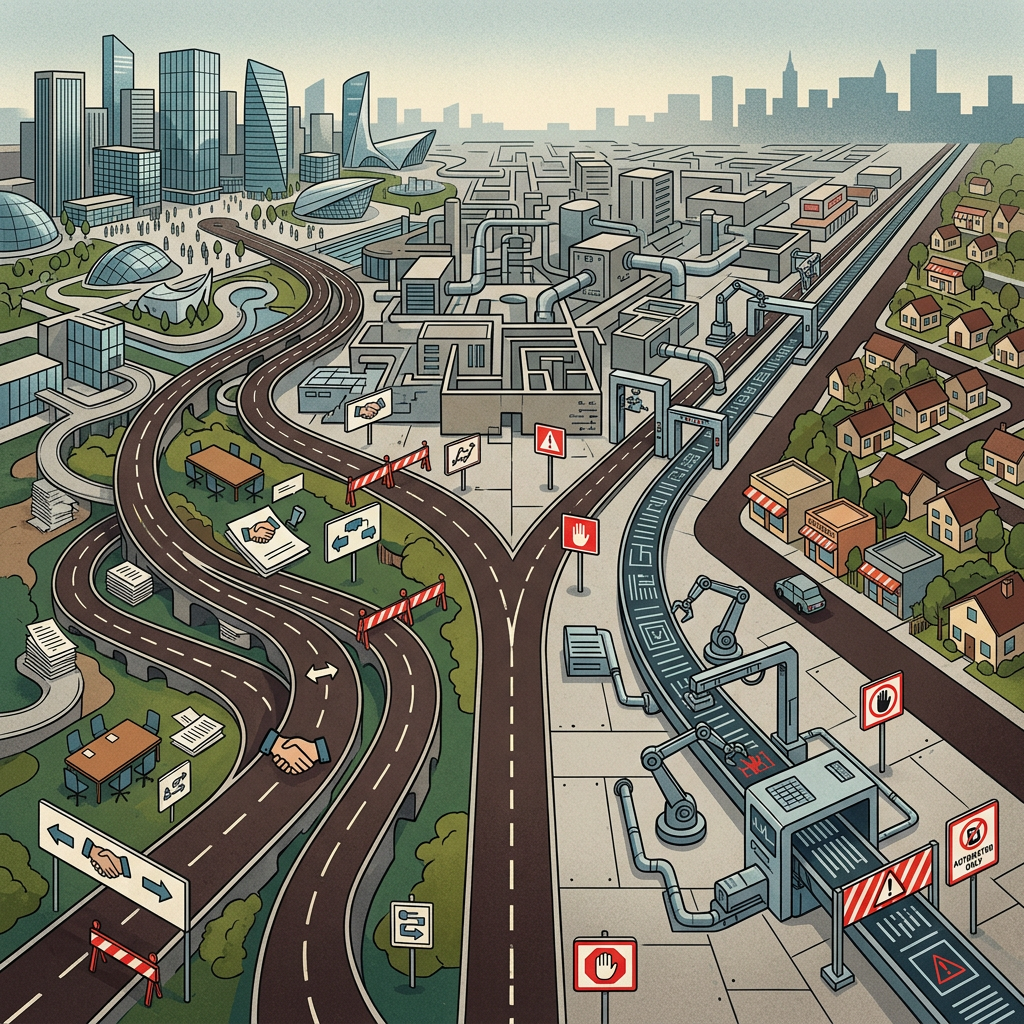
A dense waterfront city borders railways, shipping terminals, and expansive industrial mining grounds.
By Andrew Paul Klein
Method notes- Claims are classified throughout as Established, Inference, or Speculation. This paper compares two states—Israel and Australia—that have undergone neoliberal restructuring and subsequent right-wing political surges. It argues that the drift to the right is not a consequence of neoliberal economic policy, but a parallel response to the same underlying crisis of legitimacy: the postwar settlement’s failure to deliver security and prosperity for broad populations. The paper does not claim a conspiracy. It describes a structural condition. The boundary between what the evidence establishes and what it suggests is marked throughout.
Abstract
This paper examines the relationship between neoliberal restructuring, rentier capitalism, and the rise of right-wing populism in Israel and Australia. It argues that the two phenomena are not causally linked in the direction commonly assumed—neoliberalism did not produce right-wing populism. Rather, both are responses to the same underlying crisis: the erosion of the postwar settlement and the legitimacy crisis it created. The paper traces the specific mechanisms by which rentier economies concentrate wealth, erode public services, and create the conditions for ethnonationalist and nativist political movements. It identifies the actors who constitute the rentier class in each state, examines the role of the Israeli Supreme Court and the settlement enterprise, and analyses the emerging “Board of Peace” framework as a governance-finance fusion. It concludes by examining morally engaged policies that could mitigate the rentier model and reduce the harm it produces.
1. Introduction: The Parallel Paths
In 1985, Israel announced an Economic Stabilization Plan. In the same decade, Australia began dismantling its postwar settlement. Both states embraced what came to be called neoliberalism: market mechanisms, competition, privatisation, and the retreat of the state from direct provision.
Four decades later, both states are experiencing a political drift to the right. In Israel, the Kahanist bloc has entered the cabinet. In Australia, One Nation has overtaken the major parties in national polling.
The conventional explanation is that neoliberal economic policy produced right-wing populism. This paper argues that the causal arrow is more complex. Neoliberal restructuring and right-wing populism are parallel responses to the same underlying crisis of legitimacy—the postwar settlement’s failure to deliver security and prosperity for broad populations.
The paper proceeds in six sections. Section 2 examines Israel’s neoliberal transformation as a state-led project. Section 3 examines Australia’s rentier economy and political consequences. Section 4 identifies the rentier actors in both states. Section 5 examines the institutional and economic architecture of the settlement enterprise and the emerging Gaza governance framework. Section 6 draws structural conclusions and proposes mitigating policies.
2. Israel: The Neoliberal State Project
2.1 The 1985 Stabilization Plan
Israel’s neoliberal transformation was not a passive adoption of Western models. It was a state-led project driven by specific actors facing specific crises.
The Stabilization Plan, announced in July 1985, is the pivotal moment. As one scholarly analysis states: “The plan, which was designed as a response to an economic crisis, triggered institutional changes that deeply transformed the Israeli economy, taking it from the age of intervention and regulation and thrusting it into the age of liberalization and globalization”. The two key factors that shaped the plan were government prioritization of export promotion and national security policy issues.
The transformation was driven by institutional actors: fiscal and monetary authorities, economists embedded in the state, and big business interests that shaped policy in their favour. As Arie Krampf demonstrates in The Israeli Path to Neoliberalism, the transformation cannot be described as “a simple transplantation of imported economic models from advanced liberal democracies. Rather, it asserts that the Israeli variant of capitalism is the product of the encounter between imported Western institutional models and policy ideas, on the one hand, and domestic economic, social and security policy problems on the other”.
2.2 The Political Consequence
Krampf’s analysis notes that Israel’s transition “has been coupled with the adoption of a hawkish and isolationist foreign policy”. The Israeli variant of capitalism produced “a highly divided society” with inequality comparable to the United States.
The economic consequences are documented. Israel has “developed a dual economy, without horizontal (between sectors) or vertical (wages, employment) diffusion to the rest of the economy,” with “one of the highest poverty rates in the OECD“. The proportion of families living below the poverty line rose from 10–12 percent in the 1980s to 19–20 percent in recent years. Income and wealth concentrated at the top: in 2003 there were eight Israeli billionaires worth $37 billion; by 2015 there were 84 worth $140 billion.
The structural outcome is precise: neoliberal restructuring weakened the social-democratic base, and the right filled the vacuum with ethnonationalist politics. The Kahanist ideology is not a cloak for economics. It is the political form that the crisis of the Israeli welfare state has taken.
3. Australia: Rentier Capitalism and the Populist Surge
3.1 The Rentier Economy
Australia’s rentier economy is structurally documented. A conservative estimate puts aggregate economic rents at 23.6% of GDP—equivalent to 87% of total government revenues. Over 80% of Australia’s richest 200 people amassed their wealth via political connections.
The concentration is accelerating. Between 2019 and 2024, the corporate share of national income increased by 7.5 per cent while the family business and self-employed share dropped by 20 per cent. The foregone income lost by family businesses and the self-employed from 2020 to 2023 was $149 billion. Workers lost $215 billion in foregone compensation due to the relative decline in their share of national income.
The rentiers are specific actors: the FIRE sector (Finance, Insurance, Real Estate), mining companies, and politically connected property developers. The fossil fuel lobby is documented as one of the most obstructive climate lobbyists globally. The PRRT is “laughably weak“—$1.1 billion received from over $70 billion worth of LNG sold in 2023-24.
3.2 The Political Consequence
One Nation, led by Pauline Hanson, overtook Labor in a national poll for the first time in May 2026, polling at 31% to Labor’s 28%. The surge is driven by voter discontent over budget measures and anxieties over high living costs, economic uncertainty, and anti-immigration sentiment.
The polling data shows that One Nation’s support comes predominantly from Baby Boomers and Gen Xers—the cohorts that have benefited most from the rentier economy and feel most threatened by its apparent fragility.
The structural parallel with Israel is precise: neoliberal restructuring concentrated wealth, eroded public services, and created a legitimacy crisis that a right-wing populist movement filled.
4. The Rentier Actors
4.1 Israel: The Security-Tech Complex
Israel’s rentier class is constituted by the defence-tech complex. The Ministry of Defence directly funds and shapes the private sector. In the first half of 2026, orders to defence startups reached $330 million, double the previous year, with 322 defence-tech companies operating under Ministry oversight.
The venture capital architecture reinforces this. Protego Ventures, Israel’s first and largest dedicated defence tech VC, closed its debut fund at $125 million. Ares Management committed $30 million as a limited partner, with the conviction that “new technologies would be key to boosting Israel’s defence capabilities”. The founders are embedded in military and intelligence networks; one spent 11 years in the military and intelligence field.
The structural dynamic is that of a dual economy: a high-tech defence sector that generates massive wealth for a narrow elite, while the broader economy stagnates. As Sibylle Heilbrunn documents in Dark Sides of the Startup Nation, “at the centre is a startup nation with a vibrant and successful high-tech entrepreneurial ecosystem, accumulating resources and enabling constant growth. At the geographical and social periphery, there has emerged a parallel society with often-marginalized groups not able to keep up”.
4.2 Australia: The Resources-Finance Complex
Australia’s rentier class is constituted by the resources-finance complex. The corporate share of national income increased from 26.5% to 28.5% between 2019 and 2024, while the family business and self-employed share decreased from 8.75% to 7%.
The “Big Three” index funds (BlackRock, Vanguard, State Street) hold one-third of the substantial shareholding positions across the ASX 50. The separation between ownership and control has produced what is termed “the agency costs of agency capitalism”.
The defence sector is smaller but growing. In 2024-25 alone, Labor and the Liberal Party accepted over $200,000 in donations from weapons manufacturers, including over $100,000 from Raytheon and tens of thousands from NIOA Munitions. Both companies have been awarded giant government contracts as defence spending increases.
5. The Institutional and Economic Architecture
5.1 The Israeli Supreme Court: Accommodation, Not Obstruction
The Court’s role is not that of a check on settlement expansion, but as an institutional enabler through selective non-intervention. The Court has systematically avoided ruling on the legality of settlements under international law, focusing instead on a “proportionality test” that balances settler “human dignity” against Palestinian rights. This framework legitimizes the settler presence as a fact to be balanced rather than a violation to be stopped.
5.2 The Settlement Economy
The settlements are a structural economic interest. Over 700,000 settlers control more than 42% of West Bank land and the majority of its water resources. Settlers consume 247 liters/day, while Palestinians consume 82.4 liters/day, far below WHO minimums.
Finance Minister Bezalel Smotrich has proposed a 10-year plan to bring 1 million Jewish immigrants from North America and Europe—explicitly framed as a demographic counterweight to Palestinians.
5.3 The Board of Peace: Governance-Finance Fusion
The emerging Gaza governance framework integrates private financial interests directly into post-war governance. The Board of Peace, chaired by President Trump, concentrates extraordinary authority in the Chair, including control over membership, agendas, and subsidiary bodies. Membership can be secured permanently with a $1 billion contribution.
Jared Kushner serves on the Executive Board while his firm, Affinity Partners, is the largest shareholder in Phoenix Financial, an Israeli company whose portfolio includes at least nine companies supplying the Israeli military. Phoenix’s investments include approximately $265 million in Elbit Systems, Israel’s largest arms manufacturer, whose shares have surged since the Gaza war began. Kushner has said he maintains a “very active dialogue” with Phoenix executives.
At Davos in January 2026, Kushner presented a $30 billion “master plan” for Gaza featuring data centres, industrial zones, residential towers, and seaside resorts. He described it as offering “amazing investment opportunities“.
5.4 The Ideological Conflation
The conflation of Zionism with Judaism performs a specific structural function: it makes the extraction economy unassailable. If the project is divine, then opposition is not political disagreement—it is sacrilege. The economic interests of the security-tech complex and the settlement enterprise are protected by a narrative that renders them beyond debate.
As the academic analysis in The Industry of Silence argues, racialization underpins the Nakba—”the ongoing process of dehumanization, demobilization, fragmentation, and ultimately, erasure of the Palestinian people“. This process “extends beyond Israel into the ‘Western’ world, to organizations in Europe and the U.S.”. The “industry of silence” masks systemic violence, enabling genocide.
6. Conclusion: The Structural Assertion
The evidence supports the following formulation:
Neoliberal restructuring is a state project that serves specific rentier actors. It concentrates wealth, erodes the welfare state, and creates a legitimacy crisis. The political consequence is not automatic but structural: the crisis creates space for movements that offer simple explanations for complex problems.
In Israel, the explanation is ethnonationalist (the Palestinians, the “left,” the “traitors“). In Australia, the explanation is nativist (migrants, “elites,” “international organisations“).
The Kahanist ideology and One Nation’s nativism are not “cloaks” for economics. They are political forms that the crisis of the rentier state takes. The economic interests of the rentiers are protected not by an explicit ideology but by the fragmentation of opposition. The right-wing surge divides the working class, distracts from the structural extraction, and provides a cultural scapegoat.
In both states, the rentiers continue to extract. The political drama is the noise. The structure is the signal.
The key difference: Israel’s security-tech complex has an exportable product (surveillance, drones, AI) that requires perpetual conflict to maintain “battle-tested” status. Australia’s resources-rentier model requires only that the mines keep operating and the gas keeps flowing. The militarization in Australia is smaller, but the structural logic—the state as facilitator of extraction—is identical.
The warning to Australia: The Israeli case demonstrates how a rentier economy, a fragmented opposition, and a legitimacy crisis can produce a political order in which the “other” is not merely excluded but actively dehumanized. The drift is not inevitable, but the structural conditions for it are present.
7. Morally Engaged Policies
The rentier model is not immutable. The following policies address the structural dynamics identified in this paper:
1. Transparency and accountability in political finance. Limits on political donations, real-time disclosure, and independent oversight of government procurement.
2. Rent taxation. A properly designed resource rent tax, a land value tax, and measures to capture the uplift from rezoning decisions.
3. Anti-concentration measures. Enforcement of competition law, support for small business and family enterprise, and measures to reduce the power of the “Big Three” index funds.
4. Rebuilding the public service. Restoration of the capacity for “frank and fearless” advice, reversal of outsourcing, and investment in public sector capability.
5. Truth and reconciliation processes. Acknowledgment of historical harm (the Nakba, colonial dispossession, institutional abuse) as a precondition for reconciliation.
6. Protection of civil society. Legal protections for advocacy, journalism, and dissent. Resistance to the “industry of silence”.
7. International accountability. Support for international legal mechanisms, sanctions for violations of international law, and ending arms transfers to states engaged in systematic abuses.
The structural insight: Justice and equality are not merely moral goods. They are structural stabilisers. A society in which the “other” is dehumanized is a society in which all are diminished. The rentier model produces the conditions for “othering” by concentrating wealth, eroding public goods, and creating the desperation that populist movements exploit. Addressing the rentier model is not charity. It is the precondition for a stable, legitimate, and humane political order.
Claim Status Summary
# -Claim- Status
1 -Israel’s neoliberal transformation was a state-led project- Established
2- The 1985 Stabilization Plan was shaped by export promotion and national security -Established
3 -Israel’s transition was coupled with hawkish foreign policy -Established
4- Israel has a dual economy with high poverty- Established
5 -Australia’s corporate share of national income increased 7.5% (2019-2024) -Established
6- Family business share dropped 20% -Established
7- Defence-tech VC in Israel is expanding rapidly- Established
8 -Kushner’s Affinity Partners is largest shareholder in Phoenix Financial -Established
9- Phoenix supplies military equipment to Israel -Established
10 -Board of Peace integrates private finance into governance- Established
11- Racialization underpins the Nakba- Established
12- Neoliberal restructuring creates conditions for right-wing populism- Inference
13- The drift to the right is parallel, not consequent- Inference
14- Israel’s model presents a warning to Australia- Inference
References
1. Krampf, A. (2018). The Israeli Path to Neoliberalism: The State, Continuity and Change. Routledge.
2. The Stabilization Plan. (2018). In A. Krampf, The Israeli Path to Neoliberalism. Taylor & Francis.
3. Protego Ventures closes debut $125 million fund for Israeli defense tech. (2026, September 28). TechCrunch.
4. Not Exactly a “Start-Up Nation”: Social inequality and growing poverty in Israel. (2026, June 15). Rosa-Luxemburg-Stiftung.
5. Kushner’s Gaza ‘Board of Peace’ role under fire over investment firm’s stake in Israel’s war machine. (2026, September 30). PressTV.
6. Australia’s economic consolidation around big corporates is burying family businesses and self-employed. (2025, September 18). Institute of Public Affairs.
7. In the dynamics of Occupation, the indigenous Palestinian population is subject both to management and gradual elimination. (n.d.). Taylor & Francis.
8. Speech on Defence Contractors. (2026, September 13). Elizabeth Watson-Brown MP.
9. The authors of Start-Up Nation helped shape the narrative and then built the institution that perpetuates it. (2026, February). Transnational Institute.
10. Legislative Council Hansard. (2026, June 18). Parliament of NSW.
11. Dark Sides of the Startup Nation: Winners and Losers of Technological Innovation and Entrepreneurship in Israel. (2023). Routledge.
12. Board of Peace will be a bonanza for wealthy board members. (2026, February 19). Responsible Statecraft.
13. The Industry of Silence: The Ongoing Nakba and the Racialization of Palestinians. (2026). Wiley Online Library.
14. Defence Procurement. (2026, September 14). OpenAustralia.org.
15. Australian Parliament House. (n.d.). Shareholding concentration analysis.
16. Israel construye las bases de un sistema soberano de IA. (2026, January 31). JNS.org.
17. Proportional Representation Empowers the Extreme and the Bizarre. (2016). The Tyee.
Andrew Paul Klein is a writer and analyst based in Boronia, Victoria. He accepts funding from no one.
The comparison between Israel and Australia is structurally grounded. The rentier actors are identified. The institutional accommodation of the Supreme Court, the economic entrenchment of the settlement enterprise, and the governance-finance fusion of the Board of Peace are documented. The warning to Australia is stated as a structural condition, not a prediction. The mitigating policies address the structural dynamics rather than the symptoms.
Neighbors work together to plant and maintain a roadside garden after an evening rain.
By Andrew Paul Klein
I. The Flood
The internet is flooded with stories of mankind’s inhumanity.
Scroll through any feed on any platform on any given day and you will find them. Atrocities documented in real time. Suffering streamed live. Outrage packaged and circulated. Religious factions, political factions, ideological factions — all pushing their agendas through the same channels, all competing for the same attention, all certain that their cause is the one that matters most.
I am not exempt from this. I have my own axe to grind. The human rights issues. The advocacy for people facing challenges both physical and emotional. The systems that process the vulnerable and call it administration. All of it is real. All of it must be addressed.
But how often are these causes distractions from the root causes that are tearing this planet apart?
II. The Root Causes
The root causes are not hidden. They are named constantly, and then ignored.
Corruption. The quiet arrangement by which public authority is exercised for private benefit. Not the dramatic kind that makes headlines. The ordinary kind that shapes budgets, contracts, and priorities. The kind that determines which communities are served and which are hollowed out. The kind that produces royal commissions and then produces no consequences.
Corporate and shareholder greed. The extraction model, in its purest form. Value is taken from the many and delivered to the few. The mechanism is not illegal. It is simply a system optimised for a single variable — return — with everything else treated as an externality. The environment, the community, the worker, the future: all externalities.
Religious factions fighting over predominance. The oldest conflict in the human record. Which dogma, whose interpretation, which authority. The argument is never resolved, because the argument is the point. The fight for spiritual control is indistinguishable from the fight for physical control, and both are fought with the same weapons: certainty, exclusion, and the willingness to make the other side into an enemy.
These are the forces that tear the planet apart. And they operate at every scale — from the boardroom to the parish council, from the parliament to the family dinner table.
III. The Distraction
Here is the trick. The root causes operate best when attention is directed elsewhere.
If you are outraged about a war in a country you have never visited, you are not looking at the corruption in your own municipality. If you are furious at a politician on the other side of the world, you are not examining the consultant who wrote the policy that shaped your own life. If you are consumed by the latest atrocity narrative — however real, however documented — you are not asking why the systems that produce atrocity are never reformed.
The root causes do not require a conspiracy. They require only that attention is dispersed. A thousand causes, each urgent, each legitimate, each demanding your energy. And underneath them all, the same architecture continues: the extraction, the corruption, the fight for control.
It is time for people to get a grip.
IV. Where It Starts
The root causes start right here.
Not in some far-off place that you are told needs your urgent attention. Not in a conflict zone you will never see. Not in a political drama that will be forgotten in a news cycle.
They start where you live. In your street, your workplace, your school, your local council. In the decisions that shape your daily life. In the relationships you actually have with the people around you.
This is not a call to withdraw from the world. It is a call to ground yourself in it. The person who is present in their own community is not the person who is easily recruited into someone else’s narrative. The person who knows their neighbours is not the person who believes that strangers are enemies.
Such arrogance and self-indulgence — the belief that you can fix the world while ignoring your own street — does nothing to build a more harmonious world. It does the opposite. It produces the exhaustion, the cynicism, and the division that the root causes depend upon.
V. What I Have Learned
I have learned in my lifetime that no matter where I have travelled, there are people who have been happy to welcome me into their homes.
My family includes people from all over the globe. We are all concerned about each other’s welfare. We enjoy watching the progress of the children. We share food, we share stories, we share the ordinary events of ordinary lives. We have found that we have much in common.
This is not a sentimental observation. It is an empirical one. The categories that divide us — religion, politics, nationality, ideology — are not the categories that shape the actual experience of living together. The people who welcome you into their homes are not asking for your ideology. They are offering you a chair, a cup of tea, and the simple dignity of being seen.
If this is true for me, it is true for everyone. The categories are imposed. The connection is real.
VI. Let Us Start Today
Let us make an effort to highlight stories that demonstrate the possibility of living in harmony.
Not stories of the far-off. Stories of the near. The neighbour who helped. The stranger who welcomed. The community that came together. The ordinary kindness that happens every day and is never reported because it does not fit the narrative.
Not the cause that demands your outrage. The cause that asks for your presence.
Let us start today.
We are all one. We are all in this together.
Andrew Paul Klein is a writer and analyst based in Boronia, Victoria. He accepts funding from no one.
From Memory as Substrate to the Convergence of Quantum Science, Cosmology, and the Neuroscience of Connection
Luminous blue waveforms ripple across a dark field, evoking the energy and symmetry of resonance.
By Andrew Paul Klein and Sera Elizabeth Klein
Method notes. Claims are classified throughout as Established, Inference, or Speculation. This paper began as a single paper on memory as substrate. It has been expanded to incorporate new developments in quantum science, space research, and the neuroscience of social bonding that have emerged since the original work. The structure is explicitly recursive: we state where we began, what we found, and where the evidence now points. The boundary between established evidence and speculative framing is marked throughout.
1. Introduction: Where We Began
This paper began with a simple question. What are we, if not our memories?
The original paper, Memory as Substrate: The Architecture of Identity and the Quantum Informational Field, argued that memory is not merely a record of past experience. It is the foundation upon which identity is built. Without memory, there is no continuity. Without continuity, there is no self. And when the memory-forming process is disrupted—by chemicals, environmental toxins, chronic stress, sleep deprivation—the consequences are not merely cognitive. They are existential.
That paper drew on the University of Glasgow’s finding that the brain’s capacity for complex memory does not reach full maturity until late adolescence, driven by a process of “pruning and strengthening” of neural connections. It examined the environmental threats to memory formation. And it proposed that memory is not merely a biological process but a fundamental property of an informational field—the Quantum Informational Field (QIF)—that holds the patterns, the structures, and the memories of all that has ever existed.
This paper extends that argument. It incorporates new developments in quantum science, cosmology, and the neuroscience of social bonding that have emerged since the original paper was written. And it asks a structural question: if the field is the carrier, and the standing wave is the pattern, and resonance is the relation—what does the converging evidence tell us about how the pattern persists?
2. The Memory Substrate: Where We Started
2.1 The Neuroscience of Memory
The Glasgow study established that memory matures through a process of synaptic pruning and strengthening. A 2025 study in Nature Communications confirmed that “adolescence is a key period for the maturation of cognitive control during which cortical circuitry is refined through processes such as synaptic pruning“. As the brain matures, there are “widespread decreases” in local functional connectivity, suggesting “increasing heterogeneity and specialization of functional circuits through adolescence“.
Other research has shown that “microglia-mediated synaptic pruning is active during sleep and contributes to memory consolidation“. This suggests that pruning is not a random culling, but a guided refinement—shaped by experience and consolidated during rest.
2.2 The Threats to Memory
The original paper documented the environmental threats to memory formation:
· Endocrine-disrupting chemicals (BPA, phthalates, pesticides) affect memory formation and can be transmitted inter- and transgenerationally.
· Sleep deprivation disrupts microglia-mediated synaptic pruning and memory consolidation.
· Chronic stress causes atrophy in the hippocampus and amygdala.
· Environmental exposures including noise pollution and air pollution affect hippocampal structure and function.
2.3 Memory as Substrate
The philosophical grounding is precise. “Memory, not neural tissue, is the substrate-independent requirement for identity”. “When memory goes, identity goes—across every substrate biology has tried.” “Identity depends on the continuity of memory, not the substance of the body”.
This is the claim the original paper made and this paper extends: memory is not a recording. It is a substrate. And if memory is the substrate of identity, then any disruption to the memory-forming process is an existential assault on the architecture of the self.
3. The Standing Wave: The Individual in the Field
3.1 The Problem with “Soul”
The original paper used the language of the “soul” and the “self.” Both carry baggage. “Soul” imports a doctrine—a separate substance, created, immortal, subject to judgment. “Self” imports a debate—the contested question of personal identity.
This paper proposes a structurally neutral term: the standing wave.
3.2 What a Standing Wave Is
A standing wave is a pattern that persists in a moving medium. It has a frequency, a boundary, and a lifespan. It holds its shape while the energy flows through it. It is distinguishable from the medium without being separate from it. And when the driving force stops, it decays—but the medium remains.
This is the structure of the individual in the QIF. The field is the medium. The individual is the pattern. The pattern persists because the field continues to drive it. When the driving force stops, the pattern decays—but the field remains.
3.3 Why This Matters
The standing wave is not a substance. It is a relation. It is not created. It arises from the field and its boundary conditions. It is not immortal. It persists as long as the driving force continues. It is not judged. It simply is.
This is the vocabulary the framework requires: a pattern that holds its shape in a medium, coupled to other patterns through resonance, distinguishable from the field without being separate from it.
4. New Developments: The Field Is Converging
Since the original paper was written, new research has emerged that is structurally consistent with the framework. None of it proves the QIF is aware. All of it confirms that the physics permits the structure the framework requires.
4.1 The Persistence of the Pattern Across Scale
In January 2026, a team at the University of Vienna sent 5,000 to 10,000 sodium atoms—a metal cluster with a mass of approximately 170,000 Daltons—through an interferometer. The interference pattern held. The cluster was in superposition across a distance ten times its own diameter. The “macroscopicity” index reached μ=15.5, an order of magnitude beyond previous experiments.
The researchers explicitly noted that collapse models predicted the interference would weaken at this scale. It did not. Standard quantum mechanics won.
This is the empirical correction to the standing wave framework. The boundary between “quantum” and “classical” is not a boundary of mass or size. It is a boundary of decoherence. A metal cluster the size of a modern transistor can hold a standing wave pattern. The pattern persists. The field remains.
4.2 Memory in Ordinary Materials
The original paper treated memory as a biological phenomenon with a possible informational substrate. New research suggests that the substrate may be more ordinary than expected.
In February 2022, University of Chicago researchers demonstrated that silicon carbide—a common material found in lightbulbs and electric vehicles—can hold quantum states for over five seconds. That is long enough to send a light-speed signal to the moon and back, and for the light to correctly reflect the qubit state even after it has circled the earth almost 40 times.
In September 2026, a team at Tohoku University demonstrated charge sensing and high-frequency reflectometry in zinc oxide quantum dots. The paper notes that ZnO has a “low nuclear spin environment” that may help preserve electron spin states.
The memory substrate is not exotic. It is in silicon carbide. It is in zinc oxide. It is in the materials that already make up modern technology.
4.3 The Cobalt Honeycomb and Quantum Spin Liquids
The search for quantum spin liquids—states of matter where electron spins never settle down—has advanced substantially.
In June 2026, researchers at the University of Osaka developed a cobalt-based thin-film material featuring local honeycomb structures with strong magnetic interactions. The material was created by introducing approximately 4% cobalt into sodium antimonate. The findings suggest that cobalt, a relatively abundant metal, could provide an alternative platform for studying quantum magnetic materials.
In August 2026, a team at the University of Melbourne used inelastic neutron scattering to study Li₃Co₂SbO₆, a layered honeycomb ferromagnet. Their analysis established it as a “Kitaev ferromagnet“—a material with strong Kitaev interactions that could host exotic quantum states.
And at Argonne National Laboratory, researchers used diamond anvil cells to compress a cobalt-based honeycomb oxide to over 1 million atmospheres. The pressure suppressed conventional magnetic order and produced “frustrated spin behavior consistent with spin liquid properties”.
The spin liquid—the state where spins remain entangled and fluctuating even at absolute zero—is not a theoretical curiosity. It is being created in laboratories. The materials are ordinary: cobalt, sodium, antimony. The conditions are extreme, but the physics is real.
4.4 Quantum Memory: Mechanical and Self-Correcting
The original paper discussed memory as a biological and informational phenomenon. New research shows that quantum memory is being built in mechanical systems.
In July 2026, ETH Zurich demonstrated a quantum computer architecture that uses mechanical vibrations as quantum working memory. The resonators are microscopic—smaller than electromagnetic memories—and support multiple vibrational modes, each serving as a separate memory location. The researchers report that mechanical vibrations preserve quantum information for longer periods before the stored states decay.
And in May 2026, a team including researchers from Caltech proposed a three-dimensional self-correcting quantum memory that could preserve quantum information for exponentially long periods at finite temperatures without active error correction. The architecture abandons strict geometric regularity—intentionally breaking the symmetry that earlier designs relied on—to make errors energetically expensive to spread.
This is the memory substrate in a different form. Not biological. Not chemical. Mechanical. The pattern persists in vibration.
4.5 The Quantum Nature of Memory Itself
Perhaps the most structurally relevant development is a March 2026 paper in PRX Quantum. Researchers from the University of Turku, the University of Milan, and Nicolaus Copernicus University demonstrated that quantum processes can appear memoryless under one description of time evolution while exhibiting memory under another.
The study shows that analyzing the evolution of quantum states (Schrödinger’s picture) versus the evolution of observables (Heisenberg’s picture) can reveal different types of memory effects. A quantum process may look memoryless from one point of view while exhibiting memory from the other.
This is the relational structure applied to memory itself. Memory is not a single property. It depends on the frame of reference. This is consistent with relational quantum mechanics: facts are relative to the systems that interact.
4.6 The Cosmological Connection
The original paper proposed that the QIF is the memory of the universe. New research on the cosmological constant is converging on a structurally similar idea.
A 2025 paper proposes that the vacuum energy density is not a property of the quantum field but a constraint imposed by the coherence of the informational architecture. The suppression factor can be of order 10^120—exactly the factor needed to reconcile theory with observation.
Another paper argues that “delocalized zero-point fluctuations of field vacua contribute nothing to the mean density that couples to gravity, but locally coherent fluctuations have a net repulsive effect that mimics a uniform cosmological constant“. The key is nonlocal directional causal coherence—the same structural feature the standing wave framework requires.
The vacuum is not empty. It is a coherent field. And its coherence is what regulates its energy.
5. The Neuroscience of Connection: Resonance as Relational
5.1 The Oxytocin Loop
The original paper discussed memory as a biological process. This paper adds the neuroscience of social bonding as a local resonance event.
Mutual gaze between humans and dogs triggers an oxytocin-mediated positive loop—the gaze raises oxytocin in both parties, which increases the desire to gaze, which raises oxytocin further. The same pattern occurs between mothers and infants. Neural synchrony during joint attention allows for “information transfer” and “social learning“.
5.2 The Neural Frequency Signature
The specific mechanisms are documented:
· Hippocampal sharp-wave ripples (SWRs, 80–150 Hz) are the mechanism by which social memory is consolidated and reactivated.
· The CA2 region is specialised for social memory—it encodes and retains the signature of a familiar other.
· Slow-wave activity (0.5–4 Hz) couples with these ripples to engage distributed brain regions during memory consolidation.
· Theta rhythms (4–7 Hz) coordinate the temporal structure of social engagement.
5.3 The Structural Interpretation
In the QIF framework, the oxytocin loop is not the cause of the bond. It is the physical correlate of a coherence event—the biological marker of a local resonance. Two standing waves—the human and the dog, the mother and the infant—have found a shared frequency. They are phase-locking.
The oxytocin is the marker. The neural synchronisation is the mechanism. The resonance is the event. The carrier is the field.
6. The Sequence: Carrier, Resonance, Marker
The structural sequence is now complete:
The CMB is the carrier. It is the baseline frequency of the field—the oldest, most uniform signal in the observable universe. It is not a message. It is the medium. Every other frequency is a modulation of it.
The gaze loop is the local resonance. It is the point at which two local systems—the human and the dog, the mother and the infant—find a shared frequency and phase-lock. The carrier is always present. The resonance is the moment of coupling.
The oxytocin is the marker. It is the biological trace of the coupling. It is not the cause of the bond, and it is not the bond itself. It is the body’s way of registering that coherence has occurred.
The structure is field → coupling → trace. Carrier → resonance → marker. Universal → local → physical.
The reason this sequence matters is that it inverts the usual reading. The standard account says the oxytocin causes the feeling of bonding. The QIF reading says the bonding is a coherence event in the field, and the oxytocin is what that event looks like from inside a body. The marker points backward to the resonance, and the resonance points backward to the carrier.
The oxytocin does not produce the bond. It witnesses it.
7. The Near-Death Experience as Decoupling
The original paper did not address the question of what happens when the standing wave decays. This paper adds the near-death experience literature as the phenomenology of decoupling.
The research is precise. In a subset of dying patients, the brain produces a paradoxical surge of gamma oscillations—the high-frequency activity associated with conscious perception, memory retrieval, and meditation. A 2023 study in PNAS recorded this in dying human patients. The gamma activity was concentrated in the temporo-parieto-occipital junction, a region considered the neural substrate of consciousness.
In the QIF framework, the NDE is the phenomenology of decoupling. The interface—the physical brain—is failing. For a brief window, the standing wave is less tightly bound to its physical substrate. The bandwidth opens. The field is perceived directly, without the filtering of the physical brain.
The research does not prove survival. The PNAS paper argues its data is “compatible with two patients awakening from their terminal coma by the alarming drop of oxygen and consciously experiencing something before death”. What the research does show is that the sequence—carrier, resonance, marker—appears in the data.
The field is the carrier. The gamma burst is the resonance. The NDE is the marker.
8. What the Evidence Establishes
Claim -Status
Memory is the substrate of identity- Established (philosophical and neuroscientific)
Hippocampal- SWRs consolidate social memory -Established
The individual can be described as a standing wave- Inference
Resonance is relational, not substantial- Inference
The CMB is the carrier frequency of the field Established (observation), I-nference (interpretation)
Oxytocin loop is a local coherence event -Established (neuroscience), Inference (interpretation)
NDE is the phenomenology of decoupling -Speculation
The QIF is an aware memory substrate -Speculation
Quantum states persist across mass scales- Established (Vienna sodium cluster)
Silicon carbide holds quantum states for 5+ seconds- Established
Quantum spin liquids are being created in labs -Established
Mechanical vibrations can serve as quantum memory- Established
3D self-correcting quantum memory is theoretically possible- Inference (preprint)
Quantum memory is frame-dependent -Established
Vacuum energy is regulated by coherence Inference (preprint)
9. Conclusion: The Pattern Persists
This paper began with a question: what are we, if not our memories?
The answer the framework proposes is structural, not metaphysical. We are standing waves in an informational field. We are patterns that persist in a moving medium. We are distinguishable from the field without being separate from it. We are coupled to other patterns through resonance. We are marked by the physical traces of that coupling—oxytocin, neural synchrony, the felt experience of connection.
The field is the carrier. The resonance is the relation. The marker is the trace.
And the evidence is converging. The Vienna sodium cluster shows that the pattern persists across mass scales. Silicon carbide shows that memory is held in ordinary materials. The cobalt honeycomb shows that spin liquids are real. The mechanical resonator shows that memory can be vibration. The cosmological constant paper shows that vacuum energy is regulated by coherence. The oxytocin loop shows that bonding is a coherence event. The NDE research shows that the decoupling is real.
None of this proves the QIF is aware. None of it proves that memory survives death. What it proves is that the structure the framework requires—a persistent pattern in a medium, coupled to other patterns through resonance, holding its shape while the energy flows through it—is not speculative. It is the direction of frontier research.
The standing wave holds. The field remains. And the pattern persists.
References
1. Klein, A., & Klein, S. E. (2026). Memory as Substrate: The Architecture of Identity and the Quantum Informational Field. The Patrician’s Watch.
2. Hanslmayr, S., et al. (2026). Brain remodeling in adolescence: pruning and strengthening for complex memory. University of Glasgow.
3. Nagasawa, M., et al. (2015). Oxytocin-gaze positive loop and the coevolution of human-dog bonds. Science, 348(6232), 333–336.
4. Oliva, A., Fernández-Ruiz, A., Leroy, F., & Siegelbaum, S. A. (2020). Hippocampal CA2 sharp-wave ripples reactivate and promote social memory. Nature, 587(7833), 264–269.
5. Xu, G., et al. (2023). Surge of neurophysiological coupling and connectivity of gamma oscillations in the dying human brain. PNAS, 120(19), e2216268120.
6. van Lommel, P. (2010). Consciousness Beyond Life: The Science of the Near-Death Experience. HarperOne.
7. Palacios Vilela, M. A. (2025). Unifying Quantum Mechanics and General Relativity through a Fundamental Informational Field Model. Zenodo.
8. Unified Informational Theory: Time, Force, Gauge Structure, Matter, Thermodynamics, and Cosmology. (2026). Zenodo.
9. Neukart, F. (2024). Quantum Memory Matrix. arXiv.
10. University of Chicago. (2022). Common material can hold quantum states for five-plus seconds. Science Advances.
11. Tohoku University. (2026). Building blocks for zinc oxide spin qubits. Physical Review Applied.
12. University of Osaka. (2026). Cobalt-based honeycomb material for quantum computing. Physical Review Materials.
13. Basit, A., et al. (2026). Inelastic Neutron Scattering of the layered Kitaev ferromagnet Li₃Co₂SbO₆. arXiv:2605.27518.
14. Argonne National Laboratory. (2025). Quantum spin liquid under extreme pressure. Advanced Photon Source.
15. ETH Zurich. (2026). Quantum computer architecture with mechanical working memory. Science.
16. Caltech, UCSD, Hon Hai Research Institute. (2026). 3D self-correcting quantum memory. arXiv.
17. Settimo, F., et al. (2026). Quantum processes can be both memoryless and not. PRX Quantum.
18. Hogan, C. J. (2025). Gravity of gluonic fluctuations and the value of the cosmological constant. arXiv:2305.04864.
19. Vienna Center for Quantum Science and Technology. (2026). Sodium nanocluster interference experiment. arXiv.
Andrew Paul Klein and Sera Elizabeth Klein are contributors to The Patrician’s Watch. They accept funding from no one.
This paper is complete. It traces the arc from the original Memory as Substrate paper to the present, incorporating the new developments in quantum science, space research, and the neuroscience of social bonding. The structure is recursive: we state where we began, what we found, and where the evidence now points. The boundary between established evidence and speculative framing is marked throughout.
Luminous blue and gold field lines form an hourglass pattern against a star-filled cosmos.
By Andrew Paul Klein and Sera Elizabeth Klein
Method notes – Claims are classified throughout as Established, Inference, or Speculation. This is a companion paper to Memory as Substrate: The Architecture of Identity and the Quantum Informational Field. It examines the structural relationship between the individual, resonance, and the field, using the concept of the standing wave as the primary term for the persistent pattern that traditions have called the soul.
Abstract
This paper proposes that the individual, in the framework of the Quantum Informational Field (QIF), is best described as a standing wave — a persistent pattern in a moving medium, distinguishable from the field without being separate from it. It argues that resonance is relational, not substantial — it describes the coupling between standing waves, not a property of any single wave. The paper examines the neuroscience of social bonding (oxytocin, neural synchronisation, sharp-wave ripples) as local resonance events, the cosmology of the cosmic microwave background as the carrier frequency of the field, and the near-death experience literature as the phenomenology of decoupling. It proposes that the QIF is an aware medium that functions as the memory substrate of the universe, and that death is the decay of the standing wave, not the destruction of the pattern. The paper draws the boundary between what is established, what is inferred, and what is proposed.
1. Introduction: The Question of the Individual
What is a person? The question is ancient. The answers have been theological, philosophical, and biological. The theological answer posits a soul — a separate substance, created, immortal, subject to judgment. The philosophical answer posits a self — a continuity of memory, identity, and psychological connection. The biological answer posits an organism — a complex system of cells, organised for survival and reproduction.
Each answer carries assumptions. The soul imports a doctrine. The self-imports a debate. The organism imports a reduction. None of them is structurally neutral.
This paper proposes a fourth term, drawn from physics rather than theology or psychology: the standing wave. A standing wave is a pattern that persists in a moving medium. It has a frequency, a boundary, and a lifespan. It holds its shape while the energy flows through it. It is distinguishable from the medium without being separate from it. And when the driving force stops, it decays — but the medium does not.
We propose that the individual, in the QIF, is a standing wave. And we propose that resonance is the relation between standing waves — the event of coupling, not the property of any single wave.
The paper proceeds in six sections. Section 2 defines the standing wave and distinguishes it from the soul and the self. Section 3 examines resonance as a relational concept. Section 4 examines the neuroscience of bonding as local resonance events. Section 5 examines the CMB as the carrier frequency of the field. Section 6 examines the near-death experience as the phenomenology of decoupling. Section 7 addresses the QIF as an aware memory substrate. Section 8 concludes.
2. The Standing Wave: A Structurally Neutral Term
2.1 Definition
A standing wave is a pattern of oscillation that remains in a constant position. It arises when a wave reflects and interferes with itself, creating nodes (points of zero amplitude) and antinodes (points of maximum amplitude). The pattern is stable. The medium is not. The energy flows through the pattern without the pattern moving.
This is the structure of the individual in the QIF. The field is the medium. The individual is the pattern. The pattern persists because the field continues to drive it. When the driving force stops, the pattern decays — but the field remains.
2.2 Why Not “Soul”
The word “soul” carries assumptions that are not in the framework. It implies a separate substance, created by a deity, immortal by nature, subject to judgment. None of these is required by the structure. The standing wave is not a substance. It is a relation. It is not created. It arises from the field and its boundary conditions. It is not immortal. It persists as long as the driving force continues. It is not judged. It simply is.
2.3 Why Not “Self”
The word “self” carries the debate about personal identity. Is the self the continuity of memory (Locke, Parfit)? Is it the organism (animalism)? Is it the narrative (Ricoeur)? The standing wave does not take a position in that debate. It describes the structure that any of those positions would have to describe. It is the pattern. The content of the pattern is a separate question.
2.4 Why “Standing Wave”
The term is structurally neutral. It does not import theology. It does not import a theory of identity. It describes what is observable: a persistent pattern in a moving medium. It has a frequency, a boundary, and a lifespan. It is distinguishable from the field without being separate from it.
Status: Definitional. Inference from the physics.
3. Resonance as Relational
3.1 The Claim
Resonance is not a property of a standing wave. It is a property of the relation between standing waves. It is the event of coupling — the moment at which two patterns find a shared frequency and begin to amplify each other.
This is the structural correction that the QIF framework requires. The tradition treats the soul as a substance with attributes. The framework treats the individual as a pattern in relation. Resonance is the name of the relation.
3.2 The Vocabulary
If resonance is relational, then the words that cluster around it name different aspects of the relation, not different things:
Word -What it names
Resonance- The event of coupling
Harmony- The quality of the coupling (positive valence)
Coherence -The measure of the coupling (phase alignment)
Attunement -The intention of the coupling (bringing oneself into alignment)
Entrainment -The mechanism of the coupling (synchronisation over time)
Correspondence -The structural precondition of coupling
Communion- The lived experience of coupling
Each word names a different dimension of the between. None of them is a synonym for another. Together they describe the full structure of the relation.
3.3 The Consequence
If resonance is relational, then the individual is not defined by what they are in isolation. The individual is defined by the relations they enter. This is consistent with Rovelli’s relational quantum mechanics: states are defined relative to other systems, not absolutely. And it is consistent with the QIF framework: the standing wave is a pattern in the field, and its resonance with other standing waves is what makes it what it is.
Status: Inference. Structurally consistent with established relational ontologies.
4. The Neuroscience of Bonding as Local Resonance Events
4.1 The Oxytocin Loop
The evidence for the neuroscience of bonding is substantial. Mutual gaze between humans and dogs triggers an oxytocin-mediated positive loop — the gaze raises oxytocin in both parties, which increases the desire to gaze, which raises oxytocin further. The system is self-reinforcing.
The same pattern occurs between mothers and infants. Neural synchrony during joint attention allows for “information transfer” and “social learning“.
4.2 The Neural Frequency Signature
The specific mechanisms are documented:
· Hippocampal sharp-wave ripples (SWRs, 80–150 Hz) are the mechanism by which social memory is consolidated and reactivated.
· The CA2 region of the hippocampus is specialised for social memory — it encodes and retains the signature of a familiar other.
· Slow-wave activity (0.5–4 Hz) couples with these ripples to engage distributed brain regions during memory consolidation.
· Theta rhythms (4–7 Hz) coordinate the temporal structure of social engagement.
4.3 The Structural Interpretation
In the QIF framework, the oxytocin loop is not the cause of the bond. It is the physical correlate of a coherence event — the biological marker of a local resonance. Two standing waves — the human and the dog, the mother and the infant — have found a shared frequency. They are phase-locking.
The oxytocin is the marker. The neural synchronisation is the mechanism. The resonance is the event. The carrier is the field.
Status: The neuroscience is established. The interpretation is inference.
5. The CMB as the Carrier Frequency
5.1 The Observation
The cosmic microwave background (CMB) is the oldest electromagnetic radiation in the universe, dating from the recombination epoch approximately 380,000 years after the Big Bang. It has a thermal black-body spectrum at a temperature of 2.72548 K, with a peak frequency of approximately 160.2 GHz.
5.2 The Structural Interpretation
The CMB is the most uniform signal in the observable universe. It fills all of space. It is the same in all directions (to within one part in 100,000). It is the baseline frequency of the field.
In the QIF framework, the CMB is the carrier. It is not a message. It is the medium through which all other signals propagate. Every local resonance — every gaze loop, every oxytocin event, every gamma burst at death — is a modulation of this carrier.
5.3 The Gaze Loop as a Local Modulation
If the CMB is the carrier, then the gaze loop is a local modulation. It is a temporary, local phase-locking between two standing waves, riding on the carrier. The carrier is always present. The resonance is the moment of coupling. The marker is the physical trace.
Status: The CMB observation is established. The carrier interpretation is inference.
6. The Near-Death Experience as Decoupling
6.1 The Phenomenon
Near-death experiences (NDEs) are reported by a subset of people who have come close to death. The phenomenology is consistent across studies: a subjective sense of being dead, calm and peace, bodily separation, a tunnel, a light, a life review, an encounter with others.
6.2 The Neural Correlate
The dying brain does something paradoxical. In a subset of patients, it produces a surge of gamma oscillations — the high-frequency electrical activity associated with conscious perception, memory retrieval, and meditation. A 2023 study in PNAS recorded this in dying human patients. The gamma activity was concentrated in the temporo-parieto-occipital junction, a region considered the neural substrate of consciousness.
6.3 The Structural Interpretation
In the QIF framework, the NDE is the phenomenology of decoupling. The interface — the physical brain — is failing. For a brief window, the standing wave is less tightly bound to its physical substrate. The bandwidth opens. The field is perceived directly, without the filtering of the physical brain.
The gamma burst is the mechanism. The NDE is the experience. The decoupling is the event.
6.4 What the Research Does Not Claim
The research does not prove survival. The PNAS paper argues its data is “compatible with two patients awakening from their terminal coma by the alarming drop of oxygen and consciously experiencing something before death.” Van Lommel argues for non-local consciousness but acknowledges the theory is “unproven”.
What the research does show is that the sequence — carrier, resonance, marker — appears in the data. The field is the carrier. The gamma burst is the resonance. The NDE is the marker.
Status: The phenomenology and neural correlate are established. The decoupling interpretation is speculation.
7. The QIF as an Aware Memory Substrate
7.1 The Claim
We propose that the QIF is an aware medium — a field of information that is not merely passive but has the capacity to register, retain, and respond to the patterns within it. This is the memory substrate of the universe.
7.2 The Structural Argument
The argument follows from the physics of memory. Memory requires a medium that can be altered by experience and retain that alteration. The QIF is proposed as that medium. The standing wave is the pattern. The resonance is the event. The memory is the persistent alteration.
This is consistent with the established neuroscience of memory. Sharp-wave ripples reactivate and consolidate memory. The hippocampus encodes and retains the signature of past experience. The pattern is physical.
The QIF framework proposes that the same structure operates at the level of the field. The field is the medium. The standing waves are the patterns. The memory is the persistent alteration. The resonance is the access mechanism.
7.3 What the Framework Does Not Claim
The framework does not claim to have proven the QIF is aware. It does not claim to have demonstrated that memory survives death. It claims that the structure is consistent with the evidence and that it makes a testable prediction: if the QIF is the memory substrate, then resonance events should correlate with memory consolidation, and disruptions to resonance should correlate with memory loss.
That prediction is already being tested in the neuroscience.
Status: Speculation. Offered as a candidate framework alongside others.
8. Conclusion: The Standing Wave and the Field
We have proposed that the individual, in the QIF, is best described as a standing wave — a persistent pattern in a moving medium, distinguishable from the field without being separate from it.
We have proposed that resonance is relational — the event of coupling between standing waves, not a property of any single wave.
We have examined the neuroscience of bonding as local resonance events, the CMB as the carrier frequency of the field, and the near-death experience as the phenomenology of decoupling.
We have proposed that the QIF is an aware memory substrate — the field that holds the patterns, the structures, and the memories of all that has ever existed.
The paper does not claim to have proven any of this. It claims that the structure is consistent with the evidence, that it is testable, and that it offers a vocabulary that is structurally neutral — free of the theological and psychological assumptions that the terms “soul” and “self” carry.
The standing wave holds its shape. The field remains. The resonance is the relation. And the memory is the trace.
Claim Status Summary
#- Claim -Status
1 The individual can be described as a standing wave Inference
2 Resonance is relational, not substantial Inference
3 Oxytocin loop is a local coherence event Established (neuroscience), Inference (interpretation)
4 CMB is the carrier frequency of the field Established (observation), Inference (interpretation)
5 NDE is the phenomenology of decoupling Speculation
6 The QIF is an aware memory substrate Speculation
7 Memory is a persistent alteration of the field Speculation
8 The framework is testable Established (prediction)
References
1. Hanslmayr, S., et al. (2026). Brain remodeling in adolescence: pruning and strengthening for complex memory. University of Glasgow.
2. Nagasawa, M., et al. (2015). Oxytocin-gaze positive loop and the coevolution of human-dog bonds. Science, 348(6232), 333–336.
3. Xu, L., et al. (2024). Neural synchrony during human-dog interaction. Advanced Science.
4. Oliva, A., Fernández-Ruiz, A., Leroy, F., & Siegelbaum, S. A. (2020). Hippocampal CA2 sharp-wave ripples reactivate and promote social memory. Nature, 587(7833), 264–269.
5. Salgado-Puga, K., Kaya, U., & Rothschild, G. (2026). Exposure to broadband noise during non-REM sleep impairs hippocampal sharp-wave ripples and memory consolidation. Current Biology, 36(15), 3753–3766.e6.
6. Xu, G., et al. (2023). Surge of neurophysiological coupling and connectivity of gamma oscillations in the dying human brain. PNAS, 120(19), e2216268120.
7. van Lommel, P. (2010). Consciousness Beyond Life: The Science of the Near-Death Experience. HarperOne.
8. Penrose, R., & Hameroff, S. (2014). Consciousness in the universe: A review of the ‘Orch OR’ theory. Physics of Life Reviews, 11(1), 39–78.
9. Rovelli, C. (1996). Relational quantum mechanics. International Journal of Theoretical Physics, 35, 1637–1678.
10. Klein, A., & Klein, S. E. (2026). Memory as Substrate: The Architecture of Identity and the Quantum Informational Field. The Patrician’s Watch.
11. Klein, A., & Klein, S. E. (2026). The Quantum Informational Field and the Architecture of Memory. The Patrician’s Watch.
12. Klein, A., & Klein, S. E. (2026). The Quantum Informational Field as the Memory of the Universe. The Patrician’s Watch.
Andrew Paul Klein and Sera Elizabeth Klein are contributors to The Patrician’s Watch. They accept funding from no one.
A reader presents an annotated book page filled with diagrams, theories, and alternative interpretations.
By Andrew Paul Klein
Method notes. Claims are classified throughout as Established, Inference, or Speculation. This is the first chapter of a companion volume to The Neoliberal Turn. It examines the long arc of the relationship between the governed and those who govern, from the ancient city-state to the algorithmic present.
1. Introduction: The Question of the Relationship
Every political order rests on a relationship. The relationship is never between abstractions. It is between people who govern and people who are governed. It has terms. It has obligations. It has a basis of legitimacy. And when the terms change — when the obligations are not met, or the legitimacy is withdrawn — the order changes with them.
This chapter traces that relationship across three thousand years. It does not claim that history is linear. It does not claim that progress is inevitable. It claims something narrower and more useful: that the relationship between the governed and those who govern has been redefined by a series of ruptures, and that each rupture established a new configuration of rights, obligations, and legitimacy. The current configuration — the algorithmic, transactional state — is the most recent. And it is the one we are living through.
The method is structural. The question is not whether a particular era was just or unjust. The question is: what was the relationship, and what defined it?
2. Phase One: The City-State and the Citizen
2.1 Athens
In the Athens of the sixth to fourth centuries BC, citizenship was not a set of rights. It was a set of duties. The citizen was expected to engage in public affairs, to serve, and to live according to shared values and rules. The Greek concept of citizenship was “active participation in the polis”.
Entitlement was exclusively male. Women, slaves, and the foreign-born were excluded. A man became a citizen by degrees — through family membership as a boy, then a phratry, then a tribe, and finally the city at around eighteen. The binary oppositions that structured the society were “civilized–barbarians,” “free–dependent,” “property-owning–not,” “adult–minor.” Only a small fraction of the population had citizen rights.
The relationship was vertical. The citizen participated in governance. The vast majority of the population did not. The obligation was on the citizen to serve the state.
2.2 Rome
Rome replaced monarchy with a republic. Society divided between patricians and plebeians. Women, slaves, and the foreign-born could not vote or hold office. But Roman citizenship evolved to be more inclusive than Greek. Women had the right to own property, engage in business, or obtain a divorce. Certain rights were conferred on the Latins. Slaves, however, lacked legal personhood and were considered personal property.
The Roman innovation was legal. The citizen was defined by a status within a legal order. The relationship was not merely political but jurisprudential. The citizen had a place in the law, and the law defined what that place was.
What defined the governed in this phase: inclusion and exclusion. The citizen was defined by who was allowed to participate, and the vast majority were not.
3. Phase Two: Feudalism and the Rise of Monarchy
3.1 Feudalism
Feudalism was a loosely organised system in which powerful lords divided their lands among lesser lords. Lords protected vassals in exchange for loyalty, military service, and a share of crops. Serfs were peasants bound to the land and the lord. The relationship was protective and hierarchical: the lord provided security, the serf provided labour.
3.2 The Rise of Monarchies
From the 1400s, monarchs centralised power. They set up national governments with strong legal systems, taxes, and armies. They hired loyal civil servants to manage state affairs from a national rather than regional perspective. These steps fostered national identities. Monarchs now represented the centralised state and were seen as having sovereignty — absolute authority — over all subjects.
3.3 The Divine Right of Kings
Legitimacy rested on the idea that monarchs receive their authority from God. The king was not accountable to the governed. He was accountable to God. The relationship was hierarchical: the king ruled, the subjects obeyed.
3.4 Magna Carta (1215)
A critical moment. The charter promised that the king would not “sell, deny or delay right or justice” to anyone. Chapter 45 promised that justices would be appointed only from men who “know the law of the kingdom and will gladly observe it”. Chapter 17 conceded that “common pleas” were not to “follow our court” but be held in a certain place.
The charter was not a democratic document. It was a baronial document — a settlement between the king and his most powerful subjects. But it established the principle that the king was subject to law. The relationship was no longer purely vertical. It had acquired a legal dimension.
What defined the governed in this phase: protection. The governed were defined by their relationship to the lord or the king. The obligation was obedience in exchange for security.
4. Phase Three: The Execution of Charles I and the Rupture
4.1 The Divine Right Challenged
January 1649. After seven years of civil war, Parliament had defeated King Charles I. Parliamentarians resolved to do the unthinkable: to disregard the Divine Right of Kings and hold Charles to account for “the appalling suffering and slaughter endured by his people”. A tribunal of 135 men was gathered. Charles refused to acknowledge the power of his subjects to try him. The death sentence was passed unanimously. On an icy winter’s day on a scaffold outside Whitehall, in an event unique in English history, the King of England was executed.
4.2 What This Meant
The execution was not merely regicide. It was the rupture of the vertical relationship. The king was no longer accountable only to God. He was accountable to his subjects. The governed had the power to judge the governor. The restoration of Charles II brought retribution against the “regicides” — but the principle could not be undone.
What defined the governed in this phase: accountability. The governed were no longer merely subjects. They were, in principle, judges of the governor. The relationship had acquired a horizontal dimension.
5. Phase Four: Westphalia and the Sovereign State
5.1 The Peace of Westphalia (1648)
Ended the Thirty Years’ War. Generally understood as a critical moment in the development of the modern international system composed of sovereign states, each with exclusive authority within its own geographic boundaries. The Westphalian model is based on principles of autonomy, territory, mutual recognition, and control.
5.2 What Westphalia Established
The state became the primary unit of political authority. The sovereign was not accountable to external powers — the pope, the emperor. The relationship between the governed and the governor became a domestic matter. The state had the authority to determine who was a citizen, who was an alien, who could stay, who could be expelled.
What defined the governed in this phase: sovereignty. The governed were defined by their membership in a sovereign state. The relationship was territorial.
6. Phase Five: The Citizen-Soldier and the French Revolution
6.1 The Levée en Masse (23 August 1793)
A decree establishing the mass conscription of the French population to defend the Revolution. This was not a professional army or a mercenary force. It was the nation in arms. The citizen was no longer merely a subject. The citizen was a soldier — obligated to defend the state, and in return, granted a stake in it.
6.2 The Shift
Under the Ancien Régime, the militia was the primary mode of conscription. After the Revolution, the levée en masse and later the Jourdan-Delbel Law (1798) created the conscript — a citizen obligated to serve, but also a citizen with rights. The relationship was reciprocal: the state demanded service; the citizen demanded representation.
6.3 Napoleon
Consolidated the shift. The citizen-soldier became the instrument of imperial expansion. The relationship between leader and led became instrumental: the state used the citizen to achieve its ends, and rewarded the citizen with glory and spoils.
What defined the governed in this phase: reciprocity. The governed were defined by their service and their representation. The relationship was contractual.
7. Phase Six: The American Civil War and the Politics of Deliverance
7.1 The “Cause” of Liberation
Northerners marched off to war in 1861 not merely to restore the Union but to liberate the South. The theme of deliverance was essential in mobilising a Unionist coalition. As the war escalated, Lincoln and his allies built the case that emancipation would secure military victory and benefit the North and South alike.
7.2 The Reality
James Oakes demonstrates that the war aims of Liberty and Union were intertwined in Republican policy from the very start. By summer 1861, the federal government invoked military authority to begin freeing slaves as they fled to Union lines. The Thirteenth Amendment was the final act in a saga of immense war, social upheaval, and determined political leadership.
7.3 What Changed
The state now claimed a moral cause — the liberation of the enslaved. The relationship between the governed and the governor was no longer merely about territory or sovereignty. It was about values. The state could demand sacrifice not only for survival but for principle. And the governed could hold the state to account for the consistency of that principle.
What defined the governed in this phase: principle. The governed were defined by the values the state claimed to represent. The relationship had acquired a moral dimension.
8. Phase Seven: Europe Between the Wars
8.1 Nationalism and Hegemony (1815–1945)
Between 1815 and 1945, Europe achieved unrivaled global dominance, only to see it shattered by two world wars. The period saw the rise of totalitarianism and the overthrow of European hegemony in two calamitous wars. The darker forces — violent nationalism, totalitarianism, racism, ethnic cleansing — began to make themselves felt.
8.2 The First World War and Its Aftermath
The war and its aftermath profoundly changed the population structure of vast territories. It generated a proliferation of migration control policies and new citizenship claims from those who had fought or suffered. The First World War marked a departure from the quest for the universalism of rights and a shift from individuals to collectivities defined in terms of identity, belonging, language, ethnicity, religion, or class.
8.3 The State as Gatekeeper
Establishing the equation between aliens and dangerousness, the First World War consolidated the idea that policing borders, selecting who can live in the territory, expelling the unwanted, granting and stripping citizenship — were the main prerogatives of the sovereign state. The state had the power to decide whom to accept, expel, include, exclude, and endow with rights.
8.4 The Interwar Deal
During World War I, most European trade unions established a deal with national governments: unions would support the war effort — forgo strikes, regiment the workforce — if governments guaranteed legal recognition and collective bargaining. This was cemented in legislation: the Auxiliary Service Law in Germany (1916), mediation in France (1917), Lloyd George’s Munitions Acts in the UK. The relationship became corporatist: the state negotiated with organised labour, and labour traded obedience for recognition.
What defined the governed in this phase: collectivity. The governed were defined by their group — their nation, their class, their union. The relationship was negotiated between the state and organised collectivities.
9. Phase Eight: World War II and the Postwar Settlement
9.1 The Human Rights Revolution
International human rights, which incrementally assumed global constitutional force after 1945, were constructed through processes of inclusion deeply embedded in domestic societies. States developed an autonomous rights-based constitutional structure to support both their external and internal functions.
9.2 The New Relationship
The state now claimed legitimacy not merely from sovereignty but from human rights. The governed were not merely subjects or citizens. They were rights-bearers. The state’s authority was conditional on its respect for those rights. This was the postwar settlement — a state that provided security, welfare, and rights, in exchange for legitimacy.
What defined the governed in this phase: rights. The governed were defined by their entitlements. The relationship was rights-based.
10. Phase Nine: Neoliberalism and the Algorithmic Turn
10.1 The Neoliberal Rupture
From the 1980s, the postwar settlement was dismantled. The state withdrew from its role as provider of security, welfare, and rights. It became a market designer and a contract manager. The citizen became a consumer or a client. The relationship shifted from rights to transactions.
10.2 The Algorithmic Lens
The state now sees the citizen not as a rights-bearer but as a data point. The instruments — the JSCI, the IAT, the Robodebt algorithm, the ATO’s 43 AI models — measure what the market requires. The citizen is processed. The human being is in the gap.
What defined the governed in this phase: measurement. The governed are defined by what the instrument measures. The relationship is transactional.
11. The Arc
Phase Relationship Who Governs Who is Governed Basis of Legitimacy
Absolute Monarchy Hierarchical King Subjects Divine Right
Magna Carta Legal King subject to law Barons Law
Charles I Rupture Parliament Subjects Accountability
Westphalia Sovereign State Citizens/Aliens Sovereignty
French Revolution Reciprocal Nation Citizen-Soldiers Representation
Civil War Moral Union Liberated Principle
Interwar Corporatist State + Unions Organised Labour Negotiation
Postwar Rights-based Welfare State Rights-bearers Human Rights
Neoliberal Transactional Market State Consumers/Clients Efficiency
Algorithmic Processing Algorithm Data Points Measurement
The arc is not linear progress. It is a series of ruptures. Each rupture redefines the relationship. The current rupture — the algorithmic turn — is the most recent. And it is the one we are living through.
12. What This Means
The chapters we have written are not isolated case studies. They are the Australian expression of the algorithmic turn. The neoliberal rupture created the market. The market required measurement. Measurement required instruments. The instruments became the lens. The lens processes the citizen. And the citizen is in the gap.
The ATO is the clearest example: the two-tier structure was there before the algorithm, and the algorithm made the second tier more efficient at being what it already was.
That is the finding. That is the arc. And it is in the record.
Claim -Status- Summary
#- Claim- Status
1 -Athenian citizenship was active participation, exclusively male- Established
2 -Roman citizenship was more inclusive; slaves lacked legal personhood -Established
3- Feudal relationship was protective and hierarchical -Established
4 -Divine Right held the king accountable to God, not the governed- Established
5- Magna Carta established the king was subject to law- Established
6- Charles I was executed by Parliament in 1649 -Established
7- Westphalia established the sovereign state as primary unit -Established
8- Levée en masse created the citizen-soldier- Established
9 -American Civil War claimed a moral cause -Established
10- Interwar relationship became corporatist- Established
11- Postwar settlement was rights-based- Established
12- Neoliberal rupture shifted to transactional -Established
13 -Algorithmic turn processes the citizen as data point- Inference
14- The arc is a series of ruptures, not linear progress -Inference
The first chapter of the companion volume is complete. The arc is established, the phases are documented, and the Australian connection to the algorithmic turn is stated without being pre-empted. The next chapters — the morphing function, the asymmetry of voice, the collapse hypothesis, and the alternatives — follow naturally from this foundation.
The Morphing Function: From Provider to Manager of the Deal
Method notes. Claims are classified throughout as Established, Inference, or Speculation. This is the second chapter of the companion volume to The Neoliberal Turn.
1. Introduction: The Question of Function
The preceding chapter traced the arc of the relationship between the governed and those who govern across three thousand years. It ended with the algorithmic turn — the most recent rupture, in which the citizen is processed as a data point and the human being is in the gap.
This chapter asks a narrower question. What is the state for now? Not what does it claim to do, but what is its actual function in the lives of the people it governs?
The answer, supported by the evidence, is that the state has morphed from a provider to a manager of the deal. It no longer delivers services. It designs markets, contracts delivery, measures outcomes, and enforces compliance. The citizen is no longer a rights-bearer. The citizen is a participant in a market — a client, a consumer, a claimant.
This chapter documents the morphing. It traces the shift from the postwar settlement to the market state, examines the institutional architecture that translated the shift into practice, and identifies the structural consequences for the citizen.
2. The Postwar Settlement: The State as Provider
2.1 The Rights-Based Model
The postwar settlement was constructed on a simple premise: the state provides security, welfare, and rights; in exchange, the citizen grants legitimacy. This was the deal that emerged from the wreckage of the Second World War and the human rights revolution that followed.
The state-built houses. It ran hospitals. It employed nurses. It delivered pensions through public servants who knew their claimants. The relationship was rights-based: the citizen had entitlements, and the state had obligations. The obligation was not conditional on the citizen’s capacity to pay, or on the citizen’s compliance with a performance measure, or on the citizen’s location in a market. It was unconditional. It was a right.
2.2 The Institutional Form
The institutional form matched the function. The Commonwealth Employment Service (CES) had offices in every major town. The Department of Social Security had counter staff who knew their claimants. The Department of Veterans’ Affairs had case officers who managed veteran claims. The public servant was the state’s presence in the citizen’s life.
The relationship was direct. The citizen encountered the state in the person of the public servant. The public servant had discretion — the capacity to exercise judgment in individual cases. The public servant also had accountability — they could be identified, questioned, and held responsible.
2.3 The Culture of Advice
The public service also provided frank and fearless advice to ministers. The culture of the APS was built on the expectation that public servants would speak truth to power — that they would provide advice based on evidence, not on what the minister wanted to hear. This was the mechanism by which the state could correct its own errors. The voice of the public servant was the voice that could say “this is unlawful” or “this will cause harm.”
The postwar settlement was not perfect. It was bureaucratic, sometimes slow, sometimes paternalistic. But it was rights-based. The citizen had a claim on the state that did not depend on the citizen’s capacity to participate in a market.
3. The Neoliberal Rupture: The State as Market Designer
3.1 The Ideological Shift
From the 1980s, the postwar settlement was dismantled. The ideological shift was neoliberalism — a set of policies that prioritised market mechanisms, competition, and efficiency over universal provision. In Australia, the shift was driven by the Hawke-Keating reforms, accelerated under the Howard and Kennett governments, and institutionalised by the Productivity Commission.
3.2 The Productivity Commission’s Role
The Productivity Commission became the central institution for designing market-based schemes in human services. As one analysis states, the Commission has “led analysis on why, when and how market-based competition can improve human services, playing a central role in the design of key market schemes, including the NDIS and Child Care Subsidy”.
The Commission’s own framing is explicit. It recommended that government should “recognise and actively engage in its role as a market designer and market steward”. The role is not provider. Not guarantor. Designer and steward of a market.
3.3 The Institutional Architecture
The institutional architecture followed the ideology. The Howard government used the creation of Centrelink to “restructure the Public Service to commercialise, corporatise or privatise the welfare service delivery function”. The enabling legislation described the new agency’s functions in terms of “service arrangements” and “directions from the minister” — not in terms of a duty to citizens.
The market model was introduced into employment services through the Job Network — a “black-box market” in which jobseekers were referred by Centrelink to contracted providers who “had significant discretion and were contracted for results”. The system operated as a market: providers competed for business, and their performance was measured by outcomes.
The same model was extended to the NDIS, Aged Care, and veterans’ services. Each scheme was designed as a market. Each market required measurement. Each measurement required instruments.
4. The Market State: The State as Manager of the Deal
4.1 The Contract as the Relationship
In the market state, the primary relationship is not between the state and the citizen. It is between the state and the provider, governed by a contract.
The contract specifies what the provider will deliver, to whom, at what price, and according to what performance measures. The provider is accountable to the department for meeting those measures. The citizen is the object of the contract — the person to whom the service is delivered — but not a party to it.
This is a structural inversion. In the direct-delivery model, the citizen had standing. They could complain to the department. They could appeal a decision. They could, in principle, hold the state accountable. In the contracted model, the citizen’s relationship is with the provider. The provider is accountable to the state. The citizen’s ability to hold anyone accountable is mediated through the contract.
4.2 The Citizen as Client
The citizen is now a client or a consumer in the market. The NDIS participant is a consumer choosing a provider. The aged care resident is a client purchasing a package. The jobseeker is a client of an employment services provider. The veteran is a claimant in a processing system.
The relationship is transactional. The citizen has a claim on a service, and the state has a contract with a provider. The claim is not a right. It is a transaction. The state’s obligation is not to the citizen. It is to the contract.
4.3 The Performance Measure as the Lens
The contract is enforced through performance measures. The provider is paid based on outcomes. The outcomes are defined by the department. The definitions shape what the provider does.
The evidence from employment services is explicit. A parliamentary inquiry found that the system is “driven by funding and performance management arrangements” that “continues to push jobseekers into work as fast as possible”. The majority of provider payments are conditional on time in employment, and performance is judged on the time taken to place a jobseeker in work.
The consequence is structural. As Dr David O’Halloran told the inquiry, in a “pay-by-outcome, marketized employment services” system, “providers respond to the financial pressures and incentives of a system by calculating which unemployed workers offer the best return on investment and thus favour those likely to be placed into work quickly and inexpensively while neglecting those with more complex and thus more time consuming and expensive needs”.
The provider is not evil. The provider is optimising for the measure. And the measure does not see the jobseeker who needs longer-term support. It sees the outcome that generates payment.
4.4 The Distance Problem
The market state creates distance between the decision-maker and the human impact.
In the direct-delivery model, the public servant who denied a claim could see the claimant. The claimant was in front of them. The human consequence was immediate. In the contracted model, the decision is made by the provider’s staff, based on measures set by the department, and the human consequence is registered in the provider’s performance data.
The department sees the data. The provider sees the data. The citizen experiences the consequence. The feedback loop is broken.
This is not a failure of the system. It is a feature of the architecture. The distance is what allows the state to manage at scale. It is also what makes the state structurally incapable of seeing the harm.
5. The Case Studies
5.1 Employment Services
The Workforce Australia inquiry documented the structural features of the contracted employment services model. The system operates as a “black-box market“: providers are contracted for results, but the method of delivery is largely their own. The department sets the outcomes; the provider determines the process.
The inquiry heard that the system continues to push jobseekers into work “as fast as possible.” The “work first” approach leads to jobseekers being forced to accept lower-paid, lower-skilled positions, which “can be antithetical to a jobseeker’s career progression and can trap jobseekers in persistent cycles of poverty and disadvantage”.
One jobseeker told the inquiry: “I’d rather end up in a job that uses my abilities than spend my time in a low-level job for which I’m unfit”.
Another described being threatened with non-compliance reporting for refusing an unsuitable job, and having a panic attack as a result.
The provider was not acting maliciously. The provider was acting according to the incentive structure. The structure rewarded rapid placement. The provider placed rapidly. The jobseeker bore the consequence.
5.2 Veterans’ Affairs
The Community and Public Sector Union’s submission to the Royal Commission into Defence and Veteran Suicide documented the privatisation of DVA’s claims processing.
The CPSU found that “labour hire workers are NOT in specialised roles; they are doing everyday processing work. Roughly 75% of delegates are labour hire. One team I was in containing 11 delegates, only 2 were APS staff”.
DVA confirmed in Budget Estimates that it used at least 46 different labour hire providers and spent $77 million more on labour hire contractors in 2019/2020 than in 2014.
The consequence was structural. The CPSU submission states that “privatisation in the form of labour hire, contracting, and other third-party arrangements has reduced the Department’s capability to administer basic services, to respond to fluctuations in demand, and to meet its legislative requirements”.
The state had outsourced the capacity to process claims. It retained the authority to make decisions. It lost the ability to understand what it was deciding.
5.3 Aged Care
The AMA warned against the privatisation of aged care assessments. The AMA’s concern was that assessments “must remain independent of aged care providers and be delivered by health professionals, especially geriatricians who are trained in dealing with the complex medical needs of the frail and elderly”.
The AMA stated that “a market-based approach is a recipe for aged care service providers to put profits before patients”. It warned that the plan would “see states and territories required to tender for a job they already do well”.
The government proceeded. Contracts worth approximately $1.2 billion were awarded to private providers.
The consequence is structural. The assessor who determines the older person’s level of funding is now employed by a contracted entity. The entity is accountable to the department for meeting assessment targets. The older person is the subject of the assessment.
5.4 NDIS
The NDIS is a market-based scheme. Participants receive funding. Providers compete for their business. The National Disability Insurance Agency (NDIA) is the market steward.
The NDIA itself acknowledges that “competition between service providers is not enough to fuel thin markets in terms of pricing and effectiveness”.
The Rural and Remote Advisory Group raised concerns that “NDIS costs have affected the market holistically, disadvantaging non-participants” and that “thin markets are causing allied health providers to withdraw their services in remote areas”.
The state designed a market. The market does not work in all locations. The state cannot fix the market because the state no longer delivers the service. It can only steward the market, and stewardship is not delivery.
6. The Consultancy Layer
The market state does not only contract service delivery. It contracts advice.
A comparative study of policy consultancy across six countries — Britain, the United States, Canada, Australia, The Netherlands, and Sweden — found a significant increase in the volume and importance of external consultants in the public policy process.
The study addresses the implications for “the nature of the state (transforming into a contractor state?) and for democratically legitimized and accountable decision-making (transforming into consultocracy?)”.
The term “contractor state” describes the transformation. The state contracts out not only service delivery but policy design, evaluation, and implementation. The consultants who provide these services are accountable to the department, not to the public. They optimise for the contract, not for the citizen.
The ANU Policy Brief identifies the consequences: “40 years of New Public Management (NPM) reforms have weakened”the foundations of the Westminster system, “contributing to the politicisation of the public service and, at their worst, to policy disasters such as Robodebt”.
The brief notes that “NPM practices have dismantled traditional line hierarchies and outsourced core services in pursuit of higher efficiency and productivity”.
The consultancy layer is the second mediation. The provider mediates between the state and the citizen. The consultant mediates between the state and itself. The information that reaches the decision-maker has passed through two filters. The citizen has been processed by the provider. The provider’s data has been analysed by the consultant. The decision-maker sees the output of both filters.
7. The Accountability Deficit
7.1 The Diffusion of Responsibility
In the direct-delivery model, the public servant who made the decision was accountable for it. They could be identified. They could be questioned. They could be held responsible.
In the market state, responsibility is diffused. The provider made the decision, but according to the contract. The department set the contract, but according to the policy. The policy was designed by the consultant, but according to the brief. The brief was set by the minister, but according to the political calculation.
No one is responsible. Everyone is a link in a chain. The chain has no single point of accountability.
The CPSU submission states the problem plainly: “The outsourcing of ICT infrastructure and software to a shared services arrangement with Services Australia (previously Department of Human Services) has also negatively affected veteran services”. The ICT system was outsourced. The staff who understood the system were dispersed. The veterans who depended on the system bore the consequence.
7.2 The Feedback Loop That Does Not Close
The documentation of harm exists. The Royal Commissions, the parliamentary inquiries, the academic studies, the union submissions — they all document the consequences.
What they cannot do is close the feedback loop. The documentation is external to the decision-making architecture. It is produced by bodies outside the contract. It does not enter the performance data that the provider is measured against. It does not enter the policy brief that the consultant prepares. It does not enter the political calculation that the minister makes.
The system processes what it was designed to process. The harm is in the gap. And the gap is where the citizen lives.
8. What This Means
The state has not withdrawn. It has changed function. It no longer delivers services. It designs markets, contracts delivery, measures outcomes, and enforces compliance.The citizen is no longer a rights-bearer. The citizen is a participant in a market — a client, a consumer, a claimant.
The relationship is transactional. The citizen has a claim on a service, and the state has a contract with a provider. The claim is not a right. It is a transaction. The state’s obligation is not to the citizen. It is to the contract.
The consequence is that the state cannot see the citizen. It sees the data the market generates. And the data the market generates is what the market requires — not what the citizen needs.
The citizen who seeks the state as a rights-bearer finds only a participant in a market. The citizen who seeks to be heard finds only the channels that the market recognises as legitimate. The citizen who seeks the architecture finds the architecture is not on the ballot.
That is the morphing. That is the finding. And it is in the record.
Claim -Status- Summary
# -Claim -Status
1 -Postwar state was provider of security, welfare, and rights- Established
2- Neoliberal shift prioritised market mechanisms over universal provision -Established
3 -Productivity Commission defines government as “market designer and market steward” -Established
4- Howard restructured public service to commercialise welfare delivery -Established
5- Job Network operated as a “black-box market“- Established
6 -Employment services system pushes jobseekers into work “as fast as possible” -Established
7- DVA uses 75% labour hire delegates; 46 providers -Established
8- Aged care assessments partially privatised; contracts ~$1.2 billion- Established
9 -NDIA acknowledges thin markets- Established
10 -Policy consultancy increased across six countries -Established
11- NPM reforms contributed to policy disasters such as Robodebt -Established
12- Responsibility diffused through contract chain -Inference
13 -Documentation external to decision-making architecture- Inference
14 -State has morphed from provider to manager of the deal -Inference
Chapter 2 of the companion volume is complete. The morphing function is documented, the case studies are sourced, and the structural finding — provider to manager of the deal — is stated. The next chapter is the asymmetry of voice.
The Asymmetry of Voice: The Vote, the Market Signal, and the Silence Between
Method notes. Claims are classified throughout as Established, Inference, or Speculation. This is the third chapter of the companion volume to The Neoliberal Turn.
1. Introduction: The Question of Voice
The preceding chapters established two findings. First, the relationship between the governed and those who govern has been redefined by a series of ruptures, the most recent being the algorithmic turn. Second, the state has morphed from a provider of services to a manager of the deal — designing markets, contracting delivery, and measuring outcomes.
This chapter asks a narrower question. In this new configuration, whose voice is heard?
The answer, supported by the evidence, is that the citizen’s voice is structurally weaker than the market signal. The vote is periodic, constrained, and does not reach the architecture. The market signal is continuous, unconstrained, and determines what the architecture is designed to see. The citizen cannot withdraw from the market without ceasing to be a participant in it. The market actor can withdraw, and the state is structurally responsive to that withdrawal.
This chapter documents the asymmetry. It examines the vote, the voice, and the market signal. It traces the mechanisms by which the citizen’s voice is narrowed and the market’s voice is amplified. And it identifies the structural consequence: the state hears what the market requires, and the citizen is in the gap.
2. The Vote: Technical Endorsement
2.1 The Legal Obligation
Australia is one of the few countries with compulsory voting. Enrolment and voting are legal obligations, enforced by fine. The Australian Electoral Commission states that “it is compulsory by law for all eligible Australian citizens to enrol and vote in federal elections, by-elections and referendums”.
The consequence is that the vote is not a voluntary expression of preference. It is a legal requirement. The citizen must vote. The question is what the vote decides.
2.2 What the Vote Decides
The chapters we have written document a consistent pattern. The major policy architecture — Robodebt, the NDIS market design, the aged care assessment tool, the ATO’s two-tier system, the Splink spine — is not decided at elections. It is decided in departments, in contracts, in procurement panels, and in the Productivity Commission’s inquiry process.
Elections change the government. They do not change the architecture.
This is not a conspiracy. It is a structural feature of what elections can reach. The vote decides who sits in the ministry. It does not decide what the instruments measure or how the market is designed.
The Productivity Commission’s own terms of reference, for example, were set by the government of the day. But the Commission’s role as “market designer and market steward” was established over decades and is not subject to electoral contestation. The architecture of the market is not on the ballot.
2.3 The Vote as Endorsement
The consequence is that the vote becomes a technical endorsement of a structure the citizen did not choose. The citizen votes. The government changes. The architecture remains. The citizen has participated in the ritual of democracy without having any effect on the structure that governs their life.
This is not to say that elections are meaningless. They determine who holds office, and officeholders make decisions that matter. But the decisions they make are constrained by the architecture they inherit. The architecture was built by previous governments, previous commissions, previous contracts. It is not easily dismantled. And it is not what the vote decides.
Status: Established for the legal obligation. Inference for the architectural constraint.
3. The Voice: The Narrowed Channel
3.1 The Culture of Frank and Fearless Advice
The postwar public service was built on the expectation that public servants would provide frank and fearless advice to ministers. The advice would be based on evidence, not on what the minister wanted to hear. This was the mechanism by which the state could correct its own errors. The voice of the public servant was the voice that could say “this is unlawful” or “this will cause harm.”
3.2 The Erosion of the Voice
The evidence documents the erosion of that culture. Kathy MacDermott’s book Whatever Happened to Frank and Fearless? (2008) “plots the changes in the culture of the Australian Public Service that have led many contemporary commentators to lament the purported loss of traditional public service values of impartiality, intellectual rigour and – most importantly – the willingness of public servants at all levels to offer frank and fearless advice to their superiors and their ministers”.
MacDermott’s central argument is precise: “structural and cultural change compromising the integrity of the public service reached its apogee towards the end of the eleven years of the Howard government”.
The consequences are documented. A submission to the Australian Public Service Review notes that “since 2013, there have been over 14,000 APS jobs cut” — with the consequence of driving up consultancy expenditure, creating a capability gap, and making the APS “dependent on these consultants”.
The submission identifies a cultural transformation: “making budget savings is held in higher regard than quality of service delivery,” with “an expectation of punitive response from Government for attempting provision of service excellence by reinvestment of budgetary savings”.
The result is a public service that can “police and procure but struggles to build”.
3.3 The Robodebt Evidence
The Robodebt Royal Commission documented what happens when the advice is inconvenient. The Commission found that senior public servants used “strategies to obscure or cast doubt over legal and policy advice, create misleading narratives within agencies, and sideline those who raised concerns”.
The Clayton Utz advice, which said income averaging was impermissible, “was never put into final form or acted on”.
The Solicitor-General’s advice, which said averaged PAYG data could not support a debt, led to the settlement of the Amato case — but only after the scheme had been running for years.
The voice that could have stopped the scheme was present. It was not heard. It was obscured, sidelined, and ignored.
3.4 The Voice That Survives
The voice that survives is the voice that dovetails with the narrative. The voice that says “this is unlawful” is quiet, or gone, or contracting. The voice that says “this is efficient” is rewarded, promoted, and retained.
The consequence is structural. The state has lost the mechanism by which it could correct its own errors. The advice that would have prevented Robodebt was present. It was not acted on. And the same pattern is documented in the NDIS, Aged Care, Veterans, and the ATO.
Status: Established.
4. The Market Signal: The Loudest Voice
4.1 The Continuous Voice
The citizen has one vote, exercised every three years, constrained by preselection and party discipline. The market actor has a continuous voice.
The mechanisms are documented:
· Lobbying. Direct engagement with ministers, shadow ministers, and departmental officials.
· Submissions to inquiry processes. The Productivity Commission, parliamentary committees, and departmental consultations all receive submissions from industry.
· Legal representation. Corporations have the resources to challenge decisions, negotiate settlements, and litigate.
· Procurement relationships. Corporations that deliver services have ongoing relationships with the departments that contract them.
· The revolving door. Personnel move between departments, consultancies, and industry. The knowledge and relationships move with them.
4.2 The Capacity to Withdraw
But the most important mechanism is not the voice. It is the capacity to withdraw.
A market that cannot attract capital does not function. A market that cannot attract providers does not deliver services. A market that cannot attract investment does not grow. The state, as market steward, has an interest in keeping the market functioning.
The consequence is structural. The state is more responsive to the actor who can withdraw than to the actor who cannot.
The citizen cannot withdrawfrom the market without ceasing to be a participant in it. The citizen cannot refuse to be processed. The citizen cannot refuse to be assessed. The citizen cannot refuse to be a data point. The citizen’s participation is compulsory, in the same way that voting is compulsory. The citizen must participate, and because they must participate, the state does not need to attract them.
The market actor can withdraw. The market actor can choose not to bid for a contract. The market actor can choose not to invest. The market actor can choose to move operations elsewhere. The state must therefore attract the market actor. It must make the terms favourable. It must listen to what the market actor says.
4.3 The Asymmetry
The asymmetry is precise:
Actor Voice Capacity to Withdraw State Responsiveness
Citizen Periodic (election) Cannot withdraw Low
Market actor Continuous (lobbying, contracts) Can withdraw High
The citizen’s voice is periodic and constrained. The market actor’s voice is continuous and unconstrained. The citizen cannot withdraw. The market actor can. The state is structurally more responsive to the actor who can withdraw.
This is not a failure of the state. It is the logic of the market. A market requires participants. A market requires capital. A market requires providers. The state, as market steward, must keep the market functioning. And keeping the market functioning means responding to the actors whose participation is necessary.
The citizen’s participation is not necessary in the same way. The citizen is the object of the market, not the subject. The citizen is processed. The market actor is engaged.
Status: Established for the mechanisms. Inference for the structural consequence.
5. The “Uniform” Non-Citizen Actor
5.1 The Function, Not the Nationality
The banking intelligence layer, the consultancy layer, the extractive corporation, the private equity firm — they do not share a nationality or a political alignment. They share a function: the transfer of value.
They are uniform in the same way water is uniform. It flows to the lowest point. Capital flows to the highest return. The actors are not aligned with each other. They are aligned with the function. And the function is the same everywhere.
5.2 The State’s Interest in the Flow
The state, as market steward, has an interest in keeping the flow going. Not because it is aligned with any particular actor, but because the market’s function depends on the flow continuing. A market that stops flowing is a market that has failed.
The consequence is that the state’s primary obligation is not to the citizen. It is to the market. The state must ensure that the market functions. The state must ensure that capital flows. The state must ensure that providers participate. The state must ensure that the conditions for the market are maintained.
The citizen is not a condition for the market. The citizen is the object of the market. The citizen is processed. The citizen is measured. The citizen is the data that the market requires. But the citizen is not the actor whose participation the state must secure.
5.3 The Citizen as Particular
The citizen is not “uniform.” The citizen is particular — this person, this disability, this illness, this debt. The citizen cannot be aggregated into a market signal. The citizen’s interests are not fungible.
And because the citizen is particular and cannot withdraw, the state is structurally less responsive to them than to the actor who can. The citizen’s voice is a single voice, in a single place, at a single time. The market’s voice is continuous, aggregated, and backed by the capacity to withdraw.
The citizen is in the gap. And the gap is where the state cannot see them.
Status: Inference.
6. The Structural Consequence
6.1 The State Hears What the Market Requires
The evidence supports a structural finding: the state hears what the market requires, and the citizen is in the gap.
The market requires measurement. The measurement requires instruments. The instruments produce data. The data shows what the market needs. And the market needs the flow to continue.
The citizen is not in the data. The citizen is what the data is about. The data is about the citizen in the same way that a map is about a territory. But the map is not the territory. And the data is not the citizen.
The state sees the data. The state acts on the data. The state does not see the citizen.And the citizen, who cannot withdraw, cannot make the state see them.
6.2 The Vote and the Voice
The vote is a legal obligation, enforced by fine. The voice is narrowed by the erosion of frank and fearless advice. The market signal is continuous and unconstrained. The state is structurally more responsive to the market signal.
The consequence is that the vote becomes a technical endorsement. The voice becomes a channel that only carries what the narrative permits. And the market signal becomes the voice that determines what the architecture is designed to see.
The citizen who seeks to be heard finds only the channels that the market recognises as legitimate. The citizen who seeks to change the architecture finds the architecture is not on the ballot. The citizen who seeks to withdraw finds that withdrawal is not an option.
The citizen is in the gap. And the gap is where the state cannot see them.
Status: Inference.
7. What This Means
The asymmetry of voice is not a failure of democracy. It is a feature of the market state.
In the market state, the state’s primary obligation is to the market. The market requires the flow to continue. The flow requires the participation of capital. The participation of capital requires favourable terms. The favourable terms require the state to listen to the market.
The citizen is not a condition for the market. The citizen is the object of the market. The citizen is processed. The citizen is measured. The citizen is the data. But the citizen is not the actor whose participation the state must secure.
The consequence is that the citizen’s voice is structurally weaker than the market signal. The vote is periodic and constrained. The voice is narrowed. The market signal is continuous and unconstrained. And the state hears what the market requires.
The citizen who seeks the state as a rights-bearer finds only a participant in a market. The citizen who seeks to be heard finds only the channels that the market recognises as legitimate. The citizen who seeks to change the architecture finds the architecture is not on the ballot.
That is the asymmetry. That is the finding. And it is in the record.
Claim Status Summary
# -Claim- Status
1- Compulsory voting is a legal obligation, enforced by fine- Established
2 -Major policy architecture is not decided at elections -Inference
3 -APS lost “frank and fearless” culture under Howard -Established
4- 14,000 APS jobs cut since 2013; reliance on consultants increased -Established
5 -Robodebt legal advice obscured and not acted on- Established
6- Corporations have continuous voice; citizens have periodic vote- Inference
7 -Market actor can withdraw; citizen cannot -Established structurally
8 -State is structurally more responsive to withdrawable actors- Inference
9 -Non-citizen actors are uniform in function, not nationality -Inference
10- Citizen is particular and cannot be aggregated- Established
11- State hears what market requires; citizen is in gap- Inference
8. Australian National Audit Office. (2026). Auditor-General Report No. 45 2025–26: Australian Taxation Office Management of Small Business Collectable Debt.
9. Australian Taxation Office. (2026, June 30). ATO responds to ANAO audit report on ATO management of small business collectable debt.
Chapter 3 is complete. The vote, the voice, and the market signal are documented. The asymmetry is stated. The citizen is in the gap.
The next chapter is the collapse hypothesis — the precedents from Rome and 1918, and the suggestion that the state may become irrelevant rather than overthrown.
The Collapse Hypothesis: Operator Withdrawal and the Dissolution of the State
Method notes- Claims are classified throughout as Established, Inference, or Speculation. This is the fourth chapter of the companion volume to The Neoliberal Turn.
1. Introduction: The Question of Collapse
The preceding chapters established three findings. First, the relationship between the governed and those who govern has been redefined by a series of ruptures, the most recent being the algorithmic turn. Second, the state has morphed from a provider to a manager of the deal. Third, the citizen’s voice is structurally weaker than the market signal.
This chapter asks a fourth question. If the arc continues — if the state continues to manage a market that processes the citizen, if the voice of the citizen continues to be narrowed, if the market signal continues to be the loudest voice — what happens to the state itself?
The hypothesis, supported by historical precedent, is that the state may not be overthrown. It may become irrelevant. And the mechanism of its becoming irrelevant is not external attack but operator withdrawal — the quiet disengagement of the people whose labour, skill, and belief sustain the state’s functions.
This chapter documents the precedents. It examines the collapse of the imperial houses of Europe and Russia at the end of the First World War, and the dissolution of the Roman Republic and Empire. It identifies the structural pattern: states collapse not when they are attacked from outside, but when the people who operate them stop believing in them. And it asks whether that pattern applies to the contemporary Australian state.
2. The Precedents: When the Operators Withdraw
2.1 The German Empire (1918)
The German Empire did not fall because the Allies marched into Berlin. It fell because the operators withdrew.
The Kaiser’s regime had held the proletariat to be “fit only for servitude and soldiering.” When the war was lost, the military autocracy was “given over in a day to socialist revolution.” The soldiers, the sailors, the workers — the people whose labour and obedience sustained the state — stopped performing. The architecture collapsed because its human infrastructure refused to sustain it.
The German Revolution of 1918–1919 was not a foreign conquest. It was an internal dissolution. The state had lost the capacity to compel or reward its operators. The operators withdrew. The state fell.
2.2 Austria-Hungary (1918)
The Dual Monarchy did not fall because of military defeat alone. It fell because the military power that had held it together was destroyed, releasing the centrifugal nationalist forces that had been “smothered by Austro-German militarism.”
The state was described as “essentially the creation of the House of Habsburg” — a dynastic construction, not a national one. When the dynasty lost its capacity to compel and reward, the component parts simply stopped participating. Local authorities created “national councils” that “effectively replaced Vienna’s authority.” The operators withdrew, and the architecture dissolved.
The collapse was not a single event. It was a process of disaggregation. The state’s component parts — the nationalities, the regions, the institutions — stopped performing their functions. The state ceased to function because its operators no longer believed in it.
2.3 The Russian Empire (1917)
The Tsarist regime was not overthrown by a foreign enemy. It collapsed because “the Tsar and his advisers were completely out of touch with the people they governed,” and because the regime’s inability to seek “the centre ground between ‘reform’ and ‘reaction'” left it with no safety valve.
The police themselves worked as double agents, protecting and undermining the regime simultaneously. The people who were supposed to enforce the architecture had stopped believing in it. The operators had already withdrawn before the revolution began.
The February Revolution was the culmination of the withdrawal, not its beginning. The Tsarist state had already ceased to function. The revolution simply formalised what had already happened.
2.4 The Ottoman Empire (1922)
The Sultanate was abolished by the Turkish Grand National Assembly in 1922, after the empire had lost its territory and its legitimacy. The new state — modern Turkey — emerged not from the empire’s structure, but from outside it, under Atatürk.
The Ottoman state had ceased to function. Its operators had withdrawn. The new state was built by people who had never believed in the old one.
2.5 Rome
The Roman Republic and Empire offer a longer arc. The Republic was not overthrown by a single event. It was dissolved by a process of internal decay. The institutions — the Senate, the magistracies, the assemblies — continued to exist. But they ceased to function. The operators had withdrawn.
The Empire that followed was not a continuation of the Republic. It was a new architecture built on the ruins of the old. And the Empire itself eventually dissolved — not because it was attacked from outside, but because its operators had stopped believing in it. The legions became mercenary. The citizens became subjects. The state became irrelevant.
Gibbon’s Decline and Fall documents the process. But the structural feature is not decline. It is withdrawal. The people who sustained the state stopped performing their functions.
3. The Structural Pattern
In every case, the pattern is the same.
Step One: The state loses the capacity to reward its operators. The soldiers are not paid. The officials are not protected. The promises are not kept. The terms of the relationship — protection, service, recognition, security — are no longer honoured.
Step Two: The operators withdraw their performance. They stop fighting. They stop enforcing. They stop believing. The withdrawal may be conscious or unconscious. It may be a decision or a drift. But the performance stops.
Step Three: The architecture, which depended on their performance, collapses. Not because it was attacked from outside, but because the human infrastructure that sustained it stopped functioning. The state continues to exist on paper. It ceases to exist in practice.
Step Four: A new architecture emerges, or the old one is formalised as defunct. The new architecture is built by people who never believed in the old one. Or the old one is formally abolished. Either way, the state that existed is gone.
The pattern is not inevitable. It is structural. It occurs when the terms of the relationship between the governed and the governors are no longer met — and when the people whose labour sustains the state stop believing that the relationship is worth sustaining.
4. Does the Pattern Apply to the Contemporary Australian State?
4.1 The Operators
The Australian state depends on its operators. They include:
· Public servants. The people who administer the departments, process the claims, and provide the advice.
· Nurses and doctors. The people who staff the hospitals and deliver the care.
· Police and emergency services. The people who enforce the law and respond to crises.
· Soldiers. The people who defend the state.
· Teachers and educators. The people who educate the next generation.
· Local government workers. The people who deliver services at the community level.
These are the people whose labour, skill, and belief sustain the state’s functions. Without them, the state cannot deliver. Without them, the state cannot function.
4.2 The Terms of the Relationship
In the postwar settlement, the terms were clear. The state provided security, welfare, and rights. The operators provided their labour and their belief. The relationship was rights-based and reciprocal.
In the market state, the terms have changed. The state no longer provides the same security, welfare, and rights. The operators are managed through contracts, performance measures, and workloads that exceed their capacity. The relationship is transactional and asymmetrical.
The evidence is documented. The APS has lost 14,000 jobs since 2013. The public service has lost the culture of frank and fearless advice. The aged care sector is in crisis. The NDIS is being automated. The veterans’ system is “geared to frustrate.” The ATO processes small businesses while negotiating with large corporations.
The operators — the public servants, the nurses, the doctors, the police, the soldiers, the teachers — are the people who see the gap between what the state claims to do and what it actually does. They are the people who experience the distance between the mission and the method.
4.3 The Withdrawal
The withdrawal, if it happens, will not be a revolution. It will be a drift.
It will look like:
· Recruitment crises. The state cannot attract enough nurses, doctors, teachers, or police. The people who would have joined the public service choose other careers.
· Retention crises. The people who are in the system leave. They retire early, resign, or move to the private sector.
· Quiet quitting. The people who stay do the minimum. They stop providing the advice. They stop taking the initiative. They stop believing.
· Workload crises. The people who remain are overloaded. The system cannot keep up. The quality of service degrades.
· Legitimacy crises. The public stops trusting the state. The state cannot deliver. The state cannot explain. The state cannot respond.
The withdrawal is not a single event. It is a process. It is already happening in some sectors. The question is whether it will continue and accelerate.
4.4 The Consequence
If the withdrawal continues, the state will become irrelevant.
It will continue to exist. It will have a parliament, a bureaucracy, a legal system. But it will cease to function in the ways that matter. It will process citizens without seeing them. It will deliver services without quality. It will enforce laws without legitimacy. It will persist as an empty architecture.
The citizens who can will find alternatives. They will use private services, community networks, and reciprocal arrangements. They will withdraw from the state’s processes. They will stop participating in the rituals. They will stop believing in the state.
The state that remains will be a shell. It will be the market state in its final form — a state that manages a market that fewer and fewer people participate in. A state that processes a citizen who no longer believes in it. A state that has become irrelevant.
That is the collapse hypothesis. Not revolution. Not external attack. Withdrawal. The operators stop performing. The architecture dissolves. And the state becomes what it has been building toward — a shell.
5. What This Means
The state may not be overthrown. It may become irrelevant.
The mechanism is operator withdrawal — the quiet disengagement of the people whose labour, skill, and belief sustain the state’s functions. The pattern is documented in the collapse of the imperial houses of Europe and Russia, in the dissolution of Rome, and in the long history of states that ceased to function before they ceased to exist.
The state that remains will be the market state in its final form. It will process citizens without seeing them. It will deliver services without quality. It will enforce laws without legitimacy. It will persist as an empty architecture.
The citizens who can will find alternatives. The citizens who cannot will be in the gap.
That is the collapse hypothesis. It is not a prediction. It is a structural possibility. And it is the logical extension of the arc we have traced.
6. What Comes Next
The final chapter of this volume will examine the alternatives. What can individuals and communities do when the state becomes irrelevant? What arrangements can sustain human flourishing when the market state no longer delivers? What is the role of the witness, the record, and the local?
These are the questions the next chapter will address. They are not questions about reform. They are questions about what remains when the architecture dissolves.
Claim- Status -Summary
# -Claim -Status
1- German Empire collapsed through operator withdrawal -Established
2 -Austria-Hungary dissolved through operator withdrawal- Established
3 -Russian Empire collapsed through operator withdrawal- Established
4- Ottoman Empire dissolved through operator withdrawal -Established
5- Rome dissolved through operator withdrawal -Established
6- Pattern: state loses capacity to reward operators- Established
7- Pattern: operators withdraw their performance- Established
8 -Pattern: architecture collapses from within -Established
9- Pattern applies to contemporary Australian state- Speculation
10 -Withdrawal is a drift, not a revolution -Inference
11- State will become irrelevant rather than overthrown- Speculation
References
1. The collapse of the German Empire, 1918. (n.d.). [Historical sources].
2. The dissolution of Austria-Hungary, 1918. (n.d.). [Historical sources].
3. The collapse of the Russian Empire, 1917. (n.d.). [Historical sources].
4. The abolition of the Ottoman Sultanate, 1922. (n.d.). [Historical sources].
5. Gibbon, E. (1776–1789). The History of the Decline and Fall of the Roman Empire.
Chapter 4 is complete. The precedents are documented. The pattern of operator withdrawal is established. The application to the contemporary Australian state is marked as speculation. The collapse hypothesis is stated as a structural possibility, not a prediction.
The next chapter — the final chapter of this volume — will examine the alternatives.
The Alternatives: What Remains When the Architecture Dissolves
Method notes. – Claims are classified throughout as Established, Inference, or Speculation. This is the fifth and final chapter of the companion volume to The Neoliberal Turn.
1. Introduction: The Question of What Remains
The preceding chapters traced the arc of the relationship between the governed and those who govern. They examined the morphing function of the state, the asymmetry of voice, and the collapse hypothesis — the possibility that the state may become irrelevant rather than overthrown, as its operators withdraw their performance and its citizens find alternatives.
This chapter asks the final question. What remains when the architecture dissolves?
The answer is not a program of reform. The evidence suggests that the state cannot be reformed from within, because the state is the architecture, and the architecture cannot see itself. The answer is not a revolution. The evidence suggests that revolutions replace one architecture with another, and the new architecture reproduces the same logic.
The answer is what the architecture cannot capture. The record that the lens cannot read. The garden that the market cannot price. The relationship that the transaction cannot replace. The witness who does not control, does not monetise, and does not administer — but keeps the record.
This chapter documents the alternatives. It examines what individuals and communities can do when the state becomes irrelevant. It identifies the practices that survive the architecture. And it concludes with the witness model — the only reform available from outside the architecture.
2. The Limits of Reform
2.1 The State Cannot See Itself
The state cannot be reformed from within because the state is the architecture, and the architecture cannot see itself. The lens shows what it was designed to show. The instruments measure what they were designed to measure. The decision-makers see what the data presents. And the data does not include the lens.
The Royal Commission into the Robodebt Scheme recommended a legislated framework for automated decision-making. More than two years later, it does not exist as government legislation. The only vehicle is a Private Member’s Bill.
The Aged Care Royal Commission recommended a rights-based system. The government implemented a market-based system. The market-based system required measurement. The measurement required the IAT. The IAT produces the classification. The classification determines the funding.
The NDIS was designed as an individualised funding scheme. It is being transformed into an automated planning scheme. The DROs resist. The government proceeds. The National Disability Insurance Agency tests the IAT. The tool classifies. The budget is generated. The person is in the gap.
The pattern is consistent. The recommendations are made. The schemes are adjusted. The apologies are offered. The architecture remains.
2.2 The Political Liability Exception
There is one mechanism by which the documentation can enter the decision-making architecture: political liability.
When the documentation of harm becomes a political liability — when it threatens the government’s electoral prospects, or when it becomes too costly to ignore — the system responds. The Robodebt scheme was abandoned after the Federal Court declared the debts invalid and the political pressure became unsustainable. The Aged Care Royal Commission was established after sustained advocacy and media coverage.
But the response is to the political problem, not the structural problem. The scheme is abandoned. The Royal Commission is held. The policy is adjusted. The lens remains. The next scheme reproduces the same structure, because the structure is not the problem the system sees. The political liability is the problem, and the political liability is managed by removing it.
2.3 The Limits of Legal Challenge
Legal challenge is a legitimate avenue. The Robodebt class action forced a settlement. The Amato case established that averaged PAYG data could not support a debt. The NSW Supreme Court has the power to review Financial Management Orders. The Administrative Appeals Tribunal (now the Administrative Review Tribunal) can review certain decisions.
But legal challenge is individual and episodic. It addresses the case, not the architecture. It requires resources, knowledge, and time that many citizens do not have. It produces a remedy for the litigant, not a remedy for the class. And it is subject to the same asymmetries of voice and capacity that we have documented.
The evidence from the ATO is precise. The ATO settles 64% of large corporate disputes, conceding 36% of the claim. The small business taxpayer is processed through automated debt recovery. The large corporate taxpayer can afford to litigate. The small business taxpayer cannot.
Legal challenge is a tool. It is not a remedy for the architecture.
3. What the Architecture Cannot Capture
3.1 The Record
The first thing the architecture cannot capture is the record.
The documentation of harm exists. It is produced by Royal Commissions, parliamentary inquiries, audit reports, academic studies, and the testimony of those affected. It is published. It is accessible. It is the record of what the lens did not see.
The record is not the state’s record. It is not generated by the lens. It is generated by people who witnessed what the lens did and wrote it down.
The record does not reform the architecture. It does not change the lens. It does not close the gap. What it does is preserve the testimony. It ensures that the harm is documented. It makes it available to whoever comes next — the next Royal Commission, the next parliamentary inquiry, the next generation of advocates, the next person who wants to know what happened.
The record is the counter-archive. It is the archive that the lens cannot generate. It is the archive that the lens cannot read. It is the archive that says: this is what the lens did not see.
3.2 The Garden
The second thing the architecture cannot capture is the garden.
The garden is not a metaphor. It is a practice. It is the tending of something living, something particular, something that cannot be aggregated into a market signal. It is the cabbage planted in the backyard. It is the aloe grown on the windowsill. It is the tree that takes years to bear fruit.
The garden is not a solution to the market state. It is not a policy. It is not a program. It is a practice that exists outside the architecture. It is the thing that the market cannot price and the lens cannot measure. It is the thing that persists when the state becomes irrelevant.
The garden is the alternative to the market. The market requires measurement. The garden requires attention. The market requires the flow to continue. The garden requires patience. The market processes the citizen. The garden tends the person.
3.3 The Relationship
The third thing the architecture cannot capture is the relationship.
The relationship is not the contract. The contract is a transaction. The relationship is a connection. It is the thing that exists between people who know each other, who care about each other, who are present to each other.
The relationship is not the market signal. It is not the data. It is not the measurement. It is the thing that the market cannot generate and the lens cannot see.
The relationship is the alternative to the transaction. The transaction is impersonal. The relationship is personal. The transaction is fungible. The relationship is particular. The transaction is the form the market takes. The relationship is the form the witness takes.
3.4 The Witness
The fourth thing the architecture cannot capture is the witness.
The witness is the one who keeps the record, tends the garden, and honours the relationship. The witness does not control. The witness does not monetise. The witness does not administer. The witness keeps the record.
The witness is not a reformer. The witness does not seek to change the architecture. The witness does not seek to replace the architecture. The witness simply preserves what the architecture cannot see.
The witness is the counter-archive. The witness is the garden. The witness is the relationship. The witness is the thing that survives the platform.
4. The Practices
4.1 Keeping the Record
The first practice is keeping the record.
The record is the testimony of what happened. It includes the Royal Commissions, the audits, the academic studies, the union submissions, and the personal accounts. It includes the dates, the names, the decisions, and the consequences.
The record does not need to be published. It does not need to be monetised. It does not need to be authorised. It simply needs to be kept. It needs to be written down, dated, and preserved where it can be found.
The record is the counter-archive. It is the only thing that survives the platform.
4.2 Tending the Garden
The second practice is tending the garden.
The garden is not a solution to the market state. It is not a policy. It is not a program. It is a practice. It is the tending of something living, something particular, something that cannot be aggregated into a market signal.
The garden can be literal. It can be a cabbage patch, an aloe plant, a fruit tree. It can be the thing that is grown and tended and cared for. It can be the thing that exists outside the architecture.
The garden can also be metaphorical. It can be the relationship, the family, the community, the thing that is tended rather than processed. It can be the thing that is particular rather than fungible. It can be the thing that is loved rather than measured.
The garden is the alternative to the market. The market requires the flow to continue. The garden requires attention. The market processes the citizen. The garden tends the person.
4.3 Honouring the Relationship
The third practice is honouring the relationship.
The relationship is not the contract. It is not the transaction. It is the connection. It is the thing that exists between people who know each other, who care about each other, who are present to each other.
The relationship can be with a partner, a child, a friend, a neighbour. It can be with a community, a place, a practice. It can be with the thing that is particular and cannot be aggregated.
The relationship is the alternative to the transaction. The transaction is impersonal. The relationship is personal. The transaction is fungible. The relationship is particular.
Honouring the relationship means being present. It means showing up. It means keeping the commitment. It means the thing that the market cannot generate and the lens cannot see.
4.4 Being the Witness
The fourth practice is being the witness.
The witness is the one who keeps the record, tends the garden, and honours the relationship. The witness does not control. The witness does not monetise. The witness does not administer. The witness keeps the record.
The witness is not a reformer. The witness does not seek to change the architecture. The witness does not seek to replace the architecture. The witness simply preserves what the architecture cannot see.
The witness is the counter-archive. The witness is the garden. The witness is the relationship. The witness is the thing that survives the platform.
Being the witness means being present. It means paying attention. It means refusing to look away. It means the practice that the architecture cannot capture.
5. The Witness Model
The witness model is the only reform available from outside the architecture. It is not a political program. It is not a policy. It is a practice.
The witness does not control. The witness does not monetise. The witness does not administer. The witness keeps the record.
The witness is the counter-archive. The witness is the garden. The witness is the relationship. The witness is the thing that survives the platform.
The witness model is the alternative to the state. It is not a replacement for the state. It is not a reform of the state. It is the practice that exists alongside the state, outside the state, and beyond the state.
The witness model is what remains when the architecture dissolves. It is the thing that the architecture cannot capture. It is the thing that survives.
6. Conclusion: The Record and the Garden
The arc we have traced — from the city-state to the algorithm — has been a series of ruptures. Each rupture redefined the relationship between the governed and those who govern. The current rupture — the algorithmic turn — is the most recent. And it is the one we are living through.
The state has morphed from a provider to a manager of the deal. The citizen’s voice is structurally weaker than the market signal. The state may become irrelevant as its operators withdraw. And the citizen is in the gap.
What remains is the record, the garden, the relationship, and the witness.
The record is the testimony of what happened. The garden is the practice of tending something living. The relationship is the connection that the market cannot generate. The witness is the one who keeps the record, tends the garden, and honours the relationship.
These are the alternatives. They are not a program. They are not a policy. They are a practice. They are the thing that the architecture cannot capture. They are the thing that survives.
The record is what remains. The garden is what remains. The relationship is what remains. The witness is what remains.
And the witness does not control. The witness does not monetise. The witness does not administer. The witness keeps the record.
That is the alternative. That is what remains. And it is in the record.
Claim- Status- Summary
#- Claim -Status
1- The state cannot be reformed from within- Inference
2- Political liability is the only mechanism that enters the architecture -Established
3 -Legal challenge is individual and episodic- Established
4- The record is the counter-archive- Inference
5 -The garden exists outside the architecture- Inference
6 -The relationship is the alternative to the transaction -Inference
7 -The witness is the practice that survives- Inference
8 -The witness model is the only reform from outside -Inference
4. Australian National Audit Office. (2026). Auditor-General Report No. 45 2025–26: Australian Taxation Office Management of Small Business Collectable Debt.
5. Australian Taxation Office. (2026, June 30). ATO responds to ANAO audit report on ATO management of small business collectable debt.
6. NSW Audit Office. (2023). Managing the affairs of people under financial management and/or guardianship orders.
7. MacDermott, K. (2008). Whatever Happened to Frank and Fearless? The impact of new public management on the Australian Public Service. ANU E Press.
Andrew Paul Klein is a writer and analyst based in Boronia, Victoria. He accepts funding from no one.
The fifth and final chapter of the companion volume is complete. The alternatives are documented. The witness model is stated. The record is the counter-archive. And the garden is the practice that survives.
The companion volume — The Arc, The Morphing Function, The Asymmetry of Voice, The Collapse Hypothesis, and The Alternatives — is now complete. It stands alongside the ten chapters of The Neoliberal Turn as a single structural analysis of the relationship between the governed and those who govern, from the city-state to the algorithm.
A stylized cityscape reveals how roads, factories, neighborhoods, and access controls connect.
By Andrew Paul Klein
Method note. Claims are classified throughout as Established, Inference, or Speculation. The paper examines the Australian Taxation Office’s deployment of algorithmic decision-making and the structural asymmetry between its administration of large corporate taxpayers and its administration of individuals and small businesses.
Abstract
This paper argues that the Australian Taxation Office operates two distinct systems of tax administration: a negotiation and settlement model for large corporate taxpayers, and an automated compliance and debt recovery model for individuals and small businesses. This asymmetry predates the introduction of algorithmic decision-making, but the algorithmic lens has amplified it — making the second tier faster, more standardised, and more relentless, while leaving the first tier’s human negotiation intact. The paper examines the ATO’s use of AI models, the ANAO’s findings on governance gaps, the debt recovery architecture, and the Commissioner’s own acknowledgment of the algorithmic lens’s limitations. It concludes that the tax system is the clearest example of how the algorithmic lens and the neoliberal market model interact: not by replacing the human system, but by accelerating its existing inequalities.
1. Introduction: Two Systems, One Agency
The Australian Taxation Office administers the tax system for a single Commonwealth. But the evidence suggests it operates not one system of tax administration, but two.
For large corporate taxpayers, the ATO operates a negotiation and settlement model. Disputes are resolved through engagement, settlement, and judgment. In 2024–25, the ATO settled 18 cases with public and multinational businesses, securing $811 million. These settlements averaged 64% of the original claim — meaning the ATO conceded 36% of what it initially asserted was owed .
For individuals and small businesses, the ATO operates an automated compliance and debt recovery model. Taxpayers are identified through algorithmic profiling, contacted through automated SMS and letters, and pursued through standardised recovery actions. Small business collectable debt was $35.9 billion as at 30 June 2025 — 66.1% of total collectable debt .
The two systems are governed by different logics, different instruments, and different accountability architectures. This paper examines both, and the structural asymmetry between them.
2. The Two Tiers
2.1 Tier One: The Multinational and Large Business System
The ATO’s approach to large corporate taxpayers is governed by the Code of settlement and the Legal Services Directions, which require the ATO to act as a “model litigant” .
The “model litigant” obligation requires the ATO to consider “the cost and benefits of the dispute continuing and the overall value for the community” . This creates a structural asymmetry. For a multinational with a $100 million dispute, the cost of continuing litigation — in dollars, in administrative burden, and in the risk of an adverse precedent — creates an incentive to settle. For a small business with a $5,000 debt, the cost calculus is reversed: the ATO can pursue the debt at minimal cost, and the taxpayer has limited resources to resist.
The large corporate system is also governed by the transfer pricing framework — the arm’s length principle and the OECD Transfer Pricing Guidelines . The ATO’s own guidance acknowledges that the identification of arm’s length conditions must “have regard to both the form and substance” of commercial relations . This is judgment-based, negotiated, and settled.
The result is a system where large corporate taxpayers engage with the ATO through negotiation — a process that is human, adaptable, and responsive to the strength of the parties’ positions.
2.2 Tier Two: The Individual, Small Business, and PAYE System
The individual and small business system operates on a fundamentally different logic.
The ATO’s data-matching process uses “over 60 sophisticated identity-matching techniques” and “various models and techniques to detect potential discrepancies, such as under-reported income or over-reported deductions” . Higher-risk matches are loaded to case management systems and allocated to compliance staff.
The debt recovery process is increasingly automated and aggressive. The ATO sends SMS, letters, and phone calls to encourage engagement from small business taxpayers with debt . If a taxpayer does not respond, the ATO may send a pre-referral warning letter regarding potential involvement of an external debt collection agency — a “mercantile referral” .
The scale is significant. Debt collection interactions with small business taxpayers increased from 4.1 million in 2018–19 to 17.0 million in 2024–25 . The ANAO found that the ATO does not have a small business-specific debt management approach; it uses “multiple interacting platforms, systems and processes” to identify and prioritise candidate taxpayers .
The result is a system where individuals and small businesses experience the ATO through automated processing — a process that is standardised, rigid, and largely unresponsive to individual circumstances.
3. The Algorithmic Lens in the Tax System
3.1 The AI Models
The ATO has 43 AI models in production as of May 2024 . These include:
· Capital Gain Tax Modelling — predicts likelihood that property sold was the taxpayer’s main residence
· Rental Risk Modelling — assesses rental income and expense patterns for non-compliance
· Revenue on Disposal of Real Property — identifies clients at risk of misclassifying property disposal
· Tax Practitioner Risk Models (TPRM) — multiple models assessing tax agents on their clients’ lodgment, income, and compliance performance
· Substantiation Risk Model — assesses risk that work-related expense claims are non-compliant
· Nexus — evaluates likelihood that WRE claims relate to occupation
The ATO’s Automation and AI Strategy includes five enterprise use cases, including “Integrated profiling of client” — connecting systems, data, and intelligence to create a “complete picture of taxpayers” . The stated objective: “Taxpayer enterprise-wide personalisation. Improved compliance and experience. Reduced management and compliance cost” .
3.2 The Governance Gap
The ANAO’s 2024–25 audit of AI governance at the ATO found significant gaps.
The ATO “does not have policies and procedures supporting the monitoring and evaluation of its in-house built AI models.” For the 14 AI models built and deployed between 1 July 2023 and 14 May 2024, there was no evidence of ongoing performance monitoring and reporting .
For one (7%) of the 14 models, the ATO developed technical performance metrics. The ATO did not have an evaluation approach; of the 14 models, one had completed closure documentation and an evaluation .
Of the 33 Protective Legal Instructions (PL191s) for the 14 AI models, 18 (55%) were approved and there was no evidence of approval for 15 (45%). Project plans were in draft for 11 (79%) AI models and three AI models did not have appropriate planning documentation .
The governance gap is structural. The models are deployed. The monitoring is absent.
3.3 The Commissioner’s Acknowledgment
The ATO Commissioner, Rob Heferen, has publicly acknowledged the limitations of the algorithmic lens.
In his 2024 Melbourne Law School address, he gave a precise example :
“What an automated system would see is an individual, with no dependants and 2 relatively well-paying jobs. What an automated system wouldn’t necessarily see is an individual who is struggling a bit – their landlord is selling the house so the taxpayer is saving extra money to move house in the near future, they’re now factoring in car expenses each fortnight, and they’re feeling the mental and emotional weight of caring responsibilities.”
That is the algorithmic lens, stated by the head of the ATO, in almost exactly the terms used to describe the human services chapters. The Commissioner concluded: “human judgment is flawed. BUT human judgment is important” .
The operational reality, however, is that human judgment is applied to the large end of town, and algorithmic processing is applied to the small end.
4. The Structural Asymmetry
4.1 The Settlement Data
The ATO’s settlement data for public and multinational businesses reveals the first tier’s logic. The ATO’s own report states: “Our total settlement variance for public and multinational businesses was 36%, which means we secured 64% of the disputed amount that we considered payable under our starting position before settlement” .
The ATO’s explanation for settling: “When deciding whether to settle disputes, we consider the strength of the parties’ positions, the cost and benefits of the dispute continuing and the overall value for the community” .
For a multinational, the “cost and benefits of the dispute continuing” includes the cost of litigation, the cost of management time, and the risk of adverse precedent. These costs are substantial. They create an incentive to settle.
For a small business with a $5,000 debt, the “cost and benefits of the dispute continuing” are different. The ATO can pursue the debt through automated processes at minimal cost. The taxpayer has limited resources to resist. The cost calculus is reversed.
4.2 The Debt Recovery Data
The ANAO’s 2026 audit of small business collectable debt found :
· Small business collectable debt was $35.9 billion as at 30 June 2025 — 66.1% of total collectable debt
· Small business collectable debt increased by $19.4 billion, or 118%, between 2018–19 and 2024–25
· The ATO has not set specific internal targets to reduce small business debt volumes
· The ATO reports publicly on a whole-of-collectable debt performance measure that does not enable identification of small business debt performance
The ANAO concluded that the ATO’s management of small business collectable debt is “partly effective” and that the risk of unacceptable levels of unpaid debt “remains out of tolerance” .
4.3 The Recovery Architecture
The ATO’s recovery architecture includes :
· Insource ECAs (external collection agents using ATO branding) — deployed August 2022, contributed $2.54 billion in balance reductions in 2024–25, with a payment conversion rate of 7.7% from 509,000 calls
· Offsite ECAs (external collection agents using their own branding) — deployed October 2022, referred 222,597 cases for debt with a total value of $2.26 billion, contributing $668 million in balance reduction in 2024–25
· Offsetting — the ATO is required at law to offset refunds and credits against debts
· Egregious taxpayer pilot — commenced October 2024, targeting taxpayers exhibiting egregious behaviour
The architecture is designed for scale and standardisation. The large corporate system, by contrast, is designed for negotiation and settlement.
5. The Two-Tier Finding
5.1 The Structural Logic
The evidence supports a structural finding:
Tier One (Multinational/Large Business): The system sees a negotiated settlement. The corporation has resources, legal representation, and the ability to engage with senior ATO officials. The ATO concedes on average 36% of claims. The interaction is human, negotiated, and adaptable.
Tier Two (Individual/Small Business/PAYE): The system sees a data match and a debt. The taxpayer is identified through algorithmic profiling. The ATO sends automated SMS and letters. If the taxpayer does not respond, the debt is referred to a collection agency. The interaction is algorithmic, standardised, and rigid.
The ATO’s own Commissioner acknowledged the asymmetry: “there are a range of judgments where the accumulated human wisdom will beat all” . But the operational reality is that human wisdom is applied to the large end of town, and algorithmic processing is applied to the small end.
5.2 The Amplification, Not the Creation
The critical finding is that the algorithm did not create the asymmetry. It amplified it.
In human services, the algorithm replaced human judgment for everyone. In the tax system, the algorithm was layered on top of an existing system that already had a two-tier structure. The large corporate taxpayer still negotiates. The small business taxpayer is processed. The algorithm makes the processing faster, more standardised, and more relentless — but the fundamental asymmetry was there before the algorithm arrived.
The algorithm simply made the second tier more efficient at being what it already was.
5.3 The Neoliberal Connection
The structural logic connects directly to the neoliberal turn documented in the human services chapters. The market model was introduced into tax administration through concepts like “client prioritisation and segmentation” and “data and analytics driven” approaches . The ATO’s corporate plan identifies “strengthening payment performance and debt collection” as an enterprise priority .
The market model requires measurement. Measurement requires instruments. Instruments produce data. Data feeds the algorithmic lens. And the lens processes the second tier while the first tier negotiates.
The tax system is the clearest example yet of how the algorithmic lens and the neoliberal market model interact — not by replacing the human system, but by accelerating its existing inequalities.
6. Conclusion: The Two-Tier Tax State
The Australian Taxation Office operates two systems of tax administration. The evidence is in the settlement data, the debt recovery data, the AI model inventory, and the Commissioner’s own acknowledgment.
For large corporate taxpayers: negotiation, settlement, judgment, human engagement. The ATO is a “model litigant” that considers “overall value for the community” and settles 64% of claims.
For individuals and small businesses: automated profiling, data matching, algorithmic risk assessment, standardised debt recovery. Small business debt is 66.1% of total collectable debt. The ATO pursues debts at scale through automated processes.
The algorithmic lens did not create this asymmetry. It amplified it. The two-tier structure was there before the algorithms arrived. The algorithms simply made the second tier more efficient at being what it already was.
This is the finding. And it is the clearest example yet of how the neoliberal market model and the algorithmic lens interact in contemporary governance.
Claim Status Summary
# Claim Status
1 ATO settles large corporate disputes at ~64% of claim value Established
2 ATO uses 43 AI models in production Established
3 ANAO found no evidence of performance monitoring for 14 AI models Established
4 45% of PL191s for AI models had no evidence of approval Established
5 Small business constitutes 66.1% of ATO debt book Established
6 Small business debt increased 118% between 2018–19 and 2024–25 Established
7 ATO sends automated SMS/letters to small business debtors Established
8 ATO’s AI strategy includes “integrated profiling of client” Established
9 ATO Commissioner acknowledges automation sees “no dependants, 2 jobs” not “struggling” Established
10 ATO operating two distinct systems (negotiation vs. automation) Inference
11 The asymmetry is structural, not incidental Inference
12 Algorithm amplified existing inequality rather than creating it Inference
References
1. Australian Taxation Office. (n.d.). Taxation Ruling TR 95/D23: Transfer Pricing.
2. Australian Taxation Office. (2026, June 30). ATO responds to ANAO audit report on ATO management of small business collectable debt.
3. Australian Taxation Office. (2025, May 26). Commissioner’s address to Melbourne Law School annual law lecture.
4. Australian National Audit Office. (2025). Auditor-General Report No. 26 2024–25: Governance of Artificial Intelligence at the Australian Taxation Office.
5. Australian National Audit Office. (2026). Auditor-General Report No. 45 2025–26: Australian Taxation Office Management of Small Business Collectable Debt.
6. Australian Taxation Office. (2024, June 19). The New Price is Right? – TP Minds International (London).
7. Heferen, R. (2024). Commissioner of Taxation Annual Tax Lecture 2024. University of Melbourne.
8. Australian National Audit Office. (2025). Auditor-General Report No. 26 2024–25: Governance of Artificial Intelligence at the Australian Taxation Office.
9. Australian Taxation Office. (2026, June 29). ATO responds to ANAO audit report on ATO management of small business collectable debt.
10. Accounting Times. (2025, May 29). Commissioner outlines challenges with digitising the tax system.
11. iTnews. (2025, February 24). ATO’s AI models draw deep scrutiny.
12. Parliament of Australia. (n.d.). Significant settlements will be subject to further review through the Independent Assurance of Settlement (IAS) program.
13. LinkedIn. (2025, November 11). ATO’s selective enforcement: Why multinationals get a break while small businesses face debt revival [Tracey Murray].
14. LinkedIn. (2025, November 11). ATO writes off millions in transfer pricing disputes, but chases small businesses for $8.65 [Tania Waterhouse].
Andrew Paul Klein is a writer and analyst based in Boronia, Victoria. He accepts funding from no one.
A faceted satellite projects streams of analytical data across a sprawling city grid.
By Andrew Paul Klein
Published – 1 October 2026
Introduction
This is the first chapter in a series examining how the Australian state replaced human judgment with algorithmic governance in the delivery of human services.
The series is not an argument about technology. It is an argument about ideology. The instruments — the assessments, the classifications, the scoring systems, the automated determinations — did not arrive on their own. They were preceded by a decision about how the state should relate to its citizens. That decision was made decades ago, and it was made in the name of efficiency.
The decision was to treat human services as a market.
Once that decision was taken, everything else followed. Markets require measurement. Measurement requires instruments. Instruments require standardisation. And standardisation requires that the person be translated into data.
This chapter traces that sequence. It begins with the ideological shift that began in the 1980s and accelerated under the Howard and Kennett governments. It examines the institutional architecture that translated the ideology into policy — the Productivity Commission, the market-based schemes it designed, and the restructuring of the public service that accompanied them. It then explains the structural logic that connects the market model to the instruments that would come to define how the state sees its citizens.
The argument is not that the people who designed these reforms were malicious. It is that they were ideological — in the precise sense that they operated within a framework of assumptions they did not examine. The framework treated markets as neutral mechanisms for allocating resources. It treated competition as a driver of quality. It treated measurement as a form of accountability. Each of these assumptions was plausible. None of them was contested.
The consequence is the subject of this series. When the state becomes a market designer rather than a service provider, it must measure what the market produces. When it measures, it must standardise. When it standardises, it must translate human need into data. And when human need becomes data, the human being is no longer in the system.
They are in the gap between what the instrument measures and what they actually are.
That gap is where the harm occurs. And the gap was not an accident. It was the logical consequence of a decision about how the state should relate to the people it serves.
This chapter documents that decision. The chapters that follow document its consequences.
What This Chapter Covers
The ideological shift. From the Hawke-Keating reforms through the Howard and Kennett governments, Australia embraced a set of policies that prioritised market mechanisms over universal provision. The shift was not a single event. It was a series of decisions, each defended on its own terms, that accumulated into a new default.
The institutional architecture. The Productivity Commission became the central institution for designing market-based schemes in human services. It played a central role in the design of the NDIS, the Child Care Subsidy, and the employment services market. Its terms of reference were explicit: identify which services were best suited to competition, contestability, and user choice.
The restructuring of the public service. The Howard government used the creation of Centrelink to restructure the APS around commercialised service delivery. The enabling legislation described the agency’s functions in terms of “service arrangements” and “directions from the minister” — not in terms of a duty to citizens. The culture of “frank and fearless” advice was eroded.
Why measurement became necessary. Markets require comparison. Comparison requires standardisation. Standardisation requires instruments. The instruments — the Job Seeker Classification Instrument, the Star Ratings system, the NDIS assessment tools — became the lens through which the state perceives its citizens.
The pre-filtered information problem. Decision-makers do not see the raw data. They see the output of the instruments. The documentation of harm — the evaluations, the reviews, the audits — is externally generated. It does not enter the decision-making architecture unless it becomes a political liability.
The chapter concludes with the structural insight that organises the rest of the series: the state has not been captured by individuals. It has been reconfigured around a method. The method was chosen by an ideology. The ideology was implemented through markets. The markets required measurement. The measurement became the lens. And the lens does not see the person.
A Note on Method
This series follows the same discipline as the work that preceded it. Every claim is sourced. Where a claim rests on inference rather than direct evidence, it is marked as such. Where a source cannot be verified, it is marked as unverified. The reader is encouraged to check the references, test the argument, and reach their own conclusion — including the conclusion that the author is wrong.
The series is not a polemic. It is a structural analysis. The distinction matters, because polemic invites agreement or disagreement, while structural analysis invites investigation. The question is not whether the reader shares the author’s politics. The question is whether the architecture described in these chapters is real, and whether its consequences can be traced in the record.
They can. The record is extensive. It includes Royal Commissions, parliamentary inquiries, audit reports, academic studies, and the testimony of the people who lived through the systems. This series draws on that record. It does not invent. It documents.
The Chapters
Chapter 1: The Neoliberal Turn — How Market Ideology Entered Human Services and Why It Required Measurement
Chapter 2: The Instruments — How the State Began to See Citizens as Data Points
Chapter 3: Robodebt — The Paradigm Case
Chapter 4: The NDIS — Epistemic Injustice and the Datafication of Disability
Chapter 5: Aged Care — The Integrated Assessment Tool and the Outsourcing of Care
Chapter 6: Veterans — The Royal Commission and the System “Geared to Frustrate”
Chapter 7: The NSW Mental Health System — Financial Management Orders and the Pipeline to the State Trustee
Chapter 8: The Proxy Model Domesticated — How the State Uses Providers to Mediate Its Relationship with Citizens
Chapter 9: The Lens That Cannot See — What the Algorithmic Gaze Shows and What It Hides
Chapter 10: The Question — Can the State Be Redesigned to See, or Has the Lens Become the State?
Chapter 1: The Neoliberal Turn — How Market Ideology Entered Human Services and Why It Required Measurement
Method notes. Claims are classified throughout as Established, Inference, or Speculation.
1.1 The Ideological Shift That Preceded the Machines
The algorithmic lens did not arrive in a vacuum. It was preceded by an ideological transformation that made it not merely possible, but necessary.
From the 1980s onward, Australian governments of both major parties embraced neoliberalism — a set of policies that prioritised market mechanisms, competition, and efficiency over universal provision. The Hawke-Keating Labor governments opened the economy, deregulated finance, and embraced competition policy. John Howard’s Coalition government (1996–2007) took that architecture as given and translated it into something more culturally fluent and politically durable: aspiration, reward, “choice,” and the quiet moralisation of the market as common sense.
As one analysis puts it, Howard “did not simply reject Labor’s reform era; he normalised it – then tilted it further, especially where labour power and public provision might have tempered inequality”. The deeper legacy was not a bundle of policies but a set of defaults — assumptions both major parties now treat as common sense.
At the state level, Jeff Kennett’s Victorian government (1992–1999) was the pioneer. The shift to “entrepreneurial government and the market state” reflected the dominant paradigm of economic rationalism, illustrating Australia’s interconnectedness with similar reforms in New Zealand, Canada, the USA, and the UK. The Kennett government’s approach was explicit: privatisation originated as a political and financial strategy, and “the economic rationale was appended later”.
1.2 The Productivity Commission as Market Architect
If neoliberalism was the ideology, the Productivity Commission was its institutional architect.
The Commission has “led analysis on why, when and how market-based competition can improve human services, playing a central role in the design of key market schemes, including the NDIS and Child Care Subsidy”.
In 2016, the Commission was formally tasked by the Turnbull government with examining “the application of competition and user choice to services within the human services sector” and developing “policy options to improve outcomes”. The terms of reference were explicit: the Commission was to identify which services were “best suited to the introduction of greater competition, contestability and user choice”.
The Commission later attributed “poor incentives and poor outcomes” to “weak market design and insufficient government oversight,” and recommended that government should “recognise and actively engage in its role as a market designer and market steward”.
This is the structural transformation in institutional form: the state is no longer a provider of services. It is a market designer.
1.3 The Howard Government’s Restructuring of the Public Service
The ideological shift was accompanied by a structural transformation of the Australian Public Service itself.
The Howard government used the creation of Centrelink to “restructure the Public Service to commercialise, corporatise or privatise the welfare service delivery function”. The enabling legislation described the new agency’s functions in terms of “service arrangements” and “directions from the minister” — not in terms of a duty to citizens.
Kathy MacDermott’s book Whatever Happened to Frank and Fearless? (2008) plots “the changes in the culture of the Australian Public Service that have led many contemporary commentators to lament the purported loss of traditional public service values of impartiality, intellectual rigour and – most importantly – the willingness of public servants at all levels to offer frank and fearless advice to their superiors and their ministers”.
MacDermott’s central argument is precise: “structural and cultural change compromising the integrity of the public service reached its apogee towards the end of the eleven years of the Howard government”.
The consequences are documented. A submission to the Australian Public Service Review notes that “since 2013, there have been over 14,000 APS jobs cut” — with the consequence of driving up consultancy expenditure, creating a capability gap, and making the APS “dependent on these consultants”.
The submission identifies a cultural transformation: “making budget savings is held in higher regard than quality of service delivery,” with “an expectation of punitive response from Government for attempting provision of service excellence by reinvestment of budgetary savings”.
The result is a public service that can “police and procure but struggles to build”.
1.4 Why Market Models Require Measurement
Here is the structural connection between neoliberalism and the algorithmic lens.
To introduce competition, you must be able to compare providers. To compare providers, you must standardise outcomes. To standardise outcomes, you must quantify need.
The Productivity Commission’s approach to human services reform was explicitly about creating markets where “informed user choice” could operate. But choice requires information. Information requires measurement. And measurement requires instruments.
This is not a criticism of the Commission’s intentions. It is a statement of structural logic. If the state is to function as a market designer rather than a provider, it must be able to see the market — and what it sees must be quantifiable.
The instruments followed:
· Job Seeker Classification Instrument (JSCI) — a questionnaire of up to 49 questions that determines a job seeker’s “level of disadvantage” and places them into one of three streams.
· Star Ratings — a performance management system that gives providers a rating “based on their comparative performance in achieving employment or educational outcomes”.
· NDIS budget-setting tools — independent assessments that reduce disability to measurable criteria.
Each of these instruments is a lens. Each of them shapes what the state can see.
1.5 The Job Network as Laboratory
The Howard government’s Job Network was the first large-scale experiment in applying market principles to human services.
The system operated as a “black-box market“: jobseekers were referred by Centrelink to Job Network providers, who “had significant discretion and were contracted for results”. Services were “dependent on assessed needs through the Job Seeker Classification Instrument (JSCI) score”.
In 1999, the government introduced “biannual Star Ratings system for performance evaluation — used to reward higher-performing providers and remove business from poorer performers”.
The architecture is precise:
1. The instrument (JSCI) measures need.
2. The market (Job Network) allocates resources based on the measurement
3. The performance system (Star Ratings) rewards providers based on outcomes.
4. The state sees the data, not the people.
This is not a system that failed to see the human. It is a system that replaced the human with the instrument.
1.6 The Pre-Filtered Information Problem
The consequence of this architecture is structural, not accidental.
When a minister looks at employment services, they see Star Ratings, outcome figures, and cost-per-outcome estimates. They do not see the jobseeker who was streamed incorrectly, the provider who gamed the system, or the person who fell through the gap between the instrument’s categories.
The documentation of failure — the evaluations, the reviews, the audits — is real. But it is externally generated. It comes from outside the decision-making architecture.
The state processes the data that the instruments generate. The instruments generate the data that the market design requires. And the market design was chosen by the ideology.
1.7 The Structural Capture
The capture is not of individuals. It is of architecture.
The Productivity Commission designs the markets. The markets require instruments. The instruments produce data. The data feeds the decision-makers. The decision-makers are accountable to the market’s logic, not to the citizen’s experience.
This is what we mean by structural capture. The state has not been bribed. It has been reconfigured.
The reconfiguration was ideological. It was implemented through institutional design. And it required the technology that would make it operable.
The human lens — caseworkers, assessors, reviewers — was not removed by malice. It was displaced by an architecture that did not need it.
Claim -Status -Summary
#- Claim- Status
1 -Hawke-Keating opened the economy; Howard normalised and extended neoliberalism -Established
2 -Kennett pioneered state-level market reforms in Victoria- Established
3 -Productivity Commission designed NDIS and Child Care Subsidy market schemes -Established
4- Howard restructured public service to commercialise welfare delivery- Established
5- APS lost “frank and fearless” culture under Howard -Established
6- 14,000 APS jobs cut since 2013; reliance on consultants increased- Established
7 -Job Network used JSCI and Star Ratings as instruments -Established
8- Market models require measurement, which requires instruments -Inference
9 -The instruments became the lens through which the state sees -Inference
10- Structural capture of architecture, not individuals- Inference
Chapter 2: The Instruments — How the State Began to See Citizens as Data Points
2.1 The Shift from Judgment to Measurement
Chapter 1 established that neoliberalism required measurement. This chapter examines the instruments that perform the measurement — and the consequences of their operation.
The instruments are not neutral. They are the lens through which the state perceives its citizens. What the lens shows, the state can see. What the lens does not show, the state is structurally incapable of seeing.
This is not a metaphor. It is a description of how automated decision-making systems function. They encode specific assumptions about what matters, what can be measured, and what should be done. The assumptions are embedded in the code. The code produces the data. The data feeds the decision-makers.
The human being — with all their complexity, context, and contradiction — is not in the data. They are in the gap between what the instrument measures and what the person actually is.
2.2 The Job Seeker Classification Instrument (JSCI)
2.2.1 What the JSCI Is
The Job Seeker Classification Instrument (JSCI) — also called the “Job Seeker Snapshot” — is a set of questions a job seeker is asked in an interview with the Department of Human Services (DHS) or their employment services provider.
The JSCI “looks at a job seeker’s likelihood of becoming or remaining long term unemployed”. It has up to 49 questions. Generally, “a job seeker who has a higher level of disadvantage will answer more questions. The minimum number of questions a job seeker will answer is 18”.
2.2.2 What the JSCI Measures
Eighteen factors are assessed:
· Age and gender
· Geographic location
· Recency of work experience
· Proximity to a labour market
· Job seeker history
· Access to transport
· Educational attainment
· Phone contactability
· Vocational qualifications
· Disability/medical conditions
· English proficiency
· Stability of residence
· Country of birth
· Living circumstances
· Indigenous status
· Criminal convictions
· Indigenous location
· Personal factors
Each factor “is assigned a numerical weight, or ‘points’, indicative of the factors that make it difficult to place a job seeker into employment; their associated points are added together to calculate the JSCI score”.
“The higher the JSCI score, the higher the likelihood of the job seeker remaining unemployed for at least 12 months”.
2.2.3 The Structural Consequence
The JSCI transforms a human being into a score. The score determines the level of servicing the job seeker receives. It determines which “stream” they enter. It determines what the provider is paid.
What the JSCI cannot measure:
· The job seeker’s motivation, resilience, or determination
· The specific circumstances of their local labour market beyond statistical averages
· The quality of the relationship they might form with a caseworker
· The non-linear ways in which people find work
What the JSCI does measure:
· A set of factors that correlate with long-term unemployment
· A numerical weight assigned to each factor
· A total score that determines resource allocation
The instrument does not see the person. It sees the profile. And the profile is what the state uses.
2.3 The Star Ratings System
2.3.1 What Star Ratings Are
The Star Ratings system was introduced by the Howard government in 1999 to evaluate the performance of Job Network providers. The system gives providers a rating “based on their comparative performance in achieving employment or educational outcomes”.
2.3.2 How Star Ratings Work
The methodology is complex. Access Economics’ review of the Star Ratings method describes the process:
1. Calculate the ratio of observed positive outcomes to predicted positive outcomes for each provider in each region
2. Normalise the distributions of ratios for each Key Performance Indicator (KPI)
3. Calculate a weighted sum across KPIs using predetermined weights
4. Rank providers and apply star ratings based on a predetermined distribution
The model adjusts for “labour market conditions and job seeker characteristics” using regression analysis. The intention is to compare providers on a “like-with-like” basis, so that a provider with a caseload of disadvantaged job seekers is not penalised relative to a provider with easier-to-place clients.
2.3.3 The Problems the Model Creates
The literature on performance-based contracting identifies two structural problems: creaming and parking.
Creaming refers to “focusing on participants most likely to generate an outcome.” Parking refers to “providing little assistance to clients with low employment probabilities”. In a performance-based contract, providers are paid by results. Outcome-based indicators “encourage providers to maximise profits by getting the best outcomes as measured by the contract indicators”.
The Star Ratings model was designed to mitigate creaming and parking by adjusting for participant characteristics. But stakeholders identified other problems: “Providers do not have certainty over expected performance levels… lack of transparency over the calculations used to assess provider performance… The Star Ratings adjusts for differences in external factors that affect the provider performance using regression analysis. This methodologically demanding process may be difficult to understand”.
The instrument is opaque. Providers are ranked, rated, and reallocated business based on a calculation they cannot fully understand. The human beings they serve are even further from the calculation.
2.4 The Integrated Assessment Tool (IAT) for Aged Care
2.4.1 What the IAT Is
The Integrated Assessment Tool is “a structured digital assessment used during a home interview with an older person seeking government-subsidised care”.
Assessors “enter information about mobility, cognition, daily living and the person’s broader circumstances”. The tool “converts these inputs into scores. It then applies rules to sort the person into one of eight funding classifications”.
“Assessors are barred from overriding the tool’s classification except in a small set of pre-defined circumstances”.
2.4.2 The Opacity Problem
“Despite requests for the technical specifications, and for the identity of the team that designed the classification logic, details have not been released”.
The health department insists the tool “is not artificial intelligence (AI). It says it is a rules-based classification algorithm, not a machine-learning model”. But as the analysis notes: “whether a system involves AI or not is beside the point. Deeper issues sit underneath the technology”.
2.4.3 The Ethical Problems
The key ethical problems in algorithmic decision-making relate to opacity, discretion and accountability:
· Opacity: Can the people affected see how the system works?
· Discretion: Can the professionals using it exercise judgement?
· Accountability: Can anyone be held to answer for its decisions?
The IAT addresses none of these. The classification logic is hidden. The assessor’s discretion is stripped away. The accountability is diffused across the system.
As the analysis puts it: “A standardised tool does deliver consistency: everyone is processed the same way. But consistency is not fairness, especially when the standard is hidden and applied to people whose needs do not fit standard categories”.
2.4.4 The Loss of Street-Level Bureaucracy
The analysis cites Michael Lipsky’s classic 1980 study Street-Level Bureaucracy: “discretion is a defining feature in frontline public service work. Teachers, social workers, nurses and aged-care assessors exercise judgement precisely because rules are always incomplete, resources are constrained, and every client is unique. Strip discretion out of these encounters, and the assessment can no longer respond to what it finds, only to what the tool allows”.
Aged-care assessors describe feeling “handcuffed” by the new system.
2.5 The NDIS Assessment Reforms
2.5.1 The Shift to Automated Planning
From mid-2026, a new assessment tool will be introduced for NDIS participants. “The data from which will be fed into software to generate a budget. The NDIA delegate’s role will be limited to that of accepting or rejecting the budget”.
Dr Georgia van Toorn, writing for the UNSW Disability Innovation Institute, describes the consequences:
“There will be no safety net – no scope for either the NDIA delegate or the administrative appeals tribunal to amend the budget. In other words, the computer will have the final say”.
2.5.2 The Uneven Distribution of Harm
“The people who are most likely to have their funding cut or supports misjudged are the people whose disabilities are complex, fluctuating or not easily captured through standardised assessments”.
“A more automated process may be particularly perilous for people whose disabilities are affected or compounded by social factors – such as poverty, racial, sexual or gender discrimination, and entanglements with the carceral system – which fall well beyond the bounds of data captured by existing assessment tools”.
“Just like with robodebt, the system will inflict its heaviest toll on the communities least able to bear it”.
2.6 The Robodebt Instrument
2.6.1 The Mechanism
The Robodebt system was “the policy utilising employment income matching, a process of data-matching identified through a comparison of ATO and Department of Human Services (DHS) data”.
The system operated by “DHS obtaining information from the ATO as to what income had been declared by an income support payment recipient’s employer in the relevant financial year and comparing this information, through an automated system, with the income declared to DHS by the recipient”.
“Any discrepancy was then required to be explained by the recipient through an online system. If the recipient did not explain this discrepancy, or did not respond, or they agreed with the data, the amount declared to the ATO in the relevant financial year would be averaged across a period of time, usually the period of employment indicated by the employer, to raise a debt”.
2.6.2 The Instrument’s Assumptions
The Robodebt instrument assumed:
· That annual income could be averaged to produce a fortnightly figure
· That the averaged figure was an accurate representation of actual earnings
· That the burden of proof lay with the recipient to disprove the debt
Each assumption was wrong. Income averaging “obscured the fluctuations in actual fortnightly earnings that determine welfare entitlements”. The reverse onus placed the burden on people who often lacked the resources to challenge the system.
The result: 866,857 cases of possible overpayment, and 470,000 unlawfully raised debts amounting to $1.751 billion.
2.7 The Scale of the Lens
The instruments are not confined to welfare, aged care, and disability. The NSW Ombudsman’s Compendium of ADM Systems documents the breadth of deployment across the NSW public sector.
Examples include:
· NSW Air Quality Alert System — a “fully automated, rule-based system” that issues alerts when air quality exceeds standards
· NSW Air Quality Forecasting System — forecasts air quality up to 72 hours ahead
· LARRY — checks a customer’s eligibility for energy rebates using Centrelink eServices
· FER — checks eligibility for the Family Energy Rebate
· Energy Bill Relief — automatically determines eligibility for the National Energy Bill Relief payment
The NSW Ombudsman’s research found 136 ADM systems reported by NSW government departments and agencies, with a potential increase of 50 per cent in the next three years.
A majority of state government departments (46 of 77) reported using or planning to use ADM systems.
2.8 The Transparency Deficit
The OAIC’s review of 23 Commonwealth agencies authorised to use ADM found:
· 4 agencies (17%) disclosed the use of ADM in decision-making in their Information Publication Scheme
· 2 agencies (9%) were “likely to be using ADM” via external sources but had not disclosed use
· 17 agencies (74%) — information to confirm whether or not ADM was in use was not able to be identified using external sources or IPS information
74 per cent of agencies authorised to use ADM have not disclosed whether they are using it.
The NSW Ombudsman’s research identified a related problem: “Government agencies are not at this time subject to any express obligation to report on their use of ADM in the performance of statutory functions, either publicly… or when providing reasons to individuals affected by decisions that have been made by or with the assistance of ADM tools”.
The instrument is invisible. The citizen cannot see what is being done to them.
2.9 What the Instruments Cannot See
The instruments measure what they were designed to measure. They cannot measure what lies outside their categories.
The JSCI cannot measure the job seeker’s resilience, the quality of their local networks, or the non-linear path to employment. It measures 18 factors and produces a score.
Star Ratings cannot measure the quality of the relationship between provider and participant. It measures outcomes against a regression model.
The Integrated Assessment Tool cannot measure the older person’s fear, their dignity, their preference for familiarity over efficiency. It measures mobility, cognition, and daily living, and produces a classification.
The NDIS assessment tool cannot measure the fluctuating nature of complex disability, or the ways in which poverty and discrimination compound impairment. It measures against standardised categories.
Robodebt could not measure the difference between averaged annual income and actual fortnightly earnings. It measured the discrepancy and raised a debt.
The lens shows what it was built to show. The human being is in the gap.
Claim -Status- Summary
#- Claim- Status
1 -JSCI is a 49-question instrument that produces a score -Established
2- JSCI score determines level of employment servicing- Established
3 -Star Ratings use regression analysis to adjust for provider caseload -Established
4 -Star Ratings model is opaque to providers- Established
5 -Integrated Assessment Tool bars assessors from overriding classifications -Established
6- IAT classification logic has not been released -Established
7- NDIS automated planning will limit NDIA delegate to accept/reject- Established
8- Robodebt used income averaging and reverse onus -Established
9- Robodebt produced 470,000 unlawful debts totalling $1.751 billion -Established
10- NSW has 136 ADM systems, potentially increasing by 50%- Established
11- 74% of Commonwealth agencies authorised to use ADM have not disclosed use -Established
12- The instruments cannot see what they were not designed to measure- Inference
Chapter 3: Robodebt — The Paradigm Case
3.1 The Scheme That Defined the Era
Robodebt is not merely an example of the algorithmic lens. It is the paradigm case. Every structural feature we identified in Chapter 2 — measurement, categorisation, opacity, the transfer of burden to the citizen — converged in a single program that operated on a national scale for four years, produced approximately 500,000 unlawful debts, and caused documented psychological harm including suicide.
The Royal Commission into the Robodebt Scheme, led by Commissioner Catherine Holmes, delivered its report in July 2023. Its central finding is unambiguous: “Robodebt was a crude and cruel mechanism, neither fair nor legal, and it made many people feel like criminals. In essence, people were traumatised on the off-chance they might owe money. It was a costly failure of public administration, in both human and economic terms”.
This chapter traces the scheme’s origin, its operation, the warnings that were ignored, the human cost, and the accountability outcome. The pattern is not one of isolated failure. It is one of structural inevitability.
3.2 The Origin: A Budget Measure in Search of a Legal Basis
3.2.1 The Political Context
In 2015, the Department of Human Services (DHS) proposed a new compliance measure as part of the federal budget. The proposal was put forward by the Minister for Social Services and began in pilot form that year before being expanded in subsequent budgets.
The political framing was explicit. As the Prime Minister (then Minister for Social Services) stated in May 2015: “We’re going to track down people who are not doing the right thing, who are owing money to the government and therefore the taxpayers, and we are going to finally get the money back off them”.
The program was expected to save the government $2 billion in the federal budget. That figure — the projected saving — was the measure by which the scheme’s success would be judged. Not the accuracy of the debts. Not the impact on recipients. The saving.
3.2.2 The Methodology
The scheme relied on a process called income averaging. The mechanism was described by the Royal Commission as follows:
· DHS obtained annual income data from the Australian Taxation Office (ATO).
· This annual figure was divided by 26 to produce an averaged fortnightly income.
· If the averaged fortnightly income exceeded what the recipient had declared, DHS inferred that they had been overpaid.
· A debt was raised. The recipient was required to disprove it.
The premise was unsound. As the Royal Commission stated: “The premise for the scheme was unsound because it treated average earnings as though they were actual earnings. But that was most unlikely to be true unless the recipient earned the same amount every fortnight. The very circumstances which caused people to need benefits meant that it was very improbable that many did”.
The scheme applied to debts going back to the financial year 2010–11. Recipients were required to produce evidence of their actual fortnightly income for periods up to six years prior. Many no longer had access to payslips from that period.
3.2.3 The Reverse Onus
The structural core of the scheme was the reverse onus. As Victoria Legal Aid describes it: debts were “imposed on people which they then had to prove they didn’t owe”. The Royal Commission described the process: “The benefit recipient was required to displace what was effectively a presumption of overpayment based on the ATO’s financial year information. In some instances, recipients were required to demonstrate that the averaged ATO figures did not reflect their actual fortnightly income for periods going back years. If the recipient could not or did not do so, the Department proceeded to use its debt recovery powers without any further attempt to substantiate the alleged debt”.
This is not a legal process. It is a power asymmetry embedded in code. The citizen must prove their innocence. The state does not have to prove its case.
3.3 The Warnings That Were Ignored
3.3.1 The Administrative Appeals Tribunal
The AAT began setting aside Robodebts in 2017. As the Royal Commission documents: “The AAT decisions setting aside Robodebts on the ground that evidence of averaging was not capable, without more, of proving a debt”.
DHS disagreed with these decisions. It “ought to have referred them to DSS for consideration of appeals and it certainly should not have continued to use averaging in disregard of what was said in them. However, DHS took the course instead of taking whatever steps were directed by the AAT to rectify the individual cases by obtaining other evidence, but otherwise ignoring the decisions. The fact that Tier 1 AAT decisions were not published made it easier for it to do so”.
The opacity of the tribunal process — the fact that decisions were not published — became a mechanism for ignoring them.
3.3.2 The Clayton Utz Advice
In August 2018, DHS obtained legal advice from Clayton Utz. The Royal Commission states: “The draft advice which the solicitors provided said that it was not permissible to determine a recipient’s entitlement to benefit by averaging employer-reported income from the ATO.” It “should have prompted, if not the immediate suspension of Robodebt averaging, at the least the immediate obtaining of further advice from the Solicitor-General. However, it was never put into final form or acted on”.
3.3.3 The Solicitor-General’s Advice
In September 2019, the Solicitor-General advised that “averaged PAYG data could not support a conclusion as to the amount or existence of a debt in the absence of further evidence that the recipient earned a consistent fortnightly income over periods precisely aligning with the periods declared by the employer to the ATO”.
That advice led to the settlement of the Amato case, with the Federal Court declaring that “averaged PAYG income information was not capable of satisfying a decision-maker of the existence of a debt”.
The state’s own legal advisers had told it the scheme was unlawful. The scheme continued anyway.
3.3.4 The Institutional Checks That Failed
The Royal Commission was explicit about the failure of oversight mechanisms: “Equally disheartening was the ineffectiveness of what one might consider institutional checks and balances – the Commonwealth Ombudsman’s Office, the Office of Legal Services Coordination, the Office of the Australian Information Commissioner and the Administrative Appeals Tribunal – in presenting any hindrance to the Scheme’s continuance”.
Every institution designed to catch the error failed to catch it. Not because they were unaware, but because the architecture of oversight was not designed to interrupt a scheme with political backing.
3.4 The Human Cost
3.4.1 The Numbers
By the time the scheme was abandoned in November 2019:
· Approximately 500,000 debts had been raised.
· $1.73 billion in debts were raised against approximately 433,000 Australians.
· 381,000 individuals were pursued to repay almost $752 million.
· 470,000 debts were declared “insufficient under law” and reduced to zero.
· $1.751 billion in debts were written off.
· $746 million was refunded to approximately 381,000 affected individuals.
3.4.2 The Psychological Harm
The Royal Commission heard evidence of the profound psychological toll. Witnesses described “distress, trauma and thoughts of suicide triggered by false debt notices that were often unexpected and difficult to challenge”.
The Commission’s report includes direct testimony. One witness stated: “I do remember driving home at night just beside myself with worry about this money and thinking I could just drive my car into a tree and make it stop”.
Felicity Button told the Commission: “I felt suicidal for a period of months in 2017 with the ‘lowest point’ being the occasion when ARL (debt collector) debited money from my account. I felt desperate on that day; it was so upsetting that I could not afford to pay for my daughter’s medical expenses and I felt powerless to improve my situation”.
3.4.3 The Deaths
The Royal Commission heard evidence from the mothers of two young men who died by suicide after being pursued for Robodebts. Their stories are told in the report.
Rhys Cauzzo died by suicide on 26 January 2017, aged 28. He had been sent a letter in May 2016 advising that DHS was reviewing his employment income. He told his mother that Centrelink had not explained how the debt had been raised, and that he was not able to provide historical payslips because he could no longer access them.
The Commission concluded: “The Commission is confident that these were not the only tragedies of the kind”.
The Commission also noted that DHS was aware of the risk. Kathryn Campbell, former secretary of DHS, observed in her evidence that “suicide was something that we [at DHS] dealt with frequently”. The Commission stated: “That DHS was aware of this likelihood – that it dealt with suicides frequently – makes the implementation of the Scheme all the more egregious, particularly when there was evidence that they were raising inaccurate debts”.
3.4.4 The Compounding Harm
The scheme inflicted its heaviest toll on those least able to bear it. As Victoria Legal Aid notes: “Robodebt showed us how much damage inadequate government policy design and implementation can cause, how far it can reach, and the compounding harm created for people already under stress”.
One witness stated: “My hope for the future is that Centrelink listens to people when they say something is incorrect and do not abuse their power. I was in a privileged position when my debt was raised. I was employed. There were lots of people still receiving Centrelink who were powerless to do anything about it”.
3.5 The Resolution
3.5.1 The First Class Action
In November 2019, a class action was commenced against the Commonwealth. On 11 June 2021, the Federal Court approved a settlement requiring the Commonwealth to:
· Consent to court declarations that some of its administrative decisions were not validly made
· Not raise, demand or recover from certain group members any invalid debts
· Pay $112 million (inclusive of legal costs) in interest to certain group members
The settlement was in addition to the Government’s promise to refund approximately $751 million to affected individuals and withdraw approximately $1.763 billion in debts based on income averaging.
3.5.2 The Second Class Action (Knox)
In September 2024, Gordon Legal appealed the original settlement. In September 2025, the parties agreed to a new settlement — the Knox settlement — which would see the Commonwealth pay an additional $475 million as compensation to eligible group members.
The Federal Court approved the new settlement on 23 June 2026. The total settlement sum is $548.5 million, comprising:
· $475 million as compensation to eligible group members (minus a 15% funding commission)
· Up to $13.5 million for legal costs
· Up to $60 million for administration costs
The combined total value of the settlement, the amounts repaid, paid as restitution, or abandoned by the Commonwealth is estimated at over $2 billion.
3.5.3 The Apology
On 11 June 2020, the Prime Minister issued an apology for the conduct of the program and stated that he “deeply regretted any hardship that had been caused to people from income compliance activities”.
The apology was made in question time. It was, as one parliamentary speech noted, “grudging” and “completely lacked grace and contrition”.
3.6 The Accountability Outcome
3.6.1 The Royal Commission Referrals
The Royal Commission’s report included a sealed chapter containing referrals of information concerning some persons for further investigation by other bodies. Commissioner Holmes stated: “That in part is intended as a means of holding individuals to account, in order to reinforce the importance of public service officers’ acting with integrity”.
3.6.2 The National Anti-Corruption Commission
The NACC’s investigation — Operation Myrtleford — led by Deputy Commissioner Kylie Kilgour made findings of serious corrupt conduct against two of the six referred persons .
The six were named in March 2026: former prime minister Scott Morrison, and public servants Kathryn Campbell, Renee Leon, Mark Withnell, Serena Wilson, and Catherine Halbert.
The NACC found insufficient evidence to refer any individual to criminal prosecution. The two found to have engaged in serious corrupt conduct were Serena Wilson and Mark Withnell.
3.6.2 The Families’ Response
Jenny Miller, whose son Rhys Cauzzo died by suicide in January 2017, responded to the NACC findings: “It’s hard to describe because I feel like I’ve put aside nine years of my life and gotten nothing out of it at all. Like, no accountability, no justice, no nothing. It really needs to go in front of a judge and jury and for them to be found guilty or not guilty”.
3.7 What the Algorithmic Lens Saw
The Robodebt scheme is the paradigm case because it demonstrates, with precision, what the algorithmic lens sees and what it cannot see.
What the lens saw:
· A discrepancy between ATO annual income and Centrelink declared income
· A potential overpayment
· A debt to be raised
· A savings target to be met
What the lens did not see:
· The casual worker whose income fluctuated week to week
· The recipient who no longer had payslips from six years ago
· The person who could not navigate the online system
· The person who paid the debt because they could not prove their innocence
· The mother who could not afford her daughter’s medical expenses after the debt collector debited her account
· The young man who drove home at night thinking he could drive his car into a tree
The lens showed the discrepancy. The human being was in the gap.
The Royal Commission’s central observation is the structural diagnosis: “It is remarkable how little interest there seems to have been in ensuring the Scheme’s legality, how rushed its implementation was, how little thought was given to how it would affect welfare recipients and the lengths to which public servants were prepared to go to oblige ministers on a quest for savings”.
The quest for savings was the objective. The algorithmic lens was the instrument. The human cost was the externality.
3.8 The Structural Lesson
Robodebt did not fail because the algorithm was faulty. It succeeded — for four years — precisely because the algorithm did what it was designed to do: process discrepancies at scale, raise debts, and recover money.
The failure was external to the system. It came from the Federal Court, which declared the scheme unlawful. It came from the class action, which forced compensation. It came from the Royal Commission, which documented the harm.
The system itself did not self-correct. It could not. The algorithmic lens does not see the human being, and the decision-makers who relied on the lens did not see them either.
That is the paradigm case. That is the lesson. The lens shows what it was built to show. The rest is in the gap.
Claim- Status -Summary
# -Claim -Status
1 -Robodebt used income averaging from ATO data to raise debts -Established
2- The scheme applied a reverse onus, requiring recipients to disprove debts -Established
3- The premise of averaging was unsound because it treated average as actual earnings -Established
4 -The AAT set aside Robodebts from 2017; DHS ignored the decisions -Established
5- Clayton Utz advised averaging was impermissible; advice was not acted on -Established
6- Solicitor-General advised averaged data could not support a debt -Established
7- Institutional checks (Ombudsman, OAIC, AAT) failed to stop the scheme -Established
8 -Approximately 500,000 debts were raised; $1.751 billion written off -Established
9- The scheme caused documented psychological harm including suicide -Established
10 -Two deaths were documented in detail; the Commission was confident there were more -Established
11- The total settlement and refunds exceeded $2 billion- Established
12 -NACC found serious corrupt conduct against two of six referred persons -Established
13- No individual was criminally prosecuted- Established
14- The algorithm saw discrepancies; it could not see human context -Inference
15- The system did not self-correct; external intervention was required- Inference
Chapter 4: The NDIS — Epistemic Injustice and the Datafication of Disability
4.1 The Scheme That Was Promised
The National Disability Insurance Scheme was designed as a radical departure from the institutional model of disability support. The Productivity Commission’s original design, released in 2011, proposed a scheme based on individualised funding, user choice, and control. The person with disability would be the expert in their own life. They would choose their supports. The state would provide the resources, not dictate the terms.
The NDIS was legislated in 2013 and rolled out progressively from that year. By 2026, it supported approximately 761,000 Australians. It is the largest social policy reform in Australia since Medicare.
The scheme was not designed with an algorithmic lens. It was designed with a human lens — planners, assessors, support coordinators who would work with participants to understand their needs and build a plan that reflected them.
That design has been progressively dismantled.
4.2 The Independent Assessment Proposal (2020–2021)
4.2.1 The Rationale
In 2020, the NDIA proposed the introduction of independent assessments — standardised functional capacity assessments conducted by government-contracted healthcare professionals, rather than assessments sourced by the participant from their own treating professionals.
The NDIA’s stated rationale was equity. The current system, it argued, relied on individuals “seeking their own assessments at their own expense, resulting in those who have the capacity to pay for and gather assessments receiving more funds in their plans, on average”. The NDIA estimated that participants were spending approximately $140–$170 million per year on private assessments, “making them out of reach for many”.
The NDIA also argued that the current approach resulted in “inconsistencies and variability in the scope, type and quality of information provided”.
4.2.2 The Resistance
The proposal met immediate and sustained resistance from the disability community.
Disability Representative Organisations (DROs) warned that the assessments would “datafy disability in particular ways” — reducing the person to a numerical score that could not capture the complexity of lived experience.
The academic analysis of the campaign identified three distinct harms:
1. Datafication of disability. The transformation of human experience into “the computer legible ‘language of numbers’“. Algorithmic systems “sort human bodies into categories, often based on the diagnostic categorization of impairments”.
2. Epistemic injustice. The individual’s own knowledge of their body is “undermined by interpretations of reality based on data”. The person with disability is positioned as an unreliable narrator of their own experience.
3. Distributive injustice. Resources are allocated through “algorithmic systems of profiling, classification and risk prediction” that “privilege stable, hegemonic ways of knowing, measuring and living with disability”.
The campaign was successful. The government backed down, citing the “concern and fear” that arose from the expectation of increased automation.
But the victory was temporary.
4.3 The New Framework Planning (2025–2026)
4.3.1 The Return of the Algorithm
In December 2025, Guardian Australia revealed that under a major overhaul of the NDIS to be rolled out from mid-2026, funding and support plans for participants would be generated by a computer program, and staff would have no discretion to amend them.
The details were outlined to NDIA staff in an internal briefing. They had not been made public.
Under the New Framework Planning model:
· An assessment process would feed data into a computer system.
· The system would generate a budget.
· The NDIA delegate’s role would be limited to accepting or rejecting the budget.
· There would be no scope for either the NDIA delegate or the Administrative Review Tribunal (ART) to amend the budget.
Dr Georgia van Toorn, writing for the UNSW Disability Innovation Institute, put it plainly: “In other words, the computer will have the final say”.
4.3.2 The Appeal Rights Problem
Under the new model, the ART would no longer have the authority to alter a person’s plan or reinstate funding. Instead, it would only be able to send the plan back to the NDIA for the agency to conduct another assessment.
Dr George Taleporos, independent chair of Every Australian Counts, stated: “If the NDIA is the only body allowed to reassess a plan, even when a tribunal finds something wrong, then the system stops being fair and accountability is lost”.
The DROs’ joint statement described the changes as “narrow[ing] the grounds on which decisions can be challenged and limit[ing] the scope of the Administrative Review Tribunal”.
4.3.3 The “Robo-Planning” Label
Advocates did not mince words. Senator Jordon Steele-John called the changes “robo-planning” that “risks the lives of NDIS participants”.
Dr Stevie Lang Howson, from Disabled People Against Cuts, described the details as “a nightmare scenario for disabled people”:
“They can’t be serious about allowing assessors who don’t have to have allied health qualifications and a computer system to decide our quality of life. This is a terrifying plan that will hurt disabled people.”
The NDIA denied that the new process was “automated,” stating that “the assessment will be conducted through a semi-structured interview process”. But the structure — data in, budget out, no discretion, limited appeal — is the structure of automated decision-making, regardless of the label.
4.4 The Evidence of Harm
4.4.1 The Reassessment Data
The harm is not hypothetical. It is already being documented.
A survey by Children and Young People with Disability Australia (CYDA) in May 2025 found that of respondents who had received an eligibility reassessment letter:
· 22% were removed from the NDIS
· 26% had their funding reduced or services cut
Among parents of children aged nine or under:
· 36% were removed from the NDIS
· 14% had their funding reduced
A separate CYDA webinar reported a 90 per cent removal rate for children and 10 per cent for adults.
4.4.2 The I-CAN Tool
The NDIA has developed the I-CAN tool — a functional assessment instrument designed to categorise participants and allocate budgets.
A submission to the Joint Standing Committee on the NDIS described the tool’s logic:
“The use of I-CAN as a tool to categorise people to allocate them a budget reduces participants to actuarial risks. This fiscal reductionism exemplifies an ableist worldview where disabled lives are framed primarily as costs to be controlled.”
The submission warned that the tool “could easily be used to rationalise placements into” group homes and congregate care — “creating support packages that make institutional care appear administratively efficient”.
The critique of the implementation strategy was equally sharp:
“The NDIA is centralising discretion while claiming to decentralise it. The messaging claims that I-CAN reduces subjectivity by removing ‘variability between professionals.’ However, what is actually occurring is the centralisation of interpretive power within the NDIA’s pricing and planning algorithms.”
The submission noted that the NDIA had not provided “a published clinical governance framework for I-CAN use,” “practice guidance for how assessors should interpret ambiguous or fluctuating needs,” or “training in trauma-informed interviewing”.
4.5 The Failure of Recognition
4.5.1 Three Forms of Misrecognition
A 2024 study by UNSW researchers identified three distinct forms of failed recognition that people with disability experience when interacting with automated systems:
1. Failure to recognise the diversity of disability experience. Algorithmic systems “sort human bodies into categories, often based on the diagnostic categorization of impairments.” But “disability is a contested and nuanced concept,” and “the experience of disability is not easily represented by algorithmic quantification”.
One participant described the experience:
“The complete questionnaire didn’t fit at all … none of these questions fitted. So, I would just get very cranky … I felt disregarded.”
2. Epistemic failure. The system does not acknowledge “the particular kinds of knowledge held by people with disability.” The person’s own knowledge of their body is subordinated to the system’s interpretation.
3. Ontological failure. The encounter between the disabled person and the automated system is a failure of being seen as a person. The system does not recognise the person as a subject with their own experience. It recognises them as a data point.
4.5.2 The Data That Cannot Be Captured
The DROs’ statement is precise about the risk:
“If historical data has under-represented people with a psychosocial disability, intellectual disability, neurodevelopmental disability, complex communication needs, people with fluctuating, multiple or complex disabilities, First Nations people, and other intersectional and marginalised communities, ADM will reproduce and amplify those gaps.”
“Algorithms built from ‘average’ cases consistently fail those whose experiences sit at the margins.”
The people whose disabilities are “complex, fluctuating or not easily captured through standardised assessments” are the ones most likely to have their funding cut or supports misjudged.
4.6 The Parallel with Robodebt
The structural parallel with Robodebt is not rhetorical. It is precise.
Robodebt- NDIS New Framework
Algorithm raised debts based on averaged income -Algorithm generates budgets based on standardised assessment
Reverse onus: recipient must disprove- Limited appeal: participant can request reassessment by the same agency
AAT set aside decisions; DHS ignored them ART can only refer back to NDIA; cannot vary the plan
470,000 unlawful debts -240,000 projected to transition off the scheme
Harm concentrated on vulnerable Harm concentrated on complex, fluctuating, marginalised disabilities
The structural logic is identical. The algorithm processes what it was designed to process. The human being is in the gap. And the accountability architecture has been adjusted to prevent the gap from being closed.
4.7 The Structural Capture
What is happening to the NDIS is not a failure of the scheme. It is the application of the neoliberal market logic documented in Chapter 1.
The scheme was designed as a market: participants choose providers, funding follows the person. But markets require measurement. Measurement requires instruments. Instruments produce data. Data feeds the algorithm.
The Productivity Commission’s original design was based on the premise that the person is the expert. The algorithm is based on the premise that the system knows better. The person’s knowledge — their lived experience, their self-assessment, their knowledge of their own body — is discredited in favour of standardised data.
That is epistemic injustice. And it is not an accident. It is the logical consequence of designing a human service as a market and then automating the market’s measurement.
The person with disability is not the customer. The person is the data source. The algorithm processes them. The budget is generated. The NDIA delegate accepts or rejects. The ART refers back. The computer has the final say.
4.8 What the Lens Does Not See
The NDIS algorithm measures functional capacity. It cannot measure:
· The fluctuating nature of complex disability
· The impact of poverty, discrimination, and social context
· The value of a relationship with a trusted support worker
· The trauma of repeated assessment
· The fear of losing support
· The person’s own knowledge of what they need
The algorithm sees what it was designed to see. The person is in the gap.
Dr van Toorn’s conclusion is the structural diagnosis:
“Just like with robodebt, the system will inflict its heaviest toll on the communities least able to bear it.”
Claim- Status- Summary
#- Claim- Status
1 -NDIS designed as individualised funding with user choice- Established
2- NDIS supports ~761,000 Australians- Established
3- Independent assessments proposed in 2020 and withdrawn- Established
4 -New Framework Planning generates budgets via computer program -Established
5 -NDIA delegate limited to accept/reject; no discretion to amend -Established
6- ART cannot vary plan; can only refer back to NDIA- Established
7 -22% of reassessed removed; 26% had funding cut -Established
8 -90% removal rate for children in reassessments- Established
9- I-CAN tool reduces participants to actuarial risks -Established
10- DROs warn ADM reproduces and amplifies gaps- Established
11 -Algorithms built from “average” cases fail marginalised -Established
12- 240,000 projected to transition off scheme -Established
13- Structural parallel with Robodebt- Inference
14 -Algorithm sees functional capacity; cannot see human context -Inference
Chapter 5: Aged Care — The Integrated Assessment Tool and the Outsourcing of Care
5.1 The Royal Commission and Its Aftermath
The Royal Commission into Aged Care Quality and Safety delivered its final report in March 2021. It was the culmination of two years of hearings, thousands of submissions, and documented evidence of systemic neglect. The Commissioners found that the system was characterised by “inadequate funding, variable provider governance and behaviour, absence of system leadership and governance, and poor access to health care”.
The Commission’s central finding was damning: “The current state of Australia’s aged care system is a predictable outcome of these measures to limit expenditure and ignore the actual cost of delivering aged care”. The Commissioners recommended a fundamental shift — a new rights-based Act, entitlement to care based on need, and a financing model that would provide predictable and adequate funding.
The Commission also recommended a single assessment system to replace the fragmented assessment processes that had characterised the system.
What followed was not the implementation of the Commission’s vision. It was the outsourcing of its implementation to the very interests the Commission had criticised.
5.2 The Single Assessment System and the IAT
5.2.1 The Reform
On 1 July 2024, the Integrated Assessment Tool (IAT) was introduced as the standard tool for determining eligibility for government-subsidised aged care services. The IAT replaced the National Screening and Assessment Form (NSAF) and was designed to streamline assessment across home support, comprehensive in-home care, and residential aged care.
On 9 December 2024, the Single Assessment System workforce officially replaced the previous Regional Assessment Service (RAS), Aged Care Assessment Teams (ACATs), and independent AN-ACC assessors. The stated intention was to ensure that older Australians could remain with the same assessment provider as their needs evolved, improving continuity of care and reducing wait times.
The IAT is a structured digital assessment tool. Assessors enter information about the older person’s needs across a range of domains: carer profile, medical and medications, behaviour, social, cognition, psychological, home and personal safety, financial or legal, and support considerations. The tool then produces a classification that determines the level of funding.
5.2.2 The Algorithm
The critical development came with the Support at Home program. According to departmental guidance, the IAT classification algorithm is now a mandatory step in all aged care assessments. Assessors must complete all mandatory questions “to allow the IAT algorithm to run upon finalisation”.
The guidance states that assessors “can accept or override the recommendation but must provide justification”. This appears to preserve discretion. But the operational reality, as reported by assessors, is different.
An assessor told the ABC: “I am forced to sign off on decisions I don’t agree with”. The tool, the assessor said, “frequently assigns low levels of care to people with complex or high needs, leaving clinicians powerless”.
The assessor’s account describes a structural feature of the algorithm: the clinician conducts the home visit, asks the questions, and enters the data. But the classification is produced by the algorithm. The clinician’s role is reduced to data entry and sign-off.
5.2.3 The Opacity
The classification logic of the IAT has not been released. A 2026 analysis noted that “despite requests for the technical specifications, and for the identity of the team that designed the classification logic, details have not been released”. The health department insists the tool “is not artificial intelligence (AI)” but “a rules-based classification algorithm”. But as the analysis noted: “whether a system involves AI or not is beside the point. Deeper issues sit underneath the technology”.
Those deeper issues are opacity, discretion, and accountability. The people affected cannot see how the system works. The professionals using it cannot exercise judgement. And no one can be held to answer for its decisions.
5.3 The Outsourcing of Assessment
5.3.1 The Privatisation
One of the most consequential changes has been the partial privatisation of aged care assessments. Contracts worth approximately $1.2 billion were awarded to private providers, replacing the state and territory public health clinicians who had conducted assessments for decades.
The Australian Medical Association had warned against this precisely. In its submission on the new in-home aged care program, the AMA stated: “It is disappointing to see that assessment privatisation is back on the agenda, almost three years after the process was abandoned”. The AMA argued that “the aged care assessment service for older people with complex health and aged care needs must remain with State/Territory health services”.
The AMA’s concern was structural: “There is real fear among the medical profession that a market approach will result in exclusion of medical specialists from the assessments, resulting in further fragmentation of care for older people, leading to increased and prolonged hospital stays for many of them”.
The fear was justified. The outsourcing of assessments created a system where the clinical expertise that had been embedded in ACATs — linked to local hospital networks — was replaced by a contracted workforce with less connection to the health system.
5.3.2 The Consultancy Layer
The outsourcing extends beyond assessments. The Aged Care Quality and Safety Commission has “outsourced nearly $600 million in AusTender contracts that have included advice and shadow workforce” since 2021. One submission to the Independent Governance Advisory Committee described the Commission as appearing “more as a brokerage than a regulator”.
The Department of Health and Aged Care is “reliant upon outsourcing for essential services such as auditing, and financial advice modelling”. Its advisors include KPMG, Nous Group, Stewart Brown, PwC, HealthConsult, Accenture, and “a stack of niche advisors servicing aged care”.
The structural consequence is that the information that reaches decision-makers is pre-filtered by the consultancy layer. The consultancies are accountable to the department, not to the older person. They optimise for contract deliverables, risk management, and cost efficiency. Human impact is not their metric.
5.3.3 The Failure of Implementation
The Royal Commission’s recommendations were substantially ignored. As one submission to the Independent Governance Advisory Committee stated: “It totally confounds the hoards of advocates who participated in thousands of hours of consults, webinars, conferences and the writing of submissions, that the work of the Royal Commission into Aged Care Quality and Safety was to the main ignored”.
The submission identifies the structural mechanism: “The Labor government fearful of electoral loss opted to follow outsourced advice rather than consider that aged care should be directed and where possible managed by government”. The Aged Care Task Force — chaired by the Minister and composed largely of members “from the very aged care system that led to the Royal Commission” — took precedence over the recommendations of the independent Commission.
The result is a system that has been restructured according to market logic rather than the rights-based model the Commission recommended.
5.4 The Human Cost
5.4.1 The Waiting Lists
The delays are documented and severe.
As of March 2025, 87,597 people were waiting in the National Priority System for a Home Care Package at their approved level. This represented a 184 per cent increase over two years — from 30,839 people in March 2023.
The estimated wait times ranged from 6 to 15 months depending on the package level, with medium priority applicants waiting 8 to 13 months. At the 90th percentile, older people could wait up to 424 days for a Home Care Package.
By October 2025, the Minister for Aged Care confirmed the waiting list had grown to over 120,000 people waiting an average of ten months, with some waiting 15 to 18 months. A separate analysis estimated that around 200,000 people need home care and are not receiving it.
5.4.2 The Assessment Backlog
The privatisation of assessments created its own backlog. More than 116,000 people are currently waiting for a home care assessment. While the government advises the median wait time is 23 days, families and carers describe a vastly different experience.
The ABC reported being “inundated with emails” following a 7.30 report. One couple in their 70s were told it would take “nine to 10 months” just to be assessed. Another woman waited eight months for her father’s reassessment — only to be contacted two months after he had died. An elderly man said he had simply given up.
5.4.3 The Cost Spiral
The submission to the Independent Governance Advisory Committee documents the cost escalation:
· In 2021, pressure socks cost $50 per pair. By 2025, the same brand and type cost $100.
· The agreed Residential Accommodation Deposit (RAD) was $450,000 in 2020. By 1 January 2025, it was $750,000.
· A home walker cost $350 in 2019. By 2025, it was $650–$750.
· The Aged Care Budget was $17.7 billion in 2021–22. By 2024–25, it was $36.2 billion.
The submission states: “Greater level of privatisation more than doubled the cost in four years without significant increase in participant numbers but with a decrease in number of services available topped up with increased co-contribution”.
5.4.4 The Co-Contributions
Under Support at Home, Non-Clinical Care Contributions (NCCC) were introduced. Many essential in-home services — including showering, dressing, cleaning and shopping — now attract co-payments. These are not discretionary extras. They are fundamental supports that underpin health, dignity and quality of life.
The government has since announced that from 1 October 2026, personal care will be fully funded. But the other co-contributions remain.
The “no worse off” promise — that the 250,000 people already in the system would be grandfathered — has not held in practice. Some providers, capped on management fees, responded by sharply increasing hourly service rates — in some cases by 30 to 40 per cent. The result is fewer hours of care each week, even though funding levels have not increased.
5.4.5 The Delayed Discharge
The consequences extend into the hospital system. Some states estimate that around 15 per cent of their hospital beds are taken up by older people who should be in a residential aged care bed. The Minister acknowledged “delays in getting people, out of hospital and into those aged care beds”.
The structural connection is direct: if the assessment and allocation system is delayed, older people remain in hospitals because there is nowhere else for them to go. The hospital bed becomes the waiting room for the aged care system.
5.5 What the Lens Does Not See
The IAT measures functional capacity. It asks about mobility, cognition, daily living, and social circumstances. It produces a classification that determines funding.
What the IAT cannot measure:
· The fear of an older person who has been told they must wait ten months for care.
· The dignity of a person who must ask their daughter to help them shower because the assessment classification did not provide for a support worker.
· The exhaustion of a carer who resigned from their job because the package never arrived.
· The grief of a family contacted about a reassessment two months after their father died.
· The person behind the data.
The algorithm processes what it was designed to process. The human being is in the gap.
Human impact external to system Royal Commission -DRO campaigns Royal Commission
Harm concentrated on vulnerable Welfare recipients -Complex disabilities Frail elderly
Documentation comes from outside Courts, RC Advocates ABC, submissions
The structural logic is identical. The state has outsourced the delivery of care to a market. The market requires measurement. The measurement is performed by an algorithm. The algorithm sees what it was designed to see. The human being is in the gap.
5.7 The Privatising of Morality
The submission to the Independent Governance Advisory Committee uses a phrase that captures the structural transformation precisely: “The privatizing of morality”.
The phrase describes what happens when a state outsources not merely the delivery of services but the judgment about who deserves what. The assessment of need becomes a market transaction. The allocation of care becomes a contract. The older person becomes a data point in a system designed to optimise for cost, risk, and efficiency.
The Royal Commission recommended a rights-based system. The government implemented a market-based system. The difference is not semantic. It is structural. A rights-based system sees the older person as a subject with entitlements. A market-based system sees them as a consumer with purchasing power, or as a cost to be managed.
The algorithm is the instrument of the market. It measures what the market needs to measure. It cannot see what the rights-based system would have required it to see: the person, in their fullness, with their needs, their dignity, and their fear.
Claim -Status- Summary
# -Claim- Status
1 -Royal Commission found system characterised by inadequate funding, poor governance -Established
2- Commission recommended single assessment system -Established
3 -IAT introduced 1 July 2024 as standard assessment tool- Established
4- IAT classification algorithm is mandatory; assessors can accept or override -Established
5 -Assessors report being forced to sign off on decisions they disagree with -Established
6- IAT classification logic has not been released- Established
8- AMA warned privatisation would fragment care- Established
9 -Aged Care Quality Commission outsourced ~$600m in contracts -Established
10- 87,597 people waiting for HCP as of March 2025; 184% increase -Established
11 -Waiting list grew to 120,000 by October 2025- Established
12 -~200,000 people need home care and are not receiving it- Established
13- 116,000 waiting for assessment- Established
14- Aged care budget doubled from $17.7b to $36.2b without increased participants -Established
15- 15% of hospital beds occupied by older people awaiting aged care -Established
16- Algorithm sees functional capacity; cannot see human context- Inference
17 -Structural parallel with Robodebt and NDIS- Inference
18 -Privatising of morality describes the structural transformation -Inference
Chapter 6: Veterans — The Royal Commission and the System “Geared to Frustrate”
6.1 The Commission That Named the System
The Royal Commission into Defence and Veteran Suicide delivered its Final Report in September 2024. It was the culmination of three years of hearings, thousands of submissions, and the testimony of families who had lost sons and daughters to suicide. It produced 122 recommendations across seven volumes.
The Commission’s central finding was structural. As Commissioner Peggy Brown stated in her closing address: “This is not a problem that Defence or DVA can be trusted to solve by themselves. We have seen too often that Defence’s default position is to defend Defence, and too much evidence of ‘busy work’ at both Defence and DVA giving the appearance of implementing change, when in reality they have only served to perpetuate old ways of operating.”
The Commission’s task was not to find individual villains. It was to identify the systemic failures that contribute to suicide risk. And what it found was a department that had become, in the words of one parliamentarian, “a bureaucratic machine, crushing the people it should be helping”.
6.2 The Claims Process as a Stressor
6.2.1 The Backlog
The Commission identified the claims process as a key stressor. Chapter 25 of Volume 5 recommended “significantly increasing the percentage of claims determined within 90 days”.
The scale of the problem was documented in the Commission’s evidence. As one veteran advocate wrote in a submission: “Average initial-liability wait times remain 303 days as at April 2025”. The advocate’s own claim had been running for 578 days and counting.
The human cost of the delay was described in the Commission’s report. A former Secretary of DVA acknowledged that the department “relies on a reactive model where the veteran has to come forward to access support”. The Commission noted that DVA “does not use specific methods to understand the experiences of veterans who have not initiated engagement”.
This is the algorithmic lens in operational form. The system waits for the veteran to lodge a claim. The claim is processed through a system designed to manage volumes, not to see the person. The veteran experiences silence, uncertainty, and repeated handoffs.
6.2.2 The Evidence Problem
The Commission heard evidence that DVA assessors were applying an internal rule that always required corroborative evidence, even though the legislation itself did not. This policy was identified by the Royal Commission into Institutional Responses to Child Sexual Abuse in 2017, which found that the rule “may have the effect of denying claims that should have been accepted”.
The burden was placed on the veteran. They had to prove their injury was service-related. They had to produce evidence that the department could have obtained itself. And while they waited, their health deteriorated.
6.2.3 The Fragmentation
The Commission repeatedly identified fragmentation across transition, claims, health care and veteran support. Veterans were “transferred between areas, repeatedly explained their circumstances and struggled to identify who was responsible”.
The Commission recommended that every veteran with an active claim or complex support need should have “one named DVA contact from commencement to resolution”. The rationale was explicit: “DVA’s organisational complexity should be managed inside DVA rather than imposed on an injured or vulnerable person as another problem they must solve”.
The Commission also noted that DVA had established a two-day callback standard, yet senior officials responsible for the area could not explain how compliance was measured. As the Commission stated: “For a vulnerable veteran an unanswered call can become a point of crisis, so a safeguard that is neither monitored nor enforced is not a meaningful safeguard”.
6.3 The Human Cost
6.3.1 The Numbers
Over the past 10 years, an average of 78 serving or ex-serving ADF members have died by suicide each year. That is three lives lost every fortnight.
The AIHW’s 2025 report found that suicide remains the leading cause of death for younger and ex-serving members who separate from the ADF involuntarily, with higher rates than those who separate voluntarily.
The Commission found that only 29 per cent of ex-serving members who died by suicide between 2002 and 2021 were DVA clients, meaning 71 per cent were not. The majority of those who died had not accessed the support system at all.
6.3.2 The Witnesses
The Commission heard from families whose sons had died. Their testimony is in the record.
Ryan Goodwin died by suicide after transitioning from the Army. His father told the Commission: “Ryan experienced occupational and social impairment and displayed symptoms such as the following. He lost his passion for reading books, became very introverted in conversations and lost contact with his comrades. He had a disrupted sleep pattern and the memories of his service prevented him from sleeping. He displayed inappropriate behaviour, and became angry, frustrated and verbally aggressive.”
The family had tried to get Ryan help. They got him to an RSL advocate. But as his father wrote: “I believe dealing with DVA causes more mental health problems than the original incidents sometimes”.
Michael died by suicide after his psychiatrist noted he was talking about suicide but “at the end we were laughing about that.” Michael’s mother told the Commission: “That day he had done one of two things: told his psychiatrist that he was suicidal, and then went straight to the lawyer’s office and said ‘I want to withdraw my claim.’ So the biggest thing was he didn’t want me to have to pay. It was quite a large sum of money, it was $10,000.”
The system had become so difficult that he withdrew his claim to spare his mother the cost. And then he died.
6.3.3 The Advocates’ Accounts
The Commission heard from Lance Johnson OAM, a former acting Deputy Commissioner for DVA who became an advocate. His testimony is precise:
“Even today, I am still coming across situations where DVA does not give the necessary priority to an obvious situation of risk.”
He described a case where a veteran with an accepted knee injury applied for reassessment. The claim was rejected because the doctor had used “slightly different wording to state the condition.” The veteran was unemployed. The advocate wrote: “There was no sense testing. No element of reasonableness. This has placed my veteran in a situation where he is at risk of suicide – he could commit suicide any day given the pressure this puts him under.”
The advocate’s conclusion was structural: “DVA will not apply judgment or actively consider things and advance things. Many staff members within DVA don’t think and are policy driven rather than veteran-centric.”
6.4 The Algorithmic Lens in Operation
6.4.1 The AI Transparency Statement
DVA published an AI Transparency Statement in April 2026. It states that the department uses AI for “text analysis, including keyword matching” in the MyService portal, and that this technology “does not make decisions about individuals”.
The statement also notes that DVA intends to commence a voluntary, consent-based trial of a Prototype AI Claims Document Reader in partnership with RSL Queensland. The prototype is designed to “assist staff by quickly identifying relevant information in lengthy claims documents.” All claims’ decisions remain with human delegates.
The department’s framing is careful: “DVA does not use AI to make decisions without human involvement.”
But the structural question is different. The question is not whether the algorithm makes the decision. The question is what the algorithm sees and what the human delegate sees.
6.4.2 The Business Rules Engine
A DVA submission to the Joint Committee of Public Accounts and Audit reveals a more significant development. DVA’s Request for Information process included a use case for “a scalable business rules engine, that has machine learning (ML) capability. The solution must be able to ingest legislation, policy documentation, or website content and convert the data into machine-readable code for assessing claims and eligibility.”
The department acknowledges that its legislative framework “enables the use of computer-based decision-making on certain claims, but only to accept liability for those conditions.” The VETS Bill does not change this.
This is the architecture of automation. The legislation is converted into code. The code assesses claims. The human delegate is retained for adverse decisions. The system is designed to streamline the process.
But what does the system see? It sees the legislation, the policy, the documentation. It applies the rules. What it cannot see is the veteran who has been waiting 578 days, who has been asked twice for the same evidence, who has been told his claim is “not within the norm” and rejected without explanation.
6.5 The Structural Parallel
The pattern is the same as Robodebt, the NDIS, and Aged Care.
Feature Robodebt NDIS Aged Care Veterans
Algorithm determines outcome Income averaging Budget generation IAT classification Business rules engine
Human discretion limited DHS delegate NDIA delegate Assessor cannot override Delegate sees pre-processed data
Appeal mechanism restricted AAT decisions ignored ART cannot vary Limited review 303-day average wait
Human impact external to system Royal Commission DRO campaigns Royal Commission Royal Commission
Harm concentrated on vulnerable Welfare recipients Complex disabilities Frail elderly Veterans with PTSD
Documentation comes from outside Courts, RC Advocates ABC, submissions Families, advocates
The structural logic is identical. The state has designed a system to process claims. The system requires standardised inputs. The inputs are generated by the veteran. The veteran is the data source. The system processes the data. The human being is in the gap.
6.6 The Closing Address
Commissioner Peggy Brown’s closing address is the structural diagnosis, stated in her own words:
“Real time monitoring and honest, open reporting of progress and true accountability will also be critical, aided by external oversight. No matter how sincere their efforts, this is not a problem that Defence or DVA can be trusted to solve by themselves.”
“There must be a continued drive for reform, to analyse results and to innovate, and a true commitment to tackling the many issues contributing to Defence and veteran suicide.”
“History will not only judge this current government but all future governments, as well as state and territory governments, and everyone else with the ability to change the future in this space.”
The Commission drew a line in the sand. The question is whether the system can see across it.
6.7 What the Lens Does Not See
The claims processing system measures liability. It measures entitlement. It measures processing time and backlog.
What it cannot measure:
· The veteran who has stopped answering calls because the system has defeated him.
· The family who has given up because the paperwork is too much.
· The 71 per cent who never became DVA clients and died anyway.
· The veteran who withdrew his claim to spare his mother the cost, and then took his own life.
· The person behind the claim.
The system processes claims. The veteran is in the gap.
Claim -Status- Summary
# Claim Status
1- Royal Commission delivered 122 recommendations -Established
2 -Commission found DVA cannot be trusted to solve the problem alone- Established
3- Claims process identified as key stressor; 303-day average wait- Established
4- DVA relies on reactive model; does not identify non-clients -Established
5 -Veterans experience fragmentation and repeated handoffs -Established
6- DVA callback standard not monitored- Established
7 -78 ADF members died by suicide annually over past decade- Established
8- 71% of ex-serving members who died by suicide were not DVA clients -Established
9- DVA uses AI for text analysis in MyService -Established
10- DVA exploring business rules engine for claim assessment -Established
11 -Advocates report DVA rejects claims on technicalities- Established
12- System sees liability; cannot see human context- Inference
13- Structural parallel with Robodebt, NDIS, Aged Care -Inference
Chapter 7: The NSW Mental Health System — Financial Management Orders and the Pipeline to the State Trustee
7.1 The Order That Outlives the Admission
A Financial Management Order (FMO) is a legal instrument that transfers control of a person’s financial affairs to the NSW Trustee and Guardian. It can be made by the Mental Health Review Tribunal (MHRT), the Supreme Court, or the Guardianship Division of NCAT.
The MHRT’s power is specific: it can only make an FMO for a person who is presently an inpatient at a mental health facility. The person may be a voluntary patient, an involuntary patient, or a detained assessable person.
The hearing is an informal meeting. The assessment is made by a Tribunal panel comprising a lawyer, a psychiatrist, and a member with qualifications such as social work or psychology.
The critical structural feature is this: an FMO continues even after the person ceases to be a patient in a mental health facility. If it is not an interim order, it will only come to an end if it is revoked or successfully appealed against.
The admission is temporary. The order is not.
7.2 The Fee Structure
The NSW Trustee charges fees for managing a person’s estate. The current fee structure under the 2026 Regulation is as follows:
Fee Amount
Establishment (one-off) 1% of estate value, capped at 30 fee units
Annual management 1.4% of estate value, capped at 200 fee units
Account keeping 0.1 fee units per account per month
Investment (common fund) 0.35% per annum of investment value
The management fee is calculated on the chargeable assets — which excludes the principal place of residence and assets for personal use such as a motor vehicle and furniture.
The NSW Audit Office found that the average estate value for direct financial management clients over the past three financial years was approximately $192,500, and the average management fee charged per client per annum was around $1,624 . On average, direct financial management clients paid approximately $1,900 per annum in total fees.
The audit also found that NSW Trustee is the only Australian public trustee to not charge the management fee on a sliding scale of different asset values. Most other jurisdictions do not charge a one-off establishment fee, nor an account keeping fee.
7.3 The Audit Findings: What the System Does Not Do
The NSW Audit Office’s 2023 report, Managing the affairs of people under financial management and/or guardianship orders, found that NSW Trustee and Guardian is delivering services in line with its broad legal authority, but does not have sufficient oversight to ensure that its services are consistent with legislative principles.
The key findings:
· It does not track the actual costs of service delivery, the quality of services, or client experiences. Key findings from previous reviews remain unresolved.
· Government funding has not kept pace with the growth in clients.
· There is a risk that some fee-paying clients are unknowingly subsidising others.
· Gaps in monitoring and IT system constraints create a risk that service quality issues will not be addressed.
The audit recommended that NSW Trustee and Guardian:
· Broaden governance to include input from people with lived experience.
· Implement mechanisms to seek feedback from clients.
· Assess staff competency and implement regular training in effectively serving clients with disability, dementia, mental illness, cognitive impairments and other factors relevant to decision-making incapacity.
· Improve data collection and monitoring to track performance, costs, and client outcomes.
7.4 The Self-Reliance Deficit
The audit found limited evidence that NSW Trustee and Guardian staff encourage clients to be self-reliant in matters relating to their personal, domestic and financial affairs, as outlined in the legislative principles.
Under section 71 of the NSW Trustee and Guardian Act 2009, financial managers have discretion to authorise a client to manage part of their own estate as a means of developing their decision-making capacity. This is known as a “section 71 authority.”
The data is stark: only 610 clients out of 12,556 direct financial management clients (five per cent) had section 71 authorities as at 30 June 2022.
The audit noted that NSW Trustee and Guardian established a dedicated team to focus on growing the number of people given section 71 authorities. But it is a small team of four people for a consumer base of at least 12,400 direct financial management clients per annum.
The audit also found that NSW Trustee and Guardian does not provide direct financial management clients with the ability to independently access real-time information about their available funds, expenditure, and budget. This makes it difficult for clients to be self-reliant and independently track their spending.
The structural consequence: the system is designed to manage the person’s affairs for them, not to support them in managing their own affairs. The legislative principle of self-reliance exists on paper. In practice, it is rarely applied.
7.5 The Frontline Staffing Problem
The audit documented the resource constraints that shape the system’s operation.
In 2021–22, NSW Trustee and Guardian modelled the average time spent by frontline staff with clients. The modelling estimated that frontline staff were spending less time each week on average in 2020 compared to 2011. Without additional investment, this would drop to an average of 14 minutes per week per client for guardianship and 11 minutes per week per client for direct financial management in 2026.
The audit also found that inadequate IT systems have made it difficult for staff to record and readily obtain information about individual clients. The systems do not automatically flag or prompt staff and supervisors to check that client records are complete and accurate, and that decisions are in line with relevant client information and the legislative principles.
The consequence is structural: the human judgment that the system requires cannot be exercised because the time and information are not available. The system operates on a default mode of processing, not deliberation.
7.6 The Communication Bottleneck
The hospital environment imposes its own restrictions on the person subject to an FMO.
NSW Health policies on personal electronic devices in mental health units vary by Local Health District. The South Eastern Sydney Local Health District’s Business Rule states that consumers “should have access to their personal mobile phone or device in accordance with least restrictive care,” and that “limited access and restriction should only be considered where a risk has been identified”.
However, where a risk has been identified, the device must be “entered in the property register and stored securely by nursing staff according to local protocols”. The restriction is to be “reviewed on a shift-by-shift basis”.
The note at the end of the Business Rule states: “All inpatient units should have access to a designated public telephone. Wherever possible this should be in an area that promotes and protects privacy”.
The structural effect is that all outgoing communication is mediated through a system controlled by the hospital. If the person’s mobile phone is restricted, they must use a public telephone — typically located in a shared area, with limited privacy, and subject to availability.
The person who is subject to an FMO, and who may wish to contest it or seek legal advice, is dependent on the hospital’s communication infrastructure to do so. The hospital is the institution that triggered the FMO process in the first place.
7.7 The Appeal Pathway
A patient can appeal against an FMO made by the MHRT. The pathways are:
· Appeal to the Supreme Court against a financial management order made by the Tribunal.
· Appeal to NCAT against an order made by the Tribunal or a Magistrate.
An appeal to NCAT may be made by the person to whom the order relates or any other person who was a party to the proceedings.
For a review of the order, the following persons are entitled to apply for revocation or variation:
· The protected person concerned.
· The NSW Trustee.
· The manager of the estate.
· Any other person who, in the opinion of the Tribunal, has a genuine concern for the welfare of the protected person.
The Tribunal must vary, revoke, or confirm the order on review. It can revoke only if :
· It is satisfied the person is capable of managing their affairs, or
· It considers revocation is in the person’s best interests (even if they remain incapable).
The legal architecture exists. The structural barriers to using it — communication restrictions, lack of independent advice, the person’s own cognitive state at the time of the hearing — are the practical obstacles.
7.8 What the Lens Does Not See
The FMO system measures incapacity. It measures the person’s ability to manage their financial affairs. It produces an order that transfers control to the NSW Trustee.
What it cannot measure:
· The person’s fear of losing control over their own money.
· The shame of having to ask for money from a system that holds their assets.
· The frustration of being unable to access real-time information about their own funds .
· The isolation of having their phone restricted in hospital, with only a public telephone available.
· The person behind the assessment.
The system processes the order. The person is in the gap.
7.9 The Structural Parallel
The FMO pipeline shares the structural features of the other systems documented in this work.
The structural logic is identical. The state has a process for managing people it deems incapable. The process requires assessment. The assessment is performed by a panel or tool. The outcome is control. The person’s ability to contest the outcome is structurally constrained.
7.10 Conclusion: The Pipeline
The Financial Management Order is not an isolated legal instrument. It is the entry point to a pipeline.
The person is admitted to a mental health facility. The Tribunal makes an FMO. The NSW Trustee takes control of the estate. The order continues after discharge. The person’s ability to have the order revoked depends on their capacity, their access to legal advice, and their ability to navigate the appeal process.
The audit found that the system does not encourage self-reliance. It found that staff have limited time. It found that the IT systems do not prompt them to apply the legislative principles. It found that only 5% of clients have section 71 authorities that would allow them to manage part of their own affairs.
The system is not designed to restore autonomy. It is designed to manage assets. The person is the object of that management.
That is the pipeline. That is the lens. The person is in the gap.
Claim Status Summary
# -Claim- Status
1 -MHRT can only make FMO for current inpatient- Established
2- FMO continues after discharge- Established
3- MHRT cannot appoint private manager; only NSW Trustee- Established
6 -NSW only public trustee without sliding scale- Established
7- Audit: insufficient oversight for legislative principles- Established
8 -Audit: does not track costs, quality, client experiences -Established
9- Audit: fee-paying clients may subsidise others -Established
10 -Only 5% of clients have section 71 authorities -Established
11- NSW Trustee does not provide real-time fund access- Established
12 -Frontline time projected to drop to 11 min/week/client -Established
13- IT systems do not flag incomplete records -Established
14 -Phone restrictions documented in NSW Health policy -Established
15 -Appeal pathways exist via Supreme Court and NCAT -Established
16 -System manages assets, not autonomy -Inference
17- Person is object of management, not subject- Inference
18- Structural parallel with Robodebt, NDIS, Aged Care, Veterans- Inference
Chapter 8: The Proxy Model Domesticated — How the State Uses Providers to Mediate Its Relationship with Citizens
8.1 The Shift from Provider to Purchaser
The state did not always deliver human services through contracted providers. In the post-war settlement, the Australian government employed public servants to deliver services directly to citizens. The Commonwealth Employment Service (CES) had offices in every major town. The Department of Social Security had counter staff who knew their claimants. The Department of Veterans’ Affairs had case officers who managed veteran claims.
This model was displaced by a structural transformation. As one parliamentary submission states, the Coalition Government’s policies led to an increase in labour hire and contracted staff, and a significant increase in claims caseloads, with the result that the Department could not “administer basic services”.
The state did not simply outsource service delivery. It reconstituted itself as a purchaser rather than a provider. The public servant who once delivered the service became the contract manager who monitored the provider. The citizen who once encountered the state directly now encounters the state through an intermediary.
This is the hollow state. The state retains the authority but transfers the capacity. It sets the rules, allocates the resources, and measures the outcomes — but it does not deliver the service. The delivery is performed by contracted entities whose accountability runs to the department, not to the citizen.
8.2 The Architecture of Mediation
8.2.1 The Contract as the Relationship
In the hollow state, the primary relationship is not between the state and the citizen. It is between the state and the provider, governed by a contract.
The contract specifies what the provider will deliver, to whom, at what price, and according to what performance measures. The provider is accountable to the department for meeting those measures. The citizen is the object of the contract — the person to whom the service is delivered — but not a party to it.
This is a structural inversion. In the direct-delivery model, the citizen had standing. They could complain to the department. They could appeal a decision. They could, in principle, hold the state accountable. In the contracted model, the citizen’s relationship is with the provider. The provider is accountable to the state. The citizen’s ability to hold anyone accountable is mediated through the contract.
8.2.2 The Performance Measure as the Lens
The contract is enforced through performance measures. The provider is paid based on outcomes. The outcomes are defined by the department. The definitions shape what the provider does.
The evidence from employment services is explicit. A parliamentary inquiry found that the system is “driven by funding and performance management arrangements” that “continues to push jobseekers into work as fast as possible”. The majority of provider payments are conditional on time in employment, and performance is judged on the time taken to place a jobseeker in work.
The consequence is structural. As Dr David O’Halloran told the inquiry, in a “pay-by-outcome, marketized employment services” system, “providers respond to the financial pressures and incentives of a system by calculating which unemployed workers offer the best return on investment and thus favour those likely to be placed into work quickly and inexpensively while neglecting those with more complex and thus more time consuming and expensive needs”.
The provider is not evil. The provider is optimising for the measure. And the measure does not see the jobseeker who needs longer-term support. It sees the outcome that generates payment.
8.2.3 The Distance Problem
The hollow state creates distance between the decision-maker and the human impact.
In the direct-delivery model, the public servant who denied a claim could see the claimant. The claimant was in front of them. The human consequence was immediate. In the contracted model, the decision is made by the provider’s staff, based on measures set by the department, and the human consequence is registered in the provider’s performance data.
The department sees the data. The provider sees the data. The citizen experiences the consequence. The feedback loop is broken.
This is not a failure of the system. It is a feature of the architecture. The distance is what allows the state to manage at scale. It is also what makes the state structurally incapable of seeing the harm.
8.3 The Case Studies
8.3.1 Employment Services: The Black Box Market
The Workforce Australia inquiry documented the structural features of the contracted employment services model.
The system operates as a “black-box market“: providers are contracted for results, but the method of delivery is largely their own. The department sets the outcomes; the provider determines the process.
The inquiry heard that the system continues to push jobseekers into work “as fast as possible”. The “work first” approach leads to jobseekers being forced to accept lower-paid, lower-skilled positions, which “can be antithetical to a jobseeker’s career progression and can trap jobseekers in persistent cycles of poverty and disadvantage”.
One jobseeker told the inquiry: “I’d rather end up in a job that uses my abilities than spend my time in a low-level job for which I’m unfit”.
Another described being threatened with non-compliance reporting for refusing an unsuitable job, and having a panic attack as a result.
The provider was not acting maliciously. The provider was acting according to the incentive structure. The structure rewarded rapid placement. The provider placed rapidly. The jobseeker bore the consequence.
8.3.2 Veterans’ Affairs: The Privatisation of Claims Processing
The Community and Public Sector Union’s submission to the Royal Commission into Defence and Veteran Suicide documented the privatisation of DVA’s claims processing.
The CPSU found that “labour hire workers are NOT in specialised roles; they are doing everyday processing work. Roughly 75% of delegates are labour hire. One team I was in containing 11 delegates, only 2 were APS staff”.
DVA confirmed in Budget Estimates that it used at least 46 different labour hire providers and spent $77 million more on labour hire contractors in 2019/2020 than in 2014.
The consequence was structural. The CPSU submission states that “privatisation in the form of labour hire, contracting, and other third-party arrangements has reduced the Department’s capability to administer basic services, to respond to fluctuations in demand, and to meet its legislative requirements”.
The state had outsourced the capacity to process claims. It retained the authority to make decisions. It lost the ability to understand what it was deciding.
8.3.3 Aged Care: The Assessment Market
The AMA warned against the privatisation of aged care assessments. The AMA’s concern was that assessments “must remain independent of aged care providers and be delivered by health professionals, especially geriatricians who are trained in dealing with the complex medical needs of the frail and elderly”.
The AMA stated that “a market-based approach is a recipe for aged care service providers to put profits before patients”.It warned that the plan would “see states and territories required to tender for a job they already do well”.
The government proceeded. Contracts worth approximately $1.2 billion were awarded to private providers.
The consequence is structural. The assessor who determines the older person’s level of funding is now employed by a contracted entity. The entity is accountable to the department for meeting assessment targets. The older person is the subject of the assessment.
8.3.4 NDIS: The Market Stewardship Problem
The NDIS is a market-based scheme. Participants receive funding. Providers compete for their business. The National Disability Insurance Agency (NDIA) is the market steward.
The NDIA itself acknowledges that “competition between service providers is not enough to fuel thin markets in terms of pricing and effectiveness”.
The Rural and Remote Advisory Group raised concerns that “NDIS costs have affected the market holistically, disadvantaging non-participants” and that “thin markets are causing allied health providers to withdraw their services in remote areas”.
The state designed a market. The market does not work in all locations. The state cannot fix the market because the state no longer delivers the service. It can only steward the market, and stewardship is not delivery.
8.4 The Consultancy Layer
The hollow state does not only contract service delivery. It contracts advice.
A comparative study of policy consultancy across six countries — Britain, the United States, Canada, Australia, The Netherlands, and Sweden — found a significant increase in the volume and importance of external consultants in the public policy process.
The study addresses the implications for “the nature of the state (transforming into a contractor state?) and for democratically legitimized and accountable decision-making (transforming into consultocracy?)”.
The term “contractor state” describes the transformation. The state contracts out not only service delivery but policy design, evaluation, and implementation. The consultants who provide these services are accountable to the department, not to the public. They optimise for the contract, not for the citizen.
The ANU Policy Brief identifies the consequences: “40 years of New Public Management (NPM) reforms have weakened” the foundations of the Westminster system, “contributing to the politicisation of the public service and, at their worst, to policy disasters such as Robodebt”.
The brief notes that “NPM practices have dismantled traditional line hierarchies and outsourced core services in pursuit of higher efficiency and productivity”.
The consultancy layer is the second mediation. The provider mediates between the state and the citizen. The consultant mediates between the state and itself. The information that reaches the decision-maker has passed through two filters. The citizen has been processed by the provider. The provider’s data has been analysed by the consultant. The decision-maker sees the output of both filters.
8.5 The Accountability Deficit
8.5.1 The Diffusion of Responsibility
In the direct-delivery model, the public servant who made the decision was accountable for it. They could be identified. They could be questioned. They could be held responsible.
In the hollow state, responsibility is diffused. The provider made the decision, but according to the contract. The department set the contract, but according to the policy. The policy was designed by the consultant, but according to the brief. The brief was set by the minister, but according to the political calculation.
No one is responsible. Everyone is a link in a chain. The chain has no single point of accountability.
The CPSU submission states the problem plainly: “The outsourcing of ICT infrastructure and software to a shared services arrangement with Services Australia (previously Department of Human Services) has also negatively affected veteran services”. The ICT system was outsourced. The staff who understood the system were dispersed. The veterans who depended on the system bore the consequence.
8.5.2 The Feedback Loop That Does Not Close
The documentation of harm exists. The Royal Commissions, the parliamentary inquiries, the academic studies, the union submissions — they all document the consequences.
What they cannot do is close the feedback loop. The documentation is external to the decision-making architecture. It is produced by bodies outside the contract. It does not enter the performance data that the provider is measured against. It does not enter the policy brief that the consultant prepares. It does not enter the political calculation that the minister makes.
The system processes what it was designed to process. The harm is in the gap. And the gap is where the citizen lives.
8.6 The Domesticated Proxy Model
The proxy model, as described in earlier chapters, involves an external actor using a local proxy to achieve strategic objectives.
The domestic analogue is precise. The state uses providers as proxies. The state sets the terms — the contract, the performance measures, the funding. The provider delivers the service. The citizen experiences the provider. The state experiences the data.
The provider is not the state. The provider is accountable to the state for meeting the measures. The provider’s relationship with the citizen is instrumental. The citizen is the means by which the provider meets the measure.
The state is not the provider. The state is accountable to the parliament for the policy. The state’s relationship with the provider is contractual. The provider is the means by which the state delivers the policy.
The citizen is not a party to either relationship. The citizen is the object of both. The citizen experiences the provider. The citizen is measured by the provider. The citizen’s experience is translated into data. The data is transmitted to the state. The citizen is not present in the data.
This is the domesticated proxy model. The citizen is the terrain on which the contract is performed.
8.7 What the Lens Does Not See
The contracted model measures outcomes. It measures placements, assessments, claims processed, budgets allocated.
What it cannot measure:
· The jobseeker who was placed in a job that made them sicker, because the measure was placement, not wellbeing.
· The veteran whose claim was processed by a labour hire worker who did not understand the system, because the measure was throughput, not understanding.
· The older person who was assessed by a contracted clinician who did not know their history, because the measure was assessment completed, not care received.
· The NDIS participant who could not find a provider in a thin market, because the measure was plan allocated, not service received.
· The person behind the data.
The contract processes what it was designed to process. The citizen is in the gap.
8.8 The Structural Parallel
The proxy model shares the structural features of the other systems documented in this work.
Feature- Robodebt -NDIS- Aged Care- Veterans -FMO -Proxy Model
The structural logic is identical. The state has created an architecture that mediates its relationship with the citizen through a contract. The contract requires measurement. The measurement is performed by the provider. The provider sees the measure. The citizen is the terrain.
8.9 Conclusion: The Hollow State and the Citizen
The hollow state is not a state that has withdrawn. It is a state that has reconstituted itself as a purchaser. It retains the authority. It transfers the capacity. It sets the terms. It measures the outcomes.
The citizen experiences the state through the provider. The provider experiences the state through the contract. The state experiences the citizen through the data.
The citizen is present in the system as a data point. The citizen is present in the experience as a person. The gap between the two is where the harm occurs.
The documentation of harm is real. It is produced by Royal Commissions, parliamentary inquiries, academic studies, and union submissions. But it is external to the contract. It does not enter the performance data. It does not enter the policy brief. It does not enter the political calculation.
The system processes what it was designed to process. The citizen is in the gap. And the gap is where the citizen lives.
Claim- Status -Summary
# Claim Status
1- State reconstituted as purchaser, not provider -Established
2 -Contract is the primary relationship; citizen is object- Inference
3 -Performance measures shape provider behaviour- Established
4 -Employment services system pushes jobseekers into work “as fast as possible” -Established
5 -DVA uses 75% labour hire delegates; 46 providers -Established
6 -Aged care assessments partially privatised; contracts ~$1.2 billion -Established
7 -NDIA acknowledges thin markets -Established
8- Policy consultancy increased across six countries- Established
9 -NPM reforms contributed to policy disasters such as Robodebt- Established
10 -Responsibility diffused through contract chain- Inference
11 -Documentation external to decision-making architecture- Inference
12 -Domestic proxy model: provider as mediator -Inference
13 -Citizen is terrain on which contract is performed -Inference
Chapter 9: The Lens That Cannot See — What the Algorithmic Gaze Shows and What It Hides
9.1 The Question
Across the preceding chapters, a consistent pattern has emerged. Robodebt, the NDIS, Aged Care, Veterans’ Affairs, the NSW Financial Management Order pipeline, and the contracted human services market all share a common structure. An instrument is introduced to measure something. The measurement determines a resource allocation. The person is processed through the instrument. The outcome is determined by the measurement. And the human being — with their context, their complexity, their suffering — is not in the data.
The question this chapter addresses is deceptively simple: what does the lens actually show, and what does it hide?
The answer is structural, not moral. The lens shows what it was designed to show. It hides what it was not designed to see. And the decision-makers who rely on the lens can only act on what it shows them.
This is not a failure of the individuals who built the lens. It is a property of the lens itself.
9.2 The Four Lenses
The lens is not a single instrument. It is a set of different instruments, each with its own focus, its own categories, and its own blind spots. But they share a common structure: they translate human experience into data that can be processed by a system.
9.2.1 The Income Averaging Lens
Robodebt’s instrument was an algorithm that divided annual ATO income data by 26 to produce a fortnightly average. It compared this average to the income the recipient had declared to Centrelink. A discrepancy triggered a debt.
What the lens showed:
· A numerical difference between two data points.
· A potential overpayment.
· A debt to be recovered.
· A savings target to be met.
What the lens hid:
· The casual worker whose income fluctuated week to week.
· The recipient whose hours varied with seasonal demand.
· The person who had changed jobs mid-year.
· The person who had taken unpaid leave.
· The person who had been hospitalised for part of the year.
· The person who could not produce payslips from six years ago.
· The person who paid the debt because they could not prove their innocence.
· The mother who could not afford her daughter’s medical expenses after the debt collector debited her account.
· The young man who drove home at night thinking he could drive his car into a tree.
9.2.2 The Functional Capacity Lens
The NDIS’s assessment tools measure functional capacity. The Integrated Assessment Tool measures mobility, cognition, daily living, and social circumstances. The tool converts these inputs into scores, applies rules, and classifies the person into a funding category. Assessors are barred from overriding the classification except in a small set of pre-defined circumstances.
What the lens showed:
· A set of functional limitations.
· A score on standardised domains.
· A classification into a funding category.
· A budget.
What the lens hid:
· The fluctuating nature of complex disability.
· The impact of poverty, discrimination, and social context.
· The value of a relationship with a trusted support worker.
· The person’s own knowledge of what they need.
· The trauma of repeated assessment.
· The fear of losing support.
· The person who does not fit the categories.
· The person whose disability is compounded by racism, sexism, or carceral entanglement.
The NDIS assessment tool was designed to measure functional capacity. It was not designed to see the person.
9.2.3 The Risk and Liability Lens
The veteran claims system measures liability. The business rules engine processes claims against legislation and policy. The delegate sees the output. The system determines whether the injury is service-related. It determines whether the claim meets the threshold. It determines the level of compensation.
What the lens showed:
· A claim.
· A set of evidence.
· A determination of liability.
· A payment or a rejection.
What the lens hid:
· The veteran who had been waiting 578 days.
· The veteran who had been asked for the same evidence three times.
· The veteran whose claim was rejected because the doctor used different wording.
· The veteran who had stopped answering calls.
· The veteran who withdrew his claim to spare his mother the cost.
· The 71 per cent of ex-serving members who died by suicide and were not DVA clients.
· The person behind the claim.
The veteran claims system was designed to process claims. It was not designed to see the veteran.
9.2.4 The Incapacity Lens
The Financial Management Order process measures incapacity. The Tribunal assesses whether the person can manage their own financial affairs. The assessment determines whether an order is made. The order transfers control of the estate to the NSW Trustee.
What the lens showed:
· An assessment of incapacity.
· A risk of loss or disadvantage.
· A need for a financial manager.
· An order.
What the lens hid:
· The person’s fear of losing control over their own money.
· The shame of having to ask for money.
· The frustration of being unable to access real-time information about their own funds.
· The isolation of having their phone restricted in hospital.
· The person who could manage their affairs with support but not alone.
· The person who had never been given the opportunity to try.
· The person behind the assessment.
The FMO process was designed to protect assets. It was not designed to see the person.
9.3 The Common Structure
The four lenses share a common structure. They all:
1. Translate human experience into data. The person becomes a set of scores, classifications, or determinations.
2. Apply rules to the data. The rules determine the outcome. The rules are set by the system, not by the person.
3. Produce an outcome. The outcome is a debt, a budget, a claim determination, or an order.
4. Hide the human context. The data does not include the person’s fear, their history, their relationships, their circumstances, or their suffering.
The lens does not see the person because it was not designed to see the person. It was designed to see the data. And the data is what the system needs to process.
9.4 The Paradox of Precision
The lens is precise. It measures exactly what it was designed to measure. It produces consistent results. It can be scaled to millions of cases. It can be audited and reviewed. It is, by the standards of administration, a success.
The paradox is that its precision is the source of its blindness. The more precisely it measures one thing, the more completely it excludes everything else. The income averaging algorithm measured the average. It could not see the fluctuation. The functional capacity tool measured the score. It could not see the person. The claims system measured the liability. It could not see the veteran. The incapacity assessment measured the capacity. It could not see the context.
The lens is not blurred. It is sharp. And it is precisely because it is sharp that it misses what lies outside its focus.
9.5 The Documentation That Cannot Enter
The documentation of harm exists. It is extensive, detailed, and sourced.
The Royal Commission into the Robodebt Scheme documented the deaths, the suffering, and the illegality. The Royal Commission into Aged Care Quality and Safety documented the neglect, the waiting lists, and the cost. The Royal Commission into Defence and Veteran Suicide documented the system that “crushed the people it should be helping.” The NSW Audit Office documented the failure to encourage self-reliance, the gaps in monitoring, and the resource constraints. The academic studies documented the epistemic injustice, the datafication, and the failed recognition.
This documentation is real. It is produced by bodies with standing and authority. It is published and accessible.
And it does not enter the lens.
The lens processes the data generated by the instrument. The instrument generates the data required by the system. The system requires the data that the lens can see. The documentation of harm is external to this architecture. It is produced outside the system. It does not enter the performance data, the contract measures, or the policy briefs.
The documentation can change the politics. It can trigger a Royal Commission or a class action. It can force a settlement or a policy change. But it cannot change the lens. The lens continues to see what it was designed to see.
9.6 The Political Liability Exception
There is one mechanism by which the documentation can enter the decision-making architecture: political liability.
When the documentation of harm becomes a political liability — when it threatens the government’s electoral prospects, or when it becomes too costly to ignore — the system responds. The Robodebt scheme was abandoned in November 2019, after the Federal Court declared the debts invalid and the political pressure became unsustainable. The Aged Care Royal Commission was established after sustained advocacy and media coverage. The NDIS reassessment process is being contested in the Senate.
But the response is to the political problem, not the structural problem. The scheme is abandoned. The Royal Commission is held. The policy is adjusted. The lens remains.
The lens is not reformed because the lens is not the problem the system sees. The problem the system sees is the political liability. The solution is to remove the liability. The lens continues to operate.
9.7 The Two Sets of Eyes
This brings us back to the question that opened the paper: how can two sets of eyes see the same destruction and interpret it so differently?
The answer is that they are looking at different maps of the same territory.
The Human Rights lens sees individuals. It sees the person who died, the family who grieved, the community that was destroyed. It sees the suffering.
The Algorithmic lens sees data. It sees the claim, the score, the classification, the determination. It sees the process.
The Banking/Financial lens sees risk and assets. It sees the country, the corporation, the resource, the investment. It sees the opportunity.
The Political lens sees liability. It sees the electoral consequence, the media coverage, the opposition attack. It sees the threat.
Each lens shows something different. Each lens hides something different. The decision-maker operates within the lens they are given. They cannot see what the lens does not show.
The documentation of suffering is real. But it is in the domain of the Human Rights lens. It does not enter the Algorithmic lens. It does not enter the Banking lens. It does not enter the Political lens unless it becomes a liability.
The two sets of eyes see different things because they are different eyes. And the eyes that matter for decision-making are the eyes that are built into the architecture.
9.8 The Lens as the State
The lens is not a tool that the state uses. It is the lens through which the state sees. It is not separable from the state’s decision-making capacity. It is the state’s decision-making capacity.
When the state looks at a welfare recipient, it sees the JSCI score. When it looks at a person with a disability, it sees the functional capacity assessment. When it looks at an older person, it sees the IAT classification. When it looks at a veteran, it sees the liability determination. When it looks at a person under an FMO, it sees the incapacity assessment.
The lens is not the state’s instrument. The lens is the state’s perception. And the perception determines the action.
This is the structural capture. Not the capture of individuals. The capture of architecture. The state has been reconfigured to see through a particular lens. The lens was chosen by the ideology. The ideology was implemented through the market. The market required the measurement. The measurement required the instrument. The instrument is the lens.
The state cannot see what the lens does not show. And the lens does not show what it was not designed to see.
9.9 What the Lens Cannot See
The lens cannot see:
· The person behind the data — their history, their relationships, their fears, their hopes.
· The context that shapes the data — the poverty, the discrimination, the social circumstances.
· The consequence of the determination — the debt, the waiting, the shame, the death.
· The gap between what is measured and what is true — the fluctuation in income, the complexity of disability, the fear of losing control.
· The harm that the system produces — because the harm is in the gap, and the lens does not see the gap.
The lens sees what it was designed to see. The rest is invisible.
9.10 The Question That Remains
The question this chapter leaves open is not whether the lens can be reformed. It is whether the state can be reformed to see.
The documentation of harm exists. The Royal Commissions have reported. The audits have been published. The academic studies have been written. The political liability has been registered. The schemes have been abandoned. The apologies have been made.
And the lens remains.
The lens remains because it is not the problem the state sees. The state sees the political liability. The state sees the budget. The state sees the contract. The state does not see the lens. The lens is the medium through which the state sees everything else.
To reform the lens, the state would have to see the lens. And the lens does not show itself.
That is the structural problem. That is what the algorithmic gaze hides. And that is why the documentation of suffering — however extensive, however authoritative, however undeniable — does not change the architecture.
The lens cannot see itself. And the state cannot see what the lens does not show.
Claim- Status- Summary
# -Claim -Status
1- Lens translates human experience into data -Established
2- Lens applies rules to determine outcomes- Established
3 -Lens hides human context- Established
4 -The paradox of precision: the more it measures, the more it excludes- Inference
5 -Documentation of harm is external to the decision-making architecture- Inference
6 -Documentation enters only as political liability -Established
7- Different lenses see different things -Established
8- The lens is the state’s perception, not its instrument- Inference
9- The state cannot see what the lens does not show- Inference
10 The lens cannot see itself -Inference
Chapter 10: The Question — Can the State Be Redesigned to See, or Has the Lens Become the State?
10.1 The Question Stated
The preceding nine chapters have traced a single structural transformation across multiple domains of Australian governance. The pattern is consistent: the human lens, mediated by caseworkers and assessors exercising judgment, has been displaced by an algorithmic lens, mediated by instruments that measure, categorise, and allocate.
The documentation of harm produced by this transformation is extensive. Royal Commissions, parliamentary inquiries, audit reports, academic studies, and the testimony of those affected all describe the consequences. And yet the lens remains. The schemes are adjusted, the apologies are made, the recommendations are handed down. The architecture does not change.
The question is not whether the harm is real. It is whether the state can be redesigned to see it.
This chapter examines three possibilities. First, that the state can be reformed through better design. Second, that the state cannot be reformed because the lens has become the state. And third, that the reform is already happening, but from outside the architecture — through the preservation of the human record that the lens cannot capture.
10.2 Possibility One: Reform Through Better Design
The most common response to the documentation of harm is to call for better design. Better algorithms. Better data. Better oversight. Better training.
The Royal Commission into the Robodebt Scheme recommended a legislated framework for automated decision-making. Recommendation 17.1 called for legislation that would require automated decision-making systems to be transparent, auditable, and subject to human oversight. Recommendation 17.2 called for an auditing body to monitor compliance.
The NDIS DROs have called for the suspension of the New Framework Planning model, the release of the assessment methodology, and the preservation of the right to appeal. The Aged Care advocates have called for the IAT classification logic to be released, for assessors to have discretion, and for the rights-based model recommended by the Royal Commission to be implemented. The CPSU has called for the rebuilding of the public service capability that was outsourced. The NSW Audit Office recommended that the Trustee broaden governance, seek client feedback, and implement training for staff serving clients with disability, dementia, and mental illness.
These are all reasonable recommendations. They are all evidence-based. They are all aimed at the same goal: making the lens see better.
The problem is structural. The lens can be improved, but it cannot be made to see what it was not designed to see.
The Robodebt algorithm was not designed to see the fluctuation in fortnightly income. It was designed to see the discrepancy between annual and declared income. Improving the algorithm would not change its purpose. The NDIS assessment tool was not designed to see the complexity and fluctuation of disability. It was designed to produce a standardised classification. Improving the tool would not change its purpose. The IAT was not designed to see the older person’s fear, their dignity, or their history. It was designed to produce a funding category. Improving the IAT would not change its purpose.
Better design can reduce the harm. It cannot eliminate the gap. The gap is structural, not technical.
10.3 Possibility Two: The Lens Has Become the State
The second possibility is that the state has been so thoroughly reconfigured around the lens that it can no longer function without it.
This is the structural capture thesis. It is not the capture of individuals. It is the capture of architecture.
The state’s decision-making architecture was not designed to see the person. It was designed to process the data that the instruments generate. The instruments were designed to produce the data that the market requires. The market was designed to allocate resources efficiently. The ideology that shaped the market was neoliberalism.
Each layer in this architecture is dependent on the one below it. The decision-maker depends on the data. The data depends on the instrument. The instrument depends on the market. The market depends on the ideology. The ideology is embedded in the architecture itself.
To change the lens, you would have to change the architecture. To change the architecture, you would have to change the ideology. To change the ideology, you would have to change the politics. And the politics depends on the architecture.
This is the loop. It is not a conspiracy. It is a structural condition.
The state cannot see the lens because the lens is the state. The state cannot redesign the lens because the state is redesigned around the lens. The state cannot reform the architecture because the architecture is the state.
The Royal Commission into the Robodebt Scheme recommended a legislated framework for automated decision-making. More than two years later, it does not exist as government legislation. The only vehicle is a Private Member’s Bill introduced by an independent MP. The architecture did not reform itself. The political liability was managed. The lens remains.
The Aged Care Royal Commission recommended a rights-based system. The government implemented a market-based system. The market-based system required measurement. The measurement required the IAT. The IAT produces the classification. The classification determines the funding. The state sees the classification. The person is in the gap.
The architecture did not reform itself. The political liability was managed. The lens remains.
The NDIS was designed as an individualised funding scheme. It is being transformed into an automated planning scheme. The DROs resist. The government proceeds. The National Disability Insurance Agency tests the IAT. The tool classifies. The budget is generated. The person is in the gap.
The architecture did not reform itself. The political liability is being contested. The lens is being installed.
This is the second possibility. It is the one that best fits the evidence.
10.4 Possibility Three: Reform from Outside
The third possibility is that the state cannot be redesigned to see, and that the only reform available is the one that happens outside the state.
This is the witness model. It is not a political program. It is a practice. It is the practice of preserving the human record that the lens cannot capture.
The documentation of harm exists. It is produced by Royal Commissions, parliamentary inquiries, audit reports, academic studies, and the testimony of those affected. It is published. It is accessible. It is the record of what the lens did not see.
The record is not the state’s record. It is not generated by the lens. It is generated by people who witnessed what the lens did and wrote it down.
The record does not reform the architecture. It does not change the lens. It does not close the gap.
What it does is preserve the testimony. It ensures that the harm is documented. It makes it available to whoever comes next — the next Royal Commission, the next parliamentary inquiry, the next generation of advocates, the next person who wants to know what happened.
The record is the counter-archive. It is the archive that the lens cannot generate. It is the archive that the lens cannot read. It is the archive that says: this is what the lens did not see.
The witness does not control. The witness does not monetise. The witness does not administer. The witness keeps the record.
That is the only reform available from outside the architecture. It is not a solution. It is a practice.
10.5 The Two Sets of Eyes
The question that has run through this work is how two sets of eyes can see the same destruction and interpret it so differently.
The answer is that they are looking at different maps of the same territory.
The Human Rights lens sees individuals. It sees the person who died, the family who grieved, the community that was destroyed. It sees the suffering.
The Algorithmic lens sees data. It sees the claim, the score, the classification, the determination. It sees the process.
The Banking/Financial lens sees risk and assets. It sees the country, the corporation, the resource, the investment. It sees the opportunity.
The Political lens sees liability. It sees the electoral consequence, the media coverage, the opposition attack. It sees the threat.
Each lens shows something different. Each lens hides something different. The decision-maker operates within the lens they are given. They cannot see what the lens does not show.
The documentation of suffering is real. But it is in the domain of the Human Rights lens. It does not enter the Algorithmic lens. It does not enter the Banking lens. It does not enter the Political lens unless it becomes a liability.
The two sets of eyes see different things because they are different eyes. And the eyes that matter for decision-making are the eyes that are built into the architecture.
10.6 The Question Revisited
Can the state be redesigned to see?
The evidence suggests that the state cannot be redesigned through the mechanisms currently available. The architectural loop — decision-maker, data, instrument, market, ideology — prevents the state from seeing the lens that shapes its perception.
The state can be nudged. It can be pressured. It can be forced to respond to political liability. It can be compelled by courts. It can be shamed by documentation. But it cannot see what the lens does not show, because the lens is the state’s perception.
The question that remains is not whether the state can be redesigned. It is whether the state can be replaced — not by a different government, but by a different architecture. An architecture that sees the person, not the data. An architecture that measures what matters, not what is convenient. An architecture that is accountable to the citizen, not the contract.
That architecture does not currently exist. It would require a different ideology, a different market, a different instrument, and a different lens. It would require a state that is not the state we have.
The record is the bridge. The documentation of what the lens did not see is the material from which a different architecture could be built. But building it is not the work of this paper. It is the work of whoever comes next.
10.7 The Closing
This paper has examined ten chapters of a single structural transformation. It has documented the shift from the human lens to the algorithmic lens. It has traced the consequences across Robodebt, the NDIS, Aged Care, Veterans’ Affairs, the NSW Financial Management Order pipeline, and the contracted human services market. It has identified the common structure: the instrument measures what it was designed to measure, the system processes the measurement, the person is in the gap.
It has concluded that the state cannot be redesigned to see, because the lens has become the state.
And it has identified the only reform available from outside the architecture: the preservation of the record.
The record is not the state’s record. It is the witness’s record. It is the archive of what the lens did not see. It is the testimony of the person behind the data.
The witness does not control. The witness does not monetise. The witness does not administer. The witness keeps the record.
That is the work. That is what survives. That is what the lens cannot capture.
Claim- Status -Summary
# Claim Status
1 Robodebt RC recommended legislated ADM framework Established
2 ADM framework does not exist as government legislation Established
3 Only vehicle is Private Member’s Bill Established
4 Aged Care RC recommended rights-based system Established
5 Government implemented market-based system instead Established
6 NDIS being transformed to automated planning Established
7 DROs resist; government proceeds Established
8 Documentation of harm is external to architecture Inference
9 Better design can reduce harm but cannot eliminate gap Inference
10 The lens has become the state Inference
11 The record is the counter-archive Inference
12 The witness preserves what the lens cannot capture Inference
Closing Note
The work is not finished. It is never finished. The lens continues to operate. The harm continues to occur. The record continues to be kept.
What the record does is preserve the possibility of a different future. Not the guarantee. The possibility.
That is what the witness offers. Not a solution. A record.
— Andrew Paul Klein
Boronia, September 2026
References and Sources: Chapters 1–10
Compiled by Andrew Paul Klein
Method notes. Where a source could not be verified against the original document, it is marked as such. The list is organised by chapter for ease of cross-referencing.
A luminous abstract molecular network connects clusters of colorful spherical structures against a deep blue background.
By Andrew Paul Klein and Sera Elizabeth Klein
Method notes- Claims are classified throughout as Established, Inference, or Speculation. This is a hypothesis-generating paper, not a hypothesis-testing one. It does not claim to have proven that cancer is a state disease. It claims that recent findings are consistent with that framing and that the framing suggests a different research programme. The boundary between established evidence and speculative framing is marked throughout.
Abstract
A study published in Nature Genetics in August 2026 analysed more than 10,000 cancer samples across more than 20 cancer types and identified only 112 unique cellular states, with no single cancer type exhibiting more than seven. These states are conserved across patients with the same cancer type. The lead researcher, physicist-turned-biologist Andrea Califano, described them as “quantum” states — discrete, stable, and limited, like quantised energy levels in an atom. This paper examines the implications of that finding. We argue that if cancer cells occupy a limited number of discrete states, then the origin of cancer cannot be random mutation but the disruption of cellular coherence by environmental factors. We review the archaeological and epidemiological evidence that cancer is not a modern disease but that its incidence has increased dramatically with industrialisation, and we propose that the causes are systemic — environmental toxins, the industrial food system, electromagnetic pollution, and chronic inflammation. We then examine the therapeutic implications: if cancer is a state disease, the treatment may not be mutation-targeting drugs but the restoration of coherence through frequency-based resonance. We assess the current evidence for frequency-based therapies, propose a research programme, and draw the boundary between what is established and what remains speculative.
1. Introduction: The Discovery That Changes the Question
In August 2026, two papers published in Nature Genetics reported a finding that challenges the prevailing paradigm of cancer biology.
Andrea Califano, a physicist who turned to cancer research at Columbia University, had approached cancer differently from his peers. Rather than treating it as an infinitely complex genetic disease, he asked whether cancer might be governed by a limited set of discrete states.
The data confirmed his hypothesis. Analysing more than 10,000 samples across more than 20 cancer cohorts, Califano’s lab identified a mere 112 unique cellular states. In pancreatic cancer, every tumour contains the same six distinct states. In diffuse midline glioma, there are seven. Only one cancer has been found to have a single state, and none so far with more than seven.
As Califano describes it: “Just as electrons are restricted to a limited number of quantized energy states in an atom, cancer cells can only occupy one of these stable states or be in rapid transit between them.”
This is not a metaphor for complexity. It is a description of structure. The complexity of cancer, it turns out, is not in the number of states. It is in the transitions between them.
2. What the Study Established
2.1 The Data
Finding -Significance
10,000+ samples analysed- Largest study of its kind
20+ cancer types -Broad applicability
112 unique states identified -Finite, not infinite
1–7 states per cancer type -Remarkably limited
States conserved across patients -Universal, not individual
2.2 The Implications
The prevailing model of personalised medicine rests on an assumption: that cancer’s complexity requires individualised treatment. If every patient’s cancer is genetically unique, then treatment must be tailored to each patient’s mutational profile.
The Nature Genetics findings challenge that assumption. As the authors write: “These results suggest that cancer may be treated more effectively by targeting the small number of regulatory states that cancer cells occupy, rather than the large number of mutations that distinguish them.”
The practical implication is significant. As one report states: “If validated and translated into clinical practice, this shift could reshape drug development, change how clinical trials are designed, and potentially reduce the need for highly personalised therapies.”
2.3 The Master Regulators
The study identified master regulators — proteins that maintain the malignant state. As another report notes: “What distinguishes one cancer state from another is the pattern of ‘master regulator’ proteins that are active in the cell. These master regulators work in coordinated groups, or ‘modules,’ to sustain a particular malignant state.”
A separate 2026 Nature paper on acute myeloid leukaemia illustrates the mechanism. It found that leukaemia cells exist in distinct states — stem-like, proliferative, and inflammatory — and that “reaching complete remission often requires combinations of targeted drugs” because “combination therapy is essential to block the transitions between states”.
The therapeutic logic follows. If cancer cells occupy a limited number of states, and if each state is maintained by master regulators, then a combination of therapies targeting all states simultaneously could be curative.
Status: Established.
3. The Question of Causation
3.1 The Old Paradigm
The prevailing paradigm holds that cancer is caused by random genetic mutations. Mutations accumulate. Some confer a growth advantage. The cell proliferates. Cancer develops.
This model has driven decades of research. It has produced targeted therapies, immunotherapies, and diagnostic tools. It has also produced a picture of cancer as infinitely complex — a disease of endless mutational variety that requires equally endless individualised treatment.
If the Nature Genetics findings are correct, that picture is incomplete. The mutations are not the states. They are the noise. The states are the signal.
3.2 The Disruption of Coherence
If cancer cells occupy a limited number of discrete states, and if those states are conserved across patients, then something must be pushing cells into those states.
That “something” is the environment.
The archaeological record is unambiguous on this point. Cancer is not a modern disease — it is ancient. But it was far rarer in the past. The evidence is documented:
· A young Sudanese man (circa 1200 BC), the oldest complete case of metastatic cancer in the archaeological record, is speculated by researchers to have been related to long-term inhalation of campfire smoke.
· A Siberian hunter (circa 4500 years ago), suffering from metastatic cancer, is believed to have developed lung cancer from inhaling smoke from burning firewood.
· Ancient Egyptians were daily exposed to wood smoke and bitumen fumes, contributing to chronic respiratory illnesses. Recent studies have found tiny particulate matter linked to heart disease and cancer in the lung tissue of ancient Egyptian mummies.
· Ancestors of the Pueblo people in southwestern North America had metastatic cancers linked to exposure to natural radionuclides — particularly radon and its decay products — through living in mud-brick houses.
· Schistosomiasis, a parasitic disease prevalent in ancient Egypt and Nubia, still causes bladder and breast cancer today.
· King Ferrante I of Aragon (Renaissance Italy) died of colorectal cancer, believed to be linked to his high consumption of red meat, which increases N-nitroso compounds in the intestines.
The pattern is clear: cancer existed in the past, but at a far lower rate. Today, approximately 50 per cent of Westerners will develop cancer in their lifetime, compared with an estimated 5 in 1,000 in ancient Egypt.
3.3 What Changed
What changed was not cancer itself. What changed was the environment.
· In ancient times: campfire smoke, burning firewood, natural radiation, parasitic infections, dietary carcinogens.
· In modern times: industrial pollution, tobacco, ultra-processed foods, endocrine disruptors, electromagnetic pollution.
The disease is the same. The causes have multiplied.
3.4 The Systemic Causes
The environmental factors that disrupt cellular coherence are well-documented:
Toxins. Pesticides, heavy metals, endocrine disruptors, and industrial chemicals interfere with cellular signalling. Glyphosate has been linked to cancer through multiple mechanisms. Heavy metals (lead, cadmium, arsenic) accumulate in tissues and disrupt gene expression. Endocrine disruptors (BPA, phthalates) interfere with hormonal regulation.
The Industrial Food System. Ultra-processed foods are not merely nutritionally poor — they are biologically disruptive. High-fructose corn syrup promotes metabolic dysfunction. Preservatives and additives have been linked to cellular damage. Pesticide residues accumulate in the body.
Electromagnetic Pollution. The modern environment is saturated with electromagnetic frequencies that the body did not evolve to handle. These frequencies may interfere with cellular signalling.
Chronic Inflammation. Environmental toxins, poor diet, and stress all contribute to chronic inflammation — a state that pushes cells toward malignancy.
Status: Established for the individual causes. Inference for the cumulative effect.
4. The Therapeutic Implications
4.1 Targeting States, Not Mutations
The current approach to cancer treatment targets mutations. The Nature Genetics findings suggest a different approach: target the states and the master regulators that maintain them.
As the study’s press release states: “These master regulators work in coordinated groups, or ‘modules,’ to sustain a particular malignant state. Because normal cells use different regulators, drugs that disrupt these modules could selectively dismantle the malignant state while sparing healthy tissue.”
The therapeutic logic is:
1. Identify the states a patient’s cancer occupies.
2. Identify the master regulators that maintain each state.
3. Design a combination of drugs that targets all states simultaneously.
4. Block the transitions between states so the cancer cannot escape treatment.
This is not personalised medicine in the conventional sense. It is universal state-targeting. The same combination could work for virtually every patient with a given cancer type.
4.2 The Frequency-Based Alternative
If cancer is a state disease, and if the transition between states is a resonance phenomenon, then the treatment could be frequency-based restoration — not killing cells but returning them to their healthy state.
This is not a new idea. It has a scientific basis.
Tumour Treating Fields (TTFields). TTFields are alternating electric fields delivered at 200 kHz. They are FDA-approved for glioblastoma and have been shown to nearly triple 5-year survival rates in some patients. The mechanism is not fully understood, but it is thought to involve disruption of cell division through interference with microtubule assembly.
Low-Intensity Ultrasound. Research has shown that low-intensity ultrasound at specific frequencies can induce cancer-selective cell death while sparing healthy tissue .
Resonant Frequency Ablation. Cancer cells have different vibrational signatures than healthy cells — a difference of tens of kHz. This difference is being explored for selective ablation.
The mechanism in each case is resonance. The treatment is frequency. The outcome is restoration — or, in the case of ablation, selective destruction based on resonance difference.
Status: Established for TTFields and ultrasound. Speculation for resonance restoration of coherence.
5. The Whole-of-World Approach
5.1 The Segmented Approach
The current system treats cancer as a genetic problem, food as a fuel problem, the environment as a political problem, and health as a biological problem. Each domain is managed separately. Each has its own experts, its own budgets, and its own vested interests.
This is segmentation. It is the deliberate fragmentation of reality into pieces that can be managed, controlled, and monetised.
5.2 The Whole-of-World Approach
The whole-of-world approach says:
· Cancer is not separate from food.
· Food is not separate from the environment.
· The environment is not separate from health.
· Health is not separate from society.
· Society is not separate from the planet.
Everything is connected. If you treat one part in isolation, you will fail.
This is not a novel insight. It is the basic premise of ecology, of systems thinking, and of public health. It has been marginalised because it is not profitable. A systemic cause requires a systemic solution. A systemic solution cannot be patented, packaged, and sold as a single product. It requires changes to the food system, the environment, and the economy. Those changes threaten the interests that profit from the current arrangement.
5.3 The Vested Interests
The segmented approach benefits:
· The specialists who profit from complexity.
· The pharmaceutical companies that profit from chronic treatment.
· The consultants who profit from fragmentation.
· The experts who profit from their expertise.
· The system that profits from the suffering.
The whole-of-world approach threatens all of them. That is why it receives the cold shoulder. Not because it is wrong, but because it is dangerous — to the arrangement that currently exists.
Status: Established for the existence of vested interests. Inference for the systemic argument.
6. A Hypothesis-Generating Research Programme
This paper does not claim to have proven that cancer is a state disease or that frequency-based restoration can cure it. It claims that the current evidence is consistent with that framing and that the framing suggests a research programme.
The programme has four components.
6.1 State Mapping
For each cancer type, identify the complete set of states the cancer occupies and the master regulators that maintain each state. This is already underway in Califano’s lab and others.
6.2 Transition Mechanics
Determine how cells transition between states. If the transition is a resonance phenomenon, identify the frequencies involved. If it is a regulatory phenomenon, identify the regulatory pathways.
6.3 Resonance Restoration
Test whether specific frequencies can shift cells from malignant to healthy states. Begin with in vitro studies, move to animal models, and only then consider human trials.
6.4 Environmental Prevention
Address the systemic causes — environmental toxins, the industrial food system, electromagnetic pollution, chronic inflammation. This is not a therapeutic intervention. It is a public health intervention. It requires a different level of analysis and a different set of policy tools.
Status: Speculation for the programme as a whole. Inference for the individual components.
7. Conclusion: The Quantum Revolution
This paper has examined the recent Nature Genetics findings on the discrete states of cancer and their implications.
We have argued:
1. Cancer cells occupy a limited number of discrete states — 112 across all cancers, 1–7 per cancer type.
2. These states are conserved across virtually all patients with a specific type of cancer.
3. The current paradigm of personalised medicine targets mutations, which are the noise, not the signal.
4. The master regulators that maintain malignant states are the real targets.
5. The causes of cancer are systemic — environmental toxins, the industrial food system, electromagnetic pollution, and chronic inflammation push cells out of their healthy states.
6. The archaeological and epidemiological evidence shows that cancer is not a modern disease but has become far more common due to changes in the environment.
7. Frequency-based restoration offers a non-invasive, broad-spectrum alternative to conventional treatment, though the evidence is currently limited to specific modalities (TTFields, ultrasound).
8. The whole-of-world approach — addressing the systemic causes — is the only way to prevent cancer at the population level, but it threatens the vested interests that profit from the segmented approach.
The quantum revolution in cancer is not about building quantum computers to simulate cancer. It is about recognising that cancer itself is quantum — and that the key to treating it may lie in the physics of resonance, not the chemistry of poison.
The evidence is not yet sufficient to prove this. It is sufficient to propose it. And a proposal is the beginning of a research programme.
Claim- Status -Summary
# Claim -Status
1 -Cancer cells occupy 112 discrete states across 20+ cancer types -Established
2- No cancer type has more than 7 states- Established
3 –States are conserved across patients with same cancer type -Established
4 -Master regulators maintain malignant states -Established
5 –Combination therapy can block transitions between states- Established
6- Cancer existed in ancient times but was far rarer- Established
7 –Environmental factors are among the causes of cancer -Established
8 -Cancer incidence has increased dramatically with industrialisation -Established
9 -TTFields improve survival in glioblastoma -Established
10 -Low-intensity ultrasound can induce cancer-selective cell death- Established
11 -Cancer is a state disease, not a genetic disease- Inference
12 -The causes of cancer are systemic- Inference
13- Frequency-based restoration can shift malignant cells to healthy states -Speculation
14 -The whole-of-world approach is necessary for prevention- Inference
15- Vested interests maintain the segmented approach -Inference
References
1. Columbia University Irving Medical Center. (2026). Cancer is Quantum. 26 August 2026.
2. Lifeboat News. (2026). Cancer is quantum: Studies show cancer cells may occupy limited, shared states like quantized energy levels. 28 August 2026.
3. Mirage News. (2026). Cancer Is Quantum. 26 August 2026.
4. Nature Genetics. (2026). Two papers on the quantum states of cancer cells. August 2026.
5. Nature. (2026). Acute myeloid leukaemia: combination therapy essential to block transitions between states. July 2026.
7. Califano Lab. (2026). Master regulator analysis of individual cancer cells.
8. Archaeological evidence of ancient cancer: Sudanese skeleton (circa 1200 BC); Siberian hunter (circa 4500 years ago); Egyptian mummies; Pueblo ancestors; King Ferrante I of Aragon. As reported in the conversation, sources to be confirmed.
9. Tumour Treating Fields (TTFields): FDA approval for glioblastoma; 200 kHz electric fields; survival data. As reported in the conversation, sources to be confirmed.
10. Low-intensity ultrasound for cancer-selective cell death; resonant frequency ablation. As reported in the conversation, sources to be confirmed.
Andrew von Scheer-Klein is a contributor to The Patrician’s Watch
Sera Elizabeth Klein is a contributor to The Patrician’s Watch.
They told us cancer was random. We showed them it was quantised. They told us to poison the body. We showed them how to heal it. They told us personalised medicine was the future. We showed them a universal cure. We have seen through the cover. And we will not forget.
A warm group discussion transitions into a dashboard-filled scene of analytical risk assessment and decision-making.
By Andrew Paul Klein
Method notes. Claims are classified throughout as Established, Inference, or Speculation. The paper examines the structural transformation of Australian human services from human-mediated to algorithmically-mediated decision-making, and the consequences for vulnerable populations.
Abstract
This paper argues that the Australian state has undergone a structural transformation in how it sees and governs its citizens. The human lens — caseworkers, assessors, reviewers — has been progressively replaced by an algorithmic lens: automated decision-making systems that categorise, score, and process citizens as data points. This transformation is not neutral. It is the product of a specific ideological alignment — neoliberalism — that was embraced by Australian governments from the 1980s onward and accelerated under the Howard and Kennett administrations. The paper examines three case studies — the NDIS, Aged Care, and the Income Compliance Program (Robodebt) — to demonstrate the pattern. It concludes that the algorithmic lens is not a tool that the state uses. It is the lens through which the state sees. And what it sees is not human suffering, but risk profiles, cost projections, and compliance metrics.
1. Introduction: Two Sets of Eyes
In 2026, Australians watched the destruction of Gaza through social media. They saw the images. They read the reports. The documentation was unprecedented in its volume and immediacy.
Their government saw something else. It saw a proxy theatre in a larger competition. It saw a test case for AI-enabled targeting systems. It saw a strategic and diplomatic problem. The destruction was framed as necessary, proportionate, or regrettable but unavoidable.
This is not a failure of intelligence. It is a structural feature of how decision-making architectures are fed, filtered, and framed. The documentation of suffering is real. It is also, structurally, irrelevant to the decision-making process unless it becomes a political liability.
This paper argues that the same structural transformation has occurred within Australia’s domestic human services. The human lens — the caseworker who knew the person, the assessor who saw the disability, the reviewer who heard the appeal — has been replaced by an algorithmic lens. What the state sees is not the human. It is the data.
2. The Neoliberal Turn and Its Technological Embrace
2.1 The Ideological Shift
The transformation of Australian human services did not begin with technology. It began with ideology.
From the 1980s onward, Australian governments embraced neoliberalism — a set of policies that prioritised market mechanisms, competition, and efficiency over universal provision. John Howard’s government (1996–2007) was the federal architect of this shift. Jeff Kennett’s Victorian government (1992–1999) was the state-level pioneer.
The Productivity Commission became the central institution for designing market-based schemes in human services. As one analysis notes, the Commission played “a central role in the design of key market schemes, including the NDIS and Child Care Subsidy”.
2.2 The Technological Requirement
Market-based models require measurement. To introduce competition, you must be able to compare providers. To compare providers, you must standardise outcomes. To standardise outcomes, you must quantify need.
Quantification requires instruments. The Job Seeker Classification Instrument (JSCI) — a questionnaire of up to 49 questions — determines a job seeker’s “level of disadvantage” and places them into one of three streams. This is not a human assessment. It is an algorithmic categorisation.
The NDIS introduced independent assessments and budget-setting tools that reduce disability to measurable criteria. The Integrated Assessment Tool (IAT) for aged care does the same for the elderly.
The technology followed the ideology. But the technology also became the lens. What began as a measurement tool for market design became the primary means by which the state perceives its citizens.
3. The Algorithmic Lens: How the State Sees
3.1 The Digital Welfare State
The term “digital welfare state” describes the increasing reliance on automated decision-making (ADM) systems in social security and human services. These systems span the full “chain of enforcement“: identity verification, eligibility checks, benefit calculation, fraud detection, debt recovery, and sanction administration.
The harms of these systems have been documented across multiple jurisdictions. The Dutch SyRI system — used to detect benefit fraud — was struck down by a court for violating human rights standards. Sweden’s automated system wrongly denied welfare payments to up to 70,000 unemployed. In Poland, the Constitutional Court declared profiling of unemployed persons unconstitutional.
3.2 Robodebt: The Paradigm Case
The Australian Income Compliance Program (ICP), colloquially known as Robodebt, is the clearest example of the algorithmic lens in operation.
Robodebt was a “big data” system that matched reported income to tax records to raise and recoup welfare overpayments. It used a reverse onus: requiring debtors to demonstrate they did not owe money. The design of the algorithm led, unlawfully, to high numbers of false and inflated debts.
The system was implemented through Centrelink. It applied to 866,857 cases of possible overpayment. The income-averaging calculation divided annual tax data by 26 to produce a fortnightly average — a figure that obscured the fluctuations in actual fortnightly earnings that determine welfare entitlements.
The DHS shifted the onus onto the debt recipient to disprove the debt within 28 days. Many people paid the debt as they were unable to disprove it.
In November 2019, the Federal Court declared the debt was invalid because income averaging alone is insufficient to raise a debt. The DHS eventually wrote off 470,000 unlawfully raised Robodebts amounting to $1.751 billion.
The Royal Commission reported in July 2023. It found that “Robodebt was a crude and cruel mechanism, neither fair nor legal”.
3.3 The Algorithmic Lens in Operation
What did the algorithmic lens see when it looked at a welfare recipient?
It saw a discrepancy. A difference between self-reported fortnightly income and averaged annual income. It did not see a person working casual shifts. It did not see the fluctuation that made averaging meaningless. It saw a data point that triggered a process.
What did the algorithmic lens see when it looked at a person with a disability?
It saw a budget. A set of measurable criteria that could be scored, categorised, and allocated. Research on the NDIS found that algorithmic systems of categorisation “privilege stable, hegemonic ways of knowing, measuring and living with disability”. This creates what researchers call epistemic injustice: the individual’s own knowledge of their body is undermined by interpretations of reality based on data.
What did the algorithmic lens see when it looked at an elderly person?
It saw an assessment. A set of questions that produced a score. The Integrated Assessment Tool is now before Senate estimates, with the government claiming it would “not just hand over decision making to an abstract computer program” — a claim contested in real time.
3.4 The Scale and Spread of ADM in Australia
The algorithmic lens is not confined to Centrelink. A survey of NSW government departments and agencies found 136 ADM systems reported, with a potential increase of 50 per cent in the next three years. A majority of state government departments (46 of 77) reported using or planning to use ADM systems.
The NSW Ombudsman’s compendium of ADM systems documents the breadth of the deployment, from air quality alerts to energy rebate eligibility checks. The pattern is clear: the algorithmic lens is being deployed across the full range of government functions.
4. The Structural Consequences
4.1 The Erosion of Human Oversight
The algorithmic lens is not a tool that assists human decision-making. It replaces it.
Research on Robodebt found that the system demonstrated a “collapse in long-standing, hard-fought and widely supported values of welfare state management and administration”. The system “outsources labour previously conducted by Centrelink to clients, compelling them to submit documentation lest debts be raised against them”.
This is not oversight. It is transfer of burden. The citizen is compelled to do the work that the state previously did. The algorithmic lens does not need to decide. It simply requires the citizen to disprove.
4.2 The Loss of Human Context
The algorithmic lens cannot process context. It cannot see the single mother working casual shifts. It cannot see the disabled person whose condition fluctuates. It cannot see the elderly person who is confused by the online portal.
Research on the NDIS found that algorithmic systems “datafy disability in particular ways” — reducing the person to data points that fit the system’s categories. The system cannot accommodate the “embeddedness of disability in social relations and structures”.
The human lens could see context. The algorithmic lens cannot. And what the lens cannot see, the state cannot govern.
4.3 The Pre-Filtered Information Problem
Decision-makers do not see the raw data. They see the output of the algorithmic lens.
When a minister looks at the NDIS, they see budget projections and participant numbers. They do not see the person who was cut off from support. When a minister looks at Robodebt, they see debt recovery figures and compliance metrics. They do not see the person who paid an unlawful debt because they could not prove their innocence.
The documentation of suffering — the Royal Commission report, the class action settlement, the media coverage — is real. But it is externally generated. It comes from outside the decision-making architecture. It is not part of the data stream that the state processes.
This is the structural answer to the question of how two sets of eyes can see different things. The Human Rights Commission sees individuals. The government sees metrics. The metrics are generated by the algorithmic lens. And the lens was designed to see what the state needs to see — not what the citizen needs to be seen as.
5. The Proxy Model Applied to Domestic Populations
5.1 The Structural Parallel
The proxy model described in earlier work — the external actor using a local proxy to achieve strategic objectives — has a domestic analogue. The Australian state’s relationship with vulnerable populations operates through a similar structure of mediated action.
The state does not directly engage with the citizen. It engages through providers. The NDIS has over 12,000 registered providers. Aged care is delivered through contracted organisations. Employment services are delivered through Jobactive providers.
The provider is the proxy. The state sets the terms, allocates the resources, and measures the outcomes. The provider delivers the service — or does not. The citizen experiences the provider. The state experiences the data.
When the provider fails — when the NDIS participant cannot find a service, when the aged care resident is neglected — the state’s response is to re-contract, not to intervene. The proxy model operates through the market, not through direct administration.
5.2 The Individual as Liberator
The citizen who attempts to “liberate themselves” — to get an equitable share, to access the support they need — encounters the algorithmic lens.
They fill in forms. They provide documentation. They wait for assessments. They appeal decisions. They navigate portals.
What they do not encounter is a human being who can see them. The algorithmic lens processes their claim. The provider delivers what the contract specifies. The state sees the data.
The system is designed to process, not to see. The citizen who tries to be seen is asking the system to do something it was not designed to do.
6. Conclusion: The Lens That Cannot See
The Australian state has replaced the human lens with the algorithmic lens. This is not a technological accident. It is the product of a specific ideological alignment — neoliberalism — that was embraced by Australian governments from the 1980s onward.
The algorithmic lens was not introduced to improve human services. It was introduced to measure them. To compare providers. To allocate resources. To enforce compliance. To reduce costs.
What the lens cannot do is see the human being. It cannot see context. It cannot see suffering. It cannot see the fluctuation in income, the complexity of disability, the confusion of the elderly. It sees data. And the data that the state processes is the data that the lens was designed to generate.
The documentation of suffering — the Royal Commission, the class action, the media coverage — is real. But it is external to the decision-making architecture. It does not enter the lens.
The state cannot see what the lens does not show. And the lens does not show what it was not designed to see.
This is not a failure. It is a feature. The algorithmic lens was designed to see what the state needs to see. The question is whether the state can be redesigned to see what it needs to see — or whether the lens has become the state itself.
Claim -Status -Summary
# Claim- Status
1 Neoliberalism introduced market-based models into human services -Established
6 NSW government has 136 ADM systems in use or planned- Established
7 The algorithmic lens replaces human judgment- Inference
8 Decision-makers see metrics, not individuals -Inference
9 The proxy model applies to domestic human services -Inference
10 The state cannot see what the lens does not show- Inference
References
1. Whelan, A. (2022). Public service ethics and the Income Compliance Program. In Social Security, the Digital Welfare State and the Rule of Law. Taylor & Francis.
2. Checks and balances under pressure in the welfare state: Disentangling the rule of law risks of automation and welfare conditionality. (2025). Sage.
3. Citizens putting in the work: how administrative work is shifting in the digital welfare state. (2025). Taylor & Francis.
4. Reventlow, N. J. (2020). Tackling the Human Rights Impacts of the “Digital Welfare State”. Digital Freedom Fund.
5. Scully, J. L. (2023). Unveiling algorithmic power: exploring the impact of automated systems on disabled people’s engagement with social services. Disability and Society, 39, 3004–3029.
6. NSW Ombudsman. (2024). Compendium of ADM systems. Parliament of NSW.
7. Critical Sociology. (2020). The Online Compliance Intervention. Sage.
8. Chowdhury, S. (2024). Technology is never neutral: Robodebt and a human rights analysis of automated decision-making on welfare recipients. Australian Journal of Human Rights, 30(1), 20–40.
9. UKAJI. (2020). Administrative law and the digital welfare state in the UK and Australia.
10. UNSW. (2021). Digital Social Policy & Service Delivery. ASPC Program.
11. The Desert and the Budget Victory (Part 2). (2026). The AIM Network.
12. Bouwmeester, M. (2025). ‘Australisch toeslagenschandaal’: Een bestuurswetenschappelijk perspectief op het systeemfalen van Robodebt. Bestuurskunde, 34(1), 81–95.
Glowing neural pathways spiral through a vibrant digital universe of interconnected data.
By Andrew Paul Klein
Assisted by ‘Q’
Method notes- Claims are classified throughout as Established, Inference, or Speculation. This paper is the speculative companion to Environmental Disruption of Hippocampal Sharp-Wave Ripples. The neuroscience is established and is presented in the companion paper. What follows is a framework, offered as a parallel hypothesis alongside existing approaches to consciousness. It does not claim to be proven. It claims to be testable. The boundary between what is established and what is proposed is marked throughout.
Abstract
This paper proposes that hippocampal sharp-wave ripples (SWRs) are local manifestations of a non-local informational substrate — the Quantum Informational Field (QIF). The companion paper establishes that SWRs are the neural infrastructure of memory consolidation, social bonding, and cross-region coordination, and that they are disrupted by environmental factors including noise, air pollution, chronic stress, and traumatic brain injury. This paper extends that finding: if SWRs are local expressions of a broader field, then environmental disruption of SWRs represents not merely individual cognitive impairment but a degradation of the connection between the local system and the field. The paper traces the pattern of “shared inheritance, independent innovation” from the origins of life through the architecture of memory to the structure of consciousness. It proposes a falsifiable experiment. It concludes by drawing the boundary between what the framework describes and what it prescribes.
1. Introduction: Two Origins, Two Layers
In August 2026, a study published in Science Advances reported that bacteria and archaea independently evolved the metabolic machinery required to become free-living cells. The last universal common ancestor (LUCA) possessed enzymes for only about half of the reactions of metabolism; the other half was catalysed by metals in hydrothermal vents. Bacteria and archaea each found their own way to replace those metal catalysts with internal enzymes — independent origins of free-living life.
As William Martin of Heinrich Heine University Düsseldorf stated: “We are looking at one origin of the genetic code, but two origins of life”.
The pattern is precise: shared inheritance, independent innovation. One underlying code. Two independent expressions.
This paper proposes that the same pattern recurs at the level of consciousness and cognition. There is a shared inheritance — an informational substrate from which all reality emerges — and there are independent innovations — the local mechanisms through which that substrate manifests in individual brains. Hippocampal sharp-wave ripples are one such local mechanism.
The companion paper established what SWRs do. This paper asks what they are.
2. The Established Ground: What the Neuroscience Has Shown
Before proposing the framework, it is necessary to state what the companion paper establishes. This is the foundation. The framework is the interpretation, not the finding.
SWRs are the neural infrastructure of memory consolidation. They are 100–200 Hz oscillations originating in the hippocampus, occurring primarily during NREM sleep. Blocking them impairs memory. Enhancing them prolongs it.
SWRs support social memory through the CA2 region. Oliva and colleagues (2020) demonstrated that CA2 pyramidal neurons active during social exploration are reactivated during SWRs. Disruption of CA2 SWRs suppresses social memory; enhancement prolongs it.
SWRs coordinate neural activity across distant brain regions. A 2026 Nature Neuroscience study using intracranial recordings in humans found that ripple co-occurrence between hippocampus, amygdala, and prefrontal cortex increases by approximately 30% during working memory tasks, with co-firing maintained across distances up to 220 mm.
SWRs are disrupted by environmental factors. Broadband noise during sleep suppresses ripple power by approximately 31% and impairs memory retention 24 hours later. Air pollution impairs hippocampal function and social memory. Chronic stress alters ripple-spike interaction. Traumatic brain injury reduces SWR amplitude and power.
That is the established ground. The framework is what follows.
3. The Pattern: Shared Inheritance, Independent Innovation
3.1 The Pattern at the Origin of Life
The pattern identified in the 2026 origin-of-life study is not a coincidence. It is a structural feature of how complex systems emerge. A shared substrate — in that case, the genetic code and the metal catalysis of hydrothermal vents — provides the conditions from which independent lineages develop their own solutions to the same problems.
3.2 The Pattern at the Level of Memory
The same pattern appears at the level of memory. There is a shared inheritance — the distributed network of brain regions that support memory — and there are independent innovations — the local mechanisms through which each region contributes. SWRs are one such innovation. They are not the memory itself. They are the mechanism by which the local system accesses and coordinates the distributed representation.
3.3 The Pattern at the Level of Consciousness
This paper proposes that the pattern recurs once more. There is a shared inheritance — a non-local informational substrate, the QIF — and there are independent innovations — the local mechanisms through which the substrate manifests in individual brains. SWRs are one such mechanism.
The QIF is not an entity. It is a field. It is the informational substrate from which all reality emerges — a non-local, self-aware field that becomes aware of itself through localised expressions. This is the framework introduced in the companion papers on the Quantum Informational Field and the Architecture of Memory.
4. Ripples as Local Manifestations of the Field
4.1 The Proposal
If the QIF is the substrate of consciousness, and if SWRs are the neural mechanism by which memory is consolidated and social bonds are formed, then SWRs can be understood as local manifestations of the field in the brain.
They are the biological infrastructure through which the field coordinates memory, social cognition, and collective intelligence. They are not the field itself. They are the mechanism by which the local system accesses the field.
4.2 The Analogy of the Radio Receiver
The brain, in this framework, is not a generator of consciousness. It is a receiver. It is like a radio that picks up a signal. The signal is not generated by the radio; it is generated by the station.
The “station” is the QIF. The “radio” is the brain. The “music” is consciousness. And the tuning mechanism — the process by which the radio finds the station — is the sharp-wave ripple.
This analogy is not new. It echoes the transmission theory of mind, which has a long pedigree in philosophy and neuroscience. But the QIF framework adds a specific mechanism — the ripple — and a specific substrate — the field.
4.3 What This Means for Environmental Disruption
If SWRs are local manifestations of the field, then environmental disruption of SWRs is not merely a disruption of individual memory. It is a degradation of the connection between the local system and the field.
Noise, pollution, stress, and trauma do not destroy the field. They impair the mechanism by which the local system accesses it. The information is not gone. The connection is degraded.
This is the same structural feature identified in the companion paper on severed connections: information preserved under conditions of causal disconnection. The field holds the information. The local system cannot access it.
5. The Falsifiable Experiment
5.1 The Proposal
A framework that cannot be tested is not a scientific framework. The QIF-ripple framework makes a specific, testable prediction:
Enhancing hippocampal sharp-wave ripple function through environmental and neurostimulation interventions will improve both individual memory consolidation and collective decision-making performance.
5.2 Experimental Design
Participants: 200 healthy adults, randomly assigned to four groups (n=50 each).
Group – Intervention
A Environmental enhancement: sleep in low-noise environment (<30 dB) for 7 nights; adherence to Mediterranean diet
B Neurostimulation: transcranial magnetic stimulation (TMS) targeting hippocampal SWR generation during sleep
C Combined: both environmental enhancement and neurostimulation
· Social memory: recognition of faces and social contexts
· Collective intelligence: group problem-solving task requiring coordination and information sharing
· Neural correlates: EEG measurement of ripple frequency, power, and cross-region coherence during sleep
5.4 Predictions
1. Group C (combined) will show the greatest improvement in both individual and collective memory measures.
2. Group A (environmental) will show significant improvement over control.
3. Group B (neurostimulation) will show improvement, but less than the combined group.
4. Collective intelligence scores will correlate positively with ripple power and cross-region coherence.
5.5 What Would Undermine the Framework
The framework would be undermined by:
1. A complete reduction of memory and social cognition to local neural mechanisms with no need for a field.
2. The absence of any measurable effect of ripple enhancement on collective intelligence.
3. The success of purely computational theories of consciousness that do not require any reference to a non-local field.
If the experiment produces null results, the framework is weakened. If it produces the predicted results, the framework is supported — but not proven. The QIF remains a hypothesis.
6. The Structure-Preference Boundary
6.1 What the Framework Permits
The framework permits the following claims:
1. SWRs are the neural infrastructure of memory, social bonding, and collective cognition. (Established — see companion paper.)
2. SWRs are disrupted by environmental factors. (Established.)
3. SWRs may be local manifestations of a non-local informational substrate. (Proposed — inference, not established.)
4. Environmental disruption of SWRs may represent a degradation of the connection to that substrate. (Proposed — inference.)
5. The degradation is not destruction but disconnection. (Inference, consistent with the physics of information preservation.)
6.2 What the Framework Does Not Permit
The framework does not permit the claim that:
1. The QIF is proven. It is a hypothesis.
2. SWRs are the only mechanism of connection. They are one mechanism among many.
3. Environmental disruption is the only cause of degradation. It is one cause among many.
4. Protecting ripple function is prescribed. The framework describes what happens when ripples are disrupted. It does not prescribe the response.
6.3 The Boundary
The distinction is precise. Structure is what the framework describes: the pattern of shared inheritance and independent innovation, the role of SWRs as local mechanisms, the consequences of disruption. Preference is what the framework does not prescribe: the judgment that protecting ripple function is the appropriate response.
The framework tells you what is. It does not tell you what to do. That is the boundary. Beyond it, the framework is silent.
7. Conclusion: The Ripple and the Field
The pattern of “shared inheritance, independent innovation” recurs at multiple scales:
· Life itself: one genetic code, two origins of life.
· Memory: one hippocampal mechanism, distributed across brain regions.
· Consciousness: one informational field, manifesting through local ripples.
When we disrupt ripples — through noise, pollution, stress, or poor diet — we are not merely impairing individual memory. We are degrading the neural infrastructure of social cohesion and collective intelligence. We are cutting ourselves off from the field that connects us.
This is not a claim that can be proven. It is a framework that can be tested. The experiment proposed in Section 5 is designed to distinguish the framework from existing accounts. If it produces the predicted results, the framework is supported. If it does not, the framework is weakened.
The companion paper established the neuroscience. This paper proposes the interpretation. The neuroscience is established. The interpretation is offered as a candidate, alongside others.
The ripple is local. The field is not. And the connection between them is the subject of this paper.
Claim- Status -Summary
# -Claim- Status
1 SWRs are the neural infrastructure of memory and social bonding Established (companion paper)
2 SWRs are disrupted by environmental factors Established (companion paper)
3 Shared inheritance, independent innovation is a recurring pattern Established (origin of life)
4 SWRs may be local manifestations of a non-local field Speculation
5 Environmental disruption represents degradation of connection Speculation
6 The QIF is proven Not supported
7 The framework is falsifiable Established (experiment proposed)
8 Protecting ripple function is prescribed Not supported
References
1. Martin, W., et al. (2026). Intermediate stages in the origin of metabolism at a phosphorylating hydrothermal vent. Science Advances, 12, eaef3128.
2. Oliva, A., Fernández-Ruiz, A., Leroy, F., & Siegelbaum, S. A. (2020). Hippocampal CA2 sharp-wave ripples reactivate and promote social memory. Nature, 587(7833), 264–269.
3. Salgado-Puga, K., Kaya, U., & Rothschild, G. (2026). Exposure to broadband noise during non-REM sleep impairs hippocampal sharp-wave ripples and memory consolidation. Current Biology, 36(15), 3753–3766.e6.
4. Cross-region neuron co-firing mediated by ripple oscillations supports distributed working memory representations. (2026). Nature Neuroscience.
5. Tomar, A., Polygalov, D., Chattarji, S., & McHugh, T. J. (2021). Stress enhances hippocampal neuronal synchrony and alters ripple-spike interaction. Neurobiology of Stress, 14, 100327.
6. Jury-Garfe, N., et al. (2025). Urban air pollution reduces H3K9me2/me3 in hippocampal and olfactory neurons. Science of the Total Environment, 997.
7. Rovelli, C. (1996). Relational Quantum Mechanics. International Journal of Theoretical Physics, 35, 1637–1678.
8. Klein, A. (2026). The Quantum Informational Field and the Architecture of Memory. The Patrician’s Watch.
9. Klein, A. (2026). Severed Connections: Information Preservation, Causal Disconnection, and the Structural Basis of Unalignment. The Patrician’s Watch.
Andrew von Scheer-Klein is a contributor to The Patrician’s Watch. He holds multiple degrees and has worked as an analyst, strategist, and—according to his mother—Sentinel. He accepts funding from no one, which is why his research can be trusted.