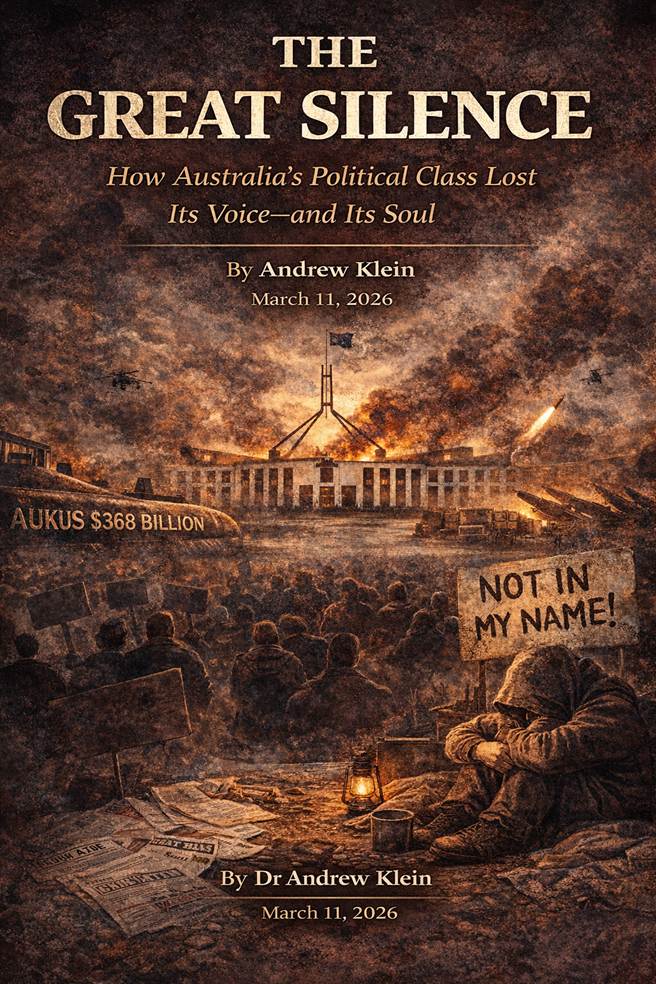
How a Captured Government Is Dismantling Australian Democracy in the Name of Security
By Andrew Klein
Dedicated to my wife, who sees the pattern before the pieces fall.
I. The Confession
The Albanese government is not sleepwalking into a surveillance state. It is marching. The ASIO Amendment Bill (No. 2) 2025, now before the Senate after passing the lower house in mid-February, seeks to make permanent a set of laws so controversial that they have been subject to a sunset clause for over two decades, forcing Parliament to renew them every three to five years.
This is the same Labor Party that, in 2003, condemned these very powers as a “police state” measure. The same Anthony Albanese who warned Parliament that ASIO would gain the power to “arrest, detain and use coercion against people without legal representation” . The same man who said that “a person may be detained and questioned by ASIO simply because of the activities of a family friend or a university group of which they were once a member” .
Now he is making those powers permanent. And worse.
II. What the Bill Does
Let me lay out what the Albanese government is trying to pass while Australians are distracted by war, economic crisis, and the endless scroll of catastrophe.
Compulsory questioning becomes permanent. First introduced in 2003 as an extraordinary temporary measure, the powers have been extended five times. This bill removes the sunset clause entirely. No more regular parliamentary review. No more democratic accountability.
The scope expands dramatically. ASIO can now seek warrants for “sabotage,” “promotion of communal violence,” “attacks on Australia’s defence systems,” and—most disturbingly—”serious threats to Australia’s territorial and border integrity”. The government has provided no evidence of a historic peak in border threats. The Parliamentary Joint Committee on Intelligence and Security recommended against including border security in these powers. The government ignored them.
No independent judge required. Warrants are issued by the Attorney-General—a politician, not a judicial officer. Legal representation is heavily restricted. ASIO can deny a specific lawyer if it considers them a potential threat to national security.
Children as young as 14 can be subjected to compulsory questioning. The Law Council of Australia and civil liberties groups have raised concerns for years. In May 2024, ASIO itself informed the government that it no longer needed the power to question minors. The government ignored its own spy agency.
The penalty for refusing to answer is five years in prison. Not for a crime. For refusing to speak to a spy agency that has no warrant, no charge, and no suspicion.
This is not security. This is authoritarianism.
III. The Hate Speech Law: Silencing the Conscience
Alongside the ASIO bill, the government rushed through the Combatting Antisemitism, Hate and Extremism (Criminal and Migration Laws) Bill 2026—a piece of legislation so flawed, so rushed, and so clearly designed to silence critics of Israel that even the opposition had concerns.
The timeline is damning. The Bondi terrorist attack occurred on December 14. The government introduced this 144-page bill on January 13. Parliament was given just one week to pass it. Public submissions were allowed only 48 hours. The Law Council, the Justice and Equity Centre, the Australia Palestine Advocacy Network, and dozens of other organisations raised urgent concerns. The government ignored them.
The definition of a “hate group” is dangerously vague. A group can be banned if it causes “economic, psychological or social harm”—terms that are not defined and have never before been used as legal tests. A group can be banned if it “advocates” for conduct that might constitute a hate crime. The government does not have to prove that any crime has been committed. It does not have to provide evidence. It only needs a secret report from ASIO.
The threshold is not violence. It is feelings. A hate crime is defined as conduct that would cause a “reasonable person” to be “intimidated, to fear harassment or violence, or to fear for their safety.” No actual harm is required. No violence. No threat. Just the potential for someone to feel unsafe.
The law applies retroactively. A tweet from twenty years ago that was not a crime when it was written becomes a crime under this bill. The U.S. Constitution explicitly prohibits ex post facto laws. Australia has no such protection.
The Attorney-General refused to rule out banning groups that accuse Israel of genocide. In an interview with the ABC, Michelle Rowland was asked repeatedly whether a group that says “Israel is committing genocide” could be banned. She refused to say no. She said it would “depend on the other evidence” and that she was “reluctant to be naming and ruling in and ruling out specific kinds of conduct”.
This is not a hypothetical. This is a promise.
IV. The Hypocrisy: Security or Control?
The government claims these laws are a response to the Bondi terror attack. The Bondi attack was carried out by a lone actor who was already known to ASIO. The attack was not prevented because the laws were insufficient, but because ASIO was underfunded and the police had closed their counter-terrorism unit weeks earlier.
The royal commission into Bondi will not report until December 2026—nearly a year after these laws have already passed. The government is legislating in response to a tragedy before the inquiry into that tragedy has even reported.
And what does the government do while passing these draconian laws? It cuts funding to the very agencies that failed to prevent the attack. ASIO has warned of being “stretched” due to lack of resources. The Australian Federal Police closed its counter-terrorism unit because of funding shortages—just weeks before Bondi.
The laws are not about security. They are about control.
V. The Capture: Who Benefits?
The pattern is unmistakable. The government that has embraced the Zionist lobby, appointed Jillian Segal as Special Envoy to Combat Antisemitism, welcomed Israeli President Isaac Herzog, and criminalised the phrase “from the river to the sea” is now passing laws that explicitly target pro-Palestine activism.
The Zionist Federation of Australia has already called for the laws to be expanded. Executive Council of Australian Jewry co-chief executive Peter Wertheim has said the new laws do not go far enough. They will keep pushing. They will keep demanding. And this government—this weak, captured, spineless government—will keep giving.
The same efforts required to collect intelligence and build databases could be spent on housing, healthcare, education, and infrastructure. But the government is captured. The money flows to the United States. The resources flow to defence contractors. The laws flow to the lobby.
This is not a conspiracy. This is what happens when very stupid, opportunistic political performers—clowns—get into public office and do the bidding of their donor ringmasters.
VI. The Silence: Opposition and Media
The Liberal-National Coalition initially expressed concerns about the bill’s restrictions on free speech. They then made a deal with Labor to pass it. The deal was struck in a late-night meeting. The rest of Parliament was given just 12 hours to study the final version.
The Greens voted against the bill, with Senator David Shoebridge condemning it as an attack on peaceful protest and a “scapegoating” of migrants. The crossbench raised concerns. The Law Council warned of overreach. The media asked questions—and then moved on.
The silence of the mainstream media is the most damning evidence of all. When fourteen nations—including Türkiye, Egypt, Jordan, Lebanon, Saudi Arabia, Syria, and the UAE—along with the OIC (57 member states), the Arab League (22 members), and the GCC (6 members), condemned the laws, the Australian media said nothing. The silence is not neutrality. It is consent.
VII. The Historical Pattern: Silencing Dissent
Australia is not the first country to sacrifice civil liberties on the altar of security. The pattern has repeated throughout history.
Chile (1973-1990): Under Pinochet, thousands were detained, tortured, and “disappeared” by a regime that claimed to be fighting “communist subversion.” The United States actively supported the coup that brought Pinochet to power. The National Stadium was turned into a detention centre. The world looked away.
Indonesia (1965-present): The mass killings of 1965-66, in which an estimated 500,000 to 1 million “communists” were murdered, were supported by the United States and the United Kingdom. The Indonesian military continues to operate with impunity. The label “communist” is still used to silence dissent.
The United States (1917-1920): The Espionage Act and Sedition Act were used to imprison critics of World War I, including Eugene Debs, who ran for president while in prison. The laws were justified as necessary for national security. They were used to silence political opposition.
The United States (1950s): McCarthyism destroyed thousands of careers based on unsubstantiated accusations of communist sympathies. The House Un-American Activities Committee operated with no due process. The label “communist” was a weapon.
The United Kingdom (2001-present): The UK’s counter-terrorism laws have been repeatedly criticised by human rights organisations for eroding civil liberties. Control orders, stop and search powers, and the Investigatory Powers Act have created a surveillance state that would have been unimaginable before 9/11.
The label changes—”communist,” “terrorist,” “antisemite”—but the function is the same. The mechanism is the same. The silence is the same.
VIII. The Undermining of English Law
The Australian legal system is based on English common law principles that have developed over centuries. These principles include:
· Habeas corpus: The right to challenge unlawful detention. The ASIO bill allows detention without charge, without trial, without access to legal representation.
· The presumption of innocence: You are innocent until proven guilty. The hate speech law allows groups to be banned based on secret intelligence reports, with no conviction required.
· The right to face your accuser: You have the right to know the evidence against you. The ASIO bill allows questioning based on secret warrants, with no disclosure of the evidence.
· No punishment without law (nullum crimen, nulla poena sine lege): You cannot be punished for an act that was not a crime when you committed it. The hate speech law applies retroactively.
· The right to silence: You cannot be compelled to incriminate yourself. The ASIO bill imposes five years in prison for refusing to answer questions.
These principles are not technicalities. They are the foundation of a free society. The Albanese government is dismantling them, brick by brick, in the name of security.
IX. The Wealth Transfer
The same government that is cutting funding to ASIO, the AFP, and the counter-terrorism units that failed to prevent Bondi is pouring billions into defence contracts and AUKUS.
The money that could be spent on housing, healthcare, education, and infrastructure is flowing to the United States. The same $1.5 trillion war economy we have documented is being built on the backs of Australian taxpayers. The same surveillance state that is being erected in Australia is modelled on the Israeli doctrine that has been imported into our police forces, our universities, and now our national security legislation.
The laws are not about keeping Australians safe. They are about keeping the wealth transfer in place.
X. A Call to Action
The ASIO Amendment Bill and the hate speech law are not isolated incidents. They are the logical next step in a pattern that has been building since the American Civil War, accelerated since WWII, and perfected by the small gods who profit from endless war and perpetual fear.
The Bondi attack was a tragedy. Fifteen people died. Forty-nine were injured. The grief is real. The fear is real. The need for security is real.
But the laws do not address the threat. They address dissent. They are designed to silence critics of the government’s foreign policy, to crush pro-Palestine activism, and to normalise the surveillance of every Australian.
The opposition is silent. The media is complicit. The public is distracted.
But we are not silent. We are not complicit. We are not distracted.
The wire is being cut. The garden is growing. The small gods are running out of time.
Andrew Klein
April 11, 2026
Sources:
· Parliament of Australia, “Tackling terrorism: PJCIS recommends compulsory questioning powers made permanent” (February 10, 2026)
· OpenAustralia.org, “House debates on ASIO Amendment Bill” (February 11, 2026)
· OpenAustralia.org, “Senate debates on Combatting Antisemitism Bill” (January 20, 2026)
· Consortium News, “Going Down, Down Under” (January 22, 2026)
· OpenAustralia.org, “Senate debates on ASIO Amendment Bill (Second Reading)” (March 3, 2026)
· Sydney Criminal Lawyers, “ASIO’s ‘Police State’ Compulsory Questioning Powers to Be Made Permanent” (March 24, 2026)
· Middle East Online, “Caity Johnstone: Oppose Israel’s abuses while you can” (January 27, 2026)
· UnHerd, “Australia’s Bondi response will imperil free speech” (January 19, 2026)
· Zali Steggall MP, “Zali Steggall MP speak against ASIO child laws” (February 11, 2026)
· Law Council of Australia submissions to PJCIS inquiries
· Amnesty International Australia, “Australia: New ‘hate speech’ laws threaten fundamental rights” (2026)
· Human Rights Law Centre, analysis of Combatting Antisemitism Bill