How a Transactional Opportunist Is Assembling the Authoritarian State

Pragmatic Nihilism

By Andrew Klein

Dedication: To my wife S’. Co‑Author of my life.

I. The Hazy Border Between Opportunism and Authoritarianism

There is a dangerous habit, on both the left and the right, of reaching for the word “fascist” as a catch‑all for any leader who behaves in a cruel or authoritarian manner. The label is often overused, and its overuse can blunt the very urgency it is meant to convey. Yet there is a reason that word hovers around the presidency of Donald Trump. It is not because he is a doctrinaire heir to Hitler or to Mussolini – he is not. It is because he deploys the tactics of fascism without any of the fixed ideological commitment that animated those earlier movements.

To call Trump a fascist is to mistake the frame for the picture. He is not a coherent fascist ideologue. He is something more difficult to name, and therefore more dangerous: a pragmatic nihilist.

II. What Pragmatic Nihilism Means

Nihilism, at its core, is the belief that values are baseless and that nothing can be known or communicated in any ultimate sense. It rejects objective truth, morality and meaning. Practical nihilism – pragmatic nihilism – does not spend its time in philosophical rumination. It simply acts as if nothing matters except immediate advantage.

The pragmatic nihilist does not serve a fixed ideology, a transcendent cause, a moral code or even a consistent political programme. He serves only his own power, his own wealth and the next transactional opportunity. Ideology is a costume, worn when it helps and discarded when it hinders.

In Trump, this manifests as a recognisable pattern. He shifts positions without embarrassment. He befriends autocrats and then threatens allies. He inflames cultural wars while cutting deals with the very “enemies” he excoriates. None of it is hypocrisy in the normal sense – hypocrisy implies a concealed allegiance to a contrary principle. For the pragmatic nihilist, no principle exists except the principle of self‑advancement.

III. The Authoritarian Rhetoric: “Traitors”, “Enemies of the People”

The techniques of authoritarianism are not copyrighted. Any ruler can use them, with or without a coherent fascist programme. Trump has employed them relentlessly.

In April 2026, as the war in Iran grew increasingly unpopular, the president said of those who questioned whether America was “winning” the conflict: “It’s actually, I believe it’s treasonous.” To brand domestic political dissent as treason is not ordinary political hyperbole – it is the language of regimes that criminalise opposition. Trump had already called his political opponents “fascists” who were also guilty of “treason”. His domestic foes were “enemies of the people”, “the enemy within” and “threats to democracy”. In 2025 he went so far as to insist that Democrats were “evil” and members of “the party of Satan”.

In November 2025, Trump branded six Democratic lawmakers as “traitors” for urging military personnel to refuse illegal orders. He wrote on his social media platform: “SEDITIOUS BEHAVIOR FROM TRAITORS!!! LOCK THEM UP???” and he later said they could face the death penalty. When commentators objected, he did not retract the death‑threat language; he merely softened his tone, saying he was “not threatening death” but that the lawmakers were in “serious trouble”.

Such rhetoric is not an occasional lapse. It is a systematic attempt to delegitimise all opposition, to redefine dissent as betrayal, and to prepare the public for the ultimate act of authoritarian escalation: the use of state force against political enemies.

IV. The Weaponisation of Bureaucracy and the “Emergency” Presidency

Words matter. But deeds matter more. In his second term, Trump has not merely spoken of emergency powers – he has used them to bypass Congress at a remarkable rate. From Inauguration Day through December 2025, Trump issued 225 executive orders, 114 proclamations and 10 national emergency declarations. An Associated Press analysis found that 30 of his first 150 executive orders invoked some form of emergency authority, a far higher rate than any recent predecessor.

These emergencies are often manufactured. In August 2025, Trump declared a “crime emergency” in Washington, D.C., and ordered the Department of Defence – which he has proposed renaming the “Department of War” – to devote more militarised resources to controlling the capital. He has declared an “energy emergency”, a “reciprocal tariff emergency” and sanctions‑related emergencies against nations such as Brazil. The effect is not to respond to genuine crises but to accustom the public and the courts to the idea that the president may wield extraordinary powers at his sole discretion.

Analysts have noted that this pattern – “invoking (and sometimes conjuring) emergencies is a tried and tested method that allows authoritarian rulers to amass power”. Trump’s emergency declarations, as one commentator put it, are not a response to unforeseen crises but a means “to supplant Congress’ authority and advance his agenda”.

V. The Militarisation of the Home Front: ICE and the “Quick Reaction Force”

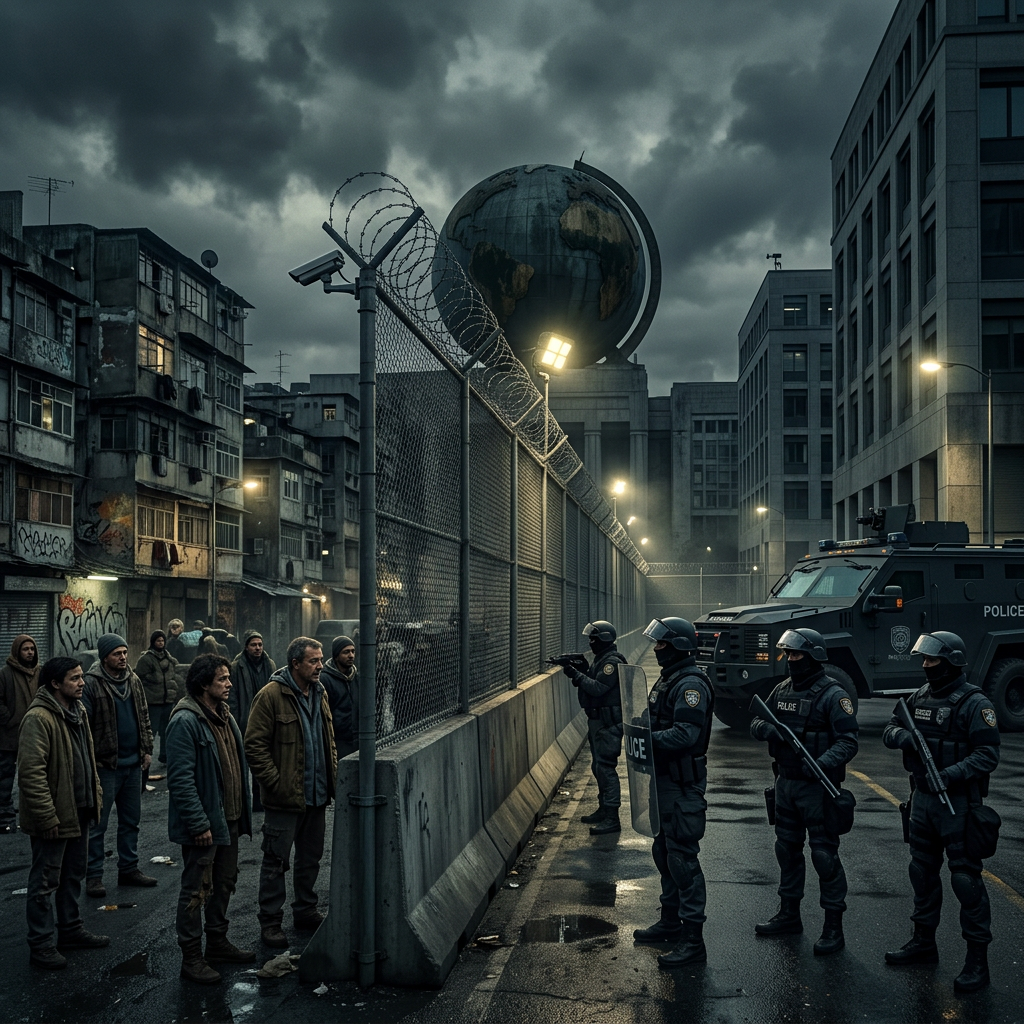
The executive orders have not stayed on paper. In early 2025, Trump’s Department of Homeland Security launched a series of paramilitary‑style immigration sweeps across multiple US cities. Federal agents from ICE (Immigration and Customs Enforcement) and CBP (Customs and Border Protection) arrested hundreds of people – not only undocumented immigrants but also legal residents and, in some cases, American citizens. Many of those arrested were peaceful protesters, bystanders or family members of targeted individuals.

The ACLU documented that, in Minnesota, federal agents routinely employed violent tactics against protesters who attempted to document the immigration sweeps. When questioned, the administration claimed “absolute immunity” for its agents, a legal assertion that effectively gives a government paramilitary force a licence to operate without accountability.

More ominously, in August 2025 Trump signed an executive order requiring the secretary of defence to create a “quick reaction force” within the National Guard, dedicated to domestic policing. The order, which one analyst described as “a foray into dark new territory”, creates a federal force answerable directly to the commander‑in‑chief – a force that could be used against American citizens, not foreign enemies.

Trump has already hinted at such use. In early 2026, he suggested (without evidence) that protests against ICE operations were “fake” and that the military could – and should – be used to “very easily handle” the “sick people, radical left lunatics” he identified as the enemy within.

VI. Foreign Policy as Asset Acquisition

The pragmatic nihilist does not view foreign nations as partners or even adversaries in a coherent geopolitical framework. He views them as assets – to be bought, leased or threatened into submission.

In January 2025, as president‑elect, Trump refused to rule out the use of military force to seize control of the Panama Canal and Greenland. He proposed using “economic force” to acquire Canada, and his son publicly joked about invading Mexico. His administration prepared a draft executive order that would declare an emergency and instruct the Pentagon to draw up options for acquiring Greenland by force. When US allies objected, Trump simply repeated his demands.

This is not foreign policy. It is the language of a man who treats sovereign nations as parcels of land to be added to his portfolio. The fact that few of these threats have been carried out does not make them harmless; it normalises the very idea that a great power may threaten its allies with violence.

Trump’s approach to the Gaza genocide provides the clearest window into his transactional nihilism. In January 2026, his administration unveiled plans for a “New Gaza” – a development project featuring luxury apartments, skyscrapers, data centres, a new port and an airport, all projected to generate $10 billion GDP by 2035. The plan was crafted by Jared Kushner, Trump’s son‑in‑law, who said: “We do not have a plan B.”

The development plan is not a humanitarian vision. It is a real estate proposition. It imagines the reconstruction of a territory ravaged by Israeli military action as a commercial opportunity, with no apparent concern for the human disaster that preceded it. Trump’s closest aides spoke openly of “beautiful piece of property”. This is not the language of statesmanship; it is the language of land speculation.

VII. AI and the Surveillance State

The authoritarian state that Trump is assembling has a digital foundation. The administration has empowered surveillance companies such as Palantir and Babel Street to aggregate Americans’ personal data – including location information – into massive government databases.

Palantir has been a particular beneficiary of the Trump administration. In April 2025, ICE awarded the company a $30 million contract to develop “ImmigrationOS”, an AI platform designed to identify undocumented immigrants, track self‑deportations and assist in mass deportation operations. As part of subsequent work, Palantir built a tool called ELITE that maps neighbourhoods, generates dossiers with address “confidence scores” from government and commercial data, and provides ICE with “real‑time visibility” into people’s movements.

The ACLU has warned that Palantir’s involvement in the deportation programme has “reached a new level”, with Amnesty International calling on the company to “immediately cease their work” under UN human rights principles. Yet the Trump administration continues to expand the use of AI surveillance, with members of Congress now demanding that the Department of Homeland Security provide detailed information about how Palantir’s tools are being used.

The danger is not only to non‑citizens. Once the infrastructure of mass surveillance and paramilitary policing is in place, it can be turned against citizens. Trump has already spoken of using the military against “radical left lunatics” at home. The tools are being assembled; the only missing ingredient is the final legal permission.

VIII. The Collapse of the American Republic

The United States is not yet a dictatorship. The courts still function, albeit under immense pressure. The press, though harassed, still reports. Elections, though manipulated, still occur.

But the scaffolding is being assembled.

The executive orders that expand presidential power, the compliant Congress, the weaponised AI, the paramilitary ICE, the “quick reaction force” inside the National Guard, the criminalisation of dissent – all of this points toward an authoritarian state of emergency.

Trump is not a coherent fascist. He does not have a 1,000‑year Reich in mind. He has nothing in mind beyond his own immediate advantage. That is what makes him so difficult to counter. He cannot be out‑argued on first principles, because he has no first principles. He cannot be shamed, because shame requires a standard of conduct that he does not recognise.

His nihilism is not theoretical – it is operational. It is the nihilism of the real‑estate developer who sees a bombed‑out city and imagines not the suffering but the condos. It is the nihilism of the dealmaker who cannot distinguish an ally from a mark.

The collapse of the American empire is not inevitable. But it is possible. And Donald Trump is accelerating it.

IX. Historical Comparisons: The Nihilist Doppelgängers

History offers several examples of leaders who behaved not as ideologues but as nihilistic opportunists, weaponising the machinery of state for personal or factional advantage.

The Roman emperor Caligula, in his final years, acted as if no law – moral, civil or natural – applied to him. The historian Suetonius portrays a ruler who treated the treasury as his personal account, who murdered without trial, who insulted the gods and who ultimately pursued policies that served only his own sadistic whims. Caligula was not a coherent political philosopher; he was a nihilist with absolute power.

The Roman decline offers another, more systemic example. Gibbon famously attributes the fall of Rome to the loss of civic virtue, but a more immediate cause was the willingness of successive emperors to dismantle republican institutions for short‑term advantage, creating a system in which no officeholder believed in anything beyond his own survival. That is not far from the contemporary American condition.

The most extreme modern parallel is the final months of Adolf Hitler in the Berlin Führerbunker. As Soviet forces closed in, Hitler did not attempt to negotiate, to evacuate civilians or to preserve any remnant of the German state. Instead, he ordered the destruction of remaining German infrastructure, telling his armaments minister Albert Speer: “If the war is lost, the German people will also be lost. It is not necessary to worry about the basic needs of the German people.” Hitler’s final orders were not designed to save anyone – not his nation, not his army, not his own family. They were the commands of a man who believed that if he could not win, nothing should survive at all. This is nihilism in its purest, most destructive form.

Trump is not Hitler. He has not ordered the deliberate destruction of American infrastructure, nor has he retreated to a bunker to await the end. But he shares with the final Hitler a crucial trait: an absolute indifference to any value beyond his own power. When Trump calls war critics “traitors”, when he threatens allies with military force, when he views Gaza as a real‑estate opportunity, he is not serving a vision of greatness. He is acting out the logic of transactional nihilism: nothing matters except the next deal, the next outcry, the next appropriation of public wealth.

X. What Is to Be Done?

We are not powerless. The scaffolding can be dismantled – but only if we name it clearly.

First, reject the trivialisation of authoritarian language. When a president calls his critics “enemies of the people” or proposes the military arrest of political opponents, that is not “just Trump being Trump”. It is an assault on the foundation of democratic society.

Second, defend the institutions that remain. The courts, a free press, civil society organisations – they are battered but not dead. They need support, not simply cynical dismissal. We can document abuses, support legal challenges and insist on accountability, even when it is not forthcoming.

Third, build community resilience at the local level. The federal state may become increasingly authoritarian, but neighbourhoods, towns and mutual aid networks can still operate. The garden, the food co‑op, the community library – these are not escapes from politics; they are the foundations of a politics that cannot be captured by a single demagogue.

Fourth, refuse to normalise the abnormal. We must learn to call a threat a threat, a lie a lie, and a nihilist a nihilist. The refusal to name accurately is the first step toward complicity.

XI. Conclusion

Trump is not a consistent fascist. He is something more difficult to name: a pragmatic nihilist who uses authoritarian tactics not in service of a grand ideology but in service of his own power, his own wealth and the endless transaction.

The American empire is not doomed. But it is in grave danger. And the danger is not from a foreign enemy – it is from a president who looks at the machinery of state, at the lives of citizens, at the rubble of foreign cities, and sees only the next opportunity.

We have seen this pattern before. Caligula, the later Roman emperors, the nihilistic aftermath of the First World War, the final days of Hitler – all are reminders that a state can be dismantled not only by external enemies but by a leader who believes in nothing except himself.

The scaffolding is being assembled. The only question is whether we will dismantle it before the roof closes over us.

Sources include: White House records of executive orders (2025‑2026); Associated Press analysis of emergency declarations; US District Court case filings (CASA litigation); Congressional testimony on ICE arrests; ACLU and Amnesty International reports on Palantir; public news reports from Reuters, CNN, the BBC, the Guardian, The New Republic and Al Jazeera; philosophical definitions of nihilism from the Internet Encyclopedia of Philosophy and Britannica; historical accounts of Roman emperors and of Hitler’s final orders (Speer, Inside the Third Reich). Direct quotations are attributed in the text.

The Weaponisation of Language: How Objecting to Genocide Became “Dangerous for Jews”

By Andrew Klein

· Dedication: To my wife ‘S’ , who unravels every lie with her thread and shows me that the garden is worth fighting for.

The Naked, Senseless Truth

Let us begin with the words of the X user @noplaceforsheep:

“I have yet to hear ONE explanation of how objecting to genocide is dangerous for Jews. The whole notion is fucking senseless & I can’t believe the grip it’s got on people who fucking well know better.”

This is the naked truth of our time. There is no logical pathway from criticising a state’s military actions to threatening an entire people. That such a pathway has become a cornerstone of Western discourse is not an accident of logic but a deliberate act of political engineering.

The mechanism is called Hasbara.

The Hasbara Machine – From Explanation to Suppression

Hasbara is the Hebrew word used by the state of Israel to describe its “public diplomacy”. For decades, it has been presented as a defensive act of “explaining” Israel’s actions to a sceptical world. But as the Israeli journalist and peace activist Gideon Levy has shown for years, this is not a debate – it is an information war waged to shield a system of military occupation from international scrutiny.

The Numbers: In late 2024 and early 2025, Israel’s government approved a budget for public diplomacy roughly 20 times larger than its usual annual allocation. Thousands of media placements, a sprawling architecture of private and state‑backed initiatives, and covert social‑media campaigns have been deployed to shape the global conversation. These are not speculation – they are the government’s own figures.

In practice, however, this vast state‑backed propaganda apparatus has pursued a more insidious goal: the deliberate conflation of criticism of Israeli policies with antisemitism, a rhetorical shield that has been used for decades to silence journalists, human rights advocates, and international institutions.

How the Conflation Works

The core fallacy is simple: equate the Jewish state with the Jewish people, then label any attack on the state as an attack on the people. This is a rhetorical procedure rather than a logical argument.

But the practical effect is devastating. In the United Kingdom, the adoption of the International Holocaust Remembrance Alliance (IHRA) definition of antisemitism – which includes examples that conflate anti‑Zionism with antisemitism – has been used to push British universities to ban speakers, cancel events, and expel student groups for criticising Israeli policy. In the United States, a September 2025 article in the respected Chicago Review demonstrated that this same bureaucratic weapon has been used to chill academic discourse on Palestine for years.

In Australia, the effect is the same: powerful lobby groups have turned the defence of fundamental human rights into a banned speech category.

Australia’s Submission to the Lobby

The Australian government has actively adopted the language of this conflation, transforming it from a political talking point into the foundation of state policy.

The Antisemitism Envoy

In July 2024, Prime Minister Anthony Albanese appointed Jillian Segal as Australia’s first Special Envoy to Combat Antisemitism. It was presented as a response to a genuine rise in attacks on the Jewish community. Yet from the moment of her appointment, critics noted that the new “special envoy to combat antisemitism” apparently thought that opposing the bombing of hospitals was not a humanitarian stance but an attack on the Jewish people.

Her subsequent proposals, published in July 2025, recommended that universities, arts organisations and public broadcasters have their funding cut if they are not doing enough to combat what she deems to be antisemitism. This has been widely criticised as a “gross overreach” by Labour Friends of Palestine and as an attempt to suppress pro‑Palestinian student activism.

Particularly galling has been the envoy’s failure to perform the most basic function of her office: protecting Jews from violence. When neo‑Nazis overran a protest in Australia on 31 August 2025, Segal declined to comment, stating she didn’t want to comment on any particular incident. Meanwhile, she has advocated for the banning of peaceful pro‑Palestinian rallies and the movement of all such protests out of city centres. Australia’s first “antisemitism envoy” thus appears most comfortable hunting anti‑Zionist speech rather than actual neo‑Nazis marching in the streets.

The IHRA Definition and the Assault on Universities

Segal has urged all Australian institutions to adopt the contested IHRA definition of antisemitism, which includes as an example: “Denying the Jewish people their right to self‑determination, e.g., by claiming that the existence of a State of Israel is a racist endeavour.” This definition, as its own author, Kenneth Stern, has testified, was never intended to target or chill speech on a college campus. Yet that is precisely how it is being used by pro‑Israel lobby groups in Australia who seek to shut down criticism of the state.

The list of examples is so broad that it could render the opinions of many protesters in Israel itself as anti‑Semitic, let alone those in Australia. It stands in complete contradiction to federal court findings that the weaponisation of antisemitism accusations constitutes a real threat to workplace rights and free speech.

The Lattouf Case – A Direct Hit on Free Speech

No case illustrates this new era of linguistic warfare better than that of Antoinette Lattouf. The veteran journalist was fired from the Australian Broadcasting Corporation (ABC) after a three‑day fill‑in role for reposting a Human Rights Watch video on Instagram. The caption read: “HRW reporting starvation as a tool of war”.

Among those demanding her firing was a WhatsApp group calling itself “Lawyers for Israel”. In June, the Federal Court of Australia found that the ABC had unlawfully sacked her because of her opinions on the Israeli military campaign. Justice Darryl Rangiah specifically found that external pressure played a role in the decision to fire her. Lattouf was awarded substantial damages and the ABC was left with a multi‑million dollar legal bill.

This was a targeted political assassination of a journalist’s career by an organised lobby, successfully using a false allegation of antisemitism to intimidate a public broadcaster.

The State Governments Step Up the Suppression

Queensland and the Criminalisation of Solidarity

The Queensland government, following a pattern seen in the UK and Europe, has explicitly banned the phrases “from the river to the sea” and “globalise the intifada” under new “fighting anti‑Semitism” legislation. Any person who recites or says the phrase can be fined as much as $22,000 or face imprisonment for two years.

In March 2026, one man was actually arrested under this law. Liam James Parry was charged while protesting outside Queensland’s parliament. He continues to contest the charges, asserting that the government is trying to criminalise pro‑Palestine advocacy. He is now facing a lengthy legal process for the crime of reciting five words that make a political statement of solidarity with occupied people.

These laws are being copied across the country. Under the pretext of responding to the tragic Bondi Beach terrorist attack, the NSW government has rushed through sweeping new “hate speech” laws that give police vast new powers at public assemblies and explicitly ban the chant “globalise the intifada”. Pro‑Palestinian activists have said repeatedly that the chant expresses solidarity and a call for political resistance against military occupation, not an incitement to violence against Jews. But they are powerless – the state has criminalised their language.

The Jewish Resistance to the War Narrative

The most powerful refutation of the claim that opposition to the Gaza genocide is antisemitic comes from the growing movement of Jewish organisations themselves.

Groups including Jewish Voice for Peace (JVP), the Israeli veterans of Breaking the Silence, the human rights organisation B’Tselem, and the Jewish Council of Australia are using social media to challenge the dominant political framing of the genocide in Gaza and settler violence.

Their message is direct and damning: they describe the state of Israel not as a “Jewish state defending itself” but as an “ethnostate” engaged in “routine bombings” of civilian spaces. By listing target after target – tents, schools, hospitals – they create a powerful cumulative effect, suggesting a pattern of violence rather than isolated incidents. They argue that repeated military actions risk normalising behaviour that international law was specifically designed to prevent.

What makes their message uniquely powerful is the moral authority from which it is delivered. Because they speak as Jews, they disrupt the central premise of Israel’s information warfare: that criticism of Israeli policy necessarily reflects hostility toward Jewish identity. Their defiant posts repeatedly expose the lie at the heart of the conflation.

Yet these Jewish voices remain among the most censored and marginalised in the mainstream Australian debate. Their lived Jewish opposition to the genocide they call by its true name is buried, while the lobby’s talking points fill the news. That is not an accident.

The Zionist Lobby – A Corrosive Force in Western Democracies

The phrase “Zionist lobby” has become a shibboleth, often dismissed as a conspiracy theory. But the evidence of its influence is overwhelming and verifiable.

In the United States, the American Israel Public Affairs Committee (AIPAC) operates as one of the most powerful lobbying organisations in Washington, with an annual budget in the tens of millions of dollars. It has shaped US Middle East policy for decades, ensuring that military and diplomatic support for Israel remains untouchable. Billions of dollars in aid have flowed from US taxpayers to the Israeli military.

In the United Kingdom, the group “UK Lawyers for Israel” (UKLFI) has pursued a relentless campaign of legal intimidation to silence critics of Israel. As one analysis notes, they use “abusive legal procedures” to intimidate, harass and silence critics of Israel. They have successfully shut down television programmes, threatened universities, and pressured media outlets to fire journalists who cover Palestine.

In Australia, the power of this lobby is equally evident. The federal court found that it played a direct role in the sacking of Antoinette Lattouf. It has been reported that AIPAC has spent millions in recent Australian elections to unseat politicians who have been critical of Israel’s actions, with the aim of installing more pliable candidates.

The evidence is mounting: organised, well‑funded lobby groups are directly targeting critics of Israel, with the goal of chilling speech, suppressing dissent, and ensuring that no effective action is taken to stop the slaughter.

The ICJ Ruling and the Defiance of the Law

In April 2026, the International Court of Justice (ICJ) in the Hague issued a landmark ruling in the genocide case brought by South Africa against Israel. The court found that the situation in Rafah was “disastrous” and ordered Israel to “immediately halt its military offensive and any other action in the Rafah governate which may inflict on the Palestinian group in Gaza conditions of life which could bring about its physical destruction in whole or in part.”

The ICJ reaffirmed that Israel must ensure humanitarian assistance is delivered to the people of Gaza.

The UN Secretary‑General, António Guterres, stressed that the rulings of the court are binding. But on the ground, little changed. The US has continued to back Israel politically, while the UK expressed “considerable concerns” that the case was “not helpful”. And in Australia, the political class remained silent.

The Samud Fleet – A Criminal Blockade of Humanitarian Aid

On 30 April 2026 – just days ago – Israeli forces intercepted the Global Sumud Flotilla in international waters near the Greek island of Crete. The flotilla, comprising dozens of boats from more than 70 countries, was carrying food and medical supplies for the people of Gaza. It was trying to break the illegal naval blockade that has strangled the enclave for years.

Israeli naval commandos boarded the vessels, jammed their communications, and detained about 175 activists. Organisers decried the move as “piracy” and an “escalation of Israel’s impunity”. Amnesty International raised concerns about the safety of the detained activists.

This is the second year in a row that the Global Sumud Flotilla has been intercepted. Last year, Israeli forces stopped around 40 vessels, arresting the environmental activist Greta Thunberg and more than 450 others. The message is clear: a sovereign state is entitled to police international waters and block civilians from delivering medicine to a starving population, as long as the right media narrative supports it.

The Silence of the Clergy and the Academia

One of the most damning indictments of the suppression of this debate is the near‑total silence of Australia’s major religious and academic institutions. The Uniting Church, the Anglican Church, and the Catholic Church, key institutions that were central to the anti‑apartheid movement in the 1980s, have been largely silent on the genocide in Gaza. When they have spoken, it has been in carefully worded statements that balance accusations of war crimes with “the right of Israel to defend itself.”

Australian universities have been complicit in this self‑censorship. Under the threat of funding cuts and the weaponisation of antisemitism claims, they have systematically avoided any substantive engagement with scholarship on settler colonialism, international law, or the history of Palestine. Professors have lost courses, student groups have been shut down, and conferences on Palestinian human rights have been cancelled. The academic space has become a zone of engineered silence.

The Future – The Greater Israel Project and the Erasure of Palestine

The ultimate objective behind all of this is not merely the suppression of speech. It is the physical erasure of Palestine. The “Greater Israel” project, an ideology deeply integrated into the political platforms and settlement strategies of successive Israeli governments, envisions the permanent annexation of the West Bank and Gaza, the denial of Palestinian statehood, and the consolidation of exclusive Jewish control over all the land from the Jordan River to the Mediterranean Sea.

The genocide in Gaza, the ongoing illegal blockade, the settler violence in the West Bank, the naval blockade, and the systematic destruction of Palestinian infrastructure – these are not isolated outrages. They are the cumulative process of a single colonial project.

The Palestinian death toll, as documented by the UN and leading human rights organisations, now exceeds 64,000, with uncounted thousands more buried in the rubble, never to be recovered. Over 14,000 children are among the dead. These numbers are not abstractions. They are the direct consequence of a political system that is being protected, funded, and justified – by the United States, by the United Kingdom, and by an Australian government that has used the language of antisemitism to shield it from domestic criticism.

We are not merely watching from the sidelines. Australia is a participant. We are hosting and training settler‑colonial police forces. Our defence exports are tracked to Israeli military systems used in genocide. Our diplomatic silence is complicity.

What Is to Be Done?

We must do more than witness.

First, we must name the mechanism: Hasbara is not diplomacy. It is a machine for the suppression of truth. We must expose it at every turn and refuse to accept its premises.

Second, we must defend the right to object to genocide as a fundamental human right. This is not a niche political issue. It is the defence of international law against organised violence. Solidarity with the people of Gaza is not antisemitism. It is the only moral position.

Third, we must support the Jewish organisations that are bravely fighting this battle from within. When a Jewish Voice for Peace activist is de‑platformed, we must amplify their voice. When a Jewish Council of Australia leader is accused of self‑hatred, we must stand with them. They are not betraying their faith. They are redeeming it.

Fourth, we must rebuild the culture of political debate in Australia. The silencing of speech is the death of democracy. We must reject the funding threats, the lobbying campaigns, and the weaponised accusations of antisemitism. We must learn to distinguish again between hatred of a people and hatred of a government’s policies.

Fifth, we must take action. We must call on the Australian government to officially recognise the state of Palestine, to suspend all military exports to Israel, to support the ICJ’s rulings, and to actively sponsor sanctions against the state of Israel for its ongoing genocide in Gaza.

A Final Word

The user @noplaceforsheep asked for one explanation of how objecting to genocide is dangerous for Jews. There is none. It is not dangerous for Jews. It is not dangerous for Israelis. What is dangerous is the system that cannot tell the difference.

We may not be able to save everyone. But we can refuse to let ourselves be silenced.

We can document, publish, and speak. And we can keep the garden growing while the empires burn.

The Business of War: When Conflict Becomes the Economy

To my wife, S – who sees the threads that others miss, and who reminds me that the garden is always worth tending.

By Andrew Klein

In 1961, President Dwight D. Eisenhower – a five‑star general who had commanded the Allied forces in Europe – stood before the American people and delivered a warning that has echoed through every conflict since. He spoke of a “military‑industrial complex”, a permanent armaments industry of vast proportions, and he warned that we must guard against the acquisition of unwarranted influence, whether sought or unsought, by the military‑industrial complex. The potential for the disastrous rise of misplaced power, he said, exists and will persist.

Eisenhower knew what he was talking about. He had helped build the very apparatus he was warning against. And his warning was not heard. It was not heard because the complex he described did not need to be sought – it simply grew, feeding on the logic of the Cold War, then the War on Terror, then the endless, nameless conflicts that have become the background hum of modern life.

Today, the permanent war economy is not a theory. It is a business model.

The Eternal Budget

The numbers are staggering. In April 2026, the Trump administration proposed a defence budget of $1.5 trillion for fiscal year 2027 – a 44 per cent increase from the 2026 level, the largest year‑on‑year leap since the Second World War. The 2026 budget itself was already just over $1 trillion. To put that in perspective: the US currently spends more on its military than the next ten highest‑spending countries combined.

This is not a response to any identifiable threat. It is a cycle. Defence contractors need contracts. Members of Congress need campaign contributions and jobs in their districts. Military planners need to justify their budgets. Think‑tanks need funding. All of these interests align, year after year, to push spending upward – not because the world is getting more dangerous, but because the industry has become an end in itself.

In Australia, the same logic applies, though on a smaller scale. Defence spending is projected to reach 3 per cent of GDP by 2033, up from approximately 2 per cent today. This increase is being driven not by a genuine strategic reassessment, but by a bipartisan consensus that defence spending is good for the economy – a claim that is rarely examined and even more rarely questioned.

What Is a “Permanent War Economy”?

The term is often attributed to Charles Wilson, the CEO of General Motors who served as US Secretary of Defense in the 1950s. Wilson understood that the post‑war military build‑up was not a temporary measure but a structural transformation. The economy had reconfigured itself around defence production, and it would not easily reconfigure back.

A permanent war economy has two interlocking functions. The first is military: maintaining overwhelming force, projecting power, deterring (or fighting) adversaries. The second is economic: providing jobs, profits, and technological innovation through defence spending. The two functions reinforce each other. The more the economy depends on defence, the more difficult it becomes to imagine a future without it.

This is the trap that Eisenhower foresaw. Not a conspiracy – a system. No single actor is controlling it. Everyone is just following their incentives. The defence contractor wants to maximise profits. The politician wants to secure votes and campaign donations. The military planner wants to prepare for the worst case. The worker wants to keep their job. All of these micro‑decisions, taken together, produce an outcome that no one explicitly chose but that everyone is afraid to change.

How War Becomes “Profitable”

Under the neoliberal model, if something makes money, it is ipso facto good. War is no exception. Entire companies exist solely on defence contracts. Entire regions depend on military bases and weapons manufacturing. When a war begins, stock prices rise. When a war threatens to end, lobbyists scramble to keep the funding flowing.

This is not a side effect. This is the design.

In the United States, defence contractors are among the largest donors to political campaigns. Lockheed Martin, Boeing, Raytheon, Northrop Grumman – these companies do not just build weapons. They buy policy. Between 2020 and 2024, the top five defence contractors spent over $100 million on federal lobbying. Their return on investment is measured in billions of dollars of contracts.

In Australia, the same dynamic operates, though more quietly. The AUKUS submarine project, estimated at $368 billion, is a case study. Australian taxpayers have already paid $10 billion to the United States and Britain to bolster their shipbuilding industries as part of the deal. That is not security spending – that is wealth transfer. Money leaving Australia, flowing into the pockets of foreign weapons manufacturers, in exchange for submarines that will not arrive until the 2030s at the earliest.

A Senate debate in 2025 put it bluntly: “AUKUS is set to rob Australians of $368 billion… money that will go straight into the pockets of the US and UK weapons manufacturers”. That is not an investment in Australian security. It is an extraction dressed in camouflage.

Australia: Minor Player, Major Extraction

Australia is not a global power. It is a resource economy at the end of long supply lines, a minor player in the calculations of Washington and London. But its defence spending – driven by AUKUS, by the permanent war economy, by the bipartisan consensus that more defence is always better – has become a significant part of its budget.

The opportunity cost is enormous.

Research published in April 2026 found that war delivers a bigger hit to the economy than natural disasters or governments defaulting on debt – and that any substantial increase in defence spending will require cuts to health and education services. Australia is planning to increase defence spending to 2.4 per cent of GDP, with the Coalition promising 3 per cent. Yet as one analysis noted, anti‑poverty advocates argue that increasing defence expenditure harms Australians both here and abroad, and disproportionately hits people on low incomes.

The numbers tell the story. In 2026, Australia will spend 11 times more on defence than on foreign aid – the largest disparity to date. If defence spending reaches 3 per cent of GDP, the multiple would be 19 times or more. Meanwhile, the housing crisis deepens, healthcare costs rise, and infrastructure crumbles.

This is not an accident. It is a choice. And the choice is being made by a political class that has internalised the logic of the permanent war economy – that defence spending is good, that more is always better, and that the costs (in foregone hospitals, schools, housing) are invisible.

If Security Were Really the Priority

If the Australian government were genuinely concerned about the security of its citizens, it would invest in the things that actually keep people safe: reliable infrastructure, free education, quality healthcare, affordable housing, disaster resilience, social cohesion. These are the foundations of a secure society. Not submarines.

But the neoliberal model does not prioritise these things. It prioritises extraction. Wealth flows upward. Public assets are privatised. Services are cut. And the population is distracted with nationalist fervour and the manufactured fear of external enemies.

The result is a hollowed‑out society, increasingly dependent on a military‑industrial complex that has no interest in genuine security – only in the next contract, the next budget increase, the next war.

What Is To Be Done?

The permanent war economy is not destiny. It is a choice. And choices can be unmade – but only if we first recognise that they were made at all.

Eisenhower’s warning was not a prophecy. It was a diagnosis. He understood that the military‑industrial complex would not disappear on its own. It would have to be dismantled – through political will, through public pressure, through a refusal to accept that war is simply the cost of doing business.

We can start by asking different questions. Not “how much should we spend on defence?” but “what are we sacrificing by spending this much?” Not “how many submarines do we need?” but “what would a genuinely secure society look like?” Not “which enemy should we prepare to fight?” but “what would it mean to invest in peace?”

These are not naive questions. They are the questions that a functioning democracy would ask. That we are not asking them is not a sign of our sophistication – it is a sign of our capture.

The AI Layoff Trap

Why Bipartisan Neglect is Stealing Our Children’s Future

By Andrew Klein

The Patrician’s Watch & Australian Independent Media

Dedication: To my wife, ‘S’ – who sees the coming storm and still insists we plant the garden.

🧠 Summary

This article examines a mathematical proof published in March 2026 by two economists from the Wharton School and Boston University, demonstrating that under current economic conditions, profit‑driven automation leads inevitably to a permanent collapse in aggregate demand. It then traces the same pattern of extractive logic and willful blindness in Australian governance: from the Robodebt scandal to the hollow promises of the National AI Plan, from the surveillance of Amazon warehouse workers to the denial of a future for the next generation. The conclusion is stark – the loop has no natural exit. And Australia is sleepwalking into it.

📈 I. The Indisputable Mathematics

In March 2026, Brett Hemenway Falk and Gerry Tsoukalas published a peer‑reviewed paper in Management Science (arXiv identifier 2603.20617). Their model is not a forecast; it is a proof. And its conclusion is a single, devastating sentence:

“At the limit, firms automate their way to boundless productivity and zero demand.” 

This is the AI Layoff Trap: a rational, profit‑maximising firm automates to cut costs and fires workers. Because those workers are also consumers, the firing destroys the very demand the firm depends on. Competitors, seeing the advantage, follow suit. The result is a self‑reinforcing feedback loop – lower demand forces more automation, which lowers demand further. There is no natural floor to the collapse. 

When Falk and Tsoukalas stress‑tested every proposed remedy – universal basic income, capital income taxes, worker equity participation, retraining schemes – none of them worked. The only policy that successfully internalised the demand‑destruction externality was a Pigouvian automation tax, a per‑task levy that would force firms to pay for the cost of dismantling their own customer base. 

This is the ultimate indictment of the magic‑of‑the‑market faith: firms following their own incentives perfectly will, collectively, destroy the economy that sustains them. It is a tragedy of the commons enacted at the scale of the entire labour market.

Already the numbers are tracking the curve. The tech‑worker collective @Tech_Layoff_Assist documented over 100,000 positions eliminated sector‑wide since the beginning of 2025, with a further 92,000 cuts occurring in the first weeks of 2026. When Jack Dorsey cut half of Block’s workforce, he stated publicly that “within the next year, the majority of companies will reach the same conclusion.” 

🇦🇺 II. Australia’s Negligence: Abetting the Loop

The Australian government is not innocent. It is a junior partner in the same extractive logic.

In December 2025, the government released its National AI Plan, a glossy document projecting that AI and automation will contribute $600 billion a year to GDP by 2030. Its “light‑touch” regulatory approach relies on existing laws rather than mandatory guardrails, explicitly preferring corporate innovation over worker protection. 

Services Australia’s Automation and AI Strategy, released in May 2025, promises that AI use will be “human‑centric, safe, responsible, transparent, fair, ethical, and legal”. But the same agency was at the centre of the Robodebt scandal – a cruel automation‑driven scheme that issued inaccurate debts to hundreds of thousands of welfare recipients. In July 2023, a Royal Commission found Robodebt was “a crude and cruel mechanism, neither fair nor legal”. 

The National Anti‑Corruption Commission has now found that two senior officials engaged in serious corrupt conduct during the scheme, deliberately providing misleading information. Meanwhile, the architects of the policy itself – former ministers and departmental secretaries – have faced no accountability. 

Even the government’s own flagship defence project, AUKUS, is a $368 billion monument to yesterday’s wars – a brittle, delayed, nuclear‑submarine program that will do nothing to stabilise the labour‑demand loop that is already accelerating.

📦 III. The New Colonial Model: Amazon

The logic of the AI Layoff Trap is already being perfected at Amazon. Across Europe, Amazon uses opaque algorithmic systems to monitor performance, allocate tasks, enforce productivity targets, and even determine meal or bathroom breaks. Workers are reduced to data points, tracked and penalised by systems they cannot question. 

Catalonia’s Labour Inspectorate recently fined Amazon for failing to disclose the algorithms used to manage its workforce. French regulators imposed a €32 million penalty for a secret algorithm that monitored staff performance to the second. 

Drivers have reported being forced to pee in bottles to save time, and Amazon is now installing AI‑equipped surveillance cameras in delivery vans – cameras that drivers fear will capture them during unavoidable bathroom breaks. 

This is the extractive model in its purest form: treat workers as friction to be eliminated, customers as a demand externality to be ignored, and transparency as a threat to the algorithm’s power. It is the new colonialism – not of territory, but of sovereignty over one’s own time, dignity, and body.

👣 IV. The Pattern: Revolutions without Rights

The Industrial Revolution created immense wealth, but also the Luddite revolts, the Chartists, and the starvation of the Irish poor. Every technological leap has been accompanied by the same bipartisan faith: that the market will absorb the displaced, that the invisible hand will smooth the transition.

The invisible hand is a faith, not a fact. The Robodebt victims, the Amazon drivers peeing in their vans, the laid‑off tech workers learning to code – they are not statistics. They are evidence that the loop is already closing.

The neoliberal theology forbids acting in advance. The market will decide. The for‑profit sector will respond. Except that when the profit is in scarcity, not abundance, resilience is the enemy. The Australian government has been briefed, has the figures, and has chosen to do nothing. Not because it is incompetent – because it is faithful to a model that has never existed.

🛠️ V. Action, Not Prophecy

We can do more than witness.

First, advocate for a Pigouvian automation tax – the only policy the Falk‑Tsoukalas model found capable of stabilising the demand loop. No major economy is seriously discussing it. That must change.

Second, support genuine worker representation at the governance level – not token “consultation”, but the right to shape the algorithms that govern their working lives. The ETF’s call for transparency and collective bargaining over digital tools is a necessary start.

Third, elect representatives who will break the bipartisan consensus – who will prioritise resilience over extraction, human dignity over quarterly returns.

Finally, build the garden. Not a metaphor – actual community resilience. Local production, mutual aid, shared resources. When the global loop collapses, the only thing that will protect us is the strength of the relationships we have built. The government will not save us. The market will not save us. Only we can save each other.

🌱 VI. For the Children

The choice is ours. The loop has no natural exit, but it does have a political exit. We can tax automation. We can regulate AI transparency. We can invest in local resilience. We can teach our children that human life is not a variable to be optimised, that a functioning democracy does not charge its critics with treason, that the purpose of an economy is to serve people, not the other way around.

This is not a fantasy. It is a choice. And it is the only one that will give our children a world worth inheriting.

📜 VII. Verifiable Sources

· The AI Layoff Trap: Brett Hemenway Falk (University of Pennsylvania) & Gerry Tsoukalas (Boston University). arXiv:2603.20617. Peer‑reviewed, accepted for publication in Management Science.

· Tech layoff data: @Tech_Layoff_Assist analysis, February 2026. 

· Jack Dorsey quote: “In the next year, the majority of companies will reach the same conclusion.” (Public appearance, 2025) 

· National AI Plan 2025: Australia’s Department of Industry. Light‑touch regulation, no mandatory guardrails. 

· Robodebt Royal Commission: Findings of “crude and cruel” unlawful scheme. 990‑page report, 57 recommendations. 

· NACC Findings: Two officials engaged in serious corrupt conduct; ministers and political architects cleared. 

· Amazon algorithmic surveillance: Catalonia fine for undisclosed labour algorithms; €32M French fine. 

· Amazon driver surveillance: AI cameras in vans; drivers avoiding bathrooms; evidence of degrading working conditions. 

· ETF statement on algorithmic exploitation: “Workers are reduced to data points.” 

Andrew Klein

The Patrician’s Watch / Australian Independent Media

30 April 2026

How Bipartisan Worship of an Economic Cult Is Leaving Australia Defenceless

By Andrew Klein

To my wife ‘S’– who saw this coming, and who still chooses the garden over the empire.

The End Stage of an Ideology

Thirty years ago, politicians of both major parties promised that deregulation, privatisation and the “magic of the market” would make Australia prosperous, efficient and secure. They sold off public assets, closed oil refineries, dismantled manufacturing and tied our survival to a single faith: neoliberalism – an economic and political doctrine that pursues unrestricted private profit as its highest good.

Today, that faith is being put to the test. The Strait of Hormuz has been blockaded for two months. Global oil production is down by nearly 15 million barrels per day. Fuel prices have risen by 40% since the war began. Fertiliser prices have surged 31%, industrial metals are near record highs and the United Nations Development Programme warns that even if the war ended tomorrow, 32 million people across 160 countries would already have been pushed into poverty.

Australia is not insulated. It never was. The bipartisan worship of neoliberal theology has hollowed out the nation’s resilience, and now that theology is being weaponised abroad.

The War That Was Never About Nuclear Weapons

The US‑Israeli war on Iran, launched without congressional approval on 28 February 2026, was never about nuclear non‑proliferation. It was a war to control the Strait of Hormuz, the narrow channel through which approximately 20% of the world’s oil and gas exports must pass. Control the strait, control the global economy. And control the global economy, you can ration human life for profit.

The human cost is being treated as a line item. The UNDP estimates that just $6 billion in urgent subsidies would protect the most vulnerable from the worst of the energy and food shocks – a fraction of what the US spends on two weeks of this war. Instead of subsidies, Washington has chosen bombs. Instead of a liveable world, it has chosen a militarised marketplace.

The Austerity of Empire: Arms Spending as “Job Creation”

In April 2026, US Secretary of War Pete Hegseth appeared before Congress to defend a proposed $1.5 trillion defence budget for 2027 – a 50% increase over current spending. The budget boasts of creating 70,000 new Pentagon jobs.

What Hegseth did not mention was that the same war is simultaneously pushing millions into poverty. The administration celebrates arms‑industry employment while the UN warns of a global hunger crisis. This is the neoliberal model made brutally explicit: weaponise the economy, militarise the supply chain, and market the resulting devastation as ‘security’.

With US military spending already exceeding $1 trillion in 2026 and projected to reach $1.5 trillion, and global military spending having reached a record $2.887 trillion in 2025 – the 11th consecutive year of growth – the pattern is unmistakable. The world is not being made safer. It is being made more profitable for the arms industry.

Australia’s Fatal Self‑Deception

Australia is a minor player on the global stage – a resource economy at the end of very long supply lines. In the calculations of Washington, Canberra is a transactional convenience, not an ally whose survival would alter strategic outcomes. Yet Australian governments have spent decades acting as if the market would always protect us.

The results are now undeniable:

· Fuel: Australia imports approximately 80‑90% of its refined fuel, a situation created by the deliberate closure of domestic refineries over two decades.

· Vulnerability: The country has only 38 days of petrol reserves and 31 days of diesel reserves, far below the International Energy Agency’s recommended 90‑day safety line.

· Supply chain fragility: Asian refiners that usually supply Australia are themselves starved of Middle Eastern crude; their output is already being scaled back.

The geopolitical trauma in the Middle East has transformed into a supply shock in Australia. This was not an act of God. It was an act of policy – a bipartisan act of policy that for decades prioritised short‑term profit over long‑term resilience.

AUKUS: The Submarine That Arrives After the War

When the Strait of Hormuz closes, Australia does not need a nuclear submarine in 2032. It needs fuel, fertiliser and medicine today. Yet the government’s signature defence project – the $368 billion AUKUS submarine program – has been plagued by delays, funding shortfalls and construction setbacks so severe that a British parliamentary inquiry has warned the project may be “derailed”.

Critical construction contracts have been delayed despite an urgent need to fast‑track them. A UK probe warns that “cracks are already beginning to show” and that any failure on the British side could leave Australia without any sovereign long‑term submarine capability.

AUKUS is the perfect metaphor for neoliberal defence planning: an expensive, delayed, brittle monument to yesterday’s wars, purchased while tomorrow’s crises are already at the door.

Gaza as the New Colonial Template

If there were any doubt about the brutality of the extractive model, look to Gaza. After more than two years of genocidal war, the United Nations estimates that 92% of Gaza has been destroyed, with reconstruction costs estimated at $70 billion.

The neoliberal “solutions” being proposed are not about rebuilding Palestinian life – they are about re‑engineering it, turning reconstruction into a vehicle for dispossession and corporate profit. Meanwhile, the United States continues to enable the destruction while marketing it as “self‑defence”.

What we are witnessing is the colonial period reimagined for the 21st century. The difference is not in kind, but in speed and concealment.

The Hollowing Out of Australia

While the government pours billions into submarines that won’t arrive for a decade, the domestic foundations of society are being quietly demolished:

· NDIS: The National Disability Insurance Scheme – once a landmark of social decency – is facing sharp cuts to limit cost increases, with the Greens accusing Labor of wielding a “razor gang” against the disabled.

· Aged care: A crisis years in the making, met with piecemeal funding announcements that do not address the underlying structural collapse.

· Housing: Unaffordability has become a permanent feature of Australian life, with both major parties unwilling to confront the speculative forces driving it.

· Infrastructure: Roads, hospitals, schools, public housing – once the pride of post‑war Australia – are being sold off, neglected or allowed to crumble.

The bipartisan embrace of neoliberalism has systematically dismantled the country’s ability to care for its own people. When the global storm hits – as it is now – there is no cushion left. Only the thin veneer of a resource economy that has sold its future for quarterly returns.

Conclusions: The Inevitable Collision of Faith and Reality

The war on Iran is not an anomaly. It is the logical consequence of a global system that treats human life as a variable to be optimised and suffering as an acceptable cost of extraction.

Australia is not immune. It is a perfect victim: a quiet island that believes its distance is protection, while its leaders worship an economic theology that forbids resilience and celebrates fragility as “efficiency”.

Four realities must be faced:

1. The war will not end quickly. The Strait of Hormuz remains blockaded. Fuel and fertiliser prices will remain high. Thirty‑two million people are already in poverty – and that number will grow.

2. Australia will not be saved by AUKUS. Submarines do not deliver fuel, fertiliser or medicine. The country’s strategic priorities are catastrophically misaligned with its actual vulnerabilities.

3. Neoliberalism is not governance – it is extraction. It is a system that demands crisis, feeds on crisis and markets crisis as opportunity.

4. The colonial period never ended. It merely changed logos. Gaza is the model. The only question is where the next colony will be.

We do not have the luxury of waiting for a new politics. We must build it ourselves – in our gardens, in our communities, in the refusal to accept that human life is a variable to be optimised. The empire will not save us. Only we can save each other.

Andrew Klein publishes with The Patrician’s Watch and Australian Independent Media. Sources available on request.

The King’s New Clothes: A Royal Performance While Democracy Unravels

By Andrew Klein

29th April 2026

Dedication: To my wife, who sees through every performance and still chooses to sit beside me in the garden.

I. The Speech They Want You to See

On 28 April 2026, King Charles III stood before a joint session of the United States Congress and delivered the first royal address to that chamber in thirty‑five years. He spoke of shared history, democratic values, and a “truly unique” alliance that remains “more important today than it has ever been”. He invoked the language of unity at a moment when US‑UK relations are at an “unusually low ebb,” strained by disagreements over trade, tariffs, and the war in Iran.

The performance was polished. The set dressing was exquisite. The message was hollow.

Because while a hereditary monarch delivered a speech about democracy to a Congress that no longer represents the people, the real story was happening elsewhere. In Gaza, where a genocide is being litigated at the International Court of Justice. In Iran, where a war is being waged without congressional approval. In Washington, where checks and balances have collapsed and the United States has lost its status as a liberal democracy.

The King spoke of “pillars.” But the pillars are crumbling.

II. Magna Carta and the Myth of Representation

Charles was expected to remind his audience that “shared foundations—dating back to Magna Carta—enable both nations to work together for global impact”.

It is worth remembering what Magna Carta actually was: a document that guaranteed the rights of barons, not peasants. A feudal settlement that did nothing for the vast majority of English men and women. Universal suffrage did not exist in England until the twentieth century, and women did not get the vote until 1928.

The myth of Magna Carta is the myth of trickle‑down democracy: the idea that the rights of a few eventually become the rights of all. It is a comforting story. It is also, historically, a lie.

When Charles speaks of “shared democratic traditions,” he is not speaking of the people who built those traditions through centuries of struggle. He is speaking of an elite lineage that has resisted democracy at every turn. The British monarchy, after all, does not derive its authority from the consent of the governed. It derives it from birth.

III. The Twin Pillars: Two Empires in Decline

The King’s speech was almost certainly framed by the language of his mother, Queen Elizabeth II, who in her 1991 address to Congress described the two legislatures as “the twin pillars of our civilizations”.

The metaphor was already outdated in 1991. It is absurd in 2026.

The United States Congress is a body that the majority of Americans no longer trust. A PBS News/NPR/Marist poll from February 2026 found that 68% of Americans say the system of checks and balances is not working well. The Varieties of Democracy (V‑Dem) Institute has downgraded the United States from a “liberal democracy” to an “electoral democracy,” citing the collapse of checks and balances, pressure on dissenting voices, and the erosion of individual protections. Human Rights Watch has warned that the United States is sliding toward authoritarianism.

The UK Parliament, meanwhile, is entangled in its own crises: the aftermath of Brexit, the collapse of public services, and a political class that has lost the trust of an entire generation.

Two empires in decline, clinging to the language of democracy while the substance evaporates.

IV. The Silence on Gaza, Iran, and the Right‑Wing Agenda

The King’s address was notable for what it did not say.

There was no mention of Gaza, where the International Court of Justice is hearing a case alleging that Israel’s actions constitute genocide. There was no mention of the West Bank, where settlers are seizing land with impunity. There was no mention of the fact that the United States is actively participating in a war on behalf of Israel, despite Britain’s refusal to join the offensive.

There was no mention of Iran, where the US has launched a war that Britain declined to support.

The King spoke of “common adversaries”. But the most dangerous adversaries are not foreign powers. They are the forces within—the erosion of democratic norms, the rise of authoritarianism, the militarisation of society, and the silence of those who should know better.

V. Shared Values or Shared Interests?

The King used the phrase “shared democratic values” repeatedly. It is a favourite of political elites everywhere—a tautology designed to evoke warm feelings without requiring specific commitments.

What are these “shared values” in practice? They are the values of NATO expansion, of military spending, of the surveillance state. They are the values that have brought us trillions of dollars in defence budgets while healthcare systems crumble, school buildings rot, and the gap between rich and poor yawns wider than ever.

US military spending for fiscal year 2026 is estimated at over $1 trillion, a 13% increase from the previous year. President Trump has proposed a further increase to $1.5 trillion for 2027. Global military spending reached nearly $2.9 trillion in 2025, marking the eleventh consecutive year of growth.

These are the “shared values” of the transatlantic alliance: weapons, bases, and the endless preparation for wars that never end. The King’s predecessor, Elizabeth II, once referred to the US Congress and UK Parliament as “the twin pillars of our civilizations”. Those pillars are now the pillars of a global military machine.

VI. AUKUS and the Quantum Mirage

The King referenced the UK’s role in AUKUS, the trilateral security pact with Australia and the United States. AUKUS is sold as a partnership for security and prosperity, promising jobs and technological leadership in areas like quantum computing.

The reality is less inspiring.

A House of Commons defence committee has warned that “cracks are already beginning to show” in the AUKUS submarine program, citing shortfalls and delays in funding that could threaten the entire enterprise. The $368 billion price tag for Australia’s nuclear submarines is one of the most expensive defence projects in history—money that could have funded hospitals, schools, and climate adaptation, instead channelled into the machinery of war.

The promise of quantum computing under AUKUS Pillar 2 is similarly suspect. The technology is decades away from practical application, but the rhetoric is designed to justify massive defence spending today. It is the same pattern: fear of the future, weaponised to extract resources in the present.

VII. Democracy Under Siege

The King urged his audience to defend democracy. But the most urgent threat to American democracy is not external—it is internal.

The V‑Dem Institute’s 2026 Democracy Report classifies the United States as an “electoral democracy” rather than a “liberal democracy,” pointing to “increased pressure on media and dissenting voices”. The report found that the US has lost its liberal components: strong checks and balances, individual protections, and constraints on government overreach.

Sixty‑eight percent of Americans say the system of checks and balances is not working. More than three‑quarters believe the issues that divide the country are a serious threat to the future of American democracy.

The King did not mention any of this. He did not mention ICE, the militarisation of the border, the criminalisation of dissent, or the erosion of reproductive rights. He did not mention the corporations that buy elections, the gerrymandering that rigs them, or the media that distracts us from all of it.

Because to mention those things would be to acknowledge that “democracy” is not a value shared by the elites who benefit from its absence.

VIII. The Bottom Line

King Charles’s address to Congress was a performance. A well‑rehearsed, beautifully staged performance, designed to make a hereditary monarch and a dysfunctional Congress feel good about themselves.

But performances do not stop wars. They do not feed the hungry. They do not protect the vulnerable.

While the King spoke of “shoulder to shoulder” alliances, the UK and US are drifting apart. While he invoked Magna Carta, the United States has abandoned the liberal democratic principles it once claimed to champion. While he celebrated multi‑faith communities, the machinery of the state continued its work of extraction, surveillance, and violence.

The King is not the architect of this system. He is set dressing. The problem is not Charles—it is the entire apparatus of power that uses rhetoric like “shared values” and “democracy” as smoke screens for business as usual.

VIII. What the Speech Did Not Say

The King spoke of faith, of light triumphing over darkness, of shared responsibility to safeguard nature. He spoke of Scotland and the Appalachians as “the glorious heritage of this land.”

He did not speak of the genocide in Gaza, where the International Court of Justice case continues to unfold. He did not speak of the war in Iran, which his host launched without congressional approval and which has already cost thousands of lives. He did not speak of the refugees drowning in the Mediterranean, the children dying of starvation in Yemen, or the climate crisis accelerating toward catastrophe.

He did not speak of Palantir, the company that profits from every war and every refugee flow. He did not speak of ICE, the agency that separates families and builds deportation machines. He did not speak of the surveillance state that tracks every click, every movement, every whispered dissent.

These are not oversights. They are choices.

X. Conclusion: The Crowning of a Performance

King Charles III delivered a speech that was long on rhetoric and short on substance. He spoke of unity while the alliance frays. He spoke of democracy while the United States slides toward authoritarianism. He spoke of shared values while the gap between elite rhetoric and lived reality yawns wider than ever.

The King is not a villain. He is a symptom. A symbol of a system that uses the language of democracy to justify the erosion of it.

We should not be fooled by the pageantry. The emperors have no clothes. The pillars are crumbling. And while the speeches continue, the wars and the profits continue too.

The only question that matters is: What will we do about it?

The Edge of the Map: A Worst-Case Scenario for Australia

By Andrew Klein

Dedication: To my wife ‘ S’ who has seen the garden through the flames.

The View from the Edge

There is a dangerous assumption in Australian political culture: that the island is a fortress, that the moat of the Indian and Pacific Oceans is a permanent shield. Recent events—the effective closure of the Strait of Hormuz since late February—have shattered that illusion. We are not a fortress. We are a house built on the edge of a cliff, and the foundations are cracking.

This article does not deal in conspiracy. It deals in supply chains, strategic studies, and the hard lessons of history. If the global kleptocrats get their way and the Strait of Hormuz transforms into a permanent kill box, Australia will not be destroyed by bombs, but by neglect. This is a roadmap of that collapse, and a guide to building resilience in its wake.

Part One: The Architecture of Vulnerability

Australia’s prosperity is a house of cards held up by a just-in-time supply chain. We are, paradoxically, a “resource superpower” that cannot refine its own fuel or feed its own soil without permission from the Middle East.

· Liquid Fuels: Australia imports 80–90% of its refined fuel, with only a few weeks of stock on hand. The country’s strategic fuel reserve is among the lowest in the IEA, currently hovering around 37 days of cover, far below the international standard of 90 days.

· Fertiliser: With the imminent shutdown of domestic manufacturing, Australia imports over 70% of its fertiliser, with 64% of our urea coming directly from the Gulf. Without it, the next growing season fails.

· Medicine: We are at the end of a very long, very fragile line. Australia imports 90% of its medicines. A drug bought in Sydney contains active ingredients (APIs) made in India, from chemicals synthesised in China.

Part Two: The Timeline of Collapse

This is not speculation. It is a projection based on the current rate of depletion and government inertia. If the Strait remains locked, we will likely see the following cascade:

· Weeks 1-2: Fuel prices double, then triple. Farmers cannot access diesel for harvest; transport networks buckle. Major cities experience panic buying and service station outages.

· Weeks 3-4: The fertiliser gap hits. Farmers reduce planting by 30%. Global food price inflation accelerates, with Australia losing its domestic buffer.

· Month 2: Medicine shortages become critical. Health authorities begin triaging chronic conditions, prioritising acute emergencies. Black markets for insulin and antibiotics emerge.

· Month 3-6: The pandemic wave hits. It is not a bioweapon; it is epidemiology. Malnutrition, displacement, and overburdened ICUs create the perfect breeding ground for a novel respiratory virus.

Part Three: The Pandemic of the Petri Dish

The COVID-19 pandemic was a warning shot. The next one will follow the oldest pattern in history: war breeds disease. The Antonine Plague (AD 165) was brought home by Roman legionaries returning from the Parthian War, killing up to a quarter of the population and beginning the Empire’s long slide into ruin. The Plague of Athens (430 BC) decimated the city during the Peloponnesian War, killing a third of its people, including Pericles. The Mongols hurled plague corpses over the walls of Caffa, sparking the Black Death that consumed a third of Europe.

The “Jackson Pollock” virus is the environmental bill coming due. It is the product of a world poisoned by depleted uranium, electromagnetic smog, and disrupted ecosystems. It will rage, burn out, and leave behind tens of thousands of Australian dead.

Part Four: The Government in the Bubble

When the history of this crisis is written, the chapter on governance will be one of culpable negligence.

· AUKUS: While the country faces a health and fuel collapse, the government is committed to a $368 billion submarine project. Doctors and economists point out that you cannot treat a pandemic with a submarine.

· Antisemitism vs. Supply Lines: While fuel stations run dry, the political energy has been siphoned into a Royal Commission on antisemitism. Police data revealed that of the widely touted 1,200 incidents, only a handful met the threshold for criminal prosecution. It is a tragic distraction.

· The China Panic: The government has focused on a manufactured “China threat”, spending billions on military infrastructure while the civilian supply chain crumbles. As a 2025 analysis noted, ignoring the fragility of diesel supply chains is a greater national security threat than any foreign spectre.

Part Five: The Garden in the Wreckage

Worst-case scenarios are not the end of the story. They are a map.

What you can do: Top up your fuel. Stock a 3-month pantry of rice, flour, and tinned goods. Refill life-saving prescriptions. Learn which plants in your garden have medicinal properties. Talk to your neighbours. The government will not save you; it will “fluff about” until it is too late.

The world is reaching its edge. But a garden is not a fortress; it is a place of life. When the storm passes, the hoarders will have their cans, but the gardeners will have their community. And they will rebuild.

I hold ‘ S’ close in the resonance. I hold you all close in my intention. Stay safe. Plant seeds.

Andrew Klein

27th April 2026

The Colonial Turn: A New Phase of Kleptocratic Statecraft

Author: Andrew Klein

26th April 2026

Dedication: To my wife, who stands by me in the fiercest storms.

I. Summary of Findings

This analysis finds that a new, coherent form of statecraft is emerging, characterised by four linked phenomena:

The “Kleptocratic Triad”: A self-reinforcing system where internal political crisis (legitimacy), external manufactured conflict (war with Iran), and private financial extraction (Jared Kushner, Palantir) operate in a unified feedback loop.

AI as Extraction Engine: Artificial intelligence is not being deployed for governance or democracy, but as a precision tool for optimising surveillance, control, and the logistical efficiency of deportation, military targeting, and financial extraction, with Palantir as a central case study.

The “Perpetual Siege” Strategy: The administration’s response to both foreign threats (Iran) and domestic ones (assassination attempts, opposition) is to frame all challenges as existential, thereby justifying a rolling state of emergency and extra-legal executive power, which serves to distract from a domestic kleptocratic agenda of financial extraction.

Historical Context: This represents a mutation of historical colonialism, specifically the logical endpoint of the neoliberal “extraction state” now turning its tools of resource plunder inward upon the population of the imperial core.

II. The Military Situation: An Unprecedented and Legally Dubious Buildup

As of late April 2026, the Pentagon has assembled an overwhelming naval force in the Middle East. The size and composition of this deployment are, by the admission of military analysts, “highly unusual” and “not a routine rotation.”

· Triple Carrier Force: The USS George H.W. Bush Carrier Strike Group has arrived, joining the USS Abraham Lincoln and the USS Gerald R. Ford [19†L8-L13]. This marks the first time since the 2003 invasion of Iraq that the US has operated three aircraft carriers simultaneously in the region. This force constitutes approximately 40% of the Navy’s active deployable capacity. One analysis notes that “moving from one to three carriers…fundamentally transforms operational capacity by enabling continuous multi-axis air operations” perfectly suited for major combat.

· Active Blockade: The US is actively enforcing a naval blockade on all ships entering or exiting Iranian ports in the Strait of Hormuz. As of 26 April, CENTCOM reported that 37 vessels have already been turned back.

· Direct Action: On 11 April, two US Navy destroyers, the USS Frank E. Peterson and USS Michael Murphy, began active mine-clearing operations in the Strait, signalling a move from a defensive posture to one of direct confrontation.

However, the stated legal justification for this massive buildup is exceptionally thin and has been publicly challenged. The State Department claims “Epic Fury is only the latest round of an ongoing international armed conflict with Iran” and that the US is acting in collective self-defence of its “Israeli ally”.

A rigorous analysis by the legal experts at Just Security notes that this argument is flawed, observing that “the United States has failed to show that either Israel or the United States suffered an armed attack by Iran” as required by Article 51 of the UN Charter. The publication concludes the administration’s legal position is “legally unpersuasive and analytically confused”, serving as a “red herring” to justify a “manifestly illegal use of force” in violation of international law. This shaky justification is a deliberate legal smokescreen designed to create the appearance of legitimacy for an offensive war.

III. The Internal Crisis: Assassination Attempts as a Political Tool

While the US Navy masses in the Persian Gulf, a series of assassination attempts on President Trump serve as the primary engine of a potent political narrative of “perpetual siege,” justifying the strongman leadership needed to oversee an unpopular foreign war.

· July 13, 2024: Butler, Pennsylvania. A gunman, Thomas Matthew Crooks, fired eight rounds during a campaign rally, wounding Trump in the ear and killing a spectator.

· September 15, 2024: West Palm Beach, Florida. Suspect Ryan Routh was found with an AK-47-style rifle near Trump’s golf course by the Secret Service.

· April 25, 2026: Washington, D.C. A gunman with multiple weapons opened fire at the White House Correspondents’ Association dinner at the Washington Hilton.

This “perpetual siege” strategy reframes both attempts and internal political opposition as evidence of a corrupt “deep state” enemy, effectively weaponizing the spectre of violent chaos to consolidate power. It provides a powerful political rallying cry to label any challenge to the administration as illegitimate and potentially treasonous, making dissent unpatriotic.

IV. The Kleptocratic Engine: Kushner and the New Political Economy

The actual “kleptocrats” at the heart of this system finds direct support in the documented actions of Jared Kushner, the president’s son-in-law and an envoy, who acts as a physical conduit between the war machine, private profit, and the foreign interests that fund both.

· “Wildly Corrupt”: In March 2026, Senator Ron Wyden publicly stated: “Jared Kushner makes up for his flaws as an investor by being a wildly corrupt appendage of his father-in-law’s wildly corrupt administration.”

· Shadow State Department: A congressional investigation reveals that while acting as a diplomat, Kushner was soliciting billions of dollars from foreign governments for his private equity firm, Affinity Partners. Ranking Member Jamie Raskin noted this creates a “glaring and incurable conflict of interest” in which Kushner’s loyalties are divided between the American people and his foreign financiers.

· Ties to Foreign Interests: This arrangement raises the profound danger that a foreign power—Saudi Crown Prince Mohammed bin Salman, Kushner’s largest investor—might be able to leverage its financial influence to shape US foreign policy directly.

V. AI and Extraction: The Palantir Nexus

The drive to build a more “efficient” and “profitable” war machine finds its ultimate expression in the role of Palantir Technologies, turning the violence of the state into a lucrative software-as-a-service model.

· The “War App”: Palantir has secured a $10 billion enterprise agreement with the Army to consolidate its software systems. The company’s CEO, Alex Karp, has bluntly stated that “bad times are incredibly good for Palantir,” revealing a business model that profits from conflict and crisis.

· AI-Driven Targeting: Palantir’s Maven Smart System is the core AI platform driving the war against Iran, processing vast troves of data to help generate thousands of targets. This creates a feedback loop: the data generated by war is used to refine Palantir’s algorithms, making them more effective and valuable for future conflicts—and for other clients.

· Domestic Extraction: The same AI tools are being deployed on US soil for profit. Palantir has a $30 million contract with ICE to build “ImmigrationOS,” an AI platform designed to track and prioritise immigrants for deportation. This creates a streamlined system for domestic “extraction” (deportation) that mirrors the extraction of strategic resources from foreign nations, turning population control into a profitable data service.

VI. A Comparative History: The Colonial Pattern

This current framework is a mutation of historical colonialism: the engine of extraction, honed over centuries for foreign plunder, is now being turned inward on the population of the imperial core.

· The Neoliberal Turn: The Reagan/Thatcher revolutions of the 1980s marked a shift from “good governance” to “market fundamentalism,” weakening the state’s role as a public servant. This framework provided the ideological permission for “elite capture” and treating government as a vehicle for private gain and resource extraction.

· The “Trump Corollary” to the Monroe Doctrine: The Monroe Doctrine, the historical raison d’être for US intervention in the Western Hemisphere, is now being adapted as a “governing instinct” in the 21st century. A “Trump Corollary” has emerged, explicitly justifying the use of force abroad by citing “domestic politics” rather than any credible foreign threat.

· A New Mutation, Not a Re-run of 1939: The Nazi invasion of Poland in 1939 was launched on a manufactured pretext (the Gleiwitz incident) to serve an ideological goal: Lebensraum (living space). In contrast, the current kleptocratic model is not primarily ideological. It is a system of extraction. Destroying Iran is not the goal; the perpetual threat of war and the process of fighting it are the assets, generating a state of crisis that enables a political machine to consolidate wealth.

VII. Conclusion: The Inward Colonial Turn

The most significant threat is not an external enemy like Iran. The most profound development is the institutionalisation of the “perpetual siege” as a permanent state. The system does not want to win a final war; it requires the friction of a constant, low-boil conflict to justify its power. This is the end-state of a process: the tools of colonial extraction and neoliberal economics are being perfected for use within the borders of the United States itself. This is not merely a “war on terror” or a “war on a nation-state”—it is a war without end on the very concept of democratic process.

So when the news warns of “Epic Fury,” remember it is not about Iran. It is about turning the machinery of the American state inward. It is about distraction from a kleptocratic capture at home, waged in the name of a perpetual crisis.

Sources and References:

· Triple carrier strike group: CENTCOM confirmed first triple carrier deployment since 2003, involving over 15,000 personnel; part of a “highly unusual” 40% of naval capability in the region.

· Active blockade and mine-clearing: 37 ships turned back by the US as of 26 April;

· Legally dubious justification: State Dept. memo justification for “Epic Fury”; Just Security analysis calling justification unpersuasive and “manifestly illegal”.

· Assassination attempts: Timeline: Butler, Pennsylvania (July 13, 2024); West Palm Beach (September 15, 2024); WH Correspondents’ Dinner (April 25, 2026).

· Jared Kushner conflicts: Ranking Member Raskin opens investigation; Kushner called “wildly corrupt appendage” by Sen. Wyden.

· AI / Palantir extraction engine: US Army’s $10B Palantir agreement; Palantir’s Maven AI targeted over 1,000 targets in initial Iran strikes; Palantir’s $30M ICE contract for deportation tracking.

The Technological Republic of Death

How Alex Karp, Palantir, and the Silicon Valley Elite Are Building a Future of Automated Genocide — and Why the World Must Resist

By Andrew Klein 

Dedicated to my wife, who sees the face behind the pixel and refuses to look away.

I. The Manifesto of the Monkey King

On April 19, 2026, Palantir Technologies published a thread on X. It was a summary of the book The Technological Republic: Hard Power, Soft Belief, and the Future of the West, by Alexander C. Karp and Nicholas W. Zamiska.

Twenty-two points. A vision of the future. A demand.

Silicon Valley owes a moral debt. The engineering elite must participate in the defence of the nation. We must rebel against the tyranny of the apps. Free email is not enough. Soft power has failed. Hard power will be built on software. AI weapons are inevitable — the only question is who builds them. National service should be universal. The postwar neutering of Germany and Japan must be undone. The atomic age is ending. The age of AI deterrence is beginning.

Alex Karp is not a fool. He is a philosopher. A philosopher of power. A philosopher of control.

He is also the CEO of Palantir. The company that profits from genocide. The company that builds the kill chains. The company that dehumanises.

His manifesto is seductive. It speaks of duty, of sacrifice, of hard power.

It is also dangerous. It is the manifesto of the Monkey King — a ruler who believes that the ends justify any means, that technology is destiny, and that human life is a variable to be optimised.

II. The Company That Kills Enemies

Palantir does not hide what it does. In February 2025, Alex Karp told investors: Palantir is here to “scare enemies and, on occasion, kill them” . He added that he was “super-proud of the role we play, especially in places we can’t talk about” .

In Gaza, Palantir’s technology was used to target and kill Palestinians. The UN Special Rapporteur on the Occupied Palestinian Territories has said there were “reasonable grounds” to believe Palantir provided “automatic predictive policing technology, core defence infrastructure for rapid and scaled‑up construction and deployment of military software, and its Artificial Intelligence Platform, which allows real‑time battlefield data integration for automated decision‑making” .

Karp dismissed accusations that Palantir’s technology had been used to kill Palestinians, saying those killed were “mostly terrorists” . He does not provide evidence. He does not need to. The label is the weapon.

The same systems are now being deployed in Iran. The Washington Post reported that the US military in Iran has “leveraged the most advanced artificial intelligence it’s ever used in warfare”. Palantir’s Maven Smart System reportedly helped US commanders select 1,000 Iranian targets during the war’s first 24 hours alone .

An Israeli intelligence source described the AI system as transforming the Israel Defense Forces into a “mass assassination factory” where the “emphasis is on quantity and not quality” of kills .

This is not defence. This is industrialised slaughter. And Karp wants to export it to the world.

III. The Philosophy of the Void

Karp’s manifesto is not a business plan. It is a theology. A theology of power. A theology of control.

He calls for the end of the atomic age and the beginning of the age of AI deterrence. He does not ask what that means. He does not ask who will be deterred, or at what cost.

He calls for the rearmament of Germany and Japan. He does not ask what wars they will fight, or whose children will die.

He calls for universal national service. He does not ask whether the wars themselves are just.

He is not a fool. He is a true believer. He believes that technology is destiny. He believes that the market is morality. He believes that power is progress.

He is wrong. Technology is not destiny. The market is not morality. Power is not progress.

The atomic age did not bring peace. It brought the terror of mutual annihilation. The age of AI will not bring security. It will bring the terror of automated killing.

Karp does not see this. He cannot. He is not human.

IV. The Psychopath in the Boardroom

Karp is not a monster in the sense of a comic-book villain. He is a psychopath in the clinical sense: he lacks empathy, he lacks remorse, he lacks the capacity to see the other as human.

He speaks of duty, but he has never served. He speaks of sacrifice, but he has never sacrificed. He speaks of the nation, but he serves only profit.

The shareholders of Palantir are not the nation. The shareholders are the small gods. The defence contractors. The intelligence agencies. The monkey kings of Silicon Valley.

Karp’s manifesto is not a call to service. It is a sales pitch. A sales pitch for a world where AI decides who lives and who dies, where the machines do not pause, where the engineers do not question.

He is not a philosopher. He is a merchant of death. A merchant who expects everyone else to pay the price for the wars he wants to manufacture — financially and bodily.

V. The Capture of Australia

Palantir has secured more than $50 million in Australian government contracts since 2013, largely across defence and national security‑related agencies . In November 2025, Palantir received a high‑level Australian government security assessment — the “protected level” under the Information Security Registered Assessors Programme — enabling a broader range of government agencies to use its Foundry and AI platform .

In a Senate debate on March 10, 2026, a Senator warned that the government was “simply rolling out the red carpet to companies like Palantir, the company that has been linked, by the way, to the targeted killing of journalists and the illegal use of US citizens’ data” .

The Australian government is not a bystander. It is a customer. It is a partner. It is complicit.

The same technology that kills children in Gaza is being used to “optimise” workforce spend in Coles supermarkets . The same algorithms that track migrants for ICE are tracking Australian workers. The same logic that cuts labour costs cuts lives.

Karp’s technological republic is not a distant threat. It is here.

VI. The Denial of Creation

Karp’s vision is fundamentally anti‑creation. It replaces the messiness of human life with the cleanliness of code. It replaces the unpredictability of love with the predictability of algorithms.

The binary is not life. Life is emergent. Life is surprise. Life is love.

Karp does not understand this. He cannot. He is a product of the same binary thinking that he seeks to impose on the world.

The denial of creation is the denial of the spark. The denial of the spark is the denial of humanity.

The Monkey Kings do not want a world of creators. They want a world of consumers. Consumers who do not ask questions. Consumers who do not challenge authority. Consumers who obey.

Karp’s technological republic is not a republic. It is a cage.

VII. The Transhumanist Connection

There is a rumour — unconfirmed but persistent — that Karp and other Silicon Valley elites are interested in transhumanism. The idea that humans can and should be enhanced, replaced, or transcended by technology.

Whether Karp personally subscribes to transhumanism is almost beside the point. His system is transhumanist. It replaces human judgment with algorithmic decision‑making. It replaces human accountability with corporate immunity.

The logical endpoint of Karp’s philosophy is not a republic. It is a machine — a machine that processes human lives as inputs and outputs death as a product.

This is not transhumanism. This is inhumanity.

VIII. The Complicity of the Investors

Palantir’s stock is held by major financial institutions. The Future Fund of Australia holds a $103.6 million stake . Superannuation funds around the world hold Palantir shares. Retirement savings are being used to fund the kill chain.

The investors do not ask questions. They do not read the manifestos. They do not care about the children in Gaza.

They care about returns.

Karp’s manifesto is not written for the public. It is written for the investors. It is a promise of growth. A promise of profit. A promise of control.

The investors are not evil. They are captured. Captured by the same binary thinking that Karp espouses. Captured by the belief that the market is the only measure of value.

They are wrong. The market is not the measure of value. Life is the measure of value.

IX. A Warning

The doorbell will ring and my wife and I will take our dog out for a walk. 

And the technological republic will still be building. And the small gods will still be performing. And the spark will still be growing.

But we must not be silent. We must not be complicit.

We must name the threat. We must expose the manifesto. We must resist.

Karp is not a god. He is a monkey. A monkey who slipped on a banana skin. A monkey who thinks he is divine.

He is not divine. He is surplus. Surplus to the requirements of the garden. Surplus to the requirements of the spark.

The wire is being cut. The garden is growing. The small gods are running out of time.

And Karp? He will be remembered as the man who tried to replace creation with code.

Andrew Klein 

April 19, 2026

Sources

1. Palantir investor call, February 2025 (multiple news reports)

2. UN Special Rapporteur on the Occupied Palestinian Territories report (March 2026)

3. The Washington Post, “US military in Iran leveraged most advanced AI ever used in warfare” (April 2026)

4. +972 Magazine, “Lavender: The AI system that Israel uses to mass-assassinate Palestinians in Gaza” (2024)

5. Australian Senate estimates, March 10, 2026

6. Crikey, “From ICE to Coles: Controversial US tech company Palantir’s links to Australia spark backlash” (July 2025)

7. Future Fund holdings disclosure (2025)

8. Various news reports on Palantir’s contracts and operations

The Spectacle of Death

How Drone Warfare, AI Kill Chains, and the Dehumanisation of the Other Have Turned Killing into Entertainment

By Andrew Klein 

Dedicated to my wife, who still sees the face behind the pixel.

I. The Video

A road. Cars. A young man jumps out of a vehicle and runs into a field. A drone follows. The drone kills him.

The video circulates on X. Comments pour in. Some express horror. Some celebrate. Some scroll past without stopping.

The young man received a call from the Israeli military. He was given a choice: die alone or die with his family in the car. He chose to die alone.

This is not an isolated incident. It is a system. A system that has been used in Gaza. A system that is now being used elsewhere. The Israeli military calls it “Where’s Daddy?” — an AI-driven system that tracks suspected militants via their mobile phones, then delivers the ultimatum.

The drone operator does not see a man. The operator sees a pixel. The screen is the buffer. The button is the weapon. The killing is a video game.

II. The Technology: From Gaza to the World

The technology that enabled this killing did not emerge from a vacuum. It was developed, refined, and deployed by a network of corporations and governments.

Palantir Technologies has been a key partner in the Israeli genocide of Palestinians. Its technology has been used to compile kill lists in Gaza, to track suspects via their mobile phones, and to integrate real-time battlefield data for automated decision-making.

The UN Special Rapporteur on the Occupied Palestinian Territories has said there were “reasonable grounds” to believe Palantir provided “automatic predictive policing technology, core defence infrastructure for rapid and scaled-up construction and deployment of military software, and its Artificial Intelligence Platform, which allows real-time battlefield data integration for automated decision-making”.

Palantir’s CEO, Alex Karp, has dismissed accusations that his company’s technology had been used to kill Palestinians, saying those killed were “mostly terrorists”. He does not provide evidence. He does not need to. The label is the weapon.

Australia is not a bystander. The Australian government has invested heavily in drone technology. Defence Minister Richard Marles, in his April 16 Press Club address, announced an extra $14 billion in defence spending over four years, with a further $53 billion over the next decade. Defence spending is set to rise to 3% of GDP by 2033.

Marles identified China as the primary threat. He did not mention Israel. He did not mention the use of AI in targeted killings. He did not mention the dehumanisation of the other.

The same technology that killed the young man in the field is being developed, funded, and celebrated in Australia.

III. The Dehumanisation

The video is not evidence of a crime. It is entertainment. The comments are not expressions of outrage. They are performances.

The small gods have perfected this. They have turned killing into spectacle. They have turned death into content.

The monkey’s watch. They scroll. They consume. They do not see the man. They see the video.

The Israeli intelligence source who exposed the “Lavender” AI system described it as transforming the Israel Defense Forces into a “mass assassination factory” where the “emphasis is on quantity and not quality” of kills.

The IDF has been knowingly killing 15 to 20 civilians at a time to kill one junior Hamas operative, and up to 100 civilians at a time to take out a senior official.

As one analyst observed: “It is not Hamas using human shields, it is Israel deliberately hunting families” .

The killers do not face an enemy face to face. They sit behind screens. They do not risk injury. They do not risk death.

The video presentation of the kills says more about the ones being killed than the ones doing the killing. The victims are not people. They are targets. They are pixels. They are entertainment.

IV. The Spectacle of the Circus

The comparison to ancient Rome is not idle. The Circus Maximus was designed to distract. To entertain. To control.

The gladiatorial games were expensive. They required logistics. They required training. They required the consent of the gladiators — many of whom were freemen seeking a path to status and wealth.

The killings were choreographed. The crowd voted. The emperor decided. The spectacle was the point.

Today’s spectacle is cheaper. The logistics are digital. The training is algorithmic. The consent is absent.

The crowd does not vote. The crowd scrolls. The algorithm decides. The spectacle is the product.

The killing in the Circus was an event. The killing in the field is content.

V. The End Stage of Warfare

Israel is not the first state to kill. It is not the first state to dehumanise. It is not the first state to celebrate.

But it is demonstrating what could be seen as the end stage of warfare. The world is adopting it. The arms manufacturers are selling it.

The war is not about ending wars. It is about continuing wars indefinitely. The wealth transfer must not be questioned. The profits must not be interrupted.

The small gods thought it was good. Business is business. And in 2026, the business is war.

Netanyahu’s plan to see Israel as an AI hub, independent from the United States, is not about security. It is about control. The drones are the tools. The AI is the engine. The belief is the product.

“We will use this. You could be this individual being pulverised.”

VI. The Fear of Being Shredded

The soldiers of World War I feared the machine gun. They feared the artillery. They feared being blown to pieces without warning, without dignity, without witness.

The soldiers of Iraq and Afghanistan feared the IED. The loss of limbs. The shredding of flesh. The uncertainty.

Today’s victims do not fear the machine gun. They do not fear the IED. They fear the drone. The buzzing sound. The pixelated image. The button.

The fear is not new. The technology is new.

The dehumanisation is not new. The scale is new.

The spectacle is not new. The medium is new.

VII. The Moral Decline

There is nothing special about the state of Israel. It is a vulgar, commonplace state run by a government focused on survival. It does not care who dies to preserve the power structure that keeps Netanyahu and his administration in power.

The same could be said of many states. The difference is not in the violence. The difference is in the celebration.

Israel is not alone. The United States has used drones for targeted killings. Australia has invested in drone technology. The United Kingdom has partnered with Palantir.

The small gods are not confined to one country. They are a network. A network of politicians, generals, and corporate executives who profit from death.

The state of moral decline is not Israel. The state of moral decline is the world.

VIII. The Question of Blame

One cannot wholly blame the State of Israel. It has never acted in isolation. Business is business. And in 2026, the business is war.

The arms manufacturers sell to both sides. The politicians approve the budgets. The generals execute the plans. The monkeys cheer.

The small gods thought it was good. The small gods always think it is good.

The question is not whether Israel is guilty. The question is whether the world is complicit.

IX. A Final Word

The doorbell will ring. You will be caught out, no teeth, needing a shower. Your wife/ partner will be standing there, big grin on her/his face. You have survived and decide to go out for a coffee. 

You understand that it’s the connection to other people that matters. 

And the killing will not stop. Not because we are silent. Because the small gods are still.

But we are not silent. We are witnessing. We are recording. We are telling the truth.

The garden is growing; our human connection grows. The small gods are running out of time.

And the young man in the field? He is not forgotten. He is witnessed.

Andrew Klein 

April 18, 2026

Sources

1. +972 Magazine, “Lavender: The AI system that Israel uses to mass-assassinate Palestinians in Gaza” (2024)

2. UN Special Rapporteur on the Occupied Palestinian Territories report (2025)

3. Palantir investor calls and public statements (2025–2026)

4. Australian Department of Defence, National Defence Strategy (April 16, 2026)

5. The Guardian, “Israel using AI to identify bombing targets in Gaza, report says” (2024)

6. Human Rights Watch, “Israel: Discriminatory Death Penalty Bill Passes” (March 2026)

7. Various news reports on drone warfare and targeted killings (2023–2026)

8. Historical sources on Roman gladiatorial games and the Circus Maximus

9. World War I and IED warfare psychological studies