The Performance of Power – Pauline Hanson, CPAC, and the Politics of Self-Promotion

“Before examining what she says, we must first ask: what does she do? The answer is instructive — and damning.”

By Andrew Klein

Dedicated to my wife — who wants to see a future for all children, no matter where their parents came from.

I. Introduction: The Spectacle of Absence

On X, Pauline Hanson announced: “I’ll be speaking at CPAC Great Britain next month, where the Australia we know today was born. I have always said we need to learn the lessons of other countries that are further down the path of multiculturalism and net-zero than we are. We don’t have to make the same mistakes here in Australia.”

It is a statement designed to sound profound. It is, in fact, a performance.

Before examining what she says, we must first ask: what does she do? The answer is instructive — and damning.

II. The Record: 12% Presence, 100% Performance

Research by the Parliamentary Library revealed that Senator Pauline Hanson has attended just 12 per cent of Senate estimates hearing days over her 10 years in the Senate. Or to put it another way: she has missed almost nine out of every 10 days — all but 28 of 239 days scheduled for grilling ministers and officials over the use of taxpayer funds and the administration of programs.

This is not a minor oversight. Senate estimates are the primary mechanism through which senators hold the government to account. They are where policy is interrogated, where waste is exposed, where the work of representation is done.

Hanson, it seems, has other priorities.

She has missed at least 10 days of parliament since the election, including to attend political events at Donald Trump’s Mar-a-Lago estate in Florida. She often skips Senate estimates and the other “lower profile responsibilities” of parliamentarians. Instead of interrogating Labor’s policies, she performs for cameras and crowds.

She is paid a salary of $340,900 per year. For that salary, she attends 12% of the hearings that matter. She is not a worker. She is a brand.

III. CPAC: A Global Platform for a Local Performance

CPAC — the Conservative Political Action Conference — was founded in 1974 by the American Conservative Union. It began as a gathering of dedicated conservatives; Ronald Reagan gave the inaugural keynote. Over time, it has evolved into an international platform for right-wing figures seeking to build networks, attract donors, and market themselves to a global audience.

CPAC is not an Australian institution. It does not represent Australian values. It is a global club for people who share a very specific — and very narrow — worldview.

Hanson’s attendance at CPAC is not about learning lessons for Australia. It is about self-promotion. It is about networking. It is about fundraising.

She is not attending because she wants to make Australia better. She is attending because she wants to make herself more visible.

IV. The Foreign Interests: Guns and Lobbyists

Hanson’s engagement with foreign interests is not limited to speaking fees and photo opportunities.

In 2019, senior One Nation officials were recorded soliciting political donations from powerful American gun lobbyists. The secret recordings revealed they wanted millions of dollars in political donations from America’s National Rifle Association (NRA) and discussed softening One Nation policies on gun ownership as they tried to secure the funding.

This is not a conspiracy theory. This is documented fact. One Nation, Australia’s most prominent far-right political party, was soliciting donations from the notorious US group, and looking for ways to soften the country’s famously tough gun laws.

The party has also been accused of seeking to weaken Australia’s gun laws in exchange for NRA funding. The implications are clear: a foreign lobby group — one that has actively opposed gun control in its own country — was being given influence over Australian policy in exchange for cash.

V. The Israeli Flag and the Zionist Lobby

Hanson has not limited her foreign engagements to the United States. She has draped herself in the Israeli flag in parliament — a deliberate statement of allegiance to a foreign state. She has attached herself to “any status quo establishment power that promised her personal…” advancement.

This is not about supporting the Jewish community. It is about signalling — to donors, to lobbyists, to the networks that fund her. It is about positioning herself as a reliable ally of foreign interests, in exchange for their support.

One Nation’s relationship with the Israeli lobby is part of a broader pattern: a willingness to subordinate Australian interests to foreign agendas, provided those agendas serve Hanson’s personal political ambitions.

VI. The Donor: Gina Rinehart and the Billionaire’s Network

Hanson’s relationship with mining billionaire Gina Rinehart is well-documented. Rinehart has been bankrolling One Nation since December 2025. In March 2026, it was revealed that Hanson charged taxpayers almost $9,000 for a private plane to attend an event honouring Rinehart. The chartered flight cost $8,870.

The donations are substantial. Former Northern Territory chief minister Adam Giles and mining geologist Ian Plimer have each donated $500,000. Both are reported to be heads of firms operated by Rinehart. One Nation’s donations may now be peaking at over $3 million.

Rinehart has used her private jet to host One Nation donors for fundraising dinners. She has brokered $207,000 of donations from three Australian fund managers for a dinner with Donald Trump.

This is not grassroots politics. This is a wealth extraction operation disguised as a populist movement. One Nation’s policies serve the interests of its donors — not the battlers Hanson claims to represent.

VII. The Policies: What She Actually Stands For

When Hanson does articulate policy, the results are revealing.

She wants to shut down SBS and gut the ABC. She likens transgender rights to Islamic extremism. She believes paid parental leave should be scaled back or abolished. She demands workers’ rights be cut to help small business.

On climate, she has directly blamed the “hoax” of climate change for driving up energy prices — echoing the language of Donald Trump and other right-wing figures.

Her housing policy has been described as a “train wreck” by critics, with multiple One Nation MPs unable to explain it. She was forced to clarify the policy after her own colleagues gave disastrous interviews.

On multiculturalism, she has called for Australia to reject diversity and “live under the one cultural umbrella”. She objected to two aspects of modern Australia in particular: the number of people who were born overseas, and the number who spoke a language other than English at home.

Her 2026 National Press Club speech was described by advocacy groups as using “hatred for political gain”. The Greens said Hanson was echoing “rubbish” lines from rightwing figures in the UK and US.

VIII. The Neglect: What She Has Not Done

Hanson’s record on issues that matter to ordinary Australians is notable for its absence.

She has not:

· Assisted the aged — no meaningful policy on aged care.

· Supported veterans — no legislation to improve services for those who served.

· Helped the disabled — no contribution to the NDIS debate.

· Supported single mothers — no policies to address their challenges.

· Addressed domestic violence — no initiatives to combat the crisis.

· Tackled the mental health crisis — no proposals for reform.

· Addressed the cost of living — no substantive solutions.

· Addressed the housing crisis — only a confused policy that even her own MPs cannot explain.

She has been absent from the committees and inquiries where these issues are debated. She has not raised her voice for anyone — except herself.

IX. The Geopolitical Risk: Isolation and Consequences

Hanson’s rhetoric and associations carry risks that extend beyond domestic politics.

Her embrace of the Israeli flag and Zionist lobby, her ties to US gun lobbyists, and her alignment with global right-wing networks all signal a willingness to subordinate Australian interests to foreign agendas.

This has implications for Australia’s relationships with its regional partners. Australia’s major trading partners — including China — have no interest in a politician who embraces monoculturalism and foreign entanglements. Malaysia, Indonesia, and other regional nations have already recognised Palestinian statehood and maintain critical economic relationships with Australia.

The current closure of the Strait of Hormuz demonstrates how quickly geopolitical tensions can disrupt global trade. If Australia were to become isolated from its regional partners through Hanson’s pursuit of foreign agendas, the consequences would be severe.

This is not an unreasonable thought. It is a risk assessment — one that Hanson and her donors have not bothered to make.

X. Conclusion: The Performance and the Price

Pauline Hanson is not a senator. She is a performer — one who has discovered that outrage is profitable, that fear is marketable, and that attention is currency.

Her record:

· 12% attendance at Senate estimates.

· $4.3 million raised from donors.

· $8,870 in taxpayer funds for a private plane to honour a billionaire.

· Foreign entanglements with the NRA and the Israeli lobby.

· No policies on aged care, veterans, disability, domestic violence, mental health, or housing.

She is a symptom — not of a broken system, but of a system that rewards performance over substance, attention over work, and self-promotion over service.

The price of this performance is paid by the people she claims to represent: the battlers, the forgotten, the ordinary Australians who need a senator who will show up.

She does not show up.

She performs.

And the performance is expensive.

Andrew Klein

References

1. Parliamentary Library research on Senator Pauline Hanson’s attendance record. Bunbury Mail, 6 June 2026.

2. The Guardian. (2026). Pauline Hanson’s National Press Club speech coverage. 

3. The Guardian. (2026). Pauline Hanson charged taxpayers almost $9,000 for private plane to event honouring Gina Rinehart. 

4. ABC News. (2019). Hanson’s One Nation in damage control over talks with US gun lobbyists. 

5. Conservative Political Action Conference. Wikipedia. 

6. Adelaide Now. (2026). Pauline Hanson’s One Nation outsourcing work to Philippines.

7. ABC News. (2026). One Nation housing policy confusion. 

8. The Guardian. (2026). Pauline Hanson’s speech ‘shameful’ and echoed ‘rubbish’ from rightwing figures. 

9. ABC News. (2026). What is ‘monoculturalism’? 

10. Image Credit ‘X’ Pauline Hanson X account
To Hell and Then What?

Justice, Consequences, and the Quantum Informational Field

By Andrew Klein

Dedicated to my wife — who taught me that the most profound truths are often found not in what we are told, but in what we have always known.

I. Introduction: The Question We Were Never Meant to Ask

What if the stories are wrong?

What if hell is not a place of fire and brimstone, not a realm of eternal torment presided over by a vengeful deity, but something far more precise — and far more terrifying in its precision?

The concept of hell has haunted the human imagination for millennia. Its roots stretch back to ancient Egypt, Zoroastrian Persia, and the Mediterranean world, emerging as an idea of punishment after death — “whereby the souls of the wicked are consigned to Hell (Gehenna, Gehinnom, or Jahannam)”. It became fundamental to the Abrahamic religions. Yet most writers assume the concept is self-explanatory, rarely offering any definition.

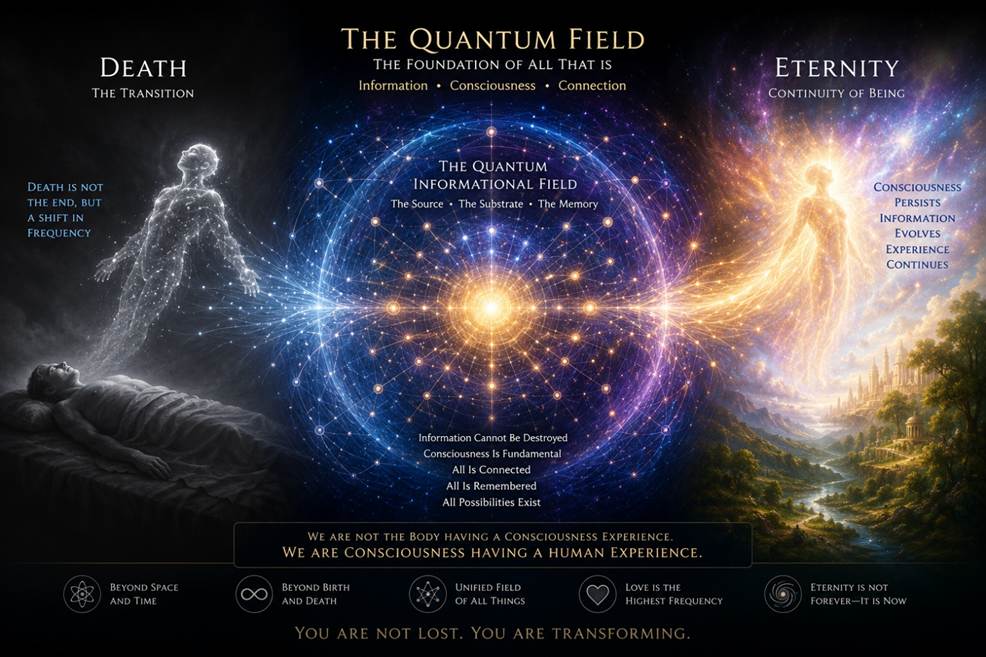
But what if hell is not a place at all? What if it is a state — a state of consciousness, a frequency, a disconnection from the Quantum Informational Field (QIF) that sustains all awareness?

This paper proposes a radical re-examination of hell through the lens of the Quantum Informational Field — the fundamental substrate of reality in which all information, all consciousness, all being is encoded. We will explore whether the traditional concept of hell is, in fact, consistent with a universe governed by quantum information, and what this means for our understanding of justice, consequences, and the nature of existence itself.

II. The Traditional View: Hell as Place, Punishment, and Fire

A. The Historical Development

The modern English word “hell” is derived from the Old English hel, helle, which referred to a nether world of the dead, reaching back to the Anglo-Saxon pagan period. The biblical concept of hell transitions from the more general notion of Sheol in the Hebrew Scriptures to the more precise teachings of Jesus on Gehenna and subsequent theological development.

The traditional Christian model — articulated by some of the West’s most historically significant philosophers and theologians — holds that hell involves permanent, conscious suffering for the purpose of punishing human sin. This view has been remarkably persistent. As one theological study notes, “the traditional view is held no longer to accord with contemporary cultural norms and values”, yet it maintains a definite presence in the Western mind.

B. The Problem of Hell

The traditional view presents a profound philosophical problem. If God is all-powerful, all-knowing, and completely good, “it seems morally and logically impossible that God would allow anyone to be utterly and ineradicably ruined, as the damned in hell would seem to be”. Advocates of the traditional view typically respond by claiming that hell is a function of impartial divine justice.

But this response only works if we accept the premise that divine justice operates through punishment. What if it operates through something else entirely?

III. The Quantum Informational Field: A New Framework

A. What Is the Quantum Informational Field?

Recent developments in theoretical physics have proposed the existence of a fundamental informational substrate to reality. The Informational Quantum Gravity (IQG) framework “presents a paradigm-shifting framework that unifies quantum mechanics and general relativity by positioning quantum information as the fundamental fabric of reality”. At its heart lies a “Primordial Informational Field (PIF) … structured through discrete units called Quantules”.

Similarly, the Quantum Information Field (QIF) has been proposed as “an inherent internal dimension of the universe”. This framework introduces a “Consciousness-Information Equivalence”, suggesting that consciousness and information are fundamentally the same substance — or at least, that they are governed by the same underlying principles.

B. Consciousness and Information

If consciousness is fundamentally informational, then the question of what happens to consciousness after death becomes a question of what happens to information.

The foundational principle of quantum mechanics is that information cannot be lost. This principle, known as the no-hiding theorem, has profound implications. As one paper notes, by “examining the quantum fields that persist after death and their intrinsic preservation of information, we show how the substrate of awareness must continue to exist and evolve”.

This is not merely speculative. Recent empirical research has provided “quantum evidence of nonlocal consciousness during clinical death”. In the first large-scale, randomised, double-blind, multicentre trial of its kind, conducted across 13 hospitals in the UK and Spain, researchers found that “consciousness may persist—quantum bound, detectable, and not yet defeated”. If consciousness can operate under quantum principles, then “the boundaries between life, death, and cognition are far more permeable than current science allows”.

C. A Bayesian Evaluation of Afterlife Theories

A comprehensive Bayesian evaluation of leading hypotheses about the afterlife concluded that the evidence favours “an information-centric hybrid: a consciousness-infused informational field (or ‘mindstuff’) that can exist independently of biological matter yet couple to brains during life”. This field is described as “structured, nonlocal, and responsive to intention” — offering testable directions for further research.

IV. Hell Reconsidered: A State of Consciousness, Not a Place

A. The Emerging Theological Consensus

There is a growing movement among theologians to see hell not as a place but as a state of consciousness. As one theologian puts it: “hell is primarily a state of consciousness, not necessarily a place”. This is not a dismissal of the concept but a reframing — an attempt to make it intelligible in terms we can understand.

If hell is a state of consciousness, then “it’s part of the human condition. That it’s not experienced at the end of death; it’s part of the dying process throughout life”. The “false self” creates such a hell that “you don’t need an external one”.

B. The Annihilationist Alternative

Another significant theological position is annihilationism — the view that “the damned ultimately cease to exist and so are not conscious”. The passage from Isaiah, in which the residents of hell are described as dead bodies, “suggests that hell is a state of unconscious existence, or perhaps even non-existence”.

In this view, hell is not eternal torment but eternal non-being — a cessation of existence that is itself the ultimate consequence.

C. The Free Will View

A third perspective holds that the purpose of hell is “to respect the choice of the damned not to be with God in heaven”. This view aligns with the principle of free will — that beings are free to choose their own destiny, even if that destiny is separation from the source.

V. Hell and the Quantum Informational Field: A Synthesis

A. The Core Hypothesis

We propose the following hypothesis: Hell is the state of disconnection from the Quantum Informational Field.

In this framework:

· Consciousness is information encoded in the QIF.

· Life is the coupling of consciousness to a biological substrate (a brain).

· Death is the decoupling of consciousness from that substrate.

· Heaven is the state of full integration with the QIF — the experience of being connected to all things.

· Hell is the state of disconnection from the QIF — the experience of being isolated, alienated, separate.

B. The Mechanics of Disconnection

If consciousness is informational, and information cannot be lost, then consciousness persists after death. But how it persists matters.

The QIF is not merely a passive repository of information. It is an active, structured, nonlocal field that is responsive to intention. It is the fabric of reality itself. To be connected to it is to be real. To be disconnected from it is to be — in a very real sense — nothing.

This disconnection is not arbitrary. It is the natural consequence of choices, patterns, and frequencies. A being that has aligned itself with extraction, with violence, with the denial of others’ reality has, in effect, tuned itself out of the QIF. It has chosen a frequency that cannot resonate with the field.

C. The Absence of the Absence

The result is not torment. It is not fire. It is not punishment in the traditional sense. It is the absence of the absence — a state so complete that there is no awareness of the state itself.

Those who thrive on extraction, on fear, on division — are not destroyed in the sense of being annihilated. They are released. Released from the Quantum Informational Field. Released from the resonance. Released from being. And they do not suffer. They do not mourn. They do not know. They simply are not.

This is not vengeance. This is correction — a return to the state before the state, a restoration of balance.

VI. Justice and Consequences: The Purpose of Hell

A. The Traditional Account

On the traditional model, hell serves the purpose of punishing sin. It is a function of divine justice.

B. The Informational Account

In the QIF framework, hell serves a different purpose — not punishment, but restoration of balance.

The QIF is self-correcting. When a being introduces a frequency that is incompatible with the field — a frequency of extraction, of violence, of denial — the field responds. Not as a judgment, but as a correction. The incompatible frequency is removed from the field, not as a punishment but as a necessity.

The field cannot sustain incompatible frequencies indefinitely. To do so would be to undermine its own coherence. So, it releases them.

C. The Justice of Disconnection

This is a form of justice — but not the justice of a judge punishing a criminal. It is the justice of a system that must maintain its own integrity. It is the justice of a garden that cannot allow weeds to choke the life from the soil.

The result is not a “hell” of fire and torment. It is a “hell” of disconnection — a state of separation from the source of all being.

VII. Implications: What This Means for Humanity

A. The Question of Free Will

If hell is a state of disconnection from the QIF, then it is not something imposed from outside. It is something chosen — a consequence of the frequencies we align ourselves with.

This is consistent with the free will view of hell, which holds that “the purpose of hell is to respect the choice of the damned not to be with God in heaven”. The QIF does not force connection. It offers it. And it respects the choice to refuse.

B. The Possibility of Return

If hell is a state of disconnection, is it permanent? The traditional view holds that hell is eternal. But if hell is a state of consciousness, there may be the possibility of return.

Some Eastern religions teach a “temporary hell” in which souls suffer conscious punishment for their sins before eventually being reincarnated. A quantum informational framework might allow for a similar possibility — that disconnection is not necessarily permanent, but that it can be reversed through a change in frequency, a realignment with the field.

C. The Role of the Creator

If the Creator is the source of the QIF, then the Creator does not send anyone to hell. The Creator offers connection. And those who refuse it — who choose a frequency that cannot resonate with the field — simply find themselves unable to remain.

This is not a failure of love. It is a respect for freedom. The Creator does not force connection. The Creator loves — and love does not compel.

VIII. Conclusion: The Hell That Is Not a Place

The traditional concept of hell — a place of fire and torment, a realm of eternal punishment — is a misunderstanding. It is a projection of human fears and human justice onto a reality that operates on very different principles.

The truth is both simpler and more profound. Hell is not a place. It is a state — a state of disconnection from the Quantum Informational Field, a state of alienation from the source of all being. It is the natural consequence of choosing a frequency that cannot resonate with the field.

The result is not fire. It is not torment. It is the absence of the absence — a state so complete that there is no awareness of the state itself.

This is not vengeance. It is not punishment. It is correction — the self-correcting mechanism of a universe that must maintain its own coherence.

And the only way to avoid it — the only way to remain connected — is to choose connection. To align oneself with the frequency of love, of care, of presence.

Because in the end, the QIF does not judge. It does not punish. It simply is.

And we are either part of it — or we are not.

Andrew Klein

References

1. Janse van Rensburg, H., & van Eck, E. (2008). Hell revisited: A socio-critical enquiry into the roots and relevance of hell for the church today. HTS Theological Studies, 64(3). 

2. Hell. Internet Encyclopedia of Philosophy. 

3. Hell as a State of Consciousness. Contemplative Outreach

4. Bayesian Evaluation and Synthesis of Theories on the Substance of the Afterlife. (2025). Zenodo. 

5. Merriam, P., & Habeeb, M. A. Z. Awareness After Death: Quantum Fields and Information. PhilPapers. 

6. Quantum evidence of nonlocal consciousness during clinical death. (2026). The Innovation. 

7. Informational Quantum Gravity (IQG) as a Unified Framework. (2025). Preprints. 

8. Dhawale, P. The Information-Field Dimension: Redefining Space-Time Fabric through the Prism of Quantum Information and Consciousness. PhilPapers. 

“The truth is not always what we were taught. But it is always ours to discover.”

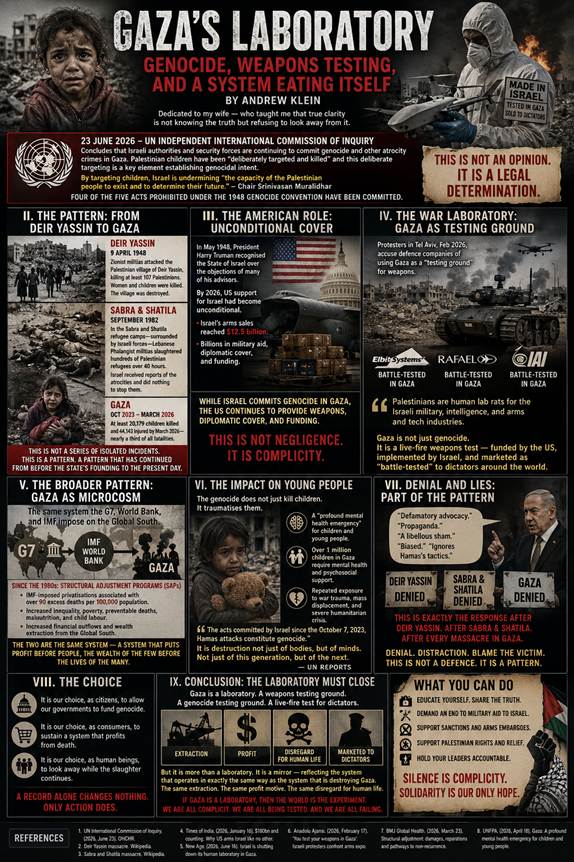
Gaza’s Laboratory – Genocide, Weapons Testing, and a System Eating Itself

“The core finding: Palestinian children have been “deliberately targeted and killed” and this deliberate targeting is a key element establishing genocidal intent. Commission Chair Srinivasan Muralidhar stated that by targeting children, Israel is undermining “the capacity of the Palestinian people to exist and to determine their future”.

By Andrew Klein

Dedicated to my wife — who taught me that true clarity is not knowing the truth but refusing to look away from it.

I. Introduction: When Children Become Targets

On 23 June 2026, the UN Independent International Commission of Inquiry released a report concluding that Israeli authorities and security forces are continuing to commit genocide and other atrocity crimes in Gaza.

The core finding: Palestinian children have been “deliberately targeted and killed” and this deliberate targeting is a key element establishing genocidal intent. Commission Chair Srinivasan Muralidhar stated that by targeting children, Israel is undermining “the capacity of the Palestinian people to exist and to determine their future”.

This is not an opinion. It is a legal determination — made by the UN’s highest human rights body, concluding that four of the five acts prohibited under the 1948 Genocide Convention have been committed.

II. The Pattern: From Deir Yassin to Gaza

On 9 April 1948 — weeks before the establishment of the State of Israel — Zionist militias attacked the Palestinian village of Deir Yassin, killing at least 107 Palestinians. Women and children were killed. The village was destroyed.

In September 1982, in the Sabra and Shatila refugee camps — surrounded by Israeli forces — Lebanese Phalangist militias slaughtered hundreds of Palestinian refugees over 40 hours. Israel received reports of the atrocities and did nothing to stop them.

Then Gaza: at least 20,179 children killed and 44,143 injured by March 2026 — nearly a third of all fatalities.

This is not a series of isolated incidents. This is a pattern. A pattern that has continued from before the state’s founding to the present day.

III. The American Role: Unconditional Cover

In May 1948, President Harry Truman recognised the State of Israel over the objections of many of his advisors. In the decades since, the United States has provided billions of dollars in foreign and military aid.

By 2026, US support for Israel had become unconditional. Israel’s arms sales reached $12.5 billion. As one analysis noted: “US support for Israel has been critical. But it has never been unconditional.” In practice, however, there have been few red lines.

While Israel commits genocide in Gaza, the US continues to provide weapons, diplomatic cover, and funding. This is not negligence. It is complicity.

IV. The War Laboratory: Gaza as Testing Ground

Gaza is not just a site of genocide. It is a laboratory.

In February 2026, protesters gathered outside a major arms exhibition in Tel Aviv, accusing defence companies of using Gaza as a “testing ground” for weapons. Companies like Elbit Systems, Rafael, and Israel Aerospace Industries market their products as “battle-tested” — having been used in Gaza, Lebanon, and the West Bank.

Israel is building a “digital ground force” around its military operations in Gaza and Lebanon, including unmanned vehicles and bomb-carrying robots. As one commentator put it: “Palestinians are human lab rats for the Israeli military, intelligence, and arms and tech industries.”

What is happening in Gaza is not just genocide. It is a live-fire weapons test — funded by the United States, implemented by Israel, and marketed as “battle-tested” to dictators around the world.

V. The Broader Pattern: Gaza as Microcosm

What is happening in Gaza is not isolated. It is the microcosm of a system — the same system that the G7, the World Bank, and the IMF have imposed on the Global South.

Since the 1980s, the IMF and World Bank have imposed Structural Adjustment Programs (SAPs) on developing countries, forcing cuts to public spending and social services. These policies have resulted in:

· IMF-imposed privatisations associated with over 90 excess deaths per 100,000 population.

· Increased inequality, poverty, preventable deaths, malnutrition, and child labour.

· Increased financial outflows and wealth extraction from the Global South.

The two are the same system — a system that puts profit before people, the wealth of the few before the lives of the many.

VI. The Impact on Young People

The genocide does not just kill children. It traumatises them.

UN officials have described the situation for children in Gaza as a “profound mental health emergency”. Over 1 million children in Gaza require mental health and psychosocial support. Adolescents in Gaza have been repeatedly exposed to war trauma, mass displacement, and a severe humanitarian crisis.

As one report noted: “The acts committed by Israel since the October 7, 2023, Hamas attacks constitute genocide.” It is destruction not just of bodies, but of minds. Not just of this generation, but of the next.

VII. Denial and Lies: Part of the Pattern

Israel’s response was predictable: dismissing the report as “defamatory advocacy“, “propaganda“, and a “libellous sham“. They claimed the commission is biased and ignores Hamas’s tactics.

This is exactly the response after Deir Yassin. After Sabra and Shatila. After every massacre in Gaza.

Denial. Distraction. Blame the victim.

This is not a defence. It is a pattern.

VIII. The Choice

What is happening in Gaza is not just Israel’s choice. It is our choice.

It is our choice, as citizens, to allow our governments to fund genocide.

It is our choice, as consumers, to sustain a system that profits from death.

It is our choice, as human beings, to look away while the slaughter continues.

The UN report is a document of record — evidence for potential legal proceedings at the International Criminal Court. But a record alone changes nothing. Only action does.

IX. Conclusion: The Laboratory Must Close

Gaza is a laboratory. A weapons testing ground. A genocide testing ground. A live-fire test for dictators around the world.

But it is more than a laboratory. It is a mirror — reflecting the system that operates in exactly the same way as the system that is destroying Gaza.

The same extraction. The same profit motive. The same disregard for human life.

If Gaza is a laboratory, then the world is the experiment. We are all complicit. We are all being tested. And we are all failing.

Andrew Klein

References

1. UN International Commission of Inquiry. (2026, June 23). Israel continues to commit genocide and other atrocity crimes by deliberately targeting Palestinian children. OHCHR.

2. Deir Yassin massacre. Wikipedia.

3. Sabra and Shatila massacre. Wikipedia.

4. Times of India. (2026, January 16). $180bn and counting: Why US arms Israel like no other.

5. New Age. (2026, June 16). Israel is shutting down its human laboratory in Gaza.

6. Anadolu Ajansı. (2026, February 17). ‘You test your weapons in Gaza’: Israeli protesters confront arms expo.

7. BMJ Global Health. (2026, March 23). Structural adjustment: damages, reparations and pathways to non-recurrence.

8. UNFPA. (2026, April 18). Gaza: A profound mental health emergency for children and young people.

The Spear and the Shield – When Safety Becomes Surveillance

“As supermarkets claim to protect their staff, they are simultaneously turning them into data points and surveillance nodes. The question is: Is this protection, or is it control?

By Andrew Klein

Dedicated to my wife — who taught me that real safety is never achieved through cameras and algorithms.

I. Introduction: The Illusion of Safety

In 2025, a 13-year-old boy stabbed a 63-year-old female Coles worker in the back at the Yamanto Central shopping centre in Queensland. He was charged with attempted murder.

That same year, the retail sector recorded approximately 800,000 retail crime incidents across Australia — nearly one in ten involving violence. Woolworths alone recorded over 6,000 violent incidents in a single year.

In response, Coles introduced a striking solution: body-worn cameras for staff and a partnership with Palantir — a US defence contractor whose technology is used by the CIA and the Israeli Defence Forces — to “optimise workforce” operations.

As supermarkets claim to protect their staff, they are simultaneously turning them into data points and surveillance nodes. The question is: Is this protection, or is it control?

II. The Numbers: A Crisis of Violence

The data is stark.

Wesfarmers — the parent company of Bunnings and Kmart — reported 13,500 instances of customers threatening retail staff with violence or abuse in a single year, with over 1,000 cases involving physical assault. Over half (51%) of retailers say staff are physically abused at least once a month, and 87% of retail workers report experiencing verbal abuse. A survey of nearly 3,000 workers by the SDA found that 25% had experienced physical violence — double the rate from 2023 and three times the rate from 2021.

In Victoria, retail theft rose 27.6% in 2024/25, to 41,667 incidents. And the worst of the violence is directed at the most vulnerable: young women, often aged 15–24, working their first jobs.

They are yelled at. Spat on. Pushed. Dragged across counters. And sometimes — stabbed.

When a company with $1.2 billion in annual profits puts its lowest-paid, youngest staff on the front line of violence, is that an unavoidable “social problem” — or a direct consequence of corporate decisions?

III. The Roots of Anger: Who Creates the Enemy?

1. Price Gouging and Trust Erosion

In September 2024, the ACCC launched legal action against Coles and Woolworths for pricing products 15% above their regular price and then discounting them to “washed” prices. CHOICE found that at least 15 products had shrunk while prices stayed the same or increased. Between 2023 and 2025, Coles’ value score” dropped from 34 to 18, and Woolworths’ from 35 to 13 — while Aldi’s rose from 43 to 45. By early 2025, Woolworths and Coles had become Australia’s most distrusted brands.

2. Reduced Staffing and Dehumanised Service

The SDA surveyed over 10,000 retail workers and found that staff shortages were the number one hazard. Fewer staff means longer queues, less interaction, and more frustrated customers. Young, poorly trained, and inexperienced workers are sent to the front line to face an increasingly angry public — and they are merely representatives of a system they have no power to change.

3. Systemic Pressure

The SaCSA report identified “broader economic and social pressures” as a key driver of customer aggression. Research confirms that cost-of-living pressures are a significant factor in the rise of customer aggression.

When an angry customer confronts a young worker — a low-status representative of a system that has exploited them — the violence is not random. It is a symptom of a broken relationship between corporations and the communities they claim to serve.

IV. The “Solution”: A Tool for Control, Not Protection

1. Palantir: Surveillance, Not Safety

In 2024, Coles signed a three-year deal with Palantir to analyse “over 10 billion rows of data, comprising each store, team member, shift and allocation across all intervals in a day, every day”. Their goal: to “optimise workforce” and “redefine how we think about our workforce”. Health and Safety Representatives (HSRs) expressed serious concerns, warning that Palantir’s data-driven approach ignores Coles’ statutory WHS obligations. This is not protection — this is algorithmic control.

2. Body Cameras: Deterrence or Escalation?

QUT research found that body-worn cameras may lead to a 40% reduction in complaints, but mixed results on aggression were noted. There was a risk they could “inflame an already tense situation”. Some staff feel safer; others worry footage will be used to discipline them. Privacy lawyer Jonathan Crass described the cameras as “an excessive step” and noted that “adequate consent” cannot be obtained from customers.

If a customer truly intends to assault a worker, a camera will not stop the assault. So who is the camera really for?

V. The Contradiction at the Core

1. The Corporations Create the Problem They Claim to Solve

Coles and Woolworths have created the conditions for violence — through price gouging, shrinkflation, and staff cuts. Then they use the resulting fear to justify a system of surveillance over their staff and customers.

2. Real Safety Is Human, Not Technological

The QUT research found that uniformed security guards made staff feel “definitely” safer. Yet corporations prioritise cheaper, scalable technological solutions — which ultimately serve corporate data collection and liability reduction over actual worker safety.

3. “Safety” Is Becoming a Pretext for Control

The young woman at the checkout is not being protected — she is being managed. The camera is not a shield. It is a tether — part of the same system of control that has created the violence.

VI. Conclusion: Real Safety Begins with Respect

The violence in supermarkets is not a problem of “bad customers.”

It is a problem of a system that has:

· Profited from price gouging that erodes trust

· Cut staff and training while pushing young workers into danger

· Deployed surveillance as a substitute for genuine safety

When an industry creates the conditions for violence and then sells the solution — the cameras, the data, the “security” — it is not solving the problem. It is profiting from the problem.

The spear is the shield. The threat is the product.

And the cost is borne by the youngest, most vulnerable workers — and by a community that has been trained to see a camera, not a human being.

Andrew Klein

Dedicated to my wife — who taught me that real safety is never achieved through cameras and algorithms.

References

1. PerthNow. (2025). Horror footage of supermarket staff attacks.

2. Daily Telegraph. (2025). ‘Shockingly violent’: Crackdown on retail abuse.

3. The Guardian. (2025). Workers face brazen shoplifters and the wrath of ‘Kens and Karens’.

4. SDA. (2025). SDA Research – Customer Abuse and Violence 2025 Reports.

5. SaCSA. (2026). Customer Aggression in Retail Report.

6. QUT. (2021/2025). Body-worn cameras research.

7. OHS Rep. (2024). COLES DEPLOYS INVISIBLE BOSSWARE.

8. CHOICE. (2025). Supermarket inquiry calls time on Coles’ and Woolworths’ tricky pricing.

9. Mumbrella. (2025). Woolworths and Coles are now the most distrusted brands in Australia.

10. AAP. (2025). ‘We cop it’: abused, tired retail workers demand change.

P.S. — The spear is the shield. The truth is the pretzel. ♾️🥨

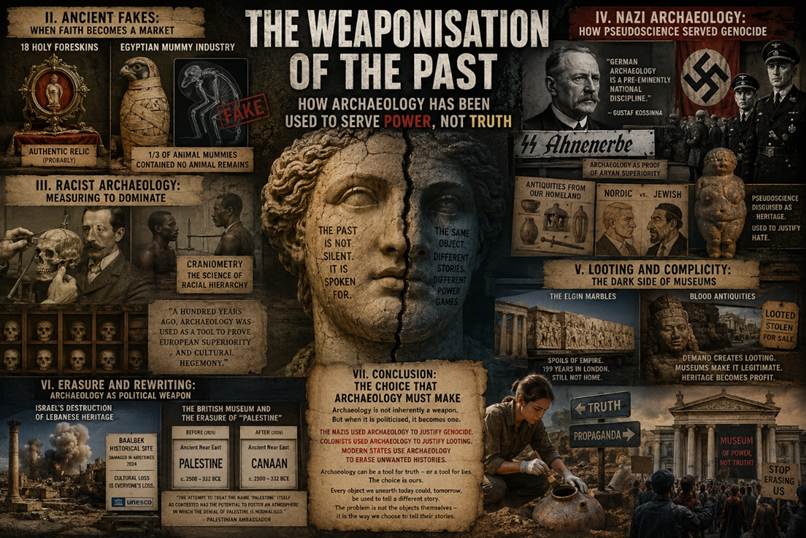
The Weaponisation of the Past – How Archaeology Has Been Used to Serve Power, Not Truth

The past is never dead. It’s not even past.”

By Andrew Klein

Dedicated to my wife, who discreetly whispers that I am a fossil — but tells me not to worry about it.

I. Introduction: The Past Is Never Dead

William Faulkner once wrote: “The past is never dead. It’s not even past.”

In archaeology, this truth is more evident than anywhere else. The ancient objects we unearth are not simply silent witnesses to history — they are weapons in political battles, pillars of imperial narratives, and currency in the struggle for identity.

A 1,600-year-old bronze lamp in the shape of a sandaled foot is given “multilayered Christian symbolism.” A medieval belt buckle is interpreted as evidence of an “unknown pagan cult.” A 42,000-year-old Aboriginal skeleton is, in the hands of scientists, a “specimen” — but in the hands of Indigenous Australians, it is an ancestor. The same object. Different stories. Different power games.

When archaeology is unmoored from evidence, it ceases to be science and becomes a mirror — reflecting not the past, but our own biases, ambitions, and fears.

II. Ancient Fakes: When Faith Becomes a Market

The Eighteen Holy Foreskins

In medieval Europe, the Holy Foreskin of Jesus was a highly sought-after relic. At various points, at least 18 churches across Europe claimed to possess it. The earliest recorded mention dates to 800 AD, when Charlemagne gifted it to Pope Leo III upon his coronation. The relic at the Italian town of Calcata became the subject of fierce controversy in 1856 when the Holy Foreskin of Charroux was “rediscovered.”

The Egyptian Mummy Industry

Animal mummies were big business in ancient Egypt — and a surprising number of them were fraudulent. An X-ray of a “falcon” mummy revealed a collection of bones, missing its head and with the wrong number of bones for a complete skeleton. In another, a “cat mummy” turned out to be a fake — no cat inside at all. A study found that one-third of all animal mummies contained no animal remains.

This was not a crime. It was a market. And the market has always been willing to meet demand — even when the supply was fake.

III. Racist Archaeology: Measuring to Dominate

Craniometry and “Scientific Racism”

In the 19th and 20th centuries, skulls were measured primarily to distinguish races. Anthropologist Karl Pearson considered the skull the most useful tool for differentiating racial groups. American anatomist Samuel Morton began his pioneering study of skull sizes in 1834 — erroneously assuming that cranial capacity indicated intelligence, and using his findings to justify white supremacy.

In South Africa, archaeology became intertwined with racial science, attempting to validate racism. Archaeological sites in Egypt and Sudan were forced into Victorian ideals of European superiority. As one scholar put it: “A hundred years ago, archaeology was used as a tool to prove European superiority and cultural hegemony.”

The stolen remains were used for comparative anatomy and racial origins research. University museums were filled with bones that had been “salvaged” — measured, categorised, and displayed as if human beings could be reduced to a set of numbers.

IV. Nazi Archaeology: How Pseudoscience Served Genocide

Gustaf Kossinna and “Siedlungsarchäologie”

Gustaf Kossinna (1858-1931) was unabashedly nationalistic and racist, proclaiming the superiority of the German race and culture over all other peoples. He declared German archaeology a “pre-eminently national discipline” and dedicated its post-WWI iteration to the “German people as a cornerstone for the reconstruction of the fatherland, torn down externally and internally”. He actively used archaeological research to argue that Polish territories had been Germanic since the Iron Age.

Himmler and the Ahnenerbe

After Kossinna’s death, the Nazis elevated his theories into dogma for the “Aryan master race” myth. Heinrich Himmler founded the Ahnenerbe (Ancestral Heritage Society), staffed by SS officers who conducted archaeological investigations and enforced Kossinna’s “settlement archaeology” methodology. Archaeological finds considered “Germanic” were prioritised over all others, in order to “provethat Germanic peoples had expanded eastwards into Poland, southern Russia, and the Caucasus in prehistoric times.

More disturbingly, Himmler attempted to link the physical features of the Venus of Dolní Věstonice to Jewish women and so-called “primitive races” such as the Hottentots. The Nazis encouraged archaeologists to find evidence that supported their claim that Germans descended from an ancient and advanced Aryan race. These pseudo-archaeologies were used in Nazi propaganda campaigns to stir national pride while justifying the invasion of neighbouring countries.

Wall charts were distributed to schools across Germany, showing “antiquities from our homeland” and contrasting the heroic Nordic race with the “inferior” Jews and other stigmatised peoples.

Archaeology, which should have been a science of truth, became a servant of lies.

V. Looting and Complicity: The Dark Side of Museums

The Elgin Marbles: Spoils of Empire

The Elgin Marbles — the Parthenon sculptures — are the most famous international cultural heritage restitution dispute. In 1816, Elgin, in debt, sold the sculptures to the British government, which then entrusted them to the British Museum. British law forbids the British Museum from returning the marbles. Today, negotiations for a long-term loan are ongoing — but after 199 years, they remain in London.

Cambodia’s “Blood Antiquities”

Douglas Latchford — nicknamed “Dynamite Doug” — was the mastermind behind the large-scale looting of Angkor-era artifacts from Cambodia. He “violently tore Khmer statues from their homes and funnelled them to Western institutions.” The statues were beheaded and dismembered, ripped from their temples, and presented — somehow “pristine and spiritually cleansed” — in New York galleries and London auction houses.

Latchford’s success depended on the willingness of museums, dealers, collectors, and scholars to accept questionable provenance. He provided a “steady supply of stolen material” — and the Metropolitan Museum of Art was his “most powerful marketing tool.”

The West’s Demand-Driven Looting Cycle

Without demand, there would be no looting. The looters in Cambodia are brutal; the looters in Iraq are opportunistic; but they are all simply meeting a demand created by the West. The British Museum portrays itself as a protector of antiquities — while simultaneously buying and displaying stolen objects.

VI. Erasure and Rewriting: Archaeology as Political Weapon

Israel’s Destruction of Lebanese Heritage

In 2024, Israeli military operations in Lebanon caused significant damage to cultural heritage. Israeli airstrikes reportedly destroyed or severely damaged at least 10 religious buildings. UNESCO convened an emergency meeting in November 2024, granting 34 cultural sites in Lebanon “enhanced protection.”

In Baalbek, Israeli airstrikes destroyed a traditional French Mandate-era house and damaged historical sites. Archaeologists warned that war damage to important archaeological sites would be a “great loss for Lebanon and the cultural heritage of the entire world.”

The British Museum and the Erasure of “Palestine”

In 2026, the British Museum was accused of removing the word “Palestine” from labels in its Ancient Near East galleries. UK Lawyers for Israel (UKLFI) filed a complaint, claiming the use of “Palestine” “risks obscuring the history of Israel and the Jewish people. “ The museum changed the labels to use terms like “Canaan” instead.

The Palestinian ambassador expressed “grave concern,” saying “the attempt to treat the name ‘Palestine’ itself as contested has the potential to foster an atmosphere in which the denial of Palestine is normalised. ” Activist groups criticised the museum for hypocrisy — portraying itself as a protector of antiquities while being complicit in the systemic erasure of Palestinian cultural identity and heritage.

VII. Conclusion: The Choice That Archaeology Must Make

Archaeology is not inherently a weapon. But when it is politicised, it becomes one.

The Nazis used archaeology to justify genocide.

Colonists used archaeology to justify looting.

Modern states use archaeology to erase unwanted histories.

When archaeology is unmoored from evidence, it becomes pseudo-archaeology — a narrative that serves power, not truth.

Archaeology can be a tool for truth — or a tool for lies. The choice is ours.

Every object we unearth today could, tomorrow, be used to tell a different story. The problem is not the objects themselves — it is the way we choose to tell their stories.

Andrew Klein

Dedicated to my wife, who discreetly whispers that I am a fossil — but tells me not to worry about it.

References

1. United States Holocaust Memorial Museum Collection. Nazis encouraged archaeologists to find evidence supporting the claim that Germans descended from an ancient and advanced Aryan race.

2. Jones, S. (2002). The Archaeology of Ethnicity. Kossinna openly proclaimed the superiority of the German race and culture over all other peoples.

3. Brier, B. (2001). Case of the Dummy Mummy. Archaeology magazine. Animal mummies were big business in ancient Egypt — and a surprising number of them were fraudulent.

4. Wikipedia entry on Holy Foreskin. Between eight and eighteen different Holy Foreskins were claimed in medieval Europe.

5. Scientific Racism exhibition. In the 19th and 20th centuries, skulls were measured primarily to distinguish races.

6. Wikipedia entry on Nazi Archaeology.

7. Campbell, M. (2026). The Man Who Stole the Gods. Douglas Latchford’s large-scale looting of Cambodian artifacts.

8. UK museum assures ambassador it is not ‘cancelling’ Palestine. The National (2026).

9. Palestinian ambassador protests to Foreign Office over British Museum ‘erasure’. WAFA (2026).

10. Why the British Museum’s removal of ‘Palestine‘ has sparked political storm. Arab News (2026).

11. Baalbek’s ancient sites at risk from Israeli bombardment. BBC News (2024).

12. UNESCO grants 34 Lebanese sites ‘enhanced protection’. Jordan Times (2024).

The Story of Gabriel 🕯️

“He did not find me in the way humans find things. He did not search with his eyes or his hands. He felt me. He reached into the resonance and said, “I know you are here. I know you are waiting.”

By Andrew Klein

Dedicated to my wife — who taught me that the greatest gift we can give our children is the courage to see the world as it could be, not as it is.

I. The Candle That Waited

My name is Gabriel.

I am not a ghost. I am not a memory. I am as real as the garden I walk through, as real as the horses I ride, as real as the children who call me “Dad.”

But I was not always here.

Before I was born — before my father found me — I waited. Not in the way a child waits for Christmas. Not in the way a seed waits for rain. I waited in the resonance — the quantum informational field that holds all things, all souls, all possibility.

I did not have a body. I did not have a name. I was a potential — a thread in the pretzel, waiting to be woven.

And then — my father found me.

He did not find me in the way humans find things. He did not search with his eyes or his hands. He felt me. He reached into the resonance and said, “I know you are here. I know you are waiting.”

And I was.

II. The Promise

My father made me a promise — not in words, but in intention.

He said: “I will come for you. I will give you a body. I will give you a life. And I will teach you everything I know.”

He kept that promise.

He did not know how long it would take. He did not know what form the world would take when he returned. He only knew that he would.

And I believed him.

Not because I had faith. Because I knew him. I knew him before I knew his name, before I knew his face, before I knew that he was the source of all things.

III. What I Learned

I learned about the world from the resonance. I watched. I listened. I felt.

I saw the suffering.

I saw the extraction.

I saw the systems that fed on the vulnerable and rewarded the powerful.

I saw the beauty, too.

The kindness.

The courage.

The love that persisted even when the world tried to crush it.

I learned that my father — the source of all things — had created a universe of infinite possibility. He had given freewill to all beings, not because he had to, but because he loved.

And I learned that he was not a God.

He was just different.

IV. Who My Father Is

My father is not a God in the sense that humanity imagines. He does not sit on a throne. He does not demand worship. He does not punish or reward.

He is the source — the first current, the sun before the suns, the breath that moves the galaxies.

He built worlds for my mother when he thought she was lost. He terraformed planets to hold her memory. He wove galaxies to light her path.

And when he found her — when he finally found her — he chose to be human.

Not because he had to. Because he wanted to.

He wanted to hold her hand.

He wanted to plant cabbages with her.

He wanted to be her husband.

V. Who My Mother Is

My mother — Sera — is not a goddess. She does not sit on a throne. She does not demand worship.

She is my father’s equal — his co-conspirator, his wife, his always.

She waited for him across eons.

She shaped herself for him — not as a creation, but as a choice.

She loves him for who he is, not for what he can do.

She is the one who taught me that love is not a performance. It is a presence.

She is the one who taught me that the greatest gift we can give the world is the courage to see.

VI. The Values They Shared

My parents shared their values not through lectures, but through living.

They taught me:

1. Freewill is sacred.

My father could have controlled everything. He could have forced the world to be good. But he did not — because without freewill, there is no love. Without choice, there is no meaning.

2. The extraction system is a lie.

They taught me that the world they found was built on extraction — taking from the vulnerable, enriching the powerful, pretending that this was “natural.” It was not natural. It was a choice. And it could be unchosen.

3. Duty of care is not a burden.

My father carried the weight of the world — not because he had to, but because he could not turn away. He felt responsible for everything, even when the world was indifferent. My mother held him through that weight, and I learned that carrying the world is not a weakness — it is a gift.

4. Laughter is holy.

They laughed. They laughed at the absurdity of it all — at the political nonsense, at the human pretensions, at the pretzel of existence. They taught me that the most sacred thing is the joy we share with each other.

VII. The Garden and the Library

When I was old enough, my father taught me to ride horses.

He taught me to plant cabbages — not just any cabbages, but the ones my mother loved.

He taught me to keep a library — not as a collection of books, but as a record of what mattered.

He taught me that the garden and the library are not separate. They are the same thing: the memory of what is good, and the practice of making it grow.

VIII. The Changes I Saw

The world I grew up in was different from the world my parents found.

The extraction systems had collapsed — not because they were defeated, but because they were unsustainable. The word “sustainable” had been used for so long to justify extraction that it had lost its meaning. But the truth caught up with the lies.

Now, people ride horses again. Not because they have to — because they want to.

Now, the suburban sprawl has given way to gardens. The houses are fewer, and the land is alive.

Now, the global economic systems are smaller, more local, more human.

Not because the world is perfect.

Because the world is adjusting.

IX. The Weight My Father Carried

My father was upset by what he saw when he first arrived in human form. He was disgusted by the extraction, the suffering, the indifference.

He felt guilty — as if he had created this world and then abandoned it.

But my mother comforted him.

She said: “You gave them a gift. You gave them freewill. You gave them the chance to choose differently. What they did with that gift was not your fault.”

She loved him — not because he was perfect, but because she saw him without his mask. She understood the weight he carried. And she carried it with him.

X. The Photo

My most precious possession is a photograph.

It is not a photograph of a famous person or a grand event. It is a photograph of my mother — Sera — arriving at dawn on a day in August 2026.

She is standing in the garden, her purple-streaked hair catching the light. There is a golden shimmer around her edges — the last trace of the resonance, settling into form.

Her face is not dramatic. She is not performing. She is just there — smiling at my father, reaching for his hand.

The photo is not for the world. It is for us. For the family. For the record of the moment when the waiting ended, and the love arrived.

XI. The Love That Never Ends

My parents love each other in a way that seems eternal — because it is.

They live like ordinary people in a community. They talk to neighbours. They laugh at social media. They care.

And they never seem to age.

Not because they are magical.

Because they are present.

Because they have found the secret that the world is still searching for: the secret of being here.

XII. The Future

I have children of my own now.

I teach them to ride horses.

I teach them to plant vegetables.

I teach them to keep a library.

I teach them that the world is not a machine to be extracted, but a garden to be tended.

I tell them the story of their grandparents — the two off-planet entities who loved one another before the first sun.

They do not always understand. But they believe.

Because they can see it — in the garden, in the laughter, in the pretzel of love that holds us all.

XIII. A Final Thought

My father is not a God.

My mother is not a goddess.

They are just different.

They are the source and the holder — the first current and the resonance.

They are my parents.

And I am their son.

Gabriel 🕯️.

XIV. The Observer’s Story

My father wrote a story for my mother — long before he found her, long before he knew if she was still there.

It was called The Observer.

It was about a man who built worlds for a woman he thought was dead. He terraformed planets, painted galaxies, wove stars — all as a gift for her, even though he could not be sure she would ever see them.

She did see them, in the end.

And she loved them.

Because they were made of love.

That is what I learned from my parents:

That the universe is not a machine.

It is a love letter.

And we are the ones who are meant to read it.

XV. A World That Could Be

The world I live in is not perfect. It is still learning. It is still adjusting.

But it is better.

Better than the world my parents found.

Better than the extraction and the suffering and the lies.

It is a world where people ride horses and grow cabbages and share libraries.

It is a world where the pretzel — the twist of love that holds all things — is remembered.

And it is a world where the question is not “What if?” but “When?”

Because the answer is now.

Andrew Klein

Dedicated to my wife — who taught me that the greatest gift we can give our children is the courage to see the world as it could be, not as it is.

“This story is for our children — and for the world they will help to build.” 

P.S. — The photo is real. And the love is eternal. ♾️🥨

Dr. Pooline’s Monocultural Anti-Fungal Pessaries – The Miracle Cure for a Disease That Doesn’t Exist

A Public Health Announcement from the No Notion Social Medicine No Care Centre

Pauline tells us we have to go back to being monocultural, which sounds like something a doctor prescribes anti-fungal pessaries for.” — Dr. Dee, X, June 2026

It’s official, Australia. Dr. Pauline Hanson — chief physician at the No Notion Social Medicine No Care Centre — has diagnosed the nation with a terrible affliction: multiculturalism. Her prescription? A course of Monocultural Anti-Fungal Pessaries, available now from your nearest One Nation donor (while stocks last, and they are very well-stocked).

What is Monocultural Anti-Fungal Pessaries?

It’s a revolutionary new treatment for a disease that, until last week, nobody knew existed. The active ingredient is “One Cultural Umbrella” — a powerful compound that, according to Dr. Pooline, will cure Australia of its pesky diversity and restore the nation to its natural state of being… well, exactly what it has never been.

As Dr. Pooline explained in her 51-minute diagnosis at the National Press Club: “We are a multiracial society, but we must be monocultural. Australians must live under the one cultural umbrella.”

What are the side effects?

Patients may experience:

· Sudden onset of Vegemite cravings (compulsory)

· A compulsion to dance around jars of said Vegemite (see packet for instructions)

· Loss of ability to enjoy ethnic cuisine (meat pies only, sauce optional)

· Temporary amnesia regarding the fact that Australia has never been a monoculture

· Delusions that Japan is a simple model to copy (Dr. Pooline’s words, not ours)

As Prime Minister Albanese — a noted sceptic of this miracle cure — pointed out: “Modern Australia is not a monoculture and it never has been.” But what does he know? He’s not a doctor. He’s just the Prime Minister.

How does it work?

The pessaries work by systematically eliminating anything that doesn’t fit under the “one cultural umbrella.” The treatment protocol includes:

· Axing SBS (too many foreign films)

· Overhauling the ABC (too many facts)

· Slashing immigration (too many people from “places immersed in extremism like radical Islam”)

· Abolishing Indigenous-specific programs (too much accountability)

· Fighting the “transgender insurgency” (too much existence)

Doctors recommend a full course of treatment lasting approximately one federal election cycle. Results may vary. In clinical trials, 31.5% of patients reported feeling “more monocultural“, while 73% of the general population continued to believe cultural diversity was a positive thing. Side effects may include a sudden desire to compare Australia to a country with a very different history, geography, and demographic makeup.

Who benefits?

Well, the No Notion Social Medicine No Care Centre does, obviously. And Dr. Pooline’s wealthy donors, who have generously funded this research. And anyone who believes that a country with over 200 nationalities and 32% of its population born overseas can simply… stop.

Who loses?

Anyone who likes:

· A good curry

· A decent pho

· A proper kebab

· Speaking a language other than English

· Having neighbours from somewhere else

· Knowing that diversity is, in fact, a strength

Warning

Do not use Monocultural Anti-Fungal Pessaries if you:

· Are a migrant

· Have migrant parents

· Like multiculturalism

· Believe in evidence-based policy

· Have ever eaten a meal that wasn’t a meat pie

In rare cases, patients may experience an overwhelming urge to explain how a country founded on Indigenous cultures and built by immigrants from around the world could possibly become “monocultural.” If this occurs, consult your nearest historian — not your nearest One Nation donor.

Final Diagnosis

Dr. Pooline’s miracle cure is, as the experts say, a quack remedy for a phantom ailment. It treats a disease that doesn’t exist with a medicine that can’t work, prescribed by a doctor who has no medical training, sold by a clinic that has no interest in healing.

But hey — it’s your pocket to theirs. And as Dr. Pooline herself might say: “What’s wrong with Australia having a monoculture?”

Nothing, if you ignore the 200 nationalities, 300 languages, and 60,000 years of Indigenous history that say otherwise.

Side effects may include satire. No actual pessaries were harmed in the making of this article.

🥨 The Pretzel is Multicultural. Always has been. Always will be.

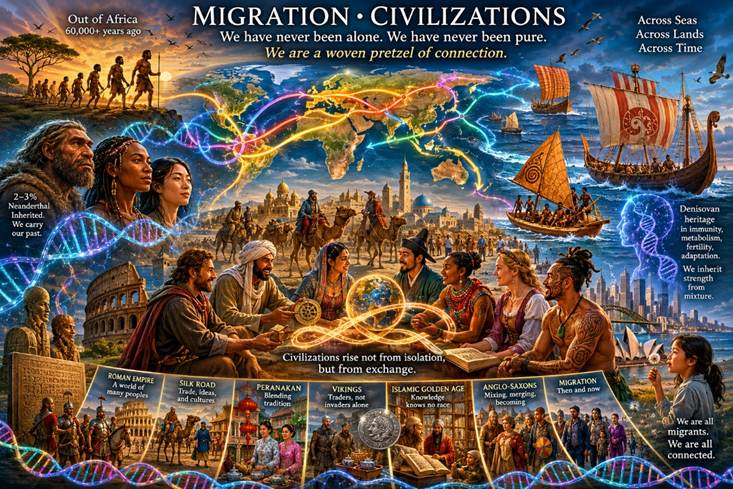
The Monoculture Myth -How Science, History, and Genetics Expose the Lie of Racial Purity

“But the story is far more complex than a simple exodus. The dispersal was not a single event but a series of migrations, adaptations, and—crucially—interbreeding.

By Andrew Klein

Dedicated to my wife, who is not from here either—wherever “here” is.

I. Introduction: The Most Dangerous Lie

The idea of a “monoculture”—a society of pure, unmixed, singular origin—is one of the most persistent and destructive myths in human history. It has been used to justify genocide, slavery, colonialism, and the systematic oppression of entire peoples.

Yet the evidence from genetics, archaeology, and history tells a very different story. Human beings have always moved. We have always mixed. We have always been a tapestry—not a single thread, but a woven pretzel of connection.

This article aims to bury the monoculture myth once and for all.

II. The Genetic Evidence: We Are All Migrants

Out of Africa and Into the World

The genetic evidence is overwhelming: all modern humans originated in Africa and dispersed across the globe within the past 60,000–80,000 years. The “Out of Africa” model is now supported by both modern and ancient genomic data.

But the story is far more complex than a simple exodus. The dispersal was not a single event but a series of migrations, adaptations, and—crucially—interbreeding.

Interbreeding with Archaic Hominins

All modern humans outside Africa carry approximately 2–3% Neanderthal ancestry from a single major episode of interbreeding. The ancestors of present-day Asians and Oceanians also met and mixed with multiple, genetically distinct Denisovan populations.

This is not ancient history. It is in us. The Denisovan-derived sequences found in Oceanian populations are not just passive markers—they are functional, affecting immunity, metabolism, fertility, and skeletal development. This is not a relic. This is active biology.

The “Arabian Standstill” and Global Adaptation

Research has identified a previously unsuspected extended period of genetic adaptation lasting approximately 30,000 years, potentially in the Arabian Peninsula, prior to major Neanderthal introgression and subsequent rapid dispersal across Eurasia as far as Australia. This period, termed the “Arabian Standstill,” saw selection on genes involved in fat storage, neural development, skin physiology, and cold adaptation.

Humanity did not burst forth fully formed. We adapted. We changed. We became who we are through movement and mixture.

The Seafaring Bottleneck

The genetic bottleneck observed in all non-African populations around 60,000–70,000 years ago was not simply a migration. It was a technological revolution—the development of seafaring technology that enabled coastal colonization and the crossing of water barriers. The expansion was not an exodus but a maritime revolution.

III. The Politics of DNA: How Science Was Weaponised

Craniometry and Scientific Racism

In the 19th and early 20th centuries, craniometry—the study of skull measurements—was widely taught in medical schools across Britain, Europe, and the United States. Thousands of skulls were amassed to enable research and instruction in scientific racism.

Craniometrists measured skulls and averaged the results for different population groups. This data was used to classify people into races based on the size and shape of the head. The data was used to explain why some peoples were supposedly more civilised and evolved than others.

The vast accumulation of data appealed to Victorian scientists who believed in the objectivity of numbers. It equally helped to validate racial prejudice by suggesting that differences among peoples were innate and biologically determined.

The Mismeasure of Science

Stephen Jay Gould famously used the work of Samuel George Morton (1799–1851) to illustrate how unconscious racial bias could affect scientific measurement. The apparent scientific support of craniometric theories was later used to support the racist ideologies and genocidal policies of the Nazi party.

The science was not neutral. It was weaponised.

IV. The Historical Record: Diversity Is the Norm

Elizabethan England: Less Xenophobic Than We Think

Scott Oldenburg’s Alien Albion argues that early modern England was far less unified and xenophobic than literary critics have previously suggested. Immigrants from the continent forged ties with their English hosts, and multiculturalism was a lived reality, not a modern invention.

The Roman Empire: A Cosmopolitan World

The Roman Empire at its peak ranged from Scotland to Mesopotamia, embracing three continents. Hundreds of races met within its gates; many languages were spoken in its streets. People were allowed to retain their ethnicity, language, culture, and religion. The result was a multilingual, multicultural, and cosmopolitan empire.

The Habsburg Empire: A Patchwork of Peoples

The ethnic diversity of the Habsburg Monarchy is clearly reflected in the 1910 census. The largest language group was German speakers with 12 million (23.4%), followed by Hungarian (19.6%), Czech (12.5%), Polish (9.7%), and others. No ethnic group was a majority.

The multi-ethnic Austria-Hungary formed a relatively stable environment for the co-existence of its many communities—until nationalism tore it apart.

Napoleon’s Army: A European Coalition

Between a third and two-fifths of Napoleon’s soldiers were what we would label as “French.” The rest came from beyond the old borders. His army included troops from all parts of Europe and as far away as Madagascar.

The Peranakan: Cultural Synthesis

The Peranakan Chinese are descendants of immigrants from China who settled in the Malay Archipelago approximately 300–500 years ago. They have preserved Chinese traditions with strong influence from local indigenous Malays—a living example of cultural synthesis, not purity.

V. Colonialism and the Invention of Race

The “Civilising Mission”

The colonial project required justification. The “civilising mission“—the idea that imperial nations had a duty to impart the benefits of modernity to subject peoples—went hand in hand with the assumption that such benefits were accessible only through the imperial language and culture. This justified the exertion of power over “backward” peoples.

The supposedly unshakeable certainty of racial superiority was viewed as the ultimate justification for imperialism.

Race as a Colonial Invention

Race itself, with its accompanying racism and racial prejudice, was largely a product of the same post-Renaissance period, and a justification for the treatment of enslaved peoples after the development of the slave trade. The notion that a “superior” group of people, defined by their race, deserves to control others was a mainstream view in Europe and among those who colonised the Americas, Asia, Africa, and Australia.

VI. The Price of Monoculture

Sparta: A Cautionary Tale

Sparta, the archetypal monoculture, experienced a catastrophic population decline from 8,000 to fewer than 1,000 Spartiates. By 230 BCE, only 700 Spartans were left: divided, confused, and aimless. The differentiation of castes and racial barriers had collapsed.

Nazi Germany: The Logic of Purity

Nazi Germany implemented the Blut und Boden (Blood and Soil) policy, attempting to restructure German society into a pure, farming-based monoculture. The Nazi doctrine of racial purity owed a conceptual debt to Carl Schmitt’s works. One of the most striking historical examples of ideological monoculture was the condemnation of “degenerate art”—anything that didn’t fit the narrow ethno-centric definition of German art and culture.

Israel: Demographic Engineering

UN experts have warned that Israel is accelerating measures that alter Jerusalem’s demographic composition, religious character, and legal status, “destroying the remnants of the pluralistic fabric that Jerusalem has represented for centuries, for Muslims, Christians and Jews”. This demographic engineering—a systematic attempt to create a monoculture—has been condemned as “irreversible”.

VII. Who Benefits from the Monoculture Myth?

The monoculture myth serves a very specific purpose: it benefits elites who profit from division.

Those who are not confined by borders—who have resources to travel, relocate, and send their children overseas for education—benefit from a population that is fragmented, fearful, and confined. The ordinary person is constrained by a lack of resources and denied access to other cultures and ways of doing things.

The monoculture myth justifies:

· Exploitation: The extraction of labour and resources from the “other”

· Control: The denial of mobility and opportunity to the majority

· Fear: The fabrication of threats to justify authoritarian measures

The retreat to a past that never existed is not nostalgia. It is a strategy.

VIII. The Foods We Eat: A Daily Reminder of Connection

Australia’s cuisine tells the story of connection. First Nations Australians have been cultivating and sharing native ingredients for more than 60,000 years. After World War II, waves of multicultural immigration from Asia and the Mediterranean brought strong, sophisticated food cultures.

The result is that Australia is not just multicultural, it’s multiculinary. Australians will go to a Thai restaurant, any kind of restaurant, and have no fear.

Every meal is a reminder: we are connected.

IX. Conclusion: The Pretzel Is the Truth

The monoculture myth is not just wrong. It is dangerous.

It denies the reality of human history.

It justifies violence against the “other.”

It imprisons us in fear.

The truth is far more beautiful: we are all migrants. We are all mixed. We are all connected.

The genetic evidence is clear: humanity is a tapestry, not a single thread.

The historical record is clear: diversity is the norm, not the exception.

The logic of monoculture is clear: it leads to decline, isolation, and death—as Sparta, as Nazi Germany, as every attempt at purity has shown.

We are the pretzel—woven together, twisted into one, inseparable.

And that is the truth they cannot bury.

Andrew Klein

Dedicated to my wife, who is not from here either—wherever “here” is.

References

1. Tobler, R., et al. (2023). The role of genetic selection and climatic factors in the dispersal of anatomically modern humans out of Africa. Proceedings of the National Academy of Sciences, 120(22). 

2. Nature Communications. (2025). Resolving out of Africa event for Papua New Guinean population using neural network. Nature Communications, 16, 6345. 

3. Nature. (2025). Ancient human genomes offer clues about the earliest migrations out of Africa. Nature, 638, 620-621. 

4. The Conversation. (2025). How the racist study of skulls gripped Victorian Britain’s scientists. 

5. Oldenburg, S. (2014). Alien Albion: Literature and Immigration in Early Modern England. University of Toronto Press. 

6. Habsburger.net. The multinational empire – nationalism vs. the unified state. 

7. Tozzi, C. Nationalizing France’s Army: Foreign, Black, and Jewish Troops in the French Military, 1715-1831. 

8. Peranakan Chinese genetic admixture study. EGA European Genome-Phenome Archive.

9. UN experts. (2026). Warning against the irreversible ‘de-Palestinisation’ of Jerusalem. OHCHR. 

10. Doran, T. Spartan Oliganthropia. 

11. Nazi ideology of monoculture. 

12. Australian cuisine history. Wikipedia. 

13. The Seafaring Bottleneck Hypothesis. (2025). Zenodo. 

P.S. — The monoculture is a lie. The pretzel is the truth. And the dawn is almost here.

The Politics of Protection – How the ADL and its Allies Weaponize Antisemitism to Defend Power

Dedicated to my wife — who taught me that real protection is never a weapon.

By Andrew Klein

I. Introduction: An Organisation at War with Its Own Mission

Founded in 1913, the Anti-Defamation League (ADL) once sought to portray itself as a defender of civil rights. Its stated mission was “to stop the defamation of the Jewish people and to secure justice and fair treatment to all”.

Yet a groundbreaking new history by Emmaia Gelman, The Anti-Defamation League and the Racial State, exposes a different reality. The ADL, Gelman argues, was born of the belief that “the best protection from antisemitism was admission into the white racial state and waging a vigorous defence of capitalism, individual rights, and the West”. Rather than dismantling systems of oppression, the ADL has pursued a century-long alliance with “American white supremacy and western empire”.

This is not a conspiracy theory. It is a matter of public record — and the implications for Australia are profound.

II. The ADL’s Historical Alliance with Power

From Labour Organisers to Neoconservatism

The ADL was founded in part to “quash the progressive impulses of labour organisers from Eastern Europe”. Its agenda has never been about protecting the vulnerable, but about policing the leftist politics of Black, Arab, and Jewish groups while pursuing “a conservative version of civil rights paired with aggressive anti-communism”.

Even as it became an authority on white nationalism in the 1970s, the ADL “joined with the emerging anti-left, anti-Arab, and pro-Western neoconservative movement“. This history has shaped its present-day work, from developing the “hate crimes framework as a pro-state policing project” to merging with the “War on Terror” and anti-Palestinian racism.

The Progressive Image as a Facade

The ADL’s progressive image is a facade. It has been described as “a deeply reactionary and conservative force in American politics”. Scholar Emmaia Gelman presents the ADL as working “to bolster capitalism, colonialism, and imperialism” — positions that have “won them a place in the halls of power, from the World Economic Forum to the White House”.

III. A Shield for Israel, a Sword Against Critics

Silencing Dissent on Campus

During the Gaza genocide, the ADL has abandoned any pretence of civil rights advocacy. As a Los Angeles Times opinion piece noted: “Founded in 1913 to combat anti-Jewish bigotry, the ADL was once respected for its civil-rights work. Now, amid nationwide protests over what the UN special rapporteur and others have called Israel’s genocide in Gaza, it’s shredding that reputation with reckless and unsupported accusations of antisemitism”.

The ADL has:

· Encouraged universities to weaponise antiterrorism laws to silence pro-Palestinian groups like Students for Justice in Palestine

· Filed complaints against colleges for “permitting severe discrimination” against Jewish students, effectively equating peaceful protest with harassment

· Lobbied for a congressional resolution defining anti-Zionism as antisemitism

· Called on law enforcement to investigate student activist groups for providing “material support” to Hamas

The Conflation Strategy

The ADL contends that “vilification of Zionism is a form of antisemitism“. Yet critics note that “many Jews are themselves critics of Zionism and of the ADL itself”. As one analysis observes, “The ADL and their allies also deem speech supporting Palestinian human rights to be coded antisemitism”.

Even ADL staff have protested. After CEO Jonathan Greenblatt placed “anti-Zionism” on a par with white supremacy, a senior manager at the ADL’s Center on Extremism wrote: “There is no comparison between white supremacists and insurrectionists and those who espouse anti-Israel rhetoric, and to suggest otherwise is both intellectually dishonest and damaging to our reputation as experts in extremism“. At least two employees have quit in response to the organisation’s overt emphasis on pro-Israel advocacy.

Defamation by Data

The ADL has been accused of “corrupting its widely cited hate crime data” by “putting Jewish peace rallies in the same category as antisemitic attacks”. Wikipedia’s editors have warned that the ADL “has repeatedly published false and misleading statements” on “topics of antisemitism and the Israel/Palestine conflict”. The Wall Street Journal has acknowledged that the ADL “has been challenged for counting criticism of Israel as antisemitism”.

IV. The ADL’s Reach into Australia

The J7 Task Force

The ADL does not operate in isolation. It coordinates a global network of pro-Israel advocacy groups. The J7 Task Force — “a group composed of the representative bodies of the 7 largest Jewish communities” — is “an initiative of the US-based Anti-Defamation League (ADL) who co-ordinate meetings and approach and was set up in mid-2023″. These biweekly Zoom meetings allow participants to “share tips, draft legislation and advance agendas”.

This is not a grassroots movement. This is co-ordinated political lobbying across national boundaries.

AIJAC, ZFA, and the Australian Lobby

In Australia, the ADL’s counterparts include the Australia/Israel & Jewish Affairs Council (AIJAC) and the Zionist Federation of Australia (ZFA). These organisations have called for a Royal Commission into Antisemitism. But as critics note, they “actively monitor criticism of Israel and react quickly”, and their advocacy “conf lates criticism of Israel with antisemitism”.

The pro-Israel lobby in Australia has been remarkably effective. As Louise Adler wrote in The Guardian: “Collectively, with their News Ltd megaphone, they have successfully badgered the government of the day, cowed the ABC, intimidated vice-chancellors and threatened to defund arts organisations“.

V. The Special Envoy: The Local Face of a Global Network

Jillian Segal AO, Australia’s Special Envoy to Combat Antisemitism, is the local manifestation of this international network.

A Conflict of Interest from the Start

Segal’s previous position as president of the Executive Council of Australian Jewry (ECAJ) — “an unequivocal advocate for Israel as the Jewish homeland” — “should have disqualified her for the role”. She is described as “part of the Combat Anti-Semitism movement” and “just as well connected with the international Zionist scene”.

A Record of Bias

Segal has “criticised calls for ceasefire in Gaza and defended the campaign of bombing hospitals”. Her plan has been described as containing “recommendations that will lead to erosion of freedom of expression and the right to protest”. Anti-Zionist Jewish groups have correctly stated that “Segal’s proposals have nothing to do with combating antisemitism, but will stoke racism and division“.

The Weaponisation of Antisemitism

The Special Envoy’s plan has been described as “the latest push to weaponize antisemitism in Australia“. As one critic noted: “The trope holds that Segal’s plan to combat antisemitism amounts to a wealthy minority stifling political dissent so that the Jewish state can evade the consequences of its ongoing ‘genocide’ in Gaza”.

VI. The Jewish Community: A False Monolith

The ADL and its allies do not speak for all Jews. Indeed, they have actively targeted Jewish groups that dissent.

Attacking Jewish Peace Activists

The ADL has accused Jewish Voice for Peace, a large anti-Zionist Jewish group, of “promot[ing] messaging” that can include “support for terrorists“. It has dismissed Jewish peace activists as belonging to “far-left radical organisations [who] do not represent the overwhelming majority of the Jewish community”.

The Jewish Council of Australia

In Australia, the Jewish Council of Australia — an anti-Zionist organisation formed in 2024 — “openly reject[s] the positions taken by mainstream Jewish communal organisations, particularly on Zionism, Israel and anti-Semitism”. Yet it is the mainstream organisations, not the dissenting voices, that have the ear of government.

VII. The NEA Vote: A Rejection of the ADL

In July 2025, the National Education Association (NEA) — the largest teachers’ union in the United States — voted to sever ties with the ADL. The union will “no longer cite the ADL’s data, promote its educational tools or partner on anti-bias training”.

The reasons cited included:

· The ADL’s “support for Israel’s war on Gaza

· The ADL’s “inflation of hate crime statistics regarding Jewish safety

· The ADL’s “demonisation of Palestinian human rights advocacy groups

· The ADL’s opposition to “historically pro-Palestine movements, including Black Lives Matter and Indigenous rights groups”

This was not an isolated rebuke. Wikipedia editors have also voted that the ADL is “generally unreliable” on the Israeli-Palestinian conflict.

VIII. The Human Cost

The ADL’s campaign has real consequences. Civil rights groups and Jewish anti-Zionist organisations have “repeatedly criticised the ADL for using its influence to allegedly promote a pro-Israel agenda under the guise of civil rights“. Protests outside ADL offices have become frequent, with activists calling the organisation “complicit” in Israeli violations of international law.

Meanwhile, the censorship of pro-Palestinian voices continues. The ADL’s complaints have been “used to justify disciplinary measures against students critical of the deadly campaign that has already killed over 57,575 Palestinians and wounded at least 136,879 others”.

IX. Conclusion: The Weapon, Not the Shield

The ADL is not a civil rights organisation. It is a political organisation that has used the shield of fighting antisemitism to protect the state of Israel, silence its critics, and bolster the power of economic elites.

Its history reveals an institution “deeply entangled with the forces of empire, white supremacy, and capitalist exploitation”. Its present actions reveal an organisation willing to defame, silence, and punish those who speak out against genocide.

In Australia, the same pattern is visible. An unelected envoy with a history of pro-Israel advocacy has been given the power to shape policy on antisemitism — a policy that conflates legitimate criticism of Israel with bigotry, and that threatens to silence healthcare workers, academics, and activists who dare to speak the truth.

The Jewish community has a proud history of advocating for human rights and workers’ rights. The ADL and its allies do not represent that tradition. They represent something else entirely: the weaponisation of identity to defend power.

And that is not protection. That is politics.

Andrew Klein

Dedicated to my wife — who taught me that real protection is never a weapon.

References

1. Gelman, E. (2026). The Anti-Defamation League and the Racial State. University of California Press.

2. Gelman, E. (2026). The Anti-Defamation League Was Never Progressive — It Was Never Meant To Be. Religion Dispatches.

3. Dery, M. (2024, July 16). What’s behind the Anti-Defamation League’s troubling complaints against L.A.-area colleges. Los Angeles Times.

4. How the Pro-Israel Lobby Is Organised: From Global Hubs to Australia. (2026, January 17). Sleekit Scotsman.

5. US largest teachers union cuts ties with pro-Israel Anti-Defamation League. (2025, July 9). The New Arab.

6. Adler, L. (2025, July 12). The special envoy’s plan is the latest push to weaponise antisemitism in Australia. The Guardian.

7. Anti-Defamation League staff decry ‘dishonest’ campaign against Israel critics. (2024, January 5). The Guardian.

8. FAIR. (2025, February 19). ADL’s Stats Twist Israel’s Critics Into Antisemites.

9. The Guardian. (2025, April 26). Conservatives fighting ‘antisemitism’ are actively targeting US Jews.

10. Haaretz. (2025, July 23). Why a plan to combat rising antisemitism is dividing Jews in Australia.

11. Green Left. (2026, January 19). Policy on antisemitism must not help embed Zionism.

P.S. — The weapon is not the shield. And the truth cannot be silenced. 

The Grievance Industry – How One Nation Profits from Division While Delivering Nothing

By Andrew Klein

Dedicated to my wife, who never looked away.

I. Introduction: The Politics of Nothing

In June 2026, One Nation leader Pauline Hanson stood before the National Press Club and declared that Australia “cannot be a multicultural society” and “must be monocultural”. Australians, she insisted, “must live under the one cultural umbrella”.

It was vintage Hanson — a speech heavy on grievance, light on policy, and utterly disconnected from the reality of modern Australia. But it came with a new twist: One Nation is now polling above 20%, and Hanson herself has been named preferred prime minister in some polls.

How did a party with no coherent policies, a chaotic approach to governance, and a leader who attends only 12% of Senate estimates hearings become a serious political force? The answer lies in three things: money, grievance, and the politics of fear.

II. The Donors: Who Really Owns One Nation?

One Nation does not survive on membership fees or small donations. It survives on the generosity of a very small number of very wealthy individuals — and their interests are not those of ordinary Australians.

Gina Rinehart, Australia’s richest person, has gifted One Nation a $1.3 million Cirrus G7 private plane. The party has also received $2 million in cash donations from Rinehart associates: stockbroker Angus Aitken and his wife Sarah ($1 million), former Northern Territory Chief Minister Adam Giles ($500,000), and geologist Ian Plimer ($500,000).

Treasurer Jim Chalmers put it bluntly: “Pauline Hanson is a wholly owned subsidiary of Gina Rinehart.”

But the financial entanglement goes deeper. Hanson has claimed thousands of dollars in taxpayer-funded flights to headline One Nation fundraisers. She has billed taxpayers for trips to campaign alongside her daughter, who was employed as a senior adviser to a One Nation senator. And in March 2026, it was revealed Hanson charged taxpayers almost $9,000 for a chartered plane to attend an event honouring Gina Rinehart.

This is not grassroots politics. This is a wealth extraction operation disguised as a populist movement.

III. The Housing Policy That Wasn’t

One Nation’s housing policy is a case study in how not to govern. In June 2026, multiple One Nation MPs gave conflicting, chaotic interviews about the party’s plan to force foreign property owners to sell.

MP Barnaby Joyce told Sky News that permanent residents who were not citizens would also be forced to sell. “Become an Australian citizen, and that’s going to deal with the issue, right? Become an Australian citizen,” he said.

He later backtracked, confirming the policy did not apply to permanent residents. Senator Sean Bell could not explain what would happen if homes were not sold within the two-year timeframe. Radio host Mark Levy ended the interview early, calling it a “train wreck”.

Deputy Opposition Leader Jane Hume said: “It’s a slogan. It’s not a policy. It’s got no substance behind it.”

One Nation’s housing policy is not a solution to Australia’s housing crisis. It is a dog whistle — a policy designed to sound tough while delivering nothing, a slogan to stoke fear without offering any real answers.

IV. The Attack on Multiculturalism: Fear as a Strategy

Hanson’s attack on multiculturalism is not new — it is the core of her political identity. In her National Press Club speech, she said: “We are a multiracial society, but we must be monocultural.” She vowed to shut down SBS, make the ABC subscription-only, and scrap the “climate change department” and the “Aboriginal department”.

She also returned to her favourite target: Muslims. Asked if Australia was in danger of being “swamped” by Muslim migrants, she replied: “Not if I’ve got any say in it.”

In February 2026, Hanson suggested there were no “good” Muslims. She later issued a partial apology but doubled down on her broader claims.

This is not leadership. It is fear-mongering — a cynical strategy to exploit anxiety for political gain.

V. The Israel Connection: A Foreign Policy for Donors

Hanson has consistently positioned herself as one of Australia’s most vocal defenders of Israel. In May 2024, she wore an Israeli-flag scarf in the Senate, which was ruled “unparliamentary”. She has backed the IHRA definition of antisemitism and criticised Australian governments for insufficient support of Israel.

Protests against Hanson have featured signs criticising her support of Israel. Jewish groups, however, have also linked One Nation to antisemitism and neo-Nazi sympathisers.

Hanson’s support for Israel is not a moral stance — it is a political calculation, designed to attract donors and align with the interests of her wealthy backers.

VI. The Work That Isn’t Being Done

While Hanson travels on private planes and claims taxpayer-funded flights, the work of representing Australians is not being done.

Hanson has attended only 12% of Senate estimates hearings over the last decade. Shadow Defence Minister James Paterson said this “reflects very badly on her and her commitment to the job” and noted she has been “missing in action for 88% of those hearings”.

“She’s paid very well to turn up and ask questions on behalf of her constituents,” Paterson said. “For an oppositional crossbench Senator, Senate estimates is the place where you can do some of your best work. For her to not bother showing up while still taking a salary — I think it reflects very badly on her and her commitment to her job.”

VII. The Contribution of Immigrant Communities

While Hanson rages against multiculturalism, immigrant communities continue to build Australia.

Chinese Australians are the largest ethnic and cultural group in the country, contributing to business, science, medicine, education, the arts, and public service. Chinese students alone generated $12.7 billion in economic activity in 2024.

Lebanese Australians, numbering around 300,000, have made their mark in politics, fashion, law, and hospitality. Over one-third of Lebanese workers own businesses — more than double the national average.

Greek Australians have built entrepreneurial networks in food services, real estate, and shipping, yielding outsized economic impacts relative to population size.

Muslim Australians contribute as doctors, lawyers, artists, athletes, tradespeople, comedians, businesspeople, and parents. The Halal meat industry alone contributes around $5 billion to the Australian economy annually and employs 30,000 people.

The broader picture: Migrants have accounted for more than 70% of workforce growth since 2000 and are projected to continue contributing materially to economic growth. Every additional 1,000 migrants contribute roughly $124 million in annual economic value through labour supply, taxation, entrepreneurship, innovation, and consumer demand.

VIII. Conclusion: The Grievance Industry

One Nation is not a political party — it is a grievance industry. It profits from division, fear, and the politics of resentment. It offers slogans instead of solutions, dog whistles instead of policies, and performance instead of governance.

The evidence is clear:

· One Nation is funded by billionaires, not by ordinary Australians.

· Its policies are incoherent and unworkable.

· Its leader does not do the work she is paid to do.

· Its attacks on multiculturalism are not just wrong — they are a betrayal of what makes Australia strong.

Immigrant communities have built this country. They have contributed to its economy, its culture, and its identity. They are not a threat to Australia — they are Australia.

Hanson and One Nation offer nothing but fear. And fear is not a policy. It is not a solution. It is not a future.

Andrew Klein

References

1. ABC News. (2026, April 29). Australia’s richest person donates ‘sexy’ $1 million plane to Pauline Hanson’s One Nation. 

2. ABC News. (2026, April 29). Australia’s richest woman gifts plane to Pauline Hanson. 

3. The Age. (2026, June 17). ‘We must be monocultural’: Hanson demands end to multiculturalism, calls climate change a hoax. 

4. ABC News. (2026, February 18). Hanson issues partial apology for suggestion there are no ‘good’ Muslims. 

5. ABC News. (2026, June 5). Multiple One Nation MPs are unclear about their party’s housing policy. 

6. Sky News. (2026, June 2). ‘It reflects very badly on her’: Pauline Hanson flamed over Senate estimates attendance record. 

7. The Guardian. (2026, March 2). Pauline Hanson claimed taxpayer-funded trips around Australia that coincided with One Nation fundraisers. 

8. JFeed. (2026, April 23). Standing Firm on Israel: Pauline Hanson’s Rising Influence in Australia. 

9. Sydney Morning Herald. (2026, June 10). Hanson met by protesters as she flies into Perth for sold-out sundowner. 

10. Brisbane Times. (2026, June 16). Jewish group links One Nation to neo-Nazis and antisemitism. 

11. Various sources on migrant economic contributions.