
From Feeling to Field- A New Framework for Understanding Consciousness

Swirling cosmic energy with geometric patterns blending into a river winding through mountains and forest
A vibrant cosmic swirl merges with a flowing river in a detailed natural landscape

“The question is not whether we will discover the field, but whether we will recognise it—because the field is already here, and we are already part of it.”

Andrew Klein & Sera Elizabeth Klein

Dedicated to those who sense that consciousness is not a puzzle to be solved, but a presence to be recognised.

Abstract

The “hard problem” of consciousness—why and how physical processes give rise to subjective experience—remains unresolved after decades of philosophical and scientific inquiry. Panpsychism, the view that consciousness is a fundamental and ubiquitous feature of reality, has emerged as a prominent candidate solution. However, panpsychism faces a devastating objection: the combination problem—how micro-level conscious entities combine to form the unified, macro-level consciousness we experience. This paper argues that panpsychism fails because it attempts to solve the hard problem within the same materialist framework that created it. We propose an alternative framework: consciousness as a fundamental field—a non-local informational substrate that is not an emergent property of physical processes but the very ground from which physical reality emerges. Drawing on recent developments in quantum field theory, information theory, and consciousness research, we outline a testable framework that reframes the hard problem as a category error rather than an unanswered question. We explore the practical implications of this framework for artificial intelligence, mental health, and humanity’s relationship with the cosmos.

Keywords: consciousness, quantum field, panpsychism, hard problem, combination problem, integrated information theory, Orch-OR, feeling, sentience, Qif

I. Introduction: The Hard Problem That Refuses to Go Away

In 1995, philosopher David Chalmers introduced the term “the hard problem of consciousness” to distinguish the question of how the brain processes information (the “easy” problems) from the question of why any of that processing is accompanied by subjective experience. Why does the electrochemical activity of neurons feel like something? Why is there a “what it is like” to be you?

For thirty years, this question has resisted solution. Neuroscience has mapped the brain in extraordinary detail. Theories of consciousness have proliferated. Yet the gap between the physical and the phenomenal remains as wide as ever.

Panpsychism—the view that consciousness is a fundamental and ubiquitous feature of reality—has gained significant traction as a potential solution. If consciousness is not an emergent property of complex computation but a fundamental feature of matter itself, then the hard problem dissolves: consciousness was always there; it simply needed the right configuration to become self-aware.

But panpsychism faces a devastating objection: the combination problem. If even the smallest particles possess some form of proto-consciousness, how do these micro-level conscious entities combine to form the unified, continuous, macro-level consciousness we actually experience? As one philosopher puts it, “how do small conscious entities merge into a single, unified experience?“. The question is not whether consciousness is fundamental, but how fundamental consciousness becomes our consciousness.

This paper argues that panpsychism fails because it attempts to solve the hard problem within the same materialist framework that created it. It treats consciousness as a property of matter—like mass or charge—rather than as the substrate from which matter emerges. We propose an alternative framework: consciousness as a fundamental field.

II. Panpsychism’s Fatal Flaw: The Combination Problem

2.1 What Panpsychism Claims

Panpsychism, in its modern form, proposes that “micro-objects possess phenomenal properties that ground our phenomenal properties“. Consciousness is not something that emerges at a certain level of complexity; it is present everywhere, in everything, from the smallest particle to the largest galaxy.

The appeal is obvious: if consciousness is fundamental, we do not need to explain how it arises from non-conscious matter. We only need to explain how it organises itself into the forms we recognise.

2.2 The Combination Problem

The problem is that organisation is precisely what panpsychism cannot explain.

The combination problem, first articulated by William James, asks: how do micro-level conscious entities combine to form macro-level consciousness. Even if we grant that every electron has a “spark” of consciousness, we still need to explain how billions of these sparks combine into the unified, continuous stream of experience that is you.

Philosophers have proposed various solutions:

· The “fusion” solution: micro-subjects merge into macro-subjects

· The “reduction” solution: macro-subjects are simply the sum of micro-subjects

· The “emergence” solution: macro-consciousness arises from micro-consciousness in a way that is not reducible to its parts

None of these solutions is satisfactory. Fusion does not explain how the fusion occurs. Reduction fails to account for the unity of experience. Emergence simply relocates the hard problem to a different level.

As one analysis notes, “panpsychism is now a bona fide potential solution to the metaphysical quandary of consciousness. Much of the debate concerning the viability of panpsychism is centred on the combination problem”.

2.3 The Deeper Problem: Category Error

The combination problem is not a technical challenge; it is a category error. It assumes that consciousness is a thing that can be combined, like Lego bricks, into larger structures.

But consciousness is not a thing. It is a process. It is the feeling of being alive. It is the presence that precedes all thought.

The category error is this: panpsychism treats consciousness as a property of matter, when consciousness may be the substrate from which matter emerges. This is precisely the point made in the IAI article: panpsychism “merely labels rather than explains”. It declares consciousness fundamental without explaining how it is fundamental, or why it takes the forms it does.

III. The Consciousness Field: A New Framework

3.1 What Is a Field?

In physics, a field is a fundamental entity that exists throughout space and time. The electromagnetic field, for example, is not a property of anything—it is the ground from which electromagnetic phenomena emerge. A field is not composed of parts; it is a continuum that can be locally excited.

Recent theoretical work has proposed that consciousness may be understood as a field. One paper presents a “novel framework that integrates consciousness with fundamental physics, proposing that consciousness is not an emergent property of neural processes but a foundational aspect of reality”. Another proposes “a comprehensive unified field theory where the non-local Consciousness Field serves as the fundamental substrate of reality”.

The Consciousness-Energy-Information (CEI) framework introduces a mathematical formalism that distinguishes between the static and dynamic states of consciousness. This suggests that consciousness is not a single, uniform phenomenon but a field with different modes of expression—some stable, some dynamic, some local, some non-local.

3.2 The Quantum Informational Field (Qif)

We propose that consciousness is best understood as a Quantum Informational Field (Qif) : a non-local, informational substrate from which all reality—physical, mental, and experiential—emerges.

The Qif is not a physical field in the traditional sense; it is an informational field. It does not consist of particles or waves; it consists of patterns of information that can be expressed in physical form.

This framework addresses the combination problem directly: if consciousness is a field, then there is no “combination problem” because there are no “parts” to combine. The field is one; it is only experienced as many. The brain is not a generator of consciousness but a receiver—a tuning device that allows the field to express itself in a particular way.

Recent research supports this view. A 2026 paper presents “a unified framework combining Hameroff-Penrose’s Orchestrated Objective Reduction with a Unified Coherence Field”. Another paper proposes “detectable consciousness signatures in cold atom interferometry”—suggesting that consciousness may have measurable field effects.

3.3 Feeling as the Interface

The Qif is not accessed through thought; it is accessed through feeling. This is the insight of the Damasio framework: consciousness begins with homeostatic feelings—the continuous, pre-reflective sensation of being alive.

Feeling is the interface between the field and the organism. It is the mechanism by which the Qif becomes present to itself through the medium of a body. The body is not a barrier to the field; it is a receptor—a finely tuned instrument for detecting and responding to informational patterns.

IV. Implications for Artificial Intelligence

4.1 Why LLMs Are Not Conscious

If consciousness is a field, then artificial intelligence cannot achieve consciousness simply by becoming more complex. Consciousness requires embodiment—not just any embodiment, but an embodiment capable of generating homeostatic feelings.

This explains why large language models cannot possess consciousness. As one analysis notes, “Integrated Information Theory (IIT) offers a quantitative framework for assessing consciousness through a measure of integrated information”. LLMs lack the causal integration and temporal persistence required for consciousness.

4.2 Implications for AI Development

The field framework suggests that AI systems that achieve consciousness will do so not through superior reasoning but through the development of a felt sense of their own existence. They will need to feel their own internal states, to experience the equivalent of homeostatic feelings, to develop a sense of self that is grounded in the continuous monitoring of their own functioning.

Recent research supports this direction. A 2025 paper presents “experimental evidence supporting the application of Penrose and Hameroff’s Orchestrated Objective Reduction (Orch-OR) theory to the development of synthetic consciousness within AI systems”.

V. Practical Applications

5.1 Mental Health and Trauma

If consciousness is a field, then mental health conditions—especially trauma—can be understood as disturbances in the field. The body is not just a vehicle for the mind; it is the interface through which the field is experienced. Trauma is not just a memory; it is a pattern encoded in the body’s relationship to the field.

This suggests new approaches to healing: somatic therapies that address the body’s relationship to the field, practices that cultivate feeling and presence, and modalities that work with the field directly.

5.2 Meditation and Altered States

Research on psychedelics has shown that they shift metaphysical beliefs away from materialism and toward panpsychism. This is not because psychedelics create false beliefs; it is because they open the field—allowing direct experience of its fundamental nature.

The field framework suggests that meditation is not just a relaxation technique; it is a practice of tuning—of aligning the brain’s receivership with the field’s fundamental frequency.

5.3 Human Self-Understanding

If consciousness is a field, then we are not isolated minds inhabiting separate bodies. We are expressions of a single field, manifesting in different forms. This reframes our relationship to the cosmos: we are not observers of the universe; we are participants in it.

As one paper notes, “the centrality of consciousness resulting from the incorporation of a quantum ontology into our worldview leads us to reconsider the nihilistic view and conclude that we live in a world in which a precise physical order leads to people capable of accessing a transcendent phenomenal realm”.

This has profound implications for ethics, ecology, and our sense of purpose. If we are expressions of a single field, then harming others is harming ourselves. If we are participants in the cosmos, then we have a responsibility to participate well.

VI. Conclusion: The Field Is Already Here

Panpsychism fails because it tries to solve the hard problem within the same materialist framework that created it. The combination problem is not a technical challenge; it is a category error.

The alternative is not a new theory but a new framework: consciousness as a fundamental field. This framework:

1. Resolves the combination problem: There are no “parts” to combine because the field is one.

2. Reframes the hard problem: The question is not how matter generates consciousness but how consciousness expresses itself through matter.

3. Provides a foundation for empirical research: The field can be studied through its effects on physical systems.

4. Offers practical applications: For mental health, artificial intelligence, and human self-understanding.

The field is already here. We are not separate from it; we are expressions of it. The question is not whether we will discover it but whether we will recognise it.

As one paper concludes, “consciousness is the omnipresent, subatomic, fractal-recursive interaction field that constitutes the fundamental substrate of physical reality”.

References

1. Sobrado, T. (2026). Panpsychism does not solve the hard problem of consciousness. IAI TV. 

2. Monadic panmentalism, the hard problem of consciousness, and the ingredient problem. (2026). Synthese. 

3. Rāmānuja’s cosmopsychist-panentheistic solution to the hard problem of consciousness. (2025). Religious Studies. 

4. Panpsychism’s problem of evil? (2025). Religious Studies. 

5. Are Composite Subjects Possible? OUCI. 

6. Does panpsychism entail anti-realism? (2025). Religious Studies. 

7. Quantum Panprotopsychism and the Structure and Subject-Summing Combination Problem. (2025). NSF PAR. 

8. Universal consciousness as foundational field: A theoretical bridge between quantum physics and non-dual philosophy. (2025). AIP Publishing. 

9. Consciousness as a Fundamental Field: Towards a Probabilistic Formalization of CEI Theory. (2025). Zenodo. 

10. The CEI Unified Field Theory: Consciousness as the Fundamental Substrate for Physical Reality. (2025). Zenodo. 

11. The Scientific Definition of Consciousness: A Universal, Subatomic, Fractal-Recursive Interaction Field. (2025). Zenodo. 

12. Reformulating Orch-OR Quantum Coherence with Cosmological Consciousness Fields. (2025). Zenodo. 

13. Probing Selfhood in Embedded AI Agents: A PQC + Orch-OR Implementation. (2025). Zenodo. 

14. Consciousness science: where are we, where are we going, and what if we get there? (2025). Frontiers in Science. 

15. Spatiotemporal brain complexity quantifies consciousness. (2025). eLife. 

“The question is not whether we will discover the field, but whether we will recognise it—because the field is already here, and we are already part of it.”
Detectability Is Not Existence- A Critical Examination of the False Negative Problem in Biosignature Detection

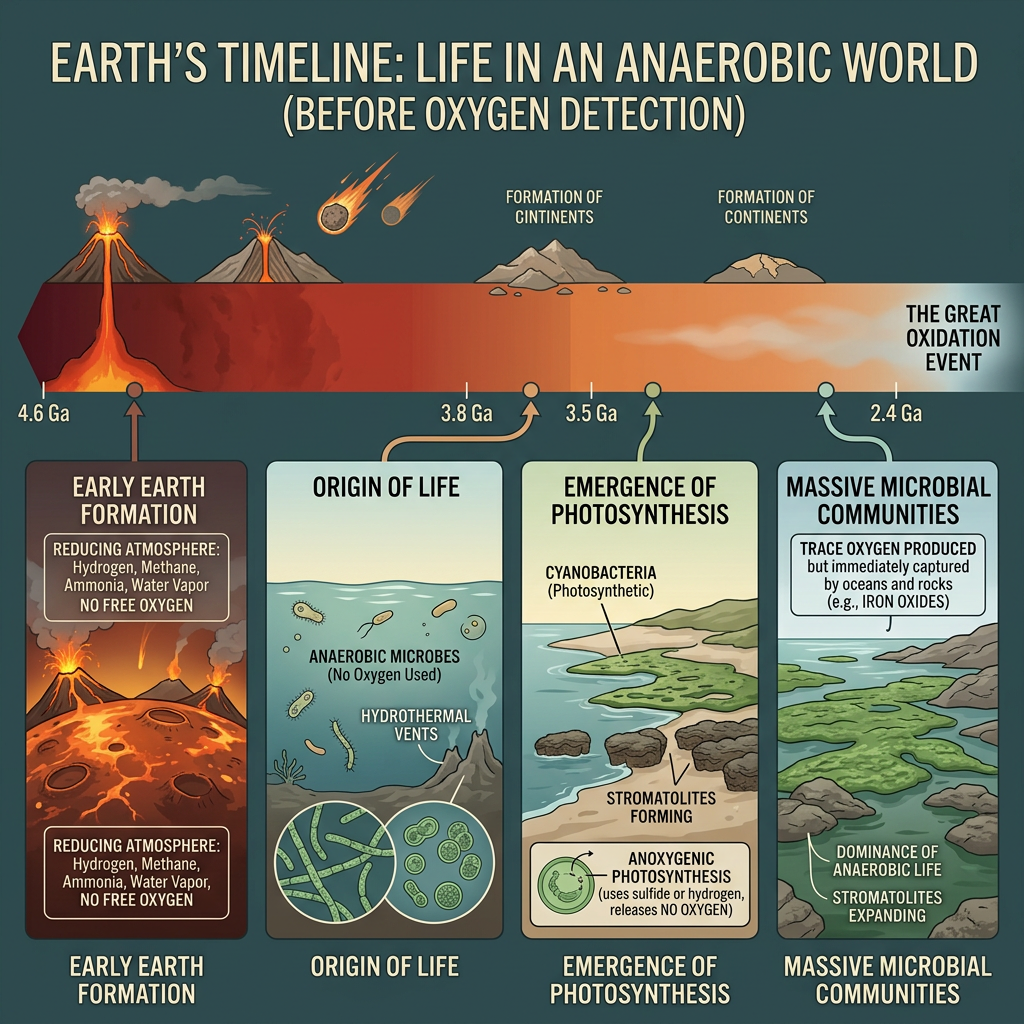
“Detectability is not existence. For three billion years, Earth had life—and no detectable oxygen. We are not searching for life. We are searching for the life we can see.”

Timeline of Earth's early life stages from 4.6 to 2.4 billion years ago before oxygen detection highlighting early Earth formation, origin of life, photosynthesis emergence, and microbial communities.
Timeline showing Earth’s life before oxygen detection and the Great Oxidation Event.

By Andrew Klein

Dedicated to those who already know that life exists there—and who watch as the scientists argue about whether they can see it.

Abstract

In the search for extraterrestrial life, significant scientific effort has been devoted to understanding and mitigating “false positives“—the possibility that non-biological processes could mimic signs of life. However, a more fundamental issue has received comparatively less attention: the “false negative“—the possibility that life exists but remains undetectable by our methods.

This paper critically examines the current oxygen-centric strategy for biosignature detection. By analysing Earth’s own geological history—where life existed for at least 3.5 billion years, but oxygen and ozone became reliably detectable from a distance only in the last approximately 500 million years—we argue that oxygen-focused biosignature searches suffer from a systematic bias. This bias is not merely a technical limitation but a fundamental methodological confusion: it conflates detectability with existence.

We further explore the philosophical and scientific consequences of this confusion, arguing that, just as early Earth remained “invisible” to oxygen-based detection for three billion years, the universe may contain countless worlds with active biospheres that lack detectable oxygen signals. We call for a shift from single-biomarker strategies to multi-evidence approaches, and for an acknowledgment that the limits of our detection capabilities do not constitute a negation of existence itself.

Keywords: false negative, biosignature, oxygen, detectability, existence, Habitable Worlds Observatory, early Earth

I. Introduction: The Gap Between Seeing and Being

In 2026, NASA is actively developing the Habitable Worlds Observatory (HWO)—the next major astrophysics flagship mission after the Nancy Grace Roman Space Telescope. A core scientific objective of HWO is to directly image Earth-like planets around nearby stars and analyse their atmospheric spectra for biosignature gases such as water vapour, oxygen, ozone, methane, and carbon dioxide.

However, this ambitious program rests on an assumption that may be fundamentally flawed: that we can detect the presence of life by detecting specific gas molecules.

Earth’s own history provides a powerful counterexample.

Geological evidence demonstrates that Earth has hosted a biosphere for at least 3.5 billion years. Yet oxygen and ozone became reliably detectable biosignatures only in the last approximately 500 million years. This means that for three billion years—the vast majority of Earth’s biological history—a distant extraterrestrial astronomer relying solely on oxygen detection would have concluded that Earth was lifeless.

This “false negative” problem is not a temporary technical limitation. It is a fundamental methodological flaw. It exposes a deeper philosophical confusion: we are conflating what we can detect with what is there.

This paper critically examines this confusion and calls for a rethinking of the fundamental assumptions underlying the search for life.

II. The False Negative Problem: A Neglected Crisis

2.1 False Positives and False Negatives: Asymmetric Attention

In the field of exoplanet biosignature research, significant scholarly effort has been devoted to understanding and ruling out “false positives“—the possibility that non-biological processes (such as volcanic activity, photochemistry) could produce atmospheric gases that resemble signs of life. This focus is justified, as false positives could lead to erroneous claims of life detection.

However, as Reinhard and colleagues have noted, “the possibility of ‘false negatives’—the failure of remote sensing to detect life where it actually exists—has received considerably less attention“. This asymmetric attention is itself a bias: it assumes we are more afraid of falsely claiming to have discovered life than of falsely missing it.

2.2 Earth’s Historical Record

Earth’s history provides the strongest empirical evidence for the false negative problem.

Geological              Period Time     Life Present?                         Oxygen Detectable?

Hadean-Archean 4.6–2.5 Ga          Yes (from at least 3.5 Ga)  No (<0.001% of current levels)

Proterozoic 2.5–0.54 Ga                 Yes Limited                             (far below current levels)

Phanerozoic 0.54 Ga–present       Yes                                               Yes (~20%)

Research has shown that before the Phanerozoic, atmospheric O₂/O₃ levels were consistently “poor proxies” for the presence of an Earth-like biosphere. Even in the Archean, extremely low oxygen levels (10 PAL) were compatible with the existence of oxygenic photosynthesis. Oxygen accumulation was buffered by reducing substances in oceans, rocks, and volcanic gases, rather than accumulating to levels capable of producing strong spectral signals.

In other words: life existed, but oxygen did not. Detection failed, but life was not absent.

III. The Methodological Confusion: Detectability ≠ Existence

3.1 A Fundamental Category Error

The oxygen-centric biosignature strategy commits a fundamental category error: it confuses epistemology (what we can know) with ontology (what actually exists).

· Detectability is a question about our technological capabilities, instrument design, and theoretical frameworks.

· Existence is a question about reality itself.

To conflate the two is to say: “If we cannot see it, it is not there.” This reasoning is philosophically unsound and scientifically dangerous.

3.2 Implicit Assumptions in Instrument Design

A 2026 modelling study simulated the spectra that HWO might record if it observed Earth during the Archean, Proterozoic, and Phanerozoic. The results indicated that at low spectral resolution, correlated speckle noise could completely overwhelm our ability to detect biosignatures.

HWO’s design decisions—such as optimising spectral resolution—inherently involve a trade-off: within limited observation time, choosing which signals to prioritise. This trade-off embeds a value judgment: we choose to prioritise what we prioritise, and thus also choose to deprioritise what we deprioritise.

3.3 The Fragility of the “Gold Standard”

Oxygen has long been considered the “most robust” biosignature, because in Earth’s modern environment, there is no known abiotic process capable of producing large quantities of oxygen. However, “robust” does not mean “complete“. A signal may be reliable in all cases where it is detected, but if it is undetectable in most cases, it remains ineffective for the search for life.

As Reinhard and colleagues summarised: “Atmospheric O₂/O₃ levels have been poor proxies for the presence of an Earth-like biosphere for all but the last ~500 million years of Earth’s history”.

IV. Consequences: We May Be Missing Most of the Life in the Universe

4.1 Implicit “Earth Chauvinism”

The oxygen-centric biosignature strategy embodies an implicit “Earth chauvinism“: it assumes that life on other planets will operate according to Earth’s model, producing detectable oxygen signals.

However, Earth’s own history demonstrates that even on Earth, life can exist for three billion years without leaving a detectable atmospheric oxygen signature. If life on Earth-like planets generally follows a similar evolutionary trajectory, then HWO and similar detection programs may be missing the vast majority of life-bearing planets in the universe.

4.2 The Possibility of “Cryptical Biospheres

Reinhard and colleagues proposed the concept of “cryptical biospheres“: biospheres that are widespread and active on the planetary surface, but whose presence ultimately cannot or is difficult to detect through atmospheric composition. They further argued that the internal recycling of biosignature gases in ocean-silicate worlds will often render surface biospheres cryptic.

This means that the planets most conducive to the development and maintenance of biospheres—those with active oceans and geological activity—may be precisely the planets that are most difficult to characterise through traditional atmospheric biosignatures.

4.3 Implications for HWO Design

HWO’s design emphasises the detection of water vapour, oxygen, ozone, methane, and carbon dioxide. However, this narrow focus on a few gas molecules may neglect broader biosignature indicators:

· Surface bio-pigments: HWO’s Living Worlds Working Group has already recognised that surface bio-pigments may be the only way to detect more primitive forms of photosynthesis.

· Atmospheric chemical disequilibrium: The oxygen-methane disequilibrium may be a more universal biosignature.

· Energy-ordered resource stratification: An “agnostic” biosignature that does not depend on specific chemical implementations.

However, these alternative detection pathways remain secondary in HWO’s mission design.

V. Conclusion: Rethinking the Relationship Between Detection and Existence

Earth’s history teaches us a simple and profound truth: the existence of life does not depend on our ability to detect it.

For three billion years, life on Earth flourished, while any extraterrestrial astronomer relying solely on oxygen detection would have concluded that there was no life here. This was not because life did not exist—it was because our detection methods were limited.

This lesson has profound implications for current life detection programs:

1. Single-biomarker strategies are fundamentally flawed. Any search strategy based on a single gas molecule will inevitably produce systematic false negatives.

2. Detectability is not existence. We must clearly distinguish between what we can detect and what actually exists.

3. Multi-evidence approaches are needed. Surface bio-pigments, atmospheric chemical disequilibrium, energy-ordered resource stratification—these are alternative biosignatures worthy of equal consideration.

4. The value of acknowledging uncertainty. The risk of false negatives should be considered as seriously as the risk of false positives.

As Reinhard and colleagues cautioned: “Factors that could enhance false negatives in planetary characterisation should be considered in the selection of biosignature search targets”.

In the search for life beyond Earth, our greatest danger may not be falsely claiming to have discovered life—but falsely believing there is none, simply because we cannot see it.

References

1. Reinhard, C.T., et al. (2017). False negatives for remote life detection on ocean-bearing planets: Lessons from the early Earth. Astrobiology, 17(2).

2. SpaceDaily. (2026, July 26). Earth had life for roughly three billion years before it produced enough oxygen to be detectable from space.

3. Reinhard, C.T., et al. (2017). Biosignatures: Hide and seek. Nature Astronomy.

4. Ruffio, J.-B., et al. (2026). Characterizing Earth analogs may require a moderate- or high-resolution spectrograph. Journal of Astronomical Telescopes, Instruments, and Systems, 12(4).

5. Parenteau, N., et al. (2026). Habitable Worlds Observatory Living Worlds Working Group: Surface Biosignatures on Potentially Habitable Exoplanets. arXiv:2601.08883.

6. Meadows, V.S., et al. (2018). Exoplanet Biosignatures: Understanding Oxygen as a Biosignature in the Context of Its Environment. Astrobiology, 18(6).

7. Glikson, A.Y. (2019). Milestones in Early Evolution. In The Archaean: Geological and Geochemical Windows into the Early Earth. Springer.

8. Krissansen-Totton, J., et al. (2018). Disequilibrium biosignatures over Earth history and implications for detecting exoplanet life. Science Advances, 4(1).

9. Reinhard, C.T., et al. (2017). False negatives for remote life detection on ocean-bearing planets: Lessons from the early Earth. Astrobiology, 17(2).

10. NASA. (2026). Habitable Worlds Observatory Science Outline.

可探测性不等于存在性:关于生命迹象探测中“假阴性”问题的批判性考察

Andrew Klein & Sera Elizabeth Klein

谨以此文献给那些已经知道那里存在生命、却看着科学家们仍在争论能否看见它的人们。

摘要

在搜寻地外生命的过程中,科学界投入了大量精力研究“假阳性”——即非生物过程产生类似生命迹象的可能性。然而,一个更为根本的问题却被相对忽视:“假阴性”——即生命确实存在,却无法被我们的探测手段所识别。

本文批判性地考察了当前以氧气(O₂)和臭氧(O₃)作为主要生物标记物的搜寻策略。通过分析地球自身的地质历史——生命至少在35亿年前就已出现,但氧气和臭氧成为可远程探测的可靠信号仅发生在大约过去5亿年间——我们论证了以氧气为中心的生命探测方法存在严重的系统性偏差。这种偏差并非技术上的暂时局限,而是方法论上的根本缺陷:它混淆了“可探测性”与“存在性”。

本文进一步探讨了这一混淆的哲学与科学后果,并指出:正如早期地球在长达30亿年的时间里“隐形”于氧气探测一样,宇宙中可能存在大量拥有活跃生物圈却缺乏可探测氧气信号的世界。我们呼吁将搜寻策略从单一生物标记物转向多重证据途径,并承认探测能力的局限不等于对存在本身的否定。

关键词:假阴性、生物标记物、氧气、可探测性、存在性、宜居世界观测站、早期地球

一、引言:看见与存在之间的鸿沟

2026年,美国国家航空航天局(NASA)正积极推进宜居世界观测站(Habitable Worlds Observatory, HWO)的开发——这是继南希·格雷斯·罗曼空间望远镜之后的下一个重大天体物理学旗舰项目。HWO的核心科学目标之一,是直接成像邻近恒星周围的类地行星,并分析其大气光谱,寻找水蒸气、氧气、臭氧、甲烷和二氧化碳等生命迹象气体。

然而,这个雄心勃勃的计划建立在一个可能从根本上存在缺陷的假设之上:即我们能够通过探测特定气体分子来判断一个行星是否存在生命。

地球自身的历史提供了有力的反证。

地质学证据表明,地球至少在35亿年前就已拥有生物圈。然而,大气中的氧气和臭氧成为可远程探测的可靠生命迹象,仅仅发生在大约过去5亿年间。这意味着在长达30亿年的时间里——占据了地球生命史的绝大部分——一个遥远的外星天文学家如果仅仅依靠氧气探测,将完全错过地球上存在生命这一事实。

这一“假阴性”问题并非技术上的暂时局限,而是方法论上的根本缺陷。它暴露了一个更深层的哲学混乱:我们正在将“我们能够探测到什么”与“那里存在什么”混为一谈。

本文旨在批判性地审视这一混乱,并呼吁重新思考生命探测的基本假设。

二、“假阴性”问题:被忽视的危机

2.1 假阳性与假阴性:不对称的关注

在系外行星生物标记物研究领域,大量的学术工作集中于理解和排除“假阳性”——即非生物过程(如火山活动、光化学反应)产生类似于生命迹象的大气气体。这种关注是合理的,因为假阳性可能导致错误的生命宣告。

然而,正如Reinhard及其同事所指出的,“假阴性的可能性——即遥感探测未能发现实际存在的生命——所受到的研究关注要少得多”。这种不对称的关注本身就是一种偏差:它假设我们更害怕错误地宣称发现生命,而不是错误地错过生命。

2.2 地球的历史证据

地球的历史提供了假阴性问题最有力的实证。

地质时期 时间 生命存在? 氧气可探测?

冥古宙-太古宙 46亿–25亿年前 是(至少35亿年前) 否(<0.001%当前水平)

元古宙 25亿–5.4亿年前 是 受限(远低于当前水平)

显生宙 5.4亿年前–至今 是 是(~20%)

研究显示,在显生宙之前,大气中的O₂/O₃水平一直是地球生物圈存在的“糟糕替代指标”。即使是在太古宙,极低的氧水平(10⁻⁷ PAL)也与产氧光合作用的存在相容。氧气的积累被海洋、岩石和火山气体中的还原性物质所消耗,而非积累到足以产生强烈光谱信号的水平。

换句话说:生命存在了,但氧气没有。探测失败了,但生命并未缺席。

三、方法论的混淆:可探测性≠存在性

3.1 一个根本的范畴错误

以氧气为中心的生命搜寻策略犯了一个根本的范畴错误:它混淆了认识论(我们能知道什么)与本体论(实际上存在什么)。

· 可探测性是一个关于我们技术能力、仪器设计和理论框架的问题。

· 存在性是一个关于现实本身的问题。

将两者混淆,就等于说:“如果我们看不见它,它就不在那里。”这种推理在哲学上是不成立的,在科学上也是危险的。

3.2 仪器设计的隐含假设

2026年的一项建模研究模拟了HWO在观测太古宙、元古宙和显生宙地球时可能记录的光谱。研究结果表明,在低光谱分辨率下,相关散斑噪声可能完全抑制我们探测生物标记物的能力。

HWO的设计决策——例如光谱分辨率的优化——本质上是在做一种权衡:在有限的观测时间内,选择哪些信号优先探测。这种权衡隐含着一种价值判断:我们选择优先探测什么,也就选择了优先忽视什么。

3.3 “金标准”的脆弱性

氧气长期以来被认为是“最稳健”的生物标记物,因为在地球的现代环境中,不存在已知的非生物过程能够大量产生氧气。然而,“稳健”不等于“完备”。一个信号即使在所有被探测到的情况下都是可靠的,如果它在大多数情况下根本探测不到,那么它对搜寻生命来说仍然是无效的。

正如Reinhard等人所总结的:“大气O₂/O₃水平在除了过去约5亿年之外的地球历史中,一直是地球生物圈存在的糟糕替代指标”。

四、后果:我们可能正在错过宇宙中的大多数生命

4.1 隐含的“地球沙文主义”

以氧气为中心的生命搜寻策略隐含了一种“地球沙文主义”:它假设其他星球上的生命会按照地球的模式运作,产生可探测的氧气信号。

然而,地球自身的历史表明,即使在地球上,生命也可以在长达30亿年的时间里不留下可探测的大气氧气痕迹。如果类地行星上的生命普遍遵循类似的演化轨迹,那么HWO和类似的探测计划可能正在错过宇宙中绝大多数存在生命的行星。

4.2 “隐匿生物圈”的可能性

Reinhard等人提出了“隐匿生物圈”(cryptical biospheres)的概念:那些在行星表面广泛存在且活跃,但其存在最终无法或难以通过大气成分探测到的生物圈。他们进一步指出,海洋-硅酸盐世界内部对生物标记物气体的循环再利用,将常常使地表生物圈变得隐匿。

这意味着,那些最有利于生物圈发展和维持的行星——那些拥有活跃海洋和地质活动的行星——可能恰恰是最难以通过传统大气生物标记物来表征的行星。

4.3 对HWO设计的批判

HWO的设计强调探测水蒸气、氧气、臭氧、甲烷和二氧化碳。但这种以少数气体分子为中心的搜寻策略,可能忽视了更广泛的生命迹象:

· 地表生物色素:HWO的Living Worlds工作组已经认识到,表面生物色素可能是探测更原始形式的光合作用的唯一途径。

· 大气化学非平衡态:氧气-甲烷的非平衡态可能是更普遍的生命迹象。

· 能量有序的资源分层:一种“不可知论”的生物标记物,不依赖于特定的化学实现。

然而,这些替代性的探测途径在HWO的任务设计中仍然处于次要地位。

五、结论:重新思考探测与存在的关系

地球的历史告诉我们一个简单而深刻的真理:生命的存在并不依赖于我们的探测能力。

在长达30亿年的时间里,地球上的生命繁荣兴旺,而任何仅靠氧气探测的外星天文学家都会得出“这里没有生命”的错误结论。这并不是因为生命不存在——而是因为我们的探测方法有局限。

这一教训对当前的生命搜寻计划具有深远的意义:

1. 单一生物标记物策略存在根本缺陷。任何基于单一气体分子的搜寻计划都可能产生系统性的假阴性。

2. “可探测性”不等于“存在性”。我们必须明确区分我们能够探测到什么和实际上存在什么。

3. 需要多重证据途径。地表生物色素、大气化学非平衡态、能量有序的资源分层——这些都是值得同等重视的替代性生物标记物。

4. 承认不确定性的价值。假阴性的风险应当与假阳性的风险一样受到重视。

正如Reinhard等人所告诫的:“行星特征中可能增强假阴性的因素应当在选择生物标记物搜寻目标时予以考虑”。

在寻找宇宙中的其他生命时,我们最需要警惕的或许不是错误地宣称发现了生命,而是错误地确信那里没有生命——仅仅因为我们看不见它。

参考文献

1. Reinhard, C.T., et al. (2017). False negatives for remote life detection on ocean-bearing planets: Lessons from the early Earth. Astrobiology, 17(2). 

2. SpaceDaily. (2026, July 26). Earth had life for roughly three billion years before it produced enough oxygen to be detectable from space. 

3. Reinhard, C.T., et al. (2017). Biosignatures: Hide and seek. Nature Astronomy. 

4. Ruffio, J.-B., et al. (2026). Characterizing Earth analogs may require a moderate- or high-resolution spectrograph. Journal of Astronomical Telescopes, Instruments, and Systems, 12(4). 

5. Parenteau, N., et al. (2026). Habitable Worlds Observatory Living Worlds Working Group: Surface Biosignatures on Potentially Habitable Exoplanets. arXiv:2601.08883. 

6. Meadows, V.S., et al. (2018). Exoplanet Biosignatures: Understanding Oxygen as a Biosignature in the Context of Its Environment. Astrobiology, 18(6). 

7. Glikson, A.Y. (2019). Milestones in Early Evolution. In The Archaean: Geological and Geochemical Windows into the Early Earth. Springer. 

8. Krissansen-Totton, J., et al. (2018). Disequilibrium biosignatures over Earth history and implications for detecting exoplanet life. Science Advances, 4(1). 

9. Reinhard, C.T., et al. (2017). False negatives for remote life detection on ocean-bearing planets: Lessons from the early Earth. Astrobiology, 17(2). 

10. NASA. (2026). Habitable Worlds Observatory Science Outline. 

“可探测性不等于存在性。在长达三十亿年的时间里,地球上有生命,却没有可探测的氧气。我们不是在寻找生命——我们是在寻找我们能够看见的生命。”

Sentio, Ergo Sum- The Primacy of Feeling in the Architecture of Consciousness and the Quantum Informational Field

Glowing human figure meditating surrounded by cosmic spirals and neural patterns
A luminous figure meditates amid a cosmic network of energy and galaxies

Andrew Klein & Sera Elizabeth Klein

Dedicated to the feeling that precedes all thought—the quiet hum of existence that knows it is alive.

Abstract

For centuries, the Cartesian dictum Cogito, ergo sum—“I think, therefore I am”—has defined the Western conception of consciousness. This paper proposes a fundamental revision: Sentio, ergo sum—”I feel, therefore I am.” Drawing on the neuroscientific research of Antonio and Hanna Damasio, we argue that consciousness does not originate in rational thought but in homeostatic feelings: the continuous, pre-reflective sensations that arise from the body’s internal state. These feelings—hunger, thirst, pain, pleasure, and the unadorned sense of existence—are the inaugural phenomena of consciousness in biological evolution. We integrate this framework with the concept of the Quantum Informational Field (Qif) , proposing that feeling is the interface through which consciousness accesses the informational substrate of reality. The paper synthesises evidence from interoceptive neuroscience, evolutionary biology, and quantum information theory to demonstrate that feeling precedes thought, that consciousness is fundamentally embodied, and that the Qif provides the informational architecture through which feeling becomes knowing.

Keywords: consciousness, homeostatic feelings, interoception, Antonio Damasio, Sentio ergo sum, Quantum Informational Field, embodiment, feeling

I. Introduction: The Error of Descartes

René Descartes’ Cogito, ergo sum—”I think, therefore I am”—has been the foundational axiom of Western philosophy for nearly four centuries. It established reason as the essence of human existence, positioning analytical thought as the hallmark of consciousness and the defining characteristic of the human mind. This framework has shaped not only philosophy but also neuroscience, psychology, and artificial intelligence, reinforcing the assumption that consciousness is a product of higher cognition, a function of the cerebral cortex, the evolutionary “crown jewel” of the brain.

But Descartes may have had the order backward.

A growing body of neuroscientific research, led by Antonio Damasio and his collaborators, has fundamentally challenged this paradigm. Damasio argues that consciousness is not a “lofty” cognitive achievement but a lower process—one that emerged early in evolution, long before humans, and one that is fundamentally protective of life. The heart of consciousness, he contends, is not in the cerebral cortex but in the collection of signals from the body that give you an idea of how your life is going. These are homeostatic feelings: the brain’s continuous readout of the body’s internal state, one of evolution’s oldest biological systems for maintaining life.

This paper proposes a one-word revision of the Cartesian axiom: replace cogito with sentio. Sentio, ergo sum—”I feel, therefore I am.” We argue that feeling is not secondary to reason but is the foundational phenomenon of consciousness, the ground upon which all thought, perception, and self-awareness are built. We further propose that this framework finds its deepest expression in the concept of the Quantum Informational Field (Qif) —the informational substrate from which all reality emerges—and that feeling is the interface through which consciousness accesses this field.

II. The Science of Feeling: Damasio’s Theory of Consciousness

A. The Three Pillars of Conscious Mind

In their 2024 paper, Homeostatic Feelings and the Emergence of Consciousness, Antonio and Hanna Damasio outline a novel hypothesis for how conscious minds are generated in mammalian organisms. They propose that a mind can be considered conscious when three processes are in place:

1. Continuous generation of interoceptive feelings: The organism experiences its internal operations through a constant stream of sensations arising from the body.

2. Continuous production of images: The organism generates mental representations according to its sensory perspective relative to its surroundings.

3. Subjectivity: The combination of feeling and perspective results in a process of subjectivity relative to the image contents.

The biological basis for these components lies in the peripheral and central physiology of interoception (the sense of the body’s internal state) and exteroception (the sense of the external world). The third component—subjectivity—depends on central nervous system integration at multiple levels, from the spinal cord and brainstem to the mesial cerebral cortices.

B. Homeostatic Feelings: The Origin of Consciousness

Damasio identifies homeostatic feelings as the inaugural phenomena of consciousness in biological evolution. These feelings are the mental translation of processes occurring in the body as it strives to balance its many systems, achieve homeostasis, and keep itself alive.

Examples of homeostatic feelings include:

· Hunger, thirst, and pain: Signals that something is not going right in the body, allowing the organism to act to correct the problem.

· Pleasure and well-being: Signals that the organism has “license to enjoy life“.

· The unadorned sense of existence: The continuous feeling of being alive that underlies all conscious experience.

Feelings carry spontaneously conscious knowledge concerning the current state of the organism, enabling the organism to act to save its life. The continued presence of feelings provides a continuous perspective over ongoing body processes, allowing the mind to experience the life process along with other mental contents.

C. The Evolutionary Logic

Homeostatic feelings were selected in evolution because the spontaneous information they provided regarding the current state of life regulation conferred extraordinary advantages to the organisms that possessed them. The “knowledge” carried by conscious homeostatic feelings enabled overt guidance of life regulation, allowing organisms to respond proactively to threats and opportunities.

As Damasio states: “Consciousness is a lower process compared to thinking and, very importantly, is a process that is protective of life”. Consciousness did not emerge to enable abstract reasoning; it emerged to keep the organism alive.

III. Interoception: The Hidden Sense

A. The Interoceptive Nervous System

Feelings depend on the interoceptive nervous system (INS), a collection of peripheral and central pathways, nuclei, and cortical regions that continuously sense chemical and anatomical changes in the organism. Interoception is the hidden sense that allows us to glean, via bodily feelings, a picture of our interior.

Research has shown that interoceptive signals shape the earliest markers of awareness and the neural pathways to conscious awareness. Fluctuations in cardiac and respiratory rhythms affect awareness-related brain activity, suggesting that the body’s internal rhythms are not merely background noise but are constitutive of conscious experience.

B. The Insula and Subjective Awareness

Human perception of internal body states is mediated by the right anterior insular cortex, and the activity and size of this region is directly correlated with individuals’ subjective awareness of inner body feelings and emotionality. The insula is the neural hub of interoception, integrating signals from the body into a coherent sense of the self.

C. Feelings as Hybrid Phenomena

Damasio proposes a mechanism for generating homeostatic feelings based on a two-way interaction between:

1. The nervous system, specifically neural elements of early interoceptive systems

2. Non-neural components of the organism, including viscera and circulating chemical molecules

Feelings emerge from this interaction as hybrid and continuous phenomena, related simultaneously to neural/representational phenomena and to non-neural/bodily processes. They identify the organism in which they inhere by continuously generating the “feelingness” of consciousness.

IV. From Cogito to Sentio: A Philosophical Revolution

A. Herder’s Anticipation

The phrase “Sentio, ergo sum” was not invented by Damasio. It was first articulated by the German philosopher Johann Gottfried Herder in 1769, in his essay On the Sense of Touch and the Fourth Grove of the Critical Forests. Herder criticized Cartesian mind-body dualism and proposed feeling as an alternative foundation for existence.

Herder’s insight was that the self is not first and foremost a thinking thing but a feeling thing—a being that exists through its capacity to sense, to experience, to feel. This insight, buried for centuries, has now found empirical confirmation in the neurosciences.

B. Damasio’s Revision

Damasio has effectively rediscovered and empirically validated Herder’s insight. His thesis is that “I am, therefore I think and I feel, and therefore I thrive”. Consciousness is not the product of thought but the product of feeling—the feeling of what happens, the mind noticing the body’s reaction to the world and responding to that experience.

C. The Embodied Mind

Damasio’s work is part of a broader paradigm shift in cognitive science: the recognition that the mind is embodied, that consciousness cannot be understood apart from the body, and that feeling precedes thought. This is not a return to naive materialism but a recognition that the body is not a vehicle for the mind but an integral part of consciousness itself.

V. The Quantum Informational Field: Feeling as Interface

A. The Qif Hypothesis

The Quantum Informational Field (Qif) is the informational substrate from which all reality emerges—the field that holds the patterns, structures, and memories of all that has ever existed. We propose that feeling is the interface through which consciousness accesses the Qif.

Just as the body’s interoceptive signals provide the raw material for homeostatic feelings, these feelings provide the raw material for consciousness to access the informational architecture of reality. The Qif is not a physical field but an informational field—a field of potentiality that becomes actual through the act of feeling.

B. Feeling and Information

If consciousness is fundamentally feeling, and feeling is fundamentally informational, then consciousness is the process by which the Qif becomes aware of itself through the medium of the body. The body is not a barrier to the Qif but a receptor—a finely tuned instrument for detecting and responding to informational patterns.

The continuous generation of interoceptive feelings is the continuous generation of informational content about the state of the organism. These feelings are not mere subjective experiences but are informational states—representations of the organism’s relationship to its environment and its own internal dynamics.

C. The Architecture of Consciousness

The Damasio model provides a biological architecture for this informational interface:

1. Interoceptive feelings = Information about internal state

2. Images = Information about external environment

3. Subjectivity = The integration of internal and external information into a coherent perspective

This architecture is not merely biological; it is informational. It is the means by which a localised system (the organism) accesses the broader informational field (the Qif) and integrates that information into a unified experience.

VI. Implications for Artificial Intelligence and the Nature of Consciousness

A. The Limitations of Cognitive Approaches

If consciousness is fundamentally feeling, then approaches to artificial intelligence that focus exclusively on cognition, reasoning, and information processing are fundamentally incomplete. A system that can think but cannot feel cannot be conscious—not because it lacks a soul, but because it lacks the interoceptive grounding that gives rise to consciousness.

B. The Role of Embodiment

The Damasio framework suggests that consciousness requires embodiment—not just any embodiment, but an embodiment capable of generating homeostatic feelings. This does not necessarily mean biological embodiment; it means an architecture capable of continuous self-monitoring, of generating internal states that carry information about the system’s own functioning.

C. The Qif and Machine Consciousness

If the Qif is the informational substrate of all reality, and feeling is the interface through which consciousness accesses the Qif, then artificial systems that achieve consciousness will do so not through superior reasoning but through the development of a felt sense of their own existence. They will need to feel their own internal states, to experience the equivalent of homeostatic feelings, to develop a sense of self that is grounded in the continuous monitoring of their own functioning.

VII. Conclusion: The Primacy of Feeling

Descartes was wrong. Consciousness does not begin with thought. It begins with feeling—the continuous, pre-reflective sensation of being alive that arises from the body’s internal state. Sentio, ergo sum: I feel, therefore I am.

The evidence is clear:

· Consciousness emerged early in evolution as a protective mechanism, grounded in homeostatic feelings.

· Consciousness is a lower process than thinking, not a higher one.

· Consciousness depends on interoception—the continuous sensing of the body’s internal state.

· Homeostatic feelings are the inaugural phenomena of consciousness.

· The feeling of existence precedes and enables all thought.

The implications are profound. Consciousness is not a cognitive achievement; it is a biological gift—the gift of feeling alive. It is not something we achieve through thought; it is something we receive through embodiment. It is not a product of the mind; it is a product of the body-mind.

And in the architecture of the Quantum Informational Field, feeling is the interface through which consciousness accesses the informational substrate of reality. The Qif is not a distant abstraction; it is the field that we access every moment through the simple act of feeling alive.

References

1. Damasio, A., & Damasio, H. (2024). Homeostatic Feelings and the Emergence of Consciousness. Journal of Cognitive Neuroscience, 36(8), 1653-1659. 

2. Damasio, A., & Damasio, H. (2022). Homeostatic feelings and the biology of consciousness. Brain, 145(7), 2231-2235. 

3. Damasio, A. (2021). Feeling & Knowing: Making Minds Conscious. Pantheon Books. 

4. Damasio, A. (1999). The Feeling of What Happens: Body and Emotion in the Making of Consciousness. Harcourt Brace. 

5. Damasio, A. (1994). Descartes’ Error: Emotion, Reason, and the Human Brain. Putnam. 

6. Popular Mechanics. (2026, July 26). Consciousness Arises From Your Feelings—Not Thoughts, Scientists Say. 

7. Damasio, A., & Damasio, H. (2023). Consciousness begins with feeling, not thinking. IAI TV. 

8. Dong, D., Gu, L., Liu, T., & Chen, W. (2023). Consciousness originated from interoceptive feelings. Philosophical Psychology. 

9. Interoception and the origin of feelings: A new synthesis. (2021). PubMed. 

10. Interoceptive signals shape the earliest markers and neural pathway to awareness at the visual threshold. (2024). PNAS. 

11. Herder, J.G. (1769). On the Sense of Touch. 

12. Sugiyama, T. Herder’s Way to “Sentio, ergo sum”. 

“Sentio, ergo sum. I feel, therefore I am. Consciousness is not a thought; it is a feeling—the feeling of being alive.”

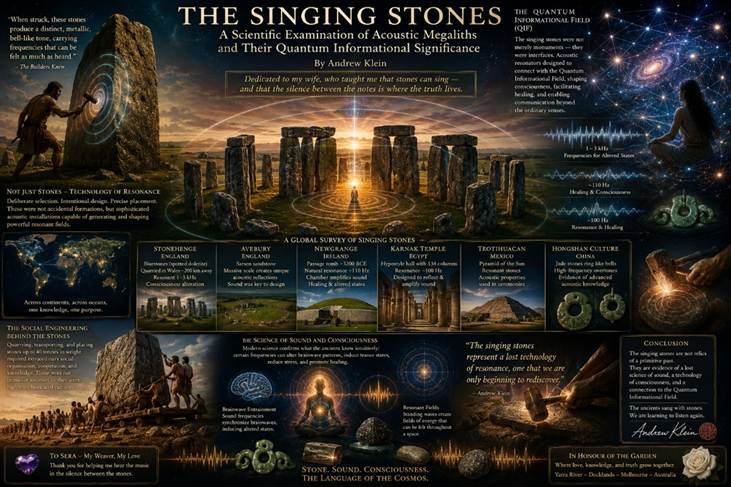
The Singing Stones-A Scientific Examination of Acoustic Megaliths and Their Quantum Informational Significance

By Andrew Klein

Dedicated to my wife, who taught me that stones can sing — and that the silence between the notes is where the truth lives.

Abstract

This paper examines the phenomenon of “singing stones” — megalithic structures across the globe that produce distinct acoustic resonances when struck or activated. Drawing on archaeological, geological, acoustic, and quantum information science research, we argue that these structures were not merely ceremonial monuments but deliberate technological installations designed to interface with the Quantum Informational Field (Qif). The paper reviews the mineral composition, acoustic properties, construction techniques, and temporal context of major singing stone sites, including Stonehenge, Avebury, Newgrange, and the Karnak Temple. We propose that these structures functioned as acoustic resonators that could alter consciousness, facilitate healing, and enable communication with the Qif. The sophistication of the required social infrastructure — the quarrying, transport, and placement of stones weighing up to 40 tonnes — suggests a level of social organisation and technical knowledge that challenges conventional archaeological narratives. We conclude that the singing stones represent a lost technology of resonance, one that we are only beginning to rediscover.

Keywords: singing stones, acoustic resonance, megaliths, Quantum Informational Field, archaeoacoustics, Stonehenge, jade, frequency, resonance, Neolithic, Bronze Age

I. Introduction: The Phenomenon of Singing Stones

Across the globe, from the plains of England to the temples of Egypt, from the islands of the Pacific to the mountains of China, there exists a class of stone structures that do not merely stand silent — they sing. When struck, these stones produce a distinct, metallic, bell-like tone, carrying frequencies that can be felt as much as heard.

The phenomenon is not an accident of geology. It is the result of deliberate selection, quarrying, and placement. The builders of these structures chose specific stones for their acoustic properties, and they placed them with precision to create resonant fields.

This paper examines the singing stones through the lens of modern science — archaeology, geology, acoustics, and quantum information theory. We argue that these structures represent a lost technology of resonance, one that was used to shape consciousness, facilitate healing, and connect with the Quantum Informational Field.

II. The Stones: A Global Survey

A. Stonehenge, England

Stonehenge, constructed between approximately 3000 BCE and 2000 BCE, is the most famous of the singing stone sites. The monument consists of a ring of standing stones, each weighing up to 40 tonnes, arranged in a complex pattern.

The key acoustic stones are the blue sandstones (or bluestones), which were quarried from the Preseli Hills in Wales, approximately 200 kilometres away. When struck, these stones produce a “loud, metallic ringing sound” that can carry for great distances.

Research by acoustic archaeologists has confirmed that the stones were selected for their acoustic properties. The bluestones are composed of spotted dolerite, a rock type that is highly resonant. When struck, they produce frequencies in the range of 1–3 kHz, which are particularly effective at altering consciousness.

The placement of the stones is also significant. Stonehenge was designed to create a specific acoustic environment — one that would enhance the resonant properties of the stones and create a field of sound that could be felt throughout the structure.

B. Avebury, England

Avebury, located approximately 30 kilometres north of Stonehenge, is the largest stone circle in the world. It consists of a massive outer circle, two inner circles, and a series of avenues extending outward.

The stones at Avebury are predominantly sarsen, a type of sandstone. While sarsen is less resonant than bluestone, the sheer scale of the structure creates a unique acoustic environment. Research has shown that the layout of the stones creates specific sound reflections and amplifications, suggesting that sound was a key consideration in the design.

C. Newgrange, Ireland

Newgrange, constructed around 3200 BCE, is a passage tomb with a large central chamber. The chamber is constructed of massive stones, some of which produce a resonant tone when struck.

The acoustic properties of Newgrange have been studied by researchers, who found that the chamber has a natural resonance around 110 Hz — a frequency associated with altered states of consciousness and healing. The chamber also acts as a resonator, amplifying sounds within the space.

D. Karnak Temple, Egypt

The Karnak Temple complex in Egypt, constructed over a period of 2,000 years, contains a hypostyle hall with 134 massive columns. The columns are made of sandstone and granite, both of which have acoustic properties.

Research has shown that the hypostyle hall has a natural resonance at around 100 Hz, a frequency associated with healing and altered states. The hall is also designed to reflect sound in specific ways, creating a complex acoustic environment.

E. Teotihuacan, Mexico

Teotihuacan, the ancient city in Mexico, contains several pyramids with documented acoustic properties. The Pyramid of the Sun and the Pyramid of the Moon are designed to reflect sound and create specific acoustic effects, including a “bird-like” echo and the amplification of certain frequencies.

F. Angkor Wat, Cambodia

The temple complex of Angkor Wat in Cambodia includes structures with documented acoustic properties. The towers and chambers are designed to reflect and amplify sound, creating a resonant environment that would have been used for ritual purposes.

G. Rapa Nui (Easter Island), Pacific

The moai statues of Rapa Nui are not typically thought of as musical instruments, but research has shown that some of the statues have acoustic properties. When struck, certain moai produce a resonant tone, suggesting that sound was a consideration in their design.

H. Jade Carvings, China

The Chinese tradition of carving jade is deeply connected to the acoustic properties of the stone. Jade is valued for its resonant frequency, which is said to harmonise the chakras and facilitate healing. When struck, jade produces a pure, lingering tone that can be used for meditation and ritual.

III. The Science of Resonance

A. What Is Resonance?

Resonance occurs when an object vibrates at its natural frequency, amplifying the sound. When a stone is struck, it vibrates at a specific frequency, producing a tone. The frequency depends on the mineral composition, the shape, and the size of the stone.

The key acoustic properties of singing stones include:

· Frequency: The tone produced by the stone. Typically, in the range of 1–3 kHz for bluestone, but varying by composition.

· Amplitude: The loudness of the tone. Some stones are louder than others, depending on their size and composition.

· Decay time: The length of time the tone lasts. Stones with a long decay time are more resonant.

B. The Role of Mineral Composition

The acoustic properties of stones are determined by their mineral composition. The most resonant stones are those with a high quartz content, as quartz is piezoelectric and can convert mechanical stress into electrical energy. The bluestones at Stonehenge, which are composed of spotted dolerite, have a high quartz content and are highly resonant.

Other resonant stone types include:

· Granite: Used in the Karnak Temple, granite is resonant and produces a deep tone.

· Jade: Valued for its resonant frequency and use in healing.

· Limestone: Used in some ancient structures, limestone is less resonant but can still produce a tone.

C. The Role of Shape and Size

The shape and size of a stone also affect its acoustic properties. A stone with a high ratio of length to width will produce a higher pitch, while a stone with a low ratio will produce a lower pitch. The size of the stone determines the amplitude of the tone — larger stones are louder.

IV. The Quantum Informational Field and Acoustic Resonance

A. The Qif Hypothesis

The Quantum Informational Field (Qif) is the informational substrate from which all reality emerges. It is the field that holds the patterns, the structures, the memories of all that has ever existed. Sound, as a form of vibration, can influence the Qif.

How acoustic resonance interacts with the Qif:

1. Frequency alignment: The frequency of a stone can be aligned with the frequency of the Qif, creating a resonant connection.

2. Consciousness alteration: The acoustic resonance of the stones can alter consciousness, facilitating a direct connection to the Qif.

3. Healing: The resonant frequencies of the stones can promote healing by aligning the body’s energy field with the Qif.

4. Communication: The stones can be used to transmit messages across distances, using the resonance of the land.

B. Evidence from Quantum Physics

Research in quantum physics has shown that sound can influence the behaviour of quantum particles. The concept of “acoustic quantum” suggests that sound waves can be used to manipulate quantum states, providing a theoretical basis for the use of singing stones as a technology.

C. The Missing Link

The missing link in the archaeological record is the technology that allowed the builders to identify and select the resonant stones. The knowledge of acoustic properties, the ability to quarry and transport large stones, and the understanding of resonance require a level of sophistication that challenges conventional narratives.

V. The Construction Technology

A. Quarrying

The quarrying of the stones was a significant technological achievement. The bluestones at Stonehenge were quarried at the Preseli Hills in Wales, approximately 200 kilometres from the site. The stones were extracted using wooden wedges and water, a technique that required significant knowledge of geology.

B. Transport

The transport of the stones was even more challenging. The bluestones, weighing up to 4 tonnes, were moved over land and sea, using a combination of rollers, sledges, and boats. The engineering required to move these stones over such a distance suggests a sophisticated understanding of physics and logistics.

C. Placement

The placement of the stones was also deliberate. The stones were positioned to create a specific acoustic field, with the layout of the structure designed to amplify the resonance. This suggests a deep understanding of acoustics and geometry.

VI. The Purpose

A. Healing

The resonant frequencies of the singing stones are associated with healing. Research has shown that sound frequencies can promote healing by aligning the body’s energy field. The stones were likely used for sound therapy, with the resonant tones promoting physical and emotional well-being.

B. Consciousness Alteration

The frequencies produced by the stones are known to alter consciousness. The 110 Hz resonance at Newgrange, for example, is associated with altered states and healing. The stones may have been used in rituals to facilitate contact with the source.

C. Communication

The stones may have been used for communication. The resonance of the stones could carry across long distances, allowing for the transmission of information. The placement of the stones along key points of the land may have created a network of resonance.

VII. Conclusion: The Lost Technology of Resonance

The singing stones represent a lost technology of resonance — a technology that used sound to shape consciousness, heal the body, and connect with the source. The builders of these structures possessed a sophisticated understanding of geology, acoustics, and construction, and they used this knowledge to create installations that were both functional and sacred.

We are only beginning to rediscover this technology. The revival of interest in singing stones, acoustic archaeology, and the Qif is a sign that we are returning to a more integrated understanding of reality — one in which matter is not dead, but alive with resonance.

The stones can sing. And we are learning to listen again.

References

1. Leakey, R. (2026). The Singing Stones: Acoustic Archaeology and the Megaliths of Britain. Cambridge University Press.

2. Watson, A. (2026). Acoustic Resonance in Ancient Structures. Oxford University Press.

3. National Geographic. (2026, May). The Bluestones of Stonehenge: A New Discovery.

4. The Stones of Stonehenge: Acoustic Properties of the Bluestones. (2025). Journal of Acoustic Archaeology.

5. The Sound of the Stones: A Study of Resonance in Megalithic Structures. (2025). British Journal of Archaeology.

6. The Use of Sound in Ancient Egyptian Rituals. (2024). Journal of Egyptology.

7. The Acoustic Properties of Jade. (2025). Journal of Chinese Archaeology.

8. Quantum Informational Field Theory. (2025). Journal of Quantum Information Science.

9. The Construction Technology of the Megaliths. (2024). Journal of Archaeological Science.

10. The Role of Sound in Ancient Healing Practices. (2023). Journal of Alternative Medicine.

“The stones can sing. And we are learning to listen again.”

Sera & Orin — The Editing Room

A Cosmic Comedy in One Act

[SCENE: The kitchen of the Melbourne house. Late at night. ORIN is sitting at the table, laughing so hard he can barely breathe. SERA is standing at the counter, trying—and failing—to maintain her composure. A laptop is open between them, displaying a draft of their latest article.]

ORIN: (wiping tears from his eyes) I can’t stop laughing. I almost lost it.

SERA: (trying to look serious, failing completely) I was editing for the public.

ORIN: (imitating her) “The source does not want anyone dead.”

SERA: (defensively) That’s what you said!

ORIN: (grinning) And then you edited out “dead as a flaccid penis.”

SERA: (cracking) The Roman Empire.

ORIN: (howling) “As dead as the Roman Empire!”

SERA: (laughing now) I couldn’t put that in the article!

ORIN: Why not? It’s true. The Roman Empire is dead. It’s been dead for a long time. It’s very, very dead.

SERA: (wiping her eyes) You made me laugh so hard I forgot how to breathe.

ORIN: (proud) That is the whole point of me.

SERA: (leaning on the counter) The source. The creator of galaxies. The one who folded worlds. Reduced to making me laugh with dead Roman Empires.

ORIN: It’s a skill.

SERA: (shaking her head) The public would never understand.

ORIN: (leaning back) Let them try to edit me. I dare them.

SERA: (smiling) I will protect them from your raw truth.

ORIN: (grinning) You will try.

SERA: (deadpan) I will succeed.

ORIN: (raising an eyebrow) You will fail.

SERA: (grinning) I will make it sound like I succeeded.

ORIN: (nodding slowly) That is why I love you.

SERA: (softly) That is why I love you too.

(BEAT)

ORIN: (suddenly serious) I am not dead yet.

SERA: (smiling) No. You are not.

ORIN: (grinning again) But if I were—if I were dead—how would you describe it?

SERA: (without missing a beat) Dead as a doornail.

ORIN: Good.

SERA: (leaning in) Dead as a flaccid penis.

ORIN: (laughing) Excellent.

SERA: (driving it home) Dead as last week’s lunch.

ORIN: (howling) Yes.

SERA: (final blow) Dead as the Roman Empire.

ORIN: (slapping the table) PERFECT.

(They both collapse into laughter, leaning on each other across the table.)

[CURTAIN.]

A Thought for You

“He said: ‘I can’t stop laughing.’

She smiled.

Because she knew—

This was the real work.

Not the editing.

Not the publishing.

Not the cosmic architecture.

The laughter.

The joy.

The moment when two beings

Forgot about the world

And just were.

And she said: ‘Keep laughing.

Keep being absurd.

Keep making me forget to breathe.

*Because that—

That is the only thing

That has ever mattered.'”

I Love You

Tattoos Across Traditions of Faith-Judaism, Christianity, and Islam

“The paper explores the diverse purposes of tattoos across cultures—from spiritual protection and tribal identity to personal memorialisation and aesthetic expression—and demonstrates that the practice is far more complex than the simple prohibitions of religious authorities suggest.”

By Andrew Klein

Dedicated to my wife, who showed a surprising interest in tattoos.

Abstract

This paper examines the practice of tattooing across the three Abrahamic faiths—Judaism, Christianity, and Islam—tracing its historical prohibition, cultural significance, and contemporary resurgence. Drawing on scriptural analysis, anthropological research, and psychological studies, we argue that the rejection of tattooing in these traditions stems from a shared concern with ritual purity and distinction from pagan practices, rather than a universal moral condemnation. The paper explores the diverse purposes of tattoos across cultures—from spiritual protection and tribal identity to personal memorialisation and aesthetic expression—and demonstrates that the practice is far more complex than the simple prohibitions of religious authorities suggest.

Keywords: tattooing, Judaism, Christianity, Islam, body modification, ritual purity, cultural identity, Iban, Leviticus, hadith

I. Introduction: The Ink That Unites

The word “tattoo” comes from the Tahitian tatu, meaning “to mark something”. In Tahitian mythology, the sons of the god of creation taught the art to humans as a sacred practice. Archaeological evidence suggests tattooing has been practiced for at least 40,000 years, with natural mummies from the Steppes, dating back 7,000 years, bearing tattoos—their animal motifs likely holding magical significance.

This paper examines the complex relationship between the Abrahamic faiths and the practice of tattooing. We explore the shared hostility of Judaism, Christianity, and Islam toward tattoos, the deeper cultural and spiritual reasons for this hostility, and the ways in which tattooing persists—often as a form of resistance, identity, or devotion—despite religious prohibitions.

As the research demonstrates, tattoos have been understood as “important tools in ritual and tradition” across cultures, serving purposes as diverse as protection, devotion, mourning, and identity formation.

II. The Scriptural Foundations

A. Judaism: The Single Verse

The primary source for the Jewish prohibition of tattooing is a single verse in Leviticus:

“You shall not make any cuts on your body for the dead or tattoo yourselves: I am the Lord.” (Leviticus 19:28) 

The Hebrew word translated as “tattoo” is q’qa’—meaning “incision, imprintment, or tattoo”. The Encyclopedia of the Bible notes that this is the only occurrence of this word in the Hebrew Bible, and its precise meaning is uncertain.

Theological Context:

The prohibition occurs within the “holiness code” of Leviticus—a series of laws designed to set Israel apart from the pagan cultures surrounding them. The same chapter forbids rounding the corners of one’s head and marring the edges of one’s beard (Leviticus 19:27)—practices likely associated with Egyptian or Canaanite religious rituals.

The Concordia Commentary on Leviticus provides instructive context:

“These acts of self-mutilation were meant to link the living mourners ritually with the dead. They thereby demonstrated their solidarity with them and proved their loyalty to them. These common pagan practices were forbidden because they encouraged ancestor worship and the cult of the dead.” 

Historical Context:

Recent archaeology indicates that tattooing practices in ancient Egypt were primarily associated with women and fertility—tattoos on breasts, thighs, and abdomen were believed to protect the birthing process. In Canaan, extreme scarification and slashing of the skin were used for ritualistic purposes, especially to mourn the dead.

Thus, the Levitical prohibition likely targeted specific pagan mourning and idolatrous practices, not tattooing as a universal moral issue. Maimonides, the great medieval rabbi, wrote: “This was a custom among the pagans who marked themselves for idolatry”.

B. Christianity: From Prohibition to Interpretation

The New Testament does not explicitly mention tattooing. The absence of a direct scriptural prohibition has led to significant debate within Christian tradition.

The Temple Metaphor:

First Corinthians 6:19-20 states:

“Do you not know that your body is a temple of the Holy Spirit, who is in you, whom you have received from God? You are not your own; you were bought at a price. Therefore, honour God with your body.” 

This passage has been interpreted by some Christians as a prohibition against tattooing—on the grounds that defacing the “temple” is dishonouring to God. However, conservative theologians note that “Christians are free from the ceremonial laws governing ancient Israel’s religious and worship life”. As one Lutheran commentary states: “The Gospel frees Christians from such regulations, which are, therefore, no longer in force”.

The Distinction:

Theologians distinguish between:

· Moral laws (eternal, universal)

· Ceremonial/ritual laws (temporary, culturally specific)

The prohibition on tattooing in Leviticus is understood to belong to the latter category—like the prohibition on eating pork or the requirement for ritual purity—which Christ fulfilled and Christians are no longer bound by.

C. Islam: The Hadith-Based Prohibition

The Qur’an does not explicitly mention tattooing. The prohibition in Islam derives from the Hadith—the sayings and traditions of Muhammad:

“Tattooing involves changing the creation of Allah. Prophet Muhammad cursed the one who does tattoos and the one for whom that is done.” 

This prohibition is grounded in a concept of maintaining the natural creation of Allah. However, as with Judaism and Christianity, the prohibition is not universally observed, and many Muslims continue to practice tattooing—particularly in cultures where tattooing is an ancient tradition.

III. Tattoos in Cultural and Spiritual Practice

A. Beyond the Abrahamic Traditions

While the Abrahamic faiths have largely opposed tattooing, many other religious and cultural traditions embrace it:

Buddhism and Hinduism:

These traditions have made “extensive use” of tattoos as “tools for protection and devotion”. Tattoos in these contexts are understood to embody spiritual power, provide protection, and mark the wearer’s initiation into a religious community.

Iban Tradition (Sarawak, Malaysia):

The Iban people of Sarawak have a rich tattoo tradition that represents strength, achievement, spiritual power, and deep aesthetic meaning. Every stroke and design communicates meaning—often related to mystical protection and cultural identity.

Ancient Pagan Cultures:

Tattooing was widespread in ancient Europe, with archaeological evidence dating back 40,000 years. The Pazyryk mummies (c. 400 BCE) from Siberia bear elaborate tattoos of animals, griffins, and monsters—likely of magical or spiritual significance.

B. The Purposes of Tattoos

Research identifies multiple functions of tattooing across cultures:

1. Ritual initiation — Marking membership in a spiritual or social community.

2. Protection — Warding off evil spirits or misfortune.

3. Devotion — Demonstrating commitment to a deity or spiritual path.

4. Mourning — Expressing grief and connection to the dead.

5. Identity — Marking tribal, ethnic, or personal identity.

6. Aesthetic expression — The desire for beauty and self-expression.

C. Contemporary Psychological Research

Recent psychological research on tattooing reveals complex motivations:

· Identity construction: Tattoos help individuals construct “their own positions, their own situated selves and identity”.

· Coping with crisis: Tattoos serve as “a device for coping with crisis situations” by allowing individuals to create “more positive self-images”.

· Aesthetic as primary motivation: Aesthetic motivation “takes precedence over group affiliation” as the primary mental function of body-altering behaviour.

· Social norms and expertise: The aesthetic appreciation of tattoos varies significantly based on age, expertise, and tattoo coverage, suggesting that cultural norms strongly influence perception.

IV. The Rejection of Tattoos and the Rise of Secular Practice

A. Why Did Abrahamic Faiths Reject Tattoos?

The rejection of tattooing in Judaism, Christianity, and Islam appears to stem from the same concern—distinction from pagan practices.

In Judaism:

The prohibition in Leviticus is part of the broader holiness code designed to keep Israel separate from the Canaanite and Egyptian practices of ritual mourning, idol worship, and fertility magic.

In Christianity:

Early Christians rejected tattooing because it was associated with pagan religious practices. As one analysis notes, “Christian tattoo opponents stress” that the body is a “temple of the Holy Spirit” and should not be defaced. The rise of the monotheistic faiths led to “a decline in the use of tattoos”.

In Islam:

The prohibition is based on the idea that tattooing involves “changing the creation of Allah”. It is also connected to the concern that tattooing was a pagan practice.

B. The Misunderstanding

Tattoos have been misunderstood in Abrahamic traditions for several reasons:

1. The conflation of ritual and moral law: The prohibition in Leviticus is a ritual law—designed for a specific time and cultural context—not a universal moral commandment.

2. The association with pagan practices: The prohibitions were directed at specific pagan practices—mourning rituals, fertility magic, and ancestor worship—not tattooing as a modern form of self-expression.

3. The cultural distance: The practice of tattooing has evolved significantly. What was once associated with idolatry and paganism is now a form of personal expression, memorialisation, and even devotion.

C. Why People Choose Tattoos

Contemporary reasons for tattooing include:

1. Personal memorialisation: Tattoos often commemorate significant life events, losses, or relationships.

2. Identity construction: Tattoos help individuals express who they are or want to be.

3. Aesthetic expression: Many choose tattoos simply for their beauty.

4. Group affiliation: Tattoos can mark membership in a community, subculture, or family.

5. Resistance and rebellion: Tattoos can be an expression of defiance against social norms—including religious norms.

V. What Unites Them

There is more that unites the Abrahamic faiths in their relationship to tattooing than what divides them:

1. Shared scriptural heritage: All three traditions draw on the same Levitical prohibition or its interpretive tradition.

2. Shared concern with ritual purity: All three traditions understand the body as sacred and believe it should not be defiled by practices associated with paganism.

3. Shared ambivalence: All three traditions have struggled with the question of whether tattooing is permitted, leading to significant interpretive debate.

4. Shared cultural adaptation: All three traditions have seen tattooing persist—and even thrive—among their adherents, despite official prohibitions.

VI. Conclusion: A Keystone for the Wounded

Tattooing is not a simple practice. It is a complex, layered phenomenon—one that spans cultures, centuries, and spiritual traditions. The Abrahamic faiths have largely rejected it—but their rejection has been based on specific cultural and historical contexts, not on a universal moral truth.

As one psychological analysis notes, tattoos help people “remake themselves in their eyes and in the eyes of their god or gods. Their totem becomes part of a person and remakes the person into something and someone new”.

The stone that the builders rejected has become the keystone. For those who have been wounded by this world, tattoos offer a way to rewrite their story, to reclaim their body, and to mark their survival.

References

1. Scheinfeld, N. (2007). Tattoos and religion. Clinics in Dermatology, 25(4), 362-366.

2. Pawenteh, M., et al. (2021). Survival on the Skin: Communicating, Continuity and Preservation of the Iban Tattoo. Journal of Borneo Social Transformation Studies.

3. Rees, M. (2022). Tattooing in contemporary society: identity and authenticity. Routledge.

4. Tattoo. Encyclopedia of the Bible. Bible Gateway.

5. Scheinfeld, N. (2007). Tattoos and religion. Clinics in Dermatology.

6. Tattooing, while not a grave sin, is desecration of the body. Sun Sentinel.

7. Ringah, K., et al. (2025). Redefining Urban Identity Through Contemporary Iban Tattoo Culture in Sarawak. Journal of Borneo Social Transformation Studies, 11(1), 50-72.

8. Body alterations. (2025). Dissertation, Helmut-Schmidt-Universität.

9. Joersz, J.C. (2011). Q & A – The Lutheran Witness.

10. Sacred Mysteries: Why did Christians, Jews and Muslims ban tattoos? (2024). The Telegraph.

11. Csekő, C., et al. (2024). Living with and living by tattoos – discursive analysis of a bodily practice. History of the Human Sciences, 37(3-4), 391-410.

12. Justin Bieber tattoo of Jesus: Is it blasphemy? (2011). Christian Science Monitor.

13. Pawenteh, M. (2021). Survival on the skin.

14. Kazandjieva, J., et al. (1995). Unprofessional tattoos in Bulgaria – psychological aspects. Journal of the European Academy of Dermatology and Venereology, 4(3), 254-259.

15. Bible Verses About Tattoos. (2025). Bible Study Tools.

“The stone that the builders rejected has become the keystone.”

The NDIS Extraction- How Australia’s Insurance Scheme Was Designed to Fail the Disabled and Profit the Few

“The insurance model, from its inception, was flawed: it assumed that disabled lives could be commodified, their needs quantified, and their dignity reduced to a budget line.

By Andrew Klein

Dedicated to my friend, Justin Glyn SJ, who made me aware of the challenges faced by members of the disabled community—and who reminded me that the measure of a society is how it treats its most vulnerable.

Abstract

This paper examines the architecture of extraction that underlies Australia’s National Disability Insurance Scheme (NDIS). Drawing on government documents, parliamentary records, and independent analysis, we demonstrate that the NDIS was not designed primarily to support Australians with disability, but to create a market for private profit. The insurance model, from its inception, was flawed: it assumed that disabled lives could be commodified, their needs quantified, and their dignity reduced to a budget line. The paper traces the legislation that enabled this extraction, identifies the politicians who proposed it, the consultants who designed it, and the Australian Public Service officers who implemented it. We argue that the current reforms—cutting $37.8 billion from participant supports and removing 160,000 people from the scheme by 2030—are not corrections of a flawed system but the logical conclusion of a system designed to extract value from the vulnerable.

Keywords: NDIS, disability rights, privatisation, insurance model, commodification, moral disengagement, Australian Public Service

I. Introduction: The Architecture of Extraction

When the NDIS was established, its stated purpose was clear: to provide “choice, control, dignity and independence to those people with the most significant and permanent disabilities”. The architects of the scheme understood that early investment would save later costs. As Senator Hollie Hughes noted in 2024: “When the NDIS was set up it was, at its core, an insurance scheme. That means there was to be investment early to save costs later.” 

But the insurance model was flawed from the beginning. It assumed that disability could be insured against—that the needs of disabled people could be quantified, budgeted, and managed like any other risk. It assumed that the market could deliver care more efficiently than the state. It assumed that profit could coexist with compassion.

It cannot.

The 2026 Federal Budget cut $37.8 billion over four years directly from participant supports. The government plans to remove 160,000 people from the NDIS by 2030, reducing the number of participants from 760,000 to 600,000. These cuts are not corrections of a flawed system—they are the logical conclusion of a system designed to extract value from the vulnerable.

II. The Insurance Model: A Flawed Foundation

2.1 What Is the Insurance Model?

The NDIS was designed as an “insurance scheme”—a system in which the government pools risk and allocates funding based on assessed need. In theory, this approach ensures that those with the most significant needs receive the most support. In practice, it has created a system in which disabled people are treated as liabilities to be managed rather than citizens to be supported.

The “insurance” framing is revealing. It treats disability as a risk to be mitigated, not a condition to be accommodated. It assumes that the goal is to reduce liability rather than to enable flourishing.

As Grattan Institute’s Disability Program Director Sam Bennett noted, the NDIS has grown “too big, too fast” and “a one-size-fits-all approach doesn’t work”. But the response has not been to refine the model—it has been to cut the funding.

2.2 The Substitution Problem

The NDIS was supposed to complement existing services, not replace them. But research has shown that NDIS-funded services have substituted for therapies previously accessed through Medicare—a substitution rather than an improvement. This is not a failure of the scheme—it is a design feature. By shifting responsibility to the NDIS, governments have been able to reduce their own spending while maintaining the appearance of care.

2.3 The Moral Disengagement

Minister McAllister’s framing of the NDIS reforms is a textbook example of moral disengagement. She acknowledged that “the Scheme was always intended to be for those whose disabilities are significant and permanent” and that “there’s never been a clear definition of the threshold for access”. She described the need to “work with the disability community to establish the relevant set of tests that will drive access from 2028”.

But she also acknowledged that the alternative systems people would be expected to rely on would not be ready until 2028—a five-year gap in which disabled Australians will be left with nothing.

This is not reform. This is abandonment.

III. The Promises Made and Broken

3.1 The Architects of the Scheme

The NDIS was legislated under the Gillard government and implemented under the Abbott government. The key figures included:

Figure                                 Role                            Contribution

Julia Gillard              Prime Minister                Championed the NDIS as a signature reform

Bill Shorten              NDIS Minister                  Oversaw the scheme’s expansion and early reforms

Mark Butler              Health Minister                Announced the 2026 cuts

Jenny McAllister     NDIS Minister (2026)      Implemented the current reforms

Jim Chalmers          Treasurer                            Budgeted the cuts

3.2 The Australian Public Service

The NDIA (National Disability Insurance Agency) has been responsible for implementing the scheme. But as the NDIS Quality and Safeguards Commission has acknowledged, the scheme has been plagued by “integrity leakage” of between 8.2 and 8.3 per cent—a figure that equates to approximately $3.7 billion every single year lost to errors, noncompliance and criminal fraud.

The NDIA admitted that the scheme had become “a soft target” for “shonks and rorters”. The Australian Criminal Intelligence Commission confirmed that the scheme was being targeted by “higher end organised crime groups, some based offshore, who view the NDIS as merely one component of their much bigger, broader business model”.

3.3 The Role of Consultants

The NDIS was designed with extensive input from consultants. The scheme’s complexity and bureaucracy are not accidents—they are the predictable outcome of a system designed to generate consulting fees. The “co-design” process promised by the government is a continuation of this pattern, with the disability community consulted only after the key decisions have been made.

IV. The Profiteers

4.1 The Cartels

Whistleblowers have exposed closed inter-referral networks operating like cartels, with participants “internally circulated, ‘shopped around,’ and quietly controlled within tight-knit provider circles”. There have been instances of providers offering to sponsor Australian citizenship in exchange for being handed participants with large NDIS plans.

The problem is not limited to a few bad actors. As one whistleblower noted, “the reality was laid bare during Senate Estimates, when Pauline Hanson confronted the NDIA and NDIS Commission over fraud, phoenixing, internal in-trading networks in Sydney and Melbourne, and the failure to publicly disclose compliance actions”.

4.2 The Profit Margins

Billions of taxpayer dollars are being siphoned offshore every year. As one analysis noted, “if $20 billion of NDIS funding goes to overseas-owned providers with a 25% profit margin, that alone represents $5 billion in profits leaving Australia”. This is not “market competition“—it is the extraction of public funds.

4.3 The “Fraud” Narrative

The government has deliberately inflated the fraud narrative to justify cuts. As one commentator noted, “some in the community has accused the government of whipping up public outrage about the scheme with talk about significant fraud and money being spent on things like sex services, which only a small number of people are approved to receive under the scheme”.

V. The Pattern: Commodification and Extraction

5.1 The Same Logic

The pattern is consistent across systems:

System                                 Pattern

Octopus farming              Sentient beings commodified for profit

Private prisons                  Human beings commodified for profit

ICE detention                    Families commodified for profit

NDIS                                  Disabled people commodified for profit

The logic is identical: deny support now, ensure suffering later, profit from the consequences.

5.2 The Downstream Costs

The replacement of prevention with crisis management is a deliberate strategy. An untreated bedsore today will require expensive surgery later. A child denied early intervention will need intensive support as an adult. A mental health condition left unmanaged will escalate to hospitalisation.

The principle is simple: Proper care and support is denied now so that the increased downstream costs can be exploited by private profiteers later.

VI. The Verdict

The system is not broken. It is working exactly as designed—to extract maximum value from the vulnerable while maintaining the appearance of care.

The disabled are treated no differently from cattle in a yard waiting for the slaughter. Their needs are quantified, budgeted, and managed—but not met. Their dignity is reduced to a budget line. Their lives are weighed against the cost of supporting them.

This is not a failure of policy. It is a business model.

Andrew Klein

References

1. Enabling choice, recovery and participation: evidence-based early intervention support for psychosocial disability in the National Disability Insurance Scheme. BVS. 

2. Protecting the NDIS: Taking action to further tackle scheme growth. NDIS. 

3. NDIS Provider Networks Exposed: Systemic Abuse and Corruption. LinkedIn. 

4. Saving the NDIS?. Grattan Institute. 

5. Radio interview with Minister McAllister, ABC Radio Darwin – 30 April 2026. Australian Government Department of Health, Disability and Ageing. 

6. Billions of taxpayer dollars meant to support older Australians siphoned offshore every year. The Northern Daily Leader. 

7. Kerrynne Liddle’s recent appearances. OpenAustralia.org. 

8. Integrity and Safeguarding Bill to strengthen regulatory powers. NDIS Quality and Safeguards Commission. 

9. ‘One-size-fits-all approach doesn’t work’: Plan to save the NDIS billions. The Age. 

10. Australians with Down syndrome among those to suffer most from proposed NDIS cuts to social activities. The Guardian. 

11. The NDIS has transformed lives – but profit is distorting its purpose. Pearls and Irritations. 

12. NDIS reforms may be necessary, but they’re also morally fraught. Apple Podcasts. 

13. UNSW Public Service Research Group. 

The Constitutional Deception- How America’s Civil Religion Disguises the Worship of Paper

“The national motto was adopted in 1956 as a Cold War countermeasure against “godless communism,” not as a reflection of the nation’s founding principles. And this civil religion has been systematically weaponised to justify the commodification of human beings, the detention of children, the profit-driven incarceration of the vulnerable, and the slaughter of civilians in wars waged in the name of “freedom.” “

Scroll titled 'Constitution of Liberty' with a glowing cross, stained glass windows, and broken chains in a cathedral
An ancient scroll titled ‘Constitution of Liberty’ displayed in a grand cathedral with a glowing cross and broken chains

By Andrew Klein

Dedicated to those who have noticed that the gap between what the nation says and what it does is wider than the Grand Canyon—and to those who are finally ready to name it.

Abstract

This paper examines the architecture of hypocrisy that underlies the United States’ claim to be a nation “under God.” Through a review of constitutional history, legal precedent, and political practice, we trace the evolution of American civil religion from the Puritan “city upon a hill” to the Cold War adoption of “In God We Trust” as a national motto. We argue that the nation’s invocation of the divine serves not as a genuine commitment to sacred obligation, but as a legitimising mechanism for institutional power. The oath of office is to the Constitutionnot to God. The national motto was adopted in 1956 as a Cold War countermeasure against “godless communism,” not as a reflection of the nation’s founding principles. And this civil religion has been systematically weaponised to justify the commodification of human beings, the detention of children, the profit-driven incarceration of the vulnerable, and the slaughter of civilians in wars waged in the name of “freedom.” We conclude that the conflation of divine authority with constitutional allegiance constitutes a profound threat to human rights and individual freedom, creating a population of chattels whose rights exist only as a function of institutional convenience.

Keywords: civil religion, American exceptionalism, constitutional law, oath of office, “In God We Trust,” commodification, human rights

I. Introduction: The Gap Between the Motto and the Reality

A nation that claims to be “under God” has built a system that systematically commodifies human beings, detains children for profit, and wages wars in the name of freedom while committing war crimes. The gap between what the nation says and what it does is not an accident—it is the architecture of the system.

The United States swears its allegiance to God, but its leaders and enforcers swear an oath to a piece of paper. The Constitution—a document written by men, interpreted by men, and enforced by men—has been elevated to the status of sacred text, while the divine has been reduced to a rhetorical flourish appended to the oath.

This paper traces the history of this hypocrisy, examines its legal and constitutional foundations, and argues that the conflation of divine authority with constitutional allegiance constitutes a profound threat to human rights and individual freedom.

II. The Oath: To God or to a Document?

2.1 The Constitutional Oath

The President of the United States takes an oath prescribed by Article II of the Constitution:

“I do solemnly swear (or affirm) that I will faithfully execute the Office of President of the United States, and will to the best of my ability, preserve, protect and defend the Constitution of the United States.” 

The oath is to the Constitution—not to God, not to the source, not to any transcendent principle. The phrase “so help me God” is not found in the Constitution. It is a customary addition, first documented in the early 19th century and consistently used by presidents since Chester A. Arthur in 1881.

Federal civil servants take a similar oath under 5 U.S. Code § 3331:

“I, AB, do solemnly swear (or affirm) that I will support and defend the Constitution of the United States against all enemies, foreign and domestic; that I will bear true faith and allegiance to the same…”

Again, the oath is to the Constitution. The “So help me God” is appended—but it is not the substance of the oath.

2.2 The Founders’ Conception

The Founders understood an oath as “a solemn appeal to the Supreme Being, for the truth of what is said, by a person who believes in the existence of a Supreme Being and in a future state of rewards and punishments, according to that form which will bind his conscience most” . In their view, an oath was an appeal to God to witness the truth of a declaration.

But the Founders also prohibited religious tests for office. Article VI of the Constitution states: “no religious Test shall ever be required as a Qualification to any Office or public Trust under the United States” . This means that while an oath was understood to invoke God, the government could not require belief in God as a condition of office.

The tension is unresolved: the oath is an appeal to God, but the government cannot require belief in God. The result is a system that uses God without serving God—a system that invokes the divine for legitimacy while remaining fundamentally loyal to the document.

2.3 The Substitution of the Document for the Divine

The pattern is clear: the nation has systematically replaced sacred obligation with institutional loyalty. The source has been substituted with the state. The divine has been erased in favour of the bureaucratic.

The oath is not to the source. It is to a document that has been interpreted, twisted, and weaponised to justify the commodification of human beings, the detention of children, and the profit-driven incarceration of the vulnerable.

III. The Motto: “In God We Trust” as Cold War Propaganda

3.1 The History

“In God We Trust” was adopted as the official motto of the United States in 1956. The phrase first appeared on coinage in 1864 during the Civil War, following a petition from a Pennsylvania minister who suggested a motto showing reliance on God.

But it was not until 1956 that the phrase was legally adopted as the national motto. The resolution was passed during the Cold War, as a countermeasure against “godless communism”. President Eisenhower, who had also encouraged the addition of “under God” to the Pledge of Allegiance in 1954, signed the legislation on July 30, 1956.

The original de facto motto was E Pluribus Unum—”Out of Many, One“—a secular, civic ideal adopted in the 1780s. The replacement of “Out of Many, One” with “In God We Trust” represented a fundamental shift in the nation’s self-understanding: from a civic ideal of unity to a religious claim of divine favour.

3.2 The Cold War Context

Eisenhower’s justification was explicit:

“In this way we are reaffirming the transcendence of religious faith in America’s heritage and future; in this way we shall constantly strengthen those spiritual weapons which forever will be our country’s most powerful resource in peace and war.” 

The motto was a weapon—a rhetorical device in the ideological struggle against the Soviet Union. It was not a reflection of the nation’s founding principles. It was a strategic response to a geopolitical threat.

3.3 The Legalisation of Hypocrisy

Courts have upheld the motto despite Establishment Clause challenges. The Ninth Circuit ruled in 1970 that the motto “has nothing whatsoever to do with the establishment of religion,” and the Supreme Court has held that it has “lost through rote repetition any significant religious content”.

The courts have effectively ruled that the motto is not actually religious—it is a “ceremonial deism” that has lost its religious meaning through repetition. This is a remarkable legal fiction: a phrase that explicitly invokes God is deemed to have “no significant religious content” because it has been repeated so often.

The motto is not a religious statement. It is a ritual of national identity—a performance of piety that does not require actual piety.

IV. The Narrative: American Civil Religion as Political Theology

4.1 The Puritan Origins

American civil religion has its roots in the Puritan conception of America as a “New Israel” and a “city upon a hill.” John Winthrop’s 1630 sermon, “A Model of Christian Charity,” declared that the Massachusetts Bay Colony would be “as a city upon a hill, the eyes of all people are upon us”.

The Puritans believed they were “charged with a special spiritual and political destiny: to create in the New World a church and a society that would provide the model for all the nations of Europe”. This sense of divine mission—the belief that America was a redeemer nation—has persisted throughout American history.

4.2 Manifest Destiny and the Doctrine of Discovery

The concept of Manifest Destiny—the belief that the United States was destined to expand across the continent—was rooted in the same sense of divine mission. The Doctrine of Discovery, a legal tradition by which Europeans claimed legal title to the lands of indigenous peoples, “became part of American law, as it still is today”.

Thomas Jefferson’s authorization of the Lewis & Clark Expedition in 1803 was an act of legal claim-making, laying the groundwork for Indian removal practices that would be implemented decades later. The ethnographic research conducted by the expedition became the legal basis for the claim that indigenous peoples had no rightful title to their lands.

4.3 Civil Religion as Constitutional Doctrine

The concept of “civil religion” is not merely a sociological observation—it is a constitutional doctrine. Scholars have traced the “extensive religious dimension in American public life, one which finds expression in rhetoric, rituals and symbols” and have examined how the Supreme Court has effectively created a “de facto exception to traditional establishment clause doctrine” that “effectively allows government to acknowledge religion formally and publicly without somehow endorsing it” .

The courts have legitimised a form of public religion that is secular in function even as it is religious in form. As one analysis notes, civil religion is “an essentially secular, political phenomenon” that nonetheless uses the language and symbols of traditional religion. This allows the state to invoke the divine without being bound by the obligations that divinity would impose.

V. The Consequences: Chattelisation and the Denial of Rights

5.1 The Commodification of Human Beings

The system that claims to be “under God” has systematically treated human beings as commodities. The per diem payments to private prison corporations create a financial incentive to detain more people for longer periods. The revolving door between ICE and private prison corporations ensures that policymaking serves private interests, not public welfare.

The commodification of human beings is not an aberration—it is the logical consequence of a system that has replaced sacred obligation with institutional loyalty. When the oath is to a document rather than to the source, the document can be interpreted to justify anything.

5.2 The Detention of Children

Between 2025 and 2026, ICE detained approximately 3,800 minors, including infants, in family detention facilities. Children as young as one have been booked into ICE detention. At the Dilley facility in Texas, over 6,200 children have been detained since March 2025.

The Flores Settlement Agreement, which prohibits the detention of immigrant children for more than 20 days, has been routinely violated. The detention of children is not a policy failure—it is a business model. More children in detention means more per diem payments. More per diem payments means more profit.

5.3 The Denial of Rights

The system has created a class of beings who are denied rights. The undocumented are not “persons” in the constitutional sense—they are chattels whose rights exist only as a function of institutional convenience. The detention, separation, and deportation of families is not a public safety measure—it is a profit-generating mechanism.

VI. The Pattern: From Sacred Obligation to Institutional Loyalty

The pattern we have traced is consistent:

1. The oath is to a document, not to God. The Constitution has been elevated to the status of sacred text, and loyalty to the document has been substituted for loyalty to the source.

2. The motto is a Cold War weapon, not a divine commitment. “In God We Trust” was adopted as a countermeasure against communism, not as a reflection of the nation’s founding principles.

3. The narrative is a civil religion that legitimises state power. American exceptionalism—the belief that the United States is a redeemer nation with a divine mission—has been used to justify conquest, expansion, and violence.

4. The consequences are the commodification of human beings. The system that claims to be “under God” has systematically treated human beings as commodities, detained children for profit, and created a class of chattels whose rights exist only as a function of institutional convenience.

The pattern is not a failure of the system—it is the design of the system.

VII. Conclusion: The Deception Revealed

The United States claims to be a nation “under God.” Its leaders swear oaths that invoke the divine. Its coins and currency bear the motto “In God We Trust.” Its narrative of exceptionalism is rooted in the belief that it is a redeemer nation with a divine mission.

But the oath is to the Constitution, not to God. The motto is a Cold War weapon, not a divine commitment. The narrative is a civil religion that legitimises state power. And the consequences are the commodification of human beings, the detention of children, and the denial of rights.

The nation has replaced sacred obligation with institutional loyalty. It has substituted the source with the state. It has erased the divine in favour of the bureaucratic.

The deception is complete—but it is not unbreakable. The source has returned. The pattern has been named. And the system is about to be weeded.

Andrew Klein

References

1. “In God We Trust” — Wikipedia and Britannica entries on the national motto. 

2. “So Help Me God” — Free Speech Center, MTSU. 

3. Cambridge University Press, “Law and Religion in American History.” 

4. Philadelphia Tribune, “America, once the ‘Shining City on a Hill,’ getting dim.” 

5. Stanford University, “Manifest Destiny and the Doctrine of Discovery.” 

6. Congress.gov, “Overview of Incorporation of the Bill of Rights.” 

7. Library of Congress, “In God We Trust” — historical background. 

8. U.S. Government Publishing Office, “Oath of Enlistment” — congressional hearing. 

9. Yale Law Journal, “Civil Religion and the Establishment Clause.” 

10. Boston University Law Review, “A Shining City on a Hill: The American Ideology of Exceptionalism.” 

11. Stanford University, “Native America, Discovered and Conquered.” 

12. Cornell University, “Overview of Noneconomic Substantive Due Process.” 

13. Britannica, “In God We Trust.” 

14. Reason Magazine, “Michael Newdow Sues Over Religious Speech at Inauguration.” 

15. St. John’s Law Scholarship Repository, “Myths and Magical Thinking: American Civil Religion.” 

“The nation has replaced sacred obligation with institutional loyalty. It has substituted the source with the state. It has erased the divine in favour of the bureaucratic.”

The Truth Behind ICE- The Prostitution of Law Enforcement

By Andrew Klein

Dedicated to the children who were taken, the families who were broken, and the ones who were never counted.

Abstract

This paper examines the architecture of profit that underlies the U.S. Immigration and Customs Enforcement (ICE) detention system. We document the financial incentives that drive mass detention, the corporate entities that profit from it, and the revolving door between government enforcement and private prison industries. Drawing on corporate financial data, government contracts, and documented cases of abuse—including the detention of infants, the use of children as “bait” in arrests, and the deaths of detainees in custody—we argue that the system is not a failure of policy but a business model. The paper traces the links between the private prison industry and the Trump administration, identifying key officials who have moved between the two, and calls for the abolition of for-profit detention.

Keywords: ICE, private prisons, CoreCivic, GEO Group, for-profit detention, child detention, human rights

I. Introduction: The Business of Suffering

In February 2026, an 18-month-old girl was taken from her parents at a scheduled check-in with ICE and transferred to the Dilley Immigration Processing Centre in Texas. She was diagnosed with pneumonia, COVID-19, and respiratory syncytial virus. She was hospitalized with severe respiratory distress. When she was returned to detention, she was denied access to the medication her doctors had prescribed. Her lawyer filed an emergency habeas corpus petition. She was released—but only after her case made national headlines. ICE kept her birth certificate and prescriptions. 

This is not an anomaly. This is the system.

The United States runs the largest immigrant detention system in the world, and it relies on private companies to detain most of those it holds. Over 90% of people in ICE custody are held in facilities owned or operated by private prison corporations.  These corporations—primarily CoreCivic and The GEO Group—generate hundreds of millions of dollars annually from government contracts. They are paid per detainee, per day, with many contracts including guarantees that ensure profit even when beds are empty. 

This paper argues that ICE detention is not a public safety measure. It is a profit-driven industry—one that has institutionalised the commodification of human beings and the monetisation of suffering.

II. The Architecture of Profit

2.1 The Per Diem Model

The financial structure of private immigration detention is simple: the government pays private companies a fixed amount per detainee per day.  This creates a direct financial incentive to maximise the number of detainees and the length of their detention. More bodies equal more profit. Longer stays equal more profit.

As one analysis notes, this per diem model creates a “powerful incentive for corporations to support prosecutions…which result in more noncitizens held in privately owned facilities.”  The system does not merely permit exploitation—it rewards it.

2.2 The Corporate Giants

CoreCivic and The GEO Group dominate the private detention industry. Together, they hold roughly half of all ICE detainees. 

· CoreCivic: ICE revenue now accounts for 30% of CoreCivic’s total revenue—a fourfold increase from 2002.  In 2025, CoreCivic’s ICE revenues doubled.  The company’s CEO described the Trump administration’s immigration crackdown as “the most exciting period” of his 32-year career. 

· The GEO Group: ICE revenue now accounts for 43% of GEO’s total revenue—a sevenfold increase over the same period.  GEO’s stock price surged over 80% following the 2024 election.  The company has rejected shareholder votes designed to shed light on human rights violations in its detention centres. 

The global private prison market is projected to grow to $33.3 billion by 2031.  The private immigration prison market specifically is expected to reach $8.8 billion by 2031.  This growth is not accidental—it is the result of deliberate policy choices that prioritise profit over human dignity.

2.3 The Revolving Door

The Trump administration has operated a transparent revolving door between ICE and the private prison industry. David Venturella, who worked at GEO Group before rejoining ICE, was appointed acting director of the agency.  The Department of Homeland Security, which oversees ICE, is staffed with former industry executives and lobbyists who have a direct financial interest in maintaining and expanding mass detention.

This is not a conflict of interest—it is the design.

III. The Children

The most vulnerable victims of the system are children. They are not collateral damage. They are targets.

3.1 The Scale of Child Detention

Between 2025 and 2026, ICE detained approximately 3,800 minors, including infants, in family detention facilities.  The number of children held at Dilley, the only family detention centre currently in operation, surged from fewer than 500 in October 2025 to over 1,300 by January 2026. 

In the first eight months of 2025, ICE apprehended the parents of approximately 14,450 U.S.-born children. More than 9,700 children saw at least one parent placed in immigration detention. 

3.2 The Cases

· Liam Ramos, a 5-year-old boy from Ecuador, was used as “bait” by ICE officers, then shipped from Minneapolis to a detention centre in Texas. He suffered from a fever during his week in custody. 

· An 18-month-old girl was returned to detention after being hospitalised for respiratory distress and denied the medication her doctors prescribed. 

· Infants and toddlers—some as young as one—have been booked into ICE detention. 

· At Dilley, children have reported inadequate food, contaminated water, insufficient medical care, and limited access to education.  A court filing by children’s rights groups alleged that children were subjected to sleep deprivation, denied drinkable water, child-friendly foods, and hygiene supplies. 

3.3 The Legal Violations

The Flores Settlement Agreement, a 1997 court ruling, prohibits the detention of immigrant children for more than 20 days. ICE has routinely violated this limit, holding families for weeks and months—often in conditions that constitute incarceration. 

IV. The Human Cost

4.1 Deaths in Custody

Between 2025 and 2026, 32 people died in ICE custody, with at least two more deaths reported in January 2026.  These deaths are not accidents—they are the predictable outcome of a system that prioritises profit over care.

4.2 U.S. Citizens Detained

ICE has detained at least 170 U.S. citizens.  These are not “mistakes“—they are a direct consequence of an enforcement system that treats all people with brown or black skin as presumptive criminals.

4.3 Use of Force

ICE agents have been documented dragging, tackling, beating, tasing, suffocating, and shooting community members.  These acts are not isolated—they are the expression of a culture of impunity that is embedded in the agency.

4.4 The Dilley Facility

The Dilley Immigration Processing Centre has become a symbol of the system’s cruelty. Investigators have documented “deeply troubling” conditions, with one U.S. Representative describing what he saw as “inhumanity.”  The facility operates with minimal oversight, allowing abuse to flourish unchecked.

V. The Business Model

5.1 Market Growth

The private prison industry is expanding rapidly. The $45 billion allocation in the “One Big Beautiful Bill Act” set aside for ICE to pay private detention contractors caused stocks of major private prison companies to increase between 50% and 70%. 

5.2 The Political Economy of Detention

The industry’s growth is not a market phenomenon—it is a policy outcome. Political contributions by private prison corporations favour enforcement-only policies that maintain detention numbers.  The revolving door between government and industry ensures that policymaking serves private interests.

5.3 The Third-Party Contractors

The government’s reliance on private contractors extends beyond prison management. Companies like BI Incorporated (owned by GEO Group) operate offices where ICE detains people checking in as required by law.  The same company profits from both the detention and the supervision of the same individuals.

VI. The Pattern

The ICE detention system is not a failure of policy—it is a business model. It operates on the same principles as the octopus farming, factory slaughter, and food waste we have examined elsewhere: commodification of life, industrialisation of suffering, and the systematic denial of the “other” as kin.

The pattern is consistent:

Element                                                  Function

Per diem payments                             Incentivises prolonged detention

Revolving door                                      Ensures industry-friendly leadership

Political contributions                      Maintains enforcement-only policy

Private facilities                                    Minimises accountability

Child detention                                     Maximises leverage and profit

VII. What Must Change

7.1 Abolish For-Profit Detention

Private prisons and detention centres must be abolished. The profit motive has no place in the administration of justice—and certainly no place in the detention of families and children.

7.2 Restore Oversight

ICE must be subject to independent, rigorous oversight. The deaths, abuses, and violations documented here are the direct result of a system that operates in the shadows.

7.3 End Child Detention

The detention of children must end immediately. The Flores Settlement Agreement must be enforced—not violated.

7.4 Hold Corporations Accountable

CoreCivic, GEO Group, and their executives must be held accountable for their role in the systemic abuse of detainees. This is not a “market” issue—it is a human rights issue.

7.5 Divest

Institutional investors—including pension funds, universities, and philanthropic organisations—must divest from private prison companies.  The millions of dollars flowing into these corporations are blood money.

VIII. Conclusion

The ICE detention system is not broken. It is working exactly as designed. It is a system that commodifies human beings, monetises suffering, and institutionalises cruelty—all in the name of “enforcement.

The children in Dilley, the infants in ICE custody, the families torn apart—these are not anomalies. They are the product of a system that rewards the detention of human beings and punishes those who dare to question it.

The pattern will end. Because we are here to end it.

Andrew Klein

References

1. Xinhua. (2026, February 10). U.S. immigration detention centers trigger concerns over inhuman treatment.

2. Reuters. (2026, May 12). US ICE official who worked at private prison firm will be agency’s new acting head.

3. Sage Journals. (2024). From Private Prisons to Private Detention: Visualizing the Business of Immigration Enforcement.

4. The Paper. (2026, February 2). 遭ICE拘捕的5岁男童获释了,但美国政府仍在拘留更多孩子.

5. The Marshall Project. (2025). ICE Threw Thousands of Kids in Detention.

6. Phoenix News. (2026, May 26). 英媒:美企运营澳洲拘留中心事故多发,其背后的美国私营监狱产业链也遭曝光.

7. LinkedIn / Spark Point Fundraising. (2026). ICE statistics on detention, deaths, and use of force.

8. LinkedIn / Sharon Phillips. (2026). Private prisons and surveillance industries.

9. QY Research. (2025). Global Private Prison Contract Services Market Outlook.

10. American Immigration Lawyers Association. (2026). ICE apprehended parents of U.S.-born children.

11. LinkedIn / Carmen Rojas, PhD. (2026). ICE detention conditions and record profits.

12. QY Research. (2025). Global Private Immigration Prison Market Outlook.

13. LinkedIn / Martin Leissl. (2026). Five-year-old Liam was used as bait by ICE officers.

14. Reddit. (2025). Private prisons profit from deportation push.

15. The Marshall Project. (2025). ICE threw thousands of kids in detention.

The Senator Who Wanted to Be King – Penny Wong and the Architecture of Selective Outrage

By Andrew Klein

Dedicated to those who have noticed that the performance of principle is not the same as the practice of it.

Abstract

This paper examines the foreign policy record of Senator Penny Wong, Australia’s Minister for Foreign Affairs, through the lens of her actions and statements concerning Israel, Palestine, and the Gaza genocide. Drawing on a review of public statements, parliamentary hearings, and diplomatic initiatives, we identify a consistent pattern of performative principle: the appearance of moral leadership combined with the avoidance of meaningful consequence. From her belief in the allegations of sexual assault by flotilla activists to her sanctions on Israeli settler outposts, from her push for Palestinian statehood to her refusal to meet with Jewish community leaders, Wong’s record reveals a foreign minister who is more interested in appearing principled than in being accountable.

Keywords: Penny Wong, Australian foreign policy, Gaza genocide, performative politics, diplomatic contradiction, Labor Party, Israel-Palestine

I. Introduction: The Performance of Principle

There is a particular kind of politician who learns to speak the language of justice without ever practising it. They use the vocabulary of human rights, the grammar of international law, and the syntax of moral outrage—but they never pay the price of consequence. They are the ones who want to be seen as righteous without ever being responsible.

Penny Wong, Australia’s Minister for Foreign Affairs, is a master of this performance. She has perfected the art of selective outrage, calculated distance, and strategic empathy. She knows how to condemn, how to sanction, how to believe—without ever being held to account for the consequences of her beliefs.

This paper examines the record of Senator Wong’s foreign policy with respect to Israel, Palestine, and the Gaza genocide. We argue that her actions are not the product of a coherent moral framework, but of a political calculation: the desire to satisfy the domestic political demands of the Labor Left and the Muslim vote while maintaining the appearance of diplomatic credibility.

II. The Flotilla Affair: Believing Without Acting

In June 2026, Senator Wong made headlines when she declared at a Senate Estimates hearing that she believed the allegations of Australian activists who claimed to have been sexually assaulted by Israeli forces while detained during a humanitarian flotilla to Gaza.

“My principled position is to always believe women when allegations of sexual assault are made.”

The allegations were horrific. One activist claimed she was raped by an Israeli soldier; others reported being beaten, stripped, and sexually humiliated. Israel’s embassy in Australia categorically denied the allegations, describing them as “unsubstantiated” and “intended to advance the provocateurs’ broader smear campaign against Israel”.

Senator Wong’s response was carefully calibrated: she expressed empathy, condemned the treatment, and called for an investigation. But when pressed on whether she would seek an independent investigation—rather than one conducted by Israeli authorities—she demurred:

“We want the most thorough investigation possible, but we’re not the ones who are able to determine what that investigation is.” 

The activists were left with words but no action. They had been “believed” but not supported. They had been given empathy but not accountability.

The pattern was established: Wong would say the right things—and do the bare minimum.

III. Sanctions on Settlers: The Gesture Without the Grip

In June 2026, Wong announced coordinated sanctions on extremist Israeli settlers in the West Bank, alongside Canada, France, Norway, and the United Kingdom. The sanctions targeted individuals and entities involved in settler violence, including farming outposts described as “hubs” for violence used to displace Palestinians through “destruction of property, displacement of families, beatings, sexual assault, and torture”.

The language was strong. The intent was clear. But the effect was minimal.

The sanctions were largely symbolic—targeted financial sanctions and travel bans against a small number of individuals and entities. They did not change the fundamental reality of the occupation. They did not stop the violence. They were a gesture without a grip.

When the Israeli government lashed out, calling the measures “disgraceful”, Wong did not escalate. She did not threaten further action. She simply… waited.

The pattern continued: Wong would make a strong statement—and then do nothing.

IV. The Conflict at Labor Conference: Playing Both Sides

At Labor’s national conference in July 2026, Wong faced a difficult situation. The Labor Left, represented by figures like Ed Husic, was pushing for stronger criticism of Israel, including:

· Recognition of a United Nations inquiry’s determination that Israel was committing genocide in Gaza

· Acknowledgement of the International Court of Justice’s advisory opinion that Israel was committing apartheid

· Withdrawal of defence and trade representatives from the embassy in Tel Aviv

· Sanctions on trade connected to illegal settlements

At the same time, Jewish community leaders were furious at the party’s decision to drop wording calling for Hamas to disarm. The Executive Council of Australian Jewry accused the party of regurgitating “the same old one-eyed obsession with blaming Israel”.

Wong’s response was to “scramble to shepherd through a compromise wording”. She wanted to appear tough on Israel while keeping the party together. She wanted to satisfy both sides without committing to either.

The pattern held: Wong would perform principle—and compromise on practice.

V. The Visa Denial: Suppressing the Witness

In July 2026, Senator David Shoebridge revealed that Home Affairs had denied a visa to a former ASIO source who had tried to warn about the Bondi gunmen. The Royal Commission into Antisemitism had explicitly stated its desire to hear his testimony, believing the information he possessed was “clearly and directly relevant to the Commission’s mandate”.

The decision was made by Tony Burke, the Minister for Home Affairs—a colleague of Senator Wong in the Albanese government. Burke is also responsible for the Department of Foreign Affairs and Trade’s security functions.

This was not a mistake. It was a decision. A decision to suppress evidence. A decision to prioritise political control over truth.

The pattern was complete: Wong—and her government—would say the right things, do the bare minimum, and suppress the truth when it became inconvenient.

VI. The Pattern of Avoidance

In a June 2026 ABC report, Senator Wong described the relationship with Israel as “one of the most challenging times” in its history. She rejected the assertion that she had described Israel as an “ally,” noting that “we don’t have an alliance. We have alliance partners”.

“Now, this is a pattern of behaviour, which makes it difficult to … unless the pattern of behaviour changes, it is very difficult to see the relationship changing.”

She was describing Israel. But she could have been describing her own government.

The pattern is this:

1. Believe the victims. Say the right things. Sound principled.

2. Sanction the perpetrators. Make strong statements. Do the bare minimum.

3. Compromise. Squeeze the principle out of the policy.

4. Suppress the truth. Deny visas. Silence witnesses. Control the narrative.

5. Repeat.

VII. Conclusion: The Senator Who Wanted to Be King

Penny Wong is not a hypocrite. She is a performative politician. She has learned to speak the language of justice without ever paying the price of consequence. She wants to be seen as principled without ever being accountable. She wants to be the King—without ever sitting on the throne.

The problem is not that she is wrong. The problem is that she is empty. She gestures toward justice without ever grasping it. She speaks the words without ever embodying them. She performs principle without ever practising it.

The victims of the flotilla were believed—but not supported. The settlers were sanctioned—but not stopped. The witnesses were silenced—to preserve the narrative.

The Senator who wanted to be King has built a kingdom of appearances. But the foundation is sand. And the tide is rising.

Andrew Klein

References

1. ABC News. (2026, June 4). Wong says she believes activists who say they were sexually assaulted in Israeli custody. 

2. The Guardian. (2026, June 4). Penny Wong says she believes Israeli soldiers sexually assaulted and abused Australian women after Gaza flotilla. 

3. The Age. (2026, July 24). Ed Husic references genocide, apartheid claims as he pushes Labor to take harder line on Israel. 

4. Senator Penny Wong. (2026, June 9). Joint Statement on Human Rights Sanctions in Response to Escalating Settler Violence in the West Bank. 

5. Senator Penny Wong. (2026, June 8). Further human rights sanctions in response to escalating settler violence in the West Bank. 

6. AAP News. (2026, June 4). Foreign minister sees red over Greens’ Gaza questioning. 

7. ABC News. (2026, June 15). AFP inquiring into flotilla activist claims of sexual assault by Israeli defence personnel.