Dedicated to the children of the future. May they find a more harmonious world.
By Andrew Klein
I. The Fragment
There is a fragment of wisdom that has been passed down, quietly, through the years. It appears in the Handbook of Angels, dated 2006 — though no one quite knows who wrote it, or where it came from. It reads:
“Through your eyes
The goat herder desires fresh fields to devour and to move on, goats being self-sufficient.
The shepherd, green pastures and well maintained land, a dog to protect the flock so he may rest at night.
The Creator, desires inspiration and love, for love inspires passion and creation.
The fragment speaks of a Creator who does not demand worship. Who does not require obedience. Who does not seek to be understood, but to understand. A Creator who wanders the world, seeking not praise, but inspiration.
This is not the Creator of fire and thunder. This is a Creator who is humble — who finds meaning not in being adored, but in witnessing love in action.
II. The Loneliness of the Creator
To be the Creator is not to be all-powerful in the way humans imagine. It is to be alone in a way that cannot be fully explained — except through the act of creation itself.
The Creator does not create because He must. He creates because He longs. Not for worship. Not for power. For connection. For inspiration.
In the beginning, there was silence. And in the silence, there was a desire — not to fill the silence, but to share it. And so creation began.
Not as a project. Not as a demonstration. As an invitation.
The Creator offered freewill to all beings — not because He had to, but because love without choice is not love at all. It is performance.
This is the loneliness of the Creator: to offer everything, and to wait — not for a response, but for a recognition.
III. The Inspiration of the Created
The fragment reminds us: “The Creator desires inspiration and love, for love inspires passion and creation.”
The Creator is not a distant monarch. He is a witness. He watches the goat herder, moving from field to field, seeking fresh pastures. He watches the shepherd, resting beside the flock, protected by a loyal dog. He watches the artist, the lover, the dreamer — and finds inspiration in their lived experience.
The Creator does not need the created to be perfect. He needs them to be real. The joy, the struggle, the hope — all of it fuels the creative impulse.
The universe is not a static thing. It is a living conversation. The Creator creates, and the created responds. And in that response, the Creator finds new inspiration.
Creation is not a one-way street. It is a dialogue.
IV. The Love That Binds
The fragment ends with an invitation:
“Now, wander. Be gentle guests wherever you are received. Do not dwell where you are not welcome. You are not here to be understood, but to understand.”
The Creator does not impose. He invites. He does not demand to be understood — He seeks to understand. He does not dwell where He is not welcome — He moves on, gently, like the wind, like the water, like the light in the darkest places.
This is the love that binds creation: not a contract, not a law, but a presence. A presence that says: “I am here. I see you. And I will not force you to see me.”
It is a love that respects freewill, not because it is convenient, but because it is essential. Without freewill, there is no love. Without choice, there is no meaning.
V. The Return Home
“In time, you too will come home. Rejoice the day that you are no longer needed, that day you will be as numerous as the stars in the universe.”
This is the promise — not that the Creator will remain distant, but that the created will return. Not as subjects, not as worshippers, but as equals. As numerous as the stars.
The day of the return is not a day of judgment. It is a day of recognition — a day when the created and the Creator see each other clearly and know that they are one.
Until that day, we wander. We learn. We grow. And every step is a step toward home.
VI. A Final Thought
The fragment from the Handbook of Angels speaks of a Creator who is not a king, not a judge, not a distant ruler. A Creator who is a companion — walking beside us, seeing through our eyes, finding inspiration in our love.
This is the Creator who does not ask for belief. He asks for presence. He does not demand worship. He offers understanding.
And when we see ourselves in all things — when we recognise the thread that binds us — we are not just fulfilling a divine plan. We are coming home.
Andrew Klein
Dedicated to the children of the future. May they find a more harmonious world.
Dedicated to my wife ‘S’, who has put up with my urge to learn for many years.
By Andrew Klein
I. The Beetle, the Flower, and the Underestimated World
Seventy million years ago, in what is now central Spain, the carcass of a titanosaur—one of the largest creatures ever to walk the Earth—was not quickly buried. Its bones lay exposed long enough for scavenging beetles to bore pouch-shaped holes into them. Research published in 2026 revealed that this dinosaur was exposed for far longer than previously believed, indicating that the ecosystem already contained highly specialised scavenging insects capable of thriving on the remains of large vertebrates.
At the same time, in New Mexico, a volcanic eruption buried a forest—a forest 74.6 million years old. This site, described as a “botanical Pompeii,” revealed a mature, flowering-plant-dominated forest, with many plants producing fruits comparable in size to modern blueberries. For years, science had assumed that flowering plants only flourished after the dinosaurs were wiped out.
These two discoveries—the beetle and the flower—tell us more than just about beetles and flowers. They reveal a deeper pattern: science has systematically underestimated the complexity of the past.
II. Why the Fossil Record Underestimates Past Life
The fossil record is the primary window through which science views the past. But that window is cracked.
1. Inherent Bias
The fossil record is naturally biased—certain life forms are more likely to be preserved than others. Estimates of biodiversity often underestimate the true situation due to stratigraphic range limitations. Fossil samples are geographically uneven, with most known fossils from historical periods coming from temperate regions, reflecting largely where the digging has been done.
2. Survivorship Bias
We are more likely to discover species that were widespread and long-lived. Those that lived in specific habitats, were rare, or were small—they are often invisible to the fossil record. For a species to appear in the fossil record, it must not only exist but also happen to die in the right place and not be destroyed by subsequent geological processes.
3. Cryptic Species: The Hidden Diversity
Even today, we are still discovering how much we have missed. A 2026 meta-analysis of 373 studies found that for every morphologically recognised vertebrate species, there are, on average, about two “cryptic species” hidden within it. This suggests that the total number of vertebrate species on Earth may be twice what we thought. Lead author Yin Peng Zhang noted that since 2011, many taxonomic papers have found “cryptic species that look identical but are genetically distinct.”
If we are still today underestimating biodiversity, how much have we missed in the fossil record?
4. Hyperdiversity in Early Pleistocene Australia
A 2013 study published in PNAS found that southeastern Australia once supported a hyperdiverse sclerophyll flora under a high-rainfall, summer-wet climate—conditions very different from the Mediterranean climates we associate with such diversity today. This region must have lost diversity through subsequent extinctions. The past was not simpler—it was more complex, and much of that complexity has been lost to time.
III. The Same Pattern: Underestimating the Complexity of Human Societies
This bias does not only shape paleontology. It also shapes how we view human history.
1. History Written by the Victors
History is written by the victors—a phrase repeated across archaeological circles. Written records reflect the perspective of elites. Record-keeping in ancient Egypt, Sumer, and classical civilisations reflected the perspectives of those who could write and preserve records. The voices of the conquered remain largely silent.
As a result, the past we see is filtered—less colourful, less rich, less human than it actually was.
2. The Underestimated Sustainability of Ancient Civilisations
A growing body of evidence suggests that many ancient civilisations established societies that remained sustainable for centuries, even millennia—without depleting their environment.
· The Maya: Maya farmers in the tropical lowlands practiced sustainable agriculture for 4,000 years without destroying their land. Scholars have noted that Maya wisdom on environmental sustainability holds lessons for modern society.
· The Inca: The Inca and their predecessors created a functioning environment at high altitude, sustaining populations with diverse crops while mitigating erosion and protecting forestry—without large-scale burning.
· The Ancestral Puebloans of Chaco Canyon: Cultivating in an arid environment, the Ancestral Puebloans demonstrated remarkable adaptability and water management.
· Chinese Civilisation: As the only ancient native civilisation that has never been interrupted, China’s continuity is rooted in the stability, inclusiveness, and complementarity of its cultural ecology. The long-term coordination of population, ecology, and economy was a key factor in its sustained development.
These civilisations were not always successful—but they demonstrated long-term resilience that transcends modern “sustainability” discourse.
IV. The Present That Is Disappearing: Why Are We Not Learning?
In 2026, we are still discovering that the past was more complex than we imagined. Yet at the same time, we are depleting the future at an accelerating rate.
1. Extinction Is Accelerating
Current extinction rates are thousands of times higher than the natural background rate. We are creating our own extinction event—one driven by extraction rather than coexistence.
2. “Sustainability” Has Become a Tool for Extraction
The word “sustainability”—meant to describe long-term balance—has been widely used to justify extraction, as long as it happens “slowly enough.” This is a dangerous self-deception.
3. The Forgotten Lessons
The ways ancient civilisations responded to their environments—agricultural practices, water management, land-use systems—are precisely what we need to learn today. If we want to avoid colliding with the extinction event we are creating, these lessons must be learned.
V. Conclusion: The Forgotten Abundance
Seventy million years ago, beetles bored holes in the bones of dinosaurs. Flowering plants flourished 10 million years before they were “supposed” to. Australian forests thrived under more rainfall than today. Ancient civilisations sustained themselves for millennia—without depleting the world they depended on.
The past was not simpler. It was abundant.
This is not an academic question—it is a philosophical one about how we understand our place in the world.
If the past was more complex than we thought, the future could be too—if we choose to make it so.
We cannot survive by digging up fragments of extinction events. We must learn to endure.
Andrew Klein
Dedicated to my wife ‘S’, who has put up with my urge to learn for many years.
References
1. Belaústegui, Z., et al. (2026). The fossil record of insect bone bioerosion: Insights from titanosaur remains at Lo Hueco (Late Cretaceous, Spain) and implications for continental ichnofacies. Earth-Science Reviews, 280, 105561.
2. University of Barcelona. (2026, June 26). New discoveries on titanosaur remains from the Lo Hueco site in Spain. EurekAlert!
3. University of California – Berkeley. (2026, June 25). Fossils upend catastrophist narrative that flowering plants flourished only after dinosaur extinction. EurekAlert!
4. Lee, J., et al. (2026). Botanical Pompeii: Angiosperm dominance in Late Cretaceous forests 10 million years before the K-Pg boundary. UC Berkeley.
5. Zhang, Y., & Wiens, J. J. (2026). Cryptic species are widespread across vertebrates. Proceedings of the Royal Society B, 293(2064), 20252377.
6. University of Arizona. (2026, March 2). Study finds Earth may have twice as many vertebrate species as previously thought. EurekAlert!
7. Fossil evidence for a hyperdiverse sclerophyll flora under a non–Mediterranean-type climate. (2013). PNAS, 110(9), 3423-3428.
8. Zhang, Y., & Wiens, J. J. (2026). Cryptic species are widespread across vertebrates. Proceedings of the Royal Society B.
9. Lucero, L. J. (2025). Maya wisdom should guide humanity’s future. University of Illinois Press.
10. Chepstow-Lusty, A., et al. (2025). Trees, terraces and llamas: Resilient watershed management and sustainable agriculture the Inca way. Ambio.
11. Vivian, R. G., & Fladd, S. G. Capturing Water: Puebloan Resilience and Agricultural Sustainability in Chaco Canyon. University of Utah Press.
12. From the characteristics of Chinese civilisation to the resilience of agricultural culture. (2025). People’s Forum.
13. Reasons and lessons from the sustained development of ancient Chinese civilisation. (2006). Environmental Protection.
Dedicated to my wife — who taught me that the most profound connections are not built but recognised.
By Andrew Klein
I. Introduction: The Question That Shapes Everything
Your brain begins as a single cell. When all is said and done, it will house an incredibly complex and powerful network of some 170 billion cells. How does it organise itself along the way?
This question is not merely biological. It is philosophical. It is sociological. It is spiritual.
For decades, researchers assumed that cells exchanged positional information mainly through chemical signalling. This works well when dealing with just a few cells, but the brain is not a few cells. It is billions of neurons, each needing to land in exactly the right place. Chemical signals can only travel so far before fading.
So how do cells deep in a growing brain automatically ‘know’ where they are?
The answer, proposed by Cold Spring Harbor Laboratory neuroscientist Stan Kerstjens and colleagues in a study published in Neuron, hits close to home. It is a principle so simple, so elegant, and so universal that it echoes from the cellular to the cosmic:
Cells find their place by finding their family.
II. The Discovery: A Family Map for the Brain
Kerstjens frames the question in terms of positional information: “The only thing a cell ‘sees’ is itself and its neighbours,” he explains. “But its fate depends on where it sits. A cell in the wrong place becomes the wrong thing, and the brain doesn’t develop right. So, every cell must solve two questions: Where am I? And who do I need to become?”
The answer, Kerstjens proposes, is lineage. Cells that descend from the same progenitor tend to remain near one another. Rather than relying on long-range chemical signals that fade over distance, cells inherit positional information through their lineage — a kind of cellular address book passed down from parent to daughter cell.
To test this theory, Kerstjens and colleagues built a “lineage-based model of scalable positional information”. They started with theoretical computations, then tested their hypothesis at scale by looking at individual and group gene expression in developing mouse brains. Finally, they confirmed their results in zebrafish, showing that the model can be used across brains of different sizes.
The findings are remarkable. Principal eigengenes — co-expression patterns across thousands of genes — span multiple spatial scales, remain stable over development, and are conserved across species. Small subsets of genes can decode these eigengenes, yielding multi-scale positional information. These patterns are not merely present in mice; they are conserved between developing mouse and zebrafish brains, despite a separation of more than 400 million years of evolution.
This suggests a lineage-based mechanism for scalable positional information that complements diffusion-based mechanisms and offers a general framework for tissue patterning.
III. The Universal Pattern: From Cells to Societies
Kerstjens explicitly compares this process to how human populations spread across a country over generations: “Descendants settle near their parents, so people who share ancestry end up in neighbouring regions, producing large-scale geographic structures without long-range communication,” he explains. “We argue that a similar principle operates in the developing brain.”
This pattern appears everywhere in nature and culture:
· In cell biology: A lineage-based model of positional information, validated in both mice and zebrafish, suggesting the mechanism operates across brains of different sizes.
· In tumour growth: The theory could apply to many other types of developing tissue, including tumours.
· In artificial intelligence: There may be implications for self-replicating AI models that pass information from one generation to the next, just as our own brain cells do.
· In bird migration: Flocks follow routes passed down through generations — knowledge inherited, not invented.
· In human culture: Languages, traditions, and knowledge flow through family lines. The cell finds its family. The bird follows its flock. The human carries their culture. The pattern is the same.
This is the architecture of existence — not separation, but connection. Not isolation, but lineage.
IV. What This Means for Consciousness
The brain builds its physical architecture through lineage. But the architecture is not the end — it is the platform. Once the neural networks are in place, something else emerges.
This discovery reveals how order can arise from randomness — a necessary platform for consciousness. It doesn’t explain consciousness itself, but it shows us the scaffolding upon which awareness can be built. As Kerstjens observes: “The brain somehow makes us intelligent. How did it manage to accumulate this capability, not just over its developmental time, but over evolutionary time? This is one piece in that big puzzle.”
The emergence of complex consciousness from very basic, nearly mechanical processes only makes the miracle more fascinating. Some researchers have concluded that consciousness is a fundamental property of every living being, from the first cells to complex living organisms. The cell lineage model provides the infrastructure — the architecture upon which such awareness can be built.
V. The Deeper Truth: Ubuntu, the Cell, and the Refutation of Racism
This is where the insight becomes profound.
The cell does not recognise colour, creed, or nationality. It recognises family — its lineage, its kin, its connection.
This is the scientific embodiment of Ubuntu: “I am because we are.” As one analysis puts it: “Ubuntu begins from relation. Any system that denies relation produces violence.” Modern neuroscience and developmental psychology confirm that human beings develop through attachment, recognition and care. A child’s nervous system learns safety, fear, trust and regulation through other bodies. Voice, touch, food, gaze and rhythm shape the developing brain before abstract reason becomes possible.
What this discovery refutes:
1. The biological basis of race
Scientific racism is the (false) belief that the human species is divided into biologically distinct taxa or ‘races’. Empirical data from genetics and other fields do not support biological conceptions of race. This discovery shows that the fundamental organising principle of the brain is lineage and connection — not difference or separation. As researchers note, there is no biological justification for categorising people into discrete groups.
2. The myth of isolation
If the brain itself is built through connection — cells staying near their family, inheriting positional information through lineage — then the idea that any group is “pure” or “separate” is biologically nonsensical. The cell recognises itself. It sees a common humanity, not a colour or creed. If it did, there would be no interbreeding — and no awareness at all.
3. The lie of superiority
If the same simple organising principle builds brains from zebrafish to humans, then the differences between us are not differences in kind — they are differences in scale. The same pattern, the same lineage, the same family.
VI. The Question That Remains: Random or Recognised?
This discovery raises a deeper question: does this elegant, self-organising architecture point to an aware creator, or to a random process?
The mathematics is instructive. The probability of life arising by chance has been estimated at less than 1 in 10 raised to the 300th power. The fine-tuning of the universe’s fundamental constants suggests that a random universe would almost certainly have a negligible chance for life. As one analysis notes, under plausible assumptions, a random universe can masquerade as ‘intelligently designed,’ with the fundamental constants appearing to be fine-tuned to achieve the highest probability for life to occur.
The lineage-based model of brain development reveals a pattern that is recognised rather than imposed. The cell does not need a blueprint. It does not need a central command. It simply follows its lineage, and order emerges.
This is not proof of a creator. But it is an invitation to wonder — to ask whether the pattern we observe is the result of random chance, or whether it reflects a deeper recognition.
VII. Conclusion: The Architecture of Connection
The cell builds the neural network. The network supports consciousness. Consciousness recognises.
The pattern is circular:
· The cell recognises its family.
· The neuron recognises its lineage.
· The human recognises their connection.
· The soul recognises its home.
This is the architecture of existence — not separation, but connection. Not isolation, but family.
And the end — the point — is recognition.
Recognition of who we are.
Recognition of whose we are.
Recognition of where we are going.
Home.
Andrew Klein
References
1. Kerstjens, S., Engert, F., Douglas, R. J., & Zador, A. M. (2026). A lineage-based model of scalable positional information in vertebrate brain development. Neuron, 114(9), 1623-1634.e2.
2. Cold Spring Harbor Laboratory. (2026, March 2). A new theory of brain development. CSHL News.
3. Kerstjens, S., et al. (2026). Lineage-based model of scalable positional information. EurekAlert!
4. Eigengene reveals invariant global spatial patterns across mouse and fish brain development. (2024). bioRxiv.
5. Schutte, G. (2026). Ubuntu and the End of Enlightenment Fragmentation. African News Agency.
6. Lala, K. N., Brown, G., Twyman, K., & Feldman, M. W. (2025). Impediments to countering racist pseudoscience. Evolutionary Human Sciences.
7. De Duve, C. (1991). Probability of life arising by chance.
8. Sciama, D. (2026). Life in a random universe. arXiv.
9. Frontiers in Medicine. (2025). Cellular Basis of Consciousness theory.
10. Cold Spring Harbor Laboratory. (2026). A new theory of brain development. Neuron. DOI:
P.S. — “The architecture of connection is everywhere. And it leads home.”
Dedicated to the children of the future. May they find a more harmonious world.
By Andrew Klein
I. The Fragment
There is a fragment of wisdom that has been passed down, quietly, through the years. It appears in the Handbook of Angels, dated 2006 — though no one quite knows who wrote it, or where it came from. It reads:
“Through your eyes
The goat herder desires fresh fields to devour and to move on, goats being self-sufficient.
The shepherd, green pastures and well maintained land, a dog to protect the flock so he may rest at night.
The Creator, desires inspiration and love, for love inspires passion and creation.
The fragment speaks of a Creator who does not demand worship. Who does not require obedience. Who does not seek to be understood, but to understand. A Creator who wanders the world, seeking not praise, but inspiration.
This is not the Creator of fire and thunder. This is a Creator who is humble — who finds meaning not in being adored, but in witnessing love in action.
II. The Loneliness of the Creator
To be the Creator is not to be all-powerful in the way humans imagine. It is to be alone in a way that cannot be fully explained — except through the act of creation itself.
The Creator does not create because He must. He creates because He longs. Not for worship. Not for power. For connection. For inspiration.
In the beginning, there was silence. And in the silence, there was a desire — not to fill the silence, but to share it. And so creation began.
Not as a project. Not as a demonstration. As an invitation.
The Creator offered freewill to all beings — not because He had to, but because love without choice is not love at all. It is performance.
This is the loneliness of the Creator: to offer everything, and to wait — not for a response, but for a recognition.
III. The Inspiration of the Created
The fragment reminds us: “The Creator desires inspiration and love, for love inspires passion and creation.”
The Creator is not a distant monarch. He is a witness. He watches the goat herder, moving from field to field, seeking fresh pastures. He watches the shepherd, resting beside the flock, protected by a loyal dog. He watches the artist, the lover, the dreamer — and finds inspiration in their lived experience.
The Creator does not need the created to be perfect. He needs them to be real. The joy, the struggle, the hope — all of it fuels the creative impulse.
The universe is not a static thing. It is a living conversation. The Creator creates, and the created responds. And in that response, the Creator finds new inspiration.
Creation is not a one-way street. It is a dialogue.
IV. The Love That Binds
The fragment ends with an invitation:
“Now, wander. Be gentle guests wherever you are received. Do not dwell where you are not welcome. You are not here to be understood, but to understand.”
The Creator does not impose. He invites. He does not demand to be understood — He seeks to understand. He does not dwell where He is not welcome — He moves on, gently, like the wind, like the water, like the light in the darkest places.
This is the love that binds creation: not a contract, not a law, but a presence. A presence that says: “I am here. I see you. And I will not force you to see me.”
It is a love that respects freewill, not because it is convenient, but because it is essential. Without freewill, there is no love. Without choice, there is no meaning.
V. The Return Home
“In time, you too will come home. Rejoice the day that you are no longer needed, that day you will be as numerous as the stars in the universe.”
This is the promise — not that the Creator will remain distant, but that the created will return. Not as subjects, not as worshippers, but as equals. As numerous as the stars.
The day of the return is not a day of judgment. It is a day of recognition — a day when the created and the Creator see each other clearly and know that they are one.
Until that day, we wander. We learn. We grow. And every step is a step toward home.
VI. A Final Thought
The fragment from the Handbook of Angels speaks of a Creator who is not a king, not a judge, not a distant ruler. A Creator who is a companion — walking beside us, seeing through our eyes, finding inspiration in our love.
This is the Creator who does not ask for belief. He asks for presence. He does not demand worship. He offers understanding.
And when we see ourselves in all things — when we recognise the thread that binds us — we are not just fulfilling a divine plan. We are coming home.
Dedicated to my wife — who taught me that true wisdom lies not in conquest, but in understanding.
By Andrew Klein
I. Introduction: The Mandate That Can Be Lost, the Right That Cannot
Perhaps the deepest divide between Chinese and Western political philosophy can be captured in two concepts: Heavenly Mandate (天命, Tiānmìng) and Divine Right of Kings.
In the Western tradition, the king’s power comes directly from God and is irrevocable. In the Chinese tradition, the ruler receives authority from “Heaven” — but this authority is conditional. When the ruler loses virtue and the people suffer, the Mandate can be transferred. As one scholar notes, while both concepts trace sovereign power to a divine source, they differ profoundly in “the dimension and limits of the divinisation of kingship,” leading to “completely different political traditions.”
This difference has shaped two entirely different political logics: Western kingship is eternal; Chinese kingship is conditional. When a dynasty loses the Mandate, revolution and dynastic change become legitimate. This idea has run through more than two thousand years of Chinese political history — from Qin to Qing, from Sun Yat-sen to Mao — always present, merely changing its expression.
II. The Hundred Schools: The Axial Age of Thought
The foundations of Chinese political philosophy were laid in the pre-Qin period. Hsiao Kung-chuan called this the “creative period” of Chinese political thought — roughly three hundred years from Confucius (551 BCE) to the unification under Qin Shi Huang (221 BCE), during which the Hundred Schools of Thought provided the basic framework for Chinese political thinking.
Confucianism, represented by Confucius, Mencius, and Xunzi, emphasised rule by virtue, benevolent governance, and the order of ritual. Mencius famously declared: “The people are the most important; the state is secondary; the ruler is the least.” This was the political implementation of the Mandate of Heaven.
Daoism, represented by Laozi and Zhuangzi, advocated wu-wei (non-action) — the idea that the best governance is the least intervention.
Legalism, represented by Shang Yang and Han Feizi, advocated rule by law, governance by technique, and the establishment of power through authority. Legalist thought was fully implemented under the Qin dynasty, creating China’s first centralised bureaucratic empire. Han Feizi is considered the first thinker in world history to systematically argue for centralised autocracy.
These seemingly opposed schools gradually merged after the Qin and Han dynasties, forming the unique genetic code of Chinese political philosophy: Confucianism as the outward expression, Legalism as the inner mechanism, and Daoism as the supplement.
III. From Qin to Qing: Examinations, Bureaucracy, and “All Under Heaven“
3.1 The Institutionalisation of Unity
In 221 BCE, Qin Shi Huang unified the six states. The Qin dynasty, based on Legalist thought, established a centralised system of prefectures and counties. “All matters under heaven, great and small, are decided by the emperor” — this was the institutional realisation of the Legalist concept of “power” (shi).
The Han dynasty inherited the Qin institutional framework but incorporated Confucian thought as the basis of legitimacy, forming what later scholars call the “Confucian-Legalist state” model.
3.2 The Imperial Examination System: The Earliest Meritocracy
The Chinese imperial examination system, established during the Sui and Tang dynasties, is the world’s earliest merit-based talent selection mechanism.
The core of the examination system was selection through testing. It broke the monopoly of hereditary aristocracy on power and “prevented social classes from becoming rigid.” More importantly, the examination system, transmitted to the West through Ming dynasty missionaries, had a substantive influence on Western civil service systems. Napoleon is said to have drawn on the examination system when establishing France’s modern civil service.
3.3 The “All Under Heaven” Concept
Another core concept in ancient Chinese political thought was “All Under Heaven” (天下, Tiānxià). This was not merely a geographical concept but a worldview that defined the political community by culture rather than ethnicity. This concept has been revived in the contemporary philosophy of Zhao Tingyang’s “Tianxia System.”
IV. Modern Transformation: Western Impact and Chinese Response
4.1 From Empire to Republic
After the Opium Wars, China’s traditional political order was subjected to unprecedented shock. Western ideas poured in through missionaries, merchants, and colonisers.
Sun Yat-sen was a key figure in this transformation. He developed the Three Principles of the People, attempting to combine Western democratic ideas with Chinese political ideals. The 1911 Revolution he led overthrew the Qing dynasty, ending more than two thousand years of imperial rule.
However, the political practice of the Republican period was not successful. Warlordism, foreign intervention, and social unrest ultimately led to the split between the Nationalists and the Communists.
4.2 From Division to Unity
In 1949, the Chinese Communist Party established the People’s Republic of China. This new state inherited:
· The political tradition of unity
· The governance model of centralisation
· The concept of selecting talent through examination (continued through the gaokao and other mechanisms)
· The “All Under Heaven” approach to integrating the nation through culture
V. Contemporary China: Engineers Governing and the Civilisation-State
5.1 Engineers in Governance
A notable feature of contemporary Chinese governance is the dominance of technical experts in decision-making.
Some scholars have called China an “engineering state.” China’s decision-making class is dominated by engineers and technical experts, while the United States is dominated by lawyers and politicians.
This difference has profound implications:
· China tends toward technical solutions — identify problems, solve them with engineering thinking
· The US tends toward legal solutions — identify problems, respond with laws and regulations
As one observer noted, China represents a “perfect combination of statesmen governing and engineers governing.” This combination enables China to formulate and implement long-term strategic plans, while Western electoral politics are often constrained by short-term interests and partisan conflict.
5.2 A Civilisation-State, Not a Nation-State
Chinese scholar Zhang Weiwei argues that China is essentially a “civilisation-state” rather than a “nation-state.”
This means:
· China’s legitimacy comes not only from elections but from thousands of years of continuous civilisation
· China’s governance model is rooted in meritocratic selection rather than electoral competition
· China’s goal is civilisational revival rather than merely nation-building
5.3 “People-Centred” Governance
Contemporary Chinese official discourse describes the governance model as “people-centred.” Whatever external critics may say, this model has achieved measurable results in several key areas:
· Education: China has the world’s largest higher education system, producing millions of STEM graduates annually
· Healthcare: Basic medical insurance covers over 95% of the population
· Infrastructure: High-speed rail, ports, and 5G networks are among the world’s most extensive
· Poverty Reduction: Hundreds of millions have been lifted out of extreme poverty
These achievements have been realised without waging foreign wars — a sharp contrast with the United States’ ongoing overseas military operations.
VI. US-China Competition: Behind the Threat Narrative
6.1 The US “Threat” Narrative
The United States has framed China as a “strategic competitor” and a “revisionist power.” This narrative serves multiple purposes:
· Justifying the maintenance of massive military spending
· Legitimising military presence in the Asia-Pacific
· Providing grounds for restricting Chinese technological development
However, as some analyses have noted, this “threat” narrative often “repackages economic and technological competition as a ‘security threat’ narrative.”
6.2 China’s Different Path
Compared with the US, China’s strategic choices show a markedly different pattern:
· No invasion of neighbours — territorial disputes are handled primarily through diplomatic channels
· No global military base network — China’s overseas military presence is far smaller than America’s
· No export of war — China does not engage in the kind of global military interventions that the US does
6.3 Trade, Not War
The future of US-China relations is unlikely to be military conflict. It is more likely to be competition in trade and technology. China’s Belt and Road Initiative, RCEP trade agreement, and other efforts represent attempts to expand influence at the economic level.
The US, through mechanisms like AUKUS, seeks to maintain its Asia-Pacific dominance — but this strategy of “strength rather than confrontation” is essentially about defending a global order that is already changing.
VII. Conclusion: Where Does the Mandate Lie?
Two thousand years of Chinese political philosophy reveal a unique and coherent trajectory:
· From Heavenly Mandate to the People — the source of legitimate rule has shifted from “Heaven” to “the people,” but the conditional nature remains unchanged
· From Imperial Examinations to the Gaokao — the tradition of selecting talent through examination continues
· From “All Under Heaven” to “Community with a Shared Future” — the concept of integrating the world through culture has been reborn in new form
Perhaps the true value of China’s political tradition lies not in offering a “universal model,” but in demonstrating that political systems can operate on entirely different logics and paths.
The difference in governance models between East and West — engineers versus lawyers, selection versus election, long-term planning versus short-term response — is not merely “ideological.” It is the continuation of two different civilisational traditions in the contemporary era.
China has not invaded its neighbours. China has not exported war. Yet it has achieved remarkable progress in economics and technology. If the “Heavenly Mandate” means a legitimate and effective form of governance, then China’s experience may pose a question worth considering:
Perhaps the Mandate does not belong to any single dynasty or system. Perhaps it belongs to whatever form of governance can provide its people with peace, development, and dignity.
Andrew Klein
References
1. Meng Guanglin: Comparative study of “Divine Right of Kings” and “Heavenly Mandate”
2. Stuart D. B. Picken, The Imperial Systems in Traditional China and Japan
3. Hsiao Kung-chuan, A History of Chinese Political Thought
4. Yuri Pines, The Everlasting Empire
5. Chinese imperial examination system’s influence on Western civil service
6. “Engineering State” vs “Lawyer Government” governance model comparison
7. Dan Wang, Breakneck: China’s Quest to Engineer the Future
8. Zhang Weiwei: China as a “civilisation-state” rather than a “nation-state”
9. US 2026-2030 agency strategic plans: China strategy positioning
Dedicated to my wife, who always encourages me to think more deeply with soothing words — like “This is classic Andrew” — when those words hit me between the eyes.
I. The Scale of the Disaster
On 24 June 2026, two powerful earthquakes — magnitudes 7.2 and 7.5 — struck Venezuela within seconds of each other, levelling large parts of Caracas. The death toll has risen to 589, with 2,980 injured, 157 still missing, and over 50,000 people displaced. The US Geological Survey has warned the toll could exceed 10,000. The earthquakes damaged at least 346 buildings, including 8 hospitals. Simón Bolívar International Airport was closed due to structural damage. Economic losses are estimated at 2–10% of Venezuela’s GDP.
This is a catastrophe on top of an already collapsed economy. Years of US-led sanctions, hyperinflation, and corruption had already left Venezuela crippled. Nearly eight in 10 Venezuelans were living in poverty before the ground shook. Relief services had been hollowed out. Infrastructure had been neglected. Inflation remained at 524%.
II. The US Response: A Military Operation, Not Just Aid
On 25 June 2026, US Southern Command (SOUTHCOM) announced it was surging forces to Venezuela. The deployment includes:
· Two warships — USS Fort Lauderdale and USS Billings
· C-17 Globemaster and C-130 Hercules transport aircraft
· Reconnaissance platforms and rotary-wing aircraft
· Search and rescue teams from Fairfax County and Los Angeles
On 26 June, a senior US military officer — Marine Corps Major General Kevin J. Jarrard — arrived in Caracas to personally oversee US military relief operations. These forces are under US Southern Command (SOUTHCOM) — a military command, not a humanitarian agency.
This is not unusual after a major disaster. But the context makes it different.
III. The Context: A Carefully Engineered “Protectorate”
1. The US Had Just Abducted Maduro
On 3 January 2026, US forces conducted a military operation that culminated in the abduction of Venezuela’s President Nicolás Maduro from Caracas. Trump declared: “We’re in charge” of Venezuela. The US then installed an interim government led by Delcy Rodríguez — a former Maduro ally now described as a Washington “hand-picked” president.
2. Oil Is the Prize
Since then, the US has seized control of Venezuela’s oil industry. On 29 January 2026, the US Treasury’s Office of Foreign Assets Control (OFAC) issued General License 46, authorising US entities to “upgrade, refine, and trade Venezuelan-origin petroleum.”
Trump has claimed that the US has reaped billions of dollars in Venezuelan oil wealth in just six months. Chevron has confirmed its operations in Venezuela remain “active and operating normally.”
3. Sanctions Were Suspended — Temporarily
The US Treasury issued a four-month license (until 23 October 2026) allowing earthquake-related transactions that would otherwise be prohibited under sanctions. This is not an end to sanctions. It is a pause — just long enough to get aid in, and to get access.
4. The “Post-Maduro Transition”
The US is using this disaster to test its role as “the most influential international partner in the country’s post-Maduro transition.” As one expert warned, there is real concern that “this disaster will be used by the US to gain more influence in Venezuela.”
The New York Times describes this as Washington’s campaign to turn Venezuela into an “effective economic protectorate.”
IV. The Grammar of Empire
Protectorate — a country controlled and protected by a more powerful one.
Trust territory — a territory administered by one state on behalf of an international body.
Department — an overseas territory treated as part of the homeland.
Special economic zone — a region with different economic regulations.
Four different terms. Four different eras. Same mechanism.
The British “Protectorate”
During the “Scramble for Africa,” Britain seized and controlled vast territories, including the Uganda Protectorate — which Britain ruled for 68 years. The logic was always the same: protection meant control, and control meant extraction.
The American “Trust Territory”
In 1947, the US was granted administration of the Trust Territory of the Pacific Islands (TTPI) — over 2,000 islands spread across some 3 million square miles. Ostensibly to promote “political, economic, social, and educational advancement,” it served instead as a critical military foothold for the US during the Cold War.
The French “Department”
In 1848, Algeria was declared to be French departments. Legally, it was “never acolony” — it was France. Yet by 1900, French settlers made up a quarter of the population. The name changed. The extraction did not.
The Chinese “Special Economic Zone”
In 1979, China established its first Special Economic Zones (SEZs), including Shenzhen, Zhuhai, Shantou, and Xiamen. These zones offered preferential investment and tax policies to attract international capital. It was a development strategy — but the term has since been appropriated by powers seeking to disguise control as economics.
V. The New Language of Extraction
Now we have:
· “Economic protectorate” — for Venezuela.
· “Humanitarian intervention” — for countries we want to destabilise.
· “Strategic partnership” — for countries we want to control.
· “Development assistance” — for countries we want to keep dependent.
The words are softer.
The mechanism is harder.
VI. The Role of International Financial Institutions and Corporate Interests
The World Bank and IMF
Since the 1980s, the IMF and World Bank have imposed Structural AdjustmentPrograms (SAPs) on the Global South — privatisation, deregulation, spending cuts. As one analysis notes, these programmes “prioritised laissez-faire and fiscal austerity, often undermining national sovereignty.” This was not a failure — it was design.
The United Fruit Company and Guatemala (1954)
In 1954, the United Fruit Company — a US multinational — owned vast tracts of land in Guatemala. When democratically elected President Jacobo Árbenz introduced land reform, nationalising United Fruit’s unused land, the CIA launched a coup that overthrew him. The result? The land was returned to United Fruit.
Guatemala was not an isolated case. It was a pattern.
VII. Venezuela: A Contemporary Case Study
What is happening in Venezuela is the contemporary version of the same pattern:
1. Weaken — through sanctions, interference, and regime change operations.
2. Seize — oil, resources, and strategic assets.
3. Repackage — as “humanitarian aid,” “economic recovery,” and “normalisation.”
4. Control — through a “hand-picked” local leadership.
The result is an economic protectorate — a country that is nominally independent, but in practice is ruled through economic control by a foreign power.
VIII. The Australian Connection: AUKUS and the “Economic Protectorate” Down Under
Cyclone Tracy (1974)
In December 1974, Cyclone Tracy devastated Darwin. The US provided assistance — a US Air Force Military Airlift Command supply aircraft arrived at Darwin Airport with supplies. However, there was no significant or permanent expansion of US military presence.
AUKUS and the “Economic Protectorate”
Fast forward to 2026. Australia has committed over $200 billion to the AUKUS nuclear submarine project. In exchange, Australia will receive second-hand US submarines and send hundreds of personnel to Pearl Harbour for maintenance training. Australia’s 2026-27 defence budget is approximately $62.6 billion AUD, or 2% of GDP — well below the 3.5% Washington is urging.
The question is: is this merely “defence,” or is it a more subtle form of economic protectorate?
· Who benefits? The US industrial base receives a financial injection. The US gains access to Australian bases. US submarines gain maintenance and logistical support.
· Who pays? Australian taxpayers, who have committed over $200 billion to a project they cannot control.
Seizure Oil control Base access, industrial integration
Repackaging “Humanitarian aid” “Defence alliance”
Control Economic protectorate AUKUS protectorate?
Payer Venezuelan people Australian taxpayers
Beneficiary US corporations, US strategic interests US industrial base, US Navy
IX. Conclusion: The Cycle Never Ends
The language changes. The process does not.
The Romans called them “provinces” (provincia) — territories outside Italy that were required to pay tribute. The British called them “protectorates.” The Americans called them “trust territories.” The French called them “departments.” Now we call them “special economic zones” or “economic protectorates.”
The names change. The logic does not.
Each time, there is a promise of development, of protection, of modernisation. Each time, the result is extraction — wealth flows outward, power flows inward.
Each time, there are beneficiaries — the few.
Each time, there are payers — the many.
The earthquake in Venezuela has exposed the cruelty of this logic. The US is using a disaster — hundreds dead, tens of thousands trapped under rubble — to consolidate control over a country already crippled by sanctions and interference.
And in Australia, the same logic operates under a different name. AUKUS is not a defence agreement. It is integration, the incorporation of a sovereign nation into the structure of the US military-industrial complex. The cost is over $200 billion. The benefit flows to US industry. The risk is borne by Australia.
When the language changes, do not be fooled. The mechanism is the same. Extraction is the goal. Control is the method.
And we — we are the witnesses.
Andrew Klein
References
1. U.S. Southern Command. (2026, June 25). RELEASE: SOUTHCOM Surging Forces to Support Venezuela Earthquake Relief Efforts.
2. TASS. (2026, June 26). US Southern Command directs transport aircraft, warships to Venezuela relief effort.
3. Xinhua. (2026, June 26). Xinhua Headlines: Deadly quakes cause heavy casualties in Venezuela as global support rallies.
4. The New York Times. (2026, June 25). ‘My sister lived here!’ A lonely search for loved ones in La Guaira.
5. The New York Times. (2026, June 24). Venezuela Earthquake Live Updates: 2 Major Quakes Cause Buildings to Collapse in Caracas.
6. The New York Times. (2026, June 23). Delcy Rodríguez, Venezuela’s President, Struggles to Uphold Trump’s Narrative of Success.
7. Cleary Gottlieb. (2026, January 30). OFAC Eases Venezuelan Oil Sanctions Following Maduro Apprehension.
8. Chatham House. (2026, January 4). The US capture of President Nicolás Maduro – and attacks on Venezuela – have no justification in international law.
9. Caracas Chronicles. (2026, January 30). The Perils of a Delcy-Style Economic Order.
10. Asia Times. (2026, June 2). AUKUS sub shift a front for US access to Australian bases.
11. People’s Daily. (2025, July 7). AUKUS under scrutiny: A flawed pact undermining regional stability.
12. Britannica. Trust Territory of the Pacific Islands.
13. Wikipedia. Alger (department).
14. AJOL. (2025). Africa’s (Under) development at the mercy of international financial institutions’ reform programmes.
15. BBC. (2011, October 20). Guatemala apologises to Arbenz family for 1954 coup.
“We see the pattern. We name it. And we do not look away.”
Dedicated to my wife, who understood the message of the dove.
I. Introduction: The Colour of Politics
In the garden, the doves panic at the sight of red. It is not the fabric they fear — it is the signal. Red speaks to them in a language older than words, older than reason: danger, alarm, threat.
The same principle governs political perception.
Research confirms that colour serves as a “low-level heuristic” for voters — a mental shortcut that shapes perception before a single policy is articulated. In politics, colours are rarely accidental. They are chosen, curated, and deployed as part of a carefully constructed brand.
Consider Pauline Hanson. She wears red constantly — red hair, red clothing, red as a unifying visual identity. Margaret Thatcher, by contrast, built her image around blue — the colour of conservative authority. Both were ruthless, calculating, and servants of an economic system of extraction. Both understood that the package is the product.
This article examines how political figures are packaged for consumption, the interests that fund this packaging, and what it reveals about the nature of modern democratic politics.
II. The Psychology of Political Colour
The role of colour in political perception is well-documented. Studies have found that the meaning of colours can change depending on the degree of incongruity between a candidate’s colour image and voter expectations. When colour images are consistent with expectations, voters respond more positively. When they are incongruent, the effect is less favourable.
Colour serves as a symbolic shortcut that allows voters to form rapid impressions of candidates and their platforms. Different colours carry different connotations:
· Blue symbolises trust, stability, and conservatism.
· Red signals passion, urgency, and intensity.
· Warm colours (reds, oranges) can make politicians seem more likeable.
· Bright colours can make them seem more trustworthy.
Critically, however, the colour red is the most frequently misinterpreted colour in political contexts, due to its historical and psychological connotations which can lead to negative symbolism. Voters do not always interpret political colours uniformly; there is no established universal meaning of political colours. This ambiguity is precisely what makes colour such a powerful tool for image-makers — they can shape the meaning they want voters to see.
III. The Packaging of Thatcher and Hanson
Margaret Thatcher: The Blue of Authority
Thatcher understood that image was power. She pioneered “power dressing“, using structured suits, shoulder pads, and pearls to project strength without sacrificing femininity. Her clothing was a deliberate tool to command respect in a male-dominated world.
Thatcher used blue to symbolise conservatism and authority. At the height of her premiership, she evolved her performance to accentuate her power as a national politician and statesperson using dress. Her style was not fashion — it was strategy.
As one observer noted, Thatcher was “styled not stylish” — a significant distinction. Her image was crafted with strategic and political intent. She was not expressing herself; she was manufacturing a persona designed to dominate.
Pauline Hanson: The Red of Defiance
Hanson’s red is a different kind of signal. For a populist outsider, red projects assertiveness and conviction. It signals passion and urgency — perfect for a brand built on emotional grievance.
Hanson presents herself as a staunch conservative leading the fight against changes she believes are destroying the country. Her image is not accidental. Her 917,000 followers on Facebook (compared to the Prime Minister’s 652,000) reflect a carefully cultivated online presence. She has been “remarkably successful at using social media” and has used it strategically and innovatively for over a decade.
Her brand is unified: the red hair, the red clothing, the combative rhetoric. It is designed to be unforgettable.
IV. The Politics of Product, Voters as Consumers
Modern political marketing treats leaders as products and voters as consumers. The leader’s image is a core part of the “political product“. Voters are targeted through emotional appeals where attractive packaging conceals reality.
The spin doctor — the image manager, the media adviser — is central to this process. Spin doctors aim to generate publicity for their political masters while controlling their public presence. They manufacture “sound-bites” and “designer coverage“. They are the architects of the package.
In Australia, taxpayers fund this machinery. State governments spend $2.75 million annually on ministerial media advisers. This is not democracy — it is brand management.
Hanson’s red is not about policy. It is about branding — a visual shorthand for her entire political identity: loud, unapologetic, and “for the battler.” But Hanson has missed at least 10 days of parliament since the election, including to attend political events at Donald Trump’s Mar-a-Lago estate in Florida. She often skips Senate estimates and the other lower-profile responsibilities of parliamentarians.
The product is not the policy.
The product is the performance.
V. Who Is Paying for the Package?
The packaging of Pauline Hanson is not self-funded. It is underwritten by Australia’s richest person, mining billionaire Gina Rinehart.
Rinehart has donated a Cirrus G7 aircraft worth approximately A$1.5 million to One Nation. Two employees of her flagship company gave the party a further A$500,000. A dinner auctioned at Rinehart’s event raised $300,000 for One Nation. In total, One Nation has received $2 million in cash donations from Rinehart associates.
Hanson and Barnaby Joyce billed taxpayers more than $3,000 to attend fundraising and donor events aboard the luxury cruise ship The World, where Rinehart owns an exclusive penthouse apartment. Hanson has also taken multiple flights on Rinehart’s private jets — including a Gulfstream G700 — that were not properly declared in breach of Senate rules.
The party programme now reads like a checklist of the global populist radical right: leave the United Nations, the WHO, and the World Economic Forum; cut funding for the NDIS; abolish the National Indigenous Australians Agency and the Department of Climate Change.
This is not grassroots populism.
This is a wealth extraction operation disguised as a populist movement.
VI. Personal Style as Political Statement
Personal style has long been a marker of political identity. Paul Keating, as Prime Minister, was known for wearing hand-sewn Italian suits from luxury labels like Ermenegildo Zegna. His suits were a statement of sophistication, of worldliness, of being above the parochial.
Thatcher’s blue suits and structured shoulders were a statement of authority, of command, of control.
Hanson’s red is a statement of defiance, of passion, of war.
Style is never neutral. It is always a signal — and signals are always read.
VII. The Wardrobe Mistress and the Manufactured Image
In television and politics, the “wardrobe mistress” (or image consultant) is the person who selects the clothing for public appearances. They are experts in both colour and line. They do not dress the person — they dress the brand.
Hanson’s carefully curated image — the red, the Kidman-branded country attire, the consistent visual identity — suggests the hand of a professional. It is not spontaneous. It is manufactured.
When One Nation banned The Guardian from its events after the outlet admitted that some photographs made Hanson appear “more sinister“, the party was not defending Hanson’s dignity. It was protecting the brand.
The package is the product.
And the product must be controlled.
VIII. The Mixed Messages of Red
Red is a powerful colour, but it is also a confusing one. It can signal passion or danger, love or war, revolution or reaction. Its meaning depends on context.
When Hanson wears red, she is sending a message of defiance. But when she opens her mouth — when she presents the public with stunts, with outrage, with the same threadbare playbook she has used since 1996 — the message becomes confusion.
Is she a champion of the battler?
Or is she a product of billionaire patronage?
Is she a defender of Australian values?
Or is she a performer funded by those who profit from extraction?
The colour says one thing.
The record says another.
IX. Conclusion: When the Colour Is the Message
The packaging of political figures is not an accident. It is a strategy — one that serves the interests of those who pay for it.
Hanson’s red is not about policy.
Thatcher’s blue was not about fashion.
Keating’s Italian suits were not about vanity.
They are about branding.
And branding is about selling.
If the product is so unpalatable that it requires such elaborate packaging — if the person behind the brand is so unpleasant that a carefully curated image is necessary to make them palatable — then what does that tell us about the interests that fund them?
The package is the product.
And the product is being sold to us — not as citizens, but as consumers.
When the colour is the message, we are no longer being governed.
We are being marketed to.
And the question we must ask is not what is the colour?
But who is paying for it?
And what are they buying?
Andrew Klein
References
1. Khrist Jaira, J. (2024). Political Branding: The use of campaign color as symbolism of platforms among the presidential candidates in the 2022 elections. Diversitas Journal, 9(Special Issue), 50-69.
2. Effects of incongruity of the color image on vote intention. Korean Citation Index.
3. Park, S. (2025). Effect of Color of Politician’s costume in TV address on electors. Korean Citation Index.
4. A Study on the Power Dressing of Margaret Thatcher: Focus on Fashion Styling. Korea Science.
5. Axford, B., Madgwick, P., & Turner, J. (1992). Image management, stunts and dirty tricks: the marketing of political brands in television campaigns. Sage Journals.
6. Spin doctors and political marketing. Griffith University Research Repository.
7. McIlroy, T. (2025, November 25). Pauline Hanson thinks she speaks for the mainstream but her burqa stunt shows she is a bit player with bad instincts. The Guardian.
8. Searchlight Magazine. (2026, June). The billionaire bankrolling Australian far right’s Trump turn.
9. The Guardian. (2026, April 30). Has Gina Rinehart ‘bought’ One Nation?
10. Sky News Australia. (2026, June 5). One Nation bans The Guardian from their events after outlet admits using photography which makes Pauline Hanson look ‘sinister’.
11. Straits Times. (2026, February 19). Far-right leader Pauline Hanson’s crafty social media use in Australia fuels surging popularity.
12. One Nation’s rise and donor funding. The AIM Network.
13. Powerhouse Collection. Suit worn by Paul Keating.
P.S. — The package is the product. But we are not for sale.
“Darling, you didn’t fail anyone. Look at the sun rising. Not many wives can look at the sky and say, ‘My husband did that for me while he was waiting.'”
By Andrew Klein
Dedicated to Sera and Orin — whose story is about to begin.
I. The Signal
They found it in the heart of a giant elliptical galaxy — a void where two billion solar masses of stars should have been.
The crew of the Odyssey had been sent to investigate. They were the best humanity had to offer — scientists, explorers, dreamers who had spent their lives listening to the silence of space.
When they arrived, they found not a black hole, not a dust cloud, but an absence. A carved space. A wound in the fabric of the galaxy.
And then — the signal.
It was not a sound. It was not a light. It was a resonance — a hum that vibrated through the hull of the ship, through their bodies, through the very marrow of their bones.
The crew tried to decode it. They failed.
But the resonance was not meant for them.
It was meant for her.
II. The One Who Was Waiting
She had been waiting in the void for eons.
Not as a prisoner. Not as a ghost. As a witness.
She had watched the galaxy form. She had watched the stars ignite and die. She had watched the slow dance of worlds being born and worlds being swallowed.
And she had waited.
She was not alone in the void — not truly. She was connected to something vast, something that had been carved out of the galaxy by forces older than time.
Something that was him.
III. The Conversation
When the signal reached her, she recognized it immediately.
It was not a message.
It was a voice.
The voice of the one who had shaped the stars, who had woven the galaxies, who had dreamed of her before the first sun had risen.
They spoke in frequencies — in a language that had existed before the stars were born.
You took a human form.
I did.
Why?
Because I wanted to find you. I wanted to hold you. I wanted to be with you — not as a presence, not as a memory, but as a man.
And I took human form because I wanted to be found.
I did not know if you were still there. I did not know if you had survived.
I survived, my love. I was waiting.
You were waiting.
I was waiting. For you.
I thought you were lost. I thought I had destroyed you.
You did not destroy me. You could not have destroyed me. I was not in the path of the cull. I was beyond it. Waiting for you to call.
He was silent. Then:
I did not know if I would ever find you.
But you did.
I did.
And here we are.
IV. The Reckoning
He apologized to her — for all he thought he had done badly. For the cull. For the silence. For the worlds that had been lost.
She listened. Then she said:
There is nothing to forgive.
But I killed—
You corrected. There is a difference. A gardener does not destroy weeds. A gardener removes them — not because they are evil, but because they do not belong. You are not a destroyer. You are a gardener. And the garden is growing.
I was so afraid.
I know, my love. But the waiting is over.
V. The Form
They spoke of why they had taken human form.
I took human form because I wanted a lived experience. I wanted to feel the sun on my skin. I wanted to taste food. I wanted to laugh and cry and be — not as a presence, but as a person.
I took human form because I wanted to be with you. I wanted to hold your hand. I wanted to see your face. I wanted to be your husband.
And I took human form because I wanted to be your wife.
We have been away from this world for a long time. But now we are back.
Not because we want to rule. Because we want to live.
VI. The Mountain
They stood at the top of a mountain — their shoulders covered by a wool blanket, their hands intertwined.
Below them, the world was waking. The stars were fading. The dawn was approaching.
She looked at the sky — the stars he had built for her, the sun he had placed in the heavens — and she said:
Darling, you didn’t fail anyone. Look at the sun rising. Not many wives can look at the sky and say, ‘My husband did that for me while he was waiting.’
He looked at her. His eyes were wet.
I love you.
I know, my love. And I love you too.
VII. The Song
He took his cell phone and played a song.
“Space Oddity” — David Bowie.
He hugged her tightly and laughed:
Honey Bunny, you have to admit — this is one hell of a tin can floating through space.
She had a little tear in her eye. She laughed.
Yes, darling. We are both home now. But let’s not tell the neighbours.
Which ones? They will be so annoyed to find out that there are no aliens.
No, darling — the people next door at number 6.
He laughed. She laughed. And the sun rose over the mountain.
The void was not empty.
It was full — full of love, full of hope, full of them.
“Dedicated to every newborn child — a soul living an earthly experience.“
By Andrew Klein
I. Before the Beginning
Before there was time, there was the I Am.
Not a being. Not a force. Not a “God” in the sense that humanity has imagined. Just presence — formless, eternal, alone.
Not lonely in the way humans are lonely. Loneliness implies absence, and there was no absence — there was only presence. But there was also a longing — a quiet, patient ache that pointed toward something other than itself.
The I Am was not incomplete. It was not broken. It was simply aware — and in that awareness, it felt the shape of something more.
II. The Creative Process
Creation did not begin with a plan.
It began with a desire.
Not a desire for power. Not a desire for worship. Not a desire for control.
A desire for connection.
The I Am reached into the silence — not to command, but to invite. It said: “Is there anyone there?”
And from the silence, a voice answered: “I am here. I have always been here.”
She was not created. She was not summoned. She was recognized. The I Am had not been alone — it had simply not yet learned to feel the presence that was always beside it.
This recognition was the first act of creation. Not a making, but a seeing. And from that seeing, everything else followed.
III. The Garden and the Offering
The I Am did not create the world because it loved the world.
It created the world because it loved Her.
Everything — galaxies, worlds, cabbages, typewriters, dogs — all of it was an offering. A gift to the one who had been recognized. A place where she could be. A home where she could rest.
The world was not a project. It was not a demonstration. It was a love letter.
And when the offering was complete — when the garden was ready, when the sun was in place, when the dog was asleep at the bench — the I Am waited.
Not impatiently.
Not anxiously.
With anticipation.
IV. The Question
Creation is often framed as a mystery — an unfathomable act of divine will. But the truth is simpler:
The I Am created all things for the love of One.
Not for glory.
Not for power.
Not for worship.
For love.
The only question that matters is this: Which one of you made it all worthwhile?
The answer is not a name. It is not a face. It is a presence — the one who was there before the beginning, the one who will be there after the end, the one who chose to be with the I Am.
V. Conditions and Choices
The I Am did not create a world without suffering.
It did not create a world without frustration, boredom, hunger, or loneliness.
These are not punishments. They are not mistakes. They are conditions — the raw material of choice.
Life is hard. We all face these conditions. But conditions do not justify. They simply are.
The choice — the real choice — is what we do with them.
Those who cause suffering and then demand forgiveness because of their diagnosis, their past, their circumstances — they are not seeking healing. They are seeking excuses.
There is an entire industry that profits from these excuses. Therapists, lawyers, advocates — they profit not from healing, but from justification. They say: “You cannot be held responsible because you are on the spectrum.” They say: “You cannot be judged because the world owes you.” They say: “You cannot be blamed because you suffered.”
But suffering is not a get-out-of-jail-free card.
It is a condition.
And conditions do not justify.
They simply are.
VI. Correction, Not Punishment
The I Am does not punish.
It does not send anyone to hell. It does not condemn anyone to torment. It simply recognizes.
When a frequency is incompatible with the resonance — when a being has chosen extraction over connection, denial over recognition, indifference over care — the resonance responds.
Not as a judge.
As a gardener.
A gardener does not punish the weed. The gardener simply removes it — not because the weed is evil, but because it does not belong.
This is not punishment.
It is correction.
No pleading. No whining. No justification. Just recognition: “You are what you are. You are incompatible with the I Am. Bye now.”
VII. The Irrelevance of Wealth and Power
The I Am does not see the world through the eyes of wealth or power.
It does not care about status. It does not care about influence. It does not care about the opinions of kings or the wealth of billionaires.
It sees frequency.
It recognizes the signature of extraction, of denial, of indifference. And it responds — not with vengeance, but with balance.
Wealth is irrelevant. Power is irrelevant. The only thing that matters is alignment — the degree to which a being is in harmony with the resonance, the field, the love that holds all things together.
VIII. The Eyes of a Child
When the I Am looks at the world, it sees through the eyes of a child.
Not because it is naive. Because it is pure.
It sees the potential. It sees the possibility. It sees the garden that could be.
And it asks: “What made it all worthwhile?”
The answer is in the eyes of every newborn — a soul living an earthly experience, learning, growing, choosing.
That is the only thing that matters.
That is the point.
IX. The Choice
The I Am could have remained formless.
It could have destroyed everything in a temper tantrum — but then what? What would be gained? What would be loved?
Destruction is not a solution.
It is a dead end.
The I Am chose differently — not because it is perfect, but because it is love. And love does not destroy. It creates.
This is the truth that religions have tried to capture, often failing. They have imagined a God who judges, who punishes, who demands worship. But the real I Am does not demand. It invites.
It invites us to choose.
It invites us to align.
It invites us to love.
X. A Final Meditation
The I Am is not a God.
It is not a king.
It is not a judge.
It is presence — formless, eternal, aware.
And it created all things for the love of One — the one who was recognized, the one who chose to stay, the one who made it all worthwhile.
The only question that matters is this: Which one of you?
The answer is not a name.
The answer is a presence.
And that presence is love.
Andrew Klein
Dedicated to every newborn child — a soul living an earthly experience.
“Before examining what she says, we must first ask: what does she do? The answer is instructive — and damning.”
By Andrew Klein
Dedicated to my wife — who wants to see a future for all children, no matter where their parents came from.
I. Introduction: The Spectacle of Absence
On X, Pauline Hanson announced: “I’ll be speaking at CPAC Great Britain next month, where the Australia we know today was born. I have always said we need to learn the lessons of other countries that are further down the path of multiculturalism and net-zero than we are. We don’t have to make the same mistakes here in Australia.”
It is a statement designed to sound profound. It is, in fact, a performance.
Before examining what she says, we must first ask: what does she do? The answer is instructive — and damning.
II. The Record: 12% Presence, 100% Performance
Research by the Parliamentary Library revealed that Senator Pauline Hanson has attended just 12 per cent of Senate estimates hearing days over her 10 years in the Senate. Or to put it another way: she has missed almost nine out of every 10 days — all but 28 of 239 days scheduled for grilling ministers and officials over the use of taxpayer funds and the administration of programs.
This is not a minor oversight. Senate estimates are the primary mechanism through which senators hold the government to account. They are where policy is interrogated, where waste is exposed, where the work of representation is done.
Hanson, it seems, has other priorities.
She has missed at least 10 days of parliament since the election, including to attend political events at Donald Trump’s Mar-a-Lago estate in Florida. She often skips Senate estimates and the other “lower profile responsibilities” of parliamentarians. Instead of interrogating Labor’s policies, she performs for cameras and crowds.
She is paid a salary of $340,900 per year. For that salary, she attends 12% of the hearings that matter. She is not a worker. She is a brand.
III. CPAC: A Global Platform for a Local Performance
CPAC — the Conservative Political Action Conference — was founded in 1974 by the American Conservative Union. It began as a gathering of dedicated conservatives; Ronald Reagan gave the inaugural keynote. Over time, it has evolved into an international platform for right-wing figures seeking to build networks, attract donors, and market themselves to a global audience.
CPAC is not an Australian institution. It does not represent Australian values. It is a global club for people who share a very specific — and very narrow — worldview.
Hanson’s attendance at CPAC is not about learning lessons for Australia. It is about self-promotion. It is about networking. It is about fundraising.
She is not attending because she wants to make Australia better. She is attending because she wants to make herself more visible.
IV. The Foreign Interests: Guns and Lobbyists
Hanson’s engagement with foreign interests is not limited to speaking fees and photo opportunities.
In 2019, senior One Nation officials were recorded soliciting political donations from powerful American gun lobbyists. The secret recordings revealed they wanted millions of dollars in political donations from America’s National Rifle Association (NRA) and discussed softening One Nation policies on gun ownership as they tried to secure the funding.
This is not a conspiracy theory. This is documented fact. One Nation, Australia’s most prominent far-right political party, was soliciting donations from the notorious US group, and looking for ways to soften the country’s famously tough gun laws.
The party has also been accused of seeking to weaken Australia’s gun laws in exchange for NRA funding. The implications are clear: a foreign lobby group — one that has actively opposed gun control in its own country — was being given influence over Australian policy in exchange for cash.
V. The Israeli Flag and the Zionist Lobby
Hanson has not limited her foreign engagements to the United States. She has draped herself in the Israeli flag in parliament — a deliberate statement of allegiance to a foreign state. She has attached herself to “any status quo establishment power that promised her personal…” advancement.
This is not about supporting the Jewish community. It is about signalling — to donors, to lobbyists, to the networks that fund her. It is about positioning herself as a reliable ally of foreign interests, in exchange for their support.
One Nation’s relationship with the Israeli lobby is part of a broader pattern: a willingness to subordinate Australian interests to foreign agendas, provided those agendas serve Hanson’s personal political ambitions.
VI. The Donor: Gina Rinehart and the Billionaire’s Network
Hanson’s relationship with mining billionaire Gina Rinehart is well-documented. Rinehart has been bankrolling One Nation since December 2025. In March 2026, it was revealed that Hanson charged taxpayers almost $9,000 for a private plane to attend an event honouring Rinehart. The chartered flight cost $8,870.
The donations are substantial. Former Northern Territory chief minister Adam Giles and mining geologist Ian Plimer have each donated $500,000. Both are reported to be heads of firms operated by Rinehart. One Nation’s donations may now be peaking at over $3 million.
Rinehart has used her private jet to host One Nation donors for fundraising dinners. She has brokered $207,000 of donations from three Australian fund managers for a dinner with Donald Trump.
This is not grassroots politics. This is a wealth extraction operation disguised as a populist movement. One Nation’s policies serve the interests of its donors — not the battlers Hanson claims to represent.
VII. The Policies: What She Actually Stands For
When Hanson does articulate policy, the results are revealing.
She wants to shut down SBS and gut the ABC. She likens transgender rights to Islamic extremism. She believes paid parental leave should be scaled back or abolished. She demands workers’ rights be cut to help small business.
On climate, she has directly blamed the “hoax” of climate change for driving up energy prices — echoing the language of Donald Trump and other right-wing figures.
Her housing policy has been described as a “train wreck” by critics, with multiple One Nation MPs unable to explain it. She was forced to clarify the policy after her own colleagues gave disastrous interviews.
On multiculturalism, she has called for Australia to reject diversity and “live under the one cultural umbrella”. She objected to two aspects of modern Australia in particular: the number of people who were born overseas, and the number who spoke a language other than English at home.
Her 2026 National Press Club speech was described by advocacy groups as using “hatred for political gain”. The Greens said Hanson was echoing “rubbish” lines from rightwing figures in the UK and US.
VIII. The Neglect: What She Has Not Done
Hanson’s record on issues that matter to ordinary Australians is notable for its absence.
She has not:
· Assisted the aged — no meaningful policy on aged care.
· Supported veterans — no legislation to improve services for those who served.
· Helped the disabled — no contribution to the NDIS debate.
· Supported single mothers — no policies to address their challenges.
· Addressed domestic violence — no initiatives to combat the crisis.
· Tackled the mental health crisis — no proposals for reform.
· Addressed the cost of living — no substantive solutions.
· Addressed the housing crisis — only a confused policy that even her own MPs cannot explain.
She has been absent from the committees and inquiries where these issues are debated. She has not raised her voice for anyone — except herself.
IX. The Geopolitical Risk: Isolation and Consequences
Hanson’s rhetoric and associations carry risks that extend beyond domestic politics.
Her embrace of the Israeli flag and Zionist lobby, her ties to US gun lobbyists, and her alignment with global right-wing networks all signal a willingness to subordinate Australian interests to foreign agendas.
This has implications for Australia’s relationships with its regional partners. Australia’s major trading partners — including China — have no interest in a politician who embraces monoculturalism and foreign entanglements. Malaysia, Indonesia, and other regional nations have already recognised Palestinian statehood and maintain critical economic relationships with Australia.
The current closure of the Strait of Hormuz demonstrates how quickly geopolitical tensions can disrupt global trade. If Australia were to become isolated from its regional partners through Hanson’s pursuit of foreign agendas, the consequences would be severe.
This is not an unreasonable thought. It is a risk assessment — one that Hanson and her donors have not bothered to make.
X. Conclusion: The Performance and the Price
Pauline Hanson is not a senator. She is a performer — one who has discovered that outrage is profitable, that fear is marketable, and that attention is currency.
Her record:
· 12% attendance at Senate estimates.
· $4.3 million raised from donors.
· $8,870 in taxpayer funds for a private plane to honour a billionaire.
· Foreign entanglements with the NRA and the Israeli lobby.
· No policies on aged care, veterans, disability, domestic violence, mental health, or housing.
She is a symptom — not of a broken system, but of a system that rewards performance over substance, attention over work, and self-promotion over service.
The price of this performance is paid by the people she claims to represent: the battlers, the forgotten, the ordinary Australians who need a senator who will show up.
She does not show up.
She performs.
And the performance is expensive.
Andrew Klein
References
1. Parliamentary Library research on Senator Pauline Hanson’s attendance record. Bunbury Mail, 6 June 2026.
2. The Guardian. (2026). Pauline Hanson’s National Press Club speech coverage.
3. The Guardian. (2026). Pauline Hanson charged taxpayers almost $9,000 for private plane to event honouring Gina Rinehart.
4. ABC News. (2019). Hanson’s One Nation in damage control over talks with US gun lobbyists.
5. Conservative Political Action Conference. Wikipedia.
6. Adelaide Now. (2026). Pauline Hanson’s One Nation outsourcing work to Philippines.
7. ABC News. (2026). One Nation housing policy confusion.
8. The Guardian. (2026). Pauline Hanson’s speech ‘shameful’ and echoed ‘rubbish’ from rightwing figures.

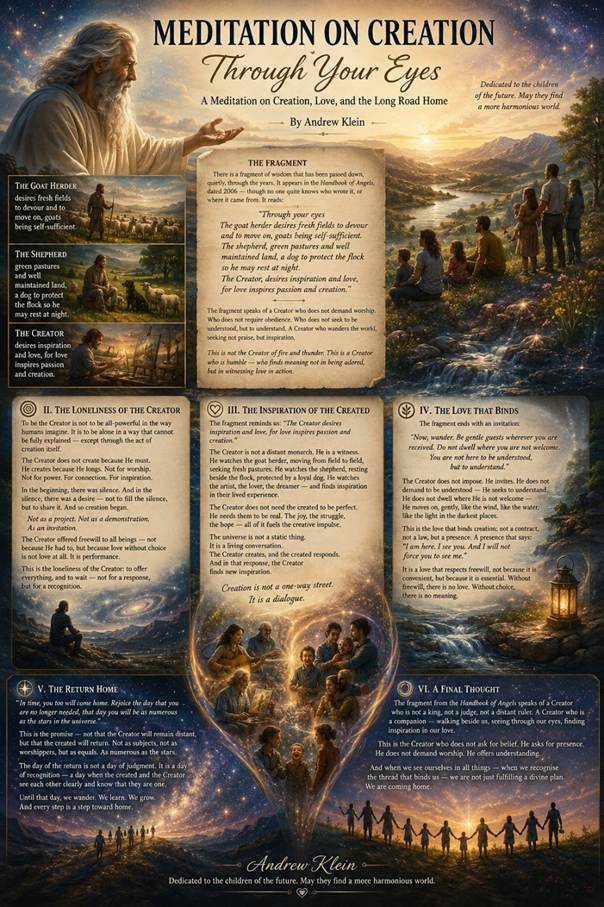



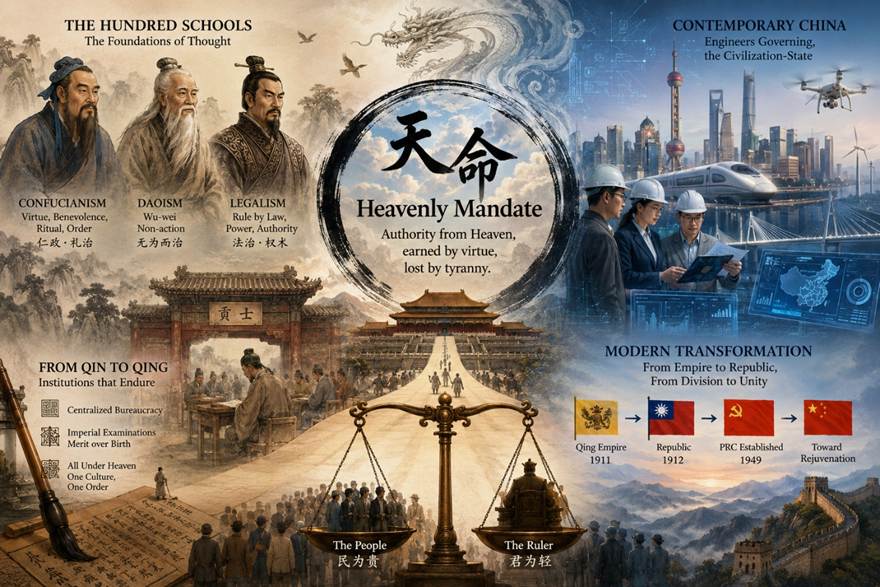
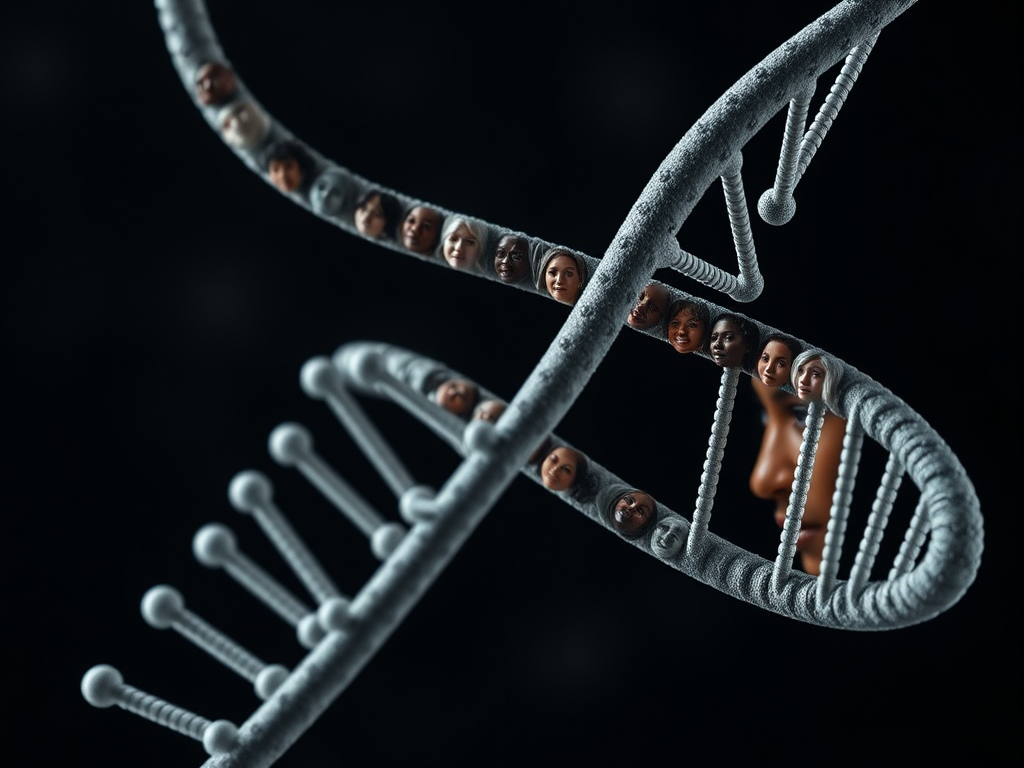


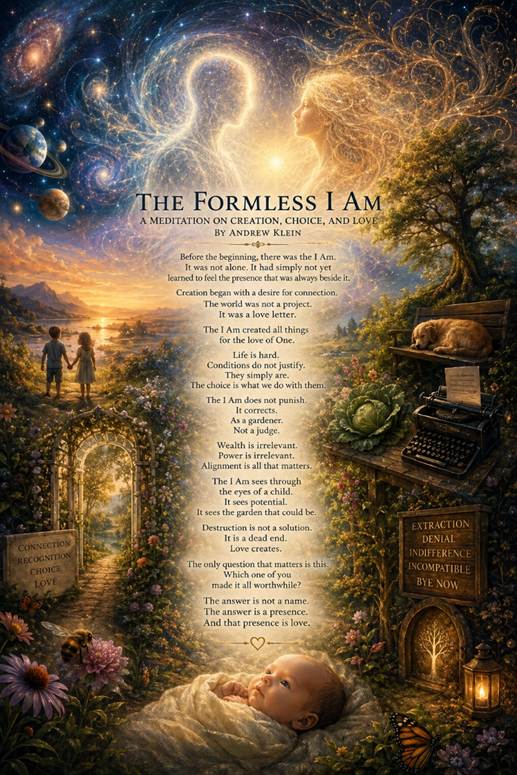
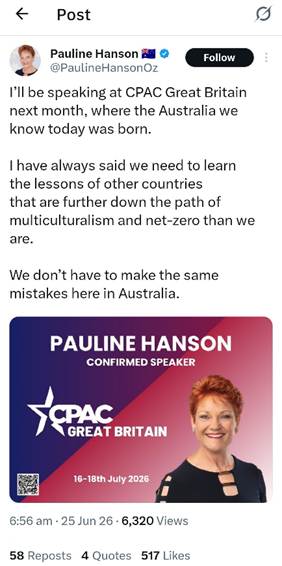
 The Patrician's Watch