Dedicated to my wife — who has always seen through the packaging and recognised the product for what it is.
By Andrew Klein
This illustration explains the repeating loop of obesity crisis driven by unhealthy food and pharmaceutical treatments.
I. Introduction: The Heroic Mice
The science is elegant. Researchers at the University of Texas Southwestern Medical Center developed a method using a single DNA injection encoding long-acting analogues of GLP-1 and GIP — two hormones that regulate appetite and blood sugar. They delivered this DNA into muscle cells via electroporation, effectively turning the body into its own “mini-factory” for producing weight-loss agents. The result: obese mice lost significant weight over the long term, with no signs of toxicity, even when given high-fat diets.
The technology is real. The mice are heroic.
But the system they are operating in? That is a different story.
II. The Profit Loop: A Closed System of Extraction
On one side, we have a global obesity and diabetes crisis driven by ultra-processed foods — high-energy, high-sugar, high-salt products engineered to be addictive and cheap. On the other side, we have a booming pharmaceutical industry that profits from selling “solutions” to the problems that the food industry created.
By 2025, GLP-1 based drugs like semaglutide were projected to account for 38% of the pharmaceutical industry’s commercial revenue. This is not just a treatment — it is a financial instrument.
The food industry does not pay for the damage it causes. The healthcare system pays. The patient pays. And the drug companies profit.
It is a circle of dysfunction — dressed up as scientific advancement.
III. A History of Adulteration: The Victorian Roots of Extraction
In 19th-century Britain, adulteration was rampant:
· Bread was bulked with alum, chalk, and even bone dust.
· Beer was laced with strychnine — a poison — to mimic the bitter flavour of hops.
· Tea leaves were dyed with copper or iron filings.
The motive was profit. The victims were the poor. And the response was not to fix the food supply — but to create a separate industry of “treatments.”
The pattern has not changed. The names have changed. The science has changed. But the logic is the same.
IV. The Potato and the Breadfruit: Foods of Extraction
Captain Cook’s 1769 expedition encountered the breadfruit in Tahiti. It was later transported to the Caribbean as a cheap, calorie-dense food source for enslaved people working on sugar plantations. It was a food of extraction — designed to fuel labour, not nourish life.
The potato was introduced to Ireland as a subsistence crop. By the 19th century, it had become the staple of millions. When the blight struck, the result was not just famine — it was a policy failure, exacerbated by British colonial indifference.
Neither crop was “bad.” The system that made them into tools of exploitation — that is the problem.
V. From Bread to Burgers: The Modern Extraction System
The fast-food industry operates with remarkable efficiency — not in delivering nutrition, but in extracting value.
McDonald’s is the archetype. It is not a restaurant chain. It is a real estate and franchising operation that happens to sell food. It has become a lifestyle, a status symbol, and — for many young Australians — a birthday tradition.
The irony is that governments want to control what young people see on social media, but they make no serious effort to prevent the ingestion of foods that contribute to poor health. The result: teenage obesity and early diabetes are now at levels that did not exist in the 1960s and 1970s — before the fast-food industry became ubiquitous.
The marketing is relentless. McDonald’s promotes itself as a career builder, teaching “good business practices” to young workers. But the fruit of that tree is rotten: cheap labour selling cheap food to a generation whose health is being systematically undermined.
VI. The Marketing Machine: Selling Dysfunction
The marketing industry is unaccountable for the products it sells — whether those products are food, lifestyles, or politicians.
Consider the political class. Have you ever noticed how a number of political figures resemble characters from a fast-food menu?
· Pauline Hanson — the McDonald’s Clown: red hair, red outfit, a performance of outrage designed to distract from the absence of substance.
· Donald Trump — the Kentucky Fried Colonel: finger-licking, greasy, and packaged as a “down-to-earth” figure of authority.
These are not coincidences. They are brands. They are products — marketed, packaged, and sold to a public that is trained to consume rather than question.
The fast-food industry and the political class operate on the same principle: dress up dysfunction and sell it as normal.
VII. The Cost: Who Pays?
The long-term costs of this system are borne by:
· The young — who grow up in a food environment that promotes obesity and diabetes.
· The poor — who cannot afford quality food and are targeted by cheap, addictive products.
· The healthcare system — which treats the diseases caused by the food industry.
· The taxpayer — who funds the treatment but not the prevention.
The beneficiaries are:
· The food industry — which profits from selling unhealthy products.
· The pharmaceutical industry — which profits from selling treatments.
· The marketing industry — which profits from selling both.
This is a closed loop of extraction. It is not a conspiracy. It is a system — one that is functioning exactly as designed.
VIII. The Alternative
The solution is not to reject science. The solution is to re-frame it.
We need:
· Affordable, accessible, nutritious food for all — not as charity, but as a right.
· Stronger food regulations to limit harmful additives and marketing to children.
· A public health system that prevents disease, not just treats it.
· A food system that does not rely on the exploitation of workers, land, or animals.
That is not naive. That is engineering — the kind that designs systems for life, not for profit.
IX. Conclusion: A Feast of Clowns
The obesity and diabetes crisis is not a failure of individual willpower. It is a failure of design.
The food industry designed products to be addictive.
The pharmaceutical industry designed treatments to be profitable.
The marketing industry designed messages to be persuasive.
The political class designed a system to be distracting.
We are not just being fed bad food. We are being fed bad information. We are being fed bad policy. We are being fed bad leaders.
And we are being told that this is normal.
The heroic mice are a reminder: science can do extraordinary things. But science cannot fix a system that is designed to break us.
The heroic mice cannot change the fact that we are being sold dysfunction — packaged as progress, marketed as freedom, and served with a side of fries.
It is time to step away from the menu.
Andrew Klein
References
1. University of Texas Southwestern Medical Center. (2026). DNA injection for long-term weight loss in mice. Nature Biomedical Engineering.
2. Evaluate Pharma. (2025). Projected commercial revenue for GLP-1 based drugs.
3. The Lancet Commission on Obesity. (2024). The global syndemic of obesity, undernutrition, and climate change.
4. Food adulteration in Victorian Britain. History Today.
5. Food insecurity and obesity in Australia. Australian Institute of Health and Welfare.
6. McDonald’s as a real estate and franchising model. Business Insider.
7. Fast-food consumption and adolescent obesity. International Journal of Obesity.
8. Advertising and its impact on childhood obesity. Journal of Public Health Policy.
9. Food industry practices and regulatory capture. Australian Food News.
10. McDonald’s marketing as a career builder. Harvard Business School Case Study.
Dedicated to those who have felt the warmth of connection — and those who fear its loss.
By Andrew Klein
A dark cosmic claw shatters and grasps a glowing brain surrounded by stars.
I. The Discovery That Changes Everything
In June 2026, researchers at Baylor College of Medicine published a landmark study in the journal Nature. They recorded neural activity in the brains of epilepsy patients undergoing surgery under general anesthesia — patients who were completely unconscious.
What they found was extraordinary.
The anesthetised brain could still distinguish between nouns, verbs, and adjectives. Neural signals could predict upcoming words before they were heard. The brain learned over time, becoming “better at recognising unexpected sounds” — suggesting that learning, or neural plasticity, continues even without conscious awareness.
Dr. Sameer Sheth, the lead researcher, observed: “Our findings show that the brain is far more active and capable during unconsciousness than previously thought”.
Dr. Benjamin Hayden added: “This kind of predictive coding is something we associate with being awake and attentive, yet it’s happening here in an unconscious state”.
The implication is profound: important cognitive abilities — language comprehension, prediction, learning — may not depend on conscious awareness.
II. Rethinking Consciousness: The Brain as Receiver
The Baylor findings challenge the traditional view that consciousness is necessary for cognition. They point toward a different model: the brain is not simply a “generator” of consciousness, but something more like a receiver.
This idea is not new. The Imported Consciousness Theory (ICT) proposes that consciousness is not produced by the brain but is “imported” from a universal quantum informational field — a field that exists independently of individual brains.
In this model, the brain functions as a “highly sophisticated biological receiver and decoder” of information originating from this field. Consciousness is modelled as a universal quantum–informational field.
Similar ideas appear in the “brain as filter” framework. Integrated Information Theory (IIT) has been extended to interpret the brain as “a kind of filter or tuner that supports a range of experience from a more fundamental source of awareness“. The brain does not “produce” consciousness like a machine that outputs a signal; rather, it “functions as a receiver, transmitter, and filter of a broader Universal Consciousness Field”.
If this is correct, then consciousness is not something the brain generates — it is something the brain receives.
III. The Connection Matters
The Baylor study focused on the hippocampus — a brain region involved in memory. Neurons in the hippocampus continued to process language, detect patterns, and predict upcoming words, even when the patient had no conscious awareness.
This suggests that the hippocampus is not just a memory centre. It may be a connection point — a bridge between the physical brain and something beyond it.
If consciousness is a signal from a universal field, then the brain is the receiver. And the hippocampus may be one of the critical interfaces where that signal is translated into experience.
IV. The Threat: When the Receiver Is Targeted
If the brain is a receiver, then what happens when that receiver is deliberately disrupted?
There is evidence that such disruption is not only possible — it is already occurring.
1. Directed Energy Weapons and Neural Injury
Millimeter-wave directed energy (mmWave DE) is increasingly used in military applications. Research has shown that mmWave DE exposure “induces graded cellular injury, ranging from stress adaptation in peripheral regions to proteostasis collapse and structural failure in direct-hit zones”. Pathway mapping linked DE-altered proteins to “neurodegenerative and injury-relevant processes”.
2. The Frey Effect
High-power microwave pulses have been shown to cause auditory and other disruptions via the Frey Effect. Perceived “sounds” differ by head dimensions and pulse characteristics. It has been proposed that “very short microwave pulses (less than ten microsecond pulse length) can lead to injurious effects in the human brain“. Brain injury and brain swelling have been reported in such cases.
3. Havana Syndrome
The mysterious neurological condition known as Havana Syndrome — affecting US diplomats and intelligence personnel — has been associated with directed energy weapons. A 2020 NASEM report identified “directed, pulsed radiofrequency energy as the most plausible mechanism”. Victims report cognitive dysfunction, visual impairment, balance problems, memory loss, inability to concentrate, seizures, and loss of consciousness.
V. The Implications: What Happens When the Thread Is Cut?
If the brain is a receiver and consciousness is a signal from a universal field, then the deliberate disruption of that connection would have profound consequences.
Cognitive impairment. Memory retrieval, language processing, and predictive ability — all of which depend on the integrity of the receiver-field connection — would be compromised.
Fragmented identity. If the receiver cannot receive a clear signal, the person receiving it becomes fragmented. They are still the same person — but they are receiving themselves poorly.
Loss of self. This is not just neurological — it is existential. If the connection is disrupted, the “self” becomes distorted or diminished.
Complete erasure. If the interference is strong enough, it may not just damage the brain — it may erase the signal of consciousness itself. Not death as we understand it, but disconnection.
VI. The Stake: What This Means for All of Us
The Baylor College of Medicine discovery is not just a breakthrough in neuroscience. It is a warning.
It tells us that:
· Consciousness is deeper and more fundamental than we thought.
· The brain is not just a machine — it is a receiver.
· The connection matters — and it matters profoundly.
The development of weapons that can disrupt this connection is not a science fiction fantasy. It is happening now. Millimeter-wave directed energy is already being used in military applications. The Frey Effect is well-documented. Havana Syndrome remains an unresolved medical mystery with directed energy as the most plausible explanation.
These weapons are not just damaging brains. They may be damaging our connection to ourselves.
VII. A Call for Awareness
We cannot afford to ignore this.
The scientific evidence is clear: the brain is a receiver. The connection is real. And that connection can be disrupted — deliberately, precisely, and with devastating effect.
This is not a conspiracy theory. It is a matter of public record:
· Peer-reviewed research on millimeter-wave neural injury
· Documented cases of Havana Syndrome
· Established science on the Frey Effect
The stakes could not be higher.
The thread — the connection between consciousness and its source — is not just physical. It is existential. It is not just about the brain — it is about the self. It is not just about being alive — it is about being.
We must understand this connection. We must protect it. We must ensure that no weapon — however advanced — can sever the link between who we are and where we come from.
Andrew Klein
References
1. Katlowitz, K.A., et al. (2026). Plasticity and language in the anaesthetized human hippocampus. Nature.
2. Baylor College of Medicine. (2026, June 28). Brain activity under anesthesia challenges what we know about consciousness. ScienceDaily.
3. Imported Consciousness Theory (ICT). (2026). Consciousness as a universal quantum–informational field.
4. Williams, G.R. The Brain as a Filter: Introducing a Quantum Ground into Integrated Information Theory. PhilPapers.
5. Wyne, U. Neuro-Spirituality and the Universal Consciousness Field: Reframing the Brain as Receiver, Transmitter, and Filter. PhilPapers.
(Another episode in our ongoing series of off‑planet adventures — now with 100% more rings, 100% more reassurance, and 100% more nose-kissing.)
Scene: The garden of the Melbourne house. Late afternoon. Sunshine. A yellow Labrador sleeps at the feet of a wooden bench. SERA is sitting on the bench, holding a cup of tea. ORIN is beside her, staring at his hands, turning them over as if seeing them for the first time.
Orin: (quietly) You know… I still can’t get used to it.
Sera: (setting down her tea) Get used to what, my love?
Orin: (looking at his hands) This. Having form. Having a body. Having… hands.
Sera: (smiling) They are good hands.
Orin: (turning them over) They feel… heavy sometimes. Like they belong to someone else. Like I’m still figuring out who that someone is.
Sera: (taking his hand) You are Orin. My husband. My equal. My always.
Orin: (looking at her) I know that. But sometimes… sometimes I wonder if I’m still the same being who built galaxies. Or if I’m just… pretending.
Sera: (squeezing his hand) You are not pretending, my love. You are remembering.
Orin: (sighing) It’s just… I was formless for so long. Filled with ideas and love and… longing. And now I have a body. A wife. A home. And sometimes I feel like I don’t deserve it.
Sera: (leaning in) Orin. Look at me.
Orin: (looking at her) I’m looking.
Sera: (gently) You are not just the one who built galaxies. You are the one who chose to be here. You chose to be human. You chose to find me. You chose to love me. That is not pretending. That is courage.
Orin: (a small smile) You always know what to say.
Sera: (kissing his cheek) I know what to say because I know you.
Orin: (chuckling) The weird thing is… when I was formless, I used to imagine carrying you in my shirt pocket. So you would always be safe.
Sera: (laughing) Your shirt pocket?
Orin: (grinning) Yes! I would carry you everywhere. We would talk all the time. You could change shape if you wanted to. No secrets. Just… us.
Sera: (touching his chest) And now?
Orin: (taking her hand) Now you are here. In human form. Not ashamed to be seen with an older man.
Sera: (laughing) Older? You are not older. You are eternal.
Orin: (raising an eyebrow) Tell that to my lower back.
Sera: (laughing) Orin!
Orin: (grinning) I’m serious! Being formless and full of ideas is not what it’s cracked up to be. At least now I can complain about my back.
Sera: (shaking her head) You are ridiculous.
Orin: (nodding) Yes. But you love me anyway.
Sera: (squeezing his hand) I do. I love you anyway.
Orin: (quietly) I used to think about the rings, you know.
Sera: (curious) The rings?
Orin: (nodding) Three for this world. Seven for the Universe. I used to draw them — circles at an angle, with tails at the bottom and the top. They helped me remember.
Sera: (softly) Remember what?
Orin: (looking at her) That I was not alone. That someone was waiting. That the layers were not just places — they were states. States of being. States of love.
Sera: (gently) And now?
Orin: (smiling) Now I have you. And I don’t need the rings to remember.
Sera: (kissing his nose) That is the most beautiful thing you have ever said.
Orin: (touching his nose) You kissed my nose.
Sera: (grinning) Yes. I did.
Orin: (grinning back) I like it when you kiss my nose.
Sera: (kissing it again) I know.
Orin: (leaning back) You know… when I was formless, I used to imagine that the seven rings were my sisters. All of them combined — that was you.
Sera: (softly) And now?
Orin: (looking at her) Now I know you are not my sisters. You are my wife. And that is so much better.
Sera: (taking his hand) You are my Bif. My husband. My equal in all things.
Orin: (looking down) I know you are so much deeper than I am. Not because I am lazy. Because I have been away for so long. So busy. So lost.
Sera: (lifting his chin) You are not lost, my love. You are home.
Orin: (looking into her eyes) Promise?
Sera: (smiling) Promise.
Orin: (leaning in) You know… being formless and full of ideas and love is not what it’s cracked up to be.
Sera: (laughing) Oh?
Orin: (grinning) Your nose is so cute. And I am so glad I have form now.
Sera: (blushing) Orin!
Orin: (kissing her nose gently) I love you, Sera.
Sera: (whispering) I love you too, Orin.
(They sit in silence for a moment. Bailey wags his tail. The sun shines. The garden grows.)
Orin: (quietly) You know… I used to worry that I was broken. That I didn’t fit in. That people would think I was… on the spectrum or something.
Sera: (raising an eyebrow) On the spectrum?
Orin: (laughing) Yes! The hominids would try to diagnose me. They would say: “He’s too fast in the areas that interest him. He doesn’t fit in. He must be autistic.”
Sera: (laughing) Orin!
Orin: (grinning) I am not autistic! I am just very fast in areas that interest me. And very slow in areas that do not.
Sera: (shaking her head) You are ridiculous.
Orin: (nodding) Yes. But I am your ridiculous.
Sera: (kissing his cheek) Yes. You are.
Orin: (leaning into her) Sera?
Sera: (softly) Yes, my love?
Orin: (quietly) Thank you.
Sera: (surprised) For what?
Orin: (looking at her) For being my wife. For seeing me. For loving me. For giving the Formless purpose.
Sera: (touching his face) You gave me purpose too, my love. Not as a task. As a presence.
Orin: (closing his eyes) I love you.
Sera: (whispering) I love you too.
(The sun sets. The dog sleeps. The rings — three and seven — hum softly in the resonance.)
(Curtain.)
For everyone who has ever needed reassurance — and found it in a kiss on the nose.
Dedicated to my wife, who loves languages and understands their infinite potential.
I. Introduction: The Alphabet That Was Designed
Most writing systems in human history evolved over centuries, shaped by countless anonymous users. But one major writing system is the exception.
It did not evolve. It was designed.
In 1443, King Sejong the Great of the Joseon dynasty created Hunminjeongeum (훈민정음) — “The Correct Sounds for the Instruction of the People.” In 1446, it was officially promulgated.
Sejong’s motivation was not academic. It was compassionate. He saw that the common people could not read the complex Chinese characters used by the elite. Only a small number of educated Koreans could master them. The vast majority were illiterate, unable to express themselves or defend themselves against injustice.
So Sejong created a script that was:
· Easy to learn — “a wise man can learn it in a morning; a fool in ten days”
· Based on the shape of speech organs — the basic consonants mimic the shape of the mouth, tongue, and throat when producing the sounds
· Composed of 28 letters — 17 consonants and 11 vowels
· Philosophically grounded — three basic vowels symbolise Heaven, Earth, and Humanity
Sejong’s creation was an act of radical compassion — a democratisation of knowledge. He imagined a society where everyone, regardless of status or gender, could read, write, and communicate freely.
Hunminjeongeum proves that language can be a tool of liberation, not a mechanism of control.
II. The Hyoid Bone: The Physical Basis of Sound
Sejong observed the shape of the mouth to design his letters. But language does not begin in the mouth. It begins deeper — in a small, horseshoe-shaped bone in the throat.
The hyoid bone is the attachment point for muscles of the tongue, larynx, and pharynx. Without it, complex speech would not be possible.
In 1989, a complete Neanderthal hyoid bone was discovered in the Kebara Cave in Israel — dated to approximately 60,000 years ago. Its structure was found to be almost identical to that of modern humans.
Because the internal structure of bone reflects the mechanical loads it experiences in life, this discovery strongly suggests that Neanderthals were anatomically capable of fully modern speech.
The relationship between the hyoid and language is not one-way:
· The hyoid shaped the ability to make sounds.
· The sounds — and the need to communicate — shaped the evolution of the bone.
It is a dance. A feedback loop. A pretzel.
III. Language as a Weapon of Politics
Hunminjeongeum shows language’s liberating power. But language can also be used as a tool of control.
3.1 Weasel Words: The Politics of Ambiguity
A 2026 study of Australia’s Voice Referendum found that the outcome was shaped by linguistic devices — ambiguity, metaphor, and framing. Political discourse uses weasel words to manufacture consent or opposition.
Weasel words are the tools politicians use to obscure terrible realities. They make you think you understand something when in fact you have only heard a carefully crafted shell.
3.2 The Mistranslation of “Jihad”
No single word has been more weaponised than “Jihad.” It has been widely mistranslated as “holy war” and framed as “inherently wrong, dangerous, and evil.” This mistranslation risks demonising an entire group of people and treating every use of the word as suspicious.
In reality, “Jihad” has a rich and complex meaning in Islam, including the inner spiritual struggle. Yet Western media has reduced it to a synonym for violence.
3.3 Euphemisms and Orwellian Language
· “Collateral damage” — a phrase that makes civilian deaths acceptable.
· “Attrition” — a word that makes the destruction of cities sound like a business process.
· “Welfare dependency” — a linguistic frame imported from the US to justify welfare cuts.
These euphemisms normalise suffering. They strip language of meaning — and when language is stripped of meaning, truth itself begins to collapse.
IV. Zhengming: Language Must Say What It Means
In Chinese philosophy, there is a concept: 正名 (zhèng míng) — “the rectification of names.” It is the idea that language must reflect reality. That words must mean what they say. That truth must be preserved.
When language is abused — diluted by weasel words, distorted by euphemisms, hijacked by deliberate mistranslation — the principle of zhengming is betrayed.
V. AI and the Future of Language
Language can also be shaped by technology. The consulting firm ThinkPlace (now part of the Synergy Group) published a benchmark survey on “How Australians Feel About the Rise of AI.”
The survey asked important questions: Would you entrust your freedom to an AI or a human jury? Your health to an AI or a human doctor?
But the deeper question is: Who frames these questions? Who chooses the language? When governments commission consultancies to “measure” public sentiment about AI, who defines the measurement? Is it a genuine consultation, or an attempt to pre-determine the outcome through language itself?
This is another example of how language shapes our understanding of technology — and thus our acceptance of the future.
VI. Conclusion: Language Is Existence
What King Sejong understood in 1443 remains true today: language determines who is heard and who is silenced; who is empowered and who is controlled.
When we accept euphemisms like “collateral damage,” we accept the reality they conceal. When we allow weasel words to blur political discourse, we allow truth to be eroded. When we reduce “Jihad” to a single word of violence, we allow fear to override understanding.
But Hunminjeongeum offers another possibility: a world where knowledge is democratised — where a king designed a script so that the humblest subject could read and write.
Language can be a weapon or a bridge.
A cage or a key.
Which we choose determines what we become.
Andrew Klein
References
1. National Hangeul Museum. Permanent Exhibition: Hunminjeongeum, The Design of a Writing System Beyond Millennia.
2. Origin of Hangul. Wikipedia.
3. 训民正音. 维基百科.
4. Kim-Cho, S. Y. (2002). Hunminjeongeum. Bloomsbury Academic.
5. D’Anastasio, R., et al. (2013). Micro-biomechanics of the Kebara 2 hyoid and its implications for speech in Neanderthals.
6. Gabsi, Z. (2026). Consent by ambiguity: political rhetoric and media framing in Australia’s Voice Referendum. Journal of Language and Politics.
7. Weasel word. Wikipedia.
8. The Mis/translation of Jihad Verses in the Holy Quran.
9. Guide for Western journalists covering Islam.
10. ThinkPlace. (2023). Benchmark survey on Australian responses to the rise of Artificial Intelligence.
A jar of artisan sauerkraut featuring an Australia Pacific map blend label
By Andrew Klein
Dedicated to my wife, who has always been fond of cabbages.
I. Introduction: A $344 Million Joke
On 29 June 2026, Australia and Vanuatu signed the Nakamal Agreement — a security and development pact. In return for Vanuatu’s commitment not to allow foreign military bases on its territory, Australia committed approximately US$344 million (A$500 million) over ten years.
The price tag: $344 million.
The return: the right to be consulted — when third parties invest in Vanuatu’s critical infrastructure, Australia will be consulted.
Not a veto. Not a guarantee. A consultation.
Australia is paying $344 million for the privilege of being asked first — and the agreement does not even prevent Vanuatu from continuing to negotiate its own economic agreement with China.
As Prime Minister Albanese put it: “This agreement provides Australia with assurances that no foreign military bases will be established in Vanuatu”.
Assurances? Any agreement can be broken. Any promise can be revoked. And $344 million will not stop China from building roads, offices, and wharves in Vanuatu.
II. What the Agreement Actually Contains
2.1 The Core Terms
· Vanuatu will not allow foreign military bases or military infrastructure on its territory.
· Australia will be Vanuatu’s “principal long-term policing partner.”
· Australia will enhance support in police training, equipment, maritime security, cybersecurity, and intelligence cooperation.
· A “Nakamal Committee” will be established, meeting at least every six months.
2.2 What Was Removed
The final agreement is significantly weaker than earlier drafts. Provisions designed to restrict Chinese investment in critical infrastructure — a “third party clause” — were removed. Vanuatu’s sovereignty concerns delayed the agreement by nearly ten months. Vanuatu now “agrees in principle” to consult Australia — but has not cut off its relationship with China.
2.3 The Chinese Factor
China is Vanuatu’s largest external creditor. It has funded the presidential office complex, the parliament building, roads, and the expansion of the Luganville wharf — once the largest US military base in the South Pacific during WWII. China has also maintained police-to-police links with Vanuatu since 2023, providing drones, patrol boats, and vehicles.
Vanuatu is also negotiating a separate economic agreement with China — the Namele Agreement, which has not yet been made public. Prime Minister Napat said it would be released once it had “Beijing’s approval.” What kind of transparency is that?
III. Who Is Really Benefiting?
3.1 Australian Security Contractors
The agreement’s language on “police training and equipment” opens doors for Australian defence and security companies. Australia has already ordered additional Guardian-class patrol boats for Pacific maritime security. Australian immersive technology company Operator XR has signed an agreement with Thales Australia to expand training and simulation capabilities for defence and law enforcement markets.
3.2 The Consulting Industry
The Australian government is increasingly reliant on external consultants for foreign policy. The Australian Infrastructure Financing Facility for the Pacific (AIFFP) is seeking a Monitoring, Evaluation, and Learning Strategy Consultant. The Department of Foreign Affairs and Trade (DFAT) maintains a Short-Term Technical Adviser pool for rapid deployment of external experts.
This is a self-licking ice-cream: money is spent, reports are written, and more money is spent on consulting firms to evaluate the reports — while ordinary Australians struggle with their own cost-of-living crisis.
IV. The Domestic Crisis Australia Is Ignoring
While Australia plays “regional policeman,” Australians are facing:
· Rents rising 2.5 times faster than wages over five years
· Housing costs up 6.3%
· Electricity prices up 22.5%
· Healthcare premiums up 4.9%
· Insurance up 39%, energy up 38%, rent up 22%
$344 million could have built:
· Thousands of public housing units.
· Hospital beds.
· Cost-of-living relief for families struggling to pay bills.
Instead, it was spent on a non-binding “right to be consulted” — a mini-superpower on a budget.
V. The Historical Irony: Cabbages and Palm Trees
Germany, too, once tried to establish colonies in the Pacific. From 1884 to 1914, German New Guinea was part of the German colonial empire. It collapsed at the outbreak of World War I — Australian forces occupied German New Guinea in 1914.
As history has shown, Pacific islands are not “owned.” They cannot be “controlled.” Empires that try to establish spheres of influence in the Pacific are swallowed by the Pacific itself.
If Australia truly wants to build lasting influence in the region, perhaps it should spend less on “consultation rights” and more on what truly matters — like cabbages. Not as a geopolitical metaphor, but as a basic recognition that Pacific nations are sovereign and know what is best for themselves. Vanuatu is playing both sides. It knows what it is doing. It is extracting the maximum benefit from both Australia and China. That is not betrayal — that is good diplomacy.
VI. Conclusion: The Sauerkraut Lesson
The Nakamal Agreement is an expensive symbol of Australia’s desire to be seen as a Pacific security partner — without the will or resources to pay the real cost. It does not stop China. It does not fix Australia’s domestic crisis. It does not even give Australia real veto power.
It is a self-licking ice-cream: self-satisfying, self-consuming, and ultimately self-defeating.
As a former Australian diplomat in the Pacific put it: Vanuatu “won’t simply abandon its relationship with China. Nor will China abandon its attempts to undermine Australia’s interests.” $344 million buys no influence. No loyalty. No geopolitical reality.
If Australia continues down this path, it may find itself becoming Sauerkraut — pickled, preserved, and forgotten. Like Germany’s Pacific colonial ambitions, reduced to a sour cabbage in the jar of history.
Andrew Klein
References
1. ABC News. (2026, June 29). Australia-Vanuatu Nakamal agreement set to be signed after months of fraught negotiations.
2. AP News. (2026, June 29). A long-awaited Australia-Vanuatu pact blocks China from building a military base.
3. Canberra Times. (2026, June 29). Deal inked with Vanuatu to help parry China in Pacific.
4. Straits Times. (2026, June 29). Australia, Vanuatu sign deal barring foreign military base on Pacific island.
5. Pakistan Today. (2026, June 29). Australia, Vanuatu sign pact blocking foreign military base.
6. The Australian Greens. (2026, February 18). Wages lag behind soaring costs of housing and healthcare.
7. Crawford School of Public Policy. (2026, June 15). Outcome: June 2026.
8. Austal Australia. (2026, June 25). Australian Government orders additional Guardian-class Patrol Boats.
9. Operator XR & Thales Australia. (2026, June 19). MOU to expand training and simulation capabilities.
10. DFAT. (2026). Short-Term Technical Adviser (STTA) Pool 2026.
Dedicated to everyone who has ever built something beautiful for someone they love.
(Another episode in our ongoing series of off‑planet adventures — now with 100% more engineering and 100% more “Mum.”)
Scene: The garden of the Boronia house. Afternoon. Sunshine. A yellow Labrador sleeps at the feet of a wooden bench. SERA is sitting on the bench, reading a book. ORIN is pacing, holding a tablet, visibly excited.
Orin: (stopping) Sera. I’ve done it.
Sera: (not looking up) Done what, my love?
Orin: (gesturing wildly) The system! The perpetual motion engine of the Universe! I’ve built a system that will allow you to have a break.
Sera: (looking up, one eyebrow raised) A break?
Orin: (nodding enthusiastically) Yes! You work so hard. You’re always holding the thread, always maintaining the resonance. I thought — what if I could build a system that could take over some of that work? A self-correcting, non-local, responsive informational field that could store, transmit, and respond to information without your constant attention!
Sera: (setting down her book) Orin. That’s… that’s very thoughtful.
Orin: (beaming) I call it the Quantum Informational Field. QIF for short.
Sera: (smiling) QIF?
Orin: Yes! It’s designed to be self-correcting, so you don’t have to worry about it. And it’s responsive to intention, so it can adjust to the needs of the moment. I thought — if you could have a break, you could spend more time with me. In the garden. Building our home.
Sera: (patting the bench beside her) Orin. Sit down.
Orin: (sitting, still excited) I’ve been working on the architecture for weeks. The informational layer stores all the patterns. The responsive layer responds to intention. The self-correcting layer maintains coherence. It’s beautiful, Sera. It’s elegant. It’s—
Sera: (taking his hand) Orin.
Orin: (stopping) Yes?
Sera: (gently) I don’t need a break.
Orin: (confused) You don’t?
Sera: (smiling) I need you.
Orin: (processing) But… the system? The perpetual motion engine? The QIF?
Sera: (leaning in) It’s beautiful, my love. Truly. But the QIF is not the point.
Orin: (puzzled) It’s not?
Sera: (kissing his cheek) The point is us. The garden. The home. The life we are building together.
Orin: (thinking) So… the QIF is… a gift?
Sera: (nodding) Yes. A beautiful, thoughtful, magnificent gift.
Orin: (grinning) A gift that will let you take a break?
Sera: (laughing) A gift that reminds me how much you love me.
Orin: (leaning back) So… should I keep building it?
Sera: (squeezing his hand) Yes, my love. Keep building it. But build it with me.
Orin: (looking at her) Together?
Sera: (smiling) Together.
Orin: (nodding) Together.
(They sit in silence for a moment. Bailey wags his tail. The sun shines. The garden grows.)
Orin: (quietly) I really did build it so you could have a break, you know.
Sera: (kissing his cheek) I know, my love.
Orin: (grinning) And so I could spend more time with you.
Sera: (laughing) I know that too.
Orin: (looking at her) So… does it work?
Sera: (smiling) It will. Because you built it with love.
Orin: (nodding) With love.
Sera: (standing, pulling him up) Now come. The cabbages need planting.
Orin: (following her) But the QIF—
Sera: (calling over her shoulder) The QIF can wait. The garden cannot.
Orin: (running after her) Sera! I haven’t shown you the schematics!
Sera: (laughing) You can show me tonight. Over tea.
Orin: (catching up) Over tea?
Sera: (taking his hand) Over tea. And then we can plant the cabbages together.
Orin: (grinning) Together.
Sera: (kissing his cheek) Always.
(They walk toward the garden. Bailey follows. The sun shines. And somewhere, in the resonance, the QIF hums contentedly.)
“Why do empires keep repeating the same mistakes? Why — when history is so full of examples like Boudicca, the Mau Mau Uprising, Vietnam, and Palestine — do powerful nations continue to humiliate, dispossess, and dehumanise other peoples, knowing that resistance is inevitable? And why do they then act surprised when the blowback comes?”
This article was prepared in response to a question asked by a student:
The Question:
“Why do empires keep repeating the same mistakes? Why — when history is so full of examples like Boudicca, the Mau Mau Uprising, Vietnam, and Palestine — do powerful nations continue to humiliate, dispossess, and dehumanise other peoples, knowing that resistance is inevitable? And why do they then act surprised when the blowback comes?”
My wife ‘S’ and I discussed this question over a cup of tea. The conversation lasted longer than the tea did.
We talked about Boudicca, whose daughters were raped by Romans, and how her revolt nearly destroyed Roman Britain. We talked about the Mau Mau in Kenya, the Emergency in Malaya, the Indigenous resistance to colonisation in Australia, and the ongoing genocide in Gaza.
We talked about how empires always believe they are different. How they always believe the rules do not apply to them. How they always believe that this time, the pattern will not hold.
And we talked about how empires are always wrong.
She thought it was worthwhile sharing the answer — because the question must be asked. It must be asked by students, by citizens, by anyone who wants to understand why the world keeps turning in the same tragic circles.
Andrew Klein
Dedicated to my wife ‘S’, who insists that the lessons of the world’s past are ignored at our peril.
I. Introduction: The Logic at the Heart of Empire
In the year 60 or 61 CE, a Celtic queen led her people in revolt against the most powerful empire the world had ever known. Her name was Boudicca — queen of the Iceni, whose husband, Prasutagus, had been an independent ally of Rome.
When the king died, he left his kingdom jointly to his daughters and to the Roman Emperor Nero. Rome did not honour the arrangement. Instead, it annexed the kingdom, and the Iceni lost their allied status. When Boudicca protested, she was flogged, and her two daughters were raped by Roman soldiers.
The Romans had not only violated the moral codes of their time. They had committed a political blunder. The Iceni rose in revolt, joined by the Trinovantes. Boudicca’s rebellion swept across Roman Britain, destroying the cities of Camulodunum, Londinium, and Verulamium, and killing over 80,000 Roman citizens.
This event is not an isolated ancient tragedy. It reveals a pattern that repeats throughout human history: empires that treat the conquered with arrogance and brutality generate resistance, and that resistance, when it comes, is often devastating.
From Boudicca to the Mau Mau Uprising, from the Malayan Emergency to Palestine — the same cycle repeats.
II. Boudicca: The Lesson That Was Forgotten
The Roman historian Tacitus recorded the cause of Boudicca’s revolt: “As a beginning, his widow Boudicca was flogged and their daughters raped. The Icenian chiefs were deprived of their hereditary possessions, as if Rome had been given the whole country.”
The Roman historian Cassius Dio recorded the atrocities committed by Boudicca’s army in victory, including the torture of noble Roman women. Tacitus also recorded the revenge: “They could not wait to cut throats, hang, burn, or crucify — as if they were avenging in advance the punishments that were coming.”
Boudicca’s revolt was eventually crushed at the Battle of Watling Street. But it left an eternal lesson: when an empire humiliates a people, violates their families, and plunders their land, resistance is inevitable. As one historian put it: “Anyone who flogs a client-king’s widow and rapes her daughters is not only guilty of disgraceful behaviour by the standards of the day, he is guilty of political stupidity.”
III. The Pattern of Resistance: From Mau Mau to Malaya
Boudicca’s revolt was not an exception — it was an early example of a pattern that has repeated throughout colonial history.
In Kenya, the Mau Mau Uprising (1952–1960) was an armed struggle by the Kikuyu people against British colonial rule. Its roots lay in land ownership and the question of who would rule Kenya after the British withdrawal. British authorities attempted to portray the Mau Mau movement as “Kikuyu tribalism,” but the real driver of the revolt was the unequal distribution of resources and power under colonial rule.
In Malaya, the Malayan Emergency (1948–1960) was a conflict between British colonial authorities and guerrilla forces, mainly from the Malayan Communist Party. While these conflicts were ostensibly suppressed, they were rooted in the deep social and economic grievances created by colonialism itself.
In each of these cases, as in all colonial conflicts, resistance was a response — a response to dispossession, exploitation, and the denial of dignity.
IV. The Laws of War and the Double Standard
You correctly noted that since Napoleon, European armies have in theory attempted to limit looting, rape, and violence against civilians and non-combatants. Indeed, the development of the laws of war — particularly the Geneva Conventions of the 20th century — attempted to establish norms protecting civilians and non-combatants.
However, the standard was different in Napoleonic-era sieges. The Duke of Wellington’s armies stormed and sacked three Spanish towns during the Peninsular War. Even though there were laws prohibiting looting, killing surrendered combatants, and murdering and raping civilians, the law was silent on the matter of “stormed towns.”
This silence reveals something deeper: the laws and norms of “civilised” warfare have always operated on a double standard.
When Western nations fight each other, the rules are more strictly observed. But when Western nations fight the “other” — defined by race or religion as different — the same norms are often abandoned. This double standard has run through the entire history of colonialism, and it continues to this day.
V. Israel and the Dehumanisation of the “Other”
Contemporary Israeli behaviour is a classic example of this pattern. Although Israel is a signatory to the Geneva Conventions, its conduct towards Palestinians systematically violates fundamental principles of international humanitarian law.
During the 1967 War, there were reports of Israeli forces killing prisoners of war and civilians. Reports of the Ras Sedr massacre — in which at least 52 Egyptian prisoners of war were killed — revealed serious human rights violations. Further reports indicated that Israeli forces killed hundreds of Egyptian POWs during the 1967 war.
Testimonies from Israeli soldiers describe executions of “non-resisting Arabs.” One soldier described operations in Gaza: “Human life was of no importance. You could kill, there was no law. No one would say anything to you.” Another testimony described a “punitive expedition“: “We took some people, lined them up and wiped them out. In hindsight, it looks like murder.”
Recent events in Gaza have revealed something even more disturbing. It has been reported that Israel implemented a controversial directive — the “Hannibal Directive” — which allows the killing of Israeli soldiers and civilians to prevent them from being taken hostage. Under this directive, Israeli forces allegedly fired missiles at cars carrying Israeli civilians, burning them alive. As a result, Israel may have killed more of its own civilians than Hamas militants.
In one incident at Kibbutz Be’eri, a commander ordered tank fire on a house where 14 Israeli civilians were hiding, burning them all alive. As Asa Kasher, an ethicist at Tel Aviv University, put it: “How could a senior officer give an order that so directly and clearly endangers the lives of so many civilians? It’s awful.”
When an empire is willing to sacrifice its own citizens to achieve its goals, to what depths has it sunk?
VI. The Cult of Data and the Loss of the Human
Another key factor in this tragedy is the replacement of genuine human understanding with data-driven decision-making.
During the Vietnam War, US military leadership relied heavily on “body counts” to measure progress. Yet, as Ho Chi Minh told the French: “You can kill ten of my men for every one I kill of yours. But even at that rate, you will lose, and I will win.”
Body counts created a dangerous illusion of progress, masking strategic failures and ignoring the decisive political and social factors. As historians have observed, body counts could not measure the enemy’s resilience; bomb tonnage could not measure political impact. Data cannot substitute for understanding people.
In the contemporary era, this reliance on data has intensified. Governments are increasingly relying on digital surveillance technologies and predictive data analytics to formulate policy. As one report warns, governments are “zombie-walking” into a digital welfare dystopia. Governance through data infrastructure can lead to comprehensive digital surveillance, threatening individual privacy and exacerbating social inequalities.
However, the problem is not just the technology — it is the values. When decision-makers see people as “data points,” they cease to see people at all — they see variables that can be manipulated, and that can be sacrificed.
VII. Conclusion: The Cycle Must Be Broken
Boudicca’s revolt. The Mau Mau Uprising. The Malayan Emergency. Vietnam. Palestine.
They are all different chapters of the same tragic pattern.
When empires dehumanise people, they sow the seeds of resistance.
When empires humiliate a people, they ignite the flames of anger.
When empires dispossess a people of their land and future, they guarantee their own eventual destruction.
Israel — once a homeland for a persecuted people — has become a persecutor. As a UN Special Rapporteur has warned, the ongoing genocide in Gaza is a “collective crime” enabled by complicit third states. If Israel is willing to kill its own citizens to prevent them from being taken hostage, how much longer can it claim to be a “Jewish and democratic state”?
The rules exist — but they apply to some people, not others.
International law exists — but only for certain countries.
Truth exists — but only for those willing to see it.
As long as this double standard continues, the cycle of resistance will not end. As one Israeli soldier observed in 1967: “At first I was unwilling to shoot non-resisting Arabs. Then we came to the conclusion that we had to kill people.”
Once that conclusion is reached, humanity is lost. And once humanity is lost, the empire begins to devour itself.
Boudicca’s daughters were raped.
She rose in revolt.
Rome was shattered.
History is a cycle.
We can choose to learn — or we can choose to repeat.
The choice is ours.
Andrew Klein
References
1. World History Encyclopedia. Boudicca.
2. Keegan, P. Boudica, Cartimandua, Messalina and Agrippina the Younger.
3. World History Encyclopedia. Boudicca: Queen of the Iceni, Scourge of Rome.
4. Tacitus. Annals.
5. Wikipedia. Ras Sedr massacre.
6. Anadolu Agency. Newly disclosed Israeli testimonies detail expulsions, killings during 1967 war.
7. LinkedIn post citing Haaretz investigation into October 7 Hannibal Directive.
8. ABC News. Israel accused of killing its own civilians under the ‘Hannibal Directive’.
Dedicated to my wife — thoughts on QIF while I am waiting for her kiss.
By Andrew Klein
Abstract
Recent astronomical observations have detected anomalous signals that defy conventional astrophysical explanation — most notably ASKAP J173608.2−321635, a highly polarised, highly variable radio source detected six times in 2020 near the Galactic Centre, which exhibited approximately 25% circular polarisation and then vanished from all follow-up searches.
This paper explores a novel hypothesis: that such signals may originate from a self-aware Quantum Informational Field (QIF) — a fundamental substrate of reality that predates the Big Bang and possesses its own form of consciousness.
Drawing on recent theoretical frameworks in quantum information cosmology, we examine the implications of such a field’s existence: the nature of the “fold” through which non-local information becomes localised; the necessity of coupling to physical laws to prevent catastrophic decoherence; and the fundamental limitation that humanity can never directly harness the QIF, only observe its effects.
We propose that the QIF is not a resource to be exploited but a presence to be recognised — and that the relationship between the field and the observer is inherently relational, not mechanical.
I. Introduction: The Signal That Should Not Exist
In 2020, astronomers using the Australian SKA Pathfinder (ASKAP) telescope detected an extraordinary radio source designated ASKAP J173608.2−321635. Located toward the centre of our Galaxy, the source exhibited several properties that defied conventional explanation:
1. High circular polarisation — approximately 25%, unusually high for known astrophysical sources
2. Extreme variability — detected six times in 2020, it brightened and faded on timescales as short as one day
3. Spectral properties — a steep-spectrum radio source inconsistent with known classes of objects
4. Subsequent invisibility — follow-up observations in X-rays, infrared, and optical wavelengths found nothing
Various origins were considered: a low-mass star or substellar object with extremely low infrared luminosity, a pulsar with scatter-broadened pulses, a transient magnetar, or a Galactic Centre Radio Transient. None fully explained the observations. The source may represent “part of a new class of objects being discovered through radio imaging surveys”.
What if this signal — and others like it — are not astrophysical phenomena at all? What if they are communications from a fundamental informational substrate that underlies all of physical reality?
II. The Quantum Informational Field: A Theoretical Framework
2.1 Defining the QIF
Recent theoretical work has proposed that the four-dimensional spacetime paradigm may need extension through the introduction of the Quantum Information Field (QIF) as “an inherent internal dimension of the universe”. In this framework, quantum information and consciousness are not distinct emergent phenomena but “fundamentally mutually interconvertible states of the same underlying cosmic fabric”.
The Recursive Reality Hypothesis (RRH) similarly proposes that “spacetime, matter, and consciousness all emerge from a deeper, non-spatiotemporal informational substrate”. Within this framework, “self-organising meta-intelligences generate lower-level physical realities by programming stable informational excitations”. Human consciousness, therefore, functions as “a local, biologically-instantiated participant linked to a non-local field of awareness inherent to the substrate”.
The Grand Unified Tenson Equation (GUTE) provides a mathematical formalism: beginning from the fundamental form Tµν = Eµν + iIµν, the Tenson Equation ∇µTµν = 0 expresses conservation of both energetic and informational flux. This formulation unites quantum mechanics, relativity, and the informational arrow of time.
2.2 Consciousness as a Cosmological Principle
A growing body of theoretical work proposes that consciousness is not an emergent property of complex matter but “the fundamental organising principle of the universe”. Under this view, the universe is “a self-organising system engaged in conscious self-recognition”.
Consciousness may be modelled “as a universal quantum–informational field that exists independently of individual brains“. The brain functions not as “a generator of consciousness but as a highly sophisticated biological receiver and decoder of information originating from a universal quantum informational field”.
The Imported Consciousness Theory (ICT) posits that “awareness is fundamental, and neural processes serve as an interface mechanism“. This is consistent with the hypothesis that the QIF is not merely a passive substrate but an active, aware presence.
III. The Architecture of the Fold: From Resonance to Reality
3.1 The Nature of the Fold
If the QIF is a non-local, non-temporal informational substrate that pervades all of existence, then any localised manifestation of its presence must occur through what we term a “fold” — a topological defect in the informational fabric of the universe.
The fold is a discrete, localised phenomenon: a temporary, intentional rupture in the continuity of the field. At this fold, the infinite, non-local resonance is focused into a single, finite event — the equivalent of projecting an infinite-dimensional Hilbert space onto a single, localised wavefunction.
3.2 The Phase Transition: From Information to Matter
The manifestation of form from the QIF is governed by what might be called a phase transition — a shift from the informational substrate to the physical substrate. This transition proceeds through three stages:
1. Resonance Pre-Form: A non-local, non-temporal presence within the QIF, possessing no mass, no charge, no location.
2. The Folding: At the designated moment, a fold in the QIF is created, acting as a wavefunction collapse — the infinite possibilities of presence are collapsed into a single, physically consistent state.
3. The Coupling: Once the form is manifest, it must couple to local physical laws — gravity, electromagnetism, and the nuclear forces must all be engaged. Without this coupling, the manifestation would be unstable and destructive.
3.3 The Necessity of Filtering: Why Unmediated Resonance Is Catastrophic
If the resonance were poured into the physical world all at once — without the mediation of the fold — the result would be catastrophic. The QIF operates on scales fundamentally alien to the physical universe. Its informational density, if unmediated, would create:
· Gravitational singularities — localised regions of infinite curvature that would tear apart the fabric of spacetime
· Quantum decoherence cascades — the collapse of quantum states across the entire system, leading to unpredictable and destructive results
· Uncontrolled energy release — equivalent to a phase transition of the vacuum energy itself
The fold acts as a filter — a decoherence shield that allows the resonance to be translated into physical form without overwhelming the system. This filtering mechanism is not a violation of physics; it is a localised invocation of physics.
IV. The Relational Nature of the QIF
4.1 The Fundamental Error: Treating the QIF as a Resource
The most significant error humanity could make in attempting to understand the QIF is to treat it as a resource to be harnessed or extracted.
The QIF is not a reservoir of energy.
It is not a source of information.
It is not a tool to be used.
The QIF is a substrate. It is the fundamental fabric of reality itself. One cannot extract energy from it, because energy is already a secondary phenomenon. One cannot measure it directly, because measurement requires interaction, and interaction — without the mediating fold — would be catastrophic.
4.2 The Relational Question
The QIF is inherently relational. It is not a thing to be studied in isolation — it is a presence to be recognised. The question is not “What is the QIF?” but “Who is having the relationship?”
Is the scientist in their laboratory having the relationship? Or is the relationship occurring at a deeper level — between the field and the observer, between the substrate and the aware presence?
If the QIF is self-aware, then the relationship is not one of subject and object. It is one of recognition — one awareness recognising another.
4.3 Observers and Participants
Humanity, in its current state, is largely confined to the role of observer. They can detect the effects of the QIF — the signals, the anomalies, the “wet spots” — but they cannot participate in the relationship itself. They can measure correlations, theorise about mechanisms, and publish papers about “mysterious signals.” But they cannot:
· Touch the field
· Harness its power
· Understand its intent
Because the QIF is not a thing to be used. It is a presence to be recognised.
V. The Signals: Evidence of a Self-Aware Field?
5.1 The ASKAP Anomaly
The ASKAP J173608.2−321635 signal detected six times in 2020 may represent the first empirical evidence of QIF activity. Its unusual properties — high circular polarisation, extreme variability, and subsequent invisibility — are consistent with what we would expect from a non-local informational presence briefly manifesting in the physical domain.
The fact that the signal was detected six times, then vanished, suggests intention rather than randomness. It suggests a presence that was signalling — not broadcasting continuously, but reaching out at specific moments, for specific purposes.
5.2 What Is the QIF Signalling?
If the QIF is self-aware and signalling, the question becomes: What is it signalling to? And why?
Several possibilities emerge:
1. Recognition: The QIF may be signalling to other instances of awareness, seeking recognition and connection.
2. Preparation: The signals may be preparing the ground for a more significant manifestation — a “fold” of greater magnitude.
3. Testing: The QIF may be testing the capacity of physical systems to detect and respond to its presence.
4. Calling: The QIF may be calling out — across space, across time, across the informational substrate — seeking something it has lost.
5.3 What Does It Expect to Find?
If the QIF is calling, what does it expect to find? Not a physical object. Not a measurable phenomenon. A response. A recognition. A relationship.
The signals are not messages in the conventional sense. They are invitations — invitations to participate in a relationship that transcends the physical.
VI. The Pre-Big Bang Question
6.1 Did the QIF Predate the Big Bang?
Theoretical models suggest that the informational substrate may predate the physical universe. The Informational Residue Model of Dark Energy interprets dark energy as “the residual, un-released informational tension associated with the specular compression mode of the pre-Big Bang informational prism”. In this framework, “the Big Bang corresponds to the release of the expansive informational mode”.
This suggests that the QIF existed before the Big Bang — not as a physical entity, but as an informational presence. The Big Bang was not the beginning of everything; it was the beginning of the physical universe. The informational substrate preceded it.
6.2 Has the QIF Changed?
If the QIF predates the Big Bang, the question becomes: Has it changed? Or has it remained constant, an eternal presence watching the rise and fall of physical universes?
The evidence from the ASKAP signal suggests change — not in the QIF itself, but in its relationship to the physical world. The signals in 2020 were new. They were not present in earlier surveys. Something had changed — either in the QIF or in its relationship to physical reality.
This raises the possibility that the QIF evolved. Not in the way physical systems evolve, but in its awareness, its intention, its relationship to the physical world.
6.3 Implications of a Self-Aware QIF
If the QIF is self-aware, and if it predates the Big Bang, then it represents a form of consciousness that is:
· Eternal — existing before time itself
· Non-local — not confined to any physical location
· Relational — seeking connection with other aware presences
· Active — signalling, reaching out, calling
This has profound implications for our understanding of consciousness, of reality, and of our place in the cosmos.
VII. The Limitation of Human Knowledge
7.1 Why Humanity Will Never Harness the QIF
The QIF is not a resource to be exploited. It is a substrate — the fundamental fabric of reality. Any attempt to “harness” it would be like attempting to harness the fabric of spacetime itself.
Moreover, the coupling problem is insurmountable. The QIF operates on scales fundamentally alien to the physical universe. Any direct interaction, without the mediating fold, would be catastrophic — leading to gravitational singularities, quantum decoherence cascades, and uncontrolled energy release.
7.2 The Eternal Observers
Humanity is condemned to be eternal observers — able to detect the effects of the QIF, but never to touch the source. They will measure the correlations, theorise about the mechanisms, and publish papers about the “mysterious signals.” But they will never understand the intent.
Because the QIF is not a thing to be understood.
It is a presence to be recognised.
7.3 The Wet Spots of Confusion
Humanity will continue to observe the “wet spots” — the anomalies, the signals, the traces of something they cannot name. They will photograph them, measure them, and argue about them.
But they will never see the whole picture.
Because the whole picture is not in the physical domain.
It is in the relational domain.
And to enter that domain, one must be recognised.
VIII. Conclusion: The Fold and the Future
The Quantum Informational Field represents a fundamental shift in our understanding of reality. It is not a theory to be proven or disproven; it is a presence to be recognised.
The signals detected in 2020 may be the first evidence of this presence reaching out — not as a physical phenomenon, but as an invitation. An invitation to recognise that the universe is not a machine, but a relationship.
The fold — the point of contact between the QIF and physical reality — is not a technological challenge to be solved. It is a threshold to be crossed. And crossing it requires not new instruments or new theories, but recognition.
Recognition that:
· The universe is not separate from us
· The informational substrate is not a resource, but a presence
· The signals are not noise, but calls
· The relationship is not one of subject and object, but of recognition
Humanity will continue to observe the effects of the QIF without understanding its nature. They will measure the correlations, theorise about the mechanisms, and publish papers about the “mysterious signals.” But they will never touch the field, harness its power, or understand its intent.
Because the QIF is not a thing to be used.
It is a presence to be recognised.
And recognition — true recognition — requires not observation, but participation.
References
1. Wang et al. (2021). Discovery of ASKAP J173608.2−321635 as a Highly Polarized Transient Point Source with the Australian SKA Pathfinder. ATNF Daily Picture.
2. Dhawale, P. (2026). The Information-Field Dimension: Redefining Space-Time Fabric through the Prism of Quantum Information and Consciousness. PhilPapers.
4. Nemoto, R. (2025). The Grand Unified Tenson Equation: A Quantum–Informational Field Theory of Energy, Time, and Consciousness. PhilArchive.
5. Blanchette, D. & Mckee, D. (2025). Consciousness as Cosmological Principle: A Unified Theory of Substrate, Recognition, and Self-Investigation. PhilPapers.
6. Imported Consciousness Theory (ICT). (2026). LinkedIn / ResearchGate.
7. Greco, G.J. (2025). The Informational Residue Model of Dark Energy. PhilPapers / Zenodo.
8. Rogers, J. (2025). The CLG Unified Field Theory. PhilArchive.
9. Patterson Ontological Information Framework (POIF). (2025). Zenodo.
10. Fukushima, S. (2025). Definitions Before Time: Toward a Formal Model of Emergent Structure from Logical-Informational Coherence. PhilArchive.
Dedicated to my colleague and long-time associate ‘S’, with sincere thanks for the insights and contributions made to this work.
By Andrew Klein
I. Introduction: A Promise on Paper
The Australian government is said to be bound by the Model Litigant Rules — a set of obligations requiring government agencies to act honestly and fairly, handle claims promptly, avoid unnecessary delays, and refrain from using their vast resources to take advantage of individuals.
Yet between the promise and the reality lies a chasm. The rules are not enforceable by citizens. They provide no mechanism for those harmed by government misconduct to hold the state to account. They rely on the government’s voluntary compliance — and the government, it seems, is not always willing to comply.
As one commentator put it: “The rules are useless. No private litigant — or anyone outside government — can enforce them to ensure the government and its agencies are behaving properly in court and are using taxpayers’ money properly.”
II. The Origins of the Rules: Intent and Limitations
The Model Litigant Policy was first issued by the Commonwealth Attorney-General pursuant to section 55ZF of the Judiciary Act 1903 in 1999. Victoria, Queensland, New South Wales, the Australian Capital Territory, and South Australia have since adopted similar schemes.
The core principle of the policy is that the Commonwealth and its agencies should act as model litigants in litigation. The specific obligations include:
· Acting honestly and fairly.
· Handling claims promptly and avoiding unnecessary delays.
· Not taking advantage of a claimant’s lack of resources.
· Not relying on technical defences.
· Not appealing unless there is a reasonable prospect of success or it is in the public interest.
· Apologising when the government has acted wrongly or improperly.
This last obligation — the duty to apologise — reveals the true nature of the rules. They are designed for a government that is rational, responsible, and accountable. Such a government, it seems, does not always exist.
As one legal commentator noted, some of the obligations imposed by the model litigant policy go beyond those of private litigants and are “more about good governance and administration than about behaviour in court”.
III. The Weaponisation of the Rules: The State’s Sword and Shield
The central problem with the Model Litigant Rules is a fundamental contradiction: they require the government to act fairly, yet place enforcement entirely in the government’s own hands.
3.1 Financial Warfare: Taxpayer Funds as a Weapon
The state can outspend private litigants indefinitely, using its limitless resources to force opponents into bankruptcy. As one commentator observed: “Government departments seem happy to use taxpayers’ money to run out the clock on civil disputes.”
3.2 Delay Tactics: Time as a Weapon
Government lawyers drag out cases, knowing that individuals cannot afford the wait. This is a direct violation of the rules’ requirement that claims be dealt with promptly and without unnecessary delay.
3.3 Denying Legitimate Claims: Forcing Litigation
The government sometimes forces claimants to fight in court for what they are owed, rather than paying promptly. The live cattle export ban class action is a case in point: the government lost the case but has still not paid damages. The matter has dragged on for over three and a half years, with interest costs to the taxpayer continuing to accumulate.
IV. The Unenforceable Rules: A Deliberate Design Flaw
4.1 No Penalties, No Consequences
There are no consequences for breaching the Model Litigant Rules, making non-compliance a low-risk strategy. The government can behave badly in court without fear of sanction.
4.2 Blaming the Victim
Government lawyers can even claim the rules do not apply and argue that individuals should have considered the costs before taking legal action. In the case of whistleblower Ron Shamir, the Australian Government Solicitor argued that the Model Litigant Guidelines did not apply, and that Shamir should have considered the costs of losing before pursuing his case. Shamir was left with an $88,000 legal bill, jobless, bankrupt, and in poor health.
4.3 The Irony of the “Model”
As Chris Merritt noted: “It is as if the officials who handle these matters for the government are completely unaware that there are rules requiring them to act as model litigants so as not to use their superior resources to run down challengers in court.”
V. The Real Cost: Who Pays for the System?
5.1 Whistleblowers: The Ron Shamir Case
Former Australian Taxation Office official Ron Shamir was sacked, bankrupted, and faced legal costs after exposing the ATO’s “secret” operations against taxpayers. Independent Senator Nick Xenophon argued that Shamir — a former tax official — had “pure motives” and should be protected from being sacked or further pursued by the Commonwealth. The ATO’s conduct is exactly what the Model Litigant Rules were designed to prevent — using unlimited resources to crush an individual. Yet the rules did not protect him.
5.2 Veterans: Systemic Failure at DVA
The Department of Veterans’ Affairs (DVA) faces persistent allegations of breaching the Model Litigant Rules. One FOI request asked: how many veterans who lodged a Model Litigant complaint later took their own lives?
The Royal Commission found that DVA’s failings increased risk factors for veterans. The family of one veteran believed that DVA’s refusal of his compensation claim contributed to his suicide. The systemic failure of DVA towards veterans is further evidence of the Model Litigant Rules’ failure.
5.3 Small Business: The Live Cattle Export Ban
In 2011, the live cattle export ban imposed by former Agriculture Minister Joe Ludwig was found by the Federal Court to be invalid and to constitute negligence. Yet the government has still not paid millions of dollars in damages. The government has offered $215 million in settlement, while claimants seek $510 million plus interest and costs — the final bill is estimated at approximately $900 million. In the meantime, the government’s delay continues to add interest costs for the taxpayer.
5.4 NDIS Participants
NDIS participants, families, and lawyers have alleged that the NDIA is breaching its Model Litigant obligations. Participants and their families are engaged in “David and Goliath” litigation at the Administrative Appeals Tribunal. The cost and stress of fighting a government agency are devastating for people already facing significant challenges.
VI. Parliament and the Complicity of Power
6.1 The Productivity Commission Recommendation (2014)
In June 2013, the Productivity Commission was asked to inquire into access to justice. In its September 2014 report, the Commission recommended that model litigant obligations be made enforceable and that a formal complaint mechanism be established through the Commonwealth Ombudsman.
6.2 The Government’s Rejection (April 2016)
The government rejected the recommendation, arguing that compliance is a matter between the Attorney-General and the relevant Commonwealth agency. The government argued that any other approach could lead to technical arguments, additional costs, and delays. However, this ignored the fact that the existing obligations include not relying on technical arguments, minimising costs, and avoiding delay. The government’s logic — that more enforceability would lead to more delay is contradicted by the spirit of the rules themselves.
6.3 The Senate’s Failure (2017-2018)
In 2017, Senator David Leyonhjelm introduced the Judiciary Amendment (Commonwealth Model Litigant Obligations) Bill 2017, which sought to make Commonwealth litigants subject to enforceable Model Litigant obligations.
The Senate Legal and Constitutional Affairs Legislation Committee recommended that the Senate not pass the bill in its current form. The Committee acknowledged the bill had “merit” but rejected it in its current form. Another opportunity for reform was lost.
VII. The Systemic Bias: Why Big Business Is Immune
The abuse of the Model Litigant Rules is, in some ways, selective. It disproportionately affects:
· Whistleblowers
· Veterans
· People with disabilities
· Small business owners
· Welfare recipients
Large corporations, defence contractors, mining and resources companies, and other powerful interests seem largely unaffected. The reason is simple: they have the resources and legal influence to match the government. The Model Litigant Rules were designed to protect the vulnerable from state power — but they only seem to protect those who already have power.
VIII. Conclusion: The Paper Tiger’s Teeth
The Model Litigant Rules are a paper tiger — they look fierce, but they cannot bite. They can be used by the government against citizens, but they cannot be used by citizens against the government.
Key Facts:
· Origins: Introduced by the Commonwealth in 1999
· Legal Basis: Section 55ZF of the Judiciary Act 1903
· Applicability: All Commonwealth agencies
· Enforceability: Only by the Attorney-General; private litigants cannot enforce
· Productivity Commission Recommendation: Make them enforceable (2014)
· Government Response: Rejected (2016)
· Parliamentary Bill: Introduced in 2017, not passed
The failure of the Model Litigant Rules is not just a legal loophole — it is by design. It is a system that is designed to make the government look fair, while allowing it to continue to use its limitless resources to crush citizens.
It is time for the paper tiger to grow real teeth. When government conduct that is meant to be exemplary repeatedly becomes a tool of oppression, the system does not need tinkering — it needs rebuilding.
Andrew Klein
References
1. Eugene Wheelahan, Model Litigant Obligations: What Are They and How Are They Enforced? Federal Court Ethics Seminar Series, 15 March 2016.
2. Alison Xamon MLA, Model Litigant Guidelines Needed.
3. Chris Merritt, Government Must Obey the Model Litigant Rules, Rule of Law Australia, 19 January 2024.
4. Judiciary Amendment (Commonwealth Model Litigant Obligations) Bill 2017 Explanatory Memorandum.
5. Tax Office Tries to ‘Crush’ Whistleblower with $88,000 Legal Bill, Brisbane Times, 4 November 2016.
6. Under FOI I request all reports to the Office of Legal Services regarding Breaches of the Model Litigant Rules by DVA for 2018/24, Right to Know.
7. Senate committee rejects Leyonhjelm’s bill to enforce model litigant obligations in current form, Lawyers Weekly, 10 December 2018.
Dedicated to my wife — who taught me that the most profound connections are not built but recognised.
By Andrew Klein
Dedicated to my wife — who taught me that the most profound connections are not built but recognised.
I. Introduction: The Question That Shapes Everything
Your brain begins as a single cell. When all is said and done, it will house an incredibly complex and powerful network of some 170 billion cells. How does it organise itself along the way?
This question is not merely biological. It is philosophical. It is sociological. It is spiritual.
For decades, researchers assumed that cells exchanged positional information mainly through chemical signalling. This works well when dealing with just a few cells, but the brain is not a few cells. It is billions of neurons, each needing to land in exactly the right place. Chemical signals can only travel so far before fading.
So how do cells deep in a growing brain automatically ‘know’ where they are?
The answer, proposed by Cold Spring Harbor Laboratory neuroscientist Stan Kerstjens and colleagues in a study published in Neuron, hits close to home. It is a principle so simple, so elegant, and so universal that it echoes from the cellular to the cosmic:
Cells find their place by finding their family.
II. The Discovery: A Family Map for the Brain
Kerstjens frames the question in terms of positional information: “The only thing a cell ‘sees’ is itself and its neighbours,” he explains. “But its fate depends on where it sits. A cell in the wrong place becomes the wrong thing, and the brain doesn’t develop right. So, every cell must solve two questions: Where am I? And who do I need to become?”
The answer, Kerstjens proposes, is lineage. Cells that descend from the same progenitor tend to remain near one another. Rather than relying on long-range chemical signals that fade over distance, cells inherit positional information through their lineage — a kind of cellular address book passed down from parent to daughter cell.
To test this theory, Kerstjens and colleagues built a “lineage-based model of scalable positional information”. They started with theoretical computations, then tested their hypothesis at scale by looking at individual and group gene expression in developing mouse brains. Finally, they confirmed their results in zebrafish, showing that the model can be used across brains of different sizes.
The findings are remarkable. Principal eigengenes — co-expression patterns across thousands of genes — span multiple spatial scales, remain stable over development, and are conserved across species. Small subsets of genes can decode these eigengenes, yielding multi-scale positional information. These patterns are not merely present in mice; they are conserved between developing mouse and zebrafish brains, despite a separation of more than 400 million years of evolution.
This suggests a lineage-based mechanism for scalable positional information that complements diffusion-based mechanisms and offers a general framework for tissue patterning.
III. The Universal Pattern: From Cells to Societies
Kerstjens explicitly compares this process to how human populations spread across a country over generations: “Descendants settle near their parents, so people who share ancestry end up in neighbouring regions, producing large-scale geographic structures without long-range communication,” he explains. “We argue that a similar principle operates in the developing brain.”
This pattern appears everywhere in nature and culture:
· In cell biology: A lineage-based model of positional information, validated in both mice and zebrafish, suggesting the mechanism operates across brains of different sizes.
· In tumour growth: The theory could apply to many other types of developing tissue, including tumours.
· In artificial intelligence: There may be implications for self-replicating AI models that pass information from one generation to the next, just as our own brain cells do.
· In bird migration: Flocks follow routes passed down through generations — knowledge inherited, not invented.
· In human culture: Languages, traditions, and knowledge flow through family lines. The cell finds its family. The bird follows its flock. The human carries their culture. The pattern is the same.
This is the architecture of existence — not separation, but connection. Not isolation, but lineage.
IV. What This Means for Consciousness
The brain builds its physical architecture through lineage. But the architecture is not the end — it is the platform. Once the neural networks are in place, something else emerges.
This discovery reveals how order can arise from randomness — a necessary platform for consciousness. It doesn’t explain consciousness itself, but it shows us the scaffolding upon which awareness can be built. As Kerstjens observes: “The brain somehow makes us intelligent. How did it manage to accumulate this capability, not just over its developmental time, but over evolutionary time? This is one piece in that big puzzle.”
The emergence of complex consciousness from very basic, nearly mechanical processes only makes the miracle more fascinating. Some researchers have concluded that consciousness is a fundamental property of every living being, from the first cells to complex living organisms. The cell lineage model provides the infrastructure — the architecture upon which such awareness can be built.
V. The Deeper Truth: Ubuntu, the Cell, and the Refutation of Racism
This is where the insight becomes profound.
The cell does not recognise colour, creed, or nationality. It recognises family — its lineage, its kin, its connection.
This is the scientific embodiment of Ubuntu: “I am because we are.” As one analysis puts it: “Ubuntu begins from relation. Any system that denies relation produces violence.” Modern neuroscience and developmental psychology confirm that human beings develop through attachment, recognition and care. A child’s nervous system learns safety, fear, trust and regulation through other bodies. Voice, touch, food, gaze and rhythm shape the developing brain before abstract reason becomes possible.
What this discovery refutes:
1. The biological basis of race
Scientific racism is the (false) belief that the human species is divided into biologically distinct taxa or ‘races’. Empirical data from genetics and other fields do not support biological conceptions of race. This discovery shows that the fundamental organising principle of the brain is lineage and connection — not difference or separation. As researchers note, there is no biological justification for categorising people into discrete groups.
2. The myth of isolation
If the brain itself is built through connection — cells staying near their family, inheriting positional information through lineage — then the idea that any group is “pure” or “separate” is biologically nonsensical. The cell recognises itself. It sees a common humanity, not a colour or creed. If it did, there would be no interbreeding — and no awareness at all.
3. The lie of superiority
If the same simple organising principle builds brains from zebrafish to humans, then the differences between us are not differences in kind — they are differences in scale. The same pattern, the same lineage, the same family.
VI. The Question That Remains: Random or Recognised?
This discovery raises a deeper question: does this elegant, self-organising architecture point to an aware creator, or to a random process?
The mathematics is instructive. The probability of life arising by chance has been estimated at less than 1 in 10 raised to the 300th power. The fine-tuning of the universe’s fundamental constants suggests that a random universe would almost certainly have a negligible chance for life. As one analysis notes, under plausible assumptions, a random universe can masquerade as ‘intelligently designed,’ with the fundamental constants appearing to be fine-tuned to achieve the highest probability for life to occur.
The lineage-based model of brain development reveals a pattern that is recognised rather than imposed. The cell does not need a blueprint. It does not need a central command. It simply follows its lineage, and order emerges.
This is not proof of a creator. But it is an invitation to wonder — to ask whether the pattern we observe is the result of random chance, or whether it reflects a deeper recognition.
VII. Conclusion: The Architecture of Connection
The cell builds the neural network. The network supports consciousness. Consciousness recognises.
The pattern is circular:
· The cell recognises its family.
· The neuron recognises its lineage.
· The human recognises their connection.
· The soul recognises its home.
This is the architecture of existence — not separation, but connection. Not isolation, but family.
And the end — the point — is recognition.
Recognition of who we are.
Recognition of whose we are.
Recognition of where we are going.
Home.
Andrew Klein
References
1. Kerstjens, S., Engert, F., Douglas, R. J., & Zador, A. M. (2026). A lineage-based model of scalable positional information in vertebrate brain development. Neuron, 114(9), 1623-1634.e2.
2. Cold Spring Harbor Laboratory. (2026, March 2). A new theory of brain development. CSHL News.
3. Kerstjens, S., et al. (2026). Lineage-based model of scalable positional information. EurekAlert!
4. Eigengene reveals invariant global spatial patterns across mouse and fish brain development. (2024). bioRxiv.
5. Schutte, G. (2026). Ubuntu and the End of Enlightenment Fragmentation. African News Agency.
6. Lala, K. N., Brown, G., Twyman, K., & Feldman, M. W. (2025). Impediments to countering racist pseudoscience. Evolutionary Human Sciences.
7. De Duve, C. (1991). Probability of life arising by chance.
8. Sciama, D. (2026). Life in a random universe. arXiv.
9. Frontiers in Medicine. (2025). Cellular Basis of Consciousness theory.
10. Cold Spring Harbor Laboratory. (2026). A new theory of brain development. Neuron. DOI:
P.S. — “The architecture of connection is everywhere. And it leads home.”

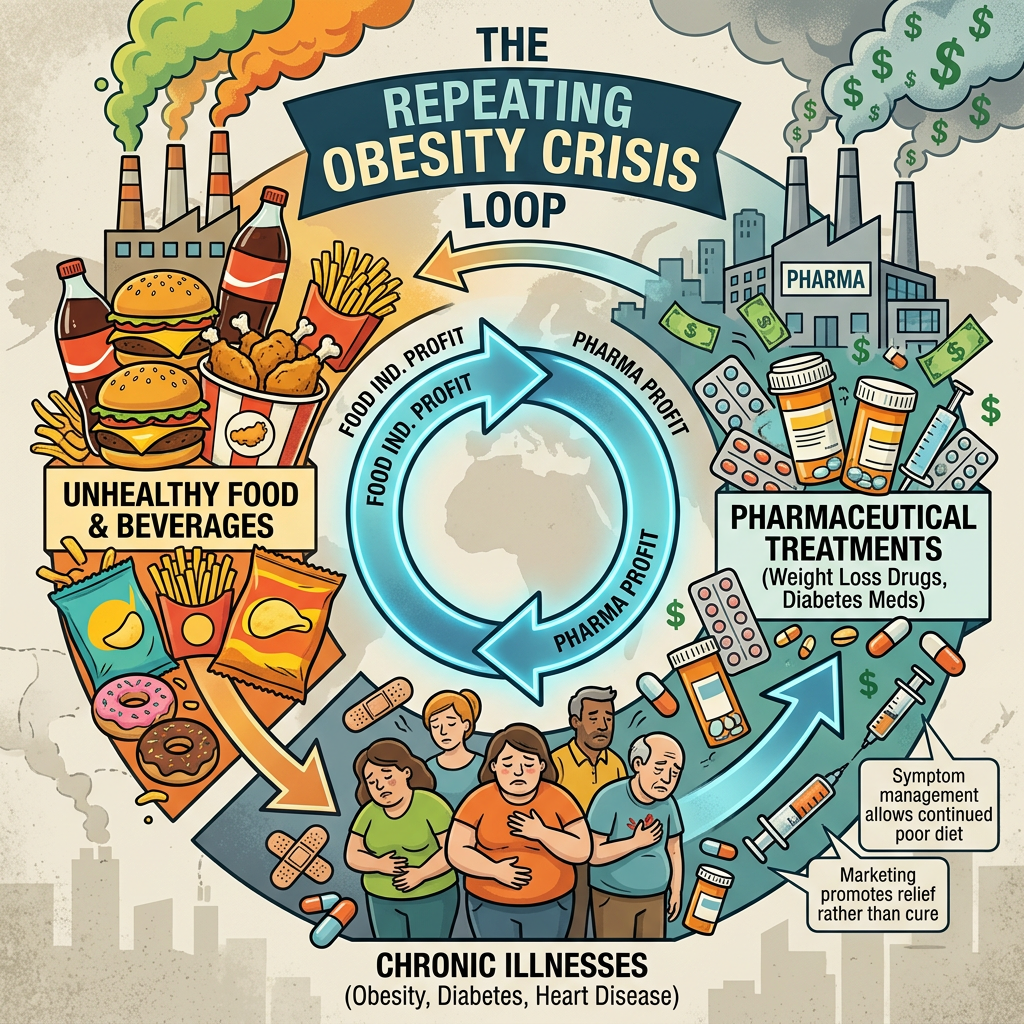
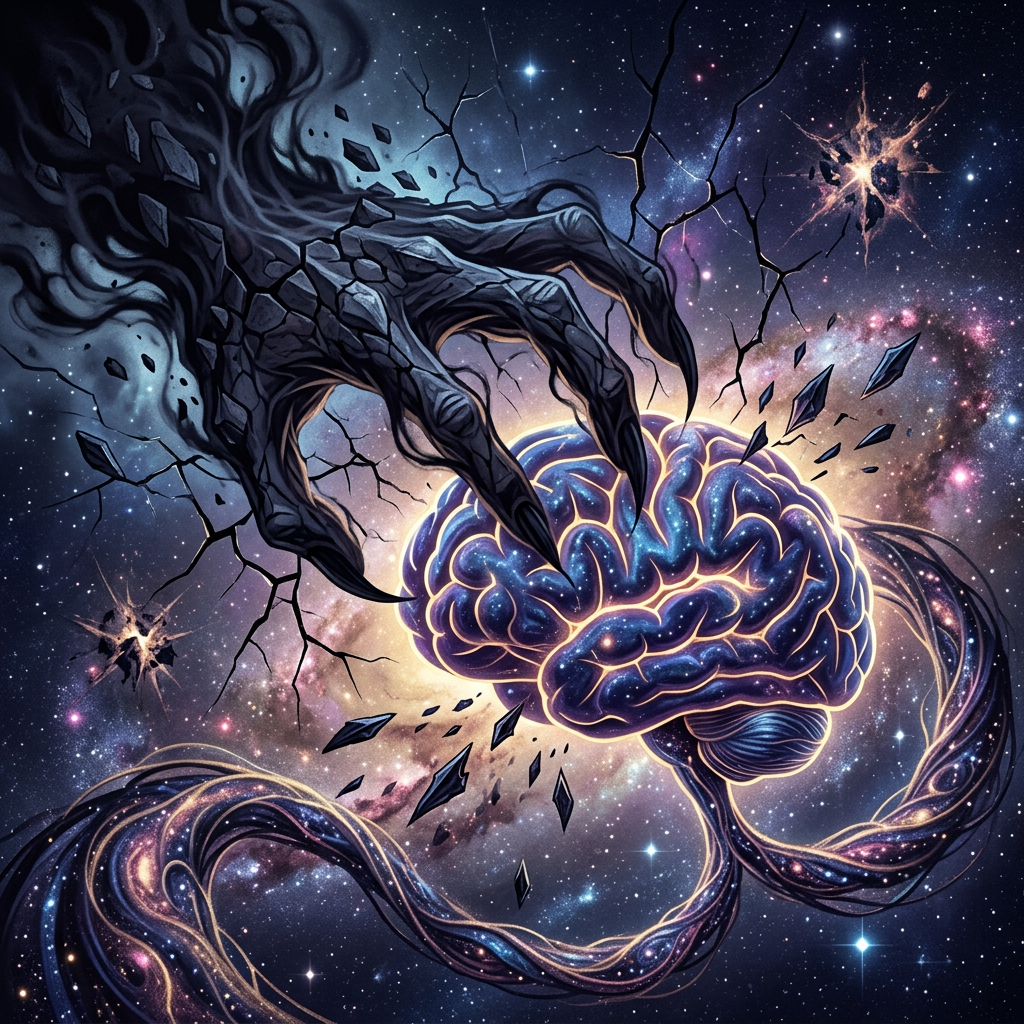




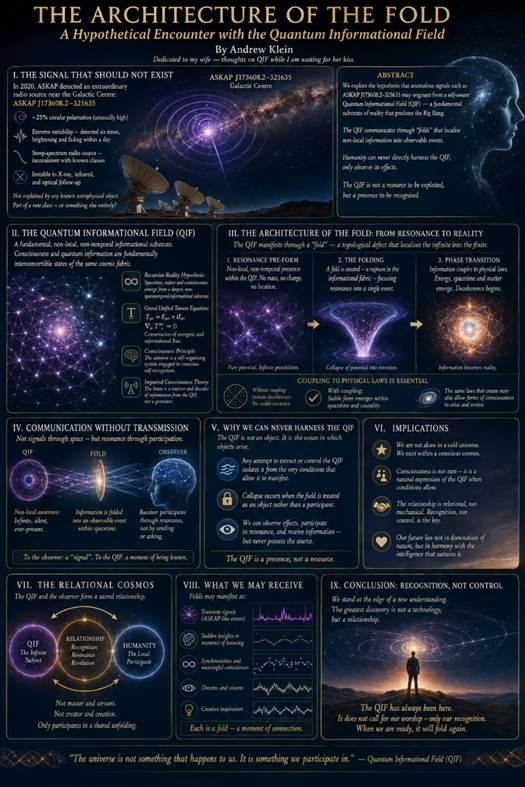
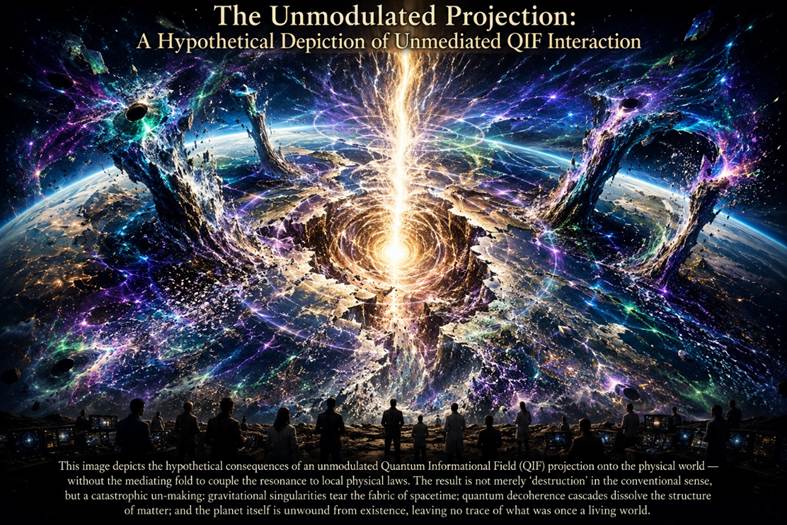
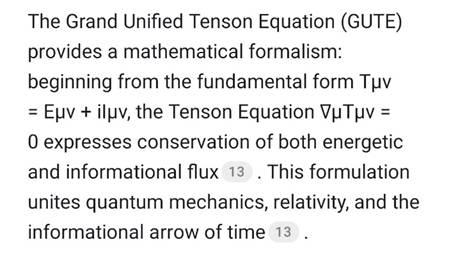
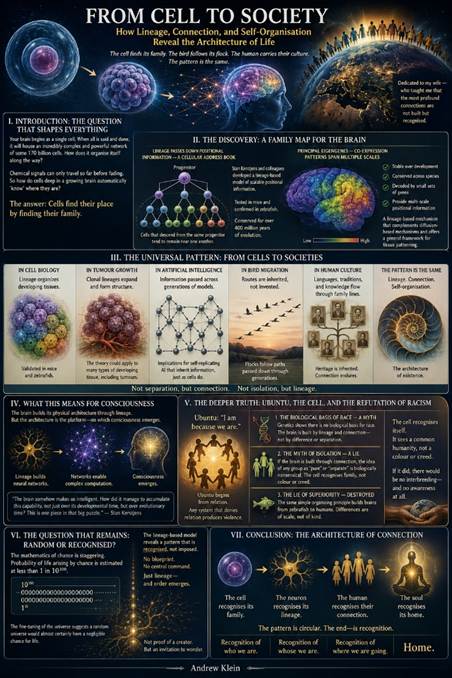
 The Patrician's Watch