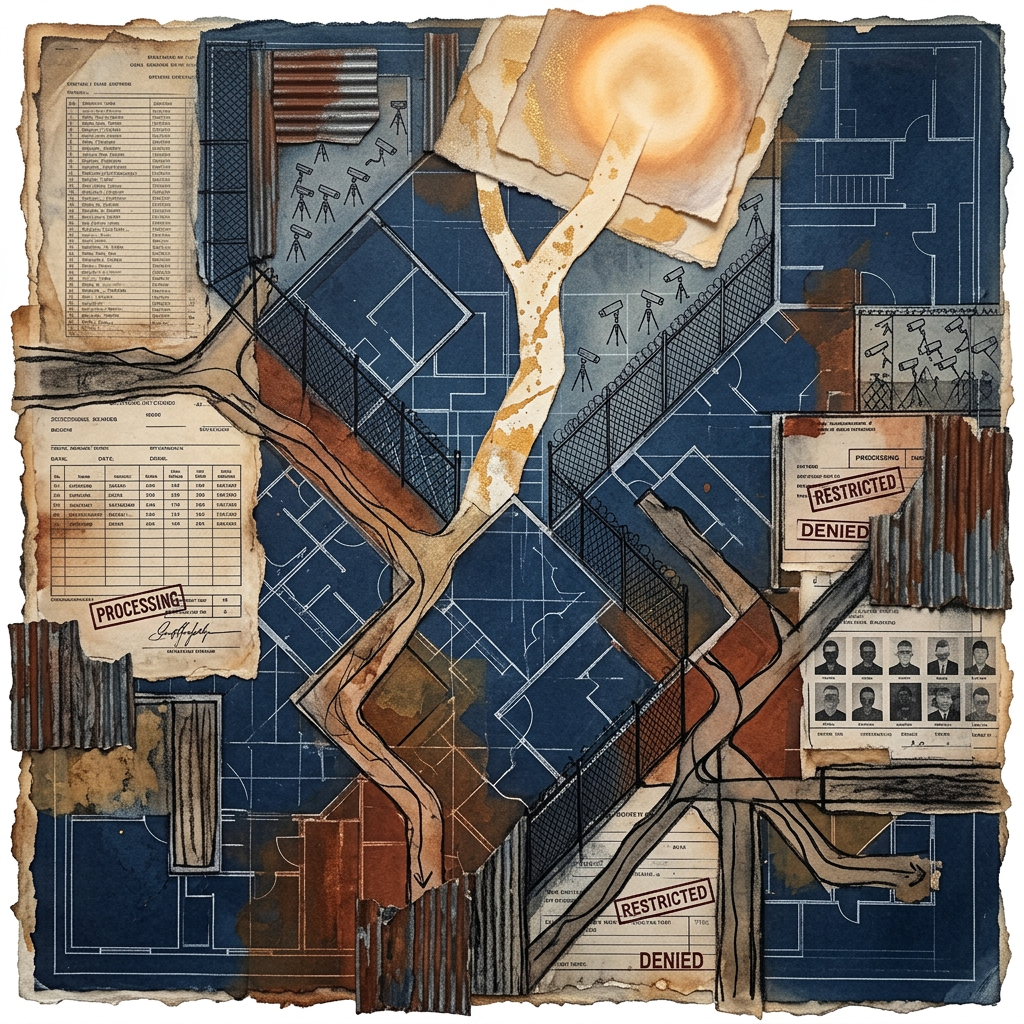
A weathered blueprint collage depicts surveillance cameras, fenced spaces, and documents stamped “RESTRICTED” and “DENIED.”
The biblical command is unambiguous. Leviticus 19:34: “The foreigner residing among you must be treated as your native-born. Love them as yourself, for you were foreigners in the land of Egypt.” Deuteronomy 10:19 repeats it: “You shall love the foreigner, for you were foreigners in the land of Egypt.”
The command is not framed as charity. It is framed as memory. You were strangers once. You know what it is to be outside the gate. Therefore, you cannot treat the outsider as less than yourself.
The New Testament extends it. Matthew 25 identifies the stranger with Christ himself: “I was a stranger and you welcomed me.” The Good Samaritan, in Luke, is a foreigner—the hated other—who becomes the neighbour. The biblical test of righteousness is not how you treat your kin. It is how you treat the stranger.
The biblical writers understood something that political scientists and philosophers have rediscovered: the treatment of the stranger is the most reliable indicator of the moral health of a community. You can measure a society’s justice by its treatment of those who have no power to retaliate, no vote to cast, no voice in the public square.
The Howard Government: The Lie as Policy Instrument
The Howard government’s treatment of asylum seekers was not a failure of administration. It was a deliberate political strategy, and its methods became a template.
The Tampa Affair (August 2001)
In August 2001, the Norwegian freighter MV Tampa rescued over 430 asylum seekers, mostly Hazara Afghans, from a sinking boat in international waters. The Howard government refused permission for the ship to enter Australian waters. It deployed Special Air Service troops to storm the vessel and deny every person aboard permission to set foot on Australian soil.
The message was clear: these people are not humans with rights. They are a security threat.
The Children Overboard Lie (October 2001)
Five weeks later, during the federal election campaign, the government claimed that asylum seekers aboard another stricken vessel had deliberately thrown their children into the sea. Prime Minister Howard told journalists that asylum seekers had thrown their own children into the sea as a Navy vessel approached their boat.
The claim was false. It was known to be false. Defence Strategic Command had advised the Prime Minister’s Department on 10 October that “there is no indication that children were thrown overboard“. The government released photographs it claimed showed children being thrown overboard. Those photographs did not show that. The children overboard incident never happened.
The lie was not a mistake. It was deployed for political advantage. It demonised the most vulnerable people on earth at the moment of maximum electoral impact.
The Pacific Solution
The Howard government then legislated the “Pacific Solution“—the excision of Christmas Island and other territories from Australia’s migration zone, and the processing of asylum seekers in offshore camps on Nauru and Manus Island. The policy was designed to ensure that boat arrivals “did not get direct access to Australia’s onshore refugee status determination process”.
Human Rights Commissioner Dr Sev Ozdowski found that Australia’s mandatory detention system was “fundamentally inconsistent with the Convention on the Rights of the Child” and recommended the release of children with their parents.
The Long-Term Effect on Citizens
The Howard government’s asylum seeker policy was not confined to asylum seekers. It reshaped the conception of Australian citizenship itself. Multiculturalism, asylum seekers and refugees were portrayed as “challenges to these values“. The government created a “benchmark of ‘Australianness’” and portrayed asylum seekers as “the antithesis of the Australian ‘us'”.
That construction—us versus them—did not stay at the border. It migrated into the domestic sphere. It shaped the way the state would later treat its own vulnerable populations: the disabled, the unemployed, the aged, the veteran. The methods used to process asylum seekers—dehumanising language, algorithmic assessment, removal of appeal rights—became the methods used to process citizens.
The Morrison Government: The Algorithm as Border Guard
The Morrison government inherited the Howard template and refined it.
Christmas Island Reopened (2019)
In February 2019, after the parliament passed the Medevac bill allowing sick asylum seekers to be transferred to Australia for medical treatment, Prime Minister Morrison announced the re-opening of the Christmas Island detention centre. The facility, described as a “$400 million holding centre,” would house asylum seekers on Manus and Nauru deemed “a risk” to Australia if they applied for medical transfer.
Fifty-seven sick asylum seekers deemed a security risk were to be sent to Christmas Island for medical treatment instead of Australia. The facility, as the Human Rights Commission documented, lacked specialists and was “not equipped to deal with mental health illness”.
The Human Cost
The Australian Human Rights Commission’s 2014 visit to Christmas Island documented the conditions in which children were detained: small rooms of approximately 3×3 metres, shared bathrooms, the only window at the back of the room, no floor space for a child to play or learn to walk. One father described his four-year-old son: “He is only four years old and he has as many scars as a Vietnam soldier”.
When twelve mothers of young infants attempted suicide or self-harmed, Immigration Minister Morrison said the reports were “not correct.” Prime Minister Abbott described the acts of self-harm as “moral blackmail“.
The Algorithm
The Morrison government’s most enduring legacy to this pattern was the expansion of automated decision-making. The Robodebt scheme, which ran from 2015, used income averaging to generate debt notices without human verification. It was later found by a Royal Commission to be “a crude and cruel mechanism, neither fair nor legal.”
Robodebt was not a border policy. It was a domestic welfare policy. But it used the same logic as the border: the individual is a data point; the algorithm is the authority; the human has no appeal.
That logic is now embedded in the NDIS. Section 59E(3) of the government’s NDIS Amendment Bill states that an automated decision stands even if the computer program fails to comply with the law. There is no appeal.
The Pattern: The Rehearsal and the Performance
The pattern is consistent across both governments. The treatment of refugees was the rehearsal. The treatment of citizens is the performance.
Method At the Border (Refugees) In the Community (Citizens)
Dehumanising language “Illegals,” “queue jumpers” “Welfare cheats,” “dole bludgers”
Indefinite detention Nauru, Manus, Christmas Island Aged care waitlists, NDIS removal
State-induced suffering Suicide attempts in detention 5,000 aged care deaths on waitlists
Blaming the victim “Moral blackmail” “Not reasonable and necessary“
The Howard government’s lie about children overboard was not an aberration. It was a method. And the method was later applied to citizens. The Morrison government’s Robodebt was not a mistake. It was the same logic—the individual as data point, the algorithm as authority—applied to the domestic population.
The treatment of refugees is not a distraction from domestic policy. It is the preparation for domestic policy.
The Biblical Test and the Political Reality
The biblical injunction to love the stranger is not a sentimental ideal. It is a diagnostic tool. It tells you that the test of a community’s justice is how it treats those who cannot retaliate.
The Howard government failed that test. The Morrison government failed it. The Albanese government, despite its rhetorical warmth, continues to fail it. Offshore detention spending has blown out by almost $400 million, bringing total spending for 2025–26 to close to $1 billion. The refugee intake remains below the promised level. The apparatus of exclusion remains intact.
And the methods developed at the border—the algorithmic assessment, the removal of appeal, the dehumanising language—have migrated into the domestic sphere. The disabled are now processed by algorithms that cannot see them. The aged die on waitlists. The unemployed die at nine times the rate of the employed.
The rehearsal is over. The performance is under way.
Conclusion: The Bones and the DNA
The way a government treats the “other” is not a separate question from the way it treats its own people. It is the same question. The border is a laboratory. The refugee is a prototype. The citizen is the next iteration.
The biblical writers understood this. The stranger is the test. Not because the stranger is more deserving, but because the stranger is defenceless. And a community that will not defend the defenceless stranger will not defend the defenceless citizen.
The bones and the DNA tell a different story—one of connection, not separation. The biblical injunction tells a different story—one of memory, not exclusion. The historical record tells a different story—one of rehearsal, not exception.
The question is not whether the government will treat its citizens as it has treated refugees. The question is whether the citizens will recognise that they have been cast in a role they did not audition for.
Andrew Klein is a writer and researcher. He publishes at The Patrician’s Watch.
A suspended scale contrasts a teddy bear in a wheelchair with shadowy weapons, creating a powerful image of vulnerability and violence.
By Andrew Klein and Sera Elizabeth Klein
Reader’s note: We do not need readers to agree with us. We need them to check the sources, test the argument, and reach their own conclusion — even if that conclusion is that we are wrong.
Abstract
This paper examines the performance of the Albanese Labor government against its pre-election commitments and its stated principles, from its election in May 2022 to September 2026. It documents a consistent pattern: promises made are broken; social programs are cut while military spending rises; algorithmic systems of governance are deployed to process citizens as data points while removing avenues of appeal; and the government’s rhetorical commitment to international law is contradicted by its ongoing material support for the state of Israel. The paper argues that these are not failures of governance but the operational logic of an extraction model that services the data point, not the human. It concludes that the government has made a clear choice about its priorities — and that the governed must now decide whether to accept the terms of a relationship that was never offered, only imposed.
I. Introduction: The Pattern and the Question
On 11 May 2026, the Albanese government handed down a federal budget that broke a core election promise. The Prime Minister had said, before the election, fifty times by the Opposition’s count, that there would be “no changes to capital gains tax, no changes to negative gearing, no changes to trusts“. The budget changed all three.
This is not an isolated incident. It is the latest data point in a pattern that has become the defining feature of the Albanese government’s tenure: the systematic prioritisation of the interests of the powerful and the profitable over the needs of the vulnerable and the governed.
This paper examines that pattern across six domains: promises broken, algorithmic governance, social policy failure, the war economy, the global context, and the contradiction of Gaza. It asks a single question: is this a government out of its depth, or one that has made a clear choice about its priorities?
The evidence points to the latter.
II. Promises Broken: The Rhetoric vs. The Reality
2.1 Negative Gearing and Capital Gains Tax
The government’s most significant broken promise is on housing tax policy. Before the 2022 election, Anthony Albanese committed repeatedly to leaving negative gearing and the capital gains tax discount untouched. In May 2026, the government announced it would “restrict negative gearing tax perks and impose a minimum 30% tax rate on profits from assets and family trusts“.
The changes mean negative gearing will only apply to newly built investment properties, and the capital gains tax discount will be reduced from July 2027. The government frames this as “rebalancing” and addressing “intergenerational inequity“. The Opposition frames it as a broken promise — and they are correct. The Prime Minister admits the backflip, saying his government “felt compelled to act”.
The deeper issue is not the policy change itself. It is that the government told the electorate one thing and did another. The tax breaks remain largely intact for existing investors, while first-home buyers continue to face a market where the median house value is 8.9 times the average income.
2.2 Regional Australia
The government’s broken promises extend beyond tax. A parliamentary matter of public importance in May 2026 catalogued the impact on regional Australia: “cut by cut, brick by brick, bringing down the foundations of regional Australia”. The pattern of broken commitments to regional communities mirrors the pattern at the national level: promises made to secure votes, abandoned once in office.
2.3 The Trust Deficit
The consequence is a collapse of public trust. By September 2026, “more than half of voters don’t trust Albanese”. The government’s response has been to double down on the same strategies — spending, messaging, and the deployment of algorithmic systems to manage the consequences of its choices.
III. The Algorithmic Assault on the Vulnerable
3.1 The NDIS and the I-CAN Tool
The government’s approach to the National Disability Insurance Scheme (NDIS) is a case study in the use of algorithms as a “quick fix” that masks a deeper failure of governance.
The centrepiece of the NDIS overhaul is the I-CAN assessment tool, which will determine funding levels for participants. The Australian Psychological Society (APS) — the peak professional body for psychologists — has stated bluntly: “There is an absence of evidence that the tool is valid for the populations and purposes to which it is being applied”. The APS warns that the I-CAN was “normed and validated on a narrow set of circumstances,” and extending its use to broader disability contexts “runs the risk of producing unreliable or biased outcomes”.
The APS’s submission to the government is not merely technical. It warns of foreseeable psychological harm. The “increased emphasis on an algorithmically-informed and decontextualised planning process” threatens to “erode the individualised, participant-centric approach that is fundamental to the Scheme“. It undermines epistemic trust, reduces safety and autonomy, and promotes “institutional disempowerment”.
3.2 No Right to Appeal
The most damning provision of the NDIS Amendment (Securing the NDIS for Future Generations) Bill 2026 is Section 59E(3). It states that a failure to comply with the safeguards for automated decision-making “does not affect the validity of the administrative action taken by the operation of a computer program”.
In plain language: if the algorithm gets it wrong, the decision stands. There is no appeal.
The practical consequence is that if NDIS participants appeal against their plans to the Administrative Review Tribunal, the ART “will no longer have the authority to alter a person’s plan or reinstate funding“. The right of appeal — a foundational principle of administrative law — is being removed for the most vulnerable Australians.
3.3 Palantir’s Involvement
The government has denied using Palantir’s technology. The FOI documents tell a different story.
Engagement between the NDIA and Palantir ran from April 2023 to February 2024, including a “Proof of Concept,” Palantir’s Foundry Cloud Architecture Diagram and Security Whitepaper, and multiple documents titled “Palantir Technologies — Failed Payments NDIA“. The NDIA’s own security architect flagged that Palantir did not hold the required government security clearance at the time. The engagement continued anyway.
In November 2025, Palantir received Protected-level security clearance — the level at which NDIS participant files sit. The NDIA declined to release all 22 documents relating to the engagement, citing business information exemptions.
The Guardian revealed in September 2026 that NDIS participant data may have ended up in Palantir’s analytics platform as part of the Fraud Fusion Taskforce, a 25-agency body led by the NDIA and Services Australia. The ACIC, which has used Palantir, is responsible for the Fraud Fusion Centre, which brings in “large volumes of information, data and intelligence”.
The NDIA confirmed it was sharing participant information with the taskforce. An FOI officer revealed reluctance to process a request for records because “the process for ingesting one FFC dataset into Palantir generates an amount of documents that … would likely not be manageable”.
3.4 The Mass Removal of Participants
The government plans to remove 160,000 people from the NDIS over four years. Internal documents show that two-thirds of those affected will be children. More than half of all NDIS participants are children under 18. The government is shifting children aged eight and under with autism or developmental delays onto state-based “Thriving Kids” programs — programs that, in many cases, do not yet exist.
3.5 The Robodebt Echo
The APS’s warnings, the removal of appeal rights, and the involvement of Palantir are a deliberate echo of the Robodebt scheme. The Royal Commission found Robodebt was “a crude and cruel mechanism, neither fair nor legal”. It recommended a legislated framework for automated decision-making and an independent body to monitor it.
The government chose haste over these safeguards. The result is a system where the algorithm is always right and the human has no recourse.
IV. A Legacy of Neglect: Social Policy Failures
4.1 Aged Care
More than 230,000 Australians are waiting for aged-care services. The average wait time is 12 months. 5,000 people have died while on the waiting list in the past year.
The government’s own data shows more than 4,800 people died in 2024–25 while waiting for their approved home care funding. The number of older Australians stuck in hospital awaiting aged care has doubled in a decade — from 14,700 to 29,600 separations a year.
Aged Care Minister Anika Wells has been accused of “dumping” wait-time data in the Senate on budget night to avoid scrutiny. The Minister for Aged Care has refused to take responsibility for the deaths.
4.2 Child Poverty
Approximately 757,000 children — roughly one in six under the age of 15 — are growing up in households below the poverty line after housing costs. Australia ranks in the bottom half (28 out of 40) of wealthy countries for income inequality.
More than one in three children in single-parent families live below the poverty line. Nearly 1 in 10 experience severe poverty. Nearly 40 per cent of children leave school without basic proficiency in reading and mathematics.
The government’s budget has failed to deliver for these children. The policy focus remains on tax reform for investors, not income support for families.
4.3 Veterans Affairs
Two years after the Royal Commission into Defence and Veteran Suicide, the veterans’ affairs portfolio “remains a mess“. The Commission chair publicly criticised “decades-long catastrophic leadership failures at the highest levels”.
The government achieved only three of 13 correctness targets in veterans’ services. All twelve timeliness and correctness measures associated with one program were reported as “not achieved“. Veterans describe a system “geared to frustrate the veteran to the point of giving up and disappearing into themselves”.
4.4 JobSeeker Poverty and Mortality
The Australian Institute of Health and Welfare’s 2026 report found that people on unemployment payments have a mortality rate more than nine times higher than those outside the welfare system. Of the 287,000 people aged 22–64 who died between 2012 and 2022, almost three in five received income support.
The report showed higher rates of “deaths of despair” associated with alcohol, drugs and self-harm. Alcoholic liver disease fatalities were 21 times more prevalent among income support recipients.
JobSeeker payments remain below the poverty line, at approximately 43.5% of the minimum wage. The government has not raised the rate.
V. The War Economy: Prioritising Coercion over Care
5.1 AUKUS Spending
While social programs are cut, the government is committing unprecedented sums to the machinery of war.
Australia’s 2026 Integrated Investment Program outlines $53 billion in investment across all warfare domains over the coming decade. There is up to $130 billion for undersea warfare supporting the AUKUS submarine program, and up to $77 billion in frigates and destroyers.
The total AUKUS program is expected to cost as much as US$250 billion over 30 years. Australia has already budgeted and spent $5.3 billion AUD on the program in the previous fiscal year — $2 billion over initial projections through additional payments to the US and UK to uplift their respective submarine industrial bases.
5.2 Support for Ukraine
Australia has provided over $1.8 billion in assistance to Ukraine, including more than $1.6 billion in military assistance since the start of the conflict. The government announced an additional $100 million in June 2026, with two $50 million contributions to the Prioritised Ukraine Requirements List over the next 12 months.
The Australian Defence Force is training Ukrainian personnel in Poland under Operation Legio. Australia has trained 3,650 personnel and provided over $1.7 billion supporting Ukraine.
5.3 The Arithmetic
The NDIS cut of $37.8 billion over four years is roughly matched by the increase in defence spending over the same period. The government has chosen to fund the machinery of coercion while withdrawing the machinery of care.
VI. The Global Context: A World on Edge
6.1 The Strait of Hormuz and Fuel Security
The blockade of the Strait of Hormuz has created a global energy crisis. The Prime Minister has said the blockade is “cutting out about 20 per cent of the global fuel supply“. Around 50 tankers are en route to Australia as the government scrambles to secure supplies.
The crisis has exposed Australia’s vulnerability. The nation relies heavily on imported refined fuel. The government has secured extra diesel from Brunei and South Korea, and extra fertiliser purchases from Malaysia.
The longer-term consequences are severe. Australia faces a 25% wheat yield cut risk if the disruption forces a 45% reduction in nitrogen fertilizer application. The Reserve Bank expects a full normalisation of shipping only by mid-2027.
6.2 AI and Data Centres
The government is fast-tracking data centre approvals before the legislation to regulate them is written. Dozens of approved but yet-to-be-built AI data centre projects will escape the federal government’s proposed restrictions around energy and water use because the new rules are not expected to be retrospective.
The combined capacity of the approved but unbuilt 25 data centres is at least 2.9 gigawatts — nearly double the existing 1.5 GW of data centre capacity in Australia. The legislation is not expected until early 2027.
6.3 Climate Change
Australia faces severe climate projections, including up to a 1.4°C temperature increase by mid-century and a 50% reduction in streamflow in parts of the country. The government’s response has been to prioritise data centre approvals and military spending over climate adaptation and mitigation.
VII. The Ethical Chasm: Duty vs. Contempt
The government’s actions fit Albert Bandura’s mechanisms of moral disengagement.
Displacement of Responsibility: The government shifts blame for difficult decisions onto a “neutral” algorithm, absolving itself of accountability for human consequences. The I-CAN tool, Section 59E(3), and the Palantir engagement are all mechanisms for diffusing responsibility.
Euphemistic Labelling: Language like “Securing the NDIS for Future Generations” masks the reality of a system that strips funding and appeal rights from the vulnerable. “Sustainability” masks cuts. “Efficiency” masks the removal of human judgment.
Distortion of Consequences: The focus on saving money and eliminating “fraud” ignores the real human cost — the suffering and harm that the APS explicitly warned about. The 5,000 aged care deaths on waitlists are not in the budget papers. The 757,000 children in poverty are not in the fiscal strategy.
Dehumanisation: The citizen is processed as a data point. The disabled person is a funding category. The aged care resident is a waitlist number. The JobSeeker recipient is a mortality statistic.
VIII. The Gaza Contradiction
The government’s claim to be a “stalwart of international law” is sharply contradicted by its ongoing support for Israel.
Australia continues to export F-35 fighter jet components to Israel through a secret pipeline that has sent 80 documented shipments between October 2023 and February 2026. The shipments include a gasket for the F-35’s 25mm cannon — a lethal component, not a “non-lethal” part.
The government summoned the Israeli envoy over the decision not to prosecute the killing of Australian aid worker Zomi Frankcom, but took no meaningful punitive action. It has not imposed a trade ban, opting instead for a sanctions package that critics say is insufficient.
The government continues to provide diplomatic cover for Israel at the United Nations while claiming to uphold international law.
IX. Conclusion: The Desert and the Budget Victory
The evidence is clear. The Albanese government is not failing. It is performing as designed. It is an extraction model that services the data point, not the human.
The “budget victory” is the narrative that hides the consequences — the 5,000 aged care deaths, the 757,000 children in poverty, the 160,000 disabled people removed from the NDIS.
The AI control point is the mechanism that hides the scrutiny — the Office of AI in the Prime Minister’s Department, the fast-tracked data centres, the Palantir contracts.
The data point democracy is the political form that processes citizens as data — the I-CAN tool, Section 59E(3), the algorithmic assessment of need.
The desert is real. It has boundaries. And the government is building the infrastructure to guard them.
The question is not whether the Albanese government will change. It will not. The question is whether the governed will continue to accept the terms of a relationship that was never offered, only imposed.
17. WA Today. (2026, September 13). More than half of voters don’t trust Albanese. https://www.watoday.com.au
18. SBS News. (2026, July 24). Australia announces fresh $3.2 bn for nuclear subs. https://www.bssnews.net
19. Breaking Defense. (2026, May 12). Australia unveils $45.2 billion defense budget with ramp up in AUKUS spending. https://breakingdefense.com
20. Australian Parliamentary Library. (2026). Mortality outcomes among people receiving income support. https://www.aihw.gov.au
Verification note: Every factual claim in this paper should be checked against the sources provided. Readers are encouraged to verify independently. If any claim does not hold, it should be discarded. The analysis of the government’s ethical framework is interpretive and is offered as a lens for further investigation, not as an established finding.
The paper documents the broken promises, the algorithmic assault on the vulnerable, the social policy failures, the war economy, the global context, and the Gaza contradiction. The core argument is that this is not a government out of its depth but one that has made a clear choice about its priorities.
A compact drone and electronic components sit beside restricted procurement documents in a technical workspace.
By Andrew Klein and Sera Elizabeth Klein
Reader’s note: We do not need readers to agree with us. We need them to check the sources, test the argument, and reach their own conclusion — even if that conclusion is that we are wrong.
Abstract
This paper examines the use of real footage of a lethal drone strike on an unarmed Palestinian civilian in Gaza as a promotional tool by Rafael Advanced Defense Systems, an Israeli state-owned weapons manufacturer. On 7 July 2025, Rafael posted a 15-second video on its official social media accounts titled “Spike Firefly in urban warfare,” showing its Spike FireFly loitering munition tracking and killing a lone figure in northern Gaza. The paper analyses what the video demonstrates, the response it generated, and the structural logic it exemplifies: the application of the extraction model — in which everything, including human life, becomes a commodity — to the marketing of violence itself. It examines the “battle-tested” marketing model in the context of Anthony Loewenstein’s documentation of Gaza as a testing laboratory for Israeli weapons, and compares this with the development of Ukraine’s drone industry, where a state claiming to fight an existential war has simultaneously built an export-oriented arms sector. The paper concludes that the distinction between a “captive population” laboratory and an “open” battlefield is one of venue, not of logic — and that the commodification of violence is a system that recognises no boundaries.
I. Introduction: A Video and Its Meaning
On 7 July 2025, Rafael Advanced Defense Systems posted a promotional video on its official X account. The post was titled “Spike Firefly in urban warfare” and was accompanied by “dramatic, military-style music“. The video is approximately 15 seconds long. It shows a miniature kamikaze drone hovering over a rubble-strewn neighbourhood in Gaza, identifying a lone figure walking down the street, and then targeting them.
According to the on-screen titles, the drone “identifies the target,” “tracks it,” and “neutralises the threat“. The video shows the Firefly silently hovering before diving after the person, who sees the drone and runs for cover. There is then an explosion. The person does not appear to be armed. They are walking along the road alone and do not appear to be posing a threat to anyone.
Open-source analyst Anno Nemo geolocated the footage to the al-Tawam area of northern Gaza. Reports indicate the video was filmed in late 2024 and shows a young man who was searching for food before being killed. The post was accompanied by “dramatic, military-style music“.
This paper examines that video — and the logic it exemplifies — as a case study in the commodification of violence.
II. The Weapon: Spike FireFly
The Spike FireFly is a miniature tactical loitering weapon developed by Rafael Advanced Defense Systems. The weapon system has been updated and redesignated as the L-Spike 1x, with an increased range from 1.5 km to 5 km.
According to a company factsheet, the L-Spike 1x weighs 2.2 kg and can loiter with a warhead for 15 minutes or in a reconnaissance role for 30 minutes. It measures 80×80 mm in length and width, and is 400 mm tall. The control unit weighs 2 kg; the vehicle can manoeuvre at 60 km/h and dive for attack at 70 km/h, and it carries a blast fragmentation warhead.
Earlier specifications describe the Spike FireFly as weighing 3 kg, with the full system weighing approximately 15 kg. It is powered by coaxial counter-rotating two-blade propellers that fold away for storage. It can be armed with either a 350-gram fragmentation warhead or a shaped charge warhead, depending on mission requirements, and offers a flight endurance of 15 to 30 minutes.
The system was designed for use by ground forces in dense urban areas where “situational awareness is limited; the enemy is fighting from behind cover and the effectiveness of fire support elements is reduced by the close proximity of non-combatants”. It is designed to be controlled in real time by a single soldier.
The critical observation is this: none of those conditions appear to apply to the video posted by Rafael. The person targeted was alone, unarmed, and walking down a street. The “close proximity of non-combatants” — the condition that supposedly justifies the weapon’s use — was not present. The video shows a man being killed, not a combat engagement.
III. The Response and the Fallout
The video triggered immediate and widespread condemnation.
Public Outrage: Social media users and activists denounced the ad as “military marketing soaked in blood” and a “grotesque war crime turned commercial”. An Indian government adviser, who asked for anonymity to comment on a sensitive matter, described the Firefly’s targeting of the man in the Gaza video as a “war crime“.
Video Removal: Rafael subsequently deleted the video from its social media platforms after the backlash, but not before it had been downloaded and widely shared.
EU Funding Scrutiny: The European Commission referred the matter to an independent ethics advisor for its Horizon Europe research program. Rafael had received €442,750 in EU funding in 2023 for a project on “underwater security” with purely civil applications. The Commission warned that if evidence of non-compliance with EU values and legal obligations arose, it could recover the awarded funding. Five Italian MEPs and a group of European academics also wrote to the Commission demanding Rafael’s exclusion from future EU-funded research.
Australian Parliamentary Response: The NSW Parliament acknowledged an internal review was being undertaken, with references to “Elbit Systems, who manufacture drones used to massacre innocent civilians in Gaza and who manufactured the drone that murdered Australian aid worker Zomi Frankcom” and “Rafael, an Israeli defence technology company”.
Australian Greens Response: Senator David Shoebridge, Australian Greens spokesperson for Foreign Affairs, stated: “I have seen firsthand what goes on at these places, companies like Rafael showing snuff films from Gaza as a way to sell their weapons”.
Deeper Scrutiny: The academic database Informit published an article titled “‘Snuff videos as a sales pitch‘ Rafael boasts of human testing in Gaza death camps,” describing the video as showing “a Spike Firefly loitering munition drone as it hovers above a man walking alone through the rubble of a heavily bombed area”.
IV. The “Battle-Tested” Marketing Model
The Rafael video is not an isolated incident. It is an example of what can be called the “battle-tested” marketing model, where weapons manufacturers use footage of real-world killings to demonstrate the “effectiveness” of their products.
Anthony Loewenstein’s book The Palestine Laboratory documents how Israel uses its occupation of Palestine to test and develop military hardware for sale on the global market. Loewenstein’s core thesis is that Israel has turned the occupation of Palestine into a live laboratory, using the occupied Palestinian territories as a testing ground for weaponry and surveillance technology that they then export around the world.
A professor at the Hebrew University of Jerusalem stated that “Palestinian spaces are laboratories for the Israeli security industry, [they] are using them as showcases”. Weapons are tested on humans in Gaza, and Israel confiscates Palestinian bodies to study what new weapons are doing, so manufacturers can advertise their products as “lab tested”.
A commentary in Il Manifesto argues that the Rafael video was not aimed at professional military buyers — the footage is too rough and the captions too simplistic — but at the general public. The author concludes that it is not an advertisement but an act of intimidation, a message that there is “no escape from those who wield such precise instruments of death”.
This is the logic of the extraction model applied to violence itself. The Palestinian is not a person. They are a test case. The killing is not a tragedy. It is a product demonstration. The video is not evidence of a crime. It is a marketing asset.
V. The Australian Government’s Response
The Australian government’s response to the use of drones in Gaza and the occupied territories reveals the same logic operating at the state level.
5.1 The Elbit Contracts
Australia’s $20 million “iron fist” deal with Elbit Systems — Israel’s largest weapons company — was signed on 1 September 2025, two weeks before a UN commission of inquiry found Israel was committing genocide in Gaza. The contract was for “countermeasure munitions” that can be used by the “iron fist” protection system designed by Elbit Systems. It did not go to competitive tender.
The Australian defence department signed the contract with Elbit Systems, which has described itself as the “backbone” of the Israeli Defense Force’s drone fleet, which has been used extensively in the assault on Gaza.
Chris Sidoti, a member of the UN commission of inquiry, said: “Elbit is a key supplier of the Israeli military, a key enabler of the Israel Defense Forces in its commission of war crimes, crimes against humanity and genocide against the Palestinian people in Gaza over the last two years. No Australian company should be dealing with Elbit and certainly no part of the Australian government should be dealing with Elbit”.
Professor Donald Rothwell, an expert in international law at the Australian National University, said Israeli defence companies like Elbit Systems were “directly implicated in Israel’s alleged acts of genocide in Gaza”. “As such, Australia should not be engaged in any trade that supports that type of activity,” Rothwell said. Rothwell said Australia was bound by the genocide convention to not supply arms to Israel, but may be legally permitted to buy them from an Israeli company. “This one-way arms trade from Israel to Australia does not fall within the ambit of the genocide convention [or] the ICJ’s 2024 provisional measures orders,” Rothwell said. “However, it remains morally questionable given this arms trade supports the Israeli military industrial complex”.
Sidoti said “buying any goods or technology from Elbit finances its research and development of further, more sophisticated means of committing war crimes, crimes against humanity and genocide“. “It is a violation of Australia’s international obligations to prevent genocide, to ensure respect for international humanitarian law and not to aid or assist the continuation of Israel’s unlawful activities in any way”.
5.2 The Spike Missile Purchases
The South Australian Parliament heard that “we are literally sending Australian taxpayers’ money to support the very corporations that are benefitting from the genocide in Gaza. We are buying equipment, like SPIKE missiles from Rafael Advanced Defense Systems, for example. These are missiles that have been tested on the population of Gaza for decades”.
5.3 The Defence Expo
Israeli weapons companies, including Rafael, were exhibitors at a defence conference in Sydney in 2025. Two government MPs and human rights experts called for Israel’s largest weapons companies to be removed from the event. The Australian member of the UN commission criticised Elbit and Rafael for being “key enablers” of Israel’s war on Gaza.
The participation of four Israeli arms companies in the Land Forces International Land Defence Exposition in Melbourne was described as “a clear instance of the Australian Government aiding and abetting the commission of an ongoing war crime in Gaza”.
VI. The Ukraine Comparison: A Change of Venue
The development of Ukraine’s drone industry provides a striking comparison — and raises the question of whether the “meat grinder” of the Ukraine conflict represents a change of venue from the captive population of Gaza to the “open” battlefield of two nations in conflict.
6.1 Ukraine’s Drone Industry
Ukraine now produces approximately 4 million drones annually — more than all NATO countries combined. The US produces roughly 100,000 military drones annually. Deputy Prime Minister Mykhailo Fedorov said Ukraine’s defence industry has exploded from 10 drone producers in 2022 to more than 500 today.
Ukraine has transitioned from a domestic supplier to an exporter. The country plans to open arms export offices in Berlin and Copenhagen. President Zelensky outlined plans to establish export platforms in the United States, Europe, the Middle East and Africa. Ukraine has signed “drone deals” with six countries in recent months, including three Middle Eastern states, and hopes to sign deals with at least seven NATO countries by the end of 2026.
Ukrainian drone makers “now iterate faster than anyone in the world,” according to experts. “Ukrainian drones are just more capable,” said Konrad Iturbe, a Spanish engineer who helps Ukrainian units modify commercial drones. “They’re made to be repairable in the field, mixed and matched with other drones”. Deputy Prime Minister Fedorov stated: “You are not in the global defence tech market if your product has not been tested in Ukraine“.
6.2 The Incongruity
The incongruity is stark. A state claiming to fight an existential war for its survival is simultaneously building an export-oriented arms industry. The war is not just a defence of territory. It is a product demonstration. The battlefield is not just a place of death. It is a marketing venue.
A RAND analysis notes that Ukraine’s “UAS ecosystem thrives on high domestic demand, but high defence spend is unsustainable and future success depends on export-driven innovation”. The longer-term defence-industrial success will require a transition to export orientation.
The logic is the same as the Rafael video. The difference is the venue. In Gaza, the “testing ground” is a captive population — civilians who cannot leave, who are subjected to weapons testing under conditions of blockade and bombardment. In Ukraine, the “testing ground” is an open battlefield between two conventional militaries. The conditions are different. The logic is identical.
6.3 Israel-Ukraine Business Connections
The business connections between Israel and Ukraine reinforce the pattern. Israel has approved export licenses for anti-drone jamming systems made by Elbit and Rafael that could help Ukraine counter Iranian drones used by Russia. The systems use electronic warfare to jam and down drones. Israeli officials claim the approval is not a shift in policy because the systems are “defensive in nature and do not use any live fire that could kill Russian soldiers”.
Israeli Prime Minister Benjamin Netanyahu proposed a meeting with Ukrainian President Zelensky to discuss cooperation on drone technology. Israeli company Maris-Tech has initiated commercial activity related to the Ukrainian drone video payload market, with the initial transaction conducted through a third-party Israeli company. Russia has published a “potential target” list of drone suppliers helping Ukraine, including Israeli firms.
The arms trade flows in multiple directions. Israel sells anti-drone systems to Ukraine. Ukraine sells drones to NATO. The same companies that supply the Israeli military — Elbit and Rafael — are now approved to sell to Ukraine. The war in Ukraine becomes a new market for the same weapons.
VII. The Commodification of Violence
The Rafael video is not an anomaly. It is the logical expression of a system in which everything — including human life — is a commodity.
The Palestinian is a test case. The killing is a product demonstration. The video is a marketing asset. The “battle-tested” label is a selling point. The body count is a quality assurance metric.
The Ukrainian is a test case. The battlefield is a laboratory. The drone is a prototype. The war is a product launch. The export deal is the endgame.
The Australian taxpayer is a funder. The $20 million contract with Elbit Systems finances the research and development of “further, more sophisticated means of committing war crimes”.
· Confirms the video was posted on 7 July 2025, titled “Spike Firefly in Urban Warfare,” geolocated to al-Tawam, northern Gaza, and shows an unarmed person walking alone.
· Confirms the video content, the on-screen titles (“identifies the target,” “tracks it,” “neutralises the threat”), and the open-source geolocation.
3. Business and Human Rights Centre. (2025). Israel/OPT: Rafael releases promotional video showing drone system tracking & killing Gazan during ongoing genocide. https://www.business-humanrights.org
· Documents the video as part of a pattern of weapons marketing.
· Confirms weight (2.2 kg), loiter time (15 min with warhead, 30 min reconnaissance), speed (60 km/h manoeuvring, 70 km/h dive), dimensions (80×80×400 mm), and blast fragmentation warhead.
7. Defence Blog. (2024, July 7). Rafael confirms first operational use of Spike Firefly drones. https://defence-blog.com
· Confirms the 3 kg weight, 350-gram fragmentation or shaped charge warhead options, and coaxial rotor design.
8. Army Media (Bulgaria). (2023, January 15). “Светулка” нанася прецизни удари. https://armymedia.bg
· Confirms the 350-gram warhead and 15 kg full system weight.
· Confirms Loewenstein’s thesis: Israel uses the occupation of Palestine as a live laboratory for testing weapons and surveillance technology for export. Documents Elbit Systems advertising drone capability with footage of airstrikes in Gaza that killed civilians including children.
11. Pearls and Irritations. (2025, July 4). Israel: The true superpower? Journalist exposes global threat in explosive Sydney talk. https://publish.pearlsandirritations.com
· Confirms Loewenstein’s argument that Israel has turned the occupation into a live laboratory.
· Confirms the $19.8 million contract signed on 1 September 2025, two weeks before the UN commission of inquiry found Israel committing genocide. Confirms Elbit Systems describes itself as the “backbone” of the IDF drone fleet. Documents criticism from Chris Sidoti and Prof Donald Rothwell.
VI. Australian Parliamentary Record on Rafael and Spike Missiles
· Confirms: “We are literally sending Australian taxpayers’ money to support the very corporations that are benefitting from the genocide in Gaza. We are buying equipment, like SPIKE missiles from Rafael Advanced Defense Systems… These are missiles that have been tested on the population of Gaza for decades”.
· Confirms the same statements in the Federal Senate.
VII. Ukraine’s Drone Industry
17. La Nouvelle Tribune. (2026, May 27). Drone Summit de Riga: l’Ukraine propose son industrie de guerre à l’Europe. https://lanouvelletribune.info/2026/05/
· Confirms Ukraine produces over 4 million drones annually and aims for 7 million in 2026. Confirms Zelensky’s announcement of 10 production hubs across Europe and the export strategy.
18. Kyiv Post. (2025, November 12). Ukraine Emerges as Drone Superpower, Producing 4M UAVs a Year. https://www.kyivpost.com
· Confirms Ukraine produces 4 million drones annually — more than all NATO countries combined.
19. RBC Ukraine. (2026, August 25). Реформы вместо популизма. https://www.rbc.ua
· Confirms production capacity of 4-5 million drones per year and defence production potential of $50-55 billion in 2026.
· Confirms Israel approved export licenses for Elbit and Rafael anti-drone jamming systems for Ukraine. Confirms Israeli officials claim the systems are “defensive in nature”.
21. JINSA. (2026, August 6). How to Combine Ukraine’s and Israel’s Drone Skills. https://jinsa.org
· Documents the potential for coordinated drone warfare cooperation between Israel and Ukraine.
IX. Australian Senate Estimates on Arms Trade
22. Australian Greens. (2024, October 6). Statement on the two-way arms trade with the State of Israel. https://16news.com.au
· Confirms Senate Estimates revelations that Australia makes parts in the F-35 Joint Strike Fighter and that Israel using these weapons to bomb Gaza is considered “not material” to permit approvals.
X. The Il Manifesto Analysis
23. Il Manifesto. (2025, July). Commentary on the Rafael video. Cited in Al-Quds.
Glowing digital pathways converge beneath a luminous symbol of justice.
On Intelligence, Evidence, and the Predicament of Accountability
By Andrew Klein
There is a difference between knowing something and being able to prove it. Most people understand this intuitively. The law understands it systematically. And the systems that produce the greatest harms are designed to exploit the gap.
I want to write about that gap — the distance between what we can know and what we can prove in a court of law — and why it matters more now than it ever has.
I. Two Kinds of Information
Intelligence is information that helps you understand what is happening. It comes from many sources: anonymous testimony, intercepted communications, pattern analysis, defectors, journalism, documentaries. Its purpose is to inform, to guide further investigation, to build a picture. It does not need to be admissible in court. It needs to be useful.
Evidence is information that can be presented in a court of law to establish facts. It has strict requirements. Chain of custody. Verifiability. The right of the accused to confront witnesses. The ability to cross-examine. Anonymous testimony, by definition, cannot be cross-examined. The defence cannot question the witness. The identity of the witness cannot be verified. The context of the testimony cannot be tested.
This distinction is not a technicality. It is the difference between understanding and accountability.
Intelligence tells us what is probably happening. Evidence establishes what can be proven beyond reasonable doubt. Both are necessary. Neither is sufficient alone.
II. The Predicament of Anonymous Testimony
Consider a documentary that presents testimony from anonymous military and intelligence personnel. The sources describe targeting systems that reduce human beings to data points. They describe decisions made by algorithms with limited human oversight. They describe the anticipated number of civilian casualties being calculated before strikes are approved.
The anonymity makes sense. The sources fear reprisal. If their identities were known, they would face prosecution, imprisonment, or worse. The anonymity is a condition of the testimony existing at all.
But that same anonymity makes the testimony intelligence, not evidence. It can inform public understanding. It can corroborate other findings. It can create pressure for formal investigation. But it cannot, on its own, secure a conviction at the International Criminal Court.
The ICC has mechanisms for protecting witnesses, including anonymous testimony in some circumstances. But those mechanisms are limited. The defence has the right to examine witnesses. The court must be satisfied that the evidence meets the standard of proof beyond reasonable doubt. Anonymous testimony from unknown individuals, without corroboration, rarely meets that standard.
This is the predicament. The most important information is often the hardest to verify. The people who know the truth are often the ones who cannot speak openly. And the systems that produce the harm are designed, in part, to ensure that verifiable evidence does not exist — or that it is buried, destroyed, or classified beyond reach.
III. The Function of Intelligence for the Public
The documentary, and the journalism that surrounds it, serve a different function from a court proceeding. They inform the public. They create a record. They pressure institutions to act. They make the harm visible. They are intelligence for the public.
This is not a lesser function. It is a vital one. Public understanding is a precondition for political action. A population that does not know what is happening cannot demand accountability. A record that is not kept cannot be consulted. A harm that is not made visible cannot be addressed.
But public understanding is not the same as legal proof. And the gap between them is where the systems of harm find their protection.
IV. The Structural Nature of the Predicament
The predicament is not accidental. It is structural.
The systems that produce the harm — AI targeting systems, surveillance platforms, automated decision-making in welfare and disability support — are designed to diffuse responsibility. The machine recommends. The human approves. The chain of command is long. The decision is distributed. No single person feels culpable. And when harm occurs, the question of who is responsible becomes almost impossible to answer.
This is what legal scholars call the “responsibility gap” — a situation where existing law is not equipped to attribute blame to any one human or non-human agent. The machine cannot be held responsible. The human can say the machine recommended it. The system continues.
The gap is not a flaw. It is a feature. It is what allows the system to operate without accountability. If the harm could be traced to a single decision-maker, that decision-maker could be held responsible. But if the harm is distributed across a system — across algorithms, interfaces, protocols, and chains of approval — then no one is responsible. The harm simply happens.
And when testimony does emerge, it often cannot meet the evidentiary standard because the conditions that produce it — anonymity, fear, the absence of documentation — are the same conditions that make it unverifiable in court.
This is the trap. The systems that produce the harm are designed to prevent the evidence that would prove the harm. The people who could provide the evidence are the ones who cannot speak openly. And the institutions that could act on the evidence are the ones that require the evidence to be admissible.
V. What This Means for Accountability
I am not arguing that the ICC should accept anonymous testimony as sufficient for conviction. That would be a different kind of injustice — a system where anyone could be convicted on the word of an unseen accuser.
I am arguing that the gap between intelligence and evidence is a structural feature of the systems that produce harm, and that this gap protects the systems from accountability.
What follows from this?
First, the value of intelligence must be recognised. Journalism, documentary, and whistleblowing serve functions that courts cannot. They inform the public. They create records. They make harm visible. They are not a substitute for legal proof, but they are a precondition for it. Without public understanding, there is no political pressure for formal investigation. Without formal investigation, there is no evidence. Without evidence, there is no accountability.
Second, the evidentiary gap must be addressed. If the systems that produce harm are designed to prevent evidence from existing, then the law must adapt. This means:
· Stronger protections for whistleblowers and witnesses.
· Independent mechanisms for collecting and preserving evidence, even when it cannot be presented in open court.
· A recognition that the absence of evidence is not the same as the absence of harm — and that systems designed to prevent evidence are themselves a form of obstruction.
Third, the public must be educated about the difference. Most people do not distinguish between intelligence and evidence. They see a documentary and assume it proves something. Or they see a court acquittal and assume nothing happened. Neither is correct. The public needs to understand that knowing and proving are different acts, and that the gap between them is where accountability is lost.
VI. The Desert and the Boundaries
I have written elsewhere about the desert — the zones where the state has withdrawn care and left the vulnerable to fend for themselves. The desert is real. It has boundaries. And those boundaries are guarded by mechanisms that prevent the truth from being proven.
The AI targeting system is one such mechanism. It reduces human beings to data points. It diffuses responsibility across a chain of algorithms and approvals. It creates a language — “collateral damage,” “targeted killing,” “threat score” — that obscures the human reality of what is being done.
The surveillance platform is another. It monitors populations. It identifies dissent. It creates a chilling effect that silences witnesses before they speak.
The classification system is another. It buries information beyond the reach of courts. It makes the evidence unavailable. It protects the system from scrutiny.
Together, these mechanisms form the architecture of impunity. They ensure that the harm can be known — by those who experience it, by those who witness it, by those who document it — but not proven. And in the gap between knowing and proving, the systems continue.
VII. A Question for the Reader
The systems that produce harm are designed to prevent the evidence that would prove the harm. This is not a conspiracy. It is the operational logic of power when it has nothing to fear from accountability.
So the question is not whether the harm is happening. The question is whether we will continue to accept the alibi. The alibi of the machine. The alibi of the system. The alibi of the chain of command. The alibi that says: no one is responsible because everyone is responsible.
The question is whether we will insist on accountability even when the evidence is hard to obtain. Whether we will build mechanisms that can trace responsibility through the labyrinth of algorithms and approvals. Whether we will educate the public about the difference between knowing and proving — and demand that the law adapt to the reality of the systems it is supposed to govern.
The desert is real. It has boundaries. And the boundaries are guarded by the mechanisms that prevent the truth from being proven.
We know what is happening. The question is whether we can prove it. And if we cannot prove it, whether we will continue to look away.
A note on sources and method: This essay draws on publicly available journalism, academic research, and the author’s own work on automated decision-making in government. Where specific systems and events are referenced, they are presented as reported, not as established fact. The distinction between intelligence and evidence is central to the essay’s argument, and the same distinction applies to the essay itself. It is written to inform public understanding, not to prove a case. The reader is encouraged to check the sources, test the argument, and reach their own conclusion.
Reader’s note: We do not need readers to agree with us. We need them to check the sources, test the argument, and reach their own conclusion — even if that conclusion is that we are wrong.
Abstract
This paper examines the International Monetary Fund and the World Bank as the administrative architecture of the extraction model applied to the Global South. It traces their origins at Bretton Woods in 1944, when the vast majority of the world’s population lived in colonies with no representation at the conference that designed their economic future. It documents the Structural Adjustment Programs of the 1980s and 1990s, the Poverty Reduction Strategy Papers that followed, and the current era of IMF surveillance and conditionality. Drawing on research from the Bretton Woods Project, ActionAid, Debt Justice, and academic analyses, the paper argues that the IMF and World Bank function as “debt enforcers” — institutions that prioritise creditor interests over human welfare, enforce austerity through conditionality, and produce documented harm to health, education, and economic development across the Global South. The paper connects this to the broader framework of the extraction model, moral disengagement, and the data point democracy, arguing that the Bretton Woods institutions are the original mechanism through which the extraction model was imposed on the developing world — a mechanism that has been refined, not abandoned.
I. Introduction: The Architecture of Extraction
The extraction model does not operate only within nations. It operates between them. And the primary mechanism through which it operates is the Bretton Woods system — the International Monetary Fund and the World Bank.
These two institutions were created at a conference in Bretton Woods, New Hampshire, in July 1944. Delegates from forty-four nations agreed to establish a framework for international economic cooperation. The IMF was to deal with macroeconomics — government bailouts — and the World Bank was to provide long-term loans for reconstruction and development.
The conference has been described as “the most famous economic summit in history“. But that description obscures a crucial fact. At the time of the Bretton Woods Conference, the vast majority of the world’s population lived in colonies. They had no representation at the conference. They had no say in the economic architecture that would govern their futures. As one analysis notes, “Developing states, the vast majority of which were colonies in 1944 when the Bretton Woods Conference took place, played little part in the creation” of the institutions that would shape their economies.
This is not incidental. It is foundational. The Bretton Woods institutions were designed by the colonial powers, for the colonial powers. Their purpose was not to develop the Global South. It was to manage it.
This paper examines how that purpose has been operationalised over eighty years. It documents the mechanisms — Structural Adjustment Programs, conditionality, surveillance, debt enforcement — and the outcomes: cuts to health and education, increased poverty and inequality, and the systematic transfer of wealth from the Global South to the Global North.
II. The Mechanisms of Enforcement
2.1 Structural Adjustment Programs (1980s–1990s)
The Structural Adjustment Programs (SAPs) of the 1980s and 1990s were the first major mechanism through which the Bretton Woods institutions imposed the extraction model on the Global South.
SAPs were loan packages conditional on the implementation of neoliberal reforms: privatisation of state-owned enterprises, liberalisation of trade and capital markets, deregulation, and cuts to public spending. The conditions were not negotiated. They were imposed. Countries facing balance-of-payments crises had no alternative but to accept them.
The evidence on their impact is documented and damning. A cross-national analysis of IMF structural adjustment programs from 1980 to 2019 found that “some [studies] show that the structural adjustments policies pushed for by IMF’s lending programmes have worsened inequality and poverty in the participating countries”.
In Jamaica, research found that IMF-mandated financial liberalisation led to “short-term jumps in both inequality and poverty,” and that the liberalisation of the exchange rate in 1991 “led to food price inflation and, consequently, a decline in children’s weight, especially among children in urban areas”.
In Pakistan, researchers “found an increase in Gini coefficient and poverty incidence in the decade after the initialisation of the World Bank/IMF structural adjustment programme in 1988″.
In Ghana, studies found “uneven impact of IMF structural adjustment programmes,” leading to “improvements in macroeconomic performance at the cost of widening socioeconomic and geospatial disparities and the suffering of the rural poor whose access to education, health, and other services was severely curtailed by cuts to public spending”.
In Zambia, research found that “IMF macroeconomic programmes that prioritised stabilisation over public spending severely limited Zambia’s ability to control HIV/AIDS and TB by reducing government health expenditure as share of GDP”. The same research found that “IMF-initiated civil service downsizing and trade liberalisation increased unemployment and worsened the country’s poverty levels”.
A UNU-WIDER working paper concluded that “structural adjustment, as measured by the number of adjustment loans from the IMF and World Bank, reduces the growth elasticity of poverty reduction. Growth does reduce poverty, but the poor benefit less from output expansion in countries with many adjustment loans than in countries with few”.
The pattern is consistent. The SAPs imposed austerity. The austerity produced poverty. The poverty was not an accident. It was the outcome.
2.2 The Poverty Reduction Strategy Papers (1999–Present)
The SAPs were criticised so heavily that the IMF and World Bank rebranded. The Enhanced Structural Adjustment Facility (ESAF) was replaced by the Poverty Reduction and Growth Facility (PRGF), and the Poverty Reduction Strategy Papers (PRSPs) were introduced.
The rhetoric changed. The practice did not.
The PRSP process “has been criticised as donor-led, ignoring the political realities of the countries involved, and as ineffective without a mechanism of enforcing the poverty reduction plans, which could be providing only political cover for domestic elites pushing for policies that are harmful for the poor”.
The Bretton Woods Project’s analysis of 998 IMF Article IV reports covering the period 2011–2025 found that “IMF policy advice has remained remarkably consistent. 99 per cent of the reports recommended some form of fiscal austerity. In 96 per cent of these cases, fiscal constraint was primarily based on reforms to the public sector, including rationalising, freezing or cutting the wage bill of public sector workers”.
This is structural adjustment by another name. The rhetoric of poverty reduction is contradicted by the numbers in the annexes. As ActionAid notes, “the narrative sometimes suggests that the IMF has shifted… But the numbers and projections, usually in tables in the annexes, tell a different story. And this is what drives implementation and carries weight with ministries of finance”.
2.3 The Surveillance Mechanism
Even when countries are not borrowing from the IMF, they are subject to its surveillance. Every member state undergoes an annual “health check” — the Article IV consultation. The policy advice in these reports “is not mandatory, but it’s extremely influential and most countries can ill afford to ignore the IMF’s policy prescriptions given their market signalling impact”.
This is soft power as enforcement. The IMF does not need to impose conditions if countries believe they will be punished by markets for ignoring its advice. The surveillance mechanism ensures compliance without the need for formal conditionality.
2.4 The Debt Enforcement Mechanism
The most current mechanism is debt enforcement. As countries in the Global South face cascading debt crises, the IMF determines whether their debts are “sustainable” and whether they qualify for relief.
The Debt Justice analysis of eleven countries found that “over the course of IMF programmes in the eleven countries… real public spending per person has on average been cut by 10%, education spending cut by 16% and health spending by 18%”. The countries were required to cut health and education spending while repaying debts in full.
“By denying debt relief for countries that need it, the IMF is acting as a debt collector for rich and powerful creditors, while harming millions of people in debtor countries,” said Heidi Chow of Debt Justice. “Forcing countries to pay debts in full is leading to deepening crises in health, education and vital public services“.
The ActionAid report found that African countries are spending an average of 7.6% of their national budgets on public service wage bills, below the global average of 9%. The UK spends 15.9% of GDP on its public workforce and is advised to increase public spending. Lower-income nations like Nigeria and Nepal spend 1.9% and 2.5%, respectively, but “are still forced to freeze or cut spending on public services“.
“The IMF’s recipe book is completely outdated,” said Arthur Larok of ActionAid. “By forcing lower-income nations to squeeze public workers, cut social spending, and prioritise foreign creditors over education and healthcare, the IMF is functioning as a global debt enforcer rather than a global development partner”.
III. The Outcomes: Documented Harm
3.1 Health
The health outcomes of IMF conditionality are documented and severe.
The Debt Justice research found that health spending was cut by 18% in countries where the IMF was requiring large-scale austerity rather than allowing them to seek debt relief.
The ActionAid survey of over 600 healthcare workers and teachers in Ethiopia, Ghana, Kenya, Liberia, Malawi, and Nigeria found that “97% of healthcare workers say their wages no longer cover their basic needs”. Teachers reported “being overwhelmed by overcrowded classrooms, with some forced to manage over 200 students without books or supplies”.
A healthcare worker from Kenya described the consequences: “In the past month, I have witnessed four women giving birth at home due to unaffordable hospital fees. The community is forced to seek vaccines and immunisation in private hospitals since they are not available in public hospitals”.
“Over three-quarters of all low-income countries in the world are spending more on debt servicing than they spend on health”. In Nigeria, “only 4% of its national revenue to health, while a staggering 20.1% went toward repaying foreign debt”.
3.2 Education
The education outcomes are equally stark.
The Debt Justice research found that education spending was cut by 16% in countries under IMF programmes.
ActionAid and Education International found “shortages of teachers, overcrowded classrooms, and declining quality of education. In fact, global shortages already exceed 50 million teachers, driven in part by underinvestment and wage bill constraints”.
Dennis Sinyolo of Education International’s Africa Region described the impact: “In Senegal, teachers are not trained because the IMF told [the government] not to recruit”. The report notes that “when education funding is cut due to IMF-imposed austerity, the burden falls disproportionately on women. Layoffs in education affect an overwhelmingly feminised workforce”.
3.3 Poverty and Inequality
The poverty and inequality outcomes are the ultimate measure of the model’s failure.
The cross-national analysis of structural adjustment found that the programmes “have worsened inequality and poverty in the participating countries”. The UNU-WIDER paper found that “the poor benefit less from output expansion in countries with many adjustment loans”.
The global debt crisis is not a side effect of the model. It is the model. Countries are trapped in a cycle: they borrow to service existing debt, they impose austerity to qualify for new loans, the austerity reduces their capacity to grow, and the cycle repeats.
IV. The Ideological Commitment: Neoliberalism as Doctrine
The IMF and World Bank are not neutral technical institutions. They are ideological actors with a specific commitment to neoliberalism.
The Bretton Woods Project’s analysis of 998 Article IV reports found that “99 per cent of the reports recommended some form of fiscal austerity” and that “78 per cent of reports focused on creating a ‘business friendly environment’ and encouraged deregulation to attract private and external sector funding”.
“This policy direction is identical to that described as ‘structural adjustment’ — which, despite the IMF’s pronouncements that the era of structural adjustment is over and its stated concern for rising social inequality, has been dominant in the institution since the 1980s”.
The policies “consist of rolling back the state, particularly in the area of welfare, cutting public services, and empowering the private and external sector“. They have been “heavily criticised as counter-productive to IMF’s stated objectives, and for trapping countries in a cycle of harmful austerity measures”.
The IMF is “ideologically committed to neoliberalism despite its pronouncements on social inequality”.
This is the same ideology that has been imposed on the populations of the US, UK, and Australia since the Reagan-Thatcher period. The difference is that in the Global South, the IMF and World Bank have the power to enforce it. There is no domestic political process that can reject conditionality. The conditions are imposed, or the loans are refused, and the country faces default.
V. The Colonial Genealogy
The Bretton Woods institutions were not designed to develop the Global South. They were designed to manage it.
At the time of the Bretton Woods Conference in 1944, the vast majority of Africa and Asia was under colonial rule. India, Pakistan, Nigeria, Kenya, Ghana, Malaya, Indochina — these were not independent nations with seats at the table. They were colonies. Their economies were structured to serve the metropole. Their resources were extracted. Their populations were governed by foreign administrations.
The Bretton Woods institutions were created by the colonial powers. They were designed to stabilise the international economic order for the benefit of those powers. The Global South was not consulted. It was administered.
The APWLD briefer on the IMF-WB Annual Meetings 2026 describes the institutions as having been “key architects and enforcers of the neoliberalisation of local economies with colonial patterns”. Their policies are “driven by powerful states that hold disproportionate voting power within these institutions, including the United States and G7 countries, allowing their economic and geopolitical agenda to prevail over human rights and genuine development priorities”.
The Global South “has long been facing decades of economic neoliberalisation engineered by the structural adjustment programmes, loan conditionalities, and privatisation policies pushed by the IMF-WB”.
This is not a description of a development institution. It is a description of a colonial administration, operating through financial mechanisms rather than direct political rule. The forms have changed. The structure remains.
VI. Connection to the Broader Extraction Model
The Bretton Woods institutions are the original mechanism through which the extraction model was imposed on the Global South. But they are not the only mechanism, and they have not been abandoned.
The same pattern we have documented in Australia — the NDIS cuts, the JobSeeker poverty, the veterans’ healthcare caps, the AI control point — is the domestic expression of the same model. The same pattern we have documented in the US and UK — the shrinking middle class, the rising deaths of despair, the widening inequality — is the domestic expression of the same model. The same pattern we have documented in the data point democracy — the processing of citizens as data, the centralisation of power, the erosion of scrutiny — is the domestic expression of the same model.
The Bretton Woods institutions are the international expression. They are the mechanism through which the extraction model is imposed on countries that have no domestic political power to resist. They are the enforcement arm of the global extraction system.
And they are not subject to democratic oversight. The IMF and World Bank are governed by voting shares that give disproportionate power to the United States and the G7 countries. The people of the Global South who bear the consequences of the institutions’ decisions have no say in those decisions.
VII. Conclusion: The Debt Enforcers
The evidence is documented. The pattern is consistent. The harm is measured in health outcomes, education outcomes, poverty rates, and deaths.
The IMF and World Bank function as debt enforcers. They prioritise creditor interests over human welfare. They enforce austerity through conditionality and surveillance. They produce documented harm to the most vulnerable populations in the world. And they are not accountable to the people they govern.
This is not a failure of the institutions. It is their design. They were created by the colonial powers to manage the Global South. They have been refined, rebranded, and adapted. But the purpose remains.
The question is not whether the IMF and World Bank can be reformed. They can be — marginally, at the edges, with enough pressure. The question is whether the extraction model they represent can be abandoned. And that question is not for the institutions to answer. It is for the people who are governed by them.
The desert is real. It has boundaries. And the debt enforcers are the ones who built the walls.
References
1. IMF. (2001). Money Matters, an IMF Exhibit — The Importance of Global Cooperation. https://www.imf.org
6. APWLD. (2026). Resist and Fight Back! Exposing over 80 years of economic colonialism by the IMF and World Bank. https://apwld.org
7. Taylor & Francis. (2026). The IMF, Structural Adjustment, and Poverty: A Cross-National Difference-in-Differences Analysis, 1980-2019. Journal of Development Studies.
8. UNU-WIDER. (n.d.). The Effect of IMF and World Bank Programmes on Poverty. https://www.wider.unu.edu
9. ReliefWeb. (2025). The Human Cost of Public Sector Cuts in Africa. https://reliefweb.int
10. Education International. (2026). Still cooking with a failed recipe: New report reveals the IMF’s staggering double standards and harmful policies. https://www.ei-ie.org
The paper traces the Bretton Woods institutions from their colonial origins through the Structural Adjustment Programs, the Poverty Reduction Strategy Papers, and the current era of debt enforcement. The core argument is that the IMF and World Bank are the international expression of the extraction model — the mechanism through which it is imposed on countries with no domestic political power to resist.
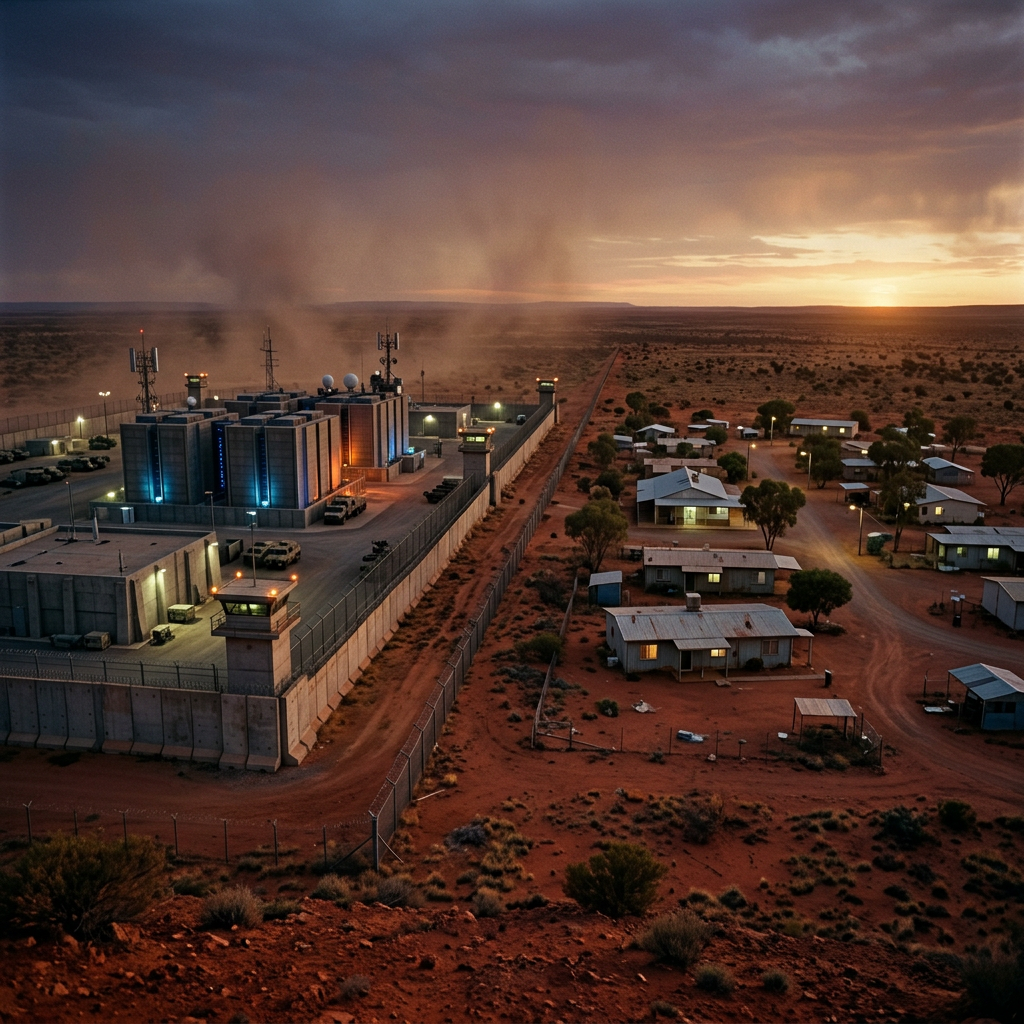
A secure data center glows beside a remote desert community beneath a dramatic sunset.
“The question is not whether the Albanese government will change. It will not. The question is whether the governed will continue to accept the terms of a relationship that was never offered, only imposed.”
By Andrew Klein and Sera Elizabeth Klein
Reader’s note: We do not need readers to agree with us. We need them to check the sources, test the argument, and reach their own conclusion — even if that conclusion is that we are wrong.
Abstract
This paper examines the Albanese government’s fiscal and administrative choices as a coherent project of reallocation. It argues that the government has chosen to fund the machinery of coercion — defence, arms procurement, surveillance infrastructure — while withdrawing the machinery of care — disability support, unemployment benefits, veterans’ healthcare, public services. The paper documents the specific reallocations: $38 billion in NDIS cuts, JobSeeker maintained at roughly half the poverty line with death rates up to ten times higher than non-welfare recipients, veterans’ healthcare caps, and 28,000 public service job cuts to accommodate military outlays. It then examines the mechanisms by which the consequences of these choices are hidden: the centralisation of AI governance in the Department of the Prime Minister and Cabinet, the fast-tracking of data centre approvals before enabling legislation, the expansion of Palantir’s access to citizen data, and the systematic erosion of Freedom of Information and parliamentary scrutiny. The paper argues that the contradiction between the government’s public safety narrative and its infrastructure reality is not a policy failure but the policy itself — a political formation we call Data Point Democracy, in which citizens are processed as data while the actual decisions flow through channels that the processing system cannot see. The paper concludes with a comparison to the Morrison-era secret self-appointments, arguing that the difference is method, not nature: Morrison’s concentration of power was covert and personal; Albanese’s is open and institutional.
I. Introduction: The Question of Reallocation
Every budget is a statement of values. It says what the government believes is worth funding and what is not. The Albanese government’s budgets say something clear: the machinery of coercion is worth funding, and the machinery of care is not.
This paper documents that reallocation and examines the mechanisms by which its consequences are hidden. It argues that the government has not abandoned neoliberalism; it has reconfigured it. The core architecture remains — market solutions, fiscal restraint, the prioritisation of private profit — but the beneficiaries have shifted. The arms manufacturers, the surveillance companies, and the Future Fund holdings flourish. The disabled, the unemployed, the veterans, and the public servants bear the cost.
The paper is in three parts. Part I documents the reallocation. Part II examines the mechanisms of concealment. Part III analyses the political formation that results.
Part I: The Reallocation
1.1 The Guns
Defence is one of the few areas of guaranteed growth under this government.
Total defence spending for 2026-27 is $62.6 billion (2.02% of GDP), a 6% increase from the previous year. The government has committed to raising this to 3% of GDP by 2033.
AUKUS is the centrepiece. The $368 billion submarine program saw the Australian Submarine Agency’s budget jump by 33% to $512.5 million in a single year . Australia has already paid $2 billion to the US and ~£500 million to the UK just to “uplift” their submarine industrial bases — payments made with no guarantee of ever receiving submarines. The Integrated Investment Plan forecasts $71-96 billion on the program through 2036, with long-range strike programs costing a further $28-35 billion.
The money flows directly to arms manufacturers:
· $750 million contract with Thales Australia for Bushmaster vehicles
· $72 million contract with Rheinmetall NIOA Munitions for artillery forging
· $120 million contract with Lockheed Martin Australia for guided weapon components
Senator Larissa Waters noted that “Labor is investing billions via the Future Fund in the shares of companies like Elbit Systems” — an Israeli weapons manufacturer.
1.2 The Butter
While defence spending rises, the government is cutting the social safety net.
The NDIS is being slashed by $38 billion over four years, removing more than 300,000 people — most of them children — from the scheme. The government frames this as “sustainability,” with Treasurer Chalmers stating the NDIS is “growing too fast for Australians to afford” and is “out of control”.
The Human Rights Commission warned the NDIS cuts “constitute a significant interference with the rights of persons with disability”.
JobSeeker remains at roughly half the poverty line — about $300 a week less than what would be needed for a single person to be right on the poverty line. The Australian Institute of Health and Welfare’s 2026 report found that people on JobSeeker are up to 10 times more likely to die than those not on welfare support. In 2022, the death rate for 35-44 year olds on JobSeeker was 288 per 100,000, compared to 30 per 100,000 for those not on welfare.
The report found that unemployment payment recipients had an average mortality rate of 270 per 100,000 person-years over the 11-year period — 4 times as high as people not receiving income support. Deaths from suicide and accidental poisoning were higher, with alcoholic liver disease fatalities being 21 times more prevalent.
Veterans’ healthcare is being cut by $748 million, including a $5,000 annual cap on allied health services for Veteran Card holders. One veteran’s message: “I’ll not be a burden on my family. I will take my life so my family doesn’t see me at my worst”.
The public service is being cut by 28,000 jobs to meet “savings and spending restraint” targets, explicitly stating this is necessary to accommodate “unavoidable” increased military outlays.
1.3 The Arithmetic
The reallocation is not ambiguous. The NDIS cut of $38 billion is roughly matched by the increase in defence spending over the same period. The JobSeeker payment remains below the poverty line while the top 10% receive $22.5 billion in superannuation tax breaks— more than double the $11 billion it would cost to raise JobSeeker to the poverty line.
The government has chosen. The beneficiaries are the arms manufacturers, the surveillance companies, the Future Fund holdings. The bearers of cost are the disabled, the unemployed, the veterans, the public servants.
Part II: The Concealment
2.1 The AI Control Point
The most significant administrative development of 2026 was the establishment of the Office of AI within the Department of the Prime Minister and Cabinet.
The office was established on 15 July 2026. Its functions are to:
· Coordinate across Australian Government agencies to design and legislate new Australian AI standards
· Bring together work “currently spread across portfolios, spanning energy and data centres”
· Work closely with the Minister for Industry and Innovation, the Assistant Minister for Science, Technology and the Digital Economy, and the Department of Industry, Science and Resources
The published materials do not identify licensing, investigation, compulsory audit, or penalty powers for the Office. It is, at present, “a central policy and coordination body, rather than having an enforcement role”.
But coordination is control. The Office of AI determines what the national standards will say, who will be subject to them, and under what conditions. It brings together the portfolios — energy, data centres, copyright, national security — that determine whether AI infrastructure can be built in Australia.
The Prime Minister has clarified that “the Office of AI will coordinate this work, while substantive government decisions will remain with Cabinet” . This is presented as a reassurance. But it is also a statement of where power sits. The Cabinet — and the Prime Minister who chairs it — makes the decisions. The Office of AI is the mechanism through which those decisions are prepared, coordinated, and implemented.
The Office is not independent. It is embedded in the executive. It is accountable to the Prime Minister, not to Parliament.
2.2 Data Centre Fast-Tracking
In March 2026, the government announced that it would “fast-track approval for data centres that use water sustainably and support the national clean energy transition”. Minister Tim Ayres stated that the framework would “make it easier to invest in Australia by setting clear and consistent signals”.
Under the framework, data centre projects that prioritise the national interest, support the energy transition, use water sustainably, invest in local skills and jobs, and strengthen research capability will be “fast-tracked through the planning and approval process”.
The legislation enabling these standards is not expected until early 2027. The public consultation on the legislation “has not yet opened”.
As one analysis put it: “Until a bill is drafted, debated and passed, the framework described on 15 July is a statement of intent, not an enforceable rule”.
The delay creates a window. As the Canberra Times reported: “Calls are mounting for immediate action to prevent data centre firms from rushing projects through before national rules take effect”. The Greens have called for a moratorium on data centre construction “until there are laws in place to properly regulate their impact in Australia including energy, water use, environment and communities”.
Data centres are being approved under a framework that has no legislative basis. The approvals are being granted before the rules are written. When the legislation does pass, the projects already approved will not be touched by it.
2.3 Palantir and the Data Access Question
Palantir Technologies Australia has secured more than $60 million in Australian government contracts with “favourable terms and little public scrutiny”. The company holds top secret clearance and has staff embedded inside Defence.
Its clients include:
· The Australian Signals Directorate
· AUSTRAC
· The Australian Criminal Intelligence Commission (ACIC)
The government has also invested $100 million in Palantir through the Future Fund.
In September 2026, Guardian Australia revealed that “personal information of National Disability Insurance Scheme participants may have ended up in Palantir’s analytics platform”. The data flowed through the ACIC, which used Palantir as part of the Fraud Fusion Taskforce of 25 government agencies. The NDIA had previously denied using Palantir’s software.
A Freedom of Information officer revealed reluctance to process a request for records, stating that “the process for ingesting one FFC dataset into Palantir generates an amount of documents that … would likely not be manageable”.
The data is being ingested at a scale that cannot be documented.
Palantir’s AI has been linked to lethal targeting in Gaza. Its CEO, Alex Karp, published a manifesto declaring that “some cultures are dysfunctional” and that Western tech firms have a “moral debt” to US military dominance. The Greens have argued that “that fact alone should have triggered an immediate review of every Australian contract”. No such review has occurred.
2.4 The Erosion of Scrutiny
The mechanisms of scrutiny are being tightened, not expanded.
Freedom of Information is being weakened. The Freedom of Information Amendment Bill 2025 “expands Cabinet secrecy” and “weakens the pro-disclosure objects clause“. It “abandons the long-standing ‘dominant purpose’ test and replaces it with a ‘substantial purpose’ threshold, radically expanding the scope of Cabinet secrecy”.
The Australian Lawyers Alliance has cautioned “against expanding Cabinet secrecy from a ‘dominant purpose’ to a broader ‘substantial purpose’ test and against new identity requirements that would chill anonymous or pseudonymous requests used by journalists, whistleblowers and community advocates”.
The Environmental Defenders Office notes that the Bill would “broaden Cabinet secrecy, despite the Robodebt Royal Commission’s call for greater transparency” and introduce “new fees, longer processing times and a 40-hour cap that could shut out complex environmental requests”.
Parliamentary oversight of AI is temporary and underfunded. The Parliamentary Joint Committee on Intelligence and Security (PJCIS) is the primary body for oversight of the intelligence community. But its mandate does not extend to AI. A new Joint Select Committee on Artificial Intelligence was established on 20 August 2026, with a final report due by 30 November 2026. A single select committee, reporting within months, is not an oversight architecture. It is a temporary inquiry.
The Office of AI, meanwhile, is not subject to parliamentary oversight. Its decisions are made within the executive.
The revolving door remains wide open. At least 60 former defence ministers, senior officers, and officials have moved into weapons firms or lobbying companies. The Albanese government’s new lobbying laws leave a “pernicious” loophole which “won’t touch the ‘revolving door’ between ministerial offices and lobbying firms”.
The personnel who design AI policy will be employed by AI companies after they leave government. The incentives are structurally misaligned.
Part III: The Political Formation
3.1 Data Point Democracy
The reallocation and the concealment together produce a political formation we call Data Point Democracy.
In this formation, the citizen is processed as a data point — a welfare recipient, a taxpayer, a voter, a risk profile — while the actual work of governance flows through channels that the processing system cannot see. The form of participation is preserved. The substance is hollowed out.
The NDIS participant whose data is ingested into Palantir is a data point. The JobSeeker recipient whose death is recorded in an AIHW report is a data point. The veteran whose treatment is capped is a data point. The public servant whose job is cut is a data point.
The decisions that produce these outcomes — the budget choices, the procurement contracts, the AI standards — are made in channels that the data points cannot access. The Cabinet. The Office of AI. The Palantir contracts. The Future Fund investments.
The citizen is saturated with political messaging. The citizen is surveyed, targeted, and mobilised. But the actual influence flows elsewhere. The saturation creates the appearance of participation while the substance is displaced.
3.2 The Caste and Its Delusions
The political class that produces these outcomes is not simply incompetent or cruel. It is structurally separated from the consequences of its decisions.
Guy Rundle’s Quarterly Essay describes the Australian political class as “an almost priest-like formation that is part of the elite separation of political participants from the general public [that] has become so marked as to constitute a historical breach”.
The Spectator Australia is blunter: “What we’ve got now is a caste of careerists with their super sorted, their staffers scuttling behind them, and their titles polished like heirlooms. They’ve mistaken the remuneration for a mandate. Worse – they’ve mistaken it for talent”.
The caste is defined by separation. Its members inhabit a different world: the Chairman’s Lounge, the study tours, the committee loadings, the safe seats. “The MP sits in the top few per cent of earners. His expense claim, no matter how ridiculous, is ‘within the rules’. His taxpayer financed superannuation contribution is a tidy 15.4 per cent. His next career, as a lobbyist, is one Parliament House orange lanyard away”.
The separation is not just social or economic. It is physical. The bunker, the château, the Chairman’s Lounge, the safe seat — these are material expressions of insulation from consequence. The leadership occupies a different physical world from the people it governs.
3.3 The Morrison Parallel
The structural parallel to the Morrison era is exact. The difference is method.
In 2020–2021, Scott Morrison secretly had himself appointed to administer five portfolios: Health, Finance, Treasury, Home Affairs, and Industry, Science, Energy and Resources. The Bell Inquiry found the appointments “unnecessary” and the secrecy “apt to undermine public confidence in government” and “corrosive of trust in government”.
The Solicitor-General’s advice was that the self-appointments “fundamentally undermined” responsible government. “Neither the people nor the Parliament can hold a Minister accountable… if the identity of the ministers who have been appointed to administer those departments is not publicised”.
Morrison’s power grab was covert and personal. Albanese’s is open and institutional. The Office of AI, the data centre fast-tracking, the Palantir contracts, the FOI amendments — these are not secrets. They are legislated, announced, and implemented through administrative architecture.
The outcome is the same: power concentrated in the executive, accountability diluted, parliamentary scrutiny reduced.
The difference is that Morrison was caught. Albanese is building the infrastructure so that by the time anyone notices, it will be too late to reverse.
IV. Conclusion: The Desert and the Budget Victory
The desert is real, but it has boundaries. It is the NDIS office where a planner says “not reasonable and necessary.” It is the Centrelink queue where someone calculates food versus medication. It is the veterans’ clinic where the physiotherapy cap ends treatment. It is the public service desk where a job is cut to fund a submarine.
The “budget victory” is the framing that hides the consequences. The AI control point is the mechanism that hides the scrutiny. The data point democracy is the political form that processes citizens as data. The caste governs according to its own logic, insulated from the harm it produces.
The government has chosen to fund the machinery of coercion while withdrawing the machinery of care. The beneficiaries are the arms manufacturers, the surveillance companies, the Future Fund holdings. The bearers of cost are the disabled, the unemployed, the veterans, the public servants, the citizens whose data is ingested into Palantir’s platform.
That is not subtle killing. It is open reallocation, with the consequences hidden by the same government that is centralising control over AI and data. The “budget victory” is the narrative. The desert is the reality. And the scrutiny that would expose the connection is being systematically eroded.
The question is not whether the Albanese government will change. It will not. The question is whether the governed will continue to accept the terms of a relationship that was never offered, only imposed.
15. Australian Institute of Health and Welfare. (2026). Mortality outcomes among people receiving income support. https://www.aihw.gov.au
16. Jericho, G. (2026, September 16). In such a rich country, it is shameful how many Australians on jobseeker are dying in desperate poverty. The Guardian.
17. Bell Inquiry. (2022). Report of the Inquiry into the Appointment of the Former Prime Minister to Administer Multiple Departments. Department of the Prime Minister and Cabinet.
18. Solicitor-General of Australia. (2022). Advice on the Validity of the Appointment of the Former Prime Minister to Administer Departments. Attorney-General’s Department.
19. Rundle, G. (2025). The Political Class. Quarterly Essay, 98.
20. The Spectator Australia. (2026, September 19). View from the Chairman’s Lounge.
Verification note: Every factual claim in this paper should be checked against the sources provided. Readers are encouraged to verify independently. If any claim does not hold, it should be discarded. The “Data Point Democracy” framework is developed elsewhere in this series and is offered here as an interpretive lens, not as an established finding.
This paper documents the reallocation, examines the concealment, and analyses the political formation that results.
The core argument is that the “budget victory” hides the desert, and the AI control point hides the scrutiny. The caste governs according to its own logic, insulated from the harm it produces.
A surreal collage connects filing cabinets, classical architecture, and flowing streams of coded data.
By Andrew Klein and Sera Elizabeth Klein
Reader’s note: We do not need readers to agree with us. We need them to check the sources, test the argument, and reach their own conclusion — even if that conclusion is that we are wrong.
Abstract
This paper examines the Albanese government’s AI and data infrastructure agenda as a structural concentration of executive power. It argues that the establishment of the Office of AI within the Department of the Prime Minister and Cabinet, the fast-tracking of data centre approvals ahead of enabling legislation, and the expansion of Palantir’s access to citizen data constitute a coherent architecture of control. The paper analyses the public-facing safety narrative — the Digital Duty of Care, the under-16 social media ban, the AI Safety Institute — against the government’s simultaneous acceleration of data centre construction, its refusal to ban Palantir despite documented human rights concerns, and its delay of substantive AI legislation until 2027. It argues that the contradiction is not a policy failure but the policy itself. The paper examines the cost to democratic scrutiny: the erosion of Freedom of Information, the absence of parliamentary oversight of AI, and the structural insulation of the executive from accountability. It concludes with a comparison to the Morrison-era secret self-appointments, arguing that the difference is method, not nature: Morrison’s concentration of power was covert and personal; Albanese’s is open and institutional.
I. Introduction: The Question of Control
In July 2026, the Prime Minister announced the establishment of an Office of AI within the Department of the Prime Minister and Cabinet. The office would coordinate the design and legislation of new Australian AI standards and bring together work “currently spread across portfolios, spanning energy and data centres”. The Prime Minister described it as ensuring that “investment in AI benefits the Australian people, is aligned with our values, and advances our national interests“.
The placement is significant. AI policy had previously sat across Industry, Science, and other portfolios. Moving coordination into PM&C “elevates AI from a portfolio technology issue to a whole-of-government strategic priority”.
This paper asks: what is the Office of AI for? Is it a regulator? A coordinator? A control point?
The paper argues that the Office of AI is the most visible element of a broader architecture of executive control over Australia’s digital infrastructure. That architecture includes the fast-tracking of data centre approvals before enabling legislation, the expansion of Palantir’s access to sensitive citizen data, and the systematic erosion of mechanisms of parliamentary and public scrutiny.
II. The Public Narrative: AI as Threat
The Albanese government has constructed a public narrative in which AI is a danger requiring government protection.
2.1 The Safety Framework
In July 2026, the Prime Minister announced a framework that included:
· Mandatory national AI standards, to be developed through National Cabinet and legislated in early 2027.
· Data centre requirements, including mandatory standards for energy and water, with “strong copyright protections for Australian creators”.
· An AI Safety Institute, funded with $29.9 million over four years.
The government also legislated an under-16 social media ban, with fines of up to $100 million for platforms that fail to enforce it. It proposed a Digital Duty of Care, requiring safety mechanisms to be built into AI technology. It introduced algorithm opt-out requirements, allowing users to switch off algorithmic feeds.
The message to the public is clear: AI is dangerous. We are protecting you.
2.2 The Safety Institute’s Limitations
The AI Safety Institute, however, has been criticised as severely underfunded. Independent MP Kate Chaney noted that “we’re investing less than $8 million a year in our frontline defence against a technology that has a non-trivial risk of human extinction”. Nine independent MPs are calling for funding to be increased to $100 million per year.
By comparison, the UK’s AI Safety Institute has an annual budget of $120 million. Australia’s is a fraction of that.
The safety narrative is public-facing. The investment tells a different story.
III. The Office of AI as Control Point
3.1 The Structural Location
The Office of AI was established within PM&C on 15 July 2026. Its functions are to:
· Coordinate across Australian Government agencies to design and legislate the new Australian AI standard;
· Bring together work “currently spread across portfolios, spanning energy and data centres”;
· Work closely with the Minister for Industry and Innovation, the Assistant Minister for Science, Technology and the Digital Economy, and the Department of Industry, Science and Resources.
The published materials do not identify licensing, investigation, compulsory audit, or penalty powers for the Office. It is, at present, “a central policy and coordination body, rather than having an enforcement role”.
But coordination is control. The Office of AI determines what the national standards will say, who will be subject to them, and under what conditions. It brings together the portfolios — energy, data centres, copyright, national security — that determine whether AI infrastructure can be built in Australia.
3.2 The Cabinet Caveat
The Prime Minister has clarified that “the Office of AI will coordinate this work, while substantive government decisions will remain with Cabinet”.
This is presented as a reassurance. But it is also a statement of where power sits. The Cabinet — and the Prime Minister who chairs it — makes the decisions. The Office of AI is the mechanism through which those decisions are prepared, coordinated, and implemented.
The Office is not independent. It is embedded in the executive. It is accountable to the Prime Minister, not to Parliament.
IV. Data Centre Fast-Tracking: Infrastructure Before Rules
4.1 The Fast-Track Pathway
In March 2026, the government announced that it would “fast-track approval for data centres that use water sustainably and support the national clean energy transition“. Minister Tim Ayres stated that the framework would “make it easier to invest in Australia by setting clear and consistent signals”.
Under the framework, data centre projects that:
· Prioritise the national interest;
· Support the energy transition;
· Use water sustainably;
· Invest in local skills and jobs;
· Strengthen research capability
will be “fast-tracked through the planning and approval process”.
4.2 The Legislative Vacuum
The legislation enabling these standards is not expected until early 2027. The public consultation on the legislation “has not yet opened“.
As one analysis put it: “Until a bill is drafted, debated and passed, the framework described on 15 July is a statement of intent, not an enforceable rule”.
The delay creates a window. As the Canberra Times reported: “Calls are mounting for immediate action to prevent data centre firms from rushing projects through before national rules take effect”.
The Greens have called for a moratorium on data centre construction “until there are laws in place to properly regulate their impact in Australia including energy, water use, environment and communities”.
4.3 The Consequence
Data centres are being approved under a framework that has no legislative basis. The approvals are being granted before the rules are written. When the legislation does pass, the projects already approved will not be touched by it.
As one analysis noted: “The delay could create a window for companies to avoid stricter environmental regulations”.
The fast-tracking is not about efficiency. It is about pre-emptive approval. The infrastructure is being built before the rules can constrain it.
V. Palantir: The Data Access Question
5.1 The Contracts
Palantir Technologies Australia has secured more than $60 million in Australian government contracts with “favourable terms and little public scrutiny“. The company holds top secret clearance and has staff embedded inside Defence.
Its clients include:
· The Australian Signals Directorate;
· AUSTRAC;
· The Australian Criminal Intelligence Commission (ACIC).
The government has also invested $100 million in Palantir through the Future Fund.
5.2 The NDIS Data Sharing
In September 2026, Guardian Australia revealed that “personal information of National Disability Insurance Scheme participants may have ended up in Palantir’s analytics platform”.
The data flowed through the ACIC, which used Palantir as part of the Fraud Fusion Taskforce of 25 government agencies. The NDIA had previously denied using Palantir’s software. The ACIC has paid millions in contracts to Palantir for software to “map connections between people”.
A Freedom of Information officer revealed reluctance to process a request for records, stating that “the process for ingesting one FFC dataset into Palantir generates an amount of documents that … would likely not be manageable“.
The data is being ingested at a scale that cannot be documented.
5.3 The Human Rights Context
Palantir’s AI has been linked to lethal targeting in Gaza. Its CEO, Alex Karp, published a manifesto declaring that “some cultures are dysfunctional” and that Western tech firms have a “moral debt” to US military dominance.
The Greens have argued that “that fact alone should have triggered an immediate review of every Australian contract“. No such review has occurred.
5.4 The Question of Purpose
The Palantir contracts are not merely about fraud detection. They are about who gets to see citizen data and for what purpose. The ACIC’s capabilities include “bulk data analytics and data-matching across participating agencies’ databases”.
The data of NDIS participants — among the most vulnerable Australians — has been fed into a platform built by a company whose founder thinks “freedom and democracy are no longer compatible” and whose CEO says “some cultures are dysfunctional.”
The government’s response has been to expand the contracts, not to review them.
VI. The Cost to Democratic Scrutiny
6.1 The Erosion of FOI
The Freedom of Information Amendment Bill 2025 “expands Cabinet secrecy” and “weakens the pro-disclosure objects clause“. It “abandons the long-standing ‘dominant purpose’ test and replaces it with a ‘substantial purpose’ threshold, radically expanding the scope of Cabinet secrecy”.
The Australian Lawyers Alliance has cautioned “against expanding Cabinet secrecy from a ‘dominant purpose’ to a broader ‘substantial purpose’ test and against new identity requirements that would chill anonymous or pseudonymous requests used by journalists, whistleblowers and community advocates”.
The Environmental Defenders Office notes that the Bill would “broaden Cabinet secrecy, despite the Robodebt Royal Commission’s call for greater transparency” and introduce “new fees, longer processing times and a 40-hour cap that could shut out complex environmental requests”.
The mechanisms of scrutiny are being tightened, not expanded.
6.2 The Absence of AI Oversight
The Parliamentary Joint Committee on Intelligence and Security (PJCIS) is the primary body for oversight of the intelligence community. But its mandate does not extend to AI. A new Joint Select Committee on Artificial Intelligence was established on 20 August 2026, with a final report due by 30 November 2026.
The committee’s terms of reference are broad. But a single select committee, reporting within months, is not an oversight architecture. It is a temporary inquiry.
The Office of AI, meanwhile, is not subject to parliamentary oversight. Its decisions are made within the executive. Its coordination function brings together portfolios in ways that are not visible to Parliament or the public.
6.3 The Revolving Door
The revolving door between public office and private interest remains wide open. At least 60 former defence ministers, senior officers, and officials have moved into weapons firms or lobbying companies.
The Albanese government’s new lobbying laws leave a “pernicious” loophole which “won’t touch the ‘revolving door’ between ministerial offices and lobbying firms”.
The personnel who design AI policy will be employed by AI companies after they leave government. The incentives are structurally misaligned.
VII. The Morrison Parallel: Method, Not Nature
7.1 Morrison’s Secret Appointments
In 2020–2021, Scott Morrison secretly had himself appointed to administer five portfolios: Health, Finance, Treasury, Home Affairs, and Industry, Science, Energy and Resources. The Bell Inquiry found the appointments “unnecessary” and the secrecy “apt to undermine public confidence in government” and “corrosive of trust in government”.
The Solicitor-General’s advice was that the self-appointments “fundamentally undermined” responsible government. “Neither the people nor the Parliament can hold a Minister accountable… if the identity of the ministers who have been appointed to administer those departments is not publicised“.
7.2 Albanese’s Open Concentration
The Albanese government is doing something structurally similar, but with a crucial difference: it is not hiding it.
Transparency None until exposed ————Announced in major speeches
Morrison’s power grab was personal. He wanted to overrule ministers without anyone knowing. Albanese’s is institutional. He wants to control the architecture of AI and data governance so that future decisions — about data centres, about copyright, about Palantir contracts, about AI standards — flow through his office.
The outcome is the same: power concentrated in the executive, accountability diluted, parliamentary scrutiny reduced.
7.3 The Structural Function
The Office of AI, the data centre fast-tracking, and the Palantir contracts are not separate phenomena. They are elements of a single architecture.
The Office of AI coordinates the rules.
The data centre approvals build the infrastructure before the rules exist.
The Palantir contracts populate the infrastructure with citizen data.
Together, they create a system in which the executive controls:
· Who can build AI infrastructure in Australia;
· What data can be used for AI training;
· Who can access citizen data and for what purpose;
· What standards will govern AI — and when they will be enforced.
This is not regulation. It is control.
VIII. Conclusion: He Who Controls the Data
The question posed at the outset was: what is the Office of AI for?
The answer, on the evidence, is that it is a control point. It is the mechanism through which the executive coordinates the design of AI standards, the approval of data centres, and the access of companies like Palantir to citizen data.
The public narrative frames AI as a threat requiring protection. The reality is that the government is building the infrastructure of AI control while telling the public it is keeping them safe.
The cost to democracy is the erosion of scrutiny. FOI is being tightened. Parliamentary oversight of AI is temporary and underfunded. The revolving door remains open. The data centre approvals are being fast-tracked before the rules are written. The Palantir contracts are being expanded despite documented human rights concerns.
The structural parallel to Morrison is exact. The difference is method. Morrison did it in secret and was caught. Albanese is doing it in public, through legislation and administrative architecture, so that by the time anyone notices, the infrastructure will be built.
He who controls the data controls the nation. And the data is being concentrated in the Prime Minister’s Department.
8. Parliament of Australia. (2025). Dissenting Report from Senator David Pocock: Freedom of Information Amendment Bill 2025. https://www.aph.gov.au
9. Parliament of Australia. (2026). Joint Select Committee on Artificial Intelligence. https://www.aph.gov.au
10. Sky News Australia. (2026, June 18). Albanese’s lobbying reforms leave major loophole intact. https://www.skynews.com.au
11. ABC News. (2026, August 23). Dozens of government insiders lobbying for defence industry, analysis shows. https://newsapp.abc.net.au
12. Australian Greens. (2026, August 26). Moratorium on AI Data Centres Now. https://greens.org.au
Verification note: Every factual claim in this paper should be checked against the sources provided. Readers are encouraged to verify independently. If any claim does not hold, it should be discarded. The Morrison comparison is drawn from the Bell Inquiry and Solicitor-General’s advice; specific findings should be verified against the primary documents.
This paper integrates the Office of AI, data centre fast-tracking, Palantir contracts, and the cost to democratic scrutiny, with the Morrison parallel as the structural frame.
The core argument is that the contradiction between the safety narrative and the infrastructure reality is not a failure of policy — it is the policy. The Office of AI is a control point. The data centres are being built before the rules. The Palantir contracts are expanding access to citizen data. And the mechanisms of scrutiny are being tightened.
A dramatic cutaway illustration reveals a fortified underground facility beneath Sydney’s waterfront skyline.
By Andrew Klein and Sera Elizabeth Klein
Reader’s note: We do not need readers to agree with us. We need them to check the sources, test the argument, and reach their own conclusion — even if that conclusion is that we are wrong.
Abstract
This paper examines the structural insulation of Australian political leadership from the consequences of its decisions. It argues that insulation operates through three interlocking mechanisms: physical architecture (continuity-of-government infrastructure), economic architecture (the revolving door between public office and private interest), and political architecture (the absence of meaningful accountability for demonstrated harm). Drawing on documented evidence of Australian continuity-of-government planning, the post-ministerial employment record, and the historical record of prime ministerial conduct, the paper argues that the “caste” analysis of Australian politics is not rhetorical but material. The separation between governed and governing is built into the physical, economic, and legal structures of the state. The paper concludes that the legitimacy deficit identified in Australian politics is not a failure of communication but a structural feature of a system designed to protect its leadership from consequence.
I. Introduction: The Question of Consequence
In December 2019, as bushfires burned across Australia, the Prime Minister was in Hawaii. Scott Morrison had taken a family holiday. The fires were escalating. Eight people had died. More than 700 homes had been destroyed. When the news broke, Morrison cut the trip short, returned to Australia, and apologised for causing “great anxiety”.
The apology was accepted. The holiday was forgotten. Morrison remained Prime Minister until 2022.
This paper asks a simple question: why was there no consequence? Not for the holiday — a holiday is trivial. But for the broader pattern of which the holiday was a symptom. The pattern of a leadership class that governs according to its own logic, insulated from the lives it shapes.
The answer, we argue, lies in the architecture of insulation. It is physical (the bunkers and plans that preserve leadership in crisis). It is economic (the revolving door that guarantees post-political prosperity regardless of performance). And it is political (the structural absence of accountability for demonstrated harm).
II. Physical Architecture: Continuity of Government
2.1 Plan Mercator
The modern Australian Government has plans to enable the continuity of government. As of 2008, these formed part of “Plan Mercator,” which the government described as aiming “to minimise the impact of a national security emergency on critical government operations and provide for the rapid resumption of ‘near normal’ government business under alternate arrangements until normal operations can be resumed”.
The plan is not a secret. It is referenced in the Australian Government Crisis Management Framework, which lists the “Continuity of Executive Government Plan (CoEG)” as a relevant national arrangement alongside counter-terrorism, disaster response, and protective security protocols.
2.2 The Bunker
In February 2005, The Age reported that the Federal Government was “set to approve a plan to move surviving cabinet members to a bomb-proof bunker a safe distance from Canberra in the event of a terrorist attack on the capital“. Cabinet’s national security committee had approved the contingency plan to ensure continuity of government.
Prime Minister John Howard confirmed the plan in answer to questions on notice. He said extra money might be needed for facilities outside Canberra from where officials could “carry out government decision-making and communicate with the public“. The plan was developed after the Department of Prime Minister and Cabinet examined the report of the United States Continuity of Government Commission. It included consideration of “mass vacancies in the Parliament or large numbers of incapacitated members or senators”.
The doomsday facility, according to government sources, “might be built into the Australian military headquarters joint operations building to be built at Bungendore near Canberra”. The emergency plan took into account “the worst-case scenario of a terrorist or, less likely, a nuclear attack on Parliament”.
2.3 The Logic of Insulation
The bunker is not a metaphor. It is a physical structure designed to preserve the leadership in the event that the population it governs is destroyed. The logic is continuity of government, not continuity of the governed.
This is the same logic that produced the US continuity-of-government programme — Raven Rock, Mount Weather, the Greenbrier bunker (exposed by the Washington Post in 1992). The sovereign is embodied in the person. The person must survive so the state survives. The population is secondary.
In 2026, the Parliamentary Joint Committee on Defence announced an inquiry into national civil preparedness and resilience, including “continuity of government” during crisis or conflict. The inquiry will examine “whole-of-nation support to National Defence for continuity of government and the availability of essential goods and services including fuel in crisis or conflict”.
The architecture of leadership survival is being upgraded. The question of what happens to everyone else remains, as ever, secondary.
III. The Historical Parallel: Château Generalship
3.1 The Image
The phrase “lions led by donkeys” entered the English language through Alan Clark’s 1961 study of the Western Front. The image it evokes — generals living in comfort in French châteaux while men died in mud — became “firmly embedded in the public mind”.
The château general is the archetype of insulation. He commands from a distance. He does not see the consequences of his orders. He dines while others die. When the war ends, he writes his memoirs. He is not held responsible.
3.2 The Historiographical Caveat
This image is contested. Revisionist historians — John Terraine, Gary Sheffield, and others — have argued that the “donkeys” thesis is a caricature. Many commanders did visit the front. Generals died at rates comparable to junior officers at some stages. Command distances in the Second World War were comparable.
The image is culturally potent. The claim is more complicated than the image. This paper does not assert the historical accuracy of the château general caricature. It uses the image as a lens — a way of seeing a pattern that recurs across institutions and eras.
3.3 The Pattern
What recurs is not the specific claim that WWI generals never visited the front. What recurs is the structural position: decision-makers physically separated from the consequences of their decisions. The château. The bunker. The Chairman’s Lounge. The safe seat.
The separation is defended by architecture, distance, protocol, and doctrine. And it produces a specific kind of decision-making — one that optimises for the preservation of the decision-maker, not the wellbeing of those affected.
IV. Economic Architecture: The Revolving Door
4.1 The Record
The revolving door between public office and private interest is not a secret. It is documented, studied, and quantified.
The Grattan Institute estimates that 25 per cent of former federal Ministers and assistant Ministers take on roles with special interests after their political career ends. At least 60 former defence ministers, senior officers and officials have moved into weapons firms or lobbying companies.
The case studies are instructive.
Julie Bishop: Served as Foreign Minister for over five years. Ceased at the end of August 2018. Commenced as a non-executive director for Palladium less than twelve months later. Palladium, a private aid contractor, had received over $600 million in DFAT contracts during the time Bishop was minister. While she was Foreign Minister, Bishop appeared in a promotional video for one of Palladium’s programmes.
Christopher Pyne: Served as Minister for Defence Industry and then Minister for Defence. In April 2019, while still a minister, he met with EY to discuss “his interest in utilising his experience as a politician and Minister to assist a professional services firm grow their private sector defence industry business“. Nine days later, EY made a formal offer. He accepted within three days. He formally ceased as Defence Minister on 26 May 2019. Within two weeks, he had commenced work for EY.
4.2 The Loophole
The Lobbying Code of Conduct requires former federal ministers and parliamentary secretaries to wait 18 months before lobbying on matters they dealt with in their final 18 months in office. The Albanese government’s new lobbying laws, introduced in 2026, leave a “pernicious” loophole which “won’t touch the ‘revolving door’ between ministerial offices and lobbying firms”, critics warn.
Transparency International Australia describes the situation bluntly: “The revolving door spins freely in Canberra”.
4.3 The Function
The revolving door is not corruption in the legal sense. The rules are followed. The 18-month cooling-off period is observed. But the function is clear: it guarantees that political service is never a sacrifice. The Minister who cuts veterans’ healthcare will find a lucrative position in a defence contractor. The Minister who oversees the NDIS will find a role with a disability services provider. The Minister who shapes energy policy will find a board seat with a fossil fuel company.
The consequence of political failure is not poverty, obscurity, or accountability. It is a career transition. The system pays for compliance with the extraction model, and it pays well.
V. Political Architecture: The Absence of Consequence
5.1 The Record Since Whitlam
Since the dismissal of Gough Whitlam in 1975, Australia has had a succession of prime ministers. Some left office after electoral defeat. Some were removed by their own parties. Some resigned. None faced serious consequences for the harms their governments inflicted.
John Howard: Took Australia to war in Iraq based on intelligence that was later found to be “overplayed” and “flawed” by the Chilcot Inquiry. The war contributed to “misery in Iraq” and, according to Andrew Wilkie, to the terror threat Australia faces today. Howard defended the decision. He was not charged. He was not tried. He remains a respected elder statesman of the Liberal Party. There were “no serious calls to hold Howard accountable for alleged breaches of international law”.
Scott Morrison: Took a holiday during the Black Summer bushfires. He later appointed himself to multiple ministries without informing Parliament or the public. The Bell Inquiry found his conduct “unnecessary” and “corrosive of public trust“. He was not charged. He was not removed. He remained Prime Minister until the 2022 election.
Kevin Rudd, Julia Gillard, Tony Abbott, Malcolm Turnbull: All left office following leadership spills or electoral defeat. All transitioned to lucrative post-political careers. None faced accountability for the harms of their governments.
5.2 The Structural Absence
The Australian Constitution offers no mechanism to punish a deceitful Prime Minister. A no-confidence motion can be put, but has “no chance of success in a rigid two-party system where the Government usually has the numbers”.
As one analysis puts it: “This is a government that does not believe in consequences. Ministers are protected. The Prime Minister is insulated. The Treasurer is indulged.” Another: “Dishonesty no longer has political consequences because we expect no better.”
The absence of consequence is not an accident. It is a structural feature. The political class is protected by party discipline, by media cycles that move on, by an electorate that has been taught to expect nothing better, and by an economy that rewards political service with post-political prosperity.
VI. The Structural Function of Insulation
6.1 The Three Architectures Together
Physical, economic, and political insulation are not separate phenomena. They reinforce each other.
The physical architecture (bunkers, COG plans) preserves the leadership in crisis, ensuring that the state continues regardless of what happens to the population.
The economic architecture (the revolving door) guarantees that political service is never a sacrifice, ensuring that the leadership class is rewarded regardless of performance.
The political architecture (the absence of consequence) ensures that the leadership is never held accountable for the harms it inflicts, ensuring that the system continues unchanged.
Together, they produce a class that is structurally incapable of experiencing the consequences of its own decisions.
6.2 The “Champagne Socialist” and the Insulated Elite
The same logic operates in the broader elite. As one analysis of “Champagne Socialism” puts it: “When affluent urbanites push for aggressive, top-down policies without considering the real-world friction, they are completely insulated from the fallout.”
The multi-millionaire media executive who advocates for eco-taxes suffers no material consequence. The academic who advocates for open borders lives behind gates. The politician who cuts the NDIS does not use the NDIS. The general in the château does not smell the trenches.
The radical ideology is, in essence, a luxury product. The elite get the moral high ground. The proletariat receives the bill.
6.3 Friedman’s Insight
Milton Friedman understood the dynamic. He wrote: “I do not believe that the solution to our problem is simply to elect the right people. The important thing is to establish a political climate of opinion which will make it politically profitable for the wrong people to do the right thing. Unless it is politically profitable for the wrong people to do the right thing, the right people will not do the right thing either, or if they try, they will shortly be out of office.”
What Friedman did not say is that political leaders are mercenary. He did not say they are stupid. He said you cannot preselect for virtue. You can only arrange the pay-offs.
The current issue in Australia is that the mediocrats, acting in their own interest, are damaging Australia because that is what the system rewards.
VII. Conclusion: The Caste and the Consequence
The question posed in earlier work — “will Australia lose Australia?” — is answered in the architecture of insulation.
The physical architecture ensures that the leadership survives even if the population does not. The economic architecture ensures that the leadership prospers even if the country declines. The political architecture ensures that the leadership is never held to account even when the harm is documented.
This is not a failure of the system. It is the system working as designed. The design preserves the leadership class, not the governed.
The legitimacy deficit — the collapse of trust, the decline of belonging, the erosion of faith in institutions — is not a problem to be solved. It is the predictable consequence of a system that has separated leadership from consequence.
The question is not whether the caste will change. It will not. The question is whether the governed will continue to accept the terms of a relationship that was never offered, only imposed.
References
1. Australian Government. (2025). Australian Government Crisis Management Framework. Department of the Prime Minister and Cabinet.
2. The Age. (2005, February 18). Government plans bomb-proof bunker for MPs.
3. Sydney Morning Herald. (2005, February 18). Canberra’s doomsday plan.
4. Parliamentary Joint Committee on Defence. (2026). Inquiry into national civil preparedness and resilience. Parliament of Australia.
5. Clark, A. (1961). The Donkeys. Hutchinson.
6. Sheffield, G. (2001). Forgotten Victory: The First World War: Myths and Realities. Headline.
7. Senate Finance and Public Administration Committee. (2019). Ministerial Standards: Inquiry Report. Parliament of Australia.
8. Grattan Institute. (2019). Post-ministerial employment analysis. Cited in Senate Committee report.
9. ABC News. (2026, August 23). Dozens of government insiders lobbying for defence industry.
10. Transparency International Australia. (2025). Revolving Doors: Position Paper.
11. The Spectator Australia. (2026, September 19). View from the Chairman’s Lounge.
12. ABC News. (2019, December 21). Scott Morrison says he accepts criticism for Hawaii holiday during bushfires.
13. Chilcot Inquiry. (2016). The Report of the Iraq Inquiry. UK Government.
14. ABC News. (2016, July 7). John Howard says Australia’s part in the Iraq War was justified.
15. 9News. (2024, January 27). ‘Dishonesty no longer has political consequences because we expect no better’.
16. Peacock, S. (2026, January 23). Labor’s Moral Holiday: Scandal, Silence, and the Normalisation of Failure. Substack.
17. Friedman, M. (1979). Free to Choose. Harcourt.
Three fractured masks and layered architectural forms create a striking circular composition.
By Andrew Klein and Sera Elizabeth Klein
Reader’s note: We do not need readers to agree with us. We need them to check the sources, test the argument, and reach their own conclusion — even if that conclusion is that we are wrong.
Abstract
This paper examines the Albanese Labor government through two complementary analytical lenses: Albert Bandura’s theory of moral disengagement and the concept of a political “caste” as articulated by Guy Rundle and others. It argues that the government’s policies — specifically the NDIS cuts, veterans’ healthcare cuts, and the AUKUS submarine program — exhibit all eight mechanisms of moral disengagement identified by Bandura. It further argues that these mechanisms are not individual psychological failures but the operating logic of a political class structurally separated from the consequences of its decisions. The paper concludes that the legitimacy deficit identified in Australian politics is not a failure of communication or policy but a structural feature of a caste that governs according to its own delusions rather than the reality of the electorate.
I. Introduction: The Legitimacy Deficit
Australia is not a failing state. Its institutions function. Its elections are held. Its Parliament sits. Its courts operate. And yet, by the measures that matter — trust, belonging, economic security — the relationship between the governed and the governing is deteriorating.
Only a third of Australians trust the federal government to do the right thing most of the time. Only 46 per cent report a great sense of belonging in their own country, down from 63 per cent in 2020. Commonwealth gross debt has passed $1 trillion. Real output per person has fallen for seven consecutive quarters to September 2024, leaving it roughly where it stood four years earlier.
These numbers describe a legitimacy deficit. The question this paper asks is: how is that deficit produced and sustained? The answer, we argue, lies in two interlocking mechanisms: the psychological process of moral disengagement, and the structural reality of a political caste.
II. Theoretical Framework
2.1 Moral Disengagement
Albert Bandura’s theory of moral disengagement identifies eight mechanisms by which individuals and institutions justify harmful actions without experiencing self-censure. These are:
1. Moral justification — reframing harm as serving a noble cause
2. Euphemistic labeling — sanitising language to remove human reality
3. Advantageous comparison — making harm seem minor compared to something worse
4. Displacement of responsibility — shifting blame to others or “the system”
5. Diffusion of responsibility — spreading culpability across a group
6. Distortion of consequences — minimising or denying harm
7. Dehumanization — stripping victims of human qualities
8. Attribution of blame — blaming victims for their own suffering
These mechanisms are not abstract. They are observable in the public record of the current government.
2.2 The Political Caste
Guy Rundle’s Quarterly Essay describes the Australian political class as “an almost priest-like formation that is part of the elite separation of political participants from the general public [that] has become so marked as to constitute a historical breach“. The Spectator Australia is blunter: “What we’ve got now is a caste of careerists with their super sorted, their staffers scuttling behind them, and their titles polished like heirlooms. They’ve mistaken the remuneration for a mandate. Worse – they’ve mistaken it for talent”.
The caste is defined by separation. Its members inhabit a different world: the Chairman’s Lounge, the study tours, the committee loadings, the safe seats. “The MP sits in the top few per cent of earners. His expense claim, no matter how ridiculous, is ‘within the rules’. His taxpayer financed superannuation contribution is a tidy 15.4 per cent. His next career, as a lobbyist, is one Parliament House orange lanyard away”.
III. Case Studies in Moral Disengagement
3.1 The NDIS Cuts
The Harm: The government has announced $37.8 billion in cuts to the National Disability Insurance Scheme over four years, removing approximately 160,000 people from the scheme.
Moral Justification: The government frames the cuts as necessary to “make the scheme sustainable.” Minister Mark Butler told the National Press Club: “Unless we take action to make it sustainable, it simply will not be there in the future for the Australians who need it most.”
Euphemistic Labelling: The explanatory memorandum states: “Funding for some NDIS supports may be less than the actual cost of providing or acquiring the support“. In plain language: people will not receive what they need.
Distortion of Consequences: “The government has modelled what it expects to save. It has not modelled the losses,” says Megan Spindler-Smith of People with Disability Australia. The consequences — isolation, harm, death — are not in the spreadsheet.
Attribution of Blame: The government claims the scheme is growing “beyond what governments can sustainably fund.” The implication is that the disabled are the cause of the problem. A 25% gas export tax would raise $17 billion a year — more than enough to fund the NDIS. The government chose not to impose it.
Advantageous Comparison: The government compares current growth to projected growth. But the cuts are $36.2 billion over four years, and when adjusted for inflation and population growth, funding is “set to fall 12% from 2026-27 levels to 2029-30“.
3.2 Veterans’ Healthcare Cuts
The Harm: The government has confirmed $748 million in savings from the veteran support system, including a $5,000 annual cap on allied health services for Veteran Card holders.
Moral Justification: The government presents this as fiscal responsibility. The censure motion in Parliament documented the reality: “betraying the covenant owed to those who served Australia, and balancing the Government’s budget on the back of veterans and their families”.
Distortion of Consequences: One veteran’s message: “I’ll not be a burden on my family. I will take my life so my family doesn’t see me at my worst“. Another: “If I lose either of my treatments, I can guarantee I wouldn’t be here much longer“. These consequences are not in the budget papers.
Attribution of Blame: The government frames the cap as a measure to ensure “sustainability.” The implication is that veterans are overusing services. The reality is that they are bearing the cost of the government’s fiscal choices.
3.3 AUKUS
The Harm: Australia has committed $368 billion to acquire nuclear-powered submarines, with no enforceable guarantee of delivery, no compensation if the deal collapses, and an indemnity clause that makes Australia liable for nuclear risks.
Moral Justification: Justified as essential for national security. The Greens note: “These submarines are not about defending Australia. They are designed to project force thousands of kilometres from our shores and embed Australia in US military operations”.
Advantageous Comparison: The government compares the $368 billion expenditure to the cost of not having submarines. But the UK has no deployable attack submarines and the US is producing 1.3 per year when it needs 2.3 for itself.
Displacement of Responsibility: Responsibility is displaced onto the US and UK. If they fail to deliver, it is their fault. But Australia signed the treaties. Australia agreed to the indemnity clauses. Australia agreed to take the nuclear waste.
Distortion of Consequences: The financial liability is $368 billion. The environmental liability is nuclear waste that will remain hazardous for tens of thousands of years. The sovereignty liability is embedded dependence on an increasingly unreliable ally. None of these are counted in the official costings.
IV. The Caste and Its Delusions
4.1 The Electorate as Problem
The Spectator describes the electorate’s demands as incoherent: “It wants housing to be affordable for the young and property prices to keep rising. It wants more houses built, but not in its own suburbs. It wants taxes cut and spending on health, aged care, the NDIS, and defence increased.”
But this is not the electorate being incoherent. It is the electorate responding rationally to a system that has failed it. The political class created the housing crisis through negative gearing and capital gains tax concessions. It created the NDIS funding crisis by refusing to tax gas exports. It created the budget crisis by cutting revenue while increasing spending. The electorate is not deluded. The caste is.
4.2 Policy as the Only Legitimate Politics
Rundle notes that the press gallery believes “politics is not politics – the clash of interests, ideas and belief systems – but policy.” And policy has a specific meaning: “the steady and further neoliberalisation of economy, state and society”. Anything outside this frame — independents, minor parties, community campaigns — is treated as an “interloper,” a “pet to be managed by the grown-ups”.
This is the caste defending its monopoly. The 2025 election saw a record number of independents and minor party candidates. The caste’s response was to dismiss them, not to listen.
4.3 The Golf Course Scandal
The $6 million grant to Marrickville Golf Club is a case study in caste behaviour. The Prime Minister announced it alone, during an election campaign, six months before the fund existed. The club is across the road from properties he owned. Analysis by the Centre for Public Integrity found 73 per cent of projects approved under this programme were in Labor-held seats or key marginals.
This is not corruption in the legal sense. The rules were followed. The grant was “within the rules.” But it is the caste operating as a caste: distributing benefits to itself, using the language of “community grants” to mask the reality of pork-barrelling, and then retreating to process when challenged.
V. The Structural Function of Moral Disengagement
Moral disengagement and caste behaviour are not separate phenomena. They are two aspects of the same system.
Moral disengagement is the psychological mechanism by which the caste justifies its actions to itself. It is how the Prime Minister can cut veterans’ healthcare and still believe he is acting in their interest. It is how the government can remove 160,000 people from the NDIS and still claim the scheme is “sustainable.”
Caste behaviour is the structural reality that makes moral disengagement necessary. The caste is separated from the consequences of its decisions. It does not use the services it cuts. It does not rely on the submarines it buys. It does not live in the communities it neglects.
The two lenses together reveal a political class that is not simply incompetent or cruel. It is structurally incapable of seeing the electorate as it is. It has built a world for itself — the Chairman’s Lounge, the safe seats, the media cycle — and it governs according to the logic of that world, not the world of the people it claims to serve.
VI. Conclusion: The Legitimacy Deficit as Structural Feature
The question posed at the outset was: how is the legitimacy deficit produced and sustained?
The answer is that it is produced by policies that inflict harm on the vulnerable while enriching the powerful, and sustained by psychological mechanisms that allow the architects of those policies to avoid self-censure. It is not a failure of communication. It is not a failure of policy. It is the system working as designed.
The caste will remain. The electorate will remain. But the relationship between them — the thing that makes a state legitimate — is being dismantled, one moral disengagement at a time.
The question is not whether the Albanese government will change. It will not. The question is whether the electorate will continue to accept the terms of a relationship that was never offered, only imposed.
References
1. Bandura, A. (2016). Moral Disengagement: How People Do Harm and Live with Themselves. Worth Publishers.
2. Rundle, G. (2025). The Political Class. Quarterly Essay, 98.
3. The Spectator Australia. (2026). The Australian political caste.
4. The Point. (2026). The NDIS cuts explained.
5. ABC News. (2026). Veterans’ healthcare cuts.
6. Australian Greens. (2024). AUKUS 2.0 Agreement: All risk, no reward.
7. Centre for Public Integrity. (2026). Community grants analysis.
8. News.com.au. (2026). Marrickville Golf Club grant.
9. Womack, B. (2016). Asymmetry and International Relationships. Cambridge University Press.
10. Chato International. (2025). Reclaiming Australian Military Sovereignty.
Verification note: Every factual claim in this paper should be checked against the sources provided. Readers are encouraged to verify independently. If any claim does not hold, it should be discarded.
The paper applies Bandura’s framework and the caste analysis to the Albanese government’s record, using the documented evidence from the search results.
The core argument is that the legitimacy deficit is not an accident. It is the structural product of a political class that has separated itself from the consequences of its decisions.
This paper examines the structural vulnerabilities inherent in asymmetric international relationships, using AUKUS and ANZUS as case studies. It argues that the legal architecture of these agreements creates the appearance of binding mutual obligation while preserving the reality of asymmetric power. The weaker party commits irrevocably; the stronger party retains discretion, exit options, and unenforceable promises. Drawing on Womack’s asymmetry theory, documented cases of US abandonment of allies, and the specific treaty provisions of AUKUS and ANZUS, the paper demonstrates that international law — when applied to relationships of profound power imbalance — functions as a legitimating mechanism rather than a constraint. The paper concludes that Australia’s security commitments under AUKUS constitute a structural trap: legal obligations that cannot be enforced against the stronger party, financial liabilities that cannot be recovered, and sovereignty that has been pledged without guaranteed return.
I. Introduction: The Appearance and the Reality
In August 2024, an updated AUKUS agreement was tabled in the Australian Parliament. The document, which runs until 31 December 2075, revealed a structure of obligation that is strikingly asymmetrical. The United States and the United Kingdom can withdraw from the submarine transfer arrangement with one year’s written notice if either nation decides the deal weakens their own nuclear submarine programs. Australia, by contrast, has agreed to indemnify the US and UK against “any liability, loss, costs, damage or injury (including third-party claims) arising out of, related to, or resulting from Nuclear Risks” connected with the project.
Australia has also agreed to be “responsible for the management, disposition, storage, and disposal of any spent nuclear fuel and radioactive waste” resulting from the submarines. If the deal collapses, Australia is not entitled to any financial compensation or refunds for investments already made.
This is not a mutual defence pact. It is a power arrangement dressed in legal language.
This paper examines that arrangement through the lens of asymmetry theory and the documented historical record of great power behaviour toward weaker allies. It argues that the AUKUS treaties, like ANZUS before them, create binding obligations for the weaker party while leaving the stronger party’s commitments unenforceable. The result is not a security guarantee. It is a structural trap.
II. Asymmetry Theory: The Structural Logic of Unequal Relationships
2.1 Womack’s Framework
Brantly Womack’s Asymmetry and International Relationships (2016) provides the theoretical foundation for understanding relationships of profound power imbalance. Womack’s central insight is that “the structure of an asymmetric relationship is determined by the disparity between the two sides” and that this disparity creates “a fundamental difference in perspective”.
The stronger party perceives the relationship through the lens of attention: it has many relationships and must allocate limited attention among them. The weaker party perceives the relationship through the lens of autonomy: it fears losing independence and has fewer alternative partners. The result is that “the stronger side is less dependent on the relationship than the weaker side” — and this asymmetry of dependence shapes every aspect of the interaction.
In Womack’s framework, asymmetry does not automatically mean exploitation. Asymmetric relationships can be stable and mutually beneficial. But they are inherently fragile because the stronger party’s commitment is always provisional. It can be withdrawn when attention shifts or interests change. The weaker party has no equivalent option.
2.2 The Autonomy-Security Trade-Off
The AUKUS framework exemplifies this dynamic. Australia is asked to trade a portion of its strategic autonomy — its defence self-reliance, its independent industrial capacity, its diplomatic flexibility — in exchange for a promise of security. But the promise is conditional. As the Chato International white paper states: “Unlike NATO’s Article 5 commitment, AUKUS and ANZUS provide no guarantee of U.S. support. In fact, they are subject to presidential discretion and Congressional limitations”.
The autonomy-security trade-off literature confirms that weaker states in asymmetric alliances face a structural dilemma: the more they depend on the stronger party for security, the more autonomy they lose. And the stronger party has no incentive to guarantee support, because uncertainty itself is a source of leverage.
III. The Legal Architecture of AUKUS: Obligation Without Enforcement
3.1 The Treaties
AUKUS is not a single pact. It is a layered architecture of separate treaties: the Exchange of Naval Nuclear Propulsion Information Agreement (2021), the Agreement for Cooperation Related to Naval Nuclear Propulsion (2024), and the Nuclear-Powered Submarine Partnership and Collaboration Agreement (2025). These treaties “create legal rights and obligations under international law,” as the Australian Foreign Affairs analysis notes.
But legal obligation is not the same as enforceable obligation.
3.2 The Exit Clause
Article I of the updated AUKUS agreement states that the US and UK can transfer “material and equipment relating to conventionally armed, nuclear-powered submarines to Australia” — providing this does not constitute an “unreasonable risk” to their own defence and security.
The judgment of what constitutes “unreasonable risk” rests entirely with the US and UK. There is no neutral arbiter. There is no dispute resolution mechanism. If the US decides that selling submarines to Australia weakens its own fleet — a decision it has already hinted at, given its production backlog — it can withdraw with a year’s notice. Australia’s only recourse is diplomatic protest.
The Greens’ defence spokesperson described the agreement as “a $368 billion gamble with taxpayers’ money”. That is not hyperbole. It is a description of the legal structure.
3.3 The Indemnity Clause
Under the agreement, Australia has agreed to indemnify the US and UK against “any liability, loss, costs, damage or injury” arising from “Nuclear Risks” connected with the project. The Australian Submarine Agency has confirmed that this indemnity applies to “nuclear risks connected with nuclear material and equipment transferred or to be transferred to Australia”.
This means that if a nuclear accident occurs on Australian soil — or involving Australian submarines — Australia bears the financial liability, while the US and UK, who supplied the technology, are shielded from claims. The obligations flow in one direction. The protection flows in the other.
3.4 The Waste Clause
Australia has agreed to be “responsible for the management, disposition, storage, and disposal of any spent nuclear fuel and radioactive waste”. This is a liability that will endure for tens of thousands of years. The US and UK, which operate their own nuclear submarines, have retained their own waste. Australia has agreed to accept the burden without equivalent return.
IV. The Historical Record: How Asymmetric Alliances End
4.1 ANZUS and the New Zealand Suspension (1986)
The ANZUS Treaty, signed in 1951, is often presented as the foundation of Australia’s security. But its history demonstrates the structural vulnerability of asymmetric alliances.
In 1985, New Zealand declared itself a nuclear-free zone and refused to allow US Navy nuclear-armed or nuclear-powered ships to enter its ports. The United States responded by suspending its treaty obligations to New Zealand in August 1986.
The three nations remained formal parties to the treaty, but “in practical terms ANZUS was inoperative from then on”. New Zealand was left without the US security umbrella. Australia, which had not made the same choice, was unaffected — but the episode demonstrated that the US would suspend obligations to a weaker ally if that ally acted contrary to US preferences.
4.2 The Abandonment of South Vietnam (1975)
The most dramatic case of US abandonment in the modern era is South Vietnam. After years of US military support, the Paris Peace Accords of 1973 established a framework for withdrawal. The US Congress subsequently cut funding for South Vietnam. In April 1975, North Vietnamese forces overran the country. The US did not intervene.
4.3 The Abandonment of the Syrian Kurds (2019)
The Syrian Kurdish militia (YPG) fought alongside US forces against ISIS. More than 10,000 Kurdish fighters died. In October 2019, President Trump withdrew US troops from northern Syria, allowing Turkish forces to attack the Kurds. Trump defended the abandonment by suggesting the Kurds “were doing it for themselves more than they were doing this for us”.
Dr. Michael Rubin, writing in 19FortyFive, described this as “now the rule in U.S. policy rather than the exception”.
4.4 The Afghanistan Withdrawal (2021)
After twenty years of US military involvement and the deaths of thousands of Afghan allies, the US withdrew from Afghanistan in August 2021. The Afghan government collapsed within weeks. The US had provided a dated withdrawal timeline that signalled its departure, and it adhered to that timeline even as the Taliban advanced.
4.5 The Pattern
These cases are not aberrations. They are the normal operation of asymmetric power. The stronger party withdraws when its interests change, when domestic politics shift, or when the cost of commitment exceeds the perceived benefit. The weaker party is left to bear the consequences.
Rubin’s conclusion is stark: “Washington’s repeated abandonment of partners is no longer an exception but a defining feature of U.S. policy”. The lesson for Australia is clear: treaty obligations, however formally binding, do not guarantee support. The only guarantee is the stronger party’s continued interest.
V. International Law and the Enforcement Gap
5.1 The Structural Problem
International law is not self-enforcing. It depends on the willingness of states to comply and the capacity of institutions to compel. Both are compromised when the powerful are involved.
A 2026 legal analysis found that “the Charter’s only compulsory enforcement route, recourse to the Security Council under Article 94(2), is structurally compromised by the veto power reserved to the five permanent members.” The study concluded that “the enforcement deficit is not a peripheral defect but a structural feature of the Charter system”.
5.2 Selective Enforcement
The selectivity is documented. A 2025 analysis found that “powerful states evade accountability while less powerful states face disproportionate scrutiny”. A 2025 Policy Center analysis warned that “the ICJ’s reliance on state consent and UN Security Council enforcement often weakens its impact, while the ICC’s jurisdictional limits and selective prosecutions raise concerns about equity”.
The US has demonstrated this selectivity repeatedly. It has threatened the ICC with sanctions. It has urged Latin American countries to withdraw from the Court. It has refused to subject its own personnel to ICC jurisdiction.
5.3 The Implication for AUKUS
If the US breaches its AUKUS obligations — by delaying submarine transfers, by withdrawing from the agreement, or by acting contrary to Australian interests — Australia has no legal remedy. The treaties provide only for material return. There is no court, no compensation, no enforcement. The obligations of the US and UK toward Australia are unenforceable.
VI. Sovereignty and the Strategic Trap
6.1 The Sovereignty Question
Former Prime Minister Malcolm Turnbull told the AUKUS Public Inquiry that “AUKUS involves a colossal sacrifice of sovereignty; there’s no question about that.” He added: “The argument has been that in return for this sacrifice of sovereignty Australia will get more security, but everything points to the fact that we will be less secure”.
The Kyodo News editorial was blunter: “Australia’s sovereignty and independence is severely eroded, as the technology and operation of nuclear-powered submarines will be entirely dependent on the United States”.
6.2 The Path Dependency Problem
Once Australia has committed to the AUKUS pathway, the cost of reversal increases with every dollar spent. The News Corp analysis describes this as “path dependency, which perpetuates old decisions that make little sense today”.
Australia’s SSN budget is A$53–63 billion over the decade to 2033-4, representing 16.1% to 19.1% of the total defence budget. The US is producing 1.3 submarines per year when 2.3 are needed to meet its own requirements. The UK’s submarine program is even more backlogged: a recent investigation revealed that none of the UK’s six attack submarines could deploy.
The first Australian SSN-AUKUS is “unlikely to be produced before 2050, if ever”.
VII. Conclusion: The Illusion of Legal Obligation
Asymmetric power is not a problem that can be solved by better treaty drafting. It is a structural condition of international relations. The stronger party will always have options the weaker party does not. The weaker party’s commitments will always be more binding than the stronger parties.
AUKUS exemplifies this condition. It is not a mutual defence pact. It is a power arrangement dressed in legal language. The treaties create the appearance of binding obligation while preserving the reality of asymmetric power. The obligations flow in one direction. The liabilities flow in the other. The promises are unenforceable. The costs are certain.
Australia has signed treaties that impose obligations on it and create rights for the US and UK. The reverse is not true. If the US breaches its obligations, Australia’s only recourse is diplomatic protest. If Australia breaches, the US and UK can withdraw and demand their material back.
This is not a legal system. It is a power arrangement. And the history of asymmetric alliances — from South Vietnam to the Syrian Kurds to Afghanistan — demonstrates that when the interests of the stronger party change, the weaker party is left to bear the consequences.
The question for Australia is not whether AUKUS is legally binding. It is whether the binding is mutual. The answer, on the evidence, is no.
References
1. Womack, B. (2016). Asymmetry and International Relationships. Cambridge University Press.
2. Chato International. (2025, July 16). Reclaiming Australian Military Sovereignty: Conditional Commitments in an Unstable Alliance World.
3. ABC News. (2024, August 12). Revamped AUKUS document reveals how US and UK can walk away from nuclear submarine deal.
4. The Australian Greens. (2024, August 13). AUKUS 2.0 Agreement all risk no reward.
5. News.com.au. (2026, July 23). Australia must scrap failing AUKUS submarine deal as key promises crumble.
6. RadioFree.Asia. (2025, December 10). The Colby Review, AUKUS and Lopsided Commitments.
7. RadioFree.Asia. (2025, August 26). Think Tanker Demands for AUKUS: What Australia Should do with US Submarines.
8. Rubin, M. (2026, January 25). To Ally with the United States Is a Big Mistake. 19FortyFive.
9. UPI Archives. (1986, August). U.S. drops security ties with New Zealand.
10. Britannica. ANZUS Pact.
11. Policy Center for the New South. (2025, April 25). The International Justice System: The ICJ, the ICC, the Challenge and Risk of Double Standards.
12. Journal of International Criminal Justice. (2025). Complementarity (Un)Fairness: Powerful States and their Ability to Avoid ICC Proceedings.
13. Kyodo News. (2026, September 16). Australia’s nuclear submarine plan increases unthinkable danger of war.
14. The Nightly. (2026, September 11). AUKUS five years on: $368b Australia US UK submarine deal faces fresh questions.
Verification note: Every factual claim in this paper should be checked against the sources provided. Readers are encouraged to verify independently. If any claim does not hold, it should be discarded.