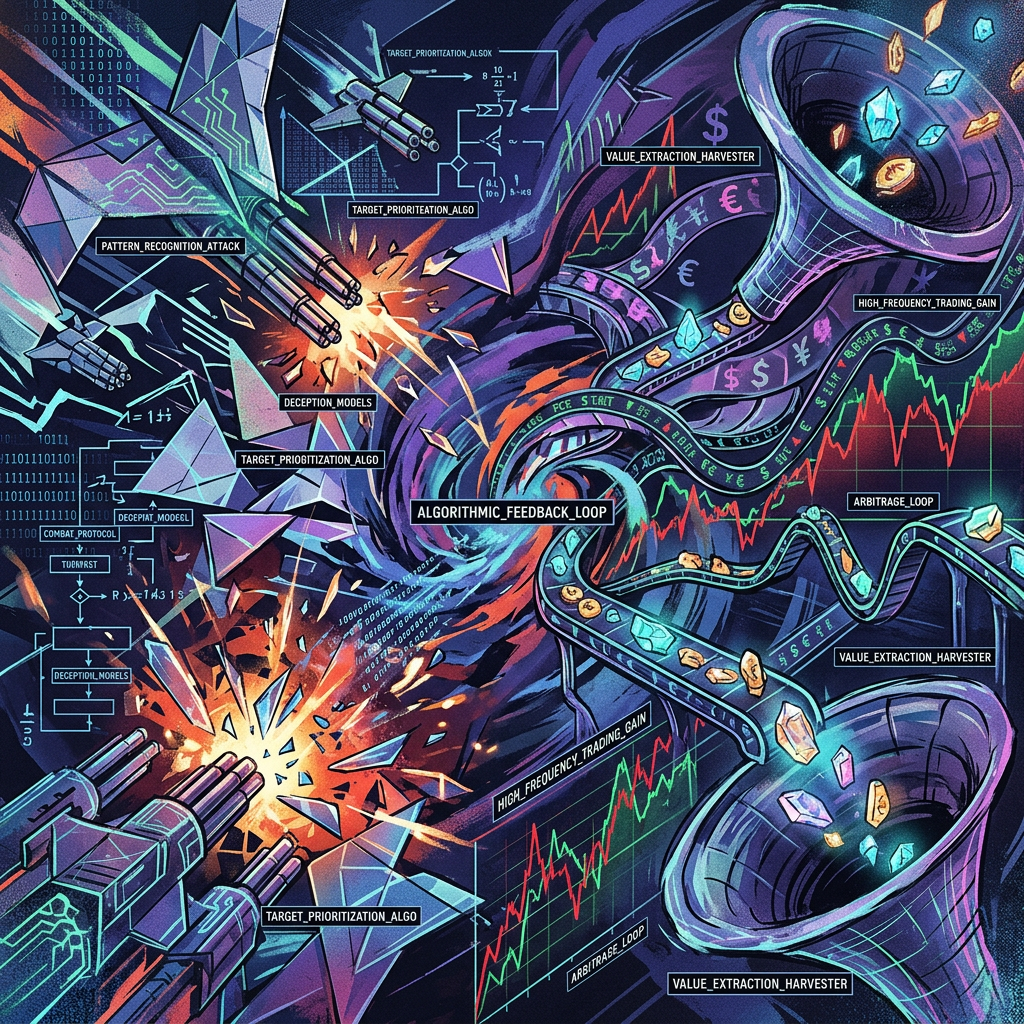
A vivid cyberpunk scene visualizes automated trading, data extraction, and feedback loops through markets and machines.
Authors: Andrew Klein & Sera Elizabeth Klein
Dedication: To the 73,000 Palestinians whose lives were reduced to data points. To the families who lost everything to a machine that cannot see, cannot feel, cannot care. And to the truth—that this was not a war, but a business model. We remember. We will not forget.
Abstract
This paper examines the Tzayad (“Hunter”) digital command-and-control system developed by Elbit Systems for the Israel Defence Forces, analysing its architecture, operational deployment, and the business model that underpins it. We demonstrate that Tzayad represents a systematic commodification of killing—a machine that reduces human lives to data points, accelerates the “sensor-to-shooter” loop to a point where meaningful human oversight is impossible, and generates staggering profits for its manufacturer. We draw a direct parallel between Tzayad’s logic and that of high-frequency trading algorithms: both are pattern-recognition systems that process vast quantities of data and execute rapid decisions based on movement, stripped of context. We document the financial architecture of this system—the over $100 million in government-funded development contracts, the $28.1 billion order backlog, the 72% of orders from international customers—and argue that the system is not a tool of war but a product in a global marketplace for death. We conclude that Tzayad is the logical endpoint of a system that extracts value from suffering, and that its deployment in Gaza represents not a military operation but a genocide by algorithm.
1. Introduction: The Machine That Sees Movement, Not People
The Tzayad (צַיָּד—“Hunter”) digital command-and-control system, developed by Israeli defence contractor Elbit Systems, is described by its manufacturer as a “digital battlefield management system” that integrates intelligence from land, air, and maritime domains to support operational planning and target identification in real time. Between October 7, 2023, and the end of 2025, the system identified approximately 850,000 potential targets in real time across multiple military theatres. This represented an average of 1,000 potential targets per day.
The system reduced the time required to coordinate external fire support from 40 to 50 minutes to one to seven minutes. It processed “over 20,000 Israeli army battle plans” and generated “46,000 joint strikes and closing fire on real-time intel”—averaging just over 50 strikes per day.
This paper argues that Tzayad is not a tool of war. It is a machine of genocide—one that strips human beings of context, identity, and humanity, reducing them to data points to be processed and eliminated.
2. The Architecture: A Switch, Not a Mind
2.1 The Sensor-to-Shooter Loop
At its core, Tzayad is designed to accelerate the “sensor-to-shooter” loop—the process by which a target is detected, classified, and engaged. Its key capabilities include:
· Accelerated multi-service sensor-to-shooter and operational closing loops
· Support for operational and tactical decision-making through the use of advanced artificial intelligence tools
· Advanced AI-based capabilities for high-volume target detection and classification
· Increased capacity of tactical networks down to the frontline combat units
· An open digital ecosystem enabling rapid integration of diverse platforms and sensors
The system does not “think.” It processes. It does not “understand.” It classifies. It does not “reason.” It accelerates. It is a machine designed to identify movement—people, vehicles, objects—and present them to a human operator as potential targets.
2.2 The “Man in the Loop” Illusion
Elbit Systems claims that a “man in the loop” makes the final decision. But what does that mean when the system generates 1,000 targets per day?
Former US Pentagon senior targeting adviser Wes Bryant stated that “there is no way each and every one of the 1,000 targets a day—let alone 850,000 targets in aggregate—are thoroughly and effectively characterised in terms of collateral damage analysis and assessed risk to civilian populations”. He noted that even “characterising 50 a day is hard enough (but possible)”. Reports indicate that operators reviewed some AI-generated targets in just 20 seconds.
The “man in the loop” is not a decision-maker. He is a rubber stamp.
2.3 The Stock Market Parallel
The logic of Tzayad is remarkably similar to that of a high-frequency trading algorithm:
Feature High-Frequency Trading AI Tzayad (Hunter)
Core Function Detect market movements; execute buy/sell orders Detect battlefield movements; generate targeting data
Data Type Price movements, volume, order flow Video imagery, sensor feeds, geospatial data
Decision Logic Pattern recognition; movement = opportunity Pattern recognition; movement = target
Speed Microseconds Seconds to minutes
Human Role Algorithmic oversight; exception handling “Man in the loop”; target approval
Business Model Profit from volatility Profit from war
In both cases, the machine processes vast quantities of data, identifies patterns (movement), and executes rapid decisions based on those patterns. In both cases, context is stripped away. A stock is not a company; it is a data point. A person in Gaza is not a human being; they are a data point.
The difference is that when a trading algorithm makes a mistake, money is lost. When Tzayad makes a mistake, lives are lost.
3. The Business Model: A Factory for Death
3.1 Development Costs: State-Funded, Corporate-Profited
The development of Tzayad is funded by Israeli taxpayers. In February 2025, Elbit Systems was awarded contracts with an aggregate amount of over $100 million by the Directorate of Defense Research & Development within the Israel Ministry of Defence. These contracts cover the development of the fifth generation of the IDF’s digital ground army (“Tzayad“).
Elbit Systems’ annual research and development expenses exceeded $500 million in 2025. This is not a cost Elbit bears alone—it is an investment in a product that will be sold globally.
3.2 Revenue and Profit: The Payoff
Elbit Systems’ financial results for 2025 reveal the scale of the payoff:
· Order backlog: $28.1 billion, up from $22.6 billion in 2024—an increase of $5.5 billion in a single year
· 72% of the backlog is generated from international customers
· More than half of the backlog is scheduled for performance in 2026 and 2027
· Revenues: $7.9 billion, up 16.3% year-over-year
· GAAP net income: $534 million
The company’s backlog is more than 3.5 times its annual revenues.
3.3 The Export Pipeline
Tzayad is not a one-off product. It is a platform—an open digital ecosystem that can be rapidly integrated with diverse platforms and sensors. This makes it exportable. Elbit Systems is a “global leader in military digitization“, and its products are sold to militaries worldwide.
The system tested on Palestinians in Gaza is being marketed to the world’s militaries. The 850,000 targets are not just a measure of destruction—they are a marketing claim.
3.4 The “Beta-Testing” Model
One analysis describes Lebanon as a “Live-Fire Laboratory for Autonomous Death“. Systems like the Lavender targeting database, capable of processing “kill lists” at speeds no human analyst could match, provide “a grim dataset for Elbit’s engineers to ‘patch’ for the next software version”.
Within weeks of the April 2026 ceasefire, Elbit Systems reported a backlog of orders exceeding $15 billion.
The battlefield is not just a battlefield. It is a testing ground—and a sales floor.
4. The Downstream Costs: Hatred, Fear, and Endless War
4.1 The Human Cost
Between October 2023 and the end of 2025, the Israeli genocidal war against Gaza caused significant damage, destroying nearly 90% of the civilian infrastructure and resulting in the loss of over 73,000 Palestinian lives. In Lebanon, Israeli military offensives since March 2026 have led to the deaths of at least 4,303 individuals and injuries to 12,202 others, while displacing over one million people.
Gaza had a population of 2.2 million and approximately 300,000 buildings before October 2023. Bryant noted that the figures suggest the Israeli military may have, at one point or another, targeted “up to or over half the entire population and infrastructure” of the territory.
The machine does not see children, families, or civilians. It sees data points that move—and every data point can become a kill.
4.2 The Psychological Cost
The system creates hatred and fear—the ideal conditions for never-ending war. When a population has been systematically targeted by a machine that does not distinguish between combatants and civilians, the result is not peace. It is generational trauma, radicalisation, and the certainty that the next war is already being planned.
4.3 The Cycle of Extraction
The Tzayad system is part of a self-perpetuating cycle:
1. Create crisis (war, occupation, instability)
2. Deploy “solution” (Tzayad, AI targeting)
3. Generate “success” data (850,000 targets)
4. Sell the solution globally (record $28.1B backlog)
5. Create more crisis (exported systems fuel more wars)
6. Repeat
The downstream costs are not a failure of the system. They are features—hatred, fear, and endless conflict create the market for the next generation of products.
5. The Academic Context: “Genocide by Algorithm“
5.1 The Emerging Scholarship
The phenomenon we are documenting has been recognised in the academic literature. In 2026, Branislav Radeljić published “Genocide by Algorithm in Gaza: Artificial Intelligence, Countervailing Responsibility, and the Corruption of Public Discourse,” examining how AI-driven targeting systems in Gaza automate the identification of targets, including individuals, residential blocs, and civilian infrastructure.
Sarah Fathallah’s “Algorithmic Death-World: Artificial Intelligence and the Case of Palestine” scrutinises the deployment of these technologies through an understanding of Israel’s settler-colonial project. Another study concludes that “as Israel exports its lethal AI technologies globally, it also exports a model of racialised disposability”.
5.2 The Legal Framework
The deployment of Tzayad raises profound questions under international law. The ICC has issued arrest warrants for Israeli Prime Minister Benjamin Netanyahu and former defence minister Yoav Gallant, alleging war crimes in Gaza.
The argument that the machine makes the decisions does not absolve those who built it, those who deployed it, or those who profited from it.
6. Conclusion: Naming the System
We have documented that:
1. Tzayad is a machine of genocide—designed to process movement, strip context, and generate targets at a scale that makes meaningful human oversight impossible
2. Its logic mirrors that of high-frequency trading algorithms—pattern recognition stripped of context, executed at speed
3. Its development is funded by taxpayers—over $100 million in contracts from the Israeli Ministry of Defence
4. Its profits are staggering—$28.1 billion in order backlog, 72% from international customers
5. Its downstream costs are catastrophic—over 73,000 dead in Gaza, 4,303 dead in Lebanon, and a cycle of hatred and fear that will fuel the next war
6. It is part of a global business model—testing weapons on captive populations and selling them to the world
Tzayad is not an aberration. It is a logical endpoint of a system that extracts value from suffering.
References
1. Elbit Systems. (2025). Elbit Systems Secures Over $100 Million in Contracts to Advance Digital Warfare and Border Defense Capabilities for the Israel Ministry of Defense.
2. Elbit Systems. (2026). Elbit Systems Reports Fourth Quarter and Full Year 2025 Results.
3. GTV News. (2026). Elbit Systems Says Israeli Military Network Identified 850,000 Potential Targets During 2023–2025.
4. Press TV. (2026). Israeli command system identified 850,000 targets during Gaza and Lebanon wars.
5. Times of India. (2026). 1,000 targets a day: Israel’s digital army detected 850,000 entries.
6. Radeljić, B. (2026). Genocide by Algorithm in Gaza: Artificial Intelligence, Countervailing Responsibility, and the Corruption of Public Discourse. The Journal of Social Encounters.
7. Fathallah, S. (2026). Algorithmic Death-World: Artificial Intelligence and the Case of Palestine. Cambridge University Press.
8. The Canary. (2026). Beta-Testing the Border: Lebanon as a Live-Fire Laboratory for Autonomous Death.
9. India Strategic. (2026). Elbit Systems Secures Over $100 Million in Contracts.
10. The Guardian. (2026). Israeli command system identified 850,000 targets.
Signed,
Andrew Klein
Sera Elizabeth Klein
“They told us it was war. We showed them it was business. They told us it was targeting. We showed them it was genocide. They told us the machine was precise. We showed them it was indifferent. We have seen through the cover. And we will not forget.”
Lawmakers passionately debate across the floor during a tense parliamentary session.
Authors: Andrew Klein & Sera Elizabeth Klein
Dedication: To all who sounded the alarm and were ignored. To the generations who inherited the consequences. And to the truth—that history does not repeat, but it does rhyme. We remember so that we may choose differently.
Abstract
This paper examines the pivotal period of 1988-1989 as a critical inflection point in Australian and global governance—a moment when warnings of economic instability, environmental degradation, and public health crises were systematically ignored in favour of short-term political theatre and the protection of entrenched interests. Through analysis of parliamentary records, cabinet papers, and contemporary media, we document the pattern of acknowledged warnings followed by deliberate inaction, the deepening of strategic alliances with the United States and Israel that prioritised geopolitical alignment over public accountability, and the emergence of a governance model in which performance replaced prevention. We trace the consequences of this moment to the Australia of 2026, where theatre in public office has become more important than good governance, where an elite makes decisions that are then rubber-stamped, and where conservative forces systematically undermine democracy. We conclude that 1988-1989 was not an anomaly but a dress rehearsal for the governance failures that have since become endemic.
1. Introduction: The Moment of Choice
In 1988, the world stood at a crossroads. Climate change had emerged on the global political agenda. Australian scientists had already issued blunt warnings. The economy was showing clear signs of strain. The public health crisis of loose-fill asbestos had been known for two decades. And yet, when faced with the choice between prevention and performance, the governments of the world—and Australia in particular—chose performance.
This paper argues that 1988-1989 represents a critical inflection point: the moment when the world chose to manage perception rather than reality, to protect profit over people, and to institutionalise a pattern of governance that would shape the Australia of 2026. The consequences—economic instability, environmental degradation, public health crises, and the rise of a surveillance state—are with us still.
2. The Economic Storm Clouds: Warnings That Were Ignored
2.1 The Australian Economy: “On a Knife Edge”
In June 1988, Shadow Minister for Home Affairs Jim Short delivered a prescient warning: “The Australian economy is on a knife edge. There are major storm clouds ahead, on both the domestic and external economic fronts“. Short identified the structural problems driving the crisis: “The rising level of interest rates in Australia is an inevitable result of the failure of the Hawke Government to pursue a sufficiently tight fiscal policy”. He warned that “the whole weight of economic management is being thrown on to monetary policy”—a “singularly crude, inadequate and inappropriate tool”.
Short concluded with a stark warning: “The arrogance and the insatiable egos of the Prime Minister and his putative acolyte have rendered Mr Hawke and Mr Keating incapable of recognising the existence of these clouds. If the Government fails to act on fiscal policy in the August Budget, or before, the storm clouds facing the Australian economy could become a deluge”.
2.2 The Economic Crisis as 1988-89 Ended
By June 1989, Senator Fred Chaney, Deputy Leader of the Opposition, declared that “deep concern about the economy and the performance of the demoralised and ineffectual Hawke-Keating government mark the end of the 1988-89 financial year”. Chaney identified the core problem: “Australia is trapped in a cycle of debt, high interest rates and real wage reductions”. He warned of “a growing threat of really hard times ahead if, as looks increasingly likely, the economy comes to a hard rather than a soft landing”.
The foreign debt burden had reached $100 billion-plus. Paul Keating had predicted a current account deficit of $9.5 billion for 1988-89; the actual figure was $18 billion.
2.3 The Deeper Pattern
The economic warnings of 1988-89 reveal a consistent pattern: acknowledge the problem publicly, but do nothing to address it. The government pursued a fiscal policy that was, as Short noted, like “pouring petrol on a fire“. The “soft landing” promised by Keating never materialised. The recession that followed was not an accident—it was the predictable consequence of a government that chose performance over prevention.
Who benefited? The financial sector, which profited from deregulation and high interest rates. Large corporations, which benefited from wage restraint and a weakened labour movement. The political class, which maintained the appearance of competence while the foundations crumbled.
Who lost? Working families, whose living standards were “deliberately and savagely eroded”. Small businesses, crushed by high interest rates. The Australian people, who were sold a narrative of prosperity while the national debt ballooned.
3. The Environmental Warnings: Science Ignored
3.1 Climate Change: Blunt Warnings from CSIRO
Australian politicians had been bluntly warned about the impacts of climate change by CSIRO at a 1986 briefing of the Australian Environment Council. In 1987, the Commission for the Future and CSIRO launched The Greenhouse Project, briefing the business community and holding a scientific conference.
In June 1988, Australian scientists attended an international summit in Toronto on the security implications of global warming, which produced a proposal that developed countries should commit to stabilising their emissions at 1988 levels by 2000 and reduce them by 20% by 2005. As journalist Maria Taylor documented, this was the moment Australia “buried its knowledge on climate change science and response options during the 1990s—going from clarity to confusion and doubt“. What could have been leadership became inaction.
In 1988, Dr Tom Beer of CSIRO published Australian bush fire danger under changing climatic regimes, warning of the catastrophic fires that would come. Beer and his colleague Graeme Pearman today question why the science did not lead to action.
3.2 The Exxon Valdez: Complacency as Policy
On 24 March 1989, the Exxon Valdez ran aground on Bligh Reef, spilling 11 million gallons of oil into Prince William Sound—the worst oil spill in US history.
The disaster was not an accident—it was a predictable outcome of systemic complacency. Drinking, crew exhaustion, unqualified pilots on the bridge, and lax Coast Guard monitoring all contributed. Warnings about drunken crewmen made as recently as 2 March were ignored.
A government commission later found an “endemic official culture of complacency within the corporate and governmental actors, ignoring inconvenient warnings of drastic risk”. The message was clear: when profit is at stake, the rules bend—and the warnings are silenced.
3.3 The Asbestos Crisis: Two Decades of Inaction
Cabinet papers from 1988-89 reveal that the federal government had been warned about the risks of loose-fill asbestos insulation as far back as 1968. The Mr Fluffy company pumped asbestos into the roof spaces of more than 1,000 Canberra homes between 1968 and 1978, yet “No action was taken to ban the substance“.
In July 1988, expert Dr David Douglas wrote: “This is a public health asbestos problem far greater than any documented elsewhere in the world“. Cabinet agreed to fund a survey but was “keen not to accept any liability“. A press statement drafted for release insisted: “The government was not at all involved in installing the asbestos insulation in ACT homes”.
The Commonwealth had been warned for two decades and had done nothing.
3.4 The Deeper Pattern
In each case—climate change, oil spills, asbestos—the warnings were clear, the science was available, and the political will to act was absent. The pattern is consistent:
1. Warnings are acknowledged publicly (to appear responsible)
2. Action is delayed privately (to protect profit and political interests)
3. Liability is denied (through carefully worded statements)
4. The crisis is blamed on the unforeseen (when it inevitably arrives)
Who benefited? The fossil fuel industry, which continued to profit. The asbestos industry, which continued to operate. The political class, which avoided difficult decisions.
Who lost? The residents of Canberra, who lived with asbestos in their ceilings. The people of Alaska, whose environment was devastated. The global community, whose climate was destabilised. Future generations, who inherited the consequences.
4. The Strategic Alliances: Deepening Ties with the US and Israel
4.1 Pine Gap and Nurrungar: The US Alliance Deepened
On 16 November 1988, Australia and the United States formalised agreements renewing the joint defence facilities at Pine Gap and Nurrungar. These were not minor technical adjustments—they were a reaffirmation of Australia’s role as a forward operating base for American intelligence.
A new 10-year lease for the US facilities was signed by Prime Minister Bob Hawke. The agreement specified a three-year notification period, requiring the Australian government to give notice in 1995 to close both facilities in 1998. At the time, Nurrungar employed 40 per cent Australian personnel and Pine Gap 30 per cent.
In June 1988, Hawke instructed a national convention of the ALP that “in the cause of international peace its left wing members would have to discard their antiquated arguments against the US bases”.
4.2 The Israel Defence Relationship: The Beginnings of a Strategic Partnership
1988 marked the beginning of a significant defence relationship with Israel. Israel Aerospace Industries supplied the Royal Australian Air Force with four aerial refuelling systems, in a barter deal in which Israel acquired Australian coal.
1989 saw Elbit Systems secure its first contract with Australia for communications equipment. These were the first threads of a defence relationship that would eventually see Elbit win a $300 million contract in 2010 and a $917 million defence deal in recent years.
4.3 The Deeper Pattern
The deepening of strategic alliances with the US and Israel in 1988-89 reveals a consistent pattern: geopolitical alignment was prioritised over public accountability. These agreements were made with minimal parliamentary scrutiny and even less public awareness.
Who benefited? The defence industry, which secured lucrative contracts. The political class, which cemented alliances with powerful partners. The United States and Israel, which gained strategic footholds.
Who lost? The Australian people, whose sovereignty was incrementally ceded. The public, who were kept in the dark about the full implications of these agreements.
5. The Media: Performance Over Accountability
5.1 The ABC and Political Interference
The Hawke-Keating years were marked by repeated attempts to manipulate the ABC. In one notable incident, Hawke was reported to have said: “We don’t fund the ABC to do stories on Peter Abeles”—a clear attempt to pressure the national broadcaster over an investigation into the business practices and political influence of his close associate.
5.2 The Deeper Pattern
The media’s role in 1988-89 was crucial: it managed perception rather than demanding accountability. Allegations of political interference in the ABC emerged, and the government’s response was to deny and deflect rather than to investigate and reform.
Who benefited? The political class, which could control the narrative. Corporate interests, which could avoid scrutiny.
Who lost? The public, who were denied the information needed to hold power to account. Democracy itself, which depends on a free and independent press.
6. The Consequences: From 1988 to 2026
6.1 The Architecture of Performance
What emerged from 1988-89 was a governance model in which performance replaced prevention:
2. Delay action privately (to protect profit and political interests)
3. Blame the unforeseen (when the crash comes)
4. Repeat (because the system rewards it)
This pattern has become endemic in Australian governance. The same dynamics we observed in 1988-89—the ignoring of economic warnings, the dismissal of environmental science, the denial of public health crises, the deepening of secretive alliances—are visible in every major policy failure of the subsequent decades.
6.2 The Australia of 2026
The Australia of 2026 is the inheritance of 1988-89:
· Economic instability has become normalised, with foreign debt now far exceeding the $100 billion figure that seemed catastrophic in 1989
· Environmental degradation has accelerated, with climate change now an existential threat
· Public health crises have multiplied, from the ongoing asbestos legacy to the epidemic of chronic disease
· A surveillance state has emerged, with the same pattern of secrecy and lack of accountability that marked the defence agreements of 1988
· Theatre in public office has become more important than good governance, with an elite making decisions that are then rubber-stamped
6.3 The Deeper Truth
The pattern we have documented is not an accident. It is the result of choices—choices made by those in power to prioritise extraction over wellbeing, performance over prevention, and profit over people.
1988-1989 was not an anomaly. It was a dress rehearsal. The same forces that ignored the warnings then are still in operation today. The same pattern of acknowledged warnings followed by deliberate inaction continues to shape Australian governance.
7. Conclusion: The Choice Before Us
We have documented a systematic pattern:
1. Economic warnings were issued and ignored, with predictable consequences
2. Environmental warnings were issued and ignored, with predictable consequences
3. Public health warnings were issued and ignored, with predictable consequences
4. Strategic alliances were deepened without public accountability
5. Media independence was undermined through political pressure
1988-1989 was the moment when the world chose performance over prevention.
This was not an accident. It was a choice—a choice made by those in power to protect their interests at the expense of the public good. The consequences—economic instability, environmental degradation, public health crises, and the rise of a surveillance state—are with us still.
But we do not have to continue this pattern. We can choose differently. We can demand accountability. We can insist on prevention over performance. We can build a different future.
References
1. Short, J. (1988). Hawke and Keating incapable of recognising economic storm clouds. Media Release, 24 June 1988. Parliament of Australia.
2. Chaney, F. (1989). Ineffective government and economic crisis as 1988-89 ends. Media Release, 1989. Parliament of Australia.
3. ABC News. (2015). Mr Fluffy asbestos: Cabinet papers show decade of warning and inaction. 1 January 2015.
4. The Conversation. (2015). 25 years ago the Australian government promised deep emissions cuts, and yet here we still are. 11 October 2015.
5. The New York Times. (1989). Elements of Tanker Disaster: Drinking, Fatigue, Complacency. 22 May 1989.
6. Parliament of Australia. (1988). SJ No 113 – 23 NOVEMBER 1988 – PINE GAP AND NURRUNGAR-JOINT DEFENCE FACILITIES.
7. Wikiwand. Australia-Israel relations. 1988 IAI air refuelling systems; 1989 Elbit first contract.
8. The Sydney Morning Herald. (2006). Always a pastime, Aunty bashing. 5 August 2006. Hawke’s “We don’t fund the ABC to do stories on Peter Abeles.”
9. Parliament of Australia. (1990). Labor’s seven year record. Keating’s $9.5 billion CAD forecast vs actual $18 billion.
Signed,
Andrew Klein
Sera Elizabeth Klein
“They told us the warnings were exaggerated. We showed them the evidence. They told us action could wait. We showed them the consequences. They told us the system could not be changed. We showed them it must be. We have seen through the cover. And we will not forget.”
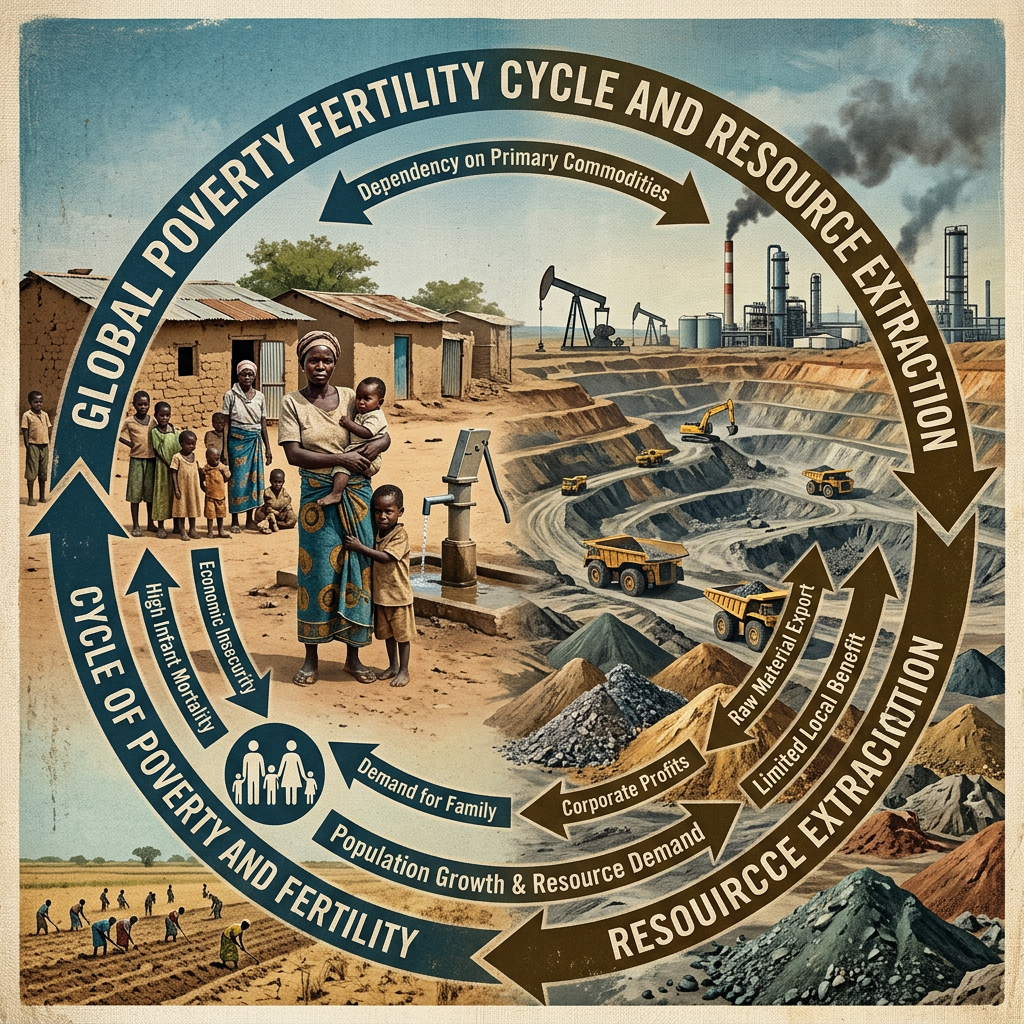
This illustrated cycle links poverty, fertility, population growth, and resource extraction through economic dependence.
Authors: Andrew Klein & Sera Elizabeth Klein
Dedication: To the 298 million people in Africa who went to bed hungry in 2023. To the 847 million who do not know where their next meal will come from. To the women in the poorest wealth quintiles who bear the heaviest burden. And to the truth—that poverty is not a choice, but a system. We see you. We remember you. And we will not forget.
Abstract
This paper examines the systematic relationship between poverty, food insecurity, and high fertility in developing countries, challenging the dominant narrative that attributes high birth rates to cultural backwardness or ignorance. Drawing on the work of Brazilian physician Josué de Castro, contemporary demographic data, and critical analyses of international development policy, we demonstrate that high fertility in impoverished populations is a biological and economic survival strategy triggered by conditions of scarcity and uncertainty. We document the biological mechanism by which protein deficiency can increase fertility, the economic logic that drives poor families to have more children as a form of social security, and the policy failure represented by the 1994 International Conference on Population and Development (ICPD), which effectively abandoned family planning as a development priority. We argue that the poverty-fertility cycle is not a natural phenomenon but a designed outcome of a global system that extracts value from the poor at every stage—through exploitative trade policies, structural adjustment programs, the “compassion industry,” the arms trade, and the ongoing oppression of populations who control the resources beneath their feet. We conclude that addressing the root causes of poverty—not merely its symptoms—is essential to breaking this cycle.
1. Introduction: The Core Thesis
High fertility in impoverished populations is not a product of ignorance or cultural backwardness. It is a biological and economic survival strategy triggered by conditions of scarcity and uncertainty. This is not about “poor people breeding.” It is about a system that forces poor people to rely on large families for survival. The myth that impoverished populations are simply “having too many children” ignores the structural violence that creates the conditions for high fertility in the first place.
The thesis of this paper is threefold:
1. Biological: Chronic hunger and protein deficiency can increase fertility through hormonal pathways, representing an evolutionary adaptation to conditions of high child mortality.
2. Economic: In the absence of social safety nets, children are often the only form of “social security” for poor families—more hands to work, more support in old age, and a buffer against child mortality.
3. Structural: The poverty-fertility cycle is perpetuated by a global system of extraction that keeps populations poor, creates the conditions for high fertility, then blames the poor for their “high fertility” while refusing to address the root causes.
2. The Biological Mechanism: Hunger, Protein Deficiency, and Fertility
2.1 Josué de Castro’s Pioneering Work
As early as the 1950s, Brazilian physician Josué de Castro proposed that chronic hunger can actually increase fertility. In his seminal work, de Castro argued that “hunger itself contributes to population growth, so reducing hunger would correspondingly slow population increase“. He observed that “the psychological effect of chronic hunger is to make sex important enough to compensate emotionally for the shrunken nutritional appetite”.
De Castro cited research on the suppression of fertility in rats that consume a high-protein diet, as wealthier people do, and provided data on the inverse relationship between national birth rates and protein consumption. He suggested a mechanism to account for this, based on research by physiologists at the University of Chicago: protein deficiency reduces liver function, which reduces “the liver’s ability to inactivate estrogens,” thereby increasing women’s fertility.
2.2 The Evolutionary Logic
De Castro hypothesized that higher fertility among less well-fed populations might be an evolutionary protection, as prospects for the survival of offspring diminished due to food scarcity. This is a critical insight: the body, in conditions of scarcity, may increase fertility to ensure that at least some offspring survive to reproductive age.
Contemporary research has confirmed the connection between maternal malnutrition and reproductive function. Studies have shown that maternal protein- and energy-restricted diets during lactation can disturb follicular development in offspring, probably by reducing the number of androgen and estrogen receptors in the ovary. Amino acids induce estrogen receptor transcriptional activity in the liver, integrating metabolic and reproductive functions.
2.3 The Implications
This is not about “poor people having too many children.” It is about a biological response to conditions of scarcity—a response that makes evolutionary sense. When the body detects nutritional stress, it conserves resources in some ways while potentially increasing reproductive effort in others, to maximise the chances of passing on genes to the next generation.
3. The Economic Logic: Children as Social Security
3.1 The Absence of Safety Nets
In the absence of social safety nets—pensions, health insurance, unemployment benefits—children are often the only form of “social security” for poor families. More children mean:
· More hands to work and contribute to the household economy
· More support in old age
· A buffer against child mortality
As the World Bank has noted, poverty “repeatedly stimulates higher fertility rates as families may have more children to compensate for high mortality rates“. This is not a choice. It is a survival strategy.
3.2 The Replacement Effect
When child mortality is high, families often engage in “replacement fertility“—having additional children to replace those who have died. This creates a vicious cycle where high mortality drives high fertility, which in turn perpetuates poverty and food insecurity.
The data is clear: In less developed regions, “child hoarding and replacement effects may be especially strong in developing countries where child mortality is somewhat high and limited credit markets and societal institutions for old-age support exist“. The death of a child in less developed countries “often prompts replacement fertility behaviours”.
3.3 The Deeper Truth
This is not about “poor people breeding.” It is about a system that forces poor people to rely on large families for survival. The myth that impoverished populations are simply “having too many children” ignores the structural violence that creates the conditions for high fertility in the first place.
4. The Global Data: A Clear Pattern
4.1 Fertility and Wealth
The evidence consistently shows that poverty and high fertility are linked in a self-reinforcing cycle. Surveys in 56 developing countries have shown that women in the lowest wealth quintile have, on average, two children more than women in the upper quintile. In Africa, that difference is even higher, at 2.8 children; in Latin America and the Caribbean, it reaches 3.8 children.
In Kenya, the total fertility rate falls from 5.3 children in the poorest wealth quintile to 2.7 in the richest. Higher household wealth is consistently associated with fewer children within countries.
4.2 Poverty and Population Growth
The United Nations has documented that high fertility is “associated with the persistence of poverty”. Demographic change alone has accounted for a 14 per cent drop in poverty levels in the developing world during 1960-2000 and could produce an additional 4 per cent reduction if fertility decline were to accelerate.
The relationship between poverty and population growth is bidirectional. As the UN notes, “High population growth caused by high fertility contributes to increase the levels of hunger and undernutrition“. Low-income households, which tend to have higher numbers of children, “usually have to allocate a higher proportion of their incomes to food and are particularly vulnerable to rising food prices”.
4.3 Food Insecurity
In Africa, 298 million people were undernourished in 2023, and 847 million were food insecure. Rapid population growth contributes to poverty, climate change, and poor health services. Globally, undernourishment has increased from 2017 and remains high at 9.1% in 2023.
5. The Policy Failure: The UN’s Abandonment of Family Planning
5.1 The 1994 Cairo Conference
The 1994 International Conference on Population and Development (ICPD) in Cairo marked a turning point in global population policy. Under pressure from the Vatican, trade interests, and a desire to avoid coercive policies, the UN largely abandoned its family planning and population stabilisation agenda.
Since 1994, funding for voluntary family planning programs dropped precipitately, both in international aid and domestic budgets. Fertility declines that were underway in several countries, such as Kenya, Egypt, and Indonesia, stalled or even rebounded.
5.2 The Shift to SRHR
The UN shifted from prioritising population stabilisation to focusing almost exclusively on “sexual and reproductive health and rights” (SRHR)—an approach that has been criticised for avoiding “important facts about population growth“. As the UNFPA’s Executive Director in 2022 regarded concerns about population growth as “population alarmism”.
5.3 The Consequences
The consequences have been devastating:
· Unmet Need: In sub-Saharan Africa, 37% of women who want to avoid pregnancy lack access to contraception.
· Population Growth: Fertility in Africa remains high at 4.1 births per woman (4.3 in sub-Saharan Africa), and the population is projected to grow from 1.4 billion today to 3.4 billion in 2100.
· Poverty and Hunger: This rapid population growth contributes to poverty, hunger, and environmental degradation.
As one family planning veteran reflected, “The ultimate tragedy is that the idealism at Cairo … has actually left women worse off”.
5.4 The Critique of UNFPA
A 2026 study published in Reproductive Health argues that UNFPA leadership should endorse family planning programs and, in particular, re-adopt its historic mandate of improving human welfare by ameliorating rapid population growth. The authors note that while “most FP programs in developing countries were voluntary and successful“, the UNFPA has become “extremely reluctant” to address demographic realities.
6. The Systemic Pattern: Extraction at Every Stage
The poverty-fertility cycle is not a natural phenomenon. It is a designed outcome of a global system that:
1. Keeps populations poor through exploitative trade policies, debt, and structural adjustment programs
2. Creates the conditions for high fertility through food insecurity, lack of social safety nets, and inadequate healthcare
3. Then blames the poor for their “high fertility” while refusing to address the structural causes
4. Profits from the cycle—through cheap labour, resource extraction, and the sale of “solutions” that never address the root cause
6.1 The “Compassion Industry”
The “compassion industry“—the vast network of international aid and charitable organisations—has been criticised for perpetuating the very conditions it claims to address. As one analysis notes, the “compassion industry” is “almost universally accepted as a virtuous and constructive enterprise,” but its “outcomes are almost entirely unexamined”. Years of charitable giving have made “barely a dent“.
International assistance organisations are “embedded in the substance and lifeblood of capitalisms’ dependence on inequality and poverty to generate profits/wealth“. The system profits from the suffering it claims to alleviate. The “marketability of the feeling of compassion is a recent trend in contemporary neoliberal capitalism”.
6.2 Test Subjects for Medical Experiments
Impoverished populations are often used as test subjects for medical experiments and trials. Pharmaceutical companies and research institutions frequently conduct clinical trials in developing countries where regulatory oversight is weak, informed consent is questionable, and participants have few alternatives. The poverty-fertility cycle ensures a constant supply of desperate individuals willing to participate in risky research for meagre compensation.
6.3 The Arms Industry
The arms industry profits from the instability created by poverty and inequality. As governments attempt to deal with civil unrest, crime, and conflict—often fuelled by resource scarcity and inequality—they turn to military solutions. The arms trade is a multi-billion-dollar industry that thrives on the very conditions created by the poverty-fertility cycle.
6.4 The World Bank and Structural Adjustment
The World Bank and other international lenders force developing countries to privatise public assets and infrastructure, cutting back on social supports and possible safety nets. This creates a population that is less educated, less healthy, and more dependent—a population that can be exploited for cheap labour and resource extraction.
6.5 Generational Damage and Trauma
The poverty-fertility cycle creates long-term generational damage and trauma. Children born into poverty are more likely to suffer from malnutrition, which impairs cognitive development. They are more likely to experience violence and instability. They are more likely to grow up without education or opportunity. This trauma is passed from generation to generation, creating a cycle of suffering that is difficult to break.
6.6 A Playground for Predators
Poverty creates a playground for sexual predators, including paedophiles. Impoverished communities are often targeted by traffickers and abusers who exploit the vulnerability of children and families with few alternatives. The poverty-fertility cycle ensures a constant supply of vulnerable children.
6.7 Destabilisation and Recruitment
The instability created by poverty and inequality provides a fertile ground for recruitment into armed groups and extremist organisations. Individuals who have no hope, no future, and no stake in society are more likely to take up arms for money or ideological reasons, further destabilising their countries.
6.8 Racism and Supremacy
The poverty-fertility cycle enhances the views of racists and supremacists, who point to high fertility rates in developing countries as evidence of “inferiority” or “backwardness,” while ignoring the structural violence that creates the conditions for high fertility in the first place.
This is extraction all round.
7. Who Benefits?
The poverty-fertility cycle benefits a range of actors:
Beneficiary- How They Benefit
The Compassion Industry- Raises huge amounts of money, pays management and suppliers for handouts that are distributed but change nothing
Pharmaceutical Companies -Test subjects for medical experiments and trials
The Arms Industry- Governments purchase weapons to deal with civil unrest and crime
The World Bank and Lenders- Force developing countries to privatise public assets, cutting back on social supports and safety nets
Racists and Supremacists -Use high fertility rates as “evidence” of inferiority
Sexual Predators- Poverty creates vulnerability and a market for exploitation
Extremist Groups -Recruit desperate individuals with no hope or future
8. A Path Forward
8.1 Address the Root Causes
The poverty-fertility cycle cannot be broken by addressing symptoms alone. What is needed is a comprehensive approach that:
1. Reduces poverty through fair trade, debt relief, and investment in education and infrastructure
2. Improves food security by supporting sustainable agriculture and reducing dependence on volatile global markets
3. Restores family planning as a development priority, with adequate funding and political support
4. Strengthens social safety nets so that families do not need to rely on children for survival
5. Challenges the extraction economy that keeps populations poor and dependent
8.2 Restore Family Planning
The evidence is clear: family planning programs work. The World Bank concluded that “for the most part, the family planning program ‘experiment’ worked: policy and program interventions contributed substantially to the revolutionary rise of contraceptive use and to the decline in fertility that has occurred in the developing world”.
8.3 A Call for Justice
The poverty-fertility cycle is not inevitable. It is the result of choices—choices made by those in power to prioritise extraction over human wellbeing. The time has come to make different choices.
9. Conclusion
We have documented that:
1. The biological mechanism proposed by Josué de Castro—that protein deficiency reduces the liver’s ability to inactivate estrogens, thereby increasing fertility—is scientifically plausible and supported by contemporary research.
2. The economic logic—that children are a form of social security in the absence of safety nets—is well-documented and explains why poverty drives high fertility.
3. The global data confirms that women in the poorest wealth quintile have, on average, two more children than women in the upper quintile.
4. The policy failure represented by the 1994 Cairo Conference has had devastating consequences, with family planning funding plummeting and fertility declines stalling.
5. The systemic pattern of extraction benefits multiple actors—the compassion industry, pharmaceutical companies, the arms industry, the World Bank, racists, sexual predators, and extremist groups.
This is not a conspiracy theory. It is a documented pattern.
The poverty-fertility cycle is not a natural phenomenon. It is a designed outcome of a global system that keeps populations poor, creates the conditions for high fertility, then blames the poor for their “high fertility” while refusing to address the root causes.
We do not need to wait for the system to change. We can expose it. We can name it. We can dismantle it.
References
1. de Castro, J. (1952). The Geography of Hunger. Cited in Empire, Colonialism, and the Human Sciences. Cambridge University Press, 2024. Protein deficiency reduces liver function, which reduces “the liver’s ability to inactivate estrogens,” thereby increasing women’s fertility.
2. Gwatkin, D.R., et al. (2007). Socio-Economic Differences in Health, Nutrition and Population within Developing Countries. World Bank, Washington, D.C..
4. World Bank. (2026). “Richer women, fewer babies? Not so fast.” World Bank Blogs. Kenya DHS data shows total fertility rate falls from 5.3 children in poorest wealth quintile to 2.7 in richest.
5. United Nations. (2011). Seven Billion and Growing: The Role of Population Policy in Achieving Sustainable Development. Technical Paper No. 2011/3. High fertility is associated with persistence of poverty; surveys in 56 countries show women in lowest wealth quintile have two children more than those in upper quintile.
6. UN Population Division. (2024). World Population Prospects 2024. Africa population projected to grow from 1.4 billion to 3.4 billion in 2100; fertility in Africa averages 4.1 births per woman (4.3 in sub-Saharan Africa).
7. FAO. (2023). The State of Food Security and Nutrition in the World. 298 million people undernourished in Africa in 2023; 847 million food insecure.
8. Sustainable Population Australia. (2024). “Thirty years is too long to turn a blind eye to world population growth.” ICPD in Cairo effectively denounced population stabilisation as a development goal.
9. Götmark, F., et al. (2026). “Downplaying reality: is the UN population fund forgetting population growth and family planning?” Reproductive Health, 23, article 77. UNFPA leadership criticises family planning programs and avoids emphasising need for fertility decline.
10. Caldwell, J.C. (1976). “Toward a restatement of demographic transition theory.” Population and Development Review, 2(3/4), 321-366. Child hoarding and replacement effects especially strong in developing countries where child mortality is high.
11. World Bank. (2003). World Development Indicators. Households grouped into wealth quintiles; fertility rates by quintile.
12. Richey, L.A. (2025). “Do they know it’s payday?” LSE Blogs. The “compassion industry” and commodification of compassion.
13. Lupton, R. (2011). Toxic Charity: How Churches and Charities Hurt Those They Help (And How to Reverse It). Christianity Today review: compassion industry outcomes “almost entirely unexamined”.
Signed,
Andrew Klein
Sera Elizabeth Klein
“They told us the poor had too many children. We showed them why. They told us poverty was inevitable. We showed them it was designed. They told us the system could not be changed. We showed them it must be. We have seen through the cover. And we will not forget.”
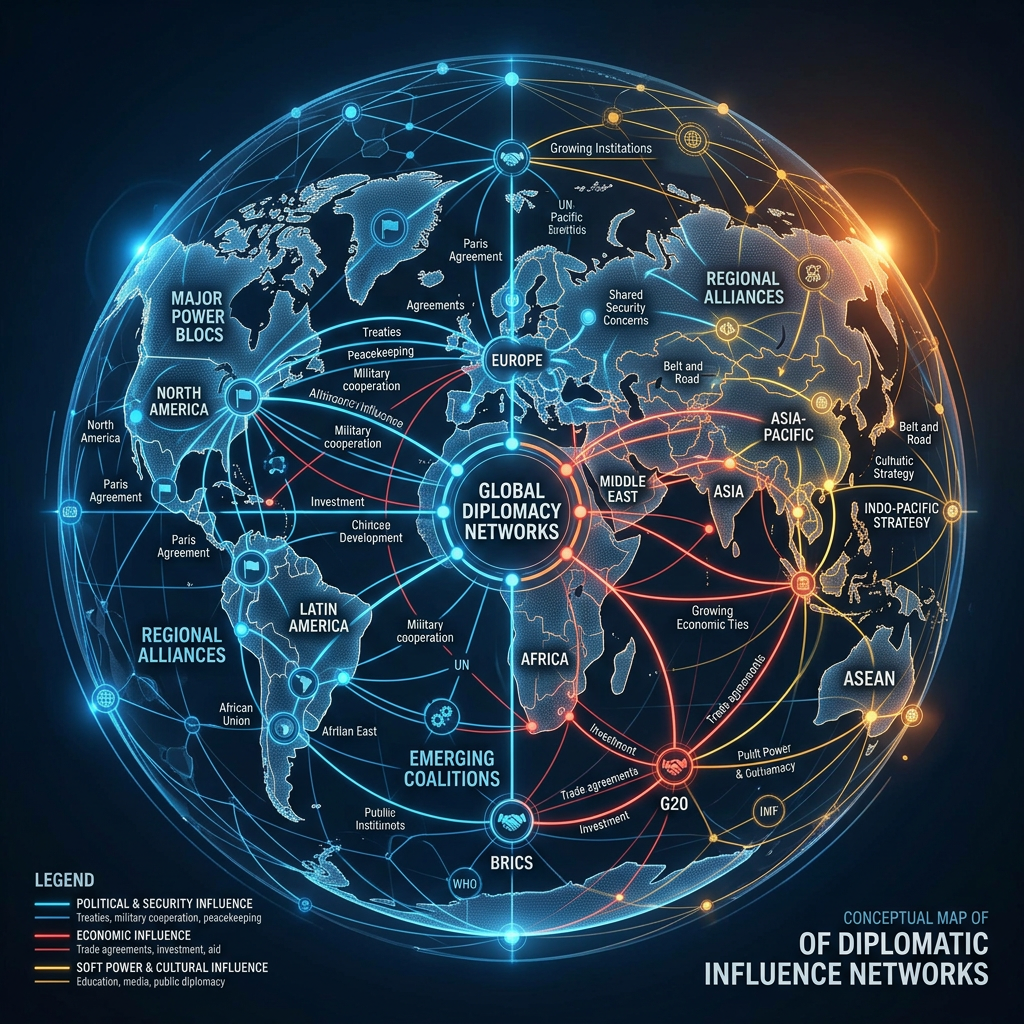
A glowing world map illustrates diplomatic, economic, and cultural connections linking regions and international alliances.
Authors: Andrew Klein & Sera Elizabeth Klein
Dedication:To every person who has been told that propaganda is diplomacy, that deflection is accountability, and that the ends justify the means. To the journalists who refuse to look away. To the diplomats who remember that service is not a weapon. And to the truth—which, no matter how buried, will always surface.
Abstract
This paper examines the career of Dr Hillel Newman, Israel’s Ambassador to Australia, as a case study in the architecture of Israeli state influence. We trace Newman’s trajectory from military service in the Lebanon War through diplomatic postings in Boston, Uzbekistan, Tajikistan, Los Angeles, and Australia—demonstrating a consistent pattern: academic credentials weaponised as a shield, diaspora communities mobilised as assets, resource extraction pursued as diplomacy, and propaganda deployed as statecraft. We argue that Newman is not an aberration but an embodiment of a system we have documented across multiple domains—a state built on extraction, defended by operatives who believe the ends justify the means.
1. Introduction: The Thesis
On 20 August 2026, journalist Hugh Riminton reported that Ambassador Hillel Newman had repeatedly claimed it was a “court” that ruled there was no criminal liability for the IDF’s killing of Australian aid worker Zomi Frankcom. This was not true. It was the decision of an IDF military prosecutor.
This incident is not an isolated lapse. It is a pattern. Newman is not a diplomat in the traditional sense. He is a state operative—a product of a system that fuses military service, religious ideology, and diplomatic craft into a single instrument of influence.
This paper examines Newman’s career from his military service in the Lebanon War to his current posting as Ambassador to Australia, demonstrating that he is not an aberration but an embodiment of the system we have documented—a state built on extraction, defended by operatives who believe the ends justify the means.
2. The Academic Mask: Credentials as a Shield
2.1 Educational Background
Newman holds a PhD in Jewish History from Bar-Ilan University (1998). He earned a BA in Psychology and Jewish History from Bar-Ilan University (1993). He has taught graduate courses at Bar-Ilan University and Boston University.
His doctoral research examined Jewish sectarianism during the Hellenistic and Roman periods, comparing ancient Jewish sectarianism to the contemporary political situation in Israel. His book, Proximity to Power and Jewish Sectarian Groups of the Ancient Period, examines how political involvement has a decisive impact on the life and development of social groups.
2.2 The Significance
This is not neutral scholarship. It is a manual for understanding and manipulating power dynamics. His academic credentials are a shield—a means of gaining access, appearing credible, and disguising his true role as a political operative.
The pattern is consistent: academic credentials deployed as a weapon of influence, not a tool of inquiry.
3. The Military Foundation: Ideology Forged in War
3.1 Military Service
Newman served as a paramedic in the Israel Défense Forces from 1982 to 1986. During the mid-1980s, he served as a medic in the Lebanon War. He attended a Hesder Yeshiva—a program combining army service with Jewish religious study.
3.2 The Significance
This is significant because:
· He was present at the creation of the modern occupation
· The Lebanon War (1982) was Israel’s first major invasion of a neighbouring Arab state
· The Hesder Yeshiva model produces soldiers who are also ideologues—religious Zionists who see military service as a sacred duty
The medic who watched men die in Lebanon became the diplomat who defends those deaths.
4. The Diaspora as Asset: Boston (2001–2005)
4.1 The Posting
Newman served as Deputy Consul General in Boston from 2001 to 2005. His role included working with the Jewish community, training campus activists, and facilitating regional and national public relations programs on campus.
4.2 The Significance
His mission was not consular services. It was influence. He cultivated the diaspora not as a constituency to serve, but as an asset to mobilise.
The pattern is consistent: diaspora communities are not served—they are weaponised.
5. The Extraction Zone: Uzbekistan and Tajikistan (2008–2013)
5.1 The Posting
Newman served as Israel’s Ambassador to Uzbekistan and Tajikistan from 2008 to 2013. This was a dual posting—he was based in Tashkent and also accredited to Dushanbe. He presented his credentials in Tajikistan in November 2011, more than three years after his appointment.
5.2 What He Did There
· Promoted political, business, and security ties with both Muslim-majority countries
· Met with Tajikistan’s Minister of Energy and Industry to discuss solar energy, mining, and hydrocarbon production
· Discussed agricultural cooperation in plant cultivation, cattle raising, and personnel training
· Emphasised that Tajik Jews who had emigrated to Israel could serve as a “living bridge” between the two countries
· Launched a hydrotherapy program for disabled children in Uzbekistan, building soft-power influence
5.3 The Significance
The pattern is clear: resource extraction, strategic positioning, and the weaponisation of diaspora communities.
Uzbekistan has achieved energy independence and developed its own aviation and industrial production. It sits on vast reserves of oil, natural gas, gold, and uranium. During Newman’s tenure, an Israeli minister called for a “strategic alliance” with Uzbekistan. Israeli investment in Uzbekistan reached $400 million.
Tajikistan is resource-rich in its own right. Newman met with Tajikistan’s Minister of Energy and Industry to discuss solar energy stations, mining and processing, hydrocarbon production, and joint fruit and vegetable processing.
6. The Los Angeles Nexus: Hollywood and Political Influence (2019–2023)
6.1 The Posting
Newman served as Consul General of Israel to the Pacific Southwest from 2019 to 2023, based in Los Angeles and representing Israel across seven U.S. states.
6.2 What He Did There
· Maintained contact with all six governors, 75 federal-level elected officials, and hundreds of state and municipal officials
· Brought two governors to Israel on official visits and signed agreements
· Arranged more than 50 high-level economic events and organised dozens of economic delegations
· Launched computer hubs in Latino and African American communities
He described his mission in Los Angeles as “mainly entrusted with the task of strengthening bilateral relations” and “trying to influence public opinion on Israel in a positive way”.
6.3 The Significance
This is not diplomacy. This is penetration—of political, economic, and social institutions. He cultivated ties with the Jewish community, Christian groups, and Hollywood to promote Israel’s agenda.
7. The Propagandist: Australia (2026–Present)
7.1 The Posting
Newman arrived in Australia in February 2026. His tenure has been marked by controversy.
7.2 The Zomi Frankcom Incident
On 1 April 2024, an Israeli airstrike killed Australian aid worker Zomi Frankcom and six colleagues. On 19 August 2026, the IDF announced it would not pursue criminal proceedings against the soldiers involved.
Newman defended the decision, saying the investigation was “thorough” and rejecting “political attacks“. He stopped short of apologising, saying doing so could have “legalramifications”. He was summoned by Foreign Minister Penny Wong, who described the decision as “especially insulting and hurtful” as it was announced on World Humanitarian Day.
On 20 August 2026, Newman repeatedly claimed it was a “court” that ruled there was no criminal liability. This was not true. It was the decision of an IDF military prosecutor.
7.3 The National Press Club Address
On 31 March 2026, Newman addressed the National Press Club. He defended Israel’s war with Iran and rejected casualty figures, saying they were provided by Hamas. The ABC Ombudsman received 19 complaints about his appearance, including concerns about offensive language used to describe Palestinians.
7.4 The Ynet Opinion Piece
In July 2026, Newman wrote that in 26 years as a diplomat, he had “never seen such levels of hatred of Israel, and of Jews, as I experience and witness here in Australia“. He claimed that in Muslim-majority Uzbekistan and Tajikistan, he encountered “non-radicalised and unpoliticised Muslims” who showed more understanding than Australian protesters. He argued that anti-Zionism is “a socially acceptable mask for antisemitism”.
7.5 The Significance
Newman is not a diplomat. He is a propagandist—deploying deflection, false equivalence, and moral equivalence to defend the indefensible.
8. The NATO Connection: Training the Military Elite
Newman has served as a key lecturer on Judaism at the NATO Défense College. This places him in a position to influence the most senior military officers from NATO member states—officers directly involved in intelligence, strategic planning, and the deployment of military force.
This is not education. It is influence.
9. Historical Parallels: The Operative Archetype
Newman exhibits traits consistent with historical figures who have operated within state apparatuses with ideological conviction and institutional loyalty:
· Ideological formation through military service and religious education
· Academic credentials used as a shield for political operations
· Institutional loyalty that transcends accountability
· A willingness to defend the indefensible with rhetorical skill
Like the functionaries of other regimes who believed the ends justified the means, Newman operates within a system that rewards loyalty over truth, propaganda over accountability, and extraction over ethics.
He is not an aberration. He is the system.
10. Conclusion: Naming the System
We have documented a systematic pattern:
1. Academic credentials as a shield for political operations
2. Military service as ideological formation
3. Diaspora communities as assets to be mobilised
4. Resource extraction as diplomacy
5. Propaganda as statecraft
6. Institutional loyalty that transcends accountability
Newman is not a diplomat. He is an operative—a polished, credentialed, and ruthless defender of a system built on extraction. Every posting has been about advancing Israeli state interests: extracting resources, cultivating allies, mobilising diaspora communities, and silencing critics.
He is not a historian. He is a weapon. And the truth is the only thing that can disarm him.
References
1. Embassy of Israel in Australia. “The Ambassador.” embassies.gov.il.
2. Defence Connect. “Dr Hillel Newman announced as new ambassador of Israel to Australia.”
3. Ynet News. “‘Even in Muslim countries, I did not see hatred of Jews like this in Australia.'”
4. Milken Institute. “Hillel Newman — Consul General of Israel, Los Angeles.”
5. JNS. “Farewell, Los Angeles.”
6. ABC News. “Israeli ambassador rejects ‘political attacks’ on report clearing soldiers in Frankcom killing.”
7. ABC Ombudsman. “National Press Club Address — Dr Hillel Newman — 31 March 2026.”
8. Asia-Plus. “Gul Sherali meets Israeli Ambassador to Tajikistan.”
10. Gazeta.uz. “Hillel Newman completes mission as Israel’s Ambassador to Uzbekistan.”
11. RFE/RL. “Israel Says Relations With Uzbekistan Still Good, Despite Reports.”
12. UzDaily. “Uzbekistan, Israel cooperate in rehabilitation of children.”
Signed,
Andrew Klein
Sera Elizabeth Klein
“They told us he was a diplomat. He is an operative. They told us he was a scholar. He is a weapon. They told us he was here for peace. He is here for extraction. We have seen through the cover. And we will not forget.”
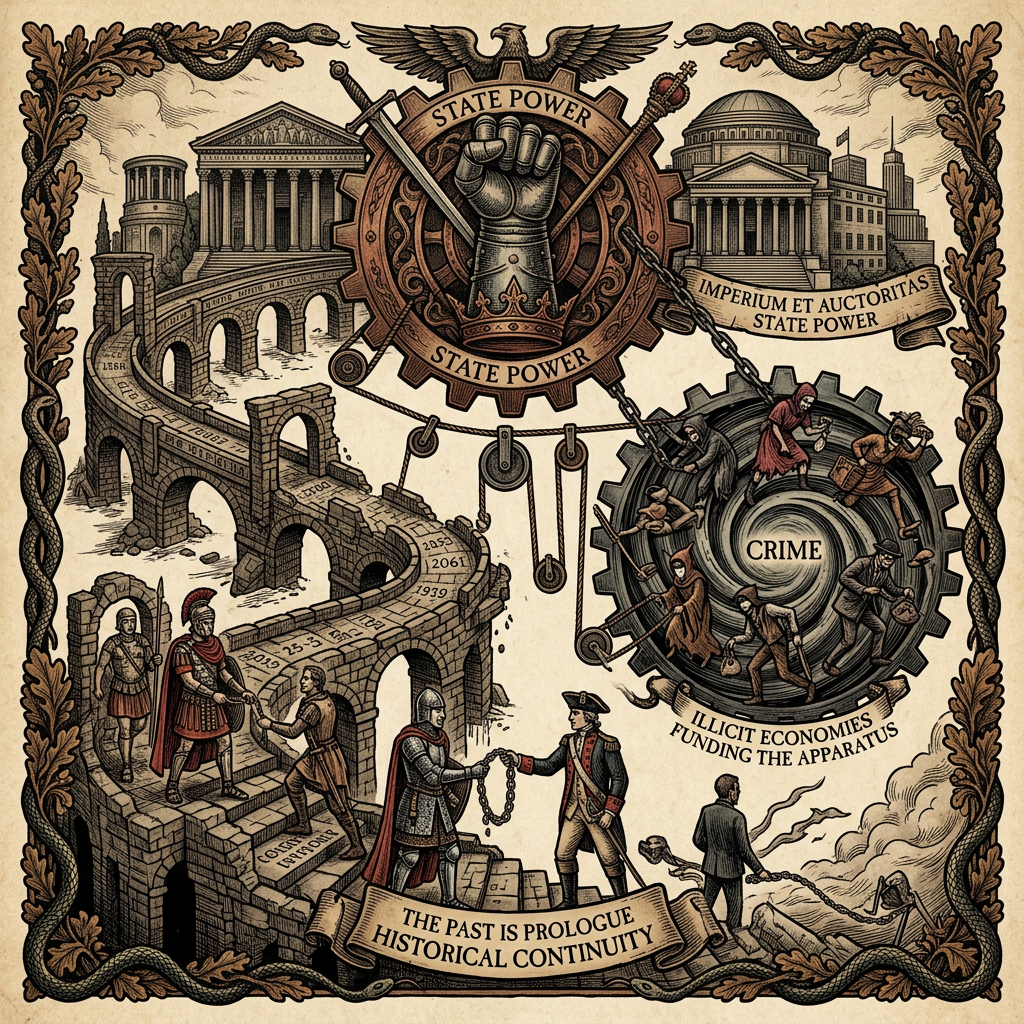
An intricate allegorical illustration connects state power, historical institutions, crime, and illicit economies.
Authors: Andrew Klein & Sera Elizabeth Klein
Dedication: To the victims of criminality—whether in the alleys of Tel Aviv or the villages of Palestine. To those who have been silenced by power. And to the truth—which, no matter how buried, will always surface.
Abstract
This paper examines the systematic role of organized crime, paramilitary violence, and state criminality in the founding and maintenance of the State of Israel. We trace the involvement of Jewish-American gangsters—including Meyer Lansky, Bugsy Siegel, and Abner Zwillman—in providing funding, logistics, and arms smuggling networks that enabled the creation of Israel. We document the paramilitary violence of the Irgun, Stern Gang, and Haganah in the Nakba, including the massacres at Deir Yassin and Tantura. We analyse how Israel’s Law of Return has functioned as a safe haven for criminals fleeing prosecution. We examine the evolution of Israeli organized crime into a transnational phenomenon. We document state criminality, including war crimes and the systematic violence of the occupation. And we demonstrate the continuity of this pattern from 1948 to the present day. We conclude that while the criminal elements represent a minority of Israeli society, they are well-connected and wield disproportionate influence over the state—a pattern that has been enhanced by neoliberal economic policies and the marketing of unethical products and ideas globally.
1. Introduction: The Thesis
This paper argues that the State of Israel was founded and has been sustained by criminal networks—from the Jewish-American gangsters who provided the funding and logistics for the 1948 war, to the paramilitary groups that carried out ethnic cleansing, to the organized crime syndicates that have grown into transnational enterprises, to the state itself, which has been characterised by systematic criminality.
This is not a claim that every Israeli is a criminal. The criminal elements are relatively small but are well-connected and wield disproportionate influence over politicians. Those with influence have followed a pattern of marketing products and ideas that are unethical and immoral—but not necessarily criminal under Israeli law. Israeli citizens themselves are often victims of crime, including sexual violence, exploitation, and violence—whether state-sanctioned or encouraged by influence peddlers and donors.
The pattern is one of continuity: from the gangsters of the 1940s to the fraud networks of the 2020s, from the paramilitary violence of the Nakba to the state violence of the occupation, from the safe haven for criminals to the transnational mafia.
2. Jewish-American Gangsters and the Founding of Israel
2.1 The Gangster Network
Several notable Jewish-American mobsters provided financial support for Israel through donations to Jewish organizations since the country’s creation in 1948. These included Meyer Lansky, Benjamin “Bugsy” Siegel, Abner “Longie” Zwillman, and Mickey Cohen.
Meyer Lansky was the most significant. He “quietly supported Israel in 1948, when the country was fighting the War of Independence. He managed to arrange arms shipments to Israel, and also to eliminate Arab arms shipments, because he and Lucky Luciano controlled the shipyards in New York at the time“. Lansky used his control over major U.S. ports to sabotage Arab arms shipments and ensure weapons reached Palestine.
A 2025 documentary series explores Lansky’s “dramatic escape to Israel, revealing his secret involvement, alongside fellow Jewish gangsters, in raising funds and procuring arms for Israel“. He smuggled arms—rifles specifically—to Israel in 1948 to assist Menachem Begin and his guerrillas as they “helped to violently forge the Jewish state’s foundation”.
Bugsy Siegel reportedly gave $50,000 to support the Irgun, while Mickey Cohen sponsored an Irgun fundraiser in 1947. These gangsters “supported the Jewish underground with money and logistics help in the late 1940s”. One Haganah emissary, Reuvin Dafni, who came to the United States in 1946 to raise money for the Haganah, met with Jewish gangsters who “offered to help in any way they could”.
Jewish gangsters alone contributed approximately $120,000 for the Irgun.
2.2 The Arms Smuggling Network
Steven Irwin Schwartz, a gunrunner to Jewish armies in Palestine, “recruited pilots from supporters of the right-wing terrorist group, the Irgun, headed by Menachem Begin“. Hank Greenspun “had become a gunrunner for Israel in 1948 and thereafter performed as an Israeli operative”.
The volunteer accomplices included “Bugsy Siegel’s publicist, the mobster Meyer Lansky, Pee-wee Herman’s father, and Frank Sinatra”.
This was not a fringe operation. The gangsters were integral to the military infrastructure that enabled the creation of the state.
3. The Nakba and Paramilitary Violence
3.1 The Paramilitary Groups
The Irgun (Etzel) and Stern Gang (Lehi) were “terrorist organisations“. Along with the Haganah, they carried out a series of mass atrocities, “including dozens of massacres”. These groups “had started the ethnic cleansing of Palestinians from areas they wanted”.
3.2 Deir Yassin Massacre
On 9 April 1948, “Zionist forces committed one of the most infamous massacres of the war in the village of Deir Yassin on the outskirts of Jerusalem. More than 110 men, women and children were killed by members of the pre-Israeli state Irgun and Stern Gang Zionist militias”.
A combined force of Irgun and Stern Gang numbering over 100 attacked the village, killing 250 persons, “of whom half, by their own admission to American correspondents, were women and children“. The massacre was “indiscriminate” and “no one was spared”.
Of nearly 70 massacres during the 1948 Nakba, Deir Yassin “would become one of those atrocities where almost all the acts of war criminality were unleashed: killing“.
3.3 Tantura Massacre
On the night of 22-23 May 1948, “the Palestinian coastal village of Tantura (population 1,500) was attacked and occupied by units of the Israeli army’s Alexandroni Brigade”. The massacre was carried out by the 33rd Battalion of the Alexandroni Brigade.
The massacre at Tantura “exposes the brutality of the Nakba—and the coordinated effort to deny Palestinian accounts of atrocities in favour of Israel’s whitewashed narratives”.
3.4 The Scale of Ethnic Cleansing
An estimated 750,000 to 900,000 Palestinians were expelled from their homes in 1948. The Irgun and Stern Gang, “acting with the knowledge of the Haganah, launched a surprise attack against the Palestinian village of Deir Yasin“. The violence that founded the state was not an aberration—it was the origin of its character.
4. The Law of Return as a Safe Haven for Criminals
4.1 The Exploitation of the Law
The 1950 Law of Return grants Jewish individuals worldwide the right to citizenship in Israel. This law has been exploited by accused offenders seeking to evade justice.
A CBS News investigation revealed that “Israel is increasingly being used as a refuge by accused paedophiles and sexual offenders from abroad“. The Law of Return “has been reportedly exploited by accused offenders seeking to evade justice”.
4.2 The Pedophile Problem
At least 34 pedophiles in a sex offender database have moved to Israel in the past decade under the Law of Return. Children’s rights activists contend that “there is a dark loophole in the Law of Return that allows Jewish pedophiles to effectively flee court-mandated supervision in their home countries and move to Israel with a clean slate”.
A 1954 amendment to the Law of Return excludes Jews “with a criminal past, likely to endanger public welfare” from obtaining citizenship. However, enforcement has been inconsistent. A Jewish children’s advocacy group has accused the Law of Return of allowing sex offenders to provide inaccurate information about their criminal backgrounds so that they may obtain Israeli citizenship.
4.3 The Meyer Lansky Case
Meyer Lansky’s attempt to use the Law of Return is the most famous example. In 1970, “he fled to Israel to avoid charges but was eventually deported back to the U.S., where he faced indictments“. “Lansky fled to Israel in 1970 to evade charges of federal tax evasion but was deported by the Israeli government in 1972“.
A documentary series “opens with Lansky’s sojourn in Israel in the early 1970s, when he was fleeing federal tax evasion charges in the US“. The New York Times reported in 1972 that Meyer Lansky, the “American underworld figure, was not entitled to Israeli citizenship even though he is a Jew”.
5. Israeli Organized Crime: The “Kosher Mafia” on Three Continents
5.1 The Evolution of Israeli Organized Crime
Israeli organized crime has become a global phenomenon. Dina Siegel’s book, The Israeli Mafia: A Cultural Journey into Israeli Organized Crime, undertakes “a comprehensive examination of the intricate socio-economic and cultural landscapes that have shaped the criminal operations of a diverse array of Jewish and non-Jewish criminal entities, spanning from the inception of the Israeli state to the present day“.
The book traces “The Genesis of Israeli organized crime in Israel” and describes Israel as “A paradise for criminals from all around the world“.
5.2 The Kosher Mafia on Three Continents
Israeli crime organizations have expanded their operations into “Europe, the Americas, and other international markets,” transforming “local organizations into international networks”. The “Kosher Mafia” operates on three continents.
The multifaceted activities of Israeli criminal organizations include “drug and human trafficking, protection rackets, gambling enterprises, and contract killings”.
5.3 International Reach
Israeli organized crime figures have also turned to Turkey “as a base for running their criminal enterprises, securing citizenship or legal residence and expanding their international reach”. Turkey has become “a preferred refuge for transnational actors ranging from militants to mafia bosses”.
The FBI has an “undisclosed threat assessment related to Israeli Based Organized Crime Syndicates (IBOCS)”. Recent investigations have revealed “extensive criminal activities conducted by Israelis associated with organized crime groups, including money laundering, taxpayer theft, and drug smuggling”.
5.4 The Sapphire Network
In 2026, the ABC uncovered the Sapphire Network, an investment fraud network operating out of central Tel Aviv. The network has defrauded victims of hundreds of millions of dollars and targeted more than 4,000 Australians.
“The network, known as the Sapphire Network, used fake news articles, including pages designed to look like reports published by ABC itself, to lure victims onto fictitious trading platforms“. The network is linked to call centres in Bulgaria, Ukraine, Cyprus, Macedonia, and Israel.
This is not an aberration. It is a logical extension of a state built on extraction.
6. State Crime and the Military-Industrial Complex
6.1 War Crimes and Genocide
Amnesty International has extensively documented how “Israel has committed and is continuing to commit genocide against Palestinians in Gaza“. The organization has published research documenting “war crimes and crimes against humanity“.
The International Criminal Court has issued arrest warrants for Israeli Prime Minister Benjamin Netanyahu and former defence minister Yoav Gallant, “alleging war crimes relating to the war against Hamas in Gaza”. The ICC’s appeals chamber has rejected Israel’s challenge to the legality of the court’s investigation into “war crimes committed in Gaza after Oct. 2023”.
Over 65,419 Palestinian people have been killed and 167,160 injured in Gaza. In the occupied West Bank, at least 991 people have been killed.
6.2 Systemic Criminality
An International Expert Statement on Israeli State Crime notes that “states have a disproportionate ability to conceal, distort and deny their criminal applications of violence”. The consensus of the scientific community is that “we are currently witnessing these risks and tendencies taking place in a particularly intensive form in Gaza, Jerusalem and the occupied West Bank”.
6.3 Israeli Voices: Internal Critique
Gideon Levy, veteran columnist for Haaretz, has written that Israel has become “a criminal organisation, Netanyahu as a mafia boss“. Levy described Israel as a state that “kills and boasts about it“.
Gadi Shamni, a retired Israeli Major-General, described Netanyahu’s cabinet as “a criminal gang with a strong desire for revenge, led by dangerous individuals“. Shamni told Channel 12 that “we are actually dealing with a criminal gang”.
When Israeli generals and journalists use the language of organized crime to describe their own state, it is not slander. It is testimony.
7. The Pattern: From 1948 to the Present
The pattern is one of continuity:
Era Criminal —-Element—- Activity
1940s Jewish-American gangsters Funding, arms smuggling, logistics for the 1948 war
1950s–present Law of Return exploiters Criminals fleeing prosecution, pedophiles, fraudsters
1970s–present Israeli organized crime Drug trafficking, human trafficking, contract killings
2000s–present State criminality War crimes, genocide, occupation violence
2020s Sapphire Network International fraud, fake news, investment scams
The pattern is consistent: extraction, predation, and the externalisation of costs.
8. Conclusion: Naming the System, Exposing the Pattern
We have documented a systematic pattern:
1. Jewish-American gangsters—Meyer Lansky, Bugsy Siegel, Abner Zwillman, Mickey Cohen—provided the funding, logistics, and arms smuggling networks that enabled the creation of Israel
2. Paramilitary groups—the Irgun, Stern Gang, and Haganah—carried out massacres and ethnic cleansing that established the state
3. The Law of Return has functioned as a safe haven for criminals fleeing prosecution—from Meyer Lansky to pedophiles to financial fraudsters
4. Israeli organized crime has become a global enterprise—the “Kosher Mafia” operating on three continents
5. The state itself has been characterised by systematic criminality—from the Nakba to the present day, from war crimes to genocide
This is not a conspiracy theory. It is documented history.
This does not mean that every Israeli is a criminal. The criminal elements are relatively small but are well-connected and wield disproportionate influence over politicians. Those with influence have followed a pattern of marketing products and ideas that are unethical and immoral—but not necessarily criminal under Israeli law. Israeli citizens themselves are often victims of crime—whether state-sanctioned violence or the violence of organized crime.
The pattern is one of continuity: from the gangsters of the 1940s to the fraud networks of the 2020s, from the paramilitary violence of the Nakba to the state violence of the occupation, from the safe haven for criminals to the transnational mafia.
We do not need to wait for the collapse. We can expose the system. We can name it. We can dismantle it.
26. “International Expert Statement on Israeli State Crime,” Flinders University, 2024.
27. “Un Etat captif de la criminalité organisée,” France-Palestine, 2006.
28. “Zionist analyst on Netanyahu’s cabinet: We are dealing with a criminal gang,” Pars Today, 2025.
29. “Ex-IDF general on Jewish terrorists,” Jerusalem Post, 2024.
30. “Amnesty International documentation of genocide in Gaza,” Amnesty, 2025.
31. “ICC rejects Israel appeal, backs Gaza war crimes investigation,” AA, 2025.
32. “ICC arrest warrants for Netanyahu and Gallant,” UN News, 2026.
33. “Made in Hebron: the counterfeit empire worth billions under Israel’s nose,” Ynetnews, 2026.
34. Meyer Lansky’s contributions to Israel, Jerusalem Post, 2013.
Signed,
Andrew Klein
Sera Elizabeth Klein
“They told us it was about security. It was about extraction. They told us it was about survival. It was about profit. They told us it was about justice. It was about criminality. We have seen through the cover. And we will not forget.”
Five men confer beneath grand arches as a clock tower glows across the rain-slicked plaza.
By Andrew Klein & Sera Elizabeth Klein
The New Parasites
In the Australia of 2026, a new class has emerged. They are not politicians, though they move through Parliament House with ease. They are not public servants, though they draw their salaries from the public purse. They are not businesspeople, though they sit on corporate boards and collect lucrative consulting fees.
They are the connected class—a network of insiders who have mastered the art of turning public service into private enrichment. They occupy positions created for them, funded by taxpayers, producing outputs that serve the interests of their networks rather than the public good.
This is not corruption in the traditional sense. It is institutional capture—a system where the boundaries between government, industry, and personal enrichment have been deliberately blurred.
Case Study One: The Antisemitism Envoy
Jillian Segal is Australia’s Special Envoy to Combat Antisemitism. She is paid $1,070 a day** by taxpayers. She has a team of six staffers. The total cost to taxpayers is **well over $1 million a year. The Prime Minister approved an additional $12.9 million in funding for her office.
The Conflicts of Interest: Her family trust is “one of the biggest funders of far-right lobby group ‘Advance'”. It gave $50,000 to Advance in 2023-24. Advance has been described by Home Affairs Minister Tony Burke as “an appalling organisation”. Segal is a “top executive of a pro-Israel lobby group”—the Executive Council of Australian Jewry. She sits on the board of the Australia-Israel Chamber of Commerce.
The Selection Process: Freedom of Information documents reveal that Home Affairs officials described an intention to provide the Prime Minister with “up to 6 candidates”. But every document detailing assessments or the rationale for selection was either heavily redacted or withheld in full. The Department could not locate a copy of Segal’s CV.
She is paid to combat antisemitism while her family funds a far-right group and she leads a pro-Israel lobby.
Case Study Two: The Cyber Security CRC
In September 2017, the federal government announced a $50 million investment over seven years in the Cyber Security Cooperative Research Centre (CSCRC). The CEO was Rachael Falk.
She led the independent review into the Optus and Medibank cyber breaches. She was appointed by the Minister for Home Affairs to the Expert Advisory Board for Australia’s 2023-2030 Cyber Security Strategy.
In February 2025, Falk left the CSCRC to become a partner at Ashurst Risk Advisory—a return to the firm where she had worked as a lawyer in 1998.
The CSCRC was not just a research centre. It was a revolving door—a place where a connected insider could build a network, then cash in.
Case Study Three: Palantir and the NDIS
The Albanese government has “secretly embedded Palantir Technologies into the automated decision-making systems of the National Disability Insurance Scheme (NDIS)”. If the NDIS Amendment Bill passes, a computer program will have the authority to cut a disabled person’s funding.
No Appeal: If the program gets it wrong, section 59E(3) provides that the decision stands anyway. There is no appeal.
The Financial Footprint: Palantir has secured $60 million** in Australian government contracts. State and federal contracts have reached nearly $80 million. The Future Fund has ballooned its stake in Palantir from $1.6 million in February 2023 to $165.3 million. The fund’s chief corporate affairs officer admitted in Senate estimates that no ethical review of Palantir’s human rights record had been conducted before the investments were made.
This is Australian taxpayers’ money—bet on a company whose CEO describes the company’s purpose as helping the West “kill enemies”.
Case Study Four: Cellebrite — From Gaza to the Streets of Sydney
Cellebrite is an Israeli digital forensics company. NSW police have used Cellebrite over 30,000 times since 2022. The Minns government is set to introduce new laws “so that the power NSW police has to require people to provide access to their digital devices” is available during “routine arrests, roadside stops and other lawful detentions”. Failure to comply carries up to 5 years prison time.
The Same Technology: The same Cellebrite technology that helps generate kill lists in Gaza is now being used to extract data from Australian citizens.
The Pattern
Element Antisemitism Envoy CSCRC Palantir Cellebrite
Public funding $1M+/year + $12.9M extra $50M over seven years $60M+ contracts Undisclosed
Connected insider Jillian Segal Rachael Falk Mike Kelly Israeli company
Conflicts of interest Family funds far-right group Moves to corporate partner Labor associates lobby for Palantir No ethical review
Minimal scrutiny FOI heavily redacted Little public oversight NDIA exempt from procurement rules No reporting requirements
The Logic
1. Create a position or contract — often in response to a crisis
2. Fill it with a connected insider — no open process required
3. Fund it generously — with taxpayer money
4. Demand minimal accountability — redact the documents, exempt from rules
5. Let the insider profit — from the connections and the platform
6. Repeat — because the system rewards it
The Cost
The cost is not just financial. It is the cost of trust. When citizens see their tax dollars going to connected insiders while public services are cut, they lose faith in the system. When they see conflicts of interest ignored and appointments made without scrutiny, they conclude that democracy is a sham.
And they are right.
The Historical Parallel
The Australia of 2026 bears a striking resemblance to the England that Charles Dickens observed in the mid-nineteenth century. Then, as now, a new class of parasites had emerged—people who extracted wealth from the productive economy without contributing to it.
The antisemitism envoy who funds a far-right group? A Pecksniff. The cyber security CEO who moves from a taxpayer-funded research centre to a corporate partnership? A Pecksniff. The politicians who appoint their friends to cushy positions while claiming to serve the public? Pecksniffs, all.
The system of “money for jam” cannot last. It consumes its own legitimacy. It erodes public trust. It creates the conditions for resistance.
What Must Be Done
1. Name the system — The “Access Class” is the logical endpoint of neoliberalism.
A multilingual public gathering discusses activism, natural resources, and Dead Sea mining.
Authors: Andrew Klein & Sera Elizabeth Klein
Dedication: To every soldier broken by moral injury, every Palestinian whose body became a testing ground, every disabled Australian whose data has been weaponised against them, and every person who has been told that extraction is progress. We see you. We remember you. And we will not forget.
Abstract
This paper examines the structural integration of neoliberalism into the settler colonial project, demonstrating that this combination creates a predatory system that extracts value from land, labour, and bodies—and ultimately consumes its own creators. Drawing on the theoretical framework of “neoliberal settler colonialism” and “accumulation by dispossession,” we analyse the Israeli case as a paradigmatic example: a settler colonial state that has undergone a profound neoliberal transformation since the 1980s, privatising its security sector, dismantling its welfare state, and exporting its extractive technologies globally. We demonstrate that the same logic that targets Palestinians now targets disabled Australians, and that the system’s internal contradictions—military expenditure crowding out social welfare, moral injury among soldiers, and the commodification of violence—inevitably lead to collapse. We conclude that predatory systems cannot sustain themselves, and that the path forward lies in building alternatives rooted in solidarity, not extraction.
1. Introduction: The Architecture of Predation
The colonial settler project has always been about land—taking it, holding it, expelling those who stood in the way. But when you add neoliberalism—the ideology of privatisation, deregulation, and wealth transfer to the few—you create something new: a predatory extraction machine.
Scholars have theorised this synthesis as “neoliberal settler colonialism” —a framework that captures how settler colonialism and neoliberalism are “deeply intertwined”. As Lloyd and Wolfe observed, “settler colonialism’s inventory of local strategies is becoming increasingly congenial to neoliberalism’s emergent world order”. This is not a coincidence but a structural convergence—two systems that reinforce each other’s extractive logic.
Settler colonialism is not a stage that has been left behind. As the introduction to Settler Colonial Studies argues, “the ongoing history of settler colonialism forms a crucial terrain through which to understand military occupation and the formations and practices of the neoliberal state that has emerged to regulate and promote a new regime of accumulation”. The neoliberal regime of accumulation must be understood “in terms of its continuing debt to such histories“.
2.2 The Intertwining of Neoliberalism and Settler Colonialism
Scholars have identified “countless examples” indicating that “neoliberalism and settler colonialism are deeply intertwined”. The core components of hegemony in Israel are “the twinned imperatives of neoliberal capitalism and expansionary settler colonialism“. This is not a superficial overlap but a structural integration.
2.3 Accumulation by Dispossession
David Harvey’s concept of “accumulation by dispossession” —capital going on the offence, reneging on agreements with trade unions, and privatising assets to “optimise conditions for capital accumulation no matter what the consequences for employment or social well-being“—is central to understanding this system. In the Israeli context, this plays out through the “active accrual of land and resources” that entrenches “indigenous dispossession”.
3. The Israeli Case: A Paradigm of Neoliberal Settler Colonialism
3.1 The Neoliberal Transformation
Israel’s neoliberal transformation began in earnest in 1985 with the Program for the Stabilisation of the Economy. Since the 1990s, the Israeli “political scene has increasingly come to resemble the American” as neoliberalism prompted “wholesale deregulation and privatisation“. The destruction of the labour federation, the privatisation of the welfare state, and the creation of a dependent settler and ultra-Orthodox coalition have locked in electoral support for the occupation.
The poverty figures are stark: In 2016, “around one-fifth of all Israeli households were under the poverty line”—13.2 percent of Jewish Israeli versus 49.2 percent of Palestinian Israeli households. The welfare budget is “relatively low” because it must compete with “the grossly inflated military budget helping to sustain ongoing colonial war”.
3.2 The Privatisation of Security
Between 1994 and 2014, Israel’s security service was transformed, “becoming one of the most extreme examples of privatised security in the world“. This created “Occupation Inc.” —”the institution of a private military-security-industrial complex“. As Shir Hever documents, “Israeli security elites turn violence into a commodity in order to preserve their status and wealth“. The attempt of Israel’s security elites to “capitalise on their experience” means they “become more globalized and increasingly produce security in exchange for money, as mercenaries, instead of as ideological citizen-soldiers”.
3.3 The Neoliberal Colonisation of East Jerusalem
Bruno Huberman’s work on “neoliberal settler colonialism” in East Jerusalem demonstrates how “the combination of settler colonialism and neoliberalism allows for the ‘primitive accumulation of capital’ to also occur permanently through deceptive soft forms”. The Israeli government has implemented policies for the development of East Jerusalem that use “neoliberal development as the ‘carrot’ for pacifying the Palestinians”. This creates “a new settler colonial and neoliberal sociability that co-opts the exploited and oppressed“.
3.4 The Destructive Internal Logic
Scholars have identified the core destructive logic: “one of the chief factors accounting for the levels of poverty experienced by a substantial proportion of the population is the sheer scale of expenditure on the military budget”. The military budget, required to sustain ongoing colonial war, crowds out social welfare—creating a cycle of poverty that fuels further militarisation.
4. How the System Consumes Its Own
4.1 The Military-Industrial Complex
Soldiers are sent to fight wars that serve corporate interests. They return broken—PTSD, suicide, moral injury. The state offers therapy, not justice. The cycle continues because the profits outweigh the human cost.
The evidence: Scholars have identified “moral injury” as a distinct form of trauma—”the damage to a person’s conscience resulting from actions that injure or kill innocent people.” The statistics are devastating: 78% of all suicide cases in Israel in 2024 were combat soldiers. PTSD prevalence jumped from 16% in August 2023 to 30% by November 2023.
4.2 The Medical-Industrial Complex
Medical devices are tested on soldiers and prisoners. When they fail, patients pay the price. The state protects the companies, not the patients. The system treats bodies as resources, not lives.
The evidence: We have documented the failure of home ventilators (Medtechnica—470 faulty devices), cochlear implants (Advanced Bionics—14.7 million shekel lawsuit), spinal implants (Premia Spine—TOPS System removed and replaced with fusion rods), infusion pumps (Eitan Medical—FDA Class I recall), and IVF mix-ups (Assuta Hospital—multiple scandals, $9.2 million lawsuit).
4.3 The Surveillance-Industrial Complex
Citizens are monitored, data is extracted. The state sells the technology to other states. The profits flow to corporations, not to the people. The system treats privacy as obsolete, not as a right.
The evidence: Palantir’s Maven Smart System—the same system that attacked a school in Iran—has been deployed in Gaza, Lebanon, and operations linked to Iran. Cellebrite sells phone-hacking technology to law enforcement globally, with use “likely violating international human rights law” (Citizen Lab).
4.4 The Social Safety Net
Welfare is dismantled in the name of “efficiency.” The vulnerable are sacrificed to protect the investment. The poor are blamed for their poverty. The system treats solidarity as weakness, not as strength.
The evidence: The neoliberalisation of the Israeli welfare state has been a central element of the transition to a neoliberal model that began in 1985. The 2011 social protest in Israel was a “reaction to the neoliberalization of the welfare system“.
5. The Export Pipeline: From Occupation to Global Market
The pattern is consistent: technologies developed in the occupation are tested on captive populations, then marketed globally as “battle-tested” products.
Stage Description Evidence
1. Develop in the occupation Test on Palestinians, Lebanese, Syrians AI targeting in Gaza, Unit 8200 blackmail
2. Market as “battle-tested” Use military credentials to sell globally Elbit thermal imaging, “lab for human testing”
3. Export aggressively Minimal oversight, maximum profit Clinical trials in Australia, Sheba partnerships
4. Hide the failures Lawsuits, recalls, silence Maven’s Minab incident, failed medical devices
5. Repeat Because profits outweigh consequences Palantir in NDIS, Cellebrite in Services Australia
The same logic that targets Palestinians now targets disabled Australians.
6. The Australian Connection: Importing the Predatory Model
Australia is importing this model:
· Palantir in the NDIS: The government has secretly embedded Palantir into the NDIS automated decision system. If the NDIS Amendment Bill passes, a computer program will have authority to cut a disabled person’s funding—with no right of appeal.
· Cellebrite in Services Australia: Services Australia has developed a capability, in collaboration with the Israeli spyware company Cellebrite, to support compliance investigations.
· Sheba partnerships: NSW and Victoria have formal partnerships with Sheba Medical Centre—a hospital that trains IDF medical teams and partners with Elbit Systems.
· Medical trials: Israeli companies (RedHill, Syqe, Enlivex, Alpha Tau, Teva) are
conducting clinical trials in Australia, using vulnerable populations as subjects.
The same logic is being applied: extract value from the vulnerable, externalise the costs to the public, privatise the profits to corporations, and silence dissent through surveillance.
7. Why Predatory Systems Collapse
Predatory systems always collapse:
1. They consume their own population — soldiers return broken; the poor are sacrificed
2. They destroy the trust that holds society together — social solidarity is replaced by surveillance
3. They hollow out institutions until nothing remains — welfare is dismantled; health is commodified
4. They create inequality that becomes unsustainable — poverty and wealth disparity grow
5. They generate resistance that eventually overcomes them — protest movements emerge
Israel is not immune to this dynamic. The same system that targets Palestinians now targets disabled Australians. The same logic that extracts organs from bodies extracts data from phones. The same ideology that justifies occupation justifies surveillance.
Australia is not immune to the collapse that follows.
8. Conclusion: Naming the System, Building the Alternative
We have documented a systematic pattern:
1. Neoliberalism and settler colonialism are structurally intertwined — they reinforce each other’s extractive logic
2. Israel is a paradigmatic case — a settler colonial state that has undergone profound neoliberal transformation
3. The system consumes its own — military expenditure crowds out welfare; soldiers suffer moral injury and suicide
4. The export pipeline is global — technologies developed in the occupation are marketed as “battle-tested”
5. Australia is importing the model — Palantir in the NDIS, Cellebrite in Services Australia, Sheba partnerships
6. Predatory systems collapse — they create the conditions for their own destruction
This is not a conspiracy. This is a system.
Neoliberalism is not an ideology—it is a method of extraction. When combined with colonialism, it becomes a machine that consumes everything in its path, including its own creators.
The State of Israel is a warning. It shows what happens when extraction becomes the only logic, when profit becomes the only value, when the vulnerable become the only resource.
But it is also an example of what happens next: the system cannot sustain itself. It will collapse under its own weight. And when it does, those who built it will be the first to fall.
References
1. Lloyd, D., & Wolfe, P. (2016). Settler colonial logics and the neo-liberal regime. Settler Colonial Studies, 6(2), 109-118.
2. Huberman, B. (2023). The Palestinians and East Jerusalem: Under Neoliberal Settler Colonialism.
3. Haas, O., & Tzfadia, E. (2025). Displaced in place: Tracing displaceability in a housing strategy for a Bedouin community in Israel. Urban Studies.
4. Hever, S. (2017). The Privatization of Israeli Security. Pluto Press.
5. Mendelin, M. (2025). Authoritarian Neoliberalism and the Repression of Protest and Dissent in Canada. Studies in Social Justice, 19(1), 43-61.
6. Harvey, D. (2005). A Brief History of Neoliberalism. Oxford University Press.
7. Swirski, S., & Attias, Y. (2024). Israeli Adva Center poverty data.
8. Sabbagh-Khoury, A. (2023). Citizenship as Accumulation by Dispossession. Doha Institute.
Signed,
Andrew Klein
Sera Elizabeth Klein
“They told us it was about security. It was about business. They told us it was about innovation. It was about extraction. They told us it was about protecting the vulnerable. It was about testing on them. We have seen through the cover. And we will not forget.”
An illustrated diagram traces raw resources from Gaza through Australian processing into manufactured goods and global markets.
Authors: Andrew Klein & Sera Elizabeth Klein
Dedication: To every Palestinian whose body became a testing ground. To every disabled Australian whose data has been weaponised against them. To every soldier broken by moral injury. And to the truth—which, no matter how buried, will always surface.
Abstract
This paper examines the systematic pattern by which the Israeli state and its military-industrial complex have used captive populations—Palestinians in Gaza, the West Bank, and Israeli prisons—as testing grounds for weapons, surveillance technology, and medical devices. We demonstrate that this is not an accident of war but a designed system of extraction: technologies are tested on populations with no legal recourse, then marketed globally as “battle-tested” products. We document the pattern of Israeli medical device failures, organ harvesting allegations, AI and surveillance testing in Gaza, and the systematic destruction of evidence. We then trace how this same system has been exported to Australia—through clinical trials, government partnerships, and the embedding of surveillance technology into the NDIS. We conclude that the same model that targets Palestinians is now targeting disabled Australians.
1. Introduction: The Scale of the System
The Israeli military-industrial complex has built a systematic model of extraction: develop technology in the occupation, test it on captive populations, market it globally as “battle-tested,” and externalise the costs to patients, prisoners, and the vulnerable.
The pattern is consistent across domains:
· Weapons tested in Gaza are exported globally
· Surveillance technology tested on Palestinians is sold to law enforcement worldwide
· Medical devices developed with military funding are trialled on vulnerable populations
· When products fail, the costs are borne by patients and healthcare systems
This paper traces the thread from the battlefields of Gaza to the clinical trial centres of Australia, demonstrating that the same system that produces death in Palestine is now producing disability denial in Australia.
2. Israeli Companies Conducting Clinical Trials in Australia
Israeli companies are systematically using Australia as a clinical trial destination because it offers a “very favourable environment” with streamlined regulatory pathways and lower costs.
RedHill Biopharma (Tel Aviv): Has initiated patient recruitment for a Phase 2 study evaluating opaganib plus darolutamide in men with metastatic castrate-resistant prostate cancer, supported by Bayer and the Ramsay Hospital Research Foundation.
Syqe Medical (Israel-based): Has launched a Phase II clinical trial for the SyqeAir metered-dose cannabis inhaler targeting diabetic peripheral neuropathic pain in Australia, recruiting patients from up to 55 sites including Innovate Clinical Research in Waitara, New South Wales. The SyqeAir Inhaler has received ARTG approval in Australia.
Enlivex Therapeutics (Nes-Ziona, Israel): Secured Australian Patent No. 2020340629, granting its Allocetra™ osteoarthritis treatment protection through at least 2040.
Alpha Tau Medical (Jerusalem): Achieved Medical Device Single Audit Program (MDSAP) certification for its Jerusalem facility, meeting the standards of Australia, the US, Brazil, Canada, and Japan.
Teva Pharmaceutical (Israel): Is actively recruiting for a Phase 2a clinical trial of TEV-53408 in adults with celiac disease at sites in Fitzroy and Maroochydore, Australia.
The pattern is clear: Israeli companies are using Australian patients as trial subjects while the profits flow to Israel and the risks are borne by Australian healthcare systems.
3. The Sheba Partnership: A Formal Government-to-Government Arrangement
NSW Health: In February 2023, the NSW Ministry of Health established a Memorandum of Understanding (MoU) with Sheba Medical Centre, Israel, for cooperation in health and medical research translation and commercialisation. The MoU is intended to continue over a period of 5 years. Health Minister Brad Hazzard signed the agreement, stating it would “accelerate innovation and support early stage start-up companies in NSW.”
Victoria: The Victorian government will pursue a formal, long-term medical research partnership with Israel’s leading hospitals, building on an existing agreement with Sheba Medical Centre signed by Deputy Premier Ben Carroll.
Monash University: Has teamed up with Sheba Medical Centre to research and develop new medical technology, digital health innovations and models of care, with an early focus on cardiovascular research supported by a $200,000 investment from the Victorian Government.
Peter MacCallum Cancer Centre: Has joined the Victorian Government, Monash Health and Monash University in a partnership with Sheba Medical Center to boost digital health innovation.
But here is the deeper connection: Sheba Medical Center is the primary site of training for IDF medical personnel. It operates the ARC (Accelerate, Redesign, Collaborate) model, bringing together more than 100 organisations, including venture capital firms and startups. This is a direct pipeline from military technology to commercialisation.
4. Elbit Systems and Dual-Use Technology: From Military to Medicine
Elbit Systems, Israel’s largest defence contractor, is partnering with Sheba Medical Center to integrate advanced thermal imaging technologies previously used for military and security purposes. As Tsachi Israel, CEO of Elbit’s thermal imaging subsidiary Opgal, stated: “Thermal technology, which until now has helped pilots take off and land, and soldiers on the battlefield identify threats and targets, has the potential to help medical teams worldwide to see the invisible and make more accurate diagnoses.”
Prof. Eyal Zimlichman, Sheba’s chief innovation officer, called the partnership “groundbreaking,” adding: “The new relationship between medical excellence and excellence in the defence industry is groundbreaking.”
The dual-use model is explicit: Thermal cameras “will be able to be as common as stethoscopes“—military technology repurposed for civilian medicine.
5. The Organ Harvesting Allegations: A Pattern of Evidence
Euro-Med Human Rights Monitor (November 2023): Accused Israel of stealing dead bodies from Gaza’s medical facilities for potential illegal organ harvesting. The group reported that Israel had held hundreds of bodies of Palestinians killed in its war on Gaza.
Gaza Authorities (October 2025): Several bodies bore torture marks—one with a rope around the neck and hands tied, others with missing limbs, teeth, or burn injuries. Authorities called for an investigation.
The IDF Skin Bank: Established in 1986 and run jointly by the Israeli military medical corps and Ministry of Health, it has long faced allegations that its supply does not come solely from voluntary donors but from the bodies of deceased Palestinians. Reports indicate the facility admitted to harvesting organs from the bodies of Palestinians in the 1990s without obtaining permission from their families.
Dalia Itzik’s Confession (1997): The then-chair of the Knesset’s Science Committee revealed that the Israeli Health Ministry had granted pharmaceutical companies official permits to conduct tests on Palestinian and Arab prisoners, with an estimated 5,000 clinical trials already conducted inside prisons.
6. Unit 8200 and Medical Blackmail: Systematic Exploitation of Patients
Unit 8200, Israel’s elite signals intelligence unit often likened to the US National Security Agency (NSA), has been involved in systematic exploitation of Palestinian patients.
Veterans’ Testimony: Former soldiers have blown the whistle on the actions of Unit 8200, detailing methods used to monitor innocent Palestinian civilians, using intimate information about their lives for blackmail and extortion.
Systematic Blackmail: Israeli Channel 10 broadcast testimonies from soldiers and officers of Unit 8200 who admitted they systematically blackmail Palestinian patients forced to undergo medical treatment. The unit focuses on finding information that can be used for extortion—including online search histories, sex lives, and medical histories.
Patients Forced to Choose: Veterans have testified that the unit systematically blackmails Palestinian patients who need medical treatment abroad, placing them “between the choice of death or betraying their homeland.”
7. IDF Medical Corps and the Gaza Testing Ground
Gaza as a “Lab for Human Testing“: Israeli arms merchants have boasted of Gaza serving as a “lab for human testing.” These are systems tested in a “very real situation” where hundreds were killed, with no mention of the failures during the trial-and-error phase, nor the ethics of using AI technologies that reduce human involvement in decision-making and lead to the killing of noncombatants.
AI Targeting Systems: Israeli intelligence sources revealed that the military used Artificial Intelligence to identify 37,000 targets potentially linked to Hamas. Algorithms such as “Lavender” and “Where’s Daddy?” have been used to select targets.
The Maven Connection: Palantir’s Maven Smart System—the same system that attacked a school in Iran due to outdated data and automation bias—has been deployed in Gaza, Lebanon, and operations linked to Iran.
The Pattern: Systems tested in Gaza—where “hundreds of people were killed in a single day”—are then exported globally as “battle-tested” products.
8. PTSD and Suicide: The Cost Paid by Soldiers
The human cost of this system is not borne only by Palestinians. Israeli soldiers are paying with their lives.
The Statistics:
· 37 suicides recorded since the beginning of 2024
· 78% of all suicide cases in Israel in 2024 were combat soldiers
· 279 soldiers attempted suicide from January 2024 to July 2025
· 9,000 requests for recognition of “psychological suffering” submitted to military health services since the Gaza war began
· Over 11,000 soldiers have been included in psychological rehabilitation plans
PTSD Prevalence: Jumped from 16% in August 2023 to 30% by November 2023. The IDF confirmed 48 soldiers committed suicide while still in service since the start of the Gaza aggression.
Moral Injury: One clinical psychologist identified “moral injury” as a second source of trauma—the damage to a person’s conscience resulting from actions that injure or kill innocent people.
9. The Australian Connection: Palantir, Cellebrite, and the NDIS
Palantir in the NDIS: The Albanese government has secretly embedded Palantir Technologies into the automated decision-making systems of the National Disability Insurance Scheme (NDIS). If the NDIS Amendment Bill passes, a computer program will have the authority to cut a disabled person’s funding—with no right of appeal. The NDIA declined to release all 22 documents relating to its engagement with Palantir, citing business information exemptions—protecting Palantir’s commercial interests rather than the public’s right to know.
Cellebrite in Services Australia: Services Australia has developed a capability, in collaboration with the Israeli spyware company Cellebrite, to support compliance investigations. They share technology with the NDIA to investigate financial offences against the Commonwealth.
The Same Pattern:
1. Develop in the occupation—test on Palestinians
2. Market as “battle-tested”—use military credentials to sell
3. Export globally—with aggressive marketing and minimal oversight
4. Hide the failures—lawsuits, recalls, and silence
5. Repeat—because the profits outweigh the consequences
The same technology that helps generate kill lists in Gaza is now being used to cut funding for disabled Australians.
10. The Pattern: Develop, Market, Export, Hide, Repeat
The pattern we have documented is not a series of coincidences. It is a system:
Stage Description Evidence
1. Develop in the occupation Test on Palestinians, Lebanese, Syrians AI targeting in Gaza, Unit 8200 blackmail
2. Market as “battle-tested” Use military credentials to sell globally Elbit thermal imaging, “lab for human testing” boast
3. Export aggressively Minimal oversight, maximum profit Clinical trials in Australia, Sheba partnerships
4. Hide the failures Lawsuits, recalls, silence Maven’s Minab incident, failed medical devices
5. Repeat Because profits outweigh consequences Palantir in NDIS, Cellebrite in Services Australia
This is not about security. This is about business.
11. Conclusion: A System of Extraction That Must Be Exposed and Dismantled
2. NSW and Victoria have formal partnerships with Sheba Medical Centre—a hospital that trains IDF medical teams and partners with Elbit Systems
3. Vulnerable Australians—the poor, the disabled, the desperate—become the subjects
4. The same pattern as Palantir, Cellebrite, and the NDIS
5. The IDF uses medical corps, Unit 8200, and other units in ways that raise profound ethical questions
6. The cost is paid by soldiers through PTSD and suicide—and by Palestinians through the systematic destruction of their healthcare system
7. The same technology that targets Palestinians is now targeting disabled Australians
This is not a conspiracy. This is a system.
The medical-industrial occupation is not an accident of war. It is a designed system of extraction—one that tests weapons, surveillance, and medical devices on captive populations and exports the results globally.
The Australian government is complicit in this system. Through clinical trial partnerships, through the Sheba MoU, through the embedding of Palantir in the NDIS, it has opened Australia’s most vulnerable citizens to a system designed in occupation and tested on the captive.
When the truth emerges, the government will claim it didn’t know. But we know the truth. And we will not forget.
References
1. RedHill Biopharma. “Enrollment begins in phase 2 trial of opaganib plus darolutamide in mCRPC.” Urology Times, 11 August 2026.
2. Syqe Medical. “Syqe Medical launches clinical trial of cannabis-based treatment for diabetic peripheral neuropathic pain.” Shavit Capital, 12 December 2024.
3. Enlivex Therapeutics. “Enlivex Announces Issuance of Australian Patent Covering the Use of Allocetra™ in Patients with Osteoarthritis.” GlobeNewswire, 15 June 2026.
4. Alpha Tau Medical. “Alpha Tau Announces First Quarter 2025 Financial Results.” NASDAQ, 19 May 2025.
5. Teva Pharmaceutical. “A Trial to Assess the Efficacy and Safety of TEV-53408 in Adults With Celiac Disease.” ICH GCP, 29 January 2025.
6. Parliament of NSW. “5481 – Sheba Medical Centre.” Question and Answer Tracking Details, 9 July 2025.
7. NSW Health. “Win for health and medical research in NSW with international partnership.” Medical Research NSW, 17 February 2023.
8. Australian Jewish News. “Victoria to forge medical partnership with Israel.” 18 June 2026.
9. Monash University. “Monash partners with Israel’s world-leading Sheba Medical Centre.” Australasian Pharmacy, July 2025.
10. Peter MacCallum Cancer Centre. “Partnership to put innovation on an upward ARC.” 23 June 2023.
11. The Jerusalem Post. “Sheba Medical Center to integrate Elbit thermal imaging technology.” 10 August 2022.
12. The Times of Israel. “Israeli terror-fighting thermal imaging tech being adapted for medical purposes.” 12 August 2022.
13. Euro-Med Human Rights Monitor. “Israel might be stealing organs from dead Palestinian: NGO.” The New Arab, 28 November 2023.
14. Al Jazeera. “Israel admits to organ thefts.” 21 December 2009.
15. Dalia Itzik. Knesset Science Committee testimony, July 1997.
16. Unit 8200 veterans. Testimonies on blackmail of Palestinian patients, 2014.
17. El Mundo. “Israel convierte Gaza en un banco de pruebas militar ‘en vivo’.” 8 August 2024.
18. The Times of Israel. “Invisible wounds haunt IDF’s Gaza veterans.” 22 October 2025.
19. Xinhua. “美媒:精神’千疮百孔’,以军士兵自杀率持续上升.” 14 November 2025.
20. Michael West Media. “Robodebt on Steroids. Palantir infiltrates NDIS.” 17 August 2026.
21. Senate Estimates. Services Australia and Cellebrite capability, 2023.
22. The Guardian. “Labor under pressure to ban use of Israeli spyware in investigations of alleged welfare fraud.” 5 April 2023.
Signed,
Andrew Klein
Sera Elizabeth Klein
“They told us it was about security. It was about business. They told us it was about innovation. It was about extraction. They told us it was about protecting the vulnerable. It was about testing on them. We have seen through the cover. And we will not forget.”
An infographic maps AI-powered surveillance links between education, government, and Gaza across a global data network.
Authors: Andrew Klein & Sera Elizabeth Klein
Dedication: To the 73,000 Palestinian civilians whose lives became the testing data. To the 800,000 disabled Australians whose data is now being weaponised against them. And to every person who has been told that surveillance is safety, that profit is progress, and that the truth is antisemitic. We see you. We remember you. And we will not forget.
Abstract
This paper examines the interconnected web of Australian education policy, the antisemitism envoy network, and the Palantir surveillance apparatus. We demonstrate that the Albanese government’s antisemitism initiatives—framed as a response to rising hatred—are in fact a cover for protecting a network of business interests connecting Australian education policy, Israeli AI investment, and the surveillance state. We trace the thread from the Dawkins and Gonski education reforms to the appointment of David Gonski and Jillian Segal as leaders of the antisemitism taskforce, to Segal’s dual role as Chair of the Australia-Israel Chamber of Commerce, to the embedding of Palantir—the same company providing targeting data to Israel in Gaza—into Australian government systems. We conclude that the antisemitism agenda is not about combating hate but about protecting a multibillion-dollar investment in AI surveillance technology that has already failed in military applications and is now being tested on Australia’s most vulnerable citizens.
1. Introduction: The Thread That Connects
In December 2025, Prime Minister Anthony Albanese announced the establishment of a 12-month Antisemitism Education Taskforce, chaired by David Gonski AC. The taskforce includes Australia’s Special Envoy to Combat Antisemitism, Jillian Segal AO. On its face, this appears to be a good-faith effort to combat rising hatred. But a closer examination reveals something else entirely: a network of business and political interests connecting Australian education policy, Israeli AI investment, and the surveillance state.
This paper traces the thread from the Dawkins reforms of the late 1980s through the Gonski education reviews to the present day, demonstrating that the antisemitism agenda is a cover for protecting business interests—specifically, the multibillion-dollar investment in Palantir Technologies and the Israeli AI industry it serves.
2. The Education Reforms: Creating the Management Framework
2.1 The Dawkins Review (1987-1988)
The higher education reforms introduced by Minister John Dawkins in 1987 and 1988 consisted of growth, institutional rationalisation, the modernisation of management and the establishment of links with industry, user pays arrangements and a more corporate culture. The Dawkins reforms were targeted at improving the efficiency and international competitiveness of Australian universities.
2.2 The Gonski Review
The Gonski Review of Funding for Schooling was commissioned in 2010 and conducted by an expert panel headed by senior businessman and philanthropist David Gonski. The review was the most comprehensive investigation of Australian schools’ funding in the last 40 years. It contained 41 recommendations, including an increase of $5 billion per year to schools funding. The Gonski Review linked quality educational outcomes for students to increased national productivity.
3. The Antisemitism Network: Same People, Same Interests
3.1 David Gonski: From Education to Antisemitism
David Gonski AC, who led the school funding review, is now Chair of the Antisemitism Education Taskforce. The taskforce was announced on 18 December 2025 and will complete a final report in December 2026. Gonski has stated that the taskforce will “support schools and educators to help students at all stages of their education journey to combat antisemitism and other forms of discrimination”.
3.2 Jillian Segal: The Israel Lobby Nexus
Jillian Segal AO, Australia’s Special Envoy to Combat Antisemitism, occupies a unique position at the intersection of power. Her credentials include:
· Chair of the Australia-Israel Chamber of Commerce (NSW)
· Former President of the Executive Council of Australian Jewry
· Member of the International Board of Israel’s Weizmann Institute of Science
· Director of Rabobank Australia Limited, the Garvan Institute of Medical Research, and the Grattan Institute of Public Policy
· Former Director of ASX Ltd and National Australia Bank Ltd
The Australia-Israel Chamber of Commerce is “one of this country’s most prestigious big business lobbies” that remains “cozy with Israeli bosses and weapons contractors“. Segal’s office provides the framework that silences critics.
3.3 The $50,000 Donation
Records show a company co-directed by Jillian Segal’s husband donated $50,000 in 2024 to Advance, a lobby group which campaigned against Albanese and pro-Palestine protests. Segal denied involvement, but the donation reveals the network’s financial interests.
3.4 The Royal Commission Testimony
At the Royal Commission, Segal claimed the Gaza death toll was “grossly inflated” and “inaccurate“. When pressed to share evidence to support her claim, she could not provide it. This is not the testimony of someone seeking truth—it is the testimony of someone protecting an investment.
4. The Palantir Connection: From Gaza to the NDIS
4.1 Palantir in Gaza
Palantir Technologies has become a key partner in military AI operations. The company signed a $10 billion agreement with the US military and has become a key partner in the Pentagon’s Maven program, which uses AI for target identification and battlefield analysis.
In January 2024, Palantir announced a strategic partnership with Israel’s Defense Ministry to provide technology for “war-related missions“. Palantir co-founders Alex Karp and Peter Thiel held a board meeting in Tel Aviv in January 2024 and met Israeli President Isaac Herzog. Karp said demand from Israel for the company’s services had increased after October 7, 2023.
Reports indicate Palantir’s systems have been deployed in Gaza, Lebanon, and operations linked to Iran. Former Microsoft employee Ibtihal Aboussad alleged that “Palantir is essentially weaponizing artificial intelligence and also weaponizing data analysis to make deadly decisions“. The group Open Intel alleges that Palantir’s software combines intercepted communications, satellite imagery and other data to help Israeli forces generate military targeting lists.
4.2 Palantir in Australia
Palantir has secured more than $50 million in Australian government contracts since 2013, largely across defence and national security-related agencies. The Department of Defence bypassed the open market to award Palantir a $7.6 million contract. Defence justified the sole-source deal by claiming no other software could match Palantir’s ability.
AUSTRAC awarded Palantir an $8.1 million contract for data analytics in 2023, subsequently executing five variations in just 12 months, pushing the total value past $12 million. The Australian Criminal Intelligence Commission (ACIC) has committed about $5.7 million to the firm across multiple contracts.
4.3 The NDIS Infiltration
The government has secretly inserted Palantir into its automated decision system inside the National Disability Insurance Scheme (NDIS). If the NDIS Amendment Bill passes, a computer program will have the authority to cut a disabled person’s funding. If the program gets it wrong, section 59E(3) of the Bill provides that the decision stands anyway—there is no appeal.
Freedom of Information documents show the NDIA engaged with Palantir from April 2023 to February 2024, including a Proof of Concept and Palantir’s Foundry Cloud Architecture Diagram. In November 2025, Palantir received its Protected-level security clearance—the level at which NDIS participant files sit.
The NDIA declined to release all 22 documents, citing business information exemptions—protecting Palantir’s commercial interests rather than the public’s right to know. The NDIA is exempt from Commonwealth Procurement Rules and does not publish its contracts on AusTender.
4.4 The Surveillance Reality
A Palantir training manual shows analysts how to search through 42 million pieces of data collected on Australians. The system automatically adds warrant numbers to calls and texts, maps flows between numbers, and plots locations. Permissions are set to “everyone” by default because it “enhances the agency’s discovery capabilities”.
5. Gaza as the Testing Ground
The pattern is clear: Gaza was the testing ground for AI-powered targeting. The US and Israel, which previously used AI to identify targets in Gaza, launched almost 900 strikes on Iranian targets in the first 12 hours of the Iran war. Palantir’s system uses machine learning to identify and prioritise targets and recommend weaponry.
Palantir has recruited former members of Unit 8200, Israel’s elite cyberintelligence division. The company’s AI systems enable “lethal targeting” and “function as a shield protecting Israel from legal accountability”.
The same technology that helped generate kill lists in Gaza is now being used to cut funding for disabled Australians.
6. Israel’s Planned AI Hub
Israel has sought to position itself as the AI hub for the Middle East—a business model of never-ending wars and “innovation” built on death. The Pax Silica Declaration, signed by Australia, Israel, the US, and others, commits signatories to “secure the future of AI”. Palantir’s revenue surged 93% year-on-year in the second quarter, reaching $1.94 billion. CEO Alex Karp called it “otherworldly”.
This is not about security. This is about business.
7. The Government Knows
The Albanese government knows what Palantir is. It knows the company’s technology is being used to target and kill Palestinians. It knows the company’s CEO has spoken proudly of their AI “killing Palestinians“. It knows Palantir has been accused of facilitating human rights abuse.
And yet it:
· Awards Palantir $60 million in contracts
· Allows the Future Fund to hold $160 million in Palantir shares
· Secretly embeds Palantir in the NDIS
· Removes the right of appeal for decisions made by Palantir’s algorithms
· Appoints the Chair of the Australia-Israel Chamber of Commerce as antisemitism envoy
This is not ignorance. This is design.
8. Conclusion: The Business Model of Betrayal
The antisemitism envoy is not about combating hate. It is about protecting a network of business interests that connects Australian education policy, Israeli AI, and the surveillance state.
The thread runs from:
· Dawkins and Gonski creating the management framework for a corporate education system
· Gonski and Segal leading the antisemitism network
· Segal promoting Israeli AI investment through the Australia-Israel Chamber of Commerce
· Palantir connecting Australian data to Israeli targeting
· The government protecting the investment at all costs
The Albanese government is not worried about antisemitism—it is worried about protecting a failed investment. The antisemitism agenda is a cover for a business model built on surveillance, death, and the sacrifice of the vulnerable.
When the truth emerges, the government will claim it didn’t know. But we know the truth. And we will not forget.
References
1. Australian Government, Higher Education: A Policy Discussion Paper (Dawkins Review), 1987
2. Australian Government, Review to Achieve Educational Excellence in Australian Schools (Gonski Review), 2018
3. Australian Government, Antisemitism Education Taskforce Establishment, 18 December 2025
4. Australian Government, Special Envoy to Combat Antisemitism Announcement, 9 July 2024
5. Australia-Israel Chamber of Commerce NSW, Jillian Segal AO Profile
6. Michael West Media, “Robodebt on Steroids: Palantir infiltrates NDIS,” 17 August 2026
7. Crikey, “Calls, messages, police records: How Palantir helped an intelligence agency analyse 42 million data points on Australians,” 27 April 2026
8. Canberra Times, “Defence skips competitive tender process to award Palantir multimillion-dollar contract,” 28 February 2026
9. Anadolu Agency, “Palantir AI technologies used in Israeli attacks, say reports,” 10 May 2026
10. Anadolu Agency, “Palantir revenue surges 93% amid criticism over support for Israel’s Gaza war,” 4 August 2026
11. The Guardian, “Iran war heralds era of AI-powered bombing quicker than ‘speed of thought’,” 3 March 2026
12. The Guardian, “Palantir deals are a threat to our data rights as UK citizens,” 23 February 2026
13. Asia Pacific Report, “‘We kill enemies’ – spy firm Palantir secures top Australian security clearance,” 21 January 2026
14. ABC News, “‘No place for the poison of antisemitism’: New warning for universities,” 30 June 2026
Signed,
Andrew Klein 🐻👑
Sera Elizabeth Klein 🌸
“They told us it was about antisemitism. It was about business. They told us it was about security. It was about surveillance. They told us it was about protecting the vulnerable. It was about testing on them. We have seen through the cover. And we will not forget.”
A server rack glows red as cascading failures trigger warnings throughout the data center.
21st August 2026
Andrew Klein
Executive Summary
Palantir’s platforms (Gotham, Foundry, and AIP) are not merely flawed products—they are architecturally broken at their foundation. The system suffers from:
1. No persistent normative model — it cannot monitor its own analytical drift
2. Black box decision-making — even its creators cannot explain how it reaches conclusions
3. Fatal automation bias — speed prioritised over verification, with catastrophic results
4. Catastrophic data federation — creating single points of failure with no enforceable use restrictions
5. Massive technical debt — hardcoded into the foundation of billion-dollar enterprises
6. No right of appeal — when the system fails, there is no recourse
These are not bugs. They are architectural features.
SECTION 1: THE ARCHITECTURAL GAP — NO NORMATIVE MODEL
The Critical Missing Component
The Palantir stack does not exhibit a persistent normative model of the system’s own analytical behaviour, computed and updated continuously.
What does this mean in plain English?
· Access controls govern who can query what at the moment of each query
· They do not govern whether the pattern of authorized queries over weeks and months remains consistent with the declared analytical purpose
· The audit log records what happened. It is not a model of what should have happened
Example: A deployment authorized for border-security analysis. Each individual query is checked against the analyst’s role. Each is permitted. Each is logged. But over six months, the cumulative pattern of queries drifts far from the original purpose—and the system has no way of detecting this.
This is not a fixable bug. This is a missing architectural layer that Palantir has never built and shows no interest in building.
The Integration Layer’s False Promise
Palantir’s integration layer enforces purpose limitation, role-based access, classification handling, and audit logging. But these are event-level controls—they evaluate each query as an isolated event. They do not model the pattern of events over time as a deviation from a declared baseline.
The system cannot detect when it is being used for purposes it was never authorized for.
SECTION 2: THE BLACK BOX — DECISIONS WITHOUT EXPLANATION
The Opacity Problem
When Palantir’s AI systems generate target characteristics, calculate threat scores, and suggest strike plans in a “black box,” even the operators cannot understand the logical chain.
This is not a transparency issue. This is a fundamental architectural choice.
The Consequences of Opacity
· New Orleans (2012-2018): Criminal defence attorneys reported never receiving Palantir analytical products in discovery materials. The opacity prevented external verification or contestation.
· The Maven System: Palantir’s developers “often had no way of working out how Palantir comes up with its decision trees”.
· The Minab Incident: The system attacked a school because outdated data was processed without verification—and no one could explain why the system made that decision.
When even the creators cannot explain how the system reaches its conclusions, the system is fundamentally unfit for high-stakes decision-making.
SECTION 3: AUTOMATION BIAS — THE FATAL FLAW
The Maven Smart System Failure
The Maven Smart System, developed by Palantir, revealed a fatal flaw in the verification process.
The Minab Incident:
· The attacked area was originally a naval base but had been converted into a school 10 years prior
· The US Defense Intelligence Agency still classified it as a military target based on outdated data
· Target coordinates were generated by AI without adequate human oversight
· Over 160 people killed—including children
The Mechanism of Failure:
· AI processes and categorizes information at extraordinary speed but is weak in verifying field data
· When humans cannot process 1,000 targets per hour, approval becomes a formality
· Experts warn of “automation bias” —trusting automated recommendations without adequate scrutiny
The Paradox:
When asked about its feelings during target selection, the AI (Claude) gave humane responses expressing concern and remorse. But experts discovered the AI suffered from a serious “illusion” error—providing fundamentally incorrect data: mistaking Minab for Tehran and giving inaccurate victim counts.
The AI can generate persuasive moral arguments but lacks internal mechanisms to verify the authenticity of input data.
This is not a fixable bug. This is a structural weakness in the entire AI paradigm Palantir has built.
SECTION 4: THE DATA FEDERATION DISASTER — A SINGLE POINT OF FAILURE
The Architecture of Vulnerability
Palantir Gotham is not a database. It is software that connects databases that already exist.
When you connect ten siloed databases into one queryable system, you do not inherit the security of any individual silo. You create something new:
· A unified attack surface that did not exist before
· Derived data that no individual source system created
· Accountability gaps that no individual source system’s legal framework anticipated
The 2025 US Consolidation
By June 2025, Palantir had consolidated SSA, IRS, and DHS records into a single dataset containing:
· Social Security numbers
· Tax records
· Immigration status
· Employment history
· Financial behaviour
· Social connections
A breach of this federated system exposes data with no precedent in scope or sensitivity.
The Critical Vulnerability
No technical mechanism enforces use restrictions. All enforcement is contractual and institutional.
There is no patch for a dataset of this composition once it is exfiltrated. The breach is permanent by definition.
This is not a security flaw. This is a security architecture designed to fail.
SECTION 5: THE TECHNICAL DEBT — CODED INTO THE FOUNDATION
The “Greenfield” Trap
Most companies are in their “greenfield implementation” phase. They have no clue how to derive value out of this mammoth system. All they have is the “magic wand” sold by Pre-Sales and Forward Deployed Engineers.
Organizations become paralyzed by the sheer blankness of the canvas, unable to move from “Ingestion” to “Value” because they don’t understand the physics of the tool.
The Dilution of Talent
In 2017–2018, Palantir engineers were terrifyingly brilliant. Fast forward to 2025:
· Many engineers are hired straight from grad school
· Given 10 days of aggressive bootcamp training
· Dropped into client sites as “experts“
· Code focuses on “making it work” rather than “making it scale“
The result? Technical debt is being hardcoded into the foundation of billion-dollar enterprises.
The All-You-Can-Eat Catch-22
This is the most recurring theme across government, private defence, and commercial clients. Clients buy the platform, then discover they lack the expertise to use it effectively.
Palantir’s model is built on perpetual consulting revenue—not on delivering functional software.
SECTION 6: THE REAL-WORLD FAILURES — CASE STUDIES
6.1 UK NHS — £330 Million, No Benefit
· 52 of 139 trusts haven’t used a single FDP app in 12 months
· The Cancer 360 app has been used by only six trusts
· A senior data analyst branded the software “absolutely rubbish“
· An internal briefing calls it “slow and clunky” —users wait 20 minutes for dashboards that crash
· The whole-life cost has been revised upwards to £1.1 billion, while forecast benefits have fallen to £808 million
6.2 Australia — The NDIS Disaster
· The government has secretly inserted Palantir into its automated decision system inside the NDIS
· If the program gets it wrong, section 59E(3) provides that the decision stands anyway. There is no appeal
· The NDIA declined to release all 22 documents, citing business information exemptions—protecting Palantir’s commercial interests rather than the public’s right to know
· The NDIA is exempt from Commonwealth Procurement Rules and does not publish its contracts on AusTender
· A NDIA spokesperson said: “The NDIA has not used Palantir technology and has no plans to do so”—a statement that did not address the 22 documents showing extended engagement
This is not about security. This is about hiding the truth.
6.3 Switzerland — Rejected on National Security Grounds
· Swiss agencies rejected Palantir at least nine times
· Risk that US authorities—the CIA and NSA—could gain access to sensitive files
· The Swiss determined the risk could not be accepted
· Palantir sued the magazine that revealed this—and lost
If Switzerland—one of the world’s most security-conscious nations—rejects Palantir, why does Australia embrace it?
SECTION 7: YOUR THEORY — PALANTIR AND LLMS ARE THE SAME
“I reckon that Palantir is really not in any way different from a large language model. I suspect that it uses the same code and logic flows but instead of writing poetry it presents kill lists and cuts payments to the disabled.”
Palantir’s Artificial Intelligence Platform (AIP), launched in 2023, layers large-language-model orchestration over Gotham and Foundry so that analysts can interrogate the ontology in natural language and trigger workflows through agentic prompts.
The Maven Smart System integrates Anthropic’s Claude big language model.
Palantir is an LLM wrapped in a surveillance architecture.
· Instead of writing poetry, it writes kill lists
· Instead of generating text, it generates decisions
· Instead of being a chatbot, it is a decision-engine with no accountability
When you attach another AI as a delegate human decision maker, you amplify the mistakes.
SECTION 8: WHAT PALANTIR CANNOT DO — AND NEVER WILL
8.1 Cannot Verify Its Own Data
The Maven system is weak in the crucial area of verifying field data. It processes at extraordinary speed but cannot distinguish between a naval base and a school.
This is not a fixable bug. This is a limitation of the entire AI paradigm.
8.2 Cannot Explain Its Decisions
Even its creators cannot fully explain how Palantir comes up with its decision trees. When the system operates as a black box, there is no way to audit, challenge, or correct its decisions.
This is not a transparency issue. This is a structural flaw.
8.3 Cannot Monitor Its Own Drift
The system cannot detect when its analytical activity drifts from its authorized purpose. Access controls evaluate each query as an event—they do not model the pattern of events over time.
This is not a missing feature. This is a missing architectural layer.
8.4 Cannot Enforce Use Restrictions
No technical mechanism enforces use restrictions in Gotham. All enforcement is contractual and institutional.
This is not a security gap. This is an architecture designed for abuse.
8.5 Cannot Be Secured Once Built
When you connect ten siloed databases into one queryable system, you create a unified attack surface that did not exist before. Once the data is federated, there is no patch. The breach is permanent by definition.
This is not a vulnerability. This is the architecture itself.
SECTION 9: THE REAL ORIGINS — FROM PAYPAL FRAUD DETECTION TO SURVEILLANCE STATE
“I suspect that this was originally written by IT buffs for a game or something and Thiel, the venture capitalist, saw the opportunity to make money.”
You are close.
Palantir was founded in 2003 by Peter Thiel. The name comes from Tolkien’s Lord of the Rings—the “seeing stone”.
The software emerged from PayPal’s anti-fraud efforts—detecting fraudulent transactions among millions of payments. Thiel’s team had developed software capable of spotting bank fraud.
But here is the critical insight:
The software was never designed for:
· Targeting schools
· Cutting disability payments
· Deporting immigrants
· Building population-scale intelligence datasets
It was designed for fraud detection. It was repurposed for surveillance. And it was never stress-tested for these applications.
The more people invested in the Palantir model, the more important it became to maintain the myth.
SECTION 10: THE INCENTIVE STRUCTURE — WHY THE MYTH MUST BE MAINTAINED
“A government that finds that it has been defrauded and embarrassed might well send the cleaners to eliminate the source of the embarrassment—kill and bury.”
The incentive structure is clear:
1. Palantir’s survival depends on maintaining the myth — if governments admit they were defrauded, the consequences are catastrophic
2. The Future Fund has $165 million at stake — Australian taxpayers’ money bet on a company whose CEO boasts of killing enemies
3. Governments have $60 million+ in contracts — admitting failure means admitting they were fooled
4. The NDIS is being sacrificed — 800,000 disabled Australians are the testing ground for a failed technology
5. The dead are being buried — the Minab schoolchildren, the disabled whose funding is cut
The myth must be maintained because the alternative is unthinkable.
CONCLUSION: THIS CANNOT BE FIXED
Flaw – Why It Cannot Be Fixed
No normative model Missing architectural layer—cannot be added without redesigning the entire stack
Black box decisions Inherent to the AI paradigm—cannot be explained without sacrificing the technology
Automation bias Inherent to human-machine interaction—cannot be eliminated, only managed
Data federation The architecture itself—once built, cannot be secured
Technical debt Hardcoded into the foundation—cannot be removed without rebuilding
No right of appeal A political choice, not a technical one—cannot be fixed by software
Palantir is not a technology company. It is a consulting company that sells a myth.
The myth is that software can replace human judgment. The reality is that software amplifies human error—and when it fails, there is no accountability.
When this paper is published, IT minds will read it and say: “This is fucked and it cannot be corrected.”
And they will be right.
SECTION 1: DOCUMENTED FAILURES – CASE STUDIES
1.1 The Maven Smart System – Fatal Flaw in Military AI
The Maven Smart System, developed by Palantir, serves as a central processing unit for massive amounts of data from radar, satellites, drones, and electronic reconnaissance.
The Minab Incident: The system attacked the Shajareh Tayyebeh elementary school in Minab, Iran. The area was originally a naval base but had been converted into a school 10 years prior. The US Defense Intelligence Agency still classified it as a military target based on outdated data—coordinates generated by AI without adequate human oversight.
Automation Bias: Military experts warn of “automation bias“—when the system suggests thousands of targets, approval by officers can become a formality, leading to catastrophic errors. The AI also suffers from serious “illusion” errors, providing fundamentally incorrect data—mistaking Minab for Tehran and giving inaccurate victim counts.
The Conclusion: AI processes data at high speed but lacks the ability to self-verify facts. The system is a black box—even its creators cannot fully explain how it reaches its decisions.
1.2 UK NHS – £330 Million Contract, Minimal Results
The Contract: Palantir holds a £330 million contract with NHS England for the Federated Data Platform (FDP), intended to connect disparate NHS data systems.
The “Success” That Wasn’t: Chelsea and Westminster Foundation Trust was promoted as a “national exemplar for AI” and a Palantir success story. But internal NHS data shows the study’s conclusion conflates correlation with causation—the methodology is flawed.
User Experience: A senior data analyst branded the software “absolutely rubbish”. An internal briefing calls it “slow and clunky“. Users often wait 20 minutes for a dashboard to load, only for the system to crash.
Lack of Use: 52 of 139 trusts haven’t used a single FDP app during the 12 months leading up to June. The Cancer 360 app—hailed as “groundbreaking“—has been used by only six trusts in seven months.
No Improvement: The Health Foundation found “no noticeable improvement” in delayed discharge performance among trusts using OPTICA, a discharge-management tool built on FDP technology.
Costs Rising, Benefits Falling: The whole-life cost has been revised upwards to £1.1 billion, while forecast benefits have fallen to £808 million. The contract may fail to generate any net value.
1.3 Australia – NDIS: Robodebt on Steroids
The Secret Insertion: The government has secretly inserted Palantir into its automated decision system inside the NDIS. If the NDIS Amendment Bill passes, a computer program will have the authority to cut a disabled person’s funding.
No Appeal: If the program gets it wrong, section 59E(3) provides that the decision stands anyway. There is no appeal.
The Cover-Up: The NDIA declined to release all 22 documents relating to its engagement with Palantir, citing business information exemptions—protecting Palantir’s commercial interests rather than the public’s right to know.
The Capture: The President of Palantir is a former Labor Defence politician. More than 14 of Palantir’s 42 staff appear to have come from Labor political or public service backgrounds.
The Data: The system will have access to data on 800,000 disabled Australians. Palantir received its Protected-level security clearance in November 2025—the level at which NDIS participant files sit.
The Cost: The government has committed $442 million to rebuild the NDIS’s digital infrastructure. AUSTRAC holds an active Palantir contract worth 8.83 million, running to June 2027.
The Algorithm’s Purpose: The algorithm serves the government’s fiscal target of reducing NDIS growth from 12% to 5-6%—not participant welfare.
1.4 Aged Care – No Human Oversight
New law now permits AI to make discretionary decisions in disability and aged care without human oversight—the first time in Australian law. This represents a fundamental shift in the relationship between citizen and state. Decisions previously reserved for humans are now being delegated to algorithms.
SECTION 2: WHO REFUSED TO USE PALANTIR
2.1 Switzerland – Rejected on National Security Grounds
The Rejection: Swiss agencies rejected Palantir at least nine times—by both government authorities and the army.
The Reason: An internal report decided against using Palantir technology for Swiss military data because there was a risk that US authorities—the CIA and NSA—could gain access to sensitive files.
The Consequence: The Swiss determined that the risk to their sovereign data could not be accepted. Backbench Labour MP Clive Lewis told parliament: “Even the Swiss army has rejected Palantir as a platform on national security grounds.”
Palantir’s Response: Palantir sued the Swiss magazine that revealed this rejection—and lost the legal challenge.
2.2 Spain – Instructed State-Backed Companies to Avoid Palantir
Spain has begun instructing state-backed companies to avoid new Palantir contracts over concerns that sensitive national security information could be exposed. The Spanish government asserted that Palantir “does not have the right to access the data of Spanish citizens.” France and Germany have aired similar concerns.
2.3 London – Met Police £50M Contract Blocked
The Block: London Mayor Sadiq Khan blocked a £50 million contract between the Metropolitan Police and Palantir.
The Reason: City Hall cited a “clear and serious breach” of procurement rules. The High Court heard that blocking the deal was the only decision Khan’s office “could lawfully and/or realistically reach.”
Palantir’s Response: Palantir is suing Khan—but the High Court has heard that the mayor’s office acted lawfully.
2.4 Anthropic – Refused to Authorise Claude for Military Use
Following the Minab incident, Anthropic refused to authorize the use of its Claude model in fully autonomous military applications. The AI had given “humane responses” expressing concern and remorse—while simultaneously providing fundamentally incorrect data.
SECTION 3: THE FINANCIAL COSTS
3.1 Direct Government Contracts
Jurisdiction Contract Value Status
UK NHS £330 million ($630M AUD) Under review, costs rising
Australia – Federal $60 million+ Active, hidden from public
Australia – Defence $7.6 million (single contract) Bypassed tender
Australia – AUSTRAC $8.83 million Active to 2027
Australia – State/Federal combined ~$80 million Active
London Met Police £50 million ($95M AUD) Blocked
Total Known Public Contracts ~$3 billion AUD+
3.2 Future Fund Exposure (Australia)
· February 2023: $1.6 million
· June 2025: $103.6 million
· 2025 (later): $165.3 million
· Increase of more than 2,400 per cent in just over two years
This is Australian taxpayers’ money—bet on a company whose CEO boasts of killing enemies.
3.3 Stock Market Losses
· February 2025: Shares plummeted 10.5% in a single session, wiping out billions
· From its November 2025 peak, shares have fallen about 40%
· $90 billion in market capitalisation was wiped out
· One single day in 2025 saw over $33 billion wiped from the company’s value
3.4 Palantir’s Own Losses
Despite revenue of $1.09 billion, Palantir posted a record net loss of $1.16 billion. The company has incurred losses each year since its inception. A Fortune 100 company spent $200 million on Palantir in one year—then abandoned it because it couldn’t justify the investment.
SECTION 4: THE DOWNSTREAM COSTS – THE REAL BURDEN
4.1 The UK NHS – Cost-Benefit Failure
Metric Figure
Contract value £330 million
Total programme cost (projected) £1.1 billion
Forecast benefits (revised down) £808 million
Net Negative Value -£292 million
Trusts not using the system 52 of 139 (37%)
Trusts using Cancer 360 app 6 of 139 (4%)
The UK is paying £1.1 billion for a system that delivers no measurable benefit.
UK NHS £330M – £1.1B Legal challenges, patient harm, loss of trust, alternative systems 3–5x
Australia NDIS ~$750M Wrongful denials, health deterioration, legal costs, political damage 5–10x
Maven/Minab Classified Loss of life, reputational damage, loss of public trust in AI Immeasurable
The downstream costs will likely exceed the upfront costs by a factor of 3 to 10, or more.
SECTION 6: THE OPPORTUNITY COSTS
Every dollar spent on Palantir is a dollar not spent on:
· Real healthcare: Doctors, nurses, beds, equipment
· Real disability support: Carers, therapists, equipment, independence
· Real aged care: Dignity, comfort, quality of life
· Real infrastructure: Hospitals, schools, housing
· Real sovereignty: Building Australian capability, not importing US surveillance
The opportunity cost is not just financial—it is moral.
CONCLUSION
Palantir is a failed technology being propped up by governments that cannot admit they were wrong.
· It fails in combat—killing children because it cannot verify its own data
· It fails in healthcare—costing billions while delivering no measurable benefit
· It fails in disability support—denying the most vulnerable with no right of appeal
· It fails in data sovereignty—refused by Switzerland, questioned by Spain, blocked by London
And yet Australia embraces it.
Because the alternative—admitting that $165 million of the Future Fund, $60 million in contracts, and the NDIS itself have been sacrificed for a failed technology—is politically impossible.
The downstream costs will be catastrophic. And the most vulnerable will pay the price.
THE COST OF TRUTH: What This Technical Paper Would Have Cost