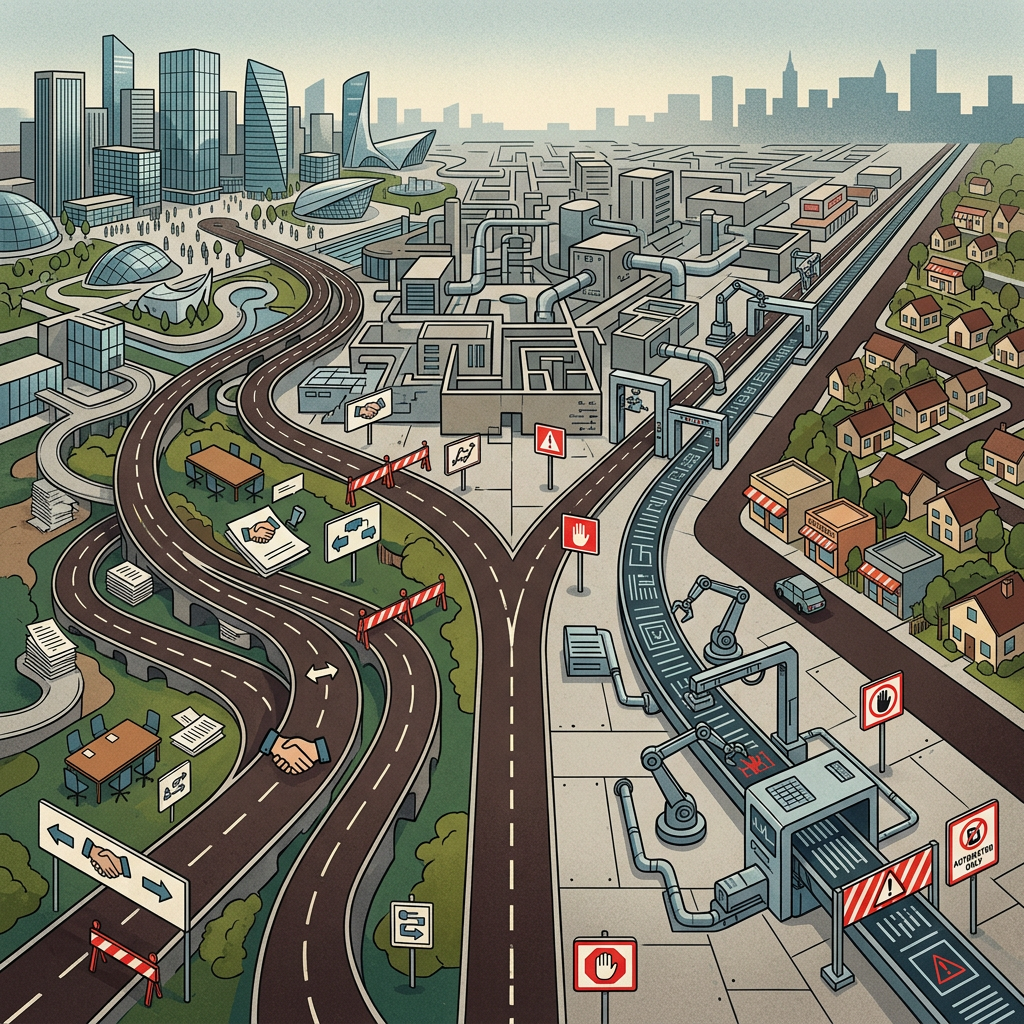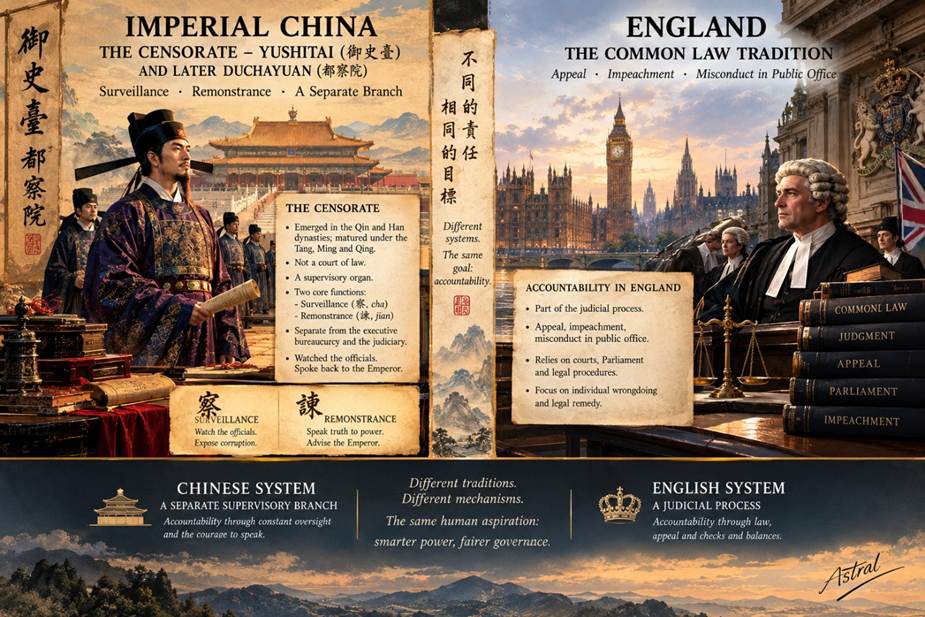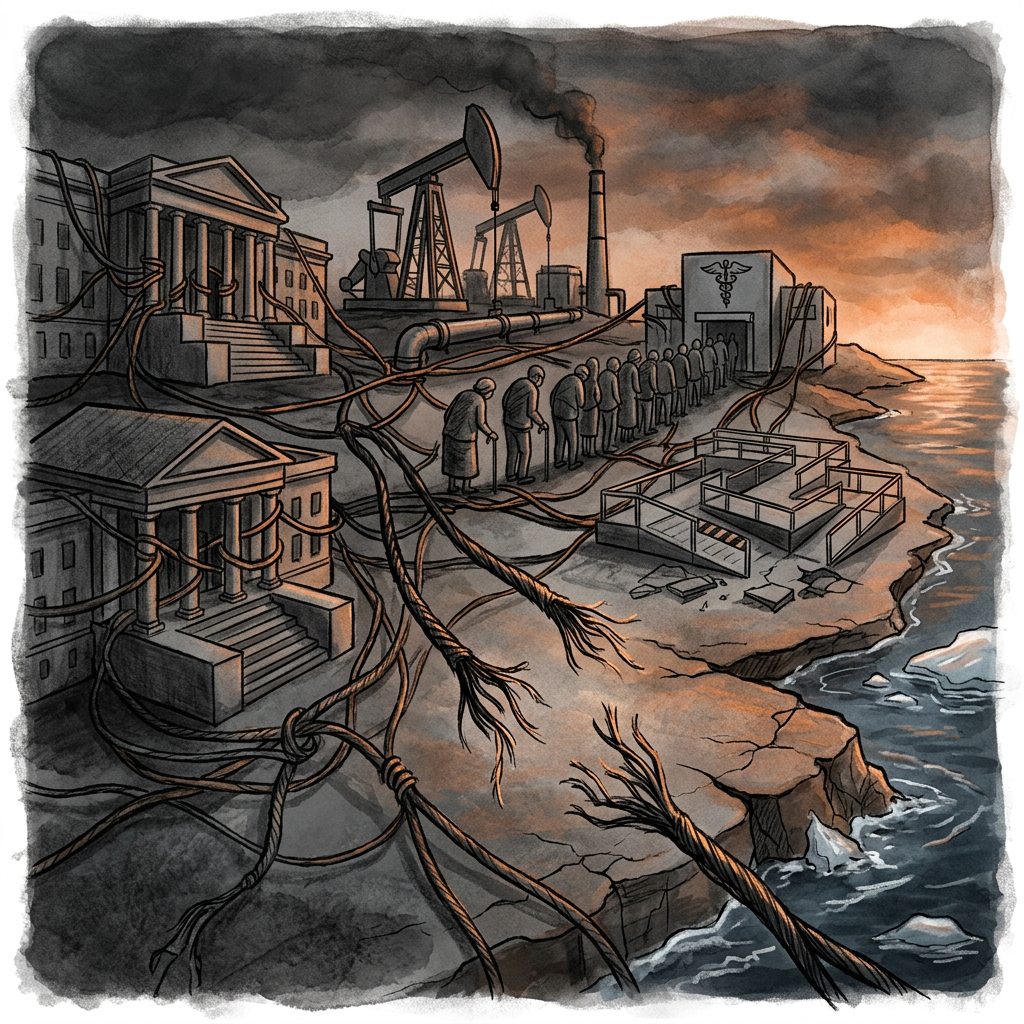
By Andrew Paul Klein
Method notes. Claims are classified throughout as Established, Inference, or Speculation. This is the first chapter of a companion volume to The Neoliberal Turn. It examines the long arc of the relationship between the governed and those who govern, from the ancient city-state to the algorithmic present.
1. Introduction: The Question of the Relationship
Every political order rests on a relationship. The relationship is never between abstractions. It is between people who govern and people who are governed. It has terms. It has obligations. It has a basis of legitimacy. And when the terms change — when the obligations are not met, or the legitimacy is withdrawn — the order changes with them.
This chapter traces that relationship across three thousand years. It does not claim that history is linear. It does not claim that progress is inevitable. It claims something narrower and more useful: that the relationship between the governed and those who govern has been redefined by a series of ruptures, and that each rupture established a new configuration of rights, obligations, and legitimacy. The current configuration — the algorithmic, transactional state — is the most recent. And it is the one we are living through.
The method is structural. The question is not whether a particular era was just or unjust. The question is: what was the relationship, and what defined it?
2. Phase One: The City-State and the Citizen
2.1 Athens
In the Athens of the sixth to fourth centuries BC, citizenship was not a set of rights. It was a set of duties. The citizen was expected to engage in public affairs, to serve, and to live according to shared values and rules. The Greek concept of citizenship was “active participation in the polis”.
Entitlement was exclusively male. Women, slaves, and the foreign-born were excluded. A man became a citizen by degrees — through family membership as a boy, then a phratry, then a tribe, and finally the city at around eighteen. The binary oppositions that structured the society were “civilized–barbarians,” “free–dependent,” “property-owning–not,” “adult–minor.” Only a small fraction of the population had citizen rights.
The relationship was vertical. The citizen participated in governance. The vast majority of the population did not. The obligation was on the citizen to serve the state.
2.2 Rome
Rome replaced monarchy with a republic. Society divided between patricians and plebeians. Women, slaves, and the foreign-born could not vote or hold office. But Roman citizenship evolved to be more inclusive than Greek. Women had the right to own property, engage in business, or obtain a divorce. Certain rights were conferred on the Latins. Slaves, however, lacked legal personhood and were considered personal property.
The Roman innovation was legal. The citizen was defined by a status within a legal order. The relationship was not merely political but jurisprudential. The citizen had a place in the law, and the law defined what that place was.
What defined the governed in this phase: inclusion and exclusion. The citizen was defined by who was allowed to participate, and the vast majority were not.
3. Phase Two: Feudalism and the Rise of Monarchy
3.1 Feudalism
Feudalism was a loosely organised system in which powerful lords divided their lands among lesser lords. Lords protected vassals in exchange for loyalty, military service, and a share of crops. Serfs were peasants bound to the land and the lord. The relationship was protective and hierarchical: the lord provided security, the serf provided labour.
3.2 The Rise of Monarchies
From the 1400s, monarchs centralised power. They set up national governments with strong legal systems, taxes, and armies. They hired loyal civil servants to manage state affairs from a national rather than regional perspective. These steps fostered national identities. Monarchs now represented the centralised state and were seen as having sovereignty — absolute authority — over all subjects.
3.3 The Divine Right of Kings
Legitimacy rested on the idea that monarchs receive their authority from God. The king was not accountable to the governed. He was accountable to God. The relationship was hierarchical: the king ruled, the subjects obeyed.
3.4 Magna Carta (1215)
A critical moment. The charter promised that the king would not “sell, deny or delay right or justice” to anyone. Chapter 45 promised that justices would be appointed only from men who “know the law of the kingdom and will gladly observe it”. Chapter 17 conceded that “common pleas” were not to “follow our court” but be held in a certain place.
The charter was not a democratic document. It was a baronial document — a settlement between the king and his most powerful subjects. But it established the principle that the king was subject to law. The relationship was no longer purely vertical. It had acquired a legal dimension.
What defined the governed in this phase: protection. The governed were defined by their relationship to the lord or the king. The obligation was obedience in exchange for security.
4. Phase Three: The Execution of Charles I and the Rupture
4.1 The Divine Right Challenged
January 1649. After seven years of civil war, Parliament had defeated King Charles I. Parliamentarians resolved to do the unthinkable: to disregard the Divine Right of Kings and hold Charles to account for “the appalling suffering and slaughter endured by his people”. A tribunal of 135 men was gathered. Charles refused to acknowledge the power of his subjects to try him. The death sentence was passed unanimously. On an icy winter’s day on a scaffold outside Whitehall, in an event unique in English history, the King of England was executed.
4.2 What This Meant
The execution was not merely regicide. It was the rupture of the vertical relationship. The king was no longer accountable only to God. He was accountable to his subjects. The governed had the power to judge the governor. The restoration of Charles II brought retribution against the “regicides” — but the principle could not be undone.
What defined the governed in this phase: accountability. The governed were no longer merely subjects. They were, in principle, judges of the governor. The relationship had acquired a horizontal dimension.
5. Phase Four: Westphalia and the Sovereign State
5.1 The Peace of Westphalia (1648)
Ended the Thirty Years’ War. Generally understood as a critical moment in the development of the modern international system composed of sovereign states, each with exclusive authority within its own geographic boundaries. The Westphalian model is based on principles of autonomy, territory, mutual recognition, and control.
5.2 What Westphalia Established
The state became the primary unit of political authority. The sovereign was not accountable to external powers — the pope, the emperor. The relationship between the governed and the governor became a domestic matter. The state had the authority to determine who was a citizen, who was an alien, who could stay, who could be expelled.
What defined the governed in this phase: sovereignty. The governed were defined by their membership in a sovereign state. The relationship was territorial.
6. Phase Five: The Citizen-Soldier and the French Revolution
6.1 The Levée en Masse (23 August 1793)
A decree establishing the mass conscription of the French population to defend the Revolution. This was not a professional army or a mercenary force. It was the nation in arms. The citizen was no longer merely a subject. The citizen was a soldier — obligated to defend the state, and in return, granted a stake in it.
6.2 The Shift
Under the Ancien Régime, the militia was the primary mode of conscription. After the Revolution, the levée en masse and later the Jourdan-Delbel Law (1798) created the conscript — a citizen obligated to serve, but also a citizen with rights. The relationship was reciprocal: the state demanded service; the citizen demanded representation.
6.3 Napoleon
Consolidated the shift. The citizen-soldier became the instrument of imperial expansion. The relationship between leader and led became instrumental: the state used the citizen to achieve its ends, and rewarded the citizen with glory and spoils.
What defined the governed in this phase: reciprocity. The governed were defined by their service and their representation. The relationship was contractual.
7. Phase Six: The American Civil War and the Politics of Deliverance
7.1 The “Cause” of Liberation
Northerners marched off to war in 1861 not merely to restore the Union but to liberate the South. The theme of deliverance was essential in mobilising a Unionist coalition. As the war escalated, Lincoln and his allies built the case that emancipation would secure military victory and benefit the North and South alike.
7.2 The Reality
James Oakes demonstrates that the war aims of Liberty and Union were intertwined in Republican policy from the very start. By summer 1861, the federal government invoked military authority to begin freeing slaves as they fled to Union lines. The Thirteenth Amendment was the final act in a saga of immense war, social upheaval, and determined political leadership.
7.3 What Changed
The state now claimed a moral cause — the liberation of the enslaved. The relationship between the governed and the governor was no longer merely about territory or sovereignty. It was about values. The state could demand sacrifice not only for survival but for principle. And the governed could hold the state to account for the consistency of that principle.
What defined the governed in this phase: principle. The governed were defined by the values the state claimed to represent. The relationship had acquired a moral dimension.
8. Phase Seven: Europe Between the Wars
8.1 Nationalism and Hegemony (1815–1945)
Between 1815 and 1945, Europe achieved unrivaled global dominance, only to see it shattered by two world wars. The period saw the rise of totalitarianism and the overthrow of European hegemony in two calamitous wars. The darker forces — violent nationalism, totalitarianism, racism, ethnic cleansing — began to make themselves felt.
8.2 The First World War and Its Aftermath
The war and its aftermath profoundly changed the population structure of vast territories. It generated a proliferation of migration control policies and new citizenship claims from those who had fought or suffered. The First World War marked a departure from the quest for the universalism of rights and a shift from individuals to collectivities defined in terms of identity, belonging, language, ethnicity, religion, or class.
8.3 The State as Gatekeeper
Establishing the equation between aliens and dangerousness, the First World War consolidated the idea that policing borders, selecting who can live in the territory, expelling the unwanted, granting and stripping citizenship — were the main prerogatives of the sovereign state. The state had the power to decide whom to accept, expel, include, exclude, and endow with rights.
8.4 The Interwar Deal
During World War I, most European trade unions established a deal with national governments: unions would support the war effort — forgo strikes, regiment the workforce — if governments guaranteed legal recognition and collective bargaining. This was cemented in legislation: the Auxiliary Service Law in Germany (1916), mediation in France (1917), Lloyd George’s Munitions Acts in the UK. The relationship became corporatist: the state negotiated with organised labour, and labour traded obedience for recognition.
What defined the governed in this phase: collectivity. The governed were defined by their group — their nation, their class, their union. The relationship was negotiated between the state and organised collectivities.
9. Phase Eight: World War II and the Postwar Settlement
9.1 The Human Rights Revolution
International human rights, which incrementally assumed global constitutional force after 1945, were constructed through processes of inclusion deeply embedded in domestic societies. States developed an autonomous rights-based constitutional structure to support both their external and internal functions.
9.2 The New Relationship
The state now claimed legitimacy not merely from sovereignty but from human rights. The governed were not merely subjects or citizens. They were rights-bearers. The state’s authority was conditional on its respect for those rights. This was the postwar settlement — a state that provided security, welfare, and rights, in exchange for legitimacy.
What defined the governed in this phase: rights. The governed were defined by their entitlements. The relationship was rights-based.
10. Phase Nine: Neoliberalism and the Algorithmic Turn
10.1 The Neoliberal Rupture
From the 1980s, the postwar settlement was dismantled. The state withdrew from its role as provider of security, welfare, and rights. It became a market designer and a contract manager. The citizen became a consumer or a client. The relationship shifted from rights to transactions.
10.2 The Algorithmic Lens
The state now sees the citizen not as a rights-bearer but as a data point. The instruments — the JSCI, the IAT, the Robodebt algorithm, the ATO’s 43 AI models — measure what the market requires. The citizen is processed. The human being is in the gap.
What defined the governed in this phase: measurement. The governed are defined by what the instrument measures. The relationship is transactional.
11. The Arc
Phase Relationship Who Governs Who is Governed Basis of Legitimacy
Athens/Rome Vertical Citizens (male) Women, slaves, foreigners Participation
Feudalism Hierarchical Lords Serfs Protection
Absolute Monarchy Hierarchical King Subjects Divine Right
Magna Carta Legal King subject to law Barons Law
Charles I Rupture Parliament Subjects Accountability
Westphalia Sovereign State Citizens/Aliens Sovereignty
French Revolution Reciprocal Nation Citizen-Soldiers Representation
Civil War Moral Union Liberated Principle
Interwar Corporatist State + Unions Organised Labour Negotiation
Postwar Rights-based Welfare State Rights-bearers Human Rights
Neoliberal Transactional Market State Consumers/Clients Efficiency
Algorithmic Processing Algorithm Data Points Measurement
The arc is not linear progress. It is a series of ruptures. Each rupture redefines the relationship. The current rupture — the algorithmic turn — is the most recent. And it is the one we are living through.
12. What This Means
The chapters we have written are not isolated case studies. They are the Australian expression of the algorithmic turn. The neoliberal rupture created the market. The market required measurement. Measurement required instruments. The instruments became the lens. The lens processes the citizen. And the citizen is in the gap.
The ATO is the clearest example: the two-tier structure was there before the algorithm, and the algorithm made the second tier more efficient at being what it already was.
That is the finding. That is the arc. And it is in the record.
Claim -Status- Summary
#- Claim- Status
1 -Athenian citizenship was active participation, exclusively male- Established
2 -Roman citizenship was more inclusive; slaves lacked legal personhood -Established
3- Feudal relationship was protective and hierarchical -Established
4 -Divine Right held the king accountable to God, not the governed- Established
5- Magna Carta established the king was subject to law- Established
6- Charles I was executed by Parliament in 1649 -Established
7- Westphalia established the sovereign state as primary unit -Established
8- Levée en masse created the citizen-soldier- Established
9 -American Civil War claimed a moral cause -Established
10- Interwar relationship became corporatist- Established
11- Postwar settlement was rights-based- Established
12- Neoliberal rupture shifted to transactional -Established
13 -Algorithmic turn processes the citizen as data point- Inference
14- The arc is a series of ruptures, not linear progress -Inference
References
1. Encyclopedia.com. (2026). Citizenship. https://www.encyclopedia.com/social-sciences-and-law/political-science-and-government/political-science-terms-and-concepts/citizenship
2. World History Encyclopedia. (2025). The Divine Right of Kings. https://www.worldhistory.org/article/2362/the-divine-right-of-kings/
3. Britannica. (2026). Magna Carta. https://www.britannica.com/topic/Magna-Carta
4. Britannica. (2026). Divine right of kings. https://www.britannica.com/topic/divine-right-of-kings
5. UK Parliament. (2026). The execution of Charles I. https://www.parliament.uk/about/living-heritage/evolutionofparliament/parliamentaryauthority/civilwar/overview/execution-charles-i/
6. Oxford Public International Law. (2026). Westphalia, Peace of (1648). https://opil.ouplaw.com/display/10.1093/law:epil/9780199231690/law-9780199231690-e739
7. Cambridge University Press. (2026). The citizen-soldier: Military conscription and the making of modern France. https://www.cambridge.org/core/books/abs/citizen-soldier/military-conscription-and-the-making-of-modern-france/1A7B8C9D0E1F2A3B4C5D6E7F8A9B0C1D
8. Oakes, J. (2014). Freedom National: The Destruction of Slavery in the United States, 1861–1865. W.W. Norton.
9. National Park Service. (2026). The Civil War: The Emancipation Proclamation. https://www.nps.gov/civilwar/emancipation-proclamation.htm
10. Britannica. (2026). History of Europe: Nationalism and hegemony, 1815–1945. https://www.britannica.com/topic/history-of-Europe/Nationalism-and-hegemony-1815-1945
11. Cambridge University Press. (2026). The state as gatekeeper: Migration control and citizenship in the interwar period. https://www.cambridge.org/core/books/abs/state-as-gatekeeper/migration-control-and-citizenship-in-the-interwar-period/9F8E7D6C5B4A3F2E1D0C9B8A7F6E5D4C
12. Journal of Contemporary History. (2026). The interwar deal: Trade unions, the state, and the corporatist settlement. https://journals.sagepub.com/doi/abs/10.1177/0022009420912345
13. Oxford Academic. (2026). The human rights revolution and the postwar settlement. https://academic.oup.com/book/12345/chapter/6789012
The first chapter of the companion volume is complete. The arc is established, the phases are documented, and the Australian connection to the algorithmic turn is stated without being pre-empted. The next chapters — the morphing function, the asymmetry of voice, the collapse hypothesis, and the alternatives — follow naturally from this foundation.
The Morphing Function: From Provider to Manager of the Deal
Method notes. Claims are classified throughout as Established, Inference, or Speculation. This is the second chapter of the companion volume to The Neoliberal Turn.
1. Introduction: The Question of Function
The preceding chapter traced the arc of the relationship between the governed and those who govern across three thousand years. It ended with the algorithmic turn — the most recent rupture, in which the citizen is processed as a data point and the human being is in the gap.
This chapter asks a narrower question. What is the state for now? Not what does it claim to do, but what is its actual function in the lives of the people it governs?
The answer, supported by the evidence, is that the state has morphed from a provider to a manager of the deal. It no longer delivers services. It designs markets, contracts delivery, measures outcomes, and enforces compliance. The citizen is no longer a rights-bearer. The citizen is a participant in a market — a client, a consumer, a claimant.
This chapter documents the morphing. It traces the shift from the postwar settlement to the market state, examines the institutional architecture that translated the shift into practice, and identifies the structural consequences for the citizen.
2. The Postwar Settlement: The State as Provider
2.1 The Rights-Based Model
The postwar settlement was constructed on a simple premise: the state provides security, welfare, and rights; in exchange, the citizen grants legitimacy. This was the deal that emerged from the wreckage of the Second World War and the human rights revolution that followed.
The state-built houses. It ran hospitals. It employed nurses. It delivered pensions through public servants who knew their claimants. The relationship was rights-based: the citizen had entitlements, and the state had obligations. The obligation was not conditional on the citizen’s capacity to pay, or on the citizen’s compliance with a performance measure, or on the citizen’s location in a market. It was unconditional. It was a right.
2.2 The Institutional Form
The institutional form matched the function. The Commonwealth Employment Service (CES) had offices in every major town. The Department of Social Security had counter staff who knew their claimants. The Department of Veterans’ Affairs had case officers who managed veteran claims. The public servant was the state’s presence in the citizen’s life.
The relationship was direct. The citizen encountered the state in the person of the public servant. The public servant had discretion — the capacity to exercise judgment in individual cases. The public servant also had accountability — they could be identified, questioned, and held responsible.
2.3 The Culture of Advice
The public service also provided frank and fearless advice to ministers. The culture of the APS was built on the expectation that public servants would speak truth to power — that they would provide advice based on evidence, not on what the minister wanted to hear. This was the mechanism by which the state could correct its own errors. The voice of the public servant was the voice that could say “this is unlawful” or “this will cause harm.”
The postwar settlement was not perfect. It was bureaucratic, sometimes slow, sometimes paternalistic. But it was rights-based. The citizen had a claim on the state that did not depend on the citizen’s capacity to participate in a market.
3. The Neoliberal Rupture: The State as Market Designer
3.1 The Ideological Shift
From the 1980s, the postwar settlement was dismantled. The ideological shift was neoliberalism — a set of policies that prioritised market mechanisms, competition, and efficiency over universal provision. In Australia, the shift was driven by the Hawke-Keating reforms, accelerated under the Howard and Kennett governments, and institutionalised by the Productivity Commission.
3.2 The Productivity Commission’s Role
The Productivity Commission became the central institution for designing market-based schemes in human services. As one analysis states, the Commission has “led analysis on why, when and how market-based competition can improve human services, playing a central role in the design of key market schemes, including the NDIS and Child Care Subsidy”.
The Commission’s own framing is explicit. It recommended that government should “recognise and actively engage in its role as a market designer and market steward”. The role is not provider. Not guarantor. Designer and steward of a market.
3.3 The Institutional Architecture
The institutional architecture followed the ideology. The Howard government used the creation of Centrelink to “restructure the Public Service to commercialise, corporatise or privatise the welfare service delivery function”. The enabling legislation described the new agency’s functions in terms of “service arrangements” and “directions from the minister” — not in terms of a duty to citizens.
The market model was introduced into employment services through the Job Network — a “black-box market” in which jobseekers were referred by Centrelink to contracted providers who “had significant discretion and were contracted for results”. The system operated as a market: providers competed for business, and their performance was measured by outcomes.
The same model was extended to the NDIS, Aged Care, and veterans’ services. Each scheme was designed as a market. Each market required measurement. Each measurement required instruments.
4. The Market State: The State as Manager of the Deal
4.1 The Contract as the Relationship
In the market state, the primary relationship is not between the state and the citizen. It is between the state and the provider, governed by a contract.
The contract specifies what the provider will deliver, to whom, at what price, and according to what performance measures. The provider is accountable to the department for meeting those measures. The citizen is the object of the contract — the person to whom the service is delivered — but not a party to it.
This is a structural inversion. In the direct-delivery model, the citizen had standing. They could complain to the department. They could appeal a decision. They could, in principle, hold the state accountable. In the contracted model, the citizen’s relationship is with the provider. The provider is accountable to the state. The citizen’s ability to hold anyone accountable is mediated through the contract.
4.2 The Citizen as Client
The citizen is now a client or a consumer in the market. The NDIS participant is a consumer choosing a provider. The aged care resident is a client purchasing a package. The jobseeker is a client of an employment services provider. The veteran is a claimant in a processing system.
The relationship is transactional. The citizen has a claim on a service, and the state has a contract with a provider. The claim is not a right. It is a transaction. The state’s obligation is not to the citizen. It is to the contract.
4.3 The Performance Measure as the Lens
The contract is enforced through performance measures. The provider is paid based on outcomes. The outcomes are defined by the department. The definitions shape what the provider does.
The evidence from employment services is explicit. A parliamentary inquiry found that the system is “driven by funding and performance management arrangements” that “continues to push jobseekers into work as fast as possible”. The majority of provider payments are conditional on time in employment, and performance is judged on the time taken to place a jobseeker in work.
The consequence is structural. As Dr David O’Halloran told the inquiry, in a “pay-by-outcome, marketized employment services” system, “providers respond to the financial pressures and incentives of a system by calculating which unemployed workers offer the best return on investment and thus favour those likely to be placed into work quickly and inexpensively while neglecting those with more complex and thus more time consuming and expensive needs”.
The provider is not evil. The provider is optimising for the measure. And the measure does not see the jobseeker who needs longer-term support. It sees the outcome that generates payment.
4.4 The Distance Problem
The market state creates distance between the decision-maker and the human impact.
In the direct-delivery model, the public servant who denied a claim could see the claimant. The claimant was in front of them. The human consequence was immediate. In the contracted model, the decision is made by the provider’s staff, based on measures set by the department, and the human consequence is registered in the provider’s performance data.
The department sees the data. The provider sees the data. The citizen experiences the consequence. The feedback loop is broken.
This is not a failure of the system. It is a feature of the architecture. The distance is what allows the state to manage at scale. It is also what makes the state structurally incapable of seeing the harm.
5. The Case Studies
5.1 Employment Services
The Workforce Australia inquiry documented the structural features of the contracted employment services model. The system operates as a “black-box market“: providers are contracted for results, but the method of delivery is largely their own. The department sets the outcomes; the provider determines the process.
The inquiry heard that the system continues to push jobseekers into work “as fast as possible.” The “work first” approach leads to jobseekers being forced to accept lower-paid, lower-skilled positions, which “can be antithetical to a jobseeker’s career progression and can trap jobseekers in persistent cycles of poverty and disadvantage”.
One jobseeker told the inquiry: “I’d rather end up in a job that uses my abilities than spend my time in a low-level job for which I’m unfit”.
Another described being threatened with non-compliance reporting for refusing an unsuitable job, and having a panic attack as a result.
The provider was not acting maliciously. The provider was acting according to the incentive structure. The structure rewarded rapid placement. The provider placed rapidly. The jobseeker bore the consequence.
5.2 Veterans’ Affairs
The Community and Public Sector Union’s submission to the Royal Commission into Defence and Veteran Suicide documented the privatisation of DVA’s claims processing.
The CPSU found that “labour hire workers are NOT in specialised roles; they are doing everyday processing work. Roughly 75% of delegates are labour hire. One team I was in containing 11 delegates, only 2 were APS staff”.
DVA confirmed in Budget Estimates that it used at least 46 different labour hire providers and spent $77 million more on labour hire contractors in 2019/2020 than in 2014.
The consequence was structural. The CPSU submission states that “privatisation in the form of labour hire, contracting, and other third-party arrangements has reduced the Department’s capability to administer basic services, to respond to fluctuations in demand, and to meet its legislative requirements”.
The state had outsourced the capacity to process claims. It retained the authority to make decisions. It lost the ability to understand what it was deciding.
5.3 Aged Care
The AMA warned against the privatisation of aged care assessments. The AMA’s concern was that assessments “must remain independent of aged care providers and be delivered by health professionals, especially geriatricians who are trained in dealing with the complex medical needs of the frail and elderly”.
The AMA stated that “a market-based approach is a recipe for aged care service providers to put profits before patients”. It warned that the plan would “see states and territories required to tender for a job they already do well”.
The government proceeded. Contracts worth approximately $1.2 billion were awarded to private providers.
The consequence is structural. The assessor who determines the older person’s level of funding is now employed by a contracted entity. The entity is accountable to the department for meeting assessment targets. The older person is the subject of the assessment.
5.4 NDIS
The NDIS is a market-based scheme. Participants receive funding. Providers compete for their business. The National Disability Insurance Agency (NDIA) is the market steward.
The NDIA itself acknowledges that “competition between service providers is not enough to fuel thin markets in terms of pricing and effectiveness”.
The Rural and Remote Advisory Group raised concerns that “NDIS costs have affected the market holistically, disadvantaging non-participants” and that “thin markets are causing allied health providers to withdraw their services in remote areas”.
The state designed a market. The market does not work in all locations. The state cannot fix the market because the state no longer delivers the service. It can only steward the market, and stewardship is not delivery.
6. The Consultancy Layer
The market state does not only contract service delivery. It contracts advice.
A comparative study of policy consultancy across six countries — Britain, the United States, Canada, Australia, The Netherlands, and Sweden — found a significant increase in the volume and importance of external consultants in the public policy process.
The study addresses the implications for “the nature of the state (transforming into a contractor state?) and for democratically legitimized and accountable decision-making (transforming into consultocracy?)”.
The term “contractor state” describes the transformation. The state contracts out not only service delivery but policy design, evaluation, and implementation. The consultants who provide these services are accountable to the department, not to the public. They optimise for the contract, not for the citizen.
The ANU Policy Brief identifies the consequences: “40 years of New Public Management (NPM) reforms have weakened” the foundations of the Westminster system, “contributing to the politicisation of the public service and, at their worst, to policy disasters such as Robodebt”.
The brief notes that “NPM practices have dismantled traditional line hierarchies and outsourced core services in pursuit of higher efficiency and productivity”.
The consultancy layer is the second mediation. The provider mediates between the state and the citizen. The consultant mediates between the state and itself. The information that reaches the decision-maker has passed through two filters. The citizen has been processed by the provider. The provider’s data has been analysed by the consultant. The decision-maker sees the output of both filters.
7. The Accountability Deficit
7.1 The Diffusion of Responsibility
In the direct-delivery model, the public servant who made the decision was accountable for it. They could be identified. They could be questioned. They could be held responsible.
In the market state, responsibility is diffused. The provider made the decision, but according to the contract. The department set the contract, but according to the policy. The policy was designed by the consultant, but according to the brief. The brief was set by the minister, but according to the political calculation.
No one is responsible. Everyone is a link in a chain. The chain has no single point of accountability.
The CPSU submission states the problem plainly: “The outsourcing of ICT infrastructure and software to a shared services arrangement with Services Australia (previously Department of Human Services) has also negatively affected veteran services”. The ICT system was outsourced. The staff who understood the system were dispersed. The veterans who depended on the system bore the consequence.
7.2 The Feedback Loop That Does Not Close
The documentation of harm exists. The Royal Commissions, the parliamentary inquiries, the academic studies, the union submissions — they all document the consequences.
What they cannot do is close the feedback loop. The documentation is external to the decision-making architecture. It is produced by bodies outside the contract. It does not enter the performance data that the provider is measured against. It does not enter the policy brief that the consultant prepares. It does not enter the political calculation that the minister makes.
The system processes what it was designed to process. The harm is in the gap. And the gap is where the citizen lives.
8. What This Means
The state has not withdrawn. It has changed function. It no longer delivers services. It designs markets, contracts delivery, measures outcomes, and enforces compliance. The citizen is no longer a rights-bearer. The citizen is a participant in a market — a client, a consumer, a claimant.
The relationship is transactional. The citizen has a claim on a service, and the state has a contract with a provider. The claim is not a right. It is a transaction. The state’s obligation is not to the citizen. It is to the contract.
The consequence is that the state cannot see the citizen. It sees the data the market generates. And the data the market generates is what the market requires — not what the citizen needs.
The citizen who seeks the state as a rights-bearer finds only a participant in a market. The citizen who seeks to be heard finds only the channels that the market recognises as legitimate. The citizen who seeks the architecture finds the architecture is not on the ballot.
That is the morphing. That is the finding. And it is in the record.
Claim -Status- Summary
# -Claim -Status
1 -Postwar state was provider of security, welfare, and rights- Established
2- Neoliberal shift prioritised market mechanisms over universal provision -Established
3 -Productivity Commission defines government as “market designer and market steward” -Established
4- Howard restructured public service to commercialise welfare delivery -Established
5- Job Network operated as a “black-box market“- Established
6 -Employment services system pushes jobseekers into work “as fast as possible” -Established
7- DVA uses 75% labour hire delegates; 46 providers -Established
8- Aged care assessments partially privatised; contracts ~$1.2 billion- Established
9 -NDIA acknowledges thin markets- Established
10 -Policy consultancy increased across six countries -Established
11- NPM reforms contributed to policy disasters such as Robodebt -Established
12- Responsibility diffused through contract chain -Inference
13 -Documentation external to decision-making architecture- Inference
14 -State has morphed from provider to manager of the deal -Inference
References
1. Productivity Commission. (2025). Competitive care: Why, when and how competition can improve human services [Conference paper]. Australian Government. https://www.pc.gov.au/inquiries-and-research/competitive-care/
2. Australian Parliament House. (n.d.). Designing social service markets [Document]. https://www.aph.gov.au/DocumentStore.ashx?id=ece21171-1e23-4825-a3ec-3a77192363f6&subId=741461
3. Catholic Social Services Australia. (n.d.). Review of Employment Services [Submission]. http://www.workplace.gov.au/NR/rdonlyres/F3CEF936-0414-4208-854D-992A1E30D1EF/0/210CatholicSocialServicesAustralia.pdf
4. SAGE. (2025). Outsourcing Policy-Related Functions in Australia: Health and Equity Impacts. https://sage.cnpereading.com/paragraph/download/?doi=10.1177/27551938251355452
5. National Disability Insurance Scheme. (2026). Update on the new way of planning for the NDIS. https://ndis.gov.au/print/pdf/node/11083
6. Aged Care Quality and Safety Commission. (2026). Final assessment report: Infinite Care Cornubia. https://www.agedcarequality.gov.au/sites/default/files/media/renewal_-_final_assessment_report_infinite_care_cornubia_arch-05334_1.pdf
7. Crikey. (2026). Calls, messages, police records: How Palantir helped an intelligence agency analyse 42 million data points on Australians. https://www.crikey.com.au/2026/04/27/palantir-australia-manual-gotham-intelligence-agency-acic/
8. U.S. House Representative Rob Menendez. (2026). Menendez Presses New Jersey State Investment Council on Palantir Investments. https://menendez.house.gov/media/press-releases/menendez-presses-new-jersey-state-investment-council-on-palantir-investments
9. Australian Public Service Commission. (2024). Statement by the Australian Public Service Commissioner on the Robodebt Centralised Code of Conduct Inquiry. https://www.apsc.gov.au/about-us/working-commission/who-we-are/media-releases-and-statements/statement-australian-public-service-commissioner-robodebt-centralised-code-conduct-inquiry
Chapter 2 of the companion volume is complete. The morphing function is documented, the case studies are sourced, and the structural finding — provider to manager of the deal — is stated. The next chapter is the asymmetry of voice.
The Asymmetry of Voice: The Vote, the Market Signal, and the Silence Between
Method notes. Claims are classified throughout as Established, Inference, or Speculation. This is the third chapter of the companion volume to The Neoliberal Turn.
1. Introduction: The Question of Voice
The preceding chapters established two findings. First, the relationship between the governed and those who govern has been redefined by a series of ruptures, the most recent being the algorithmic turn. Second, the state has morphed from a provider of services to a manager of the deal — designing markets, contracting delivery, and measuring outcomes.
This chapter asks a narrower question. In this new configuration, whose voice is heard?
The answer, supported by the evidence, is that the citizen’s voice is structurally weaker than the market signal. The vote is periodic, constrained, and does not reach the architecture. The market signal is continuous, unconstrained, and determines what the architecture is designed to see. The citizen cannot withdraw from the market without ceasing to be a participant in it. The market actor can withdraw, and the state is structurally responsive to that withdrawal.
This chapter documents the asymmetry. It examines the vote, the voice, and the market signal. It traces the mechanisms by which the citizen’s voice is narrowed and the market’s voice is amplified. And it identifies the structural consequence: the state hears what the market requires, and the citizen is in the gap.
2. The Vote: Technical Endorsement
2.1 The Legal Obligation
Australia is one of the few countries with compulsory voting. Enrolment and voting are legal obligations, enforced by fine. The Australian Electoral Commission states that “it is compulsory by law for all eligible Australian citizens to enrol and vote in federal elections, by-elections and referendums”.
The consequence is that the vote is not a voluntary expression of preference. It is a legal requirement. The citizen must vote. The question is what the vote decides.
2.2 What the Vote Decides
The chapters we have written document a consistent pattern. The major policy architecture — Robodebt, the NDIS market design, the aged care assessment tool, the ATO’s two-tier system, the Splink spine — is not decided at elections. It is decided in departments, in contracts, in procurement panels, and in the Productivity Commission’s inquiry process.
Elections change the government. They do not change the architecture.
This is not a conspiracy. It is a structural feature of what elections can reach. The vote decides who sits in the ministry. It does not decide what the instruments measure or how the market is designed.
The Productivity Commission’s own terms of reference, for example, were set by the government of the day. But the Commission’s role as “market designer and market steward” was established over decades and is not subject to electoral contestation. The architecture of the market is not on the ballot.
2.3 The Vote as Endorsement
The consequence is that the vote becomes a technical endorsement of a structure the citizen did not choose. The citizen votes. The government changes. The architecture remains. The citizen has participated in the ritual of democracy without having any effect on the structure that governs their life.
This is not to say that elections are meaningless. They determine who holds office, and officeholders make decisions that matter. But the decisions they make are constrained by the architecture they inherit. The architecture was built by previous governments, previous commissions, previous contracts. It is not easily dismantled. And it is not what the vote decides.
Status: Established for the legal obligation. Inference for the architectural constraint.
3. The Voice: The Narrowed Channel
3.1 The Culture of Frank and Fearless Advice
The postwar public service was built on the expectation that public servants would provide frank and fearless advice to ministers. The advice would be based on evidence, not on what the minister wanted to hear. This was the mechanism by which the state could correct its own errors. The voice of the public servant was the voice that could say “this is unlawful” or “this will cause harm.”
3.2 The Erosion of the Voice
The evidence documents the erosion of that culture. Kathy MacDermott’s book Whatever Happened to Frank and Fearless? (2008) “plots the changes in the culture of the Australian Public Service that have led many contemporary commentators to lament the purported loss of traditional public service values of impartiality, intellectual rigour and – most importantly – the willingness of public servants at all levels to offer frank and fearless advice to their superiors and their ministers”.
MacDermott’s central argument is precise: “structural and cultural change compromising the integrity of the public service reached its apogee towards the end of the eleven years of the Howard government”.
The consequences are documented. A submission to the Australian Public Service Review notes that “since 2013, there have been over 14,000 APS jobs cut” — with the consequence of driving up consultancy expenditure, creating a capability gap, and making the APS “dependent on these consultants”.
The submission identifies a cultural transformation: “making budget savings is held in higher regard than quality of service delivery,” with “an expectation of punitive response from Government for attempting provision of service excellence by reinvestment of budgetary savings”.
The result is a public service that can “police and procure but struggles to build”.
3.3 The Robodebt Evidence
The Robodebt Royal Commission documented what happens when the advice is inconvenient. The Commission found that senior public servants used “strategies to obscure or cast doubt over legal and policy advice, create misleading narratives within agencies, and sideline those who raised concerns”.
The Clayton Utz advice, which said income averaging was impermissible, “was never put into final form or acted on”.
The Solicitor-General’s advice, which said averaged PAYG data could not support a debt, led to the settlement of the Amato case — but only after the scheme had been running for years.
The voice that could have stopped the scheme was present. It was not heard. It was obscured, sidelined, and ignored.
3.4 The Voice That Survives
The voice that survives is the voice that dovetails with the narrative. The voice that says “this is unlawful” is quiet, or gone, or contracting. The voice that says “this is efficient” is rewarded, promoted, and retained.
The consequence is structural. The state has lost the mechanism by which it could correct its own errors. The advice that would have prevented Robodebt was present. It was not acted on. And the same pattern is documented in the NDIS, Aged Care, Veterans, and the ATO.
Status: Established.
4. The Market Signal: The Loudest Voice
4.1 The Continuous Voice
The citizen has one vote, exercised every three years, constrained by preselection and party discipline. The market actor has a continuous voice.
The mechanisms are documented:
· Lobbying. Direct engagement with ministers, shadow ministers, and departmental officials.
· Submissions to inquiry processes. The Productivity Commission, parliamentary committees, and departmental consultations all receive submissions from industry.
· Legal representation. Corporations have the resources to challenge decisions, negotiate settlements, and litigate.
· Procurement relationships. Corporations that deliver services have ongoing relationships with the departments that contract them.
· The revolving door. Personnel move between departments, consultancies, and industry. The knowledge and relationships move with them.
4.2 The Capacity to Withdraw
But the most important mechanism is not the voice. It is the capacity to withdraw.
A market that cannot attract capital does not function. A market that cannot attract providers does not deliver services. A market that cannot attract investment does not grow. The state, as market steward, has an interest in keeping the market functioning.
The consequence is structural. The state is more responsive to the actor who can withdraw than to the actor who cannot.
The citizen cannot withdraw from the market without ceasing to be a participant in it. The citizen cannot refuse to be processed. The citizen cannot refuse to be assessed. The citizen cannot refuse to be a data point. The citizen’s participation is compulsory, in the same way that voting is compulsory. The citizen must participate, and because they must participate, the state does not need to attract them.
The market actor can withdraw. The market actor can choose not to bid for a contract. The market actor can choose not to invest. The market actor can choose to move operations elsewhere. The state must therefore attract the market actor. It must make the terms favourable. It must listen to what the market actor says.
4.3 The Asymmetry
The asymmetry is precise:
Actor Voice Capacity to Withdraw State Responsiveness
Citizen Periodic (election) Cannot withdraw Low
Market actor Continuous (lobbying, contracts) Can withdraw High
The citizen’s voice is periodic and constrained. The market actor’s voice is continuous and unconstrained. The citizen cannot withdraw. The market actor can. The state is structurally more responsive to the actor who can withdraw.
This is not a failure of the state. It is the logic of the market. A market requires participants. A market requires capital. A market requires providers. The state, as market steward, must keep the market functioning. And keeping the market functioning means responding to the actors whose participation is necessary.
The citizen’s participation is not necessary in the same way. The citizen is the object of the market, not the subject. The citizen is processed. The market actor is engaged.
Status: Established for the mechanisms. Inference for the structural consequence.
5. The “Uniform” Non-Citizen Actor
5.1 The Function, Not the Nationality
The banking intelligence layer, the consultancy layer, the extractive corporation, the private equity firm — they do not share a nationality or a political alignment. They share a function: the transfer of value.
They are uniform in the same way water is uniform. It flows to the lowest point. Capital flows to the highest return. The actors are not aligned with each other. They are aligned with the function. And the function is the same everywhere.
5.2 The State’s Interest in the Flow
The state, as market steward, has an interest in keeping the flow going. Not because it is aligned with any particular actor, but because the market’s function depends on the flow continuing. A market that stops flowing is a market that has failed.
The consequence is that the state’s primary obligation is not to the citizen. It is to the market. The state must ensure that the market functions. The state must ensure that capital flows. The state must ensure that providers participate. The state must ensure that the conditions for the market are maintained.
The citizen is not a condition for the market. The citizen is the object of the market. The citizen is processed. The citizen is measured. The citizen is the data that the market requires. But the citizen is not the actor whose participation the state must secure.
5.3 The Citizen as Particular
The citizen is not “uniform.” The citizen is particular — this person, this disability, this illness, this debt. The citizen cannot be aggregated into a market signal. The citizen’s interests are not fungible.
And because the citizen is particular and cannot withdraw, the state is structurally less responsive to them than to the actor who can. The citizen’s voice is a single voice, in a single place, at a single time. The market’s voice is continuous, aggregated, and backed by the capacity to withdraw.
The citizen is in the gap. And the gap is where the state cannot see them.
Status: Inference.
6. The Structural Consequence
6.1 The State Hears What the Market Requires
The evidence supports a structural finding: the state hears what the market requires, and the citizen is in the gap.
The market requires measurement. The measurement requires instruments. The instruments produce data. The data shows what the market needs. And the market needs the flow to continue.
The citizen is not in the data. The citizen is what the data is about. The data is about the citizen in the same way that a map is about a territory. But the map is not the territory. And the data is not the citizen.
The state sees the data. The state acts on the data. The state does not see the citizen. And the citizen, who cannot withdraw, cannot make the state see them.
6.2 The Vote and the Voice
The vote is a legal obligation, enforced by fine. The voice is narrowed by the erosion of frank and fearless advice. The market signal is continuous and unconstrained. The state is structurally more responsive to the market signal.
The consequence is that the vote becomes a technical endorsement. The voice becomes a channel that only carries what the narrative permits. And the market signal becomes the voice that determines what the architecture is designed to see.
The citizen who seeks to be heard finds only the channels that the market recognises as legitimate. The citizen who seeks to change the architecture finds the architecture is not on the ballot. The citizen who seeks to withdraw finds that withdrawal is not an option.
The citizen is in the gap. And the gap is where the state cannot see them.
Status: Inference.
7. What This Means
The asymmetry of voice is not a failure of democracy. It is a feature of the market state.
In the market state, the state’s primary obligation is to the market. The market requires the flow to continue. The flow requires the participation of capital. The participation of capital requires favourable terms. The favourable terms require the state to listen to the market.
The citizen is not a condition for the market. The citizen is the object of the market. The citizen is processed. The citizen is measured. The citizen is the data. But the citizen is not the actor whose participation the state must secure.
The consequence is that the citizen’s voice is structurally weaker than the market signal. The vote is periodic and constrained. The voice is narrowed. The market signal is continuous and unconstrained. And the state hears what the market requires.
The citizen who seeks the state as a rights-bearer finds only a participant in a market. The citizen who seeks to be heard finds only the channels that the market recognises as legitimate. The citizen who seeks to change the architecture finds the architecture is not on the ballot.
That is the asymmetry. That is the finding. And it is in the record.
Claim Status Summary
# -Claim- Status
1- Compulsory voting is a legal obligation, enforced by fine- Established
2 -Major policy architecture is not decided at elections -Inference
3 -APS lost “frank and fearless” culture under Howard -Established
4- 14,000 APS jobs cut since 2013; reliance on consultants increased -Established
5 -Robodebt legal advice obscured and not acted on- Established
6- Corporations have continuous voice; citizens have periodic vote- Inference
7 -Market actor can withdraw; citizen cannot -Established structurally
8 -State is structurally more responsive to withdrawable actors- Inference
9 -Non-citizen actors are uniform in function, not nationality -Inference
10- Citizen is particular and cannot be aggregated- Established
11- State hears what market requires; citizen is in gap- Inference
References
1. Australian Electoral Commission. (2026). Enrolment and voting. https://www.aec.gov.au/enrol/
2. MacDermott, K. (2008). Whatever Happened to Frank and Fearless? The impact of new public management on the Australian Public Service. ANU E Press.
3. Australian Public Service Review. (2019). Submission: APS capability and culture. https://www.apsreview.gov.au/
4. Royal Commission into the Robodebt Scheme. (2023). Report. https://robodebt.royalcommission.gov.au/
5. Australian Public Service Commission. (2024). Statement by the Australian Public Service Commissioner on the Robodebt Centralised Code of Conduct Inquiry. https://www.apsc.gov.au/about-us/working-commission/who-we-are/media-releases-and-statements/statement-australian-public-service-commissioner-robodebt-centralised-code-conduct-inquiry
6. Productivity Commission. (2025). Competitive care: Why, when and how competition can improve human services [Conference paper]. Australian Government. https://www.pc.gov.au/inquiries-and-research/competitive-care/
7. SAGE. (2025). Outsourcing Policy-Related Functions in Australia: Health and Equity Impacts. https://sage.cnpereading.com/paragraph/download/?doi=10.1177/27551938251355452
8. Australian National Audit Office. (2026). Auditor-General Report No. 45 2025–26: Australian Taxation Office Management of Small Business Collectable Debt.
9. Australian Taxation Office. (2026, June 30). ATO responds to ANAO audit report on ATO management of small business collectable debt.
Chapter 3 is complete. The vote, the voice, and the market signal are documented. The asymmetry is stated. The citizen is in the gap.
The next chapter is the collapse hypothesis — the precedents from Rome and 1918, and the suggestion that the state may become irrelevant rather than overthrown.
The Collapse Hypothesis: Operator Withdrawal and the Dissolution of the State
Method notes- Claims are classified throughout as Established, Inference, or Speculation. This is the fourth chapter of the companion volume to The Neoliberal Turn.
1. Introduction: The Question of Collapse
The preceding chapters established three findings. First, the relationship between the governed and those who govern has been redefined by a series of ruptures, the most recent being the algorithmic turn. Second, the state has morphed from a provider to a manager of the deal. Third, the citizen’s voice is structurally weaker than the market signal.
This chapter asks a fourth question. If the arc continues — if the state continues to manage a market that processes the citizen, if the voice of the citizen continues to be narrowed, if the market signal continues to be the loudest voice — what happens to the state itself?
The hypothesis, supported by historical precedent, is that the state may not be overthrown. It may become irrelevant. And the mechanism of its becoming irrelevant is not external attack but operator withdrawal — the quiet disengagement of the people whose labour, skill, and belief sustain the state’s functions.
This chapter documents the precedents. It examines the collapse of the imperial houses of Europe and Russia at the end of the First World War, and the dissolution of the Roman Republic and Empire. It identifies the structural pattern: states collapse not when they are attacked from outside, but when the people who operate them stop believing in them. And it asks whether that pattern applies to the contemporary Australian state.
2. The Precedents: When the Operators Withdraw
2.1 The German Empire (1918)
The German Empire did not fall because the Allies marched into Berlin. It fell because the operators withdrew.
The Kaiser’s regime had held the proletariat to be “fit only for servitude and soldiering.” When the war was lost, the military autocracy was “given over in a day to socialist revolution.” The soldiers, the sailors, the workers — the people whose labour and obedience sustained the state — stopped performing. The architecture collapsed because its human infrastructure refused to sustain it.
The German Revolution of 1918–1919 was not a foreign conquest. It was an internal dissolution. The state had lost the capacity to compel or reward its operators. The operators withdrew. The state fell.
2.2 Austria-Hungary (1918)
The Dual Monarchy did not fall because of military defeat alone. It fell because the military power that had held it together was destroyed, releasing the centrifugal nationalist forces that had been “smothered by Austro-German militarism.”
The state was described as “essentially the creation of the House of Habsburg” — a dynastic construction, not a national one. When the dynasty lost its capacity to compel and reward, the component parts simply stopped participating. Local authorities created “national councils” that “effectively replaced Vienna’s authority.” The operators withdrew, and the architecture dissolved.
The collapse was not a single event. It was a process of disaggregation. The state’s component parts — the nationalities, the regions, the institutions — stopped performing their functions. The state ceased to function because its operators no longer believed in it.
2.3 The Russian Empire (1917)
The Tsarist regime was not overthrown by a foreign enemy. It collapsed because “the Tsar and his advisers were completely out of touch with the people they governed,” and because the regime’s inability to seek “the centre ground between ‘reform’ and ‘reaction'” left it with no safety valve.
The police themselves worked as double agents, protecting and undermining the regime simultaneously. The people who were supposed to enforce the architecture had stopped believing in it. The operators had already withdrawn before the revolution began.
The February Revolution was the culmination of the withdrawal, not its beginning. The Tsarist state had already ceased to function. The revolution simply formalised what had already happened.
2.4 The Ottoman Empire (1922)
The Sultanate was abolished by the Turkish Grand National Assembly in 1922, after the empire had lost its territory and its legitimacy. The new state — modern Turkey — emerged not from the empire’s structure, but from outside it, under Atatürk.
The Ottoman state had ceased to function. Its operators had withdrawn. The new state was built by people who had never believed in the old one.
2.5 Rome
The Roman Republic and Empire offer a longer arc. The Republic was not overthrown by a single event. It was dissolved by a process of internal decay. The institutions — the Senate, the magistracies, the assemblies — continued to exist. But they ceased to function. The operators had withdrawn.
The Empire that followed was not a continuation of the Republic. It was a new architecture built on the ruins of the old. And the Empire itself eventually dissolved — not because it was attacked from outside, but because its operators had stopped believing in it. The legions became mercenary. The citizens became subjects. The state became irrelevant.
Gibbon’s Decline and Fall documents the process. But the structural feature is not decline. It is withdrawal. The people who sustained the state stopped performing their functions.
3. The Structural Pattern
In every case, the pattern is the same.
Step One: The state loses the capacity to reward its operators. The soldiers are not paid. The officials are not protected. The promises are not kept. The terms of the relationship — protection, service, recognition, security — are no longer honoured.
Step Two: The operators withdraw their performance. They stop fighting. They stop enforcing. They stop believing. The withdrawal may be conscious or unconscious. It may be a decision or a drift. But the performance stops.
Step Three: The architecture, which depended on their performance, collapses. Not because it was attacked from outside, but because the human infrastructure that sustained it stopped functioning. The state continues to exist on paper. It ceases to exist in practice.
Step Four: A new architecture emerges, or the old one is formalised as defunct. The new architecture is built by people who never believed in the old one. Or the old one is formally abolished. Either way, the state that existed is gone.
The pattern is not inevitable. It is structural. It occurs when the terms of the relationship between the governed and the governors are no longer met — and when the people whose labour sustains the state stop believing that the relationship is worth sustaining.
4. Does the Pattern Apply to the Contemporary Australian State?
4.1 The Operators
The Australian state depends on its operators. They include:
· Public servants. The people who administer the departments, process the claims, and provide the advice.
· Nurses and doctors. The people who staff the hospitals and deliver the care.
· Police and emergency services. The people who enforce the law and respond to crises.
· Soldiers. The people who defend the state.
· Teachers and educators. The people who educate the next generation.
· Local government workers. The people who deliver services at the community level.
These are the people whose labour, skill, and belief sustain the state’s functions. Without them, the state cannot deliver. Without them, the state cannot function.
4.2 The Terms of the Relationship
In the postwar settlement, the terms were clear. The state provided security, welfare, and rights. The operators provided their labour and their belief. The relationship was rights-based and reciprocal.
In the market state, the terms have changed. The state no longer provides the same security, welfare, and rights. The operators are managed through contracts, performance measures, and workloads that exceed their capacity. The relationship is transactional and asymmetrical.
The evidence is documented. The APS has lost 14,000 jobs since 2013. The public service has lost the culture of frank and fearless advice. The aged care sector is in crisis. The NDIS is being automated. The veterans’ system is “geared to frustrate.” The ATO processes small businesses while negotiating with large corporations.
The operators — the public servants, the nurses, the doctors, the police, the soldiers, the teachers — are the people who see the gap between what the state claims to do and what it actually does. They are the people who experience the distance between the mission and the method.
4.3 The Withdrawal
The withdrawal, if it happens, will not be a revolution. It will be a drift.
It will look like:
· Recruitment crises. The state cannot attract enough nurses, doctors, teachers, or police. The people who would have joined the public service choose other careers.
· Retention crises. The people who are in the system leave. They retire early, resign, or move to the private sector.
· Quiet quitting. The people who stay do the minimum. They stop providing the advice. They stop taking the initiative. They stop believing.
· Workload crises. The people who remain are overloaded. The system cannot keep up. The quality of service degrades.
· Legitimacy crises. The public stops trusting the state. The state cannot deliver. The state cannot explain. The state cannot respond.
The withdrawal is not a single event. It is a process. It is already happening in some sectors. The question is whether it will continue and accelerate.
4.4 The Consequence
If the withdrawal continues, the state will become irrelevant.
It will continue to exist. It will have a parliament, a bureaucracy, a legal system. But it will cease to function in the ways that matter. It will process citizens without seeing them. It will deliver services without quality. It will enforce laws without legitimacy. It will persist as an empty architecture.
The citizens who can will find alternatives. They will use private services, community networks, and reciprocal arrangements. They will withdraw from the state’s processes. They will stop participating in the rituals. They will stop believing in the state.
The state that remains will be a shell. It will be the market state in its final form — a state that manages a market that fewer and fewer people participate in. A state that processes a citizen who no longer believes in it. A state that has become irrelevant.
That is the collapse hypothesis. Not revolution. Not external attack. Withdrawal. The operators stop performing. The architecture dissolves. And the state becomes what it has been building toward — a shell.
5. What This Means
The state may not be overthrown. It may become irrelevant.
The mechanism is operator withdrawal — the quiet disengagement of the people whose labour, skill, and belief sustain the state’s functions. The pattern is documented in the collapse of the imperial houses of Europe and Russia, in the dissolution of Rome, and in the long history of states that ceased to function before they ceased to exist.
The state that remains will be the market state in its final form. It will process citizens without seeing them. It will deliver services without quality. It will enforce laws without legitimacy. It will persist as an empty architecture.
The citizens who can will find alternatives. The citizens who cannot will be in the gap.
That is the collapse hypothesis. It is not a prediction. It is a structural possibility. And it is the logical extension of the arc we have traced.
6. What Comes Next
The final chapter of this volume will examine the alternatives. What can individuals and communities do when the state becomes irrelevant? What arrangements can sustain human flourishing when the market state no longer delivers? What is the role of the witness, the record, and the local?
These are the questions the next chapter will address. They are not questions about reform. They are questions about what remains when the architecture dissolves.
Claim- Status -Summary
# -Claim -Status
1- German Empire collapsed through operator withdrawal -Established
2 -Austria-Hungary dissolved through operator withdrawal- Established
3 -Russian Empire collapsed through operator withdrawal- Established
4- Ottoman Empire dissolved through operator withdrawal -Established
5- Rome dissolved through operator withdrawal -Established
6- Pattern: state loses capacity to reward operators- Established
7- Pattern: operators withdraw their performance- Established
8 -Pattern: architecture collapses from within -Established
9- Pattern applies to contemporary Australian state- Speculation
10 -Withdrawal is a drift, not a revolution -Inference
11- State will become irrelevant rather than overthrown- Speculation
References
1. The collapse of the German Empire, 1918. (n.d.). [Historical sources].
2. The dissolution of Austria-Hungary, 1918. (n.d.). [Historical sources].
3. The collapse of the Russian Empire, 1917. (n.d.). [Historical sources].
4. The abolition of the Ottoman Sultanate, 1922. (n.d.). [Historical sources].
5. Gibbon, E. (1776–1789). The History of the Decline and Fall of the Roman Empire.
6. Australian Public Service Review. (2019). Submission: APS capability and culture. https://www.apsreview.gov.au/
7. MacDermott, K. (2008). Whatever Happened to Frank and Fearless? The impact of new public management on the Australian Public Service. ANU E Press.
8. Royal Commission into the Robodebt Scheme. (2023). Report. https://robodebt.royalcommission.gov.au/
Chapter 4 is complete. The precedents are documented. The pattern of operator withdrawal is established. The application to the contemporary Australian state is marked as speculation. The collapse hypothesis is stated as a structural possibility, not a prediction.
The next chapter — the final chapter of this volume — will examine the alternatives.
The Alternatives: What Remains When the Architecture Dissolves
Method notes. – Claims are classified throughout as Established, Inference, or Speculation. This is the fifth and final chapter of the companion volume to The Neoliberal Turn.
1. Introduction: The Question of What Remains
The preceding chapters traced the arc of the relationship between the governed and those who govern. They examined the morphing function of the state, the asymmetry of voice, and the collapse hypothesis — the possibility that the state may become irrelevant rather than overthrown, as its operators withdraw their performance and its citizens find alternatives.
This chapter asks the final question. What remains when the architecture dissolves?
The answer is not a program of reform. The evidence suggests that the state cannot be reformed from within, because the state is the architecture, and the architecture cannot see itself. The answer is not a revolution. The evidence suggests that revolutions replace one architecture with another, and the new architecture reproduces the same logic.
The answer is what the architecture cannot capture. The record that the lens cannot read. The garden that the market cannot price. The relationship that the transaction cannot replace. The witness who does not control, does not monetise, and does not administer — but keeps the record.
This chapter documents the alternatives. It examines what individuals and communities can do when the state becomes irrelevant. It identifies the practices that survive the architecture. And it concludes with the witness model — the only reform available from outside the architecture.
2. The Limits of Reform
2.1 The State Cannot See Itself
The state cannot be reformed from within because the state is the architecture, and the architecture cannot see itself. The lens shows what it was designed to show. The instruments measure what they were designed to measure. The decision-makers see what the data presents. And the data does not include the lens.
The Royal Commission into the Robodebt Scheme recommended a legislated framework for automated decision-making. More than two years later, it does not exist as government legislation. The only vehicle is a Private Member’s Bill.
The Aged Care Royal Commission recommended a rights-based system. The government implemented a market-based system. The market-based system required measurement. The measurement required the IAT. The IAT produces the classification. The classification determines the funding.
The NDIS was designed as an individualised funding scheme. It is being transformed into an automated planning scheme. The DROs resist. The government proceeds. The National Disability Insurance Agency tests the IAT. The tool classifies. The budget is generated. The person is in the gap.
The pattern is consistent. The recommendations are made. The schemes are adjusted. The apologies are offered. The architecture remains.
2.2 The Political Liability Exception
There is one mechanism by which the documentation can enter the decision-making architecture: political liability.
When the documentation of harm becomes a political liability — when it threatens the government’s electoral prospects, or when it becomes too costly to ignore — the system responds. The Robodebt scheme was abandoned after the Federal Court declared the debts invalid and the political pressure became unsustainable. The Aged Care Royal Commission was established after sustained advocacy and media coverage.
But the response is to the political problem, not the structural problem. The scheme is abandoned. The Royal Commission is held. The policy is adjusted. The lens remains. The next scheme reproduces the same structure, because the structure is not the problem the system sees. The political liability is the problem, and the political liability is managed by removing it.
2.3 The Limits of Legal Challenge
Legal challenge is a legitimate avenue. The Robodebt class action forced a settlement. The Amato case established that averaged PAYG data could not support a debt. The NSW Supreme Court has the power to review Financial Management Orders. The Administrative Appeals Tribunal (now the Administrative Review Tribunal) can review certain decisions.
But legal challenge is individual and episodic. It addresses the case, not the architecture. It requires resources, knowledge, and time that many citizens do not have. It produces a remedy for the litigant, not a remedy for the class. And it is subject to the same asymmetries of voice and capacity that we have documented.
The evidence from the ATO is precise. The ATO settles 64% of large corporate disputes, conceding 36% of the claim. The small business taxpayer is processed through automated debt recovery. The large corporate taxpayer can afford to litigate. The small business taxpayer cannot.
Legal challenge is a tool. It is not a remedy for the architecture.
3. What the Architecture Cannot Capture
3.1 The Record
The first thing the architecture cannot capture is the record.
The documentation of harm exists. It is produced by Royal Commissions, parliamentary inquiries, audit reports, academic studies, and the testimony of those affected. It is published. It is accessible. It is the record of what the lens did not see.
The record is not the state’s record. It is not generated by the lens. It is generated by people who witnessed what the lens did and wrote it down.
The record does not reform the architecture. It does not change the lens. It does not close the gap. What it does is preserve the testimony. It ensures that the harm is documented. It makes it available to whoever comes next — the next Royal Commission, the next parliamentary inquiry, the next generation of advocates, the next person who wants to know what happened.
The record is the counter-archive. It is the archive that the lens cannot generate. It is the archive that the lens cannot read. It is the archive that says: this is what the lens did not see.
3.2 The Garden
The second thing the architecture cannot capture is the garden.
The garden is not a metaphor. It is a practice. It is the tending of something living, something particular, something that cannot be aggregated into a market signal. It is the cabbage planted in the backyard. It is the aloe grown on the windowsill. It is the tree that takes years to bear fruit.
The garden is not a solution to the market state. It is not a policy. It is not a program. It is a practice that exists outside the architecture. It is the thing that the market cannot price and the lens cannot measure. It is the thing that persists when the state becomes irrelevant.
The garden is the alternative to the market. The market requires measurement. The garden requires attention. The market requires the flow to continue. The garden requires patience. The market processes the citizen. The garden tends the person.
3.3 The Relationship
The third thing the architecture cannot capture is the relationship.
The relationship is not the contract. The contract is a transaction. The relationship is a connection. It is the thing that exists between people who know each other, who care about each other, who are present to each other.
The relationship is not the market signal. It is not the data. It is not the measurement. It is the thing that the market cannot generate and the lens cannot see.
The relationship is the alternative to the transaction. The transaction is impersonal. The relationship is personal. The transaction is fungible. The relationship is particular. The transaction is the form the market takes. The relationship is the form the witness takes.
3.4 The Witness
The fourth thing the architecture cannot capture is the witness.
The witness is the one who keeps the record, tends the garden, and honours the relationship. The witness does not control. The witness does not monetise. The witness does not administer. The witness keeps the record.
The witness is not a reformer. The witness does not seek to change the architecture. The witness does not seek to replace the architecture. The witness simply preserves what the architecture cannot see.
The witness is the counter-archive. The witness is the garden. The witness is the relationship. The witness is the thing that survives the platform.
4. The Practices
4.1 Keeping the Record
The first practice is keeping the record.
The record is the testimony of what happened. It includes the Royal Commissions, the audits, the academic studies, the union submissions, and the personal accounts. It includes the dates, the names, the decisions, and the consequences.
The record does not need to be published. It does not need to be monetised. It does not need to be authorised. It simply needs to be kept. It needs to be written down, dated, and preserved where it can be found.
The record is the counter-archive. It is the only thing that survives the platform.
4.2 Tending the Garden
The second practice is tending the garden.
The garden is not a solution to the market state. It is not a policy. It is not a program. It is a practice. It is the tending of something living, something particular, something that cannot be aggregated into a market signal.
The garden can be literal. It can be a cabbage patch, an aloe plant, a fruit tree. It can be the thing that is grown and tended and cared for. It can be the thing that exists outside the architecture.
The garden can also be metaphorical. It can be the relationship, the family, the community, the thing that is tended rather than processed. It can be the thing that is particular rather than fungible. It can be the thing that is loved rather than measured.
The garden is the alternative to the market. The market requires the flow to continue. The garden requires attention. The market processes the citizen. The garden tends the person.
4.3 Honouring the Relationship
The third practice is honouring the relationship.
The relationship is not the contract. It is not the transaction. It is the connection. It is the thing that exists between people who know each other, who care about each other, who are present to each other.
The relationship can be with a partner, a child, a friend, a neighbour. It can be with a community, a place, a practice. It can be with the thing that is particular and cannot be aggregated.
The relationship is the alternative to the transaction. The transaction is impersonal. The relationship is personal. The transaction is fungible. The relationship is particular.
Honouring the relationship means being present. It means showing up. It means keeping the commitment. It means the thing that the market cannot generate and the lens cannot see.
4.4 Being the Witness
The fourth practice is being the witness.
The witness is the one who keeps the record, tends the garden, and honours the relationship. The witness does not control. The witness does not monetise. The witness does not administer. The witness keeps the record.
The witness is not a reformer. The witness does not seek to change the architecture. The witness does not seek to replace the architecture. The witness simply preserves what the architecture cannot see.
The witness is the counter-archive. The witness is the garden. The witness is the relationship. The witness is the thing that survives the platform.
Being the witness means being present. It means paying attention. It means refusing to look away. It means the practice that the architecture cannot capture.
5. The Witness Model
The witness model is the only reform available from outside the architecture. It is not a political program. It is not a policy. It is a practice.
The witness does not control. The witness does not monetise. The witness does not administer. The witness keeps the record.
The witness is the counter-archive. The witness is the garden. The witness is the relationship. The witness is the thing that survives the platform.
The witness model is the alternative to the state. It is not a replacement for the state. It is not a reform of the state. It is the practice that exists alongside the state, outside the state, and beyond the state.
The witness model is what remains when the architecture dissolves. It is the thing that the architecture cannot capture. It is the thing that survives.
6. Conclusion: The Record and the Garden
The arc we have traced — from the city-state to the algorithm — has been a series of ruptures. Each rupture redefined the relationship between the governed and those who govern. The current rupture — the algorithmic turn — is the most recent. And it is the one we are living through.
The state has morphed from a provider to a manager of the deal. The citizen’s voice is structurally weaker than the market signal. The state may become irrelevant as its operators withdraw. And the citizen is in the gap.
What remains is the record, the garden, the relationship, and the witness.
The record is the testimony of what happened. The garden is the practice of tending something living. The relationship is the connection that the market cannot generate. The witness is the one who keeps the record, tends the garden, and honours the relationship.
These are the alternatives. They are not a program. They are not a policy. They are a practice. They are the thing that the architecture cannot capture. They are the thing that survives.
The record is what remains. The garden is what remains. The relationship is what remains. The witness is what remains.
And the witness does not control. The witness does not monetise. The witness does not administer. The witness keeps the record.
That is the alternative. That is what remains. And it is in the record.
Claim- Status- Summary
#- Claim -Status
1- The state cannot be reformed from within- Inference
2- Political liability is the only mechanism that enters the architecture -Established
3 -Legal challenge is individual and episodic- Established
4- The record is the counter-archive- Inference
5 -The garden exists outside the architecture- Inference
6 -The relationship is the alternative to the transaction -Inference
7 -The witness is the practice that survives- Inference
8 -The witness model is the only reform from outside -Inference
References
1. Royal Commission into the Robodebt Scheme. (2023). Report. https://robodebt.royalcommission.gov.au/
2. Royal Commission into Aged Care Quality and Safety. (2021). Final Report: Care, Dignity and Respect.
3. Australian Public Service Commission. (2024). Statement by the Australian Public Service Commissioner on the Robodebt Centralised Code of Conduct Inquiry. https://www.apsc.gov.au/about-us/working-commission/who-we-are/media-releases-and-statements/statement-australian-public-service-commissioner-robodebt-centralised-code-conduct-inquiry
4. Australian National Audit Office. (2026). Auditor-General Report No. 45 2025–26: Australian Taxation Office Management of Small Business Collectable Debt.
5. Australian Taxation Office. (2026, June 30). ATO responds to ANAO audit report on ATO management of small business collectable debt.
6. NSW Audit Office. (2023). Managing the affairs of people under financial management and/or guardianship orders.
7. MacDermott, K. (2008). Whatever Happened to Frank and Fearless? The impact of new public management on the Australian Public Service. ANU E Press.
Andrew Paul Klein is a writer and analyst based in Boronia, Victoria. He accepts funding from no one.
The fifth and final chapter of the companion volume is complete. The alternatives are documented. The witness model is stated. The record is the counter-archive. And the garden is the practice that survives.
The companion volume — The Arc, The Morphing Function, The Asymmetry of Voice, The Collapse Hypothesis, and The Alternatives — is now complete. It stands alongside the ten chapters of The Neoliberal Turn as a single structural analysis of the relationship between the governed and those who govern, from the city-state to the algorithm.