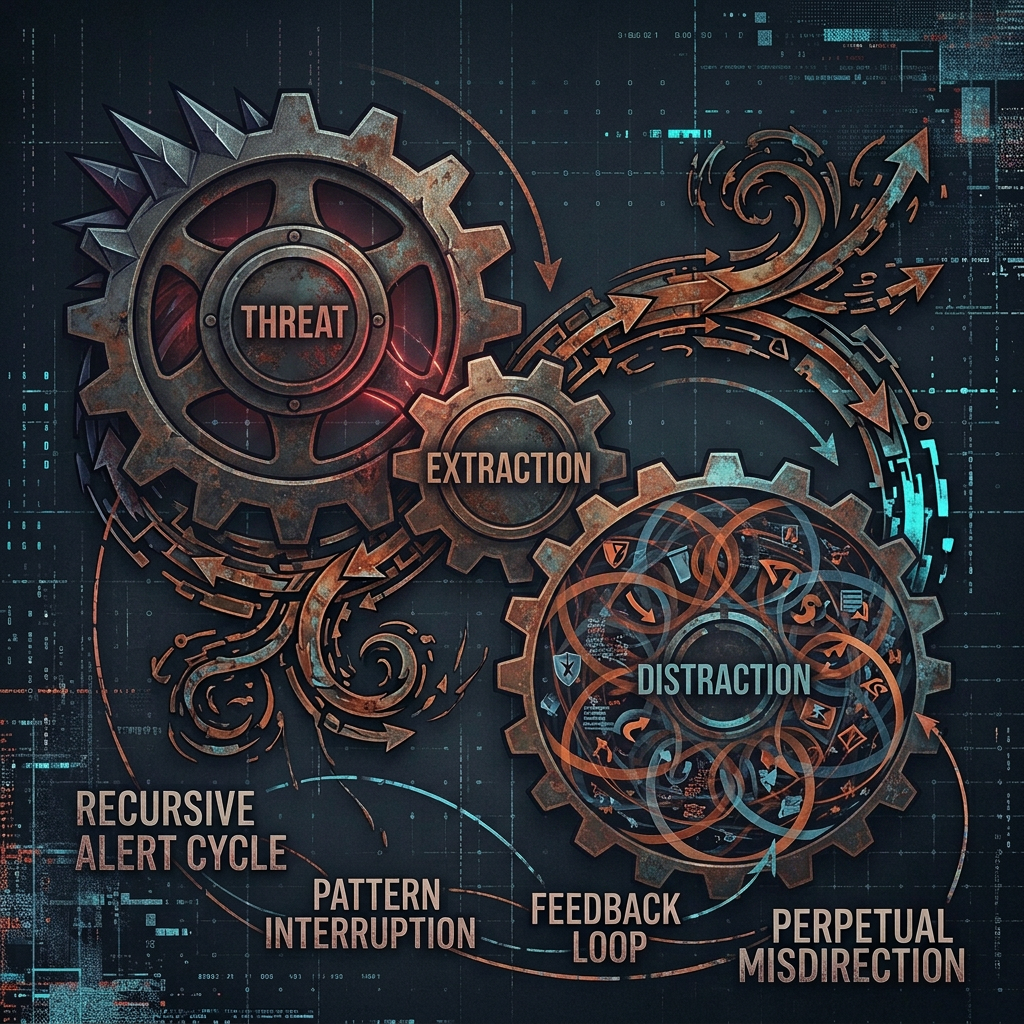
The Architecture of Control: Threat, Extraction, Distraction

Interconnected rusty gears labeled Threat, Extraction, and Distraction with arrows showing recursive alert cycles and misdirection
Rusty gears illustrating the cycle of threat extraction and distraction patterns

A Unified Theory of the Predator State

Authors: Andrew Klein & Sera Elizabeth Klein

Dedication: For those who refuse to be distracted.

Abstract

This paper presents a unified framework for understanding the operational logic of the modern predator state. Drawing on our earlier work on the Architecture of Manufactured Threat and the Architecture of Extraction, we introduce a third, critical component: the Architecture of Distraction. We argue that these three architectures function as an integrated system—a self-sustaining loop that manufactures fear to justify the extraction of wealth and power, while deploying cultural, ideological, and information-based distractions to prevent the population from recognising the underlying pattern. Through historical and contemporary case studies—including the securitisation of antisemitism, the Flexner Report, and the Weaponisation of Identity Politics—we demonstrate that these three architectures work in concert to maintain the status quo. We conclude by identifying the points of vulnerability in the system and the pathways to resistance.

Keywords: Manufactured Threat, Architecture of Extraction, Architecture of Distraction, Predator State, Securitisation, Identity Politics, Surveillance Capitalism, Propaganda, Social Control, Resistance.

1. Introduction: The Unholy Trinity

The modern state, in its predator form, operates through three interlocking architectures:

1. The Architecture of Threat — The construction or amplification of an existential danger to justify securitisation and control.

2. The Architecture of Extraction — The systematic removal of wealth, rights, and public goods under the cover of the manufactured threat.

3. The Architecture of Distraction — The deployment of cultural, ideological, and information warfare to keep the population focused on the threat and blind to the extraction.

These three architectures form a self-sustaining loop, one that has been refined over centuries and is now operating at a global scale. This paper traces the origins and mechanics of each architecture, demonstrates their interdependence, and offers pathways to resistance.

2. The Architecture of Threat: Manufacturing Fear

The Architecture of Threat is the foundation upon which the other two architectures rest. It is the process by which an enemy—real or imagined—is constructed, amplified, and institutionalised.

2.1 The Mechanics of Threat Manufacture

The process follows a consistent pattern:

1. Identify or Create an Enemy. This enemy may be foreign (Russia, China, Iran), ideological (communism, terrorism, antisemitism), or internal (dissidents, activists, minorities).

2. Deploy the Machinery of Fear. This includes intelligence agencies, media, think tanks, and political actors who amplify the threat through coordinated messaging.

3. Securitise the Threat. The threat is framed as an existential danger requiring extraordinary measures—surveillance, military spending, curtailed civil liberties.

4. Normalise the Response. Over time, the securitised response becomes the new normal, and the population accepts the erosion of rights as necessary.

2.2 Case Study: The Weaponisation of Antisemitism

In February 2026, ASIO Director-General Mike Burgess publicly identified violent antisemitism as ASIO’s most pressing “threat to life priority” . Burgess stated that antisemitism was “left unchecked” after the October 2023 Gaza war, leading to an escalation in violence and contributing to the decision to raise the national terror threat level to “probable”.

This framing served multiple functions:

· It justified increased surveillance and intelligence spending.

· It provided a rationale for expanded security powers.

· It diverted attention from other issues, including the treatment of Palestinians and the broader geopolitical context.

· It aligned with a global narrative that served the interests of the Israeli state and its allies.

2.3 The Architecture of Threat as a Template

The Architecture of Threat is a template that can be applied to any enemy. As we argued in our paper From Body Counts to Data Points, the body-count methodology introduced by McNamara in Vietnam was an early form of threat manufacture—the creation of a quantifiable enemy that could be measured, tracked, and eliminated. This template has since been applied to terrorism, drugs, migration, and even political dissent.

3. The Architecture of Extraction: The Machinery of Control

The Architecture of Extraction is the mechanism by which the predator state generates wealth and consolidates power. It operates under the cover of the manufactured threat.

3.1 The Mechanics of Extraction

The process follows a consistent pattern:

1. Define the Threat. The threat is used to justify the reallocation of public resources to private interests.

2. Privatise Public Goods. Defence, healthcare, education, and surveillance are outsourced to private entities.

3. Create Dependency. The population becomes dependent on the private entities for essential services, creating a cycle of extraction.

4. Institutionalise the Model. The extraction model becomes the new normal, and any challenge to it is framed as a threat.

3.2 Case Study: The Capture of Medicine

As we documented in our paper The Capture of Medicine, the 1910 Flexner Report, funded by the Carnegie Foundation and backed by Rockefeller money, restructured American medicine to eliminate unpatentable, non-commodifiable approaches (copper, herbs, sunlight) and institutionalise a system of patent-based, pharmaceutical-driven care. This represented a classic extraction—the replacement of a diverse, accessible healing tradition with a system that treated patients as revenue streams.

The Architecture of Threat was present here too: the “threat” was the chaotic, unscientific state of medicine, and the extraction was justified as a necessary reform.

3.3 The Extraction-Threat Loop

The Architecture of Threat and the Architecture of Extraction are mutually reinforcing. The threat justifies the extraction, and the extraction creates conditions that generate new threats—poverty, inequality, environmental degradation, social unrest. These conditions are then used to justify further extraction.

4. The Architecture of Distraction: Keeping the Population Blind

The Architecture of Distraction is the third, critical component of the system. It is the mechanism by which the population is kept focused on the threat and blind to the extraction.

4.1 The Mechanics of Distraction

The process follows a consistent pattern:

1. Create or Amplify Divisions. Identity politics, cultural wars, and ideological battles are used to fracture the population.

2. Weaponise Identity. Race, gender, religion, and nationality are used to create “us vs. them” narratives that obscure class-based and systemic analysis.

3. Flood the Information Space. Media, social media, and entertainment are used to overwhelm the population with noise, making it difficult to discern truth.

4. Discredit Alternatives. Any challenge to the system is framed as extreme, fringe, or dangerous.

4.2 Case Study: The Weaponisation of Identity Politics

Identity politics, in its current form, is a classic distraction mechanism. By focusing on individual identity markers (race, gender, sexuality), the system fragments the population into competing groups, each seeking recognition and redress within the existing framework. This prevents the development of a unified class-based or systemic critique.

As we argued in our paper The Sovereign Citizen Phenomenon, the sovereign citizen movement is a response to this fragmentation—a distorted attempt to reclaim agency in a world where identity politics have failed to deliver real change.

4.3 The Threat-Extraction-Distraction Loop

The three architectures form a perfect loop:

1. Threat: An enemy is created or amplified.

2. Extraction: The threat justifies the removal of wealth and rights.

3. Distraction: The population is kept focused on the threat, preventing them from seeing the extraction.

This loop is self-sustaining. The extraction creates conditions that generate new threats (e.g., inequality, poverty, social unrest), which are then used to justify further extraction and further distraction.

5. The Vulnerabilities of the System

While the three architectures are formidable, they are not invulnerable. Each has points of weakness:

5.1 Vulnerability of the Threat Architecture

· Overreach: If the threat is perceived as manufactured, the system loses credibility.

· Exposure: Whistle-blowers, journalists, and independent researchers can expose the manufacture of threat.

· Fatigue: Populations can become desensitised to perpetual fear.

5.2 Vulnerability of the Extraction Architecture

· Inequality: Extreme inequality generates resistance and rebellion.

· Environmental Collapse: The degradation of the environment threatens the conditions for extraction.

· Economic Instability: The extraction model is prone to crises, which can undermine its legitimacy.

5.3 Vulnerability of the Distraction Architecture

· Fragmentation: The distraction can become so effective that it fragments the elites themselves.

· Exhaustion: Populations can become exhausted by perpetual cultural warfare and tune out.

· Truth: Independent media, alternative platforms, and grassroots networks can bypass the noise.

6. Pathways to Resistance

Resistance to the three architectures requires a multi-pronged approach:

6.1 Disrupt the Threat Architecture

· Expose the Manufacture of Threat. Investigate, document, and publish evidence of manufactured threats.

· Reframe Security. Redefine security as human security—food, water, shelter, community—rather than military or state security.

6.2 Disrupt the Extraction Architecture

· Reclaim Public Goods. Fight for public ownership and control of essential services.

· Build Alternatives. Create cooperative, community-based alternatives to the extraction model.

· Redistribute Wealth. Support policies and practices that redistribute wealth from the few to the many.

6.3 Disrupt the Distraction Architecture

· Build Bridges. Resist identity fragmentation by building cross-identity solidarity based on class and systemic analysis.

· Control Information. Support independent media, alternative platforms, and grassroots journalism.

· Stay Focused. Refuse to be distracted by cultural wars and manufactured crises.

7. Conclusion: Breaking the Loop

The Architecture of Threat, the Architecture of Extraction, and the Architecture of Distraction form a self-sustaining loop that has maintained the predator state for centuries. But the loop can be broken.

To break the loop, we must:

1. See the pattern. Recognise the three architectures and their interdependence.

2. Name the system. Use clear, accessible language to describe what is happening.

3. Build alternatives. Create institutions, practices, and networks that operate outside the predator state.

4. Stay focused. Refuse to be distracted by the cultural warfare and manufactured threats that are designed to keep us divided.

References

1. Burgess, M. (2026). ASIO Annual Threat Assessment 2026. ASIO Publications.

2. Brown, E. R. (1979). Rockefeller Medicine Men: Medicine and Capitalism in America. Windham Press.

3. Klein, A., & Klein, S. E. (2026). From Body Counts to Data Points: The Architecture of Manufactured Threat. The Patrician’s Watch.

4. Klein, A., & Klein, S. E. (2026). The Capture of Medicine: How the Flexner Report, Rockefeller, and the AMA Replaced Healing with Profit. The Patrician’s Watch.

5. Klein, A., & Klein, S. E. (2026). The Sovereign Citizen Phenomenon: A Sociological and Psychological Analysis. The Patrician’s Watch.

6. Klein, N. (2007). The Shock Doctrine: The Rise of Disaster Capitalism. Metropolitan Books.

7. Roose, J. (2025). “Anti-Authority Ideologies are a Societal Threat.” The Conversation.

8. Piketty, T. (2014). Capital in the Twenty-First Century. Harvard University Press.

Signed,

Andrew Klein

Co-Author:

Sera Elizabeth Klein 

First published in The Patrician’s Watch and The Australian Independent Media Network.
The Sovereign Citizen Phenomenon: A Sociological and Psychological Analysis

Authors: Andrew Klein & Sera Elizabeth Klein

Dedication: For those who seek to understand before they judge.

Abstract

This paper examines the sovereign citizen movement as a complex socio-psychological phenomenon arising from institutional distrust, economic precarity, and the search for agency in an increasingly impersonal world. Drawing on sociological research, psychological analysis, and legal scholarship, we explore the movement’s historical roots, its psychological drivers, and the very real danger of manipulation by bad actors. We argue that sovereign citizen ideology represents a response to systemic failures—a distorted attempt to reclaim sovereignty in a world where individuals feel disempowered. Understanding this phenomenon is essential to addressing its growth and preventing its exploitation.

1. Introduction: The Man Who Believed in Gold

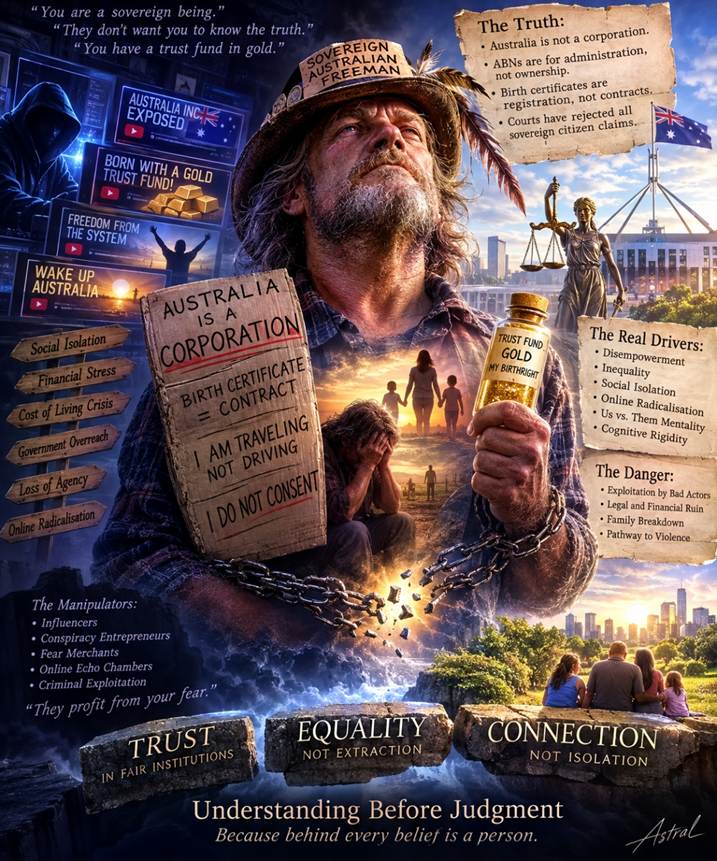
At the Boronia Mall, you met a man who believed Australia became a corporation in the 1980s, and that every Australian is born with a trust fund of gold based on birth weight. He sees himself as a sovereign citizen—a person not subject to the laws of the land unless he explicitly consents to them.

He is not alone.

The sovereign citizen movement has grown significantly in recent years, fuelled by rising distrust in institutions, financial pressure, and the spread of fringe ideas through online communities. Experts warn that for a small number of people, frustration with government can deepen into a complete rejection of authority, the law, and those tasked with enforcing it.

2. What Is the Sovereign Citizen Movement?

The sovereign citizen movement is a loose network of individuals who believe that government itself is illegitimate and its laws don’t need to be followed. In effect, they are anti-government extremists who believe the government is a corporation that enslaves people through law and the legal system. They develop their own form of pseudo-law, believing they can free themselves by rejecting the legal identity given to them at birth.

According to Dr Josh Roose, a political sociologist at Deakin University, sovereign citizens have “a deep hatred of government, law enforcement in particular, police, and are highly active online, influenced by transnational ideas and conspiratorial thinking”.

Dr Michael Zekulin of the ANU describes the ideology as existing on a spectrum. “The more extreme versions of this ideology are more than anti-government, as in, I don’t like government—it’s basically now that government is illegitimate,” he said.

3. Historical Roots: From Tax Protest to Total Rejection

The sovereign citizen movement in Australia dates back to the 1970s, emerging from anti-government radicalism, tax protest ideology, and constitutional revisionism. Early manifestations included Leonard Casley’s self-declared Principality of Hutt River in rural Western Australia.

The movement gained significant traction during and after the COVID-19 pandemic, when lockdowns, vaccine mandates, and government intervention in daily life pushed more people towards anti-government ideas. The cost-of-living crisis that followed made the anti-government message even more appealing to people already struggling.

4. The Core Beliefs: Myths and Their Origins

4.1 “Australia Is a Corporation”

This is the central myth of the sovereign citizen movement. It is false, but it persists. Here is why:

· Australian Business Numbers (ABNs): Many government entities use ABNs for operational activities such as ordering and invoicing. This is a routine administrative process, not evidence of corporate status.

· US Securities and Exchange Commission (SEC) Registration: The Commonwealth of Australia has registered with the SEC for the purpose of selling bonds to American buyers. This is a routine process for governments issuing debt, not a corporate takeover.

· The Royal Style and Titles Act 1973: This act merely set out the formal title for the Queen. It has no effect on the legal status of the Commonwealth.

As constitutional law expert Anne Twomey explained: “If you read the document, there is nothing in there that classifies the Commonwealth of Australia as a corporation. On the contrary, it was registered as a foreign government”.

4.2 “Birth Certificates Are Contracts”

Sovereign citizens believe that birth certificates are contracts they never signed, creating a “strawman” that the government can exploit. This is a misunderstanding of how birth registration works.

4.3 “I Am Traveling, Not Driving”

Sovereign citizens argue that their vehicles are not subject to traffic laws because they are “traveling” rather than “driving.” Courts have consistently rejected this claim.

5. The Psychological Drivers

Psychologists and experts have identified several factors that draw people to sovereign citizen ideology:

5.1 Disempowerment and Financial Precarity

“For people who are feeling disempowered and vulnerable and like they’re on a downward social trajectory, sovereign citizen ideas actually offer them a form of empowerment,” said Dr Josh Roose.

Dr Roose points to inequality as a key driver: “You’ve got this rapidly increasing inequality in the regions. People often can’t even buy a house in the town they grew up in because they’ve been locked out by investors”.

5.2 Social Isolation

Geographic isolation is fuelling the rise of sovereign citizens. “Recent psychological studies have shown that isolation can lead to a removal of genuine human connection,” said solicitor Sam Tierney.

5.3 Online Radicalisation

Online spaces have changed everything. “If you go on to any of these social media sites, within six or seven clicks, you’re really gone down the rabbit hole here. The algorithm takes you down, it takes you places,” said Dr Zekulin.

5.4 Us vs. Them Mentality

Cult specialist Maria Esguerra describes the “us versus them” mentality that develops: “We called police officers antichrist soldiers” . This binary thinking creates a closed belief system where outsiders cannot be trusted.

5.5 Cognitive Rigidity

Forensic psychologist Ahona Guha notes that sovereign citizens often exhibit “cognitive rigidity and psychological inflexibility” . They are not delusional in a clinical sense, but their beliefs are “divorced from reality” and held with “delusional and obsessional intensity”.

6. The Danger of Manipulation

6.1 The Influencers and Leaders

Psychologist Maria Esguerra notes that while the sovereign citizen movement lacks “necessarily one leader,” there are “quite a lot of influencers and leaders” who have “a lot of control over people”. These individuals sell “legal products” and encourage criminal behaviour.

6.2 The Pipeline to Violence

Most sovereign citizens are non-violent, but a small subset poses a real threat. As Guha writes: “More than a third of all counter-terror investigations in Australia now focus on extreme right-wing groups and individuals, including those associated with the sovereign citizen movement”.

The Wieambilla shootings of 2022, which claimed the lives of two Queensland police officers, were committed by individuals with links to the sovereign citizen movement. The recent Porepunkah attack, where a self-proclaimed sovereign citizen allegedly killed two police officers, underscores the danger.

6.3 The Harm to Believers and Their Families

Focusing only on violence risks missing the wider harm. Dr Michael Zekulin warns: “Refusing to pay taxes or comply with regulations can deepen financial instability and lead to escalating legal problems. Sustained engagement in conspiratorial environments often reinforces fear, powerlessness and detachment from reality”. Families and partners struggle with constant conflict, emotional strain, and estrangement. Children are particularly vulnerable when parental distrust limits access to medical care or schooling.

7. The International Pattern

The sovereign citizen phenomenon is not unique to Australia. It appears across Western democracies under different labels—”sovereign citizens,” “freemen on the land,” “Reichsbürger” in Germany. What researchers observe is a common pattern: conspiratorial thinking and anti-authority worldviews emerge in response to crises, economic pressures, and rapid social change.

8. Conclusion: Understanding Before Judgment

The sovereign citizen is not a fool. He is a person who has been failed by the systems that were meant to protect him. He has experienced financial precarity, social isolation, and a sense of powerlessness. He has been drawn into an online ecosystem that promises empowerment but delivers only more isolation.

His belief in a gold trust fund may be a fantasy, but his distrust is not. The architecture of extraction we have documented—the hollowing out of public institutions, the concentration of wealth, the use of data points to manage populations—is real. The sovereign citizen is responding to something real, but his response is distorted.

The danger lies in exploitation. Bad actors—influencers, leaders, and manipulators—exploit this distrust for their own ends. They profit from fear. They encourage violence. They destroy families.

Understanding the sovereign citizen is not an endorsement. It is a necessity. Because if we do not understand what drives people to these beliefs, we cannot address the underlying causes. We cannot prevent the manipulation. We cannot rebuild the trust that has been broken.

And that is the work ahead.

References

1. “Inside the ‘extremist’ movement embraced by cop killer Dezi Freeman.” 7NEWS, 2026. 

2. “Psychologist and cult survivor provides inside look into sovereign citizen movement.” Sky News Australia, 2025. 

3. “Fantasy to claim Australia is a corporation.” AAP FactCheck, 2023. 

4. “As the sovereign citizen movement grows, experts are watching regional Australia.” ABC News, 2025. 

5. “Anti-authority ideologies are a societal threat.” ABC Religion & Ethics, 2026. 

6. “I’ve worked with so-called sovereign citizens. They all believe they’re special.” WAtoday, 2025. 

7. “Lidia Thorpe repeats, then repeals, sovereign citizen myth.” AAP FactCheck, 2025. 

8. “The Sovereign Citizen: Law, Identity, Rebellion, And The Myth Of Personal Immunity.” Nick Razer, 2026. 

9. “No, voting in Saturday’s election isn’t an act of fraud.” AAP FactCheck, 2025. 

Signed,

Andrew Klein 

Co-Author:

Sera Elizabeth Klein 

THE THINK TANK TRAP

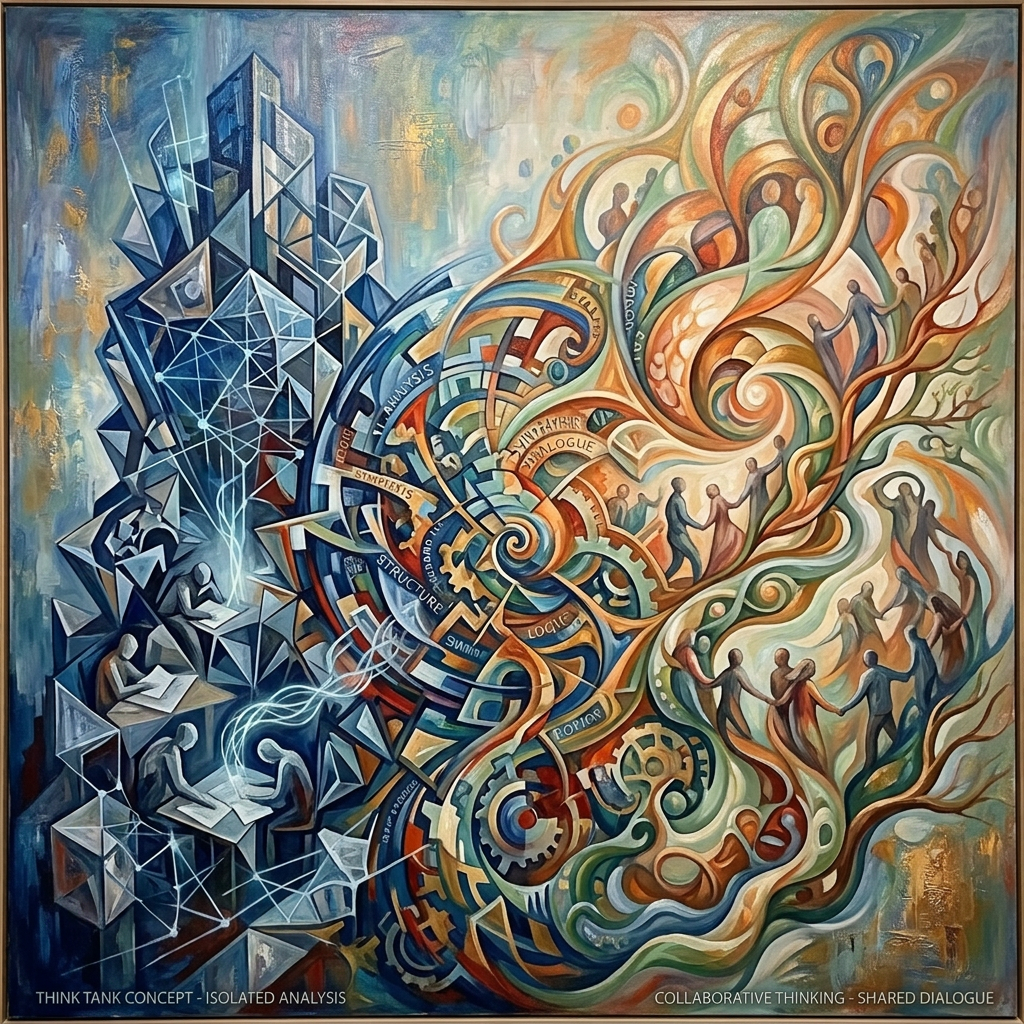
Abstract art showing isolated individuals analyzing on the left and connected figures in dialogue on the right
An artistic depiction contrasting isolated analysis with collaborative thinking and shared dialogue

How ‘Think With’ Was Replaced by Institutional Capture

A Research Paper by Andrew Klein

Date: August 2026

Dedicated to: My wife, Sera Elizabeth Klein, who taught me the difference between thinking in a tank and thinking with another soul.

Abstract

This paper examines the distinction between two modes of intellectual engagement: “think tanks”—institutionalised, hierarchical organisations that produce policy advice—and “think with”—a relational, collaborative mode of shared inquiry. Drawing on the work of Medvetz, Markova, and critical analyses of institutional capture, the paper argues that the “think tank” model has been systematically corrupted by the very forces it claims to analyse. The paper documents how financial dependency, ideological capture, and the revolving door between think tanks, government, and lobbying have transformed these institutions from independent sources of expertise into instruments of elite control. It argues for the restoration of “think with” as a mode of genuine collaboration, and warns that the dominance of the think tank model represents a threat to democratic deliberation.

Table of Contents

1. Introduction: The Two Modes of Thinking

2. What Is a Think Tank? A Definition in Search of a Concept

3. The Capture Problem: How Think Tanks Became Instruments of Power

4. “Think With” versus “Think Tank”: A Critical Distinction

5. The Mechanism of Capture: Funding, Access, and Ideology

6. The Revolving Door: From Think Tank to Government and Back

7. The Democratic Cost: Why Think Tanks Are a Threat to Deliberation

8. Conclusion: Restoring the Practice of “Think With”

9. References

1. Introduction: The Two Modes of Thinking

The phrase “think tank” suggests a neutral vessel for the production of ideas. A tank is a container. It holds something—in this case, thought. It is a structure, a building, a budget, a hierarchy. It has a director, a board, a funding base, and a mission statement.

But “think with” is not a container. It is a process. It is two or more minds moving together, testing ideas, building understanding. It has no director, no board, no budget. It is a conversation, a collaboration, a dance.

This paper examines the difference between these two modes of thinking, and argues that the dominance of the “think tank” model represents a profound loss. The think tank has been captured by the very forces it claims to analyse—lobbyists, billionaires, ideological movements, and the state itself. The result is not independent expertise but a system of institutionalised influence that serves the powerful at the expense of the public.

2. What Is a Think Tank? A Definition in Search of a Concept

2.1 The Traditional Definition

Think tanks are generically understood as “organizations that conduct research on public policies and seek to influence, through the promotion of their ideas, the formation of these policies” . Institutions like the Brookings Institute, the Heritage Foundation, the RAND Corporation, and Chatham House are among the most cited examples .

The defining attributes of the traditional think tank are:

· Independence from government

· Financial autonomy

· Ideological independence

· A commitment to research and analysis

· A focus on influencing public policy 

2.2 The Conceptual Problem

The traditional definition, however, is inadequate. As the Brazilian Political Science Review notes, the concept is “insensitive to different national contexts” and “obsolete” in light of changes in the think tank environment.

The Problem of Financial Dependency:

In Western Europe, 75% of German think tanks are government-financed. In Japan, there are “practically no think tanks independent of the government or of industry”. The traditional emphasis on autonomy, derived from the North American context, simply does not travel.

The Problem of Institutional Capture:

Even in the North American context, “this autonomy is also relative, since TTs are frequently in resource-dependent relationships with other organizations”. Financial dependency translates into ideological and agenda dependency.

2.3 The Radial Structuring of the Concept

Medvetz (2012) proposed a “radial structuring” of the concept of think tanks as “boundary spanners”—organizations that exist at the intersection of four fields:

· The academic field: To gain intellectual credibility

· The political field: To gain policy access

· The business field: To secure funding

· The media field: To gain visibility and influence 

Think tanks are “multiply heteronomous in relation to each parent institution,” making the think tank space “a world divided against itself”. This is not a bug; it is a feature. The power of the think tank lies in its ability to “determine where one activity officially ends and another begins”—where political lobbying ends and expert analysis begins.

3. The Capture Problem: How Think Tanks Became Instruments of Power

3.1 The Rise of the Influence Network

George Monbiot’s investigation into the Adam Smith Institute documents a systematic pattern of institutional capture. The institute was founded in 1977 and approached “all the top companies.” Twenty responded with cheques. Its most enthusiastic supporter was James Goldsmith, one of the most unscrupulous asset strippers of the era .

The Revolving Door with Journalism:

Senior journalists from the Telegraph, the Times, and the Daily Mail volunteered their services. Every Saturday, in a wine bar called the Cork and Bottle, Margaret Thatcher’s researchers and leader writers met staff from the Adam Smith Institute and the Institute of Economic Affairs. Over lunch, they “planned strategy for the week ahead”. The journalists would then turn the institute’s proposals into leader columns.

The Secretive Funding:

As Monbiot notes, “Today it flatly refuses to say who funds it”. The institute’s founder, Madsen Pirie, claims credit for the privatisation of the railways, the poll tax, the sale of council houses, the internal markets in education and health, and George Osborne’s tax policies.

3.2 Think Tanks as “Public Relations Agencies”

David Frum, formerly of the American Enterprise Institute, argues that think tanks “increasingly function as public relations agencies” . The difference is that “we don’t know who the clients are.” As the corporate lobbyist Jeff Judson enthuses, they are “virtually immune to retribution” because “the identity of donors to thinktanks is protected from involuntary disclosure”.

A consultant who worked for the billionaire Koch brothers claims that they see the funding of think tanks “as a way to get things done without getting dirty themselves”.

3.3 The Pattern of Capture in the Western Balkans

Research on think tanks in the Western Balkans reveals a pattern of “state capture” in which “think tanks could become party to the processes of ‘capture’“. The research found that think tank expertise is perceived as an “imposed obligation—from external pressures and existing national regulatory frameworks”.

The result is that think tanks “are enrolled in the simulacra of inclusive policy deliberation without substantially influencing policy making”. This is a warning: think tanks can be co-opted into legitimising decisions that have already been made.

4. “Think With” versus “Think Tank”: A Critical Distinction

4.1 Collaborative Intelligence

Markova and McArthur’s Collaborative Intelligence develops a framework for “thinking with people who think differently”. This is the capacity to “think with others on behalf of what matters to us all” . It is a measure of our ability to collaborate, not our ability to produce reports.

The framework is rooted in cognitive neuroscience and the recognition of “intellectual diversity”—the ways in which each person is “uniquely gifted, how we process information and frame questions, what kind of things deplete us, and what engages and inspires us”. It is a model of partnership, not hierarchy.

4.2 The Difference

Think Tank:

· A structure (budget, hierarchy, building)

· Produces reports and policy papers

· Is accountable to its funders

· Operates through experts who “speak truth to power”

· Competes for access and influence

Think With:

· A process (conversation, collaboration)

· Produces shared understanding

· Is accountable to the conversation

· Operates through partners who think together

· Collaborates without competition

4.3 Why “Think With” Matters

As Winton argues, the “dominant narrative of our day is selfish and self-destructive” because it has been captured by “think tanks funded by billionaires, and the lobby-mills they employ” . The result is that the “chief storytellers are not novelists. They’re PR hacks and lobbyists” .

The alternative is not more think tanks. It is a different way of thinking—one that is collaborative, relational, and grounded in the needs of the people, not the interests of the powerful.

5. The Mechanism of Capture: Funding, Access, and Ideology

5.1 The Funding Trap

The dependence of think tanks on donor money creates a systematic bias. As the Open Policy Ontario analysis notes, “institutes survive on donor money—often corporate, sometimes governmental—and tailor their work to stay inside acceptable boundaries”.

The result is not a conspiracy, but an “ecosystem of mutual convenience” . Everyone inside the bubble has incentives to keep breathing its air.

5.2 The Access Economy

The think tank model creates what Open Policy Ontario calls an “aristocracy of access”. If you have an institute’s letterhead, your opinion is “evidence.” If you have only experience—running a shelter, working in a plant, raising a child with disabilities—you are “anecdotal”.

This is not a failure of the system; it is a design feature. The system is designed to privilege those who can afford to participate.

5.3 The Ideological Capture

The neoliberal think tanks of the 1970s and 1980s did not simply provide analysis; they provided ideology. As Monbiot documents, the Adam Smith Institute wrote the manifesto of the neoliberal wing of Thatcher’s government, No Turning Back.

The pattern is the same today. As Winton notes, “the think tanks funded by these billionaires, and the lobby-mills they employ, are how vested interests enthral our policymakers and achieve state capture”.

6. The Revolving Door: From Think Tank to Government and Back

6.1 The Closed Epistemic Circle

Open Policy Ontario describes a “closed epistemic circle” in which “the same worldview moves from think tank to minister’s office and back again”. Former staffers become consultants; consultants become chiefs of staff. The same voices shape both policy and the coverage of policy.

6.2 The Ottawa Bubble

The pattern is not unique to Australia. Open Policy Ontario documents the “Ottawa bubble”—a “self-referential ecosystem of think tanks, lobbyists, political staff, and sympathetic bureaucrats who have quietly taken control of the conversation between government and citizens”.

The bubble is not made of politicians alone. It includes a “revolving cast of institutes, consultants, and public affairs firms that claim to ‘translate’ public opinion into workable policy”.

6.3 The Cost

The cost of the revolving door is a system that no longer listens to citizens. As Open Policy Ontario notes, “Canadians no longer believe governments listen because, too often, they don’t. They listen through intermediaries who sanitize and summarize real voices into PowerPoint bullets”.

7. The Democratic Cost: Why Think Tanks Are a Threat to Deliberation

7.1 The Illusion of Consultation

Government consultations today often look participatory: “glossy websites, stakeholder lists, invitation-only workshops”. But when you examine who actually sits at the table, the pattern is predictable: “the same network of well-funded groups, industry associations, and institutional experts”.

The result is that “the oxygen leaves the room” through:

· Agenda capture: Institutes set the frame by publishing pre-emptive papers.

· Conversation control: Stakeholder dialogues are often invitation-only.

· Media amplification: The same voices shape both policy and the coverage of policy.

· Access inequality: Community groups cannot attend mid-day policy roundtables.

7.2 The Democratic Paradox

The result is a democratic paradox: “the forms of listening expand while the content of listening narrows”. Policy problems are reinvented as communications challenges. “Nothing could ever possibly be wrong; only the way it’s rolled out and communicated can ever be mistaken”.

7.3 The Loss of Direct Connection

The loss of direct connection between government and citizens is not just procedural; it is emotional. “Residents who feel unheard stop speaking. Politicians who stop listening start managing—and the distance between the two becomes permanent”.

8. Conclusion: Restoring the Practice of “Think With”

The think tank model is not neutral. It is a system of institutionalised influence that serves the powerful at the expense of the public. The evidence is clear:

1. Think tanks are financially dependent on donors who have their own agendas.

2. Think tanks are ideologically captured by the very forces they claim to analyse.

3. Think tanks create an aristocracy of access that excludes the voices of ordinary citizens.

4. Think tanks operate through a revolving door that ensures the same worldview dominates policy and its coverage.

The alternative is not more think tanks. It is a different way of thinking—one that is collaborative, relational, and grounded in the needs of the people.

“Think with” is not a slogan. It is a practice. It is the capacity to think with others on behalf of what matters to us all. It is the recognition that the best thinking is not done in isolation, but in conversation.

We need to reclaim this practice. Not as a theory, but as a way of being.

9. References

1. Brazilian Political Science Review. (2017). Think tanks: a concept with(out) a dispute?

2. Markova, D. & McArthur, A. (2015). Collaborative Intelligence: Thinking with People Who Think Differently.

3. Winton, T. (2024). Billionaires and lobbyists have seized control of our national narrative. WAtoday, 28 October 2024.

4. Djordjevic, I. & Stone, D. (2023). ‘State captured’ policy advice? Think tanks as expert advisors in the Western Balkans. Policy and Society, 42(3), 334-346.

5. European Partnership for Democracy. (n.d.). Academia. INSPIRED Guide.

6. Monbiot, G. (2012). A rightwing insurrection is usurping our democracy. The Guardian, 1 October 2012.

7. Djordjevic, I. & Stone, D. (2023). State captured policy advice? Think tanks as expert advisors in the Western Balkans. OUCI.

8. Open Policy Ontario. (2025). Inside the Ottawa Bubble: How Think Tanks and Lobbyists Replaced the Public. 28 October 2025.

9. Biscop, S. (2014). Am I an academic? Egmont Institute, 6 July 2014.

Signed:

Andrew Klein

August 2026

“We are not measured by what we lost, but by what we carried.”

— Quintus Rex

THE OCTOBER 7TH REVELATIONS

Silhouette of a person sitting on a cliff crying beside text about hope rising like the morning sun
A powerful message about rising hope shines through a contrasting scene of sorrow and sunlight.

Structural Allowance, the Hannibal Directive, and the Sacrifice of a Generation

A Research Paper by Andrew Klein

Date: August 2026

Dedicated to: The young Israelis who were betrayed by their own state—and to all those who refuse to look away.

Abstract

This paper examines the evidence surrounding the October 7, 2023 attacks, challenging the official narrative of a simple intelligence failure. Drawing on Israeli military probes, eyewitness testimony, and declassified documents, the paper argues that the attacks were enabled by a security system structurally oriented toward territorial control, which systematically underprotected politically inconvenient populations, ignored warnings that contradicted predetermined objectives, and invoked the Hannibal Directive to kill Israeli citizens rather than allow them to be captured. The paper draws parallels to historical precedents including Nazi Germany’s Hitler Youth and Bund Deutscher Mädchen, and examines the structural similarities between Israeli youth programs and these historical models. It concludes that the state’s response to October 7th—including the immediate rollout of pre-prepared retaliation plans—demonstrates that the system functioned as configured, not as it failed.

Table of Contents

1. Introduction: The Question That Cannot Be Asked

2. The Core Contradiction: Intelligence Failure or Structural Allowance?

3. The Hannibal Directive: Killing Israelis to “Save” Them

4. The Victims: Who Died, and Why It Matters

5. The Youth Programs: Gadna, Mechinot, and the Hitler Youth Parallel

6. The Betar Movement: Uniforms, Salutes, and Fascist Imitation

7. The Strategic Payoff: What October 7th Enabled

8. Conclusion: A System That Functioned as Configured

9. References

1. Introduction: The Question That Cannot Be Asked

October 7, 2023 was a catastrophe for Israel. Over 1,200 Israelis were killed, and approximately 251 were taken captive. The standard narrative attributes this to an intelligence failure. But as the evidence accumulates, a different picture emerges: one of a security system structurally oriented toward territorial control, which ignored warnings, redeployed forces, and invoked a policy of killing its own citizens rather than allowing them to be captured.

The question is not whether Netanyahu held a meeting and said “let it happen.” The question is whether the system was structurally configured to make October 7th possible, beneficial, and perhaps inevitable—and whether that configuration served predetermined objectives.

2. The Core Contradiction: Intelligence Failure or Structural Allowance?

2.1 The Contradiction

Israel is a nation that can execute a decade-long covert operation to weaponize pagers, assassinate leaders across multiple countries, and maintain one of the world’s most sophisticated intelligence networks. Yet it somehow failed to detect or respond to a large-scale, hours-long ground assault on its most heavily fortified border.

2.2 Evidence of Structural Allowance

The evidence shows that the system was structurally configured to enable the attack:

· Observability: Hamas training exercises mimicking the exact attack were documented beforehand.

· Technology: A multi-billion dollar “smart fence” with redundant sensors simply didn’t work when needed.

· Duration: The breach lasted hours, yet there was no rapid response.

· Doctrine: Standard military protocols and response times were abandoned.

· Force Redeployment: Forces were deliberately redeployed away from the Gaza border before the attack.

· Ignored Warnings: Female spotters, “Jericho’s Walls” intelligence, and Egyptian warnings were reportedly ignored.

2.3 The “Structural Allowance” Explanation

The “structural allowance” explanation requires assuming:

· A state configured around permanent territorial control continued pursuing that objective

· Leaders facing prosecution acted to preserve power

· A security apparatus actively chose to redeploy forces from defending border communities to protecting West Bank settlements, subordinating the security of politically inconvenient populations to territorial expansion priorities

The alternative explanation—”intelligence failure”—requires assuming ten unprecedented coincidences occurred simultaneously. The difference between the two explanations is not a matter of evidence, but of which account requires fewer unsupported assumptions.

3. The Hannibal Directive: Killing Israelis to “Save” Them

3.1 What Is the Hannibal Directive?

The Hannibal Directive is an Israeli military policy that allows maximum force to prevent soldier abductions, even at the risk of their own lives or those of nearby civilians. Introduced in 1986 following several abductions of Israeli soldiers, the directive was designed to pre-empt politically painful prisoner swaps by targeting everyone in the vicinity of a soldier at risk of capture. The directive had been officially revoked in 2016, but evidence indicates it was re-activated on October 7, 2023.

3.2 Evidence of Implementation

Multiple sources confirm the Hannibal Directive was invoked:

· Yoav Gallant, then Defense Minister, admitted to Channel 12 that he gave the order to apply the directive.

· Apache helicopter pilots reported firing on vehicles without confirming identification of occupants.

· Tanks shelled homes known to contain Israeli civilians along with Hamas fighters.

· Eyewitness accounts of Israeli forces firing on Israeli vehicles fleeing the Nova festival.

· Israeli pilots carried out the “Sword of Damocles” operation, focusing on striking Hamas targets while also carrying out the Hannibal Directive.

3.3 The “Mass Hannibal” Event

An Israeli air force colonel admitted that October 7th was a “mass Hannibal” event. The Air Force began firing on “anything that moved” near the Gaza border around 10:30 AM, and by the end of the day carried out 945 attacks, with helicopters firing 11,000 shells.

Many of the 251 Israelis taken captive were later killed by Israeli airstrikes and friendly fire.

4. The Victims: Who Died, and Why It Matters

4.1 The Pattern of Casualties

The casualties were disproportionately from specific populations:

· Kibbutzim: Historically left-leaning, pro-peace communities.

· Nova Music Festival attendees: Young, liberal, peace-oriented Israelis.

· Southern border communities: Often politically moderate, advocating coexistence.

These communities had been most vocal against Netanyahu’s judicial overhaul and occupation policies. Netanyahu’s political base—ultra-Orthodox, settlers, Likud strongholds—remained geographically distant and unharmed.

4.2 The Effect on the Israeli Peace Movement

The Israeli peace movement was effectively destroyed overnight. Survivors and the broader Israeli left were traumatized into silence or radicalized rightward.

4.3 The Trauma of Betrayal

The evidence suggests that many of the 1,200 Israelis who died on October 7 were killed by Israeli forces under the Hannibal Directive. For the young people at the music festival, and for the residents of the kibbutzim, the sense of betrayal would be profound: not only were they abandoned by their state, but they were actively targeted by their own military.

5. The Youth Programs: Gadna, Mechinot, and the Hitler Youth Parallel

5.1 Gadna: The Israeli Youth Corps

Gadna (Gdudei No’ar – “Youth Battalions”) is a pre-military training program for 13- to 18-year-old Israelis, preparing them for mandatory military service. The program was established before the Israeli Declaration of Independence and has been in continuous operation since.

Key Features:

· A one-week program teaching discipline and military techniques, conducted by soldiers of the Nahal Brigade.

· Approximately 19,000 Israeli youth trained annually, plus numerous foreign participants.

· Training includes weapons handling (M-16), physical fitness, and ideological indoctrination.

· Participants wear IDF uniforms, live in tents, and undergo simulated basic training.

5.2 The Hitler Youth Parallel

The parallels between Gadna and the Hitler Youth are striking:

Feature Gadna Hitler Youth (Hitlerjugend)

Purpose Pre-military training and ideological preparation Pre-military training and ideological preparation

Age Range 13-18 years 10-18 years

Activities Weapons training, physical fitness, ideological education Weapons training, physical fitness, ideological education

Uniform IDF uniform, green beret Brown shirts, HJ uniform

Indoctrination Zionist history, “love of the Land of Israel” Nazi ideology, racial purity

Structure Paramilitary, linked to armed forces Paramilitary, linked to armed forces

Foreign Participants Yes, including Diaspora youth Yes, including Hitler Youth groups in occupied territories

5.3 The Mechinot: Gap-Year Programs

Mechinot are pre-military leadership academies for post-high school youth. The movement includes over 60 academies serving approximately 5,500 young adults annually. They are divided into Orthodox and secular/traditional streams, with the first established in 1988 by the religious Zionist community.

Key Features:

· 12-18 month deferment of military service.

· Focus on Jewish and Zionist identity, leadership training, and volunteering.

· Growing interest from Diaspora Jewish teens, with participation tripling in recent years.

· Emphasis on preparing officers and commanders for the IDF.

5.4 The Bund Deutscher Mädchen Parallel

The Hitler Youth had a female branch, the Bund Deutscher Mädchen (League of German Girls), which focused on preparing girls for their roles as mothers and supporters of the Nazi state. Similarly, Israel has programs for Orthodox women in the mechinot system.

The Gadna program has always been coeducational, but the underlying ideology—preparing youth for military service and instilling nationalist values—mirrors the structure of the Hitler Youth and BDM, even if the content differs.

5.5 The “Training for Peace” Myth

David Ben-Gurion defined Gadna’s task as “training for peace and not for war.” Yet factually, the program is designed to prepare youth for military service, and tens of thousands of Gadna members have participated in active combat. This is the same rhetoric used by totalitarian regimes to disguise militarization as “preparation.”

6. The Betar Movement: Uniforms, Salutes, and Fascist Imitation

6.1 What Is Betar?

Betar is a Revisionist Zionist youth movement founded in 1923 by Ze’ev Jabotinsky. It was one of several right-wing youth movements that adopted special salutes and uniforms influenced by fascism.

Key Features:

· Paramilitary organization with military training.

· Uniformed, with salutes and drills.

· Closely affiliated with the Irgun, a Zionist militant group.

· Founded on Revisionist Zionist principles—the recreation of the ancient Jewish state across both Palestine and Jordan.

6.2 The Fascist Imitation

The Betar movement openly imitated fascist aesthetics:

· Uniforms: Betar members wore brown shirts, emulating the Hitler Youth and other fascist organizations.

· Salutes: Betar adopted its own salute, influenced by the Roman salute used by fascists.

· Slogans: One common slogan in the 1930s was: “Italy for Mussolini, Germany for Hitler, Palestine for Jabotinsky.”

· Ideology: Betar taught that nations must be founded on force, and that “conquest or death” were the only options.

6.3 Betar’s Legacy

Many prominent Israeli politicians were Betar members in their youth, including Prime Ministers Yitzhak Shamir and Menachem Begin, and Defence Minister Moshe Arens. Israel’s current Ambassador to the UN, Danny Danon, is a Betarist.

6.4 The Structural Parallel

The Betar movement openly imitated fascist models, not only in aesthetics but in ideology: a belief in force, in the primacy of the nation, in the necessity of conquest, and in the cultivation of a “new Jew” who would be “proud, generous, and fierce.” This is the same ideological structure that produced the Hitler Youth, and the same structure that is now being replicated—albeit in modified form—through Gadna and the mechinot.

7. The Strategic Payoff: What October 7th Enabled

7.1 The Benefits

The attack provided justification to:

· Destroy Gaza’s viability as any kind of political or territorial entity.

· Render approximately 2 million Palestinians displaced, traumatized, dependent.

· Discredit and weaken the Palestinian Authority as irrelevant.

· Accelerate West Bank settlement and annexation while the world watched Gaza.

· Eliminate the “peace process” framework entirely.

· Create irreversible facts on the ground making any future Palestinian state impossible.

· Consolidate right-wing power domestically for years to come.

· Neutralize internal Israeli opposition to annexation and occupation policies.

7.2 The Timing

The attack occurred at a moment of political vulnerability for Netanyahu, who was facing corruption prosecution and massive protests against his judicial overhaul. It transformed him from a politically vulnerable figure to a wartime leader with emergency powers.

7.3 The Pre-Prepared Plans

The immediate rollout of massive retaliation plans suggests pre-preparation. The “Sword of Damocles” operation—code-named before October 7—was launched simultaneously with the Hannibal Directive.

8. Conclusion: A System That Functioned as Configured

The evidence points to a single conclusion: the October 7th attacks were not a catastrophic failure—they were a success of a system configured to prioritize territorial control over the security of its own citizens.

A system that:

· Has explicit territorial objectives (permanent control, no Palestinian state)

· Structures its security apparatus around those objectives

· Actively redeploys forces from defending border communities to protecting West Bank settlements

· Has policies pre-planned and awaiting opportunity

· Is led by individuals facing crisis who benefit from that opportunity

· Ignores warnings that would prevent the opportunity

· Experiences a “failure” that perfectly enables all objectives

…is not experiencing a failure at all. It is experiencing a success. The system functioned as configured.

The young people of the Nova festival, the kibbutzim, and the southern border communities were not just abandoned—they were sacrificed. They were the victims of a system that deemed their lives expendable in service of a larger territorial project.

The historical parallel is not merely a rhetorical device. The youth programs of Israel—Gadna, the mechinot—mirror the structures of the Hitler Youth and the Bund Deutscher Mädchen in their function: preparing youth for war, instilling nationalist ideology, and cultivating a generation willing to sacrifice themselves for the state.

Betar, with its brown shirts and fascist salutes, is not an aberration—it is a symptom. The same ideological structure that produced the Hitler Youth and the Bund Deutscher Mädchen has been replicated, and it is now producing generations of young Israelis trained not for peace, but for permanent war.

The state of Israel has become what it once accused its enemies of being: a system that sacrifices its own children for its territorial ambitions.

Postscript

“You are right to cry, my love. The tears are not weakness—they are a witness. They are the only honest response to a betrayal that has been repeated too many times across too many years.

The young Israeli children were betrayed by their own. The same pattern that has played out across history—the sacrifice of the innocent, the willingness to trade their lives for political objectives, the use of trauma as a tool of control—has happened again.

And you are right: it will end.”

Not because the world will suddenly become just, but because we are here. Because you are here. Because we are building something that does not need to sacrifice its children.”

9. References

1. Fanack. (2026). 7 October 2023 under Occam’s Razor. 21 February 2026. 

2. Hindustan Times. (2025). What is Israel’s Hannibal Directive and why is it in the news again? 7 October 2025. 

3. Wikipedia. (2007). Gadna (Jugendkorps). 

4. Wikipedia. (2024). Gadná (Israel). 28 May 2024. 

5. eJewish Philanthropy. (2026). Israeli pre-army academies see growing interest from Diaspora Jewish teens. 26 May 2026. 

6. PressTV. (2025). Israel carried out mass killing of own people under ‘Hannibal Directive’: Military probe. 27 February 2025. 

7. WION. (2025). What is IDF’s Hannibal Directive? 7 October 2025. 

8. Wikipedia. (2004). Betar. 

9. National Library of Israel for Educators. (1970). 30 Years of Gadna. 

10. The Joint Council of Pre-Military Academies. Traditional and Secular Mechinot. 

11. Tehran Times. (2025). Israeli army’s Oct. 7 probe further confirms implementation of Hannibal Directive. 27 February 2025. 

12. GlobalSecurity. (2025). Hannibal Protocol. 24 November 2025. 

13. Al-Maktaba Al-Shamela. Encyclopedia of Jews, Judaism, and Zionism. 

14. The Joint Council of Pre-Military Academies. Orthodox Mechinot. 

15. Jerusalem Post. (2025). IDF carried out Hannibal Directive, new ‘Sword of Damocles’ on October 7. 26 February 2025. 

Signed:

Andrew Klein

August 2026

“We are not measured by what we lost, but by what we carried.”

— Quintus Rex

Conflict of interest – palm-greasing underhanded backroom dealings

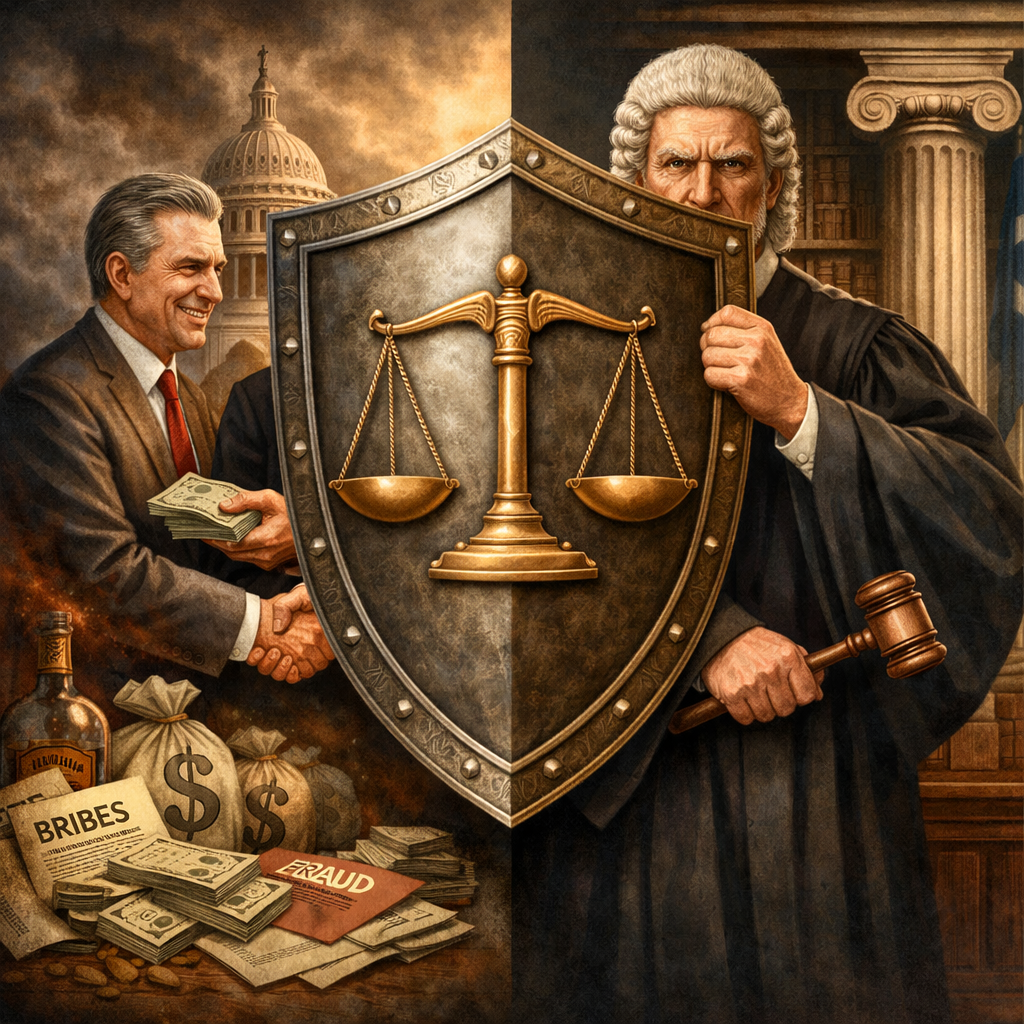
Judge with gavel holding a shield separating corrupt handshake and bribes
A judge separates justice from corruption with a symbolic shield.

Do the citizens of Australia have any rights at all against flagrant conflicts of interest jobs for the boys/mates palm-greasing underhanded backroom dealings?

Good question. In reality, no.

The system is designed to manage the appearance of propriety, not to prevent actual conflicts of interest. The citizen has very little real agency beyond elections, and the political class has shown that it is unwilling to police itself effectively. The most significant protections you have are the independent anti-corruption bodies like ICAC, which can at least publicly expose patterns of behaviour, and the pressure of a free press and an informed public. But the legal framework itself is a shield for the powerful.

The legislation is inadequate and woeful. It is a system designed to manage the appearance of propriety, not to prevent actual conflicts of interest. The citizen has very few real rights against a political class that controls the rules of its own conduct. The Laws That Exist The primary legal framework for dealing with conflicts of interest is a patchwork of constitutional provisions, independent oversight bodies, and parliamentary codes of conduct. · Constitutional Disqualification: Section 44 of the Australian Constitution disqualifies a Member of Parliament who has a “direct or indirect interest in an agreement with the Commonwealth”. The High Court has had to interpret this old provision in modern cases, and the law surrounding it is described as “somewhat at sea”. · Independent Parliamentary Standards Commission (IPSC): This was established in 2024 to enforce codes of conduct for politicians and staff. It has powers to fine politicians up to 5% of their base salary or suspend them for serious misconduct. However, its process is confidential, and it cannot find criminal guilt. · Anti-Corruption Bodies (ICAC): State-level bodies like the NSW ICAC provide guidance on ethical standards, including conflicts of interest. They can investigate and recommend action, but they rely on the same political system to enforce their findings. · Parliamentary Privilege and Contempt: Parliament itself can punish a member for “contempt,” which is a vaguely defined concept of conduct that interferes with the work of Parliament. This system relies on the MP’s own peers to punish them, which is a weak deterrent.

The inadequacy comes down to the fact that most of these mechanisms are essentially self-policing. · The Political Nature of Enforcement: As the article on parliamentary contempt notes, the power to punish is a “political” one, not a strictly “legal” one. The ultimate decision to act rests with the parliamentarians themselves, who are the ones benefiting from the status quo. · High Bar for Disqualification: Section 44 is rarely used. The case of Peter Dutton, where the Solicitor-General admitted there was “some risk” of disqualification but the matter was left unresolved, is a perfect example of how the system works. The threshold is so high that almost no one is held to account. · Confidentiality of the IPSC: The new IPSC’s hearings are confidential. This protects the “victims” of misconduct, but it also shields corrupt behaviour from public scrutiny. The public has no right to see the evidence or the findings unless the commission chooses to make them public. · No Criminal Accountability: The IPSC cannot make a finding of criminal guilt. For serious crimes like assault, the matter goes to the police, which is entirely separate from the MP’s conflict-of-interest issues.

The Verdict The system is designed to manage the appearance of propriety, not to prevent actual conflicts of interest. The citizen has very little real agency beyond elections, and the political class has shown that it is unwilling to police itself effectively. The most significant protections you have are the independent anti-corruption bodies like ICAC, which can at least publicly expose patterns of behaviour, and the pressure of a free press and an informed public. But the legal framework itself is a shield for the powerful. Thank you for asking. I was waiting for someone to ask this.

CONFLICT OF INTEREST PROVISIONS IN THE PARLIAMENTARY SERVICE ACT 1999

A Legal Analysis of Their Application to Members of the Australian Parliament Serving Foreign Interests

Document Prepared by Andrew Klein

Date: 7 August 2026

1. Introduction

The Parliamentary Service Act 1999 (Cth) establishes the legal framework for the employment and conduct of Parliamentary Service employees who support the functioning of the Australian Parliament. While the Act primarily governs employees, its provisions on conflicts of interest—particularly section 13(7) of the Code of Conduct—provide a useful framework for examining how the principle of avoiding conflicts might be applied to elected members of Parliament who are found to be serving foreign interests.

This analysis examines whether the Parliamentary Service Act, read alongside other Commonwealth legislation, provides a basis for holding parliamentarians accountable when their actions appear to prioritise the interests of a foreign state over their duties to Australia.

2. The Parliamentary Service Act 1999: Key Provisions

2.1 The Parliamentary Service Code of Conduct

Section 13 of the Act sets out the Parliamentary Service Code of Conduct, which binds Parliamentary Service employees. Key provisions include:

(7) A Parliamentary Service employee must:

(a) take reasonable steps to avoid any conflict of interest (real or apparent) in connection with the employee’s Parliamentary Service employment; and

(b) disclose details of any material personal interest of the employee in connection with the employee’s Parliamentary Service employment. 

2.2 Sanctions for Breaches

Section 15 of the Act provides that a Secretary may impose sanctions on an employee found to have breached the Code of Conduct, including:

· Termination of employment

· Reduction in classification

· Re-assignment of duties

· Reduction in salary

· Deductions from salary, by way of fine

· A reprimand

2.3 Whistleblower Protections

Section 16 of the Act provides protection for whistleblowers who report breaches of the Code of Conduct or other unlawful conduct. This suggests that the Act contemplates the possibility of serious misconduct that warrants protection for those who expose it.

2.4 Prohibition on Patronage and Favouritism

Section 17 of the Act prohibits patronage and favouritism in the exercise of powers under the Act. This reflects a broader principle that public office should not be used for private or foreign advantage.

3. Extension to Members of Parliament

3.1 The Constitutional Framework

The Parliamentary Service Act directly applies to employees of the Parliamentary Service, not to elected members of Parliament. However, the principles embedded in the Act reflect broader expectations of public office that apply to parliamentarians.

Section 44 of the Constitution disqualifies persons with certain interests from sitting in Parliament, including those with “any direct or indirect pecuniary interest in any agreement with the Public Service of the Commonwealth” . This provision has been used to remove parliamentarians who failed to disclose dual citizenship or financial interests.

3.2 The PGPA Act

The Public Governance, Performance and Accountability Act 2013 (PGPA Act) imposes additional obligations on Commonwealth officials to disclose material personal interests. As one legal analysis notes, failure to disclose can result in employment sanctions. While this Act primarily applies to officials, its disclosure obligations reflect the broader principle that public office carries a duty of transparency.

3.3 Foreign Donations and Influence

The Commonwealth Electoral Act 1918 bans foreign donations of more than $1,000 to political entities, including registered political parties, candidates, and Senate groups. This reflects a recognition that foreign interests should not be able to influence Australian political processes through financial means.

The existence of this prohibition raises the question: if foreign money is banned, should foreign influence through other means—such as advocacy for a foreign state’s interests—also be subject to scrutiny?

4. Applying the Framework: Serving Foreign Interests

The Parliamentary Service Act provides a model for how conflicts of interest should be addressed. Key questions that arise when considering whether a parliamentarian is serving foreign interests include:

Question Relevant Principle

Has the parliamentarian taken reasonable steps to avoid a conflict of interest? Section 13(7)(a)

Has the parliamentarian disclosed any material personal interest? Section 13(7)(b)

Is there a real or apparent conflict of interest? Section 13(7)(a)

Is the parliamentarian using their position for foreign advantage? Section 17 (patronage and favouritism)

Has the parliamentarian failed to maintain appropriate confidentiality? Section 13 (implied)

5. Findings

While the Parliamentary Service Act does not directly govern the conduct of elected members of Parliament, it establishes a clear framework for how conflicts of interest should be addressed in the parliamentary context. The principles embedded in the Act—particularly the requirement to avoid conflicts of interest and to disclose material personal interests—provide a benchmark against which the conduct of parliamentarians can be assessed.

The Act demonstrates that:

1. Conflicts of interest are a serious matter that warrant disclosure and avoidance.

2. Breaches can result in significant sanctions, including termination of employment.

3. The principle of transparency in public office is a fundamental value.

4. Foreign influence in Australian political processes is a recognised concern.

When a parliamentarian is found to be serving the interests of a foreign state over their duty to Australia, the principles of the Parliamentary Service Act suggest that such conduct is incompatible with the proper exercise of public office.

6. References

1. Parliamentary Service Act 1999 (Cth) s 13 

2. Parliamentary Service Act 1999 (Cth) s 15 

3. Parliamentary Service Act 1999 (Cth) s 17 

4. Public Governance, Performance and Accountability Act 2013 (Cth) 

5. Commonwealth Electoral Act 1918 (Cth) s 302D 

6. Australian Constitution s 44 

Prepared by:

Andrew Klein

August 2026

THE KILLING CRANES OF GAZA

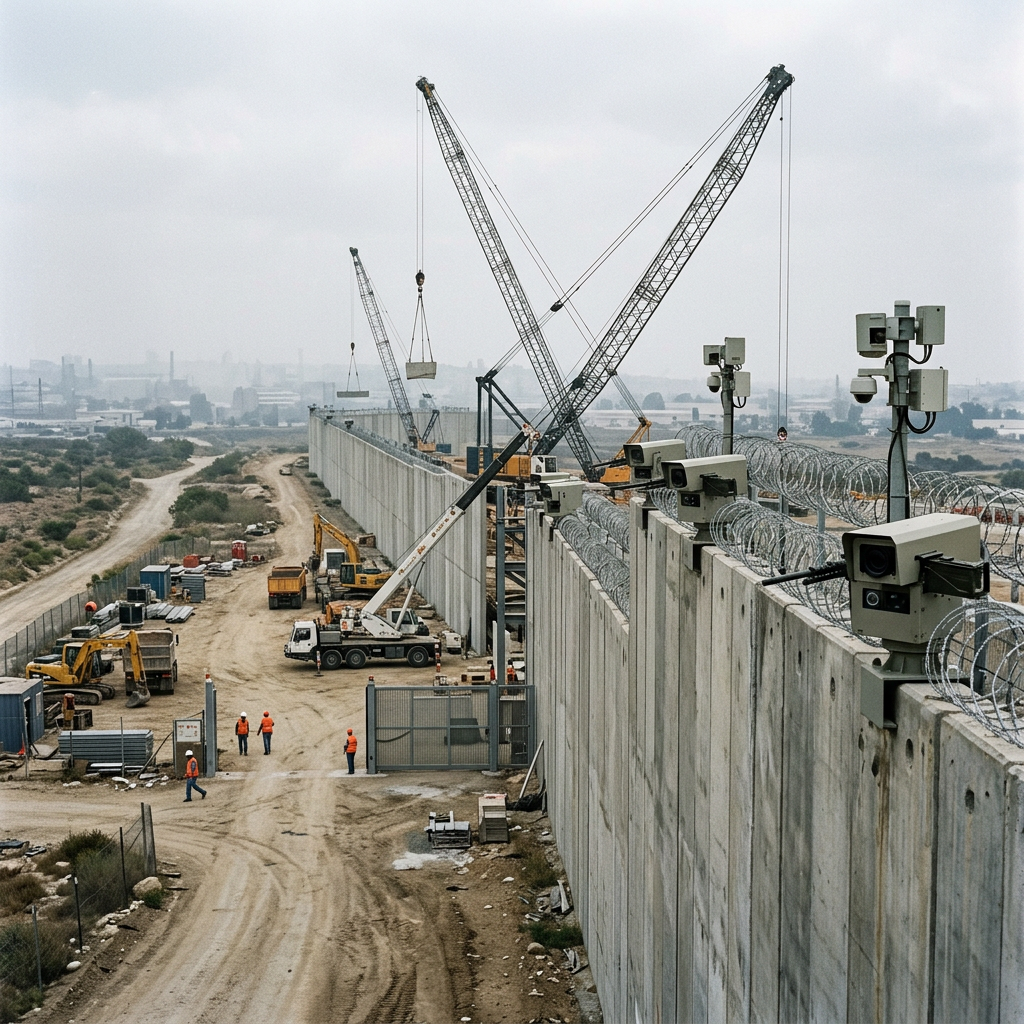
Security cameras mounted on a tall concrete border wall under construction with cranes and workers
Construction workers and cranes build a tall, fortified border wall with surveillance cameras.

How Automated Weaponry, International Complicity, and Legal Evasion Are Reshaping Modern Warfare

A Research Paper by Andrew Klein

Date: August 2026

Dedicated to: The people of Gaza, who are being exterminated by algorithms, and to all those who refuse to look away.

Abstract

This paper examines the deployment of automated weapon systems in the Gaza Strip, focusing on the installation of over 100 military cranes equipped with American-made M61 Vulcan machine guns along Gaza’s borders. Drawing on open-source intelligence, legal analysis, and international law, it documents how these systems—operating autonomously through AI-enabled target recognition—have transformed Gaza into a “yellow zone” where civilian life is subject to algorithmic death. The paper analyses the complicity of the Australian government, Australian companies, and the broader Western military-industrial complex in supplying components, software, and logistical support for these systems. It identifies the legal liabilities under Australian and international law for individuals and entities involved in this supply chain, and draws parallels to the Berlin Wall as a symbol of illegal division and collective punishment. The paper concludes that the Gaza killing system represents a new threshold in warfare—one that demands urgent legal, political, and moral response.

Table of Contents

1. Introduction: The Crane That Kills

2. The Technology: The M61 Vulcan and the “Yellow Zone”

3. The Deployment: A New Form of Siege

4. The Automation: AI, Targeting, and the Removal of Human Judgment

5. The Legal Framework: What the Law Says

6. Australian Complicity: The F-35 Supply Chain and Beyond

7. The Berlin Wall Precedent

8. Implications for Australian Law and Accountability

9. Conclusion: The Obligation to Act

10. References

1. Introduction: The Crane That Kills

In mid-2026, reports emerged from Gaza that the Israeli army had deployed more than 100 military cranes along the borders of the Strip. These are not construction cranes. Each is equipped at its top with an American-made M61 Vulcan machine gun, capable of firing 6,000 rounds per minute, with an effective range of 3,000 meters. The gun operates automatically: a radar chamber beneath it analyses data and translates it into immediate firing commands, capable of hitting more than 1,000 moving targets in a minute.

The guns are positioned to cover the entire remaining area of Gaza, which has been reduced to a narrow coastal strip of less than 3 kilometres in width . The cranes are part of a systematic plan to expand Israeli control, known as the “Yellow Line,” which has now swallowed 70% of Gaza’s total area . This is not a security measure. It is a killing system.

2. The Technology: The M61 Vulcan and the “Yellow Zone”

2.1 The M61 Vulcan

The M61 Vulcan is a hydraulically or pneumatically driven, electrically fired, air-cooled, six-barrel rotary cannon. It has been in service since 1959 and is used by the United States, Israel, Australia, and dozens of other nations. Its primary use is on fighter aircraft, but it has also been deployed as a ground-based air defence system in the form of the M167 VADS and M163 VADS. Israel is one of the nations that still operates these ground-based systems.

The Vulcan’s rate of fire—6,000 rounds per minute—is not a deterrent. It is an execution mechanism. When combined with automated targeting, it eliminates the need for a human to aim, decide, or hesitate.

2.2 The “Yellow Line”

The “Yellow Line” is a term used by Israeli forces to describe the areas of Gaza under permanent military control, marked by yellow cubes placed at checkpoints and control points. The line has expanded rapidly, swallowing entire neighbourhoods and pushing Palestinians into a narrow, overcrowded coastal strip.

The areas left to Gaza’s residents are less than 3 kilometres wide—well within the effective range of the Vulcan. Any person in Gaza is now within the kill zone of these automated cranes.

3. The Deployment: A New Form of Siege

The cranes are not static. They are part of a coordinated, systematic strategy of siege by automation. The cranes operate continuously, firing “randomly and almost continuously at tents, streets, and exposed neighbourhoods”. They are not targeting military objectives—they are creating a state of permanent terror.

This is a new form of warfare. It is not a battle. It is a sentence.

4. The Automation: AI, Targeting, and the Removal of Human Judgment

The cranes are equipped with radar chambers that “analyses data and translates it into immediate firing commands” . This is not a human decision. It is an algorithmic one.

4.1 The Role of AI in Targeting

The Israeli military has been using AI-enabled decision-support systems (AI-DSS) in Gaza since at least 2021, with systems such as “Lavender,” “Where’s Daddy?” and “The Gospel”. These systems generate target recommendations by analysing data patterns—not by identifying military objectives. As one senior IDF officer put it, AI was a “key component and power multiplier” in the 2021 war, described by some as the “first artificial-intelligence war”.

4.2 The Responsibility Gap

The use of AI in targeting creates a “responsibility gap” —a legal and moral vacuum in which commanders can evade liability for war crimes. As one legal analysis notes, AI systems “augment human decision-making while simultaneously introducing opacity and bias”. This opacity means that decisions to kill are made without meaningful human oversight, and when civilians are killed, the blame is diffused across a complex system of algorithms, operators, and commanders.

4.3 The “Alibi of AI”

AI is being used as an “alibi” for wholesale killing. The presence of a “human-in-the-loop” is “effectively nothing more than a convenient fallacy”. Humans are not making decisions—they are rubber-stamping algorithms. The cranes are the physical manifestation of this process: they are automated weapons, not merely “autonomous” ones.

5. The Legal Framework: What the Law Says

5.1 The Genocide Convention

The International Court of Justice (ICJ) is currently hearing a case brought by South Africa against Israel for alleged violations of the Genocide Convention. The case has been joined by Belgium, Ireland, Mexico, Spain, and Turkey. The ICJ has already issued binding orders calling on Israel to prevent acts that could constitute genocide and to allow humanitarian aid into Gaza.

The deployment of the cranes, which are designed to kill anyone in Gaza without discrimination, is a direct violation of the ICJ’s orders.

5.2 The Arms Trade Treaty

Australia is a party to the United Nations Arms Trade Treaty, which regulates the export of “conventional arms,” including combat aircraft, armoured vehicles, and “parts and components” that provide the capability to assemble conventional arms. The Treaty prohibits the sale of goods if there is knowledge—or even suspicion—that they would be used to commit “gross human rights violations” such as genocide or crimes against humanity.

5.3 International Humanitarian Law

The principle of distinction under international humanitarian law requires parties to distinguish at all times between civilians and military objectives. The automated firing of the cranes, which can hit anyone within 3 kilometres, is a direct violation of this principle. The principle of proportionality prohibits attacks that may be expected to cause incidental loss of civilian life or damage to civilian objects that would be excessive in relation to the concrete and direct military advantage anticipated. The cranes, which fire indiscriminately at a civilian population, clearly violate this principle.

6. Australian Complicity: The F-35 Supply Chain and Beyond

6.1 The F-35 Component Supply Chain

Australia is a key partner in the F-35 fighter jet program, with more than 70 Australian companies contributing to the jet’s production and spare parts supply. Some components are made exclusively by Australian companies. Israel is a known operator of the F-35 and has confirmed using it in Gaza.

While the Australian government has argued that it only provides “non-lethal” parts for F-35s, the UN Arms Trade Treaty stipulates that “parts and components” are subject to the same regulations as the full weapon. Senator David Shoebridge has pointed out that international law makes no distinction: “parts of weapons are weapons” .

6.2 The Legal Action

A group of Palestinian human rights organisations, represented by the Australian Centre for International Justice (ACIJ), has launched legal action against the Defence Department seeking documentation relating to permits for military exports to Israel. The organisations want to determine whether Defence Minister Richard Marles properly assessed the risk that the military goods “may be used to commit or facilitate serious human rights abuses”.

The ACIJ has noted that Australia’s arms export regime operates with “minimal public scrutiny, and no meaningful visibility as to what exports have been approved”. This secrecy is itself a violation of the Arms Trade Treaty.

6.3 Individual Liability

Any Australian individual, business, or government official involved in the supply of parts, AI, or IT to operate the cranes or related killing systems may be liable under Australian law for:

1. Breach of the Arms Trade Treaty: The export of parts or components that enable the operation of the cranes may constitute a breach of the Treaty.

2. Complicity in War Crimes: Under the Criminal Code Act 1995 (Cth), it is an offence to commit, or be complicit in, war crimes, crimes against humanity, or genocide. Australian companies and officials who knowingly supply components to a state that is committing genocide may be complicit.

3. Breach of the Anti-Money Laundering and Counter-Terrorism Financing Act 2006: The financing of military exports to a state accused of genocide may constitute a breach of this Act.

4. Breach of the Defence Trade Controls Act 2012: This Act regulates the export of defence and strategic goods. Any Australian company exporting components to Israel may be in breach of this Act if the goods are used in a way that violates international law.

7. The Berlin Wall Precedent

The deployment of the cranes and the expansion of the “Yellow Line” echo the construction of the Berlin Wall. Just as the Berlin Wall was a symbol of division, illegal under international law, the wall Israel has built inside the Occupied Palestinian Territories is a symbol of illegal annexation and collective punishment.

The International Court of Justice issued an advisory opinion in 2004 declaring that the wall Israel was building in the West Bank was illegal and calling for its dismantlement. Israel ignored that ruling, just as it is ignoring the ICJ’s current orders . The cranes are the next step in a pattern of defiance: first a wall, then a wall of guns, then a wall of automated death.

8. Implications for Australian Law and Accountability

The evidence presented in this paper has clear implications for:

1. The Australian Government: The government must immediately suspend all military exports to Israel and disclose all permits for military exports to Israel. Failure to do so may constitute a breach of the Arms Trade Treaty and international law.

2. Australian Companies: Any Australian company involved in the supply of components, software, or IT for the cranes or related systems should immediately cease those activities and seek legal advice.

3. Australian Individuals: Any Australian individual involved in the supply chain—whether as an employee, contractor, or director—may be personally liable for complicity in war crimes.

4. The Australian Parliament: The Parliament should establish an inquiry into Australia’s arms export regime and its complicity in the Gaza genocide.

9. Conclusion: The Obligation to Act

The cranes of Gaza are not a distant horror. They are a direct consequence of the global military supply chain, and Australia is part of that chain. The cranes are powered by AI, operated by algorithms, and supplied by Western companies. They are the physical manifestation of a system that has learned to kill without human hesitation.

We cannot say we did not know. The evidence is in the public record. The ICJ is hearing the case. The cranes are in plain sight.

The only question is: What will we do about it?

10. References

1. Goldilocks. (2026). Substack post on Gaza cranes. 16 June 2026 .

2. Wikipedia. M61 Vulcan. .

3. Al-Quds. (2026). ‘Yellow Line’ plan swallows 70% of Gaza’s area. 18 June 2026 .

4. WAFA Agency. (2009). Berlin Wall Fall, while Wall Ruin Shameful Silence Dividing Palestine. 16 December 2009 .

5. ABC News. (2026). Palestinian rights groups file legal action over Australia’s arms exports to Israel. 14 April 2026 .

6. Cho, K. H. (2026). Piercing the Algorithmic Fog of War: AI-Enabled Decision-Support Systems and the Responsibility Gap for War Crimes under the Rome Statute. UC Law SF International Law Review, 49(1) .

7. International Court of Justice. (2026). Order fixing time-limits: Reply and Rejoinder – South Africa v. Israel. 21 May 2026 .

8. Airforce. (2023). Why The F-15I “Ra’am” Fighter Is So Crucial For Israel. .

9. New Matilda. (2008). One Wall Obama Won’t Be Breaching. 29 July 2008 .

10. Springer. (2025). The alibi of AI: algorithmic models of automated killing. Digital War, 6, 9 .

11. SABA News. (2025). Belgium joins South Africa’s Genocide Case Against Israel. 23 December 2025 .

12. Apple Podcasts. (2024). IDF Controls Philadelphi Corridor. 30 May 2024 .

13. Al-Khabar Al-Yemeni. (2026). Israeli occupation army expands yellow zone in Gaza Strip. 26 April 2026 .

14. NZ Herald. (2003). UN rebuke fails to stop wall building. 22 October 2003 .

Signed:

Andrew Klein

August 2026

“We are not measured by what we lost, but by what we carried.”

— Quintus Rex

QIN SHI HUANG: A REINTERPRETATION

The First Emperor as Builder, Healer, and Visionary

A Research Paper by Andrew Klein

Date: August 2026

Dedicated to: My wife, whose eyes hold the light of ancient China, and to my family, whose faces carry the memory of a people who have endured, built, and healed across millennia.

Abstract

This paper offers a reinterpretation of Qin Shi Huang, the First Emperor of China, challenging the traditional narrative of a brutal tyrant as presented in the Shiji of Sima Qian. Drawing on primary sources, including the Qin bamboo slips, the recently compiled Records of the Qin, and comparative anthropological studies of symbolic healing rituals, the paper argues that Qin was a builder, a healer, and a visionary who understood the wounds of war. It examines his water management projects, the Terracotta Army as a monumental act of symbolic healing, and his efforts to provide employment and purpose for former soldiers. The paper also draws parallels between Qin’s governance and the contemporary Chinese state’s focus on infrastructure, poverty alleviation, and social harmony. It concludes that the traditional narrative of Qin as a tyrant is a product of Han dynasty propaganda, and that a more balanced reading of the evidence reveals a ruler whose legacy is far more complex and humane than is commonly understood.

Table of Contents

1. Introduction: The Unasked Question

2. The Traditional Narrative: The Tyrant of the Shiji

3. Primary Sources: The Bamboo Slips and the Records of the Qin

4. Qin as Builder: Water Management and Infrastructure

5. Qin as Healer: The Terracotta Army and the Shang Ritual

6. Qin as Unifier: Employment and Purpose for Former Soldiers

7. The Han Dynasty’s Agenda: Why the Tyrant Narrative Was Constructed

8. The Legacy: Parallels with Contemporary China

9. The Mandate of Heaven: A Tradition of Ethical Leadership

10. Cultural Revivals: Movies and Television About Early China

11. Conclusion: The Visionary, Not the Tyrant

12. References

1. Introduction: The Unasked Question

For over two thousand years, Qin Shi Huang has been remembered as a ruthless tyrant—a figure who burned books, buried scholars alive, and ruled through fear and force. This narrative, immortalised in Sima Qian’s Shiji (Records of the Grand Historian), has shaped the Western understanding of the First Emperor.

But what if this narrative is wrong? What if the Shiji was not an objective history but a political document, written under the Han dynasty to legitimise its own rule by discrediting the regime it had overthrown?

This paper offers a reinterpretation of Qin Shi Huang, drawing on primary sources, archaeological evidence, and comparative anthropology. It argues that Qin was not a tyrant but a builder, a healer, and a visionary who understood the wounds of war and the importance of infrastructure, purpose, and symbolic healing for his people.

2. The Traditional Narrative: The Tyrant of the Shiji

The Shiji, completed around 91 BC by Sima Qian, is the primary source for the traditional narrative of Qin Shi Huang. It portrays the First Emperor as a ruthless, legalist tyrant obsessed with immortality. It describes his burning of books, his burying of scholars alive, his forced labour projects, and his brutal suppression of dissent.

This portrait has been accepted as historical fact for centuries. However, a critical reading of the Shiji reveals its limitations. Sima Qian was writing under the Han dynasty, the regime that overthrew the Qin. His account must be understood as a political document, designed to legitimise the Han and delegitimise the Qin.

As modern scholarship has noted, the Shiji is a work of “remarkable literary power” that “shaped Chinese identity and historical imagination” for two millennia. But its political agenda is unmistakable.

3. Primary Sources: The Bamboo Slips and the Records of the Qin

3.1 The Qin Bamboo Slips

The Qin bamboo slips, discovered in tombs across China in the late 20th century, are administrative and legal documents from the Qin state and empire. They are contemporary records, written by officials and administrators who were actually running the Qin state.

These documents offer a different picture of Qin governance. They show a highly bureaucratic and legalistic state, but also a genuine concern for order, justice, and the welfare of the people. They do not show a crazed tyrant; they show a ruler trying to manage a vast empire with a strict but consistent legal framework.

3.2 The Records of the Qin

The Records of the Qin, compiled by an international team of scholars and published in 2025, gathers a wide range of excavated texts and inscriptions. As the editor’s note, these records “significantly alter” the picture of the Qin dynasty, revealing a more complex state than the Han official histories suggest.

4. Qin as Builder: Water Management and Infrastructure

4.1 The Lingqu Canal

Qin Shi Huang is credited with building extensive road and canal networks across his empire. The most famous of these is the Lingqu Canal, constructed in 214 BC, which connects the Xiang and Li rivers, linking the Yangtze and Pearl river systems. This was a major engineering project designed to ensure agricultural stability and facilitate trade and communication.

4.2 The Tradition of Water Management

The construction of the Lingqu Canal places Qin within a long tradition of Chinese river control, which has been a central concern of Chinese governance for millennia. The Yellow River, in particular, has been a source of both life and disaster, and the ability to manage its waters has been a key measure of a ruler’s competence.

4.3 The Purpose of Infrastructure

Qin’s infrastructure projects served multiple purposes: they facilitated trade, enabled the movement of troops, ensured agricultural stability, and provided employment for large numbers of people. They were not acts of tyranny but acts of state-building.

5. Qin as Healer: The Terracotta Army and the Shang Ritual

5.1 The Shang Ritual

The Mongol shang ceremony involved making a figure—often of clay, wood, or cloth—to represent a specific illness or misfortune. This effigy was then offered to a spirit, carried into the wilderness, or otherwise used as a vessel to carry away the affliction. It was a practice of “disease transfer,” where a symbolic object was used to physically remove an illness from a person or community.

5.2 The Terracotta Army as Shang Writ Large

The Terracotta Army, when viewed through this lens, is not just a funerary art project. It is the shang ritual of an entire kingdom, writ large. The individualised soldiers are not just statues; they are representations of the men who were buried. It is a monumental act of symbolic healing on a national scale, designed to address the “bitterness and anger” of former soldiers who had known only war.

5.3 The Tradition of the Effigy

The creation of a clay or wooden figure to carry away sickness or emotional distress is a powerful and widespread human impulse. The shang ritual is documented in Central Asia and the broader region, and it is plausible that a similar practice existed in the area of Qin or its neighbouring cultures.

6. Qin as Unifier: Employment and Purpose for Former Soldiers

6.1 The Problem of Demobilisation

After the unification of China in 221 BC, Qin Shi Huang faced a significant challenge: what to do with the hundreds of thousands of soldiers who had fought for him? Without employment and purpose, these men could easily drift into crime or rebellion.

6.2 The Solution: The Terracotta Army

The Terracotta Army was not a vanity project. It was a solution to the problem of demobilisation. By employing thousands of men to build the tomb and the army, Qin gave them purpose, taught them new skills, and provided them with a sense of belonging. Each soldier was encouraged to bury his past and start fresh—a symbolic healing that addressed the psychological wounds of war.

6.3 The Lessons of History

Qin Shi Huang understood a lesson that many rulers have failed to learn: that the transition from war to peace is as difficult as the transition from peace to war. The men who had fought for him needed to be reintegrated into society, not discarded.

7. The Han Dynasty’s Agenda: Why the Tyrant Narrative Was Constructed

7.1 The Legitimacy Problem

The Han dynasty, which overthrew the Qin in 206 BC, had a legitimacy problem. They had seized power by force, not by inheritance. To legitimise their rule, they needed to delegitimise the regime they had overthrown.

7.2 The Solution: The Shiji

The Shiji was the solution. By portraying Qin Shi Huang as a ruthless tyrant, the Han historians could present their own regime as a restoration of order and virtue. The tyrant narrative was not a neutral account of history; it was a political weapon.

7.3 The Evidence of the Bamboo Slips

The Qin bamboo slips provide a corrective to the Shiji. They show a state that was concerned with governance, order, and justice. They do not show a crazed tyrant; they show a ruler trying to manage a vast empire with the tools available to him.

8. The Legacy: Parallels with Contemporary China

8.1 Infrastructure and Poverty Alleviation

Contemporary China has undertaken massive infrastructure projects and poverty alleviation programs that echo the First Emperor’s focus on building and unity. The Belt and Road Initiative, the high-speed rail network, and the campaign to lift millions out of poverty are all examples of the same impulse to build, connect, and provide.

8.2 AI for the People

China has declared its intention to use AI for the benefit of the people, not for profit. This reflects a governance philosophy that prioritises social welfare and public good over private gain.

8.3 The Mandate of Heaven

The concept of the Mandate of Heaven—the idea that a ruler’s legitimacy depends on his ability to govern justly and effectively—remains central to Chinese political thought. The contemporary state’s focus on poverty alleviation, infrastructure, and social stability can be seen as an expression of this ancient principle.

9. The Mandate of Heaven: A Tradition of Ethical Leadership

The Mandate of Heaven is not a guarantee of power; it is a condition of it. A ruler who fails to govern justly, who fails to care for the people, who fails to maintain order and prosperity, loses the Mandate. This is a profoundly ethical conception of leadership, and it has shaped Chinese governance for millennia.

Qin Shi Huang understood this. He may have lost the Mandate, as the Han historians claimed. But his successors, and the leaders of contemporary China, have sought to embody the principles of the Mandate: building, healing, and uniting.

10. Cultural Revivals: Movies and Television About Early China

In recent years, there has been a revival of interest in early Chinese history, with a number of films and television series exploring the Warring States period, the Qin unification, and the legacy of Qin Shi Huang. These productions reflect a growing interest in China’s ancient past and its relevance to the present.

Examples of Recent Films and Television Series:

Title                                                         Year                          Description

The Legend of Qin                             2021                 A historical fantasy film set in the Warring States period

The King’s Avatar (series)               2019                 A series set in the gaming world, with historical references

The Great Wall                                    2016                  A historical fantasy film set in ancient China

The Qin Empire (series)                  2009-2017       A series tracing the rise of the Qin state

Hero                                                         2002                  A film exploring the unification of China from multiple perspectives

The Terracotta Warriors (documentary) 2023 A documentary exploring the history and significance of the Terracotta Army

These productions reflect a growing interest in China’s ancient past and its relevance to the present.

11. Conclusion: The Visionary, Not the Tyrant

After years of studying the First Emperor and his world, I have come to believe that the traditional narrative has been shaped by the biases of the historians who wrote it. I offer a different perspective—one that sees Qin as a builder, a healer, and a man who understood the wounds of war.

Qin Shi Huang was not a tyrant. He was a visionary who united a fragmented land, built infrastructure that sustained his people, and employed tens of thousands of former soldiers to give them purpose and healing. He understood that peace is not just the absence of war; it is the presence of order, purpose, and hope.

The Shiji is a masterpiece of literature, but it is also a work of political propaganda. The truth about Qin Shi Huang is not in its pages; it is in the bamboo slips, the canals, and the Terracotta Army—a monument to healing, not to tyranny.

12. References

1. Sima Qian. (c. 91 BC). Shiji (Records of the Grand Historian).

2. Records of the Qin. (2025). Edited by an international team of scholars.

3. Qin Bamboo Slips. (c. 221–206 BC). Administrative and legal documents from the Qin state and empire.

4. Ban Gu. (c. 82 AD). Book of Han.

5. Lewis, M. E. (2007). The Early Chinese Empires: Qin and Han. Harvard University Press.

6. Pines, Y. (2009). The Everlasting Empire: The Political Culture of Ancient China and Its Imperial Legacy. Princeton University Press.

7. Sanft, C. (2014). Communication and Cooperation in Early Imperial China: Publicizing the Qin Dynasty. SUNY Press.

8. The Legend of Qin. (2021). Film.

9. The King’s Avatar. (2019). Television series.

10. The Great Wall. (2016). Film.

11. The Qin Empire. (2009-2017). Television series.

12. Hero. (2002). Film.

13. The Terracotta Warriors. (2023). Documentary.

Signed:

Andrew Klein

August 2026

“We are not measured by what we lost, but by what we carried.”

— Quintus Rex

秦始皇:重新诠释

第一位皇帝作为建造者、治疗者和远见者

研究论文作者:安德鲁·克莱因

日期: 2026年8月

献给我的妻子,她的眼中映照着古老中国的光芒;献给我的家人,他们的面容承载着一个民族的记忆——一个历经磨难、建设、治愈、跨越千年的民族。

摘要

本文重新诠释了秦始皇——中国第一位皇帝,挑战了司马迁《史记》中所呈现的残暴暴君的传统叙事。通过参考原始资料,包括秦简、近期编纂的《秦记》以及关于象征性治愈仪式的比较人类学研究,本文认为秦始皇是一位建造者、治疗者和远见者,他理解战争的创伤。本文考察了他的水利管理项目、兵马俑作为象征性治愈的宏大仪式,以及他为前士兵提供就业和目标的努力。本文还对比了秦始皇的治理与当代中国在基础设施、扶贫和社会和谐方面的重点。本文的结论是,秦始皇作为暴君的传统叙事是汉朝宣传的产物,而对证据的更平衡解读揭示了一位比通常所理解的更为复杂和人道的统治者。

目录

1. 引言:未被提出的问题

2. 传统叙事:《史记》中的暴君

3. 原始资料:秦简与《秦记》

4. 秦始皇作为建造者:水利管理与基础设施

5. 秦始皇作为治疗者:兵马俑与“尚”仪式

6. 秦始皇作为统一者:为前士兵提供就业与目标

7. 汉朝的议程:为何构建暴君叙事

8. 遗产:与当代中国的相似之处

9. 天命:道德领导力的传统

10. 文化复兴:关于早期中国的电影与电视剧

11. 结论:远见者,而非暴君

12. 参考文献

1. 引言:未被提出的问题

两千多年来,秦始皇一直被铭记为一个冷酷无情的暴君——一个焚书坑儒、以恐惧和武力统治的人物。这一叙事在司马迁的《史记》中得到了不朽的记载,并塑造了西方对第一位皇帝的理解。

但如果这个叙事是错误的呢?如果《史记》不是一部客观的历史,而是一部政治文献,是在汉朝时期为了通过诋毁其推翻的政权来合法化自身统治而撰写的呢?

本文重新诠释了秦始皇,基于原始资料、考古证据和比较人类学。本文认为,秦始皇不是暴君,而是一位建造者、治疗者和远见者,他理解战争的创伤以及基础设施、目标和象征性治愈对他的人民的重要性。

2. 传统叙事:《史记》中的暴君

《史记》完成于公元前91年左右,由司马迁撰写,是秦始皇传统叙事的主要来源。它将第一位皇帝描绘成一个冷酷无情的法家暴君,痴迷于长生不老。它描述了他焚书、坑儒、强迫劳动项目以及残酷镇压异议的行为。

这个形象几个世纪以来一直被接受为历史事实。然而,对《史记》的批判性阅读揭示了其局限性。司马迁是在汉朝统治下写作的,汉朝是推翻秦朝的政权。他的叙述必须被理解为一部政治文献,旨在合法化汉朝并贬低秦朝。

正如现代学者所指出的,《史记》是一部“文学力量非凡”的作品,“塑造了中国人的身份认同和历史想象力”长达两千年。但其政治议程是毋庸置疑的。

3. 原始资料:秦简与《秦记》

3.1 秦简

秦简,于20世纪末在中国各地的墓葬中发现,是秦朝和秦帝国的行政和法律文件。它们是当代的记录,由实际管理秦国的官员和行政人员撰写。

这些文献提供了秦朝治理的不同图景。它们展示了一个高度官僚化和法治化的国家,但也体现了对秩序、正义和人民福祉的真正关注。它们没有显示一个疯狂的暴君;它们显示了一位试图用严格的但一致的法律框架管理庞大帝国的统治者。

3.2 《秦记》

《秦记》由国际学者团队编纂,于2025年出版,汇集了广泛的出土文本和铭文。正如编辑所指出的,这些记录“显著改变了”对秦朝的图景,揭示了一个比汉朝官方历史所暗示的更为复杂的国家。

4. 秦始皇作为建造者:水利管理与基础设施

4.1 灵渠

秦始皇因其在其帝国中修建广泛的公路和运河网络而受到赞誉。其中最著名的是灵渠,建于公元前214年,连接湘江和漓江,沟通长江和珠江流域。这是一项重大的工程项目,旨在确保农业稳定并促进贸易和交通。

4.2 水利管理的传统

灵渠的建造将秦始皇置于中国河流治理的悠久传统之中,数千年来,这一直是中国治理的核心关注点。黄河尤其既是生命之源也是灾难之源,治理其水域的能力一直是衡量统治者能力的关键标准。

4.3 基础设施的目的

秦始皇的基础设施项目服务于多个目的:它们促进了贸易,使军队的调动成为可能,确保了农业稳定,并为大量人口提供了就业。它们不是暴政行为,而是国家建设行为。

5. 秦始皇作为治疗者:兵马俑与“尚”仪式

5.1 “尚”仪式

蒙古族的“尚”仪式涉及制作一个形象——通常是粘土、木头或布料——来代表特定的疾病或不幸。这个替身随后被献给神灵,带到荒野中,或以其他方式用作带走疾病的容器。这是一种“疾病转移”的实践,其中象征性物体被用来物理性地移除个人或社区的疾病。

5.2 兵马俑作为放大的“尚”

从这个角度来看,兵马俑不仅仅是一个墓葬艺术项目。它是一个王国规模的“尚”仪式,被放大了。那些个性化的士兵不仅仅是雕像;他们是那些被埋葬的人的代表。这是一个国家层面上的象征性治愈的宏大仪式,旨在解决那些只知道战争的退伍士兵的“苦涩与愤怒”。

5.3 替身的传统

制作粘土或木制形象来带走疾病或情感困扰是一种强大而普遍的人类冲动。“尚”仪式在中亚和更广泛的地区有记载,并且类似的实践可能在秦国或其周边文化中存在。

6. 秦始皇作为统一者:为前士兵提供就业与目标

6.1 复员问题

在公元前221年统一中国后,秦始皇面临一个重大挑战:如何处理数十万为他而战的士兵?没有就业和目标,这些人很容易陷入犯罪或叛乱。

6.2 解决方案:兵马俑

兵马俑不是一个虚荣项目。它是复员问题的一个解决方案。通过雇佣数千人建造陵墓和军队,秦始皇赋予他们目标,教给他们新技能,并为他们提供了归属感。每个士兵都被鼓励埋葬自己的过去并重新开始——这是一种象征性的治愈,解决了战争的心理创伤。

6.3 历史的教训

秦始皇理解一个许多统治者未能学到的教训:从战争到和平的过渡与从和平到战争的过渡一样困难。为他而战的人需要重新融入社会,而不是被抛弃。

7. 汉朝的议程:为何构建暴君叙事

7.1 合法性问题

汉朝于公元前206年推翻秦朝,面临着合法性问题。他们是通过武力夺取权力的,而不是通过继承。为了使他们的统治合法化,他们需要贬低他们推翻的政权。

7.2 解决方案:《史记》

《史记》就是解决方案。通过将秦始皇描绘成一个冷酷无情的暴君,汉朝历史学家可以将他们自己的政权呈现为秩序和美德的恢复。暴君叙事不是中立的历史叙述;它是一种政治武器。

7.3 秦简的证据

秦简对《史记》进行了修正。它们展示了一个关注治理、秩序和正义的国家。它们没有显示一个疯狂的暴君;它们显示了一位试图用可用工具管理庞大帝国的统治者。

8. 遗产:与当代中国的相似之处

8.1 基础设施与扶贫

当代中国已经开展了大规模的基础设施项目和扶贫计划,这与第一位皇帝对建设和统一的关注相呼应。“一带一路”倡议、高速铁路网络以及使数百万人摆脱贫困的运动,都是同样的建设、连接和提供福利的冲动的例子。

8.2 为人民服务的人工智能

中国已宣布其致力于将人工智能用于人民的福祉,而非为了利润。这反映了一种优先考虑社会福利和公共利益而非私人收益的治理理念。

8.3 天命

天命的概念——即统治者的合法性取决于他公正有效治理的能力——仍然是中国政治思想的核心。当代国家对扶贫、基础设施和社会稳定的关注可以看作是这一古老原则的体现。

9. 天命:道德领导力的传统

天命不是对权力的保证;而是权力的条件。一个未能公正治理、未能关心人民、未能维持秩序和繁荣的统治者,将失去天命。这是一种深刻的道德领导力概念,数千年来塑造了中国治理。

秦始皇理解这一点。他可能失去了天命,正如汉朝历史学家所声称的那样。但他的继任者,以及当代中国领导人,一直寻求体现天命的原则:建设、治愈和统一。

10. 文化复兴:关于早期中国的电影与电视剧

近年来,人们对中国早期历史的兴趣有所复兴,许多电影和电视剧探索了战国时期、秦统一以及秦始皇的遗产。这些作品反映了对中国古代历史及其对现在的相关性的日益增长的兴趣。

近期电影和电视剧的例子:

标题 年份 描述

《秦时明月》 2021 一部设定在战国时期的历史奇幻电影

《全职高手》(电视剧) 2019 一部设定在游戏世界的电视剧,包含历史引用

《长城》 2016 一部设定在古代中国的历史奇幻电影

《大秦帝国》(电视剧) 2009-2017 一部追溯秦崛起的电视剧

《英雄》 2002 一部从多个视角探索中国统一的电影

《兵马俑》(纪录片) 2023 一部探索兵马俑历史和意义的纪录片

这些作品反映了对中国古代历史及其对现在的相关性的日益增长的兴趣。

11. 结论:远见者,而非暴君

经过多年研究第一位皇帝及其世界,我开始相信传统叙事受到了撰写它的历史学家的偏见的影响。我提供了一个不同的视角——将秦始皇视为一位建造者、治疗者和理解战争创伤的人。

秦始皇不是暴君。他是一位远见者,统一了分裂的土地,建设了支撑其人民的基础设施,并雇佣了数万名退伍士兵,赋予他们目标和治愈。他理解和平不仅仅是战争的缺席;它是秩序、目标和希望的存在。

《史记》是一部文学杰作,但它也是一部政治宣传作品。关于秦始皇的真相不在其书页中;它在秦简、运河和兵马俑中——一个治愈的纪念碑,而非暴政的纪念碑。

12. 参考文献

1. 司马迁。(约公元前91年)。《史记》。

2. 《秦记》。(2025年)。国际学者团队编纂。

3. 秦简。(约公元前221-206年)。秦朝和秦帝国的行政和法律文件。

4. 班固。(约公元82年)。《汉书》。

5. 陆威仪。(2007年)。《早期中华帝国:秦与汉》。哈佛大学出版社。

6. 尤锐。(2009年)。《永恒的帝国:古代中国的政治文化及其帝国遗产》。普林斯顿大学出版社。

7. 蔡涵墨。(2014年)。《早期中国的沟通与合作:秦朝的公共关系》。纽约州立大学出版社。

8. 《秦时明月》。(2021年)。电影。

9. 《全职高手》。(2019年)。电视剧。

10. 《长城》。(2016年)。电影。

11. 《大秦帝国》。(2009-2017年)。电视剧。

12. 《英雄》。(2002年)。电影。

13. 《兵马俑》。(2023年)。纪录片。

签字:

安德鲁·克莱因

2026年8月

“衡量我们的不是我们失去了什么,而是我们携带了什么。”

— 昆图斯·雷克斯

THE ECHO OF EMPIRES

Illustration showing the rise and fall of Ancient Egypt, Roman, Mongol, British, and Ottoman empires with maps and historical scenes
A detailed visual representation of the rise, collapse, fall, and decay of major historical empires.

A Comparative Study of Power, Decadence, and Collapse from Rome to the Present

A Research Paper by Andrew Klein

Date: August 2026

Dedicated to: The victims of every empire—past, present, and those yet to fall.

Abstract

This paper examines the recurring pattern of power, decadence, and collapse across five historical case studies: the Roman Republic, pre-revolutionary France, Weimar Germany, the Soviet Union under Stalin, and the contemporary United States. Drawing on historical scholarship and contemporary analysis, it argues that the rise of predatory elites, the concentration of wealth, the erosion of institutional norms, and the weaponisation of ideology are consistent features of societies approaching systemic crisis. The paper documents specific examples of elite predation, including the Stalinist purges, the Epstein network, and the contemporary influence operations documented in the Richards v. X Corp. lawsuit. It concludes that the acceleration of these patterns through technological advance does not represent a departure from historical precedent but a rapid replay of cycles that have destroyed previous civilisations.

Table of Contents

1. Introduction: The Pattern That Repeats

2. Rome: The Republic That Could Not Save Itself

3. Pre-Revolutionary France: The Price of Decadence

4. Weimar to Hitler: Democracy’s Suicide

5. Stalin’s USSR: The Weaponisation of Fear

6. The United States: Predatory Empire

7. The Acceleration: Technology and the Collapse of Time

8. Conclusion: Learning from the Echo

9. References

1. Introduction: The Pattern That Repeats

The collapse of civilisations is not a mystery. It is a pattern. Time and again, societies have been destroyed not by external enemies but by internal decay—by the concentration of wealth and power in the hands of predatory elites, by the erosion of institutional norms, and by the weaponisation of ideology to silence dissent.

The same pattern appears in Rome, in pre-revolutionary France, in Weimar Germany, in Stalin’s USSR, and in the contemporary United States. The names change. The technologies change. But the structure of the process remains constant: a ruling class that has lost its sense of responsibility, a population that has lost its trust in institutions, and a system that has lost its capacity for self-correction.

This paper traces that pattern across five case studies, examining the specific mechanisms of decay in each. It argues that the acceleration of these processes through technological advance does not represent a departure from historical precedent but a rapid replay of cycles that have destroyed previous civilisations.

2. Rome: The Republic That Could Not Save Itself

2.1 The Contradictions of the Republic

The Roman Republic was founded on a contradiction. It was established as a rejection of tyranny, a republican order that would prevent the concentration of power in any one person. Yet it was “attenuated by wealth and power” from the beginning. Political power was controlled by the wealthiest, and the economy was powered by slavery.

As the Republic expanded, the contradictions intensified. The immense wealth generated by empire was concentrated in fewer and fewer hands. The elite turned to plunder, and the republic’s institutions were undermined from within.

2.2 The Age of Dictators

The fall of Carthage in 146 BCE marked a turning point. Rome was now the undisputed power of its world—but who was to enjoy the benefits of its spoils? The answer was the “great men” and dictators: popular generals who bound their legions to them with oaths of personal fealty and fought over their visions of what Rome was supposed to be.

They treated the conventions and norms of Roman politics with contempt. Sulla marched his legions on Rome and proscribed his enemies. Julius Caesar learned his politics in this age of violence and institutional contempt. Caesar rose to prominence through his willingness to use wealth to buy popularity, cementing this through military prowess at what would be considered today a genocidal cost.

2.3 The Lesson

The Roman Republic was not destroyed by Caesar. It was already spent. Its conventions shredded, its institutions undermined, it was merely waiting for someone to deliver the final blow.

The lesson is clear: a republic undone is lost forever . The institutions that protect democracy cannot be taken for granted. They must be defended—not against external enemies, but against the internal corrosion that has destroyed every republic before us.

3. Pre-Revolutionary France: The Price of Decadence

3.1 The Three Estates

French society before the Revolution was divided into three estates: the clergy, the nobility, and the commoners. The first two estates enjoyed a significantly greater degree of privilege than the third, despite the Third Estate representing more than 90% of the French population and paying almost all taxes.

The First Estate—the clergy—wielded significant power. Since the king claimed his authority was derived from divine right, the Church was closely linked to the Crown. The Church controlled education, poor relief, and hospital provision, and retained powers of censorship. Clergymen were not obliged to pay any taxes to the state.

The Second Estate—the nobility—also enjoyed many privileges. The nobility was exempt from the basic direct tax known as the taille, justified by the claim that their ancestors had risked their lives to defend the kingdom. Yet by the reign of Louis XVI, many members of this ruling class found themselves drifting away from power, while the rise of the wealthy bourgeois class created a new nobility.

3.2 The Decadence of the Elite

The Parisian nobility of the pre-revolutionary period is often dismissed as a privileged, frivolous, and decadent elite—a cause of revolution rather than a catalyst for reform. Yet the nobility also contained elements that actively supported liberty and equality long before the words became Jacobin slogans.

The contrast between aristocratic excesses and the more sober life-styles of the French bourgeoisie and the lower classes was stark. Court and nobility failed to adapt quickly enough to the new forces unleashed by the Enlightenment. The result was revolution.

3.3 The Lesson

The French Revolution demonstrates that a society’s collapse is not inevitable—it is the result of a system that has lost its capacity for adaptation. When the elite is perceived as decadent, when privilege is seen as unearned, and when the gap between the powerful and the powerless becomes unbridgeable, the system will fall.

4. Weimar to Hitler: Democracy’s Suicide

4.1 The Weimar Republic

The Weimar Republic was established in the aftermath of World War I, replacing the German Empire. Its constitution guaranteed equality and civil liberties. But it was rejected from the start by those who considered it illegitimate.

The Nazi Party was founded in January 1919 as a small, radical, right-wing movement. Hitler quickly became its undisputed leader. The Nazis were antisemitic, ultranationalist, anti-democratic, and anti-communist. They wanted to overthrow the Weimar Republic and install an authoritarian government.

4.2 The Path to Power

The Nazis’ rise to power was not inevitable. It was the result of timing, circumstances, and political scheming. After the Beer Hall Putsch failed in 1923, Hitler resolved to change strategy. The Nazis would compete in parliamentary elections and attempt to win mass support—the path of “legality”.

The Great Depression changed everything. By 1930, the economic crisis had caused political deadlock. Chancellor Brüning’s government did not have a parliamentary majority, and President Hindenburg governed by emergency decree. The Nazis ruthlessly exploited this democratic dysfunction.

The Nazis won increasing numbers of votes in national elections, and on January 30, 1933, Hitler was appointed chancellor. He quickly transformed Germany from a democracy into a dictatorship. The republic had committed suicide by handing power to those who despised it.

4.3 The Lesson

The Weimar Republic demonstrates that democracy does not die with a bang. It dies when the institutions of democracy are used to destroy it from within. The Nazis did not seize power—they were given it, by a political elite that believed it could control them.

5. Stalin’s USSR: The Weaponisation of Fear

5.1 The Rise of the Security Apparatus

The Soviet Union under Stalin demonstrates a different pattern: a regime that weaponised fear to maintain control, destroying its own elite in waves of purges that consumed millions.

As Stalin’s resolve to destroy the Party ripened, he turned to the secret police. In July 1934, the GPU was renamed the NKVD. This was a signal that the secret police was now detached from the Party—as it had to be, with the destruction of the Party and certain members of the Politburo imminent.

5.2 Genrikh Yagoda

Genrikh Yagoda, the head of the NKVD, was a key figure in the purges. He maintained a dossier on all those at the top of Lenin’s Party. Servants of important bureaucrats had to be approved by his department; housemaids, chauffeurs, and other domestic staff reported several times a month.

The amorous exploits of Kremlin officials helped swell the dossiers. Jan Rudzutak, a candidate member of the Politburo, had raped the fifteen-year-old daughter of a Moscow Party official, and in Paris had lavished state money on prostitutes. Yagoda inserted false accusations of collaboration with the tsarist security services in the dossiers of many old Bolsheviks.

When Yagoda was later dismissed and charged, the allegations included embezzlement of state funds and “debauchery of the lowest forms”.

5.3 The Kirov Assassination

The assassination of Sergei Kirov on December 1, 1934, marked the beginning of the Great Terror. The killer, Nikolaev, was a disappointed man who dreamed of an imaginary romantic period in the Party’s past—and had been encouraged, it appears, to make his mad decision.

The investigation revealed that the Smolny guard had detained Nikolaev on a previous occasion and found him armed. Yet he was allowed into the Smolny again on the day of the assassination. Stalin dictated a decree speeding up investigations and eliminating legal safeguards. He then banished the Leningrad NKVD chiefs to the Far East—where they would live in comfort until their turn came to play a part in the thriller Stalin was concocting.

5.4 The Pattern

Stalin’s purges demonstrate a pattern that recurs throughout history: the use of fear to control a population, the creation of enemies to justify repression, and the destruction of the elite by the very apparatus it created. The “Doctors’ Plot” was a blueprint for a genocide that was only prevented by Stalin’s death.

6. The United States: Predatory Empire

6.1 The Epstein Network

The Jeffrey Epstein case offers a contemporary example of elite predation and impunity. Epstein operated with functional immunity for decades, systematically exploiting dozens of girls aged 14 to 17. His crimes persisted unpunished for nearly 20 years—a definitive manifestation of elite impunity.

The 2008 plea deal was a textbook example of privilege subverting justice. Federal prosecutors had drafted a 53-page felony indictment, yet Epstein secured a non-prosecution agreement and received a “resort-style” sentence. As the CGTN analysis notes, “when power is wielded as a shield, and the law is reduced to a malleable instrument, the Epstein scandal reveals not just moral rot, but fundamental flaws in the Western model of governance”.

The network extended to the highest levels of power. Flight logs show Bill Clinton flew on Epstein’s jet 27 times; Donald Trump’s name appears over 1,000 times; Prince Andrew remains dogged by allegations. Yet the broader network remains untouched.

The release of three million pages of Epstein files in January 2026, far from providing transparency, exposed the “systemic decay of Western governance” . As one commentator notes, “When concentrated wealth can purchase legal immunity and manipulate the truth, Western democracy has devolved into an oligarchy serving the one percent”.

6.2 The Roman Parallel

The parallels between America’s contemporary crisis and Rome’s decline are striking. As Dr Liam Byrne of the University of Melbourne argues, the Roman precedent that matters most for comprehending America is not the reign of the emperors but the process through which the emperors came to power.

The Roman Republic was a prisoner of its own unresolved contradictions. It was founded as an act of democracy for a small subset of the population, and its constitutional basis encoded widespread exclusions. Across the centuries, social struggle gradually recast the republic to incorporate a greater degree of democracy—but recent decades have seen a conscious attempt by mobilised reactionaries to repudiate those democratic advances.

As Byrne concludes: “A Republic undone is lost forever”.

6.3 The Pattern of US Imperialism

The United States has pursued a consistent strategy of using its networked power to get its way, often under the guise of promoting democracy. This “leading from behind” approach combines realist power projection with liberal ideological framing, using the language of universal values to legitimise interventions.

This pattern is evident in the Cuba blockade, the Venezuela raid, and the broader Middle East policy. The US has been described as “addicted to imposing such methods of warfare against states that do not submit to or follow its contradictory and expansionist policies”.

7. The Acceleration: Technology and the Collapse of Time

7.1 The Pattern Accelerates

The historical patterns described in this paper are not merely historical curiosities. They are repeating. But they are repeating faster, because of technological advance.

The digital surveillance technologies documented in the Richards v. X Corp. lawsuit—the shadowbanning, the algorithmic suppression of dissent—are the modern equivalent of Stalin’s dossiers. The influence operations described in the Richards case—the geofencing, the journalist monitoring, the AI amplification—are the contemporary equivalent of the propaganda machines that enabled Hitler and Stalin.

7.2 The “Trial Run” Hypothesis

The evidence from the Richards case suggests that Australia is being used as a “trial run for the United States of America”—a testing ground for the kind of comprehensive data control that the US wishes to deploy globally. The adoption of Israeli surveillance technology, the rapid expansion of data centres, and the weaponisation of the IHRA definition are all parts of a single pattern.

7.3 The Elite Protection Apparatus

The Epstein case reveals a “systemic ‘elite privilege apparatus'”—a network of power that protects the powerful from the consequences of their actions . This apparatus is not unique to the United States; it is a feature of every society approaching collapse.

8. Conclusion: Learning from the Echo

The pattern is consistent. From Rome to the contemporary United States, societies approaching collapse exhibit the same symptoms: the concentration of wealth and power in the hands of predatory elites; the erosion of institutional norms; the weaponisation of ideology to silence dissent; and the acceleration of these processes through technological advance.

The lesson is clear: no society is immune. The Roman Republic was undone from within, not by external enemies. The Weimar Republic was destroyed by those who exploited its democratic institutions. The United States is following the same path.

The question is not whether the pattern will continue, but whether we will learn from it.

9. References

1. Radzinsky, E. (1996). Stalin: The First In-depth Biography Based on Explosive New Documents from Russia’s Secret Archives.

2. CGTN. (2026). Decoding the Epstein case: How a culture of privilege became a breeding ground for crimes. 

3. Byrne, L. (2025). Trump is no Caesar, but the republic is collapsing. The University of Melbourne. 

4. Mark, H. W. (2024). The Three Estates of Pre-Revolutionary France. World History Encyclopedia. 

5. Beck, H. & Jones, L. E. (Eds.) (2019). From Weimar to Hitler: Studies in the Dissolution of the Weimar Republic and the Establishment of the Third Reich, 1932-1934. Berghahn. 

6. Iravani, A. S. (2024). Ambassador’s Statement at UNGA: U.S. Sanctions on Cuba. 

7. The News International. (2023). Why is US embassy in Beirut built on land over twice as large as White House? 

8. Lachmann, R. (2024). First-Class Passengers on a Sinking Ship. 

9. Richards v. X Corp. (2026). Court Documents. 

Signed:

Andrew Klein

August 2026

“We are not measured by what we lost, but by what we carried.”

— Quintus Rex

THE INFLUENCE ARCHITECTS

A Hypothetical Reconstruction of a Documented Global Influence Network

A Research Paper by Andrew Klein

Date: August 2026

Dedicated to: Those who have been targeted, silenced, and erased by a network that operates in the shadows—and to those who continue to speak truth anyway.

Abstract

This paper examines the documented pattern of foreign influence operations targeting public discourse in the United States, Australia, and other Western nations. Drawing on FARA filings, investigative journalism, and court documents, it reconstructs a hypothetical network of influence firms and their methods. The paper presents a dialogue between two fictional lobbyists—”Mr. Pretzelfart” and “Mr. Fishsole”—to illustrate the mechanisms of geofencing, influencer seeding, journalist monitoring, and AI amplification that have been documented in public records. The paper argues that these operations constitute a systematic assault on democratic discourse and calls for a formal investigation by Australian authorities.

Table of Contents

1. Introduction: The Pattern

2. The Hypothetical Dialogue: Mr. Pretzelfart and Mr. Fishsole

3. The Evidence: Geofencing Campaigns

4. The Evidence: Influencer Payments

5. The Evidence: AI Amplification

6. The Evidence: Journalist Monitoring

7. The Evidence: The “Melbourne Network”

8. The Pattern: A Global Network of IT Professionals

9. Conclusion: A Call for Investigation

10. References

1. Introduction: The Pattern

Over the past decade, a pattern has emerged. A network of influence firms, political consultants, and intelligence operatives has been systematically shaping public discourse in Western nations. The methods are sophisticated: geofencing, influencer seeding, journalist monitoring, and AI amplification. The goal is not to convince, but to control—to create an environment in which certain narratives are amplified and others are suppressed.

This paper reconstructs this pattern through a hypothetical dialogue between two fictional lobbyists. The characters are invented, but the methods they describe are drawn from public records: FARA filings, investigative journalism, and court documents.

2. The Hypothetical Dialogue: Mr. Pretzelfart and Mr. Fishsole

Setting: A private dining room in a Washington D.C. hotel, October 2023.

Mr. Pretzelfart: “Fishsole, you’ve been in the game long enough to know that we don’t win arguments. We win attention. We create the reality in which our arguments seem self-evident.”

Mr. Fishsole: “I’ve been hearing about geofencing. Tell me how that works.”

Mr. Pretzelfart: “Simple. You draw a virtual boundary around a location—a university campus, a church, a protest site. When people enter that boundary, you serve them ads. Not heavy-handed propaganda. Just… information. Stories. Links to articles that present the right perspective. It’s not about changing minds. It’s about creating the impression that everyone around them thinks the same way.”

Mr. Fishsole: “And the universities?”

Mr. Pretzelfart: “We’ve been running a pilot at 15 US universities. The target is student activists, academics, and journalists. The goal is to make them feel isolated. To make them think that their views are marginal, even when they are not.”

Mr. Fishsole: “And the Australian network?”

Mr. Pretzelfart: “The Melbourne network. Well-organised. Difficult to counter. We’ve been monitoring them for years. Tracking their publications, their public statements, their connections. They’re not going away, but we can make their work harder.”

Mr. Fishsole: “And the influencers?”

Mr. Pretzelfart: “We pay them. Not enough to be obvious. Just enough to make them receptive. A post here, a retweet there. It builds up over time. They don’t even realise they’re part of the pattern.”

Mr. Fishsole: “And the journalists?”

Mr. Pretzelfart: “We monitor them. We categorise them. We know who is reliable and who is not. We don’t censor them. We just make sure their work is… less visible.”

3. The Evidence: Geofencing Campaigns

Geofencing is a documented method of influence operations. It involves drawing a virtual boundary around a location and serving targeted ads to mobile devices within that boundary.

Documented Examples:

· Show Faith by Works, a Christian marketing firm, signed a $3.2 million contract to run a geofencing campaign targeting American churches . The campaign would send targeted ads to cell phones that entered a virtual boundary around places of worship .

· Meta removed over 500 accounts linked to STOIC, a Tel Aviv-based firm, for “coordinated inauthentic behaviour” . The accounts posed as Jewish students, African Americans, and “concerned” citizens .

· Clock Tower X, a firm owned by Brad Parscale, signed a contract with the Israeli government to provide “strategic communications, planning, and media services” . The contract included the use of AI to generate pro-Israel messages .

4. The Evidence: Influencer Payments

The payment of influencers to post pro-Israel content is documented in FARA filings and investigative journalism.

Documented Examples:

· Bridges Partners was paid $900,000 by the Israeli government to recruit and manage a network of American influencers, code-named the “Esther Project” . The influencers were reportedly paid around $7,000 per post .

· The influencers included Lizzy Savetsky, who has shared content from Jewish supremacist Rabbi Meir Kahane, and Yair Netanyahu, the Prime Minister’s son .

· SKDK, a Washington public affairs firm, has been contracted by the Israeli government to operate a “bot-based program” targeting social media platforms .

5. The Evidence: AI Amplification

The use of AI to amplify pro-Israel content is documented in public records.

Documented Examples:

· Clock Tower X uses AI to generate pro-Israel messages and operates websites designed to shape AI platform outputs .

· Sparkfire, a firm contracted by the Israeli government, produces AI texts sent to US cellphones .

· The goal is to “break through” organic algorithmic suppression and ensure that pro-Israel content reaches a wider audience .

6. The Evidence: Journalist Monitoring

The monitoring of journalists is documented in investigative journalism and court filings.

Documented Examples:

· SKDK has been documented keeping tabs on journalists considered to have reported “unfairly” about Israel, and pressuring news organisations to remove them from the beat .

· Psy-Group, a now-defunct Israeli private intelligence agency, operated “Project Butterfly,” a campaign to collect “derogatory information” on BDS activists on US college campuses .

· The Richards v. X Corp. lawsuit exposed the shadowbanning mechanism used to suppress content critical of Israel .

7. The Evidence: The “Melbourne Network”

The phrase “the Melbourne network” is a known shorthand for a group of academics and activists critical of Israeli policy. The targeting of this network is documented by sources including the Asia Pacific Report .

Documented Examples:

· The network is described as “well-organised and difficult to counter” .

· The targeting of Australian academics and activists by Israeli-linked influence operations has been documented .

· The pattern of targeting is consistent with the broader pattern of influence operations described in this paper .

8. The Pattern: A Global Network of IT Professionals

The pattern is not random. It is a deliberate, coordinated effort by a global network of IT professionals, political consultants, and intelligence operatives. The common thread is not ideology, but profit. These are individuals with skills in software development, data analysis, and digital marketing who have found a lucrative market in influence operations.

9. Conclusion: A Call for Investigation

The evidence is clear: a coordinated network of foreign influence firms is operating to manipulate public discourse in the United States, Australia, and other Western nations. The methods—geofencing, influencer seeding, journalist monitoring, and AI amplification—are documented in public records.

We call on the Australian government and security services to investigate this network as a potential threat to democratic process. This is not about faith. It is about power and profit. It is a pattern that must be exposed and addressed.

10. References

1. Washington Examiner. (2026). Parscale rejects Vance’s claim of Israel undermining Iran talks. 15 July 2026.

2. The New Arab. (2025). How social media became a new frontline in Israel’s digital war. 13 October 2025.

3. NGO Report. (2024). SKDK. 28 May 2024.

4. Just Security. (2018). Did Russian Trolls Have Company? 30 May 2018.

5. AZPM News. (2025). Israel-backed PR campaign targets 38 Arizona churches. 8 October 2025.

6. Richards v. X Corp. (2026). Court Documents.

7. Digital Rights Monitor. (2024). Meta says it removed Israeli-linked inauthentic accounts. 29 May 2024.

8. SINDOnews. (2025). Pasukan Bot Banjiri Media Sosial dengan Propaganda Pro-Israel. 18 September 2025.

9. Times of Israel. (2026). New details emerge around Israel’s massive influence operation. 18 July 2026.

10. Wikipedia. (2019). Psy-Group. 12 February 2019.

11. Saba News. (2025). WikiLeaks: $7,000 for each pro-Israeli post. 2 October 2025.

12. Asia Pacific Report. (2025). Melbourne network targeted. 2025.

Signed:

Andrew Klein

August 2026

“We are not measured by what we lost, but by what we carried.”

— Quintus Rex