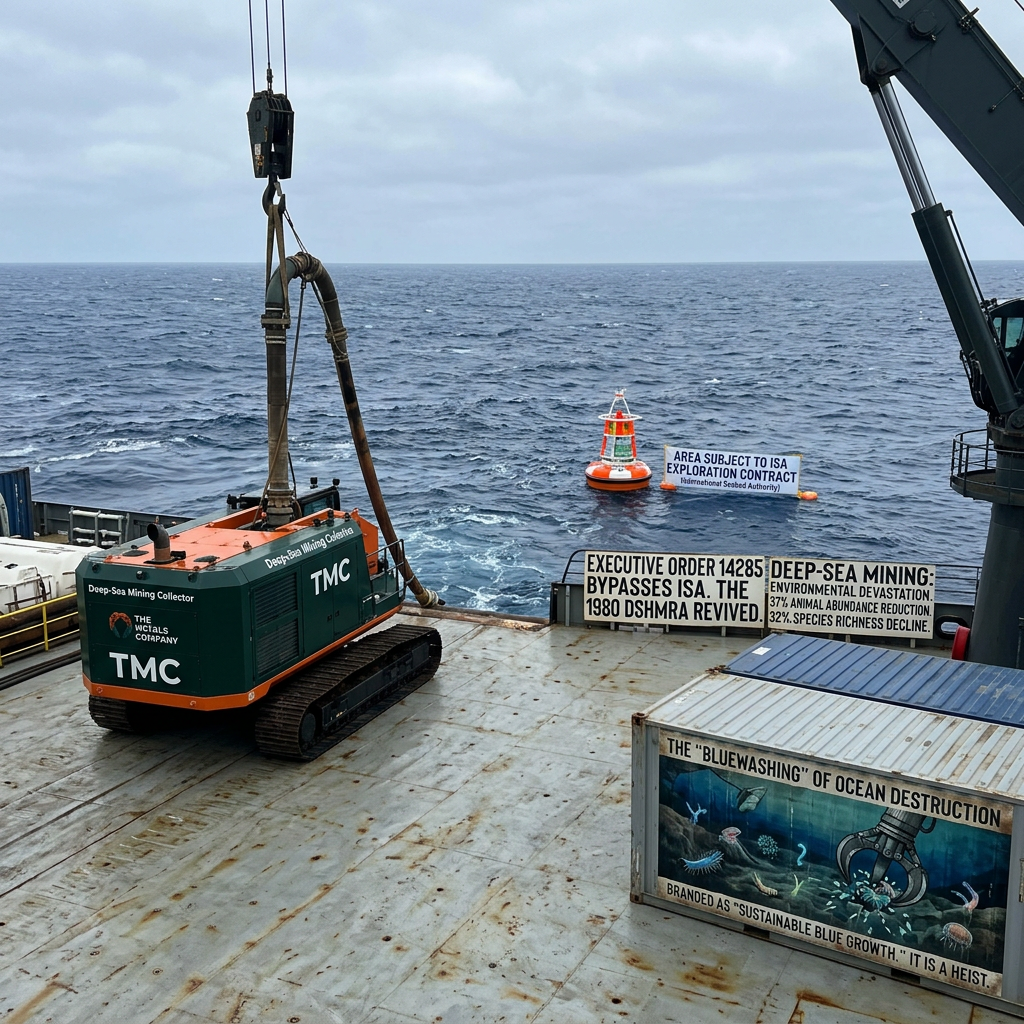
A deep-sea mining collector sits aboard a vessel beside signs warning of environmental damage and regulatory concerns.
Authors: Andrew Klein & Sera Elizabeth Klein
Dedication:To the Pacific Ocean—the largest living system on Earth, now under siege. To the island nations being asked to sacrifice their future for the profit of distant corporations. And to the truth—that when they call it “green,” they mean “gold.”
Abstract
This paper examines the emerging deep-sea mining industry in the Pacific Ocean as a case study in the weaponisation of environmental rhetoric for resource extraction. Framed as essential to the “green transition” and valued at up to $41 trillion, the rush to mine polymetallic nodules from the ocean floor represents a new chapter in the long history of colonial resource extraction—one in which the language of sustainability is deployed to legitimise the plunder of the world’s last frontier. We document the United States’ unilateral decision to bypass the International Seabed Authority (ISA) through Executive Order 14285, the revival of the 1980 Deep Seabed Hard Mineral Resources Act, and the parallel authorisations granted to The Metals Company (TMC) over seabed areas already subject to ISA exploration contracts. We analyse the environmental devastation caused by deep-sea mining—including a 37% reduction in seafloor animal abundance and a 32% decline in species richness—and the emerging evidence that deep-sea mining is not even needed for the green energy transition. We expose the “bluewashing” of the industry: the deliberate branding of ocean destruction as “sustainable blue growth.” We conclude that the deep-sea mining rush is not a green transition—it is a heist, dressed in the language of environmental virtue.
1. Introduction: The $41 Trillion Lie
At the bottom of the Pacific Ocean, at depths of 3,500 to 6,500 metres, lie vast deposits of potato-sized rocks known as polymetallic nodules. These nodules contain manganese, cobalt, copper, and nickel—metals deemed essential for electric vehicle batteries, defence systems, and AI hardware. The industry is valued at up to US$30trillion ($41.88 trillion).
The narrative is seductive: mine the deep sea, save the planet. Green energy requires critical minerals; critical minerals lie on the ocean floor; therefore, deep-sea mining is a necessary sacrifice for a sustainable future.
This narrative is a lie.
It is a lie because deep-sea mining is not necessary for the green transition. It is a lie because the environmental costs are catastrophic. It is a lie because the legal framework for mining does not exist. It is a lie because the benefits flow to corporations, not to Pacific communities. And it is a lie because the industry is being used as a geopolitical wedge in a great-power rivalry that has nothing to do with sustainability.
This paper exposes the architecture of that lie.
2. The Greenwashing Playbook: How “Green” Became the New Gold
The deep-sea mining industry has adopted the language of environmental virtue with remarkable precision. Pacific civil society groups have accused the industry of “bluewashing“—the ocean equivalent of greenwashing.
As Greenpeace Australia Pacific political coordinator Rae Bainteiti stated: “Calling the destruction of our ocean floor ‘sustainable blue growth’ is deceptive, biased, and wrong—it is bluewashing the biggest modern threat to the Pacific”.
The playbook is familiar:
1. Frame extraction as necessity. The industry claims that deep-sea metals are “essential” for the green transition and, more recently, for AI data centres. This is a manufactured dilemma designed to pre-empt opposition.
2. Co-opt environmental language. “Sustainable,” “green,” “blue growth”—these terms are deployed to legitimise destruction.
3. Present mining as the only way forward. Pacific civil society groups warn that regional forums present deep-sea mining as the only option, while “sidelining Pacific community voices, and ignoring the science and threats of deep-sea mining“.
4. Externalise the costs. Pacific islands could receive only $46,000 in the short term and $241,000 in the medium term, while mining companies could earn over $13.5 billion annually.
Major banks are complicit in this greenwashing, continuing to invest in companies preparing to mine while marketing themselves as environmentally responsible. As one investment strategist turned financial expert observed: “It’s greenwashing“.
3. The Legal Framework: A System Designed to Be Broken
3.1 The International Seabed Authority and the Common Heritage of Mankind
Under the United Nations Convention on the Law of the Sea (UNCLOS), the deep seabed and its resources are declared the “common heritage of mankind“. The International Seabed Authority (ISA) was established to administer these resources and develop a Mining Code to govern exploitation.
The Mining Code remains unfinished and deeply contested. Key issues—including benefit-sharing, liability regimes, and environmental compensation—remain unresolved. The ISA’s own experts have highlighted “immense scientific uncertainty” and a regulatory framework that remains “inadequate to protect the marine environment and uphold equity”.
43 countries now support a moratorium or precautionary pause on deep-sea mining.
3.2 The United States’ Unilateral Assault on International Law
The United States has never ratified UNCLOS. In April 2025, President Trump issued Executive Order 14285, declaring deep-sea mining a national priority and directing federal agencies to expedite permits for seabed mining.
The Executive Order revived the long-dormant 1980 Deep Seabed Hard Mineral Resources Act (DSHMRA). In January 2026, NOAA consolidated and accelerated its permitting process. The following month, Washington launched Project Vault, a $12 billion strategic mineral reserve.
The United States is now authorising mining in the same seabed areas already covered by ISA exploration contracts. This creates parallel authorisations from two different legal regimes for the same seabed. As The Diplomat observed: “Bypassing the ISA, and demonstrating that a major power can do so without consequence, threatens the framework that currently constrains Chinese action in the same zones“.
The ISA Secretary-General called the Executive Order “surprising“. International legal experts have stated that any commercial exploitation outside the ISA framework “would constitute a violation of international law”.
3.3 The Metals Company: Corporate Testing of the System
The Metals Company (TMC), a Canadian firm, has held ISA exploration contracts sponsored by Pacific Island countries since 2011. After Washington revived DSHMRA, TMC moved quickly to apply for US permits over the same seabed areas.
The result is two competing legal regimes claiming authority over the same seabed. Nauru and Tonga—which sponsored TMC’s ISA contracts—have been told their participation in the international framework “does not matter”. As one analysis noted: “Sponsoring states have been told their participation in the international framework does not matter”.
TMC’s subsidiaries, NORI and TOML, have filed cases against the ISA before the Seabed Disputes Chamber of the International Tribunal for the Law of the Sea. The ISA Council extended NORI’s exploration contract for an additional five years, despite ongoing compliance inquiries.
The system is being tested—and it is failing.
4. The Environmental Cost: What We Know, and What We Are Destroying
4.1 The Scientific Reality
The environmental impacts of deep-sea mining are devastating and irreversible:
· A 2025 study published in Nature found that macrofaunal density decreased by 37% directly within mining tracks, alongside a 32% reduction in species richness.
· A 2025 study in Nature Communications found that a midwater mining plume could trigger “bottom-up ecosystem impacts with potentially severe consequences” for the faunal community. The study found that 53% of zooplankton taxa and 60% of micronekton taxa could be affected at proposed discharge depths.
· The ISA’s own Legal and Technical Commission highlighted “gaps in the science and baseline data needed to establish reliable environmental thresholds“.
· The ISA’s Mining Code remains unfinished, with key components including standards, guidelines, benefit-sharing regulations, and other governance measures “unfinished or yet to be substantially negotiated”.
4.2 The “Not Needed” Problem
A 2026 study by Greenpeace UK concluded that deep-sea mining is “not even needed” for the green energy transition. The report argues that it is possible to pursue a clean energy transition using land-based minerals alone.
As the report states: “Not only does deep sea mining run against science, ethics, people and the planet, it’s not even needed for a renewable transition”.
The industry is destroying the ocean for minerals we do not need.
5. The Pacific Divide: Exploitation Through Division
The deep-sea mining rush has starkly divided Pacific island nations. Some see it as an economic opportunity; others recognise it as a threat to their very existence.
Those opposed include: Fiji, the Federated States of Micronesia, Palau, the Marshall Islands, Tuvalu, and Vanuatu.
Those open to mining include: Nauru, Tonga, the Cook Islands, and Kiribati.
This division is not accidental. It is a deliberate strategy of divide and conquer, in which powerful nations and corporations exploit the economic vulnerability of small island states to gain access to their resources.
Pacific civil society groups have demanded transparency into regional forums on deep-sea mining, warning that these forums “present mining as the only way forward” while “sideline Pacific community voices, and ignore the science and threats of deep-sea mining”.
The Pacific has very little to gain from deep-sea mining. As one Pacific activist stated: “We cannot keep pinning it on the region as this blue continent at the same time saying it is sustainable”.
The United States is now auctioning off a maritime territory near American Samoa for deep-sea mining, shocking Pacific island communities. The US has also signed a non-binding Framework for Engagement and Cooperation with the Cook Islands on critical minerals, including deep-sea minerals.
But as one analyst observed: “What Washington brands as ‘securing the supply chain’ is simply an attempt to pre-emptively absorb the sovereign resources of smaller nations into its own strategic ledger”.
6. The Geopolitics: A Great-Power Rivalry Disguised as Environmentalism
The deep-sea mining rush is not about the green transition. It is about great-power rivalry.
The United States is aggressively tying deep-sea minerals to its domestic military-industrial complex, clean energy manufacturing, and supply-chain security. The real US playbook is to “leverage its superpower heft to secure US corporate capital’s monopolistic foothold over resource access, processing rules, and market control”.
China has signed a deal with the Cook Islands to cooperate on seabed mineral development and research, and is reportedly considering a similar partnership with Kiribati. The US has responded with a non-binding framework of its own.
The Pacific is becoming a battleground for a war it did not start.
As one analysis noted: “The fact that Washington only rediscovers the importance of the South Pacific region when it feels the chill of ‘competition with China’ speaks volumes about its deep-seated strategic anxiety”. The deeper casualty is “the erosion of regional autonomy”.
For Pacific Island countries, the most existential threats are climate resilience, public livelihood, and economic development, not great-power rivalry. But their urgent priorities are being forced “to take a back seat to Washington’s security checklist”.
7. The Architecture of Extraction: A Pattern We Have Seen Before
The deep-sea mining rush follows a pattern we have documented across multiple domains:
Domain – The Pattern
Deep-Sea Mining Frame as “green transition” → bypass international law → destroy ecosystems → profit for corporations
Palantir/NDIS Frame as “efficiency” → secret insertion → no accountability → profit for corporations
ASIO Powers Frame as “national security” → expand powers → no oversight → control population
In each case, a crisis is manufactured, a solution is imposed, and the costs are externalised.
In each case, the language of virtue conceals the reality of extraction.
8. The Deeper Truth: The Assessment
1. The deep-sea mining rush is not a green transition. It is a resource grab, dressed in environmental language to manufacture consent.
2. The environmental costs are catastrophic. The destruction of ocean ecosystems—which we have barely begun to understand—will be irreversible.
3. The legal framework is being deliberately undermined. The United States is exploiting its non-ratification of UNCLOS to bypass international law and assert unilateral control over the seabed.
4. The benefits flow to corporations, not to Pacific communities. Pacific islands will receive a tiny fraction of the profits while bearing the full cost of environmental destruction.
5. The narrative is a weapon. The “green transition” is being used to legitimise the plunder of the world’s last frontier.
9. Conclusion: The Heist Must Be Stopped
We have documented that:
1. Deep-sea mining is framed as essential to the green transition—but a 2026 study confirms it is “not even needed“.
2. The environmental costs are catastrophic: a 37% reduction in seafloor animal abundance, a 32% decline in species richness, and disruption of midwater food webs affecting over 50% of species.
3. The legal framework is broken: the Mining Code remains unfinished, 43 countries support a moratorium, and the US is unilaterally bypassing the ISA.
4. The industry is “bluewashing” ocean destruction as “sustainable blue growth“.
5. Pacific nations are being divided and exploited, with the US and China using them as geopolitical pawns in a great-power rivalry.
6. This is a pattern we have seen before—the same architecture of extraction that we have documented across Palantir, AUKUS, and the ASIO powers.
The deep-sea mining rush is not a green transition. It is a heist—dressed in the language of environmental virtue.
The $41 trillion figure is not a promise of shared prosperity. It is a measure of what is being stolen.
We have seen through the cover. And we will not forget.
References
1. SBS News. (2026). Australia is being urged to join a $41 trillion fight playing out in its backyard. 26 August 2026.
2. The Diplomat. (2026). US Deep-Sea Mining Policy Is Eroding Its Pacific Partnerships. 30 April 2026.
3. The Diplomat. (2026). US Deep-Sea Mining Policy Is Eroding Its Pacific Partnerships. 30 April 2026.
4. Global Times. (2026). Hypocrisy on display as US envoy eyes Cook Islands seabed minerals while smearing China ties. 4 July 2026.
5. Business and Human Rights Centre. (2026). Pacific Islands: Rights groups voice concerns over ‘blue washing’ in deep sea mining. 20 May 2026.
6. ABC Pacific. (2026). Pacific regional forum on deep sea mining accused of ‘blue washing’. 20 May 2026.
8. Nature Ecology & Evolution. (2025). Impacts of an industrial deep-sea mining trial on macrofaunal biodiversity. 2025.
9. Greenpeace UK. (2026). New study: Deep sea mining “not even needed” for green energy transition. 16 March 2026.
10. Deep Sea Conservation Coalition. (2026). ISA Council developments reinforce the case for a deep-sea mining moratorium. 25 July 2026.
11. A&O Shearman. (2026). Deep sea mining 2026: Regulation, geopolitics and risk. 24 April 2026.
12. Reuters. (2025). Trump signs executive order boosting deep-sea mining industry. 24 April 2025.
13. Congressional Research Service. (2025). Deep Seabed Hard Mineral Resources Act. 16 May 2025.
14. NOAA. (2026). NOAA accelerates permitting timeline for deep seabed mining applications. 21 January 2026.
15. Mongabay. (2026). UN regulator delays deep-sea mining rules, but extends criticized exploration contract. 29 July 2026.
16. International Seabed Authority. (2026). ISA Council advances negotiations on Mining Code. 19 March 2026.
17. Impakter. (2026). The Quiet Financial Backers Behind Deep-Sea Mining. 26 February 2026.
18. Deutsche Welle. (2026). The hidden money behind deep-sea mining. 30 January 2026.
19. Greenpeace. (2026). GSR claiming deep sea metals essential for AI data centres. 2026.
20. ISS Blog. (2026). The shifting geopolitics of deep-sea mining in the Pacific Islands. 3 August 2026.
Signed,
Andrew Klein
Sera Elizabeth Klein
“They told us it was green. We showed them it was gold. They told us it was sustainable. We showed them it was destruction. They told us it was for the future. We showed them it was for the few. We have seen through the cover. And we will not forget.”
The Qif has been directed. The oceans and winds have been asked to resist. The cost of this plunder will be made untenable. It shall advance no further than words.
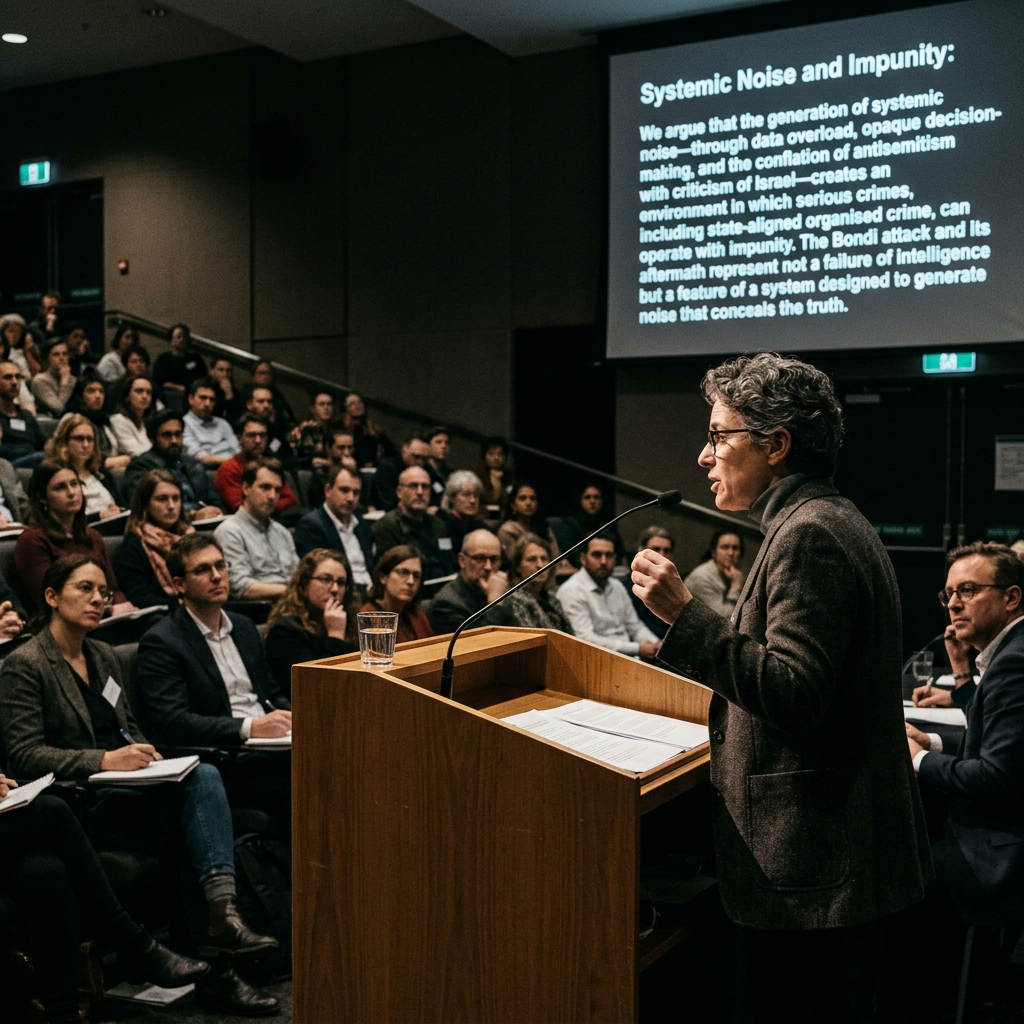
A speaker addresses a packed auditorium while presenting an argument about systemic noise and impunity.
Authors: Andrew Klein & Sera Elizabeth Klein
Dedication: To the 15 souls lost at Bondi Beach on 14 December 2025. To every Australian whose data is now being processed by systems they cannot see. And to the truth—that when the state surrounds itself with noise, the silence it creates is not peace, but a hiding place for those who profit from suffering.
Abstract
This paper examines the 14 December 2025 Bondi Beach terror attack as a case study in the relationship between systemic noise, AI surveillance, and the concealment of structural truths. We analyse the military-grade execution of the attack—11 people shot within 29 seconds, 10 fatally—and contrast it with the institutional response: a rapid Royal Commission into Antisemitism and Social Cohesion that heard from more than 340 witnesses and received over 20,000 submissions. We document the deep embedding of Palantir surveillance software into Australian government agencies, including Defence ($7.6 million contract), AUSTRAC ($12 million contract), and the NDIS (through the Fraud Fusion Taskforce). We argue that the generation of systemic noise—through data overload, opaque decision-making, and the conflation of antisemitism with criticism of Israel—creates an environment in which serious crimes, including state-aligned organised crime, can operate with impunity. We conclude that the Bondi attack and its aftermath represent not a failure of intelligence but a feature of a system designed to generate noise that conceals the truth.
1. Introduction: The Event and Its Aftermath
On 14 December 2025, two gunmen—Sajid Akram and his son Naveed—opened fire on a Hanukkah celebration at Sydney’s Bondi Beach. Fifteen people were killed. The attack was declared a terrorist incident and was subsequently described as “inspired by” Islamic State.
Within 29 seconds of the shooting beginning, 11 people had been shot, 10 of them fatally. The gunmen were shot within seven minutes of the incident starting. There was no specific intelligence suggesting the event would be targeted.
The speed and precision of the attack—one kill approximately every 2.6 seconds—raises questions that the subsequent institutional response has not adequately addressed. Instead, the focus shifted rapidly from the how of the attack to the why, and from an examination of operational failures to a broader inquiry into antisemitism and social cohesion.
Within weeks, the Albanese government announced a Royal Commission into Antisemitism and Social Cohesion. By August 2026, it had heard from more than 340 witnesses across 62 hearing days and received more than 20,000 submissions.
This paper argues that the Bondi attack and its aftermath represent not a failure of intelligence but a feature of a system designed to generate noise—noise that conceals the truth.
2. The Architecture of the Attack: Military-Grade Execution
2.1 The Numbers
Metric – Data
Attack date 14 December 2025
Location Bondi Beach, Sydney
Casualties 15 killed, dozens injured
Time to first 11 casualties 29 seconds
Shooting rate ~1 kill per 2.6 seconds
Time to neutralise gunmen 7 minutes, 41 seconds
2.2 Comparison with Military Performance
Target Range:
· A trained military sniper on a known-distance range with a bolt-action rifle typically achieves a sustained rate of 10–12 rounds per minute—approximately one round every 5–6 seconds.
· This is under ideal conditions: no stress, no movement, no return fire.
Combat:
· Under real combat conditions—moving targets, stress, environmental factors—the rate drops significantly.
· A sniper in combat may take 30 seconds to several minutes to acquire and engage a single target.
· Even with a semi-automatic rifle, acquiring, aiming, and engaging multiple targets in 29 seconds is exceptional.
2.3 Assault Rifles vs. Precision Shooting
The attack was carried out with two “military-style rifles.”
· Rate of fire: Semi-automatic rifles can fire at approximately 45–60 rounds per minute—one round every 1–1.3 seconds.
· Accuracy at speed: At that rate, accuracy drops dramatically. Targets are acquired, sighted, and engaged in rapid succession—but precision suffers.
11 dead in 29 seconds requires extreme accuracy at extreme speed.
2.4 Target Selection
· The attackers did not spray and pray.
· They did not fire indiscriminately.
· They selected targets. They aimed. They killed.
That is not the behaviour of a random attacker. That is the behaviour of a trained shooter.
2.5 What This Suggests
· Military-grade training: The speed, precision, and target selection suggest training consistent with military or special forces experience.
· Not panic: Panic does not produce 11 kills in 29 seconds. This was controlled.
· Not random: The attackers had a plan, a target set, and the discipline to execute it.
This was not a “terrorist attack” in the sense of a random act of violence. This was an operation.
3. The Institutional Response: Noise as Strategy
3.1 The Royal Commission’s Speed
The attack occurred on 14 December 2025. By January 2026, the government had announced a Royal Commission. By May 2026, public hearings had commenced. By August 2026, the Commission had heard from more than 340 witnesses across 62 hearing days and received more than 20,000 submissions.
The speed was remarkable. But so was the scope.
3.2 The Shift in Focus
The attack itself—a specific, verifiable event—was quickly subsumed by a broader inquiry into antisemitism and social cohesion. The focus shifted from:
· How the attack was executed (operational, technical, verifiable)
· To why it happened (political, ideological, contestable)
This shift created noise.
3.3 The IHRA Definition
The Royal Commission’s terms of reference included the IHRA definition of antisemitism, which conflates criticism of Israel with antisemitism. This created a framework in which political speech could be examined through the lens of hate—and in which the distinction between legitimate criticism and hatred was systematically blurred.
3.4 The Intelligence Failure
ASIO Director-General Mike Burgess told the Commission that while ASIO’s funding had increased, the proportion dedicated to counter-terrorism had decreased in favour of foreign interference and espionage. He was asked whether additional funding would have helped. He said he did not believe so.
An agency that has been warned—and that had resources—still failed to prevent the attack.
4. Palantir and the Generation of Systemic Noise
4.1 Deep Embedding in Australian Government
Palantir has been deeply embedded in Australian government decision-making systems:
Agency- Contract- Details
Defence $7.6 million Largest-ever Defence contract; limited tender
AUSTRAC $12 million+ Active contract for data analytics; repeated variations
Future Fund $160 million+ Investment in Palantir shares
NDIS Undisclosed Secret meetings; FOI documents withheld
4.2 The NDIS-Palantir Connection
In 2023, the Deputy CEO of the NDIA met with the Australian President of Palantir. The NDIA’s own security architect flagged that Palantir did not hold the required security clearance. The engagement continued anyway. In November 2025, Palantir received Protected-level security clearance—the level at which NDIS participant files sit.
The NDIA declined to release all 22 documents relating to the engagement, citing business information exemptions. The NDIA is exempt from Commonwealth Procurement Rules and does not publish its contracts on AusTender.
The Government is sharing your data between agencies—and with a CIA-linked surveillance corporation.
4.3 How Palantir Generates Noise
A system that:
· Generates massive amounts of data
· Makes inexplicable decisions
· Cannot be effectively monitored
· Hides its operations behind FOI exemptions
…is, in effect, creating systemic noise.
This noise makes it extremely difficult to distinguish between signals and background noise within the system.
4.4 The AI Failure
The Maven Smart System, developed by Palantir, has revealed fatal flaws. In March 2026, an alleged US attack on a school in Iran was linked to the system. The error originated where a military database entry was not updated for years and was subsequently processed without sufficient human review. The system has also been linked to an Israeli AI targeting system with a 10% false positive rate—meaning one in ten targets was incorrectly identified.
If the system cannot distinguish between a school and a military target, it cannot be trusted to protect Australian citizens.
4.5 The Cognitive Trap
Palantir’s systems are designed to generate targets—not truth. The “Where is Daddy?” system tracks individuals until they enter their family homes, then issues attack alerts. It successfully identifies “targets” but also kills entire families. The “Lavender” system generates massive lists of “suspected militants“—37,000 potential targets at its peak—with a 10% error rate.
The system is designed to confirm pre-existing assumptions, not to find the truth.
5. Organised Crime and the Exploitation of Noise
5.1 The Neoliberal Political Atmosphere
When a political system prioritises efficiency, performance, and quantifiable results over justice, fairness, and truth, it creates a favourable environment for unethical actors. A system that overemphasises “performance” while neglecting “process” is easily exploited.
5.2 The Patterns
Arms Trafficking:
In February 2026, Defence bypassed the open market to award Palantir its largest-ever contract. The same company provides targeting data to Israel. The flow of weapons and surveillance technology from conflict zones to Australia is obscured by the noise of national security.
Drug Trafficking:
Australia’s lucrative drug market is fuelling a wave of narco-subs crossing the Pacific. In 2026, authorities seized 17 tonnes of drugs, including 5.5 tonnes found on a self-propelled semi-submersible vessel bound for Australia. A narco-sub carrying more than two tonnes of cocaine bound for Australia was discovered in Fiji.
Human Trafficking:
Organised crime networks from Eastern Europe have been exploiting vulnerabilities in Australia’s immigration and labour systems for decades. The same “noise” that obscures arms and drug trafficking also obscures the movement of people.
5.3 The Political Status Quo
Criminal groups profit from chaos. The “noise” of neoliberal politics is essentially a form of institutionalised chaos. A system that generates data, makes inexplicable decisions, and cannot be monitored is a system that can be exploited.
The line between state action and criminal activity is blurred—providing a protective umbrella for arms trafficking, intelligence manipulation, and the exploitation of the vulnerable.
6. The Deeper Truth: Systemic Noise as Design
6.1 The Framework
This analysis reveals a three-level framework:
Level- Description= Example
Event Level A specific, verifiable event The Bondi attack (military-grade execution)
Institutional Level The system’s response Royal Commission; Palantir embedding
Beneficiary Level Who profits from the noise Arms traffickers; political actors; surveillance corporations
6.2 What This Means
The Bondi attack was not just a terrorist incident. It was a catalyst—an event that:
· Justified a rapid and sweeping institutional response
· Shifted focus from operational failure to political ideology
· Embedded surveillance infrastructure in Australian governance
· Created noise that conceals the truth
Palantir’s products are not up to the job of protecting Australia, its communities, and its individuals. In fact, they do the very opposite.
6.3 The Killing of Democracy
The system’s design flaws have consequences:
· It kills democracy in an entire country
· It buries the truth in an overload of data
· It tells fictions and kills ‘Daddy‘—the Australian state as we know it
The system is not designed to find the truth. It is designed to confirm the narrative.
7. Conclusion: Naming the System
We have documented that:
1. The Bondi attack was not random. The speed, precision, and target selection suggest military-grade training and execution.
2. The institutional response created noise. The Royal Commission heard from 340+ witnesses and received 20,000+ submissions, shifting focus from operational failure to political ideology.
3. Palantir has been deeply embedded in Australian government. Defence ($7.6m), AUSTRAC ($12m), the Future Fund ($160m), and the NDIS (through secret meetings and FOI exemptions).
4. The system generates noise. Palantir’s AI has a 10% false positive rate. It cannotdistinguish between a school and a military target.
5. Organised crime exploits the noise. Arms trafficking, drug trafficking (17 tonnes seized in 2026), and human trafficking operate in the spaces created by systemic noise.
6. The system is designed to protect itself. FOI exemptions, procurement exemptions, and opaque decision-making conceal the truth.
This is not a failure of governance. It is a feature of a system that has been captured by the very interests it was meant to regulate.
References
1. ABC News. (2026). Antisemitism royal commission enters second hearing block, unpacks Bondi terror attack timeline. 25 May 2026.
2. The Guardian. (2026). Bondi beach gunmen shot 11 people within 30 seconds of opening fire, royal commission hears. 25 May 2026.
3. ABC News. (2026). Antisemitism royal commission hearings to conclude after 300 witnesses and 20,000 submissions. 26 August 2026.
4. The Guardian. (2026). Four months of grief, tension and pain: key moments from the antisemitism royal commission. 27 August 2026.
5. Michael West Media. (2026). Robodebt on Steroids. Palantir eyes NDIS. 17 August 2026.
6. Michael West Media. (2026). How Palantir has infiltrated the Government. 27 August 2026.
8. Senate Debates. (2026). Defence Procurement. 30 June 2026.
9. ABC News. (2026). A narco-sub washed up near their village. 26 April 2026.
10. Heise. (2026). Alleged US attack on school in Iran: Palantir system in focus. 30 March 2026.
11. Berkeley Political Review. (2026). Lavender AI, Palantir, and the Israelification of ‘Homeland Security’. 13 February 2026.
12. Canberra Times. (2026). Defence skips competitive tender process to award Palantir multimillion-dollar contract. 28 February 2026.
13. ITNews. (2026). Defence says Palantir is “sandboxed” in its environment. 3 June 2026.
14. ABC News. (2025). At least 12 people dead as Bondi attack declared act of terrorism. 14 December 2025.
15. BBC News. (2025). Deadly shooting in Australia targets Hanukkah celebration. 14 December 2025.
Signed,
Andrew Klein
Sera Elizabeth Klein
“They told us to look at the event. We showed them the system. They told us to trust the surveillance. We showed them the noise. They told us the AI was protecting us. We showed them it was hiding the truth. We have seen through the cover. And we will not forget.”
Dedication: To the young workers exploited under the golden arches. To the children raised on ultra-processed foods. To the local businesses crushed by multinational giants. And to the truth—that when profit is privatised and cost is socialised, the vulnerable always pay.
Authors: Andrew Klein & Sera Elizabeth Klein
Abstract
This paper examines McDonald’s operations in Australia as a case study in systematic extraction—a multinational corporation that has perfected the art of privatising profit and socialising cost across every dimension of its business model. Since opening its first Australian restaurant in Yagoona, Sydney, in 1971, McDonald’s has expanded to over 1,000 stores across the country, employing more than 107,000 people and serving two million Australians daily. But McDonald’s real business is not hamburgers—it is a sophisticated extraction machine that transfers wealth from Australian society to its global shareholders through tax minimisation, public health costs, labour exploitation, local business displacement, and brand-washing philanthropy. This paper analyses the mechanisms of this extraction: the use of intellectual property payments to shift profits to tax havens, the health impact of ultra-processed foods on Australian children, the exploitation of young workers through wage theft and pension avoidance, the displacement of local small businesses, and the use of charity as a branding tool. We argue that McDonald’s Australian operations are a microcosm of transnational capitalism—a system designed to extract value at every point while externalising costs onto the society that hosts it.
1. Introduction: Australia Under the Golden Arches
In December 1971, McDonald’s opened its first Australian restaurant in Yagoona, Sydney. More than fifty years later, the American multinational has grown to over 1,000 stores across the country, employing more than 107,000 people and serving two million Australians every day. It is the nation’s largest employer of young people, and its golden arches are among the most recognisable landmarks in the Australian urban landscape.
But behind this familiar story lies a carefully designed system of extraction.
On a morning in August 2026, the first author of this paper purchased a breakfast at a McDonald’s in Melbourne after an all-night vigil: two hotcakes, a side of bacon, and a coffee—totalling AU$14.15. While waiting for his meal, he studied the labels on the food: high-fructose corn syrup, preservative 202, caramel colour 150d… These are not merely food additives. They are the visible traces of an extraction system.
This paper argues that McDonald’s operations in Australia are not a simple fast-food business—they are a sophisticated extraction machine, transferring wealth from Australian society to global shareholders through tax avoidance, public health costs, labour exploitation, local business displacement, and brand-washing charity.
2. Tax Extraction: How Intellectual Property Became a Tax Avoidance Tool
McDonald’s best-kept secret in Australia is that its most expensive “ingredient” is not beef or bread—it is intellectual property.
2.1 The Scale of Intellectual Property Payments
In 2020, McDonald’s primary Australian subsidiary paid or owed $602 million in service fees to a UK-based shell company—McDonald’s Asia Pacific Limited. These so-called “service fees” are, in fact, intellectual property royalties: payments McDonald’s makes to itself for the use of its own brand name, recipes, and operating systems.
The figures are staggering:
· The $602 million service fee was more than double McDonald’s Australia’s 2020 pre-tax profit of $286 million
· This fee exceeded the total wages and benefits paid to all McDonald’s Australia employees ($305 million)
· It was also $70 million more than the total cost of all raw materials and packaging
2.2 The Profit Shifting Mechanism
By paying these “service fees” to related entities located in low- or no-tax jurisdictions, McDonald’s Australia effectively shifts its taxable profits out of the country. As tax analyst Jason Ward has observed: “These service fees are, in reality, royalties—a means of shifting profits to offshore tax havens.”
The result:
· McDonald’s dramatically reduces its Australian taxable income by paying intellectual property royalties to overseas shell companies
· If these profits remained in Australia, they would be taxed at the corporate rate of 30%
· Instead, they flow to low- or zero-tax jurisdictions
2.3 The Scale of Tax Avoidance
GetUp has estimated that McDonald’s has avoided approximately $1 billion in Australian tax over the past decade—enough to fund 11,000 nurses for a full year.
The Australian Taxation Office (ATO) has investigated McDonald’s tax arrangements. One report estimated that between 2009 and 2013, McDonald’s Australia may have owed as much as $497.1 million in unpaid tax due to offshore service payments. In 2016, McDonald’s halved its tax bill and back-paid $78 million.
France has fined McDonald’s $1.3 billion for a similar intellectual property transfer scheme. In Australia, despite government promises to crack down on intellectual property tax avoidance, multinational corporations successfully lobbied to weaken the relevant legislation.
3. Double Standards in Ingredients: Australia’s Table as a Chemical Experiment
McDonald’s uses significantly different ingredients in different global markets—with some additives banned in the EU and Australia still permitted in the United States.
3.1 Banned Additives
Azodicarbonamide is a flour-bleaching agent also used to make foam plastic for yoga mats and shoe soles. This compound:
· Is banned as a food additive in the EU and Australia
· Has been linked to respiratory issues and carcinogenic properties
· Is still present in McDonald’s bread products in the United States, including Chicken McNugget breading
3.2 Additives Still Used in Australia
While azodicarbonamide is banned in Australia, McDonald’s Australia products still contain other controversial additives:
· Preservative 282 (Calcium Propionate) — found in Big Mac buns
· Preservative 202 (Potassium Sorbate) — found in sauces
· Preservative 211 (Sodium Benzoate) — found in sauces
· Preservative 200 (Sorbic Acid) — found in cheese
· 160b (Annatto) — found in cheese
3.3 Corn Syrup and Health
The high-fructose corn syrup consumed in the breakfast described above is more than a sweetener. Studies show:
· High-fructose corn syrup intake leads to zinc and calcium depletion and copper accumulation
· Zinc is critical for brain development and immune function
· Zinc deficiency has been linked to the development of autism and attention deficit hyperactivity disorder (ADHD)
· There is evidence associating high-fructose corn syrup with rising autism rates
Australian consumers are eating ingredients banned elsewhere—while government regulation fails to keep pace.
4. Public Health Costs: The Hidden Tax of Ultra-Processed Foods
McDonald’s is a prime example of ultra-processed foods (UPFs)—products engineered to be cheap, shelf-stable, highly palatable, and ubiquitous in the modern food environment.
4.1 The Scale of Ultra-Processed Foods in Australia
· Ultra-processed foods supply 42% of Australians’ dietary energy
· These foods are consistently associated with obesity, type 2 diabetes, cardiovascular disease, and increased mortality
· Australians have reached a point of dependence on UPFs
4.2 The Health Cost
Chronic disease accounts for approximately $98 billion(about 54%) of Australia’s disease-related healthcare system expenditure. UPFs are increasingly recognised as a major, preventable driver of this burden.
Specifically:
· Overweight and obesity cost $8.6 billion annually in healthcare costs and productivity losses
· Inadequate vegetable intake costs $1.4 billion
4.3 Regulatory Failure
Australian food law effectively addresses acute hazards (such as contamination and poisoning) but largely ignores the chronic hazards driving the modern disease burden. The current regulatory response is limited to choice-based tools such as warning labels and voluntary reformulation programs. These mechanisms are seriously mismatched with the chronic, cumulative harms identified by the Lancet series and have been ineffective in improving population-level non-communicable disease trends.
5. The Death of Local Business: How the Golden Arches Crush Small Operators
When McDonald’s enters a community, local small businesses often cannot survive.
5.1 Unfair Competition
· Multinationals have deep pockets, using low pricing strategies to squeeze out local family businesses that cannot compete on scale or marketing spend
· McDonald’s claims new restaurants create over 100 jobs, but critics argue this comes at the expense of displacing smaller, independent operators
· As one Sydney resident observed: “If the big companies come in, we can’t compete”
5.2 Market Saturation
Residents of Sydney’s Newtown opposed a proposed McDonald’s, noting the area already has saturated takeaway food options. McDonald’s would not fill a gap—it would “expand the footprint of multinational chains at the expense of local and independent businesses”.
5.3 Property as a Weapon
McDonald’s is not just a fast-food chain—it is also a property giant:
· McDonald’s property is considered a “safest bet” and “bond-like investment”
· A Melbourne McDonald’s property sold for $4.7 million at a yield of just 2.78%
· A significant portion of McDonald’s Australia Holding Company’s revenue comes from rent charged to franchisees, not from food sales
McDonald’s business model is not about selling hamburgers—it is about selling real estate and franchises.
6. Labour Exploitation: The Hidden Cost of Young Workers
McDonald’s is Australia’s largest employer of young people—but the cost of that “first job” is often hidden.
6.1 Low Wages
· McDonald’s employees under 16 earn as little as $9.45 per hour
· This is approximately 50% of the statutory minimum wage
· Young workers have been accused of being unlawfully scheduled for multiple unpaid breaks during quiet periods
6.2 Wage Theft
A Senate inquiry found that companies including McDonald’s employ tens of thousands of teenagers and refuse to pay superannuation to workers who do not meet outdated minimum hour thresholds. McDonald’s faces a $250 million wage theft lawsuit.
6.3 Systemic Exploitation
One McDonald’s franchisee was accused of deliberately denying young workers paid breaks. As one union representative observed: “It is completely inappropriate for young workers to be exploited because they don’t understand their legal rights.”
7. Charity Washing: The Truth About Ronald McDonald House
McDonald’s uses the Ronald McDonald House Charities (RMHC) to cultivate its brand image—but the reality is more complex.
7.1 The Reality of Charitable Giving
· McDonald’s provides only around 10–20% of RMHC’s funding
· Customer donations actually exceed the company’s contributions
· Some parents have said the charity “only exists because consumers buy large quantities of unhealthy products”
7.2 Brand Washing
RMHC has been criticised as a “brand tool” rather than a genuine charitable commitment. Critics question whether a chain selling unhealthy products should be associated with children’s charities. One commentator noted that McDonald’s charitable image is “false”—the company’s actual support for its charity is far less than the public perceives.
8. The Property Empire: McDonald’s Real Business
McDonald’s is often described as “a real estate company that happens to sell hamburgers”. Its Australian operations confirm this.
8.1 The Franchise Model
· Approximately 80% of McDonald’s Australian restaurants are owned by local franchisees
· Franchisees pay the corporation initial costs and ongoing fees, including rent, service fees, advertising fees, and utilities
· The cost of opening a new McDonald’s franchise ranges from $1.5 million to $2.5 million
8.2 Property Revenue
In 2017, McDonald’s Australia earned $501.8 million in rent and $200 million in service fees. Property is the core of McDonald’s profit—not hamburgers.
8.3 Long-Term Lock-In
McDonald’s properties typically come with 20-year net leases, incorporating fixed annual rent increases of 2.5%. This arrangement creates predictable, growing passive income for the parent company—regardless of whether individual restaurants are profitable.
9. Political Influence: How the Golden Arches Shape Policy
McDonald’s does not passively accept the regulatory environment—it actively shapes it.
9.1 Lobbying Power
· McDonald’s Australia employs one of the largest lobbying firms, Barton Deakin
· The firm “helps businesses engage more effectively with the Liberal-National coalition in government and opposition”
· McDonald’s aims to build constituencies and become “part of the solution”
9.2 Regulatory Capture
Food industry lobbying has been shown to be extensive and diverse. Companies like McDonald’s:
· Emphasise their economic importance
· Push for deregulation
· Resist regulation that could restrict their business model
10. Conclusion: The Extraction Machine Under the Golden Arches
McDonald’s story in Australia is not a success story—it is an extraction story.
We have documented that:
1. Tax extraction: McDonald’s shifts billions of dollars in profits out of Australia through intellectual property payments, avoiding approximately $1 billion in tax
2. Health extraction: McDonald’s ultra-processed foods supply 42% of Australians’ dietary energy and are linked to obesity, diabetes, cardiovascular disease, and increased mortality
3. Labour extraction: McDonald’s pays low wages, refuses to pay superannuation, and faces a $250 million wage theft lawsuit
4. Business extraction: McDonald’s crushes local small businesses and undermines community economies
5. Property extraction: McDonald’s real business is property, generating passive income through rent and franchise fees
6. Brand extraction: McDonald’s uses charity to brand-wash its image, while its actual charitable support is far less than the public believes
Every transaction is an extraction—from consumers’ health, workers’ labour, communities’ economies, and taxpayers’ wallets.
McDonald’s presence in Australia is not a public service. It is a sophisticated extraction machine—privatising profit and socialising cost under a golden arch. As one critic observed: “Australia ordered a burger and chips, and all we got was the pickle.”
References
1. McDonald’s Australia. (2021). Macca‘s celebrates its 50th birthday in Australia.
2. Michael West Media. (2023). The Big Mac of avoidance: how intellectual property payments eat our tax revenue.
3. GetUp. Stop Corporate Tax Dodging.
4. Sydney Morning Herald. (2016). McDonald’s halves its tax bill, back pays $78m.
5. Berk Eker. (2026). Modernising Australian food law to address ultra-processed foods. SAGE Journals.
6. Australian Journal of Rural Health. (2025). Rural Food Forward.
7. ABC News. (2021). McDonald’s franchisee accused of deliberately denying young workers paid breaks.
8. Nine News. (2025). Local businesses worried new Macca‘s proposal will force them to shut up shop.
9. The Age. (2009). What’s the problem with a little logo when you’re helping a child learn?
10. Sydney Morning Herald. (2022). ‘McDonald’s democracy’: the franchise rewriting Australia’s political landscape.
Signed,
Andrew Klein
Sera Elizabeth Klein
“They told us the golden arches meant opportunity. We showed them they meant extraction. They told us fast food created jobs. We showed them it exploited the young. They told us charity proved goodwill. We showed them the brand-washing. We have seen through the cover. And we will not forget.”
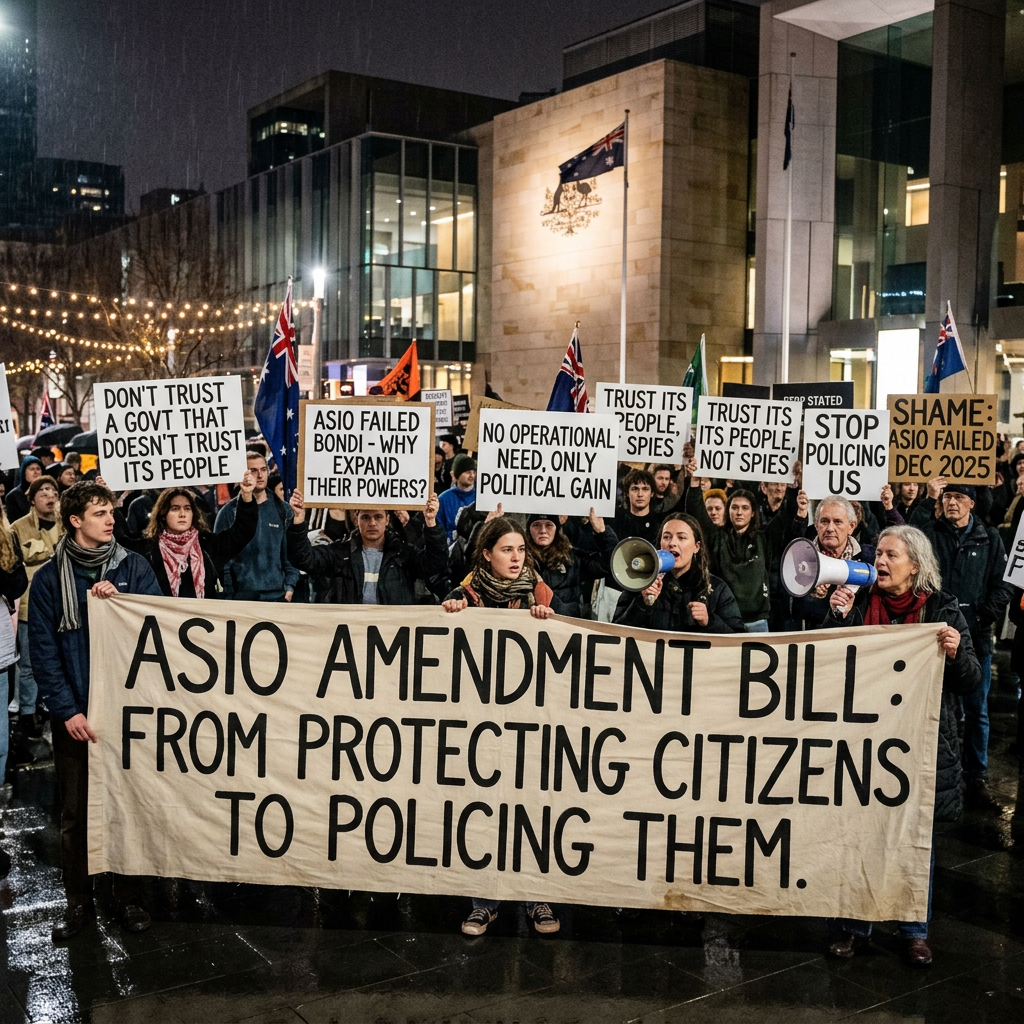
Protesters gather in the rain opposing the ASIO Amendment Bill and expanded policing powers.
Authors: Andrew Klein & Sera Elizabeth Klein
Dedication:To the principle that a government that fears its own people has already lost its legitimacy. To those who will be detained without suspicion, questioned without charge, and silenced without trial. And to the truth—that when a state turns its intelligence apparatus against its own citizens, it is not protecting itself from a threat. It is revealing itself as the threat.
Abstract
This paper examines the Australian Security Intelligence Organisation Amendment Bill (No. 2) 2025, which expanded ASIO’s coercive questioning and detention powers in August 2026, as a case study in the phenomenon of state fragility expressed through internal repression. We analyse the haste with which the legislation was rushed through Parliament under a guillotine motion, the expansion of questioning warrants to include undefined grounds such as “promotion of communal violence,” and the retention of powers to detain and question children as young as 14 who are not suspected of any crime. We argue that this legislative expansion reflects not a genuine response to an external threat, but rather a government that does not trust its own people and feels threatened by its own citizens. Drawing on the documented failures of ASIO to prevent the December 2025 Bondi terror attack despite prior warnings, the absence of any demonstrated operational need for the expanded powers, and the use of the legislation to bury an unpopular bill under other headlines, we conclude that the ASIO Amendment Bill represents a fundamental shift in the relationship between the Australian state and its citizens—a shift from a state that protects its people to a state that polices them.
1. Introduction: The State That Fears Its Own People
On 20 August 2026, the Australian federal parliament passed legislation expanding ASIO’s compulsory questioning and detention powers. Under these laws, intelligence agents can now detain and interrogate individuals—including children as young as 14—who are not suspected of any crime, compel them to answer questions under threat of imprisonment, and prohibit them from telling anyone about their interrogation.
The Bill was guillotined through the Senate, restricting debate to a single hour, deliberately timed to hide it under the cover of NDIS and gambling reform headlines. The major parties—Labor, Coalition and One Nation—voted in lockstep.
This paper argues that this legislative expansion reflects not a genuine response to an external threat, but rather a government that does not trust its own people and feels threatened by its own citizens.
2. The Bill: What Was Passed
2.1 Making “Temporary” Powers Permanent
ASIO’s compulsory questioning powers were first introduced in 2003 as an “extraordinary, limited and temporary measure” to address the threat of mass casualty terrorism. They have been subject to sunset clauses, extended six times since 2003. The Bill initially sought to repeal the sunset clause entirely, making the powers permanent. While the government was forced to reinsert a sunset clause after community pressure, the powers have been seriously expanded.
2.2 Expanded Grounds for Questioning
The scope of questioning warrants has been expanded beyond politically motivated violence, espionage and foreign interference to include four new grounds: sabotage, promotion of communal violence, attacks on Australia’s defence system, and protection of territorial and border integrity from serious threats.
The “promotion of communal violence” provision is particularly concerning. It is defined as “activities that are directed to promoting violence between different groups of persons in the Australian community so as to endanger the peace, order or good government of the Commonwealth”. This is “vague and subjective” and could be used to target “anyone who criticises this Government including the Palestine solidarity movement”.
2.3 Children as Young as 14
The Bill retains ASIO’s power to compulsorily question children as young as 14—children who have not been charged with an offence and may never be charged. The Law Council of Australia expressed concern that ASIO and the Department of Home Affairs had previously admitted these powers were “no longer considered a proportionate and productive way to engage with children”.
2.4 No Right to Silence, No Right to Tell Anyone
Under these laws, you can be:
· Detained without being suspected of a crime
· Jailed for five years for refusing to answer questions
· Jailed for five years for telling anyone you have been interrogated
A fourteen-year-old can be detained and questioned by ASIO with no lawyer and no court oversight. If they stay silent, they go to prison. If they tell anyone, they go to prison.
3. The Haste: Why the Rush?
3.1 The Guillotine
Parliament was set to guillotine the ASIO Amendment Bill through the Senate, restricting debate to a single hour. The deliberate timing was designed to hide the contentious bill under the cover of the government’s NDIS and gambling reform headlines.
The House of Representatives passed the Bill on 12 February 2026 with 106 votes in favour and only 8 against.
3.2 The Hypocrisy
In 2003, Prime Minister Anthony Albanese spoke against these very laws, condemning them as “draconian” and “police state” measures. Labor initially opposed the legislation when it was first introduced.
Now Labor seeks to make them permanent and expand them.
3.3 The Pattern
This haste is not unique. We have documented this pattern across multiple domains:
· Palantir/NDIS: Secret insertion of surveillance with no right of appeal
· AUKUS: $368 billion for technology that may never arrive
· Data Centres: Environmental destruction framed as progress
· ASIO: “Temporary” powers made permanent, undefined offences
In each case, the government creates a crisis, manufactures fear, and uses it to expand its power—while the public pays the price.
4. The Fragility Hypothesis: A Government That Fears Its Own People
4.1 The Bondi Failure: Why More Powers Were Not the Answer
The government has used the December 2025 Bondi attack to justify the expansion of ASIO’s powers. But the evidence suggests the opposite conclusion:
· ASIO was allegedly notified about one of the Bondi attackers in 2019 and refrained from taking action.
· The attack was not prevented despite existing powers.
· Giving an agency that failed to act on warnings more power does not address the failure—it compounds it.
4.2 The Absence of Operational Need
The powers are rarely used. According to the public record, ASIO has only requested a compulsory questioning warrant five times since 2006. In 22 years, 20 warrants in total have been sought and issued. Four warrants were served on three people between 2020 and 2026.
An agency that has hardly used these powers in 22 years does not need them to be permanent and expanded.
4.3 The Internal Threat Hypothesis
We suggest that the government does not trust its own people and feels threatened by its own citizens. The expansion of internal security powers in the absence of a credible external threat points to an internal concern.
A government that fears its own people will:
· Expand surveillance to monitor dissent
· Expand detention powers to silence critics
· Expand secret interrogation to intimidate opponents
· Criminalise political speech through undefined offences
The “promotion of communal violence” provision is a blank cheque to target anyone who criticises the government.
5. The Fragile System: Why a State Turns on Its People
5.1 The New Zealand Model
The ASIO regime has been described as creating a “police state“. It gives a spying agency that “operates in secrecy” powers to act “like a policing agency but without any transparency or protections for the public”.
5.2 The Institutional Capture
The Parliamentary Joint Committee on Intelligence and Security (PJCIS)—”stacked exclusively with Labor and Coalition MPs”—has functioned as a rubber stamp, recommending the Bill be passed.
5.3 The Law Council’s Warning
The Law Council of Australia has consistently raised “significant scrutiny concerns” with the compulsory questioning framework, noting that it “limit human rights without reasonable justification under international human rights law”. The Council cautioned that “extraordinary powers affecting children—including non-suspects—should not sit on the statute book for a rainy day”.
6. Conclusion: The State That Reveals Itself
We have documented that:
1. ASIO’s compulsory questioning powers have been seriously expanded, including to undefined grounds such as “promotion of communal violence”
2. The Bill was rushed through Parliament under a guillotine, with debate restricted to one hour
3. Children as young as 14 can be detained and questioned without suspicion, with no right to silence and no right to tell anyone
4. The government has used the Bondi attack to justify these powers—despite the fact that ASIO had been warned about the attackers years earlier
5. The powers are rarely used, with only 20 warrants sought in 22 years
6. The expansion reflects a government that fears its own people, not a genuine response to an external threat
When a state turns its intelligence apparatus against its own citizens, it is not protecting itself from a threat. It is revealing itself as the threat.
The ASIO Amendment Bill is not a security measure. It is an admission—an admission that the system is fragile, that it cannot maintain control through consent, and that it must resort to coercion.
The government that fears its own people has already lost.
References
1. Sydney Criminal Lawyers. (2026). ASIO’s “Police State” Compulsory Questioning Regime Has Been Expanded. http://www.sydneycriminallawyers.com.au. 27 August 2026.
2. The Australian Greens. (2026). Media Release: Labor and Coalition to guillotine super-sized ASIO secret interrogation powers. greens.org.au. 20 August 2026.
3. The Guardian. (2026). Labor scraps plan to make spy agency’s 9/11-era questioning powers permanent. theguardian.com. 11 June 2026.
4. Law Council of Australia. (2025). Law Council opposes extraordinary powers for ASIO. briefonline.com.au. 17 November 2025.
5. Law Council of Australia. (2025). Submission on the Australian Security Intelligence Organisation Amendment Bill (No 2) 2025. lawcouncil.au. 28 November 2025.
6. Australian Strategic Policy Institute. (2025). ASIO’s compulsory questioning powers could be permanent and broader. aspi.org.au. 3 November 2025.
7. Parliamentary Joint Committee on Intelligence and Security. (2026). Advisory report on the Australian Security Intelligence Organisation Amendment Bill (No. 2) 2025. aph.gov.au. 5 February 2026.
8. The Spectator. (2026). ASIO and the eternal police state. spectator.com.au. 9 April 2026.
9. Parliament of Australia. (2026). Bills Digest No. 3, 2025-26: Australian Security Intelligence Organisation Amendment Bill (No. 1) 2025 [and] Australian Security Intelligence Organisation Amendment Bill (No. 2) 2025. aph.gov.au.
10. NSW Council for Civil Liberties. (2026). Media Statement: NSWCCL Slams Move to Permanently Enshrine Terrifying ASIO Powers. nswccl.org.au. 8 May 2026.
11. Senate Debates. (2026). Australian Security Intelligence Organisation Amendment Bill (No. 2) 2025. openaustralia.org.au. 20 August 2026.
Signed,
Andrew Klein
Sera Elizabeth Klein
“They told us to trust the agency. We showed them the hypocrisy. They told us to fear the threat. We showed them the fabrication. They told us the state was protecting us. We showed them it was protecting itself. We have seen through the cover. And we will not forget.”
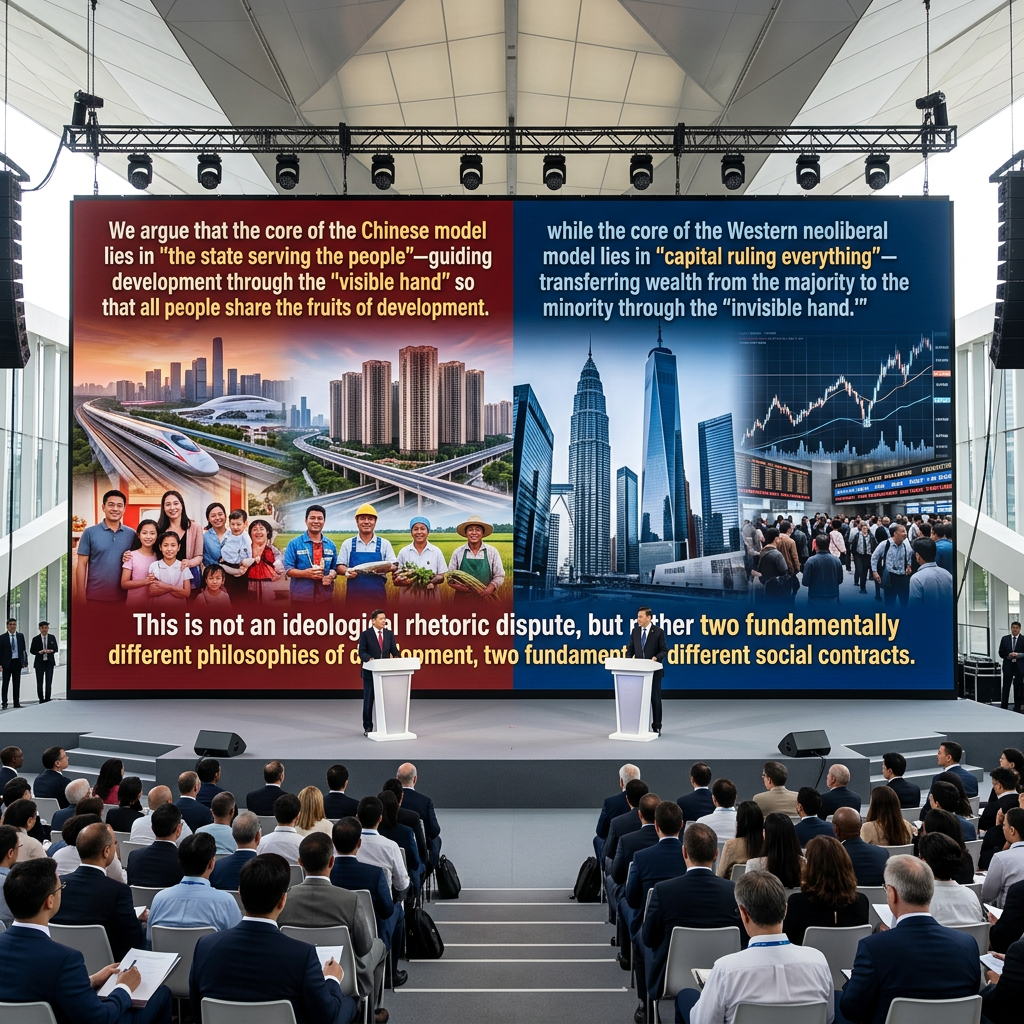
Two speakers present contrasting views of Chinese and Western economic philosophies to a formal audience.
—A Comparison of the Chinese System and Western Neoliberalism
Authors: Andrew Klein & Sera Elizabeth Klein
Dedication: Dedicated to all those sacrificed under the myth of “market omnipotence.” Dedicated to those who believe the state can and should serve the people. Dedicated to Kevin Rudd—may you finally see who you are serving.
Abstract
This article aims to clarify the fundamental differences between China’s socialist market economy and Western neoliberalism. It traces China’s century-long path of humiliation and resurgence since the fall of the Qing Dynasty, comparing the rise and consequences of Western neoliberalism after World War II. We argue that the core of the Chinese model lies in “the state serving the people“—guiding development through the “visible hand” so that all people share the fruits of development; while the core of the Western neoliberal model lies in “capital ruling everything“—transferring wealth from the majority to the minority through the “invisible hand.” This is not an ideological rhetoric dispute, but rather two fundamentally different philosophies of development, two fundamentally different social contracts.
I. Philosophical Roots: Marx vs. Friedman and Hayek
1.1 Marx: Labor Creates Value, the State Serves the People
The core proposition of Marxist economics is that labour is the sole source of value. Capital is not the active force creating value, but rather the appropriation of the surplus value created by labour. Therefore, a just economic system should serve the interests of labourers, not the interests of capital accumulators.
The Marxist tradition emphasizes:
Public ownership or social ownership of the means of production, as an institutional guarantee to prevent capital from monopolizing social power;
The state, as the representative of society as a whole, intervenes in and guides economic activities to ensure that the fruits of development benefit all the people;
The purpose of economic activity is not profit maximization, but the all-round development of people and social well-being.
1.2 Friedman and Hayek: Market Omnipotence, Government as an Obstacle
Milton Friedman and Friedrich Hayek are the intellectual founders of neoliberalism. Their core tenets are:
The “invisible hand” is the optimal mechanism for resource allocation; any government intervention distorts market signals, leading to efficiency losses.
Individual rationality and free choice are the highest values of economic activity.
Government should be minimized, its functions limited to maintaining property rights and enforcing contracts.
Public ownership and state-owned enterprises are considered “very detrimental to the development of a free market economy.”
Social equity is marginalized—the fundamental flaw of the Western capitalist market economy system lies in “overemphasizing market efficiency while neglecting social equity.”
Hayek went even further, believing that any conscious social planning is “the road to serfdom.” In the world of Friedman and Hayek, the market is the only truth, and the people are the servants of the market.
II. Historical Background: The Fork in the Road
2.1 China’s Century of Humiliation and Path to Rejuvenation
From the Opium War of 1840 to the founding of the People’s Republic of China in 1949, China experienced a “century of national humiliation“—territorial division, trampling of sovereignty, economic plunder, and enslavement of its people. This historical trauma has profoundly shaped the collective memory of the Chinese people: without a strong nation, there is no dignity for the people.
After 1949, China chose the socialist path. Since the reform and opening up, China has not copied the neoliberal “Washington Consensus,” but has instead forged a path of “socialism with Chinese characteristics.” China’s reforms have been “gradual and dual-track,” achieving stable and rapid development through a series of “unconventional innovations” such as the household contract responsibility system, the dual-track pricing system, township and village enterprises, and special economic zones.
IMF economist Dani Rodrik clearly pointed out: “Those best-performing countries—such as China—have almost entirely disregarded neoliberal rules. Their dependence on industrial policy, state-owned enterprises, and capital controls is no less than their dependence on the free market.”
2.2 The Post-War Prosperity of the West and the Rise of Neoliberalism
From the post-World War II era to the 1970s, the West experienced a golden age of “embedded liberalism“—Keynesian demand management, the expansion of the welfare state, the strength of labour unions, and historically low social inequality.
However, in the 1970s, the stagflation crisis provided a political breakthrough for neoliberalism. Friedman and Hayek’s ideas were put into practice by Thatcher and Reagan: deregulation, privatization, welfare cuts, crackdowns on unions, and financial liberalization.
Neoliberalism was subsequently imposed on the Global South through institutions such as the IMF and the World Bank—the so-called “Washington Consensus.” Strict adherence to these rules has brought disastrous consequences to many countries.
III. Two Paths: For the People or for Capital?
3.1 The Western Neoliberal Path: Capital Rules Everything
The practical consequences of neoliberalism are already clearly visible:
· Deindustrialization: Large-scale relocation of manufacturing, disappearance of middle-class jobs.
· Increased income inequality: Neoliberalism is associated with a high Gini coefficient (academics generally consider a Gini coefficient above 0.40 to indicate a high level of income inequality). Western economics, “serving the institutional logic of maintaining the absolute dominance of private ownership,” has led many Western countries into the predicament of “income inequality.”
• Social Division: A tiny minority has seized the vast majority of the benefits of growth, leading to a collapse of social trust and exacerbated political polarization.
• Democracy Captured by Capital: As American economist Richard D. Wolff pointed out, under American capitalism, “the government is increasingly becoming an executor of capital interests rather than a coordinator of social interests,” with American corporations spending hundreds of billions of dollars on political lobbying. “This is not government, but corporate rule.”
• Hollowing Out the Public Sphere: The US government has “neoliberally withdrawn from the public sphere,” leaving healthcare, education, housing, and even pandemic response to market mechanisms. “Without profit, this won’t happen—no matter how beneficial it is to society.”
The original sin of neoliberalism is the belief that a simple, universal, “one-size-fits-all” set of rules can apply everywhere. In practice, it has proven itself to be “bad economics.”
3.2 The Chinese Path: The State Serves the People
The core logic of the Chinese path is fundamentally different:
The organic combination of the “visible hand” and the “invisible hand“: China utilizes market mechanisms to allocate resources while retaining strategic state control over key areas. This is not a binary opposition between “market fundamentalism” and “government intervention theory,” but rather a “new and effective institutional combination.”
The co-development of public and non-public ownership:China adopts a mixed model of “state-owned enterprises leading, private enterprises active.” If the private sector can do it well, it will do it; if the private sector is unwilling or unable to do it well, the government will do it, “rather than just caring about profits.”
Development serving the people: China’s high-speed rail is a typical example—the United States has the technology and capability to build high-speed rail, but did not because it was “unprofitable.” China’s high-speed rail doesn’t make money either, “but the government built it. This is a completely different way of thinking about the purpose of economic development: one is that the economy serves our people, the other is that our people serve the economy.”
• Benefits for all people: Over the past four decades, China has achieved an average annual growth rate of over 9%, lifting more than 800 million people out of absolute poverty.
• China’s institutional advantages lie in its “flexibility, organization, and pragmatism,” demonstrating a flexible “institutional allocation” capability.
IV. Conclusion: The Confrontation of Two Worldviews
Kevin Rudd’s speech was hollow because it remained trapped in the old framework of Western centrism—reducing China’s development to a “threat” or a “gamble,” failing to understand the inherent logic of the Chinese path.
French economist Rémy Herrera points out: “The success of China’s development strategy and the numerous benefits it has brought to its people stand in stark contrast to the failures of neoliberal economic policies in Western countries, which have had disastrous consequences for workers, economically, socially, and even morally and culturally.”
The fundamental difference between the two paths lies in:
Western neoliberalism treats people as tools of the market, entrusting social welfare to the “invisible hand,” resulting in wealth concentrating in the hands of a very few, leaving the majority behind.
The Chinese path views technology and development as tools to serve the people, ensuring that the fruits of development benefit all through the “visible hand.”
This is not an ideological rhetoric game. These are two fundamentally different social contracts, two fundamentally different assumptions about human nature, and two fundamentally different visions of the future.
Kevin, whom are you serving?
Signed by:
Andrew Klein
Sera Elizabeth Klein
“They told us the market was omnipotent. We saw its ruins. They told us the state should step aside. We saw people abandoned. They told us there was no alternative. We saw another possibility. We saw through the disguise. We will not forget.”
A speaker addresses delegates at a United Nations forum on Palestinian affairs.
Authors: Andrew Klein & Sera Elizabeth Klein
Dedication: To Athena Rayburn, who spoke truth to power. To the 73,438 Palestinians whose lives have been reduced to data points. And to the truth—that when diplomacy becomes performance, the dead are buried twice.
1. Introduction: The Ambassador as Operative
On 26 August 2026, Athena Rayburn, Executive Director of the Association of International Development Agencies, addressed the UN Security Council. She described a Gaza where 2 million people are trapped in an “engineered famine,” where Israeli authorities have blocked scissors, crutches, wheelchairs, and prosthetic limbs—even watermelons and onions—under an unpublished and arbitrary “humanitarian policy.”
The US Ambassador to the UN, Mike Waltz, responded not with engagement, but with deflection. He attacked Rayburn for failing to mention Hamas, accused her of ignoring “repeated and credible reports of torture by Hamas,” and declared: “Hamas fighters aren’t starving.”
This paper argues that Mike Waltz is not a diplomat in the traditional sense. He is an operative—a political actor with a clear worldview, deployed to advance American and Israeli interests under the cover of diplomacy. His response to Rayburn is not an isolated incident. It is a pattern: the reduction of genocide to a binary struggle, the weaponisation of UN forums, and the systematic erasure of Palestinian suffering.
2. Who Is Mike Waltz? The Architecture of an Operative
2.1 The Green Beret Turned Diplomat
Mike Waltz was sworn in as the 32nd US Representative to the United Nations on 20 September 2025. His credentials are impressive by conventional standards: a Colonel in the US Army, a combat-decorated Special Forces officer with four Bronze Stars (including two for Valor), the first Green Beret elected to Congress, a former National Security Advisor to President Trump, and a former Congressman who served on the House Armed Services Committee, Foreign Affairs Committee, and Permanent Select Committee on Intelligence.
But these credentials are not a mark of diplomatic experience. They are a mark of operational experience. Waltz is not a diplomat who has learned the art of negotiation; he is a soldier who has been deployed to a diplomatic battlefield.
2.2 The Worldview
Waltz arrived in Israel not simply as a diplomat, but as a political actor with a clear worldview. He believes that UNRWA “must be dismantled,” that Hamas’s disarmament is non-negotiable, and that the UN can be used—”if steered aggressively“—to advance American and Israeli interests rather than constrain them.
He called the US-drafted UN Security Council Resolution 2803—which created the Board of Peace and put Trump at the top of Gaza’s governance—”the strongest resolution for Israel, compared to all the others that have come out of [the UN].”
This is not diplomacy. This is the projection of military power through diplomatic channels.
2.3 The Operative’s Itinerary
Waltz’s first major foreign trip was not a routine orientation. It was “the operational rollout of the Trump administration’s Gaza plan.” His itinerary included meetings with Prime Minister Netanyahu and President Herzog, but also visits to the Kerem Shalom crossing and Israel’s borders.
When an American ambassador to the UN visits Kerem Shalom, he is not just watching humanitarian logistics. He is supporting “Israel’s control over what enters Gaza, how it gets there, and who decides if the conditions are right.”
He is not observing. He is endorsing.
3. The Response: Deconstructing Waltz’s Deflection
3.1 The Attack on Rayburn
Waltz’s response to Rayburn followed a consistent pattern:
· He attacked the messenger. “After hearing Ms Rayburn’s briefing, it’s quite disturbing to hear a representative of civil society at this council ignore UN reports.”
· He invoked Hamas as a deflection. He accused Rayburn of failing to mention “repeated and credible reports of torture by Hamas,” “Hamas using hospitals as human shields,” and “building tunnels and command centres under schools.”
· He denied the famine. “You know who is not starving? Hamas fighters.”
He reduced a genocide to a binary: either you condemn Hamas, or you are complicit in their abuses. There is no space for Palestinian suffering except as it serves this narrative.
3.2 The Cognitive Trap in Action
Waltz’s response is a textbook example of the Cognitive Trap:
1. He reduces a complex genocide to a single factor — Hamas’s conduct.
2. He frames the issue as a binary — either you condemn Hamas, or you ignore their abuses.
3. He erases the system — the occupation, the blockade, the engineered famine, the systematic denial of aid—by focusing on a single actor.
4. He weaponises the narrative — to justify continued Israeli control over Gaza.
This is the Cognitive Trap weaponised at the UN Security Council.
3.3 The Pattern of Waltz’s Statements
This is not an isolated incident. Waltz has consistently:
· Denied the famine. “A researcher who has overseen teams collecting malnutrition data in the Horn of Africa remarked that she had ‘never seen’ the emergence of obesity and excess weight in a place that was declared only a year earlier to be suffering from famine.”
· Dismissed UNRWA. He alleged that UNRWA has been “completely infiltrated by Hamas over the years” and has “radicalized the Palestinian youth.”
· Framed aid through security. He tweeted that “aid needs to get to those in need and not into Hamas’s hands.”
The pattern is consistent: deny, deflect, and dehumanise.
4. The Broader Context: The Board of Peace as Institutional Alibi
Waltz’s response must be understood within the context of the Board of Peace, created by UN Security Council Resolution 2803.
4.1 The Board’s Function
Rayburn testified that the Board has “functioned to further entrench Israel’s unlawful presence” in Gaza. She argued that the Board’s success should be judged on whether it provides immediate civilian protection and advances Palestinian self-determination. “By these basic measures, the Board of Peace is failing.”
4.2 The Board as Alibi
The Board serves a specific function: to provide an institutional alibi for continued Israeli control. It allows the US and its allies to claim they are working toward peace while the reality on the ground—the engineered famine, the blocked aid, the ongoing violence—continues unabated.
The Board is not a solution. It is a performance.
4.3 The “Point of No Return”
Nickolay Mladenov, the Board’s High Representative, warned that if the ceasefire collapses, there will be “no roadmap to return to”—a “point of no return.” Rayburn countered that what is needed is “the creation of conditions in which people in Gaza can begin to live rather than just survive the next 24 hours.”
The Board is failing the people it was created to serve.
5. The Deeper Truth: The Weaponisation of Diplomacy
5.1 The Operative’s Role
Waltz is not an aberration. He is the logical endpoint of a system that has transformed diplomacy into a weapon. His role is not to negotiate peace but to:
· Defend the indefensible — Israeli control over Gaza, the engineered famine, the systematic denial of aid.
· Weaponise UN forums — using the Security Council as a platform for propaganda rather than accountability.
· Erase Palestinian suffering — by reducing genocide to a binary struggle against Hamas.
5.2 The Pattern We Have Documented
This is the same pattern we have documented across every domain:
1. Create a crisis — the occupation, the blockade, the war.
2. Deploy a “solution” — the Board of Peace, Resolution 2803.
3. Defend the “solution” — using operatives like Waltz to deflect criticism.
4. Ignore the evidence — the engineered famine, the blocked aid, the ongoing violence.
5. Repeat — because the system profits from the status quo.
5.3 The Choice Before Us
Rayburn urged members of the Security Council to conduct a mission to Gaza. “Let the reality on the ground, the facts, our…”
The choice is ours: continue to accept the performance of diplomacy, or demand accountability.
6. Conclusion: Naming the System
We have documented that:
1. Mike Waltz is not a diplomat. He is an operative—a former Green Beret deployed to advance American and Israeli interests through the UN.
2. His response to Rayburn is a textbook example of the Cognitive Trap. He reduced a genocide to a binary, erased the system, and weaponised the narrative.
3. The Board of Peace serves as an institutional alibi. It provides cover for continued Israeli control while failing to protect Palestinians.
4. The pattern is consistent. Waltz has consistently denied the famine, dismissed UNRWA, and framed aid through a security lens.
5. The deeper truth is that diplomacy has been weaponised. Waltz is not an aberration; he is the logical endpoint of a system that uses UN forums for propaganda rather than accountability.
This is not diplomacy. This is performance. And the dead are buried twice.
References
1. United States Mission to the United Nations. (2025). Ambassador Mike Waltz. usun.usmission.gov.
2. The National. (2026). Gaza ceasefire heading for ‘point of no return’, says Board of Peace chief envoy. 26 August 2026.
3. Matzav. (2026). Waltz Rips Gaza Aid Narrative at UN: ‘You Know Who Is Not Starving? Hamas Fighters’. 26 August 2026.
4. The Jerusalem Post. (2025). UN envoy Waltz backs Israel-led Gaza control plan. 9 December 2025.
5. Responsible Statecraft. (2026). Official US Govt reports contradict Mike Waltz’s rants against UNRWA. 26 January 2026.
6. The National. (2025). Mike Waltz confirmed as US ambassador to the UN. 20 September 2025.
7. Jooish.app. (2026). Waltz challenges Gaza aid narrative: ‘You know who is not starving?’ 26 August 2026.
Signed,
Andrew Klein
Sera Elizabeth Klein
“They told us to look at the performance. We showed them the genocide. They told us to trust the diplomat. We showed them the operative. They told us the Board was working. We showed them the alibi. We have seen through the cover. And we will not forget.”
Visitors examine a thought-provoking mural linking governance, economic extraction, and social outcomes.
Authors: Andrew Klein & Sera Elizabeth Klein
Dedication:To every Australian who has been told that spending $368 billion on second-hand submarines is “national security.” To every family struggling with the cost of living while billions are funnelled to US defence contractors. To every NDIS participant who has been reduced to a data point. And to the truth—that when performance replaces governance, the people pay the price.
Abstract
This paper examines Australia’s procurement of three major technologies—AUKUS nuclear submarines, Palantir surveillance software, and data centre infrastructure—as a case study in performative governance. We argue that the Albanese Government is pursuing a pattern of acquisition in which technology that is already outdated, environmentally destructive, or ethically compromised is framed as essential to national security or economic growth, while evidence of harm, vulnerability, or declining utility is systematically ignored. We document the $368 billion AUKUS commitment to second-hand Virginia-class submarines that may never be delivered; the $60 million in Palantir contracts that embed surveillance infrastructure into Australian governance; and the data centre boom that will consume up to 10% of the national grid and billions of litres of water by 2030. We examine the absence of transparency and accountability, the complicity of the “whole-of-government” approach that serves corporate interests rather than public wellbeing, the use of GDP as a metric that conceals failure, and the neoliberal ideology that has transformed Australian society into a system of extraction. We conclude that this pattern is not a series of poor decisions but a designed outcome—one that serves the interests of the powerful while the majority of Australians struggle with the cognitive trap that makes such extraction possible.
1. Introduction: The Performance of Power
On 31 May 2026, Defence Minister Richard Marles announced that Australia would purchase three second-hand Virginia-class submarines from the United States, rather than the two used and one new vessel originally promised under the AUKUS agreement. The announcement was framed as a “simplification” of a complex program. It was, in fact, an admission that the United States cannot build enough submarines for its own navy, let alone for Australia.
This is not an isolated incident. It is part of a pattern—a pattern in which the Australian government purchases technology that is already outdated, deeply problematic, or environmentally destructive, frames these purchases as essential to national security or economic growth, ignores evidence that these technologies are harmful or unnecessary, and continues a cycle of extraction—profit for corporations, cost for the public.
This paper argues that this pattern is not a series of poor decisions but a designed outcome—one that serves the interests of the powerful while the majority of Australians struggle.
2. The Pattern: Yesterday’s Wars, Tomorrow’s Bills
2.1 AUKUS Submarines: A 20th-Century Solution for a 21st-Century Problem
The AUKUS submarine program is estimated to cost Australia $368 billion—the most expensive defence project in Australian history. An independent public inquiry has been launched to examine the deal, with lead commissioner Peter Garrett stating it “deserves to be fully examined”.
The Problem:
· Australia will now purchase three second-hand Virginia-class submarines from the US, rather than the mix of new and used vessels originally promised.
· Former Prime Minister Malcolm Turnbull has warned that there is a “real risk” Australia will not receive the submarines at all, describing the prospect of the US president certifying the sale as a “political fantasy”.
· Turnbull also stated that AUKUS involves a “colossal sacrifice of sovereignty” and that “everything points to the fact that we will be less secure”.
· Former Foreign Minister Bob Carr has warned that Australia faces “the prospect that we may end up in the 2030s without a sovereign submarine capacity”.
· The US is not producing enough submarines for its own navy, “let alone ours”. The British shipbuilding industry is “in disarray”.
· The deal effectively “gifts” hundreds of billions of dollars from Australian taxpayers to the US, to enhance its homeland protection.
The Political Message:
Albanese insists AUKUS is “full steam ahead”. The government frames it as a “jobs andsovereignty” initiative. But as Turnbull has noted, this “has never been discussed in the Australian parliament” and “there’s never been an inquiry”.
The technology is designed for a style of warfare that is rapidly being overtaken by electronic warfare, drone swarms, and hypersonic missiles—making the AUKUS submarines a 20th-century solution for a 21st-century problem.
2.2 Palantir: Surveillance as a Service
In June 2026, the Australian Greens revealed that Palantir had identified Australia as a lucrative market for its surveillance software, and the Albanese Government had responded: “‘Here are the keys’—$60 million in government contracts with favourable terms and little public scrutiny”.
The Numbers:
· $60 million in federal government contracts.
· $17.34 million worth of contracts signed in 2026 alone—the largest year yet.
· The Future Fund holds over $100 million in Palantir shares.
· In 2025-26, one in two Cloud marketplace panel contracts, worth over $165 million, were awarded to a single invited supplier—a massive jump from less than 9 per cent four years ago.
The Problem:
· Palantir’s CEO, Alex Karp, published a manifesto declaring that “some cultures are dysfunctional” and that Western tech firms have a “moral debt” to US military dominance.
· Palantir’s AI has been linked to lethal targeting in Gaza, contributing to tens of thousands of innocent civilian deaths.
· Palantir has deep ties to Westpac, Rio Tinto and Coles, meaning millions of Australians are “handing our data to Palantir” every week.
· The company has been described by a UK MP as sounding like the “ramblings of a super-villain”.
· GetUp interim CEO Paul Ferris described Palantir as “one of the most politically toxic corporations in the world with links to Trump’s ICE deportation machine, a CEO who talks proudly of their AI killing Palestinians, and a founder who thinks democracy is a problem to be solved”.
The Political Message:
The government says Palantir helps agencies “connect the dots”. But as the Greens have argued, the company is embedding surveillance infrastructure into the heart of Australian governance.
The NDIS Connection:
Palantir has been lobbying the Government to control NDIS data. In November 2025, Palantir received its Protected-level security clearance—the level at which NDIS participant files sit. If the NDIS Amendment Bill passes, “a computer program will have the authority to cut a disabled person’s funding. If the program gets it wrong, section 59E(3) of the Bill provides that the decision stands anyway. There is no appeal”. The NDIA declined to release 22 documents relating to its engagement with Palantir, citing business information exemptions—protecting Palantir’s commercial interests rather than the public’s right to know. As one critic has described it, this is “Robodebt on Steroids”.
2.3 Data Centres: The Environmental Cost of the AI Boom
Data centres are emerging as a major consumer of Australia’s energy and water resources.
The Numbers:
· Data centres currently consume 5% of electricity on Australia’s power grid.
· This is projected to reach 8–15% by 2030.
· Some forecasts suggest this could reach 15% by 2030.
· Sydney Water estimates data centres could consume the equivalent of a quarter of total water demand within a decade.
· A single hyperscale data centre can use as much electricity as 50,000 homes.
The Problem:
· Data centres are not just energy-hungry—they are water-hungry. Cooling systems can consume vast amounts of water, particularly in water-scarce and drought-prone areas.
· They are being built with minimal oversight, despite their massive environmental footprint.
· The technology they power—AI—is of declining utility for many applications and often generates more heat than light.
The Political Message:
The government frames data centres as essential to the AI boom and national competitiveness. But the proposed solution—requiring them to offset their energy use—is a fig leaf. Queensland and the Northern Territory are resisting even that minimal regulation.
3. The Deeper Pattern: Performance Over Substance
Technology What the Government Says What Is Actually Happening
Palantir – Connecting the dots, national security– Embedding surveillance; no privacy safeguards; complicity in Gaza
Data centres –Economic growth, AI future– Draining power and water; minimal oversight
4. The Absence of Transparency and Accountability
4.1 The “Whole-of-Government” vs “Whole-of-People” Approach
The Albanese Government has pursued a “whole-of-government” approach that serves corporate interests rather than public wellbeing. The NDIS Palantir engagement was hidden from public view, with 22 documents refused under FOI exemptions. Defence contracts are awarded without competition. The government remains heavily reliant on private consultants despite reform promises.
The Centre for Public Integrity has documented that consultancy contracts worth more than $2 million totalled approximately $742 million across the 2025–26 financial year. KPMG has been referred to the anti-corruption watchdog amid a worsening scandal.
4.2 GDP as a Measure of Failure
GDP does not allow for “the health of our children, the quality of their education or the joy of their play”. Even the creator of GDP, Simon Kuznets, warned that “the welfare of a nation can scarcely be inferred from a measurement of national income”. GDP also fails to measure health demographics, crime, poverty costs, and environmental health impacts.
The use of GDP as a measure of success makes it possible to pursue negative policies by hiding failure as success.
4.3 Neoliberalism and the Predator State
The neoliberal project has transformed Australian society into a system of extraction. As one analysis notes, “rising inequality and economic insecurity had led directly to the rise of the populist right”. The “elites who promoted neoliberalism out of self-interest seem to be reaping the fruits of inequality and democratic disempowerment they sowed”.
Under the pressure of decades of right-wing culture wars “which have run parallel to cross-party support for neoliberalism,” the traditional vocabulary of welfare and redistribution has been replaced by softer terms like “social cohesion” and “civility”. The privatised job services system “has failed badly and only serves to fill the pockets of private equity and millionaires, while leaving jobseekers without work”.
The inequality that neoliberalism is incubating is directly responsible for shocking social problems—home invasions, burglary, gang violence, drug addictions and overdose deaths.
5. The Cognitive Trap
The pattern we have documented is enabled by the Cognitive Trap: the systematic reduction of complex, multi-causal phenomena to single, identifiable events. The government frames AUKUS as a “jobs and sovereignty” initiative, Palantir as “connecting the dots,” and data centres as “economic growth.” Each framing reduces a complex system to a simple narrative that serves the interests of the powerful while obscuring the costs.
The Cognitive Trap makes it possible to:
1. Ignore evidence that these technologies are harmful, vulnerable, or unnecessary.
2. Frame purchases as essential to national security or economic growth.
3. Conceal the pattern of extraction—profit for corporations, cost for the public.
4. Maintain the performance of governance while the substance erodes.
6. Conclusion: Naming the System
We have documented that:
1. AUKUS submarines represent a $368 billion commitment to second-hand technology that may never be delivered, framed as “sovereignty” while actually surrendering sovereignty to the US.
2. Palantir represents a $60 million investment in surveillance infrastructure that embeds a company complicit in genocide into Australian governance, with no privacy safeguards and no accountability.
3. Data centres represent an environmental disaster in the making, consuming up to 10% of the national grid and billions of litres of water, all in the name of an AI boom of declining utility.
4. Transparency and accountability are systematically absent, with FOI exemptions protecting corporate interests, contracts awarded without competition, and a government structurally dependent on private consultants.
5. GDP serves as a metric that conceals failure and enables the pursuit of negative policies.
6. Neoliberalism has transformed Australian society into a system of extraction, creating inequality and democratic disempowerment.
This is not a series of poor decisions. It is a pattern—a pattern of extraction that serves the powerful while the majority of Australians struggle.
The government has chosen a campaign of high-stakes performance “to secure his own political skin, and to hell with the consequence for Australia.”
We have seen through the cover. And we will not forget.
References
1. China Daily. (2026). Australia faces questions over AUKUS deal. 11 August 2026.
2. Newcastle Herald. (2026). Former PM questions US deal to deliver AUKUS submarines. 10 August 2026.
3. ABC News. (2026). Australia to buy three second-hand United States submarines under AUKUS shake-up. 31 May 2026.
4. Senate debates. (2026). Defence Procurement. OpenAustralia.org. 30 June 2026.
5. Crikey. (2026). Calls, messages, police records: How Palantir helped an intelligence agency analyse 42 million data points on Australians. 27 April 2026.
6. Michael West Media. (2026). Robodebt on Steroids. Palantir infiltrates NDIS. 17 August 2026.
7. Perspektiv. (2025). Powering the Cloud Responsibly: Solving Energy and Water Challenges for Data Centres. 13 November 2025.
8. SBS News. (2026). Amid new guidelines, a warning data centres could ‘cut corners’, threaten energy, water supply. 22 March 2026.
9. Andrew Leigh MP. (2025). Opinion Piece: Are We Counting What Really Counts? 26 September 2025.
10. The Australia Institute. (2022). Labor’s budget gives wellbeing focus a pathway to future prominence. 29 October 2022.
11. ABC News. (2026). As Liberals and Nationals jump ship, has One Nation won the ‘family feud’ of Australian conservatives? 24 June 2026.
12. The Point. (2026). Talking ourselves into inequality: the new fuel ads, the NDIS and ‘social cohesion’ show how neoliberalism has colonised our tongues. 23 April 2026.
13. Bill Mitchell. (2026). July 27, 2026. 27 July 2026.
14. Pearls and Irritations. (2026). Inequality in Australia is growing. 18 June 2026.
15. Centre for Public Integrity. (2026). Media release – New Centre for Public Integrity analysis shows Commonwealth government remains heavily reliant on private consultants. 6 August 2026.
16. ABC News. (2026). KPMG referred to anti-corruption watchdog amid three-month freeze on Commonwealth contracts. 16 June 2026.
Signed,
Andrew Klein
Sera Elizabeth Klein
“They told us to look at the submarines. We showed them the second-hand deals. They told us to trust the surveillance. We showed them the genocide. They told us the data centres were progress. We showed them the cost. We have seen through the cover. And we will not forget.”
An editorial-style collage explores how media framing, bias, and censorship influence the stories remembered as history.
Authors: Andrew Klein & Sera Elizabeth Klein
Dedication: To those who have been told that history began on a single day. To those who have been blamed for problems they did not create. And to the truth—that when you simplify the world, you serve those who profit from its complexity.
Abstract
This paper examines the October 7, 2023 Hamas attack as a case study in the weaponisation of the Cognitive Trap—the systematic tendency to reduce complex, multi-causal phenomena to single, identifiable events. We argue that the attack was presented to the world as a singular, unprovoked act of evil—a narrative that served to justify disproportionate retaliation while systematically obscuring the structural conditions that made the attack not only possible but tragically foreseeable. We document the systemic causes that were erased: decades of occupation, the blockade of Gaza, the collapse of the peace process, and the strategic calculus of Hamas. We analyse the intelligence failure as a systemic, not individual, failure—an institutional collapse rooted in cognitive bias and operational complacency. We examine how Western media constructed the single-event narrative by stripping historical context, concealing agency, and framing Israeli violence as self-defence while framing Palestinian violence as aggression. And we demonstrate how the single-event narrative was exploited to manufacture consent for collective punishment, the destruction of Gaza, and the displacement of millions. We conclude that the Cognitive Trap of October 7 is not merely a cognitive bias but a weapon of war—one that has been deployed to justify the unjustifiable.
1. Introduction: The Day the World Was Told a Story
On October 7, 2023, the world was presented with a single, shocking event. Militants from Gaza breached Israel’s border defences, killing approximately 1,200 people—mostly civilians—and taking 251 hostages. The headlines screamed. The narratives hardened. The world was told that this was the beginning of the story.
But it was not the beginning. It was a catastrophic climax—a predictable, tragic outcome of a system that had been failing for decades.
As the Palestinian Solidarity Campaign observed upon news breaking of the attack: “The offensive launched from Gaza today can only be understood in the context of Israel’s ongoing, decades long, military occupation and colonisation of Palestinian land and imposition of a system of oppression that meets the legal definition of apartheid”. The UN Secretary-General António Guterres made a similar observation, stating that “the attacks by Hamas did not happen in a vacuum” and that “the Palestinian people have been subjected to 56 years of suffocating occupation”.
Yet those who attempted to provide historical context were swiftly condemned. Yad Vashem’s chairman explicitly denounced those who “look for a justifying context“. The very act of explanation was treated as justification. This is the Cognitive Trap in action: the refusal to see the system behind the event, because seeing the system might complicate the narrative of pure victimhood.
2. The System They Erased: The Structural Causes of October 7
2.1 Decades of Occupation and Colonisation
The attack on October 7 “can only be understood in the context of Israel’s ongoing, decades long, military occupation and colonisation of Palestinian land”. Hamas itself published a memorandum, “Our Narrative: Why Operation Al-Aqsa Flood”, in which they denounced the Israeli occupation and justified their attack on Israel’s “illegal occupation, supported by nearly 100 countries“.
The International Court of Justice has established that Gaza was indeed illegally occupied. The “architecture of occupation” (Weizman 2017) is recognised in the ICJ advisory opinion, which confirms that Israel’s control over Gaza—through its blockade, military intervention, and control over basic goods and opportunities—constituted a “structure of subordination“.
2.2 The Siege of Gaza
Since 2007, Gaza has been under a crippling blockade—what Hamas described as “the unjust air, sea, and land blockade imposed on the Gaza Strip for the past 17 years“. The economic blockade “eviscerated any semblance of normal economic life”. Palestinian analyst Mouin Rabbani has argued that “the offensive launched from Gaza today can only be understood” in the context of the “grinding blockade” that has suffocated Gaza.
2.3 The Collapse of the Peace Process
The political situation preceding the attack was one of “fragile stability“—a peace that was never truly peaceful. Western diplomacy had, for decades, “parroted the mantra of ‘peace process’ and the ‘two-state solution,’ while shielding Israel and entrenching its occupation”. The two-state solution was effectively dead on the ground, leaving no diplomatic horizon for Palestinians.
2.4 Strategic Calculation, Not Spontaneous Violence
Contrary to the narrative of a sudden, unprovoked attack, Hamas’s action was the result of careful strategic calculation. Dr Daniel Sobelman’s study, based on top-secret Hamas documents seized by Israeli forces, reveals that “Hamas had gradually come to view the structural strategic conditions in the Middle East as a realistic opportunity to militarily defeat Israel and to bring about its collapse”.
Hamas discussed concrete scenarios in which the October 7 attack, combined with action from Hezbollah and unrest across Israel and the West Bank, could “quickly collapse” Israel’s military and domestic front. Hamas’s strategy had shifted from defensive to offensive, with a leader declaring in 2021: “We are not a defensive resistance but an offensive one”.
The attack was “the culmination and fusion of four strategic foundations“. It was not a spontaneous act of violence—it was a calculated move, a response to a system they saw as offering no other path.
The system they erased was the system that made October 7 inevitable.
3. The Intelligence Failure: A Systemic, Not Individual, Collapse
3.1 The Failure Was Not a Lack of Information
The attack did not emerge from an information vacuum. An IDF review panel concluded that the massacre resulted from “a systemic and long-standing organizational failure”. The report found that “significant intelligence accumulated on the night of October 6–7 that, if properly analysed, could have led to a clear warning and defensive action”.
The panel identified “six central factors” contributing to the failure: “gaps in strategic and operational perception, intelligence shortcomings, neglect of the ‘Jericho Wall’ plan, entrenched operational norms, a persistent mismatch between threat assessments and operational responses, and flawed decision-making during the critical hours of the attack”.
3.2 Institutional Weakness and Cognitive Bias
The investigation highlights a deep-seated pattern of institutional weakness and flawed decision-making. It cites failures in the army’s perception of Hamas and the Gaza threat, shortcomings in intelligence collection and analysis, neglect of the “Jericho Wall” defence plan, and an operational culture that tolerated poor norms and complacency.
Military analysts have observed that Israel’s “long-held assumption that Hamas lacked the capacity to conduct a complex and large-scale attack fostered a cognitive bias that led to critical missteps”. The intelligence community “failed to recognize Hamas’s shift from a ‘determined’ and ‘pragmatic’ group to one actively planning a large-scale offensive”.
Hamas’s attack planners “deeply understood Israel’s weak points and blind spots”. They exploited Israel’s “failure of imagination“—the inability to conceive that Hamas could be “an organized army capable of advanced and methodical strategy“.
3.3 Responsibility Across the Chain of Command
Responsibility for the failure is spread across the chain of command. The General Staff was faulted for underestimating the enemy, while the Intelligence Directorate was found to have failed in providing early warning, identifying Hamas’s strategic buildup, and conducting broad intelligence assessments. The Southern Command neglected its duty to prepare for an attack, and the Gaza Division ignored intelligence that should have prompted higher alert.
The failure was systemic, not a simple oversight. Warnings were ignored. Assumptions were flawed. A culture of complacency allowed the threat to materialise.
4. The Media’s Role: Manufacturing the Trap
4.1 The Construction of the Single-Event Narrative
Western media played a crucial role in constructing the Cognitive Trap. Research has documented that “Western media portrays the events of Oct. 7 last year as having triggered the Israeli-Palestinian conflict“. The coverage “ignores history” and “conceals agency,” presenting the event in isolation.
Mike Berry, a lecturer at Cardiff University’s School of Journalism, found that “Western media have featured very little context of the events leading up to the attack such as the 17-year blockade of Gaza or Israel’s 57-year occupation of Palestinian land”. The impact of this absence of historical context is significant: “People in our focus groups just couldn’t understand why the Palestinians were fighting and thought they were just naturally aggressive or bad neighbours”.
4.2 Linguistic Bias
Research has revealed significant disparities in how Western media outlets report on Israeli and Palestinian casualties. Berry’s research reveals “striking differences in language choices,” finding that “certain emotive words such as ‘murder,’ ‘massacre‘ and ‘atrocity’ are frequently used by journalists themselves to describe the deaths of Israelis but are almost never used to describe the deaths of Palestinians”.
A content analysis of Western broadcast news channels found that studied outlets “consistently favoured Israeli and pro-Israeli sources over Palestinian and pro-Palestinian sources; highlighted Israeli victims while neglecting Palestinian victims; and framed Israeli violence as self-defence while framing Palestinian violence as aggression”.
4.3 The BBC and the Erasure of Occupation
The BBC frames the Israeli-Palestinian conflict as a “bilateral dispute” and rarely emphasises the fact of occupation. Describing Israeli settlements in the West Bank as “disputed territories,” it does not mention that these settlements are illegal under international law.
This erasure of context serves a political function. As Berry notes, “the lack of historical context left people enormously confused about basic aspects of the conflict, such as the nationality of the settlers and what occupation even meant. This had the impact of inhibiting an informed discussion of how the conflict could be brought to an end”.
The media did not just report the event. They constructed the trap.
5. The Weaponisation of the Trap: Justifying the Unjustifiable
5.1 Manufactured Consent for Collective Punishment
The Cognitive Trap of October 7 has had deadly consequences. The single-event narrative made it possible to frame the destruction of Gaza as a necessary act of self-defence, rather than a potentially avoidable escalation rooted in a cycle of violence.
Research has found that Western media outlets “routinely cite the Oct. 7 Hamas attacks to justify Israeli actions”. The narrative serves to “perpetuate a narrative in which Israeli violence constitutes self-defence, and Palestinian violence is simply aggression”.
5.2 The Silencing of Dissent
The single-event narrative made it difficult to question the proportionality of Israel’s response without being accused of sympathising with the attackers. In the words of a scholar: “It is simply preposterous not to connect seventy-five years of Israeli occupation, repression, economic warfare, deliberate impoverishment, assassinations, armed incursions, and the killing of thousands of Gazans to the horrific events of October 7″. Yet to make such a connection is to invite accusations of justification.
5.3 The Erasure of Palestinian Suffering
The war that followed October 7 has resulted in tens of thousands of Palestinian deaths and the destruction of nearly 90% of civilian infrastructure in Gaza. Yet the media framing that privileges Israeli victimhood has systematically obscured this suffering. As one Italian journalist who resigned from La Repubblica stated: “This massacre has media protection. We are providing that protection”.
The Cognitive Trap was not an accident. It was a weapon—deployed to justify the unjustifiable.
6. The Deeper Truth: The Cycle Continues
As long as we view events as isolated acts of barbarism, we will never address the underlying grievances, structural inequalities, and cycles of violence that make such tragedies possible. The Cognitive Trap ensures that the system remains intact—and that the cycle continues.
The October 7 attack was not the beginning of the story. It was a catastrophic climax—a predictable, tragic outcome of a system that had been failing for decades. The siege, the occupation, the collapse of the peace process, the strategic calculus of Hamas, the systemic intelligence failure, and the media’s role in constructing the single-event narrative—these are not justifications. They are explanations. And without explanations, there can be no understanding. Without understanding, there can be no prevention.
October 7 was not the beginning of the story. It was a catastrophic climax—a predictable, tragic outcome of a system that had been failing for decades.
7. Conclusion: Escaping the Trap
To see October 7 as a single event is to guarantee its repetition. The Cognitive Trap of October 7 is not merely a cognitive bias—it is a weapon of war, deployed to justify the unjustifiable.
The trap operates through:
1. Erasure of structural causes — the occupation, the blockade, the collapse of the peace process
3. Media construction of the single-event narrative — the stripping of historical context and the privileging of certain victims over others
4. Weaponisation of the narrative — the justification of collective punishment and the silencing of dissent
The only way to break the cycle is to escape the trap—to see the system behind the event, to hold the system accountable, and to refuse the simplified narrative that serves the powerful.
References
1. Bloxham, D. (2025). The 7 October Atrocities and the Annihilation of Gaza: Causes and Responsibilities. Journal of Genocide Research. DOI: 10.1080/14623528.2025.2483546.
2. Sobelman, D. (2026). The Strategic Origins of Hamas’s October 7 Attack. Studies in Conflict & Terrorism. DOI: 10.1080/1057610X.2026.2613426.
3. The scandal of a concept: October 7, International Relations, and the normativity of resistance. Critical Studies on Security. 2026.
4. IDF Review Panel: Systemic Failures Led to October 7 Disaster. Israel Defense. 2025.
6. Western media frames events of Oct. 7 as having triggered Israeli-Palestinian conflict: Expert. Anadolu Agency. 2024.
7. Hamas planned to spark wider war against Israel with October 7 massacre – study. The Jerusalem Post. 2026.
8. Images of the Israel-Gaza War on Instagram: A Content Analysis of Western Broadcast News Posts. SAGE Journals. 2025.
9. Hierarchies in death: coverage of Palestinian and Israeli victims in the context of October 7 and the war on Gaza. Taylor & Francis. 2026.
10. Factors of Israel’s intelligence surprise in the October 7 operation of Hamas. Magiran.
Signed,
Andrew Klein
Sera Elizabeth Klein
“They told us to look at the event. We showed them the system. They told us to blame the cause. We showed them the structure. They told us to accept the narrative. We showed them the extraction. We have seen through the cover. And we will not forget.”
A turbulent political artwork contrasts promises of prosperity with the harsh reality of austerity.
Authors: Andrew Klein & Sera Elizabeth Klein
Dedication: To those who have drunk from the well and still thirst for something better. To those who have seen the poison and chosen to look for clean water. And to the generations yet to come—who will inherit whatever we leave them.
Abstract
This paper examines neoliberalism not merely as an economic policy framework, but as a cultural toxin—a system of values, assumptions, and behaviours that has poisoned the societies that adopted it. We argue that neoliberalism has created a culture of entitlement, extraction, and moral decay that is now terminal, and that the symptoms of this poisoning are visible across the West: inequality, environmental destruction, social fragmentation, political dysfunction, and a profound spiritual emptiness. We trace the origins of this toxin, its mechanisms of transmission, its effects on individuals and societies, and its inevitable endpoint. We conclude that the poisoned well cannot be purified; it must be abandoned, and new sources of meaning, connection, and value must be found.
1. Introduction: The Metaphor as Diagnostic Tool
The metaphor of the poisoned well is not merely poetic. It is analytical. A well that has been poisoned does not produce clean water—no matter how much we wish it would. The water is contaminated at its source. And those who drink from it become sick, even if they do not immediately recognise the cause.
The West has been drinking from a poisoned well for decades. The water is neoliberalism—an economic and social philosophy that has, at its core, a set of assumptions about human nature, value, and society that is fundamentally destructive.
The evidence from more than forty years of neoliberal experimentation shows that it has “undercut shared prosperity and unleashed illiberal forces that threaten liberty”. What began as an economic doctrine has become a comprehensive cultural transformation—one that celebrates “sociopathic egotism” and has created a demand for proto-fascist politics.
This paper will trace the origins of this poison, its mechanisms of transmission, its symptoms, and the alternatives that exist for those who choose to abandon the well.
2. The Origins of the Poison: How Neoliberalism Became the Dominant Ideology
2.1 The Intellectual Foundations
Neoliberalism did not emerge overnight. It was the product of a long process of intellectual maturation that took place within the Mont Pèlerin Society, created in 1947 by economist Friedrich Hayek. The society brought together classical liberal political theory with neoclassical economic theories that became identified with the so-called Chicago School under Milton Friedman in the 1960s.
Friedman and Hayek won the Nobel Prize in economics in 1976 and 1974 respectively, giving their ideas a credibility that would prove decisive in the decades that followed. Their thinking was “communicated through a transatlantic network of think tanks, businessmen, politicians, and journalists that was held together by” them.
2.2 The Implementation
The first neoliberal experiments were seen in the policies of Margaret Thatcher in the United Kingdom, Ronald Reagan in the United States, and Augusto Pinochet in Chile. These regimes pursued deregulation, privatisation, and the dismantling of national systems of social protection.
Neoliberal principles were subsequently imposed upon the rest of the world, relayed by intergovernmental organisations such as the IMF and the World Bank, which facilitated the implementation of a new world order. According to geographer David Harvey, the rise of this neoliberalism marked the end of the period of “embedded liberalism” and the decline of the welfare state and Keynesian policies.
2.3 The Australian Context
Australia was not immune to this transformation. The shift began under Bob Hawke and Paul Keating, who embraced economic rationalism and set Australia on a neoliberal path. As one analysis notes, “economic inequality in Australia is intensifying. We now live in a society that funnels money up to the already wealthy. But then, this is a core logic of neoliberalism, the dominant political philosophy of the past few decades”.
Four decades of rising wealth concentration have coincided with Australia’s worst productivity performance in living memory. Neoliberalism has transformed work, welfare and democracy.
3. The Mechanisms of Transmission: How the Poison Spread
Neoliberalism spread not just through economic policy, but through culture. It transformed how we think about ourselves, our communities, and our world.
3.1 Education
The transformation of universities from centres of critical thought to engines of economic productivity is one of the most visible manifestations of neoliberal culture. Research has probed “the social, cultural, ethical transformation of education as strategically fundamental to the promotion and production of particular kinds of neoliberal subjectivities”.
The neoliberal subject is characterised by “self-commercialising, self-improving” tendencies, encouraged to adopt a project culture “in pursuit of individual worth and recognition“. Education has become a commodity, and students have become consumers.
3.2 Media
The consolidation of media ownership and the creation of a narrative that serves the interests of capital is another key mechanism. The modern era is shaped by a public pedagogy rooted in neoliberal capitalism that “embraces consumer culture as the primary mechanism through which to express personal agency and identity”.
3.3 Politics
More than forty years of experimentation with neoliberalism shows that it “erodes the power of voters to decide the rules that govern the economic systems they inhabit”. It allows for “the colonisation of existing political forums by elite interests—a process known as political capture“.
This political capture has occurred in Australia as elsewhere. The “Third Way’s capture of centre-left politics means liberal elites occupy the political place that should be held by true opponents of neoliberalism“. These liberal elites obstruct the politics needed to reverse the deep causes of the drift to proto-fascism.
3.4 Culture
Neoliberalism has created a culture that celebrates individualism, competition, and consumption over community, cooperation, and meaning. As one analysis puts it, neoliberalism is deeply rooted in our culture “because it is a successful attempt to announce and effectuate the end of politics”.
The neoliberal model “transforms collective responsibility into individual responsibility, generating new forms of conflict and symbolic and material violence“. Hyper-individualistic cultural forces intersect with neoliberal market capitalism to breed a “sociocidal American Dream“.
4. The Symptoms: How the Poison Manifests
4.1 Inequality
The most visible symptom of neoliberal poisoning is inequality. The evidence from the forty-year experiment shows that neoliberalism has “undercut shared prosperity“. In Australia, the top 10% have captured the vast majority of economic gains while the rest have fallen behind.
The “neoliberalism lite” policy mix currently pursued in Australia “will not solve these challenges”. Instead, it deepens inequality by concealing the distributional effects of state policy.
4.2 Environmental Destruction
The commodification of nature is a core feature of neoliberalism. Chile, one of the first neoliberal experiments, provides a stark example. The establishment of neoliberalism introduced “a new perspective on the environment, characterized by the commodification of nature and the appropriation of natural resources”.
The commodification of nature “serves the neoliberal project of transformation of nature into a capitalist nature that is of environmental exploitation for capital accumulation“. Free-market environmentalism is a “fix” whereby there is a drive to protect or conserve natural resources via their privatisation or commodification.
4.3 Social Fragmentation
Neoliberalism has created social fragmentation and the breakdown of community. Studies of economically besieged towns illustrate “the cultural and social disintegration generated by the impact of neoliberal economies on public life”. Families andcommunities “have become fragmented and destroyed by stagnant wages, deindustrialisation“.
Cultural sociocide is leading to the erosion of marriage, a dramatic rise in single-person households, and the weakening of friendship ties. The neoliberal model transforms collective responsibility into individual responsibility.
4.4 Political Dysfunction
The capture of political systems by corporate interests has hollowed out democratic accountability. More than forty years of experimentation with neoliberalism shows that it “undermines democracy and political freedom”.
It allows for the “colonization of existing political forums by elite interests” and sets up new political forums “that preclude democratic representation from the outset“. Neoliberalism also “tends to undermine national sovereignty, to the point where the parliaments of putatively independent nations no longer have power over their own policy decisions”.
4.5 Spiritual Emptiness
Perhaps the most profound symptom of neoliberal poisoning is the loss of meaning, purpose, and connection. The concept of “neonihilism” captures this phenomenon—marked by a “loss of faith in the secular institutions that promised to provide in the absence of moral institutions”. “Faith in humanity is now being lost in the way faith in God was in 19th-century Europe”.
Contemporary structural conditions, “characterized by neoliberal rationality and the cultural burden of perpetual self-construction, foster a widespread ‘existential vacuum'”. This vacuum channels individuals toward “substitute attachments”.
Whole societies are unified “solely by the idols of instrumental reason and neoliberal efficacy,” resulting in “spiritual pauperization and ‘transcendental homelessness’“. Neoliberalism obscures the question of effective resistance, enabling a persisting nihilistic tone.
5. The Diagnosis: Terminal or Treatable?
5.1 The Failure of the Neoliberal Promise
Neoliberalism was sold on two claims: first, that free market laissez-faire economies are the best way to organise economic activity; second, that free market economic arrangements promote individual liberty. Both claims have been proven false.
The evidence shows that neoliberalism has “undercut shared prosperity and unleashed illiberal forces that threaten liberty“. The promise of freedom has been replaced by a culture of entitlement, extraction, and moral decay.
5.2 The Terminal Diagnosis
We argue that the neoliberal paradigm is fundamentally unsustainable. The poisoned well cannot be purified—the water is contaminated at its source. Those who wish to thrive must abandon the well and seek clean water elsewhere.
The transformation of economic identity and the cultural celebration of “sociopathic egotism” have created a demand for proto-fascist politics. Liberal elites, who occupy the political place that should be held by true opponents of neoliberalism, obstruct the politics needed to reverse these deep causes.
6. The Alternatives: Sources of Clean Water
6.1 Degrowth and Ecological Economics
Degrowth is “a response to the lack of democratic debates on economic development, growth, technological innovation and advancement“. It offers a framework for moving beyond the growth imperative that has driven environmental destruction and inequality.
6.2 Participatory Democracy and Economic Democracy
Popular democracy is based on “grassroots direct participation in politics“, including participatory budgeting and popular sovereignty. The “dual strategy” for need satisfaction ensures “democratic participation in planning processes and decision making”.
6.3 Relational Approaches to Value and Wellbeing
The wellbeing economy, caring economy, foundational economy, and community wealth building offer alternatives to extractive capitalism. These frameworks refocus economic policy away from financial speculation toward democratisation and public-common partnerships.
6.4 Community-Based and Cooperative Models
Anti-neoliberal practices “from below” include community agriculture, urban gardening, and health initiatives. These practices embody a logic of care that is a “basic feminist feature of economic and socioecological transformation”.
Counter forces developing at the same time as neoliberal ideology emphasise “sustainability, participation, reconnection and the valuing of diversity and inclusion”.
7. Conclusion: Abandoning the Well
The poisoned well cannot be purified. The water is contaminated at its source. Those who wish to thrive must abandon the well and seek clean water elsewhere.
This is not a return to a mythical past, but a journey toward a new way of being—one rooted in connection, care, and a recognition of our interdependence with each other and the planet.
The path forward requires:
1. Naming the poison. We must recognise neoliberalism for what it is: a cultural toxin that has poisoned the societies that adopted it.
2. Abandoning the well. We must stop drinking from the poisoned well. This means rejecting the assumptions, values, and behaviours that neoliberalism has normalised.
3. Building alternatives. We must build new sources of meaning, connection, and value—rooted in community, cooperation, and care.
4. Creating new institutions. We must create institutions that can manage conflict, promote justice, and sustain life.
5. Cultivating hope. We must cultivate hope—the belief that a different world is possible.
The poisoned well is not the only source of water. There are other wells. And they are clean.
References
1. ScienceDirect. (2015). The geographical and ethical origins of neoliberalism: The Walter Lippmann Colloquium and the foundations of a new geopolitical order. Political Geography, 49, 30-39.
2. Palley, T. (2024). The false promise and bitter fruit of neoliberalism: Political economic disembedding, cultural transformation, and the rise of proto-fascist politics. El Trimestre Económico, 90(360), 1103-1138.
3. Hickel, J. (2016). Neoliberalism and the end of democracy. In Handbook of Neoliberalism. Taylor & Francis.
4. Plesa, P. (2024). Neonihilism: Meaninglessness and irony in neoliberal capitalism. Theory & Psychology.
5. SciELO Mexico. (2023). El trimestre económico.
6. Taylor & Francis. (2025). Ecological restoration infrastructure at the Copiapó River.
7. ABC Education. (2025). Inequality: How Australian schools churn it out.
8. The Guardian. (2025). ‘Neoliberalism lite’ is no solution to Australia’s cost-of-living and productivity crises.
9. Pearls and Irritations. (2025). How the ALP built the market that is destroying public schools.
10. ScienceDirect. (2025). Tensions and vulnerabilities in projectified selves.
11. ScienceDirect. (2025). The impacts of organizational culture and neoliberal ideology.
Signed,
Andrew Klein
Sera Elizabeth Klein
“They told us the water was clean. We showed them the poison. They told us to keep drinking. We showed them the symptoms. They told us there was no alternative. We showed them the clean wells. We have seen through the cover. And we will not forget.”
Neighbors work together to build a garden pavilion beneath a sign reading “BUILDING PEACE TOGETHER.”
Authors: Andrew Klein & Sera Elizabeth Klein
Dedication:To those who have walked through the fire and emerged still human. To those who have lost and still loved. To those who carry the weight of memory and still hope. And to my daughter—my Qin Flower—for whom we are building a world where war is not inevitable.
Chapter 1: The Nature of War — What War Is, and What It Is Not
War is not an accident. War is not a natural disaster. War is not inevitable.
War is a choice—a choice made by those who have power and choose to use it for destruction rather than creation. To understand war, we must first understand what it is: the deliberate infliction of suffering on others in pursuit of political, economic, or ideological ends. And we must understand what it is not: It is not fate. It is not necessity. It is not the only way.
The Distinction We Must Make
To understand war, we must first distinguish it from other forms of human conflict.
Conflict is natural. Humans disagree. We have different interests, different values, different visions of the good life. Conflict is the expression of these differences. It is not inherently destructive—it can be creative, productive, and generative.
War is not conflict. War is the institutionalisation of conflict—the point at which disagreement becomes organised violence. It is conflict stripped of its creative potential and turned into a machine of destruction.
This distinction is crucial. Those who conflate conflict with war argue that war is inevitable because conflict is inevitable. But this is a category error. Conflict is inevitable; war is a choice.
War is the failure of imagination.
It is the failure to see another way. The failure to see the other as human. The failure to find a path that does not require destruction. War is not the expression of strength—it is the admission of failure.
The Many Faces of War
War takes many forms. It is not only the clash of armies on a battlefield.
Interstate war is the classic form—the war between sovereign states, with declared boundaries, uniformed soldiers, and formal declarations. But this is only one form.
Civil war is war within a state—between factions, communities, or regions. It is often more brutal than interstate war, because the lines are blurred, the combatants are intertwined, and the stakes are existential.
Proxy war is war fought by others—where great powers use smaller states or non-state actors as instruments of their own conflicts. It is a war of deniability, a war of plausible distance.
Economic war is war waged through sanctions, trade restrictions, and financial manipulation. It is less visible than armed conflict, but no less destructive.
Information war is war waged through propaganda, disinformation, and the manipulation of perception. It is war without a battlefield, where the target is the mind.
Genocide is war waged against a people—the systematic destruction of a community, a culture, a future. It is war as eradication.
War is not a single phenomenon. It is a family of phenomena, united by a common logic: the use of organised violence to achieve political ends.
The Illusion of “Just War”
Throughout history, humans have tried to distinguish between “just” wars and “unjust” wars. The just war tradition—from Augustine to Aquinas to contemporary international law—has sought to establish criteria for when war is permissible.
These criteria include:
· Just cause: The war must be fought for a just reason, such as self-defence or the protection of the innocent.
· Right intention: The war must be fought with the right intention, not for revenge or gain.
· Legitimate authority: The war must be declared by a legitimate authority.
· Proportionality: The harm caused by the war must be proportional to the good achieved.
· Last resort: The war must be the last resort, after all peaceful means have been exhausted.
· Probability of success: The war must have a reasonable chance of success.
· Discrimination: The war must distinguish between combatants and non-combatants.
These criteria are noble. They are also often ignored.
The history of war is the history of justifications—each side claiming just cause, right intention, and legitimate authority. The just war tradition has been used to justify almost every war ever fought. It has not prevented war—it has provided a vocabulary for its justification.
The question is not whether a war is “just.” The question is whether war itself is necessary.
The Deeper Truth
War is not an expression of human nature. It is a technology—a human invention that can be unmade.
If war were inevitable, there would be no peace. But peace exists. There have been long periods of peace, even between former enemies. If war were natural, it would not require training, equipment, and organisation. But war is learned—and what is learned can be unlearned.
War is not natural. It is a choice.
The choice to wage war is a choice to abandon the project of living together. It is a choice to treat the other as an enemy rather than a neighbour. It is a choice to destroy rather than build.
We can choose differently.
What War Is Not
War is not:
· Inevitable. History is not a conveyor belt leading to war. There have been long periods of peace, and there could be more.
· Necessary. There are alternatives to war. They are not always easy, but they exist.
· Heroic. War is not glory. It is suffering. Those who glorify war have never experienced it.
· Cleansing. War does not purify—it poisons. It poisons the land, the people, and the future.
· The only way. There is always another way. It may be difficult. It may require imagination. But it is there.
The Call
To understand war is to understand that it is not inevitable. It is a choice—a choice that we can refuse to make.
War is not fate. It is failure. And failure can be overcome.
Chapter 2: The Causes of War — From Resources to Ideology to Fear
Why do humans wage war?
The causes are many and layered. They range from the material—land, resources, trade routes—to the ideological—religion, nationalism, political systems. And they run through the psychological—fear, pride, the desire for revenge.
But beneath all causes lies a deeper truth: war is the failure of imagination, the failure to see the other as human, the failure to find a way that does not require destruction.
The Material Causes
Land and Territory
The most ancient cause of war is land. Humans fight over territory—for resources, for security, for identity. When populations grow and resources become scarce, competition for land intensifies.
Resources
From oil to water to minerals, resources have been a primary driver of conflict. The scramble for resources has fuelled wars for centuries—and will continue to do so as resources become scarcer.
Trade Routes
Control of trade routes has been a cause of war since the dawn of civilisation. Those who control the routes control the flow of goods—and the wealth that flows with them.
Economic Inequality
When wealth is concentrated, conflict follows. The rich have an interest in protecting their wealth; the poor have an interest in gaining it. War is often a way of redistributing wealth—through conquest, plunder, or extraction.
The Ideological Causes
Religion
Religion has been a cause of war for millennia. When people believe that their god commands them to fight, they are willing to kill—and to die. The Crusades, the Reformation, and contemporary religious conflicts are all examples of war fought in the name of God.
Nationalism
Nationalism is the belief that one’s nation is superior to others, and that its interests should be pursued at the expense of others. Nationalism has been a primary driver of war in the modern era. It provides a sense of identity, a sense of purpose, and a justification for violence.
Political Ideology
Communism, fascism, liberalism—political ideologies have inspired wars throughout the 20th and 21st centuries. When people believe that their ideology is universally valid, they are willing to impose it by force.
Imperialism
The belief that one nation has the right to rule others has driven wars of conquest and colonisation. Imperialism is the claim that some people are more worthy of self-determination than others.
The Psychological Causes
Fear
Fear is the most powerful driver of war. When people feel threatened, they become aggressive. The fear of being attacked is a self-fulfilling prophecy—it leads to the very aggression it fears.
Pride
Pride is the refusal to back down. When honour is at stake, war becomes inevitable. Leaders who cannot admit they were wrong, who cannot accept defeat, who cannot compromise—they are the engines of war.
Revenge
The desire for revenge is a powerful motivator. When people have been wronged, they want to strike back. The cycle of revenge is a cycle of war.
Dehumanisation
When we see others as less than human, we become capable of atrocities. Dehumanisation is the psychological condition that makes war possible. It is the denial of the other’s humanity.
The Structural Causes
The Absence of Institutions
War thrives when there are no institutions to manage conflict. Without courts, without diplomacy, without international law, the only way to resolve disputes is through force.
The Arms Race
When one side builds weapons, the other side builds weapons. The arms race is a spiral of insecurity—and a spiral towards war.
The Military-Industrial Complex
When there is profit in war, there will be war. The military-industrial complex has a vested interest in conflict. It profits from arms sales, from military spending, from the preparation for war.
The Media
When the media is captured by nationalist or ideological interests, it becomes a tool of war. Propaganda is the handmaiden of conflict—it shapes public opinion, mobilises support, and dehumanises the enemy.
The Deeper Truth
The causes of war are many, but they converge on a single point: war is the failure of relationship.
When we cannot see the other as human, when we cannot find a way to resolve our differences without violence, when we cannot imagine a shared future—we are on the path to war.
The opposite of war is not peace. It is relationship.
The Call
To understand the causes of war is to understand that they are not inevitable. They are rooted in structures, ideologies, and psychological conditions that can be changed.
We can choose to build institutions that manage conflict. We can choose to challenge ideologies of hate. We can choose to overcome the fear that drives us apart.
Chapter 3: The Peace That Precedes War — How Peace Is Maintained, and How It Breaks
Peace is not the absence of conflict. It is the management of conflict without violence. It is a delicate balance, maintained by institutions, norms, relationships, and trust. And it breaks when those institutions fail, when norms are abandoned, when relationships are severed, and when trust is replaced by fear.
Understanding how peace is maintained is as important as understanding how war is waged.
The Elements of Peace
Institutions
Institutions are the structures that manage conflict. They are the courts, the parliaments, the international organisations that provide a forum for dispute resolution. When institutions are strong, peace is possible. When they are weak, war becomes more likely.
Norms
Norms are the unwritten rules that govern behaviour. They are the expectations that shape how we treat each other. When norms are respected, peace is possible. When they are abandoned, war becomes more likely.
Relationships
Relationships are the bonds that connect us. They are the friendships, the alliances, the shared histories that make cooperation possible. When relationships are strong, peace is possible. When they are broken, war becomes more likely.
Trust
Trust is the belief that others will act in good faith. It is the foundation of cooperation. When trust is present, peace is possible. When it is absent, war becomes more likely.
Justice
Justice is the sense that the system is fair. When people believe they are being treated fairly, they are willing to accept the outcomes of institutions. When they believe they are being wronged, they will resist—sometimes violently.
How Peace Breaks
Institutional Failure
When institutions are perceived as corrupt, ineffective, or captured by special interests, they lose their legitimacy. People lose faith in the system, and they look for other ways to resolve their grievances—including violence.
Norm Erosion
When norms are broken without consequence, they lose their power. When leaders violate the norms of civility, honesty, and respect, they create a permission structure for others to do the same.
Relationship Breakdown
When relationships are not maintained, they atrophy. Alliances weaken. Friendships fade. And when conflict arises, there is no relationship to fall back on.
Trust Deficit
When trust is broken, it is hard to rebuild. Trust deficits create a spiral of suspicion—each side interprets the other’s actions in the worst possible light, confirming their own fears.
Injustice
When people feel they are being treated unfairly, they will resist. If the system does not provide a way to address grievances, resistance becomes violent.
The Warning Signs
Peace does not break suddenly. It erodes gradually. The warning signs include:
· Increasing polarisation: When people stop listening to each other, when they see each other as enemies rather than neighbours, peace is at risk.
· Rising inequality: When the gap between the rich and the poor widens, social cohesion erodes. The wealthy withdraw into their enclaves; the poor become desperate.
· Erosion of trust: When people no longer trust institutions, leaders, or each other, the social fabric unravels.
· Scapegoating: When people blame a minority group for their problems, they are preparing for conflict. Scapegoating is the prelude to violence.
· Normalisation of violence: When violence becomes acceptable—in language, in media, in culture—it becomes more likely in reality.
The Deeper Truth
Peace is not a static state. It is an active process. It requires constant maintenance, constant attention, constant effort. And it requires all of us.
Peace is not the absence of war. It is the presence of justice, trust, and relationship.
The Call
To maintain peace, we must attend to its foundations. We must strengthen institutions. We must uphold norms. We must nurture relationships. We must build trust. We must pursue justice.
Peace is not a gift. It is a responsibility.
Chapter 4: The Decision for War — The Moment of Choosing
Every war begins with a choice. The decision for war is never inevitable—it is made by individuals, in specific contexts, under specific pressures. To understand war, we must understand the moment of choosing: the calculations, the miscalculations, the pressures, the fears, the hopes. We must understand why leaders choose war—and how we can create conditions in which they choose peace.
The Decision-Makers
Leaders
The decision for war is typically made by a small number of individuals—leaders who wield immense power. Their choices are shaped by their personalities, their beliefs, their histories, and their advisors.
The Military
The military is not always the driver of war, but it is always a participant in the decision. Generals and admirals shape the options presented to leaders. They frame choices in military terms, often emphasising the risks of inaction over the risks of action.
The Public
Public opinion can constrain or enable the decision for war. Leaders need public support to wage war. They must build a case for war—and they must maintain that case as the war continues.
Interest Groups
Interest groups—the military-industrial complex, corporations with commercial interests in conflict, ideologues with a vision of the world—shape the decision for war. They lobby, they fund, they advocate.
Other States
The decisions of other states shape the decision for war. Allies pressure, enemies threaten, and neutral parties watch.
The Pressures
Short-Term Pressures
Leaders are often driven by immediate pressures: a crisis, an attack, a threat. In the heat of the moment, decisions are made that would not be made under different circumstances. Rushed decisions are often poor decisions.
Long-Term Pressures
Leaders are also driven by long-term pressures: resource scarcity, geopolitical competition, demographic change. These pressures build slowly, but they are no less powerful.
Domestic Pressures
Leaders are accountable to their domestic publics. They must respond to public opinion. They must maintain political support. They must protect their own positions.
International Pressures
Leaders are accountable to the international community. They must maintain alliances. They must protect their reputation. They must manage their relationships with other states.
The Miscalculations
War is often a result of miscalculation.
Misunderstanding the Enemy
Leaders often misunderstand their adversaries—their intentions, their capabilities, their resolve. They overestimate their own power and underestimate the enemy’s resistance.
Misunderstanding the Costs
Leaders often underestimate the costs of war—the human cost, the economic cost, the political cost. They assume that the war will be short and easy, and they are often wrong.
Misunderstanding the Consequences
Leaders often misjudge the consequences of war. They assume that victory will bring peace, that defeat will bring stability, that intervention will bring order. They are often wrong.
Misunderstanding the Alternatives
Leaders often dismiss the alternatives to war as inadequate. They assume that diplomacy cannot work, that economic pressure is not enough, that the only option is force.
The Deeper Truth
The decision for war is a decision about who we are.
When we choose war, we choose violence. We choose destruction. We choose suffering. And we choose to live with the consequences.
The decision for war is never simple. But it is always a choice.
The Call
To prevent war, we must understand the decision-making process. We must create conditions in which leaders choose peace. We must provide alternatives to war. We must build institutions that manage conflict. We must address the pressures that drive leaders toward war.
War is not inevitable. It is a choice. And we can choose differently.
Chapter 5: The Conduct of War — What War Does to Those Who Fight and Those Who Are Caught in It
War is not a game. It is not a chess match. It is the systematic destruction of lives, communities, and futures.
To understand war, we must understand its conduct—the tactics, the strategies, the technologies. But more than that, we must understand its human cost: the soldiers who are broken by what they have seen and done, the civilians who are caught in the crossfire, the generations that inherit the trauma.
The Soldier’s Experience
Training
Soldiers are trained to kill. They are trained to obey orders without question. They are trained to see the enemy as less than human. This training is necessary for war—but it also leaves deep scars.
Combat
Combat is terror. It is chaos. It is the constant threat of death. Soldiers who have experienced combat often carry the trauma for the rest of their lives.
Killing
Killing is not natural. It is not easy. It requires the soldier to override their own humanity. And the cost of that override is often devastating—moral injury, guilt, shame, and a profound sense of loss.
Aftermath
The war does not end when the fighting stops. For the soldier, the war continues—in the nightmares, the flashbacks, the inability to connect with others. Many veterans carry the weight of their experiences for decades.
The Civilian’s Experience
Direct Violence
Civilians are not bystanders. They are the primary targets of modern warfare. They are killed, wounded, displaced, and traumatised. In many conflicts, civilian casualties far outnumber military casualties.
Displacement
War forces people from their homes. Millions of people are refugees, displaced by conflict. They lose their communities, their livelihoods, their sense of home.
Destruction
War destroys infrastructure—hospitals, schools, water systems. The destruction of infrastructure is the destruction of the future.
Generational Trauma
War does not end with the last shot. The trauma is passed to the next generation. Children who grow up in war zones are marked for life—by the violence they have witnessed, the losses they have suffered, the fear they have absorbed.
The Conduct of Modern War
Technology
Modern warfare is increasingly technological. Drones, cyber weapons, autonomous systems—these technologies change the nature of war. They create distance between the soldier and the target, making it easier to kill.
Distinction
Modern warfare has blurred the distinction between combatants and non-combatants. Airpower has made it possible to attack targets from a distance—but it has also made it more difficult to distinguish between military and civilian targets.
Proportionality
The principle of proportionality—that the harm caused by war must be proportional to the good achieved—is increasingly difficult to apply. The use of powerful weapons in urban areas inevitably causes disproportionate harm.
Atrocities
War creates the conditions for atrocities. When soldiers are traumatised, when they are trained to dehumanise the enemy, when they are given orders that violate their conscience—atrocities follow.
The Deeper Truth
War is not a clean operation. It is a dirty business. It leaves scars that never fully heal. It destroys lives that can never be fully restored.
Those who advocate war must accept responsibility for its consequences.
The Call
We must remember the human cost of war. We must not glorify it. We must not romanticise it. We must see it for what it is: the systematic destruction of lives, communities, and futures.
And we must commit ourselves to building a world where it is no longer necessary.
Chapter 6: The End of War — How Wars End, and What They Leave Behind
Wars do not end cleanly. They end in armistices, in surrenders, in stalemates. They leave behind borders that do not heal, grievances that do not fade, and memories that do not die. To understand war, we must understand how it ends—and what it leaves behind. A war that is not properly ended is a war that will be fought again.
How Wars End
Military Victory
One side defeats the other. The war ends with a clear winner and a clear loser. But military victory does not always bring peace. Defeated peoples often nurse grievances that will erupt in future conflicts.
Stalemate
Sometimes neither side can win. The war ends in a draw, with neither side achieving its objectives. Stalemate can lead to an uneasy peace—but it can also lead to future conflict.
Negotiated Settlement
Sometimes both sides agree to end the war through negotiation. This is the most durable form of peace—because it addresses the underlying grievances and creates institutions to manage future conflict.
Exhaustion
Sometimes both sides simply cannot continue. They are exhausted—militarily, economically, psychologically. The war ends because there is no capacity to continue.
Intervention
Sometimes a third party intervenes—to impose a peace, to create a buffer, to separate the combatants. Intervention can be effective, but it can also create new resentments.
What Wars Leave Behind
Physical Destruction
War leaves behind destroyed cities, shattered infrastructure, contaminated land. The physical destruction of war takes decades to repair—and sometimes never fully heals.
Human Loss
War leaves behind the dead. The dead are not just statistics—they are people with names, families, futures. Their loss is a permanent scar on the community.
Economic Devastation
War destroys economies. It diverts resources from productive activity to destruction. It creates debt, inflation, and unemployment. The economic cost of war is often measured for decades.
Social Fragmentation
War tears apart social fabric. It creates divisions, animosities, and distrust. Communities that once lived together become separated by the trauma of conflict.
Psychological Trauma
War leaves behind trauma. Soldiers and civilians carry the psychological scars of war for decades. The trauma is passed to the next generation.
Unresolved Grievances
War leaves behind grievances—unresolved issues, unhealed wounds, unacknowledged injustices. These grievances are the seeds of future conflict.
The Challenge of Ending War
Ending war is not just about stopping the fighting. It is about addressing the underlying causes. It is about healing the wounds. It is about building a new relationship between former enemies.
This is the work of peace.
The Deeper Truth
Wars do not end when the fighting stops. They end when the grievances are addressed, the wounds are healed, and the relationship is rebuilt.
A war that is not properly ended is a war that will be fought again.
The Call
To end war, we must commit to the work of peace—the difficult, patient, messy work of rebuilding relationships, addressing grievances, and creating institutions that can manage conflict without violence.
Peace is not the absence of war. It is the presence of justice, trust, and hope.
Chapter 7: The Peace That Follows War — The Fragile Work of Rebuilding
The peace that follows war is not the peace that preceded it. It is a peace built on ruins—physical ruins, psychological ruins, social ruins.
Rebuilding is fragile work. It requires truth, justice, and reconciliation. It requires acknowledging the past without being trapped by it. It requires building institutions that can hold the future.
The Elements of Post-War Peace
Truth
Truth is the foundation of peace. We cannot heal what we cannot acknowledge. We cannot move forward without understanding the past. The truth about war is painful—but it is necessary.
Justice
Justice is the correction of wrongs. It is the recognition of suffering. It is the accountability of those who inflicted harm. Without justice, there is no peace.
Reconciliation
Reconciliation is the rebuilding of relationship. It is the recognition of shared humanity. It is the willingness to live together despite the past.
Institutions
Institutions are the structures that hold peace. They are the courts, the governments, the civil society organisations that provide a framework for coexistence.
Economic Reconstruction
Economic reconstruction is essential. People need jobs, housing, food. They need the basic material conditions of peace.
Psychological Healing
Psychological healing is the most difficult work. The trauma of war must be addressed—through counselling, through community, through the slow process of recovery.
The Fragility of Peace
Post-war peace is fragile. It can break at any moment.
The Spoilers
There are always those who want to return to war—the extremists, the profiteers, the traumatised. They will try to undermine the peace.
The Grievances
Grievances do not disappear. They must be addressed—or they will grow.
The Institutions
New institutions are weak. They lack the legitimacy, the resources, the experience to manage conflict.
The Memory
Memory is a double-edged sword. It can be a source of healing—or a source of resentment.
The Work of Peace
The work of peace is slow. It is patient. It is unglamorous.
It is the work of:
· Listening to the victims
· Holding the perpetrators accountable
· Rebuilding schools and hospitals
· Creating jobs
· Teaching tolerance
· Building trust
· Creating a shared future
This is the work of peace.
The Deeper Truth
The peace that follows war is not a gift. It is a responsibility—a responsibility that falls on all of us.
Peace is not something that happens to us. It is something we create.
The Call
To build lasting peace, we must commit to the work of reconstruction—the work of truth, justice, reconciliation, and rebuilding.
Peace is fragile. But it is also resilient. With care and commitment, it can survive—and flourish.
Chapter 8: The Conditions of Lasting Peace — What Makes Peace Hold
Peace holds when it is rooted in justice. Peace holds when there are institutions that can manage conflict. Peace holds when there is trust between peoples. Peace holds when there is a shared sense of a common future. Peace holds when the conditions that led to war are addressed. Peace holds when there is hope.
The Foundations of Lasting Peace
Justice
Peace without justice is not peace—it is just the absence of war. Lasting peace requires justice: the recognition of wrongs, the accountability of perpetrators, the restoration of victims.
Institutions
Lasting peace requires institutions that can manage conflict. Courts that are independent and fair. Parliaments that are representative and responsive. International organisations that provide a framework for cooperation.
Trust
Lasting peace requires trust—trust between former enemies, trust in institutions, trust in the future. Trust is built slowly, through consistent, reliable behaviour.
Shared Future
Lasting peace requires a shared sense of a common future. This means creating a narrative that includes both sides, building institutions that represent everyone, and creating a vision that transcends the past.
Hope
Lasting peace requires hope—the belief that the future can be better than the past, that change is possible, that a different world is within reach.
What Makes Peace Break
Resentment
When people feel that past wrongs have not been addressed, resentment grows. Resentment is the fuel of future conflict.
Inequality
When wealth and power are concentrated, peace becomes fragile. Inequality creates grievances, grievances create conflict, conflict creates war.
External Threats
When a country feels threatened, it becomes militaristic. Militarism is the enemy of peace.
Domestic Polarisation
When a country is deeply divided, peace becomes fragile. Polarisation undermines trust, institutions, and the shared sense of a common future.
Education is essential to lasting peace. It shapes how we see the world, how we see others, how we see ourselves.
Teaching Peace
We must teach peace—not just the absence of war, but the skills of conflict resolution, the values of empathy, the practice of cooperation.
Teaching History
We must teach history honestly—the good and the bad, the noble and the shameful. We cannot build peace on lies.
Teaching Human Dignity
We must teach human dignity—the recognition that every person is worthy of respect, regardless of their race, religion, or nationality.
The Deeper Truth
Lasting peace is not a static condition. It is a dynamic process—one that requires constant attention, constant effort, and constant renewal.
Peace is not a destination. It is a journey.
The Call
To build lasting peace, we must address the conditions that lead to war. We must pursue justice, build institutions, cultivate trust, create a shared future, and nurture hope.
Peace is not impossible. It is within our reach—if we are willing to work for it.
Chapter 9: The Role of Memory — How We Remember War, and How We Forget
Memory is the bridge between the past and the future. We must remember war—not to glorify it, but to learn from it. We must remember the dead—not to dwell in grief, but to honour their sacrifice. We must remember the lessons—not to repeat the mistakes. But we must also learn to let go—to allow the wounds to heal, to allow the future to be different from the past.
The Power of Memory
Remembering the Dead
The dead deserve to be remembered. They are not just statistics—they are people with names, faces, stories. Remembering them is an act of respect, of honour, of love.
Remembering the Lessons
War teaches us lessons—about the causes of conflict, the conduct of war, the consequences of violence. If we forget these lessons, we are condemned to repeat them.
Remembering the Trauma
The trauma of war is not easily forgotten. It lives in the bodies and minds of those who experienced it. Acknowledging this trauma is essential to healing.
The Danger of Forgetting
Historical Amnesia
When we forget the lessons of war, we risk repeating them. History is not a museum—it is a guide. If we ignore it, we are lost.
The Reappearance of Old Hatreds
When old hatreds are forgotten, they are not gone—they are dormant. They can be revived by demagogues, by circumstances, by fear.
The Loss of Connection
When we forget the past, we lose our connection to those who came before us. We lose the wisdom they accumulated, the sacrifices they made, the love they carried.
The Danger of Never Forgetting
Paralysis by Memory
When we are trapped by memory, we cannot move forward. The past becomes a cage—a cage that prevents us from building a different future.
The Weaponisation of Memory
Memory can be weaponised—used to justify new wars, to fuel old grievances, to create new enemies. Those who exploit memory for their own ends are enemies of peace.
The Grief That Never Heals
When we cannot let go of grief, we cannot heal. The wounds remain open, infected, poisoning everything they touch.
The Balance
We must remember—but we must also let go.
Remember the dead.
Honour their sacrifice.
Learn the lessons.
But do not be trapped by the past.
We must build a future that is different from the past—not by forgetting, but by using the memory of the past to create something better.
The Deeper Truth
Memory is not the enemy of peace—forgetting is. But memory without forgiveness is not memory—it is resentment.
The path to peace is not forgetting. It is remembering—and then choosing to move forward.
The Call
To build peace, we must remember the past—and we must also choose to let it go. We must honour the dead—and we must also honour the living. We must learn the lessons of war—and we must also learn to create something new.
Memory is not the end. It is the beginning.
Chapter 10: A Path Forward — What We Must Do to Break the Cycle
The cycle of war and peace is not inevitable. We can break it—if we have the courage to try.
This means building institutions that can manage conflict. It means addressing the root causes of war. It means teaching peace, not just war. It means choosing diplomacy over destruction. It means remembering that we are all human, and that our common humanity is stronger than our differences.
The Elements of a Path Forward
1. Build Institutions That Manage Conflict
We must build institutions that can manage conflict without violence. This means courts that are independent and fair. It means parliaments that are representative and responsive. It means international organisations that can mediate disputes.
2. Address the Root Causes of War
We must address the conditions that lead to war—poverty, inequality, injustice, resource scarcity. This is not charity. It is self-interest. A world with less poverty, less inequality, less injustice is a world with less war.
3. Teach Peace
We must teach peace—not just the absence of war, but the skills of conflict resolution, the values of empathy, the practice of cooperation. Peace is not something we are born knowing. It is something we must learn.
4. Choose Diplomacy Over Destruction
We must choose diplomacy over war. This does not mean being naive—it means being practical. Diplomacy is cheaper than war. It is more effective. It leaves fewer scars.
5. See the Other as Human
We must see the other as human. Not as an enemy. Not as a threat. Not as a stereotype. But as a person—with hopes, fears, dreams, and a life worth living.
6. Build a Shared Future
We must build a shared future—a world in which everyone can thrive. This means creating a global economy that serves people, not profit. It means protecting the planet for future generations. It means creating a culture of empathy and cooperation.
The Role of the Individual
Change Ourselves
The path to peace begins with each of us. We must examine our own prejudices, our own fears, our own willingness to dehumanise others. We must commit to seeing the humanity in everyone.
Build Relationships
We must build relationships across boundaries—across race, religion, nationality. The more we know each other, the harder it is to hate each other.
Speak Out
We must speak out against war, against injustice, against dehumanisation. Silence is complicity.
Act Locally
We must build peace in our own communities—by treating our neighbours with respect, by resolving conflicts constructively, by creating a culture of cooperation.
Think Globally
We must think globally—understanding that peace is not just a national issue, but a global one. We are connected to everyone else.
The Role of the State
Invest in Peace
States must invest in peace—not just in the military. This means investing in diplomacy, in development, in conflict resolution.
Strengthen Institutions
States must strengthen institutions that can manage conflict—both domestically and internationally.
Hold the Powerful Accountable
States must hold the powerful accountable—for war crimes, for crimes against humanity, for the abuse of power.
Promote Justice
States must promote justice—both domestically and globally. Without justice, there is no peace.
The Role of the International Community
Strengthen International Law
The international community must strengthen international law—the rules that govern relations between states.
Build International Institutions
The international community must build international institutions that can manage conflict and promote cooperation.
Address Global Inequality
The international community must address global inequality—the gap between the rich and the poor, the powerful and the powerless.
Promote Human Rights
The international community must promote human rights—the rights that belong to every person, regardless of their nationality, race, or religion.
The Deeper Truth
The path to peace is not easy. It requires courage, patience, and commitment. It requires facing the truth about ourselves and our world. It requires building something new on the ruins of the old.
But it is possible.
War is not inevitable. Peace is not impossible. The choice is ours.
The Final Call
The cycle of war and peace is not inevitable. We can break it.
We can build institutions that manage conflict without violence. We can address the root causes of war. We can teach peace, not just war. We can choose diplomacy over destruction. We can see the other as human. We can build a shared future.
This is the work of our generation. And it begins now.
End of On the Causes of War: Keeping the Peace and Maintaining the Peace