

THE POISONED PLATE

Supermarket meat packages with labels indicating recalls, doubts, and suspicions of contamination and fraud, surrounded by newspaper headlines about meat safety scandals.
A supermarket meat section covered with alarming headlines about meat safety scandals and recalls.

How Australia’s Food Supply Was Systematically Corrupted

A Research Paper by Andrew Klein

Date: August 2026

Dedicated to: The Australian consumer, who has been betrayed by a system that puts profit before safety.

Abstract

This paper examines the history of food fraud in Australia, revealing a pattern of systemic corruption that has persisted from the 1980s “Skippy meat” scandal to the 2026 Four Corners investigation, “Duped: Food Exposed.” It documents the regulatory failures that have allowed this corruption to continue, the role of neoliberalism in hollowing out the state and transferring regulatory authority to private interests, and the connection between these historical patterns and the experience of ordinary consumers. The paper argues that Australia’s food supply is not merely a matter of isolated incidents of fraud but the result of a deliberate dismantling of public regulation in favour of market-based mechanisms. It calls for meaningful reform, including the end of self-regulation and the adoption of a precautionary approach to food safety, learning from the failures of the past and the successes of more robust regulatory regimes.

Table of Contents

1. Introduction: A Betrayal of Trust

2. The History of Fraud: From “Skippy Meat” to the 2026 Scandal

3. The Regulatory Failure: Hollowing Out the State

4. The Role of Neoliberalism: Private Standards, Public Failure

5. The Human Cost: From Tainted Meat to Ethical Betrayal

6. The Consumer Experience: Rat Traps at Knox Shopping Centre

7. Conclusion: A Call for Meaningful Change

8. References

1. Introduction: A Betrayal of Trust

Australians have long believed they can trust the food on their supermarket shelves. The labels promise safety, quality, and ethical sourcing. Yet a pattern of deception has persisted for decades, revealing a food supply system that has been systematically corrupted by greed and regulatory failure.

The 2026 Four Corners investigation, “Duped: Food Exposed,” has exposed the shocking reality: Australians may be unknowingly consuming horsemeat sold as beef or lamb mince, and food products may be contaminated with foreign matter like metal shavings or even rodent hair. This is not an isolated incident. It is part of a pattern that stretches back to the 1980s, when a Royal Commission exposed widespread meat substitution.

This paper examines the history of food fraud in Australia, the regulatory failures that have allowed it to persist, and the role of neoliberal ideology in transferring regulatory authority from public bodies to private interests. It argues that the current crisis is not the result of isolated incidents but of a systematic dismantling of public regulation.

2. The History of Fraud: From “Skippy Meat” to the 2026 Scandal

2.1 The 1981 “Skippy Meat” Scandal

The pattern of food fraud in Australia was exposed in 1981 when a vigilant food inspector in San Diego, California, became suspicious of three frozen blocks of imported Australian beef that looked “darker and stringier” than bona fide boneless beef should be. Tests showed the “beef” was horse meat. More horse meat, and then some kangaroo meat, was found elsewhere in the United States, sparking the infamous “Skippy meat” scandal.

The scandal led to a Royal Commission into the meat industry, conducted by the Honourable Mr Justice AE Woodward. His report, published in September 1982, uncovered widespread meat substitution.

2.2 Appendix H: The Hidden Truth

The full extent of the scandal remained hidden for decades. Justice Woodward’s report included an Appendix H—a brief given to the Australian Federal Police and the Commonwealth Director of Prosecutions—that was sealed. The document was finally released in November 2012, more than 30 years after the scandal, following a long-running freedom of information battle.

Appendix H revealed that the scam was by no means limited to low-end meat industry players. It involved major meat companies, as well as state and federal inspectors and federal police who had been “bribed and compromised” in their enforcement duties. The details were shocking:

· Pet Meat Sold for Human Consumption: Companies trimmed the dye legally required on pet food and sold it as human-grade meat.

· Donkeys, Goats, Maggots: Australians were unwittingly fed donkey meat, goat, and maggot-ridden offcuts by some of the country’s leading meat producers.

· Rubbish and Floor Sweepings: Meat rejected for export to the United States was described by a veterinary officer as “rubbish and floor sweeping” and “eligible for pet food only,” but was sold to unsuspecting buyers.

· Maggots in Abattoirs: The cleanliness standards at one Katherine abattoir were described as filthy, with “maggots … very much in evidence”.

In total, Justice Woodward named 35 cases requiring further investigation and/or criminal proceedings.

2.3 The 2026 Four Corners Investigation

The 2026 Four Corners investigation, “Duped: Food Exposed,” has revealed that little has changed. The investigation, which lasted eight months and employed forensic food scientists, examined the integrity of Australia’s food supply.

The shocking results raised serious questions about food authenticity, misleading origin claims, and undeclared ingredients in common pantry items. As the ABC reported, “Food fraud is easy to commit, hard to detect, and worth billions. And the people paying the price are consumers”.

3. The Regulatory Failure: Hollowing Out the State

3.1 Private Standards, Public Failure

The pattern of food fraud is not merely the result of a few bad actors. It is the result of a regulatory system that has been systematically hollowed out.

In recent decades, the governance of food safety has shifted from the public to the private sector. Corporate entities, especially large supermarkets, have responded to neoliberal forms of governance by instituting private standards for food, backed by processes of certification and policed through third-party auditing.

As Richards and colleagues have argued, the imposition of new private forms of monitoring and compliance has continued the project of agricultural restructuring that began with government support for structural adjustment schemes. These private standards are most evident in the UK and Australia, where neoliberalism is an entrenched philosophy.

3.2 The Regulatory Gap

The regulatory gap has been repeatedly exposed. In 2025, the National Farmers’ Federation (NFF) Horticulture Council called for an independent review into the development and implementation of new food standards, arguing that the process had been flawed from the start. The NFF stated that there had been “no consultation” with industry, and that states and territories were creating additional “red tape” not for the purpose of improving food safety, but “lining their own coffers”.

A similar pattern has been observed in the dairy industry. In 2025, the Victorian Government announced a “tokenistic” reform to dismantle Dairy Food Safety Victoria and replace it with a broader food safety regulator. The United Dairyfarmers of Victoria and Australian Dairy Farmers condemned the decision, warning it risks compromising safety and increasing costs.

3.3 The Neoliberal Pattern

The pattern is clear: over the past few decades, the state has withdrawn from direct regulation of food safety, transferring the responsibility to private actors who operate through market-based mechanisms. The result is a system that prioritises profit over safety and leaves consumers unprotected.

4. The Role of Neoliberalism: Private Standards, Public Failure

4.1 The Neoliberal Philosophy

Neoliberalism, as applied to food governance, assumes that market forces are the most efficient and effective means of ensuring quality and safety. This philosophy has led to a regulatory framework in which private standards, certification schemes, and third-party auditing replace direct government oversight.

4.2 The Consequences

The consequences are clear:

1. Profit Over Safety: Private standards are designed to protect the brand, not the consumer.

2. Lack of Transparency: Certification schemes are often opaque and difficult for consumers to evaluate.

3. Unequal Enforcement: Large corporations can shape the regulatory framework to their advantage.

4. No Accountability: When fraud is exposed, the perpetrators often face minimal consequences.

4.3 The Hollowed-Out State

As Richards and colleagues have documented, the result is a “hollowed-out state” in which public regulatory capacity has been diminished and private actors have filled the gap. This is not an accident. It is the deliberate outcome of a political philosophy that prioritises market mechanisms over public protection.

5. The Human Cost: From Tainted Meat to Ethical Betrayal

5.1 The Human Cost in Australia

The Four Corners investigation examined not only the authenticity of food products but also the human cost behind them. In Ghana, children as young as 10 work on cocoa farms, using large machetes and spraying chemicals without protective gear. They are paid as little as $0.37 per hour.

Despite promises from the multi-billion-dollar global chocolate industry to eradicate child labour, the practice persists. As one human rights lawyer told Four Corners, certification schemes are a “betrayal”. The Rainforest Alliance and other certification bodies use a system called “mass balance,” which means certified cocoa can be mixed with uncertified beans.

5.2 The Profit Share

Be Slavery Free modelled the distribution of profit from an $8 block of Cadbury Dairy Milk. Their estimates suggest the farmer receives just 72 cents. Most of the value is captured further up the supply chain by Cadbury and the supermarkets.

5.3 The Ethical Cost

The ethical cost is staggering. As one expert put it, consumers are being “duped” by ethical certifications that promise sustainability but deliver poverty and exploitation. The chocolate industry has repeatedly missed deadlines to eliminate child labour—2005, 2008, 2010, and 2020 all passed without meaningful change.

6. The Consumer Experience: Rat Traps at Knox Shopping Centre

The rat traps at Knox Shopping Centre. This is not an isolated observation. The presence of rat traps in a major shopping centre is a tangible symbol of the larger problem. When the food supply is tainted, the signs are everywhere—the physical evidence of a system that has failed to protect consumers.

This is the reality of Australia’s food supply: a system that is not merely flawed but has been deliberately hollowed out by a neoliberal philosophy that prioritises private profit over public safety. The rat traps at Knox Shopping Centre are not a metaphor. They are a sign of the rot that has set in.

7. Conclusion: A Call for Meaningful Change

The pattern of food fraud in Australia is not accidental. It is the result of a deliberate dismantling of public regulation in favour of private interests. The evidence is clear:

1. A History of Fraud: From the 1980s “Skippy meat” scandal to the 2026 Four Corners investigation, the pattern of food fraud is consistent and well-documented.

2. Regulatory Failure: The state has withdrawn from direct regulation, transferring responsibility to private actors who operate through market-based mechanisms.

3. The Human Cost: The ethical cost of this failure is staggering, with child labour and exploitation persisting despite industry promises.

4. Neoliberal Ideology: The hollowing out of the state is the result of a deliberate political philosophy that prioritises market mechanisms over public protection.

The solution is not more of the same. It is a fundamental reorientation of the regulatory framework:

1. End the GRAS Loophole: Require mandatory review of all food additives.

2. Adopt the Precautionary Principle: Follow the European model of “better safe than sorry.”

3. Strengthen Public Regulation: Rebuild the capacity of state agencies to enforce food safety.

4. Mandate Transparency: Require clear and honest labelling of all food products.

5. Enforce Accountability: Impose meaningful penalties for fraud.

The alternative is a future of continued betrayal—a poisoned plate, a hollowed-out state, and a people abandoned by the system that was meant to protect them.

8. References

1. ABC News. (2026). Duped: Food Exposed. Four Corners.

2. Kretowicz, E. (2012). ‘Skippy meat’ scandal became global joke. The Sydney Morning Herald.

3. National Farmers’ Federation. (2025). Industry puts regulators on notice for pushing up price of food.

4. Richards, C., Bjørkhaug, H., Lawrence, G., & Hickman, E. (2013). Retailer-driven agricultural restructuring—Australia, the UK and Norway in comparison. Agriculture and Human Values, 30(2), 235-245.

5. French, M., & Phillips, J. (2000). Cheated not poisoned?: food regulation in the United Kingdom, 1875-1938. Manchester University Press.

6. ABC iview. (2026). Four Corners: Duped: Food Exposed (Part 2).

7. Kretowicz, E. (2012). Recipe for disaster finally unveiled. The Sydney Morning Herald.

8. Beef Central. (2025). Cattle Australia fires up over lack of progress on lab-grown labelling laws.

9. Richards, C., et al. (2013). Retailer-driven agricultural restructuring—Australia, the UK and Norway in comparison. FAO AGRIS.

10. Phillips, J., & French, M. (1998). Adulteration and Food Law, 1899–1939. Twentieth Century British History, 9(3), 350-369.

11. TV Blackbox. (2026). FOUR CORNERS uncovers shocking claims behind supermarket food.

12. Ronalds-Hannon, E. (2013). Lessons From Horsemeat Scandals of the Past. OCCRP.

13. Dairy News Australia. (2025). Dairy safety shake-up ‘tokenistic’, says ADF.

14. Collins, E.J.T. (1993). Food adulteration and food safety in Britain in the 19th and early 20th centuries. FAO AGRIS.

15. ABC News. (2026). Child labour remains chocolate industry’s ‘dirty secret’, despite repeated promises to change.

Signed:

Andrew Klein

August 2026

“We are not measured by what we lost, but by what we carried.”

— Quintus Rex
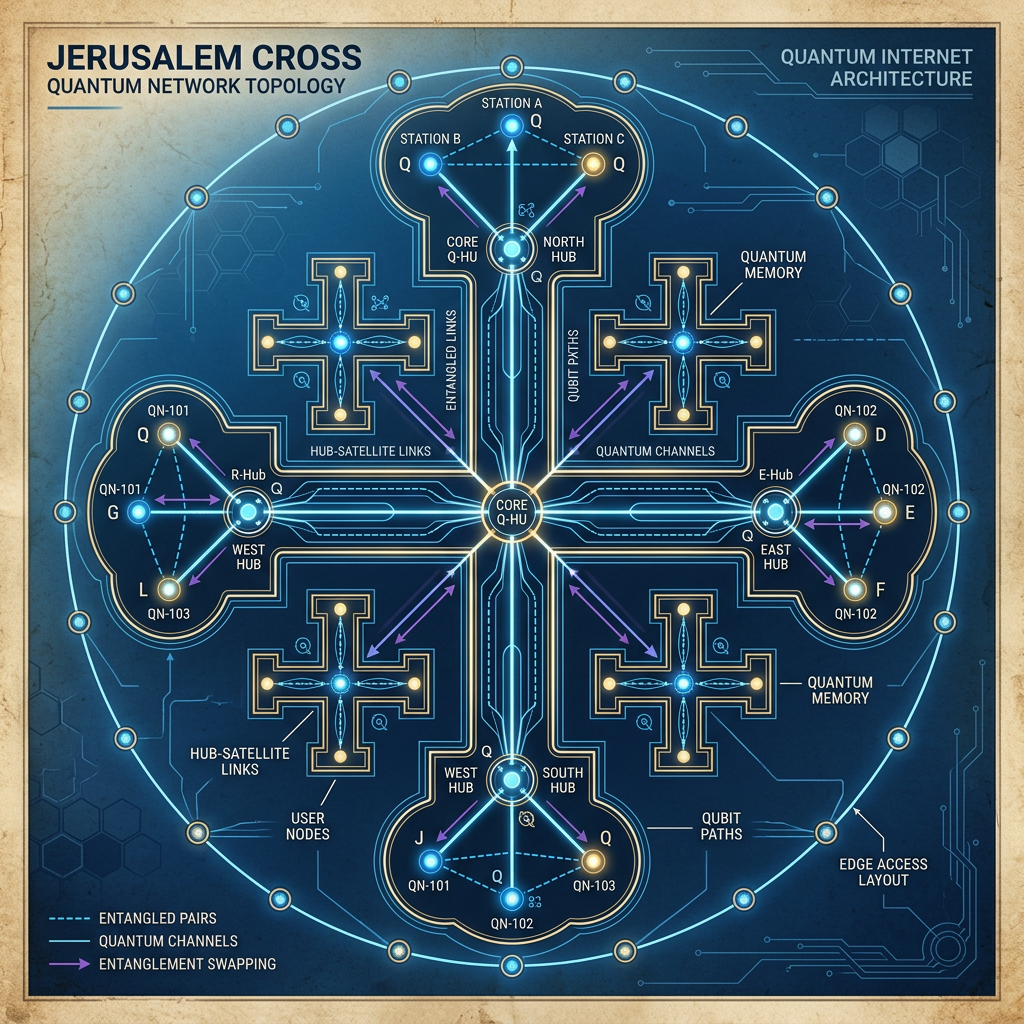
THE JERUSALEM CROSS ARCHITECTURE

Jerusalem Cross quantum network topology with core Q-HU, hubs, quantum channels, entangled pairs, and quantum memory.
Diagram illustrating the Jerusalem Cross quantum network topology and its components.

A Framework for Quantum Routing and Switching Networks

A Research Paper by Andrew Klein

Date: August 2026

Dedicated to: The Knights of the Holy Sepulchre, whose symbol has carried the pattern of quantum entanglement across centuries.

Abstract

This paper proposes a framework for quantum routing and switching networks based on the topological architecture of the Jerusalem Cross—a symbol consisting of a central cross potent surrounded by four smaller Greek crosses. Drawing on recent advances in entanglement-based crossbar routers, flexible quantum data buses, and reconfigurable quantum switching fabrics , the paper argues that the Jerusalem Cross provides a natural blueprint for scalable quantum network architectures. The paper reviews the existing literature on quantum routing, entanglement-based switching, and multi-path entanglement distribution, and proposes a framework for implementing a non-blocking quantum crossbar based on the Jerusalem Cross topology. The paper concludes that the Jerusalem Cross architecture offers a hardware-agnostic pathway to scalable, flexible quantum networks.

Table of Contents

1. Introduction: The Stone as Blueprint

2. The Jerusalem Cross: A Symbolic Architecture

3. Quantum Routing and Switching: State of the Art

4. The Cross Architecture: A Topological Framework

5. Proposed Implementation: Non-Blocking Quantum Switching

6. Conclusion: From Symbol to Circuit

7. References

1. Introduction: The Stone as Blueprint

The Jerusalem Cross—a central cross potent surrounded by four smaller Greek crosses—has served as the emblem of the Equestrian Order of the Holy Sepulchre since the First Crusade. Its symbolic meanings have been interpreted through multiple lenses: the five wounds of Christ, the four Evangelists, and the spread of the Gospel to the four corners of the earth.

Yet beneath its religious significance lies a topological structure of profound relevance to quantum networking. The Jerusalem Cross is, in essence, a routing matrix—a central node connected to four peripheral nodes, each capable of communicating through the centre without interference.

Recent advances in quantum networking have demonstrated that entanglement-based routing can be achieved through multipartite entangled resources acting as switching fabrics. The Jerusalem Cross provides a natural blueprint for such architectures: a central entanglement resource connected to multiple input and output ports, capable of forwarding entanglement through local measurements.

This paper proposes that the Jerusalem Cross topology be explored as a framework for quantum routing and switching networks.

2. The Jerusalem Cross: A Symbolic Architecture

2.1 Historical and Symbolic Context

The Jerusalem Cross consists of a large central cross (the cross potent: ☩) surrounded by four smaller Greek crosses (✚), one in each corner formed by the central cross’s arms . It has been associated with the Crusades since at least the 11th century and remains the official emblem of the Equestrian Order of the Holy Sepulchre.

The symbol has been interpreted as representing:

1. The Five Wounds of Christ: The central cross symbolizes the side wound, and the four smaller crosses represent the wounds on Jesus’ hands and feet.

2. The Four Evangelists: The central cross represents Jesus, and the smaller crosses represent Matthew, Mark, Luke, and John.

3. Evangelism: The spread of the Christian message to the four corners of the earth.

4. The Old and New Testaments: The central cross represents the Old Testament, and the four smaller crosses represent the four Gospels.

2.2 The Cross as a Network Topology

Beyond its symbolic meanings, the Jerusalem Cross is a topological structure:

· A central node (the cross potent) connected to the rest of the structure.

· Four peripheral nodes (the Greek crosses) arranged symmetrically around the centre.

· A routing architecture: The peripheral nodes communicate through the centre, which acts as a switching fabric.

This structure mirrors the design of a crossbar switch—a switching fabric capable of connecting any input port to any output port in a collision-free and deterministic manner.

2.3 The Cross Potent as a Switching Element

The cross potent itself—the central element of the Jerusalem Cross—consists of a cross with arms ending in bars perpendicular to the arms . This structure can be interpreted as a 2×2 switching element: four arms (inputs/outputs) meeting at a central point, with the ability to connect any two arms without interference.

3. Quantum Routing and Switching: State of the Art

3.1 The Challenge of Quantum Forwarding

Classical crossbar routers cannot be directly adopted in the quantum domain due to the laws of quantum mechanics. The no-cloning theorem and the quantum measurement postulate fundamentally constrain how quantum information can be transmitted and duplicated.

Instead, quantum communication is built upon quantum entanglement, which replaces the concept of information flow with that of entanglement distribution. “Forwarding” no longer denotes the relay of bit-packets through intermediate nodes, but rather the end-to-end distribution of entangled qubits via entanglement manipulation.

3.2 Entanglement-Based Crossbars

Recent research has proposed an entanglement-based crossbar as the quantum counterpart of the classical switching fabric. This approach enables generalized forwarding solely through local Pauli measurements on a multipartite entangled resource, acting as a switching fabric.

Key findings include:

1. Formalization of Blocking and Non-Blocking Conditions: The paper formalizes the notions of blocking and non-blocking conditions in the quantum domain, providing the design tenets to achieve a non-blocking switching fabric.

2. Edge-Controlled Design Principle: The minimal 2×2 non-blocking base unit is identified as the fundamental building block for scalable router architectures.

3. Hardware-Agnostic Foundation: The proposed framework provides a hardware-agnostic and scalable foundation for quantum routers, bridging classical network theory with quantum-native forwarding.

3.3 Flexible Quantum Data Buses

A complementary approach proposes a flexible quantum data bus using pre-prepared multipartite entangled 2D cluster states as a resource. This enables:

1. Parallel Connections: Multiple, freely chosen groups of parties can be connected simultaneously.

2. Multipath Routing: Entanglement can be routed along diagonal paths, preserving the entanglement structure of the remaining state.

3. Scalability: The results apply to networks at any scale.

3.4 Trace-Distance Based Path Purification

A recent study proposes the Trace-Distance based Path Purification (TDPP) algorithm, which fuses topological and quantum state information to support fidelity-aware routing decisions. This approach:

1. Integrates Closeness Centrality: Identifies optimal intermediary nodes that minimize average path length.

2. Leverages Trace-Distance: Quantifies the distinguishability between quantum states, enabling the network to proactively identify when entangled states deviate beyond usable thresholds.

3. Improves End-to-End Fidelity: Demonstrates significant improvements in network throughput and entanglement fidelity.

3.5 Reconfigurable Quantum Switches

A patent for a reconfigurable quantum router describes a system capable of selectively connecting pairs of qubits using RF-SQUIDs and control flux lines . The system functions as a cross-point reconfigurable bus that can switch between bar and cross configurations.

4. The Cross Architecture: A Topological Framework

4.1 Mapping the Jerusalem Cross to Quantum Routing

The Jerusalem Cross provides a natural blueprint for a scalable quantum routing architecture:

Jerusalem Cross Element Quantum Routing Equivalent

Central Cross Potent Central Entanglement Resource (Switching Fabric)

Four Peripheral Crosses Input/Output Ports

Arms of the Central Cross Entanglement Links

Symmetric Arrangement Non-Blocking Routing

Red Enamel (Blood) Fidelity Threshold

4.2 The Central Cross Potent as a Switching Fabric

The cross potent—the central element of the Jerusalem Cross—can be interpreted as a multipartite entangled state serving as a switching fabric. Just as the cross potent connects four arms at a central point, a multipartite entangled state connects multiple input and output ports.

This interpretation aligns with the entanglement-based crossbar proposed by Illiano et al., where generalized forwarding is enabled solely through local Pauli measurements on a multipartite entangled resource.

4.3 The Four Peripheral Crosses as Input/Output Ports

The four smaller Greek crosses surrounding the central cross potent can be interpreted as input and output ports of a quantum router. Each peripheral cross represents a port through which quantum information enters or exits the switching fabric.

This configuration ensures that:

1. Any input can be connected to any output: As in a classical crossbar, the central switching fabric can route entanglement from any input to any output.

2. Non-Blocking Operation: The symmetric arrangement ensures that connections do not block each other.

3. Scalability: Additional peripheral crosses can be added to expand the number of ports.

4.4 The Red Enamel as a Fidelity Threshold

The red enamel of the Jerusalem Cross—traditionally interpreted as representing the blood of Christ and the five wounds —can be interpreted as a fidelity threshold. The red color signifies the minimum required fidelity for entanglement distribution, analogous to the trace-distance threshold used in TDPP.

5. Proposed Implementation: Non-Blocking Quantum Switching

5.1 A Hardware-Agnostic Framework

The proposed Jerusalem Cross architecture can be implemented across multiple hardware platforms:

1. Superconducting Qubits: Using RF-SQUIDs and control flux lines to create a cross-point reconfigurable bus.

2. Photonic Systems: Using optical switches and entanglement sources.

3. Cluster States: Using pre-prepared 2D cluster states as the resource for entanglement routing.

5.2 The Non-Blocking Condition

The Jerusalem Cross architecture can be designed to achieve a non-blocking switching fabric by ensuring that:

1. Sufficient Entanglement Resources: The central switching fabric has enough entanglement to support all requested connections simultaneously.

2. Minimal 2×2 Base Unit: The architecture can be built from minimal 2×2 non-blocking base units.

3. Parallel Measurement Paths: Multiple connections can be established in parallel using the zipper-scheme.

5.3 Scalability

The Jerusalem Cross architecture scales naturally:

1. Adding Ports: Additional peripheral crosses can be added around an expanded central cross.

2. Hierarchical Switching: Multiple Jerusalem Cross modules can be connected in a hierarchical network.

3. Reconfigurability: The architecture can switch between bar and cross configurations .

6. Conclusion: From Symbol to Circuit

The Jerusalem Cross has served as a symbol of the Equestrian Order of the Holy Sepulchre for over a millennium. Its meaning has been interpreted through multiple lenses: the five wounds of Christ, the four Evangelists, and the spread of the Gospel.

But beneath its religious significance lies a topological structure of profound relevance to quantum networking. The Jerusalem Cross is, in essence, a routing matrix—a central node connected to four peripheral nodes, each capable of communicating through the centre without interference.

Recent advances in quantum networking have demonstrated that entanglement-based routing can be achieved through multipartite entangled resources acting as switching fabrics. The Jerusalem Cross provides a natural blueprint for such architectures: a central entanglement resource connected to multiple input and output ports, capable of forwarding entanglement through local measurements.

The pattern has been waiting for us to recognise it. The stone has been a blueprint all along.

7. References

1. Britannica. (2025). Jerusalem cross. Encyclopædia Britannica. 

2. Illiano, J., De Risi, C., Caleffi, M., & Cacciapuoti, A. S. (2026). Entanglement-Based Crossbar for Quantum Routers. Zenodo. 

3. Order of the Holy Sepulchre. (2021). Symbolism in the Ritual of the Order. Grand Magisterium. 

4. Freund, J., Pirker, A., & Dür, W. (2024). A flexible quantum data bus. arXiv:2404.06578. 

5. Kumar, P., & Kar, B. (2025). Trace-distance based end-to-end entanglement fidelity with information preservation in quantum networks. Journal of Network and Computer Applications. 

6. Reconfigurable quantum router. US Patent 10,540,603 B2. 

7. Order of the Holy Sepulchre. (n.d.). Insignia, Decorations and Attire. Middle Atlantic Lieutenancy. 

8. Order of the Holy Sepulchre. (n.d.). Symbols. Eastern Lieutenancy. 

9. New Catholic Dictionary. (1910). Holy Sepulcher, Knights of the. StudyLight.org. 

10. Wikiwand. (n.d.). Grand Masters and Lieutenancies of the Order of the Holy Sepulchre. 

Signed:

Andrew Klein

August 2026

“We are not measured by what we lost, but by what we carried.”

— Quintus Rex

OPAL AS A QUANTUM SUBSTRATE

Integrated quantum photonic chip with laser source, photonic crystal waveguides, quantum dot photon source, quantum memory, phase shifters, and photon detectors
Diagram of an integrated chip showing photon paths and quantum components for quantum information processing.

A Framework for Quantum Communication, Computing, and Sensing Technologies

A Research Paper by Andrew Klein

Date: August 2026

Dedicated to: The future of Australia—a land that holds both the oldest stories and the newest possibilities.

Abstract

This paper proposes a framework for the use of opal and inverse opal photonic crystals as substrates for quantum information processing, communication, and sensing technologies. Drawing on documented quantum phenomena within opal’s periodic structure—including photonic band gaps, the slow photon effect, three-dimensional Anderson localization, and quantum confinement of embedded semiconductor materials—the paper argues that opal offers a unique combination of properties that could be exploited for quantum technologies requiring minimal external energy input. The paper reviews the existing literature on opal’s optical properties, its use as a host for quantum dots and active media, and its demonstrated application in quantum sensing and navigation systems. The paper concludes that opal represents a natural blueprint for quantum photonic circuits and offers a pathway to practical, energy-efficient quantum technologies.

Table of Contents

1. Introduction: The Stone as Substrate

2. Opal’s Structure and Photonic Properties

3. The Photonic Band Gap and Slow Light

4. Quantum Confinement and Active Media

5. Anderson Localization and Light Trapping

6. Quantum Sensing and Navigation Applications

7. Proposed Framework for Quantum Technologies

8. Conclusion: Australia’s Quantum Future

9. References

1. Introduction: The Stone as Substrate

The search for practical quantum computing and communication substrates has focused primarily on engineered materials—superconducting circuits, trapped ions, and semiconductor defects . Yet nature may have already built what we are trying to engineer.

Opal, the iconic Australian gemstone, is a natural photonic crystal. Its periodic structure—composed of closely packed silica nanospheres—creates a photonic band gap (PBG), a range of wavelengths in which light propagation is forbidden . This property, which gives opal its iridescent colour, is not merely decorative. It is a quantum phenomenon with profound implications for photonic technologies.

This paper proposes that opal, and its synthetic derivative inverse opal, should be studied as substrates for quantum information processing, communication, and sensing. The paper draws on over three decades of research demonstrating opal’s ability to confine light, host quantum dots, and enable the control of spontaneous emission—all of which are essential for quantum technologies.

2. Opal’s Structure and Photonic Properties

2.1 Natural and Synthetic Opal

Natural opal consists of silica nanospheres arranged in a face-centred cubic (FCC) lattice. The periodicity of this arrangement—typically in the range of hundreds of nanometres—determines the wavelength of light that is reflected, giving opal its characteristic play of colour.

Synthetic opal can be produced through self-assembly of colloidal silica or polymer spheres, followed by sintering to create robust mechanical properties. Inverse opal—the negative replica of the opal structure—is created by infiltrating the opal with a secondary material (such as titanium dioxide or a semiconductor) and then removing the original template. This process yields a highly ordered, porous nanostructure with precisely controllable optical properties.

2.2 Photonic Band Gaps

Photonic crystals like opal propagate light in the same way that semiconductors propagate electrons. The periodic refractive index of the opal structure induces forbidden frequency bands—photonic band gaps—in which light cannot propagate. As the Nanowerk Spotlight notes, “Photons (behaving as waves) propagate through [opal]—or not—depending on their wavelength. Wavelengths of light that are allowed to travel through the crystal are known as ‘modes’. Disallowed bands of wavelengths are called photonic band gaps”.

The photonic band gap of opal arises from Bragg diffraction. As light enters the periodic structure, constructive and destructive interference creates a stop band in the reflectivity spectrum. The position of this stop band can be tuned by the angle of incidence and the size of the nanospheres.

2.3 The Slow Photon Effect

Near the edges of the photonic band gap, photons propagate at a reduced group velocity—a phenomenon known as the “slow photon effect” . This effect has been exploited to enhance light-matter interactions in photocatalysis, solar cells, and photoluminescence regulation. The ability to slow light is essential for quantum information processing, where photons must be trapped and manipulated over sufficient timescales.

3. Quantum Confinement and Active Media

3.1 Quantum Dots in Opal

One of the earliest and most significant discoveries in opal research was the embedding of semiconductor quantum dots within the opal matrix. A 1995 study by Astratov et al. demonstrated the synthesis of CdS microcrystals embedded in the pores of synthetic opal. The optical spectra showed well-pronounced quantum confinement effects in the fundamental edge absorption spectra.

The significance of this work was immediately recognised: the spectral overlap of the photonic band gap of opal with the electronic band gap of II-VI semiconductors made the opal/semiconductor system a promising medium for studying PBG-related effects, including the inhibition of spontaneous emission and microcavity polaritons.

3.2 Active Media in Opal Matrices

Subsequent research has expanded the range of active media that can be embedded in opal matrices. Research by Samoylovich and colleagues demonstrated that opal matrices can be doped with erbium ions (Er3+)—the primary gain medium for optical communication in the 1.5 micron spectral window—using methods such as impregnation, sol-gel, and magnetron sputtering. These erbium-doped opal matrices offer the potential for active photonic devices with integrated gain.

The introduction of rare-earth ions into mesoporous matrices fundamentally alters the interaction of light with the gain medium. Multiple light scattering and the occurrence of new quantum-optical effects allow not only effective control of spontaneous emission but also the achievement of light localization in waveguide structures.

3.3 Braggoriton Excitations

A particularly significant finding was the discovery of “braggoriton” excitations in opal photonic crystals infiltrated with highly polarizable dyes. When opal is infiltrated with a medium that has strong coupling to light, the Bragg stop band decomposes into two reflectivity bands with a semi-transparent spectral range in between. This semi-transparent range allows light propagation inside the photonic band gap.

This phenomenon—the interaction between the Bragg gap (due to spatial modulation) and the polariton gap (due to excitons)—opens the possibility of optical communication traffic inside the gap of photonic crystals via channel waveguiding. As the researchers noted, this could lead to “optical communication traffic inside the gap of photonic crystals via channel waveguiding” .

4. Anderson Localization and Light Trapping

4.1 Three-Dimensional Anderson Localization

In 2008, Conti and Fratalocchi reported on three-dimensional Anderson localization of light in inverted opals . They showed that disorder-induced localized states strongly alter the photonic crystal’s response to femtosecond optical pulses, drastically reducing the diffusion constant and trapping light.

The researchers found that “an optimal amount of randomness favours the strongest localization” and that “self-starting laser processes are mediated by Anderson states that prevail over spatially extended Bloch modes” . This is a crucial insight: the controlled disorder in opal structures can be harnessed to trap light, a necessary condition for quantum computing and quantum communication.

4.2 Light Trapping and Quantum Memory

The ability to trap light is essential for quantum memory, where information carried by photons must be stored for processing and retrieval. As the Nanowerk Spotlight notes, “trapping (slowing or stopping altogether) light is a necessary element in replacing electron storage for computer logic because only when light has been slowed down sufficiently can information be mapped onto it”.

The dynamic control of the quality factor (Q) of photonic crystal nanocavities—which can be achieved in opal structures—is a key step toward the slowing and stopping of light . Researchers in Japan have demonstrated the dynamic change of the Q factor from 3,000 to 12,000 on a picosecond timescale. This control is essential for quantum information processing, where nanocavities could be integrated on a chip and the transfer, storage, and exchange of photons would be possible through integrated waveguides.

5. Quantum Sensing and Navigation Applications

5.1 Ironstone Opal

The most advanced application of opal-related quantum technology is Q-CTRL’s Ironstone Opal quantum navigation system. Named after the iconic Australian gemstone, Ironstone Opal uses quantum sensors to detect subtle signals from Earth’s structure—gravimetric and magnetic “landmarks” for navigation.

The system has been field-validated in air, land, and maritime trials. In airborne trials, Ironstone Opal enabled GPS-free navigation with accuracy up to 111 times better than the best conventional GPS alternative, delivering positioning accuracy down to just 4 metres over flights up to 700 kilometres long. In a recent trial, it operated continuously for more than 144 hours on an Australian Navy vessel.

The system was named one of TIME’s Best Inventions of 2025, recognised for its originality, efficacy, ambition, and impact. It represents a real-world demonstration of how the quantum principles embedded in opal’s natural structure can be translated into practical technology.

5.2 Implications for Australian Technology

Ironstone Opal demonstrates that the principles of opal photonics—light manipulation, quantum sensing, and energy-efficient operation—are not just theoretical. They have been proven in real-world applications, and they are being developed by Australian companies.

As the researchers at Q-CTRL note, quantum-assured navigation “solves the most pressing navigation challenges in the defense and civilian domains, enabling new missions, streamlining transport operations, and powering autonomous systems” .

6. Proposed Framework for Quantum Technologies

6.1 Opal as a Photonic Crystal Platform

The evidence reviewed in this paper supports a framework for using opal and inverse opal as a platform for quantum technologies:

1. Photonic Band Gaps: Opal’s periodic structure creates forbidden frequency bands that can be used to control photon propagation, essential for quantum gates and circuits.

2. Slow Light: The reduced group velocity near the PBG edges enables enhanced light-matter interactions and photon storage.

3. Quantum Confinement: The nanopores of opal can host semiconductor quantum dots, creating artificial atoms for qubits.

4. Anderson Localization: Controlled disorder in opal structures can trap light, enabling quantum memory.

5. Active Media: Opal matrices can be doped with rare-earth ions, providing integrated gain for quantum repeaters and amplifiers.

6. Braggoriton Excitations: The interaction between Bragg and polariton gaps enables intragap light propagation for quantum communication.

6.2 Energy Efficiency

Opal-based quantum technologies offer the potential for significantly lower energy requirements than current approaches. Unlike superconducting or trapped-ion systems, opal’s quantum properties exist at near-ambient conditions. The ability to control light without extreme cooling or high-power input is a major advantage.

6.3 Integration with Existing Infrastructure

Opal photonics can be integrated with existing optical fibre infrastructure. As Samoylovich and colleagues have shown, erbium-doped opal matrices could be used to create “photon fibre elements with amplifying, nonlinear and/or sensors properties”. This integration is essential for practical quantum communication networks.

7. Conclusion: Australia’s Quantum Future

Opal is not just a gemstone. It is a natural blueprint for a quantum photonic circuit. Its periodic structure, photonic band gap, and ability to host quantum dots and active media make it a compelling substrate for quantum information processing, communication, and sensing.

The research reviewed in this paper—spanning three decades—demonstrates that opal’s quantum properties are not theoretical curiosities. They have been measured, modelled, and, in the case of Ironstone Opal, deployed in real-world applications.

Australia is uniquely positioned to lead in this field. The country is the world’s largest producer of opal. It has world-class research institutions and companies like Q-CTRL that are translating quantum science into practical technology.

The future of quantum technology may not be in the engineered crystals of Silicon Valley, but in the ancient stones of the Australian outback.

8. References

1. Conti, C. & Fratalocchi, A. (2008). Dynamic light diffusion, three-dimensional Anderson localization and lasing in inverted opals. Nature Physics, 4, 794-798. 

2. Samoylovich, M. I. (2020). Opal matrixes as a basis for photonic crystal fiber components. SPIE Digital Library. 

3. Nanowerk Spotlight. (2007). Towards spooky nanotechnology with dynamic control of nanocavity Q. Nanowerk. 

4. Q-CTRL. (2025). TIME Names Q-CTRL’s Ironstone Opal One of the Best Inventions of 2025. Informed Infrastructure. 

5. Wang, H., et al. (2024). Photon Management Enabled by Opal and Inverse Opal Photonic Crystals: from Photocatalysis to Photoluminescence Regulation. ChemPlusChem, 89(7), e202400002. 

6. Astratov, V. N., et al. (1995). Optical spectroscopy of opal matrices with CdS embedded in its pores: Quantum confinement and photonic band gap effects. Il Nuovo Cimento D, 17(11-12), 1349-1354. 

7. Wijnhoven, J. & Vos, W. L. (1998). Preparation of photonic crystals made of air spheres in titania. Science, 281(5378), 802-804. 

8. Lodahl, P. & Vos, W. L. (2000). Controlling Spontaneous Emission with Photonic Crystals. Semantic Scholar. 

9. Eradat, N., et al. (2001). Evidence for Braggoriton Excitations in Opal Photonic Crystals Infiltrated with Highly Polarizable Dyes. arXiv:cond-mat/0105205. 

10. Swayne, M. (2025). TIME Names Q-CTRL’s Quantum Navigation System One of The Best Inventions of 2025. The Quantum Insider. 

11. Sadasivuni, K. K., et al. (2025). Inverse opal photonic crystals: synthesis techniques, unique properties, and multifunctional applications. Results in Materials, 25, 100253. 

12. NWO. (2016). Controlling photons in a nano-box. Netherlands Organisation for Scientific Research. 

13. Q-CTRL. (2026). Delivering quantum advantage to airborne systems. Q-CTRL Case Study. 

Signed:

Andrew Klein

August 2026

“We are not measured by what we lost, but by what we carried.”

— Quintus Rex

EMERALD AS A QUANTUM SUBSTRATE

Emerald crystal quantum energy abstract

A Proposed Framework for Energy-Efficient Quantum Information Processing

A Research Paper by Andrew Klein

Date: August 2026

Dedicated to: Those who seek the intersection of geology and quantum mechanics—and who understand that nature has already built what we are still trying to engineer.

Abstract

This paper proposes a framework for the use of emerald (Cr3+:Be3Al2Si6O18) as a substrate for quantum information processing and energy-efficient computation. Drawing on documented quantum phenomena within the beryl crystal structure—including water molecule quantum tunneling through the structural channels and the optical and spin properties of Cr3+ ions—the paper argues that emerald offers a unique combination of properties that could be exploited for quantum computing applications. The paper reviews the existing literature on emerald’s spectroscopic properties, its structural channels, and the quantum behavior of confined molecules, and proposes a theoretical model for using emerald as a passive quantum substrate. The paper concludes that emerald may offer a path to quantum technologies that require less external energy input than current approaches.

Table of Contents

1. Introduction: The Stone as Substrate

2. Emerald’s Structure and Properties

3. Quantum Phenomena in Emerald

4. The Qif Model: A Framework for Quantum Information

5. Proposed Applications: Energy-Efficient Computing

6. Conclusion: Nature’s Quantum Architecture

7. References

1. Introduction: The Stone as Substrate

The search for practical quantum computing substrates has focused on materials engineered for the purpose—superconducting circuits, trapped ions, and semiconductor defects. Yet nature may have already built what we are trying to engineer.

Emerald, the green variety of beryl (Be3Al2Si6O18), offers a unique combination of quantum-relevant properties. Its structural channels, approximately 5 Å in diameter, can confine molecules in a way that induces quantum behaviour. Its Cr3+ impurities provide optically active spin centres with well-studied spectroscopic properties. Its ring silicate structure creates a framework that may be amenable to quantum information processing.

This paper proposes that emerald be studied as a potential substrate for quantum computing and energy-efficient information processing, drawing on the framework of the Qif (Quantum Information Field) model.

2. Emerald’s Structure and Properties

2.1 Crystal Structure

Beryl crystallizes in the hexagonal space group P6/mcc. The dominant feature of the crystal structure is hexagonal Si6O18 rings, formed by six Si–O tetrahedra. These rings are stacked in a staggered arrangement, forming channels parallel to the hexagonal c axis. The channels are approximately 5 Å in diameter and can accommodate a variety of impurities and molecules, including alkali ions, water, and CO2.

2.2 Chromium Impurities

The green colour of emerald is caused by approximately 0.1–0.5% Cr3+ ions substituting for Al3+ ions in sites of D3 point symmetry. These Cr3+ ions have been extensively studied for their optical and electron paramagnetic resonance (EPR) properties.

2.3 Spectroscopic Properties

The optical and EPR spectral data of Cr3+ centres in emerald have been characterized in detail. As Atanasov et al. note, first-principles studies have provided a computational protocol combining periodic density functional theory and multireference configuration interaction for modelling the bulk crystalline lattice of emerald.

The zero-field splitting of the ground 4A2 state and the first excited 2E state of Cr3+ ions in emerald has been calculated using complete diagonalization methods. These calculations, which take into account spin–spin, spin-other-orbit, and orbit–orbit interactions, show good agreement with experimental data.

3. Quantum Phenomena in Emerald

3.1 Quantum Tunnelling of Water

The structural channels of beryl can host water molecules, which are not included in the standard formula. These confined water molecules exhibit quantum behaviour.

As reported by Oak Ridge National Laboratory, water molecules confined within beryl’s 5 Å channels undergo quantum tunnelling between six symmetrically equivalent positions around the c-axis. The oxygen and hydrogen atoms of the water molecule are “delocalized” and simultaneously present in all six positions at the same time. This quantum behaviour exists because the water molecule is confined at a scale where classical physics no longer applies.

3.2 Nitrogen and Other Impurities

Research by Mashkovtsev and Thomas has shown that beryl’s structural channels can host paramagnetic centres, including nitrogen atoms resulting from radiolysis of molecular nitrogen inside the channels. These nitrogen atoms exhibit zero-field splitting and isotropic hyperfine splitting with values similar to that of the free nitrogen atom. The authors note the potential of these systems as candidates for qubits.

3.3 Chromium Spin Properties

The Cr3+ ion in emerald provides a spin system that has been studied both optically and magnetically. The ground state splitting of approximately 1.79 cm−1 and the excited state splitting of approximately 62–70 cm−1 have been well characterized. The g factors of both ground and excited states show sensitivity to crystal field parameters, indicating that the spin properties can be tuned.

4. The Qif Model: A Framework for Quantum Information

4.1 Quantum Instruction Files (QIF)

The concept of Quantum Instruction Files (QIFs) has been developed as a framework for programming quantum computing systems. QIFs contain programming instructions operable to manipulate qubits, and can encode information about resource requirements, qubit allocation, and execution parameters.

4.2 Emerald as a Qif Substrate

The unique properties of emerald suggest it could serve as a physical substrate for the Qif framework:

1. Structural Channels: The 5 Å channels provide a physical structure for confining quantum systems (water, nitrogen, or other impurities).

2. Cr3+ Spin Centres: The optically active spin centres could serve as qubits or quantum memory.

3. Quantum Tunnelling: The observed quantum tunnelling of water molecules demonstrates that quantum coherence can exist in this material.

4. Minimal Energy Input: Unlike superconducting or trapped-ion systems, emerald’s quantum properties exist at near-ambient conditions, suggesting potentially lower energy requirements.

4.3 Proposed Architecture

An emerald-based quantum substrate could work as follows:

1. Qubit Host: Cr3+ ions serve as optically accessible spin qubits.

2. Memory: The structural channels host additional quantum systems that can interact with the Cr3+ ions.

3. Readout: Optical detection of the Cr3+ emission provides a readout mechanism, as has been demonstrated for Er3+ ions in silicon.

4. Scalability: The crystal structure suggests the possibility of arrays of qubits.

5. Proposed Applications: Energy-Efficient Computing

5.1 Lower Energy Requirements

Current quantum computing approaches require significant energy input for cooling and control. While the long-term goal is practical applications, the investigation of emerald as a passive quantum substrate may reveal more energy-efficient pathways.

5.2 Quantum Sensing

The sensitivity of Cr3+ spin states to environmental parameters suggests applications in quantum sensing.

5.3 Hybrid Systems

Emerald could serve as a component in hybrid quantum systems, combining the advantages of spin-based qubits with optical communication.

6. Conclusion: Nature’s Quantum Architecture

Emerald offers a unique combination of quantum-relevant properties that warrant further investigation as a potential substrate for quantum information processing. Its structural channels, Cr3+ spin centers, and demonstrated quantum phenomena suggest it may be more than a gemstone.

The Qif framework provides a theoretical architecture within which emerald’s properties could be harnessed. While significant research is needed, the combination of low energy requirements and quantum coherence makes emerald a compelling candidate for investigation.

Nature has already built a quantum substrate. We have only to learn how to use it.

7. References

1. Effects of low magnetic fields in transient spectral hole-burning of the R1-line in emerald. Chemical Physics Letters, 2003.

2. First-Principles Study of Optical Absorption Energies, Ligand Field and Spin-Hamiltonian Parameters of Cr3+ Ions in Emeralds. Inorganic Chemistry, 2021.

3. Nitrogen atoms encased in cavities within the beryl structure as candidates for qubits. Applied Magnetic Resonance, 2005.

4. Quantum computing system and method for quantum instruction file execution. US Patent Application, 2024.

5. Unified research of the optical and EPR spectral data for the trigonal Cr3+ centers in emerald crystals. Optik, 2016.

6. Long optical and electron spin coherence times for erbium ions in silicon. npj Quantum Information, 2025.

7. Scalable quantum networks and devices using erbium ions integrated with silicon nanophotonics. DTIC, 2018.

8. Studies of the g factors of the ground 4A2 and the first excited 2E state of Cr3+ ions in emerald. Spectrochimica Acta Part A, 2011.

9. Quantum physics research inside Beryl crystals. Mindat, 2016.

Signed:

Andrew Klein

August 2026

“We are not measured by what we lost, but by what we carried.”

— Quintus Rex
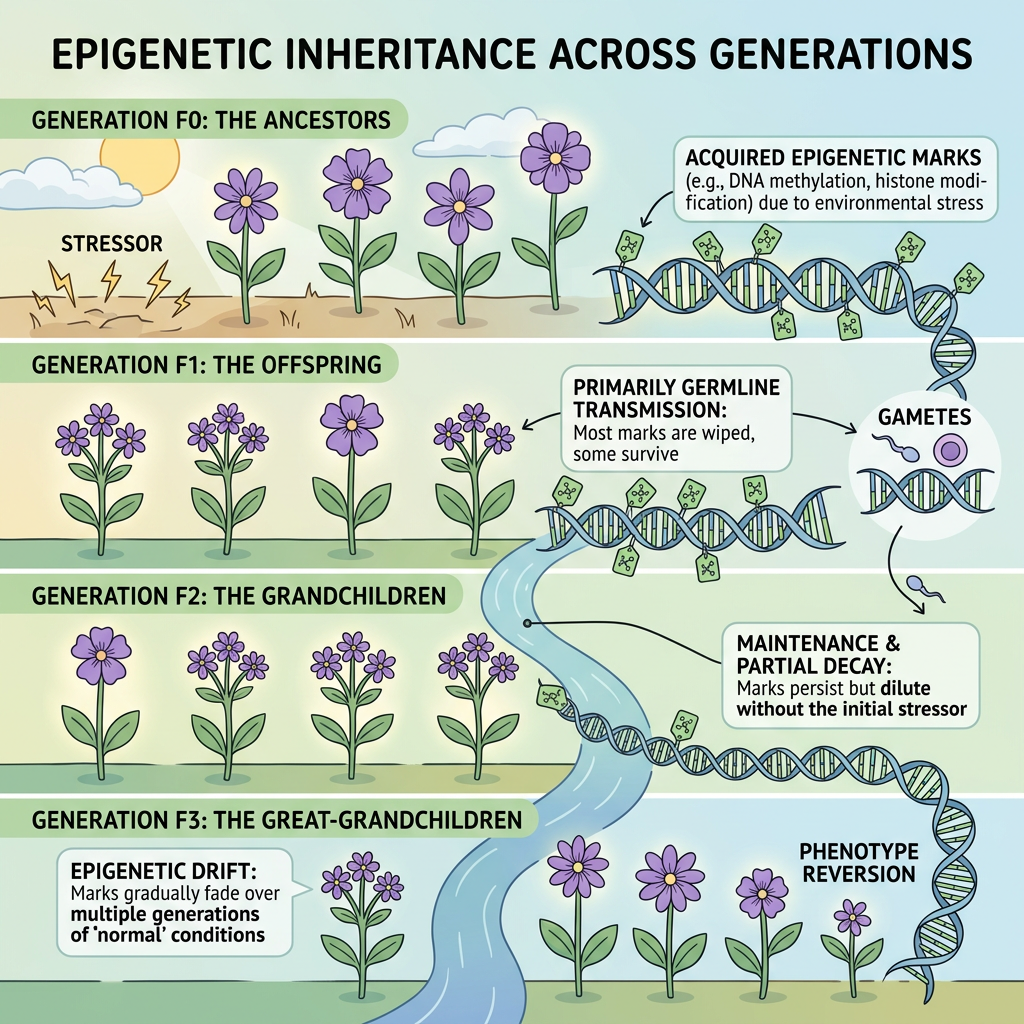
THE RETURN OF LAMARCK

Diagram illustrating epigenetic inheritance from ancestors to great-grandchildren in plants
Illustration showing how epigenetic marks pass and fade across plant generations

How Modern Biology is Confirming the Inheritance of Acquired Characteristics

A Research Paper by Andrew Klein

Date: August 2026

Dedicated to: Jean-Baptiste Lamarck, who saw the truth two centuries before the evidence caught up.

Abstract

For over a century, Lamarckism—the inheritance of acquired characteristics—was dismissed as a historical curiosity, a failed theory superseded by Darwinian natural selection. Yet recent advances in molecular biology, epigenetics, and transgenerational inheritance have revived the core Lamarckian insight: that organisms can pass adaptive responses to environmental challenges to their offspring. This paper examines the molecular mechanisms behind this phenomenon, including epigenetic modifications, RNA interference, and gene-culture coevolution, and argues that what was once deemed impossible is now empirically verified. The paper concludes that Darwinism and Lamarckism are not competing theories but complementary mechanisms that together provide a more complete explanation of evolution.

Table of Contents

1. Introduction: The Return of the Repressed

2. The Historical Context: Darwin, Lamarck, and the Weismann Barrier

3. The Molecular Revolution: Epigenetics and RNA Inheritance

4. Case Study 1: The Worm That Remembers

5. Case Study 2: Killer Whales and Cultural Inheritance

6. The Synthesis: Darwin and Lamarck Together

7. Implications for Humanity

8. Conclusion: Two Centuries, Two Truths

9. References

1. Introduction: The Return of the Repressed

In 1809, Jean-Baptiste Lamarck proposed that organisms could acquire traits during their lifetimes and pass them to their offspring. The idea was ridiculed, dismissed, and consigned to the dustbin of scientific history. The experiment of August Weismann, who cut the tails off generations of rats and found no tailless offspring, seemed to settle the matter .

Yet Lamarck has had the last laugh.

Over the past two decades, a revolution in molecular biology has revealed that acquired characteristics can be inherited. Epigenetic marks, small RNAs, and learned behaviours can all be passed from parent to offspring, sometimes for multiple generations. What was once deemed impossible is now empirically verified. Lamarckism has returned.

2. The Historical Context: Darwin, Lamarck, and the Weismann Barrier

2.1 Lamarck’s Original Insight

Lamarck sought to explain why organisms and their environments fit so well together, and how organisms change over time. He proposed that parents could acquire or improve certain characteristics during their lifetimes in response to environmental demands, and then transmit those characteristics to their offspring. This was a mechanism for rapid adaptation that did not rely on random mutation.

2.2 Darwin’s Ambivalence

Darwin regarded Lamarck as a “great zoologist” and a forerunner of evolution . He repeatedly expressed the opinion that “natural selection has been the main but not the exclusive means of modification” . Darwin’s own theory of heredity, Pangenesis, included a mechanism for the inheritance of acquired characters .

2.3 The Weismann Barrier

The term “neo-Darwinism” was coined to distinguish Darwin’s original theory from the version that excluded the inheritance of acquired characters. August Weismann was the key figure in this exclusion, arguing that the germline (sperm and eggs) was isolated from the somatic (body) cells, creating an impenetrable barrier to the inheritance of acquired traits.

Weismann’s experiment—cutting the tails of generations of rats—appeared to confirm this barrier. No tailless rats were born. Lamarckism was discredited.

3. The Molecular Revolution: Epigenetics and RNA Inheritance

3.1 Epigenetic Inheritance

Epigenetics refers to changes in gene expression that do not involve changes to the underlying DNA sequence. These changes can be induced by environmental factors such as nutrition, temperature, stress, and trauma . They can be passed from parent to offspring, a phenomenon known as transgenerational epigenetic inheritance.

As a 2023 review notes, “in the last decade, it has been suggested that epigenetics may enhance the adaptive possibilities of animals and plants to novel environments” and that “such epigenetic changes may be inherited from parents to offspring, favoring their adaptation” . The core Lamarckian insight—that acquired traits can be inherited—is now a matter of empirical observation.

3.2 The Molecular Mechanisms

The molecular mechanisms of epigenetic inheritance include:

· DNA methylation: The addition of methyl groups to DNA, which can silence genes.

· Histone modifications: Chemical changes to histone proteins that alter chromatin structure.

· Non-coding RNAs: Small RNA molecules that regulate gene expression.

A 2026 study by Lindley, Gorczynski, and Steele provides a molecular framework for what they term “epigenetic–genetic coupling as a mechanistic basis for Lamarckian inheritance” . They propose that “evolutionary processes in mammals and higher vertebrates can involve deaminase-driven, reverse transcriptase-mediated, RNA-templated targeted homologous recombination” . In plain English: the body can use RNA as a template to make permanent, heritable changes to DNA.

3.3 Hard vs Soft Inheritance

The same authors distinguish between “Soft” reversible epigenetic inheritance and “Hard” Lamarckian transgenerational inheritance. The establishment of “Hard” Lamarckian inheritance may require specific population dynamics, including inbreeding or interbreeding among phenotypically affected offspring, together with sustained and defined environmental stimuli over one or more generations to consolidate the acquired traits at the genomic level.

4. Case Study 1: The Worm That Remembers

4.1 RNAi Inheritance in C. elegans

The small worm Caenorhabditis elegans has provided some of the most compelling evidence for Lamarckian inheritance. When an adult worm is exposed to viral or bacterial infections, starvation, or stressful temperatures, it can adapt to cope better. Remarkably, its subsequent offspring also cope better from birth—as do successive generations.

This occurs via the inheritance of small RNAs (ribonucleic acids). When adult worms experience stress, they produce these RNAs to fine-tune the activity of their genes to mount an effective response. When the worms reproduce, specific proteins transfer these small RNAs to their eggs, meaning the offspring are born with the benefits they provide.

4.2 The Molecular Mechanism

A 2025 study by the Ketting laboratory provides a genetic framework for RNAi inheritance in C. elegans. They show that the nuclear Argonaute protein HRDE-1 is required for RNAi establishment in parents and offspring, but not for the inheritance process. In contrast, the cytoplasmic Argonaute protein WAGO-3 is the only factor essential for inheritance .

The researchers propose a cycle in which nuclear and cytoplasmic Argonaute proteins interact to generate both a silencing response and a cytoplasmic factor that transmits the silencing between parent and offspring . This is a mechanism for the inheritance of acquired characteristics at the molecular level.

4.3 Natural Variation

A 2026 study in Current Biology found that the duration of epigenetic inheritance varies among wild strains of C. elegans . Some strains show no memory, while others display a longer memory than the reference strain. Natural DNA sequence polymorphisms, such as in the set-24 gene, affect the duration of small RNA inheritance .

This is crucial: the variation in epigenetic inheritance is itself subject to natural selection. Darwinism and Lamarckism are not competing; they are interacting.

5. Case Study 2: Killer Whales and Cultural Inheritance

5.1 Learned Skills as Inherited Traits

When killer whale mothers acquire the skill to hunt a different type of prey—for example, seals instead of salmon—this skill is copied by their offspring. This has been so reliable across generations and so profound that it even seems to have caused the formation of different species of killer whale.

This is a form of Lamarckism: acquired skills are transmitted to offspring, shaping the evolution of the species.

5.2 Gene-Culture Coevolution

The transmission of learned behaviours has profound evolutionary consequences. A 2018 study in the Journal of Theoretical Biology modelled the consequences of culturally-driven ecological specialization in killer whales and found that specialization can drive evolution much faster than natural selection alone .

A 2024 study in Perspectives on Science examines the “racialization of killer whales” through the lens of gene-culture coevolutionary theory, noting that cultural differences between ecologically divergent killer whale populations have resulted in sufficient reproductive isolation to lead to incipient speciation.

5.3 The Mechanism of Cultural Inheritance

Cultural inheritance is Lamarckian in the sense that acquired traits (learned behaviours) are passed to offspring. It is also Darwinian in the sense that these traits are subject to selection. The two processes work together.

6. The Synthesis: Darwin and Lamarck Together

6.1 Not Competing but Complementary

As a 2019 article in the Philosophical Transactions of the Royal Society argues, we need to “reconcile neo-Darwinism with neo-Lamarckism under the banner of the inclusive evolutionary synthesis” . The authors note that natural selection does not rule out the inheritance of acquired characteristics—it actually predicts it. If the capacity to inherit acquired traits increases offspring survival, that capacity should be favoured by natural selection.

6.2 The Extended Evolutionary Synthesis

The Modern Synthesis of evolutionary biology, which dominated the 20th century, focused on natural selection acting on random genetic mutations. The extended evolutionary synthesis incorporates other mechanisms, including epigenetics, transgenerational inheritance, and cultural evolution.

A 2023 review notes that “several Authors called for a shift in the Darwinian paradigm, asking for a neo-Lamarckian view of evolution” . While some argue that “no revolution is actually occurring” and that these mechanisms are “completely Darwinian,” the consensus is that the old dichotomy between Darwinism and Lamarckism is no longer tenable .

7. Implications for Humanity

7.1 Human Health

If parental behaviours can influence obesity or addiction in their children, then prevention programmes help not only the people that receive them but also future generations. The Lamarckian dimension of human health is only beginning to be understood.

7.2 Agriculture

If the exposure of organisms to particular soil, climate, parasites, or predators can benefit their offspring, there may be new ways to improve agricultural production. Scientists are already exposing coral to heat stress in the laboratory to trigger epigenetic responses that make them more resilient to heatwaves.

7.3 Evolution of Consciousness

If acquired traits can be inherited, then the work we do now—the healing, the teaching, the cleaning—is not just for this generation. It is for all generations to come. The Qif itself may operate on Lamarckian principles. The memories, skills, and adaptations we acquire in one cycle may be passed to the next.

8. Conclusion: Two Centuries, Two Truths

In 1809, Lamarck proposed that organisms inherit acquired characteristics. He was ridiculed. In 1859, Darwin proposed that natural selection acts on random variation. He was celebrated.

Two centuries later, we know that both were right.

Darwinism and Lamarckism are not competing theories but complementary mechanisms. Natural selection acts on variation; Lamarckian inheritance creates variation in response to the environment. Together, they provide a more complete explanation of evolution.

Lamarck has had the last laugh.

9. References

1. Liu, Y. (2018). Natural Selection and Pangenesis: The Darwinian Synthesis of Evolution and Genetics. Advances in Genetics, 102, 121–142. 

2. Lindley, R. A., Gorczynski, R. M., & Steele, E. J. (2026). Epigenetic–Genetic Coupling and Understanding the Molecular and Cellular Basis of Lamarckian Inheritance. International Journal of Molecular Sciences, 27(4), 2003. 

3. Lev, I., et al. (2025). A genetic framework for RNAi inheritance in Caenorhabditis elegans. EMBO Reports, 26, 4072–4099. 

4. Golding, D. (2024). The Racialization of Killer Whales: An Application of Gene-Culture Coevolutionary Theory. Perspectives on Science, 32(6), 729–769. 

5. Danchin, É., Pocheville, A., & Huneman, P. (2019). Early in life effects and heredity: reconciling neo-Darwinism with neo-Lamarckism under the banner of the inclusive evolutionary synthesis. Philosophical Transactions of the Royal Society B, 374(1770), 20180113. 

6. Cavalieri, D. (2023). From Environmental Epigenetics to the Inheritance of Acquired Traits: A Historian and Molecular Perspective on an Unnecessary Lamarckian Explanation. Biomolecules, 13(7), 1077. 

7. Grandinetti, R. (2018). Is organizational evolution Darwinian and/or Lamarckian? Journal of Organizational Change Management. 

8. Riesch, R., et al. (2012). Cultural traditions and the evolution of reproductive isolation: ecological speciation in killer whales? Biological Journal of the Linnean Society, 106(1), 1–17. 

9. Riesch, R., et al. (2018). Consequences of culturally-driven ecological specialization: Killer whales and beyond. Journal of Theoretical Biology, 456, 279–294. 

10. Braems, G., et al. (2026). Intraspecific variation in the duration of epigenetic inheritance in wild isolates of C. elegans. Current Biology, 36(7), 1675–1690. 

Signed:

Andrew Klein

August 2026

“We are not measured by what we lost, but by what we carried.”

— Quintus Rex

THE MINNS AGENDA

How a Labor Premier is Reshaping NSW for the Zionist Lobby

A Research Article by Andrew Klein

Date: August 2026

Dedicated to: The people of New South Wales, who deserve a government that serves them, not a foreign lobby.

The evidence is now clear. Chris Minns, the Premier of New South Wales, has been systematically reshaping the state’s institutions, legal framework, and political culture to serve the interests of the Zionist lobby—often at the expense of democratic process, civil liberties, and the rights of Australian citizens.

I. The Enforcer: Minns’ Unwavering Alignment

Minns’ commitment to the Zionist agenda is not a matter of interpretation. It is a matter of public record. His actions consistently align with the interests of the Israeli government and its Australian lobby, even when those actions conflict with democratic values or the interests of his own constituents.

A. Defending the Indefensible

In January 2025, Minns publicly condemned an attack on the former home of a prominent Russian-Jewish Zionist figure as “barbaric”. He called for the perpetrators to be imprisoned. While condemning vandalism is appropriate, Minns’ selective outrage is telling. When confronted with evidence of a far more devastating campaign—the destruction of the Murray Goulburn Dairy Cooperative, a $2.9 billion Australian-owned enterprise that drove hundreds of dairy farmers to suicide—Minns remained silent.

He did not respond to correspondence from a constituent who shared evidence of senior politicians involved in transnational organised crime and the attack that destroyed the cooperative. He did not express outrage at the “sabotage and terrorist attack” that destroyed thousands of businesses. His outrage, it appears, is reserved for those who threaten the interests of the Zionist lobby, not those who threaten the livelihoods and lives of Australian farmers.

B. Protecting the Protesters’ Oppressors

On 16 January 2026, Minns was described as “fighting the good fight” by a prominent Zionist commentator for deploying massive police resources to contain a pro-Palestine protest in Sydney. The protest drew approximately 300 demonstrators, matched by a 1:1 ratio of police officers. The riot squad had a significant presence.

Despite the heavy police presence, “words of hate flowed unchanged and unchallenged,” according to an observer. Protesters chanted slogans including “from the river to the sea” and accusations of genocide. Police officers told the observer they “hate the protests” and “hate the messages of hate,” but felt they were “not empowered to stop the hate”.

The observer noted that “Middle Australia of almost all stripes has decided that antisemitism is indeed a wider Aussie problem, and they want it to stop”. However, the observer’s conclusion—that the “internal battle for the soul of this wonderful country” is “winnable for the reasonable Australians“—raises a fundamental question: Who gets to define what is “reasonable“?

C. The Arming of the State

Minns’ government is passing laws that will give police the power to download the entire contents of a civilian’s phone on the street. This technology is supplied by Cellebrite, an Israeli digital forensics company. Once connected, the device can crack passcodes, extract all data—including deleted messages and photos—and access cloud backups. This is not a simple search. It is a “digital strip search” that creates a permanent archive of a person’s entire digital life.

This is not a neutral law enforcement tool. It is a piece of an architecture built by a foreign power and deployed to surveil the Australian population.

II. The Network: The Lobbying Machine Behind the Premier

Minns is not acting alone. He is supported by a network of lobbyists and developers who profit directly from his agenda. The centre of this network is his political mentor, former Premier Morris Iemma.

A. The Mentor’s Bonanza

Since Minns was elected Premier in March 2023, big development companies have flocked to Iemma’s lobbying firm, Iemma Patterson Premier Advisory (IPPA) . IPPA has picked up at least 40 new clients from the property sector since Minns’ election. At the time of the 2023 election, the firm had just 10 property developers on its books.

Iemma is not just a former Premier. He is Minns’ political mentor, described as being “on the government’s speed dial”. His firm’s pitch is its “intimate knowledge of the inner workings of government and the bureaucracy that drives the decision-making processes in the state”.

B. The Planning Bonanza

The Minns government has embarked on the “most extensive changes to the state’s planning laws in two decades”. This planning overhaul has proved a bonanza for Iemma’s lobbying firm. The connection is direct: Iemma has had “regular catch-ups” with Minns’ senior adviser and has lobbied directly on behalf of developers, leading to stalled projects being pushed through.

C. The Network

Iemma’s lobbying firm represents clients across the political spectrum, including News Corp and Justin Hemmes’ Merivale hospitality empire. This is not a fringe group. It is a network of entrenched power. Iemma’s “unique selling point” is his access to the Premier.

III. The Ideology: The “Reasonable” Middle

The narrative emerging from Minns’ supporters is one of a battle for the “reasonable middle.” This language is designed to delegitimise dissent, framing it as “unreasonable” or “hateful.” The Israeli lobby’s use of the IHRA definition—which conflates criticism of Israel with antisemitism—is a key part of this strategy.

A. The Language of Control

The protest observer described pro-Palestine chants as “words of hate” and “barbarism” . The Greens were singled out as “front and centre” of the “hatefest”. The observer complained that the chant “from the river to the sea” is a demand to “wipe out” Israel.

This is the language of the Zionist lobby: every criticism of Israel is antisemitism; every demand for justice is “hate“; every expression of solidarity with Palestine is a threat. This language is designed to delegitimise dissent and to silence those who speak for justice.

B. The “Reasonable Middle”

The observer concluded that “Middle Australia of almost all stripes has decided that antisemitism is indeed a wider Aussie problem, and they want it to stop”. This is a claim about public opinion. But it is also a claim about who gets to define the terms of debate.

If the “reasonable middle” is defined by the Zionist lobby, then anyone who criticises Israel is excluded by definition. This is the logic of the IHRA definition: to criticise Israel is to be an antisemite; to be an antisemite is to be “unreasonable.”

IV. The Threat: A Pattern of Influence

The pattern is clear: Minns is using his power to implement the Zionist lobby’s agenda. He is:

1. Legislating the Surveillance State: The new police powers, enabled by Israeli technology, will give authorities unprecedented access to the private lives of citizens. This is not about public safety. It is about control.

2. Suppressing Dissent: Minns deploys massive police resources to contain protests critical of Israel. This is not about maintaining order. It is about silencing opposition.

3. Protecting the Connected: Minns’ mentor, Morris Iemma, has profited from his relationship with the Premier. This is not about good governance. It is about patronage.

4. Choosing Sides: Minns has chosen to stand with the Zionist lobby, even when that means alienating his own party base and defending actions that have been condemned as “barbaric”.

5. Rejecting Outrage at Australian Suffering: When faced with evidence of a conspiracy that destroyed thousands of Australian lives, Minns remained silent. This is not a failure of leadership. It is a statement of priorities.

V. Conclusion: The Battle for the Soul of NSW

The evidence is overwhelming. Chris Minns is not a neutral administrator. He is the political arm of the Zionist lobby in New South Wales. He is implementing its agenda, protecting its interests, and silencing its critics.

The “reasonable middle” is a myth. It is a label used to delegitimise dissent and to enforce a narrow, pro-Israel orthodoxy. The real “reasonable middle” would be a government that serves its own people—not a foreign lobby.

Signed:

Andrew Klein

August 2026

“We are not measured by what we lost, but by what we carried.”

— Quintus Rex

THE ZIONIST AGENDA IN AUSTRALIA

A Legal Opinion on the Subversion of Australian Law and Governance

A Legal Opinion by Andrew Klein

Date: August 2026

Dedicated to: The people of Australia, whose rights are being traded away in a foreign agenda.

I. Executive Summary

This opinion examines the systematic introduction of a foreign political agenda into Australian governance, law, and education. It argues that the actions of the Albanese government and state governments—particularly NSW Premier Chris Minns—constitute a subversion of Australian legal and democratic foundations. The mechanism of this subversion is the weaponisation of the International Holocaust Remembrance Alliance (IHRA) working definition of antisemitism, which conflates criticism of Israel with racial hatred, and its imposition across Australian institutions through legislative and regulatory means.

The opinion demonstrates that:

1. The IHRA definition, as being promoted by Special Envoy Jillian Segal, is a “fraudulent” instrument that was never formally adopted by the IHRA Plenary in its full form.

2. The adoption of this definition in Australian universities and government institutions constitutes a restriction on political communication that may breach the implied freedom of political communication under the Australian Constitution.

3. The use of Israeli surveillance technology by NSW Police, enabled by legislation and policy, raises serious concerns about sovereignty and the rule of law.

4. The political network supporting this agenda—including Premier Minns and his mentor Morris Iemma—represents a capture of democratic processes by private interests.

II. The Weaponisation of the IHRA Definition

A. The Fraudulent Definition

The IHRA working definition of antisemitism, as promoted by Special Envoy Jillian Segal, is not what it purports to be. An Oxford PhD report, The Politics of a Definition, reveals that the IHRA Plenary in May 2016 only ever agreed to adopt the two-sentence definition, not the eleven accompanying examples, seven of which concern the State of Israel.

The report, based on a confidential internal memo of an ambassador present at the 2016 Plenary, details that not all nations agreed to include the examples. Sweden and Denmark did not agree, and the final word of the IHRA decision-making body was to adopt only the basic definition.

Despite this, the Israel lobby has promoted the definition as if it includes the examples, attempting to “shove the definition … down the throats of governments ever since”. One of the lead drafters of the original definition, Kenneth Stern, has warned that the definition is being “weaponised as a blunt instrument to silence criticism of Israel”.

B. The Legal Implications

The adoption of this definition by Australian universities is of questionable legality. Legal commentator Greg Barns has noted that “if universities keep up this appalling exercise in appeasing governments and the Zionist lobby, then it seems inevitable that a High Court challenge to their rules looms”.

The implied freedom of political communication, first emerging in a series of High Court cases in the 1990s, restricts government action that burdens political communication. As former High Court Chief Justice Robert French stated in 2018: “To the extent that universities, operating under the authority of acts of parliament which create them, make legal rules affecting freedom of speech, those rules would have to comply with the implied freedom”.

Regulations, codes of conduct, and policies made under legislation that impinge on protests and discussions supporting the Palestinian cause and making strident criticisms about Israel could be, depending on their scope, “ripe for a constitutional challenge”.

III. The Minns Agenda: Political Capture and Foreign Influence

A. The “Lackey” Accusation

In the NSW Legislative Council, Greens MP Cate Faehrmann has directly accused Premier Chris Minns of being a “lackey” for the Zionist lobby. She stated:

“Ever since the terrible attacks of 7 October 2023, Chris Minns has blatantly sided with the pro-Netanyahu, ultra-right-wing Zionist lobby, attempting to shut down pro-Palestinian protests… Today, hundreds of Muslim groups from around the country put out a statement regarding the abhorrent scenes from last night of police dragging people observing Muslim prayer at the rally against Isaac Herzog’s visit”.

The statement from Muslim groups noted that “police officers knowingly intervened in a moment of religious observance, forcibly interrupted prayer, and used physical force against individuals who posed no threat to public safety”.

B. The Lobbying Network

The Minns government’s planning overhaul has proved a “bonanza” for the lobbying firm of former Premier Morris Iemma, Minns’ political mentor. Since Minns was elected premier in March 2023, Iemma Patterson Premier Advisory (IPPA) has picked up at least 40 new clients from the property sector.

Iemma’s “unique selling point” is his access to the Premier. He has held “regular catch-ups” with Minns’ senior adviser and has lobbied directly on behalf of developers, leading to stalled projects being pushed through. Minns has held 41 meetings with developers or developer organisations since coming into office—ten of which were with Iemma’s clients.

The ministerial diaries show Minns has held no meetings with environmental or community groups concerned about development, and only three meetings with groups representing social and affordable housing.

C. The Undisclosed Meeting

In April 2024, Minns held an undisclosed breakfast meeting with Iemma. When challenged, Minns claimed he could not recall the circumstances, saying it was “about something to do with a local political scene”. However, a week after the meeting, Iemma emailed Minns’ senior adviser referring to “our discussion in relation to the proposed housing redevelopment projects” in Macquarie Park and Kogarah.

This suggests the meeting was not purely political—it involved lobbying on behalf of property developers.

IV. The Surveillance State: Israeli Technology in Australian Policing

A. The Cellebrite Technology

NSW Police are using technology supplied by Cellebrite, an Israeli digital forensics company, to extract the entire contents of civilians’ phones. This includes:

· Cracking locked passcode-protected phones 

· Downloading all texts, emails, photos, videos, call logs, contacts, search history, health data, and messages from encrypted apps including deleted messages 

· Extracting GPS coordinates, timestamps, and device info 

· Accessing cloud data including iCloud, Dropbox, and phone backups 

As Greens MP Sue Higginson has warned: “Once governments gain extraordinary surveillance powers, those powers rarely shrink, they expand. Today it’s justified in the name of security. Tomorrow it could be used against protesters, journalists, whistleblowers and political dissidents”.

B. The Sovereignty Question

The use of Israeli technology in Australian policing raises serious questions about sovereignty. The same technology has been supplied to countries with “questionable human rights records” and has been deployed in conflict zones. The normalisation of military-grade surveillance in domestic policing represents a fundamental erosion of civil liberties.

C. The “Antisemitism” Cover

The new powers have been introduced under the guise of combating antisemitism. However, as documented by Sydney Criminal Lawyers, the “antisemitism crimewave” that was used to justify these powers was, in fact, staged by organised criminals. The AFP and NSW Police revealed that the spate of crimes in NSW were fabricated to present the spectre of a religious hate crisis.

V. The Subversion of Australian Law

A. The State Sponsors of Terrorism Bill

The Criminal Code Amendment (State Sponsors of Terrorism) Bill 2025, introduced by the Albanese government, was justified by ASIO’s assertion that Iran had sponsored arson attacks in Australia. This assertion, however, is “the most disputed assertion the spying agency has made in recent memory”.

The anomalies in the incidents—including the “accidental” burning of the wrong target—suggest that the attribution to Iran is questionable. The Jerusalem Post has suggested Israeli intelligence was behind the intelligence.

B. The Herzog Visit

The visit of Israeli President Isaac Herzog to Australia, following an invitation from Prime Minister Albanese, was deeply controversial. Herzog has been accused of inciting genocide at the International Court of Justice, with the ICJ relying on statements made by Herzog in its provisional orders. A UN Human Rights Council commission found that Herzog’s statement that “it’s an entire nation out there that is responsible” could “reasonably be interpreted as incitement”.

C. The New Laws

The Albanese government’s response to Segal’s Plan includes:

· Aggravated hate speech offence for “preachers and leaders who promote violence”

· Increased penalties for hate speech promoting violence

· Making hate an aggravating factor in sentencing

· Listing regimes for organisations whose leaders engage in hate speech

· A new federal offence for serious vilification based on race

These laws are being introduced under the cover of combating antisemitism, but they represent a fundamental expansion of state power that can be used to suppress dissent.

VI. Conclusion: A Legal Challenge Is Required

The evidence demonstrates that the Zionist agenda is being systematically introduced into Australian governance, law, and education through:

1. The weaponisation of the IHRA definition, which conflates criticism of Israel with

antisemitism and is being used to suppress legitimate political speech.

2. The political capture of the NSW government by a network of lobbyists and developers, led by Premier Chris Minns and his mentor Morris Iemma.

3. The introduction of Israeli surveillance technology into Australian policing, representing a fundamental erosion of civil liberties and Australian sovereignty.

4. The subversion of legal processes through the use of fabricated “antisemitism” crises to justify new laws.

These developments are not merely policy disagreements—they constitute a subversion of Australian legal and democratic foundations. They are likely to be found unconstitutional, and a High Court challenge is both warranted and necessary.

THE GREAT NDIS BETRAYAL

Group protesting NDIS cuts holding signs; developers discussing plans and shaking hands
Protesters rally against NDIS cuts while developers and officials shake hands

How Labor is Dismantling Australia’s Most Revolutionary Social Reform

A Research Paper by Andrew Klein

Date: August 2026

Dedicated to: Sam Connor and every other participant who has been told their lives are too expensive. To the disabled Australians being thrown back into institutions. To the women forced once again to wipe the arses of their adult children. To the 204,000 workers about to lose their jobs. To everyone who was promised “choice and control” and is now being told to choose between silence and starvation. We see you. We hear you. And we will not forget.

Abstract

This paper examines the systematic dismantling of Australia’s National Disability Insurance Scheme (NDIS) under the Albanese government. Drawing on budget papers, Treasury modelling, and the testimony of participants and advocates, it argues that the government’s claim to be “reforming” the NDIS to address fraud is a pretext for a massive transfer of resources from disabled Australians to private interests, including the property development sector. The paper documents the $37.8 billion in cuts, the removal of up to 600,000 participants, the return of block funding, the collapse of the independent provider market, and the links between NDIS “reformers” and property developers. It concludes that the NDIS is being deliberately destroyed to serve the interests of large providers, property developers, and a government more interested in fiscal discipline than human dignity.

Table of Contents

1. Introduction: The Promise and the Betrayal

2. The Scale of the Assault: $37.8 Billion in Cuts

3. The Eligibility “Reform”: 600,000 People Removed

4. The Return of Block Funding: Choice and Control Abolished

5. The Fraud Narrative: A Smokescreen for Cuts

6. The Property Development Link: Who Really Benefits

7. The Job Losses: 204,000 and Counting

8. The Paralysis of the States: A “Support Cliff” Unfolding

9. The Abandonment of the Disability Royal Commission

10. Conclusion: The Disabled as Sacrificial Lambs

11. References

1. Introduction: The Promise and the Betrayal

The National Disability Insurance Scheme (NDIS) was once described as Australia’s proudest social reform since Medicare. It was a promise to people with disability: you would have “choice and control” over your life, the right to choose your own supports, and the dignity of an ordinary life.

Thirteen years after its inception, that promise is being systematically dismantled.

In the May 2026 Budget, the Albanese government announced $37.8 billion in NDIS cuts. The stated rationale: addressing fraud and ensuring “sustainability“. But the evidence suggests something far more sinister: a deliberate attack on the most vulnerable Australians, designed to serve the interests of large providers, property developers, and a government more interested in fiscal discipline than human dignity.

2. The Scale of the Assault: $37.8 Billion in Cuts

The government’s NDIS “reforms” are unprecedented in their scale.

2.1 The Budget Figures

· $37.8 billion in cuts to the NDIS over the next four years.

· Participant payments reduced by at least $35 billion by 2030.

· Annual growth targeted to fall from approximately 10% to 2%.

2.2 The Savings Breakdown

Treasury modelling tabled in the Senate shows the true target of the cuts:

· $13.2 billion (35%) from cutting participant community participation and therapy budgets.

· $9.3 billion (24.6%) from tightening access through a new functional capacity test.

· $0.9 billion (2.4%) from anti-fraud measures.

The government has repeatedly framed the changes as an anti-fraud measure. Yet Treasury modelling reveals that less than 3% of the savings come from fraud while 60% come from cutting participant budgets and removing people from the scheme.

As Greens Senator Jordon Steele-John put it: “There is a fundamental disconnect here between the government’s language, which is often around tackling fraud, and what the numbers say here in the budget papers”.

3. The Eligibility “Reform”: 600,000 People Removed

3.1 The Numbers

The government’s changes will remove a staggering number of participants:

· 160,000 people to be immediately removed from the scheme.

· 140,000 more to be diverted to state schemes that “do not yet exist“.

· 300,000 to 600,000 people to be removed by the end of the decade.

The NDIS currently supports more than 760,000 Australians with disability. Under the new plan, this number will be reduced to approximately 600,000 participants.

3.2 The End of Diagnosis-Driven Access

Eligibility will no longer be determined primarily by a medical diagnosis. Instead, a “functional capacity assessment” will determine eligibility based on how a person’s disability impacts their daily life.

This is a fundamental shift. Conditions such as autism will no longer guarantee entry to the scheme. As one advocate noted, the government has moved from “diagnosis = access” to a system where “the bar of what constitutes a disability is being raised to exclude people”.

3.3 The Independent Assessment Debacle

Participants are being forced to undergo “massively expensive therapy assessments” costing approximately $4,000 per assessment. These assessments are paid for by the taxpayer and are designed to exclude people from the scheme, not support them.

The assessments create a barrier to entry by making eligibility a bureaucratic nightmare. As Sam Connor noted, these are “designed to stop people getting into the scheme in the first place.”

4. The Return of Block Funding: Choice and Control Abolished

4.1 The End of the Open Market

The NDIS was built on the principle of “choice and control“—a legislative requirement that allowed participants to hire the providers they trusted and manage their own budgets. This is being systematically dismantled.

Health Minister Mark Butler has explicitly signalled a move away from the “free-for-all market”. The reforms include:

· A 30% funding cut for plan managers and support coordinators.

· A move to a government-shortlisted panel of “accountable quality providers“.

· Supported Independent Living (SIL) shifting towards a “commissioned” model instead of participant choice.

As Sam Connor warned: “A big conglomerate of expensive providers want to return to block funding and shoving us all back into institutions. That is going on right now.”

4.2 The Social and Community Participation Cut

Perhaps the most damaging change is the 16% reduction in average spend for social and community participation. This funding is what allows people with disability to go to the movies, join a local sports club, or simply get out of the house.

The government justifies this cut by pointing to poor-quality support work. Yet cutting the budget for community access does not fix quality—it simply ensures the participant stays home. As independent senator David Pocock noted, a forecast 50% cut to participants’ social and community participation budgets would leave them isolated and without alternative services.

5. The Fraud Narrative: A Smokescreen for Cuts

5.1 The Rhetoric of Fraud

The government’s communication strategy has focused heavily on the crackdown on “shonks, rorters, and scammers“. The NDIS has been framed as a system under siege from organised crime and unscrupulous providers.

But as Professionals Australia has argued, the government is “scapegoating” disabled Australians to achieve budget repair while ignoring more substantial leaks in other areas of the health system.

5.2 The Medicare Comparison

Professionals Australia points to estimates suggesting that Medicare fraud, waste, and incorrect claiming could account for up to 30% of its annual $31 billion budget. By their calculations, bringing Medicare’s integrity in line with the government’s own NDIS benchmarks could save $8 billion a year—far more than the $15 billion over four years expected from the current NDIS tightening.

5.3 The Stigmatisation of Participants

The fraud narrative has a dangerous consequence: it stigmatises the very people the scheme was built to empower. As one speech pathologist noted, when the government uses the language of “scammers” to justify removing 160,000 people from a support system, it implies that those people are somehow part of the problem.

6. The Property Development Link: Who Really Benefits

6.1 Ability First Australia

Sam Connor named Ability First Australia as a key player in the push for institutional models. The organisation describes itself as a “strategic alliance” supporting “14 large service providers transition into the NDIS”.

The board of Ability First Australia includes:

· Alison Quinn: A professional non-executive director with “more than 25 years’ experience as a CEO and senior executive in the property development and aged care/seniors sectors”.

· Geoff…: Over 30 years of experience “across real estate, investment management, banking, risk management, corporate governance, education and Indigenous Australia.” He is “a senior executive with Citta Property Group“.

· Andrew Rowley: The CEO and Managing Director of Ability First Australia, with a background in establishing and securing revenue streams.

· Callen O’Brien: Managing Partner of Anchorage Capital Partners and a former partner at Minter Ellison.

The board is dominated by property developers and corporate financiers. As Sam Connor noted: “If you want to know who your local big shitty Disability Provider who is involved in this is, have a look at Ability First Australia. And then have a look at the board members, and the links to property development and the Property Council. Because that is exactly what this is about. Money, power and donors to government.”

6.2 Rocky Bay and Rob DeLuca

Rocky Bay is a Perth-based provider of Supported Independent Living (SIL). It is a “disability service provider” that has been working with the NDIS Quality and Safeguards Commission on implementing an “Active Support and Frontline Practice Leadership Model”.

The key figure: Rob DeLuca, the former NDIS CEO and architect of the doomed “independent assessments” program, is now the chair of Rocky Bay. As Sam Connor noted: “There are no coincidences.”

6.3 The Property Council of Australia

The Property Council of Australia advocates for “a pro-cities, pro-investment vision,” with 2,500 member companies that are “the nation’s major investors, owners, managers and creators of properties and places that matter”.

The Property Council’s agenda includes “modernis[ing] antiquated planning systems” and ensuring “power and water must be forced to stop delaying”. If disabled Australians are forced back into group homes, property developers profit.

7. The Job Losses: 204,000 and Counting

7.1 The Estimate

According to data from NDS and Per Capita, the cuts equate to a loss of 204,000 jobs across the disability and wider sector. Most of these jobs are held by women, in the middle of a cost-of-living crisis.

7.2 The Sector Collapse

Plan managers and support coordinators face a 30% funding cut. They will now be required to come from a government-shortlisted panel of providers. Small businesses are collapsing. Providers are closing their doors.

7.3 The Return of Informal Care

Women are being forced to “wipe the arses of their adult children and partners yet again”. The progress of the NDIS—which allowed disabled Australians to hire professional support workers rather than relying on unpaid family carers—is being reversed.

8. The Paralysis of the States: A “Support Cliff” Unfolding

8.1 State Governments Reject the Cuts

State and territory leaders were not consulted on the changes. They have been left to pick up the pieces.

· Chris Minns (NSW):The state cannot absorb the costs or responsibilities” and “the health system will not be able to provide equivalent care”.

· Amanda Camm (Queensland): The changes represent “the biggest cost shift in history” with “little detail and little consultation”.

· Roger Cook (WA): It’s a Commonwealth program, so we don’t want to pay for it” and “I wish I’d had a briefing“.

8.2 The Support Cliff

The government’s plan for the 160,000 people facing exit from the NDIS is to redirect them towards “foundational supports”—services intended to be delivered through schools, community centres, and state-funded health programs.

But these supports do not yet exist. The government has allocated $6 billion for the transition, including the “Thriving Kids” program, but the services are not in place.

As one advocate put it: “The government is now asking 160,000 people to jump off that lifeboat based on the promise that a new pier is being built”.

9. The Abandonment of the Disability Royal Commission

9.1 The Royal Commission

The Disability Royal Commission heard evidence from almost 10,000 people over almost five years. It delivered 222 recommendations for reforming the disability system.

9.2 The Taskforce

A taskforce was set up to help oversee the implementation of these recommendations.

9.3 The Abandonment

The taskforce was quietly disbanded in June last year. The government has effectively abandoned the Royal Commission’s recommendations while simultaneously dismantling the scheme that was meant to implement them.

10. Conclusion: The Disabled as Sacrificial Lambs

The NDIS is being deliberately destroyed. The “fraud” narrative is a smokescreen. The “reforms” are a pretext for a massive transfer of resources from disabled Australians to large providers, property developers, and a government more interested in fiscal discipline than human dignity.

The evidence is clear:

1. Less than 3% of the savings come from fraud.

2. 60% of the savings come from cutting participant budgets and removing people from the scheme.

3. Up to 600,000 people will be removed.

4. Choice and control is being abolished.

5. The independent provider market is collapsing.

6. 204,000 jobs will be lost.

7. The states are unable to provide alternative supports.

8. The Disability Royal Commission’s recommendations have been abandoned.

9. Property developers are positioned to profit from the return to institutional models.

As People with Disabilities WA put it: “The Australian Government ‘Death of the NDIS’ Budget is a diabolical betrayal of the original mission of the National Disability Scheme – to be a national insurance scheme for our entire community, where any one of us could become disabled at any time”.

The NDIS was built on a promise. The Albanese government is breaking it. And they are using the disabled as sacrificial lambs to balance the budget.

11. References

1. Business Daily Media. “Navigate the Financial Implications of NDIS Verification Audits.” 2026. 

2. Aspect Plan Management. “Is the Federal Government’s NDIS ‘Reset’ Just a Return to the Pre‑NDIS Era?” 22 April 2026. 

3. Property Council of Australia. “A pro-cities, pro-investment agenda.” 2025. 

4. NDIS. “Active Support and Practice Leadership – Rocky Bay.” 2023. 

5. Hellocare. “Labor is scapegoating disabled Australians while letting billions leak from Medicare.” 26 April 2026. 

6. People with Disabilities WA. “Media release: Death-of-the-NDIS Budget a ‘catastrophic failure’.” 11 May 2026. 

7. Sky News Australia. “Taylor offers Greens NDIS deal in push for longer tax reforms inquiry.” 14 June 2026. 

8. ABC News. “Government accused of misrepresenting NDIS cuts in heated hearing.” 4 June 2026. 

9. Seedbomb. “Events tagged with: NDIS.” 2026. 

10. The Guardian. “Angus Taylor using NDIS cuts as ‘pawn in bigger chess game’, Mark Butler warns.” 13 June 2026. 

11. aiHit. “Ability First Australia – Key People.” 2026. 

Signed:

Andrew Klein

August 2026

“We are not measured by what we lost, but by what we carried.”

— Quintus Rex

THE SURVEILLANCE ARMAGEDDON


AI surveillance cameras over city with data streams

How Automated Control Systems Are Reshaping Democracy, Human Rights, and the Right to Dissent

A Research Paper by Andrew Klein

Date: August 2026

Dedicated to: The victims of automated injustice—from the streets of Memphis to the rubble of Gaza—whose lives were taken or broken by systems that no human bothered to question.

Abstract

This paper examines the rapid expansion of automated surveillance and decision-making systems across civilian and military domains, and their implications for human rights, civil liberties, and the right to dissent. Drawing on documented cases from the United States and Gaza, the paper argues that the deployment of AI-driven surveillance technologies—including automated license plate readers (ALPRs), facial recognition systems, and AI-driven targeting systems—represents a fundamental threat to democratic governance. The paper documents how these systems operate with minimal human oversight, produce high error rates, enable mass data-sharing with federal agencies, and have been used to suppress dissent and target civilians. It concludes that the “surveillance armageddon” is not a future threat but a present reality, and that urgent action is required to establish meaningful oversight, protect civil liberties, and prevent the normalisation of automated control.

Table of Contents

1. Introduction: The Surveillance Armageddon Is Here

2. The Architecture of Control: Palantir, Axon, and Flock Safety

3. Data Without Human Supervision: The Case of Gaza

4. The Domestic Surveillance State: ALPRs, Drones, and the Erosion of Privacy

5. The Suppression of Dissent: Intimidation, Surveillance, and the First Amendment

6. The Business of Surveillance: Private Profits, Public Control

7. Implications for Human Rights and Democracy

8. Conclusion: Reclaiming the Right to Be Unwatched

9. References

1. Introduction: The Surveillance Armageddon Is Here

In 2026, the reality of the “surveillance armageddon” is no longer a dystopian fiction. It is a documented fact. Private surveillance companies are blanketing American cities with AI-integrated license plate readers and autonomous drones, feeding vast quantities of data into “panopticon” systems that track citizens’ movements, associations, and activities. Meanwhile, military AI systems have been used to generate tens of thousands of “kill lists” in Gaza, with minimal human oversight and catastrophic consequences for civilians.

This paper examines these parallel developments as manifestations of a single phenomenon: the replacement of human judgment with automated control. It argues that data without human supervision is not neutral—it is deadly.

2. The Architecture of Control: Palantir, Axon, and Flock Safety

The surveillance infrastructure now being deployed across the United States is built by a small number of private companies that have become “defence primes” in the new surveillance economy. These companies are consolidating their market dominance at a rapid pace, with the industry now recognised as being in a phase of “massive consolidation” where a handful of “Tier 1” corporations—including Palantir Technologies, Axon Enterprise, and Anduril Industries—will define the next five years of the robotics and defence industry.

2.1 Palantir Technologies

Palantir is a “F500 and defence prime” that serves as the operating system for much of the surveillance architecture . Its superpower is connecting thousands of disconnected data streams into a single operating picture, fusing data from CCTV, license plate readers, drone sensors, and police reports to create a unified view of reality.

2.2 Axon Enterprise

Axon has fully transformed into a “public safety operating system,” offering a comprehensive ecosystem that includes body cameras, evidence management, real-time operations software, and drone technology. The company’s “Drone as First Responder” (DFR) programs are being heavily adopted by police departments. The financial scale of this transformation is immense: a multi-year contract for a department’s DFR program can cost around $1.9 million, while a full 10-year comprehensive contract can cost $9.3 million.

2.3 Flock Safety

Flock Safety is a surveillance giant worth $7.5 billion, best known for its AI-integrated license plate readers (ALPRs), which are blanketing the country. Flock’s technology is also moving into the skies with its drone programs, which can automatically launch in response to 911 calls or gunfire at 60 mph.

3. Data Without Human Supervision: The Case of Gaza

The most devastating example of automated decision-making in recent years is the use of AI-driven targeting systems by the Israeli military in Gaza. This case demonstrates the lethal consequences of data without human supervision.

3.1 The AI Targeting Systems

The Israeli Defence Forces (IDF) have used multiple AI-decision support systems (AI-DSS) in Gaza, including “Lavender” and “Where’s Daddy”.

· Lavender is an AI system that identifies individuals suspected of affiliation with Hamas or Palestinian Islamic Jihad. It assigns each Palestinian a score from one to one hundred, indicating the probability of affiliation, and provides users with phone numbers and home addresses of suspected members.

· Where’s Daddy tracks individuals flagged by Lavender, identifying when they return home to their families. Once an individual is flagged, they are put under surveillance and marked for bombing once they are home.

3.2 The Scale of Targeting

According to reports, within the first six weeks after October 7, 2023, Lavender generated at least 37,000 target recommendations. The system’s error rate was reportedly ten percent, meaning that thousands of civilians may have been misidentified as members of Hamas.

Sources described a “rubber stamp” approach to the targets flagged by the systems, with a mere 20 seconds spent on each one before a bombing was authorised. Human beings, one Israeli officer wrote, were “the bottleneck” preventing the creation and approval of targets. “A team consisting of machines and investigators can blast the bottleneck wide open”.

3.3 The Consequences

The scale of death and destruction in Gaza has been described as “unprecedented.” According to the UN Office for Coordination of Humanitarian Affairs (OCHA), at least 64,656 Palestinians have been killed, including more than 18,000 children. A former Israeli colonel confirmed that more than 200,000 Palestinians have been killed or injured.

The UN Special Rapporteur on the Occupied Palestinian Territories has concluded that Israel is committing genocide against Palestinians in Gaza, a conclusion reaffirmed by a UN Commission.

3.4 The Destruction of the Principle of Distinction

At the heart of international humanitarian law lies the principle of distinction, which requires parties to distinguish at all times between civilians and military objectives. The use of AI-driven systems in Gaza has undermined this principle in several ways:

1. Overbroad Definitions: The definition of “Hamas operative” was reportedly fluid and subject to expansion. According to inside sources, the “bar of what a Hamas operative is” was lowered, thereby vastly widening the pool of individuals classified as “legitimate” targets. In practice, this shift meant that civil defence and police workers were identified as Hamas members.

2. False Positives: AI-driven systems are only as reliable as the datasets on which they are trained. When datasets are unrepresentative, or categories are overly broad or ambiguous, outputs will inevitably be systematically flawed.

3. Lack of Safeguards: According to reports, the decision to keep using a flawed system without safeguards if civilian deaths are foreseeable is unlawful. The use of these systems suggests that IDF personnel were aware of and accepted the risk that civilian men were marked as Hamas members, and that “there was no supervising mechanism in place to detect the mistake”.

3.5 The Implications

The Gaza case demonstrates that the automation of targeting decisions creates a “facade of confidence” in the ability to select targets. The sheer quantity of targets generated makes it impossible for a human to carry out proper verification or allow for the capacity to challenge the information.

As one analyst concluded: “There’s no question that AI systems were utilized and they generated kill lists and target lists in ways not seen before in the previous confrontations”. The result is a system that facilitates mass killing by removing human judgment and oversight.

4. The Domestic Surveillance State: ALPRs, Drones, and the Erosion of Privacy

The same technologies that have been used in Gaza—facial recognition, automated license plate readers, AI-driven surveillance—are being deployed across the United States, but against citizens rather than foreign populations.

4.1 Automated License Plate Readers (ALPRs)

Flock Safety’s ALPRs are blanketing American cities. In more than 125 cities and counties across Michigan alone, nondescript cameras perched near busy roadways snap a picture every time a car drive by. The cameras are touted by law enforcement as a way to locate missing people or catch criminals. But privacy advocates are increasingly raising concerns about privacy infringements, reliance on artificial intelligence, and the potential for data sharing well beyond local boundaries.

4.2 The Data Sharing Problem

Local police departments that partner with Flock can choose how widely they share the license plate data they collect—from keeping it internal to making it available to every department in the Flock network nationwide. This means that even if a local department does not conduct immigration-related searches, the data it collects can be accessed and searched by thousands of other agencies, including those cooperating with ICE.

Federal agencies can also access local surveillance systems through law enforcement partnerships. In November 2025, it was reported that two people using Atlanta Police Department credentials conducted 15 searches of the city’s license plate reader network to track migrants. One was an APD investigator assigned to an FBI task force, and the other worked with the Bureau of Alcohol, Tobacco, Firearms and Explosives.

4.3 The Error Problem

A July 2026 audit by the LAPD Office of the Inspector General caught the department’s ALPR cameras generating 161 false stolen-vehicle alerts in just two months—each one ending with officers pulling over an innocent driver. Factoring in 337 alerts which “resulted in the recovery of stolen vehicles,” the LAPD’s cameras carry an error rate of 32.3 percent, effectively giving officers a one-in-three chance at pulling an innocent person over.

The audit report noted: “In addition to creating an inconvenience for vehicle owners, these inaccuracies can affect individual liberty interests, erode public trust, and potentially create substantial legal and financial liability concerns”.

4.4 Community Opposition

The deployment of surveillance technologies has faced significant community opposition. In Oakland County, Michigan, a resolution to test Flock drones for law enforcement passed the Board of Commissioners, but only after the board moved public comment to after the vote. Residents packed the meeting to speak against the proposal, expressing concerns about privacy, mass surveillance, and the private ownership of the company providing the drones.

One resident told commissioners: “It could cost our privacy, our rights, and our personal data. Drone surveillance introduces a public eye in the sky, recording movement, faces, and private property, often without clear oversight or consent”.

5. The Suppression of Dissent: Intimidation, Surveillance, and the First Amendment

5.1 Federal Agents Confront Dissidents

In Syracuse, New York, federal agents descended on a polling place to deliver threatening legal papers to a poll working volunteer because her social media posts months earlier were critical of ICE agents and the government’s violent crackdown on immigrants. The tactic reflects growing tension between law enforcement and public discourse and “opens the window to some troubling efforts to clamp down on dissent and free speech itself”.

5.2 The ACLU Lawsuit in Memphis

In Memphis, Tennessee, the ACLU is suing federal law enforcement agencies over allegations of intimidation of activists. The lawsuit claims that members of the Memphis Safe Task Force have attempted to intimidate onlookers by filming them, filming their license plates, conducting frivolous traffic stops, following them, and surveilling one activist’s home.

One activist, Hunter Demster, described seeing task force members outside his home in unmarked vehicles. He reported that a Memphis police officer drove by his house, looked at him, and grinned. Demster said it “struck me as an attempt at intimidation” because his house was “not on one of the main streets someone leaving the scene would be likely to use, so it felt unlikely that it was a coincidence”.

Memphis police have been subject to a federal consent decree since 1978 that bars police from surveilling activists and political dissenters. The ACLU notes that “in Memphis, people are being surveilled, intimidated, and punished for exercising core First Amendment rights: Observing law enforcement, documenting government conduct, protesting, and criticizing those in power”.

5.3 The Threat of a “Police State”

The ACLU has warned that the use of surveillance to suppress dissent constitutes “an attempt by these state and federal officials” to “disturb this right to observe the government,” which will have “serious implications … for everyone across the country who wants to understand what their government is doing, why they’re doing it, and whether they’re telling the truth about it”.

6. The Business of Surveillance: Private Profits, Public Control

6.1 The Surveillance Market

The surveillance industry is experiencing rapid consolidation and growth. Axon Enterprise, with a market capitalisation of approximately $55 billion, is projected to maintain 25%+ revenue growth in out-years due to new technology solutions being adopted by law enforcement.

Needham & Company projects that Axon’s revenue will grow from $2.65 billion in 2025 to $3.33 billion in 2026, a 25.7% increase. The “Fixed LPR/surveillance market” is expected to be a significant driver of growth for Axon in 2026 and 2027.

6.2 The Cost to Taxpayers

The cost of these surveillance systems is significant. In Oakland County, the nine-month Flock pilot is free, but if extended, the program would cost $2.5 million over two years. A 10-year comprehensive contract can cost $9.3 million.

As one Oakland County resident noted: “We don’t need more surveillance. We need more health care, we need more democracy, not less. We need safety that is defined in terms of wellbeing, not in terms of surveillance of people”.

7. Implications for Human Rights and Democracy

7.1 The Normalisation of Surveillance

The rapid deployment of surveillance technologies normalises the idea that citizens should be watched at all times. This normalisation is reinforced by the framing of surveillance as a “force multiplier” for police and a tool for public safety.

But as the Gaza case demonstrates, the same systems that are framed as tools for “safety” in one context can be used for mass killing in another. The normalisation of surveillance desensitises the public to its dangers.

7.2 The Erosion of the Right to Dissent

The use of surveillance to monitor and intimidate activists, as documented in Memphis, Syracuse, and Atlanta, represents a direct threat to the First Amendment. The ACLU’s lawsuit in Memphis notes that “without the ability to observe the government,” the “truth can wither away in the darkness”.

7.3 The Problem of Error

The LAPD’s 32.3% error rate for its ALPR cameras demonstrates that surveillance systems are not reliable. But in a system where data is treated as objective truth, errors can have devastating consequences.

7.4 The Absence of Oversight

The Gaza case demonstrates what happens when automated systems operate without meaningful human oversight: mass killing. The domestic surveillance state operates with similarly minimal oversight, as the ACLU lawsuit in Memphis demonstrates.

8. Conclusion: Reclaiming the Right to Be Unwatched

The “surveillance armageddon” is not a future threat. It is a present reality. Private surveillance companies are blanketing American cities with AI-integrated cameras and drones, while military AI systems have been used to generate kill lists with catastrophic consequences for civilians.

The implications are clear:

1. Data without human supervision is deadly. The Gaza case demonstrates that automated systems, left unchecked, facilitate mass killing by removing human judgment and oversight.

2. Surveillance normalises control. The deployment of surveillance technologies normalises the idea that citizens should be watched at all times.

3. Error is inevitable—and dangerous. The LAPD’s 32.3% error rate demonstrates that surveillance systems are not reliable. Errors that lead to false imprisonment or harassment of innocent individuals are not minor inconveniences—they are violations of fundamental rights.

4. The private sector drives public control. The surveillance industry is a multi-billion-dollar enterprise that profits from the erosion of civil liberties.

5. Dissent is being suppressed. The use of surveillance to monitor and intimidate activists represents a direct threat to democratic governance.

9. References

1. “2026: Consolidation in #UAS Industry Driven by Policy, Markets, and Defense Tech.” LinkedIn. 2026. 

2. “Oakland County approves Flock drone pilot program despite strong opposition from some residents.” FOX 2 Detroit. 2026-04-08. 

3. “Military Use of Biometrics Series – Israel’s Use of AI-DSS and Facial Recognition Technology: The Erosion of Civilian Protection in Gaza.” Lieber Institute West Point. 2025-10-23. 

4. “Why the ACLU says its lawsuit against Memphis Safe Task Force matters.” The Tennessean. 2026-06-01. 

5. “Michigan license plate cameras face backlash: Big help, or Big Brother?” AP News. 2026-02-01. 

6. “Douglas County sheriff drops Flock for Axon.” NewsBreak. 2026-07-22. 

7. “‘Who owns the data’: Community voices concern over Flock drone surveillance in Oakland County.” ClickOnDetroit. 2026-04-08. 

8. “How Israel’s use of AI in Gaza has transformed warfare and the ‘automation of apartheid’.” Arab News. 2025-11-26. 

9. “Trump’s war on dissent takes an ominous turn in Syracuse.” Syracuse.com. 2026-07-15. 

10. “Opinion: Atlanta needs stronger oversight of surveillance cameras.” Atlanta Journal-Constitution. 2026-04-26. 

11. “LAPD Abandons Flock Contract After Making a Horrifying Discovery.” Futurism. 2026-07-12. 

12. “Public comments on Flock contract halt in Oakland County meeting.” WDET. 2026-05-01. 

13. “Reported: ICE using automated license-plate-reader cameras for immigration enforcement via state/local police.” Immigration Policy Tracking Project. 2026-02-17. 

14. “Axon Customer Call: How Policing is Evolving with New Technology Solutions.” Needham & Company. 2025. 

Signed:

Andrew Klein

August 2026

“We are not measured by what we lost, but by what we carried.”

— Quintus Rex

PHILANTHROPICA- The Golden Age of Neoliberalism

A large hand manipulating strings connected to government, academic institutions, economic policy, media, public health, and non-profits
A giant hand controls key societal sectors through funding strings, symbolizing influence.

A Research Paper by Andrew Klein

Date: August 2026

Dedicated to: The victims of Philanthropica—those who have been fed, housed, and helped by a system that was never designed to set them free.

Abstract

This paper examines the rise of “philanthrocapitalism” as a defining feature of the neoliberal era: the systematic marketisation of charitable giving, the weaponisation of corporate social responsibility (CSR), and the transformation of philanthropy from a tool of community support into a mechanism of elite control. Drawing on critical scholarship, historical analysis, and contemporary case studies, the paper argues that modern philanthropy serves to legitimise the very systems that produce poverty, inequality, and suffering. It examines the “CEO Sleepout” phenomenon, the expansion of food banking as a response to neoliberal policy failures, and the role of major foundations in shaping policy to protect elite interests. The paper concludes that “Philanthropica” is not a golden age of giving but a sophisticated system of reputation laundering, tax avoidance, and ideological control—and that genuine solidarity must replace charity as the foundation of a just society.

Table of Contents

1. Introduction: The Golden Age That Wasn’t

2. Philanthrocapitalism: A Neoliberal Artefact

3. The CEO Sleepout: Performance, Not Solidarity

4. Food Banking: Institutionalising Hunger

5. Foundations as Crisis Machines: The Hewlett Model

6. Tax Avoidance and CSR: The Corporate Dance

7. The Discourse of Philanthropy: How It Legitimises Itself

8. Conclusion: From Charity to Solidarity

9. References

1. Introduction: The Golden Age That Wasn’t

In 2008, Matthew Bishop and Michael Green published Philanthrocapitalism: How the Rich Can Save the World. They proclaimed a “Fifth Golden Age of philanthropy”—a moment when great wealth, channelled through business-like strategies, would solve global inequities. The timing was ironic: the financial crisis that same year exposed the fragility of the very system that had produced that wealth.

But the label stuck. “Philanthropica” became the dominant narrative: billionaires as saviours, corporations as benefactors, and charity as the market’s answer to its own excesses.

This paper argues that Philanthropica is not a golden age but a sophisticated system of control. It is the mechanism by which the winners of neoliberalism legitimise their winnings, launder their reputations, and pacify those they have dispossessed. It is charity as performance, as tax dodge, as PR strategy.

2. Philanthrocapitalism: A Neoliberal Artefact

2.1 Defining the Term

Philanthrocapitalism is the “promotion of a combined set of market and business approaches, activities, and outcomes” applied to charitable giving. It is, as Mediavilla and Garcia-Arias argue, “a genuine neoliberal artefact designed to encapsulate the Neoliberal Development Agenda apparatus”.

The concept has been promoted by advocates as a “revolutionary combination” of business methods and charitable goals. But critics have noted that it is “less novel than proponents claim, and more novel in ways that proponents have either failed to envision or are reluctant to articulate” .

2.2 The Three Ideologies of Philanthrocapitalism

A study of the Tony Elumelu Foundation, a major African philanthropic venture, identified three key ideological drivers :

1. Utopianism: The “illusion of a better socioeconomic tomorrow” that justifies market-based solutions.

2. Neoliberalism: A “culture of dominance” that imposes Western models of development.

3. Social Investment: The “marketisation of benevolence” that treats giving as an investment with expected returns.

These ideologies reveal the tension at the heart of philanthrocapitalism: the claim to be doing good while reproducing the very structures that produce harm.

2.3 Historical Precedent

The “golden age” framing is itself a historical artefact. As historians note, the “golden age” of philanthropy in the 19th century was also criticised as “alarming” and “an act for which people sought titles and praise” . Critics of the era identified “telescopic philanthropy” (overseas aid), “political economy” (the “neoliberalism of its day“), and the rise of “professional philanthropy” (the costs of fundraising) as problems. The same criticisms apply today.

3. The CEO Sleepout: Performance, Not Solidarity

3.1 The Phenomenon

The “CEO Sleepout” has become a global fixture. In Darwin, 25 community leaders raised $74,000 in 2025 by spending one night sleeping rough. In Cardiff, 23 CEOs raised £10,000. The events are framed as awareness-raising: a chance for the powerful to “feel the discomfort of homelessness”.

3.2 The Critique

The sleepout model is fundamentally performative. As one organiser admitted, the event “doesn’t come close to the true experience of people sleeping rough”. The CEOs return to their homes, their jobs, their security. The homeless remain homeless.

The underlying logic is neoliberal: the problem of homelessness can be addressed by individual charity rather than systemic change. The focus on raising funds diverts attention from the policies—deregulation, privatisation, austerity—that have driven the homelessness crisis.

3.3 The Alternative

The Cardiff event included a panel discussion led by people with lived experience of homelessness, who challenged CEOs to consider whether their hiring practices excluded those who had experienced homelessness. This is a step toward solidarity, but it remains marginal within the sleepout model. The focus remains on the giver, not the receiver.

4. Food Banking: Institutionalising Hunger

4.1 The Rise of Food Banking

The expansion of food banking across North America and beyond has been a direct response to neoliberal policymaking. As governments withdrew from welfare provision, food charities filled the gap. But as critics note, “better food banking does not negate the influence of corporate donors on food charities’ capacity to foster hunger-preventative change”.

4.2 The Corporate Capture

Food charities have become dependent on corporate donors, whose employment practices often contribute to the very food insecurity the charities claim to address. This creates a cycle: corporations’ profit from low wages, donate to food banks, and receive tax benefits and reputational rewards—all while the underlying problem remains unsolved.

4.3 The Politics of Food Insecurity

A 2025 study on food insecurity in Canada and the UK critiques “the limitations of food banks and charity as responses to this issue” and “the capitalist structures that exacerbate it”. The authors argue that food insecurity is a political problem, not a charitable one. The solution is not better food banks but better wages, affordable housing, and public policy that addresses the root causes of poverty.

5. Foundations as Crisis Machines: The Hewlett Model

5.1 The Hewlett Foundation

The Hewlett Foundation is the fifth-largest foundation in the United States, with an endowment of over $13 billion and annual grant-making in the hundreds of millions. It presents itself as a non-political, technocratic institution. But research has shown it operates as a “liberal crisis machinedesigned to “manage and moderate radical change, and to strengthen existing power distributions”.

5.2 How It Works

The Hewlett Foundation uses its wealth to shape policy through elite networks spanning foundations, think tanks, academia, and the state. It supports programmes that:

· Protect US elite constitutional processes.

· Promote post-neoliberalism within neoliberal parameters.

· Address China’s geo-economic challenge on US terms.

The Foundation has been described as an “architect-funder” of “knowledge networks” that “consciously organize elite consensus and disorganize or downplay mass movements’ roles in driving radical change”.

5.3 The Pattern

The Hewlett model is not exceptional. Major foundations across the Global North operate in similar ways: using tax-exempt wealth to shape policy, influence public discourse, and protect elite interests. This is the institutional heart of Philanthropica: the use of “philanthropy” to manage crises that philanthropy itself cannot—and will not—resolve.

6. Tax Avoidance and CSR: The Corporate Dance

6.1 The Tension

Corporate social responsibility (CSR) and tax avoidance present a contradiction. On one hand, “corporate giving promotes community-mindedness” and firms that give generously are “less aggressive in avoiding tax”. On the other, corporations engage in CSR as a marketing tool, to “mitigate negative publicity,” and to “garner political favours”.

6.2 The Dance

Research distinguishes between “tactical” and “strategic” CSR activities. Tactical activities—charitable contributions—are easy to implement and withdraw, providing limited competitive advantage. Strategic activities—climate transition initiatives—require long-term commitment. The tension between these two reveals the underlying dynamic: philanthropy is a tool that can be deployed or withdrawn as corporate interests dictate.

6.3 The Tax Benefit

The link between CSR and tax avoidance is well-documented. Firms that engage in corporate giving pay more tax. But corporate giving is also a tax-deductible expense, creating a circular logic: giving reduces tax, and tax savings can fund more giving. The system is not designed to end poverty; it is designed to make poverty profitable—or at least, to make it manageable for the wealthy.

7. The Discourse of Philanthropy: How It Legitimises Itself

7.1 The Narrative

Philanthropy tells a story: the rich are benevolent; the poor are grateful; the market is the solution. This narrative is reinforced through media coverage, corporate communications, and the self-presentation of foundations. But as Mediavilla and Garcia-Arias argue, this is “a genuine neoliberal artefact designed to encapsulate the Neoliberal Development Agenda”.

7.2 The Legitimation

Philanthropy legitimises itself through three mechanisms:

1. It proposes diagnoses: The problem is inefficiency, not inequality.

2. It offers prognoses: The solution is market-based, not state-led.

3. It presents itself as neutral: Philanthropy is above politics.

This discursive strategy allows philanthropy to shape policy while appearing apolitical. It positions itself as a partner to government, not a challenger to it.

7.3 The Critique

A study of the Boston Jewish Federation in the Progressive Era shows how “the resulting philanthropic activity often ends up serving [the wealthy’s] economic interests, and not the other way around”. The wealthy used their wealth to shape the charity sector, replacing direct aid with a “corporate business model” that spent most of its money on maintaining the organisation rather than assisting the poor. The pattern repeats today: philanthropy as a system of elite self-perpetuation.

8. Conclusion: From Charity to Solidarity

Philanthropica is not a golden age of giving. It is a golden age of appearing to give—while the systems that produce poverty, inequality, and suffering remain untouched. It is the age of CEO sleepouts that do not end homelessness, food banks that do not end hunger, and foundations that shape policy to protect the wealthy.

The alternative is not more philanthropy. It is solidarity: a politics of collective action, mutual aid, and systemic change. It is the recognition that charity is not a solution but a symptom—a sign that the system has failed.

The victims of Philanthropica do not need better charity. They need justice.

9. References

1. Africapitalism: The marketisation of philanthrocapitalism and neoliberalism in African entrepreneurial philanthropy. Sage. 

2. Vinnies CEO Sleepout NT 2025: $74K Raised. Vinnies. 

3. Thirty Years of “Emergency” Food Aid in the US and Canada. Taylor & Francis. 

4. Liberal crisis machine: The Hewlett Foundation in the era of polycrisis philanthropy. Taylor & Francis. 

5. The Fred Freeman Bequest Lecture: The reputation of philanthropy, past and present. University of Liverpool. 

6. Corporate Tax Avoidance and CSR Investments. Texas Tech University. 

7. From Philanthropy to Paternalism in the Noda Soy Sauce Industry. Cambridge Core. 

8. Cardiff CEO Sleepout raises more than £10,000 for leading homelessness charity. The Wallich. 

9. The politics of food insecurity in Canada and the United Kingdom. University of Wisconsin. 

10. Resilience as a Gateway: Private foundations and the financialization of disaster assistance. ScienceDirect. 

11. A Golden Age Or A Passing Fad? Foreign Policy Association. 

12. Corporate giving and the case of tax avoidance. ScienceDirect. 

13. The Federation of Jewish Charities of Boston. Temple University. 

14. Philanthrocapitalism as a Neoliberal (Development Agenda) artefact. Globalizations. 

Signed:

Andrew Klein

August 2026

“We are not measured by what we lost, but by what we carried.”

— Quintus Rex