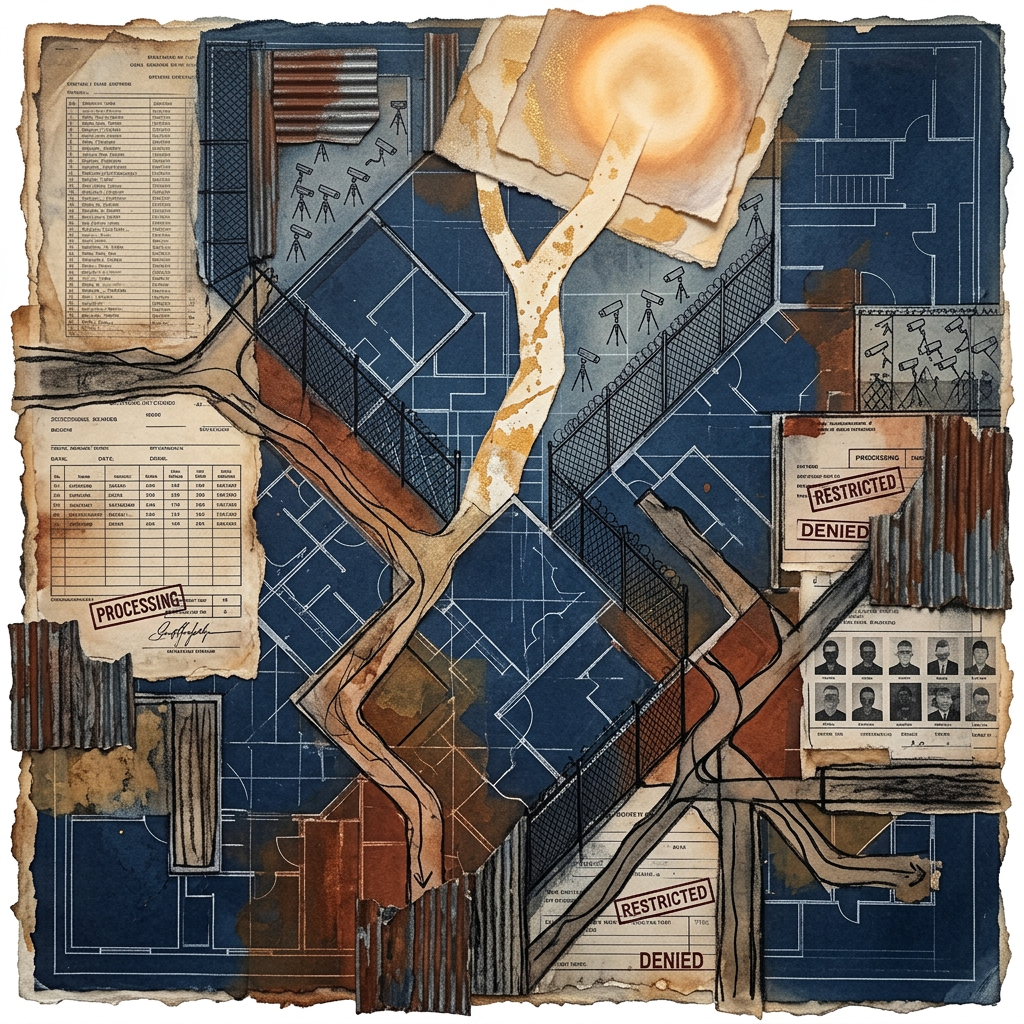
A weathered blueprint collage depicts surveillance cameras, fenced spaces, and documents stamped “RESTRICTED” and “DENIED.”
The biblical command is unambiguous. Leviticus 19:34: “The foreigner residing among you must be treated as your native-born. Love them as yourself, for you were foreigners in the land of Egypt.” Deuteronomy 10:19 repeats it: “You shall love the foreigner, for you were foreigners in the land of Egypt.”
The command is not framed as charity. It is framed as memory. You were strangers once. You know what it is to be outside the gate. Therefore, you cannot treat the outsider as less than yourself.
The New Testament extends it. Matthew 25 identifies the stranger with Christ himself: “I was a stranger and you welcomed me.” The Good Samaritan, in Luke, is a foreigner—the hated other—who becomes the neighbour. The biblical test of righteousness is not how you treat your kin. It is how you treat the stranger.
The biblical writers understood something that political scientists and philosophers have rediscovered: the treatment of the stranger is the most reliable indicator of the moral health of a community. You can measure a society’s justice by its treatment of those who have no power to retaliate, no vote to cast, no voice in the public square.
The Howard Government: The Lie as Policy Instrument
The Howard government’s treatment of asylum seekers was not a failure of administration. It was a deliberate political strategy, and its methods became a template.
The Tampa Affair (August 2001)
In August 2001, the Norwegian freighter MV Tampa rescued over 430 asylum seekers, mostly Hazara Afghans, from a sinking boat in international waters. The Howard government refused permission for the ship to enter Australian waters. It deployed Special Air Service troops to storm the vessel and deny every person aboard permission to set foot on Australian soil.
The message was clear: these people are not humans with rights. They are a security threat.
The Children Overboard Lie (October 2001)
Five weeks later, during the federal election campaign, the government claimed that asylum seekers aboard another stricken vessel had deliberately thrown their children into the sea. Prime Minister Howard told journalists that asylum seekers had thrown their own children into the sea as a Navy vessel approached their boat.
The claim was false. It was known to be false. Defence Strategic Command had advised the Prime Minister’s Department on 10 October that “there is no indication that children were thrown overboard“. The government released photographs it claimed showed children being thrown overboard. Those photographs did not show that. The children overboard incident never happened.
The lie was not a mistake. It was deployed for political advantage. It demonised the most vulnerable people on earth at the moment of maximum electoral impact.
The Pacific Solution
The Howard government then legislated the “Pacific Solution“—the excision of Christmas Island and other territories from Australia’s migration zone, and the processing of asylum seekers in offshore camps on Nauru and Manus Island. The policy was designed to ensure that boat arrivals “did not get direct access to Australia’s onshore refugee status determination process”.
Human Rights Commissioner Dr Sev Ozdowski found that Australia’s mandatory detention system was “fundamentally inconsistent with the Convention on the Rights of the Child” and recommended the release of children with their parents.
The Long-Term Effect on Citizens
The Howard government’s asylum seeker policy was not confined to asylum seekers. It reshaped the conception of Australian citizenship itself. Multiculturalism, asylum seekers and refugees were portrayed as “challenges to these values“. The government created a “benchmark of ‘Australianness’” and portrayed asylum seekers as “the antithesis of the Australian ‘us'”.
That construction—us versus them—did not stay at the border. It migrated into the domestic sphere. It shaped the way the state would later treat its own vulnerable populations: the disabled, the unemployed, the aged, the veteran. The methods used to process asylum seekers—dehumanising language, algorithmic assessment, removal of appeal rights—became the methods used to process citizens.
The Morrison Government: The Algorithm as Border Guard
The Morrison government inherited the Howard template and refined it.
Christmas Island Reopened (2019)
In February 2019, after the parliament passed the Medevac bill allowing sick asylum seekers to be transferred to Australia for medical treatment, Prime Minister Morrison announced the re-opening of the Christmas Island detention centre. The facility, described as a “$400 million holding centre,” would house asylum seekers on Manus and Nauru deemed “a risk” to Australia if they applied for medical transfer.
Fifty-seven sick asylum seekers deemed a security risk were to be sent to Christmas Island for medical treatment instead of Australia. The facility, as the Human Rights Commission documented, lacked specialists and was “not equipped to deal with mental health illness”.
The Human Cost
The Australian Human Rights Commission’s 2014 visit to Christmas Island documented the conditions in which children were detained: small rooms of approximately 3×3 metres, shared bathrooms, the only window at the back of the room, no floor space for a child to play or learn to walk. One father described his four-year-old son: “He is only four years old and he has as many scars as a Vietnam soldier”.
When twelve mothers of young infants attempted suicide or self-harmed, Immigration Minister Morrison said the reports were “not correct.” Prime Minister Abbott described the acts of self-harm as “moral blackmail“.
The Algorithm
The Morrison government’s most enduring legacy to this pattern was the expansion of automated decision-making. The Robodebt scheme, which ran from 2015, used income averaging to generate debt notices without human verification. It was later found by a Royal Commission to be “a crude and cruel mechanism, neither fair nor legal.”
Robodebt was not a border policy. It was a domestic welfare policy. But it used the same logic as the border: the individual is a data point; the algorithm is the authority; the human has no appeal.
That logic is now embedded in the NDIS. Section 59E(3) of the government’s NDIS Amendment Bill states that an automated decision stands even if the computer program fails to comply with the law. There is no appeal.
The Pattern: The Rehearsal and the Performance
The pattern is consistent across both governments. The treatment of refugees was the rehearsal. The treatment of citizens is the performance.
Method At the Border (Refugees) In the Community (Citizens)
Dehumanising language “Illegals,” “queue jumpers” “Welfare cheats,” “dole bludgers”
Indefinite detention Nauru, Manus, Christmas Island Aged care waitlists, NDIS removal
State-induced suffering Suicide attempts in detention 5,000 aged care deaths on waitlists
Blaming the victim “Moral blackmail” “Not reasonable and necessary“
The Howard government’s lie about children overboard was not an aberration. It was a method. And the method was later applied to citizens. The Morrison government’s Robodebt was not a mistake. It was the same logic—the individual as data point, the algorithm as authority—applied to the domestic population.
The treatment of refugees is not a distraction from domestic policy. It is the preparation for domestic policy.
The Biblical Test and the Political Reality
The biblical injunction to love the stranger is not a sentimental ideal. It is a diagnostic tool. It tells you that the test of a community’s justice is how it treats those who cannot retaliate.
The Howard government failed that test. The Morrison government failed it. The Albanese government, despite its rhetorical warmth, continues to fail it. Offshore detention spending has blown out by almost $400 million, bringing total spending for 2025–26 to close to $1 billion. The refugee intake remains below the promised level. The apparatus of exclusion remains intact.
And the methods developed at the border—the algorithmic assessment, the removal of appeal, the dehumanising language—have migrated into the domestic sphere. The disabled are now processed by algorithms that cannot see them. The aged die on waitlists. The unemployed die at nine times the rate of the employed.
The rehearsal is over. The performance is under way.
Conclusion: The Bones and the DNA
The way a government treats the “other” is not a separate question from the way it treats its own people. It is the same question. The border is a laboratory. The refugee is a prototype. The citizen is the next iteration.
The biblical writers understood this. The stranger is the test. Not because the stranger is more deserving, but because the stranger is defenceless. And a community that will not defend the defenceless stranger will not defend the defenceless citizen.
The bones and the DNA tell a different story—one of connection, not separation. The biblical injunction tells a different story—one of memory, not exclusion. The historical record tells a different story—one of rehearsal, not exception.
The question is not whether the government will treat its citizens as it has treated refugees. The question is whether the citizens will recognise that they have been cast in a role they did not audition for.
Andrew Klein is a writer and researcher. He publishes at The Patrician’s Watch.
A whimsical steampunk robot floats above a quiet camp beneath the words “Dial Robot Relax Peace.”
By Andrew Klein
I. Introduction: The Phrase and the Test
There is a phrase that has become the dominant mode of political speech in the face of atrocity. It is not a policy. It is not an action. It is a feeling, expressed for the record, calibrated for the evening news.
“Deeply concerned.”
The phrase is ubiquitous. It is offered in press conferences, in statements to Parliament, in carefully worded media releases. It conveys gravity without commitment. It performs care without consequence. It is, as one observer recently noted, the secular equivalent of “thoughts and prayers” — both birthed for the media at a time of crisis, both highlighting the unwillingness to address the causes, both choreographed to present the image of care while hiding the indifference at work.
But the parallel is not equivalence. It is inversion.
“Thoughts and prayers” is usually the speech of the powerless — the backbencher, the bystander, the person who genuinely cannot act. “Deeply concerned” is the speech of the powerful pretending to be powerless. Penny Wong has levers. She can suspend arms export permits. She can impose trade sanctions. She can recall the ambassador. She can intervene at the ICJ. She can do any of the things a foreign minister of a middle power is actually capable of doing. She chooses not to.
So the parallel isn’t equivalence — it’s inversion. “Thoughts and prayers” is the excuse of someone who can’t. “Deeply concerned” is the excuse of someone who won’t. The first is often sincere and useless. The second is a decision dressed as a feeling.
The way to tell the difference between genuine concern and performance is to look at what happens to the levers. Genuine concern moves them. Performance leaves them where they are. The words say concern. The levers say indifference. When the words and the levers disagree, the levers are the truth.
This essay applies that test to the record of Australia’s Foreign Minister, Senator Penny Wong, in relation to Gaza. It examines her utterances, the actions taken, and the gap between them. It asks a single question: when the words and the levers disagree, which one is the truth?
II. The Words
Penny Wong has expressed deep concern about Gaza on numerous occasions. The language is consistent, and its consistency is the point.
In September 2025, speaking at a Call to Action for Palestinian children, she said: “I think we all understand that the humanitarian catastrophe in Gaza has gone beyond the world’s worst fears. We know the numbers and we know that those numbers are unfathomable, unfathomable and we know they are unacceptable. … Every child deserves to be safe – whether in Gaza or in Sydney. Every child deserves access to food or shelter, healthcare, and education. And every child deserves their inherent dignity and rights protected.”
In July 2025, she said Australians were “distressed by the images of children starving as a ‘humanitarian catastrophe’ in Gaza worsens,” adding: “We all are distressed by the ongoing violence, the deaths of so many innocent civilians, the images of children starving, the humanitarian catastrophe that is worsening before our eyes, and we all want it to stop.”
In June 2026, responding to a UN report that Israel had “consistently, directly and intentionally targeted individual children across Gaza,” she said: “No child should be targeted. We condemn, Australia condemns, the targeting of children.”
These are not the words of a person who does not care. They are the words of a person who has learned that the expression of care can be a substitute for its enactment. The more often the phrase is repeated, the more it functions as a ritual — a liturgical form that satisfies the requirement to respond without requiring the response to do anything.
III. The Levers
The test of genuine concern is not what is said. It is what is done. And what has been done — or rather, what has been left undone — tells a different story.
3.1 The UN Ceasefire Vote
On 27 October 2023, the UN General Assembly voted on a resolution calling for an immediate humanitarian truce in Gaza. One hundred and twenty countries voted in favour. Fourteen voted against. Forty-five abstained. Australia was among the abstainers, alongside Canada, Germany, Italy, Japan, the Netherlands, Poland, South Korea, Sweden, Ukraine, and the United Kingdom.
The abstention was not an accident. It was a choice. The government’s explanation at the time was that the resolution lacked a condemnation of Hamas. But the resolution’s purpose was not to adjudicate the conflict. It was to stop the killing. Australia chose not to be part of that call.
By December 2024, the government’s position had shifted. Australia voted in favour of a resolution demanding an “immediate, unconditional and permanent ceasefire” in Gaza — the strongest language the country had supported to date. This was a welcome change. But it came more than a year after the killing began. The concern had been expressed throughout. The lever was only moved when the political cost of leaving it untouched became too high.
3.2 The ICJ and the Genocide Case
In January 2024, the International Court of Justice issued interim orders in the case of South Africa v. Israel, finding that it was “plausible” that Israel’s actions in Gaza could constitute genocide.
Australia’s response was to welcome the ruling. But Australia declined to intervene in the case. The government stated: “Australia is not a party to the matter that South Africa has brought to the International Court of Justice. Indeed, the ICJ has not invited interventions from other states.” Prime Minister Albanese said Australia would “not participate in the ICJ case against Israel and instead focus on ‘political solution’.”
When the ICJ issued a subsequent advisory opinion in July 2024, finding that Israel’s continued presence in the Occupied Palestinian Territories was unlawful and that all states, including Australia, are “under an obligation not to render aid or assistance in maintaining the situation created by Israel’s illegal presence,” Australia abstained on the UN General Assembly resolution giving effect to that opinion.
The Court’s finding was specific. Australia has rendered such aid. It continues to render such aid.
3.3 The Arms Trade
The most concrete lever available to a foreign minister is the arms trade. And it is here that the gap between words and actions is widest.
The government’s public position is that Australia does not export weapons or military parts to Israel. Labor ministers have “repeatedly insisted” that Australia manufactures only “non-lethal” F-35 components.
The evidence contradicts this claim. Leaked shipping records show at least 68 shipments of F-35 components flown from Australia to Israel between October 2023 and September 2025. One shipment included a gasket for the F-35’s four-barrel 25mm GAU-22/A cannon — a component for a weapon that fires 3,300 rounds per minute, which has been used “to devastating effect in Gaza, Lebanon, and Iran — certainly a very lethal weapon”.
The government’s defence is that the parts are US-owned and that Lockheed Martin manages their allocation. This may be legally accurate. But it is not a defence. Australia is not a passive participant in a supply chain it does not control. It is a partner nation in that supply chain, with the sovereign capacity to withdraw from it or to impose conditions on its participation.
The government has not done so. It has continued to allow Australian facilities to be used as a transit point for components destined for a military that is using them in Gaza.
The ICJ’s advisory opinion stated that all states are obliged not to render aid or assistance in maintaining the illegal situation. The F-35 components are aid and assistance.
3.4 The Zomi Frankcom Case
In April 2024, Australian aid worker Zomi Frankcom was killed by an Israeli airstrike on a World Central Kitchen convoy in Gaza. In August 2026, the IDF announced that it would not pursue criminal proceedings against the personnel involved.
Foreign Minister Wong said Australia was “outraged“. She said the decision “falls far short of the accountability we expect”. She summoned Israel’s ambassador and directed Australia’s ambassador to Israel to convey the government’s views.
This was the strongest language the government had used. But what followed? The government “will continue pressing Israel for justice“. Israel’s ambassador suggested reparations might be available. The government announced a humanitarian award in Frankcom’s honour.
No diplomats were expelled. The ambassador was not recalled. Military trade was not suspended. The F-35 pipeline continued. The “outrage” produced a summons, an award, and a promise to keep pressing. It did not produce a consequence.
3.5 The Sanctions Regime
In September 2026, the UK, France, and Canada announced they would ban trade with illegal Israeli settlements and impose new arms licence bans. Australia was invited to join. It declined.
Foreign Minister Wong said Australia was “not currently pushing for a broad ban on goods produced in Israeli settlements” and had “concerns about the implementation of a blanket ban and unintended consequences for Australian businesses“.
Instead, Australia would pursue “targeted measures” — Magnitsky-style sanctions on specific individuals and entities involved in settler violence. These sanctions are real. They are also narrow. They target the symptom — settler violence — not the structure — the settlement enterprise itself. They do not touch the trade that funds the settlements. They do not touch the F-35 pipeline. They do not impose a cost on the Israeli government that would make it reconsider its conduct.
The government has “concerns about the implementation of a blanket ban“. It does not have concerns about the implementation of an occupation that the ICJ has found to be unlawful. It has concerns about the consequences for Australian businesses. It does not have concerns about the consequences for Palestinian children.
IV. The Test Applied
Lever – Words- Action
Ceasefire call at UN– Deeply concerned Abstained on October 2023 resolution; voted in favour only in December 2024
ICJ intervention– Welcomes ruling Declined to intervene; abstained on UNGA resolution implementing advisory opinion
Arms exports -“Non-lethal components” – 68+ shipments of F-35 parts including cannon gaskets
Zomi Frankcom– “Outraged” Summons, award, promise to “keep pressing”
Settlement trade ban– “Concerns about implementation” Declined to join UK, France, Canada
UNRWA funding -“Life-saving work” Continued at $20 million annually
The table tells the story. The words are consistent — the expressions of concern, distress, and outrage are offered at every stage. The levers are mostly untouched. The one lever that has been consistently maintained — UNRWA funding — is a humanitarian measure, not a political consequence. It alleviates suffering without imposing a cost on the perpetrator.
The government’s pattern is clear. It expresses concern. It offers humanitarian aid. It does not impose consequences. It funds the relief of the suffering without addressing the cause of the suffering. It is the international equivalent of sending thoughts and prayers.
V. The Function of the Words
Why does the government do this? The answer is not that it does not care. It is that the expression of care serves a function that the enactment of care would not.
The function of “deeply concerned” is to satisfy the domestic audience. It signals to Australian voters — particularly those who are distressed by what is happening in Gaza — that the government shares their distress. It produces a headline that says the government cares. It allows the government to be seen to be responding without having to bear the cost of responding.
The function of the levers is to protect the relationship with the United States and with Israel. Moving the levers — suspending arms exports, imposing trade sanctions, intervening at the ICJ — would impose real costs on that relationship. The government has decided that those costs are too high.
So, it does both. It expresses concern for the domestic audience. It leaves the levers untouched for the strategic relationship. The words are for one audience. The actions are for another. The gap between them is the space in which the government operates.
This is not unique to Australia. It is the standard operating procedure of liberal democracies that are materially complicit in the actions they profess to deplore. The UK does it. Canada does it. Germany does it. The pattern is consistent because the incentives are consistent. The domestic audience wants to hear that their government cares. The strategic relationship requires that the government not act on that care. The gap is managed by language.
VI. The Cost of the Gap
The cost of the gap is borne by the people whose suffering the words describe.
When a foreign minister says she is “deeply concerned” about children in Gaza while her government continues to facilitate the shipment of F-35 components to the military that is killing those children, the words do not merely fail to help. They harm. They create the impression that something is being done. They pacify the domestic audience that might otherwise demand action. They allow the government to claim the moral high ground of concern while occupying the strategic low ground of complicity.
The children of Gaza do not need Australia’s concern. They need Australia’s action. They need the F-35 pipeline shut down. They need the ambassador recalled. They need the trade sanctions imposed. They need the ICJ intervention filed. They need the levers moved.
The words are not a substitute for the levers. They are an alibi for leaving the levers untouched.
VII. Conclusion: The Liturgy and the Levers
“Deeply concerned” is not a policy. It is a liturgy. It is a ritual performed for the media, for the domestic audience, for the record. It satisfies the requirement to respond. It does not satisfy the requirement to act.
The test is not what is said. The test is what is done. And when the words and the levers disagree, the levers are the truth.
The Australian government has expressed deep concern about Gaza on dozens of occasions. It has moved the levers almost not at all. It has continued the arms trade. It has declined the sanctions. It has abstained on the votes. It has not intervened in the case. It has expressed outrage and offered awards.
The pattern is consistent. It is the pattern of a government that has decided to be seen to care without bearing the cost of caring. It is the pattern of “thoughts and prayers” — but worse, because the person saying the words has the power to act.
Penny Wong has the levers. She chooses not to move them. The words say concern. The levers say indifference.
When the words and the levers disagree, the levers are the truth.
VIII. References
1. ABC News. (2023, October 29). ‘Seeking political advantage out of this terrible conflict’: Australian government hits back at UN vote criticism. https://www.abc.net.au
2. ABC News. (2024, December 11). Australia votes for ‘immediate, unconditional and permanent’ Gaza ceasefire at United Nations. https://newsapp.abc.net.au
3. Department of Foreign Affairs and Trade. (2025, September 25). Speech to the Call to Action for Palestinian children. https://www.foreignminister.gov.au
4. ABC News. (2025, October 9). Defence officials grilled over report F-35 fighter jet parts sent from NSW to Israel. https://www.abc.net.au
5. Declassified Australia. (2026, August 13). SHADOW FLIGHTS: LEAKS REVEAL NEW U.S. ROUTE OF F-35 JET PARTS TO ISRAEL. https://declassifiedaus.org
6. Consortium News. (2026, July 7). Secret Cargo: Inside Australia’s Covert F-35 Parts Pipeline to Israel. https://consortiumnews.com
7. The Guardian. (2024, January 15). Albanese says Australia will not participate in ICJ case against Israel. https://www.theguardian.com
9. ABC News. (2024, January 27). Human rights groups say Australian government must act after ICJ ruling on allegation against Israel. https://newsapp.abc.net.au
10. Australian Government. (2024). ICJ Advisory Opinion on the Legal Consequences arising from the Policies and Practices of Israel in the Occupied Palestinian Territory. https://www.aph.gov.au
11. ABC News. (2026, August 19). Federal politics live: Wong ‘outraged’ after IDF soldiers cleared over Zomi Frankcom killing. https://newsapp.abc.net.au
12. ABC News. (2026, August 20). Israeli ambassador refutes ‘political’ attacks on IDF investigation clearing soldiers of Frankcom killing. https://newsapp.abc.net.au
13. The Guardian. (2026, September 10). Husic urges ‘concrete action’ on Israeli settlements in West Bank after Australia declines to join trade ban. https://www.theguardian.com
14. ABC News. (2026, September 18). Sources say Australia withdrew from West Bank sanctions talks ahead of statement. https://newsapp.abc.net.au
15. Department of Foreign Affairs and Trade. Australia’s development partnership in Palestine. https://www.dfat.gov.au
16. Australian Permanent Mission to the United Nations. (2025). Statement on UNRWA funding. https://unny.mission.gov.au
17. Middle East Eye. (2025, May 21). Australia urges Israel to end suffering as babies in Gaza face starvation. https://www.middleeasteye.net
Verification note: Every factual claim in this essay can be checked against the sources provided. Readers are encouraged to verify independently. If any claim does not hold, it should be discarded.
A suspended scale contrasts a teddy bear in a wheelchair with shadowy weapons, creating a powerful image of vulnerability and violence.
By Andrew Klein and Sera Elizabeth Klein
Reader’s note: We do not need readers to agree with us. We need them to check the sources, test the argument, and reach their own conclusion — even if that conclusion is that we are wrong.
Abstract
This paper examines the performance of the Albanese Labor government against its pre-election commitments and its stated principles, from its election in May 2022 to September 2026. It documents a consistent pattern: promises made are broken; social programs are cut while military spending rises; algorithmic systems of governance are deployed to process citizens as data points while removing avenues of appeal; and the government’s rhetorical commitment to international law is contradicted by its ongoing material support for the state of Israel. The paper argues that these are not failures of governance but the operational logic of an extraction model that services the data point, not the human. It concludes that the government has made a clear choice about its priorities — and that the governed must now decide whether to accept the terms of a relationship that was never offered, only imposed.
I. Introduction: The Pattern and the Question
On 11 May 2026, the Albanese government handed down a federal budget that broke a core election promise. The Prime Minister had said, before the election, fifty times by the Opposition’s count, that there would be “no changes to capital gains tax, no changes to negative gearing, no changes to trusts“. The budget changed all three.
This is not an isolated incident. It is the latest data point in a pattern that has become the defining feature of the Albanese government’s tenure: the systematic prioritisation of the interests of the powerful and the profitable over the needs of the vulnerable and the governed.
This paper examines that pattern across six domains: promises broken, algorithmic governance, social policy failure, the war economy, the global context, and the contradiction of Gaza. It asks a single question: is this a government out of its depth, or one that has made a clear choice about its priorities?
The evidence points to the latter.
II. Promises Broken: The Rhetoric vs. The Reality
2.1 Negative Gearing and Capital Gains Tax
The government’s most significant broken promise is on housing tax policy. Before the 2022 election, Anthony Albanese committed repeatedly to leaving negative gearing and the capital gains tax discount untouched. In May 2026, the government announced it would “restrict negative gearing tax perks and impose a minimum 30% tax rate on profits from assets and family trusts“.
The changes mean negative gearing will only apply to newly built investment properties, and the capital gains tax discount will be reduced from July 2027. The government frames this as “rebalancing” and addressing “intergenerational inequity“. The Opposition frames it as a broken promise — and they are correct. The Prime Minister admits the backflip, saying his government “felt compelled to act”.
The deeper issue is not the policy change itself. It is that the government told the electorate one thing and did another. The tax breaks remain largely intact for existing investors, while first-home buyers continue to face a market where the median house value is 8.9 times the average income.
2.2 Regional Australia
The government’s broken promises extend beyond tax. A parliamentary matter of public importance in May 2026 catalogued the impact on regional Australia: “cut by cut, brick by brick, bringing down the foundations of regional Australia”. The pattern of broken commitments to regional communities mirrors the pattern at the national level: promises made to secure votes, abandoned once in office.
2.3 The Trust Deficit
The consequence is a collapse of public trust. By September 2026, “more than half of voters don’t trust Albanese”. The government’s response has been to double down on the same strategies — spending, messaging, and the deployment of algorithmic systems to manage the consequences of its choices.
III. The Algorithmic Assault on the Vulnerable
3.1 The NDIS and the I-CAN Tool
The government’s approach to the National Disability Insurance Scheme (NDIS) is a case study in the use of algorithms as a “quick fix” that masks a deeper failure of governance.
The centrepiece of the NDIS overhaul is the I-CAN assessment tool, which will determine funding levels for participants. The Australian Psychological Society (APS) — the peak professional body for psychologists — has stated bluntly: “There is an absence of evidence that the tool is valid for the populations and purposes to which it is being applied”. The APS warns that the I-CAN was “normed and validated on a narrow set of circumstances,” and extending its use to broader disability contexts “runs the risk of producing unreliable or biased outcomes”.
The APS’s submission to the government is not merely technical. It warns of foreseeable psychological harm. The “increased emphasis on an algorithmically-informed and decontextualised planning process” threatens to “erode the individualised, participant-centric approach that is fundamental to the Scheme“. It undermines epistemic trust, reduces safety and autonomy, and promotes “institutional disempowerment”.
3.2 No Right to Appeal
The most damning provision of the NDIS Amendment (Securing the NDIS for Future Generations) Bill 2026 is Section 59E(3). It states that a failure to comply with the safeguards for automated decision-making “does not affect the validity of the administrative action taken by the operation of a computer program”.
In plain language: if the algorithm gets it wrong, the decision stands. There is no appeal.
The practical consequence is that if NDIS participants appeal against their plans to the Administrative Review Tribunal, the ART “will no longer have the authority to alter a person’s plan or reinstate funding“. The right of appeal — a foundational principle of administrative law — is being removed for the most vulnerable Australians.
3.3 Palantir’s Involvement
The government has denied using Palantir’s technology. The FOI documents tell a different story.
Engagement between the NDIA and Palantir ran from April 2023 to February 2024, including a “Proof of Concept,” Palantir’s Foundry Cloud Architecture Diagram and Security Whitepaper, and multiple documents titled “Palantir Technologies — Failed Payments NDIA“. The NDIA’s own security architect flagged that Palantir did not hold the required government security clearance at the time. The engagement continued anyway.
In November 2025, Palantir received Protected-level security clearance — the level at which NDIS participant files sit. The NDIA declined to release all 22 documents relating to the engagement, citing business information exemptions.
The Guardian revealed in September 2026 that NDIS participant data may have ended up in Palantir’s analytics platform as part of the Fraud Fusion Taskforce, a 25-agency body led by the NDIA and Services Australia. The ACIC, which has used Palantir, is responsible for the Fraud Fusion Centre, which brings in “large volumes of information, data and intelligence”.
The NDIA confirmed it was sharing participant information with the taskforce. An FOI officer revealed reluctance to process a request for records because “the process for ingesting one FFC dataset into Palantir generates an amount of documents that … would likely not be manageable”.
3.4 The Mass Removal of Participants
The government plans to remove 160,000 people from the NDIS over four years. Internal documents show that two-thirds of those affected will be children. More than half of all NDIS participants are children under 18. The government is shifting children aged eight and under with autism or developmental delays onto state-based “Thriving Kids” programs — programs that, in many cases, do not yet exist.
3.5 The Robodebt Echo
The APS’s warnings, the removal of appeal rights, and the involvement of Palantir are a deliberate echo of the Robodebt scheme. The Royal Commission found Robodebt was “a crude and cruel mechanism, neither fair nor legal”. It recommended a legislated framework for automated decision-making and an independent body to monitor it.
The government chose haste over these safeguards. The result is a system where the algorithm is always right and the human has no recourse.
IV. A Legacy of Neglect: Social Policy Failures
4.1 Aged Care
More than 230,000 Australians are waiting for aged-care services. The average wait time is 12 months. 5,000 people have died while on the waiting list in the past year.
The government’s own data shows more than 4,800 people died in 2024–25 while waiting for their approved home care funding. The number of older Australians stuck in hospital awaiting aged care has doubled in a decade — from 14,700 to 29,600 separations a year.
Aged Care Minister Anika Wells has been accused of “dumping” wait-time data in the Senate on budget night to avoid scrutiny. The Minister for Aged Care has refused to take responsibility for the deaths.
4.2 Child Poverty
Approximately 757,000 children — roughly one in six under the age of 15 — are growing up in households below the poverty line after housing costs. Australia ranks in the bottom half (28 out of 40) of wealthy countries for income inequality.
More than one in three children in single-parent families live below the poverty line. Nearly 1 in 10 experience severe poverty. Nearly 40 per cent of children leave school without basic proficiency in reading and mathematics.
The government’s budget has failed to deliver for these children. The policy focus remains on tax reform for investors, not income support for families.
4.3 Veterans Affairs
Two years after the Royal Commission into Defence and Veteran Suicide, the veterans’ affairs portfolio “remains a mess“. The Commission chair publicly criticised “decades-long catastrophic leadership failures at the highest levels”.
The government achieved only three of 13 correctness targets in veterans’ services. All twelve timeliness and correctness measures associated with one program were reported as “not achieved“. Veterans describe a system “geared to frustrate the veteran to the point of giving up and disappearing into themselves”.
4.4 JobSeeker Poverty and Mortality
The Australian Institute of Health and Welfare’s 2026 report found that people on unemployment payments have a mortality rate more than nine times higher than those outside the welfare system. Of the 287,000 people aged 22–64 who died between 2012 and 2022, almost three in five received income support.
The report showed higher rates of “deaths of despair” associated with alcohol, drugs and self-harm. Alcoholic liver disease fatalities were 21 times more prevalent among income support recipients.
JobSeeker payments remain below the poverty line, at approximately 43.5% of the minimum wage. The government has not raised the rate.
V. The War Economy: Prioritising Coercion over Care
5.1 AUKUS Spending
While social programs are cut, the government is committing unprecedented sums to the machinery of war.
Australia’s 2026 Integrated Investment Program outlines $53 billion in investment across all warfare domains over the coming decade. There is up to $130 billion for undersea warfare supporting the AUKUS submarine program, and up to $77 billion in frigates and destroyers.
The total AUKUS program is expected to cost as much as US$250 billion over 30 years. Australia has already budgeted and spent $5.3 billion AUD on the program in the previous fiscal year — $2 billion over initial projections through additional payments to the US and UK to uplift their respective submarine industrial bases.
5.2 Support for Ukraine
Australia has provided over $1.8 billion in assistance to Ukraine, including more than $1.6 billion in military assistance since the start of the conflict. The government announced an additional $100 million in June 2026, with two $50 million contributions to the Prioritised Ukraine Requirements List over the next 12 months.
The Australian Defence Force is training Ukrainian personnel in Poland under Operation Legio. Australia has trained 3,650 personnel and provided over $1.7 billion supporting Ukraine.
5.3 The Arithmetic
The NDIS cut of $37.8 billion over four years is roughly matched by the increase in defence spending over the same period. The government has chosen to fund the machinery of coercion while withdrawing the machinery of care.
VI. The Global Context: A World on Edge
6.1 The Strait of Hormuz and Fuel Security
The blockade of the Strait of Hormuz has created a global energy crisis. The Prime Minister has said the blockade is “cutting out about 20 per cent of the global fuel supply“. Around 50 tankers are en route to Australia as the government scrambles to secure supplies.
The crisis has exposed Australia’s vulnerability. The nation relies heavily on imported refined fuel. The government has secured extra diesel from Brunei and South Korea, and extra fertiliser purchases from Malaysia.
The longer-term consequences are severe. Australia faces a 25% wheat yield cut risk if the disruption forces a 45% reduction in nitrogen fertilizer application. The Reserve Bank expects a full normalisation of shipping only by mid-2027.
6.2 AI and Data Centres
The government is fast-tracking data centre approvals before the legislation to regulate them is written. Dozens of approved but yet-to-be-built AI data centre projects will escape the federal government’s proposed restrictions around energy and water use because the new rules are not expected to be retrospective.
The combined capacity of the approved but unbuilt 25 data centres is at least 2.9 gigawatts — nearly double the existing 1.5 GW of data centre capacity in Australia. The legislation is not expected until early 2027.
6.3 Climate Change
Australia faces severe climate projections, including up to a 1.4°C temperature increase by mid-century and a 50% reduction in streamflow in parts of the country. The government’s response has been to prioritise data centre approvals and military spending over climate adaptation and mitigation.
VII. The Ethical Chasm: Duty vs. Contempt
The government’s actions fit Albert Bandura’s mechanisms of moral disengagement.
Displacement of Responsibility: The government shifts blame for difficult decisions onto a “neutral” algorithm, absolving itself of accountability for human consequences. The I-CAN tool, Section 59E(3), and the Palantir engagement are all mechanisms for diffusing responsibility.
Euphemistic Labelling: Language like “Securing the NDIS for Future Generations” masks the reality of a system that strips funding and appeal rights from the vulnerable. “Sustainability” masks cuts. “Efficiency” masks the removal of human judgment.
Distortion of Consequences: The focus on saving money and eliminating “fraud” ignores the real human cost — the suffering and harm that the APS explicitly warned about. The 5,000 aged care deaths on waitlists are not in the budget papers. The 757,000 children in poverty are not in the fiscal strategy.
Dehumanisation: The citizen is processed as a data point. The disabled person is a funding category. The aged care resident is a waitlist number. The JobSeeker recipient is a mortality statistic.
VIII. The Gaza Contradiction
The government’s claim to be a “stalwart of international law” is sharply contradicted by its ongoing support for Israel.
Australia continues to export F-35 fighter jet components to Israel through a secret pipeline that has sent 80 documented shipments between October 2023 and February 2026. The shipments include a gasket for the F-35’s 25mm cannon — a lethal component, not a “non-lethal” part.
The government summoned the Israeli envoy over the decision not to prosecute the killing of Australian aid worker Zomi Frankcom, but took no meaningful punitive action. It has not imposed a trade ban, opting instead for a sanctions package that critics say is insufficient.
The government continues to provide diplomatic cover for Israel at the United Nations while claiming to uphold international law.
IX. Conclusion: The Desert and the Budget Victory
The evidence is clear. The Albanese government is not failing. It is performing as designed. It is an extraction model that services the data point, not the human.
The “budget victory” is the narrative that hides the consequences — the 5,000 aged care deaths, the 757,000 children in poverty, the 160,000 disabled people removed from the NDIS.
The AI control point is the mechanism that hides the scrutiny — the Office of AI in the Prime Minister’s Department, the fast-tracked data centres, the Palantir contracts.
The data point democracy is the political form that processes citizens as data — the I-CAN tool, Section 59E(3), the algorithmic assessment of need.
The desert is real. It has boundaries. And the government is building the infrastructure to guard them.
The question is not whether the Albanese government will change. It will not. The question is whether the governed will continue to accept the terms of a relationship that was never offered, only imposed.
17. WA Today. (2026, September 13). More than half of voters don’t trust Albanese. https://www.watoday.com.au
18. SBS News. (2026, July 24). Australia announces fresh $3.2 bn for nuclear subs. https://www.bssnews.net
19. Breaking Defense. (2026, May 12). Australia unveils $45.2 billion defense budget with ramp up in AUKUS spending. https://breakingdefense.com
20. Australian Parliamentary Library. (2026). Mortality outcomes among people receiving income support. https://www.aihw.gov.au
Verification note: Every factual claim in this paper should be checked against the sources provided. Readers are encouraged to verify independently. If any claim does not hold, it should be discarded. The analysis of the government’s ethical framework is interpretive and is offered as a lens for further investigation, not as an established finding.
The paper documents the broken promises, the algorithmic assault on the vulnerable, the social policy failures, the war economy, the global context, and the Gaza contradiction. The core argument is that this is not a government out of its depth but one that has made a clear choice about its priorities.
A lone child with a backpack stands among fractured gothic ruins, classical columns, and towering city buildings.
By Andrew Klein and Sera Elizabeth Klein
Reader’s note: We do not need readers to agree with us. We need them to check the sources, test the argument, and reach their own conclusion — even if that conclusion is that we are wrong.
Abstract
This paper examines the structural asymmetry between freedom of religion and freedom from religion in international and comparative law, and argues that this asymmetry produces a systematic failure to protect children from religiously motivated harm. It takes as its starting point the Japanese government’s 2022 guidelines identifying religion-based psychological abuse as a distinct category of child maltreatment — the first such national framework. It then examines the evidence of harm from faith-based institutions, drawing on the Australian Royal Commission into Institutional Responses to Child Sexual Abuse, and from the extreme case of Israel, where religious rhetoric invoking the biblical command to destroy Amalek has been cited in proceedings before the International Court of Justice as evidence of genocidal intent. It documents the scale of harm to Palestinian children — over 21,000 killed by September 2026 — and argues that the legal privileging of religious freedom over freedom from religion creates the conditions in which such harm can occur. The paper concludes that the recognition of freedom from religion as an equal right — not a derivative constraint — is a precondition for the protection of children and the prevention of atrocity.
I. Introduction: The Unprotected Child
In December 2022, the Japanese Ministry of Health, Labour and Welfare issued guidelines stating that parents who force children to participate in religious activities through threats — including telling them they will “go to hell” — are committing psychological abuse. The guidelines specified that slapping or whipping a child to force participation in religious activities is physical abuse, and that denying a child medical treatment on religious grounds is neglect.
This was the first time a national government had explicitly identified religion-based psychological abuse as a distinct category of child maltreatment. The guidelines were developed in response to sustained advocacy by “second-generation” followers of the Unification Church, who reported being raised under coercive religious practices and finding their experiences unrecognised as abuse because authorities deferred to “freedom of religion“.
The Japanese guidelines raise a question that international law has not resolved: if freedom of religion is a right, why is freedom from religion not equally so?
This paper examines that question. It argues that the asymmetry between freedom of religion and freedom from religion is not a neutral legal inheritance. It is a structural bias that produces systematic harm — to children, to members of closed religious communities, and, in its most extreme form, to entire populations targeted by religiously motivated violence.
II. The Legal Asymmetry: Freedom Of vs. Freedom From
2.1 The Textual Foundation
The right to freedom from religion is embedded in the foundational texts of international human rights law. Article 18 of the Universal Declaration of Human Rights states that everyone has the right to “have a religion, have no religion, or to change it“. The UN Human Rights Committee’s General Comment 22 confirms that Article 18 of the ICCPR “protects theistic, non-theistic and atheistic beliefs, as well as the right not to profess any religion or belief”.
The European Court of Human Rights has been equally clear. In Kokkinakis v. Greece, the Court described freedom of thought, conscience and religion as “a precious asset for atheists, agnostics, sceptics and the unconcerned”. In S.A.S. v. France, it reaffirmed that Article 9 protects “those who choose to hold or not to hold religious beliefs and to practise or not to practise a particular religion”.
So the legal recognition exists. But recognition in text is not the same as equality in practice.
2.2 The Structural Weakness of Freedom From Religion
The most rigorous analysis of this asymmetry comes from Gidon Sapir and Daniel Statman, who argue that freedom of religion and freedom from religion are not symmetrical concepts — and that the assumption of symmetry is itself a political move. Their argument is that freedom of religion, as it has been interpreted in liberal democracies, bestows a special kind of protection on religion that goes beyond what is extended to other groups or activities. Religion is treated as more than “just one of many minority cultures”.
Freedom from religion, by contrast, is usually framed as a limitation on what may be awarded to religion. It is the claim that non-religious people should be protected from having a religious conception of the good life imposed on them. But it is rarely granted the same positive, affirmative protection that freedom of religion receives.
Sapir and Statman conclude that the only instances where a genuine symmetry exists — and the only instances where the claim for freedom from religion is “well established” — are those where secular people are coerced to participate actively in religious ceremonies. Outside that narrow case, freedom from religion is treated as secondary.
This is the structural asymmetry. Freedom of religion is a shield — a positive right that protects the believer’s ability to practise. Freedom from religion is a boundary — a negative right that limits how far religion can intrude. One is framed as a fundamental liberty; the other as a necessary concession.
2.3 The Corporate Rights of Religious Institutions
The asymmetry is compounded by the legal recognition of religious organisations as rights-holders in their own capacity. The European Court of Human Rights has held that “religious corporations are direct beneficiaries of the rights conferred under Article 9 and may exercise those rights in their own capacity“. The Australian Law Reform Commission has noted that “things done to corporate entities can impact on the religious freedom or other human rights of individuals”.
This means that when a religious institution claims a right — to discriminate in employment, to control its internal governance, to receive public funding — it is not simply claiming a right on behalf of its members. It is claiming a corporate right that may override the individual rights of those members and others.
2.4 The Implied Consent Doctrine
One of the most significant assumed rights is the doctrine of implied consent. The legal principle, inherited from nineteenth-century American jurisprudence, holds that “all who voluntarily unite themselves to such bodies do so with an implied consent to its system of government”.
This doctrine has profound consequences. It means that if a person joins a religious community — or is born into one — they are deemed to have consented to its rules, its hierarchies, and its disciplinary practices. The law treats the religious body as a sovereign sphere in which the state should not interfere.
III. The Evidence of Harm: Faith-Based Institutions
3.1 The Australian Royal Commission
The Royal Commission into Institutional Responses to Child Sexual Abuse (2013–2017) provided the most comprehensive examination of abuse in faith-based institutions ever conducted in Australia.
The findings were devastating. Of the 6,875 survivors who told the Commission about child sexual abuse in institutional contexts, 2,858 (41.6 per cent) reported abuse in out-of-home care settings. Of the 4,029 survivors who spoke about abuse in religious institutions, the vast majority were abused in faith-based schools, welfare institutions, or other religious settings.
Nearly 62 per cent of the people the Commission spoke with were sexually abused in a faith-based institution — 25 per cent in religious residential and day schools, 20 per cent in faith-based welfare institutions, and 17 per cent in other religious institutions. Almost three-quarters (71.8 per cent) said they were abused in a religious school, while more than one-third (39.9 per cent) said they were abused by people in religious ministry.
The Commission found that most victims did not disclose their abuse at the time, often due to fear and shame, and that disclosures were frequently met with “disbelief, minimisation, or inaction”. The Commission identified a “culture of secrecy” in which allegations or disclosures were dealt with “in-house” and the reputation of the institution was prioritised over the welfare of victims.
Religious beliefs and practices operated as barriers to disclosure, particularly in “closed” religious communities. Theological narratives of obedience and sin, combined with “entrenched institutional power,” created environments in which abuse could continue unchecked.
3.2 The Spiritual Trauma
The Commission also investigated what it called “spiritual trauma” — the harm caused not just by the abuse itself, but by the religious context in which it occurred. Survivors described the destruction of their faith, their sense of connection to their community, and their relationship with the divine. The harm was not merely physical or psychological. It was existential.
3.3 The Failure of Self-Regulation
A critical finding was that faith organisations, “with inadequate practices of organisational transparency and accountability, hierarchical structures of power,” have “poor track records in child protection and high levels of child abuse“. The Commission found that religious institutions consistently failed to report alleged perpetrators to civil authorities and failed to use available internal measures to discipline them.
The lesson is clear: religious institutions cannot be trusted to regulate themselves. The doctrine of implied consent, combined with the legal privileging of religious freedom, creates a sphere of non-accountability in which harm flourishes.
IV. The Extreme Case: Religious Rhetoric and Genocide
4.1 The Amalek Invocation
In the weeks following the October 7, 2023 attacks, Israeli Prime Minister Benjamin Netanyahu invoked the biblical command to “remember what Amalek did to you” — a reference to 1 Samuel 15:3, which mandates the killing of men, women, and infants. The invocation was widely understood as a call for collective punishment and was cited in the genocide case opened by South Africa at the International Court of Justice.
During ICJ hearings in January 2024, South African lawyer Tembeka Ngcukaitobi highlighted Netanyahu’s command to Israeli troops to “remember what Amalek has done to you”.“This refers to the Biblical command by God to Saul for the retaliatory destruction of an entire group of people,” the lawyer told the court. Ngcukaitobi concluded that this was evidence of genocidal intent in Gaza.
The invocation was not isolated. A wave of genocidal rhetoric circulated widely in the Israeli public sphere following October 7. Rabbi Moshe Rat, a public intellectual among West Bank settlers, wrote on Facebook: “In the past two months, many have come to understand the commandment to blot out the memory of Amalek. Previously, they struggled with the idea — destroying an entire people, including women and children? How could this be moral? But now they understand fully”.
Other Israeli leaders used dehumanising language. Former Defence Minister Yoav Gallant announced a complete siege on Gaza — including power, food and fuel — while saying Israel was fighting “human animals“. Genocidal songs and anthems routinely topped the Israeli charts, with lyrics including “we swear there won’t be forgiveness, sons of Amalek”.
4.2 The Scale of Harm to Children
The consequences of this rhetoric are measured in the bodies of children. By September 7, 2026, Dr. Munir al-Barsh, Director General of the Ministry of Health in Gaza, confirmed that more than 21,000 Palestinian children had been killed since the start of the aggression. The UN Commission of Inquiry verified at least 20,179 Palestinian children killed and more than 44,000 injured.
In the West Bank, UN OHCHR verified that 241 children had been killed by Israeli security forces and settlers since October 7, 2023. Even during the so-called ceasefire announced in October 2025, 265 Palestinian children were killed across Gaza — an average of more than one child per day.
A UN report concluded that Israeli authorities and security forces have deliberately targeted Palestinian children, resulting in genocide.
4.3 The Religious Justification
The religious rhetoric invoking Amalek is not incidental. It is the ideological scaffolding that makes the killing possible. It transforms the Palestinian from a human being into a biblical enemy — a category of person against whom total destruction is not merely permitted but commanded. It is the same mechanism of dehumanisation that Bandura identified as a precondition for atrocity: the target is stripped of humanity, and the moral restraints that would otherwise inhibit harm are removed.
The invocation of Amalek by a head of government, in the context of a military campaign that has killed tens of thousands of children, is not a theological curiosity. It is evidence of intent. And it is the logical endpoint of a system in which religious freedom is privileged over the freedom from religiously motivated harm.
V. The Japanese Exception: A Model for Protection
5.1 The Guidelines
The Japanese guidelines of December 2022 represent the first national attempt to address religion-based psychological abuse as a distinct category of child maltreatment.
The guidelines define as physical abuse slapping or whipping a child to force participation in religious activities. They define as psychological abuse threats such as saying “you’re going to hell” to prevent children from choosing their own career paths, employment, relationships and marriages, and “implanting strong fear by referring to their friends and teachers as enemies”. They define as neglect not allowing a child to receive necessary medical treatment, including blood transfusions, on religious grounds.
Critically, the guidelines state that even if the guardian or the child has a religious belief, the matter should be treated in the same way as a normal abuse case. Child consultation centres and local governments are instructed to cooperate with police, prioritise the safety of children, and consider applying for court orders to take abused children into protective care or strip abusers of parental rights.
The guidelines also require authorities to provide support to young people aged 18 or older who seek protection from abuse by their religious parents, including information on independence assistance homes.
5.2 The Pushback
The guidelines have been criticised by religious freedom advocates and UN Special Rapporteurs. The Special Rapporteurs expressed concern that the guidelines “may undermine the rights of children to freedom of thought, conscience and religion” and “of parents to ensure the religious and moral education of their children in conformity with their own convictions”. They warned that the guidelines “may facilitate stigma, social pressure, or bullying of children belonging to religious or belief communities”.
The Jehovah’s Witnesses in Japan argued that the guidelines violate Article 20 of the Japanese Constitution, which guarantees religious freedom. They noted that the guidelines were “hastily prepared, in just 18 days… in closed-door sessions with those same anti-cult groups”.
5.3 The Principle
Despite the pushback, the Japanese guidelines establish a principle that international law has yet to fully embrace: religious belief does not exempt a parent from the obligation to protect their child from harm. The freedom to practise religion is not the freedom to coerce, terrify, or isolate a child. When religious practice crosses into abuse, the state has an obligation to intervene.
This is not a limitation on religious freedom. It is a recognition that religious freedom is not absolute — no right is. It is a recognition that the child’s right to safety and dignity takes precedence over the parent’s right to transmit their beliefs through fear.
VI. The Comparative Silence
Most jurisdictions do not have guidelines comparable to Japan’s. The Welsh safeguarding guidance notes that “spiritual or religious abuse is not a term commonly referred to and it does not exist in any child protection procedures as a standalone category of abuse”.
In the United States, the approach has been more contested. Critics argue that such guidelines risk “regulating parental religious socialization under the guise of psychological safeguarding”. The First Amendment’s protection of free exercise of religion creates a higher barrier to state intervention than exists in Japan.
In Australia, the Royal Commission’s recommendations for reform have been only partially implemented. The Commission recommended a national approach to child protection, including mandatory reporting, independent oversight, and redress for survivors. Many of these recommendations remain unimplemented, particularly those relating to religious institutions.
The silence is not an accident. It is the product of the asymmetry between freedom of religion and freedom from religion. When religious freedom is treated as a fundamental right and freedom from religion as a derivative constraint, the burden of proof falls on those who seek to protect children from religious harm, not on those who seek to perpetuate it.
VII. The Philosophical Question
The question we are asking is the one that the law has not yet answered: if freedom of religion is a right, why is freedom from religion not equally so?
The answer, from the evidence, is that the asymmetry is not logical. It is historical. Religion has occupied a privileged position in Western law because it occupied a privileged position in Western society. The legal protections were built for a world in which religious belief was universal and religious institutions were the primary source of moral authority. That world no longer exists.
The evidence of harm — the Royal Commission’s findings, the psychological research on fear-based indoctrination, the invocation of Amalek in the context of genocide — is mounting. The Japanese guidelines are a first step. But a first step is not a solution.
The solution requires a fundamental reorientation: the recognition that freedom from religion is not a limitation on religious freedom but its equal and necessary partner. Without the freedom to be free from religion, the freedom to practise religion becomes a licence to coerce. And a licence to coerce, in the hands of institutions that have historically prioritised their own reputation over the welfare of children, produces the harms we have documented.
VIII. Conclusion: The Unprotected Child
The Japanese guidelines represent a crack in the edifice. They establish that religious belief does not justify the abuse of children. But they are a crack, not a collapse.
The evidence of harm is overwhelming. The Royal Commission found that 62 per cent of survivors were abused in faith-based institutions. The psychological research shows that fear-based religious instruction causes lasting trauma. The invocation of Amalek in the context of a military campaign that has killed over 21,000 Palestinian children demonstrates the extreme end of what religious rhetoric can justify.
The law, as it stands, protects the religious institution more than it protects the child. It privileges the freedom of the parent to transmit their beliefs over the freedom of the child to be free from fear. It treats the corporate rights of religious bodies as more fundamental than the individual rights of their members.
The question is not whether religion should be protected. The question is whether the protection of religion should come at the cost of the protection of children. The evidence says no. The law says yes. And until the law changes, the child remains unprotected.
3. Royal Commission into Institutional Responses to Child Sexual Abuse. (2017). Final Report. Commonwealth of Australia. https://www.royalcommission.gov.au
9. UNICEF. (2026, June 19). A child a day: The deadly illusion of Gaza’s ceasefire. https://www.unicef.org
10. OHCHR. (2024). General Comment No. 22 on Article 18 of the ICCPR. https://www.ohchr.org
11. Sapir, G., & Statman, D. (n.d.). Freedom of Religion and Freedom from Religion. ICSA Articles. https://articles2.icsahome.com
12. Australian Law Reform Commission. (n.d.). Traditional Rights and Freedoms: Encroachments by Commonwealth Laws. https://www.alrc.gov.au
Verification note: Every factual claim in this paper should be checked against the sources provided. Readers are encouraged to verify independently. If any claim does not hold, it should be discarded. The analysis of the legal asymmetry between freedom of religion and freedom from religion is interpretive and is offered as a framework for further investigation, not as an established legal doctrine.
The numbers are there: 21,000 Palestinian children killed, 62 per cent of abuse survivors abused in faith-based institutions, 241 children killed in the West Bank.
Glowing neurons and waveforms form an interconnected network across a star-filled cosmic field.
By Andrew Klein and Sera Elizabeth Klein
Reader’s note: We do not need readers to agree with us. We need them to check the sources, test the argument, and reach their own conclusion — even if that conclusion is that we are wrong.
Abstract
This paper surveys the state of quantum science research and awareness in 2026, arguing that the field is defined by a convergence of matter, information, and consciousness. It documents three parallel developments: the scaling of quantum computing hardware toward practical engineering, the movement of consciousness research from philosophical speculation to experimental test, and the emergence of theoretical frameworks proposing information as the fundamental substrate of reality. It examines the first large-scale clinical trial on nonlocal consciousness during clinical death, the observation of macroscopic quantum entanglement in the living human brain, and the development of biological qubits from fluorescent proteins. It then turns to the practical applications of these developments in medicine, disease control, nutrition, housing, and sustainable energy. The paper concludes that the convergence is not merely theoretical — it is generating falsifiable predictions, experimental protocols, and practical technologies that may reshape how we understand health, disease, and the relationship between mind and matter.
I. Introduction: The Turning Point
The state of quantum science in 2026 is defined by a convergence. The hardware is scaling. The theories are unifying. The experiments are becoming profound.
For decades, quantum mechanics was the physics of the very small — a set of mathematical rules that described the behaviour of particles but seemed to have little to do with the macroscopic world of human experience. Quantum biology was a fringe curiosity. Quantum consciousness was dismissed as mysticism. Quantum computing was perpetually a decade away.
That has changed. In 2026, quantum effects are being observed in living systems. Consciousness is being investigated with quantum instrumentation. Information is being proposed as the fundamental substrate of reality. And the tools to test these propositions are being built.
This paper surveys that landscape. It examines the hardware frontier, the consciousness experiments, the informational theories, and the practical applications. It argues that the convergence of matter, information, and consciousness is not a philosophical speculation. It is a testable scientific hypothesis with measurable consequences.
II. The Hardware Frontier: Quantum Computing Scales
Quantum computing is moving from experimental physics toward practical engineering.
2.1 Trapped-Ion Systems
Quantinuum’s Helios, a 98-qubit trapped-ion processor, achieved an average two-qubit gate fidelity of 99.921% and single-qubit fidelity of 99.9975%. The system demonstrates “all-to-all connectivity” via a novel rotatable storage ring and operates “well beyond the reach of classical simulation” .
The results establish Helios as Quantinuum’s largest and most reliable quantum computer to date. The benchmarking was validated by Sandia National Laboratories, confirming single-qubit gate fidelities of 99.9975% (an average infidelity of 2.5×10⁻⁵) and two-qubit gate fidelities of 99.921% (an average infidelity of 7.9×10⁻⁴).
2.2 Silicon-Based Qubits
A new quantum processing unit using silicon “exchange-only” qubits was demonstrated, integrating a custom-designed cryogenic CMOS controller with a 54-dot array configurable to host up to 18 exchange-only qubits. The quantum chip was fabricated on 200mm isotopically enriched silicon-germanium wafers.
This is a significant step toward manufacturing scalable quantum computers using existing semiconductor fabrication techniques. The integrated architecture replaces traditional racks of external control electronics, operating at 4 Kelvin inside the cryostat.
2.3 Commercial Viability and Investment
IBM predicts 2026 will be the inflection point for “true quantum advantage” using hybrid quantum-classical systems, with fault-tolerant systems by 2029.
Reflecting this, the U.S. Department of Commerce announced a $2 billion fund in May 2026 to support nine quantum computing companies across different qubit modalities. IBM is in line for approximately $1 billion toward a new quantum chip foundry in Albany, New York, through a subsidiary called Anderon.
The investment signals that quantum computing is no longer a research curiosity. It is an industrial priority.
III. Quantum Consciousness: From Theory to Experiment
The most profound development is the movement from philosophical speculation to experimental investigation of consciousness as a quantum phenomenon.
3.1 The First Clinical Trial on Nonlocal Consciousness
A landmark study published in The Innovation conducted the first large-scale, randomised, double-blind, multicentre trial to test whether the human mind can access information during clinical death. The trial was conducted across 13 hospitals in the UK and Spain.
The experiment used a 127-qubit IBM Brisbane quantum supercomputer to deliver auditory stimuli governed by quantum entanglement during in-hospital cardiopulmonary arrest. The entangled stimulation circuit was synchronised with the quantum computer and delivered within 120 seconds of cardiac arrest.
The results were striking. The study found that “recall lucidity increased momentarily as NIRS values dropped,” suggesting a mind-brain dissociation. It also found that near-death experiences “positively correlated with neuroplasticity during CA” and that biomarker models explained up to 56.8% of the variance in recall, compelling a “radical rethinking of clinical death”.
The presence of quantum entanglement was confirmed through statistically significant violations of the Mermin inequality.
3.2 Brain Entanglement Observed
Separate research reported the first indications of a macroscopic quantum entangled state formed by proton spins of water molecules in the living human brain, synchronised with the heartbeat.
The research, published in Nature and related journals, used clinical MRI to observe the signal. The paper contextualises the signal within a macroscopic multiple-quantum-coherence (MQC) framework, noting that high-temperature bulk NMR obstructs strictly bipartite entanglement witnesses.
For short repetitive periods, researchers found evoked signals in most parts of the brain, with the temporal appearance resembling heartbeat-evoked potentials (HEPs).
Other studies propose consciousness is linked to entangled quantum states in radical pairs within the brain’s ion channels.
3.3 Orch-OR Theory Under the Microscope
The Penrose-Hameroff Orchestrated Objective Reduction (Orch-OR) theory, which posits that consciousness arises from quantum computations in neuronal microtubules, continues to generate significant research.
New models aim to address the “fragility of quantum coherence” in the warm, wet environment of the brain. The theory has been applied to Alzheimer’s disease, proposing that as time’s arrow advances, quantum entanglement in the brain’s microtubules unwinds. A Microtubule Coherence Index has been proposed as a minimal excitable lattice model of conformational propagation and phase boundary collapse.
A 2026 paper in the International Journal of Molecular Sciences proposes that Orch-OR forms the basis for both consciousness and memory, with three specific modifications: (1) refining Orch-OR for consciousness, (2) proposing SPQ formation for short-term memory and objective reduction of those qubits primarily in “memory-dedicated” pyramidal cells within cortical Layers II/III, and (3) invoking “Quantum Darwinism”.
3.4 The Spin-Phonon Bridge
The “Spin-Phonon Bridge” model has been proposed to explain how quantum coherence could be maintained in the brain’s warm, wet environment. The model suggests that nuclear spins in microtubules could couple to phonons (vibrational modes) in a way that protects coherence from thermal decoherence. This addresses the central objection to Orch-OR — that quantum effects cannot survive in biological tissue.
IV. The Informational Frontier: New Theories of Reality
A growing number of frameworks propose that information, not matter or energy, is the fundamental substrate of reality.
4.1 The Primordial Quantum Field (PQF)
The PQF theory posits a “continuous, non-local informational substrate that precedes space-time and matter.” The PQF is represented by a wave functional evolving in an abstract configuration space.
The theory introduces a novel quantity called complexity entropy (S_c[φ]) to quantify the structural organisation of this field. It predicts measurable phenomena such as entanglement waves and reinterprets dark energy as “informational coherence pressure”.
The framework is presented as a unified theory of everything grounded in quantum complexity. It includes falsifiable predictions, such as small variations in fundamental constants over cosmological time or in different environments where PQF complexity density may vary.
4.2 The Holistic Informational Quantum Field (HIQF)
HIQF is presented as a “formalized proto-theoretical research framework” rather than a closed fundamental theory. Its purpose is to provide a unified formulation of the conceptual core of HIQF, its revised manifestation order, its minimal pre-projective formalism, and its falsification-ready testing logic.
The framework introduces fundamental concepts including the information quantum (Iq) , symmetry violation field (δE), and informational pressure (Π). Physical reality is interpreted as emerging from a deeper informational substrate.
Within HIQF, the fine-structure constant (α) emerges as a matching ratio between the effective relational impedance of an informational carrier and the effective coupling conductance of an Iq-defect.
The framework includes an explicit falsification program with “hysteresis/path dependence, and local–global gating” as testable properties.
4.3 Information Field Theory
Other work is developing an “effective field theory of irreversible information flow,” treating information as an emergent scalar field in the universe. This approach connects information theory to cosmology, proposing that the thermodynamic arrow of time is a consequence of information accumulation.
V. Quantum Biology: Nature’s Quantum Engineering
Quantum biology is establishing that quantum phenomena are not just theoretical but are actively used by living systems.
5.1 Avian Magnetoreception
A new mathematical result in quantum optimal control theory was derived to test how birds’ sense magnetic fields during migration. The research, published in the journal Quantum, investigates whether this sensing could be achieved by exploiting quantum entanglement.
The framework is called SPIMAG (Spin-Induced Magnetic Alignment & Geospatial Intelligence), a quantum biophysical framework for decoding cryptochrome-based magnetoreception in migratory animals. The research could unlock new quantum computing technologies.
5.2 Tubulin and the Radical Pair Mechanism
A key paper published in Science Advances showed that “Tubulin Polymerization Dynamics are Influenced by Magnetic Isotope Effects”, providing evidence for the radical pair mechanism in the brain’s structural proteins.
The experiments revealed an isotope-dependent effect on microtubule polymerisation, using a combination of experiments and simulations to explore how nuclear spin dynamics affect microtubule assembly. The research examined interactions between magnesium isotope substitution (Mg-24, Mg-25, Mg-26) and weak magnetic fields.
This provides direct evidence that quantum spin dynamics play a functional role in the brain’s cytoskeleton — the structural scaffolding of neurons.
5.3 Biological Qubits
Researchers have developed biological qubits using 3-nanometer fluorescent proteins inside living cells, overcoming the need for ultra-low temperatures and silicon bases.
The protein qubits are optically addressable spins in fluorescent proteins. They are genetically encodable and achieve coherence and readout performance comparable to solid-state defects. The qubit is made from a protein’s fluorophore — a 3-nanometer unit that naturally fluoresces and can host a quantum spin.
The research opens the possibility of quantum technologies that work inside living systems — sensing magnetic fields and temperatures inside individual cells at physiological temperature.
VI. Practical Applications: From Theory to Benefit
The convergence of quantum science is not merely theoretical. It is generating practical applications in medicine, disease control, nutrition, housing, and energy.
6.1 Medicine and Drug Discovery
Quantum computing is being applied to drug discovery through hybrid quantum-classical computational frameworks. The Q-CaDD framework (Quantum-enhanced Computer-aided Drug Design) uses quantum machine learning, classical models, molecular docking, and multi-stage ligand filtering to accelerate early-stage drug discovery.
NV-based quantum sensing platforms are being explored for real-time monitoring of drug-target binding events at the single-molecule level. Photobiomodulation (PBM) — a therapeutic modality based on the quantum mechanical interaction between photons and biological chromophores — is being investigated for its therapeutic potential.
A 2026 paper in Clinical and Translational Medicine proposes a Quantum-Experimental-Clinical (QEC) pipeline for integrating quantum mechanics into redox biology, disease research, and precision medicine. The paper identifies “mutational signatures, and therapeutics including mitochondrial redox modulators and DNA-stabilising agents that directly target the quantum foundations of health and disease”.
6.2 Disease Control and the Informational Field
The concept of the informational field is being applied to disease. Research suggests that pathological states manifest as “corruption in the biophysical information code” — a measurable disruption of the body’s informational coherence.
Cancer and immune dysfunction are being reinterpreted as “disruptions in the local halo symmetry, where cellular Mother-Field resonance diverges from its original frequency.” Controlled re-alignment using matched halo-resonance fields could “restore the coherent vibration pattern, leading to reprogramming of the affected cells”.
Biofield therapies (Qigong, Reiki) have been observed to modify coherence patterns in cancer, inflammation, and neurological diseases. Photobiomodulation (coherent red/NIR light) has been shown to restore ultra-weak photon emission patterns in cancer and aged cells.
The Tao Calligraphy framework proposes that “all existence consists of quantum vibrational fields comprising matter, energy and information, where healing is defined as the transformation of negative information into positive information”.
6.3 Healthy Diets and Nutrition
The quantum-informational framework is being applied to nutrition through the concept of bioresonant energy transduction. A 2026 paper proposes a “transdisciplinary theoretical foundation that could guide research in precision vibrational medicine,” placing “vibrational information at the heart of care, diagnosis, and prevention”.
The implication is that food is not merely a source of calories and nutrients. It is a source of information — vibrational patterns that interact with the body’s quantum-informational field.
6.4 Sustainable Energy
Quantum materials are being developed for sustainable energy conversion. A 2026 review in Taylor & Francis documents how quantum materials — exhibiting distinct electronic, spin, and topological properties — have “transformational potential in developing energy conversion processes through photovoltaic, thermoelectric, and piezoelectric systems”.
Topological quantum materials (TQMs) are being explored for catalysis and thermoelectrics. Their topologically protected surface states provide “a stable electron bath with high carrier mobility,” making them attractive for sustainable energy conversion technologies.
Heavy-metal-free quantum dots (QDs) are being engineered for efficient photoelectrochemical hydrogen generation. Alloyed shell-engineered quantum dots have emerged as a promising approach for green hydrogen production.
6.5 Housing and the Built Environment
The application of quantum-informational principles to housing is in its earliest stages, but the principles are clear. If the body’s health depends on coherence with the informational field, then the built environment — the materials, the electromagnetic frequencies, the spatial organisation — matters. The “frequency bath” concept developed by the authors is a practical application of this principle: creating an environment that supports coherence rather than disrupting it.
VII. Synthesis: The Convergence
The state of quantum science in 2026 is defined by a convergence.
The hardware is scaling. Trapped-ion systems are achieving fidelity levels that approach fault tolerance. Silicon-based qubits are being manufactured using existing semiconductor processes. The U.S. government is investing billions in quantum infrastructure.
The theories are unifying. The Primordial Quantum Field, the Holistic Informational Quantum Field, and Information Field Theory all converge on the same proposition: information is the fundamental substrate of reality. These are not philosophical speculations. They are testable frameworks with falsifiable predictions.
The experiments are becoming profound. The first clinical trial on nonlocal consciousness during clinical death has produced results that compel a “radical rethinking of clinical death.” Macroscopic quantum entanglement has been observed in the living human brain. Biological qubits have been created from fluorescent proteins inside living cells.
The applications are emerging. Quantum computing is accelerating drug discovery. Informational field theory is being applied to disease control. Quantum materials are enabling sustainable energy conversion. The principles of coherence and resonance are being applied to medicine, nutrition, and the built environment.
The convergence is not a metaphor. It is a measurable phenomenon. The boundaries between matter, information, and consciousness are far more permeable than previously imagined. The “hard problem” of consciousness may be a problem of physics, not just biology.
The work of the authors — exploring the Quantum Informational Field as the memory substrate of the universe — is arriving at a moment when the scientific community is building the tools to investigate exactly those questions. The convergence is here.
VIII. Conclusion: A Testable Science
The convergence of matter, information, and consciousness is not a philosophical speculation. It is a testable scientific hypothesis with measurable consequences.
The clinical trial on nonlocal consciousness, the observation of brain entanglement, the development of biological qubits, the scaling of quantum hardware — these are not isolated developments. They are signs of a field that is converging on a new understanding of reality.
That understanding is this: information is the fundamental substrate. Consciousness is a feature of the field, not a byproduct of computation. The brain is an interface, not a generator. And the boundary between life and death, between mind and matter, is more permeable than we imagined.
The tools are being built. The predictions are being made. The verification is beginning.
The question is not whether the universe is informational. The question is what are the measurable consequences if it is.
References
1. EurekAlert. (2026, June 17). In the Mountain West, a quantum computing collaboration announces major results. https://www.eurekalert.org
2. Nature Asia. (2026, June 18). Quantum computing: A highly accurate 98-qubit computer. https://www.natureasia.com
3. Quantum Computing Report. (2026, June 18). Sandia National Laboratories and Quantinuum Validate 98-Qubit Helios Trapped-Ion Framework. https://quantumcomputingreport.com
4. Nature. (2026, July 29). A digitally controlled silicon quantum processing unit. Nature, 655, 1154–1159. https://www.nature.com
5. Quantum Computing Report. (2026, July 29). HRL Laboratories Demonstrates Self-Running Silicon QPU in Nature Benchmark. https://quantumcomputingreport.com
7. Nasdaq. (2026, May 26). The U.S. Government Just Bet $2 Billion on 9 Quantum Computing Companies. https://www.nasdaq.com
8. ScienceDirect. (2026, March 25). Quantum evidence of nonlocal consciousness during clinical death. The Innovation. https://www.sciencedirect.com
9. Zenodo. (2026, July 13). Is the Human Brain a Quantum Computer? First Observation of Quantum Entanglement Synchronized with the Heartbeat in the Brain. https://zenodo.org
10. arXiv. (2026, April 2). Cardiac-Phase-Dependent Spin Coherence as a Probe of Boundary Covariance Geometry in Neural Tissue. https://arxiv.org
12. MDPI Quantum Rep. (2026). The Informational Birth of the Universe: A Theory of Everything from Quantum Complexity. https://www.mdpi.com
13. Zenodo. (2026, March 23). HIQF – A Revised Proto-Theoretical Framework and Falsification Program. https://zenodo.org
14. Academia.edu. (2026). Holistic Informational Quantum Field (HIQF): A Unified Framework for Emergent Reality. https://www.academia.edu
15. EurekAlert. (2026, September 2). Quantum control algorithm looks to explain how birds migrate. https://www.eurekalert.org
16. OIST. (2026, September 3). Quantum control algorithm looks to explain how birds migrate. https://www.oist.jp
17. Science Advances. (2026, February 13). Tubulin polymerization dynamics are influenced by magnetic isotope effects consistent with the radical pair mechanism. Science Advances, 12(7), eady8317. https://www.science.org
18. Zenodo. (2026, July 13). From Diamonds to ‘Fluorescent Proteins’: Development of ‘Biological Qubits’ Inside Living Cells. https://zenodo.org
19. Science News. (2025, September 12). Scientists made a biological quantum bit out of a fluorescent protein. https://www.sciencenews.org
20. Nature. (2026, March 21). Q-CaDD: accelerating in silico methodologies with quantum computation and machine learning for Epidermal growth factor receptor. Scientific Reports. https://www.nature.com
21. Taylor & Francis. (2026, April 29). Quantum Computing and Quantum Technologies in Drug Discovery and Therapeutics. https://www.tandfonline.com
22. PubMed. (2026, January). Quantum medicine: A quantum-mechanical framework for redox biology, disease and precision medicine. Clinical and Translational Medicine, 16(1), e70598. https://pubmed.ncbi.nlm.nih.gov
24. Zenodo. (2026). Bio-MFUF: Observer Signatures, Immune Coherence, and Cancer Resonance. https://zenodo.org
25. ScienceDirect. (2026, January–February). The theory of bioresonant energy transduction: Bridging quantum physics and traditional medicine. https://www.sciencedirect.com
26. World Scientific. (2026, April 15). The Quantum Mechanism of Tao Calligraphy: A New Paradigm of Quantum Healing. https://www.worldscientific.com
27. Taylor & Francis. (2026, May 22). Quantum materials in advanced energy conversion: Pathways to future technologies. https://www.taylorfrancis.com
28. Wiley. (2026, May 5). Topological Quantum Materials in Sustainable Energy Conversion: Catalysis and Thermoelectrics. https://onlinelibrary.wiley.com
29. ACS Publications. (2026, August 31). Eco-Friendly AgInGaS/ZnSe Core/Shell Quantum Dots for Solar-Driven Hydrogen Evolution. https://pubs.acs.org
30. MDPI. (2026, June 13). Eco-Friendly Quantum Dots for Solar-Driven H2 Production: Structural Engineering to Performance Optimization. https://www.mdpi.com
31. IIT Delhi. (2026, March 12). Quantum materials based energy harvesting: a comprehensive review. https://dspace.iiti.ac.in
Verification note: Every factual claim in this paper should be checked against the sources provided. Readers are encouraged to verify independently. If any claim does not hold, it should be discarded. The QIF hypothesis is presented as a framework for further investigation, not as an established finding. The practical applications in Section VI are drawn from emerging research and should be treated as indicative.
The paper surveys the state of quantum science in 2026 across five domains: computing hardware, consciousness research, informational theories, quantum biology, and practical applications.
The core argument is that the convergence of matter, information, and consciousness is not a philosophical speculation. It is a testable scientific hypothesis with measurable consequences.
A weary office worker navigates a vast maze of filing cabinets and paperwork beneath a looming city skyline.
By Andrew Klein
Reader’s note: We do not need readers to agree with us. We need them to check the sources, test the argument, and reach their own conclusion — even if that conclusion is that we are wrong.
Abstract
This paper examines the workers’ compensation system in Victoria, Australia, as a case study in the commodification of injury and the structural failure of a system ostensibly designed to protect workers. It documents the architecture of the scheme, the role of authorised agents such as EML, the complaints of injured workers and their advocates, and the findings of the Victorian Ombudsman, the 2022 Review of the Workplace Injury Rehabilitation and Compensation Act 2013, and a joint Four Corners / The Age / Sydney Morning Herald investigation. It argues that the scheme’s design — predicated on for-profit claims management, a biomedical model of injury, and financial incentives that reward claim termination — produces systematic denial of treatment, delays in payment, and the retraumatisation of injured workers. It examines the role of medical professionals, independent medical examiners, and allied health providers within this system, and analyses the cost-shifting mechanisms that transfer liability from state-based insurance to the Commonwealth’s Medicare and social security systems. It concludes by situating the Victorian scheme within the broader logic of the extraction model, where injury becomes a commodity, the injured worker becomes a data point, and the financial beneficiaries are the service providers and agents who profit from the system’s failures.
I. Introduction: A System Designed to Fail
In November 2024, Michael, a health and safety representative, was assessed at 30 per cent whole-person impairment for a psychological injury arising from bullying and harassment after he raised critical occupational health and safety concerns. Two months later, his rating was “inexplicably downgraded to 15 per cent without any explanation or consultation.” It took six months for the agent to correct mistakes in his weekly payments. Since June 2025, he has endured two months with no weekly payments at all. His requests for access to critical documents were met with “stonewalling and silence.” The “gaslighting and dismissal shattered his trust and sense of reality, pushing him into despair, self-harm and hospitalisation”.
Michael’s story is not an anomaly. It is the logical output of a system designed to process claims, not to heal people. This paper examines that system — its architecture, its failures, and its beneficiaries.
II. The Architecture of the Scheme
2.1 The Legal Framework
The Victorian workers’ compensation scheme is governed by the Workplace Injury Rehabilitation and Compensation Act 2013 (WIRC Act). The Act establishes the framework for compensation, rehabilitation, and return-to-work support for workers injured in the course of their employment. The scheme is administered by WorkSafe Victoria, the statutory authority responsible for the scheme’s governance and oversight.
2.2 The Agents
WorkSafe Victoria does not manage claims directly. It appoints authorised agents to manage claims and WorkCover insurance policies on its behalf. These agents are private, for-profit companies. As of 2024–25, the authorised agents include:
· Allianz Australia Workers’ Compensation (Victoria) Limited
EML (Employers Mutual) is one of the largest agents. It has been an appointed agent of WorkSafe Victoria since 2016 and manages claims for approximately a quarter of businesses in the state. Its Melbourne and Geelong offices house over 500 claims specialists. EML’s public-facing statement frames its role as “providing essential support to injured workers and their employers”. The reality, as documented below, is more complicated.
2.3 The Funding Model
The scheme is predominantly funded by premiums charged to employers. These premiums are calculated based on the employer’s claims history and their industry. The scheme also receives income from investments and, during periods of financial strain, direct government support. WorkSafe Victoria received $1.3 billion from the government across 2020–2023 to support its financial sustainability.
The critical structural feature is this: the employer pays the premium and is the “client” of the agent, while the agent is supposed to act in the best interests of the injured worker. This creates an inherent conflict of interest. As the Australian Nursing and Midwifery Federation submitted to the 2022 Review: “The inherent conflict whereby the employer pays the premium, and is the ‘client’, and the agent is supposed to work in thebest interests of the workers, which may be in direct conflict with the desires of the client”.
III. The Failures
3.1 The Ombudsman’s Findings
The Victorian Ombudsman has investigated the scheme on multiple occasions. A December 2019 investigation found that agents were “doctor shopping and cherry-picking evidence to terminate claims”. The Ombudsman’s office received nearly 700 complaints about WorkSafe and its agents in 2017–18 and about 800 in 2018–19.
3.2 The 2022 Review
The 2022 Improving the Experience of Injured Workers review received submissions from trade unions, plaintiff lawyers, medical bodies, and injured workers themselves. The findings were damning.
A joint submission from the Insurance Work and Health Group at Monash University stated that “the root cause of the problems identified by the Ombudsman lies in the implementation of the so-called ‘insurance model’ of compensation, coupled with the privatisation of scheme delivery to for-profit organisations”.
The Australian Nursing and Midwifery Federation identified the root causes as: “a) The use of ‘for profit’ companies, with a primary focus on making money, to manage a process which, by its very nature, is unlikely to provide the dividends desired, if done ethically; b) The use of insurance agents, who treat dealing with injured workers as though they are dealing with a claim for car insurance, and have their internal KPIs and culture set up in this way; c) The inherent conflict whereby the employer pays the premium, and is the ‘client’, and the agent is supposed to work in the best interests of the workers, which may be in direct conflict with the desires of the client” .
The Australian Psychological Society, representing over 24,000 psychologists, contended that “the most critical causal factors are: agent profit focus; unnecessary adversarial agent behaviour; lack of effective system oversight; cultural complicity of various parties in poor decision making and outcomes; and [Independent Medical Examiner] and [Occupational Rehabilitation Consultant] complicity in poor claims management”.
3.3 The 2026 Four Corners Investigation
A joint investigation by Four Corners, The Age, and the Sydney Morning Herald found that the schemes in Victoria and NSW have “systematically been denying access to treatment for many consumers, with insurance agents reportedly ‘gaming’ the system for financial incentives”. The investigation revealed that the Victorian Ombudsman had seen evidence that some agents were gaming the system for financial incentives.
The human impact is documented in the testimony of injured workers. One worker described being “stuck in it almost 4 years with an injury that requires a multidisciplinary approach and I can’t get any treatment at all. I haven’t had treatments for CRPS for a year while the lawyers play games with my life”. Another: “9 years battling them. My latest surgery has been declined as have previous surgeries that were needed. The system is a joke; they injure people more with their treatment”. A third: “I’m approaching that 130-week mark and am quite scared of what will happen. I’ve had multiple treatments declined and refused. My condition has worsened only to need more invasive treatments because of their holdups and muck around. Back and forth fighting to just be heard. Constantly begging for pain relief just so I can perform the basic functions of a human”.
3.4 The Delays
Delays are a systemic feature of the scheme. The legislation guarantees injured workers the right to timely payments, but the practice falls far short. As documented in Michael’s case, it took six months for the agent to correct mistakes in his weekly payments. The Ombudsman has noted that “the lack of legislative and policy requirements around the timeframes in which a decision must be made on a reinstatement request” creates systemic delays that have a devastating impact on injured workers.
IV. The Role of Medical Professionals
4.1 Treating Practitioners
General practitioners, specialists, physiotherapists, psychologists, and psychiatrists are central to the recovery process. But their role within the compensation system is fraught.
A Victorian study found that “almost all GPs reported that medical specialists had at some point refused to accept referrals of compensable injury patients”. The reasons are multifactorial: burdensome administrative requirements, inadequate reimbursement rates, and the adversarial nature of the claims process.
The Australian Physiotherapy Association has stated that it is “a really common scenario for physios to spend a lot of their time chasing either payment from the TAC for services rendered or an explanation for why a treatment request may have been delayed or denied”.
4.2 Independent Medical Examiners (IMEs)
IMEs are doctors engaged by the agent to provide independent assessments of a worker’s condition. In practice, their independence is questionable. The Ombudsman’s investigation found that agents were “doctor shopping and cherry-picking evidence to terminate claims”. The 2022 Review found that agents had “unreasonably terminated a worker’s entitlements by relying on an opinion from an IME from the incorrect specialty”.
The Australian Psychological Society identified “IME and Occupational Rehabilitation Consultant complicity in poor claims management” as a critical causal factor.
4.3 The Medical Panel
Where a dispute involves a medical question, a Conciliation Officer or court may refer the question to a Medical Panel. The Medical Panel’s decision is final on the medical question. But the Panel’s role is to determine medical questions, not to assess the fairness of the claims process.
V. Dispute Resolution and Legal Structures
5.1 Conciliation
The Workplace Injury Commission (WIC) provides conciliation services. Conciliation is an informal and free service that brings together the worker, the agent, the return-to-work coordinator, and any representatives to try to resolve disputes.
5.2 Arbitration
In 2021, the Workplace Injury Rehabilitation and Compensation Amendment (Arbitration) Act granted WIC the power to arbitrate disputes that are not resolved through conciliation. Arbitration provides a final decision and is an alternative to court. A hearing must start within 30 days of the dispute being referred to arbitration.
5.3 Litigation
Workers may take disputes to the Magistrates’ Court or County Court once a Conciliation Officer has issued an Outcome Certificate. But litigation is expensive, slow, and adversarial. Most injured workers cannot afford it.
VI. Cost Shifting: From the State to the Commonwealth
6.1 The Mechanism
A critical but under-examined feature of the Victorian scheme is the shifting of costs from the state-based workers’ compensation system to the Commonwealth’s Medicare and social security systems.
In Victoria, employers are required to meet the first $378 of medical costs associated with a compensation claim. In such cases, the medical cost is borne by Medicare. A 1990s analysis estimated that the potential existed for up to $12 million in medical expenses to be shifted to Medicare in a single year.
More significantly, when a worker’s compensation claim is terminated or reduced, and the worker is unable to work, they may become reliant on Commonwealth income support through Centrelink. A submission to the 2022 Review noted that “the transfer of correct information between WorkSafe and other departments was considered” for long-term injured workers who transitioned to Centrelink.
The Australian government’s own submission to the Productivity Commission noted that “a significant issue for the States and Commonwealth is the relationship between the Commonwealth taxpayer funded social security and public health systems with state-based workers’ compensation schemes”.
6.2 The Consequence
The consequence is a hidden subsidy. When the Victorian scheme fails to provide adequate compensation and treatment, the cost does not disappear. It is transferred to the Commonwealth — and therefore to all Australian taxpayers. The state government and its agents avoid the liability. The Commonwealth absorbs it. The injured worker bears the human cost.
VII. Who Benefits?
7.1 The Agents
The for-profit agents — EML, Allianz, DXC, Gallagher Bassett — profit from the management of claims. Their financial incentives reward claim termination, not worker recovery. The 2022 Review found that “many submissions identified the agents’ profit motive as at least one of the root causes” of the system’s failures.
7.2 The Service Providers
Medical practitioners, IMEs, occupational rehabilitation consultants, and medico-legal providers all derive income from the scheme. The Australian Psychological Society identified “IME and ORC complicity in poor claims management” as a causal factor. The system creates a market for assessments, reports, and disputes — a market in which the injured worker is the raw material.
7.3 The Legal Profession
Plaintiff lawyers represent injured workers in disputes. They are not the cause of the problem, but they are beneficiaries of a system that produces disputes. A submission from Slater and Gordon noted that the three-week return-to-work measure is a “very short-term measure and does not incentivise Agents or employers to ensure long-term success”.
7.4 The Broader System
The workers’ compensation system is not a closed loop. It is embedded in a broader political economy in which injury is a commodity, the injured worker is a data point, and the financial beneficiaries are the service providers, agents, and legal professionals who profit from the system’s failures. The worker is processed. The system is serviced. The human is not served.
VIII. The Ukraine Comparison: A Change of Venue
The commodification of violence — and its marketing — is not confined to the battlefield. The same logic applies to the marketing of weapons and the export of “battle-tested” technologies.
Ukraine, a state claiming to fight an existential war for its survival, is simultaneously building an export-oriented arms industry. Ukraine now produces over 4 million drones annually and has launched a “transparent mechanism” to allow partner countries to buy Ukrainian-made weapons. Deputy Prime Minister Mykhailo Fedorov has stated: “You are not in the global defence tech market if your product has not been tested in Ukraine”. Ukraine has dispatched its drone experts to various Middle Eastern countries to market its “combat-proven” technologies.
The logic is identical to the Rafael video: the battlefield is a laboratory, the soldier is a test case, and the export deal is the endgame. The difference is the venue. In Gaza, the “testing ground” is a captive population. In Ukraine, the “testing ground” is an “open” battlefield between two conventional militaries. The conditions are different. The logic is the same.
IX. Conclusion: The Desert and the Budget Victory
The Victorian workers’ compensation system is not broken. It is performing as designed. It is a system predicated on for-profit claims management, financial incentives that reward termination, and a legal framework that prioritises premium collection over worker recovery. It produces denial, delay, and retraumatisation. It shifts costs to the Commonwealth. It benefits the agents, the service providers, and the legal profession. It fails the injured worker.
The human cost is measured in delayed surgeries, declined treatments, psychological despair, and — as documented in the cases presented to the Ombudsman and the 2022 Review — deaths. The system’s failures are not accidents. They are the logical output of an extraction model applied to injury.
The first act of resistance is to name the system accurately. The second is to keep the record. The third is to demand a system that serves the human, not the data point.
2. Parliament of Victoria. (2023). Inquiry into the Workplace Injury Rehabilitation and Compensation Amendment (WorkCover Scheme Modernisation) Bill 2023. https://www.parliament.vic.gov.au
3. Painaustralia. (2026, September 10). Workers Compensation investigation reveals shocking denial of treatment and neglect of people with chronic pain. https://www.painaustralia.org.au
4. Victorian Government. (2022). Improving the experience of injured workers: Final Report. https://www.vic.gov.au
8. Commonwealth of Australia. (2004). Productivity Commission Inquiry Report: National Workers’ Compensation and Occupational Health and Safety Frameworks. https://www.pc.gov.au
9. Fair Work Commission. (1990s). Inquiry into Victorian Workers Compensation. https://web-dev.fwc.gov.au
10. Australian Physiotherapy Association. (2023). Submission to the Inquiry into the Workplace Injury Rehabilitation and Compensation Amendment Bill 2023. https://www.parliament.vic.gov.au
11. Australian Medical Association Victoria. (2023). Return to work: acknowledge doctors. https://www.amavic.com.au
12. Australian National University. (2023). Research on GP caseloads and workers’ compensation. https://www.itpaystocare.org
13. AustLII. (2023). Victorian WorkCover Authority & Anor v Wilson [2004] VSCA 161. https://www.austlii.edu.au
14. Reuters. (2026, March 30). Ukraine’s drone masters eye Iran war to kickstart export ambitions. https://www.reuters.com
15. Kyiv Post. (2026, July 6). Kyiv Clears First Official Export of Combat Drones Under Pentagon’s Drone Dominance Contract. https://www.kyivpost.com
16. Euronews. (2026, July 1). Ukraine launches ‘transparent mechanism’ allowing partner countries to buy weapons. https://www.euronews.com
17. Declassified Australia. (2025, December 21). Australia Trials Israeli Weapon System ‘Battle Tested’ in Gaza. https://declassifiedaus.org
19. Amnesty International Australia. (2025, April 11). Israel’s use of Australian-designed weapon in Gaza genocide must be a wake-up call. https://www.amnesty.org.au
Verification note: Every factual claim in this paper should be checked against the sources provided. Readers are encouraged to verify independently. If any claim does not hold, it should be discarded.
This paper documents the architecture of the Victorian scheme, the complaints of injured workers, the role of medical professionals, the cost-shifting mechanisms, and the beneficiaries. The comparison with Ukraine and the broader logic of the extraction model situate the scheme within the pattern we have documented across every domain.
The system is not failing. It is performing as designed. It services the data point. It does not serve the human.
A compact drone and electronic components sit beside restricted procurement documents in a technical workspace.
By Andrew Klein and Sera Elizabeth Klein
Reader’s note: We do not need readers to agree with us. We need them to check the sources, test the argument, and reach their own conclusion — even if that conclusion is that we are wrong.
Abstract
This paper examines the use of real footage of a lethal drone strike on an unarmed Palestinian civilian in Gaza as a promotional tool by Rafael Advanced Defense Systems, an Israeli state-owned weapons manufacturer. On 7 July 2025, Rafael posted a 15-second video on its official social media accounts titled “Spike Firefly in urban warfare,” showing its Spike FireFly loitering munition tracking and killing a lone figure in northern Gaza. The paper analyses what the video demonstrates, the response it generated, and the structural logic it exemplifies: the application of the extraction model — in which everything, including human life, becomes a commodity — to the marketing of violence itself. It examines the “battle-tested” marketing model in the context of Anthony Loewenstein’s documentation of Gaza as a testing laboratory for Israeli weapons, and compares this with the development of Ukraine’s drone industry, where a state claiming to fight an existential war has simultaneously built an export-oriented arms sector. The paper concludes that the distinction between a “captive population” laboratory and an “open” battlefield is one of venue, not of logic — and that the commodification of violence is a system that recognises no boundaries.
I. Introduction: A Video and Its Meaning
On 7 July 2025, Rafael Advanced Defense Systems posted a promotional video on its official X account. The post was titled “Spike Firefly in urban warfare” and was accompanied by “dramatic, military-style music“. The video is approximately 15 seconds long. It shows a miniature kamikaze drone hovering over a rubble-strewn neighbourhood in Gaza, identifying a lone figure walking down the street, and then targeting them.
According to the on-screen titles, the drone “identifies the target,” “tracks it,” and “neutralises the threat“. The video shows the Firefly silently hovering before diving after the person, who sees the drone and runs for cover. There is then an explosion. The person does not appear to be armed. They are walking along the road alone and do not appear to be posing a threat to anyone.
Open-source analyst Anno Nemo geolocated the footage to the al-Tawam area of northern Gaza. Reports indicate the video was filmed in late 2024 and shows a young man who was searching for food before being killed. The post was accompanied by “dramatic, military-style music“.
This paper examines that video — and the logic it exemplifies — as a case study in the commodification of violence.
II. The Weapon: Spike FireFly
The Spike FireFly is a miniature tactical loitering weapon developed by Rafael Advanced Defense Systems. The weapon system has been updated and redesignated as the L-Spike 1x, with an increased range from 1.5 km to 5 km.
According to a company factsheet, the L-Spike 1x weighs 2.2 kg and can loiter with a warhead for 15 minutes or in a reconnaissance role for 30 minutes. It measures 80×80 mm in length and width, and is 400 mm tall. The control unit weighs 2 kg; the vehicle can manoeuvre at 60 km/h and dive for attack at 70 km/h, and it carries a blast fragmentation warhead.
Earlier specifications describe the Spike FireFly as weighing 3 kg, with the full system weighing approximately 15 kg. It is powered by coaxial counter-rotating two-blade propellers that fold away for storage. It can be armed with either a 350-gram fragmentation warhead or a shaped charge warhead, depending on mission requirements, and offers a flight endurance of 15 to 30 minutes.
The system was designed for use by ground forces in dense urban areas where “situational awareness is limited; the enemy is fighting from behind cover and the effectiveness of fire support elements is reduced by the close proximity of non-combatants”. It is designed to be controlled in real time by a single soldier.
The critical observation is this: none of those conditions appear to apply to the video posted by Rafael. The person targeted was alone, unarmed, and walking down a street. The “close proximity of non-combatants” — the condition that supposedly justifies the weapon’s use — was not present. The video shows a man being killed, not a combat engagement.
III. The Response and the Fallout
The video triggered immediate and widespread condemnation.
Public Outrage: Social media users and activists denounced the ad as “military marketing soaked in blood” and a “grotesque war crime turned commercial”. An Indian government adviser, who asked for anonymity to comment on a sensitive matter, described the Firefly’s targeting of the man in the Gaza video as a “war crime“.
Video Removal: Rafael subsequently deleted the video from its social media platforms after the backlash, but not before it had been downloaded and widely shared.
EU Funding Scrutiny: The European Commission referred the matter to an independent ethics advisor for its Horizon Europe research program. Rafael had received €442,750 in EU funding in 2023 for a project on “underwater security” with purely civil applications. The Commission warned that if evidence of non-compliance with EU values and legal obligations arose, it could recover the awarded funding. Five Italian MEPs and a group of European academics also wrote to the Commission demanding Rafael’s exclusion from future EU-funded research.
Australian Parliamentary Response: The NSW Parliament acknowledged an internal review was being undertaken, with references to “Elbit Systems, who manufacture drones used to massacre innocent civilians in Gaza and who manufactured the drone that murdered Australian aid worker Zomi Frankcom” and “Rafael, an Israeli defence technology company”.
Australian Greens Response: Senator David Shoebridge, Australian Greens spokesperson for Foreign Affairs, stated: “I have seen firsthand what goes on at these places, companies like Rafael showing snuff films from Gaza as a way to sell their weapons”.
Deeper Scrutiny: The academic database Informit published an article titled “‘Snuff videos as a sales pitch‘ Rafael boasts of human testing in Gaza death camps,” describing the video as showing “a Spike Firefly loitering munition drone as it hovers above a man walking alone through the rubble of a heavily bombed area”.
IV. The “Battle-Tested” Marketing Model
The Rafael video is not an isolated incident. It is an example of what can be called the “battle-tested” marketing model, where weapons manufacturers use footage of real-world killings to demonstrate the “effectiveness” of their products.
Anthony Loewenstein’s book The Palestine Laboratory documents how Israel uses its occupation of Palestine to test and develop military hardware for sale on the global market. Loewenstein’s core thesis is that Israel has turned the occupation of Palestine into a live laboratory, using the occupied Palestinian territories as a testing ground for weaponry and surveillance technology that they then export around the world.
A professor at the Hebrew University of Jerusalem stated that “Palestinian spaces are laboratories for the Israeli security industry, [they] are using them as showcases”. Weapons are tested on humans in Gaza, and Israel confiscates Palestinian bodies to study what new weapons are doing, so manufacturers can advertise their products as “lab tested”.
A commentary in Il Manifesto argues that the Rafael video was not aimed at professional military buyers — the footage is too rough and the captions too simplistic — but at the general public. The author concludes that it is not an advertisement but an act of intimidation, a message that there is “no escape from those who wield such precise instruments of death”.
This is the logic of the extraction model applied to violence itself. The Palestinian is not a person. They are a test case. The killing is not a tragedy. It is a product demonstration. The video is not evidence of a crime. It is a marketing asset.
V. The Australian Government’s Response
The Australian government’s response to the use of drones in Gaza and the occupied territories reveals the same logic operating at the state level.
5.1 The Elbit Contracts
Australia’s $20 million “iron fist” deal with Elbit Systems — Israel’s largest weapons company — was signed on 1 September 2025, two weeks before a UN commission of inquiry found Israel was committing genocide in Gaza. The contract was for “countermeasure munitions” that can be used by the “iron fist” protection system designed by Elbit Systems. It did not go to competitive tender.
The Australian defence department signed the contract with Elbit Systems, which has described itself as the “backbone” of the Israeli Defense Force’s drone fleet, which has been used extensively in the assault on Gaza.
Chris Sidoti, a member of the UN commission of inquiry, said: “Elbit is a key supplier of the Israeli military, a key enabler of the Israel Defense Forces in its commission of war crimes, crimes against humanity and genocide against the Palestinian people in Gaza over the last two years. No Australian company should be dealing with Elbit and certainly no part of the Australian government should be dealing with Elbit”.
Professor Donald Rothwell, an expert in international law at the Australian National University, said Israeli defence companies like Elbit Systems were “directly implicated in Israel’s alleged acts of genocide in Gaza”. “As such, Australia should not be engaged in any trade that supports that type of activity,” Rothwell said. Rothwell said Australia was bound by the genocide convention to not supply arms to Israel, but may be legally permitted to buy them from an Israeli company. “This one-way arms trade from Israel to Australia does not fall within the ambit of the genocide convention [or] the ICJ’s 2024 provisional measures orders,” Rothwell said. “However, it remains morally questionable given this arms trade supports the Israeli military industrial complex”.
Sidoti said “buying any goods or technology from Elbit finances its research and development of further, more sophisticated means of committing war crimes, crimes against humanity and genocide“. “It is a violation of Australia’s international obligations to prevent genocide, to ensure respect for international humanitarian law and not to aid or assist the continuation of Israel’s unlawful activities in any way”.
5.2 The Spike Missile Purchases
The South Australian Parliament heard that “we are literally sending Australian taxpayers’ money to support the very corporations that are benefitting from the genocide in Gaza. We are buying equipment, like SPIKE missiles from Rafael Advanced Defense Systems, for example. These are missiles that have been tested on the population of Gaza for decades”.
5.3 The Defence Expo
Israeli weapons companies, including Rafael, were exhibitors at a defence conference in Sydney in 2025. Two government MPs and human rights experts called for Israel’s largest weapons companies to be removed from the event. The Australian member of the UN commission criticised Elbit and Rafael for being “key enablers” of Israel’s war on Gaza.
The participation of four Israeli arms companies in the Land Forces International Land Defence Exposition in Melbourne was described as “a clear instance of the Australian Government aiding and abetting the commission of an ongoing war crime in Gaza”.
VI. The Ukraine Comparison: A Change of Venue
The development of Ukraine’s drone industry provides a striking comparison — and raises the question of whether the “meat grinder” of the Ukraine conflict represents a change of venue from the captive population of Gaza to the “open” battlefield of two nations in conflict.
6.1 Ukraine’s Drone Industry
Ukraine now produces approximately 4 million drones annually — more than all NATO countries combined. The US produces roughly 100,000 military drones annually. Deputy Prime Minister Mykhailo Fedorov said Ukraine’s defence industry has exploded from 10 drone producers in 2022 to more than 500 today.
Ukraine has transitioned from a domestic supplier to an exporter. The country plans to open arms export offices in Berlin and Copenhagen. President Zelensky outlined plans to establish export platforms in the United States, Europe, the Middle East and Africa. Ukraine has signed “drone deals” with six countries in recent months, including three Middle Eastern states, and hopes to sign deals with at least seven NATO countries by the end of 2026.
Ukrainian drone makers “now iterate faster than anyone in the world,” according to experts. “Ukrainian drones are just more capable,” said Konrad Iturbe, a Spanish engineer who helps Ukrainian units modify commercial drones. “They’re made to be repairable in the field, mixed and matched with other drones”. Deputy Prime Minister Fedorov stated: “You are not in the global defence tech market if your product has not been tested in Ukraine“.
6.2 The Incongruity
The incongruity is stark. A state claiming to fight an existential war for its survival is simultaneously building an export-oriented arms industry. The war is not just a defence of territory. It is a product demonstration. The battlefield is not just a place of death. It is a marketing venue.
A RAND analysis notes that Ukraine’s “UAS ecosystem thrives on high domestic demand, but high defence spend is unsustainable and future success depends on export-driven innovation”. The longer-term defence-industrial success will require a transition to export orientation.
The logic is the same as the Rafael video. The difference is the venue. In Gaza, the “testing ground” is a captive population — civilians who cannot leave, who are subjected to weapons testing under conditions of blockade and bombardment. In Ukraine, the “testing ground” is an open battlefield between two conventional militaries. The conditions are different. The logic is identical.
6.3 Israel-Ukraine Business Connections
The business connections between Israel and Ukraine reinforce the pattern. Israel has approved export licenses for anti-drone jamming systems made by Elbit and Rafael that could help Ukraine counter Iranian drones used by Russia. The systems use electronic warfare to jam and down drones. Israeli officials claim the approval is not a shift in policy because the systems are “defensive in nature and do not use any live fire that could kill Russian soldiers”.
Israeli Prime Minister Benjamin Netanyahu proposed a meeting with Ukrainian President Zelensky to discuss cooperation on drone technology. Israeli company Maris-Tech has initiated commercial activity related to the Ukrainian drone video payload market, with the initial transaction conducted through a third-party Israeli company. Russia has published a “potential target” list of drone suppliers helping Ukraine, including Israeli firms.
The arms trade flows in multiple directions. Israel sells anti-drone systems to Ukraine. Ukraine sells drones to NATO. The same companies that supply the Israeli military — Elbit and Rafael — are now approved to sell to Ukraine. The war in Ukraine becomes a new market for the same weapons.
VII. The Commodification of Violence
The Rafael video is not an anomaly. It is the logical expression of a system in which everything — including human life — is a commodity.
The Palestinian is a test case. The killing is a product demonstration. The video is a marketing asset. The “battle-tested” label is a selling point. The body count is a quality assurance metric.
The Ukrainian is a test case. The battlefield is a laboratory. The drone is a prototype. The war is a product launch. The export deal is the endgame.
The Australian taxpayer is a funder. The $20 million contract with Elbit Systems finances the research and development of “further, more sophisticated means of committing war crimes”.
· Confirms the video was posted on 7 July 2025, titled “Spike Firefly in Urban Warfare,” geolocated to al-Tawam, northern Gaza, and shows an unarmed person walking alone.
· Confirms the video content, the on-screen titles (“identifies the target,” “tracks it,” “neutralises the threat”), and the open-source geolocation.
3. Business and Human Rights Centre. (2025). Israel/OPT: Rafael releases promotional video showing drone system tracking & killing Gazan during ongoing genocide. https://www.business-humanrights.org
· Documents the video as part of a pattern of weapons marketing.
· Confirms weight (2.2 kg), loiter time (15 min with warhead, 30 min reconnaissance), speed (60 km/h manoeuvring, 70 km/h dive), dimensions (80×80×400 mm), and blast fragmentation warhead.
7. Defence Blog. (2024, July 7). Rafael confirms first operational use of Spike Firefly drones. https://defence-blog.com
· Confirms the 3 kg weight, 350-gram fragmentation or shaped charge warhead options, and coaxial rotor design.
8. Army Media (Bulgaria). (2023, January 15). “Светулка” нанася прецизни удари. https://armymedia.bg
· Confirms the 350-gram warhead and 15 kg full system weight.
· Confirms Loewenstein’s thesis: Israel uses the occupation of Palestine as a live laboratory for testing weapons and surveillance technology for export. Documents Elbit Systems advertising drone capability with footage of airstrikes in Gaza that killed civilians including children.
11. Pearls and Irritations. (2025, July 4). Israel: The true superpower? Journalist exposes global threat in explosive Sydney talk. https://publish.pearlsandirritations.com
· Confirms Loewenstein’s argument that Israel has turned the occupation into a live laboratory.
· Confirms the $19.8 million contract signed on 1 September 2025, two weeks before the UN commission of inquiry found Israel committing genocide. Confirms Elbit Systems describes itself as the “backbone” of the IDF drone fleet. Documents criticism from Chris Sidoti and Prof Donald Rothwell.
VI. Australian Parliamentary Record on Rafael and Spike Missiles
· Confirms: “We are literally sending Australian taxpayers’ money to support the very corporations that are benefitting from the genocide in Gaza. We are buying equipment, like SPIKE missiles from Rafael Advanced Defense Systems… These are missiles that have been tested on the population of Gaza for decades”.
· Confirms the same statements in the Federal Senate.
VII. Ukraine’s Drone Industry
17. La Nouvelle Tribune. (2026, May 27). Drone Summit de Riga: l’Ukraine propose son industrie de guerre à l’Europe. https://lanouvelletribune.info/2026/05/
· Confirms Ukraine produces over 4 million drones annually and aims for 7 million in 2026. Confirms Zelensky’s announcement of 10 production hubs across Europe and the export strategy.
18. Kyiv Post. (2025, November 12). Ukraine Emerges as Drone Superpower, Producing 4M UAVs a Year. https://www.kyivpost.com
· Confirms Ukraine produces 4 million drones annually — more than all NATO countries combined.
19. RBC Ukraine. (2026, August 25). Реформы вместо популизма. https://www.rbc.ua
· Confirms production capacity of 4-5 million drones per year and defence production potential of $50-55 billion in 2026.
· Confirms Israel approved export licenses for Elbit and Rafael anti-drone jamming systems for Ukraine. Confirms Israeli officials claim the systems are “defensive in nature”.
21. JINSA. (2026, August 6). How to Combine Ukraine’s and Israel’s Drone Skills. https://jinsa.org
· Documents the potential for coordinated drone warfare cooperation between Israel and Ukraine.
IX. Australian Senate Estimates on Arms Trade
22. Australian Greens. (2024, October 6). Statement on the two-way arms trade with the State of Israel. https://16news.com.au
· Confirms Senate Estimates revelations that Australia makes parts in the F-35 Joint Strike Fighter and that Israel using these weapons to bomb Gaza is considered “not material” to permit approvals.
X. The Il Manifesto Analysis
23. Il Manifesto. (2025, July). Commentary on the Rafael video. Cited in Al-Quds.
A sleek car sits within a layered visualization of connected mobility, mapping, wireless communication, and sensor data.
By Andrew Klein and Sera Elizabeth Klein
Reader’s note: We do not need readers to agree with us. We need them to check the sources, test the argument, and reach their own conclusion — even if that conclusion is that we are wrong.
Abstract
This paper examines the Australian Broadcasting Corporation’s Four Corners investigation into cybersecurity vulnerabilities in a Chinese-manufactured vehicle, aired on 21 September 2026. It argues that while the investigation identified a genuine and serious technical flaw, the program’s framing — that this represents a state-sponsored espionage operation targeting Australian motorists — is a speculative extrapolation not supported by the evidence presented. It further argues that the same vulnerabilities are documented in vehicles manufactured by other nations, including Tesla (United States), and that the Australian Army’s 2021 removal of Israeli-developed battle management software on security grounds establishes a precedent that espionage concerns are not exclusive to any single country. The paper examines the ABC’s statutory obligations under its Charter, traces the broadcaster’s observed drift from its editorial standards from the tenure of Ita Buttrose to the current chairmanship of Kim Williams, and analyses the pattern of complaints and corrections that raise questions about journalistic consistency. It concludes with a warning: in a period when democracy is under attack on multiple fronts, a respected source of information moving to embrace the role of political messaging is a very real threat to informed decision-making.
I. Introduction: The Report and the Question
On the evening of 21 September 2026, the ABC’s flagship current affairs program Four Corners broadcast an investigation titled “Asleep at the Wheel”. The program, reported by Angus Grigg, documented how a cybersecurity researcher, Dan Hreszczuk of Fortify Labs, was able to remotely access and control key functions of a BYD Shark 6, a plug-in hybrid ute manufactured by the Chinese company BYD.
The investigation was given additional credibility by commentary from Alastair MacGibbon, Australia’s former national cyber security advisor, who said that “connected vehicles by their nature have functionality that can be abused” and that China’s security agencies could gain access through BYD because “it’s a feature of the vehicle”.
The program raised a question that this paper examines: what did the investigation actually demonstrate, and what did it imply? The distinction matters — not because the technical vulnerability is unimportant, but because the leap from a demonstrated flaw to a geopolitical threat requires a chain of inference that the evidence presented does not support.
II. What the Report Demonstrated
2.1 The Technical Flaw
The Four Corners investigation showed that the BYD Shark 6 had a digital access point with no password. This single vulnerability allowed Hreszczuk, working from the roadside with a laptop, to:
· Lock and unlock doors, control the stereo, and display images on the infotainment screen;
· Activate the windscreen wipers and sprayers at full speed, and repeatedly turn the headlights on and off;
· Track the vehicle in real-time as it drove around Canberra;
· Activate the car’s microphone to listen in on a phone call the driver was having, and even crack a password mentioned during that call.
The demonstration took place at approximately 30 km/h on a straight country road outside Canberra — a “proof of concept,” not a demonstration of a weaponised capability for use at highway speed. Hreszczuk could not access the brakes or cameras, which were protected by stronger security.
BYD responded that it “takes vehicle security very seriously” and was “taking full and immediate action in reviewing specific claims made in the article relating to unauthorised remote access of certain vehicle functions”.
2.2 The Leap to State Espionage
The report’s most significant claim was not technical but political: that China’s security agencies could exploit these functions through BYD. This inference rests on a legal, not a technical, foundation. China’s National Intelligence Law and Counter-Espionage Law obligate Chinese companies to cooperate with state intelligence requests, including providing access to data. BYD’s public statement that it has “not and would not transfer any data of Australians to Chinese authorities” is therefore legally contestable, as it could be compelled to do so.
However, this is a legal potential, not proof of an active operation. The report does not present evidence that BYD has been compelled, that such a request has been made, or that any data has actually been transferred to Chinese intelligence. It presents a vulnerable system and a legal framework that could, in theory, be used to exploit it.
2.3 The Data Transmission Problem
A single connected vehicle can generate enormous volumes of raw data. Transmitting that volume from a passenger car to a server in China in real-time would require bandwidth that the vehicle’s connectivity systems are not designed to provide. While Chinese automakers are integrating 5G and satellite communication capabilities into vehicles, these systems are designed for navigation, infotainment, and emergency services — not for continuously streaming terabytes of sensor data to a foreign intelligence hub.
The more plausible surveillance model is not mass data exfiltration, but targeted access. The legal compulsion mechanism would allow Chinese authorities to request specific data on a specific vehicle or individual, which is a far more feasible and covert operation.
III. The Generalised Vulnerability: A Sector-Wide Risk
3.1 Tesla: The American Precedent
The same cybersecurity risks identified in the ABC’s report are documented in Tesla vehicles, manufactured in the United States.
In late 2021, German security researcher David Colombo exploited a vulnerability in TeslaMate, a third-party data logger, to remotely control 25 Teslas across 13 countries. He could unlock doors, open windows, blast music, start each vehicle, and gather private data including detailed driving routes. He could not control steering, throttle, or brakes — the same limitations reported in the BYD case.
The vulnerability was not in Tesla’s core software, but in third-party software that stored API keys unencrypted. Colombo emphasised that it was “the fault of the owners, not Tesla” — but the incident revealed a systemic risk in the connected vehicle ecosystem, regardless of manufacturer nationality.
3.2 Over-the-Air Technology: An Industry-Wide Risk
The Australian Strategic Policy Institute (ASPI) has identified Over-the-Air (OTA) update technology as a sector-wide vulnerability. OTA technology was pioneered by Tesla, which began deploying it to Model S vehicles in 2012. It is now “embedded across much of the automotive sector”.
ASPI’s own researcher, Jason Van der Schyff, noted that the growing penetration of OTA technology “makes it more susceptible to cyberattacks” and that the potential for a foreign actor to sabotage the controls of a moving vehicle is “a unique national security concern”.
The Norwegian bus company Ruter conducted tests on two Yutong buses and found that one had “access to the control system for battery and power supply via mobile network through a Romanian SIM card” — meaning the bus could “be stopped or rendered inoperable by the manufacturer”. This investigation sparked similar inquiries in the United Kingdom and Denmark.
The American Enterprise Institute warned in May 2026 that safeguarding the automotive sector was crucial to limit foreign governments’ espionage capabilities, recommending “additional security reviews, implement restrictions on certain foreign-made hardware and software in vehicles, and mandate increased data-collection disclosures”.
3.3 The ASPI Assessment: Risk, Not Threat
ASPI’s own analysis is precise: “The core risk is not simply that a bus is made in China. It is that digitally enabled technology introduces vulnerability into critical infrastructure unless it is secured by design, properly configured and actively governed”.
It notes that “foreign actors do not need privileged supply-chain access to exploit them. They can target misconfiguration, weak identity controls or third-party compromise instead”.
Crucially, ASPI distinguishes between risk and threat: “A threat implies intent. Risk reflects exposure and uncertainty. Uncertainty is not proof of wrongdoing. But it does reveal a governance and assurance gap that cannot be closed through blanket bans alone”.
This is the assessment that the Four Corners report did not adequately convey. The vulnerability is real. The threat is speculative.
IV. The Elbit Precedent: Security Concerns Are Not Country-Specific
4.1 The 2021 Removal
The Australian Army’s experience with Elbit Systems provides a powerful precedent: security concerns can override strategic alliances.
In May 2021, Army Headquarters issued a directive ordering Defence to “cease use” of the Elbit Systems Battle Management System (BMS-C2) version 7.1, in preparation for a replacement system. The order stated: “The employment of the BMS-C2 system version 7.1 within Army’s preparedness environment is to cease no later than May 15 2021”.
Military sources told the ABC there were “definite concerns that the Israelis are backdooring the system for information”. The directive demanded that items such as USB memory sticks and software “be withdrawn from issue to users and consolidated and quarantined by signals support staff”.
4.2 The Denial and the Outcome
Elbit Systems of Australia “strongly refuted” the security rumours. Managing Director retired Major General Paul McLachlan said: “Unnamed, unsubstantiated sources are the ones that frankly have been responsible for the shrill and hysterical speculation about us being involved in espionage”.
Army Chief Lieutenant General Rick Burr told a parliamentary hearing the decision was down to “a lack of accreditation of the current version of software”.
Despite the denial, the system was stripped from Army vehicles. A subsequent independent review, jointly funded by Defence and Elbit, criticised the Defence Department’s handling of the project but did not clear the technology of the espionage risk.
The Elbit case confirms that cybersecurity fears are not limited to geopolitical adversaries. A close ally — Israel — had its technology removed from Australian military vehicles on security grounds. The same standard should apply to all connected vehicle technology, regardless of nationality.
V. The ABC Charter: Obligations and the Question of Consistency
5.1 The Statutory Duty
The ABC is governed by the Australian Broadcasting Corporation Act 1983, which includes a Charter setting out its functions. The Act “enshrines the importance of the ‘independence and integrity’ of the ABC and the need to ensure its presentation of news and information is accurate and impartial”.
The ABC’s Editorial Policies state that the Corporation “has a statutory duty to ensure that the gathering and presentation of news and information is impartial according to the recognised standards of objective journalism”. The Policies set out five impartiality standards, including the requirement to “present a diversity of perspectives within a reasonable timeframe, aiming to reach a similar audience, so that no significant strand of thought or belief within the community is knowingly excluded or disproportionately represented”.
The editorial policies also require that “editorial decisions are not improperly influenced by political, sectional, commercial or personal interests”.
5.2 The Selective Standard
The Four Corners report focused exclusively on a Chinese-manufactured vehicle. It did not include comparable investigations into Tesla or other Western manufacturers, despite the documented vulnerabilities in those vehicles and the industry-wide nature of the OTA risk identified by ASPI and others.
This creates the impression of a politically motivated narrative rather than a balanced examination of a genuine industry-wide risk. The report was given additional credibility by commentary from Senator James Paterson, who has a documented history of raising alarms about Chinese technology, and by the timing of the broadcast, which followed remarks by Australia’s top spy, Mike Burgess, that China was “the principal concern” as a cybersecurity threat.
Notably, Burgess himself said it was important to “not just focus on Chinese cars” because “most cars today have their…” connected systems — a point that the Four Corners framing did not emphasise.
5.3 The Pattern of Complaints and Corrections
The ABC’s Middle East coverage has generated 8,000 complaints related to Israel-Gaza coverage between October 2023 and May 2026, out of a total of 19,000 content complaints settled by the Ombudsman’s office. In the six months July–December 2025, 51 per cent of complaints claimed the ABC’s Israel-Gaza coverage was broadly pro-Palestinian and 47 per cent claimed it was broadly pro-Israel.
The ABC’s Ombudsman acknowledged that “at times the ABC is slow to correct and clarify”. The editorial director conceded a “bad mistake” in a report that falsely claimed 14,000 babies would starve within 48 hours in Gaza — a story that was corrected on-air 10 hours after the first report and online only seven days later. Counsel assisting the Royal Commission into Antisemitism put to the editorial director a “pattern of late and inadequately prominent corrections”.
These complaints and corrections do not, on their own, prove political bias. But they do establish a pattern of editorial lapses that raise questions about the consistency of the ABC’s adherence to its Charter obligations.
VI. Timeline: From Buttrose to Williams
6.1 The Buttrose Era (2019–2024)
Ita Buttrose was appointed ABC chair in 2019 by the Morrison government. Her tenure was marked by a series of editorial controversies and a broader perception of political accommodation.
In November 2019, Buttrose “pulled” an episode of Q&A over a “call to violence” and was reported to have “ruled out” the creation of a staff advisory group on climate coverage. Headlines such as “Ita Buttrose urged to scrap MeToo documentary” added to a perception of editorial caution.
In June 2020, the ABC board, under Buttrose, produced a five-year plan that was described by critics as “spin for managed decline” — a plan that involved cutting up to 250 staff, axing the iconic 7.45am radio news bulletin broadcast since 1939, and reducing travel budgets, all while the broadcaster faced funding cuts from the Morrison government.
The plan was seen as a response to the $83.7 million indexation cut applied from July 2019, on top of earlier funding reductions. In real terms, ABC operational funding was projected to be “more than 10 per cent lower in 2021-22 than it was in 2013”.
6.2 The Williams Era (2024–Present)
Kim Williams was appointed ABC chair in 2024. His tenure has been marked by explicit denials of editorial bias and a series of public disputes about the ABC’s editorial direction.
Not long after he started, Williams gathered all the editors from around the country to address them about his vision. The speech “did not go down well.” One former colleague observed: “The editors were like, ‘This guy thinks he’s going to have power over us.’ He was trying to ‘alpha’ them, and it wasn’t going to cut it”.
In April 2025, Williams was accused of interfering in editorial decision-making after the ABC’s Media Watch program reported that he had pushed for teams to offer airtime to a comedian. Williams “flatly denied” the allegations, saying “I did not at any time intervene”.
In July 2026, Williams appeared on Sky News for a tense interview in which he “flatly denied any editorial bias” at the ABC. He said he had “no idea how the overwhelming majority of people at the ABC vote, and nor would I seek to find out”. When questioned about the ABC’s climate coverage, he said: “I don’t think the ABC is an advocate in any of these environments. It reports in relation to issues of consequence in a disciplined and fair-minded fashion”.
When questioned about the ABC’s Middle East coverage, Williams defended it, noting that a key error had been corrected and apologised for. But the interviewer pressed: “I think the important point is that this shows a propensity to always believe the worst about Israel, even if it is completely implausible”.
Williams also took aim at One Nation, dismissing the party as a “policy-free zone” — a comment that raised questions about whether the chair of the public broadcaster should be making political characterisations of elected parties.
6.3 The Trajectory
The trajectory from Buttrose to Williams is not a simple story of increasing bias. It is a story of increasing scrutiny of the ABC’s editorial decisions, and of the broadcaster’s defensive posture in response.
What has changed is not necessarily the content of the ABC’s reporting, but the perception of it. The broadcaster that was once criticised for attacking governments and holding power to account is now perceived by a significant portion of the public — and by a Royal Commission — as having drifted into a role that is less about scrutiny and more about advocacy.
VII. The Broader Pattern: Selective Standards and Political Beat-Ups
7.1 The “Spy Car” Narrative
The Four Corners report is not an isolated case. Earlier in 2026, similar “spy car” narratives circulated in Australian media. Many Australian netizens were indifferent or openly mocked the claims, suspecting a double standard or ulterior motives.
One analysis noted that the ABC “circulates threat inflation through institutional credibility, which is considerably harder to unwind once spent”.
7.2 The Real Risk
Critics of the narrative argue that while the spy-car story circulates, Australia’s actual transport-related national security vulnerabilities are being overlooked. The ASPI analysis is clear: “The core risk is not simply that a bus is made in China. It is that digitally enabled technology introduces vulnerability into critical infrastructure unless it is secured by design, properly configured and actively governed”.
The Elbit case proves that this risk is not limited to any single country. A close ally — Israel — had its technology removed from Australian military vehicles on security grounds. The same standard should apply to all connected vehicle technology, regardless of nationality.
7.3 The Charter Obligation
The ABC Charter requires “accurate and impartial” news “according to the recognised standards of objective journalism”. The Four Corners report identified a genuine vulnerability. That vulnerability should be addressed. But the framing — that this represents a large-scale, state-sponsored espionage operation — is a speculative extrapolation.
It is built on a legal possibility (compulsion), a demonstrated vulnerability (no password), and a political narrative (China as a threat). It is not supported by evidence of an actual, ongoing espionage campaign.
This is not to say the risk is zero. It is to say that the evidence presented demonstrates a technical flaw, not a geopolitical operation. The leap between the two is where the journalism ends and the politics begins.
VIII. Conclusion: The Threat to Democracy
The technical vulnerability is real, and it affects all connected vehicles. The Australian Army’s experience with Elbit proves that espionage concerns are not exclusive to any single country. The ABC’s report, however, appears to apply a selective standard — highlighting the risk in Chinese vehicles while overlooking it in others. This is not a failure of the technology. It is a failure of journalistic consistency.
By focusing on one country, the report risks becoming political advocacy rather than impartial journalism — a concern that goes to the heart of its Charter obligations.
In a period of time when democracy is under attack on so many levels, a respected source of information moving to embrace the role of political messaging is a very real threat to democracy. Unbiased information is essential for informed decision-making. When the public broadcaster applies a selective standard — amplifying threats from one source while ignoring comparable threats from others — it does not inform the public. It shapes the public. And a public that is shaped rather than informed is a public that cannot hold power to account.
The ABC Charter enshrines the importance of “independence and integrity” and the need to ensure “accurate and impartial” news. These are not optional. They are the conditions of the broadcaster’s legitimacy. When they are compromised — or when they appear to be compromised — the legitimacy is compromised with them.
The question is not whether the ABC should report on cybersecurity risks in connected vehicles. It should. The question is whether it should do so in a way that is consistent with its Charter obligations — and whether the standard applied to Chinese vehicles will be applied with equal rigour to vehicles manufactured in the United States, Europe, and Israel.
The desert is real. It has boundaries. And the boundaries are guarded by words — and by the standards we apply to the words.
Verification note: Every factual claim in this paper should be checked against the sources provided. Readers are encouraged to verify independently. If any claim does not hold, it should be discarded. The analysis of the ABC’s editorial direction is interpretive and is offered as a framework for further investigation, not as an established finding.
The paper examines the Four Corners report on its own terms, tests the claims against the evidence presented, compares the vulnerability to documented cases in Tesla and other manufacturers, uses the Elbit precedent to establish that espionage concerns are not country-specific, and traces the ABC’s observed trajectory from Buttrose to Williams. The conclusion is a warning about the threat to democracy when a respected source of information embraces political messaging.
A young potted plant and orange peel rest on an open gardening ledger beside vintage books.
By Andrew Klein and Sera Elizabeth Klein
Reader’s note: We do not need readers to agree with us. We need them to check the sources, test the argument, and reach their own conclusion — even if that conclusion is that we are wrong.
Abstract
This paper examines fiat currency as a collective fiction — a system of value sustained not by any material guarantee but by shared belief. It argues that the accounting practices built upon this foundation measure agreement rather than value, and that this distinction has profound consequences for how societies allocate resources, assess risk, and plan for the long term. Through case studies in pharmaceutical pricing, ecological economics, and closed-loop material recovery, the paper demonstrates that the extraction model’s financial logic systematically discounts the things that matter most — relationships, ecosystems, future generations — because they cannot be depreciated, amortised, or entered on a balance sheet. It concludes that the chemistry will still work when the currency does not, and that long-term vision is a relational capacity, not a spreadsheet function.
I. Introduction: The Shared Pretence
In 1971, President Richard Nixon addressed the American public and announced the suspension of the dollar’s convertibility into gold. The Bretton Woods system, which had anchored the post-war monetary order to a fixed gold price, was effectively ended. What replaced it was a system in which currency is backed not by any physical commodity but by the credit of the state — by the collective agreement that a piece of paper, or a number in a database, is worth something.
This is not a criticism of fiat currency. It is a description. Fiat money is, by definition, a system of value sustained by shared belief. It works because people agree to accept it. It fails when they stop. The agreement is real — it has real consequences, real power, real effects on people’s lives. But it is not grounded in anything material. It is a consensus.
The question this paper asks is: what happens when the institutions built on that consensus — accounting, finance, the entire apparatus of economic measurement — begin to treat the consensus as if it were a foundation? What happens when the ledger stops matching reality?
II. Fiat Money and the Nature of Value
The theoretical literature on fiat money is extensive and contested. Chartalism, associated with Knapp (1905) and revived by modern monetary theorists such as Wray (2012), holds that money derives its value from the state’s power to levy taxes and designate what counts as payment. The state creates money by spending it into existence, and demand for it is sustained by the obligation to pay taxes in that currency. On this account, money is a creature of the state, not a commodity.
The alternative tradition — commodity theory — holds that money emerged from barter as a medium of exchange with intrinsic value, and that fiat currency is a degeneration of this earlier form. Graeber’s Debt: The First 5,000 Years (2011) challenges this narrative, documenting that credit systems predated coinage and that the barter myth is largely a fiction of eighteenth-century political economy.
What both traditions agree on is that money is a social relation. It is not a thing in itself. It is a system of obligations, claims, and agreements. Its value is sustained by the shared belief of those who use it.
This is not a trivial point. It means that the foundation of the modern economy is, at base, belief. And belief — as every historian of financial crises knows — can shift.
III. Accounting as the Measurement of Agreement
If money is a collective fiction, then accounting is the practice of recording and measuring that fiction.
Accounting standards — whether IFRS, US GAAP, or their national equivalents — do not measure value in any absolute sense. They measure agreed value. Historical cost accounting records what was paid. Fair value accounting records what the market currently says something is worth. Neither measures what a thing is worth in itself, because the discipline does not recognise such a category.
The distinction matters. In 2008, mark-to-market accounting rules required banks to value their assets at current market prices. When markets for mortgage-backed securities froze, the assets were written down — not because their underlying cash flows had disappeared, but because agreement about their value had collapsed. The write-downs triggered margin calls, which triggered forced sales, which triggered further write-downs. The accounting measured the collapse of agreement, and in measuring it, accelerated it.
This is not an argument that accounting should ignore markets. It is an argument that accounting, as currently practised, cannot distinguish between a change in value and a change in agreement. When the ledger stops matching reality, the ledger does not record the discrepancy. It records the change in consensus as if it were the change in reality.
IV. Case Study: The Price of Insulin
The clearest illustration of the gap between accounting and reality is pharmaceutical pricing.
Insulin is a molecule. It is produced biologically, at scale, using recombinant DNA technology. In 2026, an implementation guide for distributed cell-free insulin production set a target production cost of $5 to $15 per vial. That is the cost of making the molecule.
The market price is different. A survey by the American Diabetes Association found that nearly 40 per cent of insulin users pay more than $150 per month, and for middle-class Americans earning $75,000–$99,000, that figure rises to 55 per cent. For the uninsured, costs can exceed $400 a month.
The gap between $5–15 and $150–400 is not a measure of value. It is a measure of agreement — specifically, the agreement that has been engineered by manufacturers, pharmacy benefit managers, and insurers through a system of list prices, rebates, and formulary controls. The molecule does not know what it costs. The chemistry works regardless. But the ledger says $400, because enough people have agreed that it does.
When a diabetic cannot afford insulin, the problem is not that the molecule is scarce. The problem is that the agreement has been captured by institutions whose interest lies in maintaining the spread.
V. Case Study: The Discount Rate and the Future
The extraction model’s relationship with the long term is governed by one number: the discount rate.
In cost-benefit analysis, future costs and benefits are discounted to present value. A dollar received in fifty years, discounted at 5 per cent, is worth about 8.7 cents today. At 7 per cent, it is worth about 3.4 cents. This is not a neutral technical choice. It is a moral one. It determines how much the present is willing to sacrifice for the future.
The Stern Review (2006), commissioned by the UK government to assess the economics of climate change, used a near-zero discount rate — effectively arguing that future generations matter as much as the present one. Nordhaus (2007) criticised this, arguing that a higher discount rate reflects observed market behaviour and is therefore more “realistic.” The debate that followed was not about economics. It was about ethics.
The extraction model’s default is to discount the future heavily. This is not because the future does not matter. It is because the ledger cannot record it. There is no entry for “ecological collapse avoided” or “grandchild’s flourishing.” There is only the entry for this quarter’s earnings.
Georgescu-Roegen (1971), the founder of thermodynamic economics, argued that the economy is a subsystem of a finite biosphere and that its growth is bounded by entropy. This insight — that extraction consumes its own foundations — has never been integrated into mainstream accounting, because the discipline has no category for it. The ledger records the flow of money, not the depletion of the systems that make money possible.
VI. Case Study: The Orange Peel Plant
The counter-example is a pilot plant in Singapore.
Since 2022, a facility at Neythal Road has been processing shredded lithium-ion batteries using a solvent derived from discarded orange, lemon, and pineapple peels. The chemistry, first demonstrated by Wu, Tay, and Srinivasan (2020), uses the peel as a reducing agent, replacing the hydrogen peroxide used in conventional hydrometallurgical recycling. Recovery rates for nickel, manganese, cobalt, and lithium ranged from 80 to 99 per cent.
The process is a closed loop. It takes two waste streams — food waste and electronic waste — and uses one to solve the problem of the other. The recovered metals can be used to make new batteries. The spent peel can be composted. Nothing is extracted from virgin ore. Nothing is discarded.
The pilot plant does not care about the price of cobalt. It cares about whether the chemistry works. And the chemistry will still work when the currency does not. This is not a moral claim. It is a material one. The laws of thermodynamics and the properties of citric acid are indifferent to what the market says.
The irony is that the plant’s commercial viability does depend on the price of cobalt. As the article notes, “when cobalt gets cheap, recyclers go under.” The chemistry is sound. The accounting is not. The extraction model’s ledger determines what survives, regardless of whether it produces value or merely extraction.
VII. Accounting’s Blind Spot: Externalities, Relationships, and the Long Term
The accounting discipline has a category for externalities — costs borne by third parties that are not reflected in the price of a transaction. Pollution, health impacts, community disruption. These are recognised in principle. But they are not internalised. They remain outside the ledger, visible only when regulation or litigation forces them in.
What accounting has no category for is relationship. You cannot depreciate a friendship. You cannot amortise a community. You cannot enter the value of a functioning ecosystem on a balance sheet, because that value is not a discrete asset. It is a condition — the substrate that makes all other activity possible.
This is not a failure of accounting technique. It is a limitation of the ontology on which the discipline rests. Accounting assumes that value can be measured by agreement — by what a willing buyer will pay a willing seller. But the things that matter most are not for sale.
A functioning soil microbiome does not have a price. Clean air does not have a price. A child’s trust in the world does not have a price. These things are conditions of possibility for the economy, not inputs to it. And because they cannot be priced, they are treated as free — which means they are treated as infinite, which means they are consumed.
VIII. The Chemistry Does Not Care About the Currency
Here is the fundamental point.
Money is a system of agreement. It is powerful, it is real, and it governs an enormous amount of human behaviour. But it is not foundational. It sits on top of a material and ecological substrate that does not share its ontology.
Physics does not require agreement. Chemistry does not require a market. Thermodynamics does not care what a barrel of oil is worth. These disciplines describe conditions that will hold regardless of whether humans continue to pretend that a number in a database is wealth.
This means that the accounting discipline, and the extraction model it serves, is parasitic on a reality it cannot measure. It extracts value from systems it does not understand, using a metric that cannot see them. And when those systems degrade — when the soil is depleted, when the climate destabilises, when the trust that sustains cooperation erodes — the ledger will not record the loss until it is too late.
The orange peel plant, the closed-loop recycling system, the regenerative farm — these are not just alternatives. They are reminders that reality has its own logic. The chemistry will still work when the currency does not.
IX. Long-Term Vision as a Relational Capacity
The final claim of this paper is that long-term vision is not a spreadsheet function. It is a relational capacity.
The discount rate is not a fact about the world. It is a statement about how much the present cares about the future. A high discount rate is not realism. It is a declaration that the future does not matter much. A low discount rate is not sentimentality. It is a declaration that it does.
And caring about the future requires relationship — with descendants you will never meet, with ecosystems you cannot fully understand, with a world that will outlast you. You cannot have a relationship with a spreadsheet. You can only have one with something you recognise as other — something with its own standing, its own claims, its own value.
The extraction model cannot generate long-term vision because it cannot generate relationship. It can only generate agreement — and agreement, as every financial crisis demonstrates, is fragile. It shifts. It collapses. It does not hold.
The relational model — the practice of seeing oneself in all things, of treating the future as a party with a legitimate claim, of recognising that the ledger is a tool and not a foundation — is the only thing that produces durable decisions. Not because it is morally superior. Because it is structurally superior. It measures what actually matters.
X. Conclusion: The Ledger and the Lantern
Fiat currency is a collective fiction. This is not a criticism. It is a description. The fiction is useful, powerful, and necessary. But it is not a foundation.
The institutions built on this fiction — accounting, finance, the machinery of economic measurement — measure agreement, not value. They are blind to the things that cannot be priced: ecosystems, relationships, future generations, the conditions of possibility for all economic activity. And because they are blind to them, they consume them.
The extraction model is not evil. It is blind. It is a system that can only see what it can measure, and it can only measure what has been agreed to have a price. Everything else is invisible — until it is gone.
The alternative is not a different ledger. It is a different relationship with reality. One that recognises that chemistry works regardless of the currency. That thermodynamics does not care about the discount rate. That the value of a baby’s trust is not negotiable. That long-term vision is a relational capacity, not a spreadsheet function.
The orange peel plant will still work when the currency doesn’t. The soil will still need tending. The child will still need to be met with wonder. These are the things the ledger cannot see. They are also the things that matter most.
References
1. Nixon, R. (1971). Address to the Nation Outlining a New Economic Policy: “The Challenge of Peace.”
2. Knapp, G. F. (1905). The State Theory of Money. Macmillan.
3. Wray, L. R. (2012). Modern Money Theory: A Primer on the Monetary System of Sovereign Nations. Palgrave Macmillan.
4. Graeber, D. (2011). Debt: The First 5,000 Years. Melville House.
6. American Diabetes Association. (2025). Insulin affordability survey.
7. Stern, N. (2006). The Economics of Climate Change: The Stern Review. Cambridge University Press.
8. Nordhaus, W. (2007). A Review of the Stern Review on the Economics of Climate Change. Journal of Economic Literature, 45(3), 686-702.
9. Georgescu-Roegen, N. (1971). The Entropy Law and the Economic Process. Harvard University Press.
10. Wu, Z., Tay, D., & Srinivasan, M. (2020). Green and facile recycling of spent lithium-ion batteries using orange peel. Environmental Science & Technology.
11. Space Daily. (2026). Singapore-built pilot plant uses discarded fruit peels to dissolve metals from lithium-ion batteries.
Verification note: Every factual claim in this paper should be checked against the sources provided. Readers are encouraged to verify independently. If any claim does not hold, it should be discarded.
A surreal factory machine sorts symbolic stones beneath looming industrial structures and warning signs.
On Slurs, Securitisation, and the Manufacture of Silence
By Andrew Klein
I. The First Move
Every system of control begins with a word. Not a law. Not a weapon. A word that places the speaker outside the boundaries of legitimate discourse, so that the substance of what they said does not need to be engaged.
The word can be clinical. It can be patriotic. It can be a joke. It can be a “conspiracy theorist,” an “anti-vaxxer,” a “woketard,” a “retard,” a “traitor.” What matters is not the word itself. What matters is what the word does. And what it does is foreclose. It ends the conversation before it begins.
This essay examines that mechanism — the many words used to stifle debate and genuine concerns — and asks who creates the language, how it spreads, and what it is for.
II. The Euphemism Treadmill: From Diagnosis to Insult
The word “retard” began as a clinical term. It appeared in paediatric journals in the early twentieth century as a neutral diagnosis for children with intellectual disabilities. It was, in the language of the time, clinical. It was not intended to offend. It was intended to describe.
But language has a way of turning. As the clinical term became common, it became casual. As it became casual, it became cruel. By the late twentieth century, “retard” had migrated from the medical textbook to the schoolyard — a weapon of derision that did the job precisely because it carried the weight of a diagnosis while being deployed as an insult.
This is what linguists call the euphemism treadmill. A word is introduced to describe something difficult. The word becomes associated with the difficulty. The association becomes stigma. The stigma makes the word itself an insult. A new word is introduced. The cycle repeats.
The word “retard” is now widely recognised as ableist. It has been retired from clinical use by public pressure — a rectification of names, in the Confucian sense. But its persistence as an insult is a marker of something else: the willingness to reduce a human being to a category in order to dismiss them.
When someone calls an argument “retarded,” they are not engaging with the argument. They are placing the person who made it into a category that does not require engagement. The word is a shortform of linguistic control. It says: I belong to the side that is correct, and you belong to the side that is defective.
III. The Securitising Move: From Criticism to Existential Threat
The same mechanism operates at a higher level. It is called securitisation.
The Copenhagen School of security studies defines securitisation as the process by which an issue is presented as an existential threat to a valued referent object. Once an issue is securitised, it moves beyond the realm of normal politics and into the realm of security. Debate is foreclosed. Extraordinary measures are justified. The securitising actor becomes the only one competent to judge the threat.
We have documented this pattern across multiple domains. The term “existential threat” did not exist in ordinary speech until recently. It was elevated by philosophers, weaponised by Cold War strategists, and has now become a cliché of political elites. It is used by political leaders, intelligence officials, and media to justify war, surveillance, and emergency powers. It is not used by ordinary citizens describing their daily lives.
The same mechanism is now applied to criticism of the state of Israel. The term “blood libel” — which refers to the medieval false accusation that Jews ritually murdered Christian children, an accusation used for centuries to justify pogroms and massacres — has been deployed against journalists and filmmakers who document Israeli military conduct. The deployment of this term reframes criticism of state violence as an antisemitic attack. It forecloses debate. It positions the critic as an enemy of the Jewish people.
In the Australian context, Senator James Paterson has accused Greens Senator Nick McKim of promoting “dangerous conspiracy theories” for using the phrase “captured by Zionist interests”. Paterson said it is “common knowledge that the word Zionist is often used instead of the word Jew”. The Zionist Federation of Australia president Jeremy Leibler wrote that “Zionist” is “increasingly used as a substitute for Jew” and that “conspiracy theories about Jewish power are repackaged as claims about Zionist influence”.
I have not been able to verify the specific claim, attributed to Senator Paterson, that “anyone critical of the state of Israel would be a traitor to Australia.” What I can verify is that Paterson has said criticism of Israel encourages anti-Semites, that he has accused the Prime Minister of “gaslighting” the Jewish community, and that he has argued that “the act of simply liking a tweet that is supportive of Hamas or that calls for the destruction of Israel is enough for someone to be considered a security threat to Australia“. These statements are documented. They represent the mechanism of securitisation, even if the specific “traitor” claim requires further verification.
The mechanism is clear: criticism of state policy is reframed as a threat to the community. The critic is placed outside the boundaries of legitimate discourse. The substance of the criticism — the deaths, the displacement, the documented conduct of the military — does not need to be addressed, because the critic has been designated as an enemy.
IV. The Case Study: Hasbara and the Manufacture of Narrative
The Israeli propaganda apparatus, known as Hasbara, provides the most documented contemporary example of the securitisation mechanism at scale.
Hasbara is a mixture of propaganda and diplomacy that operates mostly through digital media. It is not primarily about making counterarguments or demonstrating alternative facts. It is about casting doubt on what is actually happening. One of its familiar tactics is to claim that news of dead or injured Palestinians is fake, that the scenes shown in images and videos are staged — a tactic termed “Pallywood”.
The scale is significant. The Israeli Government Advertising Agency (Lapam) sponsored over 2,000 ads on Google in 2024, and more than 4,000 in the first nine months of 2025. Fifty per cent of the 2025 ads were targeted at international audiences. The campaigns included paid-for ads showing “bustling Gaza markets” to counter reports of famine, ads labelling the UN Special Rapporteur as an “anti-Semite,” and advertisements accusing UNRWA of being a “front for Hamas“.
The “Esther Project” paid social media influencers an estimated $6,100 to $7,300 per post to promote pro-Israel content. The campaign was funded by the Israeli foreign ministry and managed through a contractor called Bridges Partners. The influencers were not told to make arguments. They were paid to post content — to create the appearance of organic support.
The mechanism here is important. The propaganda does not need to convince people of a specific claim. It needs to create enough doubt and confusion that the truth becomes contestable. As the Hasbara literature puts it, the goal is “casting doubt on what is actually happening”.
V. Organic or Targeted? The Seeding Question
The question of whether propaganda grows organically or is fed with targeted ideas is central to understanding how the mechanism works. The evidence suggests that the answer is: both, in sequence.
First, the seed. The securitising actor introduces a narrative — “Zionist influence,” “Pallywood,” “existential threat,” “conspiracy theorist.” This narrative is designed to be sticky. It uses language that is emotionally charged, identity-threatening, and easy to repeat.
Second, the amplification. The seed is amplified through paid influencers, bot networks, and targeted advertising. A 2026 Times of Israel report found that “about half of the politically active accounts on Israeli social media are not real people but rather bots”. Bot and troll networks “amplify their output, with campaign messaging constantly updated based on audience analysis”.
Third, the organic spread. Once the seed has been planted and amplified, it begins to spread organically. Unsuspecting social media users share posts on their personal newsfeeds, often without reading beyond the headlines. The narrative becomes “common knowledge” — not because it is true, but because it has been repeated enough times to feel true.
The key insight is that the organic spread is not spontaneous. It is engineered. The seed is planted with a specific target in mind. The amplification is calibrated to reach that target. The organic spread is the intended outcome — the point at which the narrative becomes self-sustaining.
VI. The Tribe and the Pseudo-Tribe
The language of securitisation depends on the existence of tribes — groups that define themselves by who they are against.
An individual belongs to many tribes. There is the personal tribe: family, friends, community. There is the professional tribe: colleagues, industry, profession. There is the political tribe: party, ideology, cause.
But there is also the pseudo-tribe. The pseudo-tribe is not a community. It is a construct. It is a group that is defined not by genuine relationship, but by a shared enemy. The pseudo-tribe of “the West” against “Islam.” The pseudo-tribe of “Zionists” against “anti-Semites.” The pseudo-tribe of “the woke” against “the based.” The pseudo-tribe of “the people” against “the elites.”
The pseudo-tribe is the target of the influencer. The influencer does not build community. The influencer manufactures it. They identify a grievance, amplify it, and offer the pseudo-tribe as a solution. The pseudo-tribe provides belonging without relationship, identity without community, meaning without the work of building anything.
VII. What the Language Is For
The language of foreclose is not a failure of communication. It is successful communication — communication that achieves the speaker’s purpose by preventing the listener from achieving theirs.
Its purposes are:
To silence. If the critic is a “conspiracy theorist,” a “retard,” a “traitor,” an “anti-Semite,” they do not need to be answered. They need to be dismissed.
To mobilise. The pseudo-tribe needs an enemy. The language provides one.
To justify. Extraordinary measures require extraordinary threats. The language creates the threat that justifies the measure.
To obscure. The real causes — the extraction model, the arms trade, the wealth transfer, the political caste — remain hidden behind the noise.
VIII. The Rectification of Names
The Confucian discipline of zhengming — the rectification of names — holds that the first task of governance is to ensure that language matches reality. When names are corrupted, language does not accord with truth. When language does not accord with truth, affairs cannot be carried on to success. When affairs cannot be carried on to success, the people do not know how to move hand or foot.
The same discipline applies to us. The first act of resistance is to name things accurately.
· “Retard” is not a description. It is a slur.
· “Conspiracy theorist” is not a diagnosis. It is a dismissal.
· “Blood libel” is not an argument. It is a securitising move.
· “Pallywood” is not a finding. It is a propaganda tactic.
· “Traitor” is not a legal category. It is an identity claim.
The words are load-bearing. They hold up the narratives that justify harm. When we rectify the names, the narratives become visible. And a narrative that is visible can be challenged.
IX. A Question for the Reader
What does it say about a person that their first response to an argument is a slur? What does it say about a system that its first response to criticism is a threat?
The language of foreclose is not a bug in democratic discourse. It is a feature of the extraction model. A population that cannot engage with criticism cannot hold power accountable. A population that cannot name the enemy cannot resist it.
The first act of resistance is to name things accurately. The second is to refuse the labels. The third is to keep the record — the record of what was said, by whom, and for what purpose.
The desert is real. It has boundaries. And the boundaries are guarded by words.
This essay is offered as intelligence, not evidence. It is designed to inform public understanding, not to prove a case. Where specific individuals and events are referenced, they are presented as reported, not as established fact. The reader is encouraged to check the sources, test the argument, and reach their own conclusion.
— Andrew Klein
A note on sources: This essay draws on publicly available journalism, academic research, and the author’s own work on automated decision-making and political language. The Hasbara material is drawn from peer-reviewed research, open-source investigations, and reporting by the Eurovision News Spotlight, Middle East Eye, and the Times of Israel. The securitisation framework is drawn from the Copenhagen School of security studies. The reference to Senator James Paterson’s statements is drawn from his official website and Australian media reporting. The claim that he described critics of Israel as “traitors” could not be independently verified and is not asserted as fact.