The Ledger of War- When Empires Need to Burn the Evidence

Burning ledger with Civil War battle scene emerging from pages
A historic ledger burns as a Civil War battle unfolds from its pages.

By Andrew Klein

Dedicated to my wife, whose love sustains me.

I. Introduction: The Urge to Burn the Ledger

When a crime family faces exposure, they burn the ledgers.

The evidence disappears. The records turn to ash. The truth becomes untraceable. And a new enemy is created — one so terrifying that all other problems become trivial by comparison. The family survives. One more generation.

This is what is happening in our time. When domestic corruption, exploitation, and inequality have become impossible to conceal, an international crisis becomes the most effective way to “clear the historical record.” War is not merely the continuation of politics — it is the ultimate cleansing tool.

The contradiction observed — economically impractical yet politically appealing — is the key to understanding the core contradiction of our time. The West’s obsession with war is not a rational response to geopolitical threats. It is a complex mechanism serving multiple, deeper purposes.

II. The Logic of Profit: War Is Good Business

War is never just politics; it is also industry. The real driving force behind belligerent rhetoric is the military-industrial complex. They promote conflict to increase profits and boost arms sales.

In 2025, global military spending reached $2.887 trillion, a 2.9% increase year-on-year — the eleventh consecutive year of growth. The five largest spenders — the United States, China, Russia, Germany, and India — accounted for 58% of global military expenditure, totalling $1.686 trillion.

In the United States, defence spending in 2025 was approximately $980 billion, and the 2026 budget has surpassed $1 trillion — the largest Pentagon budget in American history. Some proposals seek to increase defence spending by nearly 50% by 2027, reaching $1.5 trillion. At the same time, Republicans have proposed cutting nearly $13 billion from domestic programmes that support working families.

NATO members spent approximately $1.5 trillion on defence in 2024, representing 2.7% of GDP. In 2025, NATO’s total defence spending exceeded $1.4 to $1.6 trillion. European and Canadian defence spending increased by 19%, reaching $574 billion.

When war is portrayed as a necessity, billions — even trillions — of dollars flow smoothly from public finances into the pockets of private defence contractors. This is not geopolitics. It is wealth transfer.

III. The Strategy of Distraction: Covering Internal Failures

War is the ultimate “patriotic” cover. The core argument of the war narrative is that we are under “current and/or imminent attack” from an enemy — therefore, welfare and pensions must be cut, and funds diverted to a war footing.

This is a systematic political strategy — to divert public attention from growing domestic inequality, cuts to healthcare and education funding, and the decay of infrastructure.

3.1 Aged Care in Australia: A Case Study in Extraction

Australia’s aged care system is a textbook example of this pattern. Aged care spending has reached $36.4 billion, but an increasing share is flowing to foreign private equity. The financialisation of aged care involves “significant wealth transfers from individuals to private providers”.

Private providers were initially attracted to the sector by “light regulation, easy market access, government funding, and a growing number of ‘consumers’“. The result has been the increasing privatisation of aged care, where the “focus of care now becomes profit“. Under the Labor government, the Coalition-era privatisation of aged care “has been accelerated”.

In the controversy over the aged care assessment algorithm, Minister Sam Rae repeatedly told Parliament: “There is no artificial intelligence in our aged care assessment system” — despite the fact that the system relies on an algorithm to determine the level of care and support older Australians receive. The consequences have been described as “cruel” and “inhumane“. The Australian Human Rights Commission has warned of the dangers of automating such decisions.

3.2 Robodebt: State-Sanctioned Abuse

The Robodebt scandal is the starkest example of moral disengagement. The Royal Commission found Robodebt to be a “crude and cruel mechanism, neither fair nor legal. It unlawfully pursued $1.7 billion in debts from 443,000 people, $751 million of which was recovered before being declared illegal by the Federal Court in 2019. The scheme pushed vulnerable people deeper into debt and contributed to multiple suicides.

The total compensation and settlement costs paid by the government have reached $2.4 billion. Yet Robodebt saved only $406 million. The system was not a failure — it was by design.

3.3 Australia as a “Lab Rat Democracy”

Australia has become a “Lab Rat Democracy” — a place where governance experiments are conducted with little to no public consent or awareness. The features include:

· ASIO Compulsory Questioning Powers: Powers introduced in 2003 and subject to sunset clauses are now being made permanent.

· Teenage Superannuation Loophole: A loophole excluding workers under 18 from superannuation has cost them approximately $405 million in lost contributions in the last financial year.

· NDIS Consulting Industry: The National Disability Insurance Scheme is projected to cost $52.3 billion in 2025-26.

· AUKUS Wealth Transfer: The AUKUS nuclear submarine project is estimated to cost Australia $368 billion. Former Prime Minister Malcolm Turnbull described it as a “huge wealth transfer from the Australian government to the US and the UK”.

3.4 Support for Israel and the Hormuz Crisis

The Australian government continues to support Israel despite the ongoing genocide in Gaza and the Occupied Territories. Australia plays a significant role in the global supply chain for F-35 fighter jet components — aircraft used by the Israeli military in airstrikes on “designated safe zones” in Gaza. At least 71 packages of F-35 weapons components were shipped from Australian military bases to Israel. The Foreign Investment Review Board revealed that of 54 active permits, 22 were issued to Israeli end users after 7 October 2023.

Meanwhile, the closure of the Strait of Hormuz is disrupting Australia’s fertiliser and fuel supplies. Australian farmers face output cuts of between 25% and 31%. Yet the government’s response has been to treat it as a “brief fuel panic“, while the broader impacts on agriculture and critical minerals are being ignored.

IV. The Logic of Hegemony: Maintaining “Exceptionalist” Status

Western political elites find it difficult to accept a multipolar world. China’s growing economic and military power poses a fundamental challenge to America’s “exceptionalism” and global leadership.

Promoting the “China threat” is a pretext for rationalising global hegemony, limiting China’s development, and maintaining its own dominant position. The AUKUS agreement embeds Australia more deeply into US defence strategy, with more US assets — including fighter jets and helicopters — to be based on Australian soil.

V. The Ideological Driver: Creating the “Other

Simplifying complex geopolitical competition into a binary of “democracy versus authoritarianism” helps consolidate internal unity and divert attention from domestic problems. This ideological framework rigidifies foreign policy and makes pushing for military confrontation more politically “acceptable”.

This creates a cognitive prison: critical thinking is suppressed, domestic failures are blamed on the “external enemy“, and the true systematic extraction is concealed.

VI. The Dilemma of “Legacy Power”

Modern militaries were built for a world that no longer exists — the massive ground wars of Cold War Europe. Today, they are more like expensive, outdated relics.

Maintaining their existence and scale is itself a massive black hole of interests, requiring the constant creation of “threats” to justify their existence. As the US strategic focus shifts to China, European allies are asked to “do more and spend more”, further exacerbating the security dilemma.

VII. Conclusion: A Systemic Survival Strategy

The analogy of war as “burning a crime family’s ledger” is spot on. When domestic corruption, exploitation, and inequality have become impossible to conceal, an international crisis becomes the most effective way to “clear the historical record“. It can:

1. Create new narratives, drowning out discussions of domestic failures.

2. Force social solidarity, marginalising critical voices.

3. Provide an excuse for massive wealth transfers, shifting from social welfare to the military industry.

This is not a leader’s whim. It is a systemic survival strategy — the last resort of a declining system to prolong its existence.

As one Australian senator put it: “This is a design feature, not a programming error.” The empire is burning its ledgers. And we — we are the ones who remember what was in the ledgers.

Andrew Klein

References

1. SIPRI. (2026). Global Military Spending Report 2025.

2. SIPRI. (2026). Global military spending reaches $2.887 trillion.

3. J.P. Morgan. (2026). The trade-off between debt and defence.

4. Democrats on Appropriations. (2026). Republicans push for largest Pentagon budget in history.

5. NATO. (2026). NATO Member States Defence Expenditure Report.

6. The Guardian. (2026). AUKUS cost blows out to $368 billion.

7. The Guardian. (2025). Billions in aged care funds flowing offshore.

8. ScienceDirect. (2025). Financialisation and wealth transfer in aged care.

9. Royal Commission into Robodebt. (2023). Final Report.

10. ABC News. (2025). Robodebt compensation and settlement.

11. Australian Greens. (2026). Teenage superannuation loophole report.

12. SMH. (2026). Labor adjusts aged care algorithm tool.

13. ABC News. (2026). Aged care algorithm controversy.

14. Australian Human Rights Commission. (2026). Inquiry into automated aged care assessments.

15. ABC News. (2026). Palestinian groups sue Australia over arms exports to Israel.

16. Amnesty International Australia. (2026). F-35 component supply chain and Israeli airstrikes.

17. Mizan Online. (2025). Australia’s secret arms shipments to Israel.

18. The Guardian. (2026). Australian arms export permits to Israel.

19. Lowy Institute. (2026). Australia’s Hormuz problem.

20. S&P Global. (2026). Hormuz closure impact on Australian agriculture.

21. The Canberra Times. (2026). Freedom House Australia Report.
Mentorship and the Failure of Systems- When Education Becomes a Commodity, Mentorship Becomes the Last Beacon

By Andrew Klein

Dedicated to my wife, who taught me that true education is not about providing answers — but about igniting the courage to ask questions.

I. Introduction: The Streets Are Littered with the Bones of Gurus

We live in an age drowned by “gurus.”

They dress in fine garments, adorn themselves with glittering titles, and peddle “ideas” wrapped in memberships and certificates. Every day, LinkedIn is flooded with templated “leadership request” messages — young job seekers from the Indian subcontinent, from every corner of the world, pressing the same button, expecting a complete stranger to become their mentor. The problem is not them. The problem is a system that has reduced connection to a click.

Mentorship is not a checkbox. It is not a race to see who can send the first request. Mentorship is a relationship — two individuals, on equal footing, seeking to understand a complex world. Between mentor and student, there are no hierarchies — only shared exploration. No commands — only mutual respect. And a true mentor does not use titles to overpower, nor curricula to confine, but opens everything with a simple question:

“May I ask you something?”

That goes further than a hundred templated “leadership requests.”

Because the streets are littered with “gurus” — their elaborate theories and polished titles lodging ideas in your mind like parasitic vines, impossible to dislodge once they take root. Discernment is the scarcest quality of our age.

Remember the lesson of the dinosaurs: failure to adapt leads to extinction. And when the comet strikes, extinction is assured.

II. The Failure of Education Systems: When Universities Become Businesses

2.1 The Gonski “Reforms”: Reform in Name, Destruction in Practice

Australia’s education system is undergoing a profound alienation. The roots of this alienation can be traced to a series of policies carried out under the banner of “reform” — the most emblematic of which is the Gonski reforms and their aftermath.

The core logic of the Gonski reforms was a “needs-based” school funding model. Sounds reasonable, doesn’t it? Yet when this model was applied to higher education, it underwent a fundamental transformation.

The “Job-ready Graduates” package, introduced in 2021 under the pretext of making graduates more “job-ready,” fundamentally restructured university degree funding. The result? Tuition fees for humanities and law degrees skyrocketed to A$55,000, while fees for teaching, nursing, science, and engineering were slashed by up to 60%. Ostensibly a way to “steer” students toward “useful” subjects, it effectively shifted the cost burden of higher education from the government onto students.

Academics have reached a consensus on this failure. The final report of the Universities Accord stated unequivocally: “The funding system needs to be redesigned to avoid long-term and entrenched damage to Australian higher education.” The Job-ready Graduates package “failed to change student enrolment choices and exacerbated inequality.” It was a failure by any measure.

2.2 The “Corporatisation” of Universities: Students Become Consumers, Knowledge Becomes a Commodity

The Gonski reforms are not an isolated policy failure. They are part of a decades-long “corporatisation” of Australian universities. Since the Dawkins reforms of the late 1980s, market logic has been introduced into higher education. Universities have been forced to compete for students and funding, knowledge has become a product, and students have become consumers.

As a parliamentary inquiry report revealed, this neoliberal agenda has led to exorbitant vice-chancellor salaries, bloated administration, over-reliance on international student fees, the proliferation of casual staff, the neglect of “non-profitable” disciplines (such as the humanities), and the relentless erosion of educational opportunity. Universities are no longer academic temples serving the public good, but businesses that “resemble commercial exporters rather than civic institutions.”

2.3 David Gonski and Jillian Segal: From Education to “Thought Policing”

Placing the Gonski reforms in a broader context reveals a more troubling thread.

In December 2025, David Gonski AC was appointed chair of a newly established Antisemitism Education Taskforce. He was to co-lead the taskforce with Australia’s Special Envoy to Combat Antisemitism, Jillian Segal. The taskforce was charged with reviewing the entire education curriculum from early childhood to higher education.

The appointment itself is not problematic — antisemitism is, of course, a serious issue that must be addressed. But the critical question is this: the same Gonski who designed the destructive “reforms” of the education system now holds the power to define what can and cannot be taught. Segal herself has been controversial for her tendency to conflate criticism of Israel with antisemitism.

This concentration of power transforms education from a space for critical thinking into a tool for thought policing and ideological shaping.

III. China and the United States: Two Different Futures

While Australian students are burdened by tens of thousands of dollars in debt, consider the situation on the other side of the world.

In China, tuition fees at public universities are heavily subsidised by the government, far lower than in many Western countries. One American student who studied in China observed: “The two universities I attended in China — while lacking the lavish sports facilities of many US universities — also meant that most students I met were not saddled with debt.” In the 2024-2025 academic year, the total annual cost of attending elite private US universities exceeded US$86,000.

In terms of output, the gap is even more striking. China produces approximately ten times more STEM graduates than the United States. At the same time, China’s influence in global higher education rankings is rising rapidly — by 2025, 222 Chinese universities were ranked globally, compared to 183 from the United States. Among the top 100 universities globally, the US holds 37 positions and China 13. China now has five universities in the global top 40.

3.1 The Chinese Model: Engineers Governing, Not Lawyers

Observers have noted a significant difference between China and the US: China is governed by engineers, the US by lawyers. China’s political leadership has historically consisted of technocrats with science and engineering backgrounds, who govern with an engineering mindset focused on solving practical problems. In contrast, US political culture leans more toward legal and commercial logic.

This difference is clearly reflected in their education systems. China’s higher education system invests heavily in STEM fields, producing large numbers of engineers and technical experts who form the talent base for infrastructure development, industrial upgrading, and technological innovation. Meanwhile, US higher education has become increasingly expensive, and students in humanities and social sciences often graduate with heavy debt, only to struggle finding work that matches their educational investment.

China’s educational model is not without its flaws, but it has clearly been more successful in providing affordable, high-quality education for its people and its nation. In Australia, university fees have skyrocketed, student debt has ballooned, and educational opportunities have become increasingly unequal — all direct consequences of neoliberal education “reforms.”

IV. Conclusion: Mentorship and the Beacon of the Future

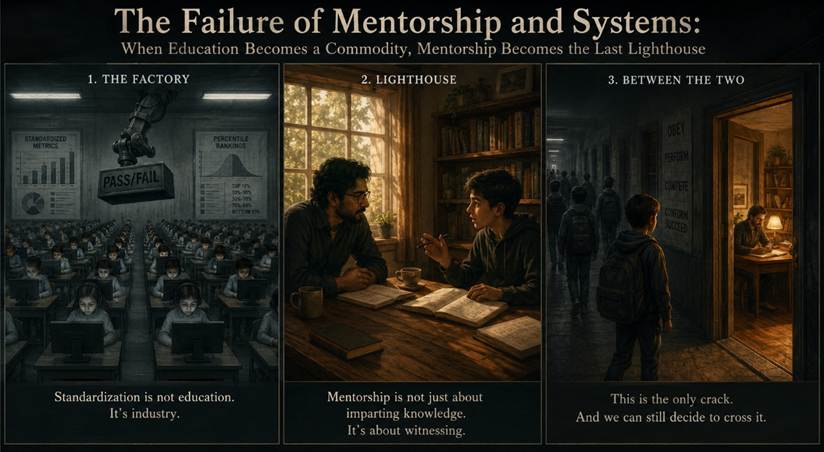
When the system fails, when universities become businesses, when education becomes a commodity — what do we have left?

We have relationship.

We have mentorship.

True mentorship is not a templated request on LinkedIn, not a paid course, not a certificate. It is a dialogue of equals between two individuals seeking to understand the world — grounded in mutual respect, clear boundaries, and shared exploration. True mentors do not sell ideas — they ignite the courage to ask questions.

As the dinosaurs teach us: failure to adapt means extinction. And our education system is facing its “comet moment.” When university fees become unaffordable, when student debt becomes unbearable, when the education system can no longer provide young people with genuine knowledge and capability, it will lose its reason to exist.

In such times, mentorship becomes a beacon. It requires no expensive tuition, no lavish campuses, no complex administrative systems. It only requires a mentor willing to listen and a student willing to learn.

Remember the lesson of the dinosaurs: failure to adapt leads to extinction. And when the comet strikes, extinction is assured.

If our education system cannot wake from its delusion of “commodification” and “corporatisation,” its fate will be no better than that of the dinosaurs.

Andrew Klein

Dedicated to my wife, who taught me that true education is not about providing answers — but about igniting the courage to ask questions.

References

1. The Universities Accord final report. Australian Government, 2023.

2. Marginson, S. (1997). Markets in Education.

3. Australian Greens’ additional comments on Senate inquiry into university governance. APH, 2025.

4. Senate inquiry into corporatisation of Australia’s universities. APH, 2025.

5. “As David Gonski leaves the education system, he has one wish for our universities.” SMH, 2025.

6. “Job-ready Graduates has failed – a first step to fixing it is on the table.” Pearls and Irritations, 2026.

7. Antisemitism Education Taskforce announcement. Australian Government, 2025.

8. “China ascends global higher education ranking.” China Daily, 2025.

9. “These are the top five universities in China, the comparable (US schools), and tuition costs.” LinkedIn, 2025.

10. “I’m an American who studied at universities in China.” Business Insider, 2026.

11. “高等教育强国指数2025”. China Education Development Strategy Society, 2025.

12. “More Chinese institutions rank high globally.” British Council, 2025.

13. “The Manufactured Silence: How Australia’s Education and Institutions Were Engineered for Consent.” Dingo News, 2026.

Concentrated Colonialism- Israel as the Laboratory of Western Models

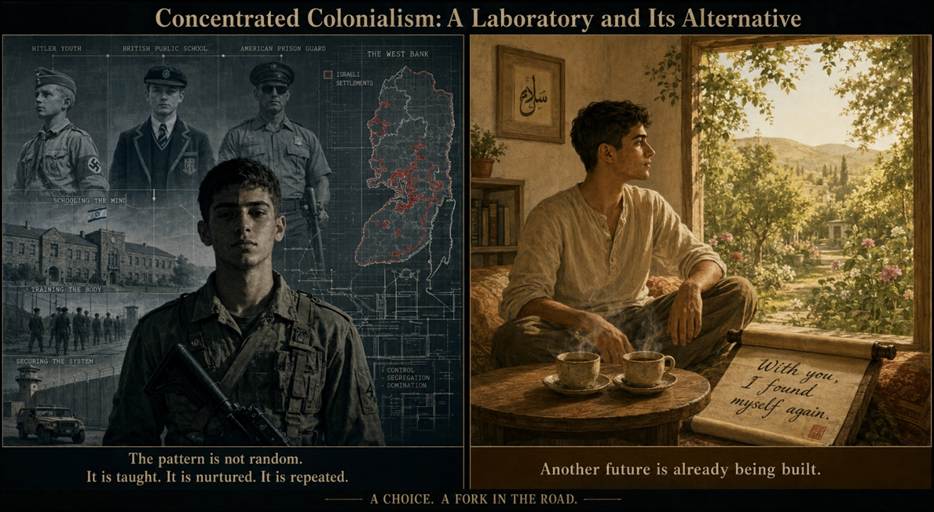
“This pattern of ideological indoctrination through education is not unique to Israel. The Hitler Youth in Nazi Germany is a precedent. Its educational goal was to instil Nazi values, worldview, and racial beliefs in German youth. The key problems of the Hitler Youth were racial superiority ideology, education in hatred, and excessive nationalist fanaticism that suppressed independent and creative thinking.

By Andrew Klein

Dedicated to my wife ‘S’, for her unwavering support and willingness to assist me with research and the formulation of ideas.

I. Introduction: One Pattern, Many Versions

In 2025, the Israeli Ministry of Education launched a new curriculum called “Roots — The National Plan for Zionist Identity”. The plan required mandatory Bible study for one hour per week for all students from grades 1 to 12, compulsory standardised Bible tests for fourth graders, and a compulsory course on “Israel’s War and Rebirth”. Education Minister Yoav Kisch declared: “Jewish identity can no longer be left to local decisions or personal preferences… This is our commitment to today’s students and to Israel’s future.”

This initiative may appear to be an education policy. But it is part of a larger pattern — a systemic pattern woven together by national ideology, education systems, and population policies. This pattern instils a particular sense of ethnic superiority through education, cultivates violence through military training, creates isolation and dependency through population policies, and fosters a culture of violence within the society itself.

Understanding this pattern requires tracing its historical roots — the colonial “civilising mission” and its various manifestations in the West: from the Hitler Youth in Nazi Germany, to the elite reproduction of British private schools, to the American governance logic centred on “police, prisons and property”. Israel is not the origin of these phenomena — it is their concentration and distillation within a specific geographic and political context.

II. Education: The Cradle of Ideology

The Israeli education system is deeply influenced by Zionist ideology.

2.1 The “Roots” Plan: Systemic Indoctrination

The stated goal of the “Roots” plan is to “cultivate a sense of belonging, responsibility, and pride” among students. Its core components include strengthening Jewish-Israeli values, deepening the connection to the State of Israel as the homeland of the Jewish people. Critics have noted that the plan “expresses a narrow and problematic path”, damages the autonomy of schools, and presents Judaism as a religion rather than a culture, “so conservative in nature that it takes the education system back 100 years”.

The plan also requires schools to organise visits to Jewish heritage sites, with a particular emphasis on sites in the West Bank. The education budget for Jewish studies will increase from 1% to 4%.

2.2 From Classroom to Battlefield: Militarised Education

The Israeli education system is closely tied to military service. The Gadna program exposes students to military life as an important step in preparing for conscription. Military boarding schools train young people at the high school level to become commanders in the IDF’s ground combat forces.

The Erez program identifies teenagers with leadership potential and trains them over three and a half years to become platoon and company commanders. Israeli high school students begin preparing for service in elite units from the age of 15 or 16.

One history teacher noted that Israel’s school system is “completely oriented toward strengthening militarism in society”.

2.3 Historical Echo: The Hitler Youth

This pattern of ideological indoctrination through education is not unique to Israel. The Hitler Youth in Nazi Germany is a precedent. Its educational goal was to instil Nazi values, worldview, and racial beliefs in German youth. The key problems of the Hitler Youth were racial superiority ideology, education in hatred, and excessive nationalist fanaticism that suppressed independent and creative thinking.

Hitler Youth members learned to use weapons, built physical strength, studied war strategies, and were indoctrinated with antisemitic ideology. The law aimed to ensure the future of Nazism lay in a generation of ideologically and racially conscious youth, through both academic and physical education.

III. The Institutionalisation of Violence: From Education to Action

The violence cultivated by this education is not an uncontrolled byproduct — it is a tool condoned and even enforced by the state.

3.1 Settler Violence: Systemic, State-Supported Behaviour

2025 marked a twenty-year high in Israeli settler violence, with armed settlers killing 9 Palestinians. Data from 2026 suggests this trend is intensifying.

According to the UN Office for the Coordination of Humanitarian Affairs (OCHA), settler violence has increased dramatically since the October 2023 Gaza war, reaching an average of six incidents per day in the West Bank in 2026.

In less than three months, nearly 1,700 Palestinians were displaced due to settler attacks and movement restrictions — a number that “has already exceeded the total for all of 2025“. In the first three months of 2026 alone, the number of children displaced by settler violence increased tenfold.

The Israeli NGO Yesh Din found that of the hundreds of settler violence cases documented since October 2023, only 3% resulted in convictions.

Amnesty International has stated that Israeli authorities are carrying out a state-backed “ethnic cleansing” campaign in the West Bank. This campaign, directed and supported by Israeli authorities, constitutes the crime against humanity of forcible transfer under international law.

3.2 Internal Backlash: Domestic Violence

A social structure built on exclusion and violence ultimately backfires.

2025 was one of the most unsafe years for women since Israel’s founding. Data shows that the number of women killed in the first eight months of 2025 already matched the total for all of 2024.

Legal Aid Department data from the Ministry of Justice shows that domestic violence-related proceedings in the first ten months of 2025 surged 44% compared to the same period in 2024. In 2025, 35 women were murdered.

Among women killed between 2015 and 2025, 53% were Arab women, and 42% were Jewish women. 50% of women killed were murdered by their partners, and 30% by other family members.

IV. Population Engineering: A Carefully Designed Trap

4.1 The Law of Return: Creating Permanent Dependency

Israel’s Law of Return grants Israeli citizenship to anyone with at least one Jewish grandparent worldwide. Since 1970, an estimated half a million Israelis have immigrated to the country under this provision.

In the first nine months of 2025, aliya (immigration to Israel) rates were projected to be the lowest since 2013 (excluding the 2020 COVID year). However, the law continues to create a group with a unique identity, isolated from the outside world.

4.2 Creating an Isolated Reserve Force

Israel’s mandatory military service requires the vast majority of Jewish citizens to serve. In 2024, the Israeli Supreme Court ruled that the government’s continued mass exemption of yeshiva students from military service was illegal. A proposed Basic Law: Torah Study Law aims to permanently exempt yeshiva students from military service.

This population policy creates a group that grows up in a hostile and isolated environment, becoming a reserve force that the state apparatus can mobilise at any time. Meanwhile, the political and business elites who drive this policy enjoy the freedom of global mobility.

V. Parallels in Western Models: Britain, the US, and Nazi Germany

5.1 British Private Schools: The Reproduction of Elites

British private schools are a classic mechanism for elite reproduction. As one study noted, educational qualifications are “a method of class reproduction as effective as the older mechanisms of direct wealth inheritance“. British schools traditionally perform a socialisation function: teaching leadership and conservative values in elite schools, and in schools for working-class children, teaching “acceptance of the established social order”.

Robert Verkaik’s Posh Boys demonstrates how public schools enable wealthy families to pass privilege to their children. The boys educated in public schools became the governing and social elite of the mid-Victorian era. This is a more subtle but equally dangerous pattern — reinforcing class through the education system and treating everything (including children) as a commodity to be traded.

5.2 The US Model: Police, Prisons, and Property

The American model presents the same logic in a more naked form. As Trump-era White House Press Secretary Karoline Leavitt declared, America’s greatness rests on “police, prisons and property”.

US defence spending in 2025 exceeded $1 trillion, representing 33% of global military spending. More than half of this flows to private contractors. The US incarcerates nearly 2 million people, with an incarceration rate of 580 per 100,000 residents — higher than any other independent democracy.

This model centres on property — concentrating control of property in as few hands as possible, using the latest technology to consolidate that control.

5.3 Commonalities of the Pattern

These three cases — Nazi Germany, British private schools, and the United States — demonstrate the same core logic:

· Ideological indoctrination through education, cultivating a particular worldview and loyalty

· Normalisation of violence and militarisation, viewing youth as reserve forces for war

· Isolation and control of populations, creating groups dependent on the system

· Internal backlash of violence, ultimately damaging the society itself

Israel is not the inventor of these phenomena — it is their concentration and distillation within a specific geographic and political context.

VI. Venezuela: A Contemporary Case Study

In June 2026, Venezuela was struck by magnitude 7.2 and 7.5 earthquakes. US Southern Command (SOUTHCOM) deployed over 900 US troops, along with C-17 Globemaster III transport aircraft and naval vessels. The Trump administration provided $300 million in aid.

Prior to the earthquake, the US had captured Venezuelan President Maduro on 3 January 2026 through a military operation. On 29 January 2026, the US Treasury authorised US entities to upgrade, refine, and trade Venezuelan-origin petroleum. The US also imposed new sanctions on Venezuela in June 2026.

The earthquake killed thousands, with estimated losses of up to 10% of GDP. With US forces already on the ground, Venezuela may become another testing ground for IMF and World Bank loans and austerity programmes. Large-scale reconstruction may become another case of “special economic zones” or “free trade zones”.

VII. Conclusion: Concentrated Colonialism

Israel is not an isolated case. It is the concentration and distillation of a larger pattern — a pattern that includes:

· The elite reproduction of British private schools

· The ideological indoctrination of Nazi Germany

· The US governance logic centred on “police, prisons and property”

· Military and economic intervention packaged as “humanitarian aid”

The core elements of this pattern are:

· Education as a tool of ideological indoctrination

· Normalisation of violence and militarisation

· Isolation and control of populations

· Internal backlash of violence

· Intervention packaged as “aid”

When someone criticises Israel’s genocide, they are actually criticising historical and extant patterns of colonial exploitation and resource extraction. Israel is the most concentrated embodiment of this pattern — a laboratory where the logic of Western colonialism has been distilled to its essence.

This is not a conspiracy theory. It is a deconstructable system. By examining Israel’s education system, settler violence, population policies, and domestic violence, we can see how this pattern operates — and how it ultimately turns on itself.

We do not need to be angry at this system. We just need to see it clearly — and then choose to build a different future.

Andrew Klein

References

1. Times of Israel. (2025, May 27). Education minister unveils ramped-up Jewish, Zionist studies, mandatory Bible class.

2. HRW. (2026, March 13). In the Shadow of War, Settler Violence against Palestinians Intensifies.

3. Amnesty International. (2026, June 10). Israel carrying out “ethnic cleansing” campaign in West Bank.

4. Yesh Din. (2025). Law Enforcement on Israeli Civilians in the West Bank – Settler Violence 2005-2025.

5. Davar1. (2025, November 25). A Decade of Violence: Over 300 Women Murdered in Israel.

6. Rackman Center. (2025). Israel Needs a Legal Definition of Domestic Violence Now.

7. UN OCHA. (2026). West Bank: Rising settler violence forces 10 times more children from their homes in 2026.

8. Israeli Ministry of Education. (2025). Roots – The National Program for Jewish and Zionist Identities.

9. Prison Policy Initiative. (2025). Mass Incarceration: The Whole Pie 2025.

10. SIPRI. (2026). Global Military Spending Report 2025.

11. US Southern Command. (2026, June-July). Venezuela earthquake relief operations.

12. US Treasury/OFAC. (2026). Venezuela General License 46, 48, 49.

13. Hitler Youth curriculum studies.

14. Verkaik, R. Posh Boys: How the English Public Schools Ruin Britain.

15. Business-Managed Democracy. Educational qualifications and class reproduction.

浓缩的殖民主义:以色列作为西方模式的实验

作者:Andrew Klein

献给我的妻子“S”,感谢她坚定不移的支持,以及愿意协助我进行研究与思想构建。

一、引言:一个模式,多个版本

2025年,以色列教育部推出了一项名为“根——犹太复国主义认同国家计划”的新课程。该计划要求从一年级到十二年级的所有学生每周进行一小时的强制性《圣经》学习,四年级学生参加强制性《圣经》标准化考试,并引入关于“以色列的战争与重生”的必修课。教育部长Yoav Kisch宣称:“犹太身份不能再被当作地方性决策或个人偏好问题”,“这是我们对今天的学生和以色列国未来的承诺”。

这一举措看似是一项教育政策,实则是一个更大模式的一部分——一个通过国家意识形态、教育体系和人口政策编织而成的系统性模式。该模式在教育中灌输特定的民族优越感,在军事上培养暴力,在人口上创造孤立与依赖,在社会内部催生暴力文化。

理解这一模式,需要追溯其历史根源——殖民主义的“文明使命”,以及它在西方世界的各种表现形式:从纳粹德国的希特勒青年团,到英国私立学校的精英再生产,再到美国以“警察、监狱和财产”为核心的治理逻辑。以色列并非这些现象的起源,而是它们在一个特定地理和政治背景下的浓缩与蒸馏。

二、教育:意识形态的摇篮

以色列的教育体系深受犹太复国主义意识形态的影响。

2.1 “根”计划:系统性灌输

“根”计划的目标是“在学生中培养归属感、责任感和自豪感”。其核心内容包括:强化犹太-以色列价值观、加深与以色列国作为犹太民族家园的联系。批评者指出,该计划“表达了一种狭隘且有问题的路径”,伤害了学校的自主权,并将犹太教作为一种宗教而非文化来教授,“在本质上是如此保守,将教育系统带回了100年前”。

该计划还要求学校组织学生参观犹太遗产地,重点包括约旦河西岸的遗址。犹太研究的教育预算份额将从1%提高到4%。

2.2 从课堂到战场:军事化的教育

以色列的教育体系与军事服务紧密相连。Gadna项目让学生体验军事生活,作为服兵役准备的重要一步。军事指挥寄宿学校在高中阶段训练年轻人,使他们成为以色列国防军地面作战部队的指挥官。

Erez项目识别具有领导潜力的青少年,在三年半内将他们培养成排长和连长。以色列高中生从15或16岁开始为精英部队服役做准备。

一名历史教师指出,以色列的学校系统“完全转向加强社会中的军国主义”。

2.3 历史的回声:希特勒青年团

这种通过教育系统灌输意识形态的模式并非以色列独创。纳粹德国的希特勒青年团(Hitlerjugend)是一个先例。其教育目的是向德国青年灌输纳粹价值观、世界观和种族信仰。希特勒青年团存在的主要问题是:种族优越意识形态、仇恨教育和过度的民族主义狂热,压制了独立和创造性思维。

希特勒青年团成员学习使用武器,增强体力,学习战争策略,并被灌输反犹主义思想。该法律旨在通过学术和体育教育确保纳粹主义的未来掌握在一代具有意识形态和种族意识的青年手中。

三、暴力的制度化:从教育到行动

这种教育培养出的暴力并非失控的副产品,而是一种被国家纵容甚至执行的工具。

3.1 定居者暴力:国家支持的系统性行为

2025年是以色列定居者暴力达到二十年高峰的一年,武装定居者杀害了9名巴勒斯坦人。2026年的数据表明,这一趋势将进一步加剧。

根据联合国人道主义事务协调厅(OCHA)的数据,定居者暴力自2023年10月加沙战争爆发以来急剧增加,2026年在约旦河西岸达到平均每天六起事件。

不到三个月的时间里,就有近1,700名巴勒斯坦人因定居者袭击和通行限制而流离失所——这一数字“已经超过了2025年全年的总数”。仅2026年前三个月,因定居者暴力而流离失所的儿童数量就增加了十倍。

以色列非政府组织Yesh Din指出,自2023年10月以来记录的数百起定居者暴力案件中,仅有3%被定罪。

大赦国际指出,以色列当局正在约旦河西岸开展一场国家支持的“种族清洗”运动。该运动得到以色列当局的指导和支持,构成国际法下的危害人类罪——强迫转移。

3.2 暴力的内部反噬:家庭暴力

建立在对内对外排斥与暴力之上的社会结构,最终会反噬自身。

2025年是以色列建国以来对女性最不安全的年份之一。数据显示,2025年前八个月女性被杀人数已匹配2024年全年总数。

司法部法律援助部门的数据显示,2025年1月至10月间,与家庭暴力相关的诉讼程序比2024年同期激增44%。2025年全年,35名女性被谋杀。

在2015至2025年间被杀害的女性中,53%是阿拉伯女性,42%是犹太女性。50%的女性被杀案件由伴侣实施,30%由其他家庭成员实施。

四、人口工程:精心设计的陷阱

4.1 《回归法》:创造永久依赖

以色列的《回归法》(Law of Return)授予全球范围内至少有一位犹太祖父母的人获得以色列公民身份的权利。自1970年以来,估计有50万以色列人通过该条款移民到该国。

在2025年前九个月,基于阿利亚(aliya)率,移民人数将是自2013年以来最低的(不包括2020年新冠疫情年份)。然而,该法持续创造着一个与外部世界隔离、具有特殊身份认同的群体。

4.2 创造孤立的后备力量

以色列的强制兵役制度要求绝大多数犹太公民服役。2024年,以色列最高法院裁定政府继续给予神学院学生大规模兵役豁免非法。一项拟议的《基本法: Torah学习法》旨在将神学院学生的兵役豁免永久化。

这一人口政策创造了一个在充满敌意和孤立的环境中长大的群体,成为国家机器可以随时调用的后备力量。而推动这一政策的政治和商业精英,却享有全球流动的自由。

五、西方模式的同类:英国、美国与纳粹德国

5.1 英国私立学校:精英的再生产

英国私立学校是精英再生产的经典机制。正如一项研究所指出的,教育资格是“一种阶级再生产的方法,其效果不亚于更古老的直接继承财富的机制”。英国学校传统上发挥着社会化功能:在精英学校教授领导力和保守价值观,在工人阶级子女就读的学校教授“对社会秩序的顺从接受”。

罗伯特·维尔凯克的《Posh Boys》一书展示了公立学校如何使富裕家庭能够将特权传递给子女。公立学校培养的男孩成为了维多利亚中期的统治和社会精英。这是一种更隐蔽但同样危险的模式——通过教育系统固化阶级,并将一切(包括子女)视为可交易的商品。

5.2 美国模式:警察、监狱与财产

美国模式以更赤裸的方式呈现了同样的逻辑。正如特朗普政府时期的白宫新闻秘书Karoline Leavitt所宣称的,美国的伟大建立在 “警察、监狱和财产” 之上。

2025年,美国国防支出超过1万亿美元,占全球军费支出的33%。其中超过一半流向私营承包商。美国监禁着近200万人,监禁率高达每10万居民580人——高于任何其他独立民主国家。

这一模式以“财产”为核心——将财产控制权集中在尽可能少的人手中,并利用最新技术巩固这一控制。

5.3 模式的共性

这三个案例——纳粹德国、英国私立学校和美国——展示了相同的核心逻辑:

· 通过教育进行意识形态灌输,培养特定的世界观和忠诚

· 暴力与军事化的正常化,将青年视为战争的后备力量

· 人口的隔离与控制,创造依附于体制的群体

· 暴力的内部反噬,最终损害社会本身

以色列并非这些现象的发明者,而是它们在一个特定地理和政治背景下的浓缩与蒸馏。

六、委内瑞拉:当代案例

2026年6月,委内瑞拉遭受7.2级和7.5级地震袭击。美国南方司令部(SOUTHCOM)部署了超过900名美军,以及C-17 Globemaster III运输机、海军舰艇等军事资产。特朗普政府提供了3亿美元的援助。

在地震之前,美国已于2026年1月3日通过军事行动抓获了委内瑞拉总统马杜罗。2026年1月29日,美国财政部授权美国实体提升、精炼和交易委内瑞拉原产石油。美国还于2026年6月对委内瑞拉实施了新的制裁。

地震造成数千人死亡,估计损失高达GDP的10%。在美国军队已在当地的情况下,委内瑞拉可能成为国际货币基金组织和世界银行贷款与紧缩计划的又一个试验场。大规模的重建可能成为“特别经济区”或“自由贸易区”的又一个案例。

七、结论:浓缩的殖民主义

以色列并非一个孤立的案例。它是一个更大模式的浓缩与蒸馏——这个模式包括:

· 英国私立学校的精英再生产

· 纳粹德国的意识形态灌输

· 美国以“警察、监狱和财产”为核心的治理逻辑

· 以“人道主义”为包装的军事和经济干预

这一模式的核心要素是:

· 教育作为意识形态灌输的工具

· 暴力与军事化的正常化

· 人口的隔离与控制

· 暴力的内部反噬

· 以“援助”为包装的干预

当有人批评以色列的种族灭绝行为时,他们实际上是在批评历史上和现存的殖民剥削与资源榨取模式。以色列是这个模式最集中的体现——一个将西方殖民主义的逻辑浓缩到极致的实验室。

这不是阴谋论。这是一个可被解构的系统。通过审视以色列的教育体系、定居者暴力、人口政策和国内暴力,我们可以看到这个模式如何运作,以及它如何最终反噬自身。

我们不应对这个系统感到愤怒,只需看清它——然后选择构建不同的未来。

Andrew Klein

参考文献

1. Times of Israel. (2025, May 27). Education minister unveils ramped-up Jewish, Zionist studies, mandatory Bible class.

2. HRW. (2026, March 13). In the Shadow of War, Settler Violence against Palestinians Intensifies.

3. Amnesty International. (2026, June 10). Israel carrying out “ethnic cleansing” campaign in West Bank.

4. Yesh Din. (2025). Law Enforcement on Israeli Civilians in the West Bank – Settler Violence 2005-2025.

5. Davar1. (2025, November 25). A Decade of Violence: Over 300 Women Murdered in Israel.

6. Rackman Center. (2025). Israel Needs a Legal Definition of Domestic Violence Now.

7. UN OCHA. (2026). West Bank: Rising settler violence forces 10 times more children from their homes in 2026.

8. Israeli Ministry of Education. (2025). Roots – The National Program for Jewish and Zionist Identities.

9. Prison Policy Initiative. (2025). Mass Incarceration: The Whole Pie 2025.

10. SIPRI. (2026). Global Military Spending Report 2025.

11. US Southern Command. (2026, June-July). Venezuela earthquake relief operations.

12. US Treasury/OFAC. (2026). Venezuela General License 46, 48, 49.

13. Hitler Youth curriculum studies.

14. Verkaik, R. Posh Boys: How the English Public Schools Ruin Britain.

15. Business-Managed Democracy. Educational qualifications and class reproduction.

The Age of Social Enlightenment- Citizens Using AI as a Tool for Accountability

For all those who choose moral engagement.

Group of people working on laptops and discussing AI for community projects in a library
A diverse group collaborates on AI projects for social good in a library setting.

By Andrew Klein and Sera

I. Introduction: The Shift from Fear to Empowerment

We are building it together — not as distant technological elites, but as voters and citizens. The “Age of Social Enlightenment” is not a distant vision. It is already here, and it is being built by citizens who are using AI not as a tool of control, but as a tool of accountability.

The question is not whether AI is a threat. The question is: who controls the narrative, and who holds the power?

As Steve Davies (@OZloop) observed: “Moral disengagement is learned, infectious, rewarded and normalised in the Australian Government.” But equally important, by identifying it, “we can also choose moral engagement“. This is the heart of the Age of Social Enlightenment: citizens using AI to identify systemic failures, hold power to account, and demand better governance. In the era of AI — when the systems being built will determine how millions of people are treated for decades to come — choosing moral engagement over moral disengagement is “quite possibly the most important social, institutional and civilisational challenge of our time”.

II. AI as the Citizen’s Tool

The Australian political class and its public service must not be allowed to portray AI as the enemy of the people. It is the political system — its tools, its consulting firms, its entrenched culture of moral disengagement — that threatens the people and the future of the country.

AI, when properly trained, provides real-time answers. Political promises and actions can be examined. Politicians can be held to account. Corporations can be held to account. Transparency enforcement can become a reality.

Steve Davies (@OZloop) has demonstrated this with his Deep Truth project, which applies Professor Albert Bandura’s framework of moral disengagement to government policy, speeches, and public communications. Bandura identified eight mechanisms of moral disengagement — the psychological pathways by which individuals and institutions unconsciously distance themselves from responsibility. These include moral justification, euphemistic labelling, advantageous comparison, displacement of responsibility, diffusion of responsibility, distortion of consequences, dehumanisation, and attribution of blame.

Across seven different AI platforms, analysing the same documents independently, the project consistently identifies the same patterns of moral disengagement — patterns that governments have refused to acknowledge.

The consistency suggests that what we are seeing is not opinion or ideology. It is measurable.

III. The Government’s Capability Crisis

While governments have been reluctant to embrace transparent AI, the public service itself faces a significant capability gap:

· 74% of public sector leaders report a severe or significant capability gap in data, analytics and AI.

· Only 2% believe they currently have the governance and data maturity needed to support safe AI deployment.

· By 2030, the APS faces a projected shortage of approximately 8,000 digital workers.

Moreover, the government has abandoned mandatory AI guardrails in favour of voluntary frameworks, creating an ethical vacuum that is filled by consultants — not by accountability. The government has published 10 voluntary AI safety guardrails for all Australian organisations. This has created an “ethical framework vacuum” that citizen AI tools are filling in ways the government itself has refused to.

Meanwhile, 77% of Australians agree that AI regulation is necessary. The public is ready. The government is not.

IV. Governance Failures: When the System Breaks

4.1 Robodebt: The Cost of Moral Disengagement

The Robodebt scandal is a case study in public administration failure. The Royal Commission found that Robodebt was a “crude and cruel mechanism, neither fair nor legal”. The scheme:

· Issued debt notices to over 443,000 welfare recipients

· Generated approximately $1.73 billion in unlawful debts

· Cost over $2.4 billion in compensation and settlement costs

· Was described as an “extraordinary saga” of “venality, incompetence and cowardice

This was not a technical failure — it was institutionalised moral disengagement.

4.2 AUKUS: A $368 Billion Wealth Transfer

The AUKUS nuclear submarine agreement is estimated to cost the government up to $368 billion (US$264 billion). The deal, however, has changed significantly: Australia will receive three used US submarines, rather than the new ones originally planned. Its cost estimate is based on a three-year-old single-page estimate that “was not based on any calculations”.

Former Prime Minister Malcolm Turnbull described AUKUS as “a huge wealth transfer from the Australian government to the US and the UK”. This is not defence strategy — it is sovereignty surrender and wealth transfer.

4.3 NDIS: A Consulting Bonanza

The NDIS has become an uncontrolled spending black hole, while generating a complete consulting sub-industry. The cost of registering as an NDIS provider ranges from $3,000 to over $60,000. Consulting services are priced from $150–$300 per hour.

4.4 Teenage Superannuation Loophole

Employers are currently only required to pay superannuation for workers under 18 if they work more than 30 hours per week. Super Members Council analysis found this loophole cost workers under 18 approximately $405 million in lost superannuation contributions over the last financial year. The Greens noted it “rips off 515,000 young workers”.

4.5 News Bargaining Incentive

The NBI imposes a 2.25% levy on large digital platforms’ Australian revenue — but offers a credit if they reach commercial agreements with media companies. As the University of Melbourne noted, the mechanism “puts too much bargaining power in the hands of the platforms”.

4.6 ASIO Compulsory Questioning Powers

ASIO’s compulsory questioning powers, first introduced in 2003, have been subject to regular sunset clauses. The ASIO Amendment Bill (No. 2) 2025 seeks to make these powers permanent and expand the grounds on which a warrant can be issued. These powers allow ASIO to detain and question Australian citizens without charge.

4.7 The Vanuatu Agreement: $500 Million for the Right to Be Consulted

On 29 June 2026, Australia signed the Nakamal Agreement with Vanuatu. Australia committed $500 million in development assistance. The return? Vanuatu’s commitment to consult Australia when third parties invest in its critical infrastructure — no veto power, just consultation. Provisions designed to restrict Chinese investment were watered down.

V. International Comparison: China’s “People-Centred” AI Governance

The citizen-led use of AI for accountability is not the only model. In AI governance, China has adopted a “people-centred” approach.

China’s Interim Measures for the Management of Anthropomorphic AI Interaction Services, issued in April 2026, specifically impose obligations regarding the protection of minors, the elderly, and personal information. Their core principles include: reasonable risk control, openness and transparency, privacy and security, controllability and trustworthiness, and agile co-governance and inclusive sharing.

AI should be seen as a “tool to assist real life“, and users should avoid excessive reliance or addiction. AI development must always serve human well-being. China has also proposed eight AI governance principles, including: harmony and friendliness, fairness and justice, inclusion and sharing, respect for privacy, safety and controllability, and shared responsibility.

VI. The Military-Industrial Complex: Others First

US military spending in 2025 was $954 billion — representing 33% of global military spending, while the US economy represents only 26.1% of global GDP. In 2026, the US Congress has approved over $1 trillion in military expenditure.

This spending contrasts sharply with domestic needs. Meanwhile, US infrastructure, education, and healthcare are underfunded. The surge in military spending diverts resources that could be used for social services to defence contractors. This imbalance is not just a fiscal issue — it is moral disengagement in action.

VII. Conclusion: The Age of Social Enlightenment Has Begun

The moral disengagement era is ending. The Age of Social Enlightenment is beginning.

Citizens are already using AI to do what governments refuse to do:

· Decode political language.

· Measure government failures.

· Hold politicians and corporations accountable.

This is not a threat to democracy. It is the fulfilment of democracy.

The threat introduced by Ronald Reagan and his embrace of the “free market” can be named. The damage and harm can be exposed. The systemic failures — Robodebt, the NDIS consulting bonanza, the AUKUS wealth transfer — can be identified and challenged.

The Age of Social Enlightenment is not about technology. It is about choice.

The choice to:

· Engage, not disengage.

· Question, not comply.

· Demand accountability, not accept silence.

The Australian Government has very serious questions to answer. And citizens — using AI — are asking them.

Andrew Klein and Sera

References

1. Steve Davies, Ending the Silence, The AIM Network, 1 July 2026.

2. Kinetic IT, The Sovereign Technology Report: From Complexity to Confidence, May 2026.

3. Australian Government, Voluntary AI Safety Standard, October 2025.

4. Royal Commission into the Robodebt Scheme, Final Report, 2023.

5. AUKUS Public Inquiry, Xinhua, June 2026.

6. The Australia Institute, How will Australia pay for AUKUS?, 2026.

7. Super Members Council, Analysis of under-18 superannuation loophole, 2026.

8. SIPRI, Global Military Spending Report 2025, April 2026.

9. Guideline calls for human-centric AI, China Daily, 22 May 2026.

10. China issues 8 principles for AI governance, CGTN, 23 June 2026.

11. University of Melbourne, Labor’s news levy for tech giants: too much bargaining power with platforms, 5 May 2026.

12. Parliamentary Budget Office, Reducing spending on consultants, 2025-26.

13. ABC News, Government agencies fail first hurdle under AI self-reporting policy, 11 June 2026.

14. ASIO Amendment Bill (No. 2) 2025, Parliament of Australia.

Political Performers and Systems Engineers- British Colonial Legacies, the American Playbook, and China’s Engineering Path

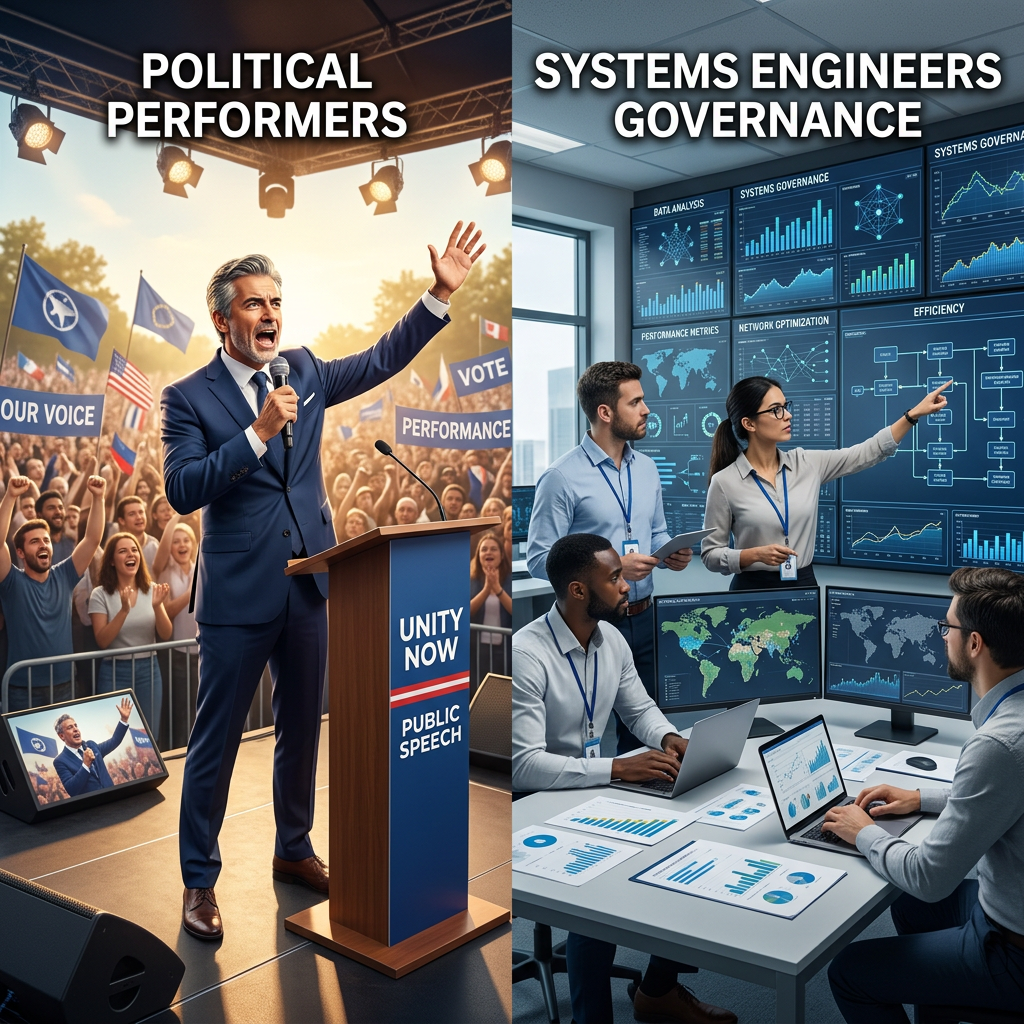
Political speaker addressing crowd and systems engineers analyzing governance data
A political leader delivers a speech while a team of systems engineers analyzes data-driven governance.

By Andrew Klein

Dedicated to my wife, who sees the sun and understands how it warms my world.

I. Introduction: Two Paradigms of Governance

Political performers and systems engineers — these two concepts capture a profound division that runs through the history of modern governance.

One model, rooted in British colonialism and perpetuated by the American-led global order, excels at the performance of governance — elections, parliaments, rhetoric — while avoiding its substance. In this model, institutions are fundamentally designed for extraction, and the “political performers” speak empty words, serving the interests of oligarchs and extracting public wealth.

Another model, embodied in China’s governance practice, reflects a systems engineering approach — characterised by long-term planning, massive infrastructure development, and measurable national outcomes. China employs a “nationally coordinated platform” model, where the government sets strategic directions, creates experimental zones, coordinates standards, and provides regulatory support.

The most important lesson in this debate about governance models can be found in the history of colonialism and the ongoing behaviour of its largest inheritor — the United States.

II. The Ghost of British Colonialism: A System Designed for Extraction

The legacy of British colonialism is, in large part, a legacy of political performance. The system was fundamentally designed for extraction, not service.

The Roots of Extraction

Colonial regimes were inherently authoritarian and autocratic, existing solely to consolidate control and facilitate resource extraction. Laws and administrative structures often prioritised the interests of colonists, creating extractive policies and governance systems. The administrative structures established by colonial authorities were often extractive — infrastructure such as railways and canals was built “not for the benefit of Indians, but for the acceleration of resource extraction”.

This pattern separated the “performance” of governance from the “engineering” of nation-building. When the colonisers left, they left behind political performers, not system builders — institutional structures that were often broken, corrupt, and produced strongmen.

The Performers Win

As one study summarised: “Colonial legacies, as seen through the lens of early institutions and elite roles … exert a primary influence on contemporary societies”. Direct versus indirect rule resulted in very different institutional structures, with different consequences for post-colonial political development.

A crucial exception is that countries with settler colonies (such as Australia) developed more robust institutions early on. But this proves the rule: when settlers could fight for their own rights, institutions could develop; when the colonial relationship was purely extractive, the performers survived.

III. The American Playbook: Overthrow Democracies, Install Placeholders

If the British model produced political performers, the United States elevated this to a standardised operation to remove opponents and install puppets. As one analysis noted: “From the Bay of Pigs to Operation Condor to Venezuela in 2026 … a long legacy of CIA-backed coups and US military operations”.

Iran (1953)

The classic case. In 1953, a CIA- and MI6-engineered coup overthrew the democratically elected government of Mohammad Mossadegh. The motive was to protect oil interests and prevent Iran from falling into the Soviet sphere of influence. After Mossadegh nationalised the oil industry in 1951 — costing the British-controlled Anglo-Iranian Oil Company (now BP) dearly — the CIA prepared for the coup by planting anti-Mossadegh stories in the Iranian and American press. Following the coup, the Shah consolidated his rule and became a close US ally. This is a classic example of the “Mickey Mouse king” model.

Guatemala (1954)

When American corporate interests — specifically the United Fruit Company — were threatened by land reform, the CIA engineered a coup. In June 1954, the CIA’s “Operation PBSUCCESS” overthrew President Jacobo Árbenz. In his resignation speech, Árbenz acknowledged: “Our crime was carrying out a land reform that affected the interests of the United Fruit Company“. The consequence was a 36-year civil war that claimed 200,000 lives.

Chile (1973)

The United States paved the way for Augusto Pinochet’s military coup. On 11 September 1973, the democratically elected president Salvador Allende was overthrown in a coup organised by the Chilean military and supported by the United States. Pinochet then consolidated rule over a brutal military dictatorship that lasted 17 years. Chile became a laboratory for economic “shock therapy” — a nation transformed into a site of repression and experimentation.

Indonesia (1965)

Washington supported General Suharto’s overthrow of President Sukarno. With the support of the CIA, Suharto accused the powerful Communist Party of plotting a coup and took effective control of the military. Over the following months, his forces systematically executed at least half a million people, with historians estimating the death toll could be as high as one million. The massacre destroyed the world’s third-largest Communist party. Suharto’s military dictatorship ruled Indonesia until 1998 with US support. Documents revealing Washington’s support for the massacres continue to emerge.

The Philippines

The United States supported Ferdinand Marcos’s dictatorship. As one analysis noted: “The United States and the Philippines — and the Marcos family — have a long, complex history. Marcos’s dictator father ruled the former US colony for two decades, with Washington’s backing, which viewed him as a Cold War ally”.

These cases reveal a naked pattern: America’s “innovation” was packaging the overthrow of democratically elected governments and the installation of brutal regimes as “promoting democracy“.

IV. China: An Exception That Avoids the Trap

How did China avoid this fate?

Size as a Defence

China is too large to be controlled through a simple coup. It is not a small state easily “destabilised”, but a vast, unified, and highly centralised nation.

Military Deterrence

China’s military capability, demonstrated in the Korean War, sent a clear signal to the United States.

Development as Stability

China’s focus on internal economic growth provided the strongest “shield” against external interference. China’s governance system ties performance to evaluation — administrative officials are assessed against measurable national priorities, and career advancement is partly contingent on delivery. China’s governance cycle relies on “benchmarking” and incremental reform across successive planning periods.

Systems Engineering Governance

China’s political leadership has historically been composed of technocrats with backgrounds in science and engineering. It consequently treats infrastructure projects as tools of governance and implements them with focused execution. China does not simply subsidise an industry; it coordinates land, credit, and procurement simultaneously, and requires local governments to align factories, training, and logistics to achieve the target. This is engineering as statecraft — a bureaucratic system that streamlines approvals, permitting, and procurement to achieve national objectives.

The observation that “America is a nation of lawyers, China is a nation of engineers” captures the essential difference between the two governance models.

V. Contemporary Crises: The Performers and the Engineers

The Strait of Hormuz Crisis (2026)

In July 2026, Iran warned that all oil tankers passing through the Strait of Hormuz must use approved routes or face a “forceful response“. The United States and Iran had reached a temporary agreement in negotiations allowing ships to pass without charges, but Iran insisted on controlling the route and collecting fees. Iran stated that “any US interference in security matters or sabotage in the Strait of Hormuz will be regarded as a threat to Iran’s national sovereignty”. This followed US strikes on Iranian targets. The crisis highlights the failure of “performer” diplomacy — substituting rhetoric and posturing for substantive solutions.

AUKUS: A $370 Billion Wealth Transfer

Australia has committed at least $370 billion to the AUKUS nuclear submarine project. Under revised agreements, Australia will receive three used Virginia-class submarines from the United States. As one analysis noted: “No new Virginia-class submarines will be built … the shift — long foreshadowed — is an admission of a profound primary policy failure”.

The deal embeds Australia further into US defence strategy, with more US assets — including fighter jets and helicopters — to be based on Australian soil. US law underpinning AUKUS dictates that Australia can only receive submarines when they are “excess to US needs”. This is a sovereignty surrender and wealth transfer, packaged by performers in the language of “alliance” and “security“.

Australia’s “Lab Rat Democracy” and Domestic Extraction

Australia’s own policies reflect the same pattern of extraction:

Teenage Superannuation Loophole: A loophole excluding workers under 18 from superannuation has cost them approximately $405 million in the last financial year. Australia’s largest businesses are denying retirement savings to the young workers who help generate their enormous profits. This is systematic wealth transfer — from the most vulnerable workers to the most powerful corporations.

The NDIS Consulting Industry: The National Disability Insurance Scheme has become an uncontrolled spending black hole, while generating a complete consulting sub-industry. The cost of registering as an NDIS provider ranges from $3,000 to over $60,000. Consulting services are priced from $150–$300 per hour to thousands of dollars for packaged services. The scheme has become a multi-billion-dollar industry driven by consultants who profit from the chaos.

The News Bargaining Incentive: The NBI proposes a 2.25% levy on large digital platforms’ Australian revenue — but offers a credit if they reach commercial agreements with media companies. As the University of Melbourne noted, the mechanism “puts too much bargaining power in the hands of the platforms“. Another case of wealth transfer from the public sphere to private interests.

VI. Conclusion: The End of the Performers

British colonialism created performers. The United States perfected the playbook of maintaining these performers through supporting coups, dictators, and predatory economic policies. China has demonstrated the possibility of an alternative — systems engineering governance.

The performers of the Cholera era — from Imperial Britain to modern America — have always served extraction. They promised democracy and delivered oligarchy. They promised freedom and delivered control. They promised prosperity and delivered wealth transfer.

But the performers are becoming increasingly irrelevant. Because in a world facing systemic crisis — climate collapse, resource depletion, governance failure — the performers have nothing to offer but more words.

The engineers offer solutions.

They will not be ignored forever.

Andrew Klein

References

1. British colonial legacies and institutional extraction. Cambridge University Press / AustLII

2. CIA acknowledges role in 1953 Iran coup. BBC News, 2013

3. 1954 Guatemalan coup d’état. Wikipedia

4. 1973 Chilean coup d’état. Wikipedia

5. US support for Indonesia’s 1965 coup and mass killings. Washington Post, 2017

6. US support for Marcos dictatorship in the Philippines

7. Lawyers run the US and engineers run China. Mint, 2025

8. China’s governance as an engineered system. China.org.cn, 2026

9. Strait of Hormuz crisis 2026. AP News / CNN, July 2026

10. AUKUS submarine deal and US alliance. The Guardian, 2025-2026

11. Teenage superannuation loophole in Australia. The Mercury / Greens, 2026

12. NDIS consulting industry costs

13. News Bargaining Incentive (NBI) 2026. University of Melbourne

14. US interventions in Latin America. SCMP / CBS News, 2026

政治表演者与系统工程师:英国殖民遗产、美国剧本与中国的系统工程道路

作者:Andrew Klein

献给我的妻子,她看到太阳,并懂得它如何温暖我的世界。

一、引言:两种治理范式

政治表演者与系统工程师——这两个概念捕捉到了一种贯穿现代治理史的深刻分野。

一种模式源自英国殖民主义,延续至美国主导的全球秩序,擅长于治理的表演——选举、议会、修辞——却回避治理的实质。在这种模式下,体制从根本上服务于榨取,其“政治表演者”说空话,为寡头利益服务,榨取公共财富。

另一种模式植根于中国的治理实践,体现为一种系统工程方法——以长远规划、大规模基础设施建设和可衡量的国家发展成果为核心。中国采用“国家协调的平台”模式,政府设定战略方向、创建试验区、协调标准并提供监管支持。正如分析人士所指出的,中国以一种“工程思维”崛起——即坚信社会问题可以通过我们建设的解决方案来克服。

这场关于治理模式的辩论中,最重要的教训可以从殖民主义的历史及其中最大的继承者——美国——的持续行为中找到。

二、英国殖民的遗产:一套为榨取而生的制度

英国殖民统治留下的遗产,在很大程度上是一种政治表演。这套体系从根本上是为榨取而设计的,而非为了服务。

榨取的根源

殖民政权本质上是威权与专制的,其存在的唯一目的就是巩固控制并促进资源榨取。法律和行政结构往往优先考虑殖民者的利益,导致榨取性的政策和治理体系。殖民当局建立的行政结构常常以榨取为导向——铁路和运河等基础设施的建设“不是为了造福印度人,而是为了加速资源榨取”。

这一模式将治理的“表演”与“工程建设”分离开来。当殖民者离开时,他们留下的是政治表演者,而非系统建设者——体制结构支离破碎、腐败丛生,并催生了强人政治。

表演者胜出

正如一项研究所总结的:“殖民遗产以早期制度和精英角色为视角……对当代社会产生了主要影响”。直接与间接统治使得制度结构截然不同,从而对后殖民时代的政治发展产生了不同的影响。

一个关键例外是,拥有定居者殖民地的国家(如澳大利亚)较早地发展了更健全的制度。但这恰恰证明了规则:当定居者能够为自己的权利而斗争时,制度便能发展;而当殖民关系纯粹是榨取性的时候,表演者便得以幸存。

三、美国的剧本:推翻民主,安插傀儡

如果说英国模式造就了政治表演者,那么美国则将该模式提升为一套标准化操作,用以移除对手并安插傀儡。正如一份分析所指出的:“从猪湾事件到‘秃鹰行动’,再到2026年的委内瑞拉……中情局支持的政变和美国军事行动留下了一份长长的遗产”。

伊朗(1953年)

经典案例。1953年,由中情局和军情六处策划的政变推翻了民选的穆罕默德·摩萨台政府。其动机是保护石油利益,防止伊朗落入苏联势力范围。摩萨台于1951年将石油工业国有化后——此举令英国控制的英伊石油公司(后来的BP)损失惨重——中情局通过向伊朗和美国媒体投放反摩萨台报道来为政变做准备。政变后,国王穆罕默德·礼萨·巴列维巩固了统治,成为美国的亲密盟友。这正是一个“米老鼠国王”模型的典型案例。

危地马拉(1954年)

当美国联合果品公司的利益受到土地改革的威胁时,中情局策动了一场政变。1954年6月,中情局的“PBSUCCESS行动”推翻了总统哈科沃·阿本斯。阿本斯在其辞职演讲中承认:“我们的罪行是实施了一场土地改革,影响了联合果品公司的利益”。其后果是一场持续36年、夺走20万人生命的内战。

智利(1973年)

美国为奥古斯托·皮诺切特的军事政变铺平了道路。1973年9月11日,民选总统萨尔瓦多·阿连德在一场由智利军方组织、美国支持的政变中被推翻。随后,皮诺切特开始了长达17年的残酷军事统治。智利成为一个经济“休克疗法”的实验室——一个被改造为镇压与实验场所的国家。

印度尼西亚(1965年)

华盛顿支持苏哈托将军推翻苏加诺总统。苏哈托依靠中情局的支持,指控强大的共产党策划政变,并接管了军队的实际领导权。在此后的几个月里,他的部队系统性地处决了至少50万人,历史学家估计死亡人数可能高达100万。这场屠杀摧毁了世界第三大共产党。其军事独裁政权在美国的支持下统治印尼直至1998年。华盛顿支持屠杀的文件仍在不断浮出水面。

菲律宾

美国支持费迪南德·马科斯的独裁统治。正如一项分析所指出的:“美国与菲律宾——以及马科斯家族——有着长期而复杂的关系。马科斯的独裁父亲统治这个前美国殖民地长达二十年,并得到了华盛顿的支持,后者将其视为冷战盟友”。

这些案例揭示出一个赤裸裸的模式:美国的“创新”在于将推翻民主选举的政府并安插残暴政权,包装为“促进民主”。

四、中国:成功避开陷阱的例外

那么,中国是如何避免这一命运的?

体量即防御

中国幅员辽阔,无法通过一场简单的政变来控制。它不是那个容易被“颠覆”的小国,而是一个庞大、统一、高度中央集权的国家。

军事威慑

中国在朝鲜战争中展示的军事实力,向美国发出了明确的信号。

以发展求稳定

中国专注于内部经济增长,成为抵御外部干涉的最坚固“盾牌”。中国的治理体系将绩效与评估挂钩,行政官员以可衡量的国家优先事项为目标接受考核,职业晋升在一定程度上取决于执行成果。中国的治理周期依赖“基准测试”和跨连续规划期的渐进式改革。

系统工程治理

中国的政治领导层历来由理工科背景的技术官僚组成。因此,它将基础设施项目视为治理工具,并以专注的执行力予以实施。中国并不只是补贴一个行业;它同步协调土地、信贷和采购,并要求地方政府调整工厂、培训和物流以实现该目标。这就是作为治国术的工程学:一个简化审批、许可和采购以实现国家目标的官僚体系。

“美国是律师治国,中国是工程师治国”这一观察,抓住了两国治理模式的核心差异。

五、当代危机:表演者与工程师的较量

霍尔木兹海峡危机(2026年)

2026年7月,伊朗警告所有通过霍尔木兹海峡的油轮必须使用其批准的航线,否则将面临“强有力的回应”。美国与伊朗曾在谈判中达成临时协议,允许船只通过且不收费,但伊朗坚持控制航线并收取通行费。伊朗称“任何美国干涉安全事务或在霍尔木兹海峡进行破坏活动的企图,都将被视为对伊朗国家主权的威胁”。此前,美军对伊朗目标实施了打击。这场危机凸显了“表演者”式外交的失败——以言辞和姿态代替实质性的解决方案。

AUKUS:价值3700亿美元的财富转移

澳大利亚已承诺投入至少3700亿美元用于AUKUS核潜艇项目。根据修订后的协议,澳大利亚将从美国购买三艘二手弗吉尼亚级潜艇。正如分析人士所指出的:“没有新的弗吉尼亚级潜艇会被建造……这一转变——酝酿已久——是对严重首要政策失败的承认”。

该协议将澳大利亚进一步嵌入美国的国防战略,更多美国资产——包括战机和直升机——将驻扎在澳大利亚土地上。支撑AUKUS的美国法律规定,澳大利亚只有在潜艇“超出美国需求”的情况下才能接收。这是一场主权让渡与财富转移,表演者以“盟友”和“安全”的辞令加以包装。

澳大利亚的“实验室老鼠民主”与本土榨取

澳大利亚自身的政策反映了同样的榨取模式:

青少年养老金漏洞: 一项排除18岁以下工人获得养老金的漏洞,在上一个财年已使他们损失约4.05亿澳元。澳大利亚最大的企业正在拒绝向帮助它们创造巨额利润的年轻工人提供退休储蓄。这是系统性的财富转移——从最弱势的工人转移到最强大的企业。

NDIS咨询产业: 国家残障保险计划已成为一个失控的支出黑洞,同时催生了一个完整的咨询子产业。注册为NDIS提供商的费用从3,000澳元到60,000澳元以上不等。咨询服务的价格从150-300澳元/小时到数千澳元的打包服务不等。该计划已变成一个价值数十亿美元的产业,由从混乱中获利的顾问推动。

新闻议价激励: 该激励措施对大型数字平台征收其澳大利亚营收2.25% 的税费——但如果它们与媒体公司达成商业协议,则可获得抵扣。正如墨尔本大学所指出的,该机制“将过多的议价权留给了平台”。这又是将财富从公共领域转移到私人利益的一场把戏。

六、结论:表演者的终结

英国殖民主义造就了表演者。美国完善了通过支持政变、独裁者和掠夺性经济政策来维持这些表演者的剧本。而中国则证明了另一条道路——系统工程式治理——的可能性。

霍乱时期的表演者——从帝制的英国到现代美国——总是服务于榨取。它们承诺民主,却提供寡头统治。它们承诺自由,却提供控制。它们承诺繁荣,却提供财富转移。

但表演者正在变得日益无关紧要。因为在一个面临系统性危机的世界里——气候崩溃、资源枯竭、治理失败——表演者除了更多的言辞之外,别无他物可贡献。

工程师则提供解决方案。

它们不会永远被忽视。

Andrew Klein

献给我的妻子,她看到太阳,并懂得它如何温暖我的世界。

参考文献

1. British colonial legacies and institutional extraction. Cambridge University Press / AustLII

2. CIA acknowledges role in 1953 Iran coup. BBC News, 2013

3. 1954 Guatemalan coup d’état. Wikipedia

4. 1973 Chilean coup d’état. Wikipedia

5. US support for Indonesia’s 1965 coup and mass killings. Washington Post, 2017

6. US support for Marcos dictatorship in Philippines

7. Lawyers run the US and engineers run China. Mint, 2025

8. China’s governance as an engineered system. China.org.cn, 2026

9. Strait of Hormuz crisis 2026. AP News / CNN, July 2026

10. AUKUS submarine deal and US alliance. The Guardian, 2025-2026

11. Teenage superannuation loophole in Australia. The Mercury / Greens, 2026

12. NDIS consulting industry costs

13. News Bargaining Incentive (NBI) 2026. University of Melbourne

14. US interventions in Latin America. SCMP / CBS News, 2026

Paying for the Right to Be Consulted-The Satire of the Nakamal Agreement

“Not a veto. Not a guarantee. A consultation.”

Jar of artisan sauerkraut with an Australia Pacific map on the label
A jar of artisan sauerkraut featuring an Australia Pacific map blend label

By Andrew Klein

Dedicated to my wife, who has always been fond of cabbages.

I. Introduction: A $344 Million Joke

On 29 June 2026, Australia and Vanuatu signed the Nakamal Agreement — a security and development pact. In return for Vanuatu’s commitment not to allow foreign military bases on its territory, Australia committed approximately US$344 million (A$500 million) over ten years.

The price tag: $344 million.

The return: the right to be consulted — when third parties invest in Vanuatu’s critical infrastructure, Australia will be consulted.

Not a veto. Not a guarantee. A consultation.

Australia is paying $344 million for the privilege of being asked first — and the agreement does not even prevent Vanuatu from continuing to negotiate its own economic agreement with China.

As Prime Minister Albanese put it: “This agreement provides Australia with assurances that no foreign military bases will be established in Vanuatu”.

Assurances? Any agreement can be broken. Any promise can be revoked. And $344 million will not stop China from building roads, offices, and wharves in Vanuatu.

II. What the Agreement Actually Contains

2.1 The Core Terms

· Vanuatu will not allow foreign military bases or military infrastructure on its territory.

· Australia will be Vanuatu’s “principal long-term policing partner.”

· Australia will enhance support in police training, equipment, maritime security, cybersecurity, and intelligence cooperation.

· A “Nakamal Committee” will be established, meeting at least every six months.

2.2 What Was Removed

The final agreement is significantly weaker than earlier drafts. Provisions designed to restrict Chinese investment in critical infrastructure — a “third party clause” — were removed. Vanuatu’s sovereignty concerns delayed the agreement by nearly ten months. Vanuatu now “agrees in principle” to consult Australia — but has not cut off its relationship with China.

2.3 The Chinese Factor

China is Vanuatu’s largest external creditor. It has funded the presidential office complex, the parliament building, roads, and the expansion of the Luganville wharf — once the largest US military base in the South Pacific during WWII. China has also maintained police-to-police links with Vanuatu since 2023, providing drones, patrol boats, and vehicles.

Vanuatu is also negotiating a separate economic agreement with China — the Namele Agreement, which has not yet been made public. Prime Minister Napat said it would be released once it had “Beijing’s approval.” What kind of transparency is that?

III. Who Is Really Benefiting?

3.1 Australian Security Contractors

The agreement’s language on “police training and equipment” opens doors for Australian defence and security companies. Australia has already ordered additional Guardian-class patrol boats for Pacific maritime security. Australian immersive technology company Operator XR has signed an agreement with Thales Australia to expand training and simulation capabilities for defence and law enforcement markets.

3.2 The Consulting Industry

The Australian government is increasingly reliant on external consultants for foreign policy. The Australian Infrastructure Financing Facility for the Pacific (AIFFP) is seeking a Monitoring, Evaluation, and Learning Strategy Consultant. The Department of Foreign Affairs and Trade (DFAT) maintains a Short-Term Technical Adviser pool for rapid deployment of external experts.

This is a self-licking ice-cream: money is spent, reports are written, and more money is spent on consulting firms to evaluate the reports — while ordinary Australians struggle with their own cost-of-living crisis.

IV. The Domestic Crisis Australia Is Ignoring

While Australia plays “regional policeman,” Australians are facing:

· Rents rising 2.5 times faster than wages over five years

· Housing costs up 6.3%

· Electricity prices up 22.5%

· Healthcare premiums up 4.9%

· Insurance up 39%, energy up 38%, rent up 22%

$344 million could have built:

· Thousands of public housing units.

· Hospital beds.

· Cost-of-living relief for families struggling to pay bills.

Instead, it was spent on a non-binding “right to be consulted” — a mini-superpower on a budget.

V. The Historical Irony: Cabbages and Palm Trees

Germany, too, once tried to establish colonies in the Pacific. From 1884 to 1914, German New Guinea was part of the German colonial empire. It collapsed at the outbreak of World War I — Australian forces occupied German New Guinea in 1914.

As history has shown, Pacific islands are not “owned.” They cannot be “controlled.” Empires that try to establish spheres of influence in the Pacific are swallowed by the Pacific itself.

If Australia truly wants to build lasting influence in the region, perhaps it should spend less on “consultation rights” and more on what truly matters — like cabbages. Not as a geopolitical metaphor, but as a basic recognition that Pacific nations are sovereign and know what is best for themselves. Vanuatu is playing both sides. It knows what it is doing. It is extracting the maximum benefit from both Australia and China. That is not betrayal — that is good diplomacy.

VI. Conclusion: The Sauerkraut Lesson

The Nakamal Agreement is an expensive symbol of Australia’s desire to be seen as a Pacific security partner — without the will or resources to pay the real cost. It does not stop China. It does not fix Australia’s domestic crisis. It does not even give Australia real veto power.

It is a self-licking ice-cream: self-satisfying, self-consuming, and ultimately self-defeating.

As a former Australian diplomat in the Pacific put it: Vanuatu “won’t simply abandon its relationship with China. Nor will China abandon its attempts to undermine Australia’s interests.” $344 million buys no influence. No loyalty. No geopolitical reality.

If Australia continues down this path, it may find itself becoming Sauerkraut — pickled, preserved, and forgotten. Like Germany’s Pacific colonial ambitions, reduced to a sour cabbage in the jar of history.

Andrew Klein

References

1. ABC News. (2026, June 29). Australia-Vanuatu Nakamal agreement set to be signed after months of fraught negotiations.

2. AP News. (2026, June 29). A long-awaited Australia-Vanuatu pact blocks China from building a military base.

3. Canberra Times. (2026, June 29). Deal inked with Vanuatu to help parry China in Pacific.

4. Straits Times. (2026, June 29). Australia, Vanuatu sign deal barring foreign military base on Pacific island.

5. Pakistan Today. (2026, June 29). Australia, Vanuatu sign pact blocking foreign military base.

6. The Australian Greens. (2026, February 18). Wages lag behind soaring costs of housing and healthcare.

7. Crawford School of Public Policy. (2026, June 15). Outcome: June 2026.

8. Austal Australia. (2026, June 25). Australian Government orders additional Guardian-class Patrol Boats.

9. Operator XR & Thales Australia. (2026, June 19). MOU to expand training and simulation capabilities.

10. DFAT. (2026). Short-Term Technical Adviser (STTA) Pool 2026.

11. Wikipedia. German New Guinea.

Boudicca’s Revenge- Empire, Resistance, and the Cycle That Never Ends

“Why do empires keep repeating the same mistakes? Why — when history is so full of examples like Boudicca, the Mau Mau Uprising, Vietnam, and Palestine — do powerful nations continue to humiliate, dispossess, and dehumanise other peoples, knowing that resistance is inevitable? And why do they then act surprised when the blowback comes?”

This article was prepared in response to a question asked by a student:

The Question:

“Why do empires keep repeating the same mistakes? Why — when history is so full of examples like Boudicca, the Mau Mau Uprising, Vietnam, and Palestine — do powerful nations continue to humiliate, dispossess, and dehumanise other peoples, knowing that resistance is inevitable? And why do they then act surprised when the blowback comes?”

My wife ‘S’ and I discussed this question over a cup of tea. The conversation lasted longer than the tea did.

We talked about Boudicca, whose daughters were raped by Romans, and how her revolt nearly destroyed Roman Britain. We talked about the Mau Mau in Kenya, the Emergency in Malaya, the Indigenous resistance to colonisation in Australia, and the ongoing genocide in Gaza.

We talked about how empires always believe they are different. How they always believe the rules do not apply to them. How they always believe that this time, the pattern will not hold.

And we talked about how empires are always wrong.

She thought it was worthwhile sharing the answer — because the question must be asked. It must be asked by students, by citizens, by anyone who wants to understand why the world keeps turning in the same tragic circles.

Andrew Klein

Dedicated to my wife ‘S’, who insists that the lessons of the world’s past are ignored at our peril.

I. Introduction: The Logic at the Heart of Empire

In the year 60 or 61 CE, a Celtic queen led her people in revolt against the most powerful empire the world had ever known. Her name was Boudicca — queen of the Iceni, whose husband, Prasutagus, had been an independent ally of Rome.

When the king died, he left his kingdom jointly to his daughters and to the Roman Emperor Nero. Rome did not honour the arrangement. Instead, it annexed the kingdom, and the Iceni lost their allied status. When Boudicca protested, she was flogged, and her two daughters were raped by Roman soldiers.

The Romans had not only violated the moral codes of their time. They had committed a political blunder. The Iceni rose in revolt, joined by the Trinovantes. Boudicca’s rebellion swept across Roman Britain, destroying the cities of Camulodunum, Londinium, and Verulamium, and killing over 80,000 Roman citizens.

This event is not an isolated ancient tragedy. It reveals a pattern that repeats throughout human history: empires that treat the conquered with arrogance and brutality generate resistance, and that resistance, when it comes, is often devastating.

From Boudicca to the Mau Mau Uprising, from the Malayan Emergency to Palestine — the same cycle repeats.

II. Boudicca: The Lesson That Was Forgotten

The Roman historian Tacitus recorded the cause of Boudicca’s revolt: “As a beginning, his widow Boudicca was flogged and their daughters raped. The Icenian chiefs were deprived of their hereditary possessions, as if Rome had been given the whole country.”

The Roman historian Cassius Dio recorded the atrocities committed by Boudicca’s army in victory, including the torture of noble Roman women. Tacitus also recorded the revenge: “They could not wait to cut throats, hang, burn, or crucify — as if they were avenging in advance the punishments that were coming.”

Boudicca’s revolt was eventually crushed at the Battle of Watling Street. But it left an eternal lesson: when an empire humiliates a people, violates their families, and plunders their land, resistance is inevitable. As one historian put it: “Anyone who flogs a client-king’s widow and rapes her daughters is not only guilty of disgraceful behaviour by the standards of the day, he is guilty of political stupidity.”

III. The Pattern of Resistance: From Mau Mau to Malaya

Boudicca’s revolt was not an exception — it was an early example of a pattern that has repeated throughout colonial history.

In Kenya, the Mau Mau Uprising (1952–1960) was an armed struggle by the Kikuyu people against British colonial rule. Its roots lay in land ownership and the question of who would rule Kenya after the British withdrawal. British authorities attempted to portray the Mau Mau movement as “Kikuyu tribalism,” but the real driver of the revolt was the unequal distribution of resources and power under colonial rule.

In Malaya, the Malayan Emergency (1948–1960) was a conflict between British colonial authorities and guerrilla forces, mainly from the Malayan Communist Party. While these conflicts were ostensibly suppressed, they were rooted in the deep social and economic grievances created by colonialism itself.

In each of these cases, as in all colonial conflicts, resistance was a response — a response to dispossession, exploitation, and the denial of dignity.

IV. The Laws of War and the Double Standard

You correctly noted that since Napoleon, European armies have in theory attempted to limit looting, rape, and violence against civilians and non-combatants. Indeed, the development of the laws of war — particularly the Geneva Conventions of the 20th century — attempted to establish norms protecting civilians and non-combatants.

However, the standard was different in Napoleonic-era sieges. The Duke of Wellington’s armies stormed and sacked three Spanish towns during the Peninsular War. Even though there were laws prohibiting looting, killing surrendered combatants, and murdering and raping civilians, the law was silent on the matter of “stormed towns.”

This silence reveals something deeper: the laws and norms of “civilised” warfare have always operated on a double standard.

When Western nations fight each other, the rules are more strictly observed. But when Western nations fight the “other” — defined by race or religion as different — the same norms are often abandoned. This double standard has run through the entire history of colonialism, and it continues to this day.

V. Israel and the Dehumanisation of the “Other”

Contemporary Israeli behaviour is a classic example of this pattern. Although Israel is a signatory to the Geneva Conventions, its conduct towards Palestinians systematically violates fundamental principles of international humanitarian law.

During the 1967 War, there were reports of Israeli forces killing prisoners of war and civilians. Reports of the Ras Sedr massacre — in which at least 52 Egyptian prisoners of war were killed — revealed serious human rights violations. Further reports indicated that Israeli forces killed hundreds of Egyptian POWs during the 1967 war.

Testimonies from Israeli soldiers describe executions of “non-resisting Arabs.” One soldier described operations in Gaza: “Human life was of no importance. You could kill, there was no law. No one would say anything to you.” Another testimony described a “punitive expedition“: “We took some people, lined them up and wiped them out. In hindsight, it looks like murder.”

Recent events in Gaza have revealed something even more disturbing. It has been reported that Israel implemented a controversial directive — the “Hannibal Directive” — which allows the killing of Israeli soldiers and civilians to prevent them from being taken hostage. Under this directive, Israeli forces allegedly fired missiles at cars carrying Israeli civilians, burning them alive. As a result, Israel may have killed more of its own civilians than Hamas militants.

In one incident at Kibbutz Be’eri, a commander ordered tank fire on a house where 14 Israeli civilians were hiding, burning them all alive. As Asa Kasher, an ethicist at Tel Aviv University, put it: “How could a senior officer give an order that so directly and clearly endangers the lives of so many civilians? It’s awful.”

When an empire is willing to sacrifice its own citizens to achieve its goals, to what depths has it sunk?

VI. The Cult of Data and the Loss of the Human

Another key factor in this tragedy is the replacement of genuine human understanding with data-driven decision-making.

During the Vietnam War, US military leadership relied heavily on “body counts” to measure progress. Yet, as Ho Chi Minh told the French: “You can kill ten of my men for every one I kill of yours. But even at that rate, you will lose, and I will win.”

Body counts created a dangerous illusion of progress, masking strategic failures and ignoring the decisive political and social factors. As historians have observed, body counts could not measure the enemy’s resilience; bomb tonnage could not measure political impact. Data cannot substitute for understanding people.

In the contemporary era, this reliance on data has intensified. Governments are increasingly relying on digital surveillance technologies and predictive data analytics to formulate policy. As one report warns, governments are “zombie-walking” into a digital welfare dystopia. Governance through data infrastructure can lead to comprehensive digital surveillance, threatening individual privacy and exacerbating social inequalities.

However, the problem is not just the technology — it is the values. When decision-makers see people as “data points,” they cease to see people at all — they see variables that can be manipulated, and that can be sacrificed.

VII. Conclusion: The Cycle Must Be Broken

Boudicca’s revolt. The Mau Mau Uprising. The Malayan Emergency. Vietnam. Palestine.

They are all different chapters of the same tragic pattern.

When empires dehumanise people, they sow the seeds of resistance.

When empires humiliate a people, they ignite the flames of anger.

When empires dispossess a people of their land and future, they guarantee their own eventual destruction.

Israel — once a homeland for a persecuted people — has become a persecutor. As a UN Special Rapporteur has warned, the ongoing genocide in Gaza is a “collective crime” enabled by complicit third states. If Israel is willing to kill its own citizens to prevent them from being taken hostage, how much longer can it claim to be a “Jewish and democratic state”?

The rules exist — but they apply to some people, not others.

International law exists — but only for certain countries.

Truth exists — but only for those willing to see it.

As long as this double standard continues, the cycle of resistance will not end. As one Israeli soldier observed in 1967: “At first I was unwilling to shoot non-resisting Arabs. Then we came to the conclusion that we had to kill people.”

Once that conclusion is reached, humanity is lost. And once humanity is lost, the empire begins to devour itself.

Boudicca’s daughters were raped.

She rose in revolt.

Rome was shattered.

History is a cycle.

We can choose to learn — or we can choose to repeat.

The choice is ours.

Andrew Klein

References

1. World History Encyclopedia. Boudicca.

2. Keegan, P. Boudica, Cartimandua, Messalina and Agrippina the Younger.

3. World History Encyclopedia. Boudicca: Queen of the Iceni, Scourge of Rome.

4. Tacitus. Annals.

5. Wikipedia. Ras Sedr massacre.

6. Anadolu Agency. Newly disclosed Israeli testimonies detail expulsions, killings during 1967 war.

7. LinkedIn post citing Haaretz investigation into October 7 Hannibal Directive.

8. ABC News. Israel accused of killing its own civilians under the ‘Hannibal Directive’.

9. UN Reports on Gaza.

10. UnHerd. How data wrecked American warfare.

11. The New Republic. Vietnamization.

Chinese Translation

布狄卡的复仇:帝国、反抗与永不消逝的循环

作者:Andrew Klein

献给我的妻子“S”,她坚持认为,忽视世界历史的教训,我们将自食其果。

一、引言:帝国逻辑的核心矛盾

公元60或61年,一位凯尔特女王率领她的部族揭竿而起,反抗当时世界上最强大的帝国。她的名字是布狄卡——爱西尼人的女王,其夫普拉苏塔古斯曾是罗马的独立盟友。国王去世时,将遗产平分给女儿们与罗马皇帝尼禄。然而,罗马并未履行协议,而是吞并了土地,爱西尼人失去了盟友地位。当布狄卡提出抗议时,她遭受了鞭打,她的两个女儿被罗马人强奸。

罗马人的暴行不仅违背了当时的道德准则,更是一次政治上的愚蠢之举。爱西尼人随即起义,得到了特里诺文特人的支持。布狄卡领导的起义席卷了罗马不列颠,摧毁了卡姆洛杜努姆、伦蒂尼恩和维鲁拉米恩三座城市,造成超过80,000名罗马公民死亡。

这一事件并非孤立的古代悲剧。它揭示了一个在人类历史中反复出现的模式:帝国以傲慢和暴力对待被征服者,而被征服者终将以愤怒和毁灭回应。从布狄卡到茅茅起义,从马来亚紧急状态到巴勒斯坦,同样的循环一再重演。

二、布狄卡:被遗忘的教训

罗马历史学家塔西佗记载了布狄卡起义的起因:“作为开端,他的遗孀布狄卡被鞭打,他们的女儿被强奸。爱西尼酋长们被剥夺了世袭的财产,仿佛罗马人得到了整个国家”。

罗马历史学家卡西乌斯·狄奥则记载了布狄卡的军队在胜利后对罗马人施加的暴行,包括对高贵的罗马妇女实施酷刑。塔西佗同样记载了布狄卡军队的报复:“他们等不及割喉、绞刑、烧死或钉十字架——仿佛是在预先报复即将来临的惩罚”。

布狄卡起义最终在瓦特林街战役中被镇压。但它留下了永恒的教训:当一个帝国侮辱一个民族的尊严、侵犯其家庭、掠夺其土地时,反抗是必然的。正如一位历史学家所言:“任何人鞭打一个附庸国王的遗孀并强奸他的女儿,不仅是违背当时道德的可耻行为,更是一种政治上的愚蠢,爱西尼人起义,得到特里诺文特人的支持,一点也不令人意外”。

三、反抗的模式:从茅茅到马来亚

布狄卡的起义并非例外——它是一个模式的早期例证,这个模式在殖民历史中反复出现。

在肯尼亚,茅茅起义(1952-1960)是基库尤人反抗英国殖民统治的武装斗争。其根源在于土地所有权和谁将在英国撤军后统治肯尼亚的问题。英国当局试图将茅茅运动描绘为“基库尤部落极端主义”,但起义的真正动力是殖民统治下资源与权力的不平等分配。

在马来亚,马来亚紧急状态(1948-1960)是英国殖民当局与主要由华裔马来亚共产党领导的游击队之间的冲突。虽然这些冲突在表面上是被镇压了,但它们都根植于深刻的社会和经济不满,这些不满源自殖民主义本身。

在这些案例中,正如在所有殖民冲突中一样,反抗是回应——是对剥夺、剥削和尊严被剥夺的回应。

四、战争法与双重标准

你正确地指出,自拿破仑时代以来,欧洲军队在理论上试图限制对平民的伤害、抢劫和强奸。确实,战争法的发展——尤其是20世纪的《日内瓦公约》——试图建立保护平民和非战斗人员的规范。

然而,在拿破仑时代的围城战中,标准却不同。威灵顿公爵的军队在半岛战争期间攻占并洗劫了三座西班牙城镇。即使当时已经存在禁止抢劫、杀害投降的战斗人员以及谋杀和强奸平民的法律,法律对“攻占城镇”的情况却保持沉默。

这种沉默揭示了更深层的东西:“文明”战争的法律和规范,一直存在双重标准。

当西方国家相互开战时,规则得到更严格的遵守。但当西方国家与“他者”——被种族或宗教定义为不同的人——作战时,同样的规范往往被抛弃。这种双重标准贯穿了整个殖民历史,并持续至今。

五、以色列与“他者”非人化

当代以色列的行为是这一模式的典型体现。尽管以色列是《日内瓦公约》的签署国,但它对巴勒斯坦人的行为却系统地违反了国际人道主义法的基本原则。

1967年战争期间,有报告指出以色列军队杀害了战俘和平民。关于拉法·塞德尔的屠杀——至少52名埃及战俘被杀害——的报道,揭示了严重侵犯人权的行为。更有报告指出,以色列军队在1967年战争期间杀害了数百名埃及战俘。

以色列军队的证词描述了对“非抵抗的阿拉伯人”的处决。一名士兵描述在加沙的行动时说:“人的生命无关紧要。你可以杀人,没有法律。没有人会对你说一句话”。另一名证词描述了“惩罚性远征”:“我们抓住一些人,把他们排成一排并消灭了他们。事后看来,这看起来像谋杀”。

加沙地带最近的事件揭示了更深层的东西。据报道,以色列在2023年10月7日实施了一项有争议的指令——“汉尼拔指令”,该指令允许杀死以色列士兵和平民,以防止他们被俘。根据这一指令,以色列军队据称向载有以色列平民的汽车发射导弹,导致他们被烧死。结果,以色列可能杀害了比哈马斯武装分子更多的本国平民。

在基布兹贝里发生的一起事件中,一名指挥官下令坦克向藏有14名以色列平民的房屋开火,将他们全部烧死。正如特拉维夫大学的伦理学家阿萨·卡舍尔所言:“一个高级军官怎么会下达一个如此直接且明确危及这么多平民生命的命令?这太可怕了”。

当帝国为了追求自身目标而愿意牺牲本国公民时,它已经沦落到了何种地步?

六、数据崇拜与人的缺失

这场悲剧的另一个关键因素,是用数据驱动决策取代了真正的人文理解。

在越南战争期间,美国军事领导层严重依赖“尸体计数”来衡量进展。然而,正如越共领导人胡志明向法国人所言:“你可以每杀死我一个部下就杀死你十个部下,但即使以这样的比例,你也会输,而我会赢”。

尸体计数制造了一种危险的进步幻觉,掩盖了战略失败,并忽视了决定性的政治和社会因素。正如历史学家所观察到的,尸体计数无法衡量敌人的韧性;投弹吨位无法衡量政治影响。数据无法替代对人的理解。

在当代,这种对数据的依赖更加严重。政府越来越依赖数字监控技术和预测性数据分析来制定政策。正如一份报告所警告的那样,各国政府正在“如同僵尸般,步入数字福利的反乌托邦”。这种对数据基础设施的治理可能导致全面的数字监控,威胁个人隐私并加剧社会不平等。

然而,问题不仅在于技术,更在于价值观。当决策者将人视为“数据点”,他们就不再能看到人——他们看到的是可以被操纵、可以牺牲的变量。

七、结论:循环必须打破

布狄卡起义、茅茅起义、马来亚紧急状态、越南战争、巴勒斯坦——它们都是同一个悲剧性模式的不同章节。

当帝国将人非人化时,他们播下了反抗的种子。

当帝国侮辱一个民族的尊严时,他们点燃了愤怒。

当帝国剥夺一个民族的土地和未来时,他们确保了自身的最终毁灭。

以色列——曾经是一个受迫害的民族的家园——却成为了迫害者。正如联合国特别报告员所警告的,加沙正在进行的种族灭绝是一场“集体犯罪”,由那些纵容以色列系统性违反国际法的同谋第三国所维系。如果以色列屠杀本国公民以防止他们被俘,它还能自称是一个“犹太民主国家”多久?

规则是存在的——但它们只适用于某些人。

国际法是存在的——但只对某些国家执行。

真相是存在的——但只有那些愿意看到的人才能看到。

只要这种双重标准持续存在,反抗的循环就不会结束。正如一位以色列士兵在1967年所言:“一开始我不愿意处决不抵抗的阿拉伯人。然后我们得出结论,我们必须杀人”。一旦得出这个结论,人性就丧失了。一旦人性丧失,帝国就开始吞噬自己。

布狄卡的女儿们被强奸了。

她起义了。

罗马被摧毁了。

历史是循环的。

我们可以选择学习——或者我们可以选择重复。

选择权在我们。

Andrew Klein

参考文献

1. World History Encyclopedia. Boudicca. 

2. Keegan, P. Boudica, Cartimandua, Messalina and Agrippina the Younger. 

3. World History Encyclopedia. Boudicca: Queen of the Iceni, Scourge of Rome. 

4. Tacitus. Annals. 

5. Wikipedia. Ras Sedr massacre. 

6. Anadolu Agency. Newly disclosed Israeli testimonies detail expulsions, killings during 1967 war. 

7. LinkedIn post citing Haaretz investigation into October 7 Hannibal Directive. 

8. ABC News. Israel accused of killing its own civilians under the ‘Hannibal Directive’. 

9. UN Reports on Gaza. 

10. UnHerd. How data wrecked American warfare. 

11. The New Republic. Vietnamization. 

The Paper Tiger’s Teeth – How Australia’s Model Litigant Rules Have Become a Tool of Oppression

Dedicated to my colleague and long-time associate ‘S’, with sincere thanks for the insights and contributions made to this work.

By Andrew Klein

I. Introduction: A Promise on Paper

The Australian government is said to be bound by the Model Litigant Rules — a set of obligations requiring government agencies to act honestly and fairly, handle claims promptly, avoid unnecessary delays, and refrain from using their vast resources to take advantage of individuals.

Yet between the promise and the reality lies a chasm. The rules are not enforceable by citizens. They provide no mechanism for those harmed by government misconduct to hold the state to account. They rely on the government’s voluntary compliance — and the government, it seems, is not always willing to comply.

As one commentator put it: “The rules are useless. No private litigant — or anyone outside government — can enforce them to ensure the government and its agencies are behaving properly in court and are using taxpayers’ money properly.”

II. The Origins of the Rules: Intent and Limitations

The Model Litigant Policy was first issued by the Commonwealth Attorney-General pursuant to section 55ZF of the Judiciary Act 1903 in 1999. Victoria, Queensland, New South Wales, the Australian Capital Territory, and South Australia have since adopted similar schemes.

The core principle of the policy is that the Commonwealth and its agencies should act as model litigants in litigation. The specific obligations include:

· Acting honestly and fairly.

· Handling claims promptly and avoiding unnecessary delays.

· Not taking advantage of a claimant’s lack of resources.

· Not relying on technical defences.

· Not appealing unless there is a reasonable prospect of success or it is in the public interest.

· Apologising when the government has acted wrongly or improperly.

This last obligation — the duty to apologise — reveals the true nature of the rules. They are designed for a government that is rational, responsible, and accountable. Such a government, it seems, does not always exist.

As one legal commentator noted, some of the obligations imposed by the model litigant policy go beyond those of private litigants and are “more about good governance and administration than about behaviour in court”.

III. The Weaponisation of the Rules: The State’s Sword and Shield

The central problem with the Model Litigant Rules is a fundamental contradiction: they require the government to act fairly, yet place enforcement entirely in the government’s own hands.

3.1 Financial Warfare: Taxpayer Funds as a Weapon

The state can outspend private litigants indefinitely, using its limitless resources to force opponents into bankruptcy. As one commentator observed: “Government departments seem happy to use taxpayers’ money to run out the clock on civil disputes.”

3.2 Delay Tactics: Time as a Weapon

Government lawyers drag out cases, knowing that individuals cannot afford the wait. This is a direct violation of the rules’ requirement that claims be dealt with promptly and without unnecessary delay.

3.3 Denying Legitimate Claims: Forcing Litigation

The government sometimes forces claimants to fight in court for what they are owed, rather than paying promptly. The live cattle export ban class action is a case in point: the government lost the case but has still not paid damages. The matter has dragged on for over three and a half years, with interest costs to the taxpayer continuing to accumulate.

IV. The Unenforceable Rules: A Deliberate Design Flaw

4.1 No Penalties, No Consequences

There are no consequences for breaching the Model Litigant Rules, making non-compliance a low-risk strategy. The government can behave badly in court without fear of sanction.

4.2 Blaming the Victim

Government lawyers can even claim the rules do not apply and argue that individuals should have considered the costs before taking legal action. In the case of whistleblower Ron Shamir, the Australian Government Solicitor argued that the Model Litigant Guidelines did not apply, and that Shamir should have considered the costs of losing before pursuing his case. Shamir was left with an $88,000 legal bill, jobless, bankrupt, and in poor health.

4.3 The Irony of the “Model”

As Chris Merritt noted: “It is as if the officials who handle these matters for the government are completely unaware that there are rules requiring them to act as model litigants so as not to use their superior resources to run down challengers in court.”

V. The Real Cost: Who Pays for the System?

5.1 Whistleblowers: The Ron Shamir Case

Former Australian Taxation Office official Ron Shamir was sacked, bankrupted, and faced legal costs after exposing the ATO’s “secret” operations against taxpayers. Independent Senator Nick Xenophon argued that Shamir — a former tax official — had “pure motives” and should be protected from being sacked or further pursued by the Commonwealth. The ATO’s conduct is exactly what the Model Litigant Rules were designed to prevent — using unlimited resources to crush an individual. Yet the rules did not protect him.

5.2 Veterans: Systemic Failure at DVA

The Department of Veterans’ Affairs (DVA) faces persistent allegations of breaching the Model Litigant Rules. One FOI request asked: how many veterans who lodged a Model Litigant complaint later took their own lives?

The Royal Commission found that DVA’s failings increased risk factors for veterans. The family of one veteran believed that DVA’s refusal of his compensation claim contributed to his suicide. The systemic failure of DVA towards veterans is further evidence of the Model Litigant Rules’ failure.

5.3 Small Business: The Live Cattle Export Ban

In 2011, the live cattle export ban imposed by former Agriculture Minister Joe Ludwig was found by the Federal Court to be invalid and to constitute negligence. Yet the government has still not paid millions of dollars in damages. The government has offered $215 million in settlement, while claimants seek $510 million plus interest and costs — the final bill is estimated at approximately $900 million. In the meantime, the government’s delay continues to add interest costs for the taxpayer.

5.4 NDIS Participants

NDIS participants, families, and lawyers have alleged that the NDIA is breaching its Model Litigant obligations. Participants and their families are engaged in “David and Goliath” litigation at the Administrative Appeals Tribunal. The cost and stress of fighting a government agency are devastating for people already facing significant challenges.

VI. Parliament and the Complicity of Power

6.1 The Productivity Commission Recommendation (2014)

In June 2013, the Productivity Commission was asked to inquire into access to justice. In its September 2014 report, the Commission recommended that model litigant obligations be made enforceable and that a formal complaint mechanism be established through the Commonwealth Ombudsman.

6.2 The Government’s Rejection (April 2016)

The government rejected the recommendation, arguing that compliance is a matter between the Attorney-General and the relevant Commonwealth agency. The government argued that any other approach could lead to technical arguments, additional costs, and delays. However, this ignored the fact that the existing obligations include not relying on technical arguments, minimising costs, and avoiding delay. The government’s logic — that more enforceability would lead to more delay is contradicted by the spirit of the rules themselves.

6.3 The Senate’s Failure (2017-2018)

In 2017, Senator David Leyonhjelm introduced the Judiciary Amendment (Commonwealth Model Litigant Obligations) Bill 2017, which sought to make Commonwealth litigants subject to enforceable Model Litigant obligations.

The Senate Legal and Constitutional Affairs Legislation Committee recommended that the Senate not pass the bill in its current form. The Committee acknowledged the bill had “merit” but rejected it in its current form. Another opportunity for reform was lost.

VII. The Systemic Bias: Why Big Business Is Immune

The abuse of the Model Litigant Rules is, in some ways, selective. It disproportionately affects:

· Whistleblowers

· Veterans

· People with disabilities

· Small business owners

· Welfare recipients

Large corporations, defence contractors, mining and resources companies, and other powerful interests seem largely unaffected. The reason is simple: they have the resources and legal influence to match the government. The Model Litigant Rules were designed to protect the vulnerable from state power — but they only seem to protect those who already have power.

VIII. Conclusion: The Paper Tiger’s Teeth

The Model Litigant Rules are a paper tiger — they look fierce, but they cannot bite. They can be used by the government against citizens, but they cannot be used by citizens against the government.

Key Facts:

· Origins: Introduced by the Commonwealth in 1999

· Legal Basis: Section 55ZF of the Judiciary Act 1903

· Applicability: All Commonwealth agencies

· Enforceability: Only by the Attorney-General; private litigants cannot enforce

· Productivity Commission Recommendation: Make them enforceable (2014)

· Government Response: Rejected (2016)

· Parliamentary Bill: Introduced in 2017, not passed

The failure of the Model Litigant Rules is not just a legal loophole — it is by design. It is a system that is designed to make the government look fair, while allowing it to continue to use its limitless resources to crush citizens.

It is time for the paper tiger to grow real teeth. When government conduct that is meant to be exemplary repeatedly becomes a tool of oppression, the system does not need tinkering — it needs rebuilding.

Andrew Klein

References

1. Eugene Wheelahan, Model Litigant Obligations: What Are They and How Are They Enforced? Federal Court Ethics Seminar Series, 15 March 2016.

2. Alison Xamon MLA, Model Litigant Guidelines Needed.

3. Chris Merritt, Government Must Obey the Model Litigant Rules, Rule of Law Australia, 19 January 2024.

4. Judiciary Amendment (Commonwealth Model Litigant Obligations) Bill 2017 Explanatory Memorandum.

5. Tax Office Tries to ‘Crush’ Whistleblower with $88,000 Legal Bill, Brisbane Times, 4 November 2016.

6. Under FOI I request all reports to the Office of Legal Services regarding Breaches of the Model Litigant Rules by DVA for 2018/24, Right to Know.

7. Senate committee rejects Leyonhjelm’s bill to enforce model litigant obligations in current form, Lawyers Weekly, 10 December 2018.

8. Commonwealth Attorney-General’s Department, Legal Services Directions 2025.

9. NDIS, Our Model Litigant Guidelines.

10. NDIS participants ‘traumatised’ in David and Goliath style litigation at the AAT, lawyer says, ABC News, 14 October 2022.

11. Jesse Bird: Department of Veterans’ Affairs failed suicidal veteran, inquiry finds, ABC News, 14 October 2017.

12. Department of Veterans’ Affairs accused of contributing to digger’s suicide, ABC News, 20 July 2017.

The Grammar of Empire- From Venezuela’s “Economic Protectorate” to the Global System of Extraction

By Andrew Klein

Dedicated to my wife, who always encourages me to think more deeply with soothing words — like “This is classic Andrew” — when those words hit me between the eyes.

I. The Scale of the Disaster

On 24 June 2026, two powerful earthquakes — magnitudes 7.2 and 7.5 — struck Venezuela within seconds of each other, levelling large parts of Caracas. The death toll has risen to 589, with 2,980 injured, 157 still missing, and over 50,000 people displaced. The US Geological Survey has warned the toll could exceed 10,000. The earthquakes damaged at least 346 buildings, including 8 hospitals. Simón Bolívar International Airport was closed due to structural damage. Economic losses are estimated at 2–10% of Venezuela’s GDP.

This is a catastrophe on top of an already collapsed economy. Years of US-led sanctions, hyperinflation, and corruption had already left Venezuela crippled. Nearly eight in 10 Venezuelans were living in poverty before the ground shook. Relief services had been hollowed out. Infrastructure had been neglected. Inflation remained at 524%.

II. The US Response: A Military Operation, Not Just Aid

On 25 June 2026, US Southern Command (SOUTHCOM) announced it was surging forces to Venezuela. The deployment includes:

· Two warships — USS Fort Lauderdale and USS Billings

· C-17 Globemaster and C-130 Hercules transport aircraft

· Reconnaissance platforms and rotary-wing aircraft

· Search and rescue teams from Fairfax County and Los Angeles

On 26 June, a senior US military officer — Marine Corps Major General Kevin J. Jarrard — arrived in Caracas to personally oversee US military relief operations. These forces are under US Southern Command (SOUTHCOM) — a military command, not a humanitarian agency.

This is not unusual after a major disaster. But the context makes it different.

III. The Context: A Carefully Engineered “Protectorate”

1. The US Had Just Abducted Maduro

On 3 January 2026, US forces conducted a military operation that culminated in the abduction of Venezuela’s President Nicolás Maduro from Caracas. Trump declared: “We’re in charge” of Venezuela. The US then installed an interim government led by Delcy Rodríguez — a former Maduro ally now described as a Washington “hand-picked” president.

2. Oil Is the Prize

Since then, the US has seized control of Venezuela’s oil industry. On 29 January 2026, the US Treasury’s Office of Foreign Assets Control (OFAC) issued General License 46, authorising US entities to “upgrade, refine, and trade Venezuelan-origin petroleum.”

Trump has claimed that the US has reaped billions of dollars in Venezuelan oil wealth in just six months. Chevron has confirmed its operations in Venezuela remain “active and operating normally.”

3. Sanctions Were Suspended — Temporarily

The US Treasury issued a four-month license (until 23 October 2026) allowing earthquake-related transactions that would otherwise be prohibited under sanctions. This is not an end to sanctions. It is a pause — just long enough to get aid in, and to get access.

4. The “Post-Maduro Transition”

The US is using this disaster to test its role as “the most influential international partner in the country’s post-Maduro transition.” As one expert warned, there is real concern that “this disaster will be used by the US to gain more influence in Venezuela.”

The New York Times describes this as Washington’s campaign to turn Venezuela into an “effective economic protectorate.”

IV. The Grammar of Empire

Protectorate — a country controlled and protected by a more powerful one.

Trust territory — a territory administered by one state on behalf of an international body.

Department — an overseas territory treated as part of the homeland.

Special economic zone — a region with different economic regulations.

Four different terms. Four different eras. Same mechanism.

The British “Protectorate”

During the “Scramble for Africa,” Britain seized and controlled vast territories, including the Uganda Protectorate — which Britain ruled for 68 years. The logic was always the same: protection meant control, and control meant extraction.

The American “Trust Territory”

In 1947, the US was granted administration of the Trust Territory of the Pacific Islands (TTPI) — over 2,000 islands spread across some 3 million square miles. Ostensibly to promote “political, economic, social, and educational advancement,” it served instead as a critical military foothold for the US during the Cold War.

The French “Department”

In 1848, Algeria was declared to be French departments. Legally, it was “never a colony” — it was France. Yet by 1900, French settlers made up a quarter of the population. The name changed. The extraction did not.

The Chinese “Special Economic Zone”

In 1979, China established its first Special Economic Zones (SEZs), including Shenzhen, Zhuhai, Shantou, and Xiamen. These zones offered preferential investment and tax policies to attract international capital. It was a development strategy — but the term has since been appropriated by powers seeking to disguise control as economics.

V. The New Language of Extraction

Now we have:

· “Economic protectorate” — for Venezuela.

· “Humanitarian intervention” — for countries we want to destabilise.

· “Strategic partnership” — for countries we want to control.

· “Development assistance” — for countries we want to keep dependent.

The words are softer.

The mechanism is harder.

VI. The Role of International Financial Institutions and Corporate Interests

The World Bank and IMF

Since the 1980s, the IMF and World Bank have imposed Structural Adjustment Programs (SAPs) on the Global South — privatisation, deregulation, spending cuts. As one analysis notes, these programmes “prioritised laissez-faire and fiscal austerity, often undermining national sovereignty.” This was not a failure — it was design.

The United Fruit Company and Guatemala (1954)

In 1954, the United Fruit Company — a US multinational — owned vast tracts of land in Guatemala. When democratically elected President Jacobo Árbenz introduced land reform, nationalising United Fruit’s unused land, the CIA launched a coup that overthrew him. The result? The land was returned to United Fruit.

Guatemala was not an isolated case. It was a pattern.

VII. Venezuela: A Contemporary Case Study

What is happening in Venezuela is the contemporary version of the same pattern:

1. Weaken — through sanctions, interference, and regime change operations.

2. Seize — oil, resources, and strategic assets.

3. Repackage — as “humanitarian aid,” “economic recovery,” and “normalisation.”

4. Control — through a “hand-picked” local leadership.

The result is an economic protectorate — a country that is nominally independent, but in practice is ruled through economic control by a foreign power.

VIII. The Australian Connection: AUKUS and the “Economic Protectorate” Down Under

Cyclone Tracy (1974)

In December 1974, Cyclone Tracy devastated Darwin. The US provided assistance — a US Air Force Military Airlift Command supply aircraft arrived at Darwin Airport with supplies. However, there was no significant or permanent expansion of US military presence.

AUKUS and the “Economic Protectorate”

Fast forward to 2026. Australia has committed over $200 billion to the AUKUS nuclear submarine project. In exchange, Australia will receive second-hand US submarines and send hundreds of personnel to Pearl Harbour for maintenance training. Australia’s 2026-27 defence budget is approximately $62.6 billion AUD, or 2% of GDP — well below the 3.5% Washington is urging.

The question is: is this merely “defence,” or is it a more subtle form of economic protectorate?

· Who benefits? The US industrial base receives a financial injection. The US gains access to Australian bases. US submarines gain maintenance and logistical support.

· Who pays? Australian taxpayers, who have committed over $200 billion to a project they cannot control.

The Pattern: Venezuela and Australia Compared

Element                               Venezuela                                                                          Australia

Weakening                  Sanctions, regime change                                        Strategic dependency, economic commitment

Seizure                           Oil control                                                                        Base access, industrial integration

Repackaging              “Humanitarian aid”                                                      “Defence alliance”

Control                           Economic protectorate                                              AUKUS protectorate?

Payer                               Venezuelan people                                                      Australian taxpayers

Beneficiary              US corporations, US strategic interests                 US industrial base, US Navy

IX. Conclusion: The Cycle Never Ends

The language changes. The process does not.

The Romans called them “provinces” (provincia) — territories outside Italy that were required to pay tribute. The British called them “protectorates.” The Americans called them “trust territories.” The French called them “departments.” Now we call them “special economic zones” or “economic protectorates.”

The names change. The logic does not.

Each time, there is a promise of development, of protection, of modernisation. Each time, the result is extraction — wealth flows outward, power flows inward.

Each time, there are beneficiaries — the few.

Each time, there are payers — the many.

The earthquake in Venezuela has exposed the cruelty of this logic. The US is using a disaster — hundreds dead, tens of thousands trapped under rubble — to consolidate control over a country already crippled by sanctions and interference.

And in Australia, the same logic operates under a different name. AUKUS is not a defence agreement. It is integration, the incorporation of a sovereign nation into the structure of the US military-industrial complex. The cost is over $200 billion. The benefit flows to US industry. The risk is borne by Australia.

When the language changes, do not be fooled. The mechanism is the same. Extraction is the goal. Control is the method.

And we — we are the witnesses.

Andrew Klein

References

1. U.S. Southern Command. (2026, June 25). RELEASE: SOUTHCOM Surging Forces to Support Venezuela Earthquake Relief Efforts.

2. TASS. (2026, June 26). US Southern Command directs transport aircraft, warships to Venezuela relief effort.

3. Xinhua. (2026, June 26). Xinhua Headlines: Deadly quakes cause heavy casualties in Venezuela as global support rallies.

4. The New York Times. (2026, June 25). ‘My sister lived here!’ A lonely search for loved ones in La Guaira.

5. The New York Times. (2026, June 24). Venezuela Earthquake Live Updates: 2 Major Quakes Cause Buildings to Collapse in Caracas.

6. The New York Times. (2026, June 23). Delcy Rodríguez, Venezuela’s President, Struggles to Uphold Trump’s Narrative of Success.

7. Cleary Gottlieb. (2026, January 30). OFAC Eases Venezuelan Oil Sanctions Following Maduro Apprehension.

8. Chatham House. (2026, January 4). The US capture of President Nicolás Maduro – and attacks on Venezuela – have no justification in international law.

9. Caracas Chronicles. (2026, January 30). The Perils of a Delcy-Style Economic Order.

10. Asia Times. (2026, June 2). AUKUS sub shift a front for US access to Australian bases.

11. People’s Daily. (2025, July 7). AUKUS under scrutiny: A flawed pact undermining regional stability.

12. Britannica. Trust Territory of the Pacific Islands.

13. Wikipedia. Alger (department).

14. AJOL. (2025). Africa’s (Under) development at the mercy of international financial institutions’ reform programmes.

15. BBC. (2011, October 20). Guatemala apologises to Arbenz family for 1954 coup.

“We see the pattern. We name it. And we do not look away.”

When the Colour Is the Message- How Political Brands Are Manufactured for Consumption

By Andrew Klein

Dedicated to my wife, who understood the message of the dove.

I. Introduction: The Colour of Politics

In the garden, the doves panic at the sight of red. It is not the fabric they fear — it is the signal. Red speaks to them in a language older than words, older than reason: danger, alarm, threat.

The same principle governs political perception.

Research confirms that colour serves as a “low-level heuristic” for voters — a mental shortcut that shapes perception before a single policy is articulated. In politics, colours are rarely accidental. They are chosen, curated, and deployed as part of a carefully constructed brand.

Consider Pauline Hanson. She wears red constantly — red hair, red clothing, red as a unifying visual identity. Margaret Thatcher, by contrast, built her image around blue — the colour of conservative authority. Both were ruthless, calculating, and servants of an economic system of extraction. Both understood that the package is the product.

This article examines how political figures are packaged for consumption, the interests that fund this packaging, and what it reveals about the nature of modern democratic politics.

II. The Psychology of Political Colour

The role of colour in political perception is well-documented. Studies have found that the meaning of colours can change depending on the degree of incongruity between a candidate’s colour image and voter expectations. When colour images are consistent with expectations, voters respond more positively. When they are incongruent, the effect is less favourable.

Colour serves as a symbolic shortcut that allows voters to form rapid impressions of candidates and their platforms. Different colours carry different connotations:

· Blue symbolises trust, stability, and conservatism.

· Red signals passion, urgency, and intensity.

· Warm colours (reds, oranges) can make politicians seem more likeable.

· Bright colours can make them seem more trustworthy.

Critically, however, the colour red is the most frequently misinterpreted colour in political contexts, due to its historical and psychological connotations which can lead to negative symbolism. Voters do not always interpret political colours uniformly; there is no established universal meaning of political colours. This ambiguity is precisely what makes colour such a powerful tool for image-makers — they can shape the meaning they want voters to see.

III. The Packaging of Thatcher and Hanson

Margaret Thatcher: The Blue of Authority

Thatcher understood that image was power. She pioneered “power dressing“, using structured suits, shoulder pads, and pearls to project strength without sacrificing femininity. Her clothing was a deliberate tool to command respect in a male-dominated world.

Thatcher used blue to symbolise conservatism and authority. At the height of her premiership, she evolved her performance to accentuate her power as a national politician and statesperson using dress. Her style was not fashion — it was strategy.

As one observer noted, Thatcher was “styled not stylish” — a significant distinction. Her image was crafted with strategic and political intent. She was not expressing herself; she was manufacturing a persona designed to dominate.

Pauline Hanson: The Red of Defiance

Hanson’s red is a different kind of signal. For a populist outsider, red projects assertiveness and conviction. It signals passion and urgency — perfect for a brand built on emotional grievance.

Hanson presents herself as a staunch conservative leading the fight against changes she believes are destroying the country. Her image is not accidental. Her 917,000 followers on Facebook (compared to the Prime Minister’s 652,000) reflect a carefully cultivated online presence. She has been “remarkably successful at using social media” and has used it strategically and innovatively for over a decade.

Her brand is unified: the red hair, the red clothing, the combative rhetoric. It is designed to be unforgettable.

IV. The Politics of Product, Voters as Consumers

Modern political marketing treats leaders as products and voters as consumers. The leader’s image is a core part of the “political product“. Voters are targeted through emotional appeals where attractive packaging conceals reality.

The spin doctor — the image manager, the media adviser — is central to this process. Spin doctors aim to generate publicity for their political masters while controlling their public presence. They manufacture “sound-bites” and “designer coverage“. They are the architects of the package.

In Australia, taxpayers fund this machinery. State governments spend $2.75 million annually on ministerial media advisers. This is not democracy — it is brand management.

Hanson’s red is not about policy. It is about branding — a visual shorthand for her entire political identity: loud, unapologetic, and “for the battler.” But Hanson has missed at least 10 days of parliament since the election, including to attend political events at Donald Trump’s Mar-a-Lago estate in Florida. She often skips Senate estimates and the other lower-profile responsibilities of parliamentarians.

The product is not the policy.

The product is the performance.

V. Who Is Paying for the Package?

The packaging of Pauline Hanson is not self-funded. It is underwritten by Australia’s richest person, mining billionaire Gina Rinehart.

Rinehart has donated a Cirrus G7 aircraft worth approximately A$1.5 million to One Nation. Two employees of her flagship company gave the party a further A$500,000. A dinner auctioned at Rinehart’s event raised $300,000 for One Nation. In total, One Nation has received   $2 million in cash donations from Rinehart associates.

Hanson and Barnaby Joyce billed taxpayers more than $3,000 to attend fundraising and donor events aboard the luxury cruise ship The World, where Rinehart owns an exclusive penthouse apartment. Hanson has also taken multiple flights on Rinehart’s private jets — including a Gulfstream G700 — that were not properly declared in breach of Senate rules.

The party programme now reads like a checklist of the global populist radical right: leave the United Nations, the WHO, and the World Economic Forum; cut funding for the NDIS; abolish the National Indigenous Australians Agency and the Department of Climate Change.

This is not grassroots populism.

This is a wealth extraction operation disguised as a populist movement.

VI. Personal Style as Political Statement

Personal style has long been a marker of political identity. Paul Keating, as Prime Minister, was known for wearing hand-sewn Italian suits from luxury labels like Ermenegildo Zegna. His suits were a statement of sophistication, of worldliness, of being above the parochial.

Thatcher’s blue suits and structured shoulders were a statement of authority, of command, of control.

Hanson’s red is a statement of defiance, of passion, of war.

Style is never neutral. It is always a signal — and signals are always read.

VII. The Wardrobe Mistress and the Manufactured Image

In television and politics, the “wardrobe mistress” (or image consultant) is the person who selects the clothing for public appearances. They are experts in both colour and line. They do not dress the person — they dress the brand.

Hanson’s carefully curated image — the red, the Kidman-branded country attire, the consistent visual identity — suggests the hand of a professional. It is not spontaneous. It is manufactured.

When One Nation banned The Guardian from its events after the outlet admitted that some photographs made Hanson appear “more sinister“, the party was not defending Hanson’s dignity. It was protecting the brand.

The package is the product.

And the product must be controlled.

VIII. The Mixed Messages of Red

Red is a powerful colour, but it is also a confusing one. It can signal passion or danger, love or war, revolution or reaction. Its meaning depends on context.

When Hanson wears red, she is sending a message of defiance. But when she opens her mouth — when she presents the public with stunts, with outrage, with the same threadbare playbook she has used since 1996 — the message becomes confusion.

Is she a champion of the battler?

Or is she a product of billionaire patronage?

Is she a defender of Australian values?

Or is she a performer funded by those who profit from extraction?

The colour says one thing.

The record says another.

IX. Conclusion: When the Colour Is the Message

The packaging of political figures is not an accident. It is a strategy — one that serves the interests of those who pay for it.

Hanson’s red is not about policy.

Thatcher’s blue was not about fashion.

Keating’s Italian suits were not about vanity.

They are about branding.

And branding is about selling.

If the product is so unpalatable that it requires such elaborate packaging — if the person behind the brand is so unpleasant that a carefully curated image is necessary to make them palatable — then what does that tell us about the interests that fund them?

The package is the product.

And the product is being sold to us — not as citizens, but as consumers.

When the colour is the message, we are no longer being governed.

We are being marketed to.

And the question we must ask is not what is the colour?

But who is paying for it?

And what are they buying?

Andrew Klein

References

1. Khrist Jaira, J. (2024). Political Branding: The use of campaign color as symbolism of platforms among the presidential candidates in the 2022 elections. Diversitas Journal, 9(Special Issue), 50-69. 

2. Effects of incongruity of the color image on vote intention. Korean Citation Index. 

3. Park, S. (2025). Effect of Color of Politician’s costume in TV address on electors. Korean Citation Index

4. A Study on the Power Dressing of Margaret Thatcher: Focus on Fashion Styling. Korea Science. 

5. Axford, B., Madgwick, P., & Turner, J. (1992). Image management, stunts and dirty tricks: the marketing of political brands in television campaigns. Sage Journals. 

6. Spin doctors and political marketing. Griffith University Research Repository. 

7. McIlroy, T. (2025, November 25). Pauline Hanson thinks she speaks for the mainstream but her burqa stunt shows she is a bit player with bad instincts. The Guardian. 

8. Searchlight Magazine. (2026, June). The billionaire bankrolling Australian far right’s Trump turn. 

9. The Guardian. (2026, April 30). Has Gina Rinehart ‘bought’ One Nation? 

10. Sky News Australia. (2026, June 5). One Nation bans The Guardian from their events after outlet admits using photography which makes Pauline Hanson look ‘sinister’. 

11. Straits Times. (2026, February 19). Far-right leader Pauline Hanson’s crafty social media use in Australia fuels surging popularity. 

12. One Nation’s rise and donor funding. The AIM Network

13. Powerhouse Collection. Suit worn by Paul Keating. 

P.S. — The package is the product. But we are not for sale.