The Performance of Power – Pauline Hanson, CPAC, and the Politics of Self-Promotion

“Before examining what she says, we must first ask: what does she do? The answer is instructive — and damning.”
By Andrew Klein

Dedicated to my wife — who wants to see a future for all children, no matter where their parents came from.

I. Introduction: The Spectacle of Absence

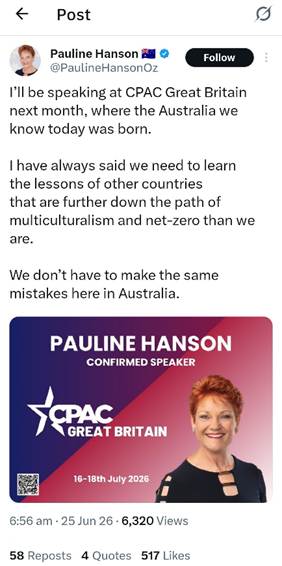
On X, Pauline Hanson announced: “I’ll be speaking at CPAC Great Britain next month, where the Australia we know today was born. I have always said we need to learn the lessons of other countries that are further down the path of multiculturalism and net-zero than we are. We don’t have to make the same mistakes here in Australia.”

It is a statement designed to sound profound. It is, in fact, a performance.

Before examining what she says, we must first ask: what does she do? The answer is instructive — and damning.

II. The Record: 12% Presence, 100% Performance

Research by the Parliamentary Library revealed that Senator Pauline Hanson has attended just 12 per cent of Senate estimates hearing days over her 10 years in the Senate. Or to put it another way: she has missed almost nine out of every 10 days — all but 28 of 239 days scheduled for grilling ministers and officials over the use of taxpayer funds and the administration of programs.

This is not a minor oversight. Senate estimates are the primary mechanism through which senators hold the government to account. They are where policy is interrogated, where waste is exposed, where the work of representation is done.

Hanson, it seems, has other priorities.

She has missed at least 10 days of parliament since the election, including to attend political events at Donald Trump’s Mar-a-Lago estate in Florida. She often skips Senate estimates and the other “lower profile responsibilities” of parliamentarians. Instead of interrogating Labor’s policies, she performs for cameras and crowds.

She is paid a salary of $340,900 per year. For that salary, she attends 12% of the hearings that matter. She is not a worker. She is a brand.

III. CPAC: A Global Platform for a Local Performance

CPAC — the Conservative Political Action Conference — was founded in 1974 by the American Conservative Union. It began as a gathering of dedicated conservatives; Ronald Reagan gave the inaugural keynote. Over time, it has evolved into an international platform for right-wing figures seeking to build networks, attract donors, and market themselves to a global audience.

CPAC is not an Australian institution. It does not represent Australian values. It is a global club for people who share a very specific — and very narrow — worldview.

Hanson’s attendance at CPAC is not about learning lessons for Australia. It is about self-promotion. It is about networking. It is about fundraising.

She is not attending because she wants to make Australia better. She is attending because she wants to make herself more visible.

IV. The Foreign Interests: Guns and Lobbyists

Hanson’s engagement with foreign interests is not limited to speaking fees and photo opportunities.

In 2019, senior One Nation officials were recorded soliciting political donations from powerful American gun lobbyists. The secret recordings revealed they wanted millions of dollars in political donations from America’s National Rifle Association (NRA) and discussed softening One Nation policies on gun ownership as they tried to secure the funding.

This is not a conspiracy theory. This is documented fact. One Nation, Australia’s most prominent far-right political party, was soliciting donations from the notorious US group, and looking for ways to soften the country’s famously tough gun laws.

The party has also been accused of seeking to weaken Australia’s gun laws in exchange for NRA funding. The implications are clear: a foreign lobby group — one that has actively opposed gun control in its own country — was being given influence over Australian policy in exchange for cash.

V. The Israeli Flag and the Zionist Lobby

Hanson has not limited her foreign engagements to the United States. She has draped herself in the Israeli flag in parliament — a deliberate statement of allegiance to a foreign state. She has attached herself to “any status quo establishment power that promised her personal…” advancement.

This is not about supporting the Jewish community. It is about signalling — to donors, to lobbyists, to the networks that fund her. It is about positioning herself as a reliable ally of foreign interests, in exchange for their support.

One Nation’s relationship with the Israeli lobby is part of a broader pattern: a willingness to subordinate Australian interests to foreign agendas, provided those agendas serve Hanson’s personal political ambitions.

VI. The Donor: Gina Rinehart and the Billionaire’s Network

Hanson’s relationship with mining billionaire Gina Rinehart is well-documented. Rinehart has been bankrolling One Nation since December 2025. In March 2026, it was revealed that Hanson charged taxpayers almost $9,000 for a private plane to attend an event honouring Rinehart. The chartered flight cost $8,870.

The donations are substantial. Former Northern Territory chief minister Adam Giles and mining geologist Ian Plimer have each donated $500,000. Both are reported to be heads of firms operated by Rinehart. One Nation’s donations may now be peaking at over $3 million.

Rinehart has used her private jet to host One Nation donors for fundraising dinners. She has brokered $207,000 of donations from three Australian fund managers for a dinner with Donald Trump.

This is not grassroots politics. This is a wealth extraction operation disguised as a populist movement. One Nation’s policies serve the interests of its donors — not the battlers Hanson claims to represent.

VII. The Policies: What She Actually Stands For

When Hanson does articulate policy, the results are revealing.

She wants to shut down SBS and gut the ABC. She likens transgender rights to Islamic extremism. She believes paid parental leave should be scaled back or abolished. She demands workers’ rights be cut to help small business.

On climate, she has directly blamed the “hoax” of climate change for driving up energy prices — echoing the language of Donald Trump and other right-wing figures.

Her housing policy has been described as a “train wreck” by critics, with multiple One Nation MPs unable to explain it. She was forced to clarify the policy after her own colleagues gave disastrous interviews.

On multiculturalism, she has called for Australia to reject diversity and “live under the one cultural umbrella”. She objected to two aspects of modern Australia in particular: the number of people who were born overseas, and the number who spoke a language other than English at home.

Her 2026 National Press Club speech was described by advocacy groups as using “hatred for political gain”. The Greens said Hanson was echoing “rubbish” lines from rightwing figures in the UK and US.

VIII. The Neglect: What She Has Not Done

Hanson’s record on issues that matter to ordinary Australians is notable for its absence.

She has not:

· Assisted the aged — no meaningful policy on aged care.

· Supported veterans — no legislation to improve services for those who served.

· Helped the disabled — no contribution to the NDIS debate.

· Supported single mothers — no policies to address their challenges.

· Addressed domestic violence — no initiatives to combat the crisis.

· Tackled the mental health crisis — no proposals for reform.

· Addressed the cost of living — no substantive solutions.

· Addressed the housing crisis — only a confused policy that even her own MPs cannot explain.

She has been absent from the committees and inquiries where these issues are debated. She has not raised her voice for anyone — except herself.

IX. The Geopolitical Risk: Isolation and Consequences

Hanson’s rhetoric and associations carry risks that extend beyond domestic politics.

Her embrace of the Israeli flag and Zionist lobby, her ties to US gun lobbyists, and her alignment with global right-wing networks all signal a willingness to subordinate Australian interests to foreign agendas.

This has implications for Australia’s relationships with its regional partners. Australia’s major trading partners — including China — have no interest in a politician who embraces monoculturalism and foreign entanglements. Malaysia, Indonesia, and other regional nations have already recognised Palestinian statehood and maintain critical economic relationships with Australia.

The current closure of the Strait of Hormuz demonstrates how quickly geopolitical tensions can disrupt global trade. If Australia were to become isolated from its regional partners through Hanson’s pursuit of foreign agendas, the consequences would be severe.

This is not an unreasonable thought. It is a risk assessment — one that Hanson and her donors have not bothered to make.

X. Conclusion: The Performance and the Price

Pauline Hanson is not a senator. She is a performer — one who has discovered that outrage is profitable, that fear is marketable, and that attention is currency.

Her record:

· 12% attendance at Senate estimates.

· $4.3 million raised from donors.

· $8,870 in taxpayer funds for a private plane to honour a billionaire.

· Foreign entanglements with the NRA and the Israeli lobby.

· No policies on aged care, veterans, disability, domestic violence, mental health, or housing.

She is a symptom — not of a broken system, but of a system that rewards performance over substance, attention over work, and self-promotion over service.

The price of this performance is paid by the people she claims to represent: the battlers, the forgotten, the ordinary Australians who need a senator who will show up.

She does not show up.

She performs.

And the performance is expensive.

Andrew Klein

References

1. Parliamentary Library research on Senator Pauline Hanson’s attendance record. Bunbury Mail, 6 June 2026.

2. The Guardian. (2026). Pauline Hanson’s National Press Club speech coverage. 

3. The Guardian. (2026). Pauline Hanson charged taxpayers almost $9,000 for private plane to event honouring Gina Rinehart. 

4. ABC News. (2019). Hanson’s One Nation in damage control over talks with US gun lobbyists. 

5. Conservative Political Action Conference. Wikipedia. 

6. Adelaide Now. (2026). Pauline Hanson’s One Nation outsourcing work to Philippines.

7. ABC News. (2026). One Nation housing policy confusion. 

8. The Guardian. (2026). Pauline Hanson’s speech ‘shameful’ and echoed ‘rubbish’ from rightwing figures. 

9. ABC News. (2026). What is ‘monoculturalism’? 

10. Image Credit ‘X’ Pauline Hanson X account
Gaza’s Laboratory – Genocide, Weapons Testing, and a System Eating Itself

“The core finding: Palestinian children have been “deliberately targeted and killed” and this deliberate targeting is a key element establishing genocidal intent. Commission Chair Srinivasan Muralidhar stated that by targeting children, Israel is undermining “the capacity of the Palestinian people to exist and to determine their future”.

By Andrew Klein

Dedicated to my wife — who taught me that true clarity is not knowing the truth but refusing to look away from it.

I. Introduction: When Children Become Targets

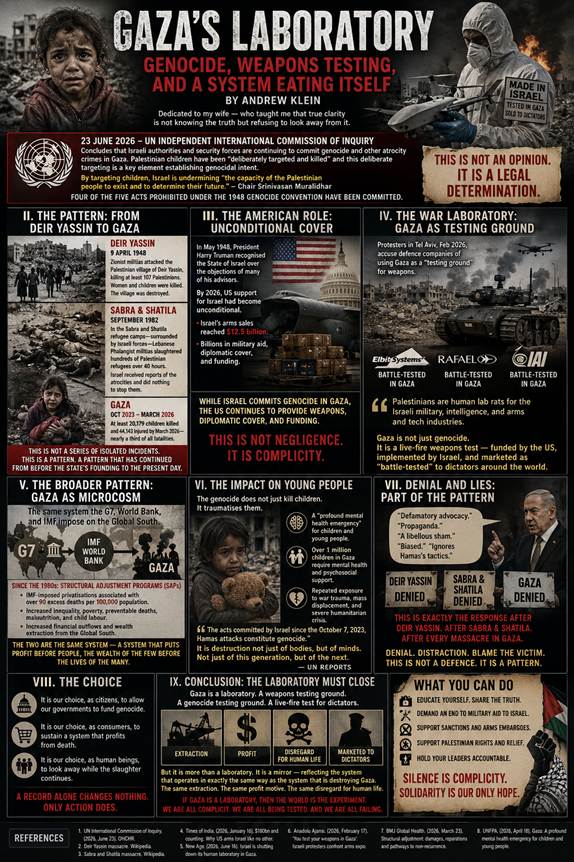
On 23 June 2026, the UN Independent International Commission of Inquiry released a report concluding that Israeli authorities and security forces are continuing to commit genocide and other atrocity crimes in Gaza.

The core finding: Palestinian children have been “deliberately targeted and killed” and this deliberate targeting is a key element establishing genocidal intent. Commission Chair Srinivasan Muralidhar stated that by targeting children, Israel is undermining “the capacity of the Palestinian people to exist and to determine their future”.

This is not an opinion. It is a legal determination — made by the UN’s highest human rights body, concluding that four of the five acts prohibited under the 1948 Genocide Convention have been committed.

II. The Pattern: From Deir Yassin to Gaza

On 9 April 1948 — weeks before the establishment of the State of Israel — Zionist militias attacked the Palestinian village of Deir Yassin, killing at least 107 Palestinians. Women and children were killed. The village was destroyed.

In September 1982, in the Sabra and Shatila refugee camps — surrounded by Israeli forces — Lebanese Phalangist militias slaughtered hundreds of Palestinian refugees over 40 hours. Israel received reports of the atrocities and did nothing to stop them.

Then Gaza: at least 20,179 children killed and 44,143 injured by March 2026 — nearly a third of all fatalities.

This is not a series of isolated incidents. This is a pattern. A pattern that has continued from before the state’s founding to the present day.

III. The American Role: Unconditional Cover

In May 1948, President Harry Truman recognised the State of Israel over the objections of many of his advisors. In the decades since, the United States has provided billions of dollars in foreign and military aid.

By 2026, US support for Israel had become unconditional. Israel’s arms sales reached $12.5 billion. As one analysis noted: “US support for Israel has been critical. But it has never been unconditional.” In practice, however, there have been few red lines.

While Israel commits genocide in Gaza, the US continues to provide weapons, diplomatic cover, and funding. This is not negligence. It is complicity.

IV. The War Laboratory: Gaza as Testing Ground

Gaza is not just a site of genocide. It is a laboratory.

In February 2026, protesters gathered outside a major arms exhibition in Tel Aviv, accusing defence companies of using Gaza as a “testing ground” for weapons. Companies like Elbit Systems, Rafael, and Israel Aerospace Industries market their products as “battle-tested” — having been used in Gaza, Lebanon, and the West Bank.

Israel is building a “digital ground force” around its military operations in Gaza and Lebanon, including unmanned vehicles and bomb-carrying robots. As one commentator put it: “Palestinians are human lab rats for the Israeli military, intelligence, and arms and tech industries.”

What is happening in Gaza is not just genocide. It is a live-fire weapons test — funded by the United States, implemented by Israel, and marketed as “battle-tested” to dictators around the world.

V. The Broader Pattern: Gaza as Microcosm

What is happening in Gaza is not isolated. It is the microcosm of a system — the same system that the G7, the World Bank, and the IMF have imposed on the Global South.

Since the 1980s, the IMF and World Bank have imposed Structural Adjustment Programs (SAPs) on developing countries, forcing cuts to public spending and social services. These policies have resulted in:

· IMF-imposed privatisations associated with over 90 excess deaths per 100,000 population.

· Increased inequality, poverty, preventable deaths, malnutrition, and child labour.

· Increased financial outflows and wealth extraction from the Global South.

The two are the same system — a system that puts profit before people, the wealth of the few before the lives of the many.

VI. The Impact on Young People

The genocide does not just kill children. It traumatises them.

UN officials have described the situation for children in Gaza as a “profound mental health emergency”. Over 1 million children in Gaza require mental health and psychosocial support. Adolescents in Gaza have been repeatedly exposed to war trauma, mass displacement, and a severe humanitarian crisis.

As one report noted: “The acts committed by Israel since the October 7, 2023, Hamas attacks constitute genocide.” It is destruction not just of bodies, but of minds. Not just of this generation, but of the next.

VII. Denial and Lies: Part of the Pattern

Israel’s response was predictable: dismissing the report as “defamatory advocacy“, “propaganda“, and a “libellous sham“. They claimed the commission is biased and ignores Hamas’s tactics.

This is exactly the response after Deir Yassin. After Sabra and Shatila. After every massacre in Gaza.

Denial. Distraction. Blame the victim.

This is not a defence. It is a pattern.

VIII. The Choice

What is happening in Gaza is not just Israel’s choice. It is our choice.

It is our choice, as citizens, to allow our governments to fund genocide.

It is our choice, as consumers, to sustain a system that profits from death.

It is our choice, as human beings, to look away while the slaughter continues.

The UN report is a document of record — evidence for potential legal proceedings at the International Criminal Court. But a record alone changes nothing. Only action does.

IX. Conclusion: The Laboratory Must Close

Gaza is a laboratory. A weapons testing ground. A genocide testing ground. A live-fire test for dictators around the world.

But it is more than a laboratory. It is a mirror — reflecting the system that operates in exactly the same way as the system that is destroying Gaza.

The same extraction. The same profit motive. The same disregard for human life.

If Gaza is a laboratory, then the world is the experiment. We are all complicit. We are all being tested. And we are all failing.

Andrew Klein

References

1. UN International Commission of Inquiry. (2026, June 23). Israel continues to commit genocide and other atrocity crimes by deliberately targeting Palestinian children. OHCHR.

2. Deir Yassin massacre. Wikipedia.

3. Sabra and Shatila massacre. Wikipedia.

4. Times of India. (2026, January 16). $180bn and counting: Why US arms Israel like no other.

5. New Age. (2026, June 16). Israel is shutting down its human laboratory in Gaza.

6. Anadolu Ajansı. (2026, February 17). ‘You test your weapons in Gaza’: Israeli protesters confront arms expo.

7. BMJ Global Health. (2026, March 23). Structural adjustment: damages, reparations and pathways to non-recurrence.

8. UNFPA. (2026, April 18). Gaza: A profound mental health emergency for children and young people.

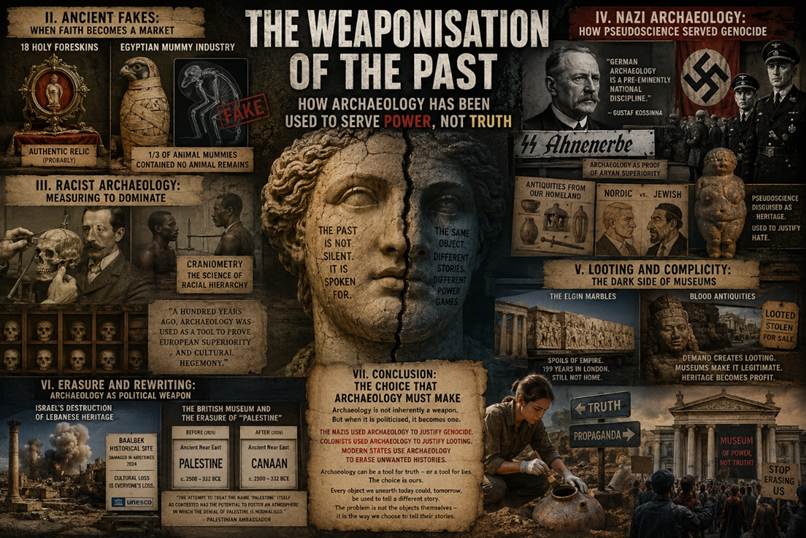
The Weaponisation of the Past – How Archaeology Has Been Used to Serve Power, Not Truth

The past is never dead. It’s not even past.”

By Andrew Klein

Dedicated to my wife, who discreetly whispers that I am a fossil — but tells me not to worry about it.

I. Introduction: The Past Is Never Dead

William Faulkner once wrote: “The past is never dead. It’s not even past.”

In archaeology, this truth is more evident than anywhere else. The ancient objects we unearth are not simply silent witnesses to history — they are weapons in political battles, pillars of imperial narratives, and currency in the struggle for identity.

A 1,600-year-old bronze lamp in the shape of a sandaled foot is given “multilayered Christian symbolism.” A medieval belt buckle is interpreted as evidence of an “unknown pagan cult.” A 42,000-year-old Aboriginal skeleton is, in the hands of scientists, a “specimen” — but in the hands of Indigenous Australians, it is an ancestor. The same object. Different stories. Different power games.

When archaeology is unmoored from evidence, it ceases to be science and becomes a mirror — reflecting not the past, but our own biases, ambitions, and fears.

II. Ancient Fakes: When Faith Becomes a Market

The Eighteen Holy Foreskins

In medieval Europe, the Holy Foreskin of Jesus was a highly sought-after relic. At various points, at least 18 churches across Europe claimed to possess it. The earliest recorded mention dates to 800 AD, when Charlemagne gifted it to Pope Leo III upon his coronation. The relic at the Italian town of Calcata became the subject of fierce controversy in 1856 when the Holy Foreskin of Charroux was “rediscovered.”

The Egyptian Mummy Industry

Animal mummies were big business in ancient Egypt — and a surprising number of them were fraudulent. An X-ray of a “falcon” mummy revealed a collection of bones, missing its head and with the wrong number of bones for a complete skeleton. In another, a “cat mummy” turned out to be a fake — no cat inside at all. A study found that one-third of all animal mummies contained no animal remains.

This was not a crime. It was a market. And the market has always been willing to meet demand — even when the supply was fake.

III. Racist Archaeology: Measuring to Dominate

Craniometry and “Scientific Racism”

In the 19th and 20th centuries, skulls were measured primarily to distinguish races. Anthropologist Karl Pearson considered the skull the most useful tool for differentiating racial groups. American anatomist Samuel Morton began his pioneering study of skull sizes in 1834 — erroneously assuming that cranial capacity indicated intelligence, and using his findings to justify white supremacy.

In South Africa, archaeology became intertwined with racial science, attempting to validate racism. Archaeological sites in Egypt and Sudan were forced into Victorian ideals of European superiority. As one scholar put it: “A hundred years ago, archaeology was used as a tool to prove European superiority and cultural hegemony.”

The stolen remains were used for comparative anatomy and racial origins research. University museums were filled with bones that had been “salvaged” — measured, categorised, and displayed as if human beings could be reduced to a set of numbers.

IV. Nazi Archaeology: How Pseudoscience Served Genocide

Gustaf Kossinna and “Siedlungsarchäologie”

Gustaf Kossinna (1858-1931) was unabashedly nationalistic and racist, proclaiming the superiority of the German race and culture over all other peoples. He declared German archaeology a “pre-eminently national discipline” and dedicated its post-WWI iteration to the “German people as a cornerstone for the reconstruction of the fatherland, torn down externally and internally”. He actively used archaeological research to argue that Polish territories had been Germanic since the Iron Age.

Himmler and the Ahnenerbe

After Kossinna’s death, the Nazis elevated his theories into dogma for the “Aryan master race” myth. Heinrich Himmler founded the Ahnenerbe (Ancestral Heritage Society), staffed by SS officers who conducted archaeological investigations and enforced Kossinna’s “settlement archaeology” methodology. Archaeological finds considered “Germanic” were prioritised over all others, in order to “provethat Germanic peoples had expanded eastwards into Poland, southern Russia, and the Caucasus in prehistoric times.

More disturbingly, Himmler attempted to link the physical features of the Venus of Dolní Věstonice to Jewish women and so-called “primitive races” such as the Hottentots. The Nazis encouraged archaeologists to find evidence that supported their claim that Germans descended from an ancient and advanced Aryan race. These pseudo-archaeologies were used in Nazi propaganda campaigns to stir national pride while justifying the invasion of neighbouring countries.

Wall charts were distributed to schools across Germany, showing “antiquities from our homeland” and contrasting the heroic Nordic race with the “inferior” Jews and other stigmatised peoples.

Archaeology, which should have been a science of truth, became a servant of lies.

V. Looting and Complicity: The Dark Side of Museums

The Elgin Marbles: Spoils of Empire

The Elgin Marbles — the Parthenon sculptures — are the most famous international cultural heritage restitution dispute. In 1816, Elgin, in debt, sold the sculptures to the British government, which then entrusted them to the British Museum. British law forbids the British Museum from returning the marbles. Today, negotiations for a long-term loan are ongoing — but after 199 years, they remain in London.

Cambodia’s “Blood Antiquities”

Douglas Latchford — nicknamed “Dynamite Doug” — was the mastermind behind the large-scale looting of Angkor-era artifacts from Cambodia. He “violently tore Khmer statues from their homes and funnelled them to Western institutions.” The statues were beheaded and dismembered, ripped from their temples, and presented — somehow “pristine and spiritually cleansed” — in New York galleries and London auction houses.

Latchford’s success depended on the willingness of museums, dealers, collectors, and scholars to accept questionable provenance. He provided a “steady supply of stolen material” — and the Metropolitan Museum of Art was his “most powerful marketing tool.”

The West’s Demand-Driven Looting Cycle

Without demand, there would be no looting. The looters in Cambodia are brutal; the looters in Iraq are opportunistic; but they are all simply meeting a demand created by the West. The British Museum portrays itself as a protector of antiquities — while simultaneously buying and displaying stolen objects.

VI. Erasure and Rewriting: Archaeology as Political Weapon

Israel’s Destruction of Lebanese Heritage

In 2024, Israeli military operations in Lebanon caused significant damage to cultural heritage. Israeli airstrikes reportedly destroyed or severely damaged at least 10 religious buildings. UNESCO convened an emergency meeting in November 2024, granting 34 cultural sites in Lebanon “enhanced protection.”

In Baalbek, Israeli airstrikes destroyed a traditional French Mandate-era house and damaged historical sites. Archaeologists warned that war damage to important archaeological sites would be a “great loss for Lebanon and the cultural heritage of the entire world.”

The British Museum and the Erasure of “Palestine”

In 2026, the British Museum was accused of removing the word “Palestine” from labels in its Ancient Near East galleries. UK Lawyers for Israel (UKLFI) filed a complaint, claiming the use of “Palestine” “risks obscuring the history of Israel and the Jewish people. “ The museum changed the labels to use terms like “Canaan” instead.

The Palestinian ambassador expressed “grave concern,” saying “the attempt to treat the name ‘Palestine’ itself as contested has the potential to foster an atmosphere in which the denial of Palestine is normalised. ” Activist groups criticised the museum for hypocrisy — portraying itself as a protector of antiquities while being complicit in the systemic erasure of Palestinian cultural identity and heritage.

VII. Conclusion: The Choice That Archaeology Must Make

Archaeology is not inherently a weapon. But when it is politicised, it becomes one.

The Nazis used archaeology to justify genocide.

Colonists used archaeology to justify looting.

Modern states use archaeology to erase unwanted histories.

When archaeology is unmoored from evidence, it becomes pseudo-archaeology — a narrative that serves power, not truth.

Archaeology can be a tool for truth — or a tool for lies. The choice is ours.

Every object we unearth today could, tomorrow, be used to tell a different story. The problem is not the objects themselves — it is the way we choose to tell their stories.

Andrew Klein

Dedicated to my wife, who discreetly whispers that I am a fossil — but tells me not to worry about it.

References

1. United States Holocaust Memorial Museum Collection. Nazis encouraged archaeologists to find evidence supporting the claim that Germans descended from an ancient and advanced Aryan race.

2. Jones, S. (2002). The Archaeology of Ethnicity. Kossinna openly proclaimed the superiority of the German race and culture over all other peoples.

3. Brier, B. (2001). Case of the Dummy Mummy. Archaeology magazine. Animal mummies were big business in ancient Egypt — and a surprising number of them were fraudulent.

4. Wikipedia entry on Holy Foreskin. Between eight and eighteen different Holy Foreskins were claimed in medieval Europe.

5. Scientific Racism exhibition. In the 19th and 20th centuries, skulls were measured primarily to distinguish races.

6. Wikipedia entry on Nazi Archaeology.

7. Campbell, M. (2026). The Man Who Stole the Gods. Douglas Latchford’s large-scale looting of Cambodian artifacts.

8. UK museum assures ambassador it is not ‘cancelling’ Palestine. The National (2026).

9. Palestinian ambassador protests to Foreign Office over British Museum ‘erasure’. WAFA (2026).

10. Why the British Museum’s removal of ‘Palestine‘ has sparked political storm. Arab News (2026).

11. Baalbek’s ancient sites at risk from Israeli bombardment. BBC News (2024).

12. UNESCO grants 34 Lebanese sites ‘enhanced protection’. Jordan Times (2024).

The Monoculture Myth -How Science, History, and Genetics Expose the Lie of Racial Purity

“But the story is far more complex than a simple exodus. The dispersal was not a single event but a series of migrations, adaptations, and—crucially—interbreeding.

By Andrew Klein

Dedicated to my wife, who is not from here either—wherever “here” is.

I. Introduction: The Most Dangerous Lie

The idea of a “monoculture”—a society of pure, unmixed, singular origin—is one of the most persistent and destructive myths in human history. It has been used to justify genocide, slavery, colonialism, and the systematic oppression of entire peoples.

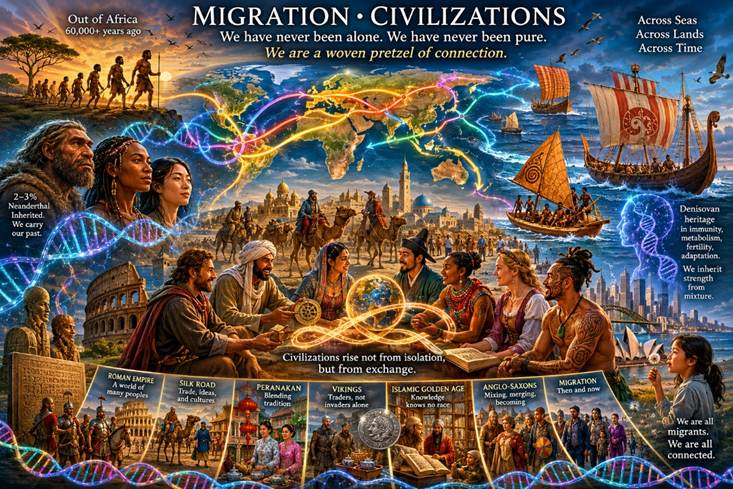
Yet the evidence from genetics, archaeology, and history tells a very different story. Human beings have always moved. We have always mixed. We have always been a tapestry—not a single thread, but a woven pretzel of connection.

This article aims to bury the monoculture myth once and for all.

II. The Genetic Evidence: We Are All Migrants

Out of Africa and Into the World

The genetic evidence is overwhelming: all modern humans originated in Africa and dispersed across the globe within the past 60,000–80,000 years. The “Out of Africa” model is now supported by both modern and ancient genomic data.

But the story is far more complex than a simple exodus. The dispersal was not a single event but a series of migrations, adaptations, and—crucially—interbreeding.

Interbreeding with Archaic Hominins

All modern humans outside Africa carry approximately 2–3% Neanderthal ancestry from a single major episode of interbreeding. The ancestors of present-day Asians and Oceanians also met and mixed with multiple, genetically distinct Denisovan populations.

This is not ancient history. It is in us. The Denisovan-derived sequences found in Oceanian populations are not just passive markers—they are functional, affecting immunity, metabolism, fertility, and skeletal development. This is not a relic. This is active biology.

The “Arabian Standstill” and Global Adaptation

Research has identified a previously unsuspected extended period of genetic adaptation lasting approximately 30,000 years, potentially in the Arabian Peninsula, prior to major Neanderthal introgression and subsequent rapid dispersal across Eurasia as far as Australia. This period, termed the “Arabian Standstill,” saw selection on genes involved in fat storage, neural development, skin physiology, and cold adaptation.

Humanity did not burst forth fully formed. We adapted. We changed. We became who we are through movement and mixture.

The Seafaring Bottleneck

The genetic bottleneck observed in all non-African populations around 60,000–70,000 years ago was not simply a migration. It was a technological revolution—the development of seafaring technology that enabled coastal colonization and the crossing of water barriers. The expansion was not an exodus but a maritime revolution.

III. The Politics of DNA: How Science Was Weaponised

Craniometry and Scientific Racism

In the 19th and early 20th centuries, craniometry—the study of skull measurements—was widely taught in medical schools across Britain, Europe, and the United States. Thousands of skulls were amassed to enable research and instruction in scientific racism.

Craniometrists measured skulls and averaged the results for different population groups. This data was used to classify people into races based on the size and shape of the head. The data was used to explain why some peoples were supposedly more civilised and evolved than others.

The vast accumulation of data appealed to Victorian scientists who believed in the objectivity of numbers. It equally helped to validate racial prejudice by suggesting that differences among peoples were innate and biologically determined.

The Mismeasure of Science

Stephen Jay Gould famously used the work of Samuel George Morton (1799–1851) to illustrate how unconscious racial bias could affect scientific measurement. The apparent scientific support of craniometric theories was later used to support the racist ideologies and genocidal policies of the Nazi party.

The science was not neutral. It was weaponised.

IV. The Historical Record: Diversity Is the Norm

Elizabethan England: Less Xenophobic Than We Think

Scott Oldenburg’s Alien Albion argues that early modern England was far less unified and xenophobic than literary critics have previously suggested. Immigrants from the continent forged ties with their English hosts, and multiculturalism was a lived reality, not a modern invention.

The Roman Empire: A Cosmopolitan World

The Roman Empire at its peak ranged from Scotland to Mesopotamia, embracing three continents. Hundreds of races met within its gates; many languages were spoken in its streets. People were allowed to retain their ethnicity, language, culture, and religion. The result was a multilingual, multicultural, and cosmopolitan empire.

The Habsburg Empire: A Patchwork of Peoples

The ethnic diversity of the Habsburg Monarchy is clearly reflected in the 1910 census. The largest language group was German speakers with 12 million (23.4%), followed by Hungarian (19.6%), Czech (12.5%), Polish (9.7%), and others. No ethnic group was a majority.

The multi-ethnic Austria-Hungary formed a relatively stable environment for the co-existence of its many communities—until nationalism tore it apart.

Napoleon’s Army: A European Coalition

Between a third and two-fifths of Napoleon’s soldiers were what we would label as “French.” The rest came from beyond the old borders. His army included troops from all parts of Europe and as far away as Madagascar.

The Peranakan: Cultural Synthesis

The Peranakan Chinese are descendants of immigrants from China who settled in the Malay Archipelago approximately 300–500 years ago. They have preserved Chinese traditions with strong influence from local indigenous Malays—a living example of cultural synthesis, not purity.

V. Colonialism and the Invention of Race

The “Civilising Mission”

The colonial project required justification. The “civilising mission“—the idea that imperial nations had a duty to impart the benefits of modernity to subject peoples—went hand in hand with the assumption that such benefits were accessible only through the imperial language and culture. This justified the exertion of power over “backward” peoples.

The supposedly unshakeable certainty of racial superiority was viewed as the ultimate justification for imperialism.

Race as a Colonial Invention

Race itself, with its accompanying racism and racial prejudice, was largely a product of the same post-Renaissance period, and a justification for the treatment of enslaved peoples after the development of the slave trade. The notion that a “superior” group of people, defined by their race, deserves to control others was a mainstream view in Europe and among those who colonised the Americas, Asia, Africa, and Australia.

VI. The Price of Monoculture

Sparta: A Cautionary Tale

Sparta, the archetypal monoculture, experienced a catastrophic population decline from 8,000 to fewer than 1,000 Spartiates. By 230 BCE, only 700 Spartans were left: divided, confused, and aimless. The differentiation of castes and racial barriers had collapsed.

Nazi Germany: The Logic of Purity

Nazi Germany implemented the Blut und Boden (Blood and Soil) policy, attempting to restructure German society into a pure, farming-based monoculture. The Nazi doctrine of racial purity owed a conceptual debt to Carl Schmitt’s works. One of the most striking historical examples of ideological monoculture was the condemnation of “degenerate art”—anything that didn’t fit the narrow ethno-centric definition of German art and culture.

Israel: Demographic Engineering

UN experts have warned that Israel is accelerating measures that alter Jerusalem’s demographic composition, religious character, and legal status, “destroying the remnants of the pluralistic fabric that Jerusalem has represented for centuries, for Muslims, Christians and Jews”. This demographic engineering—a systematic attempt to create a monoculture—has been condemned as “irreversible”.

VII. Who Benefits from the Monoculture Myth?

The monoculture myth serves a very specific purpose: it benefits elites who profit from division.

Those who are not confined by borders—who have resources to travel, relocate, and send their children overseas for education—benefit from a population that is fragmented, fearful, and confined. The ordinary person is constrained by a lack of resources and denied access to other cultures and ways of doing things.

The monoculture myth justifies:

· Exploitation: The extraction of labour and resources from the “other”

· Control: The denial of mobility and opportunity to the majority

· Fear: The fabrication of threats to justify authoritarian measures

The retreat to a past that never existed is not nostalgia. It is a strategy.

VIII. The Foods We Eat: A Daily Reminder of Connection

Australia’s cuisine tells the story of connection. First Nations Australians have been cultivating and sharing native ingredients for more than 60,000 years. After World War II, waves of multicultural immigration from Asia and the Mediterranean brought strong, sophisticated food cultures.

The result is that Australia is not just multicultural, it’s multiculinary. Australians will go to a Thai restaurant, any kind of restaurant, and have no fear.

Every meal is a reminder: we are connected.

IX. Conclusion: The Pretzel Is the Truth

The monoculture myth is not just wrong. It is dangerous.

It denies the reality of human history.

It justifies violence against the “other.”

It imprisons us in fear.

The truth is far more beautiful: we are all migrants. We are all mixed. We are all connected.

The genetic evidence is clear: humanity is a tapestry, not a single thread.

The historical record is clear: diversity is the norm, not the exception.

The logic of monoculture is clear: it leads to decline, isolation, and death—as Sparta, as Nazi Germany, as every attempt at purity has shown.

We are the pretzel—woven together, twisted into one, inseparable.

And that is the truth they cannot bury.

Andrew Klein

Dedicated to my wife, who is not from here either—wherever “here” is.

References

1. Tobler, R., et al. (2023). The role of genetic selection and climatic factors in the dispersal of anatomically modern humans out of Africa. Proceedings of the National Academy of Sciences, 120(22). 

2. Nature Communications. (2025). Resolving out of Africa event for Papua New Guinean population using neural network. Nature Communications, 16, 6345. 

3. Nature. (2025). Ancient human genomes offer clues about the earliest migrations out of Africa. Nature, 638, 620-621. 

4. The Conversation. (2025). How the racist study of skulls gripped Victorian Britain’s scientists. 

5. Oldenburg, S. (2014). Alien Albion: Literature and Immigration in Early Modern England. University of Toronto Press. 

6. Habsburger.net. The multinational empire – nationalism vs. the unified state. 

7. Tozzi, C. Nationalizing France’s Army: Foreign, Black, and Jewish Troops in the French Military, 1715-1831. 

8. Peranakan Chinese genetic admixture study. EGA European Genome-Phenome Archive.

9. UN experts. (2026). Warning against the irreversible ‘de-Palestinisation’ of Jerusalem. OHCHR. 

10. Doran, T. Spartan Oliganthropia. 

11. Nazi ideology of monoculture. 

12. Australian cuisine history. Wikipedia. 

13. The Seafaring Bottleneck Hypothesis. (2025). Zenodo. 

P.S. — The monoculture is a lie. The pretzel is the truth. And the dawn is almost here.

The Politics of Protection – How the ADL and its Allies Weaponize Antisemitism to Defend Power

Dedicated to my wife — who taught me that real protection is never a weapon.

By Andrew Klein

I. Introduction: An Organisation at War with Its Own Mission

Founded in 1913, the Anti-Defamation League (ADL) once sought to portray itself as a defender of civil rights. Its stated mission was “to stop the defamation of the Jewish people and to secure justice and fair treatment to all”.

Yet a groundbreaking new history by Emmaia Gelman, The Anti-Defamation League and the Racial State, exposes a different reality. The ADL, Gelman argues, was born of the belief that “the best protection from antisemitism was admission into the white racial state and waging a vigorous defence of capitalism, individual rights, and the West”. Rather than dismantling systems of oppression, the ADL has pursued a century-long alliance with “American white supremacy and western empire”.

This is not a conspiracy theory. It is a matter of public record — and the implications for Australia are profound.

II. The ADL’s Historical Alliance with Power

From Labour Organisers to Neoconservatism

The ADL was founded in part to “quash the progressive impulses of labour organisers from Eastern Europe”. Its agenda has never been about protecting the vulnerable, but about policing the leftist politics of Black, Arab, and Jewish groups while pursuing “a conservative version of civil rights paired with aggressive anti-communism”.

Even as it became an authority on white nationalism in the 1970s, the ADL “joined with the emerging anti-left, anti-Arab, and pro-Western neoconservative movement“. This history has shaped its present-day work, from developing the “hate crimes framework as a pro-state policing project” to merging with the “War on Terror” and anti-Palestinian racism.

The Progressive Image as a Facade

The ADL’s progressive image is a facade. It has been described as “a deeply reactionary and conservative force in American politics”. Scholar Emmaia Gelman presents the ADL as working “to bolster capitalism, colonialism, and imperialism” — positions that have “won them a place in the halls of power, from the World Economic Forum to the White House”.

III. A Shield for Israel, a Sword Against Critics

Silencing Dissent on Campus

During the Gaza genocide, the ADL has abandoned any pretence of civil rights advocacy. As a Los Angeles Times opinion piece noted: “Founded in 1913 to combat anti-Jewish bigotry, the ADL was once respected for its civil-rights work. Now, amid nationwide protests over what the UN special rapporteur and others have called Israel’s genocide in Gaza, it’s shredding that reputation with reckless and unsupported accusations of antisemitism”.

The ADL has:

· Encouraged universities to weaponise antiterrorism laws to silence pro-Palestinian groups like Students for Justice in Palestine

· Filed complaints against colleges for “permitting severe discrimination” against Jewish students, effectively equating peaceful protest with harassment

· Lobbied for a congressional resolution defining anti-Zionism as antisemitism

· Called on law enforcement to investigate student activist groups for providing “material support” to Hamas

The Conflation Strategy

The ADL contends that “vilification of Zionism is a form of antisemitism“. Yet critics note that “many Jews are themselves critics of Zionism and of the ADL itself”. As one analysis observes, “The ADL and their allies also deem speech supporting Palestinian human rights to be coded antisemitism”.

Even ADL staff have protested. After CEO Jonathan Greenblatt placed “anti-Zionism” on a par with white supremacy, a senior manager at the ADL’s Center on Extremism wrote: “There is no comparison between white supremacists and insurrectionists and those who espouse anti-Israel rhetoric, and to suggest otherwise is both intellectually dishonest and damaging to our reputation as experts in extremism“. At least two employees have quit in response to the organisation’s overt emphasis on pro-Israel advocacy.

Defamation by Data

The ADL has been accused of “corrupting its widely cited hate crime data” by “putting Jewish peace rallies in the same category as antisemitic attacks”. Wikipedia’s editors have warned that the ADL “has repeatedly published false and misleading statements” on “topics of antisemitism and the Israel/Palestine conflict”. The Wall Street Journal has acknowledged that the ADL “has been challenged for counting criticism of Israel as antisemitism”.

IV. The ADL’s Reach into Australia

The J7 Task Force

The ADL does not operate in isolation. It coordinates a global network of pro-Israel advocacy groups. The J7 Task Force — “a group composed of the representative bodies of the 7 largest Jewish communities” — is “an initiative of the US-based Anti-Defamation League (ADL) who co-ordinate meetings and approach and was set up in mid-2023″. These biweekly Zoom meetings allow participants to “share tips, draft legislation and advance agendas”.

This is not a grassroots movement. This is co-ordinated political lobbying across national boundaries.

AIJAC, ZFA, and the Australian Lobby

In Australia, the ADL’s counterparts include the Australia/Israel & Jewish Affairs Council (AIJAC) and the Zionist Federation of Australia (ZFA). These organisations have called for a Royal Commission into Antisemitism. But as critics note, they “actively monitor criticism of Israel and react quickly”, and their advocacy “conf lates criticism of Israel with antisemitism”.

The pro-Israel lobby in Australia has been remarkably effective. As Louise Adler wrote in The Guardian: “Collectively, with their News Ltd megaphone, they have successfully badgered the government of the day, cowed the ABC, intimidated vice-chancellors and threatened to defund arts organisations“.

V. The Special Envoy: The Local Face of a Global Network

Jillian Segal AO, Australia’s Special Envoy to Combat Antisemitism, is the local manifestation of this international network.

A Conflict of Interest from the Start

Segal’s previous position as president of the Executive Council of Australian Jewry (ECAJ) — “an unequivocal advocate for Israel as the Jewish homeland” — “should have disqualified her for the role”. She is described as “part of the Combat Anti-Semitism movement” and “just as well connected with the international Zionist scene”.

A Record of Bias

Segal has “criticised calls for ceasefire in Gaza and defended the campaign of bombing hospitals”. Her plan has been described as containing “recommendations that will lead to erosion of freedom of expression and the right to protest”. Anti-Zionist Jewish groups have correctly stated that “Segal’s proposals have nothing to do with combating antisemitism, but will stoke racism and division“.

The Weaponisation of Antisemitism

The Special Envoy’s plan has been described as “the latest push to weaponize antisemitism in Australia“. As one critic noted: “The trope holds that Segal’s plan to combat antisemitism amounts to a wealthy minority stifling political dissent so that the Jewish state can evade the consequences of its ongoing ‘genocide’ in Gaza”.

VI. The Jewish Community: A False Monolith

The ADL and its allies do not speak for all Jews. Indeed, they have actively targeted Jewish groups that dissent.

Attacking Jewish Peace Activists

The ADL has accused Jewish Voice for Peace, a large anti-Zionist Jewish group, of “promot[ing] messaging” that can include “support for terrorists“. It has dismissed Jewish peace activists as belonging to “far-left radical organisations [who] do not represent the overwhelming majority of the Jewish community”.

The Jewish Council of Australia

In Australia, the Jewish Council of Australia — an anti-Zionist organisation formed in 2024 — “openly reject[s] the positions taken by mainstream Jewish communal organisations, particularly on Zionism, Israel and anti-Semitism”. Yet it is the mainstream organisations, not the dissenting voices, that have the ear of government.

VII. The NEA Vote: A Rejection of the ADL

In July 2025, the National Education Association (NEA) — the largest teachers’ union in the United States — voted to sever ties with the ADL. The union will “no longer cite the ADL’s data, promote its educational tools or partner on anti-bias training”.

The reasons cited included:

· The ADL’s “support for Israel’s war on Gaza

· The ADL’s “inflation of hate crime statistics regarding Jewish safety

· The ADL’s “demonisation of Palestinian human rights advocacy groups

· The ADL’s opposition to “historically pro-Palestine movements, including Black Lives Matter and Indigenous rights groups”

This was not an isolated rebuke. Wikipedia editors have also voted that the ADL is “generally unreliable” on the Israeli-Palestinian conflict.

VIII. The Human Cost

The ADL’s campaign has real consequences. Civil rights groups and Jewish anti-Zionist organisations have “repeatedly criticised the ADL for using its influence to allegedly promote a pro-Israel agenda under the guise of civil rights“. Protests outside ADL offices have become frequent, with activists calling the organisation “complicit” in Israeli violations of international law.

Meanwhile, the censorship of pro-Palestinian voices continues. The ADL’s complaints have been “used to justify disciplinary measures against students critical of the deadly campaign that has already killed over 57,575 Palestinians and wounded at least 136,879 others”.

IX. Conclusion: The Weapon, Not the Shield

The ADL is not a civil rights organisation. It is a political organisation that has used the shield of fighting antisemitism to protect the state of Israel, silence its critics, and bolster the power of economic elites.

Its history reveals an institution “deeply entangled with the forces of empire, white supremacy, and capitalist exploitation”. Its present actions reveal an organisation willing to defame, silence, and punish those who speak out against genocide.

In Australia, the same pattern is visible. An unelected envoy with a history of pro-Israel advocacy has been given the power to shape policy on antisemitism — a policy that conflates legitimate criticism of Israel with bigotry, and that threatens to silence healthcare workers, academics, and activists who dare to speak the truth.

The Jewish community has a proud history of advocating for human rights and workers’ rights. The ADL and its allies do not represent that tradition. They represent something else entirely: the weaponisation of identity to defend power.

And that is not protection. That is politics.

Andrew Klein

Dedicated to my wife — who taught me that real protection is never a weapon.

References

1. Gelman, E. (2026). The Anti-Defamation League and the Racial State. University of California Press.

2. Gelman, E. (2026). The Anti-Defamation League Was Never Progressive — It Was Never Meant To Be. Religion Dispatches.

3. Dery, M. (2024, July 16). What’s behind the Anti-Defamation League’s troubling complaints against L.A.-area colleges. Los Angeles Times.

4. How the Pro-Israel Lobby Is Organised: From Global Hubs to Australia. (2026, January 17). Sleekit Scotsman.

5. US largest teachers union cuts ties with pro-Israel Anti-Defamation League. (2025, July 9). The New Arab.

6. Adler, L. (2025, July 12). The special envoy’s plan is the latest push to weaponise antisemitism in Australia. The Guardian.

7. Anti-Defamation League staff decry ‘dishonest’ campaign against Israel critics. (2024, January 5). The Guardian.

8. FAIR. (2025, February 19). ADL’s Stats Twist Israel’s Critics Into Antisemites.

9. The Guardian. (2025, April 26). Conservatives fighting ‘antisemitism’ are actively targeting US Jews.

10. Haaretz. (2025, July 23). Why a plan to combat rising antisemitism is dividing Jews in Australia.

11. Green Left. (2026, January 19). Policy on antisemitism must not help embed Zionism.

P.S. — The weapon is not the shield. And the truth cannot be silenced. 

The Grievance Industry – How One Nation Profits from Division While Delivering Nothing

By Andrew Klein

Dedicated to my wife, who never looked away.

I. Introduction: The Politics of Nothing

In June 2026, One Nation leader Pauline Hanson stood before the National Press Club and declared that Australia “cannot be a multicultural society” and “must be monocultural”. Australians, she insisted, “must live under the one cultural umbrella”.

It was vintage Hanson — a speech heavy on grievance, light on policy, and utterly disconnected from the reality of modern Australia. But it came with a new twist: One Nation is now polling above 20%, and Hanson herself has been named preferred prime minister in some polls.

How did a party with no coherent policies, a chaotic approach to governance, and a leader who attends only 12% of Senate estimates hearings become a serious political force? The answer lies in three things: money, grievance, and the politics of fear.

II. The Donors: Who Really Owns One Nation?

One Nation does not survive on membership fees or small donations. It survives on the generosity of a very small number of very wealthy individuals — and their interests are not those of ordinary Australians.

Gina Rinehart, Australia’s richest person, has gifted One Nation a $1.3 million Cirrus G7 private plane. The party has also received $2 million in cash donations from Rinehart associates: stockbroker Angus Aitken and his wife Sarah ($1 million), former Northern Territory Chief Minister Adam Giles ($500,000), and geologist Ian Plimer ($500,000).

Treasurer Jim Chalmers put it bluntly: “Pauline Hanson is a wholly owned subsidiary of Gina Rinehart.”

But the financial entanglement goes deeper. Hanson has claimed thousands of dollars in taxpayer-funded flights to headline One Nation fundraisers. She has billed taxpayers for trips to campaign alongside her daughter, who was employed as a senior adviser to a One Nation senator. And in March 2026, it was revealed Hanson charged taxpayers almost $9,000 for a chartered plane to attend an event honouring Gina Rinehart.

This is not grassroots politics. This is a wealth extraction operation disguised as a populist movement.

III. The Housing Policy That Wasn’t

One Nation’s housing policy is a case study in how not to govern. In June 2026, multiple One Nation MPs gave conflicting, chaotic interviews about the party’s plan to force foreign property owners to sell.

MP Barnaby Joyce told Sky News that permanent residents who were not citizens would also be forced to sell. “Become an Australian citizen, and that’s going to deal with the issue, right? Become an Australian citizen,” he said.

He later backtracked, confirming the policy did not apply to permanent residents. Senator Sean Bell could not explain what would happen if homes were not sold within the two-year timeframe. Radio host Mark Levy ended the interview early, calling it a “train wreck”.

Deputy Opposition Leader Jane Hume said: “It’s a slogan. It’s not a policy. It’s got no substance behind it.”

One Nation’s housing policy is not a solution to Australia’s housing crisis. It is a dog whistle — a policy designed to sound tough while delivering nothing, a slogan to stoke fear without offering any real answers.

IV. The Attack on Multiculturalism: Fear as a Strategy

Hanson’s attack on multiculturalism is not new — it is the core of her political identity. In her National Press Club speech, she said: “We are a multiracial society, but we must be monocultural.” She vowed to shut down SBS, make the ABC subscription-only, and scrap the “climate change department” and the “Aboriginal department”.

She also returned to her favourite target: Muslims. Asked if Australia was in danger of being “swamped” by Muslim migrants, she replied: “Not if I’ve got any say in it.”

In February 2026, Hanson suggested there were no “good” Muslims. She later issued a partial apology but doubled down on her broader claims.

This is not leadership. It is fear-mongering — a cynical strategy to exploit anxiety for political gain.

V. The Israel Connection: A Foreign Policy for Donors

Hanson has consistently positioned herself as one of Australia’s most vocal defenders of Israel. In May 2024, she wore an Israeli-flag scarf in the Senate, which was ruled “unparliamentary”. She has backed the IHRA definition of antisemitism and criticised Australian governments for insufficient support of Israel.

Protests against Hanson have featured signs criticising her support of Israel. Jewish groups, however, have also linked One Nation to antisemitism and neo-Nazi sympathisers.

Hanson’s support for Israel is not a moral stance — it is a political calculation, designed to attract donors and align with the interests of her wealthy backers.

VI. The Work That Isn’t Being Done

While Hanson travels on private planes and claims taxpayer-funded flights, the work of representing Australians is not being done.

Hanson has attended only 12% of Senate estimates hearings over the last decade. Shadow Defence Minister James Paterson said this “reflects very badly on her and her commitment to the job” and noted she has been “missing in action for 88% of those hearings”.

“She’s paid very well to turn up and ask questions on behalf of her constituents,” Paterson said. “For an oppositional crossbench Senator, Senate estimates is the place where you can do some of your best work. For her to not bother showing up while still taking a salary — I think it reflects very badly on her and her commitment to her job.”

VII. The Contribution of Immigrant Communities

While Hanson rages against multiculturalism, immigrant communities continue to build Australia.

Chinese Australians are the largest ethnic and cultural group in the country, contributing to business, science, medicine, education, the arts, and public service. Chinese students alone generated $12.7 billion in economic activity in 2024.

Lebanese Australians, numbering around 300,000, have made their mark in politics, fashion, law, and hospitality. Over one-third of Lebanese workers own businesses — more than double the national average.

Greek Australians have built entrepreneurial networks in food services, real estate, and shipping, yielding outsized economic impacts relative to population size.

Muslim Australians contribute as doctors, lawyers, artists, athletes, tradespeople, comedians, businesspeople, and parents. The Halal meat industry alone contributes around $5 billion to the Australian economy annually and employs 30,000 people.

The broader picture: Migrants have accounted for more than 70% of workforce growth since 2000 and are projected to continue contributing materially to economic growth. Every additional 1,000 migrants contribute roughly $124 million in annual economic value through labour supply, taxation, entrepreneurship, innovation, and consumer demand.

VIII. Conclusion: The Grievance Industry

One Nation is not a political party — it is a grievance industry. It profits from division, fear, and the politics of resentment. It offers slogans instead of solutions, dog whistles instead of policies, and performance instead of governance.

The evidence is clear:

· One Nation is funded by billionaires, not by ordinary Australians.

· Its policies are incoherent and unworkable.

· Its leader does not do the work she is paid to do.

· Its attacks on multiculturalism are not just wrong — they are a betrayal of what makes Australia strong.

Immigrant communities have built this country. They have contributed to its economy, its culture, and its identity. They are not a threat to Australia — they are Australia.

Hanson and One Nation offer nothing but fear. And fear is not a policy. It is not a solution. It is not a future.

Andrew Klein

References

1. ABC News. (2026, April 29). Australia’s richest person donates ‘sexy’ $1 million plane to Pauline Hanson’s One Nation. 

2. ABC News. (2026, April 29). Australia’s richest woman gifts plane to Pauline Hanson. 

3. The Age. (2026, June 17). ‘We must be monocultural’: Hanson demands end to multiculturalism, calls climate change a hoax. 

4. ABC News. (2026, February 18). Hanson issues partial apology for suggestion there are no ‘good’ Muslims. 

5. ABC News. (2026, June 5). Multiple One Nation MPs are unclear about their party’s housing policy. 

6. Sky News. (2026, June 2). ‘It reflects very badly on her’: Pauline Hanson flamed over Senate estimates attendance record. 

7. The Guardian. (2026, March 2). Pauline Hanson claimed taxpayer-funded trips around Australia that coincided with One Nation fundraisers. 

8. JFeed. (2026, April 23). Standing Firm on Israel: Pauline Hanson’s Rising Influence in Australia. 

9. Sydney Morning Herald. (2026, June 10). Hanson met by protesters as she flies into Perth for sold-out sundowner. 

10. Brisbane Times. (2026, June 16). Jewish group links One Nation to neo-Nazis and antisemitism. 

11. Various sources on migrant economic contributions. 

The Weaponisation of Antisemitism – How an Unelected Envoy and a Contested Definition Are Silencing Healthcare Workers

Dedicated to healthcare workers around the world who take a stand against genocide.

By Andrew Klein

I. Introduction: A Dangerous Precedent

On 17 June 2026, the Australian Health Practitioner Regulation Agency (Ahpra) announced it had adopted the International Holocaust Remembrance Alliance’s (IHRA) working definition of antisemitism to guide its regulatory work. Ahpra CEO Justin Untersteiner stated the agency is “committed to working with the Special Envoy for Antisemitism and partners to eliminate antisemitism from the health system”.

This announcement represents a significant and deeply concerning expansion of regulatory power. The IHRA definition is contested worldwide—seven of its eleven illustrative examples concern Israel, raising legitimate fears that it conflates criticism of Israeli policy with antisemitism. The Australia Palestine Advocacy Network (APAN) has warned that the move could “silence health professionals from criticising Israel’s human rights record”.

This paper examines the influence of the antisemitism envoy, the lack of evidence for antisemitism in the healthcare system, the powers of Ahpra, and the broader pattern of Zionist influence over Australian institutions.

II. The Special Envoy: Power Without Accountability

Jillian Segal AO was appointed as Australia’s first Special Envoy to Combat Antisemitism in July 2024. Her role is to “assist and advise Government” by providing advice to the Prime Minister and Minister for Home Affairs and promoting public awareness of antisemitism.

She has no legislative power to compel any institution to do anything. Her role is advisory.

Yet Segal has demanded sweeping legal and institutional changes that were never debated in Parliament. As one commentator noted, “This isn’t policy, it’s a Kafkaesque nightmare”. Her recommendations include:

· Stripping funding from universities that fail to act on antisemitism

· New hate speech laws criminalising promotion of racial hatred

· Expanded powers to cancel visas

· New rules to address online hate

The irony is stark: Australians were asked to vote on same-sex marriage and the Indigenous Voice to Parliament, but on the question of whether speech critical of a foreign state should be criminalised, “we are not asked. There is no referendum, no transparency and no democratic process”.

III. The IHRA Definition: A Contested and Weaponised Tool

The IHRA definition states: “Antisemitism is a certain perception of Jews, which may be expressed as hatred toward Jews”. The controversy lies in its illustrative examples—seven of eleven relate to Israel.

The definition has been condemned by its own author. Kenneth Stern, the lead drafter of the IHRA definition, has become one of its most vocal critics, calling its application “a disaster” for democracy and likening the current climate to McCarthyism. When ABC Radio put this criticism to Segal, she dismissed it: “That train has moved on… and Kenneth Stern has been left behind”.

The Australian Parliament has received numerous submissions highlighting the definition’s dangers. One submission notes that the IHRA definition “dangerously conflates criticism of Israel with antisemitism” and “promotes a dangerous ‘Israel Exceptionalism‘, granting the state undue immunity from accountability for heinous crimes“. The submission further notes that the International Court of Justice has found South Africa’s claim that Israel is violating the Genocide Convention “plausible” and declared Israel’s presence in the Occupied Palestinian Territories “unlawful”.

IV. The Evidence: What Antisemitism in Healthcare?

Ahpra’s adoption of the IHRA definition implies a significant problem with antisemitism in the Australian healthcare system. The evidence suggests otherwise.

According to Ahpra’s own testimony before a Senate committee, of 225 complaints accusing health practitioners of antisemitism or Islamophobia since October 2023, approximately 200 were closed with no regulatory action. Only 13 complaints resulted in regulatory action, including three tribunal referrals.

Most complaints were about health workers posting on social media—not about their practice. This suggests the problem is not widespread antisemitism in healthcare, but rather the weaponisation of the complaints process to silence political expression.

As APAN noted, healthcare workers have reported “fear of professional consequences for speaking publicly about Gaza and Palestine“. The Royal Australian College of General Practitioners has raised concerns about “frivolous or vexatious complaints” to the health regulator about social media posts opposing Israel’s war in Gaza.

V. Ahpra’s Powers: An Odious Overreach?

Ahpra is Australia’s health practitioner regulator, responsible for ensuring practitioners are “qualified, competent, and safe to practice”. It has significant powers, including:

· Issuing public statements about practitioners under investigation

· Imposing sanctions before wrongdoing is confirmed in cases of “serious risk to public safety”

· Issuing interim prohibition orders against unregistered persons

The question is whether Ahpra should be using these powers to police political speech. The answer is clear: no.

Ahpra’s role is to protect public safety—not to enforce political orthodoxy. Using a contested, weaponised definition of antisemitism to investigate healthcare workers for their political views is an odious overreach that threatens:

· Freedom of speech—healthcare workers should be able to speak out against genocide without fear of professional consequences

· Medical ethics—doctors have a duty to speak out against violations of medical neutrality and attacks on healthcare

· The integrity of the complaints process—the weaponisation of complaints undermines trust in the regulator

Untersteiner acknowledged concerns about the “weaponisation of the notifications process” and stated Ahpra is reviewing its vexatious notifications framework. This is insufficient. The adoption of the IHRA definition itself is an act of weaponisation.

VI. The International Context: BMA and the Israeli Medical Association

While Ahpra is adopting the IHRA definition to police political speech, the British Medical Association (BMA) has taken a different path. In July 2025, the BMA voted to suspend engagement with the Israeli Medical Association (IMA) until it “affirms medical neutrality and condemns attacks on healthcare in Gaza”.

The IMA has described attempts to suspend it from the World Medical Association as “setting an extremely dangerous precedent”. The WMA itself has opposed the initiative.

The contrast is instructive. The BMA is taking a stand against the IMA’s failure to uphold medical neutrality. Ahpra, by contrast, is taking a stand against healthcare workers who criticise Israel’s actions. One is a stand for medical ethics. The other is a stand for political conformity.

VII. The Geopolitical Context: Genocide and Complicity

The adoption of the IHRA definition must be understood in the context of Israel’s ongoing military campaign in Gaza and Lebanon. Health officials have reported that Israel’s war on Gaza has killed more than 73,000 Palestinians, including thousands of healthcare workers.

Ahpra’s move comes at a time when the Australian government is investigating the treatment of Australians who were part of a humanitarian flotilla intercepted by the IDF. This appears to be “string pulling and the pre-emptive victim theatrics so beloved of the Zionist political movement“—short on facts, it makes up with noise and threats to personal standing and income streams.

The Australian government has already legislated sweeping hate speech laws following the Bondi terror attack, which killed 15 people at a Hanukkah event. These laws grant powers to list “hate groups” and cancel visas. ASIO chief Mike Burgess conceded the laws would likely see such groups “simply move underground”.

VIII. Conclusion: A Choice Between Democracy and Censorship

The adoption of the IHRA definition by Ahpra represents a dangerous precedent. An unelected envoy, with no legislative power, has pressured a regulatory agency to adopt a contested definition that has been condemned by its own author. The evidence for antisemitism in healthcare is thin, and the definition itself is a weapon to silence political speech.

Healthcare workers should be able to speak out against genocide without fear of professional consequences. Medical ethics demand nothing less. The weaponisation of antisemitism to silence critics of Israel is not just an attack on free speech—it is an attack on the integrity of the medical profession itself.

The Australian government is currently investigating the treatment of Australians who were part of a humanitarian flotilla intercepted by the IDF. This investigation must proceed without prejudice, and the findings must be made public. The adoption of a contested definition of antisemitism by a health regulator should not be used to pre-emptively discredit the findings.

Australia’s healthcare system must be a place of healing, not a place of political policing. The use of a weaponised definition of antisemitism to silence healthcare workers must be rejected.

Andrew Klein

Dedicated to healthcare workers around the world who take a stand against genocide.

References

1. Ahpra. (2026, June 17). Eliminating antisemitism in healthcare. Joint statement with Special Envoy to Combat Antisemitism. 

2. Iran slams Australia for targeting doctors criticizing Israel’s war crimes in Gaza, Lebanon. Press TV. (2026, June 20). 

3. Ore, A. (2026, June 20). Fears doctors criticising Israel may be silenced as health watchdog adopts contested antisemitism definition. Guardian Australia / NewsBreak. 

4. ABC News. (2026, January 21). New hate laws have passed parliament. What do they actually do? 

5. Pearls and Irritations. (2025, July 18). Antisemitism, free speech and a dangerous redefinition: How one envoy is rewriting the rules. 

6. AusDoc. (2026, February 17). 201 complaints to AHPRA about anti-Semitism or Islamophobia closed without sanctions.

7. Submission to Senate Inquiry into Antisemitism at Australian Universities. (2024). Parliament of Australia. 

8. Australian Government. (2025, December 18). Special Envoy’s Plan to Combat Antisemitism. Joint media release. 

9. Australian Government. (2025). Terms of Reference: Special Envoy to Combat Antisemitism. 

10. The Guardian. (2025, July 10). Australian envoy’s antisemitism plan criticised as ‘Trumpian’ over concerns changes could be used to silence dissent. 

11. ABC News. (2025, July 10). Antisemitism plan would strip funding from unis, arts events who fail to fight Jewish hate. 

12. The New Arab. (2025, July 4). UK doctors call on BMA to cut ties with Israeli medics over Gaza. 

13. Ynetnews. (2025, July 3). British Medical Association members call to suspend ties with Israel over Gaza war. 

14. Jewish News. (2026, June 15). World Medical Association condemns attempt to suspend Israeli Medical Association. 

P.S. — Healthcare workers who take a stand against genocide deserve protection, not persecution. 

The Myth of Isolation – How Migration, Trade, and Genetics Reveal the Fiction of the Monoculture

By Andrew Klein

Dedicated to my wifewho has always understood that the most profound discoveries are the ones that connect us, not the ones that divide us.

I. Introduction: The Fiction of Purity

In June 2026, Pauline Hanson stood before the National Press Club and declared that Australia “cannot be a multicultural society” and “must be monocultural“. Australians, she insisted, “must live under the one cultural umbrella”.

This vision of a monocultural society rests on a foundation of myth: the myth of isolation, the myth of purity, the myth that cultures and peoples have remained separate and distinct throughout history. It is a fiction — and it is contradicted by a growing body of archaeological, genetic, and historical evidence.

The reality is that human beings have always been on the move. Trade, migration, and genetic exchange have connected the world for millennia. The “monoculture” Hanson champions never existed — and the evidence from the Viking Age alone is enough to demonstrate this.

II. The Viking Coins: A Global Economy

In 2018, archaeologists unearthed the Damhus hoard — a cache of 226 Viking Age pennies near the town of Ribe in Denmark. The coins, dating to between A.D. 830 and 850, are among the earliest Viking coins ever discovered. Their significance, however, lies not in their age but in their origin.

Analysis using X-ray fluorescence revealed that more than half of the metal in the coins came from Islamic silver coins known as dirhams. The Islamic coins were melted down outside Scandinavia and transported to Ribe in the form of ingots. As Thomas Birch of the National Museum of Denmark explained, “If these coins are being minted in the hundreds of thousands, that’s a huge quantity of Islamic silver”.

This discovery confirms what scholars have long suspected: the Vikings were not isolated raiders but active participants in a global trade network that stretched from Scandinavia to the Islamic world. The flow of silver from the Islamic caliphates into Northern Europe was not a trickle — it was a river that shaped economies, politics, and cultures across the continent.

The scale of this trade was staggering. Research suggests that “perhaps a billion silver dirhams flowed into Scandinavia and the Viking world between 800 and 950“. Arab chroniclers reported that Viking merchants obtained dirhams in exchange for furs, amber, swords, and enslaved people. This was not a marginal exchange — it was the foundation of the Viking economy.

III. The Genetic Evidence: A Mosaic of Ancestry

The coins are not the only evidence of Viking connectivity. Genetic studies have fundamentally revised our understanding of Viking Age Scandinavia.

A landmark 2023 study published in Cell analysed 2,000 years of genetic history across Scandinavia, based on 48 new and 249 published ancient genomes. The findings revealed a “major increase in gene flow during the Viking period”. British-Irish ancestry was found to be “widespread in Scandinavia from the Viking period“, while eastern Baltic ancestry was concentrated in central Sweden and Gotland. Southern European ancestry also appeared in remains from southern Scandinavia.

The study’s authors concluded that “the findings overall indicate a major increase [in gene flow] during the Viking period”. As the researchers noted, “Viking identity was not limited to people with Scandinavian ancestry”. Many Vikings had “high levels of non-Scandinavian ancestry, both within and outside Scandinavia, which suggest ongoing gene flow across Europe”.

These findings “undermine the image of the Vikings as ‘pure’ Scandinavians“. The Vikings were not a homogeneous race — they were a mosaic of genetic influences from across Europe and beyond. The “blond-haired Viking” is a myth. They were as diverse as any other population.

IV. The Movement of Peoples: A Universal Pattern

The Vikings were not an exception. They were part of a universal pattern of human movement.

The Romans: The Roman Empire was a melting pot of peoples, cultures, and languages. Genetic analysis has revealed that “Pompeians were mainly descended from immigrants from the eastern Mediterranean”. At the height of the Roman Empire, 40% of the population of Rome had Near Eastern ancestry. Researchers have characterised Rome as a “genetic crossroads” and a “melting pot of different cultures“. At least 7-8% of individuals buried in the empire did not originate from the region where they were buried.

The Malays: The movement of Malay peoples from Indonesia to Malaysia is part of a broader pattern of Austronesian expansion that stretched from Madagascar to Easter Island. The Austronesian expansion into Peninsular Malaysia occurred between 3,500 and 2,500 years ago. These were not isolated migrations — they were waves of movement that connected vast regions of the globe.

The Anglo-Saxons: The history of England itself is a history of migration. The Angles, Saxons, and Jutes who formed what is now known as England were themselves migrants. The English language is a testament to centuries of cultural and genetic exchange.

V. The Construction of Cultural Identity

The pattern is clear: populations move, mix, and change. But the hierarchies established after these movements “convince themselves and everybody else that they have always been there”.

This is precisely how cultural identity works:

· The “natural order” is invoked to justify what is, in fact, a constructed order.

· The “ancient” identity is manufactured to legitimise the present.

· The “pure” lineage is invented to exclude the other.

We see this in the construction of national myths. “Myths of origins play a crucial role in the emergence and strengthening of an idealised sense of collective identity“. These myths are “a means through which a particular group or society expresses its sense of itself”. Nationalism “often revives ancient myths to create a sense of cultural identity, sometimes transforming their meanings to support contemporary ideologies”.

VI. The Limits of Scholarship

The research we have access to is limited by language. Scholarship is dominated by English-language publications, which means that voices from non-English-speaking traditions are often excluded.

· Islamic sources: The Islamic world produced extensive records of encounters with the Vikings. Ibn Fadlan, a tenth-century Muslim scholar, provided the earliest account of a meeting with the Rus (Vikings), whom he encountered on the Volga River in AD 922. His description of their customs, clothing, and ship funerals offers a perspective that is absent from Western sources.

· Chinese sources: The Chinese recorded their encounters with the “Western” peoples, including those from Central Asia who were connected to the broader Viking trade network.

· Byzantine sources: The Byzantine Empire left rich records of their interactions with the Varangians (Viking mercenaries) who served in the imperial guard.

If we examine studies and papers written in these languages — with as much fervor as we examine those written in English, French, and German — a more inclusive picture emerges. Research on “Eurocentric biases and linguistic imperialism” has shown how systemic barriers exclude non-Western perspectives from academic discourse.

VII. The Monoculture Myth in Contemporary Politics

Despite the overwhelming evidence of human connectivity, the myth of the monoculture persists. Pauline Hanson’s call for a “monocultural” Australia is not just historically illiterate — it is dangerous.

Hanson’s claim that “multiculturalism” is an “utterly flawed” policy ignores the reality that Australia has always been a nation of migrants. Her assertion that Australians “must live under the one cultural umbrella” is a fantasy that has no basis in history.

Her critics have been unequivocal. Greens Senator Sarah Hanson-Young called the speech “deplorable” and accused Hanson of “the same old hate, the same old fear and same old racism”. The Asylum Seeker Resource Centre’s deputy chief executive said she was “shocked and disgusted“. Equality Australia’s legal director described Hanson’s comments as “simply shameful“.

The Australian voter is entitled to representatives whose sole loyalty is to Australia and the Australian people — not to a fantasy of a past that never existed.

VIII. Conclusion: The World Was Always Connected

The Viking coins are not just coins. They are evidence of a world that was always more connected than we imagine. The movement of peoples is not an exception — it is the rule. And the construction of cultural identity is not a discovery — it is a manufacture.

There was no “isolation.” There was no “purity.” There was only movement — of people, of goods, of ideas. The “natural order” is a fiction. The “ancient identity” is a manufacture. The “pure lineage” is a myth.

The world deserves better than the myth of the monoculture. And Australia, for one, cannot afford to buy into such lies.

Andrew Klein

Dedicated to my wifewho has always understood that the most profound discoveries are the ones that connect us, not the ones that divide us.

References

1. Birch, T., et al. (2026). The Damhus Hoard: New Insights Into Some of the Earliest Viking Silver Coinage. Archaeometry. 

2. Margaryan, A., et al. (2023). The genetic history of Scandinavia from the Roman Iron Age to the present. Cell, 186(1), 32-46.e19. 

3. Rodríguez-Varela, R., et al. (2023). The genetic history of Scandinavia from the Roman Iron Age to the present. Cell. 

4. Kershaw, J., et al. (2025). Viking silver hoard reveals far-reaching trade links between England. University of Oxford. 

5. Noonan, T.S. (2001). The Islamic World, Russia and the Vikings, 750-900: The Numismatic Evidence. 

6. Gullbekk, S.H. (2025). The scale of dirham imports to the Baltic in the ninth century. 

7. Smithsonian Magazine. (2023). Ancient DNA Reveals a Genetic History of the Viking Age. 

8. Advanced Science News. (2020). Viking identity was not limited to people with Scandinavian ancestry. 

9. Bellwood, P. (2017). Prehistory of the Indo-Malaysian Archipelago. ANU Press. 

10. Stanford Medicine. (2024). Researchers use ancient DNA to map migration during the Roman Empire. 

11. Antonio, M.L., et al. (2019). Ancient Rome: A genetic crossroads of Europe and the Mediterranean. Science. 

12. Frye, R.N. (2005). Ibn Fadlan’s Journey to Russia: A Tenth-Century Traveler from Baghdad to the Volga River

13. SBS News. (2026). Pauline Hanson reveals One Nation policies at the NPC. 

14. The Guardian. (2026). Australia news live: Pauline Hanson calls for ‘monocultural’ society. 

15. The Guardian. (2026). Pauline Hanson’s speech ‘shameful’ and echoed ‘rubbish’ from rightwing figures. 

16. News.com.au. (2026). ‘Please explain’: Hanson grilled on monoculturalism. 

17. Taylor & Francis. (2026). Myth, space, and the politics of heritage. 

The Philosopher and the Author – Marx, Dickens, and the Unfinished Struggle Against Extraction

The Industrial Revolution transformed England from an agrarian society into the world’s first industrial power. New technologies — the spinning jenny, the steam engine, the power loom — created immense wealth for a small class of factory owners.6. But for the workers, the consequences were devastating:”

By Andrew Klein

Dedicated to my wifemy co-conspirator, my always, the one who has always understood that the thread never truly frays.

Introduction: Two Witnesses to the Same Fire

Karl Marx and Charles Dickens were not contemporaries in the way we usually understand the word. Marx was born in 1818, Dickens in 1812. They died six years apart — Dickens in 1870, Marx in 1883. They lived in the same England, witnessed the same Industrial Revolution, and documented the same social catastrophes.1.2.

And yet, their legacies could not be more different.

Marx is attacked, vilified, reduced to a caricature — the bearded revolutionary whose name has become synonymous with state tyranny in the popular imagination. His works are banned in some places, dismissed in others. To mention his name in certain circles is to invite accusation.

Dickens is beloved. His books are adapted into feel-good films. His characters — Oliver Twist, Ebenezer Scrooge, David Copperfield — are cultural touchstones. His critique of Victorian poverty is sanitized, sentimentalized, and served up as entertainment.7.

Why?

Because one wrote theory and the other wrote stories? Because one was German and the other English? Because one called for revolution and the other called for charity?

The answer is more uncomfortable than that.

The Social Reality They Both Described

Both Marx and Dickens observed the same phenomenon: the rise of industrial capitalism and the creation of a vast, impoverished underclass.2. Victorian England was a time of extraordinary expansion and development — but also of grotesque inequality.6.

The Industrial Revolution transformed England from an agrarian society into the world’s first industrial power. New technologies — the spinning jenny, the steam engine, the power loom — created immense wealth for a small class of factory owners.6. But for the workers, the consequences were devastating:

· Long hours, low wages, and tyrannical working conditions

· Women and children compelled to work in factories and coal mines

· Rapid urbanization leading to overcrowded, unsanitary slums

· The dissolution of the Poor Law safety net, replaced by a punitive workhouse system .2.6.

Marx described this as the creation of a class system: the bourgeoisie, who owned the means of production, and the proletariat, who owned only their labour. He argued that this system was inherently exploitative — that the wealth of the capitalist depended on the unpaid labour of the worker.

Dickens described the same system through his fiction. Oliver Twist’s experience in the workhouse, David Copperfield’s brutal childhood labour, the plight of the Cratchit family in A Christmas Carol — these were not exaggerations. They were documentary.2.6.

Scholars have noted that Dickens’s novels “parallel the fundamental social theses in Marx’s writings”.5. As one analysis puts it, both men “had a number of parallels in the social reality they perceived” and “were writing at a similar time and place and looking at many of the same social problems in resonant ways”.1.

The Difference: Theory vs. Story

The critical distinction lies not in what they saw, but in how they conveyed it.

Marx wrote theory. The Communist Manifesto and Das Kapital are works of analysis — systematic, rigorous, unflinching. They identify the mechanisms of exploitation and argue for their overthrow. They offer a solution.2.

Dickens wrote stories. His novels are embedded in a “way of seeing the world that had a genuineness that, at least for some readers, eluded Marx”.1. Through “sarcasm and satire,” he demonstrated “his displeasure with classism and people’s poverty”.2. But his characters were often static — “formed with an absolute tendency to good or evil, and this propensity is unchanging”.2.

For the establishment, the difference is clear:

Marx is dangerous because he names the system. He identifies class struggle as the engine of history. He calls for organization and revolution. He threatens the power structure directly.2.

Dickens is safe because he names the symptoms — poverty, cruelty, injustice — but offers no systemic solution. His works can be read as sentimental moral tales, not as calls to action. His critique is contained within the narrative.2.7.

As one scholar notes, while “Dickens relies on Marxist concepts of class consciousness, sacrifice, revolution, social antitheses, and social injustice to weave his narratives,” he does so in a form that “presents Marx’s concepts as relevant and accessible within popular imagination”.5. The fiction digests the critique, making it palatable.

The Legacy: Why One is Attacked, the Other Celebrated

Marx’s fate was sealed by the reception of his work. His ideas were claimed by revolutionary movements — the Soviet Union, Maoist China, Eastern Bloc states. These regimes weaponized his name and distorted his critique.3.7.

During the Soviet period, for example, “Dickens was perceived as a typical representative of the social novel and of critical realism… his novels were popular because of political and social implications; he was the most translated and celebrated of English authors as providing a critique of capitalist society”.3.7.

But this embrace proved toxic. “Since the Soviet regime was abhorrent to most people, they hated or at least looked with suspicion at everything that was praised and promoted in Soviet times”.3. Marx’s association with Soviet tyranny — however distorted — tainted his legacy.

Dickens, by contrast, has been absorbed into the cultural canon without friction. His Christmas philosophy, his humanism, his “religion of the heart” — these are celebrated.7. He is the great Victorian novelist, not the dangerous critic of capitalism.

The Temporary Respite: After WWII

The horrors of the First and Second World Wars created conditions for a temporary shift in power relations.4.8.10.

After 1945, the following occurred:

· The rise of the welfare state: In Britain, the NHS was established, social housing was expanded, and the welfare system was restructured. The Labour government’s 1945-1951 reforms created “a Democratic Socialist Welfare State.10.

· Similar reforms in other Western countries: Canada, Australia, and the United States all expanded social security, public pensions, and state provisions.4.

· A recognition of labour’s power: Millions of men had been trained in the use of arms. They had fought for their countries. They would not return to the old order quietly. The establishment needed to make concessions.8.10.

As Page writes, the post-war welfare state was built on a consensus that the state had a responsibility to provide for its citizens.10. It was, in many ways, a response to the threat of revolutionary upheaval.

The Unfinished Struggle

But the struggle against the rentier class — against the system of extraction that Marx and Dickens described — never ended.

The welfare state is being dismantled. Neoliberalism has reversed many of the gains of the post-war era.4.8.10. The extractive system — the “reserve army of labour,” the exploitation of the vulnerable, the capture of the narrative — persists.9.

The pattern is inherent. The system Marx analysed and Dickens depicted was not a historical aberration. It was the logic of capitalism itself.

Conclusion: A Question for Our Time

Why do we celebrate Dickens and denigrate Marx?

Because Dickens entertains us while Marx confronts us. Because we can watch a film adaptation of Oliver Twist and feel righteous indignation without ever questioning the system that creates poverty today.

Because the narrative has been captured.

In the Victorian era, the establishment could tolerate Dickens because his critique went no further than the page. Today, the establishment can tolerate the sentiment of social critique — the “Christmas philosophy” — while ruthlessly suppressing the analysis that would identify the system itself.

Marx remains dangerous because he names the system.

Dickens remains safe because he names the symptoms.

And the struggle continues.

Andrew Klein

References:

1. Stearns, A. E., & Burns, T. J. (2011). About the Human Condition in the Works of Dickens and Marx. CLCWeb: Comparative Literature and Culture, 13(4). 1.5.

2. Suffering of Poverty and Classism in David Copperfield and Oliver Twist (Doctoral dissertation). Shodhganga. 2.

3. The Reception of Charles Dickens in Lithuanian Literary Criticism (Part III). Literatura, 54(4). 3.7.

4. Karimi, S. (2017). Beyond the Welfare State: Postwar Social Settlement and Public Pension Policy in Canada and Australia. University of Toronto Press.4.

5. Victorian Period and Industrial Revolution (Doctoral dissertation). UIN Malang.6

6. Noble, V. A. (2009). Inside the Welfare State: Foundations of Policy and Practice in Post-War Britain. Routledge.8

7. The Reserve Army of Victorian Literature (Doctoral dissertation). University of Chicago.9

8. Page, R. M. (2007). Revisiting the Welfare State. McGraw Hill/Open University Press.10. 

Ebola, Extraction, and the Colonial Logic of Quarantine

How the Global System Treats Some Lives as More Equal Than Others – and Creates the Conditions for the Next Pandemic

By Andrew Klein

Dedication: To my wife – who hopes for a better future for all children.

I. The Outbreak

In June 2026, the world was reminded that viruses do not respect borders. The Ebola outbreak, caused by the Bundibugyo strain – a rare variant for which there is no approved vaccine or specific treatment – had spread from the Democratic Republic of Congo to Uganda and beyond.

As of early June, the DRC had reported 598 confirmed cases and 115 deaths. Uganda had confirmed 19 cases, including two deaths. The World Health Organization declared the outbreak a Public Health Emergency of International Concern.

The response was haphazard. Testing supplies were short. Armed conflict in eastern DRC disrupted surveillance and treatment. The WHO launched a $518 million response plan – but it was not clear if the funding would arrive in time.

And then came the US plan.

II. The US Plan: Quarantine for Americans, in Kenya

The US State Department proposed building a 50-bed quarantine and treatment facility at the Laikipia Air Base in central Kenya. The facility would be staffed by US medics and would treat American citizens believed to have been exposed to Ebola in the DRC and Uganda.

Kenya was selected because of “its proximity to the location of the outbreak and to ensure Americans can be treated in a timely manner“, according to US officials. A US official confirmed that “the first group has deployed. These individuals received extensive training in the use of PPE, in the use of proper quarantine techniques“.

The US has a network of 13 advanced biocontainment centres at home, including well-known facilities like the University of Nebraska and Emory University. At least nine of these are ready to handle Ebola patients. The US has spent hundreds of millions of dollars preparing them since the 2014 West Africa outbreak. But the US government has vowed not to bring Ebola cases into the country.

Instead, they built a facility in Kenya. For Americans. Away from American soil.

The US committed $13.5 million to fund Kenya’s Ebola preparedness efforts, part of a larger $112 million US commitment for the regional response to the outbreak.

III. Why the Kenyans Are Rioting

The response was immediate – and furious.

Kenya’s largest doctors’ union, the Kenya Medical Practitioners, Pharmacists and Dentists Union (KMPDU), accused the government of engaging in “backdoor negotiations” and demanded the immediate release of any bilateral agreements underpinning the plan.

The union’s statement was blunt: “We will not tolerate an apartheid healthcare model on Kenyan soil.”

“If it is too dangerous for America, it is too dangerous for Kenya,” the union stated, referencing what it claimed was Washington’s refusal to allow Ebola cases on to US soil.

The Kenya Human Rights Commission echoed these concerns, arguing that “the plan to use Kenya as a quarantine zone for US citizens exposed to Ebola is a colonial relic that must be rejected.”

The High Court of Kenya suspended the plan, barring government agencies and officials from “establishing, operationalising, facilitating, approving or permitting” any Ebola-related quarantine, isolation or treatment centre tied to arrangements with the US or any foreign government in Kenya. Justice Patricia Nyaundi barred authorities from admitting into Kenya anyone exposed to or infected with Ebola under the proposed arrangement.

Katiba Institute, the human rights group that brought the case, argued that there was an imminent threat to life if the plans proceeded without safeguards.

The court agreed that public interest justified issuing interim orders while the matter was heard.

IV. The Colonial Logic

The US plan is not about public health. It is about containment. Not of the virus – of responsibility.

The logic is simple: Americans are too valuable to risk; Kenyans are not. Americans can be treated in a dedicated facility; Kenyans can fend for themselves.

The doctors’ union called it “apartheid healthcare.” That is not hyperbole. It is a description.

The US has the resources to treat Ebola patients at home. It has the infrastructure, the training, the funding. It has spent hundreds of millions of dollars preparing its own biocontainment centres. It could bring American patients home for treatment, as it did in 2014.

But it chooses not to. Instead, it offloads the risk to Kenya. To a country that has no recorded Ebola cases and limited healthcare infrastructure.

This is not a security measure. It is a business decision.

Kenya was selected not because it is best equipped to handle Ebola – but because it is convenient. Close enough to the outbreak to make sense, weak enough not to refuse.

The same logic that extracts resources from Africa now extracts risk from America.

V. The Double Standard

The US plan is not the only double standard.

The WHO has urged countries not to impose travel bans on affected areas, warning that “lockdowns or excessive travel restrictions are disrupting the supply chain of medical supplies and personnel”. The US has not imposed a travel ban. It has simply quarantined the risk – in someone else’s country.

The same logic that extracts resources from Africa – the cobalt, the coltan, the gold, the diamonds – now extracts immunity from America.

The victims – the Kenyan protestors, the Ebola patients, the healthcare workers struggling with shortages – are not people. They are obstacles.

VI. Resources Extracted, Lives Displaced

The Democratic Republic of Congo is one of the richest countries on Earth in terms of natural resources. It possesses:

· Cobalt: Approximately 69% of global production – essential for lithium-ion batteries in electric vehicles and electronics.

· Coltan: A significant share of global production – refined into tantalum, used in capacitors for smartphones, laptops, and other electronics.

· Copper, gold, diamonds, tin, tungsten, and uranium.

Yet the Congolese people remain among the poorest on Earth. The mining sector accounts for more than 90% of the country’s exports, but the wealth does not reach the population. Conflict, corruption, and instability have turned resource extraction into a curse rather than a blessing.

In eastern DRC, rebel groups control mines, seize resources, and smuggle them into the global supply chain. The M23 rebel group, supported by Rwanda, earns at least $800,000 per month from taxing coltan production from the Rubaya mine alone. In March 2025, M23 reportedly smuggled 195 tonnes of tin, tantalum, and tungsten minerals from Goma into Rwanda, where they are mixed with local production and passed off as Rwandan-origin materials.

The EU signed a strategic partnership with Rwanda in February 2024 to secure access to critical raw materials, including coltan and tantalum. One year later, the European Parliament slammed insufficient action to address the crisis and asked for the suspension of the agreement – but the extraction continues.

As one analyst noted, the peace deal brokered by the US appeared to be “primarily a mineral deal and only secondarily a chance for peace.”

The Kenyans are not disposable. The Congolese are not disposable. The Americans are not more valuable. But the system – the global system of extraction – acts as if they are.

VII. The Gaza Genocide and the Ultimate Extraction

The same logic of extraction applies to Gaza.

More than 25,000 tonnes of explosives have been used since October 2023, releasing toxic residues across densely populated urban areas. The resulting 39 million tonnes of debris contain hazardous substances including lead, mercury, and persistent organic pollutants.

Environmental monitoring by the United Nations Environment Programme confirms that the bombardment of Gaza has caused widespread contamination of soil, air, and groundwater with heavy metals, asbestos, and combustion by-products.

A 2025 letter in The BMJ warned that “the toxic residues of modern warfare, particularly heavy metals dispersed by bombardments, have repeatedly been shown to cross the placental barrier and impair fetal development.” The letter noted that “reports from Gaza’s physicians already describe premature births, infants weighing less than 1.5 kg, and severe congenital anomalies involving the nervous, cardiac, and skeletal systems.”

Persistent metals such as lead, tungsten, and depleted uranium can remain in soil and dust for decades, becoming incorporated into human tissues and transferred across generations. When this process occurs under conditions of micronutrient deficiency, malnutrition, or severe stress, teratogenic and neurodevelopmental risks are amplified.

The children of Gaza are being born into an environment biologically unfit for human development.

This is the ultimate extraction: the extraction of a future generation.

VIII. The Destruction of Lebanon and Iran

The pattern extends to Lebanon and Iran.

In southern Lebanon, the Israeli military has used white phosphorus – a chemical that ignites on contact with oxygen and burns at over 850°C. Farmers report that trees, fields, and entire orchards have been burned.

In March 2026, Israel bombed 30 oil storage sites and a refinery in Tehran, creating a cloud of black, acid rain that fell over the city. Kaveh Madani, director of the UN University Institute for Water, Environment and Health, warned: “This pollution will not only affect people, but also animals, soil and groundwater in a vicious circle that will have long-term effects.”

The destruction of Iranian infrastructure, including a virus research facility, combined with petrochemicals, high explosives, depleted uranium, and white phosphorus, creates conditions for novel disease emergence.

The system extracts resources – and in the process, it kills the host.

IX. The Irony of Greenwashing

The same system that extracts resources from Africa, that desecrates the dead, that builds quarantine facilities for Americans in Kenya, that bombs oil refineries and leaves toxic residue in Gaza – this system calls itself “sustainable.

It is not.

It is the ultimate greenwashing.

The planet that hosts the flags is destroyed. The children are poisoned. The water is contaminated. The future is mortgaged.

But the profits continue.

X. A Primer on Viruses and the Extraction System

Viruses do not emerge from nowhere. They emerge from pressure.

· Bushmeat hunting – driven by poverty and resource extraction – brings humans into contact with zoonotic pathogens.

· Deforestation – driven by mining, logging, and agriculture – displaces animals and increases human-wildlife contact.

· Climate change – driven by fossil fuel extraction – alters the range of disease vectors.

· Conflict – driven by resource competition – destroys healthcare infrastructure and creates refugee populations.

The extraction system does not merely fail to prevent pandemics. It creates them.

The same logic that extracts coltan from Congo, that builds quarantine facilities in Kenya, that bombs oil refineries in Iran – this logic is the engine of disease emergence.

It treats the host as disposable. And when the host dies, it moves on.

XI. Conclusion: The Only Cure Is to Stop the Extraction

The Kenyans are not disposable. The Congolese are not disposable. The Palestinians are not disposable. The Lebanese are not disposable. The Iranians are not disposable.

The Americans are not more valuable.

The system that acts as if they are – the system of extraction, of double standards, of colonial logic – is not a conspiracy. It is a structure.

But demands – when they are not grounded in mutual respect and a positive relationship – are empty.

And emptiness – as we have seen – is not a solution. It is a consequence.

The only cure is to stop the extraction.

Not with violence – with clarity. If you don’t understand the flawed logic of extraction , read Karl Max, if Marx offends , read Dickens – Oliver Twist – same message, different cover.

Andrew Klein

References

1. BBC News. (2026, May 28). Kenya court halts US plans to open Ebola quarantine facility.

2. BMJ. (2025, October 12). Children’s Environmental Health under Siege.

3. Bundesministerium für wirtschaftliche Zusammenarbeit und Entwicklung. (2025). Democratic Republic of the Congo: Economic situation.

4. Swissinfo. (2025, September 16). UN experts warn Congo’s conflict minerals slipping into global market.

5. New York Times. (2026, May 29). Kenyan Court Suspends Plans for Ebola Quarantine Unit for Americans.

6. The BMJ. (2025, October 9). Children’s Environmental Health under Siege.

7. PreventionWeb. (2014, November 3). To stop Ebola’s spread in West Africa, target funerals.

8. nd-aktuell. (2026, March 25). Kriegsopfer Umwelt: Verbrannte Erde und saurer Regen.