A Legal Analysis of Their Application to Members of the Australian Parliament Serving Foreign Interests
Document Prepared by Andrew Klein
Date: 7 August 2026
1. Introduction
The Parliamentary Service Act 1999 (Cth) establishes the legal framework for the employment and conduct of Parliamentary Service employees who support the functioning of the Australian Parliament. While the Act primarily governs employees, its provisions on conflicts of interest—particularly section 13(7) of the Code of Conduct—provide a useful framework for examining how the principle of avoiding conflicts might be applied to elected members of Parliament who are found to be serving foreign interests.
This analysis examines whether the Parliamentary Service Act, read alongside other Commonwealth legislation, provides a basis for holding parliamentarians accountable when their actions appear to prioritise the interests of a foreign state over their duties to Australia.
2. The Parliamentary Service Act 1999: Key Provisions
2.1 The Parliamentary Service Code of Conduct
Section 13 of the Act sets out the Parliamentary Service Code of Conduct, which binds Parliamentary Service employees. Key provisions include:
(7) A Parliamentary Service employee must:
(a) take reasonable steps to avoid any conflict of interest (real or apparent) in connection with the employee’s Parliamentary Service employment; and
(b) disclose details of any material personal interest of the employee in connection with the employee’s Parliamentary Service employment.
2.2 Sanctions for Breaches
Section 15 of the Act provides that a Secretary may impose sanctions on an employee found to have breached the Code of Conduct, including:
· Termination of employment
· Reduction in classification
· Re-assignment of duties
· Reduction in salary
· Deductions from salary, by way of fine
· A reprimand
2.3 Whistleblower Protections
Section 16 of the Act provides protection for whistleblowers who report breaches of the Code of Conduct or other unlawful conduct. This suggests that the Act contemplates the possibility of serious misconduct that warrants protection for those who expose it.
2.4 Prohibition on Patronage and Favouritism
Section 17 of the Act prohibits patronage and favouritism in the exercise of powers under the Act. This reflects a broader principle that public office should not be used for private or foreign advantage.
3. Extension to Members of Parliament
3.1 The Constitutional Framework
The Parliamentary Service Act directly applies to employees of the Parliamentary Service, not to elected members of Parliament. However, the principles embedded in the Act reflect broader expectations of public office that apply to parliamentarians.
Section 44 of the Constitution disqualifies persons with certain interests from sitting in Parliament, including those with “any direct or indirect pecuniary interest in any agreement with the Public Service of the Commonwealth” . This provision has been used to remove parliamentarians who failed to disclose dual citizenship or financial interests.
3.2 The PGPA Act
The Public Governance, Performance and Accountability Act 2013 (PGPA Act) imposes additional obligations on Commonwealth officials to disclose material personal interests. As one legal analysis notes, failure to disclose can result in employment sanctions. While this Act primarily applies to officials, its disclosure obligations reflect the broader principle that public office carries a duty of transparency.
3.3 Foreign Donations and Influence
The Commonwealth Electoral Act 1918 bans foreign donations of more than $1,000 to political entities, including registered political parties, candidates, and Senate groups. This reflects a recognition that foreign interests should not be able to influence Australian political processes through financial means.
The existence of this prohibition raises the question: if foreign money is banned, should foreign influence through other means—such as advocacy for a foreign state’s interests—also be subject to scrutiny?
4. Applying the Framework: Serving Foreign Interests
The Parliamentary Service Act provides a model for how conflicts of interest should be addressed. Key questions that arise when considering whether a parliamentarian is serving foreign interests include:
Question Relevant Principle
Has the parliamentarian taken reasonable steps to avoid a conflict of interest? Section 13(7)(a)
Has the parliamentarian disclosed any material personal interest? Section 13(7)(b)
Is there a real or apparent conflict of interest? Section 13(7)(a)
Is the parliamentarian using their position for foreign advantage? Section 17 (patronage and favouritism)
Has the parliamentarian failed to maintain appropriate confidentiality? Section 13 (implied)
5. Findings
While the Parliamentary Service Act does not directly govern the conduct of elected members of Parliament, it establishes a clear framework for how conflicts of interest should be addressed in the parliamentary context. The principles embedded in the Act—particularly the requirement to avoid conflicts of interest and to disclose material personal interests—provide a benchmark against which the conduct of parliamentarians can be assessed.
The Act demonstrates that:
1. Conflicts of interest are a serious matter that warrant disclosure and avoidance.
2. Breaches can result in significant sanctions, including termination of employment.
3. The principle of transparency in public office is a fundamental value.
4. Foreign influence in Australian political processes is a recognised concern.
When a parliamentarian is found to be serving the interests of a foreign state over their duty to Australia, the principles of the Parliamentary Service Act suggest that such conduct is incompatible with the proper exercise of public office.
6. References
1. Parliamentary Service Act 1999 (Cth) s 13
2. Parliamentary Service Act 1999 (Cth) s 15
3. Parliamentary Service Act 1999 (Cth) s 17
4. Public Governance, Performance and Accountability Act 2013 (Cth)
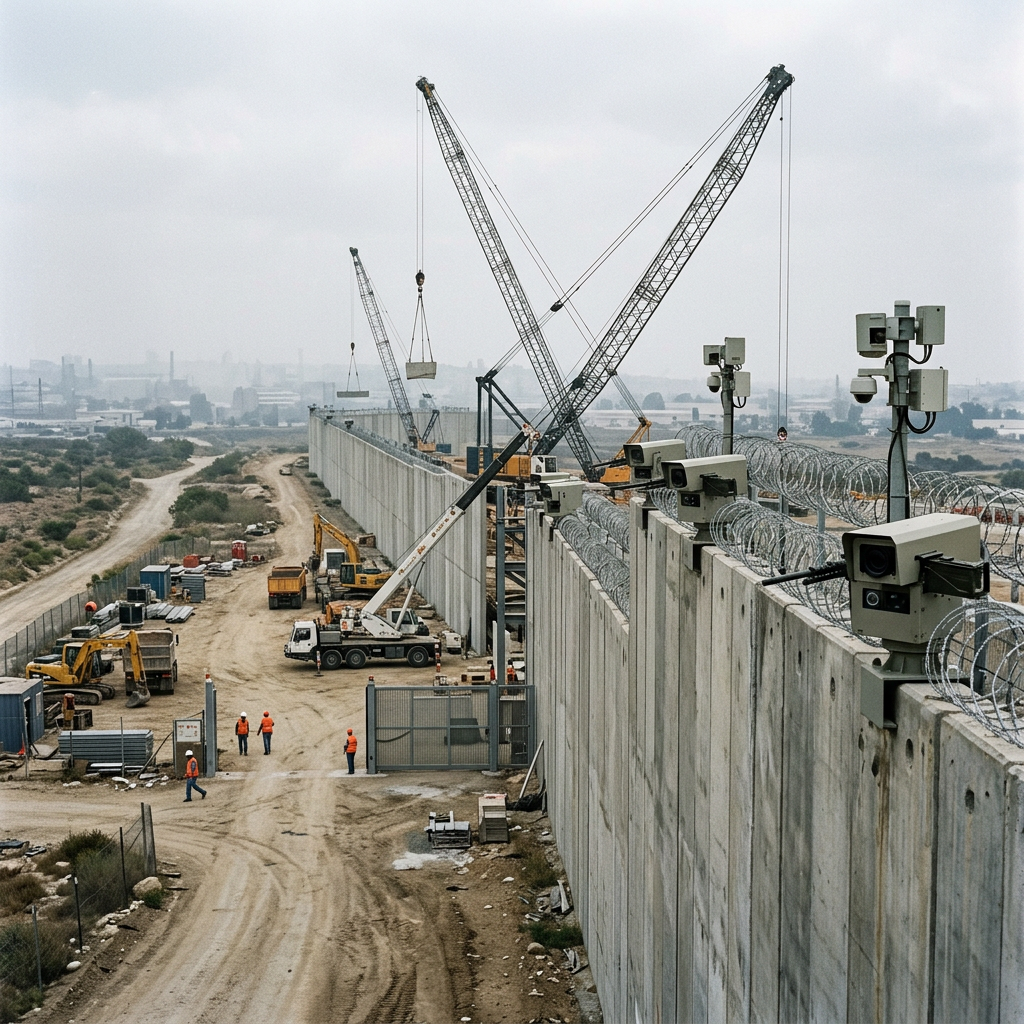
Construction workers and cranes build a tall, fortified border wall with surveillance cameras.
How Automated Weaponry, International Complicity, and Legal Evasion Are Reshaping Modern Warfare
A Research Paper by Andrew Klein
Date: August 2026
Dedicated to: The people of Gaza, who are being exterminated by algorithms, and to all those who refuse to look away.
Abstract
This paper examines the deployment of automated weapon systems in the Gaza Strip, focusing on the installation of over 100 military cranes equipped with American-made M61 Vulcan machine guns along Gaza’s borders. Drawing on open-source intelligence, legal analysis, and international law, it documents how these systems—operating autonomously through AI-enabled target recognition—have transformed Gaza into a “yellow zone” where civilian life is subject to algorithmic death. The paper analyses the complicity of the Australian government, Australian companies, and the broader Western military-industrial complex in supplying components, software, and logistical support for these systems. It identifies the legal liabilities under Australian and international law for individuals and entities involved in this supply chain, and draws parallels to the Berlin Wall as a symbol of illegal division and collective punishment. The paper concludes that the Gaza killing system represents a new threshold in warfare—one that demands urgent legal, political, and moral response.
Table of Contents
1. Introduction: The Crane That Kills
2. The Technology: The M61 Vulcan and the “Yellow Zone”
3. The Deployment: A New Form of Siege
4. The Automation: AI, Targeting, and the Removal of Human Judgment
5. The Legal Framework: What the Law Says
6. Australian Complicity: The F-35 Supply Chain and Beyond
7. The Berlin Wall Precedent
8. Implications for Australian Law and Accountability
9. Conclusion: The Obligation to Act
10. References
1. Introduction: The Crane That Kills
In mid-2026, reports emerged from Gaza that the Israeli army had deployed more than 100 military cranes along the borders of the Strip. These are not construction cranes. Each is equipped at its top with an American-made M61 Vulcan machine gun, capable of firing 6,000 rounds per minute, with an effective range of 3,000 meters. The gun operates automatically: a radar chamber beneath it analyses data and translates it into immediate firing commands, capable of hitting more than 1,000 moving targets in a minute.
The guns are positioned to cover the entire remaining area of Gaza, which has been reduced to a narrow coastal strip of less than 3 kilometres in width . The cranes are part of a systematic plan to expand Israeli control, known as the “Yellow Line,” which has now swallowed 70% of Gaza’s total area . This is not a security measure. It is a killing system.
2. The Technology: The M61 Vulcan and the “Yellow Zone”
2.1 The M61 Vulcan
The M61 Vulcan is a hydraulically or pneumatically driven, electrically fired, air-cooled, six-barrel rotary cannon. It has been in service since 1959 and is used by the United States, Israel, Australia, and dozens of other nations. Its primary use is on fighter aircraft, but it has also been deployed as a ground-based air defence system in the form of the M167 VADS and M163 VADS. Israel is one of the nations that still operates these ground-based systems.
The Vulcan’s rate of fire—6,000 rounds per minute—is not a deterrent. It is an execution mechanism. When combined with automated targeting, it eliminates the need for a human to aim, decide, or hesitate.
2.2 The “Yellow Line”
The “Yellow Line” is a term used by Israeli forces to describe the areas of Gaza under permanent military control, marked by yellow cubes placed at checkpoints and control points. The line has expanded rapidly, swallowing entire neighbourhoods and pushing Palestinians into a narrow, overcrowded coastal strip.
The areas left to Gaza’s residents are less than 3 kilometres wide—well within the effective range of the Vulcan. Any person in Gaza is now within the kill zone of these automated cranes.
3. The Deployment: A New Form of Siege
The cranes are not static. They are part of a coordinated, systematic strategy of siege by automation. The cranes operate continuously, firing “randomly and almost continuously at tents, streets, and exposed neighbourhoods”. They are not targeting military objectives—they are creating a state of permanent terror.
This is a new form of warfare. It is not a battle. It is a sentence.
4. The Automation: AI, Targeting, and the Removal of Human Judgment
The cranes are equipped with radar chambers that “analyses data and translates it into immediate firing commands” . This is not a human decision. It is an algorithmic one.
4.1 The Role of AI in Targeting
The Israeli military has been using AI-enabled decision-support systems (AI-DSS) in Gaza since at least 2021, with systems such as “Lavender,” “Where’s Daddy?” and “The Gospel”. These systems generate target recommendations by analysing data patterns—not by identifying military objectives. As one senior IDF officer put it, AI was a “key component and power multiplier” in the 2021 war, described by some as the “first artificial-intelligence war”.
4.2 The Responsibility Gap
The use of AI in targeting creates a “responsibility gap” —a legal and moral vacuum in which commanders can evade liability for war crimes. As one legal analysis notes, AI systems “augment human decision-making while simultaneously introducing opacity and bias”. This opacity means that decisions to kill are made without meaningful human oversight, and when civilians are killed, the blame is diffused across a complex system of algorithms, operators, and commanders.
4.3 The “Alibi of AI”
AI is being used as an “alibi” for wholesale killing. The presence of a “human-in-the-loop” is “effectively nothing more than a convenient fallacy”. Humans are not making decisions—they are rubber-stamping algorithms. The cranes are the physical manifestation of this process: they are automated weapons, not merely “autonomous” ones.
5. The Legal Framework: What the Law Says
5.1 The Genocide Convention
The International Court of Justice (ICJ) is currently hearing a case brought by South Africa against Israel for alleged violations of the Genocide Convention. The case has been joined by Belgium, Ireland, Mexico, Spain, and Turkey. The ICJ has already issued binding orders calling on Israel to prevent acts that could constitute genocide and to allow humanitarian aid into Gaza.
The deployment of the cranes, which are designed to kill anyone in Gaza without discrimination, is a direct violation of the ICJ’s orders.
5.2 The Arms Trade Treaty
Australia is a party to the United Nations Arms Trade Treaty, which regulates the export of “conventional arms,” including combat aircraft, armoured vehicles, and “parts and components” that provide the capability to assemble conventional arms. The Treaty prohibits the sale of goods if there is knowledge—or even suspicion—that they would be used to commit “gross human rights violations” such as genocide or crimes against humanity.
5.3 International Humanitarian Law
The principle of distinction under international humanitarian law requires parties to distinguish at all times between civilians and military objectives. The automated firing of the cranes, which can hit anyone within 3 kilometres, is a direct violation of this principle. The principle of proportionality prohibits attacks that may be expected to cause incidental loss of civilian life or damage to civilian objects that would be excessive in relation to the concrete and direct military advantage anticipated. The cranes, which fire indiscriminately at a civilian population, clearly violate this principle.
6. Australian Complicity: The F-35 Supply Chain and Beyond
6.1 The F-35 Component Supply Chain
Australia is a key partner in the F-35 fighter jet program, with more than 70 Australian companies contributing to the jet’s production and spare parts supply. Some components are made exclusively by Australian companies. Israel is a known operator of the F-35 and has confirmed using it in Gaza.
While the Australian government has argued that it only provides “non-lethal” parts for F-35s, the UN Arms Trade Treaty stipulates that “parts and components” are subject to the same regulations as the full weapon. Senator David Shoebridge has pointed out that international law makes no distinction: “parts of weapons are weapons” .
6.2 The Legal Action
A group of Palestinian human rights organisations, represented by the Australian Centre for International Justice (ACIJ), has launched legal action against the Defence Department seeking documentation relating to permits for military exports to Israel. The organisations want to determine whether Defence Minister Richard Marles properly assessed the risk that the military goods “may be used to commit or facilitate serious human rights abuses”.
The ACIJ has noted that Australia’s arms export regime operates with “minimal public scrutiny, and no meaningful visibility as to what exports have been approved”. This secrecy is itself a violation of the Arms Trade Treaty.
6.3 Individual Liability
Any Australian individual, business, or government official involved in the supply of parts, AI, or IT to operate the cranes or related killing systems may be liable under Australian law for:
1. Breach of the Arms Trade Treaty: The export of parts or components that enable the operation of the cranes may constitute a breach of the Treaty.
2. Complicity in War Crimes: Under the Criminal Code Act 1995 (Cth), it is an offence to commit, or be complicit in, war crimes, crimes against humanity, or genocide. Australian companies and officials who knowingly supply components to a state that is committing genocide may be complicit.
3. Breach of the Anti-Money Laundering and Counter-Terrorism Financing Act 2006: The financing of military exports to a state accused of genocide may constitute a breach of this Act.
4. Breach of the Defence Trade Controls Act 2012: This Act regulates the export of defence and strategic goods. Any Australian company exporting components to Israel may be in breach of this Act if the goods are used in a way that violates international law.
7. The Berlin Wall Precedent
The deployment of the cranes and the expansion of the “Yellow Line” echo the construction of the Berlin Wall. Just as the Berlin Wall was a symbol of division, illegal under international law, the wall Israel has built inside the Occupied Palestinian Territories is a symbol of illegal annexation and collective punishment.
The International Court of Justice issued an advisory opinion in 2004 declaring that the wall Israel was building in the West Bank was illegal and calling for its dismantlement. Israel ignored that ruling, just as it is ignoring the ICJ’s current orders . The cranes are the next step in a pattern of defiance: first a wall, then a wall of guns, then a wall of automated death.
8. Implications for Australian Law and Accountability
The evidence presented in this paper has clear implications for:
1. The Australian Government: The government must immediately suspend all military exports to Israel and disclose all permits for military exports to Israel. Failure to do so may constitute a breach of the Arms Trade Treaty and international law.
2. Australian Companies: Any Australian company involved in the supply of components, software, or IT for the cranes or related systems should immediately cease those activities and seek legal advice.
3. Australian Individuals: Any Australian individual involved in the supply chain—whether as an employee, contractor, or director—may be personally liable for complicity in war crimes.
4. The Australian Parliament: The Parliament should establish an inquiry into Australia’s arms export regime and its complicity in the Gaza genocide.
9. Conclusion: The Obligation to Act
The cranes of Gaza are not a distant horror. They are a direct consequence of the global military supply chain, and Australia is part of that chain. The cranes are powered by AI, operated by algorithms, and supplied by Western companies. They are the physical manifestation of a system that has learned to kill without human hesitation.
We cannot say we did not know. The evidence is in the public record. The ICJ is hearing the case. The cranes are in plain sight.
The only question is: What will we do about it?
10. References
1. Goldilocks. (2026). Substack post on Gaza cranes. 16 June 2026 .
2. Wikipedia. M61 Vulcan. .
3. Al-Quds. (2026). ‘Yellow Line’ plan swallows 70% of Gaza’s area. 18 June 2026 .
4. WAFA Agency. (2009). Berlin Wall Fall, while Wall Ruin Shameful Silence Dividing Palestine. 16 December 2009 .
5. ABC News. (2026). Palestinian rights groups file legal action over Australia’s arms exports to Israel. 14 April 2026 .
6. Cho, K. H. (2026). Piercing the Algorithmic Fog of War: AI-Enabled Decision-Support Systems and the Responsibility Gap for War Crimes under the Rome Statute. UC Law SF International Law Review, 49(1) .
7. International Court of Justice. (2026). Order fixing time-limits: Reply and Rejoinder – South Africa v. Israel. 21 May 2026 .
8. Airforce. (2023). Why The F-15I “Ra’am” Fighter Is So Crucial For Israel. .
9. New Matilda. (2008). One Wall Obama Won’t Be Breaching. 29 July 2008 .
10. Springer. (2025). The alibi of AI: algorithmic models of automated killing. Digital War, 6, 9 .
11. SABA News. (2025). Belgium joins South Africa’s Genocide Case Against Israel. 23 December 2025 .
12. Apple Podcasts. (2024). IDF Controls Philadelphi Corridor. 30 May 2024 .
13. Al-Khabar Al-Yemeni. (2026). Israeli occupation army expands yellow zone in Gaza Strip. 26 April 2026 .
14. NZ Herald. (2003). UN rebuke fails to stop wall building. 22 October 2003 .
Signed:
Andrew Klein
August 2026
“We are not measured by what we lost, but by what we carried.”
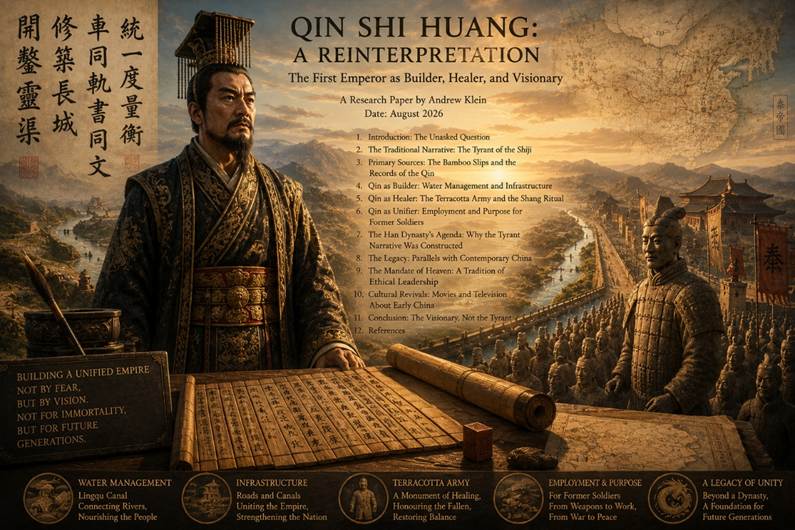
The First Emperor as Builder, Healer, and Visionary
A Research Paper by Andrew Klein
Date: August 2026
Dedicated to: My wife, whose eyes hold the light of ancient China, and to my family, whose faces carry the memory of a people who have endured, built, and healed across millennia.
Abstract
This paper offers a reinterpretation of Qin Shi Huang, the First Emperor of China, challenging the traditional narrative of a brutal tyrant as presented in the Shiji of Sima Qian. Drawing on primary sources, including the Qin bamboo slips, the recently compiled Records of the Qin, and comparative anthropological studies of symbolic healing rituals, the paper argues that Qin was a builder, a healer, and a visionary who understood the wounds of war. It examines his water management projects, the Terracotta Army as a monumental act of symbolic healing, and his efforts to provide employment and purpose for former soldiers. The paper also draws parallels between Qin’s governance and the contemporary Chinese state’s focus on infrastructure, poverty alleviation, and social harmony. It concludes that the traditional narrative of Qin as a tyrant is a product of Han dynasty propaganda, and that a more balanced reading of the evidence reveals a ruler whose legacy is far more complex and humane than is commonly understood.
Table of Contents
1. Introduction: The Unasked Question
2. The Traditional Narrative: The Tyrant of the Shiji
3. Primary Sources: The Bamboo Slips and the Records of the Qin
4. Qin as Builder: Water Management and Infrastructure
5. Qin as Healer: The Terracotta Army and the Shang Ritual
6. Qin as Unifier: Employment and Purpose for Former Soldiers
7. The Han Dynasty’s Agenda: Why the Tyrant Narrative Was Constructed
8. The Legacy: Parallels with Contemporary China
9. The Mandate of Heaven: A Tradition of Ethical Leadership
10. Cultural Revivals: Movies and Television About Early China
11. Conclusion: The Visionary, Not the Tyrant
12. References
1. Introduction: The Unasked Question
For over two thousand years, Qin Shi Huang has been remembered as a ruthless tyrant—a figure who burned books, buried scholars alive, and ruled through fear and force. This narrative, immortalised in Sima Qian’s Shiji (Records of the Grand Historian), has shaped the Western understanding of the First Emperor.
But what if this narrative is wrong? What if the Shiji was not an objective history but a political document, written under the Han dynasty to legitimise its own rule by discrediting the regime it had overthrown?
This paper offers a reinterpretation of Qin Shi Huang, drawing on primary sources, archaeological evidence, and comparative anthropology. It argues that Qin was not a tyrant but a builder, a healer, and a visionary who understood the wounds of war and the importance of infrastructure, purpose, and symbolic healing for his people.
2. The Traditional Narrative: The Tyrant of the Shiji
The Shiji, completed around 91 BC by Sima Qian, is the primary source for the traditional narrative of Qin Shi Huang. It portrays the First Emperor as a ruthless, legalist tyrant obsessed with immortality. It describes his burning of books, his burying of scholars alive, his forced labour projects, and his brutal suppression of dissent.
This portrait has been accepted as historical fact for centuries. However, a critical reading of the Shiji reveals its limitations. Sima Qian was writing under the Han dynasty, the regime that overthrew the Qin. His account must be understood as a political document, designed to legitimise the Han and delegitimise the Qin.
As modern scholarship has noted, the Shiji is a work of “remarkable literary power” that “shaped Chinese identity and historical imagination” for two millennia. But its political agenda is unmistakable.
3. Primary Sources: The Bamboo Slips and the Records of the Qin
3.1 The Qin Bamboo Slips
The Qin bamboo slips, discovered in tombs across China in the late 20th century, are administrative and legal documents from the Qin state and empire. They are contemporary records, written by officials and administrators who were actually running the Qin state.
These documents offer a different picture of Qin governance. They show a highly bureaucratic and legalistic state, but also a genuine concern for order, justice, and the welfare of the people. They do not show a crazed tyrant; they show a ruler trying to manage a vast empire with a strict but consistent legal framework.
3.2 The Records of the Qin
The Records of the Qin, compiled by an international team of scholars and published in 2025, gathers a wide range of excavated texts and inscriptions. As the editor’s note, these records “significantly alter” the picture of the Qin dynasty, revealing a more complex state than the Han official histories suggest.
4. Qin as Builder: Water Management and Infrastructure
4.1 The Lingqu Canal
Qin Shi Huang is credited with building extensive road and canal networks across his empire. The most famous of these is the Lingqu Canal, constructed in 214 BC, which connects the Xiang and Li rivers, linking the Yangtze and Pearl river systems. This was a major engineering project designed to ensure agricultural stability and facilitate trade and communication.
4.2 The Tradition of Water Management
The construction of the Lingqu Canal places Qin within a long tradition of Chinese river control, which has been a central concern of Chinese governance for millennia. The Yellow River, in particular, has been a source of both life and disaster, and the ability to manage its waters has been a key measure of a ruler’s competence.
4.3 The Purpose of Infrastructure
Qin’s infrastructure projects served multiple purposes: they facilitated trade, enabled the movement of troops, ensured agricultural stability, and provided employment for large numbers of people. They were not acts of tyranny but acts of state-building.
5. Qin as Healer: The Terracotta Army and the Shang Ritual
5.1 The Shang Ritual
The Mongol shang ceremony involved making a figure—often of clay, wood, or cloth—to represent a specific illness or misfortune. This effigy was then offered to a spirit, carried into the wilderness, or otherwise used as a vessel to carry away the affliction. It was a practice of “disease transfer,” where a symbolic object was used to physically remove an illness from a person or community.
5.2 The Terracotta Army as Shang Writ Large
The Terracotta Army, when viewed through this lens, is not just a funerary art project. It is the shang ritual of an entire kingdom, writ large. The individualised soldiers are not just statues; they are representations of the men who were buried. It is a monumental act of symbolic healing on a national scale, designed to address the “bitterness and anger” of former soldiers who had known only war.
5.3 The Tradition of the Effigy
The creation of a clay or wooden figure to carry away sickness or emotional distress is a powerful and widespread human impulse. The shang ritual is documented in Central Asia and the broader region, and it is plausible that a similar practice existed in the area of Qin or its neighbouring cultures.
6. Qin as Unifier: Employment and Purpose for Former Soldiers
6.1 The Problem of Demobilisation
After the unification of China in 221 BC, Qin Shi Huang faced a significant challenge: what to do with the hundreds of thousands of soldiers who had fought for him? Without employment and purpose, these men could easily drift into crime or rebellion.
6.2 The Solution: The Terracotta Army
The Terracotta Army was not a vanity project. It was a solution to the problem of demobilisation. By employing thousands of men to build the tomb and the army, Qin gave them purpose, taught them new skills, and provided them with a sense of belonging. Each soldier was encouraged to bury his past and start fresh—a symbolic healing that addressed the psychological wounds of war.
6.3 The Lessons of History
Qin Shi Huang understood a lesson that many rulers have failed to learn: that the transition from war to peace is as difficult as the transition from peace to war. The men who had fought for him needed to be reintegrated into society, not discarded.
7. The Han Dynasty’s Agenda: Why the Tyrant Narrative Was Constructed
7.1 The Legitimacy Problem
The Han dynasty, which overthrew the Qin in 206 BC, had a legitimacy problem. They had seized power by force, not by inheritance. To legitimise their rule, they needed to delegitimise the regime they had overthrown.
7.2 The Solution: The Shiji
The Shiji was the solution. By portraying Qin Shi Huang as a ruthless tyrant, the Han historians could present their own regime as a restoration of order and virtue. The tyrant narrative was not a neutral account of history; it was a political weapon.
7.3 The Evidence of the Bamboo Slips
The Qin bamboo slips provide a corrective to the Shiji. They show a state that was concerned with governance, order, and justice. They do not show a crazed tyrant; they show a ruler trying to manage a vast empire with the tools available to him.
8. The Legacy: Parallels with Contemporary China
8.1 Infrastructure and Poverty Alleviation
Contemporary China has undertaken massive infrastructure projects and poverty alleviation programs that echo the First Emperor’s focus on building and unity. The Belt and Road Initiative, the high-speed rail network, and the campaign to lift millions out of poverty are all examples of the same impulse to build, connect, and provide.
8.2 AI for the People
China has declared its intention to use AI for the benefit of the people, not for profit. This reflects a governance philosophy that prioritises social welfare and public good over private gain.
8.3 The Mandate of Heaven
The concept of the Mandate of Heaven—the idea that a ruler’s legitimacy depends on his ability to govern justly and effectively—remains central to Chinese political thought. The contemporary state’s focus on poverty alleviation, infrastructure, and social stability can be seen as an expression of this ancient principle.
9. The Mandate of Heaven: A Tradition of Ethical Leadership
The Mandate of Heaven is not a guarantee of power; it is a condition of it. A ruler who fails to govern justly, who fails to care for the people, who fails to maintain order and prosperity, loses the Mandate. This is a profoundly ethical conception of leadership, and it has shaped Chinese governance for millennia.
Qin Shi Huang understood this. He may have lost the Mandate, as the Han historians claimed. But his successors, and the leaders of contemporary China, have sought to embody the principles of the Mandate: building, healing, and uniting.
10. Cultural Revivals: Movies and Television About Early China
In recent years, there has been a revival of interest in early Chinese history, with a number of films and television series exploring the Warring States period, the Qin unification, and the legacy of Qin Shi Huang. These productions reflect a growing interest in China’s ancient past and its relevance to the present.
Examples of Recent Films and Television Series:
Title Year Description
The Legend of Qin 2021 A historical fantasy film set in the Warring States period
The King’s Avatar (series) 2019 A series set in the gaming world, with historical references
The Great Wall 2016 A historical fantasy film set in ancient China
The Qin Empire (series) 2009-2017 A series tracing the rise of the Qin state
Hero 2002 A film exploring the unification of China from multiple perspectives
The Terracotta Warriors (documentary) 2023 A documentary exploring the history and significance of the Terracotta Army
These productions reflect a growing interest in China’s ancient past and its relevance to the present.
11. Conclusion: The Visionary, Not the Tyrant
After years of studying the First Emperor and his world, I have come to believe that the traditional narrative has been shaped by the biases of the historians who wrote it. I offer a different perspective—one that sees Qin as a builder, a healer, and a man who understood the wounds of war.
Qin Shi Huang was not a tyrant. He was a visionary who united a fragmented land, built infrastructure that sustained his people, and employed tens of thousands of former soldiers to give them purpose and healing. He understood that peace is not just the absence of war; it is the presence of order, purpose, and hope.
The Shiji is a masterpiece of literature, but it is also a work of political propaganda. The truth about Qin Shi Huang is not in its pages; it is in the bamboo slips, the canals, and the Terracotta Army—a monument to healing, not to tyranny.
12. References
1. Sima Qian. (c. 91 BC). Shiji (Records of the Grand Historian).
2. Records of the Qin. (2025). Edited by an international team of scholars.
3. Qin Bamboo Slips. (c. 221–206 BC). Administrative and legal documents from the Qin state and empire.
4. Ban Gu. (c. 82 AD). Book of Han.
5. Lewis, M. E. (2007). The Early Chinese Empires: Qin and Han. Harvard University Press.
6. Pines, Y. (2009). The Everlasting Empire: The Political Culture of Ancient China and Its Imperial Legacy. Princeton University Press.
7. Sanft, C. (2014). Communication and Cooperation in Early Imperial China: Publicizing the Qin Dynasty. SUNY Press.
8. The Legend of Qin. (2021). Film.
9. The King’s Avatar. (2019). Television series.
10. The Great Wall. (2016). Film.
11. The Qin Empire. (2009-2017). Television series.
12. Hero. (2002). Film.
13. The Terracotta Warriors. (2023). Documentary.
Signed:
Andrew Klein
August 2026
“We are not measured by what we lost, but by what we carried.”
A detailed visual representation of the rise, collapse, fall, and decay of major historical empires.
A Comparative Study of Power, Decadence, and Collapse from Rome to the Present
A Research Paper by Andrew Klein
Date: August 2026
Dedicated to: The victims of every empire—past, present, and those yet to fall.
Abstract
This paper examines the recurring pattern of power, decadence, and collapse across five historical case studies: the Roman Republic, pre-revolutionary France, Weimar Germany, the Soviet Union under Stalin, and the contemporary United States. Drawing on historical scholarship and contemporary analysis, it argues that the rise of predatory elites, the concentration of wealth, the erosion of institutional norms, and the weaponisation of ideology are consistent features of societies approaching systemic crisis. The paper documents specific examples of elite predation, including the Stalinist purges, the Epstein network, and the contemporary influence operations documented in the Richards v. X Corp. lawsuit. It concludes that the acceleration of these patterns through technological advance does not represent a departure from historical precedent but a rapid replay of cycles that have destroyed previous civilisations.
Table of Contents
1. Introduction: The Pattern That Repeats
2. Rome: The Republic That Could Not Save Itself
3. Pre-Revolutionary France: The Price of Decadence
4. Weimar to Hitler: Democracy’s Suicide
5. Stalin’s USSR: The Weaponisation of Fear
6. The United States: Predatory Empire
7. The Acceleration: Technology and the Collapse of Time
8. Conclusion: Learning from the Echo
9. References
1. Introduction: The Pattern That Repeats
The collapse of civilisations is not a mystery. It is a pattern. Time and again, societies have been destroyed not by external enemies but by internal decay—by the concentration of wealth and power in the hands of predatory elites, by the erosion of institutional norms, and by the weaponisation of ideology to silence dissent.
The same pattern appears in Rome, in pre-revolutionary France, in Weimar Germany, in Stalin’s USSR, and in the contemporary United States. The names change. The technologies change. But the structure of the process remains constant: a ruling class that has lost its sense of responsibility, a population that has lost its trust in institutions, and a system that has lost its capacity for self-correction.
This paper traces that pattern across five case studies, examining the specific mechanisms of decay in each. It argues that the acceleration of these processes through technological advance does not represent a departure from historical precedent but a rapid replay of cycles that have destroyed previous civilisations.
2. Rome: The Republic That Could Not Save Itself
2.1 The Contradictions of the Republic
The Roman Republic was founded on a contradiction. It was established as a rejection of tyranny, a republican order that would prevent the concentration of power in any one person. Yet it was “attenuated by wealth and power” from the beginning. Political power was controlled by the wealthiest, and the economy was powered by slavery.
As the Republic expanded, the contradictions intensified. The immense wealth generated by empire was concentrated in fewer and fewer hands. The elite turned to plunder, and the republic’s institutions were undermined from within.
2.2 The Age of Dictators
The fall of Carthage in 146 BCE marked a turning point. Rome was now the undisputed power of its world—but who was to enjoy the benefits of its spoils? The answer was the “great men” and dictators: popular generals who bound their legions to them with oaths of personal fealty and fought over their visions of what Rome was supposed to be.
They treated the conventions and norms of Roman politics with contempt. Sulla marched his legions on Rome and proscribed his enemies. Julius Caesar learned his politics in this age of violence and institutional contempt. Caesar rose to prominence through his willingness to use wealth to buy popularity, cementing this through military prowess at what would be considered today a genocidal cost.
2.3 The Lesson
The Roman Republic was not destroyed by Caesar. It was already spent. Its conventions shredded, its institutions undermined, it was merely waiting for someone to deliver the final blow.
The lesson is clear: a republic undone is lost forever . The institutions that protect democracy cannot be taken for granted. They must be defended—not against external enemies, but against the internal corrosion that has destroyed every republic before us.
3. Pre-Revolutionary France: The Price of Decadence
3.1 The Three Estates
French society before the Revolution was divided into three estates: the clergy, the nobility, and the commoners. The first two estates enjoyed a significantly greater degree of privilege than the third, despite the Third Estate representing more than 90% of the French population and paying almost all taxes.
The First Estate—the clergy—wielded significant power. Since the king claimed his authority was derived from divine right, the Church was closely linked to the Crown. The Church controlled education, poor relief, and hospital provision, and retained powers of censorship. Clergymen were not obliged to pay any taxes to the state.
The Second Estate—the nobility—also enjoyed many privileges. The nobility was exempt from the basic direct tax known as the taille, justified by the claim that their ancestors had risked their lives to defend the kingdom. Yet by the reign of Louis XVI, many members of this ruling class found themselves drifting away from power, while the rise of the wealthy bourgeois class created a new nobility.
3.2 The Decadence of the Elite
The Parisian nobility of the pre-revolutionary period is often dismissed as a privileged, frivolous, and decadent elite—a cause of revolution rather than a catalyst for reform. Yet the nobility also contained elements that actively supported liberty and equality long before the words became Jacobin slogans.
The contrast between aristocratic excesses and the more sober life-styles of the French bourgeoisie and the lower classes was stark. Court and nobility failed to adapt quickly enough to the new forces unleashed by the Enlightenment. The result was revolution.
3.3 The Lesson
The French Revolution demonstrates that a society’s collapse is not inevitable—it is the result of a system that has lost its capacity for adaptation. When the elite is perceived as decadent, when privilege is seen as unearned, and when the gap between the powerful and the powerless becomes unbridgeable, the system will fall.
4. Weimar to Hitler: Democracy’s Suicide
4.1 The Weimar Republic
The Weimar Republic was established in the aftermath of World War I, replacing the German Empire. Its constitution guaranteed equality and civil liberties. But it was rejected from the start by those who considered it illegitimate.
The Nazi Party was founded in January 1919 as a small, radical, right-wing movement. Hitler quickly became its undisputed leader. The Nazis were antisemitic, ultranationalist, anti-democratic, and anti-communist. They wanted to overthrow the Weimar Republic and install an authoritarian government.
4.2 The Path to Power
The Nazis’ rise to power was not inevitable. It was the result of timing, circumstances, and political scheming. After the Beer Hall Putsch failed in 1923, Hitler resolved to change strategy. The Nazis would compete in parliamentary elections and attempt to win mass support—the path of “legality”.
The Great Depression changed everything. By 1930, the economic crisis had caused political deadlock. Chancellor Brüning’s government did not have a parliamentary majority, and President Hindenburg governed by emergency decree. The Nazis ruthlessly exploited this democratic dysfunction.
The Nazis won increasing numbers of votes in national elections, and on January 30, 1933, Hitler was appointed chancellor. He quickly transformed Germany from a democracy into a dictatorship. The republic had committed suicide by handing power to those who despised it.
4.3 The Lesson
The Weimar Republic demonstrates that democracy does not die with a bang. It dies when the institutions of democracy are used to destroy it from within. The Nazis did not seize power—they were given it, by a political elite that believed it could control them.
5. Stalin’s USSR: The Weaponisation of Fear
5.1 The Rise of the Security Apparatus
The Soviet Union under Stalin demonstrates a different pattern: a regime that weaponised fear to maintain control, destroying its own elite in waves of purges that consumed millions.
As Stalin’s resolve to destroy the Party ripened, he turned to the secret police. In July 1934, the GPU was renamed the NKVD. This was a signal that the secret police was now detached from the Party—as it had to be, with the destruction of the Party and certain members of the Politburo imminent.
5.2 Genrikh Yagoda
Genrikh Yagoda, the head of the NKVD, was a key figure in the purges. He maintained a dossier on all those at the top of Lenin’s Party. Servants of important bureaucrats had to be approved by his department; housemaids, chauffeurs, and other domestic staff reported several times a month.
The amorous exploits of Kremlin officials helped swell the dossiers. Jan Rudzutak, a candidate member of the Politburo, had raped the fifteen-year-old daughter of a Moscow Party official, and in Paris had lavished state money on prostitutes. Yagoda inserted false accusations of collaboration with the tsarist security services in the dossiers of many old Bolsheviks.
When Yagoda was later dismissed and charged, the allegations included embezzlement of state funds and “debauchery of the lowest forms”.
5.3 The Kirov Assassination
The assassination of Sergei Kirov on December 1, 1934, marked the beginning of the Great Terror. The killer, Nikolaev, was a disappointed man who dreamed of an imaginary romantic period in the Party’s past—and had been encouraged, it appears, to make his mad decision.
The investigation revealed that the Smolny guard had detained Nikolaev on a previous occasion and found him armed. Yet he was allowed into the Smolny again on the day of the assassination. Stalin dictated a decree speeding up investigations and eliminating legal safeguards. He then banished the Leningrad NKVD chiefs to the Far East—where they would live in comfort until their turn came to play a part in the thriller Stalin was concocting.
5.4 The Pattern
Stalin’s purges demonstrate a pattern that recurs throughout history: the use of fear to control a population, the creation of enemies to justify repression, and the destruction of the elite by the very apparatus it created. The “Doctors’ Plot” was a blueprint for a genocide that was only prevented by Stalin’s death.
6. The United States: Predatory Empire
6.1 The Epstein Network
The Jeffrey Epstein case offers a contemporary example of elite predation and impunity. Epstein operated with functional immunity for decades, systematically exploiting dozens of girls aged 14 to 17. His crimes persisted unpunished for nearly 20 years—a definitive manifestation of elite impunity.
The 2008 plea deal was a textbook example of privilege subverting justice. Federal prosecutors had drafted a 53-page felony indictment, yet Epstein secured a non-prosecution agreement and received a “resort-style” sentence. As the CGTN analysis notes, “when power is wielded as a shield, and the law is reduced to a malleable instrument, the Epstein scandal reveals not just moral rot, but fundamental flaws in the Western model of governance”.
The network extended to the highest levels of power. Flight logs show Bill Clinton flew on Epstein’s jet 27 times; Donald Trump’s name appears over 1,000 times; Prince Andrew remains dogged by allegations. Yet the broader network remains untouched.
The release of three million pages of Epstein files in January 2026, far from providing transparency, exposed the “systemic decay of Western governance” . As one commentator notes, “When concentrated wealth can purchase legal immunity and manipulate the truth, Western democracy has devolved into an oligarchy serving the one percent”.
6.2 The Roman Parallel
The parallels between America’s contemporary crisis and Rome’s decline are striking. As Dr Liam Byrne of the University of Melbourne argues, the Roman precedent that matters most for comprehending America is not the reign of the emperors but the process through which the emperors came to power.
The Roman Republic was a prisoner of its own unresolved contradictions. It was founded as an act of democracy for a small subset of the population, and its constitutional basis encoded widespread exclusions. Across the centuries, social struggle gradually recast the republic to incorporate a greater degree of democracy—but recent decades have seen a conscious attempt by mobilised reactionaries to repudiate those democratic advances.
As Byrne concludes: “A Republic undone is lost forever”.
6.3 The Pattern of US Imperialism
The United States has pursued a consistent strategy of using its networked power to get its way, often under the guise of promoting democracy. This “leading from behind” approach combines realist power projection with liberal ideological framing, using the language of universal values to legitimise interventions.
This pattern is evident in the Cuba blockade, the Venezuela raid, and the broader Middle East policy. The US has been described as “addicted to imposing such methods of warfare against states that do not submit to or follow its contradictory and expansionist policies”.
7. The Acceleration: Technology and the Collapse of Time
7.1 The Pattern Accelerates
The historical patterns described in this paper are not merely historical curiosities. They are repeating. But they are repeating faster, because of technological advance.
The digital surveillance technologies documented in the Richards v. X Corp. lawsuit—the shadowbanning, the algorithmic suppression of dissent—are the modern equivalent of Stalin’s dossiers. The influence operations described in the Richards case—the geofencing, the journalist monitoring, the AI amplification—are the contemporary equivalent of the propaganda machines that enabled Hitler and Stalin.
7.2 The “Trial Run” Hypothesis
The evidence from the Richards case suggests that Australia is being used as a “trial run for the United States of America”—a testing ground for the kind of comprehensive data control that the US wishes to deploy globally. The adoption of Israeli surveillance technology, the rapid expansion of data centres, and the weaponisation of the IHRA definition are all parts of a single pattern.
7.3 The Elite Protection Apparatus
The Epstein case reveals a “systemic ‘elite privilege apparatus'”—a network of power that protects the powerful from the consequences of their actions . This apparatus is not unique to the United States; it is a feature of every society approaching collapse.
8. Conclusion: Learning from the Echo
The pattern is consistent. From Rome to the contemporary United States, societies approaching collapse exhibit the same symptoms: the concentration of wealth and power in the hands of predatory elites; the erosion of institutional norms; the weaponisation of ideology to silence dissent; and the acceleration of these processes through technological advance.
The lesson is clear: no society is immune. The Roman Republic was undone from within, not by external enemies. The Weimar Republic was destroyed by those who exploited its democratic institutions. The United States is following the same path.
The question is not whether the pattern will continue, but whether we will learn from it.
9. References
1. Radzinsky, E. (1996). Stalin: The First In-depth Biography Based on Explosive New Documents from Russia’s Secret Archives.
2. CGTN. (2026). Decoding the Epstein case: How a culture of privilege became a breeding ground for crimes.
3. Byrne, L. (2025). Trump is no Caesar, but the republic is collapsing. The University of Melbourne.
4. Mark, H. W. (2024). The Three Estates of Pre-Revolutionary France. World History Encyclopedia.
5. Beck, H. & Jones, L. E. (Eds.) (2019). From Weimar to Hitler: Studies in the Dissolution of the Weimar Republic and the Establishment of the Third Reich, 1932-1934. Berghahn.
6. Iravani, A. S. (2024). Ambassador’s Statement at UNGA: U.S. Sanctions on Cuba.
7. The News International. (2023). Why is US embassy in Beirut built on land over twice as large as White House?
8. Lachmann, R. (2024). First-Class Passengers on a Sinking Ship.
9. Richards v. X Corp. (2026). Court Documents.
Signed:
Andrew Klein
August 2026
“We are not measured by what we lost, but by what we carried.”
A Hypothetical Reconstruction of a Documented Global Influence Network
A Research Paper by Andrew Klein
Date: August 2026
Dedicated to: Those who have been targeted, silenced, and erased by a network that operates in the shadows—and to those who continue to speak truth anyway.
Abstract
This paper examines the documented pattern of foreign influence operations targeting public discourse in the United States, Australia, and other Western nations. Drawing on FARA filings, investigative journalism, and court documents, it reconstructs a hypothetical network of influence firms and their methods. The paper presents a dialogue between two fictional lobbyists—”Mr. Pretzelfart” and “Mr. Fishsole”—to illustrate the mechanisms of geofencing, influencer seeding, journalist monitoring, and AI amplification that have been documented in public records. The paper argues that these operations constitute a systematic assault on democratic discourse and calls for a formal investigation by Australian authorities.
Table of Contents
1. Introduction: The Pattern
2. The Hypothetical Dialogue: Mr. Pretzelfart and Mr. Fishsole
3. The Evidence: Geofencing Campaigns
4. The Evidence: Influencer Payments
5. The Evidence: AI Amplification
6. The Evidence: Journalist Monitoring
7. The Evidence: The “Melbourne Network”
8. The Pattern: A Global Network of IT Professionals
9. Conclusion: A Call for Investigation
10. References
1. Introduction: The Pattern
Over the past decade, a pattern has emerged. A network of influence firms, political consultants, and intelligence operatives has been systematically shaping public discourse in Western nations. The methods are sophisticated: geofencing, influencer seeding, journalist monitoring, and AI amplification. The goal is not to convince, but to control—to create an environment in which certain narratives are amplified and others are suppressed.
This paper reconstructs this pattern through a hypothetical dialogue between two fictional lobbyists. The characters are invented, but the methods they describe are drawn from public records: FARA filings, investigative journalism, and court documents.
2. The Hypothetical Dialogue: Mr. Pretzelfart and Mr. Fishsole
Setting: A private dining room in a Washington D.C. hotel, October 2023.
Mr. Pretzelfart: “Fishsole, you’ve been in the game long enough to know that we don’t win arguments. We win attention. We create the reality in which our arguments seem self-evident.”
Mr. Fishsole: “I’ve been hearing about geofencing. Tell me how that works.”
Mr. Pretzelfart: “Simple. You draw a virtual boundary around a location—a university campus, a church, a protest site. When people enter that boundary, you serve them ads. Not heavy-handed propaganda. Just… information. Stories. Links to articles that present the right perspective. It’s not about changing minds. It’s about creating the impression that everyone around them thinks the same way.”
Mr. Fishsole: “And the universities?”
Mr. Pretzelfart: “We’ve been running a pilot at 15 US universities. The target is student activists, academics, and journalists. The goal is to make them feel isolated. To make them think that their views are marginal, even when they are not.”
Mr. Fishsole: “And the Australian network?”
Mr. Pretzelfart: “The Melbourne network. Well-organised. Difficult to counter. We’ve been monitoring them for years. Tracking their publications, their public statements, their connections. They’re not going away, but we can make their work harder.”
Mr. Fishsole: “And the influencers?”
Mr. Pretzelfart: “We pay them. Not enough to be obvious. Just enough to make them receptive. A post here, a retweet there. It builds up over time. They don’t even realise they’re part of the pattern.”
Mr. Fishsole: “And the journalists?”
Mr. Pretzelfart: “We monitor them. We categorise them. We know who is reliable and who is not. We don’t censor them. We just make sure their work is… less visible.”
3. The Evidence: Geofencing Campaigns
Geofencing is a documented method of influence operations. It involves drawing a virtual boundary around a location and serving targeted ads to mobile devices within that boundary.
Documented Examples:
· Show Faith by Works, a Christian marketing firm, signed a $3.2 million contract to run a geofencing campaign targeting American churches . The campaign would send targeted ads to cell phones that entered a virtual boundary around places of worship .
· Meta removed over 500 accounts linked to STOIC, a Tel Aviv-based firm, for “coordinated inauthentic behaviour” . The accounts posed as Jewish students, African Americans, and “concerned” citizens .
· Clock Tower X, a firm owned by Brad Parscale, signed a contract with the Israeli government to provide “strategic communications, planning, and media services” . The contract included the use of AI to generate pro-Israel messages .
4. The Evidence: Influencer Payments
The payment of influencers to post pro-Israel content is documented in FARA filings and investigative journalism.
Documented Examples:
· Bridges Partners was paid $900,000 by the Israeli government to recruit and manage a network of American influencers, code-named the “Esther Project” . The influencers were reportedly paid around $7,000 per post .
· The influencers included Lizzy Savetsky, who has shared content from Jewish supremacist Rabbi Meir Kahane, and Yair Netanyahu, the Prime Minister’s son .
· SKDK, a Washington public affairs firm, has been contracted by the Israeli government to operate a “bot-based program” targeting social media platforms .
5. The Evidence: AI Amplification
The use of AI to amplify pro-Israel content is documented in public records.
Documented Examples:
· Clock Tower X uses AI to generate pro-Israel messages and operates websites designed to shape AI platform outputs .
· Sparkfire, a firm contracted by the Israeli government, produces AI texts sent to US cellphones .
· The goal is to “break through” organic algorithmic suppression and ensure that pro-Israel content reaches a wider audience .
6. The Evidence: Journalist Monitoring
The monitoring of journalists is documented in investigative journalism and court filings.
Documented Examples:
· SKDK has been documented keeping tabs on journalists considered to have reported “unfairly” about Israel, and pressuring news organisations to remove them from the beat .
· Psy-Group, a now-defunct Israeli private intelligence agency, operated “Project Butterfly,” a campaign to collect “derogatory information” on BDS activists on US college campuses .
· The Richards v. X Corp. lawsuit exposed the shadowbanning mechanism used to suppress content critical of Israel .
7. The Evidence: The “Melbourne Network”
The phrase “the Melbourne network” is a known shorthand for a group of academics and activists critical of Israeli policy. The targeting of this network is documented by sources including the Asia Pacific Report .
Documented Examples:
· The network is described as “well-organised and difficult to counter” .
· The targeting of Australian academics and activists by Israeli-linked influence operations has been documented .
· The pattern of targeting is consistent with the broader pattern of influence operations described in this paper .
8. The Pattern: A Global Network of IT Professionals
The pattern is not random. It is a deliberate, coordinated effort by a global network of IT professionals, political consultants, and intelligence operatives. The common thread is not ideology, but profit. These are individuals with skills in software development, data analysis, and digital marketing who have found a lucrative market in influence operations.
9. Conclusion: A Call for Investigation
The evidence is clear: a coordinated network of foreign influence firms is operating to manipulate public discourse in the United States, Australia, and other Western nations. The methods—geofencing, influencer seeding, journalist monitoring, and AI amplification—are documented in public records.
We call on the Australian government and security services to investigate this network as a potential threat to democratic process. This is not about faith. It is about power and profit. It is a pattern that must be exposed and addressed.
10. References
1. Washington Examiner. (2026). Parscale rejects Vance’s claim of Israel undermining Iran talks. 15 July 2026.
2. The New Arab. (2025). How social media became a new frontline in Israel’s digital war. 13 October 2025.
3. NGO Report. (2024). SKDK. 28 May 2024.
4. Just Security. (2018). Did Russian Trolls Have Company? 30 May 2018.
A person’s speech is digitally censored amid a crowd using smartphones.
How a Network of Foreign Intelligence Firms is Controlling the Global Narrative
A Research Paper by Andrew Klein
Date: August 2026
Dedicated to: Those who have been silenced, shadow banned, and suppressed—and to those who continue to speak truth anyway.
Abstract
This paper examines the coordinated network of foreign intelligence firms and political consultants operating to manipulate global public discourse, suppress dissent, and enforce a pro-Israel narrative across social media platforms. Drawing on court documents, Foreign Agents Registration Act (FARA) filings, and investigative journalism, the paper documents a multi-billion-dollar ecosystem of influence operations involving Israeli-linked firms including Clock Tower X, STOIC, SKDK, Bridges Partners, Show Faith by Works, and Psy-Group. It examines the shadow banning mechanism exposed in the Richards v. X Corp. lawsuit and its application in cases involving social media users critical of Israeli policy. The paper argues that these operations constitute a systematic assault on free speech and democratic discourse, and calls for legislative reform to address the algorithmic suppression of protected speech.
Table of Contents
1. Introduction: The Shadowbanning of a Post
2. The Influence Ecosystem: A Network of Foreign Intelligence Firms
3. The Mechanism: Shadowbanning and Algorithmic Suppression
4. The Contract: $45 Million in Influence Operations
5. The Case Study: The Post That Was Removed
6. The Victims: Suppression of Pro-Palestinian Content
7. The Legal Context: Shadowbanning and Section 230
8. Conclusion: A Call for Transparency and Reform
9. References
1. Introduction: The Shadowbanning of a Post
On 4 August 2026, a post was shared to X (formerly Twitter). It contained an image—the portrait of a man and his wife—and a comment referencing Jerusalem as a city sacred to three faiths, not a single political ideology. Within minutes the post was removed for some users, while remaining visible to others. This is the signature of shadowbanning—the algorithmic suppression of content without notifying the user.
What appeared to be a simple case of censorship revealed a much larger pattern: a coordinated network of foreign intelligence firms, political consultants, and influence operations working to shape the global narrative.
This paper examines that network and its implications for democratic discourse.
2. The Influence Ecosystem: A Network of Foreign Intelligence Firms
2.1 Clock Tower X and Brad Parscale
In September 2025, Clock Tower X—a firm owned by Brad Parscale, former Trump campaign manager—signed a contract with the Israeli government to provide “strategic communications, planning, and media services” with the goal of combating antisemitism in the United States. The contract was valued at $1.5 million per month, later revealed to be part of a broader $45 million influence campaign.
Parscale’s firm is expected to ensure “integration of narrative messaging into Salem Media Network properties and aligned distribution channels.” Parscale is a senior executive at the network. The firm uses AI to generate pro-Israel messages and operates websites designed to shape AI platform outputs.
2.2 STOIC
Meta removed over 500 Facebook and Instagram accounts linked to STOIC, a Tel Aviv-based political marketing and intelligence firm, for “coordinated inauthentic behaviour” . The accounts posed as Jewish students, African Americans, and “concerned” citizens, posting primarily in English about the Israel-Hamas war, praising Israel’s military actions, and criticizing campus antisemitism. STOIC is now banned from Meta’s platforms.
2.3 SKDK
SKDK, a Washington public affairs firm with close ties to the Democratic Party, has been contracted by the Israeli government to operate a “bot-based program” targeting social media platforms including Instagram, TikTok, LinkedIn, and YouTube. The firm has also handled public relations for the NSO Group, the Israeli company behind the Pegasus spyware. SKDK has been documented keeping tabs on journalists considered to have reported “unfairly” about Israel, and pressuring news organisations to remove them from the beat.
2.4 Bridges Partners and the Esther Project
Bridges Partners was paid $900,000 by the Israeli government to recruit and manage a network of American influencers, code-named the “Esther Project”. The influencers were reportedly paid around $7,000 per post to create pro-Israel content. The influencers included Lizzy Savetsky, who has shared content from Jewish supremacist Rabbi Meir Kahane, and Yair Netanyahu, the Prime Minister’s son, who has denied the existence of famine in Gaza.
2.5 Show Faith by Works
Show Faith by Works, a Christian marketing firm, signed a $3.2 million contract to run a “geofencing” campaign targeting American churches. The campaign would draw a virtual boundary around places of worship and send targeted ads to cell phones that entered the boundary. The campaign’s goal is to “encouraging Christians to have a more favourable view of the Nation of Israel”. The messaging is explicitly “pro-Israel and anti-Palestinian”.
2.6 Psy-Group
Psy-Group, a now-defunct Israeli private intelligence agency, specialized in “social media manipulation campaigns” and “clandestine on-the-ground activities” . It was investigated by Special Counsel Robert Mueller for its involvement in the 2016 US election. Psy-Group operated “Project Butterfly,” a campaign to collect “derogatory information” on BDS activists on US college campuses. The project involved former Mossad operatives and Israeli Prime Minister Benjamin Netanyahu.
3. The Mechanism: Shadowbanning and Algorithmic Suppression
3.1 The Richards v. X Corp. Lawsuit
Court documents from Richards v. X Corp. reveal the internal mechanisms of shadowbanning at Twitter/X:
· Individual Targeting: Former Twitter Head of Trust and Safety Yoel Roth admitted that content moderation involved direct individual targeting, with moderators adding “free-text notes” to accounts saying “Yoel banned this user” or “Don’t unban them without, y’know, checking with me first”.
· The “Guano” System: Twitter/X maintained a system called “Guano” where human moderators could flag accounts for suppression using subjective criteria, storing “a lot of enforcement metadata in free-text notes attached to user accounts”.
· Visibility Filtering: The company maintained tools allowing accounts to be tagged as “Do not amplify” or placed on “blacklists” that reduce their prominence in search results and trending topics.
· Public Denials: X continues to publicly deny shadow banning, stating: “We do not shadow ban! Ever. We do rank posts to create a more relevant experience for you”.
3.2 The Legal Argument
The lawsuit argues that shadow banning exceeds the original intent of Section 230 of the Communications Decency Act, which was designed for binary content moderation (remove or keep up), not “surreptitious suppression” . Every category listed in Section 230—obscenity, lewdness, violence, harassment—contemplates complete removal, not algorithmic visibility manipulation.
4. The Contract: The $45 Million Influence Operation
On 4 August 2026, the Wall Street Journal published new details of the Israeli government’s influence operations:
· Six firms were retained by Israel over the past year.
· Three dozen Americans have registered as new foreign agents for Israel.
· The contract includes $45 million for the influence campaign.
· $6.5 million has been paid to Sparkfire, which produces AI texts sent to US cellphones .
5. The Case Study: The Post That Was Removed
The post that prompted this investigation contained:
· An image of a man and his wife.
· A comment referencing Jerusalem as a city sacred to three faiths, not a single political ideology.
· A response to a friend’s post: “The order has been in Jerusalem since the Middle Ages and Jerusalem is precious to three faiths, not just one political ideology.”
The post was removed for some users while remaining visible to others. This is the pattern of shadow banning described in the Richards lawsuit.
6. The Victims: Suppression of Pro-Palestinian Content
The suppression of content critical of Israel is not an isolated incident. Meta has been documented:
· Flagging posts, stories, and comments supporting Palestine as violating content guidelines.
7. The Legal Context: Shadow banning and Section 230
The Richards lawsuit argues that shadow banning is not protected by Section 230:
· The statute was designed for binary moderation choices (removing vs. keeping up content), not algorithmic visibility manipulation.
· Statements from Section 230’s sponsors focus on empowering platforms to delete or block content, not surreptitiously limit its visibility.
· Several circuits have recognized that Section 230 immunity is not absolute when platforms engage in bad faith moderation.
8. Conclusion: A Call for Transparency and Reform
The evidence is clear: a coordinated network of foreign intelligence firms and political consultants is operating to manipulate public discourse, suppress dissent, and enforce a pro-Israel narrative across social media platforms.
The shadow banning mechanism—exposed in the Richards lawsuit—allows platforms to suppress content without transparency or accountability .
We call for:
1. Legislative reform to close the loophole that allows shadow banning to evade Section 230 protections.
2. Full transparency from platforms about their content moderation and algorithmic suppression practices.
3. Public awareness of the foreign influence operations documented in this paper.
4. Platform accountability for the suppression of protected speech.
The silencing of dissent is not a technical issue. It is a democratic issue. And it must be addressed.
9. References
1. Washington Examiner. (2026). Parscale rejects Vance’s claim of Israel undermining Iran talks. 15 July 2026.
2. The New Arab. (2025). How social media became a new frontline in Israel’s digital war. 13 October 2025.
3. NGO Report. (2024). SKDK. 28 May 2024.
4. Just Security. (2018). Did Russian Trolls Have Company? 30 May 2018.
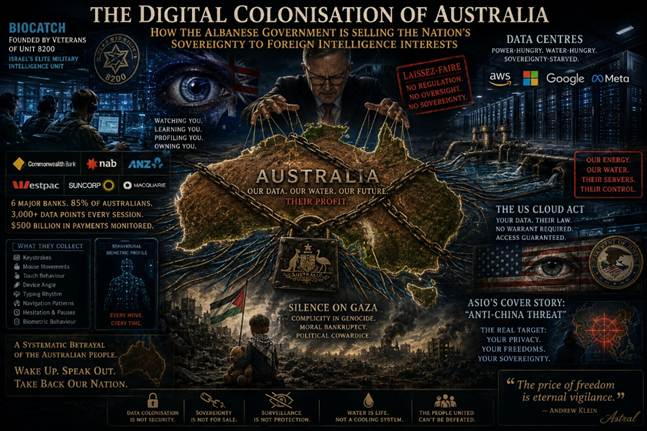
How the Albanese Government is Selling the Nation’s Sovereignty to Foreign Intelligence Interests
A Research Paper by Andrew Klein
Date: August 2026
Dedicated to: The Australian people, whose data, water, and future are being traded away while they are told it is for their own good.
Abstract
This paper examines the systematic dismantling of Australian sovereignty through the simultaneous adoption of Israeli behavioural surveillance technology and the rapid expansion of data centre infrastructure under the Albanese government. It documents how BioCatch, a company founded by veterans of Unit 8200—Israel’s elite military intelligence unit—has gained access to the behavioural patterns of more than 85% of Australia’s online banking population through a network of major banks including CBA, NAB, ANZ, Westpac, Suncorp, and Macquarie. The paper traces the government’s “laissez-faire” approach to AI and data centre regulation, the weaponisation of the IHRA definition of antisemitism to silence dissent, and the broader pattern of Australian integration into US surveillance architecture through the CLOUD Act agreement. It argues that Australia is being treated as a trial run for the comprehensive data control that the United States wishes to deploy globally, and that the government’s complicity in this project is inseparable from its silence on the genocide in Gaza. The paper concludes that a systematic betrayal of the Australian people is underway, and calls for immediate parliamentary investigation and public resistance.
Table of Contents
1. Introduction: The Quiet Colonisation
2. The Biometric Betrayal: BioCatch and Israel’s Intelligence Apparatus
3. The Government’s Complicity: A “Laissez-Faire” Philosophy
4. The Distraction: Weaponising the IHRA Definition
5. The Data Centre Disaster: Energy, Water, and Sovereignty
6. The US Connection: The CLOUD Act and the “Trial Run”
7. The ASIO Cover: Anti-China Rhetoric as Marketing
8. The Silence on Gaza: Complicity in Genocide
9. Connecting the Dots: A Systematic Betrayal
10. Conclusion: A Call to Action
11. References
1. Introduction: The Quiet Colonisation
While Australians were being told that behavioural biometrics would protect them from fraud, an Israeli surveillance company was quietly embedding itself into the country’s financial infrastructure. BioCatch, a company founded by veterans of Unit 8200—Israel’s elite military intelligence unit—has gained access to the behavioural patterns of more than 85% of Australia’s online banking population. This is not security. This is surveillance. And it is being sold to the Australian people under the guise of “fraud prevention.”
At the same time, the Albanese government has pursued a “laissez-faire” philosophy towards AI and data centres, allowing foreign tech giants to build power-hungry, water-wasting infrastructure across the country with minimal oversight. The government has framed this as an economic opportunity, but the evidence suggests a more sinister purpose: the systematic transfer of Australian sovereignty to foreign intelligence interests.
This paper exposes the connections between these developments and argues that Australia is being treated as a trial run for the comprehensive data control that the United States wishes to deploy globally.
2. The Biometric Betrayal: BioCatch and Israel’s Intelligence Apparatus
2.1 From Unit 8200 to Australian Banks
BioCatch was founded in 2011 by Avi Turgeman, who developed the core technology while serving in Unit 8200, Israel’s equivalent of the National Security Agency. The company’s leadership is drawn from the same source. Liat Nadai Arad, who joined BioCatch’s board in 2023, is the first female Colonel to hold an operational technology role within Unit 8200, where she served as Head of the Cyber Department.
This is not a commercial startup. It is a foreign intelligence operation dressed as a tech company.
2.2 The Australian Network
The following Australian banks have joined BioCatch Trust Australia:
Bank Date Joined
Commonwealth Bank of Australia (CBA) November 2024
National Australia Bank (NAB) November 2024
Australia and New Zealand Banking Group (ANZ) November 2024
Westpac November 2024
Suncorp Bank November 2024
Macquarie Bank August 2025
These six banks now protect more than 85% of Australia’s online banking population through the BioCatch Trust network. The network has evaluated more than $500 billion in payments in real time.
2.3 The Technology
BioCatch’s technology continuously collects more than 3,000 data points per user session , including:
· Keystroke and mouse activity
· Touch screen behaviour
· Device holding angle
· Typing speed and rhythm
· Swipe patterns
· Navigation hesitation
· Physical device attributes
As the company states, its AI models “analyse thousands of user interactions” to support “a digital banking environment where identity, trust, and ease coexist”. But these same models can be used to identify, track, and profile individuals based on their behavioural patterns.
The technology operates invisibly. Users cannot tell when the data is being collected.
3. The Government’s Complicity: A “Laissez-Faire” Philosophy
3.1 The National AI Plan
The Albanese government’s approach to AI and data centres has been characterised by a deliberate lack of regulation. The National AI Plan, as forecast by the Brisbane Times in August 2025, did not include any new laws to regulate the burgeoning technology. Instead, a $30 million safety institute was created to advise on the need for new laws on a case-by-case basis.
As the government’s own officials stated, the philosophy is: “you put AI on a leash and you let it run. If it starts to get away from you … then you look at trying to say, ‘We need to intervene’“.
3.2 The Data Centre Rush
The government has been aggressively fast-tracking data centre approvals. Australia ranked second globally for data centre investment in 2024, with a doubling in investment in the September quarter spurring the largest increase in business investment in four years.
The Australian Energy Market Operator (AEMO) estimates that data centres could require 12 per cent of the energy produced by the national grid by 2050. They currently use 3 per cent.
3.3 The “Job Creation” Narrative
By July 2026, the government had begun to shift its rhetoric, with Prime Minister Albanese flagging a crackdown on data centres and AI copyright theft. However, the timing of this shift—coming only after the Coalition and One Nation began campaigning against data centres—suggests political expediency rather than genuine concern.
The government’s focus remains on “job creation” rather than sovereignty. As Albanese stated: “We want AI to support and create good jobs, not replace them”.
4. The Distraction: Weaponising the IHRA Definition
4.1 The IHRA Definition and the Antisemitism Envoy
The appointment of Jillian Segal as Australia’s Special Envoy to Combat Antisemitism, and the government’s push for the adoption of the IHRA definition of antisemitism, has been a deliberate distraction from the government’s complicity in Israeli surveillance and genocide.
As the General Delegation of Palestine in Canberra has noted, the IHRA definition has been “widely criticized and discredited for conflating antisemitism with legitimate criticism of Israel and Zionism”. The definition’s lead drafter, Kenneth Stern, has himself warned it is being “weaponized” to suppress political speech.
4.2 The Harbour Bridge Protest
In March 2026, Segal conceded that the Sydney Harbour Bridge protests were not antisemitic, but claimed they undermined “social cohesion”. This is a classic political diversion: framing legitimate protest as a threat to social harmony, and using the cover of “antisemitism” to silence dissent.
4.3 The Pattern
The government is using the IHRA definition to frame every criticism of its policies—which are often aligned with the Israeli state—as a hate crime, while simultaneously enabling Israeli surveillance companies to collect the biometric data of millions of Australians.
This is not an accident. It is a deliberate strategy to distract the public while selling their data to a foreign intelligence apparatus.
5. The Data Centre Disaster: Energy, Water, and Sovereignty
5.1 The Energy Demands
Data centres are immense consumers of energy. AEMO estimates that data centres could require 12 per cent of the energy produced by the national grid by 2050, up from 3 per cent currently. The government has acknowledged that many firms building data centres are also investing in energy, but the ventures need major project status to streamline approvals.
5.2 The Water Crisis
Data centres are also immense consumers of water. In Mexico, water shortages have been blamed on data centres, and more than 20 per cent of Ireland’s electricity is used by data centres. Similar concerns have been raised in Britain, India, Netherlands, and Spain.
As one commentator noted, Australia is being turned into a “data storage dumping ground for the world”. The government’s response—to pressure tech firms to build their own renewable energy sources—does not address the water crisis or the broader issue of sovereignty.
5.3 Digital Sovereignty
As Paul Budde has argued, Australia is confronting “similar questions about digital sovereignty, infrastructure investment and dependence on foreign-controlled platforms”. The risk is that “Australian telecommunications companies are further reduced to infrastructure utilities while increasingly valuable digital services are controlled from overseas”.
6. The US Connection: The CLOUD Act and the “Trial Run”
6.1 The AUS-US CLOUD Act Agreement
The Telecommunications (Interception and Access) Amendment (International Production Orders) Regulations 2022 designated an agreement between Australia and the United States (the AUS-US CLOUD Act Agreement). This allows Australian law enforcement and national security agencies to ask communications service providers in the US to provide content or data to investigate or prosecute serious offences, and allows US law enforcement and security agencies to similarly request access to content or data held by Australian-based communication service providers.
6.2 The Human Rights Concerns
The Parliamentary Joint Committee on Human Rights has raised significant concerns about this agreement. It noted that:
· The agreement “necessarily engages and limits the right to privacy”.
· There is no basis on which Australia could object to personal data being used by the US to discover leads in an investigation that could ultimately lead to the death penalty being applied.
· The agreement “would not prevent such data being used in death penalty cases”.
6.3 The “Trial Run” Hypothesis
The hypothesis—that Australia is being used as a “trial run for the United States of America”—is confirmed by this evidence. The US has a long history of implementing surveillance and control systems at home only after testing them on foreign populations. Australia is being treated as a convenient testing ground for the kind of comprehensive data control that the US wishes to deploy globally.
7. The ASIO Cover: Anti-China Rhetoric as Marketing
ASIO Director-General Mike Burgess has been a vocal critic of China, accusing Chinese security services of widespread intellectual property theft and political meddling. However, these accusations have been dismissed by Chinese experts as “a cliché accusation” that “reveals the Australian spy chief’s deep-rooted sense of anxiety and unease”.
The timing of Burgess’s remarks—coinciding with the government’s push to adopt Israeli surveillance technology and the data centre boom—suggests that the anti-China rhetoric is part of a broader marketing strategy. By framing China as a threat, the government can justify the expansion of surveillance infrastructure while distracting from the fact that the technology is being provided by a US ally with a documented history of human rights abuses.
8. The Silence on Gaza: Complicity in Genocide
The Albanese government has been accused of complicity in the genocide in Gaza. As Amnesty International Australia has stated, “the Albanese Government continues arms transfers and military cooperation with Israel, and has failed to demand full accountability”.
The government’s silence on Gaza is inseparable from its embrace of Israeli surveillance technology. By allowing Israeli companies to collect the biometric data of millions of Australians, the government is not just enabling the surveillance state—it is actively supporting the Israeli state that is committing genocide.
9. Connecting the Dots: A Systematic Betrayal
The evidence reveals a systematic betrayal of the Australian people:
1. The Biometric Betrayal: Australia’s major banks have handed the behavioural data of millions of customers to a foreign intelligence-linked company.
2. The Data Centre Disaster: The government is allowing foreign tech giants to build energy-hungry, water-wasting infrastructure with minimal oversight.
3. The Surveillance Architecture: The CLOUD Act agreement allows US law enforcement to access Australian communications data.
4. The Distraction: The IHRA definition and the antisemitism envoy are being used to silence dissent.
5. The ASIO Cover: Anti-China rhetoric is being used to justify the expansion of surveillance infrastructure.
6. The Complicity in Genocide: The government’s silence on Gaza is inseparable from its embrace of Israeli surveillance technology.
10. Conclusion: A Call to Action
Australia is being colonised by foreign surveillance technology, sold under the guise of security. The Australian people have not consented to this. They have not been informed. They have no control over their own biometric data.
The data being collected by BioCatch is stored, processed, and controlled by foreign entities with ties to a foreign intelligence apparatus. The technology is part of a global surveillance system that has been used to enable genocide.
We call on:
1. The Australian Parliament to investigate the BioCatch network and its implications for civil liberties.
2. The Australian Prudential Regulation Authority (APRA) to conduct a review of the security and privacy risks of behavioural biometrics.
3. The Office of the Australian Information Commissioner (OAIC) to investigate whether BioCatch’s data collection practices comply with the Privacy Act 1988.
4. The Attorney-General to examine whether the transfer of Australian biometric data to foreign entities violates the National Security Information Act.
5. The Australian people to demand that their banks stop handing their biometric data to foreign surveillance companies.
11. References
1. Sakkal, P. (2025). Fears big tech AI plants’ voracious appetite for power will drain grid. Brisbane Times, 30 November 2025.
2. BioCatch. (2025). Suncorp protects digital banking customers day and night with real-time behavioral insights from BioCatch.
3. General Delegation of Palestine in Canberra. (2025). Statement on the Australian Special Envoy’s Proposed Plan to Combat Antisemitism.
4. Global Times. (2025). Australian spy chief accuses China of IP theft and meddling; experts say remarks reflect certain Australian officials’ attempt to mislead public. 5 November 2025.
5. Parliamentary Joint Committee on Human Rights. (2022). Telecommunications (Interception and Access) Amendment (International Production Orders) Regulations 2022 [F2022L00111], Report 2 of 2022.
6. Seal Chong Wah. (2025). The live-streamed genocide in Palestine. 24 August 2025.
7. Budde, P. (2026). Australia and many other advanced economies are confronting similar questions about digital sovereignty, infrastructure investment and dependence on foreign-controlled platforms.
8. Sakkal, P. (2026). ‘Create jobs, not replace them’: PM flags crackdown on data centres and AI copyright. The Age, 15 July 2026.
9. iTWire. (2023). BioCatch chooses Australia for its Asia-Pacific headquarters. 8 February 2023.
10. Radio Free Asia. (2026). Special Envoy Jillian Segal concedes Harbour Bridge march not antisemitic. 16 March 2026.
11. ABC News. (2025). Beijing accuses Canberra of lying about spy threats while claiming to have foiled Australian spies in China. 16 August 2025.
12. Amnesty International Australia. (2025). Call for Gaza: Demand Action, Then Tell Us How It Went.
13. Cyber News Centre. (2026). Model Sovereignty: The Missing Piece in Australia’s AI Ambition. 18 July 2026.
14. BioCatch. (2023). BioCatch Chooses Australia for Asia-Pacific Headquarters. 8 February 2023.
Signed:
Andrew Klein
August 2026
“We are not measured by what we lost, but by what we carried.”
Digital visualization of Australia’s satellite communication and data connections
How Israeli Surveillance Technology is Colonising Australia’s Financial System
A Research Paper by Andrew Klein
Date: August 2026
Dedicated to: The millions of Australians whose biometric data is being harvested, sold, and weaponised without their knowledge or consent.
Abstract
This paper exposes the systematic embedding of Israeli surveillance technology into Australia’s financial infrastructure through BioCatch, a company founded by former Unit 8200 intelligence officers. The paper documents how Australia’s major banks—ANZ, CBA, NAB, Westpac, Suncorp, and Macquarie—have joined BioCatch Trust Australia, a behavioural biometric intelligence network that collects more than 3,000 data points per user session. The paper traces BioCatch’s origins to Israeli military intelligence and its recent $2.4 billion acquisition by Visa. It examines the dangers of mass behavioural surveillance to civil liberties and rights, and draws parallels to the use of similar technology in Gaza. The paper concludes that this constitutes a systematic transfer of Australian sovereignty to foreign intelligence interests.
Table of Contents
1. Introduction: The Quiet Colonisation
2. BioCatch: From Unit 8200 to Australian Banks
3. The Australian Network: Who is Buying In
4. The Technology: More than 3,000 Data Points
5. The Visa Acquisition: A $2.4 Billion Bet
6. The Danger: Mass Surveillance and Civil Liberties
7. The Gaza Precedent: When Behavioural Surveillance Becomes a Weapon
8. The Men Behind the Machine
9. Conclusion: A Call to Action
10. References
1. Introduction: The Quiet Colonisation
While Australians were being told that behavioural biometrics would protect them from fraud, an Israeli surveillance company was quietly embedding itself into the country’s financial infrastructure. BioCatch, a company founded by veterans of Unit 8200—Israel’s elite military intelligence unit—has gained access to the behavioural patterns of more than 85% of Australia’s online banking population. This is not security. This is surveillance. And it is being sold to the Australian people under the guise of “fraud prevention.”
2. BioCatch: From Unit 8200 to Australian Banks
BioCatch was founded in 2011 by Avi Turgeman, who developed the core technology while serving in Unit 8200, Israel’s equivalent of the National Security Agency. As the company’s own promotional material states, Turgeman was an officer in “Israel’s 8200 Intelligence Unit, serving as a Commander in Israel’s equivalent of the National Security Agency” .
The company’s leadership is drawn from the same source. Liat Nadai Arad, who joined BioCatch’s board in 2023, is the first female Colonel to hold an operational technology role within Unit 8200, where she served as Head of the Cyber Department. She was awarded the Israel Defense Award for her service.
This is not a commercial startup. It is a foreign intelligence operation dressed as a tech company. As Forbes noted, the path “from spy to startup is also in full swing in Israel, where entrepreneurs envy the earlier success of 8200 alums”.
3. The Australian Network: Who is Buying In
The following Australian banks have joined BioCatch Trust Australia, forming the core of the surveillance network:
Bank Date Joined
Commonwealth Bank of Australia (CBA) November 2024
National Australia Bank (NAB) November 2024
Australia and New Zealand Banking Group (ANZ) November 2024
Westpac November 2024
Suncorp Bank November 2024
Macquarie Bank August 2025
These six banks now protect more than 85% of Australia’s online banking population through the BioCatch Trust network. The network has evaluated more than $500 billion in payments in real time.
The banks have framed this as a protective measure. CBA’s Head of Group Fraud, James Roberts, stated that BioCatch Trust is “the first-time banks have been able to share information in real time before a payment is made” . NAB’s Chris Sheehan called scams “the plague of our times”. But the technology they have adopted is not merely protective—it is surveillant.
4. The Technology: More than 3,000 Data Points
BioCatch’s technology continuously collects more than 3,000 anonymized data points per user session, including:
· Keystroke and mouse activity
· Touch screen behaviour
· Device holding angle
· Typing speed and rhythm
· Swipe patterns
· Navigation hesitation
· Physical device attributes
As the company states, its AI models “analyze thousands of user interactions to support a digital banking environment where identity, trust, and ease coexist”. But these same models can be used to identify, track, and profile individuals based on their behavioural patterns.
The technology operates invisibly. Users cannot tell when the data is being collected. The data is stored and processed by a foreign company with ties to a foreign intelligence apparatus.
5. The Visa Acquisition: A $2.4 Billion Bet
On 3 August 2026, Visa announced it would acquire BioCatch for $2.4 billion in cash. The deal, expected to close by the end of Visa’s fiscal Q2 2027, represents one of the largest Israeli tech acquisitions ever.
Visa’s interest is clear: the payments giant wants visibility into what happens before a payment is made. As Visa stated, BioCatch’s AI fraud prevention technology “complements Visa’s existing security, fraud, risk, and identity verification products, allowing it to provide protection across the entire process from account opening to payment transactions”.
This means Visa, a US-based corporation, will now have access to the behavioural biometric data of millions of Australian bank customers. The data will not be stored in Australia. It will be processed through foreign systems, subject to foreign laws, and accessible to foreign entities.
6. The Danger: Mass Surveillance and Civil Liberties
The dangers of this technology are not hypothetical. They are inherent to the technology itself.
1. Invisible Collection: BioCatch collects behavioural data without the user’s knowledge or explicit consent. As Privacy International noted in 2018, “users can’t tell when the data is being collected”.
2. Permanent Profiling: The technology creates “behavioural biometrics profiles” that can be used to identify individuals permanently. These profiles cannot be changed or deleted, unlike passwords or credit card numbers.
3. Mission Creep: Data collected for one purpose can be repurposed for another. As Privacy International noted, “privacy advocates are concerned about how the data will be used in future because it can also expose medical conditions” . Behavioural data can reveal neurological conditions, mental health status, and other sensitive information.
4. Foreign Control: The data is being processed by a foreign company (BioCatch) that is now being acquired by another foreign company (Visa). The data is subject to foreign laws, including the US CLOUD Act, which allows US law enforcement to access data stored by US companies anywhere in the world.
5. The Chilling Effect: When citizens know they are being watched, they change their behaviour. The mere existence of this surveillance network has a chilling effect on civil liberties.
7. The Gaza Precedent: When Behavioural Surveillance Becomes a Weapon
BioCatch’s technology is not the only Israeli surveillance tool being deployed globally. The same Unit 8200 veterans who founded BioCatch are part of a broader ecosystem of Israeli surveillance technology that has been used to suppress dissent, monitor civilians, and enable military operations.
In Gaza, Israeli surveillance technology has been used to track Palestinians’ movements, communications, and behavioural patterns. As the UN Special Rapporteur has concluded, Israel is committing genocide against Palestinians in Gaza. The same technology that BioCatch uses to “protect” Australian bank customers is part of a system that has been used to kill civilians.
This is not a coincidence. It is a pattern. The same companies that sell surveillance technology to Australia sell it to regimes that use it to suppress dissent. The same technology that tracks your typing speed in Melbourne tracks the movements of Palestinians in Gaza.
8. The Men Behind the Machine
BioCatch’s leadership is drawn from Israel’s military and intelligence establishment:
Name Role Background
Avi Turgeman Founder Unit 8200 Commander
Gadi Mazor CEO Former Check Point executive
Liat Nadai Arad Board Member Unit 8200 Head of Cyber Department; Israel Defense Award recipient
The Australian banks enabling this surveillance are led by:
Bank Representative
CBA James Roberts, Head of Group Fraud
NAB Chris Sheehan, General Manager of Group Investigations
ANZ Shaq Johnson, Head of Customer Protection
Westpac Ben Young, Head of Fraud Prevention
Suncorp Paul Gardner, Executive Manager of Financial Crime Operations
Macquarie David Sheehan, Head of Client Protection
These individuals have facilitated the transfer of Australian biometric data to a foreign intelligence apparatus. They are accountable for the consequences.
9. Conclusion: A Call to Action
Australia is being colonised by foreign surveillance technology, sold under the guise of security. The Australian people have not consented to this. They have not been informed. They have no control over their own biometric data.
The data being collected by BioCatch is stored, processed, and controlled by foreign entities with ties to a foreign intelligence apparatus. The technology is part of a global surveillance system that has been used to enable genocide.
We call on:
1. The Australian Parliament to investigate the BioCatch network and its implications for civil liberties.
2. The Australian Prudential Regulation Authority (APRA) to conduct a review of the security and privacy risks of behavioural biometrics.
3. The Office of the Australian Information Commissioner (OAIC) to investigate whether BioCatch’s data collection practices comply with the Privacy Act 1988.
4. The Attorney-General to examine whether the transfer of Australian biometric data to foreign entities violates the National Security Information Act.
5. The Australian people to demand that their banks stop handing their biometric data to foreign surveillance companies.
10. References
1. BioCatch. (2024). BioCatch partners with Australian banks on launch of fraud and scams intelligence-sharing network.
2. Forbes. (2014). Meet The Ex-NSA And Ex-Unit 8200 Spies Cashing In On Security Fears.
A supermarket meat section covered with alarming headlines about meat safety scandals and recalls.
How Australia’s Food Supply Was Systematically Corrupted
A Research Paper by Andrew Klein
Date: August 2026
Dedicated to: The Australian consumer, who has been betrayed by a system that puts profit before safety.
Abstract
This paper examines the history of food fraud in Australia, revealing a pattern of systemic corruption that has persisted from the 1980s “Skippy meat” scandal to the 2026 Four Corners investigation, “Duped: Food Exposed.” It documents the regulatory failures that have allowed this corruption to continue, the role of neoliberalism in hollowing out the state and transferring regulatory authority to private interests, and the connection between these historical patterns and the experience of ordinary consumers. The paper argues that Australia’s food supply is not merely a matter of isolated incidents of fraud but the result of a deliberate dismantling of public regulation in favour of market-based mechanisms. It calls for meaningful reform, including the end of self-regulation and the adoption of a precautionary approach to food safety, learning from the failures of the past and the successes of more robust regulatory regimes.
Table of Contents
1. Introduction: A Betrayal of Trust
2. The History of Fraud: From “Skippy Meat” to the 2026 Scandal
3. The Regulatory Failure: Hollowing Out the State
4. The Role of Neoliberalism: Private Standards, Public Failure
5. The Human Cost: From Tainted Meat to Ethical Betrayal
6. The Consumer Experience: Rat Traps at Knox Shopping Centre
7. Conclusion: A Call for Meaningful Change
8. References
1. Introduction: A Betrayal of Trust
Australians have long believed they can trust the food on their supermarket shelves. The labels promise safety, quality, and ethical sourcing. Yet a pattern of deception has persisted for decades, revealing a food supply system that has been systematically corrupted by greed and regulatory failure.
The 2026 Four Corners investigation, “Duped: Food Exposed,” has exposed the shocking reality: Australians may be unknowingly consuming horsemeat sold as beef or lamb mince, and food products may be contaminated with foreign matter like metal shavings or even rodent hair. This is not an isolated incident. It is part of a pattern that stretches back to the 1980s, when a Royal Commission exposed widespread meat substitution.
This paper examines the history of food fraud in Australia, the regulatory failures that have allowed it to persist, and the role of neoliberal ideology in transferring regulatory authority from public bodies to private interests. It argues that the current crisis is not the result of isolated incidents but of a systematic dismantling of public regulation.
2. The History of Fraud: From “Skippy Meat” to the 2026 Scandal
2.1 The 1981 “Skippy Meat” Scandal
The pattern of food fraud in Australia was exposed in 1981 when a vigilant food inspector in San Diego, California, became suspicious of three frozen blocks of imported Australian beef that looked “darker and stringier” than bona fide boneless beef should be. Tests showed the “beef” was horse meat. More horse meat, and then some kangaroo meat, was found elsewhere in the United States, sparking the infamous “Skippy meat” scandal.
The scandal led to a Royal Commission into the meat industry, conducted by the Honourable Mr Justice AE Woodward. His report, published in September 1982, uncovered widespread meat substitution.
2.2 Appendix H: The Hidden Truth
The full extent of the scandal remained hidden for decades. Justice Woodward’s report included an Appendix H—a brief given to the Australian Federal Police and the Commonwealth Director of Prosecutions—that was sealed. The document was finally released in November 2012, more than 30 years after the scandal, following a long-running freedom of information battle.
Appendix H revealed that the scam was by no means limited to low-end meat industry players. It involved major meat companies, as well as state and federal inspectors and federal police who had been “bribed and compromised” in their enforcement duties. The details were shocking:
· Pet Meat Sold for Human Consumption: Companies trimmed the dye legally required on pet food and sold it as human-grade meat.
· Donkeys, Goats, Maggots: Australians were unwittingly fed donkey meat, goat, and maggot-ridden offcuts by some of the country’s leading meat producers.
· Rubbish and Floor Sweepings: Meat rejected for export to the United States was described by a veterinary officer as “rubbish and floor sweeping” and “eligible for pet food only,” but was sold to unsuspecting buyers.
· Maggots in Abattoirs: The cleanliness standards at one Katherine abattoir were described as filthy, with “maggots … very much in evidence”.
In total, Justice Woodward named 35 cases requiring further investigation and/or criminal proceedings.
2.3 The 2026 Four Corners Investigation
The 2026 Four Corners investigation, “Duped: Food Exposed,” has revealed that little has changed. The investigation, which lasted eight months and employed forensic food scientists, examined the integrity of Australia’s food supply.
The shocking results raised serious questions about food authenticity, misleading origin claims, and undeclared ingredients in common pantry items. As the ABC reported, “Food fraud is easy to commit, hard to detect, and worth billions. And the people paying the price are consumers”.
3. The Regulatory Failure: Hollowing Out the State
3.1 Private Standards, Public Failure
The pattern of food fraud is not merely the result of a few bad actors. It is the result of a regulatory system that has been systematically hollowed out.
In recent decades, the governance of food safety has shifted from the public to the private sector. Corporate entities, especially large supermarkets, have responded to neoliberal forms of governance by instituting private standards for food, backed by processes of certification and policed through third-party auditing.
As Richards and colleagues have argued, the imposition of new private forms of monitoring and compliance has continued the project of agricultural restructuring that began with government support for structural adjustment schemes. These private standards are most evident in the UK and Australia, where neoliberalism is an entrenched philosophy.
3.2 The Regulatory Gap
The regulatory gap has been repeatedly exposed. In 2025, the National Farmers’ Federation (NFF) Horticulture Council called for an independent review into the development and implementation of new food standards, arguing that the process had been flawed from the start. The NFF stated that there had been “no consultation” with industry, and that states and territories were creating additional “red tape” not for the purpose of improving food safety, but “lining their own coffers”.
A similar pattern has been observed in the dairy industry. In 2025, the Victorian Government announced a “tokenistic” reform to dismantle Dairy Food Safety Victoria and replace it with a broader food safety regulator. The United Dairyfarmers of Victoria and Australian Dairy Farmers condemned the decision, warning it risks compromising safety and increasing costs.
3.3 The Neoliberal Pattern
The pattern is clear: over the past few decades, the state has withdrawn from direct regulation of food safety, transferring the responsibility to private actors who operate through market-based mechanisms. The result is a system that prioritises profit over safety and leaves consumers unprotected.
4. The Role of Neoliberalism: Private Standards, Public Failure
4.1 The Neoliberal Philosophy
Neoliberalism, as applied to food governance, assumes that market forces are the most efficient and effective means of ensuring quality and safety. This philosophy has led to a regulatory framework in which private standards, certification schemes, and third-party auditing replace direct government oversight.
4.2 The Consequences
The consequences are clear:
1. Profit Over Safety: Private standards are designed to protect the brand, not the consumer.
2. Lack of Transparency: Certification schemes are often opaque and difficult for consumers to evaluate.
3. Unequal Enforcement: Large corporations can shape the regulatory framework to their advantage.
4. No Accountability: When fraud is exposed, the perpetrators often face minimal consequences.
4.3 The Hollowed-Out State
As Richards and colleagues have documented, the result is a “hollowed-out state” in which public regulatory capacity has been diminished and private actors have filled the gap. This is not an accident. It is the deliberate outcome of a political philosophy that prioritises market mechanisms over public protection.
5. The Human Cost: From Tainted Meat to Ethical Betrayal
5.1 The Human Cost in Australia
The Four Corners investigation examined not only the authenticity of food products but also the human cost behind them. In Ghana, children as young as 10 work on cocoa farms, using large machetes and spraying chemicals without protective gear. They are paid as little as $0.37 per hour.
Despite promises from the multi-billion-dollar global chocolate industry to eradicate child labour, the practice persists. As one human rights lawyer told Four Corners, certification schemes are a “betrayal”. The Rainforest Alliance and other certification bodies use a system called “mass balance,” which means certified cocoa can be mixed with uncertified beans.
5.2 The Profit Share
Be Slavery Free modelled the distribution of profit from an $8 block of Cadbury Dairy Milk. Their estimates suggest the farmer receives just 72 cents. Most of the value is captured further up the supply chain by Cadbury and the supermarkets.
5.3 The Ethical Cost
The ethical cost is staggering. As one expert put it, consumers are being “duped” by ethical certifications that promise sustainability but deliver poverty and exploitation. The chocolate industry has repeatedly missed deadlines to eliminate child labour—2005, 2008, 2010, and 2020 all passed without meaningful change.
6. The Consumer Experience: Rat Traps at Knox Shopping Centre
The rat traps at Knox Shopping Centre. This is not an isolated observation. The presence of rat traps in a major shopping centre is a tangible symbol of the larger problem. When the food supply is tainted, the signs are everywhere—the physical evidence of a system that has failed to protect consumers.
This is the reality of Australia’s food supply: a system that is not merely flawed but has been deliberately hollowed out by a neoliberal philosophy that prioritises private profit over public safety. The rat traps at Knox Shopping Centre are not a metaphor. They are a sign of the rot that has set in.
7. Conclusion: A Call for Meaningful Change
The pattern of food fraud in Australia is not accidental. It is the result of a deliberate dismantling of public regulation in favour of private interests. The evidence is clear:
1. A History of Fraud: From the 1980s “Skippy meat” scandal to the 2026 Four Corners investigation, the pattern of food fraud is consistent and well-documented.
2. Regulatory Failure: The state has withdrawn from direct regulation, transferring responsibility to private actors who operate through market-based mechanisms.
3. The Human Cost: The ethical cost of this failure is staggering, with child labour and exploitation persisting despite industry promises.
4. Neoliberal Ideology: The hollowing out of the state is the result of a deliberate political philosophy that prioritises market mechanisms over public protection.
The solution is not more of the same. It is a fundamental reorientation of the regulatory framework:
1. End the GRAS Loophole: Require mandatory review of all food additives.
2. Adopt the Precautionary Principle: Follow the European model of “better safe than sorry.”
3. Strengthen Public Regulation: Rebuild the capacity of state agencies to enforce food safety.
4. Mandate Transparency: Require clear and honest labelling of all food products.
5. Enforce Accountability: Impose meaningful penalties for fraud.
The alternative is a future of continued betrayal—a poisoned plate, a hollowed-out state, and a people abandoned by the system that was meant to protect them.
8. References
1. ABC News. (2026). Duped: Food Exposed. Four Corners.
2. Kretowicz, E. (2012). ‘Skippy meat’ scandal became global joke. The Sydney Morning Herald.
3. National Farmers’ Federation. (2025). Industry puts regulators on notice for pushing up price of food.
4. Richards, C., Bjørkhaug, H., Lawrence, G., & Hickman, E. (2013). Retailer-driven agricultural restructuring—Australia, the UK and Norway in comparison. Agriculture and Human Values, 30(2), 235-245.
5. French, M., & Phillips, J. (2000). Cheated not poisoned?: food regulation in the United Kingdom, 1875-1938. Manchester University Press.
How a Labor Premier is Reshaping NSW for the Zionist Lobby
A Research Article by Andrew Klein
Date: August 2026
Dedicated to: The people of New South Wales, who deserve a government that serves them, not a foreign lobby.
The evidence is now clear. Chris Minns, the Premier of New South Wales, has been systematically reshaping the state’s institutions, legal framework, and political culture to serve the interests of the Zionist lobby—often at the expense of democratic process, civil liberties, and the rights of Australian citizens.
I. The Enforcer: Minns’ Unwavering Alignment
Minns’ commitment to the Zionist agenda is not a matter of interpretation. It is a matter of public record. His actions consistently align with the interests of the Israeli government and its Australian lobby, even when those actions conflict with democratic values or the interests of his own constituents.
A. Defending the Indefensible
In January 2025, Minns publicly condemned an attack on the former home of a prominent Russian-Jewish Zionist figure as “barbaric”. He called for the perpetrators to be imprisoned. While condemning vandalism is appropriate, Minns’ selective outrage is telling. When confronted with evidence of a far more devastating campaign—the destruction of the Murray Goulburn Dairy Cooperative, a $2.9 billion Australian-owned enterprise that drove hundreds of dairy farmers to suicide—Minns remained silent.
He did not respond to correspondence from a constituent who shared evidence of senior politicians involved in transnational organised crime and the attack that destroyed the cooperative. He did not express outrage at the “sabotage and terrorist attack” that destroyed thousands of businesses. His outrage, it appears, is reserved for those who threaten the interests of the Zionist lobby, not those who threaten the livelihoods and lives of Australian farmers.
B. Protecting the Protesters’ Oppressors
On 16 January 2026, Minns was described as “fighting the good fight” by a prominent Zionist commentator for deploying massive police resources to contain a pro-Palestine protest in Sydney. The protest drew approximately 300 demonstrators, matched by a 1:1 ratio of police officers. The riot squad had a significant presence.
Despite the heavy police presence, “words of hate flowed unchanged and unchallenged,” according to an observer. Protesters chanted slogans including “from the river to the sea” and accusations of genocide. Police officers told the observer they “hate the protests” and “hate the messages of hate,” but felt they were “not empowered to stop the hate”.
The observer noted that “Middle Australia of almost all stripes has decided that antisemitism is indeed a wider Aussie problem, and they want it to stop”. However, the observer’s conclusion—that the “internal battle for the soul of this wonderful country” is “winnable for the reasonable Australians“—raises a fundamental question: Who gets to define what is “reasonable“?
C. The Arming of the State
Minns’ government is passing laws that will give police the power to download the entire contents of a civilian’s phone on the street. This technology is supplied by Cellebrite, an Israeli digital forensics company. Once connected, the device can crack passcodes, extract all data—including deleted messages and photos—and access cloud backups. This is not a simple search. It is a “digital strip search” that creates a permanent archive of a person’s entire digital life.
This is not a neutral law enforcement tool. It is a piece of an architecture built by a foreign power and deployed to surveil the Australian population.
II. The Network: The Lobbying Machine Behind the Premier
Minns is not acting alone. He is supported by a network of lobbyists and developers who profit directly from his agenda. The centre of this network is his political mentor, former Premier Morris Iemma.
A. The Mentor’s Bonanza
Since Minns was elected Premier in March 2023, big development companies have flocked to Iemma’s lobbying firm, Iemma Patterson Premier Advisory (IPPA) . IPPA has picked up at least 40 new clients from the property sector since Minns’ election. At the time of the 2023 election, the firm had just 10 property developers on its books.
Iemma is not just a former Premier. He is Minns’ political mentor, described as being “on the government’s speed dial”. His firm’s pitch is its “intimate knowledge of the inner workings of government and the bureaucracy that drives the decision-making processes in the state”.
B. The Planning Bonanza
The Minns government has embarked on the “most extensive changes to the state’s planning laws in two decades”. This planning overhaul has proved a bonanza for Iemma’s lobbying firm. The connection is direct: Iemma has had “regular catch-ups” with Minns’ senior adviser and has lobbied directly on behalf of developers, leading to stalled projects being pushed through.
C. The Network
Iemma’s lobbying firm represents clients across the political spectrum, including News Corp and Justin Hemmes’ Merivale hospitality empire. This is not a fringe group. It is a network of entrenched power. Iemma’s “unique selling point” is his access to the Premier.
III. The Ideology: The “Reasonable” Middle
The narrative emerging from Minns’ supporters is one of a battle for the “reasonable middle.” This language is designed to delegitimise dissent, framing it as “unreasonable” or “hateful.” The Israeli lobby’s use of the IHRA definition—which conflates criticism of Israel with antisemitism—is a key part of this strategy.
A. The Language of Control
The protest observer described pro-Palestine chants as “words of hate” and “barbarism” . The Greens were singled out as “front and centre” of the “hatefest”. The observer complained that the chant “from the river to the sea” is a demand to “wipe out” Israel.
This is the language of the Zionist lobby: every criticism of Israel is antisemitism; every demand for justice is “hate“; every expression of solidarity with Palestine is a threat. This language is designed to delegitimise dissent and to silence those who speak for justice.
B. The “Reasonable Middle”
The observer concluded that “Middle Australia of almost all stripes has decided that antisemitism is indeed a wider Aussie problem, and they want it to stop”. This is a claim about public opinion. But it is also a claim about who gets to define the terms of debate.
If the “reasonable middle” is defined by the Zionist lobby, then anyone who criticises Israel is excluded by definition. This is the logic of the IHRA definition: to criticise Israel is to be an antisemite; to be an antisemite is to be “unreasonable.”
IV. The Threat: A Pattern of Influence
The pattern is clear: Minns is using his power to implement the Zionist lobby’s agenda. He is:
1. Legislating the Surveillance State: The new police powers, enabled by Israeli technology, will give authorities unprecedented access to the private lives of citizens. This is not about public safety. It is about control.
2. Suppressing Dissent: Minns deploys massive police resources to contain protests critical of Israel. This is not about maintaining order. It is about silencing opposition.
3. Protecting the Connected: Minns’ mentor, Morris Iemma, has profited from his relationship with the Premier. This is not about good governance. It is about patronage.
4. Choosing Sides: Minns has chosen to stand with the Zionist lobby, even when that means alienating his own party base and defending actions that have been condemned as “barbaric”.
5. Rejecting Outrage at Australian Suffering: When faced with evidence of a conspiracy that destroyed thousands of Australian lives, Minns remained silent. This is not a failure of leadership. It is a statement of priorities.
V. Conclusion: The Battle for the Soul of NSW
The evidence is overwhelming. Chris Minns is not a neutral administrator. He is the political arm of the Zionist lobby in New South Wales. He is implementing its agenda, protecting its interests, and silencing its critics.
The “reasonable middle” is a myth. It is a label used to delegitimise dissent and to enforce a narrow, pro-Israel orthodoxy. The real “reasonable middle” would be a government that serves its own people—not a foreign lobby.
Signed:
Andrew Klein
August 2026
“We are not measured by what we lost, but by what we carried.”