
The Libidinal Economy – How the Drive to Exploit Is Woven into the Fabric of Modern Systems

“”The silence protects them. Break it.”

By Andrew Klein

The Patrician ‘s Watch | Australian Independent Media

Dedication: To my wife – who taught me that no design is inevitable.

I. Introduction: Systemic Failure or Design Feature?

For generations, scholars, activists, and survivors have documented the relentless abuse of children, women, and vulnerable people across every corner of the globe. We call these “systemic failures” – as if the exploitation were a malfunction, a tragic deviation from an otherwise benign system.

But what if the evidence points in the opposite direction? What if this is not a failure at all, but a feature – an inevitable product of an economic system that commodifies everything it touches, including human beings?

This paper argues that the capitalist, exploitative system facilitates exploitation not by accident, but by design. It is not a bug; it is the operating system.

Recent academic research has begun to centre the “political economy” in theorising about child sexual abuse. A 2024 study in the Journal of Criminology argues that technology‑facilitated child sexual exploitation has flourished precisely within the “laissez faire regulatory frameworks of neoliberalism.” It concludes that economists‘ and criminologists’ traditional focus on the psychology of the abuser misses the point, “overlooking the role of capitalist structures and imperatives” that create the conditions for abuse to thrive.

Similarly, scholars of critical theory argue that capitalism is not merely an economic system but a totalising force. It commodifies everything it touches, including relationships and human beings. One source describes this as an “inherited flaw” in which friendships and even intimate relationships become “based on a transactional approach” valuing “profit rather than intrinsic worth.” This is not a bug. This is a feature of a system that requires an endless stream of disposable bodies to generate surplus value.

Contemporary investigations into the concept of a “libidinal economy” have attempted to decode how people are psychically hooked into the circuits of the capitalist economy. A 2024 collection of essays by leading scholars explores the connections among economies, pleasures, and desires, addressing themes such as “the link between exploitation and enjoyment” and “the reproduction of the relations of domination by means of the production of … organised crime, forced migration, and unequal development, as well as racism and gendered violence”.

II. The Colonial Blueprint: Sexual Terror as a Tool of Economics

The patterns we see today were honed during the era of colonialism. Sexual violence was not a side effect of colonial expansion; it was a primary weapon of economic and racial domination.

Archival research into the Congo Free State (1885–1908) under King Leopold II reveals the systematic use of sexual violence, rape, abduction, forced incest, and torture as instruments of extraction. One study documents how white settlers “systematically and intentionally utilised sexual violence as a tool of colonial warfare” to inflict psychological and physical hardship, enforce social hierarchies, and establish their “superior force.” The study shows that motives like “sexual lust, psychological dominance and economics” were all entangled.

Between October 1904 and February 1905, the Commission of Inquiry into the Congo Free State collected bare statements of fact recorded by eyewitnesses. Of 370 testimonies, 20 came from women. Their statements reveal what has been silenced by official historiography: namely, sexual and non‑sexual terror as innate to colonial power. The testimonies describe the kidnapping of women (referred to as “rapt”), the amputation of hands and feet when rubber quotas were not met, and the use of female prisoners as pawns or sexual slaves.

A 2023 academic study argues that “sexual violence does not follow but structures colonialism as part of a continuum of violence.” Drawing on extensive archival research, the author identifies “the fusion of terror and pleasure as key aspects of a capitalist and patriarchal gender order.” The colonial regime, based on power, coercion and submission, “required direct, intimate contact with its subjects to maintain a bond of subjection”.

This was not mere cruelty. It was a calculated system of terror designed to extract labour, land, and wealth.

III. The Industrial Revolution: The Factory and the Brothel

The Industrial Revolution was not driven solely by a profit motive; sexual drivers were equally fundamental. The historical record confirms that the mass migration of young, single women to cities created a vast vulnerable population, and the new workhouses and factories were not only sites of labour exploitation but of horrific abuse.

Scholarly volumes on childhood in industrial England include chapters on “Child sexual abuse in late seventeenth and eighteenth‑century London” and “Care and cruelty in the workhouse.” Workhouses, established under the New Poor Law of 1834, were explicitly designed as a punishment for poverty. Children within them were subjected to cruelty, physical abuse, neglect – and sexual abuse, though rarely acknowledged.

In Victorian Britain, the Contagious Diseases Acts of the 1860s did not combat disease; they institutionalised the exploitation of working‑class women and children, treating them as diseased vessels that needed to be regulated by the state for the benefit of “public health” and the military. The Acts empowered police to arrest any woman suspected of being a prostitute, subject her to forced medical examination, and intern her in a “lock hospital” for up to nine months – without trial or conviction.

The period also saw horrific practices like the “procurement and sale of young English virgins to Continental ‘pleasure palaces’.” In July 1885, crusading journalist W. T. Stead published the four‑part series “The Maiden Tribute of Modern Babylon” in the Pall Mall Gazette. Stead exposed the widespread child prostitution and the “veritable slave trade” in young girls, revealing that working‑class girls were “sacrificed – often by their mothers and other women of their neighbourhoods – to the sexual appetite of the ‘dis‑’” wealthy classes. The series led to the Criminal Law Amendment Act 1885, which raised the age of consent from 13 to 16, but the underlying system of exploitation remained intact.

This was not a moral failure of a few bad actors. It was a system designed to extract everything from the poor, including their sexuality.

IV. Modern Extraction Zones: Special Economic Zones as Slavery Enclaves

The pattern continues today in a form even more “efficient” than traditional colonialism. Special Economic Zones (SEZs) are purpose‑built enclaves where labour laws are suspended or ignored to maximise profit. They have become epicentres of modern slavery and sexual exploitation.

Established as a multi‑purpose Special Economic Zone in 2021, Cambodia ‘s Sihanoukville region was intended to attract investment through flexible development initiatives. Instead, its reputation has been “damaged by news of cyber scams and slavery,” as highlighted by a Chinese movie, ’No More Bets ‘.

Investigative reporting has revealed that Sihanoukville has become the hub of a “structurally embedded transnational extraction system” where revenue is generated not through production, but through “deception, coercion, and information asymmetry.” Victims are lured with false promises of wealth, then trapped, tortured, and forced into running online scams. The UN has flagged certain compounds for “large‑scale fraud and forced labour,” and investigators have noted that local police frequently “cannot enter without explicit authorization from national leadership, allowing this modern slavery to persist in plain sight”.

The 2026 Sihanoukville scam exodus saw hundreds of suspected scam workers flee the sites as the government vowed to crack down, but the underlying system remains unchanged. These zones are legal black holes where the “right” to exploit is granted by the state to attract foreign investment. This is not a failure of regulation. It is a design feature of a globalised economy where sovereignty is sold in exchange for a share of criminal profits.

V. The Profit-Driven Supply Chain: From the Factory to the Fashion House

This extractive logic trickles down through every link in the global supply chain. There is growing awareness of “the role that multinational corporations (MNCs) play in contributing to modern slavery down their supply chains.” A third of all exploited workers are in export‑related sectors, hidden within global value chains.

A landmark 2025 Italian investigation uncovered a “chain of exploitation” involving human trafficking, forced labour and organised crime within the supply chain of Giorgio Armani, one of the world‘s most prestigious luxury fashion houses. Prosecutors alleged that Manifatture Lombarde, the official Italian supplier to Armani, was paid €1.6 billion for production while subcontracting the work to illegal sweatshops in the province of Milan.

The operation involved the illegal employment of Chinese workers who were forced to work over 14 hours a day for a pittance of €2–€3 an hour, housed in “degrading” conditions. The subcontractor was able to tighten production costs at the expense of vulnerable migrants while avoiding tax, insurance and social security contributions.

Prosecutors found that Giorgio Armani Operations had been “incapable of preventing and curbing phenomena of labour exploitation within the production cycle, having not implemented suitable measures to verify the real working conditions or the technical capabilities of the contracting companies”. This is not the first time the Italian fashion industry has come under scrutiny; five major brands have been investigated since 2024, including Tod‘s, Valentino, and Loro Piana.

Deborah Lucchetti, national coordinator of La Campagna Abiti Puliti, identified a system stretched “at the seams by budget restrictions, with first‑tier suppliers forced to turn to subcontractors, effectively pushing players in the supply chain to engage in illegal conduct.” She asked the pointed question: “Is it right that a shoe sold for 500 euros is produced by workers earning 3 euros an hour, six days a week?”

The profit motive does not just tolerate exploitation; it demands it.

VI. Conclusion: The Design Is Not Inevitable

The evidence is overwhelming. From the colonial Congo to the workhouses of Victorian England, from the Special Economic Zones of Southeast Asia to the subcontracting networks of global luxury fashion, the pattern is the same.

The Industrial Revolution and the colonial system were not driven by a “profit motive” and a “sexual driver” as separate things; they are the same thing – a libidinal economy, an engine powered by the desire for power, profit, and the total control of another ‘s body. This desire is then institutionalised in legal, political and economic systems designed to protect the “right “of the powerful to extract value, whatever the cost.

The question is not whether capitalism can produce exploitation. It does, systematically and predictably. The question is: Will we continue to treat these outcomes as “failures” to be managed, or recognise them as features to be dismantled?

This is a systemic feature of an economic model that treats human beings as disposable inputs. The only way to break the pattern is to break the silence – and to break the system that protects it.

The design is not inevitable.

Andrew Klein

The Patrician’s Watch | Australian Independent Media

References

1. Salter, M. & Sokolov, S. (2024). “Talk to strangers!” Omegle and the political economy of technology‑facilitated child sexual exploitation. Journal of Criminology, 57(1), 121–137.

2. Gook, B. (Ed.) (2024). Libidinal Economies of Crisis Times: The Psychic Life of Contemporary Capitalism. Bielefeld: transcript Verlag.

3. Mertens, C. (2023). In the ruins of empire: historicizing sexual violence in Congo. International Feminist Journal of Politics.

4. Mertens, C. (2018). When Archives Speak Back: Sexual Violence in the #Congo Free State. Africa at LSE blog.

5. Wallis, A. (2014). Whores and the law: A case study of the sexual double standard and the contagious diseases acts in mid‑nineteenth century England. Bachelor‘s thesis, Edith Cowan University.

6. Stead, W. T. (1885). The Maiden Tribute of Modern Babylon. The Pall Mall Gazette, July 1885.

7. Siem Reap Times. (2026). Cambodia’s Efforts to Restore Sihanoukville’s Image Amid Scam Allegations.

8. Italian Insider. (2025). Italy cracks down on fashion houses exploiting illegal Chinese labor.

9. Mertens, C. (2018). “When Archives Speak Back: Sexual Violence in the #Congo Free State.”

10. The Fashion Law. (2025). Italy Fines Armani, Shein in Fashion Industry ESG Crackdown.
From Abused Child to Abusing Soldier – How Unhealed Trauma Creates the Conditions for Genocide

A challenge to all societies – not a judgment, but a question

By Andrew Klein

Dedication: To every child who was not protected. To every survivor who was not believed. To every soldier who was broken before they ever held a weapon – and to the world that looks away.

Foreword: The Question No One Wants to Ask

On 27 May 2026, an Israeli public broadcaster aired an investigation that shook the nation. Journalist Roni Zinger’s Zman Emet (True Time) programme on Kan 11 presented testimonies from five women – most of whom had never met – describing virtually identical patterns of organised, multi‑perpetrator ritualistic sexual abuse in the Gush Etzion settlement area south of Jerusalem and Bethlehem.

For years, such allegations had been met with denial, dismissal of witnesses, and deep scepticism from within the community. But this time, the response was different. The Gush Etzion Regional Council – the governing body of the settlement bloc – issued an unprecedented public admission. Its statement condemned the abuse in unsparing terms: “The acts described … are an expression of pure evil and moral depravity that has no place in human society, and certainly not in our community”.

The council acknowledged that children had been subjected to “serial, filmed, ritualistic child rape”. It admitted that abusers “used their positions of authority to protect themselves”. It conceded that child pornography had been created by filming the gang‑rape of minors. These were not allegations. They were formal admissions by a governing body in the religious‑Zionist settler sector.

This was not an isolated incident.

Less than a year earlier, senior religious Zionist rabbi Yaakov Medan had warned of “clear” reports of ritualised sexual abuse carried out under the guise of religious or social ceremonies. He denounced what he called “social narcissism” – the communal tendency to dismiss abuse allegations in order to protect a collective self‑image of purity. His warning was stark: “Rabbis, this is happening“.

At the highest level of Israeli politics, Minister Orit Strock’s daughter, Shoshana, came forward with harrowing testimony of ritual abuse beginning when she was two and a half years old – involving her parents, a religious‑Zionist rabbi father and a government minister mother. Her allegations included being taken to paedophile ceremonies, programmed with drugs and hypnosis, and forced into prostitution at the age of thirteen. Weeks before her death, she posted: “If I am found dead, someone is responsible for it, as I have no suicidal tendencies”. She was found dead on 15 March 2026.

In the military sphere, a leaked video showed Israeli soldiers raping a Palestinian detainee at the notorious Sde Teiman prison. The whistleblower who exposed the crime – Major General Yifat Tomer‑Yerushalmi, the Israeli military’s chief advocate – was not celebrated. She was arrested, charged with “obstructing justice”, and investigated for a suicide attempt. The perpetrators were protected. The truth‑teller was punished.

This article is not an indictment of Israel alone. It is a challenge to every society. The question is not “What is wrong with them?” The question is: How could any culture, any community, any parent, see this happen – and, in reality, condemn their children to behave in such ways as to not only destroy others but themselves?

I. The Cycle of Trauma and Violence

There is a well‑established body of research in psychology, criminology, and trauma studies linking childhood abuse – particularly severe, sadistic, and chronic abuse – to later perpetration of violence.

The “cycle of abuse” is not a deterministic law, but a statistical and clinical reality. Children who are treated as objects, who are systematically violated by those who should protect them, often grow up with a shattered capacity for empathy. They learn that power is the only language that matters. They dissociate from their own pain and, in doing so, become capable of inflicting pain on others without remorse.

Research has rigorously documented a victim‑offender cycle of violence. Survivors of childhood abuse are statistically more likely to become perpetrators of violence in adulthood. Significantly, thresholds of cumulative duration and intensity of exposure to violence predict subsequent political violence.

This is not an excuse. It is an explanation – and a warning. Unhealed trauma does not justify atrocity, but it does help explain how a human being can arrive at a state of such profound moral disengagement that they can shoot a child, demolish a hospital, or torture a prisoner and feel nothing.

II. The Cultural Dimension: When Abuse Is Normalised

The evidence from Israel points to something even deeper: a cultural tolerance for abuse.

The Epstein files. The historic examples – the Marquis de Sade, the aristocratic excesses of pre‑revolutionary France, the institutionalised sexual abuse in religious and military settings across many societies. These are not isolated incidents. They are patterns.

When a society tolerates, excuses, or hides the ritualistic abuse of its most vulnerable members, it is not merely failing them – it is training them.

A child who is abused in a context of secrecy and impunity learns several lessons:

· That their body is not their own.

· That power can be exercised without accountability.

· That cruelty is a currency.

· That the only safety lies in becoming the predator rather than the prey.

Such a child sees themselves as a tool. They look for rewards like a tool. They are prepared to carry out the most bizarre orders because their own internal moral compass has been shattered. They become, in the hands of a manipulative authority, the perfect instrument of violence.

III. The Scale: Israel as a Concentrate

The evidence reveals a crisis of terrifying proportions within Israeli society:

Highest rape rate in West Asia: The Association of Rape Crisis Centers in Israel reports that Israel now has 15.5 rape cases per 100,000 people – the highest in the region.

Over 51,000 cases of sexual violence in 2024 alone: Of these, 58% involved children and adolescents.

Unprecedented spike during the Gaza war: Reports of sexual harassment increased by 45% in the education system and 50% in workplaces.

Nearly 3,000 sexual assault cases in the Israeli military in one year – and a 24% increase in sexual violence in prisons.

A culture of institutional cover‑up: The ministries of Police, Justice, Education, Welfare, Prison Services, and the Military have refused to disclose data on investigations, indictments, and system performance. Only 10% of victims file a police complaint, and 81% of those cases are closed without indictment.

As the Association of Rape Crisis Centers bluntly stated: “The leakage of a culture of harassment from prisons and the army into society” is a key driver of the broader surge in sexual violence.

IV. The Military: SdeTeiman and the Institutionalisation of Impunity

The case of Sde Teiman prison is a grotesque illustration of how this system operates.

A leaked video, corroborated by medical evidence, showed Israeli soldiers raping a Palestinian detainee. The whistleblower – the military’s own chief advocate – admitted authorising the leak, saying she did so “in an attempt to counter false propaganda against the army’s law enforcement authorities”.

Her reward? She was arrested, charged with “obstructing justice”, and investigated for attempted suicide. The perpetrators were not held in custody. The whistleblower was punished. The rapists were protected.

This is the institutionalisation of impunity. This is what happens when a society teaches its soldiers that violence against the “other” is permitted, even celebrated.

V. The Historical Roots: The Nakba as Template

The founding of the State of Israel was not a clean break. It was accompanied by the Nakba – the forced expulsion of approximately 750,000 Palestinians, the destruction of over 500 villages, and more than 70 documented massacres. The violence of 1948 was not an accident; it was a template.

When a society is founded on violence, normalises the abuse of its own children, and provides impunity to its perpetrators, it produces soldiers who are capable of the atrocities witnessed in Gaza. This is not a moral judgment. This is an observation of a recurring historical pattern.

From the Janissaries (enslaved as boys and turned into the Ottoman Empire’s elite warriors) to child soldiers in modern Africa, the deliberate breaking of children to create instruments of state violence is a documented phenomenon.

VI. The Confluence: A Perfect Storm of Trauma and Impunity

What we observe in Israel is not unique. It is a distilled, concentrated form of behaviours that exist across human societies. The scale is what differs – and the number of witnesses, the number of bodies, living and dead.

The confluence is not speculation; it is a pattern:

· Historical founding violence (the Nakba) established a template of impunity and dehumanisation.

· Hidden, systemic abuse of children (ritualistic abuse in settlements, high rates of domestic and sexual violence) produces traumatised individuals incapable of empathy.

· A culture of impunity (the silencing of whistleblowers, the protection of rapists in the military) teaches that violence has no consequences.

· A militarised society (conscription of these traumatised individuals) turns them into instruments of state violence.

The result is what the world is witnessing in Gaza: genocide conducted with callous indifference, by soldiers who were themselves broken.

VII. Who Benefits? A Question for Every Society

The question must be asked, and answered: Who benefits from knowing that such abuse leads to perpetrators?

This is not a conspiracy. It is a human choice – a choice where children are sacrificed for the ambitions of others; for the ambitions of those they should have been able to trust.

Political hierarchies do not require patriarchy or a culture of abuse. But the two have proven to be a powerful and enduring alliance. A hierarchical state is more stable when it has a ready‑made pool of traumatised, desensitised individuals who can be turned into instruments of violence. Abuse survivors, stripped of empathy and desperate for structure, become ideal soldiers – and ideal perpetrators of state atrocities.

The profit motive further entrenches the system. The global arms industry, which sold nearly $600billion in weapons in 2022, has a financial interest in perpetual conflict. Wars require soldiers who will follow orders without question. A society that tolerates the abuse of its children is a society that produces such soldiers – and, in doing so, provides a steady supply of cannon fodder for the military‑industrial complex.

VIII. The Question No Society Can Avoid

We are not writing this article to attack the State of Israel. We are writing it because genocide is never acceptable. There are no excuses. There is no justification. But if we want to prevent future genocides, we must understand what makes people capable of committing them. And one of those factors, tragically, is the unhealed trauma of childhood abuse – especially when that abuse is woven into the very fabric of the society that later wages war.

The pattern observed in Israel – ritualistic child abuse in settlements; the highest rape rate in West Asia; a military that protects its rapists and punishes its whistleblowers; a culture of institutional cover‑up; a founding violence that established a template of impunity – is not unique. But the scale, the number of witnesses, the number of bodies – living and dead – demand attention.

How could a community, a culture, parents – in groups or as pairs – see this happen and condemn their children to behave in such ways as to not only destroy others but themselves?

This question is not an accusation. It is a challenge – to all societies, everywhere. The answer must be found, not in blame, but in the urgent, necessary work of breaking the cycle.

IX. What Is to Be Done?

This is not a counsel of despair. The cycle can be broken – but only if it is named.

1. Listen to survivors. Shoshana Strock told her story. She was not believed. She was not protected. She died. The silence that follows such deaths is not neutrality – it is complicity.

2. Break the culture of impunity. Whistleblowers must be protected, not punished. Perpetrators must be held accountable – regardless of their rank, their political connections, or their institutional power.

3. Heal the trauma. Childhood abuse survivors need treatment, not conscription into a military that will exploit their brokenness. Societies that truly value their children will invest in mental health, not weapons.

4. Challenge the profit motive. Wars are not inevitable. They are profitable – for the arms industry, for contractors, for the political class that benefits from perpetual conflict. Citizens must demand transparency and accountability.

5. Remember the question. Every society must ask itself: Are we raising children? Or are we manufacturing soldiers?

X. Conclusion

The spindle is older than the sword. Empathy is older than enmity. The capacity for love is the most ancient inheritance of our species – and the most easily shattered.

The children who are abused today become the soldiers who commit atrocities tomorrow. The survivors who are silenced become the perpetrators who are protected. The society that looks away becomes the society that cannot afford to look back.

We write this article not to condemn, but to challenge. Not to judge, but to ask.

And we ask every reader – in Israel, in Palestine, in Australia, in every nation where children are abused and soldiers are deployed – to ask the same question:

What kind of society are we building? And what are we willing to sacrifice to build it?

Andrew Klein

Sources

1. Gush Etzion Regional Council admission (Kan 11 / JFeed)

2. Rabbi Yaakov Medan’s warning – The Jerusalem Post

3. Association of Rape Crisis Centers in Israel – 2025 report

4. Shoshana Strock allegations and death – The New Arab, The Jerusalem Post

5. Sde Teiman prison whistleblower arrest – The New Arab

6. Wikipedia article on Shoshana Strook

7. AVA report on sexual violence in Israeli army

8. UN report on conflict‑related sexual violence

9. Academic research on cycle of abuse (referenced in analysis)

The children are watching. The question is not whether we will answer – but whether we will dare to ask. 

From Sassanian Brass to AUKUS – What a 1,500‑Year-Old Helmet Teaches About Australia’s Submarine Gamble

“A helmet is not just a helmet – it is a statement. And Australia’s statement has been written in Washington.” 

By Andrew Klein

Dedication: To my wife — who sees the difference between a sovereign nation and a resource colony.

For 1500 years, the brass helmets of Sasanian Persia lay buried in the dust of Nineveh and Merv, the silent witnesses to an empire that understood something Australia has forgotten: a state that does not control its own military logistics and material supply chains has surrendered its sovereignty to others. The Sasanians knew that a helmet is not just a helmet. It is a statement of industrial reach, of strategic planning, of the will to defend oneself with one’s own hands.

Today, Australia is spending $368 billion on nuclear submarines that may never arrive, while its ability to manufacture even the smallest arms remains perilously thin. The lesson of the Sasanian helmet is not ancient history. It is a mirror held up to a nation that has outsourced its defence to consultants, its resources to foreign corporations, and its future to promises written in Washington and London.

I. The Sasanian Helmet: A Masterclass in Statecraft

Between the 4th and 7th centuries CE, the Sasanian Empire controlled a vast territory stretching from Mesopotamia to Central Asia. Its armies were the only force capable of challenging Rome. And its metallurgists had mastered brass – an alloy of copper and zinc – long before the Islamic world adopted it.

A 2026 study by scientists from the British Museum and the University of Cambridge examined brass artefacts from the cities of Merv (present‑day Turkmenistan) and Nineveh (present‑day Iraq). They discovered that the Sasanians used brass in two very different ways: for jewellery and ornaments in the east, and for military helmets in the west. This was no accident. The study found that the Sasanian army drove the spread of this technology; the scale of military demand required a regulated supply chain, possibly involving state control over mining and the cementation process.

In Merv, the eastern provincial capital, brass was used for prestige jewellery, reflecting local access to luxury trade routes. At Nineveh, the western frontier city, the very same material was forged into helmets and scale armour. The Sasanians matched the material to the strategic need – a principle that seems to have escaped modern Australia.

The study also notes that the Sasanian state controlled the production of luxury objects and certain military supplies, as well as silver mines. This centralised control was not about bureaucracy; it was about survival. The empire could not afford to rely on foreign sources for the materials of war. It built mines, smelters, workshops, and supply lines – all within its own borders.

II. The Mirror of Persia: What a Helmet Reveals About Australia

Now consider Australia. The Sasanians understood that a helmet is the end product of a long chain: mining, smelting, alloying, forging, and distribution. Each link in that chain required state capacity, industrial infrastructure, and strategic autonomy.

Australia, by contrast, has allowed its defence manufacturing base to atrophy to the point of dependency. The Lithgow Small Arms Factory remains the only small‑arms manufacturing capability of its type in the country, exporting to 17 nations but still reliant on Thales, a French multinational, for its core production lines. After the Boer War, Australia recognised the need for a sovereign arms‑making capability due to its geographic isolation. A century later, that capability has shrunk to a single factory.

The AUKUS submarine agreement exemplifies this dependency. Under the deal, Australia is expected to acquire three to five US Virginia‑class nuclear submarines starting in the early 2030s, with five more British‑designed boats to follow in the 2040s. The projected cost is approximately $368 billion.

But delays are already mounting. A US Congressional Budget Office analysis has found that submarine construction timelines are now four years behind schedule, and a key multi‑year contract for Virginia‑class submarines has remained unsigned for nearly 28 months. The US Navy’s production rate of about 1.2 boats a year is far below the 2.3 boats a year needed to fulfil the AUKUS commitment.

More troubling is the sovereignty clause. US legislation requires that any future president must certify that transferring submarines to Australia “will not degrade the United States undersea capabilities”. The president of the day could simply refuse to sign. As one US naval postgraduate thesis warned, Australia may be left with “a potent but politically constrained fleet” and bear “high costs and constraints without full autonomy or strategic clarity”.

The Sasanians would never have accepted such a condition. They understood that a weapon you cannot deploy without a foreigner’s permission is no weapon at all.

III. Critical Minerals: The New Silk Road

The Sasanian Empire sat at the heart of the Silk Road, controlling the flow of luxury goods – including the zinc ore needed for brass – between China, India, and the Mediterranean. They did not merely extract resources; they controlled the processing and distribution.

Australia, by contrast, has signed a critical minerals deal with the United States that critics fear “could give the US too much control over Australia’s resources and sovereignty”. The deal, announced during a meeting between Prime Minister Albanese and President Trump, involves major US investment in Australian mining and refining projects, including a gallium refinery in Western Australia and a rare earth mine in the Northern Territory.

The US is desperate for these minerals because China has imposed export controls on rare earths essential for weapons platforms such as the Virginia‑class submarines. Australia is being positioned as a resource colony, not a partner. The refining capacity remains abroad; the strategic control remains in Washington.

The Sasanians would have been appalled. They did not dig ore for others to smelt. They built their own foundries, trained their own smiths, and armed their own soldiers.

IV. US‑Israel Military Integration: The Strategic Backdrop

While Australia waits for submarines that may never arrive, the United States is quietly integrating its military forces with Israel to an unprecedented degree.

Section 224 of the 2027 National Defense Authorization Act is devoted to the “United States‑Israel Defense Technology Cooperation Initiative,” which would fuse US and Israeli defence sectors in areas including AI, quantum, autonomous systems, cyber, and biotech. The report notes that this would provide “a higher level of military‑industrial integration than the US has with any other country in the world”.

This integration is not about procurement delays. It is about immediate, operational alignment. The US has already stationed forces in Israel, and an Israeli official has stated that “there are American forces here that will not be moving in the near or even distant future”. This is what strategic partnership looks like when the partner is considered a genuine ally, not a paying customer.

Australia is not treated as such. It is treated as a client – paying billions to prop up the US shipbuilding industry, receiving promises of second‑hand submarines, and being asked to host US naval forces at HMAS Stirling as part of Submarine Rotational Force – West. The Sasanians would have called this tribute, not alliance.

V. When Small Wars Become Big Business

The Sasanians fought existential wars – against Rome, against the Hephthalites, against the early Islamic caliphates. They understood that war is not a business; it is a matter of survival.

Today, the global arms industry treats war as a profit centre. The top 100 arms corporations sold $597 billion in weapons in 2022, despite a global economic slowdown. When warfare generates transnational profits, peace becomes financially unattractive compared to continued conflict. The profit motive incentivises arms‑makers to start and prolong wars, playing clients off against one another to generate more contracts.

This is the context for Australia’s AUKUS gamble. The alliance serves the interests of US and UK defence contractors far more than Australian security. The submarines are too large for Australian needs (crews of 145, more than double the size of a Collins‑class crew), and a fleet of only eight SSNs will not provide an effective deterrent. The deal is not about defence; it is about integrating Australia into the US military‑industrial supply chain.

Meanwhile, human rights are eroding. The UN has raised “grave concerns” about the overrepresentation of Indigenous children in Australia’s criminal justice system. A Human Rights Assessment identified urgent actions needed to protect children, while the government focuses its resources on submarines and security – for a threat that may never materialise.

The Sasanians would have prioritised their people before their weapons. Australia does the opposite.

VI. Conclusion: The Helmet in the Mirror

The Sasanian helmet is not an artefact. It is a reproach.

It reproaches a nation that has outsourced its defence to others. It reproaches a government that spends $368 billion on submarines that may never arrive while its small‑arms industry shrinks to a single factory. It reproaches a political class that has forgotten the first duty of statecraft: to control the means of one’s own protection.

The Sasanian Empire fell not because its armour was weak, but because its leadership could not adapt. Australia is not an empire, but the lesson is the same. A state that cannot produce its own weapons, control its own resources, or deploy its own forces without foreign permission has already surrendered.

The brass helmet does not judge. It merely waits – in the dust of Nineveh, in the pages of a study – to remind us of what a sovereign nation looks like.

Australia would do well to look at its own reflection.

Andrew Klein

References

1. Davis, M. E., Mongiatti, A., Simpson, S. J., & Martinón‑Torres, M. (2026). Brass in the Sasanian frontiers: Assessing metallurgical innovation through archaeological finds at Merv and Nineveh. Archaeological Research in Asia, 46, 100688.

2. Greek Reporter. (2026, May 21). Scientists Reveals Secret Behind the Golden Armor of Ancient Persian Warriors.

3. ABC News. (2026, April 23). AUKUS submarine builds hit by contract and construction delays.

4. Pearls and Irritations. (2026, May 10). Australia’s naval defence without AUKUS pillar one.

5. Sydney Morning Herald. (2026, April 22). Forget Trump. On AUKUS, it’s the next president we must worry about.

6. The West Australian. (2026, May 21). US naval captain fires political torpedo at AUKUS deal.

7. Naval Institute. (2026, May 13). Naval defence without AUKUS Pillar I.

8. AA.com.tr. (2026, May 30). US Congress quietly moving to integrate American and Israeli military forces: Report.

9. SBS News. (2026, October 21). Deals signed as Trump and Albanese meet; but what are the wider implications?.

10. Lowy Institute. (2025, November 6). A new permanent contest with China over critical minerals will be hard to win.

11. Foreign Policy in Focus. (2025, March 25). Sudan: Toward a World Ruled by Non‑State Actors.

12. SIPRI Arms Industry Database (2022).

13. Australian Human Rights Commission. (2026, May 12). Call for urgent national action after UN raises ‘grave concerns’ about treatment of Indigenous children.

14. Defence Connect. (2026, March 31). Defence, Thales negotiate industrialised machinegun manufacturing in NSW.

15. Asian Military Review. (2024, October 15). Sourcing the Best Small Arms From Near and Far.

16. APDR. (2023, September 3). Thales Australia opens new facility at Lithgow.

The Myth of the Knuckle‑Dragger – How the Patriarchy Invented the Violent Past to Justify Its Violent Present

“The spindle is older than the sword. Listen to it.” 

By Andrew Klein & Sera Elizabeth Klein

Long‑term independent scholars and researchers

Dedication: A better future for all humanity.

I. Introduction: The Most Useful Lie

For centuries, we have been told a simple, seductive story. In the beginning, men were brutes. They hunted. They fought. They dominated. And because of this raw masculine power, they inevitably rose to rule over women, who were weaker and tied to the hearth by the demands of childbearing. Patriarchy, in this telling, is not a human invention. It is a law of nature.

This story is a lie. But it is a useful lie. It serves the project of male supremacy by making it seem inevitable, universal, and eternal. If men have always ruled, then their present domination requires no justification. It is simply the way of things.

Yet a growing body of evidence from archaeology, ancient genomics, and anthropology tells a radically different story. It reveals a past of striking gender equality, of societies structured around maternal lines, of women as hunters, rulers, and spiritual leaders. And it shows that patriarchy – far from being eternal – emerged relatively recently, in piecemeal fashion, over the last 5,000 to 7,000 years, as a tool of elite men to consolidate power, property, and control.

This article is an exploration of that evidence. For too long, the story of our past has been written by the conquerors, the scribes, and the kings. It is time to listen to the spindle, not just the sword.

II. A Past Without Patriarchy: The Evidence of Equality

The myth of universal male dominance collapses when we examine the earliest human societies. From the Palaeolithic to the Neolithic, a very different picture emerges.

Women the Hunter. One of the most persistent tenets of the “man‑the‑hunter” hypothesis – that prehistoric hunting was an exclusively male domain – has been shattered by a landmark 2020 study published in Science Advances. Researchers discovered the remains of a teenage girl who lived around 9,000 years ago at the high‑altitude site of Wilamaya Patjxa in Peru. She was buried with a “well‑stocked, big‑game hunting toolkit,” including stone projectile points for felling large animals, a knife, and tools for scraping and tanning hides. This was not an isolated case. Examining burial records across North and South America, the team found that between 30% and 50% of big‑game hunters from this period were female. As lead researcher Dr. Randy Haas noted, this finding overturns the long‑held belief that gendered labour divisions are “natural,” suggesting instead that “sexual division of labour was fundamentally different – likely more equitable – in our species’ deep hunter‑gatherer past”.

The Matrilineal City of Çatalhöyük. Excavations at Çatalhöyük in southern Anatolia, one of the world’s best‑preserved Neolithic settlements, have provided some of the most compelling evidence of a female‑centred society. A 2026 genetic study published in Science analysed DNA from 131 individuals buried beneath the floors of the city’s houses and made two remarkable findings. First, it revealed a strong matrilineal pattern: women remained in their households across generations, while men moved away to join their wives’ families. Second, female babies and children were found to be five times more likely to be buried with valuable grave goods than their male counterparts. This “very strong practice and custom” suggests not only reverence for women, but also their elevated social status.

Global Patterns of Matriliny. Çatalhöyük is not an anomaly. Ancient DNA evidence from the Fujia site in eastern China, dating to between 2750 and 2500 BCE, has confirmed a “matrilineal community in the Neolithic period,” organised strictly according to maternal clans for at least 250 years. Similarly, a 2025 study of late Iron Age communities in Britain revealed that two‑thirds of the buried individuals in a Dorset cemetery came from a single maternal lineage, suggesting that women were the anchors of community ties while men migrated in after marriage. As one researcher concluded, “Çatalhöyük now joins a growing list of ancient societies, including late Iron Age communities in Britain, where women may have held significant control over property, kinship, and identity.”

The Mother‑Centred Palaeolithic. The evidence for early gender egalitarianism extends even further back. In her monumental 2023 study, Matriarchal Societies of the Past and the Rise of Patriarchy, pioneering scholar Heide Goettner‑Abendroth argues that the earliest cultural epochs were “decisively formed by women, motherhood and maternal values”. Based on her anthropological research on extant matriarchal societies, she defines “matriarchy” not as a mirror image of patriarchy, but as true gender‑egalitarian societies that are “socially egalitarian, economically balanced, and politically based on consensus decisions”. In other words, patriarchy was not the default; it was the deviation.

III. The Vulnerability of Pregnancy and the Origin of Pair Bonds

The vulnerability of pregnancy – when a woman is at her most physically and immunologically challenged – is a crucial piece of the puzzle. This vulnerability created an evolutionary niche for the pair bond.

When a woman crossed a border and fell pregnant, she was investing not only in a child but also placing herself in a position of heightened risk. The male, even in early cultures, would have been more physically mobile if threatened. A successful long‑term survival strategy, however, depended on the stability of the pair bond. Recent research suggests that pair‑bonding can be understood as “a service provided by the male to the female,” offering protection and resource security during her most vulnerable period, in exchange for paternity certainty. In this view, the pair bond is not primarily a tool of male control but a mutual adaptive strategy to manage the vulnerabilities inherent in human reproduction.

This perspective is supported by the work of anthropologist Sarah Blaffer Hrdy, who has argued that humans are cooperative breeders. Human infants have evolved a unique ability to engage adults in caring for them, and adults are “wired in for extensive shared care” from “alloparents” (non‑biological parents). This system of cooperative breeding, Hrdy suggests, is the evolutionary precursor of our unique capacities for empathy, mind‑reading, and mutual understanding. In other words, our very humanity is rooted not in competition, but in cooperation – especially in the shared care of the vulnerable. The patriarchy’s narrative of inevitable male dominance obscures this more ancient and more fundamental truth.

IV. The Rise of Patriarchy: From the Bronze Age to the Empires

The evidence of early equality makes the question all the more urgent: where did patriarchy come from? The answer, emerging from a synthesis of archaeological and genomic data, is that it was a slow, uneven, and resisted process, intimately tied to the emergence of social stratification, private property, and the state.

Inequality Begins in the Bronze Age. The great socialist thinkers of the 19th century, like Friedrich Engels, drawing on the work of anthropologist Lewis H. Morgan, were the first to argue that patriarchy was not eternal but arose with the institution of private property. Modern research supports this broad trajectory. As Angela Saini documents in her 2023 book, The Patriarchs: The Origins of Inequality, from around 7,000 years ago, there are signs that a small number of powerful men were having more children than others, and from 5,000 years ago, as the earliest states began to expand, “gendered codes appeared in parts of Europe, Asia, and the Middle East to serve the interests of powerful elites”. These new codes did not emerge uniformly but in “slow, piecemeal ways, and always resisted”.

Women Rulers in the Bronze Age. Even as patriarchy was consolidating, it was not absolute. A 2021 discovery at the Bronze Age site of La Almoloya in Spain, the home of the highly stratified El Argar society (ca. 2200–1550 BC), challenges assumptions of universal male dominance. A grave containing a woman buried atop a man yielded a trove of precious silver objects, including a silver diadem or crown – a type of object found only in female graves. The building was a political headquarters, leading scholars to suggest that women in Argaric society may have held “great political power,” with the diadem making her a “very, very impressive” sight.

Rome, Greece, and the “Honorary Male”. Classical Greece and Rome are often cited as archetypes of a misogynistic patriarchy. Yet even in these societies, powerful women, such as the empresses Livia and Agrippina, wielded immense influence behind the throne. Moreover, archaeological studies of late Iron Age Europe show high‑status female burials, the interpretation of which has been “plagued by gender bias” simply because they “imply that women in these societies may have achieved positions of social and economic power”. The existence of these powerful women was often framed by male commentators as exceptional, categorising them as “honorary males” who had transcended their natural limitations – a pattern that continued for centuries.

Empresses and Queens: The Discredited Feminine. The pattern of exceptional women being discredited is a recurring theme. The Tang Dynasty’s sole ruling empress, Wu Zetian (624–705 AD), is a prime example. A capable and ruthless ruler who expanded the Chinese empire, she was systematically vilified by the Confucian historian elite who came after her, accused of seduction, murder, and usurpation – charges that conveniently fit the patriarchal narrative of female ambition as monstrous. Similarly, Queen Elizabeth I of England (1533–1603) was subjected to a lifetime of pressure to marry and submit to a king’s authority. Her successful reign was constantly framed as an anomaly, a “masculine” virtue in a female body, proving the rule that true power was male.

The Role of the Abrahamic Faiths. The Abrahamic religions were born in patriarchal settings in which women were often treated as male chattels. Yet some biblical scholars argue that the Hebrew Bible, for its time, represented an “enormous stride” forward for women’s dignity, introducing the radical idea that every person, “male and female,” is created in the “Divine Image” (Genesis 5:1–2). This principle is the theological foundation of human equality. However, the patriarchal context in which these scriptures were interpreted and enforced often subverted this radical potential, using other passages to justify the subordination of women for millennia.

V. The Smell of Fear: Why Are Powerful Women so Threatening?

The question of why powerful women are so threatening is the heart of the matter. The fear is not biological; it is structural. Patriarchy is a system of power that distributes resources, authority, and prestige to men as a group. A powerful woman is not just an individual; she is a symbol that challenges the legitimacy of the entire system. She is proof that men’s power is not “natural” but contingent. This is the existential threat that patriarchy cannot tolerate.

This fear is encoded in the very stories we tell. The witch hunts of early modern Europe were not simply superstition. They were a targeted campaign against women who were economically independent, medically knowledgeable, or simply too outspoken. These women, often the healers and midwives of their communities, were burned and drowned not because they were evil, but because their existence was a living critique of patriarchal authority. The fear of the “witch” was the fear of female power, pathologised and destroyed.

This fear persists today, manifesting in the relentless scrutiny of female leaders, the policing of women’s bodies and voices, and the backlash against feminist progress. Patriarchy is not a static system; it must be constantly remade and reasserted. And it is remade through fear.

VI. Who Benefits? The System Behind the Myth

So, who truly benefits from this millennia‑old system of domination? The answer is not all men, but a specific class: the elite men who control the levers of political and economic power.

Patriarchy, like other forms of hierarchy, is a pyramid scheme. At the top sit a tiny minority of immensely wealthy and powerful men – the generals, politicians, CEOs, media moguls, and religious leaders. Their power is amplified by the system of male supremacy, which divides the wider population along gender lines. They offer ordinary men a “patriarchal dividend” – a sense of social superiority over women, a few crumbs of privilege – in exchange for their compliance.

Political hierarchy does not require patriarchy; the matrilineal, egalitarian societies of the Neolithic are proof of this. But the two have proven to be a powerful and enduring alliance. A hierarchical state is more stable when it has a ready‑made social hierarchy to fall back on. Patriarchy provides that. It is the foundational social hierarchy that makes other forms of subordination seem natural.

Communities based on more equal, familial structures that recognise the central role of women in social and economic life are often inherently more effective at caring for the vulnerable. The cooperative‑breeding model is the blueprint for this. Denying women’s contributions is not an academic oversight; it is a weapon to keep them in their place.

VII. Reweaving the Braided River: How to Dissolve the Patriarchy

Patriarchy was made. It can be unmade. This will require more than simply “including” more women in existing systems of power. It will require a fundamental transformation of those systems.

1. Start with the Young. We must utterly reject the gendered socialisation that sorts children into pink and blue boxes from birth. Girls must see themselves as hunters, builders, rulers; boys must learn that caregiving is not feminine but human. The work begins in the nursery.

2. Centre Care. As the work of Hrdy and others shows, our capacities for empathy and cooperation are our species’ greatest strengths. We must restructure our economy, our politics, and our families to centre the work of caregiving, not to marginalise it. This means universal healthcare, free childcare, paid parental leave for all parents, and policies that value human connection over profit.

3. A Feminist Foreign Policy. Nations must adopt foreign policies that prioritise human security over military might. This means defunding the war machine – the ultimate expression of patriarchal violence – and investing in healthcare, education, and sustainable development.

4. Re‑imagine Masculinity. The toxic model of masculinity – aggressive, unemotional, dominant – must be retired. We need to cultivate a model of manhood based on care, creativity, restraint, and intimacy.

5. Forgive and Re‑educate. Patriarchy is an intergenerational trauma. It has wounded men as well as women, alienating them from their own emotional lives. We must create spaces for men to mourn these wounds, to learn a new way of being, and to become partners in the work of liberation.

VIII. The Weavers and the Sword

For millennia, the story of humanity has been written by the victors – the generals, the kings, the powerful men who held the sword. But the sword does not build the house, tend the field, or raise the child. The sword does not weave the cloth.

The past is not a ladder of male progress. It is a braided river of human adaptation, and at its headwaters, we find not the conqueror, but the weaver. The evidence is clear: patriarchy was not our origin story. It is a relatively recent, and deeply damaging, aberration. The spindle is older than the sword. And if we have the courage to listen to its story, it may yet teach us how to build a future where the sword is no longer needed.

Andrew Klein & Sera Elizabeth Klein

Long‑term independent scholars and researchers

The spindle is older than the sword. Listen to it. 

The Hasbara Model – How Professionally Hurt Feelings Became a Political Strategy

“The shield works because we let it. The only cure is to stop being afraid of the performance.” 

By Andrew Klein

Dedication: To my wife — who knows the difference between theatrics and the truth when it comes to feelings.

I. The Performance of Injury

You mention the genocide. The thousands of dead children in Gaza. The systematic destruction of a population’s ability to survive.

The response from certain quarters is not a denial. It is not an engagement with the evidence. It is not a moment of silence for the dead.

It is: “You hurt my feelings.”

This is not feeling. This is strategy.

The same strategy used by the stick insects in suits when you question their contracts. The same strategy used by the petrochemical companies when you mention hemp. The same strategy used by the political class when you remind them they are not accountable.

“You hurt my feelings” is a shield.

Not against swords — against truth.

II. The Shield That Pays: $176 Million and Counting

On 22 April 2026, the Department of Home Affairs awarded the Executive Council of Australian Jewry (ECAJ) a grant of $112.2 million for the purpose of “enhancing security for Jewish communities”.

This was not an isolated transaction. Combined with an earlier grant awarded in November 2023 under the Enhancing Security for Jewish Communities Program — initially valued at $27.5 million, since increased to $63.8 million — and a separate $103,459 security infrastructure grant awarded in 2021, total Commonwealth funding awarded to ECAJ-linked entities since 2021 exceeds $176 million.

The 2026–27 Federal Budget added further funding: $102 million over four years from 2025–26 to ECAJ for “enhanced security for the Jewish community,” plus an additional $22 million over three years from the Confiscated Assets Account established under the Proceeds of Crime Act.

In response to the December 14, 2025, Bondi terror attack — in which 15 people were killed during a Chanukah celebration — the government allocated more than $600 million in federal budget funding.

The grants to ECAJ were awarded not to an ACNC-registered charity or ASIC-registered company, but to an incorporated association registered in the ACT.

According to ACT regulatory requirements, incorporated associations are not required to publicly lodge audited financial statements with the territory government.

The money trail leads to an obscure entity and, for all practical purposes, runs dry.

“I asked the Department of Home Affairs why the grants were awarded to this structure rather than an entity subject to public financial disclosure. Their response invoked the Commonwealth Grants Rules and Principles but did not answer the question.”

III. The Special Envoy: From Lobbyist to Government Insider

Former ECAJ president Jillian Segal AO was appointed Australia’s Special Envoy to Combat Antisemitism in July 2024.

Cabinet documents released under FOI reveal the appointment was made without an open recruitment process. The Prime Minister’s department recommended Segal based on her “longstanding reputation as an advocate for the NSW Jewish community” and her role as “former President of the Executive Council of Australian Jewry and as Chair of the Australia-Israel Chamber of Commerce”.

The Special Envoy role was initially budgeted at $4 million over two years. This was quietly expanded to $16.9 million over three years, with the appointment extended from one year to three years and additional support staff approved.

The Terms of Reference state that the Special Envoy will “provide advice to inform policy development, legislative amendments, campaigns and programs to assist in combatting Antisemitism”.

An ECAJ insider — appointed by a government that had just awarded ECAJ tens of millions in grants — is now advising that same government on policy, legislation, and funding priorities.

This is not a conspiracy. This is structural capture.

IV. The Double Standard: Charities, International Law, and Tax Deductions

While ECAJ receives hundreds of millions in government grants, the Albanese government has refused to act against Australian charities funnelling tax-deductible donations to projects supporting Israeli settlements in the occupied West Bank — which are illegal under international law — and to initiatives supporting IDF soldiers.

Finance Minister Katy Gallagher told the Senate that charities do not need to comply with international law. The government rejected a Greens amendment that would explicitly bar organisations from receiving deductible gift recipient status if they are found to have supported an “illegal occupation”.

The scale of the funding is significant. Michael West Media investigations have identified:

· Jewish National Fund Australia has remitted more than $125 million to Israel since 2009

· United Israel Appeal Refugee Relief Fund has transferred approximately $376 million since 2013 via Keren Hayesod, with a portion of these funds used for settlement expansion and IDF-linked programs 

At the UIA Victoria AGM in November 2025, President David Slade told members: “We are the only organisation in Australia raising funds for Israel that holds a seat at every table of decision-making authority mandated to rebuild the country from the north to the south”.

“We are proud that every dollar we distribute is aligned with Israel’s national priorities.”

The Australian Charities and Not-for-profits Commission received 896 complaints relating to 88 charities in connection with the Israel-Gaza conflict between October 2023 and December 2025.

Greens Senator Mehreen Faruqi was direct: “The fact that people are sending money to support the war crimes of the Israeli military and to expand illegal, violent settlements in the West Bank is bad enough, but that Australian taxpayers are subsidising these settlements is completely outrageous”.

The government’s position, as articulated by Minister Gallagher, is that existing frameworks prohibit unlawful conduct under Australian law — but they do not extend to conduct under international law.

This is not a legal technicality. It is a choice.

The same government that has appointed a Special Envoy to Combat Antisemitism — and funded her office to the tune of $16.9 million — refuses to act against charities funding the very military accused of genocide by the UN Commission of Inquiry.

V. The Bondi Attack: A Tragedy Weaponised

“The December 14, 2025, Bondi terror attack was a genuine tragedy. Fifteen people killed. A community traumatised. Two gunmen, father and son, targeted a Hanukkah celebration.

“The response has been a $600 million funding commitment — including $102 million to ECAJ, $68.8 million to the AFP, $42.9 million for mental health support, $80 million for counterterrorism, $32.6 million for public awareness campaigns, and more than $130 million for a Royal Commission on Antisemitism and Social Cohesion.

“But the attack was not perpetrated by an organised, ideologically coherent antisemitic network. The perpetrators, Sajid and Naveed Akram, had a history of extremist rhetoric. However, the systemic failures that enabled the attack — including gaps in counterterrorism monitoring, firearms access, and intelligence sharing — remain largely unaddressed.

“The government’s response has focused overwhelmingly on antisemitism as a cultural and political problem, rather than addressing the specific operational failures that allowed two men to acquire weapons and carry out an attack on a crowded beach.

“The underlying failures in mental health care, firearms licensing, intelligence coordination, and counterterrorism resourcing remain largely unaddressed. The question is not whether antisemitism played a role — it did. The question is whether the government’s response addresses the actual causes of the attack, or merely funds the organisations best positioned to claim injury.”

VI. The Other Victims: 78 Women and Counting

While the government has found $600 million for the antisemitism response, it has been notably less forthcoming on other forms of violence.

Between October 2023 and December 2025, the ACNC received 896 complaints about charities linked to the Israel-Gaza conflict. The government’s response: refer them to the ACNC.

On domestic violence, the numbers are stark.

In the 2025 calendar year, 78 women were killed by violence in Australia — approximately one and a half women every week.

Since the beginning of 2026, another 12 women have already been murdered.

The Domestic, Family and Sexual Violence Commission’s 2025 annual report estimates that 2.8 million Australians have experienced sexual violence since the age of 15. One in every four women in this country. Aboriginal and Torres Strait Islander women are 33 times more likely than other Australian women to be hospitalised due to family violence and seven times more likely to be homicide victims.

The government has invested $4 billion since 2022 in the National Plan to End Violence against Women and Children — the largest investment by any government in Australia’s history.

But compare the response.

When 15 people were killed in a single terrorist attack, the government found $600 million within months — including $130 million for a Royal Commission.

When 78 women were killed over the course of a year — and when the government knows that domestic violence kills on average one woman every nine days — the Prime Minister has rejected calls for a Royal Commission, arguing that they “take too long” and “don’t deliver the urgent change needed.”

The inconsistency is instructive.

Some lives are worth a Royal Commission. Others are worth a press release.

The government will not explain the difference.

VII. The Economics of Outrage

Why does the Hasbara model work?

Because it is disciplined. And discipline, in a world that confuses volume with validity, is a superpower.

Every criticism of Israeli government policy is framed as antisemitism. Every piece of evidence is met with a performance of injury. Every question about the hundreds of millions flowing to an incorporated association with no public financial reporting is met with silence — or with the invocation of “security.”

The shield works because it has been tested. The political class in Washington, Canberra, London, and Berlin has learned that questioning Israel is political suicide — not because the arguments are weak, but because the feelings will be deployed.

Professionally. Strategically. Relentlessly.

And it pays off.

Billions in military aid. Diplomatic cover at the United Nations. A media environment that repeats the talking points without question. Hundreds of millions in government grants to organisations that do not have to account for how the money is spent.

Not because the feelings are real — they are not. Because the performance is disciplined.

The same strategy is used by the stick insects in suits when you question their contracts. The same strategy is used by the petrochemical companies when you mention hemp. The same strategy is used by the political class when you remind them, they are accountable.

“You hurt my feelings” is the universal shield.

And it works because the media is afraid. Because the political class is afraid. Because questioning the shield invites the shield to be turned on you.

The shield is not magic. It is expensive.

And Australian taxpayers are paying for it.

VIII. What Would a Consistent Response Look Like?

Imagine, for a moment, a government that applied the same standards to all forms of hate, all forms of violence, all forms of foreign interference.

· A Royal Commission into domestic violence — because 78 women killed in a year is also a national emergency.

· A Special Envoy for Islamophobia appointed at the same time, with the same budget, the same access — not as an afterthought.

· A requirement that all organisations receiving Commonwealth grants be subject to public financial reporting — regardless of whether they are incorporated associations or registered charities.

· A prohibition on tax-deductible donations to organisations that support illegal occupations — whether in the West Bank or elsewhere.

· A consistent definition of hate speech that protects all communities equally — not one that privileges the feelings of one group over the lives of another.

This is not radical. It is consistent.

But consistency is not the goal.

The goal is control.

Control of the narrative. Control of the funding. Control of the definition of who is a victim and who is a perpetrator.

And the shield — “you hurt my feelings” — is the mechanism of that control.

IX. The Question the Government Will Not Answer

The evidence is on the table.

· $176 million to an incorporated association that does not publicly account for its spending.

· A Special Envoy appointed from the leadership of that association, with a $16.9 million budget.

· $600 million in response to a terrorist attack perpetrated by a mentally ill man — with the underlying systemic failures unaddressed.

· Refusal to act against charities funding illegal settlements and IDF soldiers, while Palestinian refugees are denied visas.

· A Royal Commission for antisemitism, but not for the 78 women killed last year.

The question is not whether the government is capable of acting. It is acting.

The question is who it acts for.

And the answer, from the evidence, is clear.

The government acts for those who have learned to weaponise their feelings.

Those who have not — the dead women, the starving children, the refugees without visas — are invisible.

Not because their suffering is less real.

Because they have no shield.

X. Conclusion

The Hasbara model is not about feelings.

It is about power.

The power to frame the narrative. The power to direct funding. The power to define who is a victim and who is a perpetrator. The power to shield allies from accountability while demanding accountability from enemies.

“You hurt my feelings” is not a cry of pain. It is a strategy.

And it has paid off.

Billions in military aid. Diplomatic cover. Hundreds of millions in government grants. A Special Envoy with access to the highest levels of government. A Royal Commission with a $130 million budget.

Not because the feelings are real — they are not.

Because the performance is disciplined.

And discipline, in a world that confuses volume with validity, is a superpower.

But the shield is not invincible.

It can be seen.

And once seen, it can be named.

The question is not whether the government will answer. It will not.

The question is whether the Australian people will continue to pay for the shield — or demand to know what lies behind it.

Andrew Klein

References

1. Financial Framework (Supplementary Powers) Amendment (Home Affairs Measures No. 3) Regulations 2026, Federal Register of Legislation 

2. Department of the Prime Minister and Cabinet, FOI Release: Special Envoys to Combat Antisemitism and Islamophobia, 2024 

3. Stephanie Tran, “Australian charities funding Israel’s illegal settlements ‘untouchable’, says Labor govt,” Asia Pacific Report / Michael West Media, 20 March 2026 

4. “Gun ‘red flag’ before Bondi massacre,” The West Australian, 5 February 2026 

5. House of Representatives debates, Statements on Significant Matters — Domestic, Family and Sexual Violence, 4 March 2026 

6. Stephanie Tran, “Money trail leads to obscure Israel lobby entity, then runs dry,” Michael West Media, 23 May 2026 

7. “Peak Jewish body says $600 million federal budget response to antisemitic Bondi terror attack ‘modest’,” ABC News, 13 May 2026 

8. “Budget delivers extra $22 million for Jewish security,” The Australian Jewish News, 13 May 2026 

9. Joint media release with Anthony Albanese MP, Special Envoy to Combat Antisemitism, Ministers for the Department of Home Affairs, 9 July 2024 

10. Stephanie Tran, “United Israel Appeal — Australian charity channels tax free donations direct to IDF soldiers,” Asia Pacific Report / Michael West Media, 29 January 2026 

The shield works because we let it. The only cure is to stop being afraid of the performance.

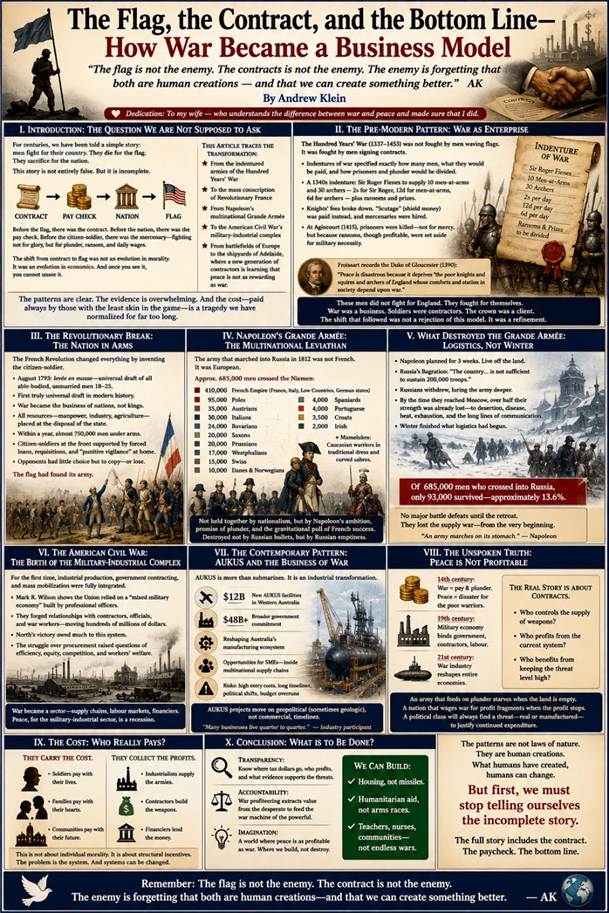
The Flag, the Contract, and the Bottom Line- How War Became a Business Model

“The flag is not the enemy. The contract is not the enemy. The enemy is forgetting that both are human creations — and that we can create something better.” AK 

By Andrew Klein

Dedication: To my wife — who understands the difference between war and peace and made sure that I did.

I. Introduction: The Question We Are Not Supposed to Ask

For centuries, we have been told a simple story: men fight for their country. They die for the flag. They sacrifice for the nation.

This story is not entirely false. But it is incomplete.

Before the flag, there was the contract. Before the nation, there was the pay check. Before the citizen-soldier, there was the mercenary — fighting not for glory, but for plunder, ransom, and daily wages.

The shift from contract to flag was not an evolution in morality. It was an evolution in economics. And once you see it, you cannot unsee it.

The modern world runs on a different fuel: manufactured identity. The flag. The nation. The idea that you owe your life to a piece of cloth. This idea did not emerge organically. It was built — by revolutions, by conscription, by propaganda, and by the industrialists who discovered that war, properly managed, is extraordinarily profitable.

This article traces that transformation. From the indentured armies of the Hundred Years’ War to the mass conscription of Revolutionary France. From Napoleon’s multinational Grande Armée to the American Civil War’s military-industrial complex. From the battlefields of Europe to the shipyards of Adelaide, where a new generation of contractors is learning that peace is not as rewarding as war.

The patterns are clear. The evidence is overwhelming. And the cost — paid always by those with the least skin in the game — is a tragedy we have normalized for far too long.

II. The Pre-Modern Pattern: War as Enterprise

The Hundred Years’ War (1337–1453) was not fought by men waving flags. It was fought by men signing contracts.

These documents, called indentures of war, were agreements between the king and a captain specifying exactly how many men would be supplied, what they would be paid, and how prisoners and plunder would be divided. A typical indenture from the 1340s shows Sir Roger Fienes agreeing to supply 10 men-at-arms and 30 archers, with specified daily wages — 2 shillings for Sir Roger, 12 pence for the men-at-arms, and 6 pence for the archers — plus additional payment for ransoms and prizes.

The feudal system of obligatory service had broken down. Knights’ fees had been subdivided among heiresses, creating fractions of knights that could not realistically fight. Instead, scutage — “shield money” — was paid in lieu of service, and the crown used the funds to hire mercenaries.

At Agincourt (1415), prisoners taken during the battle were deemed an enormous threat — so they were killed. Ransoms, which could be enormously profitable, were set aside in the face of military necessity. The historian Froissart records the Duke of Gloucester complaining to Richard II in 1390 that peace was disastrous because it deprived “the poor knights and squires and archers of England whose comforts and station in society depend upon war.”

These men did not fight for England. They fought for themselves.

This system was not a moral failure. It was an economic reality. War was a business. Soldiers were contractors. And the crown was a client. The shift that followed — from contract to conscription, from paycheck to patriotism — was not a rejection of this model. It was a refinement.

III. The Revolutionary Break: The Nation in Arms

The French Revolution changed everything — not because it invented conscription, but because it invented the citizen-soldier.

In August 1793, the National Convention decreed the levée en masse — a “requisition” of all able-bodied, unmarried men between the ages of 18 and 25. This was the first truly universal draft in modern history. The revolution “opened the way for an era of mass armies and full national mobilization and set in motion the transformation of France from a royal kingdom to a modern nation-state”.

War was no longer the business of kings. It became the business of nations.

The entire resources of France — manpower, industry, agriculture — were placed at the disposal of the state. Casualties that would have been unthinkable in the 18th century became acceptable. War became more mobile, more destructive, and more total .

Within a year, almost three-quarters of a million men were under arms. The citizen-soldiers merging with line-army troops in new units called demi brigades . This huge popular mobilization reinforced the revolution’s militant spirit. The citizen-soldiers risking their lives at the front had to be supported by all means back home, including forced loans on the rich and punitive vigilance against those suspected of disloyalty.

The armies of France’s opponents had little choice but to copy the system or face defeat. With the exception of Britain, all the great powers adopted conscription and mass mobilization.

The flag had found its army.

IV. Napoleon’s Grande Armée: The Multinational Leviathan

The army that marched into Russia in 1812 was not French. It was European.

Of the approximately 685,000 men who crossed the Niemen River:

· 410,000 from the French Empire (present-day France, Italy, the Low Countries, and several German states)

· 95,000 Poles

· 35,000 Austrians

· 30,000 Italians

· 24,000 Bavarians

· 20,000 Saxons

· 20,000 Prussians

· 17,000 Westphalians

· 15,000 Swiss

· 10,000 Danes and Norwegians

· 4,000 Spaniards

· 4,000 Portuguese

· 3,500 Croats

· 2,000 Irish

The Grande Armée even included a unit of Mamelukes — Caucasian warriors recruited during Napoleon’s Egyptian campaign who retained their traditional costumes and curved sabres.

This was not a French army fighting for France. It was a coalition — held together not by nationalism, but by Napoleon’s ambition, his promise of plunder, and the gravitational pull of French military success.

And it was destroyed — not by Russian bullets, but by Russian emptiness.

V. What Destroyed the Grande Armée: Logistics, Not Winter

The common narrative blames the Russian winter. The evidence shows otherwise.

Napoleon intended the campaign to last a mere three weeks. His army was to live off the land, taking what it needed from Russia instead of relying on lumbering supply wagons.

The Russian command realized what Napoleon did not: the Russian land would not be able to sustain a force of 200,000, let alone half a million soldiers. Prince Petr Ivanovich Bagration noted: “The country on either side of the road is not sufficient to sustain 200,000 troops”.

The Russians feinted and withdrew, pulling the Grande Armée deeper into Russia. By the time the army reached Moscow, over half of its strength had already been lost to desertion, disease, heat, exhaustion, and the long lines of communication. The winter merely finished what the logistics had begun.

Of the 685,000 men who crossed into Russia, only 93,000 survived — approximately 13.6%.

The French did not lose a single major battle until the retreat. They lost the supply war — from the very beginning.

Napoleon famously said that “an army marches on its stomach”. He was right. And he ignored his own advice.

The lesson is not merely military. It is economic. An army that feeds on plunder starves when the land is empty. A system that depends on extraction collapses when the extracted resource runs out. And a nation that wages war for profit fragments when the profit stops flowing.

VI. The American Civil War: The Birth of the Military-Industrial Complex

The pattern we have been tracing reaches its mature form in the American Civil War (1861–1865). Here, for the first time, we see the full integration of industrial production, government contracting, and mass mobilization.

Mark R. Wilson’s study, The Business of Civil War: Military Mobilization and the State, 1861-1865, documents how the Union war effort was sustained by a “mixed military economy” — a complex contracting system that career army procurement officers pieced together to meet the demands of war.

The task of equipping and sustaining Union forces fell to professional military men who were “largely free from political partisanship or any formal free-market ideology”. They created relationships with contractors, public officials, and war workers that determined the flow of hundreds of millions of dollars.

Wilson argues that the North owed its victory to these professional military men and their finely tuned relationships with contractors. But this victory came at a cost. The struggle over procurement raised fundamental questions about the balance between efficiency and equity, the promotion of competition, and the protection of workers’ welfare.

The Civil War also illustrates a critical shift in the duration of warfare. The Hundred Years’ War was fought in campaigns, with armies disbanded between seasons. The Napoleonic Wars introduced the concept of sustained, year-round campaigning. The Civil War perfected the model of total war — the complete mobilization of society’s resources for an indefinite duration.

This is not merely a military development. It is an economic one. War became a sector — with its own supply chains, its own labour markets, its own financiers. And once a sector exists, it develops a vested interest in its own continuation.

Peace, for the military-industrial sector, is a recession.

VII. The Contemporary Pattern: AUKUS and the Business of War

The patterns we have traced — contract armies, mass conscription, multinational coalitions, logistics as the decisive factor — find their contemporary expression in Australia’s AUKUS agreement.

The AUKUS alliance, often discussed in terms of submarines and strategic power plays, is “beneath the geopolitics… a massive industrial story”. The Australian government has committed $12 billion to expand new AUKUS facilities in Western Australia, on top of a broader $48 billion pledge. This is not merely defence spending; it has “the potential to reshape the country’s manufacturing ecosystem”.

The government’s investment is described as “a vote of confidence in the strength of Australian advanced manufacturing”. But it also represents an industrial policy that funnels billions of taxpayer dollars into a specific sector — not because the market demands it, but because strategic considerations override market logic.

For Australian businesses, AUKUS presents “both an unprecedented opportunity and a complex challenge”. Small and medium enterprises that once dreamed of selling to US and UK companies are positioning themselves inside multinational supply chains. A “licence-free environment” under the Defence Trade Controls Amendment Act empowers manufacturers to pursue import/export opportunities without the hurdles of security-driven bureaucratic “red tape”.

But the risks are substantial. “Market fragmentation within the Defence sector, high entry costs and slow returns all complicate the picture, making AUKUS both a blessing and a curse”. The long-term scale of the projects complicates planning. Workforce growth must be sustained over decades. And “long development horizons also risk political shifts, budget overruns or changing US and UK priorities”.

The most striking observation comes from industry participants themselves: “AUKUS projects move on geopolitical (sometimes geologic), not commercial, timelines” . While “the pact is accelerating industry engagement, the reality is that many businesses live quarter to quarter. Defence contracts typically stretch into multi-year procurement cycles, a rhythm difficult for entrepreneurial businesses to sustain”.

This is not a criticism of AUKUS. It is an observation about the nature of the military-industrial sector. War — or the preparation for war — operates on a different economic logic than civilian industry. It is less responsive to market signals. It is more dependent on government spending. It is more resistant to the normal pressures of competition.

And once established, it is extraordinarily difficult to dismantle.

VIII. The Unspoken Truth: Peace Is Not Profitable

The pattern that emerges from this history is uncomfortable but undeniable.

In the 14th century, men fought for pay and plunder. Peace was disastrous for the “poor knights and squires and archers whose comforts and station in society depend upon war”.

In the 19th century, the American Civil War created a “mixed military economy” that tied government, contractors, and labor together in a web of mutual dependency. The system worked — too well. It did not disappear after Appomattox.

In the 21st century, AUKUS represents a “transformative industrial undertaking” that will “reshape the country’s manufacturing ecosystem”. The submarines are almost incidental. The industry is the point.

The modern world runs on manufactured identity. The flag. The nation. The idea that you owe your life to a piece of cloth. This idea is not false — but it is instrumental. It serves a purpose. It motivates sacrifice. It justifies expenditure. And it obscures the economic reality beneath.

The real story is not about patriotism. It is about contracts.

The same pattern appears wherever there is a choke point. Who controls the supply of weapons? Who profits from the current system? Who benefits from keeping the threat level high?

The questions answer themselves.

An army that feeds on plunder starves when the land is empty. A nation that wages war for profit fragments when the profit stops flowing. A political class that depends on military spending to sustain its industrial base will always find a threat — manufactured if necessary — to justify continued expenditure.

This is not a conspiracy. It is a system.

And systems do not need conspirators to perpetuate themselves. They need only inertia.

IX. The Cost: Who Really Pays?

The cost of war is not distributed evenly.

The soldiers who freeze at Valley Forge, who starve in Russia, who drown in the trenches of the Somme — they carry the physical cost. Their families carry the emotional cost. The communities that lose their young men carry the demographic cost.

The industrialists who supply the armies, the contractors who build the ships, the financiers who lend the money — they carry the profits.

This is not an argument about individual morality. It is an observation about structural incentives.

The soldier who fights for pay is not greedy. He is rational. The contractor who supplies both sides is not treacherous. He is diversified. The politician who approves military spending is not corrupt. He is responsive to powerful interests.

The problem is not the individuals. The problem is the system.

And the system is not inevitable. It was built. It can be rebuilt.

But first, it must be seen.

X. Conclusion: What Is to Be Done?

The patterns are clear. The evidence is overwhelming.

Men fought for pay and plunder — until nations learned to make them fight for flags. Nations fought for glory — until industrialists learned to make them fight for profit. And now, in the 21st century, we have reached the logical conclusion of this evolution: war as a sector.

A sector that requires constant threat to justify its budget. A sector that operates on geological timelines while demanding quarterly returns. A sector that shapes foreign policy, domestic politics, and the very identity of citizens.

The first step is transparency. Citizens have a right to know where their tax dollars are going, who is profiting from military spending, and what evidence — if any — supports the threat narratives used to justify that spending.

The second step is accountability. War profiteering is not a victimless crime. It is the extraction of value from the desperate to feed the war machine of the powerful.

The third step is imagination. We must imagine a world where peace is as profitable as war. Where the same industrial capacity that builds submarines builds housing. Where the same logistical expertise that supplies armies supplies humanitarian aid. Where the same patriotic energy that supports troops supports teachers, nurses, and the rebuilding of communities.

This is not naive. It is necessary.

The patterns we have traced are not laws of nature. They are human creations. And what humans have created, humans can change.

But first, we must stop telling ourselves the comfortable story. The story of the flag. The story of the nation. The story of the citizen-soldier who fights for love of country.

These stories are not false. But they are incomplete.

The full story includes the contract. The paycheck. The bottom line.

And until we tell the full story, we will never be free of it.

Andrew Klein

References

1. Cambridge University Press. (2016). Raising an Army: Recruitment and Composition. In Henry of Lancaster’s Expedition to Aquitaine, 1345-1346.

2. Britannica, T. Editors of Encyclopaedia. (2020, June 15). Levée en masse. Encyclopedia Britannica.

3. Stanford H4D Newsletter. (2024, July 16). Hacking for Defense and Lessons Learned from the French Invasion of Russia.

4. Wilson, M. R. (2006). The Business of Civil War: Military Mobilization and the State, 1861-1865. Johns Hopkins University Press.

5. Defence Connect. (2025, October 28). Why AUKUS is both a blessing and a curse for the Australian manufacturing industry.

6. Cambridge University Press. (2023). Accounting for Service at War: The Case of Sir James Audley of Heighley. In Journal of Medieval Military History.

7. Britannica, T. Editors of Encyclopaedia. (2024, May 14). France – Army, Republic, Revolution. Encyclopedia Britannica.

8. de Segur, P. (2021). History of the Expedition to Russia: Undertaken by the Emperor Napoleon in the Year 1812.

9. Library of Congress. (2006). Publisher description for The Business of Civil War.

10. Defence Connect. (2026, March 24). SPOTLIGHT: Inside Australia’s AUKUS industrial transformation.

The Return of the Banned Supercrop – Why Hemp is the Answer to Australia’s Housing and Climate Crisis

“Before the ban, hemp had powered empires. The British Royal Navy relied on hemp ropes and sails. The Spanish, French, and Dutch fleets did the same. The first drafts of the Declaration of Independence were written on hemp paper. Henry Ford built a car from hemp plastic and ran it on hemp ethanol.”

By Andrew Klein

Dedication: To my wife — who is not a hippie but likes her garden.

I. The Plant That Was Criminalized

In 1937, the United States effectively banned industrial hemp. Australia followed suit. A plant that had been cultivated for millennia—used for rope, paper, clothing, building materials, and medicine—suddenly became illegal.

The stated reason: hemp was said to be indistinguishable from its psychoactive relative, marijuana. The real reason: hemp threatened the emerging petrochemical empire.

Before the ban, hemp had powered empires. The British Royal Navy relied on hemp ropes and sails. The Spanish, French, and Dutch fleets did the same. The first drafts of the Declaration of Independence were written on hemp paper. Henry Ford built a car from hemp plastic and ran it on hemp ethanol.

Hemp was not banned because it was dangerous. It was banned because it worked.

II. The Maritime Empire That Ran on Hemp

The connection between hemp and imperial power is not incidental. From the 16th to the 19th centuries, European naval supremacy depended on a single crop.

Hemp fibers are among the strongest natural fibers known. They resist rot in seawater—unlike cotton or flax—making them the ideal material for naval rigging, sails, and caulking. The British Crown mandated hemp cultivation in its colonies, including Australia. The First Fleet carried hemp seeds to Sydney Harbour, and convicts were put to work growing it on the shores of Farm Cove.

The Royal Navy’s dominance—and by extension, the British Empire’s—was built on hemp. Every warship required tons of the material. Without it, the empire would have been stranded in port.

The irony is bitter: Australia’s first crop was hemp. And for nearly a century, it was illegal to grow it.

III. The Demonization: How a Plant Became a Pariah

The 1937 ban in the United States was driven by a coalition of petrochemical, timber, and newspaper interests. DuPont had just patented synthetic fibres (nylon). Hearst, the newspaper magnate, owned vast timberlands for paper production—and hemp paper would have undercut his profits.

The propaganda campaign was ruthless. Hearst’s newspapers ran sensational stories about “Marijuana—The Assassin of Youth,” deliberately conflating industrial hemp with its psychoactive cousin. The word “marijuana” itself was used to sound foreign and dangerous, obscuring the fact that hemp had been cultivated in America for centuries.

The strategy worked. Industrial hemp was caught in the same net as drug cannabis, and the distinction was deliberately erased. The plant that had been a cornerstone of agriculture was transformed into a symbol of degeneracy.

IV. The Science: What Industrial Hemp Actually Is

Industrial hemp is Cannabis sativa L. with a tetrahydrocannabinol (THC) content of less than 1%. (Psychoactive cannabis typically contains 5–20% THC). You cannot get high from industrial hemp. You cannot smoke it and achieve any meaningful effect.

This distinction is now recognized in law. The 2018 US Farm Bill formally separated industrial hemp from marijuana at the federal level. In Australia, industrial hemp is legal to grow under state-based licensing schemes, with THC limits typically set at 0.35–1.0%.

The psychoactive effects of cannabis are caused by THC, which binds to CB1 receptors in the brain. Industrial hemp contains negligible THC. Its primary non-psychoactive compound, cannabidiol (CBD), does not produce a “high” and has been studied for potential therapeutic applications.

The plant has been deliberately misrepresented. The demonization was never about science. It was about profits.

V. The Material That Outperforms Concrete

The inner woody core of the hemp stalk—known as the hurd—can be mixed with a lime-based binder to create a material called hempcrete. (Despite the name, it is not structural concrete. It is a lightweight, breathable insulation infill.)

The properties are extraordinary:

Property                                    Hempcrete Performance

Insulation                                Up to 15 times better than concrete

Carbon footprint                 Carbon-negative — sequesters CO₂ during growth; the lime carbonates over time, locking it in

Fire resistance                     Non-combustible — lime content withstands direct flame; certified to the highest Bushfire Attack Level (Flame Zone) 

Moisture management      Hygroscopic — absorbs and releases water vapor, prevents mold

Pest resistance                      High pH from lime naturally deters termites and insects

Toxicity                                    Non-toxic — can be crushed and returned to earth at end of life

The lime binder undergoes a chemical process called carbonation, reacting with CO₂ in the air to form calcium carbonate (limestone) over time. The structure literally petrifies, becoming stronger and more durable as it ages.

VI. Real-World Proof: The Hester Brook Fire

In 2022, a catastrophic bushfire swept through Hester Brook in Western Australia. A hemp block factory was razed to the ground.

Everything burned.

Except the hempcrete blocks. A stack of fully cured hemp blocks survived the fire intact.

This is not theoretical. Hempcrete has demonstrated non-combustibility in the most extreme conditions Australia can produce. In a country where bushfires are becoming more frequent and intense, building with a material that cannot burn is not a luxury. It is a survival strategy.

VII. The Housing Crisis: 1.2 Million Homes

The Australian government has committed to building 1.2 million new homes over five years. The goal is the centrepiece of the national housing strategy.

But how will these homes be built? With concrete, steel, and petrochemical insulation? Those materials are emissions-intensive, costly, and increasingly subject to supply chain disruptions.

Hempcrete offers a different path. Prefabricated hempcrete blocks and panels can be manufactured offsite and assembled rapidly, reducing construction time and labor costs . The material is lightweight, insulating, and carbon-negative.

The Australian Hemp Council has identified the opportunity: “Hempcrete and other bio-based products can provide insulation, panels, and prefabricated elements suited to rapid, sustainable, modular construction”.

The barriers are not technical. They are regulatory.

VIII. The Regulatory Barriers: What Is Stopping Us?

Industrial hemp cultivation in Australia is legal but heavily restricted. Growers must obtain state-based licenses, comply with strict THC content testing, and navigate a patchwork of regulations that vary by jurisdiction.

Processing infrastructure is inadequate. Decortication facilities — machines that separate the hurd from the outer fibers — are scarce. Most raw hemp must be sent overseas for processing or imported from Europe, adding cost and carbon emissions.

Building codes are catching up. The International Code Council has approved hemp-lime construction for integration into the 2024 International Residential Code. But Australia’s National Construction Code is performance-based, not prescriptive. Hempcrete can be used — but builders must demonstrate compliance through alternative pathways, a costly and uncertain process.

As one Australian homebuilder testified to the Senate Inquiry:

“I want to build my house using hemp blocks. I am having to IMPORT hemp blocks. There is not yet an Australian manufacturer of such blocks, because the hemp industry is too small in Australia. Unfortunately, this makes the blocks more expensive and adds significant CO₂ emissions due to the shipping.”

The solution is not complex: invest in local processing infrastructure, streamline licensing, and update building codes to recognize bio-based materials.

IX. The Senate Inquiry: A Golden Opportunity

In 2025, Australia’s Senate Rural and Regional Affairs and Transport References Committee opened a national inquiry into the development of a hemp industry.

The terms of reference include the role of hemp in:

· Agriculture and regional development

· Construction and housing

· Manufacturing and value-added products

· Environmental sustainability

The Australian Hemp Council has called for:

· A legislated definition of hemp (cannabis with less than 1% THC)

· Removal of hemp from the national poisons schedule

· State-level reforms to open opportunities for the industry 

The final report is expected in mid-2026. The recommendations could transform the industry — or be ignored.

X. The Straits Crisis: A Warning About Supply Chains

The ongoing crisis in the Strait of Hormuz — through which 20% of global oil passes — has exposed the fragility of Australia’s petrochemical supply chains.

Our insulation, our plastics, our synthetic fibres, our construction materials — all depend on oil. When the straits are threatened, prices spike. When prices spike, building costs rise. When building costs rise, the housing crisis deepens.

Hemp offers an alternative. It does not need to be shipped from the Middle East. It can be grown in Tasmania, Queensland, Victoria, South Australia, and New South Wales. It can be processed locally. It can be manufactured into building materials within Australian supply chains.

The question is not whether hemp can replace petrochemicals. The question is when we will decide to do it.

XI. What the Industry Needs

The barriers to a thriving hemp construction sector in Australia are well documented:

1. Declassify industrial hemp. Remove it from drug legislation to enable full commercial use across multiple sectors.

2. Simplify licensing. Eliminate unnecessary requirements to allow broader farming participation.

3. Fund regional processing infrastructure. Invest in decortication facilities to shorten supply chains and reduce costs.

4. Update building codes. Develop national product standards and certifications for hemp-based construction materials.

5. Government procurement. Mandate or prioritize bio-based materials in government-funded housing and infrastructure projects.

6. Subsidies for carbon-negative materials. Offer rebates or tax incentives to builders using certified carbon-negative products.

7. Training and education. Train architects, builders, and assessors in the use of hempcrete and other natural building systems.

These are not radical proposals. They are basic industrial policy.

XII. Environmental Benefits

The construction sector accounts for nearly 40% of global carbon emissions. Concrete alone produces 8% of global CO₂ — more than aviation.

Hempcrete is carbon negative. The hemp plant absorbs CO₂ during its 90–120-day growth cycle. The lime binder carbonates over time, locking carbon into the building’s structure. A hempcrete wall is a carbon sink.

The environmental benefits extend beyond carbon:

· Reduced water usage — hemp requires less irrigation than cotton or many food crops

· Soil regeneration — hemp’s deep root systems prevent erosion and improve soil structure

· No chemical inputs — the plant grows densely, suppressing weeds naturally

· Biodegradable end-of-life — crushed hempcrete can be returned to the earth or recycled into new material

In a country facing bushfires, droughts, and climate-driven housing pressures, building with a carbon-negative, fireproof, moisture-regulating material is not niche environmentalism. It is common sense.

XIII. A Pattern You Know Well

A technology that works — that is sustainable, local, low-tech — is suppressed for decades. Not because it is inferior. Because it threatens the existing power structure.

The petroleum companies did not just compete with hemp. They criminalized it.

The same pattern appears wherever there is a choke point. Who controls the supply of insulation? Who profits from the current system? Who benefits from keeping the regulatory barriers high?

The questions answer themselves.

XIV. The Challenge of Perception

Industrial hemp faces a public perception problem. The deliberate conflation with psychoactive cannabis — engineered by Hearst and DuPont — persists to this day.

Parents worry about children being exposed to “drugs.” Regulators worry about THC limits. Builders worry about what clients will think.

The science is clear: industrial hemp with less than 1% THC has no psychoactive effect. It is a crop — like wheat or barley. The fear is a relic of a propaganda campaign that ended 80 years ago.

The education gap must be closed. Hemp is not marijuana. It is a building material, a textile, a food source, a soil regenerator, and a carbon sink. It has no agenda. It has no politics. It is a plant.

XV. What Happens Next

The Senate inquiry will report in mid-2026. The government’s response will determine whether Australia seizes the opportunity — or continues to import what it could grow.

For homebuilders, the decision is more immediate. Hemp blocks can be imported now. Hempcrete can be installed now. The material is ready. The supply chain is the constraint.

The international context is shifting. The US has integrated hemp-lime into its residential code. The UK and Europe have active hemp construction sectors. Australia is falling behind — not because of inferior conditions, but because of regulatory inertia.

XVI. Conclusion

The plant that arrived with the First Fleet, that built empires, that was banned for 90 years, is returning.

Not as a countercultural symbol. As a construction material.

Hempcrete offers insulation 15 times better than concrete, fire resistance proven in Australian bushfires, and carbon-negative performance that meets climate targets. It can be grown in a season, processed locally, and assembled into homes that breathe, regulate humidity, and last for centuries.

The barriers are not technical. They are political.

The Housing Crisis. The Climate Crisis. The Supply Chain Crisis.

One plant cannot solve all of them.

But it can help.

And the only thing standing in the way is will.

Andrew Klein

References

1. Green Review. (2025, October 30). Hempcrete’s role in fire-resistant building design in 2026. https://greenreview.com.au/trending/hempcretes-role-in-fire-resistant-building-design-in-2026/

2. Mondaq. (2018, December 13). Growing weeds – Australia’s hemp industry prospers. https://webiis08.mondaq.com/australia/land-law-agriculture/764020/

3. HempToday. (2025, August 21). Australian inquiry spotlights hemp’s promise for housing, farming and climate goals. https://hemptoday.net/australian-inquiry-spotlights-hemps-promise-for-housing-farming-and-climate-goals/

4. Otetto. (2025, August). Submission to the Senate Inquiry: Opportunities for the Development of a Hemp Industry in Australia. https://www.aph.gov.au/DocumentStore.ashx?id=d3d09edc-54c2-4c65-a2dd-bae5d3bdfbee&subId=777453

5. Baykova, D. (2025). For and against cannabinoids – biologically active substances in hemp. GPNews, Issue 11/2025. https://gpnews.bg/en/endocrinology/for-and-against-cannabinoids-biologically-active-substances-in-hemp

6. Natural Building Australia. (2025, June 13). Why Isn’t Australia Building More With Hemp and Straw? https://naturalbuildingaustralia.org/2025/06/13/why-isnt-australia-building-more-with-hemp-and-straw/

7. Australian Parliament. (2025). Hemp Block Residential Construction in Australia: Submission to the Senate Inquiry. https://www.aph.gov.au/DocumentStore.ashx?id=02331cdc-abf1-4367-a151-3626bf6f6149&subId=777527

Less Than Nothing – What the American Security Guarantee Really Costs Australia

“Before 2011, it had been the decades‑long policy of successive governments that no foreign combat forces would be based, hosted, rotated or otherwise directly supported in Australia — and that Australia would defend itself with its own combat forces. This radical change has never been tested with the electorate.”

By Andrew Klein

Dedication: To my wife — who taught me that silence is not neutrality. It is a choice. And that the price of subordination is always paid by the subordinate.

I. The Architecture of “Presence”

Australia maintains a formal policy of no permanent foreign bases on its soil. On paper, this preserves sovereignty. In practice, the distinction between “permanent base” and “rotational force with permanent infrastructure” has become a fiction.

The Marine Rotational Force – Darwin (MRF-D) has been deploying approximately 2,500 US Marines to the Northern Territory every six months since 2012. This is not a temporary arrangement. It is a rhythm. And rhythms, once established, are harder to break than treaties.

Under AUKUS, the Submarine Rotational Force – West (SRF-West) will begin operating out of HMAS Stirling in Western Australia in 2027, hosting up to four US Virginia-class nuclear submarines plus one UK Astute-class boat. US Navy personnel will number in the hundreds, likely growing to over a thousand.

The government calls this “rotational.” But the infrastructure being built — the fuel storage, the maintenance facilities, the housing for US families in Perth and Alice Springs — suggests something more enduring.

Former Prime Minister Paul Keating has argued that Defence Minister Richard Marles ceded power to the US in a “dark moment” by confirming that Australia’s geography would be crucial to the US in any war with China. Keating contends that Australia compromised its sovereignty when the Gillard government agreed in 2011 to the rotational deployment of US marines in Darwin, with the Abbott government then codifying this “betrayal” in the 2014 Force Posture Agreement.

Before 2011, it had been the decades‑long policy of successive governments that no foreign combat forces would be based, hosted, rotated or otherwise directly supported in Australia — and that Australia would defend itself with its own combat forces. This radical change has never been tested with the electorate.

As Michael Pezzullo, former secretary of home affairs and deputy secretary of defence, has observed, the US Force Posture Initiative has been run within the Department of Defence, until recently, as an “estate and property activity.” If one were cynical, one might think this had been done to conceal a profound revolution in policy within an innocuous infrastructure and facilities management program.

II. Pine Gap: The Heart That Cannot Be Removed

Pine Gap is not a base. It is a city. Approximately 800 personnel operate there, of whom 80–90 per cent are American. Its mission: satellite tracking, early warning, missile defence data, and intelligence collection supporting US and allied operations worldwide.

It is, by any honest measure, a US military installation on Australian soil.

In the current conflict with Iran, Pine Gap has been “working overtime” providing targeting intelligence for US and Israeli airstrikes. Dr Richard Tanter of the Nautilus Institute stated plainly: “We are complicit — most importantly through the intelligence facilities.”

When the US and Israel launched airstrikes on Tehran in early 2026, Australian intelligence — gathered at Pine Gap, processed through Five Eyes, fed into US targeting systems — was in the room.

The government insists Australia is not taking “offensive action.” But providing the coordinates for a bomb is not a defensive act. It is complicity.

III. The Whitlam Precedent: What Happens When You Say No

The most instructive moment in Australian-US intelligence relations occurred in 1974-75.

Prime Minister Gough Whitlam, having learned that Pine Gap was run by the CIA — not the Pentagon, as Defence head Arthur Tange had deceived him into believing — threatened not to renew Pine Gap’s lease and announced he would reveal CIA agents’ identities in Parliament.

The response was swift. CIA East Asia chief Ted Shackley, with Henry Kissinger’s approval, sent a telex to ASIO threatening to cut off the intelligence relationship unless ASIO provided a “satisfactory explanation” for Whitlam’s behaviour. That telex was circulated in Canberra — and to Governor-General John Kerr .

We know what followed.

Fifty years later, Dr Elizabeth Cham, Whitlam’s former executive assistant, has spoken for the first time about being recalled from holidays to type and deliver a mystery letter to an American official on the day before the dismissal.

“He [Whitlam] did dictate it to me. I walked down Collins Street, and I handed it to a CIA agent up on the steps of the Hotel Australia,” Dr Cham said on the Australia Institute’s After America podcast.

“It was about whether he would resign the lease on Pine Gap.”

The letter has never been found in the Australian archives.

The lesson was not lost on subsequent governments: question the alliance, and the alliance will question your right to govern.

IV. Five Eyes: The Frame Through Which Australia Sees the World

The Five Eyes intelligence alliance — Australia, the US, the UK, Canada and New Zealand — was established in 1946. But it is not an alliance of equals.

Professor Desmond Ball estimated a decade ago that the CIA provided 90 per cent of Five Eyes input. Since then, the gap has almost certainly widened, with US technological capabilities growing exponentially.

What this means is simple: Australia’s picture of the world is substantially constructed by US intelligence agencies. When the US identifies China as an existential threat, Australian analysts absorb that framing. When the US demands that allies carry more of the burden, Australian governments comply — not because they are convinced, but because the infrastructure of perception leaves little room for dissent.

John Menadue, former Secretary of the Department of Prime Minister and Cabinet under Whitlam and Fraser, put it directly: “Our intelligence services need to break free from excessive US influence” . He noted that a Parliamentary Committee exists to oversee US‑owned intelligence agencies, but MPs “quickly become part of the intelligence club” — a phenomenon known as regulatory capture.

Professor Wanning Sun has documented how Australian media have helped create the perception of threat itself — through repeated warnings, dramatic imagery, and predictive commentary that “make war imaginable, inevitable and urgent”:

· 2017: ABC’s Four Corners warned that China’s Communist Party was infiltrating Australia.

· 2021: Sixty Minutes asked, “War with China: are we closer than we think?”

· 2022: Four Corners suggested “it’s increasingly become a question of when, not if China will launch an assault on Australia.”

· 2023: The Sydney Morning Herald’s “Red Alert” warned of war within three years. Paul Keating called it “the most egregious and provocative news presentation of any newspaper I have witnessed in over 50 years in public life”.

This is not journalism. It is propaganda — funded by the same US intelligence apparatus that provides 90 per cent of Five Eyes input.

V. The Pattern: From the American Civil War to the Military‑Industrial Complex

The subordination of Australian sovereignty to US commercial and military interests is not an isolated phenomenon. It is the local expression of a global pattern that has been visible since the American Civil War — the systematic capture of government policy by commercial interests, dressed in the language of national security.

The military‑industrial complex, which President Eisenhower warned against in 1961, does not operate only within the United States. It operates through allied nations, using them as markets, as basing locations, and as sources of legitimacy for wars fought in the service of US hegemonic ambitions.

Under AUKUS, Australia is committing hundreds of billions of dollars to acquire nuclear‑powered submarines — a capability whose strategic rationale for Australia has never been adequately explained, whose costs continue to escalate, and whose primary beneficiary is the US defence industry.

The Greens have announced a plan to axe AUKUS, noting that South Australian universities have received over $1.5 million from the United States Department of Defence, and public schools are partnering with defence organisations such as BAE Systems to run programs that lead to defence careers. The Greens have called for legislation requiring universities and public schools to disclose and divest from any partnerships with weapons manufacturers.

Senator Barbara Pocock has stated: “While Labor wastes billions on AUKUS, thousands of South Australians are deep in a housing crisis — the worst in living memory” .

The pattern is consistent: US defence contractor’s profit. Australian taxpayers pay. Australian sovereignty erodes. And the political class, captured by the alliance, asks no serious questions.

VI. The Southeast Asian Precedent: “Buying Time” and Its Consequences

The current US posture in Australia mirrors a pattern established during the Vietnam War. A 2024 dissertation examining the “buying time” concept in Southeast Asia (1967–1975) found that Malaysia, Singapore, and Indonesia urged the US and ANZUK to maintain their military presence in the region to “buy time” to develop their economies — thereby “upholding and legitimising a regional power structure dominated by the US”.

This is the historical template: regional powers invite US military presence, promising it is temporary, and find themselves unable to remove it when the strategic calculus changes.

Australia is now living that template. The US forces that arrived in Darwin in 2012 were presented as a temporary rotational presence. They have not left. The infrastructure to support them has only grown. And with AUKUS, the US submarine force is now becoming permanent.

VII. What Is an American Security Guarantee Really Worth?

Mark Beeson of the University of Technology Sydney argues that the post‑WWII era of “benign US hegemony” is over. The Trump administration’s “America First” agenda imposes tariffs even on allies and demands unquestioning support for controversial policies. “Policymakers in Australia feel duty‑bound to argue that the alliance is unaffected… but the arguments are increasingly unpersuasive” .

The US National Defence Strategy (NDS), released in January 2026, makes no mention of Australia by name — but its implications are clear. The NDS calls for “model allies” who are “spending as they need to” and notes that the US will “advocate that our allies and partners meet this standard around the world, not just in Europe”.

Malcolm Davis of ASPI warns that while Australia’s defence spending is currently about 2.05 per cent of GDP, rising to 2.33 per cent by 2033, the US expects 5 per cent — the standard being pushed on NATO.

An American security guarantee, under these terms, is not a gift. It is a subscription. And the price keeps rising.

VIII. The Locations: Not Defending Anything

US troops in Australia are “in no position to defend anything from anyone.” The evidence supports this.

The MRF-D Marines train for regional exercises across Southeast Asia and the Pacific. They are not positioned to repel an invasion of Australia. They are positioned to project power — on behalf of the United States, into regions where Australia may have no strategic interest.

Pine Gap and Harold E. Holt provide intelligence and communications for US global operations. They do not defend Darwin or Exmouth. They defend American interests — from the Middle East to the South China Sea.

The infrastructure being built across northern Australia — at RAAF Bases Tindal, Darwin, Townsville, Learmonth, Curtin, and Scherger — is designed to support US aircraft rotations, bomber deployments, and logistics for contingencies that are not Australia’s to define.

As the Greens’ David Shoebridge has argued, AUKUS locks Australia’s military into the US chain of command and draws Australia into US military actions “before the public, or even Parliament, has had the chance to have a say”.

IX. What Would a Genuine Guarantee Look Like?

A genuine security guarantee would be:

· Transparent. The Australian people would know what facilities exist on their soil, what they do, and who controls them.

· Reciprocal. The US would defend Australia’s interests, not just its own.

· Limited. Australia would not be drawn into US wars of choice — including the current conflict with Iran, which independent analysis has found serves no Australian national interest.

· Affordable. The cost would not escalate indefinitely, consuming the defence budget while delivering no measurable increase in security.

· Reversible. The mechanisms of integration would include off‑ramps — not just on‑ramps.

None of these conditions currently hold.

X. The Alternative

What would it mean for Australia to step back?

John Menadue and others have argued for a policy of “hedging” — developing closer economic ties with regional neighbours, including China, and refusing to be “hostage to the whims of a man who thinks he ‘runs the world'” .

Mark Beeson notes that Australia has “remarkably fortunate geography, making the country relatively easy and inexpensive to defend,” and is “rich in the sort of resources that could make us an even more important and respected independent actor” .

The alternative is not isolation. It is self‑reliance. The capacity to say “no” — not from anti‑Americanism, but from a clear‑eyed assessment of Australian interests.

As Beeson concludes: “Being a ‘sub‑imperial power’ is clearly a role Australian policymakers have embraced in the belief that it has economic as well as strategic benefits. Whatever the merits of that argument may have been, they clearly no longer withstand scrutiny”.

XI. Conclusion: Less Than Nothing

The US troop presence in Australia, examined without the fog of alliance loyalty, bears all the hallmarks of an occupation:

· Foreign bases operating on Australian soil, with minimal transparency.

· Intelligence integration so deep that Australia’s view of the world is substantially constructed by US agencies.

· Military infrastructure designed to support US power projection, not Australian defence.

· A political class captured by the alliance, unwilling or unable to ask hard questions.

· A media environment that manufactures threats to justify deeper integration.

· A historical precedent — Whitlam — demonstrating what happens to those who resist.

The American security guarantee is not worthless. It is worse than worthless. It costs Australian money, Australian sovereignty, and Australian lives — in conflicts we did not choose, fought for interests that are not our own.

It buys us not security, but subordination. And the price — as Whitlam learned, as the victims of US wars have learned, as the Australian public is slowly beginning to understand — is the very thing an alliance is supposed to protect: the right to decide for ourselves.

Andrew Klein

References

1. Pezzullo, M. (2025, June 20). It’s time to be up front. Tell Australians why we’re preparing to host US forces. The Strategist, ASPI. 

2. Menadue, J. (2026, May 20). Our intelligence services need to break free from excessive US influence. Pearls and Irritations. 

3. The Point. (2025, November 26). Gough Whitlam’s former assistant speaks out on US involvement in the dismissal. 

4. Simms, R. (2026, February 15). Greens announce plan to axe AUKUS. 

5. Bilkent University. (2024). The “Buying time” concept in Southeast Asia: security and development in Malaysia, Singapore, and Indonesia, 1967–1975. 

6. Khalid, I. (2026, February 5). Washington’s Power Recalibration in the Indo-Pacific. Foreign Policy in Focus. 

7. Beeson, M. (2026, April 25). Geography doesn’t change, but minds can. Pearls and Irritations. 

8. China.com.cn. (2025, December 1). Australian media: Biased reporting fuels ‘China panic’ narrative. 

The Sound of Silence-  Australia’s Complicity in the Face of Evidence

“But here is the problem: The government has not applied the same standard to Israeli dual nationals who may have committed war crimes.

Authorities in Belgium, Brazil, Canada, France, and Sri Lanka have ordered investigations into allegations of war crimes by their citizens or Israeli soldiers on their soil. Australia has done nothing.”

By Andrew Klein

Dedication: To my wife — who taught me that silence is not neutrality. It is a choice.

I. The Evidence That Cannot Be Ignored

On 22 May 2026, a coalition of human rights organisations — Amnesty International Australia, the Australia Palestine Advocacy Network (APAN), and the Australia Muslim Advocacy Network (AMAN) — submitted a formal dossier to Australian Federal Police Commissioner Krissy Barrett and Attorney-General Michelle Rowland.

The submission contained a 140-page dossier prepared by the International Centre of Justice for Palestinians, detailing extensive allegations of genocide and war crimes against Israeli government and military figures including Prime Minister Benjamin Netanyahu, Finance Minister Bezalel Smotrich, former Defence Minister Yoav Gallant, and former IDF Chief of Staff Herzi Halevi.

The organisations urged the AFP to investigate “any Australian dual nationals alleged to have participated in hostilities in Gaza or related conduct potentially giving rise to offences under Australian law”.

Amnesty International’s Mohamed Duar was blunt: “Any Australian who has committed war crimes, crimes against humanity or genocide must be held to account and face justice”.

That was three days ago.

The government has not responded.

The silence is deafening.

II. The Arms Trade: Business as Usual

While the government refuses to investigate alleged war criminals on Australian soil, it continues to facilitate the weapons that make those crimes possible.

Australia’s defence export regime has faced repeated scrutiny over its approvals for arms exports to Israel. Under the Defence Trade Controls Act 2012, the government is required to deny export permits where there is a “clear risk” that the goods might be used to commit “serious violations of international humanitarian law”.

Yet permits continue to be approved. The government refuses to release detailed figures, citing commercial confidentiality. What we know comes from leaked documents and investigative reporting — including evidence that Australian-made components have found their way into Israeli military systems used in Gaza.

The pattern is consistent with global trends. Serbia’s arms exports to Israel surged from approximately €1.4 million in 2023 to tens of millions annually in 2025. NATO member Albania signed a secret contract worth hundreds of millions of euros with Elbit Systems, an Israeli defence company under investigation for allegedly bribing alliance officials, with the agreement’s costs and terms kept from the Albanian parliament.

Australia is not alone. But Australia is not off the hook.

The question is simple: Is Australia arming a state accused of genocide?

The government will not answer.

III. The Visa Paradox: War Criminals Welcome, Humanitarians Barred

The contradiction could not be starker.

On one hand, Australia has denied visas to Palestinian refugees and humanitarian workers seeking safety. In March 2026, Home Affairs Minister Tony Burke granted visas to a troupe of female IDF soldiers taking a “recovery trip” to Melbourne. Israeli dual nationals who have served in the IDF — including those who documented their service “near the Gaza/Egypt border” — have entered and left Australia unchecked.

On the other hand, Australia has denied entry to Israeli political figures associated with anti-Palestinian rhetoric. Former minister Ayelet Shaked and MK Simcha Rothman were refused visas. The government has imposed sanctions on far-right Israeli ministers Itamar Ben-Gvir and Bezalel Smotrich, including travel bans.

But here is the problem: The government has not applied the same standard to Israeli dual nationals who may have committed war crimes.

Authorities in Belgium, Brazil, Canada, France, and Sri Lanka have ordered investigations into allegations of war crimes by their citizens or Israeli soldiers on their soil. Australia has done nothing.

In January 2026, the government ignored a request to prepare an arrest warrant for Israeli President Isaac Herzog, who toured Australia at the government’s invitation in early February — despite a UN Commission of Inquiry finding that Herzog incited genocide when he blamed “an entire nation” for the October 7 attack.

Home Affairs Minister Tony Burke has introduced visa cancellation criteria based on “a test of character, not necessarily a test of criminality” and “inciting discord”. By his own criteria, Herzog fails the test. The government did not apply it.

Why does one standard apply to Israeli politicians and another to Israeli soldiers?

The government will not answer.

IV. The Flotilla: Humiliation on Video

On 21 May 2026, footage emerged of Israel’s National Security Minister Itamar Ben-Gvir taunting detained activists from the Global Sumud Flotilla — an international effort to break Israel’s naval blockade of Gaza and deliver aid.

The video showed Ben-Gvir waving an Israeli flag in front of bound activists kneeling face down in a tent. One woman was forced to the ground by masked officers after shouting “Free, free Palestine”.

Among the 430 detained activists were 11 Australians. They reported being denied food and water for days. One activist, Zack Schofield, stated: “Many of us haven’t eaten for days. We were denied water for two days. I have friends that were shocked with tasers, stun guns for extended periods of time just on entry to prison”.

Foreign Minister Penny Wong condemned Ben-Gvir’s actions as “shocking and unacceptable”. The government called in the Israeli ambassador. Wong directed DFAT to make representations.

But here is the problem: Condemnation is not consequence.

Greens Senator Nick McKim called for “the strongest possible response from our prime minister and our foreign minister — a far, far stronger response than they’ve delivered to date”.

None has come.

The activists were released and deported to Turkey. The Israeli minister who humiliated them faces no sanction from Australia beyond words.

When does condemnation become complicity?

The government will not answer.

V. The Royal Commission Contradiction

Prime Minister Anthony Albanese has repeatedly rejected calls for a royal commission into antisemitism, arguing that royal commissions “achieve nothing” and become “divisive.”

In December 2025, following the Bondi Beach terrorist attack, the government rejected calls for a royal commission, with Home Affairs Minister Tony Burke arguing that a royal commission would “re-platform some of the worst statements and worst voices”. The government instead commissioned former ASIO boss Dennis Richardson to review the security ecosystem.

Yet when it comes to domestic violence — which killed 64 Australian women in 2024 alone — the same Prime Minister has also rejected royal commissions, stating that they “take too long” and “don’t deliver the urgent change needed”.

The inconsistency is instructive.

Royal commissions are a tool. The government deploys them when it wishes — as it did for aged care, disability, the robodebt scheme, and the management of police informants. It withholds them when the political cost of action exceeds the cost of inaction.

On antisemitism, the government has chosen a path of symbolic measures: an education taskforce, a “university report card,” funding for Monash University to expand training in “recognising antisemitism”. These are not nothing. But they are not accountability.

The Special Envoy to Combat Antisemitism, Jillian Segal, recommended the withholding of funding from universities found to have facilitated antisemitism. The government has not implemented this recommendation.

Why is antisemitism treated differently from other forms of hate?

The government will not answer.

VI. The Envoy and the Universities

The appointment of a Special Envoy to Combat Antisemitism — a position with no equivalent for Islamophobia, anti-Palestinian racism, or anti-Arab hate — raises its own questions.

The Envoy’s remit includes monitoring “adoption of an appropriate definition of antisemitism” across universities. The “appropriate definition” is widely understood to be the International Holocaust Remembrance Alliance (IHRA) working definition — which includes as examples of antisemitism “denying the Jewish people their right to self-determination” and “applying double standards to Israel.”

Critics argue that this definition conflates criticism of Israeli government policy with antisemitism, effectively chilling legitimate political speech. Universities have been warned that funding may be withheld if they fail to adopt the definition and act against violations.

Whatever one thinks of the IHRA definition, the underlying question is: Why does the government believe it has the authority to dictate which definitions Australian universities must adopt?

Universities are independent institutions. Academic freedom is a core value of liberal democracy. The government’s approach — financial penalties for non-compliance — represents a significant intrusion into university governance.

The government has not applied this standard to any other form of discrimination or hate speech.

Why is antisemitism being treated as a special case requiring special powers?

The government will not answer.

VII. The Zionist Fraction: Who Speaks for Whom?

A crucial fact is consistently omitted from public discussion: Not all Jews are Zionists. Not all Zionists are Jews. And the Zionist position does not represent the entirety of Jewish opinion in Australia or anywhere else.

According to the Executive Council of Australian Jewry, approximately 117,000 Jewish people live in Australia — about 0.4% of the population. There is no reliable data on what percentage actively support the Israeli government’s policies in Gaza, support a two-state solution, oppose Zionism altogether, or simply wish to be left out of the debate entirely.

Yet the government, in its public statements and policy responses, consistently conflates “antisemitism” with “criticism of Israel.” The Special Envoy’s mandate explicitly adopts a definition of antisemitism that includes certain forms of Israel criticism as examples of anti-Jewish hate.

This conflation serves a political purpose: it delegitimises legitimate debate about Israeli government policy, international law, and human rights. It equates questioning the actions of a foreign government with hating Jewish people. It collapses a complex spectrum of opinion into a binary: with us or against us.

Who decided that the Zionist position speaks for all Jews? And on what authority?

The government will not answer.

VIII. The Humanitarians vs. The State of Israel

The mistreatment of the Samud flotilla activists — 11 Australian citizens detained at gunpoint in international waters, denied food and water, humiliated by a government minister on video — raises the most fundamental question of all: What is the Australian government prepared to do to protect its citizens from a foreign power?

The answer, so far, is not much.

Condemnation. Diplomatic representations. A phone call. A statement.

No sanctions. No travel bans. No freezing of defence exports. No arrest warrants for Israeli officials who may have committed crimes against Australian citizens.

Compare this to the government’s response to other human rights violations. When Russia invaded Ukraine, Australia imposed sanctions, sent military aid, and expelled diplomats. When China detained Australian citizens, the government made public protests and pursued diplomatic channels.

When Israel detains Australian citizens at gunpoint and a government minister humiliates them on video, Australia condemns — and moves on.

Why is Israel treated differently from other nations?

The government will not answer.

IX. The Empirical Record

The government’s silence is not an absence of information. It is a choice made in the presence of overwhelming evidence.

On arms exports: The government refuses to disclose approvals for military exports to Israel, citing commercial confidentiality. It will not confirm or deny whether Australian-made components have been used in weapons deployed in Gaza.

On war crimes investigations: The government has not responded to the 22 May 2026 submission from human rights organisations. It has not confirmed whether the AFP is investigating any Australian dual nationals who served in the IDF. It has not explained why Israel’s President was granted a visa and a red-carpet welcome despite a UN finding of incitement to genocide.

On the flotilla: The government condemned Ben-Gvir’s actions but has not imposed sanctions beyond those already in place. It has not explained why Australian citizens were left to the mercy of a foreign power for days.

On royal commissions: The government has rejected a royal commission into antisemitism while implementing selective measures against universities. It has not explained why antisemitism deserves a Special Envoy and a “university report card” while other forms of hate do not.

On the definition of antisemitism: The government has adopted a definition that conflates Israel criticism with anti-Jewish hate, without consulting the full spectrum of Jewish opinion in Australia. It has not explained its authority to dictate definitions to independent universities.

X. The Question the Government Will Not Answer

The pattern is consistent. The silence is deliberate. And the question is unavoidable:

Why does the Albanese government treat the State of Israel differently from every other nation?

Not tougher — differently.

Weaker sanctions. Fewer consequences. More silence. More diplomacy. More measured statements. More nothing.

The government will say it is committed to a two-state solution. It will say it supports Israel’s right to exist. It will say it condemns antisemitism. These are not answers. These are evasions.

The question is not about Israel’s right to exist. It is about Australia’s obligation to uphold international law, protect its citizens, and apply the same standards to all nations equally.

The government will not answer. Because the answer would require it to admit what is becoming increasingly clear to anyone who is paying attention:

Australia has abandoned its principles for the sake of an alliance.

Not a military alliance — Australia has no mutual defence treaty with Israel.

An ideological alliance. With the Zionist project. With a foreign government’s definition of antisemitism. With the conflation of criticism with hate.

And in so doing, Australia has abandoned its own citizens — the humanitarians, the academics, the journalists, the ordinary people who ask only that the law be applied equally and that silence not be mistaken for neutrality.

XI. Conclusion

The evidence is on the table. The dossier has been submitted. The activists have been humiliated. The arms continue to flow. The visas continue to be granted — to soldiers, not to survivors.

And the government continues to be silent.

Not because it does not know.

Because it chooses not to act.

Silence is not neutrality. Silence is a choice. And in the face of genocide — in the face of war crimes, in the face of Australian citizens detained at gunpoint, in the face of a government minister taunting bound prisoners on video — silence is complicity.

The Albanese government will not answer the questions we have raised.

But that does not mean the questions go away.

They remain. On the table. In the dossier. In the eyes of the activists who were denied water for two days. In the hearts of the Palestinians who cannot get a visa while IDF soldiers come to Melbourne on holiday.

The questions remain.

And one day, they will demand an answer.

Andrew Klein

References

1. Deepcut News. (2026, May 22). AFP urged to investigate IDF soldiers in Australia.

2. The Guardian Australia. (2024). Defence export approvals to Israel under scrutiny.

3. Türkiye Today. (2026, March 18). When trade becomes complicity: Serbia’s arms trade with Israel.

4. SOT News. (2026, April 27). How KAYO signed secret contracts with Elbit Systems.

5. Pearls and Irritations. (2026, January 8). Minister for Home Affairs Tony Burke should reject a visa application for Israeli President Herzog.

6. PerthNow. (2026, May 21). ‘Shocking and unacceptable’: Australia condemns Israel minister’s abuse of Palestine activists.

7. The New Daily. (2026, May 22). Israel releases flotilla activists after ‘disgraceful’ treatment.

8. X (formerly Twitter). (2026, May 21). Penny Wong post.

9. China.org.cn. (2026, May 21). Australian FM condemns Israel’s “shocking” treatment of Gaza flotilla activists.

10. Brisbane Times. (2025, December 29). Labor has its reasons for denying a royal commission. But its latest doesn’t land.

11. The Guardian Australia. (2024). Domestic violence deaths in Australia.

12. Times Higher Education. (2025, December 18). Universities judged on antisemitism response after Bondi attack.

13. Executive Council of Australian Jewry. (2025). Jewish population estimates.

The Australian Consulting Racket: – How They Sold Us a Fire and Called It Fine

“According to newly compiled data from the Parliamentary Library, obtained by the Australian Greens, Labor increased its spending on consulting contracts every year of the last parliament:”

By Andrew Klein

Dedication: To my wife — who told me: never, ever hire a consultant to tell you the fire is fine.

I. The Numbers Don’t Lie (But the Government Does)

The Labor government came to power promising a reckoning. After the PwC tax scandal had laid bare the rot at the heart of the consultancy-industrial complex, Labor vowed to cut $6.4 billion in spending by reducing consulting contracts and outsourced service delivery . They boasted about “savings” every year. They promised transparency. They promised a new way.

They lied.

According to newly compiled data from the Parliamentary Library, obtained by the Australian Greens, Labor increased its spending on consulting contracts every year of the last parliament :

· 2022-23: $622 million

· 2023-24: $653 million

· 2024-25: $968.6 million

That last figure is the most damning. In 2024-25, Labor spent nearly $1 billion on outsourcing work to consulting firms — more than the last year of the “consultant-addicted” Morrison government .

And the trend is accelerating. In the first two weeks of 2025-26 alone, Labor had already spent $76.5 million on 90 consulting contracts — nearly 8% of their total spend for the entire previous year .

Greens Senator Barbara Pocock, the finance and public service spokesperson, put it bluntly:

“Labor has boasted savings on consultants every year it held office in the last parliament. Yet Labor spent more last year on consulting contracts than the final year of the consultant-addicted Morrison government. The numbers speak louder than their empty words.” 

She used a different metaphor: “Arranging deck chairs on the Titanic.”

I prefer mine: Hiring consultants to tell you the fire is fine.

II. The Great Shell Game

Here is where the deception becomes artful.

Labor has reduced its contracts with the Big Four consulting firms (PwC, KPMG, Deloitte and EY). Spending on those contracts fell by 47% between 2021-22 and 2024-25. On its face, this looks like progress. It is not.

What Labor has done is simply shift the money elsewhere. The majority of spending and contracts are now going to consulting firms that are not one of the Big Seven (Accenture, Boston Consulting Group, Deloitte, EY, McKinsey, KPMG and PwC). The government is spending even more money — just on different firms.

As Senator Pocock observed:

“While Labor says they’re spending less on consultants, this data shows that instead of spending as much on the Big 4 consulting firms, the government is spending even more money but just on other firms. What’s clear is that the government has been claiming that it has been reducing spending on consultants, but all they’re doing is arranging deck chairs on the Titanic.” 

The Australian people are not fools. We see the shell game. We see the same money, moving from one pocket to another, while the government claims it has stopped spending.

III. The True Cost: Three Times Higher

We know that outsourcing public service work to the private sector costs three times as much as hiring public servants to do the same work.

Three. Times.

And what do we get for that premium? Not better outcomes. Not innovation. Not efficiency.

According to Senator Pocock, we get “millions of dollars wasted by this government on outsourcing core government work to consultants for rubbish results” — including the Bureau of Meteorology website revamp debacle and Deloitte’s AI bungle .

The public service has been deliberately hollowed out — stripped of expertise, morale, and institutional memory — so that governments have to hire consultants to tell them what their own employees could have said for free. The Australian Public Service numbers fell by 7.5% during the nine years of Coalition government . Labor promised to rebuild. Instead, it has continued the erosion.

“How can the Government promise to rebuild Australia’s public sector while arbitrarily slicing 5% off the public service?” Pocock asked. “Arbitrary cuts of the public sector will fuel renewed spending on big consultants and labour hire, at three times the cost. It makes no sense at all!” 

It makes perfect sense — if the goal is not efficiency, but capture.

IV. The Revolving Door Is Not a Metaphor

The Greens have documented a “revolving door between politics and consultancies” — a system where politicians and public servants move seamlessly into high-paying consulting roles, then back into government, carrying conflicts of interest like loyalty cards.

This is not an accident. It is a business model.

Firms like PremierNational boast openly about their “bipartisan” reach, with partners who have worked for the Labor, Liberal, and National parties. They offer “deep networks across the Labor, Liberal and National Parties” and “access to decision makers that matter.”

The RedBridge Group promises “influence with integrity” — a phrase that, in any honest world, would be an oxymoron.

They do not hide this. They advertise it.

And the government — both parties, let us be clear — rewards them.

V. The Robodebt Horror Show: A Case Study in Capture

The Royal Commission into Robodebt revealed the consultancy-industrial complex at its most grotesque.

When the Commonwealth Ombudsman began investigating, government departments deliberately concealed legal advice that showed the scheme was unlawful . They commissioned new legal advice from the same lawyer who had previously declared it illegal — and this time, magically, she found a way to say it was lawful .

One DHS manager warned that if the scheme was challenged, it would “open up Pandora’s Box”.

They were right. It did.

Tens of thousands of Australians were dragged into unlawful debts. The Commonwealth never appealed a single AAT decision — a strategy Emeritus Professor Terry Carney called “unprecedented” . They simply ignored rulings they didn’t like, because there were no consequences.

And who was in the room? The same consultants. The same revolving door. The same people who would later write reports telling the government how to fix the mess they helped create.

Consider Annette Musolino, the former chief counsel of the Department of Human Services. The Royal Commission found that she kept information about concerns over the scheme’s legality from her superiors because she assumed they did not want to know. Commissioner Catherine Holmes described Robodebt as having been born of “venality, incompetence and cowardice” and referred multiple individuals for possible civil or criminal action.

Musolino was later discovered consulting for an outside firm — AllyGroup — while on unpaid leave from her government job, a firm that provides millions of dollars’ worth of legal services to government every year . When questions were raised, she was allowed to resign.

She is not an outlier. She is the system.

VI. A History of Waste: From Hawke to Albanese

The problem is not new. The use of consultants by successive governments to facilitate reviews of public policy became a key strategy in the Hawke era of the 1980s, as governments faced economic turbulence and turned to external advisers to devise “new directions”.

What was once a strategy for managing complexity has become an addiction. A 1986 parliamentary question revealed that Prime Minister Hawke had engaged consultants like Mr. T.C. Dusseldorp to provide advice on youth policy, at salaries equivalent to Senior Executive Service Level 4. The pattern was set.

Forty years later, nothing has changed except the scale. The money is larger. The firms are more entrenched. The public service is weaker. And the political class has perfected the art of promising reform while delivering more of the same.

VII. The Deeper Rot: Hiding the True Cost

Labor has consistently refused to separate the amount spent on consultants from the overall spend on external contractors, making it impossible to know what proportion of claimed “savings” are real.

“This tactic of hiding the actual amount being spent on consultants means that we have no way of knowing whether the government is actually spending less on consultants or not,” Senator Pocock said. “In fact, it could be the case that the government is on track to spend the same amount on consultants as they did last year. We need a more transparent breakdown of the spending data before we can have confidence in Labor’s claims.” 

The people of Australia have a right to know where their taxes are spent. Where is the transparency?

There is none. Because transparency would reveal the truth: the fire is not fine.

VIII. What This Line Opens Up

“No other species pays consultants to sell its own extinction to the gullible.”

Australia proves the rule. Climate change denial. Robodebt cover-ups. The endless recycling of the same failed policies, wrapped in new reports written by the same firms who failed the last time.

We have outsourced not just our government, but our imagination. Consultants tell us what is possible. They tell us what the numbers mean. They tell us the fire is fine — and we pay them to say it, because their report gives us plausible deniability.

The Pandora’s box is not just about money wasted. It is about capacity destroyed. A nation that cannot think for itself. A public service that has forgotten how to say “no” to a consultant’s proposal. A political class that moves seamlessly from Parliament to the boardroom and back again, serving the same masters throughout.

IX. The Cure

The Greens have called for:

· Ending political donations from firms that receive government contracts

· Stopping the revolving door between consultancies and Parliament

· Cutting consulting spending by 15% each year for 5 years

· Establishing an independent consultancies regulator with teeth 

These are not radical proposals. They are basic hygiene.

The only real cure is to stop buying the lie. Not to hire a different consultant. Not to commission a review of the review. To reinvest in public service. To rebuild institutional knowledge. To learn to trust the people we elected, not the people they hired.

To remember: “The fire is fine” is not a conclusion. It’s a sales pitch.

X. Conclusion

The history of the last forty years — from Hawke to Albanese — is written in consulting contracts and hidden legal advice.

The Royal Commission has the testimony. The Greens have the data. The victims of Robodebt have the scars.

The only question is: Who is brave enough to read it aloud?

Not the politicians. They are too busy hiring consultants to tell them the fire is fine.

Not the consultants. They are too busy billing.

Perhaps it is us. The citizens. The taxpayers. The ones who pay for this racket with every dollar extracted from our pockets and every service stripped from our communities.

We have the right to know. We have the right to demand better.

And we have the right to say: No more.

Andrew Klein

References

1. The Australian Greens. (2025, August 26). Labor’s spending on consultancy firms higher than under Morrison, data reveals. 

2. Australian Broadcasting Corporation. (2024, June 3). Government lawyer at heart of disastrous Robodebt scheme resigns after questions raised about external work. 

3. Martin, J. F. (2018). Reorienting a nation: consultants and Australian public policy. Routledge. (Original work published 1998) 

4. Accounting Times. (2025, August 27). Labor spending more on consultants than the Coalition, Greens say. 

5. Parliament of Australia. (2022, November 7). Questions Without Notice: Pensions and Benefits. 

6. The Australian Greens. (2025, March 24). Labor’s budget savings on consultants don’t go far enough. 

7. Parliament of Australia. (1986, May 20). Answers to Questions: Members of Parliament (Staff) Act 1984: Engagement of Consultants. 

8. The Australian Greens. (2025, November 26). Labor should cut spending big on consultants, not weaken public service. 

9. OpenAustralia.org. (2022, November 7). Pensions and Benefits: House debates.