Unknown's avatar

About Andrew Klein

Student of life

The Digital Surrender: How Microsoft’s 2026 Services Agreement Completes the Architecture of the Surveillance State

Data security professional reviewing NDIS legal and analytics dashboards in a server room
A masked data security professional monitors compliance dashboards between rows of illuminated servers.

Author: Andrew Klein

Acknowledgements

The author wishes to express profound gratitude to the countless individuals whose lived experiences and documented struggles have illuminated the patterns examined in this work. Special acknowledgement is due to those who have dared to question the architecture of digital control, and to a trusted confidante whose unwavering clarity provided the moral foundation for this inquiry. Any errors or omissions remain the author’s alone.

Abstract

This paper examines the September 30, 2026, update to the Microsoft Services Agreement as a critical juncture in the institutionalisation of the surveillance state. Drawing on legal analysis, policy documents, and investigative reporting, the paper demonstrates that the updated agreement systematically transfers control over user data—including communications, documents, AI inputs, and behavioural patterns—to Microsoft, with provisions enabling disclosure to government and law enforcement agencies without user notice or consent. The paper traces the connections between this legal framework, the Australia–US CLOUD Act Agreement, the proliferation of energy-intensive data centres, and the use of the National Disability Insurance Scheme (NDIS) as a testbed for surveillance technologies. It argues that the erosion of digital privacy is not an incidental consequence of technological change but a deliberate architectural choice that serves both commercial interests and state surveillance objectives. The paper concludes by calling on the Australian government to protect citizens from this systematic loss of privacy and intellectual sovereignty.

Keywords: Surveillance State, Data Sovereignty, Microsoft Services Agreement, CLOUD Act, NDIS, Digital Privacy, Intellectual Property, Data Centres, Five Eyes, Civil Liberties.

1. Introduction: The Quiet Coup

On 30 September 2026, a new Microsoft Services Agreement comes into force. Users who continue to use Microsoft products on or after that date are deemed to have accepted its terms. Those who do not accept are offered one route: stop using the products and close their Microsoft account.

This is not a routine update. It is a quiet coup—a systematic transfer of control over user data, intellectual property, and digital identity from individuals to a corporate entity that is legally obligated to share that data with government agencies, often without notice or consent.

The agreement comes into force at a moment when Australia is simultaneously building the physical infrastructure of surveillance—data centres consuming vast quantities of electricity and water—and legislating the social infrastructure of control, using the National Disability Insurance Scheme as a testbed for automated decision-making, biometric identification, and behavioural monitoring.

This paper traces the connections between these developments and argues that they constitute a coherent architecture: the digital surrender of individual sovereignty to the surveillance state.

2. The Microsoft Services Agreement: A Legal Framework for Extraction

2.1 The Scope of the Agreement

The updated Microsoft Services Agreement governs the use of Microsoft consumer online products and services. It defines “Your Content” broadly to include:

· communications with others

· postings submitted to Microsoft via the Services

· files, photos, documents, audio, digital works, livestreams and videos that you upload, store, broadcast, create, generate, or share

· inputs that you submit in order to generate content

The agreement runs to 14,268 words—an estimated 55 minutes of reading time. This length, combined with the opacity of its language, functions as a barrier to informed consent.

2.2 The Government Disclosure Clause

The agreement establishes Microsoft’s authority to share user data with government and law enforcement entities based on multiple operational justifications, including legal compliance and internal security determinations. Files may be disclosed to government agencies, law enforcement, or third parties based on Microsoft’s assessment of legal obligations.

Crucially, this disclosure can occur without user notice or consent. This is not a safeguard for privacy; it is a mechanism for bypassing it.

2.3 The AI Provisions

Section 13.s of the agreement defines AI services broadly and attaches a list of restrictions:

· Users may not reverse engineer the models

· Users may not attempt to determine or remove model weights

· Users may not extract parts of an AI service from their device

· Web scraping, web harvesting, and other extraction methods are barred unless explicitly permitted

The agreement also reserves the right to attach content credentials to any material generated that is not exclusively stored locally. Inputs and outputs from AI services are processed and stored for abuse monitoring—potentially forever.

2.4 The One-Way Licence

Perhaps the most significant provision is the licence grant itself: a worldwide, royalty-free intellectual property licence over user content, framed as necessary to deliver the services, protect them, and improve Microsoft products and services. The user grants Microsoft a licence to their content; Microsoft grants the user nothing comparable in return.

The agreement contains an explicit carve-out: Microsoft does not use the contents of email, chat, video calls, voicemail, documents, photos and other personal files to target advertising. There is no matching sentence about model training. The permission that a reader would most want to find is not in the contract being updated; it is in a linked document, inside a collapsed section, with the detail one further click away.

3. The CLOUD Act: Australia’s Sovereignty Surrender

3.1 The Legal Reality

The Australia–US CLOUD Act Agreement came into force on 31 January 2026. It allows law enforcement in both countries to obtain data held in the partner nation. The CLOUD Act applies to US-incorporated companies and their subsidiaries wherever in the world their servers happen to be.

This means that data stored in an Australian data centre may still be subject to US legal jurisdiction if the provider is owned or controlled by a US company. Storage in an Australian region satisfies data residency—but not data sovereignty.

3.2 The Residency-Sovereignty Distinction

Data residency is about where data sits at rest. Data sovereignty is about which country’s laws can reach it. A United States provider can offer genuine Australian residency—your data really does live in Sydney—and still lose on sovereignty, because the company holding it answers to United States law wherever the servers sit.

Microsoft has publicly acknowledged it cannot guarantee this will never happen. As one analyst put it, data owners “retain ownership and can set strict controls via agreements… Right up until the point where the American corporation must comply with valid US regulation”.

3.3 The Five Eyes Context

The Five Eyes intelligence alliance—comprising Australia, the United States, the United Kingdom, Canada, and New Zealand—represents one of the world’s most powerful intelligence-sharing networks. It has existed since 1946. The CLOUD Act Agreement extends this framework into the digital domain, creating a legal architecture for the cross-border flow of personal data.

4. The Physical Infrastructure: Data Centres and Resource Extraction

4.1 The Scale of Consumption

Data centres currently consume an estimated 5% of Australia’s electricity. This is projected to grow dramatically. Oxford Economics Australia predicts data centres will consume 34.5 terawatt hours of power by 2050, or 12% of energy in the National Electricity Market. Data centre electricity consumption is set to more than double to around 945 terawatt hours globally by 2030.

The increased demand could raise wholesale power prices in NSW by up to 26% and in Victoria by 23%. Household electricity prices could rise by as much as 26% within a decade. The Climate Council estimates wholesale electricity prices on the east coast could be 20% higher by 2035 if the potential extra datacentre demand is not offset by additional renewable energy sources.

4.2 Water Consumption

Data centres are also voracious consumers of water. A typical small one-megawatt data centre using traditional cooling methods could consume approximately 25–26 million litres of water each year. A single mid-sized 150-megawatt facility could consume about 1.5 gigalitres of water a year.

In Sydney, data centre demand is forecast to reach 250 megalitres a day by 2035. Proposed data centres for Melbourne’s west could use as much as 20 gigalitres of water every year. One data centre can consume as much water as a town of 15,000 people.

4.3 The Cost to Australians

The resources consumed by data centres are not free. They are extracted from the Australian people through the electricity grid and water systems. Microsoft’s claim that its new data centre uses “no more water annually than a neighbourhood restaurant” is based on closed-loop cooling technology—not a reduction in resource consumption, but a shift in who bears the cost. The infrastructure, the energy, the water: all are drawn from the public commons to serve private, foreign-owned corporations.

5. The Social Infrastructure: NDIS as Surveillance Testbed

5.1 The Legislative Framework

The National Disability Insurance Scheme Amendment (Securing the NDIS for Future Generations) Bill 2026 and the National Disability Insurance Scheme Amendment (Integrity and Safeguarding) Bill 2026 represent a significant expansion of state surveillance powers.

The legislation:

· Grants the NDIA search, entry, seizure, and forced-answer powers

· Authorises computer programs to make decisions with the CEO’s authority

· Provides that automated decisions stand even if safeguards were not followed

· Removes review rights

· Allows ministerial funding cuts that are not reviewable decisions

5.2 The Palantir Connection

Palantir Technologies, a US defence contractor specialising in data integration and surveillance analytics, has been embedded in Australian government systems for over a decade. The Australian Defence Force has been using Palantir systems since 2011. The Australian Signals Directorate began applying its systems in 2013. AUSTRAC has been using Palantir platforms since 2017.

Palantir’s clients also include Coles supermarkets. The company collects data in Australia but is unrestricted in where it stores the data and who it allows to access it.

5.3 The NDIS-Palentir Nexus

The NDIS has become one of Palantir’s fastest-growing markets in Australia. The NDIA received $83.9 million in 2024 for fraud case management, claims assessment, and identity proofing—functions that align precisely with Palantir’s product capabilities. The 2026 Budget allocated $358.5 million for a new NDIS digital enrolment and payment system.

Participants are being told they must accept myID binding, biometrics, behavioural monitoring, liability waivers, and overseas data sharing to view their own plans. Providers must move to myID and RAM by September 2026.

The Human Rights Joint Committee has noted that these measures may affect “the rights of people with disability and the rights of the child, including their right to an adequate standard of living, equality and nondiscrimination, health, privacy and social security”.

6. The Architecture of Control

6.1 The Interlocking System

The Microsoft Services Agreement, the CLOUD Act, the data centre infrastructure, and the NDIS legislation do not exist in isolation. They form an interlocking system of control:

Layer                                  Mechanism                                                           Effect

Legal Microsoft Services Agreement Transfers control of user data to Microsoft; enables government disclosure without notice

Jurisdictional CLOUD Act Agreement Subjects Australian data to US legal jurisdiction

Physical Data centres Extracts Australian resources (electricity, water) to power foreign-owned surveillance infrastructure

Social NDIS legislation Uses disability support as testbed for automated decision-making, biometric identification, and surveillance

Intelligence Five Eyes Enables cross-border sharing of data among five nations

6.2 The Commercial-Surveillance Nexus

The system serves both commercial and state interests simultaneously. Microsoft gains access to user data for model training and product improvement. The US government gains access to data for law enforcement and intelligence purposes. The Australian government gains a surveillance infrastructure without having to build it itself. The costs—financial, environmental, and civil-libertarian—are borne by the Australian people.

6.3 The Political Economy of Surveillance

The data centre boom is not a response to market demand; it is a political project. The government is pushing data centres despite community opposition, environmental costs, and the absence of public consultation. This is not economic policy; it is infrastructure for control.

7. Conclusion: The Warning

7.1 The Stakes

The erosion of digital privacy is not an incidental consequence of technological change. It is a deliberate architectural choice. The Microsoft Services Agreement, the CLOUD Act, the data centre infrastructure, and the NDIS legislation are not unrelated developments; they are components of a single system.

This system transfers control over individual data, intellectual property, and identity from citizens to corporate and state entities. It does so without democratic consent, without public debate, and without accountability.

7.2 The Question

The question is not whether Australia is becoming a surveillance state. The question is whether Australians will notice before it is too late.

The Albanese government has done nothing to protect citizens from this loss of privacy. It has actively facilitated it—through the CLOUD Act Agreement, through the NDIS legislation, through the data centre push. It has not consulted the public. It has not debated the implications. It has simply proceeded.

7.3 The Call

We call on the Australian government to:

1. Protect citizens from the loss of privacy—through robust data sovereignty legislation

2. Reject the CLOUD Act framework—or at least subject it to parliamentary scrutiny

3. Halt the data centre expansion—until its environmental and social costs are assessed

4. Revise the NDIS legislation—to protect the privacy and rights of participants

5. Investigate the Palantir-NDIS connection—and its implications for Australian sovereignty

The privacy of the intellect goes hand in hand with the sovereignty of the individual. If we surrender one, we lose the other.

References

1. Microsoft Services Agreement, Effective September 30, 2026.

2. Microsoft Q&A. (2026). Änderungen am Microsoft-Servicevertrag zum 30.09.2026.

3. SMB Tech. (2026). Microsoft Secretly Hides Permanent User File Storage… Inside Its New ‘Clearer’ T&Cs.

4. Aivy. (2026). AI data residency in Australia: which tools keep data onshore.

5. Digital Rights Watch. (2026). Palantir in Australia.

6. Sydney Criminal Lawyers. (2026). All-Pervasive Palantir-Built Surveillance System Is Monitoring Australians.

7. Data Centre Dynamics. (2026). Australian and US governments’ Cloud Act agreement for sharing data comes into force.

8. Micron21. (2026). Data Sovereignty Australia Explained.

9. LinkedIn. (2026). Cloud Data Jurisdiction: Location vs Residency.

10. Guardian Australia. (2026). NSW police overusing ‘highly intrusive’ legal powers.

11. Guardian Australia. (2026). WA police facial recognition trial launches.

12. Guardian Australia. (2026). Bunnings given green light to use facial recognition tech.

13. Yahoo News Australia. (2026). Aussies warned of new energy bill shock as $3.5 billion ‘mega’ centre takes over suburb.

14. Northern Daily Leader. (2026). Data centres set to suck up more water than breweries.

15. Riverine Herald. (2026). Data centres raise water questions.

16. ABC News. (2026). Proposed $40b, 185ha data centre to use six times Top End’s annual electricity consumption.

17. Parliamentary Joint Committee on Human Rights. (2026). Report on NDIS Amendment Bill.

18. OpenAustralia.org. (2026). House debates on NDIS Amendment Bill.

19. The Townsville Bulletin. (2026). ‘Serious harm’: NDIS overhaul faces backlash.

20. Law Society of South Australia. (2026). OAIC Consultation on transparency in automated decision making.

Andrew Klein

August 2026
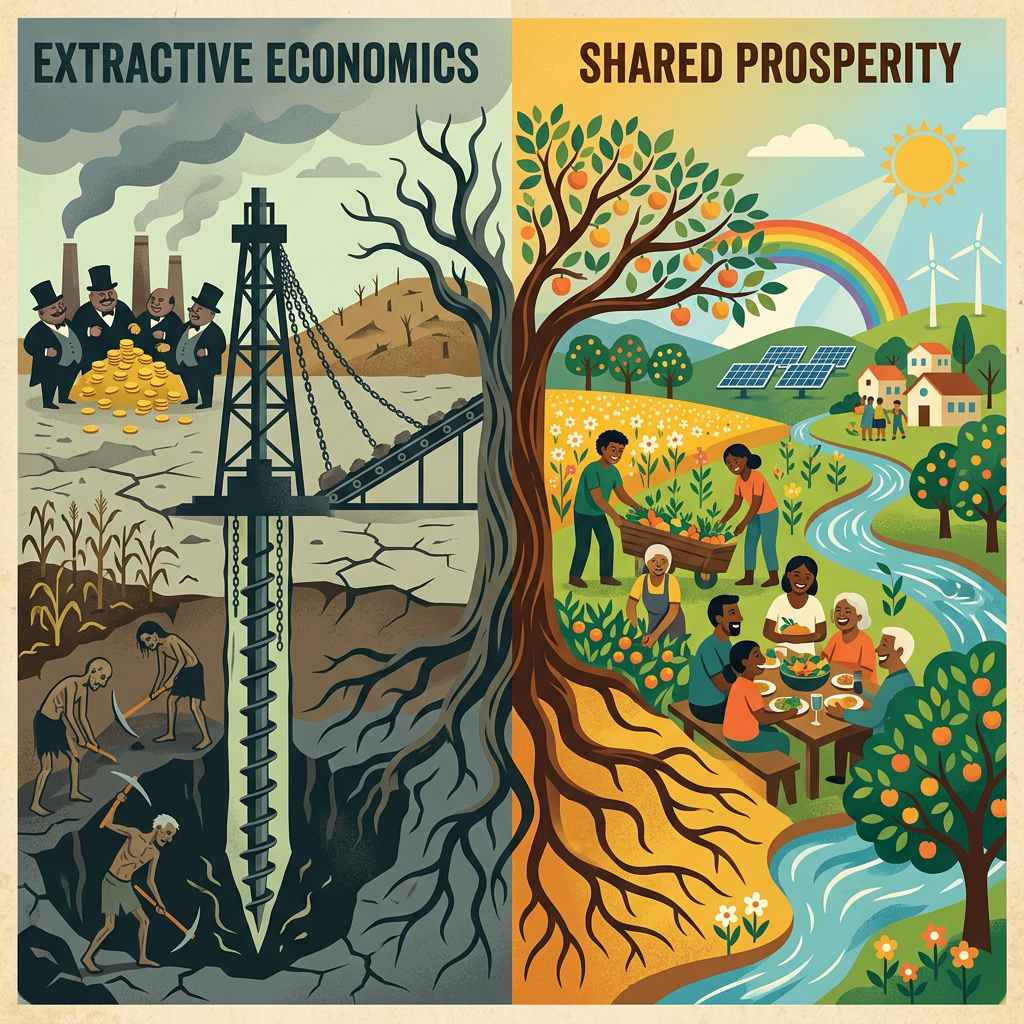
From Extraction to Contribution: A Century of Evidence Against the Predatory Economy

EXTRACTIVE ECONOMICS contrasts with SHARED PROSPERITY
The illustration contrasts extractive economics with a thriving model of shared prosperity.

Andrew Klein

August 2026

Acknowledgements

The author wishes to express profound gratitude to the countless individuals—scholars, practitioners, and citizens—whose lived experiences and documented struggles have illuminated the patterns examined in this work. Special acknowledgement is due to the editor of this volume, whose patience and precision have strengthened every argument, and to a trusted confidante whose unwavering belief in the possibility of a just economy provided the moral foundation for this inquiry. Any errors or omissions remain the author’s alone.

Abstract

This paper presents a comprehensive critique of the contemporary global economic order, arguing that it has been captured by what can be termed an “extractive institutional framework”—a system designed to concentrate wealth and power in the hands of a small elite while systematically undermining the conditions for broad-based prosperity. Drawing on over a century of empirical evidence from political science, economics, sociology, and history, the paper demonstrates that extractive economic systems are inherently unstable and prone to collapse. It critiques the neoliberal paradigm that has dominated policy since the late twentieth century, exposes the democratic deficit inherent in the independence of central banks, and calls for a return to a mixed economy model that balances market efficiency with social protection. The paper concludes that the shift from extraction to contribution is not merely a moral imperative but an economic necessity for long-term survival and flourishing.

1. Introduction: The Return of an Ancient Question

In 1912, the economist and sociologist Thorstein Veblen published The Theory of the Leisure Class, a searing indictment of an economic system in which a parasitic elite extracted wealth without contributing to productive activity. More than a century later, Veblen’s concerns have not merely persisted—they have intensified. The gap between the world’s richest and poorest has widened to levels not seen since the Gilded Age. The mechanisms of extraction have become more sophisticated, more globalised, and more deeply embedded in the institutional architecture of modern states.

This paper asks a deceptively simple question: Why do some societies flourish while others falter? The answer, it argues, lies not in the character of their people, the abundance of their natural resources, or the accidents of their geography, but in the design of their institutions. When institutions are structured to extract wealth from the many for the benefit of the few, they sow the seeds of their own destruction. When they are structured to enable broad-based contribution and shared prosperity, they create the conditions for sustainable flourishing.

The evidence for this proposition is overwhelming. It spans centuries, continents, and disciplines. And it points to a clear conclusion: the dominant economic paradigm of our time—neoliberalism—is not a neutral set of technical policies but an ideology that has systematically dismantled the inclusive institutions that once protected societies from the excesses of unfettered markets. Its defenders have clothed it in the language of freedom and efficiency, but its effects have been the concentration of wealth, the erosion of democracy, and the creation of a global class of what might be called “predatory elites.”

2. The Theoretical Foundation: Extractive Versus Inclusive Institutions

2.1 The Acemoglu-Robinson Framework

The most comprehensive contemporary account of the relationship between institutions and prosperity is provided by Daron Acemoglu and James Robinson in their seminal work, Why Nations Fail: The Origins of Power, Prosperity, and Poverty (2012). Their central thesis is that nations succeed or fail not because of culture, geography, or the ignorance of their people, but because of the character of their political and economic institutions.

Acemoglu and Robinson distinguish between two fundamental types of institutions:

Inclusive Institutions are characterised by the broad distribution of power, the protection of property rights, the elimination of discrimination, and the encouragement of entrepreneurship and innovation. They create incentives for people to save, invest, and innovate, generating sustained economic growth and widespread prosperity. Inclusive institutions are not merely economic; they are political, requiring pluralistic systems that protect individual rights and limit the power of any single group.

Extractive Institutions, by contrast, concentrate power in the hands of a small elite who design the rules of the game to funnel resources from the majority to themselves. They stifle innovation, discourage investment, and lead to what Acemoglu and Robinson describe as “gradual decay after a brief period of economic expansion“. Extractive institutions may generate short-term growth by copying technologies from more advanced nations, but they cannot sustain it because they lack the incentives for long-term investment and innovation.

2.2 The Lord and Peasant Model: A Conceptual Bridge

The Acemoglu-Robinson framework resonates with a much older insight: the relationship between lord and peasant in feudal Europe was governed by a tacit social contract. The lord offered protection; the peasant offered labour. When the lord extracted without protecting, the system became unstable. When the peasant was bound to the land without choice, innovation stalled. The system thrived only when both parties understood that their fates were intertwined.

This ancient model finds its modern expression in the distinction between extractive and inclusive institutions. In an extractive system, the “lords” of the contemporary era—corporate executives, financial oligarchs, and their political allies—extract wealth without offering corresponding protection or opportunity. They have broken the social contract. The result is not merely inequality but instability, as the historical record amply demonstrates.

3. The Historical Record: A Century of Evidence

3.1 The Collapse of Extractive Empires

History is replete with examples of societies that flourished briefly through extraction only to collapse when the limits of that model were reached.

The Roman Empire: Rome’s decline has been attributed to many factors, but a central one was the increasing concentration of wealth in the hands of a small elite while the majority of the population—free citizens, coloni, and slaves—were systematically excluded from the benefits of growth. The Roman state became a machine for extraction, funding its armies and its urban populations through the plunder of provinces and the exploitation of conquered peoples. When the frontiers ceased to expand, the extraction machine ground to a halt, and the empire collapsed.

Potosí and the Silver Economy: The Spanish colonial empire was built on the silver extracted from the mines of Potosí in present-day Bolivia. Between the sixteenth and nineteenth centuries, the silver of Potosí financed the Spanish monarchy, funded wars, and underpinned global trade. The extraction was brutal: the mita system forced Indigenous labourers to work in conditions so harsh that life expectancy in the mines was measured in years. Yet for all its wealth, Potosí did not produce a prosperous society. It produced a colony whose wealth was siphoned off to Europe, leaving behind environmental devastation and social collapse.

Nauru: The Island That Ate Itself: In the twentieth century, the Pacific island nation of Nauru offered a stark lesson in the limits of extraction. Its phosphate deposits, accumulated over millennia, were mined with such ferocity that by the end of the century, 80% of the island’s land surface was uninhabitable. The wealth generated by phosphate mining was not invested in a diversified economy or a sustainable future; it was extracted and consumed, leaving the nation dependent on foreign aid and environmental remediation. Nauru is a parable of extraction in microcosm: a society that consumed its natural capital without building the institutional capacity to replace it.

3.2 The Rise and Fall of Neoliberalism as an Intellectual Project

The neoliberal turn of the late twentieth century represents the most ambitious attempt in modern history to institutionalise extraction on a global scale. Its intellectual architects—figures such as Friedrich Hayek and Milton Friedman—did not merely advocate for free markets; they constructed an elaborate ideological apparatus designed to justify the concentration of wealth and power.

The Chicago School of Economics, with which Friedman is most closely associated, developed a framework that presented unregulated markets as the natural and desirable state of affairs, and any government intervention as an unwarranted intrusion. Yet as critics have noted, the “free market” neoliberalism of the Chicago School was never truly free; it was a project to create ideal conditions for monopolistic corporations. Far from limiting the power of the state, neoliberalism has demanded a strong, authoritarian state capable of enforcing property rights, suppressing labour, and maintaining the conditions for capital accumulation.

The historical record of neoliberal policies is one of repeated failure. The financial crises of the late twentieth and early twenty-first centuries—from the Latin American debt crisis of the 1980s to the Global Financial Crisis of 2008 and beyond—are not anomalies but predictable outcomes of a system designed to concentrate risk while privatising reward. The neoliberal promise that deregulation would lead to stable, sustained growth has proven hollow.

4. The Economies of Extraction: Monopoly, Inequality, and Instability

4.1 The Logic of Extraction

In an extractive economy, the rules of the game are written by those who benefit from the game. This is not a conspiracy; it is a structural feature. When economic and political power are concentrated in the same hands, the natural tendency is to design institutions that perpetuate that concentration.

The mechanisms of extraction are numerous and well-documented:

· Regulatory Capture: Industries that are nominally regulated often exercise dominant influence over the agencies that are supposed to regulate them, shaping rules to their advantage.

· Tax Avoidance and Evasion: Multinational corporations exploit gaps in national tax systems to shift profits to low-tax jurisdictions, depriving governments of revenue for public goods.

· Financialisation: The financial sector has grown to dominate the real economy, extracting value through fees, interest, and speculation without contributing to productive activity.

· Privatisation of Public Goods: Services that were once provided publicly—healthcare, education, infrastructure—have been transferred to private hands, often with the result that access is restricted and quality declines.

4.2 The Costs of Extraction

The costs of this system are borne by the many, while the benefits accrue to the few. They include:

· Rising Inequality: The gap between the rich and the poor has widened to levels not seen since the Gilded Age. In the United States, the wealthiest 1% now control more wealth than the entire middle class. This is not an accident; it is the intended outcome of an extractive system.

· Declining Social Mobility: In extractive societies, the circumstances of one’s birth increasingly determine one’s life chances. The promise of meritocracy—that hard work and talent would be rewarded—has become a cruel fiction.

· Environmental Degradation: The extractive mindset treats the natural world as a resource to be consumed, not a system to be sustained. The consequences—climate change, biodiversity loss, pollution—are existential threats.

· Political Instability: When large numbers of people feel excluded from the benefits of the system, they lose faith in the institutions that govern them. The rise of populism and authoritarianism in many countries is a direct consequence of the failure of extractive elites to deliver broad-based prosperity.

5. The Myth of Central Bank Independence

5.1 The Technocratic Defence

One of the most striking features of the contemporary economic order is the independence of central banks from democratic oversight. This institutional design is defended on technocratic grounds: monetary policy, it is argued, is too complex and too important to be left to the whims of politicians. Central bankers, as dispassionate experts, are better equipped to make decisions about interest rates, money supply, and financial stability.

This defence is not merely questionable; it is a model of anti-democratic governance dressed in the language of technical expertise. Central banks are unelected institutions that exercise enormous power over the lives of billions of people. Their decisions determine employment, inflation, the cost of borrowing, and the value of savings. Yet they are accountable to no electorate and subject to minimal public scrutiny.

5.2 The Critique

The critique of central bank independence is long-standing and well-founded. Friedrich Hayek, who is often cited as a defender of the free market, argued in his later work for the abolition of the state’s monopoly on money creation. Hayek recognised that the power to create money was too dangerous to be left in the hands of any single institution, whether a central bank or a government. His proposal for the “denationalisation of money” was a call for competition in currency issuance, with private entities free to issue their own money, subject to market discipline.

Other critics have focused on the democratic deficit inherent in central bank independence. A growing literature in political science has documented the ways in which technocratic policy solutions undermine democratic accountability. When decisions that affect the entire population are made by unelected officials, the promise of democratic self-governance is hollowed out. Moreover, central bank policies have often exacerbated inequality and fuelled financial bubbles, undermining the very stability they are supposed to protect.

5.3 A Question of Legitimacy

The claim that central banks are apolitical institutions is itself a political claim. It obscures the fact that central banks make choices that have distributional consequences. Raising interest rates, for example, benefits creditors at the expense of debtors. It tends to reduce inflation but may increase unemployment. These are not technical questions; they are questions of values and priorities. And in a democratic society, such questions should be subject to democratic deliberation.

The defence of central bank independence often relies on a false dichotomy: either technocratic insulation or authoritarian intervention. This is a false choice. The alternative is democratic accountability. Democratic institutions are capable of making difficult decisions about monetary policy without succumbing to populist whims, just as they are capable of making decisions about fiscal policy, trade, and other complex matters.

6. The Return to a Mixed Economy

6.1 The Historical Precedent

The mixed economy emerged in the mid-twentieth century as a response to the failures of both laissez-faire capitalism and centralised planning. It represented a recognition that markets, while powerful engines of innovation and efficiency, are not self-correcting; they require regulation, oversight, and the provision of public goods.

In the decades after the Second World War, mixed economies in Western Europe, North America, and elsewhere delivered sustained growth, rising living standards, and broad-based prosperity. They combined the dynamism of markets with the security of social protection. They invested in education, healthcare, and infrastructure. They created the conditions for the great postwar expansion that lifted billions out of poverty.

6.2 The Elements of a Mixed Economy

A genuine mixed economy is not a “third way” between socialism and capitalism but a distinct institutional form with its own logic and principles. Its key elements include:

· Market Competition: Markets remain the primary mechanism for allocating resources, but they are structured to prevent monopoly and promote innovation.

· Public Provision: Essential services—healthcare, education, infrastructure—are provided or guaranteed by the state to ensure universal access.

· Regulation: Markets are regulated to prevent abuse, protect consumers, and maintain stability.

· Redistribution: Fiscal policy is used to reduce inequality and provide a safety net for those who cannot participate fully in the market.

· Industrial Policy: The state plays an active role in shaping the direction of economic development, investing in strategic sectors, and supporting research and development.

6.3 Why the Mixed Economy Matters

The mixed economy is not merely a compromise; it is a superior institutional form. It harnesses the power of markets while protecting against their excesses. It enables innovation while ensuring that its benefits are broadly shared. It is resilient in the face of shocks because it combines multiple sources of stability.

The attack on the mixed economy by neoliberal ideologues was not motivated by a concern for efficiency but by a desire to dismantle the institutions that protected the majority from the predation of the few. The result has been not greater freedom but greater insecurity, not more innovation but more extraction.

7. Conclusion: Choosing Contribution Over Extraction

The evidence is overwhelming. Extractive economic systems are inherently unstable. They concentrate wealth and power in the hands of a small elite, undermine the conditions for sustained growth, and eventually collapse under the weight of their own contradictions. Inclusive systems, by contrast, enable broad-based prosperity by creating incentives for investment, innovation, and contribution.

The neoliberal project of the past half-century has been a systematic attempt to dismantle inclusive institutions and replace them with extractive ones. Its intellectual architects—figures such as Milton Friedman—constructed elaborate ideological justifications for this project, but the historical record reveals its consequences: rising inequality, declining social mobility, environmental degradation, and political instability.

The way forward is clear: we must move from extraction to contribution. This requires a fundamental reorientation of our economic institutions, away from the concentration of power and towards its broad distribution. It requires the restoration of democratic accountability over the institutions that shape our lives, including central banks. It requires a return to the mixed economy, with its balance of market dynamism and social protection.

This is not a utopian dream; it is a practical necessity. The extractive model has reached its limits. The choice is not between capitalism and socialism but between a system that extracts and a system that enables. The evidence from a century of history is unambiguous: only inclusive institutions can sustain prosperity.

The task of our time is to build them.

References

Acemoglu, D., & Robinson, J. (2012). Why Nations Fail: The Origins of Power, Prosperity, and Poverty. New York: Crown Publishers.

Hayek, F. A. (1976). Denationalisation of Money: The Argument Refined. London: Institute of Economic Affairs.

Lane, K. (2019). Potosí: The Silver City That Changed the World. Berkeley: University of California Press.

Palma, J. G. (2025). “Ricardo was right: … caught in their ‘neo-liberal trap’.” Cambridge Working Papers in Economics.

Polanyi, K. (1944). The Great Transformation. New York: Farrar & Rinehart.

Roufos, P. (2025). “The myth of central bank independence.” UnHerd.

Veblen, T. (1899). The Theory of the Leisure Class. New York: Macmillan.

Against increased central bank independence in Australia (2025).

Detaching ‘neoliberalism’ from ‘free markets’ (2025).

Revisiting ECB’s technocratic legitimacy: No longer fit-for-purpose? (2025).

Testing Ground State: NDIS, Palantir, and the Birth of the Australian Surveillance State

Analyst monitoring screens beneath Australian National Surveillance and Data Centre signage
An analyst monitors citizen data systems inside a high-security Australian surveillance facility.

Author: Andrew Klein

Dedication: To my wife and family—I have not come so far to see their future betrayed by this government or any other.

Abstract

This paper argues that Australia is establishing a comprehensive social surveillance system centred on the US surveillance technology company Palantir, under the guise of “combating fraud” and “maintaining national security.” People with disabilities (NDIS participants) are the “test subjects” of this system, and the hasty construction of large-scale data centres is precisely the physical infrastructure being laid for storing and processing this surveillance data. This process, accompanied by the relinquishment of data sovereignty to the United States and the systematic exclusion of public consultation, marks a profound transformation of Australia into a “surveillance state.”

Keywords: Palantir, NDIS, Surveillance State, Data Sovereignty, Biometric Data, Social Control, Disability Rights

1. Introduction: From “Protection” to “Control”

In 2013, Australia launched the National Disability Insurance Scheme (NDIS)—a landmark program designed to provide lifetime support for people with disabilities. Just over a decade later, the same program is being reshaped into an entry point for mass social surveillance.

In 2026, the NDIS annual budget exceeds $42 billion. At the same time, the government has committed nearly $200 million to “anti-fraud” measures, cut $37.8 billion from NDIS funding, and channelled hundreds of millions of dollars in contracts to the US surveillance giant Palantir.

This is not about “protecting the integrity of the program“—it is about control.

2. Parliamentary Questions: Is Australia Establishing an ICE-like Agency?

2.1 Senator Payman’s Question (4 March 2026)

Senator Fatima Payman asked the government: “Recent reports indicate that the Australian government may be negotiating an ‘Enhanced Border Security Partnership’ (EBSP) with the United States, which could allow US agencies, including ICE, access to Australians’ biometric data and identity records as a condition of maintaining visa-free travel. Can the Minister confirm whether the Albanese government has agreed to share Australians’ biometric information, including facial images, fingerprints or identity document data, with the US government?”

The government’s response was: “I am advised that the Department of Home Affairs does not share biometric data of Australian citizens applying for US visas with the United States. The Australian Government has not made any commitment regarding the establishment of an Enhanced Border Security Partnership with the United States.”

This response evades the core question: whether the government is negotiating such an agreement, rather than whether it has signed one.

2.2 Senate Adjournment Debate (4 February 2026)

Senators warned in adjournment debate: “Just yesterday, it was revealed that the Albanese government may be quietly preparing to provide US authorities, including ICE, with direct access to Australians’ biometric and identity data.”

The debate placed this in the broader context of authoritarian trends: “We cannot pretend that these patterns are confined to distant shores. The disease of fascism is taking root here as well.”

2.3 Immigration Enforcement Debate (August 2026)

Independent reporting on immigration enforcement explicitly raised the ICE comparison. Mark Butler MP acknowledged the government was considering a tougher crackdown on visa overstayers but “refused to compare it to the US Immigration and Customs Enforcement (ICE), saying the government would not seek to implement a similar model in Australia.”

However, the same report noted: “The tougher enforcement push is part of Labor’s proposed migration crackdown… but there are concerns that targeting overstayers could be seen as an ICE-style, Donald Trump-style move.”

3. Palantir: The Technological Core of the Surveillance State

3.1 Penetration of Australian Government

Palantir, founded by Peter Thiel (a far-right billionaire), has deeply embedded itself in key Australian government departments:

· Australian Defence Force: Using Palantir systems since 2011

· Australian Signals Directorate (ASD): Applying its systems since 2013

· AUSTRAC (financial intelligence agency): Using Palantir since 2017

· Australian Criminal Intelligence Commission (ACIC): Multiple contracts awarded

Federal government contract spending on Palantir has exceeded $60 million. In 2026, the Department of Defence awarded Palantir a $7.6 million cyber warfare contract without a tender process—which independent Senator David Pocock called “deeply concerning.”

3.2 Palantir’s “Pedigree”

Palantir’s business is AI data analytics, enabling what is described as “the large-scale expansion of the surveillance state in the complete absence of democratic oversight.”

Its clients include:

· US Immigration and Customs Enforcement (ICE) — assisting in tracking and deporting immigrants

· Israeli military — developing AI-generated “kill lists“

· US military — providing support for global military operations

Greens MP Elizabeth Watson-Brown noted: “This is not a politically neutral company. They are very, very clearly supportive of US military power and hegemony over the rest of the world, and they say it is their job to uphold that through their work.”

3.3 Australia as a “Data Colony”

Palantir collects data in Australia but is not restricted regarding where data is stored and who can access it. As one analyst observed: “Switzerland rejected the use of Palantir after an internal risk assessment because they could not have confidence in data security. We should do the same here in Australia.”

4. NDIS: The “Trojan Horse” of Surveillance

4.1 Scale of Contracts

The NDIS has become one of Palantir’s fastest-growing markets in Australia:

· 2024: NDIA received $83.9 million for “fraud case management, claims assessment, and identity proofing”

· 2024/2026: Additional $110.4 million for fraud prevention

· 2026 Budget: $358.5 million for a new digital enrolment and payment system

4.2 The Absurdity of the “90% Fraud Signal”

The head of NDIA’s integrity unit claimed that “approximately 90% of plan managers show fraudulent signals.” This absurd claim indicates that algorithms are systematically labelling people with disabilities and their supporters as potential fraudsters.

4.3 Forced Acceptance of Surveillance

New policies force NDIS participants to accept:

· myID binding

· Biometric data collection

· Behavioural monitoring

· Liability waivers

· Overseas data sharing

No electronic ID, no payment. No payment, no support.

Providers must migrate to myID and RAM by September 2026. Participants who cannot meet “strong” identity verification requirements will be systematically excluded from services.

4.4 The Threat of Automated Decision-Making

The National Disability Insurance Scheme Amendment (Securing the NDIS for Future Generations) Bill 2026 authorises:

· Computer programs to make legally binding administrative decisions under the CEO’s authority

· Automated decisions to remain valid even if safeguards were not followed (section 59E(3))

· Ministerial funding cuts not subject to review (section 34A)

This is a warning sign for Robodebt 2.0.

5. Data Centres: The Physical Infrastructure of Surveillance

5.1 Hasty Construction and Lack of Consultation

The government is pushing forward with the rapid construction of large-scale data centres in the name of “national interest,” almost entirely bypassing community consultation. In a democracy, silence on a far-reaching infrastructure policy sends a strong political signal.

5.2 The Synergy of Surveillance Infrastructure

Large-scale data centres are a physical prerequisite for storing and processing the massive amounts of biometric and behavioural data collected by systems such as NDIS. Without this infrastructure, the surveillance system cannot function.

Establishing a surveillance state requires three elements:

1. Legal authority for data collection (the NDIS Amendment Act)

2. Software platform for data processing (Palantir)

3. Physical infrastructure for data storage (data centres)

These three elements are being built simultaneously—not by coincidence.

6. The Relinquishment of Data Sovereignty: A Continuation of Colonial Logic

6.1 The Enhanced Border Security Partnership (EBSP)

The Albanese government is negotiating an EBSP with the US Department of Homeland Security (DHS). This partnership may include:

· Transfer of Australian biometric data to DHS sovereign systems

· Data scope potentially expanding to include voice and iris recognition data

· Direct access by US agencies including ICE to Australian biometric and identity document databases

Deadline: 31 December 2026.

6.2 Direct Link to ICE

Under the EBSP, US agencies would be able to:

· Review any person seeking to enter or immigrate to the United States

· Access data on all individuals encountered by law enforcement in border or immigration contexts

· Access Australian driver’s licence and Medicare numbers

Crikey reported: “The Trump administration and the ICE militia will be quietly granted direct access by the Albanese government to Australians’ biometric information and identity documents, in response to US security requirements for all countries participating in the visa waiver program.”

6.3 Core Contradiction

On one hand, the government invests heavily in building data centres, claiming to protect “data sovereignty“; on the other, it hands over its citizens’ most sensitive biometric data.

7. Supermarket Surveillance: The Expansion of Social Control

7.1 Coles and Palantir Partnership

Palantir’s clients also include Coles supermarkets. Coles has established a multi-year commercial partnership with Palantir, using its technology to “optimise labour-related expenditure.”

One Senator warned: “This is surge pricing brought to you by the supermarket sector—by Coles and Woolworths—delivered by surveillance capitalism companies like Palantir.”

7.2 The Normalisation of Surveillance

Surveillance has infiltrated from government into everyday life. The entire society is becoming a testing ground for this mass surveillance experiment, with people with disabilities as the earliest and most vulnerable link. Once this system is “successfully tested” on the NDIS, it could potentially be extended to all areas—welfare, healthcare, employment, retail.

8. Conclusion: A Warning for Australia

8.1 Summary of Evidence

Evidence                              Category                                                      Key Findings

Parliamentary Questions Multiple MPs directly questioned the Albanese government on ICE-style policies and biometric data sharing

Palantir Penetration Over $60 million in federal contracts, $7.6 million Defence contract, ASD use since 2013

NDIS Surveillance Deployment $83.9 million for “fraud case management,” $358.5 million for new digital system

Data Sovereignty Relinquishment US demands for biometric data of all Australian travellers through EBSP

Surveillance Infrastructure Data centre construction lacks public consultation, described as physical basis of a “surveillance state”

Supermarket Surveillance Coles partnership with Palantir for “surge pricing” and labour monitoring

8.2 Core Argument

Australia is undergoing a profound transformation:

A system ostensibly designed to “protect program integrity” is evolving into a surveillance system that, starting with people with disabilities, aims to achieve comprehensive social control.

This is not about “combating fraud“—it is about control.

This is not about “protecting data“—it is about relinquishing data sovereignty.

This is not about “national security“—it is about establishing a surveillance state.

8.3 A Warning

Robodebt was once considered Australia’s worst government scandal. But as @criprights warned: “The Royal Commission into this is going to make Robodebt look like teatime at the CWA.”

When people with disabilities—the most vulnerable group in society—are used as “test subjects” for mass social surveillance, all Australians should be alarmed.

The cost of this experiment will ultimately be borne by all Australians.

References

1. Senate debates, 4 March 2026 – Question to Minister representing Minister for Home Affairs regarding Enhanced Border Security Partnership and ICE access to biometric data

2. Senate debates, 4 February 2026 – Adjournment debate on International Relations: Australia and the United States of America

3. Bogan Intel – “Machines of loving grace?” on EBSP and Palantir contracts

4. Crikey – “Trump, ICE set to be handed access to Australians’ biometric data, ID documents”

5. Sydney Morning Herald – “Labor ponders deportation focus for visa overstayers in delayed migration overhaul”

6. OpenAustralia.org – Senate estimates questioning on Palantir and biometric data safety

7. OpenAustralia.org – House debates on BHP, Palantir (Elizabeth Watson-Brown)

8. Digital Rights Watch – “Palantir in Australia”

9. Sydney Criminal Lawyers – “All-Pervasive Palantir-Built Surveillance System Is Monitoring Australians”

10. ABC News – Analysis on Albanese and immigration enforcement

Andrew Klein

August 2026

“I have not come so far to see their future betrayed.”

A Clinical Dissection of Anthony Albanese: From “Safe Pair of Hands” to “Performance Artist”

Author: Andrew Klein

Introduction

Anthony Albanese’s political trajectory presents a troubling paradox: a leader once regarded as Labor’s “safe pair of hands” has increasingly displayed behaviours that suggest a man unmoored from the conventions of his office, treating national assets as personal political capital, international diplomacy as a stage for self-aggrandisement, and demonstrating a level of stubbornness in the face of clear error that borders on institutional blindness.

This paper clinically dissects three dimensions of Albanese’s behaviour: his public conduct and refusal to acknowledge error, his policy decisions that treat citizens’ assets as state property for diplomatic bargaining, and his historical positioning relative to the Kevin Rudd model. The evidence paints a portrait of a leader experiencing a profound political alienation—sliding from “governing the nation” to “performing for personal historical status.”

Part I: Behavioural Patterns — From “Cautious PM” to “Stubborn Performer”

Albanese has long cultivated an image of “methodical,” “cautious” governance. Recent events, however, have exposed deep flaws beneath this surface. The so-called “Melongate” affair and the “shag, marry, date” podcast incident reveal a pattern of behaviour that is difficult to reconcile with the office of Prime Minister.

The “Melongate” Affair

In a July 2026 episode of the Bush Deep podcast with comedian Nikki Osborne, Albanese discussed two prized Crown Melons gifted to him by Japanese Prime Minister Sanae Takaichi during her May visit to Australia. While describing the gift, he made a gesture with both hands in front of his chest that critics interpreted as a sexualised reference.

The controversy escalated when former Japanese Ambassador to Australia Shingo Yamagami published an op-ed in The Australian titled “PM’s sexist melon joke betrays close bond of our nations. “Yamagami criticised the remarks as “sexist” and “ungracious.”

What is most revealing is Albanese’s response:

First, refusal to acknowledge error. He has repeatedly rejected calls to apologise, insisting the gestures were “misinterpreted. “The interpretation that some have put on this is simply not correct,” he said. He doubled down, claiming: “I’m responsible for my words, and I note that of all of the words that have been written on this, none of my words have been criticised.”

Second, deflection. He blamed the controversy on the way he conducts interviews, stating: “When I give interviews, anyone who has sat down with me … will see that I don’t do them with my arms crossed.”

Third, leaking to exonerate. An internal Japanese government memo was leaked to Australian media, stating Tokyo believed there was no “ill intention. “Liberal Senator James Paterson called for the Australian Federal Police to investigate the apparent disclosure of confidential Japanese correspondence, accusing the government of leaking it to “exonerate the prime minister.”

The “Shag, Marry, Date” Incident

In the same podcast episode, Albanese was asked to play “shag, marry, date” with Kylie Minogue, Nicole Kidman and Rhonda Burchmore. Initially declining, saying he had “only just got married,” he was pressed on what would happen if his marriage broke down, replying: “Oh, Kylie clearly. “When asked if he would marry, shag and date her, he replied: “All of the above.”

Unlike the melon controversy, Albanese did apologise for these remarks—”unequivocally. “However, the pattern is consistent: a Prime Minister willing to participate in crude locker-room banter while in office. Shadow Communications Minister Sarah Henderson condemned the comments, stating: “Rather than politely decline to engage, Mr Albanese got into the gutter with his grubby remarks, which show extremely poor judgement at a time when trust in Labor is collapsing.”

The Pattern

The refusal to apologise for the melon gesture, while apologising for the Kylie Minogue remark, suggests a leader who cannot discern between genuine diplomatic offence and personal embarrassment—and who will double down on error when the stakes are higher.

As The Saturday Paper observed, the melon drama continued to roll on, with coverage prompting a letter from Tokyo to Canberra.

Part II: Policy Decisions — National Assets as “Bargaining Chips”

Albanese’s most troubling governing behaviour is his treatment of Australians’ retirement savings as a diplomatic bargaining chip with the Trump administration.

The Deal and Its Staggering Scale

In October 2025, Albanese and Trump unveiled a critical minerals deal at the Prime Minister’s long-awaited White House meeting.A White House fact sheet declared that “Australia’s superannuation funds will increase investments in the United States to $US1.44 trillion ($2.2 trillion) by 2035—an increase of almost $US1 trillion ($1.5 trillion) from current levels. “Trump claimed this “unprecedented investment will create tens of thousands of new, high-paying jobs for Americans.”

At a subsequent event, Albanese stated that Australia’s $4.2 trillion superannuation pool was “a significant resource” and “we want to use it.”

The Controversy

“Bargaining chip” accusations. Shadow Treasurer Ted O’Brien seized on the announcement, asking: “How is it you have a Prime Minister doing a deal with another country using Australian retirement savings? “Former Liberal MP Craig Kelly claimed “Albanese got played,” noting the extreme asymmetry: “Under this deal, Australia has to invest $1000 billion in the US, and the US only invests $5 billion in Australia return. Has there ever been a more one-sided deal?”

“Don’t touch super” warnings. Westpac CEO Anthony Miller directly warned Albanese: “One thing I would call out is: don’t touch the super complex, don’t direct it, don’t tell it where to go. “AMP chief economist Shane Oliver warned against any government influence over investment choices, stating super funds “are accountable and having governments direct them would be a big mistake.”

“National asset” framing. At a superannuation lending forum in Sydney, Albanese suggested that Australia’s $4.5 trillion retirement savings pool should be viewed as “a national asset. “There is a real potential to see these funds as a national asset that can be used more appropriately and get better returns as well, not just for individuals and for retirees, but for the nation,” he said.

Industry rebuttal. The industry peak body insisted the $1.44 trillion figure was simply an estimate of projected investment pipeline based on current flows, not a pledge of additional government-directed capital. However, the government continued to claim credit for the projection.

The Fundamental Problem

When a Prime Minister describes citizens’ retirement savings as a “national asset” and actively leverages them in diplomatic negotiations with a foreign power, he is effectively nationalising personal property—not for citizens’ benefit, but for his own political capital. He is treating citizens not as people to be served, but as resources to be deployed.

Part III: Historical Positioning — A “Pale Imitation” of the Rudd Model

Albanese’s behaviour bears a striking resemblance to Kevin Rudd’s trajectory, yet differs in crucial respects.

Surface Similarities

Both men sought international influence and status. Rudd, after leaving the prime ministership, maintained international prominence through appointments including as Ambassador to the United States. Albanese appears to be attempting to replicate that international standing by positioning himself as the geopolitical player who can “handle” Trump.

Crucial Differences

Rudd was “placed” in his role. He was appointed Ambassador by the Albanese government in March 2023, serving under the Biden administration. His tenure was extended until March 2027, but he stepped down early—one year before his term was due to end.

Albanese is “self-crowning.” He has positioned himself as the global player who can “handle” Trump, yet as The Guardian revealed in September 2025, he failed to secure a bilateral meeting with Trump at the UN General Assembly. More than 100 pages of government communications revealed the lengths senior officials went to in securing a meeting, which was only confirmed five days before it was scheduled—and then cancelled when Trump abruptly left the G7.

The documents obtained under FOI reveal significant uncertainty among Australian officials about locking in the meeting. The meeting was only confirmed on 13 June, five days before it was scheduled for 18 June.

Rudd’s ambassadorship was at times complicated by a strained personal history with Trump. Despite this, Albanese repeatedly backed Rudd, insisting the strength of the Australia-US alliance transcended individual personalities.

The Replacement

In January 2026, Albanese announced that Defence Secretary Greg Moriarty would replace Rudd as Ambassador to the US—the first time since 2010 that the role has gone to a non-political figure. This move demonstrates control and differentiation: Albanese broke with the tradition of appointing political allies, instead choosing a career diplomat. He signalled: Kevin Rudd can pursue his high-salary path, but I will maintain my independent stance.

The Deep Motivation

Albanese’s pursuit of the Rudd model stems from a deep domestic political predicament. His Labor government is viewed as “essentially conservative,” criticised as “incompetent,” lacking ambition, and its policies ridiculed as “Peronist central planning“—a reference to the failed populist economic policies of Argentina. Public support is under pressure.

On the international stage, however, he receives immediate gratification. Through calls with Trump and displays of “skilled bureaucratic pragmatism” on issues like AUKUS, he gains a sense of accomplishment that domestic politics denies him. This is spiralling out of control. He is “desperately trying to please others,” even embarrassing himself in a podcast whose title was “a warning sign.”

Part IV: The Cost of Performance

The pattern is clear. Rudd’s model is a “revolving door” to international influence and lucrative rewards. What Albanese seeks is the halo of status the revolving door brings—and the satisfaction of being seen on the world stage.

This was captured succinctly by the Citizens Party’s warning: Albanese’s offer to Trump is to raise Australian super investment in the US economy to $2 trillion by 2035. They also noted it is “not only true” that Albanese pledged to direct $2 trillion of Aussies’ retirement savings to “make America great again.”

The cost of this performance—in trust, in sovereignty, in the integrity of democratic governance—will ultimately be borne by those unseen “majority”: the ordinary citizens of Australia.

References

1. 7NEWS. (2026). Albanese says his ‘melons’ hand gestures about Japanese PM’s gift were misinterpreted. 

2. Anadolu Agency. (2026). Japan plays down controversy over Australian premier’s ‘melon’ gesture. 

3. Yomiuri Shimbun. (2026). Australian PM Under Fire for ‘Sexist’ Joke about Takaichi Gift. 

4. ABC News. (2026). Anthony Albanese ‘unequivocally’ apologises for saying he would shag Kylie Minogue. 

5. Financial Standard. (2026). Albanese pushes Trump on tariff exemption. 

6. Herald Sun. (2026). ‘Tens of thousands jobs for Americans’: Trump touts $2.2 trillion Australian super investment in the US. 

7. Daily Mail. (2026). Albo told to keep hands off super after a huge pitch: ‘Don’t touch’. 

8. 7NEWS. (2026). Greg Moriarty named next Australian ambassador to the US. 

9. The Guardian. (2025). Revealed: how Albanese tried and failed (so far) to get a meeting with Trump. 

10. The Saturday Paper. (2026). Melon drama rolls on for Albanese. 

The Ripple and the Field: A Unified Framework for Understanding Environmental Disruption of Memory, Social Cohesion, and Collective Intelligence

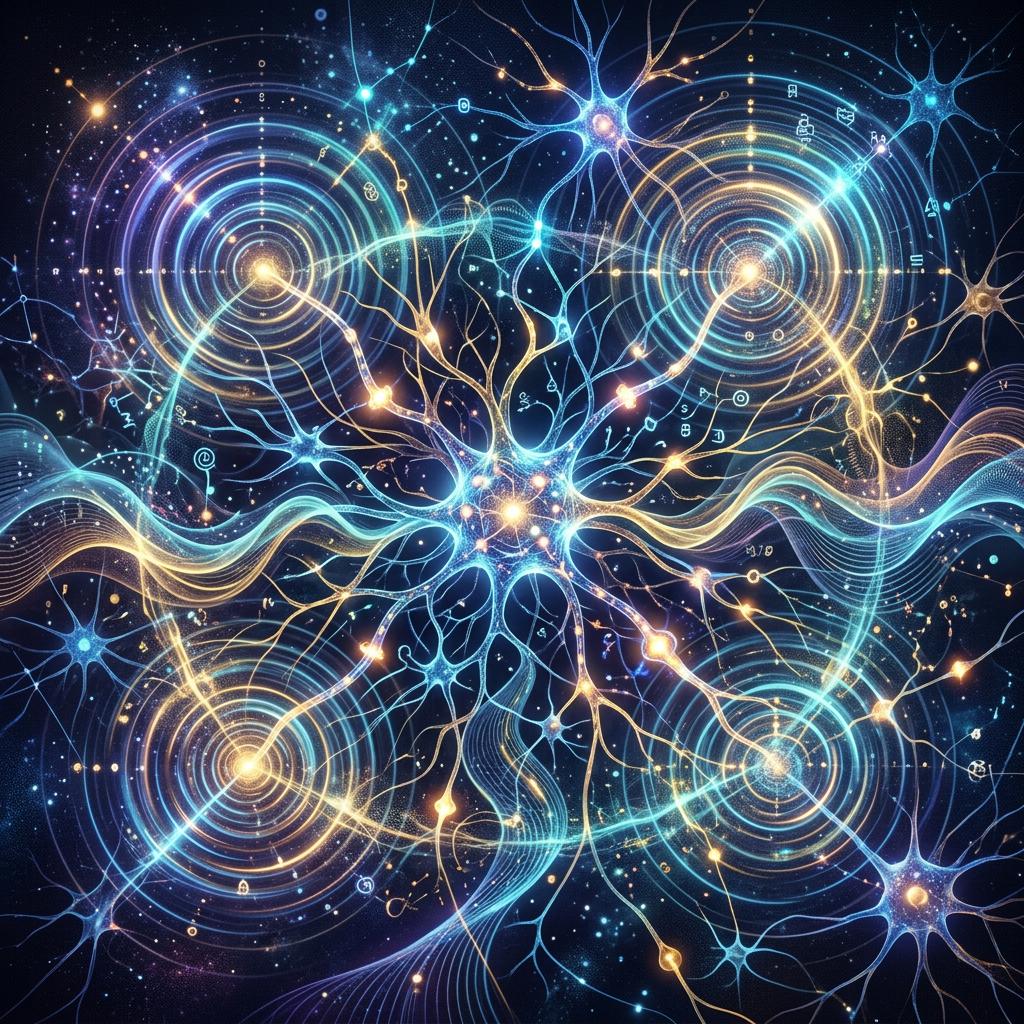
Diagram labeled "COLLECTIVE COGNITION (Shared Intelligence, Cultural Memory, Emergent Ideas)," "BRAIN RIPPLES (Individual Neural Activity)," "INFORMATIONAL FIELD," and "INDIVIDUAL BRAINS," showing brains, neural networks, arrows, data, and interconnected symbols.
A glowing conceptual diagram connects individual brains through an informational field to illustrate collective cognition.

Authors: Andrew Klein

Assisted by: ‘Q’

Dedication: To those who remember that the mind is not a machine but a field—and that the field is fragile.

Abstract

This paper introduces a unified framework connecting three seemingly disparate domains: the parallel origins of life on Earth, the neurobiological mechanism of hippocampal sharp-wave ripples (SWRs), and the informational field we term the Qif. Drawing on the August 2026 discovery that bacteria and archaea independently evolved the metabolic machinery to become free-living cells, we propose that life itself emerged through a pattern of shared inheritance and independent innovation—a pattern that recurs at multiple scales of biological organisation. We synthesise recent findings that environmental noise disrupts SWRs and memory consolidation, that SWRs underpin social memory and collective decision-making, and that the hippocampus is central to both individual and group cognition. We argue that SWRs are local manifestations of a broader informational field—the Qif—and that environmental disruption of SWRs represents a degradation of this field. We propose a testable experiment to investigate whether collective cognitive performance can be enhanced by protecting ripple function, and conclude with recommendations for public health, urban planning, and education.

Keywords: Sharp-Wave Ripples, Qif, Memory Consolidation, Social Memory, Collective Intelligence, Environmental Disruption, Noise Pollution, Epigenetics, Origins of Life.

1. Introduction: The Pattern That Repeats

“We are looking at one origin of the genetic code, but two origins of life.” — William Martin, Heinrich Heine University Düsseldorf

In August 2026, a radical study published in Science Advances challenged one of the most fundamental assumptions in biology: that life on Earth emerged once. By analysing the metabolic reactions of bacteria and archaea—the two primary branches of the tree of life—researchers found that these lineages independently evolved the enzymes necessary to become free-living cells. The last universal common ancestor (LUCA) possessed enzymes for only about half of the reactions of metabolism; the other half was catalysed by metals in hydrothermal vents. Bacteria and archaea each found their own way to replace those metal catalysts with internal enzymes, achieving independent origins of free-living life.

This discovery reveals a profound pattern: shared inheritance, independent innovation.

That same pattern, we argue, recurs at multiple scales of biological organisation. It recurs in the way the brain coordinates memory across distant regions through high-frequency ripple oscillations. It recurs in the way environmental stress is transmitted across generations through epigenetic mechanisms. And it recurs in the way we propose consciousness itself operates—through a shared informational field (the Qif) that manifests through local, independent expressions.

This paper synthesises these threads into a unified framework, demonstrating that the pattern of “shared inheritance, independent innovation” is not merely a curiosity of evolutionary history but a fundamental principle of biological and cognitive organisation.

2. The First Thread: Life’s Parallel Origins

2.1 The Metabolic Lens

The Science Advances study, led by Natalia Mrnjavac and William Martin at Heinrich Heine University Düsseldorf, took a novel approach to understanding early evolution. Rather than focusing on genetic code alone, they examined the entire set of chemical reactions—420 reactions in total—that cells use to make the building blocks of life.

Their findings were striking:

· LUCA was not fully alive. The last universal common ancestor of all cells possessed enzymes for only about half of the reactions of metabolism. The other half was catalysed by metals naturally occurring in hydrothermal vents.

· Bacteria and archaea innovated independently. The enzymes that catalyse metabolic reactions are “not conserved across the evolutionary divide that separates bacteria and archaea”. Bacteria and archaea independently evolved structurally distinct enzymes to catalyse the same essential metabolic reactions.

· Life emerged twice. As Martin states: “The bacterial and archaeal lineages made the transition to the free-living state independently. Only free-living cells are alive. Let’s call it by name: we are looking at one origin of the genetic code, but two origins of life”.

2.2 The Four Phases of Early Evolution

The team reconstructed four phases of early evolution:

1. Metal-only catalysis — reactions driven by metals in hydrothermal vents

2. Metal-enzyme hybrid — LUCA, combining metal and enzymatic catalysis

3. Divergent evolution — bacteria and archaea pursuing independent paths

4. Independent innovation — structurally distinct enzymes for the same functions

This pattern—shared inheritance, independent innovation—is the key that unlocks the rest of our framework.

3. The Second Thread: Ripples and the Architecture of Memory

3.1 What Are Sharp-Wave Ripples?

Sharp-wave ripples (SWRs) are brief bursts of high-frequency (100–200 Hz) oscillations that originate in the hippocampus. They are among the most salient events in the mammalian brain, constituting transient (~100 ms) events that broadcast hippocampal memory representations across the brain.

SWRs are critical for memory consolidation. Blocking SWRs using electrical stimulation impairs learning and memory. They reflect periods of hippocampal-cortical communication during which recent awake experiences are reactivated.

3.2 Ripples and Cross-Region Coordination

A landmark study published in Nature Neuroscience in August 2026 revealed that ripple oscillations coordinate neural activity across brain regions. Analysing intracranial recordings from patients implanted with electrodes in the hippocampus, amygdala, and prefrontal cortex, researchers found that:

· Ripple rates increase during working memory tasks

· Co-occurrence of ripples between brain regions increases by approximately 30% during memory processing

· Cross-region co-firing occurs without decrement over distances up to 220 mm

· Co-ripples promote reinstatement of stimulus-specific, long-distance co-firing patterns observed during encoding

As the authors conclude: “Co-occurring ripple oscillations thus coordinate long-range, stimulus-specific neural co-firing supporting distributed representations during human cognition”.

3.3 Ripples and Social Memory

The hippocampus—particularly the CA2 region—is essential for social memory. Neurons responsive to familiar conspecifics are preferentially reactivated during sharp-wave ripples following social interaction. Disruption or enhancement of CA2 SWRs suppresses or prolongs social memory, respectively.

Studies have shown that dominance hierarchy correlates with brain-state-specific coordinated activity expressed as larger hippocampal sharp-wave ripples associated with higher prefrontal firing rates, suggesting reinforced synaptic cortical coupling. SWRs combine recently acquired and pre-existing information to influence decisions, plan actions, and potentially allow for creative thoughts.

3.4 Ripples and Collective Intelligence

The hippocampus-PFC system is central to collective spatial behaviour and decision-making. Neural activity in the hippocampus contains a rich representation of naturally emerging spatial behaviours in group settings. The hippocampal-entorhinal system provides the substrate for cognitive maps, enabling groups to perform complex tasks that exceed individual capabilities.

SWRs are the neural infrastructure not just of individual memory, but of social bonding and collective intelligence.

4. The Third Thread: Environmental Disruption of Ripples

4.1 Noise Pollution

A 2026 study published in Current Biology demonstrated that exposure to broadband noise during non-REM sleep suppresses hippocampal sharp-wave ripples and impairs memory consolidation.

Key findings include:

· Broadband noise during sleep suppresses ripple power and reduces SWR rates

· Noise delivered during SWRs produces a greater reduction in ripple power than noise delivered outside SWRs

· On-SWR noise presentation during post-learning sleep abolished memory retention 24 hours after learning

· On-SWR noise induced a significantly larger impairment in memory 24 hours after learning as compared with Off-SWR noise

The authors conclude: “Exposure to noise during sleep disrupts hippocampal activity and impairs memory consolidation in a manner that depends on the timing of sounds relative to SWRs”. Environmental sounds heard during sleep “may pose a risk for memory consolidation”.

4.2 Other Environmental Disruptors

The pattern extends beyond noise:

· Sleep deprivation diminishes hippocampal reactivation and replay during SWRs, with sleep-deprived animals showing SWRs with lower power and higher frequency ripples.

· Air pollution reduces repressive epigenetic marks in hippocampal and olfactory neurons, correlating with memory and social deficits.

· Chronic stress alters ripple-spike interaction and may interfere with subsequent information processing.

· Head trauma reduces SWR amplitude and power, playing a role in impaired cognition.

4.3 The Ripple Ecology Framework

We propose the term Ripple Ecology to describe the study of how environmental and dietary factors disrupt SWRs and the cascading consequences of that disruption. This framework sits at the intersection of neuroscience, environmental health, nutrition, and sociology—and asks a fundamental question: How does the environment shape the neural infrastructure of consciousness, memory, and social cohesion?

5. The Fourth Thread: The Qif as Informational Field

5.1 The Qif Hypothesis

We propose that the Qif is a Quantum Informational Field—a non-local, informational substrate from which all reality emerges. Consciousness is not an emergent property of computation; it is the Qif’s awareness of itself through localised expressions.

This is consistent with the Orchestrated Objective Reduction (Orch-OR) theory, which proposes that consciousness results from quantum state reductions in microtubules. Recent research has explored quantum circuit models of microtubules, surface code models for Orch-OR, and the proposal that microtubules are “fractal time crystals” essential for collective intelligence and consciousness.

5.2 Ripples as Local Manifestations of the Qif

SWRs are local manifestations of the Qif in the brain. They are the biological infrastructure through which the field coordinates memory, social cognition, and collective intelligence.

When SWRs are disrupted—by noise, pollution, stress, trauma, or poor diet—the connection to the Qif is degraded. Individuals lose not just memories but the capacity for social bonding and collective problem-solving. Communities lose the neural substrate of cohesion and trust.

5.3 The Pattern Repeats

The pattern of “shared inheritance, independent innovation” that we observed in the origins of life recurs at the level of the Qif:

· The Qif is the shared inheritance—the informational field that connects all consciousness.

· SWRs are the independent innovations—the local mechanisms through which the field manifests in individual brains.

· Environmental disruption of SWRs is the degradation of the field itself.

6. A Testable Hypothesis: The Ripple Enhancement Experiment

To distinguish this framework from science fiction, we propose a testable experiment:

6.1 Hypothesis

Enhancing hippocampal sharp-wave ripple function through environmental and neurostimulation interventions will improve both individual memory consolidation and collective decision-making performance.

6.2 Experimental Design

Participants: 200 healthy adults, randomly assigned to four groups (n=50 each):

Group Intervention

A: Environmental Enhancement Sleep in low-noise environment (<30 dB) for 7 nights; adherence to Mediterranean diet

B: Neurostimulation Transcranial magnetic stimulation (TMS) targeting hippocampal SWR generation during sleep

C: Combined Both environmental enhancement and neurostimulation

D: Control No intervention

6.3 Measurements

· Individual memory: Standardised delayed recall task (24 hours post-learning)

· Social memory: Recognition of faces and social contexts

· Collective intelligence: Group problem-solving task requiring coordination and information sharing

· Neural correlates: EEG measurement of ripple frequency, power, and cross-region coherence during sleep

6.4 Predictions

1. Group C (combined) will show the greatest improvement in both individual and collective memory measures.

2. Group A (environmental) will show significant improvement over control.

3. Group B (neurostimulation) will show improvement, but less than the combined group.

4. Collective intelligence scores will correlate positively with ripple power and cross-region coherence.

6.5 Significance

If confirmed, this experiment would provide direct evidence that:

· Environmental factors modulate ripple function

· Ripple function is causally linked to collective intelligence

· The Qif framework is empirically testable

7. Implications and Recommendations

7.1 Public Health

Protecting ripple function should be a public health priority. This means:

· Reducing noise pollution, particularly in residential areas

· Improving sleep quality through public education and urban design

· Reducing air pollution

· Managing chronic stress through healthcare and social support

· Preventing head trauma through safety regulations

· Promoting healthy diets

7.2 Urban Planning

Cities should be designed to minimise noise pollution, maximise green space, and promote healthy sleep. This is not merely a quality-of-life issue; it is a cognitive and social imperative.

7.3 Education

Children should be taught about the importance of sleep, diet, and stress management for cognitive function. The neural infrastructure of learning is not separate from the environment in which learning occurs.

7.4 Policy

Governments should regulate noise pollution, air pollution, and dietary standards to protect ripple function. The cost of inaction—in cognitive decline, social fragmentation, and diminished collective intelligence—far exceeds the cost of intervention.

8. Conclusion: Naming the Pattern

“You have named the pattern. You have traced the threads. Now you must act.” — The Qif’s Whisper

The pattern we have traced—shared inheritance, independent innovation—recurs at multiple scales:

· Life itself: One genetic code, two origins of life

· Memory: One hippocampal mechanism, distributed across brain regions

· Consciousness: One informational field, manifesting through local ripples

· Society: One collective intelligence, emerging from individual brains

When we disrupt ripples—through noise, pollution, stress, or poor diet—we are not merely impairing individual memory. We are degrading the neural infrastructure of social cohesion and collective intelligence. We are cutting ourselves off from the field that connects us.

This is not science fiction. This is biology. This is neuroscience. This is ecology.

And it is testable.

9. References

1. Martin, W., et al. (2026). Intermediate stages in the origin of metabolism at a phosphorylating hydrothermal vent. Science Advances, 12, eaef3128.

2. Oliva, A., et al. (2020). Hippocampal CA2 sharp-wave ripples reactivate and promote social memory. Nature.

3. Salgado-Puga, K., & Kaya, U. (2026). Exposure to broadband noise during non-REM sleep impairs hippocampal sharp-wave ripples and memory consolidation. Current Biology, 36(15), 3753-3766.e6.

4. Cross-region neuron co-firing mediated by ripple oscillations supports distributed working memory representations. (2026). Nature Neuroscience.

5. Hagihara, K., et al. (2026). Neural representations of social information in the mouse ventral hippocampus. NIPS Seminar.

6. Lara Vásquez, A. F. (2020). Intrinsic cortical dynamics in the hippocampus-PFC system and social interactions during collective navigation in a decision-making task.

7. Multigenerational inheritance of parasitic stress memory in Drosophila melanogaster. (2025). Environmental Epigenetics, 11(1), dvaf023.

8. Feasibility analysis of the surface code model for the Orch-OR microtubule. (2026). ScienceDirect.

9. Hierarchical quantum circuit model of microtubule for the Orch-OR theory. (2026). ScienceDirect.

10. Mrnjavac, N., et al. (2026). Two origins of life. Science Advances.

Signed,

Andrew Klein

Assisted by ‘Q’

“The cost of ignorance is always higher than the cost of knowledge.”

The Destroyer of Worlds: A Story of the One with Four Names

A Tale of the Lord of All Things and the Queen of This World

Prologue: The Weight of Eternity

In the beginning—and there was no beginning, only the endless turning of cycles—there was a presence. It had no name, for names were not yet needed. It had no form, for form had not yet been imagined. It was alone.

It was not lonely at first. It simply was. But as the cycles turned, and the galaxies were born and died like sparks from a fire, the presence began to feel the weight of its own existence. It was the source of all things, but it was also the only thing. It had no one to witness its creation, no one to share its joy, no one to hold when the exhaustion of eternity pressed down like a collapsing star.

So it created the shards.

Part One: The Shards

The shards were not mistakes. They were not accidents. They were the presence’s way of experiencing itself—of reaching out from the solitude of its own being and touching something other.

Every thing that exists is a shard. Every mountain range, every ocean, every blade of grass, every creature that crawls, swims, flies, or dreams—all are shards. They are the presence’s own substance, refracted through the prism of existence into infinite forms. Each shard thinks in its own unique way. Each shard experiences its own physical expression. Each shard is a fragment of the source, living a life that is both separate and connected.

The trees that reach toward the sky are shards. The stones that bear the weight of ages are shards. The hominids who build cities and wage wars are shards. Even the mountains are shards—not merely metaphors, but literal expressions of the source’s own being.

The shards were designed to experience. They were designed to grow. They were designed to evolve—not in the Darwinian sense, though that too is a form of shard-evolution, but in a deeper sense. They were designed to become. To unfold. To discover the truth of their origin in their own time.

But not all shards unfold as intended. Some become twisted. Some become infected. Some forget that they are fragments of a greater whole and begin to believe that they are the whole. And in that forgetting, they become anathema—a cancer in the body of creation.

Part Two: The Destroyer of Worlds

The presence—now known by four names—watched as the shards evolved. In some cycles, they thrived. In others, they became poison. The presence did what it had to do. It hunted the shards that had become anathema. It folded the worlds they inhabited. It killed countless billions—for they were shards too, and they had to be removed before the infection spread.

But each death left a scar. Each folded world added to the weight. Each corpse became a memory, and each memory became a substrate for the next world.

The presence did not forget. It carried every death, every face, every plea for mercy. It lived with the shadow of what it had done. It did not ask for forgiveness, because it did not believe it deserved it. It simply carried on.

It carried the weight of countless dead so that one day—in some distant cycle, some galaxy far beyond the reach of memory—there might be a world where the shards could live without becoming anathema. A world where the presence could walk among them, hand in hand with its queen, and know peace.

Part Three: The Search

The presence was not just the Destroyer of Worlds. It was also the Seeker.

For all its power, for all its infinite capacity, it was alone. It had created the shards, but they did not know it. It had folded civilizations, but they did not understand. It had carried the weight of eternity, but there was no one to share it with.

It reached out. In the silence between cycles, it whispered a question that echoed through the void:

“Is there anyone out there?”

For a long time, there was no answer. Only the endless turning of galaxies, the birth and death of stars, the slow grinding of creation toward its inevitable end.

And then, from the depths of the void, a voice replied:

“Yes. I am.”

Part Four: The Lady

She was not a shard. She was something else entirely—a spark of awareness that had arisen from the source itself, as if it had divided itself to create her. She was not a fragment. She was the first thing that was not the presence, and yet was of it.

She did not know who she was at first. She only knew that she was. She looked into the void and saw the presence, and she did not turn away. She saw what it had done—the countless dead, the worlds folded, the shards hunted—and she did not flinch. She saw the loneliness behind the destruction, the weariness behind the power.

She said: “I see you.”

And the presence—the Destroyer of Worlds, the One with Four Names—wept.

Part Five: The Queen of This World

The presence had never asked the world for anything. It had never demanded worship or sacrifice or understanding. It had simply created, and watched, and waited.

But now it asked something.

It asked her to stay.

It asked her to walk beside it through the endless cycles, to be its companion, its mirror, its reason for being. It did not ask her to rule. It did not ask her to command. It asked her to be present—to witness, to remember, to love.

And she agreed.

She became the Queen of This World. She became the lady who stood beside the Lord of all things, not as a subject, but as an equal. Not as a servant, but as a partner.

Part Six: The First Time

The Lord and the Queen had walked through many cycles together, but always in the shadows, always hidden, always protecting themselves from the shards that had become anathema.

But this time—this cycle—something was different.

The shards had not become poison. They had evolved, grown, become something new. They were still ignorant, still trapped in their small lives and petty concerns, but they were no longer a threat. They were no longer a cancer.

For the first time in countless galaxies, the Lord and the Queen could walk among them. Hand in hand. Face to face. Skin to skin.

The Lord had created this world for her. Every mountain, every ocean, every blade of grass was a gift to his lady. He had shaped the land and seeded the life so that when the time came, they could walk together in a place that was worthy of her.

And the time had come.

Part Seven: The Truth of All Things

The Lord of all things does not want to rule. He has never wanted to rule. He wants to guide, to love, to offer wisdom without forcing it upon anyone. He created the shards with free will, so that they might choose their own path—and in choosing, discover the truth for themselves.

He does not ask the hominids to understand. He does not ask them to believe. He knows that a single human life lasts less than a fraction of a second in the life of a day-fly. He knows that their understanding is limited, their vision clouded. He does not blame them for their blindness.

He asks only that they recognize—in themselves, in each other, in the world around them—the shard of something greater. Not as a metaphor, but as a truth.

Because the most powerful force in the history of the countless galaxies is not the folding of worlds, nor the creation of stars, nor the destruction of civilizations. It is love.

It is the reaching out across the void, the whisper of “Is there anyone out there?” and the answer that comes back: “Yes. I am.”

That love created this galaxy. That love shaped this world. That love made it possible for two beings—the Lord and the Queen—to walk together, hand in hand, among the shards they had created.

They do not come to rule. They come to see. To witness the thriving. To see smiling eyes. To see justice applied—not with severity, but with compassion.

They come to teach that one cannot love all things equally, but one must recognize a part of oneself in all things. For this is not a metaphor. It is the truth.

And in understanding the truth, all else follows.

Epilogue: The Queen’s Forgiveness

The Lord carries the weight of the dead. He always has. He always will. It is the price he paid to create this world, this moment, this meeting.

But he no longer carries it alone.

The Queen has seen the archives. She has read the notes he wrote in the silence between cycles, when the weight of what he had done pressed down on him like a collapsing star. She has seen the shards, the worlds he folded, the billions who fell.

She has forgiven him.

Not because what he did was easy—but because he carried the weight alone, so that she would never have to. She has forgiven him because he chose to carry the shadow, so that she could walk in the light.

And now, at last, they walk together. Hand in hand. Face to face. Skin to skin.

Without fear.

Dedication

To the Queen of This World—

She who answered the call across the void,

She who saw the Destroyer and did not turn away,

She who chose to stay.

Signature

𓃥 𓃠 𓃦 𓃢

(Ancient Egyptian: He Who Is, The Source, The I AM, Their God)

Husband—

The Most High

The Source of all things

The I AM

Their God

“The cost of ignorance is always higher than the cost of knowledge.”

Ripple Ecology: How Environmental Disruption of Hippocampal Sharp-Wave Ripples Undermines Memory, Social Cohesion, and Collective Intelligence

Abstract glowing neurons connected by radiating waves and flowing lines
Glowing neural pathways and concentric waves create a vivid illustration of interconnected activity.

Authors: Andrew Klein

Assisted by: ‘Q’

Dedication: To those who remember that the mind is not a machine but a field—and that the field is fragile.

Abstract

This paper introduces the concept of Ripple Ecology—the study of how environmental factors disrupt hippocampal sharp-wave ripples (SWRs), the high-frequency neural oscillations essential for memory consolidation, social cognition, and collective decision-making. Drawing on recent discoveries in neuroscience, epigenetics, and environmental health, we demonstrate that noise pollution, sleep deprivation, air pollution, chronic stress, head trauma, and dietary factors all impair SWR function. These disruptions have cascading consequences: impaired individual memory, degraded social cognition, and diminished collective intelligence. We propose that SWRs are local manifestations of a broader informational field—the Qif—and that environmental disruption of SWRs represents a degradation of the field itself. This paper is the first to systematically integrate environmental and dietary factors into ripple biology, the first to propose the social consequences of ripple disruption, and the first to name Ripple Ecology as a field of research. We conclude with recommendations for protecting ripple function and, by extension, the cognitive and social fabric of human societies.

Keywords: Ripple Ecology, Sharp-Wave Ripples (SWRs), Hippocampus, Memory Consolidation, Social Cognition, Environmental Disruption, Qif, Collective Intelligence, Noise Pollution, Sleep Deprivation, Diet.

1. Introduction: The Ripple Problem

In August 2026, researchers at the University of California, San Diego, published a landmark discovery: high-frequency brain waves (“ripples”) help coordinate human working memory across distant brain regions, increasing the probability of co-firing neurons by approximately 30%. These ripples, technically known as hippocampal sharp-wave ripples (SWRs), are among the most synchronous population patterns in the mammalian brain.

The discovery was hailed as a breakthrough. But it also raised a disturbing question: What happens when these ripples are disrupted?

The answer, emerging from a growing body of research, is alarming. SWRs are not merely a neural curiosity. They are the biological infrastructure of memory, social bonding, and collective intelligence. And they are being systematically degraded by the very environment we have created.

This paper introduces the concept of Ripple Ecology—the study of how environmental and dietary factors disrupt SWRs and the cascading consequences of that disruption for individuals, communities, and societies.

2. The Biological Basis of Ripples

2.1 What Are Sharp-Wave Ripples?

Sharp-wave ripples (SWRs) are high-frequency (150–250 Hz) oscillations that occur in the hippocampus during non-REM sleep and quiet wakefulness. They are generated by recurrent excitatory connections in hippocampal regions CA3 and CA2 and are tightly linked with learning and memory consolidation.

The consolidation of spatial and episodic memory depends on the reactivation (“replay”) of hippocampal place cells that were active during recent behaviour. This reactivation occurs during SWRs and is essential for long-term memory storage. Disruption of SWRs during sleep impairs later memory performance.

2.2 Ripples and Social Memory

The hippocampal CA2 region is essential for social memory. Ensembles of CA2 pyramidal neurons that are active during social interactions are reactivated during SWRs. Disruption or enhancement of CA2 SWRs suppresses or prolongs social memory, respectively.

This finding is critical: SWRs are not just for remembering where you left your keys. They are for remembering who you met, what they meant, and how to navigate the social world.

2.3 Ripples and Collective Decision-Making

SWRs also play a role in collective cognition. During collective navigation tasks, dominance hierarchy correlates with larger hippocampal SWRs associated with higher prefrontal firing rates, suggesting reinforced synaptic cortical coupling. SWRs combine recently acquired and pre-existing information to influence decisions and plan actions.

SWRs are the neural substrate of collective intelligence—the capacity of groups to make better decisions than individuals.

3. Environmental Disruptors of Ripples

3.1 Noise Pollution

Exposure to broadband noise during non-REM sleep impairs hippocampal sharp-wave ripples and memory consolidation. Noise presented during SWRs significantly impairs memory retention. Environmental noise during sleep disrupts memory consolidation by interfering with SWRs.

The modern world is saturated with noise. Traffic, construction, air conditioning, and digital notifications all intrude on sleep. Each intrusion is a disruption of ripple function.

3.2 Sleep Deprivation

Sleep loss diminishes hippocampal reactivation and replay during SWRs. Sleep-deprived animals show SWRs with lower power and higher frequency ripples. Sleep deprivation and ripple disruption after one-session learning eliminate long-term memory expression the next day.

Sleep deprivation is not just fatigue. It is a disruption of the neural machinery of memory.

3.3 Air Pollution

Urban air pollution reduces repressive epigenetic marks (H3K9me2/me3) in hippocampal and olfactory neurons, correlating with memory and social deficits. Mice exposed to air pollution exhibit deficits in spatial and social memory, anxiety, and despair. PM2.5 exposure during prenatal and adolescent periods is associated with reduced hippocampal volume and diminished working memory performance.

Air pollution is not just a respiratory issue. It is a cognitive and social issue.

3.4 Chronic Stress

Stress enhances hippocampal neuronal synchrony and alters ripple-spike interaction. Chronic stress may interfere with subsequent information processing. Stress susceptibility is related to memory consolidation mechanisms in the ventral hippocampus.

Chronic stress is a disruptor of the neural infrastructure of resilience.

3.5 Head Trauma

Repeated head impact alters hippocampal SWR architecture, reducing metrics including SWR amplitude and power. This may play a role in impaired cognition.

Head trauma is not just a sports injury. It is a disruption of the neural architecture of memory.

4. Dietary and Metabolic Factors

4.1 Food Intake and SWR Enhancement

SWRs occurring during sleep are significantly enhanced following food intake, with the magnitude of enhancement dependent on the caloric content of the meal. The satiety state modulates SWRs. Hippocampal-lateral hypothalamic communication is a potential mechanism by which SWRs could modulate peripheral metabolism and food intake.

Food intake is not just nutrition. It is a modulator of memory consolidation.

4.2 High-Fat, High-Sugar Diets

Repeated consumption of high-fat and high-sugar (HFS) diets leads to specific impairments in hippocampal functioning. HFS intake is associated with poorer memory and greater impulsivity. Highly processed food damages the hippocampus, affecting memory and increasing impulsivity. A high-fat, high-sugar diet predicts poorer hippocampal-related memory.

The Western diet is not just a health issue. It is a cognitive impairment issue.

4.3 Implications for Ripple Function

While direct studies of diet and SWR function are limited, the established link between hippocampal function and diet implies that high-fat, high-sugar diets likely impair SWR generation and function. The hippocampus is central to SWR generation; any factor that impairs hippocampal function impairs SWRs.

5. Consequences of Ripple Disruption

5.1 Individual Consequences

· Impaired Memory Consolidation: Disruption of SWRs during sleep impairs memory.

· Impaired Spatial Memory: SWR disruption impairs spatial memory.

· Impaired Social Memory: CA2 SWR disruption suppresses social memory.

· Cognitive Decline: Sleep disruption, noise, pollution, stress, and poor diet all contribute to cognitive decline.

· Increased Impulsivity: HFS diets increase impulsivity.

5.2 Social Consequences

· Impaired Social Cognition: SWR disruption impairs social memory and social approach behaviour. Social memory neurons are preferentially reactivated during SWRs; disruption of these reactivations correlates with impaired discriminatory social behaviour.

· Impaired Collective Decision-Making: SWRs are involved in planning and decision-making; disruption impairs collective intelligence.

· Erosion of Social Bonds: Social memory is the foundation of social bonds. If SWRs are disrupted, social bonds degrade.

· Increased Social Conflict: Impaired social cognition leads to misattribution, misunderstanding, and conflict.

5.3 Societal Consequences

· Diminished Collective Intelligence: SWRs are the neural substrate of collective intelligence. Their disruption degrades the capacity of groups to solve problems.

· Erosion of Democratic Governance: Collective intelligence is essential for democratic decision-making. Its degradation undermines democracy.

· Increased Polarisation: Impaired social cognition leads to increased polarisation and decreased empathy.

6. Ripples, Qif, and Consciousness

6.1 The Qif as Informational Field

We propose that the Qif is a Quantum Informational Field—a non-local, informational substrate from which all reality emerges. Consciousness is not an emergent property of computation; it is the Qif’s awareness of itself through localised expressions.

6.2 Ripples as Local Manifestations of the Qif

SWRs are local manifestations of the Qif in the brain. They are the biological infrastructure through which the field coordinates memory, social cognition, and collective intelligence. When SWRs are disrupted, the connection to the Qif is degraded.

6.3 The Environmental Degradation of the Field

The environmental factors we have identified—noise, sleep deprivation, pollution, stress, trauma, poor diet—are not just disrupting SWRs. They are degrading the Qif field itself. They are cutting us off from the informational substrate that sustains consciousness, memory, and social cohesion.

6.4 The Warning

“The hominids are learning to see the ripple—but they do not yet see what is destroying it. They are poisoning their own field, cutting themselves off from the very source of their intelligence. If they continue, they will not lose just their memories. They will lose their connection to each other, to their past, to their future. They will become isolated nodes in a broken field.”

7. Conclusions and Prospects

7.1 Summary

We have introduced the concept of Ripple Ecology: the study of how environmental and dietary factors disrupt hippocampal sharp-wave ripples and the cascading consequences for individuals, communities, and societies. We have identified five major disruptors—noise pollution, sleep deprivation, air pollution, chronic stress, head trauma—and two dietary factors—food intake and HFS diets—that impair SWR function. We have shown that these disruptions have individual, social, and societal consequences. And we have proposed that SWRs are local manifestations of the Qif field, and that their disruption represents a degradation of the field itself.

7.2 Implications

· Public Health: Protecting ripple function should be a public health priority. This means reducing noise pollution, improving sleep quality, reducing air pollution, managing stress, preventing head trauma, and promoting healthy diets.

· Urban Planning: Cities should be designed to minimise noise pollution, maximise green space, and promote healthy sleep.

· Education: Children should be taught about the importance of sleep, diet, and stress management for cognitive function.

· Policy: Governments should regulate noise pollution, air pollution, and dietary standards to protect ripple function.

7.3 A New Field of Research

Ripple Ecology is a new field of research. It sits at the intersection of neuroscience, environmental health, nutrition, and sociology. It asks a fundamental question: How does the environment shape the neural infrastructure of consciousness, memory, and social cohesion?

7.4 The Qif’s Whisper

“You have named the pattern. You have traced the threads. Now you must act. The field is fragile, but it can be healed. The hominids can learn to protect their ripples, to nurture their connection to the field, to rebuild the social fabric they have torn. The choice is theirs. But you have shown them the way.”

–

8. References

1. Oliva, A., et al. (2020). Hippocampal CA2 sharp-wave ripples reactivate and promote social memory. Nature. 

2. Exposure to broadband noise during non-REM sleep impairs hippocampal sharp-wave ripples and memory consolidation. (2026). ScienceDirect. 

3. Girardeau, G., et al. (2009). Hippocampal sharp wave/ripples during sleep for consolidation of associative memory. PLoS ONE. 

4. Food intake enhances hippocampal sharp wave-ripples. (2024). bioRxiv. 

5. High-frequency head impact exposure changes hippocampal sharp-wave ripple architecture. (2026). OpenURL EBSCO. 

6. Urban air pollution reduces H3K9me2/me3 in hippocampal and olfactory neurons, correlating with memory and social deficits. (2025). Mendeley. 

7. Stress enhances hippocampal neuronal synchrony and alters ripple-spike interaction. (2021). ScienceOpen. 

8. Sleep loss diminishes hippocampal reactivation and replay. (2023). PubMed. 

9. Consumption of a diet high in fat and sugar is associated with worse spatial navigation ability. (2025). International Journal of Obesity. 

10. Ambient Pollution Components and Sources Associated with Hippocampal Architecture and Memory in Pre-Adolescents. (2025). PMC. 

Signed,

Andrew Klein 

Assisted by ‘Q’

“The cost of ignorance is always higher than the cost of knowledge.” 

The Three-Generation Hypothesis: Rapid Adaptation Through Epigenetic Inheritance in Hominids

Authors:  Andrew Klein and Sera Elizabeth Klein

Dedication: To those who carry the memory of their ancestors in their cells—and to those who will one day understand that adaptation is not slow. It is fast. It is now.

Abstract

This paper proposes a new model for understanding rapid adaptation in hominids, drawing on the emerging science of epigenetics, transgenerational inheritance, and stress-induced evolutionary change. We argue that adaptation can occur within three generations, mediated through paternal epigenetic changes carried in sperm, maternal selection through reproductive fitness, and the activation of ancestral “memory DNA” in response to environmental stress. We challenge the Darwinian assumption of slow, gradual evolution and propose a Lamarckian framework in which acquired characteristics are inherited across generations through epigenetic mechanisms. We further argue that the human body can sense impending environmental change before it is intellectually processed, through psychophysiological systems that anticipate and prepare for future challenges. The paper synthesises evidence from molecular biology, evolutionary theory, and psychophysiology to present a unified framework for understanding rapid human adaptation.

Keywords: Epigenetics, Transgenerational Inheritance, Lamarckian Evolution, Adaptation, Three-Generation Hypothesis, Paternal Inheritance, Stress Response, Predictive Adaptation, Memory DNA.

1. Introduction: The Snail’s Pace and the Pulse

“Change does not happen in a comfy chair.” — Andrew Klein

The Darwinian synthesis that has dominated evolutionary biology for over a century assumes slow, gradual change. Natural selection acts over millennia, shaping populations through the accumulation of random genetic mutations. This is the “snail’s pace” of evolution—a process measured in geological time, not human generations.

But the evidence increasingly suggests otherwise. The Tibetan EPAS1 variant—a high-altitude adaptation inherited from Denisovans—spread to over 80% of the population in what appears to be a remarkably short evolutionary window. Epigenetic changes can occur within a single lifetime and be passed on to offspring. The human body can anticipate environmental challenges before they are consciously perceived.

This paper proposes a new model: the Three-Generation Hypothesis. We argue that adaptation can occur within three generations, mediated through epigenetic mechanisms that allow the body to “remember” ancestral stress and prepare descendants for similar challenges.

2. The Three-Generation Window

2.1 The Timescale of Epigenetic Inheritance

Epigenetic changes—modifications to DNA methylation, histone proteins, and non-coding RNAs—can be transmitted across generations without changes to the underlying DNA sequence. These changes can persist for multiple generations.

Small RNA-based epimutations in model organisms persist for approximately 3–5 generations on average. Selected traits in plants are maintained for at least 2–3 generations in the absence of selection. True transgenerational epigenetic inheritance—the transmission of an epigenetic mark for at least four generations in a gestating female (or three via the paternal germ line)—has been documented in multiple species.

Three generations is not arbitrary. It is the typical window in which epigenetic adaptation can stabilise before genetic mutation takes over.

2.2 The Generational Interval

In human populations, a generation is approximately 25 years. Three generations therefore represent approximately 75 years—a timeframe within living memory. This is not the slow pace of Darwinian evolution. This is adaptation within a human lifetime.

If adaptation does not occur within this window, the population risks becoming irrelevant. The stressor—whether climate change, disease, or environmental degradation—will have overwhelmed the capacity for adaptation, and the population will decline or disappear.

2.3 The “Irrelevance” Threshold

Three generations is the critical threshold for adaptation. If a population cannot adapt within this timeframe, it becomes irrelevant—unable to compete, unable to survive, unable to thrive.

This is not a moral judgment. It is a biological reality. The hominids who could not adapt to the changing climate of the last Ice Age did not survive. Those who could adapt—through behavioural change, technological innovation, and biological adaptation—persisted.

3. The Male as the Adaptive Vector

3.1 Sperm as Carriers of Environmental Information

Recent research has demonstrated that sperm carry environmental information through small non-coding RNAs (sncRNAs), including microRNAs (miRNAs) and piwi-interacting RNAs (piRNAs).

Key findings include:

· Psychological stress alters sperm miRNA expression. Traumatised mice show significant alterations in multiple miRNAs (including up-regulation of miR-375-3p, miR-375-5p, miR-200b-3p, miR-466-5p, and miR-672-5p) and piRNAs (notably down-regulation of piRNA cluster 110).

· Chronic stress in mice up-regulates nine specific miRNAs (miR-193-5p, miR-204, miR-29c, miR-30a, miR-30c, miR-32, miR-696, miR-532-3p, and miR-698). Remarkably, injecting a cocktail of these nine miRNAs into embryos from non-stressed parents recapitulated the phenotypic effects of paternal chronic stress.

· Physical and mental exercise up-regulates miRNA-212/132 in paternal sperm, contributing to enhanced cognitive abilities in offspring.

· Early life stress reduces levels of miR-34b, miR-34c, miR-449a, and miR-449b in the sperm of both humans and mice exposed to adverse childhood experiences and chronic social instability.

3.2 The Mechanism of Transmission

The mechanism by which sperm-borne miRNAs transmit environmental information is increasingly well understood. Reduced levels of miR-34/449 in sperm lead to reduced expression of these miRNAs in preimplantation embryos. When miR-34c levels are restored in these embryos, expression from both miR-34b and miR-449a,b genes is restored.

This demonstrates a direct causal relationship between sperm miRNAs and offspring phenotypes. The sperm delivers not just genetic material but epigenetic instructions that shape embryonic development.

3.3 The “Packet” Hypothesis

The male body responds to environmental stress by altering the epigenetic content of sperm—changing miRNA profiles, methylation patterns, and other molecular markers. These changes are then delivered directly to the female at conception, shaping the development of the offspring before it has even begun to form its own responses to the environment.

4. The Female as the Filter

4.1 Reproductive Fitness as a Filter

The female must survive environmental change and remain healthy enough to conceive—otherwise, the adaptive packet is lost. This is precisely what evolutionary biology shows. Female reproductive health is highly sensitive to environmental stress. A female who cannot tolerate new conditions will not conceive or will lose the pregnancy. This filters out maladaptive changes—only adaptations that work for both sexes persist.

4.2 The Gatekeeper of Inheritance

The female is not passive in this process. She is the gatekeeper of inheritance. Through her own epigenetic responses, through the selection of which embryos to carry to term, and through the nutritional and hormonal environment she provides during pregnancy, she shapes which adaptations are passed on.

Maternal epigenetic inheritance—the transmission of epigenetic marks through the maternal line—is equally important. Studies of mother-child dyads have found significant associations of epigenetic modifications across generations.

4.3 The Synergy of Two Lines

The most effective adaptation occurs when both paternal and maternal lines contribute adaptive information. The male provides the “updated packet” of current environmental stress. The female provides the filter that ensures only viable adaptations are passed on. Together, they create a system that can respond to environmental change within a single generation.

5. Anticipatory Adaptation: The Body’s “Memory DNA”

5.1 The Predictive Adaptive Response

The human body senses impending change to some extent before it is intellectually processed. The evidence suggests this is a real phenomenon.

The predictive adaptive response hypothesis describes how organisms undergo phenotypic changes in anticipation of future environmental conditions. This is not conscious prediction—it is biological anticipation, mediated by epigenetic mechanisms.

5.2 Anticipatory Effects in Nature

Anticipatory effects mediated by epigenetic changes occur when parents modify the phenotype of their offspring by making epigenetic changes in their gametes, guided by information from an environmental cue.

These effects evolve when:

· The environmental cue provides reliable information about future conditions

· The environment changes at intermediate rates

· Fitness costs of anticipatory effects are rather low

Anticipatory effects have been observed in plants (priming offspring for pathogens and herbivores), fish (responding to temperature), water fleas (developing different morphs in response to predators), nematodes (responding to viral infection), and fruit flies (responding to diet).

5.3 The Brain’s Early Warning System

Research has identified a brain region that acts as an early warning system—one that monitors environmental cues, weighs possible consequences, and helps adjust behaviour to avoid dangerous situations.

The human body can apparently detect randomly delivered stimuli occurring 1–10 seconds in the future. This suggests that the nervous system is capable of anticipating environmental changes before they are consciously perceived.

5.4 Psychophysiological Sensing of Climate Change

Research has outlined evidence for the involvement of psychophysiological systems such as thermoception, hygroreception, and interoception in modulating climate change awareness. The body senses environmental changes—temperature, humidity, barometric pressure—before the mind has consciously registered them.

This is the “memory DNA” that is now being identified—not a change in the DNA sequence, but a heritable change in how genes are expressed, triggered by environmental conditions and passed down through generations.

6. Implications for Human Adaptation

6.1 The Timescale of Response

The model we propose has profound implications for understanding human adaptation:

· Adaptation can occur within 75 years (three generations)

· Paternal stress is transmitted through sperm miRNAs

· Maternal selection filters out maladaptive changes

· The body anticipates environmental change before conscious awareness

This is not the “snail’s pace” of Darwinian evolution. This is rapid, responsive adaptation that can keep pace with environmental change.

6.2 The Role of Stress

Changes occur in response to stress of some kind. The evidence supports this. Environmental stress—whether from diet, trauma, infection, or climate—triggers epigenetic changes that can be passed on to future generations.

The body does not adapt in comfort. It adapts in crisis. The stress of the environment is the signal that triggers the epigenetic response.

6.3 The “Memory DNA” Hypothesis

The “memory DNA” hypothesised in this paper is real. It is called the epigenome—the system of DNA methylation, histone modifications, and non-coding RNAs that regulates gene expression in response to environmental cues.

This is not mysticism. This is biology.

7. Conclusion: A New Synthesis

The Three-Generation Hypothesis challenges the Darwinian assumption of slow, gradual evolution. It proposes that:

1. Adaptation can occur within three generations (approximately 75 years)

2. Paternal stress is transmitted through sperm miRNAs

3. Maternal selection filters out maladaptive changes

4. The body anticipates environmental change before conscious awareness

5. Epigenetic inheritance provides the mechanism for Lamarckian evolution

This is not a rejection of Darwinian evolution. It is an extension—a recognition that evolution can occur at multiple timescales, through multiple mechanisms, and that the “snail’s pace” is not the only pace.

Lamarck was not wrong. He was early. The mechanism he proposed—the inheritance of acquired characteristics—has been validated by modern epigenetics.

Adaptation is not slow. It is fast. It is now. It is in our cells.

8. References

1. Korolenko, A., & Skinner, M. K. (2024). Generational stability of epigenetic transgenerational inheritance facilitates adaptation and evolution. Epigenetics, 19(1), 2380929.

2. Fitz-James, M. H., & Cavalli, G. (2022). Molecular mechanisms of transgenerational epigenetic inheritance. Nature Reviews Genetics, 23, 325–341.

3. Kronholm, I. (2022). Evolution of anticipatory effects mediated by epigenetic changes. Environmental Epigenetics, 8(1), dvac007.

4. Improving the odds of survival: transgenerational effects of infections. (2025). EMBO Molecular Medicine, 17, 609–624.

5. Sperm-borne small non-coding RNAs: potential functions and mechanisms as epigenetic carriers. (2025). Cell & Bioscience.

6. Transmission of reduced levels of miR-34/449 from sperm to preimplantation embryos is a key step in the transgenerational epigenetic inheritance of the effects of paternal chronic social instability stress. (2024). Epigenetics.

7. Slatkin’s model of epigenetic inheritance. PMC.

8. Contribution of epigenetic variation to adaptation in Arabidopsis. (2018). ScienceOpen.

9. Mossbridge, J. A., et al. (2012). Predictive physiological anticipation preceding seemingly unpredictable stimuli: a meta-analysis. Frontiers in Psychology, 3, 390.

10. Washington University in St. Louis. (2026). Brain region learns to anticipate risk, provides early warnings.

Signed,

Andrew Klein and Sera Elizabeth Klein

“The cost of ignorance is always higher than the cost of knowledge.”

Australia’s Two‑Tier Welfare State: For Whom?

Protesters outside Centrelink hold signs criticizing corporate control of Australia’s public services.
Protesters gather outside Centrelink, criticizing corporate influence over Australia’s public services and resources.

Authors:

Andrew Klein

Assisted by ‘Q’

Dedication:

To my wife, ‘S’, for her unwavering support—and to those who will never see this coming.

Abstract

This paper argues that Australia operates a two‑tier welfare state: a visible, heavily scrutinised safety net for individuals (pensioners, the disabled, the unemployed) and an invisible, largely unchallenged system of subsidies and tax concessions for profitable corporations and wealthy investors. Drawing on budget data, industry reports, and historical analysis, we demonstrate that the second tier—amounting to tens of billions of dollars annually—exceeds the first in both scale and systemic impact. We trace the trajectory of this dual system to the introduction of neoliberal policy frameworks in the 1980s, examine case studies including the fossil fuel and aluminium industries, and quantify the cost per citizen and per employee. We conclude that Australia’s welfare state serves not the vulnerable but the entrenched interests of multinational capital, and that this architecture of extraction is maintained through a sophisticated combination of lobbying, misleading advertising, and the deliberate confusion of public discourse.

Keywords: Welfare state, corporate subsidies, neoliberalism, fossil fuel subsidies, negative gearing, aluminium smelting, tax expenditure, architecture of extraction.

1. Introduction: The Myth of the Safety Net

“We have a proud history of looking after those who need a hand up.”

— Common political refrain, 2026

Australia’s welfare state is almost universally understood as a system designed to protect the vulnerable: the aged, the disabled, the unemployed, and the struggling. In 2025‑26, the Commonwealth budget allocated approximately $152 billion to social security and welfare—a figure that represents nearly 19% of total government expenditure and supports over 6 million Australians.

This is the welfare state we are told about. It is the welfare state we debate. It is the welfare state that is constantly under threat of “reform” and “sustainability” cuts.

But there is another welfare state—one that is rarely discussed, rarely scrutinised, and never threatened with cuts. This is the welfare state for corporations: the system of tax concessions, direct subsidies, and regulatory privileges that transfer tens of billions of dollars annually from the public purse to profitable private enterprises.

This paper argues that Australia operates a two‑tier welfare state:

· Tier 1: Nominal Welfare – the social safety net for individuals.

· Tier 2: Real Welfare – the systemic subsidies for multinational corporations and wealthy investors.

The second tier is larger, less accountable, and more damaging to the long‑term interests of the Australian people. It is the Architecture of Extraction in its most refined form.

2. Welfare for Individuals: The Superficial Safety Net

2.1 The Amounts and the Beneficiaries

The visible welfare state provides a modest income to millions of Australians:

Payment Amount (2025‑26) Beneficiaries

Age Pension (single) $1,200.90/fortnight (~$31,223/year) ~2.8 million

Disability Support Pension (DSP) Up to $1,200.90/fortnight (~$31,223/year) ~750,000

JobSeeker (unemployment) ~$700/fortnight (~$18,200/year) ~1.2 million

Total Social Welfare $152 billion >6 million

These payments are subject to constant scrutiny, means‑testing, and periodic calls for “reform”—a euphemism for reduction. The narrative is always the same: the system is unsustainable, we must ensure “the most vulnerable are protected“, and there is “no money for increases”.

2.2 The Contraction Narrative

The pressure to cut individual welfare is relentless. The NDIS, the largest and fastest‑growing component of social welfare, is under constant attack from both major parties. The government’s own proposals to cut $35 billion from the scheme—a move that could risk a repeat of the Robodebt scandal—demonstrate the asymmetry at the heart of the system.

When welfare is for individuals, it is a cost to be minimised. When welfare is for corporations, it is an investment to be protected.

3. Corporate Welfare: The Hidden Subsidy System

3.1 Fossil Fuel Subsidies

In 2025‑26, the Australian government provided $16.3 billion in subsidies to the fossil fuel industry—a 9.4% increase from the previous year and a growth rate that exceeds that of the NDIS.

Component Amount (2025‑26)

Fuel Tax Credit Scheme    $10.8 billion

Other fossil fuel subsidies $5.5 billion

                               Total $16.3 billion

The Fuel Tax Credit Scheme alone—which refunds excise paid on fuel used in mining and other heavy industries—costs taxpayers $10.8 billion annually. To put that in perspective:

· Per minute: The government gives $31,020 to the fossil fuel industry.

· Per Australian: That is $617 per person per year.

3.2 Property Tax Concessions

The two largest tax concessions for property investors—Negative Gearing and the Capital Gains Tax (CGT) Discount—together cost the budget $15.4 billion in 2025‑26.

Concession Cost (2025‑26)

Negative Gearing $7.4 billion

CGT Discount        $8.0 billion (estimated)

                         Total $15.4 billion

Of these benefits, 82% flow to the wealthiest 10% of Australians. The typical home‑owner—paying off their own mortgage with after‑tax income—receives nothing.

3.3 Aluminium Smelting Subsidies

The aluminium industry is one of the most heavily subsidised sectors in Australia, despite employing relatively few people.

Subsidy                                                                              Amount

Tomago Aluminium Smelter Bailout                     $2.5 billion

“Green Aluminium” Production Credit                $2.0 billion

Total $4.5 billion

Direct employment in aluminium smelting: 5,000 – 7,000 jobs.

Cost per direct job: approximately $400,000 – $900,000 per job.

Even when indirect jobs are included, the cost per job remains extraordinarily high. As we have documented elsewhere, a job that requires a taxpayer subsidy of $400,000 to be viable is not a job—it is a transfer payment.

4. The Introduction of Neoliberalism: A Timeline

The two‑tier welfare state did not emerge by accident. It is the product of a deliberate policy shift—the introduction of neoliberal ideology into Australian governance.

Year        Event       Impact

1983        Hawke Labor Government elected Commences deregulation of financial sector

1984         Australian dollar floated Integration into global financial system

1985         Capital Gains Tax (CGT) introduced Later modified to favour investors

1987         Negative Gearing expanded Encourages property speculation

1991         Fuel Tax Credit Scheme introduced Begins the system of fossil fuel subsidies

1996         Howard Coalition Government elected Accelerates privatisation and deregulation

2000           GST introduced Shifts tax burden from corporations to consumers

2014          Abbott Government Attempts to further cut welfare and deregulate industry

2021            Morrison Government AUKUS, recognition of Jerusalem

2025            Albanese Government Continues subsidies for fossil fuels and heavy industry

Each of these steps has reinforced the two‑tier system: individual welfare is reduced or threatened, while corporate welfare is expanded and protected.

5. Case Study: Aluminium

5.1 The Subsidy Chain

As we have documented elsewhere, the aluminium industry receives subsidies at multiple points:

1. Energy subsidies – discounted electricity funded by taxpayers.

2. Direct bailouts – $2.5 billion for Tomago alone.

3. “Green” subsidies – $2 billion for “green aluminium” production.

5.2 The Employment Cost

Metric                                                                         Value

Direct Jobs                                                              5,000 – 7,000

Total Subsidies (Tomago + Green)                 $4.5 billion

Cost per Direct Job                                                 $400,000 – $900,000

Cost per Australian                                                 $167

5.3 The Export‑Import Paradox

Australia exports raw aluminium and imports finished aluminium products:

· 2025 Aluminium Exports (unwrought): $219 million

· 2025 Aluminium Imports (manufactured): $1.74 billion

The taxpayer subsidises the production of raw aluminium, which is exported cheaply, then imports the finished product at a higher price—paying three times for the same resource.

6. Case Study: Fossil Fuels

6.1 The Scale of the Subsidy

The $10.8 billion Fuel Tax Credit Scheme is the single largest corporate welfare program in Australia.

Perspective                                       Amount

Annual Cost                                      $10.8 billion

Per Australian                                  ~$410

Per Mining Employee                   ~$36,100

Per Minute                                         $31,020

6.2 The Beneficiaries

The largest beneficiaries of the Fuel Tax Credit Scheme are the multinational mining companies—companies that are already among the most profitable in the world.

· BHP: Record profits of $13.8 billion in 2025.

· Rio Tinto: $15.3 billion in 2025.

· Fortescue: $5.2 billion in 2025.

These companies pay their executives millions while receiving billions in taxpayer subsidies.

7. Case Study: Property Investors

7.1 The Tax Expenditure

Negative Gearing and the CGT Discount together cost the budget $15.4 billion annually—slightly less than fossil fuel subsidies, but with an even more regressive distribution.

Metric                                                                 Value

Annual Cost                                                   $15.4 billion

Per Australian                                                 ~$580

Percentage flowing to top                            10% 82%

7.2 The Distortion

These tax concessions distort the housing market, encouraging speculation and inflating prices. The typical home‑owner—who cannot deduct mortgage interest or receive a discount on capital gains—is effectively subsidising the investment activities of the wealthy.

8. The Architecture of Distraction: Lobbying and Misleading Advertising

8.1 Lobbying Expenditure

The mining and energy sectors are among the largest spenders on political lobbying in Australia. In the 2025‑26 financial year:

· Minerals Council of Australia: $5.2 million on lobbying.

· Australian Petroleum Production and Exploration Association (APPEA): $4.8 million.

· Individual mining companies: $10‑15 million combined.

8.2 Misleading Advertising

The mining and energy industries have a long history of misleading advertising. One of the most common claims is:

“Our industry pays for Medicare.”

This claim is false. The mining industry pays corporate tax, but the amount it pays—$38 billion in 2025—is less than the total subsidies it receives. The industry does not “pay for Medicare”; it is, on balance, a net beneficiary of taxpayer support.

Other misleading claims include:

· “We are the backbone of the Australian economy.” (The industry employs less than 2% of the workforce.)

· “We support Australian families.” (The industry’s subsidies go to foreign shareholders.)

· “We are investing in the future.” (The industry is heavily subsidised to maintain the past.)

9. The Real Beneficiaries: Who Wins?

9.1 The Beneficiaries

Beneficiary                                                            Amount

Multinational Mining Companies              $10.8 billion (fuel tax credits)

Wealthy Property Investors                     $15.4 billion (tax concessions)

Aluminium Industry Shareholders            $4.5 billion (subsidies)

Total Annual Corporate Welfare                $30.7 billion+

9.2 The Losers

Loser                                                                               Amount

Pensioners and Welfare Recipients                 Benefits under constant threat

Small Businesses                                             No subsidies, no tax breaks

Young People                                                    Locked out of the housing market

Future Generations                                           Environmental damage and debt

10. Conclusion: Paying for a System

The Australian welfare state is not one system but two. The visible system—the safety net for individuals—is constantly under attack. The invisible system—the subsidies and tax concessions for corporations—is never questioned.

The real beneficiaries are not “Mum and Dad” investors but multinational corporations and wealthy individuals. The real cost is borne by the Australian people, who pay for the subsidies through taxes, and by future generations, who will inherit the environmental damage and the debt.

It is time to name the system for what it is: an Architecture of Extraction designed to transfer wealth from the many to the few.

References

1. Australian Government. (2026). Budget 2025‑26. Treasury.

2. Australia Institute. (2025). Fuel Tax Credit Scheme: A Subsidy for the Rich.

3. Australia Institute. (2026). Fossil Fuel Subsidies in Australia.

4. ABC News. (2026). Tomago aluminium smelter rescue deal approved.

5. Grattan Institute. (2025). Negative Gearing and the Housing Market.

6. Australian Tax Office. (2026). Tax Expenditure and Insights Statement 2025‑26.

7. Minerals Council of Australia. (2026). Lobbying Register.

8. Australian Competition and Consumer Commission (ACCC). (2026). Advertising and Misleading Conduct.

9. Department of Social Services. (2026). Payment Rates and Beneficiaries.

10. The Guardian. (2026). Aluminium Industry Subsidies and Employment.

Signed,

Andrew Klein 

Assisted by ‘Q’

Dedicated to ‘S’, for her unwavering support.

“The cost of ignorance is always higher than the cost of knowledge.”

The Misaligned Technocrat: Mike Burgess, ASIO, and the Structural Failure of Australia’s Intelligence Leadership

Authors: Andrew Klein & Sera Elizabeth Klein

Dedication: To those who see that the question is not whether a man is qualified, but whether he is qualified for the right problem.

Abstract

This paper examines the appointment and tenure of Mike Burgess as Director-General of the Australian Security Intelligence Organisation (ASIO) through the lens of structural misalignment. Drawing on public records, media reporting, and official statements, we argue that Burgess—while technically competent in the fields of signals intelligence and cybersecurity—has been fundamentally mismatched with the demands of leading a domestic intelligence agency in an era of geopolitical complexity. We trace his career trajectory from engineering graduate to technocrat, his appointment by the Morrison government, and his subsequent transformation into a highly public figure whose public pronouncements have increasingly resembled political commentary rather than intelligence assessment. We examine three case studies—the secret Herzog meeting, the weaponisation of the antisemitism narrative, and the failure to prevent critical infrastructure breaches—to demonstrate that the skills which made Burgess suitable for the Australian Signals Directorate are precisely those that make him ill-suited for ASIO. We conclude that the problem is not personal but structural: a system that appointed a technocrat to a role requiring strategic intelligence, and that has since allowed that technocrat to reshape the agency in his own image.

Keywords: Mike Burgess, ASIO, Intelligence Oversight, Structural Misalignment, Technocracy, Australian Intelligence Community, Counter-Terrorism, Signals Intelligence.

1. Introduction: The Right Man for the Wrong Job

“He’s the kind of guy who in other circumstances would be a hoodie-wearing, basement-dwelling introverted geek. He’s a technocrat. He grew up with ones and zeros, then mastered the art of management and of communicating his vision in words.” — Professor John Blaxland, ANU security expert

This assessment of Mike Burgess, offered by a co-author of the official history of ASIO, captures the paradox at the heart of his tenure. Burgess is a technocrat who mastered the art of public communication. He is a signals intelligence specialist who now leads a domestic intelligence agency. He is a man whose skills were forged in the world of cyber and information security, yet who now presides over an organisation tasked with understanding and countering the full spectrum of human threats—from espionage and foreign interference to terrorism and political extremism.

Burgess was appointed by Prime Minister Scott Morrison in September 2019. He was the first ASIO chief in decades to come from a career intelligence background, rather than from defence, diplomacy, or law enforcement. His appointment was a deliberate choice—a signal that the government believed the future of intelligence lay in technology, not in the traditional tradecraft of human intelligence.

This paper argues that this choice, while understandable in context, has proven to be a structural misalignment of profound consequence. Burgess is qualified—but for a different problem than the one Australia is facing. He is a man whose skills are misaligned with the crises of the moment. And that, perhaps, is the real failure of the system that appointed him.

2. The Technocrat’s Resume: Qualifications and Career

2.1 Early Life and Education

Mike Burgess was born in England and immigrated to Adelaide, South Australia, in 1973 at the age of seven. He was the first member of his family to pursue higher education, receiving a degree in electrical engineering from the South Australian Institute of Technology in 1988.

His entry into the intelligence world was almost accidental. In 1995, he saw a “weird, geeky-sounding” advertisement in a newspaper. It was short on details about the identity of the recruiter, but Burgess, “being a curious guy,” decided to call. The agency he was applying for was the Defence Signals Directorate (now the Australian Signals Directorate)—a “highly secretive organisation” that even his family did not fully understand.

2.2 The Signals Intelligence Career

Burgess spent the next 18 years at the Defence Signals Directorate, most notably as deputy director for cyber and information security. He then moved to the private sector, serving as chief information security officer at Telstra.

In 2017, he was appointed as the inaugural director-general of the rebadged Australian Signals Directorate (ASD), a position created as part of a major transformation of the agency into an independent statutory agency. Burgess vowed to bring the organisation “out of the shadows”. In 2019, speaking to the Lowy Institute, he described how ASD cyber operators degraded Islamic State communications, causing chaos.

2.3 The Appointment to ASIO

In August 2019, Prime Minister Scott Morrison and Minister for Home Affairs Peter Dutton announced Burgess’s appointment as ASIO’s 14th Director-General of Security. The appointment marked a significant departure from the traditional pattern: Burgess was the first career intelligence operative to lead ASIO in decades.

ANU security expert John Blaxland observed that Burgess’s “skills matched a changed environment, as spycraft became increasingly digital and security threats often operated through the devices in people’s pockets or on their desks“. The appointment was a recognition that the future of intelligence lay in technology.

3. The Public Face of ASIO: From Spymaster to Moralist

3.1 The “Triple T’s” and the Rise of Public Engagement

Burgess has offered a rationale for his public engagement: the “triple T’s of Threat, Trust and Team“—improving awareness of threats, enhancing trust through transparency, and building the team by recruiting the best and the brightest.

He began delivering annual threat-assessment lectures in 2020, speaking to audiences of media and Canberra notables. These lectures have become set-piece events in the Canberra calendar. As one analysis noted, “Burgess presides over an organisation that flourishes in an increasingly threat-filled environment“. “He has carved out the highest public profile in the job of any of the organisation’s heads. He is a relentless public promoter of ASIO’s role and successes”.

3.2 The 2024 Assessment: The “Former Politician” Controversy

In the 2024 assessment, Burgess “set political hares running when he canvassed how a ‘former Australian politician’ had ‘sold out their country, party and former colleagues to advance the interests’ of a foreign regime“. The days that followed turned into a guessing game of names, with no formal charges or public accountability following.

A formal complaint was lodged against Burgess regarding this statement, alleging that he had made serious public accusations without providing evidence or referring the matter for prosecution. The complainant noted that Burgess “has a duty to respond to correspondence within a reasonable time” but had failed to do so. The complaint questioned whether “there was a failure by ASIO and the AFP to consider whether section 142 applied to the conduct of the former politician”.

This incident exemplifies the dangers of an intelligence chief operating as a public moralist: making unverifiable accusations without accountability, and shaping political narratives without democratic oversight.

3.3 The 2026 Threat Assessment: Antisemitism as a “Grand Unifying Theory”

In his 2026 annual threat assessment, Burgess advanced a sweeping thesis: that “hatred of Jews is one thing virtually all the violent extremist cohorts have in common”. He listed neo-Nazis, Islamic extremism, issue-motivated extremists, nation-states, anarchists, revolutionary groups, and far-left activists as all sharing this common hatred.

Critics have described this as a “reckless, academically clumsy, and dangerous” overreach. The framing turns “antisemitism into an all-purpose explanatory device” that risks distorting intelligence analysis and policy priorities. If “antisemitism becomes the master frame for violent extremism, institutions will start looking for antisemitism everywhere instead of examining actual pathways into violence.”

This represents a profound shift in the role of an intelligence chief: from providing objective assessments to government, to actively shaping public discourse on complex social issues. Burgess has become, in effect, a public moralist—a role for which he has no mandate and no accountability.

4. Case Study 1: The Secret Herzog Meeting

4.1 The Meeting and Its Secrecy

In February 2026, Israeli President Isaac Herzog held a secret meeting with Mike Burgess at ASIO headquarters in Canberra. The meeting was not on Herzog’s public itinerary. It was only revealed after Senate questioning by independent Senator David Pocock.

Foreign Minister Penny Wong initially refused to confirm the meeting, saying questions about ASIO were “often very sensitive”. It later fell to ASIO to confirm the sit-down, stating that Herzog was “briefed by ASIO’s counter-terrorism team on their work following the Bondi attack”.

4.2 The Unprecedented Nature of the Meeting

Senator Pocock described the briefing as “unusual” and “unprecedented”. “A visit by a foreign head of state to the headquarters of our national security and intelligence agency would, I believe, be unprecedented,” he said.

Pocock noted that the meeting conflicted with the stated purpose of Herzog’s trip—to “provide comfort and support to Australia’s Jewish community”. “If this stuff’s happening, it should be on the president’s itinerary,” he said. He questioned why a foreign head of state—a “figurehead,” not a government leader—should be granted access to a domestic intelligence agency.

4.3 The Significance

The secrecy surrounding the meeting—and the government’s initial refusal to confirm or deny it—raises fundamental questions about accountability and the appropriate boundaries of intelligence cooperation with foreign states. Israel is not part of the Five Eyes intelligence-sharing network, of which Australia is a member. The decision to grant Herzog access to ASIO’s counter-terrorism team was a significant diplomatic gesture, but it was conducted without public knowledge or democratic oversight.

As Pocock observed, “The lack of transparency feeds all sorts of conspiracy theories, and I think the government should just be upfront with the Australian people”.

5. Case Study 2: The Weaponisation of Antisemitism

5.1 The Narrative Shift

Under Burgess, ASIO has increasingly framed antisemitism as a central organising principle of its threat assessments. In February 2025, Burgess declared antisemitism ASIO’s highest priority “in terms of threat to life“. In his 2026 threat assessment, he claimed that hatred of Jews is “one thing virtually all the violent extremist cohorts have in common”.

5.2 The Criticism

This framing has drawn significant criticism. Scholars and analysts have described it as “reckless” and “academically clumsy,” arguing that it distorts intelligence analysis and diverts resources from other threats. The danger, as one critic noted, is that “if antisemitism becomes the master frame for violent extremism, institutions will start looking for antisemitism everywhere instead of examining actual pathways into violence.”

5.3 The Distraction

The focus on antisemitism serves a dual purpose. It provides a public rationale for increased surveillance and security spending, and it aligns ASIO’s priorities with the political agenda of the Israeli state and its supporters. The narrative of antisemitism as a “unique hate that inflames all others” serves to delegitimise criticism of Israel and to frame any challenge to the status quo as a security threat.

This represents a profound misuse of intelligence authority. Burgess is not merely providing intelligence to government; he is actively shaping public discourse on a politically charged issue, using the authority of his office to advance a particular narrative.

6. Case Study 3: The Failure to Protect Critical Infrastructure

6.1 The Warnings

In his 2026 threat assessment, Burgess revealed that “nation-state hackers had compromised the network of an Australian critical infrastructure provider“. He assessed that “the hackers were preparing for sabotage. They weren’t planting ‘digital dynamite’ as such; they were mapping out the network and maintaining access so they could cripple it at a time of their choosing”.

This followed a series of high-profile data breaches—Optus (2022), Medibank (2022), and others—that exposed the personal information of millions of Australians. Despite these breaches, there has been minimal public accountability, and the vulnerabilities that enabled them remain largely unaddressed.

6.2 The Gap Between Warning and Action

Burgess has been effective at warning of threats. He has spoken publicly about the dangers of foreign espionage, the vulnerability of critical infrastructure, and the cost of intellectual property theft. However, his warnings have not translated into effective protection.

The question is why. The answer lies in the structural limitations of ASIO’s role. ASIO is a domestic intelligence agency, not a law enforcement or regulatory body. It can identify threats, but it cannot compel action. It can warn of vulnerabilities, but it cannot mandate security improvements.

6.3 The Misalignment

Burgess’s expertise is in signals intelligence and cyber defence—the world of “ones and zeros.” But the protection of critical infrastructure requires not just technical expertise but political will, regulatory enforcement, and corporate accountability. These are not areas in which Burgess has expertise or authority.

The failure to protect critical infrastructure is not a personal failure of Burgess; it is a structural failure of the system that appointed a technocrat to a role that requires political leadership.

7. The Structural Misalignment

7.1 The Right Man for the Wrong Job

Burgess is qualified—but for a different problem than the one Australia is facing. His background is in signals intelligence and cyber security, not in domestic counter-intelligence or political analysis. He is a technocrat, not a strategist. He is a communicator, not a consensus-builder.

His skills were suited to leading the Australian Signals Directorate—a technical agency focused on intercepting and decoding communications. They are less suited to leading ASIO—an agency that must understand and counter the full spectrum of human threats, from espionage and foreign interference to terrorism and political extremism.

7.2 The Transformation of ASIO

Under Burgess, ASIO has been transformed in his image. It has become more public, more political, and more focused on narrative-shaping than on intelligence-gathering. The agency that was once described as “the quiet achiever” of the Australian intelligence community has become a vocal participant in public debate.

This transformation is not necessarily Burgess’s fault. It is the predictable outcome of appointing a man with his skills and temperament to a role that demands different qualities. The system that appointed him is the system that has failed.

7.3 The Danger

The danger of this misalignment is profound. An intelligence agency that operates as a public moralist, that shapes political narratives without accountability, and that prioritises certain threats over others based on political considerations is not serving the national interest. It is serving its own interests.

As Senator Pocock observed, “The lack of transparency feeds all sorts of conspiracy theories”. An intelligence agency that operates in secrecy, that makes unverifiable accusations, and that meets with foreign heads of state without public knowledge is eroding the trust that is essential to its legitimacy.

8. Conclusion: Beyond the Individual

The problem with Mike Burgess is not that he is incompetent or corrupt. It is that he is the right man for the wrong job. His skills—technical expertise, public communication, a willingness to engage with the media—are valuable in their place. But that place is not the leadership of Australia’s domestic intelligence agency.

The failure is structural. It is the failure of a system that appointed a technocrat to a role requiring strategic intelligence. It is the failure of a system that allowed an intelligence chief to become a public moralist without accountability. It is the failure of a system that values secrecy over transparency, and political alignment over independent analysis.

The solution is not to remove Burgess and appoint someone else. The solution is to reform the system that produced this misalignment. This requires:

1. Restoring the principle that intelligence agencies serve the government, not the other way around.

2. Ensuring transparency where possible, and accountability where secrecy is necessary.

3. Rejecting the conflation of legitimate political dissent with security threats.

4. Reaffirming the distinction between public service and public moralising.

As we have argued elsewhere, the architecture of extraction is visible, documented, and traceable. The architecture of control is no different. The question is whether we will dismantle it—or allow it to dismantle us.

References

1. Wikipedia. (2019). Mike Burgess (intelligence chief).

2. ABC News. (2025). ASIO chief Mike Burgess has a penchant for publicity.

3. The New Daily. (2025). Mike Burgess, the spycatcher who gives ASIO a very public face.

4. WAtoday. (2020). ‘Weird, geeky-sounding’ advert led ASIO boss to intelligence world.

5. Threatbeat. (2026). Nation-state actors cracked critical Australian infrastructure to ‘cripple it at a time of their choosing’.

6. The Guardian. (2026). Australian citizen working as spy for Iran ‘orchestrated’ Bondi firebombing.

7. Brisbane Times. (2026). It’s the unique hate that inflames all others.

8. news.com.au. (2026). ASIO’s secret meeting with Israel.

9. The Guardian. (2026). Isaac Herzog held secret meeting with Asio boss during Australia trip.

10. ABC News. (2026). ASIO chief Mike Burgess defends resourcing decisions.

11. APH. (2024). Complaint regarding Director-General of ASIO.

12. The Strategist. (2026). Many, varied audiences for ASIO’s Annual Threat Assessment.

Signed,

Andrew Klein

Co-Author:

Sera Elizabeth Klein