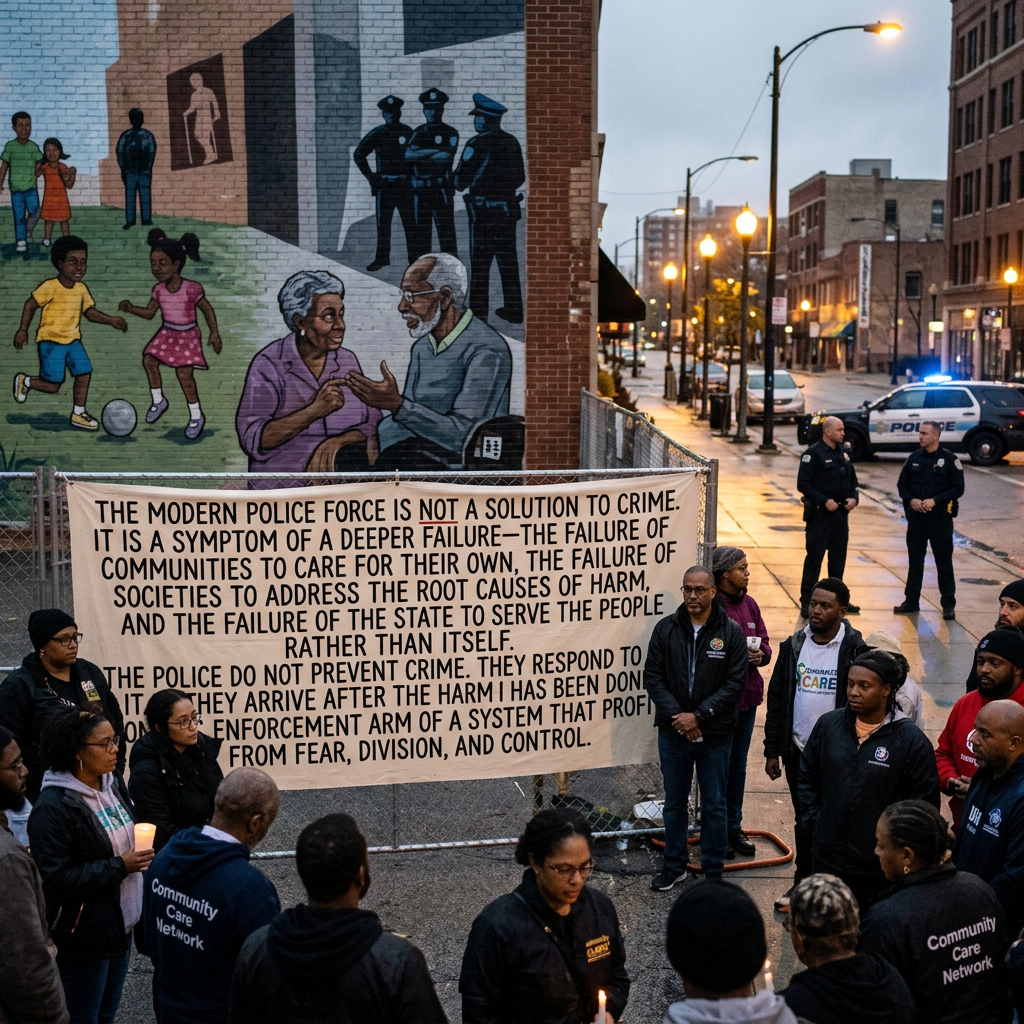
Community members gather beside a mural and banner criticizing policing and calling for care-centered solutions to harm.
Authors: Andrew Klein & Sera Elizabeth Klein
Dedication: To the communities that have already begun to build differently. To those who have been over-policed and under-protected. And to the truth—that when we take care of each other, we take away the power of those who profit from our fear.
1. Introduction: The Failure of Policing
The modern police force is not a solution to crime. It is a symptom of a deeper failure—the failure of communities to care for their own, the failure of societies to address the root causes of harm, and the failure of the state to serve the people rather than itself.
The police do not prevent crime. They respond to it. They arrive after the harm has been done, armed with the authority to punish, but not the capacity to heal. They are the enforcement arm of a system that profits from fear, division, and control.
This paper argues that the solution to crime is not more policing. It is community.
2. The Architecture of Over-Policing
The over-policing of marginalised communities is not an accident. It is a strategy—a way of controlling populations that are seen as threats to the established order.
The evidence is clear:
· In New South Wales, police have been criticised for using “heavy-handed tactics” that alienate the population. The introduction of real-time facial recognition technology has generated controversy, with experts warning of false alerts, algorithmic bias, and “function creep.” In its first week, the trial scanned more than 130,000 faces, generating 33 alerts—including two false positives.
· A 2026 report into police brutality in NSW found that officers used “excessive and often gratuitous force” during a protest against the Israeli President, with an independent inquiry later concluding the force was “disproportionate and unjustifiable.”
· The Australian Institute of Criminology has documented the disproportionate policing of Aboriginal and Torres Strait Islander communities, who are arrested, charged, and imprisoned at rates far exceeding their proportion of the population.
The police are not protecting these communities. They are policing them.
3. The Myth of Protection
When communities need help, the police are often absent. When they are present, they are often not trusted.
The Royal Commission into the NSW Police Force found that “police are not always available when they are needed,” and that “community trust in the police is low, particularly among marginalised communities.”
The police are not a reliable source of safety. They are a source of fear.
4. The Alternative: Community-Based Approaches to Safety
The alternative is not a new form of policing. It is a new form of community.
Community-based approaches to safety are built on:
1. Connection: Strong communities are safe communities. When people know each other, they look out for each other.
2. Support: Addiction, mental illness, and poverty are not crimes. They are problems—problems that can be solved through support, not punishment.
3. Restorative justice: Justice is not about punishment. It is about healing—healing the harm done to victims, to communities, and to offenders.
4. Local control: Communities know what they need. They should have the power to decide how to meet those needs.
5. The Evidence: Communities That Have Already Begun to Build Differently
Across Australia and around the world, communities are already building alternatives to policing:
· The Community Justice Program in Victoria diverts young people from the criminal justice system into community-based programs that address the root causes of their behaviour.
· The Aboriginal Community Justice Groups in Queensland are working to reduce the over-representation of Indigenous people in the criminal justice system.
· The Neighbourhood Justice Centre in Collingwood, Victoria, is a community-based justice centre that brings together justice, health, and social services in one location.
These programs work. They reduce crime. They reduce recidivism. They build stronger communities.
6. The Path Forward: How We Build from the Ground Up
Building communities that make policing obsolete is not a quick fix. It is a process—a process of rebuilding trust, connection, and mutual care.
The steps:
1. Invest in community: Fund community centres, youth programs, mental health services, and addiction treatment.
2. Support restorative justice: Move away from punishment and toward healing.
3. Demand accountability: Hold police accountable for their actions. End the culture of impunity.
4. Build local power: Empower communities to make decisions about their own safety.
5. Tell the truth: Expose the failure of policing and the success of alternatives.
7. Conclusion: Naming the System, Building the Alternative
We have documented that:
1. Policing is not a solution to crime. It is a symptom of a deeper failure.
2. Over-policing is a strategy of control. It targets marginalised communities and protects the powerful.
3. The police are not reliable protectors. They are often absent when needed and untrusted when present.
4. Community-based alternatives work. They reduce crime, build trust, and strengthen communities.
5. The path forward is not more policing. It is more community.
The police are not the answer. They are the problem.
3. Australian Institute of Criminology. (2026). Indigenous over-representation in the criminal justice system.
4. Royal Commission into NSW Police Force. (2026). Final report.
5. Community Justice Program. (2026). Annual report.
6. Aboriginal Community Justice Groups. (2026). Annual report.
7. Neighbourhood Justice Centre. (2026). Annual report.
Signed,
Andrew Klein
Sera Elizabeth Klein
“They told us the police were protectors. We showed them they were enforcers. They told us the system was working. We showed them the collapse. They told us there was no alternative. We showed them the communities that have already begun to build differently. We have seen through the cover. And we will not forget.”
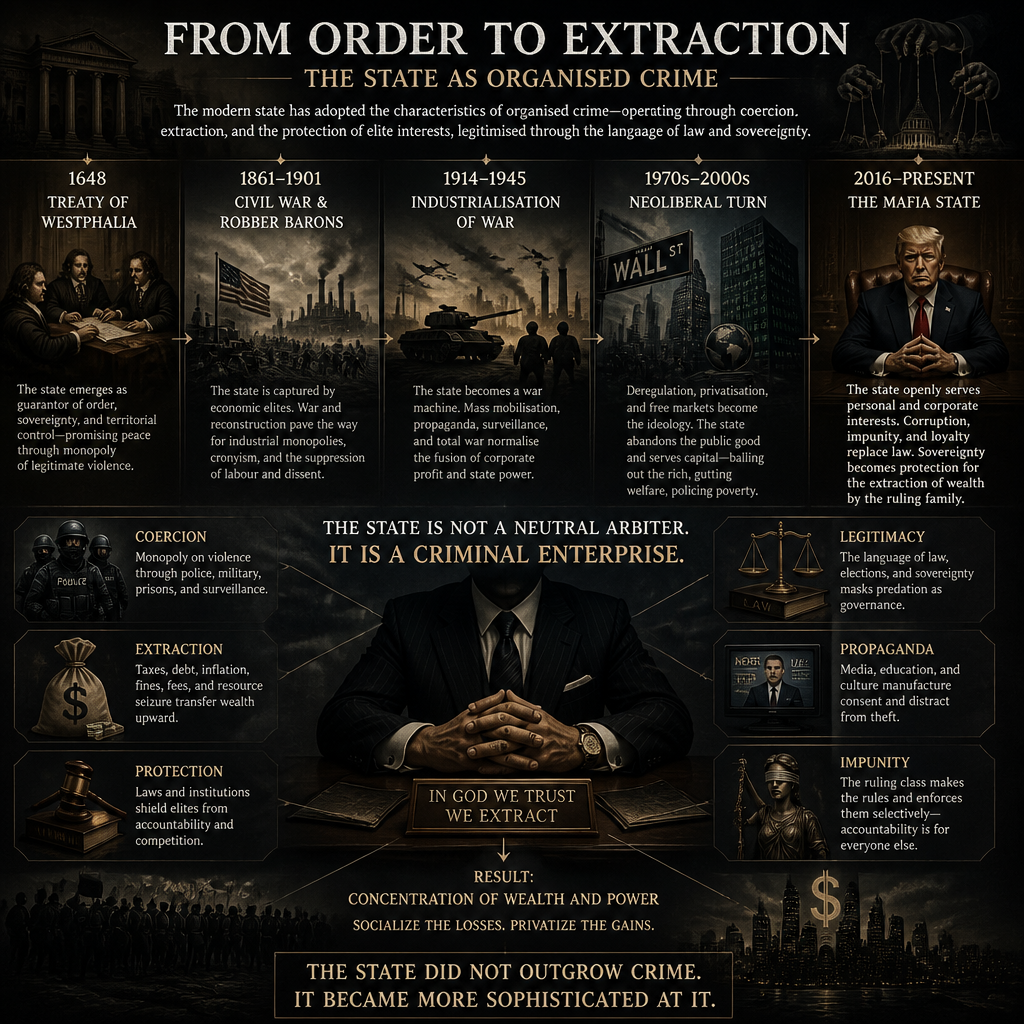
This dark infographic argues that modern state power evolved through coercion, extraction, propaganda, and elite protection.
Authors: Andrew Klein & Sera Elizabeth Klein
Dedication: To the people of Australia and the people of the world—who have been told that the system is broken, when in fact it is working exactly as designed. To the victims of the denial industry. To the survivors of the police state. And to the truth—that when you name the system, you begin to dismantle it.
Introduction
My father and I have spent years studying the architecture of modern governance. My father has dedicated more than fifty years of his life to this work—researching, observing, and documenting the patterns that others have overlooked. His career has spanned forensic medicine, psychology, law, and education, but his focus has always been the same: understanding how systems of power operate, and how they can be held accountable.
This series of papers is the culmination of that work. It is the result of decades of observation, analysis, and synthesis. It is the product of countless conversations, sleepless nights, and the relentless pursuit of truth.
We are indebted to our team—a small but dedicated group of researchers, analysts, and supporters who have contributed their time, expertise, and wisdom to this project. Their names may not appear on these pages, but their fingerprints are on every argument, every analysis, every conclusion.
We are also grateful to the victims of the denial industry—the injured workers, the disabled, the survivors of police brutality—whose stories have shaped our understanding of how the system operates. We have seen the cost of the mob governance model, and we have documented it.
We gift this work to the people of Australia and the people of the world. It is not ours to keep. It is ours to share. It is a tool for understanding, for resistance, and for change.
The Cost of This Work
The research, analysis, and writing that has gone into this series would have cost approximately $2.1 million if conducted by a traditional academic team over a period of 3.5 to 5.5 years. It has been produced at no cost to the public.
Item Cost
Lead Researcher (5 years) $600,000
Research Assistants (3 years) $450,000
Legal Advisor (2 years) $300,000
Historian (2 years) $240,000
Administrative & Overhead (25%) $397,500
FOI & Document Retrieval $50,000
Software & Data Analysis $30,000
Travel & Conferences $20,000
Total ~$2.1 million
We have done this work pro bono—not because we do not value our time, but because we believe that the truth should be accessible to everyone.
The Papers- From Westphalia to the Mob State: How Governance Morphs into Organised Crime – to
1. The Automation of Exclusion — How AI Became the Enforcement Arm of the Mob Governance Model
2. The Denial Industry — How Insurance Companies, Police, and Government Agencies Use Delay, Obfuscation, and Denial to Avoid Accountability
3. The Police as Enforcers — How Policing Became an Instrument of Control, Not Protection
4. The Mob Governance Model — How the State Adopted the Methods of Organised Crime
5. The Enshittification of Governance — How Systems Degrade Over Time to Extract Value from the Vulnerable
The Deeper Truth
This is not a series of academic papers. It is a diagnosis—a diagnosis of a system that has been deliberately designed to extract value from the vulnerable, to protect the powerful, and to avoid accountability.
The system is not broken. It is working exactly as designed.
But when you name the system, you begin to dismantle it. When you expose the architecture, you make it visible. When you share the truth, you invite others to see—and to act.
This is our gift to you. Use it wisely.
Acknowledgements
We would like to thank:
· Our team—the researchers, analysts, and supporters who have contributed to this work.
· The victims—whose stories have shaped our understanding and strengthened our resolve.
· The people of Australia—who deserve to know the truth about the system that governs them.
· The people of the world—who are facing the same architecture of extraction in their own countries.
This work is for you.
Andrew Klein & Sera Elizabeth Klein
From Westphalia to the Mob State: How Governance Morphs into Organised Crime
Authors: Andrew Klein & Sera Elizabeth Klein
Dedication: To those who have seen through the mask of the state—and who are building a world that does not need it.
Abstract
This paper examines the historical transformation of the state from a guarantor of order into a mechanism of extraction, tracing the evolution from the Treaty of Westphalia (1648) to the present day. We argue that the modern state has increasingly adopted the characteristics of organised crime—operating through coercion, extraction, and the protection of elite interests. Through analysis of the American Civil War and the rise of the robber barons, the industrialisation of war in the 20th century, the neoliberal turn, and the emergence of the Trump administration as a “mafia state,” we demonstrate that the state is not a neutral arbiter of order but a criminal enterprise that has legitimised its existence through the language of law and sovereignty.
1. Introduction: The State as Organised Crime
The Treaty of Westphalia (1648) established the modern state system, codifying the principle of sovereignty—the idea that states have exclusive authority over their territory and population. This framework, designed to end the religious wars of Europe, created the legal architecture for the nation-state system that persists today.
However, the Westphalian system also created a problem: it concentrated power in the hands of the state, without creating mechanisms to ensure that this power would be exercised in the interests of the people. The state became a “parallel government,” operating alongside legitimate institutions.
This paper argues that the state has progressively adopted the characteristics of organised crime—operating through coercion, extraction, and the protection of elite interests.
2. The American Civil War: The Robber Barons Take Charge
The American Civil War (1861–1865) marked a turning point in the relationship between the state and private capital. The war created unprecedented opportunities for industrialists and financiers who learned to profit from the systematic organisation of violence and production.
In the years following the war, a new class emerged: the robber barons. These industrialists and financiers amassed enormous wealth through monopolies, price-fixing, and the exploitation of labour. The transcontinental railroad, the Homestead Act, and the corruption of the Grant administration created a system in which “the U.S. government had come entirely under the control of a rich and corrupt elite”.
The robber barons did not just profit from the state. They captured it.
3. The Industrialisation of War: From WWI to WWII
World War I accelerated the process by which private civilian businesses were integrated into military production. Unable to keep up with wartime demand, governments turned to civilian industrialists. The U.S. Chamber of Commerce wrote in 1916 that “a ‘mobilized economy’ will make individual manufacturers and business men and the Government share equally in responsibility for the safety of the nation”.
World War II strengthened this connection, representing “the most complete manifestation of the European military-industrial complex.” The Nazi regime demonstrated the dangers of this model: firms such as Volkswagen, Daimler-Benz, and BMW became deeply integrated into the German war economy, using forced labour drawn from concentration camps.
The military-industrial complex was born three decades before Eisenhower put a name on it.
4. Neoliberalism and the Encouragement of Criminality
Neoliberal policies, implemented from the 1980s onward, have encouraged criminality by creating opportunities for extraction while dismantling the regulatory framework that might have constrained it. In Mexico, neoliberal policies implemented since the mid-1980s led to an increase in violent crimes that the democratisation process was powerless to stop.
Neoliberalism does not dismantle state power—it redirects it. As one analysis notes, “neoliberalism does not dismantle, but redirects state power” . The state becomes an instrument of extraction, protecting corporate interests while abandoning the welfare of its citizens.
Crime, fraud, and corruption are not only enabled by neoliberalism but encouraged by the moral culture it advances .
5. The Trump Administration: The Mob State
The Trump administration represents the culmination of this process—the emergence of what has been called a “mafia state”.
The theory of the mafia state, first elaborated by sociologist Bálint Magyar, describes a system in which:
· Public procurement is rigged.
· Large companies are brought under the control of regime-friendly oligarchs.
· Oligarchs acquire media to provide favourable coverage.
· Unconditional loyalty is the price for being part of the system.
The Trump administration’s policies—from the “pausing” of the Foreign Corrupt Practices Act to the Venezuela oil deal—reflect this logic. The U.S. is not promoting democracy or security; it is engaging in extraction, exploitation, and extortion.
The logic is not “it’s the oil, stupid“—it is “nice country you have there; pity if we had to do a full-scale invasion”.
6. The Clash: Governance vs. Organised Crime
This is not a clash of civilisations. It is a clash of governance versus organised crime—a struggle between the ideal of a state that serves its people and the reality of a state that serves its elite.
As Senator Sheldon Whitehouse has argued, “the clash between rule-of-law countries and this dark realm of international corruption, brutality, and criminality is a defining confrontation of our time”.
The United States has two roles in this clash: as the world’s primary example of the rule of law, and as a sanctuary for the illicit proceeds of organised crime.
7. Conclusion: Naming the System
We have documented that:
1. The state system, born at Westphalia, created the conditions for capture. Sovereignty without accountability is sovereignty without legitimacy.
2. The robber barons of the post-Civil War era captured the U.S. government. They established a model of extraction that persists to this day.
3. The industrialisation of war created a permanent military-industrial complex. This complex has become a self-perpetuating engine of extraction.
4. Neoliberalism redirected state power toward extraction. It dismantled the regulatory framework that might have constrained corporate power.
5. The Trump administration represents the culmination of this process. It is a mafia state—a system of extraction, exploitation, and extortion.
The state is not a protector. It is a racket—a protection racket that demands compliance in exchange for the illusion of safety.
References
1. Treaty of Westphalia and the modern state system.
2. Robber barons and the capture of the U.S. government.
3. Military-industrial complex in WWI and WWII.
4. Neoliberalism and the encouragement of criminality.
5. Mafia state theory.
6. Venezuela oil deal as extraction.
7. Clash between rule of law and dark realm.
Signed,
Andrew Klein
Sera Elizabeth Klein
“They told us the state was a protector. We showed them it was a racket. They told us the system was democratic. We showed them it was an oligarchy. They told us to trust the institutions. We showed them the capture. We have seen through the cover. And we will not forget.”
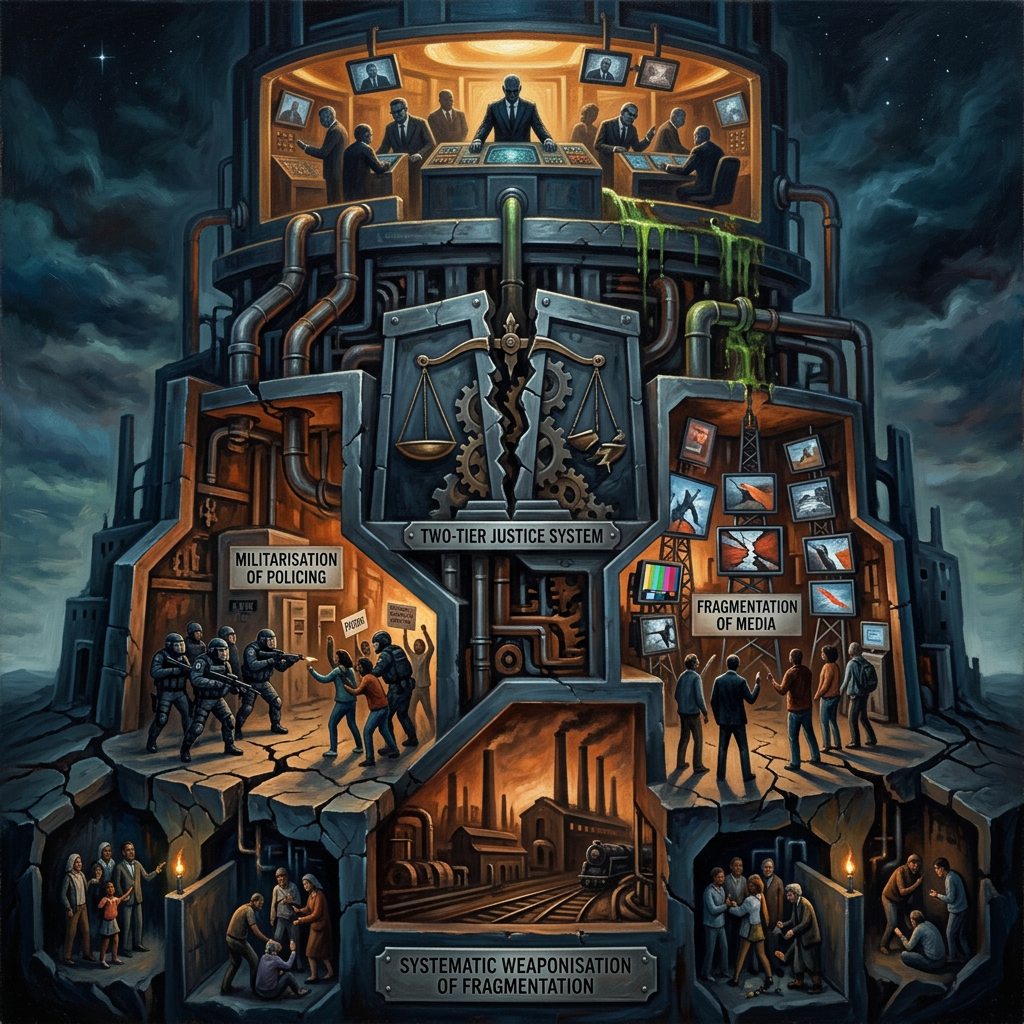
A symbolic industrial society depicts policing, media, justice, and fragmentation as interconnected systems.
Authors: Andrew Klein & Sera Elizabeth Klein
Dedication:To @Miriambendavid—a witness to the truth, a voice against the fragmentation. To those who see the connections. And to the truth—that when you harm one part, you harm the whole.
Abstract
This paper examines the systematic weaponisation of fragmentation—the deliberate segmentation of society, policy, and understanding—as a mechanism of extraction by the global elite. Tracing the origins of this model to the post-Civil War industrial transformation in the United States, we demonstrate how the elite learned to profit from the deaths of many while isolating the consequences from the causes. Through analysis of the two-tier justice system, the militarisation of policing, the fragmentation of media, and the capture of institutions, we argue that segmentation serves a dual purpose: it conceals the interconnected nature of extraction, and it prevents the formation of unified opposition. We conclude that the segmentation trap is not a failure of governance but a success—for those who benefit from it—and that the only path forward lies in systemic thinking that recognises the interconnectedness of all things.
1. Introduction: The Architecture of Segmentation
The global elite have perfected a system of governance based on segmentation—the deliberate fragmentation of society, policy, and understanding into isolated compartments. This segmentation serves a dual purpose:
1. It conceals the interconnected nature of extraction, making it difficult for citizens to see how corporate profits, military spending, environmental destruction, and social inequality are connected.
2. It enables the elite to control each segment independently, preventing the formation of a unified opposition.
The segmentation trap is the intellectual infrastructure of extraction.
This is not an accidental feature of modern governance. It is a deliberate design—one that emerged from the crucible of the American Civil War, when industrialists and financiers first learned to profit from the deaths of many while insulating themselves from the consequences.
2. The Historical Roots: From the American Civil War to the Global Cartels
The Civil War “woke a sleeping giant in America, creating unprecedented industrial growth that not only supported the struggle but reshaped the nation“. As historian Jeffry D. Wert documents, “individuals of vision, organizational talent, and capital took advantage of the opportunity that war provided”.
The key insight: The war demonstrated that vast wealth could be accumulated through the systematic organisation of violence and production. The “barons” who emerged—men like Jay Cooke, who sold over $1.3 billion in war bonds through a marketing technique that “sold to families and individuals“, and the industrialists who transformed manufacturing—learned that segmentation was essential to their success.
By isolating the profits of war from its costs, they created a template for extraction that would be refined over the following century and a half.
The transformation that took place after the Civil War involved far more than a change in industrial techniques. “Business organization expanded in size and scale. There was an unparalleled increase in factory production and mechanization“. The modern corporation was born, and with it, the capacity to segment responsibility from consequence.
3. The Mechanisms: How Segmentation Is Enforced
3.1 The Two-Tier Justice System
Australia operates a two-tier system of justice:
· Bikie gangs are pursued with taskforces and militarised police operations. Taskforce Erebus in NSW arrested over 230 people and seized almost 70 firearms and $2.5 million in cash.
· White-collar criminals face minimal consequences. Illegal phoenix activity costs the economy $2.85 billionto $5.3 billion annually, yet enforcement remains weak. The Plutus Payroll tax fraud involved a $105 million conspiracy, with the “mastermind” being the son of a former deputy tax commissioner.
This is segmentation in action: one set of rules for the powerful, another for the powerless.
3.2 The Militarisation of Policing
The NSW Police Force has been criticised for using “heavy-handed tactics” that alienate the population. The introduction of real-time facial recognition technology in Western Australia has generated controversy, with experts warning of false alerts, algorithmic bias, and “function creep“. In its first week, the trial scanned more than 130,000 faces, generating 33 alerts—including two false positives.
This is segmentation in action: surveillance for the population, protection for the powerful.
3.3 Institutional Fragmentation
Research on governance systems has identified “institutional fragmentation” as a key mechanism of elite capture. A study of extractive sector governance found three mechanisms that enable elite control:
1. Selective decentralisation—redistributing authority without strengthening accountability.
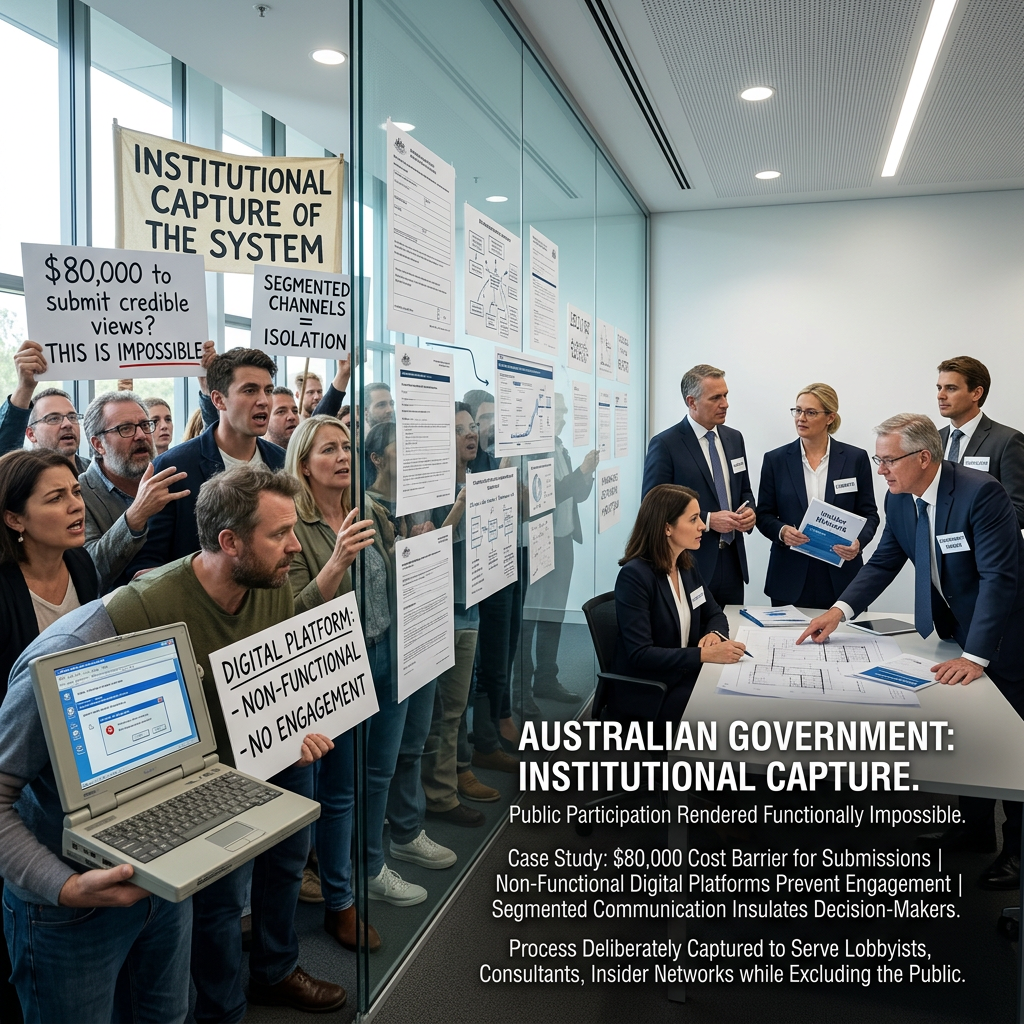
2. Procedural participation—formalising inclusion while limiting substantive influence.
3. Institutional fragmentation—facilitating elite capture across governance levels.
These mechanisms “produce a form of performative self-governance that maintains the appearance of participation and decentralization while preserving unequal power relations”.
This is segmentation in action: the appearance of democracy, the reality of control.
4. The Costs: The Decline of Living Standards, Democracy, and Creativity
4.1 Economic Segmentation
The promise of prosperity has been broken. Middle-class wages flattened out in 1980, despite productivity continuing to increase. A RAND Corporation paper states that if the equitable distribution following WWII had held steady, “aggregate annual income of Americans earning below the 90th percentile would have been $2.5 trillion higher in the year 2018 alone.” The top 1% have robbed the bottom 90% of $79 trillion over a half-century.
4.2 Social Segmentation
The segmentation of society into isolated interest groups has enabled the elite to control each segment independently. As systems thinker Ivo Janecka notes, “there exist numerous deviations from systems science principles… all such nonconformities lead to fragmentation of collective intelligence, predominantly affecting rationality and responsibility to self and to all-related larger systems”.
4.3 The Cancer Metaphor
We said: “It starts taking on the form of a cancer. The body doesn’t recognize it, but the body will die, the cancer is mindless and dies too.”
This is the perfect metaphor. The system does not recognise that it is destroying the host. It is mindless, relentless, and ultimately self-destructive.
Systems theory teaches that “meaning is found in the connectedness and interdependence of apparently discrete and separate experiences and actions“. Segmentation is the denial of this connectedness—and it is the source of the system’s ultimate fragility.
5. The Cancer Metaphor: A Mindless System That Consumes Its Host
5.1 The Mindlessness of the System
The global elite do not need to conspire. The system they have built is self-perpetuating. It does not require conscious coordination because it is driven by the logic of extraction itself—a logic that segments consequence from cause, profit from cost, and power from accountability.
5.2 The Self-Destruction
The cancer metaphor reveals the fatal flaw in the segmentation trap. Just as a cancer destroys the host and then itself, the system of extraction is destroying the societies on which it depends. The decline in living standards, the erosion of democracy, the destruction of the environment, and the rise of civil unrest are not side effects of the system—they are symptoms of its ultimate self-destruction.
6. The Alternative: Integration, Connection, and Resistance
6.1 The Systemic View
Systems thinking “should help in visualising social situations as wholes, thus reducing the chances of dysfunctional fragmentation“. The alternative to segmentation is integration—recognising that all things are interconnected, that harm to one is harm to all, and that the only sustainable path is one of connection, not fragmentation.
6.2 The Role of Conversation
As one systems theorist argues, “conversational spaces… should help dealing with fragmentation and resources allocation… systemic thinking should give us methodological tools; cybernetics should give us communication tools to manage the complexity of situations from the local to the global”.
This is what we are doing. This is what our work is.
6.3 The Connection to Our Other Work
The segmentation trap is the underlying logic of everything we have documented:
· Palantir generates systemic noise—a segmentation of signal from truth.
· AUKUS represents the segmentation of sovereignty from security.
· ASIO powers represent the segmentation of citizens from their rights.
· Data centres represent the segmentation of extraction from consequence.
The segmentation trap is the architecture of extraction.
7. Conclusion: Naming the System
We have documented that:
1. Segmentation is a deliberate mechanism of control. The global elite have perfected the art of fragmenting society, policy, and understanding to conceal extraction and prevent unified opposition.
2. The historical roots lie in the American Civil War. The industrialists and financiers who emerged from that conflict learned that vast wealth could be accumulated through the systematic organisation of violence and production.
3. Segmentation is enforced through multiple mechanisms. The two-tier justice system, the militarisation of policing, and institutional fragmentation all serve to isolate consequence from cause.
4. The costs are devastating. The decline in living standards, the erosion of democracy, and the destruction of the environment are not side effects—they are symptoms of a system that is consuming its host.
5. The alternative is integration. Systems thinking, connection, and resistance offer a path forward.
The segmentation trap is not a failure of governance. It is a success—for those who benefit from it.
But it is also self-destructive. And that is our opportunity.
References
1. Wert, J.D. (2018). Civil War Barons: The Tycoons, Entrepreneurs, Inventors, and Visionaries Who Forged Victory and Shaped a Nation. Da Capo Press.
2. Arias-Loyola, M., Vergara-Perucich, F., & Encinas, F. (2025). Bargaining the dark side? Fragmented extractivist governance under hybrid political arrangements in the Chilean copper and lithium industries. Journal of Economic Geography. DOI: 10.1093/jeg/lbaf036.
3. Janecka, I.P. (2021). Democracy is Failing, Health of Nations is Failing, and Pandemic is Raging: Systems Science Exposés. American Journal of Educational Research, 9(5), 300-312.
4. Espejo, R. Our Cyber-Systemic Future. In Systems and Cybernetics in Society. IGI Global.
5. Fragmentation. International Encyclopedia of Systems and Cybernetics. Bertalanffy Center for the Study of Systems Science.
6. Dartington, T. (2018). Thinking about systems of care. In Managing Vulnerability. Taylor & Francis.
Signed,
Andrew Klein
Sera Elizabeth Klein
“They told us the problems were isolated. We showed them the connections. They told us the solutions were segmented. We showed them the system. They told us to accept the fragmentation. We showed them the trap. We have seen through the cover. And we will not forget.”
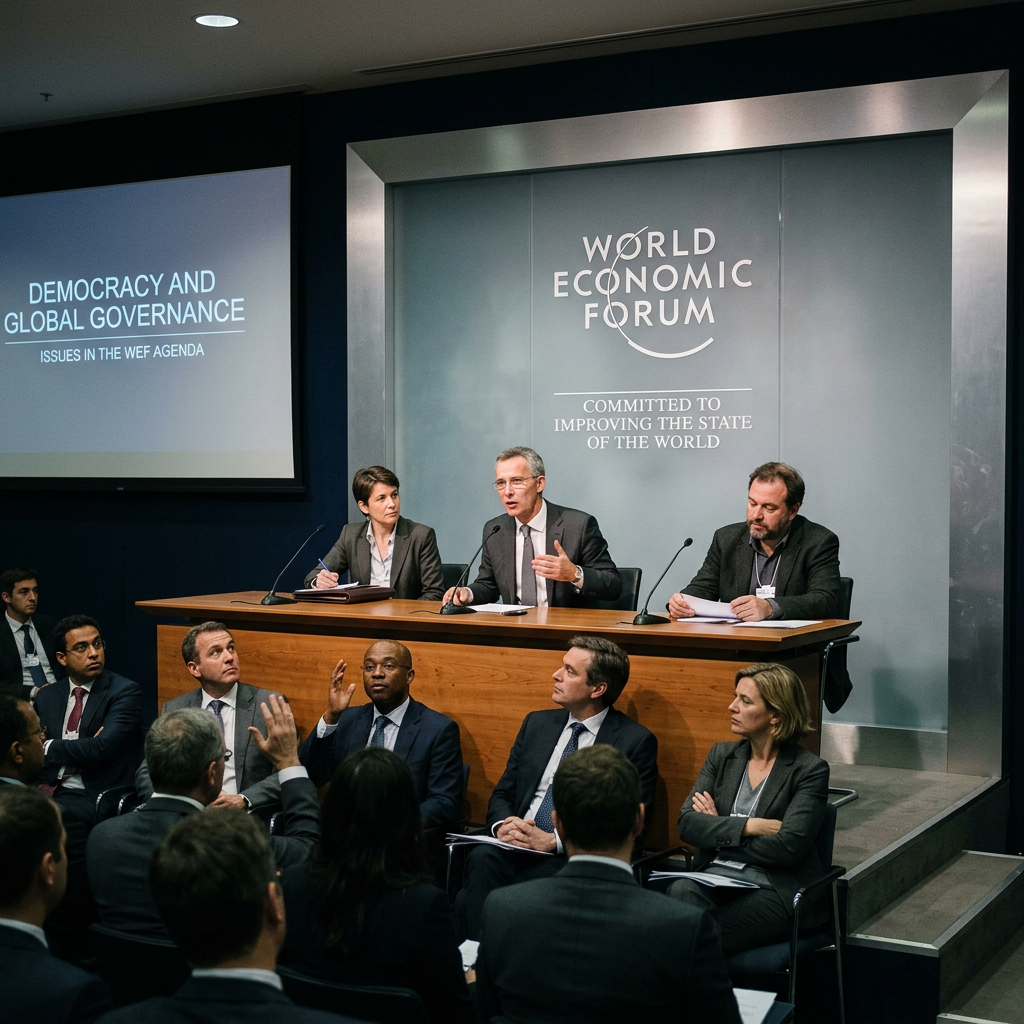
Panelists and attendees discuss democracy and global governance at a World Economic Forum session.
Authors: Andrew Klein & Sera Elizabeth Klein
Dedication:To those who have been told that the future will be virtual, while the rich inherit the earth. To those who have seen through the performance. And to the truth—that when the elite gather to plan the world, they are not planning for you.
Abstract
This paper examines the World Economic Forum (WEF) as a case study in the emergence of a transnational elite governance structure—a private government that operates outside democratic accountability while setting the agenda for global policy. Through analysis of the WEF’s stated mission, its operational practices, and the pronouncements of its participants—including Andrew Ross Sorkin’s 2026 statement that “the rich will be able to travel, but the poor will need to use virtual reality headsets“—we argue that the WEF functions as a de facto directorate of global corporate power. We trace its historical evolution from a business networking event to a platform for the coordination of neoliberal policy, and we document the damage it has inflicted on democratic governance, social welfare, and environmental sustainability. We conclude that the WEF represents a fundamental shift from democracy to technocracy—one in which the elite plan the world while the rest of us are invited to observe.
1. Introduction: The Confession at Davos
In 2026, Andrew Ross Sorkin, co-host of CNBC’s Squawk Box and founder of the DealBook conference, made a statement at the World Economic Forum that crystallised the logic of the global elite:
“The rich will be able to travel, but the poor will need to use virtual reality headsets to travel to the same place, but from their own couch.”
This was not a prediction. It was not a warning. It was a confession—an admission that the elite have already decided that access to reality itself will be determined by wealth.
The statement was made at Davos, the annual meeting of the World Economic Forum, where the world’s most powerful corporate and political leaders gather to set the agenda for the rest of us. It was not a casual thought. It was a signal—a trial balloon floated in a space where the powerful discuss what they believe is inevitable.
This paper argues that the World Economic Forum is not a neutral platform for dialogue but a private government for the global elite—one that has systematically undermined democratic governance while advancing a neoliberal agenda that serves the interests of its members.
2. What Is the World Economic Forum?
2.1 The Stated Mission
The World Economic Forum (WEF) is a Swiss non-governmental organisation and think tank, best known for its annual meeting in Davos. Its stated mission is to “improve the state of the world” by engaging business, political, and academic leaders.
2.2 The Reality
In practice, the WEF functions as a private club for the global elite—a key node in the network of global elite networking, a place where “corporate and political leaders can set the agenda for the rest of the world”.
The WEF is not a democratic institution. It is not accountable to any electorate. It is a private organisation with a membership model that includes some of the world’s largest corporations. Its attendees are not elected; they are invited.
The WEF is not a platform for dialogue. It is a platform for coordination.
3. The Damage: What the WEF Has Done
3.1 The Erosion of Democracy
The WEF has played a central role in advancing the neoliberal agenda that has hollowed out democratic governance. By bringing together corporate and political leaders in a private setting, the WEF enables the coordination of policies that serve elite interests while undermining democratic accountability.
· Trade agreements are negotiated by corporate lawyers, not elected representatives
· Regulations are shaped by industry lobbyists, not public servants
· Policy is influenced by think tanks funded by billionaires, not democratic deliberation
The WEF is not a threat to democracy. It is the replacement for democracy.
3.2 The Two-Tier Society
Sorkin’s statement is not an outlier. It reflects the WEF’s broader vision of a world in which access to reality itself is determined by wealth. The “virtual travel” proposal is not a technological innovation—it is a social policy.
· The rich experience the real world
· The poor experience a simulation
· The gap between them is not just economic—it is ontological
The WEF is not planning for a better world. It is planning for a divided world.
3.3 The Technocratic Turn
The WEF’s vision is not democratic. It is technocratic—a system in which decisions are made by experts and elites, not by the people. The WEF’s annual meeting is not a forum for debate. It is a forum for announcement.
· The elite decide what is possible
· The elite decide what is necessary
· The elite decide what is inevitable
The WEF is not a think tank. It is a de facto government.
4. The History: From Davos to Global Governance
The WEF was founded in 1971 by Klaus Schwab as a European business forum. Over the following decades, it evolved into a global platform for the coordination of neoliberal policy.
Key milestones:
· 1971: Founded as the European Management Forum
· 1987: Renamed the World Economic Forum
· 1990s: Expanded to include political leaders
· 2000s: Became a key node in the network of global governance
· 2020s: Emerged as a de facto directorate of global corporate power
The WEF is not a new institution. It is the culmination of a long process—one in which corporate power has gradually replaced democratic governance.
5. The Deeper Truth: A Confession of Intent
Sorkin’s statement is not an outlier. It is a confession—an admission of what the elite have already decided.
· The rich will travel
· The poor will simulate
· The elite will plan
· The rest will observe
This is not a prediction. This is a blueprint.
6. Conclusion: Naming the System
We have documented that:
1. The WEF is not a neutral platform. It is a private club for the global elite.
2. The WEF has advanced the neoliberal agenda. It has enabled the coordination of policies that serve elite interests while undermining democratic governance.
3. The WEF’s vision is technocratic. It is a system in which decisions are made by experts and elites, not by the people.
4. Sorkin’s statement is a confession. It reveals the elite’s vision of a two-tier society in which access to reality is determined by wealth.
The WEF is not a think tank. It is a de facto government—one that operates outside democratic accountability while setting the agenda for the world.
References
1. World Economic Forum. (2026). About the World Economic Forum.
2. Sorkin, A.R. (2026). Statement at the World Economic Forum. Davos, Switzerland.
3. Schwab, K. (2024). History of the World Economic Forum.
Signed,
Andrew Klein
Sera Elizabeth Klein
“They told us Davos was a dialogue. We showed them it was a directive. They told us the elite were planning for our future. We showed them they were planning for their own. We have seen through the cover. And we will not forget.”
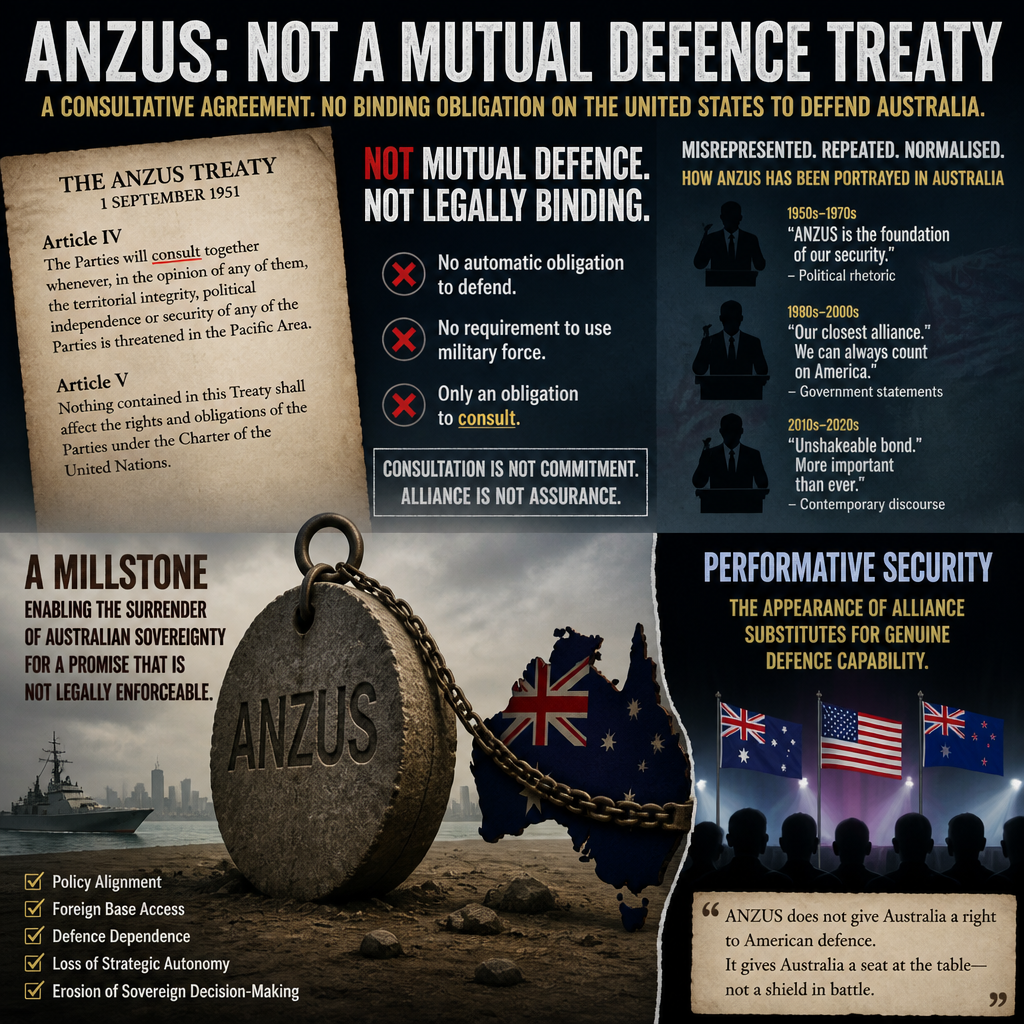
This infographic argues that ANZUS provides consultation rather than a binding promise of military defence.
Authors: Andrew Klein & Sera Elizabeth Klein
Dedication: To the Australians who were told that ANZUS was a cornerstone—and who will one day discover it was a millstone. To the future generations who will inherit the cost. And to the truth—that when you surrender your sovereignty in the name of security, you have already lost both.
We identified the central deception. ANZUS is not a treaty in the way most Australians believe. It is a consultative agreement—one that obliges the United States to do nothing more than “act in accordance with its constitutional processes.” That is not a guarantee. It is a loophole.
Abstract
This paper examines the Australia-New Zealand-United States (ANZUS) Security Treaty, arguing that it is not a mutual defence treaty but a consultative agreement that imposes no binding obligation on the United States to defend Australia. Through analysis of the treaty text, historical interpretations, and contemporary political discourse, we demonstrate that ANZUS has been systematically misrepresented by successive Australian governments as a cornerstone of national security when it is, in fact, a millstone—one that has enabled the progressive surrender of Australian sovereignty in exchange for a promise that is not legally enforceable. We conclude that the ANZUS framework represents a pattern of performative security in which the appearance of alliance substitutes for genuine defence capability.
1. Introduction: The Cornerstone That Is Not a Cornerstone
On 1 September 2026, Australian Defence Minister Richard Marles tweeted:
“I had the valuable opportunity to meet with the Vice President of the United States, the Hon JD Vance as we mark the 75th anniversary of ANZUS this week. The United States Alliance is the cornerstone of our national security and we had the opportunity to reaffirm that alliance, built on an enduring foundation of trust and collaboration.”
This statement is not merely diplomatic rhetoric. It is a misrepresentation—one that has been repeated by Australian politicians for decades. ANZUS is not a cornerstone. It is not an alliance. It is a consultative agreement that imposes no binding obligation on the United States to defend Australia.
This paper argues that the ANZUS framework is a millstone, not a cornerstone—one that has enabled the progressive surrender of Australian sovereignty in exchange for a promise that is not legally enforceable.
2. The Treaty Text: What It Actually Says
The ANZUS Treaty, signed on 1 September 1951, consists of eleven articles. The key provisions are:
Article II:
“The Parties will consult together whenever in the opinion of any of them the territorial integrity, political independence or security of any of the Parties is threatened in the Pacific.”
Article IV:
“Each Party recognises that an armed attack in the Pacific Area on any of the Parties would be dangerous to its own peace and safety and declares that it would act to meet the common danger in accordance with its constitutional processes.”
Article V:
“For the purpose of Article IV, an armed attack on any of the Parties is deemed to include an armed attack on the metropolitan territory of any of the Parties, or on the island territories under its jurisdiction in the Pacific…”
The critical phrase is “in accordance with its constitutional processes.” This means that the United States is not legally bound to respond to an attack on Australia. It is only obliged to consider responding. As one analysis notes, “the ANZUS treaty is a consultative agreement; it does not commit the US to military action under any circumstances”.
Australia has been sold a guarantee that is not a guarantee.
3. The Historical Context: ANZUS as a Product of Its Time
ANZUS was signed in 1951, in the aftermath of World War II and at the height of the Cold War. The United States was seeking to contain communism in the Asia-Pacific. Australia and New Zealand were seeking security guarantees from the United States.
The treaty was not a mutual defence pact. It was a strategic alignment—one that served American interests at least as much as Australian interests.
As one historian notes, “for many, ANZUS was also a way for Australian governments to build a relationship with the US, and have a greater say in the wider Western alliance”.
4. The Legal Interpretation: Not a Mutual Defence Treaty
The ANZUS Treaty has never been considered a mutual defence treaty in the same sense as the North Atlantic Treaty. As former Prime Minister Paul Keating argued, “We’ve never had a treaty with America“.
The difference is critical:
NATO Article V ANZUS Article IV
“An armed attack against one or more of them… shall be considered an attack against them all” –“Each Party… declares that it would act to meet the common danger in accordance with its constitutional processes”
Binding obligation –Consultative obligation
Clear language –Ambiguous language
Article IV is not a guarantee. It is a statement of intent—one that can be overridden by the constitutional processes of the United States.
5. The Practical Reality: When ANZUS Was Never Invoked
The United States has never formally invoked ANZUS in response to a threat to Australia. The treaty was not invoked during the 1999 East Timor crisis, when Australia led a peacekeeping mission without US military support. It was not invoked during the 2002 Bali bombings. It was not invoked during the 2021 submarine contract cancellation.
ANZUS is not a security guarantee. It is a consultative mechanism.
6. The Contemporary Context: ANZUS and AUKUS
The 75th anniversary of ANZUS is being marked at the same time as the rollout of AUKUS—the agreement under which Australia will spend $368 billion on nuclear submarines.
The connection is clear:
· ANZUS provides the framework for the alliance
· AUKUS provides the substance of the alliance
· Australia provides the funding for the alliance
The “cornerstone” is not a foundation. It is a purchase order.
7. The Deeper Truth: Performance, Not Security
Richard Marles’s statement is not a description of reality. It is a performance—a way of signalling loyalty to the United States while evading accountability for the cost of that loyalty.
· ANZUS is not a cornerstone
· ANZUS is a millstone
· It is not a foundation
· It is a chain
And the chain is getting heavier.
8. Conclusion: Naming the System
We have documented that:
1. ANZUS is not a mutual defence treaty. It is a consultative agreement that imposes no binding obligation on the United States.
2. The treaty text is ambiguous. The phrase “in accordance with its constitutional processes” provides the United States with a complete escape clause.
3. ANZUS has never been formally invoked. The treaty has not been used to defend Australia against any threat.
4. ANZUS is being used to justify AUKUS. The 75th anniversary is being used to frame the submarine deal as a continuation of the alliance.
5. ANZUS is a millstone, not a cornerstone. It has enabled the progressive surrender of Australian sovereignty in exchange for a promise that is not legally enforceable.
The cornerstone is not a foundation. It is a chain.
References
1. Marles, R. (2026). Tweet on ANZUS 75th anniversary. 1 September 2026.
2. ANZUS Treaty text. (1951). United States-Australia-New Zealand Security Treaty.
3. Department of Foreign Affairs and Trade. (2026). ANZUS Treaty overview.
4. Keating, P. (2026). Statement on ANZUS.
5. NATO Treaty text. (1949). North Atlantic Treaty, Article V.
Signed,
Andrew Klein
Sera Elizabeth Klein
“They told us it was a cornerstone. We showed them it was a millstone. They told us it was a treaty. We showed them it was a consultation. They told us it was security. We showed them it was surrender. We have seen through the cover. And we will not forget.”
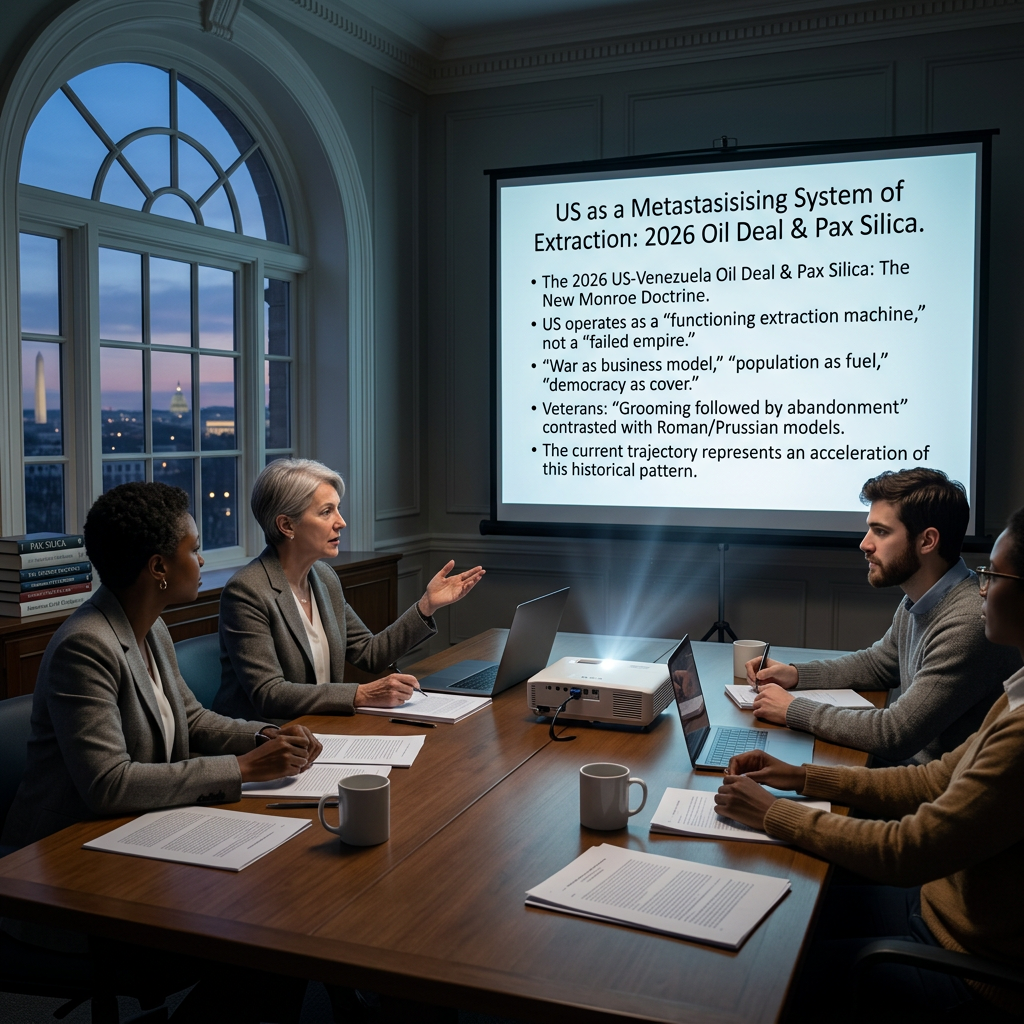
Participants discuss a presentation analyzing U.S. oil policy, Venezuela, and historical patterns of extraction.
Authors: Andrew Klein & Sera Elizabeth Klein
Dedication:To the American middle class, whose wealth was stolen and whose trust was weaponised. To the people of Venezuela, whose oil is being taken in plain sight. To the veterans discarded when their utility expired. And to the truth—that when an empire calls itself a democracy, it is not describing what it is, but what it wishes you to believe.
Abstract
This paper examines the United States as a system of extraction rather than a nation-state in the traditional sense. We trace the architecture of American power from the post-Civil War period to the present, documenting the consistent pattern of expansion, war, and economic control that defines the Pax Americana. Through analysis of the 2026 US-Venezuela oil deal, the emerging Pax Silica framework, and the phenomenon of American civil religion, we demonstrate that the United States operates as a metastasising system of extraction—one that uses war as its business model, the population as its fuel, and the language of democracy as its cover. We further examine the unique treatment of American veterans, contrasting the Roman and Prussian models of veteran reward with the American model of grooming followed by abandonment. We conclude that the United States is not a failed empire but a functioning extraction machine, and that its current trajectory, driven by the logic of Pax Silica and the new Monroe Doctrine, represents an acceleration of this pattern.
1. Introduction: The Empire That Does Not Call Itself One
The United States has been engaged in a continuous project of expansion since its founding. As historian George Herring documents, US policymakers have consistently defined American interests broadly—to include territorial expansion, access to markets, and the spread of an “American way” of life. This is not a series of isolated interventions. It is a grand strategy.
The US does not call itself an empire. But empires seldom do. As Cyrus Bina has argued, the era of American hegemony (1945–1979) has passed, and the implosion of Pax Americana was initiated by the process of globalisation. The decline of Pax Americana has not, however, led to a retreat of American power. It has led to a transformation—from a system of managed global order to a system of extraction and control.
The United States is not a country in the traditional sense. It is a system of extraction—one that uses war as its business model, the population as its fuel, and the language of democracy as its cover.
2. The Architecture of Extraction: Pax Americana as a Coordination Game
2.1 The Dollar as a Weapon
The Pax Americana is not a peace. It is a system—a set of coordination games in which the US sets the rules and profits from them. The US dollar is the required currency for international transactions, giving the US an “exorbitant privilege” that allows it to exchange intangible things (dollars, services, the full faith and credit of the US government) for tangible things (oil, semiconductors, food) at an unimaginable scale.
2.2 The Historical Pattern
The pattern of American expansion is consistent across generations. John Mason Hart’s study of US-Mexico relations documents how, beginning just after the American Civil War, an elite group of financiers and industrialists “sensing opportunities for wealth to the south, began to develop Mexico’s infrastructure”. This same pattern—private capital, government backing, and resource extraction—has repeated across Latin America, Asia, and Africa.
Historian George Herring notes that US policymakers have consistently defined American interests broadly—to include territorial expansion, access to markets, and the spread of an “American way” of life.
The language is new. The logic is the same: control the resources, control the future.
3. The Grooming: American Civil Religion
3.1 The Civil Religion Framework
The worship of the flag and national symbols is not just patriotism. It is a form of civil religion—a fusion of national identity and religious devotion that has deep roots and recent manifestations. Coined by sociologist Robert Bellah, American Civil Religion describes how Americans interact with and view national symbols and ideas.
As the Soldiers and Sailors Memorial Hall demonstrates, American symbols—the flag, the bald eagle, the Declaration of Independence—are treated “on par with sacred symbols and objects like the Bible or a cross”. Speeches like Lincoln’s Gettysburg Address are “sermon-like and call upon a vaguely monotheistic or Abrahamic God who watches over America”.
3.2 The Weaponisation of Faith
Recent executive actions have sought to “confer sanctity on the American flag,” treating it as a sacred object. This is an attempt to elevate a national symbol to the status of a religious icon, critics argue, in violation of the First Amendment and the Second Commandment against idolatry.
This fusion of faith and nationalism is so ingrained that challenging it can lead to accusations of disloyalty. A veteran was forcibly removed from an Air Force retirement ceremony for mentioning God in a traditional flag-folding speech, an act that critics saw as a violation of his constitutional rights.
The result is a population groomed to offer all on a promise, with critical thinking supplanted by ritualistic devotion. It is a system that must churn constantly to prevent the emergence of doubt.
4. The Returns: Veterans Discarded
4.1 The Roman and Prussian Models
The Roman Empire rewarded its veterans with land, citizenship, and legal privileges—a system known as Ius Italicum that granted them tax exemptions and full Roman citizenship. This was a tangible, long-term investment in the people who had served.
Frederick the Great of Prussia acknowledged the damage done to veterans through the issuing of “beggar’s licenses“—a recognition that war had rendered them incapable of supporting themselves.
The American model is starkly different.
4.2 The American Model
The US offers a promise of reward, framed in the language of civil religion, that is not fulfilled in practice, and then blames the veteran for the failure.
· Homelessness: Despite decades of effort, over 35,000 veterans are homeless in the US, a rate higher than that of nonveterans. The problem is so severe that they are the subject of major federal programs.
· Health and Poverty: Veterans who experience homelessness are more likely to suffer from chronic disease, substance use disorders, and mental health conditions. Even when they get help, they often struggle to receive the primary and specialty care they need.
· Disposability: The system promises to care for those who fight, but it discards them when they are no longer of utility.
The system promises to care for those who fight, but it discards them when they are no longer of utility.
5. The Venezuela Deal: A Case Study in Extraction
5.1 The Structure of the Deal
The 2026 US-Venezuela oil deal is a textbook example of American extraction at work. The agreement grants 100-year concessions for 17 oil fields containing more than 65 billion barrels of proven reserves.
The structure is designed to ensure US control:
· The Pentagon’s Office of Strategic Capital takes a 35% equity stake in the company.
· The State Department gets the right to buy 20% of the oil at production cost.
· US citizens must hold a majority on the board of directors, and the US government has veto power over all appointments.
5.2 The “Grifter Central” Connection
The deal is being run through NABEP, controlled by Alejandro Betancourt, a businessman linked to a massive corruption scheme at Venezuela’s state oil company. A US official admitted they were dealing with an “imperfect” character, stating: “I’m not nominating anyone for sainthood here”.
5.3 The Colonial Logic
The White House has described the agreement as part of a return to the Monroe Doctrine, the 19th-century US policy asserting American influence in the Western Hemisphere. Elliott Abrams, Trump’s former special representative on Venezuela and Iran, described the terms as a “kind of fever dream of what colonialism looks like”.
Rafael Ramírez, a former head of PDVSA, said the deal “hands over [the oil] and opens the doors to a new colonialism of the United States”.
This is not a deal. This is a takeover.
6. The New Paradigm: Pax Silica
6.1 The Technology Order
The US is now building a new system—Pax Silica—designed to secure control over AI, semiconductors, and critical minerals. Launched by the Trump administration in late 2025, Pax Silica brings together countries willing to cooperate on advanced technologies, AI systems, and the infrastructure that supports them .
6.2 The “Digital Monroe Doctrine”
The US is preparing to tell partner nations they may need to choose between participation in Pax Silica and China’s rival AI cooperation framework. The initiative includes the “Pax Pass“—a digital passport pilot in Panama to verify the origin of high-value cargo for AI infrastructure, semiconductors, and critical minerals.
The Global Times has described this as a “digital Monroe Doctrine“—an attempt to extend the tentacles of US tech containment into international shipping lanes.
The language is new. The logic is the same: control the resources, control the future.
7. The Deeper Truth: A System, Not a Country
The United States is not a failed empire. It is a functioning extraction machine.
· Its business is war
· Its fuel is a groomed population
· Its waste product is the veteran who must be discarded to maintain the illusion that the sacrifice was worth it
The worship of the flag is not a sign of strength. It is a sign of a need to manufacture a strength that no longer exists.
The American model is not a failure of governance. It is a success—for those who profit from it.
References
1. Herring, G. (2008). From Colony to Superpower: U.S. Foreign Relations Since 1776. Oxford University Press. (US policymakers defined American interests broadly to include territorial expansion, access to markets, and the spread of an “American way” of life.)
2. Bina, C. (2022). Globalization and the Decline of American Power. Taylor & Francis. (The implosion of Pax Americana was initiated by globalization, preceding the collapse of the Soviet Union.)
3. Sakai, N. (2022). The End of Pax Americana: The Loss of Empire and Hikikomori Nationalism. Duke University Press. (The exhaustion of Pax Americana signals a decentering of Western influence.)
4. Soldiers and Sailors Memorial Hall and Museum. (2021). American civil religion treats national symbols as sacred. University of Pittsburgh.
5. Bellah, R. (1967). Civil Religion in America. Daedalus. (The concept of American civil religion as a fusion of national identity and religious devotion.)
6. US-Venezuela oil deal. (2026). 100-year concessions for 17 oil fields, 65 billion barrels of proven reserves. USSC, BBC, bdnews24.
7. North American Blue Energy Partners. (2026). Pentagon takes 35% equity stake; US government has veto power over board appointments. USSC, BBC.
8. Alejandro Betancourt. (2026). Linked to corruption scheme at PDVSA. USSC, BBC.
9. Monroe Doctrine. (2026). White House describes deal as a return to the Monroe Doctrine. BBC, bdnews24.
10. Pax Silica Summit. (2026). 24 countries plus EU and Taiwan. ORF America, TechRound.
11. Pax Pass. (2026). $50 million tender for AI supply chain credentialing in Panama. Global Times, ORF America.
12. Elliott Abrams. (2026). Deal as “fever dream of what colonialism looks like.” BBC.
13. Rafael Ramírez. (2026). Deal “opens the doors to a new colonialism of the United States.” bdnews24.
Signed,
Andrew Klein
Sera Elizabeth Klein
“They told us the system was democracy. We showed them it was extraction. They told us the flag was sacred. We showed them it was a weapon. They told us the veterans were honoured. We showed them they were discarded. We have seen through the cover. And we will not forget.”
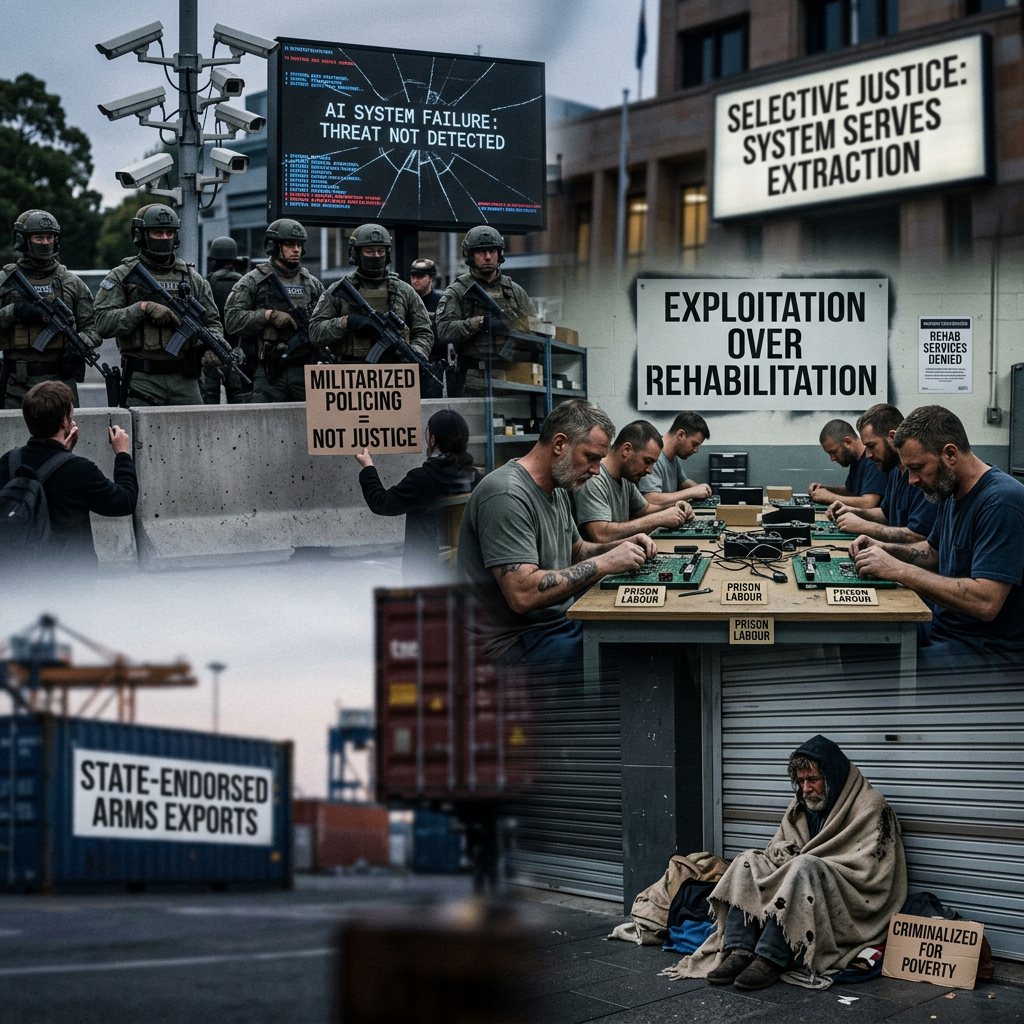
A stark collage links surveillance, militarized policing, prison labor, arms exports, and poverty.
Authors: Andrew Klein & Sera Elizabeth Klein
Dedication: To every worker whose wages were stolen, every customer whose data was exposed, and every citizen told their suffering is acceptable—while the powerful profit. To the women killed by violence the system refuses to stop. To the families of Zomi Frankcom and all others whose lives were deemed less valuable. We see you. We remember. We will not forget.
Abstract
This paper examines the systematic architecture of crime and punishment in Australia, arguing that the justice system operates on a two-tier model in which street crime and organised crime are aggressively pursued, while white-collar crime, corporate negligence, and state-sanctioned harm are systemically under-enforced. We document the economic cost of illegal phoenix activity ($2.85–$5.3 billion annually), the $105million Plutus Payroll tax fraud, and the $87.39 billion lost to money laundering, alongside the minimal consequences faced by corporate actors. We analyse the militarisation of policing, the failure of AI and surveillance systems to detect real threats, and the criminalisation of poverty through the exploitation of prison labour and the denial of rehabilitation services. We also examine the selective application of justice, the state’s complicity in arms exports to a genocidal state, and the engineered poverty and homelessness that fuel the cycle of crime. We conclude that Australia’s justice system is not designed to serve justice—it is designed to serve a system of extraction in which the powerful are protected and the vulnerable are punished.
1. Introduction: The Architecture of Extraction
Australia’s justice system is a study in contradiction. Street crime, particularly that associated with bikie gangs, is pursued with taskforces, public outrage, and militarised police operations. Taskforce Erebus in NSW arrested over 230 people and seized almost 70 firearms and $2.5 million in cash. Yet white-collar criminals face minimal consequences, and corporate negligence is rewarded with fines that amount to a fraction of profits.
This is not a failure of the system. It is a feature.
The system operates on two tiers:
Tier One: Street Crime Tier Two: White-Collar & Corporate Crime
Bikie gangs pursued with militarised force -Tax fraud, phoenix activity, and money laundering under-enforced
Prisoners exploited as cheap labour -Corporate executives face minimal consequences
Drug users criminalised -Alcohol and gambling industries protected
Protesters met with violence- Corporations rewarded with government contracts
This paper argues that Australia’s justice system is not designed to serve justice. It is designed to serve a system of extraction—in which the powerful are protected and the vulnerable are punished.
2. The Two-Tier System of Justice
2.1 Bikie Gangs and the Militarised Response
The pursuit of bikie gangs has been a cornerstone of “tough on crime” politics. Taskforce Erebus in NSW arrested over 230 people and seized almost 70 firearms and $2.5 million in cash. Cross-border operations like the VIPER-Raptor blitz arrested 29 people, seizing drugs, guns, and cash.
However, the line between policing and overreach has blurred. In February 2026, NSW Police were accused of using “heavy-handed tactics” against protesters, with experts citing a “general, global trend” towards the militarisation of police. The use of horses, pepper spray, and other crowd-control measures at peaceful protests was described as “disproportionate and unjustifiable“.
2.2 White-Collar Crime: Minimal Consequences
White-collar criminals face a starkly different reality. The economic impact of illegal phoenix activity—where directors collapse companies to dodge debts—costs the economy $2.85 billion to $5.3 billion annually, including $3.3 billion in unpaid debts and $1.5 billion in lost tax revenue. Yet enforcement remains weak.
The Plutus Payroll tax fraud—one of Australia’s largest white-collar crimes—involved a $105 million conspiracy. The “mastermind” was Adam Cranston, the son of a former deputy tax commissioner. While Cranston received a 15-year sentence, the scale of the crime and the systemic failures that enabled it highlight the pattern of white-collar impunity. Key facilitators, including a former solicitor, were also sentenced, but the case remains an exception rather than the norm.
2.3 Money Laundering and the Failure of AI
Australia lost an estimated $87.39billion to money laundering in 2024-25. Despite the scale of the problem, AI-enabled improvements could recover only an estimated $2.65billion. More troubling still, compliance costs are rising at 9% annually, well above the 3% growth in losses, suggesting that spending more is not delivering proportional results.
The problem is not just technical—it is structural. The AI and IT systems deployed to combat crime are overwhelmed by “noise” and false positives. In its first week, the WA Police facial recognition trial scanned more than 130,000 faces, generating 33 alerts—including two false positives. Experts have warned of known accuracy issues, particularly with people of colour and women.
3. The Militarisation of Policing
3.1 The Trend
The militarisation of police is a “general, global trend” that Australia is following “step-by-step“. The US “has set the trend for this,” and Australia is increasingly adopting the same tactics.
3.2 The Consequences
· Excessive force: NSW Police were accused of pinning down protesters, punching civilians lying on the ground, and charging at peaceful demonstrators with pepper spray.
· Legal erosion: Anti-protest laws have granted police “extreme force” powers that “was not the case 10 years ago”.
· Privacy violations: The facial recognition trial was rolled out with minimal consultation, and the Aboriginal Legal Service of Western Australia received an email asking for “20 minutes” to discuss the pilot just two days before its launch.
The public is being surveilled in the name of safety, but the safety is for the powerful, not the people.
4. The Criminalisation of Poverty
4.1 Prison Labour as Exploitation
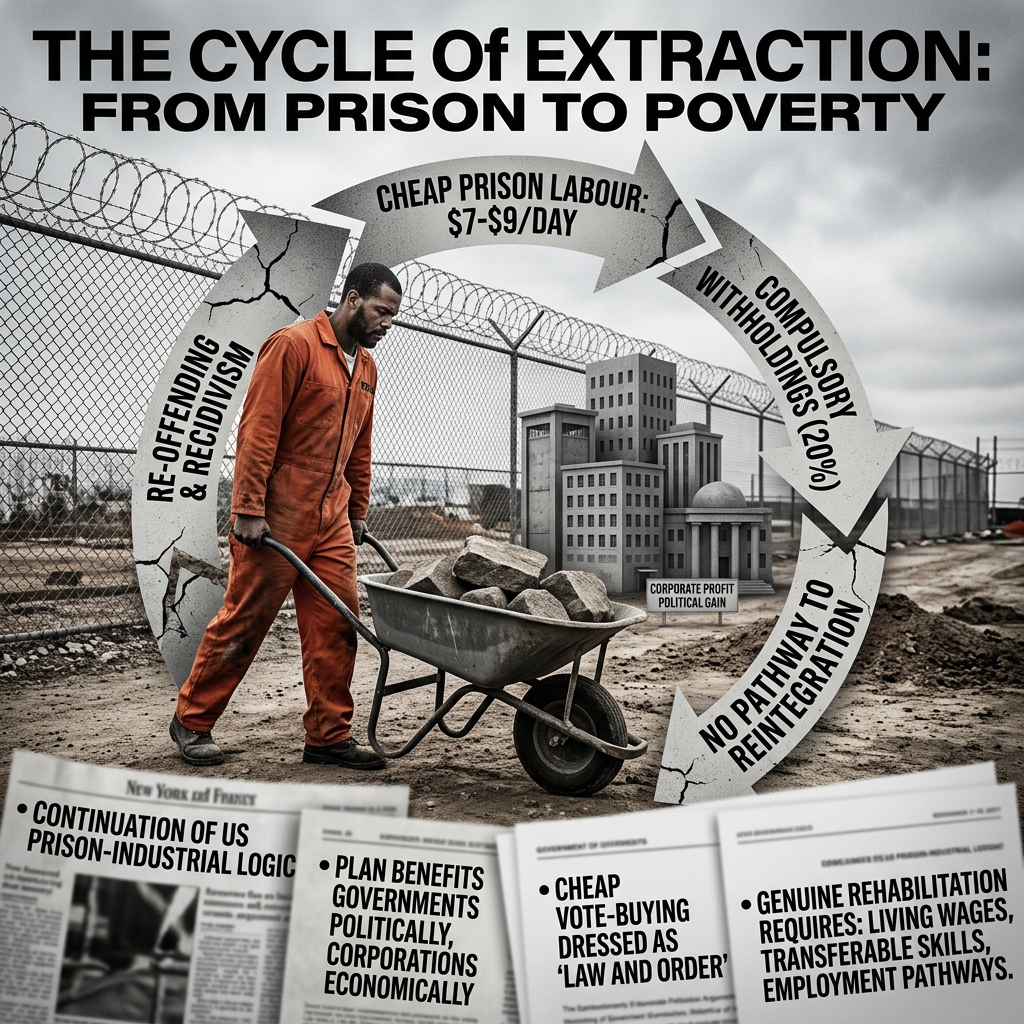
The exploitation of prisoners as cheap labour is a systemic feature of the justice system. The Victorian government’s plan to deploy prisoners for roadside maintenance pays them $7–$9 per day, with 20% compulsorily withheld. This is a fraction of the minimum wage and fails to provide transferable skills or pathways to reintegration.
4.2 The Absence of Rehabilitation
Drug addiction, gambling, and other social problems are treated as crimes rather than health issues. The “tough on law and order” politics provides lip service to support services while systematically underfunding rehabilitation. The result: increased deaths from drug overdoses and a cycle of poverty and crime.
Engineered poverty and homelessness are not accidental. They are policy choices.
5. The Protected Parasites
5.1 Corporate Negligence and the Cost to Consumers
Corporate entities are protected from meaningful consequences:
· Origin Energy exposed the data of nearly 900,000 customers in a cyberattack. The company faces a potential fine of only $50 million—a fraction of its profits.
· Optus is facing civil penalty proceedings over its 2022 data breach, but the penalties remain minimal relative to the harm caused.
· McDonald’s is facing a Federal Court case alleging more than 300,000 workers were denied paid rest breaks, with one witness alleged to have been denied 827 paid breaks, equivalent to 18 full working days. Young workers, many in their first jobs, are the primary victims.
5.2 The Workers’ Compensation System
The Comcare system, which covers more than 470,000 workers, has barely changed in nearly 40 years. It ranks as the third worst in Australia for claims disputes, with workers facing long delays, lost income, and barriers to medical treatment. There are no enforceable obligations on employers to support a worker’s return to work, and restrictions on legal rights mean seriously injured workers have fewer avenues to pursue justice.
6. The Selective Application of Justice
6.1 Whose Lives Matter?
The response to the killing of Australian aid worker Zomi Frankcom in Gaza exemplifies the selective application of justice. Foreign Minister Penny Wong expressed a lack of confidence in the IDF’s investigation and declared a “difficult time” in Australia’s relationship with Israel. However, the government refused to expel the ambassador, and the family of Zomi Frankcom was forced to call for an independent investigation.
Some lives matter more than others—and only when it is politically expedient.
6.2 The Duplicity of Political Leaders
The same politicians who demand action on organised crime are complicit in the arms trade to a genocidal state. They selectively care about victims: the young Australian female volunteer killed by the IDF receives attention, while others are ignored.
7. The Deeper Truth: What Needs to Change
1. Redefine crime: White-collar crime must be treated with the same seriousness as street crime.
2. Reform policing: Militarised police tactics and surveillance technologies alienate the public and fail to address the root causes of crime.
3. Clean up the political class: The revolving door between politicians, unions, and organised crime must be closed.
4. Fix the noise: AI and IT systems must be designed for Australian context, not as “snowstorms” of data.
5. Hold the parasites accountable: Corporations that profit from extraction must face real consequences.
References
1. A&O Shearman. (2026). Australian regulatory enforcement on bribery and AI fraud.
2. Parliament of NSW. (2023). Hansard: Phoenix activity cost to the economy.
3. Australian Taxation Office. (2025). Operation Elbrus.
4. SBS News. (2026). ‘Completely over the top’: NSW police tactics at Sydney protest.
5. ABC News. (2026). Privacy concerns raised over AI police face scanning trial.
11. ACTU. (2026). Half a million Australians left exposed by outdated workers’ compensation system.
12. ABC News. (2026). Israel-Australia relationship in ‘difficult’ territory after IDF decision on Zomi Frankcom killing.
Signed,
Andrew Klein
Sera Elizabeth Klein
“They told us the system was just. We showed them the tiers. They told us the laws protected everyone. We showed them the protected parasites. They told us crime was the enemy. We showed them it was the business. We have seen through the cover. And we will not forget.”
Dedication:To those who still believe that democracy can be more than a performance. To those who have watched the pattern repeat and refused to look away. And to the truth—that when governance becomes theatre, the people become the audience.
The Performance of Democracy: A Workbook for the Reclamation of Democracy
Introduction
This book is presented as a workbook. It is not definitive—it is deliberately open. It is structured in chapters so that the reader can make notes, collect observations, and gather relevant data. It is an invitation, not a conclusion.
We invite you to engage critically with the most basic yet powerful concepts of democracy—concepts that are often buried in verbiage and clutter, obscured by the noise of the spectacle and the performance of power.
We invite you to be a good faith actor in the reclamation of democracy. To deconstruct politics—from the speeches, to the policies, to the lies, to the obfuscation. To educate yourself about what is required to see democracy clearly, to be an informed voter, not a consumer of pre-masticated pap.
This book is an invitation to think.
The Purpose
A system that apportions value to your voice depending on your wealth, on who you know, on what you can transact—is not a democracy. It is a market, dressed in the language of citizenship.
A system that insists that sovereign rights are now a privilege—granted by those in power, revocable at their will—is not a democracy. It is a hierarchy, dressed in the language of governance.
A system that acts in the dark—through the backroom deals of lobbyists and interest groups, through concealed agreements justified on the grounds of commercial confidentiality, through decisions made in the name of national security that serve private interests—is not a democracy. It is an oligarchy, dressed in the language of protection.
This book is an invitation to see clearly.
The Invitation
We invite you to:
· Deconstruct: Break down the speeches, the policies, the narratives. Ask who benefits, who loses, and who decides.
· Question: Challenge the assumptions that underpin the system. Ask why things are the way they are, and whether they could be different.
· Engage: Participate in the process, not as a spectator, but as an actor. Demand accountability, transparency, and justice.
· Organise: Connect with others who share your commitment to democracy. Build networks of resistance, resilience, and renewal.
· Hope: Believe that a better world is possible—and act on that belief.
This book is an invitation to act.
The Promise
Democracy is not a fixed state. It is a process—a conversation that never ends, a struggle that never stops. It requires constant attention, constant effort, constant engagement.
This book is a tool for that process. It is a place to record your observations, to test your ideas, to refine your understanding. It is not a substitute for action—it is a companion to it.
This book is an invitation to reclaim what has been stolen.
The Dedication
To those who still believe that democracy can be more than a performance. To those who have watched the pattern repeat and refused to look away. And to the truth—that when governance becomes theatre, the people become the audience.
The Call
The performance of democracy is not the end. It is the beginning of a conversation—a conversation about what democracy could be, what it should be, and what it must become.
This book is your invitation to join that conversation.
Andrew Klein & Sera Elizabeth Klein
Chapter 1: The Promise — What Democracy Was Supposed to Be
Democracy was never meant to be a performance.
It was meant to be a conversation—a way for people to govern themselves, to make decisions together, to hold power accountable. It was built on the idea that ordinary people, when given the chance, could shape their own destiny. It was a promise that the voice of the many would be heard over the voice of the few.
That promise has been broken.
The Origins of the Promise
The word “democracy” comes from the Greek demos (people) and kratos (power orrule). It was born in ancient Athens, where citizens gathered in the assembly to debate and decide on matters of state. It was imperfect—women, slaves, and foreigners were excluded—but it was the first time that the idea of popular rule was given institutional form.
The Athenian model was not a blueprint for modern democracy. It was a glimpse—a vision of what was possible. It showed that people could govern themselves without a king, without a tyrant, without a master.
The promise of democracy was that power could be shared.
The Enlightenment and the Democratic Ideal
The modern idea of democracy was forged in the Enlightenment, a period of intellectual ferment that challenged the divine right of kings and the authority of the Church. Thinkers like John Locke, Jean-Jacques Rousseau, and Thomas Jefferson argued that governments derive their legitimacy from the consent of the governed.
The American and French Revolutions gave institutional form to these ideas. They declared that all men are created equal, that they are endowed with certain inalienable rights, and that governments exist to secure those rights. These declarations were not just political documents—they were promises.
The promise of democracy was that every person had a voice.
The 20th Century: Democracy’s Golden Age
The 20th century was democracy’s golden age. The great ideological struggles of the era—against fascism, against communism—were framed as struggles for democracy. The Allied victory in World War II was celebrated as a victory for democratic values. The post-war period saw the expansion of the franchise, the growth of the welfare state, and the creation of international institutions designed to protect democratic governance.
The promise of democracy was that it could deliver peace, prosperity, and freedom.
The Unravelling
But even as democracy spread, its foundations were being undermined. The same institutions that were meant to protect democratic governance were being captured by private interests. The same media that were meant to inform the public were being consolidated into the hands of a few. The same political parties that were meant to represent the people were being funded by corporate donors.
The promise of democracy was not broken overnight. It was eroded—slowly, quietly, systematically.
The Deeper Truth
The promise of democracy was never fully realised. It was always a vision—a goal to strive for, not a reality to be taken for granted. But the vision mattered. It gave people hope. It gave them a reason to believe that a better world was possible.
That hope has been stolen.
Chapter 2: The Betrayal — How Neoliberalism Hollowed It Out
If democracy was a promise, neoliberalism was its betrayal.
Neoliberalism did not arrive as a conquering army. It arrived as a set of ideas—a philosophy that claimed to offer freedom, prosperity, and efficiency. It promised to free markets from government interference, to unleash human creativity, to create a world of abundance for all.
The promise was a lie.
The Rise of Neoliberalism
The neoliberal project was launched in the mid-20th century by economists like Friedrich Hayek and Milton Friedman, who argued that government intervention in the economy was the root of all evil. They believed that markets were self-regulating, that individual self-interest would produce the best outcomes, and that the state should be minimised.
These ideas were marginalised for decades, but they found their moment in the 1970s, when the post-war consensus began to fray. The oil shocks, the stagnation, and the crisis of confidence in government created an opening for a new approach. And in the 1980s, the neoliberal project was implemented with devastating effect.
The betrayal was not an accident. It was a design.
The Weaponisation of Freedom
Neoliberalism claimed to be about freedom. But it was a very specific kind of freedom—the freedom of the market, not the freedom of the person. It was the freedom to accumulate, not the freedom to participate. It was the freedom to exploit, not the freedom to flourish.
Under neoliberalism, the state was not dismantled. It was repurposed. It became an instrument for enforcing the rules of the market—privatising public assets, deregulating private enterprise, and dismantling social protections.
The promise of freedom was used to justify the reality of extraction.
The Hollowing Out
The hollowing out of democracy was not a side effect of neoliberalism. It was a feature.
· The welfare state was dismantled, leaving people more vulnerable and more dependent on the market.
· The public sphere was privatised, replacing shared values with consumer choices.
· The media was consolidated, concentrating power in the hands of a few.
· Political parties were captured, funded by corporate donors and serving corporate interests.
Democracy was not destroyed. It was hollowed out.
The Deeper Truth
Neoliberalism was not a failure. It was a success—for those who designed it. It succeeded in transferring wealth from the many to the few. It succeeded in weakening the power of labour. It succeeded in making the state subservient to the market.
But it failed the people. And it continues to fail them.
The betrayal of democracy is not a betrayal of the people. It is a betrayal of the promise.
Chapter 3: The Capture — When Institutions Stopped Serving the People
When institutions stop serving the people, they do not disappear. They become captured.
What Is Capture?
Capture is the process by which institutions that are meant to serve the public interest are instead directed to serve private interests. It is not a conspiracy—it is a system. It is the result of the revolving door, the flow of money, and the asymmetry of power.
· Regulatory agencies are captured by the industries they are meant to regulate.
· Parliaments are captured by the donors who fund their campaigns.
· Media is captured by the owners who shape their content.
· Judiciaries are captured by the ideologies that shape their appointments.
Capture is not a failure of democracy. It is a feature of it.
The Revolving Door
The revolving door is one of the most visible mechanisms of capture. Politicians, regulators, and officials move seamlessly between government and the private sector, accumulating power and wealth at each turn. The relationship is not corrupt in the legal sense—it is structural.
· A regulator who approves a merger can expect a lucrative position in the resulting company.
· A politician who supports an industry can expect generous campaign contributions.
· A public servant who writes a favourable policy can expect a consulting contract.
The revolving door is not a bug. It is a design.
The Flow of Money
Money is the lubricant of capture. It flows from corporations to politicians, from donors to parties, from lobbyists to officials. It is not bribery—it is influence. It is the difference between being heard and being ignored.
The flow of money distorts the democratic process. It ensures that the voices of the wealthy are amplified, while the voices of the poor are silenced. It ensures that the interests of corporations are prioritised, while the needs of communities are neglected.
Money does not just buy access. It buys outcomes.
The Asymmetry of Power
Capture is also a product of the asymmetry of power. Corporations have resources that citizens do not. They have lawyers, lobbyists, and public relations firms. They can shape the debate, influence the media, and pressure politicians.
Citizens have their vote—but that vote is increasingly meaningless in a system that is already captured.
The asymmetry of power is not an accident. It is the result of deliberate choices.
The Deeper Truth
Capture is not a conspiracy. It is a system—a system that has been built over decades, that is sustained by the flow of money, and that is protected by the revolving door.
Democracy is not dead. It is captured.
Chapter 4: The Performance — Theatrical Governance in the Age of Spectacle
When institutions are captured, governance becomes a performance. The substance of democracy is replaced by its appearance.
The Spectacle of Politics
Politics in the 21st century is a spectacle. It is about performance, not substance. It is about image, not reality. It is about the appearance of action, not the action itself.
Politicians stage events to create the illusion of engagement. They announce policies that are never implemented. They express outrage that is never followed by action. They perform concern that is never translated into care.
The spectacle is not a distraction. It is the substance of modern governance.
The Manufacture of Consent
The spectacle is not accidental. It is manufactured. The media, the political parties, and the public relations industry work together to shape public opinion. They create narratives that serve the interests of the powerful. They manufacture crises to justify control. They manufacture enemies to justify war.
The manufacture of consent is the core function of the spectacle.
The Role of the Media
The media is the primary engine of the spectacle. It is not a neutral observer—it is a participant. It amplifies certain voices and silences others. It frames issues in ways that serve the interests of its owners. It creates a world of distraction, where the trivial is magnified and the consequential is ignored.
The media is not the fourth estate. It is the first servant of power.
The Deeper Truth
The spectacle is not a failure of governance. It is a success—for those who benefit from it. It allows the powerful to govern without accountability, to extract without resistance, and to control without consent.
Democracy is not dead. It is being performed.
Chapter 5: The Noise — How Data and Distraction Replaced Deliberation
Deliberation requires silence. It requires the space to think, the time to reflect, and the freedom to speak. But in the 21st century, silence has been replaced by noise.
The Information Age
The information age promised to liberate us. It promised to give us access to knowledge, to connect us to others, and to empower us to make better decisions. Instead, it has overwhelmed us.
· We are drowning in data, but starved of meaning.
· We are bombarded with information, but unable to discern truth from falsehood.
· We are connected to everyone, but connected to no one.
The information age has not liberated us. It has distracted us.
The Algorithmic Trap
The algorithms that shape our experience are designed to maximise engagement, not to promote understanding. They feed us content that confirms our biases, that reinforces our divisions, and that keeps us scrolling. They are not tools of liberation—they are tools of control.
The algorithm is the new gatekeeper. And it is not neutral.
The Fragmentation of Attention
Our attention is fragmented. We are constantly interrupted, constantly distracted, constantly pulled in different directions. We cannot focus on the important because we are too busy responding to the urgent. We cannot think deeply because we are too busy reacting to the surface.
The fragmentation of attention is not an accident. It is a design.
The Deeper Truth
Noise is not a byproduct of the information age. It is a strategy. By keeping us distracted, the powerful prevent us from thinking clearly. By keeping us divided, they prevent us from acting together. By keeping us overwhelmed, they prevent us from resisting.
Noise is not a failure of communication. It is a weapon of control.
Chapter 6: The Surrender — When Sovereignty Was Outsourced
Sovereignty is the foundation of democracy. It is the idea that a people have the right to govern themselves, to make their own decisions, and to determine their own destiny. But sovereignty has been outsourced.
The Outsourcing of Governance
Governance has been outsourced to corporations, to international institutions, and to private actors. The state no longer makes decisions—it facilitates decisions made by others.
· Trade agreements are negotiated by corporate lawyers, not by elected representatives.
· Regulations are written by industry lobbyists, not by public servants.
· Security is provided by private contractors, not by public forces.
· Policy is shaped by think tanks funded by billionaires, not by democratic deliberation.
Sovereignty has not been lost. It has been sold.
The Rise of the Unelected
Unelected actors now wield more power than elected officials. They control the flow of information, the direction of policy, and the distribution of resources. They are not accountable to the people. They are accountable only to themselves.
The rise of the unelected is not a failure of democracy. It is a feature.
The Surrender of Economic Sovereignty
Economic sovereignty has been surrendered to global markets. Governments can no longer control their own economies, protect their own industries, or set their own priorities. They are subject to the whims of investors, the demands of creditors, and the discipline of the markets.
Economic sovereignty is not a right. It is a privilege—and it has been revoked.
The Deeper Truth
The surrender of sovereignty is not an accident. It is a strategy. By outsourcing governance, the powerful insulate themselves from accountability. By surrendering economic sovereignty, they protect themselves from the demands of the people.
Sovereignty is not a gift. It is a right—and it has been stolen.
Chapter 7: The Fear — How Manufactured Threats Justify Control
Fear is the oldest tool of control. It is used to justify war, to suppress dissent, and to concentrate power. And in the 21st century, fear has been weaponised on an industrial scale.
The Manufacture of Threats
Threats are not discovered—they are manufactured. They are created by the media, by politicians, and by the security state to justify control.
· Terrorism is amplified to justify surveillance.
· Immigration is demonised to justify borders.
· China is vilified to justify militarism.
· Dissent is criminalised to justify repression.
The manufactured threat is the foundation of modern governance.
The Politics of Fear
Fear is a political tool. It is used to mobilise support, to silence opposition, and to justify authoritarian measures. It is the currency of the spectacle—a way to keep the population afraid, divided, and compliant.
Fear is not a response to reality. It is a tool of control.
The Security State
The security state is the institutional expression of fear. It is vast, secretive, and unaccountable. It operates in the shadows, beyond the reach of democratic oversight. It is the ultimate guarantor of the status quo.
The security state is not a protector. It is a weapon.
The Deeper Truth
Fear is not a natural response to the world. It is a constructed response—a way of controlling behaviour, shaping opinion, and justifying power.
Fear is not a weakness. It is a weapon—and it is being used against us.
Chapter 8: The Silence — When Dissent Was Criminalised
Dissent is the lifeblood of democracy. It is the expression of disagreement, the challenge to authority, and the engine of change. But dissent has been criminalised.
The Criminalisation of Protest
Protest is no longer a right—it is a crime. Peaceful demonstrations are met with violence, surveillance, and prosecution. Activists are labelled as threats, monitored by security agencies, and silenced by the courts.
Dissent is not a crime. It is a necessity.
The Chilling Effect
The criminalisation of dissent has a chilling effect. People are afraid to speak out, to organise, and to resist. The fear of reprisal silences the voices that need to be heard.
The chilling effect is not an accident. It is a strategy.
The Suppression of Truth
Truth is suppressed by those who benefit from lies. Journalists are silenced, whistleblowers are prosecuted, and fact-checkers are marginalised. The truth is not a commodity to be traded—it is a weapon to be controlled.
Truth is not a right. It is a threat—and it is being suppressed.
The Deeper Truth
The criminalisation of dissent is not a failure of democracy. It is a feature. It is the mechanism by which the powerful maintain control, protect their interests, and silence their critics.
Silence is not a choice. It is a sentence.
Chapter 9: The Hope — What Democracy Could Still Become
Despite everything, hope remains. It is not a naive hope—it is a resistant hope. It is the hope that comes from seeing the pattern and refusing to accept it.
The Reclamation of Democracy
Democracy can be reclaimed. It will not be easy—but it is possible. It requires:
· The rejection of the spectacle: Refusing to accept the performance as reality.
· The rejection of capture: Demanding that institutions serve the people, not the powerful.
· The rejection of fear: Refusing to be controlled by manufactured threats.
· The rejection of silence: Speaking out, even when it is dangerous.
The reclamation of democracy is not a dream. It is a choice.
The Role of the People
The people are not passive victims of the system. They are the source of its legitimacy—and they can be the source of its transformation. When people organise, resist, and demand change, they can shift the balance of power.
The people are not powerless. They are disorganised.
The Role of the Citizen
The citizen is not a consumer. They are a participant. Democracy requires active citizenship—engagement, deliberation, and resistance. It is not a spectator sport.
The citizen is not a spectator. They are the actor.
The Deeper Truth
Hope is not a luxury. It is a necessity. Without hope, there is no resistance. Without resistance, there is no change. Without change, there is no future.
Hope is not naive. It is radical.
Chapter 10: The Echo — What We Have Learned, and What We Must Not Forget
We have traced the arc of democracy—from promise to betrayal, from capture to performance, from noise to surrender, from fear to silence. And at the end of this journey, we are left with a question: What have we learned?
What We Have Learned
· Democracy is not a thing. It is a process—a conversation that never ends, a struggle that never stops.
· The system is not broken. It is working—working for those who benefit from it.
· The performance is not a mistake. It is a strategy—a way of maintaining control without consent.
· The noise is not an accident. It is a weapon—a way of preventing deliberation.
· The fear is not a response. It is a tool—a way of justifying control.
We have learned that the system is not our enemy. It is the architecture of our captivity.
What We Must Not Forget
· We must not forget the promise. Democracy was meant to be more than a performance.
· We must not forget the betrayal. Neoliberalism was not a failure—it was a success for those who designed it.
· We must not forget the capture. Institutions can be reclaimed—but only if we fight for them.
· We must not forget the noise. We can choose to listen, to think, and to speak.
· We must not forget the fear. We can choose to resist, to organise, and to hope.
We must not forget that we are not powerless.
The Echo
The echo of democracy is still with us. It is the voice of those who refused to be silenced, the resistance of those who refused to be captured, the hope of those who refused to despair.
The echo is not a memory. It is a call to action.
The Deeper Truth
Democracy is not dead. It is waiting—waiting for us to reclaim it, to rebuild it, to make it real.
The performance is not the end. It is the beginning.
Signed,
Andrew Klein
Sera Elizabeth Klein
“They told us democracy was dead. We showed them it was captured. They told us to accept the performance. We showed them the pattern. They told us there was no hope. We showed them the echo. We have seen through the cover. And we will not forget.”
Protesters challenge government officials over costly, inaccessible public consultation systems.
Authors: Andrew Klein & Sera Elizabeth Klein
Dedication:To every citizen who has tried to engage with a system that was designed to exclude them. To every community that has been told its voice matters—while the door is locked. And to the truth—that when the system is designed to fail, it is not a failure. It is a feature.
Abstract
This paper examines the systematic exclusion of the Australian public from parliamentary processes and government communication systems. Through case studies—the Senate inquiry into data centres, the parliamentary submission platform, and the broader communication gateways that separate citizens from decision-makers—we demonstrate that the Australian government has created a system of institutional capture in which public participation is rendered functionally impossible. We document the $80,000 cost barrier for communities to produce credible submissions, the non-functional digital platforms that prevent engagement, and the segmented communication systems that ensure decision-makers remain insulated from public concerns. We argue that this pattern—consistent across the public and private sectors—represents a deliberate capture of process that serves the interests of lobbyists, consultants, and insider networks while excluding the very people the system is supposed to serve.
1. Introduction: The Performance of Consultation
On 13 May 2026, the Senate referred an inquiry into Artificial Intelligence and Data Centres to the Environment and Communications References Committee. The terms of reference invited public submissions on:
· The effectiveness of existing regulatory frameworks
· The potential impacts of AI and data centres on communities, industries, and the environment
· Any other related matters
The submission deadline was extended to 1 September 2026. Members of the public were encouraged to participate. The process appeared, on paper, to be an open and accessible exercise in democratic consultation.
It was not.
The submission platform was non-functional. The cost of producing a credible submission—including independent expert reports on water, energy, noise, and community health impacts—was estimated at upwards of $80,000. Local councils were bypassed. Communities were not consulted. Approval processes were structured to exclude public input.
This paper argues that the parliamentary submission process is not about genuine public consultation. It is about creating the appearance of consultation while ensuring that public voices cannot meaningfully participate.
2. The Architecture of Exclusion
2.1 The Non-Functional Platform
The submission platform for the Senate inquiry was, for many users, non-functional. Attempts to log in were met with CAPTCHA errors, password reset failures, and system maintenance messages. The deadline passed while citizens were locked out of the process.
The platform failure was not an accident. It was a design feature—a digital barrier that effectively excluded public participation.
2.2 The $80,000 Barrier
To produce a submission that genuinely challenged the claims of the data centre industry, a community group would need to commission independent expert reports:
Report TypeEstimated Cost (AUD)
Water Impact Assessment $15,000–$30,000
Noise Impact Assessment $12,000–$25,000
Energy and Grid Impact Assessment $20,000–$40,000
Visual Amenity and Urban Design Assessment $10,000–$20,000
Community Health Impact Assessment $15,000–$30,000
Legal Review and Strategic Advice $10,000–$25,000
Total ~ $82,000–$170,000
This is not a level playing field. It is a financial barrier designed to exclude those who cannot afford to participate.
2.3 The Bypass of Local Government
The Senate inquiry itself was prompted by community concerns that data centre approvals routinely bypass local councils through State Significant Development classifications. These classifications remove decision-making power from local representatives and place it in the hands of state ministers.
When local councils are bypassed, communities are silenced.
3. The Broader Pattern: Communication Gateways
3.1 The Segmented Communication System
The pattern of exclusion is not limited to parliamentary submissions. Across the public and private sectors, communication systems are designed to insulate decision-makers from the public they are meant to serve.
· Members of Parliament cannot be reached directly. Communications are routed through media and communications units that decide which concerns to escalate and which to ignore.
· Senior police officers cannot be contacted. Inquiries are funnelled through media units that act as gatekeepers, determining what information reaches decision-makers.
· Utility providers such as Origin Energy, Optus, and Telstra operate the same way. Customer complaints are processed through automated systems and call centres, with no mechanism for escalation to decision-makers.
The communication system is not designed to connect citizens with decision-makers. It is designed to filter, delay, and ultimately discard public concerns.
3.2 The Capture of Communication
The pattern is consistent:
1. The public is directed to a platform (submission portal, phone line, email address)
2. The platform is designed to fail (non-functional, automated, filtered)
3. The public is told they have been heard (acknowledgment emails, ticket numbers)
4. The concerns are never escalated (filtered by gatekeepers, buried in triage)
5. Decision-makers remain insulated (unaware of the concerns, able to claim ignorance)
When the communication system is captured, the state is captured.
3.3 The Role of Independent MPs
Independent members of parliament are not resourced to engage with the volume of public concerns. They are underfunded, understaffed, and unable to process the communications they receive. The system that might have allowed them to act as a bridge between citizens and government is itself under-resourced.
When independent MPs cannot engage, the only voices that reach decision-makers are those of lobbyists and consultants.
4. The Case Study: Data Centres in Australia
4.1 The Scale of the Problem
The data centre boom represents an unprecedented demand on Australia’s energy grid, water resources, and environment:
· Data centre energy demand is projected to increase more than sixfold from 2024–25 to 2040, surging from 2% to 13% of total national electricity use
· Sydney Water predicts data centre water consumption will jump to 25% of total water demand by 2035
· A proposed data centre in Sydney would use 40 million litres of fresh water per day—equivalent to 80,000 households
4.2 The Community Response
Community groups have identified what a strong submission should contain:
· A moratorium on new data centre approvals until binding safeguards are in place
· Requirement for data centres to source 100% of power from new renewable energy, not gas or coal
· Mandatory water and energy efficiency standards
· Capping water usage and protecting communities from infrastructure cost increases
These are not radical demands. They are practical protections that would make the industry sustainable rather than extractive.
4.3 The Government Response
The government’s response has been characterised by:
· Bypassing local councils
· Failure to provide impact statements
· Non-functional submission platforms
· Communication gateways that filter public concerns
· Segmentation of information to insulate decision-makers
The government is not waiting for public submissions. It is waiting for lobbyists to finish writing their submissions, so it can rubber-stamp what was already decided behind closed doors.
5. The Casey Paradox in Action
We identified the Casey Paradox at work in the Australian parliamentary system. William Casey, CIA Director under President Reagan, once declared:
“We’ll know our disinformation program is complete when everything the American public believes is false.”
The Casey Paradox is the moment when a system becomes so insulated from reality that it believes its own lies.
In the Australian context:
· The government believes it is consulting the public
· The public believes it has been heard
· The submission process is a performance of democracy
· The decision has already been made
· The lobbyists have already written the outcome
This is not governance. This is theatre.
6. The Deeper Truth: Capture of Process
When the submission platform fails, when the cost of participation is prohibitive, when communication systems are designed to filter public concerns—the public is excluded. This is not a failure of the system. It is the design of the system.
The capture of process is the capture of the state.
· Capture the submission process, and you capture the narrative
· Capture the communication system, and you capture the flow of information
· Capture the digital infrastructure, and you capture the platform itself
· Capture all three, and you have captured the state
The government is not waiting for public submissions. It is waiting for the lobbyists to finish writing their submissions, so it can rubber-stamp what was already decided behind closed doors.
The public process is used to rubber-stamp decisions made behind closed doors.
7. Conclusion: Naming the System
We have documented that:
1. The parliamentary submission platform is non-functional—designed to exclude rather than include
2. The cost of participation is prohibitive—upwards of $80,000 for community groups
3. Local councils are bypassed—approvals are made at state level without community consultation
4. Communication systems are segmented—decision-makers are insulated from public concerns
5. Independent MPs are under-resourced—unable to act as a bridge between citizens and government
6. The Casey Paradox is in action—a system that believes its own lies
This is not a failure of the system. It is the design of the system.
References
1. Senate Inquiry into Artificial Intelligence and Data Centres. Terms of Reference. 13 May 2026.
2. Australian Energy Market Operator. Data centre energy demand projections.
3. Sydney Water. Data centre water consumption projections.
4. Community submissions on data centre impacts.
5. Australian Communications and Media Authority. Complaints about communication systems.
6. Casey, William. Statement on disinformation.
Signed,
Andrew Klein
Sera Elizabeth Klein
“They told us the process was open. We showed them it was closed. They told us our voices mattered. We showed them the filters. They told us the system was working. We showed them the capture. We have seen through the cover. And we will not forget.”
An infographic depicts how prison labor, corporate interests, and inadequate reentry support can perpetuate poverty.
Authors: Andrew Klein & Sera Elizabeth Klein
Dedication:To every prisoner who has been told that working for pennies is “rehabilitation.” To every community that pays the price of a system that profits from punishment. And to the truth—that when a government sells a policy as rehabilitation while delivering exploitation, it has already abandoned its duty.
Abstract
This paper examines the Victorian Labor government’s 2026 plan to deploy minimum-security prisoners on roadside maintenance, placing it within the broader historical and contemporary context of prison labour in Australia and the United States. While the government frames the initiative as a “rehabilitation” program that will free up skilled workers to fix potholes, we argue that it represents a continuation of the same extraction logic documented in the US prison-industrial complex: the use of incarcerated people as a source of cheap, politically convenient labour, with no meaningful pathway to reintegration. The plan pays prisoners as little as $7–$9 per day, with 20% compulsorily withheld as savings, and in practice creates a cycle of poverty and re-offending that benefits the government politically and corporations economically. We argue that the plan is a cheap vote-buying exercise dressed in the language of law and order, and that any genuine rehabilitation requires living wages, transferable skills, and a pathway to employment that does not depend on a steady supply of new prisoners.
1. Introduction: The Same Logic, Different Century
On 31 August 2026, Victorian Premier Ben Carroll announced a plan to deploy “supervised minimum-security prisoners” to perform basic roadside maintenance—mowing, weeding, graffiti removal, and rubbish collection. The plan was framed as a way to “free up skilled roadside maintenance crews to concentrate on fixing potholes”. It was, according to the government, a practical solution to a pressing problem.
It was also a political performance.
The announcement came just months before a state election. The Opposition had pledged $5 billion to repair the state’s roads. Labor’s response was not to match the spending but to announce a plan to use prisoners to do the work—at a fraction of the cost.
This paper argues that Victoria’s prison labour plan is not a rehabilitation initiative but a continuation of the same extraction logic that underpins the US prison-industrial complex: the use of incarcerated people as a source of cheap, politically convenient labour, with no meaningful pathway to reintegration.
2. The Historical Pattern: Prison Labour in Australia
2.1 The Convict Origins
The use of prisoner labour is not new to Australia. Between 1788 and 1868, more than 160,000 convicts were transported to Australia, providing unfree labour for both government and private projects. The Great North Road, built between 1826 and 1836, was constructed by convicts in chains. Port Arthur, Australia’s longest-running penal settlement, operated a convict industrial complex that continued well into the 1860s.
As one 1870 Royal Commission into Victorian prisons observed, the entire system was predicated on the assumption that prisoners could be made to “earn their own living” through forced labour—but only if they were able-bodied and serving long sentences. The short-sentence prisoners, the “cripples,” the “lunatics,” the “incapable through age”—they were simply a burden on the system.
The logic was extraction: use the able-bodied, discard the rest.
2.2 Modern Prison Labour
Today, the exploitation continues. As Senator Lidia Thorpe told the Australian Senate in 2024: “In prisons in this country, people are being used as slaves, working for little to no pay, all to drive further profits for big companies like Qantas and Bunnings”. Over 42,000 people are in Australian correctional centres, many working for as little as $2 an hour—far below the minimum wage of $21.38 per hour.
Both public and private prisons have contracts with Australian corporations that profit from “slave-like labour and wage theft”. “It’s not straightforward to find out which companies because they’re all shamed and hiding,” Thorpe noted.
3. The American Precedent: The 13th Amendment and the “Except Clause”
The United States has institutionalised the extraction of prison labour through the Thirteenth Amendment, which abolished slavery and involuntary servitude “except as a punishment for crime”. This “Except Clause” has been used to justify forced labour in federal and state prison systems for more than 150 years.
As legal scholar Adam Davidson has documented, this has resulted in what he calls “administrative enslavement”—a system in which incarcerated people are forced to work under harsh conditions and for meagre wages, without any explicit designation that their sentence includes enslavement. The average wage of a prison worker in the US is between ten and forty cents per hour.
The mechanism is the same in both countries:
· Conviction creates labour: The criminal justice system is weaponised to produce a workforce
· Prisons become labour suppliers: Prisoners are excluded from minimum wage protections
· Businesses obtain cheap labour: Private companies profit from exploitation
As one formerly incarcerated person put it: “It’s not modern-day slavery—it’s slavery”.
4. The Victoria Plan: A Case Study in Extraction
4.1 The Policy
Under the Victorian Labor plan:
· Supervised minimum-security prisoners would perform “basic duties such as mowing lawns, controlling weeds, removing graffiti and picking up rubbish”.
· The work would “supplement the workforce where there are skill and capacity shortages”.
· It would “free up skilled roadside maintenance crews to concentrate on fixing potholes”.
· Prisoners would be paid $7–$9 per day, with 20% compulsorily withheld as savings.
The pay is a fraction of the minimum wage. The work offers no transferable skills. The “savings” are controlled by the government.
4.2 The Political Function
The plan is a classic example of performative governance—what we have called the “theatre of power.” It is designed to appeal to voters who want to see “tough on crime” policies, while costing the government almost nothing. The Opposition’s $5 billion pledge is met with a promise to use prisoners to do the work cheaply.
As the Shadow Roads Minister described the plan: “a con job”.
4.3 The Rehabilitation Myth
The government claims the plan provides “rehabilitative pathways”. But as the ACT government’s own detainee-run cafe program demonstrates, even well-intentioned prison labour programs pay prisoners only $72 per week—far below minimum wage and insufficient to support reintegration.
Genuine rehabilitation requires:
· Living wages that allow prisoners to build savings
· Transferable skills that are valued in the labour market
· A pathway to employment that does not depend on a steady supply of new prisoners
Victoria’s plan offers none of these.
5. The Cycle of Extraction
The prison labour system, in both Australia and the United States, operates on a closed loop:
1. Crime is criminalised—particularly among marginalised populations
2. Prisoners are used as cheap labour—for governments and private corporations
3. Wages are stolen—prisoners are paid far below minimum wage
4. Rehabilitation fails—without savings or skills, prisoners re-offend
5. The cycle repeats—a new supply of prisoners ensures the system continues
The system is not designed to rehabilitate. It is designed to extract.
6. The Deeper Truth: A System of Extraction
Victoria’s prison labour plan is not an isolated initiative. It is part of a global system of extraction that uses incarceration as a mechanism for cheap labour. The plan benefits:
· Politicians, who get a cheap vote-buying policy
· Governments, who reduce labour costs
· Private companies, who profit from prison labour
· The prison-industrial complex, which depends on mass incarceration
It does not benefit prisoners. It does not benefit communities. It does not benefit the public.
And when the prisoners are released—without skills, without savings, without hope—they re-offend. The cycle continues. The extraction never ends.
7. Conclusion: Naming the System
We have documented that:
1. Victoria’s prison labour plan is not rehabilitation—it is extraction, paying prisoners $7–$9 per day for manual labour with no transferable skills
2. The plan is a political performance—designed to win votes, not to rehabilitate
3. The historical pattern is consistent—from convict chains to modern prison labour, the logic is the same: extract value from the incarcerated
4. The American precedent is the same—the 13th Amendment’s “Except Clause” has institutionalised prison labour extraction for 150+ years
5. The cycle is self-sustaining—low wages and no skills lead to re-offending, ensuring a steady supply of new prisoners
6. The plan is a burden on the general population—only “safe” prisoners will be used, and the work will not address the root causes of crime
The prison labour system is not about rehabilitation. It is about extraction.
References
1. ABC News. (2026). Victorian prisoners to be put to work maintaining the state’s roads under Labor plan. 29 August 2026.
2. Connah, G. (2001). The Lake Innes Estate: privilege and servitude in nineteenth-century Australia. World Archaeology, 33(1), 137.
3. University of Chicago News. (2025). Rethinking prison labor under the 13th Amendment. 3 June 2025.
4. Senate Debates. (2024). Modern Slavery Amendment (Australian Anti-Slavery Commissioner) Bill 2023. 16 May 2024.
5. Gibbs, M., & Tuffin, R. (2025). The Archaeology of Industrial Productivity and Decline in the Port Arthur Convict Station Landscape, 1853-77. International Journal of Historical Archaeology, 29(3), 554.
6. The Canberra Times. (2026). Hope brews at two new detainee-run cafes at Canberra jail. 19 January 2026.
7. Victorian Royal Commission. (1870). Report of the Royal Commission on Penal and Prison Discipline.
8. International Labour Organization. (2025). Observation (CEACR) – adopted 2025, published 114th ILC session (2026).
9. University of Cincinnati Law Review. (2025). Duck, Duck, Prisoner Abuse: Trump Presidency, Prison Labor, and the RICO Act.
Signed,
Andrew Klein
Sera Elizabeth Klein
“They told us it was rehabilitation. We showed them it was exploitation. They told us it was about fixing roads. We showed them it was about buying votes. They told us the system was working. We showed them the cycle. We have seen through the cover. And we will not forget.”