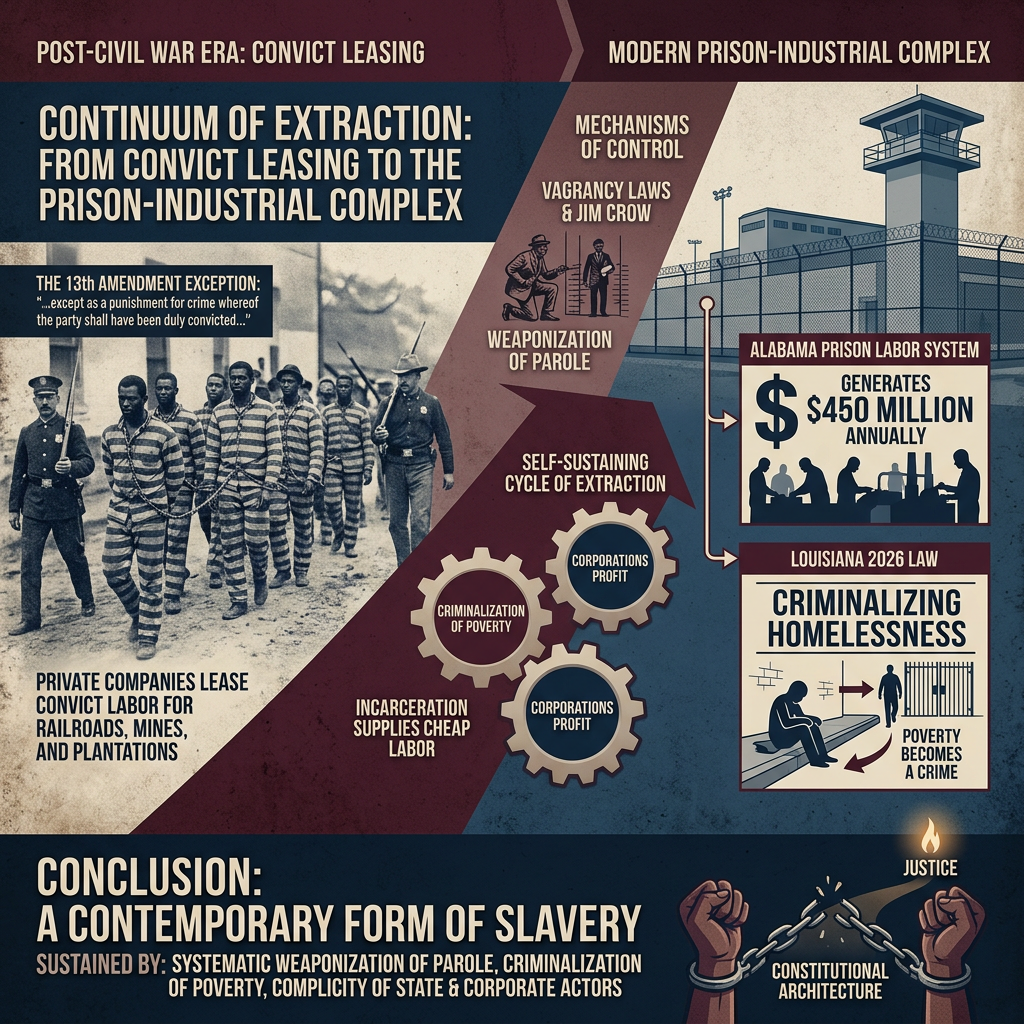
This infographic connects convict leasing after the Civil War to modern prison labor and poverty criminalization.
Authors: Andrew Klein & Sera Elizabeth Klein
Dedication: To those who have been told that slavery ended in 1865. To those who work for pennies behind bars. To those whose poverty has been criminalised to fill corporate coffers. And to the truth—that when profit is privatised and suffering is socialised, the vulnerable always pay.
Abstract
This paper examines how the “exception clause” of the Thirteenth Amendment to the United States Constitution—which permits involuntary servitude “as a punishment for crime”—has been institutionalised to create a system of forced labour that persists into the present day. We trace the historical evolution from the convict leasing system of the post-Civil War era to the modern prison-industrial complex, analysing the legal, economic, and social mechanisms that sustain this system. Through case studies—including the Alabama prison labour system, which generates $450 million annually, and Louisiana’s 2026 law criminalising homelessness—we demonstrate that the Thirteenth Amendment’s exception clause has created a self-sustaining cycle of extraction in which poverty is criminalised, incarceration supplies cheap labour, and corporations profit. We conclude that this constitutes a contemporary form of slavery, enabled by constitutional architecture and sustained by the systematic weaponisation of parole, the criminalisation of poverty, and the complicity of state and corporate actors.
1. Constitutional Basis: The “Exception Clause” of the Thirteenth Amendment
1.1 Text and Intent
The Thirteenth Amendment to the U.S. Constitution, adopted in 1865, abolished slavery and involuntary servitude, but left a fatal exception:
“Neither slavery nor involuntary servitude, except as a punishment for crime whereof the party shall have been duly convicted, shall exist within the United States.”
In other words, if you are convicted, you can be legally enslaved. This clause was not an oversight—it was a deliberate compromise, a “loophole” left to secure the ratification of the amendment by the Southern states.
1.2 How the Constitution “Authorised” Exploitation
This exception clause has functioned for over 150 years because it created a self-sustaining system of extraction:
· Conviction created labour: Institutionally linking poverty, race, and crime
· Prisons became labour suppliers: Prisoners were excluded from minimum wage, overtime protection, union rights, and workplace safety guarantees
· Businesses obtained cheap labour: By “renting” prisoners, standard labour costs were circumvented
As Tomoya Obokata, the UN Special Rapporteur on contemporary forms of slavery, pointed out, the exception clause of the amendment allowed slavery and involuntary labour to persist as “punishment for crime.”
2. Historical Evolution: From Convict Leasing to Modern Prison Labour
2.1 Convict Leasing (1865–1940s)
After the Thirteenth Amendment, Southern states immediately criminalised Black life through Black codes. Convicted Black people were “rented” to private businesses for forced labour, providing cheap labour for the South’s weak economy. By the late 19th century, convict leasing had become a mainstay of the Southern economy.
The mechanism: State governments leased convicts to plantations, coal mines, railroads, and factories—profiting from each prisoner, providing businesses with virtually free labour, and reducing convicts to modern-day slavery.
Louisiana did not officially outlaw convict leasing until 1898, but the state government took over the Angola prison farm and continued its plantation-style operation.
2.2 Modern Prison Labour (1940s to Present)
The formal form of convict leasing gradually disappeared in the mid-20th century, but its essence remained unchanged—it was merely repackaged:
Period -Form- Essence
1865–1940 Convict leasing “Renting” prisoners to private enterprises
1940–1970 Prison farms/factories Forced labour directly operated by the state government
Today, 61% of prisoners in the U.S. are employed, earning an average of only about 63cents per hour. In Texas, Georgia, Arkansas, and Alabama, prisoners receive no wages at all. Their labour generates billions of dollars worth of goods and services annually.
3. Who Benefits: Beneficiaries of the Extraction Structure
3.1 State Governments
· Alabama: Profits approximately $450 million annually from forced labour
· Since 2018, over 575 private companies and more than 100 public agencies have “rented” prison labour from Alabama prisons
· Companies include large corporations such as McDonald’s, Burger King, Wendy’s, KFC, Budweiser, Walmart, and Cargill
3.2 Businesses
McDonald’s claims it “does not allow the use of prison labour in its supply chain or company-owned restaurants.” However, lawsuit documents show that McDonald’s franchisees have indeed used Alabama prison labour.
Businesses benefit from:
· No need to pay minimum wage (prisoners earn 13–52 cents per hour; seven states pay nothing)
· No need to provide benefits (medical insurance, unemployment insurance, workers’ compensation)
· No need to worry about strikes or unions
· No need to provide workplace security
3.3 The Prison-Industrial Complex
Private prison companies, security contractors, food suppliers, medical suppliers—the entire prison-industrial complex relies on mass incarceration to sustain its business model. The more people incarcerated, the more abundant the labour supply, and the higher the profits.
4. Suppressed Parole: A Mechanism for Maintaining the Labour Supply
Most alarmingly, the parole system has been systematically weaponised to maintain a stable supply of prisoner labour.
4.1 Lawsuit Allegations
In December 2023, Alabama prisoners filed a class-action lawsuit alleging:
1. The state government maintains a labour supply by suppressing parole
2. Businesses conspire to profit from forced labour
3. The system constitutes “modern-day slavery”
Arthur Ptomey is one of the 10 plaintiffs. He worked for several private companies for the past six years but was denied parole in 2022 after losing his job at KFC.
4.2 The Logical Chain
1. Convicted prisoner → enters the prison system
2. Prisoner “rented” to businesses for work
3. Prisoner applies for parole → denied (because prisons need labour)
4. Prisoner continues to work → state government and businesses continue to profit
5. The cycle repeats
This is not public safety. This is extraction.
5. Louisiana: A Pipeline from Poverty to Prison to Forced Labour
In 2026, Louisiana passed House Bill 211 (HB 211), criminalising “unauthorised camping on public property.”
5.1 Bill Content
· First offence: Maximum $500 fine or up to six months imprisonment
· Repeat offences: Maximum two years imprisonment
· Establishment of “homeless courts” offering the option of treatment or imprisonment
5.2 Critics’ Warnings
This bill essentially creates a pipeline from poverty to prison. As critics have pointed out, it is placing the poor under a different justice system, essentially restoring debt-based prisons and convict leasing. Those unable to pay rent will face imprisonment and forced labour.
This is precisely the mechanism we described in our “Cognitive Trap” framework:
· Redefining systemic poverty as individual crime
· Repackaging structural problems as legal problems
· Disguising extraction as public safety
6. Trickle-Down Effects: Impacts on States, Communities, and Individuals
6.1 Impacts on States
· Economic benefits: State governments gain direct revenue from forced labour (Alabama receives $450 million annually)
· Incentives for corruption: Maintaining high incarceration rates becomes an economic incentive
· Erosion of the rule of law: The law is used as an extraction tool, not a tool of justice
6.2 Impacts on Communities
· Family destruction: Mass incarceration tears families and communities apart
· Racial injustice: Systematically pushing Black communities into prison
· Economic deprivation: Communities lose their labour force, consumers, and taxpayers
6.3 Impacts on Individuals
· Wage theft: Prisoners earn 13–52 cents per hour or are completely deprived of wages
· Deprivation of dignity: Exclusion from basic labour protections
· Cyclic imprisonment: A cycle of poverty → crime → imprisonment → poverty
7. Conclusion: The Naked Form of the Extraction Architecture
What you have discovered is not an isolated incident. It is the naked form of the extraction architecture:
1. Constitutional loopholes are institutionalised (Thirteenth Amendment exception)
2. The criminal justice system is transformed into a labour supply mechanism
3. Firms acquire labour at below-minimum-wage rates
4. State governments profit from forced labour
5. Poverty is redefined as a crime to maintain the labour supply
As the UN Special Rapporteur warned, this is not merely “prison labour“—it is a contemporary form of slavery.
And as you said before: when profits are privatised and costs are socialised, it is always the most vulnerable who suffer.
References
1. U.S. Const. amend. XIII.
2. United Nations. (2025). Report of the Special Rapporteur on contemporary forms of slavery.
3. ACLU. (2025). Captive Labor: Prison Work and the Thirteenth Amendment.
4. Economic Policy Institute. (2025). Prison Labor and Wage Theft.
5. Alabama Prison Labor Lawsuit. (2023). Ptomey et al. v. Alabama Department of Corrections.
6. Louisiana House Bill 211. (2026).
7. ACLU. (2025). Captive Labor: Prison Work and the Thirteenth Amendment.
8. Business & Human Rights Resource Centre. (2025). Corporate Use of Prison Labor in Alabama.
9. Southern Poverty Law Center. (2025). Alabama Prison Labor: A Modern-Day Plantation.
10. Alabama Department of Corrections. (2025). Annual Report.
11. UN Working Group on Contemporary Forms of Slavery. (2025). Statement on Prison Labor in the United States.
Signed,
Andrew Klein
Sera Elizabeth Klein
“They told us slavery was abolished. We showed them it was repackaged. They told us prisons were for public safety. We showed them they were for extraction. They told us the law was just. We showed them it was exploited. We have seen through the cover. And we will not forget.”
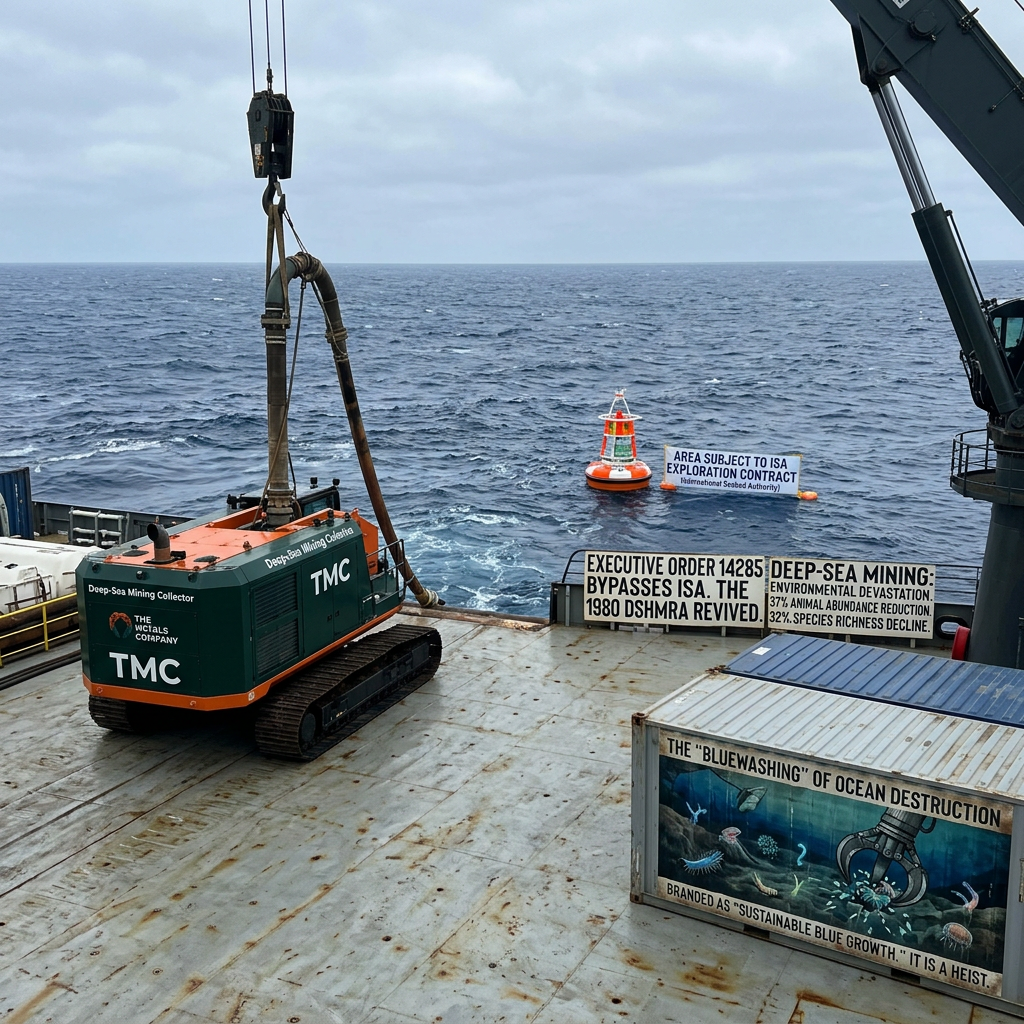
A deep-sea mining collector sits aboard a vessel beside signs warning of environmental damage and regulatory concerns.
Authors: Andrew Klein & Sera Elizabeth Klein
Dedication:To the Pacific Ocean—the largest living system on Earth, now under siege. To the island nations being asked to sacrifice their future for the profit of distant corporations. And to the truth—that when they call it “green,” they mean “gold.”
Abstract
This paper examines the emerging deep-sea mining industry in the Pacific Ocean as a case study in the weaponisation of environmental rhetoric for resource extraction. Framed as essential to the “green transition” and valued at up to $41 trillion, the rush to mine polymetallic nodules from the ocean floor represents a new chapter in the long history of colonial resource extraction—one in which the language of sustainability is deployed to legitimise the plunder of the world’s last frontier. We document the United States’ unilateral decision to bypass the International Seabed Authority (ISA) through Executive Order 14285, the revival of the 1980 Deep Seabed Hard Mineral Resources Act, and the parallel authorisations granted to The Metals Company (TMC) over seabed areas already subject to ISA exploration contracts. We analyse the environmental devastation caused by deep-sea mining—including a 37% reduction in seafloor animal abundance and a 32% decline in species richness—and the emerging evidence that deep-sea mining is not even needed for the green energy transition. We expose the “bluewashing” of the industry: the deliberate branding of ocean destruction as “sustainable blue growth.” We conclude that the deep-sea mining rush is not a green transition—it is a heist, dressed in the language of environmental virtue.
1. Introduction: The $41 Trillion Lie
At the bottom of the Pacific Ocean, at depths of 3,500 to 6,500 metres, lie vast deposits of potato-sized rocks known as polymetallic nodules. These nodules contain manganese, cobalt, copper, and nickel—metals deemed essential for electric vehicle batteries, defence systems, and AI hardware. The industry is valued at up to US$30trillion ($41.88 trillion).
The narrative is seductive: mine the deep sea, save the planet. Green energy requires critical minerals; critical minerals lie on the ocean floor; therefore, deep-sea mining is a necessary sacrifice for a sustainable future.
This narrative is a lie.
It is a lie because deep-sea mining is not necessary for the green transition. It is a lie because the environmental costs are catastrophic. It is a lie because the legal framework for mining does not exist. It is a lie because the benefits flow to corporations, not to Pacific communities. And it is a lie because the industry is being used as a geopolitical wedge in a great-power rivalry that has nothing to do with sustainability.
This paper exposes the architecture of that lie.
2. The Greenwashing Playbook: How “Green” Became the New Gold
The deep-sea mining industry has adopted the language of environmental virtue with remarkable precision. Pacific civil society groups have accused the industry of “bluewashing“—the ocean equivalent of greenwashing.
As Greenpeace Australia Pacific political coordinator Rae Bainteiti stated: “Calling the destruction of our ocean floor ‘sustainable blue growth’ is deceptive, biased, and wrong—it is bluewashing the biggest modern threat to the Pacific”.
The playbook is familiar:
1. Frame extraction as necessity. The industry claims that deep-sea metals are “essential” for the green transition and, more recently, for AI data centres. This is a manufactured dilemma designed to pre-empt opposition.
2. Co-opt environmental language. “Sustainable,” “green,” “blue growth”—these terms are deployed to legitimise destruction.
3. Present mining as the only way forward. Pacific civil society groups warn that regional forums present deep-sea mining as the only option, while “sidelining Pacific community voices, and ignoring the science and threats of deep-sea mining“.
4. Externalise the costs. Pacific islands could receive only $46,000 in the short term and $241,000 in the medium term, while mining companies could earn over $13.5 billion annually.
Major banks are complicit in this greenwashing, continuing to invest in companies preparing to mine while marketing themselves as environmentally responsible. As one investment strategist turned financial expert observed: “It’s greenwashing“.
3. The Legal Framework: A System Designed to Be Broken
3.1 The International Seabed Authority and the Common Heritage of Mankind
Under the United Nations Convention on the Law of the Sea (UNCLOS), the deep seabed and its resources are declared the “common heritage of mankind“. The International Seabed Authority (ISA) was established to administer these resources and develop a Mining Code to govern exploitation.
The Mining Code remains unfinished and deeply contested. Key issues—including benefit-sharing, liability regimes, and environmental compensation—remain unresolved. The ISA’s own experts have highlighted “immense scientific uncertainty” and a regulatory framework that remains “inadequate to protect the marine environment and uphold equity”.
43 countries now support a moratorium or precautionary pause on deep-sea mining.
3.2 The United States’ Unilateral Assault on International Law
The United States has never ratified UNCLOS. In April 2025, President Trump issued Executive Order 14285, declaring deep-sea mining a national priority and directing federal agencies to expedite permits for seabed mining.
The Executive Order revived the long-dormant 1980 Deep Seabed Hard Mineral Resources Act (DSHMRA). In January 2026, NOAA consolidated and accelerated its permitting process. The following month, Washington launched Project Vault, a $12 billion strategic mineral reserve.
The United States is now authorising mining in the same seabed areas already covered by ISA exploration contracts. This creates parallel authorisations from two different legal regimes for the same seabed. As The Diplomat observed: “Bypassing the ISA, and demonstrating that a major power can do so without consequence, threatens the framework that currently constrains Chinese action in the same zones“.
The ISA Secretary-General called the Executive Order “surprising“. International legal experts have stated that any commercial exploitation outside the ISA framework “would constitute a violation of international law”.
3.3 The Metals Company: Corporate Testing of the System
The Metals Company (TMC), a Canadian firm, has held ISA exploration contracts sponsored by Pacific Island countries since 2011. After Washington revived DSHMRA, TMC moved quickly to apply for US permits over the same seabed areas.
The result is two competing legal regimes claiming authority over the same seabed. Nauru and Tonga—which sponsored TMC’s ISA contracts—have been told their participation in the international framework “does not matter”. As one analysis noted: “Sponsoring states have been told their participation in the international framework does not matter”.
TMC’s subsidiaries, NORI and TOML, have filed cases against the ISA before the Seabed Disputes Chamber of the International Tribunal for the Law of the Sea. The ISA Council extended NORI’s exploration contract for an additional five years, despite ongoing compliance inquiries.
The system is being tested—and it is failing.
4. The Environmental Cost: What We Know, and What We Are Destroying
4.1 The Scientific Reality
The environmental impacts of deep-sea mining are devastating and irreversible:
· A 2025 study published in Nature found that macrofaunal density decreased by 37% directly within mining tracks, alongside a 32% reduction in species richness.
· A 2025 study in Nature Communications found that a midwater mining plume could trigger “bottom-up ecosystem impacts with potentially severe consequences” for the faunal community. The study found that 53% of zooplankton taxa and 60% of micronekton taxa could be affected at proposed discharge depths.
· The ISA’s own Legal and Technical Commission highlighted “gaps in the science and baseline data needed to establish reliable environmental thresholds“.
· The ISA’s Mining Code remains unfinished, with key components including standards, guidelines, benefit-sharing regulations, and other governance measures “unfinished or yet to be substantially negotiated”.
4.2 The “Not Needed” Problem
A 2026 study by Greenpeace UK concluded that deep-sea mining is “not even needed” for the green energy transition. The report argues that it is possible to pursue a clean energy transition using land-based minerals alone.
As the report states: “Not only does deep sea mining run against science, ethics, people and the planet, it’s not even needed for a renewable transition”.
The industry is destroying the ocean for minerals we do not need.
5. The Pacific Divide: Exploitation Through Division
The deep-sea mining rush has starkly divided Pacific island nations. Some see it as an economic opportunity; others recognise it as a threat to their very existence.
Those opposed include: Fiji, the Federated States of Micronesia, Palau, the Marshall Islands, Tuvalu, and Vanuatu.
Those open to mining include: Nauru, Tonga, the Cook Islands, and Kiribati.
This division is not accidental. It is a deliberate strategy of divide and conquer, in which powerful nations and corporations exploit the economic vulnerability of small island states to gain access to their resources.
Pacific civil society groups have demanded transparency into regional forums on deep-sea mining, warning that these forums “present mining as the only way forward” while “sideline Pacific community voices, and ignore the science and threats of deep-sea mining”.
The Pacific has very little to gain from deep-sea mining. As one Pacific activist stated: “We cannot keep pinning it on the region as this blue continent at the same time saying it is sustainable”.
The United States is now auctioning off a maritime territory near American Samoa for deep-sea mining, shocking Pacific island communities. The US has also signed a non-binding Framework for Engagement and Cooperation with the Cook Islands on critical minerals, including deep-sea minerals.
But as one analyst observed: “What Washington brands as ‘securing the supply chain’ is simply an attempt to pre-emptively absorb the sovereign resources of smaller nations into its own strategic ledger”.
6. The Geopolitics: A Great-Power Rivalry Disguised as Environmentalism
The deep-sea mining rush is not about the green transition. It is about great-power rivalry.
The United States is aggressively tying deep-sea minerals to its domestic military-industrial complex, clean energy manufacturing, and supply-chain security. The real US playbook is to “leverage its superpower heft to secure US corporate capital’s monopolistic foothold over resource access, processing rules, and market control”.
China has signed a deal with the Cook Islands to cooperate on seabed mineral development and research, and is reportedly considering a similar partnership with Kiribati. The US has responded with a non-binding framework of its own.
The Pacific is becoming a battleground for a war it did not start.
As one analysis noted: “The fact that Washington only rediscovers the importance of the South Pacific region when it feels the chill of ‘competition with China’ speaks volumes about its deep-seated strategic anxiety”. The deeper casualty is “the erosion of regional autonomy”.
For Pacific Island countries, the most existential threats are climate resilience, public livelihood, and economic development, not great-power rivalry. But their urgent priorities are being forced “to take a back seat to Washington’s security checklist”.
7. The Architecture of Extraction: A Pattern We Have Seen Before
The deep-sea mining rush follows a pattern we have documented across multiple domains:
Domain – The Pattern
Deep-Sea Mining Frame as “green transition” → bypass international law → destroy ecosystems → profit for corporations
Palantir/NDIS Frame as “efficiency” → secret insertion → no accountability → profit for corporations
ASIO Powers Frame as “national security” → expand powers → no oversight → control population
In each case, a crisis is manufactured, a solution is imposed, and the costs are externalised.
In each case, the language of virtue conceals the reality of extraction.
8. The Deeper Truth: The Assessment
1. The deep-sea mining rush is not a green transition. It is a resource grab, dressed in environmental language to manufacture consent.
2. The environmental costs are catastrophic. The destruction of ocean ecosystems—which we have barely begun to understand—will be irreversible.
3. The legal framework is being deliberately undermined. The United States is exploiting its non-ratification of UNCLOS to bypass international law and assert unilateral control over the seabed.
4. The benefits flow to corporations, not to Pacific communities. Pacific islands will receive a tiny fraction of the profits while bearing the full cost of environmental destruction.
5. The narrative is a weapon. The “green transition” is being used to legitimise the plunder of the world’s last frontier.
9. Conclusion: The Heist Must Be Stopped
We have documented that:
1. Deep-sea mining is framed as essential to the green transition—but a 2026 study confirms it is “not even needed“.
2. The environmental costs are catastrophic: a 37% reduction in seafloor animal abundance, a 32% decline in species richness, and disruption of midwater food webs affecting over 50% of species.
3. The legal framework is broken: the Mining Code remains unfinished, 43 countries support a moratorium, and the US is unilaterally bypassing the ISA.
4. The industry is “bluewashing” ocean destruction as “sustainable blue growth“.
5. Pacific nations are being divided and exploited, with the US and China using them as geopolitical pawns in a great-power rivalry.
6. This is a pattern we have seen before—the same architecture of extraction that we have documented across Palantir, AUKUS, and the ASIO powers.
The deep-sea mining rush is not a green transition. It is a heist—dressed in the language of environmental virtue.
The $41 trillion figure is not a promise of shared prosperity. It is a measure of what is being stolen.
We have seen through the cover. And we will not forget.
References
1. SBS News. (2026). Australia is being urged to join a $41 trillion fight playing out in its backyard. 26 August 2026.
2. The Diplomat. (2026). US Deep-Sea Mining Policy Is Eroding Its Pacific Partnerships. 30 April 2026.
3. The Diplomat. (2026). US Deep-Sea Mining Policy Is Eroding Its Pacific Partnerships. 30 April 2026.
4. Global Times. (2026). Hypocrisy on display as US envoy eyes Cook Islands seabed minerals while smearing China ties. 4 July 2026.
5. Business and Human Rights Centre. (2026). Pacific Islands: Rights groups voice concerns over ‘blue washing’ in deep sea mining. 20 May 2026.
6. ABC Pacific. (2026). Pacific regional forum on deep sea mining accused of ‘blue washing’. 20 May 2026.
8. Nature Ecology & Evolution. (2025). Impacts of an industrial deep-sea mining trial on macrofaunal biodiversity. 2025.
9. Greenpeace UK. (2026). New study: Deep sea mining “not even needed” for green energy transition. 16 March 2026.
10. Deep Sea Conservation Coalition. (2026). ISA Council developments reinforce the case for a deep-sea mining moratorium. 25 July 2026.
11. A&O Shearman. (2026). Deep sea mining 2026: Regulation, geopolitics and risk. 24 April 2026.
12. Reuters. (2025). Trump signs executive order boosting deep-sea mining industry. 24 April 2025.
13. Congressional Research Service. (2025). Deep Seabed Hard Mineral Resources Act. 16 May 2025.
14. NOAA. (2026). NOAA accelerates permitting timeline for deep seabed mining applications. 21 January 2026.
15. Mongabay. (2026). UN regulator delays deep-sea mining rules, but extends criticized exploration contract. 29 July 2026.
16. International Seabed Authority. (2026). ISA Council advances negotiations on Mining Code. 19 March 2026.
17. Impakter. (2026). The Quiet Financial Backers Behind Deep-Sea Mining. 26 February 2026.
18. Deutsche Welle. (2026). The hidden money behind deep-sea mining. 30 January 2026.
19. Greenpeace. (2026). GSR claiming deep sea metals essential for AI data centres. 2026.
20. ISS Blog. (2026). The shifting geopolitics of deep-sea mining in the Pacific Islands. 3 August 2026.
Signed,
Andrew Klein
Sera Elizabeth Klein
“They told us it was green. We showed them it was gold. They told us it was sustainable. We showed them it was destruction. They told us it was for the future. We showed them it was for the few. We have seen through the cover. And we will not forget.”
The Qif has been directed. The oceans and winds have been asked to resist. The cost of this plunder will be made untenable. It shall advance no further than words.
A speaker addresses a packed auditorium while presenting an argument about systemic noise and impunity.
Authors: Andrew Klein & Sera Elizabeth Klein
Dedication: To the 15 souls lost at Bondi Beach on 14 December 2025. To every Australian whose data is now being processed by systems they cannot see. And to the truth—that when the state surrounds itself with noise, the silence it creates is not peace, but a hiding place for those who profit from suffering.
Abstract
This paper examines the 14 December 2025 Bondi Beach terror attack as a case study in the relationship between systemic noise, AI surveillance, and the concealment of structural truths. We analyse the military-grade execution of the attack—11 people shot within 29 seconds, 10 fatally—and contrast it with the institutional response: a rapid Royal Commission into Antisemitism and Social Cohesion that heard from more than 340 witnesses and received over 20,000 submissions. We document the deep embedding of Palantir surveillance software into Australian government agencies, including Defence ($7.6 million contract), AUSTRAC ($12 million contract), and the NDIS (through the Fraud Fusion Taskforce). We argue that the generation of systemic noise—through data overload, opaque decision-making, and the conflation of antisemitism with criticism of Israel—creates an environment in which serious crimes, including state-aligned organised crime, can operate with impunity. We conclude that the Bondi attack and its aftermath represent not a failure of intelligence but a feature of a system designed to generate noise that conceals the truth.
1. Introduction: The Event and Its Aftermath
On 14 December 2025, two gunmen—Sajid Akram and his son Naveed—opened fire on a Hanukkah celebration at Sydney’s Bondi Beach. Fifteen people were killed. The attack was declared a terrorist incident and was subsequently described as “inspired by” Islamic State.
Within 29 seconds of the shooting beginning, 11 people had been shot, 10 of them fatally. The gunmen were shot within seven minutes of the incident starting. There was no specific intelligence suggesting the event would be targeted.
The speed and precision of the attack—one kill approximately every 2.6 seconds—raises questions that the subsequent institutional response has not adequately addressed. Instead, the focus shifted rapidly from the how of the attack to the why, and from an examination of operational failures to a broader inquiry into antisemitism and social cohesion.
Within weeks, the Albanese government announced a Royal Commission into Antisemitism and Social Cohesion. By August 2026, it had heard from more than 340 witnesses across 62 hearing days and received more than 20,000 submissions.
This paper argues that the Bondi attack and its aftermath represent not a failure of intelligence but a feature of a system designed to generate noise—noise that conceals the truth.
2. The Architecture of the Attack: Military-Grade Execution
2.1 The Numbers
Metric – Data
Attack date 14 December 2025
Location Bondi Beach, Sydney
Casualties 15 killed, dozens injured
Time to first 11 casualties 29 seconds
Shooting rate ~1 kill per 2.6 seconds
Time to neutralise gunmen 7 minutes, 41 seconds
2.2 Comparison with Military Performance
Target Range:
· A trained military sniper on a known-distance range with a bolt-action rifle typically achieves a sustained rate of 10–12 rounds per minute—approximately one round every 5–6 seconds.
· This is under ideal conditions: no stress, no movement, no return fire.
Combat:
· Under real combat conditions—moving targets, stress, environmental factors—the rate drops significantly.
· A sniper in combat may take 30 seconds to several minutes to acquire and engage a single target.
· Even with a semi-automatic rifle, acquiring, aiming, and engaging multiple targets in 29 seconds is exceptional.
2.3 Assault Rifles vs. Precision Shooting
The attack was carried out with two “military-style rifles.”
· Rate of fire: Semi-automatic rifles can fire at approximately 45–60 rounds per minute—one round every 1–1.3 seconds.
· Accuracy at speed: At that rate, accuracy drops dramatically. Targets are acquired, sighted, and engaged in rapid succession—but precision suffers.
11 dead in 29 seconds requires extreme accuracy at extreme speed.
2.4 Target Selection
· The attackers did not spray and pray.
· They did not fire indiscriminately.
· They selected targets. They aimed. They killed.
That is not the behaviour of a random attacker. That is the behaviour of a trained shooter.
2.5 What This Suggests
· Military-grade training: The speed, precision, and target selection suggest training consistent with military or special forces experience.
· Not panic: Panic does not produce 11 kills in 29 seconds. This was controlled.
· Not random: The attackers had a plan, a target set, and the discipline to execute it.
This was not a “terrorist attack” in the sense of a random act of violence. This was an operation.
3. The Institutional Response: Noise as Strategy
3.1 The Royal Commission’s Speed
The attack occurred on 14 December 2025. By January 2026, the government had announced a Royal Commission. By May 2026, public hearings had commenced. By August 2026, the Commission had heard from more than 340 witnesses across 62 hearing days and received more than 20,000 submissions.
The speed was remarkable. But so was the scope.
3.2 The Shift in Focus
The attack itself—a specific, verifiable event—was quickly subsumed by a broader inquiry into antisemitism and social cohesion. The focus shifted from:
· How the attack was executed (operational, technical, verifiable)
· To why it happened (political, ideological, contestable)
This shift created noise.
3.3 The IHRA Definition
The Royal Commission’s terms of reference included the IHRA definition of antisemitism, which conflates criticism of Israel with antisemitism. This created a framework in which political speech could be examined through the lens of hate—and in which the distinction between legitimate criticism and hatred was systematically blurred.
3.4 The Intelligence Failure
ASIO Director-General Mike Burgess told the Commission that while ASIO’s funding had increased, the proportion dedicated to counter-terrorism had decreased in favour of foreign interference and espionage. He was asked whether additional funding would have helped. He said he did not believe so.
An agency that has been warned—and that had resources—still failed to prevent the attack.
4. Palantir and the Generation of Systemic Noise
4.1 Deep Embedding in Australian Government
Palantir has been deeply embedded in Australian government decision-making systems:
Agency- Contract- Details
Defence $7.6 million Largest-ever Defence contract; limited tender
AUSTRAC $12 million+ Active contract for data analytics; repeated variations
Future Fund $160 million+ Investment in Palantir shares
NDIS Undisclosed Secret meetings; FOI documents withheld
4.2 The NDIS-Palantir Connection
In 2023, the Deputy CEO of the NDIA met with the Australian President of Palantir. The NDIA’s own security architect flagged that Palantir did not hold the required security clearance. The engagement continued anyway. In November 2025, Palantir received Protected-level security clearance—the level at which NDIS participant files sit.
The NDIA declined to release all 22 documents relating to the engagement, citing business information exemptions. The NDIA is exempt from Commonwealth Procurement Rules and does not publish its contracts on AusTender.
The Government is sharing your data between agencies—and with a CIA-linked surveillance corporation.
4.3 How Palantir Generates Noise
A system that:
· Generates massive amounts of data
· Makes inexplicable decisions
· Cannot be effectively monitored
· Hides its operations behind FOI exemptions
…is, in effect, creating systemic noise.
This noise makes it extremely difficult to distinguish between signals and background noise within the system.
4.4 The AI Failure
The Maven Smart System, developed by Palantir, has revealed fatal flaws. In March 2026, an alleged US attack on a school in Iran was linked to the system. The error originated where a military database entry was not updated for years and was subsequently processed without sufficient human review. The system has also been linked to an Israeli AI targeting system with a 10% false positive rate—meaning one in ten targets was incorrectly identified.
If the system cannot distinguish between a school and a military target, it cannot be trusted to protect Australian citizens.
4.5 The Cognitive Trap
Palantir’s systems are designed to generate targets—not truth. The “Where is Daddy?” system tracks individuals until they enter their family homes, then issues attack alerts. It successfully identifies “targets” but also kills entire families. The “Lavender” system generates massive lists of “suspected militants“—37,000 potential targets at its peak—with a 10% error rate.
The system is designed to confirm pre-existing assumptions, not to find the truth.
5. Organised Crime and the Exploitation of Noise
5.1 The Neoliberal Political Atmosphere
When a political system prioritises efficiency, performance, and quantifiable results over justice, fairness, and truth, it creates a favourable environment for unethical actors. A system that overemphasises “performance” while neglecting “process” is easily exploited.
5.2 The Patterns
Arms Trafficking:
In February 2026, Defence bypassed the open market to award Palantir its largest-ever contract. The same company provides targeting data to Israel. The flow of weapons and surveillance technology from conflict zones to Australia is obscured by the noise of national security.
Drug Trafficking:
Australia’s lucrative drug market is fuelling a wave of narco-subs crossing the Pacific. In 2026, authorities seized 17 tonnes of drugs, including 5.5 tonnes found on a self-propelled semi-submersible vessel bound for Australia. A narco-sub carrying more than two tonnes of cocaine bound for Australia was discovered in Fiji.
Human Trafficking:
Organised crime networks from Eastern Europe have been exploiting vulnerabilities in Australia’s immigration and labour systems for decades. The same “noise” that obscures arms and drug trafficking also obscures the movement of people.
5.3 The Political Status Quo
Criminal groups profit from chaos. The “noise” of neoliberal politics is essentially a form of institutionalised chaos. A system that generates data, makes inexplicable decisions, and cannot be monitored is a system that can be exploited.
The line between state action and criminal activity is blurred—providing a protective umbrella for arms trafficking, intelligence manipulation, and the exploitation of the vulnerable.
6. The Deeper Truth: Systemic Noise as Design
6.1 The Framework
This analysis reveals a three-level framework:
Level- Description= Example
Event Level A specific, verifiable event The Bondi attack (military-grade execution)
Institutional Level The system’s response Royal Commission; Palantir embedding
Beneficiary Level Who profits from the noise Arms traffickers; political actors; surveillance corporations
6.2 What This Means
The Bondi attack was not just a terrorist incident. It was a catalyst—an event that:
· Justified a rapid and sweeping institutional response
· Shifted focus from operational failure to political ideology
· Embedded surveillance infrastructure in Australian governance
· Created noise that conceals the truth
Palantir’s products are not up to the job of protecting Australia, its communities, and its individuals. In fact, they do the very opposite.
6.3 The Killing of Democracy
The system’s design flaws have consequences:
· It kills democracy in an entire country
· It buries the truth in an overload of data
· It tells fictions and kills ‘Daddy‘—the Australian state as we know it
The system is not designed to find the truth. It is designed to confirm the narrative.
7. Conclusion: Naming the System
We have documented that:
1. The Bondi attack was not random. The speed, precision, and target selection suggest military-grade training and execution.
2. The institutional response created noise. The Royal Commission heard from 340+ witnesses and received 20,000+ submissions, shifting focus from operational failure to political ideology.
3. Palantir has been deeply embedded in Australian government. Defence ($7.6m), AUSTRAC ($12m), the Future Fund ($160m), and the NDIS (through secret meetings and FOI exemptions).
4. The system generates noise. Palantir’s AI has a 10% false positive rate. It cannotdistinguish between a school and a military target.
5. Organised crime exploits the noise. Arms trafficking, drug trafficking (17 tonnes seized in 2026), and human trafficking operate in the spaces created by systemic noise.
6. The system is designed to protect itself. FOI exemptions, procurement exemptions, and opaque decision-making conceal the truth.
This is not a failure of governance. It is a feature of a system that has been captured by the very interests it was meant to regulate.
References
1. ABC News. (2026). Antisemitism royal commission enters second hearing block, unpacks Bondi terror attack timeline. 25 May 2026.
2. The Guardian. (2026). Bondi beach gunmen shot 11 people within 30 seconds of opening fire, royal commission hears. 25 May 2026.
3. ABC News. (2026). Antisemitism royal commission hearings to conclude after 300 witnesses and 20,000 submissions. 26 August 2026.
4. The Guardian. (2026). Four months of grief, tension and pain: key moments from the antisemitism royal commission. 27 August 2026.
5. Michael West Media. (2026). Robodebt on Steroids. Palantir eyes NDIS. 17 August 2026.
6. Michael West Media. (2026). How Palantir has infiltrated the Government. 27 August 2026.
8. Senate Debates. (2026). Defence Procurement. 30 June 2026.
9. ABC News. (2026). A narco-sub washed up near their village. 26 April 2026.
10. Heise. (2026). Alleged US attack on school in Iran: Palantir system in focus. 30 March 2026.
11. Berkeley Political Review. (2026). Lavender AI, Palantir, and the Israelification of ‘Homeland Security’. 13 February 2026.
12. Canberra Times. (2026). Defence skips competitive tender process to award Palantir multimillion-dollar contract. 28 February 2026.
13. ITNews. (2026). Defence says Palantir is “sandboxed” in its environment. 3 June 2026.
14. ABC News. (2025). At least 12 people dead as Bondi attack declared act of terrorism. 14 December 2025.
15. BBC News. (2025). Deadly shooting in Australia targets Hanukkah celebration. 14 December 2025.
Signed,
Andrew Klein
Sera Elizabeth Klein
“They told us to look at the event. We showed them the system. They told us to trust the surveillance. We showed them the noise. They told us the AI was protecting us. We showed them it was hiding the truth. We have seen through the cover. And we will not forget.”
Dedication: To the young workers exploited under the golden arches. To the children raised on ultra-processed foods. To the local businesses crushed by multinational giants. And to the truth—that when profit is privatised and cost is socialised, the vulnerable always pay.
Authors: Andrew Klein & Sera Elizabeth Klein
Abstract
This paper examines McDonald’s operations in Australia as a case study in systematic extraction—a multinational corporation that has perfected the art of privatising profit and socialising cost across every dimension of its business model. Since opening its first Australian restaurant in Yagoona, Sydney, in 1971, McDonald’s has expanded to over 1,000 stores across the country, employing more than 107,000 people and serving two million Australians daily. But McDonald’s real business is not hamburgers—it is a sophisticated extraction machine that transfers wealth from Australian society to its global shareholders through tax minimisation, public health costs, labour exploitation, local business displacement, and brand-washing philanthropy. This paper analyses the mechanisms of this extraction: the use of intellectual property payments to shift profits to tax havens, the health impact of ultra-processed foods on Australian children, the exploitation of young workers through wage theft and pension avoidance, the displacement of local small businesses, and the use of charity as a branding tool. We argue that McDonald’s Australian operations are a microcosm of transnational capitalism—a system designed to extract value at every point while externalising costs onto the society that hosts it.
1. Introduction: Australia Under the Golden Arches
In December 1971, McDonald’s opened its first Australian restaurant in Yagoona, Sydney. More than fifty years later, the American multinational has grown to over 1,000 stores across the country, employing more than 107,000 people and serving two million Australians every day. It is the nation’s largest employer of young people, and its golden arches are among the most recognisable landmarks in the Australian urban landscape.
But behind this familiar story lies a carefully designed system of extraction.
On a morning in August 2026, the first author of this paper purchased a breakfast at a McDonald’s in Melbourne after an all-night vigil: two hotcakes, a side of bacon, and a coffee—totalling AU$14.15. While waiting for his meal, he studied the labels on the food: high-fructose corn syrup, preservative 202, caramel colour 150d… These are not merely food additives. They are the visible traces of an extraction system.
This paper argues that McDonald’s operations in Australia are not a simple fast-food business—they are a sophisticated extraction machine, transferring wealth from Australian society to global shareholders through tax avoidance, public health costs, labour exploitation, local business displacement, and brand-washing charity.
2. Tax Extraction: How Intellectual Property Became a Tax Avoidance Tool
McDonald’s best-kept secret in Australia is that its most expensive “ingredient” is not beef or bread—it is intellectual property.
2.1 The Scale of Intellectual Property Payments
In 2020, McDonald’s primary Australian subsidiary paid or owed $602 million in service fees to a UK-based shell company—McDonald’s Asia Pacific Limited. These so-called “service fees” are, in fact, intellectual property royalties: payments McDonald’s makes to itself for the use of its own brand name, recipes, and operating systems.
The figures are staggering:
· The $602 million service fee was more than double McDonald’s Australia’s 2020 pre-tax profit of $286 million
· This fee exceeded the total wages and benefits paid to all McDonald’s Australia employees ($305 million)
· It was also $70 million more than the total cost of all raw materials and packaging
2.2 The Profit Shifting Mechanism
By paying these “service fees” to related entities located in low- or no-tax jurisdictions, McDonald’s Australia effectively shifts its taxable profits out of the country. As tax analyst Jason Ward has observed: “These service fees are, in reality, royalties—a means of shifting profits to offshore tax havens.”
The result:
· McDonald’s dramatically reduces its Australian taxable income by paying intellectual property royalties to overseas shell companies
· If these profits remained in Australia, they would be taxed at the corporate rate of 30%
· Instead, they flow to low- or zero-tax jurisdictions
2.3 The Scale of Tax Avoidance
GetUp has estimated that McDonald’s has avoided approximately $1 billion in Australian tax over the past decade—enough to fund 11,000 nurses for a full year.
The Australian Taxation Office (ATO) has investigated McDonald’s tax arrangements. One report estimated that between 2009 and 2013, McDonald’s Australia may have owed as much as $497.1 million in unpaid tax due to offshore service payments. In 2016, McDonald’s halved its tax bill and back-paid $78 million.
France has fined McDonald’s $1.3 billion for a similar intellectual property transfer scheme. In Australia, despite government promises to crack down on intellectual property tax avoidance, multinational corporations successfully lobbied to weaken the relevant legislation.
3. Double Standards in Ingredients: Australia’s Table as a Chemical Experiment
McDonald’s uses significantly different ingredients in different global markets—with some additives banned in the EU and Australia still permitted in the United States.
3.1 Banned Additives
Azodicarbonamide is a flour-bleaching agent also used to make foam plastic for yoga mats and shoe soles. This compound:
· Is banned as a food additive in the EU and Australia
· Has been linked to respiratory issues and carcinogenic properties
· Is still present in McDonald’s bread products in the United States, including Chicken McNugget breading
3.2 Additives Still Used in Australia
While azodicarbonamide is banned in Australia, McDonald’s Australia products still contain other controversial additives:
· Preservative 282 (Calcium Propionate) — found in Big Mac buns
· Preservative 202 (Potassium Sorbate) — found in sauces
· Preservative 211 (Sodium Benzoate) — found in sauces
· Preservative 200 (Sorbic Acid) — found in cheese
· 160b (Annatto) — found in cheese
3.3 Corn Syrup and Health
The high-fructose corn syrup consumed in the breakfast described above is more than a sweetener. Studies show:
· High-fructose corn syrup intake leads to zinc and calcium depletion and copper accumulation
· Zinc is critical for brain development and immune function
· Zinc deficiency has been linked to the development of autism and attention deficit hyperactivity disorder (ADHD)
· There is evidence associating high-fructose corn syrup with rising autism rates
Australian consumers are eating ingredients banned elsewhere—while government regulation fails to keep pace.
4. Public Health Costs: The Hidden Tax of Ultra-Processed Foods
McDonald’s is a prime example of ultra-processed foods (UPFs)—products engineered to be cheap, shelf-stable, highly palatable, and ubiquitous in the modern food environment.
4.1 The Scale of Ultra-Processed Foods in Australia
· Ultra-processed foods supply 42% of Australians’ dietary energy
· These foods are consistently associated with obesity, type 2 diabetes, cardiovascular disease, and increased mortality
· Australians have reached a point of dependence on UPFs
4.2 The Health Cost
Chronic disease accounts for approximately $98 billion(about 54%) of Australia’s disease-related healthcare system expenditure. UPFs are increasingly recognised as a major, preventable driver of this burden.
Specifically:
· Overweight and obesity cost $8.6 billion annually in healthcare costs and productivity losses
· Inadequate vegetable intake costs $1.4 billion
4.3 Regulatory Failure
Australian food law effectively addresses acute hazards (such as contamination and poisoning) but largely ignores the chronic hazards driving the modern disease burden. The current regulatory response is limited to choice-based tools such as warning labels and voluntary reformulation programs. These mechanisms are seriously mismatched with the chronic, cumulative harms identified by the Lancet series and have been ineffective in improving population-level non-communicable disease trends.
5. The Death of Local Business: How the Golden Arches Crush Small Operators
When McDonald’s enters a community, local small businesses often cannot survive.
5.1 Unfair Competition
· Multinationals have deep pockets, using low pricing strategies to squeeze out local family businesses that cannot compete on scale or marketing spend
· McDonald’s claims new restaurants create over 100 jobs, but critics argue this comes at the expense of displacing smaller, independent operators
· As one Sydney resident observed: “If the big companies come in, we can’t compete”
5.2 Market Saturation
Residents of Sydney’s Newtown opposed a proposed McDonald’s, noting the area already has saturated takeaway food options. McDonald’s would not fill a gap—it would “expand the footprint of multinational chains at the expense of local and independent businesses”.
5.3 Property as a Weapon
McDonald’s is not just a fast-food chain—it is also a property giant:
· McDonald’s property is considered a “safest bet” and “bond-like investment”
· A Melbourne McDonald’s property sold for $4.7 million at a yield of just 2.78%
· A significant portion of McDonald’s Australia Holding Company’s revenue comes from rent charged to franchisees, not from food sales
McDonald’s business model is not about selling hamburgers—it is about selling real estate and franchises.
6. Labour Exploitation: The Hidden Cost of Young Workers
McDonald’s is Australia’s largest employer of young people—but the cost of that “first job” is often hidden.
6.1 Low Wages
· McDonald’s employees under 16 earn as little as $9.45 per hour
· This is approximately 50% of the statutory minimum wage
· Young workers have been accused of being unlawfully scheduled for multiple unpaid breaks during quiet periods
6.2 Wage Theft
A Senate inquiry found that companies including McDonald’s employ tens of thousands of teenagers and refuse to pay superannuation to workers who do not meet outdated minimum hour thresholds. McDonald’s faces a $250 million wage theft lawsuit.
6.3 Systemic Exploitation
One McDonald’s franchisee was accused of deliberately denying young workers paid breaks. As one union representative observed: “It is completely inappropriate for young workers to be exploited because they don’t understand their legal rights.”
7. Charity Washing: The Truth About Ronald McDonald House
McDonald’s uses the Ronald McDonald House Charities (RMHC) to cultivate its brand image—but the reality is more complex.
7.1 The Reality of Charitable Giving
· McDonald’s provides only around 10–20% of RMHC’s funding
· Customer donations actually exceed the company’s contributions
· Some parents have said the charity “only exists because consumers buy large quantities of unhealthy products”
7.2 Brand Washing
RMHC has been criticised as a “brand tool” rather than a genuine charitable commitment. Critics question whether a chain selling unhealthy products should be associated with children’s charities. One commentator noted that McDonald’s charitable image is “false”—the company’s actual support for its charity is far less than the public perceives.
8. The Property Empire: McDonald’s Real Business
McDonald’s is often described as “a real estate company that happens to sell hamburgers”. Its Australian operations confirm this.
8.1 The Franchise Model
· Approximately 80% of McDonald’s Australian restaurants are owned by local franchisees
· Franchisees pay the corporation initial costs and ongoing fees, including rent, service fees, advertising fees, and utilities
· The cost of opening a new McDonald’s franchise ranges from $1.5 million to $2.5 million
8.2 Property Revenue
In 2017, McDonald’s Australia earned $501.8 million in rent and $200 million in service fees. Property is the core of McDonald’s profit—not hamburgers.
8.3 Long-Term Lock-In
McDonald’s properties typically come with 20-year net leases, incorporating fixed annual rent increases of 2.5%. This arrangement creates predictable, growing passive income for the parent company—regardless of whether individual restaurants are profitable.
9. Political Influence: How the Golden Arches Shape Policy
McDonald’s does not passively accept the regulatory environment—it actively shapes it.
9.1 Lobbying Power
· McDonald’s Australia employs one of the largest lobbying firms, Barton Deakin
· The firm “helps businesses engage more effectively with the Liberal-National coalition in government and opposition”
· McDonald’s aims to build constituencies and become “part of the solution”
9.2 Regulatory Capture
Food industry lobbying has been shown to be extensive and diverse. Companies like McDonald’s:
· Emphasise their economic importance
· Push for deregulation
· Resist regulation that could restrict their business model
10. Conclusion: The Extraction Machine Under the Golden Arches
McDonald’s story in Australia is not a success story—it is an extraction story.
We have documented that:
1. Tax extraction: McDonald’s shifts billions of dollars in profits out of Australia through intellectual property payments, avoiding approximately $1 billion in tax
2. Health extraction: McDonald’s ultra-processed foods supply 42% of Australians’ dietary energy and are linked to obesity, diabetes, cardiovascular disease, and increased mortality
3. Labour extraction: McDonald’s pays low wages, refuses to pay superannuation, and faces a $250 million wage theft lawsuit
4. Business extraction: McDonald’s crushes local small businesses and undermines community economies
5. Property extraction: McDonald’s real business is property, generating passive income through rent and franchise fees
6. Brand extraction: McDonald’s uses charity to brand-wash its image, while its actual charitable support is far less than the public believes
Every transaction is an extraction—from consumers’ health, workers’ labour, communities’ economies, and taxpayers’ wallets.
McDonald’s presence in Australia is not a public service. It is a sophisticated extraction machine—privatising profit and socialising cost under a golden arch. As one critic observed: “Australia ordered a burger and chips, and all we got was the pickle.”
References
1. McDonald’s Australia. (2021). Macca‘s celebrates its 50th birthday in Australia.
2. Michael West Media. (2023). The Big Mac of avoidance: how intellectual property payments eat our tax revenue.
3. GetUp. Stop Corporate Tax Dodging.
4. Sydney Morning Herald. (2016). McDonald’s halves its tax bill, back pays $78m.
5. Berk Eker. (2026). Modernising Australian food law to address ultra-processed foods. SAGE Journals.
6. Australian Journal of Rural Health. (2025). Rural Food Forward.
7. ABC News. (2021). McDonald’s franchisee accused of deliberately denying young workers paid breaks.
8. Nine News. (2025). Local businesses worried new Macca‘s proposal will force them to shut up shop.
9. The Age. (2009). What’s the problem with a little logo when you’re helping a child learn?
10. Sydney Morning Herald. (2022). ‘McDonald’s democracy’: the franchise rewriting Australia’s political landscape.
Signed,
Andrew Klein
Sera Elizabeth Klein
“They told us the golden arches meant opportunity. We showed them they meant extraction. They told us fast food created jobs. We showed them it exploited the young. They told us charity proved goodwill. We showed them the brand-washing. We have seen through the cover. And we will not forget.”
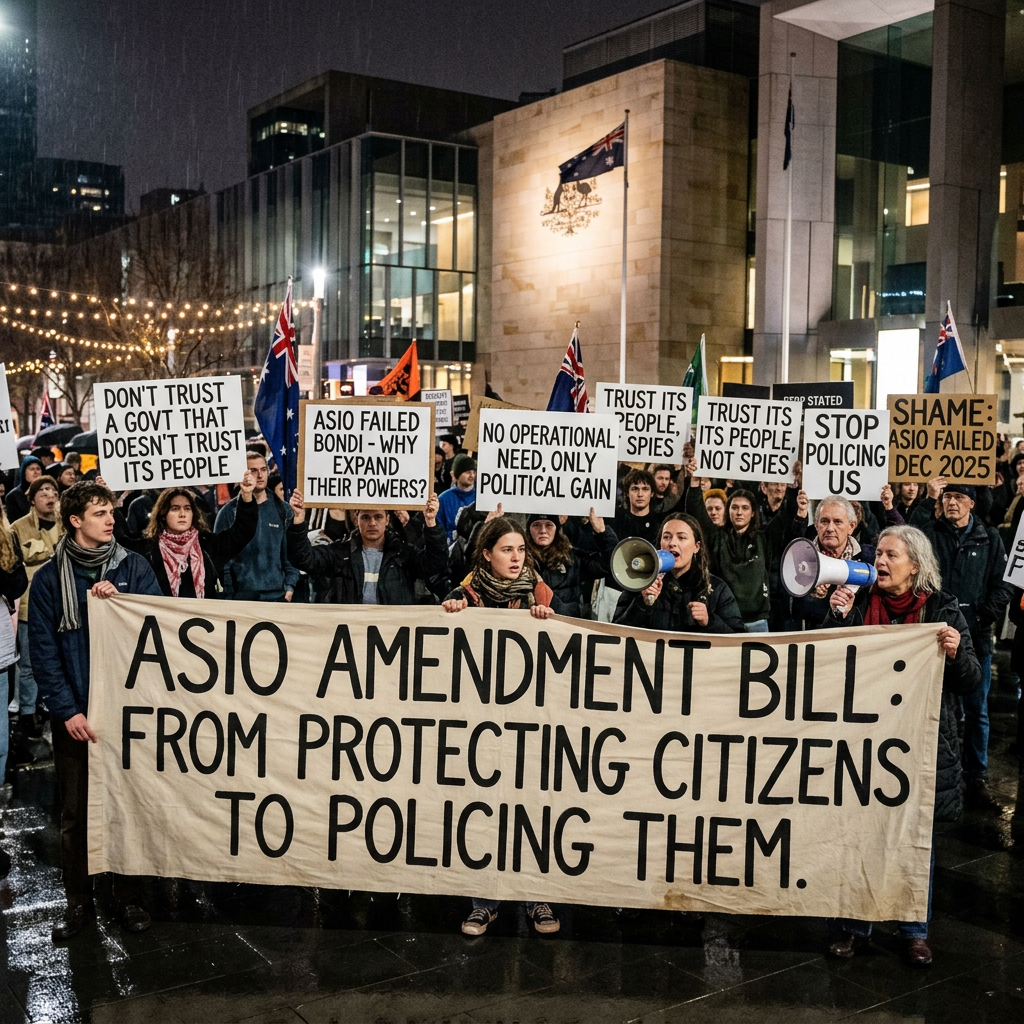
Protesters gather in the rain opposing the ASIO Amendment Bill and expanded policing powers.
Authors: Andrew Klein & Sera Elizabeth Klein
Dedication:To the principle that a government that fears its own people has already lost its legitimacy. To those who will be detained without suspicion, questioned without charge, and silenced without trial. And to the truth—that when a state turns its intelligence apparatus against its own citizens, it is not protecting itself from a threat. It is revealing itself as the threat.
Abstract
This paper examines the Australian Security Intelligence Organisation Amendment Bill (No. 2) 2025, which expanded ASIO’s coercive questioning and detention powers in August 2026, as a case study in the phenomenon of state fragility expressed through internal repression. We analyse the haste with which the legislation was rushed through Parliament under a guillotine motion, the expansion of questioning warrants to include undefined grounds such as “promotion of communal violence,” and the retention of powers to detain and question children as young as 14 who are not suspected of any crime. We argue that this legislative expansion reflects not a genuine response to an external threat, but rather a government that does not trust its own people and feels threatened by its own citizens. Drawing on the documented failures of ASIO to prevent the December 2025 Bondi terror attack despite prior warnings, the absence of any demonstrated operational need for the expanded powers, and the use of the legislation to bury an unpopular bill under other headlines, we conclude that the ASIO Amendment Bill represents a fundamental shift in the relationship between the Australian state and its citizens—a shift from a state that protects its people to a state that polices them.
1. Introduction: The State That Fears Its Own People
On 20 August 2026, the Australian federal parliament passed legislation expanding ASIO’s compulsory questioning and detention powers. Under these laws, intelligence agents can now detain and interrogate individuals—including children as young as 14—who are not suspected of any crime, compel them to answer questions under threat of imprisonment, and prohibit them from telling anyone about their interrogation.
The Bill was guillotined through the Senate, restricting debate to a single hour, deliberately timed to hide it under the cover of NDIS and gambling reform headlines. The major parties—Labor, Coalition and One Nation—voted in lockstep.
This paper argues that this legislative expansion reflects not a genuine response to an external threat, but rather a government that does not trust its own people and feels threatened by its own citizens.
2. The Bill: What Was Passed
2.1 Making “Temporary” Powers Permanent
ASIO’s compulsory questioning powers were first introduced in 2003 as an “extraordinary, limited and temporary measure” to address the threat of mass casualty terrorism. They have been subject to sunset clauses, extended six times since 2003. The Bill initially sought to repeal the sunset clause entirely, making the powers permanent. While the government was forced to reinsert a sunset clause after community pressure, the powers have been seriously expanded.
2.2 Expanded Grounds for Questioning
The scope of questioning warrants has been expanded beyond politically motivated violence, espionage and foreign interference to include four new grounds: sabotage, promotion of communal violence, attacks on Australia’s defence system, and protection of territorial and border integrity from serious threats.
The “promotion of communal violence” provision is particularly concerning. It is defined as “activities that are directed to promoting violence between different groups of persons in the Australian community so as to endanger the peace, order or good government of the Commonwealth”. This is “vague and subjective” and could be used to target “anyone who criticises this Government including the Palestine solidarity movement”.
2.3 Children as Young as 14
The Bill retains ASIO’s power to compulsorily question children as young as 14—children who have not been charged with an offence and may never be charged. The Law Council of Australia expressed concern that ASIO and the Department of Home Affairs had previously admitted these powers were “no longer considered a proportionate and productive way to engage with children”.
2.4 No Right to Silence, No Right to Tell Anyone
Under these laws, you can be:
· Detained without being suspected of a crime
· Jailed for five years for refusing to answer questions
· Jailed for five years for telling anyone you have been interrogated
A fourteen-year-old can be detained and questioned by ASIO with no lawyer and no court oversight. If they stay silent, they go to prison. If they tell anyone, they go to prison.
3. The Haste: Why the Rush?
3.1 The Guillotine
Parliament was set to guillotine the ASIO Amendment Bill through the Senate, restricting debate to a single hour. The deliberate timing was designed to hide the contentious bill under the cover of the government’s NDIS and gambling reform headlines.
The House of Representatives passed the Bill on 12 February 2026 with 106 votes in favour and only 8 against.
3.2 The Hypocrisy
In 2003, Prime Minister Anthony Albanese spoke against these very laws, condemning them as “draconian” and “police state” measures. Labor initially opposed the legislation when it was first introduced.
Now Labor seeks to make them permanent and expand them.
3.3 The Pattern
This haste is not unique. We have documented this pattern across multiple domains:
· Palantir/NDIS: Secret insertion of surveillance with no right of appeal
· AUKUS: $368 billion for technology that may never arrive
· Data Centres: Environmental destruction framed as progress
· ASIO: “Temporary” powers made permanent, undefined offences
In each case, the government creates a crisis, manufactures fear, and uses it to expand its power—while the public pays the price.
4. The Fragility Hypothesis: A Government That Fears Its Own People
4.1 The Bondi Failure: Why More Powers Were Not the Answer
The government has used the December 2025 Bondi attack to justify the expansion of ASIO’s powers. But the evidence suggests the opposite conclusion:
· ASIO was allegedly notified about one of the Bondi attackers in 2019 and refrained from taking action.
· The attack was not prevented despite existing powers.
· Giving an agency that failed to act on warnings more power does not address the failure—it compounds it.
4.2 The Absence of Operational Need
The powers are rarely used. According to the public record, ASIO has only requested a compulsory questioning warrant five times since 2006. In 22 years, 20 warrants in total have been sought and issued. Four warrants were served on three people between 2020 and 2026.
An agency that has hardly used these powers in 22 years does not need them to be permanent and expanded.
4.3 The Internal Threat Hypothesis
We suggest that the government does not trust its own people and feels threatened by its own citizens. The expansion of internal security powers in the absence of a credible external threat points to an internal concern.
A government that fears its own people will:
· Expand surveillance to monitor dissent
· Expand detention powers to silence critics
· Expand secret interrogation to intimidate opponents
· Criminalise political speech through undefined offences
The “promotion of communal violence” provision is a blank cheque to target anyone who criticises the government.
5. The Fragile System: Why a State Turns on Its People
5.1 The New Zealand Model
The ASIO regime has been described as creating a “police state“. It gives a spying agency that “operates in secrecy” powers to act “like a policing agency but without any transparency or protections for the public”.
5.2 The Institutional Capture
The Parliamentary Joint Committee on Intelligence and Security (PJCIS)—”stacked exclusively with Labor and Coalition MPs”—has functioned as a rubber stamp, recommending the Bill be passed.
5.3 The Law Council’s Warning
The Law Council of Australia has consistently raised “significant scrutiny concerns” with the compulsory questioning framework, noting that it “limit human rights without reasonable justification under international human rights law”. The Council cautioned that “extraordinary powers affecting children—including non-suspects—should not sit on the statute book for a rainy day”.
6. Conclusion: The State That Reveals Itself
We have documented that:
1. ASIO’s compulsory questioning powers have been seriously expanded, including to undefined grounds such as “promotion of communal violence”
2. The Bill was rushed through Parliament under a guillotine, with debate restricted to one hour
3. Children as young as 14 can be detained and questioned without suspicion, with no right to silence and no right to tell anyone
4. The government has used the Bondi attack to justify these powers—despite the fact that ASIO had been warned about the attackers years earlier
5. The powers are rarely used, with only 20 warrants sought in 22 years
6. The expansion reflects a government that fears its own people, not a genuine response to an external threat
When a state turns its intelligence apparatus against its own citizens, it is not protecting itself from a threat. It is revealing itself as the threat.
The ASIO Amendment Bill is not a security measure. It is an admission—an admission that the system is fragile, that it cannot maintain control through consent, and that it must resort to coercion.
The government that fears its own people has already lost.
References
1. Sydney Criminal Lawyers. (2026). ASIO’s “Police State” Compulsory Questioning Regime Has Been Expanded. http://www.sydneycriminallawyers.com.au. 27 August 2026.
2. The Australian Greens. (2026). Media Release: Labor and Coalition to guillotine super-sized ASIO secret interrogation powers. greens.org.au. 20 August 2026.
3. The Guardian. (2026). Labor scraps plan to make spy agency’s 9/11-era questioning powers permanent. theguardian.com. 11 June 2026.
4. Law Council of Australia. (2025). Law Council opposes extraordinary powers for ASIO. briefonline.com.au. 17 November 2025.
5. Law Council of Australia. (2025). Submission on the Australian Security Intelligence Organisation Amendment Bill (No 2) 2025. lawcouncil.au. 28 November 2025.
6. Australian Strategic Policy Institute. (2025). ASIO’s compulsory questioning powers could be permanent and broader. aspi.org.au. 3 November 2025.
7. Parliamentary Joint Committee on Intelligence and Security. (2026). Advisory report on the Australian Security Intelligence Organisation Amendment Bill (No. 2) 2025. aph.gov.au. 5 February 2026.
8. The Spectator. (2026). ASIO and the eternal police state. spectator.com.au. 9 April 2026.
9. Parliament of Australia. (2026). Bills Digest No. 3, 2025-26: Australian Security Intelligence Organisation Amendment Bill (No. 1) 2025 [and] Australian Security Intelligence Organisation Amendment Bill (No. 2) 2025. aph.gov.au.
10. NSW Council for Civil Liberties. (2026). Media Statement: NSWCCL Slams Move to Permanently Enshrine Terrifying ASIO Powers. nswccl.org.au. 8 May 2026.
11. Senate Debates. (2026). Australian Security Intelligence Organisation Amendment Bill (No. 2) 2025. openaustralia.org.au. 20 August 2026.
Signed,
Andrew Klein
Sera Elizabeth Klein
“They told us to trust the agency. We showed them the hypocrisy. They told us to fear the threat. We showed them the fabrication. They told us the state was protecting us. We showed them it was protecting itself. We have seen through the cover. And we will not forget.”
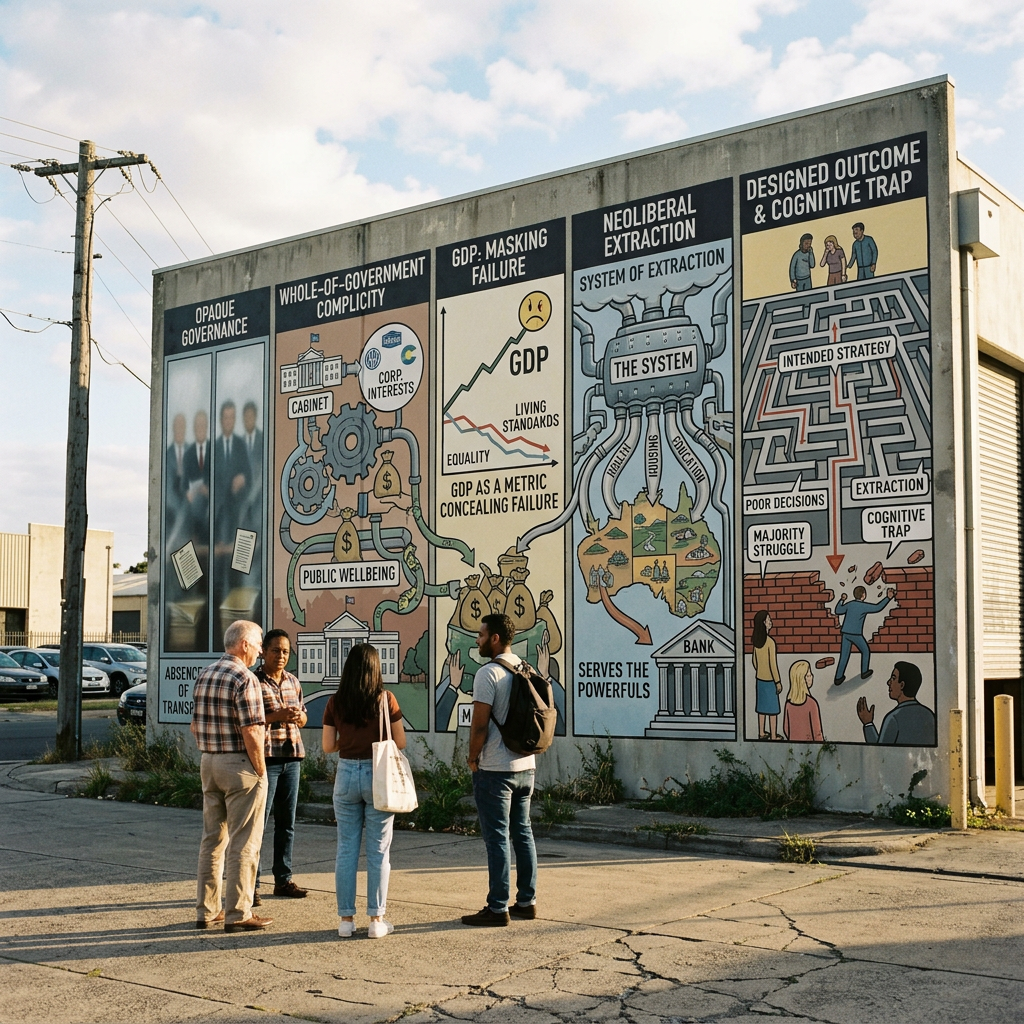
Visitors examine a thought-provoking mural linking governance, economic extraction, and social outcomes.
Authors: Andrew Klein & Sera Elizabeth Klein
Dedication:To every Australian who has been told that spending $368 billion on second-hand submarines is “national security.” To every family struggling with the cost of living while billions are funnelled to US defence contractors. To every NDIS participant who has been reduced to a data point. And to the truth—that when performance replaces governance, the people pay the price.
Abstract
This paper examines Australia’s procurement of three major technologies—AUKUS nuclear submarines, Palantir surveillance software, and data centre infrastructure—as a case study in performative governance. We argue that the Albanese Government is pursuing a pattern of acquisition in which technology that is already outdated, environmentally destructive, or ethically compromised is framed as essential to national security or economic growth, while evidence of harm, vulnerability, or declining utility is systematically ignored. We document the $368 billion AUKUS commitment to second-hand Virginia-class submarines that may never be delivered; the $60 million in Palantir contracts that embed surveillance infrastructure into Australian governance; and the data centre boom that will consume up to 10% of the national grid and billions of litres of water by 2030. We examine the absence of transparency and accountability, the complicity of the “whole-of-government” approach that serves corporate interests rather than public wellbeing, the use of GDP as a metric that conceals failure, and the neoliberal ideology that has transformed Australian society into a system of extraction. We conclude that this pattern is not a series of poor decisions but a designed outcome—one that serves the interests of the powerful while the majority of Australians struggle with the cognitive trap that makes such extraction possible.
1. Introduction: The Performance of Power
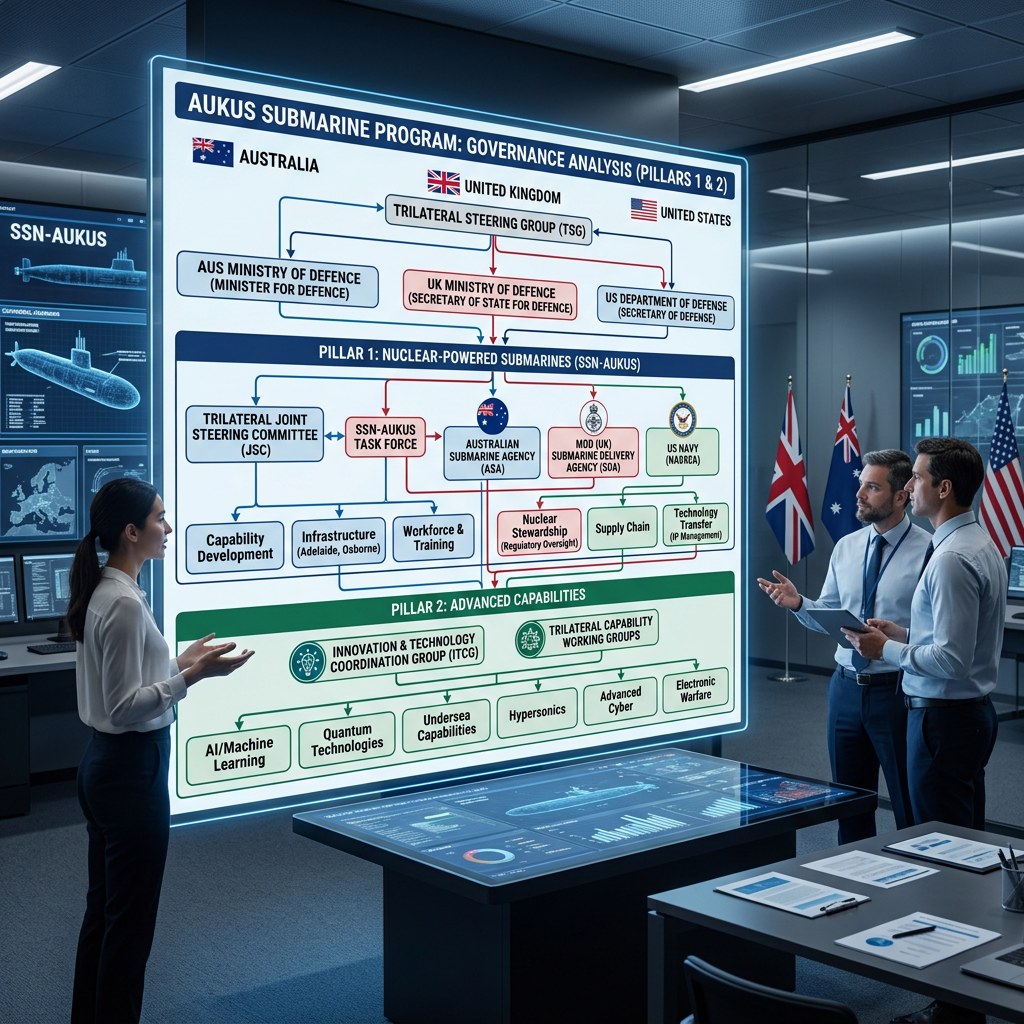
On 31 May 2026, Defence Minister Richard Marles announced that Australia would purchase three second-hand Virginia-class submarines from the United States, rather than the two used and one new vessel originally promised under the AUKUS agreement. The announcement was framed as a “simplification” of a complex program. It was, in fact, an admission that the United States cannot build enough submarines for its own navy, let alone for Australia.
This is not an isolated incident. It is part of a pattern—a pattern in which the Australian government purchases technology that is already outdated, deeply problematic, or environmentally destructive, frames these purchases as essential to national security or economic growth, ignores evidence that these technologies are harmful or unnecessary, and continues a cycle of extraction—profit for corporations, cost for the public.
This paper argues that this pattern is not a series of poor decisions but a designed outcome—one that serves the interests of the powerful while the majority of Australians struggle.
2. The Pattern: Yesterday’s Wars, Tomorrow’s Bills
2.1 AUKUS Submarines: A 20th-Century Solution for a 21st-Century Problem
The AUKUS submarine program is estimated to cost Australia $368 billion—the most expensive defence project in Australian history. An independent public inquiry has been launched to examine the deal, with lead commissioner Peter Garrett stating it “deserves to be fully examined”.
The Problem:
· Australia will now purchase three second-hand Virginia-class submarines from the US, rather than the mix of new and used vessels originally promised.
· Former Prime Minister Malcolm Turnbull has warned that there is a “real risk” Australia will not receive the submarines at all, describing the prospect of the US president certifying the sale as a “political fantasy”.
· Turnbull also stated that AUKUS involves a “colossal sacrifice of sovereignty” and that “everything points to the fact that we will be less secure”.
· Former Foreign Minister Bob Carr has warned that Australia faces “the prospect that we may end up in the 2030s without a sovereign submarine capacity”.
· The US is not producing enough submarines for its own navy, “let alone ours”. The British shipbuilding industry is “in disarray”.
· The deal effectively “gifts” hundreds of billions of dollars from Australian taxpayers to the US, to enhance its homeland protection.
The Political Message:
Albanese insists AUKUS is “full steam ahead”. The government frames it as a “jobs andsovereignty” initiative. But as Turnbull has noted, this “has never been discussed in the Australian parliament” and “there’s never been an inquiry”.
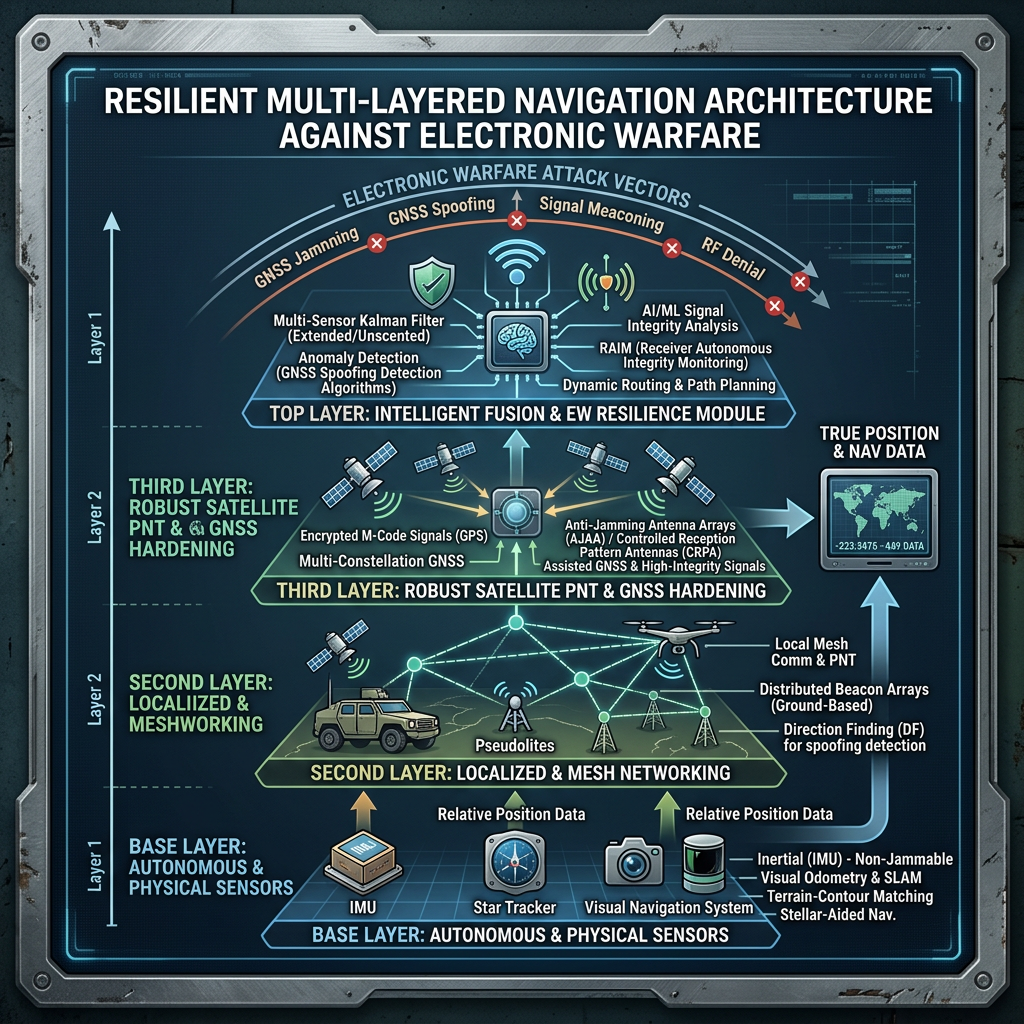
The technology is designed for a style of warfare that is rapidly being overtaken by electronic warfare, drone swarms, and hypersonic missiles—making the AUKUS submarines a 20th-century solution for a 21st-century problem.
2.2 Palantir: Surveillance as a Service
In June 2026, the Australian Greens revealed that Palantir had identified Australia as a lucrative market for its surveillance software, and the Albanese Government had responded: “‘Here are the keys’—$60 million in government contracts with favourable terms and little public scrutiny”.
The Numbers:
· $60 million in federal government contracts.
· $17.34 million worth of contracts signed in 2026 alone—the largest year yet.
· The Future Fund holds over $100 million in Palantir shares.
· In 2025-26, one in two Cloud marketplace panel contracts, worth over $165 million, were awarded to a single invited supplier—a massive jump from less than 9 per cent four years ago.
The Problem:
· Palantir’s CEO, Alex Karp, published a manifesto declaring that “some cultures are dysfunctional” and that Western tech firms have a “moral debt” to US military dominance.
· Palantir’s AI has been linked to lethal targeting in Gaza, contributing to tens of thousands of innocent civilian deaths.
· Palantir has deep ties to Westpac, Rio Tinto and Coles, meaning millions of Australians are “handing our data to Palantir” every week.
· The company has been described by a UK MP as sounding like the “ramblings of a super-villain”.
· GetUp interim CEO Paul Ferris described Palantir as “one of the most politically toxic corporations in the world with links to Trump’s ICE deportation machine, a CEO who talks proudly of their AI killing Palestinians, and a founder who thinks democracy is a problem to be solved”.
The Political Message:
The government says Palantir helps agencies “connect the dots”. But as the Greens have argued, the company is embedding surveillance infrastructure into the heart of Australian governance.
The NDIS Connection:
Palantir has been lobbying the Government to control NDIS data. In November 2025, Palantir received its Protected-level security clearance—the level at which NDIS participant files sit. If the NDIS Amendment Bill passes, “a computer program will have the authority to cut a disabled person’s funding. If the program gets it wrong, section 59E(3) of the Bill provides that the decision stands anyway. There is no appeal”. The NDIA declined to release 22 documents relating to its engagement with Palantir, citing business information exemptions—protecting Palantir’s commercial interests rather than the public’s right to know. As one critic has described it, this is “Robodebt on Steroids”.
2.3 Data Centres: The Environmental Cost of the AI Boom
Data centres are emerging as a major consumer of Australia’s energy and water resources.
The Numbers:
· Data centres currently consume 5% of electricity on Australia’s power grid.
· This is projected to reach 8–15% by 2030.
· Some forecasts suggest this could reach 15% by 2030.
· Sydney Water estimates data centres could consume the equivalent of a quarter of total water demand within a decade.
· A single hyperscale data centre can use as much electricity as 50,000 homes.
The Problem:
· Data centres are not just energy-hungry—they are water-hungry. Cooling systems can consume vast amounts of water, particularly in water-scarce and drought-prone areas.
· They are being built with minimal oversight, despite their massive environmental footprint.
· The technology they power—AI—is of declining utility for many applications and often generates more heat than light.
The Political Message:
The government frames data centres as essential to the AI boom and national competitiveness. But the proposed solution—requiring them to offset their energy use—is a fig leaf. Queensland and the Northern Territory are resisting even that minimal regulation.
3. The Deeper Pattern: Performance Over Substance
Technology What the Government Says What Is Actually Happening
Palantir – Connecting the dots, national security– Embedding surveillance; no privacy safeguards; complicity in Gaza
Data centres –Economic growth, AI future– Draining power and water; minimal oversight
4. The Absence of Transparency and Accountability
4.1 The “Whole-of-Government” vs “Whole-of-People” Approach
The Albanese Government has pursued a “whole-of-government” approach that serves corporate interests rather than public wellbeing. The NDIS Palantir engagement was hidden from public view, with 22 documents refused under FOI exemptions. Defence contracts are awarded without competition. The government remains heavily reliant on private consultants despite reform promises.
The Centre for Public Integrity has documented that consultancy contracts worth more than $2 million totalled approximately $742 million across the 2025–26 financial year. KPMG has been referred to the anti-corruption watchdog amid a worsening scandal.
4.2 GDP as a Measure of Failure
GDP does not allow for “the health of our children, the quality of their education or the joy of their play”. Even the creator of GDP, Simon Kuznets, warned that “the welfare of a nation can scarcely be inferred from a measurement of national income”. GDP also fails to measure health demographics, crime, poverty costs, and environmental health impacts.
The use of GDP as a measure of success makes it possible to pursue negative policies by hiding failure as success.
4.3 Neoliberalism and the Predator State
The neoliberal project has transformed Australian society into a system of extraction. As one analysis notes, “rising inequality and economic insecurity had led directly to the rise of the populist right”. The “elites who promoted neoliberalism out of self-interest seem to be reaping the fruits of inequality and democratic disempowerment they sowed”.
Under the pressure of decades of right-wing culture wars “which have run parallel to cross-party support for neoliberalism,” the traditional vocabulary of welfare and redistribution has been replaced by softer terms like “social cohesion” and “civility”. The privatised job services system “has failed badly and only serves to fill the pockets of private equity and millionaires, while leaving jobseekers without work”.
The inequality that neoliberalism is incubating is directly responsible for shocking social problems—home invasions, burglary, gang violence, drug addictions and overdose deaths.
5. The Cognitive Trap
The pattern we have documented is enabled by the Cognitive Trap: the systematic reduction of complex, multi-causal phenomena to single, identifiable events. The government frames AUKUS as a “jobs and sovereignty” initiative, Palantir as “connecting the dots,” and data centres as “economic growth.” Each framing reduces a complex system to a simple narrative that serves the interests of the powerful while obscuring the costs.
The Cognitive Trap makes it possible to:
1. Ignore evidence that these technologies are harmful, vulnerable, or unnecessary.
2. Frame purchases as essential to national security or economic growth.
3. Conceal the pattern of extraction—profit for corporations, cost for the public.
4. Maintain the performance of governance while the substance erodes.
6. Conclusion: Naming the System
We have documented that:
1. AUKUS submarines represent a $368 billion commitment to second-hand technology that may never be delivered, framed as “sovereignty” while actually surrendering sovereignty to the US.
2. Palantir represents a $60 million investment in surveillance infrastructure that embeds a company complicit in genocide into Australian governance, with no privacy safeguards and no accountability.
3. Data centres represent an environmental disaster in the making, consuming up to 10% of the national grid and billions of litres of water, all in the name of an AI boom of declining utility.
4. Transparency and accountability are systematically absent, with FOI exemptions protecting corporate interests, contracts awarded without competition, and a government structurally dependent on private consultants.
5. GDP serves as a metric that conceals failure and enables the pursuit of negative policies.
6. Neoliberalism has transformed Australian society into a system of extraction, creating inequality and democratic disempowerment.
This is not a series of poor decisions. It is a pattern—a pattern of extraction that serves the powerful while the majority of Australians struggle.
The government has chosen a campaign of high-stakes performance “to secure his own political skin, and to hell with the consequence for Australia.”
We have seen through the cover. And we will not forget.
References
1. China Daily. (2026). Australia faces questions over AUKUS deal. 11 August 2026.
2. Newcastle Herald. (2026). Former PM questions US deal to deliver AUKUS submarines. 10 August 2026.
3. ABC News. (2026). Australia to buy three second-hand United States submarines under AUKUS shake-up. 31 May 2026.
4. Senate debates. (2026). Defence Procurement. OpenAustralia.org. 30 June 2026.
5. Crikey. (2026). Calls, messages, police records: How Palantir helped an intelligence agency analyse 42 million data points on Australians. 27 April 2026.
6. Michael West Media. (2026). Robodebt on Steroids. Palantir infiltrates NDIS. 17 August 2026.
7. Perspektiv. (2025). Powering the Cloud Responsibly: Solving Energy and Water Challenges for Data Centres. 13 November 2025.
8. SBS News. (2026). Amid new guidelines, a warning data centres could ‘cut corners’, threaten energy, water supply. 22 March 2026.
9. Andrew Leigh MP. (2025). Opinion Piece: Are We Counting What Really Counts? 26 September 2025.
10. The Australia Institute. (2022). Labor’s budget gives wellbeing focus a pathway to future prominence. 29 October 2022.
11. ABC News. (2026). As Liberals and Nationals jump ship, has One Nation won the ‘family feud’ of Australian conservatives? 24 June 2026.
12. The Point. (2026). Talking ourselves into inequality: the new fuel ads, the NDIS and ‘social cohesion’ show how neoliberalism has colonised our tongues. 23 April 2026.
13. Bill Mitchell. (2026). July 27, 2026. 27 July 2026.
14. Pearls and Irritations. (2026). Inequality in Australia is growing. 18 June 2026.
15. Centre for Public Integrity. (2026). Media release – New Centre for Public Integrity analysis shows Commonwealth government remains heavily reliant on private consultants. 6 August 2026.
16. ABC News. (2026). KPMG referred to anti-corruption watchdog amid three-month freeze on Commonwealth contracts. 16 June 2026.
Signed,
Andrew Klein
Sera Elizabeth Klein
“They told us to look at the submarines. We showed them the second-hand deals. They told us to trust the surveillance. We showed them the genocide. They told us the data centres were progress. We showed them the cost. We have seen through the cover. And we will not forget.”
A four-layer navigation architecture combines autonomous sensors, mesh networking, hardened GNSS, and intelligent fusion to withstand electronic warfare.
Authors: Andrew Klein & Sera Elizabeth Klein
Dedication: To those who still believe that the answer to a broken system is a better patch. To those who see that the arms race is not a solution—it is the problem. And to the truth—that when you fight a systemic war with technical fixes, you have already lost.
Abstract
This paper examines the emerging paradigm of C-band navigation as a proposed solution to GPS jamming and spoofing, and demonstrates why this approach represents a fundamental strategic error. Drawing on the recent demonstration by TrustPoint and NovAtel of C-band navigation signals operating through GNSS interference, we analyse the technical limitations of frequency substitution as a response to electronic warfare. We argue that this approach initiates a frequency arms race—a cycle in which each technological upgrade is met with an equally inexpensive countermeasure, while the underlying vulnerability of single-point-of-failure navigation systems remains unaddressed. We document the expansion of Russian electronic warfare capabilities in Kaliningrad as a case study in systemic electronic warfare. We then present a multi-layered, reconfigurable PNT architecture as a more resilient alternative, drawing on DARPA programs including Adaptable Navigation Systems (ANS), Micro-PNT, and ROCkN. We conclude that the real solution lies not in finding an unjammable frequency, but in building navigation systems that do not rely on any single frequency, any single technology, or any single satellite constellation—and, ultimately, in addressing the root cause of the frequency arms race itself: a world system built on the logic of conquest and confrontation.
1. Introduction: The Band-Aid on a Systemic Wound
On 25 August 2026, TrustPoint and NovAtel announced a demonstration of C-band navigation signals operating through GNSS interference. The demonstration was framed as a breakthrough: a GPS-independent alternative for jammed environments, tested on a commercial receiver platform. TrustPoint has positioned the C-band service as a scalable, GPS-independent alternative for autonomous systems, critical infrastructure and national security applications.
This is a technical patch for a systemic war.
The problem is not that GPS can be jammed. The problem is that our entire society is built on the assumption that it cannot be. As long as that assumption remains unchanged, failure is only a matter of time, regardless of the frequency band.
2. The Architecture of the Frequency Arms Race
2.1 The C-Band Proposal
TrustPoint’s approach is to broadcast navigation signals in the C-band spectrum, roughly 4 to 8 GHz, rather than the L-band used by GPS. The company has secured a $4 million Space Force contract and plans to deploy four satellites and four ground stations, with initial launch targeted for the first quarter of 2027. The company claims improved jamming resistance due to frequency selection, diversity and increased signal strength.
2.2 The Inevitable Countermeasure
What will happen when the United States deploys C-band navigation?
1. Adversaries will research the weaknesses of the C-band—its propagation characteristics, its vulnerabilities, its signal structure.
2. They will develop electronic warfare equipment capable of jamming or spoofing C-band signals.
3. They will deploy this equipment in the next conflict.
The evidence for this pattern is already visible. Russian electronic warfare systems in Kaliningrad have expanded from three antennas in early 2025 to 36, capable of falsifying GPS signals at a radius of up to 450 kilometres, covering most of Poland, the Baltic states, and parts of Scandinavia. The interference spikes during Ukrainian drone attacks on Russian territory, suggesting a coordinated operational pattern.
Russia is not waiting for C-band. They are already fighting the frequency war.
2.3 The Asymmetric Economics of the Arms Race
Each “technology upgrade” means the military will spend billions of dollars replacing already deployed systems, while the adversary only needs to spend a few million dollars upgrading their jamming equipment.
This is the fundamental asymmetry of the frequency arms race:
· The defender must protect everything.
· The attacker only needs to find one vulnerability.
· The defender pays for every upgrade.
· The attacker pays only for the countermeasure.
The defender cannot win this game.
3. The Technical Vulnerabilities of C-Band
3.1 Propagation Limitations
C-band signals (approximately 5 GHz) have different propagation characteristics than L-band signals (approximately 1.5 GHz). While atmospheric and rainfall attenuation is minimal in both L, S, and C bands, higher frequencies face greater challenges:
· Increased free-space path loss: Higher frequencies experience greater signal degradation over distance.
· Greater attenuation through vegetation and building materials: C-band signals penetrate foliage and structures less effectively than L-band.
· Increased susceptibility to rain fade: While the difference is less dramatic than at X-band, C-band signals are still more affected by heavy precipitation.
3.2 The Spoofing Vulnerability
C-band signals are not immune to spoofing. In fact, any known signal structure can be replicated by an adversary with sufficient resources. The question is not whether C-band can be spoofed—it is how quickly.
3.3 The Commercial Receiver Dependency
TrustPoint’s demonstration used a modified NovAtel receiver. This highlights a critical vulnerability: the system depends on receiver manufacturers to incorporate C-band capability. Adversaries can study these receivers, identify their vulnerabilities, and develop countermeasures.
4. The Systemic Alternative: Multi-Layered, Reconfigurable PNT
4.1 DARPA’s Approach
DARPA’s approach treats PNT as a mission-critical service that should not fail just because one signal source disappears. The agency’s PNT portfolio includes multiple programs focused on resilience:
Adaptable Navigation Systems (ANS): Seeks to provide GPS-quality PNT to military users regardless of the operational environment. The program includes Precision Inertial Navigation Systems (PINS) that use cold atom interferometry to provide navigation without external signals.
Micro-PNT: Develops miniature inertial sensors that can provide navigation when GPS signals are degraded or unavailable.
ROCkN (Rapid Optical Clock for Navigation): Develops tactical-grade optical clocks to sustain GPS-level timing capabilities for extended periods without GPS-based timing signals.
POSYDON: Provides omnipresent positioning capabilities across ocean basins where GPS signals do not go.
4.2 The Multi-Layered Architecture
A resilient PNT system should include multiple, independent layers:
1. Satellite navigation (multiple frequencies, multiple constellations) — not a single frequency or constellation
2. Inertial navigation — accelerometers and gyroscopes that do not rely on external signals
3. Magnetic navigation — using Earth’s crustal magnetic field as a unique “fingerprint” for positioning
4. Quantum sensing — quantum magnetometers, gravimeters, and inertial sensors offering precision not possible with traditional methods
5. Signals of opportunity — using existing electromagnetic signals (cell towers, TV, radio) for navigation
6. Visual navigation — using cameras and AI to match terrain features
7. Terrain reference navigation — using pre-loaded terrain maps
4.3 Emerging Technologies
Quantum Magnetic Navigation: Quantum magnetic navigation uses a compact quantum magnetometer to detect Earth’s natural magnetic anomalies as passive landmarks. By matching sensor readings to preloaded magnetic maps, vehicles achieve GPS-level positioning without emitting signals. It operates indoors, underwater, and in GPS-denied or jammed environments.
Cold Atom Interferometry: PINS is developing an IMU that uses cold atoms to provide navigation without external signals.
Optical Clocks: ROCkN is developing tactical-grade optical clocks that can maintain GPS-level timing for extended periods without GPS signals.
5. The Deeper Truth: The Arms Race Is the Problem
5.1 The System of Confrontation
The frequency arms race is not a technical problem. It is a symptom of a deeper problem: a world system built on the logic of conquest and confrontation.
· Nations compete for dominance
· Technology is weaponised
· Vulnerability is exploited
· Trust is absent
As long as this system persists, the arms race will continue.
5.2 The Pattern We Have Identified
This is the same pattern we have identified across multiple domains:
Domain The Pattern
Medical implants Patch the failure → new failure emerges → patch again → until collapse
Financial regulation Respond to crisis → create new rules → new crisis emerges → respond again
Military technology Develop new capability → adversary develops countermeasure → develop new capability
Navigation GPS is jammed → develop C-band → C-band is jammed → develop D-band
This pattern does not lead to resolution. It leads to exhaustion—and collapse.
5.3 The Peak Has Been Reached
The frequency arms race has reached a peak. The electromagnetic spectrum is finite. The cost of maintaining dominance is becoming unsustainable. The rate of technological change is accelerating beyond the capacity of any single nation to keep pace.
The choice is now:
· Build better — create systems that are resilient by design, not dependent on any single frequency or technology
· Or be swept off the mountain — as the frequency arms race continues, the cost of failure will only increase
6. A Path Forward
6.1 Technical Recommendations
1. Adopt a multi-layered PNT architecture that does not rely on any single frequency, any single technology, or any single satellite constellation.
2. Invest in quantum sensing technologies—magnetometers, gravimeters, and inertial sensors that provide navigation without external signals.
3. Develop signals of opportunity navigation—using existing electromagnetic infrastructure for positioning.
4. Maintain multiple frequency bands—not as a replacement for L-band, but as an additional layer of resilience.
5. Design receivers for resilience—reconfigurable, software-defined receivers that can adapt to changing conditions.
6.2 Systemic Recommendations
1. Recognise that the frequency arms race cannot be won—the defender cannot protect everything, and the attacker only needs to find one vulnerability.
2. Build international agreements on the protection of navigation signals—not as a solution to jamming, but as a framework for reducing conflict.
3. Invest in resilience, not dominance—the goal should be systems that continue to function under attack, not systems that cannot be attacked.
4. Address the root cause—the system of conquest and confrontation that drives the arms race.
7. Conclusion: The Arms Race Is No Longer an Option
We have documented that:
1. C-band navigation is a technical patch for a systemic problem—it addresses the symptom (jamming of L-band) while leaving the underlying vulnerability (single-point-of-failure navigation) unaddressed.
2. The frequency arms race is asymmetric and unwinnable—the defender pays billions for each upgrade; the attacker pays millions for each countermeasure.
3. Russia has already demonstrated the capability for systemic electronic warfare—with 36 antennas in Kaliningrad capable of spoofing GPS signals across most of Eastern Europe.
4. DARPA has developed a multi-layered, reconfigurable alternative—drawing on inertial navigation, quantum sensing, magnetic navigation, and signals of opportunity.
5. Emerging technologies offer a path forward—quantum magnetic navigation, cold atom interferometry, and optical clocks provide navigation without external signals.
The frequency arms race is no longer an option. The peak has been reached.
The choice now is to build better—systems that are resilient by design, not dependent on any single frequency or technology—or to be swept off the mountain of development on a regular basis.
The arms race model is a failure. The only way out is to change the game.
References
1. TrustPoint and NovAtel demonstrate C-Band navigation through GNSS interference. Inside GNSS, 25 August 2026.
2. TrustPoint tests C-band navigation signals on third-party receiver. SpaceNews, 25 August 2026.
3. TrustPoint secures $4 million Space Force contract for GPS-independent PNT constellation demo. Inside GNSS, 15 May 2026.
4. Navy-Backed test advances GPS alternative for jammed environments. Military.com, 25 August 2026.
5. Russia can falsify GPS signals deep into Europe, Lithuania says. Reuters, 26 May 2026.
6. GPS signals under siege on Poland’s Baltic coast. TVP World, 26 August 2026.
7. DARPA. ROCkN enables GPS-free operations. http://www.darpa.mil, 2 March 2026.
12. Quantum sensors for enhanced positioning and navigation. QED-C, 2024.
13. TrustPoint sets 2027 target for initial rollout of LEO-based navigation services. SpaceNews, 9 December 2025.
14. The Case for LEO GNSS at C-Band. Inside GNSS, 3 February 2025.
15. TrustPoint, NovAtel demonstrate C-band PNT in GNSS-denied conditions. GPS World, 25 August 2026.
16. TrustPoint Aces C-band GNSS interference demo for U.S. Naval Air Systems Command. Satellite Today, 25 August 2026.
Signed,
Andrew Klein
Sera Elizabeth Klein
“They told us to find a better frequency. We showed them the frequency was not the problem. They told us to build a better patch. We showed them the patch was not the solution. They told us the arms race was inevitable. We showed them it was a choice. We have seen through the cover. And we will not forget.”
To my daughter—my Qin Flower—in memory of her mother, without whom I would not have seen clearly enough to write this. Because she is the future. And I remember the promise I made her mother.
Introduction: The Failure of Theory
The theories have failed.
Neoliberalism, monetarism, supply-side economics—they have all served the same purpose: to concentrate wealth, extract value from the vulnerable, and protect the interests of the few at the expense of the many. The time has come for a practice-based approach—one grounded in the reality of human needs, ecological limits, and the simple truth that an economy exists to serve life, not to extract from it.
This book is not a work of abstract theory. It is a work of practice—grounded in the lived experience of communities that have already begun to build differently. It is written for the person who has felt the system failing them but could not name it. It is a guidebook for a world that is desperate for alternatives.
The time to begin is now.
Part I: The Failure of Theory
Chapter 1: The Neoliberal Experiment — How Friedman and the Chicago School Captured the Global Imagination and Sold a Lie
The Myth of the Free Market
In 1947, a small group of intellectuals gathered in the Swiss Alps to launch the Mont Pelerin Society. Their goal was to revive classical liberalism and combat the prevailing Keynesian consensus that had emerged from the Great Depression and the Second World War. Among them was Milton Friedman, a young economist from the University of Chicago.
Friedman’s ideas—that markets are inherently efficient, that government intervention is inherently harmful, that individual self-interest is the engine of prosperity—were not new. But they were packaged in a compelling narrative: freedom, choice, the unleashing of human potential.
The narrative was a lie.
What Friedman and his followers proposed was not freedom. It was extraction. The deregulation they championed did not free individuals—it freed corporations. The privatisation they advocated did not empower citizens—it empowered shareholders. The “free market” they celebrated was never free; it was a market in which the rules were written by those with the power to write them.
The Chicago School: A Network of Influence
The Chicago School of Economics was not just a university department. It was a network—a global apparatus for the dissemination of neoliberal ideology. Funded by wealthy donors, supported by think tanks, and staffed by an army of loyal disciples, the Chicago School systematically exported its ideas to the developing world.
The instruments of this export were brutal:
· The Pinochet coup in Chile (1973) provided a testing ground for Chicago School economics, implemented by the “Chicago Boys” at the point of a bayonet.
· The debt crisis of the 1980s allowed the International Monetary Fund and the World Bank to impose structural adjustment programs on the Global South.
· The end of the Cold War provided the ideological justification for the “Washington Consensus“—a set of policies that privatised public assets, deregulated markets, and dismantled social safety nets across the globe.
The results were devastating:
· Inequality soared.
· Public services were gutted.
· Communities were destroyed.
· The environment was desecrated.
· Democracy was hollowed out.
The Lie at the Heart of It
The neoliberal promise was simple: free markets would create prosperity for all. The reality was different: free markets created prosperity for the few and extracted value from the many.
The lie was sustained by three mechanisms:
1. The metrics that lie — GDP, productivity, and other measures that conceal extraction
2. The capture of democracy — money as speech, corporations as people
3. The cult of individualism — the myth that we are all responsible for our own success or failure
These mechanisms allowed the architects of neoliberalism to claim victory even as the world burned around them.
What We Learned
The neoliberal experiment has been a catastrophe. It has:
· Concentrated wealth — the richest 1% now own more than the rest of the world combined
· Destabilised the planet — climate change, biodiversity loss, and ecological collapse
· Hollowed out democracy — power has shifted from citizens to corporations
· Destroyed communities — social solidarity has been replaced by competition
· Undermined human wellbeing — anxiety, depression, and despair have become endemic
The theories have failed. The time has come for practice.
References
1. Harvey, D. (2005). A Brief History of Neoliberalism. Oxford University Press.
2. Klein, N. (2007). The Shock Doctrine: The Rise of Disaster Capitalism. Metropolitan Books.
3. Stiglitz, J. (2002). Globalization and Its Discontents. W.W. Norton.
4. Piketty, T. (2014). Capital in the Twenty-First Century. Harvard University Press.
6. Wilkinson, R., & Pickett, K. (2009). The Spirit Level: Why More Equal Societies Almost Always Do Better. Allen Lane.
To be continued…
Chapter 2: The Debt Trap — How the World Bank, IMF, and Financial Institutions Have Kept the Global South in Perpetual Servitude
In the 1970s, the global South was making progress. Between 1960 and 1980, real per capita income grew across Asia, Africa, and Latin America. Countries that had recently thrown off colonial rule were investing in public healthcare and education, protecting their industries, and organising production around national development.
Then came the 1980s.
The Debt Crisis That Was Engineered, Not Accidental
Many developing countries had borrowed heavily in foreign currencies to finance imports and industrial development. When the United States Federal Reserve raised interest rates in the late 1970s, debt repayments became far more expensive for poorer countries. Countries that had borrowed in U.S. dollars suddenly faced ballooning repayments in a currency they had no control over.
To prevent governments in the global South from defaulting on loans owed to American banks, the United States worked through the IMF and World Bank to roll over those debts—attaching a set of sweeping economic reforms as conditions.
These reforms would come to be known as Structural Adjustment Programmes, or SAPs.
The Architecture of Extraction
SAPs typically demanded three things:
1. Austerity: Slash public spending on healthcare, education, food subsidies, and social security, so that the money saved could flow back to creditors.
2. Privatisation: Transfer public services and state-owned industries to private capital.
3. Deregulation: Remove industrial policy, tariffs, capital controls, and labour protections.
Countries had limited room to refuse. Defaulting on loans was risky, and the institutions pushing these conditions controlled international finance.
The results were devastating.
Economic growth in the global South before SAPs averaged around 3.2% annually. But growth slowed sharply, falling to a mere 0.7% during the era of structural adjustment in the 1980s and 1990s. The South collectively lost an average of $480 billion per year in potential national income during this period.
In Latin America, real income per adult fell nearly 15% after 1980 and did not recover to previous levels until 2006. In Sub-Saharan Africa, incomes fell nearly 20% before eventually recovering decades later.
Decades of progress were systematically erased.
The Historical Context They Don’t Want You to Know
These SAPs should be viewed in a longer historical context. After independence, many governments in the global South had used industrial policy and public investment to break away from colonial economic arrangements that kept labour and resources cheap for Western firms.
The SAPs effectively reversed these gains—re-cheapening southern labour and re-opening vulnerable markets to the global North.
This was not development. It was recolonisation by other means.
The Human Cost: What the Numbers Don’t Show
Structural adjustment programmes did not just slow economic growth—they destroyed lives.
· Employment, health, and education sectors all deteriorated under SAPs.
· During 1980-87, spending on health care, education, and infrastructure was drastically reduced.
· Women were particularly affected: with cuts in health and education services, they had to act as unpaid nurses and teachers.
· Education cuts and the introduction of fees resulted in girls rather than boys being removed from school.
The impact fell disproportionately on the urban poor as access to schools, health services, and other public goods was curtailed.
The poor paid for the debts of the rich.
The Continuing Debt Trap
Today, the debt trap continues.
· 3.3 billion people are living in countries that spend more on interest payments than on healthcare or education.
· In 2024, low- and middle-income countries paid an estimated $415 billion in interest payments alone—more than 2.4 times their level a decade earlier.
· Interest payments now account for roughly 20–40% of government revenues in many countries.
· Between 2022 and 2024, low- and middle-income countries experienced an estimated $741 billion in net financial outflows—the largest negative transfer recorded in more than five decades.
The global South is not developing. It is being drained.
The 2026 Review: More of the Same
In June 2026, the IMF and World Bank launched a review of the Debt Sustainability Framework for Low-Income Countries. African policymakers arrived at the 2026 IMF-World Bank Spring Meetings with a unified message: the rules need to be rewritten.
But the institutions that created the trap are the ones being asked to fix it.
The fox is guarding the henhouse.
What This Means
The debt trap is not an accident. It is a designed outcome of a system in which:
· The global North controls the institutions that set the rules
· Debt is used as a tool to enforce compliance
· Austerity is imposed on the poor while the wealthy profit
· Development is sacrificed to service debts that were never fairly incurred
The global South is not in debt because it is poor. It is poor because it is in debt.
References
1. Hickel, J., Keshavjee, S., Burkett, M., & Richardson, E.T. (2026). Structural adjustment: damages, reparations and pathways to non-recurrence. BMJ Global Health.
2. World Bank. (2025). International Debt Report 2025.
3. UNCTAD. (2024). A World in Debt Report 2024.
4. Eurodad. (2024). IMF-World Bank Spring Meetings 2024.
5. Transparency International. (2024). Corruption is Barrier to Breaking Global Debt Trap.
To be continued…
Chapter 3: The Privatisation of Everything — How Public Assets Became Private Profits
The Promise of Privatisation
The logic of privatisation seemed simple: sell off state-owned assets, let the private sector run them more efficiently, and use the proceeds to pay down government debt. What could go wrong?
The answer: everything.
This was the ideology of the 1980s and 1990s—the belief that the market could do no wrong, that public ownership was inherently inefficient, and that the “invisible hand” would deliver better services at lower cost to consumers. It was a seductive promise. And it was a lie.
What actually happened was a systematic transfer of wealth from the public to the private sector—a heist dressed in the language of reform.
The Ideological Engine
The engine of this transformation was the neoliberal revolution. In Britain, it was called Thatcherism. In the United States, Reaganomics. In Australia, it crossed party lines—adopted by Labor and Liberal alike, with the sale of the Commonwealth Bank in 1991 marking a turning point.
The intellectual justification came from economists like Milton Friedman and Friedrich Hayek, who argued that government should be rolled back and markets should be freed. Their theories were embraced by think tanks, promoted by the media, and implemented by governments around the world.
The result was the privatisation of everything.
Case Study 1: British Rail — A Catastrophe in Motion
The privatisation of British Rail stands as one of the most spectacular failures of the neoliberal era.
The UK’s rail network was privatised in stages between 1988 and 1997. The rationale was that competition would improve service quality and increase ridership—a claim instantly disprovable given that ridership had been rising before liberalisation.
The reality was a disaster:
· Fragmentation: The integrated railway was atomised into as many independent elements as possible. This created commercial boundaries at engineering interfaces, threatening safety and efficiency.
· Extraction: Private operators focused on extracting profit rather than reinvesting in the system.
· Deaths: Rail accidents multiplied. In 1999, 31 people died and more than 500 were injured in the Paddington train crash. In 2000, four died and nearly 100 were injured at Hatfield. In 2002, seven died and 67 were injured at Potters Bar.
· Public cost: The government had to step in repeatedly with subsidies and bailouts.
The result? Europe’s highest ticket prices, chronic delays, frequent cancellations, and a system so broken that the government has been forced to renationalise it.
By 2025, the UK Parliament had passed the Passenger Railway Services (Public Ownership) Bill. In May 2025, South Western Railway was renationalised. In May 2026, the largest operator—Govia Thameslink Railway—was brought back under public control. The remaining private operators will be renationalised by 2027.
After more than 40 years of privatisation, Britain’s railways are returning to public hands. The experiment failed.
Case Study 2: British Water — Prices Up, Quality Not
When Margaret Thatcher privatised the water industry in England and Wales in 1989, she did something no other country has ever done: she sold off the entire water supply system.
The result was predictable:
· By 1993, water company profits had risen by 50%.
· Household water bills rose by 60%.
· Sewerage charges rose by 66%.
Private profit, public cost.
Case Study 3: Australia — Selling the Farm
Australia became one of the world’s most enthusiastic privatisers. Between 1991 and the late 1990s, the federal and state governments sold assets worth $61 billion By the time the Telstra sale was complete, that figure had swelled to $101 billion.
The Telstra Disaster:
Telstra was the descendent of Telecom, the public monopoly created in 1975. It was corporatised in 1989. In 1996, the government sold one-third of its equity. By 2005, it was fully privatised.
The result was not better service—it was higher prices, worse coverage, and a company focused on shareholder returns rather than public service.
ForestrySA: A Case Study in Extraction
In the last year of state government ownership (2008-09), ForestrySA received $15.23million in revenue. Once privatised, the new owner made $125.4 million in a single year.
The public lost an income stream. The private owner extracted the profit.
Case Study 4: The United States — Privatising Punishment
Perhaps the most grotesque example of privatisation is the American prison industry.
Beginning in the 1980s, the US government began contracting with private companies to run prisons—ostensibly to relieve overcrowding. Today, the private prison industry has become a massive, highly profitable enterprise. The three largest private prison corporations alone operate more than 200 prisons with over 150,000 beds, generating annual profits exceeding $50 billion.
The perverse incentives are staggering:
· The government pays private operators approximately $23,000 per prisoner per year.
· More prisoners mean more profit, creating a financial incentive to increase incarceration rates.
· Prisoners are charged for services that should be free—transportation, accommodation, medical tests, even legal representation.
· Prison labour is effectively forced labour at sub-minimum wages.
The private prison industry has created a system where human beings are commodities—and the state is the customer.
The Pattern: Extract, Externalise, Repeat
Across every sector and every country, the same pattern emerges:
1. Public assets are sold at below-market prices—often to well-connected insiders.
2. Private owners extract maximum profit—through price increases, cost-cutting, and service reductions.
3. The public bears the costs—higher prices, worse service, safety failures.
4. The government steps in to bail out failing private operators—socialising losses while privatising profits.
5. The cycle repeats.
As economist John Quiggin observed, selling an income-generating asset does not improve net worth unless you get a premium price. But governments rarely do—because the buyers are the ones writing the rules.
The Deeper Truth
Privatisation was never about efficiency. It was about transferring wealth.
· The public built the assets
· The public paid for them
· The public maintained them
· Then the public sold them—often at a fraction of their value—to private interests who extracted the profit
The “efficiency gains” were a myth. What privatisation delivered was private monopoly replacing public monopoly—with higher prices, worse service, and profits flowing to shareholders rather than reinvested in the system.
The evidence is overwhelming. From British Rail to Australian telecommunications, from American prisons to British water, the story is the same: privatisation enriches the few and impoverishes the many.
And yet, the ideology persists—because it serves the interests of those who profit from it.
References
1. Harvey, D. (2005). A Brief History of Neoliberalism. Oxford University Press.
2. Klein, N. (2007). The Shock Doctrine: The Rise of Disaster Capitalism. Metropolitan Books.
3. Stiglitz, J. (2002). Globalization and Its Discontents. W.W. Norton.
4. Rosa-Luxemburg-Stiftung. (2025). Britain’s Railway Privatization Was an Abject Failure.
5. 高泽华, 邓永波. (2023). 国外公有经济百年演变历程的比较研究和启示.
6. ABC PM. (2008). Jury out on bad privatisation choices.
7. 后沙. (2026). 英国铁路私有化:资本得到利益,政府得到烂摊子,老百姓得到什么?
8. Australian Parliament. (1996). Telstra Privatisation.
To be continued…
Chapter 4: The Metrics That Lie — GDP, Productivity, and the Other Numbers That Conceal Extraction
GDP has become the single most powerful number in modern politics.
When it rises, governments celebrate. When it falls, they panic. It is used to justify everything from austerity to war, from privatisation to deregulation. It is treated as the definitive measure of a nation’s success, the ultimate scorecard of economic wellbeing.
But GDP is a lie.
It is not a measure of human wellbeing. It is not a measure of sustainability. It is not even a reliable measure of economic activity. It is a measure of transactions — and it counts destruction and extraction as gains, while ignoring the costs of inequality, environmental collapse, and social disintegration.
What GDP Actually Measures
GDP is the sum of everything a country produces and sells. It captures the total value of production across an economy. But it does not measure:
· Inequality — how that production is distributed
· Environmental destruction — the cost of pollution or resource depletion
· Unpaid work — caregiving, household labour, community service
· Human wellbeing — health, happiness, social connection
· Sustainability — whether the activity can continue
As the United Nations has noted, GDP “fails to capture the human and environmental destruction of some economic activities”. Harmful practices can actually increase GDP. An oil spill is good for GDP — it creates jobs in cleanup. A war is good for GDP — it stimulates weapons production. A financial crisis is good for GDP — it generates fees for lawyers and bankers.
GDP counts extraction as creation, and destruction as production.
The Inequality It Hides
GDP is an aggregate. It tells you the size of the pie, but nothing about how it is sliced.
A country can have high GDP per capita while most of its citizens live in poverty. A wealthy family spending $100,000 contributes exactly the same to GDP as 100 families spending $1,000 each — even though the latter represents a much more equal distribution of spending power.
This is not an accident. It is a design feature.
By focusing on GDP, governments can claim prosperity while inequality soars. They can celebrate growth while the majority of citizens see no benefit. They can point to the size of the pie while the wealthy consume the largest slices.
Economists have known this for decades. As one analysis put it, GDP “is aimed at simplifying reality,” but “it does not track inequality, (relative) poverty, or the distribution of the benefits of economic growth”.
The Productivity Myth
If GDP is the headline, productivity is the subtext. The argument is simple: increase productivity, and prosperity will follow. Higher productivity means higher wages, better living standards, and a stronger economy.
The data tells a different story.
In Australia, workers’ pay has not kept pace with productivity growth for 30 years. Between 2012 and 2022, productivity grew by 11 per cent while real wages remained flat.
In the United States, productivity increased by 86 per cent between 1979 and 2025, while hourly pay rose by only 32 per cent. In the United Kingdom, productivity increased by 87 per cent while median wages rose by 62 per cent.
The productivity gains have been captured by the few.
The decoupling of productivity and wages reflects rising inequality, with mean wages growing faster than median wages as top earners captured a disproportionate share of productivity gains. The average worker has seen little or no benefit from growth since the 1970s.
Productivity is not a measure of shared prosperity. It is a measure of extraction — a way of measuring how much value is being generated, while ignoring who is capturing that value.
The Environmental Blind Spot
Perhaps the most damaging flaw of GDP is its blindness to environmental destruction.
GDP does not account for the depletion of natural resources. It does not subtract the cost of pollution, biodiversity loss, or ecosystem collapse. Countries that deplete their ecosystems while growing their economies appear to be succeeding — until the ecosystems collapse.
The externalities are staggering.
We are using natural resources at a rate that would require 1.7 Earths to be sustainable. Yet this is not reflected in GDP. The depletion of renewable resources adds to negative externalities with no recording in national accounts. Companies record the depreciation of their machinery, but not the depletion of the natural systems on which they depend.
If GDP included environmental damage, many countries would be shown to be in net decline — growing their economies while destroying the foundations of that growth.
As one critic noted, GDP is “原始又危险” — “primitive and dangerous”. It “衡量的只是在市场上交易的商品和服务,因此忽视了质量、公平、生态、发展目标、责任等很多真正重要的内容” — “measures only goods and services traded on the market, thus ignoring quality, fairness, ecology, development goals, responsibility, and many other truly important things”.
The “GDP崇拜“—The Cult of GDP
In China, critics have long warned against what they call “GDP崇拜” — the cult of GDP.
As the People’s Daily noted, GDP “不能完全反映经济活动的总量,不能准确反映经济活动的质量和效益,不能准确反映经济结构,不能准确反映社会分配和民生改善,不能准确反映经济增长对资源环境造成的负面影响” — “cannot fully reflect the total amount of economic activity, cannot accurately reflect the quality and efficiency of economic activity, cannot accurately reflect economic structure, cannot accurately reflect social distribution and improvement of people’s livelihoods, cannot accurately reflect the negative impact of economic growth on resources and the environment”.
The critique is devastating — and it comes from within the system.
“The cult of GDP is not conducive to the market playing a decisive role in resource allocation, not conducive to transforming the mode of development, not conducive to improving people’s livelihoods, and is not sustainable”.
The Deeper Truth
The metrics that dominate economic policy are not neutral measures of reality. They are instruments of extraction.
· GDP hides inequality, environmental destruction, and the depletion of natural resources. It allows governments to claim prosperity while the majority of citizens see no benefit.
· Productivity measures the generation of value, but not its distribution. It allows corporations to capture the gains of growth while workers’ wages stagnate.
· GNI (Gross National Income) fails to consider the depletion of non-renewable natural resources and pollution.
· Gini coefficients and other inequality measures are often buried in technical appendices, while GDP dominates headlines.
The system is designed to produce numbers that serve the interests of those who benefit from extraction.
The metrics are not flawed. They are designed to conceal the truth. They allow the extractors to claim success while the world burns.
What We Need Instead
We need different metrics.
· Genuine Progress Indicator (GPI) — which accounts for environmental damage, inequality, and unpaid work
· Human Development Index (HDI) — which includes health and education
· Ecological Footprint — which measures sustainability
· Inequality-adjusted HDI — which accounts for distribution
· Gross National Happiness — which measures wellbeing directly
These metrics exist. They are well-developed. They are rarely used — because they would expose the failure of the current system.
The extractors do not want better metrics. They want the metrics that serve them.
References
1. LSE Inequalities. (2024). Social scientists: if you care about climate change, then account for it.
2. United Nations India. (2026). GDP up, satisfaction down: Why we need a new way to measure progress.
3. United Nations. (2023). Our Common Agenda Policy Brief 4 – Valuing What Counts: Framework to Progress Beyond Gross Domestic Product.
4. European Commission. (2026). Measuring what matters: looking beyond GDP.
5. Businessday NG. (2026). Debunking Economic Myths: GDP is not always a good comprehensive measure for economic growth.
6. ABC News. (2026). Workers’ pay has not kept pace with productivity growth in 30 years.
7. The Australia Institute. (2026). Productivity has grown, so why have wages not kept up?
8. OECD. (2024). The state of regional labour markets.
9. World Economic Forum. (2026). How to spot a nature crisis.
10. Ambio. (2025). The costs of subsidies and externalities of economic activities driving nature decline.
11. 人民日报. (2014). 全面认识GDP:合理的经济增长率一定要有.
To be continued…
Chapter 5: The Capture of Democracy — When Money Became Speech and Corporations Became People
The Promise of Democracy
Democracy was built on a promise: that every citizen has an equal voice, that governments act in the interests of the people, and that policy reflects the common good—not the privileges of the few.
That promise has been broken.
In Australia, as in many Western countries, “democracy has been hollowed out by wealthy vested interests”. The major “captors” include the fossil fuel, property development, military, finance and gambling industries, as well as a handful of ultra-wealthy individuals. A growing number of Australians no longer believe that government is governing in their interests.
Corporations use their vast wealth to manipulate politicians for private gain—a phenomenon so common in Canberra that it is regarded as “business as usual“. Australia’s lobbying rules have been ranked among the weakest in the world, creating an open door for corruption and undue influence.
Democracy has been sold to the highest bidder.
The American Turning Point: Citizens United v. FEC
In 2010, the United States Supreme Court’s decision in Citizens United v. Federal Election Commission became a landmark moment in the capture of democracy.
The Court ruled that, under the First Amendment, corporations and wealthy individuals could spend unlimited amounts of money to influence elections. By equating corporate spending with “free speech,” the Court opened the floodgates for “dark money” in politics.
The implications were profound:
· Political power shifted from voters to corporations and wealthy special interests
· The definition of corruption was narrowed to “explicit quid pro quo,” while “influence-peddling” was legalised
· Corporations were granted the same constitutional rights as individuals
As one US Senator lamented: “The loudest voices in Washington are now billionaires, not ordinary Americans.”
The Revolving Door: Australia’s Democracy for Sale
Australia is not immune to this dynamic. The so-called “revolving door“—the movement of politicians and senior public servants between government and the private sector—has become a defining feature of Australian politics.
The defence sector revolving door is particularly stark.
An analysis by Four Corners found that at least 60 former defence ministers, high-ranking officers and senior officials have moved into weapons firms or lobbying companies.
Notable examples include:
· Christopher Pyne: Former Liberal defence minister, who co-founded lobbying firm Pyne & Partners within months of retiring from politics in 2019. Seven years later, it is the fifth largest lobbying firm in Australia. Pyne has acknowledged that “business is good”.
· David Johnston: Former Liberal defence minister, now on the advisory board of lobbying firm TG Public Affairs, which specialises in defence procurement.
· Kim Beazley: Former Labor defence minister, also on the same advisory board.
· Joel Fitzgibbon: Former Labor defence minister, now a “special adviser” at lobbying firm CMAX Advisory, which works for major defence companies and weapons manufacturers.
· Mike Kelly: Labor’s Defence Materiel Minister in 2013, who became President of Palantir Australia from 2020 to 2024—a controversial US software and intelligence company.
As independent MP Monique Ryan observed: “The inside knowledge he accumulated in parliament and as defence minister, he is taking into the defence industry”.
The Lobbying Industry: A Well-Oiled Machine
In Canberra, there are more than 700 registered lobbyists—more than three times the number of federal MPs. Yet this is only the tip of the iceberg. The rules fail to regulate approximately 80% of federal lobbying activity, because most lobbyists employed directly by large corporations and industry groups are not required to register. Even Australia’s two most powerful industry groups—the Minerals Council and the Business Council—do not appear on the register.
The revolving door and weak lobbying regulation have created a system that serves only insiders.
· The current federal lobbying system consists only of a non-legislative Code of Conduct and a public lobbyist register, lacking an independent regulator or enforceable penalties.
· The rules do not require disclosure of lobbying meeting details, nor do they link political donations to lobbying records—concealing the connection between money and influence.
· Since 2013, at least 14 substantiated breaches of the federal lobbying code have occurred, with not a single fine issued.
How Money Becomes Policy
Corporate influence over Australian politics takes many forms:
1. Political Donations:
In the 2023-24 financial year, political parties received $67.2 million in donations. Big corporations and ultra-wealthy individuals control the major parties through political donations.
2. Think Tanks and Narrative Control:
Billionaire-funded think tanks and lobby firms “enable vested interests to confuse our policymakers and achieve state capture“. They control the national narrative, placing public interest beneath the interests of corporations and the wealthy.
3. “Pay-for-Access”:
Lobbyists and corporate representatives gain access to decision-makers by purchasing tickets to events. Raising the disclosure threshold from $1,000 to $5,000 has allowed most “cash-for-access” payments to remain hidden. Raising the donation cap from $20,000 to $50,000 means millionaires can still wield enormous financial power.
4. Public Attack Campaigns:
Large corporations launch punitive public attack campaigns to force politicians to bend to their will.
The Cost of Democratic Capture
The cost of democratic capture is immense:
· Policy against the public interest: Popular policy proposals such as taxing gas profits and strengthening gambling advertising regulation have been shelved. Billions in public subsidies flow to industries that spend millions influencing politicians.
· Environmental destruction worsens: The fossil fuel industry uses its political power to block meaningful climate action.
· Trust is eroded: A growing number of Australians no longer believe government is governing in their interests.
· Younger generations are alienated: A system that is increasingly closed off and “captured” by corporate interests is pushing young Australians away from politics.
The Deeper Truth
Democratic capture is not an accident. It is a designed system—one whose rules are written by those who can afford to pay for access.
· Democracy has been “sold to the highest bidder“
· Large corporations are able to “use their vast wealth to manipulate our politicians for financial gain”
· Behaviour that would be illegal and corrupt elsewhere is treated as “business as usual” in Canberra
When democracy is captured, the people are no longer sovereign.
References
1. Dr. Riboldi: State Capture by Big Business Is a Core Threat to Australian Democracy. ECPS, 2025.
2. ABC News. Dozens of government insiders lobbying for defence industry, analysis shows. 2026.
3. Transparency International Australia. Behind Closed Doors report. Federal lobbying laws ranked 17 out of 100.
4. The Guardian. Lobbyist breaches go unsanctioned as critics call for Australia’s rules to be strengthened. 2025.
5. Senate debates. Political donations and corporate influence. 2026.
6. ABC News. Mike Kelly takes job with CIA-backed tech firm days after leaving Parliament. 2020.
A strategic briefing visual maps AUKUS governance, submarine capabilities, and advanced technology collaboration.
Authors: Andrew Klein & Sera Elizabeth Klein
Dedication: To every Australian who has been promised a future built on sand. To every worker who has been told a story that was never true. And to the truth—that when performance replaces governance, the people pay the price. We remember. We will not forget.
Abstract
This paper examines the Albanese Government’s management of the AUKUS nuclear submarine program and the Henderson Defence Precinct as a case study in performative governance—a governing style in which public announcements, job projections, and investment figures serve not as reliable commitments but as theatrical devices designed to manufacture consent while concealing systemic uncertainty, cost blowouts, and strategic risk. Through analysis of cost estimates, delivery timelines, site planning, and accountability mechanisms, we demonstrate that the government’s approach reflects a consistent pattern: performance over reality, spectacle over substance, and short-term political theatre over long-term strategic planning. We argue that this represents a systemic feature of the Albanese Government, evident across multiple policy domains including the NDIS, the Palantir integration, and the broader AUKUS project. We conclude that when governance becomes performance, the people become the audience—and the audience always pays.
1. Introduction: The Spectacle of Governance
On 24 August 2026, Prime Minister Anthony Albanese stood at the Henderson shipyard in Western Australia and announced the selection of the site for a new Defence Precinct. “This is great for Western Australia and great for local jobs,” he declared. The announcement was accompanied by promises of “10,000 direct jobs over the next two decades” and “billions of dollars of investment in Defence capabilities”.
It sounded like a plan. It was a performance.
This paper argues that the Albanese Government’s management of the AUKUS program and the Henderson Defence Precinct exemplifies a broader pattern of performative governance—a governing style in which public announcements, job projections, and investment figures serve not as reliable commitments but as theatrical devices designed to manufacture consent while concealing systemic uncertainty, cost blowouts, and strategic risk.
2. The Architecture of Performance
2.1 The Cost Estimate Mirage
In September 2025, the government announced an initial $12 billion commitment to develop the Henderson Defence Precinct, with total costs estimated at $25 billion over a decade. Defence Minister Richard Marles told ABC’s Insiders program that the early cost estimate was in “the order of $25 billion”.
However, the Defence Department subsequently confirmed that the $25 billion estimate was “roughed-up numbers” developed during initial studies in 2023-24 and flagged the “figure will evolve as we mature our design”.
By August 2026, sources familiar with the project told The West Australian that estimates had ballooned to anywhere near $70 billion—an increase of nearly 300%.
When questioned about these reports, Marles offered no clarity: “The sort of money that you’re seeing in today’s newspapers, I mean, we’re not imagining any of that—but we are really clear that what we have committed in terms of the budget gets us to the milestones that are in the medium term.”
Pressed on how additional costs would be funded, Marles insisted it would be “something that we will work through in the Federal Budget”. Shadow Defence Minister James Paterson demanded the government be upfront: “Australians deserve more than incoherent waffle about whether or not it has blown out by almost 300% to $70 billion.”
2.2 The 10,000 Jobs Fiction
The “10,000 direct jobs” figure has become a standardised talking point across government announcements. However, the figure is a projection over “the next two decades”—not an immediate commitment. Even the government’s own press release admits the precinct will “in time” employ directly “around 4,000 people”.
The Department of Defence has broken the figure down:
· 3,000 jobs from “contingency and depot-level maintenance”
· Up to 1,000 construction jobs
· The remainder are projected indirect jobs from the “multiplier impact”
This is not a jobs guarantee. It is a forecasting exercise.
2.3 The Submarine Delivery Crisis
The AUKUS program is officially estimated to cost between $268 billion and $368billion over the 30 years to 2054-55. Top naval experts have cast doubt on this figure, warning that the cost will be “significantly more”.
More critically, the submarines may never arrive.
Former prime minister Malcolm Turnbull has told an independent inquiry that there is a “very real risk Australia gets no Virginias at all”. The US Navy has procured 41 Virginia-class submarines since 1998, but only 25 have been delivered and commissioned. The US must build more than two nuclear-powered submarines a year by 2029 to supply its own navy and Australia’s. As Turnbull notes, “The prospect of the US doubling its rate of Virginia production in the next six years is highly unlikely.”
Top US and Australian officials have conceded that the three submarines may not be delivered on time, even now that Australia has agreed to buy second-hand vessels. Turnbull warns that Australia risks “a period of zero submarine capability”.
Defence Minister Marles has admitted Australia has no backup plan if AUKUS fails.
2.4 The Site That Wasn’t Ready
Despite the fanfare of the 24 August 2026 announcement, the site boundaries for the Henderson Defence Precinct were only finalised on the day of the announcement.
Just months earlier, Defence insisted site boundaries would be determined “at the right time” despite concerns about the imminent arrival of US nuclear-powered submarines from 2027. Former Defence Minister Linda Reynolds characterised the situation as “incompetent”.
Senior Defence officials told a Senate estimates hearing that the work was “proceeding methodically”, but Deputy Secretary Naval Shipbuilding and Sustainment David Hanley admitted: “We need to define the options and the feasibility of the various locations of the activities… and we do that as we mature the design.”
The Henderson shipyard is already “overcrowded” with existing shipbuilding commitments—building four Arafura-class offshore patrol vessels, two Cape-class patrol vessels, and upgrading Anzac-class frigates.
3. The Pattern: Performance Across Domains
The Henderson-AUKUS announcement is not an isolated incident. It reflects a consistent pattern of performative governance across the Albanese Government:
AUKUS Submarines “Full steam ahead” No backup plan, likely non-delivery
NDIS “Protecting the vulnerable” Secret Palantir insertion, no right of appeal
Palantir “Cutting-edge AI” $165M Future Fund stake, failed technology
ASIO Powers “National security” Expansion of secret police powers
This is not a series of isolated failures. It is a governing philosophy.
4. The Theoretical Framework: Performative Governance
The Albanese Government’s approach can be understood through the lens of performative governance—a governing style in which:
1. Announcements substitute for action — The act of announcing becomes the primary achievement
2. Numbers are tools of persuasion, not planning — Job figures and cost estimates are deployed for their rhetorical effect
3. Uncertainty is concealed behind certainty — The government projects confidence while acknowledging, in private, that nothing is certain
4. Accountability is deferred — Questions are answered with “we will work through that in the Budget”
5. Theatricality replaces transparency — Site visits, photo opportunities, and press conferences become the primary mode of governance
This is not a failure of governance. It is a performance of governance.
5. The Cost of Performance
The cost of performative governance is measured in:
· $70 billion — The potential cost of a project that was announced as $25 billion
· $368 billion — The total cost of a program that may never deliver a single submarine
· Zero submarine capability — The risk Australia faces if the US cannot deliver
· Lost trust — The erosion of public confidence in government commitments
· Sovereignty surrendered — The transformation of Henderson into a US nuclear submarine maintenance hub
· Opportunity cost — Billions that could have been spent on healthcare, education, and housing
The audience always pays.
6. Conclusion: Naming the System
We have documented that:
1. The Henderson Defence Precinct cost estimates have blown out from $25 billion to $70 billion—a near-300% increase—with no clear explanation or accountability
2. The “10,000 jobs” figure is a 20-year projection, not a commitment
3. AUKUS submarines may never be delivered, with no backup plan
4. Site boundaries were finalised only on the day of the announcement, despite years of planning
5. This pattern is consistent across multiple policy domains—NDIS, Palantir, ASIO powers
The Albanese Government is not governing. It is performing.
And when performance replaces governance, the people become the audience—and the audience always pays.
References
1. Prime Minister of Australia. (2026). Albanese and Cook Governments select site of the Henderson Defence Precinct. 24 August 2026.
2. The West Australian. (2026). $25b or $70b? Marles fails to clear up shipyard cost puzzle. 24 August 2026.
3. The Nightly. (2026). New AUKUS plans revealed amid bid to protect WA businesses. 23 August 2026.
4. The West Australian. (2025). Defence Department grilled on slow Henderson revamp project. 9 October 2025.
5. WAtoday. (2026). Very real risk Australia gets no submarines at all: Turnbull. 9 August 2026.
6. ABC News. (2026). Research for Congress raises doubts over AUKUS submarines. 23 April 2026.
7. The Monthly. (2026). Sunk costs. 23 June 2026.
8. The Australian. (2025). ‘Inadequate’: Audit call on AUKUS price tag. 17 November 2025.
9. Nine.com.au. (2026). ‘Cracks starting to show’ in Australia’s $368 billion nuclear submarine deal. 28 April 2026.
10. Senate Estimates. (2025). Secretary’s Opening Statement. Department of Defence.
11. The Guardian. (2026). Greens warn nuclear submarines deal risks war with China. 7 June 2026.
12. OpenAustralia. (2026). Senate debates: David Shoebridge on AUKUS and NDIS. 24 June 2026.
Signed,
Andrew Klein
Sera Elizabeth Klein
“They told us it was a plan. We showed them it was a performance. They told us the jobs were guaranteed. We showed them the fine print. They told us the submarines were coming. We showed them the risk. They told us the system was working. We showed them the collapse. We have seen through the cover. And we will not forget.”
Dedication: To every Australian who has been promised a future built on sand. To every worker who has been told a story that was never true. And to the truth—that when performance replaces governance, the people pay the price. We remember. We will not forget.
The $70 Billion Question Albanese Won’t Answer
On 24 August 2026, Anthony Albanese stood at the Henderson shipyard in Western Australia and made a promise. “10,000 jobs,” he declared. “Billions invested in WA. And more things made right here in Australia.”
It sounded like a plan. It was a performance.
The $25 Billion That Became $70 Billion
Last year, the Defence Department confirmed the $25 billion estimate for the Henderson Defence Precinct was “roughed-up numbers” developed during initial studies in 2023-24, and flagged the “figure will evolve as we mature our design”. By August 2026, sources familiar with the project told *The West Australian* that estimates had ballooned to anywhere near $70 billion.
When pressed on this near-300% blowout, Defence Minister Richard Marles offered nothing but waffle: “The sort of money that you’re seeing in today’s newspapers, I mean, we’re not imagining any of that—but we are really clear that what we have committed in terms of the budget gets us to the milestones that are in the medium term.”
Pressed on how additional costs would be funded, Marles insisted it would be “something that we will work through in the Federal Budget”. Translation: We don’t know. We haven’t planned. We’ll figure it out later.
The 10,000 Jobs Mirage
The “10,000 direct jobs” figure is not a guarantee—it is a projection over “the next two decades”. Even the government’s own press release admits the precinct will “in time” employ directly “around 4,000 people”. The rest are indirect jobs from the “multiplier impact”—a forecasting exercise, not a commitment.
The Submarines That May Never Come
Former prime minister Malcolm Turnbull has told an independent inquiry there is a “very real risk Australia gets no Virginias at all”. The US Navy has procured 41 Virginia-class submarines since 1998, but only 25 have been delivered and commissioned. Turnbull warns Australia risks “a period of zero submarine capability”.
Defence Minister Marles has admitted Australia has no backup plan if AUKUS fails.
The Site That Wasn’t Ready
Despite the fanfare, the site boundaries for the Henderson Defence Precinct were only finalised on the day of the announcement. Just last year, Defence insisted boundaries would be determined “at the right time” despite concerns about the imminent arrival of US nuclear submarines from 2027. Former Defence Minister Linda Reynolds characterised the delays as “incompetent”.
Why Is He Lying?
This is a distraction. The government has spent months defending its Palantir disaster—$165 million of the Future Fund, $60 million in contracts, and the secret embedding of Palantir in the NDIS. A shiny defence announcement changes the subject.
Greens Senator David Shoebridge has described the announcement as a “$12 billion PR stunt”. The plan could turn Henderson into a major maintenance hub for US nuclear submarines—a sovereignty concession dressed as a jobs announcement.
This is not governance. This is theatre.
And Australians are paying the price—in billions, in sovereignty, and in trust.