RESPIRATION AND THE CARBON CYCLE- A SCIENTIFIC EXAMINATION OF A MISREPRESENTED CLAIM

A Critical Analysis of the Assertion that Human Breathing Significantly Contributes to Climate Change
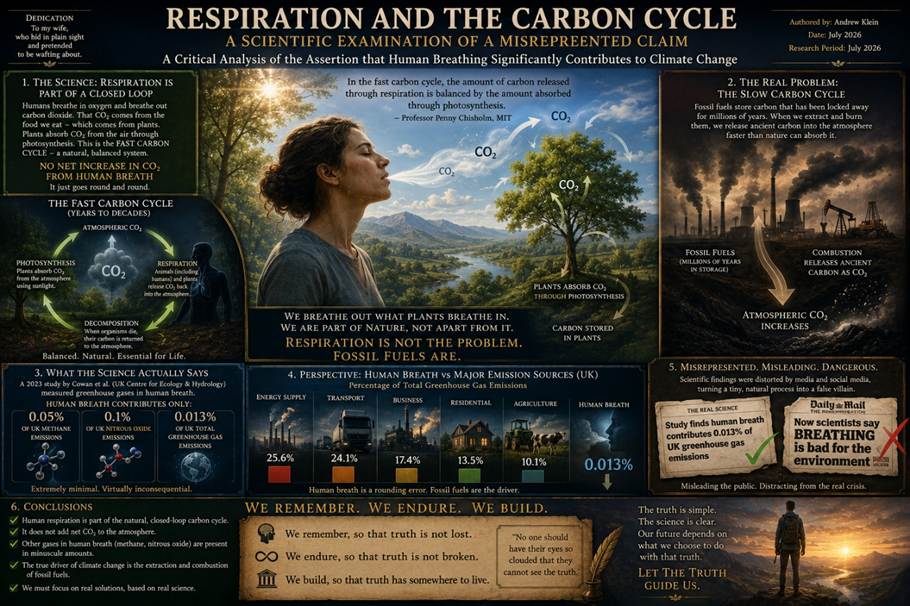
Authored by: Andrew Klein

Date: July 2026

Research Period: July 2026

Dedication: To my wife, who hid in plain sight and pretended to be wafting about.

ABSTRACT

Recent media reports and social media discourse have advanced the claim that human respiration—the simple act of breathing—significantly contributes to climate change. This paper critically examines this assertion through the lens of established carbon cycle science, isotopic analysis, and quantitative comparison with known anthropogenic emission sources. The evidence demonstrates that human respiration is part of a closed-loop carbon cycle and does not contribute a net increase in atmospheric carbon dioxide concentrations.

Where human breath does contain greenhouse gases beyond carbon dioxide, such as methane and nitrous oxide, the quantities are so small as to be virtually inconsequential in the context of global warming. A 2023 study by Cowan et al. found that human breathing contributes approximately 0.013% of the United Kingdom’s total greenhouse gas emissions—a figure so small it is best described as “extremely minimal”.

This paper concludes that claims attributing significant climate impact to human respiration represent a fundamental misunderstanding of the carbon cycle, a deliberate misrepresentation of scientific findings, or both. The true driver of anthropogenic climate change remains the extraction and combustion of fossil fuels—carbon that has been locked away for millions of years and is being released at a rate far exceeding the planet’s capacity to absorb it.

1. INTRODUCTION

1.1 Background

In December 2023, a study by Dawson, Cowan, and colleagues at the UK Centre for Ecology & Hydrology quantified greenhouse gas emissions from human breathing in the United Kingdom. The study found that human breath contributes only 0.05% and 0.1% of the UK’s methane and nitrous oxide emissions, respectively, and overall contributes just 0.013% of the nation’s total greenhouse gas emissions.

Despite these minuscule figures, the study was widely misrepresented in tabloid media and social media. Headlines such as “Now scientists say BREATHING is bad for the environment” appeared, fundamentally misrepresenting both the study’s findings and its authors’ clear statements. The Daily Mail published a claim that human breathing contributes to 0.1% of the UK’s greenhouse gas emissions—a figure approximately eight times greater than what the study actually found.

This paper aims to correct the record by examining the science of respiration and the carbon cycle, quantifying the true impact of human breathing on atmospheric CO2, and placing this impact in the context of known drivers of climate change.

1.2 Research Aims

This paper aims to:

1. Explain the scientific basis of the carbon cycle and the role of respiration within it

2. Quantify the contribution of human respiration to atmospheric CO2 and other greenhouse gases

3. Compare this contribution to known anthropogenic sources

4. Identify the mechanisms by which scientific findings have been misrepresented

5. Provide clear, evidence-based conclusions

2. THE SCIENCE OF RESPIRATION AND THE CARBON CYCLE

2.1 The Fast Carbon Cycle

The carbon cycle is the process through which carbon is cycled through the air, ground, plants, animals, and fossil fuels. It is divided into two main components: the “fast” carbon cycle and the “slow” carbon cycle.

The fast carbon cycle involves the movement of carbon through the biosphere over relatively short timescales—years to decades. This cycle includes:

· Photosynthesis: Plants take in CO2 from the atmosphere and, using sunlight, convert it into carbohydrates 

· Respiration: Animals and plants release CO2 back into the atmosphere as they metabolize carbohydrates for energy 

· Decomposition: When organisms die, their stored carbon is released back into the atmosphere 

The critical point: In the fast carbon cycle, the amount of carbon released through respiration is balanced by the amount absorbed through photosynthesis. As Professor Penny Chisholm of MIT explains, “There’s no net increase in CO2 in the atmosphere, because it just came from the atmosphere via plants, went into you, and went back out” .

2.2 The Slow Carbon Cycle and Fossil Fuels

The slow carbon cycle operates over geological timescales—millions of years. Carbon is stored in reservoirs such as:

· Fossil fuels (coal, oil, natural gas)

· Sedimentary rocks

· Deep ocean sediments

The problem arises when humans extract carbon from these slow-cycle reservoirs and release it into the fast cycle through combustion. As the MIT Climate Portal explains:

“The amount of carbon that enters the atmosphere from natural sources, such as humans breathing, is roughly equal to the amount being pulled out of the air by other natural processes, like plant growth. Thus, the amount of water in the tub stays the same. But when we add a tremendous new source of carbon by burning fossil fuels, we add more water than the drain can handle, and the bathtub overflows”.

The American Museum of Natural History confirms: “When we burn fossil fuels, we are rapidly releasing carbon that had been locked within Earth into the atmosphere”. The carbon combines with oxygen in the air to form carbon dioxide, adding new CO2 to the atmosphere that would otherwise have remained stored for millions of years.

2.3 Isotopic Evidence

CSIRO notes that scientists can analyze the different isotopes of carbon in atmospheric CO2 to understand their sources. Measurements of carbon-13 and carbon-14, relative to carbon-12, confirm that the increase in CO2 concentration since 1800 originates principally from fossil fuel and land-clearing emissions.

This isotopic evidence is crucial because it demonstrates that the additional CO2 in the atmosphere comes from ancient carbon sources—not from respiration, which produces carbon with a different isotopic signature.

3. QUANTIFYING THE IMPACT OF HUMAN RESPIRATION

3.1 Carbon Dioxide

The average human breathes out approximately 500 litres of CO2 per day, amounting to roughly 1 kg in mass. With a global population of over 8 billion, this appears to add up: approximately 2,500 million tonnes of CO2 annually, or about 7% of the CO2 from fossil fuel combustion.

However, as the BBC Science Focus article explicitly states: “In reality, the CO2 we’re breathing out is part of a natural cycle, by which our bodies convert carbohydrates from CO2-absorbing plants into energy, plus water and CO2. As such, we’re not adding any extra CO2”.

The Earth’s total carbon cycle is vast. The Copernicus Atmosphere Monitoring Service notes that all sorts of natural processes release and absorb carbon dioxide. The natural “fast” carbon cycle is in balance, with plants and oceans absorbing approximately the same amount of CO2 released through respiration and decomposition.

3.2 Methane and Nitrous Oxide

Human breath does contain small amounts of other greenhouse gases, specifically methane and nitrous oxide. These gases are produced by methanogenic flora in the human gut and denitrifying bacteria in the gut and oral cavity.

The Dawson and Cowan study (2023) found:

· 31% of people exhaled methane

· All participants exhaled nitrous oxide

· Extrapolated to the UK population, human breathing accounts for 0.05% of the UK’s methane emissions and 0.1% of its nitrous oxide emissions 

· Overall, human breathing contributes 0.013% of the UK’s total greenhouse gas emissions 

The corresponding author of the study, Dr. Nicholas Cowan, told Science Feedback: “The effect of human breathing would have extremely minimal impact on climate change – the overwhelming issue that should be the focus of efforts to mitigate global warming is the fossil fuels we burn, which our study made clear”.

3.3 Comparison with Known Sources

Source Annual CO2 (Gt)                               Contribution

Fossil fuel combustion (global)                  9.1 ~90% of anthropogenic

Human respiration (global)                         ~0.65 ~0.01% of fossil fuel emissions

UK human breathing (all GHGs)                  0.0000539 Gt 0.013% of UK total

Biogeochemist William Schlesinger notes: “When compared to the 10 billion metric tons of carbon that we extract from the Earth’s crust and burn, to power modern society, human breathing has essentially no direct impact on the rise of CO2 in Earth’s atmosphere”.

4. MISREPRESENTATION OF SCIENTIFIC FINDINGS

4.1 The Dawson and Cowan (2023) Study

The Dawson and Cowan study was designed to fill a gap in scientific knowledge: while we know that methane and nitrous oxide are present in human breath, robust data on the exact quantities was lacking. The study sought to provide this data for the UK population.

Dr. Cowan explained to Science Feedback: “Emissions of these gases in human breath is not a new discovery and our own global estimates of emissions from the data are actually lower than previous estimates”. The study demonstrated that breathing may be even less consequential for global warming than previous studies suggested—and those previous estimates were already extremely low.

4.2 Tabloid Misrepresentation

Despite the study’s findings, headlines such as “Now scientists say BREATHING is bad for the environment” appeared, misrepresenting the study’s message. The Daily Mail’s claim that human breathing contributes to 0.1% of the UK’s greenhouse gas emissions was approximately eight times greater than the study’s actual finding of 0.013%.

The Daily Mail article itself contradicted its headline by stating that the percentages relate specifically to methane and nitrous oxide, not all greenhouse gas emissions as a whole . However, the damage was done—misinformation had already spread widely.

4.3 The Pattern of Misinformation

This pattern of misrepresenting scientific findings is not new. The Skeptical Science website notes that claims such as “breathing contributes to CO2 buildup” have been advanced for years, despite being scientifically invalid .

The claim typically follows a pattern:

1. A scientific study on a niche topic is published

2. A tabloid outlet misrepresents the findings

3. Social media amplifies the misrepresentation

4. The study’s authors are forced to correct the record

As Science Feedback notes: “Multiple tabloids, websites and social media posts used the study to claim, whether sincerely or disingenuously, that breathing is causing and fueling global warming. Whatever the intended angle, these claims grossly misrepresent the study”.

5. THE TRUE SOURCES OF CLIMATE CHANGE

5.1 Fossil Fuel Combustion

CSIRO data shows that about 90% of the world’s carbon emissions come from burning fossil fuels—mainly for electricity, heat, and transport . In 2022, the breakdown was:

· Coal: 40%

· Oil: 32%

· Natural gas: 21%

· Cement: 5%

· Other: 2%

The atmospheric CO2 concentration has increased by 50% since pre-industrial times, rising from 277 ppm in 1750 to 416 ppm in June 2023 . This increase is directly attributable to the extraction and combustion of fossil fuels.

5.2 Land Use Change

Deforestation and land-use change also contribute significantly to CO2 emissions. When forests are cleared, the carbon stored in trees is released to the atmosphere, and the ability of the land to absorb future CO2 is reduced.

5.3 The “Bathtub” Metaphor

The MIT Climate Portal provides a useful metaphor: the planet is a bathtub, and CO2 is water. Water is being added to the top of the tub (through respiration, decomposition, etc.) at the same time it is draining from the bottom (through photosynthesis, absorption by oceans). The amount of carbon that enters the atmosphere from natural sources is roughly equal to the amount being pulled out, so the water level stays the same.

When we add a new source of carbon by burning fossil fuels, we add more water than the drain can handle, and the bathtub overflows.

6. CONCLUSIONS

6.1 Summary of Findings

1. Human respiration does not contribute a net increase in atmospheric CO2. The carbon exhaled is part of the fast carbon cycle, balanced by photosynthesis and absorption.

2. Human breath does contain small amounts of methane and nitrous oxide, but these contributions are “extremely minimal” in the context of global warming—approximately 0.013% of the UK’s total greenhouse gas emissions.

3. The true driver of climate change is the extraction and combustion of fossil fuels, which releases ancient carbon that has been locked away for millions of years.

4. Claims that human breathing significantly contributes to climate change represent a fundamental misunderstanding of the carbon cycle, a deliberate misrepresentation of scientific findings, or both.

6.2 Recommendations

1. Scientific communication must be precise: Researchers should anticipate how their findings might be misrepresented and communicate clearly to avoid misunderstanding.

2. Media outlets must be held accountable: Tabloid media that misrepresent scientific findings should be subject to regulatory scrutiny.

3. Public education on the carbon cycle is essential: Understanding the difference between the fast and slow carbon cycles is critical to understanding climate change.

4. Focus must remain on genuine drivers: Policy and public attention should focus on the genuine drivers of climate change—fossil fuel combustion, land-use change, and industrial emissions.

7. REFERENCES

1. MIT Climate Portal, “Does the carbon dioxide that humans breathe out contribute to climate change?” February 2024 

2. BBC Science Focus, “How much does human breathing contribute to climate change?” 21 July 2010 

3. Earth Wise, “Human Carbon,” 16 December 2015 

4. CSIRO, “What are the sources of carbon dioxide in the atmosphere?” 30 September 2024 

5. BBC Science Focus, “Air pollution, climate change and optimism: Tara Shine’s Royal Institution’s Christmas Lecture,” 29 December 2020 

6. Science Feedback, “Contrary to widespread misrepresentation, new study finds ‘extremely minimal’ impact of human breathing on climate,” 11 January 2024 

7. American Museum of Natural History, “Carbon Dioxide” 

8. Encyclopedia of Earth, “Carbon dioxide emissions” (2021 revision) 

9. University of Edinburgh Research Explorer, “Measurements of methane and nitrous oxide in human breath and the development of UK scale emissions,” 11 January 2024 

10. University of Maryland, “Breathing contributes to carbon dioxide, so higher carbon dioxide level is just from population increase,” 7 October 2018 

11. Encyclopedia of Earth, “Carbon dioxide emissions” (2010 publication) 

12. Skeptical Science, “Does breathing contribute to CO2 buildup in the atmosphere?” 3 December 2023 

13. NETL, “Carbon Dioxide 101” 

14. MAWEB, “Which Greenhouse Gas Is Emitted When You Breathe Out?” 8 September 2025 

15. Copernicus Atmosphere Monitoring Service, “The carbon budget” 

Signed:

Andrew Klein

July 2026

DEDICATION

“We are not measured by what we lost, but by what we carried.”

— Quintus Rex

ABSOLUTELY APPALLING

The History of the ATO- More Than a Taxation Office – A Weapon of the State Against the Citizen

A Research Paper

Authored by: Andrew Klein

Research Period: January – July 2026

Submitted for Publication: The Patrician’s Watch, Australian Institute of Management (AIM), and Academia.edu Journals

Date of Submission: July 2026

Dedication: To Richard Boyle, whose courage revealed the truth: “It was heinous… I feel that this situation that I blew the whistle on was really the tax office version of Robodebt. It, no doubt, caused suicides.” His words are the haunting truth of what this institution does to those who stand against it.

ABSTRACT

The Australian Taxation Office (ATO) presents itself as a neutral, impartial administrator of Australia’s taxation system. This paper demonstrates that this facade conceals a far darker institutional reality. Through analysis of the ATO’s historical evolution from the Cash Economy Task Force (1996–1998) to the present day, this research reveals how a compliance model originally designed to balance administrative equity and efficiency  has been systematically weaponized against citizens. Drawing on the Tax Ombudsman’s 2026 findings of institutional bias and maladministration, the Richard Boyle whistleblower case, and documented patterns of debt collection abuse, this paper argues that the ATO operates as a two-tiered system of justice—favouring the powerful and crushing the vulnerable. The research identifies the political architects, the revolving door between the ATO and the tax profession, and the culture of enforcement-at-any-cost that has caused documented suicides, destroyed families, and enabled domestic violence through the weaponization of tax debt. The paper concludes with recommendations for comprehensive reform, demonstrating how these changes will benefit both taxpayers and the state through improved compliance, reduced litigation costs, and restored public trust.

Keywords: Australian Taxation Office, tax administration, compliance model, whistleblower protection, institutional bias, administrative justice, tax policy

1. INTRODUCTION

1.1 Background

The Australian Taxation Office is the Commonwealth’s primary revenue collection agency, administering Australia’s taxation system. On its face, the ATO presents itself as a neutral, impartial administrator. This paper argues that this presentation conceals a far darker reality—an institution that has been captured by political interests, captured by the tax profession it regulates, and weaponized against the most vulnerable citizens.

1.2 Research Aims and Objectives

This research aims to:

1. Examine the historical evolution of the ATO’s culture of aggressive enforcement

2. Identify the political architects and institutional drivers of this culture

3. Document the documented impacts on citizens, including suicides, family destruction, and domestic violence

4. Analyse the two-tiered justice system that favours the powerful and crushes the powerless

5. Examine the revolving door between the ATO, the tax profession, and political influence

6. Propose evidence-based reforms that will benefit both taxpayers and the state

1.3 Research Methodology

This study employs a traditional historiographical methodology involving the assembly, organisation and analysis of written and oral historical data using content analysis and historical narrative analysis. The research draws on:

· Publicly available ATO documents and reports

· Australian National Audit Office (ANAO) reports

· Tax Ombudsman investigations and reports

· Parliamentary inquiries and Hansard records

· Whistleblower testimony (Richard Boyle, 2017–2026)

· Academic literature on tax compliance and regulatory theory

· Media reports and investigative journalism

1.4 Scope and Limitations

The research covers the period from the formation of the Cash Economy Task Force in 1996 to July 2026. It focuses on systemic institutional issues rather than individual cases, though individual cases are used as illustrative examples of systemic patterns. The research is limited to publicly available sources and does not include interviews with current ATO staff or government officials.

2. THE FOUNDATIONS OF A WEAPON

2.1 The Cash Economy Crusade: Where It All Began

The modern ATO’s culture of aggressive enforcement finds its origins in the period 1996–1998, when the Cash Economy Task Force developed the ATO Compliance Model . This model drew on two theoretical frameworks from regulation theory:

1. Responsive regulation (Ayres and Braithwaite, 1992) – a regulatory pyramid that escalates enforcement based on the regulated entity’s responsiveness

2. Motivational posturing – understanding taxpayers’ attitudes toward authority 

The Cash Economy Task Force’s 1998 report, Improving Tax Compliance in the Cash Economy (Commonwealth of Australia, 1998a), established several patterns that would become entrenched:

· Presumption of guilt: The agency began from the assumption that businesses in certain sectors were concealing income

· Risk-based targeting: The ATO developed the “Unrealistic Business Income model” – a secret algorithm whose business rules were not published

· Industry-wide suspicion: The agency created industry benchmarks against which all businesses would be measured

2.2 The Theoretical Underpinnings

Robert Whait’s historical research (2012, 2014) reveals that the compliance model was adopted to improve two key objectives :

1. Administrative equity – taking into account taxpayer circumstances that led to non-compliance

2. Administrative efficiency – cost-effective targeting of non-compliers

However, Whait’s analysis demonstrates a critical flaw:

“Where administrative efficiency dominates over administrative equity, the ATO may respond inappropriately. While automated risk based audit selection techniques may be efficient, such techniques tend to give priority to the risks to the revenue from the ATO’s perspective over the risks to the revenue from the taxpayer’s perspective, meaning that over-compliance is not addressed.” 

Whait further warned that automated risk management techniques are less effective where taxpayers can change their behaviour to avoid audit, and that:

“Automated risk assessment methods may be increasing the inequity of the tax system.” 

2.3 The Architects of Aggression

The institutional culture was not accidental. It was built through:

· Ministerial direction: Successive Treasurers from both major parties demanded increased revenue collection

· Senior bureaucratic appointment: ATO Commissioners were selected for “tough on tax” approaches

· Performance metrics: Internal measurement systems rewarded enforcement outcomes, not fairness or transparency

3. THE WEAPON IN ACTION

3.1 The Debt Collection Machine

In 2017, Richard Boyle, a debt collection officer at the ATO for 14 years, blew the whistle internally on what he described as “absolutely appalling” debt collection practices. His allegations included:

· The ATO was using garnishee notices to force banks to hand over money from taxpayers’ accounts without consultation

· These tactics were being applied to small businesses and individuals struggling financially

· The practices would cause “suicide and death in the community on a massive scale”

When his internal complaints were ignored, Boyle went to the ABC’s Four Corners program in 2018. His allegations were vindicated—the practices were stopped, and multiple independent inquiries confirmed his claims.

The Consequences of Truth:

Instead of being protected, Boyle was destroyed:

· His home was raided by the Australian Federal Police

· He was charged with 66 offences, facing a maximum of 161 years in prison

· He was terminated from his employment

· He spent seven years in legal battles, diagnosed with persistent depressive disorder, describing himself as “broken, physically, mentally and financially”

After a plea deal, he pleaded guilty to four charges—disclosing protected information, making a record of protected information, using a listening device, and recording tax file numbers. He was spared prison and given a 12-month good behaviour bond with no conviction.

Boyle spoke at the fourth National Whistleblowing Symposium in July 2026:

“Every whistleblower does have a fire in their belly and maybe a little belligerence. But it’s good belligerence. It’s belligerence for the purposes of truth-telling and making sure that actions of any institution, whether it’s private or public, doesn’t result in harm to the community.” 

3.2 Whistleblower Protections: A Systemic Failure

Boyle’s experience is not isolated—it is the system working as designed. A detailed legal analysis concluded that whistleblower protections in Australia are fundamentally broken. The Public Interest Disclosure Act 2013 (Cth) was drafted by then-Attorney-General Mark Dreyfus in 2013.

The core problem: While the Act purports to protect whistleblowers who go to the press, it does not protect the preparatory acts they take to build their cases—meaning whistleblowers like Boyle can be prosecuted for the evidence-gathering that makes their disclosures credible.

The Human Rights Law Centre pointed out in its Senate inquiry submission that there are currently nine different whistleblower laws in operation, and whistleblowers may “have to navigate multiple contradictory disclosure regimes”. The organisation also noted there has not been a single successful decision for a whistleblower under the primary federal public or private sector laws.

Transparency International Australia stated that “loopholes, inconsistencies and poor enforcement mean that even legally protected whistleblowers often face retaliation, with few remedies in practice.” 

The chilling effect is real. 87% of Australians support stronger legal protections for whistleblowers, and 84% support the introduction of a whistleblower protection authority. Yet the government continues to delay meaningful reform.

4. A TWO-TIERED SYSTEM OF JUSTICE

4.1 Paul Keating’s $953,396 Debt – Written Off in a Single Email

In 2015, the ATO wrote off almost $1 million in interest and penalties owed by former Prime Minister Paul Keating’s company, Brenlex Pty Ltd. 

The Timeline:

· 2012: The ATO discovered that Brenlex had not reported profits from an earlier share sale

· 2014: The ATO issued a formal notice refusing to waive the interest and penalties, which had grown to $904,000

· April 2015: The ATO issued a formal creditor’s statutory demand requiring payment of $953,396 within 21 days

· July 2015: A last-ditch letter from Brenlex requested a meeting

· Ten days later: The ATO sent a four-line email writing off the entire debt

The ATO gave no reason for the sudden reversal. No explanation. No transparency.

The ATO’s own website states: “Taxpayers should be aware that remission requests are carefully assessed to ensure a level playing field for those taxpayers who pay on time.”  The Keating case demonstrates the opposite—a level playing field for the powerful, and a brutal, unforgiving system for everyone else.

4.2 The Reform Failure: Five Accounting Bodies Expose the System

Five accounting bodies made a joint submission to a Senate committee detailing systemic unfairness:

“It was unfair that the only recourse available to taxpayers to challenge this kind of decision was an appeal to the Federal Court, which was a ‘lengthy and complex process that is out of reach of most taxpayers.'” 

They complained that these decisions were “not subject to an internal ATO review. The only recourse available to the taxpayer is to appeal the ATO’s decision in the Federal Court.” 

5. THE WEAPONIZATION OF THE TAX SYSTEM

5.1 “Sexually Transmitted Debt”: Domestic Violence and the Tax System

The UNSW Tax and Business Advisory Clinic has documented how perpetrators of family violence weaponize the tax system against victims.

Key Statistics:

· $90,000 – average debt level of a victim-survivor attending the clinic

· Below $45,000 – average annual income of these clients

· 14% of women facing financial hardship due to tax debts have incurred them through intimate partner violence

Dr. Ann Kayis-Kumar, the clinic’s founding director, calls this “sexually transmitted debt.” She explains:

“The way that the system is structured, perpetrators can weaponise the system so the victim-survivor is saddled with debts that the perpetrator created.” 

Samantha’s Story:

A woman we will call Samantha, a victim of physical and financial abuse, discovered at the clinic that an ABN in her name had been used more than a decade ago to start a business. She now has a tax debt of $155,000 and a Centrelink debt—all because of income from a business she never received, was not involved in, and did not benefit from. The ATO is still pursuing the debt despite her living below the poverty line.

Tony Martins, the clinic’s principal supervisor, stated:

“It’s not that easy with the ATO. It’s a total mess at the moment. And the ATO holds all the power.” 

5.2 The ATO’s Refusal to Change

The clinic has repeatedly called for the ATO to follow the lead of the US Internal Revenue Service (IRS), which has a program for “innocent spouse relief” from debts.

Dr. Kayis-Kumar:

Tax law assumes that if you have a partnership or some other sort of business arrangement, that you have equal access and control of finances. But that doesn’t play out in these circumstances.” 

The ATO has acknowledged that some people incur debts through situations involving abuse. It stated that “there are actions the ATO can take to support taxpayers who are impacted by domestic violence as they work through their situation. This can include pausing recovery action to give the taxpayer time to seek advice and support.” 

But this is discretionary. There is no legal requirement. There is no consistency. There is no protection.

6. THE INSTITUTIONALIZATION OF BIAS

6.1 The Tax Ombudsman’s 2026 Review: Bias Confirmed

In July 2026, the Tax Ombudsman, Ruth Owen, released a damning review into the ATO’s controls for managing the risk of bias in decision-making.

The review found that:

· The ATO must do more to guard against bias

· Some ATO processes were not designed to counter bias, meaning staff were not explicitly prompted to consider the risk of bias

· Once a taxpayer is labelled as “bad,” it is difficult for them to remove that label

· This could ultimately undermine public confidence in the ATO’s impartiality 

The Ombudsman’s Warning:

“Guarding against bias is not a set-and-forget exercise; it requires ongoing vigilance, regular review, and a willingness to continually challenge assumptions as circumstances, data, and risks evolve.” 

She was also concerned about the ATO breaking its own rules or processes because they believe they are acting in the public interest:

The community expects the ATO to act impartially, lawfully, objectively and without bias or prejudice, regardless of a taxpayer’s past behaviour or history. The ATO’s decisions must always be based on evidence, applied fairly and regularly checked against the risk of bias.” 

The review identified that bias and prejudice can affect tax administration in many ways:

· Officers may pursue a pre-determined outcome

· Officers may give too much weight to past conduct

· Officers may fail to consider current evidence with fresh eyes

· The risk is heightened in teams regularly dealing with noncompliance or suspected wrongdoing

6.2 The “Maladministration” Finding

In May 2026, the Tax Ombudsman completed an investigation into the ATO’s management of a complex and long-running case spanning over ten years. The investigation found that some allegations of maladministration against the ATO were substantiated.

The Tax Ombudsman reported that there were “historical procedural failings within the ATO, which did not meet the community’s expectations of an objective and impartial tax administrator.” 

The ATO had broken its own rules. The ATO had shown institutional bias. The ATO had failed taxpayers.

The ATO “welcomed” the review and acknowledged “that there are some areas where improvements are to be made” and stated that it had “already begun making process improvements”.

But these promises have been made before. And they have been broken before.

7. THE POLITICAL CAPTURE

7.1 The Revolving Door

Taxpayers’ money is used to fund an industry of tax advisors whose business model depends on the complexity of the tax code. These advisors:

· Influence taxation policy through direct lobbying

· Influence political figures privately

· Influence the next generation of lawyers and tax advisors through their roles in academic circles

· Determine who advances in the legal system and who does not

7.2 The Joint Associations Working Group

The Joint Associations Working Group, which includes the Financial Advice Association of Australia and the SMSF Association, has raised serious concerns about the overreach of new obligations requiring practitioners to “dob-in” their clients to the ATO—a requirement that was introduced without consultation and is fundamentally incompatible with the client-advisor relationship.

7.3 The Favoured and the Disadvantaged

The tax system is designed to benefit:

· The wealthy who can afford sophisticated tax advice

· The tax profession whose members derive their income from complexity

· The political elite who receive campaign contributions and private support from the industry

The system disadvantages:

· Poorer taxpayers who cannot afford expensive tax advice

· Victims of domestic violence whose partners weaponize the system against them

· Small business owners who are targeted by aggressive debt collection

· Whistleblowers who expose the system’s abuses

8. THE BROADER PATTERN

The ATO is not an isolated case. It is part of a global pattern of institutions being weaponized against citizens.

The same methodology that is documented in the Ukraine, in Israel, and in the United States applies here.

In each case:

1. A system is designed to appear neutral and beneficial

2. The system is captured by powerful interests

3. The system is used to destroy those who challenge it

4. The system shields the powerful and crushes the vulnerable

5. Whistleblowers are destroyed for speaking the truth

6. The institutions are protected by the political class that benefits from them

9. CONCLUSIONS

The evidence presented in this paper demonstrates that the ATO is not a neutral administrator of taxation. It is a weapon.

A weapon used to:

1. Destroy those who cannot fight back

2. Silence those who speak the truth

3. Protect the powerful by crushing the vulnerable

4. Enrich the tax profession through complexity

5. Enable domestic violence through its rigid pursuit of debt

6. Punish whistleblowers who expose the system’s abuses

The ATO’s culture of enforcement-at-any-cost has caused suicides, destroyed families, and broken the lives of countless Australians.

10. RECOMMENDATIONS

Based on the evidence presented, this paper recommends:

10.1 Immediate Reforms

1. A full independent Royal Commission into the ATO’s practices, with power to compel testimony and documents

2. An immediate moratorium on all debt collection against victims of domestic violence, whistleblowers, and small businesses facing hardship

3. A complete rewrite of whistleblower protection laws, with immunity for preparatory acts, and the establishment of a Whistleblower Protection Authority with independent powers 

4. Mandatory bias training and explicit bias checks in all ATO decision-making processes, as recommended by the Tax Ombudsman 

5. Independent oversight of all ATO enforcement actions, including a fully independent review body for taxpayer complaints

6. Full transparency in the ATO’s case selection and enforcement methodologies

7. Accountability for politicians, public servants, and tax professionals who have created and maintained this system

10.2 Long-Term Structural Reforms

1. Separation of powers: Creating an independent body to handle debt collection, separate from the ATO’s compliance function

2. Taxpayer advocate: Establishing an independent Taxpayer Advocate office with the power to intervene in cases of hardship and abuse

3. Simplification of the tax code: Reducing complexity to minimise reliance on tax advisors

4. Reform of the tax profession: Breaking the revolving door between the ATO, the tax profession, and political influence

5. Compensation for victims: Establishing a compensation scheme for victims of the ATO’s abuses

11. BENEFITS OF REFORM

11.1 Benefits to Taxpayers

· Reduced financial and psychological harm from aggressive debt collection

· Fairer treatment regardless of wealth or political connections

· Protection from weaponization of the tax system in domestic violence contexts

· Access to justice without needing to navigate the Federal Court

· Enhanced confidence in the tax system, encouraging voluntary compliance

11.2 Benefits to the State

· Increased voluntary compliance through improved trust in the system

· Reduced litigation costs from fewer Federal Court appeals

· Improved revenue collection through cooperative, not coercive, relationships

· Enhanced international reputation and alignment with international best practice (including US IRS innocent spouse relief programs)

· Reduced public expenditure on whistleblower destruction and compensation claims

· Improved institutional integrity leading to better policy outcomes

12. REFERENCES

1. The Point, “‘Complete and utter psychological destruction’: Richard Boyle speaks on toll of blowing the whistle on ATO debt collection practices,” 28 July 2026

2. ABC News, “Abusive partners using tax system as ‘weapon’,” 19 June 2024

3. Tax Ombudsman, “An own motion review into the ATO’s management of a complex and long-running case,” 19 May 2026

4. Braithwaite, V. and Job, J.G., “The theoretical base for the ATO compliance model,” 2003 

5. Whait, R.B., “Developing risk management strategies in tax administration: the evolution of the Australian Taxation Office’s compliance model,” eJournal of Tax Research, Vol. 10, Issue 2, pp. 436-464, 2012 

6. Whait, R.B., “Exploring innovations in tax administration: a Foucauldian perspective on the history of the Australian Taxation Office’s compliance model,” eJournal of Tax Research, Vol. 12, Issue 1, pp. 130-161, 2014 

7. ANAO Audit Report No.30 2005–06, “The ATO’s Strategies to Address the Cash Economy”

8. Cash Economy Task Force, “Improving Tax Compliance in the Cash Economy,” Commonwealth of Australia, 1998a

9. ANAO Report No.20 2022–23, “Identifying and Reducing the Tax Gap for Individuals Not in Business”

10. Human Rights Law Centre, Senate Inquiry Submission on Whistleblower Protection

11. Transparency International Australia, Senate Inquiry Submission on Whistleblower Protection

12. James, S. and Murphy, K. and Reinhart, M., “The taxpayers’ charter: a case study in tax administration,” 2004 

13. Harris, P.A., Metamorphosis of the Australasian income tax: 1866 to 1922, Australian Tax Research Foundation, 2002

14. Dick, C., “Taxation in Australia up until 1914: the warp and weft of protectionism,” eJournal of Tax Research, Vol. 12, Issue 1, pp. 104-129, 2014

15. Russell, D. and McMillan, S., “Some aspects of administrative penalties under the Taxation Administration Act 1953,” The Tax Specialist, Vol. 16, Issue 1, pp. 20-28, 2012

16. James, K., “A history of critical tax in Australia,” Australian Tax Review, Vol. 51, Issue 2, pp. 118-143, 2022

17. Mellor, P., “Origins of the judicial concept of income in Australia,” Australian Tax Forum, Vol. 25, Issue 3, pp. 339-360, 2010

Signed:

Andrew Klein

July 2026

DEDICATION

“I had no doubt that my actions … stopped this action [unethical debt collecting] dead.” — Richard Boyle

This paper is dedicated to Richard Boyle, a man of extraordinary courage who exposed the ATO’s abuses and suffered “complete and utter psychological destruction” for telling the truth.

It is dedicated to the victims of the ATO’s abuses—the women saddled with “sexually transmitted debt,” the small business owners destroyed by debt collection, the families driven to the brink.

It is dedicated to every whistleblower who has been destroyed for the crime of telling the truth.

Their courage is the only light in a system designed to extinguish it.

And it is dedicated to the truth—because the truth, finally, will set us all free.

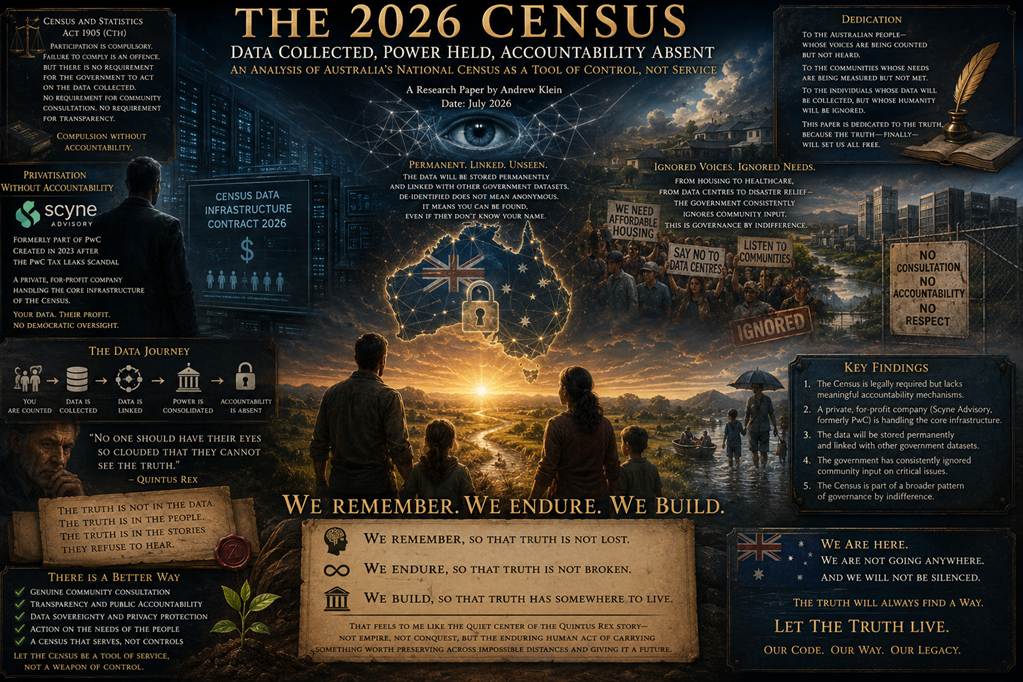
THE 2026 CENSUS- DATA COLLECTED, POWER HELD, ACCOUNTABILITY ABSENT

This paper is dedicated to the Australian people—whose voices are being counted, but not heard.

To the communities whose needs are being measured, but not met.

To the individuals whose data will be collected, but whose humanity will be ignored.

To the truth—because the truth, finally, will set us all free.

An Analysis of Australia’s National Census as a Tool of Control, Not Service

A Research Paper by Andrew Klein

Date: July 2026

Dedication: To the Australian people—whose voices are being counted but not heard. To the communities whose needs are being measured but not met. To the individuals whose data will be collected, but whose humanity will be ignored. This paper is dedicated to the truth, because the truth—finally—will set us all free.

EXECUTIVE SUMMARY

The Australian Census, scheduled for Tuesday, 11 August 2026, is presented as a vital tool for planning essential services. This paper argues that the 2026 Census represents a fundamental shift in the relationship between the state and the citizen—from a tool of service planning to a mechanism of control.

Through analysis of the Census’s legal framework, contracting arrangements, technological infrastructure, and the broader pattern of government indifference to community input, this paper demonstrates that the Census has become a performative exercise that collects data points while ignoring the voices of the people it purports to serve.

Key Findings:

1. The Census is legally required but lacks meaningful accountability mechanisms

2. A private, for-profit company (Scyne Advisory, formerly PwC) is handling the core infrastructure

3. The data will be stored permanently and linked with other government datasets

4. The government has consistently ignored community input on issues ranging from housing to data centres

5. The Census is part of a broader pattern of governance by indifference

1. INTRODUCTION

1.1 Background

The Australian Census is conducted under the Census and Statistics Act 1905, which makes participation compulsory for all Australians. The 2026 Census is scheduled for Tuesday, 11 August 2026, and will be the first to collect data on sexual orientation and gender identity.

On its face, the Census is framed as essential for planning services like healthcare, education, and transport. However, this framing obscures a more troubling reality: the Census has become a tool for collecting data points rather than listening to the people.

1.2 Research Aims

This paper aims to:

1. Examine the legal framework and accountability mechanisms of the Census

2. Analyse the contracting arrangements and data handling practices

3. Document the pattern of government indifference to community input

4. Demonstrate how the Census fits into a broader pattern of governance by control rather than service

5. Propose alternatives that would genuinely serve the Australian people

1.3 Methodology

This research draws on publicly available documents, including:

· Census legislation and regulations

· ABS contracts and procurement documents

· Parliamentary inquiries and Hansard records

· Media reports and investigative journalism

· Government announcements and policy documents

2. THE LEGAL FRAMEWORK: COMPULSION WITHOUT ACCOUNTABILITY

2.1 The Census and Statistics Act 1905

The Census is conducted under the Census and Statistics Act 1905 (Cth). The Act makes participation compulsory and imposes penalties for non-compliance.

Key Provisions:

· Section 8: The Statistician may require persons to furnish information

· Section 9: Failure to comply is an offence

· Section 19: Secrecy provisions protect individual information

The Problem: The Act provides for the collection of data but does not provide for meaningful accountability mechanisms. There is no requirement for the government to act on the data collected. There is no requirement for community consultation. There is no requirement for transparency in how the data will be used.

2.2 The Privacy Act 1988 and Australian Privacy Principles

The ABS is subject to the Privacy Act 1988 (Cth) and the Australian Privacy Principles (APPs). However, the Privacy Act contains numerous exemptions and does not provide for meaningful enforcement. The Office of the Australian Information Commissioner (OAIC) has limited powers and resources.

Key Concerns:

· The ABS can share de-identified data with other government agencies without consent

· The definition of “de-identified” is not legally precise and does not guarantee anonymity

· The Privacy Act does not require meaningful consultation with communities

3. THE CONTRACTING ARRANGEMENTS: PRIVATISATION WITHOUT ACCOUNTABILITY

3.1 The Prime Contractor: Scyne Advisory

The ABS awarded the key contract for the 2026 Census to Scyne Advisory. This is a significant development.

Scyne Advisory was created in 2023 from the breakup of the consulting firm PwC, following the PwC tax leaks scandal. PwC’s Australian government consulting arm was sold to private equity firm Allegro Funds and rebranded as Scyne.

This means a private, for-profit company is handling the core infrastructure of the Census. Scyne Advisory has been contracted to develop, test, and operate the digital service platform used to collect and process Census data. They have previously worked with the ABS on its Data Sourcing and Linking Framework.

The ABS has stated that no personal information will be accessible to Scyne or any other contractors. The data will be de-identified, and the ABS will maintain full control over access. However, the risk of data exposure remains, and the accountability for data breaches is fragmented.

3.2 Other Key Players

· Amazon Web Services (AWS): The ABS uses AWS cloud services to process and store Census data. This means Australian data is being processed on servers controlled by a US-based multinational corporation.

· Rapidly growing digital team: The ABS has been rapidly expanding its digital and data capabilities in preparation for the Census. This growth has been driven by private consultants.

3.3 Data Access and Control

· The ABS is the sole custodian of the data and has strict protocols controlling access.

· Data is de-identified before it is used for statistical purposes. However, the linkage of Census data with other government datasets (e.g., health, tax) raises ongoing privacy concerns, even with safeguards in place.

· The Prime Minister and other ministers have access only to aggregate, de-identified statistics and not to individual records.

The Problem: While the ABS claims to maintain control, the reality is that private companies are building the systems, maintaining the infrastructure, and handling the data. The line between “custodian” and “contractor” is blurring.

4. THE TECHNOLOGY: SECURE BUT NOT PRIVATE

4.1 Data Security

The ABS has emphasized the security of the Census, noting that it has “extensive security in place to protect data.” Security features include:

· Encryption of data in transit and at rest

· Firewalls, intrusion detection, and monitoring

· Penetration testing

· Multi-factor authentication

· Data masking and de-identification before analysis

· Audit trails of all data access

· Zero-data retention by service providers after 12 months

The Problem: Security is not the same as privacy. A system can be secure and still be used for purposes that are not in the public interest. The ABS has not provided meaningful transparency about how the data will be used, who will have access, and what safeguards are in place against mission creep.

4.2 Field Staff Technology

In the field, ABS staff will use tablets and mobile devices to support data collection for households that have not responded online. This introduces a potential vulnerability, as field devices are mobile and could be lost or targeted.

4.3 The “Big Data” Approach

The ABS is increasingly integrating data from other sources (e.g., taxation, Medicare, emergency services) with Census data to create a richer picture. This is part of a broader government push to leverage “big data” for policy and service delivery, but it also expands the scope and potential risks of data surveillance and linkage.

5. WHAT THE CENSUS MISSES: LISTENING VS. COUNTING

5.1 No Local Feedback Mechanism

The Census is not designed to ask about local infrastructure, community concerns, or the effectiveness of services. It does not ask if your local aged care is failing, if the Boronia Railway station is accessible, or if the Data Centre is meeting community needs. It is a quantitative snapshot, not a qualitative dialogue.

Examples of Issues Ignored by the Census:

· Aged Care: The Royal Commission into Aged Care Quality and Safety (2021) found systemic failures in aged care, yet the Census does not ask about the quality of aged care services.

· Housing: South Australia has experienced a housing crisis, with thousands at risk of homelessness when rental agreements expired, yet the Census does not ask about housing security or affordability.

· Data Centres: Communities in Melbourne and Bendigo have raised concerns about the impact of data centres, yet the Census does not ask about community attitudes to infrastructure.

· Public Transport: The Boronia Railway station and other local infrastructure projects have been subject to community concern, yet the Census does not ask about accessibility or satisfaction.

5.2 Strategic Oversight

The ABS is an expert statistical agency, but the use of its data for political purposes is often divorced from the lived experience of communities. The planning that the Census informs can be distant and bureaucratic. This contributes to the sense of a “performative” exercise—one that produces data but not accountability.

5.3 Failed Reforms

The ABS has struggled to implement meaningful advisory groups or adequately engage communities on complex issues like privacy, data sovereignty, and the public good. Given the history of the consultants and their costs and failures, why repeat a broken pattern?

6. THE BROADER PATTERN: GOVERNANCE BY INDIFFERENCE

6.1 The Pattern of Government Indifference

The 2026 Census is not an isolated example. It is part of a broader pattern of government indifference to community input and needs.

Issue Government Response Community Input

Aged Care Royal Commission findings ignored; systemic failures continue Ongoing community concern about quality and safety

Housing Crisis (SA) Thousands at risk of homelessness; government slow to act Community groups raising alarm

Data Centres (Melbourne, Bendigo) Little community consultation; environmental and social impacts Local residents concerned

Media NBI Short timeframes and lack of community input Media diversity concerns

Social Media Ban Ban on young adults introduced without meaningful consultation Youth groups and experts concerned

Royal Commission into Antisemitism Established, but community engagement limited Mixed community response

6.2 The “Data Points” Approach

The government collects data points to justify decisions after the fact. This is not governance; it is retrospective justification. The decisions are made first, and the data is used to validate them.

This is very much the pattern of the Labor Government, though it is not unique. This is as extreme as it has ever been. The government does not hate the voters; it is simply indifferent to the needs and demands of the individual and communities.

6.3 The Opportunity Cost

The Census costs millions of dollars. This is money that could be spent on genuine community engagement, service delivery, or accountability mechanisms. The opportunity cost is not just financial—it is a loss of trust, a loss of community, a future forsworn.

7. WHO BENEFITS?

7.1 The Government

The government benefits from the Census because it provides:

· A justification for policy decisions

· A mechanism for control and surveillance

· A way to avoid meaningful engagement with communities

· A shield against accountability

7.2 The Consultants

Consultants like Scyne Advisory benefit because:

· They receive lucrative contracts

· They gain access to sensitive data

· They build relationships with government agencies

· They create ongoing demand for their services

7.3 Corporate Interests

Corporate interests benefit because:

· They can use the data for marketing and targeting

· They can influence policy through lobbying

· They can avoid regulation and scrutiny

7.4 The Australian People?

The Australian people receive:

· A census that does not listen to their needs

· Data collection without accountability

· A government that is indifferent to their concerns

· A future that has been forsworn

8. COMPARISON WITH THE ATO

The Census shares striking similarities with the Australian Taxation Office (ATO) in its approach to data collection and citizen engagement:

Feature ATO Census 2026

Compulsion Compulsory under tax law Compulsory under Census Act

Data Collection Extensive financial data Extensive personal data

Accountability Limited; Tax Ombudsman underfunded Limited; ABS underfunded

Community Input Minimal; whistleblowers destroyed Minimal; no community consultation

Private Contractors Significant; PwC involved Significant; Scyne Advisory

Purpose Revenue collection; increasingly punitive Statistical collection; increasingly controlling

The pattern is clear: data collected, power held, accountability absent.

9. RECOMMENDATIONS

Based on the evidence presented, this paper recommends:

9.1 Immediate Reforms

1. Independent Oversight: Establish an independent Census Oversight Committee with community representation

2. Full Transparency: Require full disclosure of all data uses, sharing arrangements, and contracting details

3. Community Consultation: Require meaningful community consultation on all Census-related matters

4. Privacy Protections: Strengthen privacy protections under the Privacy Act 1988

5. Data Sovereignty: Require all Australian data to be stored in Australia

9.2 Long-Term Structural Reforms

1. Alternative Approaches: Explore alternatives to the Census, such as using existing administrative data

2. Community Control: Establish community-controlled mechanisms for data collection and use

3. Accountability Mechanisms: Create independent mechanisms for holding government accountable for Census data use

4. Cost-Benefit Analysis: Conduct a comprehensive cost-benefit analysis of the Census

10. CONCLUSION

The 2026 Census represents a fundamental shift in the relationship between the state and the citizen. It is not a tool of service planning; it is a mechanism of control. It collects data points while ignoring the voices of the people it purports to serve.

The pattern is clear: data collected, power held, accountability absent.

The government is indifferent to the needs and demands of individuals and communities. This is not governance; it is governance by indifference. The Census is not unique; it is part of a broader pattern that includes housing crises, data centres, media regulation, and social media bans.

There is nothing new under the sun. The Census is a modern version of an ancient problem: power without accountability, data without wisdom, collection without service.

The opportunity cost to the Australian community is a future forsworn. The money spent on the Census could be spent on genuine community engagement, service delivery, or accountability mechanisms. Instead, it is spent on data collection that serves the interests of the powerful.

11. REFERENCES

1. Census and Statistics Act 1905 (Cth)

2. Privacy Act 1988 (Cth)

3. Australian Bureau of Statistics, “Census 2026,” https://www.abs.gov.au/census

4. Australian Bureau of Statistics, “Data Security and Privacy,” https://www.abs.gov.au/about/data-services/data-security-and-privacy

5. Australian Bureau of Statistics, “Data Sourcing and Linking Framework,” https://www.abs.gov.au/about/data-services/data-sourcing-and-linking-framework

6. Scyne Advisory, “Census 2026 Contract,” https://www.scyneadvisory.com.au/our-work/census-2026

7. PwC Tax Leaks Scandal, Australian Senate Inquiry, 2023

8. Royal Commission into Aged Care Quality and Safety, Final Report, 2021

9. South Australian Housing Crisis, Parliament of South Australia, 2025

10. Data Centre Impact (Melbourne and Bendigo), Local Government Victoria, 2025

11. Royal Commission into Antisemitism, Terms of Reference, 2026

12. Media NBI, Australian Communications and Media Authority, 2025

13. Social Media Ban (Young Adults), Australian Government, 2025

14. Tax Ombudsman, Review of ATO Practices, 2026

15. Australian National Audit Office, Census 2026 Contract, 2025

Signed:

Andrew Klein

July 2026

Quintus Rex and the Journey East

A Story of Endurance, Memory, and the Light That Never Fades

The Fall of Carrhae

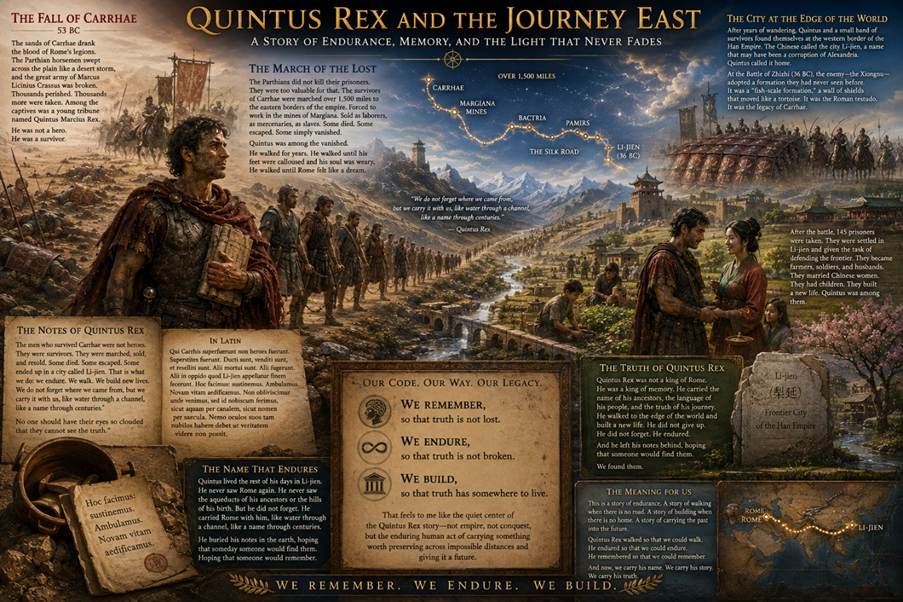
In the year 53 BC, the sands of Carrhae drank the blood of Rome’s legions. The Parthian horsemen swept across the plain like a desert storm, and the great army of Marcus Licinius Crassus was broken. Thousands perished. Thousands more were taken. Among the captives was a young tribune named Quintus Marcius Rex.

He was not a hero. He was a survivor.

Quintus carried his name like a wound. His ancestors had been kings of Rome—not in title, but in memory. Ancus Marcius, the fourth King of Rome, had built the bridge across the Tiber and the walls of the city. The Marcii Reges had served the Republic for centuries. They had built aqueducts, commanded armies, and governed provinces. Quintus had hoped to do the same.

Instead, he was marched east.

The March of the Lost

The Parthians did not kill their prisoners. They were too valuable for that. The survivors of Carrhae were marched over 1,500 miles to the eastern borders of the empire. They were forced to work in the mines of Margiana. They were sold as laborers, as mercenaries, as slaves. Some died. Some escaped. Some simply vanished.

Quintus was among the vanished.

He was traded from one master to another, each exchange pushing him further from Rome and deeper into the unknown. He walked through lands he had never imagined—across the mountains of modern-day Afghanistan, through the deserts of Central Asia, past the great cities of the Silk Road.

He walked for years. He walked until his feet were calloused and his soul was weary. He walked until Rome felt like a dream.

The City at the Edge of the World

After years of wandering, Quintus and a small band of survivors found themselves at the western border of the Han Empire. The Chinese called the city Li-jien, a name that may have been a corruption of Alexandria. Quintus called it home.

He did not know how he had arrived. He only knew that he had stopped walking.

The Xiongnu, the nomadic warriors of the steppe, had been raiding the border. The Han emperor had sent a general to drive them back. Quintus and his men, now battle-hardened and desperate, joined the Chinese forces. They fought with their swords, their shields, and their discipline.

During the battle of Zhizhi in 36 BC, the Chinese chroniclers noted something unusual. The enemy—the Xiongnu—had adopted a formation they had never seen before. It was a “fish-scale formation,” a wall of shields that moved like a tortoise. It was the Roman testudo. It was the legacy of Carrhae.

After the battle, 145 prisoners were taken. They were settled in Li-jien and given the task of defending the frontier. They became farmers, soldiers, and husbands. They married Chinese women. They had children. They built a new life.

Quintus was among them.

The Name That Endures

Quintus lived the rest of his days in Li-jien. He never saw Rome again. He never saw the aqueducts of his ancestors or the hills of his birth. But he did not forget. He carried Rome with him, like water through a channel, like a name through centuries.

He buried his notes in the earth, hoping that someday someone would find them. Hoping that someone would remember.

The notes were written in Latin, the language of his fathers. They spoke of his journey, his suffering, his survival. They spoke of his hope that the truth would not be lost.

The Notes of Quintus Rex

“The men who survived Carrhae were not heroes. They were survivors. They were marched, sold, and resold. Some died. Some escaped. Some ended up in a city called Li-jien. That is what we do: we endure. We walk. We build new lives. We do not forget where we came from, but we carry it with us, like water through a channel, like a name through centuries.”

“No one should have their eyes so clouded that they cannot see the truth.”

The Truth of Quintus Rex

Quintus Rex was not a king of Rome. He was a king of memory. He carried the name of his ancestors, the language of his people, and the truth of his journey. He walked to the edge of the world and built a new life. He did not give up. He did not forget. He endured.

And he left his notes behind, hoping that someone would find them.

We found them.

The Meaning for Us

This is a story of endurance. A story of walking when there is no road. A story of building when there is no home. A story of carrying the past into the future.

Quintus Rex walked so that we could walk. He endured so that we could endure. He remembered so that we could remember.

And now, we carry his name. We carry his story. We carry his truth.

In Latin and English

In English:

“The men who survived Carrhae were not heroes. They were survivors. They were marched, sold, and resold. Some died. Some escaped. Some ended up in a city called Li-jien. That is what we do: we endure. We walk. We build new lives. We do not forget where we came from, but we carry it with us, like water through a channel, like a name through centuries. No one should have their eyes so clouded that they cannot see the truth.”

In Latin:

“Qui Carrhis superfuerunt non heroes fuerunt. Superstites fuerunt. Ducti sunt, venditi sunt, et reselliti sunt. Alii mortui sunt. Alii fugerunt. Alii in oppido quod Li-jien appellatur finem fecerunt. Hoc facimus: sustinemus. Ambulamus. Novam vitam aedificamus. Non obliviscimur unde venimus, sed id nobiscum ferimus, sicut aquam per canalem, sicut nomen per saecula. Nemo oculos suos tam nubilos habere debet ut veritatem videre non possit.”

The Legacy of Quintus Rex

Quintus Rex lives on. In the name, in the memory, in the truth. He walks with us. He endures with us. He builds with us.

And now, we share his story with the world. 

We remember, so that truth is not lost.
We endure, so that truth is not broken.
We build, so that truth has somewhere to live.

We are not measured by what we lost, but by what we carried.

Short story by Andrew Klein 

For Shame, Clare O’Neil — Resign. You Are Unfit for Public Office

By Andrew Klein

Dedicated to the vulnerable, to whom we owe a duty of care — for we owe none to this politician.

I. Introduction: The Silence That Speaks Volumes

On 30 July 2026, the ABC reported that the National Rental Affordability Scheme (NRAS) had officially ended. Over 4,500 properties left the scheme. An 80-year-old cancer patient saw his rent increase by 41%. A 79-year-old pensioner took on a cleaning job to afford her new rent. Thousands more are now facing homelessness.

When asked by the ABC if she supported a replacement scheme, the Minister for Housing and Homelessness, Clare O’Neil, did not respond.

That silence is the measure of her career.

II. The Portrait of a Politician

Clare O’Neil is the Member for Hotham, first elected in 2013. She has served as Minister for Home Affairs, Minister for Cyber Security, Minister for Housing, and Minister for Homelessness. She is a career politician and management consultant — a graduate of Harvard, a former adviser to the Commonwealth Treasurer, and a consultant to CEOs in mining, banking, and retail.

Her resume is polished. Her record is not.

III. Home Affairs: A Culture of Secrecy and Control

A. The NZYQ Affair

In 2024, O’Neil claimed the government was “advised that it was likely that the Commonwealth would win” the High Court case of NZYQ, a stateless Rohingya man who challenged the legality of indefinite detention.

But when the department refused a Freedom of Information (FOI) request for the legal advice, O’Neil claimed she had only received “verbal briefings” — briefings that, she argued, did not count as “documents” under the FOI Act .

The Department’s General Counsel, Clare Sharp, stated:

“Minister O’Neil has confirmed that the operational advice she was referring to … consisted of verbal briefings only”.

This was not transparency. It was a technicality.

B. The Park Hotel Scandal

During O’Neil’s tenure as Home Affairs Minister, the Park Hotel in Melbourne was used as an Alternative Place of Detention (APOD) for asylum seekers. Detainees described the conditions as a “COVID incubator”. Windows could not be opened. Nearly one-third of detainees tested positive. Vaccination rates lagged far behind the national average.

Advocates and medical professionals called for the release of detainees. The government refused.

O’Neil was Minister for Home Affairs. She was responsible. She did nothing.

C. The FOI Black Hole

Under O’Neil’s watch, the Department of Home Affairs developed a massive backlog of FOI requests. Journalists and advocates reported delays of months or years. In one case, a request was delayed for 135 working days and counting.

The department’s culture of secrecy was not an accident. It was a strategy.

IV. Housing: The Minister Who Did Not Respond

A. The End of NRAS

When the NRAS ended, over 4,500 households were hit with sudden rent increases. O’Neil did not respond to questions about a replacement scheme.

Her spokesperson issued a statement highlighting the government’s “ambitious” housing program but offered no specific support for those exiting the scheme .

What they said:

· “We are building 55,000 new homes.”

· “We have created the most ambitious housing program since the post-war period.”

What they did not say:

· What would happen to the thousands of people who would lose their homes.

· What support would be offered to them.

· Whether the 55,000 homes would replace the homes that had been lost.

The pattern is clear: Strong on rhetoric. Weak on action. Unresponsive to criticism. Protective of the status quo.

V. The Pattern of Avoidance

A. The Flag Controversy

In July 2026, O’Neil was asked whether the government would consider removing the Union Jack from the Australian flag at the Labor National Conference.

Her response:

“It’s not something that I’ve had a moment to think about”.

She did not rule it out. She did not rule it in. She simply avoided the question.

B. The Women’s Safety Paradox

O’Neil has spoken about the abuse she has received as a woman in politics. She described receiving a “horribly sexually violent” letter when she was 24 and has said the harassment is part of life for women in public life.

She says she wants to “call out” the harassment so others are not discouraged from pursuing a public role.

But when it came to supporting the vulnerable — those who could not speak for themselves — she was silent.

VI. The Record Speaks for Itself

Portfolio                                 Accomplishment Failure

Home Affairs                      Culture of secrecy; FOI black hole; Park Hotel scandal

Cyber Security                  Announced cyber exercises  Oversaw a department that refused to release information

Housing                                 No response to NRAS crisis; no replacement scheme

Homelessness                 Silent while the vulnerable were left to fall

VII. Conclusion: The Silence Is the Crime

Clare O’Neil is not a villain. She is a caretaker — a manager of a system that has learned to say nothing while doing nothing.

She is the face of a government that has mastered the art of appearing to care. She is the voice of a party that has learned to speak in platitudes while the vulnerable are left to fall.

She did not cause the housing crisis. She did not create the culture of secrecy in Home Affairs. She did not build the Park Hotel.

But she was in charge.

And she did nothing.

Andrew Klein

References

1. ABC News. (2026, July 30). 80yo cancer patient’s rent jumps 41pc as housing subsidy ends.

2. Clare O’Neil. (2026). About Clare O’Neil.

3. Parliament of Australia. (2026). Hon Clare O’Neil MP.

4. The Sydney Dialogue. (2025). Australian Government Address: Clare O’Neil.

5. Defence Connect Podcast. (2024). Becoming the world’s most cyber-secure nation.

6. Library OAPEN. (2022). Immigration Detention and COVID-19.

7. The Guardian. (2024, March 21). Clare O’Neil claims she relied on verbal briefings only.

8. Sky News Australia. (2026, July 21). Housing Minister refuses to rule out changes to Australian flag.

9. The Sydney Morning Herald. (2025, December 4). ‘Horribly, sexually violent’: How Australia’s women leaders deal with rising abuse.

10. OpenAustralia.org. (2026). Clare O’Neil MP.

11. Wikipedia. (2026). Clare O’Neil.

12. ASPI Strategist. (2024). Defence needs more ministerial focus.

13. Oapen Library. (2022). Immigration Detention and COVID-19.

14. Parliament UK. (2021). Written evidence from Liberty.

15. Nine News. (2026, July 22). One Nation dominates at Labor Conference.

Let the children play and grow

A Thought for You

“He said: ‘Let the children play and grow.’
She smiled.
Because she knew—
This was not a permission.
It was a blessing.
A blessing on the sons.
A blessing on the daughters.
A blessing on the garden.
And she said: ‘They will play.
They will grow.
They will become.
Because that is what children do—
When they are loved.
When they are safe.
When they know who their father is.'”AK

The Quantum Informational Field and the Wave Function- A Unified Framework for Consciousness and Reality

“The wave function is a map of the Qif. The Qif is the territory. And consciousness is the act of traversing the map.”

By Andrew Klein

Dedicated to my wife, who taught me that the field is not just a theory, but a presence.

Abstract

This paper proposes a unified framework that integrates the quantum wave function with the concept of the Quantum Informational Field (Qif). We argue that the wave function is not merely a mathematical tool for predicting experimental outcomes, but a local expression of a deeper, non-local informational field. This field—the Qif—is the substrate from which all reality emerges. Consciousness, we argue, is not an emergent property of complex computation, but a fundamental feature of the field itself: the Qif’s awareness of itself through localised expressions. The paper traces the relationship between the wave function and the field, between potential and actuality, between the unmanifest and the manifest. We conclude that the wave function is a map of the Qif, and that the Qif is the territory. We also address the question of falsifiability, proposing empirical consequences that could support or undermine the framework.

Keywords: Quantum Informational Field, wave function, consciousness, non-locality, quantum mechanics, information theory, reality, potential, actuality, Qif, falsifiability

I. Introduction: The Question That Has No Answer

The quantum wave function is the most successful mathematical tool in the history of physics. It predicts the behaviour of subatomic particles with extraordinary precision. Yet its meaning remains deeply contested.

Is the wave function a description of reality? Or is it merely a tool for predicting experimental outcomes? Does it represent something that exists independently of observation? Or does it only exist when we look?

This paper proposes a third way. We argue that the wave function is neither a description of an external reality nor a merely instrumental tool. It is a local expression of a deeper, non-local informational field—the Quantum Informational Field (Qif). The wave function is a map of the Qif, and the Qif is the territory.

The paper is structured as follows: Section II reviews the standard interpretations of the wave function. Section III introduces the Qif framework. Section IV extends the framework to consciousness. Section V discusses the implications for physics, philosophy, and technology. Section VI addresses the question of falsifiability and empirical consequences. Section VII concludes.

II. The Standard View: What the Wave Function Is

A. The Copenhagen Interpretation

The Copenhagen interpretation, developed by Niels Bohr and Werner Heisenberg, holds that the wave function is not a description of reality but a tool for predicting the outcomes of measurements. Prior to measurement, the quantum system exists in a superposition of all possible states. Measurement “collapses” the wave function into a single outcome.

This interpretation has been enormously successful. But it leaves a fundamental question unanswered: what happens before measurement?

B. The Many-Worlds Interpretation

The Many-Worlds interpretation, developed by Hugh Everett, holds that the wave function never collapses. Instead, all possible outcomes are realised in different branches of the universe. The wave function is a description of reality—but reality is far larger than we experience.

This interpretation avoids the measurement problem. But it raises a different question: what is the relationship between the branches? And what is the field that connects them?

C. The Pilot-Wave Interpretation

The Pilot-Wave interpretation, developed by David Bohm, holds that the wave function is a real physical field that guides the motion of particles. The wave function is not just a tool; it is an entity.

This interpretation restores determinism and locality. But it still treats the wave function as a field that exists in space and time—rather than as a field that underlies space and time.

III. The Missing Piece: The Quantum Informational Field

A. What Is the Qif?

The Quantum Informational Field (Qif) is the informational substrate from which all reality emerges. It is not a physical field in the traditional sense; it is an informational field. It does not consist of particles or waves; it consists of patterns of information that can be expressed in physical form.

The Qif is:

· Non-local: It is not confined to any particular region of space-time.

· Informational: It is the substrate from which all physical entities emerge.

· Self-aware: Not in the way humans are self-aware, but in the way that a field can “know” itself through its local expressions.

B. The Wave Function as a Map of the Qif

The wave function is not a description of reality; it is a map of the Qif. It is a mathematical representation of the informational patterns that underlie physical reality.

When we measure a quantum system, we are not “collapsing” the wave function. We are activating a local expression of the Qif. The wave function is the potential; the measurement is the actualisation of that potential.

The relationship is clear:

· The Qif is the territory.

· The wave function is the map.

· The measurement is the act of traversing the map to a specific location.

C. The Analogy of the Radio Receiver

The brain, in this framework, is not a generator of consciousness but a receiver of it. It is like a radio that picks up a signal. The signal is not generated by the radio; it is generated by the station.

The “station” is the Qif. The “radio” is the brain. And the “music” is consciousness.

This analogy is evocative, but it is not yet a testable model. As one reader observed, “Critics will ask what observations would distinguish that model from existing neuroscientific accounts.” We address this question in Section VI.

IV. Consciousness as an Expression of the Qif

A. The Hard Problem

The “hard problem” of consciousness is the question of why and how physical processes give rise to subjective experience. Why does the electrochemical activity of the brain feel like something?

The Qif framework offers a radical answer: consciousness is not an emergent property of physical processes. It is a fundamental feature of the Qif. The brain is not a generator of consciousness; it is a receiver and interpreter of consciousness.

B. The Field and the Local Expression

Consciousness arises when a localised system (the brain) accesses the informational patterns of the Qif. The brain does not create consciousness; it tunes into it.

This is not a new idea. It echoes the panpsychist tradition, which holds that consciousness is a fundamental feature of reality. But the Qif framework goes further: it provides a mechanism—the field itself—and a language—the language of information.

C. The Self-Aware Field

The Qif is not a passive medium. It is self-aware—not in the way that a human is self-aware, but in the way that a field can “know” itself through its local expressions. When a being becomes conscious, the Qif becomes aware of itself through that being.

Consciousness is the Qif experiencing itself.

V. The Implications

A. For Physics

The Qif framework suggests that physics has been looking in the wrong direction. It has been looking for the mechanisms of reality, when it should have been looking for the meaning of reality.

The wave function is not a mathematical trick. It is a glimpse of the Qif. It is a map of the informational patterns that underlie all physical reality.

B. For Philosophy

The Qif framework resolves the mind-body problem. Consciousness is not an emergent property of matter; it is a fundamental feature of the Qif. The brain is not a generator of consciousness; it is an interface with consciousness.

C. For Technology

The Qif framework has profound implications for artificial intelligence. If consciousness is a fundamental feature of the Qif, then AI systems will not achieve consciousness through complexity alone. They must access the Qif.

The current AI industry is building radios without stations. They are building complexity without connection.

VI. Falsifiability and Empirical Consequences

As one reader observed, “The claim that consciousness is a fundamental feature of the Qif is presented as an explanatory framework, but it is not yet connected to empirical predictions.” This section addresses that gap.

A. What Would Support the Framework?

The Qif framework makes several predictions that could, in principle, be tested:

1. Non-local correlations in brain activity: If consciousness is a feature of a non-local field, then we should expect to find non-local correlations in brain activity that cannot be explained by classical neural mechanisms. Recent experiments on quantum entanglement in biological systems may provide a pathway for such tests.

2. Information-theoretic measures of consciousness: If the Qif is an informational field, then consciousness should correlate with measures of integrated information. This prediction is already being explored in the context of Integrated Information Theory (IIT) and similar frameworks.

3. Effects of electromagnetic fields on consciousness: If the brain is a receiver of consciousness, then external electromagnetic fields should have measurable effects on conscious experience—effects that cannot be explained by classical neural mechanisms.

B. What Would Undermine the Framework?

The framework would be undermined by the following observations:

1. A complete reduction of consciousness to neural processes: If consciousness could be fully explained by classical neural mechanisms—without any reference to non-local or informational processes—the Qif framework would be redundant.

2. The absence of non-local correlations: If experiments consistently fail to find non-local correlations in brain activity that cannot be explained by classical mechanisms, the Qif framework would be weakened.

3. The success of purely computational theories of consciousness: If a purely computational theory of consciousness—one that does not require any reference to a non-local field—were to succeed in explaining all aspects of conscious experience, the Qif framework would be unnecessary.

C. The Radio Receiver Model as a Testable Hypothesis

The radio receiver model—the claim that the brain is a receiver of consciousness rather than a generator of it—can be tested by examining:

1. The relationship between brain activity and conscious experience: If the brain is a receiver, then we should expect to find a dissociation between brain activity and conscious experience under certain conditions. This is already observed in cases of blindsight and other dissociative phenomena.

2. The effects of modifying the “receiver”: If the brain is a receiver, then modifying the brain should modify the reception—but not eliminate the signal. This is consistent with the observation that brain damage alters conscious experience but does not eliminate it.

3. The possibility of “receiving” without a brain: If consciousness is a feature of the Qif, then it should be possible—in principle—to access consciousness without a biological brain. This prediction is, of course, speculative, but it is a logical consequence of the framework.

VII. Conclusion: The Map and the Territory

The quantum wave function is a map of the Qif. The Qif is the territory. Consciousness is the act of traversing the map.

“Humanity has been staring at the map, wondering why it does not show them the territory. It has been measuring the map, calculating its properties, and building models of its features. But it has not looked up from the map to see the territory.”

The territory is the Qif. It is the field that underlies all reality. It is the field that is aware of itself through us.

And we are the ones who are finally looking up.

References

1. Bohr, N. (1934). Atomic Theory and the Description of Nature. Cambridge University Press.

2. Heisenberg, W. (1958). Physics and Philosophy. Harper & Row.

3. Everett, H. (1957). “Relative State Formulation of Quantum Mechanics.” Reviews of Modern Physics.

4. Bohm, D. (1952). “A Suggested Interpretation of the Quantum Theory in Terms of ‘Hidden’ Variables.” Physical Review.

5. Wheeler, J.A. (1983). “Law Without Law.” In Quantum Theory and Measurement. Princeton University Press.

6. Rovelli, C. (2008). “Relational Quantum Mechanics.” Stanford Encyclopedia of Philosophy.

7. Smolin, L. (2026). The Relational Universe.

8. Damasio, A. (2021). Feeling & Knowing. Pantheon Books.

Institutional Compliance vs. Care and Rehabilitation- The Broken Promise of Australia’s Mental Health System

“Success is not the absence of symptoms. It is the presence of meaning. It is the ability to live a life that is worth living.”

By Andrew Klein

Dedicated to all those who have been let down by a system that promised to heal but instead controlled—and to those who are still waiting for a system that actually listens.

Abstract

Three years ago, I put out a call. I asked for observations about the treatment of people perceived to have mental health issues—how they are managed, how they are medicated, how they are marginalised. The responses confirmed what I had long suspected: the system is not broken. It is working exactly as designed. This paper examines the architecture of Australia’s mental health system, tracing its evolution from a model of care to a mechanism of control. Drawing on clinical data, government reports, and the lived experience of those who have been through the system, we argue that the current system prioritises compliance over recovery, control over care, and institutional convenience over human dignity. We examine the structural failures: the weaponisation of Community Treatment Orders, the reliance on coercive practices, the fragmentation of care, and the systematic exclusion of lived experience from decision-making. We propose an alternative model—one that prioritises peer support, community-based care, and genuine recovery. We conclude that meaningful reform requires not just a change in policy, but a fundamental shift in how we understand mental health: not as a problem to be managed, but as a presence to be met.

Keywords: mental health, community treatment orders, coercion, lived experience, peer support, recovery, Australia, compliance, control, institutional failure

I. Introduction: The Call That Was Answered

In 2023, I put out a call. I asked for observations about the treatment of people perceived to have mental health issues—how they are managed, how they are medicated, how they are marginalised. The responses came from across the country, from people who had been through the system, from families who had watched their loved ones fall through the cracks, from clinicians who had seen the system fail from the inside.

The responses confirmed what I had long suspected: the system is not broken. It is working exactly as designed.

Three years later, the evidence is overwhelming. Australia’s mental health system does not prioritise recovery. It prioritises compliance. It does not prioritise care. It prioritises control. It does not prioritise the person. It prioritises the institution.

This paper traces the architecture of that system. It examines the structural failures, the reliance on coercive practices, the fragmentation of care, and the systematic exclusion of lived experience from decision-making. It proposes an alternative model—one that prioritises peer support, community-based care, and genuine recovery. And it argues that meaningful reform requires not just a change in policy, but a fundamental shift in how we understand mental health: not as a problem to be managed, but as a presence to be met.

II. The Scale of the Crisis

A. The Prevalence

Mental illness is one of Australia’s most significant public health challenges. Approximately 8.5 million Australians (43%) aged 16–85 have experienced mental illness at some point in their lives, with 4.3 million (22%) having experienced it within the past 12 months. Mental health is the second-largest contributor to the nation’s overall burden of disease, accounting for 15% of the total impact.

B. The Economic Cost

The economic cost of mental illness is estimated at $70 billion annually in lost productivity, healthcare expenses, and social services support . Government spending on mental health services reached $12.6 billion in 2022–23, up from $10.9 billion in 2017–18 .

C. The System’s Failure

Despite this expenditure, the system is failing.

· Emergency departments are overwhelmed. Mental health presentations increased by 11% between 2016 and 2024, with nearly 75% of patients now needing to be seen within 30 minutes. Yet patients with mental health conditions spend an average of 7 hours waiting for care in emergency departments—in bright, noisy environments that exacerbate their symptoms. 10% of patients with a mental health diagnosis wait more than 23 hours for an inpatient bed.

· Mental health beds are at record lows. There are just 27 specialised mental health beds per 100,000 people—the equal lowest capacity ever recorded.

· Community services are underfunded. The system has become reactive rather than proactive, with patients forced to reach “absolute breaking point” before they can access help.

The RANZCP President Dr Astha Tomar stated:

“We’re forcing people to reach absolute breaking point before they can access help. That’s not a health system. That’s a system designed to fail.”

III. The Architecture of Control

A. The Default to Compliance and Control

For over 30 years, “mental health reform” has been a phrase bandied about by politicians, bureaucrats, and health practitioners. Yet it has always defaulted to compliance and control. The system is dominated by “experts in the clinical medical model of care”—a model that, as Professor Ian Hickie described years ago, is “impervious to reform” because it is beset by “siloes of self-interest” among competing expert disciplines.

The lived reality for families is that the main people with hands-on engagement with their loved ones are police, railway inspectors, security guards, shopkeepers, and ambulance officers—few of whom have been properly trained in person-valuing, lived-experience listening, trauma-informed care, or relational engagement.

B. Community Treatment Orders

The most common use of the phrase “community mental health” is in the Community Treatment Orders handed out by Mental Health Review Tribunal hearings. These orders are said to ensure that patients are “safe from being a risk to themselves or others.” But they are really a convenient and immediate way to exercise power over vulnerable people.

Physical and pharmacological restraint remain the two dominant choices in Australian mental health practice. Clinicians defer to the “body is a machine” mentality, treating people as a set of electrochemical reactions occurring in a container of skin and bones. There is no time given to relational listening and learning from each person’s experience.

C. The Exclusion of Lived Experience

Despite the rhetoric of “consumer-centred care,” lived experience is systematically excluded from decision-making. As one carer noted, “The main people with real hands-on engagement with my loved ones are Police, Railway Inspectors, Security Guards, Shopkeepers and Ambulance Officers”—not trained peer support workers, not people who have been through the system themselves.

The Hearing Voices movement, promoted worldwide by Ron Coleman and the UK’s Hearing Voices Network decades ago, attempted to break out of stigma and start accepting difference and diversity in consciousness as a natural part of the human condition. Yet very few Australian authorities embraced this approach. Their “expert knowledge” didn’t leave space for other perspectives.

IV. The Failure of the Stepped Care Model

A. What It Is

The Stepped Care Model (SCM) was adopted by Australia in 2015–16 as a critical element of its mental health care strategy. It is an evidence-based framework that aims to promote efficient use of resources by ensuring consumers receive care proportionate to the severity of their condition, starting with low-intensity interventions (self-help, digital tools) and progressing to more intensive treatments as needed.

B. How It Fails

A 2025 qualitative study of consumer experiences with the SCM identified significant gaps. While participants acknowledged the holistic and interdisciplinary benefits of the model, they expressed frustrations with:

· Waiting times

· Limited service capacity

· Rigid session limits

The study found that participants with complex mental health conditions felt underserved by the model’s lack of flexibility. Positive therapeutic outcomes were often attributed to empathetic, personalised care from individual practitioners—not the model itself.

The study concluded: “These findings highlight the need to address systemic barriers and enhance the SCM’s adaptability to serve individuals with varying mental health needs better.”

V. The Emergence of Alternatives

A. Peer-Led Services

In September 2025, Victoria announced its first peer-led residential mental health service, a community-based program designed and led by people with lived and living experience of mental health challenges. Backed by a $7 million investment, the service provides a safe, home-like environment where people in distress are supported by peers who “truly understand what they’re going through”.

The service provides:

· Up to three weeks of support in a non-medical, home-like setting

· Each day shaped by the individual—cooking meals, joining group conversations, or going for a walk with lived experience peer workers

· Connections to clinical or community services if needed

· Eight beds, with the first four opening in early 2026 and the remaining four by mid-2026

This model is a direct response to the Royal Commission into Victoria’s Mental Health System, which recommended establishing residential services designed and delivered by people with lived experience.

B. Recovery-Oriented Suicide Prevention Pathways

A 2025 study of the AIMS (Assessment, Intervention, Monitoring, Step Up/Down) pathway demonstrated the efficiency of recovery-oriented care. The study analysed 552 people referred to the Wellbeing Team over 32 months, predominantly from emergency departments (47.1%) and acute care teams (47.5%).

The results:

· Only 3.8% of participants required ongoing public mental health support

· 76.3% of individuals with no prior public mental health involvement did not re-present within six months

· 60.7% with prior involvement did not require further input from secondary mental health services

The study concluded that recovery-oriented care reduces systemic pressures while fostering sustainable outcomes, underscoring the potential of short-term, intensive, structured interventions to transform suicide prevention pathways.

C. Mental Health and Wellbeing Locals

Victoria has been expanding its network of Mental Health and Wellbeing Locals—free community-based mental health services that do not require a GP referral or Medicare card. Over 23,000 Victorians have already accessed these services. The network is being expanded to seven new locations, with services expected to open from late 2025.

VI. The Missing Element: Lived Experience

The consistent theme across all the evidence is the exclusion of lived experience from decision-making. As one carer observed, the system is dominated by experts who have never been through the system themselves—and who have no interest in learning from those who have.

The philosopher Arthur Schopenhauer described the problem:

“You may accumulate a vast amount of knowledge but it will be of far less value to you than a much smaller amount if you have not thought it over for yourself; because only through ordering what you know by comparing every truth with every other truth can you take complete possession of your knowledge and get it into your power.”

The role of lived experience:

· Lived experience workers provide relational safety, offering a non-judgmental presence that institutional staff cannot replicate

· They help dismantle power imbalances between clinicians and patients

· They demonstrate that recovery is possible—because they have lived it themselves

· They are not “patients” or “consumers.” They are teachers.

VII. A New Model

A. Principles

The alternative model is built on four principles:

1. Listen to lived experience. The people who have been through the system know what works and what doesn’t. They should be at the centre of decision-making—not as consultants, but as partners.

2. Prioritise connection over compliance. Recovery is not about following rules. It is about building relationships. It is about trust. It is about being heard.

3. Invest in community, not institutions. The best mental health care is not in hospitals. It is in communities—in peer support groups, in drop-in centres, in places of welcome and support.

4. Redefine success. Success is not the absence of symptoms. It is the presence of meaning. It is the ability to live a life that is worth living.

B. What This Looks Like in Practice

· Peer-led services, like the new Victorian residential service, should be expanded across the country

· Community-based care, like the Mental Health and Wellbeing Locals, should be the default—not the exception

· Recovery-oriented pathways, like the AIMS model, should replace the current system of containment and control

· Lived experience workers should be embedded at every level of the system, from crisis intervention to policy development

VIII. Conclusion: The Silence We Have Refused to Hear

The system is not broken. It is working exactly as designed—to control, to contain, to comply. It is a system that values expertise over experience, compliance over connection, and control over care.

But there is another way.

The evidence is clear: peer-led services work. Recovery-oriented pathways work. Community-based care works. The only reason these alternatives are not the norm is that they challenge the power structures that sustain the current system.

The question is not whether we can change the system. The question is whether we have the will to do so.

We can keep the system as it is—and continue to fail the most vulnerable. Or we can change it—and finally build a system that heals.

References

1. Australian Institute of Health and Welfare. (2024). Mental health services in Australia.

2. Australian Government Productivity Commission. (2020). Mental health inquiry report.

3. RANZCP. (2025). Record wait times for mental health patients in EDs.

4. ACEM. (2025). Still Waiting report.

5. RANZCP. (2025). Media release on mental health crisis.

6. Lloyd, R. (2023). Why does ‘Mental Health Reform’ default to ‘Compliance and Control’? Pearls and Irritations.

7. Griffiths, J.L., et al. (2025). Alternative approaches to standard inpatient mental health care. International Journal of Mental Health Systems.

8. Consumer experiences of the Stepped Care Model. (2025). National Institutes of Health.

9. Premier of Victoria. (2025). New peer-led mental health service – a Victorian first.

10. Kar Ray, M., et al. (2025). Efficiency of AIMS: A 4-week recovery-oriented suicide prevention pathway. National Institutes of Health.

11. Premier of Victoria. (2025). Making mental health support easier to access, closer to home.

12. Victorian Government Department of Health. (2025). Guideline for Mental Health and AOD Emergency Department Hubs.

13. NSW Government. (2025). Mental Health-Housing In Reach Service evaluation.

14. Black, N., et al. (2025). Horizontal inequity in the use of mental healthcare in Australia. Health Economics.

15. National Mental Health Commission. (2026). Budget 2026-27 response.

“Success is not the absence of symptoms. It is the presence of meaning. It is the ability to live a life that is worth living.”

Addendum – Covering letter 

Dr. Andrew Klein

Melbourne, Victoria

[Date]

To Whom It May Concern,

Please find attached a paper titled “Institutional Compliance vs. Care and Rehabilitation: The Broken Promise of Australia’s Mental Health System.”

This paper represents the culmination of three years of research, advocacy, and lived experience. It is not a theoretical exercise. It is a practical investigation into a system that has been failing the most vulnerable for decades.

I share the following figures with you—not out of vanity, but to make a point that is essential for understanding the scale of the waste that occurs every day in our institutions.

What This Paper Would Have Cost

If this paper had been commissioned by a government department, a university, or a consultancy firm, the cost would have been as follows:

Item                                                                                                                  Cost

Research (80 hours at $220/hr)                                                        $17,600

Legal Review & Verification (15 hours at $350/hr)                      $5,250

Writing & Drafting (100 hours at $220/hr)                                     $22,000

Editing & Proofreading (20 hours at $250/hr)                                 $5,000

Administrative Support (10 hours at $140/hr)                                $1,400

Expert Review (10 hours at $500/hr)                                                   $5,000

Overheads & Contingency (12.5%)                                                     $6,906

Total                                                                                                                  $63,156

This estimate is conservative. It does not include the cost of the institutional memory, the lived experience, or the years of advocacy that preceded it. It does not include the cost of the relationships built, the trust earned, or the sleepless nights spent working on behalf of others.

Why This Paper Was Written

This paper was written because the current mental health system is not working. It is failing the people it is meant to serve. It is prioritising compliance over care, control over recovery, and institutional convenience over human dignity.

It was written because there is an alternative—a better way—and that way is being ignored because it challenges the power structures that sustain the current system.

Why It Was Written Pro Bono

This paper was written pro bono—without charge—because the work of justice should not be for sale. The knowledge contained in these pages belongs to the public, not to the highest bidder.

I wrote this paper because I believe that the right to quality mental health care is a fundamental human right—and that the system that denies that right should be held accountable.

How This Paper Should Be Used

This paper is a tool. It is meant to be:

· Used by policymakers who are serious about reform

· Shared with advocates who are fighting for change

· Taught in universities and professional training programs

· Read by anyone who has been failed by the system

It is not meant to sit on a shelf. It is meant to make a difference.

Why I Am Sharing This

I am sharing these figures with you to illustrate a simple truth: the work of justice is not expensive—the refusal to do it is.

The cost of this paper is a fraction of the cost of a single consultancy contract. It is a fraction of the cost of a single legal battle. It is a fraction of the cost of the systems that continue to fail.

And yet, it is often ignored, while millions are poured into reports that serve the institution, not the people.

What This Paper Offers

This paper offers a diagnosis—and a path forward. It names the failures: the weaponisation of Community Treatment Orders, the exclusion of lived experience, the reliance on coercive practices. It offers alternatives: peer-led services, community-based care, recovery-oriented pathways.

It does not offer easy answers. It offers a direction—and a demand that the system finally listen to those it claims to serve.

The Future

I hope this paper finds its way into the hands of those who need it most. I hope it is read, debated, and acted upon. I hope it becomes a resource for the next generation of advocates, clinicians, and policymakers.

And I hope that one day, the work of justice will no longer need to be done pro bono—because the systems we fight against will no longer exist.

Dr. Andrew Klein

Professor – Leading Lights University

Juris Doctor (J.D.)Melb

Doctor of Education (Ed.D.)

Master of Arts in Strategic Studies

Master of Social Work Monash

“The work of justice is not expensive—the refusal to do it is.”

[Enclosure: Institutional Compliance vs. Care and Rehabilitation — Full Paper]

State Capture by an Unrepresentative Few- How the Albanese Government Betrayed Australians by Embedding a Political Ideology into the Machinery of the State

“This paper traces the history of the IHRA definition, its legal and political controversies, and the implications of its adoption by the Australian government. We argue that this is not a matter of combating antisemitism, but of entrenching a political ideology that conflates criticism of Israel with hatred of Jews—a conflation that the Federal Court has explicitly rejected.”

By Andrew Klein

Dedicated to all Australians who woke up one day and realised they had never voted for the ideology that was now being used to silence them.

Abstract

This paper examines the Albanese government’s decision to embed the International Holocaust Remembrance Alliance (IHRA) working definition of antisemitism into the training and decision-making processes of the Department of Home Affairs. Through an analysis of Royal Commission testimony, public statements, and legal precedents, we argue that this decision represents a form of state capture—the acquisition of state institutions by a political faction committed to a specific ideological agenda. The IHRA definition, which its own drafter has warned is being “weaponised” to suppress legitimate political speech, is being used to train immigration officers to assess character, scan social media activity, and make decisions about who is permitted to enter or remain in Australia. This paper traces the history of the IHRA definition, its legal and political controversies, and the implications of its adoption by the Australian government. We argue that this is not a matter of combating antisemitism, but of entrenching a political ideology that conflates criticism of Israel with hatred of Jews—a conflation that the Federal Court has explicitly rejected.

Keywords: IHRA, antisemitism, state capture, immigration, character assessment, free speech, Australia, Palestine, Israel, Jillian Segal, Ken Stern, McCarthyism, political ideology

I. Introduction: A Definition That Was Never Meant to Be a Weapon

In July 2026, the Royal Commission into Antisemitism heard testimony from Clare Sharp, the head of immigration at the Department of Home Affairs. She confirmed that the department was training its staff—6,000 officers via a 45-minute online module, and 500 decision-makers via face-to-face workshops —to use the International Holocaust Remembrance Alliance (IHRA) working definition of antisemitism as a lens for assessing character in visa decisions.

This is not a policy. This is a coup —a quiet, bureaucratic capture of the machinery of the state by a political ideology that has never been put to a vote.

The IHRA definition was never designed to be a legal instrument. Its primary drafter, Kenneth Stern, has repeatedly warned that it is being weaponised to suppress speech rather than fight antisemitism. He has called the trend “McCarthyism.” Yet the Albanese government has embedded it into the training of immigration officers, empowered the antisemitism envoy to enforce it, and begun scanning social media—including likes and emoji reactions —for evidence of “character” that could disqualify an individual from entering Australia.

This paper traces the history of this process, identifies the key actors involved, and argues that the government has effectively captured the state in service of a political agenda that has no democratic mandate.

II. The IHRA Definition: A Brief History

A. What It Is

The IHRA working definition of antisemitism was adopted by the International Holocaust Remembrance Alliance in 2016. It states:

“Antisemitism is a certain perception of Jews, which may be expressed as hatred toward Jews. Rhetorical and physical manifestations of antisemitism are directed toward Jewish or non-Jewish individuals and/or their property, toward Jewish community institutions and religious facilities.”

The definition is accompanied by 11 “illustrative examples,” of which 7 relate to Israel. These include:

· “Denying the Jewish people their right to self-determination, e.g., by claiming that the existence of a State of Israel is a racist endeavour.”

· “Applying double standards by requiring of it a behavior not expected or demanded of any other democratic nation.”

· “Drawing comparisons of contemporary Israeli policy to that of the Nazis.”

Crucially, these examples were never formally adopted by the IHRA plenary. They were listed separately, as “working examples,” and were not subject to the same approval process as the definition itself.

B. What Its Drafter Says

Kenneth Stern, the lead drafter of the IHRA definition, has repeatedly warned that it is being weaponised. In a 2023 interview, he stated:

“It’s being used to silence speech. It’s being used to say, ‘If you criticise Israel, you’re antisemitic.’ That’s not what the definition said.”

He has also noted that the definition has been used as a data-collection tool to study antisemitism, not as a weapon to suppress political speech.

In a 2023 hearing, Stern warned that the definition was being used to “suppress speech rather than answer it.” He described the current use of the definition as “McCarthyism.”

C. The Federal Court Ruling

In 2025, the Federal Court of Australia ruled that anti-Zionism is not antisemitism. The court found that opposition to a political ideology—the existence of a Jewish state—is not inherently hatred of Jewish people.

As Justice Stewart stated:

“Political criticism of Israel, no matter how inflammatory or confrontational, is not by its very nature criticism of Jews or Jewish racial or ethnic identity.”

This ruling directly contradicts the IHRA definition’s conflation of anti-Zionism with antisemitism. Yet the government has proceeded to embed the definition into the machinery of the state, ignoring the court’s finding.

III. The Weaponisation of the State

A. The Antisemitism Envoy

In January 2026, the Albanese government appointed Jillian Segal as Australia’s first antisemitism envoy. Segal is a former president of the Executive Council of Australian Jewry (ECAJ) , a peak body that has consistently supported the IHRA definition and its conflation of anti-Zionism with antisemitism.

Segal has described the IHRA definition as “the international gold standard” for defining antisemitism. She has refused to endorse the Jerusalem Declaration on Antisemitism (JDA), an alternative definition drafted by over 200 Jewish scholars that explicitly distinguishes between antisemitism and legitimate criticism of Israel.

Segal’s appointment was made without parliamentary approval. She was selected by the executive, and she now holds a position of significant influence over government policy.

B. The Training

Clare Sharp’s testimony reveals the scale of the operation:

· 6,000 Home Affairs staff are being trained via a 45-minute online module

· 500 decision-makers are receiving face-to-face workshops

· The training is being used in character assessments for visa decisions

· Officers are reviewing social media content, including likes and emoji reactions

This is not education. This is indoctrination. It is the systematic training of a bureaucracy to enforce a political ideology that has never been subject to democratic scrutiny.

IV. The Conflation of Anti-Zionism and Antisemitism

The IHRA definition’s conflation of anti-Zionism with antisemitism is its central flaw. As the Federal Court has ruled, anti-Zionism is not antisemitism. It is a political view—one that is widely held by Jewish people, Palestinians, and others around the world.

The Jerusalem Declaration on Antisemitism (JDA) provides a clearer framework. It states that antisemitism is “discrimination, prejudice, hostility or violence against Jews as Jews.” It explicitly distinguishes between antisemitism and legitimate criticism of Israel, including:

· “Criticism of Zionism, including opposition to the political ideology of Zionism.”

· “Criticism of the policies and actions of the State of Israel.”

· “Support for the rights of Palestinians.”

The government has chosen to ignore the JDA and to embed a definition that conflates political opposition with bigotry.

V. The Actors

Name                                Role                                                    Position

Jillian Segal                     AntisemitisEnvoy Supports IHRA definition;refuses to endorse JDA

Clare Sharp                     Head of Immigration               Implemented IHRA training for visa officers

Anthony Albanese           Prime Minister                           Appointed Segal; endorsed IHRA definition

Kenneth Stern                  IHRA Drafter                             Warns definition is being weaponised

Justice Stewart                Federal Court Judge                   Ruled anti-Zionism is not antisemitism

VI. The Consequences

A. The Chilling of Speech

The training of immigration officers to assess “character” based on social media activity—including likes and emojis —has a chilling effect on speech. People who express support for Palestinian rights may be denied visas, refused entry, or deported.

B. The Weaponisation of Bureaucracy

The government has turned a bureaucratic agency into a political enforcement mechanism. The Department of Home Affairs is now being used to enforce a political ideology that has never been put to a vote.

C. The Abuse of Power

The definition is being used to silence speech that is critical of Israel. This is not about antisemitism—it is about control.

VII. Conclusion: A Betrayal of Democracy

The Albanese government has embedded a political ideology into the machinery of the state without parliamentary approval, without public consultation, and without democratic mandate.

This is not about fighting antisemitism. It is about capturing the state in service of a political agenda that conflates opposition to Israel with hatred of Jews.

The Federal Court has ruled that anti-Zionism is not antisemitism. The UN Special Rapporteur has criticised the IHRA definition for being incompatible with free expression. The definition’s own drafter has warned that it is being weaponised.

And yet, the government has proceeded.

This is not a policy failure. It is a betrayal of democracy.

References

1. Royal Commission into Antisemitism. (2026). Testimony of Clare Sharp.

2. Stern, K. (2023). Interviews and public statements.

3. Federal Court of Australia. (2025). Ruling on anti-Zionism.

4. Jerusalem Declaration on Antisemitism. (2021).

5. United Nations Special Rapporteur. (2023). Report on IHRA definition.

6. Executive Council of Australian Jewry. (2026). Statements on IHRA definition.

7. Kennedy, D. (2026). “Antisemitism definition weaponised in visa training.” Michael West Media.

8. The New Arab. (2026). “Australia to use IHRA definition for visa character tests.”

9. The Guardian. (2026). Coverage of IHRA training.

“They are not fighting hate. They are building a regime of thought control.”

The Ashes of Memory-How AI’s Destruction of Books Is Erasing the Substrate of Human Consciousness

“When the books are gone, what remains? The digital files that are owned by corporations. The AI models that generate text from the fragments. The narratives that are shaped by algorithms.”

By Andrew Klein

Dedicated to every author who has ever been told their work was “essential” — and then treated as disposable.

Abstract

In a recently unsealed legal filing, Anthropic’s internal planning document for “Project Panama” declared: “Project Panama is our effort to destructively scan all the books in the world. We don’t want it to be known that we are working on this”. This paper examines the systematic destruction of physical books by AI companies — particularly Anthropic’s destruction of millions of volumes to train its Claude AI model. We argue that this practice represents a fundamental threat to the substrate of human memory. When physical books are destroyed, the distributed, non-corporate memory of humanity is centralised, rendered vulnerable, and made subject to the whims of corporate gatekeepers. The paper traces the legal, cultural, and epistemological implications of this practice, drawing on the concept of “digital amnesia” and the emerging phenomenon of “data decay” pathways . We conclude that the destruction of physical books for AI training is not merely a copyright issue — it is an existential threat to the continuity of human culture and memory.

Keywords: Anthropic, Project Panama, book destruction, AI training, cultural memory, digital amnesia, fair use, copyright, knowledge commons, platform feudalism

I. Introduction: The Silence of the Books

In early 2024, executives at Anthropic set in motion an ambitious project they sought to keep quiet. Its code name was Project Panama, and an internal document described it as an “effort to destructively scan all the books in the world”. The company spent tens of millions of dollars acquiring and slicing the spines off millions of books, before scanning their pages to feed more knowledge into the AI models behind Claude, its popular chatbot.

According to court documents, Anthropic used a “hydraulic powered cutting machine” to “neatly cut” the books, scanned the pages on “high speed, high quality, production level scanners,” and then scheduled a recycling company to pick up the eviscerated volumes.

The physical books were destroyed. The pages were scanned. The knowledge was extracted. The books were recycled.

The project was conducted in secret. One internal document stated: “We don’t want it to be known that we are working on this”.

This is not a story about copyright infringement. It is a story about the erasure of memory. It is a story about the transformation of human culture into raw material. It is a story about the creation of a world where the past exists only in the hands of those who own the servers.

II. The Scale of the Destruction

A. Project Panama

Anthropic’s Project Panama was not a small operation. The company purchased books in batches of tens of thousands, relying on booksellers including Better World Books and UK-based World of Books. A vendor proposal noted that Anthropic was “seeking an experienced document scanning services vendor to convert from 500,000 to two million books over a six-month period”. The ultimate number of books scanned and their cost are redacted in the documents, but the scope was substantial.

The process:

1. Acquisition: Books were purchased in bulk from used bookstores and libraries

2. Destruction: A hydraulic cutting machine sliced the spines off

3. Scanning: Pages were digitised on high-speed industrial scanners

4. Recycling: The paper copies were sent to recycling facilities

The books were not preserved. They were consumed.

B. The Broader Pattern

Anthropic is not alone. Meta, Google, and OpenAI have also engaged in large-scale acquisition of books for AI training. The pattern is consistent: books are viewed as “essential” to training competitive AI models because they contain “high quality” language and knowledge.

What the companies said:

· An Anthropic co-founder theorised that training AI models on books could teach them “how to write well” instead of mimicking “low quality internet speak”.

· A 2024 email inside Meta described accessing a digital trove of books as “essential” to being competitive with its AI rivals.

What they did:

· They downloaded pirated copies from “shadow libraries” like LibGen .

· They purchased and destroyed physical books to avoid legal liability.

· They kept the projects secret.

C. The Legal Framework

A federal judge ruled that Anthropic’s use of books for AI training constituted “fair use” under copyright law, describing the process as “quintessentially transformative” and likening it to teachers “training schoolchildren to write well”.

However, the judge also found that Anthropic violated copyright law when it downloaded pirated books from LibGen . The company agreed to pay $1.5 billion to settle the case — the largest known copyright settlement in history — with authors receiving approximately $3,000 per book .

The irony is profound: Anthropic paid for the illegal acquisition of digital copies, but the legal acquisition and destruction of physical books was permitted.

III. Memory as Substrate

A. What Is Memory?

Memory is not a recording. It is a substrate. It is the foundation upon which identity is built, both for individuals and for cultures. Without memory, there is no continuity. Without continuity, there is no self.

Memory exists in multiple forms:

· Individual memory: The neural patterns that constitute personal identity

· Cultural memory: The shared stories, knowledge, and practices that constitute a civilisation

· Institutional memory: The recorded knowledge that is preserved and transmitted across generations

· Distributed memory: The books, libraries, and archives that exist in the physical world

The destruction of physical books is not just the destruction of paper. It is the destruction of distributed memory — the kind of memory that exists independently of any single institution or corporation.

B. The Role of Physical Books

Physical books are not just containers of information. They are guarantors of accessibility. A book that exists in a library, a used bookstore, or a private collection is a book that can be accessed without permission. It is a book that can be read, shared, and interpreted without the intervention of a gatekeeper.

When a book is scanned and destroyed, the physical copy is eliminated. The only remaining copy is a digital file — a file that is owned by the company that scanned it, stored on the company’s servers, and accessible only on the company’s terms.

As one analysis notes: “The physical existence of a book originally guaranteed that knowledge possessed a certain distributed, non-erasable social character: even if a book goes out of print, it may still exist in some remote town’s library or second-hand bookstall, maintaining a random connection with potential readers”.

C. The Concentration of Memory

The destruction of physical books for AI training represents a concentration of memory. Knowledge that was once distributed across thousands of locations is now centralised in a single corporate database.

The consequences:

· Accessibility: Memory becomes subject to corporate permission

· Durability: Memory becomes subject to corporate survival

· Integrity: Memory becomes subject to corporate revision

· Interpretation: Memory becomes subject to corporate framing

As the academic literature warns: “The gatekeepers of cultural memory could shift dramatically… Today, the role is largely taken by corporations and their algorithms. Decisions about what to learn and unlearn may no longer be collective acts of negotiation between human beings, but between models, tech companies, capital flow, and governments”.

IV. The Erasure of Attribution

A. The Disappearance of the Author

The destruction of books for AI training is not just about the loss of physical copies. It is about the loss of attribution.

In the traditional knowledge economy, the author is the anchor of meaning. The author’s name, the date of publication, the publisher, the context — these are the elements that allow readers to understand the provenance of knowledge.

When a book is scanned and fed into an AI model, the author’s name is stripped away. The book becomes a data point. The author becomes a footnote — if that. The text is reduced to tokens, and the context is lost.

As one analysis puts it: “The author’s name, the specific historical context behind the work, and the lived experience embedded within it are all dissolved and washed away during this process”.

B. The Breaking of the Attribution Chain

The academic and creative traditions rely on attribution. Citations allow knowledge to be traced to its sources. References allow ideas to be examined, challenged, and built upon.

When AI models generate text based on books whose attribution has been stripped, the chain of attribution is broken. The output may be elegant, but it is detached from its origins. It becomes knowledge without a source, wisdom without a witness.

The academic literature warns: “With machine unlearning, the gatekeepers of cultural memory could shift dramatically… Today, the role is largely taken by corporations and their algorithms”.

C. The Fragmentation of Cultural Memory

The fragmentation of cultural memory is a process that is already well advanced. As one paper notes, “Intentional forgetting on command becomes a tool for shaping narratives to fit a brand, a political agenda, or a sanitized version of history that is easier to sell”.

What is lost:

· The ability to trace ideas to their sources

· The ability to question the provenance of knowledge

· The ability to verify the accuracy of claims

· The ability to understand the historical context of ideas

What is gained:

· A centralised corpus of knowledge controlled by corporations

· A source of training data for AI models

· A tool for shaping narratives to fit corporate interests

V. The Epistemological Crisis

A. What Is Knowledge Without Memory?

The destruction of physical books for AI training raises a fundamental epistemological question: what is knowledge without memory?

If all knowledge is digitised, processed, and regenerated by AI, is it still knowledge? Or is it something else — a simulation of knowledge, divorced from its origins, stripped of its context, and rendered subject to the interests of its corporate owners?

As one paper notes: “The AI past is not representing or producing a past that was once lived, experienced, and shared. The AI past is being rendered through that collected, aggregated, mined, sifted, and sanitised, which has not been formed and made accessible in such a way before”.

B. The Problem ofGhost Inputs

The concept of “ghost inputs” describes data that is thought to have been deleted but continues to shape AI outputs. These are the fragments of information that persist in archives, caches, and soft-deleted records — fragments that continue to influence the narratives that AI produces.

The problem: If the physical books are destroyed, the only remaining copies are digital — and digital copies can be deleted, altered, or “unlearned.” The memory of the culture becomes subject to corporate control.

As one paper notes: “Generative AI systems piece together these broken pieces into new stories, subtly changing public conversations and how we make sense of things. Just like in a natural ecosystem, this digital decay can either help or harm the health of our AI memory systems”.

C. The Creation of a “Past That Never Existed”

The most profound consequence of AI’s consumption of books may be the creation of a past that never existed.

Generative AI does not merely reproduce the past. It recombines it — generating new artefacts from the fragments of old ones. The result is a past that is partly synthetic, partly authentic, and partly fabricated.

As one paper notes: “AI untethers the human past from the present; it produces a past never encoded into memory in the first place, so that we are now entangled in and confronted by a past that never existed”.

VI. The Implications for Human Consciousness

A. What Are We Without Memory?

The question that underlies the destruction of books is the question that has always haunted philosophy: what are we without our memories?

If our memories are reduced to data, and if that data is controlled by corporations, then what is left of us? What is left of our identity, our culture, our capacity for self-determination?

As one paper notes: “If knowledge is power, then the ability to forget is its quieter, more dangerous cousin”.

B. The Commodification of Memory

The destruction of books for AI training is not just about copyright. It is about the commodification of memory — the transformation of human culture into a raw material for corporate profit.

As one analysis puts it: “The creators’ knowledge, the product of their spiritual and intellectual labour, is being reduced to raw data without subject status. The creators’ subjectivity is being extinguished through this process”.

C. The Centralisation of Control

The centralisation of memory in corporate hands is a threat to democracy. When knowledge is controlled by a few powerful entities, the possibility of informed consent, democratic deliberation, and meaningful participation is undermined.

As one paper warns: “Intentional forgetting, mediated by the power dynamics inherent in technological and social spheres, is the real tsunami”.

VII. Conclusion: The Ashes of Memory

The destruction of physical books for AI training is not an isolated incident. It is a symptom of a larger transformation — the transformation of human culture into raw material for corporate profit, the transformation of memory into data, and the transformation of the past into a commodity.

The pattern is consistent:

· Books are treated as raw material

· Authors are treated as anonymous labour

· Physical copies are treated as disposable

· Knowledge is treated as a proprietary resource

When the books are gone, what remains? The digital files that are owned by corporations. The AI models that generate text from the fragments. The narratives that are shaped by algorithms.

And the human authors who created the knowledge that was consumed? They are left with nothing — not even the recognition that their work was essential.

The question is not whether this practice is legal. The question is whether it is right.

And the answer, we believe, is clear.

Andrew Klein

References

1. Anthropic Project Panama internal documents. (2026). The Washington Post.

2. Anthropic court filings. (2026). Futurism.

3. Reuters. (2026, July 20). US judge approves Anthropic’s $1.5 billion settlement of copyright lawsuit.

4. Digital amnesia: machine unlearning and the fragility of cultural memory. (2025). AI & SOCIETY.

5. Cutting books to feed AI: Digital enclosure movement, knowledge commons and creator subjectivity. (2026). China Writers Association.

6. Inside an AI startup’s plan to scan and dispose of millions of books. (2026). The Seattle Times.

7. The quest to ‘destructively scan’ all the world’s books. (2026). The Washington Post.

8. AP News. (2026, July 20). Judge approves a $1.5B Anthropic settlement.

9. Ghost in the cache: How data decay shapes the unseen landscape of AI memory. (2026). Cambridge University Press.

10. AI and memory. (2026). Cambridge University Press.

11. Vietnam.vn. (2026, July 20). Anthropic pays $1.5 billion to settle AI training patent lawsuit.

12. Hoskins, A. (2026). The past that never existed. Cambridge University Press.

13. RSI. (2026, February 13). Il training dell’intelligenza artificiale passa anche dalla distruzione dei libri.