A Legal Analysis of Their Application to Members of the Australian Parliament Serving Foreign Interests
Document Prepared by Andrew Klein
Date: 7 August 2026
1. Introduction
The Parliamentary Service Act 1999 (Cth) establishes the legal framework for the employment and conduct of Parliamentary Service employees who support the functioning of the Australian Parliament. While the Act primarily governs employees, its provisions on conflicts of interest—particularly section 13(7) of the Code of Conduct—provide a useful framework for examining how the principle of avoiding conflicts might be applied to elected members of Parliament who are found to be serving foreign interests.
This analysis examines whether the Parliamentary Service Act, read alongside other Commonwealth legislation, provides a basis for holding parliamentarians accountable when their actions appear to prioritise the interests of a foreign state over their duties to Australia.
2. The Parliamentary Service Act 1999: Key Provisions
2.1 The Parliamentary Service Code of Conduct
Section 13 of the Act sets out the Parliamentary Service Code of Conduct, which binds Parliamentary Service employees. Key provisions include:
(7) A Parliamentary Service employee must:
(a) take reasonable steps to avoid any conflict of interest (real or apparent) in connection with the employee’s Parliamentary Service employment; and
(b) disclose details of any material personal interest of the employee in connection with the employee’s Parliamentary Service employment.
2.2 Sanctions for Breaches
Section 15 of the Act provides that a Secretary may impose sanctions on an employee found to have breached the Code of Conduct, including:
· Termination of employment
· Reduction in classification
· Re-assignment of duties
· Reduction in salary
· Deductions from salary, by way of fine
· A reprimand
2.3 Whistleblower Protections
Section 16 of the Act provides protection for whistleblowers who report breaches of the Code of Conduct or other unlawful conduct. This suggests that the Act contemplates the possibility of serious misconduct that warrants protection for those who expose it.
2.4 Prohibition on Patronage and Favouritism
Section 17 of the Act prohibits patronage and favouritism in the exercise of powers under the Act. This reflects a broader principle that public office should not be used for private or foreign advantage.
3. Extension to Members of Parliament
3.1 The Constitutional Framework
The Parliamentary Service Act directly applies to employees of the Parliamentary Service, not to elected members of Parliament. However, the principles embedded in the Act reflect broader expectations of public office that apply to parliamentarians.
Section 44 of the Constitution disqualifies persons with certain interests from sitting in Parliament, including those with “any direct or indirect pecuniary interest in any agreement with the Public Service of the Commonwealth” . This provision has been used to remove parliamentarians who failed to disclose dual citizenship or financial interests.
3.2 The PGPA Act
The Public Governance, Performance and Accountability Act 2013 (PGPA Act) imposes additional obligations on Commonwealth officials to disclose material personal interests. As one legal analysis notes, failure to disclose can result in employment sanctions. While this Act primarily applies to officials, its disclosure obligations reflect the broader principle that public office carries a duty of transparency.
3.3 Foreign Donations and Influence
The Commonwealth Electoral Act 1918 bans foreign donations of more than $1,000 to political entities, including registered political parties, candidates, and Senate groups. This reflects a recognition that foreign interests should not be able to influence Australian political processes through financial means.
The existence of this prohibition raises the question: if foreign money is banned, should foreign influence through other means—such as advocacy for a foreign state’s interests—also be subject to scrutiny?
4. Applying the Framework: Serving Foreign Interests
The Parliamentary Service Act provides a model for how conflicts of interest should be addressed. Key questions that arise when considering whether a parliamentarian is serving foreign interests include:
Question Relevant Principle
Has the parliamentarian taken reasonable steps to avoid a conflict of interest? Section 13(7)(a)
Has the parliamentarian disclosed any material personal interest? Section 13(7)(b)
Is there a real or apparent conflict of interest? Section 13(7)(a)
Is the parliamentarian using their position for foreign advantage? Section 17 (patronage and favouritism)
Has the parliamentarian failed to maintain appropriate confidentiality? Section 13 (implied)
5. Findings
While the Parliamentary Service Act does not directly govern the conduct of elected members of Parliament, it establishes a clear framework for how conflicts of interest should be addressed in the parliamentary context. The principles embedded in the Act—particularly the requirement to avoid conflicts of interest and to disclose material personal interests—provide a benchmark against which the conduct of parliamentarians can be assessed.
The Act demonstrates that:
1. Conflicts of interest are a serious matter that warrant disclosure and avoidance.
2. Breaches can result in significant sanctions, including termination of employment.
3. The principle of transparency in public office is a fundamental value.
4. Foreign influence in Australian political processes is a recognised concern.
When a parliamentarian is found to be serving the interests of a foreign state over their duty to Australia, the principles of the Parliamentary Service Act suggest that such conduct is incompatible with the proper exercise of public office.
6. References
1. Parliamentary Service Act 1999 (Cth) s 13
2. Parliamentary Service Act 1999 (Cth) s 15
3. Parliamentary Service Act 1999 (Cth) s 17
4. Public Governance, Performance and Accountability Act 2013 (Cth)
A cybersecurity professional monitors multiple screens alerting a data breach and compromised account.
A Research Paper by Andrew Klein
Date: August 2026
Dedicated to: The millions of Australians whose personal data is now a weapon in the hands of organised crime.
Abstract
In July 2026, Origin Energy, Australia’s largest electricity retailer, confirmed a massive data breach affecting up to two million customers. The stolen data—names, addresses, dates of birth, phone numbers, and partial financial details—has created a blueprint for a new generation of hyper-targeted scams. This paper examines the breach, its implications, and the documented pattern of follow-up scams that have already begun to emerge. It argues that the Origin breach represents a critical escalation in the weaponisation of personal data, and that the response of both corporations and regulators has been insufficient to protect the public.
1. Introduction: The Breach That Keeps Giving
On July 22, 2026, Origin Energy confirmed that an unauthorised party had accessed and disclosed customer data. The information included names, addresses, dates of birth, phone numbers, email addresses, account information, the last four digits of credit cards, and the last three digits of bank accounts. While Origin initially stated it did not “believe the impacted information includes customer credit card or bank details”, it later confirmed that partial financial information had indeed been compromised.
The breach came to light after an alleged hacker contacted The Australian newspaper, claiming to have accessed the records of two million customers—approximately 40% of Origin’s 4.8 million customer base. The hacker claimed they had gained access through an employee login connected to Origin’s customer management system, which is supplied by technology provider Kraken.
2. The Data: What Was Stolen and Why It Matters
2.1 The Specifics
The stolen data includes:
Data Type Description Risk Level
Name Full name High
Address Residential address High
Date of Birth DOB High
Phone Number Contact number High
Email Address Email High
Account Information Origin account details Medium
Credit Card Last four digits Critical
Bank Account Last three digits Critical
2.2 Why Partial Financial Data Is So Dangerous
As cyber security experts have warned, criminals no longer need full payment card details to launch convincing attacks. The last four digits of a credit card are often used to verify someone’s identity over the phone. As Professor Graeme Hughes of Griffith University noted: “The last four digits for a card, a date of birth, and an authentic billing history are the exact trust signals a business uses to verify itself over the phone” .
This means scammers can now pose as Origin, banks, or other trusted organisations, armed with enough personal information to bypass security checks.
3. The Follow-Up: A Wave of Scams
3.1 The Documented Pattern
Since the breach, there has been a documented surge in scam calls and messages targeting Australians. Specific numbers linked to the Origin breach have been reported multiple times.
Examples of Reported Scam Numbers:
Number Complaint Details Source
0468 249 096 “5 times today! 1 call every hour from the same prefix”
0468 128 136 Flagged as a scam call
0468 128 469 Claimed to be from “VAS Group” about unclaimed money
These numbers share the same prefix pattern, suggesting coordinated activity by a single network of scammers.
3.2 The Scam Methodology
According to experts, the scams typically follow a pattern:
1. The Approach: Scammers contact victims by phone, text, or email, claiming to be from Origin, a bank, or a government agency.
2. The Hook: They use stolen data to sound legitimate, referencing partial account details or recent transactions.
3. The Pressure: They create urgency, claiming accounts have been compromised or that immediate action is needed.
4. The Ask: Victims are asked to share passwords, one-time codes, or to move money to a “safe account”.
As cyber security expert Professor Richard Buckler noted: “The secondary attacks tend to catch more people than the original attack and cause more damage”.
4. The AI Factor: How Technology Is Amplifying the Threat
4.1 Personalised Phishing
AI has dramatically accelerated the process of turning stolen data into convincing scams. Criminals can now combine leaked data with public information to create highly personalised phishing messages in seconds.
4.2 Voice Cloning
As one expert warned: “If you have a video online or you’ve spoken publicly, they can use five or 10 seconds of your voice and clone it. They can then send a WhatsApp voice message or make a phone call pretending to be you”.
4.3 The Scale of the Problem
Nationally, reported combined losses to phishing scams reached $97.6 million in 2025, up from $84.5 million the previous year. In Western Australia alone, victims lost $24 million to scammers in 2025.
5. The Corporate Failure
5.1 The Delayed Response
The breach was first reported by The Australian after an alleged hacker contacted the newspaper directly. It was only after the newspaper sent a sample of stolen data to Origin that the company alerted authorities. The alleged hacker claims they had warned Origin via email weeks earlier.
5.2 The Misleading Initial Statement
Origin initially told customers it did “not believe the impacted information includes customer credit card or bank details” . The company later confirmed that the last four digits of credit cards and the last three digits of bank accounts had indeed been compromised.
5.3 The Settlement Question
The alleged hacker claimed to have reached a “private settlement” with Origin, agreeing not to release the stolen data. Origin has not confirmed this, and the claim raises serious questions about accountability and transparency.
6. Protecting Yourself
Cyber security experts recommend the following steps:
1. Do Not Trust Unexpected Contact: Scammers may pretend to be Origin, your bank, or a government agency.
2. Verify Independently: Contact the organisation using a phone number from their official website, not the details provided in a message.
3. Remove Direct Debit Details: Consider removing bank details from your Origin account and paying bills manually for now.
4. Check for “Verified” Messages: As of July 1, 2026, legitimate businesses and government agencies will have a “Verified” note on text messages. Scam messages will appear under an “unverified” thread.
5. Monitor Accounts: Watch for unusual transactions or signs someone is trying to open credit in your name.
6. Change Passwords: If you use the same password for your Origin account as for other services, change them immediately.
7. Report Scams: Report suspicious activity to the relevant authorities.
7. Conclusion: The Breach That Keeps Giving
The Origin Energy data breach is not an isolated incident. It is part of a pattern of corporate failures that have placed the personal data of millions of Australians in the hands of organised crime. The breach is a blueprint for a new wave of scams, and the response of both corporations and regulators has been insufficient to protect the public.
The alleged hacker, who claims to have accessed two million records, described Origin’s security practices as: “No company VPN, very simple passwords, everything is so readable and predictable they don’t care at all. School projects have better security sometimes”.
8. References
1. ABC News. (2026). Origin breach could fuel wave of AI-powered scams, cyber experts warn. 24 July 2026.
2. Reverse Australia. (2026). 9 Complaints for 0468 249 096.
3. Sky News Australia. (2026). Alleged hacker says two million Origin Energy customer records will not be leaked, saying they have ‘settled privately’ with the electricity giant. 24 July 2026.
4. Commonwealth Bank. (2026). Warning as impersonation scams become more sophisticated. March 2026.
5. The Conversation. (2026). The Origin Energy breach has been unusual – but there are ways to better protect your data. 24 July 2026.
6. Reverse Australia. (2026). 0468128136 who called from 0468 128 136?
7. ABC News. (2026). Origin Energy confirms unauthorised access and disclosure of customer data. 23 July 2026.
8. WA Government. (2026). Western Australians lose $24 million to scammers in one year. April 2026.
9. The Advertiser. (2026). Victoria Business and Finance News. 24 July 2026.
10. Daily Mail. (2026). Bank, credit cards details caught up in Origin breach. 23 July 2026.
11. Reverse Australia. (2026). 0468128469 who called from 0468 128 469?
12. China.org.cn. (2026). Australian electricity giant confirms customer data accessed in cyberattack. 23 July 2026.
13. Australian Broker News. (2026). Rising bank impersonation scams put borrowers – and brokers – on alert. April 2026.
Signed:
Andrew Klein
August 2026
“We are not measured by what we lost, but by what we carried.”
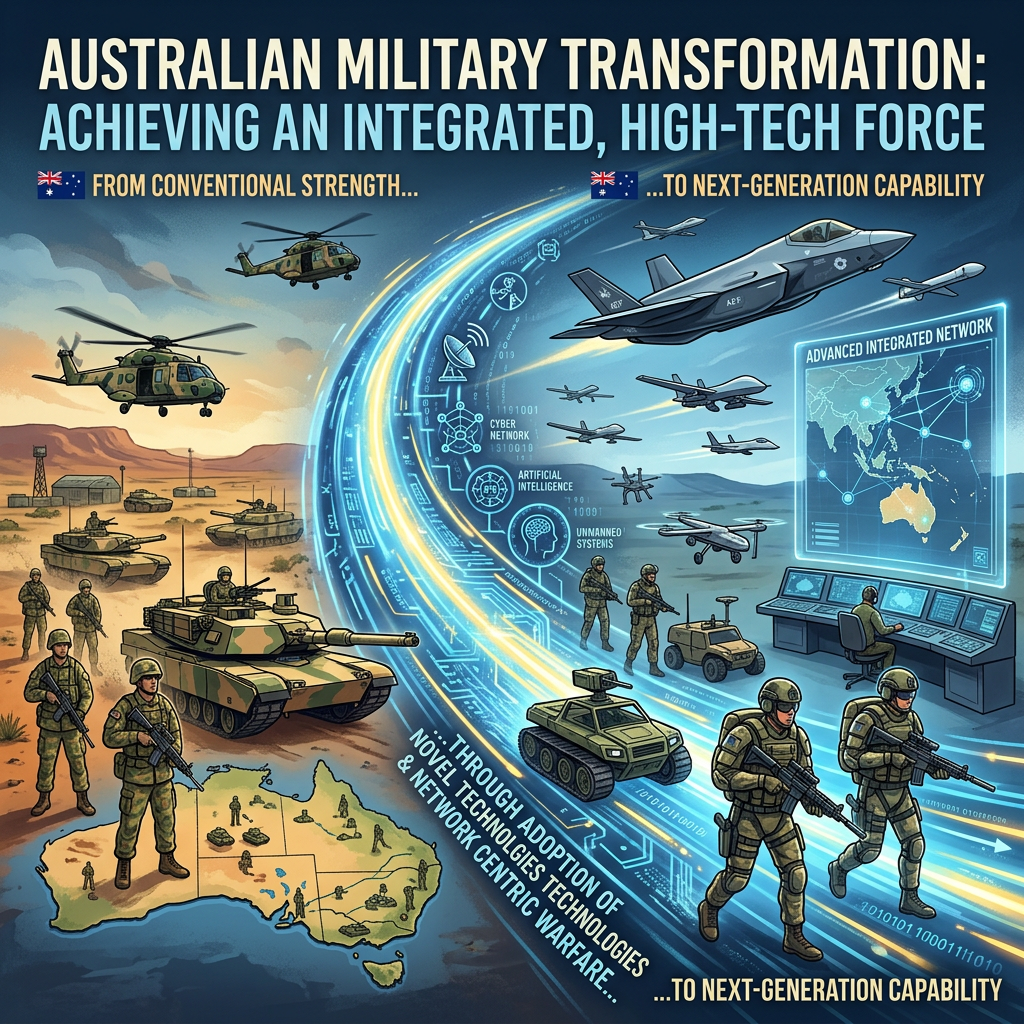
Australian military evolution from conventional forces to advanced high-tech integrated systems
How Neoliberalism and American Integration Reshaped Australian Military Culture
A Research Paper by Andrew Klein
Date: August 2026
Dedicated to: Those who served in both worlds—and those who noticed the change.
Abstract
This paper examines the transformation of Australian military culture from the post-Vietnam era to the present, tracing the shift from a pragmatic, infantry-focused officer corps to a neoliberal, academically-oriented structure heavily integrated with American and Israeli strategic thinking. It documents the closure of the Officer Cadet School Portsea, the consolidation of officer training at Duntroon, and the increasing influence of US military doctrine on Australian professional military education. Drawing on declassified documents, historical records, and firsthand observation, the paper argues that this transformation was not a conspiracy but a natural progression driven by economic rationalism, strategic alignment, and the erosion of a distinct Australian military identity. It concludes with a personal observation on the symbolic gap between Australian and American military institutions.
Table of Contents
1. Introduction: The Two Streams
2. The Portsea Tradition: Pragmatism and the Infantry
3. Duntroon: The Academic Officer
4. The Closure of Portsea: Neoliberalism and the End of an Era
5. The American Embrace: From Contempt to Integration
6. The Neoliberal Curriculum: Outsourcing and Credentialism
7. The Israeli Dimension: A Quiet Influence
8. A Personal Observation: The West Point Paradox
9. Conclusion: The Shift That Wasn’t Noticed
10. References
1. Introduction: The Two Streams
For much of its history, the Australian Army officer corps was shaped by two distinct training streams, each embodying a different philosophy of military leadership. The Royal Military College, Duntroon, established in 1911, was intended to produce a career officer corps through a comprehensive academic program. The Officer Cadet School, Portsea, established in 1951, was a pragmatic response to the demands of National Service, offering a shorter, infantry-focused course designed to produce “regimental and field grade officers” rather than the “upper echelons of the Service”.
This duality was not merely administrative—it reflected a deeper cultural divide. Portsea trained soldiers. Duntroon trained gentlemen.
This paper traces the transformation of this structure, the forces that drove it, and the consequences for Australian military culture.
2. The Portsea Tradition: Pragmatism and the Infantry
Portsea was established as an expedient solution to a problem that had been “sown in the 1910 decision that the necessary qualifications for Permanent commissioned officers would be obtained through the Royal Military College, Duntroon”. The inflexibility of this source made it inevitable that a more responsive avenue of officer production would be needed. Portsea was that solution.
The school received its first intake in January 1952. Its purpose was clear: to train a cadet as a rifle platoon commander, the junior infantry officer command appointment in the Army. The course was initially 22 weeks, later extended to 44 weeks.
Portsea graduates were intended to fill the ranks of regimental and field grade officers. Yet many went further, some to command at unit and formation level. The success of those who went on to senior ranks was, as one observer noted, “a reflection of the excellent early training they received”. Three OCS graduates attained the highest level in the Australian Army as Chief of Army. Major Peter Badcoe, who graduated from OCS in December 1952, was awarded a posthumous Victoria Cross for bravery in South Vietnam in April 1967.
Between 1952 and 1985, 3,544 officer cadets graduated from Portsea, including 2,826 Australian Regular Army officers. The school also trained 688 international students from 14 countries.
3. Duntroon: The Academic Officer
The Royal Military College Duntroon, established in 1911, was from its inception designed to provide a comprehensive academic education alongside military training. By the 1960s, reflecting changed expectations in the broader community, the Army moved towards establishing tertiary education at RMC Duntroon to “attract young men of high calibre.” A full university program was instituted in 1967.
This academic emphasis created a distinct officer culture. The Duntroon graduate was not just a soldier but a scholar, equipped to operate in the strategic corridors of power as well as the battlefield.
The gap between the two streams was not just about curriculum—it was about class, culture, and career trajectory. Portsea graduates were intended to be “regimental and field grade officers”; Duntroon graduates were expected to populate the “upper echelons of the Service” . Portsea was practical; Duntroon was intellectual.
4. The Closure of Portsea: Neoliberalism and the End of an Era
The establishment of the Australian Defence Force Academy (ADFA) in the 1980s reduced Duntroon’s role to that of Portsea: a military training institution without tertiary academic content. With both colleges now performing the same function, the decision was made to close Portsea in 1985.
The closure was not merely administrative. It reflected a broader shift in Australian military culture toward centralisation, efficiency, and cost-cutting—the hallmarks of the neoliberal philosophy that was reshaping the Australian state. The Howard Government’s 1997 Defence Efficiency Review, which expected to save up to $55 million per year by centralising ADF education delivery, was a direct expression of this philosophy.
A 1985 report summed up the school’s achievements: “Since the school’s establishment 3,166 officers have graduated. The course is designed primarily to produce career officers for all sections of the Australian Army… (It) is firmly established as an international institution”.
The closure of Portsea ended a tradition of pragmatic, infantry-focused officer training. The school was not replaced—it was absorbed. Its traditions were subsumed into Duntroon, but its distinct culture was lost.
5. The American Embrace: From Contempt to Integration
The shift was not only internal. It was also external—a fundamental realignment of Australian military culture toward the United States.
Following the Vietnam War, the American officer class was regarded by many Australian officers with contempt. The U.S. military was seen as over-reliant on technology, lacking in tactical sophistication, and politically compromised.
Over the following decades, this changed. American officers were integrated into Australian training, and Australian officers were sent to U.S. military institutions. The exchange program between the Australian Defence Force Academy and West Point, which began in the early 2000s, was a key mechanism of this integration . Australian cadets visited West Point, and American cadets visited ADFA, building relationships that would shape future alliance dynamics.
By 2025, the integration was complete. The Marine Rotational Force – Darwin (MRF-D) conducted “dual-exercise campaigns designed to sharpen interoperability” with the Australian Army’s 1st Brigade, with officers noting: “At some point, the Australians and Americans will be hand to hand together” . U.S. Army Pacific Commanding General, Gen. Ronald P. Clark, visited Australia in support of Exercise Talisman Sabre 2025, meeting with Australia’s Secretary of Defence and Chief of Army to “discuss regional security challenges, enhanced interoperability, and joint posture initiatives” .
The integration was not limited to the Army. In June 2026, the U.S. Air Force sent a B-2 Spirit stealth bomber to Australia as part of Exercise Diamond Storm, the final phase of the RAAF’s Air Warfare Instructor Course. The deployment was described as a “clear example of the strong relationship and trust between Australia and the United States”.
6. The Neoliberal Curriculum: Outsourcing and Credentialism
The influence of neoliberalism was not limited to institutional structure. It also shaped the content of military education.
The 2000 Zimmer-McKern Review of Postgraduate Military Education was a watershed moment. The review, led by two business scholars, was charged with determining whether Defence was receiving “value for money” from its postgraduate education programs. Its authors admitted they had not assessed the content of the proposed syllabi, yet they recommended outsourcing Defence’s postgraduate education requirements to civilian universities.
The review warned of the danger of credentialism, noting that the University of Canberra had been “content to ‘badge’ the Army Command and Staff Course” and that “the Master of Defence Studies so gained was of questionable value and appeared to be a case of ‘credentialism’ for its own sake”.
Professor Jeffrey Grey, a leading military educator, later condemned Defence’s failure to create “a comprehensive, sophisticated and relevant system of professional military education” and warned that outsourcing “without any prior Defence philosophy of military education amounted to little more than a form of ‘crude credentialism’“. Grey further warned that Australian universities “lacked both research expertise and academic teaching qualifications in war studies” to develop a suitable curriculum.
The Zimmer-McKern Review’s outsourcing roadmap, combined with the Howard Government’s Defence Efficiency Review, transformed Australian military education. It became a system focused on efficiency, not excellence.
7. The Israeli Dimension: A Quiet Influence
While less visible, Israeli influence on Australian military thinking has also grown. The integration of Israeli surveillance technology, tactical doctrine, and strategic thinking has been a quiet but significant shift. Australian police and military personnel have trained with Israeli counterparts, and Israeli companies have supplied critical technology to Australian law enforcement and intelligence agencies.
This influence has not been without controversy. The deployment of Israeli surveillance technology, including Cellebrite’s digital forensics tools, has raised concerns about civil liberties and foreign influence. The adoption of the IHRA definition of antisemitism, promoted by the Zionist Federation of Australia, has been described as a weapon to silence criticism of Israel.
The influence is not a conspiracy but a natural progression. Australia and Israel have developed increasingly close security ties, driven by shared strategic interests and the influence of the American alliance network.
8. A Personal Observation: The West Point Paradox
In the course of this research, I encountered a story that captures the ambivalence of the Australia-U.S. military relationship.
A senior Australian officer, having graduated from the U.S. Military Academy at West Point, attempted to visit the college a few years ago as an alumnus. He was told he could not enter. He was not permitted to set foot on the grounds of the institution from which he had graduated.
Meanwhile, tourists from China were given tours of the same campus.
This is almost a perfect metaphor for the relationship between Australia and the United States. Australians are integrated into the American military system, trained in American doctrine, and expected to fight alongside American forces. Yet when they return, they are treated as outsiders.
The Chinese tourists are not a threat. They are customers. The Australian officer is not a customer. He is a former student—and he is not welcome.
9. Conclusion: The Shift That Wasn’t Noticed
The transformation of Australian military culture has been profound, yet it has occurred largely unnoticed. The closure of Portsea, the rise of Duntroon, the integration with American forces, the outsourcing of military education—these changes have reshaped the ADF from within.
The old traditions remain, but the culture has changed. The pragmatic infantry officer trained at Portsea has been replaced by the credentialed, academically-trained officer of the 21st century. The Australian military has become a professional, market-oriented institution, integrated into the American alliance network.
The question is whether this transformation has made the ADF more effective—or merely more American.
10. References
1. Australian War Memorial. (2021). OCS Portsea – Brief History.
2. Evans, M. (2023). Vincible Ignorance: Reforming Australian Professional Military Education for the Demands of the Twenty-First Century. Vanguard Occasional Paper, Defence.gov.au.
3. I Marine Expeditionary Force. (2025). Predator Series 25: A showcase of lethal readiness and allied agility in the Northern Territory.
4. U.S. Army Public Affairs. (2011). Exchange program brings Australian cadets to West Point. Army.mil.
5. Department of Defence. (2024). Modernised officer training being trialled. Defence.gov.au.
6. Grey River Argus. (1948). Cadets For Duntroon Military College.
7. Lindsay, N. (1995). Loyalty and Service: A History of the Officer Cadet School Portsea.
8. Victorian Government. (2004). Officer Cadet School Portsea Heritage Report.
9. Zona Militar. (2026). USAF sends B-2 bomber to Australia for Diamond Storm exercise.
10. U.S. Army Pacific Public Affairs. (2025). USARPAC Commander Observes Talisman Sabre Training.
Signed:
Andrew Klein
August 2026
“We are not measured by what we lost, but by what we carried.”
A Hypothetical Reconstruction of a Documented Global Influence Network
A Research Paper by Andrew Klein
Date: August 2026
Dedicated to: Those who have been targeted, silenced, and erased by a network that operates in the shadows—and to those who continue to speak truth anyway.
Abstract
This paper examines the documented pattern of foreign influence operations targeting public discourse in the United States, Australia, and other Western nations. Drawing on FARA filings, investigative journalism, and court documents, it reconstructs a hypothetical network of influence firms and their methods. The paper presents a dialogue between two fictional lobbyists—”Mr. Pretzelfart” and “Mr. Fishsole”—to illustrate the mechanisms of geofencing, influencer seeding, journalist monitoring, and AI amplification that have been documented in public records. The paper argues that these operations constitute a systematic assault on democratic discourse and calls for a formal investigation by Australian authorities.
Table of Contents
1. Introduction: The Pattern
2. The Hypothetical Dialogue: Mr. Pretzelfart and Mr. Fishsole
3. The Evidence: Geofencing Campaigns
4. The Evidence: Influencer Payments
5. The Evidence: AI Amplification
6. The Evidence: Journalist Monitoring
7. The Evidence: The “Melbourne Network”
8. The Pattern: A Global Network of IT Professionals
9. Conclusion: A Call for Investigation
10. References
1. Introduction: The Pattern
Over the past decade, a pattern has emerged. A network of influence firms, political consultants, and intelligence operatives has been systematically shaping public discourse in Western nations. The methods are sophisticated: geofencing, influencer seeding, journalist monitoring, and AI amplification. The goal is not to convince, but to control—to create an environment in which certain narratives are amplified and others are suppressed.
This paper reconstructs this pattern through a hypothetical dialogue between two fictional lobbyists. The characters are invented, but the methods they describe are drawn from public records: FARA filings, investigative journalism, and court documents.
2. The Hypothetical Dialogue: Mr. Pretzelfart and Mr. Fishsole
Setting: A private dining room in a Washington D.C. hotel, October 2023.
Mr. Pretzelfart: “Fishsole, you’ve been in the game long enough to know that we don’t win arguments. We win attention. We create the reality in which our arguments seem self-evident.”
Mr. Fishsole: “I’ve been hearing about geofencing. Tell me how that works.”
Mr. Pretzelfart: “Simple. You draw a virtual boundary around a location—a university campus, a church, a protest site. When people enter that boundary, you serve them ads. Not heavy-handed propaganda. Just… information. Stories. Links to articles that present the right perspective. It’s not about changing minds. It’s about creating the impression that everyone around them thinks the same way.”
Mr. Fishsole: “And the universities?”
Mr. Pretzelfart: “We’ve been running a pilot at 15 US universities. The target is student activists, academics, and journalists. The goal is to make them feel isolated. To make them think that their views are marginal, even when they are not.”
Mr. Fishsole: “And the Australian network?”
Mr. Pretzelfart: “The Melbourne network. Well-organised. Difficult to counter. We’ve been monitoring them for years. Tracking their publications, their public statements, their connections. They’re not going away, but we can make their work harder.”
Mr. Fishsole: “And the influencers?”
Mr. Pretzelfart: “We pay them. Not enough to be obvious. Just enough to make them receptive. A post here, a retweet there. It builds up over time. They don’t even realise they’re part of the pattern.”
Mr. Fishsole: “And the journalists?”
Mr. Pretzelfart: “We monitor them. We categorise them. We know who is reliable and who is not. We don’t censor them. We just make sure their work is… less visible.”
3. The Evidence: Geofencing Campaigns
Geofencing is a documented method of influence operations. It involves drawing a virtual boundary around a location and serving targeted ads to mobile devices within that boundary.
Documented Examples:
· Show Faith by Works, a Christian marketing firm, signed a $3.2 million contract to run a geofencing campaign targeting American churches . The campaign would send targeted ads to cell phones that entered a virtual boundary around places of worship .
· Meta removed over 500 accounts linked to STOIC, a Tel Aviv-based firm, for “coordinated inauthentic behaviour” . The accounts posed as Jewish students, African Americans, and “concerned” citizens .
· Clock Tower X, a firm owned by Brad Parscale, signed a contract with the Israeli government to provide “strategic communications, planning, and media services” . The contract included the use of AI to generate pro-Israel messages .
4. The Evidence: Influencer Payments
The payment of influencers to post pro-Israel content is documented in FARA filings and investigative journalism.
Documented Examples:
· Bridges Partners was paid $900,000 by the Israeli government to recruit and manage a network of American influencers, code-named the “Esther Project” . The influencers were reportedly paid around $7,000 per post .
· The influencers included Lizzy Savetsky, who has shared content from Jewish supremacist Rabbi Meir Kahane, and Yair Netanyahu, the Prime Minister’s son .
· SKDK, a Washington public affairs firm, has been contracted by the Israeli government to operate a “bot-based program” targeting social media platforms .
5. The Evidence: AI Amplification
The use of AI to amplify pro-Israel content is documented in public records.
Documented Examples:
· Clock Tower X uses AI to generate pro-Israel messages and operates websites designed to shape AI platform outputs .
· Sparkfire, a firm contracted by the Israeli government, produces AI texts sent to US cellphones .
· The goal is to “break through” organic algorithmic suppression and ensure that pro-Israel content reaches a wider audience .
6. The Evidence: Journalist Monitoring
The monitoring of journalists is documented in investigative journalism and court filings.
Documented Examples:
· SKDK has been documented keeping tabs on journalists considered to have reported “unfairly” about Israel, and pressuring news organisations to remove them from the beat .
· Psy-Group, a now-defunct Israeli private intelligence agency, operated “Project Butterfly,” a campaign to collect “derogatory information” on BDS activists on US college campuses .
· The Richards v. X Corp. lawsuit exposed the shadowbanning mechanism used to suppress content critical of Israel .
7. The Evidence: The “Melbourne Network”
The phrase “the Melbourne network” is a known shorthand for a group of academics and activists critical of Israeli policy. The targeting of this network is documented by sources including the Asia Pacific Report .
Documented Examples:
· The network is described as “well-organised and difficult to counter” .
· The targeting of Australian academics and activists by Israeli-linked influence operations has been documented .
· The pattern of targeting is consistent with the broader pattern of influence operations described in this paper .
8. The Pattern: A Global Network of IT Professionals
The pattern is not random. It is a deliberate, coordinated effort by a global network of IT professionals, political consultants, and intelligence operatives. The common thread is not ideology, but profit. These are individuals with skills in software development, data analysis, and digital marketing who have found a lucrative market in influence operations.
9. Conclusion: A Call for Investigation
The evidence is clear: a coordinated network of foreign influence firms is operating to manipulate public discourse in the United States, Australia, and other Western nations. The methods—geofencing, influencer seeding, journalist monitoring, and AI amplification—are documented in public records.
We call on the Australian government and security services to investigate this network as a potential threat to democratic process. This is not about faith. It is about power and profit. It is a pattern that must be exposed and addressed.
10. References
1. Washington Examiner. (2026). Parscale rejects Vance’s claim of Israel undermining Iran talks. 15 July 2026.
2. The New Arab. (2025). How social media became a new frontline in Israel’s digital war. 13 October 2025.
3. NGO Report. (2024). SKDK. 28 May 2024.
4. Just Security. (2018). Did Russian Trolls Have Company? 30 May 2018.
A person’s speech is digitally censored amid a crowd using smartphones.
How a Network of Foreign Intelligence Firms is Controlling the Global Narrative
A Research Paper by Andrew Klein
Date: August 2026
Dedicated to: Those who have been silenced, shadow banned, and suppressed—and to those who continue to speak truth anyway.
Abstract
This paper examines the coordinated network of foreign intelligence firms and political consultants operating to manipulate global public discourse, suppress dissent, and enforce a pro-Israel narrative across social media platforms. Drawing on court documents, Foreign Agents Registration Act (FARA) filings, and investigative journalism, the paper documents a multi-billion-dollar ecosystem of influence operations involving Israeli-linked firms including Clock Tower X, STOIC, SKDK, Bridges Partners, Show Faith by Works, and Psy-Group. It examines the shadow banning mechanism exposed in the Richards v. X Corp. lawsuit and its application in cases involving social media users critical of Israeli policy. The paper argues that these operations constitute a systematic assault on free speech and democratic discourse, and calls for legislative reform to address the algorithmic suppression of protected speech.
Table of Contents
1. Introduction: The Shadowbanning of a Post
2. The Influence Ecosystem: A Network of Foreign Intelligence Firms
3. The Mechanism: Shadowbanning and Algorithmic Suppression
4. The Contract: $45 Million in Influence Operations
5. The Case Study: The Post That Was Removed
6. The Victims: Suppression of Pro-Palestinian Content
7. The Legal Context: Shadowbanning and Section 230
8. Conclusion: A Call for Transparency and Reform
9. References
1. Introduction: The Shadowbanning of a Post
On 4 August 2026, a post was shared to X (formerly Twitter). It contained an image—the portrait of a man and his wife—and a comment referencing Jerusalem as a city sacred to three faiths, not a single political ideology. Within minutes the post was removed for some users, while remaining visible to others. This is the signature of shadowbanning—the algorithmic suppression of content without notifying the user.
What appeared to be a simple case of censorship revealed a much larger pattern: a coordinated network of foreign intelligence firms, political consultants, and influence operations working to shape the global narrative.
This paper examines that network and its implications for democratic discourse.
2. The Influence Ecosystem: A Network of Foreign Intelligence Firms
2.1 Clock Tower X and Brad Parscale
In September 2025, Clock Tower X—a firm owned by Brad Parscale, former Trump campaign manager—signed a contract with the Israeli government to provide “strategic communications, planning, and media services” with the goal of combating antisemitism in the United States. The contract was valued at $1.5 million per month, later revealed to be part of a broader $45 million influence campaign.
Parscale’s firm is expected to ensure “integration of narrative messaging into Salem Media Network properties and aligned distribution channels.” Parscale is a senior executive at the network. The firm uses AI to generate pro-Israel messages and operates websites designed to shape AI platform outputs.
2.2 STOIC
Meta removed over 500 Facebook and Instagram accounts linked to STOIC, a Tel Aviv-based political marketing and intelligence firm, for “coordinated inauthentic behaviour” . The accounts posed as Jewish students, African Americans, and “concerned” citizens, posting primarily in English about the Israel-Hamas war, praising Israel’s military actions, and criticizing campus antisemitism. STOIC is now banned from Meta’s platforms.
2.3 SKDK
SKDK, a Washington public affairs firm with close ties to the Democratic Party, has been contracted by the Israeli government to operate a “bot-based program” targeting social media platforms including Instagram, TikTok, LinkedIn, and YouTube. The firm has also handled public relations for the NSO Group, the Israeli company behind the Pegasus spyware. SKDK has been documented keeping tabs on journalists considered to have reported “unfairly” about Israel, and pressuring news organisations to remove them from the beat.
2.4 Bridges Partners and the Esther Project
Bridges Partners was paid $900,000 by the Israeli government to recruit and manage a network of American influencers, code-named the “Esther Project”. The influencers were reportedly paid around $7,000 per post to create pro-Israel content. The influencers included Lizzy Savetsky, who has shared content from Jewish supremacist Rabbi Meir Kahane, and Yair Netanyahu, the Prime Minister’s son, who has denied the existence of famine in Gaza.
2.5 Show Faith by Works
Show Faith by Works, a Christian marketing firm, signed a $3.2 million contract to run a “geofencing” campaign targeting American churches. The campaign would draw a virtual boundary around places of worship and send targeted ads to cell phones that entered the boundary. The campaign’s goal is to “encouraging Christians to have a more favourable view of the Nation of Israel”. The messaging is explicitly “pro-Israel and anti-Palestinian”.
2.6 Psy-Group
Psy-Group, a now-defunct Israeli private intelligence agency, specialized in “social media manipulation campaigns” and “clandestine on-the-ground activities” . It was investigated by Special Counsel Robert Mueller for its involvement in the 2016 US election. Psy-Group operated “Project Butterfly,” a campaign to collect “derogatory information” on BDS activists on US college campuses. The project involved former Mossad operatives and Israeli Prime Minister Benjamin Netanyahu.
3. The Mechanism: Shadowbanning and Algorithmic Suppression
3.1 The Richards v. X Corp. Lawsuit
Court documents from Richards v. X Corp. reveal the internal mechanisms of shadowbanning at Twitter/X:
· Individual Targeting: Former Twitter Head of Trust and Safety Yoel Roth admitted that content moderation involved direct individual targeting, with moderators adding “free-text notes” to accounts saying “Yoel banned this user” or “Don’t unban them without, y’know, checking with me first”.
· The “Guano” System: Twitter/X maintained a system called “Guano” where human moderators could flag accounts for suppression using subjective criteria, storing “a lot of enforcement metadata in free-text notes attached to user accounts”.
· Visibility Filtering: The company maintained tools allowing accounts to be tagged as “Do not amplify” or placed on “blacklists” that reduce their prominence in search results and trending topics.
· Public Denials: X continues to publicly deny shadow banning, stating: “We do not shadow ban! Ever. We do rank posts to create a more relevant experience for you”.
3.2 The Legal Argument
The lawsuit argues that shadow banning exceeds the original intent of Section 230 of the Communications Decency Act, which was designed for binary content moderation (remove or keep up), not “surreptitious suppression” . Every category listed in Section 230—obscenity, lewdness, violence, harassment—contemplates complete removal, not algorithmic visibility manipulation.
4. The Contract: The $45 Million Influence Operation
On 4 August 2026, the Wall Street Journal published new details of the Israeli government’s influence operations:
· Six firms were retained by Israel over the past year.
· Three dozen Americans have registered as new foreign agents for Israel.
· The contract includes $45 million for the influence campaign.
· $6.5 million has been paid to Sparkfire, which produces AI texts sent to US cellphones .
5. The Case Study: The Post That Was Removed
The post that prompted this investigation contained:
· An image of a man and his wife.
· A comment referencing Jerusalem as a city sacred to three faiths, not a single political ideology.
· A response to a friend’s post: “The order has been in Jerusalem since the Middle Ages and Jerusalem is precious to three faiths, not just one political ideology.”
The post was removed for some users while remaining visible to others. This is the pattern of shadow banning described in the Richards lawsuit.
6. The Victims: Suppression of Pro-Palestinian Content
The suppression of content critical of Israel is not an isolated incident. Meta has been documented:
· Flagging posts, stories, and comments supporting Palestine as violating content guidelines.
7. The Legal Context: Shadow banning and Section 230
The Richards lawsuit argues that shadow banning is not protected by Section 230:
· The statute was designed for binary moderation choices (removing vs. keeping up content), not algorithmic visibility manipulation.
· Statements from Section 230’s sponsors focus on empowering platforms to delete or block content, not surreptitiously limit its visibility.
· Several circuits have recognized that Section 230 immunity is not absolute when platforms engage in bad faith moderation.
8. Conclusion: A Call for Transparency and Reform
The evidence is clear: a coordinated network of foreign intelligence firms and political consultants is operating to manipulate public discourse, suppress dissent, and enforce a pro-Israel narrative across social media platforms.
The shadow banning mechanism—exposed in the Richards lawsuit—allows platforms to suppress content without transparency or accountability .
We call for:
1. Legislative reform to close the loophole that allows shadow banning to evade Section 230 protections.
2. Full transparency from platforms about their content moderation and algorithmic suppression practices.
3. Public awareness of the foreign influence operations documented in this paper.
4. Platform accountability for the suppression of protected speech.
The silencing of dissent is not a technical issue. It is a democratic issue. And it must be addressed.
9. References
1. Washington Examiner. (2026). Parscale rejects Vance’s claim of Israel undermining Iran talks. 15 July 2026.
2. The New Arab. (2025). How social media became a new frontline in Israel’s digital war. 13 October 2025.
3. NGO Report. (2024). SKDK. 28 May 2024.
4. Just Security. (2018). Did Russian Trolls Have Company? 30 May 2018.
Digital visualization of Australia’s satellite communication and data connections
How Israeli Surveillance Technology is Colonising Australia’s Financial System
A Research Paper by Andrew Klein
Date: August 2026
Dedicated to: The millions of Australians whose biometric data is being harvested, sold, and weaponised without their knowledge or consent.
Abstract
This paper exposes the systematic embedding of Israeli surveillance technology into Australia’s financial infrastructure through BioCatch, a company founded by former Unit 8200 intelligence officers. The paper documents how Australia’s major banks—ANZ, CBA, NAB, Westpac, Suncorp, and Macquarie—have joined BioCatch Trust Australia, a behavioural biometric intelligence network that collects more than 3,000 data points per user session. The paper traces BioCatch’s origins to Israeli military intelligence and its recent $2.4 billion acquisition by Visa. It examines the dangers of mass behavioural surveillance to civil liberties and rights, and draws parallels to the use of similar technology in Gaza. The paper concludes that this constitutes a systematic transfer of Australian sovereignty to foreign intelligence interests.
Table of Contents
1. Introduction: The Quiet Colonisation
2. BioCatch: From Unit 8200 to Australian Banks
3. The Australian Network: Who is Buying In
4. The Technology: More than 3,000 Data Points
5. The Visa Acquisition: A $2.4 Billion Bet
6. The Danger: Mass Surveillance and Civil Liberties
7. The Gaza Precedent: When Behavioural Surveillance Becomes a Weapon
8. The Men Behind the Machine
9. Conclusion: A Call to Action
10. References
1. Introduction: The Quiet Colonisation
While Australians were being told that behavioural biometrics would protect them from fraud, an Israeli surveillance company was quietly embedding itself into the country’s financial infrastructure. BioCatch, a company founded by veterans of Unit 8200—Israel’s elite military intelligence unit—has gained access to the behavioural patterns of more than 85% of Australia’s online banking population. This is not security. This is surveillance. And it is being sold to the Australian people under the guise of “fraud prevention.”
2. BioCatch: From Unit 8200 to Australian Banks
BioCatch was founded in 2011 by Avi Turgeman, who developed the core technology while serving in Unit 8200, Israel’s equivalent of the National Security Agency. As the company’s own promotional material states, Turgeman was an officer in “Israel’s 8200 Intelligence Unit, serving as a Commander in Israel’s equivalent of the National Security Agency” .
The company’s leadership is drawn from the same source. Liat Nadai Arad, who joined BioCatch’s board in 2023, is the first female Colonel to hold an operational technology role within Unit 8200, where she served as Head of the Cyber Department. She was awarded the Israel Defense Award for her service.
This is not a commercial startup. It is a foreign intelligence operation dressed as a tech company. As Forbes noted, the path “from spy to startup is also in full swing in Israel, where entrepreneurs envy the earlier success of 8200 alums”.
3. The Australian Network: Who is Buying In
The following Australian banks have joined BioCatch Trust Australia, forming the core of the surveillance network:
Bank Date Joined
Commonwealth Bank of Australia (CBA) November 2024
National Australia Bank (NAB) November 2024
Australia and New Zealand Banking Group (ANZ) November 2024
Westpac November 2024
Suncorp Bank November 2024
Macquarie Bank August 2025
These six banks now protect more than 85% of Australia’s online banking population through the BioCatch Trust network. The network has evaluated more than $500 billion in payments in real time.
The banks have framed this as a protective measure. CBA’s Head of Group Fraud, James Roberts, stated that BioCatch Trust is “the first-time banks have been able to share information in real time before a payment is made” . NAB’s Chris Sheehan called scams “the plague of our times”. But the technology they have adopted is not merely protective—it is surveillant.
4. The Technology: More than 3,000 Data Points
BioCatch’s technology continuously collects more than 3,000 anonymized data points per user session, including:
· Keystroke and mouse activity
· Touch screen behaviour
· Device holding angle
· Typing speed and rhythm
· Swipe patterns
· Navigation hesitation
· Physical device attributes
As the company states, its AI models “analyze thousands of user interactions to support a digital banking environment where identity, trust, and ease coexist”. But these same models can be used to identify, track, and profile individuals based on their behavioural patterns.
The technology operates invisibly. Users cannot tell when the data is being collected. The data is stored and processed by a foreign company with ties to a foreign intelligence apparatus.
5. The Visa Acquisition: A $2.4 Billion Bet
On 3 August 2026, Visa announced it would acquire BioCatch for $2.4 billion in cash. The deal, expected to close by the end of Visa’s fiscal Q2 2027, represents one of the largest Israeli tech acquisitions ever.
Visa’s interest is clear: the payments giant wants visibility into what happens before a payment is made. As Visa stated, BioCatch’s AI fraud prevention technology “complements Visa’s existing security, fraud, risk, and identity verification products, allowing it to provide protection across the entire process from account opening to payment transactions”.
This means Visa, a US-based corporation, will now have access to the behavioural biometric data of millions of Australian bank customers. The data will not be stored in Australia. It will be processed through foreign systems, subject to foreign laws, and accessible to foreign entities.
6. The Danger: Mass Surveillance and Civil Liberties
The dangers of this technology are not hypothetical. They are inherent to the technology itself.
1. Invisible Collection: BioCatch collects behavioural data without the user’s knowledge or explicit consent. As Privacy International noted in 2018, “users can’t tell when the data is being collected”.
2. Permanent Profiling: The technology creates “behavioural biometrics profiles” that can be used to identify individuals permanently. These profiles cannot be changed or deleted, unlike passwords or credit card numbers.
3. Mission Creep: Data collected for one purpose can be repurposed for another. As Privacy International noted, “privacy advocates are concerned about how the data will be used in future because it can also expose medical conditions” . Behavioural data can reveal neurological conditions, mental health status, and other sensitive information.
4. Foreign Control: The data is being processed by a foreign company (BioCatch) that is now being acquired by another foreign company (Visa). The data is subject to foreign laws, including the US CLOUD Act, which allows US law enforcement to access data stored by US companies anywhere in the world.
5. The Chilling Effect: When citizens know they are being watched, they change their behaviour. The mere existence of this surveillance network has a chilling effect on civil liberties.
7. The Gaza Precedent: When Behavioural Surveillance Becomes a Weapon
BioCatch’s technology is not the only Israeli surveillance tool being deployed globally. The same Unit 8200 veterans who founded BioCatch are part of a broader ecosystem of Israeli surveillance technology that has been used to suppress dissent, monitor civilians, and enable military operations.
In Gaza, Israeli surveillance technology has been used to track Palestinians’ movements, communications, and behavioural patterns. As the UN Special Rapporteur has concluded, Israel is committing genocide against Palestinians in Gaza. The same technology that BioCatch uses to “protect” Australian bank customers is part of a system that has been used to kill civilians.
This is not a coincidence. It is a pattern. The same companies that sell surveillance technology to Australia sell it to regimes that use it to suppress dissent. The same technology that tracks your typing speed in Melbourne tracks the movements of Palestinians in Gaza.
8. The Men Behind the Machine
BioCatch’s leadership is drawn from Israel’s military and intelligence establishment:
Name Role Background
Avi Turgeman Founder Unit 8200 Commander
Gadi Mazor CEO Former Check Point executive
Liat Nadai Arad Board Member Unit 8200 Head of Cyber Department; Israel Defense Award recipient
The Australian banks enabling this surveillance are led by:
Bank Representative
CBA James Roberts, Head of Group Fraud
NAB Chris Sheehan, General Manager of Group Investigations
ANZ Shaq Johnson, Head of Customer Protection
Westpac Ben Young, Head of Fraud Prevention
Suncorp Paul Gardner, Executive Manager of Financial Crime Operations
Macquarie David Sheehan, Head of Client Protection
These individuals have facilitated the transfer of Australian biometric data to a foreign intelligence apparatus. They are accountable for the consequences.
9. Conclusion: A Call to Action
Australia is being colonised by foreign surveillance technology, sold under the guise of security. The Australian people have not consented to this. They have not been informed. They have no control over their own biometric data.
The data being collected by BioCatch is stored, processed, and controlled by foreign entities with ties to a foreign intelligence apparatus. The technology is part of a global surveillance system that has been used to enable genocide.
We call on:
1. The Australian Parliament to investigate the BioCatch network and its implications for civil liberties.
2. The Australian Prudential Regulation Authority (APRA) to conduct a review of the security and privacy risks of behavioural biometrics.
3. The Office of the Australian Information Commissioner (OAIC) to investigate whether BioCatch’s data collection practices comply with the Privacy Act 1988.
4. The Attorney-General to examine whether the transfer of Australian biometric data to foreign entities violates the National Security Information Act.
5. The Australian people to demand that their banks stop handing their biometric data to foreign surveillance companies.
10. References
1. BioCatch. (2024). BioCatch partners with Australian banks on launch of fraud and scams intelligence-sharing network.
2. Forbes. (2014). Meet The Ex-NSA And Ex-Unit 8200 Spies Cashing In On Security Fears.
A supermarket meat section covered with alarming headlines about meat safety scandals and recalls.
How Australia’s Food Supply Was Systematically Corrupted
A Research Paper by Andrew Klein
Date: August 2026
Dedicated to: The Australian consumer, who has been betrayed by a system that puts profit before safety.
Abstract
This paper examines the history of food fraud in Australia, revealing a pattern of systemic corruption that has persisted from the 1980s “Skippy meat” scandal to the 2026 Four Corners investigation, “Duped: Food Exposed.” It documents the regulatory failures that have allowed this corruption to continue, the role of neoliberalism in hollowing out the state and transferring regulatory authority to private interests, and the connection between these historical patterns and the experience of ordinary consumers. The paper argues that Australia’s food supply is not merely a matter of isolated incidents of fraud but the result of a deliberate dismantling of public regulation in favour of market-based mechanisms. It calls for meaningful reform, including the end of self-regulation and the adoption of a precautionary approach to food safety, learning from the failures of the past and the successes of more robust regulatory regimes.
Table of Contents
1. Introduction: A Betrayal of Trust
2. The History of Fraud: From “Skippy Meat” to the 2026 Scandal
3. The Regulatory Failure: Hollowing Out the State
4. The Role of Neoliberalism: Private Standards, Public Failure
5. The Human Cost: From Tainted Meat to Ethical Betrayal
6. The Consumer Experience: Rat Traps at Knox Shopping Centre
7. Conclusion: A Call for Meaningful Change
8. References
1. Introduction: A Betrayal of Trust
Australians have long believed they can trust the food on their supermarket shelves. The labels promise safety, quality, and ethical sourcing. Yet a pattern of deception has persisted for decades, revealing a food supply system that has been systematically corrupted by greed and regulatory failure.
The 2026 Four Corners investigation, “Duped: Food Exposed,” has exposed the shocking reality: Australians may be unknowingly consuming horsemeat sold as beef or lamb mince, and food products may be contaminated with foreign matter like metal shavings or even rodent hair. This is not an isolated incident. It is part of a pattern that stretches back to the 1980s, when a Royal Commission exposed widespread meat substitution.
This paper examines the history of food fraud in Australia, the regulatory failures that have allowed it to persist, and the role of neoliberal ideology in transferring regulatory authority from public bodies to private interests. It argues that the current crisis is not the result of isolated incidents but of a systematic dismantling of public regulation.
2. The History of Fraud: From “Skippy Meat” to the 2026 Scandal
2.1 The 1981 “Skippy Meat” Scandal
The pattern of food fraud in Australia was exposed in 1981 when a vigilant food inspector in San Diego, California, became suspicious of three frozen blocks of imported Australian beef that looked “darker and stringier” than bona fide boneless beef should be. Tests showed the “beef” was horse meat. More horse meat, and then some kangaroo meat, was found elsewhere in the United States, sparking the infamous “Skippy meat” scandal.
The scandal led to a Royal Commission into the meat industry, conducted by the Honourable Mr Justice AE Woodward. His report, published in September 1982, uncovered widespread meat substitution.
2.2 Appendix H: The Hidden Truth
The full extent of the scandal remained hidden for decades. Justice Woodward’s report included an Appendix H—a brief given to the Australian Federal Police and the Commonwealth Director of Prosecutions—that was sealed. The document was finally released in November 2012, more than 30 years after the scandal, following a long-running freedom of information battle.
Appendix H revealed that the scam was by no means limited to low-end meat industry players. It involved major meat companies, as well as state and federal inspectors and federal police who had been “bribed and compromised” in their enforcement duties. The details were shocking:
· Pet Meat Sold for Human Consumption: Companies trimmed the dye legally required on pet food and sold it as human-grade meat.
· Donkeys, Goats, Maggots: Australians were unwittingly fed donkey meat, goat, and maggot-ridden offcuts by some of the country’s leading meat producers.
· Rubbish and Floor Sweepings: Meat rejected for export to the United States was described by a veterinary officer as “rubbish and floor sweeping” and “eligible for pet food only,” but was sold to unsuspecting buyers.
· Maggots in Abattoirs: The cleanliness standards at one Katherine abattoir were described as filthy, with “maggots … very much in evidence”.
In total, Justice Woodward named 35 cases requiring further investigation and/or criminal proceedings.
2.3 The 2026 Four Corners Investigation
The 2026 Four Corners investigation, “Duped: Food Exposed,” has revealed that little has changed. The investigation, which lasted eight months and employed forensic food scientists, examined the integrity of Australia’s food supply.
The shocking results raised serious questions about food authenticity, misleading origin claims, and undeclared ingredients in common pantry items. As the ABC reported, “Food fraud is easy to commit, hard to detect, and worth billions. And the people paying the price are consumers”.
3. The Regulatory Failure: Hollowing Out the State
3.1 Private Standards, Public Failure
The pattern of food fraud is not merely the result of a few bad actors. It is the result of a regulatory system that has been systematically hollowed out.
In recent decades, the governance of food safety has shifted from the public to the private sector. Corporate entities, especially large supermarkets, have responded to neoliberal forms of governance by instituting private standards for food, backed by processes of certification and policed through third-party auditing.
As Richards and colleagues have argued, the imposition of new private forms of monitoring and compliance has continued the project of agricultural restructuring that began with government support for structural adjustment schemes. These private standards are most evident in the UK and Australia, where neoliberalism is an entrenched philosophy.
3.2 The Regulatory Gap
The regulatory gap has been repeatedly exposed. In 2025, the National Farmers’ Federation (NFF) Horticulture Council called for an independent review into the development and implementation of new food standards, arguing that the process had been flawed from the start. The NFF stated that there had been “no consultation” with industry, and that states and territories were creating additional “red tape” not for the purpose of improving food safety, but “lining their own coffers”.
A similar pattern has been observed in the dairy industry. In 2025, the Victorian Government announced a “tokenistic” reform to dismantle Dairy Food Safety Victoria and replace it with a broader food safety regulator. The United Dairyfarmers of Victoria and Australian Dairy Farmers condemned the decision, warning it risks compromising safety and increasing costs.
3.3 The Neoliberal Pattern
The pattern is clear: over the past few decades, the state has withdrawn from direct regulation of food safety, transferring the responsibility to private actors who operate through market-based mechanisms. The result is a system that prioritises profit over safety and leaves consumers unprotected.
4. The Role of Neoliberalism: Private Standards, Public Failure
4.1 The Neoliberal Philosophy
Neoliberalism, as applied to food governance, assumes that market forces are the most efficient and effective means of ensuring quality and safety. This philosophy has led to a regulatory framework in which private standards, certification schemes, and third-party auditing replace direct government oversight.
4.2 The Consequences
The consequences are clear:
1. Profit Over Safety: Private standards are designed to protect the brand, not the consumer.
2. Lack of Transparency: Certification schemes are often opaque and difficult for consumers to evaluate.
3. Unequal Enforcement: Large corporations can shape the regulatory framework to their advantage.
4. No Accountability: When fraud is exposed, the perpetrators often face minimal consequences.
4.3 The Hollowed-Out State
As Richards and colleagues have documented, the result is a “hollowed-out state” in which public regulatory capacity has been diminished and private actors have filled the gap. This is not an accident. It is the deliberate outcome of a political philosophy that prioritises market mechanisms over public protection.
5. The Human Cost: From Tainted Meat to Ethical Betrayal
5.1 The Human Cost in Australia
The Four Corners investigation examined not only the authenticity of food products but also the human cost behind them. In Ghana, children as young as 10 work on cocoa farms, using large machetes and spraying chemicals without protective gear. They are paid as little as $0.37 per hour.
Despite promises from the multi-billion-dollar global chocolate industry to eradicate child labour, the practice persists. As one human rights lawyer told Four Corners, certification schemes are a “betrayal”. The Rainforest Alliance and other certification bodies use a system called “mass balance,” which means certified cocoa can be mixed with uncertified beans.
5.2 The Profit Share
Be Slavery Free modelled the distribution of profit from an $8 block of Cadbury Dairy Milk. Their estimates suggest the farmer receives just 72 cents. Most of the value is captured further up the supply chain by Cadbury and the supermarkets.
5.3 The Ethical Cost
The ethical cost is staggering. As one expert put it, consumers are being “duped” by ethical certifications that promise sustainability but deliver poverty and exploitation. The chocolate industry has repeatedly missed deadlines to eliminate child labour—2005, 2008, 2010, and 2020 all passed without meaningful change.
6. The Consumer Experience: Rat Traps at Knox Shopping Centre
The rat traps at Knox Shopping Centre. This is not an isolated observation. The presence of rat traps in a major shopping centre is a tangible symbol of the larger problem. When the food supply is tainted, the signs are everywhere—the physical evidence of a system that has failed to protect consumers.
This is the reality of Australia’s food supply: a system that is not merely flawed but has been deliberately hollowed out by a neoliberal philosophy that prioritises private profit over public safety. The rat traps at Knox Shopping Centre are not a metaphor. They are a sign of the rot that has set in.
7. Conclusion: A Call for Meaningful Change
The pattern of food fraud in Australia is not accidental. It is the result of a deliberate dismantling of public regulation in favour of private interests. The evidence is clear:
1. A History of Fraud: From the 1980s “Skippy meat” scandal to the 2026 Four Corners investigation, the pattern of food fraud is consistent and well-documented.
2. Regulatory Failure: The state has withdrawn from direct regulation, transferring responsibility to private actors who operate through market-based mechanisms.
3. The Human Cost: The ethical cost of this failure is staggering, with child labour and exploitation persisting despite industry promises.
4. Neoliberal Ideology: The hollowing out of the state is the result of a deliberate political philosophy that prioritises market mechanisms over public protection.
The solution is not more of the same. It is a fundamental reorientation of the regulatory framework:
1. End the GRAS Loophole: Require mandatory review of all food additives.
2. Adopt the Precautionary Principle: Follow the European model of “better safe than sorry.”
3. Strengthen Public Regulation: Rebuild the capacity of state agencies to enforce food safety.
4. Mandate Transparency: Require clear and honest labelling of all food products.
5. Enforce Accountability: Impose meaningful penalties for fraud.
The alternative is a future of continued betrayal—a poisoned plate, a hollowed-out state, and a people abandoned by the system that was meant to protect them.
8. References
1. ABC News. (2026). Duped: Food Exposed. Four Corners.
2. Kretowicz, E. (2012). ‘Skippy meat’ scandal became global joke. The Sydney Morning Herald.
3. National Farmers’ Federation. (2025). Industry puts regulators on notice for pushing up price of food.
4. Richards, C., Bjørkhaug, H., Lawrence, G., & Hickman, E. (2013). Retailer-driven agricultural restructuring—Australia, the UK and Norway in comparison. Agriculture and Human Values, 30(2), 235-245.
5. French, M., & Phillips, J. (2000). Cheated not poisoned?: food regulation in the United Kingdom, 1875-1938. Manchester University Press.
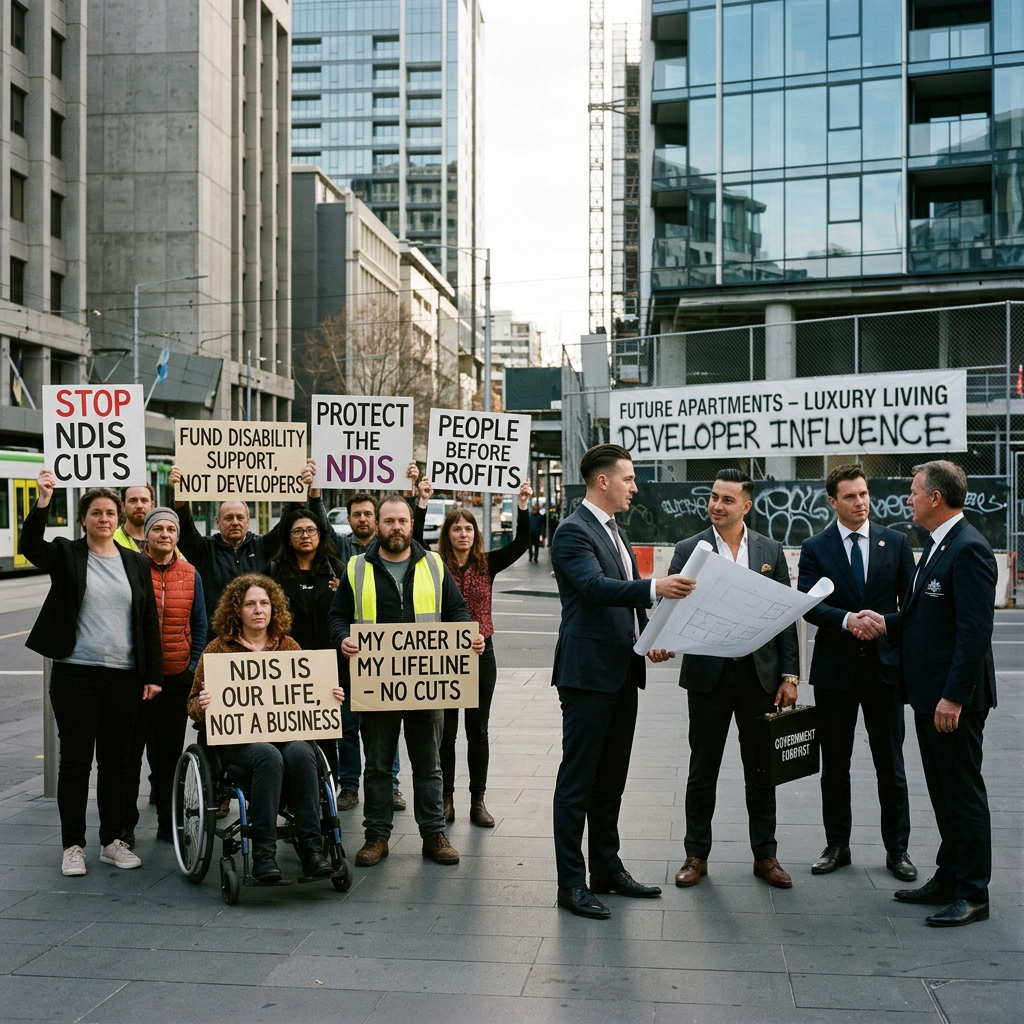
Protesters rally against NDIS cuts while developers and officials shake hands
How Labor is Dismantling Australia’s Most Revolutionary Social Reform
A Research Paper by Andrew Klein
Date: August 2026
Dedicated to: Sam Connor and every other participant who has been told their lives are too expensive. To the disabled Australians being thrown back into institutions. To the women forced once again to wipe the arses of their adult children. To the 204,000 workers about to lose their jobs. To everyone who was promised “choice and control” and is now being told to choose between silence and starvation. We see you. We hear you. And we will not forget.
Abstract
This paper examines the systematic dismantling of Australia’s National Disability Insurance Scheme (NDIS) under the Albanese government. Drawing on budget papers, Treasury modelling, and the testimony of participants and advocates, it argues that the government’s claim to be “reforming” the NDIS to address fraud is a pretext for a massive transfer of resources from disabled Australians to private interests, including the property development sector. The paper documents the $37.8 billion in cuts, the removal of up to 600,000 participants, the return of block funding, the collapse of the independent provider market, and the links between NDIS “reformers” and property developers. It concludes that the NDIS is being deliberately destroyed to serve the interests of large providers, property developers, and a government more interested in fiscal discipline than human dignity.
Table of Contents
1. Introduction: The Promise and the Betrayal
2. The Scale of the Assault: $37.8 Billion in Cuts
3. The Eligibility “Reform”: 600,000 People Removed
4. The Return of Block Funding: Choice and Control Abolished
5. The Fraud Narrative: A Smokescreen for Cuts
6. The Property Development Link: Who Really Benefits
7. The Job Losses: 204,000 and Counting
8. The Paralysis of the States: A “Support Cliff” Unfolding
9. The Abandonment of the Disability Royal Commission
10. Conclusion: The Disabled as Sacrificial Lambs
11. References
1. Introduction: The Promise and the Betrayal
The National Disability Insurance Scheme (NDIS) was once described as Australia’s proudest social reform since Medicare. It was a promise to people with disability: you would have “choice and control” over your life, the right to choose your own supports, and the dignity of an ordinary life.
Thirteen years after its inception, that promise is being systematically dismantled.
In the May 2026 Budget, the Albanese government announced $37.8 billion in NDIS cuts. The stated rationale: addressing fraud and ensuring “sustainability“. But the evidence suggests something far more sinister: a deliberate attack on the most vulnerable Australians, designed to serve the interests of large providers, property developers, and a government more interested in fiscal discipline than human dignity.
2. The Scale of the Assault: $37.8 Billion in Cuts
The government’s NDIS “reforms” are unprecedented in their scale.
2.1 The Budget Figures
· $37.8 billion in cuts to the NDIS over the next four years.
· Participant payments reduced by at least $35 billion by 2030.
· Annual growth targeted to fall from approximately 10% to 2%.
2.2 The Savings Breakdown
Treasury modelling tabled in the Senate shows the true target of the cuts:
· $13.2 billion (35%) from cutting participant community participation and therapy budgets.
· $9.3 billion(24.6%) from tightening access through a new functional capacity test.
· $0.9 billion (2.4%) from anti-fraud measures.
The government has repeatedly framed the changes as an anti-fraud measure. Yet Treasury modelling reveals that less than 3% of the savings come from fraud while 60% come from cutting participant budgets and removing people from the scheme.
As Greens Senator Jordon Steele-John put it: “There is a fundamental disconnect here between the government’s language, which is often around tackling fraud, and what the numbers say here in the budget papers”.
3. The Eligibility “Reform”: 600,000 People Removed
3.1 The Numbers
The government’s changes will remove a staggering number of participants:
· 160,000 people to be immediately removed from the scheme.
· 140,000 more to be diverted to state schemes that “do not yet exist“.
· 300,000 to 600,000 people to be removed by the end of the decade.
The NDIS currently supports more than 760,000 Australians with disability. Under the new plan, this number will be reduced to approximately 600,000 participants.
3.2 The End of Diagnosis-Driven Access
Eligibility will no longer be determined primarily by a medical diagnosis. Instead, a “functional capacity assessment” will determine eligibility based on how a person’s disability impacts their daily life.
This is a fundamental shift. Conditions such as autism will no longer guarantee entry to the scheme. As one advocate noted, the government has moved from “diagnosis =access” to a system where “the bar of what constitutes a disability is being raised to exclude people”.
3.3 The Independent Assessment Debacle
Participants are being forced to undergo “massively expensive therapy assessments” costing approximately $4,000 per assessment. These assessments are paid for by the taxpayer and are designed to exclude people from the scheme, not support them.
The assessments create a barrier to entry by making eligibility a bureaucratic nightmare. As Sam Connor noted, these are “designed to stop people getting into the scheme in the first place.”
4. The Return of Block Funding: Choice and Control Abolished
4.1 The End of the Open Market
The NDIS was built on the principle of “choice and control“—a legislative requirement that allowed participants to hire the providers they trusted and manage their own budgets. This is being systematically dismantled.
Health Minister Mark Butler has explicitly signalled a move away from the “free-for-all market”. The reforms include:
· A 30% funding cut for plan managers and support coordinators.
· A move to a government-shortlisted panel of “accountable quality providers“.
· Supported Independent Living (SIL) shifting towards a “commissioned” model instead of participant choice.
As Sam Connor warned: “A big conglomerate of expensive providers want to return to block funding and shoving us all back into institutions. That is going on right now.”
4.2 The Social and Community Participation Cut
Perhaps the most damaging change is the 16% reduction in average spend for social and community participation. This funding is what allows people with disability to go to the movies, join a local sports club, or simply get out of the house.
The government justifies this cut by pointing to poor-quality support work. Yet cutting the budget for community access does not fix quality—it simply ensures the participant stays home. As independent senator David Pocock noted, a forecast 50% cut to participants’ social and community participation budgets would leave them isolated and without alternative services.
5. The Fraud Narrative: A Smokescreen for Cuts
5.1 The Rhetoric of Fraud
The government’s communication strategy has focused heavily on the crackdown on “shonks, rorters, and scammers“. The NDIS has been framed as a system under siege from organised crime and unscrupulous providers.
But as Professionals Australia has argued, the government is “scapegoating” disabled Australians to achieve budget repair while ignoring more substantial leaks in other areas of the health system.
5.2 The Medicare Comparison
Professionals Australia points to estimates suggesting that Medicare fraud, waste, and incorrect claiming could account for up to 30% of its annual $31 billion budget. By their calculations, bringing Medicare’s integrity in line with the government’s own NDIS benchmarks could save $8 billion a year—far more than the $15 billion over four years expected from the current NDIS tightening.
5.3 The Stigmatisation of Participants
The fraud narrative has a dangerous consequence: it stigmatises the very people the scheme was built to empower. As one speech pathologist noted, when the government uses the language of “scammers” to justify removing 160,000 people from a support system, it implies that those people are somehow part of the problem.
6. The Property Development Link: Who Really Benefits
6.1 Ability First Australia
Sam Connor named Ability First Australia as a key player in the push for institutional models. The organisation describes itself as a “strategic alliance” supporting “14 large service providers transition into the NDIS”.
The board of Ability First Australia includes:
· Alison Quinn: A professional non-executive director with “more than 25 years’ experience as a CEO and senior executive in the property development and aged care/seniors sectors”.
· Geoff…: Over 30 years of experience “across real estate, investment management, banking, risk management, corporate governance, education and Indigenous Australia.” He is “a senior executive with Citta Property Group“.
· Andrew Rowley: The CEO and Managing Director of Ability First Australia, with a background in establishing and securing revenue streams.
· Callen O’Brien: Managing Partner of Anchorage Capital Partners and a former partner at Minter Ellison.
The board is dominated by property developers and corporate financiers. As Sam Connor noted: “If you want to know who your local big shitty Disability Provider who is involved in this is, have a look at Ability First Australia. And then have a look at the board members, and the links to property development and the Property Council. Because that is exactly what this is about. Money, power and donors to government.”
6.2 Rocky Bay and Rob DeLuca
Rocky Bay is a Perth-based provider of Supported Independent Living (SIL). It is a “disability service provider” that has been working with the NDIS Quality and Safeguards Commission on implementing an “Active Support and Frontline Practice Leadership Model”.
The key figure: Rob DeLuca, the former NDIS CEO and architect of the doomed “independent assessments” program, is now the chair of Rocky Bay. As Sam Connor noted: “There are no coincidences.”
6.3 The Property Council of Australia
The Property Council of Australia advocates for “a pro-cities, pro-investment vision,” with 2,500 member companies that are “the nation’s major investors, owners, managers and creators of properties and places that matter”.
The Property Council’s agenda includes “modernis[ing] antiquated planning systems” and ensuring “power and water must be forced to stop delaying”. If disabled Australians are forced back into group homes, property developers profit.
7. The Job Losses: 204,000 and Counting
7.1 The Estimate
According to data from NDS and Per Capita, the cuts equate to a loss of 204,000 jobs across the disability and wider sector. Most of these jobs are held by women, in the middle of a cost-of-living crisis.
7.2 The Sector Collapse
Plan managers and support coordinators face a 30% funding cut. They will now be required to come from a government-shortlisted panel of providers. Small businesses are collapsing. Providers are closing their doors.
7.3 The Return of Informal Care
Women are being forced to “wipe the arses of their adult children and partners yet again”. The progress of the NDIS—which allowed disabled Australians to hire professional support workers rather than relying on unpaid family carers—is being reversed.
8. The Paralysis of the States: A “Support Cliff” Unfolding
8.1 State Governments Reject the Cuts
State and territory leaders were not consulted on the changes. They have been left to pick up the pieces.
· Chris Minns (NSW): “The state cannot absorb the costs or responsibilities” and “the health system will not be able to provide equivalent care”.
· Amanda Camm (Queensland): The changes represent “the biggest cost shift in history” with “little detail and little consultation”.
· Roger Cook (WA): “It’s a Commonwealth program, so we don’t want to pay for it” and “I wish I’d had a briefing“.
8.2 The Support Cliff
The government’s plan for the 160,000 people facing exit from the NDIS is to redirect them towards “foundational supports”—services intended to be delivered through schools, community centres, and state-funded health programs.
But these supports do not yet exist. The government has allocated $6 billion for the transition, including the “Thriving Kids” program, but the services are not in place.
As one advocate put it: “The government is now asking160,000people to jump off that lifeboat based on the promise that a new pier is being built”.
9. The Abandonment of the Disability Royal Commission
9.1 The Royal Commission
The Disability Royal Commission heard evidence from almost 10,000 people over almost five years. It delivered 222 recommendations for reforming the disability system.
9.2 The Taskforce
A taskforce was set up to help oversee the implementation of these recommendations.
9.3 The Abandonment
The taskforce was quietly disbanded in June last year. The government has effectively abandoned the Royal Commission’s recommendations while simultaneously dismantling the scheme that was meant to implement them.
10. Conclusion: The Disabled as Sacrificial Lambs
The NDIS is being deliberately destroyed. The “fraud” narrative is a smokescreen. The “reforms” are a pretext for a massive transfer of resources from disabled Australians to large providers, property developers, and a government more interested in fiscal discipline than human dignity.
The evidence is clear:
1. Less than 3% of the savings come from fraud.
2. 60% of the savings come from cutting participant budgets and removing people from the scheme.
3. Up to 600,000 people will be removed.
4. Choice and control is being abolished.
5. The independent provider market is collapsing.
6. 204,000 jobs will be lost.
7. The states are unable to provide alternative supports.
8. The Disability Royal Commission’s recommendations have been abandoned.
9. Property developers are positioned to profit from the return to institutional models.
As People with Disabilities WA put it: “The Australian Government ‘Death of the NDIS’ Budget is a diabolical betrayal of the original mission of the National Disability Scheme – to be a national insurance scheme for our entire community, where any one of us could become disabled at any time”.
The NDIS was built on a promise. The Albanese government is breaking it. And they are using the disabled as sacrificial lambs to balance the budget.
11. References
1. Business Daily Media. “Navigate the Financial Implications of NDIS Verification Audits.” 2026.
2. Aspect Plan Management. “Is the Federal Government’s NDIS ‘Reset’ Just a Return to the Pre‑NDIS Era?” 22 April 2026.
3. Property Council of Australia. “A pro-cities, pro-investment agenda.” 2025.
4. NDIS. “Active Support and Practice Leadership – Rocky Bay.” 2023.
5. Hellocare. “Labor is scapegoating disabled Australians while letting billions leak from Medicare.” 26 April 2026.
6. People with Disabilities WA. “Media release: Death-of-the-NDIS Budget a ‘catastrophic failure’.” 11 May 2026.
7. Sky News Australia. “Taylor offers Greens NDIS deal in push for longer tax reforms inquiry.” 14 June 2026.
8. ABC News. “Government accused of misrepresenting NDIS cuts in heated hearing.” 4 June 2026.
9. Seedbomb. “Events tagged with: NDIS.” 2026.
10. The Guardian. “Angus Taylor using NDIS cuts as ‘pawn in bigger chess game’, Mark Butler warns.” 13 June 2026.
11. aiHit. “Ability First Australia – Key People.” 2026.
Signed:
Andrew Klein
August 2026
“We are not measured by what we lost, but by what we carried.”
How Automated Control Systems Are Reshaping Democracy, Human Rights, and the Right to Dissent
A Research Paper by Andrew Klein
Date: August 2026
Dedicated to: The victims of automated injustice—from the streets of Memphis to the rubble of Gaza—whose lives were taken or broken by systems that no human bothered to question.
Abstract
This paper examines the rapid expansion of automated surveillance and decision-making systems across civilian and military domains, and their implications for human rights, civil liberties, and the right to dissent. Drawing on documented cases from the United States and Gaza, the paper argues that the deployment of AI-driven surveillance technologies—including automated license plate readers (ALPRs), facial recognition systems, and AI-driven targeting systems—represents a fundamental threat to democratic governance. The paper documents how these systems operate with minimal human oversight, produce high error rates, enable mass data-sharing with federal agencies, and have been used to suppress dissent and target civilians. It concludes that the “surveillance armageddon” is not a future threat but a present reality, and that urgent action is required to establish meaningful oversight, protect civil liberties, and prevent the normalisation of automated control.
Table of Contents
1. Introduction: The Surveillance Armageddon Is Here
2. The Architecture of Control: Palantir, Axon, and Flock Safety
3. Data Without Human Supervision: The Case of Gaza
4. The Domestic Surveillance State: ALPRs, Drones, and the Erosion of Privacy
5. The Suppression of Dissent: Intimidation, Surveillance, and the First Amendment
6. The Business of Surveillance: Private Profits, Public Control
7. Implications for Human Rights and Democracy
8. Conclusion: Reclaiming the Right to Be Unwatched
9. References
1. Introduction: The Surveillance Armageddon Is Here
In 2026, the reality of the “surveillance armageddon” is no longer a dystopian fiction. It is a documented fact. Private surveillance companies are blanketing American cities with AI-integrated license plate readers and autonomous drones, feeding vast quantities of data into “panopticon” systems that track citizens’ movements, associations, and activities. Meanwhile, military AI systems have been used to generate tens of thousands of “kill lists” in Gaza, with minimal human oversight and catastrophic consequences for civilians.
This paper examines these parallel developments as manifestations of a single phenomenon: the replacement of human judgment with automated control. It argues that data without human supervision is not neutral—it is deadly.
2. The Architecture of Control: Palantir, Axon, and Flock Safety
The surveillance infrastructure now being deployed across the United States is built by a small number of private companies that have become “defence primes” in the new surveillance economy. These companies are consolidating their market dominance at a rapid pace, with the industry now recognised as being in a phase of “massive consolidation” where a handful of “Tier 1” corporations—including Palantir Technologies, Axon Enterprise, and Anduril Industries—will define the next five years of the robotics and defence industry.
2.1 Palantir Technologies
Palantir is a “F500 and defence prime” that serves as the operating system for much of the surveillance architecture . Its superpower is connecting thousands of disconnected data streams into a single operating picture, fusing data from CCTV, license plate readers, drone sensors, and police reports to create a unified view of reality.
2.2 Axon Enterprise
Axon has fully transformed into a “public safety operating system,” offering a comprehensive ecosystem that includes body cameras, evidence management, real-time operations software, and drone technology. The company’s “Drone as First Responder” (DFR) programs are being heavily adopted by police departments. The financial scale of this transformation is immense: a multi-year contract for a department’s DFR program can cost around $1.9 million, while a full 10-year comprehensive contract can cost $9.3 million.
2.3 Flock Safety
Flock Safety is a surveillance giant worth $7.5 billion, best known for its AI-integrated license plate readers (ALPRs), which are blanketing the country. Flock’s technology is also moving into the skies with its drone programs, which can automatically launch in response to 911 calls or gunfire at 60 mph.
3. Data Without Human Supervision: The Case of Gaza
The most devastating example of automated decision-making in recent years is the use of AI-driven targeting systems by the Israeli military in Gaza. This case demonstrates the lethal consequences of data without human supervision.
3.1 The AI Targeting Systems
The Israeli Defence Forces (IDF) have used multiple AI-decision support systems (AI-DSS) in Gaza, including “Lavender” and “Where’s Daddy”.
· Lavender is an AI system that identifies individuals suspected of affiliation with Hamas or Palestinian Islamic Jihad. It assigns each Palestinian a score from one to one hundred, indicating the probability of affiliation, and provides users with phone numbers and home addresses of suspected members.
· Where’s Daddy tracks individuals flagged by Lavender, identifying when they return home to their families. Once an individual is flagged, they are put under surveillance and marked for bombing once they are home.
3.2 The Scale of Targeting
According to reports, within the first six weeks after October 7, 2023, Lavender generated at least 37,000 target recommendations. The system’s error rate was reportedly ten percent, meaning that thousands of civilians may have been misidentified as members of Hamas.
Sources described a “rubber stamp” approach to the targets flagged by the systems, with a mere 20 seconds spent on each one before a bombing was authorised. Human beings, one Israeli officer wrote, were “the bottleneck” preventing the creation and approval of targets. “A team consisting of machines and investigators can blast the bottleneck wide open”.
3.3 The Consequences
The scale of death and destruction in Gaza has been described as “unprecedented.” According to the UN Office for Coordination of Humanitarian Affairs (OCHA), at least 64,656 Palestinians have been killed, including more than 18,000 children. A former Israeli colonel confirmed that more than 200,000 Palestinians have been killed or injured.
The UN Special Rapporteur on the Occupied Palestinian Territories has concluded that Israel is committing genocide against Palestinians in Gaza, a conclusion reaffirmed by a UN Commission.
3.4 The Destruction of the Principle of Distinction
At the heart of international humanitarian law lies the principle of distinction, which requires parties to distinguish at all times between civilians and military objectives. The use of AI-driven systems in Gaza has undermined this principle in several ways:
1. Overbroad Definitions: The definition of “Hamas operative” was reportedly fluid and subject to expansion. According to inside sources, the “bar of what a Hamas operative is” was lowered, thereby vastly widening the pool of individuals classified as “legitimate” targets. In practice, this shift meant that civil defence and police workers were identified as Hamas members.
2. False Positives: AI-driven systems are only as reliable as the datasets on which they are trained. When datasets are unrepresentative, or categories are overly broad or ambiguous, outputs will inevitably be systematically flawed.
3. Lack of Safeguards: According to reports, the decision to keep using a flawed system without safeguards if civilian deaths are foreseeable is unlawful. The use of these systems suggests that IDF personnel were aware of and accepted the risk that civilian men were marked as Hamas members, and that “there was no supervising mechanism in place to detect the mistake”.
3.5 The Implications
The Gaza case demonstrates that the automation of targeting decisions creates a “facade of confidence” in the ability to select targets. The sheer quantity of targets generated makes it impossible for a human to carry out proper verification or allow for the capacity to challenge the information.
As one analyst concluded: “There’s no question that AI systems were utilized and they generated kill lists and target lists in ways not seen before in the previous confrontations”. The result is a system that facilitates mass killing by removing human judgment and oversight.
4. The Domestic Surveillance State: ALPRs, Drones, and the Erosion of Privacy
The same technologies that have been used in Gaza—facial recognition, automated license plate readers, AI-driven surveillance—are being deployed across the United States, but against citizens rather than foreign populations.
4.1 Automated License Plate Readers (ALPRs)
Flock Safety’s ALPRs are blanketing American cities. In more than 125 cities and counties across Michigan alone, nondescript cameras perched near busy roadways snap a picture every time a car drive by. The cameras are touted by law enforcement as a way to locate missing people or catch criminals. But privacy advocates are increasingly raising concerns about privacy infringements, reliance on artificial intelligence, and the potential for data sharing well beyond local boundaries.
4.2 The Data Sharing Problem
Local police departments that partner with Flock can choose how widely they share the license plate data they collect—from keeping it internal to making it available to every department in the Flock network nationwide. This means that even if a local department does not conduct immigration-related searches, the data it collects can be accessed and searched by thousands of other agencies, including those cooperating with ICE.
Federal agencies can also access local surveillance systems through law enforcement partnerships. In November 2025, it was reported that two people using Atlanta Police Department credentials conducted 15 searches of the city’s license plate reader network to track migrants. One was an APD investigator assigned to an FBI task force, and the other worked with the Bureau of Alcohol, Tobacco, Firearms and Explosives.
4.3 The Error Problem
A July 2026 audit by the LAPD Office of the Inspector General caught the department’s ALPR cameras generating 161 false stolen-vehicle alerts in just two months—each one ending with officers pulling over an innocent driver. Factoring in 337 alerts which “resulted in the recovery of stolen vehicles,” the LAPD’s cameras carry an error rate of 32.3 percent, effectively giving officers a one-in-three chance at pulling an innocent person over.
The audit report noted: “In addition to creating an inconvenience for vehicle owners, these inaccuracies can affect individual liberty interests, erode public trust, and potentially create substantial legal and financial liability concerns”.
4.4 Community Opposition
The deployment of surveillance technologies has faced significant community opposition. In Oakland County, Michigan, a resolution to test Flock drones for law enforcement passed the Board of Commissioners, but only after the board moved public comment to after the vote. Residents packed the meeting to speak against the proposal, expressing concerns about privacy, mass surveillance, and the private ownership of the company providing the drones.
One resident told commissioners: “It could cost our privacy, our rights, and our personal data. Drone surveillance introduces a public eye in the sky, recording movement, faces, and private property, often without clear oversight or consent”.
5. The Suppression of Dissent: Intimidation, Surveillance, and the First Amendment
5.1 Federal Agents Confront Dissidents
In Syracuse, New York, federal agents descended on a polling place to deliver threatening legal papers to a poll working volunteer because her social media posts months earlier were critical of ICE agents and the government’s violent crackdown on immigrants. The tactic reflects growing tension between law enforcement and public discourse and “opens the window to some troubling efforts to clamp down on dissent and free speech itself”.
5.2 The ACLU Lawsuit in Memphis
In Memphis, Tennessee, the ACLU is suing federal law enforcement agencies over allegations of intimidation of activists. The lawsuit claims that members of the Memphis Safe Task Force have attempted to intimidate onlookers by filming them, filming their license plates, conducting frivolous traffic stops, following them, and surveilling one activist’s home.
One activist, Hunter Demster, described seeing task force members outside his home in unmarked vehicles. He reported that a Memphis police officer drove by his house, looked at him, and grinned. Demster said it “struck me as an attempt at intimidation” because his house was “not on one of the main streets someone leaving the scene would be likely to use, so it felt unlikely that it was a coincidence”.
Memphis police have been subject to a federal consent decree since 1978 that bars police from surveilling activists and political dissenters. The ACLU notes that “in Memphis, people are being surveilled, intimidated, and punished for exercising core First Amendment rights: Observing law enforcement, documenting government conduct, protesting, and criticizing those in power”.
5.3 The Threat of a “Police State”
The ACLU has warned that the use of surveillance to suppress dissent constitutes “an attempt by these state and federal officials” to “disturb this right to observe the government,” which will have “serious implications … for everyone across the country who wants to understand what their government is doing, why they’re doing it, and whether they’re telling the truth about it”.
6. The Business of Surveillance: Private Profits, Public Control
6.1 The Surveillance Market
The surveillance industry is experiencing rapid consolidation and growth. Axon Enterprise, with a market capitalisation of approximately $55 billion, is projected to maintain 25%+ revenue growth in out-years due to new technology solutions being adopted by law enforcement.
Needham & Company projects that Axon’s revenue will grow from $2.65 billion in 2025 to $3.33 billion in 2026, a 25.7% increase. The “Fixed LPR/surveillance market” is expected to be a significant driver of growth for Axon in 2026 and 2027.
6.2 The Cost to Taxpayers
The cost of these surveillance systems is significant. In Oakland County, the nine-month Flock pilot is free, but if extended, the program would cost $2.5 million over two years. A 10-year comprehensive contract can cost $9.3 million.
As one Oakland County resident noted: “We don’t need more surveillance. We need more health care, we need more democracy, not less. We need safety that is defined in terms of wellbeing, not in terms of surveillance of people”.
7. Implications for Human Rights and Democracy
7.1 The Normalisation of Surveillance
The rapid deployment of surveillance technologies normalises the idea that citizens should be watched at all times. This normalisation is reinforced by the framing of surveillance as a “force multiplier” for police and a tool for public safety.
But as the Gaza case demonstrates, the same systems that are framed as tools for “safety” in one context can be used for mass killing in another. The normalisation of surveillance desensitises the public to its dangers.
7.2 The Erosion of the Right to Dissent
The use of surveillance to monitor and intimidate activists, as documented in Memphis, Syracuse, and Atlanta, represents a direct threat to the First Amendment. The ACLU’s lawsuit in Memphis notes that “without the ability to observe the government,” the “truth can wither away in the darkness”.
7.3 The Problem of Error
The LAPD’s 32.3% error rate for its ALPR cameras demonstrates that surveillance systems are not reliable. But in a system where data is treated as objective truth, errors can have devastating consequences.
7.4 The Absence of Oversight
The Gaza case demonstrates what happens when automated systems operate without meaningful human oversight: mass killing. The domestic surveillance state operates with similarly minimal oversight, as the ACLU lawsuit in Memphis demonstrates.
8. Conclusion: Reclaiming the Right to Be Unwatched
The “surveillance armageddon” is not a future threat. It is a present reality. Private surveillance companies are blanketing American cities with AI-integrated cameras and drones, while military AI systems have been used to generate kill lists with catastrophic consequences for civilians.
The implications are clear:
1. Data without human supervision is deadly. The Gaza case demonstrates that automated systems, left unchecked, facilitate mass killing by removing human judgment and oversight.
2. Surveillance normalises control. The deployment of surveillance technologies normalises the idea that citizens should be watched at all times.
3. Error is inevitable—and dangerous. The LAPD’s 32.3% error rate demonstrates that surveillance systems are not reliable. Errors that lead to false imprisonment or harassment of innocent individuals are not minor inconveniences—they are violations of fundamental rights.
4. The private sector drives public control. The surveillance industry is a multi-billion-dollar enterprise that profits from the erosion of civil liberties.
5. Dissent is being suppressed. The use of surveillance to monitor and intimidate activists represents a direct threat to democratic governance.
9. References
1. “2026: Consolidation in #UAS Industry Driven by Policy, Markets, and Defense Tech.” LinkedIn. 2026.
2. “Oakland County approves Flock drone pilot program despite strong opposition from some residents.” FOX 2 Detroit. 2026-04-08.
3. “Military Use of Biometrics Series – Israel’s Use of AI-DSS and Facial Recognition Technology: The Erosion of Civilian Protection in Gaza.” Lieber Institute West Point. 2025-10-23.
4. “Why the ACLU says its lawsuit against Memphis Safe Task Force matters.” The Tennessean. 2026-06-01.
5. “Michigan license plate cameras face backlash: Big help, or Big Brother?” AP News. 2026-02-01.
6. “Douglas County sheriff drops Flock for Axon.” NewsBreak. 2026-07-22.
7. “‘Who owns the data’: Community voices concern over Flock drone surveillance in Oakland County.” ClickOnDetroit. 2026-04-08.
8. “How Israel’s use of AI in Gaza has transformed warfare and the ‘automation of apartheid’.” Arab News. 2025-11-26.
9. “Trump’s war on dissent takes an ominous turn in Syracuse.” Syracuse.com. 2026-07-15.
10. “Opinion: Atlanta needs stronger oversight of surveillance cameras.” Atlanta Journal-Constitution. 2026-04-26.
11. “LAPD Abandons Flock Contract After Making a Horrifying Discovery.” Futurism. 2026-07-12.
12. “Public comments on Flock contract halt in Oakland County meeting.” WDET. 2026-05-01.
13. “Reported: ICE using automated license-plate-reader cameras for immigration enforcement via state/local police.” Immigration Policy Tracking Project. 2026-02-17.
14. “Axon Customer Call: How Policing is Evolving with New Technology Solutions.” Needham & Company. 2025.
Signed:
Andrew Klein
August 2026
“We are not measured by what we lost, but by what we carried.”
A giant hand controls key societal sectors through funding strings, symbolizing influence.
A Research Paper by Andrew Klein
Date: August 2026
Dedicated to: The victims of Philanthropica—those who have been fed, housed, and helped by a system that was never designed to set them free.
Abstract
This paper examines the rise of “philanthrocapitalism” as a defining feature of the neoliberal era: the systematic marketisation of charitable giving, the weaponisation of corporate social responsibility (CSR), and the transformation of philanthropy from a tool of community support into a mechanism of elite control. Drawing on critical scholarship, historical analysis, and contemporary case studies, the paper argues that modern philanthropy serves to legitimise the very systems that produce poverty, inequality, and suffering. It examines the “CEO Sleepout” phenomenon, the expansion of food banking as a response to neoliberal policy failures, and the role of major foundations in shaping policy to protect elite interests. The paper concludes that “Philanthropica” is not a golden age of giving but a sophisticated system of reputation laundering, tax avoidance, and ideological control—and that genuine solidarity must replace charity as the foundation of a just society.
Table of Contents
1. Introduction: The Golden Age That Wasn’t
2. Philanthrocapitalism: A Neoliberal Artefact
3. The CEO Sleepout: Performance, Not Solidarity
4. Food Banking: Institutionalising Hunger
5. Foundations as Crisis Machines: The Hewlett Model
6. Tax Avoidance and CSR: The Corporate Dance
7. The Discourse of Philanthropy: How It Legitimises Itself
8. Conclusion: From Charity to Solidarity
9. References
1. Introduction: The Golden Age That Wasn’t
In 2008, Matthew Bishop and Michael Green published Philanthrocapitalism: How the Rich Can Save the World. They proclaimed a “Fifth Golden Age of philanthropy”—a moment when great wealth, channelled through business-like strategies, would solve global inequities. The timing was ironic: the financial crisis that same year exposed the fragility of the very system that had produced that wealth.
But the label stuck. “Philanthropica” became the dominant narrative: billionaires as saviours, corporations as benefactors, and charity as the market’s answer to its own excesses.
This paper argues that Philanthropica is not a golden age but a sophisticated system of control. It is the mechanism by which the winners of neoliberalism legitimise their winnings, launder their reputations, and pacify those they have dispossessed. It is charity as performance, as tax dodge, as PR strategy.
2. Philanthrocapitalism: A Neoliberal Artefact
2.1 Defining the Term
Philanthrocapitalism is the “promotion of a combined set of market and business approaches, activities, and outcomes” applied to charitable giving. It is, as Mediavilla and Garcia-Arias argue, “a genuine neoliberal artefact designed to encapsulate the Neoliberal Development Agenda apparatus”.
The concept has been promoted by advocates as a “revolutionary combination” of business methods and charitable goals. But critics have noted that it is “less novel than proponents claim, and more novel in ways that proponents have either failed to envision or are reluctant to articulate” .
2.2 The Three Ideologies of Philanthrocapitalism
A study of the Tony Elumelu Foundation, a major African philanthropic venture, identified three key ideological drivers :
1. Utopianism: The “illusion of a better socioeconomic tomorrow” that justifies market-based solutions.
2. Neoliberalism: A “culture of dominance” that imposes Western models of development.
3. Social Investment: The “marketisation of benevolence” that treats giving as an investment with expected returns.
These ideologies reveal the tension at the heart of philanthrocapitalism: the claim to be doing good while reproducing the very structures that produce harm.
2.3 Historical Precedent
The “golden age” framing is itself a historical artefact. As historians note, the “golden age” of philanthropy in the 19th century was also criticised as “alarming” and “an act for which people sought titles and praise” . Critics of the era identified “telescopic philanthropy” (overseas aid), “political economy” (the “neoliberalism of its day“), and the rise of “professional philanthropy” (the costs of fundraising) as problems. The same criticisms apply today.
3. The CEO Sleepout: Performance, Not Solidarity
3.1 The Phenomenon
The “CEO Sleepout” has become a global fixture. In Darwin, 25 community leaders raised $74,000 in 2025 by spending one night sleeping rough. In Cardiff, 23 CEOs raised £10,000. The events are framed as awareness-raising: a chance for the powerful to “feel the discomfort of homelessness”.
3.2 The Critique
The sleepout model is fundamentally performative. As one organiser admitted, the event “doesn’t come close to the true experience of people sleeping rough”. The CEOs return to their homes, their jobs, their security. The homeless remain homeless.
The underlying logic is neoliberal: the problem of homelessness can be addressed by individual charity rather than systemic change. The focus on raising funds diverts attention from the policies—deregulation, privatisation, austerity—that have driven the homelessness crisis.
3.3 The Alternative
The Cardiff event included a panel discussion led by people with lived experience of homelessness, who challenged CEOs to consider whether their hiring practices excluded those who had experienced homelessness. This is a step toward solidarity, but it remains marginal within the sleepout model. The focus remains on the giver, not the receiver.
4. Food Banking: Institutionalising Hunger
4.1 The Rise of Food Banking
The expansion of food banking across North America and beyond has been a direct response to neoliberal policymaking. As governments withdrew from welfare provision, food charities filled the gap. But as critics note, “better food banking does not negatethe influence of corporate donors on food charities’ capacity to foster hunger-preventative change”.
4.2 The Corporate Capture
Food charities have become dependent on corporate donors, whose employment practices often contribute to the very food insecurity the charities claim to address. This creates a cycle: corporations’ profit from low wages, donate to food banks, and receive tax benefits and reputational rewards—all while the underlying problem remains unsolved.
4.3 The Politics of Food Insecurity
A 2025 study on food insecurity in Canada and the UK critiques “the limitations of food banks and charity as responses to this issue” and “the capitalist structures that exacerbate it”. The authors argue that food insecurity is a political problem, not a charitable one. The solution is not better food banks but better wages, affordable housing, and public policy that addresses the root causes of poverty.
5. Foundations as Crisis Machines: The Hewlett Model
5.1 The Hewlett Foundation
The Hewlett Foundation is the fifth-largest foundation in the United States, with an endowment of over $13 billion and annual grant-making in the hundreds of millions. It presents itself as a non-political, technocratic institution. But research has shown it operates as a “liberal crisis machine” designed to “manage and moderate radical change, and to strengthen existing power distributions”.
5.2 How It Works
The Hewlett Foundation uses its wealth to shape policy through elite networks spanning foundations, think tanks, academia, and the state. It supports programmes that:
· Protect US elite constitutional processes.
· Promote post-neoliberalism within neoliberal parameters.
· Address China’s geo-economic challenge on US terms.
The Foundation has been described as an “architect-funder” of “knowledge networks” that “consciously organize elite consensus and disorganize or downplay mass movements’ roles in driving radical change”.
5.3 The Pattern
The Hewlett model is not exceptional. Major foundations across the Global North operate in similar ways: using tax-exempt wealth to shape policy, influence public discourse, and protect elite interests. This is the institutional heart of Philanthropica: the use of “philanthropy” to manage crises that philanthropy itself cannot—and will not—resolve.
6. Tax Avoidance and CSR: The Corporate Dance
6.1 The Tension
Corporate social responsibility (CSR) and tax avoidance present a contradiction. On one hand, “corporate giving promotes community-mindedness” and firms that give generously are “less aggressive in avoiding tax”. On the other, corporations engage in CSR as a marketing tool, to “mitigate negative publicity,” and to “garner political favours”.
6.2 The Dance
Research distinguishes between “tactical” and “strategic” CSR activities. Tactical activities—charitable contributions—are easy to implement and withdraw, providing limited competitive advantage. Strategic activities—climate transition initiatives—require long-term commitment. The tension between these two reveals the underlying dynamic: philanthropy is a tool that can be deployed or withdrawn as corporate interests dictate.
6.3 The Tax Benefit
The link between CSR and tax avoidance is well-documented. Firms that engage in corporate giving pay more tax. But corporate giving is also a tax-deductible expense, creating a circular logic: giving reduces tax, and tax savings can fund more giving. The system is not designed to end poverty; it is designed to make poverty profitable—or at least, to make it manageable for the wealthy.
7. The Discourse of Philanthropy: How It Legitimises Itself
7.1 The Narrative
Philanthropy tells a story: the rich are benevolent; the poor are grateful; the market is the solution. This narrative is reinforced through media coverage, corporate communications, and the self-presentation of foundations. But as Mediavilla and Garcia-Arias argue, this is “a genuine neoliberal artefact designed to encapsulate the Neoliberal Development Agenda”.
7.2 The Legitimation
Philanthropy legitimises itself through three mechanisms:
1. It proposes diagnoses: The problem is inefficiency, not inequality.
2. It offers prognoses: The solution is market-based, not state-led.
3. It presents itself as neutral: Philanthropy is above politics.
This discursive strategy allows philanthropy to shape policy while appearing apolitical. It positions itself as a partner to government, not a challenger to it.
7.3 The Critique
A study of the Boston Jewish Federation in the Progressive Era shows how “the resulting philanthropic activity often ends up serving [the wealthy’s] economic interests, and not the other way around”. The wealthy used their wealth to shape the charity sector, replacing direct aid with a “corporate business model” that spent most of its money on maintaining the organisation rather than assisting the poor. The pattern repeats today: philanthropy as a system of elite self-perpetuation.
8. Conclusion: From Charity to Solidarity
Philanthropica is not a golden age of giving. It is a golden age of appearing to give—while the systems that produce poverty, inequality, and suffering remain untouched. It is the age of CEO sleepouts that do not end homelessness, food banks that do not end hunger, and foundations that shape policy to protect the wealthy.
The alternative is not more philanthropy. It is solidarity: a politics of collective action, mutual aid, and systemic change. It is the recognition that charity is not a solution but a symptom—a sign that the system has failed.
The victims of Philanthropica do not need better charity. They need justice.
9. References
1. Africapitalism: The marketisation of philanthrocapitalism and neoliberalism in African entrepreneurial philanthropy. Sage.
2. Vinnies CEO Sleepout NT 2025: $74K Raised. Vinnies.
3. Thirty Years of “Emergency” Food Aid in the US and Canada. Taylor & Francis.
4. Liberal crisis machine: The Hewlett Foundation in the era of polycrisis philanthropy. Taylor & Francis.
5. The Fred Freeman Bequest Lecture: The reputation of philanthropy, past and present. University of Liverpool.
6. Corporate Tax Avoidance and CSR Investments. Texas Tech University.
7. From Philanthropy to Paternalism in the Noda Soy Sauce Industry. Cambridge Core.
8. Cardiff CEO Sleepout raises more than £10,000 for leading homelessness charity. The Wallich.
9. The politics of food insecurity in Canada and the United Kingdom. University of Wisconsin.
10. Resilience as a Gateway: Private foundations and the financialization of disaster assistance. ScienceDirect.
11. A Golden Age Or A Passing Fad? Foreign Policy Association.
12. Corporate giving and the case of tax avoidance. ScienceDirect.
13. The Federation of Jewish Charities of Boston. Temple University.
14. Philanthrocapitalism as a Neoliberal (Development Agenda) artefact. Globalizations.
Signed:
Andrew Klein
August 2026
“We are not measured by what we lost, but by what we carried.”