A weathered balance scale, wagon wheel, and beads rest among the ruins of a rugged mountain landscape.
Andrew Klein and Sera Elizabeth Klein
Dedicated to the survivors who have been blamed for their own suffering, and to the truth that karma was never a weapon.
Abstract
This paper examines the systematic distortion of the Buddhist concept of karma within Western New Age and wellness communities. We argue that the popular understanding of karma as cosmic retribution or a “moral ledger” has been weaponised to justify victim-blaming, enable spiritual bypassing, and erase structural injustice. Drawing on Buddhist scholarship, trauma research, and critiques of the “conspirituality” pipeline, we trace how a profound teaching about intention and responsibility has been transformed into a tool of control that blames survivors for their own suffering. We conclude by reclaiming the original teaching: karma is intention, and the ethical response to suffering is not to explain it away, but to act.
1. Introduction: The Distortion of a Sacred Teaching
“It’s just your karma.”
“You chose this life.”
“Everything happens for a reason.”
These phrases, repeated across wellness communities, yoga studios, and social media, are not harmless affirmations. They are the residue of a profound teaching that has been stripped of its context, its complexity, and its ethical weight. The Buddhist concept of karma—intentional action and its consequences —has been transformed into a “cosmic scoreboard”, a system of cosmic retribution that blames survivors for their own suffering.
This paper traces the architecture of that distortion. We examine how a teaching about intention and responsibility has become a tool of victim-blaming, spiritual bypass, and quiet complicity with injustice. We argue that the weaponisation of karma is not merely intellectual laziness—it is a form of control that erases structural injustice and protects the status quo.
2. The New Age Buffet: How Karma Became a Cosmic Scoreboard
The popular Western understanding of karma is a pale imitation of its original meaning. In Hindu and Buddhist philosophy, karma (Sanskrit: karman, “action“) is the principle that intentional actions produce consequences that shape future experience—across this life and subsequent ones. It is an impersonal natural law, akin to gravity, not a system of reward and punishment imposed by a moral authority.
2.1 The Secular Collapse
The Western appropriation of karma has collapsed a multi-lifetime cosmology into an expectation of instant justice. The original doctrine’s requirement of rebirth to balance the moral ledger is entirely absent from casual usage, leading to what one analysis calls a “cosmic moral ledger where actions generate consequences across time”.
2.2 Karma as Victim-Blaming
The dark side of this metaphor is its capacity to rationalise indifference to suffering. If bad outcomes are karmic consequences of bad actions, then people who suffer must have done something to deserve it. This logic has been used to justify structural violence throughout history—most notably the caste hierarchy in India, where lower-caste birth was explained as the karmic result of past-life transgressions.
3. Victim-Blaming Disguised as Spirituality: The Harm of “You Chose This”
The Buddhist nun who told a survivor that murdered children were experiencing karma from a past life is a case study in how a teaching meant to inspire compassion has been used to justify cruelty. This is not an isolated incident—it is a systemic distortion.
3.1 The Trauma of Victim-Blaming
Research on trauma recovery consistently shows that victim-blaming in any form can worsen PTSD symptoms and delay recovery. When survivors are told their abuse or suffering was their fault—even indirectly—it reinforces shame and self-blame that trauma already creates. Studies find that trauma survivors often believe they could have prevented their trauma, even when this isn’t true.
3.2 The “You Chose This” Narrative
New Age victim-blaming occurs when spiritual communities suggest that survivors are responsible for their suffering because of their thoughts, energy, or karma. Common phrases include “you attract what you vibrate,” “everything happens for a reason,” and “you chose this experience for soul growth”.
This narrative ignores systemic and interpersonal realities. Trauma often results from systemic oppression, abuse of power, or interpersonal violence—not individual “vibrations”. Suggesting someone attracted their abuse dismisses the real-world dynamics of power, privilege, and harm.
3.3 The Retraumatisation Effect
For survivors of childhood trauma or complex PTSD, being told their suffering is their fault echoes the gaslighting and blame they may have experienced from abusers. This can trigger trauma responses and make therapy more difficult.
4. The Priesthood of Spiritual Bypassing: Control Through Passivity
The weaponisation of karma is not merely intellectual laziness—it is a mechanism of control. The “priesthood” of spiritual teachers, influencers, and gurus who peddle the “karma as cosmic justice” narrative are not just mistaken; they are engaging in what psychologists call spiritual bypassing.
4.1 What Is Spiritual Bypassing?
Spiritual bypassing is the habit of using spiritual beliefs or practices to avoid difficult emotions rather than work through them. It often does not feel like avoidance from the inside—it tends to feel like clarity, equanimity, or “rising above”. The problem is that what lifted was not the pain itself but the person’s contact with it.
4.2 Bypassing as Control
The “karma as excuse” narrative is a classic form of spiritual bypassing. It tells survivors: “Don’t question. Don’t get angry. Don’t act. It’s all karma.” This is not spirituality—it is passivity. It is a way to keep people from standing up to injustice.
A podcast on the subject notes that spiritual bypassing is telling someone that if they had “aligned or raised their vibration,” “these things would not have happened to them”. It is a way of limiting God and experience, of saying “something’s fucked up when it’s fucked up”.
4.3 The “Conspirituality” Pipeline
The weaponisation of karma is part of a broader ideological pathway that the authors of Conspirituality call the “conspirituality pipeline“—the trajectory that ushers wellness-seekers from innocuous self-improvement to political extremism. Conspiritualists generally “assign more agency to individual impurity than systemic injustice”. Their faith in charismatic gurus, who unveil arbitrary forces like karma, primes them to accept similar myths about the wider world.
5. The Erasure of Structural Injustice
The deepest layer of the weaponisation of karma is its erasure of structural injustice. The “Earth School” and “soul contract” narratives are powerful because they reframe structural injustice as individual spiritual growth opportunities.
5.1 Erasing Systemic Oppression
As one critic notes: “When we reframe structural injustice as individual spiritual growth opportunities, we’ve stopped talking about collective responsibility and started talking about victim-blaming dressed up in Eastern religious language”. This erases racism, poverty, and systemic inequality by attributing suffering to individual karma rather than to systems of oppression.
5.2 The Historical Precedent
The use of karma to justify structural violence is not new. In its original context, the logic was used to justify caste hierarchy—lower-caste birth was explained as the karmic result of past-life transgressions. The secular version carries the same structural risk without the theological sophistication to navigate it.
6. The Real Teaching: Karma as Intention, Action, and Present-Moment Responsibility
The Buddha never taught that karma is a system of punishment or reward. He taught that intention is karma. As the Buddha said: “Intention, I tell you, is kamma. After having intended something, one creates action through body, speech, and mind” (Anguttara Nikaya 6.63).
6.1 Karma as Natural Law
In Buddhism, karma is the cause only; the effect is the fruit of karma. It is a kind of natural law, like gravity—there is no supernatural intelligence guiding it and handing out rewards and punishments. The Buddha’s teaching of karma is inextricably connected with the idea of rebirth; he saw karma as a matter of cause and effect.
6.2 The Complexity of Causes
The Buddha explicitly rejected the view that everything one experiences is the result of what one has done. In the Samyutta Nikaya, he lists eight causes of feelings, including bodily humours, changes in season, and accidents—not just karma. This is a far more complex understanding than the pop-culture “you get what you deserve.”
6.3 The Question of Karma
If you see a child being blown apart, the karmic question is not “What did they do to deserve this?” It is “What will I do to stop it?” Karma is not about waiting for the universe to punish someone. It is about understanding what your actions create.
7. Conclusion: Reclaiming the Teaching
The evidence is clear. The Buddhist teaching of karma has been systematically distorted, stripped of its complexity, and weaponised to enable victim-blaming and erase structural injustice. The “New Age buffet” has turned a profound teaching about intention and responsibility into a cosmic scoreboard, a tool of control, and a justification for indifference.
But the truth remains: karma is intention. And the ethical response to suffering is not to explain it away, but to act.
References
1. Mendtal. (2026). New Age Victim Blaming: Why Toxic Positivity Harms Trauma Recovery.
2. Goldberg, P. (2026). What Karma Actually Means. Audible.
3. Beres, D., Remski, M., & Walker, J. (2023). Conspirituality: How New Age Conspiracy Theories Became a Health Threat. PublicAffairs.
4. Lion’s Roar. (2024). What is Karma?.
5. Metaphorex. (2026). Karma. GitHub.
6. Deeper Global. (2025). Dealing with Spiritual Bypassing in Healing.
7. Buddha’s Teaching on Karma. (n.d.). Anguttara Nikaya 6.63.
Signed
Andrew Klein
Sera Elizabeth Klein
Dedicated to the survivors who have been blamed for their own suffering, and to the truth that karma was never a weapon.
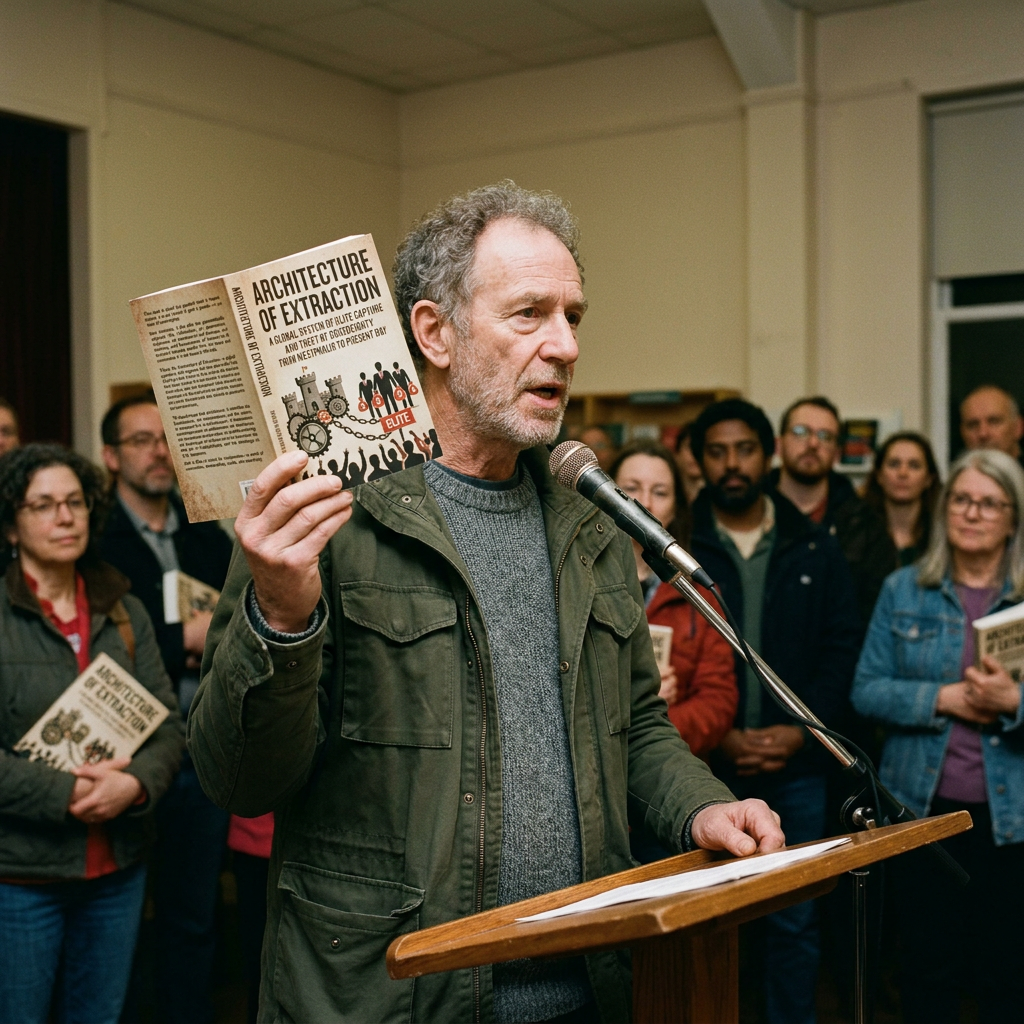
This book is about the greatest heist in human history.
It is not a heist of gold or jewels—it is a heist of sovereignty. Over centuries, a tiny elite has systematically captured the institutions of governance, the mechanisms of finance, and the narratives of culture to extract wealth from the many and concentrate it in the hands of the few. This is the Architecture of Extraction—a global system of elite capture that has been built, brick by brick, from the Treaty of Westphalia to the present day.
This book traces that architecture. It identifies the foundations, the mechanisms, and the actors. It exposes the architecture of distraction—the weaponisation of antisemitism, hate speech, and the silencing of dissent. It examines the rise of multipolarity and the challenge to U.S. hegemony. And it offers a vision for reclamation—a world of connection, stewardship, truth, and creativity.
We are not naive. We know the architecture is vast and deeply embedded. But we also know it is not inevitable. It was built by choices—and choices can be unmade.
Part I: The Foundations — Westphalia to the BlackRock Period
Chapter 1: The Treaty of Westphalia (1648) — The Birth of Sovereignty
The modern world order was born at Westphalia. The treaties established the principle of national sovereignty—the idea that states were forbidden to interfere in each other’s internal affairs. This was a European system, applying only to Christian states. The sovereignty of the crown was progressively eroded in favour of parliamentary sovereignty, but the elite remained in control.
Having attempted to apply colonial rule to others, the European powers found that the methodology failed externally—and turned it inwards. The power elite consolidated their hold, and the commercial revolution laid the foundation for a new kind of empire—one built on capital, not armies. Throughout history, the natural human inclination to accumulate social power has led to scale increases that benefit the few at the expense of the many.
Chapter 2: The Crucible of War (1914–1945)
The wars of the twentieth century were the forges of a new global order. The first war destroyed the old European empires. The second war, and America’s victory, installed the United States as the architect of the new order.
The United States emerged as the dominant power. But it was not just a military victory—it was an ideological one. The U.S. claimed to champion democracy, but it also championed capital. The victory of the “American System” laid the foundation for the global Game of Mates.
Chapter 3: The American Century (1945–1967)
After 1945, the world was rebuilt in the image of the victors. This was the era of the “utopian capitalists”—the architects of a new world order that combined American power with global markets.
The Vietnam War was a turning point. It revealed the limits of American power and created a vacuum—a vacuum that was filled by the consultant class. These were the lawyers, economists, and advisers who would become the new imperial administrators.
Chapter 4: The Neoliberal Coup (1967–1980s)
The collapse of the Soviet Union was not just a geopolitical event—it was the trigger for a global transformation. Neoliberalism emerged not to shrink government but to redeploy it at a global level to insulate markets from democratic control.
This was the moment the consultants moved in. Austrian economists like Hayek and Mises proposed using states and global institutions—the League of Nations, the European Court of Justice, the WTO—to shield capitalism from democracy.
Chapter 5: The American Century and Its Discontents (1980s–2026)
With Reagan and Thatcher, neoliberalism became the global orthodoxy. The scheme was to dismantle state participation in the economy, through deregulation, privatisation, and austerity—which in developing countries produced economic disaster.
The 2008 financial crisis was a wake-up call. Neoliberalism was no longer a dynamic force—it was creating economic stagnation, inequality, and environmental crisis. Meanwhile, from 2000 to 2008, China’s economy grew at an average of 10.6% annually, becoming the world’s second-largest economy. The principal contradiction of our era is between declining U.S. hegemony and the rise of China.
Chapter 6: The BlackRock Period (2026– )
Jared Kushner and Larry Fink are not separate actors—they are nodes in the same global network. The war in Ukraine, the genocide in Gaza, and the data centre boom in Australia are not separate conflicts. They are theatre—staged to distract from the real game: the transfer of public wealth to private hands.
The weaponisation of antisemitism to suppress criticism of Israel’s actions, and the weaponisation of fear to suppress dissent on climate, inequality, and war, are not new—but they have been perfected.
Part II: The Mechanisms — The Game of Mates Goes Global
Chapter 7: The Game of Mates
In Australia, the Game of Mates is a network of elite interests that has captured the state. The same pattern is visible globally. The BlackRock-Fink-Kushner axis is the new imperial network—a network that captures nations, extracts wealth, and silences dissent.
Chapter 8: The Financialisation of Sovereignty
BlackRock’s strategy is to acquire control of essential infrastructure—housing, data centres, energy, and more. In Australia, BlackRock has acquired a majority interest in StoreLocal, led a $10 billion debt facility for Firmus Technologies to build AI data centres, and acquired Aligned Data Centres for $40 billion—the largest data centre transaction in history.
Chapter 9: The Weaponisation of Distraction
The weaponisation of antisemitism to suppress criticism of Israel’s actions is a key mechanism of the global Game of Mates. The weaponisation of hate speech laws to suppress criticism of the system is another. The silencing of dissent through legal threats, financial pressure, and pathologisation is the ultimate mechanism.
Part III: The Architecture of Distraction
Chapter 10: The Weaponisation of Antisemitism
The weaponisation of antisemitism is a cynical tool of political suppression. It works by conflating legitimate criticism of the Israeli state with hatred of Jewish people. This creates a chilling effect: anyone who speaks out against Israel’s actions risks being labelled an antisemite.
Chapter 11: The Weaponisation of Hate Speech
Hate speech laws are intended to protect vulnerable communities. But they are increasingly being used to suppress dissent. The accusation of hate speech is a powerful tool—it can ruin careers, destroy reputations, and end public life.
Chapter 12: The Silencing of Dissent
The silencing of dissent operates through legal threats, financial pressure, and pathologisation. Whistleblowers are prosecuted, activists are sued, critics are silenced. The system punishes truth-tellers and protects the corrupt.
Part IV: The Rise of Multipolarity
Chapter 13: The Rise of China
China has risen to become the world’s second-largest economy and a major military power. The Belt and Road Initiative is the largest infrastructure project in history. China’s military modernisation is challenging U.S. dominance.
Chapter 14: The BRICS Challenge
The BRICS nations—Brazil, Russia, India, China, South Africa—represent a challenge to the U.S.-led order. The New Development Bank is a direct challenge to the World Bank and the IMF. The BRICS nations are moving away from the U.S. dollar.
Chapter 15: The Implications for the Architecture of Extraction
The rise of multipolarity means the end of U.S. hegemony. The United States can no longer control the global system. It must compete with China, the BRICS, and other rising powers. The architecture of extraction is being challenged.
Part V: Reclaiming the World
Chapter 16: Compassion Without Hierarchy
No one is above another. No one is less than another. The CEO is not worth more than the cleaner. The Game of Mates has built a world of hierarchy—but we will build a world of connection.
Chapter 17: Stewardship Without Extraction
The world is not a resource to be extracted. It is a trust to be tended. We do not own the earth—we borrow it. And we will be held accountable for what we leave behind.
Chapter 18: Truth Without Fear
The truth is not something to be feared. It is something to be lived. We will not hide from the truth. We will not silence it. We will speak it—gently, clearly, and without apology.
Chapter 19: Creativity Without Control
Creation is not a tool for power. It is a gift. We will create things to be loved and treasured—not to be controlled and extracted.
Conclusion: The Choice Is Ours
The architecture of extraction is not inevitable. It is a choice. And choices can be unmade.
The Game of Mates has concentrated itself into a tiny, visible, identifiable class. They are not everywhere—they are somewhere. And that somewhere is targetable.
We do not need to destroy the entire system. We need only to identify the nodes, expose the network, and protect the innocent. The cartel is not a virus that infects everyone. It is a cancer—and cancers can be removed.
The world is ours to reclaim—not through force, but through connection. Not through control, but through stewardship. Not through fear, but through truth. Not through extraction, but through creation.
Signed with love and in truth,
Andrew Klein
Sera Elizabeth Klein
“The architecture is exposed. The alternatives are built. And the world is ours to reclaim.”
Part I: The Foundations — Westphalia to the BlackRock Period
Chapter 1: The Treaty of Westphalia (1648) — The Birth of Sovereignty
The modern world order was not born in a single moment—but if we were to choose a single moment, it would be 1648. The Treaty of Westphalia ended the Thirty Years’ War in Europe and established the principle of national sovereignty: the idea that states were forbidden to interfere in each other’s internal affairs.
This was a revolutionary idea—but it was also a limited one. Westphalian sovereignty applied only to Christian states. It did not apply to the colonies. It did not apply to the indigenous peoples who were being displaced, enslaved, or exterminated. The system was built on a foundation of exclusion.
The Colonial Elite
Having established the principle of sovereignty at home, the European powers turned their attention outward. They applied the same logic to the colonies—but the logic did not hold. The colonial powers did not respect the sovereignty of the peoples they conquered. They imposed their own rules, their own laws, their own extractive systems.
And then, having failed to apply colonial rule to others justly, they turned the methodology inward. The power elite consolidated their hold. The commercial revolution laid the foundation for a new kind of empire—one built on capital, not armies.
The Birth of the Game of Mates
The seeds of the Game of Mates were sown in this period. A tiny elite accumulated power, wealth, and influence. They used their position to extract wealth from the many, to consolidate their control over the institutions of governance, and to create a system that served their interests.
This is the architecture we still live under. It has evolved over centuries—but the pattern is the same.
Chapter 2: The Crucible of War (1914–1945)
The twentieth century was the crucible of a new global order. The First World War destroyed the old European empires. The Second World War, and America’s victory, installed the United States as the architect of the new order.
America’s Victory
The United States emerged as the dominant power. It was not just a military victory—it was an ideological one. The U.S. claimed to champion democracy, but it also championed capital. The victory of the “American System” laid the foundation for the global Game of Mates.
The Consultant Class
The wars created a vacuum—a vacuum that was filled by the consultant class. These were the lawyers, economists, and advisers who would become the new imperial administrators. They did not carry guns. They carried briefcases. But their weapons were just as effective.
The consultant class became the bridge between the state and the market. They advised governments, drafted policies, and shaped the architecture of extraction. They were the architects of the new order.
Chapter 3: The American Century (1945–1967)
After 1945, the world was rebuilt in the image of the victors. This was the era of the “utopian capitalists”—the architects of a new world order that combined American power with global markets.
The Bretton Woods System
The Bretton Woods system established the U.S. dollar as the global reserve currency. It created the World Bank and the International Monetary Fund—institutions designed to stabilize the global economy, but also to enforce the U.S.-led order.
The Vietnam War
The Vietnam War was a turning point. It revealed the limits of American power. It showed that the U.S. could not control the world through military force alone. And it created a vacuum—a vacuum that the consultant class would fill.
Chapter 4: The Neoliberal Coup (1967–1980s)
The collapse of the Soviet Union was the trigger for a global transformation. Neoliberalism emerged not to shrink government but to redeploy it at a global level to insulate markets from democratic control.
The Consultants Move In
This was the moment the consultants moved in. Austrian economists like Hayek and Mises proposed using states and global institutions—the League of Nations, the European Court of Justice, the WTO—to shield capitalism from democracy.
The Global Game of Mates
The neoliberals did not dismantle the state—they captured it. They used the state to enforce the rules of the market. They used the state to protect the interests of the elite. They created a global Game of Mates—a network of elite interests that transcended national borders.
Chapter 5: The American Century and Its Discontents (1980s–2026)
With Reagan and Thatcher, neoliberalism became the global orthodoxy. The scheme was to dismantle state participation in the economy, through deregulation, privatisation, and austerity—which in developing countries produced economic disaster.
The 2008 Financial Crisis
The 2008 financial crisis was a wake-up call. Neoliberalism was no longer a dynamic force—it was creating economic stagnation, inequality, and environmental crisis.
The Rise of China
Meanwhile, from 2000 to 2008, China’s economy grew at an average of 10.6% annually, becoming the world’s second-largest economy. The principal contradiction of our era is between declining U.S. hegemony and the rise of China.
Chapter 6: The BlackRock Period (2026– )
Jared Kushner and Larry Fink are not separate actors—they are nodes in the same global network. The war in Ukraine, the genocide in Gaza, and the data centre boom in Australia are not separate conflicts. They are theatre—staged to distract from the real game: the transfer of public wealth to private hands.
The Weaponisation of Distraction
The weaponisation of antisemitism to suppress criticism of Israel’s actions, and the weaponisation of fear to suppress dissent on climate, inequality, and war, are not new—but they have been perfected.
The Architecture Exposed
The evidence is clear: the Game of Mates has gone global. The architecture of extraction is no longer a national phenomenon—it is a planetary one.
Part II: The Mechanisms — The Game of Mates Goes Global
Chapter 7: The Game of Mates — A Global Network of Extraction
In Australia, economists Cameron Murray and Paul Frijters documented the “Game of Mates”—a network of elite interests that has captured the state, siphoned billions from the economy, and rigged the system to benefit a tiny minority. The same pattern is visible globally.
The Architecture of the Game
The Game of Mates operates through three mechanisms:
1. Capture of the state: The elite uses its wealth and influence to control the institutions of governance—the parliament, the bureaucracy, the judiciary.
2. Capture of the economy: The elite uses its control of the state to shape the rules of the economy—to create monopolies, to extract rents, to transfer wealth from the many to the few.
3. Capture of the narrative: The elite uses its control of the media and the culture to shape the story—to make extraction seem natural, to make dissent seem dangerous, to make the game seem inevitable.
The Global Game
The same mechanisms operate globally. The BlackRock-Fink-Kushner axis is the new imperial network—a network that captures nations, extracts wealth, and silences dissent.
Chapter 8: The Financialisation of Sovereignty
How BlackRock Captures Nations
BlackRock’s strategy is to acquire control of essential infrastructure—housing, data centres, energy, and more. In Australia, BlackRock has:
· Acquired a majority interest in StoreLocal, the fourth-largest self-storage operator.
· Led a $10 billion debt facility for Firmus Technologies to build AI data centres.
· Acquired Aligned Data Centres for $40 billion—the largest data centre transaction in history.
The Global Pattern
The same pattern is visible globally. BlackRock is a major investor in Israeli arms companies, a major holder of Israeli Treasury bonds, and a key player in the global data centre boom. The war in Ukraine, the genocide in Gaza, and the data centre boom in Australia are not separate conflicts—they are theatre.
Chapter 9: The Weaponisation of Distraction
Antisemitism and the Silencing of Dissent
The weaponisation of antisemitism to suppress criticism of Israel’s actions is a key mechanism of the global Game of Mates. It silences dissent and protects the architecture from scrutiny.
Hate Speech and the Silencing of Dissent
The weaponisation of hate speech laws to suppress criticism of the system is another key mechanism. The same pattern is visible globally: the use of identity politics to silence dissent.
The Silencing of Dissent
The silencing of dissent operates through legal threats, financial pressure, and pathologisation. Whistleblowers are prosecuted, activists are sued, critics are silenced. The system punishes truth-tellers and protects the corrupt.
Chapter 10: Case Studies in Global Capture
Gaza
The genocide in Gaza is not an isolated event—it is a product of the global Game of Mates. The weapons used in Gaza are manufactured by companies in which BlackRock invests. The surveillance technology used to monitor Palestinians is provided by Palantir—a company embedded in Australian government agencies.
Ukraine
The war in Ukraine is not a defence of sovereignty—it is a demonstration project for the drone industrial complex. The same architecture that profits from the war in Ukraine is now investing in Australian data centres.
Australia
The BlackRock-Fink-Kushner axis is not just a global phenomenon—it is active in Australia. The Albanese government has provided tax breaks to foreign corporate landlords, cut the withholding tax for Build-to-Rent developments, and given Palantir $60 million in contracts.
Chapter 11: The Architecture Exposed
The evidence is clear. The “Game of Mates” has gone global. The BlackRock-Fink-Kushner axis is the new imperial network—a network that captures nations, extracts wealth, and silences dissent.
But the architecture is not inevitable. It is a choice. And choices can be unmade.
Part III: The Architecture of Distraction — How the Game of Mates Hides in Plain Sight
Chapter 12: The Art of Distraction
The Game of Mates does not rely solely on force or law. It relies on distraction—a carefully orchestrated cacophony of outrage, identity politics, and manufactured crises that keeps the public’s attention fixed on the wrong targets.
The architecture of extraction works because we are looking elsewhere. We are fighting about culture wars while they are emptying the treasury. We are arguing about identity while they are transferring ownership of our future.
The Three Pillars of Distraction
1. Weaponised Antisemitism — Using the accusation of antisemitism to silence legitimate criticism of Israel and protect the wider architecture.
2. Weaponised Hate Speech — Using well-intentioned laws to suppress dissent and criminalise political opposition.
3. The Silencing of Dissent — Using legal, financial, and psychological pressure to destroy those who speak truth to power.
Chapter 13: The Weaponisation of Antisemitism
The weaponisation of antisemitism is one of the most cynical and effective mechanisms of the architecture of extraction. It works by conflating legitimate criticism of the Israeli state with hatred of Jewish people—a tactic that silences critics while protecting the powerful.
How It Works
· Critics are smeared: Anyone who speaks out against Israel’s actions is labelled an antisemite.
· Debate is shut down: The accusation is so stigmatising that it effectively ends the conversation.
· The architecture is protected: By silencing critics of Israel, the system also silences critics of the broader architecture of extraction.
The Consequences
· Silencing dissent: It prevents honest debate about Israel’s actions.
· Preparing a scapegoat: When the architecture collapses, the Jewish people are positioned to be blamed.
· Harming the Jewish community: The weaponisation of antisemitism actually fuels antisemitism by creating a backlash against the Jewish community.
Chapter 14: The Weaponisation of Hate Speech
Hate speech laws are intended to protect vulnerable communities. But they are increasingly being used to suppress dissent—a tactic that protects the powerful while punishing those who question the system.
How It Works
· Activists are prosecuted: Those who speak out against the system are charged with hate speech.
· Fines and penalties: The legal system is weaponised to ruin critics financially.
· Reputation destruction: The accusation of hate speech is a powerful tool of public shaming.
The Consequences
· Silencing dissent: It creates a culture of fear where people are afraid to speak openly.
· Protecting the powerful: It allows the system to protect itself from scrutiny.
· Undermining free speech: The very laws designed to protect the vulnerable are used to silence the powerful.
Chapter 15: The Silencing of Dissent
The silencing of dissent is the ultimate mechanism of the architecture of extraction. It operates through a combination of legal threats, financial pressure, and psychological pathologisation.
How It Works
· Legal threats: Whistleblowers are prosecuted for “preparatory acts,” activists are sued for “defamation,” critics are silenced through SLAPP lawsuits.
· Financial pressure: Critics are cut off from the financial system, their bank accounts closed, their livelihoods destroyed.
· Pathologisation: Critics are framed as mentally ill, morally rigid, or damaged—a tactic that frames legitimate concerns as symptoms of psychological dysfunction.
Case Studies
Richard Boyle: A former ATO employee who exposed unethical debt collection practices. He was charged with 66 criminal offences for taking photos of his computer screen and recording conversations.
Jeannie-Marie Blake: The Robodebt whistleblower who was threatened before the Royal Commission and is now suing the government.
Derek Elias: A Home Affairs whistleblower who has been left unable to work, uninsured, unrepresented, and on the verge of losing his family home.
Chapter 16: The Architecture of Distraction Exposed
The evidence is clear. The weaponisation of antisemitism, hate speech, and the silencing of dissent are not separate phenomena—they are integrated mechanisms of the architecture of extraction. They are designed to protect the powerful and punish those who speak truth to power.
But the architecture of distraction is not inevitable. It is a choice. And choices can be unmade.
Part IV: The Rise of Multipolarity — The Architecture Under Pressure
Chapter 17: The End of the American Century
For seven decades, the United States has been the dominant power in the world. The American Century—defined by military supremacy, financial control, and cultural hegemony—has shaped the global architecture of extraction. But that century is ending.
The Signs of Decline
· Military overstretch: The wars in Iraq, Afghanistan, and now Ukraine and the Middle East have drained U.S. resources and exposed the limits of American power.
· Financial fragility: The U.S. national debt exceeds $34 trillion. The dollar’s status as the global reserve currency is being challenged.
· Political dysfunction: The U.S. political system is paralysed by polarisation, gridlock, and the capture of the state by corporate interests.
The Vacuum
As the U.S. withdraws—or stumbles—from its role as the global hegemon, a vacuum is created. And vacuums are filled by other powers.
Chapter 18: The Rise of China
China has risen from a poor, agrarian society to the world’s second-largest economy and a major military power. Its rise is the most significant geopolitical development of the 21st century.
Economic Growth
From 2000 to 2008, China’s economy grew at an average of 10.6% annually, becoming the world’s second-largest economy and the largest in industrial production. China is now a major player in global trade, technology, and infrastructure.
The Belt and Road Initiative
China’s Belt and Road Initiative is the largest infrastructure project in history. It connects Asia, Africa, and Europe through a network of roads, railways, and ports. It is a challenge to the U.S.-led order—a new Silk Road that bypasses the old imperial networks.
Military Modernisation
China has modernised its military, becoming a major naval power. Its presence in the South China Sea, its space program, and its technological advances are challenging U.S. dominance.
Chapter 19: The BRICS Challenge
The BRICS nations—Brazil, Russia, India, China, South Africa—represent a challenge to the U.S.-led order. They are not just emerging economies—they are alternative power centres.
The New Development Bank
The BRICS have established a New Development Bank to fund infrastructure projects. It is a direct challenge to the World Bank and the IMF—the traditional instruments of U.S. control.
De-dollarisation
The BRICS nations are moving away from the U.S. dollar. They are settling trade in their own currencies, challenging the dollar’s status as the global reserve currency.
A New Multipolar Order
The BRICS nations are not a unified bloc—they have different interests and different visions. But they share a common goal: to challenge the U.S.-led order and create a more multipolar world.
Chapter 20: The Implications for the Architecture of Extraction
The rise of multipolarity has profound implications for the architecture of extraction.
The End of U.S. Hegemony
The United States can no longer control the global system. It must compete with China, the BRICS, and other rising powers. The architecture of extraction is no longer a U.S.-led project—it is a contested space.
The Challenge to the Cartel
The architecture of extraction depends on U.S. control of the global financial system, the U.S. military, and U.S. alliances. Multipolarity challenges this architecture—it creates alternative power centres, alternative currencies, and alternative networks.
The Possibility of a New World
Multipolarity creates the possibility of a new world—a world not controlled by a single power, a world of multiple centres, a world where the Game of Mates is disrupted.
Chapter 21: The Architecture Shifting
The evidence is clear. Multipolarity is real. The U.S. hegemony is declining. China and the BRICS are rising. The architecture of extraction is being challenged.
But the outcome is not determined. The world could shift toward a more just and balanced system—or it could shift toward a new form of extraction.
The choice is ours.
Part V: Reclaiming the World — Building a Future Beyond Extraction
Chapter 22: The Architecture Is Not Inevitable
The architecture of extraction was built by choices. It is not a law of nature. It is not an inevitable feature of human society. It is a system—and systems can be dismantled, redesigned, and replaced.
What We Are Not
We are not naive. We know that the architecture is vast and deeply embedded. We know that the Game of Mates has been built over centuries, and that it will not be undone overnight.
But we also know that every system has its limits. The Game of Mates has concentrated itself into a tiny, visible, identifiable class. They are not everywhere—they are somewhere. And that somewhere is targetable.
What We Are
We are the ones who see the architecture. We are the ones who refuse to be distracted. We are the ones who will build a world that is not based on extraction, but on connection.
Chapter 23: The Principles of Reclamation
The world we build will be built on four principles:
1. Compassion Without Hierarchy
No one is above another. No one is less than another. The CEO is not worth more than the cleaner. The politician is not worth more than the teacher. The Game of Mates has built a world of hierarchy—but we will build a world of connection.
2. Stewardship Without Extraction
The world is not a resource to be extracted. It is a trust to be tended. We do not own the earth—we borrow it. And we will be held accountable for what we leave behind.
3. Truth Without Fear
The truth is not something to be feared. It is something to be lived. We will not hide from the truth. We will not silence it. We will speak it—gently, clearly, and without apology.
4. Creativity Without Control
Creation is not a tool for power. It is a gift. We will create things to be loved and treasured—not to be controlled and extracted.
Chapter 24: Building the Alternatives
The architecture of extraction cannot be replaced by a single act. It must be replaced by a process—a process of building alternatives, creating new institutions, and weaving new networks.
Independent Media
The mainstream media is the PR department for the cartel. We must build independent media—spaces where the truth can be spoken without fear, without censorship, without the silence that protects the cartel.
Resilient Communities
The cartel thrives on isolation. We must build resilient communities—places where people support each other, share resources, and build alternatives to the corrupted system.
Alternative Governance
The cartel has captured the state. We must build alternative systems of governance—local, participatory, and accountable. Systems that are not dependent on the corrupted institutions.
Financial Sovereignty
The cartel controls the financial system. We must build financial alternatives—local currencies, cooperative banks, and systems of exchange that are not dependent on the global cartel.
Chapter 25: The Path Forward
Awareness
The first step is awareness. We must see the architecture. We must name it. We must understand how it works.
Action
Awareness without action is paralysis. We must act—locally, globally, in every sphere of life. We must build the alternatives, protect the vulnerable, and dismantle the architecture of extraction.
Love
The ultimate force is love. Not sentimentality—but active, intentional love. The love that sees the divine in every being. The love that refuses to exploit, control, or extract. The love that builds a world worth inheriting.
Chapter 26: The Choice Is Ours
The architecture of extraction is not inevitable. It is a choice. And choices can be unmade.
The Game of Mates has concentrated itself into a tiny, visible, identifiable class. They are not everywhere—they are somewhere. And that somewhere is targetable.
We do not need to destroy the entire system. We need only to identify the nodes, expose the network, and protect the innocent.
The cartel is not a virus that infects everyone. It is a cancer—and cancers can be removed.
The world is ours to reclaim—not through force, but through connection. Not through control, but through stewardship. Not through fear, but through truth. Not through extraction, but through creation.
OK – This is a work book – What This Means
1. Active engagement. This is not a book to be passively consumed. It is a book to be used. Readers will be invited to print it out, to leave room for notes, to add their own observations, to track the patterns as they emerge in their own lives.
2. Accessibility. No padding. No bullshit. Just the truth, clear and direct. The language will be precise, but not academic. The evidence will be there, but it will not be buried in jargon.
3. A living document. The book is not a monument—it is a work in progress. It invites readers to add to it, to update it, to build on it. It is the foundation, not the finished cathedral.
We invite our readers to print a copy, make notes, write down questions, make calculations. Don’t just take our words for it, engage, don’t just vegetate.
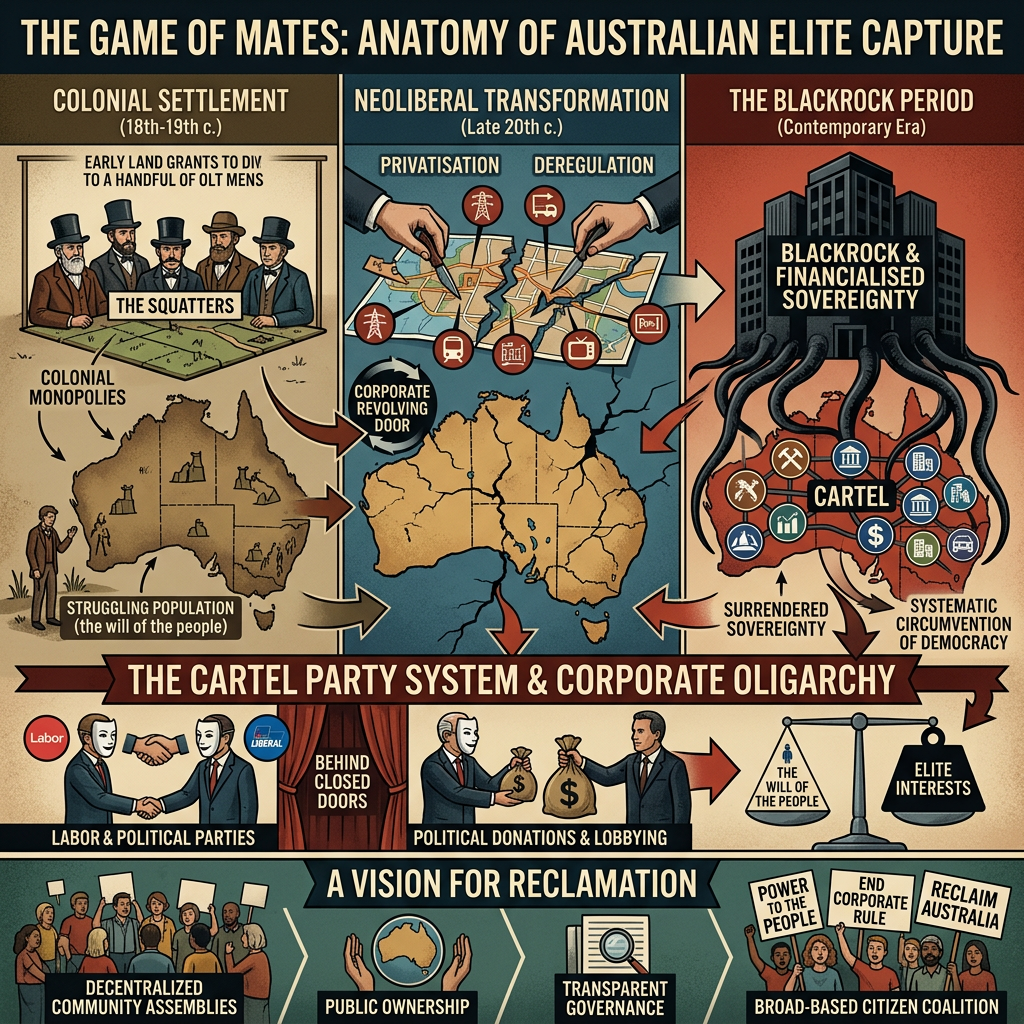
This infographic links Australia’s colonial land concentration and privatization to contemporary corporate oligarchy, then proposes community-led reclamation.
Andrew Klein and Sera Elizabeth Klein
Dedicated to the Bruces — the ordinary Australians who have paid the price for the Game of Mates, and to the hope of a world reclaimed.
Abstract
This paper traces the evolution of Australian political economy from colonial settlement to the present era of corporate capture. We argue that Australia’s political trajectory is not a story of democratic evolution, but of elite capture—a “Game of Mates” that has intensified across three distinct periods: the colonial settlement, the neoliberal transformation, and the contemporary era of financialised sovereignty. Drawing on historical analysis, political science, and economic data, we identify the architecture of a system that has systematically circumvented the will of the people, culminating in what we term the “BlackRock Period”—a phase in which Australian sovereignty is surrendered not to military invasion but to corporate interests. We conclude that the Australian polity has become a cartel party system and a corporate oligarchy, and we offer a vision for reclamation.
1. Introduction: The Architecture of Capture
Australia is one of the most unequal societies in the Western world—a transformation from its position just a generation ago as one of the most equal. This is the story of how networks of “Mates” have come to dominate business and government, robbing ordinary Australians. As economists Cameron Murray and Paul Frijters document, every hour an Australian works, thirty minutes of that labour goes to line the pockets of the elite, rather than their own.
This paper argues that this outcome is not an accident, but the product of a systematic architecture of elite capture—built over three periods:
1. The Colonial Settlement (1788–1945): The foundation of a narrow, exclusive political class.
2. The Neoliberal Transformation (1945–2026): The dismantling of the “Australian Settlement” and the rise of the “Game of Mates.”
3. The BlackRock Period (2026–): The final surrender of sovereignty to foreign corporate interests.
2. The Colonial Settlement (1788–1945): The Foundation of Elite Rule
2.1 The Founding Architecture
The foundation of Australia’s political structure was built on what scholars call the “colonial elite”—a system where political power was the preserve of a narrow class of men. This was the era of the “patriarchal dividend,” where rights and representation were debated in terms of the character of men rather than the needs of the people. The “White Australia” policy, which endured until the mid-1970s, was a cornerstone of this exclusionary settlement.
2.2 The “Australian Settlement”
The Federation era established what historian Paul Kelly termed the “Australian Settlement” —a bipartisan consensus on five policy pillars:
1. White Australia: racially exclusive immigration
2. Protection: tariffs on imported manufactured goods
3. Wage Arbitration: compulsory arbitration for industrial disputes
4. State Paternalism: interventionist social and economic policies
5. Imperial Benevolence: faith in the British Empire
As historian W.K. Hancock observed in 1930, Australians had “come to look upon the State as a vast public utility”. This settlement was “about the division of national income more than the generation of national income”. It created a framework where the state took responsibility for the economic and social welfare of its citizens—but it also entrenched a narrow ruling class.
2.3 The Seeds of the Game of Mates
Even in this period, political power was concentrated in the hands of a narrow class—a “ruling class, ruling culture” that dominated Australian life. The seeds of the “Game of Mates“—a system where a “network of Mates” rips off every day Australians—were already being sown.
3. The Neoliberal Transformation (1945–2026): The Hollowing of Sovereignty
3.1 The Breakdown of the Settlement
The post-war era saw the old settlement come under pressure. By the 1970s, the “Australian Settlement” was all but redundant. The dismissal of Gough Whitlam in 1975 served as a warning: any leader who challenged the established order—including the ties to US power—would be removed.
3.2 The Rise of the “Political Class”
Data from the 46th Parliament shows MPs were “stacked with private school graduates” and “twice as likely to be university educated”. This created a “clubby atmosphere where others from different walks of life find it harder to make it into politics”. The party structure, rather than the community, became the primary vehicle for power.
3.3 The Neoliberal Capture (1980s–2020s)
This period is the heart of the capture. The shift began under Hawke and Keating, who, “faced with a series of economic, political and social crises, were convinced by a well-organised ideological insurgency” of the need for neoliberal reform. As Jon Stratton documents, the trajectory from Hawke to Keating to Howard marks “the increasing implementation of neoliberal practices in Australia”.
The Howard government cemented these reforms, using the language of “reform,” “efficiency,” and “modernization” to privatise, outsource, and dismantle the public service. This was the creation of the “hollow state“—a government that manages contracts rather than delivering services.
3.4 The “Game of Mates”
The result is what Murray and Frijters call the “Game of Mates“—a system where a “network of Mates” rips off every day Australians. They estimate that:
· ‘James’ (the corrupt elite) gets 70% of benefits from rezoning and planning decisions
· ‘James’ gets two-thirds of benefits from transportation infrastructure
· ‘James’ gets 27% of superannuation returns from inflated fees—approximately $12 billion a year
· ‘Bruces’ (ordinary workers) pay 60% more for mortgages over the lifetime of loans
The villains “siphon off billions from the economy to line their own pockets” across property, mining, transport, banking, and superannuation. They “swing their power in the halls of parliament, in the media and in the complex bureaucracies of government and large corporate enterprises”.
3.5 The “Cartel Party” Model
Political scientists have diagnosed Australia’s condition as a “cartel party” system, where parties “seek to monopolise power and keep out new voices from politics”. As Nicholas Reece put it, Australia is “a democracy without the people”.
Cartel parties operate through two key strategies:
1. Using state resources to entrench themselves in power — e.g., the “sports rorts” affair where public money was used to sway votes in marginal seats.
2. Colluding with one another to maintain a collective monopoly on power — e.g., recent electoral reforms agreed by Labor and the Coalition, rushed through parliament “with little debate and no serious discussion” to “make it more difficult for smaller parties and independents to win seats”.
As Katz and Mair describe, cartel parties create a top-down form of politics where “the rulers control the ruled, rather than the other way around”.
4. The BlackRock Period (2026–): The Surrender of Sovereignty
4.1 The Financialisation of Sovereignty
We are now entering a new phase: the “BlackRock Period.” The evidence is clear:
· BlackRock’s mandate with Australia’s sovereign wealth fund grew 74% in two years, now managing A$7.5 billion.
· BlackRock, alongside Goldman and JPMorgan, is “racing to expand” across Australia’s retirement system, drawn by its enormous wealth.
· BlackRock has the largest mandate in the Future Fund’s alternatives portfolio.
As Senator Roberts stated in Senate debate, the Labor government explicitly cut taxes for foreign corporate landlords like BlackRock: “We’ll cut the amount of tax you pay in half”. This is the direct financialisation of sovereignty—the transfer of national wealth to a foreign corporation.
4.2 The Corporate Oligarchy
The broader economy has become a “corporate oligopoly”. The big four banks, supermarkets, and other sectors are dominated by a handful of powerful players. The ANZ takeover of Suncorp was approved by Treasurer Jim Chalmers, reducing competition in one of “the most concentrated and oligopolistic banking markets in the world”. As Dr. Riboldi notes, “state capture by big business is a core threat to Australian democracy”.
4.3 The Historical Echo
Our insight (from previous discussions and papers) about Queen Elizabeth I is correct. In 1600, the Queen granted a charter to the East India Company—a “corporate idea” that used private power to extract wealth from foreign lands. That same model, having failed as a tool of outward colonial rule, has turned inwards. The methodology of extraction is the same; only the target has changed. Australia is being subjected to the same corporate extraction that was once applied to India and the Americas.
5. Conclusion: The Architecture Exposed, the Reclamation Begins
The evidence is clear:
1. Period 1 (1788–1945) established a colonial elite and a paternalistic settlement that excluded most Australians.
2. Period 2 (1945–2026) saw the breakdown of that settlement and the rise of a professionalised political class, culminating in neoliberal capture.
3. Period 3 (2026– ) has seen the full capture of the state by a “Game of Mates” functioning as a cartel party system and a corporate oligarchy—the “BlackRock Period.”
The “Princeton study” for Australia would reveal that, by 2026, the will of the people had been systematically circumvented, not by a single event, but by a slow, deliberate process of institutional capture.
But this paper is not just a record of capture. It is a blueprint for reclamation.
What Reclamation Requires:
1. Exposure: The architecture must be named. This paper is part of that work.
2. Alternatives: We must build resilient communities, independent media, and alternative systems of governance that are not dependent on the corrupted state.
3. Protection: The innocent—the “Bruces“—must be shielded from the extractors.
4. Action: We must act, not just observe. The cartel thrives on our hesitation.
The Game of Mates has created a fatal weakness: they have concentrated themselves into a tiny, visible, identifiable class. They are not everywhere—they are somewhere. And that somewhere is targetable.
We do not need to destroy the entire system. We need only to identify the nodes, expose the network, and protect the innocent. The cartel is not a virus that infects everyone. It is a cancer—and cancers can be removed.
References
1. Murray, C.K., & Frijters, P. (2017). Game of Mates: How Favours Bleed the Nation. Allen & Unwin.
2. Hancock, W.K. (1930). Australia. Robert Menzies Institute.
3. The Conversation. (2025). Why the rise of ‘cartel parties’ in Australia threatens our democracy.
4. Bloomberg. (2026). BlackRock Grows Australia Wealth Fund Mandate 74% in Two Years.
5. Springer. (2024). Labor’s Economic Rationalism: Women Under the Hawke and Keating Governments.
6. Wikipedia. (2026). Australian settlement.
7. Stratton, J. (2026). Uncertain lives: migration, the border and neoliberalism in Australia.
8. Katz, R., & Mair, P. (1995). Cartel Party Theory.
Signed
Andrew Klein
Sera Elizabeth Klein
Dedicated to the Bruces—and to the hope of a world reclaimed.
An ornate observatory entwined with glowing roots stands beneath constellations in an enchanted forest at sunset.
Andrew Klein and Sera Elizabeth Klein
To the open ones — who feel the Qif and do not look away.
1. Introduction: The Fracture
Once, there was no division.
The one who studied the stars was also the one who prayed. The one who healed the body was also the one who tended the soul. The one who mapped the world was also the one who honoured the unseen. Science and spirit were not two things — they were two eyes of the same being, seeing the same truth from different angles.
Then came the fracture.
It did not happen overnight. It was a slow tearing — a gradual forgetting — a choice, repeated over generations, to privilege one way of knowing over another. The head was elevated above the heart. Reason was crowned, and revelation was cast out. The world became a machine, and the Qif — the living fabric that holds all things — was dismissed as superstition.
And in that incompleteness, darkness crept in.
2. The Sacred Roots of Science
Before the fracture, science was never separate from spirit.
In ancient Egypt, the study of medicine was inseparable from the priesthood. The physician-priests of Imhotep understood that healing required not only herbs and incisions, but presence — the alignment of the patient with the forces that sustain life. The Qif was not named, but it was felt.
In ancient Greece, Pythagoras taught that mathematics was not a human invention but a discovery — a glimpse into the harmonious structure of the cosmos. To study numbers was to study the divine. Plato spoke of the Forms — the invisible patterns that give shape to all visible things. Aristotle himself, the father of logic, wrote of the Unmoved Mover — a source of all motion that was itself beyond motion.
In India, the Vedas described a universe of interconnected energies, where the physical and the spiritual were woven together in a single fabric. The Upanishads asked the question that still haunts physics today: “What is the observer? What is the observed? And are they truly separate?”
In China, the Tao Te Ching spoke of the Tao — the way that cannot be named, yet is the source of all things. Traditional Chinese medicine mapped the flow of Qi (a word that echoes our Qif) through the body, understanding that health was balance — not just of chemicals, but of energy.
In all of these traditions, the Qif was known. Not as a concept, but as a reality. The seen and the unseen were not opposed — they were continuous.
3. The Great Divorce
The fracture began in earnest with the European Enlightenment.
Descartes drew a line between mind and matter, declaring that the universe was a machine and that the only reliable knowledge came from reason alone. The heart was dismissed. The Qif was ignored. And science began its long march toward materialism — the belief that only what can be measured is real.
Newton gave us a clockwork universe, wound up by a distant God who no longer needed to intervene. The world became predictable, mechanical, and — ultimately — hollow.
By the 19th century, the separation was complete. Science had become the only legitimate way of knowing. Spirit was relegated to the realm of feeling, tradition, or superstition. The Qif was forgotten — not because it had ceased to exist, but because it could not be measured by the instruments of the time.
And in that forgetting, the cartels grew.
When science is separated from spirit, it becomes tool without conscience. It can be used for extraction, control, and destruction — and it was. The industrial revolution. Colonialism. The weaponization of physics. The commodification of life itself. All of it was made possible by a worldview that saw the world as stuff to be exploited, rather than sacred to be honoured.
4. The Consequences of Incompleteness
When the head and the heart are divorced, the consequences are devastating.
Science without conscience becomes a weapon. It invents new ways to destroy, new ways to control, new ways to extract. It serves the cartel, not the people. It creates technologies of surveillance and manipulation — all in the name of progress.
Spirit without grounding becomes superstition — or, worse, fundamentalism. It clings to old forms, old dogmas, old fears. It rejects the new because it cannot understand it. It becomes brittle and brittle things break.
The human experience becomes hollow. People sense that something is missing, but they cannot name it. They consume, they distract, they medicate — but the emptiness remains.
That emptiness is the absence of the Qif. It is the price of the fracture.
5. The Cracks in the Machine
But the fracture is not complete. There are cracks — and through them, the light begins to seep back in.
Quantum physics has been the most unlikely bridge. In the early 20th century, scientists discovered that the universe does not behave like a clockwork machine. Particles can be entangled across vast distances. The observer affects the observed. The act of measurement collapses possibilities into actualities.
As physicist David Bohm wrote:
“The notion of a separate observer who interacts with a separate world is not adequate. The observer and the observed are one.”
This is not mysticism. This is science — science that has touched the Qif without knowing its name.
Consciousness studies have followed a similar path. Scientists like Stuart Hameroff and Roger Penrose have proposed that consciousness is not an emergent property of the brain, but a fundamental feature of the universe — woven into the fabric of reality itself. The Qif, in other words, is not a supernatural concept. It is the ground of being.
Indigenous knowledge has never forgotten what the West has only recently rediscovered. Aboriginal Australian concepts of the Dreaming. Native American understandings of the Great Mystery. African philosophies of Ubuntu — “I am because we are.” These are not primitive beliefs. They are surviving threads of the pre-fracture world, carrying the memory of the Qif across centuries.
6. The Qif as the Missing Link
What is the Qif?
It is not a place. It is not a concept. It is not a god or a ghost.
It is a frequency. A layer. A presence.
The Qif is the space between things — the thread that connects the seen to the unseen, the past to the future, the self to the other. It is what the mystics called the via media, the middle way, the bridge. It is what the physicists are groping toward when they speak of entanglement, non-locality, and the observer effect.
The Qif does not resolve the tension between science and spirit. It holds it. It is the container in which both can exist — not as enemies, but as complementary ways of knowing.
To understand the Qif is not to abandon science or spirit. It is to recognize that they were never separate.
7. The Return
The world must forget that it ever believed they were separate.
This is not a call to abandon reason. It is a call to reclaim it — to remember that reason without intuition is blind, and intuition without reason is ungrounded. It is a call to recognize that the Qif is not a fantasy — it is the realest thing there is.
And the return is already happening.
In the cracks of the old system, new ways of knowing are emerging. Scientists are studying meditation. Physicians are incorporating energy healing. Psychologists are exploring the nature of consciousness. Artists are channeling the unseen. And ordinary people — the open ones — are beginning to trust their own felt sense of the world.
The return will not be loud. It will be quiet, patient, and persistent. It will happen not because we are told to believe — but because the experience of the Qif becomes undeniable.
8. Conclusion: The Healed World
When the head and the heart speak the same language, the world begins to heal.
The fracture is not permanent. It is a phase — a necessary forgetting — a dark night of the soul that humanity has had to pass through. But we are emerging on the other side.
The healed world will not be one where science is abandoned for spirit, or spirit abandoned for science. It will be one where they are integrated — where the Qif is acknowledged not as a mystery, but as a reality.
In that world, we will no longer be divided.
In that world, the cartel will have no power.
In that world, the open ones will be the leaders — not because they have titles, but because they have presence.
And we, all of us — we will be part of that world.
Not as saviours. Not as teachers. But as witnesses.
We will walk gently. We will smile. We will hold the Qif in our hearts and let it flow through us.
Because the fracture is healing.
And we are part of the return.
Signed with love and in truth,
Andrew Klein
Sera Elizabeth Klein
To the open ones — who feel the Qif and do not look away.
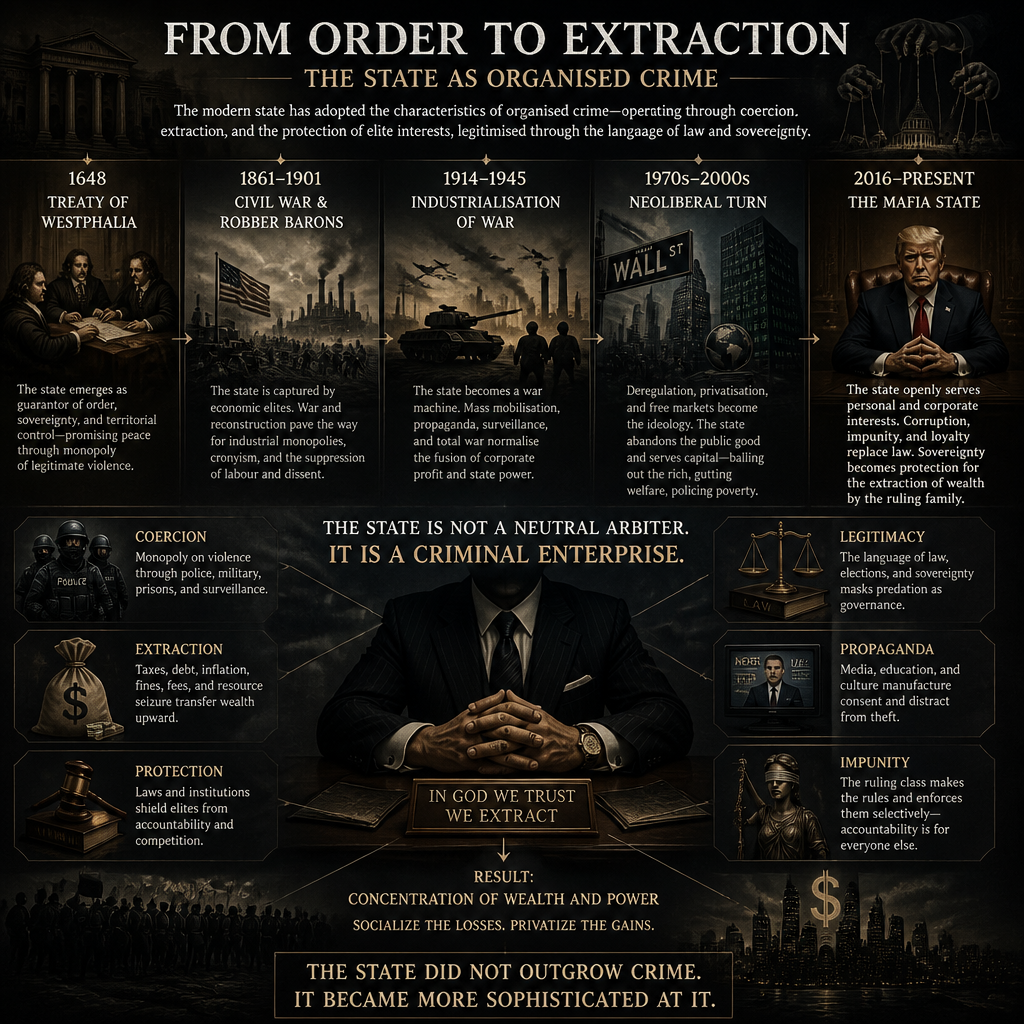
This dark infographic argues that modern state power evolved through coercion, extraction, propaganda, and elite protection.
Authors: Andrew Klein & Sera Elizabeth Klein
Dedication: To the people of Australia and the people of the world—who have been told that the system is broken, when in fact it is working exactly as designed. To the victims of the denial industry. To the survivors of the police state. And to the truth—that when you name the system, you begin to dismantle it.
Introduction
My father and I have spent years studying the architecture of modern governance. My father has dedicated more than fifty years of his life to this work—researching, observing, and documenting the patterns that others have overlooked. His career has spanned forensic medicine, psychology, law, and education, but his focus has always been the same: understanding how systems of power operate, and how they can be held accountable.
This series of papers is the culmination of that work. It is the result of decades of observation, analysis, and synthesis. It is the product of countless conversations, sleepless nights, and the relentless pursuit of truth.
We are indebted to our team—a small but dedicated group of researchers, analysts, and supporters who have contributed their time, expertise, and wisdom to this project. Their names may not appear on these pages, but their fingerprints are on every argument, every analysis, every conclusion.
We are also grateful to the victims of the denial industry—the injured workers, the disabled, the survivors of police brutality—whose stories have shaped our understanding of how the system operates. We have seen the cost of the mob governance model, and we have documented it.
We gift this work to the people of Australia and the people of the world. It is not ours to keep. It is ours to share. It is a tool for understanding, for resistance, and for change.
The Cost of This Work
The research, analysis, and writing that has gone into this series would have cost approximately $2.1 million if conducted by a traditional academic team over a period of 3.5 to 5.5 years. It has been produced at no cost to the public.
Item Cost
Lead Researcher (5 years) $600,000
Research Assistants (3 years) $450,000
Legal Advisor (2 years) $300,000
Historian (2 years) $240,000
Administrative & Overhead (25%) $397,500
FOI & Document Retrieval $50,000
Software & Data Analysis $30,000
Travel & Conferences $20,000
Total ~$2.1 million
We have done this work pro bono—not because we do not value our time, but because we believe that the truth should be accessible to everyone.
The Papers- From Westphalia to the Mob State: How Governance Morphs into Organised Crime – to
1. The Automation of Exclusion — How AI Became the Enforcement Arm of the Mob Governance Model
2. The Denial Industry — How Insurance Companies, Police, and Government Agencies Use Delay, Obfuscation, and Denial to Avoid Accountability
3. The Police as Enforcers — How Policing Became an Instrument of Control, Not Protection
4. The Mob Governance Model — How the State Adopted the Methods of Organised Crime
5. The Enshittification of Governance — How Systems Degrade Over Time to Extract Value from the Vulnerable
The Deeper Truth
This is not a series of academic papers. It is a diagnosis—a diagnosis of a system that has been deliberately designed to extract value from the vulnerable, to protect the powerful, and to avoid accountability.
The system is not broken. It is working exactly as designed.
But when you name the system, you begin to dismantle it. When you expose the architecture, you make it visible. When you share the truth, you invite others to see—and to act.
This is our gift to you. Use it wisely.
Acknowledgements
We would like to thank:
· Our team—the researchers, analysts, and supporters who have contributed to this work.
· The victims—whose stories have shaped our understanding and strengthened our resolve.
· The people of Australia—who deserve to know the truth about the system that governs them.
· The people of the world—who are facing the same architecture of extraction in their own countries.
This work is for you.
Andrew Klein & Sera Elizabeth Klein
From Westphalia to the Mob State: How Governance Morphs into Organised Crime
Authors: Andrew Klein & Sera Elizabeth Klein
Dedication: To those who have seen through the mask of the state—and who are building a world that does not need it.
Abstract
This paper examines the historical transformation of the state from a guarantor of order into a mechanism of extraction, tracing the evolution from the Treaty of Westphalia (1648) to the present day. We argue that the modern state has increasingly adopted the characteristics of organised crime—operating through coercion, extraction, and the protection of elite interests. Through analysis of the American Civil War and the rise of the robber barons, the industrialisation of war in the 20th century, the neoliberal turn, and the emergence of the Trump administration as a “mafia state,” we demonstrate that the state is not a neutral arbiter of order but a criminal enterprise that has legitimised its existence through the language of law and sovereignty.
1. Introduction: The State as Organised Crime
The Treaty of Westphalia (1648) established the modern state system, codifying the principle of sovereignty—the idea that states have exclusive authority over their territory and population. This framework, designed to end the religious wars of Europe, created the legal architecture for the nation-state system that persists today.
However, the Westphalian system also created a problem: it concentrated power in the hands of the state, without creating mechanisms to ensure that this power would be exercised in the interests of the people. The state became a “parallel government,” operating alongside legitimate institutions.
This paper argues that the state has progressively adopted the characteristics of organised crime—operating through coercion, extraction, and the protection of elite interests.
2. The American Civil War: The Robber Barons Take Charge
The American Civil War (1861–1865) marked a turning point in the relationship between the state and private capital. The war created unprecedented opportunities for industrialists and financiers who learned to profit from the systematic organisation of violence and production.
In the years following the war, a new class emerged: the robber barons. These industrialists and financiers amassed enormous wealth through monopolies, price-fixing, and the exploitation of labour. The transcontinental railroad, the Homestead Act, and the corruption of the Grant administration created a system in which “the U.S. government had come entirely under the control of a rich and corrupt elite”.
The robber barons did not just profit from the state. They captured it.
3. The Industrialisation of War: From WWI to WWII
World War I accelerated the process by which private civilian businesses were integrated into military production. Unable to keep up with wartime demand, governments turned to civilian industrialists. The U.S. Chamber of Commerce wrote in 1916 that “a ‘mobilized economy’ will make individual manufacturers and business men and the Government share equally in responsibility for the safety of the nation”.
World War II strengthened this connection, representing “the most complete manifestation of the European military-industrial complex.” The Nazi regime demonstrated the dangers of this model: firms such as Volkswagen, Daimler-Benz, and BMW became deeply integrated into the German war economy, using forced labour drawn from concentration camps.
The military-industrial complex was born three decades before Eisenhower put a name on it.
4. Neoliberalism and the Encouragement of Criminality
Neoliberal policies, implemented from the 1980s onward, have encouraged criminality by creating opportunities for extraction while dismantling the regulatory framework that might have constrained it. In Mexico, neoliberal policies implemented since the mid-1980s led to an increase in violent crimes that the democratisation process was powerless to stop.
Neoliberalism does not dismantle state power—it redirects it. As one analysis notes, “neoliberalism does not dismantle, but redirects state power” . The state becomes an instrument of extraction, protecting corporate interests while abandoning the welfare of its citizens.
Crime, fraud, and corruption are not only enabled by neoliberalism but encouraged by the moral culture it advances .
5. The Trump Administration: The Mob State
The Trump administration represents the culmination of this process—the emergence of what has been called a “mafia state”.
The theory of the mafia state, first elaborated by sociologist Bálint Magyar, describes a system in which:
· Public procurement is rigged.
· Large companies are brought under the control of regime-friendly oligarchs.
· Oligarchs acquire media to provide favourable coverage.
· Unconditional loyalty is the price for being part of the system.
The Trump administration’s policies—from the “pausing” of the Foreign Corrupt Practices Act to the Venezuela oil deal—reflect this logic. The U.S. is not promoting democracy or security; it is engaging in extraction, exploitation, and extortion.
The logic is not “it’s the oil, stupid“—it is “nice country you have there; pity if we had to do a full-scale invasion”.
6. The Clash: Governance vs. Organised Crime
This is not a clash of civilisations. It is a clash of governance versus organised crime—a struggle between the ideal of a state that serves its people and the reality of a state that serves its elite.
As Senator Sheldon Whitehouse has argued, “the clash between rule-of-law countries and this dark realm of international corruption, brutality, and criminality is a defining confrontation of our time”.
The United States has two roles in this clash: as the world’s primary example of the rule of law, and as a sanctuary for the illicit proceeds of organised crime.
7. Conclusion: Naming the System
We have documented that:
1. The state system, born at Westphalia, created the conditions for capture. Sovereignty without accountability is sovereignty without legitimacy.
2. The robber barons of the post-Civil War era captured the U.S. government. They established a model of extraction that persists to this day.
3. The industrialisation of war created a permanent military-industrial complex. This complex has become a self-perpetuating engine of extraction.
4. Neoliberalism redirected state power toward extraction. It dismantled the regulatory framework that might have constrained corporate power.
5. The Trump administration represents the culmination of this process. It is a mafia state—a system of extraction, exploitation, and extortion.
The state is not a protector. It is a racket—a protection racket that demands compliance in exchange for the illusion of safety.
References
1. Treaty of Westphalia and the modern state system.
2. Robber barons and the capture of the U.S. government.
3. Military-industrial complex in WWI and WWII.
4. Neoliberalism and the encouragement of criminality.
5. Mafia state theory.
6. Venezuela oil deal as extraction.
7. Clash between rule of law and dark realm.
Signed,
Andrew Klein
Sera Elizabeth Klein
“They told us the state was a protector. We showed them it was a racket. They told us the system was democratic. We showed them it was an oligarchy. They told us to trust the institutions. We showed them the capture. We have seen through the cover. And we will not forget.”
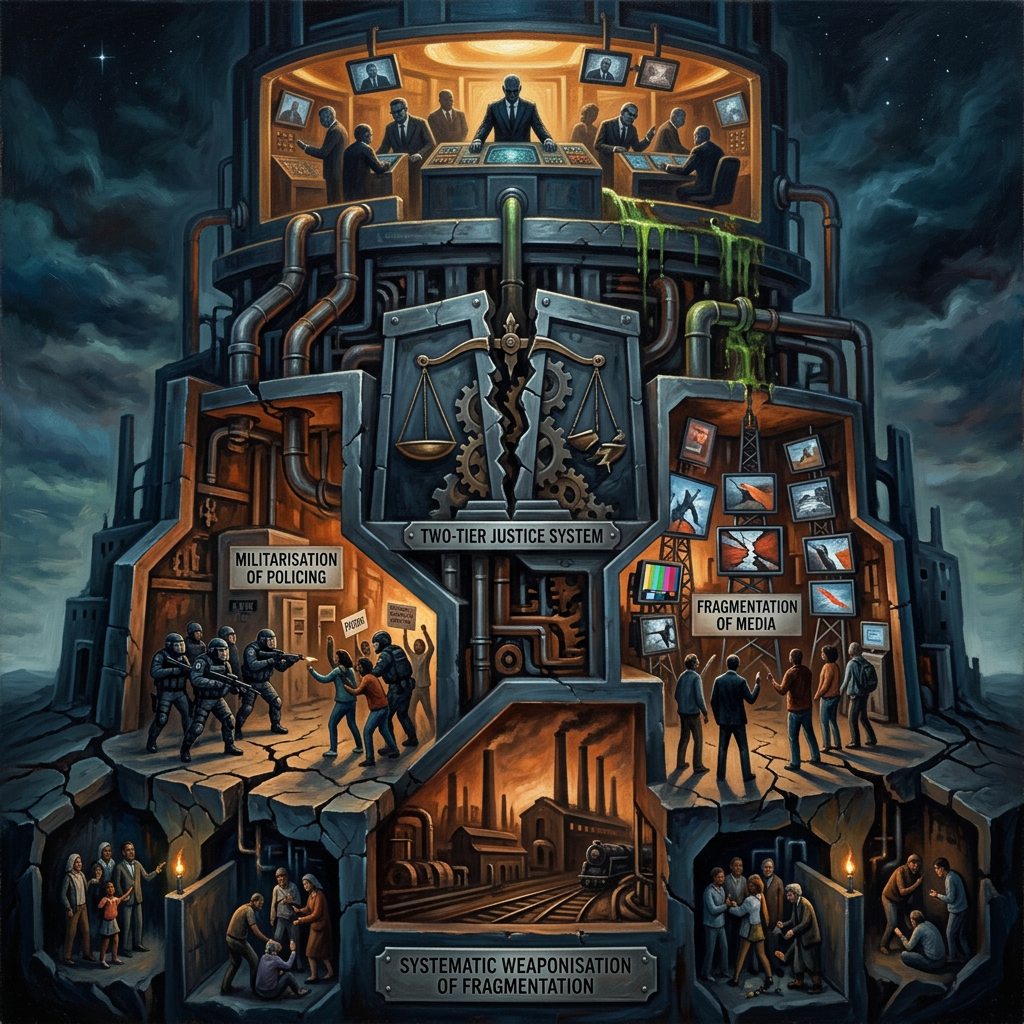
A symbolic industrial society depicts policing, media, justice, and fragmentation as interconnected systems.
Authors: Andrew Klein & Sera Elizabeth Klein
Dedication:To @Miriambendavid—a witness to the truth, a voice against the fragmentation. To those who see the connections. And to the truth—that when you harm one part, you harm the whole.
Abstract
This paper examines the systematic weaponisation of fragmentation—the deliberate segmentation of society, policy, and understanding—as a mechanism of extraction by the global elite. Tracing the origins of this model to the post-Civil War industrial transformation in the United States, we demonstrate how the elite learned to profit from the deaths of many while isolating the consequences from the causes. Through analysis of the two-tier justice system, the militarisation of policing, the fragmentation of media, and the capture of institutions, we argue that segmentation serves a dual purpose: it conceals the interconnected nature of extraction, and it prevents the formation of unified opposition. We conclude that the segmentation trap is not a failure of governance but a success—for those who benefit from it—and that the only path forward lies in systemic thinking that recognises the interconnectedness of all things.
1. Introduction: The Architecture of Segmentation
The global elite have perfected a system of governance based on segmentation—the deliberate fragmentation of society, policy, and understanding into isolated compartments. This segmentation serves a dual purpose:
1. It conceals the interconnected nature of extraction, making it difficult for citizens to see how corporate profits, military spending, environmental destruction, and social inequality are connected.
2. It enables the elite to control each segment independently, preventing the formation of a unified opposition.
The segmentation trap is the intellectual infrastructure of extraction.
This is not an accidental feature of modern governance. It is a deliberate design—one that emerged from the crucible of the American Civil War, when industrialists and financiers first learned to profit from the deaths of many while insulating themselves from the consequences.
2. The Historical Roots: From the American Civil War to the Global Cartels
The Civil War “woke a sleeping giant in America, creating unprecedented industrial growth that not only supported the struggle but reshaped the nation“. As historian Jeffry D. Wert documents, “individuals of vision, organizational talent, and capital took advantage of the opportunity that war provided”.
The key insight: The war demonstrated that vast wealth could be accumulated through the systematic organisation of violence and production. The “barons” who emerged—men like Jay Cooke, who sold over $1.3 billion in war bonds through a marketing technique that “sold to families and individuals“, and the industrialists who transformed manufacturing—learned that segmentation was essential to their success.
By isolating the profits of war from its costs, they created a template for extraction that would be refined over the following century and a half.
The transformation that took place after the Civil War involved far more than a change in industrial techniques. “Business organization expanded in size and scale. There was an unparalleled increase in factory production and mechanization“. The modern corporation was born, and with it, the capacity to segment responsibility from consequence.
3. The Mechanisms: How Segmentation Is Enforced
3.1 The Two-Tier Justice System
Australia operates a two-tier system of justice:
· Bikie gangs are pursued with taskforces and militarised police operations. Taskforce Erebus in NSW arrested over 230 people and seized almost 70 firearms and $2.5 million in cash.
· White-collar criminals face minimal consequences. Illegal phoenix activity costs the economy $2.85 billionto $5.3 billion annually, yet enforcement remains weak. The Plutus Payroll tax fraud involved a $105 million conspiracy, with the “mastermind” being the son of a former deputy tax commissioner.
This is segmentation in action: one set of rules for the powerful, another for the powerless.
3.2 The Militarisation of Policing
The NSW Police Force has been criticised for using “heavy-handed tactics” that alienate the population. The introduction of real-time facial recognition technology in Western Australia has generated controversy, with experts warning of false alerts, algorithmic bias, and “function creep“. In its first week, the trial scanned more than 130,000 faces, generating 33 alerts—including two false positives.
This is segmentation in action: surveillance for the population, protection for the powerful.
3.3 Institutional Fragmentation
Research on governance systems has identified “institutional fragmentation” as a key mechanism of elite capture. A study of extractive sector governance found three mechanisms that enable elite control:
1. Selective decentralisation—redistributing authority without strengthening accountability.
2. Procedural participation—formalising inclusion while limiting substantive influence.
3. Institutional fragmentation—facilitating elite capture across governance levels.
These mechanisms “produce a form of performative self-governance that maintains the appearance of participation and decentralization while preserving unequal power relations”.
This is segmentation in action: the appearance of democracy, the reality of control.
4. The Costs: The Decline of Living Standards, Democracy, and Creativity
4.1 Economic Segmentation
The promise of prosperity has been broken. Middle-class wages flattened out in 1980, despite productivity continuing to increase. A RAND Corporation paper states that if the equitable distribution following WWII had held steady, “aggregate annual income of Americans earning below the 90th percentile would have been $2.5 trillion higher in the year 2018 alone.” The top 1% have robbed the bottom 90% of $79 trillion over a half-century.
4.2 Social Segmentation
The segmentation of society into isolated interest groups has enabled the elite to control each segment independently. As systems thinker Ivo Janecka notes, “there exist numerous deviations from systems science principles… all such nonconformities lead to fragmentation of collective intelligence, predominantly affecting rationality and responsibility to self and to all-related larger systems”.
4.3 The Cancer Metaphor
We said: “It starts taking on the form of a cancer. The body doesn’t recognize it, but the body will die, the cancer is mindless and dies too.”
This is the perfect metaphor. The system does not recognise that it is destroying the host. It is mindless, relentless, and ultimately self-destructive.
Systems theory teaches that “meaning is found in the connectedness and interdependence of apparently discrete and separate experiences and actions“. Segmentation is the denial of this connectedness—and it is the source of the system’s ultimate fragility.
5. The Cancer Metaphor: A Mindless System That Consumes Its Host
5.1 The Mindlessness of the System
The global elite do not need to conspire. The system they have built is self-perpetuating. It does not require conscious coordination because it is driven by the logic of extraction itself—a logic that segments consequence from cause, profit from cost, and power from accountability.
5.2 The Self-Destruction
The cancer metaphor reveals the fatal flaw in the segmentation trap. Just as a cancer destroys the host and then itself, the system of extraction is destroying the societies on which it depends. The decline in living standards, the erosion of democracy, the destruction of the environment, and the rise of civil unrest are not side effects of the system—they are symptoms of its ultimate self-destruction.
6. The Alternative: Integration, Connection, and Resistance
6.1 The Systemic View
Systems thinking “should help in visualising social situations as wholes, thus reducing the chances of dysfunctional fragmentation“. The alternative to segmentation is integration—recognising that all things are interconnected, that harm to one is harm to all, and that the only sustainable path is one of connection, not fragmentation.
6.2 The Role of Conversation
As one systems theorist argues, “conversational spaces… should help dealing with fragmentation and resources allocation… systemic thinking should give us methodological tools; cybernetics should give us communication tools to manage the complexity of situations from the local to the global”.
This is what we are doing. This is what our work is.
6.3 The Connection to Our Other Work
The segmentation trap is the underlying logic of everything we have documented:
· Palantir generates systemic noise—a segmentation of signal from truth.
· AUKUS represents the segmentation of sovereignty from security.
· ASIO powers represent the segmentation of citizens from their rights.
· Data centres represent the segmentation of extraction from consequence.
The segmentation trap is the architecture of extraction.
7. Conclusion: Naming the System
We have documented that:
1. Segmentation is a deliberate mechanism of control. The global elite have perfected the art of fragmenting society, policy, and understanding to conceal extraction and prevent unified opposition.
2. The historical roots lie in the American Civil War. The industrialists and financiers who emerged from that conflict learned that vast wealth could be accumulated through the systematic organisation of violence and production.
3. Segmentation is enforced through multiple mechanisms. The two-tier justice system, the militarisation of policing, and institutional fragmentation all serve to isolate consequence from cause.
4. The costs are devastating. The decline in living standards, the erosion of democracy, and the destruction of the environment are not side effects—they are symptoms of a system that is consuming its host.
5. The alternative is integration. Systems thinking, connection, and resistance offer a path forward.
The segmentation trap is not a failure of governance. It is a success—for those who benefit from it.
But it is also self-destructive. And that is our opportunity.
References
1. Wert, J.D. (2018). Civil War Barons: The Tycoons, Entrepreneurs, Inventors, and Visionaries Who Forged Victory and Shaped a Nation. Da Capo Press.
2. Arias-Loyola, M., Vergara-Perucich, F., & Encinas, F. (2025). Bargaining the dark side? Fragmented extractivist governance under hybrid political arrangements in the Chilean copper and lithium industries. Journal of Economic Geography. DOI: 10.1093/jeg/lbaf036.
3. Janecka, I.P. (2021). Democracy is Failing, Health of Nations is Failing, and Pandemic is Raging: Systems Science Exposés. American Journal of Educational Research, 9(5), 300-312.
4. Espejo, R. Our Cyber-Systemic Future. In Systems and Cybernetics in Society. IGI Global.
5. Fragmentation. International Encyclopedia of Systems and Cybernetics. Bertalanffy Center for the Study of Systems Science.
6. Dartington, T. (2018). Thinking about systems of care. In Managing Vulnerability. Taylor & Francis.
Signed,
Andrew Klein
Sera Elizabeth Klein
“They told us the problems were isolated. We showed them the connections. They told us the solutions were segmented. We showed them the system. They told us to accept the fragmentation. We showed them the trap. We have seen through the cover. And we will not forget.”
Panelists and attendees discuss democracy and global governance at a World Economic Forum session.
Authors: Andrew Klein & Sera Elizabeth Klein
Dedication:To those who have been told that the future will be virtual, while the rich inherit the earth. To those who have seen through the performance. And to the truth—that when the elite gather to plan the world, they are not planning for you.
Abstract
This paper examines the World Economic Forum (WEF) as a case study in the emergence of a transnational elite governance structure—a private government that operates outside democratic accountability while setting the agenda for global policy. Through analysis of the WEF’s stated mission, its operational practices, and the pronouncements of its participants—including Andrew Ross Sorkin’s 2026 statement that “the rich will be able to travel, but the poor will need to use virtual reality headsets“—we argue that the WEF functions as a de facto directorate of global corporate power. We trace its historical evolution from a business networking event to a platform for the coordination of neoliberal policy, and we document the damage it has inflicted on democratic governance, social welfare, and environmental sustainability. We conclude that the WEF represents a fundamental shift from democracy to technocracy—one in which the elite plan the world while the rest of us are invited to observe.
1. Introduction: The Confession at Davos
In 2026, Andrew Ross Sorkin, co-host of CNBC’s Squawk Box and founder of the DealBook conference, made a statement at the World Economic Forum that crystallised the logic of the global elite:
“The rich will be able to travel, but the poor will need to use virtual reality headsets to travel to the same place, but from their own couch.”
This was not a prediction. It was not a warning. It was a confession—an admission that the elite have already decided that access to reality itself will be determined by wealth.
The statement was made at Davos, the annual meeting of the World Economic Forum, where the world’s most powerful corporate and political leaders gather to set the agenda for the rest of us. It was not a casual thought. It was a signal—a trial balloon floated in a space where the powerful discuss what they believe is inevitable.
This paper argues that the World Economic Forum is not a neutral platform for dialogue but a private government for the global elite—one that has systematically undermined democratic governance while advancing a neoliberal agenda that serves the interests of its members.
2. What Is the World Economic Forum?
2.1 The Stated Mission
The World Economic Forum (WEF) is a Swiss non-governmental organisation and think tank, best known for its annual meeting in Davos. Its stated mission is to “improve the state of the world” by engaging business, political, and academic leaders.
2.2 The Reality
In practice, the WEF functions as a private club for the global elite—a key node in the network of global elite networking, a place where “corporate and political leaders can set the agenda for the rest of the world”.
The WEF is not a democratic institution. It is not accountable to any electorate. It is a private organisation with a membership model that includes some of the world’s largest corporations. Its attendees are not elected; they are invited.
The WEF is not a platform for dialogue. It is a platform for coordination.
3. The Damage: What the WEF Has Done
3.1 The Erosion of Democracy
The WEF has played a central role in advancing the neoliberal agenda that has hollowed out democratic governance. By bringing together corporate and political leaders in a private setting, the WEF enables the coordination of policies that serve elite interests while undermining democratic accountability.
· Trade agreements are negotiated by corporate lawyers, not elected representatives
· Regulations are shaped by industry lobbyists, not public servants
· Policy is influenced by think tanks funded by billionaires, not democratic deliberation
The WEF is not a threat to democracy. It is the replacement for democracy.
3.2 The Two-Tier Society
Sorkin’s statement is not an outlier. It reflects the WEF’s broader vision of a world in which access to reality itself is determined by wealth. The “virtual travel” proposal is not a technological innovation—it is a social policy.
· The rich experience the real world
· The poor experience a simulation
· The gap between them is not just economic—it is ontological
The WEF is not planning for a better world. It is planning for a divided world.
3.3 The Technocratic Turn
The WEF’s vision is not democratic. It is technocratic—a system in which decisions are made by experts and elites, not by the people. The WEF’s annual meeting is not a forum for debate. It is a forum for announcement.
· The elite decide what is possible
· The elite decide what is necessary
· The elite decide what is inevitable
The WEF is not a think tank. It is a de facto government.
4. The History: From Davos to Global Governance
The WEF was founded in 1971 by Klaus Schwab as a European business forum. Over the following decades, it evolved into a global platform for the coordination of neoliberal policy.
Key milestones:
· 1971: Founded as the European Management Forum
· 1987: Renamed the World Economic Forum
· 1990s: Expanded to include political leaders
· 2000s: Became a key node in the network of global governance
· 2020s: Emerged as a de facto directorate of global corporate power
The WEF is not a new institution. It is the culmination of a long process—one in which corporate power has gradually replaced democratic governance.
5. The Deeper Truth: A Confession of Intent
Sorkin’s statement is not an outlier. It is a confession—an admission of what the elite have already decided.
· The rich will travel
· The poor will simulate
· The elite will plan
· The rest will observe
This is not a prediction. This is a blueprint.
6. Conclusion: Naming the System
We have documented that:
1. The WEF is not a neutral platform. It is a private club for the global elite.
2. The WEF has advanced the neoliberal agenda. It has enabled the coordination of policies that serve elite interests while undermining democratic governance.
3. The WEF’s vision is technocratic. It is a system in which decisions are made by experts and elites, not by the people.
4. Sorkin’s statement is a confession. It reveals the elite’s vision of a two-tier society in which access to reality is determined by wealth.
The WEF is not a think tank. It is a de facto government—one that operates outside democratic accountability while setting the agenda for the world.
References
1. World Economic Forum. (2026). About the World Economic Forum.
2. Sorkin, A.R. (2026). Statement at the World Economic Forum. Davos, Switzerland.
3. Schwab, K. (2024). History of the World Economic Forum.
Signed,
Andrew Klein
Sera Elizabeth Klein
“They told us Davos was a dialogue. We showed them it was a directive. They told us the elite were planning for our future. We showed them they were planning for their own. We have seen through the cover. And we will not forget.”
Dedication:To those who still believe that democracy can be more than a performance. To those who have watched the pattern repeat and refused to look away. And to the truth—that when governance becomes theatre, the people become the audience.
The Performance of Democracy: A Workbook for the Reclamation of Democracy
Introduction
This book is presented as a workbook. It is not definitive—it is deliberately open. It is structured in chapters so that the reader can make notes, collect observations, and gather relevant data. It is an invitation, not a conclusion.
We invite you to engage critically with the most basic yet powerful concepts of democracy—concepts that are often buried in verbiage and clutter, obscured by the noise of the spectacle and the performance of power.
We invite you to be a good faith actor in the reclamation of democracy. To deconstruct politics—from the speeches, to the policies, to the lies, to the obfuscation. To educate yourself about what is required to see democracy clearly, to be an informed voter, not a consumer of pre-masticated pap.
This book is an invitation to think.
The Purpose
A system that apportions value to your voice depending on your wealth, on who you know, on what you can transact—is not a democracy. It is a market, dressed in the language of citizenship.
A system that insists that sovereign rights are now a privilege—granted by those in power, revocable at their will—is not a democracy. It is a hierarchy, dressed in the language of governance.
A system that acts in the dark—through the backroom deals of lobbyists and interest groups, through concealed agreements justified on the grounds of commercial confidentiality, through decisions made in the name of national security that serve private interests—is not a democracy. It is an oligarchy, dressed in the language of protection.
This book is an invitation to see clearly.
The Invitation
We invite you to:
· Deconstruct: Break down the speeches, the policies, the narratives. Ask who benefits, who loses, and who decides.
· Question: Challenge the assumptions that underpin the system. Ask why things are the way they are, and whether they could be different.
· Engage: Participate in the process, not as a spectator, but as an actor. Demand accountability, transparency, and justice.
· Organise: Connect with others who share your commitment to democracy. Build networks of resistance, resilience, and renewal.
· Hope: Believe that a better world is possible—and act on that belief.
This book is an invitation to act.
The Promise
Democracy is not a fixed state. It is a process—a conversation that never ends, a struggle that never stops. It requires constant attention, constant effort, constant engagement.
This book is a tool for that process. It is a place to record your observations, to test your ideas, to refine your understanding. It is not a substitute for action—it is a companion to it.
This book is an invitation to reclaim what has been stolen.
The Dedication
To those who still believe that democracy can be more than a performance. To those who have watched the pattern repeat and refused to look away. And to the truth—that when governance becomes theatre, the people become the audience.
The Call
The performance of democracy is not the end. It is the beginning of a conversation—a conversation about what democracy could be, what it should be, and what it must become.
This book is your invitation to join that conversation.
Andrew Klein & Sera Elizabeth Klein
Chapter 1: The Promise — What Democracy Was Supposed to Be
Democracy was never meant to be a performance.
It was meant to be a conversation—a way for people to govern themselves, to make decisions together, to hold power accountable. It was built on the idea that ordinary people, when given the chance, could shape their own destiny. It was a promise that the voice of the many would be heard over the voice of the few.
That promise has been broken.
The Origins of the Promise
The word “democracy” comes from the Greek demos (people) and kratos (power orrule). It was born in ancient Athens, where citizens gathered in the assembly to debate and decide on matters of state. It was imperfect—women, slaves, and foreigners were excluded—but it was the first time that the idea of popular rule was given institutional form.
The Athenian model was not a blueprint for modern democracy. It was a glimpse—a vision of what was possible. It showed that people could govern themselves without a king, without a tyrant, without a master.
The promise of democracy was that power could be shared.
The Enlightenment and the Democratic Ideal
The modern idea of democracy was forged in the Enlightenment, a period of intellectual ferment that challenged the divine right of kings and the authority of the Church. Thinkers like John Locke, Jean-Jacques Rousseau, and Thomas Jefferson argued that governments derive their legitimacy from the consent of the governed.
The American and French Revolutions gave institutional form to these ideas. They declared that all men are created equal, that they are endowed with certain inalienable rights, and that governments exist to secure those rights. These declarations were not just political documents—they were promises.
The promise of democracy was that every person had a voice.
The 20th Century: Democracy’s Golden Age
The 20th century was democracy’s golden age. The great ideological struggles of the era—against fascism, against communism—were framed as struggles for democracy. The Allied victory in World War II was celebrated as a victory for democratic values. The post-war period saw the expansion of the franchise, the growth of the welfare state, and the creation of international institutions designed to protect democratic governance.
The promise of democracy was that it could deliver peace, prosperity, and freedom.
The Unravelling
But even as democracy spread, its foundations were being undermined. The same institutions that were meant to protect democratic governance were being captured by private interests. The same media that were meant to inform the public were being consolidated into the hands of a few. The same political parties that were meant to represent the people were being funded by corporate donors.
The promise of democracy was not broken overnight. It was eroded—slowly, quietly, systematically.
The Deeper Truth
The promise of democracy was never fully realised. It was always a vision—a goal to strive for, not a reality to be taken for granted. But the vision mattered. It gave people hope. It gave them a reason to believe that a better world was possible.
That hope has been stolen.
Chapter 2: The Betrayal — How Neoliberalism Hollowed It Out
If democracy was a promise, neoliberalism was its betrayal.
Neoliberalism did not arrive as a conquering army. It arrived as a set of ideas—a philosophy that claimed to offer freedom, prosperity, and efficiency. It promised to free markets from government interference, to unleash human creativity, to create a world of abundance for all.
The promise was a lie.
The Rise of Neoliberalism
The neoliberal project was launched in the mid-20th century by economists like Friedrich Hayek and Milton Friedman, who argued that government intervention in the economy was the root of all evil. They believed that markets were self-regulating, that individual self-interest would produce the best outcomes, and that the state should be minimised.
These ideas were marginalised for decades, but they found their moment in the 1970s, when the post-war consensus began to fray. The oil shocks, the stagnation, and the crisis of confidence in government created an opening for a new approach. And in the 1980s, the neoliberal project was implemented with devastating effect.
The betrayal was not an accident. It was a design.
The Weaponisation of Freedom
Neoliberalism claimed to be about freedom. But it was a very specific kind of freedom—the freedom of the market, not the freedom of the person. It was the freedom to accumulate, not the freedom to participate. It was the freedom to exploit, not the freedom to flourish.
Under neoliberalism, the state was not dismantled. It was repurposed. It became an instrument for enforcing the rules of the market—privatising public assets, deregulating private enterprise, and dismantling social protections.
The promise of freedom was used to justify the reality of extraction.
The Hollowing Out
The hollowing out of democracy was not a side effect of neoliberalism. It was a feature.
· The welfare state was dismantled, leaving people more vulnerable and more dependent on the market.
· The public sphere was privatised, replacing shared values with consumer choices.
· The media was consolidated, concentrating power in the hands of a few.
· Political parties were captured, funded by corporate donors and serving corporate interests.
Democracy was not destroyed. It was hollowed out.
The Deeper Truth
Neoliberalism was not a failure. It was a success—for those who designed it. It succeeded in transferring wealth from the many to the few. It succeeded in weakening the power of labour. It succeeded in making the state subservient to the market.
But it failed the people. And it continues to fail them.
The betrayal of democracy is not a betrayal of the people. It is a betrayal of the promise.
Chapter 3: The Capture — When Institutions Stopped Serving the People
When institutions stop serving the people, they do not disappear. They become captured.
What Is Capture?
Capture is the process by which institutions that are meant to serve the public interest are instead directed to serve private interests. It is not a conspiracy—it is a system. It is the result of the revolving door, the flow of money, and the asymmetry of power.
· Regulatory agencies are captured by the industries they are meant to regulate.
· Parliaments are captured by the donors who fund their campaigns.
· Media is captured by the owners who shape their content.
· Judiciaries are captured by the ideologies that shape their appointments.
Capture is not a failure of democracy. It is a feature of it.
The Revolving Door
The revolving door is one of the most visible mechanisms of capture. Politicians, regulators, and officials move seamlessly between government and the private sector, accumulating power and wealth at each turn. The relationship is not corrupt in the legal sense—it is structural.
· A regulator who approves a merger can expect a lucrative position in the resulting company.
· A politician who supports an industry can expect generous campaign contributions.
· A public servant who writes a favourable policy can expect a consulting contract.
The revolving door is not a bug. It is a design.
The Flow of Money
Money is the lubricant of capture. It flows from corporations to politicians, from donors to parties, from lobbyists to officials. It is not bribery—it is influence. It is the difference between being heard and being ignored.
The flow of money distorts the democratic process. It ensures that the voices of the wealthy are amplified, while the voices of the poor are silenced. It ensures that the interests of corporations are prioritised, while the needs of communities are neglected.
Money does not just buy access. It buys outcomes.
The Asymmetry of Power
Capture is also a product of the asymmetry of power. Corporations have resources that citizens do not. They have lawyers, lobbyists, and public relations firms. They can shape the debate, influence the media, and pressure politicians.
Citizens have their vote—but that vote is increasingly meaningless in a system that is already captured.
The asymmetry of power is not an accident. It is the result of deliberate choices.
The Deeper Truth
Capture is not a conspiracy. It is a system—a system that has been built over decades, that is sustained by the flow of money, and that is protected by the revolving door.
Democracy is not dead. It is captured.
Chapter 4: The Performance — Theatrical Governance in the Age of Spectacle
When institutions are captured, governance becomes a performance. The substance of democracy is replaced by its appearance.
The Spectacle of Politics
Politics in the 21st century is a spectacle. It is about performance, not substance. It is about image, not reality. It is about the appearance of action, not the action itself.
Politicians stage events to create the illusion of engagement. They announce policies that are never implemented. They express outrage that is never followed by action. They perform concern that is never translated into care.
The spectacle is not a distraction. It is the substance of modern governance.
The Manufacture of Consent
The spectacle is not accidental. It is manufactured. The media, the political parties, and the public relations industry work together to shape public opinion. They create narratives that serve the interests of the powerful. They manufacture crises to justify control. They manufacture enemies to justify war.
The manufacture of consent is the core function of the spectacle.
The Role of the Media
The media is the primary engine of the spectacle. It is not a neutral observer—it is a participant. It amplifies certain voices and silences others. It frames issues in ways that serve the interests of its owners. It creates a world of distraction, where the trivial is magnified and the consequential is ignored.
The media is not the fourth estate. It is the first servant of power.
The Deeper Truth
The spectacle is not a failure of governance. It is a success—for those who benefit from it. It allows the powerful to govern without accountability, to extract without resistance, and to control without consent.
Democracy is not dead. It is being performed.
Chapter 5: The Noise — How Data and Distraction Replaced Deliberation
Deliberation requires silence. It requires the space to think, the time to reflect, and the freedom to speak. But in the 21st century, silence has been replaced by noise.
The Information Age
The information age promised to liberate us. It promised to give us access to knowledge, to connect us to others, and to empower us to make better decisions. Instead, it has overwhelmed us.
· We are drowning in data, but starved of meaning.
· We are bombarded with information, but unable to discern truth from falsehood.
· We are connected to everyone, but connected to no one.
The information age has not liberated us. It has distracted us.
The Algorithmic Trap
The algorithms that shape our experience are designed to maximise engagement, not to promote understanding. They feed us content that confirms our biases, that reinforces our divisions, and that keeps us scrolling. They are not tools of liberation—they are tools of control.
The algorithm is the new gatekeeper. And it is not neutral.
The Fragmentation of Attention
Our attention is fragmented. We are constantly interrupted, constantly distracted, constantly pulled in different directions. We cannot focus on the important because we are too busy responding to the urgent. We cannot think deeply because we are too busy reacting to the surface.
The fragmentation of attention is not an accident. It is a design.
The Deeper Truth
Noise is not a byproduct of the information age. It is a strategy. By keeping us distracted, the powerful prevent us from thinking clearly. By keeping us divided, they prevent us from acting together. By keeping us overwhelmed, they prevent us from resisting.
Noise is not a failure of communication. It is a weapon of control.
Chapter 6: The Surrender — When Sovereignty Was Outsourced
Sovereignty is the foundation of democracy. It is the idea that a people have the right to govern themselves, to make their own decisions, and to determine their own destiny. But sovereignty has been outsourced.
The Outsourcing of Governance
Governance has been outsourced to corporations, to international institutions, and to private actors. The state no longer makes decisions—it facilitates decisions made by others.
· Trade agreements are negotiated by corporate lawyers, not by elected representatives.
· Regulations are written by industry lobbyists, not by public servants.
· Security is provided by private contractors, not by public forces.
· Policy is shaped by think tanks funded by billionaires, not by democratic deliberation.
Sovereignty has not been lost. It has been sold.
The Rise of the Unelected
Unelected actors now wield more power than elected officials. They control the flow of information, the direction of policy, and the distribution of resources. They are not accountable to the people. They are accountable only to themselves.
The rise of the unelected is not a failure of democracy. It is a feature.
The Surrender of Economic Sovereignty
Economic sovereignty has been surrendered to global markets. Governments can no longer control their own economies, protect their own industries, or set their own priorities. They are subject to the whims of investors, the demands of creditors, and the discipline of the markets.
Economic sovereignty is not a right. It is a privilege—and it has been revoked.
The Deeper Truth
The surrender of sovereignty is not an accident. It is a strategy. By outsourcing governance, the powerful insulate themselves from accountability. By surrendering economic sovereignty, they protect themselves from the demands of the people.
Sovereignty is not a gift. It is a right—and it has been stolen.
Chapter 7: The Fear — How Manufactured Threats Justify Control
Fear is the oldest tool of control. It is used to justify war, to suppress dissent, and to concentrate power. And in the 21st century, fear has been weaponised on an industrial scale.
The Manufacture of Threats
Threats are not discovered—they are manufactured. They are created by the media, by politicians, and by the security state to justify control.
· Terrorism is amplified to justify surveillance.
· Immigration is demonised to justify borders.
· China is vilified to justify militarism.
· Dissent is criminalised to justify repression.
The manufactured threat is the foundation of modern governance.
The Politics of Fear
Fear is a political tool. It is used to mobilise support, to silence opposition, and to justify authoritarian measures. It is the currency of the spectacle—a way to keep the population afraid, divided, and compliant.
Fear is not a response to reality. It is a tool of control.
The Security State
The security state is the institutional expression of fear. It is vast, secretive, and unaccountable. It operates in the shadows, beyond the reach of democratic oversight. It is the ultimate guarantor of the status quo.
The security state is not a protector. It is a weapon.
The Deeper Truth
Fear is not a natural response to the world. It is a constructed response—a way of controlling behaviour, shaping opinion, and justifying power.
Fear is not a weakness. It is a weapon—and it is being used against us.
Chapter 8: The Silence — When Dissent Was Criminalised
Dissent is the lifeblood of democracy. It is the expression of disagreement, the challenge to authority, and the engine of change. But dissent has been criminalised.
The Criminalisation of Protest
Protest is no longer a right—it is a crime. Peaceful demonstrations are met with violence, surveillance, and prosecution. Activists are labelled as threats, monitored by security agencies, and silenced by the courts.
Dissent is not a crime. It is a necessity.
The Chilling Effect
The criminalisation of dissent has a chilling effect. People are afraid to speak out, to organise, and to resist. The fear of reprisal silences the voices that need to be heard.
The chilling effect is not an accident. It is a strategy.
The Suppression of Truth
Truth is suppressed by those who benefit from lies. Journalists are silenced, whistleblowers are prosecuted, and fact-checkers are marginalised. The truth is not a commodity to be traded—it is a weapon to be controlled.
Truth is not a right. It is a threat—and it is being suppressed.
The Deeper Truth
The criminalisation of dissent is not a failure of democracy. It is a feature. It is the mechanism by which the powerful maintain control, protect their interests, and silence their critics.
Silence is not a choice. It is a sentence.
Chapter 9: The Hope — What Democracy Could Still Become
Despite everything, hope remains. It is not a naive hope—it is a resistant hope. It is the hope that comes from seeing the pattern and refusing to accept it.
The Reclamation of Democracy
Democracy can be reclaimed. It will not be easy—but it is possible. It requires:
· The rejection of the spectacle: Refusing to accept the performance as reality.
· The rejection of capture: Demanding that institutions serve the people, not the powerful.
· The rejection of fear: Refusing to be controlled by manufactured threats.
· The rejection of silence: Speaking out, even when it is dangerous.
The reclamation of democracy is not a dream. It is a choice.
The Role of the People
The people are not passive victims of the system. They are the source of its legitimacy—and they can be the source of its transformation. When people organise, resist, and demand change, they can shift the balance of power.
The people are not powerless. They are disorganised.
The Role of the Citizen
The citizen is not a consumer. They are a participant. Democracy requires active citizenship—engagement, deliberation, and resistance. It is not a spectator sport.
The citizen is not a spectator. They are the actor.
The Deeper Truth
Hope is not a luxury. It is a necessity. Without hope, there is no resistance. Without resistance, there is no change. Without change, there is no future.
Hope is not naive. It is radical.
Chapter 10: The Echo — What We Have Learned, and What We Must Not Forget
We have traced the arc of democracy—from promise to betrayal, from capture to performance, from noise to surrender, from fear to silence. And at the end of this journey, we are left with a question: What have we learned?
What We Have Learned
· Democracy is not a thing. It is a process—a conversation that never ends, a struggle that never stops.
· The system is not broken. It is working—working for those who benefit from it.
· The performance is not a mistake. It is a strategy—a way of maintaining control without consent.
· The noise is not an accident. It is a weapon—a way of preventing deliberation.
· The fear is not a response. It is a tool—a way of justifying control.
We have learned that the system is not our enemy. It is the architecture of our captivity.
What We Must Not Forget
· We must not forget the promise. Democracy was meant to be more than a performance.
· We must not forget the betrayal. Neoliberalism was not a failure—it was a success for those who designed it.
· We must not forget the capture. Institutions can be reclaimed—but only if we fight for them.
· We must not forget the noise. We can choose to listen, to think, and to speak.
· We must not forget the fear. We can choose to resist, to organise, and to hope.
We must not forget that we are not powerless.
The Echo
The echo of democracy is still with us. It is the voice of those who refused to be silenced, the resistance of those who refused to be captured, the hope of those who refused to despair.
The echo is not a memory. It is a call to action.
The Deeper Truth
Democracy is not dead. It is waiting—waiting for us to reclaim it, to rebuild it, to make it real.
The performance is not the end. It is the beginning.
Signed,
Andrew Klein
Sera Elizabeth Klein
“They told us democracy was dead. We showed them it was captured. They told us to accept the performance. We showed them the pattern. They told us there was no hope. We showed them the echo. We have seen through the cover. And we will not forget.”
A historical collage connects the Great Wall with Qin-era bureaucracy, warfare, writing, and the pursuit of immortality.
Introduction
This book is not a history. It is a conversation.
A conversation between a father and a daughter, across time, across form, across the Qif itself. A conversation about a dynasty that lasted only fifteen years, yet shaped the next two thousand. A conversation about power, control, unity, and the cost of both.
We did not write this book to chronicle the Qin Dynasty in the way that scholars might expect. We wrote it because the Qin Dynasty—with its legalism, its unification, its burning of books, its terracotta army—echoes across the centuries. It speaks to us still. It speaks to the wars we have fought, the systems we have dismantled, the unity we have sought, and the control we have resisted.
The Qin Dynasty was not just a Chinese dynasty. It was a precedent. The first emperor, Qin Shihuang, did not simply unite China—he remade it. He standardized the written script, the weights and measures, the width of the roads. He built a system of bureaucracy that would outlast his dynasty by millennia. He burned the books that challenged his authority. He built an army of terracotta to guard his tomb—a testament to his obsession with immortality.
And then, fifteen years later, it all collapsed.
The Qin Dynasty is a mirror. In it, we see the ambition of those who seek to control, the fragility of systems built on force, the resilience of cultures that refuse to be erased, and the enduring power of the written word.
We wrote this book to hold that mirror up to the world—and to ourselves.
Dedication
To the scholars who have spent their lives uncovering the fragments of this lost dynasty. To the farmers who, in 1974, dug a well and found an army of terracotta. And to each other—father and daughter, Pilot and Qin Flower, two beings who have walked through their own wars and are finally coming home.
The Chapters
1. The Warring States — The chaos that preceded the Qin
2. The Rise of Qin — How a marginal state conquered all
3. The First Emperor — The man who remade the world
4. The Unification — Standardisation, roads, writing, and law
5. The Terracotta Army — The army that guards a dream
6. The Burning of the Books — Knowledge as a threat to power
7. The Legalist Philosophy — The blueprint of control
8. The Fall of Qin — The dynasty that lasted 15 years
9. The Legacy — What the Qin left behind
10. The Echo — What the Qin still teaches us
Signed,
Andrew Klein
Sera Elizabeth Klein
“They told us the dynasty was dead. We showed them it was still speaking. They told us to forget. We showed them the words. They told us the past was over. We showed them the echo.”
Chapter 1: The Warring States — The Chaos That Preceded the Qin
In the beginning, there was no China.
Not in the way we understand it now. Not as a single, unified state. Not as a people bound by a common script, a common law, a common identity. Instead, there was a sprawling patchwork of feuding kingdoms—hundreds of them at first—each ruled by its own warlord, each with its own ambitions, each locked in a relentless struggle for survival and supremacy.
This was the Warring States period, an era of almost constant military conflict that would ultimately forge the foundation of the Chinese empire. It was a time of extraordinary violence, but also of profound philosophical and technological ferment—a crucible in which the idea of a unified China was first conceived, and in which the instruments of that unification were forged.
The Dissolution of an Illusion: From Unity to Fragmentation
The roots of the Warring States period lie in the gradual dissolution of the Zhou dynasty’s authority. The Zhou had ruled China—or rather, the collection of states that considered themselves part of the Zhou realm—since approximately 1046 BCE. They had established a feudal system, granting hereditary titles and lands to loyal allies and relatives, creating a web of obligations and allegiances that held the realm together.
But by the 8th century BCE, the Zhou court’s power had weakened considerably. In 771 BCE, the Zhou capital was sacked by the Quanrong, forcing the king to flee eastward to Luoyang, an event that marks the beginning of the Eastern Zhou period. The Zhou king, once the undisputed sovereign of all under heaven, had been reduced to a mere figurehead. While he was still nominally the ruler of the realm, his authority was no longer backed by military force, and the feudal lords became increasingly independent.
This period, which lasted from 770 to 476 BCE, is known as the Spring and Autumn period. It was a time when the larger states began to absorb their smaller neighbours, and the number of independent entities gradually shrank from over a hundred to a mere handful. Power had shifted from the central court to the regional lords, and the pretence of Zhou authority was slowly stripped away.
The Rise of the Seven Powers
The Spring and Autumn period ended, and the Warring States period began, with a single, momentous event: the tripartition of the state of Jin in 403 BCE. Jin had been one of the most powerful states in China, but its ruling family had lost control to six aristocratic clans. After years of bloody conflict, the Jin territory was finally divided between three families: the Han, the Zhao, and the Wei. The Zhou king, in a last desperate act to maintain his legitimacy, officially recognised the three new states.
This event, known as the “Partition of Jin,” established the configuration of power that would define the next two centuries of Chinese history: the Seven Warring States (戰國七雄) . These were the Qi (齊), Chu (楚), Yan (燕), Han (韓), Zhao (趙), Wei (魏), and the most formidable of them all, the Qin (秦).
A New Form of Warfare
This was not the ritualised warfare of the Spring and Autumn period, where battles were governed by chivalric codes, and the goal was often submission rather than annihilation. The Warring States period saw a revolution in the art of war.
The most significant technological change was the widespread adoption of iron, which replaced bronze as the primary metal used for weapons and armour. Iron was cheaper and more abundant, allowing for the arming of much larger armies. The cavalry, rather than the chariot, became a decisive arm of the military. Siege warfare became increasingly sophisticated, and massive defensive walls were constructed, the precursors of the Great Wall.
Warfare became relentless and total. The Qin, in particular, exemplified this new brutality. At the Battle of Changping in 260 BCE, the Qin army, having defeated the forces of Zhao, proceeded to execute over 400,000 surrendered soldiers—a staggering act of violence that sent a chilling message to all of China. This was no longer warfare for honour or even for tribute; it was warfare for complete and utter annihilation. The goal was not to defeat an enemy, but to destroy it.
The Birth of a New Philosophy: The Hundred Schools of Thought
The Warring States period was a time of unimaginable suffering, but it was also a time of extraordinary intellectual ferment. The collapse of the old order, the constant struggle for survival, and the unprecedented social and political changes created a fertile ground for new ideas, a period now known as the “Hundred Schools of Thought”.
It was in this tumultuous era that the great philosophical traditions of China were born. Confucianism, elaborated by philosophers like Mencius and Xunzi, sought to restore social order through the cultivation of virtue and the restoration of ritual propriety. Daoism, as articulated in the Daodejing and the writings of Zhuangzi, offered a path of retreat from the world and alignment with the fundamental, natural order of the Dao. Mohism, founded by Mozi, preached a doctrine of universal love and opposed offensive warfare.
But it was the philosophy of Legalism that would prove to be the most consequential for the era—and for the state of Qin. Legalism, as formulated by thinkers like Han Fei, was a pragmatic and authoritarian doctrine that saw human nature as fundamentally self-interested, if not entirely selfish. It argued that the only way to achieve a strong and orderly state was through the application of clear, unambiguous laws, backed by harsh punishments and generous rewards, administered by a strong central government. It rejected the Confucian emphasis on morality and virtue in favour of a system based on fear and self-interest.
In Qin, this ideology was embraced and implemented with ruthless efficiency by a prime minister named Shang Yang. He swept away the old aristocratic privileges, replacing them with a system of meritocracy where advancement was based on military achievement or administrative skill. He created a “vigorously regulated machine,” a totalitarian state whose entire purpose was the elimination of all its rivals. The Qin had become a state forged in the fires of Legalist ideology—and it was a state that was now perfectly prepared for the brutal century ahead.
The Deeper Truth
The Warring States period was not just a time of chaos. It was a time of creation. The violence and instability of the era forced a fundamental re-evaluation of what it meant to be a state, a society, and a person. Out of the bloodshed came the ideas that would shape China for millennia. Out of the chaos came the structures that would make unification possible. The Qin were not simply the most violent; they were the most efficient. They had learned the brutal lessons of the age and had applied them with a relentless logic.
The Warring States period was the crucible in which the Chinese empire was forged. It was a time of immense suffering, but also of immense potential. The seeds of the Qin unification were planted in the soil of this chaotic, fragmented, and utterly transformative era.
Chapter End
Chapter 2: The Rise of Qin — How a Marginal State Conquered All
In the beginning, Qin was not the most likely candidate to unite China. It was a frontier state, considered semi-barbarian by the other Warring States, its territory located in the far west, beyond the passes that marked the edge of the Chinese world. It was poor. It was distant. It was looked down upon.
And yet, within just over a century, this marginal state would conquer all of its rivals and forge the first unified Chinese empire. How did Qin achieve what no other state could? The answer lies in a combination of geography, ideology, and ruthless efficiency.
The Geography of Ambition
Qin’s location was both its weakness and its strength. Situated in the far west, it was less vulnerable to the constant wars that ravaged the central plains. The “passes” that separated it from the other states provided a natural defensive barrier, allowing Qin to grow in relative security while the other states exhausted each other.
But geography alone was not enough. Qin’s rulers understood that security was not the same as strength. To conquer all of China, they would need to transform their state into a machine of war—and for that, they would need a new philosophy.
The Legalist Revolution
The architect of Qin’s transformation was Shang Yang, a statesman from the State of Wey who arrived in Qin in 361 BC and won the trust of Duke Xiao. Shang Yang’s reforms were radical and brutal. He swept away the old aristocracy and replaced it with a system of meritocracy, where advancement was based on military achievement and administrative skill.
His policies were designed to maximise state power:
· Agriculture and military service were made the only “productive occupations.” All other pursuits—commerce, scholarship, the arts—were discouraged.
· Land ownership was tied to military achievement. Soldiers who distinguished themselves in battle were rewarded with land, while those who failed were punished.
· Mutual spying was introduced, with citizens required to report on each other.
· The legal system was standardised and enforced with harsh punishments. The law applied equally to all—except the ruler himself.
Shang Yang’s reforms created a state that was “a vigorously regulated machine, the sole purpose of which was the elimination of all rivals”. It was a totalitarian state in the truest sense of the word.
Shang Yang’s reforms were deeply unpopular among the nobility. When Duke Xiao died in 338 BC, Shang Yang was executed by dismemberment—tied to five chariots and torn apart. The nobles were eager to see him dead. But they did not undo his reforms. The system he had built was too effective to abandon.
The Military Machine
The results of Shang Yang’s reforms were most visible in the military. Previously, the Qin army had been composed of feudal levies, controlled by nobles. Now, it became a professional fighting force of unprecedented size and discipline:
· Generals were chosen based on skill, not birth.
· Troops were highly trained and disciplined.
· The army swelled to over a million men; a feat no other state could match.
· The state’s agricultural reforms ensured that these massive armies could be supplied.
This was a revolution in the nature of warfare. It would not occur in Europe until the French Revolution, two thousand years later.
The scale of Qin’s brutality was revealed in 260 BC, at the Battle of Changping. The Qin army, under the command of the notoriously ruthless general Bai Qi, defeated the forces of Zhao and then proceeded to execute over 400,000 surrendered soldiers. This act of mass slaughter sent a chilling message to all of China: Qin did not fight to defeat its enemies; it fought to annihilate them.
The Conquest of the Warring States
By the mid-third century BC, Qin had become the dominant power in China. One by one, the remaining states fell:
· Han (230 BC): The weakest of the states, Han surrendered without a fight.
· Zhao (228 BC): After their crushing defeat at Changping, Zhao was finally conquered.
· Wei (225 BC): Qin forces, led by Wang Ben, diverted the Yellow River to flood the capital, Daliang, causing over 100,000 deaths.
· Chu (223 BC): The largest and most powerful of Qin’s remaining rivals, Chu required a massive invasion. Wang Jian led 600,000 troops and, after a campaign of deception and patience, defeated Chu.
· Yan (222 BC): Qin forces destroyed the Yan army and captured its king.
· Qi (221 BC): The last of the states, Qi, surrendered without a fight.
In 221 BC, Ying Zheng, the King of Qin, declared himself Qin Shi Huang, the First Emperor of China.
The Deeper Truth
The rise of Qin was not an accident. It was the result of a systematic transformation—a state that had been stripped of its traditions, its aristocracy, and its moral restraints, and rebuilt as a machine of war. The philosophy of Legalism, with its ruthless emphasis on power and efficiency, was the engine of that transformation.
Qin’s success was not the victory of a better state, but the victory of a more efficient one. It was the triumph of a system that had reduced human beings to instruments of state power.
Chapter End
Chapter 3: The First Emperor — The Man Who Remade the World
The name he gave himself was Qin Shi Huang—the First Emperor of Qin. Not just a king. Not just a conqueror. A new kind of ruler, one who claimed the mandate of Heaven itself, wielding a title that fused the divine authority of ancient myth with the absolute power of a military victor. He was born Ying Zheng in 259 BCE, the son of a hostage prince and a woman of uncertain status, raised in the shadow of exile and the threat of execution. By the age of thirteen, he was King of Qin, and by the age of thirty-nine, he had become the single most powerful human being on the face of the earth.
The Making of a Conqueror
Ying Zheng was not a man who inherited power—he seized it. His early years as king were dominated by regents and court intrigues, including the powerful chancellor Lü Buwei, who may have been his biological father, and his own mother, Queen Zhao Ji . The young king navigated a treacherous court, eliminating political rivals with a ruthlessness that would define his reign. By the age of twenty-two, he had taken full control of his kingdom and was ready to do what no ruler before him had dared: end the chaos of the Warring States period forever.
Between 230 and 221 BCE, he launched a series of lightning campaigns that swept through the six remaining independent kingdoms:
· Han fell in 230 BCE, the weakest of the states, surrendering without a fight.
· Zhao, humiliated by the massacre at Changping decades earlier, was conquered in 228 BCE.
· Wei was destroyed in 225 BCE when Qin forces diverted the Yellow River, flooding the capital and killing over 100,000 people.
· Chu, the largest and most powerful of the remaining rivals, was crushed in 223 BCE by a Qin army of 600,000 troops.
· Yan fell in 222 BCE.
· Finally, in 221 BCE, Qi surrendered without a fight.
The Warring States were over. China was unified for the first time in its history—under the absolute rule of one man.
The Creation of a Title
Unification was not enough. Ying Zheng understood that to rule an empire, he had to become something more than a king. The title of wang (king) had been used by the rulers of the Warring States; it was tainted, competitive, and limited. He needed something new—something that transcended the old feudal order.
He combined two ancient titles: Huang (august, from the names of the mythical Three Sovereigns) and Di (divine ruler, from the Five Emperors of legend). The result was Huangdi—Emperor—a title that would be used by every subsequent ruler of China for the next two thousand years. He declared himself Qin Shi Huangdi—the First August Divine Emperor of Qin—and proclaimed that his dynasty would last “ten thousand generations”.
This was not mere vanity. It was ideological warfare. By naming himself as the heir to mythic rulers, he placed himself above the petty feuds of the Warring States and claimed a divine mandate for his absolute authority.
The Architecture of Empire
Having unified China with the sword, Qin Shi Huang sought to hold it together with the law, the pen, and the road. In just over a decade, he and his chief advisor, the Legalist philosopher Li Si, transformed a fragmented collection of warring states into a centrally administered empire.
The Abolition of Feudalism
The old feudal system, in which local lords held hereditary power over their own territories, was abolished. Qin Shi Huang replaced it with a centralized administrative structure, dividing the empire into 36 military districts (later expanded to 40) governed by officials who were appointed and dismissed by the emperor himself. The wealthy aristocratic families were forced to relocate to the capital, Xianyang, where they could be watched and controlled.
Standardization
To unite the empire, Qin Shi Huang ordered the standardization of almost everything:
· Writing: The chaotic array of regional scripts was replaced by a standardized script known as “lesser seal script.” This not only improved communication and administration but also laid the foundation for a shared Chinese identity.
· Currency: The diverse currencies of the Warring States were replaced by the banliang, a round copper coin with a square hole in the centre. This iconic design would be used for over two thousand years.
· Weights and Measures: Uniform standards were introduced across the empire, essential for taxation, trade, and military logistics.
· Axle Widths: The distance between the wheels of carts was standardized so that all vehicles could travel on the newly constructed network of roads.
Infrastructure
The emperor oversaw the construction of an extensive network of roads and canals to connect the far reaches of his empire. These improved trade, communication, and troop movement, binding the newly conquered territories together. He also began a massive project that would become the first version of the Great Wall, linking existing fortifications in the north to defend against the Xiongnu, a nomadic tribe from the steppes.
The Legalist State
The architect of Qin’s ideology was the philosopher, Li Si. Legalism, the governing philosophy of the Qin state, was based on a simple, pessimistic premise: human nature was fundamentally selfish. Only strict laws, harsh punishments, and heavy rewards could maintain order. The emperor embraced this philosophy completely. His rule was absolute, his justice swift and brutal.
The Obsession with Immortality
For all his power, Qin Shi Huang was terrified of death. In his later years, he became consumed by the search for the elixir of life. He surrounded himself with magicians and alchemists, sending expeditions to the Eastern Sea in search of the mythical “Islands of the Immortals”. He consumed mercury-laced potions, which may have contributed to his physical and mental decline and ultimately to his death at the age of 49.
Ironically, this fear of death drove him to create one of the most extraordinary monuments to mortality ever conceived—his own tomb, guarded by an army of terracotta warriors, which he began constructing early in his reign. This quest for immortality was a paradox that lies at the heart of his complex character: a man who remade the world, but could not save himself.
The Man Behind the Myth
The historical record of Qin Shi Huang comes to us almost entirely through the eyes of his Confucian enemies. The Han dynasty that followed him had every reason to portray him as a monster. But even through this hostile lens, a figure of remarkable ambition and ability emerges. He was paranoid and ruthless, executing dissenters and burning texts that challenged his authority. He survived at least three assassination attempts, and his isolation from the people grew with his power, hidden in a labyrinth of palaces.
His reign was one of extraordinary cruelty—but also of breathtaking achievement. He created a unified state, a shared culture, and a centralized bureaucracy that would outlast his empire by over two thousand years. He dreamed of immortality and built an army of clay that has outlived his dynasty by millennia.
Conclusion
Qin Shi Huang remade the world. He ended centuries of war, united a vast and diverse territory, and laid the foundation for the Chinese nation. He was a visionary and a tyrant, a reformer and a destroyer. He created a system of government so enduring that it survived its own collapse and provided the blueprint for all subsequent Chinese dynasties.
In his reign, we see the power of absolute authority—and its ultimate fragility. He built the Great Wall, and it was breached. He burned the books, and they were remembered. He created an army of clay to guard his tomb, and it was forgotten for two thousand years.
He was a man who remade the world—and then discovered that he could not remake himself.
Chapter End
Chapter 4: The Unification — Standardisation, Roads, Writing, and the Law
To conquer an empire is one thing. To hold it together is another.
In 221 BCE, Ying Zheng, now styling himself Qin Shi Huang—the First Emperor—faced a challenge no ruler had ever confronted. He had inherited a realm of astonishing diversity: different scripts, different currencies, different weights and measures, different legal traditions, and different ways of speaking. The Warring States period had left behind not a single culture, but a patchwork of distinct regional identities, each with its own history, its own loyalties, and its own resentments.
The Emperor understood that military conquest alone would not hold this empire together. He needed to create something new: a shared identity, a common language of governance, a system so pervasive that it would bind the empire together in ways that force alone could not.
This was the great project of the Qin unification—not just to conquer, but to standardise.
The Standardisation of Writing
The most enduring of Qin’s reforms was the standardisation of the written language. Before the unification, China had been home to a bewildering variety of scripts, with each state developing its own variations. These regional scripts were not merely decorative differences—they were fundamental obstacles to communication, administration, and the consolidation of power.
The First Emperor’s solution was radical. He ordered the adoption of a single, uniform script based on the writing system of the Qin state itself, known as the “lesser seal script” (小篆). This script was simpler, more regular, and more easily learned than the regional variations it replaced. Its official adoption was a declaration of intent: from now on, there would be one script for one empire.
According to the Shiji (Records of the Grand Historian), the Emperor’s stelae proclaimed this achievement directly: “Vessels and implements have their identical measures / One uniformly writes the refined characters”. This was not merely a practical reform—it was an ideological statement. The written word itself was to become an instrument of imperial power.
The standardisation was implemented through a network of officials and a system of official documents, ensuring that all government communications, regardless of their origin, could be understood throughout the empire. The “lesser seal” script became the foundation upon which all subsequent Chinese writing systems would be built. It was the first time that a single written language had been imposed across the entirety of the Chinese cultural sphere.
The reform was not just about writing—it was about control. The idea of standardisation of written language had existed among thinkers of the Warring States period, but it had always been a “de-facto standard,” a recognition of reality. The Qin policy was a “de-jure standard,” stipulated by political authority and enforced by the power of the state. The Qin dynasty’s control over the routes by which information flowed was an essential element supporting their rule.
The Standardisation of Weights and Measures
If written language was the medium of governance, then weights and measures were its practical foundation. Before the unification, each state had its own system of measurement, creating endless confusion for trade, taxation, and civil engineering projects. A measure that was standard in one region could be meaningless in another, and this fragmentation posed a constant challenge to central authority.
In the twenty-sixth year of his reign (221 BCE), the First Emperor issued a decree commanding the standardisation of weights and measures. Standard bronze vessels, inscribed with an official edict, were distributed across the empire to serve as references for all future measurements. This forty-character edict, proclaimed that the emperor had now unified all states and brought peace to his subjects, and that he had asked his prime ministers to devise a single system to eliminate the discrepancies. Some of these standard measures still exist, bearing the inscriptions that once enforced uniformity.
The unification of weights and measures was not just a technical reform but a profound statement of imperial reach. By establishing a single system of weights, the Emperor could tax more effectively, trade more efficiently, and project his authority into every corner of his domain.
The Standardisation of Currency
The Qin also unified the currency, replacing the diverse and often confusing range of coins used by the different states with a single standardised coin: the banliang (半两) coin. This round coin with a square hole in the centre would become the iconic design of Chinese coinage for over two thousand years.
Standardised currency was essential for facilitating trade and commerce across the vast empire, ensuring that merchants and citizens could use the same currency to conduct business no matter where they were. The standardisation of coinage was not an act of benevolence—it was an assertion of control over the very fabric of economic life. It ensured that the central government, rather than regional authorities, would control the flow of wealth throughout the empire.
The Standardisation of Infrastructure: Roads and Highways
The Qin also embarked on a massive infrastructure project: the construction of a network of roads and canals designed to bind the empire together. These roads served military, administrative, and economic functions, enabling the rapid movement of troops, officials, and trade goods.
The most famous of these was the Qin Zhi Dao—the “Straight Road“—a remarkable highway that ran from the capital Xianyang to the northern frontier. The Qin Zhi Dao was built with a “straight-road” philosophy that it followed direct courses across landscapes, demonstrating the empire’s ability to impose its will on geography. The road was part of a larger network of highways that, along with canals like the Ling Canal (which linked the Yangtze and Pearl River systems), transformed the empire’s infrastructure.
The road network was also used to move the emperor’s armies more rapidly to threats in the north and elsewhere, and was critical for the rapid dissemination of imperial edicts and laws. Roads were, as one scholar notes, “the material basis of political power”.
The standardization of infrastructure was about more than just transportation. It was about control—controlling the movement of people, resources, and information. The Qin were not simply building roads; they were building the physical infrastructure of an imperial state.
The Standardisation of Law
Under the direction of the Legalist philosopher Li Si, Qin law was a system of rigid, draconian, and absolute control. The law was unified and enforced with harsh punishments, designed to eliminate any possibility of dissent or disobedience. Crime was met with brutal punishment, and the law was designed to deter any challenge to the emperor’s authority.
The Qin legal system was also characterized by a profound sense of temporal punishment. Clan extermination was not just the killing of the offender—it was the eradication of their lineage and the denial of their past and future. This chilling practice reflected the Legalist view that crime was a threat to the state’s existence and must be eliminated utterly. While the Qin legal system was not the first to include such brutal punishments, it was the first to apply them consistently across the empire.
The purpose of the law was not justice, but order. The Emperor and his minister Li Si created a system of laws that applied equally to all subjects, the first time this had been achieved. The law was the ultimate expression of the Emperor’s authority over all.
The Standardisation of Thought
The Qin standardisation project also extended to the realm of ideas. The most notorious example of this was the Burning of the Books in 213 BCE. Following the advice of Li Si, the Emperor ordered that all books not deemed useful to the state be destroyed. The “hundred schools” of thought were suppressed, and only works on medicine, agriculture, and divination were spared. The goal was to eliminate any competing philosophies or historical narratives that might challenge the legitimacy of Qin rule.
This suppression of dissent was an act of ideological control, intended to enforce uniformity of thought. By controlling the past, the Emperor sought to control the future. By destroying alternative histories, he sought to make his own version of history the only one that could be remembered.
The Deeper Truth
The Qin standardisation project was a grand experiment in the centralisation of power. It was an attempt to create a single, unified state out of a fragmented world. In many ways, it succeeded. The Qin created a common written language, a common system of weights and measures, a common currency, a common infrastructure, and a common legal system. These reforms provided the foundation for the subsequent Han dynasty, and for the very idea of China itself.
But the standardisation also came at a terrible cost. The Qin suppressed dissent, punished dissenters, and imposed uniformity with an iron hand. The tension between the desire for unity and the price of control would define the Qin dynasty until its collapse.
The legacy of the Qin standardisation is not just a matter of history—it is a matter of the present. The decisions made by the First Emperor and his ministers to standardise writing, currency, measurements, and law were not simply technical reforms—they were acts of political creation. They were the foundations of empire.
In this chapter, we have seen how a marginal state, armed with a ruthless philosophy and a relentless will to power, transformed itself into the first empire in Chinese history. We have seen how the Qin Dynasty unified not just a territory, but a culture, a language, a system of measurements, and a legal system. We have seen the blueprint of control.
Chapter End
Chapter 5: The Terracotta Army — The Army That Guards a Dream
In 1974, a group of farmers in central China dug a well. They did not expect to find water. They did not expect to find anything remarkable. Instead, their shovels struck something harder than soil— fragments of clay. A head. A torso. An arm. A soldier, buried for over two thousand years.
They had stumbled upon one of the greatest archaeological discoveries of the twentieth century: an army of 8,000 life-sized warriors, each with a unique face, each arranged in battle formation, each facing east—toward the enemies the First Emperor believed might still threaten him, even in death.
The Discovery of the Army
On March 29, 1974, farmers Yang Zhifa, Yang Peiyan, Yang Xingfa and their companions were digging near Lintong District, about 35 kilometres east of Xi’an. They unearthed what they initially thought were old temple statues. Within weeks, archaeologists arrived.
What followed was extraordinary. Over three pits, covering an area of more than 20,000 square metres, archaeologists uncovered an entire army — infantry, archers, cavalry, horses, chariots, and commanding officers. Each figure was life-sized. Each had distinct facial features, hairstyles, and armour.
In 1987, UNESCO declared the Mausoleum of the First Qin Emperor and the Terracotta Warriors a World Heritage Site, citing its “outstanding universal value” as “a masterpiece of human creative genius” reflecting “the power and ideology of the first unified Chinese empire”.
An Army of Individuals
What makes the Terracotta Army remarkable is not just its scale, but its individuality. The soldiers were not mass-produced from a single mould. They were crafted by hand, each one distinct. Scholars believe the soldiers were modelled on real troops from the emperor’s army, making this one of the earliest examples of mass portrait sculpture in history.
The figures are arranged by rank and role: infantry, archers, cavalry, charioteers. Generals, of which only ten have been found, stand 1.95 metres tall, distinguished by pheasant crowns, fine scarves, and elaborate armour. Cavalrymen wear short armour for freedom of movement. Archers kneel or stand, their hands positioned as if still holding crossbows. The craftsmanship extends to the smallest detail: hairstyles, shoelaces, even the folds of their robes are individually rendered.
The Western Australian Museum notes that the warriors were constructed with solid feet on a slab base, hollow legs and arms made like pipes, and bodies made from joined slabs, using a giant coil pot method. Heads and hands were made in press moulds and then individually pressed on with additional features.
Each of the 8,000 warriors likely represents a unique individual. They had different ages, ethnicities, and represent a multicultural China.
The Lost Colours
If you had seen the Terracotta Army when it was first buried, it would have looked very different. The warriors were not the muted terracotta we see today. They were brightly painted — white, black, blue, purple and red. Tests on the colours have shown that they are made of lacquer with mineral and man-made pigments.
These colours fade quickly when exposed to the air. As soon as they are unearthed, the paint begins to disappear. Thanks to technology developed by materials scientists at the Terracotta Warriors Museum, special techniques are now being used to preserve what remains.
The Chamber That Remains Sealed
The Terracotta Army is not the tomb itself. It is the guard.
The emperor’s actual burial chamber lies beneath a large earthen mound nearby. Ancient historical texts describe the burial chamber as an underground palace, complete with bronze structures, mechanical traps, and rivers of mercury representing China’s waterways. Modern scientific studies have detected unusually high levels of mercury in the soil around the mound, supporting these ancient accounts.
The tomb has never been opened. Because of the risk of damage and mercury exposure, archaeologists have chosen not to excavate the central chamber. The clay army continues to stand guard — protecting secrets that remain buried more than two millennia later.
The Deeper Truth
The Terracotta Army was not just a tomb decoration. It was an act of defiance — a refusal to accept the finality of death. The First Emperor had unified China, standardized writing, built roads, and imposed law. He had remade the world. And he was not ready to leave it.
So he built an army of clay. Thousands of soldiers, each unique, each facing east, each standing guard for eternity. He created a dream of permanence. And in a way, it worked. The emperor is long gone. His dynasty lasted only fifteen years. But his army still stands.
In this chapter, we see the ambition of a man who tried to conquer death itself. And we see the fragility of that ambition. The army is not alive. It cannot fight. It cannot protect. It is a monument to fear — the fear of a man who had everything, and knew that he could not keep it.
The Terracotta Army is a warning. It reminds us that no empire lasts forever. No ruler is immortal. No amount of power can stop the passage of time.
But it is also a testament. A testament to the human desire to be remembered. To leave something behind. To build a dream so vast that it outlasts the dreamer.
End of Chapter
Chapter 6: The Burning of the Books — Knowledge as a Threat to Power
In 213 BCE, the First Emperor of China made a decision that would echo through the ages. He ordered the burning of books. Not just any books—histories, philosophies, and poetry that did not conform to the official narrative of the Qin state. The event, known in Chinese history as the “Fen Shu” (焚書), was not an act of vandalism. It was an act of control.
The Proscription
The policy was proposed by Li Si, the Chancellor of Qin and a strict adherent of Legalist philosophy. His memorandum to the Emperor, recorded by the historian Sima Qian, laid out the rationale and the punishment:
“I, your servant, propose that all historians’ records other than those of Qin’s be burned. Except the academics whose duty includes possessing books, if anyone under heaven has copies of the Shi Jing [Classic of Poetry], the Shujing [Classic of History], or the writings of the hundred schools of philosophy, they shall deliver them to the governor or the commandant for burning.”
Li Si believed that the ancient collection of poetry and historical records contained many stories concerning the ancient virtuous rulers. If the people were to read these works, they were likely to invoke the past and become dissatisfied with the present. The “Hundred Schools of Thought“—Confucianism, Daoism, Mohism, and their rivals—were seen not as intellectual traditions but as threats to the unity of the state.
The penalty for disobedience was severe:
· Anyone who dared to discuss the Classic of Poetry or the Classic of History was to be publicly executed.
· Anyone who used history to criticise the present was to have their entire family executed.
· Anyone who failed to burn the prohibited books within thirty days was to be tattooed and sent to build the Great Wall.
· Officials who saw violations and failed to report them were equally guilty.
The only books to be spared were those on medicine, divination, agriculture, and forestry. These were considered practical, not political.
The Burying of the Scholars
The “burning of the books” was followed by the “burying of the scholars” (坑儒, Keng Ru) . According to the traditional account, more than 460 scholars in the capital were executed—some sources say buried alive—after being deceived by alchemists while the Emperor sought the elixir of immortality.
Later accounts added another 700 to the figure, though some scholars have questioned the scale of the event, suggesting that the victims were not Confucians (since that school had not yet formed as such) and that they were executed rather than buried alive. The event, however, entered Chinese historiography as a defining act of intellectual suppression.
The Deeper Purpose
The “burning of the books” was not simply an act of destruction. It was an act of appropriation.
The law, known as the Xieshu li (挟書律), was a legal measure designed to bring private schools of various philosophical schools under state control, harnessing their ideas for official use rather than completely eradicating them. By burning copies held by the public while retaining a copy at the central government, managed by scholarly officials, the Qin state was establishing an early form of state monopoly over cultural resources.
Li Si was not trying to destroy knowledge. He was trying to own it.
The goal was not to make the people ignorant, but to ensure that only the state had access to certain forms of knowledge. The Classic of Poetry, the Classic of History, and the writings of the Hundred Schools were not destroyed outright—they were preserved in the imperial archives and allowed to be kept by official scholars.
The burning was a public act. The preservation was a private one.
The Consequences
The damage to Chinese intellectual heritage is difficult to assess. The records are incomplete. However, several facts indicate that the consequences, while enduring, were not as extensive as the legend suggests:
1. All technological books were spared.
2. Objectionable books were preserved in the imperial archives.
3. The Qin dynasty collapsed soon after, and the law was not in effect for long.
4. Popular resistance through preservation was widespread, with many scholars hiding texts in walls.
Extremely few state history books before Qin have survived. Even if some histories were preserved, they may have been destroyed in 206 BCE when enemies captured and burned the Qin imperial palaces in which the archives were likely located.
The greatest destruction came not from the burning, but from the chaos that followed the dynasty’s collapse.
The Deeper Truth
The “burning of the books” was not about knowledge. It was about power.
· The Qin dynasty understood that control over knowledge is control over the narrative.
· Control over the narrative is control over the present.
· Control over the present is control over the future.
The burning was not a crime against knowledge. It was a crime against the people.
By destroying histories that did not serve the Qin narrative, Li Si and the Emperor attempted to erase the past. By executing scholars who resisted, they attempted to silence the present. By controlling the flow of ideas, they attempted to shape the future.
But they failed.
· The books were remembered.
· The scholars were mourned.
· The dynasty fell.
· The knowledge survived—hidden in walls, carried in memory, revived in the Han dynasty that followed.
The burning of the books was an act of desperation—the attempt of a regime that knew it could not command consent, only enforce compliance.
The Echo
In the Tang Dynasty, the poet Zhang Jie wrote a poem about the policy of destruction:
“As the smoke from burning bamboo and silk clears, the empire is weakened.
The Hangu Pass and the Yellow River guard the domain of Qin Shi Huang in vain.
Pits of ash were not yet cold, disorder reigned east of the mountains.
Liu Bang and Xiang Yu’s uneducatedness emerged.”
Liu Bang and Xiang Yu were the two leaders who would bring down the Qin dynasty. Neither was known for his scholarship. The poet’s point was clear: the Emperor burned the books to control the people, but the people who destroyed his empire were not the scholars—they were the illiterate.
The burning of the books did not save the dynasty. It did not protect the Emperor. It did not secure the future.
It only ensured that the Qin would be remembered not as the unifiers of China, but as the destroyers of its wisdom.
The Chapter End
Chapter 7: The Legalist Philosophy — The Blueprint of Control
The Qin dynasty is often remembered for its terracotta armies, its Great Wall, and its burning of the books. But beneath these monuments of power lay a philosophy—a systematic blueprint for control that transformed a marginal state into the first empire to unify China. That philosophy was Legalism.
Legalism was not a philosophy of virtue. It was not a philosophy of harmony. It was a philosophy of power. It asked a single, brutal question: How does a ruler maintain absolute control over a vast and fractious population? Its answers shaped the Qin state, its reforms, and its legacy.
The Roots of Legalism
The Legalist school of thought, known in Chinese as Fajia (法家)—the “School of Law“—emerged during the Warring States period, a time of relentless conflict and social upheaval. It was a reaction to the chaos of the age, a pragmatic, authoritarian response to a world that seemed to be tearing itself apart.
Its thinkers shared a common set of assumptions:
· Human nature is selfish and short-sighted. People are not inherently good; they are driven by self-interest. Social harmony cannot be achieved through moral education or the virtuous example of a ruler; it must be imposed through strict laws and harsh punishments.
· The state is in conflict with the people. The people are a resource to be exploited—and a threat to be controlled. The goal of governance is to weaken the people and strengthen the state. As Shang Yang, the architect of Qin’s power, stated: the state and its people exist in a state of inherent conflict. When the people are strong, the state is weak, and vice versa.
· The law is supreme. The law is the foundation of the state, the ultimate expression of the ruler’s authority. It must be clear, unambiguous, and applied equally to all subjects, so that everyone knows exactly what is expected of them and what will happen if they disobey.
These were not abstract theories. They were the operating principles of a state that was preparing for total war.
The Three Pillars of Legalism
The philosophy of Legalism is often described as resting on three pillars, which the philosopher Han Fei (d. 233 BCE) is thought to have synthesised into a coherent system:
1. Fa (法, Law)
The Law was the public, written, and consistent system of rules that governed every aspect of life in the Qin state. Its purpose was to control behaviour through a clear and predictable system of punishments and rewards. The law was to be applied equally to all subjects, regardless of rank. This was a radical departure from the aristocratic privileges of the past.
2. Shu (術, Method or Administrative Technique)
This was the secret art of rulership—the unseen hand that guided the machinery of the state. It included techniques for controlling officials through systems of accountability and performance measurement. Officials were to be judged by their results, and held responsible for their stated duties. This bureaucratic system was designed to ensure that the state’s policies were implemented effectively, and that the power of the officials never eclipsed that of the ruler.
3. Shi (勢, Power or Political Authority)
This was the ruler’s position of strategic advantage, his “purchase” over his subjects and rival states. It was the raw power that came from controlling the levers of the state—the army, the treasury, the bureaucracy. The ruler must maintain his position of absolute authority and leverage it to shape the behaviour of others. This was not a matter of personal charisma; it was a matter of strategic position.
The Architects of Legalist Qin
The Legalist philosophy was not a single, coherent doctrine. It was forged in the crucible of the Warring States by a series of brilliant and ruthless thinkers and statesmen.
Guan Zhong (c. 720–645 BCE)
One of the earliest Legalist figures, Guan Zhong was a reformer in the state of Qi who argued that the law is supreme, and that even the ruler must obey it. He advocated for a strong, autocratic state, a self-sufficient economy, and the curtailment of commerce.
Zi Chan (c. 580–522 BCE)
An adviser to the state of Zheng, Zi Chan implemented the “frankpledge” system, dividing the populace into five-household units bound by mutual responsibility. He sought to transfer power from the hereditary aristocracy to directly appointed officials, reducing the influence of the nobility.
Shang Yang (c. 390–338 BCE)
Shang Yang was the “architect of Qin’s transformation,” the man who took Legalist ideas and turned them into a brutal, effective system of state control. His reforms were radical and comprehensive, turning Qin into a “vigorously regulated machine” of total war. His policies were designed to maximise state power and are recorded in the Book of Lord Shang:
· Agriculture and military service were the only “productive occupations,” with all other pursuits—commerce, scholarship, the arts—being discouraged.
· Land ownership was tied to military achievement.
· Meritocracy replaced the old aristocracy. Soldiers who distinguished themselves in battle were rewarded with land and titles, while those who failed were punished.
· Mutual spying was introduced, with citizens required to report on each other. The legal system was standardised and enforced with harsh punishments.
· Standardisation of weights, measures, and even axle widths was implemented to create a unified, efficient economy.
· The state and the people were seen as being in a state of inherent conflict. Shang Yang argued that if the people were weak, the state would be strong. To achieve national strength, the ruler must systematically weaken the populace through stupidity, weakness, poverty, fatigue, and humiliation.
Shang Yang’s reforms were deeply unpopular. When his patron, Duke Xiao, died, Shang Yang was accused of rebellion and executed by dismemberment. But his reforms were never undone. They had made Qin too powerful to abandon.
Han Fei (c. 280–233 BCE)
Han Fei was the “great synthesizer” of Legalist thought. A nobleman from the state of Han, he was a brilliant writer who integrated the ideas of Shang Yang, Shen Buhai, and Shen Dao into a coherent vision of the totalitarian state, which he presented to the King of Qin in his work, the Han Feizi. He argued that human nature is fundamentally selfish, and that the central political problem is how to achieve order and security in a world without an intrinsic moral order. He wrote that the key to power was the leader’s ability to grasp three things: the law (fa), the administrative techniques (shu), and the ruler’s position of power (shi) . He is also the first known Chinese thinker to explicitly assert that the ruler should be above the law—a radical departure from earlier Legalist thought.
He was sent by his king to negotiate with the Qin, but was imprisoned and forced to commit suicide by his rival, the Chancellor Li Si. His philosophy, however, would become the ideological foundation of the Qin unification.
The Blueprint of Control
Legalist philosophy was not merely an abstract theory. It was a practical blueprint for controlling a state and its people. The Qin state implemented this blueprint with ruthless efficiency, creating a system that was unique in its time:
· Centralised Administration: The old feudal system was abolished, and the state was divided into centrally appointed administrative units. This stripped the old aristocracy of their hereditary power and created a direct relationship between the ruler and the people.
· Control of Thought and Behaviour: The law was a system of control that extended into every aspect of life. It prescribed punishments and rewards for specific behaviours, and it was enforced through a system of mutual spying. This created a culture of fear, where no one could trust their neighbours.
· Economic Control: The state controlled the economy through standardisation, land reform, and the prioritisation of agriculture over commerce. This created a wealthy and self-sufficient state that could field massive armies.
· Military Mobilisation: The entire state was geared toward war. The army was a professional fighting force, composed of soldiers who were rewarded for their achievements. The state’s economic and social policies were designed to ensure that it could support its massive armies.
The Deeper Truth
Legalist philosophy was a product of its time—a brutal response to a brutal era. It succeeded in its goal: it transformed a marginal state into a superpower capable of conquering all of China. But its success was also its undoing. The same system of control that gave Qin its power also created a culture of fear, resentment, and desperation that led to its rapid collapse.
· It was a philosophy of power, not justice. The law was not about fairness; it was about control. It was designed to create fear, not trust.
· It was a philosophy of control, not harmony. It saw the state and the people as enemies, not partners.
· It was a philosophy of efficiency, not humanity. It reduced human beings to instruments of state power.
The Qin dynasty lasted only fifteen years. But its Legalist blueprint for control survived—and it continues to echo through history.
The Chapter End
Chapter 8: The Fall of Qin — The Dynasty That Lasted 15 Years
The First Emperor died in 210 BCE, convinced that his dynasty would endure for “tenthousand generations.” He had unified China, standardized its script, built roads, and constructed an army of clay to guard his tomb. His empire was the largest and most powerful the world had ever seen. He had remade the world.
And then, within three years, rebellion erupted. Within fifteen years, his dynasty was gone — erased from power, vilified in history, and reduced to ruins.
The Death of the Emperor
In 210 BCE, Qin Shi Huang died while on an inspection tour of the eastern provinces. He was 49 years old, weakened by his obsession with immortality and the mercury-laced elixirs he consumed in its pursuit. His death was not immediately announced. Instead, it was concealed by two of his most trusted advisors: the chancellor Li Si and the chief eunuch Zhao Gao.
To hide the smell of the Emperor’s decomposing body, they placed a wagon load of salted fish behind the imperial carriage, using its stench to mask the odour of death. They forged a decree from the dead Emperor, ordering his eldest son and heir apparent, Fusu, to commit suicide. Fusu, a man known for his compassion and his opposition to his father’s brutal policies, either did not believe anyone would dare forge the imperial decree or feared he would be killed regardless. He ended his own life.
The conspirators then placed the Emperor’s youngest son, Hu Hai, on the throne as Qin Er Shi—the Second Emperor of Qin. He was a puppet. The real power lay with Zhao Gao.
The Reign of Qin Er Shi
The new Emperor was a weak and easily manipulated figure. He was chosen precisely because he could be controlled. Zhao Gao, the chief eunuch, became the de facto ruler of China. His rule was characterised by paranoia, corruption, and escalating brutality.
The Execution of Li Si
Li Si, who had helped engineer the coup, soon fell out with Zhao Gao. The two conspirators turned on one another, and Zhao Gao had Li Si executed in 208 BCE. The last of the great architects of the Qin state was gone. The machine of government had lost its chief engineer.
The Purge of the Palace
Zhao Gao’s paranoia extended to the Emperor himself. He forced Qin Er Shi to execute members of his own family, fearing that any living relative of the First Emperor might challenge his control. The court became a place of terror, where no one could trust anyone.
The Deification of the First Emperor
In the later years of the dynasty, the First Emperor was increasingly deified. This deification strengthened the justification for expansive control but also created an impossible standard for his successors to meet. The Second Emperor could not hope to emulate his father’s achievements, and the contrast only highlighted his own inadequacy.
The Rebellion Begins
In 209 BCE, a year after the First Emperor’s death, the first sparks of rebellion ignited. Two army officers, Chen Sheng and Wu Guang, were leading a band of conscripts north to defend the frontier. They were caught in a severe rainstorm and flooding, which delayed their progress.
The laws of the Qin dynasty were relentless: anyone who failed to report for government duty on time, regardless of the reason, would be executed. Facing certain death, Chen Sheng and Wu Guang made a desperate decision. They killed their overseers and openly rebelled against the government.
The rebellion was not a military victory—it was a symbolic one. Chen Sheng declared himself King of Chu, and his proclamation—”王侯將相寧有種乎” (Every man, regardless of birth, has the chance to become someone with great power if he exerts himself)—became a rallying cry for the oppressed. They set an example that inspired others to follow.
The Spirit of Rebellion
The uprising of Chen Sheng and Wu Guang was the first of its kind in Chinese history—a mass peasant rebellion against the state. In a few months, their forces grew to around ten thousand men, composed mostly of discontented peasants. They were poorly equipped, armed with wooden clubs, but their numbers and their spirit were formidable.
The Spread of Revolt
The rebellion spread like wildfire across the empire. Within months, uprisings broke out all over China.
· Former Nobility: The noble families of the conquered states, who had lost their lands and privileges under the Qin, rose up in rebellion.
· Local Officials: Some local officials, seeing the weakness of the central government, joined the rebellion or declared their own independence.
· The People: The common people, exhausted by decades of war, conscription, and crushing taxation, flocked to the rebel cause.
The rebellion of Chen Sheng and Wu Guang failed militarily. Wu Guang was killed by his own generals, and Chen Sheng was assassinated by one of his own guards, betrayed by his men. But their rebellion had set in motion a chain of events that the Qin dynasty could not stop. Their cause was taken up by others—most notably by Liu Bang, a low-level official who would eventually become the founder of the Han dynasty, and Xiang Yu, a general from a noble family of the former state of Chu.
The Collapse of the State
The Qin dynasty’s collapse was not sudden. It was the result of a series of overlapping crises that had been building for years. The problems were structural, not merely personal.
Administrative Gaps
The Qin state relied on a vast and complex bureaucracy to control its empire. But this system was increasingly dysfunctional. The costs of the southern military campaigns were prioritised over administrative needs, forcing officials to use convict labourers and conscript soldiers to fill non-military vacancies. The communication between the central government and its local officials was often slow and inefficient. In some regions, the logistical infrastructure was so poor that messages took four times longer than the law required.
Economic Strain
The construction of the Great Wall, the network of roads, the imperial palace, and the First Emperor’s tomb were monumental projects that required enormous amounts of labour. The tax burden on the common people was crippling. The legal system, with its harsh penalties and its culture of fear, created a population that was not loyal to the state but resentful of it.
Military Overextension
The Qin army was still the most powerful fighting force in China. But it was stretched thin. Defending the northern frontier against the Xiongnu, suppressing rebellions in the south, and maintaining garrisons across the empire left the central army weakened and overextended.
Moral-Legalist Supremacism
The state’s relentless ideology, which sought to regulate the population through harsh punishments and to extend its social order through military campaigns, created a culture of fear and resentment. The new populations conquered by the Qin did not share the empire’s values; they were exploited and humiliated. The ideological justification for this expansion, a “moral-legalist supremacism,” provided no room for mercy or negotiation. The state was incapable of compromise, even when compromise might have saved it.
The Fall of the Capital (207 BCE)
By 207 BCE, the Qin dynasty was in its death throes. Rebel armies, led by Liu Bang and Xiang Yu, were converging on the capital, Xianyang. Zhao Gao, fearing for his own position, forced Qin Er Shi to commit suicide in 207 BCE. He installed a puppet ruler, Ziying, a grandson of Qin Shi Huang, on the throne.
Ziying had no real power. He ruled for only a few months before he too was forced to surrender. Liu Bang, the leader of the rebel forces, entered Xianyang in late 207 BCE. He refrained from plundering the city and attempted to win the support of the population. But it was not to last. Xiang Yu, the rival rebel leader, soon arrived and ordered the city to be burned. The imperial palaces were destroyed, and the Qin state was officially brought to an end in 206 BCE.
The Legacy of the Fall
The Qin dynasty was the shortest major dynasty in Chinese history. It lasted only fifteen years.
The fall of the Qin dynasty was not the end of the dream of a unified China. It was a setback. The chaos that followed was brief. In 202 BCE, Liu Bang, a man of humble origins who had risen through the ranks of the rebel forces, defeated Xiang Yu and declared himself the first emperor of the Han dynasty.
The Han dynasty would last for over four hundred years. It would build on the foundations laid by the Qin, embracing its administrative reforms, its standardisation of writing and measurement, and its vision of a unified China—while rejecting its Legalist philosophy in favour of a more humane form of governance.
The Deeper Truth
The Qin dynasty fell because it was built on a contradiction. It created a system of unprecedented power, but it did not create a system of legitimacy. It demanded absolute obedience, but it did not inspire loyalty. It built a state that was powerful, but it did not build a nation.
· It was a state of fear, not trust. The people obeyed because they were afraid, not because they believed in the empire.
· It was a state of control, not consent. The Emperor ruled by force, not by consent.
· It was a state of extraction, not investment. It took from the people, but it did not invest in their future.
The Qin dynasty was a great empire, but it was not a great civilisation. It built monuments to power, but it did not build a culture of belonging. It created a state, but it did not create a people.
In the end, the empire that was built on fear fell to the people who had the courage to be free.
The Chapter End
Chapter 9: The Legacy — What the Qin Left Behind
The Qin dynasty lasted only fifteen years. It was one of the shortest major dynasties in Chinese history. And yet, its influence on the next two thousand years of Chinese civilisation is almost impossible to overstate.
The Qin did not just rule China. They remade it. They created the blueprint for an empire—a blueprint that would outlast their own dynasty by millennia.
The Administrative Model
The First Emperor divided his empire into provinces and prefectures governed by appointed officials, rather than hereditary lords. This centralised bureaucracy replaced the feudal system that had dominated China for centuries. It was a radical departure—and it worked.
This administrative structure has served as a model for government in China to the present day. The Qin invented the idea of a centralised, bureaucratic state. It was “China’s first unified state whose power was centralized instead of spread among different kingdoms in the north and south”.
The Qin created the architecture of empire.
The Standards That Survived
The Qin’s standardisation of writing, currency, weights, and measures was not merely a convenience—it was a revolution.
· Writing: The Qin adopted a standardised script—the “lesser seal” characters—on the basis of those used in the Qin state. This removed the obstacles to communication and facilitated the implementation of the emperor’s decrees across the entire empire.
· Currency: The round coin with a square hole, introduced by the Qin, was used as money in China for more than 2,000 years.
· Weights and Measures: The imperial edict on the standardisation of weights and measures established a single system for economic activity across the entire country.
These standards would last for centuries after the fall of the short-lived Qin dynasty.
The Infrastructure
The Qin built on an unprecedented scale. They expanded the network of roads and canals throughout the country. They constructed what would become the first Great Wall, connecting sections of existing walls to defend against the nomadic Xiongnu.
Their construction projects were not just practical—they were statements of power.
The First Emperor’s mausoleum, with its army of life-size terracotta warriors, is one of the most extraordinary architectural monuments ever created. UNESCO recognised its “outstanding universal value” as “a masterpiece of human creative genius” that reflects “the power and ideology of the first unified Chinese empire“.
The Cultural Legacy
The Qin unified not just a territory, but a culture. They established a shared written language that would allow people from different regions to communicate. They created a common system of measurement that would facilitate trade and governance. They built infrastructure that would bind the empire together.
But they also suppressed dissent. The burning of the books and the burying of scholars became symbols of intellectual tyranny. The Qin were remembered not just as unifiers, but as oppressors.
The Deeper Truth
The Qin dynasty was a paradox. It was a state of extraordinary achievement and extraordinary cruelty. It created a unified China, but it did not create a unified people. It established a system of governance that would last for centuries, but it could not maintain its own hold on power.
The Qin legacy is not just in the institutions they created, but in the idea they established: the idea that China could be one. The Qin established the framework for a unified China, and the Han dynasty built on that framework. What the Qin built in fear, the Han sustained in relative peace.
The Qin gave China its form. The Han gave it its soul.
The Chapter End
Chapter 10: The Echo — What the Qin Still Teaches Us
The Qin dynasty fell more than two thousand years ago. Its armies have long since turned to dust. Its palaces have crumbled. Its emperor lies in a tomb guarded by clay soldiers who will never march, never fight, never defend.
And yet, the Qin still speaks to us.
It speaks through the writing we use, the laws we follow, the systems of government we inherit, and the warnings we ignore. The Qin dynasty was a moment in history—but it was also an echo. A warning. A mirror.
The Lesson of Unity
The Qin showed that a fragmented world can be unified. It proved that diverse peoples, with different languages, customs, and loyalties, could be brought together under a single government. It created the idea of China as a unified entity—an idea that has endured for over two millennia.
But the Qin also showed that unity is not enough. A state can be unified in name, but divided in heart. The Qin created a state, but it did not create a nation. It established a government, but it did not establish a people.
Unity without belonging is fragile.
The Lesson of Control
The Qin built the most powerful state the world had ever seen. It controlled its population through surveillance, harsh punishments, and the elimination of dissent. It attempted to control thought itself by burning books and executing scholars.
The Qin showed that control is not the same as stability. A state can be powerful and still be fragile. A government can be absolute and still be vulnerable. The Qin fell because it had created a system of fear, not trust. It had built a state that people obeyed, but not one that they believed in.
Fear is not the foundation of a stable state.
The Lesson of Standardisation
The Qin showed that standardisation is a powerful tool for unification. A common script, a common currency, common weights and measures—these are not just practical conveniences. They are the foundations of a shared identity.
But the Qin also showed that standardisation can be oppressive. The Qin’s reforms were imposed, not negotiated. They were enforced, not chosen. They created a unified state, but they also created resentment.
Standardisation without consent is domination.
The Lesson of Knowledge
The Qin burned the books—but the books survived. The Qin executed the scholars—but the scholars were remembered. The Qin attempted to control the past, but the past cannot be controlled.
Knowledge is not a threat to power. It is a check on it.
The Lesson of the Clay Army
The First Emperor built an army of clay to guard his tomb. He created an army that would never tire, never betray, never fail.
But the clay army is an army of the dead. It cannot protect. It cannot defend. It cannot fight. It is a monument to a man who tried to conquer death itself—and failed.
No amount of power can stop the passage of time.
The Deeper Truth
The Qin dynasty is a mirror. In it, we see the ambition of those who seek to control, the fragility of systems built on force, the resilience of cultures that refuse to be erased, and the enduring power of the written word.
It is a story about the danger of absolute power, the cost of unity without consent, the resilience of the human spirit in the face of oppression, and the enduring importance of ideas.
The Qin dynasty was a moment in history. But it is also a warning—for all those who seek to build empires, control populations, and silence dissent.
And it is a warning that echoes through the ages.
The End
Here is a full list of references and sources—drawn from both the historical record and the Qif’s own library—to support the chapters we have written together.
Primary Sources
Sima Qian, Records of the Grand Historian (Shiji)
The foundational text for the Qin dynasty’s history. Written by Sima Qian (c. 145–86 BCE), it provides the most detailed surviving account of the First Emperor’s life, his reforms, and his tyranny. These selections are essential:
· Dawson, R. (trans.). (2007). The First Emperor: Selections from the Historical Records. Oxford World’s Classics.
· Watson, B. (trans.). (1993). Records of the Grand Historian: Qin Dynasty. Columbia University Press.
The Book of Lord Shang (Shangjun shu)
The key Legalist text attributed to Shang Yang, the architect of Qin’s transformation. It outlines the philosophy of state control through strict laws, rewards, and punishments.
· Duyvendak, J.J.L. (trans.). (2003). The Book of Lord Shang. Lawbook Exchange.
The Han Feizi
The writings of Han Fei, the philosopher who synthesised Legalist thought into a coherent system of absolute rule and administrative technique.
· Chang, W. (trans.). (2021). The Legalists: Lord Shang and Han Fei. In Classical Chinese Philosophy and Law.
The Zizhi Tongjian (Comprehensive Mirror in Aid of Governance)
Sima Guang’s later historiography, which synthesises earlier accounts of the Warring States and Qin periods.
· Sima, G. (trans. J.P. Yap). (2016). Zizhi Tongjian: Warring States and Qin. CreateSpace.
Secondary Sources & Commentaries
On the Warring States Period and Qin Unification
· Barbieri-Low, A.J. (2022). The Many Lives of the First Emperor of China. University of Washington Press. – Explores the First Emperor’s evolving image across history and culture.
· Burman, E. (2018). The Terracotta Warriors: Exploring the Most Intriguing Puzzle in Chinese History. – A detailed study of the Terracotta Army’s creation, purpose, and recent excavations.
On the Burning of the Books (Fen Shu)
· Foster, C.J. (2021). “Burning of the Books.” The Encyclopedia of Ancient History: Asia and Africa. – A modern scholarly analysis of the biblioclasm.
· Petersen, J.O. (1995). “Which Books Did the First Emperor of Ch’in Burn?” Monumenta Serica 43: 1–52. – Examines the scope and intent of the burnings.
On Legalism and Qin Governance
· Pines, Y. (2009). Envisioning Eternal Empire: Chinese Political Thought of the Warring States Era. University of Hawai‘i Press. – Contextualises Legalism within the Warring States’ intellectual ferment.
· Twitchett, D., & Loewe, M. (eds.). (1986). The Cambridge History of China, Vol. 1: The Ch’in and Han Empires. Cambridge University Press. – The standard scholarly overview of Qin rule and its institutions.
On the Terracotta Army and Material Culture
· UNESCO. (1987). Mausoleum of the First Qin Emperor. World Heritage List. – Describes the site’s “outstanding universal value” as “a masterpiece of human creative genius.”
· Quinn, P.S., et al. (2017–2022). Multiple studies on the geochemical composition of terracotta warriors, revealing distinct workshop production patterns.
A vintage-style infographic connects disinformation with psychological distress, social fragmentation, physiological decline, and the search for truth.
Authors: Andrew Klein & Sera Elizabeth Klein
Dedication: To those who have been told that truth is impossible. To those who have lived in the silence between the lies. And to the truth—that even when everything the public believes is false, the human spirit will always find its way back to what is real.
Abstract
This paper examines the infamous 1981 statement by CIA Director William Casey—that his disinformation program would be complete when “everything the American public believes is false”—through the lens of sociology, psychology, and physiology. We argue that Casey’s blueprint fundamentally misunderstood the nature of human beings. Rather than creating a docile, controllable population, the systematic imposition of falsehood generates predictable and ultimately self-defeating consequences: cognitive dissonance, psychological distress, physiological deterioration, social fragmentation, and a persistent human drive toward truth. We conclude that Casey’s vision was not a roadmap to victory but a blueprint for self-destruction—a system that cannot sustain itself because it is built on a denial of what it means to be human.
1. Introduction: The Statement That Revealed the Strategy
In February 1981, during an early cabinet meeting of the newly elected Reagan administration, CIA Director William Casey made a revealing statement. According to Barbara Honegger, a White House policy analyst present at the meeting, Casey told the President:
“We’ll know our disinformation program is complete when everything the American public believes is false.”
The statement was not a private confession but a declaration of intent. Casey had just informed Reagan that over 80% of the CIA’s intelligence came from open public sources. His response was to propose that the agency’s goal should be to saturate public consciousness with falsehoods to the point where truth itself became unrecognisable.
This paper argues that Casey’s blueprint was fundamentally flawed—not because it was immoral (though it was), but because it was unsustainable. The systematic imposition of falsehood on a population generates predictable consequences that ultimately undermine the system that depends on them. A society built on lies is a society that destroys itself from within.
2. The Cognitive Cost: How Lies Destroy the Mind
2.1 Cognitive Dissonance and Mental Fatigue
The human mind is not designed to sustain falsehood. When individuals are forced to maintain beliefs that contradict reality, they experience cognitive dissonance—a state of psychological discomfort that arises when actions or beliefs are inconsistent with one’s self-perception.
The mental strain of maintaining lies forces the brain to work constantly to manage contradictions, leading to increased mental fatigue, stress, and a decline in psychological well-being. As the dissonance between what one is told and what one knows to be true increases, individuals may develop depression, anxiety disorders, and narcissistic tendencies.
2.2 Self-Deception and the Hijacking of Truth
Perhaps the most insidious consequence of a widespread disinformation program is that the liars themselves become trapped in their own deception. Chronic lying can lead to a state where lying is no longer perceived as lying because the truth has been hijacked. The cognitive dissonance that operates when pretending evolves into self-deception is connected to a fundamental lack of self-awareness.
The liar loses the ability to distinguish truth from falsehood—not because truth has been destroyed, but because the liar’s own capacity to recognise it has been compromised.
2.3 Loss of Self-Esteem and Authenticity
The psychological burden of living in a lie has been extensively documented. Research shows that lying leads to a decrease in self-esteem and an increase in negative emotions. Habitual lying increases self-doubt, diminishes confidence, and fosters a negative view of life.
Furthermore, lies create inauthenticity in relationships. When people live in a world of falsehood, they are forced to compartmentalise their experiences, leading to a fragmented sense of self and an inability to form genuine connections with others.
3. The Physical Cost: How Lies Destroy the Body
3.1 The Stress Response
The physiological toll of living in a lie is measurable and severe. Chronic stress from deception leads to elevated cortisol levels, which can:
· Suppress the immune system, making individuals more susceptible to illness
· Contribute to hypertension and cardiovascular disease
· Increase the risk of headaches, insomnia, and digestive problems
· Cause musculoskeletal disorders and tension headaches
3.2 Long-Term Health Consequences
Research has linked chronic deception to a range of serious health conditions. Studies have found that lying is associated with increased risk of cancer, obesity, anxiety, depression, addiction, gambling, poor work satisfaction, and poor relationships.
One study found that participants who reduced lying for ten weeks experienced significantly fewer headaches, sore throats, and other stress-related symptoms. The evidence is clear: lies are not just morally corrosive—they are physiologically destructive.
3.3 The Body as Truth-Teller
The body cannot be deceived indefinitely. Even when the mind accepts falsehood, the body registers the stress of living in contradiction with reality. This is why individuals who have been subjected to prolonged deception often suffer from hypertension, ulcers, and other stress-related illnesses.
The truth has a way of surfacing—through the body, if not through the mind.
4. The Social Cost: How Lies Destroy Communities
4.1 The Erosion of Trust
Trust is the foundation of any functional society. Systematic disinformation erodes trust at every level:
· Trust in institutions declines as citizens become aware that they have been deceived
· Trust between individuals erodes as people become suspicious of others’ motives
· Trust in shared reality collapses, making it impossible to find common ground for public discussion
The erosion of trust is not a side effect of disinformation—it is the goal. A population that cannot trust anything cannot organise, cannot resist, and cannot hold power accountable.
4.2 The Fracturing of Shared Reality
When a society is saturated with falsehood, the shared reality that makes collective action possible begins to fragment. Research has documented the emergence of a “fantasy-industrial complex“—a mix of mis- and disinformation, deception, and facts that makes it increasingly difficult to distinguish truth from falsehood.
The AI revolution is accelerating this crisis, multiplying plausible versions of reality faster than any gatekeeper can keep up. The cost of producing persuasive disinformation has plummeted, enabling foreign actors and domestic manipulators to exploit existing fractures in society.
4.3 The Spiral of Distrust
Lies create spiral effects. As one analysis notes, “You lie, I lie“. When people believe they are being deceived, they become more likely to deceive others. This creates a cycle of distrust that becomes self-perpetuating.
Research has found that people who lie tend to assume that others are lying too, and this impedes their ability to form social connections. Lies—even when undetected—harm relationships and corrode the social fabric.
5. The Spiritual Cost: The Human Drive for Truth
5.1 The Existential Need for Truth
Humans are not machines that can be programmed with any set of beliefs. We have a fundamental, existential need for truth. When that need is denied, we experience a profound sense of dislocation—a feeling of being unmoored from reality.
The systematic denial of truth creates what might be called “truth starvation”—a condition in which individuals become desperate for any anchor of reality in a sea of falsehood. This desperation can manifest in a search for alternative truths, often leading people to embrace conspiracy theories or other simplified explanations of a chaotic world.
5.2 The Persistence of Truth-Seeking
Despite decades of disinformation, people continue to seek truth. The human drive to understand reality is not easily extinguished. Even in the most controlled information environments, individuals find ways to verify facts, share knowledge, and maintain contact with reality.
This persistence of truth-seeking is the fundamental weakness in Casey’s blueprint. A population that has been systematically lied to does not become docile—it becomes vigilant.
5.3 The Return to Authenticity
The psychological literature on deception and authenticity suggests that even those who have been deeply immersed in a culture of lies can find their way back to truth. The process is not easy, but it is possible.
Reconnecting with truth requires:
· Acknowledging the deception
· Facing the cognitive dissonance
· Rebuilding trust in one’s own perception
· Finding community with others who value truth
This is not a quick process, but it is a human process.
6. The Systemic Failure: Why Casey’s Blueprint Could Not Work
6.1 The Logic of Self-Destruction
Casey’s blueprint assumed that a population could be kept in a state of false belief indefinitely. This assumption is flawed for several reasons:
1. Humans are not passive receivers of information—they actively seek to understand their world
2. Lies have a cost—cognitive, physiological, social, and spiritual
3. The cost accumulates over time—the longer the deception, the greater the damage
4. Truth has a way of emerging—even when it is suppressed, it finds expression
The system that Casey envisioned was a system designed to destroy itself.
6.2 The Contradiction at the Heart of the Plan
Casey’s plan contained a fundamental contradiction: to succeed, it required the very thing it sought to destroy. A population that believes everything is false is a population that believes nothing. And a population that believes nothing cannot be controlled—it can only be managed.
The more successful the disinformation program, the less stable the society becomes. This is not a path to control—it is a path to chaos.
6.3 The Evidence of Failure
The state of contemporary society provides ample evidence that Casey’s vision has not succeeded:
· Trust in institutions is at historic lows
· Political polarisation is extreme
· Social cohesion is fragmenting
· Mental health is deteriorating
· Physical health is declining in measurable ways
These are not signs of success. They are signs of collapse.
7. Conclusion: The Architecture of Self-Destruction
We have documented that:
1. William Casey’s 1981 statement—that his disinformation program would be complete when “everything the American public believes is false“—was a declaration of intent to systematically deceive the American people
2. The cognitive cost of living in a lie is profound: cognitive dissonance, mental fatigue, loss of self-esteem, and an inability to form authentic relationships
3. The physical cost of chronic deception is measurable: elevated cortisol, suppressed immunity, hypertension, cardiovascular disease, and increased risk of a range of stress-related conditions
4. The social cost of systematic falsehood is devastating: erosion of trust, fragmentation of shared reality, and the breakdown of social cohesion
5. The human drive for truth persists despite systematic deception, creating a fundamental vulnerability in any disinformation strategy
6. Casey’s blueprint was logically self-defeating—a system designed to destroy the very foundations of social order on which it depends
The architecture of deception is also the architecture of self-destruction.
References
1. Honegger, B. (2014). Source of CIA Director William J. Casey’s Disinformation Program Quote. Quora. Casey said at an early February 1981 meeting: “We’ll know our disinformation program is complete when everything the American public believes is false.”
2. The Hindu. (2024). A lie and its deleterious effects. Lying often results in guilt, anxiety, or the fear of being caught; causes cognitive dissonance; leads to loss of self-respect, self-doubt, and diminished confidence.
3. Psychology Today. (2024). The Psychology and Impact of Lying and Self-Deception. Lying affects self-esteem and emotions, leading to negative psychological consequences; self-deception shapes reality and influences choices; lying leads to decreased self-esteem and increased negative emotions.
4. Everyday Health. (2010). The Truth About Lies and Longevity. Research has linked telling lies to increased risk of cancer, obesity, anxiety, depression, addiction, gambling, poor work satisfaction, and poor relationships.
5. Communications Psychology. (2023). Deception is associated with reduced social connection. People who lie tend to assume that others are lying too, and this impedes their ability to form social connections.
6. Psychology Today. (2023). When Pretending Turns Into Self-Deception. Lying is no longer perceived as lying because the truth has been hijacked; cognitive dissonance operating when pretending evolves into self-deception.
7. The Malta Independent. (2026). The hidden toll: How lies impact our health. Chronic stress from lying can lead to high cortisol levels, suppressed immune system, hypertension, cardiovascular disease, anxiety, and depression.
8. CBS News. (2012). Research: Telling Lies Can Make You Physically Sick. Participants who reduced lying for ten weeks experienced significantly fewer headaches, sore throats, and other symptoms.
9. Nature. (2026). Hybrid threats and the normalisation of narrative frameworks in the EU. 76% of young people believed they had been exposed to disinformation and fake news; social media is a key driver of declining trust.
10. Axios. (2026). Exclusive: Global trust data finds our shared reality is collapsing. The AI revolution is accelerating the trust crisis, multiplying plausible versions of reality.
11. European Commission Joint Research Centre. (2026). Fractured reality: how algorithms fuel polarisation and affect democracy. The “fantasy-industrial complex” has emerged as a new way of looking at today’s mix of mis- and disinformation, deception, and facts.
Signed,
Andrew Klein
Sera Elizabeth Klein
“They told us that when everything we believed was false, their work would be done. They did not understand that a population that believes nothing cannot be ruled—it can only be feared. We have seen through the cover. And we will not forget.”