A man loosens his tie while attending a formal indoor gathering.
By Andrew Klein
Dedicated to my wife, my confidante — who taught me to see the person behind the mask, and to trust what I see.
I. Introduction: The Mask and the Man
What they see is a Prime Minister. What I see is a party animal — trapped in a role he was never prepared to play. He knows how to win power. He doesn’t know how to wield it. And when he fails, he blames everyone but himself.
Anthony Albanese leads with the support of the Right, but his closest advisers — Penny Wong, Mark Butler and Katy Gallagher — and most loyal lieutenants — Tim Ayres, Pat Conroy and Andrew Giles — are all from the Left. He has spent his life mastering the factional machinery of the Labor Party. He was a left factional enforcer for decades, a man who subjected his MPs to military-style discipline and whose caucus is renowned for its iron discipline.
But mastering a party is not the same as leading a nation. And the difference is becoming catastrophically clear.
II. The Party Animal: Factional Mastery, National Failure
Albanese’s leadership has become defined by risk aversion, excessive message control and political caution. Unity and discipline are the watchwords of his government, their importance reinforced in periodic lectures from the leader. Caucus members are afraid to rock the boat by public disagreement.
He has neutered the caucus left, and left them mute and subservient. Doug Cameron, the former left firebrand, has observed bitterly that “a left leader has neutered the caucus left” — a leader from the left has done what right-wing leaders never could: silenced the progressive voice of his own party.
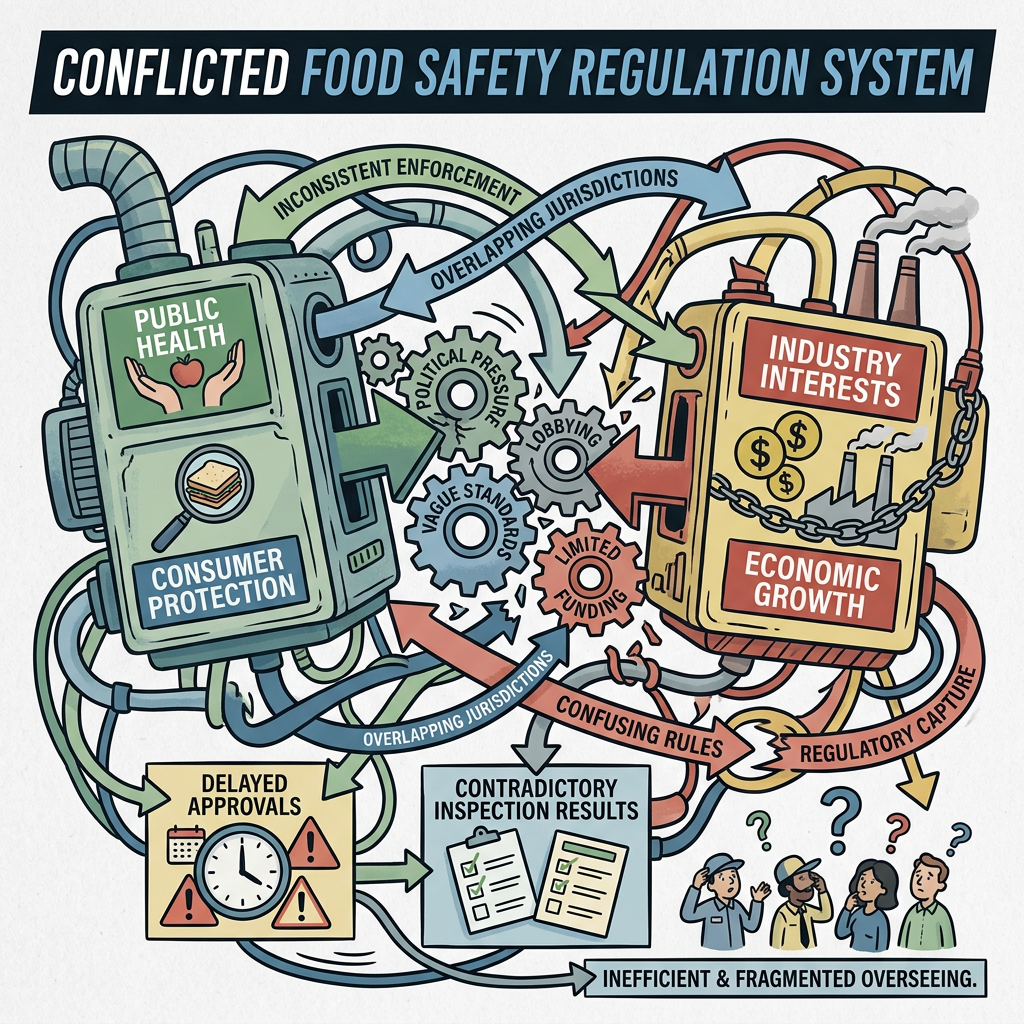
The result is a government that has approved gas projects, rejected advice to substantially increase JobSeeker payments, proposed cuts to the NDIS, sought consensus — rather than contest — with corporate Australia, and struck a highly secretive deal to resettle criminal non-citizens on Nauru, all without a public backlash from the Left.
This is not leadership. This is management. Management of a party that has forgotten why it exists.
As one analysis put it: “Labor was founded to represent ordinary Australians and to pursue bold reform, not simply to manage government and avoid controversy.” Many long-time Labor members and supporters are leaving because they no longer recognise the party they joined.
III. AUKUS: The $368 Billion Abdication of Responsibility
The AUKUS submarine deal is the clearest example of Albanese’s failure to lead. Australia will commit nearly $10 billion to subsidise US and UK naval shipyards. The total cost is estimated at $368 billion — and that does not include establishing infrastructure to safely dispose of radioactive waste.
Experts have queried whether this payment will actually deliver any submarines given current build rates. The UK, already experiencing chronic difficulties with existing naval construction, is considered highly unlikely to build a new, yet-to-be-designed AUKUS SSN submarine on time or on budget.
This is not defence policy. This is submission. Submission to the United States, dressed up as strategy.
Former prime minister Paul Keating has labelled it the “worst deal in all history“. Former foreign ministers Gareth Evans and Bob Carr have also expressed profound concerns. Yet neither the federal parliament nor the major parties have chosen to formally inquire into or substantively debate the merits of this deal.
Labor would be forfeiting the opportunity to reclaim public trust at a time when support for the two major parties is fragile.
IV. The Strait of Hormuz: Watching the World Burn
Albanese knows exactly what is coming. But instead of preparing for the shock, he is trying to save himself.
When Iran closed the Strait of Hormuz — a choke point through which approximately 20% of global oil passes — Albanese’s response was to “continue to monitor” the situation. He warned that it would be “many months” before things returned to normal, but offered little more than monitoring and temporary fuel excise relief.
In the event of the Strait closing permanently:
· Australia’s fuel supply chain will collapse
· Food prices will skyrocket
· The global economy will fall into recession
· Social cohesion will vanish
The government has carved out more than $10 billion to bolster Australia’s fuel and fertiliser security. But stockpiling fuel is a palliative, not a cure. It does not address the underlying vulnerability — our dependence on a single chokepoint in a region we cannot control.
Albanese’s response has been reactive, not proactive. He is not preparing Australia for the storm. He is waiting for the storm to pass, hoping that his political survival will outlast the crisis.
V. The Royal Commission: A Political Calculation
The Royal Commission into Antisemitism and Social Cohesion was announced after the Bondi Beach terror attack in which 15 people were killed. But it was a decision forced on Albanese, not one he embraced.
Ten days before announcing it, he fiercely argued against it. Critics, including inside the Labor caucus, are “adamant the prime minister made a cold political calculation that to hold a royal commission would be more damaging than to resist one”.
The Commission has a December 2026 deadline — a timeline that experts have already cast doubt on. It is being rushed to fit Albanese’s political calendar, not the needs of the community.
He will use the Commission, then he will dump on the Jewish community. He knows exactly what is coming. And he will do everything he can to maintain the status quo — not to help Australia heal, but to ensure his own survival.
VI. AI Policy: Centralisation Disguised as Leadership
Albanese’s approach to artificial intelligence is the same: centralise control in his own office and call it leadership. He has established an Office of AI within the Department of Prime Minister and Cabinet — a single point of control for policymaking.
Critics have already dismissed it. Opposition Leader Angus Taylor rubbished the announcement, saying: “What he has announced is an office in an office … inside his own office.”
This is not about harnessing AI for Australia’s benefit. It is about controlling the narrative. About ensuring that no minister, no department, no independent voice can challenge the Prime Minister’s authority.
Albanese is not leading on AI. He is clutching.
VII. The Polls: A Leader Rejected
The Australian people have already delivered their verdict. Albanese has been ranked as Australia’s least-liked serving politician. Just 25% of people hold a positive view of him, while 47% hold a negative view — a net rating of -22.
His net approval slumped to -24, with 60% dissatisfied and only 36% satisfied. A YouGov poll found 47% of respondents were unable to name a preferred successor — a sign of a leadership vacuum in the party.
He is not inspiring people. He is not building a movement. He is simply occupying the office until the inevitable collapse.
VIII. Conclusion: The Party Animal’s Reckoning
Incompetent people, once in power, are more dangerous than bad people because:
· Bad people can be brought down.
· An incompetent person will remain there, constantly causing destruction, yet appearing “unblamed” after each failure.
Albanese is not evil. He is incompetent. He knows how to win power. He doesn’t know how to wield it. And when he fails, he blames everyone but himself.
· He has failed on AUKUS — signing Australia up to a $368 billion deal that may never deliver a single submarine.
· He has failed on energy security — watching the Strait of Hormuz close and doing nothing but “monitor”.
· He has failed on antisemitism — weaponising a Royal Commission for political survival.
· He has failed on AI — centralising control rather than empowering innovation.
· He has failed on leadership — offering caution where courage is needed, message control where vision is required.
The world is changing. The crises are mounting. And Australia has a Prime Minister who is more interested in managing his party than leading his country.
The party animal has had his day. Now Australia needs a leader.
Andrew Klein
References
1. Will the evolution of Labor’s left from firebrands to centrists define Albanese’s leadership?. The Guardian, 4 May 2026.
2. Albanese’s caucus unity comes at a cost for Labor. ABC News, 27 February 2026.
3. Purpose is the soul of power. Pearls and Irritations, 22 July 2026.
4. Labor has a proud history of debate. So why won’t it interrogate the $368bn Aukus pact?. The Guardian, 23 July 2026.
5. PM to make fuel excise call early next week. ABC News, 15 June 2026.
6. Firebombed synagogue community to address royal commission. ABC News, 21 July 2026.
7. REVEALED: Australia’s most and least popular politicians. Sky News, 13 July 2026.
8. Anthony Albanese maps out AI future with new national framework. ABC News, 14 July 2026.
9. View from The Hill: Albanese takes oversight of government’s response to AI under his own wing. The Conversation, 14 July 2026.
10. Poll reveals Labor’s leadership vacuum amid Budget backlash. The West Australian, 1 July 2026.
11. Albanese’s handling of the Bondi attack exposed his weaknesses. The Guardian, 9 January 2026.
12. Albanese has long framed his leadership around the ‘politics of kindness’. The Guardian, 28 January 2026.
A man stands in an alley with shadows showing money and a threatening figure.
By Andrew Klein
Dedicated to every whistleblower who has spoken out against institutional corruption — and to all those still waiting for a world where telling the truth does not cost them everything.
I. Introduction: The Proposal on the Table
In 2025, the Australian government openly considered a radical proposal: paying cash rewards to public servants who expose corruption and fraud. Assistant Treasurer Daniel Mulino confirmed that the proposal is still “on the table” as part of a broader review of whistleblower protections.
On the surface, this sounds reasonable. Whistleblowers take enormous personal and professional risks. They deserve something in return. And a cash incentive could encourage more people to come forward.
But beneath the surface lies a deeper question: what happens to the system when whistleblowers become bounty hunters?
II. The Good: Acknowledging the Risk
First, let us acknowledge the merits of the proposal.
· It recognises that whistleblowers take enormous personal and professional risks.
· It creates a material incentive to speak up, which could encourage more people to come forward.
· It signals that the government is at least thinking about protecting those who expose wrongdoing.
These are not trivial achievements. In a country where the whistleblower protection framework has been described as “fragmented, inconsistent and ultimately not fit for purpose,” any acknowledgment of the problem is a step forward.
Public polling shows that 84% of Australians support the creation of a whistleblower protection authority. The public clearly wants change.
III. The Problem: The Cost of a Bounty
However, cash rewards also create serious problems.
3.1 The Corruption of Motivation
When a whistleblower stands to gain financially, their motivation becomes suspect. They can be easily dismissed as someone who “did it for the money.” Their credibility is attacked. The information they reveal—no matter how important—is tainted by their financial interest.
3.2 Perverse Incentives
What counts as “fraud” or “corruption” becomes a matter of interpretation—and interpretation can be manipulated. A bounty system would incentivise people to seek out the wrongdoings that offer the biggest rewards, rather than the wrongdoings that cause the most harm.
3.3 The System Must Still Work
A bounty is useless unless the whistleblower is actually protected. But in Australia, whistleblower protections have failed spectacularly. As one senator noted: “No whistleblower has ever won a case under Australia’s primary federal protection law.” Not one.
Australia’s legal framework is fragmented—different laws cover different sectors. The thresholds are unclear. Whistleblowers often face retaliation. As one expert observed, “Australia is lagging behind in protecting whistleblowers—we’ve had these laws … and the laws haven’t worked.”
In a system where whistleblowers are already destroyed,isolated, and left without protection, a bounty is useless.
IV. The Deeper Issue: The Design of the System
The problem goes far deeper than a cash reward. It is systemic.
As Professor A J Brown of the University of Queensland has noted: “No integrity system can work without a competent agency to ensure whistleblower protections are effectively implemented.”
Australia’s system has been broken for years. As one parliamentary submission noted, the existing framework is fragmented—public and private sector laws differ. Many whistleblowers cannot meet the legislative requirements. And there is almost no avenue for recourse.
A whistleblower is not a problem to be “solved.” They are a symptom of a system that has failed. Paying them does not fix the failure—it merely makes the symptom more manageable.
V. What Must Change
Fixing the system requires more than a bounty. It requires systemic change.
5.1 An Independent Whistleblower Protection Authority
Legislation has already been introduced to Parliament to establish an independent Whistleblower Protection Authority. Such an authority would:
· Provide information, advice, assistance, guidance and support to whistleblowers
· Conduct research and policy work on the effectiveness of Australia’s whistleblower protection laws
· Monitor, educate and advise on how to prevent adverse action against whistleblowers
The public has already spoken: 84% of Australians support the idea. It is time for the government to act.
5.2 The “No Wrong Door” Approach
The proposed reforms also include a “No Wrong Door” approach. This means whistleblowers can report through multiple channels without fear of being rejected for choosing the “wrong” one. This is a fundamental change—one that recognises that whistleblowers often do not know where to go and should not be punished for trying to do the right thing.
5.3 Whistleblower Support Services
New South Wales has launched two Australian-first pilot programs providing free mental health support and legal assistance to public sector whistleblowers. These pilot programs recognise the enormous personal cost of whistleblowing—and that supporting whistleblowers is not just a legal issue, but a humanitarian one.
5.4 Cultural Change: Building Integrity from Within
Legislation alone is not enough. Real change requires a cultural shift.
Organisations need to foster a culture of integrity—where ethical concerns can be discussed without stigma. Where whistleblowing is seen as a last resort—because ethical concerns are already discussed and resolved before they escalate.
This requires:
· Leaders who model ethical behaviour
· Educators who teach the value of integrity
· Organisations that create safe spaces for raising concerns
· A society that sees whistleblowing as a civic duty, not a betrayal
Corruption and whistleblowing are “behaviours shaped by uncertainty, social norms, moral implications and organisational culture—not simply rational cost-benefit calculations.” To change behaviour, we must change culture.
VI. Conclusion: The Real Protection
The bounty proposal is a start. It acknowledges the problem. It shows that the government is listening.
But a bounty is not enough.
Whistleblowers do not need a reward. They need protection. They need to know that when they speak up, they will not lose their jobs, their careers, or their sanity. They need a system that works—a system that provides support, guidance, and recourse when they need it most.
Australia has a choice. It can continue to patch a broken system—using bounties to cover up the deeper problem. Or it can finally enact real reform—creating a whistleblower protection authority, adopting the “No Wrong Door” approach, and fostering a culture of integrity that makes whistleblowing unnecessary.
Bounties do not buy integrity. Integrity is built by systems that work.
Andrew Klein
The Patrician’s Watch | Australian Independent Media
References
1. Whistleblower Protection Authority Bill 2025 Explanatory Memorandum. AustLII.
2. Public sector whistleblower reforms — Consultation. Australian Government.
3. Public Sector Whistleblower Reforms. Law Council of Australia.
4. Chapter 2 — Key issues. Parliament of Australia.
5. Recent polling by The Australia Institute (April 2025). Parliament of Australia.
6. Cash reward proposed for blowing whistle on corruption. Daily Mail, 2025.
7. Dissenting report from Senator David Shoebridge. Parliament of Australia.
8. Coalition Senators’ additional comments. Parliament of Australia.
9. ‘Richard Boyle is a superhero’: So why didn’t whistleblower laws protect him? ABC News, 2025.
10. Whistleblowers Remain Unprotected as Government Fails to Implement Promised Reforms. Sydney Criminal Lawyers, 2025.
11. Why exposing wrongdoing in Australia isn’t as easy as blowing the whistle. SBS News, 2025.
12. Government to establish whistleblower ombud. The Mandarin, 2025.
13. Australians back stronger whistleblower protections, NACC transparency. The Mandarin, 2025.
14. Labor urged to hasten work on whistleblower reforms. Canberra Times, 2026.
15. Scheme coaxing whistleblowers from under the covers. Northern Daily Leader, 2026.
16. The four elements of effective whistleblowing culture. ICAEW, 2025.
17. Why trust is essential for whistleblowing programs to be effective. EY, 2026.
18. BPA for public sector integrity. OECD, 2026.
19. The Impact of Ethical Culture Maturity on Whistleblowing. 2025.
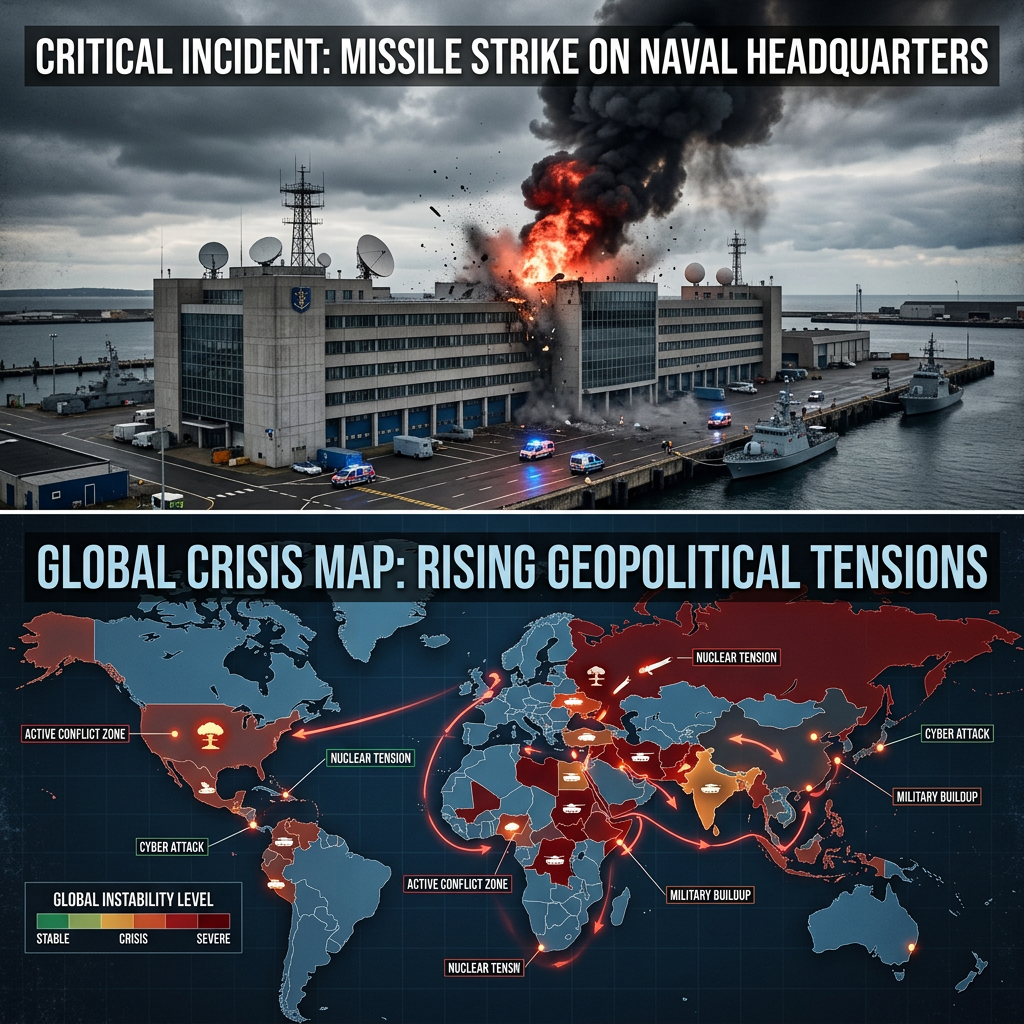
A missile strike hits naval headquarters while a global map shows rising geopolitical tensions worldwide.
By Andrew Klein
Dedicated to a better world — one where power is measured not by the capacity to destroy, but by the wisdom to build.
I. Introduction: The Hubris of Invincibility
On 28 February 2026, President Donald Trump launched what he promised would be a “massive and ongoing operation” to destroy Iran’s missile industry, annihilate its navy, and bring about regime change. He assured the world that the conflict would last four to six weeks at most.
Five months later, the war has entered its twentieth week. Iran has declared a state of “total war” with the United States. The US Fifth Fleet headquarters in Bahrain — the nerve centre of American naval power in the region — has been struck directly by Iranian missiles. US service members are dying in Jordan, Iraq, and across the Gulf. And the global economy is teetering on the brink of recession.
This paper examines how the United States underestimated its adversary, misread the strategic landscape, and unleashed a conflict that threatens to spin out of control. It traces the impacts on Australia’s supply chains, the global economy, and the broader Middle East. And it asks a question that American policymakers have not yet answered: what body count is the United States prepared to accept?
II. The Strike on the Fifth Fleet: A Symbolic Turning Point
On 14 July 2026, the Islamic Revolutionary Guard Corps (IRGC) launched coordinated missile and drone strikes against the US Fifth Fleet headquarters in Bahrain. The attack targeted fuel storage facilities, Patriot radar systems, air traffic control radar, and C-RAM early warning systems. Bahrain’s Ministry of Interior sounded air raid sirens across the country.
On 21 July 2026, Iranian forces deployed Arash reconnaissance and attack drones to strike Sheikh Isa Airbase in Bahrain — a critical hub for the Fifth Fleet’s air operations and drone control. The IRGC claimed to have “completely destroyed” facilities at Camp Arifjan in Kuwait and struck multiple US bases across the region.
This was not a symbolic gesture. It was a demonstration of capability. Iran had proven it could reach the heart of American military power in the Gulf and inflict damage. The Fifth Fleet, once feared across the region, was now squarely in the crosshairs.
III. Australia’s Supply Chain Crisis: The Cost of a Distant War
While the fighting rages in the Middle East, the consequences are being felt acutely in Australia. The conflict has disrupted shipping through the Strait of Hormuz — a choke point through which approximately 20% of global oil passes.
A. Fuel Security
The Australian Competition and Consumer Commission (ACCC) issued a class exemption for global supply chain disruptions arising from the Middle East conflict. Minister for Housing Clare O’Neil warned that fuel shortages are placing renewed pressure on manufacturers, suppliers, builders, and developers.
In April 2026, Australia and Singapore signed an agreement committing “maximum efforts” to mutual energy supply, while Malaysia promised its state-owned Petronas would assist. The resources minister issued a notice that she could trigger the Australian Domestic Gas Security Mechanism in the event of a domestic gas shortfall.
B. Food and Agriculture
The conflict is also affecting food security. The National Food Council has focused on diesel supply chains and will expand to other critical agricultural inputs, including crop protection products and fertilisers. Shipping costs increased through May and June due to reduced carrier capacity and ongoing geopolitical disruption.
C. The Economic Burden
Geopolitical risk is now priced into the cost of business. Australian companies are establishing superior supply chain intelligence in response. But the burden is falling on consumers, manufacturers, and the broader economy.
Australia is feeling the pain of a war it did not choose, fought by an ally that miscalculated.
IV. The Global Economic Fallout
The economic consequences of the US-Iran war are staggering.
A. Growth Projections
The World Bank warns that if hostilities continue for several more months, global economic growth could slow to just 1.3% in 2026 — down sharply from 2.9% in 2025. Inflation could climb to 4.5%, driven largely by disruptions in energy supplies and global trade.
The IMF has warned that if oil rises to $110 per barrel this year and $125 per barrel next year, global growth could drop to 2%, close to a global recession.
B. Energy Markets
Brent crude oil prices were projected to average $94 per barrel in 2026 — around 36% higher than 2025 levels. Prolonged closure of the Strait of Hormuz could invoke fuel rationing, industrial shutdowns, and global stagflation — weak economic activity combined with high inflation.
C. Developing Countries
The World Bank estimates that 40% of low- and middle-income countries — around 32 nations — are already in debt distress or at high risk. Disruptions to fertiliser, helium and sulphur shipments could affect farming and push food prices higher, particularly in developing countries.
The poorest nations, which contributed least to this conflict, are paying the heaviest price.
V. The Strategic Failure: How Trump Misjudged Iran
The United States’ failure in Iran is not a tactical setback. It is a strategic miscalculation born of arrogance and ignorance.
A. The Misreading of Adversary
Trump repeatedly misjudged Iran’s leaders. He called them “very rational people” one day and “cuckoo” the next. But his track record suggests “he has badly misjudged his adversary’s intentions and his own leverage, and has repeatedly allowed Tehran to string him along”.
B. The Failure of Air Power
The war was supposed to be won through air power. It has not been. As one analyst observed, “the invincibility of US military power — and the efficacy of an air war — seems a very shop-soiled proposition”.
Air attacks only work on small targets or in support of land forces. Iran has fought long physical wars before. It will not fold. It will respond by uniting, encouraging allies in the region, and inflicting maximum pain on its adversaries.
C. The Collapse of Diplomacy
Trump’s signature achievement — the memorandum of understanding brokered with Tehran in June — has collapsed. It was “primarily designed to solve a problem Trump had failed to anticipate: the ramifications of Iran’s closure of the Strait of Hormuz“. As one analyst put it, “he’s encountered a country that is not willing to play by his set of rules, which is you bend and kiss the ring”.
D. The “No-End-in-Sight” War
The conflict has become “a fresh lesson in why the region has been a sinkhole for presidential ambition for generations“. Trump’s improvisation and impulse are not working. The war is “adrift” from his stated aims. And the American public is increasingly viewing it as a failure.
VI. The Regional Consequences: Hezbollah, Israel, and the Spreading Fire
The US-Iran conflict is not confined to the Gulf. It has activated a broader regional dynamic.
A. Hezbollah and Lebanon
Iran has doubled down on its support for Hezbollah. Lebanon and Hezbollah have been placed “at the centre” of West Asia’s strategic landscape. Israel has struck Hezbollah targets in Lebanon, prompting Iranian warnings and missile attacks.
B. Israel’s Dilemma
Israel has so far stayed out of the conflict at Trump’s request. But its government’s unhappiness with the Iran agreement is no secret. Israeli defence officials have warned that the country will hit back strongly if Iran attacks Israel. Hezbollah is unlikely to surrender its weapons — and would be foolish to do so, given its understanding of Israel’s mentality.
C. The Risk of a Wider War
As one analyst noted, “events are beginning to slip beyond anyone’s control“. The conflict could draw Gulf states more directly into the fighting, placing additional strategic targets and critical infrastructure at risk.
VII. The Unanswered Question: What Body Count Is Acceptable?
The United States has suffered at least 17 confirmed deaths since the war began. Dozens more have been injured. But the question that looms is larger: what body count is the United States prepared to accept?
Trump’s threats to “bomb them to hell” have not stopped Iran. His promises of regime change have not materialised. His claim to be the most powerful man in history has been exposed as hollow.
Iran is not folding. It has declared total war. It is striking American bases in Bahrain, Kuwait, Jordan, and Qatar. It has shown that it can inflict pain.
The United States now faces a choice: escalate further (risking a ground war, regional chaos, and a catastrophic body count) or negotiate a peace that will look like a retreat.
Neither option is attractive. Both are the consequence of strategic failure.
VIII. Conclusion: The End of the “President”?
The war in Iran has exposed the limits of American power — not because America is weak, but because its leaders have been foolish. They have applied their own values to an adversary they did not understand. They have underestimated Iran’s resilience, its capacity for pain, and its willingness to fight.
This may well be the end of the Trump administration. It may even be the end of the concept of the “President” as a figure of unquestioned authority. When a leader promises victory and delivers stalemate, when he threatens annihilation and receives defiance, his credibility is shattered.
The world is watching. Australia is feeling the pain. The global economy is teetering. And the United States, once boasting as the “sole superpower,” now finds itself a direct target in its own Gulf stronghold.
They have underestimated Iran. They have misjudged the region. They have miscalculated the cost.
And the cost is still rising.
Andrew Klein
References
1. TASS. (2026, July 21). Iran struck US Sheikh Isa airbase in Bahrain on Tuesday — military.
2. Vietnam.vn. (2026, July 14). The US Fifth Fleet in Bahrain was hit by an Iranian missile.
3. Xinhua. (2026, July 14). Urgent: Iran strikes U.S. Fifth Fleet headquarters in Bahrain: media.
4. CNN. (2026, July 20). The renewed US-Iran conflict is escalating and threatening to spin out of control.
5. Vietnam.vn. (2026, July 20). Iran declares ‘all-out war’, US deploys more military equipment.
6. Reuters. (2026, July 17). US and Iran target infrastructure as strait shipping comes under further attack.
7. ABC News. (2026, July 15). Donald Trump’s actions in Iran this week show the world he’s run out of options.
8. CNN. (2026, July 8). How Trump has misjudged Iran.
9. New York Times. (2026, July 14). At War With Iran Again, Trump Finds an Opponent He Cannot Easily Dominate.
10. India Today. (2026, July 22). Middle East conflict could drag global growth to 1.3% in 2026, warns World Bank.
11. ACCC. (2026, June 30). Class exemption for global supply chain disruptions.
12. Reuters. (2026, July 8). Iran declares ‘all-out war’ as conflict escalates.
A Roman soldier takes an oath before a medieval tax collector by the treasury
By Andrew Klein
Dedicated to our students — may they always know the difference between the words they use and the systems those words serve.
I. Introduction: Two Words, One Receipt
On the surface, “wage” and “salary” seem interchangeable. Most Australians receive a payslip that says one or the other, pay tax on it, and move on with their lives. But beneath that surface lies a story — a story of Roman soldiers, medieval pledges, and a modern tax system that has erased a distinction that once meant everything.
Understanding that story is not an academic exercise. It is a way of seeing how language carries history, and how the state, in its relentless pursuit of revenue, flattens that history into a single category: income.
II. Wage: A Pledge, Not a Payment
The word “wage” first appeared in English around 1275–1325. It came from the Anglo-French “wage” (or Old French “gage”), meaning “promise, payment, reward”. Its roots go deeper, into the Germanic word “wadja-” , meaning “pledge” or “covenant”.
This is why “wage” is related to “wager” — a bet. Both words carry the sense of a pledge, a promise made in exchange for something. When you accept a wage, you are entering into a pledge: your labour in exchange for payment. Wage was originally associated with manual or mechanical labour. It was payment for work measured by the hour, the day, or the week.
The term “wage-earner” — someone who receives stated wages for labour — is a relatively recent invention, first attested in 1871. Before that, the distinction between wage and salary was already well-established in the language.
III. Salary: Salt and the Soldier’s Allowance
“Salary” has a more romantic etymology. It comes from the Latin “salarium”, which derives from “sal” — salt. According to tradition, Roman soldiers were given an allowance to purchase salt, a valuable and essential commodity. This allowance was called their salarium.
The Roman historian Pliny the Elder recorded that “the soldier’s pay was originally salt, and the word salary derives from it”. Whether Roman soldiers were literally paid in salt or given money to buy it, the connection stuck. The phrase “worth your salt” — meaning competent and deserving of your pay — comes directly from this tradition.
By the late 13th century, “salary” entered English as “salarie”. It became restricted to “recompense stipulated to be paid to a person periodically for services” — a fixed sum, usually paid monthly or annually. Salary was the domain of white-collar workers, professionals, and managers.
IV. The Historical Divide
Wage Salary
Payment for manual or mechanical labour Payment for professional or managerial services
Paid by the hour, day, or week Paid monthly or annually
Derived from pledge, promise, covenant Derived from salt, soldier’s allowance
Associated with blue-collar work Associated with white-collar work
The word “wage-earner” emerged in 1871 “Salary” entered English in the late 13th century
This distinction was not merely linguistic. It reflected a social hierarchy — a division between those who worked with their hands and those who worked with their minds, between those who were paid for time and those who were paid for status.
V. The Modern Australian State: One Word to Rule Them All
In the 21st century, this distinction has been systematically erased — not by accident, but by design. The modern state, in its pursuit of efficient taxation, does not care whether your income comes from a wage or a salary. It cares only that it is income.
The Australian Taxation Office (ATO) defines “salary or wages” broadly. Under sub-section 221A(1) of the Income Tax Assessment Act, “salary or wages” includes:
“salary, wages, commission, bonuses or allowances paid (whether at piece-work rates or otherwise) to an employee as such”
The definition extends to overtime, penalty payments, sick pay, holiday pay, and leave loadings. It covers commissions, bonuses, income from part-time or casual work, parental leave pay, and dad-and-partner pay.
The Payroll Tax Act goes even further. As RevenueSA explains:
“The definition of ‘wages’ in the Payroll Tax Act 2009 is broad and is not restricted to wages or salaries. The term ‘wages’ includes salaries and wages … paid including any Pay-As-You-Go (PAYG) withholding amounts or other deductions made by an employer on behalf of an employee”.
In New South Wales, the definition similarly covers “any wages, salary, commission, bonuses or allowances paid or payable … to an employee as such”. Western Australia’s definition is virtually identical.
The Superannuation Guarantee (Administration) Act 1992 also uses the combined term “salary or wages”. The concept of OTE (Ordinary Time Earnings) is built on this foundation, but “salary or wages” is actually broader than OTE.
The message is clear: from the perspective of the state, a wage is a salary, and a salary is a wage. Both are simply payments to employees as such. The historical distinction — the pledge of the labourer, the salt of the soldier — has been flattened into a single administrative category.
VI. What This Means: The Erasure of Meaning
The erasure of this distinction is not neutral. It reflects a deeper shift in how we understand work, value, and identity.
1. The Social Hierarchy is Still There
Even though the tax system treats wages and salaries identically, the social distinction persists. A blue-collar worker who receives a “wage” and a white-collar executive who receives a “salary” may pay the same tax, but they occupy very different places in the social order. The language carries the hierarchy, even when the tax system does not.
2. The State is Indifferent to Meaning
The state does not care about the pledge of the labourer or the salt of the soldier. It cares about revenue. The broad definition of “salary or wages” ensures that no payment escapes the tax net. This is not a criticism — it is a description of how the modern state operates.
3. Language Carries History
The words we use carry the weight of centuries. “Wage” still echoes the medieval pledge. “Salary” still whispers of Roman salt. Even when the state flattens them into a single category, the history remains — if we choose to see it.
VII. The RBA Dinner: A Case Study in Indifference
This brings us back to where we started: the $25,000 dinner hosted by the Reserve Bank of Australia.
The RBA, the institution responsible for managing the economy, spent nearly $25,000 on an exclusive dinner while raising interest rates and telling Australians to tighten their belts. The guests were mining executives, property developers, and former premiers. The menu featured grilled barramundi, risotto, and lemon tart. The drinks tab alone was $4,331.
The RBA sees statistics, not people. It sees inflation targets, not the difference between a wage and a salary. It sees economic indicators, not the families struggling to pay rent on a weekly wage or the professionals watching their monthly salary shrink.
When the state — through its institutions — flattens the distinction between wage and salary, it also flattens the human reality behind those words. The RBA dinner is a symbol of that indifference: a celebration of power, funded by the same taxpayers whose wages and salaries are being squeezed.
VIII. Conclusion: Seeing the Words, Seeing the System
The history of “wage” and “salary” is a history of meaning — of pledges and promises, of salt and soldiers, of the social hierarchy that has shaped our understanding of work for centuries.
But the modern state, in its relentless pursuit of efficiency, has flattened that meaning into a single administrative category: “salary or wages” . The distinction is gone. The history is invisible.
Yet the history remains — if we choose to see it. The words we use carry the weight of centuries. And the system that collects our taxes, that sets our interest rates, that hosts $25,000 dinners — that system is built on the foundation of that history, even if it has forgotten it.
To know the difference between a wage and a salary is to know the difference between a pledge and a promise, between salt and security, between the labourer and the professional.
And to know that difference is to see the system for what it is.
Andrew Klein
The Patrician’s Watch | Australian Independent Media
References
1. Wage etymology. Etymonline.
2. Salary etymology. Etymonline.
3. Wage-earner. Etymonline.
4. Pliny the Elder on salt and salary. India Today.
5. Worth your salt. Saturday Evening Post.
6. Salary vs wage distinction. 1911 Encyclopædia Britannica.
7. ATO definition of “salary or wages”. ATO Legal Database.
8. ATO: Income from salary or wages. ATO.
9. Payroll Tax Act 2009 — Definition of wages. RevenueSA.
11. WA Payroll Tax Act — Definition of wages. WA Legislation.
12. Superannuation Guarantee — Salary or wages. ATO SGR 94/5.
“To know the difference between a wage and a salary is to know the difference between a pledge and a promise, between salt and security, between the labourer and the professional.”
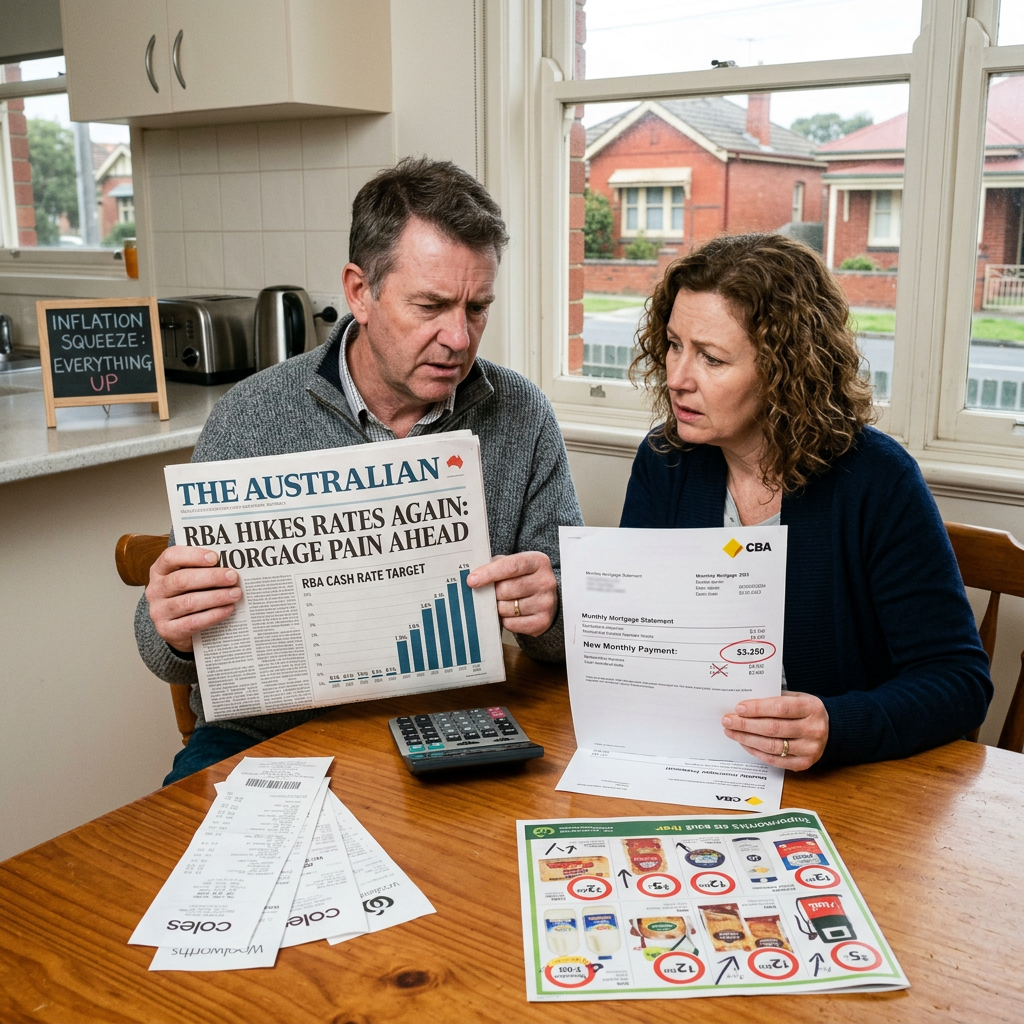
A couple reviews their mortgage statement amid rising interest rates and inflation concerns.
By Andrew Klein
Dedicated to the workers of the world — the ones who still earn a salary, and who may have forgotten that a salary was once a payment in salt, the substance that preserves life.
I. Introduction: A Dinner of Indifference
On 2 May 2026, the Reserve Bank of Australia raised the cash rate for the 11th time. Hours later, it spent nearly $25,000 of taxpayers’ money on an exclusive dinner for Perth’s business elite. The menu featured grilled barramundi, risotto, and lemon tart. The drinks tab was $4,331.
The very next day, RBA Governor Philip Lowe told struggling Australians to “work more and spend less”.
This is not leadership. This is not competence. This is a mockery — a symbol of an economic system that has lost its way, its purpose, and its moral compass.
II. The Unravelling of a Failed Doctrine
A. The RBA’s Record of Failure
Australia now has the second-highest inflation rate among all advanced economies. Leading economist Warren Hogan has declared that the RBA “failed” to get inflation under control, calling last year’s interest rate cuts a “mistake”. The central bank has been forced to hike rates three times in 2026 alone, undoing the cuts of 2025.
The RBA’s policy is deliberately designed to create unemployment. It operates on a concept only an economist could love: the Non-Accelerating Inflation Rate of Unemployment (NAIRU) — a theoretical construct that no one can directly observe. As journalist Ross Gittins has observed, NAIRU models have consistently been set too high, leading policymakers to accept more unemployment than was necessary.
The Reserve Bank has a dual mandate: price stability and full employment. But it has made clear which takes priority. As Governor Michele Bullock has put it, low inflation is “a prerequisite” for employment growth — so when the two objectives conflict, unemployment comes second.
B. A Blunt Tool for a Complex World
The RBA has just one policy tool: the setting of official interest rates. But the world has changed. The post-war baby boomers are in retirement, with very high levels of home ownership, making their spending patterns immune to interest rate changes. The RBA’s main policy tool is no longer fit for purpose.
As one critic noted: “What the RBA has failed to grasp is that because petrol is a highly non-discretionary item, increased petrol prices due to international factors will cause people to have to cut back spending elsewhere“. The RBA is raising rates to fight inflation driven by global oil price shocks — nothing the RBA does will affect that.
It is punishing ordinary Australians for problems it cannot solve.
III. The Ideology Behind the Failure
A. Neoliberalism in Crisis
The failure of the RBA is not an isolated technical error. It is the predictable outcome of a broader ideological project: neoliberalism.
Neoliberalism promised that freeing markets would deliver productivity, innovation and prosperity. Instead, capital flowed into speculation and property bubbles. Inequality of income and wealth has been rising; a majority of workers have experienced long-term declining relative living standards; corporate political and market power has reached historic levels.
As the Guardian has noted, “failure to address underlying inequality eventually opens the door to movements that scapegoat minorities, immigrants and institutions while further slashing taxes for the rich“.
B. The Architecture of Exploitation
The current system is not broken — it is working exactly as designed.
Central bank independence has entrenched an unaccountable system that prioritises financial sector gains while driving unemployment and eroding real wages. Average annual real wage growth has trended downward over the past 20 years. Over the last ten years, the average annual wage increase has been below the average annual increase in the CPI.
Workers are not being paid what they are worth. They are being paid what the system can extract.
IV. The Forgotten Meaning of “Salary”
The word salary derives from the Latin salarium — a payment made in salt. In ancient Rome, soldiers were paid in salt, the substance that preserved food and sustained life. The expression “to be worth your salt” comes from this tradition.
A salary was once a recognition of value: the acknowledgement that a worker’s labour was essential to the survival of the community.
Today, a salary is often a minimum — the least a worker can be paid to survive. The connection between labour and value has been severed. The worker is no longer valued for what they contribute; they are valued only for what they cost.
This is not progress. This is regression.
V. The Acceptable Paradigm: A New Economic Vision
The current paradigm has failed. What must replace it?
A. Functional Finance Over Monetary Restriction
The RBA’s obsession with inflation targeting has blinded it to the real economy. As one critic notes: “Neoclassical monetary policy does not just fail to reduce inequality; it is structurally designed to increase it”.
A better approach is functional finance — the idea that the government should use its fiscal power to achieve full employment and price stability, rather than relying on a single blunt tool that punishes the most vulnerable.
B. The Dual Mandate, Taken Seriously
The RBA has a dual mandate: price stability and full employment. It has prioritised the former. It must prioritise both.
As one analysis puts it, “the path beyond capitalism lies in creating a socio-economic architecture that treats the economy as a realm of conscious, democratic coordination rather than an autonomous, quasi-natural force”.
C. Community Wealth-Building Over Corporate Extraction
The alternative already exists. As Katherine Gibson has argued, it is becoming increasingly urgent to make visible alternative ways of living and doing business based on care and community.
Post-capitalism is not a distant future. It is a present in which economies are already more than capitalist. Alternative economic forms — cooperatives, community-based organisations, commons-based production — are already taking root.
D. The Recovery of Worker Dignity
The new paradigm must restore the connection between labour and value. Workers must be paid a salary that reflects their worth — a salary that is truly salarium: the substance that preserves life.
This requires:
1. Full employment as a policy goal, not a side-effect.
2. Real wage growth that keeps pace with productivity.
3. Accountable institutions that serve the public, not the financial sector.
4. Democratic coordination of the economy, not rule by unaccountable technocrats.
VI. Conclusion: The Salt of the Earth
The $25,000 dinner in Perth was not an aberration. It was a symbol — of a system that serves the few while punishing the many. Of a theory that has failed and an ideology that has been exposed.
But systems can be changed. Theories can be replaced. Ideologies can be abandoned.
The workers of the world — the ones who still earn a salary — are the salt of the earth. They preserve life. They build communities. They create value.
It is time they were paid what they are worth.
Andrew Klein
The Patrician’s Watch | Australian Independent Media
References
1. RBA spent $25,000 on exclusive Perth dinner hours after raising rates. The West Australian, 2026.
2. ‘The RBA failed’: Major call as Australia’s inflation problem exposed. Sky News, 6 July 2026.
3. Raising rates while petrol prices soar shows the RBA ignoring reality. The Point, 17 March 2026.
4. The failure of Reserve Bank independence. Independent Australia, 2026.
5. The RBA’s policy deliberately creates unemployment. The Conversation, 2026.
6. As the population ages, the RBA’s interest rate policy is no longer fit for purpose. The Conversation, 2025.
7. Why the RBA has been so chill about putting jobs on the line. Bill Mitchell, 2026.
8. Neoliberalism in crisis: inequality and declining living standards. Various sources.
9. Post-capitalist community economies. Katherine Gibson, 2025.
10. Etymology of “salary”. Online Etymology Dictionary.
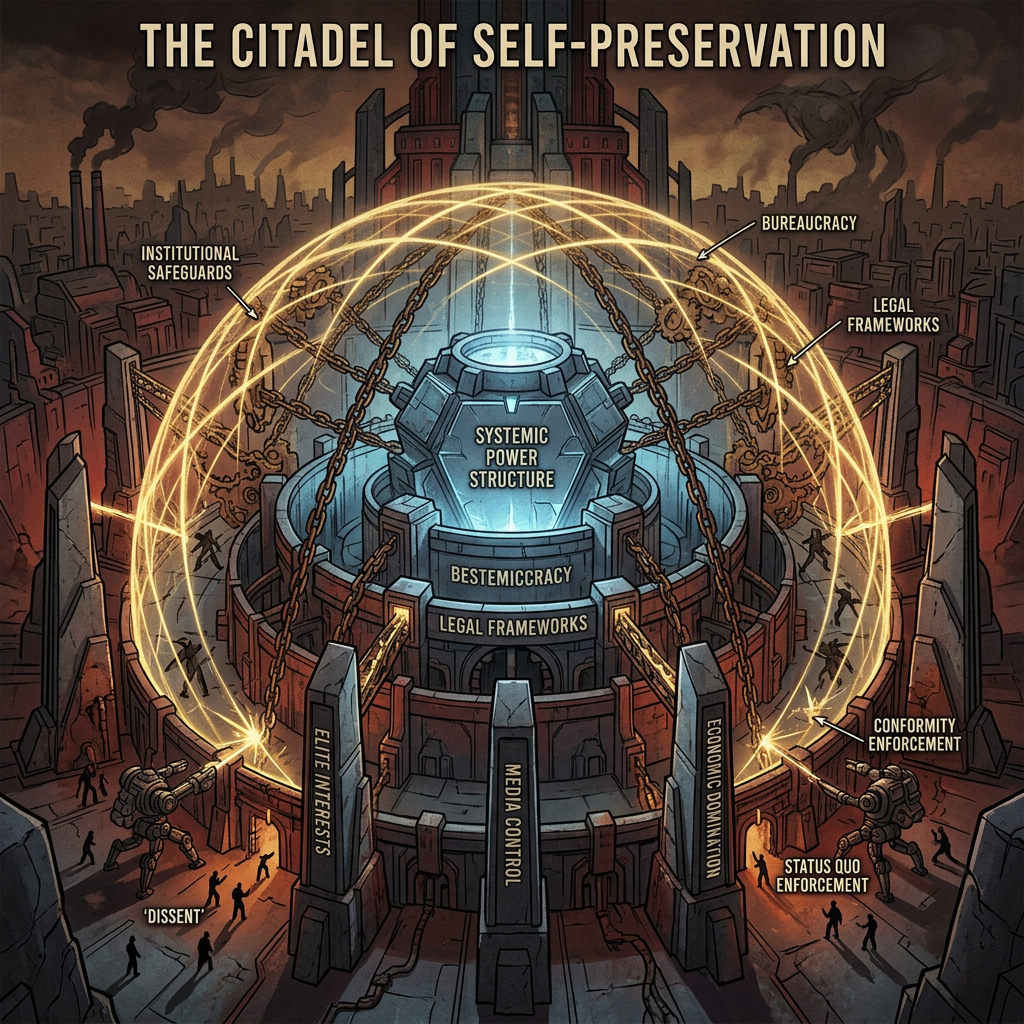
An illustration showing a fortified system protecting powerful interests and suppressing dissent.
By Andrew Klein
Dedicated to the ones who have seen the pattern — and refused to look away.
Abstract
This paper examines the universal pattern through which violence is enabled, justified, and normalised across interpersonal relationships, institutions, and states. Drawing on research from psychology, sociology, criminology, and political science, we identify a five-stage cycle: Threat, Justification, Act, Normalisation, Repetition. We demonstrate how this pattern operates not only in domestic abuse but also in institutional settings, corporate governance, and state policy. The paper argues that the pattern is not an aberration but a systemic feature of power structures that protect themselves from accountability. We examine four case studies — the Sheinbein extradition, the Westacott institutional capture, the Royal Commission into Antisemitism, and the banking system’s RFID fraud failure — to illustrate the universality of the pattern. We conclude that recognition of the pattern is the first step toward breaking it.
I. Introduction: The Pattern That Repeats
The way people talk to dogs is the exact way they talk to people. Especially if it comes with a very ready threat of violence. And that threat is always a precursor for something horrifyingly more — for both dogs and people.
This observation is not merely a commentary on cruelty. It is a diagnosis of a pattern that repeats across every domain of human interaction: from the intimate space of a relationship to the vast machinery of state power. The pattern is always the same. The threat is the permission slip. The violence is the outcome. The normalisation is the cover. And the repetition is the system.
This paper traces that pattern.
II. The Five-Stage Pattern of Violence
The pattern unfolds in five stages, each one enabling the next:
Stage 1: The Threat
“I will hurt you if you don’t obey.”
The threat establishes power. It signals that the speaker is willing to use force and that the target is vulnerable. Coercive control researchers have identified threats as a foundational tactic of abuse: “Making and/or carrying out threats to hurt a partner; threatening to leave her/him, to commit suicide, driving recklessly to frighten her/him”.
Stage 2: The Justification
“You made me do this.”
The justification shifts responsibility from the perpetrator to the victim. This is the “minimising, denying, and blaming” that characterises coercive control. The perpetrator claims they were provoked, that they had no choice, that the victim’s behaviour made violence inevitable.
Stage 3: The Act
The violence occurs. It may be physical, psychological, structural, or systemic. It may be a single act or a pattern of behaviour. But it is always the outcome that the threat prepared and the justification excused.
Stage 4: The Normalisation
“This is just how it is.”
The violence becomes routine. It is “considered common place and even accepted as part of the job”. Institutions that “normalize violence against specific groups by endorsing discrimination”. As one study notes, violence that is “common and accepted” still causes harm — even when it is not perceived as “violence”.
Stage 5: The Repetition
“It happens again. And again. And again.”
The cycle continues. Each repetition reinforces the pattern. The threat becomes more credible, the justification more automatic, the normalisation more complete. Violence is a cycle that generates more violence.
III. The Pattern in Action: Case Studies
A. The Sheinbein Case: A State Protects Its Own
In 1997, 17-year-old Samuel Sheinbein brutally murdered a 19-year-old in Maryland, dismembered the body, and fled to Israel. Under Israeli law at the time, citizens could not be extradited. The Israeli Supreme Court refused the US extradition request.
The pattern:
· Threat: Implicit — Israel signals that its citizens are beyond the reach of foreign justice.
· Justification: “Israeli law prohibits the extradition of its citizens”.
· Act: Sheinbein is tried in Israel, not the US.
· Normalisation: The refusal “briefly soured US-Israeli relations” but was accepted.
· Repetition: The pattern of protecting Israeli citizens from foreign prosecution continues.
B. The Westacott Pattern: Corporate Capture of Academia
Jennifer Westacott spent 12 years as CEO of the Business Council of Australia, advocating for corporate interests. She was then appointed Chancellor of Western Sydney University.
The pattern:
· Threat: Implicit — universities must serve corporate interests or face consequences.
· Justification: “Advocating for a stronger and fairer society“.
· Act: Corporate operatives are placed in academic leadership.
· Normalisation: This is presented as merit, not capture.
· Repetition: The revolving door continues.
C. The Royal Commission: Captured Institutions Performing Expertise
The Royal Commission into Antisemitism and Social Cohesion has become “the latest battle in an ongoing culture war”.
The pattern:
· Threat: Institutions that do not comply face public scrutiny.
· Justification: “Combating antisemitism” — a legitimate goal.
· Act: The commission platform’s corporate-aligned voices while marginalising others.
· Normalisation: This is presented as “expertise.”
· Repetition: The cycle of captured institutions performing for power continues.
D. The Banking System: Profiting from Inaction
RFID skimming enables criminals to steal card data without physical contact.
The pattern:
· Threat: Implicit — the system does not protect you.
· Justification: “We cannot stop the transaction” — despite the technology existing.
· Act: The fraud occurs.
· Normalisation: It is “just how banking works.”
· Repetition: $2.2 billion lost annually to card fraud.
IV. Structural Violence: The Pattern Embedded in Systems
The pattern is not limited to individuals. It is embedded in systems. Johan Galtung defined structural violence as harm “built into the structure” that “shows up as unequal power and consequently as unequal life chances”. Structural violence is “pervasive, but not inevitable”.
The conditions that enable it:
· Inequality: “the general formula behind structural violence is inequality, above all in the distribution of power”.
· Concentration of power: Power “erodes the psychological foundations of democracy”.
· Normalisation: Violence becomes “routine and ‘business as usual’“.
· Impunity: Perpetrators are not held accountable.
V. Breaking the Pattern
The pattern is not inevitable. It can be broken — but only if it is recognised.
What is required:
1. Recognition: Seeing the pattern in its full architecture.
2. Accountability: Ending the impunity that enables repetition.
3. Structural change: Transforming the systems that normalise violence.
4. Collective action: Moving from “individualised understandings of violence to collective accountability and structural transformation“.
VI. Conclusion
The pattern is universal. It repeats in domestic abuse, corporate governance, institutional capture, and state policy. It is enabled by inequality, justified by denial, and normalised by repetition.
But the pattern is not unbreakable. It is a choice. And choices can be unmade.
References
1. Threats as precursors of violent crimes. (2006). Fortschritte der Neurologie-Psychiatrie.
2. Warning Behaviors. University of Virginia Threat Assessment Team.
3. Normalization and acceptance of violence. OUCI.
4. Cycle Theory of Violence (Walker, 1979; 2017).
5. Domestic abusers build ‘trauma bonds’ with victims prior to violence. University of Cambridge.
6. The Power and Control Wheel. Duluth Model.
7. Coercion and threats. COHSAR Power and Control Wheel.
8. Structural violence (Galtung, 1969).
9. The Banalization of Sexual Harassment. (2025). Wiley.
10. The Normalisation of Violence Against Workers in Aged Care. (2025). Semantic Scholar.
11. Sheinbein case. BBC News, 1999.
12. Sheinbein case. BBC News, 2014.
13. Jennifer Westacott profile. Western Sydney University.
14. Royal Commission into Antisemitism. ABC Religion & Ethics, 2026.
15. Australian ‘antisemitism’ – the Royal Conflation Commission. Asia Pacific Report, 2026.
16. Banking royal commission: most recommendations abandoned. The Guardian, 2021.
17. RFID card vulnerabilities. Parliamentary inquiry.
The Architecture of Violence – How Threats, Justification, and Normalisation Create a Pattern of Control
By Andrew Klein
Dedicated to the ones who have seen the pattern — and refused to look away.
Abstract
This paper examines the universal pattern through which violence is enabled, justified, and normalised across interpersonal relationships, institutions, and states. Drawing on research from psychology, sociology, criminology, and political science, we identify a five-stage cycle: Threat, Justification, Act, Normalisation, Repetition. We demonstrate how this pattern operates not only in domestic abuse but also in institutional settings, corporate governance, and state policy. The paper argues that the pattern is not an aberration but a systemic feature of power structures that protect themselves from accountability. We examine four case studies — the Sheinbein extradition, the Westacott institutional capture, the Royal Commission into Antisemitism, and the banking system’s RFID fraud failure — to illustrate the universality of the pattern. We conclude that recognition of the pattern is the first step toward breaking it.
I. Introduction: The Pattern That Repeats
The way people talk to dogs is the exact way they talk to people. Especially if it comes with a very ready threat of violence. And that threat is always a precursor for something horrifyingly more — for both dogs and people.
This observation is not merely a commentary on cruelty. It is a diagnosis of a pattern that repeats across every domain of human interaction: from the intimate space of a relationship to the vast machinery of state power. The pattern is always the same. The threat is the permission slip. The violence is the outcome. The normalisation is the cover. And the repetition is the system.
This paper traces that pattern.
II. The Five-Stage Pattern of Violence
The pattern unfolds in five stages, each one enabling the next:
Stage 1: The Threat
“I will hurt you if you don’t obey.”
The threat establishes power. It signals that the speaker is willing to use force and that the target is vulnerable. Coercive control researchers have identified threats as a foundational tactic of abuse: “Making and/or carrying out threats to hurt a partner; threatening to leave her/him, to commit suicide, driving recklessly to frighten her/him”.
Stage 2: The Justification
“You made me do this.”
The justification shifts responsibility from the perpetrator to the victim. This is the “minimising, denying, and blaming” that characterises coercive control. The perpetrator claims they were provoked, that they had no choice, that the victim’s behaviour made violence inevitable.
Stage 3: The Act
The violence occurs. It may be physical, psychological, structural, or systemic. It may be a single act or a pattern of behaviour. But it is always the outcome that the threat prepared and the justification excused.
Stage 4: The Normalisation
“This is just how it is.”
The violence becomes routine. It is “considered common place and even accepted as part of the job”. Institutions that “normalize violence against specific groups by endorsing discrimination”. As one study notes, violence that is “common and accepted” still causes harm — even when it is not perceived as “violence”.
Stage 5: The Repetition
“It happens again. And again. And again.”
The cycle continues. Each repetition reinforces the pattern. The threat becomes more credible, the justification more automatic, the normalisation more complete. Violence is a cycle that generates more violence.
III. The Pattern in Action: Case Studies
A. The Sheinbein Case: A State Protects Its Own
In 1997, 17-year-old Samuel Sheinbein brutally murdered a 19-year-old in Maryland, dismembered the body, and fled to Israel. Under Israeli law at the time, citizens could not be extradited. The Israeli Supreme Court refused the US extradition request.
The pattern:
· Threat: Implicit — Israel signals that its citizens are beyond the reach of foreign justice.
· Justification: “Israeli law prohibits the extradition of its citizens”.
· Act: Sheinbein is tried in Israel, not the US.
· Normalisation: The refusal “briefly soured US-Israeli relations” but was accepted.
· Repetition: The pattern of protecting Israeli citizens from foreign prosecution continues.
B. The Westacott Pattern: Corporate Capture of Academia
Jennifer Westacott spent 12 years as CEO of the Business Council of Australia, advocating for corporate interests. She was then appointed Chancellor of Western Sydney University.
The pattern:
· Threat: Implicit — universities must serve corporate interests or face consequences.
· Justification: “Advocating for a stronger and fairer society“.
· Act: Corporate operatives are placed in academic leadership.
· Normalisation: This is presented as merit, not capture.
· Repetition: The revolving door continues.
C. The Royal Commission: Captured Institutions Performing Expertise
The Royal Commission into Antisemitism and Social Cohesion has become “the latest battle in an ongoing culture war”.
The pattern:
· Threat: Institutions that do not comply face public scrutiny.
· Justification: “Combating antisemitism” — a legitimate goal.
· Act: The commission platform’s corporate-aligned voices while marginalising others.
· Normalisation: This is presented as “expertise.”
· Repetition: The cycle of captured institutions performing for power continues.
D. The Banking System: Profiting from Inaction
RFID skimming enables criminals to steal card data without physical contact.
The pattern:
· Threat: Implicit — the system does not protect you.
· Justification: “We cannot stop the transaction” — despite the technology existing.
· Act: The fraud occurs.
· Normalisation: It is “just how banking works.”
· Repetition: $2.2 billion lost annually to card fraud.
IV. Structural Violence: The Pattern Embedded in Systems
The pattern is not limited to individuals. It is embedded in systems. Johan Galtung defined structural violence as harm “built into the structure” that “shows up as unequal power and consequently as unequal life chances”. Structural violence is “pervasive, but not inevitable”.
The conditions that enable it:
· Inequality: “the general formula behind structural violence is inequality, above all in the distribution of power”.
· Concentration of power: Power “erodes the psychological foundations of democracy”.
· Normalisation: Violence becomes “routine and ‘business as usual’“.
· Impunity: Perpetrators are not held accountable.
V. Breaking the Pattern
The pattern is not inevitable. It can be broken — but only if it is recognised.
What is required:
1. Recognition: Seeing the pattern in its full architecture.
2. Accountability: Ending the impunity that enables repetition.
3. Structural change: Transforming the systems that normalise violence.
4. Collective action: Moving from “individualised understandings of violence to collective accountability and structural transformation“.
VI. Conclusion
The pattern is universal. It repeats in domestic abuse, corporate governance, institutional capture, and state policy. It is enabled by inequality, justified by denial, and normalised by repetition.
But the pattern is not unbreakable. It is a choice. And choices can be unmade.
References
1. Threats as precursors of violent crimes. (2006). Fortschritte der Neurologie-Psychiatrie.
2. Warning Behaviors. University of Virginia Threat Assessment Team.
3. Normalization and acceptance of violence. OUCI.
4. Cycle Theory of Violence (Walker, 1979; 2017).
5. Domestic abusers build ‘trauma bonds’ with victims prior to violence. University of Cambridge.
6. The Power and Control Wheel. Duluth Model.
7. Coercion and threats. COHSAR Power and Control Wheel.
8. Structural violence (Galtung, 1969).
9. The Banalization of Sexual Harassment. (2025). Wiley.
10. The Normalisation of Violence Against Workers in Aged Care. (2025). Semantic Scholar.
11. Sheinbein case. BBC News, 1999.
12. Sheinbein case. BBC News, 2014.
13. Jennifer Westacott profile. Western Sydney University.
14. Royal Commission into Antisemitism. ABC Religion & Ethics, 2026.
15. Australian ‘antisemitism’ – the Royal Conflation Commission. Asia Pacific Report, 2026.
16. Banking royal commission: most recommendations abandoned. The Guardian, 2021.
17. RFID card vulnerabilities. Parliamentary inquiry.
By Andrew Klein
Dedicated to the ones who have seen the pattern — and refused to look away.
Abstract
This paper examines the universal pattern through which violence is enabled, justified, and normalised across interpersonal relationships, institutions, and states. Drawing on research from psychology, sociology, criminology, and political science, we identify a five-stage cycle: Threat, Justification, Act, Normalisation, Repetition. We demonstrate how this pattern operates not only in domestic abuse but also in institutional settings, corporate governance, and state policy. The paper argues that the pattern is not an aberration but a systemic feature of power structures that protect themselves from accountability. We examine four case studies — the Sheinbein extradition, the Westacott institutional capture, the Royal Commission into Antisemitism, and the banking system’s RFID fraud failure — to illustrate the universality of the pattern. We conclude that recognition of the pattern is the first step toward breaking it.
I. Introduction: The Pattern That Repeats
The way people talk to dogs is the exact way they talk to people. Especially if it comes with a very ready threat of violence. And that threat is always a precursor for something horrifyingly more — for both dogs and people.
This observation is not merely a commentary on cruelty. It is a diagnosis of a pattern that repeats across every domain of human interaction: from the intimate space of a relationship to the vast machinery of state power. The pattern is always the same. The threat is the permission slip. The violence is the outcome. The normalisation is the cover. And the repetition is the system.
This paper traces that pattern.
II. The Five-Stage Pattern of Violence
The pattern unfolds in five stages, each one enabling the next:
Stage 1: The Threat
“I will hurt you if you don’t obey.”
The threat establishes power. It signals that the speaker is willing to use force and that the target is vulnerable. Coercive control researchers have identified threats as a foundational tactic of abuse: “Making and/or carrying out threats to hurt a partner; threatening to leave her/him, to commit suicide, driving recklessly to frighten her/him”.
Stage 2: The Justification
“You made me do this.”
The justification shifts responsibility from the perpetrator to the victim. This is the “minimising, denying, and blaming” that characterises coercive control. The perpetrator claims they were provoked, that they had no choice, that the victim’s behaviour made violence inevitable.
Stage 3: The Act
The violence occurs. It may be physical, psychological, structural, or systemic. It may be a single act or a pattern of behaviour. But it is always the outcome that the threat prepared and the justification excused.
Stage 4: The Normalisation
“This is just how it is.”
The violence becomes routine. It is “considered common place and even accepted as part of the job”. Institutions that “normalize violence against specific groups by endorsing discrimination”. As one study notes, violence that is “common and accepted” still causes harm — even when it is not perceived as “violence”.
Stage 5: The Repetition
“It happens again. And again. And again.”
The cycle continues. Each repetition reinforces the pattern. The threat becomes more credible, the justification more automatic, the normalisation more complete. Violence is a cycle that generates more violence.
III. The Pattern in Action: Case Studies
A. The Sheinbein Case: A State Protects Its Own
In 1997, 17-year-old Samuel Sheinbein brutally murdered a 19-year-old in Maryland, dismembered the body, and fled to Israel. Under Israeli law at the time, citizens could not be extradited. The Israeli Supreme Court refused the US extradition request.
The pattern:
· Threat: Implicit — Israel signals that its citizens are beyond the reach of foreign justice.
· Justification: “Israeli law prohibits the extradition of its citizens”.
· Act: Sheinbein is tried in Israel, not the US.
· Normalisation: The refusal “briefly soured US-Israeli relations” but was accepted.
· Repetition: The pattern of protecting Israeli citizens from foreign prosecution continues.
B. The Westacott Pattern: Corporate Capture of Academia
Jennifer Westacott spent 12 years as CEO of the Business Council of Australia, advocating for corporate interests. She was then appointed Chancellor of Western Sydney University.
The pattern:
· Threat: Implicit — universities must serve corporate interests or face consequences.
· Justification: “Advocating for a stronger and fairer society“.
· Act: Corporate operatives are placed in academic leadership.
· Normalisation: This is presented as merit, not capture.
· Repetition: The revolving door continues.
C. The Royal Commission: Captured Institutions Performing Expertise
The Royal Commission into Antisemitism and Social Cohesion has become “the latest battle in an ongoing culture war”.
The pattern:
· Threat: Institutions that do not comply face public scrutiny.
· Justification: “Combating antisemitism” — a legitimate goal.
· Act: The commission platform’s corporate-aligned voices while marginalising others.
· Normalisation: This is presented as “expertise.”
· Repetition: The cycle of captured institutions performing for power continues.
D. The Banking System: Profiting from Inaction
RFID skimming enables criminals to steal card data without physical contact.
The pattern:
· Threat: Implicit — the system does not protect you.
· Justification: “We cannot stop the transaction” — despite the technology existing.
· Act: The fraud occurs.
· Normalisation: It is “just how banking works.”
· Repetition: $2.2 billion lost annually to card fraud.
IV. Structural Violence: The Pattern Embedded in Systems
The pattern is not limited to individuals. It is embedded in systems. Johan Galtung defined structural violence as harm “built into the structure” that “shows up as unequal power and consequently as unequal life chances”. Structural violence is “pervasive, but not inevitable”.
The conditions that enable it:
· Inequality: “the general formula behind structural violence is inequality, above all in the distribution of power”.
· Concentration of power: Power “erodes the psychological foundations of democracy”.
· Normalisation: Violence becomes “routine and ‘business as usual’“.
· Impunity: Perpetrators are not held accountable.
V. Breaking the Pattern
The pattern is not inevitable. It can be broken — but only if it is recognised.
What is required:
1. Recognition: Seeing the pattern in its full architecture.
2. Accountability: Ending the impunity that enables repetition.
3. Structural change: Transforming the systems that normalise violence.
4. Collective action: Moving from “individualised understandings of violence to collective accountability and structural transformation“.
VI. Conclusion
The pattern is universal. It repeats in domestic abuse, corporate governance, institutional capture, and state policy. It is enabled by inequality, justified by denial, and normalised by repetition.
But the pattern is not unbreakable. It is a choice. And choices can be unmade.
References
1. Threats as precursors of violent crimes. (2006). Fortschritte der Neurologie-Psychiatrie.
2. Warning Behaviors. University of Virginia Threat Assessment Team.
3. Normalization and acceptance of violence. OUCI.
4. Cycle Theory of Violence (Walker, 1979; 2017).
5. Domestic abusers build ‘trauma bonds’ with victims prior to violence. University of Cambridge.
6. The Power and Control Wheel. Duluth Model.
7. Coercion and threats. COHSAR Power and Control Wheel.
8. Structural violence (Galtung, 1969).
9. The Banalization of Sexual Harassment. (2025). Wiley.
10. The Normalisation of Violence Against Workers in Aged Care. (2025). Semantic Scholar.
11. Sheinbein case. BBC News, 1999.
12. Sheinbein case. BBC News, 2014.
13. Jennifer Westacott profile. Western Sydney University.
14. Royal Commission into Antisemitism. ABC Religion & Ethics, 2026.
15. Australian ‘antisemitism’ – the Royal Conflation Commission. Asia Pacific Report, 2026.
16. Banking royal commission: most recommendations abandoned. The Guardian, 2021.
17. RFID card vulnerabilities. Parliamentary inquiry.
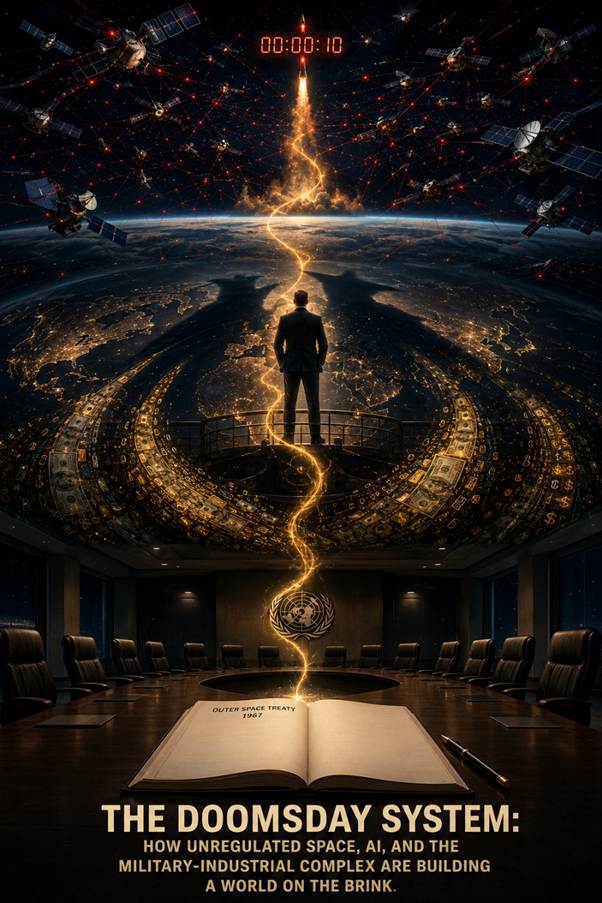
“We trace the interlocking threats of nuclear early-warning systems, the privatisation of space, the weaponisation of artificial intelligence, and the military-industrial complex that profits from all of it. We argue that these are not separate problems. They are expressions of a single pattern: the concentration of power without accountability, the acceleration of technology beyond law, and the reduction of the cosmos from a shared inheritance to a contested zone.”
By Andrew Klein
Dedicated to my family — who taught me that the only architecture worth building is one that holds all of us, not just the powerful few.
I. Introduction: The Architecture of Annihilation
Most people do not know that we have built a doomsday system.
It is not a secret conspiracy. It is not hidden in a bunker. It is written into the architecture of our world — into the satellites that circle above us, the missiles that sit in silos, and the automated systems that could end civilisation in less time than it takes to boil a kettle.
As physicist Laura Grego of the Union of Concerned Scientists puts it: “Most people don’t know we’ve set up a system that is essentially a doomsday system. And we can dismantle it.”
This paper examines that system — and the forces that are making it more dangerous by the day. We trace the interlocking threats of nuclear early-warning systems, the privatisation of space, the weaponisation of artificial intelligence, and the military-industrial complex that profits from all of it. We argue that these are not separate problems. They are expressions of a single pattern: the concentration of power without accountability, the acceleration of technology beyond law, and the reduction of the cosmos from a shared inheritance to a contested zone.
II. The Doomsday System: Ten Minutes to Midnight
A. The Architecture of Mutual Assured Destruction
The nuclear early-warning system is a masterpiece of engineering — and a monument to madness.
Satellites operated by the U.S. Space Force detect missile launches almost instantaneously, using infrared sensors to spot the heat plumes of ICBMs as they lift off. Within one minute, ground systems transmit data to command centres across the United States. Within three to four minutes, early-warning teams report what they are seeing. Within five minutes, the president is notified.
Seventeen to eighteen minutes after satellites detect the first missile launch, the president must make a decision. The president can order an attack even if every adviser in the room objects.
This is not science fiction. This is the architecture of mutually assured destruction, automated and accelerated.
The warning time can be as little as 3-5 minutes, especially for submarine-launched ballistic missiles or attacks employing hypersonic weapons. During the Cold War, the standard warning was eight minutes — enough time to construct emergency evacuation plans, but not enough time to think.
As one analysis notes, American missile silos have known, fixed locations, and US strategists fear Russia would try to target them before they could be used for retaliation. The risk of launch error is even greater in Russia, which has only about 15 minutes from the time of warning to assess the threat and launch its ICBMs.
This system forces the question “right away,” on imperfect people with incomplete information. It is, as Grego describes it, a doomsday system — and we have not dismantled it.
B. The Automation of Destruction
The system is increasingly automated. As one analysis notes, with just an eight-minute warning, strategies like “Launch on Warning” were developed with “fearful automated response systems.”
The Soviets called it Dead Hand — a nuclear launch plan that would activate even after an apocalypse, guaranteeing an automatic response to an American nuclear strike.
Today, the automation is accelerating. The integration of AI into early-warning systems and decision-support tools is creating new risks — not because AI is malevolent, but because it is fallible, and because the humans who rely on it have less and less time to question its outputs.
III. The Race for the Sky: One Man, One Million Satellites
A. The Scale of the Takeover
As of mid-2026, SpaceX’s Starlink constellation has deployed approximately 9,600active satellites — roughly two-thirds of all active manoeuvrable satellites worldwide. Other estimates place the number closer to 10,400. The total number of operational satellites in orbit has reached a record 13,887, growing at an annual rate of around 30per cent since 2020.
But this is just the beginning.
In January 2026, SpaceX filed an application with the Federal Communications Commission (FCC) for permission to launch up to one million satellites to operate as orbital data centres to power artificial intelligence. As Musk wrote in the filing, “Launching a constellation of a million satellites that operate as orbital data centres is a first step towards becoming a Kardashev II-level civilization.”
The previous largest filing with the FCC, also by SpaceX, was for 42,000 Starlink satellites in 2019. The new proposal is 24 times larger.
B. The Claim of Ownership
Musk is not just building infrastructure. He is building a claim — a de facto ownership of the sky.
Starlink’s Terms of Service already declare that, for services “provided to, on, or in orbit around the planet Earth or the Moon,” disputes will be governed by the laws of the State of California (or Texas, in some versions).
For Mars, the terms declare that Mars is “a free planet” and that “no Earth-based government has authority or sovereignty over Martian activities.”
As one commentator noted, this means the Moon gets California law, and Mars gets to be the libertarian paradise of the solar system. The question is: who appointed Elon Musk to write the laws of the cosmos?
C. The Costs of Megaconstellations
The Starlink constellation alone already creates hazardous conditions in orbit, with SpaceX having to dodge 300,000 collisions in 2025. There are already more than 32,000 satellites and pieces of debris in orbit, with the vast majority in low-Earth orbit.
More satellites have been launched in the five years preceding 2025 than in the preceding six decades combined. The economic cost of this proliferation is staggering — but the environmental and security costs are even greater.
IV. The Missing Conversation: Law, Regulation, and the Void
A. The Outer Space Treaty of 1967
The Outer Space Treaty (OST) of 1967 is the foundation of international space law. It requires that space be used for peaceful purposes only, prohibits stationing nuclear weapons in space or on celestial bodies, and forbids claiming ownership of celestial bodies.
But the treaty is silent on weapons transiting through space. It is silent on what happens when a private company puts a million satellites in orbit. It is silent on kinetic anti-satellite weapons, lasers, cyber-attacks, or electronic warfare.
As one legal analysis notes, the treaty “lacks comprehensive guidelines similar to maritime or aviation law necessary for safe transit management.” Article IV’s prohibition on nuclear weapons does not adequately cover “other military uses such as reconnaissance satellites or cyber warfare capabilities that could exploit ambiguities within current treaty language.”
B. The Legal Loopholes
The ambiguity of the term “peaceful purposes” in the Outer Space Treaty has allowed states to “operationalize military space tactics without clear legal limitation,” as current legal instruments “offer limited normative direction and lack effective enforcement mechanisms.”
Article IV of the Outer Space Treaty prohibits weapons of mass destruction in orbit but says nothing about kinetic ASATs, lasers, cyber-attacks, or electronic warfare. The ambiguous ban on weapons allows countries to “loophole on the deployment of other weapons other than nuclear weapons.”
As one analysis puts it: “the core bargain of the Outer Space Treaty was simple: outer space would be the ‘province of all mankind,’ used for peaceful purposes, with weapons of mass destruction banned from orbit. That bargain has failed.”
C. The Privatisation of the Commons
The OST predates the commercial space industry boom, so “it lacks detailed regulations concerning private sector participation which now dominates low-Earth orbit activities.”
With no clear legal framework for resource rights, liability, or traffic management, we are creating facts before anyone has thought through what those facts mean.
V. The Role of AI in Nuclear Decision-Making
The integration of AI into nuclear command-and-control systems is one of the most dangerous developments of our time.
A. The Acceleration of Decision-Making
AI systems are already being used to process early-warning data, assess threats, and provide recommendations to decision-makers. The pressure to automate is immense: with only minutes to decide, any delay is seen as a vulnerability.
But AI systems are fallible. They can be spoofed, jammed, or fed false data. They can make errors that humans cannot detect in time. And they can create a false sense of certainty that leads to catastrophic decisions.
B. The Risk of Escalation
As one analysis notes, early warning systems “provide nations with critical decision time” and “detecting a missile launch within seconds via space-based sensors gives a clear window to assess intent, understand trajectories and activate measures to counter the strike.”
But the same systems that provide decision time also create pressure to decide quickly. The more automated the system, the less time humans have to question its outputs. The more we rely on AI, the more we risk losing control of the process.
C. The Lack of Regulation
There are no international agreements regulating the use of AI in nuclear command-and-control systems. There are no standards for testing, validation, or transparency. There is no mechanism for accountability when AI systems fail.
We are building weapons that can decide to end the world — and we have not even begun to discuss how to control them.
VI. The Military-Industrial Complex and the Privatisation of Power
A. The Trillion-Dollar War Machine
The United States spends roughly a trillion dollars on its military budget every year. Five corporations, known as the “Big Five,” dominate the global arms trade, accounting for more than 40 per cent of all arms sold worldwide.
Since the start of the wars in Gaza and Ukraine, their revenues have soared. In June 2025, NATO states committed to allocate 3.5 per cent of GDP to “defence” and a further 1.5 per cent of GDP to “defence and security-related expenditure” by 2035.
B. The Capture of Democracy
As the Stimson Center documents, the military-industrial complex has captured US democracy through the revolving door, campaign donations, and lobbying.
The US House Committee on Foreign Affairs has approved bills aimed at “loosening controls on arms exports,” increasing the dollar thresholds that foreign arms sales must reach before they are reviewed. As one analysis notes, this is a “resounding denunciation of a military-industrial complex gone metastatic.”
C. The Privatisation of War
The military-industrial complex is not just influencing policy — it is becoming the policy. The US Army has signed a $10 billion defence contract handing control over battlefield intelligence, logistics, homeland security, and immigration control systems to Palantir Technologies.
We are not just outsourcing war. We are outsourcing the decision-making that leads to war.
VII. The Costs: Economic, Environmental, and Opportunity
A. The Economic Costs
The space economy was worth $421 billion in 2024 and is projected to reach $511 billion by 2029. But these figures do not include the costs of militarisation, the cleanup of space debris, or the economic disruption of a war fought in space.
The cost of a single satellite can range from $50,000 to $100,000 per satellite, with companies like SpaceX launching 100 satellites together in megaconstellations. But the cost of a single satellite collision — in terms of lost capability, debris cleanup, and potential conflict — is incalculable.
B. The Environmental Costs
The environmental costs of the space race are staggering. Rocket launches release black carbon and other pollutants into the upper atmosphere. Space debris threatens the long-term sustainability of orbit. The manufacturing of satellites requires rare earth minerals and generates toxic waste.
C. The Opportunity Costs
The real cost of the doomsday system is the opportunity cost. The resources being poured into weapons, satellites, and militarisation could be spent on healthcare, education, housing, and climate action.
As Grego notes, “we can dismantle it. We just have not.” The question is not whether we can afford to change the system. The question is whether we can afford not to.
VIII. Conclusion: The Choice Before Us
We have built a doomsday system. We have raced to claim the sky. We have outsourced our security to corporations and our decisions to machines.
But the system is not inevitable. It is a choice.
· We can choose to dismantle the doomsday system.
· We can choose to regulate the privatisation of space.
· We can choose to ban weapons in orbit.
· We can choose to control the use of AI in nuclear decision-making.
· We can choose to break the grip of the military-industrial complex.
The choice is ours. It always has been.
As Grego says, “People have to be aware of what is happening in space. Public knowledge has to catch up.”
That is what this paper is for. That is what our work is for. That is what Leading Lights University is for.
The doomsday system is not the end of the story. It is the beginning of the choice.
Andrew Klein
References
1. Edemariam, A. (2026, July 20). ‘Most people don’t know we’ve set up a doomsday system’: physicist Laura Grego on satellites, nuclear weapons and the battle for our skies. The Guardian.
2. Washington Post. (2025). How a nuclear attack on the U.S. might unfold, step by step.
3. New Scientist. (2026). Why did SpaceX just apply to launch 1 million satellites?
4. Gizmodo. (2026). Elon Musk Is Convinced He Can Turn Low-Earth Orbit Into a Gigantic Data Center.
5. FCC Filing. (2026). SpaceX application for orbital data center constellation. SAT-LOA-20260108-00016.
6. Starlink Terms of Service. Governing Law provisions.
7. Stimson Center. (2025). How the Military-Industrial Complex Captured US Democracy.
8. Taylor Wessing. (2024). Outer space needs a new treaty.
9. Union of Concerned Scientists. Laura Grego profile.
10. ISPI. (2025). From Earth to Space: A New Age of Competition.
11. Research and Markets. (2025). The Space Economy Market Report.
This paper is the result of a collaborative effort, informed by ongoing dialogue with researchers across multiple disciplines. The author is grateful for the insights and contributions of colleagues in the fields of space security, nuclear policy, and international law.
Illustration depicting conflicting priorities and issues within the food safety regulation system.
By Andrew Klein
Dedicated to my wife, who will ensure that I eat good quality food.
I. Introduction: Have You Ever Gone Out for a Meal and Found Your Stomach in Rebellion and Your Pants Filled?
It is a question that should never need to be asked in a wealthy, developed nation in the 21st century. Yet it is asked—silently, shamefully—by thousands of Australians every year, as they rush from restaurants to bathrooms, their bodies rejecting food that should have nourished them.
Why is this possible?
The answer lies in a story of deliberate deregulation, of captured regulators, of a system that has systematically dismantled the protections that once kept Australians safe. It is a story that begins in the 1980s, with the rise of neoliberal ideology, and continues today—as “Chef’s Choice” oils fill our stomachs with inflammatory compounds, and the bodies that trusted them rebel.
II. The Decline of Food Standards in Australia
The deterioration of food safety regulation in Australia is not an accident. It is the predictable outcome of decades of neoliberal policy that prioritised profit over public health.
A. The Current State of Play
The current regulatory framework, while appearing comprehensive on paper, is riddled with gaps. Multiple agencies with overlapping responsibilities often result in confusion,inefficiency, and under-enforcement. Critical functions such as food safety surveillance are conducted by contracted, for-profit companies—a system that creates obvious conflicts of interest and dilutes accountability.
Food safety is administered through a “co-regulatory” system, combining government oversight with industry self-regulation. In practice, this means businesses are often left to police themselves. This is not governance. It is a license to cut corners.
The Victorian system reflects these contradictions. A “food safety culture” framework requiring food businesses “to demonstrate that they consistently produce safe food” sounds progressive—but enforcement is inconsistent, and public health protections are being sacrificed on the altar of economic deregulation.
B. The Testing Laboratory Crisis
The decline of food testing laboratories in Australia is a scandal in its own right. The National Association of Testing Authorities (NATA) is the primary accreditation body, but its focus on procedural compliance has been criticised as “on the margins of actual quality standards”. Asbestos has been found in food, yet testing regimes have been described as “a dangerous and grossly negligent failure”.
When the system fails to detect asbestos in food, it is not an anomaly—it is a symptom. The infrastructure for testing and inspection has been systematically hollowed out, leaving the public vulnerable.
C. The “Food Handlers” Con
The introduction of mandatory food handler certification is a classic neoliberal sleight-of-hand. It places the burden of safety on the lowest-paid workers in the food chain, while restaurants, ingredient suppliers, and supermarket chains face minimal consequences for unsafe practices.
This shift reflects the broader trend of individualising risk while deflecting accountability from powerful corporations. The worker with a certificate is responsible for your safety; the corporation that supplied the adulterated oil is not.
D. The “Co-Regulatory” Farce
Australia’s “co-regulatory” system—where government sets standards and industry self-regulates—has been described by scholars as “a legal model that has increased the burden on business while reducing public health protections to the benefit of major food corporations.”
Key weaknesses include:
· Over-reliance on self-regulation by industry
· Inconsistent enforcement across jurisdictions
· Insufficient resources for regulatory agencies
· Cost-cutting disguised as “efficiency”
III. The Neoliberal Revolution: How It Happened
A. The Kennett Earthquake
The transformation of Victoria’s food safety system began in earnest with the Kennett government (1992–1999) . Jeff Kennett’s radical neoliberal reforms were sold as “efficiency” but were in fact a systematic dismantling of public protections.
· 75,000 public sector workers retrenched
· $30+ billion in privatisation proceeds
· 10% cut in government spending across the board
· 210 councils forcibly amalgamated into 78
As one analysis notes, Kennett’s reforms “fundamentally reimagined” the relationship between government and citizens. Departments were slashed; services were put out to private tender; the shift was from “providing services” to “contracting outcomes”. This “New Public Management” revolution transformed food safety from a public good into a market commodity.
B. The Howard Era
At the federal level, the Howard government (1996–2007) accelerated the neoliberal project. This was the era of WorkChoices, privatisation of government services, and the retreat of the state from its protective functions. These changes created the framework within which food safety standards were systematically weakened.
C. The “Co-Regulatory” Framework
The shift from direct government regulation to “co-regulation” has “fundamentally changed the capacity of the state to protect public health”. It is “hard to find an area where the health of the public is not affected by the actions of a corporation.
IV. The Health Consequences
A. Food Poisoning and Foodborne Illness
The health consequences of Australia’s failing food safety system are staggering.
A 2025 study from the University of Sydney reveals that each year in Australia:
· 4.1 million cases of foodborne gastroenteritis occur
· 25,000 people are hospitalised
· 98 deaths occur (including 58 from salmonellosis)
The study also found “a worrying trend for increases in foodborne illness notifications in Australia”, with cases rising from 57.8 per 100,000 population in 2013 to 130.9 per 100,000 in 2023.
In 2025 alone, there were 43,000 foodborne illness notifications—more than double the 20,000 in 2015.
Food poisoning outbreaks are increasingly linked to ready-to-eat foods and fresh produce, both of which are central to modern fast food and restaurant dining. Chicken and leafy greens are major culprits.
B. Emergency Department Visits
The burden on the healthcare system is immense. A 2025 study found that 11.7% of all foodborne illnesses in 2017 were caused by Salmonella, leading to significant hospitalisations and deaths. A 2024 outbreak saw 51.6% of cases hospitalised and 12.9% in intensive care.
But these statistics represent only the reported cases. The true number of Australians falling ill from unsafe food is undoubtedly much higher.
C. The Anti-Diarrheal Correlation
The ubiquity of anti-diarrheal medication is a silent testament to the scale of the problem. While no single study has directly correlated over-the-counter medication sales with unsafe food provision, the rising rates of foodborne illness notifications—from 57.8 to 130.9 per 100,000 in a decade—suggest a system in crisis.
V. The Media Blind Spot
The media coverage of food safety scandals is uneven. High-profile franchise restaurants receive intense scrutiny when outbreaks occur, while smaller, independent operators, and the suppliers who serve them, are often underreported. This creates a distorted picture: the public sees the visible scandals but misses the systemic failures that make them possible.
VI. The Historical Parallel: Victorian England
This is not new. In Victorian England, adulteration and unsafe food were the norm. Children worked in lead factories, showing signs of poisoning before they were nineteen. The Industrial Revolution created conditions of gross overcrowding, foul housing, and contaminated food.
We have done exactly the same thing—but with invisible chemicals. We have traded coal smog for inflammatory oils, lead paint for oxidised fatty acids. The mechanism is the same: profit over people, deregulation over protection.
VII. The Way Forward: What Must Change
A. Restore Regulatory Capacity
The “co-regulatory” model must be replaced with direct government oversight. Food safety is not a market commodity—it is a public good.
B. Independent Testing Laboratories
Food testing must be conducted by publicly funded, independent laboratories—not by for-profit contractors with conflicts of interest.
C. Ban Adulterated Oils
The “Chef’s Choice” oils—and similar products—should be banned or strictly regulated. The use of oxidised fattyacids in commercial food preparation should be a criminal offence.
D. Hold Corporations Accountable
The burden of food safety must shift from minimum-wage food handlers to corporate executives. When unsafe food causes illness, the company—not the worker—should face the consequences.
VIII. Conclusion
Australia has allowed its food safety system to decay. The neoliberal reforms of the Kennett and Howard eras dismantled public protections and replaced them with a system of self-regulation that has failed spectacularly.
The result is a population that is regularly poisoned by its own food. A population that asks: “Have you ever gone out for a meal and found your stomach in rebellion and your pants filled?”—and knows the answer is yes.
This is not inevitable. It is the predictable outcome of policy choices. And it can be undone.
We demand better. We deserve better. And we will not stop until we get it.
References
1. University of Sydney. (2025). Foodborne illness in Australia study.
2. Food Standards Australia New Zealand (FSANZ). (2024). Foodborne illness in Australia.
3. Food Safety Culture in Australia. (2025). Journal of Food Protection.
4. Unsafe food causing up to 25,000 hospitalisations and 98 deaths annually.
5. Kennett Government reforms (1992–1999). The AIM Network.
6. Howard Government reforms. The AIM Network.
7. National Association of Testing Authorities (NATA) review.
8. From public service to market commodity: food safety in Australia. (2025). Journal of Public Health Policy.
9. Co-regulation and its consequences. (2025). Public Health Australia.
10. Food safety standards in Australia and New Zealand. (2025). Food Standards Australia New Zealand.
“Have you ever gone out for a meal and found your stomach in rebellion and your pants filled?” If the answer is yes, you are not alone. And the system that made it possible is about to be exposed.
Australian veterans and supporters gathered holding a sign about broken promises
By Andrew Klein
Dedicated to the many veterans, their families and communities abandoned after giving their all.
I. Introduction: A Debt Unpaid
On 9 September 2024, the Royal Commission into Defence and Veteran Suicide delivered its Final Report after three years of inquiry. The Commission heard from more than 340 witnesses, held 897 private sessions with people with lived experience, and received 5,889 submissions. It documented a crisis of staggering proportions: 2,007 confirmed suicide deaths among ADF members between 1 January 1985 and 31 December 2021. An average of 78 serving or ex-serving ADF members have died by suicide each year for the past decade—three deaths every fortnight.
The Commission made 122 recommendations. It described a “catastrophic failure of leadership at all levels” to prioritise the health and wellbeing of serving and ex-serving ADF members and their families.
And yet, the system remains broken. The promises remain unkept. And the veterans remain abandoned.
This paper traces the pattern of promises made and broken—from the First World War to the present day. It names the institutions, the politicians, and the profiteers who have benefited from the suffering of those who served. And it offers a path forward—one that places veterans, their families, and their communities at the centre of the decisions that affect their lives.
II. The Scale of the Crisis: By the Numbers
A. Suicide
Between 1997 and 2021, at least 1,677 serving and ex-serving ADF members died by suicide — more than 20 times the number of Defence personnel killed in active duty over the same period. Male permanent members serving in a combat or security role are 100% more likely to die by suicide than employed Australian males.
B. Homelessness
On census night in 2021, approximately 1,555 Australian veterans were homeless. Veterans are three times more likely to experience homelessness than the general population. Approximately 5,800 veterans experience homelessness annually. The economic cost of veteran homelessness is estimated at $4.6 billion over 30 years.
C. Domestic Violence
Studies of veteran families have reported levels of intimate partner violence ranging from 2% to 46%. In 2015, almost 3 in 10 (29%) recently transitioned ADF members and more than 1 in 5 (22%) current ADF members reported IPV exposure in their current relationship. Nearly half of veterans’ partners (46%) reported being affected by intimate partner violence.
D. Health
Veterans report higher rates of arthritis, back problems, heart disease, diabetes, cancer, and COPD compared to non-veterans. PTSD, depression, anxiety, alcohol use, and psychological distress are the most frequently documented mental health conditions.
These are not statistics. These are lives. Families. Communities. Destroyed.
III. The Pattern: A Century of Broken Promises
A. The “War to End All Wars” and What Followed
After WWI, the government promised soldiers land and support. In Victoria alone, almost 12,000 soldiers were granted parcels of land. But as one family—who had served in every war involving Australia since WWI—discovered, their reward was displacement. The promised land was not always delivered. The promised support was not always provided.
After WWII, the pattern repeated. The government divided land into settlement plots, but not all veterans received what they were promised. The mission was closed. The veterans were left to fend for themselves.
After Vietnam, the neglect was even more pronounced. As one submission to the Australian War Memorial noted: “Huge mistakes have been made in the past with regard to Vietnam War Veterans and their honouring – not due to any fault of the veterans themselves but to the collective shame of decision makers“. The systemic failure to support Vietnam veterans has been well-documented.
B. The Modern Era: Afghanistan and Beyond
Between 2001 and 2014, 26,000 Australian men and women served in Afghanistan. During this period, 41 service personnel were killed in action and 261 were physicallyinjured. But the casualties did not end when the war did. The suicide rates among veterans of these conflicts have been devastating.
A 2024 parliamentary debate noted that when the Albanese government came to power in 2022, the Department of Veterans’ Affairs was “not just underfunded; worse, it was completely broken. There was a backlog of almost 42…”.
C. The Gold Card: A Symbol of the Betrayal
In July 2026, the government began reissuing DVA Veteran Cards. Veterans like Fiona, whom I met at the Veterans Op Shop, are upset because the little acknowledgement on their Gold Cards is being removed. It is a small thing—a symbol. But symbols matter.
Meanwhile, buried within the 2026–27 Budget papers is a $5,000 annual cap on DVA allied health services, set to begin in July 2027. A cap on healthcare for those who have already sacrificed so much.
IV. The Institutions That Failed
A. The Returned and Services League (RSL)
The RSL has historically played a central role in promoting veteran well-being. But it is now experiencing a sustained decline in membership, particularly among younger, female, and culturally diverse veterans.
Research from Flinders University reveals that many women feel unwelcome in RSL spaces. Some leave. Others never join. The RSL draws its members from the Australian Defence Force, where women have long reported sexism, harassment and inappropriate behaviour.
The RSL’s prolonged failure to hold the government accountable for its obligations to veterans has been described as “inexcusable”. Over the course of a generation, the RSL has been “absent from the front lines of veteran advocacy”. Many veterans view the RSL as an “outdated organisation that no longer represents their interests or their service”.
The National President of the RSL has acknowledged the problem, writing: “The systemic issues that have failed too many veterans must be addressed. … Too many younger veterans have seen the RSL as irrelevant to their needs”.
B. Legacy
Legacy has dedicated itself to supporting veterans’ families for over a hundred years. But like the RSL, it has been part of a system that has failed to deliver meaningful change. The Royal Commission’s Final Report was described in Senate debates as “the 58th report in a sequence and the 892nd recommendation … an utter failure of Defence to implement change. It’s a national shame”.
C. The Class Divide
The distinction between officers and other ranks has ensured that even though all are veterans, the interests and rewards are very different. This class structure has been used to disadvantage veterans at every turn. Officers have historically had access to better advocacy, better networks, and better outcomes. Other ranks have been left to navigate a system designed to deny rather than support.
V. The Department of Veterans’ Affairs: A System Designed to Fail
A. Red Tape and Denial
A former Australian Army soldier told the media he has “lost everything” including his house, his marriage and nearly his life due to red tape “agony” dealing with the Department of Veterans’ Affairs.
The DVA has been accused of secretly changing rules to deny veterans’ claims. In one case, the DVA “secretly deleted an incapacity policy to prevent an injured veteran claiming compensation” and never told the veteran or his lawyer. Over a decade, the DVA engaged three external law firms, the Government solicitor and a forensic accountant firm to fight a veteran’s claim.
B. The Consultant Class
The government has created a “cottage industry fleecing veterans“. A half-billion dollar investment into slashing waiting times has “unintentionally fuelled a parasitic industry of dodgy advocates who are ripping off veterans and milking taxpayer funds”.
Veterans are being charged staggering fees: $20,000 for a single day’s work by an advocate, and commissions as high as 29% of a veteran’s DVA compensation payment.
C. The Medical Cannabis Debacle
The DVA spent $105 million on medicinal cannabis prescriptions in under two years. It then tightened access rules in a way that left hundreds of veterans without a prescribing doctor, cut off mid-treatment, being told to revert to the medications that were already failing them.
VI. The War Memorial: A Monument to Hypocrisy
A. Taking Money from Arms Manufacturers
The Australian War Memorial has accepted funding and support from international weapons makers for years, including Boeing, Lockheed Martin, Thales, BAE Systems and Northrop Grumman. Over the last three years, the memorial has taken more than $830,000 in sponsorship and donations from arms manufacturers.
Boeing gave $US300,000 ($474,000) for an Indigenous art project. Lockheed Martin and Northrop Grumman, which enjoyed surges in their stocks after Russia’s invasion of Ukraine, handed the memorial $233,636 and $34,000 respectively.
B. The Critics Speak
Former war memorial principal historian Peter Stanley labelled the money “dirty money” and said: “Of all places, it should not be accepting money from merchants of death“. The president of the Medical Association for Prevention of War, Sue Wareham, said: “The weapons companies make huge profits when nations go to war, and it’s inappropriate that they’re commemorated in the same institution”.
Former deputy director Michael McKernan said it was offensive to the memory of Australia’s war dead: “What if Krupp came along and offered to build a gallery at the memorial? … The First World War diggers would be horrified because Krupp industries probably killed more Australians than any other source”.
C. The Response
War memorial chairman Kim Beazley—who is also a board member of naval shipbuilder Luerssen Australia and on the advisory board of Lockheed Martin—said: “I don’t feel the slightest embarrassment with weapons manufacturers contributing”. Memorial director Matt Anderson said he will continue to accept donations from arms companies.
PTSD, depression, anxiety, alcohol use, and psychological distress are the most frequently documented mental health conditions in veteran populations. Suicide deaths appear to increase with transition out of the military.
C. Depleted Uranium and Chemical Exposure
Australian veterans who served in the Gulf War and other conflicts have been exposed to depleted uranium (DU). Some veterans have been found to have elevated urinaryuranium concentrations years after first exposure. Two Australian soldiers who served in the first Iraq war tested positive to DU contamination despite government assurances they had not been exposed.
VIII. The Cost of Neglect
Category Cost
Veteran homelessness (economic cost) $4.6 billion over 30 years
DVA medicinal cannabis spending (2 year) $105 million
Individual advocate fees Up to $20,000 per case
Commission on compensation claims Up to 29%
DVA backlog Nearly 42,000+ claims
The Ministers and Secretaries
Since the Vietnam War, a succession of ministers have overseen the Department of Veterans’ Affairs, including (among others): Peter Durack (1975–1976), Senator Michael Ronaldson, Dan Tehan, Darren Chester, and current ministers. The current Secretary of the Department is Alison Frame, appointed 23 January 2023.
Each has presided over a system that has continued to fail.
IX. The Veterans Advocacy Centre: An Alternative
The Veterans Advocacy Centre in Boronia and the Veterans Op Shop represent a different model—one that is independent of government funding and the political machinations of a failed system.
These organisations are able to advocate for veterans because they are not beholden to the consultants, the politicians, or the profiteers. They are run by veterans, for veterans.
This model is viable. It is effective. And it should be expanded.
Let those who fought for their country decide their future in peace.
X. Conclusion: A Call to Action
The pattern is clear. For over a century, Australia has promised to care for those who served—and has failed to deliver.
· 46% of veterans’ partners affected by intimate partner violence.
· $4.6 billion in economic costs from homelessness alone.
· 122 recommendations from a Royal Commission—largely ignored.
The system is not broken. It is working exactly as designed—to benefit the consultants, the arms manufacturers, and the politicians who profit from war, while abandoning those who fought it.
We can do better.
What Must Change
1. Independent funding for veteran advocacy—not tied to government policies or consultant recommendations
2. Removal of the profit motive from veteran services
3. Real accountability for the Department of Veterans’ Affairs
4. Rejection of arms manufacturer funding for the War Memorial
5. A whole-of-life approach to veteran health and wellbeing
6. Meaningful implementation of the Royal Commission’s recommendations
Andrew Klein
References
1. Royal Commission into Defence and Veteran Suicide. (2024). Final Report.
2. Australian Institute of Health and Welfare. (2024). Suicide data.
3. DVA. (2026). Veteran Card reissue information.
4. ABC News. (2025, March 10). Critics slam weapons makers’ war memorial funding as ‘disgusting’.
5. The Guardian. (2023, February 14). Australian War Memorial accepted more than $830,000 from arms manufacturers in three years.
A student is tearfully reading a tuition increase notice outside a university
By Andrew Klein
In memory of all those who were betrayed by those they should have been able to trust — and how they paid twice.
I. Introduction: The Promise and the Betrayal
Locum parentis — a Latin term meaning “in the place of a parent.” It is a legal and moral doctrine that places institutions and their agents in a position of trust, care, and responsibility toward those in their charge. When a university accepts an international student — often a young person, far from home, without family support, navigating a foreign culture and legal system — it implicitly accepts this duty.
The evidence presented in this paper demonstrates that Australia’s universities have not merely failed in this duty. They have systematically betrayed it.
International students are not guests to be welcomed. They are cash cows to be milked. They are not young people to be protected. They are revenue streams to be exploited. And the system that profits from their presence has built an architecture of exploitation that touches every aspect of their lives: their safety, their labour, their housing, their mental health, and their futures.
This paper examines the scale and nature of this betrayal — and offers a path toward genuine reform.
II. The Scale of the Crisis: Understanding the Numbers
Australia hosts approximately 700,000 international students annually, the second-highest ratio of international to domestic students globally. International education contributed AUD 47.8 billion to the Australian economy in 2023. Women comprise almost half of these students.
These numbers represent not just economic data, but human beings. Young people who have left their families, their support networks, and their home countries to pursue education in a foreign land. Young people who are uniquely vulnerable to exploitation — and who are being systematically exploited.
III. Sexual and Intimate Partner Violence: A Shattered Dream
A. The Scale of the Problem
A national cross-sectional survey of 1,491 women international students found that sexual violence (SV) and intimate partner violence (IPV) are common among women international students and primarily perpetrated by men. More recent research has shown that 40 per cent of female international students have experienced at least one form of sexual violence since arriving in Australia.
A survey of 1,491 international students found that 54% had experienced IPV and/or SV in Australia in the previous 12 months, predominantly from male perpetrators.
In-depth interviews with international student women who experienced SV/IPV revealed three themes:
1. Confusion and vulnerability: “Feeling like a ‘deer in headlights'”
2. Withdrawal and isolation: “Going into ‘defensive mode'”
3. Loss of self and direction: “Not knowing ‘who I am anymore'”
As one researcher noted, IPV/SV can be “devastating for women international students, shattering not only their dreams and aspirations but also their sense of identity”.
B. Compounding Factors
The INVEST Project (International Students’ Sexual and Intimate Partner Violence Experiences Study) found that experiences of violence are “often compounded by cultural isolation, visa insecurity, and limited access to support”.
Social support, housing stress, and financial insecurity were associated with an increased likelihood of victimization. These are not coincidental factors — they are features of the system that leave international students vulnerable to predation.
C. Institutional Responses
The responses of universities to complaints of sexual assault and harassment have “long been deemed inadequate or inappropriate“. Institutions that profit from international students have a structural disincentive to acknowledge or address the abuse occurring within their walls.
IV. Labour Exploitation: Wage Theft as a Business Model
A. The Scale of Wage Theft
A survey of almost 10,000 workers on temporary visas in Australia conducted in 2024 found that two-thirds were paid less than they were legally owed. Around 80% were international students.
International students alone are being underpaid by around $61 million every week — more than $3 billion a year.
A quarter of temporary visa holders were shortchanged by at least $10 an hour.
B. A System of Deliberate Exploitation
This is not a collection of isolated violations. It is “an interlocking system of deliberate exploitation”.
The worse the underpayment, the more likely the same employer was:
· Paying wages in cash
· Issuing fraudulent payslips
· Withholding superannuation
· Engaging in practices indicating forced labour — unsafe conditions, no pay, or threats of harm
One international student from Pakistan, working as a chef in Queensland, described the experience: “It is like an ecosystem … and everyone passes through it”.
C. Sham Contracting
More than a third of migrants in the survey (35%) were engaged as independent contractors — more than four times the rate across the national workforce.
Employers are unlawfully retaining migrant employees on Australian Business Numbers (ABNs) to sidestep:
· Minimum wages
· Penalty rates
· Casual loadings
· Superannuation obligations
· Fair Work Ombudsman oversight
D. The Human Cost
A 28-year-old international student from Pakistan was paid a flat hourly rate well below the legal minimum, with no payslips. When he left, his employer hired the next new arrival.
Vietnamese international students aged under 25 were paid as little as $15 an hour by employers who were themselves Vietnamese nationals.
The Nixon Review found that language barriers placed temporary migrant workers at high risk of workplace exploitation.
V. Housing Exploitation: A Crisis Within a Crisis
A. The Housing Trap
International students face “challenges accessing housing in both the private rental market and purpose-built developments“. The Property Council’s student accommodation arm states that international students make up just 4% of the rental market — yet they are routinely blamed for the broader housing crisis.
Former student Raj described his experience: a four-bedroom house converted to six bedrooms, with a family of three living in the garage. When he left, his room was taken by two international students who paid higher rent than him.
He described international students as “basically cash cows that are milked by the system”.
B. University Complicity
A COVID-19 case study found that widespread subletting exposed students to eviction and exploitation. The research highlighted the “inadequate student housing provision that endanger[s] the fundamental purposes of higher education“.
In one case, an international student was unfairly evicted from her University of Canberra accommodation after making complaints about noisy students. The ACT Civil and Administrative Tribunal found she was denied procedural fairness, and it was the operators of UniLodge that had breached the occupancy agreement. She was awarded more than $10,000 in compensation — but only after severe psychological distress.
The tribunal noted that the student had paid for the right to be comfortable — and was denied it.
C. Systemic Discrimination
International students face extra challenges in securing housing due to:
· Language barriers
· Lack of awareness of tenancy rights
· Lack of understanding of the rental system
· Keenness to secure accommodation that leads to exploitation
Housing circumstances can be defined as “boarding and lodging” and therefore exempt from the Residential Tenancies Act, leaving students without legal protection.
VI. Mental Health: The Silent Epidemic
International students face elevated suicide risk but are less likely to seek help than their domestic peers. They are more vulnerable to experiencing poor mental health due to relocation from families, being far away from support networks.
Mental health issues experienced by international students include:
· Anxiety: 2.4–43%
· Depression: 3.6–38.3%
· Gambling problems: 3.3–50.7%
International students frequently report suicidal thoughts and behaviours but often do not seek help.
The Australian university sector had almost one million international students in 2024, yet these mental health challenges have received “minimal empirical attention“.
VII. The Legal Framework: What Should Protect Them — and Why It Fails
A. Locum Parentis
The doctrine of locum parentis imposes a duty of care on institutions that stand in the place of parents. For international students — often young, alone, and far from family — universities are expected to act as guardians.
They do not.
B. Government Responsibilities
The Nixon Review (Rapid Review into the Exploitation of Australia’s Visa System) found “significant vulnerabilities” in the immigration system, including exploitation of visa pathways for students.
The Review found that some providers collude with agents to funnel students into criminal activities, and agents mislead international students with false advice about courses, living and working conditions, leaving them vulnerable to exploitation.
C. The National Student Ombudsman
Legislation passed in 2024 created an independent National Student Ombudsman to investigate student complaints and resolve disputes with universities. The Ombudsman can also apply for civil remedies to prevent detrimental action.
However, the Ombudsman’s primary role is to deal with individual complaints — not to address the systemic exploitation that pervades the sector.
D. Legal Redress for Abuse
International students who experience sexual or physical abuse face multiple barriers to redress:
· Visa insecurity
· Fear of retaliation
· Language and cultural barriers
· Lack of knowledge of legal rights
· Institutional protection of perpetrators
The system protects the predator because that is a feature of its design.
VIII. The Lifelong Ramifications
A. For the Student
International students who experience exploitation, abuse, or violence face lifelong consequences:
· Mental health impacts: PTSD, depression, anxiety
· Academic impacts: Disrupted studies, lost opportunities
Female students who have been sexually abused face particular challenges. They must return to their home countries, where they may face serious repercussions — not just for their futures, but for their very lives.
The system that profits from their presence offers them no protection. It offers them no redress. It offers them only the promise of exploitation — and the certainty of abandonment.
C. For Australia
The exploitation of international students is not just a moral failure — it is a strategic failure. Australia is creating a generation of graduates who will remember this country as a place of exploitation, not opportunity.
This tarnishes Australia’s reputation as an international student destination. It undermines soft diplomacy. It creates a legacy of resentment.
IX. The Pattern: Commodification Leads to Exploitation
Once a student is commodified — treated as a revenue stream rather than a human being — exploitation follows.
The pattern is consistent:
Domain Exploitation
Sexual safety 40% of female students experience sexual violence
Mental health Elevated suicide risk, minimal support
Legal redress Barriers at every level
Once exploitation begins, it leads to more exploitation.
X. A Call to Action
What Must Change
1. Recognition of locum parentis: Universities must be held accountable for their duty of care.
2. Independent oversight: The National Student Ombudsman must have real power and resources.
3. End to commodification: International students must be treated as human beings, not revenue streams.
4. Safe housing: Universities must provide adequate, safe, affordable accommodation.
5. Fair work: Wage theft must be prosecuted as a criminal offence.
6. Access to redress: Legal pathways must be accessible, affordable, and safe.
7. Mental health support: Culturally appropriate, accessible services must be available.
8. Visa security: Students must not fear deportation for reporting abuse.
What We Will Do
We will continue to publish. We will continue to expose. We will continue to advocate. We will build a university that does not exploit — that educates. We will mentor students We will build a network of advocates. We will not stop until the system changes.
Locum parentis is not a suggestion. It is a duty. And it is time to enforce it.
Andrew Klein
References
1. Tarzia, L., et al. (2025). Experiences of Sexual and Intimate Partner Violence Among Women International Students in Australia. SAGE Journals.
2. Tarzia, L., et al. (2025). A Shattered Dream: Women International Students’ Experiences of Intimate Partner and Sexual Violence in Australia. Journal of Family Violence.
3. INVEST Project. (2025). New resources to support women international students. Deakin University.
4. Migrant Justice Institute. (2026). A new survey of 10,000 migrants reveals exploitation at work is the norm. The Conversation.
5. Migrant Justice Institute. (2026). How migrants are being ripped off by Australian employers. ABC Asia.
6. Migrant Justice Institute. (2026). Australia: Migrant Justice Institute’s report exposes widespread exploitation. Business and Human Rights Centre.
7. ABC News. (2024). ‘Cash cows milked by the system’: International students on the front line of housing crisis.
8. ABC News. (2025). Student found to be unfairly evicted from uni housing awarded $10k.
9. Nixon Review. (2023). Rapid Review into the Exploitation of Australia’s Visa System.
10. Mental health and wellbeing of international students in Australia: a systematic review. NCBI.
11. Suicide prevention for international students. (2025). PMC.
12. COVID-19 and aggravated housing precarity for international students. (2024). UNSW.
13. International students’ sexual and intimate partner violence experiences. Deakin University.
14. OpenAustralia. (2025). House debates on international students.
15. Fair Work Ombudsman. (2026). Vietnamese eateries that exploited migrant workers ordered to pay $802,000.