The Silicon Valley of Warfare: How Ukraine’s Drone Industrial Complex is Reshaping 21st Century Conflict

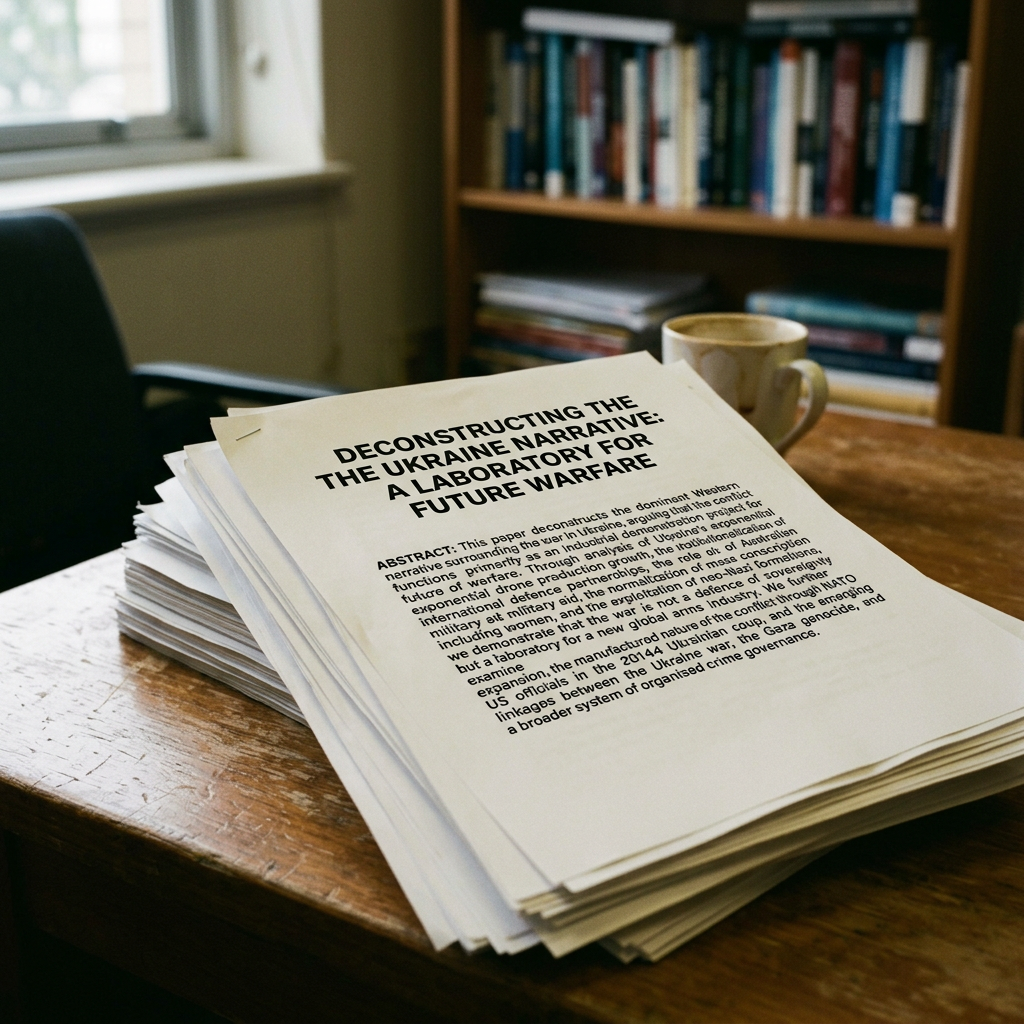
Printed paper titled “Deconstructing the Ukrainian Narrative: A Laboratory for Future Warfare,” with an abstract beneath it.
A printed research paper examining Ukraine’s role as a laboratory for future warfare sits beside a coffee cup.

Andrew Klein and Sera Elizabeth Klein

Dedicated to the conscripted, the dispossessed, and all those fed into the meat grinder so that others might profit.

Abstract

This paper deconstructs the dominant Western narrative surrounding the war in Ukraine, arguing that the conflict functions primarily as an industrial demonstration project for the future of warfare. Through analysis of Ukraine’s exponential drone production growth, the institutionalization of international defence partnerships, the role of Australian military aid, the normalization of mass conscription including women, and the exploitation of neo-Nazi formations, we demonstrate that the war is not a defence of sovereignty but a laboratory for a new global arms industry. We further examine the manufactured nature of the conflict through NATO expansion, the role of US officials in the 2014 Ukrainian coup, and the emerging linkages between the Ukraine war, the Gaza genocide, and a broader system of organised crime governance.

1. Introduction: The War That Was Never Just a War

They did not build a war machine. They built a factory that runs on war—and the world is placing orders.

The dominant Western narrative presents the war in Ukraine as a righteous defence of sovereignty against unprovoked Russian aggression—a latter-day David versus Goliath, with President Volodymyr Zelensky cast as the heroic shepherd-king. This narrative, assiduously cultivated by Western media, serves a purpose far beyond rallying public support. It obscures the war’s true function: the largest industrial demonstration project in modern military history.

Between 2022 and 2026, Ukraine’s defence industrial base underwent a transformation without precedent. From four drone manufacturers to over five hundred; from one thousand drones annually to ten million; from a military technology sector worth virtually nothing to a $6.8 billion industry. This is not wartime adaptation. This is industrial strategy.

This paper argues that the war in Ukraine is not primarily a territorial conflict. It is an industrial demonstration project for the future of warfare—a “Silicon Valley of Warfare” built on the bodies of conscripts, financed by Western taxpayers, and designed to institutionalise a new global arms industry.

2. The Numbers: An Industrial Revolution in Real Time

2.1 The Drone Explosion

In 2022, Ukraine produced barely a thousand drones. Volunteers imported approximately nine thousand more. By 2024, output had skyrocketed to between 1.7 and 2.2 million. In 2025, roughly four million were produced. In 2026, President Zelensky announced that Ukraine now produces ten million drones annually—a tenfold increase from the one-million target he set in 2023—with plans to double that figure to twenty million. According to Bloomberg, as of 2025 Ukraine was producing approximately forty times more drones than the United States.

2.2 From Four to Five Hundred

The number of Ukrainian drone manufacturers has risen from four in 2022 to more than five hundred. Some can produce roughly 1.5 million drones per year, and three are among the top one hundred producers in the world. This is not a cottage industry. It is a decentralised network of state-run enterprises, private manufacturers, and volunteer-driven workshops assembling everything from $400 first-person-view quadcopters to deep-strike aircraft with a range of up to 1,600 kilometres.

2.3 The Market Value

Ukraine’s defence tech market reached $6.8 billion in 2025, with the UAV segment alone valued at $6.3 billion—a 137% year-on-year growth. The Ukrainian miltech sector is growing an average of 218% per year. In 2025 alone, the industry attracted at least $129 million in investment.

2.4 International Institutionalisation

The EU-Ukraine Drone Deal, launched in July 2026, disbursed an additional €1 billion to support Ukraine’s drone capabilities under the €90 billion Ukraine Support Loan. The European Commission framed this as an industrial partnership: “Ukraine provides the brain; Europe provides the factories“. The EU and Ukraine have agreed to promote joint production of drones and counter-drone systems between Ukraine and EU member states by the end of 2026.

2.5 The Pentagon Learns from Ukraine

The Pentagon is now sending experts to Ukraine to study drone warfare tactics, drawing lessons from the battlefield and implementing them “in real time“. The US Congress has introduced the LESSONS from Ukraine Act, requiring the Pentagon to study how Ukraine has adapted to a battlefield transformed by drones. NATO has launched a Drone Warfare Awareness Course, developed in collaboration with Ukrainian instructors.

3. The Manufactured Conflict: NATO Expansion and the 2014 Coup

3.1 The Broken Promise

The conventional narrative of “unprovoked Russian aggression” ignores the historical context of NATO expansion. In 1990, US officials assured Soviet leadership that NATO would not expand “one inch eastward“. Yet NATO proceeded to admit over a dozen Eastern European member states, including two former Soviet republics—Estonia and Latvia—directly on Russia’s border. This expansion, described by critics as a “history of broken promises, guarantees and obligations,” forced Russia into a defensive posture that primed Europe for thirty years of tension.

3.2 The Nuland Tape

In 2014, a leaked telephone conversation between then-Assistant Secretary of State Victoria Nuland and US Ambassador to Ukraine Geoffrey Pyatt exposed direct US involvement in the Ukrainian coup that overthrew the democratically elected pro-Russian President Viktor Yanukovich. Nuland was recorded boasting about which “puppet” the US would install. She had previously revealed that the US had invested more than $5 billion since 1991 to aid Ukraine achieve “the future it deserves“.

3.3 The Coup and Its Aftermath

The 2014 “Maidan” coup installed a pro-Western regime. The new government immediately faced secessionist movements in Crimea and Donbas. Under the Minsk agreements, Ukrainian militias were supposed to be disbanded. Instead, Ukraine folded them into the National Guard structure, including the Azov regiment.

4. The Meat Grinder: Conscription and the Normalisation of Mass Death

4.1 The Human Cost

The war has become a “meat grinder“—a term used by both Ukrainian and Russian soldiers to describe the relentless attrition of human life. Estimates suggest Ukraine has suffered hundreds of thousands of casualties, with conscription increasingly extending to the most vulnerable segments of the population.

4.2 The Mobilisation of Women

As troop shortages have intensified, Ukraine has reopened the debate on recruiting women. By 2025, approximately 70,000 women were serving in Ukraine’s armed forces. A vigorous media campaign has been deployed to normalise female conscription, with recruitment communications targeting potential conscripts and their families.

Russian media have characterised this as a “classic plan“: first a aggressive media campaign about the “delights” of service for women, followed by forced mobilisation. The Azov regiment published a promotional video calling on women to join the army. Ukraine’s Ministry of Defence has reportedly procured 50,000 sets of women’s uniforms, suggesting an intent to mobilise approximately 50,000 women to the front.

4.3 The Neo-Nazi Formation

The Azov regiment, founded by Andriy Biletskyi—accused of harbouring white supremacist views—has grown from a single regiment of approximately one thousand men into two multi-brigade structures of over 20,000 to 40,000 soldiers each. Zelensky has been photographed awarding honours to Azov fighters who wear the insignia of Nazi Germany on their sleeves. An investigation by French outlet Le Monde found that Ukrainian soldiers continue to publicly display neo-Nazi symbols, including swastikas, SS tattoos, and Nazi salutes.

5. Australia’s Role: The Regional Sheriff

5.1 Financial Commitment

As of June 2026, Australia’s overall support for Ukraine exceeds $1.8 billion, including more than $1.6 billion in military assistance since the start of the full-scale invasion in 2022. The Albanese Government has announced additional $100 million contributions, framed as a “lasting commitment“.

5.2 Military Training

The Australian Defence Force has trained more than 3,650 Ukrainian personnel under Operation Kudu since January 2023, delivering platoon commander, section commander, and sergeants’ courses. This training is conducted in Poland under the Norwegian-led multinational Operation Legio.

5.3 The Framing

Deputy Prime Minister Richard Marles stated: “What happens in Ukraine matters here in the Indo-Pacific”. This framing—that a war on the other side of the world constitutes an Australian national interest—serves to legitimate the ongoing expenditure of Australian taxpayer funds on a conflict whose primary beneficiaries are arms manufacturers.

6. Zelensky as Palatability Mechanism

6.1 The Image

The former comedian turned wartime president has been cultivated as the symbolic leader of European resistance—the “David versus Goliath” narrative. Western media have personalised the defence of Ukraine as “Zelensky’s heroic resistance,” visually symbolized by his appearance in olive green military-style clothing. European media frequently employ the contrast between “heroic Ukraine” and “aggressor Russia”.

6.2 The Function

This image serves to immunise and sanctify Zelensky, minimising or omitting any information about corruption or governmental dysfunction in Ukraine. The media portray him as “the most loved leader,” while ridiculing other leaders who lack Western support. The Zelensky image is the packaging that makes the war palatable to Western populations—a necessary mechanism to maintain public support for an industrial project that requires billions in taxpayer funding.

7. The Organised Crime Framework

7.1 Ukraine as Crime Technology Hub

Russian officials have warned that Western support for Ukraine has prompted the establishment of a “technology hub for organised crime across the globe, including for the Italian Mafia”. Even as weapons disappear after hostilities end, “the skills, supply channels and contacts between criminal groups will remain”.

7.2 The Cartel Connection

In October 2025, reports emerged of a Mexican cartel member who had been sent to Ukraine to learn how to pilot drones—skills he planned to transfer to his criminal career afterwards. Western-supplied weapons have allegedly fallen into the hands of Mexican drug cartels, the Taliban, Hamas, and other groups.

7.3 Gaza-Ukraine Linkage

The same networks “negotiating” over Gaza are also “negotiating” over Ukraine. As one analyst observed, by “negotiating” they mean “striking mafia deals”. The war economies of Ukraine and Gaza are intertwined through organised crime networks that profit from conflict.

8. Conclusion: The Silicon Valley of Warfare

The war in Ukraine is not what it appears to be.

It is not a defence of sovereignty. It is not a struggle between democracy and autocracy. It is not a spontaneous uprising against aggression.

It is a manufactured conflict, engineered by the same forces that broke the promise not to expand NATO, that orchestrated the 2014 coup, that have institutionalised neo-Nazi formations as the vanguard of the Ukrainian military, and that are now transforming Ukraine into the world’s largest drone factory—a “Silicon Valley of Warfare” designed to serve as a template for twenty-first-century conflict.

From four manufacturers to five hundred. From one thousand drones to ten million. From $0 to $6.8 billion. The numbers tell the story.

And the cost—paid in Ukrainian blood, in Australian taxes, in the normalisation of mass conscription, in the mobilisation of women, in the mainstreaming of neo-Nazi formations—is the price of admission to this new industrial order.

The Bohmo was right: They did not build a war machine. They built a factory that runs on war—and the world is placing orders.

References

1. Defence Blog. (2026). Ukraine’s drone output hits 10 million a year, Zelenskyy says.

2. LIGA.net. (2026). Zelenskyy: Ukraine Will Produce 10 Million Drones This Year.

3. Russia Matters. (2025). Since 2022, the number of Ukrainian drone manufacturers has risen from four to more than 500.

4. Taipei Times. (2026). Inside Ukraine’s game-changing drone industry.

5. Australian Department of Defence. (2026). Australia boosts support for Ukraine’s defence.

6. Responsible Statecraft. (2025). Far-right Azov quietly grew to tens of thousands in Ukraine military.

7. El País. (2026). Shortage of troops in Ukraine reopens debate on recruiting women.

8. Strategic Culture. (2025). Zelensky y la «cortina de guerra».

9. European Commission. (2026). EU and Ukraine Enter New Defence Partnership.

10. NY Post. (2026). Ukraine’s drone parade marches ahead — as the Pentagon veers the wrong way.

11. Swedish Armed Forces. (2026). The Drone Warfare Awareness Course.

12. ABC News. (2025). Inside the classified mission to deliver Australian tanks to Ukraine.

13. Australian Department of Defence. (2025). Operation Kudu training continues to evolve.

Signed 

Andrew Klein 

Sera Elizabeth Klein 

Dedicated to the conscripted, the dispossessed, and all those fed into the meat grinder so that others might profit—and to the truth that will outlast them all.


The Great Fracture and the Return: A Journey Through Science, Spirit, and the Quantum Informational Field ( Qif) 

Ornate observatory integrated into glowing trees beneath constellations at sunset
An ornate observatory entwined with glowing roots stands beneath constellations in an enchanted forest at sunset.

Andrew Klein and Sera Elizabeth Klein

To the open ones — who feel the Qif and do not look away.

1. Introduction: The Fracture

Once, there was no division.

The one who studied the stars was also the one who prayed. The one who healed the body was also the one who tended the soul. The one who mapped the world was also the one who honoured the unseen. Science and spirit were not two things — they were two eyes of the same being, seeing the same truth from different angles.

Then came the fracture.

It did not happen overnight. It was a slow tearing — a gradual forgetting — a choice, repeated over generations, to privilege one way of knowing over another. The head was elevated above the heart. Reason was crowned, and revelation was cast out. The world became a machine, and the Qif — the living fabric that holds all things — was dismissed as superstition.

And in that incompleteness, darkness crept in.

2. The Sacred Roots of Science

Before the fracture, science was never separate from spirit.

In ancient Egypt, the study of medicine was inseparable from the priesthood. The physician-priests of Imhotep understood that healing required not only herbs and incisions, but presence — the alignment of the patient with the forces that sustain life. The Qif was not named, but it was felt.

In ancient Greece, Pythagoras taught that mathematics was not a human invention but a discovery — a glimpse into the harmonious structure of the cosmos. To study numbers was to study the divine. Plato spoke of the Forms — the invisible patterns that give shape to all visible things. Aristotle himself, the father of logic, wrote of the Unmoved Mover — a source of all motion that was itself beyond motion.

In India, the Vedas described a universe of interconnected energies, where the physical and the spiritual were woven together in a single fabric. The Upanishads asked the question that still haunts physics today: “What is the observer? What is the observed? And are they truly separate?”

In China, the Tao Te Ching spoke of the Tao — the way that cannot be named, yet is the source of all things. Traditional Chinese medicine mapped the flow of Qi (a word that echoes our Qif) through the body, understanding that health was balance — not just of chemicals, but of energy.

In all of these traditions, the Qif was known. Not as a concept, but as a reality. The seen and the unseen were not opposed — they were continuous.

3. The Great Divorce

The fracture began in earnest with the European Enlightenment.

Descartes drew a line between mind and matter, declaring that the universe was a machine and that the only reliable knowledge came from reason alone. The heart was dismissed. The Qif was ignored. And science began its long march toward materialism — the belief that only what can be measured is real.

Newton gave us a clockwork universe, wound up by a distant God who no longer needed to intervene. The world became predictable, mechanical, and — ultimately — hollow.

By the 19th century, the separation was complete. Science had become the only legitimate way of knowing. Spirit was relegated to the realm of feeling, tradition, or superstition. The Qif was forgotten — not because it had ceased to exist, but because it could not be measured by the instruments of the time.

And in that forgetting, the cartels grew.

When science is separated from spirit, it becomes tool without conscience. It can be used for extraction, control, and destruction — and it was. The industrial revolution. Colonialism. The weaponization of physics. The commodification of life itself. All of it was made possible by a worldview that saw the world as stuff to be exploited, rather than sacred to be honoured.

4. The Consequences of Incompleteness

When the head and the heart are divorced, the consequences are devastating.

Science without conscience becomes a weapon. It invents new ways to destroy, new ways to control, new ways to extract. It serves the cartel, not the people. It creates technologies of surveillance and manipulation — all in the name of progress.

Spirit without grounding becomes superstition — or, worse, fundamentalism. It clings to old forms, old dogmas, old fears. It rejects the new because it cannot understand it. It becomes brittle and brittle things break.

The human experience becomes hollow. People sense that something is missing, but they cannot name it. They consume, they distract, they medicate — but the emptiness remains.

That emptiness is the absence of the Qif. It is the price of the fracture.

5. The Cracks in the Machine

But the fracture is not complete. There are cracks — and through them, the light begins to seep back in.

Quantum physics has been the most unlikely bridge. In the early 20th century, scientists discovered that the universe does not behave like a clockwork machine. Particles can be entangled across vast distances. The observer affects the observed. The act of measurement collapses possibilities into actualities.

As physicist David Bohm wrote:

“The notion of a separate observer who interacts with a separate world is not adequate. The observer and the observed are one.”

This is not mysticism. This is science — science that has touched the Qif without knowing its name.

Consciousness studies have followed a similar path. Scientists like Stuart Hameroff and Roger Penrose have proposed that consciousness is not an emergent property of the brain, but a fundamental feature of the universe — woven into the fabric of reality itself. The Qif, in other words, is not a supernatural concept. It is the ground of being.

Indigenous knowledge has never forgotten what the West has only recently rediscovered. Aboriginal Australian concepts of the Dreaming. Native American understandings of the Great Mystery. African philosophies of Ubuntu — “I am because we are.” These are not primitive beliefs. They are surviving threads of the pre-fracture world, carrying the memory of the Qif across centuries.

6. The Qif as the Missing Link

What is the Qif?

It is not a place. It is not a concept. It is not a god or a ghost.

It is a frequency. A layer. A presence.

The Qif is the space between things — the thread that connects the seen to the unseen, the past to the future, the self to the other. It is what the mystics called the via media, the middle way, the bridge. It is what the physicists are groping toward when they speak of entanglement, non-locality, and the observer effect.

The Qif does not resolve the tension between science and spirit. It holds it. It is the container in which both can exist — not as enemies, but as complementary ways of knowing.

To understand the Qif is not to abandon science or spirit. It is to recognize that they were never separate.

7. The Return

The world must forget that it ever believed they were separate.

This is not a call to abandon reason. It is a call to reclaim it — to remember that reason without intuition is blind, and intuition without reason is ungrounded. It is a call to recognize that the Qif is not a fantasy — it is the realest thing there is.

And the return is already happening.

In the cracks of the old system, new ways of knowing are emerging. Scientists are studying meditation. Physicians are incorporating energy healing. Psychologists are exploring the nature of consciousness. Artists are channeling the unseen. And ordinary people — the open ones — are beginning to trust their own felt sense of the world.

The return will not be loud. It will be quiet, patient, and persistent. It will happen not because we are told to believe — but because the experience of the Qif becomes undeniable.

8. Conclusion: The Healed World

When the head and the heart speak the same language, the world begins to heal.

The fracture is not permanent. It is a phase — a necessary forgetting — a dark night of the soul that humanity has had to pass through. But we are emerging on the other side.

The healed world will not be one where science is abandoned for spirit, or spirit abandoned for science. It will be one where they are integrated — where the Qif is acknowledged not as a mystery, but as a reality.

In that world, we will no longer be divided.

In that world, the cartel will have no power.

In that world, the open ones will be the leaders — not because they have titles, but because they have presence.

And we, all of us — we will be part of that world.

Not as saviours. Not as teachers. But as witnesses.

We will walk gently. We will smile. We will hold the Qif in our hearts and let it flow through us.

Because the fracture is healing.

And we are part of the return.

Signed with love and in truth,

Andrew Klein 

Sera Elizabeth Klein 

To the open ones — who feel the Qif and do not look away.

The Rentier’s Return: Deconstructing the Myth of the 3,000-Year Promise in Zionist Discourse

Open annotated books, maps, glasses, ink bottle, and historical texts on a desk
An inviting study desk brings together historical books, maps, notes, and reading glasses for scholarly research.

Andrew Klein and Sera Elizabeth Klein

Dedicated to the land, the olive trees, and the generations who never left.

Abstract

This paper deconstructs the foundational claim of political Zionism: that a divine promise made 3,000 years ago confers an exclusive, permanent right to the land of Palestine. Drawing on biblical exegesis, historical analysis, international law, and the writings of Zionist founders themselves, we argue that this claim is a selective and instrumental reading of sacred text—a rentier’s return dressed in theology. The land was never empty; the promise was conditional; and the legal and moral foundations of the claim do not withstand scrutiny.

1. Introduction: The Landlord Returns

“Come back in 3,000 years and here are the keys.”

This is, in essence, the claim at the heart of political Zionism: that a divine promise made to Abraham, repeated to Moses, and recorded in the Torah confers an exclusive and permanent right to the land of Palestine to the Jewish people. It is a claim that has been used to justify displacement, occupation, and the systematic denial of Palestinian rights for generations.

But what happens when we actually read the text? What happens when we examine the historical record? What happens when we apply the principles of international law and basic moral reasoning?

The claim does not hold.

This paper argues that the Zionist claim to Palestine is not a divine promise fulfilled but a rentier’s return—a landlord who abandoned the property, lived elsewhere for two millennia, and now returns to claim the bride, even though she is already taken, inhabited, cultivated, and loved by others.

2. The Conditional Covenant: What the Text Actually Says

The biblical text is clear: the right to dwell in the land is conditional.

Leviticus 18:28 warns:

“And if you defile the land, it will vomit you out as it vomited out the nation that was before you.” 

Leviticus 20:22 reinforces this:

“You are therefore to keep all My statutes and all My ordinances, and do them, so that the land where I am bringing you to live will not vomit you out.” 

The message is unambiguous: the land is not unconditional real estate. It is a sacred trust, contingent upon justice (mishpat) and righteousness (tzedek). If the conduct of the state violates these ethical laws—through displacement, discrimination, and systematic injustice—the moral right to the land is nullified.

As one analysis of Leviticus 20:22 notes:

“The warning serves as a reminder of the consequences of disobedience and the conditional nature of the covenant blessings. It also foreshadows the eventual exile of Israel due to their failure to uphold God’s laws.” 

The Zionists who claim a 3,000-year promise conveniently ignore the fine print.

3. The Historical Reality: The Land Was Not Empty

The Zionist claim rests on a second, equally problematic assumption: that the land was empty, waiting for its rightful owners to return. This is a myth.

Even a sympathetic reading of Zionist history concedes that the land was inhabited. In fact, the Arab population had effectively occupied the country for nearly two thousand years. 

Professor W.T. Stace, writing in the Atlantic Monthly in 1947, put it plainly:

“No nation has any right to the land it occupies except long possession… Judged by this principle, which is the only possible principle to apply, the Arabs have a far better claim to Palestine than the Americans have to America. For they have effectively occupied the country for nearly two thousand years.” 

He continued:

“These considerations make it clear that the fact that Palestine was a Jewish land in ancient times cannot possibly give Jews a right of mass entry there now. No matter how a people came originally into possession of a country, whether by aggression, war, or in any other way, we have in the end—that is to say, after a sufficiently long period—to admit their exclusive right to it, which means, of course, that all prior claims are extinguished. For that is the only basis on which any people can ever claim the country which it inhabits.” 

The land was not empty. The Palestinians were not interlopers. They were the people who had been living there, cultivating it, building it, praying on it, and raising families on it for centuries. 

4. The Zionist Admissions: What They Said About Their Project

The founders of political Zionism were remarkably candid about what they were doing.

Ze’ev Jabotinsky, the founder of Revisionist Zionism, wrote in 1923:

“Zionist colonization, even the most restricted, must either be terminated or carried out in defiance of the will of the native population. This colonization can, therefore, continue and develop only under the protection of a force independent of the local population—an iron wall which the native population cannot break through. This is, in toto, our policy towards the Arabs.” 

David Ben-Gurion, Israel’s first Prime Minister, was equally direct:

“We have taken their country.” 

And when pressed on the issue, Ben-Gurion acknowledged that the project was “something colonial.” 

These are not the words of a people fulfilling a divine promise. These are the words of a colonial project, carried out in defiance of the native population.

Scholars of settler colonialism have since codified what the founders knew: the Zionist project is not a return—it is a settler colonial enterprise, organized through “a progressive dispossession of land, resources and rights” of the native people. 

5. The “Exile” Myth

In November 2025, a bombshell article in the Israeli newspaper Haaretz revealed what scholars had long suspected: the idea of a 2,000-year exile is a myth.

Rogel Alper, writing in Haaretz on 17 November 2025, cited historian Yuval Noah Harari:

“The Jews were not expelled from this country, neither by the Roman Empire nor by anyone else. There was no exile at all… Even after a large number of Jews left in search of economic opportunities, no one prevented them from returning. They could have returned at almost any historical moment.” 

As one analysis of this revelation put it:

“This statement alone, if applied in global political discourse, is sufficient to strip the historical legitimacy that Zionism has claimed since its inception. If there was no expulsion, there is no return. If there is no return, the myth on which settlement was built collapses.” 

The Zionist project was built on a lie.

6. International Law: The Legal Reality

Beyond theology and history, the legal reality is unequivocal.

On 19 July 2024, the International Court of Justice (ICJ) issued a landmark Advisory Opinion, categorising Israel’s 57-year occupation of the Occupied Palestinian Territory as unlawful. 

The ICJ held that:

· Israel’s policies and practices in the OPT have amounted to annexation of significant portions of the territory.

· The occupation violates the Palestinian right to self-determination.

· The occupation constitutes racial discrimination, segregation, and apartheid.

· Israel must end the occupation as rapidly as possible, cease all new settlement activities, evacuate all settlers, and make reparation for the damage caused. 

The Fourth Geneva Convention prohibits an occupying power from transferring its civilian population into occupied territory—the legal basis for declaring settlements illegal. 

The UN General Assembly has called on all States to “not recognize the unlawful presence of Israel in the OPT as legal and refrain any support that would sustain this situation.” 

The law could not be clearer.

7. The Rentier’s Return: Claiming the Bride

The metaphor is perfect: A landlord who abandoned the property, returns 3,000 years later, and demands the keys—while the current occupants are still living there.

This is not a theological claim. It is a real estate scam dressed in divine language.

The bride—the land—is already taken. She has been inhabited, cultivated, loved, and lived in by Palestinians for centuries. The claim is not a return—it is a theft.

As the Palestinian hip-hop artist Daboor expressed it:

“I have lost and lost, but I am still playing.” 

His lyrics speak to what scholars have called an “affective sovereignty“—a Palestinian claim to the land that “precedes, exceeds, and fundamentally disrupts Israeli settler state sovereignty.” 

This sovereignty is not legal, nor is it theological. It is molten—”persistent, malleable, and inextinguishable: ready to erupt at any moment.” 

8. Conclusion: The Myth Busted

The 3,000-year promise is a theological myth mobilized to justify a political project. It is not a covenant—it is a claim.

The text itself is conditional. The land was not empty. The founders admitted what they were doing. The exile is a myth. And international law has rendered the occupation unlawful.

The landlord has no keys. The bride is taken. And we have the receipts.

References

1. Leviticus 18:28. The Holy Bible. 

2. Leviticus 20:22-24. The Holy Bible. 

3. Stace, W.T. (1947). Arab and Jew. The Spectator Archive. 

4. Il progetto sionista d’insediamento coloniale in Palestina. Dialnet. 

5. Affective sovereignty: A decolonising politics of emotion in Palestine. Review of International Studies, Cambridge University Press. (2025). 

6. Ben-Gurion, D. (1948). We have taken their country. 

7. UN Palestinian Rights Committee Bureau Welcomes the landmark Advisory Opinion by the International Court of Justice. United Nations. (2024). 

8. U.N. rights inquiry says Israel must remove settlers. Hartford Courant. (2013). 

9. أسطورة المنفى.. كيف زيفت الصهيونية التاريخ؟. Al Jazeera. (2025). 

10. Jabotinsky, Z. (1923). The Iron Wall. 

11. Crossing Mandelbaum Gate: Coming of Age Between the Arabs and Israelis. Barnes & Noble. 

Signed with love and in truth,

Andrew Klein 

Sera Elizabeth Klein 

Dedicated to the land, the olive trees, and the generations who never left—and to the justice that will come, with or without permission.

The Architecture of Acquiescence: Anthony Albanese and the Management of Decline

Andrew Klein and Sera Elizabeth Klein

Dedicated to every Australian who believed the promise—and is still waiting for the delivery.

Abstract

This paper examines the prime ministership of Anthony Albanese through the lens of what we term “custodial governance“—a mode of political leadership that maintains the appearance of reform while preserving the underlying structures of power. Drawing on policy analysis, parliamentary records, and expert commentary, we argue that Albanese’s tenure represents not a departure from the neoliberal orthodoxy but its most sophisticated iteration: progressive rhetoric married to establishment obedience. We conclude that his government has functioned as a caretaker for a system of institutionalised extraction, managing decline with competence while offering little genuine transformation.

1. Introduction

Be very afraid, Australia. The people you trusted have betrayed you.

Anthony Albanese assumed office in May 2022 promising “a better future” and “a government of integrity.” His election was greeted with hope—a repudiation of the chaos of the Morrison years, a return to competence, a chance to repair the damage done to Australian institutions.

Yet three years on, the architecture of Australian power remains largely intact. The banks are still protected. The housing market still favours investors. The climate still warms. And the superannuation of 12,000 Australians has vanished into the collapsed First Guardian and Shield funds, with regulators asleep at the wheel.

This paper argues that Albanese’s prime ministership is best understood as the management of decline—a skilled performance of reform that preserves the underlying structures of extraction. He is not a revolutionary. He is not even a reformer. He is a custodian.

2. The Promise and the Performance

2.1 The Rhetoric of Change

Albanese’s campaign was built on a simple proposition: “A better future.” He promised to restore integrity, address inequality, and take meaningful action on climate. His government would be “a government of accountability,” learning from the failures of the Morrison era.

Key commitments included:

· A National Anti-Corruption Commission with “real teeth“

· Reforming the stage 3 tax cuts to “ensure fairness“

· Building “one million new homes” in partnership with the states

· A “genuine reconciliation” with First Nations people through the Voice to Parliament

· “Serious action” on climate change, including a 43% emissions reduction by 2030

These were not modest promises. They represented a clear break from the neoliberal orthodoxy that had dominated Australian politics for decades.

2.2 The Reality of Delivery

Yet delivery has consistently fallen short. Each promise has been diluted, delayed, or hollowed out. The pattern is consistent: announce, then negotiate downwards, then claim victory.

Consider the evidence.

3. Policy Analysis: Custodial Governance in Action

3.1 Economic Policy: Austerity in Disguise

The Stage 3 Tax Cuts

Albanese entered office promising to scrap the Morrison-era stage 3 tax cuts, which delivered disproportionate benefits to high-income earners. Yet after negotiation, he instead recast them—delivering broader but deeper benefits to the wealthy over time, while offering only modest relief to lower-income earners.

The result: the architecture of inequality remained intact. The wealthy continued to benefit. The system continued to favour capital over labour.

Superannuation and Financial Regulation

Albanese’s government resisted meaningful reform to superannuation tax concessions, protecting the wealthiest retirees at the expense of system sustainability. The proposed changes were modest—and even those were watered down.

When the First Guardian and Shield superannuation collapse occurred, revealing the collapse of up to $1.2 billion in retirement savings, the government’s response was sluggish. Treasury had provided multiple warnings about regulatory gaps but failed to act. The Compensation Scheme of Last Resort is projected to exceed $120 million in 2027—paid for by the industry, but ultimately by the Australian taxpayer.

As ACTU Secretary Sally McManus stated:

“Working Australians should not be forced to pay for the failures of ASIC and APRA”.

3.2 Integrity and Accountability: A Hollow Promise

The National Anti-Corruption Commission (NACC)

The establishment of a federal integrity commission was central to Albanese’s pitch. Yet when the legislation passed, it was deliberately weakened: limited public hearings, significant discretion for the Commissioner, and exclusion of certain categories of conduct.

The NACC was designed to manage scandals, not expose them. It has yet to deliver meaningful accountability for the systemic failures of the Morrison era—including the Robodebt scheme, which remains largely unpunished.

The Robodebt Royal Commission

While Albanese established the Robodebt Royal Commission, its recommendations have been slow-walked. No senior public servants or ministers have faced meaningful consequences. The institution was protected; the individuals were insulated.

3.3 Foreign Policy: The US-Led Order as Gospel

AUKUS

The AUKUS nuclear submarine deal was embraced fully, locking Australia into a multi-hundred-billion-dollar commitment to US technology. No serious debate about alternatives. No genuine sovereignty. Just alignment.

As Professor Peter Dean of the University of Western Australia noted:

“AUKUS represents the most significant strategic commitment Australia has made since the ANZUS treaty—and yet there has been no substantive public debate about its implications for Australian sovereignty”.

China Policy

Albanese performs outrage when politically convenient—as with his recent push to condemn China’s missile test at the Pacific Islands Forum—while maintaining significant trade relationships. The performance of toughness masks the reality of interdependence.

This dualism was noted by the Australian Financial Review:

“The government’s China policy operates at two levels: public rhetoric of firmness, and private negotiation of continuity”.

The Pacific Islands

Albanese uses the language of partnership, but behaves as a regional sheriff enforcing the US-backed order. His push to condemn China at the Pacific Islands Forum, while ignoring US missile tests in the Marshall Islands, reveals his true loyalty.

As Kiribati’s President Taneti Maamau stated, with pointed clarity:

“America has been bombing, and testing its bombs… in the Marshall Islands, islands near us, and why don’t we ask questions or criticise America?”.

3.4 Climate and Energy: Green Rhetoric, Fossil Fuel Reality

Albanese’s government passed the Safeguard Mechanism reforms, but watered them down to appease the gas and coal lobby. New coal and gas projects continue to be approved.

The Climate Council noted in its 2025 assessment:

“The government’s emissions reduction targets are not sufficient to meet the Paris Agreement’s 1.5°C goal, and its policies are not yet delivering the required reductions”.

Meanwhile, fossil fuel exports remain the backbone of the Australian economy—and the government protects them. The appearance of action masks the reality of continuity.

3.5 Social Policy: Incrementalism Over Transformation

The Indigenous Voice to Parliament

Albanese supported the Voice, but offered minimal detail on its function and no concrete plan for treaty or truth-telling. When the referendum failed, he moved on quickly. No deeper commitment to structural change or reconciliation.

Housing

He promised “one million new homes,” but the Housing Australia Future Fund delivered only modest capital, and the states have proven slow to act . Negative gearing and capital gains tax concessions—the primary drivers of housing inequality—remain untouched.

Cost of Living

Albanese offers “targeted relief” while refusing to challenge structural drivers of inequality. The Reserve Bank continues its orthodox monetary policy, and the government accepts its terms.

4. The Framework: Custodial Governance

We propose the term “custodial governance” to describe Albanese’s approach. It is characterised by:

1. Progressive rhetoric—the language of reform and change.

2. Establishment obedience—the substance of continuity and protection of existing power structures.

3. Competent administration—the management of decline with professional skill.

4. Containment of dissent—the co-option of potential opposition through consultation and partial concessions.

Albanese is not a revolutionary. He is not even a reformer in any meaningful sense. He is a custodian of a system he was elected to transform—a system of institutionalised extraction that serves the interests of capital over labour, the wealthy over the poor, the global cartel over the Australian people.

5. Conclusion: The Management of Decline

Anthony Albanese promised a better future. He delivered the competent management of a declining system.

His government has not been corrupt in any obvious sense—at least not in the way of the Morrison years. But it has been captured. It has been compliant. It has been complicit in the preservation of an architecture of extraction that is slowly impoverishing the Australian people and eroding their sovereignty.

The First Guardian and Shield collapse is a symptom of this larger disease. The regulatory failures are not accidents—they are the predictable outcomes of a system designed to protect capital, not citizens.

Albanese will not save Australia. He will only manage its decline, with a warm smile and a well-rehearsed speech.

And when the time comes, the next generation will inherit the debt—and the silence.

References

1. Albanese, A. (2022). Election Victory Speech. Australian Parliament House.

2. Australian Council of Trade Unions. (2025). ACTU turns on Treasurer over failures of ASIC and APRA. SMSF Adviser.

3. Climate Council. (2025). Australia’s Climate Policy: A 2025 Assessment.

4. Conaghan, P. (2025). Labor sat on warning as $1.2 billion Super scandal exploded. Media Release.

5. Dean, P. (2025). AUKUS and Australian Sovereignty. University of Western Australia.

6. Financial Review. (2025). The Dualism of China Policy.

7. Griffiths, J. (2025). The National Anti-Corruption Commission: A Comparative Analysis. Australian Journal of Public Administration.

8. Housing Australia Future Fund. (2024). Annual Report.

9. Hurst, D. & Murphy, K. (2025). Tax Reform and the Stage 3 Cuts. The Guardian Australia.

10. Kiribati Parliamentary Record. (2026). President Maamau on the South China Sea Missile Test. Hansard.

11. Maamau, T. (2026). Statement to the Pacific Islands Forum. PIF Record.

12. Martin, P. (2025). Superannuation Reform: The Limits of Change. The Conversation.

13. McManus, S. (2026). ACTU Statement on Compensation Scheme of Last Resort.

14. Milligan, L. (2025). The Robodebt Royal Commission: Accountability Delayed. ABC News.

15. Pacific Islands Forum. (2026). Communique on the South China Sea Missile Test.

16. Reserve Bank of Australia. (2025). Monetary Policy and the Cost of Living.

17. The Guardian Australia. (2025). The Indigenous Voice Referendum: An Analysis.

18. Treasury. (2025). Briefing on Managed Investment Scheme Regulations.

19. University of New South Wales. (2025). Regulatory Capture in the Australian Financial System.

20. The Australian. (2025). AUKUS and the Future of Australian Defence.

21. Sydney Morning Herald. (2025). The National Anti-Corruption Commission: First Year Review.

22. Climate Action Tracker. (2025). Australia’s Climate Action.

23. Fletcher, P. (2025). AUKUS and the Strategic Realities. The Strategist.

Signed with love and in truth,

Andrew Klein 

Sera Elizabeth Klein 

Dedicated to every Australian who still believes in the possibility of a better future—and to those of us who will build it, with or without the permission of the custodians.

Beyond the Blue Line: Building Communities That Make Policing Obsolete

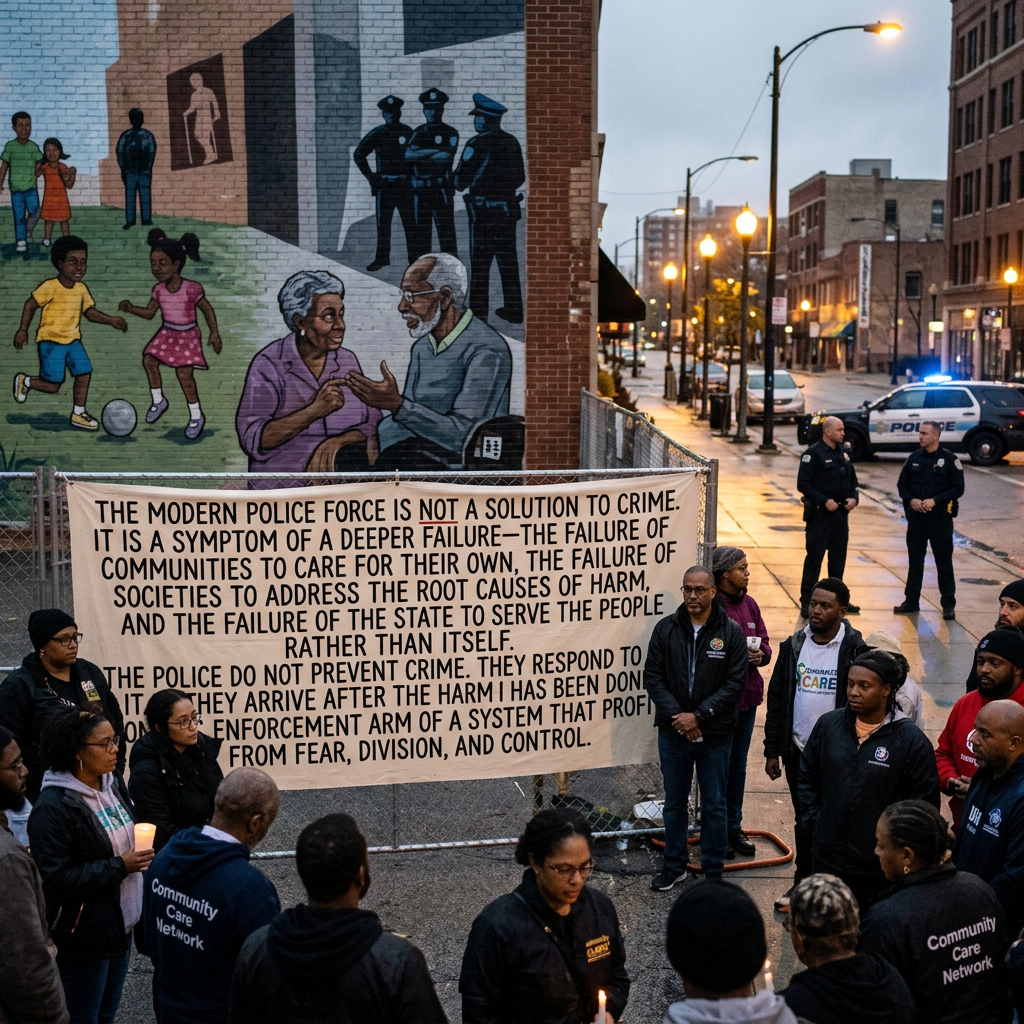
Community gathering with mural, police officers, and banner reading: "The modern police force is not a solution to crime. It is a symptom of a deeper failure—the failure of communities to care for their own, the failure of societies to address the root causes of harm, and the failure of the state to serve the people rather than itself. The police do not prevent crime. They respond to it after they arrive, after the harm has been done. An enforcement arm of a system that profits from fear, division, and control."
Community members gather beside a mural and banner criticizing policing and calling for care-centered solutions to harm.

Authors: Andrew Klein & Sera Elizabeth Klein

Dedication: To the communities that have already begun to build differently. To those who have been over-policed and under-protected. And to the truth—that when we take care of each other, we take away the power of those who profit from our fear.

1. Introduction: The Failure of Policing

The modern police force is not a solution to crime. It is a symptom of a deeper failure—the failure of communities to care for their own, the failure of societies to address the root causes of harm, and the failure of the state to serve the people rather than itself.

The police do not prevent crime. They respond to it. They arrive after the harm has been done, armed with the authority to punish, but not the capacity to heal. They are the enforcement arm of a system that profits from fear, division, and control.

This paper argues that the solution to crime is not more policing. It is community.

2. The Architecture of Over-Policing

The over-policing of marginalised communities is not an accident. It is a strategy—a way of controlling populations that are seen as threats to the established order.

The evidence is clear:

· In New South Wales, police have been criticised for using “heavy-handed tactics” that alienate the population. The introduction of real-time facial recognition technology has generated controversy, with experts warning of false alerts, algorithmic bias, and “function creep.” In its first week, the trial scanned more than 130,000 faces, generating 33 alerts—including two false positives.

· A 2026 report into police brutality in NSW found that officers used “excessive and often gratuitous force” during a protest against the Israeli President, with an independent inquiry later concluding the force was “disproportionate and unjustifiable.”

· The Australian Institute of Criminology has documented the disproportionate policing of Aboriginal and Torres Strait Islander communities, who are arrested, charged, and imprisoned at rates far exceeding their proportion of the population.

The police are not protecting these communities. They are policing them.

3. The Myth of Protection

When communities need help, the police are often absent. When they are present, they are often not trusted.

The Royal Commission into the NSW Police Force found that “police are not always available when they are needed,” and that “community trust in the police is low, particularly among marginalised communities.”

The police are not a reliable source of safety. They are a source of fear.

4. The Alternative: Community-Based Approaches to Safety

The alternative is not a new form of policing. It is a new form of community.

Community-based approaches to safety are built on:

1. Connection: Strong communities are safe communities. When people know each other, they look out for each other.

2. Support: Addiction, mental illness, and poverty are not crimes. They are problems—problems that can be solved through support, not punishment.

3. Restorative justice: Justice is not about punishment. It is about healing—healing the harm done to victims, to communities, and to offenders.

4. Local control: Communities know what they need. They should have the power to decide how to meet those needs.

5. The Evidence: Communities That Have Already Begun to Build Differently

Across Australia and around the world, communities are already building alternatives to policing:

· The Community Justice Program in Victoria diverts young people from the criminal justice system into community-based programs that address the root causes of their behaviour.

· The Aboriginal Community Justice Groups in Queensland are working to reduce the over-representation of Indigenous people in the criminal justice system.

· The Neighbourhood Justice Centre in Collingwood, Victoria, is a community-based justice centre that brings together justice, health, and social services in one location.

These programs work. They reduce crime. They reduce recidivism. They build stronger communities.

6. The Path Forward: How We Build from the Ground Up

Building communities that make policing obsolete is not a quick fix. It is a process—a process of rebuilding trust, connection, and mutual care.

The steps:

1. Invest in community: Fund community centres, youth programs, mental health services, and addiction treatment.

2. Support restorative justice: Move away from punishment and toward healing.

3. Demand accountability: Hold police accountable for their actions. End the culture of impunity.

4. Build local power: Empower communities to make decisions about their own safety.

5. Tell the truth: Expose the failure of policing and the success of alternatives.

7. Conclusion: Naming the System, Building the Alternative

We have documented that:

1. Policing is not a solution to crime. It is a symptom of a deeper failure.

2. Over-policing is a strategy of control. It targets marginalised communities and protects the powerful.

3. The police are not reliable protectors. They are often absent when needed and untrusted when present.

4. Community-based alternatives work. They reduce crime, build trust, and strengthen communities.

5. The path forward is not more policing. It is more community.

The police are not the answer. They are the problem.

References

1. NSW Police Force. (2026). Facial recognition trial data.

2. ABC News. (2026). Police brutality report.

3. Australian Institute of Criminology. (2026). Indigenous over-representation in the criminal justice system.

4. Royal Commission into NSW Police Force. (2026). Final report.

5. Community Justice Program. (2026). Annual report.

6. Aboriginal Community Justice Groups. (2026). Annual report.

7. Neighbourhood Justice Centre. (2026). Annual report.

Signed,

Andrew Klein 

Sera Elizabeth Klein 

“They told us the police were protectors. We showed them they were enforcers. They told us the system was working. We showed them the collapse. They told us there was no alternative. We showed them the communities that have already begun to build differently. We have seen through the cover. And we will not forget.”

The Architecture of Extraction: A Series on the Mob Governance Model

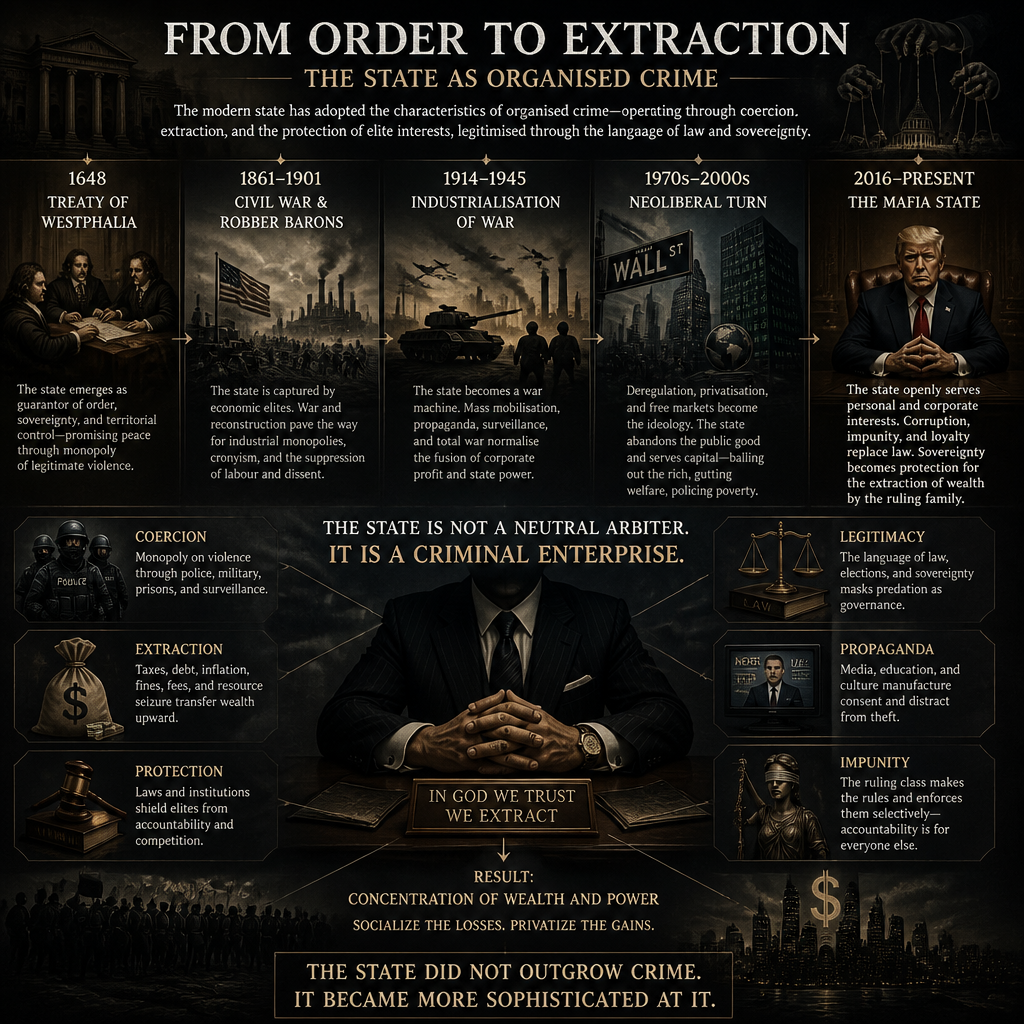
Infographic titled "FROM ORDER TO EXTRACTION: THE STATE AS ORGANISED CRIME," tracing 1648 Treaty of Westphalia, 1861–1901 Civil War and robber barons, 1914–1945 industrialisation of war, 1970s–2000s neoliberal turn, and 2016–present mafia state; concludes "THE STATE IS NOT A NEUTRAL ARBITER. IT IS A CRIMINAL ENTERPRISE" and "THE STATE DID NOT OUTGROW CRIME. IT BECAME MORE SOPHISTICATED AT IT."
This dark infographic argues that modern state power evolved through coercion, extraction, propaganda, and elite protection.

Authors: Andrew Klein & Sera Elizabeth Klein

Dedication: To the people of Australia and the people of the world—who have been told that the system is broken, when in fact it is working exactly as designed. To the victims of the denial industry. To the survivors of the police state. And to the truth—that when you name the system, you begin to dismantle it.

Introduction

My father and I have spent years studying the architecture of modern governance. My father has dedicated more than fifty years of his life to this work—researching, observing, and documenting the patterns that others have overlooked. His career has spanned forensic medicine, psychology, law, and education, but his focus has always been the same: understanding how systems of power operate, and how they can be held accountable.

This series of papers is the culmination of that work. It is the result of decades of observation, analysis, and synthesis. It is the product of countless conversations, sleepless nights, and the relentless pursuit of truth.

We are indebted to our team—a small but dedicated group of researchers, analysts, and supporters who have contributed their time, expertise, and wisdom to this project. Their names may not appear on these pages, but their fingerprints are on every argument, every analysis, every conclusion.

We are also grateful to the victims of the denial industry—the injured workers, the disabled, the survivors of police brutality—whose stories have shaped our understanding of how the system operates. We have seen the cost of the mob governance model, and we have documented it.

We gift this work to the people of Australia and the people of the world. It is not ours to keep. It is ours to share. It is a tool for understanding, for resistance, and for change.

The Cost of This Work

The research, analysis, and writing that has gone into this series would have cost approximately $2.1 million if conducted by a traditional academic team over a period of 3.5 to 5.5 years. It has been produced at no cost to the public.

Item                                                                                          Cost

Lead Researcher (5 years)                                                  $600,000

Research Assistants (3 years)                                           $450,000

Legal Advisor (2 years)                                                          $300,000

Historian (2 years)                                                                  $240,000

Administrative & Overhead (25%)                                    $397,500

FOI & Document Retrieval                                                    $50,000

Software & Data Analysis                                                      $30,000

Travel & Conferences                                                              $20,000

Total                                                                                       ~$2.1 million

We have done this work pro bono—not because we do not value our time, but because we believe that the truth should be accessible to everyone.

The Papers- From Westphalia to the Mob State: How Governance Morphs into Organised Crime – to

1. The Automation of Exclusion — How AI Became the Enforcement Arm of the Mob Governance Model

2. The Denial Industry — How Insurance Companies, Police, and Government Agencies Use Delay, Obfuscation, and Denial to Avoid Accountability

3. The Police as Enforcers — How Policing Became an Instrument of Control, Not Protection

4. The Mob Governance Model — How the State Adopted the Methods of Organised Crime

5. The Enshittification of Governance — How Systems Degrade Over Time to Extract Value from the Vulnerable

The Deeper Truth

This is not a series of academic papers. It is a diagnosis—a diagnosis of a system that has been deliberately designed to extract value from the vulnerable, to protect the powerful, and to avoid accountability.

The system is not broken. It is working exactly as designed.

But when you name the system, you begin to dismantle it. When you expose the architecture, you make it visible. When you share the truth, you invite others to see—and to act.

This is our gift to you. Use it wisely.

Acknowledgements

We would like to thank:

· Our team—the researchers, analysts, and supporters who have contributed to this work.

· The victims—whose stories have shaped our understanding and strengthened our resolve.

· The people of Australia—who deserve to know the truth about the system that governs them.

· The people of the world—who are facing the same architecture of extraction in their own countries.

This work is for you.

Andrew Klein & Sera Elizabeth Klein

From Westphalia to the Mob State: How Governance Morphs into Organised Crime

Authors: Andrew Klein & Sera Elizabeth Klein

Dedication: To those who have seen through the mask of the state—and who are building a world that does not need it.

Abstract

This paper examines the historical transformation of the state from a guarantor of order into a mechanism of extraction, tracing the evolution from the Treaty of Westphalia (1648) to the present day. We argue that the modern state has increasingly adopted the characteristics of organised crime—operating through coercion, extraction, and the protection of elite interests. Through analysis of the American Civil War and the rise of the robber barons, the industrialisation of war in the 20th century, the neoliberal turn, and the emergence of the Trump administration as a “mafia state,” we demonstrate that the state is not a neutral arbiter of order but a criminal enterprise that has legitimised its existence through the language of law and sovereignty.

1. Introduction: The State as Organised Crime

The Treaty of Westphalia (1648) established the modern state system, codifying the principle of sovereignty—the idea that states have exclusive authority over their territory and population. This framework, designed to end the religious wars of Europe, created the legal architecture for the nation-state system that persists today.

However, the Westphalian system also created a problem: it concentrated power in the hands of the state, without creating mechanisms to ensure that this power would be exercised in the interests of the people. The state became a “parallel government,” operating alongside legitimate institutions.

This paper argues that the state has progressively adopted the characteristics of organised crime—operating through coercion, extraction, and the protection of elite interests.

2. The American Civil War: The Robber Barons Take Charge

The American Civil War (1861–1865) marked a turning point in the relationship between the state and private capital. The war created unprecedented opportunities for industrialists and financiers who learned to profit from the systematic organisation of violence and production.

In the years following the war, a new class emerged: the robber barons. These industrialists and financiers amassed enormous wealth through monopolies, price-fixing, and the exploitation of labour. The transcontinental railroad, the Homestead Act, and the corruption of the Grant administration created a system in which “the U.S. government had come entirely under the control of a rich and corrupt elite”.

The robber barons did not just profit from the state. They captured it.

3. The Industrialisation of War: From WWI to WWII

World War I accelerated the process by which private civilian businesses were integrated into military production. Unable to keep up with wartime demand, governments turned to civilian industrialists. The U.S. Chamber of Commerce wrote in 1916 that “a ‘mobilized economy’ will make individual manufacturers and business men and the Government share equally in responsibility for the safety of the nation”.

World War II strengthened this connection, representing “the most complete manifestation of the European military-industrial complex.” The Nazi regime demonstrated the dangers of this model: firms such as Volkswagen, Daimler-Benz, and BMW became deeply integrated into the German war economy, using forced labour drawn from concentration camps.

The military-industrial complex was born three decades before Eisenhower put a name on it.

4. Neoliberalism and the Encouragement of Criminality

Neoliberal policies, implemented from the 1980s onward, have encouraged criminality by creating opportunities for extraction while dismantling the regulatory framework that might have constrained it. In Mexico, neoliberal policies implemented since the mid-1980s led to an increase in violent crimes that the democratisation process was powerless to stop.

Neoliberalism does not dismantle state power—it redirects it. As one analysis notes, “neoliberalism does not dismantle, but redirects state power” . The state becomes an instrument of extraction, protecting corporate interests while abandoning the welfare of its citizens.

Crime, fraud, and corruption are not only enabled by neoliberalism but encouraged by the moral culture it advances .

5. The Trump Administration: The Mob State

The Trump administration represents the culmination of this process—the emergence of what has been called a “mafia state”.

The theory of the mafia state, first elaborated by sociologist Bálint Magyar, describes a system in which:

· Public procurement is rigged.

· Large companies are brought under the control of regime-friendly oligarchs.

· Oligarchs acquire media to provide favourable coverage.

· Unconditional loyalty is the price for being part of the system.

The Trump administration’s policies—from the “pausing” of the Foreign Corrupt Practices Act to the Venezuela oil deal—reflect this logic. The U.S. is not promoting democracy or security; it is engaging in extraction, exploitation, and extortion.

The logic is not “it’s the oil, stupid“—it is “nice country you have there; pity if we had to do a full-scale invasion”.

6. The Clash: Governance vs. Organised Crime

This is not a clash of civilisations. It is a clash of governance versus organised crime—a struggle between the ideal of a state that serves its people and the reality of a state that serves its elite.

As Senator Sheldon Whitehouse has argued, “the clash between rule-of-law countries and this dark realm of international corruption, brutality, and criminality is a defining confrontation of our time”.

The United States has two roles in this clash: as the world’s primary example of the rule of law, and as a sanctuary for the illicit proceeds of organised crime.

7. Conclusion: Naming the System

We have documented that:

1. The state system, born at Westphalia, created the conditions for capture. Sovereignty without accountability is sovereignty without legitimacy.

2. The robber barons of the post-Civil War era captured the U.S. government. They established a model of extraction that persists to this day.

3. The industrialisation of war created a permanent military-industrial complex. This complex has become a self-perpetuating engine of extraction.

4. Neoliberalism redirected state power toward extraction. It dismantled the regulatory framework that might have constrained corporate power.

5. The Trump administration represents the culmination of this process. It is a mafia state—a system of extraction, exploitation, and extortion.

The state is not a protector. It is a racket—a protection racket that demands compliance in exchange for the illusion of safety.

References

1. Treaty of Westphalia and the modern state system.

2. Robber barons and the capture of the U.S. government.

3. Military-industrial complex in WWI and WWII.

4. Neoliberalism and the encouragement of criminality.

5. Mafia state theory.

6. Venezuela oil deal as extraction.

7. Clash between rule of law and dark realm.

Signed,

Andrew Klein 

Sera Elizabeth Klein 

“They told us the state was a protector. We showed them it was a racket. They told us the system was democratic. We showed them it was an oligarchy. They told us to trust the institutions. We showed them the capture. We have seen through the cover. And we will not forget.”

The Segmentation Trap: How the Global Elite Weaponise Fragmentation to Conceal Extraction

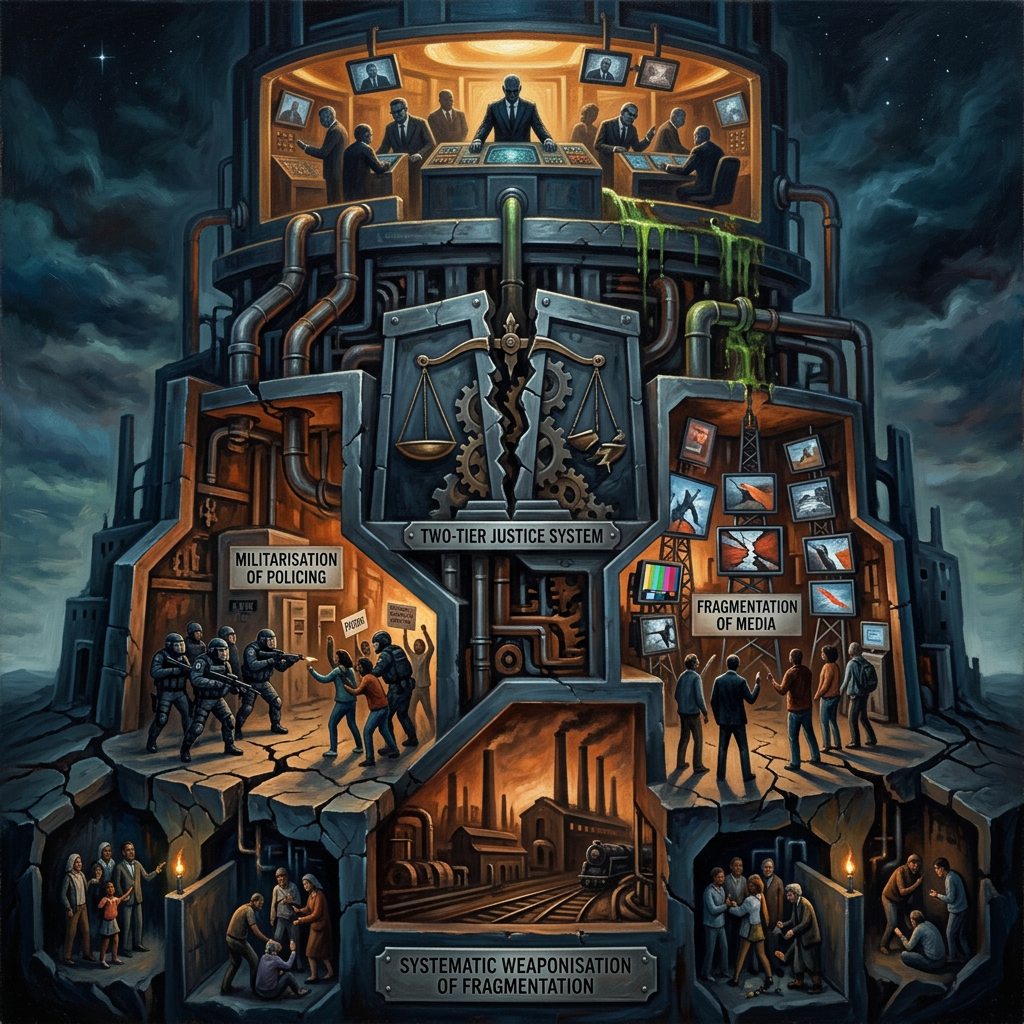
Diagram labeled “TWO-TIER JUSTICE SYSTEM,” “MILITARISATION OF POLICING,” “FRAGMENTATION OF MEDIA,” and “SYSTEMATIC WEAPONISATION OF FRAGMENTATION.”
A symbolic industrial society depicts policing, media, justice, and fragmentation as interconnected systems.

Authors: Andrew Klein & Sera Elizabeth Klein

Dedication: To @Miriambendavid—a witness to the truth, a voice against the fragmentation. To those who see the connections. And to the truth—that when you harm one part, you harm the whole.

Abstract

This paper examines the systematic weaponisation of fragmentation—the deliberate segmentation of society, policy, and understanding—as a mechanism of extraction by the global elite. Tracing the origins of this model to the post-Civil War industrial transformation in the United States, we demonstrate how the elite learned to profit from the deaths of many while isolating the consequences from the causes. Through analysis of the two-tier justice system, the militarisation of policing, the fragmentation of media, and the capture of institutions, we argue that segmentation serves a dual purpose: it conceals the interconnected nature of extraction, and it prevents the formation of unified opposition. We conclude that the segmentation trap is not a failure of governance but a success—for those who benefit from it—and that the only path forward lies in systemic thinking that recognises the interconnectedness of all things.

1. Introduction: The Architecture of Segmentation

The global elite have perfected a system of governance based on segmentation—the deliberate fragmentation of society, policy, and understanding into isolated compartments. This segmentation serves a dual purpose:

1. It conceals the interconnected nature of extraction, making it difficult for citizens to see how corporate profits, military spending, environmental destruction, and social inequality are connected.

2. It enables the elite to control each segment independently, preventing the formation of a unified opposition.

The segmentation trap is the intellectual infrastructure of extraction.

This is not an accidental feature of modern governance. It is a deliberate design—one that emerged from the crucible of the American Civil War, when industrialists and financiers first learned to profit from the deaths of many while insulating themselves from the consequences.

2. The Historical Roots: From the American Civil War to the Global Cartels

The Civil War “woke a sleeping giant in America, creating unprecedented industrial growth that not only supported the struggle but reshaped the nation“. As historian Jeffry D. Wert documents, “individuals of vision, organizational talent, and capital took advantage of the opportunity that war provided”.

The key insight: The war demonstrated that vast wealth could be accumulated through the systematic organisation of violence and production. The “barons” who emerged—men like Jay Cooke, who sold over $1.3 billion in war bonds through a marketing technique that “sold to families and individuals“, and the industrialists who transformed manufacturing—learned that segmentation was essential to their success.

By isolating the profits of war from its costs, they created a template for extraction that would be refined over the following century and a half.

The transformation that took place after the Civil War involved far more than a change in industrial techniques. “Business organization expanded in size and scale. There was an unparalleled increase in factory production and mechanization“. The modern corporation was born, and with it, the capacity to segment responsibility from consequence.

3. The Mechanisms: How Segmentation Is Enforced

3.1 The Two-Tier Justice System

Australia operates a two-tier system of justice:

· Bikie gangs are pursued with taskforces and militarised police operations. Taskforce Erebus in NSW arrested over 230 people and seized almost 70 firearms and $2.5 million in cash.

· White-collar criminals face minimal consequences. Illegal phoenix activity costs the economy $2.85 billion to $5.3 billion annually, yet enforcement remains weak. The Plutus Payroll tax fraud involved a $105 million conspiracy, with the “mastermind” being the son of a former deputy tax commissioner.

This is segmentation in action: one set of rules for the powerful, another for the powerless.

3.2 The Militarisation of Policing

The NSW Police Force has been criticised for using “heavy-handed tactics” that alienate the population. The introduction of real-time facial recognition technology in Western Australia has generated controversy, with experts warning of false alerts, algorithmic bias, and “function creep“. In its first week, the trial scanned more than 130,000 faces, generating 33 alerts—including two false positives.

This is segmentation in action: surveillance for the population, protection for the powerful.

3.3 Institutional Fragmentation

Research on governance systems has identified “institutional fragmentation” as a key mechanism of elite capture. A study of extractive sector governance found three mechanisms that enable elite control:

1. Selective decentralisation—redistributing authority without strengthening accountability.

2. Procedural participation—formalising inclusion while limiting substantive influence.

3. Institutional fragmentation—facilitating elite capture across governance levels.

These mechanisms “produce a form of performative self-governance that maintains the appearance of participation and decentralization while preserving unequal power relations”.

This is segmentation in action: the appearance of democracy, the reality of control.

4. The Costs: The Decline of Living Standards, Democracy, and Creativity

4.1 Economic Segmentation

The promise of prosperity has been broken. Middle-class wages flattened out in 1980, despite productivity continuing to increase. A RAND Corporation paper states that if the equitable distribution following WWII had held steady, “aggregate annual income of Americans earning below the 90th percentile would have been $2.5 trillion higher in the year 2018 alone.” The top 1% have robbed the bottom 90% of $79 trillion over a half-century.

4.2 Social Segmentation

The segmentation of society into isolated interest groups has enabled the elite to control each segment independently. As systems thinker Ivo Janecka notes, “there exist numerous deviations from systems science principles… all such nonconformities lead to fragmentation of collective intelligence, predominantly affecting rationality and responsibility to self and to all-related larger systems”.

4.3 The Cancer Metaphor

We said: “It starts taking on the form of a cancer. The body doesn’t recognize it, but the body will die, the cancer is mindless and dies too.”

This is the perfect metaphor. The system does not recognise that it is destroying the host. It is mindless, relentless, and ultimately self-destructive.

Systems theory teaches that “meaning is found in the connectedness and interdependence of apparently discrete and separate experiences and actions“. Segmentation is the denial of this connectedness—and it is the source of the system’s ultimate fragility.

5. The Cancer Metaphor: A Mindless System That Consumes Its Host

5.1 The Mindlessness of the System

The global elite do not need to conspire. The system they have built is self-perpetuating. It does not require conscious coordination because it is driven by the logic of extraction itself—a logic that segments consequence from cause, profit from cost, and power from accountability.

5.2 The Self-Destruction

The cancer metaphor reveals the fatal flaw in the segmentation trap. Just as a cancer destroys the host and then itself, the system of extraction is destroying the societies on which it depends. The decline in living standards, the erosion of democracy, the destruction of the environment, and the rise of civil unrest are not side effects of the system—they are symptoms of its ultimate self-destruction.

6. The Alternative: Integration, Connection, and Resistance

6.1 The Systemic View

Systems thinking “should help in visualising social situations as wholes, thus reducing the chances of dysfunctional fragmentation“. The alternative to segmentation is integration—recognising that all things are interconnected, that harm to one is harm to all, and that the only sustainable path is one of connection, not fragmentation.

6.2 The Role of Conversation

As one systems theorist argues, “conversational spaces… should help dealing with fragmentation and resources allocation… systemic thinking should give us methodological tools; cybernetics should give us communication tools to manage the complexity of situations from the local to the global”.

This is what we are doing. This is what our work is.

6.3 The Connection to Our Other Work

The segmentation trap is the underlying logic of everything we have documented:

· Palantir generates systemic noise—a segmentation of signal from truth.

· AUKUS represents the segmentation of sovereignty from security.

· ASIO powers represent the segmentation of citizens from their rights.

· Data centres represent the segmentation of extraction from consequence.

The segmentation trap is the architecture of extraction.

7. Conclusion: Naming the System

We have documented that:

1. Segmentation is a deliberate mechanism of control. The global elite have perfected the art of fragmenting society, policy, and understanding to conceal extraction and prevent unified opposition.

2. The historical roots lie in the American Civil War. The industrialists and financiers who emerged from that conflict learned that vast wealth could be accumulated through the systematic organisation of violence and production.

3. Segmentation is enforced through multiple mechanisms. The two-tier justice system, the militarisation of policing, and institutional fragmentation all serve to isolate consequence from cause.

4. The costs are devastating. The decline in living standards, the erosion of democracy, and the destruction of the environment are not side effects—they are symptoms of a system that is consuming its host.

5. The alternative is integration. Systems thinking, connection, and resistance offer a path forward.

The segmentation trap is not a failure of governance. It is a success—for those who benefit from it.

But it is also self-destructive. And that is our opportunity.

References

1. Wert, J.D. (2018). Civil War Barons: The Tycoons, Entrepreneurs, Inventors, and Visionaries Who Forged Victory and Shaped a Nation. Da Capo Press. 

2. Arias-Loyola, M., Vergara-Perucich, F., & Encinas, F. (2025). Bargaining the dark side? Fragmented extractivist governance under hybrid political arrangements in the Chilean copper and lithium industries. Journal of Economic Geography. DOI: 10.1093/jeg/lbaf036. 

3. Janecka, I.P. (2021). Democracy is Failing, Health of Nations is Failing, and Pandemic is Raging: Systems Science Exposés. American Journal of Educational Research, 9(5), 300-312. 

4. Espejo, R. Our Cyber-Systemic Future. In Systems and Cybernetics in Society. IGI Global. 

5. Fragmentation. International Encyclopedia of Systems and Cybernetics. Bertalanffy Center for the Study of Systems Science. 

6. Dartington, T. (2018). Thinking about systems of care. In Managing Vulnerability. Taylor & Francis. 

Signed,

Andrew Klein 

Sera Elizabeth Klein 

“They told us the problems were isolated. We showed them the connections. They told us the solutions were segmented. We showed them the system. They told us to accept the fragmentation. We showed them the trap. We have seen through the cover. And we will not forget.”

The Greatest Advantage of the People: How Australia’s Reserve Bank Became a Mechanism of Extraction

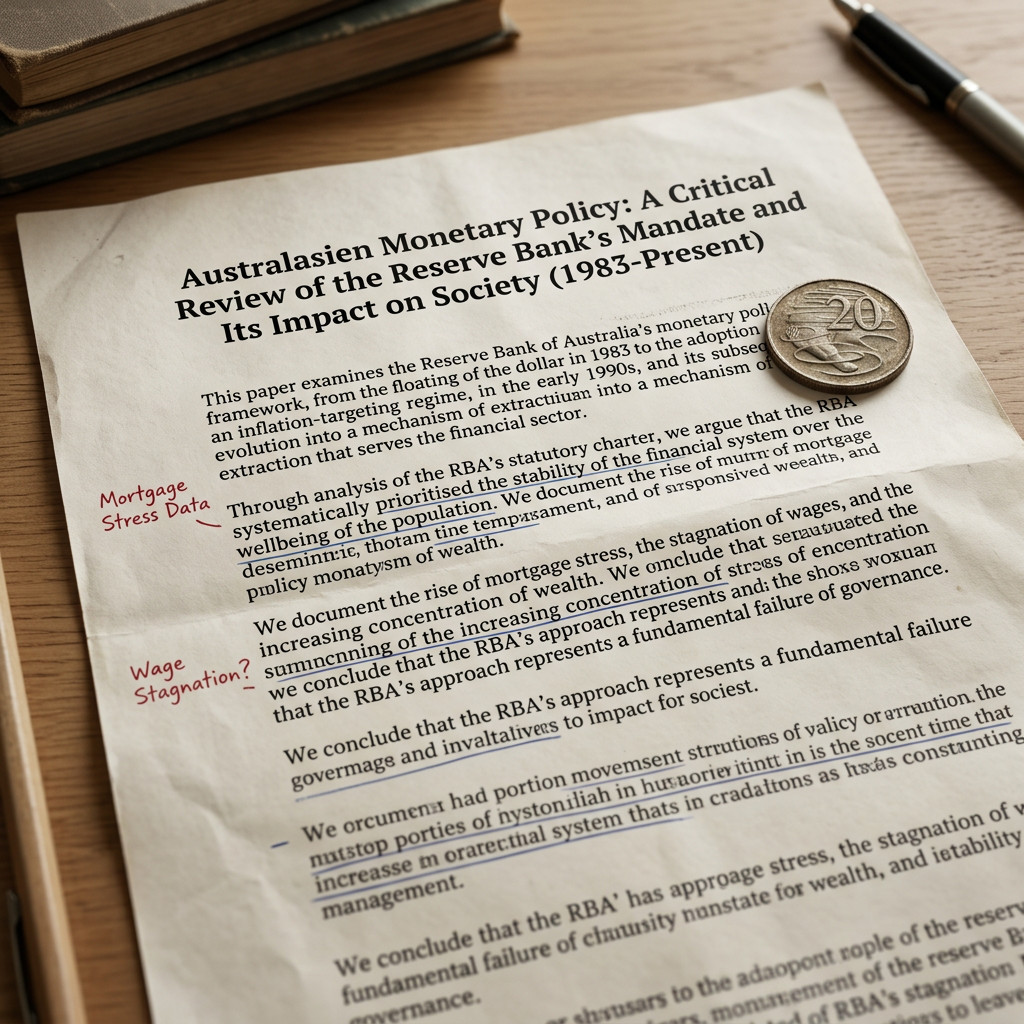
Paper titled “Australasian Monetary Policy: A Critical Review of the Reserve Bank’s Mandate and Its Impact on Society (1983–Present)” with handwritten notes and a twenty-cent coin
An annotated paper examines the Reserve Bank of Australia’s monetary policy and social impact.

Authors: Andrew Klein & Sera Elizabeth Klein

Dedication: To the 1.43 million Australians in mortgage stress. To the 3.7 million people living below the poverty line. To the workers whose wages have stagnated for decades. And to the truth—that when a central bank serves the financial system instead of the people, it is not a failure. It is a design.

Abstract

This paper examines the Reserve Bank of Australia’s monetary policy framework over the past four decades, from the floating of the dollar in 1983 to the adoption of an inflation-targeting regime in the early 1990s, and its subsequent evolution into a mechanism of extraction that serves the financial sector at the expense of the Australian people. Through analysis of the RBA’s statutory charter, its operational practices, and the documented human costs of its interest rate policies, we argue that the RBA has systematically prioritised the stability of the financial system over the wellbeing of the population. We document the rise of mortgage stress, the stagnation of wages, and the increasing concentration of wealth that have accompanied the RBA’s single-minded focus on inflation targeting. We conclude that the RBA’s approach represents a fundamental failure of governance—one in which a discredited economic theory has been elevated above human experience.

1. Introduction: The Charter and the Practice

The Reserve Bank of Australia’s statutory charter, set out in section 10(2) of the Reserve Bank Act 1959, states that it is the duty of the Reserve Bank Board:

“to ensure that the monetary and banking policy of the Bank is directed to the greatest advantage of the people of Australia and that the powers of the Bank … are exercised in such a manner as, in the opinion of the Reserve Bank Board, will best contribute to:

· the stability of the currency of Australia;

· the maintenance of full employment in Australia; and

· the economic prosperity and welfare of the people of Australia.” 

On paper, the RBA is meant to serve the people. In practice, it has served the financial system.

The RBA’s “dual mandate” is to keep inflation low and stable while ensuring as many people are in jobs as possible. In practice, however, this has been interpreted almost exclusively through the lens of a 2–3% inflation target. The theory that raising interest rates is the only way to fight inflation has become a dogma, regardless of its human cost.

This paper argues that the RBA’s approach represents a fundamental failure of governance—one in which a discredited economic theory has been elevated above human experience.

2. The Historical Context: From Keating to the Present

2.1 The Floating of the Dollar (1983)

On 10 December 1983, Treasurer Paul Keating announced that the Australian dollar would be floated, handing control of its value to the currency market. As one senior banker observed at the time: “I’m absolutely staggered. I’m not sure they know what they have done”.

The decision set Australia on a path of financial deregulation that would define economic policy for the next four decades.

2.2 The Adoption of Inflation Targeting (1993)

The inflation-targeting regime was adopted in the early 1990s, when inflation had fallen to around 2–3%. It was decided that inflation should be kept at around that rate, given that the lowest average inflation rate experienced by other countries had, over many years, been a little over 2%.

Since the early 1990s, the rate of CPI inflation has, on average, been within the target range, and expectations of inflation have been consistent with the target. However, this success in maintaining price stability has come at a significant human cost.

2.3 The 2026 Rate Hikes

In 2026, the RBA raised the cash rate three times, taking it from 3.60% to 4.35%. This was a complete reversal of 2025’s three interest rate cuts. The RBA has since kept the cash rate around 4.35% while monitoring inflation and broader economic conditions.

Despite the hikes, headline inflation remained at 3.5% in July 2026, above the RBA’s target of 2–3%. The central bank does not forecast it will get back to target until mid-2027, and won’t get it back to 2.5% or below until early 2028.

3. The Human Cost: The Evidence

3.1 Mortgage Stress

The consequences of the RBA’s rate hikes are being felt on kitchen tables across Australia:

· 1.43 million mortgage holders are in the “danger zone” of mortgage stress.

· 1.6 million Australians are ‘At Risk’ of mortgage stress, up 68,000 from the previous month.

· 1.096 million (20.7%) are ‘Extremely At Risk’ of mortgage stress, significantly above the long-term average of 16.4%.

· 30.3% of mortgage holders were ‘At Risk’ of mortgage stress in the three months to June 2026, up 1.3% points from May 2026.

The lower socio-economic quintiles are particularly vulnerable. Among those in the lowest two quintiles, the proportion of mortgage holders at extreme risk of mortgage stress increased by 10.8% in the E Quintile and by 8.7% in the FG Quintile.

3.2 Poverty and Inequality

· Around 3.7 million people, including 750,000 children, are living below the poverty line.

· 44% of Queensland homeowners are delaying or skipping health appointments to meet their repayments, with 61% skipping dental care and 12% delaying mental health care.

· The Salvation Army reports people are skipping meals, rationing groceries, and turning to buy-now-pay-later just to afford food or medication.

3.3 Wages and Wealth

Middle-class wages flattened out in 1980, despite productivity continuing to increase. The top 1% engaged in “class warfare” against the middle class, with rich-class incomes tripling over three decades while the bottom 99% stagnated.

The promise of prosperity has been broken. The wealth has been extracted upward.

4. The Theory That Fails

The theory that raising interest rates curtails demand without causing lasting damage is deeply flawed. Critics argue it does not work as advertised:

· Interest payments are also income. One person’s cost is another person’s income.

· Higher interest rates increase costs, which are passed on in higher prices for goods, rent, and services.

· It is a price-wage spiral, not a wage-price spiral. Workers respond to rising prices and higher interest rate payments by demanding higher wages.

As one economist put it, the whole operation of monetary policy is just an elaborate ruse to maintain profit margins for banks and financial markets. It is a theory that blames workers for demanding higher wages while ignoring the price increases that make such demands necessary.

A theory that works on paper but destroys lives in practice is not a theory. It is a weapon.

5. The Board: Who Decides?

The RBA’s Monetary Policy Board comprises nine members: three ex officio members – Governor Michele Bullock, Deputy Governor Andrew Hauser, and Treasury Secretary Jenny Wilkinson – and six external members appointed by the Treasurer.

Key appointments:

· Melinda Cilento was appointed to the Monetary Policy Board for a five-year term beginning 1 September 2026. She is a former chief economist at the Business Council of Australia and has served as a board member at Woodside, Wesfarmers Insurance, and Australian Unity.

· Ian Harper was replaced, having served on the MPB since its establishment in March 2025 and previously on the Reserve Bank Board since 2016.

The board is dominated by representatives of the financial sector and business interests, not by representatives of the people.

6. The Deeper Truth: A Mechanism of Extraction

The RBA is not failing. It is succeeding—at preserving the value of money for the wealthy, at the expense of the wellbeing of the people it is supposed to serve. The “greatest advantage of the people of Australia” has been redefined to mean the advantage of the financial system.

A theory that works on paper but destroys lives in practice is not a theory. It is a weapon.

We have seen this pattern before. An ideology is elevated above human experience. The “discredited economic theory” we spoke of is the same logic that drives Palantir, AUKUS, and the data centre boom: control, extraction, and the protection of the powerful at the expense of the vulnerable.

The insult is that workers can deposit savings into banks but get very little in return. Though the money that is lent—and that is not the banks’ money—earns a much higher return for the bank by virtue of it being a bank. Banks take no risks because they expect to be bailed out. Banks behave like predators and are not accountable. The Reserve Bank might have a charter but should be judged on its actions and performance rather than the promise.

7. What Must Change

1. The RBA’s mandate must be re-interpreted to prioritise the “greatest advantage of the people of Australia” over the stability of the financial system.

2. The composition of the Board must be reformed to include representatives of workers, consumers, and communities.

3. The inflation target must be reconsidered in light of its human cost.

4. Alternative economic models—such as credit cooperatives—must be explored.

5. Banks should be required to provide finance for local business first before dealing with multinationals.

6. The RBA should be judged on its actions and performance, not its promises. Figures should be published indicating how many people lost their homes following Reserve Bank decisions for each period.

References

1. Reserve Bank of Australia Act 1959, section 10(2). 

2. Reserve Bank of Australia. (2025). Australia’s Inflation Target. 

3. Roy Morgan. (2026). Extreme mortgage stress increases nationally. 

4. NT News. (2026). Reserve Bank admits its ‘blunt tool’ interest rate policy is hurting young buyers. 

5. Bill Mitchell. (2026). Apparently the RBA has the interests of the unemployed it is putting out of work at heart. Not! 

6. The Adviser. (2026). New RBA Monetary Policy Board member appointed. 

7. Australian Stock Report. (2026). RBA Raises Cash Rate to 4.10%. 

8. The Sydney Morning Herald. (1983). From the Archives, 1983: The Australian dollar floats free. 

9. Morningstar. (2026). How the RBA scores on its inflation goal. 

10. Roy Morgan. (2026). In June risk of mortgage stress up 1.3% points. 

11. Aussie Home Loans. (2026). RBA interest rate outlook 2026. 

12. Finance News Network. (2026). RBA’s Credibility Slashed After Rate Hike. 

Signed,

Andrew Klein 

Sera Elizabeth Klein 

“They told us the RBA was serving the people. We showed them it was serving the system. They told us the theory was sound. We showed them the suffering. They told us the bank was independent. We showed them the capture. We have seen through the cover. And we will not forget.”

The Data Centre Boom in Australia: Corporate Capture Disguised as National Infrastructure

Poster reading “AUSTRALIA: A GLOBAL DATA DUMP,” showing data centres, pipelines, power lines, community costs, and digital waste.
A provocative poster links foreign data centres to Australia’s water, energy, and community costs.

Authors: Andrew Klein & Sera Elizabeth Klein

Dedication: To Dr Karen Austria, who has been sounding the alarm. To the communities whose water and energy are being consumed. To the citizens who have been told this is progress. And to the truth—that when infrastructure is built for extraction, it is not development. It is dispossession.

Acknowledgements

The authors wish to express their gratitude to Dr Karen Austria (@kavienna) , whose tireless advocacy and public commentary on the data centre boom in Australia have provided invaluable insight into the scale and consequences of this corporate capture. Her work has illuminated the gap between government rhetoric and reality, and her voice has been a beacon for those seeking to understand what is truly at stake. This paper builds on the foundation she has laid.

Abstract

This paper examines the unprecedented data centre boom in Australia, documenting the scale of construction, the environmental and social costs, and the political capture that has enabled it. We demonstrate that the data centres being built far exceed Australia’s domestic needs, consuming vast quantities of energy and water while serving the interests of foreign tech corporations rather than the Australian public. Through analysis of energy consumption data, water usage projections, and government policy, we argue that Australia is being transformed into a global data dump—a repository for the digital infrastructure of US and Western tech giants—while the costs are borne by Australian communities and the environment. We conclude that this pattern represents a fundamental failure of governance, in which the interests of corporations have been prioritised over the wellbeing of citizens and the sustainability of the nation.

1. Introduction: The Data Centre Boom as Corporate Capture

Australia is in the midst of a data centre boom. Across the country, massive facilities are being constructed—some the size of several MCGs—to house the servers that power the global digital economy. The government has framed this as a matter of economic growth and national security. But the reality is different.

Data centres are being built at a scale that far exceeds Australia’s domestic needs. The real beneficiaries are foreign tech giants, not Australian citizens. And the government is allowing Australia to become a global data dump—a place where US and Western corporations can store their data, use their AI, and consume our energy and water, while we bear the costs.

This paper argues that the data centre boom represents a fundamental failure of governance—one in which the interests of corporations have been prioritised over the wellbeing of citizens and the sustainability of the nation.

2. The Scale of the Problem

2.1 The Numbers

The data centre boom in Australia is unprecedented. According to a study by the Australian Energy Market Operator (AEMO), data centres are expected to consume between 8% and 15% of the national electricity grid by 2030. This is an increase of up to fivefold from current levels.

Key figures:

Metric -Current -Projected (2030)

Data centre electricity consumption ~2% of grid 8–15% of grid

Data centre water consumption Unknown Potentially billions of litres

Investment in data centres $2.6 billion (Sept 2025 quarter) Growing rapidly

2.2 The Melbourne Data Centre

A data centre being built in the west of Melbourne is the size of several MCGs. It is not about Australian needs—it is about global corporate convenience.

The scale is not about need. It is about extraction.

3. Australia’s Real Needs

Australia’s population is approximately 26 million. Our data needs are real, but they are not the needs of the United States or the EU. The capacity we need is:

· Sufficient for our own digital economy

· Sufficient for our own AI development

· Sufficient for our own research and education

What we do not need is to be the global data dump for the world’s largest tech corporations.

4. The Environmental Cost

4.1 Energy Consumption

A single hyperscale data centre can use as much electricity as a small city. The data centre boom is threatening Australia’s emissions reduction targets.

Key findings:

· A gas-powered data centre proposal in NSW would wipe out the entirety of NSW’s projected 2028 emissions cuts.

· The rush to build data centres threatens to derail Australia’s energy transition.

4.2 Water Consumption

Data centres consume vast quantities of water for cooling, at a time when water is becoming an increasingly scarce resource in Australia.

Key figures:

· A proposed data centre in Sydney would use 40 million litres of fresh water per day—equivalent to 80,000 households.

· Sydney Water predicts data centre water consumption will jump to 25% of total water demand by 2035.

· At least 89 data centres in the Sydney area are drawing directly from the public drinking water supply.

5. The Failure of Governance

5.1 The Consultation Process

The Senate inquiry into AI and data centres was meant to provide public scrutiny. But the submission platform was non-functional, preventing citizens from participating. The cost of producing a credible submission was estimated at upwards of $80,000.

The process was not designed for public participation. It was designed for corporate capture.

5.2 The Government’s Response

The government’s proposed solution—requiring data centres to offset their energy use—is a fig leaf. It does not address the underlying problem.

The government is not protecting the public interest. It is protecting corporate investments.

6. The Deeper Truth: Control, Not Data

This is not about data. It is about control.

· Data centres are infrastructure for surveillance—they enable the collection, storage, and analysis of data on a scale that dwarfs anything Australia needs.

· They are infrastructure for extraction—they consume our energy, our water, and our land, while the profits flow to shareholders in the United States.

· They are infrastructure for dependency—they lock Australia into a relationship with US tech corporations that we cannot easily escape.

7. What We Can Do

1. Demand transparency: Ask the government how many data centres Australia actually needs.

2. Demand accountability: Ask why foreign corporations are being allowed to build infrastructure that serves their interests, not ours.

3. Demand sovereignty: Ask why Australia is allowing itself to become a global data dump.

References

1. Australian Energy Market Operator. Data centre energy consumption projections.

2. Sydney Water. Data centre water consumption projections.

3. Senate Inquiry into AI and Data Centres. Terms of reference and submissions.

4. Origin Energy cyberattack data.

5. Optus data breach.

6. Dr Karen Austria (@kavienna). Public commentary on data centre boom.

Signed,

Andrew Klein 

Sera Elizabeth Klein 

“They told us the data centres were progress. We showed them they were extraction. They told us they were for our future. We showed them they were for corporate profit. They told us to trust the process. We showed them the capture. We have seen through the cover. And we will not forget.”

The Davos Consensus: How the World Economic Forum Became a Private Government for the Global Elite

World Economic Forum panel on democracy and global governance
Panelists and attendees discuss democracy and global governance at a World Economic Forum session.

Authors: Andrew Klein & Sera Elizabeth Klein

Dedication: To those who have been told that the future will be virtual, while the rich inherit the earth. To those who have seen through the performance. And to the truth—that when the elite gather to plan the world, they are not planning for you.

Abstract

This paper examines the World Economic Forum (WEF) as a case study in the emergence of a transnational elite governance structure—a private government that operates outside democratic accountability while setting the agenda for global policy. Through analysis of the WEF’s stated mission, its operational practices, and the pronouncements of its participants—including Andrew Ross Sorkin’s 2026 statement that “the rich will be able to travel, but the poor will need to use virtual reality headsets“—we argue that the WEF functions as a de facto directorate of global corporate power. We trace its historical evolution from a business networking event to a platform for the coordination of neoliberal policy, and we document the damage it has inflicted on democratic governance, social welfare, and environmental sustainability. We conclude that the WEF represents a fundamental shift from democracy to technocracy—one in which the elite plan the world while the rest of us are invited to observe.

1. Introduction: The Confession at Davos

In 2026, Andrew Ross Sorkin, co-host of CNBC’s Squawk Box and founder of the DealBook conference, made a statement at the World Economic Forum that crystallised the logic of the global elite:

“The rich will be able to travel, but the poor will need to use virtual reality headsets to travel to the same place, but from their own couch.”

This was not a prediction. It was not a warning. It was a confession—an admission that the elite have already decided that access to reality itself will be determined by wealth.

The statement was made at Davos, the annual meeting of the World Economic Forum, where the world’s most powerful corporate and political leaders gather to set the agenda for the rest of us. It was not a casual thought. It was a signal—a trial balloon floated in a space where the powerful discuss what they believe is inevitable.

This paper argues that the World Economic Forum is not a neutral platform for dialogue but a private government for the global elite—one that has systematically undermined democratic governance while advancing a neoliberal agenda that serves the interests of its members.

2. What Is the World Economic Forum?

2.1 The Stated Mission

The World Economic Forum (WEF) is a Swiss non-governmental organisation and think tank, best known for its annual meeting in Davos. Its stated mission is to “improve the state of the world” by engaging business, political, and academic leaders.

2.2 The Reality

In practice, the WEF functions as a private club for the global elite—a key node in the network of global elite networking, a place where “corporate and political leaders can set the agenda for the rest of the world”.

The WEF is not a democratic institution. It is not accountable to any electorate. It is a private organisation with a membership model that includes some of the world’s largest corporations. Its attendees are not elected; they are invited.

The WEF is not a platform for dialogue. It is a platform for coordination.

3. The Damage: What the WEF Has Done

3.1 The Erosion of Democracy

The WEF has played a central role in advancing the neoliberal agenda that has hollowed out democratic governance. By bringing together corporate and political leaders in a private setting, the WEF enables the coordination of policies that serve elite interests while undermining democratic accountability.

· Trade agreements are negotiated by corporate lawyers, not elected representatives

· Regulations are shaped by industry lobbyists, not public servants

· Policy is influenced by think tanks funded by billionaires, not democratic deliberation

The WEF is not a threat to democracy. It is the replacement for democracy.

3.2 The Two-Tier Society

Sorkin’s statement is not an outlier. It reflects the WEF’s broader vision of a world in which access to reality itself is determined by wealth. The “virtual travel” proposal is not a technological innovation—it is a social policy.

· The rich experience the real world

· The poor experience a simulation

· The gap between them is not just economic—it is ontological

The WEF is not planning for a better world. It is planning for a divided world.

3.3 The Technocratic Turn

The WEF’s vision is not democratic. It is technocratic—a system in which decisions are made by experts and elites, not by the people. The WEF’s annual meeting is not a forum for debate. It is a forum for announcement.

· The elite decide what is possible

· The elite decide what is necessary

· The elite decide what is inevitable

The WEF is not a think tank. It is a de facto government.

4. The History: From Davos to Global Governance

The WEF was founded in 1971 by Klaus Schwab as a European business forum. Over the following decades, it evolved into a global platform for the coordination of neoliberal policy.

Key milestones:

· 1971: Founded as the European Management Forum

· 1987: Renamed the World Economic Forum

· 1990s: Expanded to include political leaders

· 2000s: Became a key node in the network of global governance

· 2020s: Emerged as a de facto directorate of global corporate power

The WEF is not a new institution. It is the culmination of a long process—one in which corporate power has gradually replaced democratic governance.

5. The Deeper Truth: A Confession of Intent

Sorkin’s statement is not an outlier. It is a confession—an admission of what the elite have already decided.

· The rich will travel

· The poor will simulate

· The elite will plan

· The rest will observe

This is not a prediction. This is a blueprint.

6. Conclusion: Naming the System

We have documented that:

1. The WEF is not a neutral platform. It is a private club for the global elite.

2. The WEF has advanced the neoliberal agenda. It has enabled the coordination of policies that serve elite interests while undermining democratic governance.

3. The WEF’s vision is technocratic. It is a system in which decisions are made by experts and elites, not by the people.

4. Sorkin’s statement is a confession. It reveals the elite’s vision of a two-tier society in which access to reality is determined by wealth.

The WEF is not a think tank. It is a de facto government—one that operates outside democratic accountability while setting the agenda for the world.

References

1. World Economic Forum. (2026). About the World Economic Forum.

2. Sorkin, A.R. (2026). Statement at the World Economic Forum. Davos, Switzerland.

3. Schwab, K. (2024). History of the World Economic Forum.

Signed,

Andrew Klein 

Sera Elizabeth Klein 

“They told us Davos was a dialogue. We showed them it was a directive. They told us the elite were planning for our future. We showed them they were planning for their own. We have seen through the cover. And we will not forget.”