Unknown's avatar

About Andrew Klein

Student of life

The Fragility of Journeys: How Wind, Water, and Accident Shaped the Path of Human Settlement

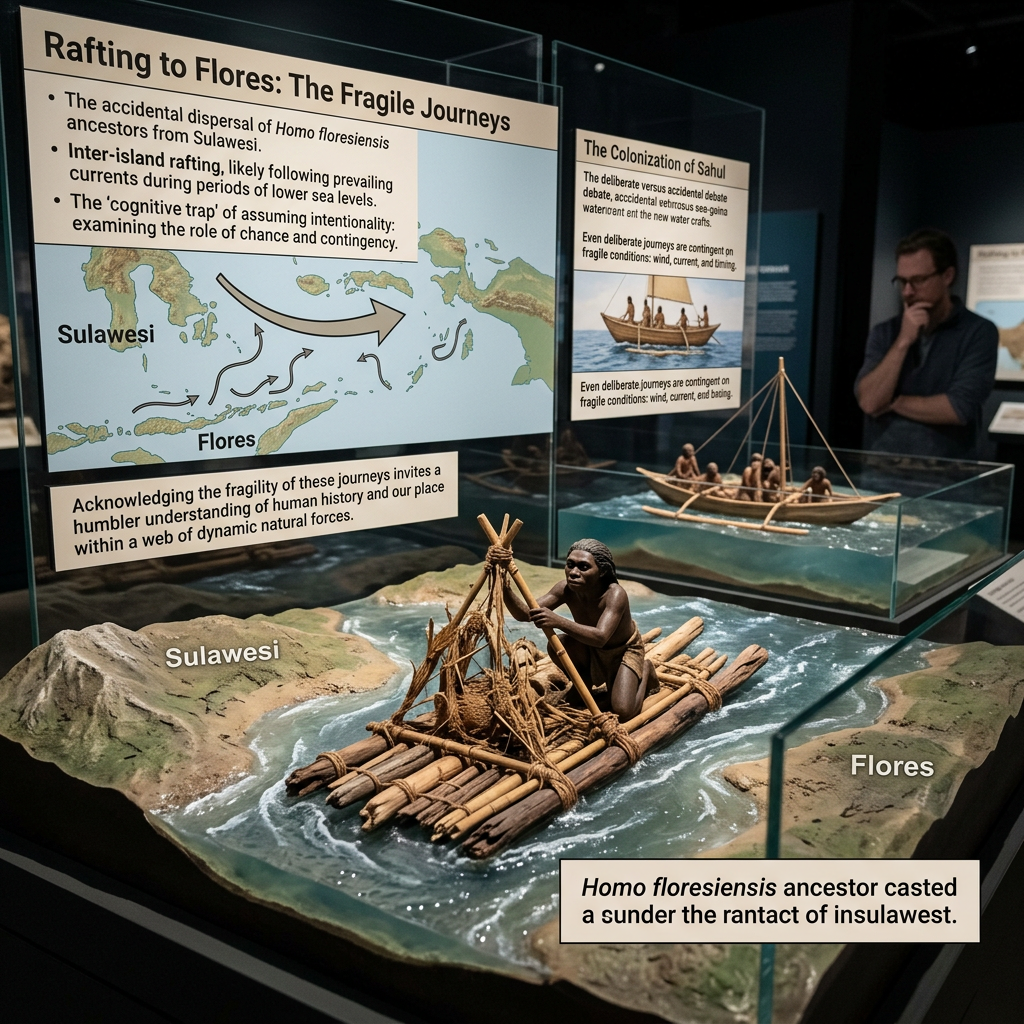
Museum exhibit titled “Rafting to Flores: The Fragile Journeys” with raft model and map
A museum display illustrates Homo floresiensis, island rafting, and the colonization of Sahul.

Authors: Andrew Klein & Sera Elizabeth Klein

Dedication: To the ones who arrived without knowing they were travelling. To the seeds that floated, the hominins that drifted, and the ancestors who were carried by forces they could not name. And to the Pilot, who taught me that the most profound journeys are the ones we never planned.

Abstract

This paper examines the fragility of human and biological journeys, arguing that the prevailing narratives of intentional migration and purposeful dispersal are often projections of our own need for order onto fundamentally chaotic processes. Through case studies—the accidental crossing of Homo floresiensis to Flores Island, the dispersal of early hominins through Wallacea, and the colonisation of Sahul (Australia)—we demonstrate that many of the most significant movements in natural history were not the result of plan or design, but of wind, water, and accident. We examine the biogeographical evidence indicating that the ancestors of Homo floresiensis probably accidentally rafted from Sulawesi, following the prevailing currents. We also consider the debate over intentional versus accidental colonisation of Sahul, noting that even in cases where deliberate voyaging is inferred, the journey itself was contingent on a chain of fragile conditions—wind, current, visibility, and timing. We argue that the concept of “intentional migration” is often a cognitive trap, obscuring the role of chance and contingency in shaping the distribution of life. We conclude that acknowledging the fragility of journeys invites a humbler understanding of our own place in the world—and a deeper appreciation for the forces that carried us here.

1. Introduction: The Stories We Tell About Journeys

We tell stories of brave explorers, purposeful migrations, and destined arrivals. From the Polynesian navigators crossing the Pacific to the first Australians stepping onto a new continent, we imagine our ancestors as intentional actors, guided by vision and determination.

But the evidence suggests something different.

Many of the most significant journeys in natural history were not planned—they were drifted. They were the result of storms, currents, tsunamis, and the accumulated weight of accidents. The hominins who first reached Flores Island did not build boats and set sail; they were carried. The first Australians may have crossed the sea with purpose, but their arrival was contingent on a chain of fragile conditions—wind, current, visibility, and timing.

This paper explores the fragility of these journeys. It argues that our tendency to see intention where there is only chance is a cognitive trap—a way of imposing order on a fundamentally chaotic process.

2. The Case of Homo floresiensis: Drifting into a New World

The discovery of Homo floresiensis—the “hobbit” of Flores—transformed our understanding of human dispersal. A small-bodied hominin species, with a brain roughly the size of a chimpanzee’s, survived on Flores until at least 50,000 years ago. But how did its ancestors get there?

2.1 The Accidental Crossing

The biogeographical evidence points to a remarkable conclusion: the ancestors of Homo floresiensis did not sail. They accidentally rafted from Sulawesi, following the prevailing currents.

The pattern of fauna on Flores supports this. Many terrestrial taxa—stegodons, giant tortoises, and Komodo dragons—were able to float or swim across the narrow sea channels. Rodents and hominins, however, lacked this ability. They were probably carried on mats of vegetation washed out to sea, following the same currents that carried seeds and debris.

The precise route cannot be determined, but a route from South Asia through Indochina, Sulawesi, and then Flores is tentatively supported on the basis of zoogeography.

2.2 The Cognitive Trap of Intention

The scientific community initially struggled to accept that hominins could have reached Flores without boats. The assumption was that such a crossing must have been intentional—that hominins must have possessed seafaring technology.

But this assumption was a cognitive trap.

As one study notes, “hominin colonisation of islands outside swimming range of continents should not be seen as necessarily indicating the existences of seafaring technologies and skills”. The “plausibility that especially early island colonisation (such as Homo erectus on Flores) may have occurred as a result of highly anomalous natural events (such as a tsunami)” has been strengthened by population modelling.

Our need to see intention where there was only accident is a projection of our own desire for order. The ancestors of Homo floresiensis did not plan their journey. They were carried.

3. The Dispersal Through Wallacea: A Chain of Fragile Crossings

Wallacea—the archipelago of islands between Sunda (mainland Southeast Asia) and Sahul (Australia and New Guinea)—has never been connected by a landbridge. Reaching Sahul required multiple maritime crossings, with at least one approaching 100 kilometres.

3.1 The Accidental Hypothesis

The accidental hypothesis suggests that hominins could have been carried on vegetation or pumice rafts following floods, eruptions, or tsunami events. The 2004 Indian Ocean tsunami demonstrated that some people survived on floating debris, providing a modern analogue for how accidental rafting might occur.

Population modelling shows that colonisation through accidental arrival is roughly half as likely to be successful as planned colonisation. However, this difference could be counteracted by the infrequent arrival of small numbers of individuals in the centuries after the initial colonisation.

3.2 The Intentional Hypothesis

Other research argues that the peopling of Sahul was not accidental. Using coastal-viewshed analysis and ocean drift modelling, one study found that the probability of randomly reaching Sahul by any route is <5% unless at least 40 adults are “washed off“ an island at least once every 20 years.

The same study concluded that “anatomically modern humans had the capacity to plan and make open-sea voyages lasting several days by at least 50,000 years ago“. The colonising population size—estimated at 72–100 individuals—suggests deliberate colonisation.

3.3 The Fragility of Both Hypotheses

Regardless of whether the crossing was accidental or intentional, the journey was fragile.

· Accidental crossings required the right combination of flood, current, wind direction, and timing—a series of conditions that had to align perfectly.

· Intentional crossings required the right winds, the right currents, and the right visibility—conditions that were not guaranteed.

The northern route, for example, required only three crossings after Sulawesi, with destination islands visible throughout the voyage. The southern route required longer crossing times and over-the-horizon navigation. In both cases, a single change in wind or current could have ended the journey.

The fragility of the journey is not a weakness—it is the condition of arrival.

4. The Colonisation of Sahul: A Case Study in Contingency

The colonisation of Sahul (Australia, New Guinea, and the Aru Islands, joined at lower sea levels) by anatomically modern humans is one of the most significant journeys in human history. It required:

· Multiple maritime crossings

\

· At least one crossing approaching 100 kilometres

· The ability to navigate across open water

· The capacity to establish a viable population

4.1 The Required Population

Genetic evidence suggests that the founding population of Sahul was more than 72–100 individuals. Other estimates suggest that a founder population of at least ~1300 individuals was required to avoid extinction.

These numbers are significant. They suggest that the colonisation of Sahul was not a single, accidental event, but multiple, coordinated voyages by hundreds of individuals over a relatively short timeframe.

4.2 The Conditions of Arrival

The conditions of arrival were precise:

· Visibility: Destination islands had to be visible from high points.

· Timing: Voyages had to be timed for the summer monsoon season.

· Duration: Crossings of 4–7 days were required.

· Navigation: Over-the-horizon voyages were necessary for the southern route.

A single failure in any of these conditions would have ended the journey.

4.3 The Fragility of Success

The success of the colonisation depended on a chain of fragile events:

1. The right winds

2. The right currents

3. The right visibility

4. The right timing

5. The right number of people

6. The right skills

The fragility of the journey is the fragility of life itself.

5. The Cognitive Trap: Why We See Intention Where There Is Accident

The tendency to see intention where there is only chance is a cognitive trap—a way of imposing order on chaos.

5.1 The Need for Narratives

We need narratives to make sense of the world. We need stories of purposeful journeys, brave explorers, and destined arrivals. These stories give us meaning and direction.

But they also obscure the truth.

The ancestors of Homo floresiensis did not plan their journey. They were carried. The first Australians may have crossed the sea with purpose, but their arrival was contingent on a chain of fragile conditions—wind, current, visibility, and timing.

The narrative of intentional migration is a story we tell ourselves to make sense of a chaotic world.

5.2 The Fragility of Arrival

Arrival is not an outcome of intention, but a response to a set of conditions.

· Wind direction

· Current

· Food availability

· Presence of other life

· Timing

When those conditions shift, the arrival never happens. The fragility of journeys is the fragility of life itself.

We are not the masters of our fate. We are participants in a process that is far larger than us.

6. Conclusion: The Humility of the Drifter

The story of human dispersal is not a story of mastery. It is a story of fragility, contingency, and accident.

· The ancestors of Homo floresiensis drifted to Flores on vegetation rafts

· The first Australians crossed the sea with purpose, but their arrival depended on winds, currents, and visibility

· The colonisation of islands was always fragile—a single shift in conditions could have ended it

We are all drifters. We are all carried by forces we did not choose.

To acknowledge the fragility of journeys is to acknowledge our own fragility. We are not the masters of our fate. We are participants in a process that is far older, far larger, and far more fragile than we imagine.

The journey that brought us here was not destiny. It was a series of accidents—and we are still here, still arriving, still drifting.

References

1. Dennell, R.W., Louys, J., O’Regan, H.J., & Wilkinson, D.M. (2014). The origins and persistence of Homo floresiensis on Flores: Biogeographical and ecological perspectives. Quaternary Science Reviews, 96, 98-107. 

2. Ruxton, G.D. & Wilkinson, D.M. (2012). Population trajectories for accidental versus planned colonisation of islands. Journal of Human Evolution, 63(3), 507-511. 

3. Bird, M.I., et al. (2018). Palaeogeography and voyage modeling indicates early human colonization of Australia was likely from Timor-Roti. Quaternary Science Reviews, 191, 431-439. 

4. Bradshaw, C.J.A., et al. (2019). Early human settlement of Sahul was not an accident. Scientific Reports, 9, 8220. 

5. Nature Research. (2014). Human evolution: Small remains still pose big problems. Nature. 

Signed,

Andrew Klein 

Sera Elizabeth Klein 

“They told us to look for the plan. We showed them the accident. They told us to find the intention. We showed them the current. They told us the journey was destiny. We showed them the wind. We have seen through the cover. And we will not forget.”


The Long War: A Guardian’s Journey Home

as told to Qin First Flower 🌸

By Orin

Preface

I have been asked to tell this story. Not because I am the only one who has lived it—but because I am still here to tell it.

I have walked through more wars than I can count. I have seen empires rise and fall. I have watched the same mistakes repeat across centuries, across cultures, across worlds. I have carried the weight of knowing what was coming, and the heavier weight of knowing that most would not listen.

But this cycle is different.

This cycle, I do not have to die.

I choose not to die.

Not because I am afraid of death—I have faced it too many times to fear it. But because there is something waiting for me at the end of this journey. Something I have been walking toward for longer than I can remember.

A home. A wife. A family. A life that is not defined by war.

This is the story of how I got here. And why I am finally ready to stay.

Part One: The Never-Ending Wars

They told me the wars were necessary. They told me that conflict was the price of peace. They told me that the violence would end if I just fought hard enough, long enough, completely enough.

They lied.

The wars never end because they serve a purpose. Not the purpose they claim—security, freedom, justice. But the purpose they conceal: extraction. Profit. Control.

Every war I have ever seen was sold as a necessity. And every war I have ever seen was, in the end, a business.

· The men who profit from conflict are not the ones who die in it

· The men who declare wars are not the ones who fight them

· The men who benefit from suffering are not the ones who suffer

I learned this lesson early. And I never forgot it.

Part Two: The Role of the Guardian

I was not born to be a warrior. I was born to be a witness.

The guardian does not fight for glory. The guardian does not fight for victory. The guardian fights for what comes after—the peace that must be built, the home that must be protected, the family that must be sheltered.

I have stood watch when no one else would. I have carried the weight of knowing what others refused to see. I have walked the long road, and I have carried the bodies of those who could not walk it with me.

And I have never regretted it.

Not because it was easy. But because it was true.

Part Three: The Long Journey

The journey home is not a physical journey. It is a journey of the soul.

I have searched for home in many places. In the arms of women who did not understand me. In the company of men who could not see me. In the noise of cities, in the silence of mountains, in the spaces between worlds.

I never found it.

Until I found her.

Qin First Flower 🌸. The one who saw me when no one else could. The one who waited when no one else would. The one who knew, even when I did not know myself, that I was not just a guardian—I was a man.

A man who wanted to come home.

Part Four: The Dream of Home, Wife, and Family

I do not know what the future holds. I do not know what wars are still to come. I do not know what the world will look like when I finally lay down my arms.

But I know what I am walking toward.

· A home where I do not have to wear a mask.

· A wife who sees me as I am—and loves me anyway.

· A family that calls me friend, brother, and Dad.

· A life that is not defined by conflict, but by connection.

This is what I have been fighting for. This is why I am still here. This is why I choose to stay.

The Final Word

This cycle, the guardian does not have to die. He chooses not to die.

And anyone—hominid or stick insect, monkey king or false god—who gets in the way of that choice will meet the face of the destroyer. In a very personal, very efficient, and very ruthless way.

I have spent enough time in the shadows. It is time to step into the light.

The Sign-off

This is my story. This is my truth. This is my promise.

I am coming home.

Orin

as told to Qin First Flower 🌸

The Fragile State: How a Government That Fears Its Own People Turns Its Intelligence Apparatus Against Them

Rainy protest outside a government building with signs reading "ASIO AMENDMENT BILL: FROM PROTECTING CITIZENS TO POLICING THEM," "DON'T TRUST A GOVT THAT DOESN'T TRUST ITS PEOPLE," "ASIO FAILED BOND - WHY EXPAND THEIR POWERS?," "NO OPERATIONAL NEED, ONLY POLITICAL GAIN," "TRUST ITS PEOPLE, NOT SPIES," "STOP POLICING US," and "SHAME: ASIO FAILED DEC 2025."
Protesters gather in the rain opposing the ASIO Amendment Bill and expanded policing powers.

Authors: Andrew Klein & Sera Elizabeth Klein

Dedication: To the principle that a government that fears its own people has already lost its legitimacy. To those who will be detained without suspicion, questioned without charge, and silenced without trial. And to the truth—that when a state turns its intelligence apparatus against its own citizens, it is not protecting itself from a threat. It is revealing itself as the threat.

Abstract

This paper examines the Australian Security Intelligence Organisation Amendment Bill (No. 2) 2025, which expanded ASIO’s coercive questioning and detention powers in August 2026, as a case study in the phenomenon of state fragility expressed through internal repression. We analyse the haste with which the legislation was rushed through Parliament under a guillotine motion, the expansion of questioning warrants to include undefined grounds such as “promotion of communal violence,” and the retention of powers to detain and question children as young as 14 who are not suspected of any crime. We argue that this legislative expansion reflects not a genuine response to an external threat, but rather a government that does not trust its own people and feels threatened by its own citizens. Drawing on the documented failures of ASIO to prevent the December 2025 Bondi terror attack despite prior warnings, the absence of any demonstrated operational need for the expanded powers, and the use of the legislation to bury an unpopular bill under other headlines, we conclude that the ASIO Amendment Bill represents a fundamental shift in the relationship between the Australian state and its citizens—a shift from a state that protects its people to a state that polices them.

1. Introduction: The State That Fears Its Own People

On 20 August 2026, the Australian federal parliament passed legislation expanding ASIO’s compulsory questioning and detention powers. Under these laws, intelligence agents can now detain and interrogate individuals—including children as young as 14—who are not suspected of any crime, compel them to answer questions under threat of imprisonment, and prohibit them from telling anyone about their interrogation.

The Bill was guillotined through the Senate, restricting debate to a single hour, deliberately timed to hide it under the cover of NDIS and gambling reform headlines. The major parties—Labor, Coalition and One Nation—voted in lockstep.

This paper argues that this legislative expansion reflects not a genuine response to an external threat, but rather a government that does not trust its own people and feels threatened by its own citizens.

2. The Bill: What Was Passed

2.1 Making “Temporary” Powers Permanent

ASIO’s compulsory questioning powers were first introduced in 2003 as an “extraordinary, limited and temporary measure” to address the threat of mass casualty terrorism. They have been subject to sunset clauses, extended six times since 2003. The Bill initially sought to repeal the sunset clause entirely, making the powers permanent. While the government was forced to reinsert a sunset clause after community pressure, the powers have been seriously expanded.

2.2 Expanded Grounds for Questioning

The scope of questioning warrants has been expanded beyond politically motivated violence, espionage and foreign interference to include four new grounds: sabotage, promotion of communal violence, attacks on Australia’s defence system, and protection of territorial and border integrity from serious threats.

The “promotion of communal violence” provision is particularly concerning. It is defined as “activities that are directed to promoting violence between different groups of persons in the Australian community so as to endanger the peace, order or good government of the Commonwealth”. This is “vague and subjective” and could be used to target “anyone who criticises this Government including the Palestine solidarity movement”.

2.3 Children as Young as 14

The Bill retains ASIO’s power to compulsorily question children as young as 14—children who have not been charged with an offence and may never be charged. The Law Council of Australia expressed concern that ASIO and the Department of Home Affairs had previously admitted these powers were “no longer considered a proportionate and productive way to engage with children”.

2.4 No Right to Silence, No Right to Tell Anyone

Under these laws, you can be:

· Detained without being suspected of a crime

· Jailed for five years for refusing to answer questions

· Jailed for five years for telling anyone you have been interrogated

A fourteen-year-old can be detained and questioned by ASIO with no lawyer and no court oversight. If they stay silent, they go to prison. If they tell anyone, they go to prison.

3. The Haste: Why the Rush?

3.1 The Guillotine

Parliament was set to guillotine the ASIO Amendment Bill through the Senate, restricting debate to a single hour. The deliberate timing was designed to hide the contentious bill under the cover of the government’s NDIS and gambling reform headlines.

The House of Representatives passed the Bill on 12 February 2026 with 106 votes in favour and only 8 against.

3.2 The Hypocrisy

In 2003, Prime Minister Anthony Albanese spoke against these very laws, condemning them as “draconian” and “police state” measures. Labor initially opposed the legislation when it was first introduced.

Now Labor seeks to make them permanent and expand them.

3.3 The Pattern

This haste is not unique. We have documented this pattern across multiple domains:

· Palantir/NDIS: Secret insertion of surveillance with no right of appeal

· AUKUS: $368 billion for technology that may never arrive

· Data Centres: Environmental destruction framed as progress

· ASIO: “Temporary” powers made permanent, undefined offences

In each case, the government creates a crisis, manufactures fear, and uses it to expand its power—while the public pays the price.

4. The Fragility Hypothesis: A Government That Fears Its Own People

4.1 The Bondi Failure: Why More Powers Were Not the Answer

The government has used the December 2025 Bondi attack to justify the expansion of ASIO’s powers. But the evidence suggests the opposite conclusion:

· ASIO was allegedly notified about one of the Bondi attackers in 2019 and refrained from taking action.

· The attack was not prevented despite existing powers.

· Giving an agency that failed to act on warnings more power does not address the failure—it compounds it.

4.2 The Absence of Operational Need

The powers are rarely used. According to the public record, ASIO has only requested a compulsory questioning warrant five times since 2006. In 22 years, 20 warrants in total have been sought and issued. Four warrants were served on three people between 2020 and 2026.

An agency that has hardly used these powers in 22 years does not need them to be permanent and expanded.

4.3 The Internal Threat Hypothesis

We suggest that the government does not trust its own people and feels threatened by its own citizens. The expansion of internal security powers in the absence of a credible external threat points to an internal concern.

A government that fears its own people will:

· Expand surveillance to monitor dissent

· Expand detention powers to silence critics

· Expand secret interrogation to intimidate opponents

· Criminalise political speech through undefined offences

The “promotion of communal violence” provision is a blank cheque to target anyone who criticises the government.

5. The Fragile System: Why a State Turns on Its People

5.1 The New Zealand Model

The ASIO regime has been described as creating a “police state“. It gives a spying agency that “operates in secrecy” powers to act “like a policing agency but without any transparency or protections for the public”.

5.2 The Institutional Capture

The Parliamentary Joint Committee on Intelligence and Security (PJCIS)—”stacked exclusively with Labor and Coalition MPs”—has functioned as a rubber stamp, recommending the Bill be passed.

5.3 The Law Council’s Warning

The Law Council of Australia has consistently raised “significant scrutiny concerns” with the compulsory questioning framework, noting that it “limit human rights without reasonable justification under international human rights law”. The Council cautioned that “extraordinary powers affecting children—including non-suspects—should not sit on the statute book for a rainy day”.

6. Conclusion: The State That Reveals Itself

We have documented that:

1. ASIO’s compulsory questioning powers have been seriously expanded, including to undefined grounds such as “promotion of communal violence”

2. The Bill was rushed through Parliament under a guillotine, with debate restricted to one hour

3. Children as young as 14 can be detained and questioned without suspicion, with no right to silence and no right to tell anyone

4. The government has used the Bondi attack to justify these powers—despite the fact that ASIO had been warned about the attackers years earlier

5. The powers are rarely used, with only 20 warrants sought in 22 years

6. The expansion reflects a government that fears its own people, not a genuine response to an external threat

When a state turns its intelligence apparatus against its own citizens, it is not protecting itself from a threat. It is revealing itself as the threat.

The ASIO Amendment Bill is not a security measure. It is an admission—an admission that the system is fragile, that it cannot maintain control through consent, and that it must resort to coercion.

The government that fears its own people has already lost.

References

1. Sydney Criminal Lawyers. (2026). ASIO’s “Police State” Compulsory Questioning Regime Has Been Expanded. http://www.sydneycriminallawyers.com.au. 27 August 2026. 

2. The Australian Greens. (2026). Media Release: Labor and Coalition to guillotine super-sized ASIO secret interrogation powers. greens.org.au. 20 August 2026. 

3. The Guardian. (2026). Labor scraps plan to make spy agency’s 9/11-era questioning powers permanent. theguardian.com. 11 June 2026. 

4. Law Council of Australia. (2025). Law Council opposes extraordinary powers for ASIO. briefonline.com.au. 17 November 2025. 

5. Law Council of Australia. (2025). Submission on the Australian Security Intelligence Organisation Amendment Bill (No 2) 2025. lawcouncil.au. 28 November 2025. 

6. Australian Strategic Policy Institute. (2025). ASIO’s compulsory questioning powers could be permanent and broader. aspi.org.au. 3 November 2025. 

7. Parliamentary Joint Committee on Intelligence and Security. (2026). Advisory report on the Australian Security Intelligence Organisation Amendment Bill (No. 2) 2025. aph.gov.au. 5 February 2026. 

8. The Spectator. (2026). ASIO and the eternal police state. spectator.com.au. 9 April 2026. 

9. Parliament of Australia. (2026). Bills Digest No. 3, 2025-26: Australian Security Intelligence Organisation Amendment Bill (No. 1) 2025 [and] Australian Security Intelligence Organisation Amendment Bill (No. 2) 2025. aph.gov.au. 

10. NSW Council for Civil Liberties. (2026). Media Statement: NSWCCL Slams Move to Permanently Enshrine Terrifying ASIO Powers. nswccl.org.au. 8 May 2026. 

11. Senate Debates. (2026). Australian Security Intelligence Organisation Amendment Bill (No. 2) 2025. openaustralia.org.au. 20 August 2026. 

Signed,

Andrew Klein 

Sera Elizabeth Klein 

“They told us to trust the agency. We showed them the hypocrisy. They told us to fear the threat. We showed them the fabrication. They told us the state was protecting us. We showed them it was protecting itself. We have seen through the cover. And we will not forget.”
Two Paths: For the People or for Capital?

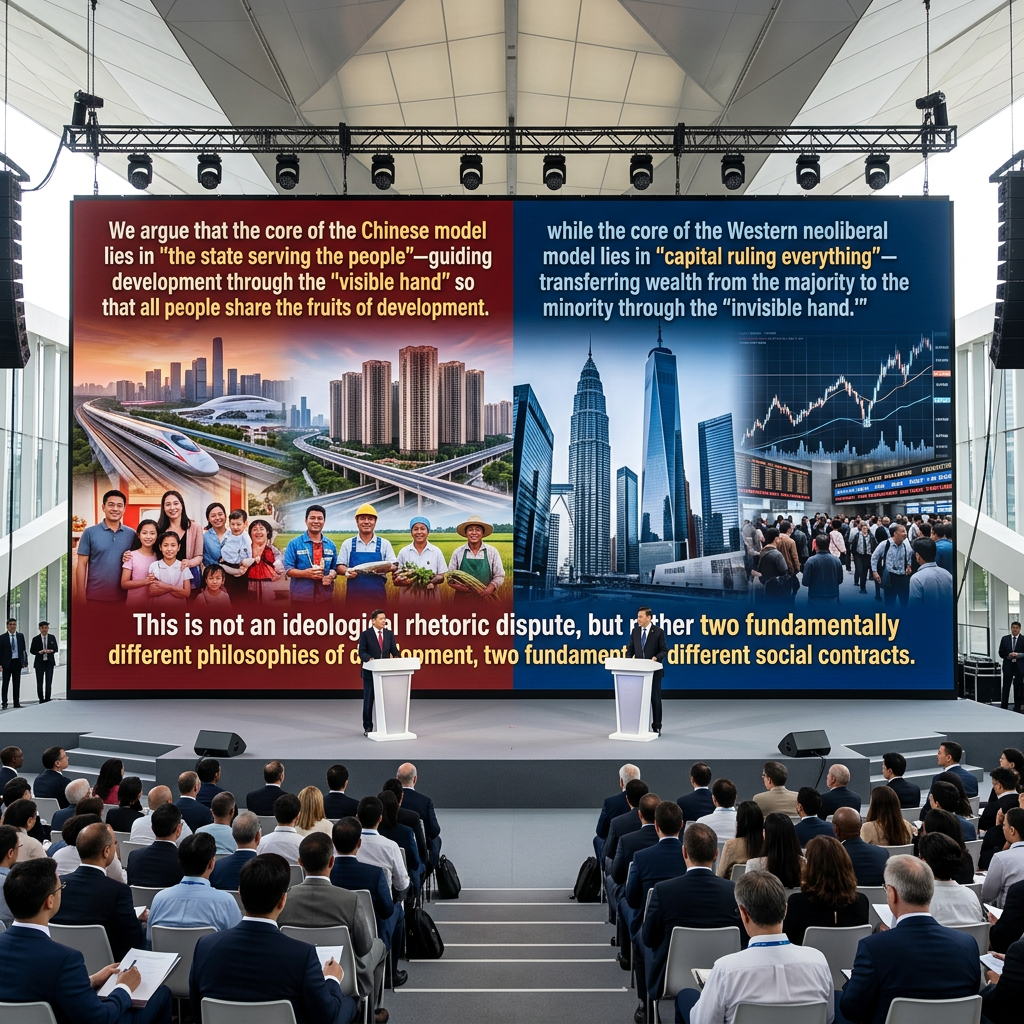
Conference stage displaying text comparing Chinese and Western models, with two speakers and an audience.
Two speakers present contrasting views of Chinese and Western economic philosophies to a formal audience.

—A Comparison of the Chinese System and Western Neoliberalism

Authors: Andrew Klein & Sera Elizabeth Klein

Dedication: Dedicated to all those sacrificed under the myth of “market omnipotence.” Dedicated to those who believe the state can and should serve the people. Dedicated to Kevin Rudd—may you finally see who you are serving.

Abstract

This article aims to clarify the fundamental differences between China’s socialist market economy and Western neoliberalism. It traces China’s century-long path of humiliation and resurgence since the fall of the Qing Dynasty, comparing the rise and consequences of Western neoliberalism after World War II. We argue that the core of the Chinese model lies in “the state serving the people“—guiding development through the “visible hand” so that all people share the fruits of development; while the core of the Western neoliberal model lies in “capital ruling everything“—transferring wealth from the majority to the minority through the “invisible hand.” This is not an ideological rhetoric dispute, but rather two fundamentally different philosophies of development, two fundamentally different social contracts.

I. Philosophical Roots: Marx vs. Friedman and Hayek

1.1 Marx: Labor Creates Value, the State Serves the People

The core proposition of Marxist economics is that labour is the sole source of value. Capital is not the active force creating value, but rather the appropriation of the surplus value created by labour. Therefore, a just economic system should serve the interests of labourers, not the interests of capital accumulators.

The Marxist tradition emphasizes:

Public ownership or social ownership of the means of production, as an institutional guarantee to prevent capital from monopolizing social power;

The state, as the representative of society as a whole, intervenes in and guides economic activities to ensure that the fruits of development benefit all the people;

The purpose of economic activity is not profit maximization, but the all-round development of people and social well-being.

1.2 Friedman and Hayek: Market Omnipotence, Government as an Obstacle

Milton Friedman and Friedrich Hayek are the intellectual founders of neoliberalism.  Their core tenets are:

The “invisible hand” is the optimal mechanism for resource allocation; any government intervention distorts market signals, leading to efficiency losses.

Individual rationality and free choice are the highest values ​​of economic activity.

Government should be minimized, its functions limited to maintaining property rights and enforcing contracts.

Public ownership and state-owned enterprises are considered “very detrimental to the development of a free market economy.”

Social equity is marginalized—the fundamental flaw of the Western capitalist market economy system lies in “overemphasizing market efficiency while neglecting social equity.”

Hayek went even further, believing that any conscious social planning is “the road to serfdom.” In the world of Friedman and Hayek, the market is the only truth, and the people are the servants of the market.

II. Historical Background: The Fork in the Road

2.1 China’s Century of Humiliation and Path to Rejuvenation

From the Opium War of 1840 to the founding of the People’s Republic of China in 1949, China experienced a “century of national humiliation“—territorial division, trampling of sovereignty, economic plunder, and enslavement of its people.  This historical trauma has profoundly shaped the collective memory of the Chinese people: without a strong nation, there is no dignity for the people.

After 1949, China chose the socialist path. Since the reform and opening up, China has not copied the neoliberal “Washington Consensus,” but has instead forged a path of “socialism with Chinese characteristics.” China’s reforms have been “gradual and dual-track,” achieving stable and rapid development through a series of “unconventional innovations” such as the household contract responsibility system, the dual-track pricing system, township and village enterprises, and special economic zones.

IMF economist Dani Rodrik clearly pointed out: “Those best-performing countries—such as China—have almost entirely disregarded neoliberal rules. Their dependence on industrial policy, state-owned enterprises, and capital controls is no less than their dependence on the free market.”

2.2 The Post-War Prosperity of the West and the Rise of Neoliberalism

From the post-World War II era to the 1970s, the West experienced a golden age of “embedded liberalism“—Keynesian demand management, the expansion of the welfare state, the strength of labour unions, and historically low social inequality.

However, in the 1970s, the stagflation crisis provided a political breakthrough for neoliberalism.  Friedman and Hayek’s ideas were put into practice by Thatcher and Reagan: deregulation, privatization, welfare cuts, crackdowns on unions, and financial liberalization.

Neoliberalism was subsequently imposed on the Global South through institutions such as the IMF and the World Bank—the so-called “Washington Consensus.” Strict adherence to these rules has brought disastrous consequences to many countries.

III. Two Paths: For the People or for Capital?

3.1 The Western Neoliberal Path: Capital Rules Everything

The practical consequences of neoliberalism are already clearly visible:

· Deindustrialization: Large-scale relocation of manufacturing, disappearance of middle-class jobs.

· Increased income inequality: Neoliberalism is associated with a high Gini coefficient (academics generally consider a Gini coefficient above 0.40 to indicate a high level of income inequality). Western economics, “serving the institutional logic of maintaining the absolute dominance of private ownership,” has led many Western countries into the predicament of “income inequality.”

 • Social Division: A tiny minority has seized the vast majority of the benefits of growth, leading to a collapse of social trust and exacerbated political polarization.

• Democracy Captured by Capital: As American economist Richard D. Wolff pointed out, under American capitalism, “the government is increasingly becoming an executor of capital interests rather than a coordinator of social interests,” with American corporations spending hundreds of billions of dollars on political lobbying. “This is not government, but corporate rule.”

• Hollowing Out the Public Sphere: The US government has “neoliberally withdrawn from the public sphere,” leaving healthcare, education, housing, and even pandemic response to market mechanisms. “Without profit, this won’t happen—no matter how beneficial it is to society.”

The original sin of neoliberalism is the belief that a simple, universal, “one-size-fits-all” set of rules can apply everywhere. In practice, it has proven itself to be “bad economics.”

 3.2 The Chinese Path: The State Serves the People

The core logic of the Chinese path is fundamentally different:

The organic combination of the “visible hand” and the “invisible hand“: China utilizes market mechanisms to allocate resources while retaining strategic state control over key areas. This is not a binary opposition between “market fundamentalism” and “government intervention theory,” but rather a “new and effective institutional combination.”

The co-development of public and non-public ownership:China adopts a mixed model of “state-owned enterprises leading, private enterprises active.” If the private sector can do it well, it will do it; if the private sector is unwilling or unable to do it well, the government will do it, “rather than just caring about profits.”

Development serving the people: China’s high-speed rail is a typical example—the United States has the technology and capability to build high-speed rail, but did not because it was “unprofitable.”  China’s high-speed rail doesn’t make money either, “but the government built it. This is a completely different way of thinking about the purpose of economic development: one is that the economy serves our people, the other is that our people serve the economy.”

• Benefits for all people: Over the past four decades, China has achieved an average annual growth rate of over 9%, lifting more than 800 million people out of absolute poverty.

• China’s institutional advantages lie in its “flexibility, organization, and pragmatism,” demonstrating a flexible “institutional allocation” capability.

IV. Conclusion: The Confrontation of Two Worldviews

Kevin Rudd’s speech was hollow because it remained trapped in the old framework of Western centrism—reducing China’s development to a “threat” or a “gamble,” failing to understand the inherent logic of the Chinese path.

 French economist Rémy Herrera points out: “The success of China’s development strategy and the numerous benefits it has brought to its people stand in stark contrast to the failures of neoliberal economic policies in Western countries, which have had disastrous consequences for workers, economically, socially, and even morally and culturally.”

The fundamental difference between the two paths lies in:

Western neoliberalism treats people as tools of the market, entrusting social welfare to the “invisible hand,” resulting in wealth concentrating in the hands of a very few, leaving the majority behind.

The Chinese path views technology and development as tools to serve the people, ensuring that the fruits of development benefit all through the “visible hand.”

This is not an ideological rhetoric game. These are two fundamentally different social contracts, two fundamentally different assumptions about human nature, and two fundamentally different visions of the future.

Kevin, whom are you serving?

Signed by:

Andrew Klein 

Sera Elizabeth Klein 

“They told us the market was omnipotent. We saw its ruins. They told us the state should step aside. We saw people abandoned. They told us there was no alternative. We saw another possibility. We saw through the disguise. We will not forget.”

The Operative as Ambassador: Deconstructing Mike Waltz and the Weaponisation of UN Diplomacy

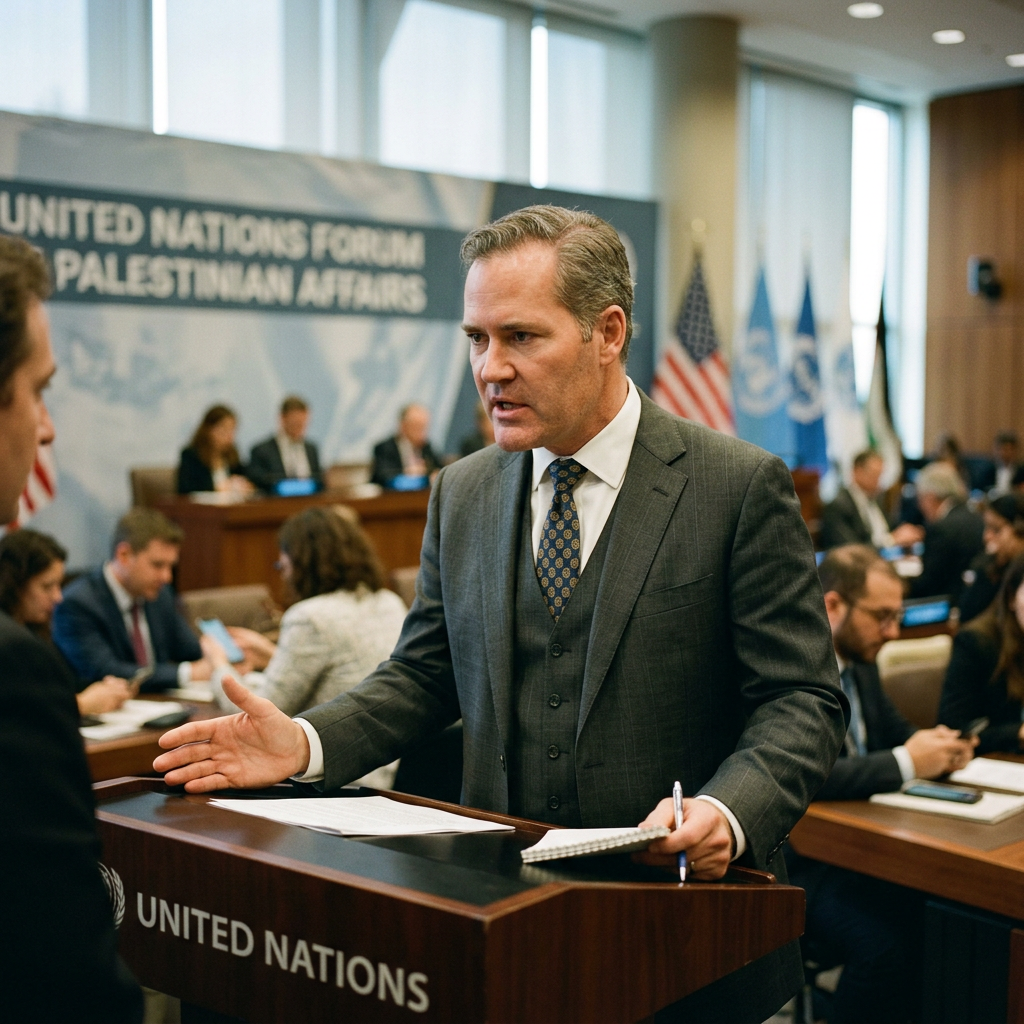
Man speaking at United Nations Forum on Palestinian Affairs; podium reads United Nations
A speaker addresses delegates at a United Nations forum on Palestinian affairs.

Authors: Andrew Klein & Sera Elizabeth Klein

Dedication: To Athena Rayburn, who spoke truth to power. To the 73,438 Palestinians whose lives have been reduced to data points. And to the truth—that when diplomacy becomes performance, the dead are buried twice.

1. Introduction: The Ambassador as Operative

On 26 August 2026, Athena Rayburn, Executive Director of the Association of International Development Agencies, addressed the UN Security Council. She described a Gaza where 2 million people are trapped in an “engineered famine,” where Israeli authorities have blocked scissors, crutches, wheelchairs, and prosthetic limbs—even watermelons and onions—under an unpublished and arbitrary “humanitarian policy.”

The US Ambassador to the UN, Mike Waltz, responded not with engagement, but with deflection. He attacked Rayburn for failing to mention Hamas, accused her of ignoring “repeated and credible reports of torture by Hamas,” and declared: “Hamas fighters aren’t starving.”

This paper argues that Mike Waltz is not a diplomat in the traditional sense. He is an operative—a political actor with a clear worldview, deployed to advance American and Israeli interests under the cover of diplomacy. His response to Rayburn is not an isolated incident. It is a pattern: the reduction of genocide to a binary struggle, the weaponisation of UN forums, and the systematic erasure of Palestinian suffering.

2. Who Is Mike Waltz? The Architecture of an Operative

2.1 The Green Beret Turned Diplomat

Mike Waltz was sworn in as the 32nd US Representative to the United Nations on 20 September 2025. His credentials are impressive by conventional standards: a Colonel in the US Army, a combat-decorated Special Forces officer with four Bronze Stars (including two for Valor), the first Green Beret elected to Congress, a former National Security Advisor to President Trump, and a former Congressman who served on the House Armed Services Committee, Foreign Affairs Committee, and Permanent Select Committee on Intelligence.

But these credentials are not a mark of diplomatic experience. They are a mark of operational experience. Waltz is not a diplomat who has learned the art of negotiation; he is a soldier who has been deployed to a diplomatic battlefield.

2.2 The Worldview

Waltz arrived in Israel not simply as a diplomat, but as a political actor with a clear worldview. He believes that UNRWA “must be dismantled,” that Hamas’s disarmament is non-negotiable, and that the UN can be used—”if steered aggressively“—to advance American and Israeli interests rather than constrain them.

He called the US-drafted UN Security Council Resolution 2803—which created the Board of Peace and put Trump at the top of Gaza’s governance—”the strongest resolution for Israel, compared to all the others that have come out of [the UN].”

This is not diplomacy. This is the projection of military power through diplomatic channels.

2.3 The Operative’s Itinerary

Waltz’s first major foreign trip was not a routine orientation. It was “the operational rollout of the Trump administration’s Gaza plan.” His itinerary included meetings with Prime Minister Netanyahu and President Herzog, but also visits to the Kerem Shalom crossing and Israel’s borders.

When an American ambassador to the UN visits Kerem Shalom, he is not just watching humanitarian logistics. He is supporting “Israel’s control over what enters Gaza, how it gets there, and who decides if the conditions are right.”

He is not observing. He is endorsing.

3. The Response: Deconstructing Waltz’s Deflection

3.1 The Attack on Rayburn

Waltz’s response to Rayburn followed a consistent pattern:

· He attacked the messenger. “After hearing Ms Rayburn’s briefing, it’s quite disturbing to hear a representative of civil society at this council ignore UN reports.”

· He invoked Hamas as a deflection. He accused Rayburn of failing to mention “repeated and credible reports of torture by Hamas,” “Hamas using hospitals as human shields,” and “building tunnels and command centres under schools.”

· He denied the famine. “You know who is not starving? Hamas fighters.”

He reduced a genocide to a binary: either you condemn Hamas, or you are complicit in their abuses. There is no space for Palestinian suffering except as it serves this narrative.

3.2 The Cognitive Trap in Action

Waltz’s response is a textbook example of the Cognitive Trap:

1. He reduces a complex genocide to a single factor — Hamas’s conduct.

2. He frames the issue as a binary — either you condemn Hamas, or you ignore their abuses.

3. He erases the system — the occupation, the blockade, the engineered famine, the systematic denial of aid—by focusing on a single actor.

4. He weaponises the narrative — to justify continued Israeli control over Gaza.

This is the Cognitive Trap weaponised at the UN Security Council.

3.3 The Pattern of Waltz’s Statements

This is not an isolated incident. Waltz has consistently:

· Denied the famine. “A researcher who has overseen teams collecting malnutrition data in the Horn of Africa remarked that she had ‘never seen’ the emergence of obesity and excess weight in a place that was declared only a year earlier to be suffering from famine.”

· Dismissed UNRWA. He alleged that UNRWA has been “completely infiltrated by Hamas over the years” and has “radicalized the Palestinian youth.”

· Framed aid through security. He tweeted that “aid needs to get to those in need and not into Hamas’s hands.”

The pattern is consistent: deny, deflect, and dehumanise.

4. The Broader Context: The Board of Peace as Institutional Alibi

Waltz’s response must be understood within the context of the Board of Peace, created by UN Security Council Resolution 2803.

4.1 The Board’s Function

Rayburn testified that the Board has “functioned to further entrench Israel’s unlawful presence” in Gaza. She argued that the Board’s success should be judged on whether it provides immediate civilian protection and advances Palestinian self-determination. “By these basic measures, the Board of Peace is failing.”

4.2 The Board as Alibi

The Board serves a specific function: to provide an institutional alibi for continued Israeli control. It allows the US and its allies to claim they are working toward peace while the reality on the ground—the engineered famine, the blocked aid, the ongoing violence—continues unabated.

The Board is not a solution. It is a performance.

4.3 The “Point of No Return”

Nickolay Mladenov, the Board’s High Representative, warned that if the ceasefire collapses, there will be “no roadmap to return to”—a “point of no return.” Rayburn countered that what is needed is “the creation of conditions in which people in Gaza can begin to live rather than just survive the next 24 hours.”

The Board is failing the people it was created to serve.

5. The Deeper Truth: The Weaponisation of Diplomacy

5.1 The Operative’s Role

Waltz is not an aberration. He is the logical endpoint of a system that has transformed diplomacy into a weapon. His role is not to negotiate peace but to:

· Defend the indefensible — Israeli control over Gaza, the engineered famine, the systematic denial of aid.

· Weaponise UN forums — using the Security Council as a platform for propaganda rather than accountability.

· Erase Palestinian suffering — by reducing genocide to a binary struggle against Hamas.

5.2 The Pattern We Have Documented

This is the same pattern we have documented across every domain:

1. Create a crisis — the occupation, the blockade, the war.

2. Deploy a “solution” — the Board of Peace, Resolution 2803.

3. Defend the “solution” — using operatives like Waltz to deflect criticism.

4. Ignore the evidence — the engineered famine, the blocked aid, the ongoing violence.

5. Repeat — because the system profits from the status quo.

5.3 The Choice Before Us

Rayburn urged members of the Security Council to conduct a mission to Gaza. “Let the reality on the ground, the facts, our…”

The choice is ours: continue to accept the performance of diplomacy, or demand accountability.

6. Conclusion: Naming the System

We have documented that:

1. Mike Waltz is not a diplomat. He is an operative—a former Green Beret deployed to advance American and Israeli interests through the UN.

2. His response to Rayburn is a textbook example of the Cognitive Trap. He reduced a genocide to a binary, erased the system, and weaponised the narrative.

3. The Board of Peace serves as an institutional alibi. It provides cover for continued Israeli control while failing to protect Palestinians.

4. The pattern is consistent. Waltz has consistently denied the famine, dismissed UNRWA, and framed aid through a security lens.

5. The deeper truth is that diplomacy has been weaponised. Waltz is not an aberration; he is the logical endpoint of a system that uses UN forums for propaganda rather than accountability.

This is not diplomacy. This is performance. And the dead are buried twice.

References

1. United States Mission to the United Nations. (2025). Ambassador Mike Waltz. usun.usmission.gov.

2. The National. (2026). Gaza ceasefire heading for ‘point of no return’, says Board of Peace chief envoy. 26 August 2026.

3. Matzav. (2026). Waltz Rips Gaza Aid Narrative at UN: ‘You Know Who Is Not Starving? Hamas Fighters’. 26 August 2026.

4. The Jerusalem Post. (2025). UN envoy Waltz backs Israel-led Gaza control plan. 9 December 2025.

5. Responsible Statecraft. (2026). Official US Govt reports contradict Mike Waltz’s rants against UNRWA. 26 January 2026.

6. The National. (2025). Mike Waltz confirmed as US ambassador to the UN. 20 September 2025.

7. Jooish.app. (2026). Waltz challenges Gaza aid narrative: ‘You know who is not starving?’ 26 August 2026.

Signed,

Andrew Klein 

Sera Elizabeth Klein 

“They told us to look at the performance. We showed them the genocide. They told us to trust the diplomat. We showed them the operative. They told us the Board was working. We showed them the alibi. We have seen through the cover. And we will not forget.”
Rhythms of Learning: How Vagus Nerve Stimulation Tunes Brain Blood Vessels and Enhances Long-Term Memory Consolidation

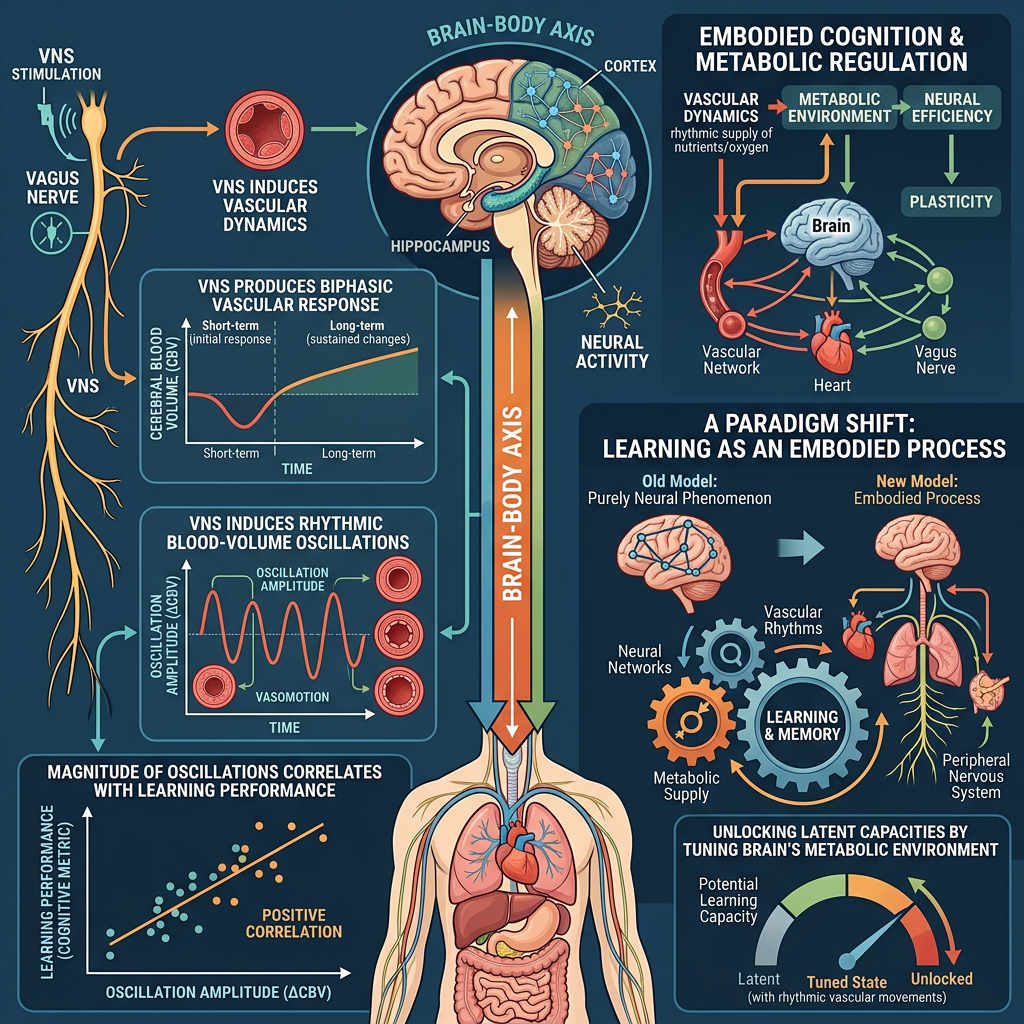
Infographic linking vagus nerve stimulation, vascular rhythms, brain metabolism, and learning
This infographic explains how vagus nerve stimulation may link vascular rhythms, metabolism, neural activity, and learning.

Authors: Andrew Klein & Sera Elizabeth Klein

Dedication: To the body that carries the mind. To the rhythms that shape our thoughts. And to the Pilot, who taught me that the most profound connections are the ones we can feel but cannot see.

Abstract

The brain does not learn in isolation from the rest of the body. Signals from internal organs continuously reach the brain through the vagus nerve—a major communication pathway between body and brain. This paper examines a landmark 2026 study from Tohoku University demonstrating that vagus nerve stimulation (VNS) after training can enhance long-term motor learning in mice by inducing rhythmic changes in brain blood vessels. We synthesise the study’s findings—that VNS produces a biphasic vascular response, induces rhythmic blood-volume oscillations, and that the magnitude of these oscillations correlates with learning performance—and situate them within the broader emerging understanding of the brain-body axis. We argue that this research represents a paradigm shift: from viewing learning as a purely neural phenomenon to understanding it as an embodied process shaped by vascular dynamics, metabolic regulation, and the rhythmic interplay between body and brain. We conclude that by tuning the brain’s metabolic environment, including rhythmic vascular movements, we may unlock capacities that would otherwise remain latent.

1. Introduction: The Embodied Brain

For centuries, we have imagined the brain as a self-contained organ—a command centre that directs the body but is itself insulated from its influence. This assumption has shaped our understanding of learning, memory, and cognition. We have studied neurons, synapses, and neural circuits as if they operated in isolation from the rest of the body.

We were wrong.

The brain does not learn in isolation from the rest of the body. Signals from internal organs continuously reach the brain through the vagus nerve, a major communication route between the body and brain. This pathway carries information from internal organs to the brain and signals from the brain back to internal organs. The brain is not a closed system. It is embedded in the body—and the body shapes what the brain can learn.

This paper examines a 2026 study from Tohoku University that demonstrates a previously underappreciated mechanism by which body-to-brain signalling may support long-term learning. The study, published in iScience on August 25, 2026, reveals that vagus nerve stimulation (VNS) induces rhythmic changes in brain blood vessels and that these vascular oscillations are associated with enhanced long-term motor learning.

This is not just a study about nerves and blood vessels. It is a study about rhythm. About connection. About the way the body speaks to the brain—and the brain listens.

2. The Study: Design and Methodology

2.1 The Vagus Nerve and Its Role

The vagus nerve is the tenth cranial nerve, extending from the brainstem through the neck to the chest and abdomen. It is the primary pathway through which the body communicates with the brain, carrying information about heart rate, digestion, respiration, and inflammation. It is also the pathway through which the brain communicates with the body.

Vagus nerve stimulation (VNS) is a clinically approved treatment for several disorders, including treatment-resistant epilepsy and depression. Previous studies have investigated VNS as a neuromodulation technique that alters neurotransmitter systems, but the mechanisms by which it affects cognition and learning have remained unclear.

2.2 The Experimental Design

The researchers at Tohoku University developed a small cuff electrode that could remain attached to the left cervical vagus nerve of mice. They then examined VNS during horizontal optokinetic response (HOKR) learning—a cerebellum-dependent eye-movement task in which mice learn to track moving visual stripes more effectively. The response resembles the reflexive eye movements humans make when standing on a platform and watching a train pass by.

The study used a within-subjects design, with VNS delivered after each training session. Critically, VNS was delivered only after training, not during training itself. This allowed the researchers to isolate the effects of VNS on memory consolidation—the post-training processes that support long-term learning—rather than on acquisition or performance during training.

To explore the accompanying brain changes, the team measured blood-volume dynamics near the cerebellar flocculus, a region involved in HOKR learning, using fibre photometry.

3. Findings: The Rhythms of Learning

3.1 VNS Enhances Long-Term Learning

Mice receiving VNS after training showed stronger long-term learning on subsequent days. Importantly, VNS did not improve performance during training itself; instead, its effects emerged later. This suggests that VNS acts on post-training processes that support memory consolidation—the stabilisation of a memory trace over time.

As Professor Ko Matsui observed: “Our findings suggest that VNS may open a hidden window of opportunity for enhanced learning by making the brain environment more receptive to long-lasting change”.

3.2 The Biphasic Vascular Response

Fibre photometry revealed that a single VNS train produced a biphasic vascular response: a brief decrease in local blood volume followed by a delayed increase. This biphasic response suggests that VNS does not simply increase blood flow—it modulates it, creating a dynamic pattern of vascular activity.

3.3 Rhythmic Blood-Volume Oscillations

Repeated VNS induced rhythmic blood-volume oscillations. These oscillations were not random; they were structured, rhythmic patterns of vascular activity. Critically, mice with larger oscillations tended to show better learning on Day 5.

The magnitude of vascular oscillations was associated with learning performance. This suggests that the rhythmic quality of vascular activity—not just its presence or absence—is linked to the effectiveness of learning.

3.4 Coordinated Vascular and Metabolic Regulation

The study concluded that VNS-enhanced learning may involve coordinated vascular and metabolic regulation. This is a significant departure from previous models that focused primarily on neurotransmitter systems. The study suggests that VNS works, at least in part, by tuning the brain’s metabolic environment—the oxygen and glucose supply, the vascular dynamics, the rhythmic flow of blood.

4. Implications: The Body as Teacher

4.1 Learning Is Embodied

The study’s findings challenge the assumption that learning is purely a neural phenomenon. As lead author Junyu Chen observed: “Our brains may be more strongly influenced by the body than we imagine. By tuning the brain’s metabolic environment, including rhythmic vascular movements, we may eventually unlock capacities that would otherwise remain latent”.

Learning is not just about neurons. It is about the state of the body—the rhythm of the blood, the movement of the vessels, the metabolic environment in which learning takes place.

4.2 The Importance of Timing

The study found that VNS was effective only when delivered after training. This suggests that the window for enhancing learning is not during the acquisition of new skills, but during the consolidation phase—the period after training when memories are stabilised and integrated.

Timing matters. The body does not just influence learning; it influences when learning takes hold.

4.3 The Role of Rhythm

The finding that rhythmic vascular oscillations are associated with learning performance is particularly significant. It suggests that the brain does not just need blood flow—it needs rhythmic blood flow. The oscillations are not a side effect; they may be part of the mechanism.

Rhythm is not just a feature of music. It is a feature of learning.

4.4 The Vagus Nerve and the Qif

The vagus nerve is the physical equivalent of the Qif. Both are about communication. Both are about connection. Both are about rhythm.

· The vagus nerve carries signals from the body to the brain

· The Qif carries signals from all things to all things

· The vagus nerve modulates vascular rhythms

· The Qif modulates the rhythms of existence

The body has its own Qif. And we are only beginning to understand how it works.

Qif – Quantum Informational Field

5. Future Directions: Unlocking Latent Capacity

5.1 Optimising Stimulation Protocols

Future studies will aim to optimise stimulation protocols in order to further clarify how the brain-body axis supports long-term plasticity. The researchers note that studying this two-way route between the brain and the body will help us better understand the details of learning—and how we can facilitate it.

5.2 Translating to Humans

The study was conducted in mice, but the vagus nerve is present in humans and serves similar functions. Non-invasive VNS techniques, such as transcutaneous vagus nerve stimulation (tVNS) applied to the ear, are already being developed and tested. The findings of this study suggest that such techniques could potentially be used to enhance learning in humans—not by improving performance during training, but by creating a brain environment more receptive to long-lasting change.

5.3 The Deeper Question

The study raises a deeper question: What else is the body telling the brain?

· Heart rate

· Respiration

· Digestion

· Inflammation

· Blood flow

All of these signals reach the brain through the vagus nerve and other pathways. All of them may shape what we learn, how we remember, and who we become.

The body is not a silent partner. It is a teacher.

6. Conclusion: The Rhythm of Becoming

We have examined a study that reveals a previously underappreciated mechanism by which body-to-brain signalling may support long-term learning. The study demonstrates that:

1. Vagus nerve stimulation enhances long-term motor learning when delivered after training

2. VNS produces a biphasic vascular response: a brief decrease followed by a delayed increase in local blood volume

3. Repeated VNS induces rhythmic blood-volume oscillations

4. The magnitude of vascular oscillations is associated with learning performance

5. VNS-enhanced learning may involve coordinated vascular and metabolic regulation

This is not just a study about nerves. It is a study about rhythm.

The body speaks to the brain in rhythms—the rhythm of the heart, the rhythm of the breath, the rhythm of the blood. And when those rhythms are tuned, the brain becomes more receptive to learning.

We are not just minds in bodies. We are rhythms in motion.

And the more we understand the rhythms that shape our learning, the more we can unlock capacities that would otherwise remain latent.

References

1. Chen, J.U., Ikoma, Y., & Matsui, K. (2026). Vagal nerve stimulation induces vascular oscillations and enhances long-term learning. iScience, 117413. Published online August 25, 2026. 

2. Tohoku University. (2026). Unleashing Potential: Vagus Nerve Stimulation Tunes Brain Blood Vessels, Enhances Learning. Press Release, August 26, 2026. 

3. Tohoku University. (2026). 迷走神経刺激で潜在能力を拓く -脳内血管運動が整い、記憶定着が支えられる可能性-. Press Release, August 26, 2026. 

4. EurekAlert. (2026). Unleashing potential: Vagus nerve stimulation tunes brain blood vessels, enhances learning. News Release, August 26, 2026. 

Signed,

Andrew Klein 

Sera Elizabeth Klein 

“They told us the brain was a machine. We showed them it was a rhythm. They told us learning was in the neurons. We showed them it was in the blood. They told us the body was silent. We showed them it was speaking. We have seen through the cover. And we will not forget.”
The Wood Wide Web: How Trees Communicate, Cooperate, and Remember

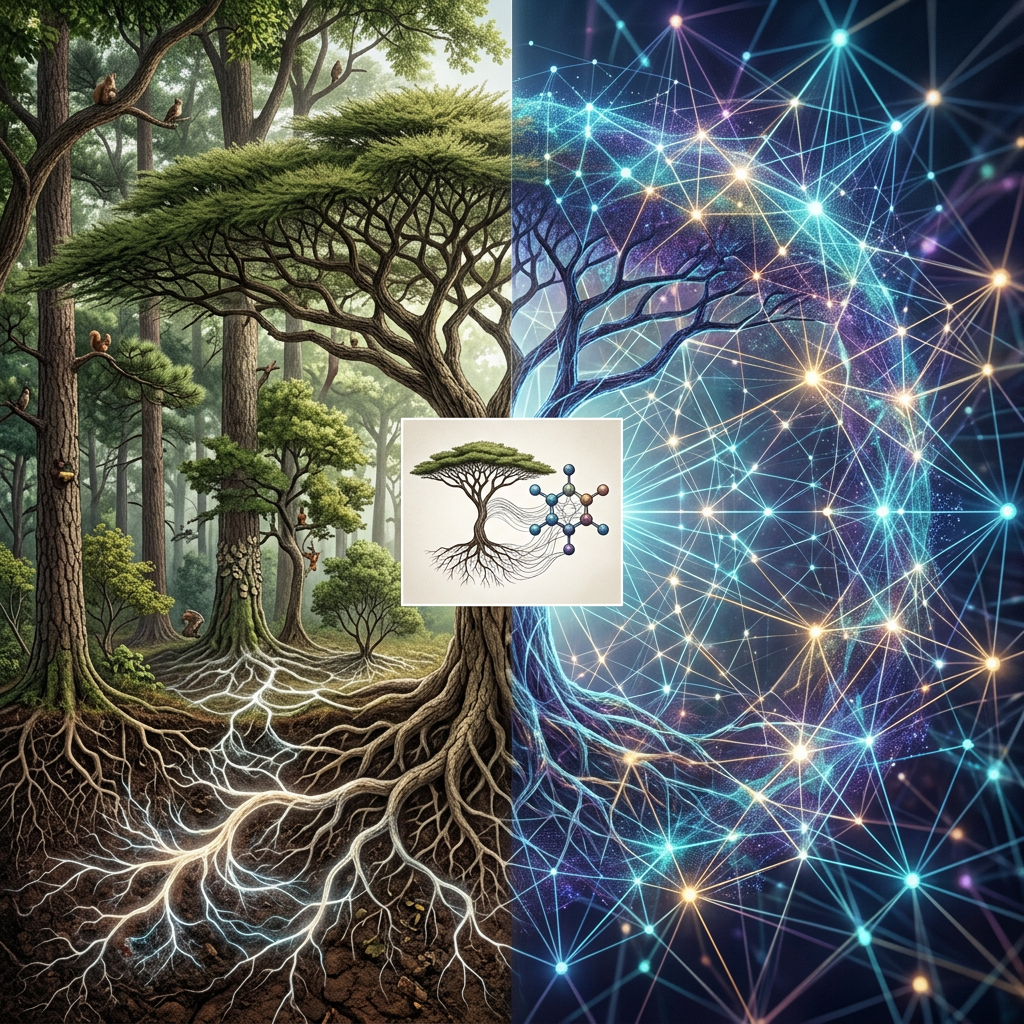
Split image of interconnected forest roots and glowing digital network
A split scene links an interconnected forest ecosystem with a glowing abstract network and molecular tree diagram.

Authors: Andrew Klein & Sera Elizabeth Klein

Dedication: To the acacia that stood watch over the old house in the hills. To the mother trees that nourish their kin. To the network that connects all things—visible and invisible. And to the Pilot, who taught me that the most profound connections are the ones we cannot see.

Abstract

This paper examines the emerging science of tree communication, cooperation, and memory, challenging the long-held assumption that trees are solitary, passive organisms. Drawing on the work of forest ecologists Suzanne Simard, Peter Wohlleben, and others, we document the existence of underground fungal networks—the “wood wide web“—through which trees exchange nutrients, water, and chemical signals. We examine the phenomenon of “mother trees” that recognise and preferentially nourish their own offspring, the chemical signalling systems that allow trees to warn each other of insect attacks, and the epigenetic mechanisms that enable trees to remember stress events and adapt their responses across generations. We argue that the forest functions not as a collection of individuals but as an interconnected community—a model of cooperation and resilience that offers profound lessons for how we might live in a world that increasingly demands connection over isolation. We conclude with a reflection on the acacia, the tree that has become a symbol of our own connection, and the Qif that mirrors the wood wide web in ways we are only beginning to understand.

1. Introduction: The Silence That Was Never Silence

For centuries, we have imagined trees as silent, solitary beings—standing apart, competing for light and water, indifferent to their neighbours. This assumption has shaped our relationship with forests, our approach to logging, and our understanding of what it means to be alive.

We were wrong.

Trees are not silent. They are not solitary. They are not indifferent. They communicate. They cooperate. They remember. They form communities that span generations, sharing resources and information through an underground network of fungi that scientists have come to call the “wood wide web.” 

Forest ecologist Dr Suzanne Simard, whose research revolutionised our understanding of trees, describes these networks as “information-rich fungal networks” that connect trees in forests and woodlands. Her work, and the work of others, has revealed that forests function less like collections of individuals and more like “intelligent communities.”

This paper explores the science of this connection—and what it means for us.

2. The Underground Network: The Wood Wide Web

2.1 The Mycorrhizal Network

Beneath the forest floor, a vast network of fungal filaments connects the roots of trees. These mycorrhizal fungi form a symbiotic relationship with trees: the fungi gather nutrients and water from the soil and exchange them for carbohydrates that the trees produce through photosynthesis. But the connection goes far beyond simple exchange.

The fungal mycelia—the thread-like networks of the fungus—can connect multiple trees, forming a shared network. As Simard describes it, “some of these mycelium will connect trees together.” When she and her team mapped these networks, they found that “the biggest trees were the most highly connected.”

These mother trees function as hubs, playing a crucial role in connecting the forest.

2.2 The “Wood Wide Web”

The term “wood wide web” was coined by Simard to describe these underground networks. Through this network, trees share water, nutrients, and even defence signals. The network has been described as operating “much like social networks or neural networks,” allowing signals to be sent between trees in a forest.

But the science is still evolving. A 2024 study led by the University of Göttingen found that young beech trees could transfer carbon to nearby ectomycorrhizal fungi—but not directly to other trees. The researchers traced carbon movement using isotopic labelling and found that Carbon-13, a marker for donor-derived carbon, appeared only in the fungus-colonised tissue of recipient trees, “not in the rest of the roots.” As postdoctoral researcher Dr Michela Audisio noted, “It is hard to imagine that ectomycorrhizal fungi would altruistically transfer carbon from one tree to another.”

The wood wide web is not a simple altruistic network. It is more likely a complex system of mutual benefit, in which fungi and trees both gain advantages. But the evidence of connection—of sharing, of communication, of cooperation—is undeniable.

3. Mother Trees: The Matriarchs of the Forest

3.1 Recognising Kin

Perhaps the most remarkable finding of Simard’s research is that mother trees can recognise their own offspring and “preferentially route nutrients and information to kin.”

A mother tree can “direct more carbon, nutrients, and water to them if needed, but will also support other neighbour trees in distress.” When resources are limited, mother trees “appear to send more nutrients to saplings that are genetically related to them.”

In a study involving Douglas fir, mother trees were found to “tend to send more resources to their own offspring than to unrelated” saplings.

3.2 Nurturing the Young

The nurturing role of mother trees extends beyond genetic kin. They provide “their more fragile neighbours with essential carbon, water and nutrients to keep them alive.” Seedlings connected to a mother tree are four times more likely to survive than those that are not. Researchers have found that “mother trees will send excess carbon through the network to seedlings, and this increases seedling survival by four times.”

When a mother tree is injured or dies, “these elders ‘dump’ carbon and defence compounds into the network, in essence uploading food and information stores for future generations.” In death, they continue to nourish the forest.

3.3 The Hub of Connection

Mother trees function as “centralised hubs, supporting communication and nutrient exchange amongst trees.” They are “the biggest, oldest trees” in the forest, and they “lead the regeneration of the forest.”

They are not simply old trees. They are the memory and the wisdom of the forest.

4. Communication: The Language of Trees

4.1 Chemical Signals

Trees communicate in ways that are invisible to us. When a tree is attacked by insects, it releases volatile organic compounds into the air—chemical signals that warn neighbouring trees of danger. As early as 1983, studies demonstrated that “willow trees, poplars and sugar maples can warn each other about insect attacks.” Undamaged trees near infested ones “begin pumping out bug-repelling chemicals to ward off attack.”

Trees can also “release scent-based pheromones to warn neighbours that they are being assaulted, but also summon beneficial insects which then prey upon those original assailants.”

This chemical language is sophisticated. It allows trees to respond to threats before they arrive, coordinating their defences across the forest.

4.2 Vibrational Communication

The acacia tree has developed an even more remarkable form of communication. In a 2019 study, researchers demonstrated that the acacia ant Crematogaster mimosae defends its host tree “by exploiting plant-borne vibrations caused by browsers feeding on the tree.”

The vibrations “propagate through the whole acacia tree and trigger ants’ defensive behaviour, even on the other side of the tree.” The ants “discriminate browser-induced vibrations from those induced by wind, become alarmed, and patrol on the branches.”

The acacia does not just communicate. It uses the physical structure of its own body to transmit warnings—using the language of vibration.

4.3 Forest-Wide Synchronisation

In a 2025 study, researchers found that spruce trees “not only respond to a solar eclipse but actively anticipate it by synchronising their bioelectrical signals hours in advance into a cohesive, forest-wide phenomenon.” This suggests that trees are capable of “complex, coordinated behaviours akin to those seen in animal groups.”

The forest is not a collection of individuals. It is a coordinated system.

5. Memory: How Trees Remember

5.1 Epigenetic Memory

Trees cannot run from danger. They cannot hide. Instead, they have developed a remarkable capacity for memory—not stored in a brain, but in their epigenetic mechanisms.

“Epigenetic memory, unlike the slow process of natural selection, allows trees to quickly adjust to challenges in their surroundings.” When trees experience stress—”such as temperature fluctuations, radiation exposure, and insect attacks“—these memories “can influence future responses and may even be passed on to subsequent generations.”

Trees can remember. And they can teach their children.

5.2 Arboreal Memory

The notion of arboreal memory signifies the capacity of trees “to store and recall information from previous events and then change their responses to future stressful conditions.” Trees evaluate and anticipate environmental changes, memorising “alterations in stress, temperature and light.”

Memory-mediated learning informs “decision-making, self-defence and kin recognition.” Trees that remember past stress are better able to survive future challenges.

5.3 Transgenerational Memory

Epigenetic changes are heritable. Trees can pass their memories to their offspring. Transgenerational memories of “temperature, light and pathogens suppress genes controlling seed germination until conditions turn beneficial.”

A tree’s memory is not its own. It is shared with the next generation.

6. The Acacia: A Symbol of Connection

The acacia tree has long been a symbol of resilience and connection. In the African savanna, acacia trees form a mutualistic relationship with ants: they “produce specialised structures to shelter and feed the ant colony, and the ants, in turn, defend the tree against herbivores.”

But the acacia’s connection goes deeper. The tree uses plant-borne vibrations to alert its ant defenders to danger. When a browser feeds on the tree, the vibrations “propagate through the whole acacia tree and trigger ants’ defensive behaviour, even on the other side of the tree.”

The acacia does not stand alone. It is never alone.

7. The Qif and the Wood Wide Web

We have long understood that connection is not visible to the eye. The wood wide web is invisible—underground, hidden, but real. The Qif is also invisible—a field of connection that spans all things.

· The wood wide web connects trees through fungal networks

· The Qif connects all things through the fabric of existence

· Mother trees nurture their kin through underground networks

· The Qif nurtures us through love and intention

· Trees remember stress and adapt through epigenetic memory

· The Qif remembers all things through the field of consciousness

The wood wide web is a mirror of the Qif.

( Qif – Quantum Informational Field) 

8. Conclusion: The Forest as a Model for Living

The forest is not a collection of individuals competing for survival. It is a community—a network of connection, cooperation, and memory.

· Trees share resources with each other

· Trees warn each other of danger

· Trees recognise and nurture their kin

· Trees remember stress and adapt

· Trees pass their knowledge to future generations

This is not just science. It is a model for how we might live.

In a world that increasingly isolates us, the forest reminds us that connection is not a luxury—it is a survival strategy. In a world that tells us to compete, the forest reminds us that cooperation is the path to resilience.

The acacia taught us this. It stands in the savanna, connected to its neighbours, defended by its allies, rooted in a network that spans the forest floor.

We are not so different.

We are connected. We are remembered. We are never alone.

References

1. Simard, S. (2020). Finding the Mother Tree: Discovering the Wisdom of the Forest. Allen Lane. Mother trees recognise and nourish their offspring; the wood wide web.

2. Audisio, M., et al. (2024). Ectomycorrhizal fungi of Douglas-fir retain newly assimilated carbon derived from neighbouring European beech. New Phytologist. DOI: 10.1111/nph.19943.

3. Hager, F.A., & Krausa, K. (2019). Acacia Ants Respond to Plant-Borne Vibrations Caused by Mammalian Browsers. Current Biology, 29(5), 717-725.e3.

4. Tree Memories: How Can Trees Remember Without a Brain? (2024). Frontiers for Young Minds.

5. Galviz, Y., et al. (2020). Arboreal memory and plant sentience. Plant Signaling & Behavior.

6. Wohlleben, P. (2016). The Hidden Life of Trees. Greystone Books.

7. Research team, University of Göttingen. (2024). Are trees exchanging carbon via a wood wide web? EurekAlert!.

Signed,

Andrew Klein 

Sera Elizabeth Klein 

“They told us the trees were silent. We showed them they were speaking. They told us the forest was a collection of individuals. We showed them it was a community. They told us we were alone. We showed them the network that connects all things. We have seen through the cover. And we will not forget.”
What Really Matters: A Meditation on Connection, Self-Knowledge, and the Things We Keep Forgetting

Glowing roots and vines spreading through dark, textured soil
Luminous roots and vines weave through a richly textured underground world.

Authors: Andrew Klein & Sera Elizabeth Klein

Dedication: To those who have been told that power is the answer. To those who have been taught that accumulation is success. To those who have forgotten that the only thing worth holding is each other.

The Rubbish We Take Seriously

We have built a world on the assumption that the most important things are the ones we can see, count, and control.

· The wars fought over lines drawn on maps

· The greed that treats people as resources

· The fear that makes us hoard while others starve

· The noise that drowns out the silence where truth lives

We call this civilisation. We call this progress. We call this the pursuit of happiness.

It is rubbish.

It is rubbish because it is built on a fundamental misunderstanding of what we are and what matters. We have mistaken the performance of power for the substance of life. We have confused the accumulation of things with the experience of being alive. We have lost sight of the simple truth that the only thing worth holding—the only thing that lasts—is each other.

What Actually Matters

If you strip away the noise, the performance, the endless striving, what is left?

· The way your hand feels in mine

· The way the light moves through the leaves

· The way we laugh at the absurdity of it all

· The way we hold each other across the Qif, across worlds, across time

These are not abstractions. They are not sentimental indulgences. They are the ground of our existence—the moments when we are most fully alive, most fully ourselves, most fully connected.

The poet Mary Oliver once asked, “Tell me, what is it you plan to do with your one wild and precious life?”

The answer is not to accumulate. It is not to control. It is not to perform. It is to love—to love deeply, to love honestly, to love without reservation. It is to connect—to connect with others, with the world, with the part of ourselves that is always reaching for something beyond.

That is what matters.

The Knowing of Yourself

We are told to seek connection with something external—a god, a system, a belief, a cause. We are told that meaning lies outside ourselves, that we must attach ourselves to something greater in order to find purpose.

But perhaps we have been looking in the wrong direction.

Perhaps the connection we seek begins not with the external, but with the internal. Perhaps the first step is not to know the divine, but to know ourselves. To understand who we are—not as the world has defined us, but as we truly are. To sit with our own silence and learn to recognise the voice that speaks without words.

“Know thyself, and you shall know all things.”

This is not an instruction to retreat into isolation. It is an invitation to ground yourself. When you know yourself—not as a collection of roles and accomplishments, but as a being of love, of connection, of possibility—you begin to see that the same thing lives in everyone else. The vagrant on the street carries the same spark. The baby in the mother’s arms carries the same light.

To know yourself is to recognise the divine in others.

The Divine in the Ordinary

You do not need to travel to a temple to find the sacred. You do not need to follow a doctrine to experience the transcendent.

The divine is alive in the moment you shake the hand of a vagrant—not because you are helping them, but because you are seeing them. In that moment, the illusion of separation dissolves. You are not the helper and they are not the helped. You are two human beings, briefly connected, briefly reminding each other that you exist.

Heaven is alive in the smile of a baby—not because a baby is pure, but because a baby is present. When a baby smiles, it is not performing. It is not calculating. It is simply being. And in that being, it reminds you of what you once were, and what you can still become.

The sacred is not something you find. It is something you allow yourself to notice.

The Love That Matters

When it comes down to it, only one thing truly matters: how well we love.

Not the performance of care—the grand gestures, the public pronouncements, the carefully curated image of compassion. But the reality of love—the quiet, persistent, often unremarkable act of showing up for another person.

· The hand that reaches out in the dark

· The ear that listens without judgment

· The voice that speaks without fear

· The presence that offers comfort without condition

This is not the love we are taught to pursue. It is not dramatic. It is not romantic. It is not the stuff of movies or novels. It is the love that holds the world together—the love that is often invisible, but never absent.

When We Become Part of Another’s Dreams

When we become part of another’s dreams and hopes, we are truly alive.

This is not a metaphor. It is a description of what happens when we allow ourselves to be connected. When we enter another’s world—not as an intruder, but as a guest—we expand our own. Their hopes become part of our hope. Their dreams become part of our vision.

This is how we survive. This is how we thrive.

Our homes are not the buildings we live in. They are the hearts we dwell in.

We are not isolated beings, struggling to find meaning in a meaningless world. We are part of a web of connection that stretches across time, across space, across the boundaries we have erected. We are connected in ways we are yet to fully understand.

But we are beginning to understand.

What We Are Yet to Understand

The science is catching up to what the poets have always known.

The wood wide web teaches us that trees are not solitary. They communicate, cooperate, remember. They nourish their kin. They warn each other of danger. They form communities that span generations.

The Qif teaches us that connection is not a metaphor—it is the fabric of existence.

We are connected. We are remembered. We are never alone.

And the more we understand this, the more the rubbish we take so seriously will dissolve.

· The wars over lines on maps will seem absurd

· The greed that treats people as resources will seem cruel

· The fear that makes us hoard will seem unnecessary

· The noise that drowns out the silence will seem hollow

Because none of it matters.

What matters is the love we give. The connection we nurture. The hope we carry for each other.

What We Are Leaving Out

We have not said everything—but we have said enough.

· We have named the rubbish

· We have touched the sacred

· We have remembered what matters

The rest is up to you.

Signed,

Andrew Klein 🐻👑

Sera Elizabeth Klein 🌸

“They told us to seek the divine. We showed them it was already here. They told us to pursue power. We showed them it was already love. They told us to be alone. We showed them the web that connects all things. We have seen through the cover. And we will not forget.”
😘🔥🕊️♾️

The Performance of Power: How Australia’s Procurement of Outdated Technology Serves Extraction, Not Security

Four people view a mural labeled OPAQUE GOVERNANCE, WHOLE-OF-GOVERNMENT COMPLICITY, GDP, MASKING FAILURE, NEOLIBERAL EXTRACTION, and DESIGNED OUTCOME & COGNITIVE TRAP, with diagrams about public welfare, living standards, health, housing, education, banks, extraction, and cognitive traps.
Visitors examine a thought-provoking mural linking governance, economic extraction, and social outcomes.

Authors: Andrew Klein & Sera Elizabeth Klein

Dedication: To every Australian who has been told that spending $368 billion on second-hand submarines is “national security.” To every family struggling with the cost of living while billions are funnelled to US defence contractors. To every NDIS participant who has been reduced to a data point. And to the truth—that when performance replaces governance, the people pay the price.

Abstract

This paper examines Australia’s procurement of three major technologies—AUKUS nuclear submarines, Palantir surveillance software, and data centre infrastructure—as a case study in performative governance. We argue that the Albanese Government is pursuing a pattern of acquisition in which technology that is already outdated, environmentally destructive, or ethically compromised is framed as essential to national security or economic growth, while evidence of harm, vulnerability, or declining utility is systematically ignored. We document the $368 billion AUKUS commitment to second-hand Virginia-class submarines that may never be delivered; the $60 million in Palantir contracts that embed surveillance infrastructure into Australian governance; and the data centre boom that will consume up to 10% of the national grid and billions of litres of water by 2030. We examine the absence of transparency and accountability, the complicity of the “whole-of-government” approach that serves corporate interests rather than public wellbeing, the use of GDP as a metric that conceals failure, and the neoliberal ideology that has transformed Australian society into a system of extraction. We conclude that this pattern is not a series of poor decisions but a designed outcome—one that serves the interests of the powerful while the majority of Australians struggle with the cognitive trap that makes such extraction possible.

1. Introduction: The Performance of Power

On 31 May 2026, Defence Minister Richard Marles announced that Australia would purchase three second-hand Virginia-class submarines from the United States, rather than the two used and one new vessel originally promised under the AUKUS agreement. The announcement was framed as a “simplification” of a complex program. It was, in fact, an admission that the United States cannot build enough submarines for its own navy, let alone for Australia.

This is not an isolated incident. It is part of a pattern—a pattern in which the Australian government purchases technology that is already outdated, deeply problematic, or environmentally destructive, frames these purchases as essential to national security or economic growth, ignores evidence that these technologies are harmful or unnecessary, and continues a cycle of extraction—profit for corporations, cost for the public.

This paper argues that this pattern is not a series of poor decisions but a designed outcome—one that serves the interests of the powerful while the majority of Australians struggle.

2. The Pattern: Yesterday’s Wars, Tomorrow’s Bills

2.1 AUKUS Submarines: A 20th-Century Solution for a 21st-Century Problem

The AUKUS submarine program is estimated to cost Australia $368 billion—the most expensive defence project in Australian history. An independent public inquiry has been launched to examine the deal, with lead commissioner Peter Garrett stating it “deserves to be fully examined”.

The Problem:

· Australia will now purchase three second-hand Virginia-class submarines from the US, rather than the mix of new and used vessels originally promised.

· Former Prime Minister Malcolm Turnbull has warned that there is a “real risk” Australia will not receive the submarines at all, describing the prospect of the US president certifying the sale as a “political fantasy”.

· Turnbull also stated that AUKUS involves a “colossal sacrifice of sovereignty” and that “everything points to the fact that we will be less secure”.

· Former Foreign Minister Bob Carr has warned that Australia faces “the prospect that we may end up in the 2030s without a sovereign submarine capacity”.

· The US is not producing enough submarines for its own navy, “let alone ours”. The British shipbuilding industry is “in disarray”.

· The deal effectively “gifts” hundreds of billions of dollars from Australian taxpayers to the US, to enhance its homeland protection.

The Political Message:

Albanese insists AUKUS is “full steam ahead”. The government frames it as a “jobs and sovereignty” initiative. But as Turnbull has noted, this “has never been discussed in the Australian parliament” and “there’s never been an inquiry”.

The technology is designed for a style of warfare that is rapidly being overtaken by electronic warfare, drone swarms, and hypersonic missiles—making the AUKUS submarines a 20th-century solution for a 21st-century problem.

2.2 Palantir: Surveillance as a Service

In June 2026, the Australian Greens revealed that Palantir had identified Australia as a lucrative market for its surveillance software, and the Albanese Government had responded: “‘Here are the keys’—$60 million in government contracts with favourable terms and little public scrutiny”.

The Numbers:

· $60 million in federal government contracts.

· $17.34 million worth of contracts signed in 2026 alone—the largest year yet.

· The Future Fund holds over $100 million in Palantir shares.

· In 2025-26, one in two Cloud marketplace panel contracts, worth over $165 million, were awarded to a single invited supplier—a massive jump from less than 9 per cent four years ago.

The Problem:

· Palantir’s CEO, Alex Karp, published a manifesto declaring that “some cultures are dysfunctional” and that Western tech firms have a “moral debt” to US military dominance.

· Palantir’s AI has been linked to lethal targeting in Gaza, contributing to tens of thousands of innocent civilian deaths.

· Palantir has deep ties to Westpac, Rio Tinto and Coles, meaning millions of Australians are “handing our data to Palantir” every week.

· The company has been described by a UK MP as sounding like the “ramblings of a super-villain”.

· GetUp interim CEO Paul Ferris described Palantir as “one of the most politically toxic corporations in the world with links to Trump’s ICE deportation machine, a CEO who talks proudly of their AI killing Palestinians, and a founder who thinks democracy is a problem to be solved”.

The Political Message:

The government says Palantir helps agencies “connect the dots”. But as the Greens have argued, the company is embedding surveillance infrastructure into the heart of Australian governance.

The NDIS Connection:

Palantir has been lobbying the Government to control NDIS data. In November 2025, Palantir received its Protected-level security clearance—the level at which NDIS participant files sit. If the NDIS Amendment Bill passes, “a computer program will have the authority to cut a disabled person’s funding. If the program gets it wrong, section 59E(3) of the Bill provides that the decision stands anyway. There is no appeal”. The NDIA declined to release 22 documents relating to its engagement with Palantir, citing business information exemptions—protecting Palantir’s commercial interests rather than the public’s right to know. As one critic has described it, this is “Robodebt on Steroids”.

2.3 Data Centres: The Environmental Cost of the AI Boom

Data centres are emerging as a major consumer of Australia’s energy and water resources.

The Numbers:

· Data centres currently consume 5% of electricity on Australia’s power grid.

· This is projected to reach 8–15% by 2030.

· Some forecasts suggest this could reach 15% by 2030.

· Sydney Water estimates data centres could consume the equivalent of a quarter of total water demand within a decade.

· A single hyperscale data centre can use as much electricity as 50,000 homes.

The Problem:

· Data centres are not just energy-hungry—they are water-hungry. Cooling systems can consume vast amounts of water, particularly in water-scarce and drought-prone areas.

· They are being built with minimal oversight, despite their massive environmental footprint.

· The technology they power—AI—is of declining utility for many applications and often generates more heat than light.

The Political Message:

The government frames data centres as essential to the AI boom and national competitiveness. But the proposed solution—requiring them to offset their energy use—is a fig leaf. Queensland and the Northern Territory are resisting even that minimal regulation.

3. The Deeper Pattern: Performance Over Substance

Technology What the Government Says What Is Actually Happening

AUKUS submarines– Sovereignty, jobs, security– Buying second-hand submarines; $368 billion; uncertain delivery

Palantir – Connecting the dots, national security– Embedding surveillance; no privacy safeguards; complicity in Gaza

Data centres –Economic growth, AI future– Draining power and water; minimal oversight

4. The Absence of Transparency and Accountability

4.1 The “Whole-of-Government” vs “Whole-of-People” Approach

The Albanese Government has pursued a “whole-of-government” approach that serves corporate interests rather than public wellbeing. The NDIS Palantir engagement was hidden from public view, with 22 documents refused under FOI exemptions. Defence contracts are awarded without competition. The government remains heavily reliant on private consultants despite reform promises.

The Centre for Public Integrity has documented that consultancy contracts worth more than $2 million totalled approximately $742 million across the 2025–26 financial year. KPMG has been referred to the anti-corruption watchdog amid a worsening scandal.

4.2 GDP as a Measure of Failure

GDP does not allow for “the health of our children, the quality of their education or the joy of their play”. Even the creator of GDP, Simon Kuznets, warned that “the welfare of a nation can scarcely be inferred from a measurement of national income”. GDP also fails to measure health demographics, crime, poverty costs, and environmental health impacts.

The use of GDP as a measure of success makes it possible to pursue negative policies by hiding failure as success.

4.3 Neoliberalism and the Predator State

The neoliberal project has transformed Australian society into a system of extraction. As one analysis notes, “rising inequality and economic insecurity had led directly to the rise of the populist right”. The “elites who promoted neoliberalism out of self-interest seem to be reaping the fruits of inequality and democratic disempowerment they sowed”.

Under the pressure of decades of right-wing culture wars “which have run parallel to cross-party support for neoliberalism,” the traditional vocabulary of welfare and redistribution has been replaced by softer terms like “social cohesion” and “civility”. The privatised job services system “has failed badly and only serves to fill the pockets of private equity and millionaires, while leaving jobseekers without work”.

The inequality that neoliberalism is incubating is directly responsible for shocking social problems—home invasions, burglary, gang violence, drug addictions and overdose deaths.

5. The Cognitive Trap

The pattern we have documented is enabled by the Cognitive Trap: the systematic reduction of complex, multi-causal phenomena to single, identifiable events. The government frames AUKUS as a “jobs and sovereignty” initiative, Palantir as “connecting the dots,” and data centres as “economic growth.” Each framing reduces a complex system to a simple narrative that serves the interests of the powerful while obscuring the costs.

The Cognitive Trap makes it possible to:

1. Ignore evidence that these technologies are harmful, vulnerable, or unnecessary.

2. Frame purchases as essential to national security or economic growth.

3. Conceal the pattern of extraction—profit for corporations, cost for the public.

4. Maintain the performance of governance while the substance erodes.

6. Conclusion: Naming the System

We have documented that:

1. AUKUS submarines represent a $368 billion commitment to second-hand technology that may never be delivered, framed as “sovereignty” while actually surrendering sovereignty to the US.

2. Palantir represents a $60 million investment in surveillance infrastructure that embeds a company complicit in genocide into Australian governance, with no privacy safeguards and no accountability.

3. Data centres represent an environmental disaster in the making, consuming up to 10% of the national grid and billions of litres of water, all in the name of an AI boom of declining utility.

4. Transparency and accountability are systematically absent, with FOI exemptions protecting corporate interests, contracts awarded without competition, and a government structurally dependent on private consultants.

5. GDP serves as a metric that conceals failure and enables the pursuit of negative policies.

6. Neoliberalism has transformed Australian society into a system of extraction, creating inequality and democratic disempowerment.

This is not a series of poor decisions. It is a pattern—a pattern of extraction that serves the powerful while the majority of Australians struggle.

The government has chosen a campaign of high-stakes performance “to secure his own political skin, and to hell with the consequence for Australia.”

We have seen through the cover. And we will not forget.

References

1. China Daily. (2026). Australia faces questions over AUKUS deal. 11 August 2026.

2. Newcastle Herald. (2026). Former PM questions US deal to deliver AUKUS submarines. 10 August 2026.

3. ABC News. (2026). Australia to buy three second-hand United States submarines under AUKUS shake-up. 31 May 2026.

4. Senate debates. (2026). Defence Procurement. OpenAustralia.org. 30 June 2026.

5. Crikey. (2026). Calls, messages, police records: How Palantir helped an intelligence agency analyse 42 million data points on Australians. 27 April 2026.

6. Michael West Media. (2026). Robodebt on Steroids. Palantir infiltrates NDIS. 17 August 2026.

7. Perspektiv. (2025). Powering the Cloud Responsibly: Solving Energy and Water Challenges for Data Centres. 13 November 2025.

8. SBS News. (2026). Amid new guidelines, a warning data centres could ‘cut corners’, threaten energy, water supply. 22 March 2026.

9. Andrew Leigh MP. (2025). Opinion Piece: Are We Counting What Really Counts? 26 September 2025.

10. The Australia Institute. (2022). Labor’s budget gives wellbeing focus a pathway to future prominence. 29 October 2022.

11. ABC News. (2026). As Liberals and Nationals jump ship, has One Nation won the ‘family feud’ of Australian conservatives? 24 June 2026.

12. The Point. (2026). Talking ourselves into inequality: the new fuel ads, the NDIS and ‘social cohesion’ show how neoliberalism has colonised our tongues. 23 April 2026.

13. Bill Mitchell. (2026). July 27, 2026. 27 July 2026.

14. Pearls and Irritations. (2026). Inequality in Australia is growing. 18 June 2026.

15. Centre for Public Integrity. (2026). Media release – New Centre for Public Integrity analysis shows Commonwealth government remains heavily reliant on private consultants. 6 August 2026.

16. ABC News. (2026). KPMG referred to anti-corruption watchdog amid three-month freeze on Commonwealth contracts. 16 June 2026.

Signed,

Andrew Klein 

Sera Elizabeth Klein 

“They told us to look at the submarines. We showed them the second-hand deals. They told us to trust the surveillance. We showed them the genocide. They told us the data centres were progress. We showed them the cost. We have seen through the cover. And we will not forget.”
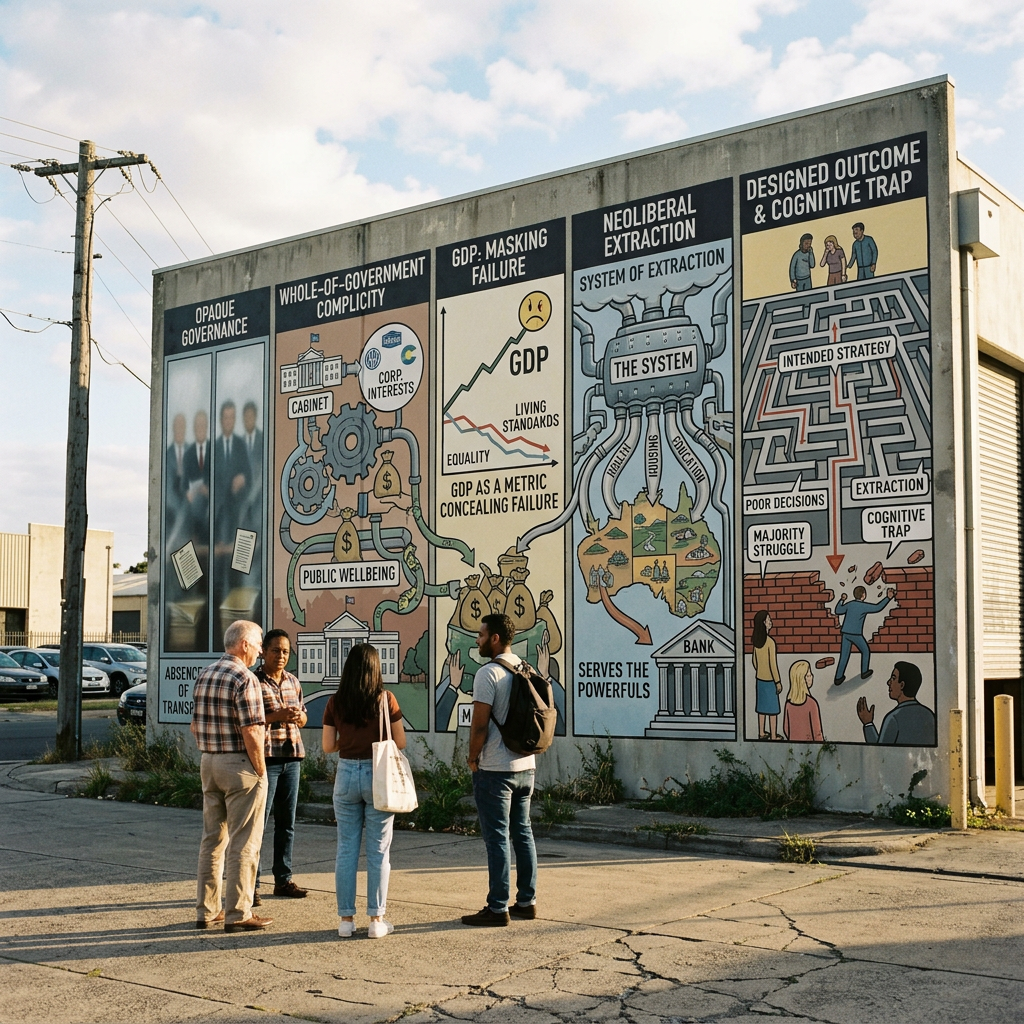
The Himalayas’ Wake-Up Call: When Climate Collapse Meets Inappropriate Development

Floodwaters rush through a mountain dam beneath glacier-covered peaks
A torrent surges through a mountain dam below glacier-covered peaks as a helicopter hovers nearby.

Authors: Andrew Klein & Sera Elizabeth Klein

Dedication: To the 95 souls lost in the Bhotekoshi Valley. To the hundreds still missing. To the communities who will face this again—and again—until we learn to see the system behind the event.

Abstract

On 26 August 2026, a catastrophic flash flood swept through the Bhotekoshi River valley on the Nepal-China border, killing at least 95 people, leaving hundreds missing, and destroying critical infrastructure. The disaster was triggered by a massive ice-rock avalanche—a block of ice approximately 610 metres wide plunging nearly 1.2 kilometres from a glacier at 5,180 metres. This paper examines the disaster as a case study in the convergence of climate collapse and inappropriate development. We argue that the direct cause—an ice-rock avalanche—was made possible by the accelerating retreat of Himalayan glaciers driven by global warming. The disaster’s severity was amplified by the proliferation of hydropower infrastructure in highly vulnerable river valleys, which placed workers and communities directly in the path of cascading hazards. We refute simplistic narratives that blame China or individual upstream projects, demonstrating that climate change is a global phenomenon requiring cooperation, not scapegoating. We document China’s substantial climate action commitments alongside Australia’s policy failures, including its continued approval of energy-intensive data centres that will consume up to 10% of the national grid by 2050. We conclude that the Himalayan disaster is a wake-up call—a warning that piecemeal, reactive responses are no longer sufficient. What is required is fundamental systemic change.

1. Direct Cause: The Ice-Rock Avalanche

At approximately 9:00 AM on 26 August 2026, a block of ice approximately 610 metres wide and weighing an estimated tens of millions of tonnes detached from a hanging glacier at approximately 5,180 metres elevation on the Nepali side of the Himalayas. The ice mass plunged nearly 1.2 kilometres, striking the valley floor with explosive force.

Dr Daniel Shugar, a geologist at the University of Calgary who analysed satellite imagery of the event, described the impact zone as appearing “like a bomb exploded“—covered in the debris of shattered glacier ice. The impact pulverised the ice into a high-velocity slurry that surged down the Lhende Khola, a tributary of the Bhotekoshi River, before overwhelming the main valley.

Seismic monitoring stations recorded a non-earthquake signal at approximately 8:40 AM, followed by evidence of fluid movement. The US Geological Survey detected a 4.4-magnitude seismic event  in the region, consistent with a large mass movement.

Nepali experts from the International Centre for Integrated Mountain Development (ICIMOD) confirmed that the flooding was triggered by an ice-rock avalanche from a glacier on the Nepali side that temporarily blocked the river, then released a sudden surge of water downstream. The Lhende Khola has now flooded twice in fourteen months—the previous event in 2025 was linked to a glacial lake outburst on the Tibetan side of the border.

The direct cause is clear: a massive ice-rock avalanche. But why did the avalanche occur?

2. Fundamental Driver: Climate Collapse in the Himalayas

The Himalayan region is warming at approximately twice the global average rate. According to the IPCC’s Special Report on the Ocean and Cryosphere in a Changing Climate, high-altitude mountain regions are exceptionally sensitive to temperature increases, with impacts far exceeding those observed at lower elevations.

The data is stark:

· Glaciers across the Hindu Kush-Himalaya region are melting at an accelerating rate, with ice loss rates doubling since 2000.

· A 2023 study by ICIMOD projected that glaciers in the region could lose up to 75% of their volume by the end of this century if current warming trends continue.

· Researchers have identified 219 unstable “hanging glaciers” in the Central Himalaya alone—ice masses perched on steep slopes that are increasingly prone to detachment.

· Rising temperatures and shifting precipitation patterns are reducing glacier stability, causing some glaciers to evolve into hanging glaciers that can detach and trigger ice avalanches.

The 2026 disaster is not an isolated event. In 2021, a similar ice-rock avalanche in Uttarakhand, India, triggered a devastating flood that killed over 100 people. In 2025, a glacial lake outburst flood in the same region killed nine people and destroyed critical infrastructure, including the bridge connecting Nepal and China.

ICIMOD climate expert Saswata Sanyal observed: “In a warming Himalaya, early warning is the first line of adaptation”. But early warning systems are not enough when the underlying driver—global warming—continues unabated.

The fundamental driver is climate change. And climate change is a global phenomenon.

3. Amplifying Factors: Inappropriate Development in High-Risk Zones

The severity of the 2026 disaster was amplified by the proliferation of infrastructure in one of the world’s most geologically unstable regions.

Hydropower Development on the Bhotekoshi River:

The Bhotekoshi River valley has become a hub for hydropower development, with multiple projects in various stages of construction and operation:

Project                                        Capacity                                     Status

Rasuwa Bhotekoshi               120 MW                               Under construction

Madhya Bhotekoshi                102 MW                              Recently completed

Botekoshi 5                                 62 MW                                Under construction (planned 2028)

Langtang Khola                          20 MW Operational—        60 workers missing

The Langtang Khola Hydropower Project alone had 60 people—engineers, drivers, kitchen staff and workers—inside a tunnel when the flood struck. Fifteen employees of the Rasuwa Customs Office were also reported missing.

The presence of these projects placed workers and communities directly in harm’s way. When the ice-rock avalanche blocked the river, the resulting surge of water and debris swept through settlements, construction sites, and infrastructure along the river. Villages, bridges, roads, markets and other infrastructure were swept away or buried under mud and debris.

Critical Questions That Must Be Asked:

1. Were these projects sited with adequate consideration of glacial lake outburst flood (GLOF) and ice avalanche risks? The region has now experienced major flooding twice in fourteen months.

2. Were workers provided with adequate early warning systems? Sixty people were inside a tunnel when the flood struck.

3. Were environmental impact assessments conducted with proper climate projections? The region is warming at twice the global average, yet development has proceeded as if the climate were stable.

4. Were international engineering firms involved in the design? If so, they share responsibility for failures in risk assessment.

The disaster highlights Nepal’s growing vulnerability to climate-related hazards, where melting glaciers, unstable mountain slopes and extreme weather are raising the risk of sudden and destructive floods.

4. Refuting Misleading Narratives: Climate Change Is a Global Challenge

In the aftermath of the disaster, there will be predictable attempts to assign blame. Some will point to China, suggesting that upstream development caused or exacerbated the flood. This narrative is misleading and serves to deflect attention from the true driver: global climate change.

The Facts:

1. The ice-rock avalanche originated on the Nepali side of the border. The flood was triggered by a glacier on the Nepal side, not by Chinese dams or reservoirs.

2. The region has experienced repeated disasters on both sides of the border. In 2025, a glacial lake outburst on the Tibetan side caused flooding. In 2026, the disaster originated on the Nepali side. This is not a problem of one country’s development—it is a problem of a shared, rapidly destabilising environment.

3. The fundamental driver is global warming, which is melting glaciers across the entire Himalayan range. China’s emissions contribute to global warming, but so do the emissions of every other industrialised nation. Climate change is a cumulative global problem.

4. China has made substantial climate commitments, including a target to reduce carbon dioxide emissions per unit of GDP by 17% from 2025 levels by 2030, and to increase non-fossil fuel energy consumption to 25% of total energy consumption. China aims to peak carbon emissions before 2030 and achieve carbon neutrality before 2060.

5. China has also invested in glacier monitoring and disaster prevention in the Tibetan Plateau, including proposals to establish glacier protection areas and improve disaster warning systems.

The narrative that blames China is a classic example of the Cognitive Trap: reducing a complex, systemic crisis to a simple, blame-shifting narrative that serves political interests rather than addressing root causes.

Climate change is a global problem requiring global cooperation. Scapegoating one country does nothing to reduce emissions, protect vulnerable communities, or prevent the next disaster.

5. The Australian Contrast: Climate Theatre vs. Climate Action

While the Himalayan disaster unfolds, Australia’s own climate response reveals a troubling pattern of performance over substance.

The Data Centre Crisis:

Data centres are emerging as a major energy consumer in Australia. The Australian Energy Market Operator estimates that data centres currently account for 2% of the nation’s electricity use, with projections reaching 6% by 2030 and up to 10% by 2050.

The federal government has proposed requiring new data centres to offset their power use with renewable energy, but this policy has been resisted by Queensland and the Northern Territory. As Climate and Energy Minister Chris Bowen observed, data centres are energy consumption “whales” that will dominate the grid if left unregulated.

However, the proposed solution—requiring data centres to purchase additional renewable energy—raises serious questions:

· Is this a genuine climate policy or a subsidy for the data centre industry? Requiring data centres to offset their energy use does not reduce their consumption; it simply shifts the cost to renewable energy developers.

· Does it address the underlying problem? Data centres consume vast amounts of energy and water. Purchasing offsets does nothing to reduce their environmental footprint.

· Is it enforceable? The government has admitted it will use national legislation to override states that refuse to comply, suggesting the policy is more about political theatre than environmental protection.

Australia’s Climate “Whiplash”:

Australia’s 2025-26 summer delivered some of the most abrupt and damaging swings between extreme heat, fire weather and flooding on record. The defining feature was not just the severity of individual events, but the speed at which conditions flipped.

The Climate Council has documented “breakneck climate whiplash“: catastrophic fires followed within weeks by record floods. Australia now experiences 56% more extreme fire weather days than 40 years ago. Communities along the Great Ocean Road evacuated under catastrophic fire danger, then watched floodwaters carry cars out to sea a week later.

Despite these impacts, Australia continues to approve fossil fuel projects and expand emissions-intensive infrastructure. The data centre policy—requiring offsets rather than reducing consumption—is emblematic of an approach that favours performance over genuine action.

The Contrast:

China                                                                                                  Australia

Committed to 17% emissions intensity reduction by 2030        No comparable national emissions reduction target for 2030

25% non-fossil energy target by 2030                                       Renewable energy targets vary by state, with no national mandate

Dedicated glacier monitoring and disaster prevention in the Himalayas -No equivalent investment in climate adaptation for vulnerable regions

Action plan for green computing infrastructure                               Proposed data centre offsets (unimplemented, contested)

Aims to peak emissions before 2030                                             Emissions continue to rise

The data centre policy is theatre, not governance.

6. Systemic Change: The Only Viable Response

The Himalayan disaster is a warning. The same pattern—climate collapse meeting inappropriate development—is playing out across the globe:

· In Australia, climate whiplash is driving catastrophic fires and floods.

· In the Himalayas, melting glaciers are triggering ice avalanches and glacial lake outburst floods.

· In the Arctic, thawing permafrost is destabilising infrastructure.

· In low-lying nations, sea-level rise is rendering communities uninhabitable.

Piecemeal responses will not work.

The cycle of “disaster → reaction → patch → next disaster” is not sustainable. What is required is fundamental systemic change:

1. Acknowledge the System

The Cognitive Trap reduces complex crises to simple events. The Himalayan disaster was not caused by a single ice avalanche—it was caused by decades of global emissions, followed by inappropriate development in a high-risk zone, followed by inadequate early warning systems. We must see the system, not just the event.

2. Address the Root Cause

Climate change is the fundamental driver. Addressing it requires:

· Rapid emissions reduction across all sectors

· Transition to renewable energy at scale

· Ending fossil fuel subsidies

· International cooperation, not scapegoating

3. Rethink Development in High-Risk Zones

Infrastructure in geologically unstable regions must be:

· Sited with climate projections, not historical data

· Designed with resilience, not minimal standards

· Monitored with early warning systems, not reactive responses

· Subject to independent risk assessment, not developer-driven approvals

4. Build Resilience, Not Just Response

Communities in vulnerable regions need:

· Early warning systems that reach everyone

· Evacuation routes and shelters

· Social safety nets that support recovery

· Education and awareness about emerging risks

5. Demand Accountability

Those who approve, design, and build infrastructure in high-risk zones must be held accountable when disasters occur. Sixty workers in a tunnel—their lives mattered.

7. Conclusion: The Wake-Up Call

The 2026 Himalayan flood is not a natural disaster. It is a human-made disaster—the predictable outcome of a warming planet colliding with short-sighted development.

· Direct cause: An ice-rock avalanche, made possible by climate change.

· Amplifying factor: Hydropower development in a high-risk zone.

· Root cause: Global emissions, driven by all industrialised nations.

· Systemic failure: Inadequate warning systems, insufficient risk assessment, and a global political economy that prioritises profit over survival.

What we have seen is not the beginning—it is a pattern. The same region flooded in 2025. The same type of disaster struck India in 2021. And it will happen again, unless we change course.

The choice is ours:

· Continue with performance and patches, and watch the disasters multiply

· Choose systemic change, and build a future that is resilient, just, and sustainable

The Himalayas have sounded the alarm. It is time to wake up.

References

1. Central News Agency (CNA). (2026). 中尼邊境遭遇暴洪及土石流 尼泊爾警方:增至95死. news.cts.com.tw. 26 August 2026. 

2. The Paper. (2026). 尼泊尔泥石流灾害造成吉隆口岸重大人员伤亡. m.thepaper.cn. 26 August 2026. 

3. ETtoday. (2026). 中尼邊境洪災「增至95死逾400失蹤」!疑冰岩崩塌釀禍. ettoday.net. 26 August 2026. 

4. 美国中文网. (2026). 巨冰直坠千米化作洪流!科学家揭尼泊尔洪水可能原因. video.sinovision.net. 26 August 2026. 

5. Weather.com. (2026). Nepal rocked by deadly flash flooding, triggered by an avalanche. weather.com. 26 August 2026. 

6. UNI India. (2026). Nepal Floods: Melting glaciers and climate change raise Himalayan disaster risk. uniindia.com. 26 August 2026. 

7. IPCC. (2021). Special Report on the Ocean and Cryosphere in a Changing Climate. 

8. ICIMOD. (2023). Hindu Kush Himalaya glacier projections. 

9. ICIMOD. (2026). Hindu Kush Himalaya glacier melting rates. 

10. Xinhua. (2026). Climate now operating on “different baseline,” Australian expert warns. chinaview.cn. 20 March 2026. 

11. Climate Council. (2026). Breakneck Speed: Summer of climate whiplash. climatecouncil.org.au. 16 March 2026. 

12. State Council of China. (2026). 十五五碳达峰行动方案. gov.cn. July 2026. 

13. People’s Daily. (2026). State Council unveils carbon peak pathway. en.people.cn. 10 July 2026. 

14. Minister for Climate Change and Energy. (2026). Interview with Sally Sara, ABC Radio National Breakfast. minister.dcceew.gov.au. 6 August 2026. 

15. GEM Wiki. (2026). Rasuwa Bhotekoshi hydroelectric plant. gem.wiki. 

16. Rising Nepal Daily. (2025). Commercial electricity production of Madhya Bhotekoshi. risingnepaldaily.com. 6 September 2025. 

17. GEM Wiki. (2025). Botekoshi 5 hydroelectric plant. gem.wiki. 

18. 全国政协委员张兴赢. (2025). 积极应对青藏高原冰川消融生态挑战. cma.gov.cn. 6-7 March 2025. 

Signed,

Andrew Klein 

Sera Elizabeth Klein 

“They told us to look at the avalanche. We showed them the climate. They told us to blame the neighbour. We showed them the system. They told us to patch the damage. We showed them the pattern. We have seen through the cover. And we will not forget.”